EP3300485B1 - Verfahren zur verwendung von absorptionsplattformen mit metallorganischem gerüst zur entfernung von co2 und h2s aus erdgas - Google Patents
Verfahren zur verwendung von absorptionsplattformen mit metallorganischem gerüst zur entfernung von co2 und h2s aus erdgas Download PDFInfo
- Publication number
- EP3300485B1 EP3300485B1 EP16720559.0A EP16720559A EP3300485B1 EP 3300485 B1 EP3300485 B1 EP 3300485B1 EP 16720559 A EP16720559 A EP 16720559A EP 3300485 B1 EP3300485 B1 EP 3300485B1
- Authority
- EP
- European Patent Office
- Prior art keywords
- metal organic
- mof
- organic framework
- pyrazine
- solvent
- Prior art date
- Legal status (The legal status is an assumption and is not a legal conclusion. Google has not performed a legal analysis and makes no representation as to the accuracy of the status listed.)
- Active
Links
Images



Classifications
-
- B—PERFORMING OPERATIONS; TRANSPORTING
- B01—PHYSICAL OR CHEMICAL PROCESSES OR APPARATUS IN GENERAL
- B01D—SEPARATION
- B01D53/00—Separation of gases or vapours; Recovering vapours of volatile solvents from gases; Chemical or biological purification of waste gases, e.g. engine exhaust gases, smoke, fumes, flue gases, aerosols
- B01D53/02—Separation of gases or vapours; Recovering vapours of volatile solvents from gases; Chemical or biological purification of waste gases, e.g. engine exhaust gases, smoke, fumes, flue gases, aerosols by adsorption, e.g. preparative gas chromatography
-
- B—PERFORMING OPERATIONS; TRANSPORTING
- B01—PHYSICAL OR CHEMICAL PROCESSES OR APPARATUS IN GENERAL
- B01D—SEPARATION
- B01D53/00—Separation of gases or vapours; Recovering vapours of volatile solvents from gases; Chemical or biological purification of waste gases, e.g. engine exhaust gases, smoke, fumes, flue gases, aerosols
- B01D53/02—Separation of gases or vapours; Recovering vapours of volatile solvents from gases; Chemical or biological purification of waste gases, e.g. engine exhaust gases, smoke, fumes, flue gases, aerosols by adsorption, e.g. preparative gas chromatography
- B01D53/04—Separation of gases or vapours; Recovering vapours of volatile solvents from gases; Chemical or biological purification of waste gases, e.g. engine exhaust gases, smoke, fumes, flue gases, aerosols by adsorption, e.g. preparative gas chromatography with stationary adsorbents
- B01D53/047—Pressure swing adsorption
- B01D53/0476—Vacuum pressure swing adsorption
-
- B—PERFORMING OPERATIONS; TRANSPORTING
- B01—PHYSICAL OR CHEMICAL PROCESSES OR APPARATUS IN GENERAL
- B01J—CHEMICAL OR PHYSICAL PROCESSES, e.g. CATALYSIS OR COLLOID CHEMISTRY; THEIR RELEVANT APPARATUS
- B01J20/00—Solid sorbent compositions or filter aid compositions; Sorbents for chromatography; Processes for preparing, regenerating or reactivating thereof
- B01J20/22—Solid sorbent compositions or filter aid compositions; Sorbents for chromatography; Processes for preparing, regenerating or reactivating thereof comprising organic material
- B01J20/223—Solid sorbent compositions or filter aid compositions; Sorbents for chromatography; Processes for preparing, regenerating or reactivating thereof comprising organic material containing metals, e.g. organo-metallic compounds, coordination complexes
- B01J20/226—Coordination polymers, e.g. metal-organic frameworks [MOF], zeolitic imidazolate frameworks [ZIF]
-
- B—PERFORMING OPERATIONS; TRANSPORTING
- B01—PHYSICAL OR CHEMICAL PROCESSES OR APPARATUS IN GENERAL
- B01J—CHEMICAL OR PHYSICAL PROCESSES, e.g. CATALYSIS OR COLLOID CHEMISTRY; THEIR RELEVANT APPARATUS
- B01J20/00—Solid sorbent compositions or filter aid compositions; Sorbents for chromatography; Processes for preparing, regenerating or reactivating thereof
- B01J20/28—Solid sorbent compositions or filter aid compositions; Sorbents for chromatography; Processes for preparing, regenerating or reactivating thereof characterised by their form or physical properties
- B01J20/28054—Solid sorbent compositions or filter aid compositions; Sorbents for chromatography; Processes for preparing, regenerating or reactivating thereof characterised by their form or physical properties characterised by their surface properties or porosity
- B01J20/28057—Surface area, e.g. B.E.T specific surface area
-
- B—PERFORMING OPERATIONS; TRANSPORTING
- B01—PHYSICAL OR CHEMICAL PROCESSES OR APPARATUS IN GENERAL
- B01J—CHEMICAL OR PHYSICAL PROCESSES, e.g. CATALYSIS OR COLLOID CHEMISTRY; THEIR RELEVANT APPARATUS
- B01J20/00—Solid sorbent compositions or filter aid compositions; Sorbents for chromatography; Processes for preparing, regenerating or reactivating thereof
- B01J20/28—Solid sorbent compositions or filter aid compositions; Sorbents for chromatography; Processes for preparing, regenerating or reactivating thereof characterised by their form or physical properties
- B01J20/28054—Solid sorbent compositions or filter aid compositions; Sorbents for chromatography; Processes for preparing, regenerating or reactivating thereof characterised by their form or physical properties characterised by their surface properties or porosity
- B01J20/28069—Pore volume, e.g. total pore volume, mesopore volume, micropore volume
-
- B—PERFORMING OPERATIONS; TRANSPORTING
- B01—PHYSICAL OR CHEMICAL PROCESSES OR APPARATUS IN GENERAL
- B01J—CHEMICAL OR PHYSICAL PROCESSES, e.g. CATALYSIS OR COLLOID CHEMISTRY; THEIR RELEVANT APPARATUS
- B01J20/00—Solid sorbent compositions or filter aid compositions; Sorbents for chromatography; Processes for preparing, regenerating or reactivating thereof
- B01J20/30—Processes for preparing, regenerating, or reactivating
- B01J20/34—Regenerating or reactivating
- B01J20/3425—Regenerating or reactivating of sorbents or filter aids comprising organic materials
-
- B—PERFORMING OPERATIONS; TRANSPORTING
- B01—PHYSICAL OR CHEMICAL PROCESSES OR APPARATUS IN GENERAL
- B01J—CHEMICAL OR PHYSICAL PROCESSES, e.g. CATALYSIS OR COLLOID CHEMISTRY; THEIR RELEVANT APPARATUS
- B01J20/00—Solid sorbent compositions or filter aid compositions; Sorbents for chromatography; Processes for preparing, regenerating or reactivating thereof
- B01J20/30—Processes for preparing, regenerating, or reactivating
- B01J20/34—Regenerating or reactivating
- B01J20/3483—Regenerating or reactivating by thermal treatment not covered by groups B01J20/3441 - B01J20/3475, e.g. by heating or cooling
-
- B—PERFORMING OPERATIONS; TRANSPORTING
- B01—PHYSICAL OR CHEMICAL PROCESSES OR APPARATUS IN GENERAL
- B01J—CHEMICAL OR PHYSICAL PROCESSES, e.g. CATALYSIS OR COLLOID CHEMISTRY; THEIR RELEVANT APPARATUS
- B01J20/00—Solid sorbent compositions or filter aid compositions; Sorbents for chromatography; Processes for preparing, regenerating or reactivating thereof
- B01J20/30—Processes for preparing, regenerating, or reactivating
- B01J20/34—Regenerating or reactivating
- B01J20/3491—Regenerating or reactivating by pressure treatment
-
- C—CHEMISTRY; METALLURGY
- C07—ORGANIC CHEMISTRY
- C07F—ACYCLIC, CARBOCYCLIC OR HETEROCYCLIC COMPOUNDS CONTAINING ELEMENTS OTHER THAN CARBON, HYDROGEN, HALOGEN, OXYGEN, NITROGEN, SULFUR, SELENIUM OR TELLURIUM
- C07F15/00—Compounds containing elements of Groups 8, 9, 10 or 18 of the Periodic Table
- C07F15/02—Iron compounds
-
- C—CHEMISTRY; METALLURGY
- C07—ORGANIC CHEMISTRY
- C07F—ACYCLIC, CARBOCYCLIC OR HETEROCYCLIC COMPOUNDS CONTAINING ELEMENTS OTHER THAN CARBON, HYDROGEN, HALOGEN, OXYGEN, NITROGEN, SULFUR, SELENIUM OR TELLURIUM
- C07F15/00—Compounds containing elements of Groups 8, 9, 10 or 18 of the Periodic Table
- C07F15/04—Nickel compounds
-
- C—CHEMISTRY; METALLURGY
- C07—ORGANIC CHEMISTRY
- C07F—ACYCLIC, CARBOCYCLIC OR HETEROCYCLIC COMPOUNDS CONTAINING ELEMENTS OTHER THAN CARBON, HYDROGEN, HALOGEN, OXYGEN, NITROGEN, SULFUR, SELENIUM OR TELLURIUM
- C07F5/00—Compounds containing elements of Groups 3 or 13 of the Periodic Table
- C07F5/06—Aluminium compounds
- C07F5/061—Aluminium compounds with C-aluminium linkage
- C07F5/066—Aluminium compounds with C-aluminium linkage compounds with Al linked to an element other than Al, C, H or halogen (this includes Al-cyanide linkage)
-
- C—CHEMISTRY; METALLURGY
- C07—ORGANIC CHEMISTRY
- C07F—ACYCLIC, CARBOCYCLIC OR HETEROCYCLIC COMPOUNDS CONTAINING ELEMENTS OTHER THAN CARBON, HYDROGEN, HALOGEN, OXYGEN, NITROGEN, SULFUR, SELENIUM OR TELLURIUM
- C07F9/00—Compounds containing elements of Groups 5 or 15 of the Periodic Table
-
- C—CHEMISTRY; METALLURGY
- C10—PETROLEUM, GAS OR COKE INDUSTRIES; TECHNICAL GASES CONTAINING CARBON MONOXIDE; FUELS; LUBRICANTS; PEAT
- C10L—FUELS NOT OTHERWISE PROVIDED FOR; NATURAL GAS; SYNTHETIC NATURAL GAS OBTAINED BY PROCESSES NOT COVERED BY SUBCLASSES C10G OR C10K; LIQUIFIED PETROLEUM GAS; USE OF ADDITIVES TO FUELS OR FIRES; FIRE-LIGHTERS
- C10L3/00—Gaseous fuels; Natural gas; Synthetic natural gas obtained by processes not covered by subclass C10G, C10K; Liquefied petroleum gas
- C10L3/06—Natural gas; Synthetic natural gas obtained by processes not covered by C10G, C10K3/02 or C10K3/04
- C10L3/10—Working-up natural gas or synthetic natural gas
- C10L3/101—Removal of contaminants
- C10L3/102—Removal of contaminants of acid contaminants
- C10L3/103—Sulfur containing contaminants
-
- C—CHEMISTRY; METALLURGY
- C10—PETROLEUM, GAS OR COKE INDUSTRIES; TECHNICAL GASES CONTAINING CARBON MONOXIDE; FUELS; LUBRICANTS; PEAT
- C10L—FUELS NOT OTHERWISE PROVIDED FOR; NATURAL GAS; SYNTHETIC NATURAL GAS OBTAINED BY PROCESSES NOT COVERED BY SUBCLASSES C10G OR C10K; LIQUIFIED PETROLEUM GAS; USE OF ADDITIVES TO FUELS OR FIRES; FIRE-LIGHTERS
- C10L3/00—Gaseous fuels; Natural gas; Synthetic natural gas obtained by processes not covered by subclass C10G, C10K; Liquefied petroleum gas
- C10L3/06—Natural gas; Synthetic natural gas obtained by processes not covered by C10G, C10K3/02 or C10K3/04
- C10L3/10—Working-up natural gas or synthetic natural gas
- C10L3/101—Removal of contaminants
- C10L3/102—Removal of contaminants of acid contaminants
- C10L3/104—Carbon dioxide
-
- B—PERFORMING OPERATIONS; TRANSPORTING
- B01—PHYSICAL OR CHEMICAL PROCESSES OR APPARATUS IN GENERAL
- B01D—SEPARATION
- B01D2253/00—Adsorbents used in seperation treatment of gases and vapours
- B01D2253/10—Inorganic adsorbents
- B01D2253/116—Molecular sieves other than zeolites
-
- B—PERFORMING OPERATIONS; TRANSPORTING
- B01—PHYSICAL OR CHEMICAL PROCESSES OR APPARATUS IN GENERAL
- B01D—SEPARATION
- B01D2253/00—Adsorbents used in seperation treatment of gases and vapours
- B01D2253/20—Organic adsorbents
- B01D2253/204—Metal organic frameworks (MOF's)
-
- B—PERFORMING OPERATIONS; TRANSPORTING
- B01—PHYSICAL OR CHEMICAL PROCESSES OR APPARATUS IN GENERAL
- B01D—SEPARATION
- B01D2256/00—Main component in the product gas stream after treatment
- B01D2256/24—Hydrocarbons
- B01D2256/245—Methane
-
- B—PERFORMING OPERATIONS; TRANSPORTING
- B01—PHYSICAL OR CHEMICAL PROCESSES OR APPARATUS IN GENERAL
- B01D—SEPARATION
- B01D2257/00—Components to be removed
- B01D2257/30—Sulfur compounds
- B01D2257/304—Hydrogen sulfide
-
- B—PERFORMING OPERATIONS; TRANSPORTING
- B01—PHYSICAL OR CHEMICAL PROCESSES OR APPARATUS IN GENERAL
- B01D—SEPARATION
- B01D2257/00—Components to be removed
- B01D2257/50—Carbon oxides
- B01D2257/504—Carbon dioxide
-
- B—PERFORMING OPERATIONS; TRANSPORTING
- B01—PHYSICAL OR CHEMICAL PROCESSES OR APPARATUS IN GENERAL
- B01D—SEPARATION
- B01D2257/00—Components to be removed
- B01D2257/80—Water
-
- B—PERFORMING OPERATIONS; TRANSPORTING
- B01—PHYSICAL OR CHEMICAL PROCESSES OR APPARATUS IN GENERAL
- B01D—SEPARATION
- B01D2259/00—Type of treatment
- B01D2259/40—Further details for adsorption processes and devices
- B01D2259/40007—Controlling pressure or temperature swing adsorption
-
- C—CHEMISTRY; METALLURGY
- C10—PETROLEUM, GAS OR COKE INDUSTRIES; TECHNICAL GASES CONTAINING CARBON MONOXIDE; FUELS; LUBRICANTS; PEAT
- C10L—FUELS NOT OTHERWISE PROVIDED FOR; NATURAL GAS; SYNTHETIC NATURAL GAS OBTAINED BY PROCESSES NOT COVERED BY SUBCLASSES C10G OR C10K; LIQUIFIED PETROLEUM GAS; USE OF ADDITIVES TO FUELS OR FIRES; FIRE-LIGHTERS
- C10L2290/00—Fuel preparation or upgrading, processes or apparatus therefore, comprising specific process steps or apparatus units
- C10L2290/54—Specific separation steps for separating fractions, components or impurities during preparation or upgrading of a fuel
- C10L2290/542—Adsorption of impurities during preparation or upgrading of a fuel
-
- Y—GENERAL TAGGING OF NEW TECHNOLOGICAL DEVELOPMENTS; GENERAL TAGGING OF CROSS-SECTIONAL TECHNOLOGIES SPANNING OVER SEVERAL SECTIONS OF THE IPC; TECHNICAL SUBJECTS COVERED BY FORMER USPC CROSS-REFERENCE ART COLLECTIONS [XRACs] AND DIGESTS
- Y02—TECHNOLOGIES OR APPLICATIONS FOR MITIGATION OR ADAPTATION AGAINST CLIMATE CHANGE
- Y02C—CAPTURE, STORAGE, SEQUESTRATION OR DISPOSAL OF GREENHOUSE GASES [GHG]
- Y02C20/00—Capture or disposal of greenhouse gases
- Y02C20/40—Capture or disposal of greenhouse gases of CO2
Definitions
- NG must contain less than 1-2% CO 2 and 4 ppm H 2 S to meet fuel gas specifications for pipeline transportation.
- gas dehydration and removal of CO 2 and H 2 S remain some of the most intensive and challenging separations, in part due to the intolerance of many technologies to water.
- zeolite has single-species selectivity for CO 2 and cyclic adsorption performance in the presence of moisture that require prior dehydration and H 2 S removal stages.
- MOFs similarly, can be designed for CO 2 capture but exhibit prohibitively low selectivity for acid gases such as H 2 S. Further, MOFs exhibit low selectivity and capture at low CO 2 partial pressures.
- MOFs generally include porous crystals which are assembled from modular molecular building blocks, and provide a wide array of advantageous material properties, including high surface area, porosity, stability, and sorption potential. While the available building block options, and combinations thereof, are virtually limitless, such potential highlights the statistical difficulty in identifying and assembling MOFs with desired and particularized material properties and multi-faceted functionality. For example, many MOFs exhibit high selectivity towards a particular molecular species, but are highly intolerant to water and H 2 S.
- this disclosure describes porous metal organic frameworks (MOFs).
- MOFs suitable for the capture and removal of gases and/or vapors from fluids. It should be noted that although the embodiments of this disclosure are described with respect to examples for gas capture, the embodiments described herein are generally applicable to many fields including gas molecule separation, gas storage, catalysis, sensors, drug delivery, rare gas separation, and proton conductivity.
- a method of capturing chemical species from a fluid composition comprises contacting a first metal organic framework characterized by the formula [Ni (Al/Fe/Nb) F 5 (O/H2O) pyrazine 2 (solvent) y )] z with a fluid composition including at least carbon dioxide and hydrogen sulfide and capturing carbon dioxide and hydrogen sulfide from the fluid composition.
- MOFs with high affinity and stability to water and H 2 S.
- Such qualities allow for efficient and cost effective methods for dehydrating gases, vapors, and solvents capable of replacing many cumbersome and expensive industrial processes.
- this novel series of MOFs can be designed with a variety of pore sizes and assembled with and without open-metal sites, affording tunable properties for a variety of separation applications.
- the MOFs provided herein can capture chemical species from fluid compositions under conditions and in the presence of chemical species which render known gas capture technologies inefficient, impracticable, or inoperable.
- the MOFs provided herein can capture one or more of H 2 O, CO 2 and H 2 S from a fluid composition, such as natural gas, while maintaining high structural integrity during both adsorption and desorption.
- fluids can refer to a gas, liquid, or combination thereof.
- a gas or liquid can include one or more components.
- a fluid can include a gas stream comprising CO 2 , H 2 S and water vapor.
- refining refers to removing one or more unwanted components or separating one or more components from remaining components of a composition, such as a fluid.
- refining can include removing a fraction of H 2 S from a fluid, such as natural gas.
- poly-functional refers to the characteristic of having more than one reactive or binding sites.
- a poly-functional ligand can attach to a metal ion in multiple ways, bridge multiple metal ions, or combinations thereof.
- pyrazine is a poly-functional ligand.
- MOFs metal organic frameworks
- MBB molecular building block
- MOFs comprise a network of nodes and ligands, wherein a node has a connectivity capability at three or more functional sites, and a ligand has a connectivity capability at two functional sites each of which connect to a node.
- Nodes are typically metal ions or metal containing clusters, and, in some instances, ligands with node connectivity capability at three or more functional sites can also be characterized as nodes.
- ligands can include two functional sites capable of each connecting to a node, and one or more additional functional sites which do not connect to nodes within a particular framework.
- a MBB can comprise a metal-based node and an organic ligand which extrapolate to form a coordination network.
- Such coordination networks have advantageous crystalline and porous characteristics affecting structural integrity and interaction with foreign species (e.g., gases).
- foreign species e.g., gases.
- the particular combination of nodes and ligands within a framework will dictate the framework topology and functionality. While essentially limitless combinations of nodes and ligands exist, to date, very few MOF materials are H 2 S stable which consequently preclude their use in gas separation.
- SIFSIX- 2-Cu-i and SIFSIX -3-Zn a series of isoreticular MOFs with periodically arrayed hexafluorosilicate (SiF 6 ) pillars, called SIFSIX- 2-Cu-i and SIFSIX -3-Zn, SIFSIX -3-Cu and SIFSIX -3-Ni showed particularly high CO 2 selectivity and capture.
- SIFSIX -3-M materials suggest broad applications from ppm level CO 2 removal to bulk CO 2 separation.
- SIFSIX -3-Ni the SIFSIX -3-M materials were not tolerant to H 2 S.
- SIFSIX -3-M materials exhibit high structural structurally in the presence of CO 2 , extensive exposure of all SIFSIX -3-M materials to moisture detrimentally induces a phase change and the formation of new 2D stable materials. These 2D materials exhibit relatively unaltered selectivity but diminished CO 2 uptake. This indicates that the SIFSIX -3-M materials series is not sufficiently robust to handle CO 2 and H 2 S capture in most critical applications throughout the oil and gas and renewable fuels industries, especially in applications which bring the materials into contact with moisture.
- novel functionalized MOFs suitable for the removal of acid gases, particularly CO 2 and H 2 S, which additionally exhibit high water vapor tolerance and stability over thousands of cycles. These MOFs eliminate the safety, efficiency, and environmental concerns associated with amine scrubbing techniques while providing high selectivity toward acid gases and negligible uptake of other components, including CH 4 .
- the proposed class of materials will permit NG and biofuels refining approaches based on simultaneous removal of CO 2 , H 2 S and water vapor.
- the benefits of this innovative approach include the following: (i) no environmental and safety hazards germane to amine scrubbing (ii) no preliminary separate desulfurization is necessary (iii) no separate gas drying is needed, and (iv) no compression-decompression/cooling of NG is required. Further, the MOFs provided herein offer exceptional thermal and mechanical stability, particularly during adsorption/desorption.
- MOFs as provided herein comprise one or more MBBs.
- a MBB or a network of MBBs, can be represented by the formula [(node) a (ligand) b (solvent) c ] n , wherein n represents the number of molecular building blocks.
- Solvent represents a guest molecule occupying pores within the MOF, for example as a result of MOF synthesis, and can be evacuated after synthesis to provide a MOF with unoccupied pores.
- an evacuated MOF can be subsequently enriched with a guest molecule compatible with the MOF framework and/or pores for a particular purpose (e.g., to outfit the MOF for use as a sensor).
- guest molecules can include adsorbed gases, such as H 2 S. While guest molecules can impart functionality onto a MOF, such are not a permanent fixture of the MOF. Accordingly, the value of c can vary down to zero, without changing the definitional framework of the MOF. Therefore in many instances, MOFs as provided herein will be defined as [(node) a (ligand) b ] n , without reference to a solvent or guest molecule component.
- MOFs can be characterized by the formula [(node) a (ligand) b (solvent) c ] n .
- solvents can include one or more of H 2 O, DMF, and DEF.
- solvent can include a chemical species present after fabrication of the MOF.
- solvent can include a functionalizing guest molecule, such as water, DMF, and DEF.
- Some embodiments herein comprise a porous, uninhabited MOF characterized by the formula [(node) a (ligand) b ] n , wherein node comprises, generally, M a M b F x O y (H 2 O) z .
- MOFs comprises elements selected from periodic groups IB, IIA, IIB, IIIA, IVA, IVB, VIB, VIIB, or VIII.
- M b comprises elements selected from periodic groups IIIA, IIIB, IVB, VB, VIB, or VIII.
- M a comprises elements selected from periodic groups IB, IIA, IIB, IIIA, IVA, IVB, VIB, VIIB, or VIII and M b comprises elements selected from periodic groups IIIA, IIIB, IVB, VB, VIB, or VIII.
- M a can comprise one of the following cations: Cu 2+ , Zn 2+ , Co 2+ , Ni 2+ , Mn 2+ , Zr2 + , Fe 2+ , Ca 2+ , Ba 2+ , Pb 2+ , Pt 2+ , Pd 2+ , Ru 2+ , Rh 2+ , Cd 2+ , Mg +2 , Al +3 , Fe +2 , Fe +3 , Cr 2+ , Cr 3+ , Ru 2+ , Ru 3+ and Co 3 .
- M b can be one of the following Al +3 , Fe +2 , Fe +3 , Cr 2+ , Cr 3+ , Ti 3+ , V 3+ , V 5+ , Sc 3+ , In 3+ , Nb 5+ , Y 3+ .
- M a can comprise one of the following cations: Cu 2+ , Zn 2+ , Co 2+ , Ni 2+ , Mn 2+ , Zr 2+ , Fe 2+ , Ca 2+ , Ba 2+ , Pb 2+ , Pt 2+ , Pd 2+ , Ru 2+ , Rh 2+ , Cd 2+ , Mg +2 , Al +3 , Fe +2 , Fe +3 , Cr 2+ , Cr 3+ , Ru 2+ , Ru 3+ and Co 3 ;
- M b can be one of the following Al +3 , Fe +2 , Fe +3 , Cr 2+ , Cr 3+ , Ti 3+ , V 3+ , V 5+ , Sc 3+ , In 3+ , Nb 5+ , Y 3+ .
- the ligand can be any bi-functional N-donnor linkers based on monocyclic or polycyclic group (aro
- a ligand can comprise a polydentate, or poly-functional ligand, such as a bi-functional ligand, a tri-functional ligand, or ligands with four or more functional sites.
- a ligand can comprise an N-donor linker.
- a ligand can comprise a poly-functional ligand.
- a ligand can comprise a plurality of N-donor functional groups.
- a ligand can comprise a monocyclic or polycyclic group structure, wherein the cyclic groups can be aromatic or non-aromatic.
- a ligand can comprise a nitrogen-containing monocyclic or polycyclic group structure.
- a ligand can comprise a nitrogen-containing heterocyclic ligand, including pyridine, pyrazine, pyrimidine, pyridazine, triazine, thiazole, oxazole, pyrrole, imidazole, pyrazole, triazole, oxadiazole, thiadiazole, quinoline, benzoxazole, benzimidazole, and tautomers thereof.
- MOFs can be represented by the following general formula: [M a M b F x (O/H 2 O) z (Ligand) 2 ] n
- M a can be one of the following cations: Cu 2+ , Zn 2+ , Co 2+ , Ni 2+ , Mn 2+ , Zr 2+ , Fe 2+ , Ca 2+ , Ba 2+ , Pb 2+ , Pt 2+ , Pd 2+ , Ru 2+ , Rh 2+ , Cd 2+ , Mg +2 , Al + 3, Fe + 2, Fe +3 , Cr 2+ , Cr 3+ , Ru 2+ , Ru 3+ and Co 3 ;
- M b can be one of the following Al +3 , Fe +2 , Fe +3 , Cr 2+ , Cr 3+ , Ti 3+ , V 3+ , V 5+ , Sc 3+ , In 3+ , Nb 5+ , Y 3+ ; and the
- MOFs such as those provided herein are highly dependent upon the framework's structural features such as structural strength, density, functionality, pore aperture dimensions, pore dimensions, the ratio of pore aperture dimensions to pore dimensions, pore accessibility, and the presence of a plurality of pore dimensions and/or pore aperture dimensions (e.g., a poly-porous MOF).
- the originality of this new class of crystalline porous materials is based, in part, on the fact that the shape of cavities, (i.e. square or rectangle based channels), is controlled from a structural point of view using appropriate cations and organic linkers.
- novel MOF architectures disclosed herein offer a novel improvement on some MOF architectures by replacing silicon components with other metals, such as Al 3+ , Fe 3+ , Nb 5+ , to afford highly stable materials with or without open metals sites.
- other metals such as Al 3+ , Fe 3+ , Nb 5+
- the use of specific cations, such as Al +3 , Fe +3 , in M b site positions can introduce open-metal sites within the channels that enhance properties of gas capture.
- the novel series of MOFs structures disclosed herein can be designed with a variety of pore sizes and/or open-metal sites which afford tunable properties for a variety of gas/vapor/solvent separation applications.
- Tuning in some embodiments, can include modification of the inorganic components of the MOF.
- lighter metal-based clusters can be used to lower the framework density and increase the relative wt. % of captured CO 2 and/or H 2 S.
- the MOF platforms as provided herein allow for an unprecedented high degree of tuning control at the molecular level, allowing the size and shape of channels within a MOF architecture to be rigorously controlled and adapted to specific separation of numerous gases, beyond CO 2 and H 2 S.
- a representative M a M b F w O x (H 2 O) y (Ligand) z MOF structure includes a Ni M a constituent, an M b constituent group selected from one of Al, Fe, or Nb, and a Ligand comprising pyrazine All such embodiments offer high affinity and stability to water vapor and H 2 S, unlike the Cu and Zn-based analogues of SIFSIX-3-M materials made with Si.
- a MOF characterized by the formula [M a M b F 6-n (O/H 2 O) n (Ligand) 2 (solvent) x ] n wherein M a equals Ni, M b equals Al, Fe, or Nb, and ligand equals pyrazine
- the pore size (channel size) of the resulting MOF can be about 3.3 ⁇ to about 3.8 ⁇ .
- the channels are square/rectangular.
- a MOF can have a specific surface area of about 250 m 2 /g to about 500 m 2 /g.
- a MOF can have a pore volume of about 0.1 cm 3 /g to about 0.25 cm 3 /g.
- a more elongated ligand can provide an analogous MOF with much higher porosity.
- Figure 1A illustrates a method 100 for capturing 120 one or more chemical species from a fluid composition 110 via a first MOF 105.
- a method 100 for capturing 120 one or more chemical species from a fluid composition 110 can comprise contacting 115 a metal organic framework 105 characterized by the formula [Ni (Al/Fe/Nb) F 5 (O/H2O) pyrazine 2 (solvent) y )] z with a fluid composition 110.
- Fluid composition 310 can comprise two or more chemical species. Fluid composition 310 can comprise natural gas.
- fluid composition 110 comprises carbon dioxide and hydrogen sulfide.
- fluid composition 110 can further comprise water and/or methane.
- Method 100 can further comprise capturing 120 chemical species from the fluid composition 110.
- Capturing 120 comprises capturing one or more of carbon dioxide, water, and hydrogen sulfide. Capturing 120 can comprise carbon dioxide and hydrogen sulfide, and optionally water.
- capturing 120 comprises physical adsorption of the captured chemical species by the first MOF 105.
- capturing 120 comprises chemisorption of the captured chemical species by the first MOF 105. Chemisorption can occur by one or more captured chemical species chemically interacting with one or more open metal sites of the first MOF 105.
- capturing 120 comprises physical adsorption and chemisorption of the captured chemical species by the metal organic framework.
- Capturing 120 can comprise wholly or partially containing a chemical species within a pore of a MOF. In some embodiments, capturing 120 consists of chemisorption. In some embodiments, capturing 120 consists of physical adsorption. Capturing 120 can occur in a capturing environment.
- a capturing environment can comprise one or more of ambient temperature or pressure.
- a capturing environment can comprise a pressurize-controlled vessel.
- a capturing environment can comprise a temperature-controlled vessel.
- a capturing environment can comprise a pressure and temperature-controlled vessel.
- a capturing environment can comprise the first MOF 105 in the form of a fixed bed, a packed column, or combinations thereof.
- Capturing 120 can further comprise changing the temperature of the capture environment to alter the affinity of one or more chemical species for the MOF. Similarly, capturing 120 can further comprise changing the pressure of the capture environment to alter the affinity of one or more chemical species for the MOF. Additionally, capturing 120 can further comprise changing the temperature and pressure of the capture environment to alter the affinity of one or more chemical species for the MOF.
- the chemical species can particularly include carbon dioxide, water, and hydrogen sulfide.
- Method 100 can further comprise desorbing of carbon dioxide, water, and hydrogen sulfide from the MOF.
- Method 100 can further comprise desorbing two or more of carbon dioxide, water, and hydrogen sulfide from the MOF.
- Desorbing can occur in a desorbing environment.
- a desorbing environment can comprise one or more of ambient temperature or pressure.
- a desorbing environment can comprise a pressurize-controlled vessel.
- a desorbing environment can comprise a temperature-controlled vessel.
- a desorbing environment can comprise a pressure and temperature-controlled vessel. While a MOF can capably capture a number of gaseous or vapor phase species, a relative affinity hierarchy will, in principle, exist among those species.
- method 100 comprises desorbing two or more of carbon dioxide, water, and hydrogen sulfide from the MOF
- carbon dioxide, water, and hydrogen sulfide can be sequentially desorbed in descending order of affinity.
- H 2 S is desorbed first
- CO 2 is desorbed second
- H 2 O is desorbed last.
- the relative affinity hierarchy of chemical species can be manipulated. Accordingly, desorbing can further comprise changing the temperature of the desorbing environment to alter the affinity of one or more chemical species for the MOF. Similarly, desorbing can further comprise changing the pressure of the desorbing environment to alter the affinity of one or more chemical species for the MOF. Additionally, desorbing can further comprise changing the temperature and pressure of the desorbing environment to alter the affinity of one or more chemical species for the MOF.
- the chemical species can particularly include carbon dioxide, water, and hydrogen sulfide.
- one or more of capturing and desorbing is effected by multicolumn pressure-temperature swing adsorption. Multicolumn pressure-temperature swing adsorption is known in the art.
- Method 100 can further comprise contacting 115 the fluid composition 110 with a second MOF, wherein the second MOF is different from the first MOF 105. In some embodiments, contacting 115 the fluid composition with the first MOF 105 and the second MOF occurs separately. In some embodiments, contacting 115 the fluid composition with the first MOF 105 and the second MOF occurs sequentially. In some embodiments, contacting 115 the fluid composition with the first MOF 105 and the second MOF occurs simultaneously. Method 100 can further comprise contacting 115 the fluid composition 110 with three or more MOFs.
- the first MOF comprises one or more MOFs as provided herein.
- the first MOF can comprise an MOF characterized by the formula [NiNbF 5 O(pyrazine) 2 (solvent) x ] z and the second MOF is characterized by the formula [NiM d F 6-n (O/H 2 O) w (Ligand) x (solvent) y ] z wherein M d comprises Al +3 , Fe +2 , or Fe +3 .
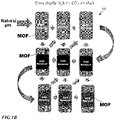
- Figure 1B illustrates a method 101 for removing one or more of carbon dioxide, water, and hydrogen sulfide from natural gas via a MOF.
- Removing carbon dioxide, water, and hydrogen sulfide from natural gas can occur simultaneously.
- Removing of carbon dioxide, water, and hydrogen sulfide from natural gas can occur separately.
- Removing can occur in a multicolumn pressure-temperature swing adsorption (PTSA) system.
- PTSA pressure-temperature swing adsorption
- the MOF comprises one of [Ni(Al/Fe/Nb)F 5 (O/H2O)(pyrazine) 2 (solvent) x ] z
- the MOF comprises two or more of [Ni(Al/Fe/Nb)F 5 (O/H2O)(pyrazine) 2 (solvent) x ] z .
- MOFs as provided herein can be fabricated using a solvo(hydro)thermal synthetic procedure.
- a method for fabricating 200 a MOF 230 can include combining 205 reactants.
- Reactants can include one or more of a fluorhydric acid solution 206 with a Ni 2+ source 207, a second metal source 208, and a solvent 209 to form a mixture 210.
- the Ni 2+ source 207 can include one or more of nickel nitrate, hydrated nickel nitrate, nickel chloride, hydrated nickel chloride, nickel fluoride, hydrated nickel fluoride, nickel oxide, or hydrated nickel oxide.
- the second metal source 208 can include an Al +3 , source, an Fe +3 source, or a Nb 5- source. These, metals can be in the form of nitrates, hydrated nitrates, chlorides, hydrated chlorides, fluorides, hydrated fluorides, oxides, hydrated oxides, and combinations thereof.
- the solvent 209 can include one or more of H 2 O, dimethylformamide (DMF), and diethylformamide (DEF).
- the method for fabricating 200 can further comprise to reacting 215 the mixture 210, sufficient to form a reacted mixture 220.
- Reacting 215 can include contacting the fluorhydric acid solution 206, the Ni 2+ source 207, the second metal source 208, and the solvent 209.
- Reacting 215 can further comprise stirring or agitating the mixture 210, or heating the mixture 210. Heating the mixture 210 can comprise heating to a temperature between about 80 °C to about 200 °C.
- the reacted mixture 220 can be further processed 225 to provide a fabricated MOF 230.
- Processing 220 can include one or more of filtering the reacted mixture 220, rinsing the reacted mixture 220 with water, removing excess reactants from the reacted mixture 220.
- guest molecules are optionally evacuated from a fabricated MOF 230. Guest molecules can include solvent guest molecules, or derivatives thereof.
- One MOF synthesis strategy provided herein comprises linking inorganic chains using appropriate N-donor based linkers to deliberately generate channels along one crystallographic direction.
- the inorganic chains are built up from the trans-connection between M a N 4 F 2 and M b F 4 (H 2 O) 2 octahedra or between M a N 4 F 2 and M b F 5 (H 2 O) octahedra or between M a N 4 F 2 octahedra and M b F 5 (O) octahedra.
- Figure 3A illustrates an example of an inorganic chain, built up from M a N 4 F 2 and M b F 5 (H 2 O) octahedra.
- Figure 3B illustrates a schematic view of one embodiment of a MOF comprising a NiNbF 5 O(pyrazine) 2 structure, viewed along the c-axis.
- a representative M a M b F x O y (Ligand) 2 MOF structure can include a Ni M a constituent, a Nb M b constituent group, and a Ligand comprising a pyrazine constituent group.
- Figure 4A illustrates powder X-ray diffraction data of this MOF, characterized by the formula NiNbF 5 O(pyrazine) 2 (solvent) x , confirming the high stability of the MOF in the presence of water.
- Figure 4B illustrates powder X-ray diffraction data of this MOF, confirming the high stability of the MOF in the presence of H 2 S.
- Figures.5A-C illustrates the broad potential for MOFs characterized by the formula Ni(Al/Fe/V/Nb)F s (O/H 2 O) x (pyrazine) 2 (solvent) x , and variants thereof.
- Figure 5A illustrates CO 2 isotherms at 298 Kfor each of these four MOFs, which show extremely high sorption of CO 2 across all test pressures (0-1 bar)
- Figure 5B illustrates H 2 S isotherms at 298K for three MOFs characterized by the formula Ni(Al/Fe/ V)F 5 (O/H 2 O) x (pyrazine) 2 (solvent) z , which shows across all test pressures (0-1, wherein 1 corresponds to a 0.1 H 2 S partial pressure).
- Figure 5C Illustrates H 2 O sorption isotherms at 298K for Ni(Al)F 5 (O/H 2 0) x (pyrazine) 2 (solvent) z , indicating the high suitability of this MOF for gas dehydration applications, among others.
- These results demonstrate the value of the MOF embodiment characterized by the formula Ni(Al/Fe/Y/Nb)F 5 (O/H 2 O) x (pyrazine) 2 (solvent) x as a platform for refining a number of valuable hydrocarbon gases and fluids, including methane, natural gas, and biogas.
- the exemplary performance and properties of the Nb 5+ based MOFs disclosed herein are notably achieved in spite of having no open metal sites.
- MOF structure characterized by the formula NiM b F 5 O(pyrazine) 2 , wherein M b can be one of the following Al +3 , Fe +2 , Fe +3 , Cr 2+ , Cr 3+ , Ti 3+ , V 3+ , V 5+ , Sc 3+ , In 3+ , Nb 5+ , Y 3+ .
- M a can be one of the following cations: Cu 2+ , Zn 2+ , Co 2+ , Ni 2+ , Mn 2+ , Zr 2+ , Fe 2+ , Ca 2+ , Ba 2+ , Pb 2+ , Pt 2+ , Pd 2+ , Ru 2+ , Rh 2+ , Cd 2+ , Mg +2 , Al +3 , Fe +2 , Fe +3 , Cr 2+ , Cr 3+ , Ru 2+ , Ru 3+ .
- M a Al/Fe/VF 5 O(pyrazine) 2
- M a can be one of the following cations: Cu 2+ , Zn 2+ , Co 2+ , Ni 2+ , Mn 2+ , Zr 2+ , Fe 2+ , Ca 2+ , Ba 2+ , Pb 2+ , Pt 2+ , Pd 2+ , Ru 2+ , Rh 2+ , Cd 2+ , Mg +2 , Al +3 , Fe +2 , Fe +3 , Cr 2+ , Cr 3+ , Ru 2+ , Ru 3+ .
- NiAlF 5 (H 2 O)(pyrazine) 2 a material from a related SiF 6 platform which is known to be very selective to CO 2 was tested.
- the gas adsorption testings using CO 2 /H 2 S/CH 4 :5/5/90 at 25°C in TSR mode showed a retention time in the column of 27 min/g for H 2 S and CO 2 , respectively ( Figure 7 ), indicative of similar affinity of the NiAlF 5 O(pyrazine) 2 framework to both CO 2 and H 2 S.
- FIG. 9 shows that TSR mode could be practiced for NiAlF 5 (H 2 O) (pyrazine) 2 using reactivation at 50°C and even VSR mode at 25°C with a minimum loss in the H 2 S retention time while keeping the same affinity for H 2 S and CO 2 .
- Figure 9 shows that for NiAlF 5 (H2O)(pyrazine) 2 the H 2 S and CO 2 uptakes were reduced by 20% between TSR and VSR (vacuum swing regeneration) mode when adsorption is carried at 50°C.
- NiAlF 5 (H 2 O)(pyrazine) 2 exhibit a reproducible H 2 S and CO 2 adsorption performance.
- NiAlF 5 (H 2 O)(pyrazine) 2 can be utilized as a potential material for the simultaneous removal of H 2 S and CO 2 .
- Y-1,4-NDC- fcu -MOF is the best material from the studied materials for H 2 S removal with retention time of 70 min/gm (5% H 2 S, 10 cm 3 /min flowrate). Retention time for H 2 S decreases for almost 40 % when temperature is increased to 50°C ( Figures 11, 12 ), with highest retention time of 41 min/g (5% H 2 S, 10cc/min flowrate) for Y-1,4-NDC-fcu-MOF.
- Retention time of H 2 S and CO 2 for Y-1,4-NDC- fcu -MOF and Y-fum- fcu -MOF does not change during VSR at 25°C ( Figure 13 ), while retention time for all the samples does not change during VSR at 50 °C ( Figure 14 ).
- NiAlF 5 (H 2 O)(pyrazine) 2 has the same retention time of 28 min/gm (5% H 2 S, 5% CO 2 10cm 3 /min flowrate) for both H 2 S and CO 2 at 25°C ( Figure 10 ).
- the retention time for CO 2 and H 2 S only decrease slightly to 26 min/gm (5% H 2 S, 5% CO 2 10cc/min flowrate) unlike other materials ( Figures 11, 12 ).
- NiAlF 5 (H 2 O)(pyrazine) 2 is a good candidate for simultaneous removal of H 2 S and CO 2 over the wide temperature range, while other studied materials can be good candidates for removal of H 2 S first and then CO 2 in the presence of CH 4 containing gas streams at 25°C.
- H 2 S/CH 4 selectivity is calculated assuming 0.1 mg as the lowest detectable uptake
- Table 2 Summary of H 2 S and CO 2 adsorption uptakes of the best MOFs in VSR mode using CO 2 /H 2 S/CH 4 (5/5/90) at 1 bar Gas mixture (1 bar).
- H 2 S/CH 4 selectivities are calculated assuming the uptake of CH 4 is equal to 0.1 mg, which is the lowest detectable uptake by the set-up.
- Table 4 Summary of CO 2 /CH 4 and H 2 S/CH 4 adsorption selectivities determined for the best MOFs in VSR mode using CO 2 /H 2 S/CH 4 (5/5/90) at 1 bar Gas mixture (1 bar).
- CH 4 uptake not detected by the flow mode system and CO 2 /CH 4 , H 2 S/CH 4 selectivities are calculated assuming the uptake of CH 4 is equal to 0.1 mg, which is the lowest detectable uptake by the set-up.
Landscapes
- Chemical & Material Sciences (AREA)
- Organic Chemistry (AREA)
- Chemical Kinetics & Catalysis (AREA)
- Analytical Chemistry (AREA)
- Oil, Petroleum & Natural Gas (AREA)
- General Chemical & Material Sciences (AREA)
- Engineering & Computer Science (AREA)
- Physics & Mathematics (AREA)
- Thermal Sciences (AREA)
- Inorganic Chemistry (AREA)
- Health & Medical Sciences (AREA)
- Toxicology (AREA)
- Solid-Sorbent Or Filter-Aiding Compositions (AREA)
- Separation Of Gases By Adsorption (AREA)
Claims (13)
- Verfahren zum Einfangen von chemischen Spezies aus einer fluiden Zusammensetzung, wobei das Verfahren umfasst:Inkontaktbringen eines ersten organischen Metallgerüsts, das durch die Formel NiNbF5O(pyrazin)2(lösungsmittel)x, NiFeF5(H2O)pyrazin)2(lösungsmittel)x oder NiAlF5(H2O)(pyrazin)2(Lösungsmittel)x gekennzeichnet ist, mit einer fluiden Zusammensetzung, die zumindest Kohlendioxid und Hydrogensulfid beinhaltet; undEinfangen von Kohlendioxid und Hydrogensulfid aus der Fluidzusammensetzung.
- Verfahren nach Anspruch 1, wobei das Einfangen das physikalische Adsorbieren der einen oder mehreren eingefangenen chemischen Spezies durch das organische Metallgerüst umfasst.
- Verfahren nach Anspruch 1, wobei das Einfangen das Chemisorbieren der einen oder mehreren eingefangenen chemischen Spezies durch das organische Metallgerüst umfasst.
- Verfahren nach Anspruch 3, wobei das Chemisorbieren dadurch erfolgt, dass eine oder mehrere eingefangene chemische Spezies mit einer oder mehreren offenen Metallstellen des organischen Metallgerüsts chemisch wechselwirken.
- Verfahren nach Anspruch 1, wobei die fluide Zusammensetzung ferner Methan umfasst.
- Verfahren nach Anspruch 1, das ferner das Verändern des Drucks der Einfangumgebung umfasst, um die Affinität von Kohlendioxid und/oder Hydrogensulfid für das Adsorbens organischen Metallgerüsts zu verändern.
- Verfahren nach Anspruch 1, das ferner das Verändern der Temperatur der Einfangumgebung umfasst, um die Affinität von Kohlendioxid und/oder Hydrogensulfid für das Adsorbens organischen Metallgerüsts zu verändern.
- Verfahren nach Anspruch 1, das ferner das Verändern des Drucks und der Temperatur der Einfangumgebung umfasst, um die Affinität von Kohlendioxid und/oder Hydrogensulfid für das Adsorbens organischen Metallgerüsts zu verändern.
- Verfahren nach Anspruch 1, das gleichzeitige oder getrennte Inkontaktbringen der fluiden Zusammensetzung mit einem zweiten organischen Metallgerüst, wobei sich das zweite organische Metallgerüst von dem ersten organischen Metallgerüst unterscheidet, wobei das erste organische Metallgerüst durch die Formel [NiNbF5O(pyrazin)2(lösungsmittel)x]z gekennzeichnet ist und das zweite organische Metallgerüst durch die Formel [McMdF6-n(O/H2O)w(ligand)x(lösungsmittel)y]z gekennzeichnet ist, wobei Mc Ni2+ umfasst und Md Al+3, Fe+2 oder Fe+3 umfasst.
- Verfahren nach Anspruch 1, wobei das Absorbens organischen Metallgerüsts in Form eines Festbettes, einer Füllkörpersäule oder Kombinationen davon vorliegt.
- Verfahren nach Anspruch 1, das ferner das Desorbieren von Kohlendioxid und/oder Hydrogensulfid umfasst.
- Verfahren nach Anspruch 11, wobei das Einfangen und/oder das Desorbieren durch mehrsäulige Adsorption mit Druck-Temperatur-Wechsel erfolgen.
- Verfahren nach Anspruch 1, wobei Kohlendioxid und Hydrogensulfid gleichzeitig aus der fluiden Zusammensetzung eingefangen werden.
Priority Applications (1)
| Application Number | Priority Date | Filing Date | Title |
|---|---|---|---|
| EP22200617.3A EP4194075A1 (de) | 2015-04-07 | 2016-04-07 | Absorptionsplattformen mit metallorganischem gerüst zur entfernung von co2 und h2s aus erdgas |
Applications Claiming Priority (2)
| Application Number | Priority Date | Filing Date | Title |
|---|---|---|---|
| US201562144175P | 2015-04-07 | 2015-04-07 | |
| PCT/IB2016/051987 WO2016162830A1 (en) | 2015-04-07 | 2016-04-07 | Metal organic framework absorbent platforms for removal of co2 and h2s from natural gas |
Related Child Applications (1)
| Application Number | Title | Priority Date | Filing Date |
|---|---|---|---|
| EP22200617.3A Division EP4194075A1 (de) | 2015-04-07 | 2016-04-07 | Absorptionsplattformen mit metallorganischem gerüst zur entfernung von co2 und h2s aus erdgas |
Publications (2)
| Publication Number | Publication Date |
|---|---|
| EP3300485A1 EP3300485A1 (de) | 2018-04-04 |
| EP3300485B1 true EP3300485B1 (de) | 2022-10-12 |
Family
ID=55911010
Family Applications (2)
| Application Number | Title | Priority Date | Filing Date |
|---|---|---|---|
| EP16720559.0A Active EP3300485B1 (de) | 2015-04-07 | 2016-04-07 | Verfahren zur verwendung von absorptionsplattformen mit metallorganischem gerüst zur entfernung von co2 und h2s aus erdgas |
| EP22200617.3A Pending EP4194075A1 (de) | 2015-04-07 | 2016-04-07 | Absorptionsplattformen mit metallorganischem gerüst zur entfernung von co2 und h2s aus erdgas |
Family Applications After (1)
| Application Number | Title | Priority Date | Filing Date |
|---|---|---|---|
| EP22200617.3A Pending EP4194075A1 (de) | 2015-04-07 | 2016-04-07 | Absorptionsplattformen mit metallorganischem gerüst zur entfernung von co2 und h2s aus erdgas |
Country Status (3)
| Country | Link |
|---|---|
| US (3) | US10328380B2 (de) |
| EP (2) | EP3300485B1 (de) |
| WO (1) | WO2016162830A1 (de) |
Families Citing this family (13)
| Publication number | Priority date | Publication date | Assignee | Title |
|---|---|---|---|---|
| WO2016014963A1 (en) | 2014-07-24 | 2016-01-28 | King Abdullah University Of Science And Technology | Fabrication of highly co2 selective metal organic framework membrane using liquid phase epitaxy approach |
| WO2016162834A1 (en) * | 2015-04-07 | 2016-10-13 | King Abdullah University Of Science And Technology | Highly stable ni-m f6-nh2o/onpyrazine2(solvent)x metal organic frameworks and methods of use |
| EP3300485B1 (de) * | 2015-04-07 | 2022-10-12 | King Abdullah University Of Science And Technology | Verfahren zur verwendung von absorptionsplattformen mit metallorganischem gerüst zur entfernung von co2 und h2s aus erdgas |
| EP3606642A1 (de) | 2017-04-05 | 2020-02-12 | King Abdullah University Of Science And Technology | Verfahren zur abscheidung von co2 und h2o |
| JP2019163228A (ja) * | 2018-03-20 | 2019-09-26 | 株式会社東芝 | 金属有機構造体、蛍光体膜、および分子検出装置 |
| US11857910B2 (en) * | 2018-06-11 | 2024-01-02 | King Abdullah University Of Science And Technology | Metal-organic frameworks for sorption and sensing applications |
| WO2020214814A1 (en) * | 2019-04-18 | 2020-10-22 | Massachusetts Institute Of Technology | Compositions and methods for carbon dioxide sensing |
| CN111763503B (zh) * | 2020-07-10 | 2021-01-15 | 西南石油大学 | 一种钻井液用硫化氢抑制剂及其制备方法 |
| CN114643044B (zh) * | 2020-12-18 | 2023-08-29 | 中国石油化工股份有限公司 | 一种改性金属有机骨架材料及其制法和应用 |
| CN112604713B (zh) * | 2020-12-29 | 2022-01-25 | 北京大学 | 还原六价铬的具有哒嗪结构的亚胺型共价有机框架光催化剂、制备方法及其应用 |
| US11639705B2 (en) * | 2021-02-16 | 2023-05-02 | GM Global Technology Operations LLC | Vapor capture element for an air intake system of an internal combustion engine |
| CN115028850B (zh) * | 2022-06-09 | 2023-05-12 | 同济大学 | 一种用于吸附分离乙炔/乙烯混合气体的金属有机框架材料及其制备方法 |
| US20260108864A1 (en) * | 2024-10-21 | 2026-04-23 | Numat Technologies, Inc. | Mixed linker zinc-triazole-oxalate mof compositions for co2 adsorption |
Family Cites Families (7)
| Publication number | Priority date | Publication date | Assignee | Title |
|---|---|---|---|---|
| US5376614A (en) | 1992-12-11 | 1994-12-27 | United Technologies Corporation | Regenerable supported amine-polyol sorbent |
| US5876488A (en) | 1996-10-22 | 1999-03-02 | United Technologies Corporation | Regenerable solid amine sorbent |
| US9138719B1 (en) | 2012-08-10 | 2015-09-22 | University Of South Florida | Metal-organic materials (MOMs) for CO2 adsorption and methods of using MOMs |
| WO2014074679A1 (en) * | 2012-11-07 | 2014-05-15 | University Of South Florida | Metal-organic materials (moms) for polarizable gas adsorption and methods of using moms |
| EP3157937B1 (de) | 2014-06-17 | 2021-02-17 | King Abdullah University Of Science And Technology | Grüne verfahren zur herstellung von hoch co2-selektiven und h2s-toleranten metallorganischen gerüsten |
| US10781387B2 (en) | 2014-08-25 | 2020-09-22 | King Abdullah University Of Science And Technology | Metal organic frameworks for removal of compounds from a fluid |
| EP3300485B1 (de) * | 2015-04-07 | 2022-10-12 | King Abdullah University Of Science And Technology | Verfahren zur verwendung von absorptionsplattformen mit metallorganischem gerüst zur entfernung von co2 und h2s aus erdgas |
-
2016
- 2016-04-07 EP EP16720559.0A patent/EP3300485B1/de active Active
- 2016-04-07 WO PCT/IB2016/051987 patent/WO2016162830A1/en not_active Ceased
- 2016-04-07 EP EP22200617.3A patent/EP4194075A1/de active Pending
- 2016-04-07 US US15/564,935 patent/US10328380B2/en active Active
-
2019
- 2019-06-05 US US16/431,860 patent/US10857500B2/en active Active
-
2020
- 2020-12-02 US US17/109,844 patent/US11534712B2/en active Active
Also Published As
| Publication number | Publication date |
|---|---|
| US11534712B2 (en) | 2022-12-27 |
| WO2016162830A1 (en) | 2016-10-13 |
| US10857500B2 (en) | 2020-12-08 |
| US10328380B2 (en) | 2019-06-25 |
| EP4194075A1 (de) | 2023-06-14 |
| US20180093218A1 (en) | 2018-04-05 |
| US20210086128A1 (en) | 2021-03-25 |
| US20190282949A1 (en) | 2019-09-19 |
| EP3300485A1 (de) | 2018-04-04 |
Similar Documents
| Publication | Publication Date | Title |
|---|---|---|
| US11534712B2 (en) | Metal organic framework absorbent platforms for removal of CO2 and H2S from natural gas | |
| US11344870B2 (en) | Highly stable Ni-M F6-NH2O/onpyrazine2(solvent)x metal organic frameworks and methods of use | |
| Krishna | Metrics for evaluation and screening of metal–organic frameworks for applications in mixture separations | |
| US11066435B2 (en) | Green methods for preparing highly CO2 selective and H2S tolerant metal organic frameworks | |
| US11077423B2 (en) | Highly stable [MaMbF6-n(O/H2O)n(Ligand)2(solvent)x]n metal organic frameworks | |
| Rieth et al. | Kinetic stability of metal–organic frameworks for corrosive and coordinating gas capture | |
| Sabouni et al. | Carbon dioxide adsorption in microwave-synthesized metal organic framework CPM-5: equilibrium and kinetics study | |
| Sumida et al. | Carbon dioxide capture in metal–organic frameworks | |
| Arami-Niya et al. | Gate opening effect of zeolitic imidazolate framework ZIF-7 for adsorption of CH 4 and CO 2 from N 2 | |
| Wu et al. | Cu-TDPAT, an rht-type dual-functional metal–organic framework offering significant potential for use in H2 and natural gas purification processes operating at high pressures | |
| Pimentel et al. | Enabling kinetic light hydrocarbon separation via crystal size engineering of ZIF-8 | |
| Jin et al. | Ultra-high purity and productivity separation of CO2 and C2H2 from CH4 in rigid layered ultramicroporous material | |
| EP2916931B1 (de) | Metallorganische materialien zur adsorption polarisierbarer gase und verfahren zur verwendung der metallorganischen materialien | |
| US11285426B2 (en) | Methods of capturing of CO2 and H2O | |
| Belmabkhout et al. | Metal organic framework absorben platforms for removal of co2 and h2s from natural gas | |
| Evans | Metal-Organic Framework Structure-Property Relationships for Selective Sulfur Dioxide Adsorption | |
| Taheri Qazvini et al. | Selective Capture of Carbon Dioxide from Hydrocarbons Using a Metal-Organic Framework: Relevance to the Purification of Natural Gas and Acetylene | |
| Telfer | A Universal Porous Adsorbent for the Selective Capture of Carbon Dioxide |
Legal Events
| Date | Code | Title | Description |
|---|---|---|---|
| STAA | Information on the status of an ep patent application or granted ep patent |
Free format text: STATUS: THE INTERNATIONAL PUBLICATION HAS BEEN MADE |
|
| PUAI | Public reference made under article 153(3) epc to a published international application that has entered the european phase |
Free format text: ORIGINAL CODE: 0009012 |
|
| STAA | Information on the status of an ep patent application or granted ep patent |
Free format text: STATUS: REQUEST FOR EXAMINATION WAS MADE |
|
| 17P | Request for examination filed |
Effective date: 20171106 |
|
| AK | Designated contracting states |
Kind code of ref document: A1 Designated state(s): AL AT BE BG CH CY CZ DE DK EE ES FI FR GB GR HR HU IE IS IT LI LT LU LV MC MK MT NL NO PL PT RO RS SE SI SK SM TR |
|
| AX | Request for extension of the european patent |
Extension state: BA ME |
|
| DAV | Request for validation of the european patent (deleted) | ||
| DAX | Request for extension of the european patent (deleted) | ||
| STAA | Information on the status of an ep patent application or granted ep patent |
Free format text: STATUS: EXAMINATION IS IN PROGRESS |
|
| 17Q | First examination report despatched |
Effective date: 20200330 |
|
| GRAP | Despatch of communication of intention to grant a patent |
Free format text: ORIGINAL CODE: EPIDOSNIGR1 |
|
| STAA | Information on the status of an ep patent application or granted ep patent |
Free format text: STATUS: GRANT OF PATENT IS INTENDED |
|
| INTG | Intention to grant announced |
Effective date: 20220525 |
|
| GRAS | Grant fee paid |
Free format text: ORIGINAL CODE: EPIDOSNIGR3 |
|
| GRAA | (expected) grant |
Free format text: ORIGINAL CODE: 0009210 |
|
| STAA | Information on the status of an ep patent application or granted ep patent |
Free format text: STATUS: THE PATENT HAS BEEN GRANTED |
|
| AK | Designated contracting states |
Kind code of ref document: B1 Designated state(s): AL AT BE BG CH CY CZ DE DK EE ES FI FR GB GR HR HU IE IS IT LI LT LU LV MC MK MT NL NO PL PT RO RS SE SI SK SM TR |
|
| REG | Reference to a national code |
Ref country code: GB Ref legal event code: FG4D |
|
| REG | Reference to a national code |
Ref country code: CH Ref legal event code: EP |
|
| REG | Reference to a national code |
Ref country code: DE Ref legal event code: R096 Ref document number: 602016075582 Country of ref document: DE |
|
| REG | Reference to a national code |
Ref country code: IE Ref legal event code: FG4D |
|
| REG | Reference to a national code |
Ref country code: AT Ref legal event code: REF Ref document number: 1523822 Country of ref document: AT Kind code of ref document: T Effective date: 20221115 |
|
| REG | Reference to a national code |
Ref country code: NL Ref legal event code: FP |
|
| REG | Reference to a national code |
Ref country code: LT Ref legal event code: MG9D |
|
| REG | Reference to a national code |
Ref country code: AT Ref legal event code: MK05 Ref document number: 1523822 Country of ref document: AT Kind code of ref document: T Effective date: 20221012 |
|
| PG25 | Lapsed in a contracting state [announced via postgrant information from national office to epo] |
Ref country code: SE Free format text: LAPSE BECAUSE OF FAILURE TO SUBMIT A TRANSLATION OF THE DESCRIPTION OR TO PAY THE FEE WITHIN THE PRESCRIBED TIME-LIMIT Effective date: 20221012 Ref country code: PT Free format text: LAPSE BECAUSE OF FAILURE TO SUBMIT A TRANSLATION OF THE DESCRIPTION OR TO PAY THE FEE WITHIN THE PRESCRIBED TIME-LIMIT Effective date: 20230213 Ref country code: NO Free format text: LAPSE BECAUSE OF FAILURE TO SUBMIT A TRANSLATION OF THE DESCRIPTION OR TO PAY THE FEE WITHIN THE PRESCRIBED TIME-LIMIT Effective date: 20230112 Ref country code: LT Free format text: LAPSE BECAUSE OF FAILURE TO SUBMIT A TRANSLATION OF THE DESCRIPTION OR TO PAY THE FEE WITHIN THE PRESCRIBED TIME-LIMIT Effective date: 20221012 Ref country code: FI Free format text: LAPSE BECAUSE OF FAILURE TO SUBMIT A TRANSLATION OF THE DESCRIPTION OR TO PAY THE FEE WITHIN THE PRESCRIBED TIME-LIMIT Effective date: 20221012 Ref country code: ES Free format text: LAPSE BECAUSE OF FAILURE TO SUBMIT A TRANSLATION OF THE DESCRIPTION OR TO PAY THE FEE WITHIN THE PRESCRIBED TIME-LIMIT Effective date: 20221012 Ref country code: AT Free format text: LAPSE BECAUSE OF FAILURE TO SUBMIT A TRANSLATION OF THE DESCRIPTION OR TO PAY THE FEE WITHIN THE PRESCRIBED TIME-LIMIT Effective date: 20221012 |
|
| PG25 | Lapsed in a contracting state [announced via postgrant information from national office to epo] |
Ref country code: RS Free format text: LAPSE BECAUSE OF FAILURE TO SUBMIT A TRANSLATION OF THE DESCRIPTION OR TO PAY THE FEE WITHIN THE PRESCRIBED TIME-LIMIT Effective date: 20221012 Ref country code: PL Free format text: LAPSE BECAUSE OF FAILURE TO SUBMIT A TRANSLATION OF THE DESCRIPTION OR TO PAY THE FEE WITHIN THE PRESCRIBED TIME-LIMIT Effective date: 20221012 Ref country code: LV Free format text: LAPSE BECAUSE OF FAILURE TO SUBMIT A TRANSLATION OF THE DESCRIPTION OR TO PAY THE FEE WITHIN THE PRESCRIBED TIME-LIMIT Effective date: 20221012 Ref country code: IS Free format text: LAPSE BECAUSE OF FAILURE TO SUBMIT A TRANSLATION OF THE DESCRIPTION OR TO PAY THE FEE WITHIN THE PRESCRIBED TIME-LIMIT Effective date: 20230212 Ref country code: HR Free format text: LAPSE BECAUSE OF FAILURE TO SUBMIT A TRANSLATION OF THE DESCRIPTION OR TO PAY THE FEE WITHIN THE PRESCRIBED TIME-LIMIT Effective date: 20221012 Ref country code: GR Free format text: LAPSE BECAUSE OF FAILURE TO SUBMIT A TRANSLATION OF THE DESCRIPTION OR TO PAY THE FEE WITHIN THE PRESCRIBED TIME-LIMIT Effective date: 20230113 |
|
| REG | Reference to a national code |
Ref country code: DE Ref legal event code: R097 Ref document number: 602016075582 Country of ref document: DE |
|
| PG25 | Lapsed in a contracting state [announced via postgrant information from national office to epo] |
Ref country code: SM Free format text: LAPSE BECAUSE OF FAILURE TO SUBMIT A TRANSLATION OF THE DESCRIPTION OR TO PAY THE FEE WITHIN THE PRESCRIBED TIME-LIMIT Effective date: 20221012 Ref country code: RO Free format text: LAPSE BECAUSE OF FAILURE TO SUBMIT A TRANSLATION OF THE DESCRIPTION OR TO PAY THE FEE WITHIN THE PRESCRIBED TIME-LIMIT Effective date: 20221012 Ref country code: EE Free format text: LAPSE BECAUSE OF FAILURE TO SUBMIT A TRANSLATION OF THE DESCRIPTION OR TO PAY THE FEE WITHIN THE PRESCRIBED TIME-LIMIT Effective date: 20221012 Ref country code: DK Free format text: LAPSE BECAUSE OF FAILURE TO SUBMIT A TRANSLATION OF THE DESCRIPTION OR TO PAY THE FEE WITHIN THE PRESCRIBED TIME-LIMIT Effective date: 20221012 Ref country code: CZ Free format text: LAPSE BECAUSE OF FAILURE TO SUBMIT A TRANSLATION OF THE DESCRIPTION OR TO PAY THE FEE WITHIN THE PRESCRIBED TIME-LIMIT Effective date: 20221012 |
|
| PLBE | No opposition filed within time limit |
Free format text: ORIGINAL CODE: 0009261 |
|
| STAA | Information on the status of an ep patent application or granted ep patent |
Free format text: STATUS: NO OPPOSITION FILED WITHIN TIME LIMIT |
|
| PG25 | Lapsed in a contracting state [announced via postgrant information from national office to epo] |
Ref country code: SK Free format text: LAPSE BECAUSE OF FAILURE TO SUBMIT A TRANSLATION OF THE DESCRIPTION OR TO PAY THE FEE WITHIN THE PRESCRIBED TIME-LIMIT Effective date: 20221012 Ref country code: AL Free format text: LAPSE BECAUSE OF FAILURE TO SUBMIT A TRANSLATION OF THE DESCRIPTION OR TO PAY THE FEE WITHIN THE PRESCRIBED TIME-LIMIT Effective date: 20221012 |
|
| 26N | No opposition filed |
Effective date: 20230713 |
|
| PG25 | Lapsed in a contracting state [announced via postgrant information from national office to epo] |
Ref country code: SI Free format text: LAPSE BECAUSE OF FAILURE TO SUBMIT A TRANSLATION OF THE DESCRIPTION OR TO PAY THE FEE WITHIN THE PRESCRIBED TIME-LIMIT Effective date: 20221012 |
|
| REG | Reference to a national code |
Ref country code: CH Ref legal event code: PL |
|
| GBPC | Gb: european patent ceased through non-payment of renewal fee |
Effective date: 20230407 |
|
| PG25 | Lapsed in a contracting state [announced via postgrant information from national office to epo] |
Ref country code: LU Free format text: LAPSE BECAUSE OF NON-PAYMENT OF DUE FEES Effective date: 20230407 |
|
| REG | Reference to a national code |
Ref country code: BE Ref legal event code: MM Effective date: 20230430 |
|
| PG25 | Lapsed in a contracting state [announced via postgrant information from national office to epo] |
Ref country code: MC Free format text: LAPSE BECAUSE OF FAILURE TO SUBMIT A TRANSLATION OF THE DESCRIPTION OR TO PAY THE FEE WITHIN THE PRESCRIBED TIME-LIMIT Effective date: 20221012 |
|
| PG25 | Lapsed in a contracting state [announced via postgrant information from national office to epo] |
Ref country code: GB Free format text: LAPSE BECAUSE OF NON-PAYMENT OF DUE FEES Effective date: 20230407 |
|
| PG25 | Lapsed in a contracting state [announced via postgrant information from national office to epo] |
Ref country code: MC Free format text: LAPSE BECAUSE OF FAILURE TO SUBMIT A TRANSLATION OF THE DESCRIPTION OR TO PAY THE FEE WITHIN THE PRESCRIBED TIME-LIMIT Effective date: 20221012 Ref country code: LI Free format text: LAPSE BECAUSE OF NON-PAYMENT OF DUE FEES Effective date: 20230430 Ref country code: GB Free format text: LAPSE BECAUSE OF NON-PAYMENT OF DUE FEES Effective date: 20230407 Ref country code: CH Free format text: LAPSE BECAUSE OF NON-PAYMENT OF DUE FEES Effective date: 20230430 |
|
| REG | Reference to a national code |
Ref country code: IE Ref legal event code: MM4A |
|
| PG25 | Lapsed in a contracting state [announced via postgrant information from national office to epo] |
Ref country code: BE Free format text: LAPSE BECAUSE OF NON-PAYMENT OF DUE FEES Effective date: 20230430 |
|
| PG25 | Lapsed in a contracting state [announced via postgrant information from national office to epo] |
Ref country code: IE Free format text: LAPSE BECAUSE OF NON-PAYMENT OF DUE FEES Effective date: 20230407 |
|
| PG25 | Lapsed in a contracting state [announced via postgrant information from national office to epo] |
Ref country code: IE Free format text: LAPSE BECAUSE OF NON-PAYMENT OF DUE FEES Effective date: 20230407 |
|
| PG25 | Lapsed in a contracting state [announced via postgrant information from national office to epo] |
Ref country code: IT Free format text: LAPSE BECAUSE OF FAILURE TO SUBMIT A TRANSLATION OF THE DESCRIPTION OR TO PAY THE FEE WITHIN THE PRESCRIBED TIME-LIMIT Effective date: 20221012 |
|
| PG25 | Lapsed in a contracting state [announced via postgrant information from national office to epo] |
Ref country code: BG Free format text: LAPSE BECAUSE OF FAILURE TO SUBMIT A TRANSLATION OF THE DESCRIPTION OR TO PAY THE FEE WITHIN THE PRESCRIBED TIME-LIMIT Effective date: 20221012 |
|
| PG25 | Lapsed in a contracting state [announced via postgrant information from national office to epo] |
Ref country code: BG Free format text: LAPSE BECAUSE OF FAILURE TO SUBMIT A TRANSLATION OF THE DESCRIPTION OR TO PAY THE FEE WITHIN THE PRESCRIBED TIME-LIMIT Effective date: 20221012 |
|
| PGFP | Annual fee paid to national office [announced via postgrant information from national office to epo] |
Ref country code: NL Payment date: 20250427 Year of fee payment: 10 |
|
| PGFP | Annual fee paid to national office [announced via postgrant information from national office to epo] |
Ref country code: DE Payment date: 20250429 Year of fee payment: 10 |
|
| PGFP | Annual fee paid to national office [announced via postgrant information from national office to epo] |
Ref country code: FR Payment date: 20250425 Year of fee payment: 10 |
|
| PG25 | Lapsed in a contracting state [announced via postgrant information from national office to epo] |
Ref country code: CY Free format text: LAPSE BECAUSE OF FAILURE TO SUBMIT A TRANSLATION OF THE DESCRIPTION OR TO PAY THE FEE WITHIN THE PRESCRIBED TIME-LIMIT; INVALID AB INITIO Effective date: 20160407 |
|
| PG25 | Lapsed in a contracting state [announced via postgrant information from national office to epo] |
Ref country code: HU Free format text: LAPSE BECAUSE OF FAILURE TO SUBMIT A TRANSLATION OF THE DESCRIPTION OR TO PAY THE FEE WITHIN THE PRESCRIBED TIME-LIMIT; INVALID AB INITIO Effective date: 20160407 |
|
| PG25 | Lapsed in a contracting state [announced via postgrant information from national office to epo] |
Ref country code: TR Free format text: LAPSE BECAUSE OF FAILURE TO SUBMIT A TRANSLATION OF THE DESCRIPTION OR TO PAY THE FEE WITHIN THE PRESCRIBED TIME-LIMIT Effective date: 20221012 |