EP3300029A1 - A method for camera-based tolling - Google Patents
A method for camera-based tolling Download PDFInfo
- Publication number
- EP3300029A1 EP3300029A1 EP16189918.2A EP16189918A EP3300029A1 EP 3300029 A1 EP3300029 A1 EP 3300029A1 EP 16189918 A EP16189918 A EP 16189918A EP 3300029 A1 EP3300029 A1 EP 3300029A1
- Authority
- EP
- European Patent Office
- Prior art keywords
- tolling
- record
- camera
- location
- picture
- Prior art date
- Legal status (The legal status is an assumption and is not a legal conclusion. Google has not performed a legal analysis and makes no representation as to the accuracy of the status listed.)
- Granted
Links
Images
Classifications
-
- G—PHYSICS
- G07—CHECKING-DEVICES
- G07B—TICKET-ISSUING APPARATUS; FARE-REGISTERING APPARATUS; FRANKING APPARATUS
- G07B15/00—Arrangements or apparatus for collecting fares, tolls or entrance fees at one or more control points
- G07B15/06—Arrangements for road pricing or congestion charging of vehicles or vehicle users, e.g. automatic toll systems
-
- G—PHYSICS
- G06—COMPUTING OR CALCULATING; COUNTING
- G06F—ELECTRIC DIGITAL DATA PROCESSING
- G06F16/00—Information retrieval; Database structures therefor; File system structures therefor
- G06F16/50—Information retrieval; Database structures therefor; File system structures therefor of still image data
- G06F16/51—Indexing; Data structures therefor; Storage structures
-
- G—PHYSICS
- G06—COMPUTING OR CALCULATING; COUNTING
- G06F—ELECTRIC DIGITAL DATA PROCESSING
- G06F16/00—Information retrieval; Database structures therefor; File system structures therefor
- G06F16/50—Information retrieval; Database structures therefor; File system structures therefor of still image data
- G06F16/58—Retrieval characterised by using metadata, e.g. metadata not derived from the content or metadata generated manually
- G06F16/583—Retrieval characterised by using metadata, e.g. metadata not derived from the content or metadata generated manually using metadata automatically derived from the content
- G06F16/5846—Retrieval characterised by using metadata, e.g. metadata not derived from the content or metadata generated manually using metadata automatically derived from the content using extracted text
-
- G—PHYSICS
- G06—COMPUTING OR CALCULATING; COUNTING
- G06F—ELECTRIC DIGITAL DATA PROCESSING
- G06F16/00—Information retrieval; Database structures therefor; File system structures therefor
- G06F16/50—Information retrieval; Database structures therefor; File system structures therefor of still image data
- G06F16/58—Retrieval characterised by using metadata, e.g. metadata not derived from the content or metadata generated manually
- G06F16/5866—Retrieval characterised by using metadata, e.g. metadata not derived from the content or metadata generated manually using information manually generated, e.g. tags, keywords, comments, manually generated location and time information
-
- G—PHYSICS
- G06—COMPUTING OR CALCULATING; COUNTING
- G06F—ELECTRIC DIGITAL DATA PROCESSING
- G06F16/00—Information retrieval; Database structures therefor; File system structures therefor
- G06F16/50—Information retrieval; Database structures therefor; File system structures therefor of still image data
- G06F16/58—Retrieval characterised by using metadata, e.g. metadata not derived from the content or metadata generated manually
- G06F16/587—Retrieval characterised by using metadata, e.g. metadata not derived from the content or metadata generated manually using geographical or spatial information, e.g. location
-
- G—PHYSICS
- G06—COMPUTING OR CALCULATING; COUNTING
- G06Q—INFORMATION AND COMMUNICATION TECHNOLOGY [ICT] SPECIALLY ADAPTED FOR ADMINISTRATIVE, COMMERCIAL, FINANCIAL, MANAGERIAL OR SUPERVISORY PURPOSES; SYSTEMS OR METHODS SPECIALLY ADAPTED FOR ADMINISTRATIVE, COMMERCIAL, FINANCIAL, MANAGERIAL OR SUPERVISORY PURPOSES, NOT OTHERWISE PROVIDED FOR
- G06Q50/00—Information and communication technology [ICT] specially adapted for implementation of business processes of specific business sectors, e.g. utilities or tourism
- G06Q50/40—Business processes related to the transportation industry
-
- G—PHYSICS
- G06—COMPUTING OR CALCULATING; COUNTING
- G06V—IMAGE OR VIDEO RECOGNITION OR UNDERSTANDING
- G06V20/00—Scenes; Scene-specific elements
- G06V20/60—Type of objects
- G06V20/62—Text, e.g. of license plates, overlay texts or captions on TV images
-
- G—PHYSICS
- G06—COMPUTING OR CALCULATING; COUNTING
- G06V—IMAGE OR VIDEO RECOGNITION OR UNDERSTANDING
- G06V30/00—Character recognition; Recognising digital ink; Document-oriented image-based pattern recognition
- G06V30/10—Character recognition
- G06V30/22—Character recognition characterised by the type of writing
- G06V30/224—Character recognition characterised by the type of writing of printed characters having additional code marks or containing code marks
-
- G—PHYSICS
- G07—CHECKING-DEVICES
- G07B—TICKET-ISSUING APPARATUS; FARE-REGISTERING APPARATUS; FRANKING APPARATUS
- G07B15/00—Arrangements or apparatus for collecting fares, tolls or entrance fees at one or more control points
- G07B15/02—Arrangements or apparatus for collecting fares, tolls or entrance fees at one or more control points taking into account a variable factor such as distance or time, e.g. for passenger transport, parking systems or car rental systems
-
- G—PHYSICS
- G07—CHECKING-DEVICES
- G07B—TICKET-ISSUING APPARATUS; FARE-REGISTERING APPARATUS; FRANKING APPARATUS
- G07B15/00—Arrangements or apparatus for collecting fares, tolls or entrance fees at one or more control points
- G07B15/06—Arrangements for road pricing or congestion charging of vehicles or vehicle users, e.g. automatic toll systems
- G07B15/063—Arrangements for road pricing or congestion charging of vehicles or vehicle users, e.g. automatic toll systems using wireless information transmission between the vehicle and a fixed station
-
- G—PHYSICS
- G06—COMPUTING OR CALCULATING; COUNTING
- G06Q—INFORMATION AND COMMUNICATION TECHNOLOGY [ICT] SPECIALLY ADAPTED FOR ADMINISTRATIVE, COMMERCIAL, FINANCIAL, MANAGERIAL OR SUPERVISORY PURPOSES; SYSTEMS OR METHODS SPECIALLY ADAPTED FOR ADMINISTRATIVE, COMMERCIAL, FINANCIAL, MANAGERIAL OR SUPERVISORY PURPOSES, NOT OTHERWISE PROVIDED FOR
- G06Q2240/00—Transportation facility access, e.g. fares, tolls or parking
Definitions
- the present invention relates to a method for tolling one or more locations of a vehicle having a license plate number by means of a tolling system having a camera at each location to be tolled, a server, a database, a user terminal, and a network linking the camera/s, server and user terminal.
- a picture of a passing vehicle is taken by a still camera or from the video stream of a video camera and processed by optical character recognition (OCR) to read the license plate number (LPN) of the vehicle at the location to be tolled.
- Tollable locations may, e.g., be toll roads, parking lots, borders, gates, etc., the passing or usage of which shall be charged.
- Cameras can be mounted on gantries, roadside facilities, buildings and the like in order to identify vehicles by OCR reading their LPNs and subsequently generate tolling records containing the LPNs and the locations of the respective cameras. The tolling records can then be used to charge user accounts set up for these LPNs.
- OCR reading the LPN of a vehicle in a picture of the vehicle is, however, an error-prone process due to highly variable lighting and weather conditions, fields of view, dust, mud, snow or ice on vehicle license plates, degraded or tampered license plates etc. Therefore, special measures have to be taken to avoid charging users wrongly on the basis of faulty OCR readings.
- One of these special measures is to store for each tolling record, which includes an LPN reading result, also the original picture from which the LPN was read to allow for a later inspection, verification, or re-reading of the LPN in case of a charging failure or objection.
- the original pictures are stored somewhere in the tolling system, either decentralized at the camera sites or centralized at the server site.
- a first aspect provides a method for tolling of the above-identified kind, comprising:
- Both the embodiment according to the first aspect and the embodiment according to the second aspect of the invention provide a novel technical infrastructure for a fast, nearly real-time "self-declaration" of a location usage by the user, either by post-confirming or pre-registering the usage.
- the pictures of a declared, i.e., post-confirmed or pre- or post-registered, location usage are immediately deleted from the system, reducing the storage load on the system to a great extent. Only pictures of LPNs from confirmed or unregistered tolling records are kept in the database of the system. All other pictures originating from a regular, compliant, non-erroneous, untampered operation of the system are deleted.
- the amount of storage necessary for storing original pictures in the system can thus be reduced to a small fraction of that of prior art systems, saving substantial installation, powering, and maintenance costs.
- the amount of data transferred between decentralized camera storages and centralized server storage can be significantly reduced when the pictures are stored at the decentralized camera sites and deleted there upon a successful confirmation or registration match as they will then never be transferred to the server.
- both embodiments of the invention differ slightly in sequence of steps in that in the first aspect embodiment a request for confirmation of tolling records is sent to the user terminal after the tolling records have been generated and in the second aspect embodiment a registration request concerning future locations to be tolled is sent in advance, during or afterwards from the user terminal, both embodiments share the common inventive concept of deleting OCR reading pictures in case of an active acknowledgement by a user terminal.
- each tolling record may preferably include a time when its picture was taken by the camera.
- time stamps are very useful to enhance tolling accuracy.
- the methods can proceed from the generating step to the sending or testing step, respectively, when the times in two successively generated tolling records differ by more than a predetermined time span.
- tolling records are generated and accumulated as long as they do not "pause” for a "timeout" period, which would indicate that travelling a route consisting of a sequence of route legs, which are each charged by a tolling record, has been terminated, whereafter it makes sense to send these tolling records to the user terminal for post-confirmation, or to test them for a match with a pre- or post-registered route.
- the methods can proceed from the generating step to the sending or testing step, respectively, when the time in a most recently generated tolling record differs from the time in a tolling record of a preceding sending or testing step by more than a predetermined time span.
- This variant sends a batch of tolling records at regular time intervals to the user terminal for post-confirmation or tests it for a match with a pre- or post-registered route, respectively.
- the methods proceed from the generating step to the sending or testing step, respectively, when the location in a most recently generated tolling record differs from the location in a tolling record of a preceding sending or testing step by more than a predetermined distance. This triggers the confirmation request or match testing, respectively, every time when a certain distance is passed.
- the respective picture or tolling record is deleted, which yields a further reduction of picture storage.
- a confidence level-based deletion of this kind may lead to "gaps" in a sequence of tolling records along a route.
- two or more tolling records can be merged into a "merged" tolling record when their locations match a predetermined geographical sequence, for example, tolling locations along a route such as a toll highway or during a parking stay at one and the same parking lot.
- the merged tolling records are used in said sending and receiving steps or in said testing step, respectively.
- the user can thus, e.g., post-confirm or pre- or post-declare an entire route to be travelled, consisting of several tolling locations, on the basis of a single merged tolling record.
- the database which stores the pictures in the system can be maintained centrally at the server.
- the database comprises first parts kept at the camera/s and a second part kept at the server and the picture/s is/are stored in the first parts, wherein a picture is transferred from the first parts to the second part when the response does not confirm or the testing does not match, respectively.
- Storage capacity can thus be distributed over multiple camera sites. Communication traffic can be greatly reduced between the cameras and the server when only pointers to the pictures stored locally at the cameras are exchanged over the network during manipulation of the tolling records.
- an electronic signature is received with the response or registration request, respectively, and is stored with a tolling record the picture of which is deleted.
- a tolling record the picture of which is deleted.
- the picture is "substituted" by an electronic signature in the tolling record, indicating its confirmation or registration, respectively.
- the user terminal can, e.g., be a personal computer linked to the network over the internet.
- the user terminal is, however, a mobile device such as a smart phone or tablet computer and the network includes a mobile network such as a 3G, 4G, 5G, etc. mobile phone network which serves the mobile device.
- the user can register or confirm tolling records "on the go" immediately before or after a ride.
- the confirmation request or registration request is sent by a short message, an email, a webpage, or a data connection to an application on the mobile device.
- a location can be a parking lot and the camera is then directed towards an entrance, a parking space or an exit of the parking lot; or the location is a road segment and the camera is directed towards this road segment.
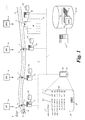
- the methods of the invention are employed in a tolling system 1 devised for tolling the use of locations L 1 , L 2 , L 3 , L 4 , ..., generally L m , by vehicles 2.
- An exemplary vehicle 2 is shown travelling a toll road 3 or parking on a chargeable parking lot 4, respectively.
- the vehicles 2 are identified in the tolling system 1 by their license plate number (LPN) 5, here: "W-5324", as it is printed on a license plate 6 of the vehicle 2.
- LPN license plate number
- each tollable location L m is provided with a camera 7.
- the camera 7 is directed towards its location L m to take a picture ("pic") 8 of the vehicle 2 including its license plate 6 (at least of that part of the vehicle 2 which includes the license plate 6) so that the LPN 5 can be seen and read in the picture 8.
- the cameras 7 can, e.g., be mounted on gantries 9 spanning the road 3, on poles or buildings aside the road 3 ("roadside"), at an entrance and/or exit of the parking lot 4, at a gate or border, etc.
- Each camera 7 is provided with an on-site processor 10 and connected over a network 11 to a central server 12 of the tolling system 1.
- the toll (fee) charged for a usage of a location L m can be a flat fee or dependent on distance travelled to or from this location and/or time spent at this location.
- a camera 7 cannot only monitor the entrance or exit of a parking lot 4 but could also monitor the entire area of the parking lot 4 and take pictures at regular intervals to identify the parking duration T of a vehicle 2 with the same LPN 5.
- the pictures 8 taken by the cameras 7 are stored in a database 13.
- the database 13 can either be kept centrally at the server 12 or be distributed over the system 1 in a decentralized way.
- first parts 13' of the database 13 are kept at the cameras 7, e.g., connected to their processors 10, and each store the pictures 8 taken by the respective camera 7; while a second, centralized part 13" of the database 13 is kept at the server 12 and collects tolling records ("rec") and pictures 8 over the network 11, as will be detailed further below.
- the pictures 8 For basic system functionality it does not matter where the pictures 8 physically reside, either at the first parts 13' or the second part 13" of a distributed database 13, or only at a central database 13.
- the pictures 8 When the pictures 8 are stored locally at the parts 13' of the cameras 7 they can, e.g., be referenced or indexed by pointers from the central part 13".
- the pictures 8 are stored locally at the cameras' database parts 13' and are transferred to the server's parts 13" only when necessary.
- the user terminal 14 Connected to the network 11 is at least one user terminal 14 with an input and output device.
- the user terminal 14 can be a data terminal, personal computer, notebook or tablet computer or preferably a smart phone with a touch screen 15 as input and output device.
- the network 11 which links cameras 7, server 12 and user terminals 14 can be of any kind, e.g., the Internet, or suitably segmented, for example a data network which links server 12 and cameras 7 and has a gateway to the Internet or to a mobile phone network serving user terminals 14 in the form of mobile devices such as smart phones.
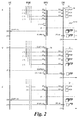
- Fig. 2 shows three exemplary embodiments of methods performed within the tolling system 1 of Fig. 1 .
- Section X of Fig. 2 refers to a first embodiment of "post-confirmation" of tollable locations;
- Section Y of Fig. 2 refers to a second and a third embodiment of registration ("pre- or post-declaration") of tollable locations;
- section Z of Fig. 2 shows an application of the first embodiment to the tolling of the parking lot 4.
- one or more cameras 7 each take a picture (pic) 8 and send it with an identifier of their respective location L m to the server 12 (step 17).
- the server 12 OCR-reads the LPNs 5 of vehicles 2 in the pictures 8 and generates tolling records ("rec") 18 for the database 13.
- the OCR-reading of the LPNs 5 in the pictures 8 can alternatively be done by the processors 10 of the cameras 7.
- the tolling records 18 each comprise a picture 8 and a data part 19 which includes an LPN 5 read in the picture 8, the location L m of the respective camera 7 which took the picture 8, an optional confidence value CV of the OCR process reading the LPN 5, and further meta-data as necessary.
- the tolling records 18 each also include the time t n when the picture 8 was taken by the respective camera 7.
- the tolling records 18 can be stored either in the first parts 13' or the second part 13" of the database 13 or can be distributed over the first and second parts 13', 13" so that, e.g., the pictures 8 could be kept locally in the first parts 13' at the cameras 7 as detailed above. Furthermore, the tolling records 18 can be generated either by the server 12 as shown in Fig. 2 or generated locally by the processors 10 of the cameras 7, or generation could be split among the local processors 10 and the server 12.
- the picture 8 in that tolling record 18 could be deleted right away, either at the camera 7 or the server 12, as is shown schematically in generating step 17'.
- the server 12 - or a camera's processor 10 - can analyze the sequence of locations L m showing up in subsequent tolling records 18 and compare or match these locations L m with a predetermined geographical sequence (such as the sequence L 1 -L 2 -L 3 on the road 3 in Fig. 1 ) to "fill” any "gaps" which might occur due to the deletion of a tolling record 18 in step 17' or a general failure of a camera 7 etc.
- a predetermined geographical sequence such as the sequence L 1 -L 2 -L 3 on the road 3 in Fig. 1
- Such "gap filling" can optionally generate additional tolling records 18 having only a data part 19, as is shown in step 20.
- a confirmation request "Q" is sent from the server 12 (or a camera 7) to the user terminal 14 (step 22).
- the criteria 21 which let the method proceed from the generating steps 17, 17', 20 to the sending step 22 can be one or more of the following:
- the confirmation request Q of step 22 is triggered either after each generating step 17 or according to one or more of the criteria i)-iii) mentioned above, one tolling record 18 or a set 23 of tolling records 18 for a certain LPN 5 is available in the database 13.
- the confirmation request Q is sent to that user terminal 14 that is identified by the LPN 5 indicated in the set 23.
- user terminals 14 can be directly addressed by LPNs 5, i.e., each vehicle 2 is associated with one user terminal 14 and vice-versa.
- a user can register a user terminal 14 that is addressable by, e.g., a mobile phone number in the network 11, for an LPN 5 with the network 11 or the server 12.
- Fig. 1 shows an exemplary touch screen display 24 on the touch screen 15 of the user terminal 14 with a list of confirmation requests Q for the LPN 5.
- route legs A-B, B-C, and C-D between locations L 1 and L 2 , L 2 and L 3 , L m and L m+1 , respectively, with the respective passing times t 1 -t
- a confirmation request Q of step 22 includes an LPN 5 the request relates to and a location information LI (such as L m , A-B, B-C, E, A-D, ...) which depends on one or more locations L m of one or more tolling records 18.
- the location information LI contained in a confirmation request Q does not need to enumerate individual tollable locations L m but can also be a generalized or geographically map-mached generalization of locations L m , such as the exemplary route A-D, which identifies a sequence of tolling locations L 1 , L 2 , L 3 , ... travelled along; all this being comprised by the term "dependency" of the location information LI on the location/s L m .
- two or more tolling records 18 of the set 23 could be merged into a "merged tolling record", for example tolling records 18 which relate to a route (leg) spanning several locations L m , L m+1 , L m+2 etc.
- the merging of individual tolling records 18 into merged tolling records 18 can, e.g., be performed when the times t n , t n+1 , ... of two or more tolling records 18 fall within a predetermined time span, i.e., are timely close to each other.
- two or more tolling records 18 can be merged into a merged tolling record 18 when their locations L m match a predetermined geographical sequence, e.g., a route defined by a sequence of tolling locations L m .
- Such merged tolling records 18 could be substituted for the original (individual) tolling records 18 in the course of the further procedure.
- the user Having received the confirmation request Q in step 22, the user then confirms (or rejects, i.e., does not confirm) the confirmation request Q by means of the user terminal 14.
- the user ticks a confirmation box 26 relating to a confirmation request Q and presses a "send" button 27.
- This initiates step 23 of sending a response "R" from the user terminal 14 to the entity having sent the request Q, i.e., to the server 12 or the requesting camera 7.
- the response R contains a reference to the request Q it relates to, and an indication whether this request is confirmed or not. In the simplest case the mere existence of a response R is an indication of confirmation.
- the server 12 deletes all those pictures 8 from the tolling records 18 in the database 13 to which the request Q was related, see deletion step 29.
- the server 12 or camera 7 deletes all those pictures 8 from the tolling records 18 in the database 13 to which the request Q was related, see deletion step 29.
- only tolling records 18 for which no confirmative response R is received in step 28 still contain pictures 8, whereas all other tolling records 18 are reduced to their data part 19.
- the deletion of the pictures 8 in step 29 frees up memory in the database 13 and preserves only those pictures 8 which might be necessary to revisit for checking or repeating the OCR reading or in case of other system failures.
- step 30 the tolling records 18 are retrieved from the database 13 for further processing such as checking, re-validation, re-OCR-reading, charging, accounting and enforcement of tolls.
- a registration request "G" is sent from the user terminal 14 to the server 12.
- the registration request G of step 31 includes at least a reference to an LPN 5 of a vehicle 2 and a location information LI - such as route A-D, route legs A-B, B-C, parking lot E etc. - which is dependent on one or more locations L m tollable by the cameras 7.
- the location information LI contained in a registration request G does not need to enumerate individual tollable locations L m but can be a merged, generalized or geographically map-mached generalization of locations L m , i.e., is "dependent on" the location/s L m , such as the exemplary trip or route A-D, which designates a sequence of tolling locations L m .
- the server 12 Having received the registration request G in step 31, the server 12 starts a process 32 in which the cameras 7 take pictures 8 (steps 17), and tolling records 18 are generated in the same way as in the first embodiment explained above.
- the tolling records 18 accumulate in the database 13.
- a testing step 33 is started.
- the process 32 tests whether the tolling records 18 accumulated so far match the registration request G as to LPN 5 and locations information indicated in the registration request G.
- the matching step 33 checks whether a tollable location L m indicated in the registration request G has been passed, i.e., whether there is a tolling record 18 containing this location L m .
- the matching step 33 can comprise a geographical map-matching, wherein the sequence of locations L m of a sequence of tolling records 18 is geographically compared ("map-matched") to the location information LI such as routes A-D, legs A-B, B-C, lot E etc. indicated in the registration request G. If the testing step 33 yields a "match", then the server 12 deletes all those pictures 8 from the tolling records 18 to which the registration request G relate. As a result, again, the number of pictures 8 in the database 13 is greatly reduced. In the final step 30 the tolling records 18 with their remaining pictures 8 are retrieved from the database 13 for further processing, as in the first embodiment.
- the step 31 of sending the registration request G is done at any time during or after the generating step(s) 17, as is exemplarily shown in broken lines.
- the bottom section Z of Fig. 2 shows a fourth embodiment based on the first embodiment (confirmation request/response), see steps 22 and 28.
- the generating steps 17 originate from one and the same camera 7, e.g., at the entrance and exit of the parking lot 4.
- Successive tolling records 18 do not differ in locations L m , but only in times t n , which is useful for tolling a location usage dependent on time spent at the location L m .
- the number of pictures 8 can be massively reduced, after receiving a confirmatory response R in step 28, by means of the deletion step 29.
- the second embodiment of section Y of Fig. 2 could be employed.
- an electronic signature of the user terminal 14 that has sent the respective confirmation response R in step 28 or registration request G in step 31 can be stored in the tolling record 18.
- the pictures 8 When the pictures 8 are stored locally in the database parts 13' at the cameras 7, they can be either deleted there in the steps 29, or they can be transferred to the central part 13" of the database 13 when there is no confirmation step 28 or no match in step 33. In addition, the pictures 8 can also be transferred from the first parts 13' to the second part 13" at regular intervals, when the first parts 13' exceeds a size threshold, or upon request, e.g., when required in step 30.
Landscapes
- Engineering & Computer Science (AREA)
- Theoretical Computer Science (AREA)
- Physics & Mathematics (AREA)
- General Physics & Mathematics (AREA)
- Business, Economics & Management (AREA)
- Library & Information Science (AREA)
- Data Mining & Analysis (AREA)
- Databases & Information Systems (AREA)
- General Engineering & Computer Science (AREA)
- Finance (AREA)
- Computer Networks & Wireless Communication (AREA)
- Software Systems (AREA)
- Human Resources & Organizations (AREA)
- Multimedia (AREA)
- Health & Medical Sciences (AREA)
- Economics (AREA)
- General Health & Medical Sciences (AREA)
- Marketing (AREA)
- Primary Health Care (AREA)
- Strategic Management (AREA)
- Tourism & Hospitality (AREA)
- General Business, Economics & Management (AREA)
- Computer Vision & Pattern Recognition (AREA)
- Devices For Checking Fares Or Tickets At Control Points (AREA)
- Traffic Control Systems (AREA)
Abstract
Description
- The present invention relates to a method for tolling one or more locations of a vehicle having a license plate number by means of a tolling system having a camera at each location to be tolled, a server, a database, a user terminal, and a network linking the camera/s, server and user terminal.
- In camera-based tolling systems, a picture of a passing vehicle is taken by a still camera or from the video stream of a video camera and processed by optical character recognition (OCR) to read the license plate number (LPN) of the vehicle at the location to be tolled. Tollable locations may, e.g., be toll roads, parking lots, borders, gates, etc., the passing or usage of which shall be charged. Cameras can be mounted on gantries, roadside facilities, buildings and the like in order to identify vehicles by OCR reading their LPNs and subsequently generate tolling records containing the LPNs and the locations of the respective cameras. The tolling records can then be used to charge user accounts set up for these LPNs.
- OCR reading the LPN of a vehicle in a picture of the vehicle is, however, an error-prone process due to highly variable lighting and weather conditions, fields of view, dust, mud, snow or ice on vehicle license plates, degraded or tampered license plates etc. Therefore, special measures have to be taken to avoid charging users wrongly on the basis of faulty OCR readings. One of these special measures is to store for each tolling record, which includes an LPN reading result, also the original picture from which the LPN was read to allow for a later inspection, verification, or re-reading of the LPN in case of a charging failure or objection. The original pictures are stored somewhere in the tolling system, either decentralized at the camera sites or centralized at the server site. However, storing the pictures of only one single traffic camera at an ordinary highway can generate picture data in the range of several terabytes per day. In a tolling system for an entire road network, huge amounts of picture data in the range of several petabytes can accumulate swiftly in just a couple of days. This requires massive storage systems with correspondingly high installation, maintenance, and powering costs. Last but not least, transferring such vast amounts of picture data between camera sites and the server takes up a lot of communication resources in the linking network.
- It is an object of the present invention to overcome these drawbacks of the prior art and to provide a camera-based tolling system which is easier and less costly to install, power, and maintain.
- To achieve these objects, a first aspect the invention provides a method for tolling of the above-identified kind, comprising:
- generating one or more tolling records, each including a picture of the vehicle taken by one of the camera/s, the location of said camera, and a license plate number read by optical character recognition from said picture, and storing the tolling record/s in the database;
- sending a confirmation request to the user terminal including the read license plate number and a location information dependent on the location/s in said tolling record/s; and
- receiving a response from the user terminal and, if the response confirms the request, deleting the picture/s from the tolling record/s in the database.
- In a second aspect, the objects of the invention are achieved with an alternative embodiment of the method identified at the outset, comprising:
- receiving a registration request from the user terminal including a license plate number and a location information dependent on one or more locations to be tolled;
- generating one or more tolling records, each including a picture of the vehicle taken by one of the camera/s, the location of said camera, and a license plate number read by optical character recognition from said picture, and storing the tolling record/s in the database; and
- testing whether the tolling record/s match/es the registration request as to license plate number and location/s and, if so, deleting the picture/s from the tolling record/s in the database,
- Both the embodiment according to the first aspect and the embodiment according to the second aspect of the invention provide a novel technical infrastructure for a fast, nearly real-time "self-declaration" of a location usage by the user, either by post-confirming or pre-registering the usage. The pictures of a declared, i.e., post-confirmed or pre- or post-registered, location usage are immediately deleted from the system, reducing the storage load on the system to a great extent. Only pictures of LPNs from confirmed or unregistered tolling records are kept in the database of the system. All other pictures originating from a regular, compliant, non-erroneous, untampered operation of the system are deleted.
- The amount of storage necessary for storing original pictures in the system can thus be reduced to a small fraction of that of prior art systems, saving substantial installation, powering, and maintenance costs. In addition, the amount of data transferred between decentralized camera storages and centralized server storage can be significantly reduced when the pictures are stored at the decentralized camera sites and deleted there upon a successful confirmation or registration match as they will then never be transferred to the server.
- While the two embodiments of the invention differ slightly in sequence of steps in that in the first aspect embodiment a request for confirmation of tolling records is sent to the user terminal after the tolling records have been generated and in the second aspect embodiment a registration request concerning future locations to be tolled is sent in advance, during or afterwards from the user terminal, both embodiments share the common inventive concept of deleting OCR reading pictures in case of an active acknowledgement by a user terminal.
- In both aspects of the invention, each tolling record may preferably include a time when its picture was taken by the camera. Such "time stamps" are very useful to enhance tolling accuracy.
- In a first variant of the invention that makes use of such time stamps, the methods can proceed from the generating step to the sending or testing step, respectively, when the times in two successively generated tolling records differ by more than a predetermined time span. In other words, tolling records are generated and accumulated as long as they do not "pause" for a "timeout" period, which would indicate that travelling a route consisting of a sequence of route legs, which are each charged by a tolling record, has been terminated, whereafter it makes sense to send these tolling records to the user terminal for post-confirmation, or to test them for a match with a pre- or post-registered route.
- In a second variant of the invention, making use of such time stamps the methods can proceed from the generating step to the sending or testing step, respectively, when the time in a most recently generated tolling record differs from the time in a tolling record of a preceding sending or testing step by more than a predetermined time span. This variant sends a batch of tolling records at regular time intervals to the user terminal for post-confirmation or tests it for a match with a pre- or post-registered route, respectively.
- In a third variant of the invention, the methods proceed from the generating step to the sending or testing step, respectively, when the location in a most recently generated tolling record differs from the location in a tolling record of a preceding sending or testing step by more than a predetermined distance. This triggers the confirmation request or match testing, respectively, every time when a certain distance is passed.
- Optionally, when a confidence level of the optical character recognition reading of the license plate number is below a given threshold, the respective picture or tolling record is deleted, which yields a further reduction of picture storage.
- A confidence level-based deletion of this kind may lead to "gaps" in a sequence of tolling records along a route. To compensate for such gaps, in a further preferred embodiment of the invention two or more tolling records can be merged into a "merged" tolling record when their locations match a predetermined geographical sequence, for example, tolling locations along a route such as a toll highway or during a parking stay at one and the same parking lot.
- Merging several individual tolling records into one merged tolling record frees up storage and makes handling in the confirmation and testing steps easier. Therefore, in further preferred embodiments of the inventive methods, the merged tolling records are used in said sending and receiving steps or in said testing step, respectively. The user can thus, e.g., post-confirm or pre- or post-declare an entire route to be travelled, consisting of several tolling locations, on the basis of a single merged tolling record.
- The database which stores the pictures in the system can be maintained centrally at the server. Alternatively, the database comprises first parts kept at the camera/s and a second part kept at the server and the picture/s is/are stored in the first parts, wherein a picture is transferred from the first parts to the second part when the response does not confirm or the testing does not match, respectively. Storage capacity can thus be distributed over multiple camera sites. Communication traffic can be greatly reduced between the cameras and the server when only pointers to the pictures stored locally at the cameras are exchanged over the network during manipulation of the tolling records.
- According to a further preferred feature of the invention, an electronic signature is received with the response or registration request, respectively, and is stored with a tolling record the picture of which is deleted. For tolling records (or merged tolling records) that have been confirmed upon request or that have matched a pre- or post-registration, the picture is "substituted" by an electronic signature in the tolling record, indicating its confirmation or registration, respectively.
- The user terminal can, e.g., be a personal computer linked to the network over the internet. In a preferred embodiment, the user terminal is, however, a mobile device such as a smart phone or tablet computer and the network includes a mobile network such as a 3G, 4G, 5G, etc. mobile phone network which serves the mobile device. With this setup, the user can register or confirm tolling records "on the go" immediately before or after a ride. Preferably, the confirmation request or registration request, respectively, is sent by a short message, an email, a webpage, or a data connection to an application on the mobile device.
- The location usages tollable by the methods of the invention can be of any kind, as detailed at the outset. In particular, a location can be a parking lot and the camera is then directed towards an entrance, a parking space or an exit of the parking lot; or the location is a road segment and the camera is directed towards this road segment.
- The invention will now be explained in detail by means of exemplary embodiments thereof with reference to the enclosed drawings, in which:
-
Fig. 1 shows a camera-based tolling system as used in the methods of the invention in a schematic block diagram; and -
Fig. 2 shows four exemplary embodiments of the methods of the invention in form of a sequence diagram. - With reference to
Fig. 1 , the methods of the invention are employed in atolling system 1 devised for tolling the use of locations L1, L2, L3, L4, ..., generally Lm, byvehicles 2. Anexemplary vehicle 2 is shown travelling a toll road 3 or parking on a chargeable parking lot 4, respectively. Thevehicles 2 are identified in thetolling system 1 by their license plate number (LPN) 5, here: "W-5324", as it is printed on alicense plate 6 of thevehicle 2. - To ascertain that a
vehicle 2 uses a location Lm, each tollable location Lm is provided with acamera 7. Thecamera 7 is directed towards its location Lm to take a picture ("pic") 8 of thevehicle 2 including its license plate 6 (at least of that part of thevehicle 2 which includes the license plate 6) so that theLPN 5 can be seen and read in thepicture 8. - The
cameras 7 can, e.g., be mounted on gantries 9 spanning the road 3, on poles or buildings aside the road 3 ("roadside"), at an entrance and/or exit of the parking lot 4, at a gate or border, etc. Eachcamera 7 is provided with an on-site processor 10 and connected over anetwork 11 to acentral server 12 of thetolling system 1. - The toll (fee) charged for a usage of a location Lm can be a flat fee or dependent on distance travelled to or from this location and/or time spent at this location. For example, the toll charged for the location L2 can be dependent on the distance between the preceding chargeable location L1 and the present location L2, or on the length of a road section on which the location L2 lies; or dependent on a time spent such as, e.g., on the location L4 of the parking lot 4, i.e., the time T = t2 - t1 spent between the time t1 of a
first picture 8 taken at entering the parking lot 4 via the location L4 and the time t2 of asecond picture 8 taken at exiting the parking lot 4 via the same location L4. It should be noted that acamera 7 cannot only monitor the entrance or exit of a parking lot 4 but could also monitor the entire area of the parking lot 4 and take pictures at regular intervals to identify the parking duration T of avehicle 2 with thesame LPN 5. - The
pictures 8 taken by thecameras 7 are stored in adatabase 13. Thedatabase 13 can either be kept centrally at theserver 12 or be distributed over thesystem 1 in a decentralized way. In the latter embodiment, first parts 13' of thedatabase 13 are kept at thecameras 7, e.g., connected to theirprocessors 10, and each store thepictures 8 taken by therespective camera 7; while a second,centralized part 13" of thedatabase 13 is kept at theserver 12 and collects tolling records ("rec") andpictures 8 over thenetwork 11, as will be detailed further below. - For basic system functionality it does not matter where the
pictures 8 physically reside, either at the first parts 13' or thesecond part 13" of a distributeddatabase 13, or only at acentral database 13. When thepictures 8 are stored locally at the parts 13' of thecameras 7 they can, e.g., be referenced or indexed by pointers from thecentral part 13". To minimize data traffic over thenetwork 11, it is preferred that thepictures 8 are stored locally at the cameras' database parts 13' and are transferred to the server'sparts 13" only when necessary. - Connected to the
network 11 is at least oneuser terminal 14 with an input and output device. Theuser terminal 14 can be a data terminal, personal computer, notebook or tablet computer or preferably a smart phone with atouch screen 15 as input and output device. - The
network 11 which linkscameras 7,server 12 anduser terminals 14 can be of any kind, e.g., the Internet, or suitably segmented, for example a data network which linksserver 12 andcameras 7 and has a gateway to the Internet or to a mobile phone network servinguser terminals 14 in the form of mobile devices such as smart phones. -
Fig. 2 shows three exemplary embodiments of methods performed within thetolling system 1 ofFig. 1 . - Section X of
Fig. 2 refers to a first embodiment of "post-confirmation" of tollable locations; Section Y ofFig. 2 refers to a second and a third embodiment of registration ("pre- or post-declaration") of tollable locations; and section Z ofFig. 2 shows an application of the first embodiment to the tolling of the parking lot 4. - In the first embodiment of a "post-confirmation" shown in section X, one or
more cameras 7 each take a picture (pic) 8 and send it with an identifier of their respective location Lm to the server 12 (step 17). Theserver 12 OCR-reads theLPNs 5 ofvehicles 2 in thepictures 8 and generates tolling records ("rec") 18 for thedatabase 13. The OCR-reading of theLPNs 5 in thepictures 8 can alternatively be done by theprocessors 10 of thecameras 7. - The tolling records 18 each comprise a
picture 8 and adata part 19 which includes anLPN 5 read in thepicture 8, the location Lm of therespective camera 7 which took thepicture 8, an optional confidence value CV of the OCR process reading theLPN 5, and further meta-data as necessary. Optionally and preferably, the tolling records 18 each also include the time tn when thepicture 8 was taken by therespective camera 7. - The tolling records 18 can be stored either in the first parts 13' or the
second part 13" of thedatabase 13 or can be distributed over the first andsecond parts 13', 13" so that, e.g., thepictures 8 could be kept locally in the first parts 13' at thecameras 7 as detailed above. Furthermore, the tolling records 18 can be generated either by theserver 12 as shown inFig. 2 or generated locally by theprocessors 10 of thecameras 7, or generation could be split among thelocal processors 10 and theserver 12. - If the confidence level CV of the OCR
reading result LPN 5 in atolling record 18 does not reach a predetermined minimum threshold, thepicture 8 in that tolling record 18 (or the entire tolling record 18) could be deleted right away, either at thecamera 7 or theserver 12, as is shown schematically in generating step 17'. - The server 12 - or a camera's processor 10 - can analyze the sequence of locations Lm showing up in
subsequent tolling records 18 and compare or match these locations Lm with a predetermined geographical sequence (such as the sequence L1-L2-L3 on the road 3 inFig. 1 ) to "fill" any "gaps" which might occur due to the deletion of atolling record 18 in step 17' or a general failure of acamera 7 etc. Such "gap filling" can optionally generateadditional tolling records 18 having only adata part 19, as is shown instep 20. - After each generating
step 17 or when a certain set oftolling records 18 has been generated, the set being determined bycriteria 21 explained below, a confirmation request "Q" is sent from the server 12 (or a camera 7) to the user terminal 14 (step 22). Thecriteria 21 which let the method proceed from the generating steps 17, 17', 20 to the sendingstep 22 can be one or more of the following: - i) The times tn in two successively generated
tolling records 18 differ by more than a predetermined time span Ttime-out, i.e. tn+1 - tn > Ttimeout. This is based on the assumption that thevehicle 2 may have terminated travelling the road 3 or pauses for a longer time period so that a user's trip may have finished. - ii) The time tn in the most
recent tolling record 18 of thesteps 17 differs from the time tn-x in thelast tolling record 18 which was sent in an earlier sendingstep 22, i.e., inFig. 2 in a sending step 22 (not shown) preceding thesteps 17, by more than a predetermined time span Tsend. This implements a periodical triggering of the sending of an accumulated set oftolling records 18 instep 22 in intervals of roughly said predetermined time span Tsend. - iii) The location Lm in the most recently generated
tolling record 18 of thesteps 17 differs from the location Lm-X in thelast tolling record 18 which was sent in an earlier sending step 22 (not shown inFig. 2 ) by more than a predetermined distance Dsend. This implements a periodical sending of confirmation requests 22 at geographical intervals of roughly Dsend. - When the confirmation request Q of
step 22 is triggered either after each generatingstep 17 or according to one or more of the criteria i)-iii) mentioned above, onetolling record 18 or aset 23 oftolling records 18 for acertain LPN 5 is available in thedatabase 13. In the sendingstep 22, the confirmation request Q is sent to thatuser terminal 14 that is identified by theLPN 5 indicated in theset 23. For example,user terminals 14 can be directly addressed byLPNs 5, i.e., eachvehicle 2 is associated with oneuser terminal 14 and vice-versa. To this end, in a preceding registration step (not shown) a user can register auser terminal 14 that is addressable by, e.g., a mobile phone number in thenetwork 11, for anLPN 5 with thenetwork 11 or theserver 12. -
Fig. 1 shows an exemplarytouch screen display 24 on thetouch screen 15 of theuser terminal 14 with a list of confirmation requests Q for theLPN 5. In thescreen display 24, the confirmation requests Q displayed contain data from thedata parts 19 of the tolling records 18 in a processed form, here for example route legs A-B, B-C, and C-D between locations L1 and L2, L2 and L3, Lm and Lm+1, respectively, with the respective passing times t1-t2, t2-t3 and tm-tm+1 of the route leg start and end locations; an example of a parking location E = L4 with start and end times of parking; as well as an example of a route ("trip") A-D over several route legs, with the respective passing times of the route start and end locations. - At minimum, a confirmation request Q of
step 22 includes anLPN 5 the request relates to and a location information LI (such as Lm, A-B, B-C, E, A-D, ...) which depends on one or more locations Lm of one or more tolling records 18. However, the location information LI contained in a confirmation request Q does not need to enumerate individual tollable locations Lm but can also be a generalized or geographically map-mached generalization of locations Lm, such as the exemplary route A-D, which identifies a sequence of tolling locations L1, L2, L3, ... travelled along; all this being comprised by the term "dependency" of the location information LI on the location/s Lm. - As an option, in
step 22 two ormore tolling records 18 of theset 23 could be merged into a "merged tolling record", for example tolling records 18 which relate to a route (leg) spanning several locations Lm, Lm+1, Lm+2 etc. The merging ofindividual tolling records 18 intomerged tolling records 18 can, e.g., be performed when the times tn, tn+1, ... of two ormore tolling records 18 fall within a predetermined time span, i.e., are timely close to each other. Additionally or alternatively, two ormore tolling records 18 can be merged into amerged tolling record 18 when their locations Lm match a predetermined geographical sequence, e.g., a route defined by a sequence of tolling locations Lm. Such mergedtolling records 18 could be substituted for the original (individual)tolling records 18 in the course of the further procedure. - Having received the confirmation request Q in
step 22, the user then confirms (or rejects, i.e., does not confirm) the confirmation request Q by means of theuser terminal 14. In the example shown inFig. 1 , the user ticks aconfirmation box 26 relating to a confirmation request Q and presses a "send"button 27. This initiatesstep 23 of sending a response "R" from theuser terminal 14 to the entity having sent the request Q, i.e., to theserver 12 or the requestingcamera 7. The response R contains a reference to the request Q it relates to, and an indication whether this request is confirmed or not. In the simplest case the mere existence of a response R is an indication of confirmation. - When the response R is received in
step 28, the server 12 (or camera 7) deletes all thosepictures 8 from the tolling records 18 in thedatabase 13 to which the request Q was related, seedeletion step 29. As a result,only tolling records 18 for which no confirmative response R is received instep 28 still containpictures 8, whereas allother tolling records 18 are reduced to theirdata part 19. The deletion of thepictures 8 instep 29 frees up memory in thedatabase 13 and preserves only thosepictures 8 which might be necessary to revisit for checking or repeating the OCR reading or in case of other system failures. - In
step 30 the tolling records 18 are retrieved from thedatabase 13 for further processing such as checking, re-validation, re-OCR-reading, charging, accounting and enforcement of tolls. - In section Y of
Fig. 2 , second and third embodiments of the method are shown. In the second embodiment of a "pre-declaration", in a first step 31 a registration request "G" is sent from theuser terminal 14 to theserver 12. The registration request G ofstep 31 includes at least a reference to anLPN 5 of avehicle 2 and a location information LI - such as route A-D, route legs A-B, B-C, parking lot E etc. - which is dependent on one or more locations Lm tollable by thecameras 7. As in the first embodiment, also in the second embodiment the location information LI contained in a registration request G does not need to enumerate individual tollable locations Lm but can be a merged, generalized or geographically map-mached generalization of locations Lm, i.e., is "dependent on" the location/s Lm, such as the exemplary trip or route A-D, which designates a sequence of tolling locations Lm. - Having received the registration request G in
step 31, theserver 12 starts aprocess 32 in which thecameras 7 take pictures 8 (steps 17), andtolling records 18 are generated in the same way as in the first embodiment explained above. The tolling records 18 accumulate in thedatabase 13. - After each
generation step 17 or when one of the criteria i), ii), or iii) explained above is met during accumulation of the tolling records 18, atesting step 33 is started. In thetesting step 33 theprocess 32 tests whether the tolling records 18 accumulated so far match the registration request G as toLPN 5 and locations information indicated in the registration request G. In the simplest form the matchingstep 33 checks whether a tollable location Lm indicated in the registration request G has been passed, i.e., whether there is atolling record 18 containing this location Lm. In more complex forms, the matchingstep 33 can comprise a geographical map-matching, wherein the sequence of locations Lm of a sequence oftolling records 18 is geographically compared ("map-matched") to the location information LI such as routes A-D, legs A-B, B-C, lot E etc. indicated in the registration request G. If thetesting step 33 yields a "match", then theserver 12 deletes all thosepictures 8 from the tolling records 18 to which the registration request G relate. As a result, again, the number ofpictures 8 in thedatabase 13 is greatly reduced. In thefinal step 30 the tolling records 18 with their remainingpictures 8 are retrieved from thedatabase 13 for further processing, as in the first embodiment. - In the third embodiment of a "post-declaration" depicted in section Y of
Fig. 2 , thestep 31 of sending the registration request G is done at any time during or after the generating step(s) 17, as is exemplarily shown in broken lines. - The bottom section Z of
Fig. 2 shows a fourth embodiment based on the first embodiment (confirmation request/response), seesteps same camera 7, e.g., at the entrance and exit of the parking lot 4. Successive tolling records 18 do not differ in locations Lm, but only in times tn, which is useful for tolling a location usage dependent on time spent at the location Lm. Here also, the number ofpictures 8 can be massively reduced, after receiving a confirmatory response R instep 28, by means of thedeletion step 29. Of course, for tolling a parking lot also the second embodiment of section Y ofFig. 2 could be employed. - In all embodiments, when a
picture 8 is deleted in thedatabase 13, an electronic signature of theuser terminal 14 that has sent the respective confirmation response R instep 28 or registration request G instep 31 can be stored in thetolling record 18. - When the
pictures 8 are stored locally in the database parts 13' at thecameras 7, they can be either deleted there in thesteps 29, or they can be transferred to thecentral part 13" of thedatabase 13 when there is noconfirmation step 28 or no match instep 33. In addition, thepictures 8 can also be transferred from the first parts 13' to thesecond part 13" at regular intervals, when the first parts 13' exceeds a size threshold, or upon request, e.g., when required instep 30. - The invention is not restricted to the specific embodiments diclosed herein but encompasses all variants, modifications and combinations thereof which fall into the scope of the appended claims.
Claims (15)
- A method for tolling one or more locations (Lm) of a vehicle (2) having a license plate number (5) by means of a tolling system (1) having a camera (7) at each location (Lm) to be tolled, a server (12), a database (13), a user terminal (14), and a network (11) linking the camera/s (7), server (12) and user terminal (14), the method comprising:generating (17) one or more tolling records (18), each including a picture (8) of the vehicle (2) taken by one of the camera/s (7), the location (Lm) of said camera (7), and a license plate number (5) read by optical character recognition from said picture (7), and storing the tolling record/s (18) in the database (13);sending (22) a confirmation request (Q) to the user terminal (14) including the read license plate number (5) and a location information (LI) dependent on the location/s (Lm) in said tolling record/s (18); andreceiving (28) a response (R) from the user terminal (14) and, if the response (R) confirms the request (Q), deleting (29) the picture/s (8) from the tolling record/s (18) in the database (13).
- A method for tolling one or more locations (Lm) of a vehicle (2) having a license plate number (5) by means of a tolling system (1) having a camera (7) at each location (Lm) to be tolled, a server (12), a database (13), a user terminal (14), and a network (11) linking the camera/s (7), server (12) and user terminal (14), the method comprising:receiving (31) a registration request (G) from the user terminal (14) including a license plate number (5) and a location information (LI) dependent on one or more locations (Lm) to be tolled;generating (17) one or more tolling records (18), each including a picture (8) of the vehicle (2) taken by one of the camera/s (7), the location (Lm) of said camera (7), and a license plate number (5) read by optical character recognition from said picture (8), and storing the tolling record/s (18) in the database (13); andtesting (33) whether the tolling record/s (18) match/es the registration request (G) as to license plate number (5) and location/s (Lm) and, if so, deleting (29) the picture/s (8) from the tolling record/s (18) in the database (13),wherein the step of receiving (31) is performed before, during or after the step of generating (17).
- The method of claim 1 or 2, wherein each tolling record (18) includes a time (tn) when said picture (8) was taken by the camera (7).
- The method of claim 3, further comprising:proceeding from the generating step (17) to the sending (22) or testing (33) step, respectively, when the times (tn) in two successively generated tolling records (18) differ by more than a predetermined time span (Ttimeout).
- The method of claim 3, further comprising:proceeding from the generating step (17) to the sending (22) or testing (33) step, respectively, when the time (tn) in a most recently generated tolling record (18) differs from the time (tn-x) in a tolling record (18) of a preceding sending or testing step (22, 33) by more than a predetermined time span (Tsend).
- The method of any one of the claims 1 to 3, further comprising:proceeding from the generating step (17) to the sending (22) or testing (33) step, respectively, when the location (Lm) in a most recently generated tolling record (18) differs from the location (Lm-X) in a tolling record (18) of a preceding sending or testing step (22, 23) by more than a predetermined distance (Dsend).
- The method of any one of the claims 1 to 6, wherein, when a confidence level (CV) of the optical character recognition reading of the license plate number (5) is below a given threshold, the respective picture (8) or tolling record (18) is deleted.
- The method of any one of the claims 1 to 7, wherein two or more tolling records (18) are merged into a merged tolling record (18) when their locations (Lm) match a predetermined geographical sequence.
- The method of any one of the claims 1 to 7, in which each tolling record (18) includes a time (tn) when its picture (8) was taken by the camera (7), wherein two or more tolling records (18) are merged into a merged tolling record when their times (tn) fall within a predetermined time span.
- The method of claim 8 or 9, wherein said merged tolling record/s is/are used instead of said tolling record/s (18).
- The method of any one of the claims 1 to 10, wherein the database (13) comprises first parts (13') kept at the camera/s (7) and a second part (13") kept at the server (12) and wherein the picture/s (8) is/are stored in the first parts (13'), and wherein a picture (8) is transferred from the first parts (13') to the second part (13") when the response (R) does not confirm or the testing (33) does not match, respectively.
- The method of any one of the claims 1 to 11, wherein an electronic signature is received with the response (R) or registration request (G), respectively, and is stored with a tolling record (18) the picture (8) of which is deleted.
- The method of any one of the claims 1 to 12, wherein the user terminal (14) is a mobile device and the network (11) includes a mobile network serving the mobile device (14).
- The method of claim 13, wherein the confirmation request (Q) or registration request (G) respectively, is sent by a short message, an email, a webpage, or a data connection to an application on the mobile device (14).
- The method of any one of the claims 1 to 14, wherein the location (Lm) is a parking lot (4) and the camera (7) is directed towards an entrance, a parking space or an exit of the parking lot (4); or the location (Lm) is a segment of a road (3) and the camera is directed towards this road segment.
Priority Applications (4)
| Application Number | Priority Date | Filing Date | Title |
|---|---|---|---|
| ES16189918T ES2834700T3 (en) | 2016-09-21 | 2016-09-21 | Camera-based toll collection method |
| EP16189918.2A EP3300029B1 (en) | 2016-09-21 | 2016-09-21 | A method for camera-based tolling |
| CA2972205A CA2972205C (en) | 2016-09-21 | 2017-06-30 | A method for camera-based tolling |
| US15/706,190 US10354457B2 (en) | 2016-09-21 | 2017-09-15 | Method for camera-based tolling |
Applications Claiming Priority (1)
| Application Number | Priority Date | Filing Date | Title |
|---|---|---|---|
| EP16189918.2A EP3300029B1 (en) | 2016-09-21 | 2016-09-21 | A method for camera-based tolling |
Publications (2)
| Publication Number | Publication Date |
|---|---|
| EP3300029A1 true EP3300029A1 (en) | 2018-03-28 |
| EP3300029B1 EP3300029B1 (en) | 2020-11-04 |
Family
ID=56990268
Family Applications (1)
| Application Number | Title | Priority Date | Filing Date |
|---|---|---|---|
| EP16189918.2A Active EP3300029B1 (en) | 2016-09-21 | 2016-09-21 | A method for camera-based tolling |
Country Status (4)
| Country | Link |
|---|---|
| US (1) | US10354457B2 (en) |
| EP (1) | EP3300029B1 (en) |
| CA (1) | CA2972205C (en) |
| ES (1) | ES2834700T3 (en) |
Families Citing this family (4)
| Publication number | Priority date | Publication date | Assignee | Title |
|---|---|---|---|---|
| US10831745B2 (en) * | 2018-01-30 | 2020-11-10 | Walmart Apollo, Llc | Database protocols and retrieval techniques |
| CN109448142A (en) * | 2018-11-09 | 2019-03-08 | 郑州云海信息技术有限公司 | A kind of intelligent high-speed charging system and method based on cloud computing |
| CN114464008B (en) * | 2019-03-07 | 2023-04-21 | 西安艾润物联网技术服务有限责任公司 | Warning method and device for vehicle entering and exiting places |
| US12190644B1 (en) | 2024-06-14 | 2025-01-07 | Tollscopic Llc | System for tolling |
Citations (3)
| Publication number | Priority date | Publication date | Assignee | Title |
|---|---|---|---|---|
| WO2008076463A1 (en) * | 2006-06-21 | 2008-06-26 | Pips Technology, Inc. | Automated site security, monitoring and access control system |
| EP1975884A1 (en) * | 2006-01-05 | 2008-10-01 | Mitsubishi Heavy Industries, Ltd. | Mobile object charging system and mobile object charging method by mobile object charging system |
| US20140270386A1 (en) * | 2013-03-13 | 2014-09-18 | Kapsch Trafficcom Ag | Method for reading vehicle identifications |
Family Cites Families (1)
| Publication number | Priority date | Publication date | Assignee | Title |
|---|---|---|---|---|
| SG10201704349XA (en) * | 2005-06-10 | 2017-06-29 | Accenture Global Services Ltd | Electronic vehicle identification |
-
2016
- 2016-09-21 EP EP16189918.2A patent/EP3300029B1/en active Active
- 2016-09-21 ES ES16189918T patent/ES2834700T3/en active Active
-
2017
- 2017-06-30 CA CA2972205A patent/CA2972205C/en active Active
- 2017-09-15 US US15/706,190 patent/US10354457B2/en active Active
Patent Citations (3)
| Publication number | Priority date | Publication date | Assignee | Title |
|---|---|---|---|---|
| EP1975884A1 (en) * | 2006-01-05 | 2008-10-01 | Mitsubishi Heavy Industries, Ltd. | Mobile object charging system and mobile object charging method by mobile object charging system |
| WO2008076463A1 (en) * | 2006-06-21 | 2008-06-26 | Pips Technology, Inc. | Automated site security, monitoring and access control system |
| US20140270386A1 (en) * | 2013-03-13 | 2014-09-18 | Kapsch Trafficcom Ag | Method for reading vehicle identifications |
Also Published As
| Publication number | Publication date |
|---|---|
| US20180082491A1 (en) | 2018-03-22 |
| CA2972205C (en) | 2024-04-30 |
| EP3300029B1 (en) | 2020-11-04 |
| ES2834700T3 (en) | 2021-06-18 |
| US10354457B2 (en) | 2019-07-16 |
| CA2972205A1 (en) | 2018-03-21 |
Similar Documents
| Publication | Publication Date | Title |
|---|---|---|
| US10354457B2 (en) | Method for camera-based tolling | |
| CN110379025B (en) | Electronic toll collection method and system based on intelligent network-connected automobile and Internet-of-vehicles service platform | |
| KR102287051B1 (en) | Parking space managing system by using image recognizing device | |
| CN105005853A (en) | Automotive aftermarket service management system | |
| BRPI0611952B1 (en) | METHOD AND SYSTEM FOR IDENTIFYING A VIOLATION PHOTO CORRESPONDING TO A VIOLATION TRANSACTION ENTRY | |
| CN112712023A (en) | Vehicle type identification method and system and electronic equipment | |
| US20190385449A1 (en) | System and method for providing automatic on-street parking control and unoccupied parking spot availability detection | |
| CN111582540A (en) | Method and device for determining emergency material scheduling scheme | |
| CN112053567B (en) | Roadside parking management method and electronic equipment | |
| Clements et al. | Technologies for congestion pricing | |
| CN107885795A (en) | A kind of data verification method, system and the device of bayonet socket data | |
| CN107393308A (en) | A method and device for recognizing license plates and a parking lot management system | |
| KR100986622B1 (en) | System and method for public resentment delivery using lbs based mobile terminal | |
| WO2025189682A1 (en) | Parking lot navigation method based on directed graph, and system and storage medium | |
| Hamidi et al. | Industry 4.0 urban mobility: goNpark smart parking tracking module | |
| CN113903090A (en) | Block chain-based highway cost determination method and system | |
| CN112560074B (en) | Vehicle passing data processing method, device, equipment and system | |
| JP2002312886A (en) | Road traffic information management system | |
| JP2026006687A (en) | Parking fee settlement system | |
| CN118898873A (en) | Travel pricing method and storage medium | |
| KR102362702B1 (en) | A system and service provision method for video shooting matching service around the road using an individual's own vehicle | |
| CN116206481A (en) | Method and device for associating parking space availability information | |
| CN111833540B (en) | Rental vehicle use charging method, electronic device and storage medium | |
| US20250246027A1 (en) | System and method for vehicle toll management | |
| CN105654775A (en) | Urban public road section parking management system and method |
Legal Events
| Date | Code | Title | Description |
|---|---|---|---|
| PUAI | Public reference made under article 153(3) epc to a published international application that has entered the european phase |
Free format text: ORIGINAL CODE: 0009012 |
|
| STAA | Information on the status of an ep patent application or granted ep patent |
Free format text: STATUS: REQUEST FOR EXAMINATION WAS MADE |
|
| 17P | Request for examination filed |
Effective date: 20170614 |
|
| AK | Designated contracting states |
Kind code of ref document: A1 Designated state(s): AL AT BE BG CH CY CZ DE DK EE ES FI FR GB GR HR HU IE IS IT LI LT LU LV MC MK MT NL NO PL PT RO RS SE SI SK SM TR |
|
| AX | Request for extension of the european patent |
Extension state: BA ME |
|
| STAA | Information on the status of an ep patent application or granted ep patent |
Free format text: STATUS: EXAMINATION IS IN PROGRESS |
|
| 17Q | First examination report despatched |
Effective date: 20190522 |
|
| GRAP | Despatch of communication of intention to grant a patent |
Free format text: ORIGINAL CODE: EPIDOSNIGR1 |
|
| STAA | Information on the status of an ep patent application or granted ep patent |
Free format text: STATUS: GRANT OF PATENT IS INTENDED |
|
| INTG | Intention to grant announced |
Effective date: 20200603 |
|
| GRAS | Grant fee paid |
Free format text: ORIGINAL CODE: EPIDOSNIGR3 |
|
| GRAA | (expected) grant |
Free format text: ORIGINAL CODE: 0009210 |
|
| STAA | Information on the status of an ep patent application or granted ep patent |
Free format text: STATUS: THE PATENT HAS BEEN GRANTED |
|
| AK | Designated contracting states |
Kind code of ref document: B1 Designated state(s): AL AT BE BG CH CY CZ DE DK EE ES FI FR GB GR HR HU IE IS IT LI LT LU LV MC MK MT NL NO PL PT RO RS SE SI SK SM TR |
|
| REG | Reference to a national code |
Ref country code: GB Ref legal event code: FG4D |
|
| REG | Reference to a national code |
Ref country code: CH Ref legal event code: EP |
|
| REG | Reference to a national code |
Ref country code: AT Ref legal event code: REF Ref document number: 1331798 Country of ref document: AT Kind code of ref document: T Effective date: 20201115 |
|
| REG | Reference to a national code |
Ref country code: IE Ref legal event code: FG4D |
|
| REG | Reference to a national code |
Ref country code: DE Ref legal event code: R096 Ref document number: 602016047035 Country of ref document: DE |
|
| REG | Reference to a national code |
Ref country code: SE Ref legal event code: TRGR |
|
| REG | Reference to a national code |
Ref country code: NL Ref legal event code: MP Effective date: 20201104 |
|
| PG25 | Lapsed in a contracting state [announced via postgrant information from national office to epo] |
Ref country code: NO Free format text: LAPSE BECAUSE OF FAILURE TO SUBMIT A TRANSLATION OF THE DESCRIPTION OR TO PAY THE FEE WITHIN THE PRESCRIBED TIME-LIMIT Effective date: 20210204 Ref country code: RS Free format text: LAPSE BECAUSE OF FAILURE TO SUBMIT A TRANSLATION OF THE DESCRIPTION OR TO PAY THE FEE WITHIN THE PRESCRIBED TIME-LIMIT Effective date: 20201104 Ref country code: PT Free format text: LAPSE BECAUSE OF FAILURE TO SUBMIT A TRANSLATION OF THE DESCRIPTION OR TO PAY THE FEE WITHIN THE PRESCRIBED TIME-LIMIT Effective date: 20210304 Ref country code: GR Free format text: LAPSE BECAUSE OF FAILURE TO SUBMIT A TRANSLATION OF THE DESCRIPTION OR TO PAY THE FEE WITHIN THE PRESCRIBED TIME-LIMIT Effective date: 20210205 Ref country code: FI Free format text: LAPSE BECAUSE OF FAILURE TO SUBMIT A TRANSLATION OF THE DESCRIPTION OR TO PAY THE FEE WITHIN THE PRESCRIBED TIME-LIMIT Effective date: 20201104 |
|
| PG25 | Lapsed in a contracting state [announced via postgrant information from national office to epo] |
Ref country code: BG Free format text: LAPSE BECAUSE OF FAILURE TO SUBMIT A TRANSLATION OF THE DESCRIPTION OR TO PAY THE FEE WITHIN THE PRESCRIBED TIME-LIMIT Effective date: 20210204 Ref country code: LV Free format text: LAPSE BECAUSE OF FAILURE TO SUBMIT A TRANSLATION OF THE DESCRIPTION OR TO PAY THE FEE WITHIN THE PRESCRIBED TIME-LIMIT Effective date: 20201104 Ref country code: IS Free format text: LAPSE BECAUSE OF FAILURE TO SUBMIT A TRANSLATION OF THE DESCRIPTION OR TO PAY THE FEE WITHIN THE PRESCRIBED TIME-LIMIT Effective date: 20210304 Ref country code: PL Free format text: LAPSE BECAUSE OF FAILURE TO SUBMIT A TRANSLATION OF THE DESCRIPTION OR TO PAY THE FEE WITHIN THE PRESCRIBED TIME-LIMIT Effective date: 20201104 |
|
| REG | Reference to a national code |
Ref country code: LT Ref legal event code: MG9D |
|
| REG | Reference to a national code |
Ref country code: ES Ref legal event code: FG2A Ref document number: 2834700 Country of ref document: ES Kind code of ref document: T3 Effective date: 20210618 |
|
| PG25 | Lapsed in a contracting state [announced via postgrant information from national office to epo] |
Ref country code: HR Free format text: LAPSE BECAUSE OF FAILURE TO SUBMIT A TRANSLATION OF THE DESCRIPTION OR TO PAY THE FEE WITHIN THE PRESCRIBED TIME-LIMIT Effective date: 20201104 |
|
| PG25 | Lapsed in a contracting state [announced via postgrant information from national office to epo] |
Ref country code: SK Free format text: LAPSE BECAUSE OF FAILURE TO SUBMIT A TRANSLATION OF THE DESCRIPTION OR TO PAY THE FEE WITHIN THE PRESCRIBED TIME-LIMIT Effective date: 20201104 Ref country code: RO Free format text: LAPSE BECAUSE OF FAILURE TO SUBMIT A TRANSLATION OF THE DESCRIPTION OR TO PAY THE FEE WITHIN THE PRESCRIBED TIME-LIMIT Effective date: 20201104 Ref country code: EE Free format text: LAPSE BECAUSE OF FAILURE TO SUBMIT A TRANSLATION OF THE DESCRIPTION OR TO PAY THE FEE WITHIN THE PRESCRIBED TIME-LIMIT Effective date: 20201104 Ref country code: CZ Free format text: LAPSE BECAUSE OF FAILURE TO SUBMIT A TRANSLATION OF THE DESCRIPTION OR TO PAY THE FEE WITHIN THE PRESCRIBED TIME-LIMIT Effective date: 20201104 Ref country code: SM Free format text: LAPSE BECAUSE OF FAILURE TO SUBMIT A TRANSLATION OF THE DESCRIPTION OR TO PAY THE FEE WITHIN THE PRESCRIBED TIME-LIMIT Effective date: 20201104 Ref country code: LT Free format text: LAPSE BECAUSE OF FAILURE TO SUBMIT A TRANSLATION OF THE DESCRIPTION OR TO PAY THE FEE WITHIN THE PRESCRIBED TIME-LIMIT Effective date: 20201104 |
|
| REG | Reference to a national code |
Ref country code: DE Ref legal event code: R097 Ref document number: 602016047035 Country of ref document: DE |
|
| PG25 | Lapsed in a contracting state [announced via postgrant information from national office to epo] |
Ref country code: DK Free format text: LAPSE BECAUSE OF FAILURE TO SUBMIT A TRANSLATION OF THE DESCRIPTION OR TO PAY THE FEE WITHIN THE PRESCRIBED TIME-LIMIT Effective date: 20201104 |
|
| PLBE | No opposition filed within time limit |
Free format text: ORIGINAL CODE: 0009261 |
|
| STAA | Information on the status of an ep patent application or granted ep patent |
Free format text: STATUS: NO OPPOSITION FILED WITHIN TIME LIMIT |
|
| 26N | No opposition filed |
Effective date: 20210805 |
|
| PG25 | Lapsed in a contracting state [announced via postgrant information from national office to epo] |
Ref country code: NL Free format text: LAPSE BECAUSE OF FAILURE TO SUBMIT A TRANSLATION OF THE DESCRIPTION OR TO PAY THE FEE WITHIN THE PRESCRIBED TIME-LIMIT Effective date: 20201104 Ref country code: AL Free format text: LAPSE BECAUSE OF FAILURE TO SUBMIT A TRANSLATION OF THE DESCRIPTION OR TO PAY THE FEE WITHIN THE PRESCRIBED TIME-LIMIT Effective date: 20201104 Ref country code: IT Free format text: LAPSE BECAUSE OF FAILURE TO SUBMIT A TRANSLATION OF THE DESCRIPTION OR TO PAY THE FEE WITHIN THE PRESCRIBED TIME-LIMIT Effective date: 20201104 |
|
| PG25 | Lapsed in a contracting state [announced via postgrant information from national office to epo] |
Ref country code: SI Free format text: LAPSE BECAUSE OF FAILURE TO SUBMIT A TRANSLATION OF THE DESCRIPTION OR TO PAY THE FEE WITHIN THE PRESCRIBED TIME-LIMIT Effective date: 20201104 |
|
| REG | Reference to a national code |
Ref country code: CH Ref legal event code: PL |
|
| REG | Reference to a national code |
Ref country code: BE Ref legal event code: MM Effective date: 20210930 |
|
| GBPC | Gb: european patent ceased through non-payment of renewal fee |
Effective date: 20210921 |
|
| PG25 | Lapsed in a contracting state [announced via postgrant information from national office to epo] |
Ref country code: IS Free format text: LAPSE BECAUSE OF FAILURE TO SUBMIT A TRANSLATION OF THE DESCRIPTION OR TO PAY THE FEE WITHIN THE PRESCRIBED TIME-LIMIT Effective date: 20210304 Ref country code: MC Free format text: LAPSE BECAUSE OF FAILURE TO SUBMIT A TRANSLATION OF THE DESCRIPTION OR TO PAY THE FEE WITHIN THE PRESCRIBED TIME-LIMIT Effective date: 20201104 |
|
| PG25 | Lapsed in a contracting state [announced via postgrant information from national office to epo] |
Ref country code: LU Free format text: LAPSE BECAUSE OF NON-PAYMENT OF DUE FEES Effective date: 20210921 Ref country code: IE Free format text: LAPSE BECAUSE OF NON-PAYMENT OF DUE FEES Effective date: 20210921 Ref country code: GB Free format text: LAPSE BECAUSE OF NON-PAYMENT OF DUE FEES Effective date: 20210921 Ref country code: BE Free format text: LAPSE BECAUSE OF NON-PAYMENT OF DUE FEES Effective date: 20210930 |
|
| PG25 | Lapsed in a contracting state [announced via postgrant information from national office to epo] |
Ref country code: LI Free format text: LAPSE BECAUSE OF NON-PAYMENT OF DUE FEES Effective date: 20210930 Ref country code: CH Free format text: LAPSE BECAUSE OF NON-PAYMENT OF DUE FEES Effective date: 20210930 |
|
| REG | Reference to a national code |
Ref country code: AT Ref legal event code: UEP Ref document number: 1331798 Country of ref document: AT Kind code of ref document: T Effective date: 20201104 |
|
| PG25 | Lapsed in a contracting state [announced via postgrant information from national office to epo] |
Ref country code: HU Free format text: LAPSE BECAUSE OF FAILURE TO SUBMIT A TRANSLATION OF THE DESCRIPTION OR TO PAY THE FEE WITHIN THE PRESCRIBED TIME-LIMIT; INVALID AB INITIO Effective date: 20160921 |
|
| P01 | Opt-out of the competence of the unified patent court (upc) registered |
Effective date: 20230513 |
|
| PG25 | Lapsed in a contracting state [announced via postgrant information from national office to epo] |
Ref country code: CY Free format text: LAPSE BECAUSE OF FAILURE TO SUBMIT A TRANSLATION OF THE DESCRIPTION OR TO PAY THE FEE WITHIN THE PRESCRIBED TIME-LIMIT Effective date: 20201104 |
|
| PG25 | Lapsed in a contracting state [announced via postgrant information from national office to epo] |
Ref country code: MK Free format text: LAPSE BECAUSE OF FAILURE TO SUBMIT A TRANSLATION OF THE DESCRIPTION OR TO PAY THE FEE WITHIN THE PRESCRIBED TIME-LIMIT Effective date: 20201104 |
|
| PG25 | Lapsed in a contracting state [announced via postgrant information from national office to epo] |
Ref country code: TR Free format text: LAPSE BECAUSE OF FAILURE TO SUBMIT A TRANSLATION OF THE DESCRIPTION OR TO PAY THE FEE WITHIN THE PRESCRIBED TIME-LIMIT Effective date: 20201104 |
|
| PG25 | Lapsed in a contracting state [announced via postgrant information from national office to epo] |
Ref country code: MT Free format text: LAPSE BECAUSE OF FAILURE TO SUBMIT A TRANSLATION OF THE DESCRIPTION OR TO PAY THE FEE WITHIN THE PRESCRIBED TIME-LIMIT Effective date: 20201104 |
|
| PGFP | Annual fee paid to national office [announced via postgrant information from national office to epo] |
Ref country code: DE Payment date: 20250919 Year of fee payment: 10 |
|
| PGFP | Annual fee paid to national office [announced via postgrant information from national office to epo] |
Ref country code: FR Payment date: 20250922 Year of fee payment: 10 Ref country code: AT Payment date: 20250919 Year of fee payment: 10 |
|
| PGFP | Annual fee paid to national office [announced via postgrant information from national office to epo] |
Ref country code: SE Payment date: 20250918 Year of fee payment: 10 |
|
| PGFP | Annual fee paid to national office [announced via postgrant information from national office to epo] |
Ref country code: ES Payment date: 20251028 Year of fee payment: 10 |