EP3299985A1 - Settlement terminal and method of protecting data stored in the settlement terminal against tampering - Google Patents
Settlement terminal and method of protecting data stored in the settlement terminal against tampering Download PDFInfo
- Publication number
- EP3299985A1 EP3299985A1 EP17191388.2A EP17191388A EP3299985A1 EP 3299985 A1 EP3299985 A1 EP 3299985A1 EP 17191388 A EP17191388 A EP 17191388A EP 3299985 A1 EP3299985 A1 EP 3299985A1
- Authority
- EP
- European Patent Office
- Prior art keywords
- settlement
- programs
- tampering
- terminal
- section
- Prior art date
- Legal status (The legal status is an assumption and is not a legal conclusion. Google has not performed a legal analysis and makes no representation as to the accuracy of the status listed.)
- Granted
Links
Images




Classifications
-
- G—PHYSICS
- G06—COMPUTING OR CALCULATING; COUNTING
- G06Q—INFORMATION AND COMMUNICATION TECHNOLOGY [ICT] SPECIALLY ADAPTED FOR ADMINISTRATIVE, COMMERCIAL, FINANCIAL, MANAGERIAL OR SUPERVISORY PURPOSES; SYSTEMS OR METHODS SPECIALLY ADAPTED FOR ADMINISTRATIVE, COMMERCIAL, FINANCIAL, MANAGERIAL OR SUPERVISORY PURPOSES, NOT OTHERWISE PROVIDED FOR
- G06Q20/00—Payment architectures, schemes or protocols
- G06Q20/04—Payment circuits
-
- G—PHYSICS
- G06—COMPUTING OR CALCULATING; COUNTING
- G06F—ELECTRIC DIGITAL DATA PROCESSING
- G06F21/00—Security arrangements for protecting computers, components thereof, programs or data against unauthorised activity
- G06F21/50—Monitoring users, programs or devices to maintain the integrity of platforms, e.g. of processors, firmware or operating systems
- G06F21/55—Detecting local intrusion or implementing counter-measures
- G06F21/554—Detecting local intrusion or implementing counter-measures involving event detection and direct action
-
- G—PHYSICS
- G06—COMPUTING OR CALCULATING; COUNTING
- G06F—ELECTRIC DIGITAL DATA PROCESSING
- G06F21/00—Security arrangements for protecting computers, components thereof, programs or data against unauthorised activity
- G06F21/50—Monitoring users, programs or devices to maintain the integrity of platforms, e.g. of processors, firmware or operating systems
- G06F21/57—Certifying or maintaining trusted computer platforms, e.g. secure boots or power-downs, version controls, system software checks, secure updates or assessing vulnerabilities
- G06F21/572—Secure firmware programming, e.g. of basic input output system [BIOS]
-
- G—PHYSICS
- G06—COMPUTING OR CALCULATING; COUNTING
- G06F—ELECTRIC DIGITAL DATA PROCESSING
- G06F8/00—Arrangements for software engineering
- G06F8/60—Software deployment
- G06F8/65—Updates
-
- G—PHYSICS
- G06—COMPUTING OR CALCULATING; COUNTING
- G06F—ELECTRIC DIGITAL DATA PROCESSING
- G06F8/00—Arrangements for software engineering
- G06F8/60—Software deployment
- G06F8/65—Updates
- G06F8/654—Updates using techniques specially adapted for alterable solid state memories, e.g. for EEPROM or flash memories
-
- G—PHYSICS
- G06—COMPUTING OR CALCULATING; COUNTING
- G06Q—INFORMATION AND COMMUNICATION TECHNOLOGY [ICT] SPECIALLY ADAPTED FOR ADMINISTRATIVE, COMMERCIAL, FINANCIAL, MANAGERIAL OR SUPERVISORY PURPOSES; SYSTEMS OR METHODS SPECIALLY ADAPTED FOR ADMINISTRATIVE, COMMERCIAL, FINANCIAL, MANAGERIAL OR SUPERVISORY PURPOSES, NOT OTHERWISE PROVIDED FOR
- G06Q20/00—Payment architectures, schemes or protocols
- G06Q20/08—Payment architectures
- G06Q20/20—Point-of-sale [POS] network systems
- G06Q20/206—Point-of-sale [POS] network systems comprising security or operator identification provisions, e.g. password entry
-
- G—PHYSICS
- G06—COMPUTING OR CALCULATING; COUNTING
- G06Q—INFORMATION AND COMMUNICATION TECHNOLOGY [ICT] SPECIALLY ADAPTED FOR ADMINISTRATIVE, COMMERCIAL, FINANCIAL, MANAGERIAL OR SUPERVISORY PURPOSES; SYSTEMS OR METHODS SPECIALLY ADAPTED FOR ADMINISTRATIVE, COMMERCIAL, FINANCIAL, MANAGERIAL OR SUPERVISORY PURPOSES, NOT OTHERWISE PROVIDED FOR
- G06Q20/00—Payment architectures, schemes or protocols
- G06Q20/30—Payment architectures, schemes or protocols characterised by the use of specific devices or networks
- G06Q20/32—Payment architectures, schemes or protocols characterised by the use of specific devices or networks using wireless devices
-
- G—PHYSICS
- G06—COMPUTING OR CALCULATING; COUNTING
- G06Q—INFORMATION AND COMMUNICATION TECHNOLOGY [ICT] SPECIALLY ADAPTED FOR ADMINISTRATIVE, COMMERCIAL, FINANCIAL, MANAGERIAL OR SUPERVISORY PURPOSES; SYSTEMS OR METHODS SPECIALLY ADAPTED FOR ADMINISTRATIVE, COMMERCIAL, FINANCIAL, MANAGERIAL OR SUPERVISORY PURPOSES, NOT OTHERWISE PROVIDED FOR
- G06Q20/00—Payment architectures, schemes or protocols
- G06Q20/30—Payment architectures, schemes or protocols characterised by the use of specific devices or networks
- G06Q20/34—Payment architectures, schemes or protocols characterised by the use of specific devices or networks using cards, e.g. integrated circuit [IC] cards or magnetic cards
- G06Q20/347—Passive cards
-
- G—PHYSICS
- G06—COMPUTING OR CALCULATING; COUNTING
- G06Q—INFORMATION AND COMMUNICATION TECHNOLOGY [ICT] SPECIALLY ADAPTED FOR ADMINISTRATIVE, COMMERCIAL, FINANCIAL, MANAGERIAL OR SUPERVISORY PURPOSES; SYSTEMS OR METHODS SPECIALLY ADAPTED FOR ADMINISTRATIVE, COMMERCIAL, FINANCIAL, MANAGERIAL OR SUPERVISORY PURPOSES, NOT OTHERWISE PROVIDED FOR
- G06Q20/00—Payment architectures, schemes or protocols
- G06Q20/38—Payment protocols; Details thereof
- G06Q20/40—Authorisation, e.g. identification of payer or payee, verification of customer or shop credentials; Review and approval of payers, e.g. check credit lines or negative lists
- G06Q20/403—Solvency checks
-
- G—PHYSICS
- G07—CHECKING-DEVICES
- G07F—COIN-FREED OR LIKE APPARATUS
- G07F7/00—Mechanisms actuated by objects other than coins to free or to actuate vending, hiring, coin or paper currency dispensing or refunding apparatus
- G07F7/08—Mechanisms actuated by objects other than coins to free or to actuate vending, hiring, coin or paper currency dispensing or refunding apparatus by coded identity card or credit card or other personal identification means
- G07F7/10—Mechanisms actuated by objects other than coins to free or to actuate vending, hiring, coin or paper currency dispensing or refunding apparatus by coded identity card or credit card or other personal identification means together with a coded signal, e.g. in the form of personal identification information, like personal identification number [PIN] or biometric data
- G07F7/1025—Identification of user by a PIN code
- G07F7/1075—PIN is checked remotely
Definitions
- Embodiments described herein relate generally to a settlement terminal and a method of protecting data stored in the settlement terminal against tampering.
- various settlement terminals e.g., a card settlement terminal which carries out the settlement of a transaction by a credit card
- tampering can occur to change the terminal to output recorded information used for a settlement, such as the credit card information read from a credit card.
- various events serving as signs of changes to the terminal such as forcibly opening a housing, are monitored, and in a case in which such an event occurs, the terminal is prevented from operating normally thereafter by deleting a program or the data necessary for the normal operation thereof.
- a settlement terminal comprising: a reading unit configured to read card data; a settlement processing unit including a processor programmed to carry out a settlement process the card data and a tampering detection process; a storage device in which a first set of programs is stored after encryption by a first key and a second set of programs is stored after encryption by a second key, each set of programs including a first program for operating the reading unit, and a second program for carrying out the settlement process, wherein upon detection of tampering, the processor of the settlement processing unit notifies an external terminal of the tampering and upon receiving an update instruction from the external terminal, updates a current set of programs used for operating the reading unit and carrying out the settlement process from the first set to the second set.
- the tampering detection process includes comparing a start value associated with a current connection state with an initial value associated with a prior connection state, and outputting a tampering error signal if the start value does not match the initial value.
- the start value is an IP address currently assigned to the settlement terminal and the initial value is an IP address previously assigned to the settlement terminal.
- the settlement processing unit is connected to a point-of-sale (POS) terminal over a network to receive transaction data from the POS terminal.
- POS point-of-sale
- the external terminal is preferably the POS terminal.
- the storage device includes an encryption processing circuit configured to encrypt the first and second sets of programs using the first and second keys, respectively, prior to storage in a storage area of the storage device and decrypt the first and second sets of programs using the first and second keys, respectively, when they are read out from the storage area.
- an encryption processing circuit configured to encrypt the first and second sets of programs using the first and second keys, respectively, prior to storage in a storage area of the storage device and decrypt the first and second sets of programs using the first and second keys, respectively, when they are read out from the storage area.
- the storage device further includes an access control circuit configured to supply the first key to the encryption processing circuit if the first set of programs is the current set of programs and the second key to the encryption processing circuit if the second set of programs is the current set of programs.
- the processor is further programmed to write either normal mode data or maintenance mode data in a shared memory region such that, if the normal mode data is written, a tampering error signal is output if a start value associated with a current connection state does not match an initial value associated with a prior connection state, and if the maintenance mode data is written, the tampering error signal is not output even if the start value does not match the initial value.
- the set of programs stored in the storage areas can be effectively used.
- the settlement processing unit preferably includes a wireless communication interface which sends an instruction to the processor to write maintenance mode data in the shared memory region upon authentication of a maintenance terminal that is within a communication range of the wireless communication interface.
- the invention also relates to a method of protecting data stored in a settlement terminal against tampering, wherein the settlement terminal includes a reading unit configured to read card data, a settlement processing unit including a processor programmed to carry out a settlement process using the card data and a tampering detection process, and a storage device in which a first set of programs is stored after encryption by a first key and a second set of programs is stored after encryption by a second key, each set of programs including a first program for operating the reading unit, and a second program for carrying out the settlement process, said method comprising: performing a tampering detection process; upon detection of tampering, notifying an external terminal of the tampering; and upon receiving an update instruction from the external terminal, updating a current set of programs used for operating the reading unit and carrying out the settlement process from the first set to the second set.
- the start value is an IP address currently assigned to the settlement terminal and the initial value is an IP address previously assigned to the settlement terminal.
- the settlement processing unit is connected to a point-of-sale (POS) terminal over a network to receive transaction data from the POS terminal.
- POS point-of-sale
- the external terminal is preferably the POS terminal.
- the storage device includes an encryption processing circuit configured to encrypt the first and second sets of programs using the first and second keys, respectively, prior to storage in a storage area of the storage device and decrypt the first and second sets of programs using the first and second keys, respectively, when they are read out from the storage area.
- an encryption processing circuit configured to encrypt the first and second sets of programs using the first and second keys, respectively, prior to storage in a storage area of the storage device and decrypt the first and second sets of programs using the first and second keys, respectively, when they are read out from the storage area.
- the storage device further includes an access control circuit configured to supply the first key to the encryption processing circuit if the first set of programs is the current set of programs and the second key to the encryption processing circuit if the second set of programs is the current set of programs.
- the processor is further programmed to write either normal mode data or maintenance mode data in a shared memory region such that, if the normal mode data is written, a tampering error signal is output if a start value associated with a current connection state does not match an initial value associated with a prior connection state, and if the maintenance mode data is written, the tampering error signal is not output even if the start value does not match the initial value.
- the set of programs stored in the storage areas can be effectively used.
- the settlement processing unit preferably includes a wireless communication interface which sends an instruction to the processor to write maintenance mode data in the shared memory region upon authentication of a maintenance terminal that is within a communication range of the wireless communication interface.
- a settlement terminal comprises a reading unit configured to read card data, a settlement processing unit including a processor programmed to carry out a settlement process using the card data and a tampering detection process, a storage device in which a first set of programs is stored after encryption by a first key and a second set of programs is stored after encryption by a second key, each set of programs including a first program for operating the reading unit, and a second program for carrying out the settlement process.
- the processor of the settlement processing unit Upon detection of tampering, notifies an external terminal of the tampering and upon receiving an update instruction from the external terminal, updates a current set of programs used for operating the reading unit and carrying out the settlement process from the first set to the second set.
- Fig. 1 is a block diagram illustrating main circuit elements of a settlement terminal 100 according to the first embodiment.
- the settlement terminal 100 includes a reading unit 10, a settlement processing unit 20 and a storage unit 30. Furthermore, although not shown, the settlement terminal 100 further includes units provided in other settlement terminals of the same type, such as a printing unit and a user interface unit.
- the reading unit 10 includes a reading section 11 and a reading control section 12.
- the reading section 11 reads card data recorded in a credit card presented thereto.
- the reading section 11 is an example of a reading module.
- the reading control section 12 encrypts the card data read by the reading section 11 and then sends the encrypted card data to the settlement processing unit 20. Therefore, the reading control section 12 includes an encryption module and a sending module to perform the encryption and sending functions.
- the reading control section 12 includes, for example, a microcomputer unit and includes a processor and a memory.
- a reading program P1 is stored in the memory.
- the processor executes processing based on the reading program P1 to realize operations of the reading control section 12.
- the settlement processing unit 20 includes a settlement control section 21, a tampering detection section 22 and a switch section 23.
- the settlement control section 21 includes, for example, a microcomputer unit and includes a processor and a memory.
- a settlement program P2 is stored in the memory.
- the processor executes processing using the settlement program P2 to perform the operations of the settlement control section 21.
- the tampering detection section 22, the reading unit 10, the storage unit 30 and POS (point-of-sale) terminals 200 are respectively connected with the settlement control section 21.
- the settlement control section 21 acquires transaction data indicating a settlement amount relating to a transaction, serving as an object of a settlement, from the POS terminal 200.
- the settlement control section 21 receives the encrypted card data sent by the reading unit 10, and decodes the encrypted card data.
- the settlement control section 21 encrypts settlement data including transaction data and card data by a method set by a settlement service that is provided by a settlement server 600.
- the settlement control section 21 sends the encrypted settlement data to a LAN (Local Area Network) 300 connected therewith via the switch section 23 and to the settlement server 600.
- LAN Local Area Network
- the settlement control section 21 receives the result of settlement based on the settlement data and controls the printing unit to print a paper slip representing the settlement result on the basis of response data sent from the settlement server 600. Further, the settlement control section 21 carries out processing, as described later herein, for updating the reading program P1 of the reading control section 12 and the settlement program P2 of the settlement control section 21.
- the tampering detection section 22 includes, for example, a microcomputer unit and includes a processor and a memory.
- a tampering detection program P3 is stored in the memory.
- the processor executes processing based on the tampering detection program P3 to realize the operations of the tampering detection section 22.
- the tampering detection section 22 acquires an IP address assigned to the settlement terminal 100 from the LAN 300 and carries out processing described later herein for detecting change in the connection state to the LAN 300 of the settlement terminal 100 on the basis of the IP address.
- the memory stores an initial value V1 and a start value V2, as will be described herein.
- the tampering detection section 22 further includes a clock function T1 which continuously carries out a clocking operation to obtain the current date and time.
- the switch section 23 is a switching circuit that selectively connects the settlement control section 21 and the tampering detection section 22 to the LAN 300 in response to the switch signal applied from the tampering detection section 22.
- the settlement processing unit 20 includes various interface sections for transmitting and receiving data between each of the reading unit 10 and the storage unit 30 and the settlement control section 21. Further, the settlement processing unit 20 includes an interface section for transmission and reception of data by the settlement control section 21 and the tampering detection section 22 via the LAN 300.
- the storage unit 30 includes a storage section 31, and control circuitry such as an access control section 32, an encryption key output section 33, an encryption processing section 34, and an interface section 35.
- the storage section 31 stores program files and data files, and includes, for example, an EEPROM (Electric Erasable Programmable Read-only Memory), an HDD (Hard Disk Drive), an SSD (Solid State Drive) and the like.
- the storage section 31 can logically set one, or a plurality of, storage areas.
- Fig. 1 shows a state in which n storage areas 31-1 to 31-n are set as an example.
- Each of the storage areas 31-1 to 31-n is an area for storing an encrypted file.
- areas other than the storage areas 31-1 to 31-n are also set in the storage section 31.
- One of such areas is a pre-boot authentication area that stores a program file for pre-boot authentication processing. Further, one of such areas is an area that stores a program file for program update processing by the settlement control section 21.
- the access control section 32 manages which of a locked state and an unlocked state is set for each of the storage areas 31-1 to 31-n. In a case in which any one of respective addresses of the storage areas 31-1 to 31-n and an access key determined for the storage area of the address are supplied from the interface section 35, the access control section 32 switches between the locked state and the unlocked state of the corresponding storage area. In a case of setting a storage area to the unlocked state, the access control section 32 acquires an encryption key predetermined for the storage area from the encryption key output section 33, and sets the encryption key in the encryption processing section 34. In a case of setting some storage area to the locked state, the access control section 32 clears the encryption key set in the encryption processing section 34 as described above.
- the encryption key output section 33 supplies an encryption key corresponding to a storage area designated by the access control section 32 to the access control section 32.
- the encryption key output section 33 may store each of the encryption keys, generated in advance, for each of the storage areas, or may carry out calculation with, for example, a specific calculation formula such as a hash function on the basis of information applied from the access control section 32.
- the encryption processing section 34 In a case in which writing of a file into a designated storage area in which a corresponding encryption key is set is requested, the encryption processing section 34 encrypts the file using the set encryption key described above. Then, the encryption processing section 34 writes the encrypted file into the designated storage area. In a case in which reading of a file from a designated storage area in which a corresponding encryption key is set is requested, the encryption processing section 34 decodes (i.e., decrypts) the file using the set encryption key described above. Then, the encryption processing section 34 outputs the decoded file to the interface section 35. If the encryption key corresponding to the designated storage area is not set, the encryption processing section 34 denies the requests for writing or reading.
- the interface section 35 supplies an address, and an access key sent from the settlement control section 21 of the settlement processing unit 20, to the access control section 32.
- the interface section 35 supplies the request for the reading or the writing of the file from the settlement control section 21 to the encryption processing section 34.
- the interface section 35 supplies the decoded file from the encryption processing section 34 to the settlement control section 21.
- a device based on a general-purpose interface standard such as an SATA (Serial Advanced Technology Attachment) interface device, can be used.
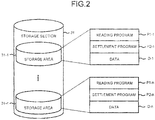
- Fig. 2 is a diagram illustrating a storage state of files in the storage areas 31-1 to 31-n.
- Each of the storage areas 31-1 to 31-n stores a group of program files, each group consisting of a corresponding one of reading programs P1-1 to P1-n, a corresponding one of settlement programs P2-1 to P2-n, and a corresponding one of data files D-1 to D-n.
- the reading program and the settlement program stored in one of the storage areas 31-1 to 31-n are assigned the same encryption key.
- the data file stored in one of the storage areas 31-1 to 31-n includes data used in a processing operation based on the reading program or the settlement program stored in the same storage area.
- the LAN 300 may be constituted as either a wired LAN or a wireless LAN, or a combination of a wired LAN and a wireless LAN. Furthermore, the LAN 300 may be replaced with another type of communication network such as an optical communication network or a Bluetooth® or combined therewith. In other words, the LAN 300 can be replaced with any communication network as long as the identifier of a device serving as a sending source is included in transmitted data therefrom. In other words, the LAN is an example of the communication network.
- a plurality of POS terminals 200 belonging to one POS system are connected to the LAN 300 in order to communicate with a POS server 400 belonging to the same POS system.
- a POS terminal 200 which is not connected to the shown settlement terminal 100 is connected with a different settlement terminal 100 from the shown one without using the LAN 300.
- only one settlement terminal 100 is shown in Fig. 1 ; however, the POS system may be constituted as including a plurality of settlement terminals 100 being respectively connected with other POS terminals 200.
- the settlement control section 21 reads a program for program update processing from the storage section 31, and starts processing based on the program.
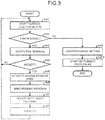
- Fig. 3 is a flowchart of the program update processing by the settlement control section 21.
- the settlement control section 21 starts the tampering detection section 22 by outputting an operation start signal to the tampering detection section 22 (Act 1).
- the tampering detection section 22 starts processing based on a tampering detection program P3 if the foregoing operation start signal arrives.
- the processing based on the tampering detection program P3 by the tampering detection section 22 is illustrated in the flowchart of Fig. 4 .
- the tampering detection section 22 inquires the LAN 300 about an IP address (Act 11). Furthermore, the tampering detection section 22 sets a switch signal to a Low level at this time. If the switch signal is the Low level, the switch section 23 selects communication with the tampering detection section 22. Thus, the tampering detection section 22 is in a state of being connected with the LAN 300 through the switch section 23.
- the tampering detection section 22 confirms whether or not the IP address is notified (i.e., received) from the LAN 300 (Act 12) . Then, the tampering detection section 22 follows the No path if the IP address is not received, and proceeds to the processing in Act 13. There, the tampering detection section 22 confirms whether or not the standby time for receipt of the IP address notification is timed out (Act 13). Then, the tampering detection section 22 returns to the processing Act 12 if the standby time for receipt of the IP address has not timed out.
- the standby time may be optionally set by, for example, the creator of the tampering detection program P3 or the manager of the settlement terminal 100.
- the tampering detection section 22 waits for the IP address to be received until the standby time reaches the end of the standby time period (Act 12 and Act 13).
- the tampering detection section 22 follows the Yes path from the processing in Act 12 if the IP address is received during the standby time period, and proceeds to a processing in Act 14.
- the tampering detection section 22 acquires the IP address and date and time obtained by the clock function T1 at this point of time (Act 14). Furthermore, the received IP address indicates that a terminal identified by the IP address is connected with the LAN 300, and thus is one of network information relating to the constitution of the LAN 300 as the communication network.
- the tampering detection section 22 confirms whether or not initial setting of the IP address is completed (Act 15). Whether or not the initial setting is completed is managed with a flag by, for example, the settlement control section 21, and notified by the operation start signal. The tampering detection section 22 follows the No path if the initial setting is not completed after receipt of the notification, and proceeds to the processing in Act 16.
- the tampering detection section 22 sets the IP address acquired in the processing in Act 14 as the initial value V1, associates the IP address with the date and time it was acquired in the processing in Act 14, and stores the IP address and the date and time in the memory of the tampering detection section 22 (Act 16).
- the tampering detection section 22 notifies the settlement control section 21 of the initial value V1 stored as described above (Act 17). Then, the tampering detection section 22 ends the processing shown in Fig. 4 .
- the tampering detection section 22 starts the processing of Fig. 4 in response to re-starting of the settlement terminal 100 after the setting of the initial value V1 as above, the completion of the initial setting is notified by the operation start signal.
- the tampering detection section 22 follows the Yes path in the processing in Act 15 on the basis of this notification, and proceeds to the processing in Act 18.
- the tampering detection section 22 updates the start value V2 with the IP address acquired in the processing in Act 14, and stores the date and time acquired in the processing in Act 14, in association with the start value V2, in the memory of the tampering detection section 22 (Act 18).
- the tampering detection section 22 proceeds to the processing in Act 21 after that.
- the tampering detection section 22 takes the Yes path from the processing Act 13 if the standby time period times out without receiving notification of the IP address, and proceeds to the processing in Act 19.
- the tampering detection section 22 acquires the date and time obtained by the clock function T1 at that point in time (Act 19) .
- the tampering detection section 22 clears the start value V2, and updates the date and time associated with the start value V2 with the acquired date and time described above (Act 20).
- the tampering detection section 22 proceeds to the processing in Act 21 after that.
- the tampering detection section 22 confirms whether or not the initial value V1 and the start value V2 are coincident. Then, the tampering detection section 22 follows the Yes path if both the values are coincident, and proceeds to the processing in Act 22. The tampering detection section 22 notifies the settlement control section 21 of the start value V2 (Act 22) . Then, the tampering detection section 22 ends the processing shown in Fig. 4 as a result. However, the tampering detection section 22 follows the No path in the processing in Act 21 if the initial value V1 and the start value V2 are not coincident, and proceeds to the processing in Act 23.
- the tampering detection section 22 sends a tampering error signal to the settlement control section 21 (Act 23).
- the tampering detection section 22 notifies the settlement control section 21 of the start value V2 (Act 24) .
- the tampering detection section 22 ends the processing in Fig. 4 as a result.
- the tampering detection section 22 changes the switch signal to a High level at the time of ending the processing shown in Fig. 4 .
- the switch section 23 selects the settlement control section 21 if the switch signal is at the High level.
- the switch state is changed from one that indicates the tampering detection section 22 is connected with the LAN 300 to one that indicates the settlement control section 21 is connected with the LAN 300.
- the settlement control section 21 proceeds to the processing in Act 2 after starting the tampering detection section 22 in Act 1.
- the settlement control section 21 confirms whether or not the tampering error signal has been output as described above (Act 2) . Then, the settlement control section 21 takes the Yes path if the tampering error signal has been output, and proceeds to the processing in Act 3.
- the settlement control section 21 provides an error notification to the POS terminal 200 connected with the settlement control section 21 (Act 3). If the POS terminal 200 receives the notification, the POS terminal 200 carries out an operation to display a message requesting the operator to update the settlement program (or refuse to update the program) since it is possible that some unauthorized conduct with respect to the settlement terminal 100, such as tampering, has occurred. Thereafter, the POS terminal 200 receives a confirmation operation by the operator to update settlement program.Then, the POS terminal 200 notifies the settlement control section 21 of the content of the confirmation operation if the confirmation operation is carried out.
- the settlement control section 21 confirms whether or not the foregoing operation of the message for accepting the update was carried out (Act 4). Then, the settlement control section 21 takes the No path if the foregoing operation of the message for refusing the update is carried out, or the predetermined standby time is timed out while there is no notification of the confirmation operation, and returns to the processing in Act 1 without executing processing in Act 5 to Act 8. Alternatively, the settlement control section 21 takes the Yes path to the processing in Act 4 if the foregoing operation of the message for accepting the update is carried out, and proceeds to the processing in Act 5 according to the operation procedures as guided previously by the operator.
- the settlement control section 21 activates one of the unused storage areas among the storage areas 31-1 to 31-n (Act 5). Unused means that the reading program stored in that storage area is not written into its reading control section 12 as the reading program P1.
- the settlement control section 21 specifically manages the storage areas and selects one of the storage areas which was not activated in the past, and thereby the information therein. Then, the settlement control section 21 applies the address of the selected storage area and the access key associated with the storage area to the interface section 35. Then, in the storage unit 30, the selected storage area is set to the unlocked state and activated through the foregoing function of each section.
- the settlement control section 21 sends the reading program stored in the activated storage area to the reading control section 12 (Act 6). At this time, it is preferable that the settlement control section 21 encrypts the reading program and sends the encrypted reading program. If the reading program is sent from the settlement control section 21 in this way, the reading control section 12 writes the reading program into the memory of the reading control section 12 as the reading program P1. In other words, the reading control section 12 updates the reading program P1.
- the settlement control section 21 writes the settlement program stored in the activated storage area into the memory of the settlement control section 21 as the settlement program P2 (Act 7). In other words, the settlement control section 21 updates the settlement program P2.
- the settlement control section 21 initializes a monitoring state of a network constitution (Act 8). Specifically, the settlement control section 21 notifies the POS terminal 200 of the abnormal event date and time so that the history of the program update can be managed by the POS terminal 200. Then, the settlement control section 21 sets the flag for managing whether or not the initial setting is completed, to a state indicating that the initial setting is not complete. Furthermore, at this time, the settlement control section 21 may instruct the tampering detection section 22 to clear the initial value V1 and the start value V2.
- the settlement control section 21 returns to the processing in Act 1.
- the settlement control section 21 enables the tampering detection section 22 to carry out the initial setting, and the IP address assigned to the settlement terminal 100 is stored in the memory of the tampering detection section 22 as the initial value V1 at the time of the update of the program.
- a function as an update module is realized through cooperation of the settlement control section 21 and the tampering detection section 22.
- the settlement control section 21 process follows the No path in the processing in Act 2 in Fig. 3 if the initial value or the start value is notified in a state in which the tampering error signal is not received, in other words, if the initial value or the start value in Act 17 or Act 22 in Fig. 4 is notified, and proceeds to the processing in Act 9.
- the settlement control section 21 sets the IP address indicated by the notified initial value or start value as information for LAN processing for communication via the LAN 300 (Act 9). Further, the settlement control section 21 sets information, necessary for the LAN processing, which relates to the network environment and the network constitution for the LAN processing.
- the information is, for example, a MAC address of a LAN interface section (not shown) arranged between the LAN 300.
- the settlement control section 21 starts a settlement processing based on the settlement program P2 (Act 10) . Then, the settlement control section 21 ends the processing shown in Fig. 3 .
- the settlement terminal 100 is disconnected from the LAN 300 and is removed from a store where the settlement terminal 100 is originally located by an unauthorized person. Then, after the settlement terminal 100 is returned to the foregoing store and reconnected to the LAN 300, when the settlement terminal 100 is started, a new IP address different from the IP address thereof before the disconnection from the LAN 300 is assigned to the settlement terminal 100.
- the initial value V1 indicating the IP address assigned before the disconnection from the LAN 300 and the start value V2 indicating the IP address assigned after the reconnection with the LAN 300 are different values. Then, as a result, the tampering detection section 22 determines that the initial value V1 and the start value V2 are not coincident in the processing in Act 21 in Fig. 4 , and the reading program P1 of the reading control section 12 and the settlement program P2 of the settlement control section 21 are updated to new programs from storage 31 which have not been previously used. Thus, analysis and change of the reading program P1 and the settlement program P2 carried out by the unauthorized person before such program update is carried out will become meaningless, and even if such unauthorized conduct occurs, damage caused by the unfair conduct can be avoided.
- the settlement terminal 100 since the reading program P1 and the settlement program P2 are immediately updated at the time of the starting of the settlement terminal 100, there is hardly any time period during which the settlement terminal 100 cannot be used after a tampering incident has occurred.
- the reading program P1 and the settlement program P2 are updated again with respect to the single act of unauthorized conduct described above.
- the program is not updated in a case in which the operation of the message for accepting the update of the program is not carried out, and in this way, the reading program and the settlement program stored in each of the storage areas 31-1 to 31-n can be used effectively.
- Fig. 5 is a block diagram illustrating main circuit elements of a settlement terminal 101 according to the second embodiment. Furthermore, the components of the settlement terminal 101 are different from that of the settlement terminal 100 in that a settlement processing unit 50 is included instead of the settlement processing unit 20. Thus, Fig. 5 only illustrates the components of the settlement processing unit 50. The same elements in Fig. 5 as these shown in Fig. 1 are applied with the same reference numerals, and detailed descriptions thereof are omitted.
- the settlement processing unit 50 includes the settlement control section 21, a state detection section 51 and a tampering detection section 52.
- the settlement processing unit 50 includes the tampering detection section 52 instead of the tampering detection section 22 in the first embodiment, and additionally includes the state detection section 51.
- the state detection section 51 includes a wireless section 51a, a memory control section 51b, a shared memory 51c and a memory control section 51d, all of which are implemented as control circuitry in one example.
- the wireless section 51a wirelessly communicates with a maintenance terminal 700.
- the wireless section 51a carries out authentication of the maintenance terminal 700 on the basis of RF data received through the communication with the maintenance terminal 700.
- the wireless section 51a instructs the memory control section 51b to rewrite mode data stored in the shared memory 51c in a case in which the maintenance terminal 700 can be authenticated.
- the memory control section 51b rewrites the mode data stored by the shared memory 51c in response to the instruction received from the wireless section 51a.
- the shared memory 51c stores the mode data.
- the mode data is normal mode data or maintenance mode data.
- the memory control section 51d reads out the mode data from the shared memory 51c to apply the mode data to the tampering detection section 52.
- the tampering detection section 52 includes, for example, a microcomputer unit and includes a processor and a memory, and is different from the tampering detection section 22 in that a tampering detection program P4 instead of the tampering detection program P3 is stored in the memory thereof. Then, operations of the tampering detection section 52 are realized in such a manner that the processor of the tampering detection section 52 executes the hereafter described processing based on the tampering detection program P4.
- the maintenance terminal 700 is possessed by a maintainer having authorized authority to maintain the settlement terminal 100 and it sends RF data including authentication information in a case in which the maintenance terminal 700 can communicate with the wireless section 51a.
- a system of a RFID (Radio Frequency Identification) or a NFC (Near Field Communication) can be used for the transmission of RF data.
- the wireless section 51a includes a function as a third acquisition module.
- the maintenance person positions the maintenance terminal 700 close to the antenna of the wireless section 51a before the maintenance. Then, RF data is wirelessly sent from the maintenance terminal 700, and the RF data is received by the wireless section 51a.
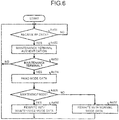
- Fig. 6 is a flowchart illustrating operations of the wireless section 51a.
- the wireless section 51a determines if the RF data is received (Act 31). Then, the wireless section 51a follows the Yes path if the RF data is received, and proceeds to the processing in Act 32.
- the wireless section 51a authenticates the maintenance terminal 700 using authentication information included in the RF data (Act 32).
- the wireless section 51a confirms whether or not the maintenance terminal 700 that sends the RF data is a regular maintenance terminal 700 on the basis of the foregoing authentication (Act 33) . Then, the wireless section 51a follows the No path if the maintenance terminal 700 that sends the RF data is not the regular maintenance terminal 700, and returns to the waiting state of Act 31. However, the wireless section 51a follows the Yes path if the maintenance terminal 700 that sends the RF data is the regular maintenance terminal 700, and proceeds to the processing of Act 34.
- the wireless section 51a reads the mode data stored in the shared memory 51c via the memory control section 51b (Act 34) .
- the wireless section 51a confirms whether or not the mode data is the maintenance mode data (Act 35) .
- the wireless section 51a proceeds to a processing in Act 36 (follows the Yes path) if the mode data is the maintenance mode data.
- the wireless section 51a instructs the memory control section 51b to rewrite the mode data stored by the shared memory 51c with the maintenance mode data.
- the memory control section 51b rewrites the mode data stored by the shared memory 51c with the maintenance mode data. After that, the wireless section 51a returns to the waiting state of Act 31.
- the wireless section 51a follows the No path if the mode data read from the sharing memory 51c in Act 35 is the normal mode data, and proceeds to the processing of Act 37.
- the wireless section 51a instructs the memory control section 51b to rewrite the mode data stored by the shared memory 51c with the normal mode data (Act 37).
- the memory control section 51b rewrites the mode data stored by the shared memory 51c with the normal mode data. After that, the wireless section 51a returns to the waiting state in Act 31.
- the mode data stored by the shared memory 51c can be replaced by either the normal mode data or the maintenance mode data.
- Fig. 7 is a flowchart illustrating procedures of processing based on the tampering detection program P4 in the tampering detection section 52. Furthermore, portions of the illustration of operations of the same contents as these shown in Fig. 4 is omitted, and illustrated operations are applied with the same reference numerals, and detailed description thereof are omitted.
- the tampering detection section 52 carries out the processing of Act 11 to Act 20, similar to the tampering detection section 22. Then, the tampering detection section 52 proceeds to processing of Act 41 if the processing of Act 18 or Act 20 is ended.
- the tampering detection section 52 reads the mode data stored in the shared memory 51c via the memory control section 51d, and confirms whether or not the read mode data is the normal mode data (Act 41). Then, the tampering detection section 52 proceeds to the processing of Act 21 (follows the Yes path) if the read mode data is the normal mode data.
- the tampering detection section 52 bypasses the processing of Act 21 to proceed to the processing of Act 22 (follows the No path)if the read mode data is the maintenance mode data. After that, the tampering detection section 52 carries out the processing after the processing of Act 21, similar to the tampering detection section 22.
- the tampering detection section 52 does not confirm whether or not the initial value V1 and the start value V2 are coincident, and thus does not carry out the update of the reading program P1 as well as the settlement program P2 in a state in which the maintenance mode is set by setting the mode data to the maintenance mode data.
- the tampering detection section 52 includes a function as a second control module.
- the settlement terminal 101 According to the settlement terminal 101, the same effect as the settlement terminal 100 can be achieved. In addition, according to the settlement terminal 101, even in a state in which the assignment of the IP address is changed through the maintenance, it can be prevented that the reading program P1 and the settlement program P2 are updated by setting the maintenance mode. In other words, the reading programs and the settlement programs stored in the storage areas 31-1 to 31-n can be effectively used.
Landscapes
- Engineering & Computer Science (AREA)
- Theoretical Computer Science (AREA)
- Business, Economics & Management (AREA)
- General Physics & Mathematics (AREA)
- Physics & Mathematics (AREA)
- Software Systems (AREA)
- Computer Security & Cryptography (AREA)
- General Engineering & Computer Science (AREA)
- Accounting & Taxation (AREA)
- General Business, Economics & Management (AREA)
- Strategic Management (AREA)
- Computer Hardware Design (AREA)
- Computer Networks & Wireless Communication (AREA)
- Finance (AREA)
- Microelectronics & Electronic Packaging (AREA)
- Cash Registers Or Receiving Machines (AREA)
- Financial Or Insurance-Related Operations Such As Payment And Settlement (AREA)
Abstract
Description
- Embodiments described herein relate generally to a settlement terminal and a method of protecting data stored in the settlement terminal against tampering.
- In various settlement terminals, e.g., a card settlement terminal which carries out the settlement of a transaction by a credit card, tampering can occur to change the terminal to output recorded information used for a settlement, such as the credit card information read from a credit card. For this reason, various events serving as signs of changes to the terminal, such as forcibly opening a housing, are monitored, and in a case in which such an event occurs, the terminal is prevented from operating normally thereafter by deleting a program or the data necessary for the normal operation thereof.
- However, if the configuration of the tamper detection technology is known, it is possible to avoid detection of tampering relatively easily. Further, in a case in which a treatment such as deleting a program, or the taking of data occurs, if the deleted program or data is not restored, the normal operation of the terminal cannot be restored.
- To solve the above-cited problems, there is provided a settlement terminal, comprising: a reading unit configured to read card data; a settlement processing unit including a processor programmed to carry out a settlement process the card data and a tampering detection process; a storage device in which a first set of programs is stored after encryption by a first key and a second set of programs is stored after encryption by a second key, each set of programs including a first program for operating the reading unit, and a second program for carrying out the settlement process, wherein upon detection of tampering, the processor of the settlement processing unit notifies an external terminal of the tampering and upon receiving an update instruction from the external terminal, updates a current set of programs used for operating the reading unit and carrying out the settlement process from the first set to the second set.
- Preferably, the tampering detection process includes comparing a start value associated with a current connection state with an initial value associated with a prior connection state, and outputting a tampering error signal if the start value does not match the initial value.
- Preferably, the start value is an IP address currently assigned to the settlement terminal and the initial value is an IP address previously assigned to the settlement terminal.
- Preferably, the settlement processing unit is connected to a point-of-sale (POS) terminal over a network to receive transaction data from the POS terminal.
- In the above storage device, the external terminal is preferably the POS terminal.
- Preferably, the storage device includes an encryption processing circuit configured to encrypt the first and second sets of programs using the first and second keys, respectively, prior to storage in a storage area of the storage device and decrypt the first and second sets of programs using the first and second keys, respectively, when they are read out from the storage area.
- Preferably, the storage device further includes an access control circuit configured to supply the first key to the encryption processing circuit if the first set of programs is the current set of programs and the second key to the encryption processing circuit if the second set of programs is the current set of programs.
- Preferably, the processor is further programmed to write either normal mode data or maintenance mode data in a shared memory region such that, if the normal mode data is written, a tampering error signal is output if a start value associated with a current connection state does not match an initial value associated with a prior connection state, and if the maintenance mode data is written, the tampering error signal is not output even if the start value does not match the initial value.
- According to the above settlement terminal, even upon detection of tampering through the maintenance, it can be prevented that the set of programs is updated by setting the maintenance mode. In other words, the set of programs stored in the storage areas can be effectively used.
- In the above storage device, the settlement processing unit preferably includes a wireless communication interface which sends an instruction to the processor to write maintenance mode data in the shared memory region upon authentication of a maintenance terminal that is within a communication range of the wireless communication interface.
- The invention also relates to a method of protecting data stored in a settlement terminal against tampering, wherein the settlement terminal includes a reading unit configured to read card data, a settlement processing unit including a processor programmed to carry out a settlement process using the card data and a tampering detection process, and a storage device in which a first set of programs is stored after encryption by a first key and a second set of programs is stored after encryption by a second key, each set of programs including a first program for operating the reading unit, and a second program for carrying out the settlement process, said method comprising: performing a tampering detection process; upon detection of tampering, notifying an external terminal of the tampering; and upon receiving an update instruction from the external terminal, updating a current set of programs used for operating the reading unit and carrying out the settlement process from the first set to the second set.
- Preferably, the start value is an IP address currently assigned to the settlement terminal and the initial value is an IP address previously assigned to the settlement terminal.
- Preferably, the settlement processing unit is connected to a point-of-sale (POS) terminal over a network to receive transaction data from the POS terminal.
- In the above storage device, the external terminal is preferably the POS terminal.
- Preferably, the storage device includes an encryption processing circuit configured to encrypt the first and second sets of programs using the first and second keys, respectively, prior to storage in a storage area of the storage device and decrypt the first and second sets of programs using the first and second keys, respectively, when they are read out from the storage area.
- Preferably, the storage device further includes an access control circuit configured to supply the first key to the encryption processing circuit if the first set of programs is the current set of programs and the second key to the encryption processing circuit if the second set of programs is the current set of programs.
- Preferably, the processor is further programmed to write either normal mode data or maintenance mode data in a shared memory region such that, if the normal mode data is written, a tampering error signal is output if a start value associated with a current connection state does not match an initial value associated with a prior connection state, and if the maintenance mode data is written, the tampering error signal is not output even if the start value does not match the initial value.
- According to the above settlement terminal, even upon detection of tampering through the maintenance, it can be prevented that the set of programs is updated by setting the maintenance mode. In other words, the set of programs stored in the storage areas can be effectively used.
- In the above storage device, the settlement processing unit preferably includes a wireless communication interface which sends an instruction to the processor to write maintenance mode data in the shared memory region upon authentication of a maintenance terminal that is within a communication range of the wireless communication interface.
-
-
Fig. 1 is a block diagram illustrating main circuit elements of a settlement terminal according to a first embodiment; -
Fig. 2 is a diagram illustrating a storage state of a file in a storage area shown inFig. 1 ; -
Fig. 3 is a flowchart illustrating an operation of a settlement control section shown inFig. 1 ; -
Fig. 4 is a flowchart illustrating an operation of a tampering detection section shown inFig. 1 ; -
Fig. 5 is a block diagram illustrating main circuit elements of a settlement terminal according to a second embodiment; -
Fig. 6 is a flowchart illustrating an operation of a wireless section shown inFig. 5 ; and -
Fig. 7 is a flowchart illustrating an operation of a tampering detection section shown inFig. 5 . - In accordance with an embodiment, a settlement terminal comprises a reading unit configured to read card data, a settlement processing unit including a processor programmed to carry out a settlement process using the card data and a tampering detection process, a storage device in which a first set of programs is stored after encryption by a first key and a second set of programs is stored after encryption by a second key, each set of programs including a first program for operating the reading unit, and a second program for carrying out the settlement process. Upon detection of tampering, the processor of the settlement processing unit notifies an external terminal of the tampering and upon receiving an update instruction from the external terminal, updates a current set of programs used for operating the reading unit and carrying out the settlement process from the first set to the second set.
- Hereinafter, embodiments are described with reference to the accompanying drawings. Furthermore, in the present embodiment, a settlement terminal that processes a settlement by a credit card is described as an example.
-
Fig. 1 is a block diagram illustrating main circuit elements of asettlement terminal 100 according to the first embodiment. Thesettlement terminal 100 includes areading unit 10, asettlement processing unit 20 and astorage unit 30. Furthermore, although not shown, thesettlement terminal 100 further includes units provided in other settlement terminals of the same type, such as a printing unit and a user interface unit. - The
reading unit 10 includes areading section 11 and areading control section 12. Thereading section 11 reads card data recorded in a credit card presented thereto. A known device including therein, for example, a card reader especially a magnetic card reader, can be used as thereading section 11. Thereading section 11 is an example of a reading module. Thereading control section 12 encrypts the card data read by thereading section 11 and then sends the encrypted card data to thesettlement processing unit 20. Therefore, thereading control section 12 includes an encryption module and a sending module to perform the encryption and sending functions. Thereading control section 12 includes, for example, a microcomputer unit and includes a processor and a memory. A reading program P1 is stored in the memory. The processor executes processing based on the reading program P1 to realize operations of thereading control section 12. - The
settlement processing unit 20 includes asettlement control section 21, a tampering detection section 22 and aswitch section 23. Thesettlement control section 21 includes, for example, a microcomputer unit and includes a processor and a memory. A settlement program P2 is stored in the memory. The processor executes processing using the settlement program P2 to perform the operations of thesettlement control section 21. - The tampering detection section 22, the
reading unit 10, thestorage unit 30 and POS (point-of-sale)terminals 200 are respectively connected with thesettlement control section 21. Thesettlement control section 21 acquires transaction data indicating a settlement amount relating to a transaction, serving as an object of a settlement, from thePOS terminal 200. Thesettlement control section 21 receives the encrypted card data sent by thereading unit 10, and decodes the encrypted card data. Thesettlement control section 21 encrypts settlement data including transaction data and card data by a method set by a settlement service that is provided by asettlement server 600. Thesettlement control section 21 sends the encrypted settlement data to a LAN (Local Area Network) 300 connected therewith via theswitch section 23 and to thesettlement server 600. In this way, a request for a settlement to the settlement system including thesettlement server 600 is made. Thesettlement control section 21 receives the result of settlement based on the settlement data and controls the printing unit to print a paper slip representing the settlement result on the basis of response data sent from thesettlement server 600. Further, thesettlement control section 21 carries out processing, as described later herein, for updating the reading program P1 of thereading control section 12 and the settlement program P2 of thesettlement control section 21. - The tampering detection section 22 includes, for example, a microcomputer unit and includes a processor and a memory. A tampering detection program P3 is stored in the memory. Then, the processor executes processing based on the tampering detection program P3 to realize the operations of the tampering detection section 22. The tampering detection section 22 acquires an IP address assigned to the
settlement terminal 100 from theLAN 300 and carries out processing described later herein for detecting change in the connection state to theLAN 300 of thesettlement terminal 100 on the basis of the IP address. Further, the memory stores an initial value V1 and a start value V2, as will be described herein. The tampering detection section 22 further includes a clock function T1 which continuously carries out a clocking operation to obtain the current date and time. - The
switch section 23 is a switching circuit that selectively connects thesettlement control section 21 and the tampering detection section 22 to theLAN 300 in response to the switch signal applied from the tampering detection section 22. Furthermore, although not shown, thesettlement processing unit 20 includes various interface sections for transmitting and receiving data between each of thereading unit 10 and thestorage unit 30 and thesettlement control section 21. Further, thesettlement processing unit 20 includes an interface section for transmission and reception of data by thesettlement control section 21 and the tampering detection section 22 via theLAN 300. - The
storage unit 30 includes astorage section 31, and control circuitry such as anaccess control section 32, an encryptionkey output section 33, anencryption processing section 34, and aninterface section 35. Thestorage section 31 stores program files and data files, and includes, for example, an EEPROM (Electric Erasable Programmable Read-only Memory), an HDD (Hard Disk Drive), an SSD (Solid State Drive) and the like. Thestorage section 31 can logically set one, or a plurality of, storage areas.Fig. 1 shows a state in which n storage areas 31-1 to 31-n are set as an example. Each of the storage areas 31-1 to 31-n is an area for storing an encrypted file. Although not shown, areas other than the storage areas 31-1 to 31-n are also set in thestorage section 31. One of such areas is a pre-boot authentication area that stores a program file for pre-boot authentication processing. Further, one of such areas is an area that stores a program file for program update processing by thesettlement control section 21. - The
access control section 32 manages which of a locked state and an unlocked state is set for each of the storage areas 31-1 to 31-n. In a case in which any one of respective addresses of the storage areas 31-1 to 31-n and an access key determined for the storage area of the address are supplied from theinterface section 35, theaccess control section 32 switches between the locked state and the unlocked state of the corresponding storage area. In a case of setting a storage area to the unlocked state, theaccess control section 32 acquires an encryption key predetermined for the storage area from the encryptionkey output section 33, and sets the encryption key in theencryption processing section 34. In a case of setting some storage area to the locked state, theaccess control section 32 clears the encryption key set in theencryption processing section 34 as described above. - The encryption
key output section 33 supplies an encryption key corresponding to a storage area designated by theaccess control section 32 to theaccess control section 32. The encryptionkey output section 33 may store each of the encryption keys, generated in advance, for each of the storage areas, or may carry out calculation with, for example, a specific calculation formula such as a hash function on the basis of information applied from theaccess control section 32. - In a case in which writing of a file into a designated storage area in which a corresponding encryption key is set is requested, the
encryption processing section 34 encrypts the file using the set encryption key described above. Then, theencryption processing section 34 writes the encrypted file into the designated storage area. In a case in which reading of a file from a designated storage area in which a corresponding encryption key is set is requested, theencryption processing section 34 decodes (i.e., decrypts) the file using the set encryption key described above. Then, theencryption processing section 34 outputs the decoded file to theinterface section 35. If the encryption key corresponding to the designated storage area is not set, theencryption processing section 34 denies the requests for writing or reading. - The
interface section 35 supplies an address, and an access key sent from thesettlement control section 21 of thesettlement processing unit 20, to theaccess control section 32. Theinterface section 35 supplies the request for the reading or the writing of the file from thesettlement control section 21 to theencryption processing section 34. Theinterface section 35 supplies the decoded file from theencryption processing section 34 to thesettlement control section 21. As theinterface section 35, for example, a device based on a general-purpose interface standard, such as an SATA (Serial Advanced Technology Attachment) interface device, can be used. -
Fig. 2 is a diagram illustrating a storage state of files in the storage areas 31-1 to 31-n. Each of the storage areas 31-1 to 31-n stores a group of program files, each group consisting of a corresponding one of reading programs P1-1 to P1-n, a corresponding one of settlement programs P2-1 to P2-n, and a corresponding one of data files D-1 to D-n. The reading program and the settlement program stored in one of the storage areas 31-1 to 31-n are assigned the same encryption key. The data file stored in one of the storage areas 31-1 to 31-n includes data used in a processing operation based on the reading program or the settlement program stored in the same storage area. - The
LAN 300 may be constituted as either a wired LAN or a wireless LAN, or a combination of a wired LAN and a wireless LAN. Furthermore, theLAN 300 may be replaced with another type of communication network such as an optical communication network or a Bluetooth® or combined therewith. In other words, theLAN 300 can be replaced with any communication network as long as the identifier of a device serving as a sending source is included in transmitted data therefrom. In other words, the LAN is an example of the communication network. - A plurality of
POS terminals 200 belonging to one POS system are connected to theLAN 300 in order to communicate with aPOS server 400 belonging to the same POS system. In a case of allowing a card settlement, aPOS terminal 200 which is not connected to the shownsettlement terminal 100 is connected with adifferent settlement terminal 100 from the shown one without using theLAN 300. In other words, only onesettlement terminal 100 is shown inFig. 1 ; however, the POS system may be constituted as including a plurality ofsettlement terminals 100 being respectively connected withother POS terminals 200. - Next, the operations of the
settlement terminal 100 constituted as described above are described. Furthermore, the contents of the processing described below are one example, and various processing capable of obtaining the same result can be suitably utilized. - If the
settlement terminal 100 is started, thesettlement control section 21 reads a program for program update processing from thestorage section 31, and starts processing based on the program. -
Fig. 3 is a flowchart of the program update processing by thesettlement control section 21. Thesettlement control section 21 starts the tampering detection section 22 by outputting an operation start signal to the tampering detection section 22 (Act 1). - The tampering detection section 22 starts processing based on a tampering detection program P3 if the foregoing operation start signal arrives. The processing based on the tampering detection program P3 by the tampering detection section 22 is illustrated in the flowchart of
Fig. 4 . - The tampering detection section 22 inquires the
LAN 300 about an IP address (Act 11). Furthermore, the tampering detection section 22 sets a switch signal to a Low level at this time. If the switch signal is the Low level, theswitch section 23 selects communication with the tampering detection section 22. Thus, the tampering detection section 22 is in a state of being connected with theLAN 300 through theswitch section 23. - The tampering detection section 22 confirms whether or not the IP address is notified (i.e., received) from the LAN 300 (Act 12) . Then, the tampering detection section 22 follows the No path if the IP address is not received, and proceeds to the processing in
Act 13. There, the tampering detection section 22 confirms whether or not the standby time for receipt of the IP address notification is timed out (Act 13). Then, the tampering detection section 22 returns to theprocessing Act 12 if the standby time for receipt of the IP address has not timed out. The standby time may be optionally set by, for example, the creator of the tampering detection program P3 or the manager of thesettlement terminal 100. In this way, the tampering detection section 22 waits for the IP address to be received until the standby time reaches the end of the standby time period (Act 12 and Act 13). The tampering detection section 22 follows the Yes path from the processing inAct 12 if the IP address is received during the standby time period, and proceeds to a processing in Act 14. - The tampering detection section 22 acquires the IP address and date and time obtained by the clock function T1 at this point of time (Act 14). Furthermore, the received IP address indicates that a terminal identified by the IP address is connected with the
LAN 300, and thus is one of network information relating to the constitution of theLAN 300 as the communication network. - The tampering detection section 22 confirms whether or not initial setting of the IP address is completed (Act 15). Whether or not the initial setting is completed is managed with a flag by, for example, the
settlement control section 21, and notified by the operation start signal. The tampering detection section 22 follows the No path if the initial setting is not completed after receipt of the notification, and proceeds to the processing in Act 16. - The tampering detection section 22 sets the IP address acquired in the processing in Act 14 as the initial value V1, associates the IP address with the date and time it was acquired in the processing in Act 14, and stores the IP address and the date and time in the memory of the tampering detection section 22 (Act 16). The tampering detection section 22 notifies the
settlement control section 21 of the initial value V1 stored as described above (Act 17). Then, the tampering detection section 22 ends the processing shown inFig. 4 . - On the other hand, if the tampering detection section 22 starts the processing of
Fig. 4 in response to re-starting of thesettlement terminal 100 after the setting of the initial value V1 as above, the completion of the initial setting is notified by the operation start signal. The tampering detection section 22 follows the Yes path in the processing in Act 15 on the basis of this notification, and proceeds to the processing in Act 18. The tampering detection section 22 updates the start value V2 with the IP address acquired in the processing in Act 14, and stores the date and time acquired in the processing in Act 14, in association with the start value V2, in the memory of the tampering detection section 22 (Act 18). The tampering detection section 22 proceeds to the processing inAct 21 after that. - Referring back to
Act 13, the tampering detection section 22 takes the Yes path from theprocessing Act 13 if the standby time period times out without receiving notification of the IP address, and proceeds to the processing inAct 19. The tampering detection section 22 acquires the date and time obtained by the clock function T1 at that point in time (Act 19) . The tampering detection section 22 clears the start value V2, and updates the date and time associated with the start value V2 with the acquired date and time described above (Act 20). The tampering detection section 22 proceeds to the processing inAct 21 after that. - In
Act 21, the tampering detection section 22 confirms whether or not the initial value V1 and the start value V2 are coincident. Then, the tampering detection section 22 follows the Yes path if both the values are coincident, and proceeds to the processing in Act 22. The tampering detection section 22 notifies thesettlement control section 21 of the start value V2 (Act 22) . Then, the tampering detection section 22 ends the processing shown inFig. 4 as a result. However, the tampering detection section 22 follows the No path in the processing inAct 21 if the initial value V1 and the start value V2 are not coincident, and proceeds to the processing inAct 23. The tampering detection section 22 sends a tampering error signal to the settlement control section 21 (Act 23). The tampering detection section 22 notifies thesettlement control section 21 of the start value V2 (Act 24) . Then, the tampering detection section 22 ends the processing inFig. 4 as a result. - The tampering detection section 22 changes the switch signal to a High level at the time of ending the processing shown in
Fig. 4 . Theswitch section 23 selects thesettlement control section 21 if the switch signal is at the High level. Thus, the switch state is changed from one that indicates the tampering detection section 22 is connected with theLAN 300 to one that indicates thesettlement control section 21 is connected with theLAN 300. - Referring back to
Fig. 3 , thesettlement control section 21 proceeds to the processing inAct 2 after starting the tampering detection section 22 inAct 1. Thesettlement control section 21 confirms whether or not the tampering error signal has been output as described above (Act 2) . Then, thesettlement control section 21 takes the Yes path if the tampering error signal has been output, and proceeds to the processing inAct 3. - The
settlement control section 21 provides an error notification to thePOS terminal 200 connected with the settlement control section 21 (Act 3). If thePOS terminal 200 receives the notification, the POS terminal 200 carries out an operation to display a message requesting the operator to update the settlement program (or refuse to update the program) since it is possible that some unauthorized conduct with respect to thesettlement terminal 100, such as tampering, has occurred. Thereafter, thePOS terminal 200 receives a confirmation operation by the operator to update settlement program.Then, thePOS terminal 200 notifies thesettlement control section 21 of the content of the confirmation operation if the confirmation operation is carried out. - The
settlement control section 21 confirms whether or not the foregoing operation of the message for accepting the update was carried out (Act 4). Then, thesettlement control section 21 takes the No path if the foregoing operation of the message for refusing the update is carried out, or the predetermined standby time is timed out while there is no notification of the confirmation operation, and returns to the processing inAct 1 without executing processing in Act 5 toAct 8. Alternatively, thesettlement control section 21 takes the Yes path to the processing in Act 4 if the foregoing operation of the message for accepting the update is carried out, and proceeds to the processing in Act 5 according to the operation procedures as guided previously by the operator. - The
settlement control section 21 activates one of the unused storage areas among the storage areas 31-1 to 31-n (Act 5). Unused means that the reading program stored in that storage area is not written into itsreading control section 12 as the reading program P1. Thesettlement control section 21 specifically manages the storage areas and selects one of the storage areas which was not activated in the past, and thereby the information therein. Then, thesettlement control section 21 applies the address of the selected storage area and the access key associated with the storage area to theinterface section 35. Then, in thestorage unit 30, the selected storage area is set to the unlocked state and activated through the foregoing function of each section. - The
settlement control section 21 sends the reading program stored in the activated storage area to the reading control section 12 (Act 6). At this time, it is preferable that thesettlement control section 21 encrypts the reading program and sends the encrypted reading program. If the reading program is sent from thesettlement control section 21 in this way, thereading control section 12 writes the reading program into the memory of thereading control section 12 as the reading program P1. In other words, thereading control section 12 updates the reading program P1. - The
settlement control section 21 writes the settlement program stored in the activated storage area into the memory of thesettlement control section 21 as the settlement program P2 (Act 7). In other words, thesettlement control section 21 updates the settlement program P2. - The
settlement control section 21 initializes a monitoring state of a network constitution (Act 8). Specifically, thesettlement control section 21 notifies thePOS terminal 200 of the abnormal event date and time so that the history of the program update can be managed by thePOS terminal 200. Then, thesettlement control section 21 sets the flag for managing whether or not the initial setting is completed, to a state indicating that the initial setting is not complete. Furthermore, at this time, thesettlement control section 21 may instruct the tampering detection section 22 to clear the initial value V1 and the start value V2. - After that, the
settlement control section 21 returns to the processing inAct 1. In this way, thesettlement control section 21 enables the tampering detection section 22 to carry out the initial setting, and the IP address assigned to thesettlement terminal 100 is stored in the memory of the tampering detection section 22 as the initial value V1 at the time of the update of the program. In other words, a function as an update module is realized through cooperation of thesettlement control section 21 and the tampering detection section 22. - Then, the
settlement control section 21 process follows the No path in the processing inAct 2 inFig. 3 if the initial value or the start value is notified in a state in which the tampering error signal is not received, in other words, if the initial value or the start value in Act 17 or Act 22 inFig. 4 is notified, and proceeds to the processing in Act 9. Thesettlement control section 21 sets the IP address indicated by the notified initial value or start value as information for LAN processing for communication via the LAN 300 (Act 9). Further, thesettlement control section 21 sets information, necessary for the LAN processing, which relates to the network environment and the network constitution for the LAN processing. The information is, for example, a MAC address of a LAN interface section (not shown) arranged between theLAN 300. - The
settlement control section 21 starts a settlement processing based on the settlement program P2 (Act 10) . Then, thesettlement control section 21 ends the processing shown inFig. 3 . - Next, the effect of unauthorized conduct related to the
settlement terminal 100, such as improperly taking out thesettlement terminal 100 by an unauthorized person outside business hours from a store where thesettlement terminal 100 is originally located, and returning thesettlement terminal 100 to the foregoing store after the program file is analyzed or changed, is described. - Here, the
settlement terminal 100 is disconnected from theLAN 300 and is removed from a store where thesettlement terminal 100 is originally located by an unauthorized person. Then, after thesettlement terminal 100 is returned to the foregoing store and reconnected to theLAN 300, when thesettlement terminal 100 is started, a new IP address different from the IP address thereof before the disconnection from theLAN 300 is assigned to thesettlement terminal 100. - Thus, the initial value V1 indicating the IP address assigned before the disconnection from the
LAN 300 and the start value V2 indicating the IP address assigned after the reconnection with theLAN 300 are different values. Then, as a result, the tampering detection section 22 determines that the initial value V1 and the start value V2 are not coincident in the processing inAct 21 inFig. 4 , and the reading program P1 of thereading control section 12 and the settlement program P2 of thesettlement control section 21 are updated to new programs fromstorage 31 which have not been previously used. Thus, analysis and change of the reading program P1 and the settlement program P2 carried out by the unauthorized person before such program update is carried out will become meaningless, and even if such unauthorized conduct occurs, damage caused by the unfair conduct can be avoided. Furthermore, according to thesettlement terminal 100, since the reading program P1 and the settlement program P2 are immediately updated at the time of the starting of thesettlement terminal 100, there is hardly any time period during which thesettlement terminal 100 cannot be used after a tampering incident has occurred. - Further, in a case in which the
settlement terminal 100 disconnected from theLAN 300 is connected with another LAN by the unauthorized person, a new IP address different from the IP address before the disconnection from theLAN 300 is assigned to thesettlement terminal 100. In this case, since thePOS terminal 200 is disconnected from thesettlement terminal 100 as well, as long as other POS terminals are not connected, the operation of the message for accepting the update of the program is not sent from the POS terminal to thesettlement terminal 100. Thus, in this case, the update of the program is not carried out. However, furthermore, at the time of the reconnection with theLAN 300, since the reading program P1 and the settlement program P2 are updated in the same way as above, the same effect as the above is achieved. - Furthermore, if the POS terminal is connected with the
settlement terminal 100 by the unauthorized person and the operation of the message for accepting the update of the program is carried out as well, the reading program P1 and the settlement program P2 are updated again with respect to the single act of unauthorized conduct described above. On the contrary, as described above, the program is not updated in a case in which the operation of the message for accepting the update of the program is not carried out, and in this way, the reading program and the settlement program stored in each of the storage areas 31-1 to 31-n can be used effectively. -
Fig. 5 is a block diagram illustrating main circuit elements of asettlement terminal 101 according to the second embodiment. Furthermore, the components of thesettlement terminal 101 are different from that of thesettlement terminal 100 in that asettlement processing unit 50 is included instead of thesettlement processing unit 20. Thus,Fig. 5 only illustrates the components of thesettlement processing unit 50. The same elements inFig. 5 as these shown inFig. 1 are applied with the same reference numerals, and detailed descriptions thereof are omitted. - The
settlement processing unit 50 includes thesettlement control section 21, astate detection section 51 and atampering detection section 52. In other words, thesettlement processing unit 50 includes thetampering detection section 52 instead of the tampering detection section 22 in the first embodiment, and additionally includes thestate detection section 51. Thestate detection section 51 includes awireless section 51a, amemory control section 51b, a sharedmemory 51c and amemory control section 51d, all of which are implemented as control circuitry in one example. - The
wireless section 51a wirelessly communicates with amaintenance terminal 700. Thewireless section 51a carries out authentication of themaintenance terminal 700 on the basis of RF data received through the communication with themaintenance terminal 700. Thewireless section 51a instructs thememory control section 51b to rewrite mode data stored in the sharedmemory 51c in a case in which themaintenance terminal 700 can be authenticated. Thememory control section 51b rewrites the mode data stored by the sharedmemory 51c in response to the instruction received from thewireless section 51a. The sharedmemory 51c stores the mode data. The mode data is normal mode data or maintenance mode data. Thememory control section 51d reads out the mode data from the sharedmemory 51c to apply the mode data to thetampering detection section 52. - The
tampering detection section 52 includes, for example, a microcomputer unit and includes a processor and a memory, and is different from the tampering detection section 22 in that a tampering detection program P4 instead of the tampering detection program P3 is stored in the memory thereof. Then, operations of thetampering detection section 52 are realized in such a manner that the processor of thetampering detection section 52 executes the hereafter described processing based on the tampering detection program P4. - Next, operations of the
settlement terminal 100 constituted as described above are described. Furthermore, the contents of the processing described below are one example, and various processing capable of obtaining the same result can be suitably utilized. - The
maintenance terminal 700 is possessed by a maintainer having authorized authority to maintain thesettlement terminal 100 and it sends RF data including authentication information in a case in which themaintenance terminal 700 can communicate with thewireless section 51a. For example, a system of a RFID (Radio Frequency Identification) or a NFC (Near Field Communication) can be used for the transmission of RF data. In this way, thewireless section 51a includes a function as a third acquisition module. - For the maintenance of the
settlement terminal 100 or at the time of the maintenance of other elements of theLAN 300 or the POS system, it is possible to change the assignment of the IP address to thesettlement terminal 100. In a case of carrying out such maintenance, the maintenance person positions themaintenance terminal 700 close to the antenna of thewireless section 51a before the maintenance. Then, RF data is wirelessly sent from themaintenance terminal 700, and the RF data is received by thewireless section 51a. -
Fig. 6 is a flowchart illustrating operations of thewireless section 51a. Thewireless section 51a determines if the RF data is received (Act 31). Then, thewireless section 51a follows the Yes path if the RF data is received, and proceeds to the processing inAct 32. - The
wireless section 51a authenticates themaintenance terminal 700 using authentication information included in the RF data (Act 32). Thewireless section 51a confirms whether or not themaintenance terminal 700 that sends the RF data is aregular maintenance terminal 700 on the basis of the foregoing authentication (Act 33) . Then, thewireless section 51a follows the No path if themaintenance terminal 700 that sends the RF data is not theregular maintenance terminal 700, and returns to the waiting state ofAct 31. However, thewireless section 51a follows the Yes path if themaintenance terminal 700 that sends the RF data is theregular maintenance terminal 700, and proceeds to the processing ofAct 34. - The
wireless section 51a reads the mode data stored in the sharedmemory 51c via thememory control section 51b (Act 34) . Thewireless section 51a confirms whether or not the mode data is the maintenance mode data (Act 35) . Then, thewireless section 51a proceeds to a processing in Act 36 (follows the Yes path) if the mode data is the maintenance mode data. - In Act 36, the
wireless section 51a instructs thememory control section 51b to rewrite the mode data stored by the sharedmemory 51c with the maintenance mode data. In response to the instruction, thememory control section 51b rewrites the mode data stored by the sharedmemory 51c with the maintenance mode data. After that, thewireless section 51a returns to the waiting state ofAct 31. - On the other hand, the
wireless section 51a follows the No path if the mode data read from the sharingmemory 51c inAct 35 is the normal mode data, and proceeds to the processing of Act 37. Thewireless section 51a instructs thememory control section 51b to rewrite the mode data stored by the sharedmemory 51c with the normal mode data (Act 37). In response to the instruction, thememory control section 51b rewrites the mode data stored by the sharedmemory 51c with the normal mode data. After that, thewireless section 51a returns to the waiting state inAct 31. - In this way, each time the maintenance person positions the
maintenance terminal 700 close to the antenna of thewireless section 51a, the mode data stored by the sharedmemory 51c can be replaced by either the normal mode data or the maintenance mode data. -
Fig. 7 is a flowchart illustrating procedures of processing based on the tampering detection program P4 in thetampering detection section 52. Furthermore, portions of the illustration of operations of the same contents as these shown inFig. 4 is omitted, and illustrated operations are applied with the same reference numerals, and detailed description thereof are omitted. - The
tampering detection section 52 carries out the processing ofAct 11 to Act 20, similar to the tampering detection section 22. Then, thetampering detection section 52 proceeds to processing of Act 41 if the processing of Act 18 orAct 20 is ended. Thetampering detection section 52 reads the mode data stored in the sharedmemory 51c via thememory control section 51d, and confirms whether or not the read mode data is the normal mode data (Act 41). Then, thetampering detection section 52 proceeds to the processing of Act 21 (follows the Yes path) if the read mode data is the normal mode data. Further, thetampering detection section 52 bypasses the processing ofAct 21 to proceed to the processing of Act 22 (follows the No path)if the read mode data is the maintenance mode data. After that, thetampering detection section 52 carries out the processing after the processing ofAct 21, similar to the tampering detection section 22. - In other words, the
tampering detection section 52 does not confirm whether or not the initial value V1 and the start value V2 are coincident, and thus does not carry out the update of the reading program P1 as well as the settlement program P2 in a state in which the maintenance mode is set by setting the mode data to the maintenance mode data. In other words, thetampering detection section 52 includes a function as a second control module. - In this way, according to the
settlement terminal 101, the same effect as thesettlement terminal 100 can be achieved. In addition, according to thesettlement terminal 101, even in a state in which the assignment of the IP address is changed through the maintenance, it can be prevented that the reading program P1 and the settlement program P2 are updated by setting the maintenance mode. In other words, the reading programs and the settlement programs stored in the storage areas 31-1 to 31-n can be effectively used. - Various modifications of the embodiment as described herein are possible. It is possible to execute operations in the same way as described above even in a settlement terminal which carries out a settlement by a method other than the credit settlement such as an electronic money settlement. Further, it is also possible to execute operations by using a wireless tag such as a NFC tag mounted on an electronic money card or a portable information terminal, or storage information stored in any other storage medium instead of the card information in the foregoing embodiment.
- While certain embodiments have been described, these embodiments have been presented by way of example only, and are not intended to limit the scope of the invention. Indeed, the novel embodiments described herein may be embodied in a variety of other forms; furthermore, various omissions, substitutions and changes in the form of the embodiments described herein may be made without departing from the framework of the invention. The accompanying claims and their equivalents are intended to cover such forms or modifications as would fall within the scope of the invention.
Claims (14)
- A settlement terminal comprising:a reading unit configured to read card data;a settlement processing unit including a processor programmed to carry out a settlement process using the card data and a tampering detection process;a storage device in which a first set of programs is stored after encryption by a first key and a second set of programs is stored after encryption by a second key, each set of programs including a first program for operating the reading unit, and a second program for carrying out the settlement process, whereinupon detection of tampering, the processor of the settlement processing unit notifies an external terminal of the tampering and upon receiving an update instruction from the external terminal, updates a current set of programs used for operating the reading unit and carrying out the settlement process from the first set to the second set.
- The settlement terminal according to claim 1, wherein the tampering detection process includes comparing a start value associated with a current connection state with an initial value associated with a prior connection state, and outputting a tampering error signal if the start value does not match the initial value.
- The settlement terminal according to claim 2, wherein the start value is an IP address currently assigned to the settlement terminal and the initial value is an IP address previously assigned to the settlement terminal.
- The settlement terminal according to any one of claims 1 to 3, wherein the settlement processing unit is connected to a point-of-sale (POS) terminal over a network to receive transaction data from the POS terminal.
- The settlement terminal according to any one of claims 1 to 4, wherein the storage device includes an encryption processing circuit configured to encrypt the first and second sets of programs using the first and second keys, respectively, prior to storage in a storage area of the storage device and decrypt the first and second sets of programs using the first and second keys, respectively, when they are read out from the storage area.
- The settlement terminal according to claim 5, wherein the storage device further includes an access control circuit configured to supply the first key to the encryption processing circuit if the first set of programs is the current set of programs and the second key to the encryption processing circuit if the second set of programs is the current set of programs.
- The settlement terminal according to any one of claims 1 to 6, wherein the processor is further programmed to write either normal mode data or maintenance mode data in a shared memory region such that,
if the normal mode data is written, a tampering error signal is output if a start value associated with a current connection state does not match an initial value associated with a prior connection state, and
if the maintenance mode data is written, the tampering error signal is not output even if the start value does not match the initial value. - A method of protecting data stored in a settlement terminal against tampering, wherein the settlement terminal includes a reading unit configured to read card data, a settlement processing unit including a processor programmed to carry out a settlement process using the card data and a tampering detection process, and a storage device in which a first set of programs is stored after encryption by a first key and a second set of programs is stored after encryption by a second key, each set of programs including a first program for operating the reading unit, and a second program for carrying out the settlement process, said method comprising:performing a tampering detection process;upon detection of tampering, notifying an external terminal of the tampering; andupon receiving an update instruction from the external terminal, updating a current set of programs used for operating the reading unit and carrying out the settlement process from the first set to the second set.
- The method according to claim 8, wherein the tampering detection process includes comparing a start value associated with a current connection state with an initial value associated with a prior connection state, and outputting a tampering error signal if the start value does not match the initial value.
- The method according to claim 9, wherein the start value is an IP address currently assigned to the settlement terminal and the initial value is an IP address previously assigned to the settlement terminal.
- The method according to any one of claims 8 to 10, wherein the settlement processing unit is connected to a point-of-sale (POS) terminal over a network to receive transaction data from the POS terminal.
- The method according to any one of claims 8 to 11, wherein the storage device includes an encryption processing circuit configured to encrypt the first and second sets of programs using the first and second keys, respectively, prior to storage in a storage area of the storage device and decrypt the first and second sets of programs using the first and second keys, respectively, when they are read out from the storage area.
- The method according to claim 12, wherein the storage device further includes an access control circuit configured to supply the first key to the encryption processing circuit if the first set of programs is the current set of programs and the second key to the encryption processing circuit if the second set of programs is the current set of programs.
- The method according to any one of claims 8 to 13, wherein the processor is further programmed to write either normal mode data or maintenance mode data in a shared memory region such that,
if the normal mode data is written, a tampering error signal is output if a start value associated with a current connection state does not match an initial value associated with a prior connection state, and
if the maintenance mode data is written, the tampering error signal is not output even if the start value does not match the initial value.
Applications Claiming Priority (1)
| Application Number | Priority Date | Filing Date | Title |
|---|---|---|---|
| JP2016185516A JP6875814B2 (en) | 2016-09-23 | 2016-09-23 | Payment terminal |
Publications (2)
| Publication Number | Publication Date |
|---|---|
| EP3299985A1 true EP3299985A1 (en) | 2018-03-28 |
| EP3299985B1 EP3299985B1 (en) | 2019-05-01 |
Family
ID=59895177
Family Applications (1)
| Application Number | Title | Priority Date | Filing Date |
|---|---|---|---|
| EP17191388.2A Not-in-force EP3299985B1 (en) | 2016-09-23 | 2017-09-15 | Settlement terminal and method of protecting data stored in the settlement terminal against tampering |
Country Status (3)
| Country | Link |
|---|---|
| US (1) | US10318933B2 (en) |
| EP (1) | EP3299985B1 (en) |
| JP (1) | JP6875814B2 (en) |
Families Citing this family (3)
| Publication number | Priority date | Publication date | Assignee | Title |
|---|---|---|---|---|
| JP6949517B2 (en) * | 2017-03-17 | 2021-10-13 | 東芝テック株式会社 | Payment system |
| JP6987571B2 (en) | 2017-08-25 | 2022-01-05 | 東芝テック株式会社 | Control device |
| JP7516133B2 (en) * | 2020-06-30 | 2024-07-16 | ニデックインスツルメンツ株式会社 | Payment Device |
Citations (3)
| Publication number | Priority date | Publication date | Assignee | Title |
|---|---|---|---|---|
| WO2002087152A1 (en) * | 2001-04-18 | 2002-10-31 | Caveo Technology, Llc | Universal, customizable security system for computers and other devices |
| EP1271427A2 (en) * | 2001-06-27 | 2003-01-02 | Fujitsu Limited | Transaction terminal apparatus |
| US20040025021A1 (en) * | 2002-07-30 | 2004-02-05 | Makoto Aikawa | Smart card and settlement terminal |
Family Cites Families (14)
| Publication number | Priority date | Publication date | Assignee | Title |
|---|---|---|---|---|
| JP2002216080A (en) * | 2001-01-18 | 2002-08-02 | Tamura Electric Works Ltd | Transmission device, terminal device, and settlement method |
| JP2004054897A (en) | 2002-05-29 | 2004-02-19 | Toshiba Tec Corp | Card authentication server device and card authentication program |
| GB0406105D0 (en) * | 2004-03-18 | 2004-04-21 | Ncr Int Inc | A self-service terminal |
| JPWO2006011511A1 (en) * | 2004-07-28 | 2008-05-01 | オリエント測器コンピュータ株式会社 | Computer system and computer having terminal information notification function |
| JP2006259848A (en) * | 2005-03-15 | 2006-09-28 | Matsushita Electric Ind Co Ltd | Program execution device, program execution method, and program |
| US7837110B1 (en) * | 2005-05-28 | 2010-11-23 | Maxim Integrated Products, Inc. | Magnetic stripe reader having digital peak detector |
| JP5250455B2 (en) * | 2009-03-09 | 2013-07-31 | サクサ株式会社 | Terminal device monitoring system |
| JP6199549B2 (en) * | 2012-09-28 | 2017-09-20 | 株式会社デンソーウェーブ | Reading system |
| JP2015179359A (en) * | 2014-03-19 | 2015-10-08 | 東芝テック株式会社 | Settlement terminal device and program |
| JP2018508906A (en) * | 2015-03-04 | 2018-03-29 | トゥルソナ,インコーポレイテッド | System and method for performing card authentication reading |
| JP2018508907A (en) * | 2015-03-04 | 2018-03-29 | トゥルソナ,インコーポレイテッド | System and method for user identification using payment card authentication read data |
| US20170061167A1 (en) * | 2015-08-25 | 2017-03-02 | Ncr Corporation | Skimmer device detection |
| JP6052561B1 (en) * | 2015-08-31 | 2016-12-27 | パナソニックIpマネジメント株式会社 | Transaction terminal device and information input device |
| US10679201B2 (en) * | 2016-11-04 | 2020-06-09 | Nxp B.V. | Personal point of sale (pPOS) device that provides for card present E-commerce transaction |
-
2016
- 2016-09-23 JP JP2016185516A patent/JP6875814B2/en not_active Expired - Fee Related
-
2017
- 2017-09-12 US US15/702,320 patent/US10318933B2/en active Active
- 2017-09-15 EP EP17191388.2A patent/EP3299985B1/en not_active Not-in-force
Patent Citations (3)
| Publication number | Priority date | Publication date | Assignee | Title |
|---|---|---|---|---|
| WO2002087152A1 (en) * | 2001-04-18 | 2002-10-31 | Caveo Technology, Llc | Universal, customizable security system for computers and other devices |
| EP1271427A2 (en) * | 2001-06-27 | 2003-01-02 | Fujitsu Limited | Transaction terminal apparatus |
| US20040025021A1 (en) * | 2002-07-30 | 2004-02-05 | Makoto Aikawa | Smart card and settlement terminal |
Also Published As
| Publication number | Publication date |
|---|---|
| US10318933B2 (en) | 2019-06-11 |
| JP2018050228A (en) | 2018-03-29 |
| JP6875814B2 (en) | 2021-05-26 |
| US20180089640A1 (en) | 2018-03-29 |
| EP3299985B1 (en) | 2019-05-01 |
Similar Documents
| Publication | Publication Date | Title |
|---|---|---|
| US12067553B2 (en) | Methods for locating an antenna within an electronic device | |
| EP2383675B1 (en) | Thin client-server system, thin client terminal, data management method, and computer readable recording medium | |
| CN101727603B (en) | Information processing apparatus, method for switching cipher and program | |
| US20190239079A1 (en) | Electronic credential management system | |
| US8689002B2 (en) | Peripheral device, network system, communication processing method | |
| JP5521803B2 (en) | COMMUNICATION DEVICE, COMMUNICATION METHOD, AND COMMUNICATION SYSTEM | |
| EP3621332B1 (en) | Method, terminal device, management server and system for distributing data of virtual subscriber identity module | |
| US20170255936A1 (en) | Securing Personal Identification Numbers For Mobile Payment Applications By Combining With Random Components | |
| US8707444B2 (en) | Systems and methods for implementing application control security | |
| EP3299985B1 (en) | Settlement terminal and method of protecting data stored in the settlement terminal against tampering | |
| WO2020179707A1 (en) | Communication control device and communication system | |
| WO2020179706A1 (en) | Communication control device and communication system | |
| JP5447822B2 (en) | Automatic logon information management system for terminals | |
| KR102099739B1 (en) | How to manage secure elements | |
| US10484432B2 (en) | Security information update system, information processing device, security information update method, and security information update program | |
| JP2010533913A (en) | License enforcement | |
| JP5692441B2 (en) | Information processing apparatus, information processing method, and program | |
| WO2020179708A1 (en) | Communication control device and communication system | |
| JP2016136390A (en) | Processing mode determination device, portable information processing unit, ic card, processing mode determination method and processing mode determination program | |
| JP7516133B2 (en) | Payment Device | |
| WO2020179709A1 (en) | Communication control device and communication system | |
| JP2020173641A (en) | Information processing device | |
| NZ777433B2 (en) | Techniques to perform applet programming | |
| JP2005063333A (en) | Data processing system and its method, and data processing terminal and program used therein | |
| KR20150120116A (en) | Smart device and method for saving application data using secure element |
Legal Events
| Date | Code | Title | Description |
|---|---|---|---|
| PUAI | Public reference made under article 153(3) epc to a published international application that has entered the european phase |
Free format text: ORIGINAL CODE: 0009012 |
|
| STAA | Information on the status of an ep patent application or granted ep patent |
Free format text: STATUS: THE APPLICATION HAS BEEN PUBLISHED |
|
| AK | Designated contracting states |
Kind code of ref document: A1 Designated state(s): AL AT BE BG CH CY CZ DE DK EE ES FI FR GB GR HR HU IE IS IT LI LT LU LV MC MK MT NL NO PL PT RO RS SE SI SK SM TR |
|
| AX | Request for extension of the european patent |
Extension state: BA ME |
|
| STAA | Information on the status of an ep patent application or granted ep patent |
Free format text: STATUS: REQUEST FOR EXAMINATION WAS MADE |
|
| 17P | Request for examination filed |
Effective date: 20180928 |
|
| RBV | Designated contracting states (corrected) |
Designated state(s): AL AT BE BG CH CY CZ DE DK EE ES FI FR GB GR HR HU IE IS IT LI LT LU LV MC MK MT NL NO PL PT RO RS SE SI SK SM TR |
|
| GRAP | Despatch of communication of intention to grant a patent |
Free format text: ORIGINAL CODE: EPIDOSNIGR1 |
|
| STAA | Information on the status of an ep patent application or granted ep patent |
Free format text: STATUS: GRANT OF PATENT IS INTENDED |
|
| RIC1 | Information provided on ipc code assigned before grant |
Ipc: G06Q 20/04 20120101ALI20181112BHEP Ipc: G06F 9/445 20180101ALI20181112BHEP Ipc: G06Q 20/40 20120101ALI20181112BHEP Ipc: G06Q 20/34 20120101ALI20181112BHEP Ipc: G07F 7/10 20060101ALI20181112BHEP Ipc: G06F 21/57 20130101ALI20181112BHEP Ipc: G06F 21/55 20130101AFI20181112BHEP Ipc: G06F 8/65 20180101ALI20181112BHEP Ipc: G06Q 20/32 20120101ALI20181112BHEP Ipc: G06F 8/654 20180101ALI20181112BHEP Ipc: G06Q 20/20 20120101ALI20181112BHEP |
|
| INTG | Intention to grant announced |
Effective date: 20181130 |
|
| GRAS | Grant fee paid |
Free format text: ORIGINAL CODE: EPIDOSNIGR3 |
|
| GRAA | (expected) grant |
Free format text: ORIGINAL CODE: 0009210 |
|
| STAA | Information on the status of an ep patent application or granted ep patent |
Free format text: STATUS: THE PATENT HAS BEEN GRANTED |
|
| AK | Designated contracting states |
Kind code of ref document: B1 Designated state(s): AL AT BE BG CH CY CZ DE DK EE ES FI FR GB GR HR HU IE IS IT LI LT LU LV MC MK MT NL NO PL PT RO RS SE SI SK SM TR |
|
| REG | Reference to a national code |
Ref country code: GB Ref legal event code: FG4D |
|
| REG | Reference to a national code |
Ref country code: CH Ref legal event code: EP Ref country code: AT Ref legal event code: REF Ref document number: 1127883 Country of ref document: AT Kind code of ref document: T Effective date: 20190515 |
|
| REG | Reference to a national code |
Ref country code: DE Ref legal event code: R096 Ref document number: 602017003643 Country of ref document: DE |
|
| REG | Reference to a national code |
Ref country code: IE Ref legal event code: FG4D |
|
| REG | Reference to a national code |
Ref country code: NL Ref legal event code: MP Effective date: 20190501 |
|
| REG | Reference to a national code |
Ref country code: LT Ref legal event code: MG4D |
|
| PG25 | Lapsed in a contracting state [announced via postgrant information from national office to epo] |
Ref country code: NL Free format text: LAPSE BECAUSE OF FAILURE TO SUBMIT A TRANSLATION OF THE DESCRIPTION OR TO PAY THE FEE WITHIN THE PRESCRIBED TIME-LIMIT Effective date: 20190501 Ref country code: SE Free format text: LAPSE BECAUSE OF FAILURE TO SUBMIT A TRANSLATION OF THE DESCRIPTION OR TO PAY THE FEE WITHIN THE PRESCRIBED TIME-LIMIT Effective date: 20190501 Ref country code: HR Free format text: LAPSE BECAUSE OF FAILURE TO SUBMIT A TRANSLATION OF THE DESCRIPTION OR TO PAY THE FEE WITHIN THE PRESCRIBED TIME-LIMIT Effective date: 20190501 Ref country code: PT Free format text: LAPSE BECAUSE OF FAILURE TO SUBMIT A TRANSLATION OF THE DESCRIPTION OR TO PAY THE FEE WITHIN THE PRESCRIBED TIME-LIMIT Effective date: 20190901 Ref country code: LT Free format text: LAPSE BECAUSE OF FAILURE TO SUBMIT A TRANSLATION OF THE DESCRIPTION OR TO PAY THE FEE WITHIN THE PRESCRIBED TIME-LIMIT Effective date: 20190501 Ref country code: ES Free format text: LAPSE BECAUSE OF FAILURE TO SUBMIT A TRANSLATION OF THE DESCRIPTION OR TO PAY THE FEE WITHIN THE PRESCRIBED TIME-LIMIT Effective date: 20190501 Ref country code: NO Free format text: LAPSE BECAUSE OF FAILURE TO SUBMIT A TRANSLATION OF THE DESCRIPTION OR TO PAY THE FEE WITHIN THE PRESCRIBED TIME-LIMIT Effective date: 20190801 Ref country code: AL Free format text: LAPSE BECAUSE OF FAILURE TO SUBMIT A TRANSLATION OF THE DESCRIPTION OR TO PAY THE FEE WITHIN THE PRESCRIBED TIME-LIMIT Effective date: 20190501 Ref country code: FI Free format text: LAPSE BECAUSE OF FAILURE TO SUBMIT A TRANSLATION OF THE DESCRIPTION OR TO PAY THE FEE WITHIN THE PRESCRIBED TIME-LIMIT Effective date: 20190501 |
|
| PG25 | Lapsed in a contracting state [announced via postgrant information from national office to epo] |
Ref country code: GR Free format text: LAPSE BECAUSE OF FAILURE TO SUBMIT A TRANSLATION OF THE DESCRIPTION OR TO PAY THE FEE WITHIN THE PRESCRIBED TIME-LIMIT Effective date: 20190802 Ref country code: BG Free format text: LAPSE BECAUSE OF FAILURE TO SUBMIT A TRANSLATION OF THE DESCRIPTION OR TO PAY THE FEE WITHIN THE PRESCRIBED TIME-LIMIT Effective date: 20190801 Ref country code: RS Free format text: LAPSE BECAUSE OF FAILURE TO SUBMIT A TRANSLATION OF THE DESCRIPTION OR TO PAY THE FEE WITHIN THE PRESCRIBED TIME-LIMIT Effective date: 20190501 Ref country code: LV Free format text: LAPSE BECAUSE OF FAILURE TO SUBMIT A TRANSLATION OF THE DESCRIPTION OR TO PAY THE FEE WITHIN THE PRESCRIBED TIME-LIMIT Effective date: 20190501 |
|
| REG | Reference to a national code |
Ref country code: AT Ref legal event code: MK05 Ref document number: 1127883 Country of ref document: AT Kind code of ref document: T Effective date: 20190501 |
|
| PG25 | Lapsed in a contracting state [announced via postgrant information from national office to epo] |
Ref country code: IS Free format text: LAPSE BECAUSE OF FAILURE TO SUBMIT A TRANSLATION OF THE DESCRIPTION OR TO PAY THE FEE WITHIN THE PRESCRIBED TIME-LIMIT Effective date: 20190901 |
|
| PG25 | Lapsed in a contracting state [announced via postgrant information from national office to epo] |
Ref country code: DK Free format text: LAPSE BECAUSE OF FAILURE TO SUBMIT A TRANSLATION OF THE DESCRIPTION OR TO PAY THE FEE WITHIN THE PRESCRIBED TIME-LIMIT Effective date: 20190501 Ref country code: SK Free format text: LAPSE BECAUSE OF FAILURE TO SUBMIT A TRANSLATION OF THE DESCRIPTION OR TO PAY THE FEE WITHIN THE PRESCRIBED TIME-LIMIT Effective date: 20190501 Ref country code: CZ Free format text: LAPSE BECAUSE OF FAILURE TO SUBMIT A TRANSLATION OF THE DESCRIPTION OR TO PAY THE FEE WITHIN THE PRESCRIBED TIME-LIMIT Effective date: 20190501 Ref country code: RO Free format text: LAPSE BECAUSE OF FAILURE TO SUBMIT A TRANSLATION OF THE DESCRIPTION OR TO PAY THE FEE WITHIN THE PRESCRIBED TIME-LIMIT Effective date: 20190501 Ref country code: EE Free format text: LAPSE BECAUSE OF FAILURE TO SUBMIT A TRANSLATION OF THE DESCRIPTION OR TO PAY THE FEE WITHIN THE PRESCRIBED TIME-LIMIT Effective date: 20190501 Ref country code: AT Free format text: LAPSE BECAUSE OF FAILURE TO SUBMIT A TRANSLATION OF THE DESCRIPTION OR TO PAY THE FEE WITHIN THE PRESCRIBED TIME-LIMIT Effective date: 20190501 |
|
| REG | Reference to a national code |
Ref country code: DE Ref legal event code: R097 Ref document number: 602017003643 Country of ref document: DE |
|
| PG25 | Lapsed in a contracting state [announced via postgrant information from national office to epo] |
Ref country code: IT Free format text: LAPSE BECAUSE OF FAILURE TO SUBMIT A TRANSLATION OF THE DESCRIPTION OR TO PAY THE FEE WITHIN THE PRESCRIBED TIME-LIMIT Effective date: 20190501 Ref country code: SM Free format text: LAPSE BECAUSE OF FAILURE TO SUBMIT A TRANSLATION OF THE DESCRIPTION OR TO PAY THE FEE WITHIN THE PRESCRIBED TIME-LIMIT Effective date: 20190501 |
|
| PLBE | No opposition filed within time limit |
Free format text: ORIGINAL CODE: 0009261 |
|
| STAA | Information on the status of an ep patent application or granted ep patent |
Free format text: STATUS: NO OPPOSITION FILED WITHIN TIME LIMIT |
|
| PG25 | Lapsed in a contracting state [announced via postgrant information from national office to epo] |
Ref country code: TR Free format text: LAPSE BECAUSE OF FAILURE TO SUBMIT A TRANSLATION OF THE DESCRIPTION OR TO PAY THE FEE WITHIN THE PRESCRIBED TIME-LIMIT Effective date: 20190501 |
|
| 26N | No opposition filed |
Effective date: 20200204 |
|
| PG25 | Lapsed in a contracting state [announced via postgrant information from national office to epo] |
Ref country code: PL Free format text: LAPSE BECAUSE OF FAILURE TO SUBMIT A TRANSLATION OF THE DESCRIPTION OR TO PAY THE FEE WITHIN THE PRESCRIBED TIME-LIMIT Effective date: 20190501 |
|
| PG25 | Lapsed in a contracting state [announced via postgrant information from national office to epo] |
Ref country code: SI Free format text: LAPSE BECAUSE OF FAILURE TO SUBMIT A TRANSLATION OF THE DESCRIPTION OR TO PAY THE FEE WITHIN THE PRESCRIBED TIME-LIMIT Effective date: 20190501 Ref country code: MC Free format text: LAPSE BECAUSE OF FAILURE TO SUBMIT A TRANSLATION OF THE DESCRIPTION OR TO PAY THE FEE WITHIN THE PRESCRIBED TIME-LIMIT Effective date: 20190501 |
|
| PG25 | Lapsed in a contracting state [announced via postgrant information from national office to epo] |
Ref country code: LU Free format text: LAPSE BECAUSE OF NON-PAYMENT OF DUE FEES Effective date: 20190915 Ref country code: IE Free format text: LAPSE BECAUSE OF NON-PAYMENT OF DUE FEES Effective date: 20190915 |
|
| REG | Reference to a national code |
Ref country code: BE Ref legal event code: MM Effective date: 20190930 |
|
| PG25 | Lapsed in a contracting state [announced via postgrant information from national office to epo] |
Ref country code: BE Free format text: LAPSE BECAUSE OF NON-PAYMENT OF DUE FEES Effective date: 20190930 |
|
| REG | Reference to a national code |
Ref country code: CH Ref legal event code: PL |
|
| PG25 | Lapsed in a contracting state [announced via postgrant information from national office to epo] |
Ref country code: CY Free format text: LAPSE BECAUSE OF FAILURE TO SUBMIT A TRANSLATION OF THE DESCRIPTION OR TO PAY THE FEE WITHIN THE PRESCRIBED TIME-LIMIT Effective date: 20190501 |
|
| PG25 | Lapsed in a contracting state [announced via postgrant information from national office to epo] |
Ref country code: MT Free format text: LAPSE BECAUSE OF FAILURE TO SUBMIT A TRANSLATION OF THE DESCRIPTION OR TO PAY THE FEE WITHIN THE PRESCRIBED TIME-LIMIT Effective date: 20190501 Ref country code: HU Free format text: LAPSE BECAUSE OF FAILURE TO SUBMIT A TRANSLATION OF THE DESCRIPTION OR TO PAY THE FEE WITHIN THE PRESCRIBED TIME-LIMIT; INVALID AB INITIO Effective date: 20170915 |
|
| PG25 | Lapsed in a contracting state [announced via postgrant information from national office to epo] |
Ref country code: LI Free format text: LAPSE BECAUSE OF NON-PAYMENT OF DUE FEES Effective date: 20200930 Ref country code: CH Free format text: LAPSE BECAUSE OF NON-PAYMENT OF DUE FEES Effective date: 20200930 |
|
| PG25 | Lapsed in a contracting state [announced via postgrant information from national office to epo] |
Ref country code: MK Free format text: LAPSE BECAUSE OF FAILURE TO SUBMIT A TRANSLATION OF THE DESCRIPTION OR TO PAY THE FEE WITHIN THE PRESCRIBED TIME-LIMIT Effective date: 20190501 |
|
| PGFP | Annual fee paid to national office [announced via postgrant information from national office to epo] |
Ref country code: GB Payment date: 20220728 Year of fee payment: 6 Ref country code: DE Payment date: 20220609 Year of fee payment: 6 |
|
| PGFP | Annual fee paid to national office [announced via postgrant information from national office to epo] |
Ref country code: FR Payment date: 20220709 Year of fee payment: 6 |
|
| REG | Reference to a national code |
Ref country code: DE Ref legal event code: R119 Ref document number: 602017003643 Country of ref document: DE |
|
| GBPC | Gb: european patent ceased through non-payment of renewal fee |
Effective date: 20230915 |
|
| PG25 | Lapsed in a contracting state [announced via postgrant information from national office to epo] |
Ref country code: GB Free format text: LAPSE BECAUSE OF NON-PAYMENT OF DUE FEES Effective date: 20230915 |
|
| PG25 | Lapsed in a contracting state [announced via postgrant information from national office to epo] |
Ref country code: GB Free format text: LAPSE BECAUSE OF NON-PAYMENT OF DUE FEES Effective date: 20230915 Ref country code: FR Free format text: LAPSE BECAUSE OF NON-PAYMENT OF DUE FEES Effective date: 20230930 Ref country code: DE Free format text: LAPSE BECAUSE OF NON-PAYMENT OF DUE FEES Effective date: 20240403 |