EP3299984A1 - Authentifizierung einer software-entität durch eine andere software-entität - Google Patents
Authentifizierung einer software-entität durch eine andere software-entität Download PDFInfo
- Publication number
- EP3299984A1 EP3299984A1 EP16189839.0A EP16189839A EP3299984A1 EP 3299984 A1 EP3299984 A1 EP 3299984A1 EP 16189839 A EP16189839 A EP 16189839A EP 3299984 A1 EP3299984 A1 EP 3299984A1
- Authority
- EP
- European Patent Office
- Prior art keywords
- software entity
- software
- system platform
- api
- entity
- Prior art date
- Legal status (The legal status is an assumption and is not a legal conclusion. Google has not performed a legal analysis and makes no representation as to the accuracy of the status listed.)
- Withdrawn
Links
Images


Classifications
-
- G—PHYSICS
- G06—COMPUTING OR CALCULATING; COUNTING
- G06F—ELECTRIC DIGITAL DATA PROCESSING
- G06F21/00—Security arrangements for protecting computers, components thereof, programs or data against unauthorised activity
- G06F21/30—Authentication, i.e. establishing the identity or authorisation of security principals
- G06F21/44—Program or device authentication
-
- H—ELECTRICITY
- H04—ELECTRIC COMMUNICATION TECHNIQUE
- H04L—TRANSMISSION OF DIGITAL INFORMATION, e.g. TELEGRAPHIC COMMUNICATION
- H04L63/00—Network architectures or network communication protocols for network security
- H04L63/08—Network architectures or network communication protocols for network security for authentication of entities
- H04L63/0823—Network architectures or network communication protocols for network security for authentication of entities using certificates
-
- H—ELECTRICITY
- H04—ELECTRIC COMMUNICATION TECHNIQUE
- H04L—TRANSMISSION OF DIGITAL INFORMATION, e.g. TELEGRAPHIC COMMUNICATION
- H04L63/00—Network architectures or network communication protocols for network security
- H04L63/08—Network architectures or network communication protocols for network security for authentication of entities
- H04L63/0869—Network architectures or network communication protocols for network security for authentication of entities for achieving mutual authentication
Definitions
- the present invention generally relates to the authentication of a software entity. It finds applications, in particular, in computer systems where establishing trust of a software entity may prove necessary to protect the system against potential attacks.
- API application programming interface
- APIs are such an essential business enabler, it has become of significant importance to protect them so that their services and data are not sabotaged or stolen by fake API clients, forged API servers and malicious API eavesdroppers, for instance.
- a secure API is used to allow an API client and an API server to mutually authenticate each other and set-up a secure communication channel between them.
- APIs are a plausible attack surface. They are programmable, which facilitates brute-force attacks by bots. They are also mostly based on popular standards such as HTTP, JSON, and XML, whose open-source tools help make attacks more convenient. Thus, API attacks are common and have brought a plethora of data breaches and frauds in various computer systems. Most API vulnerabilities are remediable by adopting best implementation practices, particularly regarding the careful use and processing of API inputs and parameters to protect against attacks such as data injection, cross-site scripting (XSS) and cross-site request forgery (CSRF). In addition, certain API servers also implement API analytics capabilities to help mitigate brute-force and DDoS attacks.
- XSS cross-site scripting
- CSRF cross-site request forgery
- API-client authentication does not become less of a problem. Indeed, end-user authentication cannot replace API-client authentication because a fake API client can make effectively a MITM attack to steal end-user authentication credentials.
- a first aspect of the present invention relates to a method of verification by a first software entity of the authenticity of a second software entity running on a hosting trustworthy system platform wherein, upon receipt of an authentication request from the first software entity, the second software entity obtains from said hosting trustworthy system platform an authenticity proof associated to said second software entity and then sends it back to the first software entity.
- the solution proposes a practical way for one software entity to authenticate another software entity, which becomes increasingly important for software security but does not yet have any deployed method.
- the two software entities could run on the same or different trustworthy system platforms.
- the solution can be used as part of an API for an API server to authenticate an API client.
- the conventional API key which is subject to theft, is no longer relied upon for API-client authentication although it may continue being used to serve other purposes.
- the trustworthy system platform which can be an Operating System (OS)
- OS Operating System
- the trustworthy system platform knows the digital certificate. It also knows the software identities and signer identities of the code-signed software entities installed and run in it, which is what is meant in the above when referring to "at least one identifier of said second software entity as identified by said trustworthy system platform".
- identifier refers to any combination of at least one of the software entity's software name, code-signer identity, and any other associated identities. Indeed, the objective of authenticating a software entity is to establish trust of that software entity.
- the software entity is authenticated as a software entity of a particular release, belonging to a particular family of various versions and/or components, code-signed by a particular developer, or any desirable combination of such identity information.
- the second software entity's identifier known by the first software entity and allowing said first software entity to identify said second software entity can carry one or more identities associated with the second software entity, such as its software identity, its code-signer's identity, etc.
- the first software entity can thus identify the second software entity by any one of or by a combination of the identities carried by the identifier.
- the second software entity's identifier shall carry at least all the identities expected by the first software entity.
- the authenticity proof can be signed or encrypted by a secure element of the trustworthy system platform using the private key associated with the digital certificate of said trustworthy system platform, before being sent by the second software entity to the first software entity.
- the private key associated with the digital certificate of said trustworthy system platform can be stored in the secure element of the trustworthy system platform.
- the first software entity thus verifies the signed authenticity proof or decrypts the encrypted authenticity proof using the digital certificate of the second software entity's trustworthy system platform to obtain the authenticity proof certified by second software entity's trustworthy system platform.
- the first anti-replay protection elements and/or the second anti-replay protection elements can comprise one or more of: a randomly or pseudo-randomly-generated token, and a time stamp.
- the first and second software entities can run on the same trustworthy system platform or on different trustworthy system platforms.
- the first software entity is an application programming interface (API) server and the second software entity is an API client, or vice versa.
- API application programming interface
- a second aspect of the present invention relates to a computer program product comprising one or more stored sequences of instructions that are accessible to a processor and which, when executed by the processor, cause the processor to carry out the steps of the method of the first aspect of the present invention.
- a third aspect of the present invention relates to a computer system comprising a first software entity and a second software entity running on a hosting trustworthy system platform, and further comprising means configured to carry out the steps of the method of the first aspect.
- the well-known client-server model is a distributed application structure that partitions tasks or workloads between the providers of a resource or service, called servers, and service requesters, called clients.
- This model describes the relationship of cooperating software components in an application.
- the server component of the application provides a function or service to one or many client components of said application.
- the clients initiate requests for such services, which include any resources shared by the server with clients.
- Said resources comprise any of the server computer's software and electronic components, from programs and data to processors and storage devices, for instance.
- FIG. 1 there is shown therein a schematic diagram illustrating the client-server model, with clients 11 communicating with a server 12 via a communication network 10 such as the World Wide Web, for instance.
- a communication network 10 such as the World Wide Web
- clients and servers communicate over a computer network on separate hardware, as in the example as shown wherein the clients can include, in particular, a desktop computer, a laptop computer, or a smartphone or any similar communicating device, etc.
- client and server may also reside in the same system.
- client software can communicate with server software within the same computer.
- Clients and servers exchange messages in a request-response messaging pattern, wherein the client sends a request and the server returns a response.
- the server may implement an application programming interface (API).
- API is an abstraction layer for such resources as databases and custom software, for instance. By restricting communication to a specific content format, it facilitates parsing. By abstracting access, it facilitates cross-platform data exchange.
- An API specifies how an API server offers its services to an API client, so that they can be developed and deployed independently as software components belonging to the same application or different applications.
- a web application typically employs APIs for its backend server to support its various front-end clients on targeted end-user platforms.
- APIs As Internet of Things (IoT), software-defined networking (SDN) and network-function virtualization (NFV) emerge, APIs enable software from different vendors to collaborate, allowing customers to deploy flexible and customized solutions.
- IoT Internet of Things
- SDN software-defined networking
- NFV network-function virtualization
- API client When an API customer registers its API client with an API operator, it is given a specific API key (or any equivalent thereof) for the API client to use in making API calls. This measure is intended for the API server to control and manage the provision of its services to the API client. However, this is only a best-effort approach, because the API key is often not secure enough for an API operator to authenticate an API client, nor is there any other effective way for an API operator to verify the authenticity of an API client.
- API client For an API client that runs inside a web browser, for instance, its API key is embedded in downloaded webpages or JavaScripts, and could therefore be easily stolen.
- the API server can attempt to identify the API client by looking for the request referral in HTTP headers, However, such headers could be easily spoofed.
- an API client is a desktop application, a mobile application or an embedded application running on any user appliances, its API key is embedded in the API client. Nevertheless, malicious parities could code-inspect the API client to steal the API key.
- an API client runs on a server, its API key is generally considered secure because of the assumedly safe enterprise-server environment.
- the API server can attempt to identify the API client by its hosting server's globally unique IP address.
- such assumptions are becoming unjustifiable in the cloud era, as more API clients are increasingly running on servers hosted by public cloud service providers. In the cloud, consequently, API keys are less safe and API clients cannot usually be identified by IP addresses.
- API operators systematically advise API customers to keep API keys secret, but there are no effective security measures offered on their side.
- API customers have difficulty to keep their API keys secure since these keys have to be embedded in the API clients somehow. Even techniques such as obfuscation cannot resist attacks from determined hackers to recover API keys.
- an API key is compromised, it has to be revoked and the API customer needs to obtain a new API key from the API operator. Subsequently the API customer needs to release a new version of its API client to use the new API key. Due to the lack of API client authentication in an API, such last-resort remedy is often too frequent and too inconvenient for all parties, including API operators, API customers, and end-users.
- the basic idea behind the proposed solution is that it is reasonably reliable for a software entity to have its authenticity certified by its hosting trustworthy system platform upon authentication request from another software entity.
- Embodiments of the proposed authentication method allow a first software entity A to check the authenticity of a second software entity B running on a hosting trustworthy system platform P.
- the software entities A and B can run on the same trustworthy system platform P. However, this is not a limiting feature of the invention. Indeed, software entities A and B can run on different trustworthy system platforms.
- the first software entity is an application programming interface (API) server and the second software entity is an API client.
- API application programming interface
- the invention is not intended to be restricted to such application of the method.
- embodiments of the method can apply to the reverse situation, namely the first software entity can be an API client and the second software entity can be an API server.
- the process starts at 21 when software entity A sends an Authentication Request message A.req to software entity B.
- the message A.req can include one or more anti-replay protection elements, such as token(s) Tk.
- Other anti-replay protection elements can include, for instance a Time Stamp. This measure allows an authenticity proof to include anti-replay protection elements to prevent a fraudulent party to steal the authenticity proof for the purpose of replaying same later from another, fake or corrupted software entity, in an attempt to impersonate the software entity for which the authenticity proof was generated.
- the message A.req is received by B at 21 a.
- the message AP.req includes the token(s) Tk which B received from A in the Authentication Request message A.req, in order to convey this means of anti-replay protection to P.
- the message AP.req is received by P at 22a.
- the platform P Upon receipt of the message AP.req, the platform P generates an Authenticity Proof AP of B, which contains the identifier Id.B of B.
- AP further contains, if present, the anti-replay protection elements Tk received from B within the message AP.req.
- AP further includes anti-replay protection elements given by P, for instance one or more time stamps TS.
- the protection elements Tk and/or TS specifically protect the generated AP against attacks of the replay type.
- the authenticity proof AP which is generated by P is, at level of P, a "plain" authenticity proof.
- this plain AP can be signed or encrypted using the private key associated with P's digital certificate.
- P sends a signature (or encryption) request message Sign.req to its secure element SE, at 23.
- the message Sign.req contains the plain version of AP, which carries B's identifier(s) Id.B, the first anti-replay protection elements Tk received by B from A, if any, and the anti-replay protection elements TS given by P where applicable.
- the message Sign.req is received by SE at 23a.
- the private key associated with P's digital certificate is securely stored inside SE, which carries out a signature or encryption process, whose outcome is a signed or encrypted version, respectively, of the plain AP received by SE from P.
- This signed/encrypted version of AP is denoted AP.signed in the drawings and in the present description.
- a typical signature process which can be used by SE is based on public-key cryptography, such as DSA ("Digital Signature Algorithm”) or any one of its variants such as ECDSA ("Elliptic Curve Digital Signature Algorithm”), for instance.
- DSA Digital Signature Algorithm
- ECDSA Elliptic Curve Digital Signature Algorithm
- SE can implement an encryption algorithm based on public-key cryptography, such as the RSA (from Ron Rivest, Adi Shamir and Leonard Adleman), but using the private key for encryption and the public key for decryption.
- public-key cryptography such as the RSA (from Ron Rivest, Adi Shamir and Leonard Adleman)
- the signed/encrypted authenticity proof AP.signed is sent back by SE to P, within a signature (or encryption) response message Sign.rsp.
- the message Sign.rsp is received by P at 24a, and thus the signed/encrypted authenticity proof AP.signed which has been generated by SE from the plain authenticity proof AP.
- P sends a Authentication Proof Response message AP.rsp to B, which responds the Authentication Proof Request message AP.req received at 22a.
- This message AP.rsp contains the signed/encrypted authenticity proof AP.signed obtained from SE, along with P's digital certificate C.
- the response message AP.rsp is received by B.
- B responds to the authentication request message A.req received at 21 a by sending back to A an authentication response message A.rsp.
- This message A.rsp contains the signed/encrypted authenticity proof AP.signed and P's digital certificate C. Since software entity A knows software entity B's identifier Id.B, A can authenticate B by said identifier. The received identifier Id.B can be trusted since it is received within a signed or encrypted authenticity proof of B, whose origin is itself based on the received P's digital certificate C and can thus be trusted if the received P's digital certificate C is also trusted by A.
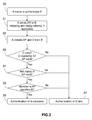
- FIG. 3 shows steps of the authentication process according to embodiments, which are carried out on A's side.
- the process starts at 30, with software entity A being executed and needing to verify the authenticity of software entity B which is running on its hosting trustworthy system platform P.
- A sends the Authentication Request (AR) message to B, said message including anti-replay token(s) in some embodiments.
- AR Authentication Request
- This message corresponds to message A.req(Tk) sent at 21 with reference to Figure 2 which has been described in the foregoing.
- A obtains the signed/encrypted version of the Authencicity Proof AP of B and P's digital certificate C, from B. This data is received within a message which corresponds to message A.Rsp(AP.signed,C) received at 26a with reference to above described Figure 2 .
- the Authenticity Proof AP of B is valid, which refers to the fact that the signed or encrypted version AP.signed of AP is correctly verified or decrypted, respectively. If any one of the above check is not passed, then the process ends at 37, meaning that the authentication of B fails.
- the process goes on at 34 with the conduction of an additional test to check whether the anti-replay protection element(s), Tk(s) and/or TS(s) received within message A.Rsp(AP.signed,C) is(are) valid.
- Validity of token(s) is checked by comparison with the token(s) as originally sent by A.
- Validity of Time Stamp(s) is checked by comparison with timing information issued by a timing reference available at level of A, for instance a clock signal. If the above check of the anti-replay protection element(s) is not passed, then the process ends at 37, meaning that the authentication of B fails.
- the process is continued, at 35, by determining whether the identifier Id.B of B received within the message A.Rsp(AP.signed,C) as part of the plain Authenticity Proof AP carries the identity or identities by which A identifies B. If not, then the authentication of B fails and, again, the process ends at 37.
- B receives the authentication request message from A.
- This message corresponds to message A.Req(Tk) received at 21a in the above described Figure 2 .
- this message can contain anti-reply protection elements such as one or more tokens Tk(s).
- B requests AP from P, by sending to P the message AP.req(Tk) of Figure 2 (sent at 22).
- this message AP.req(Tk) includes said elements.
- B receives the Authencity Proof (AP) of B, more particularly the signed/encrypted version AP.signed thereof, as well as P's digital certificate C, in the example as shown in Figure 2 .
- AP Authencity Proof
- the last step carried out by B consists in sending back its Authenticity Proof AP, namely the signed/encrypted version AP.signed thereof included in the message A.Rsp(AP.signed,C) as shown in Figure 2 , at 26.
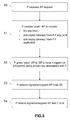
- P receives the request for Authenticity Proof from B. With reference to Figure 2 , his corresponds to receipt of the message AP.req(Tk) at 22a.
- P creates the plain version of B's Authenticity Proof AP which includes:
- At least one anti-replay token is ensured in AP at 51, in order to provide anti-replay protection.
- P passes the plain version of AP to its secure element SE in order to have it signed (or encrypted) using private key associated with C. This corresponds to the sending of request message Sign.req(AP[Id.B,Tk,TS]) at 23, in the above described Figure 2 .
- P obtains the signed/encrypted version AP.signed of AP from SE, at 53. This corresponds to the receipt of message Sign.rsp(AP.signed) as shown in Figure 2 , at 24a.
- P returns to B the signed/encrypted version of AP along with P's digital certificate C.
- this is achieved by P sending back to B the message AP.rsp(AP.signed,C) at 25.
- API used in the above description shall be understood as encompassing any software interface between two interacting software entities.
- the present invention can also be embedded in a computer program product, which comprises all the features enabling the implementation of the methods described herein, and which - when loaded in an information processing system - is able to carry out these methods.
- Computer program means or computer program in the present context mean any expression, in any language, code or notation, of a set of instructions intended to cause a system having an information processing capability to perform a particular function either directly or after conversion to another language.
- Such a computer program can be stored on a computer or machine readable medium allowing data, instructions, messages or message packets, and other machine readable information to be read from the medium.
- the computer or machine readable medium may include non-volatile memory, such as ROM, Flash memory, Disk drive memory, CD-ROM, and other permanent storage.
- a computer or machine readable medium may include, for example, volatile storage such as RAM, buffers, cache memory, and network circuits.
- the computer or machine readable medium may comprise computer or machine readable information in a transitory state medium such as a network link and/or a network interface, including a wired network or a wireless network, that allow a device to read such computer or machine readable information.
Landscapes
- Engineering & Computer Science (AREA)
- Computer Security & Cryptography (AREA)
- Computer Hardware Design (AREA)
- General Engineering & Computer Science (AREA)
- Theoretical Computer Science (AREA)
- Computing Systems (AREA)
- Computer Networks & Wireless Communication (AREA)
- Signal Processing (AREA)
- Software Systems (AREA)
- Physics & Mathematics (AREA)
- General Physics & Mathematics (AREA)
- Storage Device Security (AREA)
Priority Applications (1)
| Application Number | Priority Date | Filing Date | Title |
|---|---|---|---|
| EP16189839.0A EP3299984A1 (de) | 2016-09-21 | 2016-09-21 | Authentifizierung einer software-entität durch eine andere software-entität |
Applications Claiming Priority (1)
| Application Number | Priority Date | Filing Date | Title |
|---|---|---|---|
| EP16189839.0A EP3299984A1 (de) | 2016-09-21 | 2016-09-21 | Authentifizierung einer software-entität durch eine andere software-entität |
Publications (1)
| Publication Number | Publication Date |
|---|---|
| EP3299984A1 true EP3299984A1 (de) | 2018-03-28 |
Family
ID=57017962
Family Applications (1)
| Application Number | Title | Priority Date | Filing Date |
|---|---|---|---|
| EP16189839.0A Withdrawn EP3299984A1 (de) | 2016-09-21 | 2016-09-21 | Authentifizierung einer software-entität durch eine andere software-entität |
Country Status (1)
| Country | Link |
|---|---|
| EP (1) | EP3299984A1 (de) |
Cited By (3)
| Publication number | Priority date | Publication date | Assignee | Title |
|---|---|---|---|---|
| CN113779543A (zh) * | 2021-02-10 | 2021-12-10 | 北京沃东天骏信息技术有限公司 | 软件认证方法和装置 |
| WO2022135387A1 (zh) * | 2020-12-26 | 2022-06-30 | 西安西电捷通无线网络通信股份有限公司 | 一种身份鉴别方法和装置 |
| WO2022135386A1 (zh) * | 2020-12-26 | 2022-06-30 | 西安西电捷通无线网络通信股份有限公司 | 一种身份鉴别方法和装置 |
Citations (3)
| Publication number | Priority date | Publication date | Assignee | Title |
|---|---|---|---|---|
| WO2011031272A1 (en) * | 2009-09-14 | 2011-03-17 | Interdigital Patent Holdings, Inc. | Method and apparatus for trusted authentication and logon |
| US20150052595A1 (en) * | 2013-08-15 | 2015-02-19 | Mocana Corporation | User, device, and app authentication implemented between a client device and vpn gateway |
| US20150113272A1 (en) * | 2013-10-21 | 2015-04-23 | Electronics And Telecommunications Research Institute | Method and apparatus for authenticating and managing application using trusted platform module |
-
2016
- 2016-09-21 EP EP16189839.0A patent/EP3299984A1/de not_active Withdrawn
Patent Citations (3)
| Publication number | Priority date | Publication date | Assignee | Title |
|---|---|---|---|---|
| WO2011031272A1 (en) * | 2009-09-14 | 2011-03-17 | Interdigital Patent Holdings, Inc. | Method and apparatus for trusted authentication and logon |
| US20150052595A1 (en) * | 2013-08-15 | 2015-02-19 | Mocana Corporation | User, device, and app authentication implemented between a client device and vpn gateway |
| US20150113272A1 (en) * | 2013-10-21 | 2015-04-23 | Electronics And Telecommunications Research Institute | Method and apparatus for authenticating and managing application using trusted platform module |
Non-Patent Citations (1)
| Title |
|---|
| ANONYMOUS: "Restricting access to server to iPhone app - Stack Overflow", 23 June 2010 (2010-06-23), XP055323042, Retrieved from the Internet <URL:https://web.archive.org/web/20100623095522/http://stackoverflow.com/questions/1918435/restricting-access-to-server-to-iphone-app> [retrieved on 20161125] * |
Cited By (7)
| Publication number | Priority date | Publication date | Assignee | Title |
|---|---|---|---|---|
| WO2022135387A1 (zh) * | 2020-12-26 | 2022-06-30 | 西安西电捷通无线网络通信股份有限公司 | 一种身份鉴别方法和装置 |
| WO2022135386A1 (zh) * | 2020-12-26 | 2022-06-30 | 西安西电捷通无线网络通信股份有限公司 | 一种身份鉴别方法和装置 |
| GB2617017A (en) * | 2020-12-26 | 2023-09-27 | China Iwncomm Co Ltd | Identity authentication method and apparatus |
| GB2617508A (en) * | 2020-12-26 | 2023-10-11 | China Iwncomm Co Ltd | Method and device for identity authentication |
| US12438878B2 (en) | 2020-12-26 | 2025-10-07 | China Iwncomm Co., Ltd. | Method and device for identity authentication |
| US12445301B2 (en) | 2020-12-26 | 2025-10-14 | China Iwncomm Co., Ltd. | Identity authentication method and apparatus |
| CN113779543A (zh) * | 2021-02-10 | 2021-12-10 | 北京沃东天骏信息技术有限公司 | 软件认证方法和装置 |
Similar Documents
| Publication | Publication Date | Title |
|---|---|---|
| US10437985B2 (en) | Using a second device to enroll a secure application enclave | |
| CN102763111B (zh) | 用于可信联合身份管理和数据接入授权的方法和设备 | |
| CN102647461B (zh) | 基于超文本传输协议的通信方法、服务器、终端 | |
| CN105659559B (zh) | 验证远程服务器的安全性 | |
| JP6896940B2 (ja) | 第1のアプリケーションと第2のアプリケーションとの間の対称型相互認証方法 | |
| KR101563828B1 (ko) | 신뢰성있는 인증 및 로그온을 위한 방법 및 장치 | |
| US9225702B2 (en) | Transparent client authentication | |
| US12095753B2 (en) | End-to-end verifiable multi-factor authentication service | |
| WO2015158228A1 (zh) | 一种服务器、用户设备以及用户设备与服务器的交互方法 | |
| EP3299984A1 (de) | Authentifizierung einer software-entität durch eine andere software-entität | |
| Islam et al. | Detecting compromise of passkey storage on the cloud | |
| CN116055172A (zh) | 一种设备认证方法、系统、电子设备及存储介质 | |
| CN114765533A (zh) | 一种基于量子密钥通信的远程证明方法、装置及系统 | |
| Sanjoyo et al. | Accountable bootstrapping based on attack resilient public key infrastructure and secure zero touch provisioning | |
| Baghdasaryan et al. | FIDO Security Reference | |
| Fongen et al. | The integration of trusted platform modules into a tactical identity management system | |
| EP4576667A1 (de) | System und verfahren zur verleihung von authentizität bei der kommunikation zwischen einem mobilen client und einem server | |
| CN110557365A (zh) | 一种基于消息认证码的安全单点登录方法 | |
| Schwarz et al. | FeIDo: Recoverable FIDO2 Tokens Using Electronic IDs (Extended Version) | |
| Desai et al. | Mobile App-Browser Extension Based Authentication | |
| Nagasuresh et al. | Defense against Illegal Use of Single Sign on Mechanism for Distributed Network Services | |
| Loss et al. | FeIDo: Recoverable FIDO2 Tokens Using Electronic IDs (Extended Version, January 20, 2023) |
Legal Events
| Date | Code | Title | Description |
|---|---|---|---|
| PUAI | Public reference made under article 153(3) epc to a published international application that has entered the european phase |
Free format text: ORIGINAL CODE: 0009012 |
|
| AK | Designated contracting states |
Kind code of ref document: A1 Designated state(s): AL AT BE BG CH CY CZ DE DK EE ES FI FR GB GR HR HU IE IS IT LI LT LU LV MC MK MT NL NO PL PT RO RS SE SI SK SM TR |
|
| AX | Request for extension of the european patent |
Extension state: BA ME |
|
| RAP1 | Party data changed (applicant data changed or rights of an application transferred) |
Owner name: ALCATEL LUCENT |
|
| 17P | Request for examination filed |
Effective date: 20180921 |
|
| RBV | Designated contracting states (corrected) |
Designated state(s): AL AT BE BG CH CY CZ DE DK EE ES FI FR GB GR HR HU IE IS IT LI LT LU LV MC MK MT NL NO PL PT RO RS SE SI SK SM TR |
|
| 17Q | First examination report despatched |
Effective date: 20200310 |
|
| STAA | Information on the status of an ep patent application or granted ep patent |
Free format text: STATUS: THE APPLICATION IS DEEMED TO BE WITHDRAWN |
|
| 18D | Application deemed to be withdrawn |
Effective date: 20200922 |