EP3296425A1 - Chemical vapor deposition starting material comprising organic platinum compound, and chemical vapor deposition method using said chemical vapor deposition starting material - Google Patents
Chemical vapor deposition starting material comprising organic platinum compound, and chemical vapor deposition method using said chemical vapor deposition starting material Download PDFInfo
- Publication number
- EP3296425A1 EP3296425A1 EP16792640.1A EP16792640A EP3296425A1 EP 3296425 A1 EP3296425 A1 EP 3296425A1 EP 16792640 A EP16792640 A EP 16792640A EP 3296425 A1 EP3296425 A1 EP 3296425A1
- Authority
- EP
- European Patent Office
- Prior art keywords
- group
- raw material
- platinum
- deposition
- thin film
- Prior art date
- Legal status (The legal status is an assumption and is not a legal conclusion. Google has not performed a legal analysis and makes no representation as to the accuracy of the status listed.)
- Withdrawn
Links
Images


Classifications
-
- C—CHEMISTRY; METALLURGY
- C23—COATING METALLIC MATERIAL; COATING MATERIAL WITH METALLIC MATERIAL; CHEMICAL SURFACE TREATMENT; DIFFUSION TREATMENT OF METALLIC MATERIAL; COATING BY VACUUM EVAPORATION, BY SPUTTERING, BY ION IMPLANTATION OR BY CHEMICAL VAPOUR DEPOSITION, IN GENERAL; INHIBITING CORROSION OF METALLIC MATERIAL OR INCRUSTATION IN GENERAL
- C23C—COATING METALLIC MATERIAL; COATING MATERIAL WITH METALLIC MATERIAL; SURFACE TREATMENT OF METALLIC MATERIAL BY DIFFUSION INTO THE SURFACE, BY CHEMICAL CONVERSION OR SUBSTITUTION; COATING BY VACUUM EVAPORATION, BY SPUTTERING, BY ION IMPLANTATION OR BY CHEMICAL VAPOUR DEPOSITION, IN GENERAL
- C23C16/00—Chemical coating by decomposition of gaseous compounds, without leaving reaction products of surface material in the coating, i.e. chemical vapour deposition [CVD] processes
- C23C16/06—Chemical coating by decomposition of gaseous compounds, without leaving reaction products of surface material in the coating, i.e. chemical vapour deposition [CVD] processes characterised by the deposition of metallic material
- C23C16/18—Chemical coating by decomposition of gaseous compounds, without leaving reaction products of surface material in the coating, i.e. chemical vapour deposition [CVD] processes characterised by the deposition of metallic material from metallo-organic compounds
-
- C—CHEMISTRY; METALLURGY
- C07—ORGANIC CHEMISTRY
- C07C—ACYCLIC OR CARBOCYCLIC COMPOUNDS
- C07C211/00—Compounds containing amino groups bound to a carbon skeleton
- C07C211/01—Compounds containing amino groups bound to a carbon skeleton having amino groups bound to acyclic carbon atoms
- C07C211/20—Compounds containing amino groups bound to a carbon skeleton having amino groups bound to acyclic carbon atoms of an acyclic unsaturated carbon skeleton
- C07C211/21—Monoamines
-
- C—CHEMISTRY; METALLURGY
- C07—ORGANIC CHEMISTRY
- C07F—ACYCLIC, CARBOCYCLIC OR HETEROCYCLIC COMPOUNDS CONTAINING ELEMENTS OTHER THAN CARBON, HYDROGEN, HALOGEN, OXYGEN, NITROGEN, SULFUR, SELENIUM OR TELLURIUM
- C07F15/00—Compounds containing elements of Groups 8, 9, 10 or 18 of the Periodic Table
-
- C—CHEMISTRY; METALLURGY
- C07—ORGANIC CHEMISTRY
- C07F—ACYCLIC, CARBOCYCLIC OR HETEROCYCLIC COMPOUNDS CONTAINING ELEMENTS OTHER THAN CARBON, HYDROGEN, HALOGEN, OXYGEN, NITROGEN, SULFUR, SELENIUM OR TELLURIUM
- C07F15/00—Compounds containing elements of Groups 8, 9, 10 or 18 of the Periodic Table
- C07F15/0006—Compounds containing elements of Groups 8, 9, 10 or 18 of the Periodic Table compounds of the platinum group
- C07F15/0086—Platinum compounds
-
- C—CHEMISTRY; METALLURGY
- C23—COATING METALLIC MATERIAL; COATING MATERIAL WITH METALLIC MATERIAL; CHEMICAL SURFACE TREATMENT; DIFFUSION TREATMENT OF METALLIC MATERIAL; COATING BY VACUUM EVAPORATION, BY SPUTTERING, BY ION IMPLANTATION OR BY CHEMICAL VAPOUR DEPOSITION, IN GENERAL; INHIBITING CORROSION OF METALLIC MATERIAL OR INCRUSTATION IN GENERAL
- C23C—COATING METALLIC MATERIAL; COATING MATERIAL WITH METALLIC MATERIAL; SURFACE TREATMENT OF METALLIC MATERIAL BY DIFFUSION INTO THE SURFACE, BY CHEMICAL CONVERSION OR SUBSTITUTION; COATING BY VACUUM EVAPORATION, BY SPUTTERING, BY ION IMPLANTATION OR BY CHEMICAL VAPOUR DEPOSITION, IN GENERAL
- C23C16/00—Chemical coating by decomposition of gaseous compounds, without leaving reaction products of surface material in the coating, i.e. chemical vapour deposition [CVD] processes
- C23C16/44—Chemical coating by decomposition of gaseous compounds, without leaving reaction products of surface material in the coating, i.e. chemical vapour deposition [CVD] processes characterised by the method of coating
- C23C16/455—Chemical coating by decomposition of gaseous compounds, without leaving reaction products of surface material in the coating, i.e. chemical vapour deposition [CVD] processes characterised by the method of coating characterised by the method used for introducing gases into reaction chamber or for modifying gas flows in reaction chamber
- C23C16/45523—Pulsed gas flow or change of composition over time
- C23C16/45525—Atomic layer deposition [ALD]
- C23C16/45553—Atomic layer deposition [ALD] characterized by the use of precursors specially adapted for ALD
-
- C—CHEMISTRY; METALLURGY
- C23—COATING METALLIC MATERIAL; COATING MATERIAL WITH METALLIC MATERIAL; CHEMICAL SURFACE TREATMENT; DIFFUSION TREATMENT OF METALLIC MATERIAL; COATING BY VACUUM EVAPORATION, BY SPUTTERING, BY ION IMPLANTATION OR BY CHEMICAL VAPOUR DEPOSITION, IN GENERAL; INHIBITING CORROSION OF METALLIC MATERIAL OR INCRUSTATION IN GENERAL
- C23C—COATING METALLIC MATERIAL; COATING MATERIAL WITH METALLIC MATERIAL; SURFACE TREATMENT OF METALLIC MATERIAL BY DIFFUSION INTO THE SURFACE, BY CHEMICAL CONVERSION OR SUBSTITUTION; COATING BY VACUUM EVAPORATION, BY SPUTTERING, BY ION IMPLANTATION OR BY CHEMICAL VAPOUR DEPOSITION, IN GENERAL
- C23C16/00—Chemical coating by decomposition of gaseous compounds, without leaving reaction products of surface material in the coating, i.e. chemical vapour deposition [CVD] processes
- C23C16/44—Chemical coating by decomposition of gaseous compounds, without leaving reaction products of surface material in the coating, i.e. chemical vapour deposition [CVD] processes characterised by the method of coating
- C23C16/46—Chemical coating by decomposition of gaseous compounds, without leaving reaction products of surface material in the coating, i.e. chemical vapour deposition [CVD] processes characterised by the method of coating characterised by the method used for heating the substrate
-
- H—ELECTRICITY
- H10—SEMICONDUCTOR DEVICES; ELECTRIC SOLID-STATE DEVICES NOT OTHERWISE PROVIDED FOR
- H10D—INORGANIC ELECTRIC SEMICONDUCTOR DEVICES
- H10D1/00—Resistors, capacitors or inductors
- H10D1/60—Capacitors
- H10D1/68—Capacitors having no potential barriers
- H10D1/692—Electrodes
- H10D1/694—Electrodes comprising noble metals or noble metal oxides
-
- H—ELECTRICITY
- H10—SEMICONDUCTOR DEVICES; ELECTRIC SOLID-STATE DEVICES NOT OTHERWISE PROVIDED FOR
- H10P—GENERIC PROCESSES OR APPARATUS FOR THE MANUFACTURE OR TREATMENT OF DEVICES COVERED BY CLASS H10
- H10P14/00—Formation of materials, e.g. in the shape of layers or pillars
- H10P14/40—Formation of materials, e.g. in the shape of layers or pillars of conductive or resistive materials
- H10P14/42—Formation of materials, e.g. in the shape of layers or pillars of conductive or resistive materials using a gas or vapour
Definitions
- the present invention relates to a raw material for chemical deposition composed of an organoplatinum compound for manufacturing a platinum thin film or a platinum compound thin film by a chemical deposition method, such as a CVD method or an ALD method.
- a chemical deposition method such as a CVD method or an ALD method.
- the present invention relates to a raw material for chemical deposition capable of forming a platinum thin film and the like even at low temperature of not more than 200°C, with moderate thermal stability.
- a stereoscopic Ni-Pt silicide electrode having a three-dimensional structure is known as an electrode material of a field-effect transistor (FET) that is built in an integrated circuit.
- FET field-effect transistor
- a chemical deposition method such as a CVD method
- a chemical deposition method capable of forming a film at low temperature, is suitable in achieving size reduction / high performance.
- (1,5-hexadiene)dimethylplatinum (II) or the like is proposed as a compound in which hexadiene (derivative) and an alkyl anion are coordinated to divalent platinum in order to provide a raw material for CVD that is thermally decomposed easily even at low temperature (PTL 3).
- Raw materials in the past as described above possess a part of required characteristics for a CVD compound, but do not possess all the required characteristics in a well-balanced manner.
- platinum compounds in PTL 1 and PTL 2 have high thermal stability but are difficult to deposit at low temperature.
- the platinum compound in PTL 3 is thermally decomposed easily and excellent in low temperature deposition properties, but the compound is infrequently decomposed in storage or in vaporization stage before deposition, and there is a room for improvement about thermal stability.
- the present invention provides a raw material that possesses characteristics required for a CVD compound in a well-balanced manner, that is, a platinum compound for CVD that is capable of forming a film deposition at low temperature and has sufficient thermal stability without thermal decomposition in a vaporization stage.
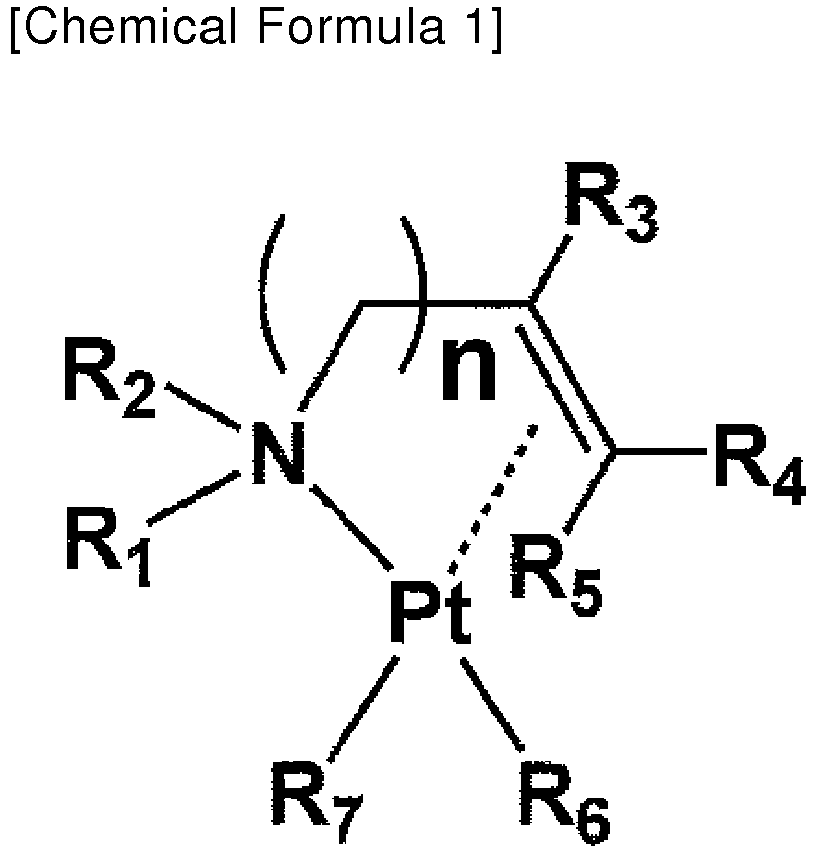
- the present invention that solves above-described problems relates to a raw material for chemical deposition for manufacturing a platinum thin film or a platinum compound thin film by a chemical deposition method, the raw material including an organoplatinum compound in which an alkenyl amine and an alkyl anion that are coordinated to a divalent platinum as shown by a formula below, (wherein n is 1 or more and 5 or less; each of R 1 to R 5 represents any one of a hydrogen atom, an alkyl group, an alkenyl group, an alkynyl group, an amino group, an imino group, a cyano group and an isocyano group, and each has a carbon number of not more than 4; and each of R 6 and R 7 represents an alkyl group having a carbon number of 1 or more and 3 or less.)
- an alkenyl amine and two alkyl anions are coordinated as ligands of divalent platinum as shown below.
- the present inventors conceived the platinum compound on the basis of the following reason with respect to respective constitutions of a central metal and ligands to be coordinated to the metal.
- the "alkenyl amine” in the present invention is a ligand composed of an amine and a hydrocarbon having a double bond.
- a ligand including an amine is applied in the present invention in consideration of a balance between the thermal stability and the vapor pressure. Further, selection of an alkenyl amine having a small molecular weight and a low boiling point can result in a ligand that evaporates easily after decomposition and is hard to remain in the metal film as an impurity.
- Suitable setting of a molecular weight of an alkyl anion that is another ligand can also control the vapor pressure of a complex to some degree.
- An alkyl anion whose molecular weight is controlled is emitted as a low boiling point hydrocarbon by performing film deposition in a reducing atmosphere, such as hydrogen gas, and causing the complex to decompose. Consequently, an alkyl anion with a controlled molecular weight is hard to become a residual impurity in a deposited metal film and is suitable as a ligand for causing pure metal to be emitted.
- platinum to be a central metal
- platinum complexes with platinum having positive di- or tetra-charges as a central metal are stable, and the present inventors prefer a divalent platinum complex having moderate stability because easy handling of the compound in the processes of synthesis/purification/storage is also important.
- an alkenyl amine and an alkyl anion are coordinated as ligands to divalent platinum in the present inventive raw material.
- the alkenyl amine has n of 1 or more and 5 or less
- n is preferably 1 or more and 4 or less.
- n Particularly preferable is 2 or 3 as n, and suitable is a raw material for chemical deposition composed of organoplatinum compounds that have any of a butenyl amine or derivatives of the butenyl amine and a pentenyl amine or derivatives of the pentenyl amine as a ligand, as shown by formulae below, (wherein each of R 1 to R 5 represents any one of a hydrogen atom, an alkyl group, an alkenyl group, an alkynyl group, an amino group, an imino group, a cyano group and an isocyano group, and has a carbon number of 4 or less. Each of R 6 and R 7 represents an alkyl group having a carbon number of 1 or more and 3 or less.)
- Each of the substituents R 1 and R 2 on a nitrogen atom in an alkenyl amine is any one of a hydrogen atom, an alkyl group, an alkenyl group, an alkynyl group, an amino group, an imino group, a cyano group and an isocyano group, and has a carbon number of 4 or less.
- Each of the substituents R 1 and R 2 is preferably any one of a hydrogen atom, a methyl group, an ethyl group and a propyl group, and is particularly preferably a methyl group or an ethyl group.
- linear chain (n-) and branched chains (iso-, sec-, tert-) that are structural isomers may be used when an alkyl group having a carbon number of 3 or more is to be used, but a linear chain is preferable.
- the substituent R 3 is a hydrogen atom, an alkyl group, an alkenyl group, an alkynyl group, an amino group, an imino group, a cyano group or an isocyano group, and has a carbon number of 1 or more and 4 or less.
- the substituent R 3 is preferably a hydrogen atom, a methyl group or an ethyl group, and is particularly preferably a hydrogen atom. Any of a linear chain (n-) and branched chains (iso-, sec-, tert-) that are structural isomers may be used when an alkyl group having a carbon number of 3 or more is to be used, but a linear chain is preferable.
- Each of the substituents R 4 and R 5 is any one of a hydrogen atom, an alkyl group, an alkenyl group, an alkynyl group, an amino group, an imino group, a cyano group and an isocyano group, and has a carbon number of 4 or less.
- Each of the substituents R 4 and R 5 is preferably a hydrogen atom or a methyl group, and is particularly preferably a hydrogen atom. Any of a linear chain (n-) and branched chains (iso-, sec-, tert-) that are structural isomers may be used when an alkyl group having a carbon number of 3 or more is to be used, but a linear chain is preferable.
- Each of two alkyl anions R 6 and R 7 is preferably an alkyl group having a carbon number of 1 or more and 3 or less, that is, any one of a methyl group, an ethyl group and an n-propyl group.
- These alkyl anions have a small molecular weight, and therefore can suppress decrease of vapor pressure with the increase of molecular weight also when a complex is to be formed. Further, the stability of a platinum complex tends to decrease as the carbon chain of an alkyl group becomes long, and therefore synthesis/handling of a complex become difficult when a long chain alkyl group having a carbon number of 4 or more is used as a ligand.
- a group that is particularly preferable as R 6 and R 7 is a methyl group. The methyl group becomes methane having a low boiling point (boiling point: -162°C) after the decomposition of a complex, and therefore can be emitted without leaving an impurity in a metal thin film to be
- the above-described raw material for chemical deposition of the present invention can be manufactured with a platinum salt used as a starting material, by adding and causing the platinum salt that is the starting material to react with an alkenyl amine.
- a platinum salt used as a starting material, by adding and causing the platinum salt that is the starting material to react with an alkenyl amine.
- (1,5-hexadiene)dimethylplatinum or the like can be used as a platinum salt.
- the present inventive raw material for chemical deposition is useful for forming a platinum thin film by a CVD method.
- a raw material composed of an organoplatinum compound is vaporized to be a reaction gas, the reaction gas is introduced to a substrate surface, and the organoplatinum compound is decomposed to precipitate platinum, in which the present inventive organoplatinum compound is used as a raw material.
- a reducing atmosphere is preferable as a reaction atmosphere in forming a platinum film.
- the raw material of the present invention tends to show good low-temperature film deposition properties particularly in a reducing atmosphere. Further, a reducing atmosphere also suppresses oxidization of a nickel thin film that is formed together with platinum in a stereoscopic electrode of an FET.
- introduction of hydrogen or ammonia as a reaction gas is preferable, and hydrogen is particularly preferable.
- the present invention aims at setting film deposition temperature on a low-temperature side.
- heating temperature for a deposition reaction is preferably 100°C to 350°C. Because progress of a deposition reaction is difficult and acquisition of a necessary film thickness is difficult when the heating temperature is less than 100°C. Further because, when the heating temperature exceeds 350°C, it becomes difficult not only to form a uniform thin film on a stereoscopic electrode but also to maintain performance of an FET element.
- the platinum complex of the present inventive raw material for chemical deposition has high vapor pressure to make possible the manufacturing of a platinum thin film at low temperature and also has moderate thermal stability.
- the present inventive raw material may also be applied to chemical deposition methods, such as an atomic layer deposition method (ALD method), in addition to a CVD method.
- ALD method atomic layer deposition method
- platinum complexes Five kinds of platinum complexes were synthesized in the present embodiment. Physical properties of the synthesized platinum complexes were evaluated, and film deposition tests were performed as raw materials for chemical deposition.
- Example 1 As a raw material for chemical deposition, manufactured was a platinum complex (dimethyl(N,N-dimethyl-3-butene-1-amine)platinum) in which N,N-dimethyl-3-butene-1-amine and two methyl groups being alkyl anions were coordinated.
- the synthesis reaction formula is as follows. Hereinafter, the manufacturing process will be described in detail.
- Example 2 As a raw material for chemical deposition, manufactured was a platinum complex (dimethyl(N-ethyl-N-methyl-3-butene-1-amine)dimethylplatinum) in which N-ethyl-N-methyl-3-butene-1-amine and two methyl groups being alkyl anions were coordinated.
- the synthesis reaction formula is as follows. Hereinafter, the manufacturing process will be described in detail.
- Example 3 As a raw material for chemical deposition, manufactured was a platinum complex ((N,N-diethyl-3-butene-1-amine)dimethylplatinum) in which N,N-diethyl-3-butene-1-amine and two methyl groups being alkyl anions were coordinated.
- the synthesis reaction formula is as follows. Hereinafter, the manufacturing process will be described in detail.
- Example 4 As a raw material for chemical deposition, manufactured was a platinum complex ((methyl)(N,N-dimethyl-3-butene-1-amine)(propyl)platinum) in which N,N-dimethyl-3-butene-1-amine and a methyl group and a propyl group being alkyl anions were coordinated.
- the synthesis reaction formula is as follows. Hereinafter, the manufacturing process will be described in detail.
- Example 5 As a raw material for chemical deposition, manufactured was a platinum complex (dimethyl(N,N-dimethyl-4-pentene-1-amine) in which N,N-dimethyl-4-pentene-1-amine and two methyl groups being alkyl anions were coordinated.
- the synthesis reaction formula is as follows. Hereinafter, the manufacturing process will be described in detail.
- the platinum complex in Example 1 had a melting point of about 75°C from a concave peak and a decomposition temperature of about 150°C from a convex peak, and had sufficient thermal stability for handling for deposition. Further, about 30% of the platinum complex had been vaporized until the decomposition temperature from weight decrease prior to the decomposition temperature and residue weight after the heating, from the result of TG. From the above, it was shown that both decomposition and vaporization were generated, deposition at comparatively low temperatures was possible and vaporization in deposition also tended to progress favorably, in an instance of the complex. In Examples 2 and 3, it was shown that vaporization properties and thermal stability that were sufficient for deposition were possessed as in Example 1 except that there was seen a drop of around 20°C in melting point by the introduction of an ethyl group.
- Deposition test Next, deposition tests of a platinum thin film were performed by a CVD method using platinum complexes manufactured in Examples 1 to 5 as raw compounds.
- a platinum thin film was deposited on a silicon substrate (15 mm ⁇ 15 mm).
- a thermal CVD apparatus of a hot wall type was used as a deposition apparatus.
- a reaction gas (hydrogen) was flown at a constant flow rate using a mass flow controller. Deposition conditions are as follows. Results are shown in Table 1. Further, there is shown in Fig. 2 a SEM-observed photograph of a platinum thin film that was formed using the complex in Example 1.
- a platinum thin film was able to be deposited and the formed thin film had a flat and uniform surface in all cases where any complex in Examples 1 to 5 was used as a raw material.
- Film thickness and specific resistance were measured for the platinum thin film that was formed in Example 1, and the Pt film had a sufficient thickness of 8.5 nm and a specific resistance of 174.4 ⁇ cm. Further, the formation of a platinum thin film having a smooth and uniform surface was confirmed also by the SEM photograph in Fig. 2 .
- deposition tests onto respective Si substrates in the first embodiment were performed at deposition temperatures of 100°C and 150°C to evaluate low temperature deposition properties.
- Other deposition conditions were the same as the conditions in the first embodiment. Results are shown in Table below. The deposition results in the first embodiment are shown together in the Table below. Further, a SEM-observed result of the formed platinum thin film is shown in Fig. 3 .
- the platinum thin films that were formed at 100°C and 150°C as deposition temperatures also had a flat and uniform surface. Further, the Pt thin films that were formed at 100°C and 150°C as deposition temperatures had a moderate film thickness and low specific resistance, from the above Table.
- dimethyl(N,N,N',N'-tetramethylethylenediamine)platinum was used in Comparative Example and vaporization properties and deposition properties were compared with Example 1.
- Reduced pressure TG measurement (vaporization properties): A platinum complex sample (5 mg) was heated and analyzed with TG-DTA2000SA manufactured by BRUKER Corporation in a measurement temperature range of room temperature to 450°C at temperature rising rate of 5 °C/min and pressure of 5 torr under a nitrogen atmosphere. Results are shown in Fig. 4 .
- Deposition test Platinum complexes in Examples and Comparative Examples were used as raw materials for chemical deposition to form a Pt thin film on respective substrates Si at 200°C in deposition temperature. Sample temperatures were set to be 40°C in Comparative Example 1 and 110°C in Comparative Example 2. Other deposition conditions were set to be the same as the conditions in the first embodiment.
- Example 1 had both vaporization properties and deposition properties suitable for the formation of a platinum thin film.
- the present inventive raw material has high vapor pressure to make possible the formation of a highly accurate platinum thin film at low temperature and also has moderate thermal stability to exert excellent handling properties. Consequently, the raw material is useful for the deposition onto a steric structure and can be applied to a stereoscopic electrode having a three-dimensional structure of a field-effect transistor (FET), and the like.
- FET field-effect transistor
Landscapes
- Chemical & Material Sciences (AREA)
- Organic Chemistry (AREA)
- General Chemical & Material Sciences (AREA)
- Chemical Kinetics & Catalysis (AREA)
- Engineering & Computer Science (AREA)
- Materials Engineering (AREA)
- Mechanical Engineering (AREA)
- Metallurgy (AREA)
- Chemical Vapour Deposition (AREA)
- Organic Low-Molecular-Weight Compounds And Preparation Thereof (AREA)
- Electrodes Of Semiconductors (AREA)
Abstract
Description
- The present invention relates to a raw material for chemical deposition composed of an organoplatinum compound for manufacturing a platinum thin film or a platinum compound thin film by a chemical deposition method, such as a CVD method or an ALD method. In particular, the present invention relates to a raw material for chemical deposition capable of forming a platinum thin film and the like even at low temperature of not more than 200°C, with moderate thermal stability.
- A stereoscopic Ni-Pt silicide electrode having a three-dimensional structure is known as an electrode material of a field-effect transistor (FET) that is built in an integrated circuit. In the manufacturing of the Ni-Pt silicide electrode, a chemical deposition method, such as a CVD method, is utilized when a Pt thin film and a Ni thin film are formed on previously manufactured Si having a steric structure. Further, also in a gate electrode of an FET, a chemical deposition method, such as a CVD method capable of forming a film at low temperature, is suitable in achieving size reduction / high performance.
- Many compounds are conventionally known as raw materials for manufacturing a platinum thin film or a platinum compound thin film by the CVD method. For example, bis(acetylacetonate)platinum (II) complex (PTL 1), (cyclopentadienyl)trimethylplatinum (IV)) complex (PTL 2) and the like are mentioned. Required performance of these raw materials for CVD generally include capability of deposition at low temperature because of high vapor pressure and low decomposition temperature.

- In response to such demand, (1,5-hexadiene)dimethylplatinum (II) or the like is proposed as a compound in which hexadiene (derivative) and an alkyl anion are coordinated to divalent platinum in order to provide a raw material for CVD that is thermally decomposed easily even at low temperature (PTL 3).


-
- PTL 1: Published Japanese translation of
PCT patent application No. 2001-504159 - PTL 2: Japanese Patent Laid-Open Heisei No.
11-292889 - PTL 3: International Publication No.
WO 2012/144455 Pamphlet - Raw materials in the past as described above possess a part of required characteristics for a CVD compound, but do not possess all the required characteristics in a well-balanced manner. For example, platinum compounds in
PTL 1 andPTL 2 have high thermal stability but are difficult to deposit at low temperature. The platinum compound inPTL 3 is thermally decomposed easily and excellent in low temperature deposition properties, but the compound is infrequently decomposed in storage or in vaporization stage before deposition, and there is a room for improvement about thermal stability. As described above, with respect to low temperature deposition properties in a deposition stage and thermal stability before the deposition stage, such as during storage, when one is possessed, the other is difficult to be realized and there is such a tendency that it is difficult to provide a compound that possesses both characteristics in a balanced manner. - Against such a background, the present invention provides a raw material that possesses characteristics required for a CVD compound in a well-balanced manner, that is, a platinum compound for CVD that is capable of forming a film deposition at low temperature and has sufficient thermal stability without thermal decomposition in a vaporization stage.
- The present invention that solves above-described problems relates to a raw material for chemical deposition for manufacturing a platinum thin film or a platinum compound thin film by a chemical deposition method, the raw material including an organoplatinum compound in which an alkenyl amine and an alkyl anion that are coordinated to a divalent platinum as shown by a formula below,


- In the present inventive raw material for chemical deposition, an alkenyl amine and two alkyl anions are coordinated as ligands of divalent platinum as shown below. The present inventors conceived the platinum compound on the basis of the following reason with respect to respective constitutions of a central metal and ligands to be coordinated to the metal.


- The "alkenyl amine" in the present invention is a ligand composed of an amine and a hydrocarbon having a double bond. The ligand including an amine is thus applied because the inventors found that thermal stability and vapor pressure of a platinum compound tend to vary easily by the introduction of an amine. Because a bonding site between a C=C double bond and a platinum compound is separated easily in a ligand not having an amine (diene) as shown below, vapor pressure is high and deposition at low temperature becomes easy, but thermal stability tends to deteriorate and handling is difficult. In contrast, a ligand having two amines (diamine) has high thermal stability, but has low vapor pressure and tends to make film deposition at low temperature difficult. Therefore, a ligand including an amine is applied in the present invention in consideration of a balance between the thermal stability and the vapor pressure. Further, selection of an alkenyl amine having a small molecular weight and a low boiling point can result in a ligand that evaporates easily after decomposition and is hard to remain in the metal film as an impurity.

- Suitable setting of a molecular weight of an alkyl anion that is another ligand can also control the vapor pressure of a complex to some degree. An alkyl anion whose molecular weight is controlled is emitted as a low boiling point hydrocarbon by performing film deposition in a reducing atmosphere, such as hydrogen gas, and causing the complex to decompose. Consequently, an alkyl anion with a controlled molecular weight is hard to become a residual impurity in a deposited metal film and is suitable as a ligand for causing pure metal to be emitted.
- Furthermore, with respect to platinum to be a central metal, most of platinum complexes with platinum having positive di- or tetra-charges as a central metal are stable, and the present inventors prefer a divalent platinum complex having moderate stability because easy handling of the compound in the processes of synthesis/purification/storage is also important. On the basis of the above reason, an alkenyl amine and an alkyl anion are coordinated as ligands to divalent platinum in the present inventive raw material.
- Details of suitable substituents and the like will be described about the above-mentioned platinum ligand.
- The alkenyl amine has n of 1 or more and 5 or less, and concrete compounds include propenyl amine or derivatives of the propenyl amine (n = 1), butenyl amine or derivatives of the butenyl amine (n = 2), pentenyl amine or derivatives of the pentenyl amine (n = 3), hexenyl amine or derivatives of the hexenyl amine (n = 4), and heptenyl amine or derivatives of the heptenyl amine (n = 5). n is preferably 1 or more and 4 or less. The application of a comparatively small alkyl group can suppress the reduction of vapor pressure with the increase of a molecular weight. Further, since a longer carbon chain tends to decrease the stability of a platinum complex, synthesis/handling of a platinum complex become difficult when a long chain alkene having n exceeding 5 is applied.
- Particularly preferable is 2 or 3 as n, and suitable is a raw material for chemical deposition composed of organoplatinum compounds that have any of a butenyl amine or derivatives of the butenyl amine and a pentenyl amine or derivatives of the pentenyl amine as a ligand, as shown by formulae below,

- Each of the substituents R1 and R2 on a nitrogen atom in an alkenyl amine is any one of a hydrogen atom, an alkyl group, an alkenyl group, an alkynyl group, an amino group, an imino group, a cyano group and an isocyano group, and has a carbon number of 4 or less. Each of the substituents R1 and R2 is preferably any one of a hydrogen atom, a methyl group, an ethyl group and a propyl group, and is particularly preferably a methyl group or an ethyl group. Any of a linear chain (n-) and branched chains (iso-, sec-, tert-) that are structural isomers may be used when an alkyl group having a carbon number of 3 or more is to be used, but a linear chain is preferable.
- The substituent R3 is a hydrogen atom, an alkyl group, an alkenyl group, an alkynyl group, an amino group, an imino group, a cyano group or an isocyano group, and has a carbon number of 1 or more and 4 or less. The substituent R3 is preferably a hydrogen atom, a methyl group or an ethyl group, and is particularly preferably a hydrogen atom. Any of a linear chain (n-) and branched chains (iso-, sec-, tert-) that are structural isomers may be used when an alkyl group having a carbon number of 3 or more is to be used, but a linear chain is preferable.
- Each of the substituents R4 and R5 is any one of a hydrogen atom, an alkyl group, an alkenyl group, an alkynyl group, an amino group, an imino group, a cyano group and an isocyano group, and has a carbon number of 4 or less. Each of the substituents R4 and R5 is preferably a hydrogen atom or a methyl group, and is particularly preferably a hydrogen atom. Any of a linear chain (n-) and branched chains (iso-, sec-, tert-) that are structural isomers may be used when an alkyl group having a carbon number of 3 or more is to be used, but a linear chain is preferable.
- Each of two alkyl anions R6 and R7 is preferably an alkyl group having a carbon number of 1 or more and 3 or less, that is, any one of a methyl group, an ethyl group and an n-propyl group. These alkyl anions have a small molecular weight, and therefore can suppress decrease of vapor pressure with the increase of molecular weight also when a complex is to be formed. Further, the stability of a platinum complex tends to decrease as the carbon chain of an alkyl group becomes long, and therefore synthesis/handling of a complex become difficult when a long chain alkyl group having a carbon number of 4 or more is used as a ligand. A group that is particularly preferable as R6 and R7 is a methyl group. The methyl group becomes methane having a low boiling point (boiling point: -162°C) after the decomposition of a complex, and therefore can be emitted without leaving an impurity in a metal thin film to be formed.
- Kinds of organoplatinum compounds that are suitable for the raw material for chemical deposition of the present invention are concretely exemplified below.


- The above-described raw material for chemical deposition of the present invention can be manufactured with a platinum salt used as a starting material, by adding and causing the platinum salt that is the starting material to react with an alkenyl amine. Meanwhile, for example, (1,5-hexadiene)dimethylplatinum or the like can be used as a platinum salt.
- The present inventive raw material for chemical deposition is useful for forming a platinum thin film by a CVD method. In the method for forming a thin film, a raw material composed of an organoplatinum compound is vaporized to be a reaction gas, the reaction gas is introduced to a substrate surface, and the organoplatinum compound is decomposed to precipitate platinum, in which the present inventive organoplatinum compound is used as a raw material.
- A reducing atmosphere is preferable as a reaction atmosphere in forming a platinum film. The raw material of the present invention tends to show good low-temperature film deposition properties particularly in a reducing atmosphere. Further, a reducing atmosphere also suppresses oxidization of a nickel thin film that is formed together with platinum in a stereoscopic electrode of an FET. As a reducing atmosphere, introduction of hydrogen or ammonia as a reaction gas is preferable, and hydrogen is particularly preferable.
- The present invention aims at setting film deposition temperature on a low-temperature side. From the viewpoint, heating temperature for a deposition reaction is preferably 100°C to 350°C. Because progress of a deposition reaction is difficult and acquisition of a necessary film thickness is difficult when the heating temperature is less than 100°C. Further because, when the heating temperature exceeds 350°C, it becomes difficult not only to form a uniform thin film on a stereoscopic electrode but also to maintain performance of an FET element.
- As described above, the platinum complex of the present inventive raw material for chemical deposition has high vapor pressure to make possible the manufacturing of a platinum thin film at low temperature and also has moderate thermal stability. Meanwhile, the present inventive raw material may also be applied to chemical deposition methods, such as an atomic layer deposition method (ALD method), in addition to a CVD method.
-
-
Fig. 1 shows a TG-DTA curve of a platinum complex in a first embodiment. -
Fig. 2 shows a cross-sectional photograph of a platinum thin film in the first embodiment. -
Fig. 3 shows a cross-sectional photograph of a platinum thin film in a second embodiment. -
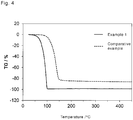
Fig. 4 shows a TG curve of a platinum complex in a third embodiment. - Hereinafter, the best embodiment in the present invention will be described.
- Five kinds of platinum complexes were synthesized in the present embodiment. Physical properties of the synthesized platinum complexes were evaluated, and film deposition tests were performed as raw materials for chemical deposition.

- Example 1: As a raw material for chemical deposition, manufactured was a platinum complex (dimethyl(N,N-dimethyl-3-butene-1-amine)platinum) in which N,N-dimethyl-3-butene-1-amine and two methyl groups being alkyl anions were coordinated. The synthesis reaction formula is as follows. Hereinafter, the manufacturing process will be described in detail.


- Each of 0.75 g (7.5 mmol) of N,N-dimethyl-3-butene-1-amine and 1.54 g (5.0 mmol) of (1,4-hexadiene)dimethylplatinum was added in this order to a flask containing 50 ml of hexane, and then the mixture was stirred for 20 hours at room temperature. After the end of the reaction, the reaction product was concentrated to give a white solid. The obtained white solid was sublimated and purified to give 1.55 g (4.8 mmol) of dimethyl(N,N-dimethyl-3-butene-1-amine)platinum that was the target (yield: 96%, melting point: 76°C).
- Example 2: As a raw material for chemical deposition, manufactured was a platinum complex (dimethyl(N-ethyl-N-methyl-3-butene-1-amine)dimethylplatinum) in which N-ethyl-N-methyl-3-butene-1-amine and two methyl groups being alkyl anions were coordinated. The synthesis reaction formula is as follows. Hereinafter, the manufacturing process will be described in detail.


- Each of 0.62 g (5.5 mmol) of N-ethyl-N-methyl-3-butene-1-amine and 1.54 g (5.0 mmol) of (1,4-hexadiene)dimethylplatinum was added in this order to a flask containing 50 ml of hexane, and then the mixture was stirred for 20 hours at room temperature. After the end of the reaction, the reaction product was concentrated to give a white solid. The obtained white solid was sublimated and purified to give 1.53 g (4.3 mmol) of dimethyl(N,N-diethyl-3-butene-1-amine)dimethylplatinum that was the target (yield: 86%, melting point: 51°C).
- Example 3: As a raw material for chemical deposition, manufactured was a platinum complex ((N,N-diethyl-3-butene-1-amine)dimethylplatinum) in which N,N-diethyl-3-butene-1-amine and two methyl groups being alkyl anions were coordinated. The synthesis reaction formula is as follows. Hereinafter, the manufacturing process will be described in detail.


- Each of 0.70 g (5.5 mmol) of N,N-diethyl-3-butene-1-amine and 1.54 g (5.0 mmol) of (1,4-hexadiene)dimethylplatinum was added in this order to a flask containing 50 ml of hexane, and then the mixture was stirred for 20 hours at room temperature. After the end of the reaction, the reaction product was concentrated to give a white solid. The obtained white solid was sublimated and purified to give 1.53 g (4.3 mmol) of dimethyl(N,N-diethyl-3-butene-1-amine)dimethylplatinum that was the target (yield: 87%, melting point: 58°C).
- Example 4: As a raw material for chemical deposition, manufactured was a platinum complex ((methyl)(N,N-dimethyl-3-butene-1-amine)(propyl)platinum) in which N,N-dimethyl-3-butene-1-amine and a methyl group and a propyl group being alkyl anions were coordinated. The synthesis reaction formula is as follows. Hereinafter, the manufacturing process will be described in detail.


- Each of 0.55 g (5.5 mmol) of N,N-dimethyl-3-butene-1-amine and 1.54 g (5.0 mmol) of (1,4-hexadiene)dimethylplatinum was added in this order to a flask containing 50 ml of hexane, and then the mixture was refluxed for 20 hours. After the end of the reaction, generation of 0.30 g (0.85 mmol) of (methyl)(N,N-dimethyl-3-butene-1-amine)(propyl)platinum that was the target was confirmed.
- Example 5: As a raw material for chemical deposition, manufactured was a platinum complex (dimethyl(N,N-dimethyl-4-pentene-1-amine) in which N,N-dimethyl-4-pentene-1-amine and two methyl groups being alkyl anions were coordinated. The synthesis reaction formula is as follows. Hereinafter, the manufacturing process will be described in detail.


- Each of 0.62 g (5.5 mmol) of N,N-dimethyl-4-pentene-1-amine and 1.54 g (5.0 mmol) of (1,4-hexadiene)dimethylplatinum was added in this order to a flask containing 50 ml of hexane, and then the mixture was stirred for 20 hours at room temperature. After the end of the reaction, generation of 0.42 g (1.25 mmol) of dimethyl(N,N-dimethyl-4-pentene-1-amine)platinum that was the target was confirmed.
- Evaluation of physical properties by TG-DTA was performed on platinum complexes manufactured in Examples 1 to 3. In the analysis, changes in heat quantity and weight of a sample were observed when a platinum complex sample (5 mg) was heated from room temperature to 450°C that was a range of measurement temperature at a temperature rising rate of 5 °C/min under a nitrogen atmosphere with TG-DTA2000SA manufactured by BRUKER Corporation. Results are shown in
Fig. 1 . - From the result of DTA in
Fig. 1 , the platinum complex in Example 1 had a melting point of about 75°C from a concave peak and a decomposition temperature of about 150°C from a convex peak, and had sufficient thermal stability for handling for deposition. Further, about 30% of the platinum complex had been vaporized until the decomposition temperature from weight decrease prior to the decomposition temperature and residue weight after the heating, from the result of TG. From the above, it was shown that both decomposition and vaporization were generated, deposition at comparatively low temperatures was possible and vaporization in deposition also tended to progress favorably, in an instance of the complex. In Examples 2 and 3, it was shown that vaporization properties and thermal stability that were sufficient for deposition were possessed as in Example 1 except that there was seen a drop of around 20°C in melting point by the introduction of an ethyl group. - Deposition test: Next, deposition tests of a platinum thin film were performed by a CVD method using platinum complexes manufactured in Examples 1 to 5 as raw compounds.
- A platinum thin film was deposited on a silicon substrate (15 mm × 15 mm). A thermal CVD apparatus of a hot wall type was used as a deposition apparatus. A reaction gas (hydrogen) was flown at a constant flow rate using a mass flow controller. Deposition conditions are as follows. Results are shown in Table 1. Further, there is shown in
Fig. 2 a SEM-observed photograph of a platinum thin film that was formed using the complex in Example 1. -
- Substrate: Si
- Film deposition temperature: 200°C
- Sample temperature: 70°C
- Deposition pressure: 5 torr
- Flow rate of reaction gas (hydrogen): 10 sccm
- Film deposition time: 10 minutes
- As the results of the above deposition tests, a platinum thin film was able to be deposited and the formed thin film had a flat and uniform surface in all cases where any complex in Examples 1 to 5 was used as a raw material. Film thickness and specific resistance were measured for the platinum thin film that was formed in Example 1, and the Pt film had a sufficient thickness of 8.5 nm and a specific resistance of 174.4 µΩ·cm. Further, the formation of a platinum thin film having a smooth and uniform surface was confirmed also by the SEM photograph in
Fig. 2 . - In the present embodiment, deposition tests onto respective Si substrates in the first embodiment were performed at deposition temperatures of 100°C and 150°C to evaluate low temperature deposition properties. Other deposition conditions were the same as the conditions in the first embodiment. Results are shown in Table below. The deposition results in the first embodiment are shown together in the Table below. Further, a SEM-observed result of the formed platinum thin film is shown in
Fig. 3 .[Table 1] Film deposition temperature (°C) Pt film thickness (nm) Specific resistance (µΩ·cm) 100 4.5 50.9 150 3.5 34.0 200 8.5 174.4 - From the SEM photograph in
Fig. 3 , the platinum thin films that were formed at 100°C and 150°C as deposition temperatures also had a flat and uniform surface. Further, the Pt thin films that were formed at 100°C and 150°C as deposition temperatures had a moderate film thickness and low specific resistance, from the above Table. - In the present embodiment, dimethyl(N,N,N',N'-tetramethylethylenediamine)platinum was used in Comparative Example and vaporization properties and deposition properties were compared with Example 1.
- Reduced pressure TG measurement (vaporization properties): A platinum complex sample (5 mg) was heated and analyzed with TG-DTA2000SA manufactured by BRUKER Corporation in a measurement temperature range of room temperature to 450°C at temperature rising rate of 5 °C/min and pressure of 5 torr under a nitrogen atmosphere. Results are shown in
Fig. 4 . - As the result of the TG measurement, from
Fig. 4 , the complex having aminoalkene in Example 1 was totally vaporized without generating residue but the complex having diamine in Comparative Example generated about 15% residue. It is considered that the diamine ligand had a lower vapor pressure and thermal decomposition was generated before the complex was totally vaporized in the process of temperature rising. - Deposition test: Platinum complexes in Examples and Comparative Examples were used as raw materials for chemical deposition to form a Pt thin film on respective substrates Si at 200°C in deposition temperature. Sample temperatures were set to be 40°C in Comparative Example 1 and 110°C in Comparative Example 2. Other deposition conditions were set to be the same as the conditions in the first embodiment.
- As the results of the deposition tests, a platinum thin film was formed even at 200°C in film deposition temperature in the case of the complex in Example 1 but, in contrast, a thin film was not able to be formed in the case of the complex in Comparative Examples because the decomposition of compounds was generated in vaporization of samples.
- From the above, it was confirmed that the complex in Example 1 had both vaporization properties and deposition properties suitable for the formation of a platinum thin film.
- The present inventive raw material has high vapor pressure to make possible the formation of a highly accurate platinum thin film at low temperature and also has moderate thermal stability to exert excellent handling properties. Consequently, the raw material is useful for the deposition onto a steric structure and can be applied to a stereoscopic electrode having a three-dimensional structure of a field-effect transistor (FET), and the like.
Claims (5)
- A raw material for chemical deposition for manufacturing a platinum thin film or a platinum compound thin film by a chemical deposition method, the raw material comprisingan organoplatinum compound in which an alkenyl amine and alkyl anions that are coordinated to a divalent platinum as shown by a formula below,

- The raw material for chemical deposition according to claim 1, wherein n is 2 or 3, and the raw material comprises any of organoplatinum compounds shown by formulae below,

- The raw material for chemical deposition according to claim 1 or 2, wherein each of R1 to R5 represents any one of a hydrogen atom, a methyl group, an ethyl group and a propyl group.
- The raw material for chemical deposition according to any of claims 1 to 3, wherein each of R6 and R7 represents any one of a methyl group, an ethyl group and an n-propyl group.
- A chemical deposition method of a platinum thin film or a platinum compound thin film, the method comprising: vaporizing a raw material composed of an organoplatinum compound to form a raw material gas, and heating the raw material gas while introducing the raw material gas onto a substrate surface,wherein the raw material for chemical deposition defined in any of claims 1 to 4 is used as the raw material.
Applications Claiming Priority (2)
| Application Number | Priority Date | Filing Date | Title |
|---|---|---|---|
| JP2015096975A JP5960321B1 (en) | 2015-05-12 | 2015-05-12 | Chemical vapor deposition material comprising an organic platinum compound and chemical vapor deposition method using the chemical vapor deposition material |
| PCT/JP2016/063692 WO2016181915A1 (en) | 2015-05-12 | 2016-05-09 | Chemical vapor deposition starting material comprising organic platinum compound, and chemical vapor deposition method using said chemical vapor deposition starting material |
Publications (2)
| Publication Number | Publication Date |
|---|---|
| EP3296425A1 true EP3296425A1 (en) | 2018-03-21 |
| EP3296425A4 EP3296425A4 (en) | 2019-01-16 |
Family
ID=56550519
Family Applications (1)
| Application Number | Title | Priority Date | Filing Date |
|---|---|---|---|
| EP16792640.1A Withdrawn EP3296425A4 (en) | 2015-05-12 | 2016-05-09 | CHEMICAL VAPOR DEPOSITION RAW MATERIAL COMPRISING AN ORGANIC PLATIN COMPOUND AND CHEMICAL VAPOR DEPOSITION PROCESS USING THE SAME BASIC CHEMICAL VAPOR DEPOSITION MATERIAL |
Country Status (7)
| Country | Link |
|---|---|
| US (1) | US10465283B2 (en) |
| EP (1) | EP3296425A4 (en) |
| JP (1) | JP5960321B1 (en) |
| KR (1) | KR102040387B1 (en) |
| CN (1) | CN107532294B (en) |
| TW (1) | TWI596078B (en) |
| WO (1) | WO2016181915A1 (en) |
Families Citing this family (3)
| Publication number | Priority date | Publication date | Assignee | Title |
|---|---|---|---|---|
| JP6407370B1 (en) * | 2017-07-25 | 2018-10-17 | 田中貴金属工業株式会社 | Vapor deposition material comprising organic platinum compound and vapor deposition method using the vapor deposition material |
| US11488830B2 (en) | 2018-08-23 | 2022-11-01 | Applied Materials, Inc. | Oxygen free deposition of platinum group metal films |
| JP7840543B2 (en) * | 2024-08-02 | 2026-04-06 | ユニスト(ウルサン ナショナル インスティテュート オブ サイエンス アンド テクノロジー) | Method for forming platinum-ruthenium alloy thin films |
Family Cites Families (21)
| Publication number | Priority date | Publication date | Assignee | Title |
|---|---|---|---|---|
| GB2134103A (en) * | 1983-01-21 | 1984-08-08 | Tanabe Seiyaku Co | Novel organic platinum complex and process for the preparation thereof |
| IL67789A (en) * | 1983-01-31 | 1986-09-30 | Yissum Res Dev Co | Amino-substituted malonato platinum(ii)complexes and method for their preparation |
| JPS63267794A (en) * | 1987-04-23 | 1988-11-04 | Sanwa Kagaku Kenkyusho Co Ltd | Organic platinum complex and antitumor agent containing the same |
| JP2560246B2 (en) * | 1994-03-11 | 1996-12-04 | 工業技術院長 | Organic platinum polymer and method for producing the same |
| JP2730496B2 (en) * | 1994-12-09 | 1998-03-25 | 三菱マテリアル株式会社 | Organoplatinum compounds for forming platinum thin films by metalorganic chemical vapor deposition with high vapor pressure |
| US5783716A (en) | 1996-06-28 | 1998-07-21 | Advanced Technology Materials, Inc. | Platinum source compositions for chemical vapor deposition of platinum |
| JP3379315B2 (en) * | 1995-12-11 | 2003-02-24 | 三菱マテリアル株式会社 | Raw materials for forming platinum thin films by metal organic chemical vapor deposition |
| JPH101492A (en) * | 1996-06-14 | 1998-01-06 | Canon Inc | Organic platinum complex, electrode material and decoration material, and method for manufacturing electrode, decoration, electron-emitting device or image forming apparatus |
| JP3321729B2 (en) | 1998-04-03 | 2002-09-09 | 株式会社高純度化学研究所 | Trimethyl (ethylcyclopentadienyl) platinum, method for producing the same, and method for producing platinum-containing thin film using the same |
| JP2000281694A (en) * | 1999-03-29 | 2000-10-10 | Tanaka Kikinzoku Kogyo Kk | Organometallic compounds for metalorganic vapor phase epitaxy |
| US6562470B2 (en) * | 2001-01-10 | 2003-05-13 | General Electric Company | Method for making coated substrates and articles made thereby |
| ATE360024T1 (en) * | 2002-08-29 | 2007-05-15 | Jih-Ru Hwu | ORGANOMETAL COMPLEX |
| EP1698647A4 (en) * | 2003-12-26 | 2008-01-30 | Kansai Paint Co Ltd | Polymer and process for producing polymer |
| CN101903025A (en) * | 2007-10-19 | 2010-12-01 | 彼帕科学公司 | Methods and compositions for treating cancer using benzopyrone-type PARP inhibitors |
| US8674127B2 (en) * | 2008-05-02 | 2014-03-18 | Advanced Technology Materials, Inc. | Antimony compounds useful for deposition of antimony-containing materials |
| FR2940980B1 (en) * | 2009-01-15 | 2011-07-29 | Centre Nat Rech Scient | METAL COMPLEXES FOR PLATINUM VAPOR PHASE CHEMICAL DEPOSITION |
| CN102030783B (en) * | 2009-09-30 | 2013-08-21 | 中国科学院理化技术研究所 | One-dimensional micron or submicron material of metal organic platinum (II) complex and preparation method and application thereof |
| US8440556B2 (en) * | 2010-12-22 | 2013-05-14 | Intel Corporation | Forming conformal metallic platinum zinc films for semiconductor devices |
| WO2012144455A1 (en) * | 2011-04-20 | 2012-10-26 | 田中貴金属工業株式会社 | Organic platinum compound for chemical vapor deposition, and chemical vapor deposition method using organic platinum compound |
| JP5156120B1 (en) * | 2011-10-14 | 2013-03-06 | 田中貴金属工業株式会社 | Chemical vapor deposition material comprising an organic platinum compound and chemical vapor deposition method using the chemical vapor deposition material |
| CN104230997B (en) * | 2013-06-13 | 2017-01-04 | 上海医药工业研究院 | A kind of platinum (II) coordination compound, its preparation method, pharmaceutical composition and application |
-
2015
- 2015-05-12 JP JP2015096975A patent/JP5960321B1/en active Active
-
2016
- 2016-05-04 TW TW105113839A patent/TWI596078B/en active
- 2016-05-09 US US15/558,057 patent/US10465283B2/en active Active
- 2016-05-09 CN CN201680026945.8A patent/CN107532294B/en active Active
- 2016-05-09 EP EP16792640.1A patent/EP3296425A4/en not_active Withdrawn
- 2016-05-09 KR KR1020177027927A patent/KR102040387B1/en active Active
- 2016-05-09 WO PCT/JP2016/063692 patent/WO2016181915A1/en not_active Ceased
Also Published As
| Publication number | Publication date |
|---|---|
| TW201708182A (en) | 2017-03-01 |
| KR102040387B1 (en) | 2019-11-04 |
| TWI596078B (en) | 2017-08-21 |
| CN107532294B (en) | 2019-09-13 |
| CN107532294A (en) | 2018-01-02 |
| JP2016211048A (en) | 2016-12-15 |
| US20180066357A1 (en) | 2018-03-08 |
| US10465283B2 (en) | 2019-11-05 |
| JP5960321B1 (en) | 2016-08-02 |
| KR20170122822A (en) | 2017-11-06 |
| WO2016181915A1 (en) | 2016-11-17 |
| EP3296425A4 (en) | 2019-01-16 |
Similar Documents
| Publication | Publication Date | Title |
|---|---|---|
| EP3348667A1 (en) | Chemical vapor deposition feedstock comprising organic ruthenium compound and chemical vapor deposition method using said chemical vapor deposition feedstock | |
| US10815260B2 (en) | Chemical vapor deposition raw material including dinuclear ruthenium complex and chemical deposition method using chemical vapor deposition raw material | |
| EP3296425A1 (en) | Chemical vapor deposition starting material comprising organic platinum compound, and chemical vapor deposition method using said chemical vapor deposition starting material | |
| US8911827B2 (en) | Chemical vapor deposition method using an organoplatinum compound | |
| EP3202949A1 (en) | Chemical vapor deposition raw material comprising organic ruthenium compound and chemical vapor deposition method using chemical vapor deposition raw material | |
| US11084837B2 (en) | Chemical deposition raw material including iridium complex and chemical deposition method using the chemical deposition raw material | |
| EP3299490A1 (en) | Chemical vapor deposition starting material comprising organic platinum compound, and chemical vapor deposition method using said chemical vapor deposition starting material | |
| KR102351888B1 (en) | A raw material for vapor deposition containing an organic platinum compound and a vapor deposition method using the raw material for vapor deposition |
Legal Events
| Date | Code | Title | Description |
|---|---|---|---|
| PUAI | Public reference made under article 153(3) epc to a published international application that has entered the european phase |
Free format text: ORIGINAL CODE: 0009012 |
|
| 17P | Request for examination filed |
Effective date: 20171201 |
|
| AK | Designated contracting states |
Kind code of ref document: A1 Designated state(s): AL AT BE BG CH CY CZ DE DK EE ES FI FR GB GR HR HU IE IS IT LI LT LU LV MC MK MT NL NO PL PT RO RS SE SI SK SM TR |
|
| AX | Request for extension of the european patent |
Extension state: BA ME |
|
| DAV | Request for validation of the european patent (deleted) | ||
| DAX | Request for extension of the european patent (deleted) | ||
| A4 | Supplementary search report drawn up and despatched |
Effective date: 20181214 |
|
| RIC1 | Information provided on ipc code assigned before grant |
Ipc: C07F 15/00 20060101ALI20181210BHEP Ipc: C07C 211/21 20060101ALI20181210BHEP Ipc: C23C 16/18 20060101AFI20181210BHEP Ipc: H01L 21/285 20060101ALI20181210BHEP |
|
| STAA | Information on the status of an ep patent application or granted ep patent |
Free format text: STATUS: THE APPLICATION IS DEEMED TO BE WITHDRAWN |
|
| 18D | Application deemed to be withdrawn |
Effective date: 20190719 |