EP3293518A1 - Capteur de h2s a onde elastique comportant un film de polymere comprenant des fonctions carboxylates et des cations de plomb ou de zinc et procede de fabrication - Google Patents
Capteur de h2s a onde elastique comportant un film de polymere comprenant des fonctions carboxylates et des cations de plomb ou de zinc et procede de fabrication Download PDFInfo
- Publication number
- EP3293518A1 EP3293518A1 EP17190623.3A EP17190623A EP3293518A1 EP 3293518 A1 EP3293518 A1 EP 3293518A1 EP 17190623 A EP17190623 A EP 17190623A EP 3293518 A1 EP3293518 A1 EP 3293518A1
- Authority
- EP
- European Patent Office
- Prior art keywords
- sensor according
- transducer
- film
- sensor
- elastic wave
- Prior art date
- Legal status (The legal status is an assumption and is not a legal conclusion. Google has not performed a legal analysis and makes no representation as to the accuracy of the status listed.)
- Granted
Links
Images


Classifications
-
- G—PHYSICS
- G01—MEASURING; TESTING
- G01N—INVESTIGATING OR ANALYSING MATERIALS BY DETERMINING THEIR CHEMICAL OR PHYSICAL PROPERTIES
- G01N29/00—Investigating or analysing materials by the use of ultrasonic, sonic or infrasonic waves; Visualisation of the interior of objects by transmitting ultrasonic or sonic waves through the object
- G01N29/02—Analysing fluids
- G01N29/022—Fluid sensors based on microsensors, e.g. quartz crystal-microbalance [QCM], surface acoustic wave [SAW] devices, tuning forks, cantilevers, flexural plate wave [FPW] devices
-
- B—PERFORMING OPERATIONS; TRANSPORTING
- B06—GENERATING OR TRANSMITTING MECHANICAL VIBRATIONS IN GENERAL
- B06B—METHODS OR APPARATUS FOR GENERATING OR TRANSMITTING MECHANICAL VIBRATIONS OF INFRASONIC, SONIC, OR ULTRASONIC FREQUENCY, e.g. FOR PERFORMING MECHANICAL WORK IN GENERAL
- B06B1/00—Methods or apparatus for generating mechanical vibrations of infrasonic, sonic, or ultrasonic frequency
- B06B1/02—Methods or apparatus for generating mechanical vibrations of infrasonic, sonic, or ultrasonic frequency making use of electrical energy
- B06B1/06—Methods or apparatus for generating mechanical vibrations of infrasonic, sonic, or ultrasonic frequency making use of electrical energy operating with piezoelectric effect or with electrostriction
- B06B1/0644—Methods or apparatus for generating mechanical vibrations of infrasonic, sonic, or ultrasonic frequency making use of electrical energy operating with piezoelectric effect or with electrostriction using a single piezoelectric element
- B06B1/0662—Methods or apparatus for generating mechanical vibrations of infrasonic, sonic, or ultrasonic frequency making use of electrical energy operating with piezoelectric effect or with electrostriction using a single piezoelectric element with an electrode on the sensitive surface
-
- B—PERFORMING OPERATIONS; TRANSPORTING
- B06—GENERATING OR TRANSMITTING MECHANICAL VIBRATIONS IN GENERAL
- B06B—METHODS OR APPARATUS FOR GENERATING OR TRANSMITTING MECHANICAL VIBRATIONS OF INFRASONIC, SONIC, OR ULTRASONIC FREQUENCY, e.g. FOR PERFORMING MECHANICAL WORK IN GENERAL
- B06B1/00—Methods or apparatus for generating mechanical vibrations of infrasonic, sonic, or ultrasonic frequency
- B06B1/02—Methods or apparatus for generating mechanical vibrations of infrasonic, sonic, or ultrasonic frequency making use of electrical energy
- B06B1/0207—Driving circuits
- B06B1/0223—Driving circuits for generating signals continuous in time
- B06B1/0238—Driving circuits for generating signals continuous in time of a single frequency, e.g. a sine-wave
- B06B1/0246—Driving circuits for generating signals continuous in time of a single frequency, e.g. a sine-wave with a feedback signal
- B06B1/0261—Driving circuits for generating signals continuous in time of a single frequency, e.g. a sine-wave with a feedback signal taken from a transducer or electrode connected to the driving transducer
-
- B—PERFORMING OPERATIONS; TRANSPORTING
- B32—LAYERED PRODUCTS
- B32B—LAYERED PRODUCTS, i.e. PRODUCTS BUILT-UP OF STRATA OF FLAT OR NON-FLAT, e.g. CELLULAR OR HONEYCOMB, FORM
- B32B27/00—Layered products comprising a layer of synthetic resin
- B32B27/30—Layered products comprising a layer of synthetic resin comprising vinyl (co)polymers; comprising acrylic (co)polymers
- B32B27/308—Layered products comprising a layer of synthetic resin comprising vinyl (co)polymers; comprising acrylic (co)polymers comprising acrylic (co)polymers
-
- B—PERFORMING OPERATIONS; TRANSPORTING
- B32—LAYERED PRODUCTS
- B32B—LAYERED PRODUCTS, i.e. PRODUCTS BUILT-UP OF STRATA OF FLAT OR NON-FLAT, e.g. CELLULAR OR HONEYCOMB, FORM
- B32B27/00—Layered products comprising a layer of synthetic resin
- B32B27/34—Layered products comprising a layer of synthetic resin comprising polyamides
-
- B—PERFORMING OPERATIONS; TRANSPORTING
- B32—LAYERED PRODUCTS
- B32B—LAYERED PRODUCTS, i.e. PRODUCTS BUILT-UP OF STRATA OF FLAT OR NON-FLAT, e.g. CELLULAR OR HONEYCOMB, FORM
- B32B27/00—Layered products comprising a layer of synthetic resin
- B32B27/36—Layered products comprising a layer of synthetic resin comprising polyesters
- B32B27/365—Layered products comprising a layer of synthetic resin comprising polyesters comprising polycarbonates
-
- B—PERFORMING OPERATIONS; TRANSPORTING
- B32—LAYERED PRODUCTS
- B32B—LAYERED PRODUCTS, i.e. PRODUCTS BUILT-UP OF STRATA OF FLAT OR NON-FLAT, e.g. CELLULAR OR HONEYCOMB, FORM
- B32B27/00—Layered products comprising a layer of synthetic resin
- B32B27/40—Layered products comprising a layer of synthetic resin comprising polyurethanes
-
- G—PHYSICS
- G01—MEASURING; TESTING
- G01N—INVESTIGATING OR ANALYSING MATERIALS BY DETERMINING THEIR CHEMICAL OR PHYSICAL PROPERTIES
- G01N29/00—Investigating or analysing materials by the use of ultrasonic, sonic or infrasonic waves; Visualisation of the interior of objects by transmitting ultrasonic or sonic waves through the object
- G01N29/02—Analysing fluids
- G01N29/036—Analysing fluids by measuring frequency or resonance of acoustic waves
-
- G—PHYSICS
- G01—MEASURING; TESTING
- G01N—INVESTIGATING OR ANALYSING MATERIALS BY DETERMINING THEIR CHEMICAL OR PHYSICAL PROPERTIES
- G01N29/00—Investigating or analysing materials by the use of ultrasonic, sonic or infrasonic waves; Visualisation of the interior of objects by transmitting ultrasonic or sonic waves through the object
- G01N29/22—Details, e.g. general constructional or apparatus details
- G01N29/24—Probes
- G01N29/2412—Probes using the magnetostrictive properties of the material to be examined, e.g. electromagnetic acoustic transducers [EMAT]
-
- G—PHYSICS
- G01—MEASURING; TESTING
- G01N—INVESTIGATING OR ANALYSING MATERIALS BY DETERMINING THEIR CHEMICAL OR PHYSICAL PROPERTIES
- G01N33/00—Investigating or analysing materials by specific methods not covered by groups G01N1/00 - G01N31/00
- G01N33/0004—Gaseous mixtures, e.g. polluted air
- G01N33/0009—General constructional details of gas analysers, e.g. portable test equipment
- G01N33/0027—General constructional details of gas analysers, e.g. portable test equipment concerning the detector
- G01N33/0036—General constructional details of gas analysers, e.g. portable test equipment concerning the detector specially adapted to detect a particular component
- G01N33/0044—Sulphides, e.g. H2S
-
- C—CHEMISTRY; METALLURGY
- C01—INORGANIC CHEMISTRY
- C01G—COMPOUNDS CONTAINING METALS NOT COVERED BY SUBCLASSES C01D OR C01F
- C01G21/00—Compounds of lead
-
- C—CHEMISTRY; METALLURGY
- C01—INORGANIC CHEMISTRY
- C01G—COMPOUNDS CONTAINING METALS NOT COVERED BY SUBCLASSES C01D OR C01F
- C01G9/00—Compounds of zinc
-
- C—CHEMISTRY; METALLURGY
- C08—ORGANIC MACROMOLECULAR COMPOUNDS; THEIR PREPARATION OR CHEMICAL WORKING-UP; COMPOSITIONS BASED THEREON
- C08L—COMPOSITIONS OF MACROMOLECULAR COMPOUNDS
- C08L33/00—Compositions of homopolymers or copolymers of compounds having one or more unsaturated aliphatic radicals, each having only one carbon-to-carbon double bond, and only one being terminated by only one carboxyl radical, or of salts, anhydrides, esters, amides, imides or nitriles thereof; Compositions of derivatives of such polymers
- C08L33/04—Homopolymers or copolymers of esters
- C08L33/06—Homopolymers or copolymers of esters of esters containing only carbon, hydrogen and oxygen, which oxygen atoms are present only as part of the carboxyl radical
-
- C—CHEMISTRY; METALLURGY
- C08—ORGANIC MACROMOLECULAR COMPOUNDS; THEIR PREPARATION OR CHEMICAL WORKING-UP; COMPOSITIONS BASED THEREON
- C08L—COMPOSITIONS OF MACROMOLECULAR COMPOUNDS
- C08L75/00—Compositions of polyureas or polyurethanes; Compositions of derivatives of such polymers
- C08L75/04—Polyurethanes
-
- G—PHYSICS
- G01—MEASURING; TESTING
- G01N—INVESTIGATING OR ANALYSING MATERIALS BY DETERMINING THEIR CHEMICAL OR PHYSICAL PROPERTIES
- G01N2291/00—Indexing codes associated with group G01N29/00
- G01N2291/01—Indexing codes associated with the measuring variable
- G01N2291/014—Resonance or resonant frequency
-
- G—PHYSICS
- G01—MEASURING; TESTING
- G01N—INVESTIGATING OR ANALYSING MATERIALS BY DETERMINING THEIR CHEMICAL OR PHYSICAL PROPERTIES
- G01N2291/00—Indexing codes associated with group G01N29/00
- G01N2291/02—Indexing codes associated with the analysed material
- G01N2291/025—Change of phase or condition
- G01N2291/0255—(Bio)chemical reactions, e.g. on biosensors
-
- G—PHYSICS
- G01—MEASURING; TESTING
- G01N—INVESTIGATING OR ANALYSING MATERIALS BY DETERMINING THEIR CHEMICAL OR PHYSICAL PROPERTIES
- G01N2291/00—Indexing codes associated with group G01N29/00
- G01N2291/02—Indexing codes associated with the analysed material
- G01N2291/025—Change of phase or condition
- G01N2291/0256—Adsorption, desorption, surface mass change, e.g. on biosensors
Definitions
- the field of the invention is that of the detection of hydrogen sulphide present in the gas or liquid phase and considered in its first form as toxic for concentrations of the order of 20 ppm. Produced in particular by bacteria contaminating oil drilling, its detection can represent a major stake.
- the known art in this field proposes a number of solutions (electrochemical, colorimetric, conductimetric) incompatible with the deployment of passive sensor, autonomous and can be interrogated remotely without wired connection, for example by a radiofrequency link.
- the Applicants have sought a solution that makes it possible, in particular, to functionalize an elastic wave piezoelectric transducer making it possible to develop a sensor compatible with the absence of a local source of energy and with wireless remote measurements.
- the applicants have thus developed a film of H 2 S-sensitive material that can be produced in a reproducible manner, and of controlled thickness, which can notably be used in a passive sensor propagating an elastic wave allowing detection of the presence of H 2 S under the form of a mass of gas absorbed on the surface.
- a film of sensitive material of controlled thickness can be operated with any direct sensing transducer (eg optical or surface plasmon resonance).
- any direct sensing transducer eg optical or surface plasmon resonance.
- passive remote-sensing elastic wave sensors comprising a sensitive layer for detecting certain types of compounds are already known.
- the captured mass is able to induce a variation of the propagation limit conditions of the elastic wave, typically it is a slowing of the wave, observed as a decrease of the phase of the radiofrequency signal exciting the transducer.
- the Applicants have in particular designed a passive sensor using an elastic wave transducer of the known art and functionalized it with a layer containing reactive sites in order to add to the conventional transducer a specific sensitivity. at H 2 S.
- a known mode for detection of H 2 S is to use a paper soaked in lead acetate, Pb (CH 3 COO) 2 and is described in the article of T. Ding, J.-R. Zhang, S. Long, and J.-J. Zhu. Synthesis of HgS and PbS nanocrystals in a solvent polyol by microwave heating. Microelectronic Engineering, 66: 46-52, 2003 . In this case, the molecule does not have the ability to be polymerized and only impregnates the paper.
- the sulfur affinity for Pb (II) cations is very strong. It allows, for example, to form nano-particles of PbS from solid sulfur, sulphide anions or H 2 S, as described in the articles of T. Ding, J.-R. Zhang, S. Long, and J.-J. Zhu. Synthesis of HgS and PbS nanocrystals in a solvent polyol by microwave heating. Microelectronic Engineering, 66: 46-52, 2003 and of H. Karami, M. Ghasemi, and S. Matini. Synthesis, characterization and application of lead sulfide nanostructures as ammonia gas sensing agent. Int. J. Electrochem.
- the Applicants propose a solution consisting of a polymer film allowing the Pb or Zn cations to impregnate a solid matrix intended to serve as a sensitive and compatible layer of light. development of a passive sensor with elastic wave.
- the present invention thus relates to an H 2 S sensor, comprising at least one elastic wave transducer and a film comprising a polymer matrix comprising carboxylate functions and lead or zinc cations.
- the film represents the sensitive layer of the sensor.
- the senor comprises an antenna making it possible to interrogate said remote sensor and thus to make a passive sensor that can be interrogated remotely.
- the polymer film may typically have a thickness of between one hundred nanometers and a few microns.
- the polymer has the following chemical formulas: with n, m and p integers.
- the same thickness ranges can be used whether it is a surface wave transducer or a volume wave transducer.
- the thickness varying as the inverse of the root of the frequency, from a volume wave resonator (working frequency typically of the order of 5-10 MHz) to an elastic wave transducer (typically working frequency of the order of 1 GHz) only varies the film thickness by a factor of 10.
- the transducer is a surface elastic wave transducer.
- the senor comprises a delay line comprising at least one surface elastic wave transducer and a mirror, the sensitive layer being positioned between said transducer and said mirror.
- the delay line comprises a transducer positioned between two mirrors, said sensitive layer being positioned between said transducer and one of said mirrors.
- the transducer is a volume wave transducer or Lamb.
- the transducer incorporated in the sensor is a dipole, whether it comprises a delay line architecture or a resonator propagating an elastic wave.
- the transducer comprises a substrate made of lithium niobate or of lithium tantalate.
- the subject of the invention is also a method for manufacturing a sensor according to the invention comprising the deposition on a substrate of a polymer film, previously synthesized, which may be of chemical formula: with n, m and p integers.
- the invention also relates to a method for manufacturing a sensor according to the invention comprising the deposition on a substrate of a polymer film obtained by polycondensation or polyaddition or polyelimination between a monomer containing a lead or zinc carboxylate complex and a difunctional molecule.
- the final polymer can be of chemical formula: with n, m and p integers.
- the device comprises means for analyzing the speed or insertion losses of the elastic wave to identify the presence of the compound H 2 S.
- the H 2 S sensor according to the invention may be a wired sensor or a passive sensor that can be interrogated remotely.
- the H 2 S-sensitive film may advantageously thus be combined with an elastic-wave transducer to produce a remote-sensing passive sensor according to the invention, the elastic-wave transducer being capable of converting an electromagnetic signal into a mechanical vibration.
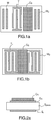
- the figure 1a illustrates an example of a surface elastic wave sensor of the invention, of compact configuration.
- the sensor comprises a reflective delay line, having two mirrors M 1 and M 2 , a transducer T located between the two mirrors.
- the senor incorporates an elastic wave transducer connected to an antenna and several mirrors, thus making it possible to perform a multiparameter measurement as described in the article: J. Micro / Nanolith. MEMS MOEMS 8 (3) 031306 (2009) ) - Wireless surface acoustic wave chemical sensor for the simultaneous measurement of CO2 and humidity.
- the transducer may conventionally include interdigitated electrodes.
- a layer Cs of H 2 S-sensitive polymer film is deposited between the transducer and one of the mirrors. More precisely in this mirror-transducer-mirror architecture, the zone separating the first mirror from the transducer is free of any surface functionalization to establish the free-space flight time of the elastic wave (regardless of the gas concentration), while the second region between the transducer and the second mirror is functionalized to vary the velocity of the elastic wave with the absorption of the gas.
- strongly coupled substrates such as lithium niobate or lithium tantalate are favored.
- the figure 1b illustrates, in turn, a simple configuration comprising two surface elastic wave transducers T 1 and T 2 , between which is positioned a sensitive layer Cs of polymer film.
- a simple configuration comprising two surface elastic wave transducers T 1 and T 2 , between which is positioned a sensitive layer Cs of polymer film.
- the transducer employed in the passive sensor of the invention may also be a volume wave or Lamb transducer, the surface wave transducers being still more advantageous in terms of the increase in frequency necessary for the reduction of antennas. the transmitter and the receiver.
- FIG. Figures 2a and 2b Variations of volume wave transducers are shown in FIG. Figures 2a and 2b .
- These transducers may be of cylindrical symmetry geometry.
- the figure 2a illustrates a first configuration having an electrode Es coated with a sensitive layer Cs, a piezoelectric piezoelectric substrate S being inserted between the upper electrode Es and a lower electrode Ei.
- the figure 2b illustrates a second configuration having a piezoelectric thin Piezo substrate deposited on a substrate S having low elastic losses, two electrodes Es and Ei (buried electrode) surround the thin substrate, so as to constitute the volume wave transducer.
- the sensitive layer Cs is deposited on the surface of the upper electrode Es.
- the sensor thus produced can be interrogated remotely, and the response carries the presence detection information of H 2 S.
- the figure 3 illustrates, as such, an example of a typical elastic wave transducer reader architecture interrogated by a radio frequency carrier wireless link.
- a carrier is generated by a source 1 and amplified by an amplifier 2 before being transmitted through a switch 4.
- a pulse is formed by switching the switch between the source and the receive stage formed of a low noise amplifier 3 and a phase and magnitude detector (I / Q).
- An antenna 7 connected to the common point 4 radiates the signal 10 which telemeans, through an antenna 8, the passive sensor 9 comprising the H 2 S sensitive film.
- the passive sensor is schematized by a representation of resonator (even in the case of the use of a delay line).
- the response of the sensor 9 bears the signature of the detection of the chemical compound H 2 S, whether it is the flight time of the elastic wave (in the case of a delay line) or a variation of resonance frequency, in the case of a sensor comprising a resonator.
- the reference up is relative to an example of a microcontroller, a STM32F103, but the exact type of microcontroller does not affect, this microcontroller has the function of sequencing the various steps of measurements, without constraint of computing power. It could be an FPGA component, a DSP component, or any programmable digital component that can sequence the measurements.
- the first synthesis is based on the formation of a lead (II) or zinc (II) carboxylate complex containing a polymerizable monomer-soluble function, which can be deposited as a thin film on a substrate.
- these monomers are polymerized under the effect of an external stimulus (heat, photons) to obtain a crosslinked film.
- This second synthesis is based on the complexation of Pb (II) or Zn (II) cations by a polymer containing pendant carboxylic acid functions. Then, the polymer is deposited in the form of a thin film on a substrate:
- This third example of synthesis is based on the complexation of Pb (II) or Zn (II) cations by polyfunctional molecules which can then react by polycondensation, polyaddition or polyelimination (or any other combination of these reactions) with molecules.
- complementary polyfunctional elements for forming a polymer thin film on a substrate according to, for example, the following reaction scheme:
- the thin films subjected then to exposure to H 2 S gas can generate the formation of lead (II) or zinc (II) sulphide, ie PbS or ZnS.
- the relative mass variation which is the essential parameter in acoustic detection, depends directly on the choice of organic precursors in the matrix.
- a surface acoustic wave transducer is known to be able to detect a mass variation of the order of a few tens of ng / cm 2 , defining the limit of detection accessible by means of this method. type of transducer.
- lead (II) complexes were synthesized and characterized by standard methods of analytical chemistry, allowing to elaborate several grams of molecules at each synthesis.
- the H 2 S that is used for testing is produced by acid treatment of a sulfur salt.
- the first test consisted of exposing the lead (II) complex powder to a gaseous H 2 S stream under normal conditions.
- the reaction occurs in a time interval less than the time between two photographs taken from a film at 50 frames / second, almost instantaneous and probably limited by the diffusion time of the gas.
- the color change - from a white powder to a black powder - is visible on the powder sample at the bottom of the container.
- DMSO dimethylsulfoxide
- the quality of the polymerization is validated by the mechanical strength of the film.
- the color change also validates the reactivity of the film during exposure to H 2 S.
- the applicants have validated obtaining thin films of polymers by spin. coating on silicon substrates.
- the samples used have surfaces of the order of 5 to 10 cm 2 .
- the sets of parameters have been optimized to determine robust and reproducible protocols to obtain thin layers of controlled thickness between 0.5 and 2 microns. Then, the applicants verified that these films were still sensitive to the presence of H 2 S. When these films are exposed to H 2 S, a color change is visible.
- a transmission surface elastic wave transducer quartz substrate propagating a Love wave.
- Such a device does not propagate the same wave nature as a lithium niobate reflective delay line which can advantageously be used for a wireless radio frequency measurement, but its behavior is suitably controlled and allows a fine analysis of the behavior of the film.
- FIGS. 4a and 4b illustrate the results of measurements of the IL magnitude and of the phase as a function of the interrogation frequency and before functionalization and after functionalization of the polymer, resulting from exposure to H 2 S (before functionalization, each delay line has an attenuation of the order of 23 dB, the deposition of the film induces a significant attenuation dependent on the thickness of the film) and the evolution of the phase of the signal.
Landscapes
- Physics & Mathematics (AREA)
- Chemical & Material Sciences (AREA)
- Health & Medical Sciences (AREA)
- Life Sciences & Earth Sciences (AREA)
- General Physics & Mathematics (AREA)
- Biochemistry (AREA)
- General Health & Medical Sciences (AREA)
- Analytical Chemistry (AREA)
- Immunology (AREA)
- Pathology (AREA)
- Engineering & Computer Science (AREA)
- Acoustics & Sound (AREA)
- Mechanical Engineering (AREA)
- Combustion & Propulsion (AREA)
- Food Science & Technology (AREA)
- Medicinal Chemistry (AREA)
- Electromagnetism (AREA)
- Investigating Or Analyzing Materials By The Use Of Ultrasonic Waves (AREA)
Abstract
Description
- Le domaine de l'invention est celui de la détection de sulfure d'hydrogène présent en phase gazeuse ou liquide et considéré dans sa première forme comme toxique pour des concentrations de l'ordre de 20 ppm. Produit notamment par des bactéries contaminant les forages pétroliers, sa détection peut représenter un enjeu majeur.
- L'art connu dans ce domaine, propose un certain nombre de solutions (électrochimiques, colorimétriques, conductimétriques) incompatibles avec le déploiement de capteur passif, autonome et pouvant être interrogé à distance sans liaison filaire, par exemple par une liaison radiofréquence.
- Dans ce contexte, les Demandeurs ont cherché une solution permettant notamment de fonctionnaliser un transducteur piézoélectrique à onde élastique permettant d'élaborer un capteur compatible avec l'absence de source locale d'énergie et avec des mesures à distance sans fil.
- Les demandeurs ont ainsi élaboré un film de matériau sensible au H2S pouvant être réalisé de manière reproductible, et d'épaisseur contrôlée, pouvant notamment être utilisé dans un capteur passif propageant une onde élastique permettant la détection de présence de H2S sous la forme d'une masse de gaz absorbée sur la surface.
- De manière extensive, un film de matériau sensible d'épaisseur contrôlée peut être exploité avec tout transducteur à détection directe (par exemple optique ou par résonance plasmon de surface).
- De manière générale, il est déjà connu des capteurs passifs à onde élastique interrogeables à distance comprenant une couche sensible permettant de détecter certains types de composés. La masse captée est en mesure d'induire une variation des conditions limites de propagation de l'onde élastique, classiquement il s'agit d'un ralentissement de l'onde, observée comme une décroissance de la phase du signal radiofréquence excitant le transducteur.
- Dans le contexte de la présente invention, les Demandeurs ont notamment conçu un capteur passif utilisant un transducteur à onde élastique de l'art connu et l'ont fonctionnalisé avec une couche contenant des sites réactifs afin d'ajouter au transducteur classique, une sensibilité spécifique à H2S.
- Pour ce faire, les Demandeurs ont recherché à exploiter un composé connu pour sa réaction sélective avec l'élément soufre. Des éléments tels que les ions de zinc, cuivre, or ou plomb sont connus pour réagir spécifiquement avec le soufre. Cependant, le cuivre présente une réaction défavorable avec l'oxygène pour former de l'oxyde de cuivre, tandis que l'or s'avère potentiellement complexe à manipuler.
- Un mode connu pour de détection du H2S consiste à utiliser un papier imbibé d'acétate de plomb, Pb(CH3COO)2 et est décrit dans l'article de T. Ding, J.-R. Zhang, S. Long, and J.-J. Zhu. Synthesis of HgS and PbS nanocrystals in a polyol solvent by microwave heating. Microelectronic Engineering, 66 :46-52, 2003. Dans ce cas, la molécule ne présente pas la capacité à être polymérisée et ne fait qu'imprégner le papier.
- Un mode de production de ce composé est la réaction d'un cation Pb(II) avec l'acide acétique en milieu basique.
- La réaction du produit ainsi formé avec H2S induit la transformation en sulfure de Pb(II), PbS, un précipité gris, selon la réaction :

- L'affinité du soufre pour les cations Pb(II) est très forte. Elle permet, par exemple, de former des nano-particules de PbS à partir de soufre solide, d'anions sulfure ou de H2S, comme décrit dans les articles de T. Ding, J.-R. Zhang, S. Long, and J.-J. Zhu. Synthesis of HgS and PbS nanocrystals in a polyol solvent by microwave heating. Microelectronic Engineering, 66 : 46-52, 2003 et de H. Karami, M. Ghasemi, and S. Matini. Synthesis, characterization and application of lead sulfide nano- structures as ammonia gas sensing agent. Int. J. Electrochem. Sci., 8 : 11661-11679, 2013 et de Z. Zeng, S. Wang, and S. Yang. Synthesis and characterization of PbS nanocrystallites in random copolymer ionomers. Chem. Mater., 11 :3365-3369, 1999.
- Plus précisément, pour pouvoir notamment réaliser un capteur de type capteur passif à onde élastique, les Demandeurs proposent une solution consistant en un film de polymère permettant aux cations Pb ou Zn d'imprégner une matrice solide destinée à servir de couche sensible et compatible de l'élaboration d'un capteur passif à onde élastique.
- La présente invention a ainsi pour objet un capteur de H2S, comprenant au moins un transducteur à onde élastique et un film comportant une matrice de polymère comprenant des fonctions carboxylates et des cations de plomb ou de zinc.
- Le film représente la couche sensible du capteur.
- Selon des variantes, le capteur comporte une antenne permettant d'interroger ledit capteur à distance et ainsi réaliser un capteur passif interrogeable à distance.
- Le film de polymère peut présenter typiquement une épaisseur comprise entre une centaine de nanomètres et quelques microns.
- Selon des variantes de l'invention, le polymère répond aux formules chimiques suivantes :
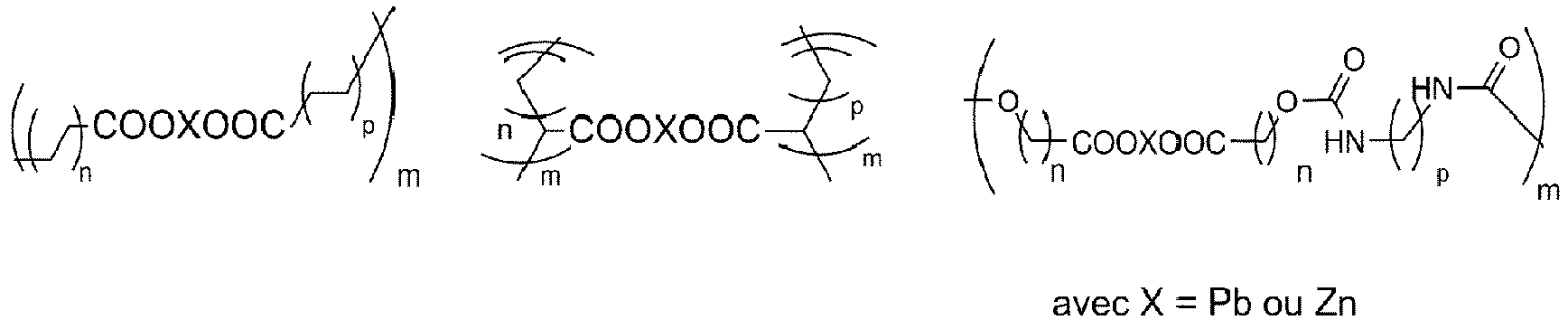
- Pour obtenir la couche sensible de film de polymère, les Demandeurs ont développé des polymères incorporant les fonctions nécessaires, c'est-à-dire incorporant du plomb ou du zinc et des fonctions carboxylates et plus précisément par exemple pour cela, des familles de molécules du type : (R1COO)X(R2COO) où R1 et R2 désignent des groupements possédant des fonctions réactives qui permettent de connecter les cations Pb(II) ou les cations Zn(II) par ses ligands dans des macromolécules.
- Afin de maximiser la sensibilité de la couche organique, il est intéressant de maximiser la densité d'ions Pb(II) ou d'ions Zn(II) dans la matrice en réduisant de préférence autant que possible la longueur des chaînes carbonées des monomères.
- Les Demandeurs sont partis du constat que la fonctionnalisation doit d'une part affecter le moins possible la propagation de l'onde élastique en absence de H2S mais également offrir suffisamment de sites réactifs pour induire une variation significative par exemple de la célérité de l'onde élastique en présence de H2S.
- Ce compromis ainsi que le contrôle de l'épaisseur de la couche et la densité des sites récepteurs, peuvent être optimisés. Ainsi afin de limiter d'une part la perturbation induite par le film de polymère sur la propagation de l'onde élastique, tout en maximisant d'autre part la variation de la célérité de l'onde par variation des conditions limites de propagation, il est particulièrement intéressant d'utiliser une épaisseur de film de l'ordre de 1 à 5% de la longueur d'onde élastique. Pour une fréquence de travail de 150 MHz par exemple, une telle condition conduit à une épaisseur de film comprise entre environ 250 nm et 5 µm.
- Il est à noter en effet, que les mêmes gammes d'épaisseur peuvent être employées qu'il s'agisse de transducteur à onde de surface ou de transducteur à onde de volume. L'épaisseur variant comme l'inverse de la racine de la fréquence, passer d'un résonateur à onde de volume (fréquence de travail typiquement de l'ordre de 5-10 MHz) à un transducteur à onde élastique (fréquence de travail typiquement de l'ordre du 1 GHz) ne fait varier l'épaisseur de film que d'un facteur 10.
- Selon des variantes de l'invention, le transducteur est un transducteur à onde élastique de surface.
- Selon des variantes de l'invention, le capteur comporte une ligne à retard comportant au moins un transducteur à onde élastique de surface et un miroir, la couche sensible étant positionnée entre ledit transducteur et ledit miroir. Avantageusement, la ligne à retard comprend un transducteur positionné entre deux miroirs, ladite couche sensible étant positionnée entre ledit transducteur et l'un desdits miroirs.
- Selon des variantes de l'invention, le transducteur est un transducteur à onde de volume ou de Lamb.
- Avantageusement, le transducteur incorporé au capteur est un dipôle, qu'il comprenne une architecture de ligne à retard ou un résonateur propageant une onde élastique.
- Selon des variantes de l'invention, le transducteur comprend un substrat en niobate de lithium ou en tantalate de lithium.
- L'invention a aussi pour objet un procédé de fabrication d'un capteur selon l'invention, comprenant les étapes suivantes :
- le dépôt à la surface d'un substrat, de monomère contenant un complexe de carboxylate de plomb ou de zinc et une fonction polymérisable, pouvant être, par exemple, de formule chimique :

- la polymérisation dudit monomère.
- L'invention a encore pour objet un procédé de fabrication d'un capteur selon l'invention comprenant le dépôt sur un substrat d'un film de polymère, préalablement synthétisé pouvant être de formule chimique :

- L'invention a également pour objet un procédé de fabrication d'un capteur selon l'invention comprenant le dépôt sur un substrat d'un film de polymère obtenu par polycondensation ou polyaddition ou polyélimination entre un monomère contenant un complexe de carboxylate de plomb ou de zinc et une molécule difonctionnelle. Le polymère final peut être de formule chimique :

- L'invention a encore pour objet un dispositif de détection de H2S comprenant :
- un capteur selon l'invention ;
- des moyens d'interrogation radiofréquence ;
- des moyens de détection de la réponse dudit capteur.
- Selon des variantes de l'invention, le dispositif comprend des moyens d'analyse de la célérité ou des pertes d'insertion de l'onde élastique pour identifier la présence du composé H2S.
- L'invention sera mieux comprise et d'autres avantages apparaîtront à la lecture de la description qui va suivre donnée à titre non limitatif et grâce aux figures parmi lesquelles :
- les
figures 1a et 1b illustrent un exemple de capteur à onde élastique de surface selon la présente invention et une configuration de test utilisant des transducteurs à onde élastique de surface ; - les
figures 2a et2b illustrent des exemples de capteur à onde de volume selon la présente invention ; - la
figure 3 illustre une architecture de lecteur de capteur selon l'invention interrogeable à distance ; - les
figures 4a et 4b illustrent des courbes de réponse en termes de magnitude et de phase d'un capteur selon l'invention, en fonction de la fréquence d'interrogation (avant et après fonctionnalisation par du H2S de la couche sensible). - Le capteur de H2S selon l'invention peut être un capteur filaire ou un capteur passif interrogeable à distance.
- Le film sensible à H2S peut avantageusement être ainsi combiné à un transducteur à onde élastique pour réaliser un capteur passif interrogeable à distance selon l'invention, le transducteur à onde élastique étant capable de convertir un signal électromagnétique en vibration mécanique.
- La
figure 1a illustre un exemple de capteur à onde élastique de surface de l'invention, de configuration compacte. - Le capteur comporte une ligne à retard réflective, présentant deux miroirs M1 et M2, un transducteur T situé entre les deux miroirs.
- Il peut être particulièrement intéressant que le capteur intègre un transducteur à onde élastique relié à une antenne et plusieurs miroirs, permettant ainsi d'effectuer une mesure multiparamètres tel que décrite dans l'article : J. Micro/Nanolith. MEMS MOEMS 8(3) 031306 (2009) - Wireless surface acoustic wave chemical sensor for simultaneous measurement of CO2 and humidity.
- Typiquement le transducteur peut comporter de manière classique des électrodes interdigitées.
- La présence de deux miroirs permet d'avoir une zone de référence, sans laquelle la mesure de H2S est polluée par la variation de distance lecteur-capteur.
- Il est donc utile de disposer d'une zone sensible pour la mesure, et d'une zone libre de fonctionnalisation de surface pour établir la distance RADAR-capteur.
- Une couche Cs de film de polymère sensible au H2S est déposée entre le transducteur et un des miroirs Plus précisément dans cette architecture miroir-transducteur-miroir, la zone séparant le premier miroir du transducteur est libre de toute fonctionnalisation de surface pour établir le temps de vol en espace libre de l'onde élastique (quelle que soit la concentration de gaz), tandis que la seconde région entre le transducteur et le second miroir est fonctionnalisée pour faire varier la célérité de l'onde élastique avec l'absorption du gaz.
- Pour une mesure sans fil dans une configuration de ligne à retard réflective, des substrats fortement couplés (coefficient de couplage supérieur à 1 %), tels que le niobate de lithium ou le tantalate de lithium sont favorisés.
- La
figure 1b illustre quant à elle, une configuration simple comportant deux transducteurs à onde élastique de surface T1 et T2, entre lesquels est positionnée une couche sensible Cs de film de polymère. Une telle configuration a été utilisée par le Demandeur pour valider expérimentalement la sensibilité du film mince de polymère utilisé dans la présente invention à la détection de H2S, comme il sera explicité ultérieurement. - Le transducteur employé dans le capteur passif de l'invention peut également être un transducteur à onde de volume ou de Lamb, les transducteurs à onde de surface étant tout de même plus avantageux en termes de montée en fréquence nécessaire à la réduction d'antennes de l'émetteur et du récepteur.
- Des variantes de transducteurs à onde de volume sont représentées en
figures 2a et2b . - Ces transducteurs peuvent être de géométrie à symétrie cylindrique.
- La
figure 2a illustre une première configuration présentant une électrode Es recouverte d'une couche sensible Cs, un substrat piézoélectrique Spiézo étant inserré entre l'électrode supérieure Es et une électrode inférieure Ei. - La
figure 2b illustre une seconde configuration présentant un substrat piézoélectrique fin Cpiézo déposé sur un substrat S présentant de faibles pertes élastiques, deux électrodes Es et Ei (électrode enterrée) entourent le substrat fin, de manière à constituer le transducteur à onde de volume. La couche sensible Cs est déposée à la surface de l'électrode supérieure Es. - Le capteur ainsi réalisé peut être interrogé à distance, et la réponse est porteuse de l'information de détection de présence de H2S.
- La
figure 3 , illustre à ce titre un exemple d'architecture typique de lecteur de transducteur à onde élastique interrogé par une liaison sans fil sur porteuse radiofréquence. - Une porteuse est générée par une source 1 et amplifiée par un amplificateur 2 avant d'être émise au travers d'un commutateur 4.
- Une impulsion est formée en commutant le commutateur entre la source et l'étage de réception formé d'un amplificateur à faible bruit 3 et d'un détecteur 5 de phase et de magnitude (I/Q).
- Une antenne 7 connectée au point commun 4 rayonne le signal 10 qui téléalimente, au travers d'une antenne 8, le capteur passif 9 comportant le film sensible à H2S. Sur la
figure 3 , le capteur passif est schématisé par une représentation de résonateur (même dans le cas de l'utilisation d'une ligne à retard). - La réponse du capteur 9 porte la signature de la détection du composé chimique H2S, qu'il s'agisse de temps de vol de l'onde élastique (dans le cas d'une ligne à retard) ou d'une variation de fréquence de résonance, dans le cas d'un capteur comportant un résonateur.
- La référence up est relative à un exemple de microcontrôleur, un STM32F103, mais le type exact de microcontrôleur n'a pas d'incidence, ce microcontrôleur a pour fonction de séquencer les diverses étapes de mesures, sans contrainte de puissance de calcul. Il pourrait s'agir d'un composant FPGA, d'un composant DSP, ou de tout composant numérique programmable capable de séquencer les mesures.
- Pour obtenir la couche sensible constituée du film de polymère, les Demandeurs ont ainsi développé des polymères incorporant les fonctions nécessaires. Ils ont développé notamment pour cela, des familles de molécules du type : (R1COO)X(R2COO) où R1 et R2 désignent des groupements possédant des fonctions réactives qui permettent de connecter les cations par ses ligands dans des macromolécules, et X un cation Pb2+ ou un cation Zn 2+.
- Plusieurs exemples de synthèse de polymères utilisés dans la présente invention sont présentés ci-après :
- La première synthèse est fondée sur la formation d'un complexe de carboxylate de plomb(II) ou zinc(II) contenant une fonction polymérisable constituant un monomère, soluble, qui peut être déposé sous la forme d'un film mince sur un substrat.
- Puis, ces monomères sont polymérisés sous l'effet d'un stimulus extérieur (chaleur, photons) pour obtenir un film réticulé.

- Cette seconde synthèse est fondée sur la complexation de cations Pb(II) ou Zn(II) par un polymère contenant des fonctions acides carboxyliques pendantes. Ensuite, le polymère est déposé sous la forme d'un film mince sur un substrat :

- Ce troisième exemple de synthèse est fondée sur la complexation de cations Pb(II) ou Zn(II) par des molécules polyfonctionnelles qui peuvent ensuite réagir par polycondensation, polyaddition ou polyélimination (ou toutes autres combinaisons de ces réactions) avec des molécules polyfonctionnelles complémentaires pour former un film mince polymère sur un substrat selon, par exemple le schéma réactionnel suivant :

- Dans les différents cas, les films minces soumis ensuite à l'exposition à H2S gazeux peuvent générer la formation de sulfure de plomb(II) ou zinc(II), i.e. PbS ou ZnS.
- Dans le cadre de la présente invention, la formation de PbS ou ZnS conduit à une variation de masse accompagnée d'un changement de couleur.
- La variation relative de masse, qui est le paramètre essentiel dans la détection acoustique, dépend directement du choix des précurseurs organiques de la matrice.
- Si le monomère de départ est de l'acide acrylique ; sa masse molaire est de 72 g/mol. La masse molaire du plomb étant de 207 g/mol, la complexation de la couche sensible par H2S (masse molaire 34g/mol) conduit à une variation de masse relative de 34 / (207 + 72x2) = 10%.
- Il est à noter que de manière générale, un transducteur à onde acoustique de surface est connu pour être capable de détecter une variation de masse de l'ordre de quelques dizaines de ng/cm2, définissant la limite de détection accessible au moyen de ce type de transducteur.
- Les Demandeurs ont procédé à des essais permettant de valider le concept de capteur de la présente invention et le choix de la couche sensible permettant effectivement une détection de H2S, dans un capteur passif à onde élastique pouvant être interrogé à distance.
- Cette démonstration expérimentale de concept de capteur repose sur quatre étapes :
- Etape 1 : la synthèse et la caractérisation des molécules sensibles à H2S. La sensibilité à H2S est testée par une exposition directe des molécules à H2S déclenchant un changement de couleur ;
- Etape 2 : l'élaboration d'un film mince transparent sur une lame de verre et l'étude de la polymérisation des molécules en phase solide ;
- Etape 3 : la détection d'un changement d'absorbance de ce film mince lors d'une exposition à H2S ;
- Etape 4 : le dépôt d'un film mince sur un transducteur à onde élastique de surface pour estimer la variation de la célérité de l'onde élastique lors de l'exposition des molécules à H2S.
- Dans un premier temps, des complexes de plomb(II) ont été synthétisés et caractérisés par les méthodes standard de la chimie analytique, permettant d'élaborer plusieurs grammes de molécules à chaque synthèse.
- Le H2S qui est utilisé pour les tests est produit par un traitement acide d'un sel de soufre. Le premier essai a consisté en l'exposition de la poudre de complexes de plomb(II) à un flux de H2S gazeux dans des conditions normales.
- La réaction apparaît dans un intervalle de temps inférieur à la durée entre deux photographies extraites d'un film à 50 images/seconde, quasi-instantanée et probablement limitée par le temps de diffusion du gaz. Le changement de couleur - d'une poudre blanche à une poudre noire - est visible sur l'échantillon de poudre situé au fond du récipient.
- Ayant validé la réactivité du composé synthétisé avec H2S, le dépôt de la molécule solubilisée dans le diméthylsulfoxyde (DMSO) est obtenu par évaporation du solvant couramment dénommé « drop casting ».
- La qualité de la polymérisation est validée par la tenue mécanique du film.
- Une fois le film formé sur lame de verre, le changement de couleur valide également la réactivité du film lors de l'exposition à H2S. Les demandeurs ont validé l'obtention de films minces de polymères par spin coating sur des substrats en silicium. Les échantillons utilisés présentent des surfaces de l'ordre de 5 à 10 cm2. Les jeux de paramètres (solvant, viscosité, température, vitesse de rotation) ont été optimisés afin de déterminer des protocoles robustes et reproductibles pour obtenir des couches minces d'épaisseur contrôlées entre 0,5 et 2 microns. Puis, les demandeurs ont vérifié que ces films étaient toujours sensibles à la présence d'H2S. Lorsque ces films sont exposés à H2S, un changement de couleur est visible.
- Enfin, la procédure de dépôt est reproduite sur un transducteur à onde élastique de surface en transmission (substrat de quartz propageant une onde de Love). Un tel dispositif ne propage pas la même nature d'onde qu'une ligne à retard réflective sur niobate de lithium qui peut avantageusement être utilisée pour une mesure radiofréquence sans fil, mais son comportement est convenablement maîtrisé et permet une analyse fine du comportement du film mince organique soumis à H2S.
- Les
figures 4a et 4b illustrent les résultats des mesures de détermination de la magnitude IL et de la phase en fonction de la fréquence d'interrogation et ce avant fonctionnalisation et après fonctionnalisation du polymère, résultat de l'exposition au H2S (avant fonctionnalisation, chaque ligne à retard présente une atténuation de l'ordre de 23 dB. Le dépôt du film induit une atténuation significative dépendante de l'épaisseur du film) et l'évolution de la phase du signal. - Les courbes en traits gras sont relatives à ces paramètres mesurés avant réaction avec du H2S, les courbes en traits fins étant relatives à ces paramètres obtenus après réaction.
- L'évolution de la phase vers les hautes fréquences est a priori surprenante car une augmentation de la masse du film se traduit généralement par un décalage des courbes vers les basses fréquences.
- Dans le cas d'une élévation de la célérité de l'onde élastique (observée comme décalage de la courbe vers les hautes fréquences), l'interprétation classique est d'attribuer cette élévation de célérité à une rigidification de la couche organique adsorbée.
- Les Demandeurs attribuent cet effet au passage du plomb sous forme d'ions dans la matrice, à une forme de nanoparticules de PbS dans la matrice organique.
- Ce comportement (augmentation de la célérité) est relativement inhabituel en détection de composés gazeux par une couche mince organique.
- Un intérêt majeur de cette observation est de fournir une distinction claire entre une détection de H2S et l'interférence par de l'absorption non-spécifique d'espèces chimiques autres présentes dans l'atmosphère : ces dernières induisant une variation de masse du film - sans le rigidifier - qui se traduit par une baisse de la célérité de l'onde élastique (ou une décroissance de la phase si le transducteur est sondé à fréquence fixe).
- Le risque de faux positif est donc réduit par cette analyse.
- La variation de près de 20° de la phase lors de l'exposition à H2S est significative, et considérée comme constituant un signal très facilement détectable. Pour référence, l'article de D. Rabus, J.-M. Friedt, S. Ballandras, G. Martin, E . Carry, and V. Blondeau-Patissier. A high sensitivity open loop electronics for gravimetric acoustic wave-based sensors. IEEE Trans. UFFC, 60(6) :1219-1226, 2013 démontre une limite de détection plus de 500 fois plus faible (dans un contexte de ligne à retard en transmission).
Claims (18)
- Capteur de H2S, comprenant au moins un transducteur à onde élastique et un film comportant une matrice de polymère comprenant des fonctions carboxylates et des cations de plomb ou de zinc.
- Capteur selon la revendication 1, caractérisé en ce qu'il comporte une antenne permettant d'interroger ledit capteur à distance.
- Capteur selon l'une des revendications 1 ou 2, dans lequel le film présente une épaisseur comprise entre une centaine de nanomètres et quelques microns.
- Capteur selon l'une des revendications 1 à 3, dans lequel le polymère répond à la formule chimique suivante :

- Capteur selon l'une des revendications 1 à 3, dans lequel le polymère répond à la formule chimique suivante :

- Capteur selon l'une des revendications 1 à 3, dans lequel le polymère répond à la formule chimique suivante :

- Capteur selon l'une des revendications 1 à 6, dans lequel le film présente une épaisseur comprise entre 1 à 5% de la longueur d'onde élastique.
- Capteur selon la revendication 7, dans lequel le film présente une épaisseur comprise entre 250 nm et 5 µm.
- Capteur selon l'une des revendications 1 à 8, caractérisé en ce que le transducteur est un transducteur à onde élastique de surface.
- Capteur selon la revendication 9, caractérisé en ce qu'il comporte une ligne à retard comportant au moins un transducteur à onde élastique de surface et un miroir.
- Capteur selon la revendication 9, caractérisé en ce qu'il comprend un transducteur positionné entre deux miroirs, ladite couche sensible étant positionnée entre ledit transducteur et l'un desdits miroirs.
- Capteur selon l'une des revendications 1 à 8, caractérisé en ce que le transducteur est un transducteur à onde élastique de volume ou de Lamb.
- Capteur selon l'une des revendications 1 à 12, caractérisé en ce que le transducteur comprend un substrat en niobate de lithium ou en tantalate de lithium.
- Procédé de fabrication d'un capteur selon l'une des revendications 1 à 13, comprenant la réalisation dudit film de polymère qui comporte les étapes suivantes :- le dépôt à la surface d'un substrat, de monomère formé d'un complexe de carboxylate de plomb ou de zinc et une fonction polymérisable, pouvant être de formule chimique :

- Procédé de fabrication d'un capteur selon l'une des revendications 1 à 13 comprenant :- la synthèse d'un polymère de formule chimique :
 - le dépôt sur un substrat d'un film dudit polymère préalablement synthétisé.
 - Procédé de fabrication d'un capteur selon l'une des revendications 1 à 13 comprenant :- la synthèse d'un polymère est de formule chimique

ladite synthèse étant réalisée par polycondensation ou polyaddition ou polyélimination d'un monomère contenant un complexe de carboxylate de plomb ou de zinc et une molécule difonctionnelle ;- le dépôt sur un substrat d'un film dudit polymère préalablement synthétisé. - Dispositif de détection de H2S comprenant :- un capteur selon l'une des revendications 1 à 13 ;- des moyens d'interrogation radiofréquence ;- des moyens de détection de la réponse dudit capteur.
- Dispositif selon la revendication 17, caractérisé en ce qu'il comprend des moyens d'analyse de la célérité ou des pertes d'insertion de l'onde élastique pour identifier la présence du composé H2S.
Applications Claiming Priority (1)
| Application Number | Priority Date | Filing Date | Title |
|---|---|---|---|
| FR1658487A FR3055901A1 (fr) | 2016-09-13 | 2016-09-13 | Film de polymere sensible a h2s comportant des fonctions carboxylates et des cations de plomb ou de zinc et capteur passif a onde elastique comportant le film, interrogeable a distance |
Publications (2)
| Publication Number | Publication Date |
|---|---|
| EP3293518A1 true EP3293518A1 (fr) | 2018-03-14 |
| EP3293518B1 EP3293518B1 (fr) | 2021-12-01 |
Family
ID=57396627
Family Applications (1)
| Application Number | Title | Priority Date | Filing Date |
|---|---|---|---|
| EP17190623.3A Active EP3293518B1 (fr) | 2016-09-13 | 2017-09-12 | Capteur de h2s a onde elastique comportant un film de polymere comprenant des fonctions carboxylates et des cations de plomb ou de zinc et procede de fabrication |
Country Status (3)
| Country | Link |
|---|---|
| US (1) | US11185887B2 (fr) |
| EP (1) | EP3293518B1 (fr) |
| FR (1) | FR3055901A1 (fr) |
Families Citing this family (1)
| Publication number | Priority date | Publication date | Assignee | Title |
|---|---|---|---|---|
| KR102079659B1 (ko) * | 2018-04-05 | 2020-02-20 | 해성디에스 주식회사 | 광 센서 소자 및 이를 포함하는 광 센서 패키지 |
Citations (2)
| Publication number | Priority date | Publication date | Assignee | Title |
|---|---|---|---|---|
| US3167734A (en) * | 1959-11-27 | 1965-01-26 | Gen Motors Corp | Humidity sensing element |
| US5034452A (en) * | 1989-08-23 | 1991-07-23 | The Glidden Company | Ionomeric coatings neutralized with zinc carbonate |
Family Cites Families (2)
| Publication number | Priority date | Publication date | Assignee | Title |
|---|---|---|---|---|
| FR2730810B1 (fr) * | 1995-02-21 | 1997-03-14 | Thomson Csf | Capteur chimique hautement selectif |
| US6773926B1 (en) * | 2000-09-25 | 2004-08-10 | California Institute Of Technology | Nanoparticle-based sensors for detecting analytes in fluids |
-
2016
- 2016-09-13 FR FR1658487A patent/FR3055901A1/fr active Pending
-
2017
- 2017-09-12 EP EP17190623.3A patent/EP3293518B1/fr active Active
- 2017-09-12 US US15/702,652 patent/US11185887B2/en active Active
Patent Citations (2)
| Publication number | Priority date | Publication date | Assignee | Title |
|---|---|---|---|---|
| US3167734A (en) * | 1959-11-27 | 1965-01-26 | Gen Motors Corp | Humidity sensing element |
| US5034452A (en) * | 1989-08-23 | 1991-07-23 | The Glidden Company | Ionomeric coatings neutralized with zinc carbonate |
Non-Patent Citations (5)
| Title |
|---|
| ASAD MOHSEN ET AL: "Surface acoustic wave based H2S gas sensors incorporating sensitive layers of single wall carbon nanotubes decorated with Cu nanoparticles", SENSORS AND ACTUATORS B: CHEMICAL: INTERNATIONAL JOURNAL DEVOTED TO RESEARCH AND DEVELOPMENT OF PHYSICAL AND CHEMICAL TRANSDUCERS, vol. 198, 18 March 2014 (2014-03-18), pages 134 - 141, XP028658237, ISSN: 0925-4005, DOI: 10.1016/J.SNB.2014.03.024 * |
| G I DZHARDIMALIEVA ET AL: "Macromolecular metal carboxylates", RUSSIAN CHEMICAL REVIEWS (USPEKHI KHIMII)., vol. 77, no. 3, 31 March 2008 (2008-03-31), GB, pages 259 - 301, XP055364214, ISSN: 0036-021X, DOI: 10.1070/RC2008v077n03ABEH003682 * |
| HANMING DING ET AL: "Detection of hydrogen sulfide: the role of fatty acid salt Langmuir-Blodgett films", MATERIALS SCIENCE AND ENGINEERING C., vol. 11, no. 2, 28 November 2000 (2000-11-28), CH, pages 121 - 128, XP055363717, ISSN: 0928-4931, DOI: 10.1016/S0928-4931(00)00195-8 * |
| W P JAKUBIK ET AL: "POLYANILINE THIN FILMS AS A TOXIC GAS SENSORS IN SAW SYSTEM", MOLECULAR AND QUANTUM ACOUSTICS, vol. 28, 2007, pages 125, XP055446416 * |
| ZAINAB YUNUSA ET AL: "Gas Sensors: A Review", SENSORS & TRANSDUCERS, 30 April 2014 (2014-04-30), pages 61 - 75, XP055363935, Retrieved from the Internet <URL:http://www.sensorsportal.com/HTML/DIGEST/april_2014/Vol_168/P_1957.pdf> [retrieved on 20170411] * |
Also Published As
| Publication number | Publication date |
|---|---|
| US11185887B2 (en) | 2021-11-30 |
| US20180071780A1 (en) | 2018-03-15 |
| EP3293518B1 (fr) | 2021-12-01 |
| FR3055901A1 (fr) | 2018-03-16 |
Similar Documents
| Publication | Publication Date | Title |
|---|---|---|
| Yuan et al. | Investigation for terminal reflection optical fiber SPR glucose sensor and glucose sensitive membrane with immobilized GODs | |
| Lépinay et al. | Molecular imprinted polymer-coated optical fiber sensor for the identification of low molecular weight molecules | |
| JP5769703B2 (ja) | 多層比色センサ | |
| KR100977292B1 (ko) | 표면 플라즈몬 공명을 이용한 분자각인 가스 센서 칩 제조방법 | |
| FR2730810A1 (fr) | Capteur chimique hautement selectif | |
| EP2231894A1 (fr) | Support solide revetu d'au moins un film de metal et d'au moins une couche d'oxyde transparent et conducteur pour la detection par spr et/ou par une methode electrochimique | |
| Pilla et al. | Transition mode long period grating biosensor with functional multilayer coatings | |
| EP2423668A1 (fr) | Système et procédé de détection d'analytes présents dans un échantillon gazeux | |
| Darr et al. | Plasmonic-enhanced conjugated polymer fluorescence chemosensor for trace nitroaromatic vapor | |
| Choi et al. | Highly reliable SERS substrate based on plasmonic hybrid coupling between gold nanoislands and periodic nanopillar arrays | |
| Martínez-Pérez et al. | Commercial polycarbonate track-etched membranes as substrates for low-cost optical sensors | |
| EP3293518B1 (fr) | Capteur de h2s a onde elastique comportant un film de polymere comprenant des fonctions carboxylates et des cations de plomb ou de zinc et procede de fabrication | |
| Vázquez-Guardado et al. | Hybrid cavity-coupled plasmonic biosensors for low concentration, label-free and selective biomolecular detection. | |
| US20160018337A1 (en) | Color Changing Polymer Films for Detecting Chemical and Biological Targets | |
| US20090066957A1 (en) | Method and Apparatus for Sensing a Target Substance by Analysing Time Series of Said Target Substance | |
| FR2831275A1 (fr) | Substrat revetu d'un film organique transparent et procede de fabrication | |
| Giammarco et al. | Towards universal enrichment nanocoating for IR-ATR waveguides | |
| Radloff et al. | Stability improvement of an optochemical heavy metal ion sensor by covalent receptor binding | |
| Blevins et al. | Planar nanophotonic structures for intensity based readout refractive index sensing applied to dissolved methane detection | |
| Lee et al. | Formation of activation‐free, selectively bioconjugatable poly (N‐acryloxysuccinimide‐co‐oligoethylene glycol methyl ether methacrylate) films by surface‐initiated ARGET ATRP | |
| Abu-Rabeah et al. | Characterization of Electrogenerated Polypyrrole− Benzophenone Films Coated on Poly (pyrrole-methyl metacrylate) Optic-Conductive Fibers | |
| Cyago et al. | Surface plasmon resonance spectroscopy and molecularly imprinted polymer (MIP) sensors | |
| Leibl et al. | Molecularly Imprinted Polymers for Chemical Sensing: A Tutorial Review. Chemosensors 2021, 9, 123 | |
| Moslemi et al. | Optical Fiber Probe Based on Localized Surface Plasmon Resonance of Gold Nanostructures for Chemical Sensing. | |
| Samavati et al. | Comprehensive study on glycoprotein detection via polymer fiber sensor decorated with dome-like Ag nanoislands and ZnO nanorods |
Legal Events
| Date | Code | Title | Description |
|---|---|---|---|
| PUAI | Public reference made under article 153(3) epc to a published international application that has entered the european phase |
Free format text: ORIGINAL CODE: 0009012 |
|
| STAA | Information on the status of an ep patent application or granted ep patent |
Free format text: STATUS: THE APPLICATION HAS BEEN PUBLISHED |
|
| AK | Designated contracting states |
Kind code of ref document: A1 Designated state(s): AL AT BE BG CH CY CZ DE DK EE ES FI FR GB GR HR HU IE IS IT LI LT LU LV MC MK MT NL NO PL PT RO RS SE SI SK SM TR |
|
| AX | Request for extension of the european patent |
Extension state: BA ME |
|
| STAA | Information on the status of an ep patent application or granted ep patent |
Free format text: STATUS: REQUEST FOR EXAMINATION WAS MADE |
|
| 17P | Request for examination filed |
Effective date: 20180913 |
|
| RBV | Designated contracting states (corrected) |
Designated state(s): AL AT BE BG CH CY CZ DE DK EE ES FI FR GB GR HR HU IE IS IT LI LT LU LV MC MK MT NL NO PL PT RO RS SE SI SK SM TR |
|
| R17P | Request for examination filed (corrected) |
Effective date: 20180913 |
|
| RAP1 | Party data changed (applicant data changed or rights of an application transferred) |
Owner name: UNIVERSITE DE FRANCHE-COMTE Owner name: CENTRE NATIONAL DE LA RECHERCHE SCIENTIFIQUE Owner name: SENSEOR Owner name: TOTAL SE |
|
| GRAP | Despatch of communication of intention to grant a patent |
Free format text: ORIGINAL CODE: EPIDOSNIGR1 |
|
| STAA | Information on the status of an ep patent application or granted ep patent |
Free format text: STATUS: GRANT OF PATENT IS INTENDED |
|
| RIC1 | Information provided on ipc code assigned before grant |
Ipc: G01N 33/00 20060101AFI20210701BHEP Ipc: G01N 29/02 20060101ALI20210701BHEP Ipc: G01N 29/036 20060101ALI20210701BHEP |
|
| INTG | Intention to grant announced |
Effective date: 20210720 |
|
| RIN1 | Information on inventor provided before grant (corrected) |
Inventor name: FRIEDT, JEAN-MICHEL Inventor name: CHERIOUX, FREDERIC Inventor name: LAMARE, SIMON Inventor name: GEGOT, FRANCOIS |
|
| GRAS | Grant fee paid |
Free format text: ORIGINAL CODE: EPIDOSNIGR3 |
|
| GRAA | (expected) grant |
Free format text: ORIGINAL CODE: 0009210 |
|
| STAA | Information on the status of an ep patent application or granted ep patent |
Free format text: STATUS: THE PATENT HAS BEEN GRANTED |
|
| AK | Designated contracting states |
Kind code of ref document: B1 Designated state(s): AL AT BE BG CH CY CZ DE DK EE ES FI FR GB GR HR HU IE IS IT LI LT LU LV MC MK MT NL NO PL PT RO RS SE SI SK SM TR |
|
| REG | Reference to a national code |
Ref country code: GB Ref legal event code: FG4D Free format text: NOT ENGLISH |
|
| REG | Reference to a national code |
Ref country code: AT Ref legal event code: REF Ref document number: 1452248 Country of ref document: AT Kind code of ref document: T Effective date: 20211215 Ref country code: CH Ref legal event code: EP |
|
| REG | Reference to a national code |
Ref country code: IE Ref legal event code: FG4D Free format text: LANGUAGE OF EP DOCUMENT: FRENCH |
|
| REG | Reference to a national code |
Ref country code: DE Ref legal event code: R096 Ref document number: 602017050072 Country of ref document: DE |
|
| REG | Reference to a national code |
Ref country code: LT Ref legal event code: MG9D |
|
| REG | Reference to a national code |
Ref country code: NL Ref legal event code: MP Effective date: 20211201 |
|
| REG | Reference to a national code |
Ref country code: AT Ref legal event code: MK05 Ref document number: 1452248 Country of ref document: AT Kind code of ref document: T Effective date: 20211201 |
|
| PG25 | Lapsed in a contracting state [announced via postgrant information from national office to epo] |
Ref country code: RS Free format text: LAPSE BECAUSE OF FAILURE TO SUBMIT A TRANSLATION OF THE DESCRIPTION OR TO PAY THE FEE WITHIN THE PRESCRIBED TIME-LIMIT Effective date: 20211201 Ref country code: LT Free format text: LAPSE BECAUSE OF FAILURE TO SUBMIT A TRANSLATION OF THE DESCRIPTION OR TO PAY THE FEE WITHIN THE PRESCRIBED TIME-LIMIT Effective date: 20211201 Ref country code: FI Free format text: LAPSE BECAUSE OF FAILURE TO SUBMIT A TRANSLATION OF THE DESCRIPTION OR TO PAY THE FEE WITHIN THE PRESCRIBED TIME-LIMIT Effective date: 20211201 Ref country code: BG Free format text: LAPSE BECAUSE OF FAILURE TO SUBMIT A TRANSLATION OF THE DESCRIPTION OR TO PAY THE FEE WITHIN THE PRESCRIBED TIME-LIMIT Effective date: 20220301 Ref country code: AT Free format text: LAPSE BECAUSE OF FAILURE TO SUBMIT A TRANSLATION OF THE DESCRIPTION OR TO PAY THE FEE WITHIN THE PRESCRIBED TIME-LIMIT Effective date: 20211201 |
|
| PG25 | Lapsed in a contracting state [announced via postgrant information from national office to epo] |
Ref country code: SE Free format text: LAPSE BECAUSE OF FAILURE TO SUBMIT A TRANSLATION OF THE DESCRIPTION OR TO PAY THE FEE WITHIN THE PRESCRIBED TIME-LIMIT Effective date: 20211201 Ref country code: PL Free format text: LAPSE BECAUSE OF FAILURE TO SUBMIT A TRANSLATION OF THE DESCRIPTION OR TO PAY THE FEE WITHIN THE PRESCRIBED TIME-LIMIT Effective date: 20211201 Ref country code: NO Free format text: LAPSE BECAUSE OF FAILURE TO SUBMIT A TRANSLATION OF THE DESCRIPTION OR TO PAY THE FEE WITHIN THE PRESCRIBED TIME-LIMIT Effective date: 20220301 Ref country code: LV Free format text: LAPSE BECAUSE OF FAILURE TO SUBMIT A TRANSLATION OF THE DESCRIPTION OR TO PAY THE FEE WITHIN THE PRESCRIBED TIME-LIMIT Effective date: 20211201 Ref country code: HR Free format text: LAPSE BECAUSE OF FAILURE TO SUBMIT A TRANSLATION OF THE DESCRIPTION OR TO PAY THE FEE WITHIN THE PRESCRIBED TIME-LIMIT Effective date: 20211201 Ref country code: GR Free format text: LAPSE BECAUSE OF FAILURE TO SUBMIT A TRANSLATION OF THE DESCRIPTION OR TO PAY THE FEE WITHIN THE PRESCRIBED TIME-LIMIT Effective date: 20220302 Ref country code: ES Free format text: LAPSE BECAUSE OF FAILURE TO SUBMIT A TRANSLATION OF THE DESCRIPTION OR TO PAY THE FEE WITHIN THE PRESCRIBED TIME-LIMIT Effective date: 20211201 |
|
| PG25 | Lapsed in a contracting state [announced via postgrant information from national office to epo] |
Ref country code: NL Free format text: LAPSE BECAUSE OF FAILURE TO SUBMIT A TRANSLATION OF THE DESCRIPTION OR TO PAY THE FEE WITHIN THE PRESCRIBED TIME-LIMIT Effective date: 20211201 |
|
| PG25 | Lapsed in a contracting state [announced via postgrant information from national office to epo] |
Ref country code: SM Free format text: LAPSE BECAUSE OF FAILURE TO SUBMIT A TRANSLATION OF THE DESCRIPTION OR TO PAY THE FEE WITHIN THE PRESCRIBED TIME-LIMIT Effective date: 20211201 Ref country code: SK Free format text: LAPSE BECAUSE OF FAILURE TO SUBMIT A TRANSLATION OF THE DESCRIPTION OR TO PAY THE FEE WITHIN THE PRESCRIBED TIME-LIMIT Effective date: 20211201 Ref country code: RO Free format text: LAPSE BECAUSE OF FAILURE TO SUBMIT A TRANSLATION OF THE DESCRIPTION OR TO PAY THE FEE WITHIN THE PRESCRIBED TIME-LIMIT Effective date: 20211201 Ref country code: PT Free format text: LAPSE BECAUSE OF FAILURE TO SUBMIT A TRANSLATION OF THE DESCRIPTION OR TO PAY THE FEE WITHIN THE PRESCRIBED TIME-LIMIT Effective date: 20220401 Ref country code: EE Free format text: LAPSE BECAUSE OF FAILURE TO SUBMIT A TRANSLATION OF THE DESCRIPTION OR TO PAY THE FEE WITHIN THE PRESCRIBED TIME-LIMIT Effective date: 20211201 Ref country code: CZ Free format text: LAPSE BECAUSE OF FAILURE TO SUBMIT A TRANSLATION OF THE DESCRIPTION OR TO PAY THE FEE WITHIN THE PRESCRIBED TIME-LIMIT Effective date: 20211201 |
|
| REG | Reference to a national code |
Ref country code: DE Ref legal event code: R097 Ref document number: 602017050072 Country of ref document: DE |
|
| PG25 | Lapsed in a contracting state [announced via postgrant information from national office to epo] |
Ref country code: IS Free format text: LAPSE BECAUSE OF FAILURE TO SUBMIT A TRANSLATION OF THE DESCRIPTION OR TO PAY THE FEE WITHIN THE PRESCRIBED TIME-LIMIT Effective date: 20220401 |
|
| PLBE | No opposition filed within time limit |
Free format text: ORIGINAL CODE: 0009261 |
|
| STAA | Information on the status of an ep patent application or granted ep patent |
Free format text: STATUS: NO OPPOSITION FILED WITHIN TIME LIMIT |
|
| PG25 | Lapsed in a contracting state [announced via postgrant information from national office to epo] |
Ref country code: DK Free format text: LAPSE BECAUSE OF FAILURE TO SUBMIT A TRANSLATION OF THE DESCRIPTION OR TO PAY THE FEE WITHIN THE PRESCRIBED TIME-LIMIT Effective date: 20211201 Ref country code: AL Free format text: LAPSE BECAUSE OF FAILURE TO SUBMIT A TRANSLATION OF THE DESCRIPTION OR TO PAY THE FEE WITHIN THE PRESCRIBED TIME-LIMIT Effective date: 20211201 |
|
| 26N | No opposition filed |
Effective date: 20220902 |
|
| PG25 | Lapsed in a contracting state [announced via postgrant information from national office to epo] |
Ref country code: SI Free format text: LAPSE BECAUSE OF FAILURE TO SUBMIT A TRANSLATION OF THE DESCRIPTION OR TO PAY THE FEE WITHIN THE PRESCRIBED TIME-LIMIT Effective date: 20211201 |
|
| PG25 | Lapsed in a contracting state [announced via postgrant information from national office to epo] |
Ref country code: MC Free format text: LAPSE BECAUSE OF FAILURE TO SUBMIT A TRANSLATION OF THE DESCRIPTION OR TO PAY THE FEE WITHIN THE PRESCRIBED TIME-LIMIT Effective date: 20211201 |
|
| REG | Reference to a national code |
Ref country code: CH Ref legal event code: PL |
|
| REG | Reference to a national code |
Ref country code: BE Ref legal event code: MM Effective date: 20220930 |
|
| PG25 | Lapsed in a contracting state [announced via postgrant information from national office to epo] |
Ref country code: IT Free format text: LAPSE BECAUSE OF FAILURE TO SUBMIT A TRANSLATION OF THE DESCRIPTION OR TO PAY THE FEE WITHIN THE PRESCRIBED TIME-LIMIT Effective date: 20211201 |
|
| PG25 | Lapsed in a contracting state [announced via postgrant information from national office to epo] |
Ref country code: LU Free format text: LAPSE BECAUSE OF NON-PAYMENT OF DUE FEES Effective date: 20220912 |
|
| PG25 | Lapsed in a contracting state [announced via postgrant information from national office to epo] |
Ref country code: LI Free format text: LAPSE BECAUSE OF NON-PAYMENT OF DUE FEES Effective date: 20220930 Ref country code: IE Free format text: LAPSE BECAUSE OF NON-PAYMENT OF DUE FEES Effective date: 20220912 Ref country code: CH Free format text: LAPSE BECAUSE OF NON-PAYMENT OF DUE FEES Effective date: 20220930 |
|
| PG25 | Lapsed in a contracting state [announced via postgrant information from national office to epo] |
Ref country code: BE Free format text: LAPSE BECAUSE OF NON-PAYMENT OF DUE FEES Effective date: 20220930 |
|
| PG25 | Lapsed in a contracting state [announced via postgrant information from national office to epo] |
Ref country code: HU Free format text: LAPSE BECAUSE OF FAILURE TO SUBMIT A TRANSLATION OF THE DESCRIPTION OR TO PAY THE FEE WITHIN THE PRESCRIBED TIME-LIMIT; INVALID AB INITIO Effective date: 20170912 |
|
| PG25 | Lapsed in a contracting state [announced via postgrant information from national office to epo] |
Ref country code: CY Free format text: LAPSE BECAUSE OF FAILURE TO SUBMIT A TRANSLATION OF THE DESCRIPTION OR TO PAY THE FEE WITHIN THE PRESCRIBED TIME-LIMIT Effective date: 20211201 |
|
| PG25 | Lapsed in a contracting state [announced via postgrant information from national office to epo] |
Ref country code: MK Free format text: LAPSE BECAUSE OF FAILURE TO SUBMIT A TRANSLATION OF THE DESCRIPTION OR TO PAY THE FEE WITHIN THE PRESCRIBED TIME-LIMIT Effective date: 20211201 |
|
| PG25 | Lapsed in a contracting state [announced via postgrant information from national office to epo] |
Ref country code: MT Free format text: LAPSE BECAUSE OF FAILURE TO SUBMIT A TRANSLATION OF THE DESCRIPTION OR TO PAY THE FEE WITHIN THE PRESCRIBED TIME-LIMIT Effective date: 20211201 |
|
| REG | Reference to a national code |
Ref country code: DE Ref legal event code: R081 Ref document number: 602017050072 Country of ref document: DE Owner name: CENTRE NATIONAL DE LA RECHERCHE SCIENTIFIQUE, FR Free format text: FORMER OWNERS: CENTRE NATIONAL DE LA RECHERCHE SCIENTIFIQUE, PARIS, FR; SENSEOR, VALBONNE, FR; TOTAL SE, COURBEVOIE, FR; UNIVERSITE DE FRANCHE-COMTE, BESANCON, FR Ref country code: DE Ref legal event code: R081 Ref document number: 602017050072 Country of ref document: DE Owner name: SENSEOR, FR Free format text: FORMER OWNERS: CENTRE NATIONAL DE LA RECHERCHE SCIENTIFIQUE, PARIS, FR; SENSEOR, VALBONNE, FR; TOTAL SE, COURBEVOIE, FR; UNIVERSITE DE FRANCHE-COMTE, BESANCON, FR Ref country code: DE Ref legal event code: R081 Ref document number: 602017050072 Country of ref document: DE Owner name: TOTAL SE, FR Free format text: FORMER OWNERS: CENTRE NATIONAL DE LA RECHERCHE SCIENTIFIQUE, PARIS, FR; SENSEOR, VALBONNE, FR; TOTAL SE, COURBEVOIE, FR; UNIVERSITE DE FRANCHE-COMTE, BESANCON, FR Ref country code: DE Ref legal event code: R081 Ref document number: 602017050072 Country of ref document: DE Owner name: UNIVERSITE DE MARIE ET LOUIS PASTEUR, FR Free format text: FORMER OWNERS: CENTRE NATIONAL DE LA RECHERCHE SCIENTIFIQUE, PARIS, FR; SENSEOR, VALBONNE, FR; TOTAL SE, COURBEVOIE, FR; UNIVERSITE DE FRANCHE-COMTE, BESANCON, FR |
|
| PGFP | Annual fee paid to national office [announced via postgrant information from national office to epo] |
Ref country code: DE Payment date: 20250902 Year of fee payment: 9 |
|
| PGFP | Annual fee paid to national office [announced via postgrant information from national office to epo] |
Ref country code: GB Payment date: 20250828 Year of fee payment: 9 |
|
| PGFP | Annual fee paid to national office [announced via postgrant information from national office to epo] |
Ref country code: FR Payment date: 20250908 Year of fee payment: 9 |
|
| PG25 | Lapsed in a contracting state [announced via postgrant information from national office to epo] |
Ref country code: TR Free format text: LAPSE BECAUSE OF FAILURE TO SUBMIT A TRANSLATION OF THE DESCRIPTION OR TO PAY THE FEE WITHIN THE PRESCRIBED TIME-LIMIT Effective date: 20211201 |