EP3292812A1 - Piezoresistive material - Google Patents
Piezoresistive material Download PDFInfo
- Publication number
- EP3292812A1 EP3292812A1 EP16188296.4A EP16188296A EP3292812A1 EP 3292812 A1 EP3292812 A1 EP 3292812A1 EP 16188296 A EP16188296 A EP 16188296A EP 3292812 A1 EP3292812 A1 EP 3292812A1
- Authority
- EP
- European Patent Office
- Prior art keywords
- component
- carbon
- carbon particles
- piezoresistive
- material according
- Prior art date
- Legal status (The legal status is an assumption and is not a legal conclusion. Google has not performed a legal analysis and makes no representation as to the accuracy of the status listed.)
- Withdrawn
Links
- 239000000463 material Substances 0.000 title claims abstract description 101
- OKTJSMMVPCPJKN-UHFFFAOYSA-N Carbon Chemical compound [C] OKTJSMMVPCPJKN-UHFFFAOYSA-N 0.000 claims abstract description 117
- 229910052799 carbon Inorganic materials 0.000 claims abstract description 115
- 239000002245 particle Substances 0.000 claims abstract description 68
- 229920001971 elastomer Polymers 0.000 claims abstract description 48
- 239000000806 elastomer Substances 0.000 claims abstract description 43
- 229920000642 polymer Polymers 0.000 claims abstract description 33
- 238000001514 detection method Methods 0.000 claims abstract description 31
- 238000004519 manufacturing process Methods 0.000 claims abstract description 10
- 150000001875 compounds Chemical class 0.000 claims abstract description 8
- 239000000523 sample Substances 0.000 claims description 25
- 239000011148 porous material Substances 0.000 claims description 15
- 238000005325 percolation Methods 0.000 claims description 13
- 230000036772 blood pressure Effects 0.000 claims description 11
- 238000000034 method Methods 0.000 claims description 10
- 239000000203 mixture Substances 0.000 claims description 10
- 230000007423 decrease Effects 0.000 claims description 7
- 238000005087 graphitization Methods 0.000 claims description 7
- 229920001296 polysiloxane Polymers 0.000 claims description 5
- 239000005060 rubber Substances 0.000 claims description 5
- 229920003048 styrene butadiene rubber Polymers 0.000 claims description 5
- 238000002156 mixing Methods 0.000 claims description 4
- 230000008569 process Effects 0.000 claims description 3
- 229920002943 EPDM rubber Polymers 0.000 claims description 2
- 230000008859 change Effects 0.000 description 13
- 230000035945 sensitivity Effects 0.000 description 7
- 230000001419 dependent effect Effects 0.000 description 5
- 230000015572 biosynthetic process Effects 0.000 description 4
- 238000009826 distribution Methods 0.000 description 4
- 239000007788 liquid Substances 0.000 description 4
- 239000003795 chemical substances by application Substances 0.000 description 3
- 239000000839 emulsion Substances 0.000 description 3
- 238000007650 screen-printing Methods 0.000 description 3
- IJGRMHOSHXDMSA-UHFFFAOYSA-N Atomic nitrogen Chemical compound N#N IJGRMHOSHXDMSA-UHFFFAOYSA-N 0.000 description 2
- 239000002174 Styrene-butadiene Substances 0.000 description 2
- QAOWNCQODCNURD-UHFFFAOYSA-N Sulfuric acid Chemical compound OS(O)(=O)=O QAOWNCQODCNURD-UHFFFAOYSA-N 0.000 description 2
- 238000002679 ablation Methods 0.000 description 2
- 230000001133 acceleration Effects 0.000 description 2
- 230000008901 benefit Effects 0.000 description 2
- 210000000988 bone and bone Anatomy 0.000 description 2
- 230000006835 compression Effects 0.000 description 2
- 238000007906 compression Methods 0.000 description 2
- 238000001125 extrusion Methods 0.000 description 2
- 229910002804 graphite Inorganic materials 0.000 description 2
- 239000010439 graphite Substances 0.000 description 2
- 239000004816 latex Substances 0.000 description 2
- 229920000126 latex Polymers 0.000 description 2
- 210000000056 organ Anatomy 0.000 description 2
- 238000002459 porosimetry Methods 0.000 description 2
- 239000000047 product Substances 0.000 description 2
- 230000008707 rearrangement Effects 0.000 description 2
- XMNIXWIUMCBBBL-UHFFFAOYSA-N 2-(2-phenylpropan-2-ylperoxy)propan-2-ylbenzene Chemical compound C=1C=CC=CC=1C(C)(C)OOC(C)(C)C1=CC=CC=C1 XMNIXWIUMCBBBL-UHFFFAOYSA-N 0.000 description 1
- XUIMIQQOPSSXEZ-UHFFFAOYSA-N Silicon Chemical compound [Si] XUIMIQQOPSSXEZ-UHFFFAOYSA-N 0.000 description 1
- 229920004482 WACKER® Polymers 0.000 description 1
- 238000013019 agitation Methods 0.000 description 1
- 150000001412 amines Chemical group 0.000 description 1
- 210000004369 blood Anatomy 0.000 description 1
- 239000008280 blood Substances 0.000 description 1
- 210000004204 blood vessel Anatomy 0.000 description 1
- 238000005119 centrifugation Methods 0.000 description 1
- 239000011248 coating agent Substances 0.000 description 1
- 238000000576 coating method Methods 0.000 description 1
- 238000004132 cross linking Methods 0.000 description 1
- 239000006185 dispersion Substances 0.000 description 1
- 230000000694 effects Effects 0.000 description 1
- 230000006870 function Effects 0.000 description 1
- 230000008595 infiltration Effects 0.000 description 1
- 238000001764 infiltration Methods 0.000 description 1
- 238000001746 injection moulding Methods 0.000 description 1
- 239000007791 liquid phase Substances 0.000 description 1
- 210000004072 lung Anatomy 0.000 description 1
- 230000004048 modification Effects 0.000 description 1
- 238000012986 modification Methods 0.000 description 1
- 239000000178 monomer Substances 0.000 description 1
- 238000000465 moulding Methods 0.000 description 1
- 210000003205 muscle Anatomy 0.000 description 1
- 229910052757 nitrogen Inorganic materials 0.000 description 1
- 238000010422 painting Methods 0.000 description 1
- 230000000704 physical effect Effects 0.000 description 1
- 239000012704 polymeric precursor Substances 0.000 description 1
- 239000002244 precipitate Substances 0.000 description 1
- 239000002243 precursor Substances 0.000 description 1
- 238000007639 printing Methods 0.000 description 1
- 238000001812 pycnometry Methods 0.000 description 1
- 230000035807 sensation Effects 0.000 description 1
- 229910052710 silicon Inorganic materials 0.000 description 1
- 239000010703 silicon Substances 0.000 description 1
- 201000002859 sleep apnea Diseases 0.000 description 1
- 239000007787 solid Substances 0.000 description 1
- 238000001179 sorption measurement Methods 0.000 description 1
- 238000005507 spraying Methods 0.000 description 1
- 239000000758 substrate Substances 0.000 description 1
- 230000002195 synergetic effect Effects 0.000 description 1
- 239000004753 textile Substances 0.000 description 1
- 210000001519 tissue Anatomy 0.000 description 1
- 230000002792 vascular Effects 0.000 description 1
Images




Classifications
-
- H—ELECTRICITY
- H01—ELECTRIC ELEMENTS
- H01B—CABLES; CONDUCTORS; INSULATORS; SELECTION OF MATERIALS FOR THEIR CONDUCTIVE, INSULATING OR DIELECTRIC PROPERTIES
- H01B1/00—Conductors or conductive bodies characterised by the conductive materials; Selection of materials as conductors
- H01B1/20—Conductive material dispersed in non-conductive organic material
- H01B1/24—Conductive material dispersed in non-conductive organic material the conductive material comprising carbon-silicon compounds, carbon or silicon
-
- A—HUMAN NECESSITIES
- A61—MEDICAL OR VETERINARY SCIENCE; HYGIENE
- A61B—DIAGNOSIS; SURGERY; IDENTIFICATION
- A61B5/00—Measuring for diagnostic purposes; Identification of persons
- A61B5/02—Detecting, measuring or recording for evaluating the cardiovascular system, e.g. pulse, heart rate, blood pressure or blood flow
- A61B5/021—Measuring pressure in heart or blood vessels
- A61B5/0215—Measuring pressure in heart or blood vessels by means inserted into the body
-
- A—HUMAN NECESSITIES
- A61—MEDICAL OR VETERINARY SCIENCE; HYGIENE
- A61B—DIAGNOSIS; SURGERY; IDENTIFICATION
- A61B5/00—Measuring for diagnostic purposes; Identification of persons
- A61B5/68—Arrangements of detecting, measuring or recording means, e.g. sensors, in relation to patient
- A61B5/6846—Arrangements of detecting, measuring or recording means, e.g. sensors, in relation to patient specially adapted to be brought in contact with an internal body part, i.e. invasive
- A61B5/6847—Arrangements of detecting, measuring or recording means, e.g. sensors, in relation to patient specially adapted to be brought in contact with an internal body part, i.e. invasive mounted on an invasive device
- A61B5/6852—Catheters
-
- C—CHEMISTRY; METALLURGY
- C08—ORGANIC MACROMOLECULAR COMPOUNDS; THEIR PREPARATION OR CHEMICAL WORKING-UP; COMPOSITIONS BASED THEREON
- C08J—WORKING-UP; GENERAL PROCESSES OF COMPOUNDING; AFTER-TREATMENT NOT COVERED BY SUBCLASSES C08B, C08C, C08F, C08G or C08H
- C08J3/00—Processes of treating or compounding macromolecular substances
- C08J3/24—Crosslinking, e.g. vulcanising, of macromolecules
-
- G—PHYSICS
- G01—MEASURING; TESTING
- G01L—MEASURING FORCE, STRESS, TORQUE, WORK, MECHANICAL POWER, MECHANICAL EFFICIENCY, OR FLUID PRESSURE
- G01L1/00—Measuring force or stress, in general
- G01L1/18—Measuring force or stress, in general using properties of piezo-resistive materials, i.e. materials of which the ohmic resistance varies according to changes in magnitude or direction of force applied to the material
-
- G—PHYSICS
- G01—MEASURING; TESTING
- G01L—MEASURING FORCE, STRESS, TORQUE, WORK, MECHANICAL POWER, MECHANICAL EFFICIENCY, OR FLUID PRESSURE
- G01L1/00—Measuring force or stress, in general
- G01L1/20—Measuring force or stress, in general by measuring variations in ohmic resistance of solid materials or of electrically-conductive fluids; by making use of electrokinetic cells, i.e. liquid-containing cells wherein an electrical potential is produced or varied upon the application of stress
-
- G—PHYSICS
- G01—MEASURING; TESTING
- G01L—MEASURING FORCE, STRESS, TORQUE, WORK, MECHANICAL POWER, MECHANICAL EFFICIENCY, OR FLUID PRESSURE
- G01L9/00—Measuring steady of quasi-steady pressure of fluid or fluent solid material by electric or magnetic pressure-sensitive elements; Transmitting or indicating the displacement of mechanical pressure-sensitive elements, used to measure the steady or quasi-steady pressure of a fluid or fluent solid material, by electric or magnetic means
- G01L9/0041—Transmitting or indicating the displacement of flexible diaphragms
- G01L9/0051—Transmitting or indicating the displacement of flexible diaphragms using variations in ohmic resistance
- G01L9/0052—Transmitting or indicating the displacement of flexible diaphragms using variations in ohmic resistance of piezoresistive elements
- G01L9/0054—Transmitting or indicating the displacement of flexible diaphragms using variations in ohmic resistance of piezoresistive elements integral with a semiconducting diaphragm
-
- A—HUMAN NECESSITIES
- A61—MEDICAL OR VETERINARY SCIENCE; HYGIENE
- A61B—DIAGNOSIS; SURGERY; IDENTIFICATION
- A61B2562/00—Details of sensors; Constructional details of sensor housings or probes; Accessories for sensors
- A61B2562/02—Details of sensors specially adapted for in-vivo measurements
- A61B2562/0247—Pressure sensors
-
- A—HUMAN NECESSITIES
- A61—MEDICAL OR VETERINARY SCIENCE; HYGIENE
- A61B—DIAGNOSIS; SURGERY; IDENTIFICATION
- A61B2562/00—Details of sensors; Constructional details of sensor housings or probes; Accessories for sensors
- A61B2562/02—Details of sensors specially adapted for in-vivo measurements
- A61B2562/0261—Strain gauges
-
- A—HUMAN NECESSITIES
- A61—MEDICAL OR VETERINARY SCIENCE; HYGIENE
- A61B—DIAGNOSIS; SURGERY; IDENTIFICATION
- A61B5/00—Measuring for diagnostic purposes; Identification of persons
- A61B5/68—Arrangements of detecting, measuring or recording means, e.g. sensors, in relation to patient
- A61B5/6801—Arrangements of detecting, measuring or recording means, e.g. sensors, in relation to patient specially adapted to be attached to or worn on the body surface
- A61B5/6843—Monitoring or controlling sensor contact pressure
-
- C—CHEMISTRY; METALLURGY
- C08—ORGANIC MACROMOLECULAR COMPOUNDS; THEIR PREPARATION OR CHEMICAL WORKING-UP; COMPOSITIONS BASED THEREON
- C08J—WORKING-UP; GENERAL PROCESSES OF COMPOUNDING; AFTER-TREATMENT NOT COVERED BY SUBCLASSES C08B, C08C, C08F, C08G or C08H
- C08J2309/00—Characterised by the use of homopolymers or copolymers of conjugated diene hydrocarbons
- C08J2309/06—Copolymers with styrene
-
- C—CHEMISTRY; METALLURGY
- C08—ORGANIC MACROMOLECULAR COMPOUNDS; THEIR PREPARATION OR CHEMICAL WORKING-UP; COMPOSITIONS BASED THEREON
- C08J—WORKING-UP; GENERAL PROCESSES OF COMPOUNDING; AFTER-TREATMENT NOT COVERED BY SUBCLASSES C08B, C08C, C08F, C08G or C08H
- C08J2383/00—Characterised by the use of macromolecular compounds obtained by reactions forming in the main chain of the macromolecule a linkage containing silicon with or without sulfur, nitrogen, oxygen, or carbon only; Derivatives of such polymers
- C08J2383/04—Polysiloxanes
Definitions
- the invention relates to a piezoresistive material, a detection unit comprising such piezoresistive material, and a method for producing such piezoresistive material. Further, several uses of the material and the detection unit are described.
- a piezoresistive material comprises a compound of a carbon component and an elastomer component.
- the carbon component comprises carbon particles comprising macropores.
- the elastomer component comprises polymeric chains. At least some of the macropores in the carbon particles are infiltrated by polymeric chains to form a piezoresistive interconnection between the carbon particles.
- piezoresistive may be understood in that the piezoresistive material is subjected to a change of its electrical resistivity when mechanical stress is applied to the piezoresistive material.
- the mechanical stress may be an elastic, isostatic or unidirectional compressive load.
- the mechanical stress may be at least one of a group comprising force, pressure, motion, vibration, acceleration and elongation.
- piezoresistive interconnection may be understood in that the carbon component and the elastomer component are interconnected to form a compound material which has a piezoresistive effect. This means, when mechanical stress is applied to the compound of carbon component and elastomer component, the compound shows a change of its electrical resistivity and in particular a decrease of its electrical resistivity and an increase of electrical conductivity.
- the interconnection between the carbon component and the elastomer component comprises an infiltration of polymeric chains of the elastomer component into the macropores within the carbon particles.
- the dimensions of the macropores of the carbon particles may therefore be adapted to the dimensions of polymeric precursors of the elastomer component.
- the diameter of a polymer emulsion particle is in a range of a diameter of a macropore.
- the interconnection may further comprise that at least some of the carbon particles are linked by polymeric chains. Such rigid mechanical interconnection between carbon particles and polymeric chains enables a most complete geometrical restoring after elastic compression of the material.
- the piezoresistance of the interconnection is based on the fact that the polymeric chains between the carbon particles of the carbon component rearrange and relax when the piezoresistive material is subjected to a compressive load.
- the rearrangement and relaxation enables a formation of electrical paths between the electrically conductive carbon particles and consequently reduces the electrical resistance of the piezoresistive material.
- the piezoresistive material according to the present invention may be a material comprising elastomer filled with porous carbon particles to form part of a resistive sensor which shows a negative change of electrical resistance when subjected to pressure.
- the invention refers to a piezoresistive material with at least one of the following advantages: a possibility to form piezoresistive devices showing a superior sensitivity, a possibility to form very small piezoresistive devices, a possibility to form flexible piezoresistive devices, and a possibility to form a piezoresistive device with a large measuring or detection range, a small dependence on temperatures and/or a very good relaxation behavior.
- the piezoresistive material according to the present invention may allow an easy and cheap manufacture, may be manufactured in all kinds of shapes and sizes (e.g. by 3D and conventional printing, drawing, molding, injection molding, painting, spraying, screen printing, coating etc.) and may be adapted during manufacture in view of its elastic modulus, flexibility etc. by e.g. tuning the physical properties of the elastomer component.
- carbon component may be understood as a component comprising carbon particles with open porosity and macropores.
- macropores may be understood as pores having a size between 50 and 1000 nm measured by e.g. Hg porosimetry.
- the carbon particles may be highly porous.
- highly porous may be understood as having a total pore volume between 0.7 and 3.5 cm 3 /g, and preferably between 0.9 and 2.5 cm 3 /g.
- elastomer component may be understood as a component comprising an elastomer, which is an elastic polymer.
- the molecular structure of elastomers can be imagined as a 'spaghetti and meatball' structure, with the meatballs signifying cross-links.
- Elasticity is derived from an ability of long chains to reconfigure themselves to distribute an applied stress. Covalent cross-linkages ensure that the elastomer will return to its original configuration when the mechanical stress is removed.
- polymeric chains may be understood as covalently bonded links between monomers forming a network.
- the polymeric chains may block an electric conductivity between the carbon particles in an unloaded condition of the piezoresistive material.
- a load as e.g. mechanical pressure
- the polymeric chains may be compressed and the electrically conductive carbon particles may contact each other to implement an electric conductivity of the piezoresistive material.
- infiltrated may be understood in that polymeric chains penetrate into pores of the carbon particles.
- the polymeric chains may also penetrate through pores of carbon particles and thereby link several carbon particles to each other.
- the macropores in the carbon particles have a macropore volume between 0.6 and 2.4 cm 3 /g calculated from pores sizes ranging from 50 to 1000 nm, and preferably between 0.8 and 2.2 cm 3 /g. This large macropore volume enables a filling by the polymeric chains of the elastomer component and thus a fixation of the polymeric chains.
- the carbon particles further comprise mesopores with a mesopore volume between 0.05 and 0.2 cm 3 /g, and preferably between 0.1 and 0.15 cm 3 /g.
- mesopores may be understood as pores having a size between 2 and 50 nm measured by e.g. Hg porosimetry.
- the carbon component is graphitized.
- graphitized may be understood in that a formation of graphitic carbon is initiated by an exposure to elevated temperatures between e.g. 1400 to 3000 °C. During graphitization, micropores tend to disappear, mesopores rearrange and macropores remain constant. The result is a graphitized, porous carbon component comprising carbon particles with a large amount of macropores. The macropores can be linked with each other. The formation of graphite in the carbon component leads to an increased electrical conductivity.
- the graphitizing of the carbon component may here be done between 1400 and 3000 °C, preferably between 2300 and 2600 °C.
- the carbon component is graphitized to a graphitization degree between 60 and 80 %, and preferably to a graphitization degree of over 70 %.
- a small distance d002 value thereby relates to a high graphitization degree.
- the carbon particles comprise essentially no micropores which may be understood as having a micropore volume of less than 0.01 cm 3 /g.
- micropores may be understood as pores having a size smaller 2 nm measured by nitrogen adsorption (BET).
- the amount of the carbon component in the elastomer component is near a percolation threshold. Near in the meaning of within the area of the percolation threshold, only few conductive paths exist in the piezoresistive material when not subjected to a load. However, if a load is applied to the piezoresistive material, the elastomer component is compressed and the electrically conductive carbon particles get in contact with each other. Further conductive paths appear, which thus increase the electrical conductivity of the piezoresistive material. As a result, near the percolation threshold, the sensitivity for pressure is extremely high. Outside the area of the percolation threshold, there is no sudden change of the electrical conductivity of the piezoresistive material.
- the amount of the carbon component in the elastomer component is between 1 to 30 wt.-%, preferably between 15 and 26 wt.-%.
- the carbon particles have sizes d50 between 1 and 100 ⁇ m, preferably between 5 and 20 ⁇ m.
- the filling threshold is between 60 and 250 nm, and preferably between 60 and 150 nm.
- the carbon component has a real density between 1.6 and 2.26 g/cm 3 , and preferably between 2.0 and 2.26 g/cm 3 as measured by He pycnometry.
- the carbon component has a specific surface between 5 and 500 m 2 /g, and preferably between 10 and 70 m 2 /g.
- the specific surface is here measured according to BET (Brunauer-Emmett-Teller).
- the elastomer component comprises rubber and/or silicone.
- Rubber may be styrene butadiene rubber, ethylene propylene diene monomer rubber or the like.
- the silicone of the elastomer component may have a viscosity in an uncured state between 10 Pa s and 2000 Pa s when measured e.g. according to DIN53019.
- the detection unit comprises a detection element and a processing element.
- the detection element comprises the piezoresistive material as described above.
- the detection element may be a probe, a catheter tip, a blood pressure sensor, an artificial skin component or the like.
- the processing element is configured to process a decrease of electrical resistance detected by the piezoresistive material into a value of compressive load applied to the piezoresistive material.
- the processing element may be an analog digital converter.
- the material or the detection unit may replace all kinds of elastomer components in all technical fields without influencing the mechanic behavior.
- the material or the detection unit is used for a probe to detect a force, pressure, motion and/or vibration of the probe relative to a surrounding medium. Further, a detection of a change in force, pressure, motion, vibration etc. is possible. In addition, a detection of acceleration or elongation or their changes is possible.
- the surrounding medium may be gaseous, liquid or solid. It may be bone, tissue, organs, blood and/or the like.
- the probe is a catheter tip configured to detect a force.
- the force may be in a range of 0.02 N to 10 N.
- Such catheter tip may be used to avoid harming the surrounding medium when moving a (balloon) catheter e.g. through blood vessels to assist to a navigation of the catheter through the surrounding medium etc.
- the probe is part of an ablation electrode to allow a better control of the ablation parameters.
- the probe is a blood pressure sensor configured to detect a blood pressure.
- the blood pressure may be in a range of 40 mmHg to 200 mmHg.
- Such blood pressure sensor may be used to e.g. assist a pacemaker during adjustment or operation or to characterize a vascular constriction.
- the probe is configured to detect movements of organs, as e.g. a lung and/or a heart, for example to detect sleep apnoea.
- the probe is configured to be used as strain sensors for e.g. human motion detection.
- the probe is an artificial skin, muscle or hair component.
- the skin component may be configured to detect a tactile sensation.
- the probe is part of a smart textile or a clothing as e.g. socks for diabetics or clothes for pulse measuring.
- the probe may be applied to an e.g. elastomeric substrate by e.g. extrusion, screen printing or by means of a doctor blade.
- the probe is part of a pulse measuring device of e.g. a smart watch.
- the probe is part of a wearable flexible stretch sensor.
- the probe is part of a stress gauge for detecting stain applied to e.g. bones and in particular to feet.
- the probe may be integrated into sports equipment as e.g. a football or ice hockey helmet to detect e.g. a severity of a head impact.
- the probe is part of a haptic sensor for e.g. a gripping instrument.
- a method for producing a piezoresistive material comprises the following steps:
- the elastomer component may be liquid or an emulsion and may be made of at least one and preferably two liquid subcomponent(s).
- the method further comprises a step of graphitizing the carbon component between 1400 and 3000 °C, preferably between 2300 and 2600 °C.
- the graphitizing step is introduced before the mixing step.
- the method further comprises a step of forming the mixture into a predefined shape of a product to be manufactured by means of e.g. extrusion or screen printing. This may be done before the curing step. The curing may be done for e.g. 4 hours at 200°C.
- the method further comprises a step of electrically contacting the cured product.
- the piezoresistive material, the detection unit comprising such piezoresistive material, the method for producing such piezoresistive material and the described uses of the piezoresistive material or the detection unit according to the independent claims have similar and/or identical preferred embodiments, in particular, as defined in the dependent claims. It shall be understood further that a preferred embodiment of the invention can also be any combination of the dependent claims with the respective independent claim.
- Fig. 1 shows schematically and exemplarily an embodiment of a detection unit 10 according to the invention.
- the detection unit 10 comprises a detection element 20 and a processing element 30.
- the processing element 30 may be an analog digital converter.
- the processing element 30 processes a decrease of electrical resistance detected by the piezoresistive material 1 into a value of compressive load applied to the piezoresistive material 1.
- the detection element 20 may be a probe, a catheter tip, a blood pressure sensor, an artificial skin component or the like.
- the detection element 20 comprises a piezoresistive material 1.
- Fig. 2 shows schematically and exemplarily an embodiment of the piezoresistive material 1 according to the invention.
- Fig. 2a shows the piezoresistive material 1 with no load or pressure.
- Fig. 2b shows the piezoresistive material 1 with isostatic load or pressure.
- Fig. 2c shows the piezoresistive material 1 with uniaxial load or pressure.
- the piezoresistive material 1 comprises a compound of a carbon component 2 and an elastomer component 3.
- the carbon component 2 comprises porous carbon particles 4, which comprise macropores (not shown).
- the elastomer component 3 comprises pre-stressed polymeric chains 5. Most of the macropores in the carbon particles 4 are infiltrated by polymeric chains 5. Further, most carbon particles 4 are linked by polymeric chains 5.
- the piezoresistivity of the piezoresistive material 1 is based on the fact that the polymeric chains 5 between the carbon particles 4 of the carbon component 2 rearrange and relax when the piezoresistive material 1 is subjected to a compressive load (isostatic in Fig. 2b , uniaxial in Fig. 2c ).
- the rearrangement and relaxation enables a formation of electrical paths between the carbon particles 4 and consequently reduces the electrical resistance of the piezoresistive material 1.
- the elastomer component 3 is here a silicone precursor.
- the carbon component 2 comprises highly porous carbon particles 4 with open porosity.
- the pores of the carbon particles 4 comprise macropores with a size between 50 and 1000 nm.
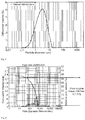
- Fig. 3 shows a particle size distribution for an exemplary carbon component 2.
- the carbon particles 4 of the carbon component 2 are mainly between 1 and 20 ⁇ m.
- Fig. 4 shows a pore size distribution for an exemplary carbon particle 4.
- the total pore volume of the macropores is here 2.1 cm 3 /g and lies in general between 0.7 and 2.5 cm 3 /g.
- the carbon particles 4 further comprise mesopores with a size between 2 and 50 nm.
- pores larger than a filling threshold between 60 and 250 nm are infiltrated by polymeric chains 5.
- Small macropores and mesopores are not filled.
- Micropores essentially do not exist due to a graphitization of the material.
- the amount of the carbon component 2 in the material is near a percolation threshold P, which is here 18 wt.-%.
- Fig. 5 shows a schematic overview of an electrical conductivity of the piezoresistive material 1 depending on a carbon concentration without external load.
- the curve shows within the area of the percolation threshold P a change of the electrical conductivity of the material. Below and above the area of the percolation threshold P, there is no sudden change of the electrical conductivity of the material.
- the elastomer component 3 When subjected to a load, the elastomer component 3 is compressed and thereby no longer blocks a contact between the actually electrically conductive carbon particles 4. Electrically conductive paths appear between the carbon particles 4. As the amount of the carbon component 2 in the piezoresistive material 1 is near the percolation threshold P, the appearance of the conductive paths leads to a sudden increase of the electrical conductivity of the piezoresistive material 1. The sudden increase of the electrical conductivity can be easily detected. As a result, near the percolation threshold P, the sensitivity for pressure is extremely high. Outside the area of the percolation threshold P, there is no sudden change of the electrical conductivity of the piezoresistive material 1.
- Fig. 6 shows a schematic overview of steps of a method for producing a piezoresistive material 1 according to the invention. The method comprises the following steps:
- Step S1 may also comprise a mixture with a curing agent.
- the curing agent may also be an elastomer component.
- the macroporous carbon Porocarb HG3 Fine Grain (Heraeus) is used.
- Porocarb HG3 Fine Grain has a specific surface of 57 m 2 /g and a particle size d50 of 4 ⁇ m.
- the carbon component is dispersed in both subcomponents of the elastomer component separately. This is done by means of a roller mill. Both subcomponents filled by the carbon component are then mixed with a 1:1 ratio to obtain the piezoresistive material.
- the piezoresistive material is formed into a plate- and a rod-shape and cured in an oven for 4 hours at 200 °C.
- a percolation threshold To detect a percolation threshold, several samples of the piezoresistive material with different concentrations of carbon particles are made and their electric conductivity is measured without any external force/pressure. The result is shown in Fig. 7 .
- the electric conductivity is detected starting at a carbon particle concentration of 18 wt.-%.
- a maximum change of electric resistance (2503 k ⁇ ) is detected for a carbon particle concentration between 18 wt.-% and 19 wt.-%.
- Starting at a carbon particle concentration of 21 wt.-% no considerable change of the electric resistance is detected.
- the samples of the piezoresistive material are subjected to unidirectional and isostatic pressure tests.
- Unidirectional pressure tests are made by means of a compression die.
- Isostatic pressure tests are made by means of a pressure chamber.
- the electric resistance is monitored by a multimeter (e.g. Agilent 34401 a).
- Fig. 8 shows the detected electric resistance for an increasing load.
- Area I shows the electric resistance before the application of a load.
- area II the application of a load starts and the electric resistance decreases.
- the negative change of electric resistance for a load between 0 and 4 N amounts to 614 k ⁇ .
- Area III shows a peak when unloading the sample and a decrease of the electric resistance after unloading the sample.
- Area IV shows the return of the electric resistance to its initial value.
- Fig. 9 shows a detected electric resistance for a sudden increase of blood pressure.
- the sudden increase of blood pressure leads to a considerable change of the detected electric resistance of the piezoresistive material, which thereby shows a great sensitivity for pressure changes.
- elastomer component also the latex emulsion dispersion Lanxess S-62F can be used.
- Lanxess S-62F comprises 68 wt.-% of styrene butadiene rubber and has a nominal density of 0.94g/cm 3 .
- the carbon modification Porocarb HG3 Fine Grain (Heraeus) can be used again.
- 210 gr Porocarb HG-3FG are added to 1162 gr Lanxess S-62F to obtain a carbon concentration of 21 wt.-%.
- the mixture is agitated for 15 min.
- 70 gr diluted sulfuric acid (pH 3) with 1.4 gr of a polymere quaternary amine (e.g. Perchem 503) are added at 60°C.
- SBR latex particles coagulate and precipitate.
- the liquid phase is separated by centrifugation.
- an SBR rubber compound material is obtained. It is further agitated by a Brabender mixer B50 up to a temperature of 100°C and cooled to 50°C. 2.5 gr Dicumyl peroxide (SigmaAldrich) are added to initiate cross-linking. The mixture is again agitated at 60°C in the Brabender mixer, removed from the mixer and formed to samples to be tested as described above.
Landscapes
- Health & Medical Sciences (AREA)
- Life Sciences & Earth Sciences (AREA)
- Physics & Mathematics (AREA)
- Chemical & Material Sciences (AREA)
- General Physics & Mathematics (AREA)
- Animal Behavior & Ethology (AREA)
- Molecular Biology (AREA)
- Cardiology (AREA)
- Veterinary Medicine (AREA)
- Public Health (AREA)
- Biophysics (AREA)
- Pathology (AREA)
- Engineering & Computer Science (AREA)
- Biomedical Technology (AREA)
- Heart & Thoracic Surgery (AREA)
- Medical Informatics (AREA)
- General Health & Medical Sciences (AREA)
- Surgery (AREA)
- Spectroscopy & Molecular Physics (AREA)
- Medicinal Chemistry (AREA)
- Chemical Kinetics & Catalysis (AREA)
- Organic Chemistry (AREA)
- Dispersion Chemistry (AREA)
- Polymers & Plastics (AREA)
- Vascular Medicine (AREA)
- Physiology (AREA)
- Compositions Of Macromolecular Compounds (AREA)
Abstract
The invention relates to a piezoresistive material, a detection unit comprising such piezoresistive material, and a method for producing such piezoresistive material. Further, several uses of the material uses of the piezoresistive material or the detection unit are described. The piezoresistive material comprises a compound of a carbon component and an elastomer component. The carbon component comprises carbon particles comprising macropores. The elastomer component comprises polymeric chains. At least some of the macropores in the carbon particles are infiltrated by polymeric chains to form a piezoresistive interconnection between the carbon particles.
Description
- The invention relates to a piezoresistive material, a detection unit comprising such piezoresistive material, and a method for producing such piezoresistive material. Further, several uses of the material and the detection unit are described.
- Conventional piezoresistive materials as e.g. used in MEMS pressure sensors have limitations, in particular in view of their sensitivity. For example, when used in the medical field, devices made from conventional piezoresistive or piezoelectric materials can hardly be used as they do not provide sufficient sensitivity and flexibility and are rather large and thereby stiffen the e.g. medical component.
- As a result, there may be a need to provide an improved piezoresistive material, which allows forming piezoresistive devices with improved sensitivity.
- The problem of the present invention is solved by the subject-matters of the independent claims; wherein further embodiments are incorporated in the dependent claims. It should be noted that the aspects of the invention described in the following apply also to the piezoresistive material, the detection unit comprising such piezoresistive material, the method for producing such piezoresistive material and the described uses of the piezoresistive material or the detection unit.
- According to the present invention, a piezoresistive material is presented. The piezoresistive material comprises a compound of a carbon component and an elastomer component. The carbon component comprises carbon particles comprising macropores. The elastomer component comprises polymeric chains. At least some of the macropores in the carbon particles are infiltrated by polymeric chains to form a piezoresistive interconnection between the carbon particles.
- The term "piezoresistive" may be understood in that the piezoresistive material is subjected to a change of its electrical resistivity when mechanical stress is applied to the piezoresistive material. The mechanical stress may be an elastic, isostatic or unidirectional compressive load. The mechanical stress may be at least one of a group comprising force, pressure, motion, vibration, acceleration and elongation.
- The term "piezoresistive interconnection" may be understood in that the carbon component and the elastomer component are interconnected to form a compound material which has a piezoresistive effect. This means, when mechanical stress is applied to the compound of carbon component and elastomer component, the compound shows a change of its electrical resistivity and in particular a decrease of its electrical resistivity and an increase of electrical conductivity.
- The interconnection between the carbon component and the elastomer component comprises an infiltration of polymeric chains of the elastomer component into the macropores within the carbon particles.
- The dimensions of the macropores of the carbon particles may therefore be adapted to the dimensions of polymeric precursors of the elastomer component. This means, the diameter of a polymer emulsion particle is in a range of a diameter of a macropore. The interconnection may further comprise that at least some of the carbon particles are linked by polymeric chains. Such rigid mechanical interconnection between carbon particles and polymeric chains enables a most complete geometrical restoring after elastic compression of the material.
- The piezoresistance of the interconnection is based on the fact that the polymeric chains between the carbon particles of the carbon component rearrange and relax when the piezoresistive material is subjected to a compressive load. The rearrangement and relaxation enables a formation of electrical paths between the electrically conductive carbon particles and consequently reduces the electrical resistance of the piezoresistive material.
- In other words, the piezoresistive material according to the present invention may be a material comprising elastomer filled with porous carbon particles to form part of a resistive sensor which shows a negative change of electrical resistance when subjected to pressure.
- As a result, the invention refers to a piezoresistive material with at least one of the following advantages: a possibility to form piezoresistive devices showing a superior sensitivity, a possibility to form very small piezoresistive devices, a possibility to form flexible piezoresistive devices, and a possibility to form a piezoresistive device with a large measuring or detection range, a small dependence on temperatures and/or a very good relaxation behavior. Further, the piezoresistive material according to the present invention may allow an easy and cheap manufacture, may be manufactured in all kinds of shapes and sizes (e.g. by 3D and conventional printing, drawing, molding, injection molding, painting, spraying, screen printing, coating etc.) and may be adapted during manufacture in view of its elastic modulus, flexibility etc. by e.g. tuning the physical properties of the elastomer component.
- The term "carbon component" may be understood as a component comprising carbon particles with open porosity and macropores. The term "macropores" may be understood as pores having a size between 50 and 1000 nm measured by e.g. Hg porosimetry. The carbon particles may be highly porous. The term "highly porous" may be understood as having a total pore volume between 0.7 and 3.5 cm3/g, and preferably between 0.9 and 2.5 cm3/g.
- The term "elastomer component" may be understood as a component comprising an elastomer, which is an elastic polymer. The molecular structure of elastomers can be imagined as a 'spaghetti and meatball' structure, with the meatballs signifying cross-links. Elasticity is derived from an ability of long chains to reconfigure themselves to distribute an applied stress. Covalent cross-linkages ensure that the elastomer will return to its original configuration when the mechanical stress is removed.
- The term "polymeric chains" may be understood as covalently bonded links between monomers forming a network. The polymeric chains may block an electric conductivity between the carbon particles in an unloaded condition of the piezoresistive material. When a load, as e.g. mechanical pressure, is applied to the piezoresistive material, the polymeric chains may be compressed and the electrically conductive carbon particles may contact each other to implement an electric conductivity of the piezoresistive material.
- The term "infiltrated" may be understood in that polymeric chains penetrate into pores of the carbon particles. The polymeric chains may also penetrate through pores of carbon particles and thereby link several carbon particles to each other.
- In an example, the macropores in the carbon particles have a macropore volume between 0.6 and 2.4 cm3/g calculated from pores sizes ranging from 50 to 1000 nm, and preferably between 0.8 and 2.2 cm3/g. This large macropore volume enables a filling by the polymeric chains of the elastomer component and thus a fixation of the polymeric chains.
- In an example, the carbon particles further comprise mesopores with a mesopore volume between 0.05 and 0.2 cm3/g, and preferably between 0.1 and 0.15 cm3/g. The term "mesopores" may be understood as pores having a size between 2 and 50 nm measured by e.g. Hg porosimetry.
- In an example, the carbon component is graphitized. The term "graphitized" may be understood in that a formation of graphitic carbon is initiated by an exposure to elevated temperatures between e.g. 1400 to 3000 °C. During graphitization, micropores tend to disappear, mesopores rearrange and macropores remain constant. The result is a graphitized, porous carbon component comprising carbon particles with a large amount of macropores. The macropores can be linked with each other. The formation of graphite in the carbon component leads to an increased electrical conductivity. The graphitizing of the carbon component may here be done between 1400 and 3000 °C, preferably between 2300 and 2600 °C.
- In an example, the carbon component is graphitized to a graphitization degree between 60 and 80 %, and preferably to a graphitization degree of over 70 %. The graphitization degree g may be calculated based on a measured distance d002 of graphite basal levels: g = (344pm-d002)/(344pm-335.4pm)
- A small distance d002 value thereby relates to a high graphitization degree.
- In an example, the carbon particles comprise essentially no micropores which may be understood as having a micropore volume of less than 0.01 cm3/g. The term "micropores" may be understood as pores having a size smaller 2 nm measured by nitrogen adsorption (BET).
- In an example, the amount of the carbon component in the elastomer component is near a percolation threshold. Near in the meaning of within the area of the percolation threshold, only few conductive paths exist in the piezoresistive material when not subjected to a load. However, if a load is applied to the piezoresistive material, the elastomer component is compressed and the electrically conductive carbon particles get in contact with each other. Further conductive paths appear, which thus increase the electrical conductivity of the piezoresistive material. As a result, near the percolation threshold, the sensitivity for pressure is extremely high. Outside the area of the percolation threshold, there is no sudden change of the electrical conductivity of the piezoresistive material.
- In an example, the amount of the carbon component in the elastomer component is between 1 to 30 wt.-%, preferably between 15 and 26 wt.-%.
- In an example, the carbon particles have sizes d50 between 1 and 100 µm, preferably between 5 and 20 µm.
- In an example, only pores larger than a filling threshold are infiltrated by polymeric chains. Exemplarily, the filling threshold is between 60 and 250 nm, and preferably between 60 and 150 nm.
- In an example, the carbon component has a real density between 1.6 and 2.26 g/cm3, and preferably between 2.0 and 2.26 g/cm3 as measured by He pycnometry.
- In an example, the carbon component has a specific surface between 5 and 500 m2/g, and preferably between 10 and 70 m2/g. The specific surface is here measured according to BET (Brunauer-Emmett-Teller).
- In an example, the elastomer component comprises rubber and/or silicone. Rubber may be styrene butadiene rubber, ethylene propylene diene monomer rubber or the like. The silicone of the elastomer component may have a viscosity in an uncured state between 10 Pa s and 2000 Pa s when measured e.g. according to DIN53019.
- According to the present invention, also a detection unit is presented. The detection unit comprises a detection element and a processing element. The detection element comprises the piezoresistive material as described above. The detection element may be a probe, a catheter tip, a blood pressure sensor, an artificial skin component or the like. The processing element is configured to process a decrease of electrical resistance detected by the piezoresistive material into a value of compressive load applied to the piezoresistive material. The processing element may be an analog digital converter.
- According to the present invention, also several uses of the material or the detection unit as described above are presented. In general, the material or the detection unit may replace all kinds of elastomer components in all technical fields without influencing the mechanic behavior.
- In an example, the material or the detection unit is used for a probe to detect a force, pressure, motion and/or vibration of the probe relative to a surrounding medium. Further, a detection of a change in force, pressure, motion, vibration etc. is possible. In addition, a detection of acceleration or elongation or their changes is possible. The surrounding medium may be gaseous, liquid or solid. It may be bone, tissue, organs, blood and/or the like. When using several probes, also a detection of a position of an occurrence or a change in force, pressure, motion, vibration etc. is possible.
- In an example, the probe is a catheter tip configured to detect a force. The force may be in a range of 0.02 N to 10 N. Such catheter tip may be used to avoid harming the surrounding medium when moving a (balloon) catheter e.g. through blood vessels to assist to a navigation of the catheter through the surrounding medium etc.
- Exemplarily, the probe is part of an ablation electrode to allow a better control of the ablation parameters.
- In an example, the probe is a blood pressure sensor configured to detect a blood pressure. The blood pressure may be in a range of 40 mmHg to 200 mmHg. Such blood pressure sensor may be used to e.g. assist a pacemaker during adjustment or operation or to characterize a vascular constriction.
- Exemplarily, the probe is configured to detect movements of organs, as e.g. a lung and/or a heart, for example to detect sleep apnoea. Exemplarily, the probe is configured to be used as strain sensors for e.g. human motion detection.
- In an example, the probe is an artificial skin, muscle or hair component. For example, the skin component may be configured to detect a tactile sensation.
- Exemplarily, the probe is part of a smart textile or a clothing as e.g. socks for diabetics or clothes for pulse measuring. In all cases, the probe may be applied to an e.g. elastomeric substrate by e.g. extrusion, screen printing or by means of a doctor blade. Exemplarily, the probe is part of a pulse measuring device of e.g. a smart watch.
- Exemplarily, the probe is part of a wearable flexible stretch sensor. Exemplarily, the probe is part of a stress gauge for detecting stain applied to e.g. bones and in particular to feet. The probe may be integrated into sports equipment as e.g. a football or ice hockey helmet to detect e.g. a severity of a head impact.
- Exemplarily, the probe is part of a haptic sensor for e.g. a gripping instrument.
- According to the present invention, also a method for producing a piezoresistive material is presented. It comprises the following steps:
- a) mixing an elastomer component and a carbon component into a mixture, wherein the elastomer component comprises polymeric chains and the carbon component comprises carbon particles comprising macropores, and
- b) curing the mixture so that at least some of the macropores in the carbon particles are infiltrated by polymeric chains to form a piezoresistive interconnection between the carbon particles.
- The elastomer component may be liquid or an emulsion and may be made of at least one and preferably two liquid subcomponent(s).
- In an example, the method further comprises a step of graphitizing the carbon component between 1400 and 3000 °C, preferably between 2300 and 2600 °C. In the example, the graphitizing step is introduced before the mixing step.
- Exemplarily, the method further comprises a step of forming the mixture into a predefined shape of a product to be manufactured by means of e.g. extrusion or screen printing. This may be done before the curing step. The curing may be done for e.g. 4 hours at 200°C. Exemplarily, the method further comprises a step of electrically contacting the cured product.
- It shall be understood that the the piezoresistive material, the detection unit comprising such piezoresistive material, the method for producing such piezoresistive material and the described uses of the piezoresistive material or the detection unit according to the independent claims have similar and/or identical preferred embodiments, in particular, as defined in the dependent claims. It shall be understood further that a preferred embodiment of the invention can also be any combination of the dependent claims with the respective independent claim.
- These and other aspects of the present invention will become apparent from and be elucidated with reference to the embodiments described hereinafter.
- Exemplary embodiments of the invention will be described in the following with reference to the accompanying drawings:
-
Fig. 1 shows a schematic drawing of an example of a detection unit according to the invention. -
Fig. 2 shows schematically and exemplarily an embodiment of the piezoresistive material according to the invention. -
Fig. 3 shows a particle size distribution for an exemplary carbon component. -
Fig. 4 shows a pore size distribution for an exemplary carbon particle. -
Fig. 5 shows a schematic overview of an electrical conductivity of a piezoresistive material depending on a carbon concentration. -
Fig. 6 shows basic steps of an example of a method for producing a piezoresistive material according to the invention. -
Fig. 7 shows a percolation threshold. -
Fig. 8 shows the detected electric resistance for an increasing load. -
Fig. 9 shows a detected electric resistance for a linear increase of blood pressure. -
Fig. 1 shows schematically and exemplarily an embodiment of adetection unit 10 according to the invention. Thedetection unit 10 comprises adetection element 20 and aprocessing element 30. - The
processing element 30 may be an analog digital converter. Theprocessing element 30 processes a decrease of electrical resistance detected by thepiezoresistive material 1 into a value of compressive load applied to thepiezoresistive material 1. - The
detection element 20 may be a probe, a catheter tip, a blood pressure sensor, an artificial skin component or the like. Thedetection element 20 comprises apiezoresistive material 1. -
Fig. 2 shows schematically and exemplarily an embodiment of thepiezoresistive material 1 according to the invention.Fig. 2a shows thepiezoresistive material 1 with no load or pressure.Fig. 2b shows thepiezoresistive material 1 with isostatic load or pressure.Fig. 2c shows thepiezoresistive material 1 with uniaxial load or pressure. - As shown in
Fig. 2a , thepiezoresistive material 1 comprises a compound of acarbon component 2 and anelastomer component 3. Thecarbon component 2 comprisesporous carbon particles 4, which comprise macropores (not shown). Theelastomer component 3 comprises pre-stressedpolymeric chains 5. Most of the macropores in thecarbon particles 4 are infiltrated bypolymeric chains 5. Further,most carbon particles 4 are linked bypolymeric chains 5. - As shown in
Figs. 2b and 2c , the piezoresistivity of thepiezoresistive material 1 is based on the fact that thepolymeric chains 5 between thecarbon particles 4 of thecarbon component 2 rearrange and relax when thepiezoresistive material 1 is subjected to a compressive load (isostatic inFig. 2b , uniaxial inFig. 2c ). The rearrangement and relaxation enables a formation of electrical paths between thecarbon particles 4 and consequently reduces the electrical resistance of thepiezoresistive material 1. - The
elastomer component 3 is here a silicone precursor. - The
carbon component 2 comprises highlyporous carbon particles 4 with open porosity. The pores of thecarbon particles 4 comprise macropores with a size between 50 and 1000 nm.Fig. 3 shows a particle size distribution for anexemplary carbon component 2. Thecarbon particles 4 of thecarbon component 2 are mainly between 1 and 20 µm.Fig. 4 shows a pore size distribution for anexemplary carbon particle 4. The total pore volume of the macropores is here 2.1 cm3/g and lies in general between 0.7 and 2.5 cm3/g. Thecarbon particles 4 further comprise mesopores with a size between 2 and 50 nm. - Here, only pores larger than a filling threshold between 60 and 250 nm are infiltrated by
polymeric chains 5. Small macropores and mesopores are not filled. Micropores essentially do not exist due to a graphitization of the material. - The amount of the
carbon component 2 in the material is near a percolation threshold P, which is here 18 wt.-%. -
Fig. 5 shows a schematic overview of an electrical conductivity of thepiezoresistive material 1 depending on a carbon concentration without external load. The curve shows within the area of the percolation threshold P a change of the electrical conductivity of the material. Below and above the area of the percolation threshold P, there is no sudden change of the electrical conductivity of the material. - When subjected to a load, the
elastomer component 3 is compressed and thereby no longer blocks a contact between the actually electricallyconductive carbon particles 4. Electrically conductive paths appear between thecarbon particles 4. As the amount of thecarbon component 2 in thepiezoresistive material 1 is near the percolation threshold P, the appearance of the conductive paths leads to a sudden increase of the electrical conductivity of thepiezoresistive material 1. The sudden increase of the electrical conductivity can be easily detected. As a result, near the percolation threshold P, the sensitivity for pressure is extremely high. Outside the area of the percolation threshold P, there is no sudden change of the electrical conductivity of thepiezoresistive material 1. -
Fig. 6 shows a schematic overview of steps of a method for producing apiezoresistive material 1 according to the invention. The method comprises the following steps: - In a first step S1, mixing one or
more elastomer components 3 and acarbon component 2 into a mixture, wherein theelastomer component 3 comprisespolymeric chains 5 and thecarbon component 2 comprisescarbon particles 4 comprising macropores. - In a second step S2, curing the mixture so that at least some of the macropores in the
carbon particles 4 are infiltrated bypolymeric chains 5 to form a piezoresistive interconnection between thecarbon particles 4. - Step S1 may also comprise a mixture with a curing agent. The curing agent may also be an elastomer component.
- As elastomer component, the two-component silicon Elastosil LR 3003/10 (Wacker Chemie AG) is used. Both subcomponents of Elastosil LR 3003/10 are liquid and highly viscous (η = 74.000 mPa*s).
- As carbon component, the macroporous carbon Porocarb HG3 Fine Grain (Heraeus) is used.
- Porocarb HG3 Fine Grain has a specific surface of 57 m2/g and a particle size d50 of 4 µm.
- The carbon component is dispersed in both subcomponents of the elastomer component separately. This is done by means of a roller mill. Both subcomponents filled by the carbon component are then mixed with a 1:1 ratio to obtain the piezoresistive material.
- The piezoresistive material is formed into a plate- and a rod-shape and cured in an oven for 4 hours at 200 °C.
- To detect a percolation threshold, several samples of the piezoresistive material with different concentrations of carbon particles are made and their electric conductivity is measured without any external force/pressure. The result is shown in
Fig. 7 . The electric conductivity is detected starting at a carbon particle concentration of 18 wt.-%. A maximum change of electric resistance (2503 kΩ) is detected for a carbon particle concentration between 18 wt.-% and 19 wt.-%. Starting at a carbon particle concentration of 21 wt.-%, no considerable change of the electric resistance is detected. - The samples of the piezoresistive material are subjected to unidirectional and isostatic pressure tests. Unidirectional pressure tests are made by means of a compression die. Isostatic pressure tests are made by means of a pressure chamber. The electric resistance is monitored by a multimeter (e.g. Agilent 34401 a).
-
Fig. 8 shows the detected electric resistance for an increasing load. Area I shows the electric resistance before the application of a load. In area II, the application of a load starts and the electric resistance decreases. The negative change of electric resistance for a load between 0 and 4 N amounts to 614 kΩ. Area III shows a peak when unloading the sample and a decrease of the electric resistance after unloading the sample. Area IV shows the return of the electric resistance to its initial value. -
Fig. 9 shows a detected electric resistance for a sudden increase of blood pressure. The sudden increase of blood pressure leads to a considerable change of the detected electric resistance of the piezoresistive material, which thereby shows a great sensitivity for pressure changes. - As elastomer component, also the latex emulsion dispersion Lanxess S-62F can be used.
- Lanxess S-62F comprises 68 wt.-% of styrene butadiene rubber and has a nominal density of 0.94g/cm3. As carbon component, the carbon modification Porocarb HG3 Fine Grain (Heraeus) can be used again.
- In a further example, 210 gr Porocarb HG-3FG are added to 1162 gr Lanxess S-62F to obtain a carbon concentration of 21 wt.-%. The mixture is agitated for 15 min. During further agitation, 70 gr diluted sulfuric acid (pH 3) with 1.4 gr of a polymere quaternary amine (e.g. Perchem 503) are added at 60°C. SBR latex particles coagulate and precipitate. The liquid phase is separated by centrifugation.
- As a result, an SBR rubber compound material is obtained. It is further agitated by a Brabender mixer B50 up to a temperature of 100°C and cooled to 50°C. 2.5 gr Dicumyl peroxide (SigmaAldrich) are added to initiate cross-linking. The mixture is again agitated at 60°C in the Brabender mixer, removed from the mixer and formed to samples to be tested as described above.
- It has to be noted that embodiments of the invention are described with reference to different subject matters. In particular, some embodiments are described with reference to method type claims whereas other embodiments are described with reference to the device type claims. However, a person skilled in the art will gather from the above and the following description that, unless otherwise notified, in addition to any combination of features belonging to one type of subject matter also any combination between features relating to different subject matters is considered to be disclosed with this application. However, all features can be combined providing synergetic effects that are more than the simple summation of the features.
- While the invention has been illustrated and described in detail in the drawings and foregoing description, such illustration and description are to be considered illustrative or exemplary and not restrictive. The invention is not limited to the disclosed embodiments. Other variations to the disclosed embodiments can be understood and effected by those skilled in the art in practicing a claimed invention, from a study of the drawings, the disclosure, and the dependent claims.
In the claims, the word "comprising" does not exclude other elements or steps, and the indefinite article "a" or "an" does not exclude a plurality. A single processor or other unit may fulfil the functions of several items re-cited in the claims. The mere fact that certain measures are re-cited in mutually different dependent claims does not indicate that a combination of these measures cannot be used to advantage. Any reference signs in the claims should not be construed as limiting the scope.
Claims (24)
- Piezoresistive material (1), comprising a compound of:- a carbon component (2), and- an elastomer component (3),wherein the carbon component (2) comprises carbon particles (4) comprising macropores,
wherein the elastomer component (3) comprises polymeric chains (5), and
wherein at least some of the macropores in the carbon particles (4) are infiltrated by polymeric chains (5) to form a piezoresistive interconnection between the carbon particles (4). - Material according to claim 1, wherein the carbon particles (4) are highly porous with a total pore volume between 0.7 and 3.5 cm3/g.
- Material according to claim 1 or 2, wherein the macropores in the carbon particles (4) are interconnected and have a size between 50 and 1000 nm.
- Material according to the preceding claim, wherein the macropores in the carbon particles (4) have a macropore volume between 0.6 and 2.4 cm3/g.
- Material according to one of the preceding claims, wherein the carbon particles (4) further comprise mesopores with a size between 10 and 50 nm and a mesopore volume between 0.05 and 0.2 cm3/g.
- Material according to one of the preceding claims, wherein the carbon component (2) is graphitized to a graphitization degree between 60 and 80 %.
- Material according to one of the preceding claims, wherein the carbon particles (4) comprise essentially no micropores with a size smaller 2 nm.
- Material according to one of the preceding claims, wherein the piezoresistive interconnection between the carbon particles (4) is implemented by the polymeric chains (5) which are configured to rearrange when the piezoresistive material (1) is subjected to a compressive load so that electrical paths form between the carbon particles (4) to decrease an electrical resistance of the piezoresistive material (1).
- Material according to one of the preceding claims, wherein the amount of the carbon component (2) in the elastomer component (3) is near or within a percolation threshold (P).
- Material according to one of the preceding claims, wherein the amount of the carbon component (2) in the elastomer component (3) is between 1 to 30 wt.-%, preferably between 15 and 26 wt.-%.
- Material according to one of the preceding claims, wherein the carbon particles (4) have sizes d50 between 1 and 100 µm, preferably between 5 and 20 µm.
- Material according to one of the preceding claims, wherein only pores larger than a filling threshold are infiltrated by polymeric chains (5), and wherein the filling threshold is between 60 and 250 nm.
- Material according to one of the preceding claims, wherein the carbon component (2) has a density between 1.6 and 2.26 g/cm3.
- Material according to one of the preceding claims, wherein the carbon component (2) has a specific surface between 5 and 500 m2/g.
- Material according to one of the preceding claims, wherein the elastomer component (3) comprises rubber and/or silicone.
- Material according to the preceding claim, wherein rubber is styrene butadiene rubber or ethylene propylene diene monomer rubber.
- Material according to claim 15, wherein the silicone of the elastomer component has a viscosity between 10 Pa s and 2000 Pa s.
- Detection unit (10), comprising:- a detection element (20), and- a processing element (30),wherein the detection element (20) is made of the piezoresistive material (1) according to one of the preceding claims, and
wherein the processing element (30) is configured to process a decrease of electrical resistance detected by the piezoresistive material (1) into a value of compressive load applied to the piezoresistive material (1). - Use of the material or the detection unit according to one of the preceding claims for a probe to detect a force, pressure, motion and/or vibration of the probe relative to a surrounding medium.
- Use according to the preceding claim, wherein the probe is a catheter tip configured to detect a force in a range of 0.02 N to 10 N.
- Use according to claim 19, wherein the probe is a blood pressure sensor configured to detect a blood pressure in a range of 40 mmHg to 200 mmHg.
- Use according to claim 19, wherein the probe is an artificial skin component configured to detect a mechanical contact.
- Method for producing a piezoresistive material (1), wherein the method comprises the following steps:- mixing an elastomer component (3) and a carbon component (2) into a mixture, wherein the elastomer component (3) comprises polymeric chains (5) and the carbon component (2) comprises carbon particles (4) comprising macropores, and- curing the mixture so that at least some of the macropores in the carbon particles (4) are infiltrated by polymeric chains (5) to form a piezoresistive interconnection between the carbon particles (4).
- Method according to the proceeding claim, further comprising a step of graphitizing the carbon component (2) between 1400 and 3000 °C, preferably between 2300 and 2600 °C.
Priority Applications (5)
| Application Number | Priority Date | Filing Date | Title |
|---|---|---|---|
| EP16188296.4A EP3292812A1 (en) | 2016-09-12 | 2016-09-12 | Piezoresistive material |
| PCT/EP2017/072730 WO2018046725A1 (en) | 2016-09-12 | 2017-09-11 | Piezoresistive material |
| EP17768738.1A EP3509478A1 (en) | 2016-09-12 | 2017-09-11 | Piezoresistive material |
| CN201780054147.0A CN109661195A (en) | 2016-09-12 | 2017-09-11 | Pressure drag material |
| US16/332,491 US20190221327A1 (en) | 2016-09-12 | 2017-09-11 | Piezoresistive material |
Applications Claiming Priority (1)
| Application Number | Priority Date | Filing Date | Title |
|---|---|---|---|
| EP16188296.4A EP3292812A1 (en) | 2016-09-12 | 2016-09-12 | Piezoresistive material |
Publications (1)
| Publication Number | Publication Date |
|---|---|
| EP3292812A1 true EP3292812A1 (en) | 2018-03-14 |
Family
ID=56958743
Family Applications (2)
| Application Number | Title | Priority Date | Filing Date |
|---|---|---|---|
| EP16188296.4A Withdrawn EP3292812A1 (en) | 2016-09-12 | 2016-09-12 | Piezoresistive material |
| EP17768738.1A Withdrawn EP3509478A1 (en) | 2016-09-12 | 2017-09-11 | Piezoresistive material |
Family Applications After (1)
| Application Number | Title | Priority Date | Filing Date |
|---|---|---|---|
| EP17768738.1A Withdrawn EP3509478A1 (en) | 2016-09-12 | 2017-09-11 | Piezoresistive material |
Country Status (4)
| Country | Link |
|---|---|
| US (1) | US20190221327A1 (en) |
| EP (2) | EP3292812A1 (en) |
| CN (1) | CN109661195A (en) |
| WO (1) | WO2018046725A1 (en) |
Cited By (1)
| Publication number | Priority date | Publication date | Assignee | Title |
|---|---|---|---|---|
| CN109025971A (en) * | 2018-04-28 | 2018-12-18 | 中国石油天然气股份有限公司 | Drilling pressure detection device and its diaphragm force mechanism |
Families Citing this family (1)
| Publication number | Priority date | Publication date | Assignee | Title |
|---|---|---|---|---|
| WO2022203607A2 (en) * | 2021-03-24 | 2022-09-29 | Flexosense Pte. Ltd. | Flexible strain sensor |
Citations (9)
| Publication number | Priority date | Publication date | Assignee | Title |
|---|---|---|---|---|
| US3629774A (en) * | 1968-10-21 | 1971-12-21 | Scient Advances Inc | Progressively collapsible variable resistance element |
| US4205055A (en) * | 1977-05-12 | 1980-05-27 | Le Carbone-Lorraine | Dual pore-structure artificial carbon and graphite |
| EP0236222A1 (en) * | 1986-02-26 | 1987-09-09 | Commissariat A L'energie Atomique | Piezoresistive material useful for the production of piezoresistive gauges and production process for this material |
| WO1996034403A1 (en) * | 1995-04-27 | 1996-10-31 | Burgess Lester E | Pressure activated switching device |
| US20080161786A1 (en) * | 2006-12-29 | 2008-07-03 | Kedar Ravindra Belhe | Pressure-sensitive conductive composite contact sensor and method for contact sensing |
| US20130079693A1 (en) * | 2011-09-26 | 2013-03-28 | Northeastern University | Customizable Embedded Sensors |
| WO2014200428A1 (en) * | 2013-06-10 | 2014-12-18 | Nanyang Technological University | Method of manufacturing a flexible and/or stretchable electronic device |
| WO2015172897A1 (en) * | 2014-05-12 | 2015-11-19 | Koninklijke Philips N.V. | Silicone composite sensor for measurement of heart rate |
| CN105542246A (en) * | 2016-01-28 | 2016-05-04 | 深圳市慧瑞电子材料有限公司 | Conductive rubber material used for flexible sensor as well as preparation method and application of conductive rubber material |
-
2016
- 2016-09-12 EP EP16188296.4A patent/EP3292812A1/en not_active Withdrawn
-
2017
- 2017-09-11 WO PCT/EP2017/072730 patent/WO2018046725A1/en not_active Ceased
- 2017-09-11 EP EP17768738.1A patent/EP3509478A1/en not_active Withdrawn
- 2017-09-11 US US16/332,491 patent/US20190221327A1/en not_active Abandoned
- 2017-09-11 CN CN201780054147.0A patent/CN109661195A/en active Pending
Patent Citations (9)
| Publication number | Priority date | Publication date | Assignee | Title |
|---|---|---|---|---|
| US3629774A (en) * | 1968-10-21 | 1971-12-21 | Scient Advances Inc | Progressively collapsible variable resistance element |
| US4205055A (en) * | 1977-05-12 | 1980-05-27 | Le Carbone-Lorraine | Dual pore-structure artificial carbon and graphite |
| EP0236222A1 (en) * | 1986-02-26 | 1987-09-09 | Commissariat A L'energie Atomique | Piezoresistive material useful for the production of piezoresistive gauges and production process for this material |
| WO1996034403A1 (en) * | 1995-04-27 | 1996-10-31 | Burgess Lester E | Pressure activated switching device |
| US20080161786A1 (en) * | 2006-12-29 | 2008-07-03 | Kedar Ravindra Belhe | Pressure-sensitive conductive composite contact sensor and method for contact sensing |
| US20130079693A1 (en) * | 2011-09-26 | 2013-03-28 | Northeastern University | Customizable Embedded Sensors |
| WO2014200428A1 (en) * | 2013-06-10 | 2014-12-18 | Nanyang Technological University | Method of manufacturing a flexible and/or stretchable electronic device |
| WO2015172897A1 (en) * | 2014-05-12 | 2015-11-19 | Koninklijke Philips N.V. | Silicone composite sensor for measurement of heart rate |
| CN105542246A (en) * | 2016-01-28 | 2016-05-04 | 深圳市慧瑞电子材料有限公司 | Conductive rubber material used for flexible sensor as well as preparation method and application of conductive rubber material |
Non-Patent Citations (4)
| Title |
|---|
| ANONYMUS: "Carbon Functional Additive", 26 August 2015 (2015-08-26), XP055319919, Retrieved from the Internet <URL:https://www.heraeus.com/media/media/group/media_group/technology_report_online_1/2014_2/porocarb_carbon_functional_additive.pdf> [retrieved on 20161116] * |
| DATABASE CA [online] CHEMICAL ABSTRACTS SERVICE, COLUMBUS, OHIO, US; 5 May 2016 (2016-05-05), LI, DAJUN ET AL: "Conductive rubber material for flexible sensor and its preparation method", XP002764279, retrieved from STN Database accession no. 2016:712052 * |
| RONGQING XU ET AL: "Facile Fabrication of Three-Dimensional Graphene Foam/Poly(dimethylsiloxane) Composites and Their Potential Application as Strain Sensor", ACS APPLIED MATERIALS AND INTERFACES, vol. 6, no. 16, 27 August 2014 (2014-08-27), US, pages 13455 - 13460, XP055241902, ISSN: 1944-8244, DOI: 10.1021/am502208g * |
| XIAO-DONG PAN: "Impact of reinforcing filler on the dynamic moduli of elastomer compounds under shear deformation in relation to wet sliding friction", RHEOLOGICA ACTA, SPRINGER-VERLAG, DE, vol. 44, no. 4, 1 April 2005 (2005-04-01), pages 379 - 395, XP019340606, ISSN: 1435-1528, DOI: 10.1007/S00397-004-0420-5 * |
Cited By (1)
| Publication number | Priority date | Publication date | Assignee | Title |
|---|---|---|---|---|
| CN109025971A (en) * | 2018-04-28 | 2018-12-18 | 中国石油天然气股份有限公司 | Drilling pressure detection device and its diaphragm force mechanism |
Also Published As
| Publication number | Publication date |
|---|---|
| EP3509478A1 (en) | 2019-07-17 |
| CN109661195A (en) | 2019-04-19 |
| US20190221327A1 (en) | 2019-07-18 |
| WO2018046725A1 (en) | 2018-03-15 |
Similar Documents
| Publication | Publication Date | Title |
|---|---|---|
| US11590317B2 (en) | Catheter system | |
| Lee et al. | Ultra-robust wide-range pressure sensor with fast response based on polyurethane foam doubly coated with conformal silicone rubber and CNT/TPU nanocomposites islands | |
| US11510626B2 (en) | Conductive polymer composite based sensor | |
| Yu et al. | Superior piezoresistive strain sensing behaviors of carbon nanotubes in one-dimensional polymer fiber structure | |
| Salaeh et al. | Fabrication of a strain sensor from a thermoplastic vulcanizate with an embedded interconnected conducting filler network | |
| CN103748152B (en) | Conducting polymer materials, its application and manufacture method thereof | |
| KR101322838B1 (en) | The method of manufacturing piezoelectric sensor having carbon black | |
| Yan et al. | Synthesis of highly-stretchable graphene–poly (glycerol sebacate) elastomeric nanocomposites piezoresistive sensors for human motion detection applications | |
| Yan et al. | Processing, characterisation and electromechanical behaviour of elastomeric multiwall carbon nanotubes-poly (glycerol sebacate) nanocomposites for piezoresistive sensors applications | |
| KR101919906B1 (en) | Bio-inspired, highly stretchable and conductive dry adhesive, method of manufacturing the same and wearable device including the same | |
| KR101753845B1 (en) | Method for preparing conductive polymer composite and conductive polymer composite prepared therefrom | |
| US20170203096A1 (en) | Multi-layered structure and method | |
| US20190221327A1 (en) | Piezoresistive material | |
| Xiao et al. | Crack-enhanced mechanosensitivity of cost-effective piezoresistive flexible strain sensors suitable for motion detection | |
| Paterson et al. | Monitoring of hand function enabled by low complexity sensors printed on textile | |
| WO2015172897A1 (en) | Silicone composite sensor for measurement of heart rate | |
| Cavallo et al. | A biocompatible pressure sensor based on a 3D-printed scaffold functionalized with PEDOT: PSS for biomedical applications | |
| Zens et al. | Polydimethylsiloxane strain gauges for biomedical applications | |
| Zhou et al. | Fabric-Based insoles with Self-Equipped sensors for the foot’s physiological signal monitoring | |
| Moorthy et al. | Stencil printing of low-cost carbon-based stretchable strain sensors | |
| Beak et al. | Highly stretchable dry electrode composited with carbon nanofiber (CNF) for wearable device | |
| Majerus et al. | Flexible, structured MWCNT/PDMS sensor for chronic vascular access monitoring | |
| CN107811617A (en) | A kind of preparation method of three-dimensional grapheme composite construction for flexible pulse detecting probe | |
| Kõiv et al. | Investigation of cost-effective carbon nanofiber/carbon fiber and silicone polymer composite material for wearable bioimpedance device | |
| Sanli | Electrospun piezoresistive pressure sensor integrated into a soft ball for portable, battery-free monitoring of hand grip strength |
Legal Events
| Date | Code | Title | Description |
|---|---|---|---|
| PUAI | Public reference made under article 153(3) epc to a published international application that has entered the european phase |
Free format text: ORIGINAL CODE: 0009012 |
|
| STAA | Information on the status of an ep patent application or granted ep patent |
Free format text: STATUS: REQUEST FOR EXAMINATION WAS MADE |
|
| 17P | Request for examination filed |
Effective date: 20160912 |
|
| AK | Designated contracting states |
Kind code of ref document: A1 Designated state(s): AL AT BE BG CH CY CZ DE DK EE ES FI FR GB GR HR HU IE IS IT LI LT LU LV MC MK MT NL NO PL PT RO RS SE SI SK SM TR |
|
| AX | Request for extension of the european patent |
Extension state: BA ME |
|
| STAA | Information on the status of an ep patent application or granted ep patent |
Free format text: STATUS: THE APPLICATION IS DEEMED TO BE WITHDRAWN |
|
| 18D | Application deemed to be withdrawn |
Effective date: 20180905 |