EP3291204A1 - Roadside detection system, roadside unit and roadside communication method thereof - Google Patents
Roadside detection system, roadside unit and roadside communication method thereof Download PDFInfo
- Publication number
- EP3291204A1 EP3291204A1 EP17150523.3A EP17150523A EP3291204A1 EP 3291204 A1 EP3291204 A1 EP 3291204A1 EP 17150523 A EP17150523 A EP 17150523A EP 3291204 A1 EP3291204 A1 EP 3291204A1
- Authority
- EP
- European Patent Office
- Prior art keywords
- roadside
- latitude
- zero degree
- roadside unit
- vehicle
- Prior art date
- Legal status (The legal status is an assumption and is not a legal conclusion. Google has not performed a legal analysis and makes no representation as to the accuracy of the status listed.)
- Ceased
Links
Images


Classifications
-
- G—PHYSICS
- G08—SIGNALLING
- G08G—TRAFFIC CONTROL SYSTEMS
- G08G1/00—Traffic control systems for road vehicles
- G08G1/09—Arrangements for giving variable traffic instructions
- G08G1/0962—Arrangements for giving variable traffic instructions having an indicator mounted inside the vehicle, e.g. giving voice messages
- G08G1/0967—Systems involving transmission of highway information, e.g. weather, speed limits
- G08G1/096766—Systems involving transmission of highway information, e.g. weather, speed limits where the system is characterised by the origin of the information transmission
- G08G1/096783—Systems involving transmission of highway information, e.g. weather, speed limits where the system is characterised by the origin of the information transmission where the origin of the information is a roadside individual element
-
- G—PHYSICS
- G08—SIGNALLING
- G08G—TRAFFIC CONTROL SYSTEMS
- G08G1/00—Traffic control systems for road vehicles
- G08G1/16—Anti-collision systems
- G08G1/161—Decentralised systems, e.g. inter-vehicle communication
- G08G1/163—Decentralised systems, e.g. inter-vehicle communication involving continuous checking
-
- G—PHYSICS
- G01—MEASURING; TESTING
- G01S—RADIO DIRECTION-FINDING; RADIO NAVIGATION; DETERMINING DISTANCE OR VELOCITY BY USE OF RADIO WAVES; LOCATING OR PRESENCE-DETECTING BY USE OF THE REFLECTION OR RERADIATION OF RADIO WAVES; ANALOGOUS ARRANGEMENTS USING OTHER WAVES
- G01S13/00—Systems using the reflection or reradiation of radio waves, e.g. radar systems; Analogous systems using reflection or reradiation of waves whose nature or wavelength is irrelevant or unspecified
- G01S13/88—Radar or analogous systems specially adapted for specific applications
- G01S13/91—Radar or analogous systems specially adapted for specific applications for traffic control
-
- G—PHYSICS
- G01—MEASURING; TESTING
- G01S—RADIO DIRECTION-FINDING; RADIO NAVIGATION; DETERMINING DISTANCE OR VELOCITY BY USE OF RADIO WAVES; LOCATING OR PRESENCE-DETECTING BY USE OF THE REFLECTION OR RERADIATION OF RADIO WAVES; ANALOGOUS ARRANGEMENTS USING OTHER WAVES
- G01S19/00—Satellite radio beacon positioning systems; Determining position, velocity or attitude using signals transmitted by such systems
- G01S19/01—Satellite radio beacon positioning systems transmitting time-stamped messages, e.g. GPS [Global Positioning System], GLONASS [Global Orbiting Navigation Satellite System] or GALILEO
- G01S19/13—Receivers
- G01S19/14—Receivers specially adapted for specific applications
-
- G—PHYSICS
- G01—MEASURING; TESTING
- G01S—RADIO DIRECTION-FINDING; RADIO NAVIGATION; DETERMINING DISTANCE OR VELOCITY BY USE OF RADIO WAVES; LOCATING OR PRESENCE-DETECTING BY USE OF THE REFLECTION OR RERADIATION OF RADIO WAVES; ANALOGOUS ARRANGEMENTS USING OTHER WAVES
- G01S5/00—Position-fixing by co-ordinating two or more direction or position line determinations; Position-fixing by co-ordinating two or more distance determinations
- G01S5/0009—Transmission of position information to remote stations
- G01S5/0045—Transmission from base station to mobile station
- G01S5/0054—Transmission from base station to mobile station of actual mobile position, i.e. position calculation on base station
-
- G—PHYSICS
- G08—SIGNALLING
- G08G—TRAFFIC CONTROL SYSTEMS
- G08G1/00—Traffic control systems for road vehicles
- G08G1/01—Detecting movement of traffic to be counted or controlled
- G08G1/04—Detecting movement of traffic to be counted or controlled using optical or ultrasonic detectors
-
- G—PHYSICS
- G08—SIGNALLING
- G08G—TRAFFIC CONTROL SYSTEMS
- G08G1/00—Traffic control systems for road vehicles
- G08G1/01—Detecting movement of traffic to be counted or controlled
- G08G1/052—Detecting movement of traffic to be counted or controlled with provision for determining speed or overspeed
-
- G—PHYSICS
- G08—SIGNALLING
- G08G—TRAFFIC CONTROL SYSTEMS
- G08G1/00—Traffic control systems for road vehicles
- G08G1/01—Detecting movement of traffic to be counted or controlled
- G08G1/056—Detecting movement of traffic to be counted or controlled with provision for distinguishing direction of travel
-
- G—PHYSICS
- G08—SIGNALLING
- G08G—TRAFFIC CONTROL SYSTEMS
- G08G1/00—Traffic control systems for road vehicles
- G08G1/16—Anti-collision systems
-
- H—ELECTRICITY
- H04—ELECTRIC COMMUNICATION TECHNIQUE
- H04W—WIRELESS COMMUNICATION NETWORKS
- H04W4/00—Services specially adapted for wireless communication networks; Facilities therefor
- H04W4/20—Services signaling; Auxiliary data signalling, i.e. transmitting data via a non-traffic channel
-
- B—PERFORMING OPERATIONS; TRANSPORTING
- B60—VEHICLES IN GENERAL
- B60W—CONJOINT CONTROL OF VEHICLE SUB-UNITS OF DIFFERENT TYPE OR DIFFERENT FUNCTION; CONTROL SYSTEMS SPECIALLY ADAPTED FOR HYBRID VEHICLES; ROAD VEHICLE DRIVE CONTROL SYSTEMS FOR PURPOSES NOT RELATED TO THE CONTROL OF A PARTICULAR SUB-UNIT
- B60W2556/00—Input parameters relating to data
- B60W2556/45—External transmission of data to or from the vehicle
- B60W2556/65—Data transmitted between vehicles
-
- G—PHYSICS
- G01—MEASURING; TESTING
- G01S—RADIO DIRECTION-FINDING; RADIO NAVIGATION; DETERMINING DISTANCE OR VELOCITY BY USE OF RADIO WAVES; LOCATING OR PRESENCE-DETECTING BY USE OF THE REFLECTION OR RERADIATION OF RADIO WAVES; ANALOGOUS ARRANGEMENTS USING OTHER WAVES
- G01S13/00—Systems using the reflection or reradiation of radio waves, e.g. radar systems; Analogous systems using reflection or reradiation of waves whose nature or wavelength is irrelevant or unspecified
- G01S13/86—Combinations of radar systems with non-radar systems, e.g. sonar, direction finder
- G01S13/867—Combination of radar systems with cameras
-
- G—PHYSICS
- G01—MEASURING; TESTING
- G01S—RADIO DIRECTION-FINDING; RADIO NAVIGATION; DETERMINING DISTANCE OR VELOCITY BY USE OF RADIO WAVES; LOCATING OR PRESENCE-DETECTING BY USE OF THE REFLECTION OR RERADIATION OF RADIO WAVES; ANALOGOUS ARRANGEMENTS USING OTHER WAVES
- G01S13/00—Systems using the reflection or reradiation of radio waves, e.g. radar systems; Analogous systems using reflection or reradiation of waves whose nature or wavelength is irrelevant or unspecified
- G01S13/88—Radar or analogous systems specially adapted for specific applications
- G01S13/93—Radar or analogous systems specially adapted for specific applications for anti-collision purposes
- G01S13/931—Radar or analogous systems specially adapted for specific applications for anti-collision purposes of land vehicles
- G01S2013/9316—Radar or analogous systems specially adapted for specific applications for anti-collision purposes of land vehicles combined with communication equipment with other vehicles or with base stations
-
- G—PHYSICS
- G01—MEASURING; TESTING
- G01S—RADIO DIRECTION-FINDING; RADIO NAVIGATION; DETERMINING DISTANCE OR VELOCITY BY USE OF RADIO WAVES; LOCATING OR PRESENCE-DETECTING BY USE OF THE REFLECTION OR RERADIATION OF RADIO WAVES; ANALOGOUS ARRANGEMENTS USING OTHER WAVES
- G01S2205/00—Position-fixing by co-ordinating two or more direction or position line determinations; Position-fixing by co-ordinating two or more distance determinations
- G01S2205/001—Transmission of position information to remote stations
- G01S2205/002—Transmission of position information to remote stations for traffic control, mobile tracking, guidance, surveillance or anti-collision
-
- G—PHYSICS
- G01—MEASURING; TESTING
- G01S—RADIO DIRECTION-FINDING; RADIO NAVIGATION; DETERMINING DISTANCE OR VELOCITY BY USE OF RADIO WAVES; LOCATING OR PRESENCE-DETECTING BY USE OF THE REFLECTION OR RERADIATION OF RADIO WAVES; ANALOGOUS ARRANGEMENTS USING OTHER WAVES
- G01S5/00—Position-fixing by co-ordinating two or more direction or position line determinations; Position-fixing by co-ordinating two or more distance determinations
- G01S5/02—Position-fixing by co-ordinating two or more direction or position line determinations; Position-fixing by co-ordinating two or more distance determinations using radio waves
- G01S5/0284—Relative positioning
Definitions
- the disclosure relates to a roadside detection system, a roadside unit and a roadside communication method thereof.
- Connected vehicle communication technology can be applied to active road safety.
- many applications require to broadcast vehicle statues, such as Intersection Movement Assist (IMA), Left Turn Assist (LTA), Lane change warning (LCW), Forward Collision Warning (FCW) and Electronic Emergency Brake Light (EEBL), via a standard inter-vehicle Basic Safety Message (BSM).
- Vehicle communication mode includes Vehicle-to-Vehicle (V2V), Vehicle-to-Roadside (V2R) and Vehicle-to-Infrastructure (V2I), or the so-called V2X communication.
- V2V Vehicle-to-Vehicle
- V2R Vehicle-to-Roadside
- V2I Vehicle-to-Infrastructure
- V2X communication Wireless Access in Vehicular Environments (WAVE)/Dedicated Short Range Communications (DSRC) is a communication technique applied to the V2X communication.
- WAVE Wireless Access in Vehicular Environments
- DSRC Dedicated Short Range Communications
- ADAS Advanced Driver Assistance Systems
- NLOS Non-Line-Of-Sight
- An exemplary embodiment of the disclosure provides a roadside detection system.
- the roadside detection system includes at least one sensor and a roadside unit.
- the sensor detects at least one object within a detection range, and transmits object information of the object that includes information of the object detected by the sensor at at least two time points.
- the roadside unit receives a positioning signal from a satellite positioning system to obtain roadside latitude and longitude coordinates and an initialization parameter coordinate of the roadside unit.
- the roadside unit receives the object information of the object from the sensor, and obtains object latitude and longitude coordinates, an object speed, an object acceleration, an object length and an object heading/direction of the object according to the roadside latitude and longitude coordinates, the initialization parameter coordinate and the object information.
- the roadside unit converts the object latitude and longitude coordinates, the object speed, the object acceleration, the object length and the object heading/direction of the object into a Vehicle-to-Vehicle Basic Safety Message format.
- An exemplary embodiment of the disclosure provides a roadside unit.
- the roadside unit includes a positioning signal receiver circuit, a storage circuit and a processing circuitry.
- the positioning signal receiver circuit receives a positioning signal from a satellite positioning system to obtain roadside latitude and longitude coordinates and an initialization parameter coordinate of the roadside unit.
- the storage circuit has a vehicle-to-vehicle format conversion module.
- the processing circuitry is coupled to the positioning signal receiver circuit and the storage circuit, and receives object information of at least one object from at least one sensor, wherein the object information includes information of the object detected by the sensor at at least two time points.
- the processing circuitry obtains object latitude and longitude coordinates, an object speed, an object acceleration, an object length and an object heading/direction of the object according to the roadside latitude and longitude coordinates, the initialization parameter coordinate and the object information.
- the vehicle-to-vehicle format conversion module converts the object latitude and longitude coordinates, the object speed, the object acceleration, the object length and the object heading/direction of the object into a Vehicle-to-Vehicle Basic Safety Message format.
- An exemplary embodiment of the disclosure provides a roadside communication method for a roadside unit.
- the roadside communication method includes: receiving a positioning signal from a satellite positioning system to obtain roadside latitude and longitude coordinates and an initialization parameter coordinate of the roadside unit; receiving, from at least one sensor, object information of at least one object that includes information of the object detected by the sensor at at least two time points; calculating object latitude and longitude coordinates, an object speed, an object acceleration, an object length and an object heading/direction of the object according to the roadside latitude and longitude coordinates, the initialization parameter coordinate and the object information; converting the object latitude and longitude coordinates, the object speed, the object acceleration, the object length and the object heading/direction of the object into a Vehicle-to-Vehicle Basic Safety Message format; and broadcasting the Vehicle-to-Vehicle Basic Safety Message in a Roadside-to-Vehicle communication mode.
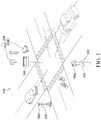
- FIG. 1 is a schematic diagram illustrating the operation of a roadside detection system 100 according to an exemplary embodiment of the disclosure.
- the roadside detection system 100 includes a roadside infrastructure 102.
- the roadside infrastructure 102 includes a roadside unit (RSU) 104 and at least one sensor 106.
- the sensor 106 may be a sensing device, such as a radar 106a, a camera 106b or a combination thereof.
- the sensor 106 may be equipped on the roadsides or at crossroads.
- the sensor 106 detects at least one object within a detection range, and collects object information of the object at at least two time points t1 and t2. For example, the sensor 106 detects, but not limited to, cars, motorbikes, bicycles or pedestrians within the detection range.
- the roadside unit 104 receives positioning signals from a satellite positioning system to obtain roadside latitude and longitude coordinates ( RSU _ lat , RSU _ long ) and initialization parameter coordinates ( BX, BY ) of the roadside unit 104.
- the roadside latitude and longitude coordinates ( RSU _ lat , RSU _ long ) are absolute position coordinates of the roadside unit 104.
- the roadside unit 104 receives and collects object information of the object detected by the sensor 106 at at least two time points t1 and t2 over wired or wireless networks, and obtains object latitude and longitude coordinates, an object speed, an object acceleration, an object length and an object heading/direction of the object according to the roadside latitude and longitude coordinates ( RSU _ lat , RSU _ long ) and the object information of the object.
- the roadside unit 104 then converts the object latitude and longitude coordinates, the object speed, the object acceleration, the object length and the object heading/direction of the object into a standard V2V Basic Safety Message (BSM) format, and broadcasts the V2V message in a Roadside-to-Vehicle (R2V) communication mode.
- BSM Basic Safety Message
- R2V Roadside-to-Vehicle
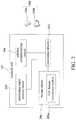
- FIG. 2 is a functional block diagram of a roadside unit 104 according to an exemplary embodiment of the disclosure.
- the roadside unit 104 includes a processing circuitry 202, a wireless communication circuit 204, a storage circuit 206 and a positioning signal receiver circuit 208.
- the processing circuitry 202 controls the operation of the roadside unit 104.
- the processing circuitry 202 is, for example, but not limited to, a central processing unit (CPU), a programmable microprocessor, a digital signal processor (DSP), a programmable controller, an application specific integrated circuits (ASIC), a programmable logic device (PLD), or the like.
- the positioning signal receiver circuit 208 is coupled to the processing circuitry 202, and receives positioning signals from satellites of a satellite positioning system.
- the positioning signal receiver circuit 208 supports communication protocols of, for example, a Global Positioning System (GPS), an Assisted Global Positioning system (AGPS), a Galileo positioning system or a Global Navigation Satellite System (GLONASS).
- GPS Global Positioning System
- AGPS Assisted Global Positioning system
- GLONASS Global Navigation Satellite System
- the wireless communication circuit 204 is coupled to the processing circuitry 202 and broadcasts V2V messages.
- the wireless communication circuit 204 may further receive object information of each object detected by the sensor 106 when the roadside unit 104 and the sensor 106 are equipped at different positions or the roadside unit 104 and the sensor 106 communicate over the wireless network.
- the wireless communication circuit 204 is a communication chip supporting, for example, a Global System for Mobile Communication (GSM) system, a Personal Handy-phone System (PHS), a Code Division Multiple Access (CDMA) system, a Wireless Fidelity (WiFi) system, a Worldwide Interoperability for Microwave Access (WiMAX) system, Third-Generation Wireless communication technology (3G), Long Term Evolution (LTE), Wireless Access in Vehicular Environments/Dedicated Short Range Communication (WAVE/DSRC), and a combination thereof.
- the storage circuit 206 is coupled to the processing circuitry 202 and stores program codes of the roadside unit 104 and the received object information.
- the storage circuit 206 is, for example, a storage device, such as a hard drive and a flash memory.
- the roadside unit 104 converts the object latitude and longitude coordinates, the object speed, the object acceleration, the object length and the object heading/direction of the object into a standard V2V Basic Safety Message (BSM) format via a vehicle-to-vehicle (V2V) format conversion module 206a having program codes.
- the V2V format conversion module 206a is implemented by, for example, software, and is stored in the storage circuit 206.
- the processing circuitry 202 loads the program codes of the V2V format conversion module 206a from the storage circuit 206, and executes the function of converting the object latitude and longitude coordinates, the object speed, the object acceleration, the object length and the object heading/direction of the object into the standard V2V Basic Safety Message (BSM) format.
- BSM V2V Basic Safety Message
- the function of converting the object latitude and longitude coordinates, the object speed, the object acceleration, the object length and the object heading/direction of the object into the standard V2V Basic Safety Message (BSM) format can also be implemented in a hardware circuit such as the processing circuitry 202.
- the sensor 106 may be an equipment, such as a radar 106a, a camera 106b or a combination thereof.
- the object information detected by the sensor 106 includes, but not limited to, a relative position and a relative speed between the object and the roadside unit, and object lengths of the object.
- the radar 106a detects all objects within a detection range via radar detection technology to obtain object information of the objects detected.
- the object information may include a relative position (a relative movement coordinate) and a relative speed between the objects and the roadside unit 104, and object lengths of the objects.
- the roadside unit 104 receives object information of each object at at least two time points transmitted from the radar 106a, converts each relative position of each object at the at least two time points into object latitude and longitude coordinates of the two time points, and further obtains an object speed, an object acceleration, an object length and an object heading/direction of each object according to the object latitude and longitude coordinates and the object information.
- object information of each object at at least two time points transmitted from the radar 106a
- converts each relative position of each object at the at least two time points into object latitude and longitude coordinates of the two time points and further obtains an object speed, an object acceleration, an object length and an object heading/direction of each object according to the object latitude and longitude coordinates and the object information.
- the camera 106b by using image identification technology, the camera 106b identifies objects from images that it captures, obtains object information of the objects, calculates the relative position and the relative speed of the objects and the roadside unit 104, and object information such as an object length of the object, and transmits the object information of the objects to the roadside unit 104.
- the roadside unit 104 acquires the GPS coordinate of the camera 106b in advance, and receives image information from the camera 106b.
- the roadside unit 104 then identifies the objects in the images by the image identification technology, calculates the relative position and the relative speed of the object and the roadside unit 104, and object information such as object length of the object, and further obtains the object latitude and longitude coordinates, the object speed, the object acceleration, the object length and the object heading/direction of the objects.
- object information such as object length of the object
- the disclosure does not limit the configuration of the sensor 106, and any sensor can be used in the disclosure as long as the sensor can transmit the detected object information to the roadside unit 104, allowing the roadside unit 104 to convert the object latitude and longitude coordinates, the object speed, the object acceleration, the object length and the object heading/direction of the object into a V2V Basic Safety Message format.
- the roadside unit 104 encodes the object latitude and longitude coordinates, the object speed, the object acceleration, the object length and object heading/direction into a standard V2V Basic Safety Message format.
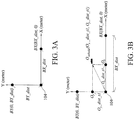
- FIG. 3A is a schematic diagram illustrating a relative position of a roadside unit and initialization parameter coordinates according to an exemplary embodiment of the disclosure.
- FIG. 3B is a schematic diagram illustrating a relative position of a vehicle and a roadside unit, and initialization parameter coordinates according to an exemplary embodiment of the disclosure.
- the positioning signal receiver circuit 208 receives positioning signals to obtain roadside latitude and longitude coordinates (RSU_lat, RSU _ long ) and initialization parameter coordinates ( BX , BY ) of the roadside unit 104.
- the reference coordinate parameter BX of the initialization parameter coordinates ( BX, BY ) takes the roadside unit 104 as a starting point, and obtains the distance BX_ dist away from the roadside unit 104 within a distance range such as a range from 10 meters to 100 meters in X-axis direction.
- the reference coordinate parameter BY of the initialization parameter coordinates ( BX , BY ) also takes the roadside unit 104 as a starting point, and obtains the distance BY_ dist away from the roadside unit 104 within a distance range such as a range from 10 meters to 100 meters in Y-axis direction.
- the roadside unit 104 receives the objection information of the objects.
- the object information of each of the objects includes the information of the object detected by the sensor 106 at at least two time points.
- the processing circuitry 202 of the roadside unit 104 obtains the object latitude and longitude coordinates, the object speed, the object acceleration, the object length and the object heading/direction of the object according to the roadside latitude and longitude coordinates ( RSU_lat, RSU _ long ), the initialization parameter coordinates ( BX , BY ) and the object information, packages these information into a packet, and transmits the packet via the wireless communication circuit 204 by DSRC communication technology.
- the roadside unit 104 may transmit the packet via other communication standards. The following describes how to obtain the object latitude and longitude coordinates, the object speed, the object acceleration, the object length and the object heading/direction of the object.
- the processing circuitry 202 of the roadside unit 104 calculates the distances (unit: meters) of the roadside unit 104 and the initialization parameter coordinates ( BX , BY ) away from zero degree longitude and zero degree latitude, respectively.
- the roadside unit 104 obtains the distance R d _lat of the roadside unit 104 away from zero degree latitude , and the distance R d _long of the roadside unit 104 away from zero degree longitude.
- the distance of the reference coordinate parameter BX away from the roadside unit 104 is BX _dist.
- the distance of the reference coordinate parameter BX away from zero degree latitude is BX d _lat.
- the distance of the reference coordinate parameter BX away from zero degree longitude is BX d _long.
- the distance of the reference coordinate parameter BY away from the roadside unit 104 is BY_ dist.
- the distance of the reference coordinate parameter BY away from zero degree latitude is BY d _ lat.
- the distance of the reference coordinate parameter BY away from zero degree longitude is BY d _ long.
- the processing circuitry 202 of the roadside unit 104 calculates the object latitude and longitude coordinates of the object at at least two time points.
- the sensor 106 detects a vehicle O vehicle , the object information of which comprises a relative position coordinate ( O x _ dist_tl, O y _dist_tl) of the vehicle O vehicle and the roadside unit 104.
- the processing circuitry 202 calculates distances (unit: meters) of the vehicle O vehicle having the relative position coordinate ( O x _dist_t1, O y _dist_t1 ) at the first time point t1 away from zero degree longitude and zero degree latitude, respectively.
- the roadside unit 104 obtains the object latitude and longitude coordinates, i.e., the absolute longitude and latitude coordinates of the object, at the first time point t1, via the equations (1) and (2), according to the roadside latitude and longitude coordinates ( RSU_lat, RSU _ long ), the initialization parameter coordinates ( BX, BY ) and the object information (the distances O d _lat_t1 and O d _long_t1 of the vehicle O vehicle away from zero degree longitude and zero degree longitude, respectively).
- the roadside unit 104 obtains the object latitude and longitude coordinates at the second time point t2, via the equations (1) and (2), according to the roadside latitude and longitude coordinates ( RSU_lat, RSU _ long ), the initialization parameter coordinates (BX, BY) and the object information (the distances O d _lat_t2 and O d _long_t2 of the vehicle O vehicle away from zero degree latitude and zero degree longitude, respectively).
- FIG. 4A is a schematic diagram illustrating the position of a vehicle at first time point and second time point according to an exemplary embodiment of the disclosure.
- FIG 4B is a schematic diagram illustrating a vehicle having a moving direction changed to north heading angle according to an exemplary embodiment of the disclosure.
- the processing circuitry 202 of the roadside unit 104 obtains, via the equations (1) and (2), the distances O d _lat_t1 and O d _long_t1 of the vehicle O vehicle away from zero degree latitude and zero degree longitude, respectively, at the first time point t1, and the distances O d _lat_t2 and O d _long_t2 of the vehicle O vehicle away from zero degree latitude and zero degree longitude, respectively, at the second time point t2, and changes the moving direction of the vehicle O vehicle to a north heading angle according to the moving direction of the vehicle O vehicle , i.e., the moving direction of vehicle O vehicle at the position O vehicle_t1 of the first time point t1 toward the position O vehicle _t2 at the second time point t2.
- Taiwan i.e., 120-122 degrees east longitude and 22-25 degrees north latitude
- the disclosure is not limited thereto, and the heading angle of the object is not limited to north.
- the processing circuitry 202 of the roadside unit 104 calculates the speed and acceleration of the object according to the object information transmitted by the sensor 106. Take the vehicle O vehicle as an example.
- the roadside unit 104 acquires, from the object information transmitted by the sensor 106, that the relative position coordinate of the vehicle O vehicle at the first time point t1 is ( O x _dist_t1, O y_ dist _ t1 ) and the relative position coordinate of the vehicle O vehicle at the second time point t2 is ( O x_ dist_t2, O y _dist t2 ), and further obtains the object speed V and the object acceleration a of the vehicle O vehicle .
- the roadside unit 104 can obtain the object speed V via the relative speed of the object. For example, the sensor 106 detects that the relative speeds of the vehicle O vehicle at the first time point t1 along the X axis and the Y axis are V x_t1 and V y_t1 , respectively, and the roadside unit 104 can thus calculate the speed V_t1 and the acceleration a of the vehicle O vehicle .
- the roadside unit 104 stores the received object information and the object latitude and longitude coordinates, the object speed, the object acceleration, the object length and the object heading/direction of the object in the storage circuit 206.
- the processing circuitry 202 of the roadside unit 104 converts, the object latitude and longitude coordinates, the object speed, the object acceleration, the object length and the object heading/direction of the object into a standard V2V Basic Safety Message (BSM) format, and the roadside unit 104 broadcasts the V2V messages in the Roadside-to-Vehicle (R2V) communication mode.
- BSM V2V Basic Safety Message
- the sensor 106 and the roadside unit 104 are equipped at the same position.
- the sensor 106 can be built in the roadside unit 104.
- the sensor 106 and the roadside unit 104 have identical GPS coordinates. Therefore, the sensor 106 transmits the detected object information including the relative position and the relative speed of the object and the roadside unit and the object lengths of the object to the roadside unit 104, and the roadside unit 104 can obtain the object latitude and longitude coordinates, the object speed, the object acceleration and the object heading/direction of the object, based on the above description.
- the sensor 106 and the roadside unit 104 are equipped at different positions.
- the roadside unit 104 can acquire the GPS coordinate of the sensor 106 in advance, or receives the GPS coordinate and the object information from the sensor 106. Therefore, the roadside unit 104 can obtain the object latitude and longitude coordinates, the object speed, the object acceleration, the object length and the object heading/direction of the object according to the GPS coordinate of the sensor 106 and the object information received by the sensor 106.
- a vehicle equipped with an On-board Unit (OBU) and configured to receive V2V messages can receive packets transmitted from the roadside unit 104 that comprise V2V Basic Safety Message format. Therefore, the vehicle equipped with the OBU can be made aware of all the coming objects (e.g., cars, motorbikes, bicycles, or pedestrians) via the received V2V Basic Safety Message. The vehicle equipped with the OBU can then release a warning message if it determines that the coming object is too close in order to protect itself from colliding with the object.
- OBU On-board Unit
- the roadside unit 104 that converts the object information at the crossroads into the V2V Basic Safety Message and informs vehicles nearby of the V2V Basic Safety Message, the problems due to low popularity of the OBU and that not every vehicle or object has the function of transmitting the V2V Basic Safety Message are solved..
- FIG. 5 is a flow chart of a roadside communication method according to an exemplary embodiment of the disclosure.
- step S501 the roadside unit 104 receives positioning signals from a satellite positioning system to obtain roadside latitude and longitude coordinates ( RSU _ lat , RSU_long ) and initialization parameter coordinates ( BX, BY ) of the roadside unit.
- step S503 the roadside unit 104 receives, from the sensor 106, object information of at least one object that includes information of the object detected by the sensor 106 at at least two time points.
- step S505 the roadside unit 104 obtains object latitude and longitude coordinates, an object speed, an object acceleration, an object length and an object heading/direction of the object according to the roadside latitude and longitude coordinates ( RSU _ lat , RSU_long ), the initialization parameter coordinates ( BX, BY ) and the object information of the object.
- step S507 the roadside unit 104 converts the object latitude and longitude coordinates, the object speed, the object acceleration, the object length and the object heading/direction of the object into a Vehicle-to-Vehicle Basic Safety Message format.
- the roadside detection system, the roadside unit and the roadside communication method in the exemplary embodiments employ the roadside unit to detect objects and release V2V messages, such that neighboring vehicles or objects can be made aware of one another via the V2V messages from the roadside unit, thereby reducing the occurrence of accidents, and solving the problem caused by the low popularity of the OBU.
Landscapes
- Physics & Mathematics (AREA)
- General Physics & Mathematics (AREA)
- Engineering & Computer Science (AREA)
- Radar, Positioning & Navigation (AREA)
- Remote Sensing (AREA)
- Computer Networks & Wireless Communication (AREA)
- Electromagnetism (AREA)
- Signal Processing (AREA)
- Life Sciences & Earth Sciences (AREA)
- Atmospheric Sciences (AREA)
- Traffic Control Systems (AREA)
Abstract
Description
- The disclosure relates to a roadside detection system, a roadside unit and a roadside communication method thereof.
- Connected vehicle communication technology can be applied to active road safety. In a connected vehicle network environment, many applications require to broadcast vehicle statues, such as Intersection Movement Assist (IMA), Left Turn Assist (LTA), Lane change warning (LCW), Forward Collision Warning (FCW) and Electronic Emergency Brake Light (EEBL), via a standard inter-vehicle Basic Safety Message (BSM). Vehicle communication mode includes Vehicle-to-Vehicle (V2V), Vehicle-to-Roadside (V2R) and Vehicle-to-Infrastructure (V2I), or the so-called V2X communication. Wireless Access in Vehicular Environments (WAVE)/Dedicated Short Range Communications (DSRC) is a communication technique applied to the V2X communication.
- Advanced Driver Assistance Systems (ADAS) assists in driving a vehicle. However, in an ADAS system, the Non-Line-Of-Sight (NLOS) problem cannot be solved. In a road safety application, crossroad collision and forward vehicle's abrupt stop belong to NLOS accidents.
- In recent years, roadside unit safety application has become a popular issue. According to the data from National Highway Traffic Safety Administration (NHTSA), the majority of accidents occurs at a crossroad. NHTSA and Depart of Transportation published an Advance Notice of Proposed Rulemaking (ANPRM) to prompt the Government to legislate that the vehicles running in the United States shall be equipped with the V2V technology. In the near future, compact cars and pickups are required to have the V2V function. The V2V application has to be operated in an environment in which all vehicles are equipped with an On-Board Unit (OBU). However, many vehicles, pedestrians and even other moving objects do not have any OBU equipped. Therefore, accidents are more likely to occur at crossroads, and crossroad safety is severely affected.
- An exemplary embodiment of the disclosure provides a roadside detection system. The roadside detection system includes at least one sensor and a roadside unit. The sensor detects at least one object within a detection range, and transmits object information of the object that includes information of the object detected by the sensor at at least two time points. The roadside unit receives a positioning signal from a satellite positioning system to obtain roadside latitude and longitude coordinates and an initialization parameter coordinate of the roadside unit. The roadside unit receives the object information of the object from the sensor, and obtains object latitude and longitude coordinates, an object speed, an object acceleration, an object length and an object heading/direction of the object according to the roadside latitude and longitude coordinates, the initialization parameter coordinate and the object information. The roadside unit converts the object latitude and longitude coordinates, the object speed, the object acceleration, the object length and the object heading/direction of the object into a Vehicle-to-Vehicle Basic Safety Message format.
- An exemplary embodiment of the disclosure provides a roadside unit. The roadside unit includes a positioning signal receiver circuit, a storage circuit and a processing circuitry. The positioning signal receiver circuit receives a positioning signal from a satellite positioning system to obtain roadside latitude and longitude coordinates and an initialization parameter coordinate of the roadside unit. The storage circuit has a vehicle-to-vehicle format conversion module. The processing circuitry is coupled to the positioning signal receiver circuit and the storage circuit, and receives object information of at least one object from at least one sensor, wherein the object information includes information of the object detected by the sensor at at least two time points. The processing circuitry obtains object latitude and longitude coordinates, an object speed, an object acceleration, an object length and an object heading/direction of the object according to the roadside latitude and longitude coordinates, the initialization parameter coordinate and the object information. The vehicle-to-vehicle format conversion module converts the object latitude and longitude coordinates, the object speed, the object acceleration, the object length and the object heading/direction of the object into a Vehicle-to-Vehicle Basic Safety Message format.
- An exemplary embodiment of the disclosure provides a roadside communication method for a roadside unit. The roadside communication method includes: receiving a positioning signal from a satellite positioning system to obtain roadside latitude and longitude coordinates and an initialization parameter coordinate of the roadside unit; receiving, from at least one sensor, object information of at least one object that includes information of the object detected by the sensor at at least two time points; calculating object latitude and longitude coordinates, an object speed, an object acceleration, an object length and an object heading/direction of the object according to the roadside latitude and longitude coordinates, the initialization parameter coordinate and the object information; converting the object latitude and longitude coordinates, the object speed, the object acceleration, the object length and the object heading/direction of the object into a Vehicle-to-Vehicle Basic Safety Message format; and broadcasting the Vehicle-to-Vehicle Basic Safety Message in a Roadside-to-Vehicle communication mode.
- In the following detailed description, for purposes of explanation, numerous specific details are set forth in order to provide a thorough understanding of the disclosed embodiments. It will be apparent, however, that one or more embodiments may be practiced without these specific details. In other instances, well-known structures and devices are schematically shown in order to simplify the drawing.
-
-
FIG. 1 is a schematic diagram illustrating the operation of a roadside detection system according to an exemplary embodiment of the disclosure. -
FIG. 2 is a functional block diagram of a roadside unit according to an exemplary embodiment of the disclosure. -
FIG. 3A is a schematic diagram illustrating a relative position of a roadside unit and initialization parameter coordinates according to an exemplary embodiment of the disclosure. -
FIG. 3B is a schematic diagram illustrating a relative position of a vehicle and a roadside unit and an initialization parameter coordinate according to an exemplary embodiment of the disclosure. -
FIG. 4A is a schematic diagram illustrating the positions of a vehicle at a first time point and a second time point according to an exemplary embodiment of the disclosure. -
FIG 4B is a schematic diagram illustrating a vehicle having a moving direction changed to a north heading angle according to an exemplary embodiment of the disclosure. -
FIG. 5 is a flow chart of a roadside communication method according to an exemplary embodiment of the disclosure. -
FIG. 1 is a schematic diagram illustrating the operation of aroadside detection system 100 according to an exemplary embodiment of the disclosure. - The
roadside detection system 100 includes aroadside infrastructure 102. Theroadside infrastructure 102 includes a roadside unit (RSU) 104 and at least onesensor 106. Thesensor 106 may be a sensing device, such as aradar 106a, acamera 106b or a combination thereof. Thesensor 106 may be equipped on the roadsides or at crossroads. Thesensor 106 detects at least one object within a detection range, and collects object information of the object at at least two time points t1 and t2. For example, thesensor 106 detects, but not limited to, cars, motorbikes, bicycles or pedestrians within the detection range. - The
roadside unit 104 receives positioning signals from a satellite positioning system to obtain roadside latitude and longitude coordinates (RSU_lat, RSU_long) and initialization parameter coordinates (BX, BY) of theroadside unit 104. The roadside latitude and longitude coordinates (RSU_lat, RSU_long) are absolute position coordinates of theroadside unit 104. Theroadside unit 104 receives and collects object information of the object detected by thesensor 106 at at least two time points t1 and t2 over wired or wireless networks, and obtains object latitude and longitude coordinates, an object speed, an object acceleration, an object length and an object heading/direction of the object according to the roadside latitude and longitude coordinates (RSU_lat, RSU_long) and the object information of the object. Theroadside unit 104 then converts the object latitude and longitude coordinates, the object speed, the object acceleration, the object length and the object heading/direction of the object into a standard V2V Basic Safety Message (BSM) format, and broadcasts the V2V message in a Roadside-to-Vehicle (R2V) communication mode. -
FIG. 2 is a functional block diagram of aroadside unit 104 according to an exemplary embodiment of the disclosure. - The
roadside unit 104 includes aprocessing circuitry 202, awireless communication circuit 204, astorage circuit 206 and a positioningsignal receiver circuit 208. - In the exemplary embodiment, the
processing circuitry 202 controls the operation of theroadside unit 104. Theprocessing circuitry 202 is, for example, but not limited to, a central processing unit (CPU), a programmable microprocessor, a digital signal processor (DSP), a programmable controller, an application specific integrated circuits (ASIC), a programmable logic device (PLD), or the like. The positioningsignal receiver circuit 208 is coupled to theprocessing circuitry 202, and receives positioning signals from satellites of a satellite positioning system. The positioningsignal receiver circuit 208 supports communication protocols of, for example, a Global Positioning System (GPS), an Assisted Global Positioning system (AGPS), a Galileo positioning system or a Global Navigation Satellite System (GLONASS). Thewireless communication circuit 204 is coupled to theprocessing circuitry 202 and broadcasts V2V messages. Thewireless communication circuit 204 may further receive object information of each object detected by thesensor 106 when theroadside unit 104 and thesensor 106 are equipped at different positions or theroadside unit 104 and thesensor 106 communicate over the wireless network. Thewireless communication circuit 204 is a communication chip supporting, for example, a Global System for Mobile Communication (GSM) system, a Personal Handy-phone System (PHS), a Code Division Multiple Access (CDMA) system, a Wireless Fidelity (WiFi) system, a Worldwide Interoperability for Microwave Access (WiMAX) system, Third-Generation Wireless communication technology (3G), Long Term Evolution (LTE), Wireless Access in Vehicular Environments/Dedicated Short Range Communication (WAVE/DSRC), and a combination thereof. Thestorage circuit 206 is coupled to theprocessing circuitry 202 and stores program codes of theroadside unit 104 and the received object information. Thestorage circuit 206 is, for example, a storage device, such as a hard drive and a flash memory. - In the exemplary embodiment, the
roadside unit 104 converts the object latitude and longitude coordinates, the object speed, the object acceleration, the object length and the object heading/direction of the object into a standard V2V Basic Safety Message (BSM) format via a vehicle-to-vehicle (V2V)format conversion module 206a having program codes. The V2Vformat conversion module 206a is implemented by, for example, software, and is stored in thestorage circuit 206. In the operation of theroadside unit 104, theprocessing circuitry 202 loads the program codes of the V2Vformat conversion module 206a from thestorage circuit 206, and executes the function of converting the object latitude and longitude coordinates, the object speed, the object acceleration, the object length and the object heading/direction of the object into the standard V2V Basic Safety Message (BSM) format. However, it should be understood that the disclosure is not limited thereto. In another exemplary embodiment, the function of converting the object latitude and longitude coordinates, the object speed, the object acceleration, the object length and the object heading/direction of the object into the standard V2V Basic Safety Message (BSM) format can also be implemented in a hardware circuit such as theprocessing circuitry 202. - In an exemplary embodiment, the
sensor 106 may be an equipment, such as aradar 106a, acamera 106b or a combination thereof. The object information detected by thesensor 106 includes, but not limited to, a relative position and a relative speed between the object and the roadside unit, and object lengths of the object. In an embodiment that thesensor 106 is aradar 106a, theradar 106a detects all objects within a detection range via radar detection technology to obtain object information of the objects detected. The object information may include a relative position (a relative movement coordinate) and a relative speed between the objects and theroadside unit 104, and object lengths of the objects. Theroadside unit 104 receives object information of each object at at least two time points transmitted from theradar 106a, converts each relative position of each object at the at least two time points into object latitude and longitude coordinates of the two time points, and further obtains an object speed, an object acceleration, an object length and an object heading/direction of each object according to the object latitude and longitude coordinates and the object information. However, it should be understood that it is one example to use the radar detection technology to detect an object, and the disclosure is not limited thereto. - In an embodiment in which the
sensor 106 is thecamera 106b, by using image identification technology, thecamera 106b identifies objects from images that it captures, obtains object information of the objects, calculates the relative position and the relative speed of the objects and theroadside unit 104, and object information such as an object length of the object, and transmits the object information of the objects to theroadside unit 104. In another embodiment, theroadside unit 104 acquires the GPS coordinate of thecamera 106b in advance, and receives image information from thecamera 106b. Theroadside unit 104 then identifies the objects in the images by the image identification technology, calculates the relative position and the relative speed of the object and theroadside unit 104, and object information such as object length of the object, and further obtains the object latitude and longitude coordinates, the object speed, the object acceleration, the object length and the object heading/direction of the objects. However, it should be understood that the disclosure does not limit the configuration of thesensor 106, and any sensor can be used in the disclosure as long as the sensor can transmit the detected object information to theroadside unit 104, allowing theroadside unit 104 to convert the object latitude and longitude coordinates, the object speed, the object acceleration, the object length and the object heading/direction of the object into a V2V Basic Safety Message format. In other words, theroadside unit 104 encodes the object latitude and longitude coordinates, the object speed, the object acceleration, the object length and object heading/direction into a standard V2V Basic Safety Message format. -
FIG. 3A is a schematic diagram illustrating a relative position of a roadside unit and initialization parameter coordinates according to an exemplary embodiment of the disclosure. -
FIG. 3B is a schematic diagram illustrating a relative position of a vehicle and a roadside unit, and initialization parameter coordinates according to an exemplary embodiment of the disclosure. - Referring to
FIG. 3A , in the exemplary embodiment, when theroadside unit 104 is in operation, the positioningsignal receiver circuit 208 receives positioning signals to obtain roadside latitude and longitude coordinates (RSU_lat, RSU_long) and initialization parameter coordinates (BX, BY) of theroadside unit 104. The reference coordinate parameter BX of the initialization parameter coordinates (BX, BY) takes theroadside unit 104 as a starting point, and obtains the distance BX_dist away from theroadside unit 104 within a distance range such as a range from 10 meters to 100 meters in X-axis direction. The reference coordinate parameter BY of the initialization parameter coordinates (BX, BY) also takes theroadside unit 104 as a starting point, and obtains the distance BY_dist away from theroadside unit 104 within a distance range such as a range from 10 meters to 100 meters in Y-axis direction. - In the exemplary embodiment, the
roadside unit 104 receives the objection information of the objects. The object information of each of the objects includes the information of the object detected by thesensor 106 at at least two time points. Theprocessing circuitry 202 of theroadside unit 104 obtains the object latitude and longitude coordinates, the object speed, the object acceleration, the object length and the object heading/direction of the object according to the roadside latitude and longitude coordinates (RSU_lat, RSU_long), the initialization parameter coordinates (BX, BY) and the object information, packages these information into a packet, and transmits the packet via thewireless communication circuit 204 by DSRC communication technology. However, it should be understood that the disclosure is not limited thereto. In another embodiment, theroadside unit 104 may transmit the packet via other communication standards. The following describes how to obtain the object latitude and longitude coordinates, the object speed, the object acceleration, the object length and the object heading/direction of the object. - In the exemplary embodiment, the
processing circuitry 202 of theroadside unit 104 calculates the distances (unit: meters) of theroadside unit 104 and the initialization parameter coordinates (BX, BY) away from zero degree longitude and zero degree latitude, respectively. According to the roadside latitude and longitude coordinates (RSU_lat, RSU_long), theroadside unit 104 obtains the distance Rd_lat of theroadside unit 104 away from zero degree latitude , and the distance Rd_long of theroadside unit 104 away from zero degree longitude. The distance of the reference coordinate parameter BX away from theroadside unit 104 is BX_dist. The distance of the reference coordinate parameter BX away from zero degree latitude is BX d_lat. The distance of the reference coordinate parameter BX away from zero degree longitude is BX d_long. The distance of the reference coordinate parameter BY away from theroadside unit 104 is BY_dist. The distance of the reference coordinate parameter BY away from zero degree latitude is BYd_lat. The distance of the reference coordinate parameter BY away from zero degree longitude is BYd_long. - Next, the
processing circuitry 202 of theroadside unit 104 calculates the object latitude and longitude coordinates of the object at at least two time points. Referring toFIG. 3B , in an embodiment, in which the first time point t1 is taken as an example, thesensor 106 detects a vehicle Ovehicle, the object information of which comprises a relative position coordinate (O x_ dist_tl, Oy_dist_tl) of the vehicle Ovehicle and theroadside unit 104. Theprocessing circuitry 202 calculates distances (unit: meters) of the vehicle Ovehicle having the relative position coordinate (Ox_dist_t1, Oy_dist_t1) at the first time point t1 away from zero degree longitude and zero degree latitude, respectively. The distances of the vehicle Ovehicle along the relative position coordinate Ox_dist_t1 of the X axis away from zero degree latitude and zero degree longitude are Oxd_lat_t1 and Oxd_long_t1, respectively; the distances of the vehicle Ovehicle along the relative position coordinate Oy_dist_t1 of the Y axis away from zero degree latitude and zero degree longitude are Oyd_lat_t1 and Oyd_long_t1, respectively, and can be expressed by the following equations (1):
- According to the distances Oxd_lat_t1 and Oxd_long_t1 of the vehicle Ovehicle at the relative position coordinate O x_dist_t1 along the X axis away from zero degree latitude and zero degree longitude, respectively, and the distances Oyd_lat-t1 and Oyd_long_t1 of vehicle Ovehicle at the relative position coordinate Oy_dist_t1 along the Y axis away from zero degree latitude and zero degree longitude, respectively, the
roadside unit 104 obtains the distances (unit: meters) of the vehicle Ovehicle away from zero degree latitude and zero degree longitude to be Od_lat_t1 and Od_long_t1, respectively, and can be expressed by the following equations:
- Therefore, the
roadside unit 104 obtains the object latitude and longitude coordinates, i.e., the absolute longitude and latitude coordinates of the object, at the first time point t1, via the equations (1) and (2), according to the roadside latitude and longitude coordinates (RSU_lat, RSU_long), the initialization parameter coordinates (BX, BY) and the object information (the distances Od_lat_t1 and Od_long_t1 of the vehicle Ovehicle away from zero degree longitude and zero degree longitude, respectively). Similarly, theroadside unit 104 obtains the object latitude and longitude coordinates at the second time point t2, via the equations (1) and (2), according to the roadside latitude and longitude coordinates (RSU_lat, RSU_long), the initialization parameter coordinates (BX, BY) and the object information (the distances Od_lat_t2 and Od_long_t2 of the vehicle Ovehicle away from zero degree latitude and zero degree longitude, respectively). -
FIG. 4A is a schematic diagram illustrating the position of a vehicle at first time point and second time point according to an exemplary embodiment of the disclosure. -
FIG 4B is a schematic diagram illustrating a vehicle having a moving direction changed to north heading angle according to an exemplary embodiment of the disclosure. - Please refer to
FIGs. 4A and 4B . In an exemplary embodiment, theprocessing circuitry 202 of theroadside unit 104 obtains, via the equations (1) and (2), the distances Od_lat_t1 and Od_long_t1 of the vehicle Ovehicle away from zero degree latitude and zero degree longitude, respectively, at the first time point t1, and the distances Od_lat_t2 and Od_long_t2 of the vehicle Ovehicle away from zero degree latitude and zero degree longitude, respectively, at the second time point t2, and changes the moving direction of the vehicle Ovehicle to a north heading angle according to the moving direction of the vehicle Ovehicle, i.e., the moving direction of vehicle Ovehicle at the position Ovehicle_t1 of the first time point t1 toward the position Ovehicle_t2 at the second time point t2. For example, the absolute position of Taiwan, i.e., 120-122 degrees east longitude and 22-25 degrees north latitude may be used as a basis to convert the heading angle of the object. However, the disclosure is not limited thereto, and the heading angle of the object is not limited to north. - Please refer to
FIG. 4B . In an embodiment, the moving direction of the vehicle Ovehicle is changed to be north heading angle D, which is expressed by the following equations (3):
- The
processing circuitry 202 of theroadside unit 104 calculates the speed and acceleration of the object according to the object information transmitted by thesensor 106. Take the vehicle Ovehicle as an example. Theroadside unit 104 acquires, from the object information transmitted by thesensor 106, that the relative position coordinate of the vehicle Ovehicle at the first time point t1 is (Ox_dist_t1, Oy_dist_t1) and the relative position coordinate of the vehicle Ovehicle at the second time point t2 is (Ox_dist_t2, Oy_dist t2), and further obtains the object speed V and the object acceleration a of the vehicle Ovehicle. In another embodiment, if thesensor 106 can detect the relative speed of the object and transmit the relative speed of the object to theroadside unit 104, theroadside unit 104 can obtain the object speed V via the relative speed of the object. For example, thesensor 106 detects that the relative speeds of the vehicle Ovehicle at the first time point t1 along the X axis and the Y axis are Vx_t1 and Vy_t1 , respectively, and theroadside unit 104 can thus calculate the speed V_t1 and the acceleration a of the vehicle Ovehicle. The speed V_t1 can be expressed by the following equation (4):
- The
roadside unit 104 obtains, via the equation (4), the speeds V_t1 and V_t2 of the vehicle Ovehicle at the first time point t1 and the second time point t2, respectively, and then obtains the acceleration a of the vehicle Ovehicle via the following equation (5):
- The
roadside unit 104 stores the received object information and the object latitude and longitude coordinates, the object speed, the object acceleration, the object length and the object heading/direction of the object in thestorage circuit 206. By the V2Vformat conversion module 206a, theprocessing circuitry 202 of theroadside unit 104 converts, the object latitude and longitude coordinates, the object speed, the object acceleration, the object length and the object heading/direction of the object into a standard V2V Basic Safety Message (BSM) format, and theroadside unit 104 broadcasts the V2V messages in the Roadside-to-Vehicle (R2V) communication mode. - In an embodiment, the
sensor 106 and theroadside unit 104 are equipped at the same position. In another embodiment, thesensor 106 can be built in theroadside unit 104. As such, thesensor 106 and theroadside unit 104 have identical GPS coordinates. Therefore, thesensor 106 transmits the detected object information including the relative position and the relative speed of the object and the roadside unit and the object lengths of the object to theroadside unit 104, and theroadside unit 104 can obtain the object latitude and longitude coordinates, the object speed, the object acceleration and the object heading/direction of the object, based on the above description. In another embodiment, thesensor 106 and theroadside unit 104 are equipped at different positions. As such, theroadside unit 104 can acquire the GPS coordinate of thesensor 106 in advance, or receives the GPS coordinate and the object information from thesensor 106. Therefore, theroadside unit 104 can obtain the object latitude and longitude coordinates, the object speed, the object acceleration, the object length and the object heading/direction of the object according to the GPS coordinate of thesensor 106 and the object information received by thesensor 106. - Accordingly, a vehicle equipped with an On-board Unit (OBU) and configured to receive V2V messages can receive packets transmitted from the
roadside unit 104 that comprise V2V Basic Safety Message format. Therefore, the vehicle equipped with the OBU can be made aware of all the coming objects (e.g., cars, motorbikes, bicycles, or pedestrians) via the received V2V Basic Safety Message. The vehicle equipped with the OBU can then release a warning message if it determines that the coming object is too close in order to protect itself from colliding with the object. Therefore, with theroadside unit 104 that converts the object information at the crossroads into the V2V Basic Safety Message and informs vehicles nearby of the V2V Basic Safety Message, the problems due to low popularity of the OBU and that not every vehicle or object has the function of transmitting the V2V Basic Safety Message are solved.. -
FIG. 5 is a flow chart of a roadside communication method according to an exemplary embodiment of the disclosure. - In step S501, the
roadside unit 104 receives positioning signals from a satellite positioning system to obtain roadside latitude and longitude coordinates (RSU_lat, RSU_long) and initialization parameter coordinates (BX, BY) of the roadside unit. In step S503, theroadside unit 104 receives, from thesensor 106, object information of at least one object that includes information of the object detected by thesensor 106 at at least two time points. In step S505, theroadside unit 104 obtains object latitude and longitude coordinates, an object speed, an object acceleration, an object length and an object heading/direction of the object according to the roadside latitude and longitude coordinates (RSU_lat, RSU_long), the initialization parameter coordinates (BX, BY) and the object information of the object. In step S507, theroadside unit 104 converts the object latitude and longitude coordinates, the object speed, the object acceleration, the object length and the object heading/direction of the object into a Vehicle-to-Vehicle Basic Safety Message format. - The roadside detection system, the roadside unit and the roadside communication method in the exemplary embodiments employ the roadside unit to detect objects and release V2V messages, such that neighboring vehicles or objects can be made aware of one another via the V2V messages from the roadside unit, thereby reducing the occurrence of accidents, and solving the problem caused by the low popularity of the OBU.
- It will be apparent to those skilled in the art that various modifications and variations can be made to the disclosed embodiments. It is intended that the specification and examples be considered as exemplary only, with a true scope of the disclosure being indicated by the following claims and their equivalents.
Claims (15)
- A roadside detection system (100), characterized in that:at least one sensor (106) is configured to detect at least one object within a detection range and transmit object information of the object, wherein the object information includes information of the object detected by the sensor (106) at at least two time points; anda roadside unit (104) is configured to receive a positioning signal from a satellite positioning system and obtain roadside latitude and longitude coordinates and an initialization parameter coordinate of the roadside unit (104),wherein the roadside unit (104) receives the object information of the object from the sensor (106), and obtains object latitude and longitude coordinates, an object speed, an object acceleration, an object length and an object heading/direction of the object according to the roadside latitude and longitude coordinates, the initialization parameter coordinate and the object information, andwherein the roadside unit (104) converts the object latitude and longitude coordinates, the object speed, the object acceleration, the object length and the object heading/direction of the object into a Vehicle-to-Vehicle Basic Safety Message format.
- The roadside detection system (100) of claim 1, wherein the roadside unit (104) includes a processing circuitry (202), a wireless communication circuit (204), a positioning signal receiver circuit (208) and a vehicle-to-vehicle format conversion module (206a), and the processing circuitry (202) converts, via the vehicle-to-vehicle format conversion module (206a), the object latitude and longitude coordinates, the object speed, the object acceleration, the object length and the object heading/direction of the object into the Vehicle-to-Vehicle Basic Safety Message format.
- The roadside detection system (100) of claim 1 or claim 2, wherein the sensor (106) includes at least one radar (106a) or at least one camera (106b), and employs radar detection technology or image identification technology to detect the object within the detection range and obtain the object information.
- The roadside detection system (100) of any of the preceding claims, wherein the object information includes a relative position and a relative speed of the object and the roadside unit (104) and the object length of the object, and the roadside unit (104) is configured to calculate distances of the roadside unit (104) away from zero degree longitude and zero degree latitude, respectively, according to the roadside latitude and longitude coordinates and the initialization parameter coordinate, and calculate distances of the initialization parameter coordinate away from the zero degree longitude and the zero degree latitude, respectively, according to the roadside latitude and longitude coordinates and the initialization parameter coordinate,
wherein the roadside unit (104) obtains distances of the object away from the zero degree longitude and the zero degree latitude, respectively, according to the relative position of the object, and
wherein the roadside unit (104) obtains the object latitude and longitude coordinates according to the roadside latitude and longitude coordinates, the initialization parameter coordinate and the distances of the object away from the zero degree longitude and the zero degree latitude, wherein
preferably the roadside unit (104) obtains the distances of the object away from the zero degree longitude and the zero degree latitude at a first time point and a second time point, respectively, and obtains the object heading/direction of the object according to the distances of the object away from the zero degree longitude and the zero degree latitude. - The roadside detection system (100) of any of the preceding claims, wherein the object information includes a relative position and a relative speed of the object and the roadside unit (104) and the object length of the object, and wherein the roadside unit (104) obtains the object speed and the object acceleration of the object according to the relative speed of the object at a first time point and a second time point, respectively.
- The roadside detection system (100) of any of the preceding claims, wherein the roadside unit (104) broadcasts the Vehicle-to-Vehicle Basic Safety Message in a Roadside-to-Vehicle communication mode.
- A roadside unit (104), characterized in that:a positioning signal receiver circuit (208) is configured to receive a positioning signal from a satellite positioning system to obtain roadside latitude and longitude coordinates and an initialization parameter coordinate of the roadside unit (104);a storage circuit (206) includes a vehicle-to-vehicle format conversion module (206a); anda processing circuitry (202) is coupled to the positioning signal receiver circuit (208) and the storage circuit (206),wherein the processing circuitry (202) receives object information of at least one object from at least one sensor (106), wherein the object information includes information of the object detected by the sensor (106) at at least two time points,wherein the processing circuitry (202) obtains object latitude and longitude coordinates, an object speed, an object acceleration, an object length and an object heading/direction of the object according to the roadside latitude and longitude coordinates, the initialization parameter coordinate and the object information, andwherein the processing circuitry (202) converts the object latitude and longitude coordinates, the object speed, the object acceleration, the object length and the object heading/direction of the object into a Vehicle-to-Vehicle Basic Safety Message format via the vehicle-to-vehicle format conversion module (206a).
- The roadside unit (104) of claim 7, wherein the object information includes a relative position and a relative speed of the object and the roadside unit (104) and the object length, and the roadside unit is configured to calculate distances of the roadside unit (104) away from zero degree longitude and zero degree latitude, respectively, according to the roadside latitude and longitude coordinates and the initialization parameter coordinate, and calculate distances of the initialization parameter coordinate away from the zero degree longitude and the zero degree latitude, respectively, according to the roadside latitude and longitude coordinates and the initialization parameter coordinate,
wherein the roadside unit (104) obtains distances of the object away from the zero degree longitude and the zero degree latitude, respectively, according to the relative position of the object,
wherein the roadside unit (104) obtains the object latitude and longitude coordinates according to the roadside latitude and longitude coordinates, the initialization parameter coordinate and the distances of the object away from the zero degree longitude and the zero degree latitude, and
wherein preferably the roadside unit (104) is configured to obtain the distances of the object away from the zero degree longitude and the zero degree latitude at a first time point and a second time point, respectively, and obtain the object heading/direction of the object according to the distances of the object away from the zero degree longitude and the zero degree latitude. - The roadside unit of claim 7 or claim 8, wherein the object information includes a relative position and a relative speed of the object and the roadside unit (104) and the object length, and the roadside unit is configured to obtain the object speed and the object acceleration of the object according to the relative speed of the object at a first time point and a second time point, respectively.
- The roadside unit (104) of any of claims 7 to 9, further comprising a wireless communication circuit (204) configured to broadcast the Vehicle-to-Vehicle Basic Safety Message in a Roadside-to-Vehicle communication mode.
- The roadside unit (104) of claim 10, wherein the wireless communication circuit (204) is coupled to the processing circuitry (202) and configured to receive the object information of the at least one object from the at least one sensor (106).
- A roadside communication method for a roadside unit (104), characterized in that the roadside communication method comprises:receiving a positioning signal from a satellite positioning system to obtain roadside latitude and longitude coordinates and an initialization parameter coordinate of the roadside unit (104);receiving, from at least one sensor (106), object information of at least one object, wherein the object information comprises information of the object detected by the sensor (106) at at least two time points;calculating object latitude and longitude coordinates, an object speed, an object acceleration, an object length and an object heading/direction of the object according to the roadside latitude and longitude coordinates, the initialization parameter coordinate and the object information;converting the object latitude and longitude coordinates, the object speed, the object acceleration, the object length and the object heading/direction of the object into a Vehicle-to-Vehicle Basic Safety Message format; andbroadcasting the Vehicle-to-Vehicle Basic Safety Message in a Roadside-to-Vehicle communication mode.
- The roadside communication method of claim 12, wherein the object information includes a relative position and a relative speed of the object and the roadside unit (104) and the object length, and the roadside communication method further comprises calculating distances of the roadside unit (104) away from zero degree longitude and zero degree latitude, respectively, according to the roadside latitude and longitude coordinates and the initialization parameter coordinate, and calculating distances of the initialization parameter coordinate away from the zero degree longitude and the zero degree latitude, respectively, according to the roadside latitude and longitude coordinates and the initialization parameter coordinate,
wherein the roadside unit (104) obtains distances of the object away from the zero degree longitude and the zero degree latitude, respectively, according to the relative position of the object, and
wherein the roadside unit (104) obtains the object latitude and longitude coordinates according to the roadside latitude and longitude coordinates, the initialization parameter coordinate and the distances of the object away from the zero degree longitude and the zero degree latitude. - The roadside communication method of claim 13, further comprising obtaining the distances of the object away from the zero degree longitude and the zero degree latitude at a first time point and a second time point, respectively, and obtaining the object heading/direction of the object according to the distances of the object away from the zero degree longitude and the zero degree latitude.
- The roadside communication method of claim 13 or claim 14, wherein the object information includes a relative position and a relative speed of the object and the roadside unit (104) and the object length, and the roadside communication method further comprises obtaining the object speed and the object acceleration of the object according to the relative speed of the object at a first time point and a second time point, respectively.
Applications Claiming Priority (1)
| Application Number | Priority Date | Filing Date | Title |
|---|---|---|---|
| TW105128762A TWI662252B (en) | 2016-09-06 | 2016-09-06 | Roadside detection system, roadside unit and roadside communication method thereof |
Publications (1)
| Publication Number | Publication Date |
|---|---|
| EP3291204A1 true EP3291204A1 (en) | 2018-03-07 |
Family
ID=57749864
Family Applications (1)
| Application Number | Title | Priority Date | Filing Date |
|---|---|---|---|
| EP17150523.3A Ceased EP3291204A1 (en) | 2016-09-06 | 2017-01-06 | Roadside detection system, roadside unit and roadside communication method thereof |
Country Status (4)
| Country | Link |
|---|---|
| US (1) | US10096244B2 (en) |
| EP (1) | EP3291204A1 (en) |
| CN (1) | CN107798897A (en) |
| TW (1) | TWI662252B (en) |
Cited By (1)
| Publication number | Priority date | Publication date | Assignee | Title |
|---|---|---|---|---|
| US11099272B2 (en) * | 2018-08-31 | 2021-08-24 | Beijing Online Network Technology (Beijing) Co., Ltd. | Intelligent roadside unit |
Families Citing this family (24)
| Publication number | Priority date | Publication date | Assignee | Title |
|---|---|---|---|---|
| CN108347691B (en) * | 2017-01-24 | 2021-10-26 | 华为技术有限公司 | Positioning method and device |
| JP2018173688A (en) * | 2017-03-31 | 2018-11-08 | パナソニックIpマネジメント株式会社 | Road side machine |
| US20190043359A1 (en) * | 2017-08-03 | 2019-02-07 | Laird Technologies, Inc. | Sensor-equipped traffic safety message systems and related methods |
| EP3471075B1 (en) * | 2017-10-16 | 2025-01-15 | Volkswagen Aktiengesellschaft | Method for collision avoidance between a vulnerable road user vehicle and a surrounding vehicle, vulnerable road user vehicle, further vehicle and computer program |
| JP7015723B2 (en) * | 2018-04-11 | 2022-02-03 | パナソニック株式会社 | Object detection device, object detection system, and object detection method |
| US11341850B2 (en) * | 2018-06-18 | 2022-05-24 | Roger Andre EILERTSEN | Road traffic navigation system |
| CN108717788A (en) * | 2018-07-23 | 2018-10-30 | 王冰子 | A kind of integrated information processing system of intelligent traffic light and transit equipment |
| JP7211674B2 (en) * | 2018-09-27 | 2023-01-24 | 株式会社Subaru | MOBILE OBJECT MONITORING DEVICE, VEHICLE CONTROL SYSTEM AND TRAFFIC SYSTEM USING THE SAME |
| WO2020071995A1 (en) * | 2018-10-02 | 2020-04-09 | Ncs Pte. Ltd. | Real time vehicle location system |
| CN109829991B (en) * | 2018-12-27 | 2021-12-03 | 北京万集科技股份有限公司 | Information acquisition method, device and system |
| CN109856591A (en) * | 2019-01-24 | 2019-06-07 | 腾讯科技(深圳)有限公司 | Localization method, device, computer-readable medium and the electronic equipment of mobile terminal |
| CN109785642A (en) * | 2019-03-18 | 2019-05-21 | 解保业 | Vehicular intelligent inducible system |
| CN110971650B (en) * | 2019-03-25 | 2022-01-11 | 重庆长安汽车股份有限公司 | Collaborative sensing system and method based on V2X system and vehicle |
| CN110174093B (en) * | 2019-05-05 | 2022-10-28 | 腾讯科技(深圳)有限公司 | Positioning method, device, equipment and computer readable storage medium |
| US10873840B1 (en) * | 2019-07-30 | 2020-12-22 | Continental Teves Ag & Co. Ohg | Communication apparatus for vehicle-to-X communication, method and use |
| CN110634286A (en) * | 2019-08-16 | 2019-12-31 | 北京千方科技股份有限公司 | Information processing method and equipment applied to V2X scene |
| DE102019127930B4 (en) | 2019-10-16 | 2022-01-20 | Audi Ag | Method for determining the position of a non-motorized road user and traffic facility |
| CN111354193B (en) * | 2020-02-26 | 2021-09-10 | 江苏大学 | Highway vehicle abnormal behavior early warning system based on 5G communication |
| CN113810881B (en) | 2020-06-11 | 2026-01-23 | 中兴通讯股份有限公司 | Information interaction method, server, non-OBU vehicle-mounted terminal and storage medium |
| CN112346079A (en) * | 2020-10-22 | 2021-02-09 | 芜湖雄狮汽车科技有限公司 | Roadside device and auxiliary positioning method thereof, vehicle and storage medium |
| CN112163720A (en) * | 2020-10-22 | 2021-01-01 | 哈尔滨工程大学 | A battery swap scheduling method for multi-agent unmanned electric vehicles based on the Internet of Vehicles |
| US20230032998A1 (en) * | 2021-07-30 | 2023-02-02 | Magna Electronics Inc. | Vehicular object detection and door opening warning system |
| JP7537411B2 (en) * | 2021-11-11 | 2024-08-21 | トヨタ自動車株式会社 | Information processing system, information processing method, and program |
| US20240112569A1 (en) * | 2022-09-29 | 2024-04-04 | Magna Electronics Inc. | Vehicular sensing system and control system utilizing short range communication with transmitters at the road or traffic signs |
Citations (3)
| Publication number | Priority date | Publication date | Assignee | Title |
|---|---|---|---|---|
| JP2014137321A (en) * | 2013-01-18 | 2014-07-28 | Nec Corp | Position coordinate conversion system, position coordinate conversion method, on-vehicle device, global coordinate measurement device and position coordinate conversion program |
| US20160210525A1 (en) * | 2015-01-16 | 2016-07-21 | Qualcomm Incorporated | Object detection using location data and scale space representations of image data |
| CN110634286A (en) * | 2019-08-16 | 2019-12-31 | 北京千方科技股份有限公司 | Information processing method and equipment applied to V2X scene |
Family Cites Families (31)
| Publication number | Priority date | Publication date | Assignee | Title |
|---|---|---|---|---|
| JPH0894320A (en) * | 1994-09-28 | 1996-04-12 | Nec Corp | Traveling object-measuring instrument |
| US8282549B2 (en) | 2003-12-09 | 2012-10-09 | Dexcom, Inc. | Signal processing for continuous analyte sensor |
| CN100369073C (en) * | 2005-12-06 | 2008-02-13 | 北京工业大学 | Roadside parking lot management system based on video technology |
| CN100492434C (en) | 2006-11-30 | 2009-05-27 | 上海交通大学 | A method for obtaining the sampling amount of the probe car required for traffic flow state analysis |
| US8165748B2 (en) * | 2006-12-05 | 2012-04-24 | Kabushiki Kaisha Kenwood | Information providing system, information providing method, and computer program |
| CN200997188Y (en) * | 2006-12-19 | 2007-12-26 | 交通部公路科学研究所 | Vehicle information aid of roadside traffic sign |
| KR100986372B1 (en) * | 2007-11-28 | 2010-10-08 | 현대자동차주식회사 | Traffic information collection terminal and traffic information generation method |
| US20100100324A1 (en) | 2008-10-22 | 2010-04-22 | Toyota Motor Engineering & Manufacturing North America, Inc. | Communication based vehicle-pedestrian collision warning system |
| TW201020140A (en) * | 2008-11-28 | 2010-06-01 | Automotive Res & Testing Ct | Vehicle traveling safety assistant network management system and method |
| CN101571400A (en) * | 2009-01-04 | 2009-11-04 | 四川川大智胜软件股份有限公司 | Embedded onboard combined navigation system based on dynamic traffic information |
| KR100948382B1 (en) * | 2009-07-28 | 2010-03-22 | 경북대학교 산학협력단 | Security service method and system |
| JP2012010036A (en) * | 2010-06-23 | 2012-01-12 | Toshiba Corp | Camera calibration system, and measuring vehicle and roadside device for the same |
| CN102339531B (en) | 2010-07-14 | 2014-11-05 | 数伦计算机技术(上海)有限公司 | Road traffic detection system |
| DE102010049091A1 (en) | 2010-10-21 | 2012-04-26 | Gm Global Technology Operations Llc (N.D.Ges.D. Staates Delaware) | Method for operating at least one sensor of a vehicle and vehicle with at least one sensor |
| DE102010049093A1 (en) | 2010-10-21 | 2012-04-26 | Gm Global Technology Operations Llc (N.D.Ges.D. Staates Delaware) | Method for operating at least one sensor of a vehicle and vehicle with at least one sensor |
| CN102431556B (en) | 2011-11-15 | 2015-09-30 | 武汉理工大学 | Based on the integrated driver prior-warning device that bus or train route is collaborative |
| US9253753B2 (en) * | 2012-04-24 | 2016-02-02 | Zetta Research And Development Llc-Forc Series | Vehicle-to-vehicle safety transceiver using time slots |
| US20130278441A1 (en) | 2012-04-24 | 2013-10-24 | Zetta Research and Development, LLC - ForC Series | Vehicle proxying |
| CN102857573B (en) * | 2012-09-17 | 2016-05-18 | 广州杰赛科技股份有限公司 | For the authentication method and system of vehicle-carrying communication |
| CN102928861B (en) * | 2012-09-29 | 2015-05-06 | 凯迈(洛阳)测控有限公司 | Target positioning method and device for airborne equipment |
| TWI453449B (en) | 2012-12-27 | 2014-09-21 | Ind Tech Res Inst | System and method of collaborative positioning calibration, and method of deploying reference station |
| EP2793041A1 (en) * | 2013-04-15 | 2014-10-22 | Nederlandse Organisatie voor toegepast -natuurwetenschappelijk onderzoek TNO | Assured vehicle absolute localisation |
| US8990001B2 (en) | 2013-07-26 | 2015-03-24 | Nissan North America, Inc. | Vehicle collision monitoring method |
| TWI503560B (en) * | 2013-12-25 | 2015-10-11 | 財團法人工業技術研究院 | Vehicle position calibration method and apparatus |
| US9460625B2 (en) | 2014-04-08 | 2016-10-04 | Denso International America, Inc. | Proxy DSRC basic safety message for unequipped vehicles |
| US9729636B2 (en) * | 2014-08-01 | 2017-08-08 | Magna Electronics Inc. | Smart road system for vehicles |
| CN104376735B (en) | 2014-11-21 | 2016-10-12 | 中国科学院合肥物质科学研究院 | A kind of crossing, blind area vehicle driving safety early warning system and method for early warning thereof |
| US10035509B2 (en) * | 2015-08-06 | 2018-07-31 | Safer Technology Solutions LLC | Early warning intersection device |
| CN105976609A (en) * | 2015-11-06 | 2016-09-28 | 乐卡汽车智能科技(北京)有限公司 | Vehicle data processing system and method |
| CN105427610B (en) * | 2015-12-31 | 2018-01-30 | 招商局重庆交通科研设计院有限公司 | A kind of traffic management method based on bus or train route coordination technique |
| CN105513425B (en) | 2016-01-18 | 2018-02-27 | 江苏大学 | A kind of vehicle collision risk algorithm and accidents early warning method |
-
2016
- 2016-09-06 TW TW105128762A patent/TWI662252B/en active
- 2016-10-12 CN CN201610889343.7A patent/CN107798897A/en active Pending
-
2017
- 2017-01-06 EP EP17150523.3A patent/EP3291204A1/en not_active Ceased
- 2017-01-09 US US15/401,353 patent/US10096244B2/en active Active
Patent Citations (3)
| Publication number | Priority date | Publication date | Assignee | Title |
|---|---|---|---|---|
| JP2014137321A (en) * | 2013-01-18 | 2014-07-28 | Nec Corp | Position coordinate conversion system, position coordinate conversion method, on-vehicle device, global coordinate measurement device and position coordinate conversion program |
| US20160210525A1 (en) * | 2015-01-16 | 2016-07-21 | Qualcomm Incorporated | Object detection using location data and scale space representations of image data |
| CN110634286A (en) * | 2019-08-16 | 2019-12-31 | 北京千方科技股份有限公司 | Information processing method and equipment applied to V2X scene |
Non-Patent Citations (2)
| Title |
|---|
| CHEN KUAN-WEN ET AL: "Object Detection for Neighbor Map Construction in an IoV System", 2014 IEEE INTERNATIONAL CONFERENCE ON INTERNET OF THINGS(ITHINGS), AND IEEE GREEN COMPUTING AND COMMUNICATIONS (GREENCOM) AND IEEE CYBER, PHYSICAL AND SOCIAL COMPUTING (CPSCOM), IEEE, 1 September 2014 (2014-09-01), pages 300 - 303, XP032747577, ISBN: 978-1-4799-5967-9, [retrieved on 20150312], DOI: 10.1109/ITHINGS.2014.54 * |
| VLASTARAS DIMITRIOS ET AL: "Universal medium range radar and IEEE 802.11p modem solution for integrated traffic safety", 2013 13TH INTERNATIONAL CONFERENCE ON ITS TELECOMMUNICATIONS (ITST), IEEE, 5 November 2013 (2013-11-05), pages 193 - 197, XP032532129, DOI: 10.1109/ITST.2013.6685544 * |
Cited By (1)
| Publication number | Priority date | Publication date | Assignee | Title |
|---|---|---|---|---|
| US11099272B2 (en) * | 2018-08-31 | 2021-08-24 | Beijing Online Network Technology (Beijing) Co., Ltd. | Intelligent roadside unit |
Also Published As
| Publication number | Publication date |
|---|---|
| US20180068562A1 (en) | 2018-03-08 |
| TW201812252A (en) | 2018-04-01 |
| US10096244B2 (en) | 2018-10-09 |
| TWI662252B (en) | 2019-06-11 |
| CN107798897A (en) | 2018-03-13 |
Similar Documents
| Publication | Publication Date | Title |
|---|---|---|
| US10096244B2 (en) | Roadside detection system, roadside unit and roadside communication method thereof | |
| US11194057B2 (en) | ASIL-classification by cooperative positioning | |
| EP3300055A1 (en) | Roadside display system, roadside unit and roadside display method thereof | |
| JP6219312B2 (en) | Method for determining the position of a vehicle in a lane traffic path of a road lane and a method for detecting alignment and collision risk between two vehicles | |
| KR102099745B1 (en) | A device, method, and computer program that generates useful information about the end of a traffic jam through a vehicle-to-vehicle interface | |
| CN111699523B (en) | Information generating device, information generating method, computer program, and in-vehicle device | |
| JP6260912B2 (en) | Device, method, and program for providing traffic location information | |
| JP2006279859A (en) | Mobile body movement actual information provision system, position information collection device, car navigation device, and mobile body movement actual information provision method | |
| US20180190125A1 (en) | Real-time relative vehicle trajectories using vehicle to vehicle communication | |
| CN111915921A (en) | Lane-level precision positioning method using roadside equipment | |
| WO2023177941A1 (en) | User equipment (ue) based relative position | |
| KR101850254B1 (en) | Inter-Vehicle Communication System For Supporting Connected Car Environment | |
| US20190043359A1 (en) | Sensor-equipped traffic safety message systems and related methods | |
| JP5104372B2 (en) | Inter-vehicle communication system, inter-vehicle communication device | |
| US10737618B2 (en) | Device and method for identifying relative position between objects | |
| JP2017123072A (en) | Driving support device and computer program | |
| US20190243367A1 (en) | Precise Localization And V2X Communication For Autonomous Driving Vehicles | |
| JP2017107463A (en) | Pedestrian terminal device, communication system, and pedestrian position acquisition method | |
| EP3965395B1 (en) | Apparatus, method, and computer program for a first vehicle and for estimating a position of a second vehicle at the first vehicle, vehicle | |
| JP6714944B2 (en) | Driving support device, driving support program, driving support method, and driving support system | |
| Hussain et al. | Development and demonstration of merge assist system using connected vehicle technology | |
| JP2007108837A (en) | In-vehicle communication device and inter-vehicle communication system | |
| WO2023176587A1 (en) | Traffic communication system, first terminal, program, and communication method | |
| WO2023112238A1 (en) | Communication system, communication method, and storage medium |
Legal Events
| Date | Code | Title | Description |
|---|---|---|---|
| PUAI | Public reference made under article 153(3) epc to a published international application that has entered the european phase |
Free format text: ORIGINAL CODE: 0009012 |
|
| STAA | Information on the status of an ep patent application or granted ep patent |
Free format text: STATUS: REQUEST FOR EXAMINATION WAS MADE |
|
| 17P | Request for examination filed |
Effective date: 20170106 |
|
| AK | Designated contracting states |
Kind code of ref document: A1 Designated state(s): AL AT BE BG CH CY CZ DE DK EE ES FI FR GB GR HR HU IE IS IT LI LT LU LV MC MK MT NL NO PL PT RO RS SE SI SK SM TR |
|
| AX | Request for extension of the european patent |
Extension state: BA ME |
|
| STAA | Information on the status of an ep patent application or granted ep patent |
Free format text: STATUS: EXAMINATION IS IN PROGRESS |
|
| 17Q | First examination report despatched |
Effective date: 20201023 |
|
| STAA | Information on the status of an ep patent application or granted ep patent |
Free format text: STATUS: THE APPLICATION HAS BEEN REFUSED |
|
| 18R | Application refused |
Effective date: 20240131 |