EP3290547A1 - Method for producing heat-shielding film - Google Patents
Method for producing heat-shielding film Download PDFInfo
- Publication number
- EP3290547A1 EP3290547A1 EP17188398.6A EP17188398A EP3290547A1 EP 3290547 A1 EP3290547 A1 EP 3290547A1 EP 17188398 A EP17188398 A EP 17188398A EP 3290547 A1 EP3290547 A1 EP 3290547A1
- Authority
- EP
- European Patent Office
- Prior art keywords
- oxide film
- pore sealing
- silicon
- sealing agent
- based oxide
- Prior art date
- Legal status (The legal status is an assumption and is not a legal conclusion. Google has not performed a legal analysis and makes no representation as to the accuracy of the status listed.)
- Granted
Links
- 238000004519 manufacturing process Methods 0.000 title claims description 17
- 239000011148 porous material Substances 0.000 claims abstract description 105
- 238000007789 sealing Methods 0.000 claims abstract description 88
- 239000003795 chemical substances by application Substances 0.000 claims abstract description 61
- XUIMIQQOPSSXEZ-UHFFFAOYSA-N Silicon Chemical compound [Si] XUIMIQQOPSSXEZ-UHFFFAOYSA-N 0.000 claims abstract description 56
- 229910052710 silicon Inorganic materials 0.000 claims abstract description 56
- 239000010703 silicon Substances 0.000 claims abstract description 56
- 238000002485 combustion reaction Methods 0.000 claims description 24
- 150000001875 compounds Chemical class 0.000 claims description 20
- 230000003647 oxidation Effects 0.000 claims description 10
- 238000007254 oxidation reaction Methods 0.000 claims description 10
- 229920001709 polysilazane Polymers 0.000 claims description 9
- 125000004432 carbon atom Chemical group C* 0.000 claims description 8
- 125000001183 hydrocarbyl group Chemical group 0.000 claims description 7
- 239000003960 organic solvent Substances 0.000 claims description 7
- 239000000126 substance Substances 0.000 claims description 5
- 125000000217 alkyl group Chemical group 0.000 claims description 4
- 238000006116 polymerization reaction Methods 0.000 claims description 4
- 229920000592 inorganic polymer Polymers 0.000 abstract description 8
- 238000002844 melting Methods 0.000 abstract description 6
- 230000008018 melting Effects 0.000 abstract description 6
- 230000000903 blocking effect Effects 0.000 abstract description 2
- 238000010586 diagram Methods 0.000 description 18
- 238000010304 firing Methods 0.000 description 10
- 238000000034 method Methods 0.000 description 9
- 239000000463 material Substances 0.000 description 7
- 239000000654 additive Substances 0.000 description 6
- 230000000996 additive effect Effects 0.000 description 5
- 238000006243 chemical reaction Methods 0.000 description 5
- 230000000694 effects Effects 0.000 description 5
- 239000000446 fuel Substances 0.000 description 5
- OKKJLVBELUTLKV-UHFFFAOYSA-N Methanol Chemical compound OC OKKJLVBELUTLKV-UHFFFAOYSA-N 0.000 description 4
- VYPSYNLAJGMNEJ-UHFFFAOYSA-N Silicium dioxide Chemical compound O=[Si]=O VYPSYNLAJGMNEJ-UHFFFAOYSA-N 0.000 description 4
- 239000000567 combustion gas Substances 0.000 description 4
- 239000012466 permeate Substances 0.000 description 4
- QGZKDVFQNNGYKY-UHFFFAOYSA-N Ammonia Chemical compound N QGZKDVFQNNGYKY-UHFFFAOYSA-N 0.000 description 3
- MUBZPKHOEPUJKR-UHFFFAOYSA-N Oxalic acid Chemical compound OC(=O)C(O)=O MUBZPKHOEPUJKR-UHFFFAOYSA-N 0.000 description 3
- 229910045601 alloy Inorganic materials 0.000 description 3
- 239000000956 alloy Substances 0.000 description 3
- 230000015572 biosynthetic process Effects 0.000 description 3
- 239000003054 catalyst Substances 0.000 description 3
- 239000011248 coating agent Substances 0.000 description 3
- 238000000576 coating method Methods 0.000 description 3
- 238000001816 cooling Methods 0.000 description 3
- 238000005868 electrolysis reaction Methods 0.000 description 3
- 239000007789 gas Substances 0.000 description 3
- 239000001023 inorganic pigment Substances 0.000 description 3
- 229920000642 polymer Polymers 0.000 description 3
- 239000000047 product Substances 0.000 description 3
- 239000000243 solution Substances 0.000 description 3
- XLYOFNOQVPJJNP-UHFFFAOYSA-N water Substances O XLYOFNOQVPJJNP-UHFFFAOYSA-N 0.000 description 3
- 229910000838 Al alloy Inorganic materials 0.000 description 2
- 229910000861 Mg alloy Inorganic materials 0.000 description 2
- NBIIXXVUZAFLBC-UHFFFAOYSA-N Phosphoric acid Chemical compound OP(O)(O)=O NBIIXXVUZAFLBC-UHFFFAOYSA-N 0.000 description 2
- QAOWNCQODCNURD-UHFFFAOYSA-N Sulfuric acid Chemical compound OS(O)(=O)=O QAOWNCQODCNURD-UHFFFAOYSA-N 0.000 description 2
- 229910001069 Ti alloy Inorganic materials 0.000 description 2
- RDOXTESZEPMUJZ-UHFFFAOYSA-N anisole Chemical compound COC1=CC=CC=C1 RDOXTESZEPMUJZ-UHFFFAOYSA-N 0.000 description 2
- 239000012298 atmosphere Substances 0.000 description 2
- -1 carbide Chemical compound 0.000 description 2
- 239000008151 electrolyte solution Substances 0.000 description 2
- 239000004744 fabric Substances 0.000 description 2
- 230000009545 invasion Effects 0.000 description 2
- 229910052751 metal Inorganic materials 0.000 description 2
- 239000002184 metal Substances 0.000 description 2
- 230000001105 regulatory effect Effects 0.000 description 2
- 239000002904 solvent Substances 0.000 description 2
- 239000004034 viscosity adjusting agent Substances 0.000 description 2
- 239000002699 waste material Substances 0.000 description 2
- DURPTKYDGMDSBL-UHFFFAOYSA-N 1-butoxybutane Chemical compound CCCCOCCCC DURPTKYDGMDSBL-UHFFFAOYSA-N 0.000 description 1
- UCKMPCXJQFINFW-UHFFFAOYSA-N Sulphide Chemical compound [S-2] UCKMPCXJQFINFW-UHFFFAOYSA-N 0.000 description 1
- ISKQADXMHQSTHK-UHFFFAOYSA-N [4-(aminomethyl)phenyl]methanamine Chemical compound NCC1=CC=C(CN)C=C1 ISKQADXMHQSTHK-UHFFFAOYSA-N 0.000 description 1
- UKLDJPRMSDWDSL-UHFFFAOYSA-L [dibutyl(dodecanoyloxy)stannyl] dodecanoate Chemical compound CCCCCCCCCCCC(=O)O[Sn](CCCC)(CCCC)OC(=O)CCCCCCCCCCC UKLDJPRMSDWDSL-UHFFFAOYSA-L 0.000 description 1
- SMZOGRDCAXLAAR-UHFFFAOYSA-N aluminium isopropoxide Chemical compound [Al+3].CC(C)[O-].CC(C)[O-].CC(C)[O-] SMZOGRDCAXLAAR-UHFFFAOYSA-N 0.000 description 1
- 229910000147 aluminium phosphate Inorganic materials 0.000 description 1
- 229910021529 ammonia Inorganic materials 0.000 description 1
- 239000007864 aqueous solution Substances 0.000 description 1
- FPCJKVGGYOAWIZ-UHFFFAOYSA-N butan-1-ol;titanium Chemical compound [Ti].CCCCO.CCCCO.CCCCO.CCCCO FPCJKVGGYOAWIZ-UHFFFAOYSA-N 0.000 description 1
- BSDOQSMQCZQLDV-UHFFFAOYSA-N butan-1-olate;zirconium(4+) Chemical compound [Zr+4].CCCC[O-].CCCC[O-].CCCC[O-].CCCC[O-] BSDOQSMQCZQLDV-UHFFFAOYSA-N 0.000 description 1
- 230000015556 catabolic process Effects 0.000 description 1
- KRVSOGSZCMJSLX-UHFFFAOYSA-L chromic acid Substances O[Cr](O)(=O)=O KRVSOGSZCMJSLX-UHFFFAOYSA-L 0.000 description 1
- 238000004040 coloring Methods 0.000 description 1
- 230000008602 contraction Effects 0.000 description 1
- 238000005336 cracking Methods 0.000 description 1
- 230000003247 decreasing effect Effects 0.000 description 1
- 238000006731 degradation reaction Methods 0.000 description 1
- 238000000151 deposition Methods 0.000 description 1
- 230000008021 deposition Effects 0.000 description 1
- 239000012975 dibutyltin dilaurate Substances 0.000 description 1
- 238000007865 diluting Methods 0.000 description 1
- 238000003618 dip coating Methods 0.000 description 1
- 230000002708 enhancing effect Effects 0.000 description 1
- AWJWCTOOIBYHON-UHFFFAOYSA-N furo[3,4-b]pyrazine-5,7-dione Chemical compound C1=CN=C2C(=O)OC(=O)C2=N1 AWJWCTOOIBYHON-UHFFFAOYSA-N 0.000 description 1
- 238000010438 heat treatment Methods 0.000 description 1
- 229910052739 hydrogen Inorganic materials 0.000 description 1
- 239000001257 hydrogen Substances 0.000 description 1
- 125000004435 hydrogen atom Chemical class [H]* 0.000 description 1
- XLYOFNOQVPJJNP-UHFFFAOYSA-M hydroxide Chemical compound [OH-] XLYOFNOQVPJJNP-UHFFFAOYSA-M 0.000 description 1
- 230000000873 masking effect Effects 0.000 description 1
- UZKWTJUDCOPSNM-UHFFFAOYSA-N methoxybenzene Substances CCCCOC=C UZKWTJUDCOPSNM-UHFFFAOYSA-N 0.000 description 1
- 239000000203 mixture Substances 0.000 description 1
- 239000003607 modifier Substances 0.000 description 1
- 150000004767 nitrides Chemical class 0.000 description 1
- 229910000069 nitrogen hydride Inorganic materials 0.000 description 1
- 235000006408 oxalic acid Nutrition 0.000 description 1
- XPGAWFIWCWKDDL-UHFFFAOYSA-N propan-1-olate;zirconium(4+) Chemical compound [Zr+4].CCC[O-].CCC[O-].CCC[O-].CCC[O-] XPGAWFIWCWKDDL-UHFFFAOYSA-N 0.000 description 1
- 238000004528 spin coating Methods 0.000 description 1
- 238000005507 spraying Methods 0.000 description 1
- 238000006467 substitution reaction Methods 0.000 description 1
- 230000003746 surface roughness Effects 0.000 description 1
- 239000004094 surface-active agent Substances 0.000 description 1
- 238000007751 thermal spraying Methods 0.000 description 1
- VXUYXOFXAQZZMF-UHFFFAOYSA-N titanium(IV) isopropoxide Chemical compound CC(C)O[Ti](OC(C)C)(OC(C)C)OC(C)C VXUYXOFXAQZZMF-UHFFFAOYSA-N 0.000 description 1
- MYWQGROTKMBNKN-UHFFFAOYSA-N tributoxyalumane Chemical compound [Al+3].CCCC[O-].CCCC[O-].CCCC[O-] MYWQGROTKMBNKN-UHFFFAOYSA-N 0.000 description 1
Images
Classifications
-
- C—CHEMISTRY; METALLURGY
- C25—ELECTROLYTIC OR ELECTROPHORETIC PROCESSES; APPARATUS THEREFOR
- C25D—PROCESSES FOR THE ELECTROLYTIC OR ELECTROPHORETIC PRODUCTION OF COATINGS; ELECTROFORMING; APPARATUS THEREFOR
- C25D11/00—Electrolytic coating by surface reaction, i.e. forming conversion layers
- C25D11/02—Anodisation
- C25D11/04—Anodisation of aluminium or alloys based thereon
- C25D11/18—After-treatment, e.g. pore-sealing
- C25D11/24—Chemical after-treatment
- C25D11/246—Chemical after-treatment for sealing layers
-
- C—CHEMISTRY; METALLURGY
- C25—ELECTROLYTIC OR ELECTROPHORETIC PROCESSES; APPARATUS THEREFOR
- C25D—PROCESSES FOR THE ELECTROLYTIC OR ELECTROPHORETIC PRODUCTION OF COATINGS; ELECTROFORMING; APPARATUS THEREFOR
- C25D11/00—Electrolytic coating by surface reaction, i.e. forming conversion layers
- C25D11/02—Anodisation
- C25D11/022—Anodisation on selected surface areas
-
- C—CHEMISTRY; METALLURGY
- C25—ELECTROLYTIC OR ELECTROPHORETIC PROCESSES; APPARATUS THEREFOR
- C25D—PROCESSES FOR THE ELECTROLYTIC OR ELECTROPHORETIC PRODUCTION OF COATINGS; ELECTROFORMING; APPARATUS THEREFOR
- C25D11/00—Electrolytic coating by surface reaction, i.e. forming conversion layers
- C25D11/02—Anodisation
- C25D11/04—Anodisation of aluminium or alloys based thereon
- C25D11/18—After-treatment, e.g. pore-sealing
- C25D11/24—Chemical after-treatment
- C25D11/243—Chemical after-treatment using organic dyestuffs
-
- C—CHEMISTRY; METALLURGY
- C25—ELECTROLYTIC OR ELECTROPHORETIC PROCESSES; APPARATUS THEREFOR
- C25D—PROCESSES FOR THE ELECTROLYTIC OR ELECTROPHORETIC PRODUCTION OF COATINGS; ELECTROFORMING; APPARATUS THEREFOR
- C25D11/00—Electrolytic coating by surface reaction, i.e. forming conversion layers
- C25D11/02—Anodisation
- C25D11/26—Anodisation of refractory metals or alloys based thereon
-
- C—CHEMISTRY; METALLURGY
- C25—ELECTROLYTIC OR ELECTROPHORETIC PROCESSES; APPARATUS THEREFOR
- C25D—PROCESSES FOR THE ELECTROLYTIC OR ELECTROPHORETIC PRODUCTION OF COATINGS; ELECTROFORMING; APPARATUS THEREFOR
- C25D11/00—Electrolytic coating by surface reaction, i.e. forming conversion layers
- C25D11/02—Anodisation
- C25D11/30—Anodisation of magnesium or alloys based thereon
-
- F—MECHANICAL ENGINEERING; LIGHTING; HEATING; WEAPONS; BLASTING
- F02—COMBUSTION ENGINES; HOT-GAS OR COMBUSTION-PRODUCT ENGINE PLANTS
- F02B—INTERNAL-COMBUSTION PISTON ENGINES; COMBUSTION ENGINES IN GENERAL
- F02B77/00—Component parts, details or accessories, not otherwise provided for
- F02B77/11—Thermal or acoustic insulation
Definitions
- the present disclosure relates to a method for producing a heat-shielding film, in particular, a method for producing a heat-shielding film provided on a constitutional surface of a combustion chamber of an engine.
- a combustion chamber of an engine is defined as a space surrounded by the bore surface of the cylinder block, the top surface of a piston enclosed by the bore surface, the bottom surface of the cylinder head, and the bottom surfaces of the head parts of an intake valve and an exhaust valve provided in a prescribed location in the cylinder head.
- a heat-shielding film is sometimes provided, for the purpose of reducing the cooling loss in the engine, or protecting the engine from the heat generated by the combustion of fuel.
- JP 2010-249008 A discloses a technique for providing an anode oxide film as a heat-shielding film, on the constitutional surface of the combustion chamber of an engine.
- the anode oxide film has a thermal conductivity lower than the thermal conductivities of the base materials (for example, an aluminum alloy, a magnesium alloy, a titanium alloy) of the parts constituting the combustion chamber. Consequently, the anode oxide film allows the heat-shielding property of the combustion chamber to be improved and the cooling loss to be reduced.
- the anode oxide film has a volume heat capacity lower than the volume heat capacities of the above-described base materials. Accordingly, the anode oxide film also allows the surface temperature of the film to be made to follow the temperature of the working gas in the combustion chamber.
- the surface temperature of the film can be made to follow the intake temperature in the intake stroke, and the temperature of the combustion gas in the expansion stroke. Accordingly, the anode oxide film allows the cooling loss in the expansion stroke to be reduced, and at the same time, allows the heating of the working gas in the intake stroke to be suppressed and the fuel consumption to be improved.
- JP 2010-249008 A also discloses that it is preferable to perform a treatment of sealing innumerable pores formed on the top surface of the anode oxide film (pore sealing treatment).
- pore sealing treatment a treatment of sealing innumerable pores formed on the top surface of the anode oxide film.
- Patent Literature 1 introduces a method in which an organic silicon solution is applied as a pore sealing agent to the top surface of the anode oxide film, and heated so as to form a silicon-based oxide film.
- JP 2002-363539 A discloses a pore sealing agent which seals pores formed on a top surface of a thermal spraying product.
- the pore sealing agent is a non-solvent-typed pore sealing agent including an alkoxysilane compound represented by the following chemical formula (1) or a partially hydrolyzed condensate thereof: R 1 n Si(OR 2 ) 4-n (1)
- R 1 represents a substituted or unsubstituted monovalent hydrocarbon group having 1 to 8 carbon atoms
- R 2 represents an alkyl group having 1 to 4 carbon atoms
- n represents an integer of 0 to 3.
- JP 2009-280716 A discloses a non-solvent-typed pore sealing agent which includes almost the same alkoxysilane compound discloses in JP 2002-363539 A as a pore sealing agent to seal pores formed on a top layer of a porous material.
- JP 2002-363539A nor JP 2009-280716 A mention about a constitutional surface of a combustion chamber of an engine.
- the non-solvent-type sealing agent disclosed in these patent documents are applied in substitution for the organic silicon solution of JP 2010-249008 A , the innumerable pores on the top surface of the anode oxide film are sealed.
- the alkoxysilane compound includes hydrocarbon group within a molecule. Therefore, it is estimated that a pore sealing film obtained from the alkoxysilane compound has lower melting temperature as compared with the silicon-based oxide film obtained from the organic silicon solution. That is, the pore sealing treatment with the non-solvent-type sealing agent disclosed in JP 2002-363539A or JP 2009-280716 A has concerns about heat resistance of the pore sealing film obtained from the sealing agent.
- the present disclosure addresses the above-described problems, and an object of the present disclosure is to provide a production method capable of enhancing the heat resistance of the pore sealing film formed on the top surface of the anode oxide film.
- the present disclosure is a method for producing a heat-shielding film for achieving the above-described object, and comprises an anode oxidation step, a first pore sealing step and a second pore sealing step.
- the anode oxidation step is a step of forming an anode oxide film having a top surface provided with innumerable pores formed thereon, by the anode oxidation treatment of the part constituting the combustion chamber of an engine.
- the first pore sealing step is a step of forming a first silicon-based oxide film by applying, to the top surface of the anode oxide film, a non-solvent-type first pore sealing agent including an alkoxysilane compound represented by the following chemical formula (1) or a partially hydrolyzed condensate thereof, and by the polymerization of at least one of the alkoxysilane compound and the partially hydrolyzed condensate thereof: R 1 n Si(OR 2 ) 4-n (1)
- R 1 represents a substituted or unsubstituted monovalent hydrocarbon group having 1 to 8 carbon atoms
- R 2 represents an alkyl group having 1 to 4 carbon atoms
- n represents an integer of 0 to 3.
- the second pore sealing step is a step of forming a first silicon-based oxide film by applying, to the top surface of the first silicon-based oxide film, a solvent-typed second pore sealing agent including polysilazane and an organic solvent, and by the polymerization of the polysilazane involving the removal of the organic solvent of the second pore sealing agent.
- the polysilazane included in the second pore sealing agent may be perhydropolysilazane.
- the top surface of the heat-shielding film can be constituted with the second silicon-based oxide film.
- the polymer constituting the second silicon-based oxide film is a polymer derived from polysilazane, and is excellent in heat resistance as compared with the polymer constituting the first silicon-based oxide film. Accordingly, as compared with the case where the top surface of the heat-shielding film is constituted with the first silicon-based oxide film, the heat resistance of the top surface concerned can be improved.
- the top surface of the heat-shielding film can be constituted with a silica glass, and accordingly the heat resistance of the top surface concerned can be particularly improved.
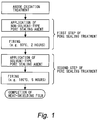
- Fig. 1 is a diagram illustrating the flow of the method for producing a heat-shielding film according to an embodiment of the present disclosure.
- an anode oxidation treatment of the part (hereinafter, referred to as a "combustion chamber part") constituting a combustion chamber of an engine is performed.
- the combustion chamber of an engine is defined as a space surrounded by the bore surface of the cylinder block, the top surface of a piston enclosed by the bore surface, the bottom surface of the cylinder head, and the bottom surfaces of the head parts of an intake valve and an exhaust valve provided in a prescribed location in the cylinder head.
- the combustion chamber part of the present embodiment includes at least one of the cylinder block, the cylinder head, the piston, the intake valve and the exhaust valve.
- the anode oxidation treatment is an electrolysis performed while an electrolyte solution (as an example, an aqueous solution of phosphoric acid, oxalic acid, sulfuric acid, or chromic acid) is being supplied to the surface of the combustion chamber part as an anode.
- an electrolyte solution as an example, an aqueous solution of phosphoric acid, oxalic acid, sulfuric acid, or chromic acid
- the electric current density and the energization time are regulated.
- the contact area of the electrolyte solution is restricted by using, for example, a masking agent in such a way that only a predetermined area of the surface of the combustion chamber part undergoes the formation of the anode oxide film.
- the base material of the combustion chamber part is, for example, an aluminum alloy, a magnesium alloy or a titanium alloy. Accordingly, when the anode oxidation treatment is performed, the oxide film of the alloy (namely, anode oxide film) is formed in the above-de
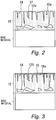
- Fig. 2 is a cross-sectional schematic diagram of an anode oxide film formed on the base material of a combustion chamber part.
- the anode oxide film 10 shown in Fig. 2 has innumerable open pores 12 having openings on the top surface 10a.
- the open pores 12 are formed in the course of the anode oxidation treatment.
- the presence of the open pores 12 allows the anode oxide film 10 to function as a heat-shielding film having a lower thermal conductivity and a lower volume heat capacity (meaning a heat capacity per unit volume; the same shall apply hereinafter) than those of the base material of the combustion chamber part.
- the anode oxide film 10 has also closed pores 14 in the interior thereof.
- the closed pores 14 are formed in the course of the anode oxidation treatment, and are originated from the additives (mainly, Si) for improving the mechanical properties of the combustion chamber part.
- the presence of the closed pores 14 allows the low volume heat capacity of the anode oxide film 10 to be actualized.
- the treatment (pore sealing treatment) for sealing the open pores 12 shown in Fig. 2 is performed.
- the pore sealing treatment is performed in order to enhance the heat-shielding property of the anode oxide film 10 by blocking at least the openings 12a of the open pores 12 close to the top surface 10a.
- the pore sealing treatment comprises a first step and a second step.
- a non-solvent-typed pore sealing agent first pore sealing agent
- the non-solvent-typed pore sealing agent includes an alkoxysilane compound represented by the following chemical formula (1) or a partially hydrolyzed condensate (oligomer) thereof: R 1 n Si(OR 2 ) 4-n (1)
- R 1 represents a substituted or unsubstituted monovalent hydrocarbon group having 1 to 8 carbon atoms
- R 2 represents an alkyl group having 1 to 4 carbon atoms
- n represents an integer of 0 to 3.
- the non-solvent-typed pore sealing agent may include, if necessary, a curing catalyst regulating the rate of the curing reaction, an inorganic pigment coloring the resulting pore sealing film and an inorganic additive(s).
- a curing catalyst regulating the rate of the curing reaction
- an inorganic pigment coloring the resulting pore sealing film and an inorganic additive(s).
- the curing catalyst, the inorganic pigment and the inorganic additive(s) are not particularly limited, and heretofore known products can be used.
- the curing catalyst examples include: organotin compounds such as dibutyltin dilaurate and dibutyltin diacetate; organotitanium compounds such as tetraisopropoxy titanium and tetra-n-butoxy titanium; organoaluminum compounds such as triisopropoxy aluminum and tri-n-butoxy aluminum; and organozirconium compounds such as tetra-n-butoxy zirconium and tetra-n-propoxy zirconium.
- organotin compounds such as dibutyltin dilaurate and dibutyltin diacetate
- organotitanium compounds such as tetraisopropoxy titanium and tetra-n-butoxy titanium
- organoaluminum compounds such as triisopropoxy aluminum and tri-n-butoxy aluminum
- organozirconium compounds such as tetra-n-butoxy zirconium and tetra-n-propoxy zirconium.
- Permeate (trade name) manufactured by D&D Corp. is quoted.
- Permeate is a non-solvent one-component pore sealing agent mainly composed of an alkoxysilane compound represented by the above-described chemical formula (1) or a partially hydrolyzed condensate thereof.
- the application method of the non-solvent-typed pore sealing agent is not particularly limited, and a heretofore known method can be used as the application method concerned.
- Examples of the heretofore known method include brush coating, spray coating, dip coating, float coating and spin coating. It is to be noted that the deposition of the pore sealing agent on the film surface during coating may unfortunately lead to the degradation of the surface roughness due to cracking or the increase of the volume heat capacity. Accordingly, when the solvent-typed pore sealing agent is deposited on the surface of the anode oxide film, the deposited pore sealing agent may be wiped off, for example, by using waste cloth after the application of the pore sealing agent.
- the firing of the non-solvent-typed pore sealing agent is performed.
- the firing conditions are such that the temperature is set at 80°C and the firing time is set at 2 hours. .
- the above-described alkoxysilane compound is polycondensed with itself
- the above-described partially hydrolyzed condensate is polycondensed with itself or the alkoxysilane compound and the partially hydrolyzed condensate are polycondensed with each other. Consequently, a silicon-based oxide film (first silicon-based oxide film) is formed on the top surface 10a shown in Fig. 2.
- FIG. 3 is a cross-sectional schematic diagram of an anode oxide film on which a first silicon-based oxide film is formed.
- the first silicon-based oxide film 16 is formed on the top surface 10a and the constitutional surface of the open pores 12. Consequently, most of the openings 12a are blocked by the first silicon-based oxide film 16.
- Fig. 3 depicts the deep portion 12b of an open pore 12 not blocked by the first silicon-based oxide film 16.
- the formation of such a deep portion 12b itself causes no problem, and rather, when such a deep portion 12b functions similarly to the closed pores 14, such a deep portion 12b contributes to a low volume heat capacity of the heat-shielding film.
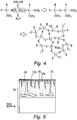
- Fig. 4 is a diagram schematically illustrating the reaction of alkoxysilane compounds.
- the alkoxysilane compound forms a network by reacting with water while releasing methanol (CH 3 OH).
- CH 3 OH methanol
- the alkoxysilane compound or the partially hydrolyzed condensate thereof reacts with the moisture in the atmosphere, and consequently, formed is the first silicon-based oxide film 16 composed of an inorganic polymer having -Si-O-Si-O- as the main chain.
- a solvent-typed pore sealing agent (second pore sealing agent) is applied to all the area of the top surface 16a of the first silicon-based oxide film 16 shown in Fig. 3 .
- the solvent-typed pore sealing agent includes perhydropolysilazane and/or organopolysilazane (as an example, polydimethyl silazane or poly (dimethyl-methyl) silazane) and an organic solvent.
- the solvent-typed pore sealing agent may include, if necessary, an additive(s). Examples of the additive include a leveling agent, a surfactant and a viscosity modifier.
- Aquamica (registered trademark) manufactured by AZ Electronic Materials Co., Ltd. is quoted.
- Aquamica is a product prepared by diluting perhydropolysilazane with an ethereal solvent such as dibutyl ether or anisole.
- the application method of the solvent-typed pore sealing agent is not particularly limited, and a heretofore known method can be used as the application method concerned.
- the solvent-typed pore sealing agent is deposited on the surface of the first silicon-based oxide film, the deposited pore sealing agent may be wiped off, for example, by using waste cloth after the application of the solvent-typed pore sealing agent.
- the firing of the solvent-typed pore sealing agent is performed.
- the firing conditions are such that the temperature is set at 180°C and the firing time is set at 5 hours.
- the above-described organic solvent evaporates, and at the same time, the polysilazane is polycondensed. Consequently, there is formed a silicon-based oxide film (second silicon-based oxide film) other than the first silicon-based oxide film 16 covering the top surface 16a shown in Fig. 3 .
- Fig. 5 is a cross-sectional schematic diagram of an anode oxide film on which a second silicon-based oxide film is formed. As shown in Fig. 5 , the second silicon-based oxide film 18 is formed on the top surface 16a.
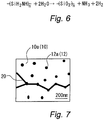
- Fig. 6 is a diagram schematically illustrating the reaction of perhydropolysilazane. As shown in Fig. 6 , perhydropolysilazane is converted into silica glass while reacting with water (H 2 O) and releasing ammonia (NH 3 ) and hydrogen (H 2 ). When above-described Aquamica is used as the solvent-typed pore sealing agent, perhydropolysilazane reacts with the moisture in the atmosphere, and consequently the second silicon-based oxide film 18 composed of silica glass is formed.
- a heat-shielding film is formed on the base material of the combustion chamber part.
- the anode oxide film 10 the first silicon-based oxide film 16 and the second silicon-based oxide film 18 shown in Fig. 5 correspond to the heat-shielding film obtained by the production method according to the present embodiment.
- Fig. 7 is a diagram schematically illustrating the top surface of the anode oxide film before the pore sealing treatment.
- innumerable openings 12a are dotted about on the top surface 10a.
- a crack opening 20 is formed on the top surface 10a.
- the crack opening 20 can be created in the course of the formation of the open pores 12.
- the size of the crack opening 20 is also varied, and the size of the crack opening 20 shown in Fig. 7 is larger than the maximum size of the openings 12a shown in the same figure.
- the second pore sealing agent is applied to the top surface 10a in advance of the application of the first pore sealing agent, it is impossible to completely block the openings 12a or the crack opening 20. This is because even when a solvent-typed pore sealing agent can be filled in all the openings 12a or all the crack openings 20 in the application step, the volume of the pore sealing agent is reduced by the amount of the organic solvent evaporated in the subsequent firing step. When the volume of the pore sealing agent is decreased, the openings 12a and the crack openings 20 incompletely blocked by the second silicon-based oxide film 16 remain.
- Fig. 8 is a diagram illustrating the problematic points in the case where the openings of the open pores or the crack openings are incompletely blocked. If the second pore sealing agent is applied to the top surface 10a in advance of the application of the first pore sealing agent, there is formed on the top surface 10a a silicon-based oxide film (a third silicon-based oxide film) which has the same composition as the second silicon-based film. However, for the reasons mentioned above, it is impossible to completely block all the openings 12a by the third silicon-based oxide film 22. Then, the combustion gas can invade into the incompletely blocked openings 12a.
- a silicon-based oxide film a third silicon-based oxide film
- the heat-shielding property due to the anode oxide film 10 or the followability to the working gas is degraded. Also, in the case of a gasoline engine, it is possible that the fuel invading into the incompletely blocked openings 12a does not contribute to the combustion and remains in the incompletely blocked openings 12a.
- the first step of the pore sealing treatment using a non-solvent-typed pore sealing agent is performed.
- the non-solvent-typed pore sealing agent is substantially free from the volume contraction in the application step or in the firing step. Consequently, all the openings 12a can be certainly blocked by the first silicon-based oxide film 16.
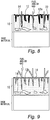
- Fig. 9 is a diagram illustrating the effects when the first silicon-based oxide film 16 is formed on the top surface 10a. As the arrows indicate in Fig. 9 , when all the openings 12a are blocked by the first silicon-based oxide film 16, the invasion of the combustion gas or the fuel can be blocked.
- the second silicon-based oxide film 18 shown in Fig. 5 is omitted in Fig. 9 .
- the invasion of the combustion gas or the fuel is assumed to be blocked when the second silicon-based oxide film 18 is formed on the first silicon-based oxide film 16.
- the inorganic polymer constituting the first silicon-based oxide film 16 includes hydrocarbon groups in the side chains thereof. Accordingly, the inorganic polymer tends to have a lower melting temperature as compared with an inorganic polymer having no hydrocarbon groups at all in the side chains thereof.
- above-described Permeate has a melting temperature as low as approximately 500°C, and has a low hardness. Consequently, when the top surface of the heat-shielding film is constituted with the first silicon-based oxide film 16, an apprehension remains with respect to the heat resistance and the hardness.
- the second step is performed subsequent to first step.
- the inorganic polymer constituting the second silicon-based oxide film 18 has a higher melting point and a sufficiently higher hardness as compared with the inorganic polymer constituting the first silicon-based oxide film 16.
- the above-described silica glass formed from perhydropolysilazane has a melting point as high as approximately 1000°C.
Landscapes
- Chemical & Material Sciences (AREA)
- Engineering & Computer Science (AREA)
- Chemical Kinetics & Catalysis (AREA)
- Electrochemistry (AREA)
- Materials Engineering (AREA)
- Metallurgy (AREA)
- Organic Chemistry (AREA)
- General Chemical & Material Sciences (AREA)
- Acoustics & Sound (AREA)
- Combustion & Propulsion (AREA)
- Mechanical Engineering (AREA)
- General Engineering & Computer Science (AREA)
- Physics & Mathematics (AREA)
- Cylinder Crankcases Of Internal Combustion Engines (AREA)
- Combustion Methods Of Internal-Combustion Engines (AREA)
- Pistons, Piston Rings, And Cylinders (AREA)
Abstract
Description
- The present application claims priority under 35 U.S.C. §119 to Japanese Patent Applications No.
2016-167045, filed on August 29, 2016 - The present disclosure relates to a method for producing a heat-shielding film, in particular, a method for producing a heat-shielding film provided on a constitutional surface of a combustion chamber of an engine.
- In general, when a cylinder head and a cylinder block are assembled together, a combustion chamber of an engine is defined as a space surrounded by the bore surface of the cylinder block, the top surface of a piston enclosed by the bore surface, the bottom surface of the cylinder head, and the bottom surfaces of the head parts of an intake valve and an exhaust valve provided in a prescribed location in the cylinder head. On the constitutional surface of such a combustion chamber, a heat-shielding film is sometimes provided, for the purpose of reducing the cooling loss in the engine, or protecting the engine from the heat generated by the combustion of fuel.
-
JP 2010-249008 A -
JP 2010-249008 A -
JP 2002-363539 A
R1 nSi(OR2)4-n (1)
- (In formula (1), R1 represents a substituted or unsubstituted monovalent hydrocarbon group having 1 to 8 carbon atoms, R2 represents an alkyl group having 1 to 4 carbon atoms and n represents an integer of 0 to 3.)
-
JP 2009-280716 A JP 2002-363539 A - Neither
JP 2002-363539A JP 2009-280716 A JP 2010-249008 A JP 2002-363539A JP 2009-280716 A - The present disclosure addresses the above-described problems, and an object of the present disclosure is to provide a production method capable of enhancing the heat resistance of the pore sealing film formed on the top surface of the anode oxide film.
- The present disclosure is a method for producing a heat-shielding film for achieving the above-described object, and comprises an anode oxidation step, a first pore sealing step and a second pore sealing step. The anode oxidation step is a step of forming an anode oxide film having a top surface provided with innumerable pores formed thereon, by the anode oxidation treatment of the part constituting the combustion chamber of an engine. The first pore sealing step is a step of forming a first silicon-based oxide film by applying, to the top surface of the anode oxide film, a non-solvent-type first pore sealing agent including an alkoxysilane compound represented by the following chemical formula (1) or a partially hydrolyzed condensate thereof, and by the polymerization of at least one of the alkoxysilane compound and the partially hydrolyzed condensate thereof:
R1 nSi(OR2)4-n (1)
- (In formula (1), R1 represents a substituted or unsubstituted monovalent hydrocarbon group having 1 to 8 carbon atoms, R2 represents an alkyl group having 1 to 4 carbon atoms and n represents an integer of 0 to 3.)
- The second pore sealing step is a step of forming a first silicon-based oxide film by applying, to the top surface of the first silicon-based oxide film, a solvent-typed second pore sealing agent including polysilazane and an organic solvent, and by the polymerization of the polysilazane involving the removal of the organic solvent of the second pore sealing agent.
- In the present disclosure, the polysilazane included in the second pore sealing agent may be perhydropolysilazane.
- According to the present disclosure, the top surface of the heat-shielding film can be constituted with the second silicon-based oxide film. The polymer constituting the second silicon-based oxide film is a polymer derived from polysilazane, and is excellent in heat resistance as compared with the polymer constituting the first silicon-based oxide film. Accordingly, as compared with the case where the top surface of the heat-shielding film is constituted with the first silicon-based oxide film, the heat resistance of the top surface concerned can be improved.
- In the present disclosure, when the polysilazane included in the second pore sealing agent is perhydropolysilazane, the top surface of the heat-shielding film can be constituted with a silica glass, and accordingly the heat resistance of the top surface concerned can be particularly improved.
-
-
Fig. 1 is a diagram illustrating the flow of the method for producing a heat-shielding film according to an embodiment of the present disclosure; -
Fig. 2 is a cross-sectional schematic diagram of an anode oxide film formed on the base material of a combustion chamber part; -
Fig. 3 is a cross-sectional schematic diagram of an anode oxide film on which a first silicon-based oxide film is formed; -
Fig. 4 is a diagram schematically illustrating the reaction of alkoxysilane compounds; -
Fig. 5 is a cross-sectional schematic diagram of an anode oxide film on which a second silicon-based oxide film is formed; -
Fig. 6 is a diagram schematically illustrating the reaction of perhydropolysilazane; -
Fig. 7 is a diagram schematically illustrating the top surface of an anode oxide film before a pore sealing treatment; -
Fig. 8 is a diagram illustrating the problematic points in the case where the openings of open pores or crack openings are incompletely blocked; and -
Fig. 9 is a diagram illustrating the effects when the first silicon-basedoxide film 16 is formed on thetop surface 10a. - Hereinafter, the embodiment of the present disclosure are described with reference to the accompanying drawings. It is to be noted that the common elements in the drawings are denoted by the same reference signs and the duplicate descriptions thereof are omitted. The present disclosure is not limited by the following embodiment.
-
Fig. 1 is a diagram illustrating the flow of the method for producing a heat-shielding film according to an embodiment of the present disclosure. In the production method according to the present embodiment, first, an anode oxidation treatment of the part (hereinafter, referred to as a "combustion chamber part") constituting a combustion chamber of an engine is performed. As already described, the combustion chamber of an engine is defined as a space surrounded by the bore surface of the cylinder block, the top surface of a piston enclosed by the bore surface, the bottom surface of the cylinder head, and the bottom surfaces of the head parts of an intake valve and an exhaust valve provided in a prescribed location in the cylinder head. The combustion chamber part of the present embodiment includes at least one of the cylinder block, the cylinder head, the piston, the intake valve and the exhaust valve. - The anode oxidation treatment is an electrolysis performed while an electrolyte solution (as an example, an aqueous solution of phosphoric acid, oxalic acid, sulfuric acid, or chromic acid) is being supplied to the surface of the combustion chamber part as an anode. During the electrolysis, the electric current density and the energization time are regulated. During the electrolysis, the contact area of the electrolyte solution is restricted by using, for example, a masking agent in such a way that only a predetermined area of the surface of the combustion chamber part undergoes the formation of the anode oxide film. The base material of the combustion chamber part is, for example, an aluminum alloy, a magnesium alloy or a titanium alloy. Accordingly, when the anode oxidation treatment is performed, the oxide film of the alloy (namely, anode oxide film) is formed in the above-described predetermined area.
-
Fig. 2 is a cross-sectional schematic diagram of an anode oxide film formed on the base material of a combustion chamber part. Theanode oxide film 10 shown inFig. 2 has innumerableopen pores 12 having openings on thetop surface 10a. The open pores 12 are formed in the course of the anode oxidation treatment. The presence of theopen pores 12 allows theanode oxide film 10 to function as a heat-shielding film having a lower thermal conductivity and a lower volume heat capacity (meaning a heat capacity per unit volume; the same shall apply hereinafter) than those of the base material of the combustion chamber part. Theanode oxide film 10 has also closedpores 14 in the interior thereof. The closed pores 14 are formed in the course of the anode oxidation treatment, and are originated from the additives (mainly, Si) for improving the mechanical properties of the combustion chamber part. The presence of theclosed pores 14 allows the low volume heat capacity of theanode oxide film 10 to be actualized. - In the production method according to the present embodiment, successively, the treatment (pore sealing treatment) for sealing the
open pores 12 shown inFig. 2 is performed. The pore sealing treatment is performed in order to enhance the heat-shielding property of theanode oxide film 10 by blocking at least theopenings 12a of theopen pores 12 close to thetop surface 10a. The pore sealing treatment comprises a first step and a second step. In the first step of the pore sealing treatment, first, a non-solvent-typed pore sealing agent (first pore sealing agent) is applied to all the area of thetop surface 10a shown inFig. 2 . The non-solvent-typed pore sealing agent includes an alkoxysilane compound represented by the following chemical formula (1) or a partially hydrolyzed condensate (oligomer) thereof:
R1 nSi(OR2)4-n (1)
- (In formula (1), R1 represents a substituted or unsubstituted monovalent hydrocarbon group having 1 to 8 carbon atoms, R2 represents an alkyl group having 1 to 4 carbon atoms and n represents an integer of 0 to 3.)
- The non-solvent-typed pore sealing agent may include, if necessary, a curing catalyst regulating the rate of the curing reaction, an inorganic pigment coloring the resulting pore sealing film and an inorganic additive(s). The curing catalyst, the inorganic pigment and the inorganic additive(s) are not particularly limited, and heretofore known products can be used. Examples of the curing catalyst include: organotin compounds such as dibutyltin dilaurate and dibutyltin diacetate; organotitanium compounds such as tetraisopropoxy titanium and tetra-n-butoxy titanium; organoaluminum compounds such as triisopropoxy aluminum and tri-n-butoxy aluminum; and organozirconium compounds such as tetra-n-butoxy zirconium and tetra-n-propoxy zirconium. Examples of the inorganic pigment include a metal, an alloy, and the oxide, hydroxide, carbide, sulfide and nitride of these metal and alloy. Examples of the additive include a gloss modifier and a viscosity modifier.
- As an example of the non-solvent-typed pore sealing agent, Permeate (trade name) manufactured by D&D Corp. is quoted. Permeate is a non-solvent one-component pore sealing agent mainly composed of an alkoxysilane compound represented by the above-described chemical formula (1) or a partially hydrolyzed condensate thereof.
- The application method of the non-solvent-typed pore sealing agent is not particularly limited, and a heretofore known method can be used as the application method concerned. Examples of the heretofore known method include brush coating, spray coating, dip coating, float coating and spin coating. It is to be noted that the deposition of the pore sealing agent on the film surface during coating may unfortunately lead to the degradation of the surface roughness due to cracking or the increase of the volume heat capacity. Accordingly, when the solvent-typed pore sealing agent is deposited on the surface of the anode oxide film, the deposited pore sealing agent may be wiped off, for example, by using waste cloth after the application of the pore sealing agent.
- In the first step of the pore sealing treatment, successively, the firing of the non-solvent-typed pore sealing agent is performed. For example, the firing conditions are such that the temperature is set at 80°C and the firing time is set at 2 hours. . By performing the firing of the non-solvent-typed pore sealing agent, the above-described alkoxysilane compound is polycondensed with itself, the above-described partially hydrolyzed condensate is polycondensed with itself or the alkoxysilane compound and the partially hydrolyzed condensate are polycondensed with each other. Consequently, a silicon-based oxide film (first silicon-based oxide film) is formed on the
top surface 10a shown inFig. 2. Fig. 3 is a cross-sectional schematic diagram of an anode oxide film on which a first silicon-based oxide film is formed. As shown inFig. 3 , the first silicon-basedoxide film 16 is formed on thetop surface 10a and the constitutional surface of the open pores 12. Consequently, most of theopenings 12a are blocked by the first silicon-basedoxide film 16. It is to be noted thatFig. 3 depicts thedeep portion 12b of anopen pore 12 not blocked by the first silicon-basedoxide film 16. However, the formation of such adeep portion 12b itself causes no problem, and rather, when such adeep portion 12b functions similarly to theclosed pores 14, such adeep portion 12b contributes to a low volume heat capacity of the heat-shielding film. -
Fig. 4 is a diagram schematically illustrating the reaction of alkoxysilane compounds. As shown inFig. 4 , the alkoxysilane compound forms a network by reacting with water while releasing methanol (CH3OH). When above-described Permeate is used as the non-solvent-typed pore sealing agent, the alkoxysilane compound or the partially hydrolyzed condensate thereof reacts with the moisture in the atmosphere, and consequently, formed is the first silicon-basedoxide film 16 composed of an inorganic polymer having -Si-O-Si-O- as the main chain. - In the second step of the pore sealing treatment, first, a solvent-typed pore sealing agent (second pore sealing agent) is applied to all the area of the
top surface 16a of the first silicon-basedoxide film 16 shown inFig. 3 . The solvent-typed pore sealing agent includes perhydropolysilazane and/or organopolysilazane (as an example, polydimethyl silazane or poly (dimethyl-methyl) silazane) and an organic solvent. The solvent-typed pore sealing agent may include, if necessary, an additive(s). Examples of the additive include a leveling agent, a surfactant and a viscosity modifier. - As an example of the solvent-typed pore sealing agent, Aquamica (registered trademark) manufactured by AZ Electronic Materials Co., Ltd. is quoted. Aquamica is a product prepared by diluting perhydropolysilazane with an ethereal solvent such as dibutyl ether or anisole.
- Similarly to the above-described non-solvent-typed pore sealing agent, the application method of the solvent-typed pore sealing agent is not particularly limited, and a heretofore known method can be used as the application method concerned. In addition, when the solvent-typed pore sealing agent is deposited on the surface of the first silicon-based oxide film, the deposited pore sealing agent may be wiped off, for example, by using waste cloth after the application of the solvent-typed pore sealing agent.
- In the second step of the pore sealing treatment, successively, the firing of the solvent-typed pore sealing agent is performed. For example, the firing conditions are such that the temperature is set at 180°C and the firing time is set at 5 hours. By performing the firing of the solvent-typed pore sealing agent, the above-described organic solvent evaporates, and at the same time, the polysilazane is polycondensed. Consequently, there is formed a silicon-based oxide film (second silicon-based oxide film) other than the first silicon-based
oxide film 16 covering thetop surface 16a shown inFig. 3 .Fig. 5 is a cross-sectional schematic diagram of an anode oxide film on which a second silicon-based oxide film is formed. As shown inFig. 5 , the second silicon-basedoxide film 18 is formed on thetop surface 16a. -
Fig. 6 is a diagram schematically illustrating the reaction of perhydropolysilazane. As shown inFig. 6 , perhydropolysilazane is converted into silica glass while reacting with water (H2O) and releasing ammonia (NH3) and hydrogen (H2). When above-described Aquamica is used as the solvent-typed pore sealing agent, perhydropolysilazane reacts with the moisture in the atmosphere, and consequently the second silicon-basedoxide film 18 composed of silica glass is formed. - Due to the above-described anode oxidation treatment and the above-described pore sealing treatment, a heat-shielding film is formed on the base material of the combustion chamber part. By the way, the
anode oxide film 10, the first silicon-basedoxide film 16 and the second silicon-basedoxide film 18 shown inFig. 5 correspond to the heat-shielding film obtained by the production method according to the present embodiment. - First, the effects according to the first step of the above-described pore sealing treatment is described with reference to
Fig. 7. Fig. 7 is a diagram schematically illustrating the top surface of the anode oxide film before the pore sealing treatment. As shown inFig. 7 ,innumerable openings 12a are dotted about on thetop surface 10a. When theseopenings 12a are compared with each other, it is found that there are differences in the sizes thereof. As shown inFig. 7 , acrack opening 20 is formed on thetop surface 10a. Thecrack opening 20 can be created in the course of the formation of the open pores 12. Similarly to the sizes of theopenings 12a, the size of thecrack opening 20 is also varied, and the size of the crack opening 20 shown inFig. 7 is larger than the maximum size of theopenings 12a shown in the same figure. - When the sizes of the
openings 12a are large, or when thecrack opening 20 is formed, if the second pore sealing agent is applied to thetop surface 10a in advance of the application of the first pore sealing agent, it is impossible to completely block theopenings 12a or thecrack opening 20. This is because even when a solvent-typed pore sealing agent can be filled in all theopenings 12a or all thecrack openings 20 in the application step, the volume of the pore sealing agent is reduced by the amount of the organic solvent evaporated in the subsequent firing step. When the volume of the pore sealing agent is decreased, theopenings 12a and thecrack openings 20 incompletely blocked by the second silicon-basedoxide film 16 remain. -
Fig. 8 is a diagram illustrating the problematic points in the case where the openings of the open pores or the crack openings are incompletely blocked. If the second pore sealing agent is applied to thetop surface 10a in advance of the application of the first pore sealing agent, there is formed on thetop surface 10a a silicon-based oxide film (a third silicon-based oxide film) which has the same composition as the second silicon-based film. However, for the reasons mentioned above, it is impossible to completely block all theopenings 12a by the third silicon-basedoxide film 22. Then, the combustion gas can invade into the incompletely blockedopenings 12a. Accordingly, as compared with the case where theopenings 12a are completely blocked, the heat-shielding property due to theanode oxide film 10 or the followability to the working gas is degraded. Also, in the case of a gasoline engine, it is possible that the fuel invading into the incompletely blockedopenings 12a does not contribute to the combustion and remains in the incompletely blockedopenings 12a. - With respect to this point, in the production method according to the present embodiment, the first step of the pore sealing treatment using a non-solvent-typed pore sealing agent is performed. In contrast to the solvent-typed pore sealing agent, the non-solvent-typed pore sealing agent is substantially free from the volume contraction in the application step or in the firing step. Consequently, all the
openings 12a can be certainly blocked by the first silicon-basedoxide film 16.Fig. 9 is a diagram illustrating the effects when the first silicon-basedoxide film 16 is formed on thetop surface 10a. As the arrows indicate inFig. 9 , when all theopenings 12a are blocked by the first silicon-basedoxide film 16, the invasion of the combustion gas or the fuel can be blocked. It is noted that the second silicon-basedoxide film 18 shown inFig. 5 is omitted inFig. 9 . However, since all theopenings 12a are blocked by the first silicon-basedoxide film 16, the invasion of the combustion gas or the fuel is assumed to be blocked when the second silicon-basedoxide film 18 is formed on the first silicon-basedoxide film 16. - Next, the effects according to the second step of the above-described pore sealing treatment is described. As can be seen from
Fig. 4 , the inorganic polymer constituting the first silicon-basedoxide film 16 includes hydrocarbon groups in the side chains thereof. Accordingly, the inorganic polymer tends to have a lower melting temperature as compared with an inorganic polymer having no hydrocarbon groups at all in the side chains thereof. In fact, above-described Permeate has a melting temperature as low as approximately 500°C, and has a low hardness. Consequently, when the top surface of the heat-shielding film is constituted with the first silicon-basedoxide film 16, an apprehension remains with respect to the heat resistance and the hardness. - From this aspect, in the production method according to the present embodiment, the second step is performed subsequent to first step. The inorganic polymer constituting the second silicon-based
oxide film 18 has a higher melting point and a sufficiently higher hardness as compared with the inorganic polymer constituting the first silicon-basedoxide film 16. In particular, the above-described silica glass formed from perhydropolysilazane has a melting point as high as approximately 1000°C. In this way, according to the production method according to the present embodiment, by the second step forming the second silicon-basedoxide film 18, it is possible to obtain a heat-shielding film having a high real machine durability, and being enhanced in the heat resistance and the hardness of the top surface of the heat-shielding film.
Claims (2)
- A method for producing a heat-shielding film comprising the steps of:forming an anode oxide film (10) having a top surface (10a) provided with innumerable pores (12) formed thereon, by the anode oxidation treatment of the part constituting the combustion chamber of an engine;forming a first silicon-based oxide film (16) by applying, to the top surface (10a) of the anode oxide film (10), a non-solvent-typed first pore sealing agent including an alkoxysilane compound represented by the following chemical formula (1) or a partially hydrolyzed condensate thereof, and by the polymerization of at least one of the alkoxysilane compound and the partially hydrolyzed condensate thereof; andforming a second silicon-based oxide film (18) by applying, to the top surface (16a) of the first silicon-based oxide film (16), a solvent-typed second pore sealing agent including polysilazane and an organic solvent, and by the polymerization of the polysilazane involving the removal of the organic solvent of the first pore sealing agent.
R1 nSi(OR2)4-n (1)
(In formula (1), R1 represents a substituted or unsubstituted monovalent hydrocarbon group having 1 to 8 carbon atoms, R2 represents an alkyl group having 1 to 4 carbon atoms and n represents an integer of 0 to 3.) - The method for producing a heat-shielding film according to claim 1, wherein the polysilazane included in the second pore sealing agent is perhydropolysilazane.
Applications Claiming Priority (1)
| Application Number | Priority Date | Filing Date | Title |
|---|---|---|---|
| JP2016167045A JP6465086B2 (en) | 2016-08-29 | 2016-08-29 | Manufacturing method of thermal barrier film |
Publications (2)
| Publication Number | Publication Date |
|---|---|
| EP3290547A1 true EP3290547A1 (en) | 2018-03-07 |
| EP3290547B1 EP3290547B1 (en) | 2019-03-27 |
Family
ID=59901327
Family Applications (1)
| Application Number | Title | Priority Date | Filing Date |
|---|---|---|---|
| EP17188398.6A Not-in-force EP3290547B1 (en) | 2016-08-29 | 2017-08-29 | Method for producing heat-shielding film |
Country Status (3)
| Country | Link |
|---|---|
| US (1) | US20180057954A1 (en) |
| EP (1) | EP3290547B1 (en) |
| JP (1) | JP6465086B2 (en) |
Cited By (1)
| Publication number | Priority date | Publication date | Assignee | Title |
|---|---|---|---|---|
| EP3933186A1 (en) * | 2020-07-03 | 2022-01-05 | MAHLE International GmbH | Combustion engine and piston for a combustion engine |
Families Citing this family (8)
| Publication number | Priority date | Publication date | Assignee | Title |
|---|---|---|---|---|
| JP6729233B2 (en) * | 2016-09-20 | 2020-07-22 | 日本軽金属株式会社 | Pellicle support frame, pellicle, and manufacturing method thereof |
| JP6525019B2 (en) * | 2017-03-03 | 2019-06-05 | トヨタ自動車株式会社 | Engine manufacturing method |
| JP7084234B2 (en) * | 2018-07-04 | 2022-06-14 | トヨタ自動車株式会社 | Internal combustion engine |
| CN111020667B (en) * | 2019-12-31 | 2021-03-12 | 佛山市南海双成金属表面技术有限公司 | A kind of method and sealing agent of anodic oxide film pre-sealing |
| JP7396173B2 (en) * | 2020-04-01 | 2023-12-12 | マツダ株式会社 | Engine combustion chamber structure |
| JP2022072859A (en) * | 2020-10-30 | 2022-05-17 | スズキ株式会社 | Piston for internal combustion engine, and its manufacturing method |
| JP7578912B2 (en) * | 2021-03-18 | 2024-11-07 | スズキ株式会社 | Piston for internal combustion engine and manufacturing method thereof |
| CN117885455B (en) * | 2023-12-18 | 2024-09-27 | 建民五金科技(东莞)有限公司 | Metal surface full-color pattern transfer printing method |
Citations (5)
| Publication number | Priority date | Publication date | Assignee | Title |
|---|---|---|---|---|
| JP2002363539A (en) | 2001-06-07 | 2002-12-18 | Chuo Rika Kogyo Corp | Pore sealing agent |
| JP2009280716A (en) | 2008-05-23 | 2009-12-03 | D & D:Kk | Solventless, one-pack and normal-temperature curing impregnation material |
| JP2010249008A (en) | 2009-04-15 | 2010-11-04 | Toyota Motor Corp | Engine combustion chamber structure |
| WO2013038249A2 (en) * | 2011-09-12 | 2013-03-21 | Toyota Jidosha Kabushiki Kaisha | Internal combustion engine and method for manufacturing the same |
| US20160130716A1 (en) * | 2014-11-07 | 2016-05-12 | Kabushiki Kaisha Toyota Chuo Kenkyusho | Forming method of thermal insulation film |
Family Cites Families (7)
| Publication number | Priority date | Publication date | Assignee | Title |
|---|---|---|---|---|
| JPH06316787A (en) * | 1993-04-28 | 1994-11-15 | Kojundo Chem Lab Co Ltd | Treatment of surface of anodized alminum layer |
| JP2001172795A (en) * | 1999-12-14 | 2001-06-26 | Ulvac Kyushu Corp | Aluminum composite and method for surface-treating aluminum composite |
| JP2011184719A (en) * | 2010-03-05 | 2011-09-22 | Shin Etsu Handotai Co Ltd | Corrosion resistant member, vapor deposition device, vapor deposition method, and coating method |
| JP6065388B2 (en) * | 2012-03-07 | 2017-01-25 | マツダ株式会社 | Thermal insulation film structure and manufacturing method thereof |
| JP5913227B2 (en) * | 2013-08-05 | 2016-04-27 | トヨタ自動車株式会社 | Internal combustion engine and manufacturing method thereof |
| JP6269297B2 (en) * | 2014-04-25 | 2018-01-31 | トヨタ自動車株式会社 | Piston top surface coating method |
| JP6178303B2 (en) * | 2014-12-26 | 2017-08-09 | トヨタ自動車株式会社 | Internal combustion engine |
-
2016
- 2016-08-29 JP JP2016167045A patent/JP6465086B2/en not_active Expired - Fee Related
-
2017
- 2017-07-18 US US15/652,525 patent/US20180057954A1/en not_active Abandoned
- 2017-08-29 EP EP17188398.6A patent/EP3290547B1/en not_active Not-in-force
Patent Citations (5)
| Publication number | Priority date | Publication date | Assignee | Title |
|---|---|---|---|---|
| JP2002363539A (en) | 2001-06-07 | 2002-12-18 | Chuo Rika Kogyo Corp | Pore sealing agent |
| JP2009280716A (en) | 2008-05-23 | 2009-12-03 | D & D:Kk | Solventless, one-pack and normal-temperature curing impregnation material |
| JP2010249008A (en) | 2009-04-15 | 2010-11-04 | Toyota Motor Corp | Engine combustion chamber structure |
| WO2013038249A2 (en) * | 2011-09-12 | 2013-03-21 | Toyota Jidosha Kabushiki Kaisha | Internal combustion engine and method for manufacturing the same |
| US20160130716A1 (en) * | 2014-11-07 | 2016-05-12 | Kabushiki Kaisha Toyota Chuo Kenkyusho | Forming method of thermal insulation film |
Cited By (1)
| Publication number | Priority date | Publication date | Assignee | Title |
|---|---|---|---|---|
| EP3933186A1 (en) * | 2020-07-03 | 2022-01-05 | MAHLE International GmbH | Combustion engine and piston for a combustion engine |
Also Published As
| Publication number | Publication date |
|---|---|
| JP6465086B2 (en) | 2019-02-06 |
| JP2018035688A (en) | 2018-03-08 |
| EP3290547B1 (en) | 2019-03-27 |
| US20180057954A1 (en) | 2018-03-01 |
Similar Documents
| Publication | Publication Date | Title |
|---|---|---|
| EP3290547B1 (en) | Method for producing heat-shielding film | |
| EP3290548B1 (en) | Method for producing heat-shielding film | |
| US9359946B2 (en) | Internal combustion engine and method for manufacturing the same | |
| US9653193B2 (en) | Coating method and coating for a bearing component | |
| US20200025324A1 (en) | Process for producing aerogel composite, aerogel composite, and heat-insulated object | |
| JP2020519802A (en) | Thermally insulating coating for aluminum pistons | |
| US20200255672A1 (en) | Manufacturing method for porous thermal insulation coating layer, porous thermal insulation coating layer and internal combustion engine using the same | |
| KR101287146B1 (en) | A Bead, A Mold, A Product manufactured by A Mold, A Bead Manufacturing Method and A Mold Manufacturing Method by Dual-coating Process | |
| CN108350316A (en) | Protective layer against oxidation of pistons of internal combustion engines | |
| KR101298840B1 (en) | A Mold and A Mold Manufacturing Method | |
| CN118475731B (en) | Method for forming a cathodic protection coating on a turbine component | |
| JP2005015835A (en) | Corrosion prevention method for metal sprayed surface | |
| JPH1068086A (en) | Sealing agent for thermal sprayed coating and sealing method | |
| JP4071091B2 (en) | Corrosion-resistant film forming method and use thereof | |
| PL241261B1 (en) | A method of obtaining a hybrid coating on a magnesium alloy and a hybrid coating on a magnesium alloy | |
| GB2344773A (en) | Gasket coating | |
| KR20120084361A (en) | A mold and a mold manufacturing method by dual-coating process | |
| TW201800612A (en) | Aluminum substrate for magnetic recording medium, and method for manufacturing same | |
| TW201938379A (en) | Method for producing aerogel composite, aerogel composite and insulated body including a coating liquid infiltration step and a solvent removing step |
Legal Events
| Date | Code | Title | Description |
|---|---|---|---|
| PUAI | Public reference made under article 153(3) epc to a published international application that has entered the european phase |
Free format text: ORIGINAL CODE: 0009012 |
|
| STAA | Information on the status of an ep patent application or granted ep patent |
Free format text: STATUS: REQUEST FOR EXAMINATION WAS MADE |
|
| 17P | Request for examination filed |
Effective date: 20170929 |
|
| AK | Designated contracting states |
Kind code of ref document: A1 Designated state(s): AL AT BE BG CH CY CZ DE DK EE ES FI FR GB GR HR HU IE IS IT LI LT LU LV MC MK MT NL NO PL PT RO RS SE SI SK SM TR |
|
| AX | Request for extension of the european patent |
Extension state: BA ME |
|
| GRAP | Despatch of communication of intention to grant a patent |
Free format text: ORIGINAL CODE: EPIDOSNIGR1 |
|
| STAA | Information on the status of an ep patent application or granted ep patent |
Free format text: STATUS: GRANT OF PATENT IS INTENDED |
|
| RIC1 | Information provided on ipc code assigned before grant |
Ipc: C25D 11/26 20060101ALN20180927BHEP Ipc: C25D 11/24 20060101AFI20180927BHEP Ipc: C25D 11/30 20060101ALN20180927BHEP |
|
| INTG | Intention to grant announced |
Effective date: 20181012 |
|
| RIC1 | Information provided on ipc code assigned before grant |
Ipc: C25D 11/26 20060101ALN20181003BHEP Ipc: C25D 11/24 20060101AFI20181003BHEP Ipc: C25D 11/30 20060101ALN20181003BHEP |
|
| GRAS | Grant fee paid |
Free format text: ORIGINAL CODE: EPIDOSNIGR3 |
|
| GRAA | (expected) grant |
Free format text: ORIGINAL CODE: 0009210 |
|
| STAA | Information on the status of an ep patent application or granted ep patent |
Free format text: STATUS: THE PATENT HAS BEEN GRANTED |
|
| AK | Designated contracting states |
Kind code of ref document: B1 Designated state(s): AL AT BE BG CH CY CZ DE DK EE ES FI FR GB GR HR HU IE IS IT LI LT LU LV MC MK MT NL NO PL PT RO RS SE SI SK SM TR |
|
| REG | Reference to a national code |
Ref country code: GB Ref legal event code: FG4D |
|
| REG | Reference to a national code |
Ref country code: CH Ref legal event code: EP |
|
| REG | Reference to a national code |
Ref country code: AT Ref legal event code: REF Ref document number: 1113203 Country of ref document: AT Kind code of ref document: T Effective date: 20190415 |
|
| REG | Reference to a national code |
Ref country code: IE Ref legal event code: FG4D |
|
| REG | Reference to a national code |
Ref country code: DE Ref legal event code: R096 Ref document number: 602017002941 Country of ref document: DE |
|
| REG | Reference to a national code |
Ref country code: DE Ref legal event code: R084 Ref document number: 602017002941 Country of ref document: DE |
|
| REG | Reference to a national code |
Ref country code: GB Ref legal event code: 746 Effective date: 20190530 |
|
| PG25 | Lapsed in a contracting state [announced via postgrant information from national office to epo] |
Ref country code: FI Free format text: LAPSE BECAUSE OF FAILURE TO SUBMIT A TRANSLATION OF THE DESCRIPTION OR TO PAY THE FEE WITHIN THE PRESCRIBED TIME-LIMIT Effective date: 20190327 Ref country code: NO Free format text: LAPSE BECAUSE OF FAILURE TO SUBMIT A TRANSLATION OF THE DESCRIPTION OR TO PAY THE FEE WITHIN THE PRESCRIBED TIME-LIMIT Effective date: 20190627 Ref country code: SE Free format text: LAPSE BECAUSE OF FAILURE TO SUBMIT A TRANSLATION OF THE DESCRIPTION OR TO PAY THE FEE WITHIN THE PRESCRIBED TIME-LIMIT Effective date: 20190327 Ref country code: LT Free format text: LAPSE BECAUSE OF FAILURE TO SUBMIT A TRANSLATION OF THE DESCRIPTION OR TO PAY THE FEE WITHIN THE PRESCRIBED TIME-LIMIT Effective date: 20190327 |
|
| REG | Reference to a national code |
Ref country code: NL Ref legal event code: MP Effective date: 20190327 |
|
| PG25 | Lapsed in a contracting state [announced via postgrant information from national office to epo] |
Ref country code: GR Free format text: LAPSE BECAUSE OF FAILURE TO SUBMIT A TRANSLATION OF THE DESCRIPTION OR TO PAY THE FEE WITHIN THE PRESCRIBED TIME-LIMIT Effective date: 20190628 Ref country code: BG Free format text: LAPSE BECAUSE OF FAILURE TO SUBMIT A TRANSLATION OF THE DESCRIPTION OR TO PAY THE FEE WITHIN THE PRESCRIBED TIME-LIMIT Effective date: 20190627 Ref country code: HR Free format text: LAPSE BECAUSE OF FAILURE TO SUBMIT A TRANSLATION OF THE DESCRIPTION OR TO PAY THE FEE WITHIN THE PRESCRIBED TIME-LIMIT Effective date: 20190327 Ref country code: LV Free format text: LAPSE BECAUSE OF FAILURE TO SUBMIT A TRANSLATION OF THE DESCRIPTION OR TO PAY THE FEE WITHIN THE PRESCRIBED TIME-LIMIT Effective date: 20190327 Ref country code: NL Free format text: LAPSE BECAUSE OF FAILURE TO SUBMIT A TRANSLATION OF THE DESCRIPTION OR TO PAY THE FEE WITHIN THE PRESCRIBED TIME-LIMIT Effective date: 20190327 Ref country code: RS Free format text: LAPSE BECAUSE OF FAILURE TO SUBMIT A TRANSLATION OF THE DESCRIPTION OR TO PAY THE FEE WITHIN THE PRESCRIBED TIME-LIMIT Effective date: 20190327 |
|
| REG | Reference to a national code |
Ref country code: AT Ref legal event code: MK05 Ref document number: 1113203 Country of ref document: AT Kind code of ref document: T Effective date: 20190327 |
|
| PG25 | Lapsed in a contracting state [announced via postgrant information from national office to epo] |
Ref country code: IT Free format text: LAPSE BECAUSE OF FAILURE TO SUBMIT A TRANSLATION OF THE DESCRIPTION OR TO PAY THE FEE WITHIN THE PRESCRIBED TIME-LIMIT Effective date: 20190327 Ref country code: EE Free format text: LAPSE BECAUSE OF FAILURE TO SUBMIT A TRANSLATION OF THE DESCRIPTION OR TO PAY THE FEE WITHIN THE PRESCRIBED TIME-LIMIT Effective date: 20190327 Ref country code: CZ Free format text: LAPSE BECAUSE OF FAILURE TO SUBMIT A TRANSLATION OF THE DESCRIPTION OR TO PAY THE FEE WITHIN THE PRESCRIBED TIME-LIMIT Effective date: 20190327 Ref country code: RO Free format text: LAPSE BECAUSE OF FAILURE TO SUBMIT A TRANSLATION OF THE DESCRIPTION OR TO PAY THE FEE WITHIN THE PRESCRIBED TIME-LIMIT Effective date: 20190327 Ref country code: ES Free format text: LAPSE BECAUSE OF FAILURE TO SUBMIT A TRANSLATION OF THE DESCRIPTION OR TO PAY THE FEE WITHIN THE PRESCRIBED TIME-LIMIT Effective date: 20190327 Ref country code: PT Free format text: LAPSE BECAUSE OF FAILURE TO SUBMIT A TRANSLATION OF THE DESCRIPTION OR TO PAY THE FEE WITHIN THE PRESCRIBED TIME-LIMIT Effective date: 20190727 Ref country code: SK Free format text: LAPSE BECAUSE OF FAILURE TO SUBMIT A TRANSLATION OF THE DESCRIPTION OR TO PAY THE FEE WITHIN THE PRESCRIBED TIME-LIMIT Effective date: 20190327 Ref country code: AL Free format text: LAPSE BECAUSE OF FAILURE TO SUBMIT A TRANSLATION OF THE DESCRIPTION OR TO PAY THE FEE WITHIN THE PRESCRIBED TIME-LIMIT Effective date: 20190327 |
|
| PG25 | Lapsed in a contracting state [announced via postgrant information from national office to epo] |
Ref country code: PL Free format text: LAPSE BECAUSE OF FAILURE TO SUBMIT A TRANSLATION OF THE DESCRIPTION OR TO PAY THE FEE WITHIN THE PRESCRIBED TIME-LIMIT Effective date: 20190327 Ref country code: SM Free format text: LAPSE BECAUSE OF FAILURE TO SUBMIT A TRANSLATION OF THE DESCRIPTION OR TO PAY THE FEE WITHIN THE PRESCRIBED TIME-LIMIT Effective date: 20190327 |
|
| PG25 | Lapsed in a contracting state [announced via postgrant information from national office to epo] |
Ref country code: AT Free format text: LAPSE BECAUSE OF FAILURE TO SUBMIT A TRANSLATION OF THE DESCRIPTION OR TO PAY THE FEE WITHIN THE PRESCRIBED TIME-LIMIT Effective date: 20190327 Ref country code: IS Free format text: LAPSE BECAUSE OF FAILURE TO SUBMIT A TRANSLATION OF THE DESCRIPTION OR TO PAY THE FEE WITHIN THE PRESCRIBED TIME-LIMIT Effective date: 20190727 |
|
| REG | Reference to a national code |
Ref country code: DE Ref legal event code: R097 Ref document number: 602017002941 Country of ref document: DE |
|
| PG25 | Lapsed in a contracting state [announced via postgrant information from national office to epo] |
Ref country code: DK Free format text: LAPSE BECAUSE OF FAILURE TO SUBMIT A TRANSLATION OF THE DESCRIPTION OR TO PAY THE FEE WITHIN THE PRESCRIBED TIME-LIMIT Effective date: 20190327 |
|
| PLBE | No opposition filed within time limit |
Free format text: ORIGINAL CODE: 0009261 |
|
| STAA | Information on the status of an ep patent application or granted ep patent |
Free format text: STATUS: NO OPPOSITION FILED WITHIN TIME LIMIT |
|
| PG25 | Lapsed in a contracting state [announced via postgrant information from national office to epo] |
Ref country code: SI Free format text: LAPSE BECAUSE OF FAILURE TO SUBMIT A TRANSLATION OF THE DESCRIPTION OR TO PAY THE FEE WITHIN THE PRESCRIBED TIME-LIMIT Effective date: 20190327 |
|
| 26N | No opposition filed |
Effective date: 20200103 |
|
| PG25 | Lapsed in a contracting state [announced via postgrant information from national office to epo] |
Ref country code: TR Free format text: LAPSE BECAUSE OF FAILURE TO SUBMIT A TRANSLATION OF THE DESCRIPTION OR TO PAY THE FEE WITHIN THE PRESCRIBED TIME-LIMIT Effective date: 20190327 |
|
| PG25 | Lapsed in a contracting state [announced via postgrant information from national office to epo] |
Ref country code: MC Free format text: LAPSE BECAUSE OF FAILURE TO SUBMIT A TRANSLATION OF THE DESCRIPTION OR TO PAY THE FEE WITHIN THE PRESCRIBED TIME-LIMIT Effective date: 20190327 Ref country code: LU Free format text: LAPSE BECAUSE OF NON-PAYMENT OF DUE FEES Effective date: 20190829 |
|
| REG | Reference to a national code |
Ref country code: BE Ref legal event code: MM Effective date: 20190831 |
|
| PG25 | Lapsed in a contracting state [announced via postgrant information from national office to epo] |
Ref country code: IE Free format text: LAPSE BECAUSE OF NON-PAYMENT OF DUE FEES Effective date: 20190829 |
|
| PG25 | Lapsed in a contracting state [announced via postgrant information from national office to epo] |
Ref country code: BE Free format text: LAPSE BECAUSE OF NON-PAYMENT OF DUE FEES Effective date: 20190831 |
|
| REG | Reference to a national code |
Ref country code: CH Ref legal event code: PL |
|
| PG25 | Lapsed in a contracting state [announced via postgrant information from national office to epo] |
Ref country code: LI Free format text: LAPSE BECAUSE OF NON-PAYMENT OF DUE FEES Effective date: 20200831 Ref country code: CH Free format text: LAPSE BECAUSE OF NON-PAYMENT OF DUE FEES Effective date: 20200831 |
|
| PG25 | Lapsed in a contracting state [announced via postgrant information from national office to epo] |
Ref country code: CY Free format text: LAPSE BECAUSE OF FAILURE TO SUBMIT A TRANSLATION OF THE DESCRIPTION OR TO PAY THE FEE WITHIN THE PRESCRIBED TIME-LIMIT Effective date: 20190327 |
|
| PG25 | Lapsed in a contracting state [announced via postgrant information from national office to epo] |
Ref country code: MT Free format text: LAPSE BECAUSE OF FAILURE TO SUBMIT A TRANSLATION OF THE DESCRIPTION OR TO PAY THE FEE WITHIN THE PRESCRIBED TIME-LIMIT Effective date: 20190327 Ref country code: HU Free format text: LAPSE BECAUSE OF FAILURE TO SUBMIT A TRANSLATION OF THE DESCRIPTION OR TO PAY THE FEE WITHIN THE PRESCRIBED TIME-LIMIT; INVALID AB INITIO Effective date: 20170829 |
|
| PGFP | Annual fee paid to national office [announced via postgrant information from national office to epo] |
Ref country code: FR Payment date: 20210715 Year of fee payment: 5 |
|
| PGFP | Annual fee paid to national office [announced via postgrant information from national office to epo] |
Ref country code: DE Payment date: 20210720 Year of fee payment: 5 Ref country code: GB Payment date: 20210722 Year of fee payment: 5 |
|
| PG25 | Lapsed in a contracting state [announced via postgrant information from national office to epo] |
Ref country code: MK Free format text: LAPSE BECAUSE OF FAILURE TO SUBMIT A TRANSLATION OF THE DESCRIPTION OR TO PAY THE FEE WITHIN THE PRESCRIBED TIME-LIMIT Effective date: 20190327 |
|
| REG | Reference to a national code |
Ref country code: DE Ref legal event code: R119 Ref document number: 602017002941 Country of ref document: DE |
|
| GBPC | Gb: european patent ceased through non-payment of renewal fee |
Effective date: 20220829 |
|
| PG25 | Lapsed in a contracting state [announced via postgrant information from national office to epo] |
Ref country code: FR Free format text: LAPSE BECAUSE OF NON-PAYMENT OF DUE FEES Effective date: 20220831 Ref country code: DE Free format text: LAPSE BECAUSE OF NON-PAYMENT OF DUE FEES Effective date: 20230301 |
|
| PG25 | Lapsed in a contracting state [announced via postgrant information from national office to epo] |
Ref country code: GB Free format text: LAPSE BECAUSE OF NON-PAYMENT OF DUE FEES Effective date: 20220829 |