EP3289180B1 - Determination of horizontal constraints in subsoil - Google Patents
Determination of horizontal constraints in subsoil Download PDFInfo
- Publication number
- EP3289180B1 EP3289180B1 EP15760237.6A EP15760237A EP3289180B1 EP 3289180 B1 EP3289180 B1 EP 3289180B1 EP 15760237 A EP15760237 A EP 15760237A EP 3289180 B1 EP3289180 B1 EP 3289180B1
- Authority
- EP
- European Patent Office
- Prior art keywords
- data
- subsoil
- parameters
- horizontal
- constraints
- Prior art date
- Legal status (The legal status is an assumption and is not a legal conclusion. Google has not performed a legal analysis and makes no representation as to the accuracy of the status listed.)
- Active
Links
Images

Classifications
-
- E—FIXED CONSTRUCTIONS
- E21—EARTH OR ROCK DRILLING; MINING
- E21B—EARTH OR ROCK DRILLING; OBTAINING OIL, GAS, WATER, SOLUBLE OR MELTABLE MATERIALS OR A SLURRY OF MINERALS FROM WELLS
- E21B49/00—Testing the nature of borehole walls; Formation testing; Methods or apparatus for obtaining samples of soil or well fluids, specially adapted to earth drilling or wells
- E21B49/006—Measuring wall stresses in the borehole
-
- E—FIXED CONSTRUCTIONS
- E21—EARTH OR ROCK DRILLING; MINING
- E21B—EARTH OR ROCK DRILLING; OBTAINING OIL, GAS, WATER, SOLUBLE OR MELTABLE MATERIALS OR A SLURRY OF MINERALS FROM WELLS
- E21B47/00—Survey of boreholes or wells
- E21B47/06—Measuring temperature or pressure
-
- G—PHYSICS
- G01—MEASURING; TESTING
- G01V—GEOPHYSICS; GRAVITATIONAL MEASUREMENTS; DETECTING MASSES OR OBJECTS; TAGS
- G01V1/00—Seismology; Seismic or acoustic prospecting or detecting
- G01V1/40—Seismology; Seismic or acoustic prospecting or detecting specially adapted for well-logging
- G01V1/44—Seismology; Seismic or acoustic prospecting or detecting specially adapted for well-logging using generators and receivers in the same well
- G01V1/48—Processing data
- G01V1/50—Analysing data
-
- G—PHYSICS
- G01—MEASURING; TESTING
- G01V—GEOPHYSICS; GRAVITATIONAL MEASUREMENTS; DETECTING MASSES OR OBJECTS; TAGS
- G01V11/00—Prospecting or detecting by methods combining techniques covered by two or more of main groups G01V1/00 - G01V9/00
-
- G—PHYSICS
- G01—MEASURING; TESTING
- G01V—GEOPHYSICS; GRAVITATIONAL MEASUREMENTS; DETECTING MASSES OR OBJECTS; TAGS
- G01V2210/00—Details of seismic processing or analysis
- G01V2210/60—Analysis
- G01V2210/62—Physical property of subsurface
- G01V2210/624—Reservoir parameters
-
- G—PHYSICS
- G01—MEASURING; TESTING
- G01V—GEOPHYSICS; GRAVITATIONAL MEASUREMENTS; DETECTING MASSES OR OBJECTS; TAGS
- G01V2210/00—Details of seismic processing or analysis
- G01V2210/60—Analysis
- G01V2210/62—Physical property of subsurface
- G01V2210/624—Reservoir parameters
- G01V2210/6242—Elastic parameters, e.g. Young, Lamé or Poisson
-
- G—PHYSICS
- G01—MEASURING; TESTING
- G01V—GEOPHYSICS; GRAVITATIONAL MEASUREMENTS; DETECTING MASSES OR OBJECTS; TAGS
- G01V2210/00—Details of seismic processing or analysis
- G01V2210/60—Analysis
- G01V2210/62—Physical property of subsurface
- G01V2210/624—Reservoir parameters
- G01V2210/6248—Pore pressure
Definitions
- the present invention relates to the determination of in situ horizontal stresses in different geological formations using well log data.
- the vertical profile of horizontal stress is needed for estimation of the high of hydrocarbon column.
- HPHT high pressure & high temperature
- horizontal stresses' model is used to assess various possible geomechanical hazards link to reservoir depletion: subsidence, cap rock integrity and casing integrity.
- profiles of "frac" (hydraulic fracturing) gradient and the minimum mud weight (MMW) needed for different intervals are two critical parameters and are computed from in situ stress model. These two parameters impact greatly the cost of drilling.
- the horizontal stresses ⁇ h may be computed from the vertical stress ⁇ v and coupled with pore pressure.
- b is the Biot coefficient
- v is the Poisson's ratio
- ⁇ P is a pressure variation
- v 1 ⁇ v ⁇ ⁇ v ⁇ b ⁇ P is the effective horizontal stress increment induced by the delta vertical effective stress.
- poroelastic parameters of above formula may be determined from well logs like DTc, Rhob, NPhi, etc. Examples and possible embodiments of the prior art may be found in US 2015/090498 A1, Lisa Song : "SPE 162233 Minimum Horizontal Stress Profile from Logging Data for Montney Formation of North East British Columbia”, Colin M Sayers ET AL: "The effect of anisotropy on the Young's moduli and Poisson's ratios of shales”.
- the invention relates to a method of determination of horizontal constraints (or stresses) in subsoil, wherein the method comprises:
- the horizontal stress obtained is more consistent both from theoretical point view and from the feedback of several hundreds of wellbores geo-mechanical models provided by this method.
- the well data of the subsoil may be known as "well log data”.
- the horizontal constraints may be computed according to the ascending order of i.
- determining the parameters may comprise:
- a second aspect relates to a computer program product comprising a computer readable medium, having thereon a computer program comprising program instructions.
- the computer program is loadable into a data-processing unit and adapted to cause the data-processing unit to carry out the method described above when the computer program is run by the data-processing unit.
- ⁇ h ⁇ 0 ⁇ b ⁇ ⁇ P ⁇ ⁇ d ⁇ + ⁇ 0 ⁇ v ⁇ 1 ⁇ v ⁇ ⁇ ⁇ v ⁇ ⁇ ⁇ b ⁇ ⁇ P ⁇ ⁇ d ⁇ + ⁇ 0 ⁇ E ⁇ ⁇ ⁇ 1 ⁇ v ⁇ ⁇ T ⁇ ⁇ d ⁇
- the integrations of the above formula are integrations with respect of progressive increases of burial depth of the investigated layer from surface or seabed to current position at depth z 0 .
- the above integrations are integrations with respect to time over the whole sedimentation history of the considered layer.
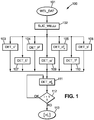
- Figure 1 is a flow chart 100 describing a possible embodiment of the present invention.
- the well data 101 is sliced (step 102) into a plurality of layers having a constant or variable vertical depth increment. Each slice is identified by an ordered index i in ⁇ 0,..., n ⁇ .
- ⁇ h i ⁇ h i ⁇ 1 + b i P i ⁇ P i ⁇ 1 + v i 1 ⁇ v i ⁇ v i ⁇ ⁇ v i ⁇ 1 ⁇ b i P i ⁇ P i ⁇ 1 + E i ⁇ i 1 ⁇ v i T i ⁇ T i ⁇ 1
- This "iterative integration" method assumes that the history of sedimentation and compaction of layer i at present-day at depth z can be represented numerically by the present-day's porosity and density evolution (vertical profiles) from seabed to depth z, even if there are lots of layers having different mineral composition compared to that of layer i.
- the poro-elastic properties E, b, v and ⁇ of layer i have a limited impact on present-day horizontal stress, their influences on ⁇ h are proportional to the increment ⁇ v and ⁇ P, ⁇ T between two consecutive layers (numerical layers), while according to the first equation, the horizontal stress of layer i depends uniquely on present-day poro-elastic properties of layer i, so is independent to the stress in the layer just above it (layer i-1).
- the elastic properties of formations may be computed with different methods according to geological context of the field:
- the parameter K ⁇ may be dependent on the modulus of the mineral fractions and the burial depth and the pore pressure.
- K ⁇ K s 1 ⁇ 2 ⁇ v 1 ⁇ v ⁇ ⁇ v ⁇ P ⁇
- ⁇ and ⁇ are two constants dependent of geological context and type of fluid, ⁇ v is the vertical stress, P is the pore pressure. Parameters ⁇ and ⁇ varies in the range 0.017-0.02 and 0.45 ⁇ 1.0 respectively according to the geological context.
- step 103 In order to determine the Young's modulus in step 103, it is possible to determine an empirical relationship of aspect ratio of clay mineral as function of mineral composition for computation of the anisotropy of elastic properties of shale.
- micro-macro approach (proposed by Tandon & Weng, 1984) deals with a problem of homogenization of disc-shaped spheroidal inclusions in a homogeneous and isotropic matrix.
- the ratio of Young's modulus parallel to the shale's bedding plane to that perpendicular to bedding is function of the aspect ratio of spheroidal inclusion (i.e. d/l), where d is the thickness and I is the diameter of spheroidal inclusion.
- ⁇ is the porosity
- V cl is clay content
- ⁇ , n and ⁇ are three parameters varying respectively in the range of 0.05 -0.06 for ⁇ , 2 -2.5 for n and 0.15 to 0.25 for ⁇ , according to the geological context and applicable for clay content V cl varying in the interval 0.05 to 0.5.
- Figure 2 is a possible embodiment for a device that enables the present invention.
- the device 200 comprise a computer, this computer comprising a memory 205 to store program instructions loadable into a circuit and adapted to cause circuit 204 to carry out the steps of the present invention when the program instructions are run by the circuit 204.
- the memory 205 may also store data and useful information for carrying the steps of the present invention as described above.
- the circuit 204 may be for instance:
- This computer comprises an input interface 203 for the reception of data used for the above method according to the invention and an output interface 206 for providing a stacked model.
- a screen 201 and a keyboard 202 may be provided and connected to the computer circuit 204.
Landscapes
- Life Sciences & Earth Sciences (AREA)
- Physics & Mathematics (AREA)
- Engineering & Computer Science (AREA)
- Geology (AREA)
- Mining & Mineral Resources (AREA)
- General Life Sciences & Earth Sciences (AREA)
- Environmental & Geological Engineering (AREA)
- Geophysics (AREA)
- Fluid Mechanics (AREA)
- Geochemistry & Mineralogy (AREA)
- General Physics & Mathematics (AREA)
- Acoustics & Sound (AREA)
- Remote Sensing (AREA)
- Investigation Of Foundation Soil And Reinforcement Of Foundation Soil By Compacting Or Drainage (AREA)
- Geophysics And Detection Of Objects (AREA)
- Management, Administration, Business Operations System, And Electronic Commerce (AREA)
Description
- The present invention relates to the determination of in situ horizontal stresses in different geological formations using well log data.
- The approaches described in this section could be pursued, but are not necessarily approaches that have been previously conceived or pursued. Therefore, unless otherwise indicated herein, the approaches described in this section are not prior art to the claims in this application and are not admitted to be prior art by inclusion in this section. Furthermore, all embodiments are not necessarily intended to solve all or even any of the problems brought forward in this section.
- Determining the orientation and the magnitude of in situ horizontal stress has many applications in petroleum engineering. Horizontal stress could be anisotropic due to tectonic stress. In this case, we have two components: the maximum horizontal stress (σhmax) and the minimum horizontal stress (σhmin).
- During evaluation of a prospect, the vertical profile of horizontal stress is needed for estimation of the high of hydrocarbon column. In HPHT (high pressure & high temperature) prospect, horizontal stresses' model is used to assess various possible geomechanical hazards link to reservoir depletion: subsidence, cap rock integrity and casing integrity. In design of well architecture, and well integrity control during drilling, profiles of "frac" (hydraulic fracturing) gradient and the minimum mud weight (MMW) needed for different intervals are two critical parameters and are computed from in situ stress model. These two parameters impact greatly the cost of drilling.
- To determine the vertical stress, it is possible to compute, for every current point inside a geological formation located a depth z0, the weight of the overburden layers above the current point:

- While density log data is absent, usually in shallow section, vertical stress can be derived from region over-burden gradient or a synthetic density distribution based on empirical porosity distribution started from ground surface (or seabed).
- In the prior art, the horizontal stresses σh may be computed from the vertical stress σv and coupled with pore pressure.
- Therefore, the prior techniques use this following formula to determine the horizontal stress σh (without integration with respect to z):

- Actually, this formula of stress calculation is erroneous. The reason is following.
- Assuming non lateral deformation, the poro-elasic compaction theory may assume that, for a given layer, an incremental its burial depth ΔZ induces an augmentation of vertical stress Δσv and an increase of pore pressure ΔP, then provokes an increment of horizontal stress Δσh , which is written as:

- Where b is the Biot coefficient, v is the Poisson's ratio, ΔP is a pressure variation, the
term 
- With consideration of an increment of temperature with depth, the thermo-poro-elastic compaction incremental equation may be written as:

- Indeed, due to the fact that the horizontal stress is progressively increasing over the time when the layer is getting deeper, its poro-elastic parameters E, b, v changed when the burial depth increases.
- There is thus a need for a correct method for a determination of the horizontal constraints in subsoil.
- The poroelastic parameters of above formula may be determined from well logs like DTc, Rhob, NPhi, etc. Examples and possible embodiments of the prior art may be found in
US 2015/090498 A1, Lisa Song : "SPE 162233 Minimum Horizontal Stress Profile from Logging Data for Montney Formation of North East British Columbia", Colin M Sayers ET AL: "The effect of anisotropy on the Young's moduli and Poisson's ratios of shales". - The invention relates to a method of determination of horizontal constraints (or stresses) in subsoil, wherein the method comprises:
- receiving well data of the subsoil;
- dividing the well data in a plurality of contiguous sets of data i, a set of data i being above a set of data i+1 in corresponding subsoil;
- for each set of data i in the plurality of sets of data, determining, based on the set of data i, at least parameters:
- Pi , a pressure in subsoil corresponding to the set of data i;
- bi , a Biot coefficient corresponding to the set of data i;
- νi , a Poisson's ratio corresponding to the set of data i;
-

- Ei, a Young's modulus corresponding to the set of data i;
- αi , a rock thermal expansion coefficient corresponding to the set of data i;
- Ti , a temperature in subsoil corresponding to the set of data i;
- for each set of data i in the plurality of sets of data, computing and outputting the horizontal constraints


- Therefore, it is possible to efficiently determine the horizontal stress/constraints in subsoil. The horizontal stress obtained is more consistent both from theoretical point view and from the feedback of several hundreds of wellbores geo-mechanical models provided by this method.
- The well data of the subsoil may be known as "well log data".
- If tectonic stress is present in the investigated region, there may be the two principal stresses in the horizontal plane: the maximum horizontal stress (σhmax) and the minimum horizontal stress (σhmin). They can be determined, for instance, with two additional terms:


- In a possible embodiment, the horizontal constraints may be computed according to the ascending order of i.
- In addition, determining the parameters may comprise:
- receiving the porosity value Φ in subsoil corresponding to the set of data i, the proportion of clay Vcl in subsoil corresponding to the set of data i, the proportion of calcite Vcal in subsoil corresponding to the set of data i;
- computing the aspect ratio of clay mineral (d/l) using an empirical relationship:

where φ is the porosity, Vcl is clay content, λ, n and κ are three parameters. - A second aspect relates to a computer program product comprising a computer readable medium, having thereon a computer program comprising program instructions. The computer program is loadable into a data-processing unit and adapted to cause the data-processing unit to carry out the method described above when the computer program is run by the data-processing unit.
- Other features and advantages of the method and apparatus disclosed herein will become apparent from the following description of non-limiting embodiments, with reference to the appended drawings.
- The present invention is illustrated by way of example, and not by way of limitation, in the figures of the accompanying drawings, in which like reference numerals refer to similar elements and in which:
-
Figure 1 is a flow chart describing a possible embodiment of the present invention; -
Figure 2 is a possible embodiment for a device that enables the present invention. - As indicated above, the formula below is incorrect:

- The correct formula is not a simple integration with respect to z and should be written:

- The integrations of the above formula are integrations with respect of progressive increases of burial depth of the investigated layer from surface or seabed to current position at depth z0. In other words, the above integrations are integrations with respect to time over the whole sedimentation history of the considered layer.
- Such integration is a priori impossible to be resolved since neither detail geological evolution nor the associated poro-mechanical properties changes of the investigated layer over past millions years is known.
-
Figure 1 is aflow chart 100 describing a possible embodiment of the present invention. - In order to determine the above formula of σh , the
well data 101 is sliced (step 102) into a plurality of layers having a constant or variable vertical depth increment. Each slice is identified by an ordered index i in {0,..., n}. - Once the well lithology data have been sliced, it is possible to determine for each slice i:
- the Poisson's ratio νi (step103);
- the mean pressure Pi (step104);
- the vertical constraint

- the Biot coefficient bi (step106);
- the Young's modulus Ei (step107);
- the thermal expansion coefficient αi (step109);
- the mean temperature Ti (step110).
- These parameters may be considered as constant for each value of i.
- Thus, for each slice i (starting with i=0 and incrementing the value of i by 1 at each iteration, i+1 denoting a slice immediately below the slice i), it is possible to compute (step 111):

- If the value


- If there is at least one slice i not iterated (i.e. i<n,
test 112, output OK), then the value of i is incremented and thestep 111 is reiterated. - If all slices have been iterated (i.e. i+1>n,
test 112, output KO), the computed value of the horizontal constraints
- This "iterative integration" method assumes that the history of sedimentation and compaction of layer i at present-day at depth z can be represented numerically by the present-day's porosity and density evolution (vertical profiles) from seabed to depth z, even if there are lots of layers having different mineral composition compared to that of layer i.
- This assumption is valid with accepted uncertainty for most offshore basins without radical changes of sedimentation environment over past millions years.
- There is a fundamental difference between these two following equations:


- In the second equation, the poro-elastic properties E, b, v and α of layer i have a limited impact on present-day horizontal stress, their influences on σh are proportional to the increment Δσv and ΔP, ΔT between two consecutive layers (numerical layers), while according to the first equation, the horizontal stress of layer i depends uniquely on present-day poro-elastic properties of layer i, so is independent to the stress in the layer just above it (layer i-1).
- In
steps 103 to 110, the elastic properties of formations may be computed with different methods according to geological context of the field: - Hashin-Shtrikman and Morri-Tanaka micro-macro approach for normal consolidated formation,
- Modified Cam-Clay for young and unconsolidated clay and clay-sand formations,
- Tandon-Weng (1984), and Ortega A. (2010) methods for hard anisotropic shale formation (mother rock), for example gas(oil) shale.
- Nevertheless, it is possible to enhance the results of said method, by taking into account, for instance, the impact of porosity on elastic properties of rocks.
- The impact of porosity on the elastic parameters of porous material may be represented by the following relationship between the bulk modulus of the porous rock (Kb), the pore compressibility (Kφ) and the compressibility of mixed solid matrix Ks computed from micro-macro approach:

- The parameter Kφ may be dependent on the modulus of the mineral fractions and the burial depth and the pore pressure.
- Based on a set of experimental data, it has been determined the following relationship:

- Where α and β are two constants dependent of geological context and type of fluid, σv is the vertical stress, P is the pore pressure. Parameters α and β varies in the range 0.017-0.02 and 0.45 ∼ 1.0 respectively according to the geological context.
- Thus, by using the determined values in the above mentioned method, it is possible to enhance the determination of the elastic properties of rocks.
- In order to determine the Young's modulus in
step 103, it is possible to determine an empirical relationship of aspect ratio of clay mineral as function of mineral composition for computation of the anisotropy of elastic properties of shale. - The micro-macro approach (proposed by Tandon & Weng, 1984) deals with a problem of homogenization of disc-shaped spheroidal inclusions in a homogeneous and isotropic matrix.
- Application of this method to shaly formation leads to compute the elastic properties parallel and perpendicular to bedding plane of the shale.
- The ratio of Young's modulus parallel to the shale's bedding plane to that perpendicular to bedding is function of the aspect ratio of spheroidal inclusion (i.e. d/l), where d is the thickness and I is the diameter of spheroidal inclusion.
- Based on various experimental data obtained on shale samples having different ranges of clay content and porosity, it has been determined that d and I are related according to an empirical relationship:

- Where φ is the porosity; Vcl is clay content; λ, n and κ are three parameters varying respectively in the range of 0.05 -0.06 for λ, 2 -2.5 for n and 0.15 to 0.25 for κ, according to the geological context and applicable for clay content Vcl varying in the interval 0.05 to 0.5.
-
Figure 2 is a possible embodiment for a device that enables the present invention. - In this embodiment, the
device 200 comprise a computer, this computer comprising amemory 205 to store program instructions loadable into a circuit and adapted to causecircuit 204 to carry out the steps of the present invention when the program instructions are run by thecircuit 204. - The
memory 205 may also store data and useful information for carrying the steps of the present invention as described above. - The
circuit 204 may be for instance: - a processor or a processing unit adapted to interpret instructions in a computer language, the processor or the processing unit may comprise, may be associated with or be attached to a memory comprising the instructions, or
- the association of a processor / processing unit and a memory, the processor or the processing unit adapted to interpret instructions in a computer language, the memory comprising said instructions, or
- an electronic card wherein the steps of the invention are described within silicon, or
- a programmable electronic chip such as a FPGA chip (for « Field-Programmable Gate Array »).
- This computer comprises an
input interface 203 for the reception of data used for the above method according to the invention and anoutput interface 206 for providing a stacked model. - To ease the interaction with the computer, a
screen 201 and akeyboard 202 may be provided and connected to thecomputer circuit 204. - Expressions such as "comprise", "include", "incorporate", "contain", "is" and "have" are to be construed in a non-exclusive manner when interpreting the description and its associated claims, namely construed to allow for other items or components which are not explicitly defined also to be present. Reference to the singular is also to be construed in be a reference to the plural and vice versa.
- A person skilled in the art will readily appreciate that various parameters disclosed in the description may be modified and that various embodiments disclosed may be combined without departing from the scope of the invention as defined by the appended claims.
Claims (4)
- A method of determination of horizontal constraints in subsoil, wherein the method comprises:- receiving well data (101) of the subsoil;- dividing (102) the well data in a plurality of contiguous sets of data i, a set of data i being above a set of data i+1;- for each set of data i in the plurality of sets of data, determining, based on the set of data i, at least parameters:- Pi , a pressure in subsoil corresponding to the set of data i (104);- bi, a Biot coefficient corresponding to the set of data i (106);- νi , a Poisson's ratio corresponding to the set of data i (103);-
 - Ei , a Young's modulus corresponding to the set of data i (107);- αi , thermal expansion coefficient corresponding to the set of data i (109);- Ti , a temperature in subsoil corresponding to the set of data i (110);- for each set of data i in the plurality of sets of data, computing (111) and outputting (113) the horizontal constraints

- A method according to claim 1, wherein the horizontal constraints are computed according to the ascending order of i.
- A method according to one of the preceding claims, wherein determining the parameters comprises:- receiving the porosity value Φ in subsoil corresponding to the set of data i, the proportion of clay Vcl in subsoil corresponding to the set of data I;- computing aspect ratio of clay mineral

- A non-transitory computer readable storage medium, having stored thereon a computer program comprising program instructions, the computer program being loadable into a data-processing unit and adapted to cause the data-processing unit to carry out the steps of any of claims 1 to 3 when the computer program is run by the data-processing device.
Applications Claiming Priority (1)
| Application Number | Priority Date | Filing Date | Title |
|---|---|---|---|
| PCT/IB2015/000853 WO2016174489A1 (en) | 2015-04-27 | 2015-04-27 | Determination of horizontal constraints in subsoil |
Publications (2)
| Publication Number | Publication Date |
|---|---|
| EP3289180A1 EP3289180A1 (en) | 2018-03-07 |
| EP3289180B1 true EP3289180B1 (en) | 2019-02-20 |
Family
ID=54065389
Family Applications (1)
| Application Number | Title | Priority Date | Filing Date |
|---|---|---|---|
| EP15760237.6A Active EP3289180B1 (en) | 2015-04-27 | 2015-04-27 | Determination of horizontal constraints in subsoil |
Country Status (3)
| Country | Link |
|---|---|
| US (1) | US11125080B2 (en) |
| EP (1) | EP3289180B1 (en) |
| WO (1) | WO2016174489A1 (en) |
Families Citing this family (4)
| Publication number | Priority date | Publication date | Assignee | Title |
|---|---|---|---|---|
| CN107941619B (en) * | 2017-10-12 | 2019-07-16 | 中国科学院武汉岩土力学研究所 | A method for measuring effective stress coefficient of rock |
| CN112801461B (en) * | 2021-01-06 | 2024-03-05 | 中国石油天然气股份有限公司 | Method and device for determining exploration planning indicators of petroleum blocks |
| RU2762078C1 (en) * | 2021-04-29 | 2021-12-15 | Публичное акционерное общество "Нефтяная компания "Роснефть" (ПАО "НК "Роснефть") | Method for localizing promising zones in oil source strata |
| RU2761935C1 (en) * | 2021-04-29 | 2021-12-14 | Публичное акционерное общество "Нефтяная компания "Роснефть" (ПАО "НК "Роснефть") | Method for localization of promising zones in oil-producing strata |
Family Cites Families (4)
| Publication number | Priority date | Publication date | Assignee | Title |
|---|---|---|---|---|
| EP1287229A1 (en) * | 2000-06-06 | 2003-03-05 | Halliburton Energy Services, Inc. | Real-time method for maintaining formation stability |
| US20130246022A1 (en) * | 2012-03-14 | 2013-09-19 | Schlumberger Technology Corporation | Screening potential geomechanical risks during waterflooding |
| US10094210B2 (en) * | 2013-10-01 | 2018-10-09 | Rocsol Technologies Inc. | Drilling system |
| US9803475B2 (en) * | 2014-04-09 | 2017-10-31 | Weatherford Technology Holdings, Llc | System and method for integrated wellbore stress, stability and strengthening analyses |
-
2015
- 2015-04-27 WO PCT/IB2015/000853 patent/WO2016174489A1/en not_active Ceased
- 2015-04-27 EP EP15760237.6A patent/EP3289180B1/en active Active
- 2015-04-27 US US15/570,061 patent/US11125080B2/en active Active
Non-Patent Citations (1)
| Title |
|---|
| None * |
Also Published As
| Publication number | Publication date |
|---|---|
| US20190024506A1 (en) | 2019-01-24 |
| WO2016174489A9 (en) | 2017-10-12 |
| US11125080B2 (en) | 2021-09-21 |
| EP3289180A1 (en) | 2018-03-07 |
| WO2016174489A1 (en) | 2016-11-03 |
Similar Documents
| Publication | Publication Date | Title |
|---|---|---|
| Kidambi et al. | Mechanical earth modeling for a vertical well drilled in a naturally fractured tight carbonate gas reservoir in the Persian Gulf | |
| Wang et al. | Poroelasticity: Efficient modeling of strongly coupled, slow deformation processes in multilayered half-space | |
| Blanton et al. | Stress magnitudes from logs: effects of tectonic strains and temperature | |
| Lee et al. | Estimation of in situ stresses with hydro-fracturing tests and a statistical method | |
| Agbasi et al. | Assessment of pore pressure, wellbore failure and reservoir stability in the Gabo field, Niger Delta, Nigeria-Implications for drilling and reservoir management | |
| Gholami et al. | An analytical model to predict the volume of sand during drilling and production | |
| Frydman et al. | Comprehensive determination of the far-field earth stresses for rocks with anisotropy in tectonic environment | |
| Smye et al. | Variations in vertical stress in the Permian Basin region | |
| Yassir et al. | Abnormally high fluid pressures and associated porosities and stress regimes in sedimentary basins | |
| US11125080B2 (en) | Determination of horizontal constraints in subsoil | |
| Issa et al. | Developing a geomechanical model to mitigate the risks of wellbore instability in an Iraqi oilfield | |
| Agoha et al. | Integrated 3D geomechanical characterization of a reservoir: case study of" Fuja" field, offshore Niger Delta, Southern Nigeria | |
| Valdes et al. | Impact of anisotropic poroelastic parameters estimated using well logs and core measurements on stress prediction in organic-rich mudrocks | |
| Almalikee et al. | Estimation of minimum and maximum horizontal stresses from well log, a case study in Rumaila oil field, Iraq | |
| Ayodele et al. | Pore pressure prediction of some selected wells from the Southern Pletmos Basin, offshore South Africa | |
| Behboudi et al. | Shallow tectonic stress magnitudes at the Hikurangi subduction margin, New Zealand | |
| Jimenez et al. | Calibration of well logs with mini-frac data for estimating the minimum horizontal stress in the tight-gas Monteith formation of the Western Canada Sedimentary Basin: A case study | |
| Chatterjee et al. | Overpressure zone under the Krishna–Godavari offshore basin: geophysical implications for natural hazard in deeper-water drilling | |
| Banerjee et al. | Implication of fast shear wave azimuth and critically stressed fractures in a coalbed methane reservoir | |
| Hung et al. | In-situ stress and fault reactivation associated with LNG injection in the Tiechanshan gas field, fold-thrust belt of Western Taiwan | |
| Kumar et al. | Pore pressure prediction from well logs and seismic data | |
| Urban et al. | Determination of principal in-situ stress magnitude from well logs in unconventional reservoirs: A practical application in willesden green field, Canada | |
| Chatterjee et al. | Geomechanics in unconventional reservoir: a new approach to drilling integrating advanced acoustic measurements and formation evaluation | |
| Holbrook | A new method for predicting fracture propagation pressure from MWD or wireline log data | |
| Fabricius et al. | Assessment of pore collapse in North Sea Lower Cretaceous carbonates using downhole elastic strain |
Legal Events
| Date | Code | Title | Description |
|---|---|---|---|
| STAA | Information on the status of an ep patent application or granted ep patent |
Free format text: STATUS: THE INTERNATIONAL PUBLICATION HAS BEEN MADE |
|
| PUAI | Public reference made under article 153(3) epc to a published international application that has entered the european phase |
Free format text: ORIGINAL CODE: 0009012 |
|
| STAA | Information on the status of an ep patent application or granted ep patent |
Free format text: STATUS: REQUEST FOR EXAMINATION WAS MADE |
|
| 17P | Request for examination filed |
Effective date: 20171103 |
|
| AK | Designated contracting states |
Kind code of ref document: A1 Designated state(s): AL AT BE BG CH CY CZ DE DK EE ES FI FR GB GR HR HU IE IS IT LI LT LU LV MC MK MT NL NO PL PT RO RS SE SI SK SM TR |
|
| AX | Request for extension of the european patent |
Extension state: BA ME |
|
| DAV | Request for validation of the european patent (deleted) | ||
| DAX | Request for extension of the european patent (deleted) | ||
| GRAP | Despatch of communication of intention to grant a patent |
Free format text: ORIGINAL CODE: EPIDOSNIGR1 |
|
| STAA | Information on the status of an ep patent application or granted ep patent |
Free format text: STATUS: GRANT OF PATENT IS INTENDED |
|
| INTG | Intention to grant announced |
Effective date: 20180912 |
|
| GRAS | Grant fee paid |
Free format text: ORIGINAL CODE: EPIDOSNIGR3 |
|
| GRAA | (expected) grant |
Free format text: ORIGINAL CODE: 0009210 |
|
| STAA | Information on the status of an ep patent application or granted ep patent |
Free format text: STATUS: THE PATENT HAS BEEN GRANTED |
|
| AK | Designated contracting states |
Kind code of ref document: B1 Designated state(s): AL AT BE BG CH CY CZ DE DK EE ES FI FR GB GR HR HU IE IS IT LI LT LU LV MC MK MT NL NO PL PT RO RS SE SI SK SM TR |
|
| REG | Reference to a national code |
Ref country code: GB Ref legal event code: FG4D |
|
| REG | Reference to a national code |
Ref country code: CH Ref legal event code: EP |
|
| REG | Reference to a national code |
Ref country code: DE Ref legal event code: R096 Ref document number: 602015024917 Country of ref document: DE |
|
| REG | Reference to a national code |
Ref country code: AT Ref legal event code: REF Ref document number: 1098431 Country of ref document: AT Kind code of ref document: T Effective date: 20190315 |
|
| REG | Reference to a national code |
Ref country code: IE Ref legal event code: FG4D |
|
| REG | Reference to a national code |
Ref country code: NL Ref legal event code: FP |
|
| REG | Reference to a national code |
Ref country code: NO Ref legal event code: T2 Effective date: 20190220 |
|
| REG | Reference to a national code |
Ref country code: LT Ref legal event code: MG4D |
|
| PG25 | Lapsed in a contracting state [announced via postgrant information from national office to epo] |
Ref country code: FI Free format text: LAPSE BECAUSE OF FAILURE TO SUBMIT A TRANSLATION OF THE DESCRIPTION OR TO PAY THE FEE WITHIN THE PRESCRIBED TIME-LIMIT Effective date: 20190220 Ref country code: LT Free format text: LAPSE BECAUSE OF FAILURE TO SUBMIT A TRANSLATION OF THE DESCRIPTION OR TO PAY THE FEE WITHIN THE PRESCRIBED TIME-LIMIT Effective date: 20190220 Ref country code: PT Free format text: LAPSE BECAUSE OF FAILURE TO SUBMIT A TRANSLATION OF THE DESCRIPTION OR TO PAY THE FEE WITHIN THE PRESCRIBED TIME-LIMIT Effective date: 20190620 Ref country code: SE Free format text: LAPSE BECAUSE OF FAILURE TO SUBMIT A TRANSLATION OF THE DESCRIPTION OR TO PAY THE FEE WITHIN THE PRESCRIBED TIME-LIMIT Effective date: 20190220 |
|
| PG25 | Lapsed in a contracting state [announced via postgrant information from national office to epo] |
Ref country code: LV Free format text: LAPSE BECAUSE OF FAILURE TO SUBMIT A TRANSLATION OF THE DESCRIPTION OR TO PAY THE FEE WITHIN THE PRESCRIBED TIME-LIMIT Effective date: 20190220 Ref country code: HR Free format text: LAPSE BECAUSE OF FAILURE TO SUBMIT A TRANSLATION OF THE DESCRIPTION OR TO PAY THE FEE WITHIN THE PRESCRIBED TIME-LIMIT Effective date: 20190220 Ref country code: RS Free format text: LAPSE BECAUSE OF FAILURE TO SUBMIT A TRANSLATION OF THE DESCRIPTION OR TO PAY THE FEE WITHIN THE PRESCRIBED TIME-LIMIT Effective date: 20190220 Ref country code: BG Free format text: LAPSE BECAUSE OF FAILURE TO SUBMIT A TRANSLATION OF THE DESCRIPTION OR TO PAY THE FEE WITHIN THE PRESCRIBED TIME-LIMIT Effective date: 20190520 Ref country code: IS Free format text: LAPSE BECAUSE OF FAILURE TO SUBMIT A TRANSLATION OF THE DESCRIPTION OR TO PAY THE FEE WITHIN THE PRESCRIBED TIME-LIMIT Effective date: 20190620 Ref country code: GR Free format text: LAPSE BECAUSE OF FAILURE TO SUBMIT A TRANSLATION OF THE DESCRIPTION OR TO PAY THE FEE WITHIN THE PRESCRIBED TIME-LIMIT Effective date: 20190521 |
|
| REG | Reference to a national code |
Ref country code: AT Ref legal event code: MK05 Ref document number: 1098431 Country of ref document: AT Kind code of ref document: T Effective date: 20190220 |
|
| PG25 | Lapsed in a contracting state [announced via postgrant information from national office to epo] |
Ref country code: DK Free format text: LAPSE BECAUSE OF FAILURE TO SUBMIT A TRANSLATION OF THE DESCRIPTION OR TO PAY THE FEE WITHIN THE PRESCRIBED TIME-LIMIT Effective date: 20190220 Ref country code: ES Free format text: LAPSE BECAUSE OF FAILURE TO SUBMIT A TRANSLATION OF THE DESCRIPTION OR TO PAY THE FEE WITHIN THE PRESCRIBED TIME-LIMIT Effective date: 20190220 Ref country code: AL Free format text: LAPSE BECAUSE OF FAILURE TO SUBMIT A TRANSLATION OF THE DESCRIPTION OR TO PAY THE FEE WITHIN THE PRESCRIBED TIME-LIMIT Effective date: 20190220 Ref country code: IT Free format text: LAPSE BECAUSE OF FAILURE TO SUBMIT A TRANSLATION OF THE DESCRIPTION OR TO PAY THE FEE WITHIN THE PRESCRIBED TIME-LIMIT Effective date: 20190220 Ref country code: RO Free format text: LAPSE BECAUSE OF FAILURE TO SUBMIT A TRANSLATION OF THE DESCRIPTION OR TO PAY THE FEE WITHIN THE PRESCRIBED TIME-LIMIT Effective date: 20190220 Ref country code: SK Free format text: LAPSE BECAUSE OF FAILURE TO SUBMIT A TRANSLATION OF THE DESCRIPTION OR TO PAY THE FEE WITHIN THE PRESCRIBED TIME-LIMIT Effective date: 20190220 Ref country code: CZ Free format text: LAPSE BECAUSE OF FAILURE TO SUBMIT A TRANSLATION OF THE DESCRIPTION OR TO PAY THE FEE WITHIN THE PRESCRIBED TIME-LIMIT Effective date: 20190220 Ref country code: EE Free format text: LAPSE BECAUSE OF FAILURE TO SUBMIT A TRANSLATION OF THE DESCRIPTION OR TO PAY THE FEE WITHIN THE PRESCRIBED TIME-LIMIT Effective date: 20190220 |
|
| REG | Reference to a national code |
Ref country code: DE Ref legal event code: R119 Ref document number: 602015024917 Country of ref document: DE |
|
| PG25 | Lapsed in a contracting state [announced via postgrant information from national office to epo] |
Ref country code: PL Free format text: LAPSE BECAUSE OF FAILURE TO SUBMIT A TRANSLATION OF THE DESCRIPTION OR TO PAY THE FEE WITHIN THE PRESCRIBED TIME-LIMIT Effective date: 20190220 Ref country code: SM Free format text: LAPSE BECAUSE OF FAILURE TO SUBMIT A TRANSLATION OF THE DESCRIPTION OR TO PAY THE FEE WITHIN THE PRESCRIBED TIME-LIMIT Effective date: 20190220 |
|
| REG | Reference to a national code |
Ref country code: CH Ref legal event code: PL |
|
| REG | Reference to a national code |
Ref country code: BE Ref legal event code: MM Effective date: 20190430 |
|
| PLBE | No opposition filed within time limit |
Free format text: ORIGINAL CODE: 0009261 |
|
| STAA | Information on the status of an ep patent application or granted ep patent |
Free format text: STATUS: NO OPPOSITION FILED WITHIN TIME LIMIT |
|
| PG25 | Lapsed in a contracting state [announced via postgrant information from national office to epo] |
Ref country code: MC Free format text: LAPSE BECAUSE OF FAILURE TO SUBMIT A TRANSLATION OF THE DESCRIPTION OR TO PAY THE FEE WITHIN THE PRESCRIBED TIME-LIMIT Effective date: 20190220 Ref country code: LU Free format text: LAPSE BECAUSE OF NON-PAYMENT OF DUE FEES Effective date: 20190427 Ref country code: AT Free format text: LAPSE BECAUSE OF FAILURE TO SUBMIT A TRANSLATION OF THE DESCRIPTION OR TO PAY THE FEE WITHIN THE PRESCRIBED TIME-LIMIT Effective date: 20190220 |
|
| 26N | No opposition filed |
Effective date: 20191121 |
|
| PG25 | Lapsed in a contracting state [announced via postgrant information from national office to epo] |
Ref country code: DE Free format text: LAPSE BECAUSE OF NON-PAYMENT OF DUE FEES Effective date: 20191101 Ref country code: LI Free format text: LAPSE BECAUSE OF NON-PAYMENT OF DUE FEES Effective date: 20190430 Ref country code: CH Free format text: LAPSE BECAUSE OF NON-PAYMENT OF DUE FEES Effective date: 20190430 |
|
| PG25 | Lapsed in a contracting state [announced via postgrant information from national office to epo] |
Ref country code: BE Free format text: LAPSE BECAUSE OF NON-PAYMENT OF DUE FEES Effective date: 20190430 Ref country code: SI Free format text: LAPSE BECAUSE OF FAILURE TO SUBMIT A TRANSLATION OF THE DESCRIPTION OR TO PAY THE FEE WITHIN THE PRESCRIBED TIME-LIMIT Effective date: 20190220 |
|
| PG25 | Lapsed in a contracting state [announced via postgrant information from national office to epo] |
Ref country code: TR Free format text: LAPSE BECAUSE OF FAILURE TO SUBMIT A TRANSLATION OF THE DESCRIPTION OR TO PAY THE FEE WITHIN THE PRESCRIBED TIME-LIMIT Effective date: 20190220 |
|
| PG25 | Lapsed in a contracting state [announced via postgrant information from national office to epo] |
Ref country code: IE Free format text: LAPSE BECAUSE OF NON-PAYMENT OF DUE FEES Effective date: 20190427 |
|
| PG25 | Lapsed in a contracting state [announced via postgrant information from national office to epo] |
Ref country code: CY Free format text: LAPSE BECAUSE OF FAILURE TO SUBMIT A TRANSLATION OF THE DESCRIPTION OR TO PAY THE FEE WITHIN THE PRESCRIBED TIME-LIMIT Effective date: 20190220 |
|
| PG25 | Lapsed in a contracting state [announced via postgrant information from national office to epo] |
Ref country code: HU Free format text: LAPSE BECAUSE OF FAILURE TO SUBMIT A TRANSLATION OF THE DESCRIPTION OR TO PAY THE FEE WITHIN THE PRESCRIBED TIME-LIMIT; INVALID AB INITIO Effective date: 20150427 Ref country code: MT Free format text: LAPSE BECAUSE OF FAILURE TO SUBMIT A TRANSLATION OF THE DESCRIPTION OR TO PAY THE FEE WITHIN THE PRESCRIBED TIME-LIMIT Effective date: 20190220 |
|
| REG | Reference to a national code |
Ref country code: FR Ref legal event code: PLFP Year of fee payment: 8 |
|
| PG25 | Lapsed in a contracting state [announced via postgrant information from national office to epo] |
Ref country code: MK Free format text: LAPSE BECAUSE OF FAILURE TO SUBMIT A TRANSLATION OF THE DESCRIPTION OR TO PAY THE FEE WITHIN THE PRESCRIBED TIME-LIMIT Effective date: 20190220 |
|
| REG | Reference to a national code |
Ref country code: GB Ref legal event code: 732E Free format text: REGISTERED BETWEEN 20240523 AND 20240529 |
|
| REG | Reference to a national code |
Ref country code: NL Ref legal event code: PD Owner name: TOTALENERGIES ONETECH; FR Free format text: DETAILS ASSIGNMENT: CHANGE OF OWNER(S), ASSIGNMENT; FORMER OWNER NAME: TOTALENERGIES SE Effective date: 20240905 Ref country code: NL Ref legal event code: HC Owner name: TOTALENERGIES SE; FR Free format text: DETAILS ASSIGNMENT: CHANGE OF OWNER(S), CHANGE OF OWNER(S) NAME; FORMER OWNER NAME: TOTAL SA Effective date: 20240905 |
|
| P01 | Opt-out of the competence of the unified patent court (upc) registered |
Free format text: CASE NUMBER: UPC_APP_328615/2023 Effective date: 20230524 |
|
| PGFP | Annual fee paid to national office [announced via postgrant information from national office to epo] |
Ref country code: NL Payment date: 20250418 Year of fee payment: 11 |
|
| PGFP | Annual fee paid to national office [announced via postgrant information from national office to epo] |
Ref country code: GB Payment date: 20250423 Year of fee payment: 11 |
|
| PGFP | Annual fee paid to national office [announced via postgrant information from national office to epo] |
Ref country code: NO Payment date: 20250424 Year of fee payment: 11 |
|
| PGFP | Annual fee paid to national office [announced via postgrant information from national office to epo] |
Ref country code: FR Payment date: 20250425 Year of fee payment: 11 |