EP3288746B1 - A method and apparatus for forming a composite component - Google Patents
A method and apparatus for forming a composite component Download PDFInfo
- Publication number
- EP3288746B1 EP3288746B1 EP16718901.8A EP16718901A EP3288746B1 EP 3288746 B1 EP3288746 B1 EP 3288746B1 EP 16718901 A EP16718901 A EP 16718901A EP 3288746 B1 EP3288746 B1 EP 3288746B1
- Authority
- EP
- European Patent Office
- Prior art keywords
- forming
- tool
- elements
- configuration
- flange
- Prior art date
- Legal status (The legal status is an assumption and is not a legal conclusion. Google has not performed a legal analysis and makes no representation as to the accuracy of the status listed.)
- Active
Links
Images




Classifications
-
- B—PERFORMING OPERATIONS; TRANSPORTING
- B29—WORKING OF PLASTICS; WORKING OF SUBSTANCES IN A PLASTIC STATE IN GENERAL
- B29C—SHAPING OR JOINING OF PLASTICS; SHAPING OF MATERIAL IN A PLASTIC STATE, NOT OTHERWISE PROVIDED FOR; AFTER-TREATMENT OF THE SHAPED PRODUCTS, e.g. REPAIRING
- B29C70/00—Shaping composites, i.e. plastics material comprising reinforcements, fillers or preformed parts, e.g. inserts
- B29C70/68—Shaping composites, i.e. plastics material comprising reinforcements, fillers or preformed parts, e.g. inserts by incorporating or moulding on preformed parts, e.g. inserts or layers, e.g. foam blocks
- B29C70/681—Component parts, details or accessories; Auxiliary operations
-
- B—PERFORMING OPERATIONS; TRANSPORTING
- B29—WORKING OF PLASTICS; WORKING OF SUBSTANCES IN A PLASTIC STATE IN GENERAL
- B29C—SHAPING OR JOINING OF PLASTICS; SHAPING OF MATERIAL IN A PLASTIC STATE, NOT OTHERWISE PROVIDED FOR; AFTER-TREATMENT OF THE SHAPED PRODUCTS, e.g. REPAIRING
- B29C70/00—Shaping composites, i.e. plastics material comprising reinforcements, fillers or preformed parts, e.g. inserts
- B29C70/04—Shaping composites, i.e. plastics material comprising reinforcements, fillers or preformed parts, e.g. inserts comprising reinforcements only, e.g. self-reinforcing plastics
- B29C70/28—Shaping operations therefor
- B29C70/40—Shaping or impregnating by compression not applied
- B29C70/42—Shaping or impregnating by compression not applied for producing articles of definite length, i.e. discrete articles
- B29C70/46—Shaping or impregnating by compression not applied for producing articles of definite length, i.e. discrete articles using matched moulds, e.g. for deforming sheet moulding compounds [SMC] or prepregs
- B29C70/462—Moulding structures having an axis of symmetry or at least one channel, e.g. tubular structures, frames
-
- B—PERFORMING OPERATIONS; TRANSPORTING
- B29—WORKING OF PLASTICS; WORKING OF SUBSTANCES IN A PLASTIC STATE IN GENERAL
- B29C—SHAPING OR JOINING OF PLASTICS; SHAPING OF MATERIAL IN A PLASTIC STATE, NOT OTHERWISE PROVIDED FOR; AFTER-TREATMENT OF THE SHAPED PRODUCTS, e.g. REPAIRING
- B29C70/00—Shaping composites, i.e. plastics material comprising reinforcements, fillers or preformed parts, e.g. inserts
- B29C70/04—Shaping composites, i.e. plastics material comprising reinforcements, fillers or preformed parts, e.g. inserts comprising reinforcements only, e.g. self-reinforcing plastics
- B29C70/28—Shaping operations therefor
- B29C70/30—Shaping by lay-up, i.e. applying fibres, tape or broadsheet on a mould, former or core; Shaping by spray-up, i.e. spraying of fibres on a mould, former or core
- B29C70/38—Automated lay-up, e.g. using robots, laying filaments according to predetermined patterns
-
- B—PERFORMING OPERATIONS; TRANSPORTING
- B29—WORKING OF PLASTICS; WORKING OF SUBSTANCES IN A PLASTIC STATE IN GENERAL
- B29C—SHAPING OR JOINING OF PLASTICS; SHAPING OF MATERIAL IN A PLASTIC STATE, NOT OTHERWISE PROVIDED FOR; AFTER-TREATMENT OF THE SHAPED PRODUCTS, e.g. REPAIRING
- B29C70/00—Shaping composites, i.e. plastics material comprising reinforcements, fillers or preformed parts, e.g. inserts
- B29C70/04—Shaping composites, i.e. plastics material comprising reinforcements, fillers or preformed parts, e.g. inserts comprising reinforcements only, e.g. self-reinforcing plastics
- B29C70/28—Shaping operations therefor
- B29C70/54—Component parts, details or accessories; Auxiliary operations, e.g. feeding or storage of prepregs or SMC after impregnation or during ageing
- B29C70/541—Positioning reinforcements in a mould, e.g. using clamping means for the reinforcement
-
- B—PERFORMING OPERATIONS; TRANSPORTING
- B29—WORKING OF PLASTICS; WORKING OF SUBSTANCES IN A PLASTIC STATE IN GENERAL
- B29C—SHAPING OR JOINING OF PLASTICS; SHAPING OF MATERIAL IN A PLASTIC STATE, NOT OTHERWISE PROVIDED FOR; AFTER-TREATMENT OF THE SHAPED PRODUCTS, e.g. REPAIRING
- B29C70/00—Shaping composites, i.e. plastics material comprising reinforcements, fillers or preformed parts, e.g. inserts
- B29C70/04—Shaping composites, i.e. plastics material comprising reinforcements, fillers or preformed parts, e.g. inserts comprising reinforcements only, e.g. self-reinforcing plastics
- B29C70/28—Shaping operations therefor
- B29C70/54—Component parts, details or accessories; Auxiliary operations, e.g. feeding or storage of prepregs or SMC after impregnation or during ageing
- B29C70/56—Tensioning reinforcements before or during shaping
-
- B—PERFORMING OPERATIONS; TRANSPORTING
- B29—WORKING OF PLASTICS; WORKING OF SUBSTANCES IN A PLASTIC STATE IN GENERAL
- B29K—INDEXING SCHEME ASSOCIATED WITH SUBCLASSES B29B, B29C OR B29D, RELATING TO MOULDING MATERIALS OR TO MATERIALS FOR MOULDS, REINFORCEMENTS, FILLERS OR PREFORMED PARTS, e.g. INSERTS
- B29K2307/00—Use of elements other than metals as reinforcement
- B29K2307/04—Carbon
-
- B—PERFORMING OPERATIONS; TRANSPORTING
- B29—WORKING OF PLASTICS; WORKING OF SUBSTANCES IN A PLASTIC STATE IN GENERAL
- B29L—INDEXING SCHEME ASSOCIATED WITH SUBCLASS B29C, RELATING TO PARTICULAR ARTICLES
- B29L2031/00—Other particular articles
- B29L2031/748—Machines or parts thereof not otherwise provided for
- B29L2031/7504—Turbines
Definitions
- the invention relates to a method and apparatus for forming a composite component, in particular, a composite component having a radial flange.
- CFRP Carbon Fibre Reinforced Polymer
- a component with a flange such as an annular flange on a casing for a gas turbine, or the sides of a spar for a wing.
- a component with a flange such as an annular flange on a casing for a gas turbine, or the sides of a spar for a wing.
- the formation of the flange can pose an engineering problem. For example, it may be difficult to layup composite material on a flanged mould, in particular in the region of bends between the main part of the mould and the flange that may be hard to access.
- GB2486231 discloses a mould for a composite pre-form having a first portion and a movable second portion comprising a plurality of circumferentially spaced movable sectors. After laying up plies of unidirectional composite tape on the mould, the mould and pre-form are heated in an autoclave and the movable second part is actuated to deform a part of the pre-form to form the flange.
- circumferentially spaced sectors of GB2486231 provide a discontinuous surface for forming the radial flange, which may result in a poor quality flange.
- a method of forming a composite component having a curved body and an integral flange from a pre-form using forming apparatus comprising: a tool comprising a curved body portion having a lay-up surface and a forming assembly comprising a plurality of forming elements each having a lay-up surface and a primary flange-forming surface; and a plurality of filler elements each having a secondary flange-forming surface; the method comprising:
- Providing a pre-form over the lay-up surfaces may comprise providing a body region of the pre-form corresponding to the curved body of the composite component on the layup surface of the curved body portion; and providing a flange region of the pre-form over the lay-up surfaces of the forming elements. Movement of the forming assembly from the layup configuration to the forming configuration may cause at least the flange region of the pre-form to deform between the continuous flange-forming surface and the counteracting forming surface to form the integral flange of the component.
- the integral flange may be an integral curved flange.
- the forming elements may reach their respective forming positions before the filler elements reach their respective forming positions.
- the method may further comprise providing the tool in the layup configuration so that the lay-up surfaces of the curved body portion and the forming elements are substantially continuous.
- the method may further comprise laying-up the pre-form on the tool in the layup configuration.
- the method may further comprise providing a counteracting support, and the counteracting support may define the counteracting forming surface.
- the counteracting support may be positioned to oppose the flange-forming surfaces after the pre-form is laid up on the tool and before the forming elements and filler elements are moved from the layup configuration to the forming configuration.
- the forming elements and filler elements may be moved simultaneously. Alternatively, the forming and filler elements may be moved in sequence.
- the method may further comprise heating the tool before moving the forming elements and filler elements from the layup configuration to the forming configuration.
- the tool may be heated after the pre-form is laid up on the tool. Additionally or alternatively, the tool may be heated before and/or during layup of the pre-form on the tool. The tool may be heated by heating elements coupled to the tool.
- a third aspect of the invention there is provided a method of forming a casing for a gas-turbine engine in accordance with the first or second aspects of the invention.
- the tool or forming apparatus may be in accordance with the fourth or fifth aspects of the invention.
- a tool for forming a composite component having a curved body and an integral flange from a pre-form comprising: a curved body portion having a lay-up surface; and a forming assembly having a lay-up configuration and a forming configuration, the forming assembly comprising: a plurality of forming elements each having a lay-up surface and a primary flange-forming surface, the forming elements being radially outwardly moveable from the lay-up configuration to the forming configuration, in which the forming elements are circumferentially spaced from one another; a plurality of filler elements each having a secondary flange-forming surface, the filler elements being arranged to move into the circumferential gaps between the forming elements in the forming configuration so as to form a substantially continuous flange-forming surface; and wherein in use a pre-form is disposed on the layup surfaces of the curved body portion and the forming elements in the layup configuration, and wherein movement
- the lay-up surfaces of the forming elements may be substantially continuous with one another and with the lay-up surface of the body portion.
- the body portion of the tool may be for receiving a first region of a pre-form corresponding to the curved body of the composite component.
- the forming assembly may be adjacent the curved body portion.
- each forming element may be a radially outer surface of the forming element, and the primary flange-forming surface of each forming element may extend radially inwardly from the respective lay-up surface.
- Each filler element may have a radially outer filler surface arranged to extend into a gap formed between the radially outer lay-up surfaces of the forming elements in the forming configuration to form a substantially continuous outer forming surface.
- the filler elements may be concealed radially within the forming elements when the forming assembly is in the lay-up configuration.
- the layup surface of the curved body portion may be substantially continuous with the layup surfaces of the forming elements in the layup configuration.
- the layup surface of the curved body portion may be radially spaced apart from the layup surfaces of the forming elements in the layup configuration.
- the primary and secondary flange-forming surfaces may extend at least partly radially.
- the primary and secondary forming surfaces may be substantially radially extending (i.e. substantially normal to the axis of the tool).
- the forming elements and the filler elements may be alternately arranged.
- the forming elements and the filler elements may be alternately arranged around an axis of the tool.
- the tool may further comprise a drive means for moving the forming assembly from the lay-up configuration to the forming configuration.
- the drive means may comprise a plurality of drive units and each drive unit may be arranged to move at least one forming element.
- Each drive unit may be configured to move the or each respective forming element and an adjacent filler element from respective retracted positions corresponding to the lay-up configuration to respective extended positions corresponding to the forming configuration.
- Each drive unit may be configured so that the respective filler element reaches its respective forming position after the forming element reaches its respective forming position.
- a lost motion connection may be provided between each drive unit and the respective forming element.
- the lost motion connection may comprise a resilient means which biases the forming element away from the drive unit.
- Each drive unit may comprise a guide block, the respective forming element may be guided for displacement with respect to the guide block by means of a guide rod or rail, and the resilient means may comprise a spring which acts between the guide block and the forming element.
- the guide block may be fixedly secured to the filler element so that the filler element cannot move relative to the guide block.
- the tool may be for forming an annular or semi-annular component.
- the tool may be for forming a casing for a gas-turbine engine.
- a forming apparatus for forming a composite component having a curved body and an integral flange, the apparatus comprising: a tool in accordance with the fourth aspect of the invention; and a counteracting support detachably attachable to the tool over a pre-form received on the tool, the counteracting support having a counteracting forming surface arranged to oppose the flange-forming surfaces of the forming assembly so that in use a region of the pre-form is deformed between the forming assembly and the counteracting support to form the flange of the component.
- Figure 1 shows a gas turbine engine 10 comprising an exterior nacelle 12 supported on an annular casing 14 having forward and aft flanges 16, 18.
- the casing 14 is centred on the axis 20 of the engine 10 and houses a fan 22 comprising a plurality of fan blades.
- Forward and aft annular casing boxes 24, 26 support the front and rear portions of the nacelle 12.
- the casing 14 has a curved main body 28 which is generally cylindrical and is provided with forward and aft flanges 16, 18 extending radially outwardly with respect to the curvature of the main body.
- the casing 14 is composed of composite material, such as Carbon Fibre Reinforced Polymer (CFRP).
- CFRP Carbon Fibre Reinforced Polymer
- the casing 14 comprises a plurality of plies of pre-impregnated ("pre-preg") unidirectional composite tape that been have been applied to a mould in a lay-up process and cured.
- pre-preg pre-impregnated
- Figures 3 to 5 show cross sectional views of an apparatus 100 for manufacturing the composite casing 14.
- the apparatus 100 comprises a generally annular tool 102 that is configured to rest on a horizontal surface, such as a workshop floor, so that its central axis (not shown) extends vertically, although in other embodiments it may be supported in any orientation.
- the tool 102 comprises an annular support structure 103 for supporting a forming assembly 105 comprising a plurality of forming elements 106 and filler elements (not shown), and a body portion 104.
- the body portion 104 comprises a plurality of circumferentially extending curved body panels 108 that together define a cylindrical lay-up surface 110 for a composite pre-form 200.
- the body portion 104 is provided with a body heater 114 comprising a plurality of heater mats 116 mounted to the radially inner surfaces of the curved body panels 108 for heating the body panels 108, and thereby a pre-form 200 disposed on the outer lay-up surface 110 of the body portion 104.
- the body panels 108 are composed of a thermally conductive metal, in particular, stainless steel or aluminium.
- the forming assembly 105 is mounted to the support structure 103 above the body portion 104 by an actuation mechanism (not shown) and comprises a plurality of forming elements 106 which are radially movable with respect to the support structure 103 and the body portion 104 between a retracted or lay-up position (for example, Figure 3 ) and an extended or forming position (for example, Figure 5 ).
- the forming elements 106 are circumferentially arranged around the tool 102.
- Each forming element 106 has a circumferentially extending radially outer lay-up surface 120 which is configured to be substantially contiguous and continuous with the lay-up surface 110 of the adjacent body portion 104 in the lay-up configuration of the forming assembly 105 (i.e. with the forming elements in the lay-up position).
- the lay-up surfaces 120 of the forming elements 106 are substantially continuous with each other around the axis of the tool 102.
- the lay-up surfaces 120 of the forming elements are radially spaced apart from the lay-up surface 110 of the adjacent body portion 104, and there are circumferentially extending gaps between them.
- the forming elements 106 are configured so that the lay-up surfaces 120 of each element 120 has a radius of curvature corresponding to the radial position of the lay-up surface 120 in the forming position. Accordingly, the lay-up surfaces 120 extend in a true circumferential direction when in the forming position, and extend approximately circumferentially (or substantially circumferentially) in the retracted or lay-up position.
- each forming element 106 is in the form of a semi-annular block or sector that defines the radially outer lay-up surface 120 and has four radially extending sides: lower and upper side surfaces 122, 124 and angularly spaced side surfaces (not shown).
- the lower side surface 122 acts as a primary flange-forming surface during a forming operation, as will be described in detail below.
- each main flange-forming portion 106 has an angular extent of 12o, and so the tool 102 comprises 30 separate main flange-forming portions.
- Each main flange-forming portion 106 comprises a cavity 126 in which there is disposed a flange heater 123 for heating the main flange-forming portion 106.
- Each main flange-forming portion 106 is composed of a thermally conductive metal, in particular, stainless steel or aluminium.
- the flange heaters 123 and the body heater 114 are coupled to a controller (not shown) for controlling flange forming and curing operations, as will be described below.
- the forming assembly 105 additionally comprises a plurality of filler elements 107.
- the filler elements 107 are in the form of semi-annular blocks configured to move from a radially inner retracted or lay-up position to a radially outer extended or forming position, corresponding to the lay-up and forming configurations of the forming assembly 105 respectively.
- the blocks have a radially outer filler surface 150, annular spaced side surfaces 152, 154, and lower and upper side surfaces 156, 158.
- the lower side surface 156 forms a secondary flange-forming surface during a forming operation, as will be described in detail below.
- the filler elements 107 are disposed radially inwardly of the lay-up surfaces of the forming elements 106, so that the filler elements are concealed from a radially outer position.
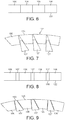
- the forming elements 106 have tapered angularly spaced side surfaces 160, 162 which, in the lay-up configuration of the forming assembly, define between them a recess for receiving the filler elements 107 (as best shown in Figure 7 ).
- the filler elements 107 extend into the circumferentially extending gaps between the forming elements 106 so that the secondary flange-forming surface 156 of the filler elements 107 are substantially continuous with the primary flange-forming surfaces 122 of the forming elements 106. Additionally, in the forming configuration, the radially outer filler surface 150 extends into the circumferentially extending gaps between the lay-up surfaces 120 of the forming elements 106, so that the lay-up surfaces 120 and filler surfaces 150 form a substantially continuous circumferentially extending surface.
- the forming and filler elements 106, 107 are coupled to actuators (not shown) for moving them between the respective lay-up and extended positions.
- the tool 102 further comprises a generally cylindrical continuation portion 128 disposed above the forming assembly 105 and having a radially outer lay-up surface 130 arranged to be contiguous and continuous with the lay-up surfaces 120 of the forming elements 106 in the lay-up configuration.
- the continuation portion 128 is supported on the support structure 103 and comprises a plurality of continuation panels 131.
- lay-up surfaces 110, 120, 130 of the body portion 104, forming elements 106 and the continuation portion 128 of the tool 102 together define a generally cylindrical continuous lay-up surface 132 for laying up a cylindrical pre-form 200.
- the tool 102 further comprises a plurality of attachment portions 134 angularly spaced around the circumferential extent of the tool 102 above the continuation portion 128 for coupling with a flange support structure 136.
- the flange support structure 136 is in the form of an annular frame configured to extend around a pre-form 200 disposed on the lay-up surface 132 of the tool and is detachably attachable to the tool 102 by cooperating attachment portions 134, 135 on the tool 102 and the flange support structure 136 respectively.
- the attachment portions 134, 135 may be coupled by bolts.
- the flange support structure 136 comprises a counteracting flange support portion 137 arranged to counteract the flange-forming surfaces 122, 156 of the forming elements 106 and filler elements 107 of the tool 102 respectively during a flange forming operation, so as to control the shape of the formed flange.
- the counteracting flange support portion 137 is arranged to abut a pre-form 200 disposed on the lay-up surface of the tool and defines an annular counteracting forming surface 140 for shaping the flange region of the component as it is formed in the forming operation.
- the counteracting forming surface 140 is oriented substantially radially (horizontally in Figures 3-5 ) and positioned axially below the level of the flange-forming surfaces 122, 156 of the forming assembly 105 by a distance corresponding to the desired thickness of the flange.
- the counteracting forming surface 140 has a radially inner rounded bend or transition portion for forming a bend or transition region where the flange region and the main body region of the component meet.
- the transition portion has a relatively low curvature so that there is a continuous bend between the main body and flange of the composite component.
- the flange-forming portion is arranged to form a flange having a radial extent of approximately 65mm, and the radius of curvature for the flange is approximately 10mm.
- the flange support structure 136 also comprises an integral mounting and heating element by which the counteracting flange support portion 137 is mounted and heated for forming and curing.
- FIG 10 shows a drive mechanism 138 for the forming assembly.
- the drive mechanism 138 comprises a plurality of drive units, each having a rotary motor 190 for each pair of adjacent forming and filler elements 106, 107 and arranged to drive a linear guide rod 192 along a guide direction slightly offset from the radial direction (in other embodiments, the guide direction may be substantially radial).
- the guide rod 192 is coupled to a guide block 194 which is fixedly secured to the filler element 107, and is coupled to the forming element 106 by a compression spring 196.
- the guide block is constrained to move along guide rails (not shown) secured to the support structure 103.
- the drive units also include radial stops (not shown) for stopping the radial motion of the respective elements 106, 107.
- the drive units are configured to gradually drive the forming elements 106 and filler elements 107 from their respective lay-up positions to their respective forming positions.
- the compression spring 196 provides a lost-motion connection between the guide block 194 and the forming element 106 so that, in use, the forming element 106 reaches its respective forming position and the filler element 107 subsequently extends into its forming position between adjacent forming elements 106.
- Figure 11 shows a portion of the apparatus 100 corresponding to one sixth of the full annulus and in particular shows the arrangement of the tool 102 including the body portion 104, five forming elements 106, the continuation portion 128, together with the flange support structure 136 and a portion of the actuation mechanism 138 corresponding to the five flange-forming portions 106 shown.
- the apparatus 100 is oriented on a support surface, such as a floor, so that its central axis extends vertically.
- the apparatus 100 is prepared for a lay-up operation by detaching the flange support structure 132, if attached. Additionally, the actuation mechanism 138 ( Figure 10 ) is controlled to return the forming assembly 105 to the lay-up configuration.
- the forming elements 106 are circumferentially adjacent one another.
- a continuous lay-up surface 132 is defined on the tool 102 by the radially outer surfaces of the body portion 104, the forming assembly 105 (the forming elements 106) and the continuation portion 128.
- This lay-up surface 132 is accessible from a radially outer position.
- a release layer (not shown) is overlaid on the lay-up surface 132 before the lay-up operation is initiated.
- a lay-up operation is conducted in which unidirectional tapes of pre-impregnated composite material are applied over the continuous lay-up surface 132 in successive layers or plies using an automatic tape laying (ATL) apparatus, thereby forming a substantially cylindrical composite pre-form 200 on the tool 102.
- the tapes are applied in a combination of ⁇ 60o and 90o (i.e. vertical) orientations with respect to a plane normal to the axis of the tool, and extend over the lay-up surfaces 110, 120, of the body portion 104 and the forming elements 106.
- the lay-up operation may be conducted by hand, or using other methods such as Automatic Fibre Placement (AFP) or automatic tape winding.
- AFP Automatic Fibre Placement
- the composite material is applied to the tool to provide a pre-form having a body region 206 extending over the body portion 104 of the tool and a flange region 208 extending over the lay-up surfaces 120 of the forming elements.
- the flange region 208 may additionally extend part-way over the lay-up surface 130 of the continuation portion 128 of the tool, and/or there may be a continuation region of the pre-form extending from the flange region 208 that may be cut away from the flange after forming or curing.
- the composite material is applied to the tool to provide a pre-form 200 for a casing for a gas turbine having an axial length of 1000mm and a flange radius of 65mm.
- the composite material is applied to the tool so that the body region 206 has an axial extent over the body portion 104 of 1000mm and the flange region has an axial extent over the forming assembly of at least 65mm.
- adhesive tapes 202 are applied in annular loops to the body portion 104 and continuation portion 128 below and above the pre-form 200 respectively, and a vacuum bag 204 is placed over the pre-form 200 and sealed with the tapes 202 against the tool 102.
- Vacuum tubes (not shown) are extended through the vacuum bag to the space enclosed between the tool 102 and the vacuum bag 204, and a vacuum source such as a vacuum pump is applied to the vacuum tubes to create a partial vacuum in the space occupied by the pre-form 200.
- a partial vacuum is formed so that an unbalanced pressure force from the ambient atmosphere is applied through the vacuum bag onto the pre-form 200.
- the forming operation is initiated by the controller causing the heating apparatus (i.e. the body heater 114 and flange heaters 123) to heat the pre-form 200 to a threshold forming temperature, which in this example is 80oC.
- the heating apparatus i.e. the body heater 114 and flange heaters 123
- the controller causes the actuation mechanism 138 to drive the forming elements 106 and the filler elements radially outwardly from the lay-up configuration to the forming configuration ( Figures 3-5 and 6-9 ). As the forming elements 106 move radially outwardly, circumferential gaps form between them and the filler elements 107 extend into these gaps.
- the flange region 208 of the pre-form is caused to slide over the lay-up surface 120 and onto the primary flange-forming surfaces 122 (i.e. the underside of the flange-forming portion 106) and the secondary flange-forming surface 156 (i.e. the underside of the filler portions 107), which together form a substantially continuous flange-forming surface.
- the movement of the flange-forming portions 106 causes the flange region 208 to plastically deform around and between the flange-forming surface 122, 156 and the flange-facing surface 140 of the counteracting support element 137, thereby forming the radial flange of the component.
- the body region 206 of the pre-form remains substantially in place against the body portion 104 of the tool 100, held in position by the counteracting support element 137.
- the forming assembly 105 is configured to move slowly during the forming operation, such as at approximately 120mm per hour, to ensure that the layers of the composite pre-form 200 are able to move relative one another during the forming operation without creating wrinkles in the pre-form.
- the controller initiates a curing operation and causes the heating apparatus to heat the pre-form 200, including the formed flange and transition region, to at least a threshold curing temperature, which in this embodiment is 135oC.
- the controller also controls the vacuum source so that an unbalanced pressure force is applied to the pre-form through the vacuum bag.
- the controller turns off the heaters and the cured casing 14 is allowed to cool on the tool 102.
- the flange support structure 136 is removed from the tool 102 and the vacuum bag and associated equipment is removed from the cured component.
- the flange assembly 105 is moved back to the lay-up configuration, and the cured casing 14 is removed from the tool.
- the casing 14 is then trimmed to remove any continuation portion of the pre-form extending beyond the desired dimensions of the flange.
- the invention allows a curved flanged component to be formed from a pre-form by driving forming elements radially outwardly during a forming process, despite the inherent problem that circumferential gaps will form between the forming elements.
- the filler elements of the forming assembly are configured to move into the respective gaps so as to provide a substantially continuous flange-forming surface.
- substantially continuous is intended to mean that there is no step change in the profile of a surface defined across two or more surfaces.
Landscapes
- Engineering & Computer Science (AREA)
- Chemical & Material Sciences (AREA)
- Composite Materials (AREA)
- Mechanical Engineering (AREA)
- Robotics (AREA)
- Moulding By Coating Moulds (AREA)
Applications Claiming Priority (2)
| Application Number | Priority Date | Filing Date | Title |
|---|---|---|---|
| GBGB1507412.3A GB201507412D0 (en) | 2015-04-30 | 2015-04-30 | A method and Apparatus for Forming a Composite Component |
| PCT/GB2016/051156 WO2016174401A1 (en) | 2015-04-30 | 2016-04-25 | A method and apparatus for forming a composite component |
Publications (2)
| Publication Number | Publication Date |
|---|---|
| EP3288746A1 EP3288746A1 (en) | 2018-03-07 |
| EP3288746B1 true EP3288746B1 (en) | 2019-06-12 |
Family
ID=53488944
Family Applications (1)
| Application Number | Title | Priority Date | Filing Date |
|---|---|---|---|
| EP16718901.8A Active EP3288746B1 (en) | 2015-04-30 | 2016-04-25 | A method and apparatus for forming a composite component |
Country Status (7)
| Country | Link |
|---|---|
| US (1) | US20180154594A1 (https=) |
| EP (1) | EP3288746B1 (https=) |
| JP (1) | JP6752227B2 (https=) |
| CN (1) | CN107530988B (https=) |
| CA (1) | CA2983065A1 (https=) |
| GB (1) | GB201507412D0 (https=) |
| WO (1) | WO2016174401A1 (https=) |
Families Citing this family (6)
| Publication number | Priority date | Publication date | Assignee | Title |
|---|---|---|---|---|
| GB201507418D0 (en) | 2015-04-30 | 2015-06-17 | Composite Technology & Applic Ltd | A tool for forming a composite component |
| CN108883586B (zh) * | 2016-04-06 | 2020-10-09 | 罗尔斯·罗伊斯公司 | 用于制造复合部件的方法 |
| FR3097800B1 (fr) * | 2019-06-27 | 2022-09-30 | Safran Aircraft Engines | Procede de fabrication d’un carter pour une turbomachine et outillages pour sa mise en oeuvre |
| JP7225320B2 (ja) * | 2021-06-28 | 2023-02-20 | 三菱重工業株式会社 | 賦形方法および賦形装置 |
| GB202210346D0 (en) | 2022-07-14 | 2022-08-31 | Rolls Royce Plc | Woven structure, method and apparatus for a flanged composite component |
| GB202312199D0 (en) * | 2023-08-09 | 2023-09-20 | Rolls Royce Plc | Method and system for manufacturing composite component |
Family Cites Families (7)
| Publication number | Priority date | Publication date | Assignee | Title |
|---|---|---|---|---|
| JPS5232388B2 (https=) * | 1972-11-08 | 1977-08-20 | ||
| JPS63417Y2 (https=) * | 1981-05-29 | 1988-01-07 | ||
| JPS6056525U (ja) * | 1983-09-27 | 1985-04-20 | 住友電気工業株式会社 | 繊維強化プラスチツクスの成形装置 |
| US5348602A (en) * | 1993-06-08 | 1994-09-20 | General Electric Company | Method for making a bonded laminated article bend portion |
| US9102103B2 (en) * | 2006-02-02 | 2015-08-11 | The Boeing Company | Thermoplastic composite parts having integrated metal fittings and method of making the same |
| GB2486231B (en) * | 2010-12-07 | 2013-04-03 | Gkn Aerospace Services Ltd | Composite structure |
| GB201116476D0 (en) * | 2011-09-26 | 2011-11-09 | Rolls Royce Plc | Mandrel for forming a component |
-
2015
- 2015-04-30 GB GBGB1507412.3A patent/GB201507412D0/en not_active Ceased
-
2016
- 2016-04-25 US US15/568,359 patent/US20180154594A1/en not_active Abandoned
- 2016-04-25 JP JP2017556707A patent/JP6752227B2/ja active Active
- 2016-04-25 CN CN201680024459.2A patent/CN107530988B/zh active Active
- 2016-04-25 WO PCT/GB2016/051156 patent/WO2016174401A1/en not_active Ceased
- 2016-04-25 EP EP16718901.8A patent/EP3288746B1/en active Active
- 2016-04-25 CA CA2983065A patent/CA2983065A1/en not_active Abandoned
Also Published As
| Publication number | Publication date |
|---|---|
| WO2016174401A1 (en) | 2016-11-03 |
| GB201507412D0 (en) | 2015-06-17 |
| US20180154594A1 (en) | 2018-06-07 |
| EP3288746A1 (en) | 2018-03-07 |
| JP2018521873A (ja) | 2018-08-09 |
| CN107530988B (zh) | 2020-07-14 |
| JP6752227B2 (ja) | 2020-09-09 |
| CN107530988A (zh) | 2018-01-02 |
| CA2983065A1 (en) | 2016-11-03 |
Similar Documents
| Publication | Publication Date | Title |
|---|---|---|
| EP3288746B1 (en) | A method and apparatus for forming a composite component | |
| EP3288747B1 (en) | A method of manufacturing a composite component | |
| US11999079B2 (en) | Method for manufacturing a composite component | |
| JP2018521873A5 (https=) | ||
| JP5745633B2 (ja) | 複合構造体を製造する方法およびその方法によって得られる複合構造体 | |
| EP2682245A2 (en) | Apparatus for manufacturing a flange composite component and methods of manufacturing the same | |
| EP3288745B1 (en) | A tool for forming a composite component | |
| JP2018515365A5 (https=) | ||
| GB2555833A (en) | A tool and method for forming a composite component |
Legal Events
| Date | Code | Title | Description |
|---|---|---|---|
| STAA | Information on the status of an ep patent application or granted ep patent |
Free format text: STATUS: THE INTERNATIONAL PUBLICATION HAS BEEN MADE |
|
| PUAI | Public reference made under article 153(3) epc to a published international application that has entered the european phase |
Free format text: ORIGINAL CODE: 0009012 |
|
| STAA | Information on the status of an ep patent application or granted ep patent |
Free format text: STATUS: REQUEST FOR EXAMINATION WAS MADE |
|
| 17P | Request for examination filed |
Effective date: 20171129 |
|
| AK | Designated contracting states |
Kind code of ref document: A1 Designated state(s): AL AT BE BG CH CY CZ DE DK EE ES FI FR GB GR HR HU IE IS IT LI LT LU LV MC MK MT NL NO PL PT RO RS SE SI SK SM TR |
|
| AX | Request for extension of the european patent |
Extension state: BA ME |
|
| DAV | Request for validation of the european patent (deleted) | ||
| DAX | Request for extension of the european patent (deleted) | ||
| GRAP | Despatch of communication of intention to grant a patent |
Free format text: ORIGINAL CODE: EPIDOSNIGR1 |
|
| STAA | Information on the status of an ep patent application or granted ep patent |
Free format text: STATUS: GRANT OF PATENT IS INTENDED |
|
| RIC1 | Information provided on ipc code assigned before grant |
Ipc: B29C 70/68 20060101ALI20181106BHEP Ipc: B29C 70/46 20060101AFI20181106BHEP Ipc: B29C 70/56 20060101ALI20181106BHEP Ipc: B29C 70/38 20060101ALI20181106BHEP Ipc: B29C 33/30 20060101ALI20181106BHEP |
|
| INTG | Intention to grant announced |
Effective date: 20181128 |
|
| GRAS | Grant fee paid |
Free format text: ORIGINAL CODE: EPIDOSNIGR3 |
|
| RAP1 | Party data changed (applicant data changed or rights of an application transferred) |
Owner name: ROLLS-ROYCE PLC |
|
| GRAA | (expected) grant |
Free format text: ORIGINAL CODE: 0009210 |
|
| STAA | Information on the status of an ep patent application or granted ep patent |
Free format text: STATUS: THE PATENT HAS BEEN GRANTED |
|
| AK | Designated contracting states |
Kind code of ref document: B1 Designated state(s): AL AT BE BG CH CY CZ DE DK EE ES FI FR GB GR HR HU IE IS IT LI LT LU LV MC MK MT NL NO PL PT RO RS SE SI SK SM TR |
|
| REG | Reference to a national code |
Ref country code: GB Ref legal event code: FG4D |
|
| REG | Reference to a national code |
Ref country code: CH Ref legal event code: EP |
|
| REG | Reference to a national code |
Ref country code: AT Ref legal event code: REF Ref document number: 1142028 Country of ref document: AT Kind code of ref document: T Effective date: 20190615 |
|
| REG | Reference to a national code |
Ref country code: DE Ref legal event code: R096 Ref document number: 602016015186 Country of ref document: DE |
|
| REG | Reference to a national code |
Ref country code: IE Ref legal event code: FG4D |
|
| REG | Reference to a national code |
Ref country code: NL Ref legal event code: MP Effective date: 20190612 |
|
| REG | Reference to a national code |
Ref country code: LT Ref legal event code: MG4D |
|
| PG25 | Lapsed in a contracting state [announced via postgrant information from national office to epo] |
Ref country code: AL Free format text: LAPSE BECAUSE OF FAILURE TO SUBMIT A TRANSLATION OF THE DESCRIPTION OR TO PAY THE FEE WITHIN THE PRESCRIBED TIME-LIMIT Effective date: 20190612 Ref country code: LT Free format text: LAPSE BECAUSE OF FAILURE TO SUBMIT A TRANSLATION OF THE DESCRIPTION OR TO PAY THE FEE WITHIN THE PRESCRIBED TIME-LIMIT Effective date: 20190612 Ref country code: FI Free format text: LAPSE BECAUSE OF FAILURE TO SUBMIT A TRANSLATION OF THE DESCRIPTION OR TO PAY THE FEE WITHIN THE PRESCRIBED TIME-LIMIT Effective date: 20190612 Ref country code: NO Free format text: LAPSE BECAUSE OF FAILURE TO SUBMIT A TRANSLATION OF THE DESCRIPTION OR TO PAY THE FEE WITHIN THE PRESCRIBED TIME-LIMIT Effective date: 20190912 Ref country code: SE Free format text: LAPSE BECAUSE OF FAILURE TO SUBMIT A TRANSLATION OF THE DESCRIPTION OR TO PAY THE FEE WITHIN THE PRESCRIBED TIME-LIMIT Effective date: 20190612 Ref country code: HR Free format text: LAPSE BECAUSE OF FAILURE TO SUBMIT A TRANSLATION OF THE DESCRIPTION OR TO PAY THE FEE WITHIN THE PRESCRIBED TIME-LIMIT Effective date: 20190612 |
|
| PG25 | Lapsed in a contracting state [announced via postgrant information from national office to epo] |
Ref country code: RS Free format text: LAPSE BECAUSE OF FAILURE TO SUBMIT A TRANSLATION OF THE DESCRIPTION OR TO PAY THE FEE WITHIN THE PRESCRIBED TIME-LIMIT Effective date: 20190612 Ref country code: LV Free format text: LAPSE BECAUSE OF FAILURE TO SUBMIT A TRANSLATION OF THE DESCRIPTION OR TO PAY THE FEE WITHIN THE PRESCRIBED TIME-LIMIT Effective date: 20190612 Ref country code: GR Free format text: LAPSE BECAUSE OF FAILURE TO SUBMIT A TRANSLATION OF THE DESCRIPTION OR TO PAY THE FEE WITHIN THE PRESCRIBED TIME-LIMIT Effective date: 20190913 Ref country code: BG Free format text: LAPSE BECAUSE OF FAILURE TO SUBMIT A TRANSLATION OF THE DESCRIPTION OR TO PAY THE FEE WITHIN THE PRESCRIBED TIME-LIMIT Effective date: 20190912 |
|
| REG | Reference to a national code |
Ref country code: AT Ref legal event code: MK05 Ref document number: 1142028 Country of ref document: AT Kind code of ref document: T Effective date: 20190612 |
|
| PG25 | Lapsed in a contracting state [announced via postgrant information from national office to epo] |
Ref country code: PT Free format text: LAPSE BECAUSE OF FAILURE TO SUBMIT A TRANSLATION OF THE DESCRIPTION OR TO PAY THE FEE WITHIN THE PRESCRIBED TIME-LIMIT Effective date: 20191014 Ref country code: CZ Free format text: LAPSE BECAUSE OF FAILURE TO SUBMIT A TRANSLATION OF THE DESCRIPTION OR TO PAY THE FEE WITHIN THE PRESCRIBED TIME-LIMIT Effective date: 20190612 Ref country code: NL Free format text: LAPSE BECAUSE OF FAILURE TO SUBMIT A TRANSLATION OF THE DESCRIPTION OR TO PAY THE FEE WITHIN THE PRESCRIBED TIME-LIMIT Effective date: 20190612 Ref country code: EE Free format text: LAPSE BECAUSE OF FAILURE TO SUBMIT A TRANSLATION OF THE DESCRIPTION OR TO PAY THE FEE WITHIN THE PRESCRIBED TIME-LIMIT Effective date: 20190612 Ref country code: AT Free format text: LAPSE BECAUSE OF FAILURE TO SUBMIT A TRANSLATION OF THE DESCRIPTION OR TO PAY THE FEE WITHIN THE PRESCRIBED TIME-LIMIT Effective date: 20190612 Ref country code: RO Free format text: LAPSE BECAUSE OF FAILURE TO SUBMIT A TRANSLATION OF THE DESCRIPTION OR TO PAY THE FEE WITHIN THE PRESCRIBED TIME-LIMIT Effective date: 20190612 Ref country code: SK Free format text: LAPSE BECAUSE OF FAILURE TO SUBMIT A TRANSLATION OF THE DESCRIPTION OR TO PAY THE FEE WITHIN THE PRESCRIBED TIME-LIMIT Effective date: 20190612 |
|
| RAP2 | Party data changed (patent owner data changed or rights of a patent transferred) |
Owner name: ROLLS-ROYCE PLC |
|
| PG25 | Lapsed in a contracting state [announced via postgrant information from national office to epo] |
Ref country code: ES Free format text: LAPSE BECAUSE OF FAILURE TO SUBMIT A TRANSLATION OF THE DESCRIPTION OR TO PAY THE FEE WITHIN THE PRESCRIBED TIME-LIMIT Effective date: 20190612 Ref country code: SM Free format text: LAPSE BECAUSE OF FAILURE TO SUBMIT A TRANSLATION OF THE DESCRIPTION OR TO PAY THE FEE WITHIN THE PRESCRIBED TIME-LIMIT Effective date: 20190612 Ref country code: IS Free format text: LAPSE BECAUSE OF FAILURE TO SUBMIT A TRANSLATION OF THE DESCRIPTION OR TO PAY THE FEE WITHIN THE PRESCRIBED TIME-LIMIT Effective date: 20191012 Ref country code: IT Free format text: LAPSE BECAUSE OF FAILURE TO SUBMIT A TRANSLATION OF THE DESCRIPTION OR TO PAY THE FEE WITHIN THE PRESCRIBED TIME-LIMIT Effective date: 20190612 |
|
| REG | Reference to a national code |
Ref country code: DE Ref legal event code: R097 Ref document number: 602016015186 Country of ref document: DE |
|
| PG25 | Lapsed in a contracting state [announced via postgrant information from national office to epo] |
Ref country code: TR Free format text: LAPSE BECAUSE OF FAILURE TO SUBMIT A TRANSLATION OF THE DESCRIPTION OR TO PAY THE FEE WITHIN THE PRESCRIBED TIME-LIMIT Effective date: 20190612 |
|
| PLBE | No opposition filed within time limit |
Free format text: ORIGINAL CODE: 0009261 |
|
| STAA | Information on the status of an ep patent application or granted ep patent |
Free format text: STATUS: NO OPPOSITION FILED WITHIN TIME LIMIT |
|
| PG25 | Lapsed in a contracting state [announced via postgrant information from national office to epo] |
Ref country code: DK Free format text: LAPSE BECAUSE OF FAILURE TO SUBMIT A TRANSLATION OF THE DESCRIPTION OR TO PAY THE FEE WITHIN THE PRESCRIBED TIME-LIMIT Effective date: 20190612 Ref country code: PL Free format text: LAPSE BECAUSE OF FAILURE TO SUBMIT A TRANSLATION OF THE DESCRIPTION OR TO PAY THE FEE WITHIN THE PRESCRIBED TIME-LIMIT Effective date: 20190612 |
|
| 26N | No opposition filed |
Effective date: 20200313 |
|
| PG25 | Lapsed in a contracting state [announced via postgrant information from national office to epo] |
Ref country code: IS Free format text: LAPSE BECAUSE OF FAILURE TO SUBMIT A TRANSLATION OF THE DESCRIPTION OR TO PAY THE FEE WITHIN THE PRESCRIBED TIME-LIMIT Effective date: 20200224 Ref country code: SI Free format text: LAPSE BECAUSE OF FAILURE TO SUBMIT A TRANSLATION OF THE DESCRIPTION OR TO PAY THE FEE WITHIN THE PRESCRIBED TIME-LIMIT Effective date: 20190612 |
|
| PG2D | Information on lapse in contracting state deleted |
Ref country code: IS |
|
| PG25 | Lapsed in a contracting state [announced via postgrant information from national office to epo] |
Ref country code: MC Free format text: LAPSE BECAUSE OF FAILURE TO SUBMIT A TRANSLATION OF THE DESCRIPTION OR TO PAY THE FEE WITHIN THE PRESCRIBED TIME-LIMIT Effective date: 20190612 |
|
| REG | Reference to a national code |
Ref country code: CH Ref legal event code: PL |
|
| REG | Reference to a national code |
Ref country code: DE Ref legal event code: R082 Ref document number: 602016015186 Country of ref document: DE Representative=s name: HL KEMPNER PATENTANWAELTE, SOLICITORS (ENGLAND, DE Ref country code: DE Ref legal event code: R082 Ref document number: 602016015186 Country of ref document: DE Representative=s name: HL KEMPNER PATENTANWALT, RECHTSANWALT, SOLICIT, DE Ref country code: DE Ref legal event code: R082 Ref document number: 602016015186 Country of ref document: DE Representative=s name: HL KEMPNER PARTG MBB, DE |
|
| PG25 | Lapsed in a contracting state [announced via postgrant information from national office to epo] |
Ref country code: LU Free format text: LAPSE BECAUSE OF NON-PAYMENT OF DUE FEES Effective date: 20200425 Ref country code: LI Free format text: LAPSE BECAUSE OF NON-PAYMENT OF DUE FEES Effective date: 20200430 Ref country code: CH Free format text: LAPSE BECAUSE OF NON-PAYMENT OF DUE FEES Effective date: 20200430 |
|
| REG | Reference to a national code |
Ref country code: BE Ref legal event code: MM Effective date: 20200430 |
|
| PG25 | Lapsed in a contracting state [announced via postgrant information from national office to epo] |
Ref country code: BE Free format text: LAPSE BECAUSE OF NON-PAYMENT OF DUE FEES Effective date: 20200430 |
|
| PG25 | Lapsed in a contracting state [announced via postgrant information from national office to epo] |
Ref country code: IE Free format text: LAPSE BECAUSE OF NON-PAYMENT OF DUE FEES Effective date: 20200425 |
|
| PG25 | Lapsed in a contracting state [announced via postgrant information from national office to epo] |
Ref country code: MT Free format text: LAPSE BECAUSE OF FAILURE TO SUBMIT A TRANSLATION OF THE DESCRIPTION OR TO PAY THE FEE WITHIN THE PRESCRIBED TIME-LIMIT Effective date: 20190612 Ref country code: CY Free format text: LAPSE BECAUSE OF FAILURE TO SUBMIT A TRANSLATION OF THE DESCRIPTION OR TO PAY THE FEE WITHIN THE PRESCRIBED TIME-LIMIT Effective date: 20190612 |
|
| PG25 | Lapsed in a contracting state [announced via postgrant information from national office to epo] |
Ref country code: MK Free format text: LAPSE BECAUSE OF FAILURE TO SUBMIT A TRANSLATION OF THE DESCRIPTION OR TO PAY THE FEE WITHIN THE PRESCRIBED TIME-LIMIT Effective date: 20190612 |
|
| P01 | Opt-out of the competence of the unified patent court (upc) registered |
Effective date: 20230528 |
|
| PGFP | Annual fee paid to national office [announced via postgrant information from national office to epo] |
Ref country code: DE Payment date: 20250428 Year of fee payment: 10 |
|
| PGFP | Annual fee paid to national office [announced via postgrant information from national office to epo] |
Ref country code: FR Payment date: 20250424 Year of fee payment: 10 |
|
| PGFP | Annual fee paid to national office [announced via postgrant information from national office to epo] |
Ref country code: GB Payment date: 20260313 Year of fee payment: 11 |