EP3288051A1 - Dye-sensitized solar cell and electrolysis solution for dye-sensitized solar cell - Google Patents
Dye-sensitized solar cell and electrolysis solution for dye-sensitized solar cell Download PDFInfo
- Publication number
- EP3288051A1 EP3288051A1 EP16783174.2A EP16783174A EP3288051A1 EP 3288051 A1 EP3288051 A1 EP 3288051A1 EP 16783174 A EP16783174 A EP 16783174A EP 3288051 A1 EP3288051 A1 EP 3288051A1
- Authority
- EP
- European Patent Office
- Prior art keywords
- dye
- solar cell
- sensitized solar
- group
- compound
- Prior art date
- Legal status (The legal status is an assumption and is not a legal conclusion. Google has not performed a legal analysis and makes no representation as to the accuracy of the status listed.)
- Withdrawn
Links
- 238000005868 electrolysis reaction Methods 0.000 title 1
- -1 nitroxyl radical compound Chemical class 0.000 claims abstract description 111
- 239000004065 semiconductor Substances 0.000 claims abstract description 54
- 239000003792 electrolyte Substances 0.000 claims abstract description 27
- 125000000217 alkyl group Chemical group 0.000 claims abstract description 10
- 229910052736 halogen Inorganic materials 0.000 claims abstract description 9
- 150000002367 halogens Chemical class 0.000 claims abstract description 8
- 125000003545 alkoxy group Chemical group 0.000 claims abstract description 7
- 125000003118 aryl group Chemical group 0.000 claims abstract description 7
- 239000008151 electrolyte solution Substances 0.000 claims description 60
- 229910052710 silicon Chemical group 0.000 claims description 13
- 125000004432 carbon atom Chemical group C* 0.000 claims description 10
- 125000004429 atom Chemical group 0.000 claims description 9
- 125000004437 phosphorous atom Chemical group 0.000 claims description 9
- 125000004435 hydrogen atom Chemical group [H]* 0.000 claims description 8
- 239000000463 material Substances 0.000 abstract description 67
- ZCYVEMRRCGMTRW-UHFFFAOYSA-N 7553-56-2 Chemical compound [I] ZCYVEMRRCGMTRW-UHFFFAOYSA-N 0.000 abstract description 22
- 229910052740 iodine Inorganic materials 0.000 abstract description 22
- 239000011630 iodine Substances 0.000 abstract description 22
- 230000007774 longterm Effects 0.000 abstract description 5
- OKTJSMMVPCPJKN-UHFFFAOYSA-N Carbon Chemical compound [C] OKTJSMMVPCPJKN-UHFFFAOYSA-N 0.000 abstract description 2
- 229910052799 carbon Inorganic materials 0.000 abstract description 2
- GDOPTJXRTPNYNR-UHFFFAOYSA-N methyl-cyclopentane Natural products CC1CCCC1 GDOPTJXRTPNYNR-UHFFFAOYSA-N 0.000 description 62
- 150000001875 compounds Chemical class 0.000 description 58
- RTZKZFJDLAIYFH-UHFFFAOYSA-N Diethyl ether Chemical compound CCOCC RTZKZFJDLAIYFH-UHFFFAOYSA-N 0.000 description 49
- IJGRMHOSHXDMSA-UHFFFAOYSA-N Atomic nitrogen Chemical compound N#N IJGRMHOSHXDMSA-UHFFFAOYSA-N 0.000 description 29
- 239000000975 dye Substances 0.000 description 27
- 239000002904 solvent Substances 0.000 description 26
- WEVYAHXRMPXWCK-UHFFFAOYSA-N Acetonitrile Chemical compound CC#N WEVYAHXRMPXWCK-UHFFFAOYSA-N 0.000 description 24
- 238000004519 manufacturing process Methods 0.000 description 24
- 238000006243 chemical reaction Methods 0.000 description 21
- HEDRZPFGACZZDS-UHFFFAOYSA-N Chloroform Chemical compound ClC(Cl)Cl HEDRZPFGACZZDS-UHFFFAOYSA-N 0.000 description 18
- 238000004949 mass spectrometry Methods 0.000 description 18
- OFOBLEOULBTSOW-UHFFFAOYSA-N Malonic acid Chemical compound OC(=O)CC(O)=O OFOBLEOULBTSOW-UHFFFAOYSA-N 0.000 description 17
- 238000000034 method Methods 0.000 description 16
- 239000000047 product Substances 0.000 description 15
- 239000000243 solution Substances 0.000 description 15
- LFQSCWFLJHTTHZ-UHFFFAOYSA-N Ethanol Chemical compound CCO LFQSCWFLJHTTHZ-UHFFFAOYSA-N 0.000 description 13
- 230000015572 biosynthetic process Effects 0.000 description 13
- BASFCYQUMIYNBI-UHFFFAOYSA-N platinum Chemical compound [Pt] BASFCYQUMIYNBI-UHFFFAOYSA-N 0.000 description 13
- 238000003786 synthesis reaction Methods 0.000 description 13
- 238000004435 EPR spectroscopy Methods 0.000 description 12
- ZMANZCXQSJIPKH-UHFFFAOYSA-N Triethylamine Chemical compound CCN(CC)CC ZMANZCXQSJIPKH-UHFFFAOYSA-N 0.000 description 12
- 230000027756 respiratory electron transport chain Effects 0.000 description 12
- 230000002441 reversible effect Effects 0.000 description 12
- 238000006276 transfer reaction Methods 0.000 description 12
- 229910001873 dinitrogen Inorganic materials 0.000 description 11
- 238000010992 reflux Methods 0.000 description 11
- RDKKQZIFDSEMNU-UHFFFAOYSA-N 2-ethylsulfonylpropane Chemical compound CCS(=O)(=O)C(C)C RDKKQZIFDSEMNU-UHFFFAOYSA-N 0.000 description 10
- LYCAIKOWRPUZTN-UHFFFAOYSA-N Ethylene glycol Chemical compound OCCO LYCAIKOWRPUZTN-UHFFFAOYSA-N 0.000 description 10
- CSNNHWWHGAXBCP-UHFFFAOYSA-L Magnesium sulfate Chemical compound [Mg+2].[O-][S+2]([O-])([O-])[O-] CSNNHWWHGAXBCP-UHFFFAOYSA-L 0.000 description 10
- UZFMOKQJFYMBGY-UHFFFAOYSA-N 4-hydroxy-TEMPO Chemical compound CC1(C)CC(O)CC(C)(C)N1[O] UZFMOKQJFYMBGY-UHFFFAOYSA-N 0.000 description 9
- ZMXDDKWLCZADIW-UHFFFAOYSA-N N,N-Dimethylformamide Chemical compound CN(C)C=O ZMXDDKWLCZADIW-UHFFFAOYSA-N 0.000 description 9
- 230000001588 bifunctional effect Effects 0.000 description 9
- MTHSVFCYNBDYFN-UHFFFAOYSA-N diethylene glycol Chemical compound OCCOCCO MTHSVFCYNBDYFN-UHFFFAOYSA-N 0.000 description 9
- 229910052757 nitrogen Inorganic materials 0.000 description 9
- CXMXRPHRNRROMY-UHFFFAOYSA-N sebacic acid Chemical compound OC(=O)CCCCCCCCC(O)=O CXMXRPHRNRROMY-UHFFFAOYSA-N 0.000 description 9
- 230000000052 comparative effect Effects 0.000 description 8
- 125000000524 functional group Chemical group 0.000 description 8
- 238000005227 gel permeation chromatography Methods 0.000 description 8
- 238000005259 measurement Methods 0.000 description 8
- UFHFLCQGNIYNRP-UHFFFAOYSA-N Hydrogen Chemical compound [H][H] UFHFLCQGNIYNRP-UHFFFAOYSA-N 0.000 description 7
- 239000007795 chemical reaction product Substances 0.000 description 7
- 239000003960 organic solvent Substances 0.000 description 7
- 229920001223 polyethylene glycol Polymers 0.000 description 7
- 150000003254 radicals Chemical group 0.000 description 7
- XLYOFNOQVPJJNP-UHFFFAOYSA-N water Substances O XLYOFNOQVPJJNP-UHFFFAOYSA-N 0.000 description 7
- WYURNTSHIVDZCO-UHFFFAOYSA-N Tetrahydrofuran Chemical compound C1CCOC1 WYURNTSHIVDZCO-UHFFFAOYSA-N 0.000 description 6
- 235000019441 ethanol Nutrition 0.000 description 6
- 229910052697 platinum Inorganic materials 0.000 description 6
- FYSNRJHAOHDILO-UHFFFAOYSA-N thionyl chloride Chemical compound ClS(Cl)=O FYSNRJHAOHDILO-UHFFFAOYSA-N 0.000 description 6
- VYPSYNLAJGMNEJ-UHFFFAOYSA-N Silicium dioxide Chemical compound O=[Si]=O VYPSYNLAJGMNEJ-UHFFFAOYSA-N 0.000 description 5
- 239000012295 chemical reaction liquid Substances 0.000 description 5
- 150000004696 coordination complex Chemical class 0.000 description 5
- 238000000605 extraction Methods 0.000 description 5
- 229910052739 hydrogen Inorganic materials 0.000 description 5
- 239000001257 hydrogen Substances 0.000 description 5
- 239000007788 liquid Substances 0.000 description 5
- 229910052943 magnesium sulfate Inorganic materials 0.000 description 5
- 235000019341 magnesium sulphate Nutrition 0.000 description 5
- 239000011148 porous material Substances 0.000 description 5
- NJAKRNRJVHIIDT-UHFFFAOYSA-N 1-ethylsulfonyl-2-methylpropane Chemical compound CCS(=O)(=O)CC(C)C NJAKRNRJVHIIDT-UHFFFAOYSA-N 0.000 description 4
- WXZSOSHKVAZDMU-UHFFFAOYSA-N 2-methyl-1-propan-2-ylsulfonylpropane Chemical compound CC(C)CS(=O)(=O)C(C)C WXZSOSHKVAZDMU-UHFFFAOYSA-N 0.000 description 4
- VXEGSRKPIUDPQT-UHFFFAOYSA-N 4-[4-(4-methoxyphenyl)piperazin-1-yl]aniline Chemical compound C1=CC(OC)=CC=C1N1CCN(C=2C=CC(N)=CC=2)CC1 VXEGSRKPIUDPQT-UHFFFAOYSA-N 0.000 description 4
- IKHGUXGNUITLKF-UHFFFAOYSA-N Acetaldehyde Chemical compound CC=O IKHGUXGNUITLKF-UHFFFAOYSA-N 0.000 description 4
- 239000002202 Polyethylene glycol Substances 0.000 description 4
- 239000012327 Ruthenium complex Substances 0.000 description 4
- WNLRTRBMVRJNCN-UHFFFAOYSA-N adipic acid Chemical compound OC(=O)CCCCC(O)=O WNLRTRBMVRJNCN-UHFFFAOYSA-N 0.000 description 4
- 239000010949 copper Substances 0.000 description 4
- 239000012043 crude product Substances 0.000 description 4
- 229910021419 crystalline silicon Inorganic materials 0.000 description 4
- 150000001991 dicarboxylic acids Chemical class 0.000 description 4
- 150000002009 diols Chemical class 0.000 description 4
- 239000000706 filtrate Substances 0.000 description 4
- 239000011521 glass Substances 0.000 description 4
- BDJRBEYXGGNYIS-UHFFFAOYSA-N nonanedioic acid Chemical compound OC(=O)CCCCCCCC(O)=O BDJRBEYXGGNYIS-UHFFFAOYSA-N 0.000 description 4
- 229910052698 phosphorus Inorganic materials 0.000 description 4
- 239000011574 phosphorus Substances 0.000 description 4
- FAIAAWCVCHQXDN-UHFFFAOYSA-N phosphorus trichloride Chemical compound ClP(Cl)Cl FAIAAWCVCHQXDN-UHFFFAOYSA-N 0.000 description 4
- WLJVNTCWHIRURA-UHFFFAOYSA-N pimelic acid Chemical compound OC(=O)CCCCCC(O)=O WLJVNTCWHIRURA-UHFFFAOYSA-N 0.000 description 4
- 238000000746 purification Methods 0.000 description 4
- 229930195734 saturated hydrocarbon Natural products 0.000 description 4
- 239000010703 silicon Substances 0.000 description 4
- 239000005049 silicon tetrachloride Substances 0.000 description 4
- 230000000087 stabilizing effect Effects 0.000 description 4
- TYFQFVWCELRYAO-UHFFFAOYSA-N suberic acid Chemical compound OC(=O)CCCCCCC(O)=O TYFQFVWCELRYAO-UHFFFAOYSA-N 0.000 description 4
- 239000000758 substrate Substances 0.000 description 4
- UWHCKJMYHZGTIT-UHFFFAOYSA-N tetraethylene glycol Chemical compound OCCOCCOCCOCCO UWHCKJMYHZGTIT-UHFFFAOYSA-N 0.000 description 4
- ZIBGPFATKBEMQZ-UHFFFAOYSA-N triethylene glycol Chemical compound OCCOCCOCCO ZIBGPFATKBEMQZ-UHFFFAOYSA-N 0.000 description 4
- CYQGCJQJIOARKD-UHFFFAOYSA-N 4-carboxy-TEMPO Chemical class CC1(C)CC(C(O)=O)CC(C)(C)N1[O] CYQGCJQJIOARKD-UHFFFAOYSA-N 0.000 description 3
- RYGMFSIKBFXOCR-UHFFFAOYSA-N Copper Chemical compound [Cu] RYGMFSIKBFXOCR-UHFFFAOYSA-N 0.000 description 3
- YMWUJEATGCHHMB-UHFFFAOYSA-N Dichloromethane Chemical compound ClCCl YMWUJEATGCHHMB-UHFFFAOYSA-N 0.000 description 3
- XEEYBQQBJWHFJM-UHFFFAOYSA-N Iron Chemical compound [Fe] XEEYBQQBJWHFJM-UHFFFAOYSA-N 0.000 description 3
- OKKJLVBELUTLKV-UHFFFAOYSA-N Methanol Chemical compound OC OKKJLVBELUTLKV-UHFFFAOYSA-N 0.000 description 3
- MUBZPKHOEPUJKR-UHFFFAOYSA-N Oxalic acid Chemical compound OC(=O)C(O)=O MUBZPKHOEPUJKR-UHFFFAOYSA-N 0.000 description 3
- ATJFFYVFTNAWJD-UHFFFAOYSA-N Tin Chemical compound [Sn] ATJFFYVFTNAWJD-UHFFFAOYSA-N 0.000 description 3
- 229910052782 aluminium Inorganic materials 0.000 description 3
- XAGFODPZIPBFFR-UHFFFAOYSA-N aluminium Chemical compound [Al] XAGFODPZIPBFFR-UHFFFAOYSA-N 0.000 description 3
- YLFIGGHWWPSIEG-UHFFFAOYSA-N aminoxyl Chemical compound [O]N YLFIGGHWWPSIEG-UHFFFAOYSA-N 0.000 description 3
- JFDZBHWFFUWGJE-UHFFFAOYSA-N benzonitrile Chemical compound N#CC1=CC=CC=C1 JFDZBHWFFUWGJE-UHFFFAOYSA-N 0.000 description 3
- 238000001816 cooling Methods 0.000 description 3
- 229910052802 copper Inorganic materials 0.000 description 3
- 230000007797 corrosion Effects 0.000 description 3
- 238000005260 corrosion Methods 0.000 description 3
- 238000000354 decomposition reaction Methods 0.000 description 3
- 230000000694 effects Effects 0.000 description 3
- 238000001914 filtration Methods 0.000 description 3
- 150000004820 halides Chemical class 0.000 description 3
- 125000004051 hexyl group Chemical group [H]C([H])([H])C([H])([H])C([H])([H])C([H])([H])C([H])([H])C([H])([H])* 0.000 description 3
- 229910052751 metal Inorganic materials 0.000 description 3
- 239000002184 metal Substances 0.000 description 3
- OEIJHBUUFURJLI-UHFFFAOYSA-N octane-1,8-diol Chemical compound OCCCCCCCCO OEIJHBUUFURJLI-UHFFFAOYSA-N 0.000 description 3
- 229940116351 sebacate Drugs 0.000 description 3
- CXMXRPHRNRROMY-UHFFFAOYSA-L sebacate(2-) Chemical compound [O-]C(=O)CCCCCCCCC([O-])=O CXMXRPHRNRROMY-UHFFFAOYSA-L 0.000 description 3
- 239000000741 silica gel Substances 0.000 description 3
- 229910002027 silica gel Inorganic materials 0.000 description 3
- 238000003756 stirring Methods 0.000 description 3
- YLQBMQCUIZJEEH-UHFFFAOYSA-N tetrahydrofuran Natural products C=1C=COC=1 YLQBMQCUIZJEEH-UHFFFAOYSA-N 0.000 description 3
- 229910052718 tin Inorganic materials 0.000 description 3
- WSWCOQWTEOXDQX-MQQKCMAXSA-M (E,E)-sorbate Chemical compound C\C=C\C=C\C([O-])=O WSWCOQWTEOXDQX-MQQKCMAXSA-M 0.000 description 2
- VDVUCLWJZJHFAV-UHFFFAOYSA-N 2,2,6,6-tetramethylpiperidin-4-ol Chemical compound CC1(C)CC(O)CC(C)(C)N1 VDVUCLWJZJHFAV-UHFFFAOYSA-N 0.000 description 2
- BEVWMRQFVUOPJT-UHFFFAOYSA-N 2,4-dimethyl-1,3-thiazole-5-carboxamide Chemical compound CC1=NC(C)=C(C(N)=O)S1 BEVWMRQFVUOPJT-UHFFFAOYSA-N 0.000 description 2
- COEGBCJIXOPJHZ-UHFFFAOYSA-N 2-(2,2,6,6-tetramethylpiperidin-4-yl)ethanol Chemical compound CC1(C)CC(CCO)CC(C)(C)N1 COEGBCJIXOPJHZ-UHFFFAOYSA-N 0.000 description 2
- HUAJFMVQTNDNEX-UHFFFAOYSA-N 2-(2-methoxyethylsulfonyl)propane Chemical compound COCCS(=O)(=O)C(C)C HUAJFMVQTNDNEX-UHFFFAOYSA-N 0.000 description 2
- WGKYSFRFMQHMOF-UHFFFAOYSA-N 3-bromo-5-methylpyridine-2-carbonitrile Chemical compound CC1=CN=C(C#N)C(Br)=C1 WGKYSFRFMQHMOF-UHFFFAOYSA-N 0.000 description 2
- DEXFNLNNUZKHNO-UHFFFAOYSA-N 6-[3-[4-[2-(2,3-dihydro-1H-inden-2-ylamino)pyrimidin-5-yl]piperidin-1-yl]-3-oxopropyl]-3H-1,3-benzoxazol-2-one Chemical compound C1C(CC2=CC=CC=C12)NC1=NC=C(C=N1)C1CCN(CC1)C(CCC1=CC2=C(NC(O2)=O)C=C1)=O DEXFNLNNUZKHNO-UHFFFAOYSA-N 0.000 description 2
- UXVMQQNJUSDDNG-UHFFFAOYSA-L Calcium chloride Chemical compound [Cl-].[Cl-].[Ca+2] UXVMQQNJUSDDNG-UHFFFAOYSA-L 0.000 description 2
- IAZDPXIOMUYVGZ-UHFFFAOYSA-N Dimethylsulphoxide Chemical compound CS(C)=O IAZDPXIOMUYVGZ-UHFFFAOYSA-N 0.000 description 2
- PXHVJJICTQNCMI-UHFFFAOYSA-N Nickel Chemical compound [Ni] PXHVJJICTQNCMI-UHFFFAOYSA-N 0.000 description 2
- BPQQTUXANYXVAA-UHFFFAOYSA-N Orthosilicate Chemical compound [O-][Si]([O-])([O-])[O-] BPQQTUXANYXVAA-UHFFFAOYSA-N 0.000 description 2
- KDLHZDBZIXYQEI-UHFFFAOYSA-N Palladium Chemical compound [Pd] KDLHZDBZIXYQEI-UHFFFAOYSA-N 0.000 description 2
- 239000004793 Polystyrene Substances 0.000 description 2
- SMWDFEZZVXVKRB-UHFFFAOYSA-N Quinoline Chemical compound N1=CC=CC2=CC=CC=C21 SMWDFEZZVXVKRB-UHFFFAOYSA-N 0.000 description 2
- KEAYESYHFKHZAL-UHFFFAOYSA-N Sodium Chemical compound [Na] KEAYESYHFKHZAL-UHFFFAOYSA-N 0.000 description 2
- GWEVSGVZZGPLCZ-UHFFFAOYSA-N Titan oxide Chemical compound O=[Ti]=O GWEVSGVZZGPLCZ-UHFFFAOYSA-N 0.000 description 2
- RTAQQCXQSZGOHL-UHFFFAOYSA-N Titanium Chemical compound [Ti] RTAQQCXQSZGOHL-UHFFFAOYSA-N 0.000 description 2
- JWUXJYZVKZKLTJ-UHFFFAOYSA-N Triacetonamine Chemical compound CC1(C)CC(=O)CC(C)(C)N1 JWUXJYZVKZKLTJ-UHFFFAOYSA-N 0.000 description 2
- 239000007983 Tris buffer Substances 0.000 description 2
- 239000000654 additive Substances 0.000 description 2
- 239000001361 adipic acid Substances 0.000 description 2
- 235000011037 adipic acid Nutrition 0.000 description 2
- XVJWWMHPPKXKRU-UHFFFAOYSA-N bis(1-$l^{1}-oxidanyl-2,2,6,6-tetramethylpiperidin-4-yl) decanedioate Chemical compound C1C(C)(C)N([O])C(C)(C)CC1OC(=O)CCCCCCCCC(=O)OC1CC(C)(C)N([O])C(C)(C)C1 XVJWWMHPPKXKRU-UHFFFAOYSA-N 0.000 description 2
- CDQSJQSWAWPGKG-UHFFFAOYSA-N butane-1,1-diol Chemical compound CCCC(O)O CDQSJQSWAWPGKG-UHFFFAOYSA-N 0.000 description 2
- 239000001110 calcium chloride Substances 0.000 description 2
- 229910001628 calcium chloride Inorganic materials 0.000 description 2
- OQNGCCWBHLEQFN-UHFFFAOYSA-N chloroform;hexane Chemical compound ClC(Cl)Cl.CCCCCC OQNGCCWBHLEQFN-UHFFFAOYSA-N 0.000 description 2
- 239000006258 conductive agent Substances 0.000 description 2
- ZYGHJZDHTFUPRJ-UHFFFAOYSA-N coumarin Chemical compound C1=CC=C2OC(=O)C=CC2=C1 ZYGHJZDHTFUPRJ-UHFFFAOYSA-N 0.000 description 2
- VEVZSMAEJFVWIL-UHFFFAOYSA-O cyanidin cation Chemical compound [O+]=1C2=CC(O)=CC(O)=C2C=C(O)C=1C1=CC=C(O)C(O)=C1 VEVZSMAEJFVWIL-UHFFFAOYSA-O 0.000 description 2
- 230000003247 decreasing effect Effects 0.000 description 2
- KZTYYGOKRVBIMI-UHFFFAOYSA-N diphenyl sulfone Chemical compound C=1C=CC=CC=1S(=O)(=O)C1=CC=CC=C1 KZTYYGOKRVBIMI-UHFFFAOYSA-N 0.000 description 2
- MHIBEGOZTWERHF-UHFFFAOYSA-N heptane-1,1-diol Chemical compound CCCCCCC(O)O MHIBEGOZTWERHF-UHFFFAOYSA-N 0.000 description 2
- IIRDTKBZINWQAW-UHFFFAOYSA-N hexaethylene glycol Chemical compound OCCOCCOCCOCCOCCOCCO IIRDTKBZINWQAW-UHFFFAOYSA-N 0.000 description 2
- ZSIAUFGUXNUGDI-UHFFFAOYSA-N hexan-1-ol Chemical compound CCCCCCO ZSIAUFGUXNUGDI-UHFFFAOYSA-N 0.000 description 2
- ACCCMOQWYVYDOT-UHFFFAOYSA-N hexane-1,1-diol Chemical compound CCCCCC(O)O ACCCMOQWYVYDOT-UHFFFAOYSA-N 0.000 description 2
- FUZZWVXGSFPDMH-UHFFFAOYSA-N hexanoic acid Chemical compound CCCCCC(O)=O FUZZWVXGSFPDMH-UHFFFAOYSA-N 0.000 description 2
- 239000012456 homogeneous solution Substances 0.000 description 2
- PNDPGZBMCMUPRI-UHFFFAOYSA-N iodine Chemical compound II PNDPGZBMCMUPRI-UHFFFAOYSA-N 0.000 description 2
- 239000012280 lithium aluminium hydride Substances 0.000 description 2
- 229910044991 metal oxide Inorganic materials 0.000 description 2
- 150000004706 metal oxides Chemical class 0.000 description 2
- 229920000847 nonoxynol Polymers 0.000 description 2
- GLZWNFNQMJAZGY-UHFFFAOYSA-N octaethylene glycol Chemical compound OCCOCCOCCOCCOCCOCCOCCOCCO GLZWNFNQMJAZGY-UHFFFAOYSA-N 0.000 description 2
- NFHFRUOZVGFOOS-UHFFFAOYSA-N palladium;triphenylphosphane Chemical compound [Pd].C1=CC=CC=C1P(C=1C=CC=CC=1)C1=CC=CC=C1.C1=CC=CC=C1P(C=1C=CC=CC=1)C1=CC=CC=C1.C1=CC=CC=C1P(C=1C=CC=CC=1)C1=CC=CC=C1.C1=CC=CC=C1P(C=1C=CC=CC=1)C1=CC=CC=C1 NFHFRUOZVGFOOS-UHFFFAOYSA-N 0.000 description 2
- JLFNLZLINWHATN-UHFFFAOYSA-N pentaethylene glycol Chemical compound OCCOCCOCCOCCOCCO JLFNLZLINWHATN-UHFFFAOYSA-N 0.000 description 2
- UWJJYHHHVWZFEP-UHFFFAOYSA-N pentane-1,1-diol Chemical compound CCCCC(O)O UWJJYHHHVWZFEP-UHFFFAOYSA-N 0.000 description 2
- OJMIONKXNSYLSR-UHFFFAOYSA-N phosphorous acid Chemical compound OP(O)O OJMIONKXNSYLSR-UHFFFAOYSA-N 0.000 description 2
- 239000004033 plastic Substances 0.000 description 2
- 229920003023 plastic Polymers 0.000 description 2
- 229920002223 polystyrene Polymers 0.000 description 2
- 239000012312 sodium hydride Substances 0.000 description 2
- 229910000104 sodium hydride Inorganic materials 0.000 description 2
- 238000000859 sublimation Methods 0.000 description 2
- 230000008022 sublimation Effects 0.000 description 2
- 239000000126 substance Substances 0.000 description 2
- HHVIBTZHLRERCL-UHFFFAOYSA-N sulfonyldimethane Chemical compound CS(C)(=O)=O HHVIBTZHLRERCL-UHFFFAOYSA-N 0.000 description 2
- 229910052719 titanium Inorganic materials 0.000 description 2
- 239000010936 titanium Substances 0.000 description 2
- OGIDPMRJRNCKJF-UHFFFAOYSA-N titanium oxide Inorganic materials [Ti]=O OGIDPMRJRNCKJF-UHFFFAOYSA-N 0.000 description 2
- ILWRPSCZWQJDMK-UHFFFAOYSA-N triethylazanium;chloride Chemical compound Cl.CCN(CC)CC ILWRPSCZWQJDMK-UHFFFAOYSA-N 0.000 description 2
- 239000003643 water by type Substances 0.000 description 2
- RYHBNJHYFVUHQT-UHFFFAOYSA-N 1,4-Dioxane Chemical compound C1COCCO1 RYHBNJHYFVUHQT-UHFFFAOYSA-N 0.000 description 1
- MBDUIEKYVPVZJH-UHFFFAOYSA-N 1-ethylsulfonylethane Chemical compound CCS(=O)(=O)CC MBDUIEKYVPVZJH-UHFFFAOYSA-N 0.000 description 1
- URDYJNJREUFXGD-UHFFFAOYSA-N 1-ethylsulfonylpropane Chemical compound CCCS(=O)(=O)CC URDYJNJREUFXGD-UHFFFAOYSA-N 0.000 description 1
- YBJCDTIWNDBNTM-UHFFFAOYSA-N 1-methylsulfonylethane Chemical compound CCS(C)(=O)=O YBJCDTIWNDBNTM-UHFFFAOYSA-N 0.000 description 1
- RTBFRGCFXZNCOE-UHFFFAOYSA-N 1-methylsulfonylpiperidin-4-one Chemical compound CS(=O)(=O)N1CCC(=O)CC1 RTBFRGCFXZNCOE-UHFFFAOYSA-N 0.000 description 1
- QAPSIUMUNHNUPW-UHFFFAOYSA-N 1-methylsulfonylpropane Chemical compound CCCS(C)(=O)=O QAPSIUMUNHNUPW-UHFFFAOYSA-N 0.000 description 1
- JEXYCADTAFPULN-UHFFFAOYSA-N 1-propylsulfonylpropane Chemical compound CCCS(=O)(=O)CCC JEXYCADTAFPULN-UHFFFAOYSA-N 0.000 description 1
- XNLJVMOQROTYDT-UHFFFAOYSA-N 2-(2,2,6,6-tetramethylpiperidin-4-yl)hexan-1-ol Chemical compound CC1(NC(CC(C1)C(CO)CCCC)(C)C)C XNLJVMOQROTYDT-UHFFFAOYSA-N 0.000 description 1
- IQHSSYROJYPFDV-UHFFFAOYSA-N 2-bromo-1,3-dichloro-5-(trifluoromethyl)benzene Chemical group FC(F)(F)C1=CC(Cl)=C(Br)C(Cl)=C1 IQHSSYROJYPFDV-UHFFFAOYSA-N 0.000 description 1
- BTBJCTWMARHHQD-UHFFFAOYSA-N 2-heptadecylpropanedioic acid Chemical compound CCCCCCCCCCCCCCCCCC(C(O)=O)C(O)=O BTBJCTWMARHHQD-UHFFFAOYSA-N 0.000 description 1
- VTWYQAQIXXAXOR-UHFFFAOYSA-N 2-methylsulfonylpropane Chemical compound CC(C)S(C)(=O)=O VTWYQAQIXXAXOR-UHFFFAOYSA-N 0.000 description 1
- ZDULHUHNYHJYKA-UHFFFAOYSA-N 2-propan-2-ylsulfonylpropane Chemical compound CC(C)S(=O)(=O)C(C)C ZDULHUHNYHJYKA-UHFFFAOYSA-N 0.000 description 1
- YLZOPXRUQYQQID-UHFFFAOYSA-N 3-(2,4,6,7-tetrahydrotriazolo[4,5-c]pyridin-5-yl)-1-[4-[2-[[3-(trifluoromethoxy)phenyl]methylamino]pyrimidin-5-yl]piperazin-1-yl]propan-1-one Chemical compound N1N=NC=2CN(CCC=21)CCC(=O)N1CCN(CC1)C=1C=NC(=NC=1)NCC1=CC(=CC=C1)OC(F)(F)F YLZOPXRUQYQQID-UHFFFAOYSA-N 0.000 description 1
- SOISRTCWXMURDJ-UHFFFAOYSA-N 3-(2-methylpropyl)thiolane 1,1-dioxide Chemical compound CC(C)CC1CCS(=O)(=O)C1 SOISRTCWXMURDJ-UHFFFAOYSA-N 0.000 description 1
- MJHQCZSMXROASM-UHFFFAOYSA-N 3-(3-methylbutyl)thiolane 1,1-dioxide Chemical compound C(CC(C)C)C1CS(=O)(=O)CC1 MJHQCZSMXROASM-UHFFFAOYSA-N 0.000 description 1
- JEIQEQBAZNCTKR-UHFFFAOYSA-N 3-butylthiolane 1,1-dioxide Chemical compound CCCCC1CCS(=O)(=O)C1 JEIQEQBAZNCTKR-UHFFFAOYSA-N 0.000 description 1
- SOZYDBBOFTUUPT-UHFFFAOYSA-N 3-ethylthiolane 1,1-dioxide Chemical compound CCC1CCS(=O)(=O)C1 SOZYDBBOFTUUPT-UHFFFAOYSA-N 0.000 description 1
- FRDAATYAJDYRNW-UHFFFAOYSA-N 3-methyl-3-pentanol Chemical compound CCC(C)(O)CC FRDAATYAJDYRNW-UHFFFAOYSA-N 0.000 description 1
- CMJLMPKFQPJDKP-UHFFFAOYSA-N 3-methylthiolane 1,1-dioxide Chemical compound CC1CCS(=O)(=O)C1 CMJLMPKFQPJDKP-UHFFFAOYSA-N 0.000 description 1
- JUKITVAVAFWANY-UHFFFAOYSA-N 3-pentylthiolane 1,1-dioxide Chemical compound CCCCCC1CCS(=O)(=O)C1 JUKITVAVAFWANY-UHFFFAOYSA-N 0.000 description 1
- KEIWCJFRHAPCIO-UHFFFAOYSA-N 3-propan-2-ylthiolane 1,1-dioxide Chemical compound CC(C)C1CCS(=O)(=O)C1 KEIWCJFRHAPCIO-UHFFFAOYSA-N 0.000 description 1
- XWVQGSWWPONKGD-UHFFFAOYSA-N 3-propylthiolane 1,1-dioxide Chemical compound CCCC1CCS(=O)(=O)C1 XWVQGSWWPONKGD-UHFFFAOYSA-N 0.000 description 1
- UXBLSWOMIHTQPH-UHFFFAOYSA-N 4-acetamido-TEMPO Chemical compound CC(=O)NC1CC(C)(C)N([O])C(C)(C)C1 UXBLSWOMIHTQPH-UHFFFAOYSA-N 0.000 description 1
- RZVAJINKPMORJF-UHFFFAOYSA-N Acetaminophen Chemical compound CC(=O)NC1=CC=C(O)C=C1 RZVAJINKPMORJF-UHFFFAOYSA-N 0.000 description 1
- ROFVEXUMMXZLPA-UHFFFAOYSA-N Bipyridyl Chemical compound N1=CC=CC=C1C1=CC=CC=N1 ROFVEXUMMXZLPA-UHFFFAOYSA-N 0.000 description 1
- ZOXJGFHDIHLPTG-UHFFFAOYSA-N Boron Chemical compound [B] ZOXJGFHDIHLPTG-UHFFFAOYSA-N 0.000 description 1
- WKBOTKDWSSQWDR-UHFFFAOYSA-N Bromine atom Chemical compound [Br] WKBOTKDWSSQWDR-UHFFFAOYSA-N 0.000 description 1
- ZAMOUSCENKQFHK-UHFFFAOYSA-N Chlorine atom Chemical compound [Cl] ZAMOUSCENKQFHK-UHFFFAOYSA-N 0.000 description 1
- VYZAMTAEIAYCRO-UHFFFAOYSA-N Chromium Chemical compound [Cr] VYZAMTAEIAYCRO-UHFFFAOYSA-N 0.000 description 1
- OIFBSDVPJOWBCH-UHFFFAOYSA-N Diethyl carbonate Chemical compound CCOC(=O)OCC OIFBSDVPJOWBCH-UHFFFAOYSA-N 0.000 description 1
- 239000003109 Disodium ethylene diamine tetraacetate Substances 0.000 description 1
- ZGTMUACCHSMWAC-UHFFFAOYSA-L EDTA disodium salt (anhydrous) Chemical compound [Na+].[Na+].OC(=O)CN(CC([O-])=O)CCN(CC(O)=O)CC([O-])=O ZGTMUACCHSMWAC-UHFFFAOYSA-L 0.000 description 1
- KMTRUDSVKNLOMY-UHFFFAOYSA-N Ethylene carbonate Chemical compound O=C1OCCO1 KMTRUDSVKNLOMY-UHFFFAOYSA-N 0.000 description 1
- PXGOKWXKJXAPGV-UHFFFAOYSA-N Fluorine Chemical compound FF PXGOKWXKJXAPGV-UHFFFAOYSA-N 0.000 description 1
- WHXSMMKQMYFTQS-UHFFFAOYSA-N Lithium Chemical compound [Li] WHXSMMKQMYFTQS-UHFFFAOYSA-N 0.000 description 1
- ZOKXTWBITQBERF-UHFFFAOYSA-N Molybdenum Chemical compound [Mo] ZOKXTWBITQBERF-UHFFFAOYSA-N 0.000 description 1
- SECXISVLQFMRJM-UHFFFAOYSA-N N-Methylpyrrolidone Chemical compound CN1CCCC1=O SECXISVLQFMRJM-UHFFFAOYSA-N 0.000 description 1
- PHSPJQZRQAJPPF-UHFFFAOYSA-N N-alpha-Methylhistamine Chemical compound CNCCC1=CN=CN1 PHSPJQZRQAJPPF-UHFFFAOYSA-N 0.000 description 1
- OAICVXFJPJFONN-UHFFFAOYSA-N Phosphorus Chemical compound [P] OAICVXFJPJFONN-UHFFFAOYSA-N 0.000 description 1
- KJTLSVCANCCWHF-UHFFFAOYSA-N Ruthenium Chemical compound [Ru] KJTLSVCANCCWHF-UHFFFAOYSA-N 0.000 description 1
- XUIMIQQOPSSXEZ-UHFFFAOYSA-N Silicon Chemical compound [Si] XUIMIQQOPSSXEZ-UHFFFAOYSA-N 0.000 description 1
- KDYFGRWQOYBRFD-UHFFFAOYSA-N Succinic acid Natural products OC(=O)CCC(O)=O KDYFGRWQOYBRFD-UHFFFAOYSA-N 0.000 description 1
- HCHKCACWOHOZIP-UHFFFAOYSA-N Zinc Chemical compound [Zn] HCHKCACWOHOZIP-UHFFFAOYSA-N 0.000 description 1
- QCWXUUIWCKQGHC-UHFFFAOYSA-N Zirconium Chemical compound [Zr] QCWXUUIWCKQGHC-UHFFFAOYSA-N 0.000 description 1
- FHKPLLOSJHHKNU-INIZCTEOSA-N [(3S)-3-[8-(1-ethyl-5-methylpyrazol-4-yl)-9-methylpurin-6-yl]oxypyrrolidin-1-yl]-(oxan-4-yl)methanone Chemical compound C(C)N1N=CC(=C1C)C=1N(C2=NC=NC(=C2N=1)O[C@@H]1CN(CC1)C(=O)C1CCOCC1)C FHKPLLOSJHHKNU-INIZCTEOSA-N 0.000 description 1
- DGEZNRSVGBDHLK-UHFFFAOYSA-N [1,10]phenanthroline Chemical compound C1=CN=C2C3=NC=CC=C3C=CC2=C1 DGEZNRSVGBDHLK-UHFFFAOYSA-N 0.000 description 1
- 239000002253 acid Substances 0.000 description 1
- 230000000996 additive effect Effects 0.000 description 1
- 230000002411 adverse Effects 0.000 description 1
- 150000001298 alcohols Chemical class 0.000 description 1
- 229910021417 amorphous silicon Inorganic materials 0.000 description 1
- JFCQEDHGNNZCLN-UHFFFAOYSA-N anhydrous glutaric acid Natural products OC(=O)CCCC(O)=O JFCQEDHGNNZCLN-UHFFFAOYSA-N 0.000 description 1
- 229910052787 antimony Inorganic materials 0.000 description 1
- WATWJIUSRGPENY-UHFFFAOYSA-N antimony atom Chemical compound [Sb] WATWJIUSRGPENY-UHFFFAOYSA-N 0.000 description 1
- 239000000987 azo dye Substances 0.000 description 1
- 229910052796 boron Inorganic materials 0.000 description 1
- GDTBXPJZTBHREO-UHFFFAOYSA-N bromine Substances BrBr GDTBXPJZTBHREO-UHFFFAOYSA-N 0.000 description 1
- 229910052794 bromium Inorganic materials 0.000 description 1
- KDYFGRWQOYBRFD-NUQCWPJISA-N butanedioic acid Chemical compound O[14C](=O)CC[14C](O)=O KDYFGRWQOYBRFD-NUQCWPJISA-N 0.000 description 1
- 150000004649 carbonic acid derivatives Chemical class 0.000 description 1
- 239000003795 chemical substances by application Substances 0.000 description 1
- 239000000460 chlorine Substances 0.000 description 1
- 229910052801 chlorine Inorganic materials 0.000 description 1
- 229910052804 chromium Inorganic materials 0.000 description 1
- 239000011651 chromium Substances 0.000 description 1
- 238000007796 conventional method Methods 0.000 description 1
- 229960000956 coumarin Drugs 0.000 description 1
- 235000001671 coumarin Nutrition 0.000 description 1
- 235000007336 cyanidin Nutrition 0.000 description 1
- INSRQEMEVAMETL-UHFFFAOYSA-N decane-1,1-diol Chemical compound CCCCCCCCCC(O)O INSRQEMEVAMETL-UHFFFAOYSA-N 0.000 description 1
- 230000006866 deterioration Effects 0.000 description 1
- 238000009792 diffusion process Methods 0.000 description 1
- IEJIGPNLZYLLBP-UHFFFAOYSA-N dimethyl carbonate Chemical compound COC(=O)OC IEJIGPNLZYLLBP-UHFFFAOYSA-N 0.000 description 1
- 235000019301 disodium ethylene diamine tetraacetate Nutrition 0.000 description 1
- 239000006185 dispersion Substances 0.000 description 1
- GTZOYNFRVVHLDZ-UHFFFAOYSA-N dodecane-1,1-diol Chemical compound CCCCCCCCCCCC(O)O GTZOYNFRVVHLDZ-UHFFFAOYSA-N 0.000 description 1
- 150000002170 ethers Chemical class 0.000 description 1
- VBQUDDWATQWCPP-UHFFFAOYSA-N ethylsulfonylbenzene Chemical compound CCS(=O)(=O)C1=CC=CC=C1 VBQUDDWATQWCPP-UHFFFAOYSA-N 0.000 description 1
- 238000011156 evaluation Methods 0.000 description 1
- 229910052731 fluorine Inorganic materials 0.000 description 1
- 239000011737 fluorine Substances 0.000 description 1
- 239000007789 gas Substances 0.000 description 1
- 238000001879 gelation Methods 0.000 description 1
- 238000007429 general method Methods 0.000 description 1
- SRYDOKOCKWANAE-UHFFFAOYSA-N hexadecane-1,1-diol Chemical compound CCCCCCCCCCCCCCCC(O)O SRYDOKOCKWANAE-UHFFFAOYSA-N 0.000 description 1
- QOSATHPSBFQAML-UHFFFAOYSA-N hydrogen peroxide;hydrate Chemical compound O.OO QOSATHPSBFQAML-UHFFFAOYSA-N 0.000 description 1
- 125000004356 hydroxy functional group Chemical group O* 0.000 description 1
- RCBVKBFIWMOMHF-UHFFFAOYSA-L hydroxy-(hydroxy(dioxo)chromio)oxy-dioxochromium;pyridine Chemical compound C1=CC=NC=C1.C1=CC=NC=C1.O[Cr](=O)(=O)O[Cr](O)(=O)=O RCBVKBFIWMOMHF-UHFFFAOYSA-L 0.000 description 1
- 125000002768 hydroxyalkyl group Chemical group 0.000 description 1
- 239000005457 ice water Substances 0.000 description 1
- 230000001771 impaired effect Effects 0.000 description 1
- 238000010348 incorporation Methods 0.000 description 1
- 229910052738 indium Inorganic materials 0.000 description 1
- APFVFJFRJDLVQX-UHFFFAOYSA-N indium atom Chemical compound [In] APFVFJFRJDLVQX-UHFFFAOYSA-N 0.000 description 1
- 229910003437 indium oxide Inorganic materials 0.000 description 1
- PJXISJQVUVHSOJ-UHFFFAOYSA-N indium(iii) oxide Chemical compound [O-2].[O-2].[O-2].[In+3].[In+3] PJXISJQVUVHSOJ-UHFFFAOYSA-N 0.000 description 1
- 238000011835 investigation Methods 0.000 description 1
- 238000000752 ionisation method Methods 0.000 description 1
- 150000002500 ions Chemical class 0.000 description 1
- 229910052741 iridium Inorganic materials 0.000 description 1
- GKOZUEZYRPOHIO-UHFFFAOYSA-N iridium atom Chemical compound [Ir] GKOZUEZYRPOHIO-UHFFFAOYSA-N 0.000 description 1
- 229910052742 iron Inorganic materials 0.000 description 1
- 229910052744 lithium Inorganic materials 0.000 description 1
- WPBNNNQJVZRUHP-UHFFFAOYSA-L manganese(2+);methyl n-[[2-(methoxycarbonylcarbamothioylamino)phenyl]carbamothioyl]carbamate;n-[2-(sulfidocarbothioylamino)ethyl]carbamodithioate Chemical compound [Mn+2].[S-]C(=S)NCCNC([S-])=S.COC(=O)NC(=S)NC1=CC=CC=C1NC(=S)NC(=O)OC WPBNNNQJVZRUHP-UHFFFAOYSA-L 0.000 description 1
- 238000000691 measurement method Methods 0.000 description 1
- SQFDQLBYJKFDDO-UHFFFAOYSA-K merbromin Chemical compound [Na+].[Na+].C=12C=C(Br)C(=O)C=C2OC=2C([Hg]O)=C([O-])C(Br)=CC=2C=1C1=CC=CC=C1C([O-])=O SQFDQLBYJKFDDO-UHFFFAOYSA-K 0.000 description 1
- 229940008716 mercurochrome Drugs 0.000 description 1
- DZVCFNFOPIZQKX-LTHRDKTGSA-M merocyanine Chemical compound [Na+].O=C1N(CCCC)C(=O)N(CCCC)C(=O)C1=C\C=C\C=C/1N(CCCS([O-])(=O)=O)C2=CC=CC=C2O\1 DZVCFNFOPIZQKX-LTHRDKTGSA-M 0.000 description 1
- 239000000434 metal complex dye Substances 0.000 description 1
- 125000001434 methanylylidene group Chemical group [H]C#[*] 0.000 description 1
- 229910052750 molybdenum Inorganic materials 0.000 description 1
- 239000011733 molybdenum Substances 0.000 description 1
- 230000003472 neutralizing effect Effects 0.000 description 1
- 229910052759 nickel Inorganic materials 0.000 description 1
- 229910052758 niobium Inorganic materials 0.000 description 1
- 239000010955 niobium Substances 0.000 description 1
- GUCVJGMIXFAOAE-UHFFFAOYSA-N niobium atom Chemical compound [Nb] GUCVJGMIXFAOAE-UHFFFAOYSA-N 0.000 description 1
- 150000002825 nitriles Chemical class 0.000 description 1
- FVXBCDWMKCEPCL-UHFFFAOYSA-N nonane-1,1-diol Chemical compound CCCCCCCCC(O)O FVXBCDWMKCEPCL-UHFFFAOYSA-N 0.000 description 1
- VJQGGZWPOMJLTP-UHFFFAOYSA-N octadecane-1,1-diol Chemical compound CCCCCCCCCCCCCCCCCC(O)O VJQGGZWPOMJLTP-UHFFFAOYSA-N 0.000 description 1
- BNJOQKFENDDGSC-UHFFFAOYSA-N octadecanedioic acid Chemical compound OC(=O)CCCCCCCCCCCCCCCCC(O)=O BNJOQKFENDDGSC-UHFFFAOYSA-N 0.000 description 1
- 235000006408 oxalic acid Nutrition 0.000 description 1
- 239000003002 pH adjusting agent Substances 0.000 description 1
- 125000001997 phenyl group Chemical group [H]C1=C([H])C([H])=C(*)C([H])=C1[H] 0.000 description 1
- WKFBZNUBXWCCHG-UHFFFAOYSA-N phosphorus trifluoride Chemical compound FP(F)F WKFBZNUBXWCCHG-UHFFFAOYSA-N 0.000 description 1
- PZHNNJXWQYFUTD-UHFFFAOYSA-N phosphorus triiodide Chemical compound IP(I)I PZHNNJXWQYFUTD-UHFFFAOYSA-N 0.000 description 1
- 239000001007 phthalocyanine dye Substances 0.000 description 1
- 239000002798 polar solvent Substances 0.000 description 1
- 150000004032 porphyrins Chemical class 0.000 description 1
- 238000001556 precipitation Methods 0.000 description 1
- 238000002360 preparation method Methods 0.000 description 1
- IJTSQCOXRMHSCS-UHFFFAOYSA-N propan-2-ylsulfonylbenzene Chemical compound CC(C)S(=O)(=O)C1=CC=CC=C1 IJTSQCOXRMHSCS-UHFFFAOYSA-N 0.000 description 1
- ULWHHBHJGPPBCO-UHFFFAOYSA-N propane-1,1-diol Chemical compound CCC(O)O ULWHHBHJGPPBCO-UHFFFAOYSA-N 0.000 description 1
- RUOJZAUFBMNUDX-UHFFFAOYSA-N propylene carbonate Chemical compound CC1COC(=O)O1 RUOJZAUFBMNUDX-UHFFFAOYSA-N 0.000 description 1
- 239000002994 raw material Substances 0.000 description 1
- 239000011347 resin Substances 0.000 description 1
- 229920005989 resin Polymers 0.000 description 1
- 239000001022 rhodamine dye Substances 0.000 description 1
- 229910052703 rhodium Inorganic materials 0.000 description 1
- 239000010948 rhodium Substances 0.000 description 1
- MHOVAHRLVXNVSD-UHFFFAOYSA-N rhodium atom Chemical compound [Rh] MHOVAHRLVXNVSD-UHFFFAOYSA-N 0.000 description 1
- 229910052707 ruthenium Inorganic materials 0.000 description 1
- 230000035945 sensitivity Effects 0.000 description 1
- AIFMYMZGQVTROK-UHFFFAOYSA-N silicon tetrabromide Chemical compound Br[Si](Br)(Br)Br AIFMYMZGQVTROK-UHFFFAOYSA-N 0.000 description 1
- ABTOQLMXBSRXSM-UHFFFAOYSA-N silicon tetrafluoride Chemical compound F[Si](F)(F)F ABTOQLMXBSRXSM-UHFFFAOYSA-N 0.000 description 1
- JHGCXUUFRJCMON-UHFFFAOYSA-J silicon(4+);tetraiodide Chemical compound [Si+4].[I-].[I-].[I-].[I-] JHGCXUUFRJCMON-UHFFFAOYSA-J 0.000 description 1
- XMVONEAAOPAGAO-UHFFFAOYSA-N sodium tungstate Chemical compound [Na+].[Na+].[O-][W]([O-])(=O)=O XMVONEAAOPAGAO-UHFFFAOYSA-N 0.000 description 1
- 239000007787 solid Substances 0.000 description 1
- 230000003595 spectral effect Effects 0.000 description 1
- HXJUTPCZVOIRIF-UHFFFAOYSA-N sulfolane Chemical compound O=S1(=O)CCCC1 HXJUTPCZVOIRIF-UHFFFAOYSA-N 0.000 description 1
- 229910052715 tantalum Inorganic materials 0.000 description 1
- GUVRBAGPIYLISA-UHFFFAOYSA-N tantalum atom Chemical compound [Ta] GUVRBAGPIYLISA-UHFFFAOYSA-N 0.000 description 1
- 239000010409 thin film Substances 0.000 description 1
- ANRHNWWPFJCPAZ-UHFFFAOYSA-M thionine Chemical compound [Cl-].C1=CC(N)=CC2=[S+]C3=CC(N)=CC=C3N=C21 ANRHNWWPFJCPAZ-UHFFFAOYSA-M 0.000 description 1
- 239000011135 tin Substances 0.000 description 1
- XOLBLPGZBRYERU-UHFFFAOYSA-N tin dioxide Chemical compound O=[Sn]=O XOLBLPGZBRYERU-UHFFFAOYSA-N 0.000 description 1
- 229910001887 tin oxide Inorganic materials 0.000 description 1
- 238000013519 translation Methods 0.000 description 1
- GGUBFICZYGKNTD-UHFFFAOYSA-N triethyl phosphonoacetate Chemical compound CCOC(=O)CP(=O)(OCC)OCC GGUBFICZYGKNTD-UHFFFAOYSA-N 0.000 description 1
- WFKWXMTUELFFGS-UHFFFAOYSA-N tungsten Chemical compound [W] WFKWXMTUELFFGS-UHFFFAOYSA-N 0.000 description 1
- 229910052721 tungsten Inorganic materials 0.000 description 1
- 239000010937 tungsten Substances 0.000 description 1
- GRXOWOKLKIZFNP-UHFFFAOYSA-N undecane-1,1-diol Chemical compound CCCCCCCCCCC(O)O GRXOWOKLKIZFNP-UHFFFAOYSA-N 0.000 description 1
- 229910052720 vanadium Inorganic materials 0.000 description 1
- GPPXJZIENCGNKB-UHFFFAOYSA-N vanadium Chemical compound [V]#[V] GPPXJZIENCGNKB-UHFFFAOYSA-N 0.000 description 1
- 239000004034 viscosity adjusting agent Substances 0.000 description 1
- 238000005406 washing Methods 0.000 description 1
- 238000005303 weighing Methods 0.000 description 1
- 239000001018 xanthene dye Substances 0.000 description 1
- 229910052725 zinc Inorganic materials 0.000 description 1
- 239000011701 zinc Substances 0.000 description 1
- 229910052726 zirconium Inorganic materials 0.000 description 1
Classifications
-
- H—ELECTRICITY
- H10—SEMICONDUCTOR DEVICES; ELECTRIC SOLID-STATE DEVICES NOT OTHERWISE PROVIDED FOR
- H10K—ORGANIC ELECTRIC SOLID-STATE DEVICES
- H10K85/00—Organic materials used in the body or electrodes of devices covered by this subclass
- H10K85/60—Organic compounds having low molecular weight
- H10K85/649—Aromatic compounds comprising a hetero atom
- H10K85/654—Aromatic compounds comprising a hetero atom comprising only nitrogen as heteroatom
-
- H—ELECTRICITY
- H01—ELECTRIC ELEMENTS
- H01G—CAPACITORS; CAPACITORS, RECTIFIERS, DETECTORS, SWITCHING DEVICES, LIGHT-SENSITIVE OR TEMPERATURE-SENSITIVE DEVICES OF THE ELECTROLYTIC TYPE
- H01G9/00—Electrolytic capacitors, rectifiers, detectors, switching devices, light-sensitive or temperature-sensitive devices; Processes of their manufacture
- H01G9/20—Light-sensitive devices
- H01G9/2004—Light-sensitive devices characterised by the electrolyte, e.g. comprising an organic electrolyte
- H01G9/2018—Light-sensitive devices characterised by the electrolyte, e.g. comprising an organic electrolyte characterised by the ionic charge transport species, e.g. redox shuttles
-
- H—ELECTRICITY
- H10—SEMICONDUCTOR DEVICES; ELECTRIC SOLID-STATE DEVICES NOT OTHERWISE PROVIDED FOR
- H10K—ORGANIC ELECTRIC SOLID-STATE DEVICES
- H10K30/00—Organic devices sensitive to infrared radiation, light, electromagnetic radiation of shorter wavelength or corpuscular radiation
- H10K30/80—Constructional details
- H10K30/81—Electrodes
-
- H—ELECTRICITY
- H10—SEMICONDUCTOR DEVICES; ELECTRIC SOLID-STATE DEVICES NOT OTHERWISE PROVIDED FOR
- H10K—ORGANIC ELECTRIC SOLID-STATE DEVICES
- H10K85/00—Organic materials used in the body or electrodes of devices covered by this subclass
- H10K85/40—Organosilicon compounds, e.g. TIPS pentacene
-
- H—ELECTRICITY
- H01—ELECTRIC ELEMENTS
- H01G—CAPACITORS; CAPACITORS, RECTIFIERS, DETECTORS, SWITCHING DEVICES, LIGHT-SENSITIVE OR TEMPERATURE-SENSITIVE DEVICES OF THE ELECTROLYTIC TYPE
- H01G9/00—Electrolytic capacitors, rectifiers, detectors, switching devices, light-sensitive or temperature-sensitive devices; Processes of their manufacture
- H01G9/20—Light-sensitive devices
- H01G9/2027—Light-sensitive devices comprising an oxide semiconductor electrode
- H01G9/2031—Light-sensitive devices comprising an oxide semiconductor electrode comprising titanium oxide, e.g. TiO2
-
- H—ELECTRICITY
- H01—ELECTRIC ELEMENTS
- H01G—CAPACITORS; CAPACITORS, RECTIFIERS, DETECTORS, SWITCHING DEVICES, LIGHT-SENSITIVE OR TEMPERATURE-SENSITIVE DEVICES OF THE ELECTROLYTIC TYPE
- H01G9/00—Electrolytic capacitors, rectifiers, detectors, switching devices, light-sensitive or temperature-sensitive devices; Processes of their manufacture
- H01G9/20—Light-sensitive devices
- H01G9/2059—Light-sensitive devices comprising an organic dye as the active light absorbing material, e.g. adsorbed on an electrode or dissolved in solution
-
- Y—GENERAL TAGGING OF NEW TECHNOLOGICAL DEVELOPMENTS; GENERAL TAGGING OF CROSS-SECTIONAL TECHNOLOGIES SPANNING OVER SEVERAL SECTIONS OF THE IPC; TECHNICAL SUBJECTS COVERED BY FORMER USPC CROSS-REFERENCE ART COLLECTIONS [XRACs] AND DIGESTS
- Y02—TECHNOLOGIES OR APPLICATIONS FOR MITIGATION OR ADAPTATION AGAINST CLIMATE CHANGE
- Y02E—REDUCTION OF GREENHOUSE GAS [GHG] EMISSIONS, RELATED TO ENERGY GENERATION, TRANSMISSION OR DISTRIBUTION
- Y02E10/00—Energy generation through renewable energy sources
- Y02E10/50—Photovoltaic [PV] energy
- Y02E10/542—Dye sensitized solar cells
-
- Y—GENERAL TAGGING OF NEW TECHNOLOGICAL DEVELOPMENTS; GENERAL TAGGING OF CROSS-SECTIONAL TECHNOLOGIES SPANNING OVER SEVERAL SECTIONS OF THE IPC; TECHNICAL SUBJECTS COVERED BY FORMER USPC CROSS-REFERENCE ART COLLECTIONS [XRACs] AND DIGESTS
- Y02—TECHNOLOGIES OR APPLICATIONS FOR MITIGATION OR ADAPTATION AGAINST CLIMATE CHANGE
- Y02E—REDUCTION OF GREENHOUSE GAS [GHG] EMISSIONS, RELATED TO ENERGY GENERATION, TRANSMISSION OR DISTRIBUTION
- Y02E10/00—Energy generation through renewable energy sources
- Y02E10/50—Photovoltaic [PV] energy
- Y02E10/549—Organic PV cells
Definitions
- the present invention relates to a dye-sensitized solar cell, and an electrolytic solution used in a dye-sensitized solar cell.
- Examples of forms of solar cells based on a photoelectric conversion technique include crystalline silicon solar cells, amorphous silicon solar cells, organic thin film solar cells, and dye-sensitized solar cells as classified based on the device material, for example.
- crystalline silicon solar cells have been industrially produced from a long time ago, and are beginning to be popularized with the recent improvement in conversion efficiency.
- various solar cells that can supersede crystalline silicon solar cells are being vigorously studied.
- a dye-sensitized solar cell is a solar cell proposed by Gratzel et al. at Netherlands Polytechnique Federale de Lausanne in 1991 , and includes a semiconductor electrode made of a porous metal oxide, such as titanium oxide, carrying a dye such as a ruthenium complex.
- Dye-sensitized solar cells have been studied particularly actively due to their high photoelectric conversion efficiency and low cost of raw materials (see, for example, Non-Patent Document 1 and Patent Document 1).
- Dye-sensitized solar cells are difficult to be made large due to their complicated manufacturing process.
- the electrolyte of the dye-sensitized solar cells contains iodine, a metal part such as a current collector is required to have corrosion durability.
- a metal part such as a current collector is required to have corrosion durability.
- the pores of the semiconductor carrying a dye there are portions where the semiconductor is exposed. In these portions, electrons transferred from the dye to the semiconductor react with iodine, that is, the electrolyte (reverse electron transfer reaction) to adversely cause loss of voltage and current.
- Patent Document 2 a corrosion-resistant current collector such as platinum
- Patent Documents 3 and 4 to reform a semiconductor layer
- Patent Document 5 to gelate the electrolyte
- Patent Document 6 a technique of using a nitroxy radical compound instead of iodine in the electrolyte has also been proposed (Patent Document 6).
- an organic solvent such as acetonitrile is generally used as a solvent of the electrolytic solution.
- Organic solvents such as acetonitrile are generally highly volatile and likely to generate a gas due to volatilization or decomposition in the cell. For this reason, such a solvent may cause deterioration of cell characteristics such as reduction in current density and open circuit voltage due to long-term use.
- the method of gelation of the electrolyte may lower the diffusibility of the charge-transporting material, which may result in a reduction in current and voltage.
- Non-Patent Document 1 B. O'Regan and M. Gratzel, Nature, 353(24), 737, 1991
- a primary object of the present invention is to provide a dye-sensitized solar cell that is non-iodine-based, excellent in diffusibility of a charge-transporting material, and stabilized in cell characteristics over a long period of time.
- Another object of the present invention is to provide an electrolytic solution that is non-iodine-based and excellent in diffusibility of a charge-transporting material, and is capable of stabilizing cell characteristics of a dye-sensitized solar cell over a long period of time.
- the present inventors conducted intensive studies to solve the above-mentioned problems. As a result, they found that an electrolytic solution for a dye-sensitized solar cell that contains a specific nitroxyl radical compound as a charge-transporting material and a specific sulfone compound as a solvent is excellent in diffusibility of a charge-transporting material although the electrolytic solution is non-iodine-based, and is capable of stabilizing cell characteristics of a dye-sensitized solar cell over a long period of time.
- the present invention has been completed based on such finding and further investigation.
- the present invention provides the following inventions.
- the present invention it is possible to provide a dye-sensitized solar cell that is non-iodine-based, excellent in diffusibility of a charge-transporting material, and stabilized in cell characteristics over a long period of time. Further, according to the present invention, it is possible to provide an electrolytic solution for a dye-sensitized solar cell that is non-iodine-based and excellent in diffusibility of a charge-transporting material, and is capable of stabilizing cell characteristics of a dye-sensitized solar cell over a long period of time.
- the charge-transporting material used in the electrolytic solution for a dye-sensitized solar cell of the present invention is designed to contain a 2,2,6,6-tetramethylpiperidine-1-oxyl-4-yl group (radical unit), and have a small molecular weight of the nitroxyl radical compound as a whole and a bulky steric structure of the molecule owing to a specific structure of a group that links the radical unit. Therefore, when such a charge-transporting material is used in the electrolyte of the dye-sensitized solar cell, the decrease in the diffusion rate due to the increase in the molecular weight is effectively suppressed.
- the nitroxyl radical represented by the formula (2) or (3) is suppressed in sublimation, decomposition and the like, has high thermal stability, and can contribute to the durability of the dye-sensitized solar cell. Furthermore, as described above, it is known that in the conventional dye-sensitized solar cells, there are portions where the semiconductor is exposed in the pores of the semiconductor carrying a dye, and in these portions, the semiconductor and the electrolyte undergo a reverse electron transfer reaction to cause loss of voltage and current. In the present invention, however, incorporation of the charge-transporting material into the pores of the semiconductor due to the bulkiness of the charge-transporting material is suppressed, and the occurrence of the reverse electron transfer reaction is reduced.
- use of the charge-transporting material in the electrolyte layer of the dye-sensitized solar cell can impart excellent cell characteristics to the dye-sensitized solar cell. Furthermore, since the charge-transporting material used in the present invention is non-iodine-based, use of the charge-transporting material in an electrolyte layer of a dye-sensitized solar cell eliminates the necessity of use of an expensive metal such as platinum in a current collector or the like, so that it is possible to manufacture a dye-sensitized solar cell at a lower cost.
- a specific sulfone compound represented by the formula (1) is used as a solvent.
- the sulfone compound is excellent in thermal stability, has high decomposition voltage characteristics, and does not evaporate in a large amount at high temperatures. Therefore, the sulfone compound contributes to the long-term stability of the dye-sensitized solar cell.
- the specific nitroxyl radical compound as a charge-transporting material of the electrolytic solution as well as use of the specific sulfone compound as a solvent makes the electrolytic solution excellent in diffusibility of the charge-transporting material although the electrolytic solution is non-iodine-based, and also makes the electrolytic solution capable of stabilizing cell characteristics of the dye-sensitized solar cell over a long period of time.
- the dye-sensitized solar cell of the present invention includes a semiconductor electrode containing a semiconductor and a dye, a counter electrode opposed to the semiconductor electrode, and an electrolyte layer provided between the semiconductor electrode and the counter electrode, and the electrolyte layer contains a sulfone compound represented by the formula (1) and a nitroxyl radical compound.
- the electrolytic solution for a dye-sensitized solar cell of the present invention can be used, for example, in the electrolyte layer of the dye-sensitized solar cell of the present invention, and contains the sulfone compound represented by the formula (1) and the nitroxyl radical compound.
- the electrolytic solution for a dye-sensitized solar cell of the present invention contains a sulfone compound represented by the following formula (1) as a solvent.
- a sulfone compound represented by the following formula (1) as a solvent.
- R 1 and R 2 are each independently a linear or branched alkyl group having 1 to 12 carbon atoms, an alkoxy group, an aromatic ring, or a halogen, or R 1 and R 2 are mutually linked to form a cyclic sulfone compound.
- one type of sulfone compound may be used alone, or two or more types thereof may be used in combination.
- the sulfone compound examples include dimethyl sulfone, ethyl methyl sulfone, diethyl sulfone, propyl methyl sulfone, isopropyl methyl sulfone, propyl ethyl sulfone, isopropyl ethyl sulfone, dipropyl sulfone, diisopropyl sulfone, ethyl isobutyl sulfone, isobutyl isopropyl sulfone, methoxyethyl isopropyl sulfone, and fluoroethyl isopropyl sulfone.
- sulfone compounds having a total number of carbon atoms of R 1 and R 2 of 5 or more, preferably 5 to 10, such as ethyl isopropyl sulfone, ethyl isobutyl sulfone, isobutyl isopropyl sulfone, methoxyethyl isopropyl sulfone, and fluoroethyl isopropyl sulfone are particularly suitable because they can be used in a wide temperature range, and are excellent in long-term reliability.
- sulfone compound is a compound in which at least one of R 1 and R 2 is a phenyl group, and examples thereof include phenyl isopropyl sulfone, phenylethyl sulfone, and diphenyl sulfone.
- Examples of the cyclic sulfone compound include sulfolane, 3-methylsulfolane, 3-ethylsulfolane, 3-propylsulfolane, 3-butylsulfolane, 3-pentylsulfolane, 3-isopropylsulfolane, 3-isobutylsulfolane, and 3-isopentylsulfolane.
- the electrolytic solution of the present invention may contain other organic solvents in addition to the above-mentioned sulfone compound as long as the effect of the present invention is not impaired.
- the organic solvent that can be used in combination with the sulfone compound is preferably an organic solvent that is electrochemically stable, low in viscosity, and has sufficient ion conductivity.
- Specific examples thereof include carbonates such as dimethyl carbonate, diethyl carbonate, ethylene carbonate, and propylene carbonate; alcohols such as methanol and ethanol; ethers such as tetrahydrofuran, dioxane, and diethyl ether; nitriles such as acetonitrile and benzonitrile; and aprotic polar solvents such as N,N-dimethylformamide, N-methylpyrrolidone, and dimethyl sulfoxide.
- the organic solvent used in combination with the sulfone compound one type of organic solvent may be used alone, or two or more types thereof may be used in combination.
- the content of the solvent used in combination in the entire solvents of the electrolytic solution of the present invention is preferably 90% by mass or less, more preferably 80% by mass or less.
- the charge-transporting material contained in the electrolytic solution of the present invention is not particularly limited as long as it contains a nitroxyl radical compound, but preferably contains at least one of the nitroxyl radical compounds represented by the following formulae (2) and (3).
- n1 and n2 each independently represent an integer of 0 to 10.
- Y represents a group -(CH 2 ) n3 - or a group -(CH 2 CH 2 O) n4 -CH 2 CH 2 -.
- n3 and n4 each represent an integer of 0 to 22. It is to be noted that, for example, in the group -X 1 -Y-X 2 - of the formula (2), when both X 1 and X 2 are a group -O- and Y is a single bond, the group -X 1 -Y-X 2 - is a group -O-O-, and thus, the compound represented by the formula (2) is generally unstable. Thus, in the formula (2), the group -X 1 -Y-X 2 -does not have to include the bond -O-O- because the group -X 1 -Y-X 2 - including the bond -O-O- is generally unstable.
- Z represents a P atom or a Si atom.
- n number of R's each independently represent an H atom, R's each independently represent an H atom, an alkyl group having 1 to 18 carbon atoms, or a 2,2,6,6-tetramethylpiperidine-1-oxyl-4-yl group.
- m represents an integer of 1 to 4.
- n represents an integer of 0 to 3.
- the upper limit of the molecular weight of the nitroxyl radical compound represented by the formula (2) or (3) is not particularly limited, but is preferably 1000 or less from the viewpoint of suppressing the reverse electron transfer reaction with the semiconductor while improving the stability of the nitroxyl radical compound in the electrolytic solution, and imparting excellent cell characteristics to a dye-sensitized solar cell. If the molecular weight is too large, it may become difficult to impart excellent cell characteristics to a dye-sensitized solar cell since the diffusibility of the charge-transporting material in the electrolytic solution lowers and the charge transporting efficiency per molecule is reduced, although the occurrence of the reverse electron transfer reaction in the semiconductor pores can be reduced.
- the lower limit of the molecular weight of the nitroxyl radical compound represented by the formula (2) or (3) is not particularly limited, but is preferably 380 or more, more preferably 500 or more from the same viewpoint as described above. If the molecular weight is too small, the charge-transporting material easily enters the pores of the semiconductor, and a reverse electron transfer reaction from the semiconductor to the charge-transporting material is likely to occur, so that the current density is reduced, and it may become difficult to impart excellent cell characteristics to a dye-sensitized solar cell.
- the charge-transporting material used in the present invention is the nitroxyl radical compound represented by the formula (2)
- Y be a group -(CH 2 ) n3 -in the formula (2) from the viewpoint of suppressing the reverse electron transfer reaction with the semiconductor while improving the diffusibility of the nitroxyl radical compound in the electrolytic solution, and imparting excellent cell characteristics to a dye-sensitized solar cell.
- a preferable charge-transporting material in the present invention is a nitroxyl radical compound represented by the following formula (2a).
- n1 and n2 are each independently an integer of 0 to 10
- n3 is an integer of 0 to 22.
- a preferable charge-transporting material in the present invention is a nitroxyl radical compound represented by the following formula (2b).
- n1 and n2 are each independently an integer of 0 to 10.
- the charge-transporting material used in the present invention is the nitroxyl radical compound represented by the formula (3)
- m be an integer of 2 to 4, more preferably 3 or 4 in the formula (3) from the viewpoint of suppressing the reverse electron transfer reaction with the semiconductor while improving the stability of the nitroxyl radical compound in the electrolytic solution, and imparting excellent cell characteristics to a dye-sensitized solar cell. That is, in the nitroxyl radical compound represented by the formula (3), the number of TEMPO groups is preferably 2 to 4, more preferably 3 or 4.
- the charge-transporting material used in the present invention is the nitroxyl radical compound represented by the formula (3) and Z is a P atom
- m be 3 in the formula (3) from the viewpoint of suppressing the reverse electron transfer reaction with the semiconductor while improving the stability of the nitroxyl radical compound in the electrolytic solution, and imparting excellent cell characteristics to a dye-sensitized solar cell.
- a preferable charge-transporting material in the present invention is a nitroxyl radical compound represented by the following formula (3a).
- the charge-transporting material used in the present invention is the nitroxyl radical compound represented by the formula (3) and Z is a Si atom
- m be 3 or 4 in the formula (3)
- R be an H atom from the viewpoint of suppressing the reverse electron transfer reaction with the semiconductor while improving the stability of the nitroxyl radical compound in the electrolytic solution, and imparting excellent cell characteristics to a dye-sensitized solar cell.
- a preferable charge-transporting material in the present invention is a nitroxyl radical compound represented by the following formula (3b) or (3c).
- a method for manufacturing the charge-transporting material used in the present invention is not particularly limited, and a known manufacturing method can be adopted.
- the nitroxyl radical compound represented by the formula (2) that has 2 TEMPO groups per molecule can be synthesized by reacting a bifunctional compound with a functional group-containing 2,2,6,6-tetramethylpiperidine-1-oxyl compound (a functional group-containing TEMPO compound).
- the bifunctional compound is not particularly limited as long as it is a compound capable of introducing a TEMPO group, and examples thereof include a dicarboxylic acid and a dialcohol.
- the functional group-containing TEMPO compound is not particularly limited as long as it is capable of reacting with each of the two functional groups of the bifunctional compound to introduce two TEMPO compounds into the bifunctional compound.
- One type of each of the bifunctional compound and the functional group-containing TEMPO compound may be used alone, or two or more types thereof may be used in combination.
- dicarboxylic acid as the bifunctional compound examples include saturated hydrocarbon dicarboxylic acids such as oxalic acid, malonic acid, succinic acid, glutaric acid, adipic acid, pimelic acid, suberic acid, azelaic acid, sebacic acid, decanedicarboxylic acid, dodecyldicarboxylic acid, hexadecanedicarboxylic acid, and octadecanedicarboxylic acid; and polyethylene glycol dicarboxylic acids such as ethylene glycol dicarboxylic acid, diethylene glycol dicarboxylic acid, triethylene glycol dicarboxylic acid, tetraethylene glycol dicarboxylic acid, pentaethylene glycol dicarboxylic acid, hexaethylene glycol dicarboxylic acid, heptaethylene glycol dicarboxylic acid, octaethylene glycol dicarboxylic acid, and nonaethylene glycol dicarboxylic acids
- saturated hydrocarbon dicarboxylic acids such as adipic acid, pimelic acid, suberic acid, azelaic acid, and sebacic acid
- polyethylene glycol dicarboxylic acids such as ethylene glycol dicarboxylic acid, triethylene glycol dicarboxylic acid, and tetraethylene glycol dicarboxylic acid are preferable from the viewpoint of solubility in an electrolytic solution described later that is used in a dye-sensitized solar cell, molecular size, and charge transporting efficiency.
- dialcohol as the bifunctional compound examples include saturated hydrocarbon diols such as ethanediol, propanediol, butanediol, pentanediol, hexanediol, heptanediol, octanediol, nonanediol, decanediol, undecanediol, dodecanediol, hexadecanediol, and octadecanediol; and polyethylene glycol diols such as ethylene glycol, diethylene glycol, triethylene glycol, tetraethylene glycol, pentaethylene glycol, hexaethylene glycol, heptaethylene glycol, octaethylene glycol, and nonaethylene glycol.
- saturated hydrocarbon diols such as ethanediol, propanediol, butanediol, pentanedi
- saturated hydrocarbon diols such as butanediol, pentanediol, hexanediol, heptanediol, and octanediol
- polyethylene glycol diols such as diethylene glycol, triethylene glycol, and tetraethylene glycol are preferable from the viewpoint of solubility in an electrolytic solution described later that is used in a dye-sensitized solar cell, and the effect of suppressing voltage loss.
- hydroxy TEMPO compounds such as 4-hydroxy TEMPO, 4-hydroxymethyl TEMPO, 4-(2-hydroxyethyl) TEMPO, 4-(3-hydroxypropyl) TEMPO, 4-(4-hydroxybutyl) TEMPO, 4-(5-hydroxypentyl) TEMPO, and 4-(6-hydroxyhexyl) TEMPO; carboxy TEMPO compounds such as 4-carboxy TEMPO, 4-carboxymethyl TEMPO, 4-(2-carboxyethyl) TEMPO, 4-(3-carboxypropyl) TEMPO, 4-(4-carboxybutyl) TEMPO, 4-(5-carboxypentyl) TEMPO, and 4-(6-carboxyhexyl) TEMPO; and halogen-containing TEMPO compounds such as 4-chloro TEMPO, 4-bromo TEMPO, 4-iodo TEMPO, 4-bromomethyl TEMPO, 4-(trimethyl) TEMPO, 4-(2-(
- the compound having 2 TEMPO groups per molecule can be synthesized by esterifying sebacic acid and 4-hydroxy TEMPO using thionyl chloride.
- the compound having 2 TEMPO groups per molecule can be synthesized by esterifying 1,8-octanediol and 4-carboxy TEMPO using thionyl chloride.
- the nitroxyl radical compound represented by the formula (3) that has 1 to 4 TEMPO groups per molecule can be synthesized by reacting a trifunctional compound or a tetrafunctional compound with a functional group-containing TEMPO compound.
- a method for manufacturing the nitroxyl radical compound represented by the formula (3) is not particularly limited, and a known method can be adopted.
- the nitroxyl radical compound represented by the formula (3) that has 1 to 4 TEMPO groups per molecule can be synthesized by reacting a halide of phosphorus or silicon, such as phosphorus trichloride or silicon tetrachloride, as a trifunctional compound or a tetrafunctional compound with an active hydrogen-containing TEMPO compound.
- the nitroxyl radical compound represented by the formula (3) can be synthesized by reacting a phosphorus halide or a silicon halide having fluorine, chlorine, bromine, iodine or the like with an active hydrogen-containing TEMPO compound such as 4-hydroxy-TEMPO in the presence of a neutralizing agent such as triethylamine.
- the trifunctional compound or the tetrafunctional compound include phosphorus halides such as phosphorus trifluoride, phosphorus trichloride, phosphorus tribromide, and phosphorus triiodide; and silicon halides such as silicon tetrafluoride, silicon tetrachloride, silicon tetrabromide, and silicon tetraiodide.
- phosphorus halides such as phosphorus trifluoride, phosphorus trichloride, phosphorus tribromide, and phosphorus triiodide
- silicon halides such as silicon tetrafluoride, silicon tetrachloride, silicon tetrabromide, and silicon tetraiodide.
- silicon halides such as silicon tetrafluoride, silicon tetrachloride, silicon tetrabromide, and silicon tetraiodide.
- the active hydrogen-containing TEMPO compound is not particularly limited as long as it is capable of reacting with the functional group of the trifunctional compound or tetrafunctional compound, and has a TEMPO group.
- the active hydrogen-containing TEMPO compound is preferably a hydroxyalkyl TEMPO compound such as 4-hydroxy TEMPO, 4-hydroxymethyl TEMPO, 4-(2-hydroxyethyl) TEMPO, 4-(3-hydroxypropyl) TEMPO, 4-(4-hydroxybutyl) TEMPO, 4-(5-hydroxypentyl) TEMPO, and 4-(6-hydroxyhexyl) TEMPO.
- 4-hydroxy TEMPO 4-(2-hydroxyethyl) TEMPO, 4-(4-hydroxybutyl) TEMPO, and 4-(6-hydroxyhexyl) TEMPO are preferable from the viewpoint of the effect of suppressing voltage and current loss.
- One type of the active hydrogen-containing TEMPO compound may be used alone, or two or more types thereof may be used in combination.
- the molecular weight of the nitroxyl radical compound can be measured by a known method.
- a method for measuring the molecular weight for example, general methods such as gel permeation chromatography (GPC) and mass spectrometry (MS) can be adopted.
- GPC gel permeation chromatography
- MS mass spectrometry
- the number average molecular weight can be calculated by standard polystyrene conversion using, for example, 2695 and 2414 manufactured by Waters Corporation as a GPC apparatus, columns OH-pak SB-202.5 HQ and SB-203 HQ manufactured by SHOWDEX, and N,N-dimethylformamide as a mobile phase.
- the molecular weight can be measured using, for example, LCMS-2010 EV system manufactured by Shimadzu Corporation as an MS apparatus.
- the molecular weight of one compound can be measured by both the methods of gel permeation chromatography (GPC) and mass spectrometry (MS)
- the molecular weight refers to the value measured by mass spectrometry (MS).
- the percentage (introduction rate) of the TEMPO group in the charge-transporting material (sample) formed of the nitroxyl radical compound can be confirmed by electron spin resonance (ESR) measurement.
- ESR electron spin resonance
- the spin intensity is obtained by using FR-30EX manufactured by JEOL as an ESR measuring apparatus, precisely weighing a compound having a known TEMPO group content, such as 4-hydroxy TEMPO or 4-acetamide TEMPO, as a reference specimen in a quartz glass tube, measuring the spin signal by ESR measurement, and then integrating the resulting value twice. Meanwhile, a quartz glass tube is filled with a weighed sample, and the spin intensity is similarly determined by ESR measurement.
- the percentage (introduction rate) of the TEMPO group in the charge-transporting material can be calculated by comparing the spin intensity ratio and the molar ratio of charged sample between the reference specimen and the sample.
- Percentage of TEMPO group in sample mol % B / A / number of TEMPO groups per molecule ⁇ 100
- the use ratio between the nitroxyl radical compound and the sulfone compound of the formula (1) is not particularly limited.
- the concentration of the charge-transporting material (nitroxyl radical compound) in the electrolytic solution containing the sulfone compound as a solvent is preferably about 0.01 to 5 M, more preferably about 0.05 to 1 M from the viewpoint of improving cell characteristics.
- M means mol/L.
- the charge-transporting material may be formed of only one type of nitroxyl radical compound, or may be formed of two or more types of nitroxyl radical compounds. Moreover, a combination of the nitroxyl radical compound represented by the formula (2) or (3) and an additional charge-transporting material may be used as the charge-transporting material.
- the additional charge-transporting material is not particularly limited, and may be a non-iodine-based or iodine-based charge-transporting material.
- the electrolytic solution of the present invention may contain additives such as a viscosity adjusting agent and a pH adjusting agent.
- additives such as a viscosity adjusting agent and a pH adjusting agent.
- One type of additive may be used alone, or two or more types thereof may be used in combination.
- the charge-transporting material used in the present invention is non-iodine-based, excellent in diffusibility in an electrolytic solution, and further effectively suppressed in the reverse electron transfer reaction with a semiconductor. Therefore, the electrolytic solution of the present invention containing the combination of the charge-transporting material and the above-mentioned solvent can be suitably used as an electrolytic solution for an electrolyte layer of a dye-sensitized solar cell as described later, for example.
- the dye-sensitized solar cell of the present invention includes a semiconductor electrode containing a semiconductor and a dye, a counter electrode opposed to the semiconductor electrode, and an electrolyte layer provided between the semiconductor electrode and the counter electrode, and the electrolyte layer contains a nitroxyl radical compound, and a sulfone compound represented by the following formula (1): wherein R 1 and R 2 are each independently a linear or branched alkyl group having 1 to 12 carbon atoms, an alkoxy group, an aromatic ring, or a halogen, or R 1 and R 2 are mutually linked to form a cyclic sulfone compound.
- the electrolytic solution of the present invention can be suitably used for the electrolyte layer of the dye-sensitized solar cell of the present invention. Details of the electrolytic solution used in the electrolyte layer of the dye-sensitized solar cell of the present invention are as described in the item of "1. Electrolytic solution for dye-sensitized solar cell".
- the electrolytic solution of the present invention that is, the electrolytic solution containing the specific nitroxyl radical compound as a charge-transporting material and the specific sulfone compound as a solvent
- the electrolytic solution of the present invention makes the dye-sensitized solar cell inexpensive, excellent in diffusibility of a charge-transporting material although the electrolytic solution is non-iodine-based, and being stabilized in cell characteristics over a long period of time.
- the dye-sensitized solar cell includes a non-iodine-based charge-transporting material, there is no need to use an expensive metal such as platinum in a current collector or the like, so that a less expensive dye-sensitized solar cell can be provided.
- a semiconductor electrode those used in a known dye-sensitized solar cell can be used.
- a semiconductor electrode can be obtained by applying a semiconductor to a glass or plastic electrode plate subjected to conductive treatment with tin or zinc-doped indium oxide (ITO or IZO) or the like to form a semiconductor layer, then baking the semiconductor layer at a high temperature, and chemically adsorbing a dye to the surface of the semiconductor layer.
- the semiconductor those used in a known dye-sensitized solar cell can be employed.
- the preferable semiconductor include porous metal oxides formed of oxides of titanium, zinc, niobium, tin, vanadium, indium, tungsten, tantalum, zirconium, molybdenum, manganese, iron, copper, nickel, iridium, rhodium, chromium, ruthenium and the like.
- One type of semiconductor may be used alone, or two or more types thereof may be used in combination.
- the dye to be adsorbed to the semiconductor layer those used in a known dye-sensitized solar cell can be employed.
- the preferable dye include a ruthenium complex dye.
- the ruthenium complex dye include N3, black dye, a bipyridine-carboxylic acid group, a bipyridine dye, phenanthroline, quinoline, and a ⁇ -diketonate complex.
- metal complex dyes such as Os metal complex, Fe metal complex, Cu metal complex, Pt metal complex, and Re metal complex, methine dyes such as cyanine dyes and merocyanine dyes, and organic dyes such as mercurochrome dyes, xanthene dyes, porphyrin dyes, phthalocyanine dyes, cyanidin dyes, rhodamine dyes, azo dyes, and coumarin dyes can also be used.
- One type of dye may be used alone, or two or more types thereof may be used in combination.
- a counter electrode opposed to the semiconductor electrode those used in a known dye-sensitized solar cell can be used.
- a glass or plastic electrode plate coated with platinum, conductive carbon or the like as a conductive agent can be used.
- the dye-sensitized solar cell of the present invention includes a non-iodine-based charge-transporting material as the electrolyte, aluminum, copper or the like can also be used as the material of the counter electrode.
- the molecular weight of the compounds obtained in the production examples was measured by mass spectrometry (atmospheric pressure ionization method) using LCMS-2010 EV system manufactured by Shimadzu Corporation.
- the molecular weight of the compound of Comparative Example 1 is the number average molecular weight measured by gel permeation chromatography.
- the number average molecular weight was calculated by standard polystyrene conversion using, for example, 2695 and 2414 manufactured by Waters Corporation as a GPC apparatus, columns OH-pak SB-202.5 HQ and SB-203 HQ manufactured by SHOWDEX, and N,N-dimethylformamide as a mobile phase.
- the introduction rate of the TEMPO group was calculated according to the same method as the above-mentioned ESR measurement method through comparison of the spin intensity ratio and the molar ratio of charged sample between the reference specimen and the sample by electron spin resonance (ESR) measurement using FR-30EX manufactured by JEOL as an ESR measuring apparatus, and 4-hydroxy TEMPO as the reference specimen.
- a 200 mL four-necked flask equipped with a stirrer, a nitrogen gas inlet tube, a thermometer, and a reflux condenser tube was thoroughly aerated with nitrogen, and then 50 mL of tetrahydrofuran, 1.11 g (0.011 mol) of triethylamine, and 1.72 g (0.010 mol) of 4-hydroxy-2,2,6,6-tetramethylpiperidine (manufactured by Tokyo Chemical Industry Co., Ltd., trade name: TEMPOL) were charged into the flask to give a homogeneous solution.
- TEMPOL 4-hydroxy-2,2,6,6-tetramethylpiperidine
- the ether was removed with an evaporator, and the obtained reaction product was subjected to column purification with hexane-chloroform to give 2.18 g of a reddish brown solid.
- the obtained product had a molecular weight of 510 as measured by mass spectrometry, and was bis(2,2,6,6-tetramethyl-4-piperidyl-1-oxyl) sebacate (compound (A) of the above-mentioned formula).
- the introduction rate of the TEMPO group (radical unit) obtained through the ESR measurement was 98 mol%.
- a 500 mL four-necked flask equipped with a stirrer, a nitrogen gas inlet tube, a thermometer, and a reflux condenser tube was thoroughly aerated with nitrogen, then 4.0 g (0.10 mol) of sodium hydride and 100 mL of diethyl ether were mixed, and 25.1 g (0.11 mol) of triethyl phosphonoacetate was slowly added to the flask. Then, 80 mL of a diethyl ether solution of 10.9 g (0.07 mol) of 2,2,6,6-tetramethyl-4-piperidone was slowly added, and the reaction was continued for 15 hours.
- the obtained product had a molecular weight of 227 as measured by mass spectrometry, and was confirmed to be ethyl (2,2,6,6-tetramethyl-4-piperidyl) acetate (intermediate (B2) of the above-mentioned formula).
- reaction was stopped by slowly adding water, extraction with a mixed liquid of diethyl ether/chloroform was repeated several times, the reaction product was dehydrated with magnesium sulfate, and the solvent was removed with an evaporator to give 6.8 g (0.037 mol) of the intermediate (B3).
- the obtained product had a molecular weight of 185 as measured by mass spectrometry, and was confirmed to be 2-(2,2,6,6-tetramethyl-4-piperidyl) ethanol (intermediate (B3) of the above-mentioned formula).
- the ether layer was extracted with chloroform, washed repeatedly several times with water, and dehydrated with magnesium sulfate, and the solvent was removed with an evaporator to give 4.9 g (0.024 mol) of the intermediate (B4).
- the obtained product had a molecular weight of 200 as measured by mass spectrometry, and was confirmed to be 2-(2,2,6,6-tetramethyl-4-piperidyl-1-oxyl) ethanol (intermediate (B4) of the above-mentioned formula).
- the resulting crude product was subjected to silica gel column purification with a hexane-chloroform developing solution to give 14.7 g (0.074 mol) of the intermediate (B5).
- the obtained product had a molecular weight of 198 as measured by mass spectrometry, and was confirmed to be 2-(2,2,6,6-tetramethyl-4-piperidyl-1-oxyl) acetaldehyde (intermediate (B5) of the above-mentioned formula).
- a 500 mL four-necked flask equipped with a stirrer, a nitrogen gas inlet tube, a thermometer, and a reflux condenser tube was thoroughly aerated with nitrogen, then 4.1 g (0.103 mol) of sodium hydride and 300 mL of diethyl ether were mixed, and 29.4 g (0.117 mol) of triethylphosphonocrotonate was slowly added to the flask. Then, 100 mL of a diethyl ether solution of 14.7 g (0.074 mol) of the intermediate (B5) was slowly added, and the reaction was continued for 15 hours.
- the obtained product had a molecular weight of 298 as measured by mass spectrometry, and was confirmed to be methyl-6-(2,2,6,6-tetramethyl-4-piperidyl-1-oxyl) hexanoate (intermediate (B7) of the above-mentioned formula).
- reaction was stopped by slowly adding water, extraction with a mixed liquid of diethyl ether/chloroform was repeated several times, the reaction product was dehydrated with magnesium sulfate, and the solvent was removed with an evaporator to give 4.4 g (0.017 mol) of the intermediate (B8).
- the obtained product had a molecular weight of 256 as measured by mass spectrometry, and was confirmed to be 2-(2,2,6,6-tetramethyl-4-piperidyl) hexanol (intermediate (B8) of the above-mentioned formula).
- Example 2-5 The procedure of Example 2-5 was repeated except that 2.6 g (0.010 mol) of the intermediate (B8) was used instead of 4-hydroxy-2,2,6,6-tetramethylpiperidine in Production Example 1 to give 3.9 g of a product.
- the obtained product had a molecular weight of 678 as measured by mass spectrometry, and was confirmed to be bis(6-(2,2,6,6-tetramethyl-4-piperidyl-1-oxyl)hexyl) sebacate (0.006 mol) (compound (B) of the above-mentioned formula). Further, the introduction rate of the TEMPO group (radical unit) obtained through the ESR measurement was 99 mol%.
- a 100 mL four-necked flask equipped with a stirrer, a nitrogen gas inlet tube, a thermometer, and a reflux condenser tube connected with a calcium chloride tube was thoroughly aerated with nitrogen, then 3 g (17.4 mmol) of 4-hydroxy TEMPO, 1.8 g (17.7 mmol) of triethylamine, and 20 mL of chloroform were added to the flask and dissolved, and then the solution was cooled to 10°C or lower.
- the obtained product had a molecular weight of 544 as measured by mass spectrometry, and was confirmed to be 2.1 g (yield 66%) of tris(2,2,6,6-tetramethylpiperidin-4-yl-1-oxyl) phosphite (compound (C) of the above-mentioned formula). Further, the introduction rate of the TEMPO group (radical unit) obtained through the ESR measurement was 99 mol%.
- a 100 mL four-necked flask equipped with a stirrer, a nitrogen gas inlet tube, a thermometer, and a reflux condenser tube connected with a calcium chloride tube was thoroughly aerated with nitrogen, then 3.5 g (20.3 mmol) of 4-hydroxy TEMPO, 2.7 g (26.7 mmol) of triethylamine, and 20 mL of chloroform were added to the flask and dissolved, and then the solution was cooled to 10°C or lower.
- the obtained product had a molecular weight of 712 as measured by mass spectrometry, and was confirmed to be 1.8 g (yield 58%) of tetrakis(2,2,6,6-tetramethylpiperidin-4-yl-1-oxyl) orthosilicate (compound (D) of the above-mentioned formula). Further, the introduction rate of the TEMPO group (radical unit) obtained through the ESR measurement was 99 mol%.
- a dispersion liquid of titanium oxide as a semiconductor was applied, and the substrate was baked at 450°C. Subsequently, the glass substrate was immersed in acetonitrile containing D205 (manufactured by Mitsubishi Paper Mills Limited) as a dye at room temperature to adsorb the dye to the substrate, whereby a semiconductor electrode containing a semiconductor and a dye was obtained.
- acetonitrile containing D205 manufactured by Mitsubishi Paper Mills Limited
- a counter electrode containing vapor-deposited platinum and a semiconductor electrode were disposed at an interval of 0.5 mm to form a cell
- an electrolytic solution obtained by dissolving the compound (A) synthesized in Production Example 1 in a 0.1 M lithium bistrifluoromethanesulfonylimide/ethyl isopropyl sulfone solution was added to the cell, and the cell was sealed with a photocurable resin to give a dye-sensitized solar cell.
- the initial current density (mA/cm 2 ) and open circuit voltage (mV) were measured using a spectral sensitivity measuring device (CEP-2000 manufactured by Bunkoukeiki Co., Ltd.), then the cell was allowed to stand still at room temperature for 3 months, and the current density and the open circuit voltage were similarly measured.
- the results are shown in Table 1.
- the concentration of the charge-transporting material in the electrolytic solution was adjusted to 0.1 M.
- a dye-sensitized solar cell was produced in the same manner as in Example 1 except that ethyl isobutyl sulfone was used instead of ethyl isopropyl sulfone to prepare an electrolytic solution, and the current density and open circuit voltage were measured. The results are shown in Table 1. The concentration of the charge-transporting material in the electrolytic solution was adjusted to 0.1 M.
- a dye-sensitized solar cell was produced in the same manner as in Example 1 except that isopropyl isobutyl sulfone was used instead of ethyl isopropyl sulfone to prepare an electrolytic solution, and the current density and open circuit voltage were measured. The results are shown in Table 1. The concentration of the charge-transporting material in the electrolytic solution was adjusted to 0.1 M.
- a dye-sensitized solar cell was produced in the same manner as in Example 1 except that the compound (B) synthesized in Production Example 2 was used instead of the compound (A) as a charge-transporting material to prepare an electrolytic solution, and the current density and open circuit voltage were measured. The results are shown in Table 1. The concentration of the charge-transporting material in the electrolytic solution was adjusted to 0.1 M.
- a dye-sensitized solar cell was produced in the same manner as in Example 1 except that the compound (C) synthesized in Production Example 3 was used instead of the compound (A) as a charge-transporting material to prepare an electrolytic solution, and the current density and open circuit voltage were measured. The results are shown in Table 1. The concentration of the charge-transporting material in the electrolytic solution was adjusted to 0.07 M.
- a dye-sensitized solar cell was produced in the same manner as in Example 1 except that the compound (D) synthesized in Production Example 4 was used instead of the compound (A) as a charge-transporting material to prepare an electrolytic solution, and the current density and open circuit voltage were measured. The results are shown in Table 1. The concentration of the charge-transporting material in the electrolytic solution was adjusted to 0.05 M.
- a dye-sensitized solar cell was produced in the same manner as in Example 1 except that iodine was used instead of the compound (A) as a charge-transporting material to prepare an electrolytic solution, and the current density and open circuit voltage were measured. The results are shown in Table 1. The concentration of the charge-transporting material in the electrolytic solution was adjusted to 0.2 M.
- a dye-sensitized solar cell was produced in the same manner as in Example 1 except that acetonitrile was used instead of ethyl isopropyl sulfone to prepare an electrolytic solution, and the current density and open circuit voltage were measured. The results are shown in Table 1. The concentration of the charge-transporting material in the electrolytic solution was adjusted to 0.1 M.
Landscapes
- Engineering & Computer Science (AREA)
- Chemical & Material Sciences (AREA)
- Power Engineering (AREA)
- Chemical Kinetics & Catalysis (AREA)
- Electrochemistry (AREA)
- Microelectronics & Electronic Packaging (AREA)
- Physics & Mathematics (AREA)
- Materials Engineering (AREA)
- Electromagnetism (AREA)
- Spectroscopy & Molecular Physics (AREA)
- Hybrid Cells (AREA)
- Photovoltaic Devices (AREA)
Abstract
Description
- The present invention relates to a dye-sensitized solar cell, and an electrolytic solution used in a dye-sensitized solar cell.
- In recent years, techniques of utilizing wind power, sunlight, and the like as renewable energy have been extensively studied. Among others, a photoelectric conversion technique such as a solar cell is one of techniques that have attracted attention since such a technique enables use of renewable energy in general household.
- Examples of forms of solar cells based on a photoelectric conversion technique include crystalline silicon solar cells, amorphous silicon solar cells, organic thin film solar cells, and dye-sensitized solar cells as classified based on the device material, for example. Of these, crystalline silicon solar cells have been industrially produced from a long time ago, and are beginning to be popularized with the recent improvement in conversion efficiency. In addition, from the viewpoint of price and material supply, various solar cells that can supersede crystalline silicon solar cells are being vigorously studied.
- As an example of various solar cells that can supersede crystalline silicon solar cells, a dye-sensitized solar cell can be mentioned. A dye-sensitized solar cell is a solar cell proposed by Gratzel et al. at Ecole Polytechnique Federale de Lausanne in 1991, and includes a semiconductor electrode made of a porous metal oxide, such as titanium oxide, carrying a dye such as a ruthenium complex. Dye-sensitized solar cells have been studied particularly actively due to their high photoelectric conversion efficiency and low cost of raw materials (see, for example, Non-Patent Document 1 and Patent Document 1).
- Dye-sensitized solar cells are difficult to be made large due to their complicated manufacturing process. In addition, since the electrolyte of the dye-sensitized solar cells contains iodine, a metal part such as a current collector is required to have corrosion durability. Furthermore, in the pores of the semiconductor carrying a dye, there are portions where the semiconductor is exposed. In these portions, electrons transferred from the dye to the semiconductor react with iodine, that is, the electrolyte (reverse electron transfer reaction) to adversely cause loss of voltage and current. To solve these problems, the following various proposals have been made: to use a corrosion-resistant current collector such as platinum (see, for example, Patent Document 2), to reform a semiconductor layer (see, for example, Patent Documents 3 and 4), and to gelate the electrolyte (see, for example, Patent Document 5).
- These conventional methods, however, still employ halogen ions such as iodine in the electrolyte. Moreover, only limited electrodes such as platinum can be used from the viewpoint of corrosion resistance of the electrode, and a material that is inexpensive and excellent in conductivity, such as aluminum and copper, cannot be used.
- In addition, a technique of using a nitroxy radical compound instead of iodine in the electrolyte has also been proposed (Patent Document 6). In such technique, however, an organic solvent such as acetonitrile is generally used as a solvent of the electrolytic solution. Organic solvents such as acetonitrile are generally highly volatile and likely to generate a gas due to volatilization or decomposition in the cell. For this reason, such a solvent may cause deterioration of cell characteristics such as reduction in current density and open circuit voltage due to long-term use. In addition, the method of gelation of the electrolyte may lower the diffusibility of the charge-transporting material, which may result in a reduction in current and voltage.
- Under such circumstances, it is desired to develop a dye-sensitized solar cell that is non-iodine-based, excellent in diffusibility of a charge-transporting material, and stabilized in cell characteristics over a long period of time.
-
- Patent Document 1: Japanese Patent Laid-open Publication No.
1-220380 - Patent Document 2: Published Japanese Translation No.
2010-508636 - Patent Document 3: Japanese Patent Laid-open Publication No.
2000-285974 - Patent Document 4: Japanese Patent Laid-open Publication No.
2001-35551 - Patent Document 5: Japanese Patent Laid-open Publication No.
2002-363418 - Patent Document 6: Japanese Patent Laid-open Publication No.
2009-76369 - Non-Patent Document 1: B. O'Regan and M. Gratzel, Nature, 353(24), 737, 1991
- A primary object of the present invention is to provide a dye-sensitized solar cell that is non-iodine-based, excellent in diffusibility of a charge-transporting material, and stabilized in cell characteristics over a long period of time. Another object of the present invention is to provide an electrolytic solution that is non-iodine-based and excellent in diffusibility of a charge-transporting material, and is capable of stabilizing cell characteristics of a dye-sensitized solar cell over a long period of time.
- The present inventors conducted intensive studies to solve the above-mentioned problems. As a result, they found that an electrolytic solution for a dye-sensitized solar cell that contains a specific nitroxyl radical compound as a charge-transporting material and a specific sulfone compound as a solvent is excellent in diffusibility of a charge-transporting material although the electrolytic solution is non-iodine-based, and is capable of stabilizing cell characteristics of a dye-sensitized solar cell over a long period of time. The present invention has been completed based on such finding and further investigation.
- That is, the present invention provides the following inventions.
- Item 1. A dye-sensitized solar cell including:
- a semiconductor electrode containing a semiconductor and a dye,
- a counter electrode opposed to the semiconductor electrode, and
- an electrolyte layer provided between the semiconductor electrode and the counter electrode,
- wherein the electrolyte layer contains a nitroxyl radical compound, and a sulfone compound represented by the following formula (1):

- Item 2. The dye-sensitized solar cell according to item 1, wherein the nitroxyl radical compound is a nitroxyl radical compound represented by the following formula (2):

- Item 3. The dye-sensitized solar cell according to item 2, wherein the nitroxyl radical compound represented by the formula (2) has a molecular weight of 380 or more.
- Item 4. The dye-sensitized solar cell according to item 2 or 3, wherein, in the formula (2), X1 represents a group -(CH2)n1-OC(=O)-, X2 represents a group -C(=O)O-(CH2)n2-, Y represents a group -(CH2)n3-, n1 and n2 each independently represent an integer of 0 to 10, and n3 represents an integer of 0 to 22.
- Item 5. The dye-sensitized solar cell according to item 2 or 3, wherein, in the formula (2), X1 represents a group -(CH2)n1-C(=O)O-, X2 represents a group -OC(=O)-(CH2)n2-, Y represents a group -(CH2CH2O)n4-CH2CH2-, n1 and n2 each independently represent an integer of 0 to 10, and n4 represents an integer of 1 to 22.
- Item 6. The dye-sensitized solar cell according to item 1, wherein the nitroxyl radical compound is a nitroxyl radical compound represented by the following formula (3):

- Item 7. The dye-sensitized solar cell according to item 6, wherein, in the formula (3), Z is a P atom and m is 3.
- Item 8. The dye-sensitized solar cell according to item 6, wherein, in the formula (3), Z is a Si atom, m is 3 or 4, and when m is 3, R is an H atom.
- Item 9. An electrolytic solution for a dye-sensitized solar cell, containing:
- a nitroxyl radical compound, and
- a sulfone compound represented by the following formula (1):

- According to the present invention, it is possible to provide a dye-sensitized solar cell that is non-iodine-based, excellent in diffusibility of a charge-transporting material, and stabilized in cell characteristics over a long period of time. Further, according to the present invention, it is possible to provide an electrolytic solution for a dye-sensitized solar cell that is non-iodine-based and excellent in diffusibility of a charge-transporting material, and is capable of stabilizing cell characteristics of a dye-sensitized solar cell over a long period of time.
- Specifically, as shown in the formulae (2) and (3), the charge-transporting material used in the electrolytic solution for a dye-sensitized solar cell of the present invention is designed to contain a 2,2,6,6-tetramethylpiperidine-1-oxyl-4-yl group (radical unit), and have a small molecular weight of the nitroxyl radical compound as a whole and a bulky steric structure of the molecule owing to a specific structure of a group that links the radical unit. Therefore, when such a charge-transporting material is used in the electrolyte of the dye-sensitized solar cell, the decrease in the diffusion rate due to the increase in the molecular weight is effectively suppressed. Further, the nitroxyl radical represented by the formula (2) or (3) is suppressed in sublimation, decomposition and the like, has high thermal stability, and can contribute to the durability of the dye-sensitized solar cell. Furthermore, as described above, it is known that in the conventional dye-sensitized solar cells, there are portions where the semiconductor is exposed in the pores of the semiconductor carrying a dye, and in these portions, the semiconductor and the electrolyte undergo a reverse electron transfer reaction to cause loss of voltage and current. In the present invention, however, incorporation of the charge-transporting material into the pores of the semiconductor due to the bulkiness of the charge-transporting material is suppressed, and the occurrence of the reverse electron transfer reaction is reduced. Therefore, use of the charge-transporting material in the electrolyte layer of the dye-sensitized solar cell can impart excellent cell characteristics to the dye-sensitized solar cell. Furthermore, since the charge-transporting material used in the present invention is non-iodine-based, use of the charge-transporting material in an electrolyte layer of a dye-sensitized solar cell eliminates the necessity of use of an expensive metal such as platinum in a current collector or the like, so that it is possible to manufacture a dye-sensitized solar cell at a lower cost.
- In the electrolytic solution for a dye-sensitized solar cell of the present invention, a specific sulfone compound represented by the formula (1) is used as a solvent. The sulfone compound is excellent in thermal stability, has high decomposition voltage characteristics, and does not evaporate in a large amount at high temperatures. Therefore, the sulfone compound contributes to the long-term stability of the dye-sensitized solar cell.
- As described above, in the dye-sensitized solar cell of the present invention, use of the specific nitroxyl radical compound as a charge-transporting material of the electrolytic solution as well as use of the specific sulfone compound as a solvent makes the electrolytic solution excellent in diffusibility of the charge-transporting material although the electrolytic solution is non-iodine-based, and also makes the electrolytic solution capable of stabilizing cell characteristics of the dye-sensitized solar cell over a long period of time.
- The dye-sensitized solar cell of the present invention includes a semiconductor electrode containing a semiconductor and a dye, a counter electrode opposed to the semiconductor electrode, and an electrolyte layer provided between the semiconductor electrode and the counter electrode, and the electrolyte layer contains a sulfone compound represented by the formula (1) and a nitroxyl radical compound.
- Further, the electrolytic solution for a dye-sensitized solar cell of the present invention can be used, for example, in the electrolyte layer of the dye-sensitized solar cell of the present invention, and contains the sulfone compound represented by the formula (1) and the nitroxyl radical compound.
- Hereinafter, the electrolytic solution for a dye-sensitized solar cell, and the dye-sensitized solar cell of the present invention will be described in detail.
- The electrolytic solution for a dye-sensitized solar cell of the present invention contains a sulfone compound represented by the following formula (1) as a solvent. Use of a nitroxyl radical compound as a charge-transporting material and the specific sulfone compound as a solvent in the electrolytic solution of the present invention can broaden and stabilize the potential window, and exponentially improve the long-term stability of cell characteristics of the dye-sensitized solar cell.

- In the formula (1), R1 and R2 are each independently a linear or branched alkyl group having 1 to 12 carbon atoms, an alkoxy group, an aromatic ring, or a halogen, or R1 and R2 are mutually linked to form a cyclic sulfone compound. In the electrolytic solution for a dye-sensitized solar cell of the present invention, one type of sulfone compound may be used alone, or two or more types thereof may be used in combination.
- Specific examples of the sulfone compound include dimethyl sulfone, ethyl methyl sulfone, diethyl sulfone, propyl methyl sulfone, isopropyl methyl sulfone, propyl ethyl sulfone, isopropyl ethyl sulfone, dipropyl sulfone, diisopropyl sulfone, ethyl isobutyl sulfone, isobutyl isopropyl sulfone, methoxyethyl isopropyl sulfone, and fluoroethyl isopropyl sulfone. Among them, sulfone compounds having a total number of carbon atoms of R1 and R2 of 5 or more, preferably 5 to 10, such as ethyl isopropyl sulfone, ethyl isobutyl sulfone, isobutyl isopropyl sulfone, methoxyethyl isopropyl sulfone, and fluoroethyl isopropyl sulfone are particularly suitable because they can be used in a wide temperature range, and are excellent in long-term reliability.
- Another example of the sulfone compound is a compound in which at least one of R1 and R2 is a phenyl group, and examples thereof include phenyl isopropyl sulfone, phenylethyl sulfone, and diphenyl sulfone.
- Examples of the cyclic sulfone compound include sulfolane, 3-methylsulfolane, 3-ethylsulfolane, 3-propylsulfolane, 3-butylsulfolane, 3-pentylsulfolane, 3-isopropylsulfolane, 3-isobutylsulfolane, and 3-isopentylsulfolane.
- The electrolytic solution of the present invention may contain other organic solvents in addition to the above-mentioned sulfone compound as long as the effect of the present invention is not impaired. The organic solvent that can be used in combination with the sulfone compound is preferably an organic solvent that is electrochemically stable, low in viscosity, and has sufficient ion conductivity. Specific examples thereof include carbonates such as dimethyl carbonate, diethyl carbonate, ethylene carbonate, and propylene carbonate; alcohols such as methanol and ethanol; ethers such as tetrahydrofuran, dioxane, and diethyl ether; nitriles such as acetonitrile and benzonitrile; and aprotic polar solvents such as N,N-dimethylformamide, N-methylpyrrolidone, and dimethyl sulfoxide. As the organic solvent used in combination with the sulfone compound, one type of organic solvent may be used alone, or two or more types thereof may be used in combination. The content of the solvent used in combination in the entire solvents of the electrolytic solution of the present invention is preferably 90% by mass or less, more preferably 80% by mass or less.
- The charge-transporting material contained in the electrolytic solution of the present invention is not particularly limited as long as it contains a nitroxyl radical compound, but preferably contains at least one of the nitroxyl radical compounds represented by the following formulae (2) and (3).

- In the formula (2), X1 represents a group -(CH2)n1-OC(=O)-, a group -(CH2)n1-C(=O)O-, or a group -O-. X2 represents a group -C(=O)O-(CH2)n2-, a group -OC(=O)-(CH2)n2-, or a group -O-. n1 and n2 each independently represent an integer of 0 to 10. Y represents a group -(CH2)n3- or a group -(CH2CH2O)n4-CH2CH2-. n3 and n4 each represent an integer of 0 to 22. It is to be noted that, for example, in the group -X1-Y-X2- of the formula (2), when both X1 and X2 are a group -O- and Y is a single bond, the group -X1-Y-X2- is a group -O-O-, and thus, the compound represented by the formula (2) is generally unstable. Thus, in the formula (2), the group -X1-Y-X2-does not have to include the bond -O-O- because the group -X1-Y-X2- including the bond -O-O- is generally unstable.


- In the formula (3), Z represents a P atom or a Si atom. n number of R's each independently represent an H atom, R's each independently represent an H atom, an alkyl group having 1 to 18 carbon atoms, or a 2,2,6,6-tetramethylpiperidine-1-oxyl-4-yl group. m represents an integer of 1 to 4. n represents an integer of 0 to 3. When Z is a P atom, n + m = 3, and when Z is a Si atom, n + m = 4.
- The upper limit of the molecular weight of the nitroxyl radical compound represented by the formula (2) or (3) is not particularly limited, but is preferably 1000 or less from the viewpoint of suppressing the reverse electron transfer reaction with the semiconductor while improving the stability of the nitroxyl radical compound in the electrolytic solution, and imparting excellent cell characteristics to a dye-sensitized solar cell. If the molecular weight is too large, it may become difficult to impart excellent cell characteristics to a dye-sensitized solar cell since the diffusibility of the charge-transporting material in the electrolytic solution lowers and the charge transporting efficiency per molecule is reduced, although the occurrence of the reverse electron transfer reaction in the semiconductor pores can be reduced.
- The lower limit of the molecular weight of the nitroxyl radical compound represented by the formula (2) or (3) is not particularly limited, but is preferably 380 or more, more preferably 500 or more from the same viewpoint as described above. If the molecular weight is too small, the charge-transporting material easily enters the pores of the semiconductor, and a reverse electron transfer reaction from the semiconductor to the charge-transporting material is likely to occur, so that the current density is reduced, and it may become difficult to impart excellent cell characteristics to a dye-sensitized solar cell.
- When the charge-transporting material used in the present invention is the nitroxyl radical compound represented by the formula (2), it is preferable that X1 be a group -(CH2)n1-OC(=O)-, X2 be a group -C(=O)O-(CH2)n2-, and Y be a group -(CH2)n3-in the formula (2) from the viewpoint of suppressing the reverse electron transfer reaction with the semiconductor while improving the diffusibility of the nitroxyl radical compound in the electrolytic solution, and imparting excellent cell characteristics to a dye-sensitized solar cell. That is, a preferable charge-transporting material in the present invention is a nitroxyl radical compound represented by the following formula (2a). In the formula (2a), n1 and n2 are each independently an integer of 0 to 10, and n3 is an integer of 0 to 22.

- When the charge-transporting material used in the present invention is the nitroxyl radical compound represented by the formula (2), it is preferable that X1 be a group -(CH2)n1-C(=O)O-, X2 be a group -OC(=O)-(CH2)n2-, Y be a group -(CH2CH2O)n4-CH2CH2-, and n4 be an integer of 1 to 22 in the formula (2) from the viewpoint of suppressing the reverse electron transfer reaction with the semiconductor while improving the stability of the nitroxyl radical compound in the electrolytic solution, and imparting excellent cell characteristics to a dye-sensitized solar cell. That is, a preferable charge-transporting material in the present invention is a nitroxyl radical compound represented by the following formula (2b). In the formula (2b), n1 and n2 are each independently an integer of 0 to 10.
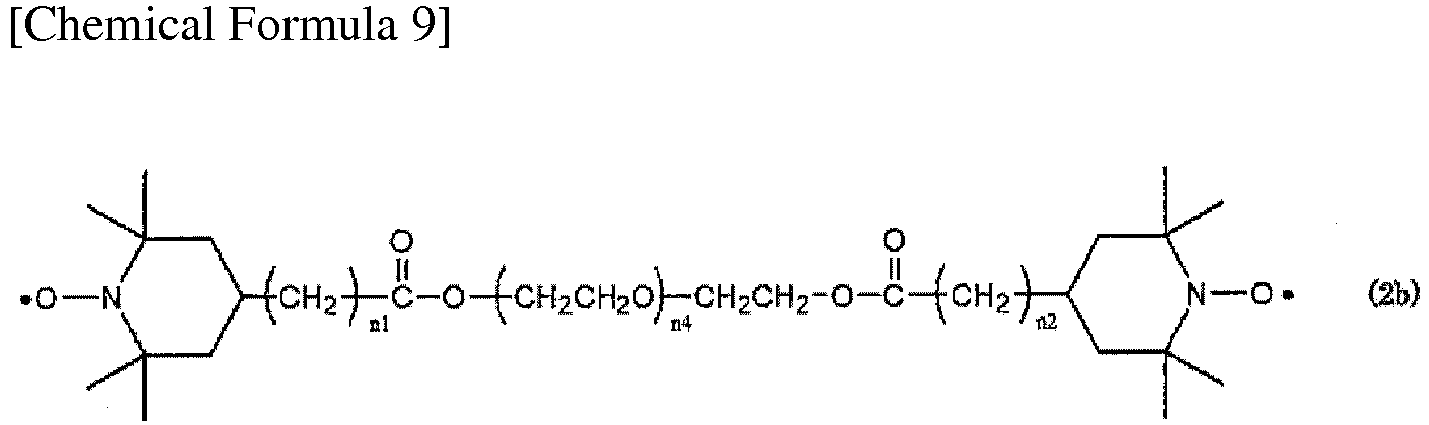
- When the charge-transporting material used in the present invention is the nitroxyl radical compound represented by the formula (3), it is preferable that m be an integer of 2 to 4, more preferably 3 or 4 in the formula (3) from the viewpoint of suppressing the reverse electron transfer reaction with the semiconductor while improving the stability of the nitroxyl radical compound in the electrolytic solution, and imparting excellent cell characteristics to a dye-sensitized solar cell. That is, in the nitroxyl radical compound represented by the formula (3), the number of TEMPO groups is preferably 2 to 4, more preferably 3 or 4.
- When the charge-transporting material used in the present invention is the nitroxyl radical compound represented by the formula (3) and Z is a P atom, it is preferable that m be 3 in the formula (3) from the viewpoint of suppressing the reverse electron transfer reaction with the semiconductor while improving the stability of the nitroxyl radical compound in the electrolytic solution, and imparting excellent cell characteristics to a dye-sensitized solar cell. That is, a preferable charge-transporting material in the present invention is a nitroxyl radical compound represented by the following formula (3a).

- When the charge-transporting material used in the present invention is the nitroxyl radical compound represented by the formula (3) and Z is a Si atom, it is preferable that m be 3 or 4 in the formula (3), and when m is 3, it is more preferable that R be an H atom from the viewpoint of suppressing the reverse electron transfer reaction with the semiconductor while improving the stability of the nitroxyl radical compound in the electrolytic solution, and imparting excellent cell characteristics to a dye-sensitized solar cell. That is, a preferable charge-transporting material in the present invention is a nitroxyl radical compound represented by the following formula (3b) or (3c).

- A method for manufacturing the charge-transporting material used in the present invention is not particularly limited, and a known manufacturing method can be adopted. For example, the nitroxyl radical compound represented by the formula (2) that has 2 TEMPO groups per molecule can be synthesized by reacting a bifunctional compound with a functional group-containing 2,2,6,6-tetramethylpiperidine-1-oxyl compound (a functional group-containing TEMPO compound). The bifunctional compound is not particularly limited as long as it is a compound capable of introducing a TEMPO group, and examples thereof include a dicarboxylic acid and a dialcohol. The functional group-containing TEMPO compound is not particularly limited as long as it is capable of reacting with each of the two functional groups of the bifunctional compound to introduce two TEMPO compounds into the bifunctional compound. One type of each of the bifunctional compound and the functional group-containing TEMPO compound may be used alone, or two or more types thereof may be used in combination.
- Specific examples of the dicarboxylic acid as the bifunctional compound include saturated hydrocarbon dicarboxylic acids such as oxalic acid, malonic acid, succinic acid, glutaric acid, adipic acid, pimelic acid, suberic acid, azelaic acid, sebacic acid, decanedicarboxylic acid, dodecyldicarboxylic acid, hexadecanedicarboxylic acid, and octadecanedicarboxylic acid; and polyethylene glycol dicarboxylic acids such as ethylene glycol dicarboxylic acid, diethylene glycol dicarboxylic acid, triethylene glycol dicarboxylic acid, tetraethylene glycol dicarboxylic acid, pentaethylene glycol dicarboxylic acid, hexaethylene glycol dicarboxylic acid, heptaethylene glycol dicarboxylic acid, octaethylene glycol dicarboxylic acid, and nonaethylene glycol dicarboxylic acid. Among them, saturated hydrocarbon dicarboxylic acids such as adipic acid, pimelic acid, suberic acid, azelaic acid, and sebacic acid; and polyethylene glycol dicarboxylic acids such as ethylene glycol dicarboxylic acid, triethylene glycol dicarboxylic acid, and tetraethylene glycol dicarboxylic acid are preferable from the viewpoint of solubility in an electrolytic solution described later that is used in a dye-sensitized solar cell, molecular size, and charge transporting efficiency.
- Specific examples of the dialcohol as the bifunctional compound include saturated hydrocarbon diols such as ethanediol, propanediol, butanediol, pentanediol, hexanediol, heptanediol, octanediol, nonanediol, decanediol, undecanediol, dodecanediol, hexadecanediol, and octadecanediol; and polyethylene glycol diols such as ethylene glycol, diethylene glycol, triethylene glycol, tetraethylene glycol, pentaethylene glycol, hexaethylene glycol, heptaethylene glycol, octaethylene glycol, and nonaethylene glycol. Among them, saturated hydrocarbon diols such as butanediol, pentanediol, hexanediol, heptanediol, and octanediol; and polyethylene glycol diols such as diethylene glycol, triethylene glycol, and tetraethylene glycol are preferable from the viewpoint of solubility in an electrolytic solution described later that is used in a dye-sensitized solar cell, and the effect of suppressing voltage loss.
- Specific examples of the usable functional group-containing TEMPO compound include hydroxy TEMPO compounds such as 4-hydroxy TEMPO, 4-hydroxymethyl TEMPO, 4-(2-hydroxyethyl) TEMPO, 4-(3-hydroxypropyl) TEMPO, 4-(4-hydroxybutyl) TEMPO, 4-(5-hydroxypentyl) TEMPO, and 4-(6-hydroxyhexyl) TEMPO; carboxy TEMPO compounds such as 4-carboxy TEMPO, 4-carboxymethyl TEMPO, 4-(2-carboxyethyl) TEMPO, 4-(3-carboxypropyl) TEMPO, 4-(4-carboxybutyl) TEMPO, 4-(5-carboxypentyl) TEMPO, and 4-(6-carboxyhexyl) TEMPO; and halogen-containing TEMPO compounds such as 4-chloro TEMPO, 4-bromo TEMPO, 4-iodo TEMPO, 4-bromomethyl TEMPO, 4-(2-bromoethyl) TEMPO, 4-(3-bromopropyl) TEMPO, 4-(4-bromobutyl) TEMPO, 4-(5-bromopentyl) TEMPO, and 4-(6-bromohexyl) TEMPO.
- For example, in the case where a dicarboxylic acid is used as a bifunctional compound, the compound having 2 TEMPO groups per molecule can be synthesized by esterifying sebacic acid and 4-hydroxy TEMPO using thionyl chloride. In addition, for example, in the case where a diol compound is used as a bifunctional compound, the compound having 2 TEMPO groups per molecule can be synthesized by esterifying 1,8-octanediol and 4-carboxy TEMPO using thionyl chloride.
- Further, for example, the nitroxyl radical compound represented by the formula (3) that has 1 to 4 TEMPO groups per molecule can be synthesized by reacting a trifunctional compound or a tetrafunctional compound with a functional group-containing TEMPO compound. A method for manufacturing the nitroxyl radical compound represented by the formula (3) is not particularly limited, and a known method can be adopted. For example, the nitroxyl radical compound represented by the formula (3) that has 1 to 4 TEMPO groups per molecule can be synthesized by reacting a halide of phosphorus or silicon, such as phosphorus trichloride or silicon tetrachloride, as a trifunctional compound or a tetrafunctional compound with an active hydrogen-containing TEMPO compound. More specifically, the nitroxyl radical compound represented by the formula (3) can be synthesized by reacting a phosphorus halide or a silicon halide having fluorine, chlorine, bromine, iodine or the like with an active hydrogen-containing TEMPO compound such as 4-hydroxy-TEMPO in the presence of a neutralizing agent such as triethylamine.
- Specific examples of the trifunctional compound or the tetrafunctional compound include phosphorus halides such as phosphorus trifluoride, phosphorus trichloride, phosphorus tribromide, and phosphorus triiodide; and silicon halides such as silicon tetrafluoride, silicon tetrachloride, silicon tetrabromide, and silicon tetraiodide. Besides the phosphorus halide and silicon halide, halides of aluminum, boron, titanium, tin, antimony and the like can also be used. Among these halides, phosphorus trichloride, silicon tetrachloride and the like are preferable from the viewpoint of ease of availability.
- The active hydrogen-containing TEMPO compound is not particularly limited as long as it is capable of reacting with the functional group of the trifunctional compound or tetrafunctional compound, and has a TEMPO group. The active hydrogen-containing TEMPO compound is preferably a hydroxyalkyl TEMPO compound such as 4-hydroxy TEMPO, 4-hydroxymethyl TEMPO, 4-(2-hydroxyethyl) TEMPO, 4-(3-hydroxypropyl) TEMPO, 4-(4-hydroxybutyl) TEMPO, 4-(5-hydroxypentyl) TEMPO, and 4-(6-hydroxyhexyl) TEMPO. Among them, 4-hydroxy TEMPO, 4-(2-hydroxyethyl) TEMPO, 4-(4-hydroxybutyl) TEMPO, and 4-(6-hydroxyhexyl) TEMPO are preferable from the viewpoint of the effect of suppressing voltage and current loss. One type of the active hydrogen-containing TEMPO compound may be used alone, or two or more types thereof may be used in combination.
- The molecular weight of the nitroxyl radical compound can be measured by a known method. As a method for measuring the molecular weight, for example, general methods such as gel permeation chromatography (GPC) and mass spectrometry (MS) can be adopted. For example, in the case of the gel permeation chromatography, the number average molecular weight can be calculated by standard polystyrene conversion using, for example, 2695 and 2414 manufactured by Waters Corporation as a GPC apparatus, columns OH-pak SB-202.5 HQ and SB-203 HQ manufactured by SHOWDEX, and N,N-dimethylformamide as a mobile phase. Alternatively, in the case of mass spectrometry, for example, the molecular weight can be measured using, for example, LCMS-2010 EV system manufactured by Shimadzu Corporation as an MS apparatus. When the molecular weight of one compound can be measured by both the methods of gel permeation chromatography (GPC) and mass spectrometry (MS), the molecular weight refers to the value measured by mass spectrometry (MS).
- The percentage (introduction rate) of the TEMPO group in the charge-transporting material (sample) formed of the nitroxyl radical compound can be confirmed by electron spin resonance (ESR) measurement. In the ESR, the spin intensity is obtained by using FR-30EX manufactured by JEOL as an ESR measuring apparatus, precisely weighing a compound having a known TEMPO group content, such as 4-hydroxy TEMPO or 4-acetamide TEMPO, as a reference specimen in a quartz glass tube, measuring the spin signal by ESR measurement, and then integrating the resulting value twice. Meanwhile, a quartz glass tube is filled with a weighed sample, and the spin intensity is similarly determined by ESR measurement. Then, the percentage (introduction rate) of the TEMPO group in the charge-transporting material can be calculated by comparing the spin intensity ratio and the molar ratio of charged sample between the reference specimen and the sample.

- (A) Spin intensity of reference specimen/mol
- (B) Spin intensity of sample/mol
- In the electrolytic solution for a dye-sensitized solar cell of the present invention, the use ratio between the nitroxyl radical compound and the sulfone compound of the formula (1) is not particularly limited. However, the concentration of the charge-transporting material (nitroxyl radical compound) in the electrolytic solution containing the sulfone compound as a solvent is preferably about 0.01 to 5 M, more preferably about 0.05 to 1 M from the viewpoint of improving cell characteristics. Herein, "M" means mol/L.
- In the present invention, the charge-transporting material may be formed of only one type of nitroxyl radical compound, or may be formed of two or more types of nitroxyl radical compounds. Moreover, a combination of the nitroxyl radical compound represented by the formula (2) or (3) and an additional charge-transporting material may be used as the charge-transporting material. The additional charge-transporting material is not particularly limited, and may be a non-iodine-based or iodine-based charge-transporting material.
- The electrolytic solution of the present invention may contain additives such as a viscosity adjusting agent and a pH adjusting agent. One type of additive may be used alone, or two or more types thereof may be used in combination.
- The charge-transporting material used in the present invention is non-iodine-based, excellent in diffusibility in an electrolytic solution, and further effectively suppressed in the reverse electron transfer reaction with a semiconductor. Therefore, the electrolytic solution of the present invention containing the combination of the charge-transporting material and the above-mentioned solvent can be suitably used as an electrolytic solution for an electrolyte layer of a dye-sensitized solar cell as described later, for example.
- The dye-sensitized solar cell of the present invention includes a semiconductor electrode containing a semiconductor and a dye, a counter electrode opposed to the semiconductor electrode, and an electrolyte layer provided between the semiconductor electrode and the counter electrode, and the electrolyte layer contains a nitroxyl radical compound, and a sulfone compound represented by the following formula (1):


- In the dye-sensitized solar cell of the present invention, use of the electrolytic solution of the present invention (that is, the electrolytic solution containing the specific nitroxyl radical compound as a charge-transporting material and the specific sulfone compound as a solvent) in the electrolyte layer makes the dye-sensitized solar cell inexpensive, excellent in diffusibility of a charge-transporting material although the electrolytic solution is non-iodine-based, and being stabilized in cell characteristics over a long period of time. Furthermore, since the dye-sensitized solar cell includes a non-iodine-based charge-transporting material, there is no need to use an expensive metal such as platinum in a current collector or the like, so that a less expensive dye-sensitized solar cell can be provided.
- As the semiconductor electrode, those used in a known dye-sensitized solar cell can be used. For example, a semiconductor electrode can be obtained by applying a semiconductor to a glass or plastic electrode plate subjected to conductive treatment with tin or zinc-doped indium oxide (ITO or IZO) or the like to form a semiconductor layer, then baking the semiconductor layer at a high temperature, and chemically adsorbing a dye to the surface of the semiconductor layer.
- As the semiconductor, those used in a known dye-sensitized solar cell can be employed. Examples of the preferable semiconductor include porous metal oxides formed of oxides of titanium, zinc, niobium, tin, vanadium, indium, tungsten, tantalum, zirconium, molybdenum, manganese, iron, copper, nickel, iridium, rhodium, chromium, ruthenium and the like. One type of semiconductor may be used alone, or two or more types thereof may be used in combination.
- As the dye to be adsorbed to the semiconductor layer, those used in a known dye-sensitized solar cell can be employed. Examples of the preferable dye include a ruthenium complex dye. Specific examples of the ruthenium complex dye include N3, black dye, a bipyridine-carboxylic acid group, a bipyridine dye, phenanthroline, quinoline, and a β-diketonate complex. In addition to the ruthenium complex dye, metal complex dyes such as Os metal complex, Fe metal complex, Cu metal complex, Pt metal complex, and Re metal complex, methine dyes such as cyanine dyes and merocyanine dyes, and organic dyes such as mercurochrome dyes, xanthene dyes, porphyrin dyes, phthalocyanine dyes, cyanidin dyes, rhodamine dyes, azo dyes, and coumarin dyes can also be used. One type of dye may be used alone, or two or more types thereof may be used in combination.
- As a counter electrode opposed to the semiconductor electrode, those used in a known dye-sensitized solar cell can be used. For example, a glass or plastic electrode plate coated with platinum, conductive carbon or the like as a conductive agent can be used. Further, since the dye-sensitized solar cell of the present invention includes a non-iodine-based charge-transporting material as the electrolyte, aluminum, copper or the like can also be used as the material of the counter electrode.
- Hereinafter, the present invention will be described in detail with reference to examples and comparative examples. However, the present invention is not limited to these examples. The molecular weight of the compounds obtained in the production examples was measured by mass spectrometry (atmospheric pressure ionization method) using LCMS-2010 EV system manufactured by Shimadzu Corporation. However, the molecular weight of the compound of Comparative Example 1 is the number average molecular weight measured by gel permeation chromatography. Specifically, the number average molecular weight was calculated by standard polystyrene conversion using, for example, 2695 and 2414 manufactured by Waters Corporation as a GPC apparatus, columns OH-pak SB-202.5 HQ and SB-203 HQ manufactured by SHOWDEX, and N,N-dimethylformamide as a mobile phase. The introduction rate of the TEMPO group (radical unit) was calculated according to the same method as the above-mentioned ESR measurement method through comparison of the spin intensity ratio and the molar ratio of charged sample between the reference specimen and the sample by electron spin resonance (ESR) measurement using FR-30EX manufactured by JEOL as an ESR measuring apparatus, and 4-hydroxy TEMPO as the reference specimen.
-

- A 200 mL four-necked flask equipped with a stirrer, a nitrogen gas inlet tube, a thermometer, and a reflux condenser tube was thoroughly aerated with nitrogen, and then 50 mL of tetrahydrofuran, 1.11 g (0.011 mol) of triethylamine, and 1.72 g (0.010 mol) of 4-hydroxy-2,2,6,6-tetramethylpiperidine (manufactured by Tokyo Chemical Industry Co., Ltd., trade name: TEMPOL) were charged into the flask to give a homogeneous solution. Then, after cooling the four-necked flask to 10°C or lower with ice water, 20 mL of a tetrahydrofuran solution containing 1.01 g (0.005 mol) of sebacic acid (manufactured by Tokyo Chemical Industry Co., Ltd.) and 1.31 g (0.011 mol) of thionyl chloride was added dropwise continuously to the homogeneous solution. After completion of the dropwise addition, the reaction liquid was reacted for 2 hours while being kept at 10°C or lower, and then the reaction was continued at room temperature for another 2 hours. Then, the reaction liquid was filtered, water was added to the reaction liquid, and extraction with diethyl ether was repeated several times. Further, the ether was removed with an evaporator, and the obtained reaction product was subjected to column purification with hexane-chloroform to give 2.18 g of a reddish brown solid. The obtained product had a molecular weight of 510 as measured by mass spectrometry, and was bis(2,2,6,6-tetramethyl-4-piperidyl-1-oxyl) sebacate (compound (A) of the above-mentioned formula). Further, the introduction rate of the TEMPO group (radical unit) obtained through the ESR measurement was 98 mol%.
-

- A 500 mL four-necked flask equipped with a stirrer, a nitrogen gas inlet tube, a thermometer, and a reflux condenser tube was thoroughly aerated with nitrogen, then 4.0 g (0.10 mol) of sodium hydride and 100 mL of diethyl ether were mixed, and 25.1 g (0.11 mol) of triethyl phosphonoacetate was slowly added to the flask. Then, 80 mL of a diethyl ether solution of 10.9 g (0.07 mol) of 2,2,6,6-tetramethyl-4-piperidone was slowly added, and the reaction was continued for 15 hours. Subsequently, water was added to the reaction product, extraction with diethyl ether was repeated several times, the reaction product was dehydrated with magnesium sulfate, and the solvent was removed with an evaporator to give 8.7 g (0.039 mol) of the intermediate (B1). The obtained product had a molecular weight of 225 as measured by mass spectrometry, and was confirmed to be ethyl (2,2,6,6-tetramethyl-4-piperidylidene) acetate (intermediate (B1) of the above-mentioned formula).
- A 500 mL four-necked flask equipped with a stirrer, a nitrogen gas inlet tube, a thermometer, and a reflux condenser tube was thoroughly aerated with nitrogen, and then 8.7 g (0.039 mol) of the intermediate (B1) was added to 120 mL of ethyl alcohol and dissolved therein. Subsequently, 0.8 g of 10% palladium/carbon was added to the solution, and the inside of the reaction vessel was filled with hydrogen gas with stirring. After 1 hour, the reaction was continued at 60°C for 4 hours. After cooling, the reaction liquid was filtered, and the solvent was removed from the resulting filtrate with an evaporator to give 8.6 g (0.038 mol) of the intermediate (B2). The obtained product had a molecular weight of 227 as measured by mass spectrometry, and was confirmed to be ethyl (2,2,6,6-tetramethyl-4-piperidyl) acetate (intermediate (B2) of the above-mentioned formula).
- A 500 mL four-necked flask equipped with a stirrer, a nitrogen gas inlet tube, a thermometer, and a reflux condenser tube was thoroughly aerated with nitrogen, then 46 mL of a 1 M lithium aluminum hydride/diethyl ether solution was added, then a solution of 8.6 g (0.038 mol) of the intermediate (B2) in 100 mL of diethyl ether was slowly added, and the reaction was continued for 1 hour. Subsequently, the reaction was stopped by slowly adding water, extraction with a mixed liquid of diethyl ether/chloroform was repeated several times, the reaction product was dehydrated with magnesium sulfate, and the solvent was removed with an evaporator to give 6.8 g (0.037 mol) of the intermediate (B3). The obtained product had a molecular weight of 185 as measured by mass spectrometry, and was confirmed to be 2-(2,2,6,6-tetramethyl-4-piperidyl) ethanol (intermediate (B3) of the above-mentioned formula).
- To a 500 mL four-necked flask equipped with a stirrer, a nitrogen gas inlet tube, a thermometer, and a reflux condenser tube, 6.8 g (0.037 mol) of the intermediate (B3), 145 mL of water, 16.3 mL (0.19 mol) of 35% hydrogen peroxide water, 50 mL of diethyl ether, 0.6 g (0.015 mol) of disodium ethylenediaminetetraacetate, and 0.6 g (0.02 mol) of sodium tungstate were added, and the reaction was continued at room temperature for 24 hours. Subsequently, the ether layer was extracted with chloroform, washed repeatedly several times with water, and dehydrated with magnesium sulfate, and the solvent was removed with an evaporator to give 4.9 g (0.024 mol) of the intermediate (B4). The obtained product had a molecular weight of 200 as measured by mass spectrometry, and was confirmed to be 2-(2,2,6,6-tetramethyl-4-piperidyl-1-oxyl) ethanol (intermediate (B4) of the above-mentioned formula).


- To a 1,000 mL four-necked flask equipped with a stirrer, a nitrogen gas inlet tube, a thermometer, and a reflux condenser tube, 22.8 g (0.114 mol) of the intermediate (B4), 80.0 g (0.230 mol) of pyridinium dichromate, and 200 mL of dichloromethane were added, and the reaction was continued for 10 hours with stirring. Subsequently, 300 mL of diethyl ethanol was added, filtration washing was carried out, and the solvent was removed with an evaporator to give a crude product. The resulting crude product was subjected to silica gel column purification with a hexane-chloroform developing solution to give 14.7 g (0.074 mol) of the intermediate (B5). The obtained product had a molecular weight of 198 as measured by mass spectrometry, and was confirmed to be 2-(2,2,6,6-tetramethyl-4-piperidyl-1-oxyl) acetaldehyde (intermediate (B5) of the above-mentioned formula).
- A 500 mL four-necked flask equipped with a stirrer, a nitrogen gas inlet tube, a thermometer, and a reflux condenser tube was thoroughly aerated with nitrogen, then 4.1 g (0.103 mol) of sodium hydride and 300 mL of diethyl ether were mixed, and 29.4 g (0.117 mol) of triethylphosphonocrotonate was slowly added to the flask. Then, 100 mL of a diethyl ether solution of 14.7 g (0.074 mol) of the intermediate (B5) was slowly added, and the reaction was continued for 15 hours. Subsequently, water was added to the reaction product, extraction with diethyl ether was repeated several times, the reaction product was dehydrated with magnesium sulfate, and the solvent was removed with an evaporator to give 13.9 g (0.047 mol) of the intermediate (B6). The obtained product had a molecular weight of 294 as measured by mass spectrometry, and was confirmed to be methyl-6-(2,2,6,6-tetramethyl-4-piperidyl-1-oxyl) hexa-2,4-dienoate (intermediate (B6) of the above-mentioned formula).
- A 500 mL four-necked flask equipped with a stirrer, a nitrogen gas inlet tube, a thermometer, and a reflux condenser tube was thoroughly aerated with nitrogen, and then 13.9 g (0.047 mol) of the intermediate (B6) was added to 200 mL of ethyl alcohol and dissolved therein. Subsequently, 1.4 g of 10% palladium/carbon was added to the solution, and the inside of the reaction vessel was filled with hydrogen gas with stirring. After 1 hour, the reaction was continued at 60°C for 4 hours. After cooling, the reaction liquid was filtered, and the solvent was removed from the resulting filtrate with an evaporator to give 7.4 g (0.025 mol) of the intermediate (B7). The obtained product had a molecular weight of 298 as measured by mass spectrometry, and was confirmed to be methyl-6-(2,2,6,6-tetramethyl-4-piperidyl-1-oxyl) hexanoate (intermediate (B7) of the above-mentioned formula).
- A 500 mL four-necked flask equipped with a stirrer, a nitrogen gas inlet tube, a thermometer, and a reflux condenser tube was thoroughly aerated with nitrogen, then 53 mL of a 1 M lithium aluminum hydride/diethyl ether solution was added, then a solution of 7.4 g (0.025 mol) of the intermediate (B7) in 200 mL of diethyl ether was slowly added, and the reaction was continued for 1 hour. Subsequently, the reaction was stopped by slowly adding water, extraction with a mixed liquid of diethyl ether/chloroform was repeated several times, the reaction product was dehydrated with magnesium sulfate, and the solvent was removed with an evaporator to give 4.4 g (0.017 mol) of the intermediate (B8). The obtained product had a molecular weight of 256 as measured by mass spectrometry, and was confirmed to be 2-(2,2,6,6-tetramethyl-4-piperidyl) hexanol (intermediate (B8) of the above-mentioned formula).
-


- The procedure of Example 2-5 was repeated except that 2.6 g (0.010 mol) of the intermediate (B8) was used instead of 4-hydroxy-2,2,6,6-tetramethylpiperidine in Production Example 1 to give 3.9 g of a product. The obtained product had a molecular weight of 678 as measured by mass spectrometry, and was confirmed to be bis(6-(2,2,6,6-tetramethyl-4-piperidyl-1-oxyl)hexyl) sebacate (0.006 mol) (compound (B) of the above-mentioned formula). Further, the introduction rate of the TEMPO group (radical unit) obtained through the ESR measurement was 99 mol%.
-

- A 100 mL four-necked flask equipped with a stirrer, a nitrogen gas inlet tube, a thermometer, and a reflux condenser tube connected with a calcium chloride tube was thoroughly aerated with nitrogen, then 3 g (17.4 mmol) of 4-hydroxy TEMPO, 1.8 g (17.7 mmol) of triethylamine, and 20 mL of chloroform were added to the flask and dissolved, and then the solution was cooled to 10°C or lower. Subsequently, a mixed liquid of 0.8 g (5.8 mmol) of phosphorus trichloride and 10 mL of chloroform was slowly added from a 50 mL dropping funnel and continuously stirred for 2 hours, and then the reaction was continued at room temperature for another 14 hours. Subsequently, triethylamine hydrochloride was removed by filtration, and the solvent was removed from the resulting filtrate with an evaporator. Then, 2.9 g of the resulting crude product was subjected to column purification using chloroform as a developing solution and using silica gel to give a product. The obtained product had a molecular weight of 544 as measured by mass spectrometry, and was confirmed to be 2.1 g (yield 66%) of tris(2,2,6,6-tetramethylpiperidin-4-yl-1-oxyl) phosphite (compound (C) of the above-mentioned formula). Further, the introduction rate of the TEMPO group (radical unit) obtained through the ESR measurement was 99 mol%.
-


- A 100 mL four-necked flask equipped with a stirrer, a nitrogen gas inlet tube, a thermometer, and a reflux condenser tube connected with a calcium chloride tube was thoroughly aerated with nitrogen, then 3.5 g (20.3 mmol) of 4-hydroxy TEMPO, 2.7 g (26.7 mmol) of triethylamine, and 20 mL of chloroform were added to the flask and dissolved, and then the solution was cooled to 10°C or lower. Subsequently, a mixed liquid of 0.74 g (4.1 mmol) of silicon tetrachloride and 10 mL of chloroform was slowly added from a 50 mL dropping funnel and continuously stirred for 1 hour, and then the reaction was continued at room temperature for another 4 hours. Subsequently, triethylamine hydrochloride was removed by filtration, and the solvent was removed from the resulting filtrate with an evaporator. Then, 2.4 g of the resulting crude product was subjected to column purification using chloroform as a developing solution and using silica gel to give a product. The obtained product had a molecular weight of 712 as measured by mass spectrometry, and was confirmed to be 1.8 g (yield 58%) of tetrakis(2,2,6,6-tetramethylpiperidin-4-yl-1-oxyl) orthosilicate (compound (D) of the above-mentioned formula). Further, the introduction rate of the TEMPO group (radical unit) obtained through the ESR measurement was 99 mol%.
- To a glass substrate (ITO) containing tin oxide as a conductive agent, a dispersion liquid of titanium oxide as a semiconductor was applied, and the substrate was baked at 450°C. Subsequently, the glass substrate was immersed in acetonitrile containing D205 (manufactured by Mitsubishi Paper Mills Limited) as a dye at room temperature to adsorb the dye to the substrate, whereby a semiconductor electrode containing a semiconductor and a dye was obtained. Then, a counter electrode containing vapor-deposited platinum and a semiconductor electrode were disposed at an interval of 0.5 mm to form a cell, an electrolytic solution obtained by dissolving the compound (A) synthesized in Production Example 1 in a 0.1 M lithium bistrifluoromethanesulfonylimide/ethyl isopropyl sulfone solution was added to the cell, and the cell was sealed with a photocurable resin to give a dye-sensitized solar cell. Using a white bias light source, the initial current density (mA/cm2) and open circuit voltage (mV) were measured using a spectral sensitivity measuring device (CEP-2000 manufactured by Bunkoukeiki Co., Ltd.), then the cell was allowed to stand still at room temperature for 3 months, and the current density and the open circuit voltage were similarly measured. The results are shown in Table 1. The concentration of the charge-transporting material in the electrolytic solution was adjusted to 0.1 M.
- A dye-sensitized solar cell was produced in the same manner as in Example 1 except that ethyl isobutyl sulfone was used instead of ethyl isopropyl sulfone to prepare an electrolytic solution, and the current density and open circuit voltage were measured. The results are shown in Table 1. The concentration of the charge-transporting material in the electrolytic solution was adjusted to 0.1 M.
- A dye-sensitized solar cell was produced in the same manner as in Example 1 except that isopropyl isobutyl sulfone was used instead of ethyl isopropyl sulfone to prepare an electrolytic solution, and the current density and open circuit voltage were measured. The results are shown in Table 1. The concentration of the charge-transporting material in the electrolytic solution was adjusted to 0.1 M.
- A dye-sensitized solar cell was produced in the same manner as in Example 1 except that the compound (B) synthesized in Production Example 2 was used instead of the compound (A) as a charge-transporting material to prepare an electrolytic solution, and the current density and open circuit voltage were measured. The results are shown in Table 1. The concentration of the charge-transporting material in the electrolytic solution was adjusted to 0.1 M.
- A dye-sensitized solar cell was produced in the same manner as in Example 1 except that the compound (C) synthesized in Production Example 3 was used instead of the compound (A) as a charge-transporting material to prepare an electrolytic solution, and the current density and open circuit voltage were measured. The results are shown in Table 1. The concentration of the charge-transporting material in the electrolytic solution was adjusted to 0.07 M.
- A dye-sensitized solar cell was produced in the same manner as in Example 1 except that the compound (D) synthesized in Production Example 4 was used instead of the compound (A) as a charge-transporting material to prepare an electrolytic solution, and the current density and open circuit voltage were measured. The results are shown in Table 1. The concentration of the charge-transporting material in the electrolytic solution was adjusted to 0.05 M.
- A dye-sensitized solar cell was produced in the same manner as in Example 1 except that iodine was used instead of the compound (A) as a charge-transporting material to prepare an electrolytic solution, and the current density and open circuit voltage were measured. The results are shown in Table 1. The concentration of the charge-transporting material in the electrolytic solution was adjusted to 0.2 M.
- A dye-sensitized solar cell was produced in the same manner as in Example 1 except that acetonitrile was used instead of ethyl isopropyl sulfone to prepare an electrolytic solution, and the current density and open circuit voltage were measured. The results are shown in Table 1. The concentration of the charge-transporting material in the electrolytic solution was adjusted to 0.1 M.
[Table 1] Solvent Charge-transporting material Initial After standing still (Compound) Current density (mA/cm2) Open circuit voltage (mV) Current density (mA/cm2) Open circuit voltage (mV) Example 1 Ethyl isopropyl sulfone A 4.8 810 4.7 800 Example 2 Ethyl isobutyl sulfone A 4.6 810 4.4 800 Example 3 Isopropyl isobutyl sulfone A 4.5 810 4.3 800 Example 4 Ethyl isopropyl sulfone B 6.7 800 6.6 790 Example 5 Ethyl isopropyl sulfone C 4.9 730 4.7 720 Example 6 Ethyl isopropyl sulfone D 5 720 4.7 700 Comparative Example 1 Ethyl isopropyl sulfone Iodine 7.3 480 4.5 400 Comparative Example 2 Acetonitrile A 4.5 810 1.5 750 - As shown in Table 1, in the dye-sensitized solar cells of Examples 1 to 6 that contained a sulfone compound as a solvent and a nitroxyl radical compound as a charge-transporting material, both the current density and the open circuit voltage were high, and the current density and the open circuit voltage after the cells were allowed to stand still were almost the same values as the initial values.
- In the dye-sensitized solar cell of Comparative Example 1 that contained iodine as a charge-transporting material, both the current density and the open circuit voltage greatly decreased after the cell was allowed to stand still as compared with the initial values. The reason is speculated as follows: since iodine has sublimation property, iodine is released from the electrolyte layer while the cell is allowed to stand still, and consequently it becomes difficult to sufficiently transport charge, leading to a decrease in current density and open circuit voltage.
- Furthermore, in the dye-sensitized solar cell of Comparative Example 2 that contained acetonitrile as a solvent, both the current density and the open circuit voltage greatly decreased after the cell was allowed to stand still as compared with the initial values. The reason is speculated as follows: acetonitrile as the solvent evaporated to make it difficult to transport charge due to precipitation of the charge-transporting material or the like, leading to a decrease in current density and open circuit voltage.
Claims (9)
- A dye-sensitized solar cell comprising:a semiconductor electrode containing a semiconductor and a dye,a counter electrode opposed to the semiconductor electrode, andan electrolyte layer provided between the semiconductor electrode and the counter electrode,wherein the electrolyte layer contains a nitroxyl radical compound, and a sulfone compound represented by the following formula (1):

- The dye-sensitized solar cell according to claim 1, wherein the nitroxyl radical compound is a nitroxyl radical compound represented by the following formula (2):

- The dye-sensitized solar cell according to claim 2, wherein the nitroxyl radical compound represented by the formula (2) has a molecular weight of 380 or more.
- The dye-sensitized solar cell according to claim 2 or 3, wherein, in the formula (2), X1 represents a group -(CH2)n1-OC(=O)-, X2 represents a group -C(=O)O-(CH2)n2-, Y represents a group -(CH2)n3-, n1 and n2 each independently represent an integer of 0 to 10, and n3 represents an integer of 0 to 22.
- The dye-sensitized solar cell according to claim 2 or 3, wherein, in the formula (2), X1 represents a group -(CH2)n1-C(=O)O-, X2 represents a group -OC(=O)-(CH2)n2-, Y represents a group -(CH2CH2O)n4-CH2CH2-, n1 and n2 each independently represent an integer of 0 to 10, and n4 represents an integer of 1 to 22.
- The dye-sensitized solar cell according to claim 1, wherein the nitroxyl radical compound is a nitroxyl radical compound represented by the following formula (3):

- The dye-sensitized solar cell according to claim 6, wherein, in the formula (3), Z is a P atom and m is 3.
- The dye-sensitized solar cell according to claim 6, wherein, in the formula (3), Z is a Si atom, m is 3 or 4, and when m is 3, R is an H atom.
- An electrolytic solution for a dye-sensitized solar cell, comprising:a nitroxyl radical compound, anda sulfone compound represented by the following formula (1):
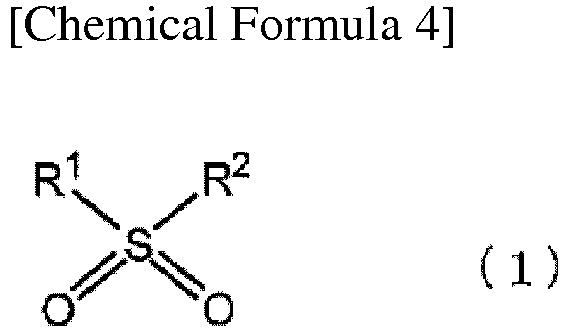
Applications Claiming Priority (2)
| Application Number | Priority Date | Filing Date | Title |
|---|---|---|---|
| JP2015086944 | 2015-04-21 | ||
| PCT/JP2016/062453 WO2016171153A1 (en) | 2015-04-21 | 2016-04-20 | Dye-sensitized solar cell and electrolysis solution for dye-sensitized solar cell |
Publications (2)
| Publication Number | Publication Date |
|---|---|
| EP3288051A1 true EP3288051A1 (en) | 2018-02-28 |
| EP3288051A4 EP3288051A4 (en) | 2019-01-16 |
Family
ID=57144590
Family Applications (1)
| Application Number | Title | Priority Date | Filing Date |
|---|---|---|---|
| EP16783174.2A Withdrawn EP3288051A4 (en) | 2015-04-21 | 2016-04-20 | Dye-sensitized solar cell and electrolysis solution for dye-sensitized solar cell |
Country Status (6)
| Country | Link |
|---|---|
| US (1) | US20180114919A1 (en) |
| EP (1) | EP3288051A4 (en) |
| JP (1) | JPWO2016171153A1 (en) |
| CN (1) | CN107430942B (en) |
| TW (1) | TW201642515A (en) |
| WO (1) | WO2016171153A1 (en) |
Families Citing this family (4)
| Publication number | Priority date | Publication date | Assignee | Title |
|---|---|---|---|---|
| WO2020194633A1 (en) * | 2019-03-27 | 2020-10-01 | シャープ株式会社 | Display device |
| CN115566156B (en) * | 2022-07-07 | 2025-11-14 | 上饶市康然光学仪器有限公司 | A type of battery positive electrode |
| CN116854734A (en) * | 2023-07-08 | 2023-10-10 | 吉林市博禹祥实工贸有限公司 | Preparation method of high-efficiency polymerization inhibitor BYXS-705 |
| CN119350393B (en) * | 2024-12-25 | 2025-04-22 | 烟台新特路新材料科技有限公司 | A kind of polymerization inhibitor ZJ5575 and preparation method thereof |
Family Cites Families (16)
| Publication number | Priority date | Publication date | Assignee | Title |
|---|---|---|---|---|
| JP4967211B2 (en) * | 2001-09-26 | 2012-07-04 | 日本電気株式会社 | Photoelectrochemical device |
| JP2008235103A (en) * | 2007-03-22 | 2008-10-02 | Matsushita Electric Works Ltd | Photoelectric conversion element, and its manufacturing method |
| JP2008282632A (en) * | 2007-05-09 | 2008-11-20 | Kyoto Univ | Secondary battery for energy regeneration |
| JP2009076369A (en) * | 2007-09-21 | 2009-04-09 | Adeka Corp | Dye-sensitized solar cell |
| EP2320513B1 (en) * | 2008-08-28 | 2015-08-19 | Panasonic Corporation | Photoelectric device |
| US8841549B2 (en) * | 2008-10-08 | 2014-09-23 | University Of Utah Research Foundation | Organic spintronic devices and methods for making the same |
| CN102341951A (en) * | 2009-03-06 | 2012-02-01 | 日本电气株式会社 | Photoelectric conversion element, process for producing same, optical sensor, and solar cell |
| CN102804481B (en) * | 2009-06-19 | 2015-05-20 | 松下电器产业株式会社 | Photoelectric components |
| JP5204317B2 (en) * | 2010-01-28 | 2013-06-05 | 日本カーリット株式会社 | Electrolyte for dye-sensitized solar cell and dye-sensitized solar cell using the same |
| JP5701633B2 (en) * | 2011-02-07 | 2015-04-15 | カーリットホールディングス株式会社 | Electrolyte for dye-sensitized solar cell and dye-sensitized solar cell using the same |
| EP2781555A4 (en) * | 2011-11-18 | 2015-10-07 | Adeka Corp | NEW COMPOUND AND SUPPORT SUPPORTING THIS NEW COMPOUND |
| JP5874140B2 (en) * | 2011-12-28 | 2016-03-02 | 株式会社Adeka | Dye-sensitized solar cell |
| JP5947688B2 (en) * | 2011-12-28 | 2016-07-06 | パナソニック株式会社 | Electrode composite and photoelectric device including the same |
| US9013023B2 (en) * | 2011-12-28 | 2015-04-21 | Panasonic Corporation | Photoelectric element having stacked charge-transport layers |
| JP2014086239A (en) * | 2012-10-23 | 2014-05-12 | Nec Corp | Energy storage type dye-sensitized solar cell |
| CN104321844B (en) * | 2013-03-22 | 2017-09-19 | 松下电器产业株式会社 | Photoelectric conversion element |
-
2016
- 2016-04-20 CN CN201680017403.4A patent/CN107430942B/en not_active Expired - Fee Related
- 2016-04-20 JP JP2017514147A patent/JPWO2016171153A1/en active Pending
- 2016-04-20 US US15/568,437 patent/US20180114919A1/en not_active Abandoned
- 2016-04-20 WO PCT/JP2016/062453 patent/WO2016171153A1/en not_active Ceased
- 2016-04-20 EP EP16783174.2A patent/EP3288051A4/en not_active Withdrawn
- 2016-04-21 TW TW105112432A patent/TW201642515A/en unknown
Also Published As
| Publication number | Publication date |
|---|---|
| CN107430942B (en) | 2019-12-13 |
| US20180114919A1 (en) | 2018-04-26 |
| JPWO2016171153A1 (en) | 2018-02-22 |
| CN107430942A (en) | 2017-12-01 |
| WO2016171153A1 (en) | 2016-10-27 |
| EP3288051A4 (en) | 2019-01-16 |
| TW201642515A (en) | 2016-12-01 |
Similar Documents
| Publication | Publication Date | Title |
|---|---|---|
| JP4576494B2 (en) | Photosensitizing dye | |
| EP2883881A1 (en) | Cobaltcomplex salts and mixtures of Cobaltcomplex salts for use in DSSC | |
| US8580961B2 (en) | 2-phenyl-6-azolylpyridine-based ligand and group VIII transition metal complex | |
| EP3889140A1 (en) | Phenazine-based compound, electrolytic liquid comprising same for redox flow battery, and redox flow battery | |
| US20150310998A1 (en) | Cobalt complexes with tricyanoborate or dicyanoborate counter-anions for electrochemical or optoelectronic devices | |
| US20150302995A1 (en) | Cobaltcomplex salts | |
| US8889872B2 (en) | Bisazole-based compound and group VIII transition metal complex | |
| US20230318003A1 (en) | Redox flow battery and aqueous-based solution | |
| US20180114919A1 (en) | Dye-sensitized solar cell and electrolysis solution for dye-sensitized solar cell | |
| WO2020201405A1 (en) | Redox flow battery and new compounds useful therein | |
| Fang et al. | Novel diyne-bridged dyes for efficient dye-sensitized solar cells | |
| Geysens et al. | Enhancing the solubility of 1, 4-diaminoanthraquinones in electrolytes for organic redox flow batteries through molecular modification | |
| TWI646082B (en) | Charge transport materials for photoelectrochemical elements | |
| JP4500523B2 (en) | Onium salt | |
| KR100553337B1 (en) | Copolymer containing imidazolium group, manufacturing method thereof, electrolyte composition for solar cell containing same and dye-sensitized solar cell comprising same as electrolyte | |
| CN117813710A (en) | Aqueous electrolyte, salt used therein, and redox flow battery using the aqueous electrolyte | |
| JP5751177B2 (en) | Ruthenium-containing compound and method for producing the same | |
| CN115850666B (en) | Trithiophene alkylsulfonic acid polymer and its preparation method and application | |
| JP7762896B2 (en) | Anthraquinone active materials | |
| KR102817310B1 (en) | Dye-sensitized solar cell solid electrolyte comprising bis(N-alkylpyrrolydinium) alkane diiodide, method of its production, and dye-sensitized solar cell including the same | |
| Fang | Organic redox-active materials design for redox flow batteries | |
| Hwang et al. | A dihydroxyethylamino-functionalized naphthoquinone derivative with highly stable and reversible two-electron reaction for aqueous organic redox flow batteries | |
| US8722905B2 (en) | Dyes and photoelectric conversion devices containing the same | |
| KR101545325B1 (en) | Dye for dye-sensitized solar cells and dye-sensitized solar cells using the same | |
| KR20250081746A (en) | Dye-sensitized solar cell solid electrolyte comprising bis(N-alkylpyridinium) alkane diiodide, method of its production, and dye-sensitized solar cell comprising the same |
Legal Events
| Date | Code | Title | Description |
|---|---|---|---|
| PUAI | Public reference made under article 153(3) epc to a published international application that has entered the european phase |
Free format text: ORIGINAL CODE: 0009012 |
|
| 17P | Request for examination filed |
Effective date: 20171107 |
|
| AK | Designated contracting states |
Kind code of ref document: A1 Designated state(s): AL AT BE BG CH CY CZ DE DK EE ES FI FR GB GR HR HU IE IS IT LI LT LU LV MC MK MT NL NO PL PT RO RS SE SI SK SM TR |
|
| AX | Request for extension of the european patent |
Extension state: BA ME |
|
| DAV | Request for validation of the european patent (deleted) | ||
| DAX | Request for extension of the european patent (deleted) | ||
| RIC1 | Information provided on ipc code assigned before grant |
Ipc: H01G 9/20 20060101AFI20181206BHEP |
|
| A4 | Supplementary search report drawn up and despatched |
Effective date: 20181213 |
|
| GRAP | Despatch of communication of intention to grant a patent |
Free format text: ORIGINAL CODE: EPIDOSNIGR1 |
|
| STAA | Information on the status of an ep patent application or granted ep patent |
Free format text: STATUS: GRANT OF PATENT IS INTENDED |
|
| INTG | Intention to grant announced |
Effective date: 20200520 |
|
| STAA | Information on the status of an ep patent application or granted ep patent |
Free format text: STATUS: THE APPLICATION IS DEEMED TO BE WITHDRAWN |
|
| 18D | Application deemed to be withdrawn |
Effective date: 20201001 |