EP3287953A1 - Input processing program, input processing device, input processing method, character identification program, character identification device, and character identification method - Google Patents
Input processing program, input processing device, input processing method, character identification program, character identification device, and character identification method Download PDFInfo
- Publication number
- EP3287953A1 EP3287953A1 EP15889930.2A EP15889930A EP3287953A1 EP 3287953 A1 EP3287953 A1 EP 3287953A1 EP 15889930 A EP15889930 A EP 15889930A EP 3287953 A1 EP3287953 A1 EP 3287953A1
- Authority
- EP
- European Patent Office
- Prior art keywords
- character
- input
- display
- handwriting
- displayed
- Prior art date
- Legal status (The legal status is an assumption and is not a legal conclusion. Google has not performed a legal analysis and makes no representation as to the accuracy of the status listed.)
- Withdrawn
Links
Images






Classifications
-
- G—PHYSICS
- G06—COMPUTING OR CALCULATING; COUNTING
- G06V—IMAGE OR VIDEO RECOGNITION OR UNDERSTANDING
- G06V30/00—Character recognition; Recognising digital ink; Document-oriented image-based pattern recognition
- G06V30/10—Character recognition
- G06V30/14—Image acquisition
- G06V30/142—Image acquisition using hand-held instruments; Constructional details of the instruments
- G06V30/1423—Image acquisition using hand-held instruments; Constructional details of the instruments the instrument generating sequences of position coordinates corresponding to handwriting
-
- G—PHYSICS
- G06—COMPUTING OR CALCULATING; COUNTING
- G06F—ELECTRIC DIGITAL DATA PROCESSING
- G06F3/00—Input arrangements for transferring data to be processed into a form capable of being handled by the computer; Output arrangements for transferring data from processing unit to output unit, e.g. interface arrangements
- G06F3/01—Input arrangements or combined input and output arrangements for interaction between user and computer
- G06F3/02—Input arrangements using manually operated switches, e.g. using keyboards or dials
- G06F3/023—Arrangements for converting discrete items of information into a coded form, e.g. arrangements for interpreting keyboard generated codes as alphanumeric codes, operand codes or instruction codes
- G06F3/0233—Character input methods
-
- G—PHYSICS
- G06—COMPUTING OR CALCULATING; COUNTING
- G06F—ELECTRIC DIGITAL DATA PROCESSING
- G06F3/00—Input arrangements for transferring data to be processed into a form capable of being handled by the computer; Output arrangements for transferring data from processing unit to output unit, e.g. interface arrangements
- G06F3/01—Input arrangements or combined input and output arrangements for interaction between user and computer
- G06F3/048—Interaction techniques based on graphical user interfaces [GUI]
- G06F3/0487—Interaction techniques based on graphical user interfaces [GUI] using specific features provided by the input device, e.g. functions controlled by the rotation of a mouse with dual sensing arrangements, or of the nature of the input device, e.g. tap gestures based on pressure sensed by a digitiser
- G06F3/0488—Interaction techniques based on graphical user interfaces [GUI] using specific features provided by the input device, e.g. functions controlled by the rotation of a mouse with dual sensing arrangements, or of the nature of the input device, e.g. tap gestures based on pressure sensed by a digitiser using a touch-screen or digitiser, e.g. input of commands through traced gestures
-
- G—PHYSICS
- G06—COMPUTING OR CALCULATING; COUNTING
- G06F—ELECTRIC DIGITAL DATA PROCESSING
- G06F40/00—Handling natural language data
- G06F40/10—Text processing
- G06F40/166—Editing, e.g. inserting or deleting
- G06F40/171—Editing, e.g. inserting or deleting by use of digital ink
-
- G—PHYSICS
- G06—COMPUTING OR CALCULATING; COUNTING
- G06V—IMAGE OR VIDEO RECOGNITION OR UNDERSTANDING
- G06V30/00—Character recognition; Recognising digital ink; Document-oriented image-based pattern recognition
- G06V30/10—Character recognition
- G06V30/12—Detection or correction of errors, e.g. by rescanning the pattern
- G06V30/127—Detection or correction of errors, e.g. by rescanning the pattern with the intervention of an operator
-
- G—PHYSICS
- G06—COMPUTING OR CALCULATING; COUNTING
- G06V—IMAGE OR VIDEO RECOGNITION OR UNDERSTANDING
- G06V30/00—Character recognition; Recognising digital ink; Document-oriented image-based pattern recognition
- G06V30/10—Character recognition
- G06V30/14—Image acquisition
- G06V30/146—Aligning or centring of the image pick-up or image-field
- G06V30/147—Determination of region of interest
-
- G—PHYSICS
- G06—COMPUTING OR CALCULATING; COUNTING
- G06V—IMAGE OR VIDEO RECOGNITION OR UNDERSTANDING
- G06V30/00—Character recognition; Recognising digital ink; Document-oriented image-based pattern recognition
- G06V30/10—Character recognition
- G06V30/32—Digital ink
- G06V30/333—Preprocessing; Feature extraction
- G06V30/347—Sampling; Contour coding; Stroke extraction
-
- G—PHYSICS
- G06—COMPUTING OR CALCULATING; COUNTING
- G06F—ELECTRIC DIGITAL DATA PROCESSING
- G06F3/00—Input arrangements for transferring data to be processed into a form capable of being handled by the computer; Output arrangements for transferring data from processing unit to output unit, e.g. interface arrangements
- G06F3/01—Input arrangements or combined input and output arrangements for interaction between user and computer
- G06F3/048—Interaction techniques based on graphical user interfaces [GUI]
- G06F3/0487—Interaction techniques based on graphical user interfaces [GUI] using specific features provided by the input device, e.g. functions controlled by the rotation of a mouse with dual sensing arrangements, or of the nature of the input device, e.g. tap gestures based on pressure sensed by a digitiser
- G06F3/0488—Interaction techniques based on graphical user interfaces [GUI] using specific features provided by the input device, e.g. functions controlled by the rotation of a mouse with dual sensing arrangements, or of the nature of the input device, e.g. tap gestures based on pressure sensed by a digitiser using a touch-screen or digitiser, e.g. input of commands through traced gestures
- G06F3/04883—Interaction techniques based on graphical user interfaces [GUI] using specific features provided by the input device, e.g. functions controlled by the rotation of a mouse with dual sensing arrangements, or of the nature of the input device, e.g. tap gestures based on pressure sensed by a digitiser using a touch-screen or digitiser, e.g. input of commands through traced gestures for inputting data by handwriting, e.g. gesture or text
-
- G—PHYSICS
- G06—COMPUTING OR CALCULATING; COUNTING
- G06V—IMAGE OR VIDEO RECOGNITION OR UNDERSTANDING
- G06V30/00—Character recognition; Recognising digital ink; Document-oriented image-based pattern recognition
- G06V30/10—Character recognition
Definitions
- the present disclosure relates to an input processing program, an input processing device, an input processing method, a character identification program, a character identification device, and a character identification method.
- Tools have been known that receive a handwriting input performed by a user, and process recognized characters obtained by applying character recognition to the handwriting input, as input characters.
- Patent Document 1 Japanese Laid-Open Patent Application No. 2005-235116
- it is an object to enable smooth character input by handwriting.
- a computer is caused to execute a process.
- the process includes receiving a handwriting input on a display screen on which a character is displayed; and in response to detecting that the handwriting input has been performed at a position corresponding to a display position of a specific character displayed on the display screen, executing a process of changing the specific character into a character recognized with respect to the handwriting input.
- FIG. 1 is a diagram illustrating principal program components in the first embodiment.
- the first embodiment includes, as principal programs, a first application 10, a character identification program 20, and a recognition program 30.
- the first application 10 is a program that displays a character group (text) having been input, for example, a slip creation application or an email creation application.
- a text displayed by the first application will be referred to as a "display text" in the following.
- the display text is not limited to characters input by a handwriting input, and may include, for example, characters input by a keyboard or the like.
- the character identification program 20 When a correction is made to a character in a display text by a handwriting input (or a handwriting correction input), the character identification program 20 identifies a position and a range of a correction target in the display text from input strokes. For example, the character identification program 20 identifies a position and a range in the display text to be replaced with a character input by a handwriting correction input. Similarly, the character identification program 20 identifies a position and a range in the display text to be inserted with a character input by a handwriting correction input. Note that the handwriting input and the handwriting correction input are not limited to input by strokes using a finger, and may be, for example, input by strokes using a stylus or the like.
- the recognition program 30 recognizes a character from strokes input by a handwriting input and a handwriting correction input. In other words, the recognition program 30 obtains a character corresponding to strokes input by the handwriting input and the handwriting correction input, as a recognition result.
- the first application 10, the character identification program 20, and the recognition program 30 in the first embodiment may be implemented on independent devices, respectively, or may be implemented in a single device. In the following description of the first embodiment, a case will be described where the first application 10, the character identification program 20, and the recognition program 30 are implemented on a single device. In the following description, a device on which the first application 10, the character identification program 20, and the recognition program 30 are implemented will be referred to as a "character identification device".
- FIG. 2 is a diagram illustrating a handwriting correction input by the character identification device.
- a screen 2 is displayed on the character identification device 1.
- Display texts "ABCDE” and "1234" are displayed on the screen 2.
- a case will be described in which at this time, a user of the character identification device 1 corrects a character "C” included in the display text to a character "A” by handwriting.
- the display text on the screen 2 is displayed by the first application 10.
- the user inputs a character "A” by handwriting directly at the position where the character "C” included in the display text is displayed, through a touch panel or the like of the character identification device 1.
- the character identification device 1 causes the character identification program 20 to identify a character group to which the correction has been made by handwriting and the position of the character "C" to be corrected in the character group, from information representing the strokes of the character "A" input by handwriting.
- the character identification program 20 identifies the display text "ABCDE” as the character group to which the correction has been made.
- the character identification program 20 also identifies the character "C” in the display text "ABCDE” as the character to be corrected.
- the character identification program 20 transfers information representing the strokes of the character "A” to the recognition program 30.
- the recognition program 30 recognizes the character "A” from the information representing the strokes, and transfers the character group having the correction reflected to the first application 10.
- the first application 10 displays the character group having the correction reflected.
- the display text "ABCDE” turns into a display text "ABADE” in which the character "C” has been corrected to the character "A”.
- the character identification device 1 in the first embodiment can directly execute a handwriting correction input to a display text displayed by the first application.
- the handwriting correction input described with FIG. 2 is a correction that replaces the character "C” included in the display text by the character "A"
- a correction may be made to insert the character "A” before or after the character "C” included in the display text.
- the character group (a first character group) among the display texts "ABCDE” and "1234" to be corrected by the handwriting input includes multiple characters, it is not limited as such.
- the character group to be corrected by a handwriting correction input among display texts displayed by the first application 10 may consist of one character.
- the number of characters to be corrected by a handwriting correction input may be two or more (in other words, replacement or insertion may be made with a character group).
- the strokes of the character "A” input by handwriting may be displayed in a color different from the color of the display text "ABCDE". For example, if the display text "ABCDE” is displayed in black, the strokes of the character "A” input by handwriting may be displayed in red or blue.
- the strokes of the character input by handwriting in the display text can be seen more easily, and it becomes easier for the user to perform a handwriting correction input.
- the handwriting correction will be described in detail.
- FIG. 3 is a diagram illustrating an example of a hardware configuration of the character identification device.
- the character identification device 1 in the embodiment includes a display operation unit 101, a drive unit 102, an auxiliary storage unit 103, a memory unit 104, an arithmetic processing unit 105, and an interface unit 106, which are mutually connected via a bus B.
- the display operation unit 101 is, for example, a touch panel, and is used for inputting various signals, and displaying (outputting) various signals.
- the interface unit 106 includes a model and a LAN card, and is used for connecting to a network.
- the first application 10, the character identification program 20, and the recognition program 30 are at least a part of various programs that control the character identification device 1. These programs are provided, for example, by distributing the recording medium 107, or by downloading from a network.
- various types of recording media can be used including recording media that record information optically, electrically or magnetically, such as a CD-ROM, a flexible disk, and an optical magnetic disk, and semiconductor memories that record information electrically such as a ROM and a flash memory.
- the character identification program 20, and the recognition program 30 are set in the drive unit 102, these programs are installed in the auxiliary storage unit 103 via the drive unit 102 from the recording medium 107.
- the programs downloaded from a network are installed in the auxiliary storage unit 103 via the interface unit 106.
- the auxiliary storage unit 103 stores the first application 10, the character identification program 20, and the recognition program 30 that have been installed, and also stores an OS (Operating System) being base software, required files, data, and the like.
- the memory unit 104 reads and loads each of the programs when each of the programs is activated. Then, the arithmetic processing unit 105 implements various processes, which will be described later, following the programs stored in the memory unit 104.
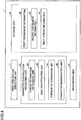
- FIG. 4 is a diagram illustrating a functional configuration of the character identification device in the first embodiment.
- the character identification device 1 in the embodiment includes a first application execution unit 11, a character identification processing unit 21, a recognition unit 31, and a storage unit 41.
- the first application execution unit 11 in the embodiment is implemented by the arithmetic processing unit 105 executing the first application 10.
- the character identification processing unit 21 in the embodiment is implemented by the arithmetic processing unit 105 executing the character identification program 20.
- the recognition unit 31 in the embodiment is implemented by the arithmetic processing unit 105 executing the recognition program 30.
- the storage unit 41 in the embodiment is implemented by the auxiliary storage unit 103 and the memory unit 104.
- the storage unit 41 includes first coordinate information 42, second coordinate information 43, and input stroke information 44.
- the first coordinate information 42 is coordinate information that identifies a circumscribing frame of each character included in the display text.
- the circumscribing frame is a quadrangular frame that circumscribes a character. Therefore, the first coordinate information 42 includes first top coordinate information that identifies the top side, first bottom coordinate information that identifies the base side, first left coordinate information that identifies the left side, and first right coordinate information that identifies the right-hand side of the circumscribing frame.
- the second coordinate information 43 is coordinate information that identifies a circumscribing frame of a character formed by strokes input by the user by a handwriting correction input. Similar to the first coordinate information 42, the second coordinate information 43 includes second top coordinate information, second bottom coordinate information, second left coordinate information, and second right coordinate information, which identify the respective sides of the circumscribing frame.
- the circumscribing frame is not limited to a quadrangle, and may be a polygon.
- the first coordinate information 42 and the second coordinate information 43 includes coordinate information that identifies respective sides of the polygon.
- the input stroke information 44 is stroke information input by the user by a handwriting correction input.
- the stroke information is information representing a single stroke (a trace) done by handwriting that includes two or more coordinate information items.
- a single stroke is identified by connecting coordinates represented by two or more coordinate information items included in the stroke information. Therefore, the recognition unit 31, which will be described later, recognizes a character formed by strokes represented by stroke information.
- each coordinate information item included in the first coordinate information 42, the second coordinate information 43, and the input stroke information 44 is represented by X-Y coordinate values relative to the origin, which is, for example, a reference point set in advance on a screen displayed by the character identification device 1.
- the reference point the position of a pixel at the upper left corner on the screen displayed by the character identification device 1 may be set.
- the positive direction of the X-axis may be set rightward from the reference point, and the positive direction of the Y-axis may be set downward from the reference point.
- the first application execution unit 11 obtains the first coordinate information 42 of a character included in a display text. Also, the first application execution unit 11 replaces a character included in a display text with a character obtained from the recognition unit 31, or inserts a character obtained from the recognition unit 31 into a display text, so as to correct the display text.
- the character identification processing unit 21 identifies a position and a range at which correction is to be made by handwriting.
- the recognition unit 31 recognizes a character from the input stroke information 44, to obtain the character as a recognition result.
- the character identification processing unit 21 in the embodiment includes a stroke information obtainment unit 22, an area identification unit 23, an overlap determination unit 24, and a character identification unit 25.
- the stroke information obtainment unit 22 obtains the input stroke information 44 representing strokes input by the user by a handwriting correction input.
- the area identification unit 23 obtains the second coordinate information 43 from the input stroke information 44 obtained by the stroke information obtainment unit 22. Also, the area identification unit 23 identifies an area (an input character area) surrounded by a circumscribing frame identified by the second coordinate information 43, and an area (a text area) surrounded by a circumscribing frame identified by the first coordinate information 42. Note that the first coordinate information 42 may be transferred to the area identification unit 23 by the first application execution unit 11. Alternatively, the first coordinate information 42 may be obtained from the storage unit 41 by the area identification unit 23, when the stroke information obtainment unit 22 obtains the input stroke information 44.
- the overlap determination unit 24 determines whether the proportion of an area in the input character area overlapping the text area is greater than or equal to a first threshold set in advance.
- the character identification unit 25 identifies a position and a range in the display text at which the correction is to be made. In other words, the character identification unit 25 identifies a character or a character group in the display text that is, for example, to be replaced. Similarly, the character identification unit 25 identifies a character or a character group in the display text that is, for example, to be inserted.
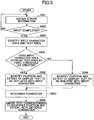
- FIG. 5 is a flowchart illustrating an example of a handwriting correction process in the first embodiment.
- FIG. 5 illustrates a process that corrects a display text (replacement or insertion of a character) displayed on the display operation unit 101 of the character identification device 1 by a handwriting correction input.
- the character identification device 1 in the embodiment causes the stroke information obtainment unit 22 of the character identification processing unit 21 to obtain the input stroke information 44 representing strokes input by the handwriting correction input (Step S501).
- the character identification device 1 causes the stroke information obtainment unit 22 of the character identification processing unit 21 to determine whether the handwriting correction input has been completed (Step S502).
- the stroke information obtainment unit 22 may determine that the handwriting correction input has been completed if additional input stroke information 44 is not obtained for a predetermined period of time.
- Step S502 If it has been determined at Step S502 that the handwriting correction input has not been completed, the character identification device 1 returns to Step S501.
- the character identification device 1 causes the area identification unit 23 of the character identification processing unit 21 to identify a text area and an input character area (Step S503).
- the area identification unit 23 obtains the first coordinate information 42 via the first application execution unit 11. Then, the area identification unit 23 identifies a text area based on the first coordinate information 42.
- the area identification unit 23 also obtains the second coordinate information 43 from the input stroke information 44. Then, the area identification unit 23 identifies an input character area based on the second coordinate information 43. Note that according to the embodiment, identifying a text area by the area identification unit 23 identifies a character group to which a correction is to be made.
- the character identification device 1 causes the overlap determination unit 24 of the character identification processing unit 21 to determine whether the proportion of an area in the input character area overlapping the text area is greater than or equal to the first threshold (Step S504).
- the first threshold may be set, for example, to one-half. In this case, the overlap determination unit 24 determines whether the input character area overlaps the text area by one-half or more.
- the character identification device 1 causes the character identification unit 25 of the character identification processing unit 21 to identify a character or a character group to be replaced in the display text (Step S505).
- the character identification unit 25 identifies a position and a range in the display text to be replaced by a character input by the handwriting correction input.
- the character identification device 1 causes the character identification unit 25 of the character identification processing unit 21 to identify a character or a character group to be inserted in the display text (Step S506).
- the character identification unit 25 identifies a position and a range in the display text to be inserted with a character input by the handwriting correction input.
- the character identification device 1 causes the recognition unit 31 to recognize a character corresponding to the input stroke information 44 obtained by the stroke information obtainment unit 22, to obtain the character as a recognition result (Step S507). Then, the recognition unit 31 transfers the obtained character to the first application execution unit 11. Note that if the input stroke information 44 obtained by the stroke information obtainment unit 22 corresponds to multiple characters, the recognition unit 31 obtains the multiple characters (namely, a character group).
- the character identification device 1 causes the first application execution unit 11 to correct the display text at the position and the range identified at Step S505 or Step S506, by the character or the character group obtained at Step S507 (Step S508).
- Step S504 if having proceeded from Step S504 to Step S505, the first application execution unit 11 replaces the character or the character group at the position and the range identified in the display text, by the obtained character or character group.
- the first application execution unit 11 inserts the character or the character group at the position and the range identified in the display text, by the obtained character or character group. This concludes a series of steps for a handwriting correction in the embodiment.
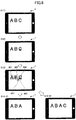
- FIG. 6 is a diagram illustrating a specific example of a handwriting correction in the first embodiment.
- the character identification device 1 receives a handwriting correction that has been performed by the user for correcting a character "C" to a character "A" in the display text (State S12). Then, the stroke information obtainment unit 22 obtains the input stroke information 44 representing strokes input by the handwriting correction input. In the example in FIG. 6 , the stroke information obtainment unit 22 obtains input stroke information 44 1 of the first stroke of the character "A", input stroke information 44 2 of the second stroke of the character "A", and input stroke information 44 3 of the third stroke of the character "A".
- the area identification unit 23 identifies a text area and an input character area. Then, the overlap determination unit 24 determines whether the input character area overlaps the text area by the first threshold or greater (State S13).
- the area identification unit 23 identifies a text area and an input character area as follows. First, the area identification unit 23 obtains coordinate information of each character of the display text "ABC", which is maintained by an OS, via the first application execution unit 11. Then, the first coordinate information 42 is obtained for each character, including, for example, coordinate information having the minimum Y-coordinate as first top coordinate information; coordinate information having the maximum Y-coordinate as first bottom coordinate information; coordinate information having the minimum X-coordinate as first left coordinate information; and coordinate information having the maximum X-coordinate as first right coordinate information.
- the area identification unit 23 in the embodiment identifies a text area of each character included in the display text from the first coordinate information 42 of each character.
- the area identification unit 23 based on the first coordinate information 42 of each character, identifies a text area 301 of the character "A" in the display text, a text area 302 of the character "B” in the display text, and a text area 303 of the character "C” in the display text. In the embodiment, once the text area of each character has been identified, information related to the display position and size of each character in the display text is identified.
- the area identification unit 23 also obtains the second coordinate information 43 of the character "A" input by handwriting from the input stroke information 44 1 , the input stroke information 44 2 , and the input stroke information 44 3 . Specifically, among the coordinate information included in the input stroke information 44 1 , the input stroke information 44 2 , and the input stroke information 44 3 , the area identification unit 23 obtains the second coordinate information 43 including, for example, coordinate information having the minimum Y-coordinate as second top coordinate information; coordinate information having the maximum Y-coordinate as second bottom coordinate information; coordinate information having the minimum X-coordinate as second left coordinate information; and coordinate information having the maximum X-coordinate as second right coordinate information.
- the area identification unit 23 based on the second coordinate information 43, the area identification unit 23 identifies the input character area 401 of the character "A" input by the handwriting correction input.
- the overlap determination unit 24 determines whether the input character area 401 overlaps each of the text area 301, the text area 302, and the text area 302 by the first threshold or more. Then, depending on the determination result by the overlap determination unit 24, the character identification unit 25 identifies the position and the range at which the correction is to be made.
- a correction in the embodiment is replacement or insertion of a character.
- the input character area 401 overlaps the text area 303.
- the proportion of the area in the input character area 401 that overlaps the text area 303 is one-half or more. Therefore, the overlap determination unit 24 determines that the input character area 401 overlaps the text area 303 by the first threshold or more.
- the character identification unit 25 identifies the character "C" in the text area 303 as the replacement target (correction target) to be replaced with the character input for the correction.
- the first application execution unit 11 replaces the character "C” corresponding to the text area 303 with the character "A” corresponding to the strokes input by the handwriting correction input (State S14-1).
- the ratios of the areas that overlap the text area 302 and the text area 303, respectively, are both smaller than one-half.
- the overlap determination unit 24 determines that the input character area 401' does not overlap the text area 302 and the text area 303 by the first threshold or more. Also, the character identification unit 25 identifies a position between the text area 302 and the text area 303 as the insertion point of the character "C" input for the correction.
- the first application execution unit 11 inserts the character "A" corresponding to the strokes input by the handwriting correction input, between the text area 302 and the text area 303 (State S14-2).
- the character identification device 1 in the embodiment, it is possible to perform a handwriting correction input for a display text displayed by the first application 10, without specifying a position and a range with a cursor or the like, at which the correction is to be made.
- characters other than the character or the character group to be corrected by a handwriting correction are not to be corrected; rather, the displayed characters are protected.
- FIG. 7 is a diagram illustrating protection of a display text.
- FIG. 7 illustrates a case in which characters are to be inserted by a handwriting correction in a display text where the number of characters is limited.
- the display text displayed by the first application execution unit 11 is displayed in a display field 61, and the number of characters that can be displayed in the display field 61 is five.
- the first application execution unit 11 may display a message 72 or the like indicating that, for example, the number of characters exceeds a predetermined number of characters, without replacing the character "C" by the character group "AAA".
- the first application execution unit 11 may inhibit receiving a correction for a character not overlapping the input strokes until the completion of the preceding correction completes.
- the character identification processing unit 21 in the embodiment just needs to obtain information required for protection in advance, including the number of characters in a display text, and the number of characters that can be displayed in a display field, from the first application execution unit 11.
- the character identification device 1 in the embodiment executes a handwriting correction directly on a display text. Therefore, display texts other than the text to be corrected are not hidden by, for example, the input field for the handwriting input. Therefore, the character identification device 1 in the embodiment enables the user to perform a handwriting correction, while referring to display texts other than the text to be corrected.
- FIG. 8 is a diagram illustrating a handwriting correction with which an input field is displayed.
- FIG. 8 illustrates a case in which the input field into which the user inputs strokes is displayed when the user corrects a character by a handwriting correction.
- FIG. 8 suppose that display texts "ABCDE”, “12345”, and “abcde” are displayed on a screen 5.
- the user specifies the correction target and the range 6a with a cursor or the like as illustrated on a screen 6, and then, a handwriting input field 6b for performing the handwriting correction is displayed.
- the display text "abcde” is hidden by the handwriting input field 6b, and when the user inputs a character by handwriting in the handwriting input field 6b, the user cannot refer to the display text "abcde".
- the character identification device 1 in the embodiment enables the user to perform a correction by handwriting, which is directly input on a display text, and does not need to display an input field. Therefore, according to the embodiment, when performing a correction by handwriting directly input on a display text, it is possible to perform the correction while referring to characters before and after the correction target, the context, and the like.
- the character identification device 1 in the embodiment enables the user to perform a correction by handwriting while referring to a display text displayed by another application.
- FIG. 9 is a diagram illustrating display texts of multiple applications.
- a handwriting correction is performed while referring to a display text displayed by another application.
- an application screen 7a displayed by the first application 10 On a screen 7 illustrated in FIG. 9 , an application screen 7a displayed by the first application 10, and an application screen 7b displayed by a second application are displayed.
- the screen 7 is displayed on the display operation unit 101, for example, if a display text on the application screen 7a is to be corrected while referring to the content of a display text on the application screen 7b.
- a case may be considered, for example, where a word with correct spelling is displayed on the application screen 7b, and the user refers to the application screen 7b, and is going to correct the spelling of a word that is a display text on the application screen 7a.
- the character identification device 1 in the embodiment enables the user, if a character "C” in the display text displayed on the application screen 7a is to be corrected to a character "A" by a handwriting correction, to perform the correction while referring to a display text "abcde” being displayed on the application screen 7b.
- the user can perform a correction while referring to a display text other than the display text to be corrected.
- a character identification device 1A in the embodiment can delete a character in a display text by a handwriting correction input.
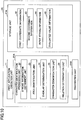
- FIG. 10 is a diagram illustrating a functional configuration of the character identification device in the second embodiment.
- the character identification device 1A in the embodiment includes a character identification processing unit 21A, a recognition unit 31A, and a storage unit 41A.
- the character identification processing unit 21A in the embodiment includes a deletion determination unit 26.
- the storage unit 41A in the embodiment includes an evaluated value information 45.
- the recognition unit 31A obtains evaluated value information 45 as a recognition result, which includes a character recognized from input stroke information 44 as a recognition result, and an evaluated value of the character.
- the evaluated value information 45 is information obtained by the recognition unit 31A as a recognition result, and is information that includes a character recognized from input stroke information 44, and an evaluated value of the character.
- the evaluated value is a value that represents the certainty of a character recognized from the input stroke information 44.
- the evaluated value information 45 may include multiple characters and the evaluated values of the characters.
- the deletion determination unit 26 determines whether the handwriting correction input is for deletion of a character in a display text. Specifically, the deletion determination unit 26 determines that the correction is deletion of a character if the proportion of an area in the input character area overlapping the text area is greater than or equal to the first threshold, and if the evaluated value of the character indicating deletion in the evaluated value information 45 is greater than or equal to a second threshold set in advance.
- the character indicating deletion is a deletion mark, which may be denoted as, for example, "-”.
- FIG. 11 is a flowchart illustrating an example of a handwriting correction process in the second embodiment.
- a process of deleting a display text being displayed on the display operation unit 101 of the character identification device 1A by a handwriting correction input will be mainly described. Note that replacement or insertion of a character can be done as has been described in the first embodiment with reference to FIG. 5 , and the description is omitted here.
- the character identification device 1A in the embodiment causes the recognition unit 31A to recognize a character corresponding to the input stroke information 44 obtained by the stroke information obtainment unit 22, to obtain the evaluated value information 45 as a recognition result (Step S1101).
- the character identification device 1A in the embodiment causes the deletion determination unit 26 of the character identification processing unit 21A to determine whether the handwriting correction input is for deletion of a character in a display text, based on a determination result by the overlap determination unit 24 and the evaluated value information 45 (Step S1102). Specifically, the deletion determination unit 26 determines whether the proportion of an area in the input character area overlapping the text area is greater than or equal to the first threshold (namely, the correction target is to be replaced), and the evaluated value of the character indicating deletion included in the evaluated value information 45 is greater than or equal to the second threshold.
- the first threshold namely, the correction target is to be replaced
- Step S1102 If it has been determined at Step S1102 that the correction target is to be replaced, and the evaluated value of the character indicating deletion included in the evaluated value information 45 is greater than or equal to the second threshold, the character identification device 1A causes the first application execution unit 11 to delete the correction target in the display text with a character or a character group in the range (Step S1103). This concludes a series of steps for a handwriting correction in the embodiment.
- FIG. 12 is a diagram illustrating a specific example of character deletion according to the handwriting correction process in the second embodiment.
- FIG. 12 illustrates a case in which, in a state (State S21) where a display text "ABC" is displayed on the display operation unit 101 of the character identification device 1A, the user performs a correction by a handwriting input for deleting a character "B" in the display text.
- State S21 in response to receiving as input a character "-" indicating deletion of the character "B", the character identification device 1A causes the stroke information obtainment unit 22 to obtain the input stroke information 44 representing strokes input by the handwriting input (State S22).
- the stroke information obtainment unit 22 obtains the input stroke information 44 of the character "-" indicating deletion.
- the area identification unit 23 identifies a text area and an input character area. Then, the overlap determination unit 24 determines whether the proportion of an area in the input character area overlapping the text area is greater than or equal to the first threshold (State S23).
- the input character area 701 overlaps the text area 602 among the text areas 601, 602, and 603. Besides, in State S23 in FIG. 12 , the proportion of the area in the input character area 701 overlapping the text area 602 is one-half or more. Therefore, the overlap determination unit 24 determines that the input character area 701 overlaps the text area 602 by the first threshold or more.
- the deletion determination unit 26 also determines whether the evaluated value of the character indicating deletion included in the evaluated value information 45 is greater than or equal to the second threshold. For example, suppose that the evaluated value information 45 includes a character "--" (a Chinese character representing "one") and its evaluated value "50”; a character “-” (hyphen) and its evaluated value "40”; and a character "-” indicating deletion and its evaluated value “35", and the second threshold is "30". In this case, the deletion determination unit 26 determines that the evaluated value of the character indicating deletion included in the evaluated value information 45 is greater than or equal to the second threshold.
- the first application execution unit 11 determines that the character "-" indicating deletion is for deleting the character "B", and deletes the character "B" in the text area 602 that is located at the position and the range identified by the character identification unit 25 (State S24).
- the character identification device 1 in the embodiment, it is possible to perform deletion of a character in a display text displayed by the first application 10, without specifying a position and a range at which a correction is to be made with a cursor or the like.
- FIG. 13 is a diagram illustrating an example of a character identification system in the third embodiment.
- a character identification device 1B in the embodiment includes a first application 10 and a character identification program 20.
- a server device 50 connected with the character identification device 1B via a network N includes a recognition program 30.
- the character identification device 1B causes the character identification program 20 to transmit input stroke information 44 representing strokes input as a handwriting correction input, to the server device 50. Then, the server device 50 causes the recognition program 30 to recognize a character in the input stroke information 44, and replies with the recognition result sent to the character identification device 1B.
- the character identification device 1B causes the character identification program 20 to identify a correction target and the range in a display text. Then, the character identification device 1B causes the first application 10 to correct the display text by a character or a character group replied from the server device 50 as the recognition result.
- Such a configuration makes it possible, for example, to manage information used by the recognition program 30 for character recognition in the server device 50. Therefore, if a database or the like to which the recognition program 30 refers is updated in the server device 50, and the precision of character recognition by the recognition program 30 is improved, this will also benefit recognition of strokes input as a handwriting correction.
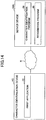
- FIG. 14 is a diagram illustrating an example of a character identification system in the fourth embodiment.
- a character identification device 1C in the embodiment includes a first application 10.
- a server device 50A connected with the character identification device 1C via a network N includes a character identification program 20 and a recognition program 30.
- the character identification device 1C causes the first application 10 to transmit stroke information input by the user and the coordinate information of each character in a display text, to the server device 50A.
- the server device 50A causes the character identification program 20 to obtain the input stroke information 44 and the coordinate information of each character in the display text, to identify a correction target and a range.
- the server device 50A recognizes a character from the input stroke information 44, and obtains the character as a recognition result.
- the server device 50A replies with identified correction target and range, and a character or a character group obtained as a recognition result, sent to the character identification device 1C.
- the character identification device 1 causes the first application 10 to correct the display text based on the replied correction target and range, and the character or the character group obtained as the recognition result.
- Such a configuration enables the character identification device 1C, if having the first application 10 installed, to execute a handwriting correction described in the first embodiment and the second embodiment.
Landscapes
- Engineering & Computer Science (AREA)
- Theoretical Computer Science (AREA)
- Physics & Mathematics (AREA)
- General Physics & Mathematics (AREA)
- Computer Vision & Pattern Recognition (AREA)
- General Engineering & Computer Science (AREA)
- Multimedia (AREA)
- Human Computer Interaction (AREA)
- Health & Medical Sciences (AREA)
- Computational Linguistics (AREA)
- General Health & Medical Sciences (AREA)
- Audiology, Speech & Language Pathology (AREA)
- Artificial Intelligence (AREA)
- Character Discrimination (AREA)
- User Interface Of Digital Computer (AREA)
Abstract
Description
- The present disclosure relates to an input processing program, an input processing device, an input processing method, a character identification program, a character identification device, and a character identification method.
- Tools have been known that receive a handwriting input performed by a user, and process recognized characters obtained by applying character recognition to the handwriting input, as input characters.
- [Patent Document 1] Japanese Laid-Open Patent Application No.
2005-235116 - However, when using such a conventional tool, the user is required, before performing the handwriting input, to perform an operation to specify an item or a position where the user wants to input characters by the handwriting input, in addition to the handwriting input, which hinders smooth character input by the handwriting.
- In an aspect, it is an object to enable smooth character input by handwriting.
- According to an embodiment, a computer is caused to execute a process. The process includes receiving a handwriting input on a display screen on which a character is displayed; and in response to detecting that the handwriting input has been performed at a position corresponding to a display position of a specific character displayed on the display screen, executing a process of changing the specific character into a character recognized with respect to the handwriting input.
- In an aspect, it is possible to perform smooth character input by handwriting.
-
-
FIG. 1 is a diagram illustrating principal program components in a first embodiment; -
FIG. 2 is a diagram illustrating a handwriting correction input by a character identification device; -
FIG. 3 is a diagram illustrating an example of a hardware configuration of a character identification device; -
FIG. 4 is a diagram illustrating a functional configuration of a character identification device in the first embodiment; -
FIG. 5 is a flowchart illustrating an example of a handwriting correction process in the first embodiment; -
FIG. 6 is a diagram illustrating a specific example of a handwriting correction in the first embodiment; -
FIG. 7 is a diagram illustrating protection of a display text; -
FIG. 8 is a diagram illustrating a handwriting correction with which an input field is displayed; -
FIG. 9 is a diagram illustrating display texts of multiple applications; -
FIG. 10 is a diagram illustrating a functional configuration of a character identification device in a second embodiment; -
FIG. 11 is a flowchart illustrating an example of a handwriting correction process in the second embodiment; -
FIG. 12 is a diagram illustrating a specific example of character deletion according to a handwriting correction process in the second embodiment; -
FIG. 13 is a diagram illustrating an example of a character identification system in a third embodiment; and -
FIG. 14 is a diagram illustrating an example of a character identification system in a fourth embodiment. - In the following, a first embodiment will be described with reference to the drawings.
FIG. 1 is a diagram illustrating principal program components in the first embodiment. - The first embodiment includes, as principal programs, a
first application 10, acharacter identification program 20, and arecognition program 30. - The
first application 10 is a program that displays a character group (text) having been input, for example, a slip creation application or an email creation application. A text displayed by the first application will be referred to as a "display text" in the following. Note that the display text is not limited to characters input by a handwriting input, and may include, for example, characters input by a keyboard or the like. - When a correction is made to a character in a display text by a handwriting input (or a handwriting correction input), the
character identification program 20 identifies a position and a range of a correction target in the display text from input strokes. For example, thecharacter identification program 20 identifies a position and a range in the display text to be replaced with a character input by a handwriting correction input. Similarly, thecharacter identification program 20 identifies a position and a range in the display text to be inserted with a character input by a handwriting correction input. Note that the handwriting input and the handwriting correction input are not limited to input by strokes using a finger, and may be, for example, input by strokes using a stylus or the like. - The
recognition program 30 recognizes a character from strokes input by a handwriting input and a handwriting correction input. In other words, therecognition program 30 obtains a character corresponding to strokes input by the handwriting input and the handwriting correction input, as a recognition result. - The
first application 10, thecharacter identification program 20, and therecognition program 30 in the first embodiment may be implemented on independent devices, respectively, or may be implemented in a single device. In the following description of the first embodiment, a case will be described where thefirst application 10, thecharacter identification program 20, and therecognition program 30 are implemented on a single device. In the following description, a device on which thefirst application 10, thecharacter identification program 20, and therecognition program 30 are implemented will be referred to as a "character identification device". - Next, the handwriting correction input of a display text in the character identification device in the first embodiment will be described.
FIG. 2 is a diagram illustrating a handwriting correction input by the character identification device. - Suppose that a
screen 2 is displayed on thecharacter identification device 1. Display texts "ABCDE" and "1234" are displayed on thescreen 2. A case will be described in which at this time, a user of thecharacter identification device 1 corrects a character "C" included in the display text to a character "A" by handwriting. Note that the display text on thescreen 2 is displayed by thefirst application 10. - In a correction by handwriting according to the embodiment, as illustrated on a
screen 3, the user inputs a character "A" by handwriting directly at the position where the character "C" included in the display text is displayed, through a touch panel or the like of thecharacter identification device 1. - Then, the
character identification device 1 causes thecharacter identification program 20 to identify a character group to which the correction has been made by handwriting and the position of the character "C" to be corrected in the character group, from information representing the strokes of the character "A" input by handwriting. - In the example in
FIG. 2 , thecharacter identification program 20 identifies the display text "ABCDE" as the character group to which the correction has been made. Thecharacter identification program 20 also identifies the character "C" in the display text "ABCDE" as the character to be corrected. - Next, the
character identification program 20 transfers information representing the strokes of the character "A" to therecognition program 30. Therecognition program 30 recognizes the character "A" from the information representing the strokes, and transfers the character group having the correction reflected to thefirst application 10. - The
first application 10 displays the character group having the correction reflected. In the example inFIG. 2 , as illustrated on ascreen 4, the display text "ABCDE" turns into a display text "ABADE" in which the character "C" has been corrected to the character "A". - In this way, the
character identification device 1 in the first embodiment can directly execute a handwriting correction input to a display text displayed by the first application. - Note that although the handwriting correction input described with
FIG. 2 is a correction that replaces the character "C" included in the display text by the character "A", a correction may be made to insert the character "A" before or after the character "C" included in the display text. - Also, in the example in
FIG. 2 , although the character group (a first character group) among the display texts "ABCDE" and "1234" to be corrected by the handwriting input includes multiple characters, it is not limited as such. The character group to be corrected by a handwriting correction input among display texts displayed by thefirst application 10 may consist of one character. - Besides, the number of characters to be corrected by a handwriting correction input may be two or more (in other words, replacement or insertion may be made with a character group).
- Note that in the handwriting correction input in
FIG. 2 , the strokes of the character "A" input by handwriting may be displayed in a color different from the color of the display text "ABCDE". For example, if the display text "ABCDE" is displayed in black, the strokes of the character "A" input by handwriting may be displayed in red or blue. Thus, the strokes of the character input by handwriting in the display text can be seen more easily, and it becomes easier for the user to perform a handwriting correction input. In the following, the handwriting correction will be described in detail. - First, a hardware configuration of the
character identification device 1 will be described.FIG. 3 is a diagram illustrating an example of a hardware configuration of the character identification device. Thecharacter identification device 1 in the embodiment includes adisplay operation unit 101, adrive unit 102, anauxiliary storage unit 103, amemory unit 104, anarithmetic processing unit 105, and aninterface unit 106, which are mutually connected via a bus B. - The
display operation unit 101 is, for example, a touch panel, and is used for inputting various signals, and displaying (outputting) various signals. Theinterface unit 106 includes a model and a LAN card, and is used for connecting to a network. - The
first application 10, thecharacter identification program 20, and therecognition program 30 are at least a part of various programs that control thecharacter identification device 1. These programs are provided, for example, by distributing therecording medium 107, or by downloading from a network. As therecording medium 107 that records thefirst application 10, thecharacter identification program 20, and therecognition program 30, various types of recording media can be used including recording media that record information optically, electrically or magnetically, such as a CD-ROM, a flexible disk, and an optical magnetic disk, and semiconductor memories that record information electrically such as a ROM and a flash memory. - Also, when the
recording medium 107 that records thefirst application 10, thecharacter identification program 20, and therecognition program 30 is set in thedrive unit 102, these programs are installed in theauxiliary storage unit 103 via thedrive unit 102 from therecording medium 107. The programs downloaded from a network are installed in theauxiliary storage unit 103 via theinterface unit 106. - The
auxiliary storage unit 103 stores thefirst application 10, thecharacter identification program 20, and therecognition program 30 that have been installed, and also stores an OS (Operating System) being base software, required files, data, and the like. Thememory unit 104 reads and loads each of the programs when each of the programs is activated. Then, thearithmetic processing unit 105 implements various processes, which will be described later, following the programs stored in thememory unit 104. - Next, a functional configuration of the
character identification device 1 will be described.FIG. 4 is a diagram illustrating a functional configuration of the character identification device in the first embodiment. Thecharacter identification device 1 in the embodiment includes a firstapplication execution unit 11, a characteridentification processing unit 21, arecognition unit 31, and astorage unit 41. - The first
application execution unit 11 in the embodiment is implemented by thearithmetic processing unit 105 executing thefirst application 10. The characteridentification processing unit 21 in the embodiment is implemented by thearithmetic processing unit 105 executing thecharacter identification program 20. Therecognition unit 31 in the embodiment is implemented by thearithmetic processing unit 105 executing therecognition program 30. Thestorage unit 41 in the embodiment is implemented by theauxiliary storage unit 103 and thememory unit 104. - The
storage unit 41 includes first coordinateinformation 42, second coordinateinformation 43, andinput stroke information 44. - The first coordinate
information 42 is coordinate information that identifies a circumscribing frame of each character included in the display text. Here, the circumscribing frame is a quadrangular frame that circumscribes a character. Therefore, the first coordinateinformation 42 includes first top coordinate information that identifies the top side, first bottom coordinate information that identifies the base side, first left coordinate information that identifies the left side, and first right coordinate information that identifies the right-hand side of the circumscribing frame. - The second coordinate
information 43 is coordinate information that identifies a circumscribing frame of a character formed by strokes input by the user by a handwriting correction input. Similar to the first coordinateinformation 42, the second coordinateinformation 43 includes second top coordinate information, second bottom coordinate information, second left coordinate information, and second right coordinate information, which identify the respective sides of the circumscribing frame. - Note that the circumscribing frame is not limited to a quadrangle, and may be a polygon. In this case, the first coordinate
information 42 and the second coordinateinformation 43 includes coordinate information that identifies respective sides of the polygon. - The
input stroke information 44 is stroke information input by the user by a handwriting correction input. Note that the stroke information is information representing a single stroke (a trace) done by handwriting that includes two or more coordinate information items. In other words, in the embodiment, a single stroke is identified by connecting coordinates represented by two or more coordinate information items included in the stroke information. Therefore, therecognition unit 31, which will be described later, recognizes a character formed by strokes represented by stroke information. - Here, each coordinate information item included in the first coordinate
information 42, the second coordinateinformation 43, and theinput stroke information 44 is represented by X-Y coordinate values relative to the origin, which is, for example, a reference point set in advance on a screen displayed by thecharacter identification device 1. As the reference point, the position of a pixel at the upper left corner on the screen displayed by thecharacter identification device 1 may be set. In this case, for example, the positive direction of the X-axis may be set rightward from the reference point, and the positive direction of the Y-axis may be set downward from the reference point. - The first
application execution unit 11 obtains the first coordinateinformation 42 of a character included in a display text. Also, the firstapplication execution unit 11 replaces a character included in a display text with a character obtained from therecognition unit 31, or inserts a character obtained from therecognition unit 31 into a display text, so as to correct the display text. - Within the extent of a display text displayed by the first
application execution unit 11, the characteridentification processing unit 21 identifies a position and a range at which correction is to be made by handwriting. - The
recognition unit 31 recognizes a character from theinput stroke information 44, to obtain the character as a recognition result. - In the following, the character
identification processing unit 21 will be described in detail. The characteridentification processing unit 21 in the embodiment includes a stroke informationobtainment unit 22, anarea identification unit 23, anoverlap determination unit 24, and acharacter identification unit 25. - The stroke information
obtainment unit 22 obtains theinput stroke information 44 representing strokes input by the user by a handwriting correction input. - The
area identification unit 23 obtains the second coordinateinformation 43 from theinput stroke information 44 obtained by the stroke informationobtainment unit 22. Also, thearea identification unit 23 identifies an area (an input character area) surrounded by a circumscribing frame identified by the second coordinateinformation 43, and an area (a text area) surrounded by a circumscribing frame identified by the first coordinateinformation 42. Note that the first coordinateinformation 42 may be transferred to thearea identification unit 23 by the firstapplication execution unit 11. Alternatively, the first coordinateinformation 42 may be obtained from thestorage unit 41 by thearea identification unit 23, when the stroke informationobtainment unit 22 obtains theinput stroke information 44. - For the input character area and the text area identified by the
area identification unit 23, theoverlap determination unit 24 determines whether the proportion of an area in the input character area overlapping the text area is greater than or equal to a first threshold set in advance. - Depending on the determination result of the
overlap determination unit 24, thecharacter identification unit 25 identifies a position and a range in the display text at which the correction is to be made. In other words, thecharacter identification unit 25 identifies a character or a character group in the display text that is, for example, to be replaced. Similarly, thecharacter identification unit 25 identifies a character or a character group in the display text that is, for example, to be inserted. - Next, operations of the
character identification device 1 in the embodiment will be described.FIG. 5 is a flowchart illustrating an example of a handwriting correction process in the first embodiment.FIG. 5 illustrates a process that corrects a display text (replacement or insertion of a character) displayed on thedisplay operation unit 101 of thecharacter identification device 1 by a handwriting correction input. - The
character identification device 1 in the embodiment causes the stroke informationobtainment unit 22 of the characteridentification processing unit 21 to obtain theinput stroke information 44 representing strokes input by the handwriting correction input (Step S501). Next, thecharacter identification device 1 causes the stroke informationobtainment unit 22 of the characteridentification processing unit 21 to determine whether the handwriting correction input has been completed (Step S502). Here, the stroke informationobtainment unit 22 may determine that the handwriting correction input has been completed if additionalinput stroke information 44 is not obtained for a predetermined period of time. - If it has been determined at Step S502 that the handwriting correction input has not been completed, the
character identification device 1 returns to Step S501. - If it has been determined at Step S502 that the handwriting correction input has been completed, the
character identification device 1 causes thearea identification unit 23 of the characteridentification processing unit 21 to identify a text area and an input character area (Step S503). In other words, thearea identification unit 23 obtains the first coordinateinformation 42 via the firstapplication execution unit 11. Then, thearea identification unit 23 identifies a text area based on the first coordinateinformation 42. Thearea identification unit 23 also obtains the second coordinateinformation 43 from theinput stroke information 44. Then, thearea identification unit 23 identifies an input character area based on the second coordinateinformation 43. Note that according to the embodiment, identifying a text area by thearea identification unit 23 identifies a character group to which a correction is to be made. - Next, the
character identification device 1 causes theoverlap determination unit 24 of the characteridentification processing unit 21 to determine whether the proportion of an area in the input character area overlapping the text area is greater than or equal to the first threshold (Step S504). Note that the first threshold may be set, for example, to one-half. In this case, theoverlap determination unit 24 determines whether the input character area overlaps the text area by one-half or more. - If it has been determined at
Step 504 that the proportion of an area in the input character area overlapping the text area is greater than or equal to the first threshold, thecharacter identification device 1 causes thecharacter identification unit 25 of the characteridentification processing unit 21 to identify a character or a character group to be replaced in the display text (Step S505). In other words, thecharacter identification unit 25 identifies a position and a range in the display text to be replaced by a character input by the handwriting correction input. - If it has been determined at
Step 504 that the proportion of an area in the input character area overlapping the text area is not greater than or equal to the first threshold, thecharacter identification device 1 causes thecharacter identification unit 25 of the characteridentification processing unit 21 to identify a character or a character group to be inserted in the display text (Step S506). In other words, thecharacter identification unit 25 identifies a position and a range in the display text to be inserted with a character input by the handwriting correction input. - Next, the
character identification device 1 causes therecognition unit 31 to recognize a character corresponding to theinput stroke information 44 obtained by the stroke informationobtainment unit 22, to obtain the character as a recognition result (Step S507). Then, therecognition unit 31 transfers the obtained character to the firstapplication execution unit 11. Note that if theinput stroke information 44 obtained by the stroke informationobtainment unit 22 corresponds to multiple characters, therecognition unit 31 obtains the multiple characters (namely, a character group). - Finally, depending on the determination result at Step S504, the
character identification device 1 causes the firstapplication execution unit 11 to correct the display text at the position and the range identified at Step S505 or Step S506, by the character or the character group obtained at Step S507 (Step S508). - In other words, if having proceeded from Step S504 to Step S505, the first
application execution unit 11 replaces the character or the character group at the position and the range identified in the display text, by the obtained character or character group. Alternatively, if having proceeded from Step S504 to Step S506, the firstapplication execution unit 11 inserts the character or the character group at the position and the range identified in the display text, by the obtained character or character group. This concludes a series of steps for a handwriting correction in the embodiment. - Next, with reference to
FIG. 6 , a case will be described specifically in which a handwriting correction is executed by the handwriting correction process described withFIG. 5 .FIG. 6 is a diagram illustrating a specific example of a handwriting correction in the first embodiment. - First, suppose that a display text "ABC" is displayed on the character identification device 1 (State S11).
- In State S11, the
character identification device 1 receives a handwriting correction that has been performed by the user for correcting a character "C" to a character "A" in the display text (State S12). Then, the stroke informationobtainment unit 22 obtains theinput stroke information 44 representing strokes input by the handwriting correction input. In the example inFIG. 6 , the stroke informationobtainment unit 22 obtainsinput stroke information 441 of the first stroke of the character "A",input stroke information 442 of the second stroke of the character "A", andinput stroke information 443 of the third stroke of the character "A". - Next, the
area identification unit 23 identifies a text area and an input character area. Then, theoverlap determination unit 24 determines whether the input character area overlaps the text area by the first threshold or greater (State S13). - Specifically, the
area identification unit 23 identifies a text area and an input character area as follows. First, thearea identification unit 23 obtains coordinate information of each character of the display text "ABC", which is maintained by an OS, via the firstapplication execution unit 11. Then, the first coordinateinformation 42 is obtained for each character, including, for example, coordinate information having the minimum Y-coordinate as first top coordinate information; coordinate information having the maximum Y-coordinate as first bottom coordinate information; coordinate information having the minimum X-coordinate as first left coordinate information; and coordinate information having the maximum X-coordinate as first right coordinate information. - Next, the
area identification unit 23 in the embodiment identifies a text area of each character included in the display text from the first coordinateinformation 42 of each character. - In the example in
FIG. 6 , based on the first coordinateinformation 42 of each character, thearea identification unit 23 identifies atext area 301 of the character "A" in the display text, atext area 302 of the character "B" in the display text, and atext area 303 of the character "C" in the display text. In the embodiment, once the text area of each character has been identified, information related to the display position and size of each character in the display text is identified. - The
area identification unit 23 also obtains the second coordinateinformation 43 of the character "A" input by handwriting from theinput stroke information 441, theinput stroke information 442, and theinput stroke information 443. Specifically, among the coordinate information included in theinput stroke information 441, theinput stroke information 442, and theinput stroke information 443, thearea identification unit 23 obtains the second coordinateinformation 43 including, for example, coordinate information having the minimum Y-coordinate as second top coordinate information; coordinate information having the maximum Y-coordinate as second bottom coordinate information; coordinate information having the minimum X-coordinate as second left coordinate information; and coordinate information having the maximum X-coordinate as second right coordinate information. - Next, based on the second coordinate
information 43, thearea identification unit 23 identifies theinput character area 401 of the character "A" input by the handwriting correction input. - Next, the
overlap determination unit 24 determines whether theinput character area 401 overlaps each of thetext area 301, thetext area 302, and thetext area 302 by the first threshold or more. Then, depending on the determination result by theoverlap determination unit 24, thecharacter identification unit 25 identifies the position and the range at which the correction is to be made. A correction in the embodiment is replacement or insertion of a character. - First, replacement of a character will be described. In State S13 in
FIG. 6 , theinput character area 401 overlaps thetext area 303. Besides, in State S13 inFIG. 6 , the proportion of the area in theinput character area 401 that overlaps thetext area 303 is one-half or more. Therefore, theoverlap determination unit 24 determines that theinput character area 401 overlaps thetext area 303 by the first threshold or more. - From this determination result, the
character identification unit 25 identifies the character "C" in thetext area 303 as the replacement target (correction target) to be replaced with the character input for the correction. - In the display text, once the character to be replaced has been identified, the first
application execution unit 11 replaces the character "C" corresponding to thetext area 303 with the character "A" corresponding to the strokes input by the handwriting correction input (State S14-1). - Next, insertion of a character will be described. In State S13 in
FIG. 6 , suppose that the input character area identified by thearea identification unit 23 is an input character area 401'. In this case, the input character area 401' partially overlaps both thetext area 302 and thetext area 303. - However, in the input character area 401', the ratios of the areas that overlap the
text area 302 and thetext area 303, respectively, are both smaller than one-half. - Therefore, the
overlap determination unit 24 determines that the input character area 401' does not overlap thetext area 302 and thetext area 303 by the first threshold or more. Also, thecharacter identification unit 25 identifies a position between thetext area 302 and thetext area 303 as the insertion point of the character "C" input for the correction. - In the display text, once the insertion point of the correction character has been identified, the first
application execution unit 11 inserts the character "A" corresponding to the strokes input by the handwriting correction input, between thetext area 302 and the text area 303 (State S14-2). - In this way, by using the
character identification device 1 in the embodiment, it is possible to perform a handwriting correction input for a display text displayed by thefirst application 10, without specifying a position and a range with a cursor or the like, at which the correction is to be made. - Here, in a display text displayed on the
display operation unit 101 of thecharacter identification device 1, characters other than the character or the character group to be corrected by a handwriting correction are not to be corrected; rather, the displayed characters are protected. - In the following, with reference to
FIG. 7 , protection of a display text will be described.FIG. 7 is a diagram illustrating protection of a display text.FIG. 7 illustrates a case in which characters are to be inserted by a handwriting correction in a display text where the number of characters is limited. - In
FIG. 7 , the display text displayed by the firstapplication execution unit 11 is displayed in adisplay field 61, and the number of characters that can be displayed in thedisplay field 61 is five. - In this case, for example, upon receiving a character group "AAA" (a first character group) as input by a handwriting correction on the character "C", the first
application execution unit 11 may display amessage 72 or the like indicating that, for example, the number of characters exceeds a predetermined number of characters, without replacing the character "C" by the character group "AAA". - This makes it possible to avoid erasing a character group "DE" (a second character group) that has been input before the correction, which would be erased by replacing the character "C" with the character group "AAA" in the
display field 61, against the intention of the user who had performed the handwriting correction. Thus, according to the embodiment, characters other than those to be corrected in a display text are not affected by a handwriting correction input, and characters not located at the position and range identified by the handwriting correction input are protected. - In addition, although the example in
FIG. 7 has been described for the case in which the number of characters in the display text of thedisplay field 61 is limited, it is not limited as such. In the embodiment, for example, if a handwriting correction has been input in a display text, the firstapplication execution unit 11 may inhibit receiving a correction for a character not overlapping the input strokes until the completion of the preceding correction completes. - Also, in the example in
FIG. 7 , although the characters other than those to be corrected are protected by a process of the firstapplication execution unit 11, this process may be executed by the characteridentification processing unit 21. In this case, the characteridentification processing unit 21 in the embodiment just needs to obtain information required for protection in advance, including the number of characters in a display text, and the number of characters that can be displayed in a display field, from the firstapplication execution unit 11. - Besides, the
character identification device 1 in the embodiment executes a handwriting correction directly on a display text. Therefore, display texts other than the text to be corrected are not hidden by, for example, the input field for the handwriting input. Therefore, thecharacter identification device 1 in the embodiment enables the user to perform a handwriting correction, while referring to display texts other than the text to be corrected. - In the following, with reference to
FIG. 8 , comparison with a handwriting input with which an input field is displayed will be described.FIG. 8 is a diagram illustrating a handwriting correction with which an input field is displayed.FIG. 8 illustrates a case in which the input field into which the user inputs strokes is displayed when the user corrects a character by a handwriting correction. - In
FIG. 8 , suppose that display texts "ABCDE", "12345", and "abcde" are displayed on ascreen 5. On thescreen 5, in order to correct a character "C" to a character "A" by a handwriting correction, the user specifies the correction target and therange 6a with a cursor or the like as illustrated on ascreen 6, and then, ahandwriting input field 6b for performing the handwriting correction is displayed. - Therefore, the display text "abcde" is hidden by the
handwriting input field 6b, and when the user inputs a character by handwriting in thehandwriting input field 6b, the user cannot refer to the display text "abcde". This is inconvenient if the user wants to make the correction while referring to display texts other than the display text to be corrected. For example, when the user is going to correct the character "C" to the character "A", if the user wants to confirm the character color of a character "c", the hidden character "c" cannot be referred to; therefore, the user needs to make theinput field 6b non-displayed once, so as to confirm the character color, which is inconvenient. - In contrast to this, the
character identification device 1 in the embodiment enables the user to perform a correction by handwriting, which is directly input on a display text, and does not need to display an input field. Therefore, according to the embodiment, when performing a correction by handwriting directly input on a display text, it is possible to perform the correction while referring to characters before and after the correction target, the context, and the like. - Furthermore, the
character identification device 1 in the embodiment enables the user to perform a correction by handwriting while referring to a display text displayed by another application. -
FIG. 9 is a diagram illustrating display texts of multiple applications. In the following, with reference toFIG. 9 , a case will be described in which a handwriting correction is performed while referring to a display text displayed by another application. - On a
screen 7 illustrated inFIG. 9 , anapplication screen 7a displayed by thefirst application 10, and anapplication screen 7b displayed by a second application are displayed. - The
screen 7 is displayed on thedisplay operation unit 101, for example, if a display text on theapplication screen 7a is to be corrected while referring to the content of a display text on theapplication screen 7b. - Specifically, a case may be considered, for example, where a word with correct spelling is displayed on the
application screen 7b, and the user refers to theapplication screen 7b, and is going to correct the spelling of a word that is a display text on theapplication screen 7a. - The
character identification device 1 in the embodiment enables the user, if a character "C" in the display text displayed on theapplication screen 7a is to be corrected to a character "A" by a handwriting correction, to perform the correction while referring to a display text "abcde" being displayed on theapplication screen 7b. In other words, the user can perform a correction while referring to a display text other than the display text to be corrected. - Next, a second embodiment will be described. In the following description of the second embodiment, different points from the first embodiment will be described, whereas elements having the same functional configurations as in the first embodiment are assigned the same reference symbols, and description is omitted for such elements.
- A
character identification device 1A in the embodiment can delete a character in a display text by a handwriting correction input. -
FIG. 10 is a diagram illustrating a functional configuration of the character identification device in the second embodiment. Thecharacter identification device 1A in the embodiment includes a characteridentification processing unit 21A, arecognition unit 31A, and astorage unit 41A. In addition, the characteridentification processing unit 21A in the embodiment includes adeletion determination unit 26. Furthermore, thestorage unit 41A in the embodiment includes an evaluatedvalue information 45. - The
recognition unit 31A obtains evaluatedvalue information 45 as a recognition result, which includes a character recognized frominput stroke information 44 as a recognition result, and an evaluated value of the character. - The evaluated
value information 45 is information obtained by therecognition unit 31A as a recognition result, and is information that includes a character recognized frominput stroke information 44, and an evaluated value of the character. Here, the evaluated value is a value that represents the certainty of a character recognized from theinput stroke information 44. Note that the evaluatedvalue information 45 may include multiple characters and the evaluated values of the characters. - Based on a determination result by the
overlap determination unit 24 and the evaluatedvalue information 45, thedeletion determination unit 26 determines whether the handwriting correction input is for deletion of a character in a display text. Specifically, thedeletion determination unit 26 determines that the correction is deletion of a character if the proportion of an area in the input character area overlapping the text area is greater than or equal to the first threshold, and if the evaluated value of the character indicating deletion in the evaluatedvalue information 45 is greater than or equal to a second threshold set in advance. Here, "the character indicating deletion" is a deletion mark, which may be denoted as, for example, "-". - Next, operations of the
character identification device 1A in the embodiment will be described.FIG. 11 is a flowchart illustrating an example of a handwriting correction process in the second embodiment. With reference toFIG. 11 , a process of deleting a display text being displayed on thedisplay operation unit 101 of thecharacter identification device 1A by a handwriting correction input, will be mainly described. Note that replacement or insertion of a character can be done as has been described in the first embodiment with reference toFIG. 5 , and the description is omitted here. - The
character identification device 1A in the embodiment causes therecognition unit 31A to recognize a character corresponding to theinput stroke information 44 obtained by the stroke informationobtainment unit 22, to obtain the evaluatedvalue information 45 as a recognition result (Step S1101). - Next, the
character identification device 1A in the embodiment causes thedeletion determination unit 26 of the characteridentification processing unit 21A to determine whether the handwriting correction input is for deletion of a character in a display text, based on a determination result by theoverlap determination unit 24 and the evaluated value information 45 (Step S1102). Specifically, thedeletion determination unit 26 determines whether the proportion of an area in the input character area overlapping the text area is greater than or equal to the first threshold (namely, the correction target is to be replaced), and the evaluated value of the character indicating deletion included in the evaluatedvalue information 45 is greater than or equal to the second threshold. - If it has been determined at Step S1102 that the correction target is to be replaced, and the evaluated value of the character indicating deletion included in the evaluated
value information 45 is greater than or equal to the second threshold, thecharacter identification device 1A causes the firstapplication execution unit 11 to delete the correction target in the display text with a character or a character group in the range (Step S1103). This concludes a series of steps for a handwriting correction in the embodiment. - Next, with reference to
FIG. 12 , a case will be specifically described in which a handwriting correction for deleting a character is executed by the handwriting correction process described withFIG. 11 .FIG. 12 is a diagram illustrating a specific example of character deletion according to the handwriting correction process in the second embodiment. -
FIG. 12 illustrates a case in which, in a state (State S21) where a display text "ABC" is displayed on thedisplay operation unit 101 of thecharacter identification device 1A, the user performs a correction by a handwriting input for deleting a character "B" in the display text. - In State S21, in response to receiving as input a character "-" indicating deletion of the character "B", the
character identification device 1A causes the stroke informationobtainment unit 22 to obtain theinput stroke information 44 representing strokes input by the handwriting input (State S22). In the example inFIG. 12 , the stroke informationobtainment unit 22 obtains theinput stroke information 44 of the character "-" indicating deletion. - Next, the
area identification unit 23 identifies a text area and an input character area. Then, theoverlap determination unit 24 determines whether the proportion of an area in the input character area overlapping the text area is greater than or equal to the first threshold (State S23). - In State S23 in
FIG. 12 , theinput character area 701 overlaps thetext area 602 among thetext areas FIG. 12 , the proportion of the area in theinput character area 701 overlapping thetext area 602 is one-half or more. Therefore, theoverlap determination unit 24 determines that theinput character area 701 overlaps thetext area 602 by the first threshold or more. - The
deletion determination unit 26 also determines whether the evaluated value of the character indicating deletion included in the evaluatedvalue information 45 is greater than or equal to the second threshold. For example, suppose that the evaluatedvalue information 45 includes a character "--" (a Chinese character representing "one") and its evaluated value "50"; a character "-" (hyphen) and its evaluated value "40"; and a character "-" indicating deletion and its evaluated value "35", and the second threshold is "30". In this case, thedeletion determination unit 26 determines that the evaluated value of the character indicating deletion included in the evaluatedvalue information 45 is greater than or equal to the second threshold. - From this determination result, the first
application execution unit 11 determines that the character "-" indicating deletion is for deleting the character "B", and deletes the character "B" in thetext area 602 that is located at the position and the range identified by the character identification unit 25 (State S24). - In this way, by using the
character identification device 1 in the embodiment, it is possible to perform deletion of a character in a display text displayed by thefirst application 10, without specifying a position and a range at which a correction is to be made with a cursor or the like. - Next, a third embodiment will be described. In the following description of the third embodiment, different points from the first embodiment will be described, whereas elements having the same functional configurations as in the first embodiment are assigned the same reference symbols, and description is omitted for such elements.
- In the embodiment, a case will be described in which the
recognition program 30 is installed in a device that is different from thecharacter identification device 1.FIG. 13 is a diagram illustrating an example of a character identification system in the third embodiment. - A
character identification device 1B in the embodiment includes afirst application 10 and acharacter identification program 20. Besides, aserver device 50 connected with thecharacter identification device 1B via a network N includes arecognition program 30. - In the embodiment, the
character identification device 1B causes thecharacter identification program 20 to transmitinput stroke information 44 representing strokes input as a handwriting correction input, to theserver device 50. Then, theserver device 50 causes therecognition program 30 to recognize a character in theinput stroke information 44, and replies with the recognition result sent to thecharacter identification device 1B. - Besides, the
character identification device 1B causes thecharacter identification program 20 to identify a correction target and the range in a display text. Then, thecharacter identification device 1B causes thefirst application 10 to correct the display text by a character or a character group replied from theserver device 50 as the recognition result. - Such a configuration makes it possible, for example, to manage information used by the
recognition program 30 for character recognition in theserver device 50. Therefore, if a database or the like to which therecognition program 30 refers is updated in theserver device 50, and the precision of character recognition by therecognition program 30 is improved, this will also benefit recognition of strokes input as a handwriting correction. - Next, a fourth embodiment will be described. In the following description of the fourth embodiment, different points from the first embodiment will be described, whereas elements having the same functional configurations as in the first embodiment are assigned the same reference symbols, and description is omitted for such elements.
- In the embodiment, a case will be described in which the
character identification program 20 and therecognition program 30 are installed in a device that is different from thecharacter identification device 1.FIG. 14 is a diagram illustrating an example of a character identification system in the fourth embodiment. - A character identification device 1C in the embodiment includes a
first application 10. Besides, aserver device 50A connected with the character identification device 1C via a network N includes acharacter identification program 20 and arecognition program 30. - In the embodiment, the character identification device 1C causes the
first application 10 to transmit stroke information input by the user and the coordinate information of each character in a display text, to theserver device 50A. Theserver device 50A causes thecharacter identification program 20 to obtain theinput stroke information 44 and the coordinate information of each character in the display text, to identify a correction target and a range. Besides, theserver device 50A recognizes a character from theinput stroke information 44, and obtains the character as a recognition result. - Next, the
server device 50A replies with identified correction target and range, and a character or a character group obtained as a recognition result, sent to the character identification device 1C. - Then, the
character identification device 1 causes thefirst application 10 to correct the display text based on the replied correction target and range, and the character or the character group obtained as the recognition result. - Such a configuration enables the character identification device 1C, if having the
first application 10 installed, to execute a handwriting correction described in the first embodiment and the second embodiment. - As above, the embodiments of the present invention have been described in detail. Note that the present invention is not limited to such specific embodiments, but various variations and modifications may be made within the scope of the subject matters of the present invention described in the claims.
-
- 1 character identification device
- 10 first application
- 20 character identification program
- 21 character identification processing unit
- 22 stroke information obtainment unit
- 23 area identification unit
- 24 overlap determination unit
- 25 character identification unit
- 30 recognition program
Claims (20)
- An input processing program for causing a computer to execute a process, the process comprising:receiving a handwriting input on a display screen on which a character is displayed; andin response to detecting that the handwriting input has been performed at a position corresponding to a display position of a specific character displayed on the display screen, executing a process of changing the specific character into a character recognized with respect to the handwriting input.
- The input processing program as claimed in claim 1, wherein a stroke of the handwriting input is displayed in red, blue, or a display color different from a display color of the specific character.
- An input processing program for causing a computer to execute a process, the process comprising:receiving a handwriting input on a display screen on which a character is displayed; andin response to detecting that the handwriting input has been performed at a position corresponding to a display position of a specific character displayed on the display screen, executing a process in which an input position of a character recognized with respect to the handwriting input is treated as the position of the specific character.
- The input processing program as claimed in claim 3, wherein a stroke of the handwriting input is displayed in red, blue, or a display color different from a display color of the specific character.
- The input processing program as claimed in any one of claims 1 to 4, wherein the handwriting input is input by a stylus.
- An input processing device, comprising:a reception unit configured to receive a handwriting input on a display screen on which a character is displayed; andan execution unit configured, in response to detecting that the handwriting input has been performed at a position corresponding to a display position of a specific character displayed on the display screen, to execute a process of changing the specific character into a character recognized with respect to the handwriting input.
- An input processing device, comprising:a reception unit configured to receive a handwriting input on a display screen on which a character is displayed; andan execution unit configured, in response to detecting that the handwriting input has been performed at a position corresponding to a display position of a specific character displayed on the display screen, to execute a process in which an input position of a character recognized with respect to the handwriting input is treated as the position of the specific character.
- An input processing method executed by a computer, the method comprising:receiving a handwriting input on a display screen on which a character is displayed; andin response to detecting that the handwriting input has been performed at a position corresponding to a display position of a specific character displayed on the display screen, executing a process of changing the specific character into a character recognized with respect to the handwriting input.
- An input processing method executed by a computer, the method comprising:receiving a handwriting input on a display screen on which a character is displayed; andin response to detecting that the handwriting input has been performed at a position corresponding to a display position of a specific character displayed on the display screen, executing a process in which an input position of a character recognized with respect to the handwriting input is treated as the position of the specific character.
- A character identification program for causing a computer to execute a process, the process comprising:obtaining display information related to a display position and a size of each character in a text displayed by a first application; andin response to a handwriting correction input with respect to a display of a first character group included in the display text of the first application, identifying the first character group based on the display information.
- The character identification program as claimed in claim 10, the process further comprising:reflecting a result obtained by applying a recognition result of the handwriting correction input to the first character group, in the display text of the first application.
- The character identification program as claimed in claim 11, wherein the reflecting protects a second character group other than the first character group in the display text.
- The character identification program as claimed in claim 12, wherein the reflecting is one of a process of replacing the first character group with a character input by the handwriting correction input; a process of inserting the character input by the handwriting correction input into the first character group; and a process of deleting a character on which the handwriting correction input has been performed, from the first character group.
- The character identification program as claimed in any one of claims 10 to 13, wherein the first character group is a text recognized with respect to the handwriting input.
- The character identification program as claimed in any one of claims 10 to 13, wherein the first character group is a text generated by an input method other than the handwriting input.
- The character identification program as claimed in any one of claims 10 to 15, wherein the first character group consists of one character.
- The character identification program as claimed in any one of claims 10 to 15, wherein the first character group includes a plurality of characters.
- The character identification program as claimed in any one of claims 10 to 17, wherein the display text of the first application is displayed on a same screen as a display text displayed by a second application.
- A character identification device, comprising:an obtainment unit configured to obtain display information related to a display position and a size of each character in a text displayed by a first application; andan identification unit configured, in response to a handwriting correction input with respect to a display of a first character group included in the display text of the first application, to identify the first character group based on the display information.
- A character identification method executed by a computer, the method comprising:obtaining display information related to a display position and a size of each character in a text displayed by a first application; andin response to a handwriting correction input with respect to a display of a first character group included in the display text of the first application, identifying the first character group based on the display information.
Applications Claiming Priority (1)
| Application Number | Priority Date | Filing Date | Title |
|---|---|---|---|
| PCT/JP2015/062610 WO2016170691A1 (en) | 2015-04-24 | 2015-04-24 | Input processing program, input processing device, input processing method, character identification program, character identification device, and character identification method |
Publications (2)
| Publication Number | Publication Date |
|---|---|
| EP3287953A1 true EP3287953A1 (en) | 2018-02-28 |
| EP3287953A4 EP3287953A4 (en) | 2018-04-11 |
Family
ID=57143486
Family Applications (1)
| Application Number | Title | Priority Date | Filing Date |
|---|---|---|---|
| EP15889930.2A Withdrawn EP3287953A4 (en) | 2015-04-24 | 2015-04-24 | Input processing program, input processing device, input processing method, character identification program, character identification device, and character identification method |
Country Status (5)
| Country | Link |
|---|---|
| US (1) | US11080472B2 (en) |
| EP (1) | EP3287953A4 (en) |
| JP (1) | JPWO2016170691A1 (en) |
| CN (1) | CN107533646A (en) |
| WO (1) | WO2016170691A1 (en) |
Families Citing this family (4)
| Publication number | Priority date | Publication date | Assignee | Title |
|---|---|---|---|---|
| CN108804003B (en) * | 2018-04-26 | 2021-05-07 | 广州视源电子科技股份有限公司 | Handwriting recognition method and device for intelligent interactive equipment and intelligent interactive equipment |
| JP7247496B2 (en) * | 2018-09-14 | 2023-03-29 | 富士フイルムビジネスイノベーション株式会社 | Information processing device and program |
| KR102727938B1 (en) * | 2019-08-06 | 2024-11-11 | 삼성전자주식회사 | Electronic device and method for processing handwriting input thereof |
| CN115480659B (en) * | 2021-05-31 | 2025-11-04 | 华为技术有限公司 | A method, medium, and electronic device for recognizing handwriting gestures using a stylus. |
Family Cites Families (25)
| Publication number | Priority date | Publication date | Assignee | Title |
|---|---|---|---|---|
| JP3353954B2 (en) | 1993-08-13 | 2002-12-09 | ソニー株式会社 | Handwriting input display method and handwriting input display device |
| US6021218A (en) * | 1993-09-07 | 2000-02-01 | Apple Computer, Inc. | System and method for organizing recognized and unrecognized objects on a computer display |
| JP2817646B2 (en) * | 1995-02-01 | 1998-10-30 | 日本電気株式会社 | Document editing device |
| JP3917349B2 (en) | 2000-05-30 | 2007-05-23 | 富士通株式会社 | Retrieval device and method for retrieving information using character recognition result |
| US6690364B1 (en) * | 2001-05-31 | 2004-02-10 | Palm Source, Inc. | Method and system for on screen text correction via pen interface |
| JP4212270B2 (en) * | 2001-12-07 | 2009-01-21 | シャープ株式会社 | Character input device, character input method, and program for inputting characters |
| US20030189603A1 (en) * | 2002-04-09 | 2003-10-09 | Microsoft Corporation | Assignment and use of confidence levels for recognized text |
| US6989822B2 (en) * | 2003-11-10 | 2006-01-24 | Microsoft Corporation | Ink correction pad |
| JP4574188B2 (en) | 2004-02-23 | 2010-11-04 | 富士通株式会社 | Information processing device |
| US7551779B2 (en) * | 2005-03-17 | 2009-06-23 | Microsoft Corporation | Word or character boundary-based scratch-out gesture recognition |
| JP4733415B2 (en) | 2005-04-05 | 2011-07-27 | シャープ株式会社 | Electronic document display apparatus and method, and computer program |
| JP2008242541A (en) * | 2007-03-26 | 2008-10-09 | Dainippon Printing Co Ltd | Electronic form input system |
| US20090007014A1 (en) | 2007-06-27 | 2009-01-01 | Microsoft Corporation | Center locked lists |
| US8116569B2 (en) * | 2007-12-21 | 2012-02-14 | Microsoft Corporation | Inline handwriting recognition and correction |
| JP2011111061A (en) | 2009-11-27 | 2011-06-09 | Fujitsu Ten Ltd | On-vehicle display system |
| CN102156608B (en) | 2010-12-10 | 2013-07-24 | 上海合合信息科技发展有限公司 | Handwriting input method for writing characters continuously |
| US20120216113A1 (en) * | 2011-02-18 | 2012-08-23 | Google Inc. | Touch gestures for text-entry operations |
| US20120238295A1 (en) * | 2011-03-14 | 2012-09-20 | Nokia Corporation | Method and apparatus for recommending content based on content provision models associated with spatial regions |
| JP2012238295A (en) * | 2011-04-27 | 2012-12-06 | Panasonic Corp | Handwritten character input device and handwritten character input method |
| CN102214043B (en) | 2011-06-15 | 2013-12-11 | 安徽科大讯飞信息科技股份有限公司 | Handwriting input identifying method and system |
| JP2013012084A (en) * | 2011-06-29 | 2013-01-17 | Konica Minolta Business Technologies Inc | Document processing device, document processing system, and program |
| JP5248696B1 (en) | 2012-05-25 | 2013-07-31 | 株式会社東芝 | Electronic device, handwritten document creation method, and handwritten document creation program |
| JP5787843B2 (en) | 2012-08-10 | 2015-09-30 | 株式会社東芝 | Handwriting drawing apparatus, method and program |
| FR3005175B1 (en) | 2013-04-24 | 2018-07-27 | Myscript | PERMANENT SYNCHRONIZATION SYSTEM FOR MANUSCRITE INPUT |
| CN103824072B (en) | 2014-03-05 | 2017-02-08 | 广东小天才科技有限公司 | Method and device for detecting font structure of handwritten character |
-
2015
- 2015-04-24 CN CN201580079183.3A patent/CN107533646A/en active Pending
- 2015-04-24 EP EP15889930.2A patent/EP3287953A4/en not_active Withdrawn
- 2015-04-24 WO PCT/JP2015/062610 patent/WO2016170691A1/en not_active Ceased
- 2015-04-24 JP JP2017513943A patent/JPWO2016170691A1/en active Pending
-
2017
- 2017-10-06 US US15/726,695 patent/US11080472B2/en not_active Expired - Fee Related
Also Published As
| Publication number | Publication date |
|---|---|
| EP3287953A4 (en) | 2018-04-11 |
| CN107533646A (en) | 2018-01-02 |
| US11080472B2 (en) | 2021-08-03 |
| JPWO2016170691A1 (en) | 2018-02-01 |
| WO2016170691A1 (en) | 2016-10-27 |
| US20180032495A1 (en) | 2018-02-01 |
Similar Documents
| Publication | Publication Date | Title |
|---|---|---|
| US8619045B2 (en) | Calculator and computer-readable medium | |
| EP3296928A1 (en) | Character input and reception method, character input and reception device, and character input and reception program | |
| EP3796145B1 (en) | A method and correspond device for selecting graphical objects | |
| US9329775B2 (en) | Figure drawing apparatus, figure drawing method and recording medium on which figure drawing programs are recorded | |
| US20150269432A1 (en) | Electronic device and method for manufacturing the same | |
| US11080472B2 (en) | Input processing method and input processing device | |
| US20140321751A1 (en) | Character input apparatus and method | |
| JP7529865B2 (en) | Digital ink generation device, method and program | |
| JP2015158900A (en) | Information processing device, information processing method and information processing program | |
| JP2007279828A (en) | Form processing device, form creation device, form, program for form processing, program for form creation | |
| US20170090727A1 (en) | Electronic device, device computer readable recording medium, and device control method | |
| US20150277729A1 (en) | Electronic whiteboard device, input support method of electronic whiteboard, and computer-readable recording medium | |
| CN111444751B (en) | Information processing apparatus, storage medium, and information processing method | |
| EP2722743A1 (en) | Information processing device, information processing method, and information processing program | |
| US20180032244A1 (en) | Input control device, input control method, character correction device, and character correction method | |
| US20140071058A1 (en) | Positioning Clickable Hotspots On A Touchscreen Display | |
| US20140375585A1 (en) | Object processing device, object processing method, and object processing program | |
| JP5361315B2 (en) | Information processing apparatus and information processing method | |
| JP4050677B2 (en) | Image processing apparatus, image processing method, program, and recording medium | |
| US20160048321A1 (en) | Document viewing device and non-transitory computer-readable recording medium having program stored thereon | |
| WO2023281954A1 (en) | Information processing device, method, program, and system | |
| JPWO2017042981A1 (en) | INPUT PROCESSING METHOD, INPUT PROCESSING DEVICE, INPUT PROCESSING PROGRAM, AND INPUT PROCESSING SYSTEM | |
| JPWO2017042975A1 (en) | Input processing method, input processing apparatus, and input processing program | |
| WO2019049187A1 (en) | Program, information processing device, and information processing method | |
| WO2017029737A1 (en) | Character string selection method, program, and information processing device |
Legal Events
| Date | Code | Title | Description |
|---|---|---|---|
| STAA | Information on the status of an ep patent application or granted ep patent |
Free format text: STATUS: THE INTERNATIONAL PUBLICATION HAS BEEN MADE |
|
| PUAI | Public reference made under article 153(3) epc to a published international application that has entered the european phase |
Free format text: ORIGINAL CODE: 0009012 |
|
| STAA | Information on the status of an ep patent application or granted ep patent |
Free format text: STATUS: REQUEST FOR EXAMINATION WAS MADE |
|
| 17P | Request for examination filed |
Effective date: 20171010 |
|
| AK | Designated contracting states |
Kind code of ref document: A1 Designated state(s): AL AT BE BG CH CY CZ DE DK EE ES FI FR GB GR HR HU IE IS IT LI LT LU LV MC MK MT NL NO PL PT RO RS SE SI SK SM TR |
|
| AX | Request for extension of the european patent |
Extension state: BA ME |
|
| A4 | Supplementary search report drawn up and despatched |
Effective date: 20180312 |
|
| RIC1 | Information provided on ipc code assigned before grant |
Ipc: G06F 17/24 20060101ALI20180306BHEP Ipc: G06F 3/023 20060101ALI20180306BHEP Ipc: G06K 9/62 20060101AFI20180306BHEP Ipc: G06F 3/0488 20130101ALI20180306BHEP Ipc: G06K 9/03 20060101ALI20180306BHEP Ipc: G06K 9/22 20060101ALI20180306BHEP |
|
| DAV | Request for validation of the european patent (deleted) | ||
| DAX | Request for extension of the european patent (deleted) | ||
| STAA | Information on the status of an ep patent application or granted ep patent |
Free format text: STATUS: EXAMINATION IS IN PROGRESS |
|
| 17Q | First examination report despatched |
Effective date: 20200721 |
|
| STAA | Information on the status of an ep patent application or granted ep patent |
Free format text: STATUS: THE APPLICATION HAS BEEN WITHDRAWN |
|
| 18W | Application withdrawn |
Effective date: 20220412 |