EP3284760A1 - Polymer, molding material and resin molded body - Google Patents
Polymer, molding material and resin molded body Download PDFInfo
- Publication number
- EP3284760A1 EP3284760A1 EP16768213.7A EP16768213A EP3284760A1 EP 3284760 A1 EP3284760 A1 EP 3284760A1 EP 16768213 A EP16768213 A EP 16768213A EP 3284760 A1 EP3284760 A1 EP 3284760A1
- Authority
- EP
- European Patent Office
- Prior art keywords
- polymer
- group
- integer
- added
- reaction
- Prior art date
- Legal status (The legal status is an assumption and is not a legal conclusion. Google has not performed a legal analysis and makes no representation as to the accuracy of the status listed.)
- Withdrawn
Links
- 229920000642 polymer Polymers 0.000 title claims abstract description 159
- 239000011347 resin Substances 0.000 title claims abstract description 30
- 229920005989 resin Polymers 0.000 title claims abstract description 30
- 239000012778 molding material Substances 0.000 title 1
- 239000000463 material Substances 0.000 claims abstract description 41
- 125000004435 hydrogen atom Chemical group [H]* 0.000 claims abstract description 17
- 125000004430 oxygen atom Chemical group O* 0.000 claims abstract description 17
- 239000000203 mixture Substances 0.000 claims abstract description 15
- 125000004432 carbon atom Chemical group C* 0.000 claims abstract description 13
- 239000000126 substance Substances 0.000 claims abstract description 11
- 125000000217 alkyl group Chemical group 0.000 claims abstract description 5
- 125000005843 halogen group Chemical group 0.000 claims description 10
- 125000001183 hydrocarbyl group Chemical group 0.000 claims 4
- 230000003287 optical effect Effects 0.000 abstract description 19
- YXFVVABEGXRONW-UHFFFAOYSA-N Toluene Chemical compound CC1=CC=CC=C1 YXFVVABEGXRONW-UHFFFAOYSA-N 0.000 description 117
- 238000006243 chemical reaction Methods 0.000 description 59
- 239000000243 solution Substances 0.000 description 56
- OKKJLVBELUTLKV-UHFFFAOYSA-N Methanol Chemical compound OC OKKJLVBELUTLKV-UHFFFAOYSA-N 0.000 description 54
- 239000000178 monomer Substances 0.000 description 53
- 238000004519 manufacturing process Methods 0.000 description 33
- IJGRMHOSHXDMSA-UHFFFAOYSA-N nitrogen Substances N#N IJGRMHOSHXDMSA-UHFFFAOYSA-N 0.000 description 26
- -1 poly(4-methylpentene) Polymers 0.000 description 26
- 230000009477 glass transition Effects 0.000 description 24
- 238000006116 polymerization reaction Methods 0.000 description 22
- 239000012044 organic layer Substances 0.000 description 21
- 239000006096 absorbing agent Substances 0.000 description 20
- 238000005259 measurement Methods 0.000 description 20
- 229910052757 nitrogen Inorganic materials 0.000 description 20
- 239000002904 solvent Substances 0.000 description 20
- LFQSCWFLJHTTHZ-UHFFFAOYSA-N Ethanol Chemical compound CCO LFQSCWFLJHTTHZ-UHFFFAOYSA-N 0.000 description 18
- 150000002430 hydrocarbons Chemical group 0.000 description 18
- 238000003786 synthesis reaction Methods 0.000 description 18
- 239000012298 atmosphere Substances 0.000 description 17
- WYURNTSHIVDZCO-UHFFFAOYSA-N Tetrahydrofuran Chemical compound C1CCOC1 WYURNTSHIVDZCO-UHFFFAOYSA-N 0.000 description 16
- 230000015572 biosynthetic process Effects 0.000 description 16
- 238000000034 method Methods 0.000 description 16
- CDBYLPFSWZWCQE-UHFFFAOYSA-L Sodium Carbonate Chemical compound [Na+].[Na+].[O-]C([O-])=O CDBYLPFSWZWCQE-UHFFFAOYSA-L 0.000 description 14
- 239000007788 liquid Substances 0.000 description 14
- QJGQUHMNIGDVPM-UHFFFAOYSA-N nitrogen group Chemical group [N] QJGQUHMNIGDVPM-UHFFFAOYSA-N 0.000 description 14
- XLYOFNOQVPJJNP-UHFFFAOYSA-N water Chemical compound O XLYOFNOQVPJJNP-UHFFFAOYSA-N 0.000 description 14
- 230000000052 comparative effect Effects 0.000 description 13
- XTXRWKRVRITETP-UHFFFAOYSA-N Vinyl acetate Chemical compound CC(=O)OC=C XTXRWKRVRITETP-UHFFFAOYSA-N 0.000 description 12
- 239000006185 dispersion Substances 0.000 description 12
- 238000010438 heat treatment Methods 0.000 description 12
- 238000000926 separation method Methods 0.000 description 11
- VYPSYNLAJGMNEJ-UHFFFAOYSA-N Silicium dioxide Chemical compound O=[Si]=O VYPSYNLAJGMNEJ-UHFFFAOYSA-N 0.000 description 10
- 239000011541 reaction mixture Substances 0.000 description 10
- VEXZGXHMUGYJMC-UHFFFAOYSA-N Hydrochloric acid Chemical compound Cl VEXZGXHMUGYJMC-UHFFFAOYSA-N 0.000 description 9
- 239000003963 antioxidant agent Substances 0.000 description 8
- 230000003078 antioxidant effect Effects 0.000 description 8
- 238000010538 cationic polymerization reaction Methods 0.000 description 8
- 125000001309 chloro group Chemical group Cl* 0.000 description 8
- 150000001875 compounds Chemical class 0.000 description 8
- 238000004821 distillation Methods 0.000 description 8
- 238000003756 stirring Methods 0.000 description 8
- YLQBMQCUIZJEEH-UHFFFAOYSA-N tetrahydrofuran Natural products C=1C=COC=1 YLQBMQCUIZJEEH-UHFFFAOYSA-N 0.000 description 8
- VYXHVRARDIDEHS-UHFFFAOYSA-N 1,5-cyclooctadiene Chemical compound C1CC=CCCC=C1 VYXHVRARDIDEHS-UHFFFAOYSA-N 0.000 description 7
- VHUUQVKOLVNVRT-UHFFFAOYSA-N Ammonium hydroxide Chemical compound [NH4+].[OH-] VHUUQVKOLVNVRT-UHFFFAOYSA-N 0.000 description 7
- XDTMQSROBMDMFD-UHFFFAOYSA-N Cyclohexane Chemical compound C1CCCCC1 XDTMQSROBMDMFD-UHFFFAOYSA-N 0.000 description 7
- 235000011114 ammonium hydroxide Nutrition 0.000 description 7
- 239000012299 nitrogen atmosphere Substances 0.000 description 7
- 239000002685 polymerization catalyst Substances 0.000 description 7
- 229910000029 sodium carbonate Inorganic materials 0.000 description 7
- KZMGYPLQYOPHEL-UHFFFAOYSA-N Boron trifluoride etherate Chemical compound FB(F)F.CCOCC KZMGYPLQYOPHEL-UHFFFAOYSA-N 0.000 description 6
- KFZMGEQAYNKOFK-UHFFFAOYSA-N Isopropanol Chemical compound CC(C)O KFZMGEQAYNKOFK-UHFFFAOYSA-N 0.000 description 6
- PXHVJJICTQNCMI-UHFFFAOYSA-N Nickel Chemical compound [Ni] PXHVJJICTQNCMI-UHFFFAOYSA-N 0.000 description 6
- 229940125782 compound 2 Drugs 0.000 description 6
- 238000012718 coordination polymerization Methods 0.000 description 6
- 230000000694 effects Effects 0.000 description 6
- 239000000706 filtrate Substances 0.000 description 6
- 239000003999 initiator Substances 0.000 description 6
- 239000003960 organic solvent Substances 0.000 description 6
- 239000004014 plasticizer Substances 0.000 description 6
- 238000012644 addition polymerization Methods 0.000 description 5
- 239000003054 catalyst Substances 0.000 description 5
- 229940125904 compound 1 Drugs 0.000 description 5
- 238000005984 hydrogenation reaction Methods 0.000 description 5
- 238000000746 purification Methods 0.000 description 5
- HECLRDQVFMWTQS-RGOKHQFPSA-N 1755-01-7 Chemical compound C1[C@H]2[C@@H]3CC=C[C@@H]3[C@@H]1C=C2 HECLRDQVFMWTQS-RGOKHQFPSA-N 0.000 description 4
- 239000004215 Carbon black (E152) Substances 0.000 description 4
- 239000005909 Kieselgur Substances 0.000 description 4
- UIIMBOGNXHQVGW-UHFFFAOYSA-M Sodium bicarbonate Chemical compound [Na+].OC([O-])=O UIIMBOGNXHQVGW-UHFFFAOYSA-M 0.000 description 4
- PPBRXRYQALVLMV-UHFFFAOYSA-N Styrene Chemical compound C=CC1=CC=CC=C1 PPBRXRYQALVLMV-UHFFFAOYSA-N 0.000 description 4
- 239000002253 acid Substances 0.000 description 4
- 125000003118 aryl group Chemical group 0.000 description 4
- ILAHWRKJUDSMFH-UHFFFAOYSA-N boron tribromide Chemical compound BrB(Br)Br ILAHWRKJUDSMFH-UHFFFAOYSA-N 0.000 description 4
- 229940125898 compound 5 Drugs 0.000 description 4
- RTZKZFJDLAIYFH-UHFFFAOYSA-N ether Substances CCOCC RTZKZFJDLAIYFH-UHFFFAOYSA-N 0.000 description 4
- 238000005227 gel permeation chromatography Methods 0.000 description 4
- 229930195733 hydrocarbon Natural products 0.000 description 4
- 229910052739 hydrogen Inorganic materials 0.000 description 4
- 239000001257 hydrogen Substances 0.000 description 4
- ZSPTYLOMNJNZNG-UHFFFAOYSA-N 3-Buten-1-ol Chemical compound OCCC=C ZSPTYLOMNJNZNG-UHFFFAOYSA-N 0.000 description 3
- UHOVQNZJYSORNB-UHFFFAOYSA-N Benzene Chemical compound C1=CC=CC=C1 UHOVQNZJYSORNB-UHFFFAOYSA-N 0.000 description 3
- IMNFDUFMRHMDMM-UHFFFAOYSA-N N-Heptane Chemical compound CCCCCCC IMNFDUFMRHMDMM-UHFFFAOYSA-N 0.000 description 3
- KWYUFKZDYYNOTN-UHFFFAOYSA-M Potassium hydroxide Chemical compound [OH-].[K+] KWYUFKZDYYNOTN-UHFFFAOYSA-M 0.000 description 3
- HEMHJVSKTPXQMS-UHFFFAOYSA-M Sodium hydroxide Chemical compound [OH-].[Na+] HEMHJVSKTPXQMS-UHFFFAOYSA-M 0.000 description 3
- 239000000654 additive Substances 0.000 description 3
- 125000002723 alicyclic group Chemical group 0.000 description 3
- WTEOIRVLGSZEPR-UHFFFAOYSA-N boron trifluoride Chemical compound FB(F)F WTEOIRVLGSZEPR-UHFFFAOYSA-N 0.000 description 3
- 229940126214 compound 3 Drugs 0.000 description 3
- 230000003247 decreasing effect Effects 0.000 description 3
- 238000002347 injection Methods 0.000 description 3
- 239000007924 injection Substances 0.000 description 3
- 239000004611 light stabiliser Substances 0.000 description 3
- CPOFMOWDMVWCLF-UHFFFAOYSA-N methyl(oxo)alumane Chemical compound C[Al]=O CPOFMOWDMVWCLF-UHFFFAOYSA-N 0.000 description 3
- 238000002156 mixing Methods 0.000 description 3
- 125000003367 polycyclic group Chemical group 0.000 description 3
- JIAARYAFYJHUJI-UHFFFAOYSA-L zinc dichloride Chemical compound [Cl-].[Cl-].[Zn+2] JIAARYAFYJHUJI-UHFFFAOYSA-L 0.000 description 3
- XWJBRBSPAODJER-UHFFFAOYSA-N 1,7-octadiene Chemical compound C=CCCCCC=C XWJBRBSPAODJER-UHFFFAOYSA-N 0.000 description 2
- LIKMAJRDDDTEIG-UHFFFAOYSA-N 1-hexene Chemical compound CCCCC=C LIKMAJRDDDTEIG-UHFFFAOYSA-N 0.000 description 2
- 229910015900 BF3 Inorganic materials 0.000 description 2
- 239000007848 Bronsted acid Substances 0.000 description 2
- VGGSQFUCUMXWEO-UHFFFAOYSA-N Ethene Chemical compound C=C VGGSQFUCUMXWEO-UHFFFAOYSA-N 0.000 description 2
- 239000005977 Ethylene Substances 0.000 description 2
- KRHYYFGTRYWZRS-UHFFFAOYSA-N Fluorane Chemical compound F KRHYYFGTRYWZRS-UHFFFAOYSA-N 0.000 description 2
- UFHFLCQGNIYNRP-UHFFFAOYSA-N Hydrogen Chemical compound [H][H] UFHFLCQGNIYNRP-UHFFFAOYSA-N 0.000 description 2
- AFVFQIVMOAPDHO-UHFFFAOYSA-N Methanesulfonic acid Chemical compound CS(O)(=O)=O AFVFQIVMOAPDHO-UHFFFAOYSA-N 0.000 description 2
- AFCARXCZXQIEQB-UHFFFAOYSA-N N-[3-oxo-3-(2,4,6,7-tetrahydrotriazolo[4,5-c]pyridin-5-yl)propyl]-2-[[3-(trifluoromethoxy)phenyl]methylamino]pyrimidine-5-carboxamide Chemical compound O=C(CCNC(=O)C=1C=NC(=NC=1)NCC1=CC(=CC=C1)OC(F)(F)F)N1CC2=C(CC1)NN=N2 AFCARXCZXQIEQB-UHFFFAOYSA-N 0.000 description 2
- OFBQJSOFQDEBGM-UHFFFAOYSA-N Pentane Chemical compound CCCCC OFBQJSOFQDEBGM-UHFFFAOYSA-N 0.000 description 2
- ISWSIDIOOBJBQZ-UHFFFAOYSA-N Phenol Chemical compound OC1=CC=CC=C1 ISWSIDIOOBJBQZ-UHFFFAOYSA-N 0.000 description 2
- OAICVXFJPJFONN-UHFFFAOYSA-N Phosphorus Chemical compound [P] OAICVXFJPJFONN-UHFFFAOYSA-N 0.000 description 2
- NINIDFKCEFEMDL-UHFFFAOYSA-N Sulfur Chemical compound [S] NINIDFKCEFEMDL-UHFFFAOYSA-N 0.000 description 2
- QAOWNCQODCNURD-UHFFFAOYSA-N Sulfuric acid Chemical compound OS(O)(=O)=O QAOWNCQODCNURD-UHFFFAOYSA-N 0.000 description 2
- 230000000996 additive effect Effects 0.000 description 2
- 239000002216 antistatic agent Substances 0.000 description 2
- 150000001639 boron compounds Chemical class 0.000 description 2
- DCFKHNIGBAHNSS-UHFFFAOYSA-N chloro(triethyl)silane Chemical compound CC[Si](Cl)(CC)CC DCFKHNIGBAHNSS-UHFFFAOYSA-N 0.000 description 2
- MVPPADPHJFYWMZ-UHFFFAOYSA-N chlorobenzene Chemical compound ClC1=CC=CC=C1 MVPPADPHJFYWMZ-UHFFFAOYSA-N 0.000 description 2
- 238000007796 conventional method Methods 0.000 description 2
- 150000004696 coordination complex Chemical class 0.000 description 2
- 239000012043 crude product Substances 0.000 description 2
- NNBZCPXTIHJBJL-UHFFFAOYSA-N decalin Chemical compound C1CCCC2CCCCC21 NNBZCPXTIHJBJL-UHFFFAOYSA-N 0.000 description 2
- 235000014113 dietary fatty acids Nutrition 0.000 description 2
- HNPSIPDUKPIQMN-UHFFFAOYSA-N dioxosilane;oxo(oxoalumanyloxy)alumane Chemical compound O=[Si]=O.O=[Al]O[Al]=O HNPSIPDUKPIQMN-UHFFFAOYSA-N 0.000 description 2
- 239000003480 eluent Substances 0.000 description 2
- 150000002148 esters Chemical class 0.000 description 2
- 125000001495 ethyl group Chemical group [H]C([H])([H])C([H])([H])* 0.000 description 2
- 125000002534 ethynyl group Chemical group [H]C#C* 0.000 description 2
- 239000000194 fatty acid Substances 0.000 description 2
- 229930195729 fatty acid Natural products 0.000 description 2
- 238000001914 filtration Methods 0.000 description 2
- 229910052731 fluorine Inorganic materials 0.000 description 2
- UIZVMOZAXAMASY-UHFFFAOYSA-N hex-5-en-1-ol Chemical compound OCCCCC=C UIZVMOZAXAMASY-UHFFFAOYSA-N 0.000 description 2
- 150000008040 ionic compounds Chemical class 0.000 description 2
- RBTARNINKXHZNM-UHFFFAOYSA-K iron trichloride Chemical compound Cl[Fe](Cl)Cl RBTARNINKXHZNM-UHFFFAOYSA-K 0.000 description 2
- 125000001449 isopropyl group Chemical group [H]C([H])([H])C([H])(*)C([H])([H])[H] 0.000 description 2
- 238000004898 kneading Methods 0.000 description 2
- 229910052751 metal Inorganic materials 0.000 description 2
- 239000002184 metal Substances 0.000 description 2
- 150000002736 metal compounds Chemical class 0.000 description 2
- VNWKTOKETHGBQD-UHFFFAOYSA-N methane Chemical compound C VNWKTOKETHGBQD-UHFFFAOYSA-N 0.000 description 2
- BDAGIHXWWSANSR-UHFFFAOYSA-N methanoic acid Natural products OC=O BDAGIHXWWSANSR-UHFFFAOYSA-N 0.000 description 2
- 125000002496 methyl group Chemical group [H]C([H])([H])* 0.000 description 2
- UAEPNZWRGJTJPN-UHFFFAOYSA-N methylcyclohexane Chemical compound CC1CCCCC1 UAEPNZWRGJTJPN-UHFFFAOYSA-N 0.000 description 2
- 125000002950 monocyclic group Chemical group 0.000 description 2
- VLKZOEOYAKHREP-UHFFFAOYSA-N n-Hexane Chemical compound CCCCCC VLKZOEOYAKHREP-UHFFFAOYSA-N 0.000 description 2
- 125000004108 n-butyl group Chemical group [H]C([H])([H])C([H])([H])C([H])([H])C([H])([H])* 0.000 description 2
- 125000004123 n-propyl group Chemical group [H]C([H])([H])C([H])([H])C([H])([H])* 0.000 description 2
- 229910052759 nickel Inorganic materials 0.000 description 2
- JFNLZVQOOSMTJK-KNVOCYPGSA-N norbornene Chemical compound C1[C@@H]2CC[C@H]1C=C2 JFNLZVQOOSMTJK-KNVOCYPGSA-N 0.000 description 2
- YWAKXRMUMFPDSH-UHFFFAOYSA-N pentene Chemical compound CCCC=C YWAKXRMUMFPDSH-UHFFFAOYSA-N 0.000 description 2
- 125000001997 phenyl group Chemical group [H]C1=C([H])C([H])=C(*)C([H])=C1[H] 0.000 description 2
- 229910052698 phosphorus Inorganic materials 0.000 description 2
- 239000011574 phosphorus Substances 0.000 description 2
- 229920001195 polyisoprene Polymers 0.000 description 2
- 229920000346 polystyrene-polyisoprene block-polystyrene Polymers 0.000 description 2
- LPNYRYFBWFDTMA-UHFFFAOYSA-N potassium tert-butoxide Chemical compound [K+].CC(C)(C)[O-] LPNYRYFBWFDTMA-UHFFFAOYSA-N 0.000 description 2
- 239000000047 product Substances 0.000 description 2
- 239000002516 radical scavenger Substances 0.000 description 2
- 229920005604 random copolymer Polymers 0.000 description 2
- 229920006395 saturated elastomer Polymers 0.000 description 2
- 229910000030 sodium bicarbonate Inorganic materials 0.000 description 2
- 235000017557 sodium bicarbonate Nutrition 0.000 description 2
- 229910001220 stainless steel Inorganic materials 0.000 description 2
- 239000010935 stainless steel Substances 0.000 description 2
- 229920003048 styrene butadiene rubber Polymers 0.000 description 2
- 229910052717 sulfur Inorganic materials 0.000 description 2
- 239000011593 sulfur Substances 0.000 description 2
- 125000000999 tert-butyl group Chemical group [H]C([H])([H])C(*)(C([H])([H])[H])C([H])([H])[H] 0.000 description 2
- JOXIMZWYDAKGHI-UHFFFAOYSA-N toluene-4-sulfonic acid Chemical compound CC1=CC=C(S(O)(=O)=O)C=C1 JOXIMZWYDAKGHI-UHFFFAOYSA-N 0.000 description 2
- 229920002554 vinyl polymer Polymers 0.000 description 2
- 239000011592 zinc chloride Substances 0.000 description 2
- 239000004711 α-olefin Substances 0.000 description 2
- JBVMSEMQJGGOFR-FNORWQNLSA-N (4e)-4-methylhexa-1,4-diene Chemical compound C\C=C(/C)CC=C JBVMSEMQJGGOFR-FNORWQNLSA-N 0.000 description 1
- PRBHEGAFLDMLAL-GQCTYLIASA-N (4e)-hexa-1,4-diene Chemical compound C\C=C\CC=C PRBHEGAFLDMLAL-GQCTYLIASA-N 0.000 description 1
- QGKMIGUHVLGJBR-UHFFFAOYSA-M (4z)-1-(3-methylbutyl)-4-[[1-(3-methylbutyl)quinolin-1-ium-4-yl]methylidene]quinoline;iodide Chemical compound [I-].C12=CC=CC=C2N(CCC(C)C)C=CC1=CC1=CC=[N+](CCC(C)C)C2=CC=CC=C12 QGKMIGUHVLGJBR-UHFFFAOYSA-M 0.000 description 1
- SCYULBFZEHDVBN-UHFFFAOYSA-N 1,1-Dichloroethane Chemical compound CC(Cl)Cl SCYULBFZEHDVBN-UHFFFAOYSA-N 0.000 description 1
- RGASRBUYZODJTG-UHFFFAOYSA-N 1,1-bis(2,4-ditert-butylphenyl)-2,2-bis(hydroxymethyl)propane-1,3-diol dihydroxyphosphanyl dihydrogen phosphite Chemical compound OP(O)OP(O)O.C(C)(C)(C)C1=C(C=CC(=C1)C(C)(C)C)C(O)(C(CO)(CO)CO)C1=C(C=C(C=C1)C(C)(C)C)C(C)(C)C RGASRBUYZODJTG-UHFFFAOYSA-N 0.000 description 1
- RELMFMZEBKVZJC-UHFFFAOYSA-N 1,2,3-trichlorobenzene Chemical compound ClC1=CC=CC(Cl)=C1Cl RELMFMZEBKVZJC-UHFFFAOYSA-N 0.000 description 1
- OCJBOOLMMGQPQU-UHFFFAOYSA-N 1,4-dichlorobenzene Chemical compound ClC1=CC=C(Cl)C=C1 OCJBOOLMMGQPQU-UHFFFAOYSA-N 0.000 description 1
- 239000004912 1,5-cyclooctadiene Substances 0.000 description 1
- GTPRBJXHNNFJDN-UHFFFAOYSA-N 1-adamantylmethanol toluene Chemical compound Cc1ccccc1.OCC12CC3CC(CC(C3)C1)C2 GTPRBJXHNNFJDN-UHFFFAOYSA-N 0.000 description 1
- 125000001637 1-naphthyl group Chemical group [H]C1=C([H])C([H])=C2C(*)=C([H])C([H])=C([H])C2=C1[H] 0.000 description 1
- 125000006017 1-propenyl group Chemical group 0.000 description 1
- KGRVJHAUYBGFFP-UHFFFAOYSA-N 2,2'-Methylenebis(4-methyl-6-tert-butylphenol) Chemical compound CC(C)(C)C1=CC(C)=CC(CC=2C(=C(C=C(C)C=2)C(C)(C)C)O)=C1O KGRVJHAUYBGFFP-UHFFFAOYSA-N 0.000 description 1
- SPSPIUSUWPLVKD-UHFFFAOYSA-N 2,3-dibutyl-6-methylphenol Chemical compound CCCCC1=CC=C(C)C(O)=C1CCCC SPSPIUSUWPLVKD-UHFFFAOYSA-N 0.000 description 1
- ZBIDZPHRNBZTLT-UHFFFAOYSA-N 2-(1-adamantyl)ethanol Chemical compound C1C(C2)CC3CC2CC1(CCO)C3 ZBIDZPHRNBZTLT-UHFFFAOYSA-N 0.000 description 1
- 125000001622 2-naphthyl group Chemical group [H]C1=C([H])C([H])=C2C([H])=C(*)C([H])=C([H])C2=C1[H] 0.000 description 1
- 125000003903 2-propenyl group Chemical group [H]C([*])([H])C([H])=C([H])[H] 0.000 description 1
- 125000001494 2-propynyl group Chemical group [H]C#CC([H])([H])* 0.000 description 1
- HXIQYSLFEXIOAV-UHFFFAOYSA-N 2-tert-butyl-4-(5-tert-butyl-4-hydroxy-2-methylphenyl)sulfanyl-5-methylphenol Chemical compound CC1=CC(O)=C(C(C)(C)C)C=C1SC1=CC(C(C)(C)C)=C(O)C=C1C HXIQYSLFEXIOAV-UHFFFAOYSA-N 0.000 description 1
- PZRWFKGUFWPFID-UHFFFAOYSA-N 3,9-dioctadecoxy-2,4,8,10-tetraoxa-3,9-diphosphaspiro[5.5]undecane Chemical compound C1OP(OCCCCCCCCCCCCCCCCCC)OCC21COP(OCCCCCCCCCCCCCCCCCC)OC2 PZRWFKGUFWPFID-UHFFFAOYSA-N 0.000 description 1
- OSWFIVFLDKOXQC-UHFFFAOYSA-N 4-(3-methoxyphenyl)aniline Chemical compound COC1=CC=CC(C=2C=CC(N)=CC=2)=C1 OSWFIVFLDKOXQC-UHFFFAOYSA-N 0.000 description 1
- YKZUNWLMLRCVCW-UHFFFAOYSA-N 4-[2-(4-bicyclo[2.2.1]hept-2-enyl)ethyl]bicyclo[2.2.1]hept-2-ene Chemical compound C1CC(C2)C=CC21CCC1(C=C2)CC2CC1 YKZUNWLMLRCVCW-UHFFFAOYSA-N 0.000 description 1
- GPIARXZSVWTOMD-UHFFFAOYSA-N 4-[chloro(dimethyl)silyl]butanenitrile Chemical compound C[Si](C)(Cl)CCCC#N GPIARXZSVWTOMD-UHFFFAOYSA-N 0.000 description 1
- VSQLAQKFRFTMNS-UHFFFAOYSA-N 5-methylhexa-1,4-diene Chemical compound CC(C)=CCC=C VSQLAQKFRFTMNS-UHFFFAOYSA-N 0.000 description 1
- ZROYLIZIEZAAQH-UHFFFAOYSA-N 5-tert-butyl-5-methylcyclohexa-1,3-dien-1-ol Chemical compound C(C)(C)(C)C1(CC(=CC=C1)O)C ZROYLIZIEZAAQH-UHFFFAOYSA-N 0.000 description 1
- IFJNFWJTPMJATL-UHFFFAOYSA-N 7-tert-butyl-2,2,4-trimethyl-3,4-dihydrochromen-6-ol Chemical compound CC(C)(C)C1=C(O)C=C2C(C)CC(C)(C)OC2=C1 IFJNFWJTPMJATL-UHFFFAOYSA-N 0.000 description 1
- NIXOWILDQLNWCW-UHFFFAOYSA-M Acrylate Chemical compound [O-]C(=O)C=C NIXOWILDQLNWCW-UHFFFAOYSA-M 0.000 description 1
- WKBOTKDWSSQWDR-UHFFFAOYSA-N Bromine atom Chemical group [Br] WKBOTKDWSSQWDR-UHFFFAOYSA-N 0.000 description 1
- NLZUEZXRPGMBCV-UHFFFAOYSA-N Butylhydroxytoluene Chemical compound CC1=CC(C(C)(C)C)=C(O)C(C(C)(C)C)=C1 NLZUEZXRPGMBCV-UHFFFAOYSA-N 0.000 description 1
- AZCCGPFJJJYVNP-UHFFFAOYSA-N C=CCCC(C1)C2C(C3CC4CC3)C4C1C2 Chemical compound C=CCCC(C1)C2C(C3CC4CC3)C4C1C2 AZCCGPFJJJYVNP-UHFFFAOYSA-N 0.000 description 1
- OKTJSMMVPCPJKN-UHFFFAOYSA-N Carbon Chemical compound [C] OKTJSMMVPCPJKN-UHFFFAOYSA-N 0.000 description 1
- GHKOFFNLGXMVNJ-UHFFFAOYSA-N Didodecyl thiobispropanoate Chemical compound CCCCCCCCCCCCOC(=O)CCSCCC(=O)OCCCCCCCCCCCC GHKOFFNLGXMVNJ-UHFFFAOYSA-N 0.000 description 1
- RWSOTUBLDIXVET-UHFFFAOYSA-N Dihydrogen sulfide Chemical class S RWSOTUBLDIXVET-UHFFFAOYSA-N 0.000 description 1
- 239000003508 Dilauryl thiodipropionate Substances 0.000 description 1
- 239000002656 Distearyl thiodipropionate Substances 0.000 description 1
- 229910021577 Iron(II) chloride Inorganic materials 0.000 description 1
- 229910021578 Iron(III) chloride Inorganic materials 0.000 description 1
- PHSPJQZRQAJPPF-UHFFFAOYSA-N N-alpha-Methylhistamine Chemical compound CNCCC1=CN=CN1 PHSPJQZRQAJPPF-UHFFFAOYSA-N 0.000 description 1
- 229930192627 Naphthoquinone Natural products 0.000 description 1
- GRYLNZFGIOXLOG-UHFFFAOYSA-N Nitric acid Chemical compound O[N+]([O-])=O GRYLNZFGIOXLOG-UHFFFAOYSA-N 0.000 description 1
- CTQNGGLPUBDAKN-UHFFFAOYSA-N O-Xylene Chemical compound CC1=CC=CC=C1C CTQNGGLPUBDAKN-UHFFFAOYSA-N 0.000 description 1
- JKIJEFPNVSHHEI-UHFFFAOYSA-N Phenol, 2,4-bis(1,1-dimethylethyl)-, phosphite (3:1) Chemical compound CC(C)(C)C1=CC(C(C)(C)C)=CC=C1OP(OC=1C(=CC(=CC=1)C(C)(C)C)C(C)(C)C)OC1=CC=C(C(C)(C)C)C=C1C(C)(C)C JKIJEFPNVSHHEI-UHFFFAOYSA-N 0.000 description 1
- XBDQKXXYIPTUBI-UHFFFAOYSA-M Propionate Chemical compound CCC([O-])=O XBDQKXXYIPTUBI-UHFFFAOYSA-M 0.000 description 1
- 239000002174 Styrene-butadiene Substances 0.000 description 1
- 229910021627 Tin(IV) chloride Inorganic materials 0.000 description 1
- RTAQQCXQSZGOHL-UHFFFAOYSA-N Titanium Chemical compound [Ti] RTAQQCXQSZGOHL-UHFFFAOYSA-N 0.000 description 1
- QCWXUUIWCKQGHC-UHFFFAOYSA-N Zirconium Chemical compound [Zr] QCWXUUIWCKQGHC-UHFFFAOYSA-N 0.000 description 1
- BGYHLZZASRKEJE-UHFFFAOYSA-N [3-[3-(3,5-ditert-butyl-4-hydroxyphenyl)propanoyloxy]-2,2-bis[3-(3,5-ditert-butyl-4-hydroxyphenyl)propanoyloxymethyl]propyl] 3-(3,5-ditert-butyl-4-hydroxyphenyl)propanoate Chemical compound CC(C)(C)C1=C(O)C(C(C)(C)C)=CC(CCC(=O)OCC(COC(=O)CCC=2C=C(C(O)=C(C=2)C(C)(C)C)C(C)(C)C)(COC(=O)CCC=2C=C(C(O)=C(C=2)C(C)(C)C)C(C)(C)C)COC(=O)CCC=2C=C(C(O)=C(C=2)C(C)(C)C)C(C)(C)C)=C1 BGYHLZZASRKEJE-UHFFFAOYSA-N 0.000 description 1
- 230000003213 activating effect Effects 0.000 description 1
- FOWDOWQYRZXQDP-UHFFFAOYSA-N adamantan-2-ol Chemical compound C1C(C2)CC3CC1C(O)C2C3 FOWDOWQYRZXQDP-UHFFFAOYSA-N 0.000 description 1
- 150000001338 aliphatic hydrocarbons Chemical class 0.000 description 1
- 125000003342 alkenyl group Chemical group 0.000 description 1
- 125000003545 alkoxy group Chemical group 0.000 description 1
- 125000000304 alkynyl group Chemical group 0.000 description 1
- XYLMUPLGERFSHI-UHFFFAOYSA-N alpha-Methylstyrene Chemical compound CC(=C)C1=CC=CC=C1 XYLMUPLGERFSHI-UHFFFAOYSA-N 0.000 description 1
- HSFWRNGVRCDJHI-UHFFFAOYSA-N alpha-acetylene Natural products C#C HSFWRNGVRCDJHI-UHFFFAOYSA-N 0.000 description 1
- PQLAYKMGZDUDLQ-UHFFFAOYSA-K aluminium bromide Chemical compound Br[Al](Br)Br PQLAYKMGZDUDLQ-UHFFFAOYSA-K 0.000 description 1
- 229910000147 aluminium phosphate Inorganic materials 0.000 description 1
- VSCWAEJMTAWNJL-UHFFFAOYSA-K aluminium trichloride Chemical compound Cl[Al](Cl)Cl VSCWAEJMTAWNJL-UHFFFAOYSA-K 0.000 description 1
- 150000001412 amines Chemical class 0.000 description 1
- 238000010539 anionic addition polymerization reaction Methods 0.000 description 1
- PYKYMHQGRFAEBM-UHFFFAOYSA-N anthraquinone Natural products CCC(=O)c1c(O)c2C(=O)C3C(C=CC=C3O)C(=O)c2cc1CC(=O)OC PYKYMHQGRFAEBM-UHFFFAOYSA-N 0.000 description 1
- 150000004056 anthraquinones Chemical class 0.000 description 1
- 150000004945 aromatic hydrocarbons Chemical class 0.000 description 1
- 125000004104 aryloxy group Chemical group 0.000 description 1
- 150000001540 azides Chemical class 0.000 description 1
- WPYMKLBDIGXBTP-UHFFFAOYSA-N benzoic acid Chemical compound OC(=O)C1=CC=CC=C1 WPYMKLBDIGXBTP-UHFFFAOYSA-N 0.000 description 1
- RWCCWEUUXYIKHB-UHFFFAOYSA-N benzophenone Chemical compound C=1C=CC=CC=1C(=O)C1=CC=CC=C1 RWCCWEUUXYIKHB-UHFFFAOYSA-N 0.000 description 1
- 239000012965 benzophenone Substances 0.000 description 1
- QRUDEWIWKLJBPS-UHFFFAOYSA-N benzotriazole Chemical compound C1=CC=C2N[N][N]C2=C1 QRUDEWIWKLJBPS-UHFFFAOYSA-N 0.000 description 1
- 239000012964 benzotriazole Substances 0.000 description 1
- SYFOAKAXGNMQAX-UHFFFAOYSA-N bis(prop-2-enyl) carbonate;2-(2-hydroxyethoxy)ethanol Chemical compound OCCOCCO.C=CCOC(=O)OCC=C SYFOAKAXGNMQAX-UHFFFAOYSA-N 0.000 description 1
- 229920001400 block copolymer Polymers 0.000 description 1
- UCKORWKZRPKRQE-UHFFFAOYSA-N bromo(triethyl)silane Chemical compound CC[Si](Br)(CC)CC UCKORWKZRPKRQE-UHFFFAOYSA-N 0.000 description 1
- MTAZNLWOLGHBHU-UHFFFAOYSA-N butadiene-styrene rubber Chemical compound C=CC=C.C=CC1=CC=CC=C1 MTAZNLWOLGHBHU-UHFFFAOYSA-N 0.000 description 1
- 235000010354 butylated hydroxytoluene Nutrition 0.000 description 1
- 229910052799 carbon Inorganic materials 0.000 description 1
- 239000007795 chemical reaction product Substances 0.000 description 1
- 239000003795 chemical substances by application Substances 0.000 description 1
- 229910052801 chlorine Inorganic materials 0.000 description 1
- MNKYQPOFRKPUAE-UHFFFAOYSA-N chloro(triphenyl)silane Chemical compound C=1C=CC=CC=1[Si](C=1C=CC=CC=1)(Cl)C1=CC=CC=C1 MNKYQPOFRKPUAE-UHFFFAOYSA-N 0.000 description 1
- ITKVLPYNJQOCPW-UHFFFAOYSA-N chloro-(chloromethyl)-dimethylsilane Chemical compound C[Si](C)(Cl)CCl ITKVLPYNJQOCPW-UHFFFAOYSA-N 0.000 description 1
- KWYZNESIGBQHJK-UHFFFAOYSA-N chloro-dimethyl-phenylsilane Chemical compound C[Si](C)(Cl)C1=CC=CC=C1 KWYZNESIGBQHJK-UHFFFAOYSA-N 0.000 description 1
- YCXVDEMHEKQQCI-UHFFFAOYSA-N chloro-dimethyl-propan-2-ylsilane Chemical compound CC(C)[Si](C)(C)Cl YCXVDEMHEKQQCI-UHFFFAOYSA-N 0.000 description 1
- HXVPUKPVLPTVCQ-UHFFFAOYSA-N chloro-dimethyl-propylsilane Chemical compound CCC[Si](C)(C)Cl HXVPUKPVLPTVCQ-UHFFFAOYSA-N 0.000 description 1
- XSDCTSITJJJDPY-UHFFFAOYSA-N chloro-ethenyl-dimethylsilane Chemical compound C[Si](C)(Cl)C=C XSDCTSITJJJDPY-UHFFFAOYSA-N 0.000 description 1
- OJZNZOXALZKPEA-UHFFFAOYSA-N chloro-methyl-diphenylsilane Chemical compound C=1C=CC=CC=1[Si](Cl)(C)C1=CC=CC=C1 OJZNZOXALZKPEA-UHFFFAOYSA-N 0.000 description 1
- 229920001577 copolymer Polymers 0.000 description 1
- 229940117389 dichlorobenzene Drugs 0.000 description 1
- 150000001993 dienes Chemical class 0.000 description 1
- HQWPLXHWEZZGKY-UHFFFAOYSA-N diethylzinc Chemical compound CC[Zn]CC HQWPLXHWEZZGKY-UHFFFAOYSA-N 0.000 description 1
- CBSRFAFEYSKHGN-UHFFFAOYSA-N dihydroxyphosphanyl dihydrogen phosphite 1,2,3,5-tetrakis(2,4-ditert-butylphenyl)-4-phenylbenzene Chemical compound OP(O)OP(O)O.C(C)(C)(C)C1=C(C=CC(=C1)C(C)(C)C)C=1C(=C(C(=C(C1)C1=C(C=C(C=C1)C(C)(C)C)C(C)(C)C)C1=C(C=C(C=C1)C(C)(C)C)C(C)(C)C)C1=C(C=C(C=C1)C(C)(C)C)C(C)(C)C)C1=CC=CC=C1 CBSRFAFEYSKHGN-UHFFFAOYSA-N 0.000 description 1
- 235000019304 dilauryl thiodipropionate Nutrition 0.000 description 1
- 239000000539 dimer Substances 0.000 description 1
- PWWSSIYVTQUJQQ-UHFFFAOYSA-N distearyl thiodipropionate Chemical compound CCCCCCCCCCCCCCCCCCOC(=O)CCSCCC(=O)OCCCCCCCCCCCCCCCCCC PWWSSIYVTQUJQQ-UHFFFAOYSA-N 0.000 description 1
- 235000019305 distearyl thiodipropionate Nutrition 0.000 description 1
- 239000012153 distilled water Substances 0.000 description 1
- 125000001301 ethoxy group Chemical group [H]C([H])([H])C([H])([H])O* 0.000 description 1
- 238000001125 extrusion Methods 0.000 description 1
- 150000004665 fatty acids Chemical class 0.000 description 1
- 125000001153 fluoro group Chemical group F* 0.000 description 1
- 235000019253 formic acid Nutrition 0.000 description 1
- 150000008282 halocarbons Chemical class 0.000 description 1
- MBAKFIZHTUAVJN-UHFFFAOYSA-I hexafluoroantimony(1-);hydron Chemical compound F.F[Sb](F)(F)(F)F MBAKFIZHTUAVJN-UHFFFAOYSA-I 0.000 description 1
- IXCSERBJSXMMFS-UHFFFAOYSA-N hydrogen chloride Substances Cl.Cl IXCSERBJSXMMFS-UHFFFAOYSA-N 0.000 description 1
- 229910000041 hydrogen chloride Inorganic materials 0.000 description 1
- XMBWDFGMSWQBCA-UHFFFAOYSA-N hydrogen iodide Chemical class I XMBWDFGMSWQBCA-UHFFFAOYSA-N 0.000 description 1
- 238000006460 hydrolysis reaction Methods 0.000 description 1
- RSAZYXZUJROYKR-UHFFFAOYSA-N indophenol Chemical compound C1=CC(O)=CC=C1N=C1C=CC(=O)C=C1 RSAZYXZUJROYKR-UHFFFAOYSA-N 0.000 description 1
- 238000011835 investigation Methods 0.000 description 1
- MGFYSGNNHQQTJW-UHFFFAOYSA-N iodonium Chemical compound [IH2+] MGFYSGNNHQQTJW-UHFFFAOYSA-N 0.000 description 1
- 229910052741 iridium Inorganic materials 0.000 description 1
- GKOZUEZYRPOHIO-UHFFFAOYSA-N iridium atom Chemical compound [Ir] GKOZUEZYRPOHIO-UHFFFAOYSA-N 0.000 description 1
- NMCUIPGRVMDVDB-UHFFFAOYSA-L iron dichloride Chemical compound Cl[Fe]Cl NMCUIPGRVMDVDB-UHFFFAOYSA-L 0.000 description 1
- 239000000395 magnesium oxide Substances 0.000 description 1
- CPLXHLVBOLITMK-UHFFFAOYSA-N magnesium oxide Inorganic materials [Mg]=O CPLXHLVBOLITMK-UHFFFAOYSA-N 0.000 description 1
- AXZKOIWUVFPNLO-UHFFFAOYSA-N magnesium;oxygen(2-) Chemical compound [O-2].[Mg+2] AXZKOIWUVFPNLO-UHFFFAOYSA-N 0.000 description 1
- 239000000155 melt Substances 0.000 description 1
- 238000002844 melting Methods 0.000 description 1
- 230000008018 melting Effects 0.000 description 1
- 229910001507 metal halide Inorganic materials 0.000 description 1
- 150000005309 metal halides Chemical class 0.000 description 1
- 150000002739 metals Chemical class 0.000 description 1
- 229940098779 methanesulfonic acid Drugs 0.000 description 1
- 125000000956 methoxy group Chemical group [H]C([H])([H])O* 0.000 description 1
- 125000004184 methoxymethyl group Chemical group [H]C([H])([H])OC([H])([H])* 0.000 description 1
- GYNNXHKOJHMOHS-UHFFFAOYSA-N methyl-cycloheptane Natural products CC1CCCCCC1 GYNNXHKOJHMOHS-UHFFFAOYSA-N 0.000 description 1
- 239000012046 mixed solvent Substances 0.000 description 1
- 125000001280 n-hexyl group Chemical group C(CCCCC)* 0.000 description 1
- 125000000740 n-pentyl group Chemical group [H]C([H])([H])C([H])([H])C([H])([H])C([H])([H])C([H])([H])* 0.000 description 1
- 150000002791 naphthoquinones Chemical class 0.000 description 1
- 229910017604 nitric acid Inorganic materials 0.000 description 1
- NFHFRUOZVGFOOS-UHFFFAOYSA-N palladium;triphenylphosphane Chemical compound [Pd].C1=CC=CC=C1P(C=1C=CC=CC=1)C1=CC=CC=C1.C1=CC=CC=C1P(C=1C=CC=CC=1)C1=CC=CC=C1.C1=CC=CC=C1P(C=1C=CC=CC=1)C1=CC=CC=C1.C1=CC=CC=C1P(C=1C=CC=CC=1)C1=CC=CC=C1 NFHFRUOZVGFOOS-UHFFFAOYSA-N 0.000 description 1
- 239000008188 pellet Substances 0.000 description 1
- LQAVWYMTUMSFBE-UHFFFAOYSA-N pent-4-en-1-ol Chemical compound OCCCC=C LQAVWYMTUMSFBE-UHFFFAOYSA-N 0.000 description 1
- HVAMZGADVCBITI-UHFFFAOYSA-M pent-4-enoate Chemical compound [O-]C(=O)CCC=C HVAMZGADVCBITI-UHFFFAOYSA-M 0.000 description 1
- 125000000951 phenoxy group Chemical group [H]C1=C([H])C([H])=C(O*)C([H])=C1[H] 0.000 description 1
- 150000004714 phosphonium salts Chemical class 0.000 description 1
- NBIIXXVUZAFLBC-UHFFFAOYSA-N phosphoric acid Substances OP(O)(O)=O NBIIXXVUZAFLBC-UHFFFAOYSA-N 0.000 description 1
- IEQIEDJGQAUEQZ-UHFFFAOYSA-N phthalocyanine Chemical compound N1C(N=C2C3=CC=CC=C3C(N=C3C4=CC=CC=C4C(=N4)N3)=N2)=C(C=CC=C2)C2=C1N=C1C2=CC=CC=C2C4=N1 IEQIEDJGQAUEQZ-UHFFFAOYSA-N 0.000 description 1
- 230000000704 physical effect Effects 0.000 description 1
- 229920003229 poly(methyl methacrylate) Polymers 0.000 description 1
- 239000004417 polycarbonate Substances 0.000 description 1
- 229920000515 polycarbonate Polymers 0.000 description 1
- 229920002776 polycyclohexyl methacrylate Polymers 0.000 description 1
- 239000003505 polymerization initiator Substances 0.000 description 1
- 239000004926 polymethyl methacrylate Substances 0.000 description 1
- 229920000098 polyolefin Polymers 0.000 description 1
- 238000000425 proton nuclear magnetic resonance spectrum Methods 0.000 description 1
- WVIICGIFSIBFOG-UHFFFAOYSA-N pyrylium Chemical compound C1=CC=[O+]C=C1 WVIICGIFSIBFOG-UHFFFAOYSA-N 0.000 description 1
- 238000010526 radical polymerization reaction Methods 0.000 description 1
- 230000009257 reactivity Effects 0.000 description 1
- 238000010992 reflux Methods 0.000 description 1
- 229910000077 silane Inorganic materials 0.000 description 1
- 150000004756 silanes Chemical class 0.000 description 1
- PNGLEYLFMHGIQO-UHFFFAOYSA-M sodium;3-(n-ethyl-3-methoxyanilino)-2-hydroxypropane-1-sulfonate;dihydrate Chemical compound O.O.[Na+].[O-]S(=O)(=O)CC(O)CN(CC)C1=CC=CC(OC)=C1 PNGLEYLFMHGIQO-UHFFFAOYSA-M 0.000 description 1
- 239000007787 solid Substances 0.000 description 1
- 239000011115 styrene butadiene Substances 0.000 description 1
- 229920000468 styrene butadiene styrene block copolymer Polymers 0.000 description 1
- 150000005846 sugar alcohols Polymers 0.000 description 1
- BCNZYOJHNLTNEZ-UHFFFAOYSA-N tert-butyldimethylsilyl chloride Chemical compound CC(C)(C)[Si](C)(C)Cl BCNZYOJHNLTNEZ-UHFFFAOYSA-N 0.000 description 1
- XBFJAVXCNXDMBH-UHFFFAOYSA-N tetracyclo[6.2.1.1(3,6).0(2,7)]dodec-4-ene Chemical group C1C(C23)C=CC1C3C1CC2CC1 XBFJAVXCNXDMBH-UHFFFAOYSA-N 0.000 description 1
- NHEJMCHRGUAKFT-UHFFFAOYSA-N tetrafluorophosphonium Chemical compound F[P+](F)(F)F NHEJMCHRGUAKFT-UHFFFAOYSA-N 0.000 description 1
- HPGGPRDJHPYFRM-UHFFFAOYSA-J tin(iv) chloride Chemical compound Cl[Sn](Cl)(Cl)Cl HPGGPRDJHPYFRM-UHFFFAOYSA-J 0.000 description 1
- 239000010936 titanium Substances 0.000 description 1
- 229910052719 titanium Inorganic materials 0.000 description 1
- 150000003609 titanium compounds Chemical class 0.000 description 1
- XJDNKRIXUMDJCW-UHFFFAOYSA-J titanium tetrachloride Chemical compound Cl[Ti](Cl)(Cl)Cl XJDNKRIXUMDJCW-UHFFFAOYSA-J 0.000 description 1
- UTXPCJHKADAFBB-UHFFFAOYSA-N tribenzyl(chloro)silane Chemical compound C=1C=CC=CC=1C[Si](CC=1C=CC=CC=1)(Cl)CC1=CC=CC=C1 UTXPCJHKADAFBB-UHFFFAOYSA-N 0.000 description 1
- JSQJUDVTRRCSRU-UHFFFAOYSA-N tributyl(chloro)silane Chemical compound CCCC[Si](Cl)(CCCC)CCCC JSQJUDVTRRCSRU-UHFFFAOYSA-N 0.000 description 1
- VOITXYVAKOUIBA-UHFFFAOYSA-N triethylaluminium Chemical compound CC[Al](CC)CC VOITXYVAKOUIBA-UHFFFAOYSA-N 0.000 description 1
- VIYXXANHGYSBLY-UHFFFAOYSA-N trimethylsilyl 2,2,2-trifluoroacetate Chemical compound C[Si](C)(C)OC(=O)C(F)(F)F VIYXXANHGYSBLY-UHFFFAOYSA-N 0.000 description 1
- MGMXGCZJYUCMGY-UHFFFAOYSA-N tris(4-nonylphenyl) phosphite Chemical compound C1=CC(CCCCCCCCC)=CC=C1OP(OC=1C=CC(CCCCCCCCC)=CC=1)OC1=CC=C(CCCCCCCCC)C=C1 MGMXGCZJYUCMGY-UHFFFAOYSA-N 0.000 description 1
- 229910052720 vanadium Inorganic materials 0.000 description 1
- LEONUFNNVUYDNQ-UHFFFAOYSA-N vanadium atom Chemical compound [V] LEONUFNNVUYDNQ-UHFFFAOYSA-N 0.000 description 1
- 150000003682 vanadium compounds Chemical class 0.000 description 1
- PXXNTAGJWPJAGM-UHFFFAOYSA-N vertaline Natural products C1C2C=3C=C(OC)C(OC)=CC=3OC(C=C3)=CC=C3CCC(=O)OC1CC1N2CCCC1 PXXNTAGJWPJAGM-UHFFFAOYSA-N 0.000 description 1
- 125000000391 vinyl group Chemical group [H]C([*])=C([H])[H] 0.000 description 1
- 239000008096 xylene Substances 0.000 description 1
- 235000005074 zinc chloride Nutrition 0.000 description 1
- XOOUIPVCVHRTMJ-UHFFFAOYSA-L zinc stearate Chemical compound [Zn+2].CCCCCCCCCCCCCCCCCC([O-])=O.CCCCCCCCCCCCCCCCCC([O-])=O XOOUIPVCVHRTMJ-UHFFFAOYSA-L 0.000 description 1
- 150000003754 zirconium Chemical class 0.000 description 1
- 229910052726 zirconium Inorganic materials 0.000 description 1
Classifications
-
- C—CHEMISTRY; METALLURGY
- C08—ORGANIC MACROMOLECULAR COMPOUNDS; THEIR PREPARATION OR CHEMICAL WORKING-UP; COMPOSITIONS BASED THEREON
- C08F—MACROMOLECULAR COMPOUNDS OBTAINED BY REACTIONS ONLY INVOLVING CARBON-TO-CARBON UNSATURATED BONDS
- C08F16/00—Homopolymers and copolymers of compounds having one or more unsaturated aliphatic radicals, each having only one carbon-to-carbon double bond, and at least one being terminated by an alcohol, ether, aldehydo, ketonic, acetal or ketal radical
- C08F16/12—Homopolymers and copolymers of compounds having one or more unsaturated aliphatic radicals, each having only one carbon-to-carbon double bond, and at least one being terminated by an alcohol, ether, aldehydo, ketonic, acetal or ketal radical by an ether radical
- C08F16/14—Monomers containing only one unsaturated aliphatic radical
- C08F16/16—Monomers containing no hetero atoms other than the ether oxygen
- C08F16/22—Carbocyclic compounds
-
- C—CHEMISTRY; METALLURGY
- C08—ORGANIC MACROMOLECULAR COMPOUNDS; THEIR PREPARATION OR CHEMICAL WORKING-UP; COMPOSITIONS BASED THEREON
- C08F—MACROMOLECULAR COMPOUNDS OBTAINED BY REACTIONS ONLY INVOLVING CARBON-TO-CARBON UNSATURATED BONDS
- C08F116/00—Homopolymers of compounds having one or more unsaturated aliphatic radicals, each having only one carbon-to-carbon double bond, and at least one being terminated by an alcohol, ether, aldehydo, ketonic, acetal or ketal radical
- C08F116/12—Homopolymers of compounds having one or more unsaturated aliphatic radicals, each having only one carbon-to-carbon double bond, and at least one being terminated by an alcohol, ether, aldehydo, ketonic, acetal or ketal radical by an ether radical
- C08F116/14—Monomers containing only one unsaturated aliphatic radical
- C08F116/16—Monomers containing no hetero atoms other than the ether oxygen
-
- C—CHEMISTRY; METALLURGY
- C08—ORGANIC MACROMOLECULAR COMPOUNDS; THEIR PREPARATION OR CHEMICAL WORKING-UP; COMPOSITIONS BASED THEREON
- C08F—MACROMOLECULAR COMPOUNDS OBTAINED BY REACTIONS ONLY INVOLVING CARBON-TO-CARBON UNSATURATED BONDS
- C08F2420/00—Metallocene catalysts
- C08F2420/04—Cp or analog not bridged to a non-Cp X ancillary anionic donor
-
- C—CHEMISTRY; METALLURGY
- C08—ORGANIC MACROMOLECULAR COMPOUNDS; THEIR PREPARATION OR CHEMICAL WORKING-UP; COMPOSITIONS BASED THEREON
- C08F—MACROMOLECULAR COMPOUNDS OBTAINED BY REACTIONS ONLY INVOLVING CARBON-TO-CARBON UNSATURATED BONDS
- C08F4/00—Polymerisation catalysts
- C08F4/42—Metals; Metal hydrides; Metallo-organic compounds; Use thereof as catalyst precursors
- C08F4/44—Metals; Metal hydrides; Metallo-organic compounds; Use thereof as catalyst precursors selected from light metals, zinc, cadmium, mercury, copper, silver, gold, boron, gallium, indium, thallium, rare earths or actinides
- C08F4/60—Metals; Metal hydrides; Metallo-organic compounds; Use thereof as catalyst precursors selected from light metals, zinc, cadmium, mercury, copper, silver, gold, boron, gallium, indium, thallium, rare earths or actinides together with refractory metals, iron group metals, platinum group metals, manganese, rhenium technetium or compounds thereof
- C08F4/62—Refractory metals or compounds thereof
- C08F4/64—Titanium, zirconium, hafnium or compounds thereof
- C08F4/659—Component covered by group C08F4/64 containing a transition metal-carbon bond
- C08F4/65912—Component covered by group C08F4/64 containing a transition metal-carbon bond in combination with an organoaluminium compound
Definitions
- the present invention relates to a novel polymer useful as the resin component of an optical formed article, a forming material containing the polymer, and a resin formed article obtained by forming the forming material.
- the resin component of an optical formed article such as a lens is required to be excellent in transparency.
- the resin components of optical formed articles the following have hitherto been used: polymethyl methacrylate, polycarbonate, diethylene glycol bisallyl carbonate, polycyclohexyl methacrylate, poly(4-methylpentene), amorphous alicyclic polyolefin, polycyclic norbornene polymer, vinyl alicyclic hydrocarbon polymer and the like.
- Patent Literature 1 describes an optical formed article obtained by using a forming material containing a vinyl alicyclic hydrocarbon polymer having a specific repeating unit.
- Patent Literature 1 Japanese Patent Laid-Open No. 2009-197139
- the refractive index of the polymer having a high Abbe number tends to be increased, and by increasing the proportion of the repeating unit having an aromatic ring in the polymer, the refractive index of the polymer having a low Abbe number tends to be increased. It has also been found that when the refractive index of the polymer is increased by these methods, the glass transition temperature of the polymer tends to be similarly increased.
- a polymer having a high glass transition temperature is preferable from the viewpoint of heat resistance.
- the glass transition temperature of the polymer is preferably appropriately low.
- An object of the present invention is to provide a novel polymer useful as a resin component of an optical formed article, a forming material containing the polymer, and a resin formed article obtained by forming the forming material.
- the present inventors conducted extensive studies with regard to a polymer having a high refractive index and a low birefringence in order to solve the above problem. As a result, the present inventors found that by introducing a partial structure having an effect of decreasing the glass transition temperature and a partial structure having an effect of increasing the refractive index into the side chains of a polymer, a polymer having a high refractive index and a low birefringence, and having a relatively low glass transition temperature is obtained. This finding has led to the completion of the present invention.
- the polymers [1] to [7], the forming material [8], and the resin formed article [9] described below are provided.
- a novel polymer useful as a resin component of an optical formed article, a forming material containing the polymer, and a resin formed article obtained by forming the forming material are provided.
- the polymer of the present invention has the repeating unit represented by the following formula (1):
- X 1 and X 2 each independently represent an oxygen atom or a chemical single bond.
- r 1 to r 3 each independently represent a hydrogen atom, or an alkyl group having 1 to 6 carbon atoms such as a methyl group, an ethyl group, an n-propyl group, an isopropyl group, an n-butyl group, or a t-butyl group. r 1 to r 3 are all preferably hydrogen atoms.
- Y represents a monovalent group having the composition represented by the following formula (2): C p H q O r (2)
- p represents an integer of 8 to 21, preferably an integer of 11 to 21
- q represents an integer of 7 to 40, preferably an integer of 12 to 40
- the value of (p/q) is more than 0.5, preferably 0.7 to 2.0
- r represents an integer of 0 to 3, preferably an integer of 0 to 1.
- Y is a portion affecting the refractive index of the polymer.
- the refractive index of the polymer tends to be lowered.
- Y is preferably a group having a ring structure such as an alicyclic structure or an aromatic ring structure.
- a polymer having a high refractive index tends to be easily obtained.
- a dangling bond thereof usually extends from the carbon constituting the ring structure.
- Examples of the group having a ring structure include the groups represented by the following formula (3) or (4):
- any one of A 1 to A 18 is a dangling bond, and the rest of A 1 to A 18 each independently represent a hydrogen atom, a halogen atom, a hydrocarbon group, or a hydrocarbon group having an oxygen atom.
- a 1 to A 18 may be bonded to each other to form a ring(s).
- s is an integer of 0 to 2, preferably an integer of 0 to 1
- t is an integer of 0 to 2, preferably an integer of 0 to 1
- u is an integer of 0 or 1 or more, preferably an integer of 1 to 3.
- Examples of the halogen atom in each of A 1 to A 18 include a fluorine atom, a chlorine atom and a bromine atom.
- the number of carbon atoms of the hydrocarbon group in each of A 1 to A 18 is usually 1 to 20, and preferably 1 to 10.
- Examples of the hydrocarbon group of each of A 1 to A 18 include: alkyl groups having one to 20 carbon atoms such as a methyl group, an ethyl group, an n-propyl group, an isopropyl group, an n-butyl group, a t-butyl group, an n-pentyl group, and an n-hexyl group; alkenyl groups having 2 to 20 carbon atoms such as a vinyl group, a 1-propenyl group, a 2-propenyl group, and a crotyl group; alkynyl groups having 2 to 20 carbon atoms such as an ethynyl group and a propargyl group; and aryl groups having 6 to 20 carbon atoms such as a phenyl group, a 1-naphthyl group, and a 2-naphthyl group.
- Examples of the hydrocarbon group having an oxygen atom (a group obtained by introducing an oxygen atom into the hydrocarbon group) of each of A 1 to A 18 include: alkoxy groups having 1 to 20 carbon atoms such as a methoxy group and an ethoxy group; aryloxy groups such as a phenoxy group; and ether bond-containing groups such as a methoxymethyl group.
- the ring(s) formed by bonding A 1 to A 18 to each other may be monocyclic or polycyclic. Such a ring may also have a double bond(s) within the ring.
- a 19 and A 20 each independently represent a hydrogen atom, a halogen atom, a hydrocarbon group, or a hydrocarbon group having an oxygen atom; A 19 and A 20 may be bonded to each other to form a ring(s); and * represents a dangling bond).
- a 19 and A 20 each independently represent a hydrogen atom, a halogen atom, a hydrocarbon group, or a hydrocarbon group having an oxygen atom.
- a 19 and A 20 may be bonded to each other to form a ring(s).
- any one of R 1 to R 10 is a dangling bond, and the rest of R 1 to R 10 each independently represent a hydrogen atom, a halogen atom, a hydrocarbon group, or a hydrocarbon group having an oxygen atom; and R 1 to R 10 may be bonded to each other to form a ring(s).
- v is an integer of 0 to 2, preferably an integer of 1 to 2, w is 0 or 1, x is 0 or 1, and at least one of w and x is 1.
- halogen atom the hydrocarbon group, and the hydrocarbon group having an oxygen atom of each of R 1 to R 10 include the same groups as shown as A 1 to A 18 .
- the ring(s) formed by bonding R 1 to R 10 to each other may be monocyclic or polycyclic. Such a ring may also have a double bond(s) within the ring.
- n 1 and n 2 each independently represent an integer of 1 to 4, and preferably an integer of 1 or 2.
- a group represented by -X 1 - ⁇ [C(r 1 )(r 2 )] n1 -X 2 ⁇ n2 - is a portion affecting the glass transition temperature of the polymer. With the increase of the length of the group, the glass transition temperature of the polymer tends to be lowered.
- the polymer of the present invention may have one type of the repeating unit represented by the formula (1), or may have two or more types of the repeating units represented by the formula (1).
- the polymer of the present invention may have a repeating unit(s) other than the repeating unit represented by the formula (1).
- the content of the repeating unit represented by the formula (1) contained in the polymer of the present invention is preferably 50 wt% or more, more preferably 70 wt% or more and still more preferably 80 wt% or more, in relation to the whole of the repeating units.
- the weight average molecular weight (Mw) of the polymer of the present invention is preferably 10,000 to 300,000, more preferably 20,000 to 200,000, and particularly preferably 30,000 to 150,000.
- Mw weight average molecular weight
- the weight average molecular weight (Mw) of the polymer is too small, the strength of the resin formed article is liable to be decreased.
- the weight average molecular weight (Mw) of the polymer is too large, the formability of the forming material is liable to be degraded.
- the molecular weight distribution (Mw/Mn) of the polymer is not particularly limited, but is preferably 1 to 8, and more preferably 1 to 6.
- the weight average molecular weight (Mw) of the polymer and the number average molecular weight (Mn) of the polymer refer respectively to a standard polyisoprene-equivalent weight average molecular weight and a standard polyisoprene-equivalent number average molecular weight determined by gel permeation chromatography (GPC) (eluent: cyclohexane).
- GPC gel permeation chromatography
- the method for producing the polymer of the present invention is not particularly limited.
- the polymer of the present invention can be produced by performing an addition polymerization reaction by using a monomer represented by the following formula (22), corresponding to the repeating unit represented by the formula (1) :
- X 1 , X 2 , Y, r 1 to r 3 , n 1 , and n 2 represent the same meanings as described above).
- the polymer having an alicyclic structure can also be obtained by performing an addition polymerization reaction by using a monomer having an aromatic ring structure, and by subsequently subjecting the obtained reaction product to a hydrogenation reaction.
- addition polymerization reaction examples include a radical polymerization reaction, an anionic polymerization reaction, a cationic polymerization reaction, and a coordination polymerization reaction. These addition polymerization reactions can be appropriately determined in consideration of the reactivity and the like of the monomer to be used.
- a monomer in which X 1 in the formula (22) is a chemical single bond it is preferable to perform the polymerization reaction by adopting the coordination polymerization reaction; when a monomer in which X 1 in the formula (22) is an oxygen atom is used, it is preferable to perform the polymerization reaction by adopting the cationic polymerization reaction.
- reaction conditions in the coordination polymerization reaction is not particularly limited, and heretofore known methods can be appropriately used.
- Examples of the polymerization catalyst used in the coordination polymerization reaction include: vanadium-based catalysts formed from vanadium compounds and organoaluminum compounds; titanium-based catalysts formed from titanium compounds and organoaluminum compounds; and zirconium-based catalysts formed from zirconium complexes and aluminoxanes.
- These polymerization catalysts may be used either alone or in combination.
- the amount of the polymerization catalyst used may be appropriately selected according to the polymerization conditions and the like; however, the amount of the polymerization catalyst used is usually 0.000001 to 0.1 mol and preferably 0.00001 to 0.01 mol in relation to 1 mol of the monomer.
- the coordination polymerization reaction is usually conducted in an organic solvent.
- organic solvent any organic solvent inert to polymerization reaction can be used.
- organic solvent to be used examples include: aromatic hydrocarbon-based solvents such as benzene, toluene and xylene; aliphatic hydrocarbon-based solvents such as n-pentane, n-hexane and n-heptane; alicyclic hydrocarbon-based solvents such as cyclohexane, methylcyclohexane, decalin and bicyclononane; and halogenated hydrocarbon-based solvents such as dichloroethane, chlorobenzene, dichlorobenzene and trichlorobenzene.
- aromatic hydrocarbon-based solvents such as benzene, toluene and xylene
- aliphatic hydrocarbon-based solvents such as n-pentane, n-hexane and n-heptane
- alicyclic hydrocarbon-based solvents such as cyclohexane, methylcyclohexane, decalin and bicyclononan
- the polymerization temperature is usually -50 to +250°C, preferably -30 to +200°C, and more preferably -20 to +150°C.
- the polymerization time is appropriately selected according to the polymerization conditions, and is usually 30 minutes to 20 hours, and preferably 1 to 10 hours.
- reaction conditions in the cationic polymerization reaction are not particularly limited, and heretofore known methods can be appropriately used.
- Examples of the cationic polymerization catalyst to be used in the cationic polymerization reaction include: boron compounds, silane compounds, ionic compounds, Bronsted acids, and metal compounds.
- Examples of the boron compound include boron trifluoride, and boron trifluoride-diethyl ether complex.
- silane compound examples include: (chloromethyl)dimethylchlorosilane, chlorodimethylvinylsilane, (trifluoroacetoxy)trimethylsilane, chlorodimethylallylsilane, dimethyl(n-propyl)chlorosilane, dimethylisopropylchlorosilane, (3-cyanopropyl)dimethylchlorosilane, triethylbromosilane, triethylchlorosilane, t-butyldimethylchlorosilane, dimethylphenylchlorosilane, tributylchlorosilane, diphenylmethylchlorosilane, triphenylchlorosilane, and tribenzylchlorosilane.
- ionic compound examples include: sulfonium salts such as triphenylsulfonium hexafluorophosphate, and triphenylsulfonium hexafluoroantimonate; iodonium salts such as diphenyliodonium hexafluorophosphate, diphenyliodonium hexafluoroantimonate, bis(dodecylphenyl)iodonium tetrakis(pentafluorophenyl)borate, iodonium[4-(4-methylphenyl-2-methylpropyl)phenyl]hexafluorophosphate; and phosphonium salts such as tetrafluorophosphonium hexafluorophosphate.
- sulfonium salts such as triphenylsulfonium hexafluorophosphate, and triphenylsulfonium hexafluoroantimonate
- Bronsted acid examples include: sulfuric acid, nitric acid, hydrochloric acid, methanesulfonic acid, hexafluorophosphoric acid, hexafluoroantimonic acid, p-toluenesulfonic acid, and hydrofluoric acid.
- metal compound examples include: metal halides such as aluminum trichloride, aluminum tribromide, titanium tetrachloride, iron(III) chloride, iron(II) chloride, zinc dichloride, and tin tetrachloride; and alkylated metals such as triethylaluminum and diethylzinc.
- metal halides such as aluminum trichloride, aluminum tribromide, titanium tetrachloride, iron(III) chloride, iron(II) chloride, zinc dichloride, and tin tetrachloride
- alkylated metals such as triethylaluminum and diethylzinc.
- the amount of the cationic polymerization catalyst used may be appropriately selected according to the polymerization conditions and the like; however, the amount of the cationic polymerization catalyst used is usually 0.000001 to 0.1 mol and preferably 0.00001 to 0.01 mol in relation to 1 mol of the monomer.
- the cationic polymerization reaction is usually conducted in an organic solvent.
- organic solvent include the same solvents as shown as the solvents in the coordination polymerization reaction.
- the polymerization temperature is usually -50 to +250°C, preferably -30 to +200°C, and more preferably -20 to +150°C.
- the polymerization time is appropriately selected according to the polymerization conditions, and is usually 30 minutes to 20 hours and preferably 1 to 10 hours.
- Examples of the other monomers include: ⁇ -olefins having 2 to 20 carbon atoms such as ethylene, propylene, 1-butene, 1-pentene, and 1-hexene; aromatic vinyl compounds such as styrene and ⁇ -methylstyrene; and nonconjugated dienes such as 1,4-hexadiene, 4-methyl-1,4-hexadiene, 5-methyl-1,4-hexadiene and 1,7-octadiene.
- ⁇ -olefins are preferable, and ethylene is more preferable.
- the other monomers may be used either alone or in combination.
- the amount thereof used is usually 1 to 20 mol%, preferably 1 to 10 mol%, in relation to the total amount of the monomer represented by the formula (22) and the other monomer(s).
- the polymer of the present invention may be a block copolymer or a random copolymer.
- the compound (22a) in which X 1 in the formula (22) is an oxygen atom can be produced as follows.
- an alcohol compound represented by the formula (35) and a vinyl acetate compound represented by the formula (36) are allowed to react with each other, in the presence of a chloro(1,5-cyclooctadiene)iridium (I) dimer and sodium carbonate, and thus, the compound represented by the formula (22a) can be obtained (for example, Organic Syntheses, Vol. 82, pp. 55-48, 2005 ).
- acetylene and an alcohol compound are allowed to react with each other in the presence of a metal alcoholate, and thus the compound represented by the formula (22a) can be obtained (for example, Japanese Patent Laid-Open No. 04-198144 ).
- an alcohol compound represented by the formula (37) and boron tribromide (BBr 3 ) are allowed to react with each other, the resulting reaction mixture is treated with a strong base such as potassium t-butoxide, and thus the compound represented by the formula (22b) can be obtained (for example, Organic Syntheses collective volume 3, p. 370 ).
- the polymer of the present invention has a group represented by Y, having an effect of increasing the refractive index of the polymer, and a group represented by "-X 1 - ⁇ [C(r 1 )(r 2 )] n1 -X 1 ⁇ n2 -", having an effect of decreasing the glass transition temperature of the polymer.
- the relation between the glass transition temperature and the refractive index (n d ) preferably satisfies the following expression: y ⁇ 1 .5 ⁇ 10 ⁇ 4 x + 1.5275
- x represents the glass transition temperature (°C) of the polymer
- y represents the refractive index (n d ) of the polymer at 25°C].
- the glass transition temperature of the polymer of the present invention is preferably 50 to 200°C and more preferably 100 to 170°C.
- the refractive index (n d ) at 25°C of the polymer of the present invention is preferably 1.53 to 1.80 and more preferably 1.54 to 1.70.
- the Abbe number of the polymer of the present invention is preferably 50 or more or 35 or less, more preferably 54 or more or 30 or less, and particularly preferably 55 or more or 25 or less.
- the Abbe number is a numerical value representing the degree of the refractive index at each wavelength of light (wavelength dispersion of refractive index).
- a material having the larger Abbe number (v d ) has the smaller wavelength dispersion of the refractive index, and the smaller variation of the emerging angle of the light ray at each wavelength; a material having the smaller Abbe number has the larger wavelength dispersion of the refractive index, and the larger variation of the emerging angle of the light ray at each wavelength.
- a polymer having an Abbe number (v d ) of 50 or more is preferably used as a production material of a low-dispersion optical member.
- a polymer having an Abbe number (v d ) of 35 or less is preferably used as a production material of a high-dispersion optical member.
- a low-dispersion optical member and a high-dispersion optical member are used in combination, and the dispersion of the emerging angle of light generated in the low-dispersion optical member is corrected by the high-dispersion optical member.
- the relation between the refractive index (n d ) and the Abbe number (v d ) of the polymer of the present invention is such that preferably the refractive index (n d ) ⁇ 1.53 and the Abbe number (v d ) ⁇ 50, more preferably the refractive index (n d ) ⁇ 1.54 and the Abbe number (v d ) ⁇ 54, and still more preferably the refractive index (n d ) ⁇ 1.55 and the Abbe number (v d ) ⁇ 55.
- a polymer satisfying these relations is preferably used as a production material of a low-dispersion optical member.
- the relation between the refractive index (n d ) and the Abbe number (v d ) of the polymer of the present invention is such that preferably the refractive index (n d ) ⁇ 1.60 and the Abbe number (v d ) ⁇ 35, more preferably the refractive index (n d ) ⁇ 1.62 and the Abbe number (v d ) ⁇ 30, and still more preferably the refractive index (n d ) ⁇ 1.64 and the Abbe number (v d ) ⁇ 25.
- a polymer satisfying these relations is preferably used as a production material of a high-dispersion optical member.
- the polymer of the present invention has a low birefringence.
- the absolute value of the birefringence magnitude ( ⁇ n) per unit thickness of the polymer of the present invention is preferably 0 to 80, and more preferably 0 to 50.
- the ⁇ n value can be obtained, for example, by the method described in Examples.
- conventional low-birefringence polymers each include two or more types of repeating units, and at least one of the repeating units has a rigid structure in many cases, and in the main chains of such polymers, necessarily rigid structures are incorporated. Consequently, conventional low-birefringence polymers tend to be high in glass transition temperature.
- the polymer of the present invention is allowed to develop low birefringence by methods different from conventional methods, and thus has a low birefringence even when only the repeating unit shown by the formula (1) is adopted.
- the polymer of the present invention has a high refractive index and a low birefringence, and accordingly, an achievement of a high refractive index and an achievement of a low birefringence hardly cause a phenomenon of the increase of the glass transition temperature.
- the forming material of the present invention contains the polymer of the present invention.
- the forming material may contain a resin component(s) other than the polymer of the present invention and other components such as an additive, within the ranges not impairing the advantageous effects of the present invention.
- the resin component other than the polymer of the present invention examples include: styrene-based polymers such as a styrene-butadiene block copolymer, a styrene-butadiene-styrene block copolymer, a styrene-isoprene block copolymer, a styrene-isoprene-styrene block copolymer, and the hydrogenated products of these; and a styrene-butadiene random copolymer.
- styrene-based polymers such as a styrene-butadiene block copolymer, a styrene-butadiene-styrene block copolymer, a styrene-isoprene block copolymer, a styrene-isoprene-styrene block copolymer, and the hydrogenated products
- the content of the other resin component(s) is usually 0.1 to 100 parts by weight, and preferably 1 to 50 parts by weight, in relation to 100 parts by weight of the polymer of the present invention.
- the additive examples include: an antioxidant, an UV absorber, a light stabilizer, a near-infrared absorber, a plasticizer, an antistatic agent, and an acid scavenger.
- antioxidant examples include a phenol-based antioxidant, a phosphorus-based antioxidant, and a sulfur-based antioxidant.
- phenol-based antioxidant examples include: 3,5-di-t-butyl-4-hydroxytoluene, dibutylhydroxytoluene, 2,2'-methylenebis(6-t-butyl-4-methylphenol), 4,4'-butylydenebis(3-t-butyl-3-methylphenol), 4,4'-thiobis(6-t-butyl-3-methylphenol), ⁇ -tocophenol, 2,2,4-trimethyl-6-hydroxy-7-t-butylchromane, tetrakis[methylene-3-(3',5'-di-t-butyl-4'-hydroxyphenyl)propionate]methane, and pentaerythritol tetrakis[3-(3,5-di-t-butyl-4-hydroxyphenyl)propionate].
- Examples of the phosphorus-based antioxidant include: distearylpentaerythritol diphosphite, bis(2,4-di-t-butylphenyl)pentaerythritol diphosphite, tris(2,4-di-t-butylphenyl) phosphite, tetrakis(2,4-di-t-butylphenyl) 4,4'-biphenyl diphosphite, and trinonylphenyl phosphite.
- sulfur-based antioxidant examples include distearyl thiodipropionate and dilauryl thiodipropionate.
- UV absorber examples include a benzotriazole-based UV absorber, a benzoate-based UV absorber, a benzophenone-based UV absorber, an acrylate-based UV absorber, and a metal complex-based UV absorber.
- Examples of the light stabilizer include a hindered amine-based light stabilizer.
- the near-infrared absorber examples include a cyanine-based near-infrared absorber, a pyrylium-based infrared absorber, a squarylium-based near-infrared absorber, a croconium-based infrared absorber, an azulenium-based near-infrared absorber, a phthalocyanine-based near-infrared absorber, a dithiol metal complex-based near-infrared absorber, a naphthoquinone-based near-infrared absorber, an anthraquinone-based near-infrared absorber, an indophenol-based near-infrared absorber, and an azide-based near-infrared absorber.
- plasticizer examples include a phosphoric acid triester-based plasticizer, a fatty acid monobasic acid ester-based plasticizer, a dihydric alcohol ester-based plasticizer, and an oxy acid ester-based plasticizer.
- antistatic agent examples include a fatty acid ester of a polyhydric alcohol.
- Examples of the acid scavenger include magnesium oxide and zinc stearate.
- the contents of these additives may be appropriately determined taking account of the object.
- the content is usually 0.001 to 5 parts by weight, and preferably 0.01 to 1 part by weight in relation to 100 parts by weight of the polymer of the present invention.
- the forming material may be obtained by mixing the components according to an ordinary method.
- the components may be mixed in an appropriate solvent, or may be mixed (kneaded) in a molten state.
- the components may be mixed (kneaded) using a melt mixer such as a single-screw extruder, a twin-screw extruder, a Banbury mixer, a kneader, or a feeder ruder.
- a melt mixer such as a single-screw extruder, a twin-screw extruder, a Banbury mixer, a kneader, or a feeder ruder.
- the mixing (kneading) temperature is preferably 200 to 400°C, and more preferably 240 to 350°C.
- the components may be added at a time, and mixed (kneaded), or may be mixed (kneaded) while adding the components stepwise.
- the mixed (kneaded) forming material is extruded into rod forms, the rods are cut to an appropriate length with a strand cutter, and thus the forming material can be prepared as pellets.
- the forming material of the present invention contains the polymer of the present invention and is excellent in formability.
- the use of the forming material of the present invention allows a resin formed article having a high refractive index and a low birefringence to be obtained. Accordingly, the forming material of the present invention is suitably used as the forming material of an optical formed article such as a lens.
- the resin formed article of the present invention is obtained by forming the forming material of the present invention.
- the forming method is not particularly limited.
- Examples of the forming method include an injection forming method, a press forming method and an extrusion forming method.
- the formed article is an optical member or the like, it is preferable to use an injection forming method since the desired resin formed article can be obtained with high accuracy.
- the melting temperature employed during forming differs depending on the type of the forming material, but is normally 200 to 400°C, and preferably 210 to 350°C.
- the mold temperature is normally set to 20°C to (Tg + 15)°C, preferably (Tg - 30)°C to (Tg + 10)°C, and more preferably (Tg - 20)°C to (Tg + 5)°C.
- Tg is the glass transition temperature of the forming material.
- the resin formed article of the present invention is obtained by forming the forming material of the present invention, and accordingly has a high refractive index and a low birefringence.
- the resin formed article of the present invention is suitably used as an optical member such as an optical lens, a prism, and a light guide.
- the structure of the target product was identified by measuring the 1 H-NMR spectrum.
- the weight average molecular weight (Mw) (standard polyisoprene-equivalent weight average molecular weight) of the polymer was determined by gel permeation chromatography (GPC) (eluent: cyclohexane).
- the molecular weight was measured in a state in which three columns ("TSKgel G5000HXL”, “TSKgel G4000HXL”, and “TSKgel G2000HXL” manufactured by Tosoh Corporation) were connected in series (flow rate: 1.0 mL/min, sample injection amount: 100 ⁇ L, column temperature: 40°C).
- the glass transition temperature (Tg) of the polymer was measured by using a differential scanning calorimeter ("DSC 6220SII” manufactured by NanoTechnology Inc.), in accordance with JIS K 6911, under the condition of the temperature increase rate of 10°C/min.
- the polymer was formed into a 5-mm thick sheet form, and was allowed to stand in an atmosphere at [the glass transition temperature (Tg) of the polymer - 15]°C for 20 hours; then the thus treated sheet was used as a measurement sample.
- Tg glass transition temperature
- n d , n C , and n F represent the refractive indices at the wavelengths of 587.6 nm, 656.3 nm and 486.1 nm, respectively.
- the obtained polymer was formed into a shape of 35 mm ⁇ 10 mm ⁇ 1 mm. Both ends of the sheet were fixed with clips, and then a weight of 160 g was fixed at one of the clips. Subsequently, in an oven at [the glass transition temperature (Tg) of the polymer - 15]°C, a stretching treatment was performed by hanging the sheet for 10 minutes with the clip having no weight fixed thereto as the starting point, and the thus treated sheet was used as the measurement sample.
- Tg glass transition temperature
- the retardation value (this measured value is represented by a) in the central part of the measurement sample at a light wavelength of 650 nm was measured by using a birefringence meter (trade name: KOBRA-CCD/X, manufactured by Oji Scientific Instruments Co., Ltd.).
- tetracyclododecene 200 g was placed and increased in temperature to 100°C. Subsequently, while the whole content was being stirred, formic acid (172 g) was added dropwise to the reactor over 1 hour. After the completion of the dropwise addition, the stirring was continued for further 8 hours. Toluene (400 g) was added to the obtained reaction solution, and the resulting mixture was washed three times with a saturated aqueous sodium hydrogen carbonate solution (300 mL), and then the organic layer was taken out by a liquid separation treatment.
- the toluene in the organic layer was distilled off by using a rotary evaporator, and then the residue was transferred into a reactor equipped with a reflux condenser; subsequently, in the reactor, methanol (100 mL), distilled water (10 mL), and potassium hydroxide (55 g) were added, the whole content was increased in temperature to 65°C, and the resulting mixture was continuously stirred for 8 hours to perform a hydrolysis reaction.
- the toluene in the organic layer was distilled off by using a rotary evaporator, the residue was distilled under a reduced pressure (87 to 90°C, 0.013 kPa), and thus 180 g of an alcohol compound 1 was obtained.
- dicyclopentadiene (100 g) and 3-buten-1-ol (500 g) were added, the atmosphere of the inside of the reaction system was replaced with nitrogen and the reaction system was sealed, and then while the whole content was being stirred, the whole content was heated to 220°C, and the reaction was allowed to proceed for 1 hour. Subsequently, the following operation was repeated twice: dicyclopentadiene (100 g) was further added to the reaction solution, the atmosphere of the inside of the reaction system was replaced with nitrogen and the reaction system was sealed, and then the reaction was allowed to proceed in the same manner as described above.
- the reaction solution was transferred into an autoclave equipped with a stirrer, 100 parts of cyclohexane and a nickel catalyst supported on diatomaceous earth (trade name: T8400RL, nickel support rate: 58%, manufactured by Clariant) (0.5 g) were added to the autoclave.
- the atmosphere in the autoclave was replaced with hydrogen, and then a hydrogenation reaction was performed at 160°C, under a hydrogen pressure of 2.0 MPa, for 2 hours.
- the reaction mixture was filtered through a pressure filter (trade name: FUNDABAC filter, manufactured by IHI Corporation) (filtration bed: diatomaceous earth (trade name: Radiolite (registered trademark) #500, manufactured by Showa Chemical Industry Co., Ltd.) under a pressure of 0.25 MPa to obtain a colorless and transparent solution.
- the cyclohexane in the obtained solution was distilled off by using a rotary evaporator, and the residue was distilled under a reduced pressure (113 to 116°C, 0.013 kPa), and thus 71 g of an alcohol compound 2 was obtained.
- the contents were heated at 100°C for 3 hours to allow the reaction to proceed, and then the reaction mixture was allowed to stand to cool to 25°C.
- the reaction mixture was filtered by using Celite, the filtrate was washed with water, and then the organic layer was taken out by a liquid separation treatment.
- the organic layer was concentrated and dried under a reduced pressure by using an evaporator, and thus the solvent and the unreacted vinyl acetate in the organic layer were distilled off; the residue was distilled under a reduced pressure (80°C, 0.20 kPa), and thus 19.7 g of a monomer 1 was obtained.
- a monomer 2 was obtained in the same manner as in Production Example 3 except that the alcohol compound 2 was used in place of the alcohol compound 1 in Production Example 3.
- the toluene in the organic layer was distilled off by using a rotary evaporator, the residue was distilled under a reduced pressure (80 to 83°C, 0.13 kPa), and thus 25 g of a monomer 3 was obtained.
- a monomer 4 was obtained in the same manner as in Production Example 3 except that 2-adamantanol was used in place of the alcohol compound 1 in the Production Example 3.
- dicyclopentadiene (100 g) and allyl acetate (500 g) were added, the atmosphere of the inside of the reaction system was replaced with nitrogen and the reaction system was sealed, and then while the whole content was being stirred, the whole content was heated to 220°C, and the reaction was allowed to proceed for 1 hour. Subsequently, the following operation was repeated twice: dicyclopentadiene (100 g) was further added to the reaction solution, the atmosphere of the inside of the reaction system was replaced with nitrogen and the reaction system was sealed, and then the reaction was allowed to proceed in the same manner as described above.
- the reaction solution was transferred into an autoclave equipped with a stirrer, 100 parts of cyclohexane and 0.5 g of a nickel catalyst supported on diatomaceous earth (trade name: T8400RL, nickel support rate: 58%, manufactured by Clariant) were added to the autoclave.
- the atmosphere in the autoclave was replaced with hydrogen, and then a hydrogenation reaction was performed at 160°C, under a hydrogen pressure of 2.0 MPa, for 2 hours.
- reaction mixture was filtered through a pressure filter (trade name: FUNDABAC filter, manufactured by IHI Corporation) (filtration bed: diatomaceous earth (trade name: Radiolite (registered trademark) #500, manufactured by Showa Chemical Industry Co., Ltd.) under a pressure of 0.25 MPa to obtain a colorless and transparent solution.
- a pressure filter trade name: FUNDABAC filter, manufactured by IHI Corporation
- diatomaceous earth trade name: Radiolite (registered trademark) #500, manufactured by Showa Chemical Industry Co., Ltd.
- the cyclohexane in the obtained solution was distilled off by using a rotary evaporator, and then the residue was dissolved in methanol.
- 100 g of sodium hydroxide was added, and the whole content was stirred at room temperature for 24 hours.
- the methanol in the obtained solution was distilled off by using a rotary evaporator, then the solution was filtered with a filter paper, and thus a yellowish liquid was obtained.
- the yellowish liquid was distilled under a reduced pressure (89°C, 0.04 kPa), and thus 71 g of an alcohol compound 3 was obtained.
- An alcohol compound 4 was obtained by performing a distillation under a reduced pressure (113°C, 0.05 kPa) in the same manner as in Production Example 2 except that 4-penten-1-ol was used in place of 3-buten-1-ol in Production Example 2.
- An alcohol compound 5 was obtained by performing a distillation under a reduced pressure (126°C, 0.05 kPa) in the same manner as in Production Example 2 except that 5-hexen-1-ol was used in place of 3-buten-1-ol in Production Example 2.
- the obtained mixture was heated and stirred at 100°C for 3 hours, and then allowed to air cool to room temperature.
- the reaction mixture was filtered by using Celite, water was added to the filtrate to perform a liquid separation, and the organic layer was taken out.
- the solvent and the unreacted vinyl acetate were distilled off from the organic layer by using an evaporator, and then the obtained residue was distilled under reduced pressure.
- the purification based on distillation under reduced pressure was repeated further twice, and thus a monomer 5 was obtained (66.5°C, 0.2 kPa). Yield: 19.41 g, percent yield: 50.9%.
- chloro(1,5-cyclooctadiene)iridium(I) dimer (0.58 g, 0.863 mmol) and 8.26 g of sodium carbonate were added, the inside of the reaction system was deaerated with a vacuum pump, the atmosphere inside the reaction system was replaced with nitrogen, and then 86 mL of toluene, the alcohol compound 4 (19.01 g, 0.0863 mol), and vinyl acetate (19.9 mL, 0.216 mol) were added in this order under stirring to the flask.
- the obtained liquid mixture was heated and stirred at 100°C for 3 hours, and then allowed to air cool to room temperature; then the reaction mixture was filtered by using Celite. Water was added to the filtrate, thus a liquid separation was performed, and the organic layer was taken out. The solvent and the unreacted vinyl acetate were distilled off from the organic layer by using an evaporator, and then the obtained residue was distilled under reduced pressure. The purification based on distillation under reduced pressure was further repeated, and thus a monomer 6 was obtained (95°C, 0.2 kPa). Yield: 12.58 g, percent yield: 59.2%.
- the obtained mixture was heated and stirred at 100°C for 3 hours, and then allowed to air cool to room temperature; then, the reaction mixture was filtered by using Celite. Water was added to the filtrate, thus a liquid separation was performed, and the organic layer was taken out. The solvent and the unreacted vinyl acetate were distilled off from the organic layer by using an evaporator, and then the obtained residue was distilled under reduced pressure. The purification based on distillation under reduced pressure was repeated further twice, and thus a monomer 7 was obtained (125°C, 0.2 kPa). Yield: 16.20 g, percent yield: 53.4%.
- chloro(1,5-cyclooctadiene)iridium(I) dimer (1.05 g, 1.50 mmol) and 14.4 g of sodium carbonate were added, the inside of the reaction system was deaerated with a vacuum pump, the atmosphere inside the reaction system was replaced with nitrogen, and then, 164 mL of toluene 1-adamantanemethanol (25.0 g, 0.150 mol, manufactured by Tokyo Chemical Industry Co., Ltd.), and vinyl acetate (68.0 mL, 0.675 mol) were added in this order under stirring to the flask.
- the obtained mixture was heated and stirred at 100°C for 3 hours, and then allowed to air cool to room temperature; then, the reaction mixture was filtered by using Celite. Water was added to the filtrate, thus a liquid separation was performed, and the organic layer was taken out. The solvent and the unreacted vinyl acetate were distilled off from the organic layer by using an evaporator, and thus a crude product was obtained. The crude product was recrystallized from methanol, and thus a monomer 8 was obtained. Yield: 11.74 g, percent yield: 40.7%.
- the obtained mixture was heated and stirred at 100°C for 3 hours, and then allowed to air cool to room temperature; then, the reaction mixture was filtered by using Celite. Water was added to the filtrate, thus a liquid separation was performed, and the organic layer was taken out. The solvent and the unreacted vinyl acetate were distilled off from the organic layer by using an evaporator. The obtained residue was distilled under reduced pressure. The purification based on distillation under reduced pressure was repeated further twice, and thus a monomer 9 was obtained (79°C, 0.3 kPa). Yield: 12.61 g, percent yield: 44.0%.
- a monomer 10 was obtained by performing the same operations as in Production Example 5 except that the alcohol compound 4 was used in place of the alcohol compound 2 in Production Example 5, and by performing a distillation under a reduced pressure (61°C, 0.04 kPa).
- a monomer 11 was obtained by performing the same operations as in Production Example 5 except that the alcohol compound 5 was used in place of the alcohol compound 2 in Production Example 5, and by performing a distillation under a reduced pressure (81°C, 0.06 kPa).
- the precipitated polymer was filtered out, and completely dissolved in toluene to obtain a solution.
- the resulting solution was washed with ion-exchanged water, and then the solvent contained in the solution was distilled off by using an evaporator.
- the solution obtained by dissolving the residue in tetrahydrofuran (THF) was poured into a large amount of methanol to reprecipitate the polymer.
- the obtained polymer was filtered out, and the polymer was dried under reduced pressure to obtain 16.5 g of a polymer 1 having a repeating unit represented by the following formula (23).
- a polymer 5 having the repeating unit represented by the following formula (31) was obtained in the same manner as in Example 4 except that the monomer 11 was used in place of the monomer 10 in Example 4.
- a polymer 7 having the repeating unit represented by the following formula (25) was obtained in the same manner as in Example 1 except that the monomer 4 was used in place of the monomer 2 in Example 1, and various measurements were performed. The results thus obtained are shown in Table 2.
- the polymers obtained in Examples 1 to 5 are high in refractive index and low in birefringence, and have relatively low glass transition temperatures.
- the polymer of Comparative Example 1 does not have a low birefringence.
- the polymer of Comparative Example 2 has a high glass transition temperature.
- the polymer of Comparative Example 3 does not have a low birefringence, and is low in refractive index.
- the polymer of Comparative Example 4 does not have a low birefringence.
Landscapes
- Chemical & Material Sciences (AREA)
- Health & Medical Sciences (AREA)
- Chemical Kinetics & Catalysis (AREA)
- Medicinal Chemistry (AREA)
- Polymers & Plastics (AREA)
- Organic Chemistry (AREA)
- Addition Polymer Or Copolymer, Post-Treatments, Or Chemical Modifications (AREA)
Abstract
Description
- The present invention relates to a novel polymer useful as the resin component of an optical formed article, a forming material containing the polymer, and a resin formed article obtained by forming the forming material.
- The resin component of an optical formed article such as a lens is required to be excellent in transparency. From such a viewpoint, as the resin components of optical formed articles, the following have hitherto been used: polymethyl methacrylate, polycarbonate, diethylene glycol bisallyl carbonate, polycyclohexyl methacrylate, poly(4-methylpentene), amorphous alicyclic polyolefin, polycyclic norbornene polymer, vinyl alicyclic hydrocarbon polymer and the like.
- For example, Patent Literature 1 describes an optical formed article obtained by using a forming material containing a vinyl alicyclic hydrocarbon polymer having a specific repeating unit.
- In addition, recently, lenses of mobile phone cameras and the like have been required to be further thinner and to have further higher resolution. Accordingly, there have been demanded resins being high in refractive index and low in birefringence.
- Patent Literature 1: Japanese Patent Laid-Open No.
2009-197139 - According to the investigation performed by the present inventors, it has been found that by increasing the value of the ratio between the carbon atoms and the hydrogen atoms (number of carbon atoms/number of hydrogen atoms) constituting a polymer, the refractive index of the polymer having a high Abbe number tends to be increased, and by increasing the proportion of the repeating unit having an aromatic ring in the polymer, the refractive index of the polymer having a low Abbe number tends to be increased. It has also been found that when the refractive index of the polymer is increased by these methods, the glass transition temperature of the polymer tends to be similarly increased.
- A polymer having a high glass transition temperature is preferable from the viewpoint of heat resistance. However, for example, in the case where a forming material being excellent in formability is required, or in the case where the reduction of the residual stress of a formed article is achieved, the glass transition temperature of the polymer is preferably appropriately low.
- Accordingly, depending on the applications or the like of the formed article, a polymer having a high refractive index and a low birefringence, and having an appropriately low glass transition temperature has also been desired.
- The invention was conceived in view of the above situation. An object of the present invention is to provide a novel polymer useful as a resin component of an optical formed article, a forming material containing the polymer, and a resin formed article obtained by forming the forming material.
- The present inventors conducted extensive studies with regard to a polymer having a high refractive index and a low birefringence in order to solve the above problem. As a result, the present inventors found that by introducing a partial structure having an effect of decreasing the glass transition temperature and a partial structure having an effect of increasing the refractive index into the side chains of a polymer, a polymer having a high refractive index and a low birefringence, and having a relatively low glass transition temperature is obtained. This finding has led to the completion of the present invention.
- Thus, according to the present invention, the polymers [1] to [7], the forming material [8], and the resin formed article [9] described below are provided.
- [1] A polymer having a repeating unit represented by the following formula (1):

CpHqOr (2)
(p represents an integer of 8 to 21, q represents an integer of 7 to 40, the value of (p/q) is larger than 0.5, and r represents an integer of 0 to 3); and n1 and n2 each independently represent an integer of 1 to 4]. - [2] The polymer according to [1], wherein Y is a group represented by the following formula (3):

- [3] The polymer according to [2], wherein Y is a group represented by any of the following formulas (5) to (7) :

- [4] The polymer according to any one of [1] to [3], wherein the content of the repeating unit represented by the formula (1) is 50 wt% or more in relation to the whole of the repeating units.
- [5] A forming material containing the polymer according to any one of [1] to [4].
- [6] A resin formed article obtained by forming the forming material according to [5].
- According to the present invention, a novel polymer useful as a resin component of an optical formed article, a forming material containing the polymer, and a resin formed article obtained by forming the forming material are provided.
-
- 1) A polymer, 2) a forming material, and 3) a resin formed article according to the exemplary embodiments of the present invention are described in detail below.
- The polymer of the present invention has the repeating unit represented by the following formula (1):

- In the formula (1), X1 and X2 each independently represent an oxygen atom or a chemical single bond.
- r1 to r3 each independently represent a hydrogen atom, or an alkyl group having 1 to 6 carbon atoms such as a methyl group, an ethyl group, an n-propyl group, an isopropyl group, an n-butyl group, or a t-butyl group. r1 to r3 are all preferably hydrogen atoms.
- Y represents a monovalent group having the composition represented by the following formula (2):
CpHqOr (2)
- In the formula (2), p represents an integer of 8 to 21, preferably an integer of 11 to 21, q represents an integer of 7 to 40, preferably an integer of 12 to 40, and the value of (p/q) is more than 0.5, preferably 0.7 to 2.0. r represents an integer of 0 to 3, preferably an integer of 0 to 1.
- Y is a portion affecting the refractive index of the polymer. When the value of (p/q) is 0.5 or less, the refractive index of the polymer tends to be lowered.
- Y is preferably a group having a ring structure such as an alicyclic structure or an aromatic ring structure. When Y is a group having a ring structure, a polymer having a high refractive index tends to be easily obtained. When Y is a group having a ring structure, a dangling bond thereof usually extends from the carbon constituting the ring structure.
- Examples of the group having a ring structure include the groups represented by the following formula (3) or (4):
-

- In the formula (3), any one of A1 to A18 is a dangling bond, and the rest of A1 to A18 each independently represent a hydrogen atom, a halogen atom, a hydrocarbon group, or a hydrocarbon group having an oxygen atom. A1 to A18 may be bonded to each other to form a ring(s).
- s is an integer of 0 to 2, preferably an integer of 0 to 1, t is an integer of 0 to 2, preferably an integer of 0 to 1, and u is an integer of 0 or 1 or more, preferably an integer of 1 to 3.
- Examples of the halogen atom in each of A1 to A18 include a fluorine atom, a chlorine atom and a bromine atom.
- The number of carbon atoms of the hydrocarbon group in each of A1 to A18 is usually 1 to 20, and preferably 1 to 10.
- Examples of the hydrocarbon group of each of A1 to A18 include: alkyl groups having one to 20 carbon atoms such as a methyl group, an ethyl group, an n-propyl group, an isopropyl group, an n-butyl group, a t-butyl group, an n-pentyl group, and an n-hexyl group; alkenyl groups having 2 to 20 carbon atoms such as a vinyl group, a 1-propenyl group, a 2-propenyl group, and a crotyl group; alkynyl groups having 2 to 20 carbon atoms such as an ethynyl group and a propargyl group; and aryl groups having 6 to 20 carbon atoms such as a phenyl group, a 1-naphthyl group, and a 2-naphthyl group.
- Examples of the hydrocarbon group having an oxygen atom (a group obtained by introducing an oxygen atom into the hydrocarbon group) of each of A1 to A18 include: alkoxy groups having 1 to 20 carbon atoms such as a methoxy group and an ethoxy group; aryloxy groups such as a phenoxy group; and ether bond-containing groups such as a methoxymethyl group.
- The ring(s) formed by bonding A1 to A18 to each other may be monocyclic or polycyclic. Such a ring may also have a double bond(s) within the ring.
- Specific examples of the group represented by the formula (3) include the groups represented by the following formulas (5) to (7):

- In the formula (5), A19 and A20 each independently represent a hydrogen atom, a halogen atom, a hydrocarbon group, or a hydrocarbon group having an oxygen atom. A19 and A20 may be bonded to each other to form a ring(s).
- Specific examples of these groups include the same groups as shown as A1 to A18, and * represents a dangling bond.
- Specific examples of the group represented by the formula (5) include the groups represented by the following formulas (16) to (21):

-

- In the formula (4), any one of R1 to R10 is a dangling bond, and the rest of R1 to R10 each independently represent a hydrogen atom, a halogen atom, a hydrocarbon group, or a hydrocarbon group having an oxygen atom; and R1 to R10 may be bonded to each other to form a ring(s).
- v is an integer of 0 to 2, preferably an integer of 1 to 2, w is 0 or 1, x is 0 or 1, and at least one of w and x is 1.
- Specific examples of the halogen atom, the hydrocarbon group, and the hydrocarbon group having an oxygen atom of each of R1 to R10 include the same groups as shown as A1 to A18.
- The ring(s) formed by bonding R1 to R10 to each other may be monocyclic or polycyclic. Such a ring may also have a double bond(s) within the ring.
- Specific examples of the group represented by the formula (4) include the groups represented by the following formulas (11) to (15).


- In the formula (1), n1 and n2 each independently represent an integer of 1 to 4, and preferably an integer of 1 or 2.
- A group represented by -X1-{[C(r1)(r2)]n1-X2}n2- is a portion affecting the glass transition temperature of the polymer. With the increase of the length of the group, the glass transition temperature of the polymer tends to be lowered.
- The polymer of the present invention may have one type of the repeating unit represented by the formula (1), or may have two or more types of the repeating units represented by the formula (1).
- Alternatively, as described later, the polymer of the present invention may have a repeating unit(s) other than the repeating unit represented by the formula (1).
- The content of the repeating unit represented by the formula (1) contained in the polymer of the present invention is preferably 50 wt% or more, more preferably 70 wt% or more and still more preferably 80 wt% or more, in relation to the whole of the repeating units.
- The weight average molecular weight (Mw) of the polymer of the present invention is preferably 10,000 to 300,000, more preferably 20,000 to 200,000, and particularly preferably 30,000 to 150,000. When the weight average molecular weight (Mw) of the polymer is too small, the strength of the resin formed article is liable to be decreased. On the other hand, when the weight average molecular weight (Mw) of the polymer is too large, the formability of the forming material is liable to be degraded.
- The molecular weight distribution (Mw/Mn) of the polymer is not particularly limited, but is preferably 1 to 8, and more preferably 1 to 6.
- When the molecular weight distribution of the polymer falls within the above-described range, a resin formed article having a sufficient mechanical strength can be obtained.
- The weight average molecular weight (Mw) of the polymer and the number average molecular weight (Mn) of the polymer refer respectively to a standard polyisoprene-equivalent weight average molecular weight and a standard polyisoprene-equivalent number average molecular weight determined by gel permeation chromatography (GPC) (eluent: cyclohexane).
- The method for producing the polymer of the present invention is not particularly limited. For example, the polymer of the present invention can be produced by performing an addition polymerization reaction by using a monomer represented by the following formula (22), corresponding to the repeating unit represented by the formula (1) :

- (In the formula, X1, X2, Y, r1 to r3, n1, and n2 represent the same meanings as described above).
- The polymer having an alicyclic structure can also be obtained by performing an addition polymerization reaction by using a monomer having an aromatic ring structure, and by subsequently subjecting the obtained reaction product to a hydrogenation reaction.
- Examples of the addition polymerization reaction include a radical polymerization reaction, an anionic polymerization reaction, a cationic polymerization reaction, and a coordination polymerization reaction. These addition polymerization reactions can be appropriately determined in consideration of the reactivity and the like of the monomer to be used.
- For example, when a monomer in which X1 in the formula (22) is a chemical single bond is used, it is preferable to perform the polymerization reaction by adopting the coordination polymerization reaction; when a monomer in which X1 in the formula (22) is an oxygen atom is used, it is preferable to perform the polymerization reaction by adopting the cationic polymerization reaction.
- The details of the reaction conditions in the coordination polymerization reaction is not particularly limited, and heretofore known methods can be appropriately used.
- Examples of the polymerization catalyst used in the coordination polymerization reaction include: vanadium-based catalysts formed from vanadium compounds and organoaluminum compounds; titanium-based catalysts formed from titanium compounds and organoaluminum compounds; and zirconium-based catalysts formed from zirconium complexes and aluminoxanes.
- These polymerization catalysts may be used either alone or in combination.
- The amount of the polymerization catalyst used may be appropriately selected according to the polymerization conditions and the like; however, the amount of the polymerization catalyst used is usually 0.000001 to 0.1 mol and preferably 0.00001 to 0.01 mol in relation to 1 mol of the monomer.
- The coordination polymerization reaction is usually conducted in an organic solvent. As the organic solvent, any organic solvent inert to polymerization reaction can be used.
- Examples of the organic solvent to be used include: aromatic hydrocarbon-based solvents such as benzene, toluene and xylene; aliphatic hydrocarbon-based solvents such as n-pentane, n-hexane and n-heptane; alicyclic hydrocarbon-based solvents such as cyclohexane, methylcyclohexane, decalin and bicyclononane; and halogenated hydrocarbon-based solvents such as dichloroethane, chlorobenzene, dichlorobenzene and trichlorobenzene.
- The polymerization temperature is usually -50 to +250°C, preferably -30 to +200°C, and more preferably -20 to +150°C.
- The polymerization time is appropriately selected according to the polymerization conditions, and is usually 30 minutes to 20 hours, and preferably 1 to 10 hours.
- The details of the reaction conditions in the cationic polymerization reaction are not particularly limited, and heretofore known methods can be appropriately used.
- Examples of the cationic polymerization catalyst to be used in the cationic polymerization reaction include: boron compounds, silane compounds, ionic compounds, Bronsted acids, and metal compounds.
- Examples of the boron compound include boron trifluoride, and boron trifluoride-diethyl ether complex.
- Examples of the silane compound include: (chloromethyl)dimethylchlorosilane, chlorodimethylvinylsilane, (trifluoroacetoxy)trimethylsilane, chlorodimethylallylsilane, dimethyl(n-propyl)chlorosilane, dimethylisopropylchlorosilane, (3-cyanopropyl)dimethylchlorosilane, triethylbromosilane, triethylchlorosilane, t-butyldimethylchlorosilane, dimethylphenylchlorosilane, tributylchlorosilane, diphenylmethylchlorosilane, triphenylchlorosilane, and tribenzylchlorosilane.
- Examples of the ionic compound include: sulfonium salts such as triphenylsulfonium hexafluorophosphate, and triphenylsulfonium hexafluoroantimonate; iodonium salts such as diphenyliodonium hexafluorophosphate, diphenyliodonium hexafluoroantimonate, bis(dodecylphenyl)iodonium tetrakis(pentafluorophenyl)borate, iodonium[4-(4-methylphenyl-2-methylpropyl)phenyl]hexafluorophosphate; and phosphonium salts such as tetrafluorophosphonium hexafluorophosphate.
- Examples of the Bronsted acid include: sulfuric acid, nitric acid, hydrochloric acid, methanesulfonic acid, hexafluorophosphoric acid, hexafluoroantimonic acid, p-toluenesulfonic acid, and hydrofluoric acid.
- Examples of the metal compound include: metal halides such as aluminum trichloride, aluminum tribromide, titanium tetrachloride, iron(III) chloride, iron(II) chloride, zinc dichloride, and tin tetrachloride; and alkylated metals such as triethylaluminum and diethylzinc.
- The amount of the cationic polymerization catalyst used may be appropriately selected according to the polymerization conditions and the like; however, the amount of the cationic polymerization catalyst used is usually 0.000001 to 0.1 mol and preferably 0.00001 to 0.01 mol in relation to 1 mol of the monomer.
- The cationic polymerization reaction is usually conducted in an organic solvent. Examples of the organic solvent include the same solvents as shown as the solvents in the coordination polymerization reaction.
- The polymerization temperature is usually -50 to +250°C, preferably -30 to +200°C, and more preferably -20 to +150°C.
- The polymerization time is appropriately selected according to the polymerization conditions, and is usually 30 minutes to 20 hours and preferably 1 to 10 hours.
- When the polymer of the present invention is produced, other monomers copolymerizable with the monomer represented by the formula (22) can also be used.
- Examples of the other monomers include: α-olefins having 2 to 20 carbon atoms such as ethylene, propylene, 1-butene, 1-pentene, and 1-hexene; aromatic vinyl compounds such as styrene and α-methylstyrene; and nonconjugated dienes such as 1,4-hexadiene, 4-methyl-1,4-hexadiene, 5-methyl-1,4-hexadiene and 1,7-octadiene. Among these, α-olefins are preferable, and ethylene is more preferable.
- The other monomers may be used either alone or in combination. When the other monomer(s) is used, the amount thereof used is usually 1 to 20 mol%, preferably 1 to 10 mol%, in relation to the total amount of the monomer represented by the formula (22) and the other monomer(s).
- When the two or more monomers represented by the formula (22) are used, or when the monomer represented by the formula (22) and the other monomer(s) are used, the polymer of the present invention may be a block copolymer or a random copolymer.
- Many of the compounds represented by the formula (22) are known substances, can be produced by known methods and are available.
- For example, the compound (22a) in which X1 in the formula (22) is an oxygen atom can be produced as follows.

- Specifically, an alcohol compound represented by the formula (35) and a vinyl acetate compound represented by the formula (36) are allowed to react with each other, in the presence of a chloro(1,5-cyclooctadiene)iridium (I) dimer and sodium carbonate, and thus, the compound represented by the formula (22a) can be obtained (for example, Organic Syntheses, Vol. 82, pp. 55-48, 2005).
- Alternatively, acetylene and an alcohol compound are allowed to react with each other in the presence of a metal alcoholate, and thus the compound represented by the formula (22a) can be obtained (for example, Japanese Patent Laid-Open No.
04-198144 - In addition, the compound (22b) in which X1 in the formula (22) is a chemical single bond can be produced as follows.

- Specifically, an alcohol compound represented by the formula (37) and boron tribromide (BBr3) are allowed to react with each other, the resulting reaction mixture is treated with a strong base such as potassium t-butoxide, and thus the compound represented by the formula (22b) can be obtained (for example, Organic Syntheses collective volume 3, p. 370).
- As described above, the polymer of the present invention has a group represented by Y, having an effect of increasing the refractive index of the polymer, and a group represented by "-X1-{[C(r1)(r2)]n1-X1}n2-", having an effect of decreasing the glass transition temperature of the polymer.
- Accordingly, an appropriate combination of these allows a polymer having a high refractive index and a low glass transition temperature, unable to be obtained by conventional methods, to be obtained.
- For example, in the polymer of the present invention, the relation between the glass transition temperature and the refractive index (nd) preferably satisfies the following expression:

- [In the expression, x represents the glass transition temperature (°C) of the polymer, and y represents the refractive index (nd) of the polymer at 25°C].
- The glass transition temperature of the polymer of the present invention is preferably 50 to 200°C and more preferably 100 to 170°C.
- The refractive index (nd) at 25°C of the polymer of the present invention is preferably 1.53 to 1.80 and more preferably 1.54 to 1.70.
- The Abbe number of the polymer of the present invention is preferably 50 or more or 35 or less, more preferably 54 or more or 30 or less, and particularly preferably 55 or more or 25 or less.
- The Abbe number is a numerical value representing the degree of the refractive index at each wavelength of light (wavelength dispersion of refractive index). When the refractive indices of a material for the light rays at the F line (wavelength: 486.1 nm), the d line (wavelength: 587.6 nm), and the C line (wavelength: 656.3 nm) of the Fraunhofer lines are represented by nF, nd and nC, respectively, the Abbe number (vd) is defined by the following expression (1):

- A material having the larger Abbe number (vd) has the smaller wavelength dispersion of the refractive index, and the smaller variation of the emerging angle of the light ray at each wavelength; a material having the smaller Abbe number has the larger wavelength dispersion of the refractive index, and the larger variation of the emerging angle of the light ray at each wavelength.
- A polymer having an Abbe number (vd) of 50 or more is preferably used as a production material of a low-dispersion optical member.
- A polymer having an Abbe number (vd) of 35 or less is preferably used as a production material of a high-dispersion optical member.
- Usually, a low-dispersion optical member and a high-dispersion optical member are used in combination, and the dispersion of the emerging angle of light generated in the low-dispersion optical member is corrected by the high-dispersion optical member.
- When the Abbe number of the polymer of the present invention is 50 or more, the relation between the refractive index (nd) and the Abbe number (vd) of the polymer of the present invention is such that preferably the refractive index (nd) ≥ 1.53 and the Abbe number (vd) ≥ 50, more preferably the refractive index (nd) ≥ 1.54 and the Abbe number (vd) ≥ 54, and still more preferably the refractive index (nd) ≥ 1.55 and the Abbe number (vd) ≥ 55. A polymer satisfying these relations is preferably used as a production material of a low-dispersion optical member.
- When the Abbe number of the polymer of the present invention is 35 or less, the relation between the refractive index (nd) and the Abbe number (vd) of the polymer of the present invention is such that preferably the refractive index (nd) ≥ 1.60 and the Abbe number (vd) ≤ 35, more preferably the refractive index (nd) ≥ 1.62 and the Abbe number (vd) ≤ 30, and still more preferably the refractive index (nd) ≥ 1.64 and the Abbe number (vd) ≤ 25. A polymer satisfying these relations is preferably used as a production material of a high-dispersion optical member.
- The polymer of the present invention has a low birefringence. The absolute value of the birefringence magnitude (δn) per unit thickness of the polymer of the present invention is preferably 0 to 80, and more preferably 0 to 50. The δn value can be obtained, for example, by the method described in Examples.
- In order to develop a low birefringence of a polymer, there has hitherto been adopted a combination of a repeating unit having a positive birefringence and a repeating unit having a negative birefringence. For example, in an ethylene-norbornene-based addition copolymer, an ethylene-derived repeating unit having a positive birefringence and a norbornene-based monomer-derived repeating unit having a negative birefringence are combined, and thus a low birefringence is developed.
- In this way, conventional low-birefringence polymers each include two or more types of repeating units, and at least one of the repeating units has a rigid structure in many cases, and in the main chains of such polymers, necessarily rigid structures are incorporated. Consequently, conventional low-birefringence polymers tend to be high in glass transition temperature.
- On the other hand, the polymer of the present invention is allowed to develop low birefringence by methods different from conventional methods, and thus has a low birefringence even when only the repeating unit shown by the formula (1) is adopted.
- In this way, even when the polymer of the present invention does not have a rigid structure in the main chain, the polymer of the present invention has a high refractive index and a low birefringence, and accordingly, an achievement of a high refractive index and an achievement of a low birefringence hardly cause a phenomenon of the increase of the glass transition temperature.
- The forming material of the present invention contains the polymer of the present invention.
- The forming material may contain a resin component(s) other than the polymer of the present invention and other components such as an additive, within the ranges not impairing the advantageous effects of the present invention.
- Examples of the resin component other than the polymer of the present invention (hereinafter, sometimes referred to as "the other resin component(s)") include: styrene-based polymers such as a styrene-butadiene block copolymer, a styrene-butadiene-styrene block copolymer, a styrene-isoprene block copolymer, a styrene-isoprene-styrene block copolymer, and the hydrogenated products of these; and a styrene-butadiene random copolymer.
- When the forming material to be used in the present invention contains the other resin component(s), the content of the other resin component(s) is usually 0.1 to 100 parts by weight, and preferably 1 to 50 parts by weight, in relation to 100 parts by weight of the polymer of the present invention.
- Examples of the additive include: an antioxidant, an UV absorber, a light stabilizer, a near-infrared absorber, a plasticizer, an antistatic agent, and an acid scavenger.
- Examples of the antioxidant include a phenol-based antioxidant, a phosphorus-based antioxidant, and a sulfur-based antioxidant.
- Examples of the phenol-based antioxidant include: 3,5-di-t-butyl-4-hydroxytoluene, dibutylhydroxytoluene, 2,2'-methylenebis(6-t-butyl-4-methylphenol), 4,4'-butylydenebis(3-t-butyl-3-methylphenol), 4,4'-thiobis(6-t-butyl-3-methylphenol), α-tocophenol, 2,2,4-trimethyl-6-hydroxy-7-t-butylchromane, tetrakis[methylene-3-(3',5'-di-t-butyl-4'-hydroxyphenyl)propionate]methane, and pentaerythritol tetrakis[3-(3,5-di-t-butyl-4-hydroxyphenyl)propionate].
- Examples of the phosphorus-based antioxidant include: distearylpentaerythritol diphosphite, bis(2,4-di-t-butylphenyl)pentaerythritol diphosphite, tris(2,4-di-t-butylphenyl) phosphite, tetrakis(2,4-di-t-butylphenyl) 4,4'-biphenyl diphosphite, and trinonylphenyl phosphite.
- Examples of the sulfur-based antioxidant include distearyl thiodipropionate and dilauryl thiodipropionate.
- Examples of the UV absorber include a benzotriazole-based UV absorber, a benzoate-based UV absorber, a benzophenone-based UV absorber, an acrylate-based UV absorber, and a metal complex-based UV absorber.
- Examples of the light stabilizer include a hindered amine-based light stabilizer.
- Examples of the near-infrared absorber include a cyanine-based near-infrared absorber, a pyrylium-based infrared absorber, a squarylium-based near-infrared absorber, a croconium-based infrared absorber, an azulenium-based near-infrared absorber, a phthalocyanine-based near-infrared absorber, a dithiol metal complex-based near-infrared absorber, a naphthoquinone-based near-infrared absorber, an anthraquinone-based near-infrared absorber, an indophenol-based near-infrared absorber, and an azide-based near-infrared absorber.
- Examples of the plasticizer include a phosphoric acid triester-based plasticizer, a fatty acid monobasic acid ester-based plasticizer, a dihydric alcohol ester-based plasticizer, and an oxy acid ester-based plasticizer.
- Examples of the antistatic agent include a fatty acid ester of a polyhydric alcohol.
- Examples of the acid scavenger include magnesium oxide and zinc stearate.
- The contents of these additives may be appropriately determined taking account of the object.
- The content is usually 0.001 to 5 parts by weight, and preferably 0.01 to 1 part by weight in relation to 100 parts by weight of the polymer of the present invention.
- The forming material may be obtained by mixing the components according to an ordinary method. The components may be mixed in an appropriate solvent, or may be mixed (kneaded) in a molten state.
- The components may be mixed (kneaded) using a melt mixer such as a single-screw extruder, a twin-screw extruder, a Banbury mixer, a kneader, or a feeder ruder.
- The mixing (kneading) temperature is preferably 200 to 400°C, and more preferably 240 to 350°C. The components may be added at a time, and mixed (kneaded), or may be mixed (kneaded) while adding the components stepwise.
- After mixing (kneading), according to an ordinary method, the mixed (kneaded) forming material is extruded into rod forms, the rods are cut to an appropriate length with a strand cutter, and thus the forming material can be prepared as pellets.
- The forming material of the present invention contains the polymer of the present invention and is excellent in formability. The use of the forming material of the present invention allows a resin formed article having a high refractive index and a low birefringence to be obtained. Accordingly, the forming material of the present invention is suitably used as the forming material of an optical formed article such as a lens.
- The resin formed article of the present invention is obtained by forming the forming material of the present invention.
- The forming method is not particularly limited. Examples of the forming method include an injection forming method, a press forming method and an extrusion forming method. Among these, when the formed article is an optical member or the like, it is preferable to use an injection forming method since the desired resin formed article can be obtained with high accuracy.
- The melting temperature employed during forming differs depending on the type of the forming material, but is normally 200 to 400°C, and preferably 210 to 350°C. When a mold is used, the mold temperature is normally set to 20°C to (Tg + 15)°C, preferably (Tg - 30)°C to (Tg + 10)°C, and more preferably (Tg - 20)°C to (Tg + 5)°C. It is to be noted that Tg is the glass transition temperature of the forming material.
- The resin formed article of the present invention is obtained by forming the forming material of the present invention, and accordingly has a high refractive index and a low birefringence.
- The resin formed article of the present invention is suitably used as an optical member such as an optical lens, a prism, and a light guide.
- Hereinafter, the present invention is further described in detail by way of examples and comparative examples. It is to be noted that the present invention is not limited by following Examples. In what follows, the units "parts" and "%" respectively refer to "parts by weight" and "wt%", and the pressure is the gauge pressure, unless otherwise indicated.
- The structure of the target product was identified by measuring the 1H-NMR spectrum.
- The measurements of the physical properties were performed according to the following methods.
- The weight average molecular weight (Mw) (standard polyisoprene-equivalent weight average molecular weight) of the polymer was determined by gel permeation chromatography (GPC) (eluent: cyclohexane).
- Standard polyisoprene (Mw = 602, 1390, 3920, 8050, 13800, 22700, 58800, 71300, 109000, 280000) manufactured by Tosoh Corporation was used as the standard polyisoprene.
- The molecular weight was measured in a state in which three columns ("TSKgel G5000HXL", "TSKgel G4000HXL", and "TSKgel G2000HXL" manufactured by Tosoh Corporation) were connected in series (flow rate: 1.0 mL/min, sample injection amount: 100 µL, column temperature: 40°C).
- The glass transition temperature (Tg) of the polymer was measured by using a differential scanning calorimeter ("DSC 6220SII" manufactured by NanoTechnology Inc.), in accordance with JIS K 6911, under the condition of the temperature increase rate of 10°C/min.
- The polymer was formed into a 5-mm thick sheet form, and was allowed to stand in an atmosphere at [the glass transition temperature (Tg) of the polymer - 15]°C for 20 hours; then the thus treated sheet was used as a measurement sample.
- The refractive indices at 25°C (nd, nC, nF) of the obtained measurement sample were measured by using a precision refractometer (trade name: KPR-200, manufactured by Shimadzu Corporation, light sources = He lamp (587.6 nm), H2 lamp (656.3 nm, 486.1 nm).
- In Tables 1 and 2, the refractive indices at a light wavelength of 587.6 nm are shown.
- By using the refractive indices at 25°C (nd, nC, nF) obtained by the refractive index measurement, the Abbe number (vd) was calculated according to the following expression (1) :
[Expression 3]
- In the expression (1), nd, nC, and nF represent the refractive indices at the wavelengths of 587.6 nm, 656.3 nm and 486.1 nm, respectively.
- The obtained polymer was formed into a shape of 35 mm × 10 mm × 1 mm. Both ends of the sheet were fixed with clips, and then a weight of 160 g was fixed at one of the clips. Subsequently, in an oven at [the glass transition temperature (Tg) of the polymer - 15]°C, a stretching treatment was performed by hanging the sheet for 10 minutes with the clip having no weight fixed thereto as the starting point, and the thus treated sheet was used as the measurement sample.
- For the obtained measurement sample, the retardation value (this measured value is represented by a) in the central part of the measurement sample at a light wavelength of 650 nm was measured by using a birefringence meter (trade name: KOBRA-CCD/X, manufactured by Oji Scientific Instruments Co., Ltd.). The thickness of the central part of the measurement sample was measured (this measured value is represented by b), and the δn value was obtained with the expression:

- The closer to 0 the δn value is, the smaller the birefringence is. The case where the birefringence is generated in the stretching direction exhibits a positive value; the case where the birefringence is generated in the direction perpendicular to the stretching direction exhibits a negative value.
-

- In a reactor in which the internal atmosphere had been replaced with nitrogen, tetracyclododecene (200 g) was placed and increased in temperature to 100°C. Subsequently, while the whole content was being stirred, formic acid (172 g) was added dropwise to the reactor over 1 hour. After the completion of the dropwise addition, the stirring was continued for further 8 hours. Toluene (400 g) was added to the obtained reaction solution, and the resulting mixture was washed three times with a saturated aqueous sodium hydrogen carbonate solution (300 mL), and then the organic layer was taken out by a liquid separation treatment.
- The toluene in the organic layer was distilled off by using a rotary evaporator, and then the residue was transferred into a reactor equipped with a reflux condenser; subsequently, in the reactor, methanol (100 mL), distilled water (10 mL), and potassium hydroxide (55 g) were added, the whole content was increased in temperature to 65°C, and the resulting mixture was continuously stirred for 8 hours to perform a hydrolysis reaction.
- Toluene (500 mL) was added to the reaction solution, the resulting mixture was washed three times with a 2N aqueous hydrogen chloride solution (300 mL), and then the organic layer was taken out by a liquid separation treatment.
- The toluene in the organic layer was distilled off by using a rotary evaporator, the residue was distilled under a reduced pressure (87 to 90°C, 0.013 kPa), and thus 180 g of an alcohol compound 1 was obtained.
-

- Into a stainless steel autoclave, dicyclopentadiene (100 g) and 3-buten-1-ol (500 g) were added, the atmosphere of the inside of the reaction system was replaced with nitrogen and the reaction system was sealed, and then while the whole content was being stirred, the whole content was heated to 220°C, and the reaction was allowed to proceed for 1 hour. Subsequently, the following operation was repeated twice: dicyclopentadiene (100 g) was further added to the reaction solution, the atmosphere of the inside of the reaction system was replaced with nitrogen and the reaction system was sealed, and then the reaction was allowed to proceed in the same manner as described above.
- The reaction solution was transferred into an autoclave equipped with a stirrer, 100 parts of cyclohexane and a nickel catalyst supported on diatomaceous earth (trade name: T8400RL, nickel support rate: 58%, manufactured by Clariant) (0.5 g) were added to the autoclave. The atmosphere in the autoclave was replaced with hydrogen, and then a hydrogenation reaction was performed at 160°C, under a hydrogen pressure of 2.0 MPa, for 2 hours.
- After the completion of the hydrogenation reaction, the reaction mixture was filtered through a pressure filter (trade name: FUNDABAC filter, manufactured by IHI Corporation) (filtration bed: diatomaceous earth (trade name: Radiolite (registered trademark) #500, manufactured by Showa Chemical Industry Co., Ltd.) under a pressure of 0.25 MPa to obtain a colorless and transparent solution. The cyclohexane in the obtained solution was distilled off by using a rotary evaporator, and the residue was distilled under a reduced pressure (113 to 116°C, 0.013 kPa), and thus 71 g of an alcohol compound 2 was obtained.
-

- Into a two-necked flask equipped with a three-way cock and a Dimroth condenser, chloro(1,5-cyclooctadiene)iridium(I) dimer (1.1 g) and sodium carbonate (15.7 g) were added, the inside of the reaction system was deaerated with a vacuum pump, the atmosphere inside the reaction system was replaced with nitrogen; then while the whole content was being stirred, toluene (164 mL), the alcohol compound 1 (29.2 g), and vinyl acetate (68.0 mL) were added in this order to the flask. Subsequently, the contents were heated at 100°C for 3 hours to allow the reaction to proceed, and then the reaction mixture was allowed to stand to cool to 25°C. The reaction mixture was filtered by using Celite, the filtrate was washed with water, and then the organic layer was taken out by a liquid separation treatment.
- Subsequently, the organic layer was concentrated and dried under a reduced pressure by using an evaporator, and thus the solvent and the unreacted vinyl acetate in the organic layer were distilled off; the residue was distilled under a reduced pressure (80°C, 0.20 kPa), and thus 19.7 g of a monomer 1 was obtained.
-

- A monomer 2 was obtained in the same manner as in Production Example 3 except that the alcohol compound 2 was used in place of the alcohol compound 1 in Production Example 3.
-
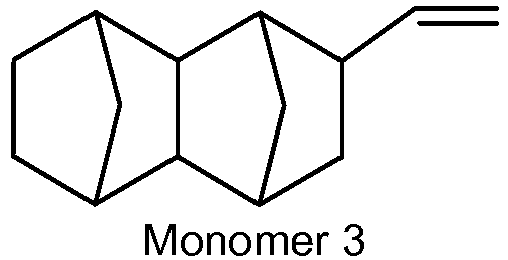
- Into a reactor in which the internal atmosphere had been replaced with nitrogen, the alcohol compound 2 (60 g) and diethyl ether (200 g) were added, and then while the whole content was being stirred, phosphorus tribromide (30 g) was added dropwise to the reactor at room temperature (25°C, hereinafter the same shall apply) over 1 hour. After the completion of the dropwise addition, the stirring was continued for further 23 hours, and thus a reaction solution was obtained. Toluene (400 g) was added to the reaction solution, the resulting mixture was washed three times with a saturated aqueous sodium hydrogen carbonate solution (300 mL), and then the organic layer was taken out by a liquid separation treatment.
- Subsequently, while the solution of the organic layer was being stirred, potassium t-butoxide (50 g) was added to the solution at room temperature, the resulting mixture was continuously stirred for further 5 hours, and thus a reaction solution was obtained. Toluene (500 mL) was added to the reaction solution, the resulting mixture was washed three times with a 2N aqueous hydrogen chloride solution (300 mL), and the organic layer was taken out by a liquid separation treatment.
- The toluene in the organic layer was distilled off by using a rotary evaporator, the residue was distilled under a reduced pressure (80 to 83°C, 0.13 kPa), and thus 25 g of a monomer 3 was obtained.
-

- A monomer 4 was obtained in the same manner as in Production Example 3 except that 2-adamantanol was used in place of the alcohol compound 1 in the Production Example 3.
-

- Into a stainless steel autoclave, dicyclopentadiene (100 g) and allyl acetate (500 g) were added, the atmosphere of the inside of the reaction system was replaced with nitrogen and the reaction system was sealed, and then while the whole content was being stirred, the whole content was heated to 220°C, and the reaction was allowed to proceed for 1 hour. Subsequently, the following operation was repeated twice: dicyclopentadiene (100 g) was further added to the reaction solution, the atmosphere of the inside of the reaction system was replaced with nitrogen and the reaction system was sealed, and then the reaction was allowed to proceed in the same manner as described above.
- The reaction solution was transferred into an autoclave equipped with a stirrer, 100 parts of cyclohexane and 0.5 g of a nickel catalyst supported on diatomaceous earth (trade name: T8400RL, nickel support rate: 58%, manufactured by Clariant) were added to the autoclave. The atmosphere in the autoclave was replaced with hydrogen, and then a hydrogenation reaction was performed at 160°C, under a hydrogen pressure of 2.0 MPa, for 2 hours.
- After the completion of the hydrogenation reaction, the reaction mixture was filtered through a pressure filter (trade name: FUNDABAC filter, manufactured by IHI Corporation) (filtration bed: diatomaceous earth (trade name: Radiolite (registered trademark) #500, manufactured by Showa Chemical Industry Co., Ltd.) under a pressure of 0.25 MPa to obtain a colorless and transparent solution.
- The cyclohexane in the obtained solution was distilled off by using a rotary evaporator, and then the residue was dissolved in methanol. To the obtained solution, 100 g of sodium hydroxide was added, and the whole content was stirred at room temperature for 24 hours. The methanol in the obtained solution was distilled off by using a rotary evaporator, then the solution was filtered with a filter paper, and thus a yellowish liquid was obtained.
- The yellowish liquid was distilled under a reduced pressure (89°C, 0.04 kPa), and thus 71 g of an alcohol compound 3 was obtained.
-

- An alcohol compound 4 was obtained by performing a distillation under a reduced pressure (113°C, 0.05 kPa) in the same manner as in Production Example 2 except that 4-penten-1-ol was used in place of 3-buten-1-ol in Production Example 2.
-

- An alcohol compound 5 was obtained by performing a distillation under a reduced pressure (126°C, 0.05 kPa) in the same manner as in Production Example 2 except that 5-hexen-1-ol was used in place of 3-buten-1-ol in Production Example 2.
-

- Into a two-necked flask equipped with a three-way cock and a Dimroth condenser, chloro(1,5-cyclooctadiene)iridium(I) dimer (1.2 g, 1.75 mmol) and 16.8 g of sodium carbonate were added, the inside of the reaction system was deaerated with a vacuum pump, the atmosphere inside the reaction system was replaced with nitrogen, and then 176 mL of toluene, the alcohol compound 3 (33.61 g, 0.175 mol), and vinyl acetate (40.37 mL, 0.438 mol) were added in this order under stirring to the flask. The obtained mixture was heated and stirred at 100°C for 3 hours, and then allowed to air cool to room temperature. The reaction mixture was filtered by using Celite, water was added to the filtrate to perform a liquid separation, and the organic layer was taken out. The solvent and the unreacted vinyl acetate were distilled off from the organic layer by using an evaporator, and then the obtained residue was distilled under reduced pressure. The purification based on distillation under reduced pressure was repeated further twice, and thus a monomer 5 was obtained (66.5°C, 0.2 kPa). Yield: 19.41 g, percent yield: 50.9%.
-

- Into a two-necked flask equipped with a three-way cock and a Dimroth condenser, chloro(1,5-cyclooctadiene)iridium(I) dimer (0.58 g, 0.863 mmol) and 8.26 g of sodium carbonate were added, the inside of the reaction system was deaerated with a vacuum pump, the atmosphere inside the reaction system was replaced with nitrogen, and then 86 mL of toluene, the alcohol compound 4 (19.01 g, 0.0863 mol), and vinyl acetate (19.9 mL, 0.216 mol) were added in this order under stirring to the flask. The obtained liquid mixture was heated and stirred at 100°C for 3 hours, and then allowed to air cool to room temperature; then the reaction mixture was filtered by using Celite. Water was added to the filtrate, thus a liquid separation was performed, and the organic layer was taken out. The solvent and the unreacted vinyl acetate were distilled off from the organic layer by using an evaporator, and then the obtained residue was distilled under reduced pressure. The purification based on distillation under reduced pressure was further repeated, and thus a monomer 6 was obtained (95°C, 0.2 kPa). Yield: 12.58 g, percent yield: 59.2%.
-

- Into a two-necked flask equipped with a three-way cock and a Dimroth condenser, chloro(1,5-cyclooctadiene)iridium(I) dimer (0.77 g, 1.16 mmol) and 11.1 g of sodium carbonate wee added, the inside of the reaction system was deaerated with a vacuum pump, the atmosphere inside the reaction system was replaced with nitrogen, and then, 116 mL of toluene, the alcohol compound 5 (27.14 g, 0.116 mol), and vinyl acetate (27.6 mL, 0.300 mol) were added in this order under stirring to the flask. The obtained mixture was heated and stirred at 100°C for 3 hours, and then allowed to air cool to room temperature; then, the reaction mixture was filtered by using Celite. Water was added to the filtrate, thus a liquid separation was performed, and the organic layer was taken out. The solvent and the unreacted vinyl acetate were distilled off from the organic layer by using an evaporator, and then the obtained residue was distilled under reduced pressure. The purification based on distillation under reduced pressure was repeated further twice, and thus a monomer 7 was obtained (125°C, 0.2 kPa). Yield: 16.20 g, percent yield: 53.4%.
-

- Into a two-necked flask equipped with a three-way cock and a Dimroth condenser, chloro(1,5-cyclooctadiene)iridium(I) dimer (1.05 g, 1.50 mmol) and 14.4 g of sodium carbonate were added, the inside of the reaction system was deaerated with a vacuum pump, the atmosphere inside the reaction system was replaced with nitrogen, and then, 164 mL of toluene 1-adamantanemethanol (25.0 g, 0.150 mol, manufactured by Tokyo Chemical Industry Co., Ltd.), and vinyl acetate (68.0 mL, 0.675 mol) were added in this order under stirring to the flask. The obtained mixture was heated and stirred at 100°C for 3 hours, and then allowed to air cool to room temperature; then, the reaction mixture was filtered by using Celite. Water was added to the filtrate, thus a liquid separation was performed, and the organic layer was taken out. The solvent and the unreacted vinyl acetate were distilled off from the organic layer by using an evaporator, and thus a crude product was obtained. The crude product was recrystallized from methanol, and thus a monomer 8 was obtained. Yield: 11.74 g, percent yield: 40.7%.
-

- Into a two-necked flask equipped with a three-way cock and a Dimroth condenser, chloro(1,5-cyclooctadiene)iridium(I) dimer (0.934 g, 139 mmol) and 13.3 g of sodium carbonate were added, the inside of the reaction system was deaerated with a vacuum pump, the atmosphere inside the reaction system was replaced with nitrogen, and then, 164 mL of toluene, 1-adamantaneethanol (25.0 g, 0.139 mol, manufactured by Tokyo Chemical Industry Co., Ltd.), and vinyl acetate (57.7 mL, 0.626 mol) were added in this order under stirring to the flask. The obtained mixture was heated and stirred at 100°C for 3 hours, and then allowed to air cool to room temperature; then, the reaction mixture was filtered by using Celite. Water was added to the filtrate, thus a liquid separation was performed, and the organic layer was taken out. The solvent and the unreacted vinyl acetate were distilled off from the organic layer by using an evaporator. The obtained residue was distilled under reduced pressure. The purification based on distillation under reduced pressure was repeated further twice, and thus a monomer 9 was obtained (79°C, 0.3 kPa). Yield: 12.61 g, percent yield: 44.0%.
-

- A monomer 10 was obtained by performing the same operations as in Production Example 5 except that the alcohol compound 4 was used in place of the alcohol compound 2 in Production Example 5, and by performing a distillation under a reduced pressure (61°C, 0.04 kPa).
-

- A monomer 11 was obtained by performing the same operations as in Production Example 5 except that the alcohol compound 5 was used in place of the alcohol compound 2 in Production Example 5, and by performing a distillation under a reduced pressure (81°C, 0.06 kPa).
- Into an eggplant-shaped flask the inside of which had been dried, equipped with a three-way cock, 17.2 mL of the monomer 2 and 50.3 mL of toluene were added, in a nitrogen atmosphere, and then the eggplant-shaped flask was cooled to -30°C. Subsequently, 7.5 mL of a polymerization initiator solution (BF3·C4H100: 0.3 mL, toluene: 14.7 mL) was added to the flask, and the contents were stirred at the same temperature for 1 hour. After the completion of the polymerization reaction, 30 mL of a reaction terminator (10 vol% ammonia water/methanol mixed solvent (1/9)) was added to terminate the polymerization reaction. The precipitated polymer was filtered out, and completely dissolved in toluene to obtain a solution. The resulting solution was washed with ion-exchanged water, and then the solvent contained in the solution was distilled off by using an evaporator. The solution obtained by dissolving the residue in tetrahydrofuran (THF) was poured into a large amount of methanol to reprecipitate the polymer.
- The obtained polymer was filtered out, and the polymer was dried under reduced pressure to obtain 16.5 g of a polymer 1 having a repeating unit represented by the following formula (23).
- By using the polymer 1, the various measurements were performed. The results thus obtained are shown in Table 1.
- Into an eggplant-shaped flask equipped with a three-way cock, having been dried by heating with a heating gun for 10 minutes in a flow of nitrogen, 15.84 mL of the monomer 5 and 51.61 mL of toluene were added by using a syringe in a nitrogen atmosphere, then the eggplant-shaped flask was cooled to -30°C, 7.5 mL of an initiator solution (BF3OEt2: 0.3 mL, toluene: 14.7 mL) was added, and the whole content was stirred at the same temperature for 1.5 hours. After the completion of the polymerization reaction, 30 mL of a terminator (10 vol% ammonia water/methanol = 1/9) was added to terminate the polymerization. Subsequently, the precipitated polymer was completely dissolved in toluene, the obtained solution was washed with ion-exchanged water, and then the solvent was distilled off by using an evaporator. The polymer was dissolved in THF, the obtained solution was poured into a large amount of methanol to reprecipitate the polymer, the precipitated polymer was dried under reduced pressure, and thus 14.54 g of a polymer 2 having the repeating unit represented by the following formula (28) was obtained. Percent yield: 88.8%
- By using the polymer 2, the various measurements were performed. The results thus obtained are shown in Table 1.
- Into an eggplant-shaped flask equipped with a three-way cock, having been dried by heating with a heating gun for 10 minutes in a flow of nitrogen, 11.27 mL of the monomer 6 and 29.23 mL of toluene were added by using a syringe in a nitrogen atmosphere, and then the eggplant-shaped flask was cooled to -30°C. Into the flask, 4.5 mL of an initiator solution (BF3OEt2: 0.3 mL, toluene: 14.7 mL) was added, and the whole content was stirred at the same temperature for 1 hour. After the completion of the polymerization reaction, 30 mL of a terminator (10 vol% ammonia water/methanol = 1/9) was added to terminate the polymerization. Subsequently, the precipitated polymer was completely dissolved in toluene, the obtained solution was washed with ion-exchanged water, and then the solvent was distilled off by using an evaporator. The polymer was dissolved in THF, the obtained solution was poured into a large amount of methanol to reprecipitate the polymer, the precipitated polymer was dried under reduced pressure, and thus 7.85 g of a polymer 3 having the repeating unit represented by the following formula (29) was obtained. Percent yield: 70.7%.
- By using the polymer 3, the various measurements were performed. The results thus obtained are shown in Table 1.
- In a 100-mL autoclave in which the internal atmosphere had been replaced with nitrogen, a stirring bar, 30 mL of toluene, 174 mg of methylaluminoxane, and 2 g of the monomer 10 were placed, and a catalyst solution [1 mL of a toluene solution containing 0.25 mol of CpTi(N=C(t-Bu)2)Cl2] was added while the whole content was being stirred at 25°C. After the addition of the catalyst solution, the addition polymerization reaction was performed for further 24 hours. After the completion of the reaction, the autoclave was depressurized, the content in the autoclave was transferred into a large amount of 2-propanol acidified with hydrochloric acid, and thus the polymer was precipitated. The precipitated polymer was dried under reduced pressure, and a polymer 4 having the repeating unit represented by the following formula (30) was obtained.
- By using the polymer 4, the various measurements were performed. The results thus obtained are shown in Table 1.
- A polymer 5 having the repeating unit represented by the following formula (31) was obtained in the same manner as in Example 4 except that the monomer 11 was used in place of the monomer 10 in Example 4.
- By using the polymer 5, the various measurements were performed. The results thus obtained are shown in Table 1.
- Into an eggplant-shaped flask equipped with a three-way cock, having been dried by heating with a heating gun for 10 minutes in a flow of nitrogen, 10.0 mL of the monomer 3 and 10.0 mL of toluene were added by using a syringe in a nitrogen atmosphere. The eggplant-shaped flask was cooled to -30°C, 2.5 mL of an initiator solution (HCl: 0.25 mL, toluene: 99.75 mL) and 2.5 mL of an activating agent solution (ZnCl2: 0.1 mL, toluene: 19.9 mL) were added to the flask, and the whole content was stirred at the same temperature for 96 hours. After the completion of the reaction, 30 mL of a terminator (10 vol% ammonia water/methanol = 1/9) was added to the reaction solution to terminate the polymerization. Subsequently, the precipitated polymer was completely dissolved in toluene, the obtained solution was washed with ion-exchanged water, and then the solvent was distilled off by using an evaporator. The polymer was dissolved in THF, the obtained solution was poured into a large amount of methanol to reprecipitate the polymer, the precipitated polymer was dried under reduced pressure, and thus 9.86 g of a polymer 6 having the repeating unit represented by the following formula (24) was obtained. Percent yield: 97.0%.
- By using the polymer 6, the various measurements were performed. The results thus obtained are shown in Table 2.
- A polymer 7 having the repeating unit represented by the following formula (25) was obtained in the same manner as in Example 1 except that the monomer 4 was used in place of the monomer 2 in Example 1, and various measurements were performed. The results thus obtained are shown in Table 2.
- According to the method described in Japanese Patent Laid-Open No.
2005-113049 - In a 15-mL screw tube bottle in which the internal atmosphere had been replaced with nitrogen, 174 mg of white solid MAO (methylaluminoxane), 8 g of toluene, and 2 g of the monomer 3 were placed. Into the screw tube bottle, 1 mL of a toluene solution (5 mmol/L) of a metal complex (CpTi(N=C(t-Bu)2)Cl2) was added, and the whole content was stirred at 25°C for 120 hours to perform the polymerization reaction. Subsequently, the content of the screw tube bottle was transferred into a large amount of 2-propanol acidified with hydrochloric acid, and thus the polymer was precipitated. The obtained polymer was filtered out, the polymer was dried under reduced pressure to obtain a polymer 9 having a repeating unit represented by the following formula (27), and various measurements were performed. The results thus obtained are shown in Table 2.
- Into an eggplant-shaped flask equipped with a three-way cock, having been dried by heating with a heating gun for 10 minutes in a flow of nitrogen, 12.23 mL of the monomer 7 and 32.77 mL of toluene were added by using a syringe in a nitrogen atmosphere. The eggplant-shaped flask was cooled to -30°C, 5.0 mL of an initiator solution (BF3OEt2: 0.3 mL, toluene: 14.7 mL) was added to the flask, and the whole content was stirred at the same temperature for 0.5 hour. After the completion of the reaction, 30 mL of a terminator (10 vol% ammonia water/methanol = 1/9) was added to the reaction solution to terminate the polymerization. Subsequently, the precipitated polymer was completely dissolved in toluene, the obtained solution was subjected to a liquid separation purification with ion-exchanged water, and then the solvent was distilled off by using an evaporator. The polymer was dissolved in THF, the obtained solution was poured into a large amount of methanol to reprecipitate the polymer, the precipitated polymer was dried under reduced pressure, and thus 10.2 g of a polymer 10 having the repeating unit represented by the following formula (32) was obtained. Percent yield: 78.6%.
- By using the polymer 10, the various measurements were performed. The results thus obtained are shown in Table 2.
- Into an eggplant-shaped flask equipped with a three-way cock, having been dried by heating with a heating gun for 10 minutes in a flow of nitrogen, 9.61 g of the monomer 8 and 35.4 mL of toluene were added by using a syringe in a nitrogen atmosphere. The eggplant-shaped flask was cooled to -30°C, 5.0 mL of an initiator solution (BF3OEt2: 0.3 mL, toluene: 14.7 mL) was added to the flask, and the whole content was stirred at the same temperature for 4 hours. After the completion of the reaction, 30 mL of a terminator (10 vol% ammonia water/methanol = 1/9) was added to the reaction solution to terminate the polymerization. Subsequently, the precipitated polymer was completely dissolved in toluene, the obtained solution was washed with ion-exchanged water, and then the solvent was distilled off by using an evaporator. The polymer was dissolved in THF, the obtained solution was poured into a large amount of methanol to reprecipitate the polymer, the precipitated polymer was dried under reduced pressure, and thus 9.04 g of a polymer 11 having the repeating unit represented by the following formula (33) was obtained. Percent yield: 94.1%.
- By using the polymer 11, the various measurements were performed. The results thus obtained are shown in Table 2.
- Into an eggplant-shaped flask equipped with a three-way cock, having been dried by heating with a heating gun for 10 minutes in a flow of nitrogen, 10.5 mL of the monomer 9 and 34.5 mL of toluene were added by using a syringe in a nitrogen atmosphere. The eggplant-shaped flask was cooled to -30°C, 5.0 mL of an initiator solution (BF3OEt2: 0.3 mL, toluene: 14.7 mL) was added to the flask, and the whole content was stirred at the same temperature for 4 hours. After the completion of the reaction, 30 mL of a terminator (10 vol% ammonia water/methanol = 1/9) was added to the reaction solution to terminate the polymerization. Subsequently, the precipitated polymer was completely dissolved in toluene, the obtained solution was washed with ion-exchanged water, and then the solvent was distilled off by using an evaporator. The polymer was dissolved in THF, the obtained solution was poured into a large amount of methanol to reprecipitate the polymer, the precipitated polymer was dried under reduced pressure, and thus 9.57 g of a polymer 12 having the repeating unit represented by the following formula (34) was obtained. Percent yield: 92.8%.
- By using the polymer 12, the various measurements were performed. The results thus obtained are shown in Table 2.


Table 1 Example 1 2 3 4 5 Weight average molecular weight 227000 60800 76800 143000 122000 Molecular weight distribution 6.18 2.12 3.73 2.20 5.39 Glass transition temperature (°C) 60.0 78.4 34.1 131.6 97.8 Refractive index nd 1.5440 1.5470 1.5410 1.5483 1.5480 Abbe number Vd 56 56 57 56 56 Birefringence magnitude per unit thickness: δn -25 -10 -25 -35 -35 Table 2 Comparative Example 1 2 3 4 5 6 7 Weight average molecular weight 125400 59800 186000 40300 54000 146400 53700 Molecular weight distribution 3.86 3.47 5.48 2.05 4.09 8.48 3.32 Glass transition temperature (°C) 127.1 178.0 104.0 164.0 19.8 133.1 76.8 Refractive index nd 1.542 1.530 1.528 1.550 1.537 1.524 1.532 Abbe number vd 57 56 56 56 56 54 55 Birefringence magnitude per unit thickness: δn -110 -50 -130 -170 -10 -50 -50 - From Tables 1 and 2, the following are found.
- The polymers obtained in Examples 1 to 5 are high in refractive index and low in birefringence, and have relatively low glass transition temperatures.
- On the other hand, the polymer of Comparative Example 1 does not have a low birefringence.
- The polymer of Comparative Example 2 has a high glass transition temperature.
- The polymer of Comparative Example 3 does not have a low birefringence, and is low in refractive index.
- The polymer of Comparative Example 4 does not have a low birefringence.
Claims (6)
- A polymer having a repeating unit represented by the following formula (1) :

CpHqOr (2)
(p represents an integer of 8 to 21, q represents an integer of 7 to 40, the value of (p/q) is larger than 0.5, and r represents an integer of 0 to 3); and n1 and n2 each independently represent an integer of 1 to 4]. - The polymer according to claim 1, wherein Y is a group represented by the following formula (3):

- The polymer according to claim 2, wherein Y is a group represented by any one of the following formulas (5) to (7):

- The polymer according to any one of claims 1 to 3, wherein the content of the repeating unit represented by the formula (1) is 50 wt% or more in relation to the whole of the repeating units.
- A forming material containing the polymer according to any one of claims 1 to 4.
- A resin formed article obtained by forming the forming material according to claim 5.
Applications Claiming Priority (2)
| Application Number | Priority Date | Filing Date | Title |
|---|---|---|---|
| JP2015062052 | 2015-03-25 | ||
| PCT/JP2016/054203 WO2016152310A1 (en) | 2015-03-25 | 2016-02-12 | Polymer, molding material and resin molded body |
Publications (2)
| Publication Number | Publication Date |
|---|---|
| EP3284760A1 true EP3284760A1 (en) | 2018-02-21 |
| EP3284760A4 EP3284760A4 (en) | 2018-12-19 |
Family
ID=56979111
Family Applications (1)
| Application Number | Title | Priority Date | Filing Date |
|---|---|---|---|
| EP16768213.7A Withdrawn EP3284760A4 (en) | 2015-03-25 | 2016-02-12 | Polymer, molding material and resin molded body |
Country Status (4)
| Country | Link |
|---|---|
| EP (1) | EP3284760A4 (en) |
| JP (1) | JP6733661B2 (en) |
| CN (1) | CN107428864A (en) |
| WO (1) | WO2016152310A1 (en) |
Family Cites Families (13)
| Publication number | Priority date | Publication date | Assignee | Title |
|---|---|---|---|---|
| DE2942179A1 (en) * | 1979-10-18 | 1981-05-07 | Basf Ag, 6700 Ludwigshafen | METHOD FOR PRODUCING PVP IOD |
| JP3182919B2 (en) * | 1992-09-30 | 2001-07-03 | 三井化学株式会社 | Vinyl ether polymer and method for producing the same |
| JPH11140135A (en) * | 1997-11-04 | 1999-05-25 | Nippon Kayaku Co Ltd | Novel propenyl ether, polymerizable composition and cured product thereof |
| JP2005023049A (en) * | 2003-07-02 | 2005-01-27 | Daicel Chem Ind Ltd | Method for producing vinyl ethers |
| JP4136886B2 (en) * | 2003-10-09 | 2008-08-20 | 丸善石油化学株式会社 | Polymers of novel alicyclic vinyl ethers |
| JP4119834B2 (en) * | 2003-12-26 | 2008-07-16 | 丸善石油化学株式会社 | Cycloalkyl vinyl ether-maleic anhydride copolymer, curing agent and curable resin composition containing the copolymer |
| US20070282077A1 (en) * | 2004-12-27 | 2007-12-06 | Jsr Corporation | Thermoplastic Resin Composition, Optical Film And Oriented Film |
| JP5218750B2 (en) * | 2008-07-25 | 2013-06-26 | Jsr株式会社 | Radiation-sensitive composition for forming colored layer, color filter, and color liquid crystal display element |
| JP5127648B2 (en) * | 2008-09-29 | 2013-01-23 | 日本カーバイド工業株式会社 | Curable resin composition |
| JP2010174128A (en) * | 2009-01-29 | 2010-08-12 | Nippon Oil Corp | Liquid crystalline composition, liquid crystal film, method for producing the same, and liquid crystal display element |
| EP2436702B1 (en) * | 2009-05-29 | 2014-12-17 | JX Nippon Oil & Energy Corporation | Isobutylene-based polymer and method for producing same |
| EP2448985B1 (en) * | 2009-07-01 | 2015-01-14 | Bridgestone Corporation | Method of making hydroxyaryl-functionalized interpolymer by free radical initiated polymerization |
| JP5905207B2 (en) * | 2011-04-21 | 2016-04-20 | 丸善石油化学株式会社 | Method for producing a copolymer for semiconductor lithography with a small amount of metal impurities, and a method for purifying a polymerization initiator for producing the copolymer |
-
2016
- 2016-02-12 WO PCT/JP2016/054203 patent/WO2016152310A1/en not_active Ceased
- 2016-02-12 EP EP16768213.7A patent/EP3284760A4/en not_active Withdrawn
- 2016-02-12 JP JP2017507591A patent/JP6733661B2/en not_active Expired - Fee Related
- 2016-02-12 CN CN201680012868.0A patent/CN107428864A/en active Pending
Also Published As
| Publication number | Publication date |
|---|---|
| JPWO2016152310A1 (en) | 2018-01-18 |
| WO2016152310A1 (en) | 2016-09-29 |
| EP3284760A4 (en) | 2018-12-19 |
| JP6733661B2 (en) | 2020-08-05 |
| CN107428864A (en) | 2017-12-01 |
Similar Documents
| Publication | Publication Date | Title |
|---|---|---|
| KR102427223B1 (en) | Cyclic olefin ring-opened polymer hydride, resin molded article, and optical member | |
| JP5810679B2 (en) | Film production method | |
| JP6763373B2 (en) | Copolymers, polymers, molding materials and resin moldings | |
| JPWO2017199980A1 (en) | Hydrogenated polymer, molding material and resin molding | |
| JP5862268B2 (en) | POLYMER, MOLDED BODY AND METHOD FOR PRODUCING POLYMER | |
| EP2264078B1 (en) | Hydrogenated beta-pinene-based polymer and molded article comprising the same | |
| EP3176217B1 (en) | Resin molded article | |
| CN107708965B (en) | Long film and method for producing same | |
| EP3266829B1 (en) | Resin composition and resin molded article | |
| EP3284760A1 (en) | Polymer, molding material and resin molded body | |
| US11325287B2 (en) | Shaping material, resin shaped product, cosmetic container, semiconductor container, and method of producing semiconductor container | |
| KR101401880B1 (en) | Retardation film | |
| JP2010150443A (en) | Norbornene-based ring-opening polymer hydrogenated material and utilization of the same | |
| JP6528631B2 (en) | MOLDING MATERIAL, MOLDED BODY, AND METHOD FOR MANUFACTURING MOLDING MATERIAL | |
| JP2016069448A (en) | Resin composition, resin molded body, and optical member | |
| JP2016008302A (en) | Resin composition and resin molded body | |
| JP2011057945A (en) | Alicyclic hydrocarbon copolymer |
Legal Events
| Date | Code | Title | Description |
|---|---|---|---|
| STAA | Information on the status of an ep patent application or granted ep patent |
Free format text: STATUS: THE INTERNATIONAL PUBLICATION HAS BEEN MADE |
|
| 17P | Request for examination filed |
Effective date: 20171016 |
|
| AK | Designated contracting states |
Kind code of ref document: A1 Designated state(s): AL AT BE BG CH CY CZ DE DK EE ES FI FR GB GR HR HU IE IS IT LI LT LU LV MC MK MT NL NO PL PT RO RS SE SI SK SM TR |
|
| AX | Request for extension of the european patent |
Extension state: BA ME |
|
| PUAI | Public reference made under article 153(3) epc to a published international application that has entered the european phase |
Free format text: ORIGINAL CODE: 0009012 |
|
| STAA | Information on the status of an ep patent application or granted ep patent |
Free format text: STATUS: THE APPLICATION HAS BEEN PUBLISHED |
|
| DAV | Request for validation of the european patent (deleted) | ||
| DAX | Request for extension of the european patent (deleted) | ||
| A4 | Supplementary search report drawn up and despatched |
Effective date: 20181121 |
|
| RIC1 | Information provided on ipc code assigned before grant |
Ipc: C08F 10/14 20060101ALI20181114BHEP Ipc: C08F 116/16 20060101ALI20181114BHEP Ipc: C08F 16/22 20060101AFI20181114BHEP |
|
| STAA | Information on the status of an ep patent application or granted ep patent |
Free format text: STATUS: EXAMINATION IS IN PROGRESS |
|
| 17Q | First examination report despatched |
Effective date: 20200422 |
|
| STAA | Information on the status of an ep patent application or granted ep patent |
Free format text: STATUS: THE APPLICATION HAS BEEN WITHDRAWN |
|
| 18W | Application withdrawn |
Effective date: 20200619 |