EP3284740A1 - Synergistic composition and method for inhibiting growth of microorganisms - Google Patents
Synergistic composition and method for inhibiting growth of microorganisms Download PDFInfo
- Publication number
- EP3284740A1 EP3284740A1 EP17185934.1A EP17185934A EP3284740A1 EP 3284740 A1 EP3284740 A1 EP 3284740A1 EP 17185934 A EP17185934 A EP 17185934A EP 3284740 A1 EP3284740 A1 EP 3284740A1
- Authority
- EP
- European Patent Office
- Prior art keywords
- hydantoin
- hypochlorite
- composition
- peracetic acid
- paa
- Prior art date
- Legal status (The legal status is an assumption and is not a legal conclusion. Google has not performed a legal analysis and makes no representation as to the accuracy of the status listed.)
- Granted
Links
Classifications
-
- C—CHEMISTRY; METALLURGY
- C07—ORGANIC CHEMISTRY
- C07D—HETEROCYCLIC COMPOUNDS
- C07D233/00—Heterocyclic compounds containing 1,3-diazole or hydrogenated 1,3-diazole rings, not condensed with other rings
- C07D233/54—Heterocyclic compounds containing 1,3-diazole or hydrogenated 1,3-diazole rings, not condensed with other rings having two double bonds between ring members or between ring members and non-ring members
- C07D233/66—Heterocyclic compounds containing 1,3-diazole or hydrogenated 1,3-diazole rings, not condensed with other rings having two double bonds between ring members or between ring members and non-ring members with hetero atoms or with carbon atoms having three bonds to hetero atoms with at the most one bond to halogen, e.g. ester or nitrile radicals, directly attached to ring carbon atoms
- C07D233/72—Two oxygen atoms, e.g. hydantoin
-
- C—CHEMISTRY; METALLURGY
- C02—TREATMENT OF WATER, WASTE WATER, SEWAGE, OR SLUDGE
- C02F—TREATMENT OF WATER, WASTE WATER, SEWAGE, OR SLUDGE
- C02F1/00—Treatment of water, waste water, or sewage
- C02F1/50—Treatment of water, waste water, or sewage by addition or application of a germicide or by oligodynamic treatment
-
- A—HUMAN NECESSITIES
- A01—AGRICULTURE; FORESTRY; ANIMAL HUSBANDRY; HUNTING; TRAPPING; FISHING
- A01N—PRESERVATION OF BODIES OF HUMANS OR ANIMALS OR PLANTS OR PARTS THEREOF; BIOCIDES, e.g. AS DISINFECTANTS, AS PESTICIDES OR AS HERBICIDES; PEST REPELLANTS OR ATTRACTANTS; PLANT GROWTH REGULATORS
- A01N43/00—Biocides, pest repellants or attractants, or plant growth regulators containing heterocyclic compounds
- A01N43/48—Biocides, pest repellants or attractants, or plant growth regulators containing heterocyclic compounds having rings with two nitrogen atoms as the only ring hetero atoms
- A01N43/50—1,3-Diazoles; Hydrogenated 1,3-diazoles
-
- A—HUMAN NECESSITIES
- A01—AGRICULTURE; FORESTRY; ANIMAL HUSBANDRY; HUNTING; TRAPPING; FISHING
- A01N—PRESERVATION OF BODIES OF HUMANS OR ANIMALS OR PLANTS OR PARTS THEREOF; BIOCIDES, e.g. AS DISINFECTANTS, AS PESTICIDES OR AS HERBICIDES; PEST REPELLANTS OR ATTRACTANTS; PLANT GROWTH REGULATORS
- A01N59/00—Biocides, pest repellants or attractants, or plant growth regulators containing elements or inorganic compounds
-
- C—CHEMISTRY; METALLURGY
- C07—ORGANIC CHEMISTRY
- C07D—HETEROCYCLIC COMPOUNDS
- C07D233/00—Heterocyclic compounds containing 1,3-diazole or hydrogenated 1,3-diazole rings, not condensed with other rings
- C07D233/54—Heterocyclic compounds containing 1,3-diazole or hydrogenated 1,3-diazole rings, not condensed with other rings having two double bonds between ring members or between ring members and non-ring members
- C07D233/66—Heterocyclic compounds containing 1,3-diazole or hydrogenated 1,3-diazole rings, not condensed with other rings having two double bonds between ring members or between ring members and non-ring members with hetero atoms or with carbon atoms having three bonds to hetero atoms with at the most one bond to halogen, e.g. ester or nitrile radicals, directly attached to ring carbon atoms
- C07D233/72—Two oxygen atoms, e.g. hydantoin
- C07D233/76—Two oxygen atoms, e.g. hydantoin with substituted hydrocarbon radicals attached to the third ring carbon atom
- C07D233/78—Radicals substituted by oxygen atoms
Definitions
- the present invention relates generally to controlling the growth of microorganisms in industrial waters. More specifically, the present invention relates to the use of a composition for inhibiting microbial growth, especially inhibition of slime deposits, comprising peracetic acid and a composition comprising hydantoin-stabilized halide or halogen-based hydantoin.
- slimes by microorganisms is an additional problem that is encountered in many aqueous systems.
- Slime deposition is found in natural and industrial waters that possess conditions that are conducive to the growth and reproduction of slime-forming microorganisms.
- microorganisms can adversely affect finished paper products. Contaminating microorganisms are a major cause of spoilage of pulp, furnish, coatings, or additives.
- compositions and methods are provided which provide unexpected synergistic inhibition of growth of microorganisms, inhibition of slime deposits, without the use of high, and/or damaging levels of biocides.
- compositions include:
- Halide ion donors may be any oxidizing halogen such as chlorine or bromine.
- An efficacious form of chlorine is hypochlorite.
- Alkali or alkaline earth metal hypochlorite is selected from the group consisting of sodium hypochlorite, potassium hypochlorite, lithium hypochlorite, magnesium hypochlorite, calcium hypochlorite, and mixtures thereof.
- Halogen-based hydantoin includes bromo- or chloro- hydantoin
- a representative composition comprises a first composition of hydantoin-stabilized sodium hypochlorite and a second composition of peracetic acid (PAA).
- PAA peracetic acid
- hydantoin, hypochlorite, and peracetic acid are known biocidal compounds, the synergistic effect obtained by combining PAA and a hydantoin-stabilized hypochlorite has not been previously reported.
- “Slime” means an accumulation of certain microorganisms in the presence of pulp fiber, filler, dirt and other materials, mixed in varied proportions, having variable physical characteristics and accumulating at continuously changing rates. In most industrial process waters, especially pulp and paper mill systems, spore forming bacteria and Pseudomonas aeruginosa contribute to slime formation.
- compositions comprising peracetic acid ("PAA") and hydantoin-stabilized hypochlorite or halogen-based hydantoin are especially efficacious in controlling the growth of bacterial microbes in industrial water systems.
- PAA peracetic acid
- hydantoin-stabilized hypochlorite or halogen-based hydantoin are especially efficacious in controlling the growth of bacterial microbes in industrial water systems.
- mixtures of PAA and hydantoin-stabilized hypochlorite are especially efficacious in controlling the growth of bacterial microbes, and especially the build-up of slime deposits.
- the first active component of the synergistic composition is alkali or alkaline earth metal halide donor or halogen-derived hydantoin.
- hypochlorite will be exemplified.
- the hypochlorite includes but is not limited to, sodium hypochlorite, potassium hypochlorite, lithium hypochlorite, magnesium hypochlorite or calcium hypochlorite.
- Bromo-based hydantoin is another useful exemplification.
- Sodium hypochlorite in pure form is unstable.
- Industrial bleach consists of a solution of sodium hypochlorite ranging from 10% to 13% available chlorine by volume (8.8% - 10.6% by weight).
- One gallon of bleach contains about the same amount of active chlorine as one pound of chlorine gas.
- the second active component of the synergistic composition is hydantoin.
- Hydantoin is represented by wherein:
- the third active component is PAA.
- Peracetic acid is a unique oxidant, utilizing a different mode of action than other oxidants. Given the structure of the molecule H. 3 COOOH the hydrocarbon tail allows PAA to penetrate into the bacterial cell. This enables the molecule to disrupt S--S and S--H bonds both inside and outside of the organisms, killing more quickly and effectively than other oxidants. Other oxidants, such as HOCl, ClO 2 , H 2 O 2 , etc. do not penetrate the cells in this manner because they do not have an organic portion to facilitate entrance into the bacterial cell. Peracetic acid has always been applied by itself in high concentrations but has never been used for effective microbial control at concentration levels identified herein.
- the synergistic activity supplied by the active components of the first composition permit lower PAA concentrations for effective control.
- Peracetic acid has been used as a sterilant in the food industry for many years, but is generally used at higher concentrations (10,000 to 100,000 ppm).
- the combined treatment is added, for example, to cooling water systems, paper and pulp mill systems, pools, ponds, lagoons, lakes, etc., to control the formation of bacterial microorganisms, which may be contained by, or which may become entrained in, the system to be treated.
- PAA and hydantoin-stabilized hypochlorite compositions and methods of utilization of the treatment are efficacious in controlling against filamentous bacteria.
- Filamentous bacteria play a major role in the formation of many slime deposits.
- dimethylhydantoin-stabilized hypochlorite has been reported as very effective in slime control (which may populate these systems.
- the combined treatment composition and method is expected to be efficacious in inhibiting and controlling all types of aerobic and anaerobic bacteria.
- compositions having hydantoin-stabilized hypochlorite as an active ingredient are mixed with compositions having PAA as an active ingredient provide a higher degree of bactericidal activity than that of the individual ingredients comprising the mixture. Accordingly, it is possible to produce a highly efficacious bactericide. Because of the enhanced activity of the mixture, the total quantity of the bacterial treatment may be reduced.
- the combined PAA and hydantoin-stabilized hypochlorite biocide treatment may be added to the desired aqueous system in need of biocidal treatment
- the combination of PAA and hydantoin-stabilized possess a higher degree of bactericidal activity than that of the individual ingredients comprising the mixture.
- the hydantoin-stabilized hypochlorite is generated on site by mixing a hydantoin solution, for example a solution containing dimethylhydantoin, with a sodium hypochlorite solution.
- a hydantoin solution for example a solution containing dimethylhydantoin
- sodium hypochlorite solution can be mixed in different ratios depending on the chlorine demand of the system, and then be dosed in the process water. It is also possible to dose the hydantoin and hypochlorite compositions separately in the water that needs to be treated, in a side stream of the process water that need to be treated, or other carrier water (e.g. freshwater), that supplies the process water with sufficient amounts of hydantoin-stabilized hypochlorous acid.
- the second oxidizing biocide peracetic acid is dosed in the process water containing the stabilized chlorine.
- the amount of free halogen coming from the hydantoin-stabilized solution should be low, at the point were the second oxidant is applied. This will prevent antagonism between hypochlorite and the second oxidant.
- the efficiency in microbial control can be further enhanced by the addition of conventional biocides.
- the advantage of using a combination of hydantoin-stabilized hypochlorite and PAA as a second oxidant is that it lowers the overall use of oxidizing biocides in the process that is needed for inhibition of the growth of microorganisms.
- hydantoin-stabilized hypochlorite has been shown to work excellent in control of slime deposition, whereas peracetic acid can be very effective reducing numbers of microorganisms, a complementary effect in control of microorganisms in industrial waters can be expected. This is especially the case when control of slime deposition is desirable.
- PAA Final breakdown products of PAA are carbon dioxide and water, thus no harmful products will reach the environment.
- PAA is a preferred option in case health concerns associated with non-oxidizing biocides are a concern, or the mill wishes to promote a green image.
- PAA alone is less effective in slime control compared to dimethylhydantoin-stabilized hypochlorite.
- Example 1 Mill producing paper grades using mechanical pulp in the furnish .
- the furnish used in this mill is composed of about 50% TMP, 25% bleached Kraft pulp, and 25% broke.
- White water was collected and total bacterial counts were determined in samples with and without the addition of DMH stabilized chlorine (1: 1 molar ratio of DMH to "Cl2) and/or PAA, after 50 minutes of contact time. The results are summarized in the table below.
- Biocide (PAA: ppm product; DMH stabilized chlorine: ppm Cl2) Total bacterial counts Control (no biocide added) 1.3 x 10 7 PAA-25 4 x 10 6 PAA-50 3 x 10 5 PAA-100 3 x 10 3 Cl2-1 10 7 C12-2 4 x 10 6 Cl2-4 ⁇ 10 3 Cl2-2 + PAA-25 10 4 Cl2-2 + PAA-50 ⁇ 10 3
- This example shows the synergistic relationship obtained with the present invention. Synergy is mathematically demonstrated by the industry accepted method described by Kull et al. (Applied Microbiology (1961), Vol. 9: 538-541 . Applied to the current invention it is as follows:
- Example 2 Mill producing paper grades using chemical pulp.
- Example 3 Very closed mill ( ⁇ 5m 3 /Ton) producing paper grades using chemical pulp.
- the furnish used in this mill is composed of about 75% bleached Kraft pulp, and 25% broke.
- White water was collected and total bacterial counts were determined in samples with and without the addition of DMH stabilized chlorine (1:1 molar ratio of DMH to "Cl2"), and/or PAA, after 30 minutes of contact time. The results are summarized in the table below.
- Biocide (PAA: ppm product; DMH stabilized chlorine: ppm C12) Total bacterial counts Control (no biocide added) 9 x 10° PAA-50 4.5 x 10 6 PAA-75 1.6 x 10 6 PAA-100 3 x 10 5 PAA-150 10 3 PAA-200 ⁇ 10 2 Cl2-1 9 x 10 6 Cl2-2 9 x 10 6 Cl2-3 6.3 x 10 6 Cl2-4 5.4 x 10 6 Cl2-1 + PAA-100 9 x 10 4 Cl2-1 + PAA-150 ⁇ 10 2
Landscapes
- Life Sciences & Earth Sciences (AREA)
- Chemical & Material Sciences (AREA)
- Organic Chemistry (AREA)
- Engineering & Computer Science (AREA)
- Dentistry (AREA)
- Agronomy & Crop Science (AREA)
- Health & Medical Sciences (AREA)
- Pest Control & Pesticides (AREA)
- Plant Pathology (AREA)
- General Health & Medical Sciences (AREA)
- Wood Science & Technology (AREA)
- Zoology (AREA)
- Environmental Sciences (AREA)
- Inorganic Chemistry (AREA)
- Environmental & Geological Engineering (AREA)
- Water Supply & Treatment (AREA)
- Hydrology & Water Resources (AREA)
- Agricultural Chemicals And Associated Chemicals (AREA)
- Paper (AREA)
Abstract
Description
- The present invention relates generally to controlling the growth of microorganisms in industrial waters. More specifically, the present invention relates to the use of a composition for inhibiting microbial growth, especially inhibition of slime deposits, comprising peracetic acid and a composition comprising hydantoin-stabilized halide or halogen-based hydantoin.
- The presence of microorganisms in water systems, especially industrial water systems, have resulted in extensive research efforts to identify biocidal compositions for industrial manufacturers where microbial growth is an extensive and constant problem. Examples of industrial waters where microorganisms can interfere with industrial processes include: cooling tower waters, mining process waters, food processing waters, papermaking slurries, pulp and paper mill waters, sugar reprocessing waters, and the like. To counteract the detrimental effects of microbial growth, manufacturers must employ expensive microbial control programs. These effects impact the efficacy of industrial processes by causing, for example, plugging of pumps and membranes, corrosion under the deposits, and odors.
- The formation of slimes by microorganisms is an additional problem that is encountered in many aqueous systems. Slime deposition is found in natural and industrial waters that possess conditions that are conducive to the growth and reproduction of slime-forming microorganisms. For example, in the paper industry, microorganisms can adversely affect finished paper products. Contaminating microorganisms are a major cause of spoilage of pulp, furnish, coatings, or additives.
- The problems identified above have resulted in the extensive utilization of biocides in aqueous systems, such as pulp and paper mill systems. To date, no one compound or composition has achieved a clearly established predominance in respect to the problems discussed above. For these reasons, control of microorganisms and slime in industrial waters remain an unfelt need.
- Compositions and methods are provided which provide unexpected synergistic inhibition of growth of microorganisms, inhibition of slime deposits, without the use of high, and/or damaging levels of biocides.
- The compositions include:
- (1) a first composition comprising (a) hydantoin-stabilized alkali or alkaline earth metal halide ion donor; or (b) halogen-based hydantoin; and
- (b) a second composition comprising peracetic acid (PAA), characterized in that the dosing of each composition in process waters results in a synergy for controlling microbial growth.
- Halide ion donors may be any oxidizing halogen such as chlorine or bromine. An efficacious form of chlorine is hypochlorite. Alkali or alkaline earth metal hypochlorite is selected from the group consisting of sodium hypochlorite, potassium hypochlorite, lithium hypochlorite, magnesium hypochlorite, calcium hypochlorite, and mixtures thereof.
- A representative composition comprises a first composition of hydantoin-stabilized sodium hypochlorite and a second composition of peracetic acid (PAA).
- Although hydantoin, hypochlorite, and peracetic acid are known biocidal compounds, the synergistic effect obtained by combining PAA and a hydantoin-stabilized hypochlorite has not been previously reported.
- As used herein, the following terms are defined as:
- "About" means within 50%, preferably within 25%, and more preferably within 10% of a given value or range. Alternatively, the term "about" means within an acceptable standard error of the mean, when considered by one of ordinary skill in the art.
- "Effective amount": means any dosage of biocidal composition that controls the growth of bacterial microbes in industrial water systems.
- "Slime" means an accumulation of certain microorganisms in the presence of pulp fiber, filler, dirt and other materials, mixed in varied proportions, having variable physical characteristics and accumulating at continuously changing rates. In most industrial process waters, especially pulp and paper mill systems, spore forming bacteria and Pseudomonas aeruginosa contribute to slime formation.
- "First Composition" comprises halogen-based hydantoin or hydantoin-stabilized alkali or alkaline earth metal halide ion donor; including but not limited to sodium hypochlorite.
- "Second Composition" comprises peracetic acid (PAA),
- "Synergistic Composition" is greater than expected control of microorganisms in process waters comprising the combination of the above-identified first and second compositions.
- Compositions comprising peracetic acid ("PAA") and hydantoin-stabilized hypochlorite or halogen-based hydantoin are especially efficacious in controlling the growth of bacterial microbes in industrial water systems.. Specifically, mixtures of PAA and hydantoin-stabilized hypochlorite are especially efficacious in controlling the growth of bacterial microbes, and especially the build-up of slime deposits.
- The first active component of the synergistic composition is alkali or alkaline earth metal halide donor or halogen-derived hydantoin. For ease of discussion, hypochlorite will be exemplified. The hypochlorite, includes but is not limited to, sodium hypochlorite, potassium hypochlorite, lithium hypochlorite, magnesium hypochlorite or calcium hypochlorite. Bromo-based hydantoin is another useful exemplification.
- Sodium hypochlorite in pure form is unstable. Industrial bleach consists of a solution of sodium hypochlorite ranging from 10% to 13% available chlorine by volume (8.8% - 10.6% by weight). One gallon of bleach contains about the same amount of active chlorine as one pound of chlorine gas.
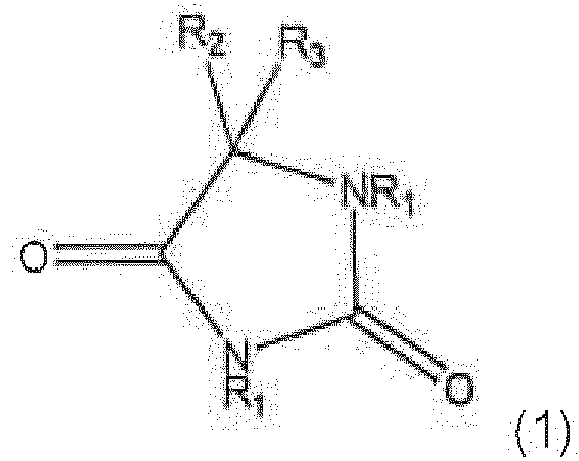
- The second active component of the synergistic composition is hydantoin. Hydantoin is represented by

- Each R1 can be the same or different and independently represent H or OR4, R4 is H, halogen, or alkyl of 1 to 5 carbon atoms, and R2 and R3 are the same or different or independently H or alkyl of 1 to 5 carbon atoms. When hydantoin is the halogen source, the stabilization of the oxidizing biocide hypochlorite is optional. Dialkyl-substituted hydantoin compounds exemplify additional stabilizers. For example, 5,5-dimethylhydantoin (DMH)or methylethylhydantoin (MEH) provide effective hypochlorite stabilization for synergistic microbial control with PAA.
- The third active component is PAA. Peracetic acid is a unique oxidant, utilizing a different mode of action than other oxidants. Given the structure of the molecule
H.3COOOH
the hydrocarbon tail allows PAA to penetrate into the bacterial cell. This enables the molecule to disrupt S--S and S--H bonds both inside and outside of the organisms, killing more quickly and effectively than other oxidants. Other oxidants, such as HOCl, ClO2, H2 O2, etc. do not penetrate the cells in this manner because they do not have an organic portion to facilitate entrance into the bacterial cell. Peracetic acid has always been applied by itself in high concentrations but has never been used for effective microbial control at concentration levels identified herein. The synergistic activity supplied by the active components of the first composition permit lower PAA concentrations for effective control. Peracetic acid has been used as a sterilant in the food industry for many years, but is generally used at higher concentrations (10,000 to 100,000 ppm). The combined treatment is added, for example, to cooling water systems, paper and pulp mill systems, pools, ponds, lagoons, lakes, etc., to control the formation of bacterial microorganisms, which may be contained by, or which may become entrained in, the system to be treated. - It has been found that the PAA and hydantoin-stabilized hypochlorite compositions and methods of utilization of the treatment are efficacious in controlling against filamentous bacteria. Filamentous bacteria play a major role in the formation of many slime deposits. Additionally, dimethylhydantoin-stabilized hypochlorite has been reported as very effective in slime control (which may populate these systems. The combined treatment composition and method is expected to be efficacious in inhibiting and controlling all types of aerobic and anaerobic bacteria.
- Increased inhibition of microbial growth resulting from compositions having hydantoin-stabilized hypochlorite as an active ingredient are mixed with compositions having PAA as an active ingredient provide a higher degree of bactericidal activity than that of the individual ingredients comprising the mixture. Accordingly, it is possible to produce a highly efficacious bactericide. Because of the enhanced activity of the mixture, the total quantity of the bacterial treatment may be reduced. The combined PAA and hydantoin-stabilized hypochlorite biocide treatment may be added to the desired aqueous system in need of biocidal treatment The combination of PAA and hydantoin-stabilized possess a higher degree of bactericidal activity than that of the individual ingredients comprising the mixture.
- In the present invention the hydantoin-stabilized hypochlorite is generated on site by mixing a hydantoin solution, for example a solution containing dimethylhydantoin, with a sodium hypochlorite solution. These two components can be mixed in different ratios depending on the chlorine demand of the system, and then be dosed in the process water. It is also possible to dose the hydantoin and hypochlorite compositions separately in the water that needs to be treated, in a side stream of the process water that need to be treated, or other carrier water (e.g. freshwater), that supplies the process water with sufficient amounts of hydantoin-stabilized hypochlorous acid. The second oxidizing biocide peracetic acid is dosed in the process water containing the stabilized chlorine. Preferably the amount of free halogen coming from the hydantoin-stabilized solution should be low, at the point were the second oxidant is applied. This will prevent antagonism between hypochlorite and the second oxidant. The efficiency in microbial control can be further enhanced by the addition of conventional biocides.
- The advantage of using a combination of hydantoin-stabilized hypochlorite and PAA as a second oxidant is that it lowers the overall use of oxidizing biocides in the process that is needed for inhibition of the growth of microorganisms. As hydantoin-stabilized hypochlorite has been shown to work excellent in control of slime deposition, whereas peracetic acid can be very effective reducing numbers of microorganisms, a complementary effect in control of microorganisms in industrial waters can be expected. This is especially the case when control of slime deposition is desirable.
- The use of other biocidal components, preferably so-called fast killers, including but not limited to, dibromonitrile propionamide (DBNPA), will complement the dimethylhydantoin-stabilized hypochlorite in killing efficiency, thus greatly expanding the possible applications in industries. The synergy that was found between dimethylhydantoin-stabilized hypochlorite and PAA, allows reduced use of these chemicals thus ameliorating the problems caused by excess of hypochlorite. Furthermore, PAA was shown to contribute far less to corrosion, or felt damage, and does not interfere with wet-end chemicals in papermaking, for example optical brightening agents, dyes, sizing agents and the like. On top of this PAA does not contribute to the formation of AOX. Final breakdown products of PAA are carbon dioxide and water, thus no harmful products will reach the environment. Thus PAA is a preferred option in case health concerns associated with non-oxidizing biocides are a concern, or the mill wishes to promote a green image. On the negative side PAA alone is less effective in slime control compared to dimethylhydantoin-stabilized hypochlorite.
- All of the reasons mentioned above make it extremely desirable to be recognized as the inventor of control of microorganisms in industrial waters by applying combinations of dimethylhydantoin stabilized hypochlorite, and PAA in such waters. Applications including PAA are very common in paper industry. A weakness of this technology is poor control in the so called long loops, comprising the white water that is not directly used to dilute the pulp just prior to the paper formation section (in the so-called short loop), but that is reused for example in re-pulping of pulp and broke, and/or showers after clearing. Thus, the composition as identified fulfills an un-met need in the industry.
- The following experimental data were developed. It is to be remembered that the following examples are to be regarded solely as being illustrative, and not as restricting the scope of the invention.
- Hydantoin-stabilized hypochlorite combined with PAA were tested in accordance with the procedure described below. In determining synergy,: Q.sub.a =quantity of compound A, acting alone, producing an end point
- Q.sub.b =quantity of compound B, acting alone, producing an end point
- QA = quantity of compound A in mixture, producing an end point
- QB = quantity of compound B in mixture, producing an end point
- The data in the following tables come from treating microorganisms found in industrial cooling waters and in pulping and paper making systems, with varying ratios and concentrations of PAA and DMH-hypochlorite. Shown for each combination is the % reduction of .bacterial activity, the calculated SI, and the weight ratio of PAA and DMH-hypochlorite.
The following experimental data were developed. It is to be remembered that the following examples are to be regarded solely as being illustrative, and not as restricting the scope of the invention. - The furnish used in this mill is composed of about 50% TMP, 25% bleached Kraft pulp, and 25% broke. White water was collected and total bacterial counts were determined in samples with and without the addition of DMH stabilized chlorine (1: 1 molar ratio of DMH to "Cl2) and/or PAA, after 50 minutes of contact time. The results are summarized in the table below.
Biocide (PAA: ppm product; DMH stabilized chlorine: ppm Cl2) Total bacterial counts Control (no biocide added) 1.3 x 10⁷ PAA-25 4 x 10⁶ PAA-50 3 x 10⁵ PAA-100 3 x 10³ Cl2-1 107 C12-2 4 x 10⁶ Cl2-4 <103 Cl2-2 + PAA-25 104 Cl2-2 + PAA-50 <103 - QA=ppm of active peracetic acid alone, which produces an endpoint
- QB = ppm of active DMH stabilized chlorine (expressed as ppm Cl2) alone, which produces an endpoint;
- Qa=ppm of active peracetic acid, in combination, which produces an endpoint
- Qb=the ppm of active DMH stabilized chlorine (expressed as ppm Cl2), in combination, which produces an endpoint
- <1, it indicates synergy
- 1, it indicates additivity
- >1, it indicates antagonism
- Composition 1: PAA = 100 ppm
- Composition 2: DMH stabilized chlorine ("Cl2") = 4 ppm


- The furnish used on this paper machine is composed of about 60% bleached Kraft pulp, and 40% broke. White water was collected and total bacterial counts were determined in samples with and without the addition of DMH stabilized chlorine (1:1 molar ratio of DMH to "Cl2"), and/or PAA, after 30 minutes of contact time. The results are summarized in the table below.
Biocide (PAA: ppm product; DMH stabilized chlorine: ppm C12) Total bacterial counts Control (no biocide added) 5.8 x 10° PAA-2.5 5.8 x 10⁶ PAA-5 1.1 x 10⁶ PAA-10 5 x 10⁴ Cl2-2.5 2.7 x 10⁴ Cl2-5 6 x 10² Cl2-2.5 + PAA-2.5 2 x 10³ - In this example a >3-log reduction in bacterial counts is achieved with:
- Synergistic Composition:
- Composition 1: PAA > 10 ppm
- Composition 2: DMH stabilized chlorine ("Cl2") = 5 ppm


- The furnish used in this mill is composed of about 75% bleached Kraft pulp, and 25% broke. White water was collected and total bacterial counts were determined in samples with and without the addition of DMH stabilized chlorine (1:1 molar ratio of DMH to "Cl2"), and/or PAA, after 30 minutes of contact time. The results are summarized in the table below.
Biocide (PAA: ppm product; DMH stabilized chlorine: ppm C12) Total bacterial counts Control (no biocide added) 9 x 10° PAA-50 4.5 x 10⁶ PAA-75 1.6 x 10⁶ PAA-100 3 x 10⁵ PAA-150 103 PAA-200 <102 Cl2-1 9 x 10⁶ Cl2-2 9 x 10⁶ Cl2-3 6.3 x 10⁶ Cl2-4 5.4 x 10⁶ Cl2-1 + PAA-100 9 x 10⁴ Cl2-1 + PAA-150 <102 - In this example a 2-log reduction in bacterial counts is achieved with:
- Synergistic Composition
- Composition 1: PAA 150 ppm
- Composition 2: DMH stabilized chlorine ("Cl2") = >4 ppm


-
- 1. A composition for inhibiting the growth of microorganisms comprising effective amounts of:
- (a) hydantoin-based halide or hydantoin represented by formula (1):

- a) R1 is the same of different; when different it independently represent H or OR4, wherein R4 is H, halogen, or alkyl of 1 to 5 carbon atoms, and
- b) R2 and R3 are the same of different; when different they independently H or alkyl of 1 to 5 carbon atoms;
- c) a halogen donor source; and
- d) peracetic acid and derivatives and salts thereof with the proviso that when hydantoin is halogen based;h (c) is optional.
- (a) hydantoin-based halide or hydantoin represented by formula (1):
- 2. The composition of 1, wherein the halogen donor is alkali- or alkaline salt of hypochlorite or halogen based hydantoin.
- 3. The composition of 1, wherein the halogen donor is sodium hypochlorite or hydantoin chlorite.
- 4. The composition of 1 wherein R1 of formula (1) are each H, R2 and R3 are different and independently C1 to C5 alkyl and (b) is sodium hypochlorite.
- 5. A composition for inhibiting the growth of microorganisms in industrial water systems comprising an effective amounts of:
- (a) dialkyl hydantoin;
- (b) sodium hypochlorite; and
- (c) peracetic acid and salts and derivatives thereof.
- 6. A composition for inhibiting the growth of microorganisms in industrial water systems comprising effective amounts of:
- (a) halogen-based dialkyl hydantoin; and
- (b) peracetic acid and salts and derivatives thereof.
- 7. The composition of 1 used to control slime deposition in industrial water systems.
- 8. The composition of 1 used to control growth of filamentous bacteria in industrial water systems.
- 9. The composition of 1 used to control slime deposition in a papermaking process.
- 10. The composition of 1, further comprising a fasting acting biocide.
- 11. A method for controlling the growth of microorganisms in industrial process water comprising administering a sufficient amount of a composition of 1.
- 12. A method for controlling the growth of microorganisms in industrial process water comprising the step of administering an effective amount of a composition comprising:
- (a) hydatoin-stabilized sodium hypochlorite and peracetic acid; or
- (b) halogen-based hydantoin and peracetic acid.
- 13. The method of 9 wherein the industrial process water is selected from the group consisting of water of a pulp and paper mill system, cooling water, steel mill system and mining water.
- 14. The method of 10, wherein the paper mill system produces mechanical or-chemical pulp.
- 15. The method of 10, wherein the peracetic acid of composition 2 is added consecutively or simultaneously to the industrial water with composition 1 comprising:
- (a) hydantoin-stabilized hypochlorite; or
- (b) halogen-based hydantoin.
- 16. The method of 10, wherein the first composition comprising:
- (a) hydantoin and hypochlorite are mixed in ratios relative to the chlorine demand to, form a mixture; or
- (b) the concentration of halogen-based hydantoin is determined; and added consecutively or simultaneously to the industrial water with peracetic acid.
- 17. The method of 10, wherein the first composition of hydantoin and hypochlorite are separately added to the water to be treated.
- 18. The method of 14, wherein peracetic acid is dosed into industrial water containing hydantoin-stabilized-hypochlorite or halogen-based hydantoin.
- 19. Mechanical pulp produced by the method of 10.
- 20. Chemical pulp produced by the method of 10.
- 21. Furnish from mechanical and/or chemical pulp treated with the method of 10.

Claims (12)
- A method for controlling the growth of microorganisms in industrial process water comprising the step of administering an effective amount of a composition comprising:(a) hydantoin represented by formula (1):
 a) R1 is the same or different and independently represents H or OR4, wherein R4 is H or alkyl of 1 to 5 carbon atoms, andb) R2 and R3 are the same or different and independently represent H or alkyl of 1 to 5 carbon atoms;(b) a halogen donor source; and(c) peracetic acid or peracetic acid salts.
 - The method of claim 1, wherein (b) is hypochlorite and (c) is peracetic acid, and wherein the peracetic acid is added consecutively to the industrialwater with the composition comprising:(a) the hydantoin represented by formula (1):
 a) R1 is the same or different and independently represents H or OR4, wherein R4 is H or alkyl of 1 to 5 carbon atoms, andb) R2 and R3 are the same or different and independently represent H or alkyl of 1 to 5 carbon atoms; and(b) the hypochlorite.
 - A method for controlling the growth of microorganisms in industrial process water comprising the step of administering an effective amount of a composition comprising:(a) hydantoin-based halide represented by formula (1):
 a) R1 is the same or different and independently represents halogen, andb) R2 and R3 are the same or different and independently represent H or alkyl of 1 to 5 carbon atoms; and(b) peracetic acid or peracetic acid salts.
 - The method of claim 3, wherein (c) is peracetic acid, and wherein the peracetic acid is added consecutively to the industrialwater with the composition comprising:(a) the hydantoin-based halide represented by formula (1):
 a) R1 is the same or different and independently represents halogen, andb) R2 and R3 are the same or different and independently represent H or alkyl of 1 to 5 carbon atoms.
 - The method of claim 1 or 2, wherein the halogen donor is alkali- or alkaline salt of hypochlorite.
- The method of claim 3, wherein (b) is sodium hypochlorite.
- The method of claim 1 or 2, wherein R1 of formula (1) are each H, and wherein R2 and R3 are different and independently C1 to C5 alkyl, and wherein (b) is sodium hypochlorite.
- The method of any of claims 1 to 7, wherein the microorganisms comprise Pseudomonas aeruginosa.
- The method of any of claims 1 to 8, wherein the industrial process water is selected from the group consisting of water of a pulp and paper mill system, cooling water, steel mill system and mining water.
- The method of claim 9, wherein the paper mill system produces mechanical or chemical pulp.
- The method of claim 1, wherein the hydantoin under (a) and the halogen donor source under (b) are separately added to the water to be treated.
- The method of claim 2, wherein the hydantoin under (a) and the hypochlorite under (b) are separately added to the water to be treated.
Applications Claiming Priority (3)
| Application Number | Priority Date | Filing Date | Title |
|---|---|---|---|
| US11/183,060 US9061926B2 (en) | 2005-07-15 | 2005-07-15 | Synergistic composition and method for inhibiting growth of microorganisms |
| PCT/US2006/017909 WO2007011445A2 (en) | 2005-07-15 | 2006-05-09 | Synergistic composition and method for inhibiting growth of microorganisms |
| EP06770133A EP1904453A4 (en) | 2005-07-15 | 2006-05-09 | Synergistic composition and method for inhibiting growth of microorganisms |
Related Parent Applications (1)
| Application Number | Title | Priority Date | Filing Date |
|---|---|---|---|
| EP06770133A Division EP1904453A4 (en) | 2005-07-15 | 2006-05-09 | Synergistic composition and method for inhibiting growth of microorganisms |
Publications (2)
| Publication Number | Publication Date |
|---|---|
| EP3284740A1 true EP3284740A1 (en) | 2018-02-21 |
| EP3284740B1 EP3284740B1 (en) | 2020-10-28 |
Family
ID=37660705
Family Applications (2)
| Application Number | Title | Priority Date | Filing Date |
|---|---|---|---|
| EP17185934.1A Expired - Lifetime EP3284740B1 (en) | 2005-07-15 | 2006-05-09 | Synergistic method for inhibiting growth of microorganisms |
| EP06770133A Ceased EP1904453A4 (en) | 2005-07-15 | 2006-05-09 | Synergistic composition and method for inhibiting growth of microorganisms |
Family Applications After (1)
| Application Number | Title | Priority Date | Filing Date |
|---|---|---|---|
| EP06770133A Ceased EP1904453A4 (en) | 2005-07-15 | 2006-05-09 | Synergistic composition and method for inhibiting growth of microorganisms |
Country Status (15)
| Country | Link |
|---|---|
| US (1) | US9061926B2 (en) |
| EP (2) | EP3284740B1 (en) |
| JP (1) | JP5256033B2 (en) |
| KR (1) | KR101307064B1 (en) |
| CN (1) | CN101243054B (en) |
| AR (1) | AR056377A1 (en) |
| AU (1) | AU2006270501B2 (en) |
| BR (1) | BRPI0615510B1 (en) |
| CA (1) | CA2615381C (en) |
| MX (1) | MX2008000703A (en) |
| NO (1) | NO20080712L (en) |
| NZ (1) | NZ565676A (en) |
| RU (1) | RU2414432C2 (en) |
| WO (1) | WO2007011445A2 (en) |
| ZA (1) | ZA200801424B (en) |
Families Citing this family (15)
| Publication number | Priority date | Publication date | Assignee | Title |
|---|---|---|---|---|
| US20090200246A1 (en) | 2006-12-29 | 2009-08-13 | King Joseph A | ION enhancement |
| TWI445698B (en) * | 2006-06-29 | 2014-07-21 | Albemarle Corp | Biofilm control |
| FI119800B (en) | 2006-11-09 | 2009-03-31 | Kemira Oyj | Procedures for preventing the growth of microorganisms and combinations that prevent the growth of microorganisms |
| PE20100041A1 (en) * | 2008-03-25 | 2010-02-06 | Albemarle Corp | METHODS TO REDUCE OR ELIMINATE BACTERIA FROM HUMAN CONSUMING EGGS |
| CN102176830A (en) * | 2008-09-26 | 2011-09-07 | 隆萨公司 | Synergistic peroxide-based biocide compositions |
| AU2015202057B2 (en) * | 2009-06-08 | 2016-11-03 | Bromine Compounds Ltd. | Stabilized and activated bromine solutions as a biocide and as an antifouling agent |
| WO2011056203A2 (en) * | 2009-10-27 | 2011-05-12 | King Technology, Inc. | Water treatment |
| RU2574052C2 (en) * | 2013-10-02 | 2016-01-27 | Общество с ограниченной ответственностью "Банмарк" | Method of inhibiting microorganisms in pulp and paper industry |
| US20160102002A1 (en) * | 2014-10-14 | 2016-04-14 | Bwa Water Additives Uk Limited | Water treatment |
| US10905125B2 (en) | 2014-10-14 | 2021-02-02 | Italmatch Chemicals Gb Ltd. | Biocidal compositions and method of treating water using thereof |
| US10827758B2 (en) | 2014-10-14 | 2020-11-10 | Italmatch Chemicals Gb Limited | Relating to water treatment |
| US10538442B2 (en) | 2015-08-31 | 2020-01-21 | Bwa Water Additives Uk Limited | Water treatment |
| US10004233B2 (en) | 2015-10-01 | 2018-06-26 | Bwa Water Additives Uk Limited | Relating to treatment of water |
| US9957173B2 (en) | 2015-10-08 | 2018-05-01 | Bwa Water Additives Uk Limited | Treatment of water |
| US10570033B2 (en) | 2016-05-12 | 2020-02-25 | Italmatch Chemicals Gb Limited | Water treatment |
Citations (4)
| Publication number | Priority date | Publication date | Assignee | Title |
|---|---|---|---|---|
| WO1996014092A1 (en) * | 1994-11-04 | 1996-05-17 | Betzdearborn Inc. | Synergistic biocidal combinations |
| US5565109A (en) * | 1994-10-14 | 1996-10-15 | Lonza Inc. | Hydantoin-enhanced halogen efficacy in pulp and paper applications |
| US6447722B1 (en) * | 1998-12-04 | 2002-09-10 | Stellar Technology Company | Solid water treatment composition and methods of preparation and use |
| US20030211210A1 (en) * | 2001-06-28 | 2003-11-13 | Howarth Jonathan N. | Microbiological control in poultry processing |
Family Cites Families (12)
| Publication number | Priority date | Publication date | Assignee | Title |
|---|---|---|---|---|
| JPS5631492A (en) * | 1979-08-22 | 1981-03-30 | Nitto Chem Ind Co Ltd | Stabilization of residual chlorine |
| US5128051A (en) * | 1991-09-30 | 1992-07-07 | Union Carbide Chemicals & Plastics Technology Corporation | Method for the control of biofouling |
| IT1271141B (en) * | 1993-07-29 | 1997-05-27 | Promox S R L | PROCEDURE FOR THE POTABILIZATION OF WATER INTENDED FOR HUMAN CONSUMPTION |
| CA2129489C (en) * | 1993-08-05 | 2000-10-10 | Judy G. Lazonby | Method and composition for inhibiting growth of microorganisms including peracetic acid and a non-oxidizing biocide |
| US6669904B1 (en) * | 1999-03-31 | 2003-12-30 | Ondeo Nalco Company | Stabilized bromine solutions, method of making and uses thereof for biofouling control |
| WO2001055036A2 (en) * | 2000-01-31 | 2001-08-02 | Lonza Inc. | Partially halogenated hydantoins in slime control |
| JP2001286870A (en) * | 2000-04-04 | 2001-10-16 | Kurita Water Ind Ltd | Operating method of cooling water system |
| RU2195319C2 (en) * | 2001-01-03 | 2002-12-27 | Смирнов Алексей Владимирович | Disinfecting agent |
| US6919364B2 (en) * | 2001-06-28 | 2005-07-19 | Solution Biosciences, Inc. | Microbiological control in animal processing |
| CN1535250A (en) * | 2001-06-29 | 2004-10-06 | 隆萨公司 | Mixtures of halogen-generating biocides, halogen stabilizers and nitrogen-containing biocides |
| JP2003104804A (en) * | 2001-09-28 | 2003-04-09 | Hakuto Co Ltd | Water-based microbicidal methods |
| NZ540823A (en) * | 2002-12-20 | 2008-03-28 | Lonza Ag | Method for removal of biofilm |
-
2005
- 2005-07-15 US US11/183,060 patent/US9061926B2/en active Active
-
2006
- 2006-05-09 EP EP17185934.1A patent/EP3284740B1/en not_active Expired - Lifetime
- 2006-05-09 RU RU2008103508/05A patent/RU2414432C2/en active
- 2006-05-09 NZ NZ565676A patent/NZ565676A/en not_active IP Right Cessation
- 2006-05-09 WO PCT/US2006/017909 patent/WO2007011445A2/en not_active Ceased
- 2006-05-09 AU AU2006270501A patent/AU2006270501B2/en not_active Expired
- 2006-05-09 MX MX2008000703A patent/MX2008000703A/en active IP Right Grant
- 2006-05-09 CA CA2615381A patent/CA2615381C/en not_active Expired - Lifetime
- 2006-05-09 EP EP06770133A patent/EP1904453A4/en not_active Ceased
- 2006-05-09 BR BRPI0615510-3A patent/BRPI0615510B1/en active IP Right Grant
- 2006-05-09 JP JP2008521379A patent/JP5256033B2/en not_active Expired - Lifetime
- 2006-05-09 CN CN2006800303737A patent/CN101243054B/en not_active Expired - Lifetime
- 2006-05-09 KR KR1020087003382A patent/KR101307064B1/en not_active Expired - Lifetime
- 2006-06-05 AR ARP060102339A patent/AR056377A1/en unknown
-
2008
- 2008-02-08 NO NO20080712A patent/NO20080712L/en not_active Application Discontinuation
- 2008-02-12 ZA ZA200801424A patent/ZA200801424B/en unknown
Patent Citations (5)
| Publication number | Priority date | Publication date | Assignee | Title |
|---|---|---|---|---|
| US5565109A (en) * | 1994-10-14 | 1996-10-15 | Lonza Inc. | Hydantoin-enhanced halogen efficacy in pulp and paper applications |
| US5565109B1 (en) * | 1994-10-14 | 1999-11-23 | Lonza Ag | Hydantoin-enhanced halogen efficacy in pulp and paper applications |
| WO1996014092A1 (en) * | 1994-11-04 | 1996-05-17 | Betzdearborn Inc. | Synergistic biocidal combinations |
| US6447722B1 (en) * | 1998-12-04 | 2002-09-10 | Stellar Technology Company | Solid water treatment composition and methods of preparation and use |
| US20030211210A1 (en) * | 2001-06-28 | 2003-11-13 | Howarth Jonathan N. | Microbiological control in poultry processing |
Non-Patent Citations (6)
| Title |
|---|
| DATABASE CAPLUS, [online] 1 January 1978 (1978-01-01), NAIDENOVA L P ET AL: "Study of new preparations for the sanitation treatment of technological equipment", XP002497245, retrieved from CAPLUS * |
| DATABASE CAPLUS, [online] 1 January 1981 (1981-01-01), ROGATINA L N ET AL: "Study of various chemical compounds for disinfection and preservation of small-scale water-purification plants", XP002497244, retrieved from CAPLUS * |
| DATABASE CAPLUS, [online] 1 January 2001 (2001-01-01), SHEN JIANZHONG ET AL: "Experimental observation on bactericidal efficacy and corrosiveness of compound disinfectant of peracetic acid", XP002497247, retrieved from CAPLUS * |
| DATABASE CAPLUS, [online] 1 January 2003 (2003-01-01), ZHANG YINGCHUN ET AL: "Examination of synergistic germicidal efficacy of peracetic acid and dichloromethyl hydantion", XP002497246, retrieved from CAPLUS * |
| KULL ET AL., APPLIED MICROBIOLOGY, vol. 9, 1961, pages 538 - 541 |
| LEI QIAN ET AL: "Durable and regenerable antimicrobial textiles: Synthesis and applications of 3-methylol-2,2,5,5-tetramethyl-imidazolidin-4-one (MTMIO)", JOURNAL OF APPLIED POLYMER SCIENCE, vol. 89, no. 9, 29 August 2003 (2003-08-29), US, pages 2418 - 2425, XP055253109, ISSN: 0021-8995, DOI: 10.1002/app.12405 * |
Also Published As
| Publication number | Publication date |
|---|---|
| CN101243054A (en) | 2008-08-13 |
| EP1904453A4 (en) | 2010-05-26 |
| KR20080027938A (en) | 2008-03-28 |
| NZ565676A (en) | 2011-04-29 |
| JP2009501219A (en) | 2009-01-15 |
| KR101307064B1 (en) | 2013-09-11 |
| US20070012632A1 (en) | 2007-01-18 |
| RU2008103508A (en) | 2009-08-20 |
| EP3284740B1 (en) | 2020-10-28 |
| AU2006270501A1 (en) | 2007-01-25 |
| BRPI0615510B1 (en) | 2019-09-17 |
| CN101243054B (en) | 2012-12-12 |
| JP5256033B2 (en) | 2013-08-07 |
| ZA200801424B (en) | 2009-01-28 |
| AR056377A1 (en) | 2007-10-10 |
| NO20080712L (en) | 2008-02-08 |
| US9061926B2 (en) | 2015-06-23 |
| RU2414432C2 (en) | 2011-03-20 |
| WO2007011445A2 (en) | 2007-01-25 |
| AU2006270501B2 (en) | 2012-02-09 |
| BRPI0615510A2 (en) | 2011-05-17 |
| CA2615381C (en) | 2015-04-28 |
| CA2615381A1 (en) | 2007-01-25 |
| EP1904453A2 (en) | 2008-04-02 |
| MX2008000703A (en) | 2008-04-02 |
| WO2007011445A3 (en) | 2007-09-13 |
Similar Documents
| Publication | Publication Date | Title |
|---|---|---|
| AU692323B2 (en) | Hydantoin-enhanced halogen efficacy in pulp and paper applications | |
| CA2640452C (en) | Suppressing microbial growth in pulp and paper | |
| EP2079308B1 (en) | Method for preventing growth of microorganisms, and a combination for the prevention of microbial growth | |
| EP3284740B1 (en) | Synergistic method for inhibiting growth of microorganisms | |
| JP5670334B2 (en) | Synergistic peroxide disinfectant composition | |
| JP5357440B2 (en) | Harmful microorganism eradication agent and harmful microorganism eradication method using the same | |
| JPH08325995A (en) | Use of dichloroisocyanuric acid alkali metal salt (anhydrous) and alkali bromide in paper processing system | |
| EP1858811A1 (en) | Method of inhibiting the growth of microorganisms | |
| EP1866253A1 (en) | Electrochemical method for preparing microbiocidal solutions |
Legal Events
| Date | Code | Title | Description |
|---|---|---|---|
| STAA | Information on the status of an ep patent application or granted ep patent |
Free format text: STATUS: UNKNOWN |
|
| PUAI | Public reference made under article 153(3) epc to a published international application that has entered the european phase |
Free format text: ORIGINAL CODE: 0009012 |
|
| STAA | Information on the status of an ep patent application or granted ep patent |
Free format text: STATUS: THE APPLICATION HAS BEEN PUBLISHED |
|
| AC | Divisional application: reference to earlier application |
Ref document number: 1904453 Country of ref document: EP Kind code of ref document: P |
|
| AK | Designated contracting states |
Kind code of ref document: A1 Designated state(s): AT BE BG CH CY CZ DE DK EE ES FI FR GB GR HU IE IS IT LI LT LU LV MC NL PL PT RO SE SI SK TR |
|
| STAA | Information on the status of an ep patent application or granted ep patent |
Free format text: STATUS: REQUEST FOR EXAMINATION WAS MADE |
|
| 17P | Request for examination filed |
Effective date: 20180817 |
|
| RBV | Designated contracting states (corrected) |
Designated state(s): AT BE BG CH CY CZ DE DK EE ES FI FR GB GR HU IE IS IT LI LT LU LV MC NL PL PT RO SE SI SK TR |
|
| STAA | Information on the status of an ep patent application or granted ep patent |
Free format text: STATUS: EXAMINATION IS IN PROGRESS |
|
| 17Q | First examination report despatched |
Effective date: 20181203 |
|
| GRAP | Despatch of communication of intention to grant a patent |
Free format text: ORIGINAL CODE: EPIDOSNIGR1 |
|
| STAA | Information on the status of an ep patent application or granted ep patent |
Free format text: STATUS: GRANT OF PATENT IS INTENDED |
|
| INTG | Intention to grant announced |
Effective date: 20191129 |
|
| GRAJ | Information related to disapproval of communication of intention to grant by the applicant or resumption of examination proceedings by the epo deleted |
Free format text: ORIGINAL CODE: EPIDOSDIGR1 |
|
| STAA | Information on the status of an ep patent application or granted ep patent |
Free format text: STATUS: EXAMINATION IS IN PROGRESS |
|
| GRAP | Despatch of communication of intention to grant a patent |
Free format text: ORIGINAL CODE: EPIDOSNIGR1 |
|
| STAA | Information on the status of an ep patent application or granted ep patent |
Free format text: STATUS: GRANT OF PATENT IS INTENDED |
|
| INTC | Intention to grant announced (deleted) | ||
| INTG | Intention to grant announced |
Effective date: 20200512 |
|
| GRAS | Grant fee paid |
Free format text: ORIGINAL CODE: EPIDOSNIGR3 |
|
| GRAA | (expected) grant |
Free format text: ORIGINAL CODE: 0009210 |
|
| STAA | Information on the status of an ep patent application or granted ep patent |
Free format text: STATUS: THE PATENT HAS BEEN GRANTED |
|
| AC | Divisional application: reference to earlier application |
Ref document number: 1904453 Country of ref document: EP Kind code of ref document: P |
|
| AK | Designated contracting states |
Kind code of ref document: B1 Designated state(s): AT BE BG CH CY CZ DE DK EE ES FI FR GB GR HU IE IS IT LI LT LU LV MC NL PL PT RO SE SI SK TR |
|
| REG | Reference to a national code |
Ref country code: GB Ref legal event code: FG4D |
|
| REG | Reference to a national code |
Ref country code: CH Ref legal event code: EP |
|
| REG | Reference to a national code |
Ref country code: DE Ref legal event code: R096 Ref document number: 602006059776 Country of ref document: DE |
|
| REG | Reference to a national code |
Ref country code: AT Ref legal event code: REF Ref document number: 1328082 Country of ref document: AT Kind code of ref document: T Effective date: 20201115 |
|
| REG | Reference to a national code |
Ref country code: IE Ref legal event code: FG4D |
|
| REG | Reference to a national code |
Ref country code: FI Ref legal event code: FGE |
|
| REG | Reference to a national code |
Ref country code: AT Ref legal event code: MK05 Ref document number: 1328082 Country of ref document: AT Kind code of ref document: T Effective date: 20201028 |
|
| REG | Reference to a national code |
Ref country code: NL Ref legal event code: MP Effective date: 20201028 |
|
| PG25 | Lapsed in a contracting state [announced via postgrant information from national office to epo] |
Ref country code: NL Free format text: LAPSE BECAUSE OF FAILURE TO SUBMIT A TRANSLATION OF THE DESCRIPTION OR TO PAY THE FEE WITHIN THE PRESCRIBED TIME-LIMIT Effective date: 20201028 Ref country code: PT Free format text: LAPSE BECAUSE OF FAILURE TO SUBMIT A TRANSLATION OF THE DESCRIPTION OR TO PAY THE FEE WITHIN THE PRESCRIBED TIME-LIMIT Effective date: 20210301 Ref country code: GR Free format text: LAPSE BECAUSE OF FAILURE TO SUBMIT A TRANSLATION OF THE DESCRIPTION OR TO PAY THE FEE WITHIN THE PRESCRIBED TIME-LIMIT Effective date: 20210129 |
|
| REG | Reference to a national code |
Ref country code: LT Ref legal event code: MG4D |
|
| PG25 | Lapsed in a contracting state [announced via postgrant information from national office to epo] |
Ref country code: ES Free format text: LAPSE BECAUSE OF FAILURE TO SUBMIT A TRANSLATION OF THE DESCRIPTION OR TO PAY THE FEE WITHIN THE PRESCRIBED TIME-LIMIT Effective date: 20201028 Ref country code: AT Free format text: LAPSE BECAUSE OF FAILURE TO SUBMIT A TRANSLATION OF THE DESCRIPTION OR TO PAY THE FEE WITHIN THE PRESCRIBED TIME-LIMIT Effective date: 20201028 Ref country code: LV Free format text: LAPSE BECAUSE OF FAILURE TO SUBMIT A TRANSLATION OF THE DESCRIPTION OR TO PAY THE FEE WITHIN THE PRESCRIBED TIME-LIMIT Effective date: 20201028 Ref country code: IS Free format text: LAPSE BECAUSE OF FAILURE TO SUBMIT A TRANSLATION OF THE DESCRIPTION OR TO PAY THE FEE WITHIN THE PRESCRIBED TIME-LIMIT Effective date: 20210228 Ref country code: PL Free format text: LAPSE BECAUSE OF FAILURE TO SUBMIT A TRANSLATION OF THE DESCRIPTION OR TO PAY THE FEE WITHIN THE PRESCRIBED TIME-LIMIT Effective date: 20201028 Ref country code: BG Free format text: LAPSE BECAUSE OF FAILURE TO SUBMIT A TRANSLATION OF THE DESCRIPTION OR TO PAY THE FEE WITHIN THE PRESCRIBED TIME-LIMIT Effective date: 20210128 Ref country code: SE Free format text: LAPSE BECAUSE OF FAILURE TO SUBMIT A TRANSLATION OF THE DESCRIPTION OR TO PAY THE FEE WITHIN THE PRESCRIBED TIME-LIMIT Effective date: 20201028 |
|
| REG | Reference to a national code |
Ref country code: DE Ref legal event code: R097 Ref document number: 602006059776 Country of ref document: DE |
|
| PG25 | Lapsed in a contracting state [announced via postgrant information from national office to epo] |
Ref country code: EE Free format text: LAPSE BECAUSE OF FAILURE TO SUBMIT A TRANSLATION OF THE DESCRIPTION OR TO PAY THE FEE WITHIN THE PRESCRIBED TIME-LIMIT Effective date: 20201028 Ref country code: CZ Free format text: LAPSE BECAUSE OF FAILURE TO SUBMIT A TRANSLATION OF THE DESCRIPTION OR TO PAY THE FEE WITHIN THE PRESCRIBED TIME-LIMIT Effective date: 20201028 Ref country code: LT Free format text: LAPSE BECAUSE OF FAILURE TO SUBMIT A TRANSLATION OF THE DESCRIPTION OR TO PAY THE FEE WITHIN THE PRESCRIBED TIME-LIMIT Effective date: 20201028 Ref country code: SK Free format text: LAPSE BECAUSE OF FAILURE TO SUBMIT A TRANSLATION OF THE DESCRIPTION OR TO PAY THE FEE WITHIN THE PRESCRIBED TIME-LIMIT Effective date: 20201028 Ref country code: RO Free format text: LAPSE BECAUSE OF FAILURE TO SUBMIT A TRANSLATION OF THE DESCRIPTION OR TO PAY THE FEE WITHIN THE PRESCRIBED TIME-LIMIT Effective date: 20201028 |
|
| PG25 | Lapsed in a contracting state [announced via postgrant information from national office to epo] |
Ref country code: DK Free format text: LAPSE BECAUSE OF FAILURE TO SUBMIT A TRANSLATION OF THE DESCRIPTION OR TO PAY THE FEE WITHIN THE PRESCRIBED TIME-LIMIT Effective date: 20201028 |
|
| PLBE | No opposition filed within time limit |
Free format text: ORIGINAL CODE: 0009261 |
|
| STAA | Information on the status of an ep patent application or granted ep patent |
Free format text: STATUS: NO OPPOSITION FILED WITHIN TIME LIMIT |
|
| 26N | No opposition filed |
Effective date: 20210729 |
|
| PG25 | Lapsed in a contracting state [announced via postgrant information from national office to epo] |
Ref country code: SI Free format text: LAPSE BECAUSE OF FAILURE TO SUBMIT A TRANSLATION OF THE DESCRIPTION OR TO PAY THE FEE WITHIN THE PRESCRIBED TIME-LIMIT Effective date: 20201028 |
|
| REG | Reference to a national code |
Ref country code: CH Ref legal event code: PL |
|
| GBPC | Gb: european patent ceased through non-payment of renewal fee |
Effective date: 20210509 |
|
| PG25 | Lapsed in a contracting state [announced via postgrant information from national office to epo] |
Ref country code: LI Free format text: LAPSE BECAUSE OF NON-PAYMENT OF DUE FEES Effective date: 20210531 Ref country code: MC Free format text: LAPSE BECAUSE OF FAILURE TO SUBMIT A TRANSLATION OF THE DESCRIPTION OR TO PAY THE FEE WITHIN THE PRESCRIBED TIME-LIMIT Effective date: 20201028 Ref country code: CH Free format text: LAPSE BECAUSE OF NON-PAYMENT OF DUE FEES Effective date: 20210531 Ref country code: LU Free format text: LAPSE BECAUSE OF NON-PAYMENT OF DUE FEES Effective date: 20210509 |
|
| REG | Reference to a national code |
Ref country code: BE Ref legal event code: MM Effective date: 20210531 |
|
| PG25 | Lapsed in a contracting state [announced via postgrant information from national office to epo] |
Ref country code: IE Free format text: LAPSE BECAUSE OF NON-PAYMENT OF DUE FEES Effective date: 20210509 Ref country code: GB Free format text: LAPSE BECAUSE OF NON-PAYMENT OF DUE FEES Effective date: 20210509 |
|
| PG25 | Lapsed in a contracting state [announced via postgrant information from national office to epo] |
Ref country code: IS Free format text: LAPSE BECAUSE OF FAILURE TO SUBMIT A TRANSLATION OF THE DESCRIPTION OR TO PAY THE FEE WITHIN THE PRESCRIBED TIME-LIMIT Effective date: 20210228 Ref country code: FR Free format text: LAPSE BECAUSE OF NON-PAYMENT OF DUE FEES Effective date: 20210531 |
|
| PG25 | Lapsed in a contracting state [announced via postgrant information from national office to epo] |
Ref country code: BE Free format text: LAPSE BECAUSE OF NON-PAYMENT OF DUE FEES Effective date: 20210531 |
|
| PG25 | Lapsed in a contracting state [announced via postgrant information from national office to epo] |
Ref country code: HU Free format text: LAPSE BECAUSE OF FAILURE TO SUBMIT A TRANSLATION OF THE DESCRIPTION OR TO PAY THE FEE WITHIN THE PRESCRIBED TIME-LIMIT; INVALID AB INITIO Effective date: 20060509 Ref country code: CY Free format text: LAPSE BECAUSE OF FAILURE TO SUBMIT A TRANSLATION OF THE DESCRIPTION OR TO PAY THE FEE WITHIN THE PRESCRIBED TIME-LIMIT Effective date: 20201028 |
|
| PG25 | Lapsed in a contracting state [announced via postgrant information from national office to epo] |
Ref country code: TR Free format text: LAPSE BECAUSE OF FAILURE TO SUBMIT A TRANSLATION OF THE DESCRIPTION OR TO PAY THE FEE WITHIN THE PRESCRIBED TIME-LIMIT Effective date: 20201028 |
|
| PGFP | Annual fee paid to national office [announced via postgrant information from national office to epo] |
Ref country code: FI Payment date: 20250513 Year of fee payment: 20 |
|
| PGFP | Annual fee paid to national office [announced via postgrant information from national office to epo] |
Ref country code: DE Payment date: 20250311 Year of fee payment: 20 |
|
| PGFP | Annual fee paid to national office [announced via postgrant information from national office to epo] |
Ref country code: IT Payment date: 20250422 Year of fee payment: 20 |