EP3284595A1 - Expanding/contracting laminate and product including same - Google Patents
Expanding/contracting laminate and product including same Download PDFInfo
- Publication number
- EP3284595A1 EP3284595A1 EP16780037.4A EP16780037A EP3284595A1 EP 3284595 A1 EP3284595 A1 EP 3284595A1 EP 16780037 A EP16780037 A EP 16780037A EP 3284595 A1 EP3284595 A1 EP 3284595A1
- Authority
- EP
- European Patent Office
- Prior art keywords
- layer
- stretchable laminate
- elastomer
- woven fabric
- laminate according
- Prior art date
- Legal status (The legal status is an assumption and is not a legal conclusion. Google has not performed a legal analysis and makes no representation as to the accuracy of the status listed.)
- Granted
Links
Images




Classifications
-
- C—CHEMISTRY; METALLURGY
- C09—DYES; PAINTS; POLISHES; NATURAL RESINS; ADHESIVES; COMPOSITIONS NOT OTHERWISE PROVIDED FOR; APPLICATIONS OF MATERIALS NOT OTHERWISE PROVIDED FOR
- C09J—ADHESIVES; NON-MECHANICAL ASPECTS OF ADHESIVE PROCESSES IN GENERAL; ADHESIVE PROCESSES NOT PROVIDED FOR ELSEWHERE; USE OF MATERIALS AS ADHESIVES
- C09J7/00—Adhesives in the form of films or foils
- C09J7/20—Adhesives in the form of films or foils characterised by their carriers
- C09J7/22—Plastics; Metallised plastics
- C09J7/24—Plastics; Metallised plastics based on macromolecular compounds obtained by reactions involving only carbon-to-carbon unsaturated bonds
- C09J7/241—Polyolefin, e.g.rubber
- C09J7/243—Ethylene or propylene polymers
-
- B—PERFORMING OPERATIONS; TRANSPORTING
- B32—LAYERED PRODUCTS
- B32B—LAYERED PRODUCTS, i.e. PRODUCTS BUILT-UP OF STRATA OF FLAT OR NON-FLAT, e.g. CELLULAR OR HONEYCOMB, FORM
- B32B3/00—Layered products comprising a layer with external or internal discontinuities or unevennesses, or a layer of non-planar shape; Layered products comprising a layer having particular features of form
- B32B3/26—Layered products comprising a layer with external or internal discontinuities or unevennesses, or a layer of non-planar shape; Layered products comprising a layer having particular features of form characterised by a particular shape of the outline of the cross-section of a continuous layer; characterised by a layer with cavities or internal voids ; characterised by an apertured layer
- B32B3/266—Layered products comprising a layer with external or internal discontinuities or unevennesses, or a layer of non-planar shape; Layered products comprising a layer having particular features of form characterised by a particular shape of the outline of the cross-section of a continuous layer; characterised by a layer with cavities or internal voids ; characterised by an apertured layer characterised by an apertured layer, the apertures going through the whole thickness of the layer, e.g. expanded metal, perforated layer, slit layer regular cells B32B3/12
-
- A—HUMAN NECESSITIES
- A61—MEDICAL OR VETERINARY SCIENCE; HYGIENE
- A61F—FILTERS IMPLANTABLE INTO BLOOD VESSELS; PROSTHESES; DEVICES PROVIDING PATENCY TO, OR PREVENTING COLLAPSING OF, TUBULAR STRUCTURES OF THE BODY, e.g. STENTS; ORTHOPAEDIC, NURSING OR CONTRACEPTIVE DEVICES; FOMENTATION; TREATMENT OR PROTECTION OF EYES OR EARS; BANDAGES, DRESSINGS OR ABSORBENT PADS; FIRST-AID KITS
- A61F13/00—Bandages or dressings; Absorbent pads
- A61F13/15—Absorbent pads, e.g. sanitary towels, swabs or tampons for external or internal application to the body; Supporting or fastening means therefor; Tampon applicators
-
- B—PERFORMING OPERATIONS; TRANSPORTING
- B32—LAYERED PRODUCTS
- B32B—LAYERED PRODUCTS, i.e. PRODUCTS BUILT-UP OF STRATA OF FLAT OR NON-FLAT, e.g. CELLULAR OR HONEYCOMB, FORM
- B32B25/00—Layered products comprising a layer of natural or synthetic rubber
- B32B25/10—Layered products comprising a layer of natural or synthetic rubber next to a fibrous or filamentary layer
-
- B—PERFORMING OPERATIONS; TRANSPORTING
- B32—LAYERED PRODUCTS
- B32B—LAYERED PRODUCTS, i.e. PRODUCTS BUILT-UP OF STRATA OF FLAT OR NON-FLAT, e.g. CELLULAR OR HONEYCOMB, FORM
- B32B27/00—Layered products comprising a layer of synthetic resin
- B32B27/06—Layered products comprising a layer of synthetic resin as the main or only constituent of a layer, which is next to another layer of the same or of a different material
- B32B27/08—Layered products comprising a layer of synthetic resin as the main or only constituent of a layer, which is next to another layer of the same or of a different material of synthetic resin
-
- B—PERFORMING OPERATIONS; TRANSPORTING
- B32—LAYERED PRODUCTS
- B32B—LAYERED PRODUCTS, i.e. PRODUCTS BUILT-UP OF STRATA OF FLAT OR NON-FLAT, e.g. CELLULAR OR HONEYCOMB, FORM
- B32B27/00—Layered products comprising a layer of synthetic resin
- B32B27/12—Layered products comprising a layer of synthetic resin next to a fibrous or filamentary layer
-
- B—PERFORMING OPERATIONS; TRANSPORTING
- B32—LAYERED PRODUCTS
- B32B—LAYERED PRODUCTS, i.e. PRODUCTS BUILT-UP OF STRATA OF FLAT OR NON-FLAT, e.g. CELLULAR OR HONEYCOMB, FORM
- B32B27/00—Layered products comprising a layer of synthetic resin
- B32B27/32—Layered products comprising a layer of synthetic resin comprising polyolefins
-
- B—PERFORMING OPERATIONS; TRANSPORTING
- B32—LAYERED PRODUCTS
- B32B—LAYERED PRODUCTS, i.e. PRODUCTS BUILT-UP OF STRATA OF FLAT OR NON-FLAT, e.g. CELLULAR OR HONEYCOMB, FORM
- B32B27/00—Layered products comprising a layer of synthetic resin
- B32B27/32—Layered products comprising a layer of synthetic resin comprising polyolefins
- B32B27/327—Layered products comprising a layer of synthetic resin comprising polyolefins comprising polyolefins obtained by a metallocene or single-site catalyst
-
- B—PERFORMING OPERATIONS; TRANSPORTING
- B32—LAYERED PRODUCTS
- B32B—LAYERED PRODUCTS, i.e. PRODUCTS BUILT-UP OF STRATA OF FLAT OR NON-FLAT, e.g. CELLULAR OR HONEYCOMB, FORM
- B32B5/00—Layered products characterised by the non- homogeneity or physical structure, i.e. comprising a fibrous, filamentary, particulate or foam layer; Layered products characterised by having a layer differing constitutionally or physically in different parts
- B32B5/02—Layered products characterised by the non- homogeneity or physical structure, i.e. comprising a fibrous, filamentary, particulate or foam layer; Layered products characterised by having a layer differing constitutionally or physically in different parts characterised by structural features of a fibrous or filamentary layer
- B32B5/022—Non-woven fabric
-
- C—CHEMISTRY; METALLURGY
- C09—DYES; PAINTS; POLISHES; NATURAL RESINS; ADHESIVES; COMPOSITIONS NOT OTHERWISE PROVIDED FOR; APPLICATIONS OF MATERIALS NOT OTHERWISE PROVIDED FOR
- C09J—ADHESIVES; NON-MECHANICAL ASPECTS OF ADHESIVE PROCESSES IN GENERAL; ADHESIVE PROCESSES NOT PROVIDED FOR ELSEWHERE; USE OF MATERIALS AS ADHESIVES
- C09J123/00—Adhesives based on homopolymers or copolymers of unsaturated aliphatic hydrocarbons having only one carbon-to-carbon double bond; Adhesives based on derivatives of such polymers
- C09J123/02—Adhesives based on homopolymers or copolymers of unsaturated aliphatic hydrocarbons having only one carbon-to-carbon double bond; Adhesives based on derivatives of such polymers not modified by chemical after-treatment
-
- B—PERFORMING OPERATIONS; TRANSPORTING
- B32—LAYERED PRODUCTS
- B32B—LAYERED PRODUCTS, i.e. PRODUCTS BUILT-UP OF STRATA OF FLAT OR NON-FLAT, e.g. CELLULAR OR HONEYCOMB, FORM
- B32B2250/00—Layers arrangement
- B32B2250/05—5 or more layers
-
- B—PERFORMING OPERATIONS; TRANSPORTING
- B32—LAYERED PRODUCTS
- B32B—LAYERED PRODUCTS, i.e. PRODUCTS BUILT-UP OF STRATA OF FLAT OR NON-FLAT, e.g. CELLULAR OR HONEYCOMB, FORM
- B32B2250/00—Layers arrangement
- B32B2250/40—Symmetrical or sandwich layers, e.g. ABA, ABCBA, ABCCBA
-
- B—PERFORMING OPERATIONS; TRANSPORTING
- B32—LAYERED PRODUCTS
- B32B—LAYERED PRODUCTS, i.e. PRODUCTS BUILT-UP OF STRATA OF FLAT OR NON-FLAT, e.g. CELLULAR OR HONEYCOMB, FORM
- B32B2255/00—Coating on the layer surface
- B32B2255/02—Coating on the layer surface on fibrous or filamentary layer
-
- B—PERFORMING OPERATIONS; TRANSPORTING
- B32—LAYERED PRODUCTS
- B32B—LAYERED PRODUCTS, i.e. PRODUCTS BUILT-UP OF STRATA OF FLAT OR NON-FLAT, e.g. CELLULAR OR HONEYCOMB, FORM
- B32B2262/00—Composition or structural features of fibres which form a fibrous or filamentary layer or are present as additives
- B32B2262/02—Synthetic macromolecular fibres
- B32B2262/0207—Elastomeric fibres
-
- B—PERFORMING OPERATIONS; TRANSPORTING
- B32—LAYERED PRODUCTS
- B32B—LAYERED PRODUCTS, i.e. PRODUCTS BUILT-UP OF STRATA OF FLAT OR NON-FLAT, e.g. CELLULAR OR HONEYCOMB, FORM
- B32B2262/00—Composition or structural features of fibres which form a fibrous or filamentary layer or are present as additives
- B32B2262/02—Synthetic macromolecular fibres
- B32B2262/0246—Acrylic resin fibres
-
- B—PERFORMING OPERATIONS; TRANSPORTING
- B32—LAYERED PRODUCTS
- B32B—LAYERED PRODUCTS, i.e. PRODUCTS BUILT-UP OF STRATA OF FLAT OR NON-FLAT, e.g. CELLULAR OR HONEYCOMB, FORM
- B32B2262/00—Composition or structural features of fibres which form a fibrous or filamentary layer or are present as additives
- B32B2262/02—Synthetic macromolecular fibres
- B32B2262/0253—Polyolefin fibres
-
- B—PERFORMING OPERATIONS; TRANSPORTING
- B32—LAYERED PRODUCTS
- B32B—LAYERED PRODUCTS, i.e. PRODUCTS BUILT-UP OF STRATA OF FLAT OR NON-FLAT, e.g. CELLULAR OR HONEYCOMB, FORM
- B32B2262/00—Composition or structural features of fibres which form a fibrous or filamentary layer or are present as additives
- B32B2262/02—Synthetic macromolecular fibres
- B32B2262/0261—Polyamide fibres
-
- B—PERFORMING OPERATIONS; TRANSPORTING
- B32—LAYERED PRODUCTS
- B32B—LAYERED PRODUCTS, i.e. PRODUCTS BUILT-UP OF STRATA OF FLAT OR NON-FLAT, e.g. CELLULAR OR HONEYCOMB, FORM
- B32B2262/00—Composition or structural features of fibres which form a fibrous or filamentary layer or are present as additives
- B32B2262/02—Synthetic macromolecular fibres
- B32B2262/0276—Polyester fibres
-
- B—PERFORMING OPERATIONS; TRANSPORTING
- B32—LAYERED PRODUCTS
- B32B—LAYERED PRODUCTS, i.e. PRODUCTS BUILT-UP OF STRATA OF FLAT OR NON-FLAT, e.g. CELLULAR OR HONEYCOMB, FORM
- B32B2262/00—Composition or structural features of fibres which form a fibrous or filamentary layer or are present as additives
- B32B2262/02—Synthetic macromolecular fibres
- B32B2262/0292—Polyurethane fibres
-
- B—PERFORMING OPERATIONS; TRANSPORTING
- B32—LAYERED PRODUCTS
- B32B—LAYERED PRODUCTS, i.e. PRODUCTS BUILT-UP OF STRATA OF FLAT OR NON-FLAT, e.g. CELLULAR OR HONEYCOMB, FORM
- B32B2262/00—Composition or structural features of fibres which form a fibrous or filamentary layer or are present as additives
- B32B2262/04—Cellulosic plastic fibres, e.g. rayon
-
- B—PERFORMING OPERATIONS; TRANSPORTING
- B32—LAYERED PRODUCTS
- B32B—LAYERED PRODUCTS, i.e. PRODUCTS BUILT-UP OF STRATA OF FLAT OR NON-FLAT, e.g. CELLULAR OR HONEYCOMB, FORM
- B32B2262/00—Composition or structural features of fibres which form a fibrous or filamentary layer or are present as additives
- B32B2262/06—Vegetal fibres
- B32B2262/062—Cellulose fibres, e.g. cotton
-
- B—PERFORMING OPERATIONS; TRANSPORTING
- B32—LAYERED PRODUCTS
- B32B—LAYERED PRODUCTS, i.e. PRODUCTS BUILT-UP OF STRATA OF FLAT OR NON-FLAT, e.g. CELLULAR OR HONEYCOMB, FORM
- B32B2262/00—Composition or structural features of fibres which form a fibrous or filamentary layer or are present as additives
- B32B2262/14—Mixture of at least two fibres made of different materials
-
- B—PERFORMING OPERATIONS; TRANSPORTING
- B32—LAYERED PRODUCTS
- B32B—LAYERED PRODUCTS, i.e. PRODUCTS BUILT-UP OF STRATA OF FLAT OR NON-FLAT, e.g. CELLULAR OR HONEYCOMB, FORM
- B32B2264/00—Composition or properties of particles which form a particulate layer or are present as additives
- B32B2264/10—Inorganic particles
- B32B2264/102—Oxide or hydroxide
-
- B—PERFORMING OPERATIONS; TRANSPORTING
- B32—LAYERED PRODUCTS
- B32B—LAYERED PRODUCTS, i.e. PRODUCTS BUILT-UP OF STRATA OF FLAT OR NON-FLAT, e.g. CELLULAR OR HONEYCOMB, FORM
- B32B2270/00—Resin or rubber layer containing a blend of at least two different polymers
-
- B—PERFORMING OPERATIONS; TRANSPORTING
- B32—LAYERED PRODUCTS
- B32B—LAYERED PRODUCTS, i.e. PRODUCTS BUILT-UP OF STRATA OF FLAT OR NON-FLAT, e.g. CELLULAR OR HONEYCOMB, FORM
- B32B2274/00—Thermoplastic elastomer material
-
- B—PERFORMING OPERATIONS; TRANSPORTING
- B32—LAYERED PRODUCTS
- B32B—LAYERED PRODUCTS, i.e. PRODUCTS BUILT-UP OF STRATA OF FLAT OR NON-FLAT, e.g. CELLULAR OR HONEYCOMB, FORM
- B32B2307/00—Properties of the layers or laminate
- B32B2307/30—Properties of the layers or laminate having particular thermal properties
- B32B2307/308—Heat stability
-
- B—PERFORMING OPERATIONS; TRANSPORTING
- B32—LAYERED PRODUCTS
- B32B—LAYERED PRODUCTS, i.e. PRODUCTS BUILT-UP OF STRATA OF FLAT OR NON-FLAT, e.g. CELLULAR OR HONEYCOMB, FORM
- B32B2307/00—Properties of the layers or laminate
- B32B2307/40—Properties of the layers or laminate having particular optical properties
- B32B2307/402—Coloured
- B32B2307/4026—Coloured within the layer by addition of a colorant, e.g. pigments, dyes
-
- B—PERFORMING OPERATIONS; TRANSPORTING
- B32—LAYERED PRODUCTS
- B32B—LAYERED PRODUCTS, i.e. PRODUCTS BUILT-UP OF STRATA OF FLAT OR NON-FLAT, e.g. CELLULAR OR HONEYCOMB, FORM
- B32B2307/00—Properties of the layers or laminate
- B32B2307/50—Properties of the layers or laminate having particular mechanical properties
-
- B—PERFORMING OPERATIONS; TRANSPORTING
- B32—LAYERED PRODUCTS
- B32B—LAYERED PRODUCTS, i.e. PRODUCTS BUILT-UP OF STRATA OF FLAT OR NON-FLAT, e.g. CELLULAR OR HONEYCOMB, FORM
- B32B2307/00—Properties of the layers or laminate
- B32B2307/50—Properties of the layers or laminate having particular mechanical properties
- B32B2307/51—Elastic
-
- B—PERFORMING OPERATIONS; TRANSPORTING
- B32—LAYERED PRODUCTS
- B32B—LAYERED PRODUCTS, i.e. PRODUCTS BUILT-UP OF STRATA OF FLAT OR NON-FLAT, e.g. CELLULAR OR HONEYCOMB, FORM
- B32B2307/00—Properties of the layers or laminate
- B32B2307/70—Other properties
- B32B2307/718—Weight, e.g. weight per square meter
-
- B—PERFORMING OPERATIONS; TRANSPORTING
- B32—LAYERED PRODUCTS
- B32B—LAYERED PRODUCTS, i.e. PRODUCTS BUILT-UP OF STRATA OF FLAT OR NON-FLAT, e.g. CELLULAR OR HONEYCOMB, FORM
- B32B2307/00—Properties of the layers or laminate
- B32B2307/70—Other properties
- B32B2307/724—Permeability to gases, adsorption
-
- B—PERFORMING OPERATIONS; TRANSPORTING
- B32—LAYERED PRODUCTS
- B32B—LAYERED PRODUCTS, i.e. PRODUCTS BUILT-UP OF STRATA OF FLAT OR NON-FLAT, e.g. CELLULAR OR HONEYCOMB, FORM
- B32B2307/00—Properties of the layers or laminate
- B32B2307/70—Other properties
- B32B2307/732—Dimensional properties
-
- B—PERFORMING OPERATIONS; TRANSPORTING
- B32—LAYERED PRODUCTS
- B32B—LAYERED PRODUCTS, i.e. PRODUCTS BUILT-UP OF STRATA OF FLAT OR NON-FLAT, e.g. CELLULAR OR HONEYCOMB, FORM
- B32B2535/00—Medical equipment, e.g. bandage, prostheses or catheter
-
- B—PERFORMING OPERATIONS; TRANSPORTING
- B32—LAYERED PRODUCTS
- B32B—LAYERED PRODUCTS, i.e. PRODUCTS BUILT-UP OF STRATA OF FLAT OR NON-FLAT, e.g. CELLULAR OR HONEYCOMB, FORM
- B32B2555/00—Personal care
- B32B2555/02—Diapers or napkins
-
- C—CHEMISTRY; METALLURGY
- C08—ORGANIC MACROMOLECULAR COMPOUNDS; THEIR PREPARATION OR CHEMICAL WORKING-UP; COMPOSITIONS BASED THEREON
- C08L—COMPOSITIONS OF MACROMOLECULAR COMPOUNDS
- C08L2207/00—Properties characterising the ingredient of the composition
- C08L2207/06—Properties of polyethylene
- C08L2207/066—LDPE (radical process)
Definitions
- the present invention relates to a stretchable laminate and an article including the stretchable laminate.
- a stretchable laminate formed of two or more layers including an elastomer layer has been proposed as such member.
- a stretchable laminate having a non-woven fabric layer on at least one side of an elastomer layer has been proposed.
- the elastomer layer and the non-woven fabric layer are generally bonded to each other with an adhesive or a pressure-sensitive adhesive.
- such related-art stretchable laminate formed of two or more layers including an elastomer layer involves a problem in that delamination occurs between the elastomer layer and a layer adjacent thereto.
- an adhesive or a pressure-sensitive adhesive is used in the laminate, and hence the laminate involves a problem in that a unique odor derived from the adhesive or the pressure-sensitive adhesive occurs and a problem in that its cost increases.
- the elastomer layer and the layer adjacent thereto each have air permeability, the bonding of the elastomer layer and the adjacent layer with the adhesive or the pressure-sensitive adhesive causes a problem in that the air permeability is inhibited.
- the present invention has been made to solve the conventional problems, and an object of the present invention is to provide a stretchable laminate formed of two or more layers including an elastomer layer, the stretchable laminate having the following features: delamination hardly occurs between the elastomer layer and a layer adjacent thereto; the occurrence of a unique odor derived from an adhesive or a pressure-sensitive adhesive is suppressed; the inhibition of air permeability due to the bonding of the elastomer layer and the layer adj acent thereto can be prevented; and the laminate can be produced at lower cost than ever before.
- Another object of the present invention is to provide an article including such stretchable laminate.
- a stretchable laminate including two or more layers including an elastomer layer, in which the elastomer layer and a layer adjacent thereto are directly laminated.
- the elastomer layer and the layer adjacent thereto contain the same kind of material.
- the elastomer layer has a three-layer structure.
- the three-layer structure has, as an intermediate layer, a layer in which two or more kinds of elastomers are blended, and has, as both surface layers, layers each containing one of elastomers of the same kinds as the elastomers in the intermediate layer.
- the elastomer layer has a thickness of from 20 ⁇ m to 200 ⁇ m.
- the elastomer layer has a thickness of from 30 ⁇ m to 100 ⁇ m.
- the elastomer layer contains an olefin-based elastomer.
- the olefin-based elastomer includes an ⁇ -olefin-based elastomer.
- the ⁇ -olefin-based elastomer includes at least one kind selected from an ethylene-based elastomer , a propylene-based elastomer, and a 1-butene-based elastomer.
- the elastomer layer and the layer adjacent thereto are directly fused and bonded to each other.
- the welding bonding includes ultrasonic welding bonding.
- the adjacent layer includes a non-woven fabric layer.
- the non-woven fabric layer contains fibers of polyolefin.
- the polyolefin includes polypropylene.
- the non-woven fabric layer is formed of a non-woven fabric having a basis weight of 150 gsm or less.
- the non-woven fabric has a basis weight of 50 gsm or less.
- the non-woven fabric has a basis weight of from 10 gsm to 30 gsm.
- the stretchable laminate according to the embodiment of the present invention has a region C having through-holes.
- the stretchable laminate according to the embodiment of the present invention has a region A free of a through-hole in one end portion thereof and a region B free of a through-hole in another end portion thereof, and has the region C having the through-holes between the region A and the region B.
- an article including the stretchable laminate according to the embodiment of the present invention.
- the stretchable laminate formed of two or more layers including an elastomer layer the stretchable laminate having the following features can be provided : delamination hardly occurs between the elastomer layer and a layer adjacent thereto; the occurrence of a unique odor derived from an adhesive or a pressure-sensitive adhesive is suppressed; the inhibition of air permeability due to the bonding of the elastomer layer and the layer adjacent thereto can be prevented; and the laminate can be produced at lower cost than ever before.
- the article including such stretchable laminate can also be provided.
- a stretchable laminate of the present invention is a stretchable laminate formed of two or more layers including an elastomer layer.
- the stretchable laminate of the present invention may include any appropriate other layer except the elastomer layer to the extent that the effects of the present invention are not impaired as long as the stretchable laminate is formed of two or more layers including the elastomer layer.
- the number of such any appropriate other layers may be only one, or may be two or more.
- the elastomer layer and a layer adjacent thereto are directly laminated. That is, the foregoing means that in the stretchable laminate of the present invention, the elastomer layer and the layer adjacent thereto are directly laminated without intermediation of any other layer, such as an adhesive layer or a pressure-sensitive adhesive layer, between the two layers.
- the stretchable laminate of the present invention has the following features: delamination hardly occurs between the elastomer layer and a layer adjacent thereto; the occurrence of a unique odor derived from an adhesive or a pressure-sensitive adhesive is suppressed; the inhibition of air permeability due to the bonding of the elastomer layer and the layer adjacent thereto can be prevented; and the laminate can be produced at lower cost than ever before.
- FIG. 1 is a schematic sectional view of a stretchable laminate according to a preferred embodiment of the present invention.
- a stretchable laminate 100 illustrated in FIG. 1 includes an elastomer layer 10 and a non-woven fabric layer 20 arranged on only one side of the elastomer layer 10.
- the elastomer layer 10 and the non-woven fabric layer 20 are directly laminated.
- FIG. 2 is a schematic sectional view of another stretchable laminate according to a preferred embodiment of the present invention.
- a stretchable laminate 100 illustrated in FIG. 2 has an elastomer layer 10, a non-woven fabric layer 20a arranged on one side of the elastomer layer 10, and a non-woven fabric layer 20b arranged on the elastomer layer 10 on an opposite side to the non-woven fabric layer 20a.
- the elastomer layer 10 and the non-woven fabric layer 20a are directly laminated.
- the elastomer layer 10 and the non-woven fabric layer 20b are directly laminated.
- FIG. 3 is a schematic sectional view of still another stretchable laminate according to a preferred embodiment of the present invention.
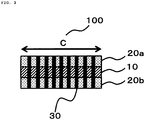
- a stretchable laminate 100 illustrated in FIG. 3 includes an elastomer layer 10, a non-woven fabric layer 20a arranged on one side of the elastomer layer 10, and a non-woven fabric layer 20b arranged on the elastomer layer 10 on an opposite side to the non-woven fabric layer 20a, and the laminate has a region C having through-holes 30.
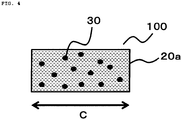
- a schematic plan view of the stretchable laminate 100 illustrated in FIG. 3 is FIG. 4 .
- the stretchable laminate 100 illustrated in FIG. 4 has a region C having through-holes 30.
- Such stretchable laminate as illustrated in each of FIG. 3 and FIG. 4 has the region C having the through-holes.
- the stretchable laminate of the present invention has the through-holes in the region C, and hence can express more excellent air permeability in the region C.
- FIG. 5 is a schematic sectional view of still another stretchable laminate according to a preferred embodiment of the present invention.
- a stretchable laminate 100 illustrated in FIG. 5 includes an elastomer layer 10, anon-woven fabric layer 20a arranged on one side of the elastomer layer 10, and a non-woven fabric layer 20b arranged on the elastomer layer 10 on an opposite side to the non-woven fabric layer 20a, and the laminate has a region A free of a through-hole in one end portion thereof and a region B free of a through-hole in the other end portion thereof, and has a region C having through-holes 30 between the region A and the region B.
- a schematic plan view of the stretchable laminate 100 illustrated in FIG. 5 is FIG. 6 .
- the stretchable laminate 100 illustrated in FIG. 6 has the region A free of a through-hole in one end portion thereof and the region B free of a through-hole in the other end portion thereof, and has the region C having the through-holes 30 between the region A and the region B.
- Such stretchable laminate as illustrated in each of FIG. 5 and FIG. 6 has the region A free of a through-hole in one end portion thereof and the region B free of a through-hole in the other end portion thereof, and has the region C having the through-holes between the region A and the region B.
- the stretchable laminate of the present invention has the through-holes in the region C, and hence can express more excellent air permeability in the region C.
- the stretchable laminate of the present invention has the region A free of a through-hole and the region B free of a through-hole in its end portions, and hence the end portions can be further strengthened.
- the thickness of the stretchable laminate of the present invention varies depending on the thickness of the elastomer layer or the thickness of any other layer, such as the non-woven fabric layer, and is preferably from 1.0 mm to 0.1 mm, more preferably from 0.8 mm to 0.15 mm, still more preferably from 0.6 mm to 0.15 mm, particularly preferably from 0.5 mm to 0.2 mm, most preferably from 0.45 mm to 0.2 mm.
- the laminate can be easilyused as a material used in articles such as sanitary articles , for example, a diaper and a mask.
- the elastomer layer and the layer adjacent thereto be directly fused and bonded to each other, and it is more preferred that the welding bonding include ultrasonic welding bonding.
- the stretchable laminate of the present invention has the following features: the delamination more hardly occurs between the elastomer layer and the layer adjacent thereto; the occurrence of the unique odor derived from the adhesive or the pressure-sensitive adhesive is further suppressed; the inhibition of the air permeability due to the bonding of the elastomer layer and the layer adjacent thereto can be further prevented; and the laminate can be produced at even lower cost than ever before.
- the elastomer layer and the layer adjacent thereto preferably contain the same kind of material (e.g. , a polyolefin-based elastomer layer and a polyolef in-based adjacent layer), and more preferably contain, as their main components, the same kind of material.
- the same kind of material is used, the delamination more hardly occurs between the elastomer layer and the layer adjacent thereto.
- any appropriate ultrasonic welding bonding may be adopted as the ultrasonic welding bonding to the extent that the effects of the present invention are not impaired.
- members to be bonded are arranged between a part generally referred to as "horn", the part being configured to feed vibration energy with an ultrasonic wave, and a roll-shaped part generally referred to as "anvil".
- the horn is arranged vertically above the members to be bonded and the anvil.
- the horn typically vibrates at from 20, 000 Hz to 40, 000 Hz to transfer energy typically in the form of frictional heat to the members to be bonded under pressure.
- Part of at least one of the members to be bonded is softened or melted by the frictional heat and the pressure, and hence the materials are bonded to each other.
- continuous ultrasonic welding bonding One preferred kind of ultrasonic welding bonding is generally known as "continuous ultrasonic welding bonding.”
- the continuous ultrasonic welding bonding is typically used for sealing members to be bonded that can be supplied into a bonding apparatus in a substantially continuous manner.
- the horn In the continuous ultrasonic welding bonding, the horn is typically fixed and the members to be bonded move directly below the horn.
- the fixed horn and a rotating anvil surface are used.
- the members to be bonded are pulled between the horn and the rotating anvil.
- the horn typically extends in its lengthwise direction toward the members to be bonded, and its vibration moves along the horn in its axial direction to the materials.
- the horn is a rotation type, has a cylindrical shape, and rotates about its lengthwise direction axis. Input vibration is present in the axial direction of the horn and output vibration is present in the radial direction of the horn.
- the horn is arranged so as to be close to the anvil, and the anvil can also typically rotate so that the members to be bonded may pass a space between cylindrical surfaces at a line velocity substantially equal to the tangential velocity of the cylindrical surfaces.
- the ultrasonic welding bonding is disclosed in, for example, JP 2008-526552 A , JP 2010-195044 A , JP 2013-231249 A , JP 2015-16294 A , and US 5976316 A , and the contents of the disclosures are incorporated herein by reference.
- any appropriate elastomer layer maybe adopted as the elastomer layer to the extent that the effects of the present invention are not impaired.
- an elastomer resin serving as a main component of such elastomer layer include an olef in-based elastomer, a styrene-based elastomer, a vinyl chloride-based elastomer, a urethane-based elastomer, an ester-based elastomer, and an amide-based elastomer.
- the content of the elastomer resin serving as the main component in the elastomer layer is preferably from 50 wt% to 100 wt%, more preferably from 70 wt% to 100 wt%, still more preferably from 90 wt% to 100 wt%, particularly preferably from 95 wt% to 100 wt%, most preferably from 98 wt% to 100 wt%.
- the elastomer layer can express a sufficient elastomer characteristic.
- the number of the elastomer layers may be one, or may be two or more.
- the three-layer structure is preferably, for example, such a three-layer structure that a layer in which two or more kinds of elastomers are blended is used as an intermediate layer, and layers each containing one of elastomers of the same kinds as the elastomers in the intermediate layer are used as both surface layers.
- the elastomer resin serving as the main component in the elastomer layer is preferably an olefin-based elastomer.
- the olefin-based elastomer is adopted as the elastomer resin, heat stability is improved as compared to any other elastomer resin (e.g., a styrene-based elastomer), and hence, for example, heat decomposition at the time of the formation of the resin into a film in the production of the stretchable laminate of the present invention can be suppressed.
- the olefin-based elastomer when adopted as the elastomer resin, storage stability is improved as compared to any other elastomer resin (e.g., a styrene-based elastomer), and hence the fluctuation of values for physical properties during the storage of the stretchable laminate of the present invention can be suppressed.
- a styrene-based elastomer resin e.g., a styrene-based elastomer
- the olefin-based elastomer when adopted as the elastomer resin, steps in the production of the elastomer layer can be simplified, and hence processing cost can be suppressed. This is because of, for example, the following reason.
- any other elastomer resin e.g., a styrene-based elastomer
- several kinds of styrene-based elastomers need to be blended for controlling values for physical properties. To this end, a master batch needs to be produced.
- extrusion molding can be performed by using fewer kinds of resins in the production of the elastomer layer, and hence the need for the production of the master batch can be eliminated.
- the olefin-based elastomer when adopted as the elastomer resin, the olefin-based elastomer may be only one kind of elastomer or a blend of two or more kinds of elastomers .
- olefin-based elastomer examples include an olefin block copolymer, an olefin random copolymer, an ethylene copolymer, a propylene copolymer, an ethylene olefin block copolymer, a propylene olefin block copolymer, an ethylene olefin random copolymer, a propylene olefin random copolymer, an ethylene propylene random copolymer, an ethylene (1-butene) random copolymer, an ethylene (1-pentene) olefin block copolymer, an ethylene (1-hexene) random copolymer, an ethylene (1-heptene) olefin block copolymer, an ethylene (1-octene) olefin block copolymer, an ethylene (1-nonene) olefin block copolymer, an ethylene (1-decene)
- the olef in-based elastomer that maybe adopted as the elastomer resin in the present invention has a density of preferably from 0.890 g/cm 3 to 0.830 g/cm 3 , more preferably from 0.888 g/cm 3 to 0.835 g/cm 3 , still more preferably from 0.886 g/cm 3 to 0.835 g/cm 3 , particularly preferably from 0.885 g/cm 3 to 0.840 g/cm 3 , most preferably from 0.885 g/cm 3 to 0.845 g/cm 3 .
- a stretchable laminate having more excellent fittability can be provided.
- the heat stability is further improved as compared to any other elastomer resin (e.g., a styrene-based elastomer), and hence, for example, the heat decomposition at the time of the formation of the resin into a film in the production of the stretchable laminate of the present invention can be further suppressed.
- the storage stability is further improved as compared to any other elastomer resin (e.g., a styrene-based elastomer), and hence the fluctuation of values for physical properties during the storage of the stretchable laminate of the present invention can be further suppressed.
- the steps in the production of the elastomer layer can be further simplified, and hence the processing cost can be further suppressed.
- the olefin-based elastomer that maybe adopted as the elastomer resin in the present invention has a MFR at 230°C and 2.16 kgf of preferably from 1.0 g/10 min to 25.0 g/10 min, more preferably from 2.0 g/10 min to 23.0 g/10 min, still more preferably from 2.0 g/10 min to 21.0 g/10 min, particularly preferably from 2.0 g/10 min to 20.0 g/10 min, most preferably from 2.0 g/10 min to 19.0 g/10 min.
- a stretchable laminate having more excellent fittability can be provided.
- the heat stability is further improved as compared to any other elastomer resin (e.g., a styrene-based elastomer), and hence, for example, the heat decomposition at the time of the formation of the resin into a film in the production of the stretchable laminate of the present invention can be further suppressed.
- the storage stability is further improved as compared to any other elastomer resin (e.g., a styrene-based elastomer), and hence the fluctuation of values for physical properties during the storage of the stretchable laminate of the present invention can be further suppressed.
- the steps in the production of the elastomer layer can be further simplified, and hence the processing cost can be further suppressed.
- the olef in-based elastomer that maybe adopted as the elastomer resin in the present invention is specifically preferably an ⁇ -olefin-based elastomer.
- ⁇ -olefin-based elastomers at least one kind selected from an ethylene-based elastomer, a propylene-based elastomer, and a 1-butene-based elastomer is more preferred.
- ⁇ -olefin-based elastomer is adopted as the olefin-based elastomer, a stretchable laminate having more excellent fittability can be provided.
- the heat stability is further improved as compared to any other elastomer resin (e.g., a styrene-based elastomer), and hence, for example, the heat decomposition at the time of the formation of the resin into a film in the production of the stretchable laminate of the present invention can be further suppressed.
- the storage stability is further improved as compared to any other elastomer resin (e.g., a styrene-based elastomer), and hence the fluctuation of values for physical properties during the storage of the stretchable laminate of the present invention can be further suppressed.
- the steps in the production of the elastomer layer can be further simplified, and hence the processing cost can be further suppressed.
- ⁇ -olefin-based elastomers that may be adopted as the elastomer resin in the present invention
- an ethylene-based elastomer or a propylene-based elastomer is particularly preferred.
- the ethylene-based elastomer or the propylene-based elastomer is adopted as the olefin-based elastomer, a stretchable laminate having extremely excellent fittability can be provided.
- the heat stability is still further improved as compared to any other elastomer resin (e.g.
- the storage stability is still further improved as compared to any other elastomer resin (e.g. , a styrene-based elastomer), and hence the fluctuation of values for physical properties during the storage of the stretchable laminate of the present invention can be still further suppressed.
- the steps in the production of the elastomer layer can be still further simplified, and hence the processing cost can be still further suppressed.
- the ⁇ -olefin-based elastomer is also available as a commercial product.
- commercial product include some products in the "Tafmer” (trademark) series (e.g., Tafmer PN-2070 and Tafmer PN-3560) manufactured by Mitsui Chemicals, Inc., and some products in the "Vistamaxx” (trademark) series (e.g., Vistamaxx 3000, Vistamaxx 6202, and Vistamaxx 7010) manufactured by Exxon Mobil Corporation.
- the ⁇ -olefin-based elastomer that may be adopted as the elastomer resin in the present invention is preferably produced by using a metallocene catalyst.
- a metallocene catalyst When the ⁇ -olefin-based elastomer produced by using a metallocene catalyst is adopted, a stretchable laminate having extremely excellent fittability can be provided.
- the heat stability is still further improved as compared to any other elastomer resin (e.g., a styrene-based elastomer), and hence, for example, the heat decomposition at the time of the formation of the resin into a film in the production of the stretchable laminate of the present invention can be still further suppressed.
- the storage stability is still further improved as compared to any other elastomer resin (e.g., a styrene-based elastomer), and hence the fluctuation of values for physical properties during the storage of the stretchable laminate of the present invention can be still further suppressed.
- the steps in the production of the elastomer layer can be still further simplified, and hence the processing cost can be still further suppressed.
- the elastomer layer may contain any appropriate other component as long as the effects of the present invention are not impaired.
- examples of such other component include any other polymer, a tackifier, a plasticizer, an antidegradant, a pigment, a dye, an antioxidant, an antistatic agent, a lubricant, a blowing agent, a heat stabilizer, a light stabilizer, an inorganic filler, and an organic filler.
- the number of kinds of those components may be only one, or may be two or more.
- the content of the other component in the elastomer layer is preferably 10 wt% or less, more preferably 7 wt% or less, still more preferably 5 wt% or less, particularly preferably 2 wt% or less, most preferably 1 wt% or less.
- the thickness of the elastomer layer is preferably from 20 ⁇ m to 200 ⁇ m, morepreferably from 30 ⁇ m to 160 ⁇ m, still more preferably from 30 ⁇ m to 140 ⁇ m, particularly preferably from 30 ⁇ m to 120 ⁇ m, most preferably from 30 ⁇ m to 100 ⁇ m.
- a stretchable laminate having more excellent fittability can be provided.
- the stretchable laminate of the present invention is formed of two or more layers including the elastomer layer, and preferably includes a non-woven fabric layer as a layer except the elastomer layer.
- a layer adjacent to the elastomer layer is more preferably the non-woven fabric layer.
- any appropriate non-woven fabric layer may be adopted as the non-woven fabric layer as long as the effects of the present invention are not impaired.
- the number of kinds of non-woven fabrics constituting the non-woven fabric layer may be only one, or may be two or more.
- non-woven fabric constituting the non-woven fabric layer examples include a spunbonded non-woven web, a fluffy non-woven fabric (such as a non-woven fabric obtained by a thermal bonding method, a bonding joining method, or a spunlace method), a meltblown non-woven web, a spunlace non-woven web, a spunbonded meltblown spunbonded non-woven web, a spunbonded meltblown meltblown spunbonded non-woven web, an unjoined non-woven web, an electrospun non-woven web, a flashspun non-woven web (such as TYVEKTM from Du Pont), and a carded non-woven fabric.
- a spunbonded non-woven web such as a non-woven fabric obtained by a thermal bonding method, a bonding joining method, or a spunlace method
- meltblown non-woven web such as a non-woven fabric obtained by a thermal bonding method, a bonding joining method, or a spunlace method
- meltblown non-woven web such as a non-woven fabric obtained
- the non-woven fabric constituting the non-woven fabric layer may contain fibers of polypropylene, polyethylene, polyester, polyamide, polyurethane, an elastomer, rayon, cellulose, acrylic, a copolymer thereof, or a blend thereof, or a mixture thereof, or any other polyolefin.
- the non-woven fabric preferably contains fibers of polyolefin, such as polypropylene or polyethylene, out of those fibers because the effects of the present invention can be expressed to a larger extent.
- the non-woven fabric constituting the non-woven fabric layer may contain fibers as a homogeneous structural body, or may contain a bicomponent structural body, such as a sheath/core structure, a side-by-side structure, a sea-island structure, and any other bicomponent structure.
- a bicomponent structural body such as a sheath/core structure, a side-by-side structure, a sea-island structure, and any other bicomponent structure.
- Detailed descriptions of the non-woven fabric may be found in, for example, " Nonwoven Fabric Primer and Reference Sampler, " E.A. Vaughn, Association of the Nonwoven Fabrics Industry, third edition (1992 ).
- the basis amount of the non-woven fabric constituting the non-woven fabric layer is preferably 150 gsm or less, more preferably 100 gsm or less, still more preferably 50 gsm or less, particularly preferably from 10 gsm to 30 gsm.
- Any appropriate production method may be adopted as a method of producing the stretchable laminate of the present invention to the extent that the effects of the present invention are not impaired as long as a stretchable laminate in which the elastomer layer and a layer adjacent thereto are directly laminated can be produced by the method.
- Such production method is preferably a method in which the elastomer layer and the layer adjacent thereto are directly fused and bonded to each other described in detail in the foregoing, and the welding bonding is more preferably ultrasonic welding bonding.
- the stretchable laminate of the present invention When the stretchable laminate of the present invention is such stretchable laminate as illustrated in each of FIG. 3 and FIG. 4 , the laminate has the region C having the through-holes.
- the stretchable laminate of the present invention having such construction is preferably produced by feeding an ultrasonic wave from a horn so that vibration energy may be more intensively applied to sites where the through-holes are to be formed at the time of bonding in the region C.
- the stretchable laminate of the present invention When the stretchable laminate of the present invention is such stretchable laminate as illustrated in each of FIG. 5 and FIG. 6 , the laminate has the region A free of a through-hole in one end portion thereof and the region B free of a through-hole in the other end portion thereof, and has the region C having the through-holes between the region A and the region B.
- the stretchable laminate of the present invention having such construction is preferably produced by: feeding an ultrasonic wave from a horn so that vibration energy may be uniformly applied to the entirety of a bonding surface at the time of bonding in the region A and the region B; and feeding an ultrasonic wave from the horn so that vibration energy may be more intensively applied to sites where the through-holes are to be formed at the time of bonding in the region C.
- the stretchable laminate of the present invention may be subjected to treatments referred to as pre-stretching treatment and activation treatment after the lamination. Specifically, stretching treatment is performed in a width direction of the stretchable laminate or, for example, treatment in which a fiber structure of a part of the region of the non-woven fabric layer is mechanically broken may be performed. When such treatments are performed, the stretchable laminate can be stretched by a smaller force.
- the stretchable laminate of the present invention can be used in any appropriate article in which the effects of the present invention can be effectively utilized. That is, the article of the present invention includes the stretchable laminate of the present invention.
- a typical example of such article is a sanitary article .
- Examples of such sanitary article include a diaper (in particular, an ear portion of a disposable diaper), a supporter, and a mask.
- Stretchable laminates obtained in Examples and Comparative Examples were each evaluated by performing a delamination test as described below.
- Each of the stretchable laminates was cut into a piece having a width of 30 mm and a length of 10 cm so that a cross direction (CD) vertical to a machine direction (MD) of a film served as a long side.
- the resultant stretchable laminate was set in a tension testing machine (manufactured by Shimadzu Corporation: AG-IS 50 kN) with a rubber plate so that a distance between chucks became 50 mm, and the laminate was stopped at a tension speed of 300 mm/min and a moving distance of 50 mm (100% extension) . After having been pulled for 30 minutes in its held state, the stretchable laminate was removed and the state of the peeling (delamination) of a non-woven fabric was observed.
- Air permeability was measured with an Oken-type air permeability meter (sec/100 cc) (manufactured by Asahi Seiko Co., Ltd., product name: EG01-7-7MR) .
- a stretchable laminate having an air permeability of more than 99,999 sec/100 cc was evaluated as x, and any other stretchable laminate was evaluated as o.
- the level of an odor generated from a stretchable laminate stored for 1 week at room temperature after its production was subjected to a sensory evaluation in accordance with the following evaluation criteria.
- an elastomer layer (hereinafter sometimes referred to as elastic film) was formed by extrusion molding by extruding three layers in two types (A layer/B layer/A layer) through use of a T-die molding machine.
- the extrusion temperatures were set under the following conditions.
- a stretchable laminate was obtained by performing ultrasonic welding lamination with an ultrasonic welding facility (manufactured by Herrmann, apparatus name: MICROBOND (ULTRABOND 48:20)) at a frequency of 20 kHz (output intensity: 1, 800 W) and a line velocity of 400 m/min under a state in which three layers, i.e., a non-woven fabric, an elastic film, and a non-woven fabric were laminated.
- an ultrasonic welding facility manufactured by Herrmann, apparatus name: MICROBOND (ULTRABOND 48:20)
- a stretchable laminate was obtained by bonding each of both surfaces of an elastic film described in each of Examples and Comparative Examples, and a non-woven fabric having a hot-melt pressure-sensitive adhesive described in each of Comparative Examples applied thereto in a stripe manner (width of a pressure-sensitive adhesive layer: 1 mm, interval: 1 mm, application amount: 8 g/m 2 ) to each other on a roll.
- a stretchable laminate (7) was obtained in the same manner as in Example 1 except that the elastic film (7) was used instead of the elastic film (1).
- an olefin-based resin manufactured by Exxon Mobil Corporation, product name: PP9513
- a formulation of 65 parts by weight of an olefin-based resin manufactured by Exxon Mobil Corporation, product name: Vistamaxx 6202
- 30 parts by weight of an olefin-based resin manufactured by Mitsui Chemicals, Inc., product name: Tafmer PN-3560
- 5 parts by weight of a white pigment titanium oxide, manufactured by Du pont, product name: Ti-Pure R103
- a stretchable laminate (8) was obtained in the same manner as in Example 1 except that the elastic film (8) was used instead of the elastic film (1).
- a stretchable laminate (9) was obtained in the same manner as in Example 1 except that the elastic film (9) was used instead of the elastic film (1).
- a SIS-based resin manufactured by Zeon Corporation, product name: Quintac 3399
- a formulation of 95 parts by weight of a SIS-based resin manufactured by Zeon Corporation, product name: Quintac 3399
- a white pigment titanium oxide, manufactured by Du pont, product name: Ti-Pure R103
- the stretchable laminate of the present invention can be used in any appropriate article in which the effects of the present invention can be effectively utilized. That is, the article of the present invention includes the stretchable laminate of the present invention.
- a typical example of such article is a sanitary article. Examples of such sanitary article include a diaper (in particular, an ear portion of a disposable diaper), a supporter, and a mask.
Landscapes
- Chemical & Material Sciences (AREA)
- Organic Chemistry (AREA)
- Chemical Kinetics & Catalysis (AREA)
- Engineering & Computer Science (AREA)
- Health & Medical Sciences (AREA)
- Textile Engineering (AREA)
- Heart & Thoracic Surgery (AREA)
- Biomedical Technology (AREA)
- Epidemiology (AREA)
- Vascular Medicine (AREA)
- Life Sciences & Earth Sciences (AREA)
- Animal Behavior & Ethology (AREA)
- General Health & Medical Sciences (AREA)
- Public Health (AREA)
- Veterinary Medicine (AREA)
- Laminated Bodies (AREA)
Abstract
Description
- The present invention relates to a stretchable laminate and an article including the stretchable laminate.
- Various stretchable laminates have been proposed as members for articles such as sanitary articles, for example, a diaper and a mask (see, for example, Patent Literatures 1 and 2).
- A stretchable laminate formed of two or more layers including an elastomer layer has been proposed as such member. Typically, a stretchable laminate having a non-woven fabric layer on at least one side of an elastomer layer has been proposed. In such stretchable laminate, the elastomer layer and the non-woven fabric layer are generally bonded to each other with an adhesive or a pressure-sensitive adhesive.
- However, such related-art stretchable laminate formed of two or more layers including an elastomer layer involves a problem in that delamination occurs between the elastomer layer and a layer adjacent thereto. In addition, an adhesive or a pressure-sensitive adhesive is used in the laminate, and hence the laminate involves a problem in that a unique odor derived from the adhesive or the pressure-sensitive adhesive occurs and a problem in that its cost increases. Further, even when the elastomer layer and the layer adjacent thereto each have air permeability, the bonding of the elastomer layer and the adjacent layer with the adhesive or the pressure-sensitive adhesive causes a problem in that the air permeability is inhibited.
-
- [PTL 1]
JP 2012-187857 A - [PTL 2]
JP 3830818 B2 - The present invention has been made to solve the conventional problems, and an object of the present invention is to provide a stretchable laminate formed of two or more layers including an elastomer layer, the stretchable laminate having the following features: delamination hardly occurs between the elastomer layer and a layer adjacent thereto; the occurrence of a unique odor derived from an adhesive or a pressure-sensitive adhesive is suppressed; the inhibition of air permeability due to the bonding of the elastomer layer and the layer adj acent thereto can be prevented; and the laminate can be produced at lower cost than ever before. Another object of the present invention is to provide an article including such stretchable laminate.
- According to one embodiment of the present invention, there is provided a stretchable laminate, including two or more layers including an elastomer layer, in which the elastomer layer and a layer adjacent thereto are directly laminated.
- In a preferred embodiment, the elastomer layer and the layer adjacent thereto contain the same kind of material.
- In a preferred embodiment, the elastomer layer has a three-layer structure.
- In a preferred embodiment, the three-layer structure has, as an intermediate layer, a layer in which two or more kinds of elastomers are blended, and has, as both surface layers, layers each containing one of elastomers of the same kinds as the elastomers in the intermediate layer.
- In a preferred embodiment, the elastomer layer has a thickness of from 20 µm to 200 µm.
- In a preferred embodiment, the elastomer layer has a thickness of from 30 µm to 100 µm.
- In a preferred embodiment, the elastomer layer contains an olefin-based elastomer.
- In a preferred embodiment, the olefin-based elastomer includes an α-olefin-based elastomer.
- In a preferred embodiment, the α-olefin-based elastomer includes at least one kind selected from an ethylene-based elastomer , a propylene-based elastomer, and a 1-butene-based elastomer.
- In a preferred embodiment, the elastomer layer and the layer adjacent thereto are directly fused and bonded to each other.
- In a preferred embodiment, the welding bonding includes ultrasonic welding bonding.
- In a preferred embodiment, the adjacent layer includes a non-woven fabric layer.
- In a preferred embodiment, the non-woven fabric layer contains fibers of polyolefin.
- In a preferred embodiment, the polyolefin includes polypropylene.
- In a preferred embodiment, the non-woven fabric layer is formed of a non-woven fabric having a basis weight of 150 gsm or less.
- In a preferred embodiment, the non-woven fabric has a basis weight of 50 gsm or less.
- In a preferred embodiment, the non-woven fabric has a basis weight of from 10 gsm to 30 gsm.
- In a preferred embodiment, the stretchable laminate according to the embodiment of the present invention has a region C having through-holes.
- In a preferred embodiment, the stretchable laminate according to the embodiment of the present invention has a region A free of a through-hole in one end portion thereof and a region B free of a through-hole in another end portion thereof, and has the region C having the through-holes between the region A and the region B.
- According to another embodiment of the present invention, there is provided an article, including the stretchable laminate according to the embodiment of the present invention.
- According to the present invention, the stretchable laminate formed of two or more layers including an elastomer layer, the stretchable laminate having the following features can be provided : delamination hardly occurs between the elastomer layer and a layer adjacent thereto; the occurrence of a unique odor derived from an adhesive or a pressure-sensitive adhesive is suppressed; the inhibition of air permeability due to the bonding of the elastomer layer and the layer adjacent thereto can be prevented; and the laminate can be produced at lower cost than ever before. The article including such stretchable laminate can also be provided.
-
-
FIG. 1 is a schematic sectional view of a stretchable laminate according to a preferred embodiment of the present invention. -
FIG. 2 is a schematic sectional view of another stretchable laminate according to a preferred embodiment of the present invention. -
FIG. 3 is a schematic sectional view of still another stretchable laminate according to a preferred embodiment of the present invention. -
FIG. 4 is a schematic plan view of the still other stretchable laminate according to the preferred embodiment of the present invention ofFIG. 3 . -
FIG. 5 is a schematic sectional view of still another stretchable laminate according to a preferred embodiment of the present invention. -
FIG. 6 is a schematic plan view of the still other stretchable laminate according to the preferred embodiment of the present invention ofFIG. 5 . - A stretchable laminate of the present invention is a stretchable laminate formed of two or more layers including an elastomer layer. The stretchable laminate of the present invention may include any appropriate other layer except the elastomer layer to the extent that the effects of the present invention are not impaired as long as the stretchable laminate is formed of two or more layers including the elastomer layer. The number of such any appropriate other layers may be only one, or may be two or more.
- In the stretchable laminate of the present invention, the elastomer layer and a layer adjacent thereto are directly laminated. That is, the foregoing means that in the stretchable laminate of the present invention, the elastomer layer and the layer adjacent thereto are directly laminated without intermediation of any other layer, such as an adhesive layer or a pressure-sensitive adhesive layer, between the two layers. With such construction, the stretchable laminate of the present invention has the following features: delamination hardly occurs between the elastomer layer and a layer adjacent thereto; the occurrence of a unique odor derived from an adhesive or a pressure-sensitive adhesive is suppressed; the inhibition of air permeability due to the bonding of the elastomer layer and the layer adjacent thereto can be prevented; and the laminate can be produced at lower cost than ever before.
-
FIG. 1 is a schematic sectional view of a stretchable laminate according to a preferred embodiment of the present invention. Astretchable laminate 100 illustrated inFIG. 1 includes anelastomer layer 10 and anon-woven fabric layer 20 arranged on only one side of theelastomer layer 10. In thestretchable laminate 100 illustrated inFIG. 1 , theelastomer layer 10 and the non-wovenfabric layer 20 are directly laminated. -
FIG. 2 is a schematic sectional view of another stretchable laminate according to a preferred embodiment of the present invention. Astretchable laminate 100 illustrated inFIG. 2 has anelastomer layer 10, anon-woven fabric layer 20a arranged on one side of theelastomer layer 10, and anon-woven fabric layer 20b arranged on theelastomer layer 10 on an opposite side to thenon-woven fabric layer 20a. In thestretchable laminate 100 illustrated inFIG. 2 , theelastomer layer 10 and the non-wovenfabric layer 20a are directly laminated. In thestretchable laminate 100 illustrated inFIG. 2 , theelastomer layer 10 and the non-wovenfabric layer 20b are directly laminated. -
FIG. 3 is a schematic sectional view of still another stretchable laminate according to a preferred embodiment of the present invention. Astretchable laminate 100 illustrated inFIG. 3 includes anelastomer layer 10, a non-woven fabric layer 20aarranged on one side of theelastomer layer 10, and anon-woven fabric layer 20b arranged on theelastomer layer 10 on an opposite side to thenon-woven fabric layer 20a, and the laminate has a region C having through-holes 30. A schematic plan view of thestretchable laminate 100 illustrated inFIG. 3 isFIG. 4 . Thestretchable laminate 100 illustrated inFIG. 4 has a region C having through-holes 30. - Such stretchable laminate as illustrated in each of
FIG. 3 andFIG. 4 has the region C having the through-holes. With such construction, the stretchable laminate of the present invention has the through-holes in the region C, and hence can express more excellent air permeability in the region C. -
FIG. 5 is a schematic sectional view of still another stretchable laminate according to a preferred embodiment of the present invention. Astretchable laminate 100 illustrated inFIG. 5 includes anelastomer layer 10, anon-wovenfabric layer 20a arranged on one side of theelastomer layer 10, and anon-woven fabric layer 20b arranged on theelastomer layer 10 on an opposite side to thenon-woven fabric layer 20a, and the laminate has a region A free of a through-hole in one end portion thereof and a region B free of a through-hole in the other end portion thereof, and has a region C having through-holes 30 between the region A and the region B. A schematic plan view of thestretchable laminate 100 illustrated inFIG. 5 isFIG. 6 . Thestretchable laminate 100 illustrated inFIG. 6 has the region A free of a through-hole in one end portion thereof and the region B free of a through-hole in the other end portion thereof, and has the region C having the through-holes 30 between the region A and the region B. - Such stretchable laminate as illustrated in each of
FIG. 5 andFIG. 6 has the region A free of a through-hole in one end portion thereof and the region B free of a through-hole in the other end portion thereof, and has the region C having the through-holes between the region A and the region B. With such construction, the stretchable laminate of the present invention has the through-holes in the region C, and hence can express more excellent air permeability in the region C. In addition, the stretchable laminate of the present invention has the region A free of a through-hole and the region B free of a through-hole in its end portions, and hence the end portions can be further strengthened. - The thickness of the stretchable laminate of the present invention varies depending on the thickness of the elastomer layer or the thickness of any other layer, such as the non-woven fabric layer, and is preferably from 1.0 mm to 0.1 mm, more preferably from 0.8 mm to 0.15 mm, still more preferably from 0.6 mm to 0.15 mm, particularly preferably from 0.5 mm to 0.2 mm, most preferably from 0.45 mm to 0.2 mm. When the thickness of the stretchable laminate of the present invention falls within such range, the laminate can be easilyused as a material used in articles such as sanitary articles , for example, a diaper and a mask.
- In the stretchable laminate of the present invention, it is preferred that the elastomer layer and the layer adjacent thereto be directly fused and bonded to each other, and it is more preferred that the welding bonding include ultrasonic welding bonding.
- When the elastomer layer and the layer adjacent thereto are directly fused and bonded to each other by the ultrasonic welding bonding, the stretchable laminate of the present invention has the following features: the delamination more hardly occurs between the elastomer layer and the layer adjacent thereto; the occurrence of the unique odor derived from the adhesive or the pressure-sensitive adhesive is further suppressed; the inhibition of the air permeability due to the bonding of the elastomer layer and the layer adjacent thereto can be further prevented; and the laminate can be produced at even lower cost than ever before.
- In the stretchable laminate of the present invention, the elastomer layer and the layer adjacent thereto preferably contain the same kind of material (e.g. , a polyolefin-based elastomer layer and a polyolef in-based adjacent layer), and more preferably contain, as their main components, the same kind of material. When the same kind of material is used, the delamination more hardly occurs between the elastomer layer and the layer adjacent thereto.
- Any appropriate ultrasonic welding bonding may be adopted as the ultrasonic welding bonding to the extent that the effects of the present invention are not impaired.
- In the ultrasonic welding bonding, members to be bonded (e.g., two or more layer members including the elastomer layer) are arranged between a part generally referred to as "horn", the part being configured to feed vibration energy with an ultrasonic wave, and a roll-shaped part generally referred to as "anvil". In many cases, the horn is arranged vertically above the members to be bonded and the anvil. The horn typically vibrates at from 20, 000 Hz to 40, 000 Hz to transfer energy typically in the form of frictional heat to the members to be bonded under pressure. Part of at least one of the members to be bonded is softened or melted by the frictional heat and the pressure, and hence the materials are bonded to each other.
- One preferred kind of ultrasonic welding bonding is generally known as "continuous ultrasonic welding bonding." The continuous ultrasonic welding bonding is typically used for sealing members to be bonded that can be supplied into a bonding apparatus in a substantially continuous manner. In the continuous ultrasonic welding bonding, the horn is typically fixed and the members to be bonded move directly below the horn. In one kind of continuous ultrasonic welding bonding, the fixed horn and a rotating anvil surface are used. During the continuous ultrasonic welding bonding, the members to be bonded are pulled between the horn and the rotating anvil. The horn typically extends in its lengthwise direction toward the members to be bonded, and its vibration moves along the horn in its axial direction to the materials.
- In another preferred kind of ultrasonic welding bonding, the horn is a rotation type, has a cylindrical shape, and rotates about its lengthwise direction axis. Input vibration is present in the axial direction of the horn and output vibration is present in the radial direction of the horn. The horn is arranged so as to be close to the anvil, and the anvil can also typically rotate so that the members to be bonded may pass a space between cylindrical surfaces at a line velocity substantially equal to the tangential velocity of the cylindrical surfaces.
- The ultrasonic welding bonding is disclosed in, for example,
JP 2008-526552 A JP 2010-195044 A JP 2013-231249 A JP 2015-16294 A US 5976316 A , and the contents of the disclosures are incorporated herein by reference. - Any appropriate elastomer layer maybe adopted as the elastomer layer to the extent that the effects of the present invention are not impaired. Examples of an elastomer resin serving as a main component of such elastomer layer include an olef in-based elastomer, a styrene-based elastomer, a vinyl chloride-based elastomer, a urethane-based elastomer, an ester-based elastomer, and an amide-based elastomer.
- The content of the elastomer resin serving as the main component in the elastomer layer is preferably from 50 wt% to 100 wt%, more preferably from 70 wt% to 100 wt%, still more preferably from 90 wt% to 100 wt%, particularly preferably from 95 wt% to 100 wt%, most preferably from 98 wt% to 100 wt%. When the content of the elastomer resin serving as the main component in the elastomer layer falls within the range, the elastomer layer can express a sufficient elastomer characteristic.
- The number of the elastomer layers may be one, or may be two or more. When the elastomer layer has a three-layer structure, the three-layer structure is preferably, for example, such a three-layer structure that a layer in which two or more kinds of elastomers are blended is used as an intermediate layer, and layers each containing one of elastomers of the same kinds as the elastomers in the intermediate layer are used as both surface layers.
- In the present invention, the elastomer resin serving as the main component in the elastomer layer is preferably an olefin-based elastomer. When the olefin-based elastomer is adopted as the elastomer resin, heat stability is improved as compared to any other elastomer resin (e.g., a styrene-based elastomer), and hence, for example, heat decomposition at the time of the formation of the resin into a film in the production of the stretchable laminate of the present invention can be suppressed. In addition, when the olefin-based elastomer is adopted as the elastomer resin, storage stability is improved as compared to any other elastomer resin (e.g., a styrene-based elastomer), and hence the fluctuation of values for physical properties during the storage of the stretchable laminate of the present invention can be suppressed.
- In the present invention, when the olefin-based elastomer is adopted as the elastomer resin, steps in the production of the elastomer layer can be simplified, and hence processing cost can be suppressed. This is because of, for example, the following reason. When any other elastomer resin (e.g., a styrene-based elastomer) is adopted as the elastomer resin, several kinds of styrene-based elastomers need to be blended for controlling values for physical properties. To this end, a master batch needs to be produced. When the olefin-based elastomer is adopted as the elastomer resin, extrusion molding can be performed by using fewer kinds of resins in the production of the elastomer layer, and hence the need for the production of the master batch can be eliminated.
- In the present invention, when the olefin-based elastomer is adopted as the elastomer resin, the olefin-based elastomer may be only one kind of elastomer or a blend of two or more kinds of elastomers .
- Examples of the olefin-based elastomer include an olefin block copolymer, an olefin random copolymer, an ethylene copolymer, a propylene copolymer, an ethylene olefin block copolymer, a propylene olefin block copolymer, an ethylene olefin random copolymer, a propylene olefin random copolymer, an ethylene propylene random copolymer, an ethylene (1-butene) random copolymer, an ethylene (1-pentene) olefin block copolymer, an ethylene (1-hexene) random copolymer, an ethylene (1-heptene) olefin block copolymer, an ethylene (1-octene) olefin block copolymer, an ethylene (1-nonene) olefin block copolymer, an ethylene (1-decene) olefin block copolymer, a propylene ethylene olefin block copolymer, an ethylene (a-olefin) copolymer, an ethylene (a-olefin) random copolymer, an ethylene (a-olefin) block copolymer, amorphous polypropylene, combinations of the above-mentioned polymers and polyethylene (LLDPE, LDPE, HDPE, or the like), combinations of the above-mentioned polymers and polypropylene, and combinations thereof.
- The olef in-based elastomer that maybe adopted as the elastomer resin in the present invention has a density of preferably from 0.890 g/cm3 to 0.830 g/cm3, more preferably from 0.888 g/cm3 to 0.835 g/cm3, still more preferably from 0.886 g/cm3 to 0.835 g/cm3, particularly preferably from 0.885 g/cm3 to 0.840 g/cm3, most preferably from 0.885 g/cm3 to 0.845 g/cm3. When the olefin-based elastomer whose density falls within the range is adopted, a stretchable laminate having more excellent fittability can be provided. In addition, the heat stability is further improved as compared to any other elastomer resin (e.g., a styrene-based elastomer), and hence, for example, the heat decomposition at the time of the formation of the resin into a film in the production of the stretchable laminate of the present invention can be further suppressed. In addition, the storage stability is further improved as compared to any other elastomer resin (e.g., a styrene-based elastomer), and hence the fluctuation of values for physical properties during the storage of the stretchable laminate of the present invention can be further suppressed. Further, the steps in the production of the elastomer layer can be further simplified, and hence the processing cost can be further suppressed.
- The olefin-based elastomer that maybe adopted as the elastomer resin in the present invention has a MFR at 230°C and 2.16 kgf of preferably from 1.0 g/10 min to 25.0 g/10 min, more preferably from 2.0 g/10 min to 23.0 g/10 min, still more preferably from 2.0 g/10 min to 21.0 g/10 min, particularly preferably from 2.0 g/10 min to 20.0 g/10 min, most preferably from 2.0 g/10 min to 19.0 g/10 min. When the olefin-based elastomer whose MFR falls within the range is adopted, a stretchable laminate having more excellent fittability can be provided. In addition, the heat stability is further improved as compared to any other elastomer resin (e.g., a styrene-based elastomer), and hence, for example, the heat decomposition at the time of the formation of the resin into a film in the production of the stretchable laminate of the present invention can be further suppressed. In addition, the storage stability is further improved as compared to any other elastomer resin (e.g., a styrene-based elastomer), and hence the fluctuation of values for physical properties during the storage of the stretchable laminate of the present invention can be further suppressed. Further, the steps in the production of the elastomer layer can be further simplified, and hence the processing cost can be further suppressed.
- The olef in-based elastomer that maybe adopted as the elastomer resin in the present invention is specifically preferably an α-olefin-based elastomer. Of such α-olefin-based elastomers, at least one kind selected from an ethylene-based elastomer, a propylene-based elastomer, and a 1-butene-based elastomer is more preferred. When such α-olefin-based elastomer is adopted as the olefin-based elastomer, a stretchable laminate having more excellent fittability can be provided. In addition, the heat stability is further improved as compared to any other elastomer resin (e.g., a styrene-based elastomer), and hence, for example, the heat decomposition at the time of the formation of the resin into a film in the production of the stretchable laminate of the present invention can be further suppressed. In addition, the storage stability is further improved as compared to any other elastomer resin (e.g., a styrene-based elastomer), and hence the fluctuation of values for physical properties during the storage of the stretchable laminate of the present invention can be further suppressed. Further, the steps in the production of the elastomer layer can be further simplified, and hence the processing cost can be further suppressed.
- Of the α-olefin-based elastomers that may be adopted as the elastomer resin in the present invention, an ethylene-based elastomer or a propylene-based elastomer is particularly preferred. When the ethylene-based elastomer or the propylene-based elastomer is adopted as the olefin-based elastomer, a stretchable laminate having extremely excellent fittability can be provided. In addition, the heat stability is still further improved as compared to any other elastomer resin (e.g. , a styrene-based elastomer), and hence, for example, the heat decomposition at the time of the formation of the resin into a film in the production of the stretchable laminate of the present invention canbe still further suppressed. In addition, the storage stability is still further improved as compared to any other elastomer resin (e.g. , a styrene-based elastomer), and hence the fluctuation of values for physical properties during the storage of the stretchable laminate of the present invention can be still further suppressed. Further, the steps in the production of the elastomer layer can be still further simplified, and hence the processing cost can be still further suppressed.
- The α-olefin-based elastomer is also available as a commercial product. Examples of such commercial product include some products in the "Tafmer" (trademark) series (e.g., Tafmer PN-2070 and Tafmer PN-3560) manufactured by Mitsui Chemicals, Inc., and some products in the "Vistamaxx" (trademark) series (e.g., Vistamaxx 3000, Vistamaxx 6202, and Vistamaxx 7010) manufactured by Exxon Mobil Corporation.
- The α-olefin-based elastomer that may be adopted as the elastomer resin in the present invention is preferably produced by using a metallocene catalyst. When the α-olefin-based elastomer produced by using a metallocene catalyst is adopted, a stretchable laminate having extremely excellent fittability can be provided. In addition, the heat stability is still further improved as compared to any other elastomer resin (e.g., a styrene-based elastomer), and hence, for example, the heat decomposition at the time of the formation of the resin into a film in the production of the stretchable laminate of the present invention can be still further suppressed. In addition, the storage stability is still further improved as compared to any other elastomer resin (e.g., a styrene-based elastomer), and hence the fluctuation of values for physical properties during the storage of the stretchable laminate of the present invention can be still further suppressed. Further, the steps in the production of the elastomer layer can be still further simplified, and hence the processing cost can be still further suppressed.
- The elastomer layer may contain any appropriate other component as long as the effects of the present invention are not impaired. Examples of such other component include any other polymer, a tackifier, a plasticizer, an antidegradant, a pigment, a dye, an antioxidant, an antistatic agent, a lubricant, a blowing agent, a heat stabilizer, a light stabilizer, an inorganic filler, and an organic filler. The number of kinds of those components may be only one, or may be two or more. The content of the other component in the elastomer layer is preferably 10 wt% or less, more preferably 7 wt% or less, still more preferably 5 wt% or less, particularly preferably 2 wt% or less, most preferably 1 wt% or less.
- The thickness of the elastomer layer is preferably from 20 µm to 200 µm, morepreferably from 30 µm to 160 µm, still more preferably from 30 µm to 140 µm, particularly preferably from 30 µm to 120 µm, most preferably from 30 µm to 100 µm. When the thickness of the elastomer layer falls within such range, a stretchable laminate having more excellent fittability can be provided.
- The stretchable laminate of the present invention is formed of two or more layers including the elastomer layer, and preferably includes a non-woven fabric layer as a layer except the elastomer layer. A layer adjacent to the elastomer layer is more preferably the non-woven fabric layer.
- Any appropriate non-woven fabric layer may be adopted as the non-woven fabric layer as long as the effects of the present invention are not impaired. The number of kinds of non-woven fabrics constituting the non-woven fabric layer may be only one, or may be two or more.
- Examples of the non-woven fabric constituting the non-woven fabric layer include a spunbonded non-woven web, a fluffy non-woven fabric (such as a non-woven fabric obtained by a thermal bonding method, a bonding joining method, or a spunlace method), a meltblown non-woven web, a spunlace non-woven web, a spunbonded meltblown spunbonded non-woven web, a spunbonded meltblown meltblown spunbonded non-woven web, an unjoined non-woven web, an electrospun non-woven web, a flashspun non-woven web (such as TYVEKTM from Du Pont), and a carded non-woven fabric.
- For example, the non-woven fabric constituting the non-woven fabric layer may contain fibers of polypropylene, polyethylene, polyester, polyamide, polyurethane, an elastomer, rayon, cellulose, acrylic, a copolymer thereof, or a blend thereof, or a mixture thereof, or any other polyolefin. The non-woven fabric preferably contains fibers of polyolefin, such as polypropylene or polyethylene, out of those fibers because the effects of the present invention can be expressed to a larger extent.
- The non-woven fabric constituting the non-woven fabric layer may contain fibers as a homogeneous structural body, or may contain a bicomponent structural body, such as a sheath/core structure, a side-by-side structure, a sea-island structure, and any other bicomponent structure. Detailed descriptions of the non-woven fabric may be found in, for example, "Nonwoven Fabric Primer and Reference Sampler, " E.A. Vaughn, Association of the Nonwoven Fabrics Industry, third edition (1992).
- The basis amount of the non-woven fabric constituting the non-woven fabric layer is preferably 150 gsm or less, more preferably 100 gsm or less, still more preferably 50 gsm or less, particularly preferably from 10 gsm to 30 gsm.
- Any appropriate production method may be adopted as a method of producing the stretchable laminate of the present invention to the extent that the effects of the present invention are not impaired as long as a stretchable laminate in which the elastomer layer and a layer adjacent thereto are directly laminated can be produced by the method. Such production method is preferably a method in which the elastomer layer and the layer adjacent thereto are directly fused and bonded to each other described in detail in the foregoing, and the welding bonding is more preferably ultrasonic welding bonding.
- When the stretchable laminate of the present invention is such stretchable laminate as illustrated in each of
FIG. 3 andFIG. 4 , the laminate has the region C having the through-holes. The stretchable laminate of the present invention having such construction is preferably produced by feeding an ultrasonic wave from a horn so that vibration energy may be more intensively applied to sites where the through-holes are to be formed at the time of bonding in the region C. - When the stretchable laminate of the present invention is such stretchable laminate as illustrated in each of
FIG. 5 andFIG. 6 , the laminate has the region A free of a through-hole in one end portion thereof and the region B free of a through-hole in the other end portion thereof, and has the region C having the through-holes between the region A and the region B. The stretchable laminate of the present invention having such construction is preferably produced by: feeding an ultrasonic wave from a horn so that vibration energy may be uniformly applied to the entirety of a bonding surface at the time of bonding in the region A and the region B; and feeding an ultrasonic wave from the horn so that vibration energy may be more intensively applied to sites where the through-holes are to be formed at the time of bonding in the region C. - The stretchable laminate of the present invention may be subjected to treatments referred to as pre-stretching treatment and activation treatment after the lamination. Specifically, stretching treatment is performed in a width direction of the stretchable laminate or, for example, treatment in which a fiber structure of a part of the region of the non-woven fabric layer is mechanically broken may be performed. When such treatments are performed, the stretchable laminate can be stretched by a smaller force.
- The stretchable laminate of the present invention can be used in any appropriate article in which the effects of the present invention can be effectively utilized. That is, the article of the present invention includes the stretchable laminate of the present invention. A typical example of such article is a sanitary article . Examples of such sanitary article include a diaper (in particular, an ear portion of a disposable diaper), a supporter, and a mask.
- The present invention is hereinafter specifically described by way of Examples. However, the present invention is by no means limited to these Examples. Test and evaluation methods in Examples and the like are as described below. In addition, "part (s) " means "part(s) by weight" and "%" means "wt%" unless otherwise stated.
- Stretchable laminates obtained in Examples and Comparative Examples were each evaluated by performing a delamination test as described below. Each of the stretchable laminates was cut into a piece having a width of 30 mm and a length of 10 cm so that a cross direction (CD) vertical to a machine direction (MD) of a film served as a long side. The resultant stretchable laminate was set in a tension testing machine (manufactured by Shimadzu Corporation: AG-IS 50 kN) with a rubber plate so that a distance between chucks became 50 mm, and the laminate was stopped at a tension speed of 300 mm/min and a moving distance of 50 mm (100% extension) . After having been pulled for 30 minutes in its held state, the stretchable laminate was removed and the state of the peeling (delamination) of a non-woven fabric was observed.
- A stretchable laminate in which 1 cm2 or more of the non-woven fabric peeled from an elastic film was evaluated as x, and any other stretchable laminate was evaluated as o.
- Air permeability was measured with an Oken-type air permeability meter (sec/100 cc) (manufactured by Asahi Seiko Co., Ltd., product name: EG01-7-7MR) . A stretchable laminate having an air permeability of more than 99,999 sec/100 cc was evaluated as x, and any other stretchable laminate was evaluated as o.
- The level of an odor generated from a stretchable laminate stored for 1 week at room temperature after its production was subjected to a sensory evaluation in accordance with the following evaluation criteria.
- ×: Odor easily sensed
- Δ: Weak odor
- ○: No odor
- In Examples and Comparative Examples, an elastomer layer (hereinafter sometimes referred to as elastic film) was formed by extrusion molding by extruding three layers in two types (A layer/B layer/A layer) through use of a T-die molding machine. The extrusion temperatures were set under the following conditions.
- A layer: 200°C
- B layer: 200°C
- Die temperature: 200°C
- A stretchable laminate was obtained by performing ultrasonic welding lamination with an ultrasonic welding facility (manufactured by Herrmann, apparatus name: MICROBOND (ULTRABOND 48:20)) at a frequency of 20 kHz (output intensity: 1, 800 W) and a line velocity of 400 m/min under a state in which three layers, i.e., a non-woven fabric, an elastic film, and a non-woven fabric were laminated.
- A stretchable laminate was obtained by bonding each of both surfaces of an elastic film described in each of Examples and Comparative Examples, and a non-woven fabric having a hot-melt pressure-sensitive adhesive described in each of Comparative Examples applied thereto in a stripe manner (width of a pressure-sensitive adhesive layer: 1 mm, interval: 1 mm, application amount: 8 g/m2) to each other on a roll.
- 90 Parts by weight of an olefin-based resin (manufactured by Exxon Mobil Corporation, product name: Vistamaxx 6202) and 10 parts by weight of an olefin-based resin (manufactured by BOREALIS, product name: Borstar (trademark) FB2230, LLDPE) were loaded into an A layer in an extrusion machine, and a formulation of 65 parts by weight of an olefin-based resin (manufactured by Exxon Mobil Corporation, product name: Vistamaxx 6202), 30 parts by weight of an olefin-based resin (manufactured by Mitsui Chemicals, Inc., product name: Tafmer PN-3560), and 5 parts by weight of a white pigment (titanium oxide, manufactured by Du pont, product name: Ti-Pure R103) was loaded into a B layer in the extrusion machine to extrude an elastic film (1) having the construction of A layer/B layer/A layer=9 µm/42 µm/9 µm in total of 60 µm.
- Next, ultrasonic welding bonding was performed so that a non-woven fabric (PP carded type, basis weight=24 gsm) was directly laminated on each of both surfaces of the resultant elastic film (1), and so that when a roll of a stretchable laminate to be obtained was cut, in each of regions A and B having lengths of 10 mm each from both ends of the cut product, the non-woven fabrics and the film were completely bonded to each other so as not to have any through-holes, and in a region C between the region A and the region B, the non-woven fabrics and the film were bonded to each other so as to have through-holes each having a hole diameter (diameter) of 1.5 mm at a pitch of 8 mm. Thus, a stretchable laminate (1) was obtained.
- The results are shown in Table 1.
- A stretchable laminate (2) was obtained in the same manner as in Example 1 except that an elastic film (2) having the construction of A layer/B layer/A layer=6.75 µm/31.5 µm/6.75 µm in total of 45 µm was extruded.
- The results are shown in Table 1.
- A stretchable laminate (3) was obtained in the same manner as in Example 1 except that a non-woven fabric (PP spunlace type, basis weight=30 gsm) was used instead of the non-woven fabric (PP carded type, basis weight=24 gsm).
- The results are shown in Table 1.
- A stretchable laminate (4) was obtained in the same manner as in Example 2 except that a non-woven fabric (PP spunlace type, basis weight=30 gsm) was used instead of the non-woven fabric (PP carded type, basis weight=24 gsm).
- The results are shown in Table 1.
- A stretchable laminate (5) was obtained in the same manner as in Example 1 except that a non-woven fabric (PP spunbonded type, basis weight=20 gsm) was used instead of the non-woven fabric (PP carded type, basis weight=24 gsm).
- The results are shown in Table 1.
- A stretchable laminate (6) was obtained in the same manner as in Example 2 except that a non-woven fabric (PP spunbonded type, basis weight=20 gsm) was used instead of the non-woven fabric (PP carded type, basis weight=24 gsm).
- The results are shown in Table 1.
- 70 Parts by weight of an olefin-based resin (manufactured by Exxon Mobil Corporation, product name: Vistamaxx 3000) and 30 parts byweightof anolefin-based resin (manufactured by BOREALIS, product name: Borstar (trademark) FB2230, LLDPE) were loaded into an A layer in an extrusion machine, and a formulation of 25 parts by weight of an olefin-based resin (manufactured by Exxon Mobil Corporation, product name: Vistamaxx 3000), 70 parts by weight of an olefin-based resin (manufactured by Mitsui Chemicals, Inc., product name: Tafmer PN-3560), and 5 parts by weight of a white pigment (titanium oxide, manufactured by Du pont, product name: Ti-Pure R103) was loaded into a B layer in the extrusion machine to extrude an elastic film (7) having the construction of A layer/B layer/A layer=6 µm/48 µm/6 µm in total of 60 µm.
- A stretchable laminate (7) was obtained in the same manner as in Example 1 except that the elastic film (7) was used instead of the elastic film (1).
- The results are shown in Table 1.
- 100 Parts by weight of an olefin-based resin (manufactured by Exxon Mobil Corporation, product name: PP9513) was loaded into an A layer in an extrusion machine, and a formulation of 65 parts by weight of an olefin-based resin (manufactured by Exxon Mobil Corporation, product name: Vistamaxx 6202), 30 parts by weight of an olefin-based resin (manufactured by Mitsui Chemicals, Inc., product name: Tafmer PN-3560), and 5 parts by weight of a white pigment (titanium oxide, manufactured by Du pont, product name: Ti-Pure R103) was loaded into a B layer in the extrusion machine to extrude an elastic film (8) having the construction of A layer/B layer/A layer=6 µm/48 µm/6 µm in total of 60 µm.
- A stretchable laminate (8) was obtained in the same manner as in Example 1 except that the elastic film (8) was used instead of the elastic film (1).
- The results are shown in Table 1.
- 100 Parts by weight of an olefin-based resin (manufactured by Exxon Mobil Corporation, product name: PP9513) was loaded into an A layer in an extrusion machine, and a formulation of 95 parts by weight of a SIS-based resin (manufactured by Zeon Corporation, product name: Quintac 3399) and 5 parts by weight of a white pigment (titanium oxide, manufactured by Du pont, product name: Ti-Pure R103) was loaded into a B layer in the extrusion machine to extrude an elastic film (9) having the construction of A layer/B layer/A layer=6 µm/48 µm/6 µm in total of 60 µm.
- A stretchable laminate (9) was obtained in the same manner as in Example 1 except that the elastic film (9) was used instead of the elastic film (1).
- The results are shown in Table 1.
- 213 Parts by weight of a SIS-based resin (manufacturedbyKraton Polymers, Inc., product name: Kraton D1165 PT), 619 parts by weight of a tackifier (manufactured by Kolon Industries, Inc., product name: SUKOREZ SU-100 S), 84 parts by weight of liquid paraffin (manufactured by Petro yag, product name: White Oil Pharma Oyster 259), and 10 parts by weight of an antioxidant (manufactured by BASF, product name: Irganox 1010) were blended to provide a hot-melt pressure-sensitive adhesive (C1).
- The hot-melt pressure-sensitive adhesive (C1) was applied to each of both surfaces of the elastic film (1) obtained in Example 1, and a non-woven fabric (PP carded type, basis weight=24 gsm) was bonded to each of both surfaces of the elastic film (1). Thus, a stretchable laminate (C1) was obtained.
- The results are shown in Table 2.
- 100 Parts by weight of a SIS-based resin (manufactured by Zeon Corporation, product name: Quintac 3399) was loaded into an A layer in an extrusion machine, and a formulation of 95 parts by weight of a SIS-based resin (manufactured by Zeon Corporation, product name: Quintac 3399) and 5 parts by weight of a white pigment (titanium oxide, manufactured by Du pont, product name: Ti-Pure R103) was loaded into a B layer in the extrusion machine to extrude an elastic film (C2) having the construction of A layer/B layer/A layer=9 µm/42 µm/9 µm in total of 60 µm.
- Next, the hot-melt pressure-sensitive adhesive (C1) prepared in Comparative Example 1 was applied to each of both surfaces of the resultant elastic film (C2), and a non-woven fabric (PP carded type, basis weight=24 gsm) was bonded to each of both surfaces of the elastic film (C2). Thus, a stretchable laminate (C2) was obtained.
- The results are shown in Table 2.
- A stretchable laminate (C3) was obtained in the same manner as in Comparative Example 1 except that a non-woven fabric (PP spunlace type, basis weight=30 gsm) was used instead of the non-woven fabric (PP carded type, basis weight=24 gsm).
- The results are shown in Table 2.
Table 1 Example 1 2 3 4 5 6 7 8 9 Film formulation A layer resin (1) Vistamaxx 6202 ← ← ← ← ← Vistamaxx 3000 PP9513 PP9513 A layer resin (2) FB2230 (LLDPE) ← ← ← ← ← FB2230 (LLDPE) - - B layer resin (1) vistamaxx 6202 ← ← ← ← ← Vistamaxx 3000 Vistamaxx 6202 Quintac 3399 B layer resin (2) Tafmer PN-3560 ← ← ← ← ← Tafmer PN-3560 Tafmer PN-3560 - B layer resin (3) TiO2 MB ← ← ← ← ← ← ← ← A layer formulation (1) / (2) 90/10 ← ← ← ← ← 70/30 100/0 100/0 B layer formulation (1)/(2)/(3) 65/30/5 ← ← ← ← ← 25/70/5 65/30/5 95/0/5 A/B/A thickness µm 9/42/9 6.75/31. 5/6.75 9/42/9 6.75/31.5/6.75 9/42/9 6.75/31.5/6.75 6/48/6 6/48/6 6/48/6 Thickness of elastic film layer µm 60 45 60 45 60 45 60 60 60 Kind of non-woven fabric Production method Carded Carded Spunlace Spunlace Spunbonded Spunbonded Carded Carded Carded Fiber surface resin PP PP PP PP PP PP PP PP PP Weight g/m2 24 24 30 30 20 20 24 24 24 Bonding system Kind Ultrasonic bonding Ultrasonic bonding Ultrasonic bonding Ultrasonic bonding Ultrasonic bonding Ultrasonic bonding Ultrasonic bonding Ultrasonic bonding Ultrasonic bonding Interlaminar fracture failure (delamination) ○ ○ ○ ○ ○ ○ ○ ○ ○ Air permeability ○ ○ ○ ○ ○ ○ ○ ○ ○ Chemical substance odor ○ ○ ○ ○ ○ ○ ○ ○ Δ Table 2 Comparative Example 1 2 3 Film formulation A layer resin (1) Vistamaxx 6202 Quintac 3399 Vistamaxx 6202 A layer resin (2) FB2230 (LLDPE) - FB2230 (LLDPE) B layer resin (1) Vistamaxx 6202 Quintac 3399 Vistamaxx 6202 B layer resin (2) Tafmer PN-3560 - Tafmer PN-3560 B layer resin (3) TiO2 MB ← TiO2 MB A layer formulation (1)/(2) 90/10 100/0 90/10 B layer formulation (1)/(2)/(3) 65/30/5 95/0/5 65/30/5 A/B/A thickness µm 9/42/9 9/42/9 9/42/9 Thickness of elastic film layer µm 60 60 60 Ki nd of non-woven fabric Production method Carded Carded Carded Fiber surface resin PP PP PP Weight g/m2 24 24 30 Bonding system Kind Styrene-based HM pressure-sensitive adhesive Styrene-based HM pressure-sensitive adhesive Styrene-based HM pressure-sensitive adhesive Interlaminar fracture failure (delamination) × ○ × Air permeability × × × Chemical substance odor × × × - The stretchable laminate of the present invention can be used in any appropriate article in which the effects of the present invention can be effectively utilized. That is, the article of the present invention includes the stretchable laminate of the present invention. A typical example of such article is a sanitary article. Examples of such sanitary article include a diaper (in particular, an ear portion of a disposable diaper), a supporter, and a mask.
-
- 100
- stretchable laminate
- 10
- elastomer layer
- 20
- non-woven fabric layer
- 20a
- non-woven fabric layer
- 20b
- non-woven fabric layer
- 30
- through-hole
Claims (19)
- A stretchable laminate, comprising two or more layers including an elastomer layer, wherein the elastomer layer and a layer adjacent thereto are directly laminated.
- The stretchable laminate according to claim 1, wherein the elastomer layer and the layer adjacent thereto contain the same kind of material.
- The stretchable laminate according to claim 1, wherein the elastomer layer has a three-layer structure.
- The stretchable laminate according to claim 3, wherein the three-layer structure has, as an intermediate layer, a layer in which two or more kinds of elastomers are blended, and has, as both surface layers, layers each containing one of elastomers of the same kinds as the elastomers in the intermediate layer.
- The stretchable laminate according to claim 1, wherein the elastomer layer has a thickness of from 20 µm to 200 µm.
- The stretchable laminate according to claim 1, wherein the elastomer layer has a thickness of from 30 µm to 100 µm.
- The stretchable laminate according to claim 1, wherein the elastomer layer contains an olefin-based elastomer.
- The stretchable laminate according to claim 7, wherein the olefin-based elastomer comprises an α-olefin-based elastomer.
- The stretchable laminate according to claim 8, wherein the α-olefin-based elastomer comprises at least one kind selected from an ethylene-based elastomer, a propylene-based elastomer, and a 1-butene-based elastomer.
- The stretchable laminate according to claim 1, wherein the elastomer layer and the layer adjacent thereto are directly fused and bonded to each other.
- The stretchable laminate according to claim 10, wherein the welding bonding comprises ultrasonic welding bonding.
- The stretchable laminate according to claim 1, wherein the adjacent layer comprises a non-woven fabric layer.
- The stretchable laminate according to claim 12, wherein the non-woven fabric layer contains fibers of polyolefin.
- The stretchable laminate according to claim 12, wherein the non-woven fabric layer is formed of a non-woven fabric having a basis weight of 150 gsm or less.
- The stretchable laminate according to claim 14, wherein the non-woven fabric has a basis weight of 50 gsm or less.
- The stretchable laminate according to claim 15, wherein the non-woven fabric has a basis weight of from 10 gsm to 30 gsm.
- The stretchable laminate according to claim 1, wherein the stretchable laminate has a region C having through-holes.
- The stretchable laminate according to claim 17, wherein the stretchable laminate has a region A free of a through-hole in one end portion thereof and a region B free of a through-hole in another end portion thereof, and has the region C having the through-holes between the region A and the region B.
- An article, comprising the stretchable laminate of claim 1.
Applications Claiming Priority (3)
| Application Number | Priority Date | Filing Date | Title |
|---|---|---|---|
| JP2015082963 | 2015-04-15 | ||
| JP2016058093A JP6718272B2 (en) | 2015-04-15 | 2016-03-23 | Stretchable laminate and article containing the same |
| PCT/JP2016/061797 WO2016167246A1 (en) | 2015-04-15 | 2016-04-12 | Expanding/contracting laminate and product including same |
Publications (3)
| Publication Number | Publication Date |
|---|---|
| EP3284595A1 true EP3284595A1 (en) | 2018-02-21 |
| EP3284595A4 EP3284595A4 (en) | 2018-12-19 |
| EP3284595B1 EP3284595B1 (en) | 2024-02-21 |
Family
ID=57488590
Family Applications (1)
| Application Number | Title | Priority Date | Filing Date |
|---|---|---|---|
| EP16780037.4A Active EP3284595B1 (en) | 2015-04-15 | 2016-04-12 | Expanding/contracting laminate and product including same |
Country Status (3)
| Country | Link |
|---|---|
| US (1) | US20180127620A1 (en) |
| EP (1) | EP3284595B1 (en) |
| JP (1) | JP6718272B2 (en) |
Cited By (1)
| Publication number | Priority date | Publication date | Assignee | Title |
|---|---|---|---|---|
| WO2020212906A1 (en) * | 2019-04-17 | 2020-10-22 | Nitto Denko Corporation | Elastic laminate |
Families Citing this family (2)
| Publication number | Priority date | Publication date | Assignee | Title |
|---|---|---|---|---|
| JP6884571B2 (en) * | 2016-12-26 | 2021-06-09 | 日東電工株式会社 | Stretch film, stretch laminate, and articles containing it |
| PL3960442T3 (en) | 2019-04-26 | 2024-09-23 | Nitto Denko Corporation | Stretchable laminate and method for manufacturing same |
Family Cites Families (17)
| Publication number | Priority date | Publication date | Assignee | Title |
|---|---|---|---|---|
| SE468271B (en) * | 1991-03-01 | 1992-12-07 | Moelnlycke Ab | POST PROVIDED TO BE MADE BY A MALE USER INSIDE AN ABSORBING PRODUCT |
| JP4184591B2 (en) * | 2000-12-11 | 2008-11-19 | 大王製紙株式会社 | Method for producing stretchable sheet and disposable diaper using the same |
| DE10202333B4 (en) * | 2002-01-23 | 2006-04-06 | Nordenia Deutschland Gronau Gmbh | Process for producing an elastic, air-permeable composite film |
| US7320948B2 (en) * | 2002-12-20 | 2008-01-22 | Kimberly-Clark Worldwide, Inc. | Extensible laminate having improved stretch properties and method for making same |
| JP3830104B1 (en) * | 2005-05-17 | 2006-10-04 | 雅浩 服部 | Moisturizing face mask |
| KR101355420B1 (en) * | 2006-03-31 | 2014-01-27 | 다이오 페이퍼 코퍼레이션 | Disposable diaper |
| JP5009052B2 (en) * | 2006-05-31 | 2012-08-22 | 大王製紙株式会社 | Disposable diapers |
| MX2008016327A (en) * | 2006-06-30 | 2009-01-28 | Pliant Corp | Embossed stretchable elastic laminate and method of production. |
| JP2008213284A (en) * | 2007-03-02 | 2008-09-18 | Mitsui Chemicals Inc | Nonwoven fabric laminate |
| US20100215923A1 (en) * | 2009-02-24 | 2010-08-26 | Tredegar Film Products Corporation | Elastic film laminates with tapered point bonds |
| TWI495442B (en) * | 2011-03-28 | 2015-08-11 | Ozu Corp | Cosmetic-impregnated sheet and its producing method |
| JP2012228347A (en) * | 2011-04-26 | 2012-11-22 | Nitto Denko Corp | Stretch adhesive bandage |
| JP2013106719A (en) * | 2011-11-18 | 2013-06-06 | Nitto Denko Corp | Stretch adhesive bandage |
| US9469091B2 (en) * | 2012-08-08 | 2016-10-18 | 3M Innovative Properties Company | Method of making extensible web laminates |
| JP2016519581A (en) * | 2013-03-11 | 2016-07-07 | ザ プロクター アンド ギャンブル カンパニー | Absorbent article having a multilayer dual laminate |
| JP5994695B2 (en) * | 2013-03-19 | 2016-09-21 | 王子ホールディングス株式会社 | Absorbent articles |
| JP6321928B2 (en) * | 2013-07-18 | 2018-05-09 | 日東電工株式会社 | Stretchable laminate and article containing the same |
-
2016
- 2016-03-23 JP JP2016058093A patent/JP6718272B2/en active Active
- 2016-04-12 US US15/566,042 patent/US20180127620A1/en not_active Abandoned
- 2016-04-12 EP EP16780037.4A patent/EP3284595B1/en active Active
Cited By (2)
| Publication number | Priority date | Publication date | Assignee | Title |
|---|---|---|---|---|
| WO2020212906A1 (en) * | 2019-04-17 | 2020-10-22 | Nitto Denko Corporation | Elastic laminate |
| US12515439B2 (en) | 2019-04-17 | 2026-01-06 | Nitto Denko Corporation | Elastic laminate |
Also Published As
| Publication number | Publication date |
|---|---|
| JP2016203618A (en) | 2016-12-08 |
| EP3284595A4 (en) | 2018-12-19 |
| EP3284595B1 (en) | 2024-02-21 |
| JP6718272B2 (en) | 2020-07-08 |
| US20180127620A1 (en) | 2018-05-10 |
Similar Documents
| Publication | Publication Date | Title |
|---|---|---|
| EP3187333B1 (en) | Stretchable laminate, and article including same | |
| EP3078489B1 (en) | Elastic laminate and article containing same | |
| EP3560704B1 (en) | Stretchable film, stretchable laminate and article comprising same | |
| EP3315572B1 (en) | Hot-melt pressure-sensitive adhesive, stretchable laminate, and article | |
| EP3023247B1 (en) | Stretchable laminate and article containing same | |
| EP3045311A1 (en) | Stretchable member and article including same | |
| EP3284595B1 (en) | Expanding/contracting laminate and product including same | |
| EP3960442B1 (en) | Stretchable laminate and method for manufacturing same | |
| EP3072685B1 (en) | Stretchable laminate, and article including same | |
| JP6673653B2 (en) | Stretchable laminate and articles containing it | |
| WO2016167246A1 (en) | Expanding/contracting laminate and product including same | |
| US12515439B2 (en) | Elastic laminate | |
| EP4505985A1 (en) | Post-treatment material for absorbent article, absorbent article including said post-treatment material for absorbent article, and manufacturing method therefor |
Legal Events
| Date | Code | Title | Description |
|---|---|---|---|
| STAA | Information on the status of an ep patent application or granted ep patent |
Free format text: STATUS: THE INTERNATIONAL PUBLICATION HAS BEEN MADE |
|
| PUAI | Public reference made under article 153(3) epc to a published international application that has entered the european phase |
Free format text: ORIGINAL CODE: 0009012 |
|
| STAA | Information on the status of an ep patent application or granted ep patent |
Free format text: STATUS: REQUEST FOR EXAMINATION WAS MADE |
|
| 17P | Request for examination filed |
Effective date: 20171109 |
|
| AK | Designated contracting states |
Kind code of ref document: A1 Designated state(s): AL AT BE BG CH CY CZ DE DK EE ES FI FR GB GR HR HU IE IS IT LI LT LU LV MC MK MT NL NO PL PT RO RS SE SI SK SM TR |
|
| AX | Request for extension of the european patent |
Extension state: BA ME |
|
| DAV | Request for validation of the european patent (deleted) | ||
| DAX | Request for extension of the european patent (deleted) | ||
| A4 | Supplementary search report drawn up and despatched |
Effective date: 20181121 |
|
| RIC1 | Information provided on ipc code assigned before grant |
Ipc: B32B 27/12 20060101AFI20181114BHEP Ipc: A61F 13/15 20060101ALI20181114BHEP Ipc: B32B 25/10 20060101ALI20181114BHEP Ipc: C09J 7/00 20180101ALI20181114BHEP Ipc: C09J 123/02 20060101ALI20181114BHEP |
|
| STAA | Information on the status of an ep patent application or granted ep patent |
Free format text: STATUS: EXAMINATION IS IN PROGRESS |
|
| 17Q | First examination report despatched |
Effective date: 20201216 |
|
| GRAP | Despatch of communication of intention to grant a patent |
Free format text: ORIGINAL CODE: EPIDOSNIGR1 |
|
| STAA | Information on the status of an ep patent application or granted ep patent |
Free format text: STATUS: GRANT OF PATENT IS INTENDED |
|
| INTG | Intention to grant announced |
Effective date: 20231114 |
|
| GRAS | Grant fee paid |
Free format text: ORIGINAL CODE: EPIDOSNIGR3 |
|
| GRAA | (expected) grant |
Free format text: ORIGINAL CODE: 0009210 |
|
| STAA | Information on the status of an ep patent application or granted ep patent |
Free format text: STATUS: THE PATENT HAS BEEN GRANTED |
|
| P01 | Opt-out of the competence of the unified patent court (upc) registered |
Effective date: 20231220 |
|
| AK | Designated contracting states |
Kind code of ref document: B1 Designated state(s): AL AT BE BG CH CY CZ DE DK EE ES FI FR GB GR HR HU IE IS IT LI LT LU LV MC MK MT NL NO PL PT RO RS SE SI SK SM TR |
|
| REG | Reference to a national code |
Ref country code: GB Ref legal event code: FG4D |
|
| REG | Reference to a national code |
Ref country code: CH Ref legal event code: EP |
|
| REG | Reference to a national code |
Ref country code: DE Ref legal event code: R096 Ref document number: 602016085916 Country of ref document: DE |
|
| REG | Reference to a national code |
Ref country code: IE Ref legal event code: FG4D |
|
| REG | Reference to a national code |
Ref country code: SE Ref legal event code: TRGR |
|
| REG | Reference to a national code |
Ref country code: LT Ref legal event code: MG9D |
|
| REG | Reference to a national code |
Ref country code: NL Ref legal event code: MP Effective date: 20240221 |
|
| PG25 | Lapsed in a contracting state [announced via postgrant information from national office to epo] |
Ref country code: IS Free format text: LAPSE BECAUSE OF FAILURE TO SUBMIT A TRANSLATION OF THE DESCRIPTION OR TO PAY THE FEE WITHIN THE PRESCRIBED TIME-LIMIT Effective date: 20240621 |
|
| PG25 | Lapsed in a contracting state [announced via postgrant information from national office to epo] |
Ref country code: LT Free format text: LAPSE BECAUSE OF FAILURE TO SUBMIT A TRANSLATION OF THE DESCRIPTION OR TO PAY THE FEE WITHIN THE PRESCRIBED TIME-LIMIT Effective date: 20240221 |
|
| PG25 | Lapsed in a contracting state [announced via postgrant information from national office to epo] |
Ref country code: GR Free format text: LAPSE BECAUSE OF FAILURE TO SUBMIT A TRANSLATION OF THE DESCRIPTION OR TO PAY THE FEE WITHIN THE PRESCRIBED TIME-LIMIT Effective date: 20240522 |
|
| REG | Reference to a national code |
Ref country code: AT Ref legal event code: MK05 Ref document number: 1658801 Country of ref document: AT Kind code of ref document: T Effective date: 20240221 |
|
| PG25 | Lapsed in a contracting state [announced via postgrant information from national office to epo] |
Ref country code: RS Free format text: LAPSE BECAUSE OF FAILURE TO SUBMIT A TRANSLATION OF THE DESCRIPTION OR TO PAY THE FEE WITHIN THE PRESCRIBED TIME-LIMIT Effective date: 20240521 Ref country code: NL Free format text: LAPSE BECAUSE OF FAILURE TO SUBMIT A TRANSLATION OF THE DESCRIPTION OR TO PAY THE FEE WITHIN THE PRESCRIBED TIME-LIMIT Effective date: 20240221 Ref country code: HR Free format text: LAPSE BECAUSE OF FAILURE TO SUBMIT A TRANSLATION OF THE DESCRIPTION OR TO PAY THE FEE WITHIN THE PRESCRIBED TIME-LIMIT Effective date: 20240221 |
|
| PG25 | Lapsed in a contracting state [announced via postgrant information from national office to epo] |
Ref country code: ES Free format text: LAPSE BECAUSE OF FAILURE TO SUBMIT A TRANSLATION OF THE DESCRIPTION OR TO PAY THE FEE WITHIN THE PRESCRIBED TIME-LIMIT Effective date: 20240221 |
|
| PG25 | Lapsed in a contracting state [announced via postgrant information from national office to epo] |
Ref country code: AT Free format text: LAPSE BECAUSE OF FAILURE TO SUBMIT A TRANSLATION OF THE DESCRIPTION OR TO PAY THE FEE WITHIN THE PRESCRIBED TIME-LIMIT Effective date: 20240221 |
|
| PG25 | Lapsed in a contracting state [announced via postgrant information from national office to epo] |
Ref country code: RS Free format text: LAPSE BECAUSE OF FAILURE TO SUBMIT A TRANSLATION OF THE DESCRIPTION OR TO PAY THE FEE WITHIN THE PRESCRIBED TIME-LIMIT Effective date: 20240521 Ref country code: NO Free format text: LAPSE BECAUSE OF FAILURE TO SUBMIT A TRANSLATION OF THE DESCRIPTION OR TO PAY THE FEE WITHIN THE PRESCRIBED TIME-LIMIT Effective date: 20240521 Ref country code: NL Free format text: LAPSE BECAUSE OF FAILURE TO SUBMIT A TRANSLATION OF THE DESCRIPTION OR TO PAY THE FEE WITHIN THE PRESCRIBED TIME-LIMIT Effective date: 20240221 Ref country code: LT Free format text: LAPSE BECAUSE OF FAILURE TO SUBMIT A TRANSLATION OF THE DESCRIPTION OR TO PAY THE FEE WITHIN THE PRESCRIBED TIME-LIMIT Effective date: 20240221 Ref country code: IS Free format text: LAPSE BECAUSE OF FAILURE TO SUBMIT A TRANSLATION OF THE DESCRIPTION OR TO PAY THE FEE WITHIN THE PRESCRIBED TIME-LIMIT Effective date: 20240621 Ref country code: HR Free format text: LAPSE BECAUSE OF FAILURE TO SUBMIT A TRANSLATION OF THE DESCRIPTION OR TO PAY THE FEE WITHIN THE PRESCRIBED TIME-LIMIT Effective date: 20240221 Ref country code: GR Free format text: LAPSE BECAUSE OF FAILURE TO SUBMIT A TRANSLATION OF THE DESCRIPTION OR TO PAY THE FEE WITHIN THE PRESCRIBED TIME-LIMIT Effective date: 20240522 Ref country code: FI Free format text: LAPSE BECAUSE OF FAILURE TO SUBMIT A TRANSLATION OF THE DESCRIPTION OR TO PAY THE FEE WITHIN THE PRESCRIBED TIME-LIMIT Effective date: 20240221 Ref country code: ES Free format text: LAPSE BECAUSE OF FAILURE TO SUBMIT A TRANSLATION OF THE DESCRIPTION OR TO PAY THE FEE WITHIN THE PRESCRIBED TIME-LIMIT Effective date: 20240221 Ref country code: BG Free format text: LAPSE BECAUSE OF FAILURE TO SUBMIT A TRANSLATION OF THE DESCRIPTION OR TO PAY THE FEE WITHIN THE PRESCRIBED TIME-LIMIT Effective date: 20240221 Ref country code: AT Free format text: LAPSE BECAUSE OF FAILURE TO SUBMIT A TRANSLATION OF THE DESCRIPTION OR TO PAY THE FEE WITHIN THE PRESCRIBED TIME-LIMIT Effective date: 20240221 |
|
| PG25 | Lapsed in a contracting state [announced via postgrant information from national office to epo] |
Ref country code: PT Free format text: LAPSE BECAUSE OF FAILURE TO SUBMIT A TRANSLATION OF THE DESCRIPTION OR TO PAY THE FEE WITHIN THE PRESCRIBED TIME-LIMIT Effective date: 20240621 |
|
| PG25 | Lapsed in a contracting state [announced via postgrant information from national office to epo] |
Ref country code: PT Free format text: LAPSE BECAUSE OF FAILURE TO SUBMIT A TRANSLATION OF THE DESCRIPTION OR TO PAY THE FEE WITHIN THE PRESCRIBED TIME-LIMIT Effective date: 20240621 Ref country code: LV Free format text: LAPSE BECAUSE OF FAILURE TO SUBMIT A TRANSLATION OF THE DESCRIPTION OR TO PAY THE FEE WITHIN THE PRESCRIBED TIME-LIMIT Effective date: 20240221 |
|
| PG25 | Lapsed in a contracting state [announced via postgrant information from national office to epo] |
Ref country code: DK Free format text: LAPSE BECAUSE OF FAILURE TO SUBMIT A TRANSLATION OF THE DESCRIPTION OR TO PAY THE FEE WITHIN THE PRESCRIBED TIME-LIMIT Effective date: 20240221 |
|
| PG25 | Lapsed in a contracting state [announced via postgrant information from national office to epo] |
Ref country code: SM Free format text: LAPSE BECAUSE OF FAILURE TO SUBMIT A TRANSLATION OF THE DESCRIPTION OR TO PAY THE FEE WITHIN THE PRESCRIBED TIME-LIMIT Effective date: 20240221 |
|
| PG25 | Lapsed in a contracting state [announced via postgrant information from national office to epo] |
Ref country code: EE Free format text: LAPSE BECAUSE OF FAILURE TO SUBMIT A TRANSLATION OF THE DESCRIPTION OR TO PAY THE FEE WITHIN THE PRESCRIBED TIME-LIMIT Effective date: 20240221 |
|
| PG25 | Lapsed in a contracting state [announced via postgrant information from national office to epo] |
Ref country code: SK Free format text: LAPSE BECAUSE OF FAILURE TO SUBMIT A TRANSLATION OF THE DESCRIPTION OR TO PAY THE FEE WITHIN THE PRESCRIBED TIME-LIMIT Effective date: 20240221 |
|
| PG25 | Lapsed in a contracting state [announced via postgrant information from national office to epo] |
Ref country code: SM Free format text: LAPSE BECAUSE OF FAILURE TO SUBMIT A TRANSLATION OF THE DESCRIPTION OR TO PAY THE FEE WITHIN THE PRESCRIBED TIME-LIMIT Effective date: 20240221 Ref country code: SK Free format text: LAPSE BECAUSE OF FAILURE TO SUBMIT A TRANSLATION OF THE DESCRIPTION OR TO PAY THE FEE WITHIN THE PRESCRIBED TIME-LIMIT Effective date: 20240221 Ref country code: RO Free format text: LAPSE BECAUSE OF FAILURE TO SUBMIT A TRANSLATION OF THE DESCRIPTION OR TO PAY THE FEE WITHIN THE PRESCRIBED TIME-LIMIT Effective date: 20240221 Ref country code: EE Free format text: LAPSE BECAUSE OF FAILURE TO SUBMIT A TRANSLATION OF THE DESCRIPTION OR TO PAY THE FEE WITHIN THE PRESCRIBED TIME-LIMIT Effective date: 20240221 Ref country code: DK Free format text: LAPSE BECAUSE OF FAILURE TO SUBMIT A TRANSLATION OF THE DESCRIPTION OR TO PAY THE FEE WITHIN THE PRESCRIBED TIME-LIMIT Effective date: 20240221 |
|
| PG25 | Lapsed in a contracting state [announced via postgrant information from national office to epo] |
Ref country code: MC Free format text: LAPSE BECAUSE OF FAILURE TO SUBMIT A TRANSLATION OF THE DESCRIPTION OR TO PAY THE FEE WITHIN THE PRESCRIBED TIME-LIMIT Effective date: 20240221 |
|
| REG | Reference to a national code |
Ref country code: DE Ref legal event code: R097 Ref document number: 602016085916 Country of ref document: DE |
|
| PG25 | Lapsed in a contracting state [announced via postgrant information from national office to epo] |
Ref country code: MC Free format text: LAPSE BECAUSE OF FAILURE TO SUBMIT A TRANSLATION OF THE DESCRIPTION OR TO PAY THE FEE WITHIN THE PRESCRIBED TIME-LIMIT Effective date: 20240221 |
|
| REG | Reference to a national code |
Ref country code: CH Ref legal event code: PL |
|
| PG25 | Lapsed in a contracting state [announced via postgrant information from national office to epo] |
Ref country code: IT Free format text: LAPSE BECAUSE OF FAILURE TO SUBMIT A TRANSLATION OF THE DESCRIPTION OR TO PAY THE FEE WITHIN THE PRESCRIBED TIME-LIMIT Effective date: 20240221 |
|
| PG25 | Lapsed in a contracting state [announced via postgrant information from national office to epo] |
Ref country code: LU Free format text: LAPSE BECAUSE OF NON-PAYMENT OF DUE FEES Effective date: 20240412 |
|
| PLBE | No opposition filed within time limit |
Free format text: ORIGINAL CODE: 0009261 |
|
| STAA | Information on the status of an ep patent application or granted ep patent |
Free format text: STATUS: NO OPPOSITION FILED WITHIN TIME LIMIT |
|
| PG25 | Lapsed in a contracting state [announced via postgrant information from national office to epo] |
Ref country code: LU Free format text: LAPSE BECAUSE OF NON-PAYMENT OF DUE FEES Effective date: 20240412 Ref country code: IT Free format text: LAPSE BECAUSE OF FAILURE TO SUBMIT A TRANSLATION OF THE DESCRIPTION OR TO PAY THE FEE WITHIN THE PRESCRIBED TIME-LIMIT Effective date: 20240221 |
|
| 26N | No opposition filed |
Effective date: 20241122 |
|
| GBPC | Gb: european patent ceased through non-payment of renewal fee |
Effective date: 20240521 |
|
| PG25 | Lapsed in a contracting state [announced via postgrant information from national office to epo] |
Ref country code: CH Free format text: LAPSE BECAUSE OF NON-PAYMENT OF DUE FEES Effective date: 20240430 |
|
| PG25 | Lapsed in a contracting state [announced via postgrant information from national office to epo] |
Ref country code: IE Free format text: LAPSE BECAUSE OF NON-PAYMENT OF DUE FEES Effective date: 20240412 |
|
| PG25 | Lapsed in a contracting state [announced via postgrant information from national office to epo] |
Ref country code: SI Free format text: LAPSE BECAUSE OF FAILURE TO SUBMIT A TRANSLATION OF THE DESCRIPTION OR TO PAY THE FEE WITHIN THE PRESCRIBED TIME-LIMIT Effective date: 20240221 |
|
| PG25 | Lapsed in a contracting state [announced via postgrant information from national office to epo] |
Ref country code: GB Free format text: LAPSE BECAUSE OF NON-PAYMENT OF DUE FEES Effective date: 20240521 |
|
| PGFP | Annual fee paid to national office [announced via postgrant information from national office to epo] |
Ref country code: TR Payment date: 20250327 Year of fee payment: 10 |
|
| PGFP | Annual fee paid to national office [announced via postgrant information from national office to epo] |
Ref country code: DE Payment date: 20250305 Year of fee payment: 10 |
|
| PG25 | Lapsed in a contracting state [announced via postgrant information from national office to epo] |
Ref country code: CY Free format text: LAPSE BECAUSE OF FAILURE TO SUBMIT A TRANSLATION OF THE DESCRIPTION OR TO PAY THE FEE WITHIN THE PRESCRIBED TIME-LIMIT; INVALID AB INITIO Effective date: 20160412 |
|
| PG25 | Lapsed in a contracting state [announced via postgrant information from national office to epo] |
Ref country code: HU Free format text: LAPSE BECAUSE OF FAILURE TO SUBMIT A TRANSLATION OF THE DESCRIPTION OR TO PAY THE FEE WITHIN THE PRESCRIBED TIME-LIMIT; INVALID AB INITIO Effective date: 20160412 |
|
| PGFP | Annual fee paid to national office [announced via postgrant information from national office to epo] |
Ref country code: SE Payment date: 20260312 Year of fee payment: 11 |
|
| PGFP | Annual fee paid to national office [announced via postgrant information from national office to epo] |
Ref country code: BE Payment date: 20260317 Year of fee payment: 11 |
|
| PGFP | Annual fee paid to national office [announced via postgrant information from national office to epo] |
Ref country code: FR Payment date: 20260309 Year of fee payment: 11 |
|
| PGFP | Annual fee paid to national office [announced via postgrant information from national office to epo] |
Ref country code: CZ Payment date: 20260324 Year of fee payment: 11 |
|
| PGFP | Annual fee paid to national office [announced via postgrant information from national office to epo] |
Ref country code: PL Payment date: 20260316 Year of fee payment: 11 |