EP3281958A1 - Modifying agent, and modified conjugated diene-based polymer produced using same - Google Patents
Modifying agent, and modified conjugated diene-based polymer produced using same Download PDFInfo
- Publication number
- EP3281958A1 EP3281958A1 EP17784523.7A EP17784523A EP3281958A1 EP 3281958 A1 EP3281958 A1 EP 3281958A1 EP 17784523 A EP17784523 A EP 17784523A EP 3281958 A1 EP3281958 A1 EP 3281958A1
- Authority
- EP
- European Patent Office
- Prior art keywords
- group
- carbon atoms
- conjugated diene
- independently
- modified
- Prior art date
- Legal status (The legal status is an assumption and is not a legal conclusion. Google has not performed a legal analysis and makes no representation as to the accuracy of the status listed.)
- Granted
Links
Classifications
-
- C—CHEMISTRY; METALLURGY
- C08—ORGANIC MACROMOLECULAR COMPOUNDS; THEIR PREPARATION OR CHEMICAL WORKING-UP; COMPOSITIONS BASED THEREON
- C08C—TREATMENT OR CHEMICAL MODIFICATION OF RUBBERS
- C08C19/00—Chemical modification of rubber
- C08C19/25—Incorporating silicon atoms into the molecule
-
- B—PERFORMING OPERATIONS; TRANSPORTING
- B60—VEHICLES IN GENERAL
- B60C—VEHICLE TYRES; TYRE INFLATION; TYRE CHANGING; CONNECTING VALVES TO INFLATABLE ELASTIC BODIES IN GENERAL; DEVICES OR ARRANGEMENTS RELATED TO TYRES
- B60C1/00—Tyres characterised by the chemical composition or the physical arrangement or mixture of the composition
-
- C—CHEMISTRY; METALLURGY
- C07—ORGANIC CHEMISTRY
- C07F—ACYCLIC, CARBOCYCLIC OR HETEROCYCLIC COMPOUNDS CONTAINING ELEMENTS OTHER THAN CARBON, HYDROGEN, HALOGEN, OXYGEN, NITROGEN, SULFUR, SELENIUM OR TELLURIUM
- C07F7/00—Compounds containing elements of Groups 4 or 14 of the Periodic Table
- C07F7/02—Silicon compounds
- C07F7/08—Compounds having one or more C—Si linkages
- C07F7/18—Compounds having one or more C—Si linkages as well as one or more C—O—Si linkages
- C07F7/1804—Compounds having Si-O-C linkages
-
- C—CHEMISTRY; METALLURGY
- C08—ORGANIC MACROMOLECULAR COMPOUNDS; THEIR PREPARATION OR CHEMICAL WORKING-UP; COMPOSITIONS BASED THEREON
- C08C—TREATMENT OR CHEMICAL MODIFICATION OF RUBBERS
- C08C19/00—Chemical modification of rubber
- C08C19/22—Incorporating nitrogen atoms into the molecule
-
- C—CHEMISTRY; METALLURGY
- C08—ORGANIC MACROMOLECULAR COMPOUNDS; THEIR PREPARATION OR CHEMICAL WORKING-UP; COMPOSITIONS BASED THEREON
- C08C—TREATMENT OR CHEMICAL MODIFICATION OF RUBBERS
- C08C19/00—Chemical modification of rubber
- C08C19/30—Addition of a reagent which reacts with a hetero atom or a group containing hetero atoms of the macromolecule
- C08C19/42—Addition of a reagent which reacts with a hetero atom or a group containing hetero atoms of the macromolecule reacting with metals or metal-containing groups
- C08C19/44—Addition of a reagent which reacts with a hetero atom or a group containing hetero atoms of the macromolecule reacting with metals or metal-containing groups of polymers containing metal atoms exclusively at one or both ends of the skeleton
-
- C—CHEMISTRY; METALLURGY
- C08—ORGANIC MACROMOLECULAR COMPOUNDS; THEIR PREPARATION OR CHEMICAL WORKING-UP; COMPOSITIONS BASED THEREON
- C08F—MACROMOLECULAR COMPOUNDS OBTAINED BY REACTIONS ONLY INVOLVING CARBON-TO-CARBON UNSATURATED BONDS
- C08F8/00—Chemical modification by after-treatment
-
- C—CHEMISTRY; METALLURGY
- C08—ORGANIC MACROMOLECULAR COMPOUNDS; THEIR PREPARATION OR CHEMICAL WORKING-UP; COMPOSITIONS BASED THEREON
- C08K—Use of inorganic or non-macromolecular organic substances as compounding ingredients
- C08K3/00—Use of inorganic substances as compounding ingredients
- C08K3/34—Silicon-containing compounds
- C08K3/36—Silica
-
- C—CHEMISTRY; METALLURGY
- C08—ORGANIC MACROMOLECULAR COMPOUNDS; THEIR PREPARATION OR CHEMICAL WORKING-UP; COMPOSITIONS BASED THEREON
- C08K—Use of inorganic or non-macromolecular organic substances as compounding ingredients
- C08K5/00—Use of organic ingredients
- C08K5/54—Silicon-containing compounds
- C08K5/541—Silicon-containing compounds containing oxygen
- C08K5/5415—Silicon-containing compounds containing oxygen containing at least one Si—O bond
-
- C—CHEMISTRY; METALLURGY
- C08—ORGANIC MACROMOLECULAR COMPOUNDS; THEIR PREPARATION OR CHEMICAL WORKING-UP; COMPOSITIONS BASED THEREON
- C08K—Use of inorganic or non-macromolecular organic substances as compounding ingredients
- C08K5/00—Use of organic ingredients
- C08K5/54—Silicon-containing compounds
- C08K5/544—Silicon-containing compounds containing nitrogen
-
- C—CHEMISTRY; METALLURGY
- C08—ORGANIC MACROMOLECULAR COMPOUNDS; THEIR PREPARATION OR CHEMICAL WORKING-UP; COMPOSITIONS BASED THEREON
- C08K—Use of inorganic or non-macromolecular organic substances as compounding ingredients
- C08K5/00—Use of organic ingredients
- C08K5/54—Silicon-containing compounds
- C08K5/544—Silicon-containing compounds containing nitrogen
- C08K5/5477—Silicon-containing compounds containing nitrogen containing nitrogen in a heterocyclic ring
-
- C—CHEMISTRY; METALLURGY
- C08—ORGANIC MACROMOLECULAR COMPOUNDS; THEIR PREPARATION OR CHEMICAL WORKING-UP; COMPOSITIONS BASED THEREON
- C08L—COMPOSITIONS OF MACROMOLECULAR COMPOUNDS
- C08L51/00—Compositions of graft polymers in which the grafted component is obtained by reactions only involving carbon-to-carbon unsaturated bonds; Compositions of derivatives of such polymers
- C08L51/08—Compositions of graft polymers in which the grafted component is obtained by reactions only involving carbon-to-carbon unsaturated bonds; Compositions of derivatives of such polymers grafted on to macromolecular compounds obtained otherwise than by reactions only involving unsaturated carbon-to-carbon bonds
Definitions
- the present invention relates to a novel modifier and a modified and conjugated diene-based polymer prepared using the same.
- a conjugated diene-based polymer having modulational stability represented by wet skid resistance as well as low rolling resistance, and excellent abrasion resistance and tensile properties is required as a rubber material for tires.
- Natural rubbers, polyisoprene rubbers, or polybutadiene rubbers are known as rubber materials having low hysteresis loss, but these rubbers have a limitation of low wet skid resistance.
- conjugated diene-based (co)polymers such as styrene-butadiene rubbers (hereinafter, referred to as "SBR") and butadiene rubbers (hereinafter, referred to as "BR”), are prepared by emulsion polymerization or solution polymerization to be used as rubbers for tires.
- the greatest advantage of the solution polymerization in comparison to the emulsion polymerization is that the vinyl structure content and the styrene content, which specify physical properties of the rubber, may be arbitrarily adjusted and its molecular weight and physical properties may be controlled by coupling or modification.
- the SBR prepared by the solution polymerization is widely used as a rubber material for tires because it is easy to change a structure of the finally prepared SBR or BR, and movement of chain terminals may be reduced and a coupling force with a filler such as silica and carbon black may be increased by coupling or modification of the chain terminals.
- the solution-polymerized SBR is used as the rubber material for tires, since a glass transition temperature of the rubber is increased by increasing the vinyl content in the SBR, physical properties such as running resistance and braking force, required for tires may be controlled, and fuel consumption may also be reduced by appropriately adjusting the glass transition temperature.
- the solution-polymerized SBR is prepared by using an anionic polymerization initiator and is being used by coupling or modifying THE chain terminals of the polymer thus formed using various modifiers.
- U.S. Patent No. 4,397,994 discloses a method of coupling active anions of the chain terminals of a polymer obtained by polymerizing styrene-butadiene using alkyllithium which is a monofunctional initiator in a non-polar solvent, using a binder such as a tin compound.
- carbon black and silica are being used as a reinforcing filler of a tire tread, wherein, if the silica is used as the reinforcing filler, hysteresis loss may be small and wet skid resistance may be improved.
- the silica having a hydrophilic surface has a low affinity with a conjugated diene-based rubber in comparison to the carbon black having a hydrophobic surface, dispersibility may be poor, and thus, there is a need to use a separate silane coupling agent to improve the dispersibility or provide coupling between the silica and the rubber.
- the present invention has been devised in consideration of the above-mentioned problems, and an object of the present invention is to provide a modified and conjugated diene-based polymer which is modified by a modifier to show excellent affinity with a filler in a rubber composition, and at the same time, the mobility of the terminal of a rubber molecule is decreased via the combination with a filler to decrease hysteresis loss when applied to a rubber composition for tires.
- Another object of the present invention is to provide a method for preparing the modified and conjugated diene-based polymer.
- Another object of the present invention is to provide a novel modifier used for the modification of a conjugated diene-based polymer.
- further another object of the present invention is to provide a rubber composition including the modified and conjugated diene-based polymer.
- further another object of the present invention is to provide a tire manufactured from the rubber composition.
- a modified and conjugated diene-based polymer modified by a modifier including a silane-based compound of Formula 1 below and including a functional group which is derived from the silane-based compound of Formula 1 below.
- a modified and conjugated diene-based polymer including a functional group derived from the compound of Formula 1 below.
- a method for preparing the modified and conjugated diene-based polymer including preparing an active polymer of which at least one terminal is combined with an alkali metal by polymerizing conjugated diene-based monomers, or an aromatic vinyl-based monomer and a conjugated diene-based monomer in the presence of an organo-alkali metal compound in a hydrocarbon solvent (step 1); and reacting the active polymer with a modifier including a silane-based compound of Formula 1 below (step 2).
- a modifier including a silane-based compound of Formula 1 below.
- a rubber composition including the modified and conjugated diene-based polymer.
- the modifier according to the present invention may provide a conjugated diene-based polymer chain with a tertiary amino group having a ring structure, which has excellent affinity with a filler.
- the modified and conjugated diene-based polymer prepared using the modifier may prevent the agglomeration of a filler and increase the dispersibility of a filler in a rubber composition, thereby improving processability of the rubber composition.
- the physical properties of a molded article manufactured using the rubber composition including the modified and conjugated diene-based polymer may be improved, and more particularly, the rolling resistance and abrasion resistance of a tire may be improved in good balance.
- a modified and conjugated diene-based polymer modified by a modifier including a silane-based compound of Formula 1 below, and including a functional group derived from a silane-based compound of Formula 1 below is provided.
- a 1 and A 2 may be each independently substituted with one or at least two substituents selected from the group consisting of an alkyl group of 1 to 4 carbon atoms, a cycloalkyl group of 3 to 6 carbon atoms, an aryl group of 6 to 8 carbon atoms, an arylalkyl group of 7 to 10 carbon atoms, and an alkylaryl group of 7 to 10 carbon atoms, and more particularly, substituted with an alkyl group of 1 to 4 carbon atoms.
- R 1 to R 4 may be each independently a halogen group such as fluoro, chloro and bromo; or an alkoxy group of 1 to 6 carbon atoms such as a methoxy group, an ethoxy group or a propoxy group, more particularly, a halogen group or an alkoxy group of 1 to 3 carbon atoms, further more particularly, a chloro group, a methoxy group or an ethoxy group.
- a halogen group such as fluoro, chloro and bromo
- an alkoxy group of 1 to 6 carbon atoms such as a methoxy group, an ethoxy group or a propoxy group, more particularly, a halogen group or an alkoxy group of 1 to 3 carbon atoms, further more particularly, a chloro group, a methoxy group or an ethoxy group.
- X 1 and X 2 may be each independently a five-member to eight-member, more particularly, five-member or six-member heterocyclic group containing at least one, more particularly, 1 to 3 nitrogen atoms in a functional group.
- a heterocycloalkyl group such as a piperidinyl group, a piperazinyl group, a methylpiperazinyl group, a pyrrolidinyl group, an imidazolinyl group, a pyrrolinyl group, and a triazolinyl group
- a heteroaryl group such as a pyridinyl group, a pyrazinyl group, a pyrimidinyl group, a pyridazinyl group, and a triazinyl group, more particularly, a piperazinyl group, a triazinyl group or an imidazolinyl group, may be used.
- At least one hydrogen atom in the heterocyclic group may be substituted with an alkyl group having 1 to 6, more particularly, 1 to 3 carbon atoms such as a methyl group, an ethyl group, a propyl group, an isopropyl group, an n-butyl group and a t-butyl group.
- n may be an integer of 1 to 5, more particularly, an integer of 1 or 2.
- a 1 and A 2 may be each independently an alkylene group of 1 to 6 carbon atoms, which is unsubstituted or substituted with an alkyl group of 1 to 4 carbon atoms
- R 1 to R 4 may be each independently a halogen group or an alkoxy group of 1 to 6 carbon atoms
- X 1 and X 2 may be each independently a five-member to eight-member heterocycloalkyl group, more particularly, a five-member or six-member heterocycloalkyl group including 1 to 3 nitrogen atoms, which is unsubstituted or substituted with an alkyl group of 1 to 3 carbon atoms.
- a particular embodiment may include a compound of Formula 1a below.
- a 1 and A 2 are each independently an alkylene group of 1 to 6 carbon atoms, which is unsubstituted or substituted with at least one alkyl group of 1 to 4 carbon atoms
- R 1 to R 4 are each independently a halogen group or an alkoxy group of 1 to 6 carbon atoms, more particularly, an alkoxy group of 1 to 4 carbon atoms, further more particularly, a methoxy group
- n is an integer of 1 to 5, more particularly, an integer of 1 or 2.
- R a to R d may be each independently an alkyl group of 1 to 3 carbon atoms
- p and p' are each independently an integer of 0 to 4.
- a 1 and A 2 may be each independently an alkylene group of 1 to 6 carbon atoms, which is unsubstituted or substituted with an alkyl group of 1 to 4 carbon atoms
- R 1 to R 4 are each independently a halogen group or an alkoxy group of 1 to 6 carbon atoms
- X 1 and X 2 are each independently a five-member to eight-member heteroaryl group, more particularly, a five-member or six-member heteroaryl group containing 1 to 3 nitrogen atoms, which is substituted or unsubstituted.
- a particular embodiment may include a compound of Formula 1b below.
- a 1 and A 2 are each independently an alkylene group of 1 to 6 carbon atoms, which is unsubstituted or substituted with at least one of an alkyl group of 1 to 4 carbon atoms
- R 1 to R 4 are each independently a halogen group or an alkoxy group of 1 to 6 carbon atoms, more particularly, an alkoxy group of 1 to 4 carbon atoms, further more particularly, a methoxy group
- n is an integer of 1 to 5, more particularly, an integer of 1 or 2.
- R e and R f may be each independently an alkyl group of 1 to 3 carbon atoms
- q and q' are each independently an integer of 0 to 3.
- the compound of Formula 1 may be a compound of Formula 2 or Formula 3 below, and one or a mixture of two thereof may be used as a modifier.
- the conjugated diene-based polymer may be a homopolymer of conjugated diene-based monomers, or a copolymer of a conjugated diene-based monomer and an aromatic vinyl-based monomer.
- the modified and conjugated diene-based polymer is a copolymer
- the copolymer may be a random copolymer in which structural units constituting the copolymer including a structural unit derived from the conjugated diene-based monomer and a structural unit derived from the aromatic vinyl-based monomer are arranged and combined in disorder.
- the modified and conjugated diene-based polymer may have narrow molecular weight distribution (Mw/Mn) of 1.1 to 5.0. If the molecular weight distribution of the modified and conjugated diene-based polymer is greater than 5.0 or less than 1.1, and when applying thereof to a rubber composition, it is apprehended that tensile properties and viscoelasticity may be degraded. In consideration of remarkable improving effects of the tensile properties and viscoelasticity of a polymer according to the control of the molecular weight distribution, the molecular weight distribution of the modified and conjugated diene-based polymer may particularly be from 1.2 to 3.0.
- the molecular weight distribution of a modified butadiene-based polymer may be calculated from a ratio (Mw/Mn) of a weight average molecular weight (Mw) to a number average molecular weight (Mn).
- Mw weight average molecular weight
- Mn number average molecular weight
- the weight average molecular weight (Mw) illustrates molecular weight distribution of a polymer composition. All molecular weight average values may be expressed by gram per mol (g/mol).
- each of the weight average molecular weight and the number average molecular weight is a polystyrene converted molecular weight analyzed by gel permeation chromatography (GPC).
- the modified and conjugated diene-based polymer may satisfy the molecular weight distribution conditions and at the same time, may have a number average molecular weight (Mn) of 50,000 g/mol to 2,000,000 g/mol, more particularly, 200,000 g/mol to 800,000 g/mol.
- Mn number average molecular weight
- the modified and conjugated diene-based polymer may have a weight average molecular weight (Mw) of 100,000 g/mol to 4,000,000 g/mol, more particularly, 300,000 g/mol to 1,500,000 g/mol.
- the weight average molecular weight (Mw) of the modified and conjugated diene-based polymer is less than 100,000 g/mol, or the number average molecular weight (Mn) is less than 50,000 g/mol, and when the modified and conjugated diene-based polymer is applied to a rubber composition, it is apprehended that tensile properties may be degraded.
- the processability of the modified and conjugated diene-based polymer may be degraded, the workability of a rubber composition may be deteriorated, difficulty is shown with mixing and kneading, and sufficient improvement of the physical properties of the rubber composition may become difficult.
- the modified and conjugated diene-based polymer according to an embodiment of the present invention satisfies the molecular weight distribution together with the weight average molecular weight and the number average molecular weight at the same time, and when applying thereof to a rubber composition, tensile properties, viscoelasticity and processability with respect to the rubber composition may be improved in balance without being biased to any one of them.
- the modified and conjugated diene-based polymer may have a vinyl content of 5 wt% or more, particularly, 10 wt% or more, more particularly, 10 wt% to 50 wt%.
- a glass transition temperature may be controlled in an appropriate range. Accordingly, when applying the modified and conjugated diene-based polymer to tires, physical properties required for tires such as running resistance and braking force may be improved.
- the vinyl content represents the amount of not 1,4-added but 1,2-added conjugated diene-based monomer by the percentage based on the total amount of a conjugated diene-based polymer composed of a vinyl group-containing monomer or a conjugated diene-based monomer.
- the modified and conjugated diene-based polymer according to an embodiment of the present invention has mooney viscosity (MV) of 40 to 90, particularly, 60 to 80 at 100°C. With the mooney viscosity in the range, excellent processability may be attained.
- MV mooney viscosity
- the mooney viscosity may be measured by using a mooney viscometer, for example, MV2000E of Monsanto Co., Ltd. using Large Rotor at a rotor speed of 2 ⁇ 0.02 rpm at 100°C.
- a specimen used was stood at room temperature (23 ⁇ 3°C) for 30 minutes or more, and 27 ⁇ 3 g of the specimen was collected and put in a die cavity, and then, Platen was operated for measurement.
- the preparation method particularly includes a step of preparing an active polymer of which at least one terminal is combined with an alkali metal by polymerizing conjugated diene-based monomers, or an aromatic vinyl-based monomer and a conjugated diene-based monomer in the presence of an organo-alkali metal compound in a hydrocarbon solvent (step 1); and a step of reacting the active polymer with a modifier including a silane-based compound of Formula 1 (step 2).
- Step 1 is a step for preparing an active polymer of which at least one terminal is combined with an alkali metal, and is conducted by polymerizing conjugated diene-based monomers; or an aromatic vinyl-based monomer and a conjugated diene-based monomer in the presence of an organo-alkali metal compound in a hydrocarbon solvent.
- the polymerization in step 1 may use a single type of conjugated diene-based monomer, or a conjugated diene-based monomer and an aromatic vinyl-based monomer together as monomers. That is, the polymer prepared by the preparation method according to an embodiment of the present invention may be a homopolymer of a single type of conjugated diene-based monomer or a copolymer derived from a conjugated diene-based monomer and an aromatic vinyl-based monomer.
- the conjugated diene-based monomer is not specifically limited, but may be at least one selected from the group consisting of, for example, 1,3-butadiene, 2,3-dimethyl-1,3-butadiene, piperylene, 3-butyl-1,3-octadiene, isoprene and 2-phenyl-1,3-butadiene.
- the conjugated diene-based monomer may be used in an amount such that the derived unit of the conjugated diene-based monomer is 60 wt% or more, particularly 60 wt% to 90 wt%, more particularly, 60 wt% to 85 wt% in a finally prepared modified and conjugated diene-based polymer.
- the aromatic vinyl-based monomer may be, for example, at least one selected from the group consisting of styrene, ⁇ -methylstyrene, 3-methylstyrene, 4-methylstyrene, 4-propylstyrene, 1-vinylnaphthalene, 4-cyclohexylstyrene, 4-(p-methylphenyl)styrene, and 1-vinyl-5-hexylnaphthalene, without specific limitation.
- the aromatic vinyl-based monomer may be used in an amount such that an amount of the derived unit of the aromatic vinyl-based monomer in a finally prepared modified and conjugated diene-based polymer is 40 wt% or less, particularly, from 10 wt% to 40 wt%, more particularly, from 15 wt% to 40 wt%.
- the hydrocarbon solvent is not specifically limited and may be, for example, at least one selected from the group consisting of n-pentane, n-hexane, n-heptane, isooctane, cyclohexane, toluene, benzene and xylene.
- the organo-alkali metal compound may be used from 0.1 mmol to 1.0 mmol based on 100 g of the total monomers.
- the organo-alkali metal compound may be, for example, at least one selected from the group consisting of methyllithium, ethyllithium, propyllithium, n-butyllithium, s-butyllithium, t-butyllithium, hexyllithium, n-decyllithium, t-octyllithium, phenyllithium, 1-naphthyl lithium, n-eicosyl lithium, 4-butylphenyl lithium, 4-tolyl lithium, cyclohexyl lithium, 3,5-di-n-heptylcyclohexyl lithium, 4-cyclopentyl lithium, naphthyl sodium, naphthyl potassium, lithium alkoxide, sodium alkoxide, potassium alkoxide, lithium sulfonate, sodium sulfonate, potassium sulfonate, lithium amide, sodium amide, potassium amide, and lithium isopropylamide,
- the polymerization of step 1 may be conducted by further adding a polar additive as needed, and the polar additive may be added in an amount of 0.001 parts by weight to 1.0 part by weight based on 100 parts by weight of the total monomers.
- the addition amount may be from 0.005 parts by weight to 0.5 parts by weight, more particularly, from 0.01 parts by weight to 0.3 parts by weight based on 100 parts by weight of the total monomers.
- the polar additive may be at least one selected from the group consisting of tetrahydrofuran, 2,2-di(2-tetrahydrofuryl)propane, diethyl ether, dipropyl ether, ethylene dimethyl ether, ethylene dimethyl ether, diethyl glycol, dimethyl ether, tert-butoxy ethoxy ethane, bis(3-dimethylaminoethyl)ether, (dimethylaminoethyl) ethyl ether, trimethylamine, triethylamine, tripropylamine, and tetramethylethylenediamine.
- the difference of the reaction rates therebetween may be compensated by the addition of the polar additive, thereby attaining easy formation of a random copolymer.
- the polymerization of step 1 may be conducted by an adiabatic polymerization, or a polymerization at a constant temperature.
- the adiabatic polymerization means a polymerization method including a step of polymerization using self-generated heat of reaction without optionally applying heat after adding an organo-alkali metal compound.
- the polymerization at a constant temperature means a polymerization method by which the temperature of a polymer is kept constant by optionally applying or taking heat away after adding an organo-alkali metal compound.
- the polymerization may be conducted in a temperature range of -20°C to 200°C, particularly, 0°C to 150°C, more particularly, 10°C to 120°C.
- Step 2 is a modification reaction step of reacting the active polymer and the silane-based modifier of Formula 1 to prepare a modified and conjugated diene-based polymer.
- the silane-based modifier of Formula 1 may be the same as described above.
- the silane-based modifier of Formula 1 may be used in a ratio of 0.1 mol to 2.0 mol with respect to 1 mol of an organo-alkali metal compound.
- the reaction of step 2 is a modification reaction for introducing a functional group into a polymer, and each reaction may be conducted in a temperature range of 0°C to 90°C for 1 minute to 5 hours.
- the preparation method according to an embodiment of the present invention may further include at least one step of recovering and drying of solvents and unreacted monomers after step 2, if needed.
- a modifier including a silane-based compound of Formula 1 below, which may easily introduce a tertiary amino group of a ring structure, which is a functional group having affinity with a filler into a rubber, particularly, a conjugated diene-based polymer.
- a tertiary amino group of a ring structure having even stronger affinity with respect to a filler in a rubber composition, such as silica and carbon black may be provided. Accordingly, a modified and conjugated diene-based polymer having a functional group derived from the silane-based compound may show excellent affinity with respect to a filler, when applied to a rubber composition, and as a result, the agglomeration of a filler in a rubber composition may be prevented and the dispersibility of a filler may be increased, thereby improving the processability of a rubber composition.
- the physical properties of a molded article manufactured using the rubber composition may be improved.
- the tertiary amino group of a ring structure is combined with filler particles to decrease the mobility of the terminal of a modified and conjugated diene-based polymer, thereby decreasing hysteresis loss when applied to a rubber composition for a tire.
- the rolling resistance and abrasion resistance of a tire may be improved with good balance.
- the modifier according to an embodiment of the present invention may be a modifier for modifying the structure, properties and physical properties of a rubber, particularly, a modifier for a conjugated diene-based polymer such as a butadiene-based polymer and a styrene-butadiene copolymer.
- a conjugated diene-based polymer such as a butadiene-based polymer and a styrene-butadiene copolymer.
- a rubber composition including the modified and conjugated diene-based polymer.
- the rubber composition includes the modified and conjugated diene-based polymer, the physical properties of a molded article may be improved, and particularly, rolling resistance and abrasion resistance may be improved with good balance.
- the rubber composition may include the modified and conjugated diene-based polymer in an amount of 0.1 wt% to 100 wt%, particularly, 10 wt% to 100 wt%, more particularly 20 wt% to 90 wt%. If the amount of the modified and conjugated diene-based polymer is less than 0.1 wt%, improving effects of fuel efficiency, abrasion resistance and crack resistance of a molded article, for example, a tire manufactured by using the rubber composition may be insignificant.
- the rubber composition may further include other rubber components, if necessary, in addition to the modified and conjugated diene-based polymer, and, in this case, the rubber component may be included in an amount of 90 wt% or less based on the total amount of the rubber composition.
- the rubber composition may include the rubber component in an amount of 1 part by weight to 900 parts by weight based on 100 parts by weight of the modified and conjugated diene-based copolymer.
- the rubber component may be a natural rubber or a synthetic rubber, and the rubber component may be, for example, a natural rubber (NR) including cis-1,4-polyisoprene; a modified natural rubber which is obtained by modifying or purifying a common natural rubber, such as an epoxidized natural rubber (ENR), a deproteinized natural rubber (DPNR), and a hydrogenated natural rubber; and a synthetic rubber such as a styrene-butadiene copolymer (SBR), a polybutadiene (BR), a polyisoprene (IR), a butyl rubber (IIR), an ethylene-propylene copolymer, a polyisobutylene-co-isoprene, a neoprene, a poly(ethylene-co-propylene), a poly(styrene-co-butadiene), a poly(styrene-co-isoprene), a poly(styren
- the rubber composition may include 0.1 parts by weight to 150 parts by weight of a filler based on 100 parts by weight of the modified and conjugated diene-based polymer.
- the filler may particularly be a silica-based filler or a carbon black-based filler, and one or a mixture of two thereof may be used.
- the filler may be silica, more particularly, wet silica (hydrated silicate), dry silica (anhydrous silicate), calcium silicate, aluminum silicate, or colloid silica. More particularly, the filler may be wet silica which has the most significant improving effects of destruction characteristics and compatible effects of wet grip characteristics.
- a silica-based filler is used as the filler, a silane coupling agent may be used together for the improvement of reinforcing and low exothermic properties.
- the silane coupling agent may particularly include bis(3-triethoxysilylpropyl)tetrasulfide, bis(3-triethoxysilylpropyl)trisulfide, bis(3-triethoxysilylpropyl)disulfide, bis(2-triethoxysilylethyl)tetrasulfide, bis(3-trimethoxysilylpropyl)tetrasulfide, bis(2-trimethoxysilylethyl)tetrasulfide, 3-mercaptopropyltrimethoxysilane, 3-mercaptopropyltriethoxysilane, 2-mercaptoethyltrimethoxysilane, 2-mercaptoethyltriethoxysilane, 3-trimethoxysilylpropyl-N,N-dimethylthiocarbamoyltetrasulfide, 3-triethoxysilylpropyl-N,N-
- the silane coupling agent may be bis(3-triethoxysilylpropyl)polysulfide or 3-trimethoxysilylpropylbenzothiazyltetrasulfide in consideration of the improving effect of reinforcing properties.
- a modified and conjugated diene-based polymer in which a functional group having high affinity with a silica-based filler is introduced into an active part is used as a rubber component, and the mixing amount of a silane coupling agent may be smaller than a common case.
- the silane coupling agent may be used in an amount of 1 part by weight to 20 parts by weight based on 100 parts by weight of the silica-based filler. With the amount used in the above range, effects as a coupling agent may be sufficiently exhibited, and the gelation of a rubber component may be prevented. More particularly, the silane coupling agent may be used in an amount of 5 parts by weight to 15 parts by weight based on 100 parts by weight of silica.
- the rubber composition according to an embodiment of the present invention may be sulfur crosslinkable, and so may further include a vulcanizing agent.
- the vulcanizing agent may be particularly a sulfur powder and may be included in an amount of 0.1 parts by weight to 10 parts by weight based on 100 parts by weight of a rubber component. With the amount used in the above range, elasticity and strength required for a vulcanized rubber composition may be secured, and at the same time, a low fuel consumption ratio may be attained.
- the rubber composition according to an embodiment of the present invention may further include various additives used in a common rubber industry in addition to the above components, particularly, a vulcanization accelerator, a process oil, a plasticizer, an antiaging agent, a scorch preventing agent, a zinc white, stearic acid, a thermosetting resin, or a thermoplastic resin.
- various additives used in a common rubber industry particularly, a vulcanization accelerator, a process oil, a plasticizer, an antiaging agent, a scorch preventing agent, a zinc white, stearic acid, a thermosetting resin, or a thermoplastic resin.
- the vulcanization accelerator is not specifically limited and may particularly include thiazole-based compounds such as 2-mercaptobenzothiazole (M), dibenzothiazyldisulfide (DM), and N-cyclohexyl-2-benzothiazylsulfenamide (CZ), or guanidine-based compounds such as diphenylguanidine (DPG).
- M 2-mercaptobenzothiazole
- DM dibenzothiazyldisulfide
- CZ N-cyclohexyl-2-benzothiazylsulfenamide
- DPG diphenylguanidine
- the vulcanization accelerator may be included in an amount of 0.1 parts by weight to 5 parts by weight based on 100 parts by weight of the rubber component.
- the process oil acts as a softener in a rubber composition and may particularly include a paraffin-based, naphthene-based, or aromatic compound. More particularly, an aromatic process oil may be used in consideration of tensile strength and abrasion resistance, and a naphthene-based or paraffin-based process oil may be used in consideration of hysteresis loss and properties at low temperature.
- the process oil may be included in an amount of 100 parts by weight or less based on 100 parts by weight of the rubber component. With the above-described amount, the deterioration of tensile strength and low exothermic properties (low fuel consumption ratio) of the vulcanized rubber may be prevented.
- the antiaging agent may particularly include N-isopropyl-N'-phenyl-p-phenylenediamine, N-(1,3-dimethylbutyl)-N'-phenyl-p-phenylenediamine, 6-ethoxy-2,2,4-trimethyl-1,2-dihydroquinoline, or a condensate of diphenylamine and acetone at a high temperature.
- the antiaging agent may be used in an amount of 0.1 parts by weight to 6 parts by weight based on 100 parts by weight of the rubber component.
- the rubber composition according to an embodiment of the present invention may be obtained by mulling using a mulling apparatus such as a banbury mixer, a roll, and an internal mixer according to a mixing prescription.
- a rubber composition having low exothermic properties and good abrasion resistance may be obtained by a vulcanization process after a molding process.
- the rubber composition may be useful to the manufacture of each member of a tire such as a tire tread, an under tread, a side wall, a carcass coating rubber, a belt coating rubber, a bead filler, and a bead coating rubber, or to the manufacture of rubber products in various industries such as a dustproof rubber, a belt conveyor, and a hose.
- a molded article and a tire manufactured using the rubber composition are provided.
- silane-based compound of Formula 1 useful for preparing the modifier.
- a modified styrene-butadiene copolymer was prepared by conducting the same method described in Example 1 except for conducting modification reaction by injecting 4 mmol of a compound of Formula 3 below instead of the compound of Formula 2 in Example 1 as a modifier.
- a modified styrene-butadiene copolymer was prepared by conducting the same method described in Example 1 except for conducting modification reaction by injecting 4 mmol of tetraethoxysilane (TEOS) instead of the compound of Formula 2 in Example 1 as a modifier.
- TEOS tetraethoxysilane
- a weight average molecular weight (Mw), a number average molecular weight (Mn), polydispersity index (PDI), styrene derived structural unit and vinyl contents, and mooney viscosity (MV) were measured for each of the modified styrene-butadiene copolymers prepared in Examples 1 and 2 and Comparative Example 1. The results are shown in Table 1 below.
- SM styrene derived structural unit
- vinyl contents in each copolymer were measured using nuclear magnetic resonance (NMR) analysis.
- the weight average molecular weight (Mw) and the number average molecular weight (Mn) were measured by gel permeation chromatography (GPC) analysis in conditions of 40°C.
- GPC gel permeation chromatography
- the two columns of PLgel Olexis and one column of PLgel mixed-C of Polymer Laboratories Co. Ltd. were used in combination, and newly replaced columns were all mixed bed type columns.
- PS polystyrene
- Polydispersity index (PDI) was calculated from the ratio (Mw/Mn) of the weight average molecular weight (Mw) and the number average molecular weight (Mn) measured by the above method.
- Example 1 Comparative Example 1 Modifier amount used (mmol) 4 4 4 Mooney viscosity (MV) 67 69 98 NMR Styrene derived structural unit content ( wt% based on total polymer amou nt) 27.0 26.9 27.2 Vinyl content ( wt% based on total polymer amou nt) 42.9 42.7 42.7 GPC Mn ( ⁇ 10 4 g/mol) 12.6 12.2 14.8 Mw ( ⁇ 10 4 g/mol) 14.4 14.1 21.6 PDI (Mw/Mn) 1.14 1.16 1.46
- Each rubber composition was prepared via a first stage mulling, a second stage mulling and a third stage mulling.
- the amounts used of materials excluding a modified styrene-butadiene copolymer were shown based on 100 parts by weight of the modified styrene-butadiene copolymer.
- each copolymer 100 parts by weight of each copolymer, 70 parts by weight of silica, 11.02 parts by weight of bis(3-triethoxysilylpropyl)tetrasulfide as a silane coupling agent, 33.75 parts by weight of a process oil (TDAE), 2.0 parts by weight of an antiaging agent (TMDQ), 2.0 parts by weight of an antioxidant, 3.0 parts by weight of zinc oxide (ZnO), 2.0 parts by weight of stearic acid, and 1.0 part by weight of wax were mixed and mulled under conditions of 80 rpm by using a banbury mixer equipped with a temperature controlling apparatus.
- TDAE process oil
- TMDQ an antiaging agent
- ZnO zinc oxide
- stearic acid 2.0 parts by weight of stearic acid
- 1.0 part by weight of wax 100 parts by weight of each copolymer, 70 parts by weight of silica, 11.02 parts by weight of bis(3-triethoxysilylpropyl)tetrasul
- the temperature of the mulling apparatus was controlled, and a first compound mixture was obtained at a discharge temperature of 140°C to 150°C.
- the first compound mixture was cooled to room temperature, and 1.75 parts by weight of a rubber accelerator (CZ), 1.5 parts by weight of a sulfur powder, and 2.0 parts by weight of a vulcanization accelerator were added to the mulling apparatus and mixed at a temperature of 60°C or less to obtain a second compound mixture.
- the second compound mixture was molded at the third stage mulling, and vulcanized at 180°C for t90+10 minutes using a vulcanization press to prepare each vulcanized rubber.
- the tensile properties were measured by manufacturing each specimen (thickness of 25 mm, length of 80 mm) and measuring tensile strength when broken and tensile stress when elongated by 300% (300% modulus) of each specimen according to an ASTM 412 tensile test method. Particularly, a Universal Test machine 4204 tensile tester (Instron Co., Ltd.) was used, and measurement was performed at room temperature at a rate of 50 cm/min, to obtain a tensile strength value and a tensile stress value when elongated by 300%.
- the viscoelasticity properties were measured by using a dynamic mechanical analyzer (TA Co., Ltd.). Tan ⁇ was measured by changing deformation at each measurement temperature (0°C to 60°C) with a twist mode and a frequency of 10 Hz. Payne effect ( ⁇ G') was shown as the difference between a minimum value and a maximum value at deformation of 0.28% to 40%, and if the Payne effect decreases, it means that dispersibility of a filler is excellent. In addition, if the tan ⁇ at a high temperature of 60°C is low, it means that hysteresis loss is small, and low rolling resistance (fuel consumption ratio) is good.
- Example 1 Example 2 Comparative Example 1 300% modulus (Kgf/cm 2 ) 150 147 120 Tensile strength 230 220 167 (Kgf/cm 2 ) ⁇ G' 0.52 0.51 1.20 tan ⁇ @ 0°C 1.167 1.197 0.942 tan ⁇ @ 60°C 0.082 0.085 0.124
- the rubber composition including the modified styrene-butadiene copolymer of Example 1 or 2, which was modified using a modifier according to the present invention was excellent in terms of all the properties of tensile strength, viscoelasticity and processability when compared to those of Comparative Example 1.
Landscapes
- Chemical & Material Sciences (AREA)
- Organic Chemistry (AREA)
- Health & Medical Sciences (AREA)
- Chemical Kinetics & Catalysis (AREA)
- Medicinal Chemistry (AREA)
- Polymers & Plastics (AREA)
- General Chemical & Material Sciences (AREA)
- Engineering & Computer Science (AREA)
- Mechanical Engineering (AREA)
- Compositions Of Macromolecular Compounds (AREA)
- Addition Polymer Or Copolymer, Post-Treatments, Or Chemical Modifications (AREA)
- Tires In General (AREA)
Abstract
Description
- The present application claims the benefit of priority based on Korean Patent Application No.
10-2016-0054884, filed on May 3, 2016 - The present invention relates to a novel modifier and a modified and conjugated diene-based polymer prepared using the same.
- According to the recent demand for cars having a low fuel consumption ratio, a conjugated diene-based polymer having modulational stability represented by wet skid resistance as well as low rolling resistance, and excellent abrasion resistance and tensile properties is required as a rubber material for tires.
- In order to reduce the rolling resistance of tires, there is a method of reducing hysteresis loss of vulcanized rubber, and rebound resilience at 50°C to 80°C, tan δ, Goodrich heating, or the like is used as an evaluation index of the vulcanized rubber. That is, it is desirable to use a rubber material having high rebound resilience at the above temperature or a low tan δ value or Goodrich heating.
- Natural rubbers, polyisoprene rubbers, or polybutadiene rubbers are known as rubber materials having low hysteresis loss, but these rubbers have a limitation of low wet skid resistance. Thus, recently, conjugated diene-based (co)polymers such as styrene-butadiene rubbers (hereinafter, referred to as "SBR") and butadiene rubbers (hereinafter, referred to as "BR"), are prepared by emulsion polymerization or solution polymerization to be used as rubbers for tires. Among these polymerization methods, the greatest advantage of the solution polymerization in comparison to the emulsion polymerization is that the vinyl structure content and the styrene content, which specify physical properties of the rubber, may be arbitrarily adjusted and its molecular weight and physical properties may be controlled by coupling or modification. Thus, the SBR prepared by the solution polymerization is widely used as a rubber material for tires because it is easy to change a structure of the finally prepared SBR or BR, and movement of chain terminals may be reduced and a coupling force with a filler such as silica and carbon black may be increased by coupling or modification of the chain terminals.
- If the solution-polymerized SBR is used as the rubber material for tires, since a glass transition temperature of the rubber is increased by increasing the vinyl content in the SBR, physical properties such as running resistance and braking force, required for tires may be controlled, and fuel consumption may also be reduced by appropriately adjusting the glass transition temperature.
- The solution-polymerized SBR is prepared by using an anionic polymerization initiator and is being used by coupling or modifying THE chain terminals of the polymer thus formed using various modifiers. For example,
U.S. Patent No. 4,397,994 discloses a method of coupling active anions of the chain terminals of a polymer obtained by polymerizing styrene-butadiene using alkyllithium which is a monofunctional initiator in a non-polar solvent, using a binder such as a tin compound. - Meanwhile, as a material of a tire tread which comes in contact with the ground, a material having low rolling resistance, excellent wet grip, and practically sufficient abrasion resistance, is required.
- Generally, carbon black and silica are being used as a reinforcing filler of a tire tread, wherein, if the silica is used as the reinforcing filler, hysteresis loss may be small and wet skid resistance may be improved. However, since the silica having a hydrophilic surface has a low affinity with a conjugated diene-based rubber in comparison to the carbon black having a hydrophobic surface, dispersibility may be poor, and thus, there is a need to use a separate silane coupling agent to improve the dispersibility or provide coupling between the silica and the rubber.
- Therefore, attempt of introducing a functional group having affinity or reactivity with silica into the terminal of a rubber molecule to improve the dispersibility of silica in a rubber composition, to decrease the mobility of the terminal of the rubber molecule via the combination with silica particles, and to decrease hysteresis loss, is being performed, but its effect is insufficient.
- Accordingly, the development of rubbers having high affinity with a filler such as silica is required.
- The present invention has been devised in consideration of the above-mentioned problems, and an object of the present invention is to provide a modified and conjugated diene-based polymer which is modified by a modifier to show excellent affinity with a filler in a rubber composition, and at the same time, the mobility of the terminal of a rubber molecule is decreased via the combination with a filler to decrease hysteresis loss when applied to a rubber composition for tires.
- Another object of the present invention is to provide a method for preparing the modified and conjugated diene-based polymer.
- Further another object of the present invention is to provide a novel modifier used for the modification of a conjugated diene-based polymer.
- Also, further another object of the present invention is to provide a rubber composition including the modified and conjugated diene-based polymer.
- In addition, further another object of the present invention is to provide a tire manufactured from the rubber composition.
- To solve the above-described tasks, according to an embodiment of the present invention, there is provided a modified and conjugated diene-based polymer modified by a modifier including a silane-based compound of Formula 1 below and including a functional group which is derived from the silane-based compound of Formula 1 below.
- According to an embodiment of the present invention, there is provided a modified and conjugated diene-based polymer including a functional group derived from the compound of Formula 1 below.

- In Formula 1,
- A1 and A2 are each independently a divalent hydrocarbon group of 1 to 10 carbon atoms, which is unsubstituted or substituted with one or at least two selected from the group consisting of an alkyl group of 1 to 10 carbon atoms, a cycloalkyl group of 3 to 10 carbon atoms, an alkoxy group of 1 to 10 carbon atoms, a cycloalkoxy group of 4 to 10 carbon atoms, an aryl group of 6 to 12 carbon atoms, an aryloxy group of 6 to 12 carbon atoms, an alkanoyloxy group of 2 to 12 carbon atoms, an arylalkyloxy group of 7 to 13 carbon atoms, an arylalkyl group of 7 to 13 carbon atoms, and an alkylaryl group of 7 to 13 carbon atoms,
- R1 to R4 are each independently a halogen group or an alkoxy group of 1 to 6 carbon atoms,
- X1 and X2 are each independently a nitrogen-containing heterocyclic group which is unsubstituted or substituted with at least one alkyl group of 1 to 6 carbon atoms, and
- n is an integer of 1 to 5.
- In addition, according to another embodiment of the present invention, there is provided a method for preparing the modified and conjugated diene-based polymer, including preparing an active polymer of which at least one terminal is combined with an alkali metal by polymerizing conjugated diene-based monomers, or an aromatic vinyl-based monomer and a conjugated diene-based monomer in the presence of an organo-alkali metal compound in a hydrocarbon solvent (step 1); and reacting the active polymer with a modifier including a silane-based compound of Formula 1 below (step 2).

- In Formula 1,
- A1 and A2 are each independently a divalent hydrocarbon group of 1 to 10 carbon atoms, which is unsubstituted or substituted with one or at least two selected from the group consisting of an alkyl group of 1 to 10 carbon atoms, a cycloalkyl group of 3 to 10 carbon atoms, an alkoxy group of 1 to 10 carbon atoms, a cycloalkoxy group of 4 to 10 carbon atoms, an aryl group of 6 to 12 carbon atoms, an aryloxy group of 6 to 12 carbon atoms, an alkanoyloxy group of 2 to 12 carbon atoms, an arylalkyloxy group of 7 to 13 carbon atoms, an arylalkyl group of 7 to 13 carbon atoms, and an alkylaryl group of 7 to 13 carbon atoms,
- R1 to R4 are each independently a halogen group or an alkoxy group of 1 to 6 carbon atoms,
- X1 and X2 are each independently a nitrogen-containing heterocyclic group which is unsubstituted or substituted with at least one alkyl group of 1 to 6 carbon atoms, and
- n is an integer of 1 to 5.
- According to another embodiment of the present invention, there is provided a modifier including a silane-based compound of Formula 1 below.

- In Formula 1,
- A1 and A2 are each independently a divalent hydrocarbon group of 1 to 10 carbon atoms, which is unsubstituted or substituted with one or at least two selected from the group consisting of an alkyl group of 1 to 10 carbon atoms, a cycloalkyl group of 3 to 10 carbon atoms, an alkoxy group of 1 to 10 carbon atoms, a cycloalkoxy group of 4 to 10 carbon atoms, an aryl group of 6 to 12 carbon atoms, an aryloxy group of 6 to 12 carbon atoms, an alkanoyloxy group of 2 to 12 carbon atoms, an arylalkyloxy group of 7 to 13 carbon atoms, an arylalkyl group of 7 to 13 carbon atoms, and an alkylaryl group of 7 to 13 carbon atoms,
- R1 to R4 are each independently a halogen group or an alkoxy group of 1 to 6 carbon atoms,
- X1 and X2 are each independently a nitrogen-containing heterocyclic group which is unsubstituted or substituted with at least one alkyl group of 1 to 6 carbon atoms, and
- n is an integer of 1 to 5.
- In addition, according to another embodiment of the present invention, there is provided a rubber composition including the modified and conjugated diene-based polymer.
- Further, according to another embodiment of the present invention, there is provided a tire manufactured from the rubber composition.
- When used as the modifier of a conjugated diene-based polymer, the modifier according to the present invention may provide a conjugated diene-based polymer chain with a tertiary amino group having a ring structure, which has excellent affinity with a filler. As a result, the modified and conjugated diene-based polymer prepared using the modifier may prevent the agglomeration of a filler and increase the dispersibility of a filler in a rubber composition, thereby improving processability of the rubber composition. In addition, the physical properties of a molded article manufactured using the rubber composition including the modified and conjugated diene-based polymer may be improved, and more particularly, the rolling resistance and abrasion resistance of a tire may be improved in good balance.
- Hereinafter, the present invention will be described in more detail in order to assist the understanding of the present invention.
- It will be understood that words or terms used in the specification and claims shall not be interpreted as the meaning defined in commonly used dictionaries. It will be further understood that the words or terms should be interpreted as having a meaning that is consistent with their meaning of the technical idea of the invention, based on the principle that an inventor may properly define the meaning of the words or terms to best explain the invention.
- According to an embodiment of the present invention, a modified and conjugated diene-based polymer modified by a modifier including a silane-based compound of Formula 1 below, and including a functional group derived from a silane-based compound of Formula 1 below is provided.

- In Formula 1,
- A1 and A2 are each independently a divalent hydrocarbon group of 1 to 10 carbon atoms, which is unsubstituted or substituted with one or at least two selected from the group consisting of an alkyl group of 1 to 10 carbon atoms, a cycloalkyl group of 3 to 10 carbon atoms, an alkoxy group of 1 to 10 carbon atoms, a cycloalkoxy group of 4 to 10 carbon atoms, an aryl group of 6 to 12 carbon atoms, an aryloxy group of 6 to 12 carbon atoms, an alkanoyloxy group of 2 to 12 carbon atoms, an arylalkyloxy group of 7 to 13 carbon atoms, an arylalkyl group of 7 to 13 carbon atoms, and an alkylaryl group of 7 to 13 carbon atoms,
- R1 to R4 are each independently a halogen group or an alkoxy group of 1 to 6 carbon atoms,
- X1 and X2 are each independently a nitrogen-containing heterocyclic group which is unsubstituted or substituted with at least one alkyl group of 1 to 6 carbon atoms, and
- n is an integer of 1 to 5.
- In addition, A1 and A2 may be each independently substituted with one or at least two substituents selected from the group consisting of an alkyl group of 1 to 4 carbon atoms, a cycloalkyl group of 3 to 6 carbon atoms, an aryl group of 6 to 8 carbon atoms, an arylalkyl group of 7 to 10 carbon atoms, and an alkylaryl group of 7 to 10 carbon atoms, and more particularly, substituted with an alkyl group of 1 to 4 carbon atoms.
- In addition, in Formula 1, R1 to R4 may be each independently a halogen group such as fluoro, chloro and bromo; or an alkoxy group of 1 to 6 carbon atoms such as a methoxy group, an ethoxy group or a propoxy group, more particularly, a halogen group or an alkoxy group of 1 to 3 carbon atoms, further more particularly, a chloro group, a methoxy group or an ethoxy group.
- In addition, in Formula 1, X1 and X2 may be each independently a five-member to eight-member, more particularly, five-member or six-member heterocyclic group containing at least one, more particularly, 1 to 3 nitrogen atoms in a functional group. Particularly, a heterocycloalkyl group such as a piperidinyl group, a piperazinyl group, a methylpiperazinyl group, a pyrrolidinyl group, an imidazolinyl group, a pyrrolinyl group, and a triazolinyl group, or a heteroaryl group such as a pyridinyl group, a pyrazinyl group, a pyrimidinyl group, a pyridazinyl group, and a triazinyl group, more particularly, a piperazinyl group, a triazinyl group or an imidazolinyl group, may be used.
- In addition, at least one hydrogen atom in the heterocyclic group may be substituted with an alkyl group having 1 to 6, more particularly, 1 to 3 carbon atoms such as a methyl group, an ethyl group, a propyl group, an isopropyl group, an n-butyl group and a t-butyl group.
- In addition, in Formula 1, n may be an integer of 1 to 5, more particularly, an integer of 1 or 2.
- More particularly, in the silane-based compound of Formula 1, A1 and A2 may be each independently an alkylene group of 1 to 6 carbon atoms, which is unsubstituted or substituted with an alkyl group of 1 to 4 carbon atoms, R1 to R4 may be each independently a halogen group or an alkoxy group of 1 to 6 carbon atoms, and X1 and X2 may be each independently a five-member to eight-member heterocycloalkyl group, more particularly, a five-member or six-member heterocycloalkyl group including 1 to 3 nitrogen atoms, which is unsubstituted or substituted with an alkyl group of 1 to 3 carbon atoms.
- A particular embodiment may include a compound of Formula 1a below.

- In Formula la, A1 and A2 are each independently an alkylene group of 1 to 6 carbon atoms, which is unsubstituted or substituted with at least one alkyl group of 1 to 4 carbon atoms, R1 to R4 are each independently a halogen group or an alkoxy group of 1 to 6 carbon atoms, more particularly, an alkoxy group of 1 to 4 carbon atoms, further more particularly, a methoxy group, and n is an integer of 1 to 5, more particularly, an integer of 1 or 2. In addition, Ra to Rd may be each independently an alkyl group of 1 to 3 carbon atoms, and p and p' are each independently an integer of 0 to 4.
- In addition, in the silane-based compound of Formula 1, A1 and A2 may be each independently an alkylene group of 1 to 6 carbon atoms, which is unsubstituted or substituted with an alkyl group of 1 to 4 carbon atoms, R1 to R4 are each independently a halogen group or an alkoxy group of 1 to 6 carbon atoms, and X1 and X2 are each independently a five-member to eight-member heteroaryl group, more particularly, a five-member or six-member heteroaryl group containing 1 to 3 nitrogen atoms, which is substituted or unsubstituted.
- A particular embodiment may include a compound of Formula 1b below.

- In Formula 1b, A1 and A2 are each independently an alkylene group of 1 to 6 carbon atoms, which is unsubstituted or substituted with at least one of an alkyl group of 1 to 4 carbon atoms, R1 to R4 are each independently a halogen group or an alkoxy group of 1 to 6 carbon atoms, more particularly, an alkoxy group of 1 to 4 carbon atoms, further more particularly, a methoxy group, and n is an integer of 1 to 5, more particularly, an integer of 1 or 2. In addition, Re and Rf may be each independently an alkyl group of 1 to 3 carbon atoms, and q and q' are each independently an integer of 0 to 3.
- More particularly, the compound of Formula 1 may be a compound of Formula 2 or Formula 3 below, and one or a mixture of two thereof may be used as a modifier.


- In addition, the conjugated diene-based polymer may be a homopolymer of conjugated diene-based monomers, or a copolymer of a conjugated diene-based monomer and an aromatic vinyl-based monomer.
- In addition, if the modified and conjugated diene-based polymer is a copolymer, the copolymer may be a random copolymer in which structural units constituting the copolymer including a structural unit derived from the conjugated diene-based monomer and a structural unit derived from the aromatic vinyl-based monomer are arranged and combined in disorder.
- Particularly, the modified and conjugated diene-based polymer may have narrow molecular weight distribution (Mw/Mn) of 1.1 to 5.0. If the molecular weight distribution of the modified and conjugated diene-based polymer is greater than 5.0 or less than 1.1, and when applying thereof to a rubber composition, it is apprehended that tensile properties and viscoelasticity may be degraded. In consideration of remarkable improving effects of the tensile properties and viscoelasticity of a polymer according to the control of the molecular weight distribution, the molecular weight distribution of the modified and conjugated diene-based polymer may particularly be from 1.2 to 3.0.
- In the present invention, the molecular weight distribution of a modified butadiene-based polymer may be calculated from a ratio (Mw/Mn) of a weight average molecular weight (Mw) to a number average molecular weight (Mn). In this case, the number average molecular weight (Mn) is a common average of an individual polymer molecular weight, which is obtained by measuring the molecular weights of n polymer molecules, obtaining the total of the molecular weights and dividing the total by n. The weight average molecular weight (Mw) illustrates molecular weight distribution of a polymer composition. All molecular weight average values may be expressed by gram per mol (g/mol).
- In addition, in the present invention, each of the weight average molecular weight and the number average molecular weight is a polystyrene converted molecular weight analyzed by gel permeation chromatography (GPC).
- In addition, the modified and conjugated diene-based polymer may satisfy the molecular weight distribution conditions and at the same time, may have a number average molecular weight (Mn) of 50,000 g/mol to 2,000,000 g/mol, more particularly, 200,000 g/mol to 800,000 g/mol. In addition, the modified and conjugated diene-based polymer may have a weight average molecular weight (Mw) of 100,000 g/mol to 4,000,000 g/mol, more particularly, 300,000 g/mol to 1,500,000 g/mol.
- If the weight average molecular weight (Mw) of the modified and conjugated diene-based polymer is less than 100,000 g/mol, or the number average molecular weight (Mn) is less than 50,000 g/mol, and when the modified and conjugated diene-based polymer is applied to a rubber composition, it is apprehended that tensile properties may be degraded. In addition, if the weight average molecular weight (Mw) is greater than 4,000,000 g/mol, or the number average molecular weight (Mn) is greater than 2,000,000 g/mol, the processability of the modified and conjugated diene-based polymer may be degraded, the workability of a rubber composition may be deteriorated, difficulty is shown with mixing and kneading, and sufficient improvement of the physical properties of the rubber composition may become difficult.
- More particularly, if the modified and conjugated diene-based polymer according to an embodiment of the present invention satisfies the molecular weight distribution together with the weight average molecular weight and the number average molecular weight at the same time, and when applying thereof to a rubber composition, tensile properties, viscoelasticity and processability with respect to the rubber composition may be improved in balance without being biased to any one of them.
- In addition, the modified and conjugated diene-based polymer may have a vinyl content of 5 wt% or more, particularly, 10 wt% or more, more particularly, 10 wt% to 50 wt%. When the vinyl content is in the range, a glass transition temperature may be controlled in an appropriate range. Accordingly, when applying the modified and conjugated diene-based polymer to tires, physical properties required for tires such as running resistance and braking force may be improved.
- In this case, the vinyl content represents the amount of not 1,4-added but 1,2-added conjugated diene-based monomer by the percentage based on the total amount of a conjugated diene-based polymer composed of a vinyl group-containing monomer or a conjugated diene-based monomer.
- In addition, the modified and conjugated diene-based polymer according to an embodiment of the present invention has mooney viscosity (MV) of 40 to 90, particularly, 60 to 80 at 100°C. With the mooney viscosity in the range, excellent processability may be attained.
- In the present invention, the mooney viscosity may be measured by using a mooney viscometer, for example, MV2000E of Monsanto Co., Ltd. using Large Rotor at a rotor speed of 2±0.02 rpm at 100°C. In this case, a specimen used was stood at room temperature (23±3°C) for 30 minutes or more, and 27±3 g of the specimen was collected and put in a die cavity, and then, Platen was operated for measurement.
- According to another embodiment of the present invention, there is provided a method for preparing the modified and conjugated diene-based polymer using a modifier including a silane-based compound of Formula 1.
- The preparation method particularly includes a step of preparing an active polymer of which at least one terminal is combined with an alkali metal by polymerizing conjugated diene-based monomers, or an aromatic vinyl-based monomer and a conjugated diene-based monomer in the presence of an organo-alkali metal compound in a hydrocarbon solvent (step 1); and a step of reacting the active polymer with a modifier including a silane-based compound of Formula 1 (step 2).
- Step 1 is a step for preparing an active polymer of which at least one terminal is combined with an alkali metal, and is conducted by polymerizing conjugated diene-based monomers; or an aromatic vinyl-based monomer and a conjugated diene-based monomer in the presence of an organo-alkali metal compound in a hydrocarbon solvent.
- The polymerization in step 1 may use a single type of conjugated diene-based monomer, or a conjugated diene-based monomer and an aromatic vinyl-based monomer together as monomers. That is, the polymer prepared by the preparation method according to an embodiment of the present invention may be a homopolymer of a single type of conjugated diene-based monomer or a copolymer derived from a conjugated diene-based monomer and an aromatic vinyl-based monomer.
- The conjugated diene-based monomer is not specifically limited, but may be at least one selected from the group consisting of, for example, 1,3-butadiene, 2,3-dimethyl-1,3-butadiene, piperylene, 3-butyl-1,3-octadiene, isoprene and 2-phenyl-1,3-butadiene.
- If the conjugated diene-based monomer and the aromatic vinyl-based monomer are used together as the monomers, the conjugated diene-based monomer may be used in an amount such that the derived unit of the conjugated diene-based monomer is 60 wt% or more, particularly 60 wt% to 90 wt%, more particularly, 60 wt% to 85 wt% in a finally prepared modified and conjugated diene-based polymer.
- The aromatic vinyl-based monomer may be, for example, at least one selected from the group consisting of styrene, α-methylstyrene, 3-methylstyrene, 4-methylstyrene, 4-propylstyrene, 1-vinylnaphthalene, 4-cyclohexylstyrene, 4-(p-methylphenyl)styrene, and 1-vinyl-5-hexylnaphthalene, without specific limitation.
- If the conjugated diene-based monomer and the aromatic vinyl-based monomer are used together as the monomers, the aromatic vinyl-based monomer may be used in an amount such that an amount of the derived unit of the aromatic vinyl-based monomer in a finally prepared modified and conjugated diene-based polymer is 40 wt% or less, particularly, from 10 wt% to 40 wt%, more particularly, from 15 wt% to 40 wt%.
- The hydrocarbon solvent is not specifically limited and may be, for example, at least one selected from the group consisting of n-pentane, n-hexane, n-heptane, isooctane, cyclohexane, toluene, benzene and xylene.
- The organo-alkali metal compound may be used from 0.1 mmol to 1.0 mmol based on 100 g of the total monomers.
- The organo-alkali metal compound may be, for example, at least one selected from the group consisting of methyllithium, ethyllithium, propyllithium, n-butyllithium, s-butyllithium, t-butyllithium, hexyllithium, n-decyllithium, t-octyllithium, phenyllithium, 1-naphthyl lithium, n-eicosyl lithium, 4-butylphenyl lithium, 4-tolyl lithium, cyclohexyl lithium, 3,5-di-n-heptylcyclohexyl lithium, 4-cyclopentyl lithium, naphthyl sodium, naphthyl potassium, lithium alkoxide, sodium alkoxide, potassium alkoxide, lithium sulfonate, sodium sulfonate, potassium sulfonate, lithium amide, sodium amide, potassium amide, and lithium isopropylamide, without specific limitation.
- The polymerization of step 1 may be conducted by further adding a polar additive as needed, and the polar additive may be added in an amount of 0.001 parts by weight to 1.0 part by weight based on 100 parts by weight of the total monomers. Particularly, the addition amount may be from 0.005 parts by weight to 0.5 parts by weight, more particularly, from 0.01 parts by weight to 0.3 parts by weight based on 100 parts by weight of the total monomers.
- The polar additive may be at least one selected from the group consisting of tetrahydrofuran, 2,2-di(2-tetrahydrofuryl)propane, diethyl ether, dipropyl ether, ethylene dimethyl ether, ethylene dimethyl ether, diethyl glycol, dimethyl ether, tert-butoxy ethoxy ethane, bis(3-dimethylaminoethyl)ether, (dimethylaminoethyl) ethyl ether, trimethylamine, triethylamine, tripropylamine, and tetramethylethylenediamine.
- In the preparation method according to an embodiment of the present invention, in case of copolymerizing a conjugated diene-based monomer and an aromatic vinyl-based monomer, the difference of the reaction rates therebetween may be compensated by the addition of the polar additive, thereby attaining easy formation of a random copolymer.
- The polymerization of step 1 may be conducted by an adiabatic polymerization, or a polymerization at a constant temperature.
- Here, the adiabatic polymerization means a polymerization method including a step of polymerization using self-generated heat of reaction without optionally applying heat after adding an organo-alkali metal compound. The polymerization at a constant temperature means a polymerization method by which the temperature of a polymer is kept constant by optionally applying or taking heat away after adding an organo-alkali metal compound.
- The polymerization may be conducted in a temperature range of -20°C to 200°C, particularly, 0°C to 150°C, more particularly, 10°C to 120°C.
- Step 2 is a modification reaction step of reacting the active polymer and the silane-based modifier of Formula 1 to prepare a modified and conjugated diene-based polymer.
- In this case, the silane-based modifier of Formula 1 may be the same as described above. The silane-based modifier of Formula 1 may be used in a ratio of 0.1 mol to 2.0 mol with respect to 1 mol of an organo-alkali metal compound.
- The reaction of step 2 is a modification reaction for introducing a functional group into a polymer, and each reaction may be conducted in a temperature range of 0°C to 90°C for 1 minute to 5 hours.
- The preparation method according to an embodiment of the present invention may further include at least one step of recovering and drying of solvents and unreacted monomers after step 2, if needed.
- Also, according to an embodiment of the present invention, there is provided a modifier including a silane-based compound of Formula 1 below, which may easily introduce a tertiary amino group of a ring structure, which is a functional group having affinity with a filler into a rubber, particularly, a conjugated diene-based polymer.

- In Formula 1,
- A1 and A2 are each independently a divalent hydrocarbon group of 1 to 10 carbon atoms, which is unsubstituted or substituted with one or at least two selected from the group consisting of an alkyl group of 1 to 10 carbon atoms, a cycloalkyl group of 3 to 10 carbon atoms, an alkoxy group of 1 to 10 carbon atoms, a cycloalkoxy group of 4 to 10 carbon atoms, an aryl group of 6 to 12 carbon atoms, an aryloxy group of 6 to 12 carbon atoms, an alkanoyloxy group of 2 to 12 carbon atoms, an arylalkyloxy group of 7 to 13 carbon atoms, an arylalkyl group of 7 to 13 carbon atoms, and an alkylaryl group of 7 to 13 carbon atoms,
- R1 to R4 are each independently a halogen group or an alkoxy group of 1 to 6 carbon atoms,
- X1 and X2 are each independently a nitrogen-containing heterocyclic group which is unsubstituted or substituted with at least one alkyl group of 1 to 6 carbon atoms, and
- n is an integer of 1 to 5.
- In the modifier according to an embodiment of the present invention, if the silane compound of the structure is applied as the modifier of a conjugated diene-based polymer, a tertiary amino group of a ring structure, having even stronger affinity with respect to a filler in a rubber composition, such as silica and carbon black may be provided. Accordingly, a modified and conjugated diene-based polymer having a functional group derived from the silane-based compound may show excellent affinity with respect to a filler, when applied to a rubber composition, and as a result, the agglomeration of a filler in a rubber composition may be prevented and the dispersibility of a filler may be increased, thereby improving the processability of a rubber composition. In addition, the physical properties of a molded article manufactured using the rubber composition may be improved. Particularly, the tertiary amino group of a ring structure is combined with filler particles to decrease the mobility of the terminal of a modified and conjugated diene-based polymer, thereby decreasing hysteresis loss when applied to a rubber composition for a tire. Through this, the rolling resistance and abrasion resistance of a tire may be improved with good balance.
- The modifier according to an embodiment of the present invention may be a modifier for modifying the structure, properties and physical properties of a rubber, particularly, a modifier for a conjugated diene-based polymer such as a butadiene-based polymer and a styrene-butadiene copolymer.
- Further, according to another embodiment of the present invention, there is provided a rubber composition including the modified and conjugated diene-based polymer.
- Since the rubber composition includes the modified and conjugated diene-based polymer, the physical properties of a molded article may be improved, and particularly, rolling resistance and abrasion resistance may be improved with good balance.
- Particularly, the rubber composition may include the modified and conjugated diene-based polymer in an amount of 0.1 wt% to 100 wt%, particularly, 10 wt% to 100 wt%, more particularly 20 wt% to 90 wt%. If the amount of the modified and conjugated diene-based polymer is less than 0.1 wt%, improving effects of fuel efficiency, abrasion resistance and crack resistance of a molded article, for example, a tire manufactured by using the rubber composition may be insignificant.
- In addition, the rubber composition may further include other rubber components, if necessary, in addition to the modified and conjugated diene-based polymer, and, in this case, the rubber component may be included in an amount of 90 wt% or less based on the total amount of the rubber composition. Specifically, the rubber composition may include the rubber component in an amount of 1 part by weight to 900 parts by weight based on 100 parts by weight of the modified and conjugated diene-based copolymer.
- The rubber component may be a natural rubber or a synthetic rubber, and the rubber component may be, for example, a natural rubber (NR) including cis-1,4-polyisoprene; a modified natural rubber which is obtained by modifying or purifying a common natural rubber, such as an epoxidized natural rubber (ENR), a deproteinized natural rubber (DPNR), and a hydrogenated natural rubber; and a synthetic rubber such as a styrene-butadiene copolymer (SBR), a polybutadiene (BR), a polyisoprene (IR), a butyl rubber (IIR), an ethylene-propylene copolymer, a polyisobutylene-co-isoprene, a neoprene, a poly(ethylene-co-propylene), a poly(styrene-co-butadiene), a poly(styrene-co-isoprene), a poly(styrene-co-isoprene-co-butadiene), a poly(isoprene-co-butadiene), a poly(ethylene-co-propylene-co-diene), a polysulfide rubber, an acryl rubber, a urethane rubber, a silicone rubber, an epichlorohydrin rubber, a butyl rubber, a halogenated butyl rubber, and any one or a mixture of at least two thereof may be used.
- In addition, the rubber composition may include 0.1 parts by weight to 150 parts by weight of a filler based on 100 parts by weight of the modified and conjugated diene-based polymer.
- The filler may particularly be a silica-based filler or a carbon black-based filler, and one or a mixture of two thereof may be used.
- More particularly, the filler may be silica, more particularly, wet silica (hydrated silicate), dry silica (anhydrous silicate), calcium silicate, aluminum silicate, or colloid silica. More particularly, the filler may be wet silica which has the most significant improving effects of destruction characteristics and compatible effects of wet grip characteristics.
- Meanwhile, if a silica-based filler is used as the filler, a silane coupling agent may be used together for the improvement of reinforcing and low exothermic properties.
- The silane coupling agent may particularly include bis(3-triethoxysilylpropyl)tetrasulfide, bis(3-triethoxysilylpropyl)trisulfide, bis(3-triethoxysilylpropyl)disulfide, bis(2-triethoxysilylethyl)tetrasulfide, bis(3-trimethoxysilylpropyl)tetrasulfide, bis(2-trimethoxysilylethyl)tetrasulfide, 3-mercaptopropyltrimethoxysilane, 3-mercaptopropyltriethoxysilane, 2-mercaptoethyltrimethoxysilane, 2-mercaptoethyltriethoxysilane, 3-trimethoxysilylpropyl-N,N-dimethylthiocarbamoyltetrasulfide, 3-triethoxysilylpropyl-N,N-dimethylthiocarbamoyltetrasulfide, 2-triethoxysilylethyl-N,N-dimethylthiocarbamoyltetrasulfide, 3-trimethoxysilylpropylbenzothiazolyltetrasulfide, 3-triethoxysilylpropylbenzolyltetrasulfide, 3-triethoxysilylpropylmethacrylatemonosulfide, 3-trimethoxysilylpropylmethacrylatemonosulfide, bis(3-diethoxymethylsilylpropyl)tetrasulfide, 3-mercaptopropyldimethoxymethylsilane, dimethoxymethylsilylpropyl-N,N-dimethylthiocarbamoyltetrasulfide, or dimethoxymethylsilylpropylbenzothiazolyltetrasulfide, and any one or a mixture of at least two thereof may be used. More particularly, the silane coupling agent may be bis(3-triethoxysilylpropyl)polysulfide or 3-trimethoxysilylpropylbenzothiazyltetrasulfide in consideration of the improving effect of reinforcing properties.
- In addition, in the rubber composition according to an embodiment of the present invention, a modified and conjugated diene-based polymer in which a functional group having high affinity with a silica-based filler is introduced into an active part is used as a rubber component, and the mixing amount of a silane coupling agent may be smaller than a common case. In particular, the silane coupling agent may be used in an amount of 1 part by weight to 20 parts by weight based on 100 parts by weight of the silica-based filler. With the amount used in the above range, effects as a coupling agent may be sufficiently exhibited, and the gelation of a rubber component may be prevented. More particularly, the silane coupling agent may be used in an amount of 5 parts by weight to 15 parts by weight based on 100 parts by weight of silica.
- In addition, the rubber composition according to an embodiment of the present invention may be sulfur crosslinkable, and so may further include a vulcanizing agent.
- The vulcanizing agent may be particularly a sulfur powder and may be included in an amount of 0.1 parts by weight to 10 parts by weight based on 100 parts by weight of a rubber component. With the amount used in the above range, elasticity and strength required for a vulcanized rubber composition may be secured, and at the same time, a low fuel consumption ratio may be attained.
- In addition, the rubber composition according to an embodiment of the present invention may further include various additives used in a common rubber industry in addition to the above components, particularly, a vulcanization accelerator, a process oil, a plasticizer, an antiaging agent, a scorch preventing agent, a zinc white, stearic acid, a thermosetting resin, or a thermoplastic resin.
- The vulcanization accelerator is not specifically limited and may particularly include thiazole-based compounds such as 2-mercaptobenzothiazole (M), dibenzothiazyldisulfide (DM), and N-cyclohexyl-2-benzothiazylsulfenamide (CZ), or guanidine-based compounds such as diphenylguanidine (DPG). The vulcanization accelerator may be included in an amount of 0.1 parts by weight to 5 parts by weight based on 100 parts by weight of the rubber component.
- In addition, the process oil acts as a softener in a rubber composition and may particularly include a paraffin-based, naphthene-based, or aromatic compound. More particularly, an aromatic process oil may be used in consideration of tensile strength and abrasion resistance, and a naphthene-based or paraffin-based process oil may be used in consideration of hysteresis loss and properties at low temperature. The process oil may be included in an amount of 100 parts by weight or less based on 100 parts by weight of the rubber component. With the above-described amount, the deterioration of tensile strength and low exothermic properties (low fuel consumption ratio) of the vulcanized rubber may be prevented.
- In addition, the antiaging agent may particularly include N-isopropyl-N'-phenyl-p-phenylenediamine, N-(1,3-dimethylbutyl)-N'-phenyl-p-phenylenediamine, 6-ethoxy-2,2,4-trimethyl-1,2-dihydroquinoline, or a condensate of diphenylamine and acetone at a high temperature. The antiaging agent may be used in an amount of 0.1 parts by weight to 6 parts by weight based on 100 parts by weight of the rubber component.
- The rubber composition according to an embodiment of the present invention may be obtained by mulling using a mulling apparatus such as a banbury mixer, a roll, and an internal mixer according to a mixing prescription. In addition, a rubber composition having low exothermic properties and good abrasion resistance may be obtained by a vulcanization process after a molding process.
- Therefore, the rubber composition may be useful to the manufacture of each member of a tire such as a tire tread, an under tread, a side wall, a carcass coating rubber, a belt coating rubber, a bead filler, and a bead coating rubber, or to the manufacture of rubber products in various industries such as a dustproof rubber, a belt conveyor, and a hose.
- Further, according to another embodiment of the present invention, there is provided a molded article and a tire manufactured using the rubber composition.
- Further, according to another embodiment of the present invention, there is provided a silane-based compound of Formula 1 useful for preparing the modifier.
- Hereinafter, the present invention will be explained in particular referring to embodiments and experimental embodiments. However, the following embodiments and experimental embodiments are only for the illustration of the present invention, and the scope of the present invention is not limited thereto.
- To a 20 L autoclave reactor, 270 g of styrene, 710 g of 1,3-butadiene, 5,000 g of n-hexane, and 1.3 g of 2,2-di(2-tetrahydrofuryl)propane as a polar additive were added, and the internal temperature of the reactor was elevated to 40°C. When the internal temperature of the reactor reached 40°C, 4 mmol of n-butyllithium was injected into the reactor, and an adiabatic reaction with heating was performed. After about 20 minutes, 20 g of 1,3-butadiene was injected for capping the terminal of SSBR with butadiene. After 5 minutes, 4 mmol of a compound of Formula 2 below was injected as a modifier, and reaction was conducted for 15 minutes. Then, the polymerization reaction was quenched using ethanol, and 5 ml of a hexane solution in which 0.3 wt% of a butyrate hydroxytoluene (BHT) antioxidant was dissolved was added thereto. The polymer thus obtained was injected into hot water heated with steam, stirred to remove solvents, and roll dried to remove remaining solvents and water to prepare a modified styrene-butadiene copolymer.
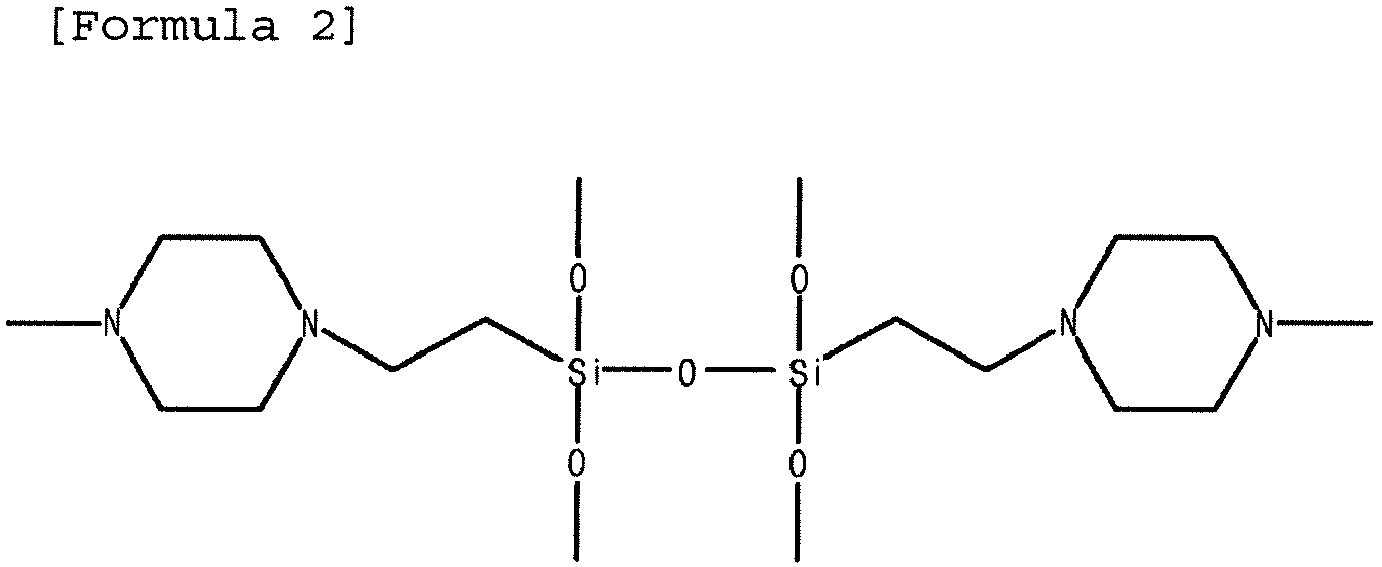
- A modified styrene-butadiene copolymer was prepared by conducting the same method described in Example 1 except for conducting modification reaction by injecting 4 mmol of a compound of Formula 3 below instead of the compound of Formula 2 in Example 1 as a modifier.


- A modified styrene-butadiene copolymer was prepared by conducting the same method described in Example 1 except for conducting modification reaction by injecting 4 mmol of tetraethoxysilane (TEOS) instead of the compound of Formula 2 in Example 1 as a modifier.
- A weight average molecular weight (Mw), a number average molecular weight (Mn), polydispersity index (PDI), styrene derived structural unit and vinyl contents, and mooney viscosity (MV) were measured for each of the modified styrene-butadiene copolymers prepared in Examples 1 and 2 and Comparative Example 1. The results are shown in Table 1 below.
- The styrene derived structural unit (SM) and vinyl contents in each copolymer were measured using nuclear magnetic resonance (NMR) analysis.
- The weight average molecular weight (Mw) and the number average molecular weight (Mn) were measured by gel permeation chromatography (GPC) analysis in conditions of 40°C. In this case, the two columns of PLgel Olexis and one column of PLgel mixed-C of Polymer Laboratories Co. Ltd. were used in combination, and newly replaced columns were all mixed bed type columns. In addition, polystyrene (PS) was used as a GPC standard material for calculating the molecular weight. Polydispersity index (PDI) was calculated from the ratio (Mw/Mn) of the weight average molecular weight (Mw) and the number average molecular weight (Mn) measured by the above method.
- The mooney viscosity of each copolymer was measured by using MV-2000 (Alpha Technologies Co., Ltd.) at 100°C for 4 minutes after pre-heating two specimens, of which amount was 15 g or more each, for 1 minute.
[Table 1] Example 1 Example 2 Comparative Example 1 Modifier amount used (mmol) 4 4 4 Mooney viscosity (MV) 67 69 98 NMR Styrene derived structural unit content ( wt% based on total polymer amou nt) 27.0 26.9 27.2 Vinyl content ( wt% based on total polymer amou nt) 42.9 42.7 42.7 GPC Mn (×104 g/mol) 12.6 12.2 14.8 Mw (×104 g/mol) 14.4 14.1 21.6 PDI (Mw/Mn) 1.14 1.16 1.46 - In order to comparatively analyze the physical properties of a rubber composition including each copolymer of Examples 1 and 2 and Comparative Example 1 and a molded article manufactured therefrom, tensile properties and viscoelasticity properties were measured.
- Each rubber composition was prepared via a first stage mulling, a second stage mulling and a third stage mulling. In this case, the amounts used of materials excluding a modified styrene-butadiene copolymer were shown based on 100 parts by weight of the modified styrene-butadiene copolymer. In the first stage mulling, 100 parts by weight of each copolymer, 70 parts by weight of silica, 11.02 parts by weight of bis(3-triethoxysilylpropyl)tetrasulfide as a silane coupling agent, 33.75 parts by weight of a process oil (TDAE), 2.0 parts by weight of an antiaging agent (TMDQ), 2.0 parts by weight of an antioxidant, 3.0 parts by weight of zinc oxide (ZnO), 2.0 parts by weight of stearic acid, and 1.0 part by weight of wax were mixed and mulled under conditions of 80 rpm by using a banbury mixer equipped with a temperature controlling apparatus. In this case, the temperature of the mulling apparatus was controlled, and a first compound mixture was obtained at a discharge temperature of 140°C to 150°C. In the second stage mulling, the first compound mixture was cooled to room temperature, and 1.75 parts by weight of a rubber accelerator (CZ), 1.5 parts by weight of a sulfur powder, and 2.0 parts by weight of a vulcanization accelerator were added to the mulling apparatus and mixed at a temperature of 60°C or less to obtain a second compound mixture. Then, the second compound mixture was molded at the third stage mulling, and vulcanized at 180°C for t90+10 minutes using a vulcanization press to prepare each vulcanized rubber.
- The tensile properties were measured by manufacturing each specimen (thickness of 25 mm, length of 80 mm) and measuring tensile strength when broken and tensile stress when elongated by 300% (300% modulus) of each specimen according to an ASTM 412 tensile test method. Particularly, a Universal Test machine 4204 tensile tester (Instron Co., Ltd.) was used, and measurement was performed at room temperature at a rate of 50 cm/min, to obtain a tensile strength value and a tensile stress value when elongated by 300%.
- The viscoelasticity properties were measured by using a dynamic mechanical analyzer (TA Co., Ltd.). Tan δ was measured by changing deformation at each measurement temperature (0°C to 60°C) with a twist mode and a frequency of 10 Hz. Payne effect (ΔG') was shown as the difference between a minimum value and a maximum value at deformation of 0.28% to 40%, and if the Payne effect decreases, it means that dispersibility of a filler is excellent. In addition, if the tan δ at a high temperature of 60°C is low, it means that hysteresis loss is small, and low rolling resistance (fuel consumption ratio) is good.
[Table 2] Example 1 Example 2 Comparative Example 1 300% modulus (Kgf/cm2) 150 147 120 Tensile strength 230 220 167 (Kgf/cm2) ΔG' 0.52 0.51 1.20 tan δ @ 0°C 1.167 1.197 0.942 tan δ @ 60°C 0.082 0.085 0.124 - Referring to the experimental results, the rubber composition including the modified styrene-butadiene copolymer of Example 1 or 2, which was modified using a modifier according to the present invention, was excellent in terms of all the properties of tensile strength, viscoelasticity and processability when compared to those of Comparative Example 1.
Claims (15)
- A modified and conjugated diene-based polymer comprising a functional group which is derived from a silane-based compound of the following Formula 1:
 A1 and A2 are each independently a divalent hydrocarbon group of 1 to 10 carbon atoms, which is unsubstituted or substituted with one or at least two selected from the group consisting of an alkyl group of 1 to 10 carbon atoms, a cycloalkyl group of 3 to 10 carbon atoms, an alkoxy group of 1 to 10 carbon atoms, a cycloalkoxy group of 4 to 10 carbon atoms, an aryl group of 6 to 12 carbon atoms, an aryloxy group of 6 to 12 carbon atoms, an alkanoyloxy group of 2 to 12 carbon atoms, an arylalkyloxy group of 7 to 13 carbon atoms, an arylalkyl group of 7 to 13 carbon atoms, and an alkylaryl group of 7 to 13 carbon atoms,R1 to R4 are each independently a halogen group or an alkoxy group of 1 to 6 carbon atoms,X1 and X2 are each independently a nitrogen-containing heterocyclic group which is unsubstituted or substituted with at least one alkyl group of 1 to 6 carbon atoms, andn is an integer of 1 to 5.
 - The modified and conjugated diene-based polymer of claim 1, wherein in Formula 1, X1 and X2 are each independently a five-member to eight-member heterocyclic group containing 1 to 3 nitrogen atoms, which is unsubstituted or substituted with at least one alkyl group of 1 to 3 carbon atoms.
- The modified and conjugated diene-based polymer of claim 1, wherein in Formula 1, A1 and A2 are each independently an alkylene group of 1 to 6 carbon atoms which is unsubstituted or substituted with at least one alkyl group of 1 to 4 carbon atoms, R1 to R4 are each independently a halogen group or an alkoxy group of 1 to 6 carbon atoms, and X1 and X2 are each independently a five-member or six-member heterocycloalkyl group or heteroaryl group containing 1 to 3 nitrogen atoms, which is unsubstituted or substituted with at least one alkyl group of 1 to 3 carbon atoms.
- The modified and conjugated diene-based polymer of claim 1, wherein the silane-based compound of Formula 1 is a compound of the following Formula 1a:
 A1 and A2 are each independently an alkylene group of 1 to 6 carbon atoms, which is unsubstituted or substituted with at least one of an alkyl group of 1 to 4 carbon atoms,R1 to R4 are each independently a halogen group or an alkoxy group of 1 to 6 carbon atoms,Ra to Rd are each independently an alkyl group of 1 to 3 carbon atoms,n is an integer of 1 to 5, and p and p' are each independently an integer of 0 to 4.
 - The modified and conjugated diene-based polymer of claim 1, wherein the silane-based compound of Formula 1 is a compound of the following Formula 1b:
 A1 and A2 are each independently an alkylene group of 1 to 6 carbon atoms, which is unsubstituted or substituted with at least one of an alkyl group of 1 to 4 carbon atoms,R1 to R4 are each independently a halogen group or an alkoxy group of 1 to 6 carbon atoms,Re and Rf are each independently an alkyl group of 1 to 3 carbon atoms,n is an integer of 1 to 5, and q and q' are each independently an integer of 0 to 3.
 - The modified and conjugated diene-based polymer of claim 1, wherein the silane-based compound of Formula 1 is at least one among the following Formula 2 and Formula 3:


- The modified and conjugated diene-based polymer of claim 1, wherein the modified and conjugated diene-based polymer is a homopolymer of conjugated diene-based monomers, or a modified polymer of a copolymer of a conjugated diene-based monomer and an aromatic vinyl-based monomer.
- The modified and conjugated diene-based polymer of claim 1, wherein the modified and conjugated diene-based polymer has a mooney viscosity at 100°C is from 40 to 90.
- A method for preparing the modified and conjugated diene-based polymer of claim 1, the method comprising:preparing an active polymer of which at least one terminal is combined with an alkali metal by polymerizing conjugated diene-based monomers, or an aromatic vinyl-based monomer and a conjugated diene-based monomer in the presence of an organo-alkali metal compound in a hydrocarbon solvent (step 1); andreacting the active polymer with a modifier comprising a silane-based compound of the following Formula 1 (step 2):
 A1 and A2 are each independently a divalent hydrocarbon group of 1 to 10 carbon atoms, which is unsubstituted or substituted with one or at least two selected from the group consisting of an alkyl group of 1 to 10 carbon atoms, a cycloalkyl group of 3 to 10 carbon atoms, an alkoxy group of 1 to 10 carbon atoms, a cycloalkoxy group of 4 to 10 carbon atoms, an aryl group of 6 to 12 carbon atoms, an aryloxy group of 6 to 12 carbon atoms, an alkanoyloxy group of 2 to 12 carbon atoms, an arylalkyloxy group of 7 to 13 carbon atoms, an arylalkyl group of 7 to 13 carbon atoms, and an alkylaryl group of 7 to 13 carbon atoms,R1 to R4 are each independently a halogen group or an alkoxy group of 1 to 6 carbon atoms,X1 and X2 are each independently a nitrogen-containing heterocyclic group which is unsubstituted or substituted with at least one alkyl group of 1 to 6 carbon atoms, andn is an integer of 1 to 5.
 - The method for preparing the modified and conjugated diene-based polymer of claim 9, wherein a polar additive is further added during polymerizing.
- A modifier comprising a silane-based compound of the following Formula 1:
 A1 and A2 are each independently a divalent hydrocarbon group of 1 to 10 carbon atoms, which is unsubstituted or substituted with one or at least two selected from the group consisting of an alkyl group of 1 to 10 carbon atoms, a cycloalkyl group of 3 to 10 carbon atoms, an alkoxy group of 1 to 10 carbon atoms, a cycloalkoxy group of 4 to 10 carbon atoms, an aryl group of 6 to 12 carbon atoms, an aryloxy group of 6 to 12 carbon atoms, an alkanoyloxy group of 2 to 12 carbon atoms, an arylalkyloxy group of 7 to 13 carbon atoms, an arylalkyl group of 7 to 13 carbon atoms, and an alkylaryl group of 7 to 13 carbon atoms,R1 to R4 are each independently a halogen group or an alkoxy group of 1 to 6 carbon atoms,X1 and X2 are each independently a nitrogen-containing heterocyclic group which is unsubstituted or substituted with at least one alkyl group of 1 to 6 carbon atoms, andn is an integer of 1 to 5.
 - A rubber composition comprising the modified and conjugated diene-based polymer according to claim 1.
- The rubber composition of claim 12, wherein the rubber composition further comprises a filler in an amount of 0.1 parts by weight to 150 parts by weight based on 100 parts by weight of the modified and conjugated diene-based polymer.
- The rubber composition of claim 13, wherein the filler is a silica-based filler.
- A tire manufactured from the rubber composition of claim 12.
Applications Claiming Priority (2)
| Application Number | Priority Date | Filing Date | Title |
|---|---|---|---|
| KR1020160054884A KR102046930B1 (en) | 2016-05-03 | 2016-05-03 | Modifying agent and modified conjugated diene polymer prepared by using the same |
| PCT/KR2017/004379 WO2017191921A1 (en) | 2016-05-03 | 2017-04-25 | Modifying agent, and modified conjugated diene-based polymer produced using same |
Publications (3)
| Publication Number | Publication Date |
|---|---|
| EP3281958A1 true EP3281958A1 (en) | 2018-02-14 |
| EP3281958A4 EP3281958A4 (en) | 2018-05-16 |
| EP3281958B1 EP3281958B1 (en) | 2018-11-28 |
Family
ID=60203596
Family Applications (1)
| Application Number | Title | Priority Date | Filing Date |
|---|---|---|---|
| EP17784523.7A Active EP3281958B1 (en) | 2016-05-03 | 2017-04-25 | Modifying agent, and modified conjugated diene-based polymer produced using same |
Country Status (6)
| Country | Link |
|---|---|
| US (1) | US10906995B2 (en) |
| EP (1) | EP3281958B1 (en) |
| JP (1) | JP6488059B2 (en) |
| KR (1) | KR102046930B1 (en) |
| CN (1) | CN107614538B (en) |
| WO (1) | WO2017191921A1 (en) |
Families Citing this family (15)
| Publication number | Priority date | Publication date | Assignee | Title |
|---|---|---|---|---|
| KR101857392B1 (en) * | 2017-01-03 | 2018-06-19 | 주식회사 엘지화학 | Method for preparing modified conjugated diene polymer |
| KR102323810B1 (en) * | 2017-12-05 | 2021-11-10 | 주식회사 엘지화학 | Modified conjugated diene polymer and rubber composition comprising the same |
| US20210079200A1 (en) * | 2017-12-19 | 2021-03-18 | Compagnie Generale Des Etablissements Michelin | Tire tread, the crosslinking system of which is based on organic peroxide |
| KR102744314B1 (en) * | 2018-05-08 | 2024-12-19 | 주식회사 엘지화학 | Modified conjugated diene polymer and rubber composition comprising the same |
| FR3081161B1 (en) | 2018-05-17 | 2020-07-10 | Compagnie Generale Des Etablissements Michelin | TIRE TREAD OF WHICH THE CROSSLINKING SYSTEM IS BASED ON ORGANIC PEROXIDE |
| CN109851880B (en) * | 2019-01-27 | 2021-04-13 | 浙江奥康鞋业股份有限公司 | Formula and production process of ice top-stop slipping material |
| KR102421536B1 (en) | 2019-07-15 | 2022-07-15 | 주식회사 엘지화학 | Modified conjugated diene polymer, preparing method thereof and rubber compostion comprising the same |
| JP7665524B2 (en) | 2019-09-11 | 2025-04-21 | エルジー・ケム・リミテッド | Modified conjugated diene polymer and rubber composition containing same |
| KR102604539B1 (en) | 2019-09-11 | 2023-11-22 | 주식회사 엘지화학 | Modified conjugated diene-based polymer, preparing method thereof and rubber composition comprising the same |
| JP7280972B2 (en) | 2019-09-11 | 2023-05-24 | エルジー・ケム・リミテッド | Modified conjugated diene polymer, method for producing the same, and rubber composition containing the same |
| WO2021049916A1 (en) | 2019-09-11 | 2021-03-18 | 주식회사 엘지화학 | Modified conjugated diene-based polymer, method for producing same, and rubber composition containing same |
| JP7337434B2 (en) | 2019-09-11 | 2023-09-04 | エルジー・ケム・リミテッド | Modified conjugated diene-based polymer and rubber composition containing the same |
| KR102745053B1 (en) * | 2019-10-14 | 2024-12-23 | 주식회사 엘지화학 | Modified conjugated diene polymer of branched structure, preparation mehtod thereof and rubber composition comprising the same |
| KR102536519B1 (en) | 2019-11-29 | 2023-05-26 | 주식회사 엘지화학 | Modifying agent and modified conjugated diene polymer prepared by using the same |
| CN111289731A (en) * | 2020-03-07 | 2020-06-16 | 深圳天溯计量检测股份有限公司 | Rotor-free vulcanizer and use method thereof |
Family Cites Families (18)
| Publication number | Priority date | Publication date | Assignee | Title |
|---|---|---|---|---|
| GB758168A (en) * | 1953-10-28 | 1956-10-03 | Midland Silicones Ltd | Organosilicon compounds |
| NL86588C (en) | 1980-09-20 | |||
| US6765065B2 (en) * | 2002-01-09 | 2004-07-20 | Sumitomo Chemical Company, Limited | Process for producing modified polymer rubber |
| JP2007214396A (en) | 2006-02-10 | 2007-08-23 | Fujifilm Corp | Metal polishing liquid and chemical mechanical polishing method |
| EP2045272B1 (en) | 2006-07-24 | 2010-12-29 | Asahi Kasei Chemicals Corporation | Modified conjugated diene polymer and method for producing the same |
| JP2009137471A (en) | 2007-12-07 | 2009-06-25 | Bridgestone Corp | Pneumatic tire |
| CN102177185A (en) * | 2008-10-14 | 2011-09-07 | 旭化成化学株式会社 | Modified conjugated diene polymer, method for producing same, modified conjugated diene polymer composition, and tire |
| JP5801193B2 (en) * | 2008-11-03 | 2015-10-28 | エルジー・ケム・リミテッド | New nitrogen-containing heterocyclic compounds and organic electronic devices using the same |
| JP5348763B2 (en) * | 2009-06-24 | 2013-11-20 | 旭化成ケミカルズ株式会社 | Modified conjugated diene-aromatic vinyl copolymer, process for producing the same, and copolymer composition thereof |
| JP5705120B2 (en) * | 2009-10-02 | 2015-04-22 | 旭化成ケミカルズ株式会社 | Method for producing modified conjugated diene polymer, modified conjugated diene polymer, and modified conjugated diene polymer composition |
| WO2012108488A1 (en) * | 2011-02-09 | 2012-08-16 | Jsr株式会社 | Rubber composition, method for producing same, and tire |
| EA201490496A1 (en) | 2011-08-26 | 2014-08-29 | Асахи Касеи Кемикалз Корпорейшн | A method for producing modified polymers of conjugated dienes, modified polymers of conjugated dienes, composite compositions of modified polymers of conjugated dienes, rubber composites, and a body code. |
| KR101881375B1 (en) * | 2011-08-31 | 2018-07-24 | 제이에스알 가부시끼가이샤 | Method for producing denatured conjugated diene polymer |
| GB201121122D0 (en) * | 2011-12-08 | 2012-01-18 | Dow Corning | Hydrolysable silanes and elastomer compositions containing them |
| KR101455508B1 (en) * | 2012-02-06 | 2014-10-27 | 주식회사 엘지화학 | Modified Conjugated Diene Polymer And Method For Preparing The Same |
| CN104364250B (en) * | 2012-04-13 | 2017-05-31 | 株式会社Lg化学 | New nitrogen-containing heterocyclic compounds and organic electronic devices using them |
| TWI503331B (en) * | 2012-12-03 | 2015-10-11 | Chi Mei Corp | Terminal-modified copolymer of conjugated diene and vinyl aromatic hydrocarbon and the synthesis method thereof |
| JP6084881B2 (en) * | 2013-04-03 | 2017-02-22 | 住友ゴム工業株式会社 | Rubber composition for tire and pneumatic tire |
-
2016
- 2016-05-03 KR KR1020160054884A patent/KR102046930B1/en active Active
-
2017
- 2017-04-25 WO PCT/KR2017/004379 patent/WO2017191921A1/en not_active Ceased
- 2017-04-25 EP EP17784523.7A patent/EP3281958B1/en active Active
- 2017-04-25 US US15/569,524 patent/US10906995B2/en active Active
- 2017-04-25 CN CN201780001831.2A patent/CN107614538B/en active Active
- 2017-04-25 JP JP2018514814A patent/JP6488059B2/en active Active
Also Published As
| Publication number | Publication date |
|---|---|
| US20180223006A1 (en) | 2018-08-09 |
| EP3281958B1 (en) | 2018-11-28 |
| JP2018529010A (en) | 2018-10-04 |
| EP3281958A4 (en) | 2018-05-16 |
| CN107614538B (en) | 2020-02-11 |
| WO2017191921A1 (en) | 2017-11-09 |
| CN107614538A (en) | 2018-01-19 |
| KR20170124897A (en) | 2017-11-13 |
| KR102046930B1 (en) | 2019-11-20 |
| JP6488059B2 (en) | 2019-03-20 |
| US10906995B2 (en) | 2021-02-02 |
Similar Documents
| Publication | Publication Date | Title |
|---|---|---|
| EP3281958B1 (en) | Modifying agent, and modified conjugated diene-based polymer produced using same | |
| US12037432B2 (en) | Method for preparing modified and conjugated diene-based polymer and modified and conjugated diene-based polymer prepared using the same | |
| EP3333199B1 (en) | Modified conjugated diene-based polymer and method for preparing the same | |
| EP3296322B1 (en) | Modified conjugated diene polymer, production method therefor, and modifier | |
| US10392449B2 (en) | Polymerization initiator, modified conjugated diene-based polymer, and methods for preparing them | |
| EP3372622B1 (en) | Modified conjugated diene-based polymer and method of preparing the same | |
| EP3312199B1 (en) | Azasilane-based modifier, and method for preparing modified and conjugated diene-based polymer using the same | |
| EP3296324B1 (en) | Novel compound containing silyl group, modified conjugated diene-based polymer, and method for preparing same | |
| EP3312205A1 (en) | Polymer compound, method for preparing modified conjugated diene-based polymer by using same, and modified conjugated diene-based polymer | |
| EP3372621B1 (en) | Modified conjugated diene-based polymer and method for producing same | |
| EP3971238B1 (en) | Modifying agent and modified conjugated diene polymer prepared by using the same | |
| KR20170077614A (en) | Modifying agent, preparation method of modified conjugated diene polymer using the modifying agent and modified conjugated diene polymer | |
| EP3345941B1 (en) | Modifier, modified conjugated diene-based polymer and method for preparing the same | |
| KR20170077517A (en) | Modifying agent, preparation method of modified conjugated diene polymer using the modifying agent and modified conjugated diene polymer | |
| KR20170074676A (en) | Modifying agent, preparation method of modified conjugated diene polymer using the modifying agent and modified conjugated diene polymer | |
| EP3345945B1 (en) | Modified monomer, modified conjugated diene-based polymer comprising same, and method for preparing same |
Legal Events
| Date | Code | Title | Description |
|---|---|---|---|
| STAA | Information on the status of an ep patent application or granted ep patent |
Free format text: STATUS: UNKNOWN |
|
| STAA | Information on the status of an ep patent application or granted ep patent |
Free format text: STATUS: THE INTERNATIONAL PUBLICATION HAS BEEN MADE |
|
| PUAI | Public reference made under article 153(3) epc to a published international application that has entered the european phase |
Free format text: ORIGINAL CODE: 0009012 |
|
| STAA | Information on the status of an ep patent application or granted ep patent |
Free format text: STATUS: REQUEST FOR EXAMINATION WAS MADE |
|
| 17P | Request for examination filed |
Effective date: 20171026 |
|
| AK | Designated contracting states |
Kind code of ref document: A1 Designated state(s): AL AT BE BG CH CY CZ DE DK EE ES FI FR GB GR HR HU IE IS IT LI LT LU LV MC MK MT NL NO PL PT RO RS SE SI SK SM TR |
|
| AX | Request for extension of the european patent |
Extension state: BA ME |
|
| A4 | Supplementary search report drawn up and despatched |
Effective date: 20180416 |
|
| RIC1 | Information provided on ipc code assigned before grant |
Ipc: C08K 5/5415 20060101ALI20180410BHEP Ipc: C08F 8/00 20060101ALI20180410BHEP Ipc: C08C 19/22 20060101ALI20180410BHEP Ipc: C08C 19/44 20060101ALI20180410BHEP Ipc: C08L 51/08 20060101ALI20180410BHEP Ipc: C08K 5/544 20060101ALI20180410BHEP Ipc: C08K 3/36 20060101ALI20180410BHEP Ipc: B60C 1/00 20060101ALI20180410BHEP Ipc: C08C 19/25 20060101AFI20180410BHEP |
|
| GRAP | Despatch of communication of intention to grant a patent |
Free format text: ORIGINAL CODE: EPIDOSNIGR1 |
|
| RIC1 | Information provided on ipc code assigned before grant |
Ipc: C08L 51/08 20060101ALI20180719BHEP Ipc: C08K 3/36 20060101ALI20180719BHEP Ipc: B60C 1/00 20060101ALI20180719BHEP Ipc: C08C 19/25 20060101AFI20180719BHEP Ipc: C08F 8/00 20060101ALI20180719BHEP Ipc: C08K 5/544 20060101ALI20180719BHEP Ipc: C08C 19/44 20060101ALI20180719BHEP Ipc: C08K 5/5415 20060101ALI20180719BHEP Ipc: C08C 19/22 20060101ALI20180719BHEP |
|
| STAA | Information on the status of an ep patent application or granted ep patent |
Free format text: STATUS: GRANT OF PATENT IS INTENDED |
|
| INTG | Intention to grant announced |
Effective date: 20180823 |
|
| GRAS | Grant fee paid |
Free format text: ORIGINAL CODE: EPIDOSNIGR3 |
|
| GRAA | (expected) grant |
Free format text: ORIGINAL CODE: 0009210 |
|
| STAA | Information on the status of an ep patent application or granted ep patent |
Free format text: STATUS: THE PATENT HAS BEEN GRANTED |
|
| DAV | Request for validation of the european patent (deleted) | ||
| DAX | Request for extension of the european patent (deleted) | ||
| AK | Designated contracting states |
Kind code of ref document: B1 Designated state(s): AL AT BE BG CH CY CZ DE DK EE ES FI FR GB GR HR HU IE IS IT LI LT LU LV MC MK MT NL NO PL PT RO RS SE SI SK SM TR |
|
| REG | Reference to a national code |
Ref country code: CH Ref legal event code: EP |
|
| REG | Reference to a national code |
Ref country code: AT Ref legal event code: REF Ref document number: 1070115 Country of ref document: AT Kind code of ref document: T Effective date: 20181215 |
|
| REG | Reference to a national code |
Ref country code: IE Ref legal event code: FG4D |
|
| REG | Reference to a national code |
Ref country code: DE Ref legal event code: R096 Ref document number: 602017001094 Country of ref document: DE |
|
| REG | Reference to a national code |
Ref country code: NL Ref legal event code: MP Effective date: 20181128 |
|
| REG | Reference to a national code |
Ref country code: LT Ref legal event code: MG4D |
|
| REG | Reference to a national code |
Ref country code: AT Ref legal event code: MK05 Ref document number: 1070115 Country of ref document: AT Kind code of ref document: T Effective date: 20181128 |
|
| PG25 | Lapsed in a contracting state [announced via postgrant information from national office to epo] |
Ref country code: FI Free format text: LAPSE BECAUSE OF FAILURE TO SUBMIT A TRANSLATION OF THE DESCRIPTION OR TO PAY THE FEE WITHIN THE PRESCRIBED TIME-LIMIT Effective date: 20181128 Ref country code: IS Free format text: LAPSE BECAUSE OF FAILURE TO SUBMIT A TRANSLATION OF THE DESCRIPTION OR TO PAY THE FEE WITHIN THE PRESCRIBED TIME-LIMIT Effective date: 20190328 Ref country code: LT Free format text: LAPSE BECAUSE OF FAILURE TO SUBMIT A TRANSLATION OF THE DESCRIPTION OR TO PAY THE FEE WITHIN THE PRESCRIBED TIME-LIMIT Effective date: 20181128 Ref country code: BG Free format text: LAPSE BECAUSE OF FAILURE TO SUBMIT A TRANSLATION OF THE DESCRIPTION OR TO PAY THE FEE WITHIN THE PRESCRIBED TIME-LIMIT Effective date: 20190228 Ref country code: HR Free format text: LAPSE BECAUSE OF FAILURE TO SUBMIT A TRANSLATION OF THE DESCRIPTION OR TO PAY THE FEE WITHIN THE PRESCRIBED TIME-LIMIT Effective date: 20181128 Ref country code: LV Free format text: LAPSE BECAUSE OF FAILURE TO SUBMIT A TRANSLATION OF THE DESCRIPTION OR TO PAY THE FEE WITHIN THE PRESCRIBED TIME-LIMIT Effective date: 20181128 Ref country code: NO Free format text: LAPSE BECAUSE OF FAILURE TO SUBMIT A TRANSLATION OF THE DESCRIPTION OR TO PAY THE FEE WITHIN THE PRESCRIBED TIME-LIMIT Effective date: 20190228 Ref country code: AT Free format text: LAPSE BECAUSE OF FAILURE TO SUBMIT A TRANSLATION OF THE DESCRIPTION OR TO PAY THE FEE WITHIN THE PRESCRIBED TIME-LIMIT Effective date: 20181128 |
|
| PG25 | Lapsed in a contracting state [announced via postgrant information from national office to epo] |
Ref country code: PT Free format text: LAPSE BECAUSE OF FAILURE TO SUBMIT A TRANSLATION OF THE DESCRIPTION OR TO PAY THE FEE WITHIN THE PRESCRIBED TIME-LIMIT Effective date: 20190328 Ref country code: AL Free format text: LAPSE BECAUSE OF FAILURE TO SUBMIT A TRANSLATION OF THE DESCRIPTION OR TO PAY THE FEE WITHIN THE PRESCRIBED TIME-LIMIT Effective date: 20181128 Ref country code: GR Free format text: LAPSE BECAUSE OF FAILURE TO SUBMIT A TRANSLATION OF THE DESCRIPTION OR TO PAY THE FEE WITHIN THE PRESCRIBED TIME-LIMIT Effective date: 20190301 Ref country code: RS Free format text: LAPSE BECAUSE OF FAILURE TO SUBMIT A TRANSLATION OF THE DESCRIPTION OR TO PAY THE FEE WITHIN THE PRESCRIBED TIME-LIMIT Effective date: 20181128 Ref country code: SE Free format text: LAPSE BECAUSE OF FAILURE TO SUBMIT A TRANSLATION OF THE DESCRIPTION OR TO PAY THE FEE WITHIN THE PRESCRIBED TIME-LIMIT Effective date: 20181128 |
|
| PG25 | Lapsed in a contracting state [announced via postgrant information from national office to epo] |
Ref country code: NL Free format text: LAPSE BECAUSE OF FAILURE TO SUBMIT A TRANSLATION OF THE DESCRIPTION OR TO PAY THE FEE WITHIN THE PRESCRIBED TIME-LIMIT Effective date: 20181128 |
|
| PG25 | Lapsed in a contracting state [announced via postgrant information from national office to epo] |
Ref country code: DK Free format text: LAPSE BECAUSE OF FAILURE TO SUBMIT A TRANSLATION OF THE DESCRIPTION OR TO PAY THE FEE WITHIN THE PRESCRIBED TIME-LIMIT Effective date: 20181128 Ref country code: ES Free format text: LAPSE BECAUSE OF FAILURE TO SUBMIT A TRANSLATION OF THE DESCRIPTION OR TO PAY THE FEE WITHIN THE PRESCRIBED TIME-LIMIT Effective date: 20181128 Ref country code: CZ Free format text: LAPSE BECAUSE OF FAILURE TO SUBMIT A TRANSLATION OF THE DESCRIPTION OR TO PAY THE FEE WITHIN THE PRESCRIBED TIME-LIMIT Effective date: 20181128 Ref country code: PL Free format text: LAPSE BECAUSE OF FAILURE TO SUBMIT A TRANSLATION OF THE DESCRIPTION OR TO PAY THE FEE WITHIN THE PRESCRIBED TIME-LIMIT Effective date: 20181128 |
|
| REG | Reference to a national code |
Ref country code: DE Ref legal event code: R097 Ref document number: 602017001094 Country of ref document: DE |
|
| PG25 | Lapsed in a contracting state [announced via postgrant information from national office to epo] |
Ref country code: RO Free format text: LAPSE BECAUSE OF FAILURE TO SUBMIT A TRANSLATION OF THE DESCRIPTION OR TO PAY THE FEE WITHIN THE PRESCRIBED TIME-LIMIT Effective date: 20181128 Ref country code: SK Free format text: LAPSE BECAUSE OF FAILURE TO SUBMIT A TRANSLATION OF THE DESCRIPTION OR TO PAY THE FEE WITHIN THE PRESCRIBED TIME-LIMIT Effective date: 20181128 Ref country code: EE Free format text: LAPSE BECAUSE OF FAILURE TO SUBMIT A TRANSLATION OF THE DESCRIPTION OR TO PAY THE FEE WITHIN THE PRESCRIBED TIME-LIMIT Effective date: 20181128 Ref country code: SM Free format text: LAPSE BECAUSE OF FAILURE TO SUBMIT A TRANSLATION OF THE DESCRIPTION OR TO PAY THE FEE WITHIN THE PRESCRIBED TIME-LIMIT Effective date: 20181128 |
|
| PLBE | No opposition filed within time limit |
Free format text: ORIGINAL CODE: 0009261 |
|
| STAA | Information on the status of an ep patent application or granted ep patent |
Free format text: STATUS: NO OPPOSITION FILED WITHIN TIME LIMIT |
|
| 26N | No opposition filed |
Effective date: 20190829 |
|
| REG | Reference to a national code |
Ref country code: BE Ref legal event code: MM Effective date: 20190430 |
|
| PG25 | Lapsed in a contracting state [announced via postgrant information from national office to epo] |
Ref country code: MC Free format text: LAPSE BECAUSE OF FAILURE TO SUBMIT A TRANSLATION OF THE DESCRIPTION OR TO PAY THE FEE WITHIN THE PRESCRIBED TIME-LIMIT Effective date: 20181128 Ref country code: LU Free format text: LAPSE BECAUSE OF NON-PAYMENT OF DUE FEES Effective date: 20190425 |
|
| PG25 | Lapsed in a contracting state [announced via postgrant information from national office to epo] |
Ref country code: BE Free format text: LAPSE BECAUSE OF NON-PAYMENT OF DUE FEES Effective date: 20190430 |
|
| PG25 | Lapsed in a contracting state [announced via postgrant information from national office to epo] |
Ref country code: TR Free format text: LAPSE BECAUSE OF FAILURE TO SUBMIT A TRANSLATION OF THE DESCRIPTION OR TO PAY THE FEE WITHIN THE PRESCRIBED TIME-LIMIT Effective date: 20181128 |
|
| PG25 | Lapsed in a contracting state [announced via postgrant information from national office to epo] |
Ref country code: IE Free format text: LAPSE BECAUSE OF NON-PAYMENT OF DUE FEES Effective date: 20190425 |
|
| REG | Reference to a national code |
Ref country code: CH Ref legal event code: PL |
|
| PG25 | Lapsed in a contracting state [announced via postgrant information from national office to epo] |
Ref country code: LI Free format text: LAPSE BECAUSE OF NON-PAYMENT OF DUE FEES Effective date: 20200430 Ref country code: CH Free format text: LAPSE BECAUSE OF NON-PAYMENT OF DUE FEES Effective date: 20200430 |
|
| PG25 | Lapsed in a contracting state [announced via postgrant information from national office to epo] |
Ref country code: CY Free format text: LAPSE BECAUSE OF FAILURE TO SUBMIT A TRANSLATION OF THE DESCRIPTION OR TO PAY THE FEE WITHIN THE PRESCRIBED TIME-LIMIT Effective date: 20181128 |
|
| PG25 | Lapsed in a contracting state [announced via postgrant information from national office to epo] |
Ref country code: MT Free format text: LAPSE BECAUSE OF FAILURE TO SUBMIT A TRANSLATION OF THE DESCRIPTION OR TO PAY THE FEE WITHIN THE PRESCRIBED TIME-LIMIT Effective date: 20181128 Ref country code: HU Free format text: LAPSE BECAUSE OF FAILURE TO SUBMIT A TRANSLATION OF THE DESCRIPTION OR TO PAY THE FEE WITHIN THE PRESCRIBED TIME-LIMIT; INVALID AB INITIO Effective date: 20170425 |
|
| PG25 | Lapsed in a contracting state [announced via postgrant information from national office to epo] |
Ref country code: SI Free format text: LAPSE BECAUSE OF FAILURE TO SUBMIT A TRANSLATION OF THE DESCRIPTION OR TO PAY THE FEE WITHIN THE PRESCRIBED TIME-LIMIT Effective date: 20181128 |
|
| PG25 | Lapsed in a contracting state [announced via postgrant information from national office to epo] |
Ref country code: MK Free format text: LAPSE BECAUSE OF FAILURE TO SUBMIT A TRANSLATION OF THE DESCRIPTION OR TO PAY THE FEE WITHIN THE PRESCRIBED TIME-LIMIT Effective date: 20181128 |
|
| PGFP | Annual fee paid to national office [announced via postgrant information from national office to epo] |
Ref country code: IT Payment date: 20250321 Year of fee payment: 9 |
|
| PGFP | Annual fee paid to national office [announced via postgrant information from national office to epo] |
Ref country code: DE Payment date: 20250320 Year of fee payment: 9 |
|
| PGFP | Annual fee paid to national office [announced via postgrant information from national office to epo] |
Ref country code: GB Payment date: 20260324 Year of fee payment: 10 |
|
| PGFP | Annual fee paid to national office [announced via postgrant information from national office to epo] |
Ref country code: FR Payment date: 20260323 Year of fee payment: 10 |