EP3281948B1 - Polar solvent solution and production method thereof - Google Patents
Polar solvent solution and production method thereof Download PDFInfo
- Publication number
- EP3281948B1 EP3281948B1 EP16776502.3A EP16776502A EP3281948B1 EP 3281948 B1 EP3281948 B1 EP 3281948B1 EP 16776502 A EP16776502 A EP 16776502A EP 3281948 B1 EP3281948 B1 EP 3281948B1
- Authority
- EP
- European Patent Office
- Prior art keywords
- solution
- polar solvent
- protein
- mass
- amino acid
- Prior art date
- Legal status (The legal status is an assumption and is not a legal conclusion. Google has not performed a legal analysis and makes no representation as to the accuracy of the status listed.)
- Active
Links
Images


Classifications
-
- C—CHEMISTRY; METALLURGY
- C07—ORGANIC CHEMISTRY
- C07K—PEPTIDES
- C07K14/00—Peptides having more than 20 amino acids; Gastrins; Somatostatins; Melanotropins; Derivatives thereof
- C07K14/435—Peptides having more than 20 amino acids; Gastrins; Somatostatins; Melanotropins; Derivatives thereof from animals; from humans
- C07K14/43504—Peptides having more than 20 amino acids; Gastrins; Somatostatins; Melanotropins; Derivatives thereof from animals; from humans from invertebrates
- C07K14/43513—Peptides having more than 20 amino acids; Gastrins; Somatostatins; Melanotropins; Derivatives thereof from animals; from humans from invertebrates from arachnidae
- C07K14/43518—Peptides having more than 20 amino acids; Gastrins; Somatostatins; Melanotropins; Derivatives thereof from animals; from humans from invertebrates from arachnidae from spiders
-
- C—CHEMISTRY; METALLURGY
- C07—ORGANIC CHEMISTRY
- C07K—PEPTIDES
- C07K14/00—Peptides having more than 20 amino acids; Gastrins; Somatostatins; Melanotropins; Derivatives thereof
- C07K14/435—Peptides having more than 20 amino acids; Gastrins; Somatostatins; Melanotropins; Derivatives thereof from animals; from humans
-
- C—CHEMISTRY; METALLURGY
- C08—ORGANIC MACROMOLECULAR COMPOUNDS; THEIR PREPARATION OR CHEMICAL WORKING-UP; COMPOSITIONS BASED THEREON
- C08J—WORKING-UP; GENERAL PROCESSES OF COMPOUNDING; AFTER-TREATMENT NOT COVERED BY SUBCLASSES C08B, C08C, C08F, C08G or C08H
- C08J3/00—Processes of treating or compounding macromolecular substances
- C08J3/02—Making solutions, dispersions, lattices or gels by other methods than by solution, emulsion or suspension polymerisation techniques
- C08J3/09—Making solutions, dispersions, lattices or gels by other methods than by solution, emulsion or suspension polymerisation techniques in organic liquids
- C08J3/091—Making solutions, dispersions, lattices or gels by other methods than by solution, emulsion or suspension polymerisation techniques in organic liquids characterised by the chemical constitution of the organic liquid
-
- C—CHEMISTRY; METALLURGY
- C08—ORGANIC MACROMOLECULAR COMPOUNDS; THEIR PREPARATION OR CHEMICAL WORKING-UP; COMPOSITIONS BASED THEREON
- C08L—COMPOSITIONS OF MACROMOLECULAR COMPOUNDS
- C08L89/00—Compositions of proteins; Compositions of derivatives thereof
-
- D—TEXTILES; PAPER
- D01—NATURAL OR MAN-MADE THREADS OR FIBRES; SPINNING
- D01C—CHEMICAL OR BIOLOGICAL TREATMENT OF NATURAL FILAMENTARY OR FIBROUS MATERIAL TO OBTAIN FILAMENTS OR FIBRES FOR SPINNING; CARBONISING RAGS TO RECOVER ANIMAL FIBRES
- D01C3/00—Treatment of animal material, e.g. chemical scouring of wool
-
- D—TEXTILES; PAPER
- D01—NATURAL OR MAN-MADE THREADS OR FIBRES; SPINNING
- D01D—MECHANICAL METHODS OR APPARATUS IN THE MANUFACTURE OF ARTIFICIAL FILAMENTS, THREADS, FIBRES, BRISTLES OR RIBBONS
- D01D1/00—Treatment of filament-forming or like material
- D01D1/02—Preparation of spinning solutions
-
- D—TEXTILES; PAPER
- D01—NATURAL OR MAN-MADE THREADS OR FIBRES; SPINNING
- D01F—CHEMICAL FEATURES IN THE MANUFACTURE OF ARTIFICIAL FILAMENTS, THREADS, FIBRES, BRISTLES OR RIBBONS; APPARATUS SPECIALLY ADAPTED FOR THE MANUFACTURE OF CARBON FILAMENTS
- D01F1/00—General methods for the manufacture of artificial filaments or the like
- D01F1/02—Addition of substances to the spinning solution or to the melt
-
- D—TEXTILES; PAPER
- D01—NATURAL OR MAN-MADE THREADS OR FIBRES; SPINNING
- D01F—CHEMICAL FEATURES IN THE MANUFACTURE OF ARTIFICIAL FILAMENTS, THREADS, FIBRES, BRISTLES OR RIBBONS; APPARATUS SPECIALLY ADAPTED FOR THE MANUFACTURE OF CARBON FILAMENTS
- D01F4/00—Monocomponent artificial filaments or the like of proteins; Manufacture thereof
- D01F4/02—Monocomponent artificial filaments or the like of proteins; Manufacture thereof from fibroin
-
- D—TEXTILES; PAPER
- D01—NATURAL OR MAN-MADE THREADS OR FIBRES; SPINNING
- D01F—CHEMICAL FEATURES IN THE MANUFACTURE OF ARTIFICIAL FILAMENTS, THREADS, FIBRES, BRISTLES OR RIBBONS; APPARATUS SPECIALLY ADAPTED FOR THE MANUFACTURE OF CARBON FILAMENTS
- D01F6/00—Monocomponent artificial filaments or the like of synthetic polymers; Manufacture thereof
- D01F6/58—Monocomponent artificial filaments or the like of synthetic polymers; Manufacture thereof from homopolycondensation products
- D01F6/68—Monocomponent artificial filaments or the like of synthetic polymers; Manufacture thereof from homopolycondensation products from polyaminoacids or polypeptides
-
- C—CHEMISTRY; METALLURGY
- C08—ORGANIC MACROMOLECULAR COMPOUNDS; THEIR PREPARATION OR CHEMICAL WORKING-UP; COMPOSITIONS BASED THEREON
- C08J—WORKING-UP; GENERAL PROCESSES OF COMPOUNDING; AFTER-TREATMENT NOT COVERED BY SUBCLASSES C08B, C08C, C08F, C08G or C08H
- C08J2389/00—Characterised by the use of proteins; Derivatives thereof
Definitions
- the present invention relates to method for producing a polar solvent solution that can keep its viscosity high.
- Polar solvents such as dimethylsulfoxide (DMSO) can dissolve substances such as polymers easily, so they are used for acrylic fiber polymerization and acrylic fiber spinning solutions, or as solvents for polyimide polymerization, etc.
- DMSO dimethylsulfoxide
- the inventors of the present invention have proposed application of the polar solvents as solvents of polypeptides such as spider silk proteins and silk proteins in Patent Documents 1 and 2.
- the applicant of the present invention has proposed extraction methods for hydrophilic recombinant proteins that include the use of aprotic polar solvents in Patent Document 3.
- Non-patent Document 1 identifies solvents for silk fibroin, particularly LiBr.H 2 O.
- Non-patent Document 2 examines the solubility of silk fibroin in various media.
- Non-patent Document 3 provides a solution to dissolve the adhesive silk protein sericin in which chemical modification may be performed.
- Non-patent Document 4 discusses the properties of silk proteins such as spider silks and considers their solubility in general terms.
- Non-patent Document 5 is concerned with spider silk fibers spun from soluble recombinant silk. The solvent for dissolution varied depending on the protein, e.g. buffered saline or strong denaturing solvents.
- Non-patent Document 6 is concerned with the issues resulting from storage of compounds in DMSO and observes that DMSO absorbs water over time.
- polar solvent solutions e.g., solutions in which polypeptides such as spider silk proteins and silk proteins are dissolved in dimethylsulfoxide (DMSO)
- DMSO dimethylsulfoxide
- the polar solvent solutions still have room for improvement in terms of performing stable spinning and casting when used as dopes for spinning, film, etc.
- the present invention provides a method for producing a polar solvent solution that enables stable spinning and casting without lowering its viscosity when used as dopes for spinning, film, etc..
- the present invention relates to a method for producing a polar solvent solution in which a solute containing a polyamino acid is dissolved in a polar solvent, wherein the polyamino acid is a spider silk protein and the polar solvent contains at least one selected from the group consisting of dimethylsulfoxide (DMSO), N,N-dimethylformamide (DMF), N,N-dimethylacetamide (DMA), and N-methyl-2-pyrrolidone (NMP).
- DMSO dimethylsulfoxide
- DMF N,N-dimethylformamide
- DMA N,N-dimethylacetamide
- NMP N-methyl-2-pyrrolidone
- the moisture content of the solution is reduced to increase the viscosity of the solution, wherein the moisture content of the solution is reduced by adjusting the relative humidity of the atmosphere in the production and/or storage of the solution so that the solution has a moisture content of less than 5% by mass based on 100% by mass of the solution.
- the polar solvent solution that is produced by the method of the present invention in which a solute containing a polyamino acid is dissolved in a polar solvent, has a moisture content of less than 5 mass% based on 100% by mass of the solution. By doing so, it is possible to prevent the viscosity of the solution from lowering significantly, and thus spinning and casting are stabilized when the solution is used as dopes for spinning, film, etc.
- the moisture content of the polar solvent solution in which a solute containing a polyamino acid is dissolved in a polar solvent is reduced to increase the viscosity of the solution. By doing so, it is possible to obtain a polar solvent solution that enables stable spinning and casting.
- the inventors of the present invention found that polyamino acid (particularly polypeptide) itself, as well as a polar solvent solution in which a solute containing the polyamino acid is dissolved in polar solvent, readily absorbs moisture and lowers its viscosity.
- the polar solvent solution produced by the method of the present invention in which a solute containing a polyamino acid is dissolved in a polar solvent, has a moisture content of less than 5 mass% (0 mass% or more and less than 5 mass%) based on 100 mass% of the solution.
- the moisture content of the polar solvent solution is preferably 0 mass% or more and 3 mass% or less, more preferably 0 mass% or more and 1.5 mass% or less.
- the polyamino acid (particularly polypeptide and a spider silk protein according to the invention) in a swollen state is dissolved in the polar solvent, and the viscosity of the polar solvent solution is maintained high.
- the viscosity of the polar solvent solution decreases significantly, and spinnability and casting properties decrease accordingly when the solution is used as dopes for spinning, film, etc.
- the polar solvent solution is also called a dope. The following mainly describes a case of using polypeptide, which is an exemplary polyamino acid.
- the polar solvent to be used in the method of the present invention contain at least one aprotic polar solvent selected from the group consisting of (i) dimethylsulfoxide (DMSO), (ii) N,N-dimethylformamide (DMF), (iii) N,N-dimethylacetamide (DMA), and (iv) N-methyl-2-pyrrolidone (NMP).
- aprotic polar solvent selected from the group consisting of (i) dimethylsulfoxide (DMSO), (ii) N,N-dimethylformamide (DMF), (iii) N,N-dimethylacetamide (DMA), and (iv) N-methyl-2-pyrrolidone (NMP).
- the ratio of the total amount of the at least one aprotic polar solvent selected from the group consisting of (i)-(iv) described above is desirably 10 to 100 mass%, based on 100 mass% of the polar solvent as a whole. Within this range, the solubility of the solutes containing polypeptides can be enhanced.
- the solute contains a polyamino acid (in the present invention a spider silk protein).
- the polyamino acid refers to any polyamide compound polymerized through amide linkage between amino groups and carboxyl groups of amino acids.
- the number of amino acids constituting the polyamide compound is preferably 15 or more, more preferably 20 or more, further preferably 30 or more, still further preferably 100 or more, and particularly preferably 500 or more, and preferably 6000 or less, more preferably 5000 or less, further preferably 3000 or less, and particularly preferably 2000 or less.
- the solute to be used in the present specification may be composed of, e.g., polyamino acid alone or contain one or more kinds of substances (e.g., carbonhydrate, synthetic resin) other than the polyamino acid in combination with the polypeptide.
- the solute to be used in the present specification may be composed of, e.g., polypeptide alone or contain one or more kinds of substances (e.g., carbonhydrate, synthetic resin) other than the polypeptide in combination with the polypeptide.
- the polypeptide used in the methods of the invention is a spider silk protein which is a structural protein, more preferably a structural protein including crystal regions. Such polypeptides can exhibit high strength and high toughness when formed into fibers, films, and the like.
- the structural protein refers to any protein involved in structures of living organisms, or any protein constituting structures created by living organisms.
- structural proteins include fibroin, sericin, collagen, keratin, elastin, and resillin.
- the invention is concerned with spider silk proteins.
- the polypeptides used in the methods of the invention are spider silk proteins. Spider silk proteins have a high affinity for polar solvents and can be dissolved in the polar solvents easily.
- the concentration of the solute i.e., spider silk protein
- the concentration of the solute is desirably 2 to 50 mass%, further preferably 3 to 40 mass%, and particularly preferably 5 to 30 mass%.
- the decrease or excessive increase of the viscosity of the polar solvent solution can be avoided effectively.
- the polar solvent solution produced by the method of the present invention desirably in a state where undesired substances such as dust and bubbles have been removed, has a viscosity of preferably 10 to 100000 mPa • s, further preferably 15 to 20000 mPa • s, and particularly preferably 100 to 10000 mPa • s.
- the polar solvent solution within this viscosity range enables favorable wet spinning and film casting when used as dopes.
- the viscosity of the polar solvent solution is increased as the moisture content of the polar solvent solution is reduced.
- the moisture content of the polar solvent solution is less than 5 mass%, more preferably 0 to 3 mass%, and further preferably 0 to 1.5 mass% based on 100 mass% of the solution.
- a reduction in the moisture content of the solution is achieved by, e.g., subjecting the solute or the solvent to heat drying or vacuum drying in advance, or adjusting the relative humidity of the atmosphere in at least one of the production and the storage of the solution, or vaporizing moisture of the produced solution by heating, or absorbing moisture using various kinds of moisture absorbents (moisture absorbent materials) such as zeolite, or combining these operations appropriately.
- moisture absorbents moisture absorbent materials
- the method of drying the solute before dissolution in the solvent is favorably adopted. By doing so, the moisture content of the solution can be reduced more reliably and more efficiently.
- the moisture content of the solution is reduced by adjusting the relative humidity of the atmosphere in the production and/or storage of the solution so that the solution has a moisture content of less than 5% by mass based on 100% by mass of the solution.
- the relative humidity of the atmosphere in at least one of the production and the storage of the solution is kept at 1.3% RH or less.
- processes such as the production and storage of the solution be carried out inside a dry room.
- DMSO which is suitably used as a polar solvent for dissolving a solute containing a polypeptide
- DMSO has a melting point of 18.4°C and a boiling point of 189°C.
- DMSO has a much higher boiling point than hexafluoroisopropanol (HFIP) and hexafluroacetone (HFAc) having boiling points of 59°C and -26.5°C, respectively, which have been used in conventional methods.
- HFIP hexafluoroisopropanol
- HFAc hexafluroacetone
- the spider silk proteins which are the polypeptides to be contained in the solute in the methods of the present invention, are not limited particularly as long as they are natural spider silk proteins or proteins derived from or analogous to (hereinafter, simply referred to as "derived from”) natural spider silk proteins.
- the proteins derived from natural spider silk proteins described herein are proteins having an amino acid sequence similar to or analogous to any of repetitive sequences of amino acids of natural spider silk proteins, examples of which includes variants, analogs, and derivatives of recombinant spider silk proteins and natural spider silk proteins.
- the spider silk proteins are preferably major dragline silk proteins produced in major ampullate glands of spiders or spider silk proteins derived therefrom, in terms of excellent tenacity.
- Examples of the major dragline silk proteins include major ampullate spidroins MaSp1 and MaSp2 derived from Nephila clavipes, and ADF3 and ADF4 derived from Araneus diadematus, etc.
- the spider silk proteins may be minor dragline silk proteins produced in minor ampullate glands of spiders or spider silk proteins derived therefrom.
- Examples of the minor dragline silk proteins include minor ampullate spidroins MiSp1 and MiSp2 derived from Nephila clavipes.
- the spider silk proteins may be flagelliform silk proteins produced in flagelliform glands of spiders or spider silk proteins derived therefrom.
- flagelliform silk proteins include flagelliform silk proteins derived from Nephila clavipes, etc.
- spider silk proteins polypeptides derived from major dragline silk proteins
- spider silk proteins include recombinant spider silk proteins containing two or more units of an amino acid sequence represented by the formula 1: REP1-REP2 (1), preferably recombinant spider silk proteins containing four or more units thereof, and more preferably recombinant spider silk proteins containing six or more units thereof.
- units of the amino acid sequence represented by the formula (1): REP1-REP2 (1) may be the same or different from each other.
- the REP1 represents a polyalanine region mainly constituted by alanine and expressed as (Xl)p, and preferably the REP1 represents polyalanine.
- p is not particularly limited, but preferably an integer of 2 to 20, more preferably an integer of 4 to 12.
- X1 represents alanine (Ala), serine (Ser), or glycine (Gly).
- the total number of alanine residues in the polyalanine region expressed as (X1)p is preferably 80% or more, more preferably 85% or more with respect to the total number of amino acid residues in the region.
- the number of alanine residues arranged in succession is preferably 2 or more, more preferably 3 or more, further preferably 4 or more, and particularly preferably 5 or more. Further, in the REP1, the number of alanine residues arranged in succession is preferably 20 or less, more preferably 16 or less, further preferably 12 or less, and particularly preferably 10 or less.
- the REP2 is an amino acid sequence composed of 10 to 200 amino acid residues. The total number of glycine, serine, glutamine, proline and alanine residues contained in the amino acid sequence is 40% or more, preferably 50% or more, and more preferably 60% or more with respect to the total number of amino acid residues contained therein.
- the REP1 corresponds to a crystal region in a fiber where a crystal ⁇ sheet is formed
- the REP2 corresponds to an amorphous region in a fiber where flexibility is high and most of the parts lack regular configurations.
- the [REP1-REP2] corresponds to a repeating region (repetitive sequence) composed of the crystal region and the amorphous region, which is a characteristic sequence of dragline silk proteins.
- Examples of the recombinant spider silk proteins containing two or more units of the amino acid sequence represented by the formula 1: REP1-REP2 (1) are recombinant spider silk proteins derived from ADF3 having an amino acid sequence represented by any of SEQ ID NO: 1, SEQ ID NO: 2 and SEQ ID NO: 3.
- the amino acid sequence represented by SEQ ID NO: 1 is an amino acid sequence obtained by the following mutation: in an amino acid sequence of ADF3 to the N-terminal of which has been added an amino acid sequence (SEQ ID NO: 4) composed of a start codon, His 10-tag and HRV3C Protease (Human rhinovirus 3C Protease) recognition site, 1 st to 13 th repetitive regions are about doubled and the translation ends at the 1154 th amino acid residue.
- the amino acid sequence represented by SEQ ID NO: 2 is an amino acid sequence obtained by adding the amino acid sequence (SEQ ID NO: 4) composed of a start codon, His 10-tag and HRV3C Protease (Human rhinovirus 3C Protease) recognition site, to the N-terminal of a partial amino acid sequence of ADF3 (NCBI Genebank Accession No.: AAC47010, GI: 1263287) obtained from the NCBI database.
- the amino acid sequence represented by SEQ ID NO: 3 is an amino acid sequence obtained by the following mutation: in an amino acid sequence of ADF3 to the N-terminal of which has been added the amino acid sequence (SEQ ID NO: 4) composed of a start codon, His 10-tag and HRV3C Protease (Human rhinovirus 3C Protease) recognition site, 1 st to 13 th repetitive regions are about doubled.
- the recombinant spider silk proteins containing two or more units of the amino acid-sequence represented by the formula 1: REP1-REP2 (1) may be spider silk proteins that are composed of an amino acid sequence represented by any of SEQ ID NO: 1, SEQ ID NO: 2 and SEQ ID NO: 3 in which one or more amino acids have been substituted, deleted, inserted and/or added and that have repeating regions composed of the crystal region and the amorphous region.
- spider silk proteins polypeptides derived from minor dragline silk proteins
- the REP 3 indicates an amino acid sequence represented by (Gly-Gly-Z)m
- the REP4 indicates an amino acid sequence represented by (Gly-Ala)1
- the REP5 indicates an amino acid sequence represented by (Ala)r.
- Z indicates any one of amino acids, particularly, it is preferably an amino acid selected from the group consisting of Ala, Tyr and Gln.
- m is preferably 1 to 4.
- 1 is preferably 0 to 4.
- r is preferably 1 to 6.
- the minor dragline silk is wound spirally from the center of a spider net, and used as a reinforcement of the net and a yarn to wrap a captured prey.
- the minor dragline silk is inferior to the major dragline silk in tensile strength, but is known to have high stretchability.
- the reason for this is considered to be as follows: in the minor dragline silk, since many crystal regions are composed of regions where glycine and alanine are arranged alternately in succession, the hydrogen bonds of the crystal regions weaken easily as compared with the major dragline silk whose crystal regions are composed only of alanine.
- Examples of the recombinant spider silk proteins (polypeptides) derived from flagelliform silk proteins include recombinant spider silk proteins containing an amino acid sequence represented by the formula 3: REP6 (3).
- the REP 6 indicates an amino acid sequence represented by (U1)n or (U2)n.
- U1 indicates an amino acid sequence represented by Gly-Pro-Gly-X-X (SEQ ID NO: 12)
- U2 indicates an amino acid sequence represented by Gly-Pro-Gly-Gly-X (SEQ ID NO: 13).
- X indicates any one of amino acids, particularly, it is preferably an amino acid selected from the group consisting of Ala, Ser, Tyr, Gln, Val, Leu, and Ile, more preferably an amino acid selected from the group consisting of Ala, Ser; Tyr, Gln, and Val.
- a plurality of X may be the same or different from each other.
- n indicates a number of 4 or larger, preferably 10 or larger, and more preferably 20 or larger.
- the flagelliform silk does not have crystal regions but has repeating regions composed of the amorphous region, which is a major characteristic of the flagelliform silk. It is considered that since the major dragline silk and the like have repeating regions composed of the crystal region and the amorphous region, they have both high stress and stretchability. Meanwhile, regarding the flagelliform silk, the stress is inferior to that of the major dragline silk but the stretchability is high. The reason for this is considered to be that the flagelliform silk is composed mostly of the amorphous region.
- the recombinant spider silk proteins can be produced using a host that has been transformed by an expression vector containing a gene encoding a natural spider silk protein subjected to recombination.
- a method for producing a gene is not limited particularly, and it may be produced by amplifying a gene encoding a natural spider silk protein from a cell derived from spiders by a polymerase chain reaction (PCR) or the like, and cloning it, or may be synthesized chemically.
- PCR polymerase chain reaction
- a method for chemically synthesizing a gene also is not limited particularly, and it can be synthesized as follows, for example: based on information of amino acid sequences of natural spider silk proteins obtained from the NCBI web database or the like, oligonucleotides that have been synthesized automatically with AKTA oligopilot plus 10/100 (GE Healthcare Japan Corporation) are linked by PCR or the like.
- a gene may be synthesized that encodes a protein having the above-described amino acid sequence to the N-terminal of which has been added an amino acid sequence composed of a start codon and His 10-tag.
- the expression vector examples include a plasmid, a phage, a virus and the like that can express protein based on a DNA sequence.
- the plasmid-type expression vector is not limited particularly as long as it allows a target gene to be expressed in a host cell and it can amplify itself.
- a pET22b(+) plasmid vector, a pCold plasmid vector and the like can be used.
- productivity of protein it is preferable to use the pET22b(+) plasmid vector.
- the host include animal cells, plant cells, microbes, etc.
- a partial amino acid sequence ofADF3 (GI: 1263287), which is one of two principal dragline silk proteins ofAraneus diadematus, was obtained from the NCBI web database, and synthesis of a gene encoding an amino acid sequence (SEQ ID NO: 2) was outsourced to GenScript, Inc.
- the amino acid sequence (SEQ ID NO: 2) is an amino acid sequence obtained by adding an amino acid sequence (SEQ ID NO: 4) composed of a start codon, His 10-tag and HRV3C Protease (Human rhinovirus 3C Protease) recognition site, to the N-terminal of said partial amino acid sequence of ADF3.
- a pUC57 vector to which a gene ofADF3Kai having a base sequence represented by SEQ ID NO: 5 had been introduced was obtained (having an Nde I site immediately upstream of 5' terminal of the gene and an Xba I site immediately downstream of 5' terminal thereof). Thereafter, the gene was subjected to a restriction enzyme treatment with Nde I and EcoR I, and recombined into a pET22b(+) expression vector.
- sequence A The half of the gene sequence ofADF3Kai on the 5' side (hereinafter, referred to as a sequence A) was amplified by the PCR reaction using ADF3Kai as a template, and a T7 promoter primer (SEQ ID NO: 8) and a Rep Xba I primer (SEQ ID NO: 9).
- the obtained DNA fragment of the sequence A was recombined into a pUC118 vector that had been subjected to the restriction enzyme treatment with Nde I and Xba I in advance using a Mighty Cloning Kit (manufactured by TAKARA BIO INC.).
- sequence B the half of the gene sequence ofADF3Kai on the 3' side (hereinafter, referred to as a sequence B) was amplified by the PCR reaction using ADF3Kai as a template, and an Xba I Rep primer (SEQ ID NO: 10) and a T7 terminator primer (SEQ ID NO: 11).
- the obtained DNA fragment of the sequence B was recombined into a pUC118 vector that had been subjected to the restriction enzyme treatment with Xba I and EcoR I in advance using the Mighty Cloning Kit (manufactured by TAKARA BIO INC.).
- the pUC118 vector to which the sequence A had been introduced and the pUC118 vector to which the sequence B had been introduced were subjected to the restriction enzyme treatment with Nde I, Xba I and Xba I, EcoR I, respectively, and target DNA fragments of the sequences A and B were purified by gel cut.
- the DNA fragments A, B and the pET22b(+) that had been subjected to the restriction enzyme treatment with Nde I and EcoR I in advance were subjected to a ligation reaction and transformed into Escherichia coli DH5 ⁇ .
- plasmid was extracted from a colony where a target band size (3.6 kbp) was obtained, and the entire base sequence was checked by a sequence reaction using a 3130 x 1 Genetic Analyzer (Applied Biosystems). Consequently, the construction of a gene of ADF3Kai-Large represented by SEQ ID NO: 6 was confirmed.
- the amino acid sequence of ADF3Kai-Large is as represented by SEQ ID NO: 3.
- the pET22b(+) expression vector containing the gene sequence of ADF3Kai-Large-NRSH1 was transformed into Escherichia coli Rosetta (DE3).
- the obtained single colony was incubated for 15 hours in 2 ml of an LB culture medium containing ampicillin. Thereafter, 1.4 ml of the culture solution was added to 140 ml of an LB culture medium containing ampicillin, and incubated to an OD 600 of 3.5 under the conditions of 37°C and 200 rpm. Next, the culture solution with the OD 600 of 3.5 was added to 7L of a 2xYT culture medium containing ampicillin, together with 140 ml of 50% glucose, and incubated further to the OD 600 of 4.0.
- IPTG isopropyl- ⁇ -thiogalactopyranoside
- the spider silk protein (powder) obtained above was subjected to vacuum drying (bone dry), and the spider silk protein in the absolute dry state was added to five DMSO solvents of a predetermined amount prepared beforehand so that the concentration of the protein of the respective solvents would be 15 mass%.
- Different amounts of pure water were added and mixed into four of the five DMSO solvents containing the spider silk protein to prepare five kinds of dopes having different moisture contents (moisture percentages) as indicated in Table 1 below.
- the dopes with a moisture content of 0 mass%, 0.75 mass%, 1.5 mass%, and 3 mass% are dopes of Examples 1, 2, 3, and 4, respectively.
- the dope with a moisture content of 5 mass% is a dope of Comparative Example 1.
- the dopes of Examples 1-4 with a moisture content of less than 5 mass% had high viscosities regardless of the temperature, and the viscosity rise in accordance with the temperature drop was significant, as compared with the dope of Comparative Example 1 with a moisture content of 5 mass%. Further, as to the dopes of Examples 1-4, the viscosity was high as the moisture content was low, i.e., the dope of Example 1 with a moisture content of 0 mass% had the highest viscosity.
- the viscosities of the dopes of Examples 1-4 were much higher than the viscosity of the dope of Comparative Example 1, specifically, they were 2.8 to 4.7 times the viscosity of the dope of Comparative Example 1. These results clearly indicate that the viscosities of the dopes can be increased by adjusting the moisture content of the dopes to be less than 5 mass%. It was also confirmed that spinning and casting can be stabilized with the dopes of Examples 1-4.
- Example 9 the spider silk protein (powder) in the absolute dry state was dissolved in a DMSO solvent at a concentration of 22.0 mass% in a general laboratory (in the atmosphere) without humidity control to produce a dope of Example 9.
- the dope of Example 9 was stored in a general laboratory without humidity control for 24 hours.
- the respective conditions of the experiment are shown in Table 2 below.
- FIG. 2 shows the results. [Table 2] Ex. 5 Ex. 6 Ex. 7 Ex. 8 Ex. 9 Protein concentration (mass%) 19.5 20.0 20.5 21.5 22.0 With or without adjustment in dry room With With With With With Without With or without storage in dry room With With With With With Without Without Without
- the relationship between the temperature and the viscosity of the dope of Example 9 (produced and stored in an environment without humidity control and having a protein concentration of 22.0 mass%) was substantially the same as that of the dope of Example 7 (produced and stored in the dry room and having a protein concentration of 20.5 mass%).
- the reason for this is considered to be that the moisture in the atmosphere was mixed into the dope of Example 9 during the production and storage.
- the spider silk protein (powder) obtained above was subjected to vacuum drying (bone dry), and the spider silk protein (powder) in the absolute dry state was exposed to an atmosphere at a temperature of 25°C and a relative humidity of 72% RH to examine a change in moisture percentage.
- FIG. 3 shows the results. As is clear from FIG. 3 , the moisture percentage of the spider silk protein (powder) in the absolute dry state reached about 13 mass% (equilibrium moisture regain) in about 20 minutes. This test result indicates that it is important for the spider silk protein (powder) to be subjected to vacuum drying to prepare dopes. Without the vacuum drying, the moisture adsorbed to the spider silk protein (powder) during the storage under the room temperature or an environment with high relative humidity is mixed into dopes directly.
- the following test was performed to confirm that the lowering of the viscosity of the dope due to the mixing of moisture into the dope was not simply attributed to the dilution of the dope with moisture.
- a dishwashing detergent having almost the same viscosity as that of the dope of Example 1 at 50°C was prepared.
- moisture was added to the dishwashing detergent so that the moisture content would be 3 mass% based on 100 mass% of the dishwashing detergent.
- the viscosity of the dishwashing detergent at 50°C was measured to determine a rate of change of viscosity before and after addition of moisture.
- the viscosity of the dishwashing detergent at 50°C before addition of moisture was 143 mPa • s
- the viscosity of the dishwashing detergent at 50°C after addition of moisture was 133 mPa•s.
- a lowering rate of the viscosity of the dishwashing detergent at 50°C due to addition of moisture was 7%.
- the viscosity of the dope of Example 1 at 50°C was 153 mPa • s
- the viscosity of the dope of Example 4 at 50°C with a moisture content of 3 mass% by addition of moisture was 89 mPa • s.
- a lowering rate of the viscosity of the dope containing the spider silk protein at 50°C due to addition of moisture was 42%. It was clearly recognized from these results that the lowering of the viscosity of the polar solvent solution containing polypeptide (e.g., spider silk protein) due to the mixing of moisture into the solution was not simply attributed to the dilution with moisture.
- polypeptide e.g., spider silk protein
- the polar solvent solution prepared by the method of the present invention is useful for wet spinning, film casting, gels, particles, mesh materials, and various types of moldings.
Landscapes
- Chemical & Material Sciences (AREA)
- Health & Medical Sciences (AREA)
- Life Sciences & Earth Sciences (AREA)
- Engineering & Computer Science (AREA)
- Organic Chemistry (AREA)
- General Chemical & Material Sciences (AREA)
- Chemical Kinetics & Catalysis (AREA)
- Textile Engineering (AREA)
- Medicinal Chemistry (AREA)
- Zoology (AREA)
- Molecular Biology (AREA)
- Insects & Arthropods (AREA)
- Toxicology (AREA)
- Proteomics, Peptides & Aminoacids (AREA)
- Gastroenterology & Hepatology (AREA)
- General Health & Medical Sciences (AREA)
- Biophysics (AREA)
- Biochemistry (AREA)
- Genetics & Genomics (AREA)
- Tropical Medicine & Parasitology (AREA)
- Polymers & Plastics (AREA)
- Manufacturing & Machinery (AREA)
- Animal Husbandry (AREA)
- Wood Science & Technology (AREA)
- Dispersion Chemistry (AREA)
- Mechanical Engineering (AREA)
- Peptides Or Proteins (AREA)
- Artificial Filaments (AREA)
Description
- The present invention relates to method for producing a polar solvent solution that can keep its viscosity high.
- Polar solvents such as dimethylsulfoxide (DMSO) can dissolve substances such as polymers easily, so they are used for acrylic fiber polymerization and acrylic fiber spinning solutions, or as solvents for polyimide polymerization, etc. The inventors of the present invention have proposed application of the polar solvents as solvents of polypeptides such as spider silk proteins and silk proteins in
Patent Documents Patent Document 3. - Non-patent
Document 1 identifies solvents for silk fibroin, particularly LiBr.H2O. Non-patentDocument 2 examines the solubility of silk fibroin in various media. Non-patentDocument 3 provides a solution to dissolve the adhesive silk protein sericin in which chemical modification may be performed.Non-patent Document 4 discusses the properties of silk proteins such as spider silks and considers their solubility in general terms. Non-patentDocument 5 is concerned with spider silk fibers spun from soluble recombinant silk. The solvent for dissolution varied depending on the protein, e.g. buffered saline or strong denaturing solvents. -
Non-patent Document 6 is concerned with the issues resulting from storage of compounds in DMSO and observes that DMSO absorbs water over time. -
- Patent Document 1:
JP 5427322 B WO2013/065650 ) - Patent Document 2:
JP 5584932 B WO2013/065651 ) - Patent Document 3:
WO2014/103846 - Non-patent Document 1: Matsumoto and Uejima, 1997, Journal of Polymer Science, Part A: Polymer Chemistry, John Wiley & Sons, Inc., Vol. 35, No. 10, p 1949-1954.
- Non-patent Document 2: Sashina et al., 2006, Russian J. Appl. Chem., Vol. 79, No. 6, p869-876.
- Non-patent Document 3: Teramoto et al., 2004, Biomacromolecules, 5, p1392-1398.
- Non-patent Document 4: Hardy et al., 2008, Polymer, Vol. 49, p4309-4327.
- Non-patent Document 5: Lazaris et al., 2002, Science, Vol. 295, p472-476.
- Non-patent Document 6: Waybright et al., 2009, J. Biomol. Screening, Vol. 14, No. 6, p708-715.
- However, polar solvent solutions (e.g., solutions in which polypeptides such as spider silk proteins and silk proteins are dissolved in dimethylsulfoxide (DMSO)) may have reduced viscosities depending on how they are handled. The polar solvent solutions still have room for improvement in terms of performing stable spinning and casting when used as dopes for spinning, film, etc.
- The present invention provides a method for producing a polar solvent solution that enables stable spinning and casting without lowering its viscosity when used as dopes for spinning, film, etc..
- The present invention relates to a method for producing a polar solvent solution in which a solute containing a polyamino acid is dissolved in a polar solvent, wherein the polyamino acid is a spider silk protein and the polar solvent contains at least one selected from the group consisting of dimethylsulfoxide (DMSO), N,N-dimethylformamide (DMF), N,N-dimethylacetamide (DMA), and N-methyl-2-pyrrolidone (NMP). In the method the moisture content of the solution is reduced to increase the viscosity of the solution, wherein the moisture content of the solution is reduced by adjusting the relative humidity of the atmosphere in the production and/or storage of the solution so that the solution has a moisture content of less than 5% by mass based on 100% by mass of the solution.
- The polar solvent solution that is produced by the method of the present invention, in which a solute containing a polyamino acid is dissolved in a polar solvent, has a moisture content of less than 5 mass% based on 100% by mass of the solution. By doing so, it is possible to prevent the viscosity of the solution from lowering significantly, and thus spinning and casting are stabilized when the solution is used as dopes for spinning, film, etc. In the production method of the present invention the moisture content of the polar solvent solution in which a solute containing a polyamino acid is dissolved in a polar solvent is reduced to increase the viscosity of the solution. By doing so, it is possible to obtain a polar solvent solution that enables stable spinning and casting.
-
- [
FIG. 1] FIG. 1 is a graph showing a viscosity change with a temperature change in several examples and a comparative example of the present invention. - [
FIG. 2] FIG. 2 is a graph showing a viscosity change when with or without humidity control and the concentration and temperature of protein are changed in other examples of the present invention and comparative examples. - [
FIG. 3] FIG. 3 is a graph showing a change in moisture percentage when spider silk protein (powder) in an absolute dry state is exposed to an atmosphere. - The inventors of the present invention found that polyamino acid (particularly polypeptide) itself, as well as a polar solvent solution in which a solute containing the polyamino acid is dissolved in polar solvent, readily absorbs moisture and lowers its viscosity. To cope with this problem, the polar solvent solution produced by the method of the present invention, in which a solute containing a polyamino acid is dissolved in a polar solvent, has a moisture content of less than 5 mass% (0 mass% or more and less than 5 mass%) based on 100 mass% of the solution. The moisture content of the polar solvent solution is preferably 0 mass% or more and 3 mass% or less, more preferably 0 mass% or more and 1.5 mass% or less. Within this range, the polyamino acid (particularly polypeptide and a spider silk protein according to the invention) in a swollen state is dissolved in the polar solvent, and the viscosity of the polar solvent solution is maintained high. In a case where the moisture content is 5 mass% or more, the viscosity of the polar solvent solution decreases significantly, and spinnability and casting properties decrease accordingly when the solution is used as dopes for spinning, film, etc. In the present specification, the polar solvent solution is also called a dope. The following mainly describes a case of using polypeptide, which is an exemplary polyamino acid.
- The polar solvent to be used in the method of the present invention contain at least one aprotic polar solvent selected from the group consisting of (i) dimethylsulfoxide (DMSO), (ii) N,N-dimethylformamide (DMF), (iii) N,N-dimethylacetamide (DMA), and (iv) N-methyl-2-pyrrolidone (NMP). This is because the aprotic polar solvents can dissolve solutes containing polypeptides easily. As the polar solvent, the ratio of the total amount of the at least one aprotic polar solvent selected from the group consisting of (i)-(iv) described above is desirably 10 to 100 mass%, based on 100 mass% of the polar solvent as a whole. Within this range, the solubility of the solutes containing polypeptides can be enhanced.
- The solute contains a polyamino acid (in the present invention a spider silk protein). In the present specification, the polyamino acid refers to any polyamide compound polymerized through amide linkage between amino groups and carboxyl groups of amino acids. As the polyamino acid, the number of amino acids constituting the polyamide compound is preferably 15 or more, more preferably 20 or more, further preferably 30 or more, still further preferably 100 or more, and particularly preferably 500 or more, and preferably 6000 or less, more preferably 5000 or less, further preferably 3000 or less, and particularly preferably 2000 or less. The solute to be used in the present specification may be composed of, e.g., polyamino acid alone or contain one or more kinds of substances (e.g., carbonhydrate, synthetic resin) other than the polyamino acid in combination with the polypeptide. Moreover, the solute to be used in the present specification may be composed of, e.g., polypeptide alone or contain one or more kinds of substances (e.g., carbonhydrate, synthetic resin) other than the polypeptide in combination with the polypeptide. The polypeptide used in the methods of the invention is a spider silk protein which is a structural protein, more preferably a structural protein including crystal regions. Such polypeptides can exhibit high strength and high toughness when formed into fibers, films, and the like. The structural protein refers to any protein involved in structures of living organisms, or any protein constituting structures created by living organisms. Examples of structural proteins include fibroin, sericin, collagen, keratin, elastin, and resillin. The invention is concerned with spider silk proteins.
- The polypeptides used in the methods of the invention are spider silk proteins. Spider silk proteins have a high affinity for polar solvents and can be dissolved in the polar solvents easily.
- When the polar solvent solution produced by the method of the present invention is assumed to be 100 mass%, the concentration of the solute (i.e., spider silk protein) is desirably 2 to 50 mass%, further preferably 3 to 40 mass%, and particularly preferably 5 to 30 mass%. Within this range, the decrease or excessive increase of the viscosity of the polar solvent solution can be avoided effectively.
- The polar solvent solution produced by the method of the present invention, desirably in a state where undesired substances such as dust and bubbles have been removed, has a viscosity of preferably 10 to 100000 mPa • s, further preferably 15 to 20000 mPa • s, and particularly preferably 100 to 10000 mPa • s. The polar solvent solution within this viscosity range enables favorable wet spinning and film casting when used as dopes.
- In the production method of the present invention, the viscosity of the polar solvent solution is increased as the moisture content of the polar solvent solution is reduced. In these processes of manufacture, the moisture content of the polar solvent solution is less than 5 mass%, more preferably 0 to 3 mass%, and further preferably 0 to 1.5 mass% based on 100 mass% of the solution. By doing so, it is possible to obtain a polar solvent solution that enables stable spinning and casting when used as dopes for spinning, film, etc.
- In the production methods of the present invention, a reduction in the moisture content of the solution is achieved by, e.g., subjecting the solute or the solvent to heat drying or vacuum drying in advance, or adjusting the relative humidity of the atmosphere in at least one of the production and the storage of the solution, or vaporizing moisture of the produced solution by heating, or absorbing moisture using various kinds of moisture absorbents (moisture absorbent materials) such as zeolite, or combining these operations appropriately. Among the adjustment methods for reducing the moisture content of the solution described above, the method of drying the solute before dissolution in the solvent is favorably adopted. By doing so, the moisture content of the solution can be reduced more reliably and more efficiently. In the methods of the invention, the moisture content of the solution is reduced by adjusting the relative humidity of the atmosphere in the production and/or storage of the solution so that the solution has a moisture content of less than 5% by mass based on 100% by mass of the solution. Iin the case of reducing the moisture content of the solution by adjusting the relative humidity of the atmosphere, it is advantageous that the relative humidity of the atmosphere in at least one of the production and the storage of the solution is kept at 1.3% RH or less. In order to keep the relative humidity of the atmosphere at 1.3% RH or less, it is preferred that processes such as the production and storage of the solution be carried out inside a dry room.
- In the present invention, DMSO, which is suitably used as a polar solvent for dissolving a solute containing a polypeptide, is particularly advantageously used as, e.g., a solvent for dissolving a solute containing a spider silk protein. DMSO has a melting point of 18.4°C and a boiling point of 189°C. DMSO has a much higher boiling point than hexafluoroisopropanol (HFIP) and hexafluroacetone (HFAc) having boiling points of 59°C and -26.5°C, respectively, which have been used in conventional methods. Further, in view of the fact that DMSO has been used also in general industrial fields for acrylic fiber polymerization and acrylic fiber spinning solutions, and as solvents for polyimide polymerization, they are low cost substances with proven safety.
- The spider silk proteins, which are the polypeptides to be contained in the solute in the methods of the present invention, are not limited particularly as long as they are natural spider silk proteins or proteins derived from or analogous to (hereinafter, simply referred to as "derived from") natural spider silk proteins. The proteins derived from natural spider silk proteins described herein are proteins having an amino acid sequence similar to or analogous to any of repetitive sequences of amino acids of natural spider silk proteins, examples of which includes variants, analogs, and derivatives of recombinant spider silk proteins and natural spider silk proteins. The spider silk proteins are preferably major dragline silk proteins produced in major ampullate glands of spiders or spider silk proteins derived therefrom, in terms of excellent tenacity. Examples of the major dragline silk proteins include major ampullate spidroins MaSp1 and MaSp2 derived from Nephila clavipes, and ADF3 and ADF4 derived from Araneus diadematus, etc.
- The spider silk proteins may be minor dragline silk proteins produced in minor ampullate glands of spiders or spider silk proteins derived therefrom. Examples of the minor dragline silk proteins include minor ampullate spidroins MiSp1 and MiSp2 derived from Nephila clavipes.
- Other than these, the spider silk proteins may be flagelliform silk proteins produced in flagelliform glands of spiders or spider silk proteins derived therefrom. Examples of the flagelliform silk proteins include flagelliform silk proteins derived from Nephila clavipes, etc.
- Examples of the spider silk proteins (polypeptides) derived from major dragline silk proteins include recombinant spider silk proteins containing two or more units of an amino acid sequence represented by the formula 1: REP1-REP2 (1), preferably recombinant spider silk proteins containing four or more units thereof, and more preferably recombinant spider silk proteins containing six or more units thereof. In the recombinant spider silk proteins, units of the amino acid sequence represented by the formula (1): REP1-REP2 (1) may be the same or different from each other.
- In the formula (1), the REP1 represents a polyalanine region mainly constituted by alanine and expressed as (Xl)p, and preferably the REP1 represents polyalanine. Here, p is not particularly limited, but preferably an integer of 2 to 20, more preferably an integer of 4 to 12. X1 represents alanine (Ala), serine (Ser), or glycine (Gly). The total number of alanine residues in the polyalanine region expressed as (X1)p is preferably 80% or more, more preferably 85% or more with respect to the total number of amino acid residues in the region. In the REP1, the number of alanine residues arranged in succession is preferably 2 or more, more preferably 3 or more, further preferably 4 or more, and particularly preferably 5 or more. Further, in the REP1, the number of alanine residues arranged in succession is preferably 20 or less, more preferably 16 or less, further preferably 12 or less, and particularly preferably 10 or less. In the formula (1), the REP2 is an amino acid sequence composed of 10 to 200 amino acid residues. The total number of glycine, serine, glutamine, proline and alanine residues contained in the amino acid sequence is 40% or more, preferably 50% or more, and more preferably 60% or more with respect to the total number of amino acid residues contained therein.
- The REP1 corresponds to a crystal region in a fiber where a crystal β sheet is formed, and the REP2 corresponds to an amorphous region in a fiber where flexibility is high and most of the parts lack regular configurations. Further, the [REP1-REP2] corresponds to a repeating region (repetitive sequence) composed of the crystal region and the amorphous region, which is a characteristic sequence of dragline silk proteins.
- Examples of the recombinant spider silk proteins containing two or more units of the amino acid sequence represented by the formula 1: REP1-REP2 (1) are recombinant spider silk proteins derived from ADF3 having an amino acid sequence represented by any of SEQ ID NO: 1, SEQ ID NO: 2 and SEQ ID NO: 3. The amino acid sequence represented by SEQ ID NO: 1 is an amino acid sequence obtained by the following mutation: in an amino acid sequence of ADF3 to the N-terminal of which has been added an amino acid sequence (SEQ ID NO: 4) composed of a start codon, His 10-tag and HRV3C Protease (Human rhinovirus 3C Protease) recognition site, 1st to 13th repetitive regions are about doubled and the translation ends at the 1154th amino acid residue. The amino acid sequence represented by SEQ ID NO: 2 is an amino acid sequence obtained by adding the amino acid sequence (SEQ ID NO: 4) composed of a start codon, His 10-tag and HRV3C Protease (Human rhinovirus 3C Protease) recognition site, to the N-terminal of a partial amino acid sequence of ADF3 (NCBI Genebank Accession No.: AAC47010, GI: 1263287) obtained from the NCBI database. The amino acid sequence represented by SEQ ID NO: 3 is an amino acid sequence obtained by the following mutation: in an amino acid sequence of ADF3 to the N-terminal of which has been added the amino acid sequence (SEQ ID NO: 4) composed of a start codon, His 10-tag and HRV3C Protease (Human rhinovirus 3C Protease) recognition site, 1st to 13th repetitive regions are about doubled. Further, the recombinant spider silk proteins containing two or more units of the amino acid-sequence represented by the formula 1: REP1-REP2 (1) may be spider silk proteins that are composed of an amino acid sequence represented by any of SEQ ID NO: 1, SEQ ID NO: 2 and SEQ ID NO: 3 in which one or more amino acids have been substituted, deleted, inserted and/or added and that have repeating regions composed of the crystal region and the amorphous region.
- Examples of the spider silk proteins (polypeptides) derived from minor dragline silk proteins are recombinant spider silk proteins containing an amino acid sequence represented by the formula 2: REP3-REP4-REP5 (2). In the
formula 2, theREP 3 indicates an amino acid sequence represented by (Gly-Gly-Z)m, the REP4 indicates an amino acid sequence represented by (Gly-Ala)1, and the REP5 indicates an amino acid sequence represented by (Ala)r. In the REP3, Z indicates any one of amino acids, particularly, it is preferably an amino acid selected from the group consisting of Ala, Tyr and Gln. Further, in the REP3, m is preferably 1 to 4. In the REP4, 1 is preferably 0 to 4. In theREP 5, r is preferably 1 to 6. - Among spider silks, the minor dragline silk is wound spirally from the center of a spider net, and used as a reinforcement of the net and a yarn to wrap a captured prey. The minor dragline silk is inferior to the major dragline silk in tensile strength, but is known to have high stretchability. The reason for this is considered to be as follows: in the minor dragline silk, since many crystal regions are composed of regions where glycine and alanine are arranged alternately in succession, the hydrogen bonds of the crystal regions weaken easily as compared with the major dragline silk whose crystal regions are composed only of alanine.
- Examples of the recombinant spider silk proteins (polypeptides) derived from flagelliform silk proteins include recombinant spider silk proteins containing an amino acid sequence represented by the formula 3: REP6 (3). In the
formula 3, theREP 6 indicates an amino acid sequence represented by (U1)n or (U2)n. In the REP6, U1 indicates an amino acid sequence represented by Gly-Pro-Gly-X-X (SEQ ID NO: 12), and U2 indicates an amino acid sequence represented by Gly-Pro-Gly-Gly-X (SEQ ID NO: 13). In the U1 and U2, X indicates any one of amino acids, particularly, it is preferably an amino acid selected from the group consisting of Ala, Ser, Tyr, Gln, Val, Leu, and Ile, more preferably an amino acid selected from the group consisting of Ala, Ser; Tyr, Gln, and Val. A plurality of X may be the same or different from each other. In the REP6, n indicates a number of 4 or larger, preferably 10 or larger, and more preferably 20 or larger. - Among spider silks, the flagelliform silk does not have crystal regions but has repeating regions composed of the amorphous region, which is a major characteristic of the flagelliform silk. It is considered that since the major dragline silk and the like have repeating regions composed of the crystal region and the amorphous region, they have both high stress and stretchability. Meanwhile, regarding the flagelliform silk, the stress is inferior to that of the major dragline silk but the stretchability is high. The reason for this is considered to be that the flagelliform silk is composed mostly of the amorphous region.
- The recombinant spider silk proteins (polypeptides) can be produced using a host that has been transformed by an expression vector containing a gene encoding a natural spider silk protein subjected to recombination. A method for producing a gene is not limited particularly, and it may be produced by amplifying a gene encoding a natural spider silk protein from a cell derived from spiders by a polymerase chain reaction (PCR) or the like, and cloning it, or may be synthesized chemically. A method for chemically synthesizing a gene also is not limited particularly, and it can be synthesized as follows, for example: based on information of amino acid sequences of natural spider silk proteins obtained from the NCBI web database or the like, oligonucleotides that have been synthesized automatically with AKTA oligopilot plus 10/100 (GE Healthcare Japan Corporation) are linked by PCR or the like. At this time, in order to facilitate purification and observation of protein, a gene may be synthesized that encodes a protein having the above-described amino acid sequence to the N-terminal of which has been added an amino acid sequence composed of a start codon and His 10-tag. Examples of the expression vector include a plasmid, a phage, a virus and the like that can express protein based on a DNA sequence. The plasmid-type expression vector is not limited particularly as long as it allows a target gene to be expressed in a host cell and it can amplify itself. For example, in the case of using Escherichia coli Rosetta (DE3) as a host, a pET22b(+) plasmid vector, a pCold plasmid vector and the like can be used. Among these, in terms of productivity of protein, it is preferable to use the pET22b(+) plasmid vector. Examples of the host include animal cells, plant cells, microbes, etc.
- Hereinafter, the present invention will be described in further detail by way of examples. Note that the present invention is not limited to the following examples.
-
- (1) Viscosity: The viscosities of polar solvent solutions (dopes) were measured using an EMS viscometer (EMS-01S) manufactured by Kyoto Electronics Manufacturing Co., Ltd.
- (2) Relative humidity: The temperature and the dew-point temperature of an experiment environment were measured to calculate the relative humidity of the environment using a known calculation.
- (3) Moisture percentage of dope: The moisture percentages of dopes were measured using a Hybrid Karl Fischer Moisture Titrator (MKH-700) manufactured by Kyoto Electronics Manufacturing Co., Ltd.
- A partial amino acid sequence ofADF3 (GI: 1263287), which is one of two principal dragline silk proteins ofAraneus diadematus, was obtained from the NCBI web database, and synthesis of a gene encoding an amino acid sequence (SEQ ID NO: 2) was outsourced to GenScript, Inc. The amino acid sequence (SEQ ID NO: 2) is an amino acid sequence obtained by adding an amino acid sequence (SEQ ID NO: 4) composed of a start codon, His 10-tag and HRV3C Protease (Human rhinovirus 3C Protease) recognition site, to the N-terminal of said partial amino acid sequence of ADF3. As a result, a pUC57 vector to which a gene ofADF3Kai having a base sequence represented by SEQ ID NO: 5 had been introduced was obtained (having an Nde I site immediately upstream of 5' terminal of the gene and an Xba I site immediately downstream of 5' terminal thereof). Thereafter, the gene was subjected to a restriction enzyme treatment with Nde I and EcoR I, and recombined into a pET22b(+) expression vector.
- The half of the gene sequence ofADF3Kai on the 5' side (hereinafter, referred to as a sequence A) was amplified by the PCR reaction using ADF3Kai as a template, and a T7 promoter primer (SEQ ID NO: 8) and a Rep Xba I primer (SEQ ID NO: 9). The obtained DNA fragment of the sequence A was recombined into a pUC118 vector that had been subjected to the restriction enzyme treatment with Nde I and Xba I in advance using a Mighty Cloning Kit (manufactured by TAKARA BIO INC.). Similarly, the half of the gene sequence ofADF3Kai on the 3' side (hereinafter, referred to as a sequence B) was amplified by the PCR reaction using ADF3Kai as a template, and an Xba I Rep primer (SEQ ID NO: 10) and a T7 terminator primer (SEQ ID NO: 11). The obtained DNA fragment of the sequence B was recombined into a pUC118 vector that had been subjected to the restriction enzyme treatment with Xba I and EcoR I in advance using the Mighty Cloning Kit (manufactured by TAKARA BIO INC.). The pUC118 vector to which the sequence A had been introduced and the pUC118 vector to which the sequence B had been introduced were subjected to the restriction enzyme treatment with Nde I, Xba I and Xba I, EcoR I, respectively, and target DNA fragments of the sequences A and B were purified by gel cut. The DNA fragments A, B and the pET22b(+) that had been subjected to the restriction enzyme treatment with Nde I and EcoR I in advance were subjected to a ligation reaction and transformed into Escherichia coli DH5α. After confirmation of the insertion of the target DNA fragments by a colony PCR using a T7 promoter primer and a T7 terminator primer, plasmid was extracted from a colony where a target band size (3.6 kbp) was obtained, and the entire base sequence was checked by a sequence reaction using a 3130 x 1 Genetic Analyzer (Applied Biosystems). Consequently, the construction of a gene of ADF3Kai-Large represented by SEQ ID NO: 6 was confirmed. The amino acid sequence of ADF3Kai-Large is as represented by SEQ ID NO: 3.
- With a pET22b(+) vector to which the gene of ADF3Kai-Large obtained above had been introduced used as a template, through site-directed mutagenesis using a PrimeSTAR Mutagenesis Basal Kit (manufactured by TAKARA BIO INC.), a codon GGC corresponding to the 1155th amino acid residue, i.e., glycine (Gly), in the amino acid sequence of ADF3Kai-Large (SEQ ID NO: 3) was mutated into a stop codon TAA, and a gene of ADF3Kai-Large-NRSH1 represented by SEQ ID NO: 7 was constructed on the pET22b(+). The accuracy of the introduction of the mutation was checked by the sequence reaction using the 3130 x 1 Genetic Analyzer (Applied Biosystems). The amino acid sequence of ADF3Kai-Large-NRSH1 is as represented by SEQ ID NO: 1.
- The pET22b(+) expression vector containing the gene sequence of ADF3Kai-Large-NRSH1 was transformed into Escherichia coli Rosetta (DE3). The obtained single colony was incubated for 15 hours in 2 ml of an LB culture medium containing ampicillin. Thereafter, 1.4 ml of the culture solution was added to 140 ml of an LB culture medium containing ampicillin, and incubated to an OD600 of 3.5 under the conditions of 37°C and 200 rpm. Next, the culture solution with the OD600 of 3.5 was added to 7L of a 2xYT culture medium containing ampicillin, together with 140 ml of 50% glucose, and incubated further to the OD600 of 4.0. Thereafter, isopropyl-β-thiogalactopyranoside (IPTG) was added to the obtained culture solution with the OD600 of 4.0 so that the final concentration would be 0.5 mM, thereby inducing the expression of protein. After a lapse of two hours from the addition of IPTG, the culture solution was centrifuged and bacterial cells were collected. Protein solutions prepared from the culture solution before the addition of IPTG and after the addition of IPTG were each electrophoresed in a polyacrylamide gel. Consequently, a target band size (about 101.1 kDa) was observed with the addition of IPTG, and the expression of the target protein was confirmed.
-
- (1) About 50 g of bacteria cells of the Escherichia coli expressing the ADF3Kai-Large-NRSH1 protein and 300 ml of a buffer solution AI (20 mM Tris-HCI, pH 7.4) were placed in a centrifuge tube (1000 ml). After dispersing the bacteria cells with a mixer ("T18 basic ULTRA TURRAX" manufactured by IKA, level 2), the dispersion was centrifuged (11,000 g, 10 minutes, room temperature) with a centrifuge ("
Model 7000" manufactured by Kubota Corporation), and a supernatant was discarded. - (2) To a precipitate (bacteria cells) obtained by the centrifugation, 300 ml of the buffer solution AI and 3 ml of 0.1 M PMSF (dissolved by isopropanol) were added. After dispersing the precipitate for 3 minutes with the mixer (level 2) manufactured by IKA, the bacteria cells were disrupted repeatedly for three times using a high-pressure homogenizer ("
Panda Plus 2000" manufactured by GEA Niro Soavi). - (3) To the disrupted bacterial cells, 300 ml of a buffer solution B (50 mM Tris-HCL, 100 mM NaCl, pH 7.0) containing 3 w/v% of SDS was added. After dispersing well the bacterial cells with the mixer (level 2) manufactured by IKA, the dispersion was stirred for 60 minutes with a shaker (manufactured by TAITEC CORPORATION, 200 rpm, 37°C). Thereafter, the stirred dispersion was centrifuged (11,000 g, 30 minutes, room temperature) with the centrifuge manufactured by Kubota Corporation, and a supernatant was discarded, whereby SDS washing granules (precipitate) were obtained.
- (4) The SDS washing granules were suspended in a DMSO solution containing 1M lithium chloride so that the concentration would be 100 mg/ml, and heat-treated for 1 hour at 80°C. Thereafter, the heated suspension was centrifuged (11,000 g, 30 minutes, room temperature) with the centrifuge manufactured by Kubota Corporation, and the supernatant was collected.
- (5) Ethanol in an amount three times greater than that of the collected supernatant was prepared. The collected supernatant was added to the ethanol, and left to stand still for 1 hour at room temperature. Thereafter, the resultant was centrifuged (11,000 g, 30 minutes, room temperature) with the centrifuge manufactured by Kubota Corporation to collect aggregated protein. Next, a process of washing aggregated protein using pure water and a process of collecting aggregated protein by centrifugation were repeated three times, and then moisture was removed by a freeze dryer to collect freeze-dried powder. The purification degree of the target proteinADF3Kai-Large-NRSH1 (about 56.1 kDa) in the obtained freeze-dried powder was checked by analyzing images of the results of polyacrylamide gel electrophoresis (CBB staining) of said protein powder using Totallab (nonlinear dynamics Ltd.). As a result, the purification degree of ADF3Kai-Large-NRSH1 was about 85%.
- The spider silk protein (powder) obtained above was subjected to vacuum drying (bone dry), and the spider silk protein in the absolute dry state was added to five DMSO solvents of a predetermined amount prepared beforehand so that the concentration of the protein of the respective solvents would be 15 mass%. Different amounts of pure water were added and mixed into four of the five DMSO solvents containing the spider silk protein to prepare five kinds of dopes having different moisture contents (moisture percentages) as indicated in Table 1 below. The dopes with a moisture content of 0 mass%, 0.75 mass%, 1.5 mass%, and 3 mass% are dopes of Examples 1, 2, 3, and 4, respectively. The dope with a moisture content of 5 mass% is a dope of Comparative Example 1. In the preparation of the five kinds of dopes of Examples 1-4 and Comparative Example 1, the spider silk protein was dissolved in the solvents for 5 hours using a shaker, and then dust and bubbles were removed from the solvents. This process was all performed in a dry room at a relative humidity of 1.3% RH or less. The storage was also in a dry room at a relative humidity of 1.3% RH or less. The viscosity change with temperature was tested for the dopes of Examples 1-4 and the dope of Comparative Example 1. Table 1 below and
FIG. 1 show the results.[Table 1] Viscosity (mPa • s) Temperature (°C) 70 60 50 40 30 25 Ex. 1 H2O, 0 mass% 82 110 153 221 333 434 Ex. 2 H2O, 0.75 mass% 67 89 124 193 306 393 Ex. 3 H2O, 1.5 mass% 56 73 100 150 232 299 Ex. 4 H2O, 3 mass% 49 63 89 132 199 261 Comp. Ex. 1 H2O, 5 mass% 23 30 39 53 76 92 *Ex.: Example, Comp. Ex.: Comparative Example - As is clear from Table 1 and
FIG. 1 , the dopes of Examples 1-4 with a moisture content of less than 5 mass% had high viscosities regardless of the temperature, and the viscosity rise in accordance with the temperature drop was significant, as compared with the dope of Comparative Example 1 with a moisture content of 5 mass%. Further, as to the dopes of Examples 1-4, the viscosity was high as the moisture content was low, i.e., the dope of Example 1 with a moisture content of 0 mass% had the highest viscosity. Moreover, at a temperature of 25°C, which is close to room temperature, the viscosities of the dopes of Examples 1-4 were much higher than the viscosity of the dope of Comparative Example 1, specifically, they were 2.8 to 4.7 times the viscosity of the dope of Comparative Example 1. These results clearly indicate that the viscosities of the dopes can be increased by adjusting the moisture content of the dopes to be less than 5 mass%. It was also confirmed that spinning and casting can be stabilized with the dopes of Examples 1-4. - This experiment was carried out to examine the viscosity change when with or without humidity control and the concentration and temperature of spider silk protein were changed. First, the spider silk protein (powder) obtained above was subjected to vacuum drying (bone dry), and the spider silk protein (powder) in the absolute dry state (moisture content: 0 mass%) was dissolved in DMSO solvents at concentrations indicated in Table 2 below in a dry room at a relative humidity of the atmosphere of 1.3% RH or less, so as to produce four kinds of dopes (Examples 5-8) having different concentrations of the spider silk protein. Then, the four kinds of dopes of Examples 5-8 were stored in a dry room at a relative humidity of 1.3% RH or less for 24 hours. Further, the spider silk protein (powder) in the absolute dry state was dissolved in a DMSO solvent at a concentration of 22.0 mass% in a general laboratory (in the atmosphere) without humidity control to produce a dope of Example 9. The dope of Example 9 was stored in a general laboratory without humidity control for 24 hours. The respective conditions of the experiment are shown in Table 2 below. A relationship between the temperature and the viscosity of the dopes of Examples 5-9 was examined.
FIG. 2 shows the results.[Table 2] Ex. 5 Ex. 6 Ex. 7 Ex. 8 Ex. 9 Protein concentration (mass%) 19.5 20.0 20.5 21.5 22.0 With or without adjustment in dry room With With With With Without With or without storage in dry room With With With With Without - As indicated in
FIG. 2 , the relationship between the temperature and the viscosity of the dope of Example 9 (produced and stored in an environment without humidity control and having a protein concentration of 22.0 mass%) was substantially the same as that of the dope of Example 7 (produced and stored in the dry room and having a protein concentration of 20.5 mass%). The reason for this is considered to be that the moisture in the atmosphere was mixed into the dope of Example 9 during the production and storage. These results indicate that the viscosities of the dopes can be kept high by lowering the relative humidity of the atmosphere in the production and storage of the dopes to prevent the dopes from absorbing moisture. - The spider silk protein (powder) obtained above was subjected to vacuum drying (bone dry), and the spider silk protein (powder) in the absolute dry state was exposed to an atmosphere at a temperature of 25°C and a relative humidity of 72% RH to examine a change in moisture percentage.
FIG. 3 shows the results. As is clear fromFIG. 3 , the moisture percentage of the spider silk protein (powder) in the absolute dry state reached about 13 mass% (equilibrium moisture regain) in about 20 minutes. This test result indicates that it is important for the spider silk protein (powder) to be subjected to vacuum drying to prepare dopes. Without the vacuum drying, the moisture adsorbed to the spider silk protein (powder) during the storage under the room temperature or an environment with high relative humidity is mixed into dopes directly. - The following test was performed to confirm that the lowering of the viscosity of the dope due to the mixing of moisture into the dope was not simply attributed to the dilution of the dope with moisture. First, a dishwashing detergent having almost the same viscosity as that of the dope of Example 1 at 50°C was prepared. Next, moisture was added to the dishwashing detergent so that the moisture content would be 3 mass% based on 100 mass% of the dishwashing detergent. Then, the viscosity of the dishwashing detergent at 50°C was measured to determine a rate of change of viscosity before and after addition of moisture.
- As a result, the viscosity of the dishwashing detergent at 50°C before addition of moisture was 143 mPa • s, and the viscosity of the dishwashing detergent at 50°C after addition of moisture was 133 mPa•s. A lowering rate of the viscosity of the dishwashing detergent at 50°C due to addition of moisture was 7%. Meanwhile, the viscosity of the dope of Example 1 at 50°C was 153 mPa • s, and the viscosity of the dope of Example 4 at 50°C with a moisture content of 3 mass% by addition of moisture was 89 mPa • s. A lowering rate of the viscosity of the dope containing the spider silk protein at 50°C due to addition of moisture was 42%. It was clearly recognized from these results that the lowering of the viscosity of the polar solvent solution containing polypeptide (e.g., spider silk protein) due to the mixing of moisture into the solution was not simply attributed to the dilution with moisture.
- The following are considered as the reasons for the significant lowering of the viscosity of the polar solvent solution of polypeptide due to the mixing (inclusion) of moisture into the solution. Amino acids constituting molecules of protein (polypeptide) have various side chains. When water molecules enter the polar solvent solution of protein, hydrogen bonds are formed between the side chains of the protein molecules, and the protein molecules agglomerate. This decreases the solubility of the protein, and lowers the viscosity of the polar solvent solution of protein. Therefore, by removing water molecules from the polar solvent solution of protein, the agglomeration of the protein molecules can be avoided, and the solubility of the protein into the polar solvent solution can be enhanced, resulting in an increase in the viscosity of the polar solvent solution.
- The polar solvent solution prepared by the method of the present invention is useful for wet spinning, film casting, gels, particles, mesh materials, and various types of moldings.
-
- SEQ ID NOS: 1-4,12,13 amino acid sequences
- SEQ ID NOS: 5-7 base sequences
- SEQ ID NOS: 8-11 primer sequences
-
- <110> Spiber Inc.
- <120> A Solution Containing a Polar Solvent and Method for Producing the Same
- <130> H4382
- <150>
JP 2015-80226
<151> 2015-04-09 - <160> 13
- <170> PatentIn version 3.3
- <210> 1
<211> 1154
<212> PRT
<213> Artificial - <220>
<223> ADF3Kai-Large-NRSH1 - <400> 1


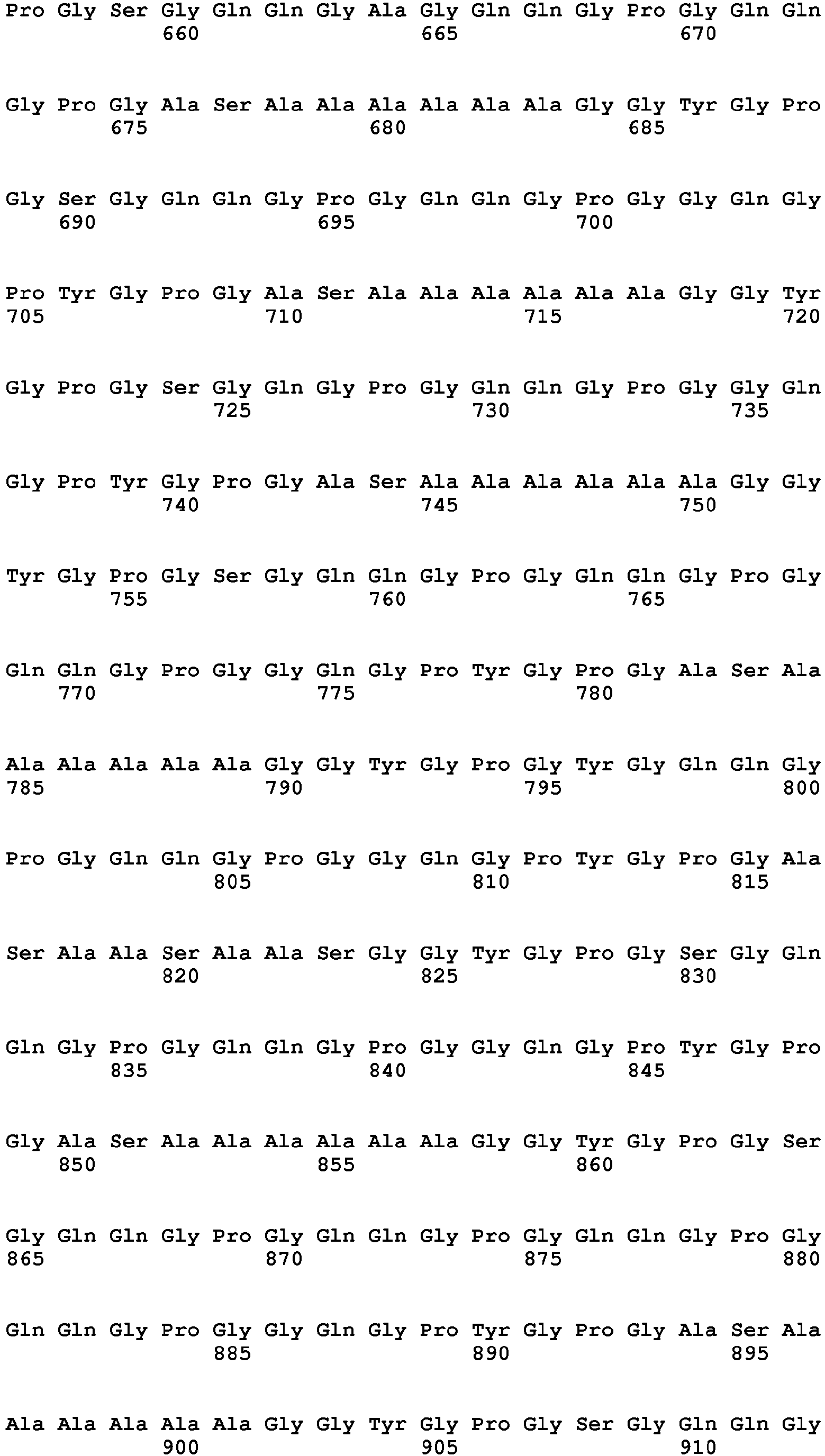


- <210> 2
<211> 660
<212> PRT
<213> Artificial - <220>
<223> ADF3Kai - <400> 2


- <210> 3
<211> 1183
<212> PRT
<213> Artificial - <220>
<223> ADF3Kai-Large - <400> 3
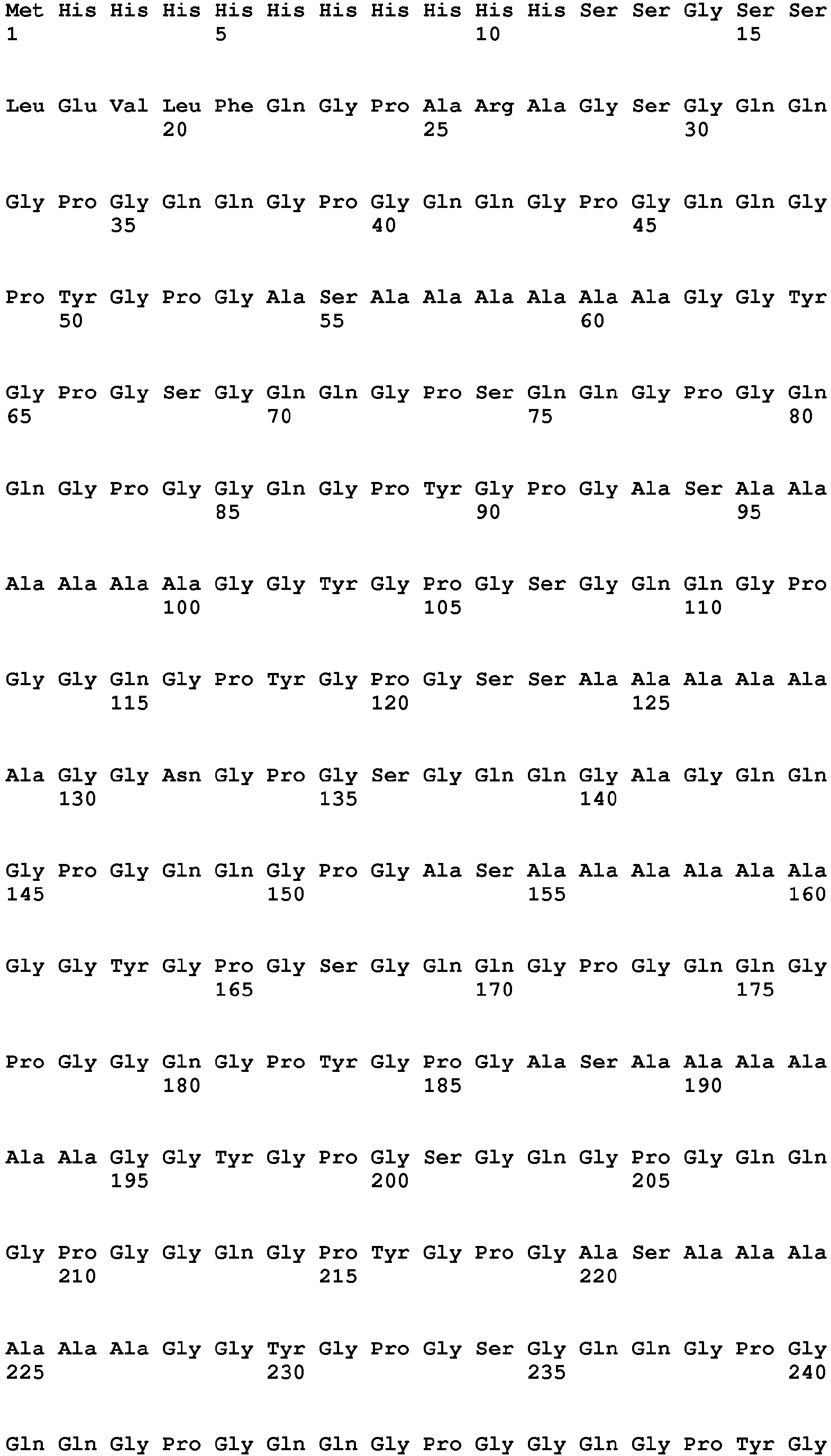


- <210> 4
<211> 24
<212> PRT
<213> Artificial - <220>
<223> His tag and start codon - <400> 4


- <210> 5
<211> 1983
<212> DNA
<213> Artificial - <220>
<223> ADF3Kai - <400> 5


- <210> 6
<211> 3552
<212> DNA
<213> Artificial - <220>
<223> ADF3Kai-Large - <400> 6

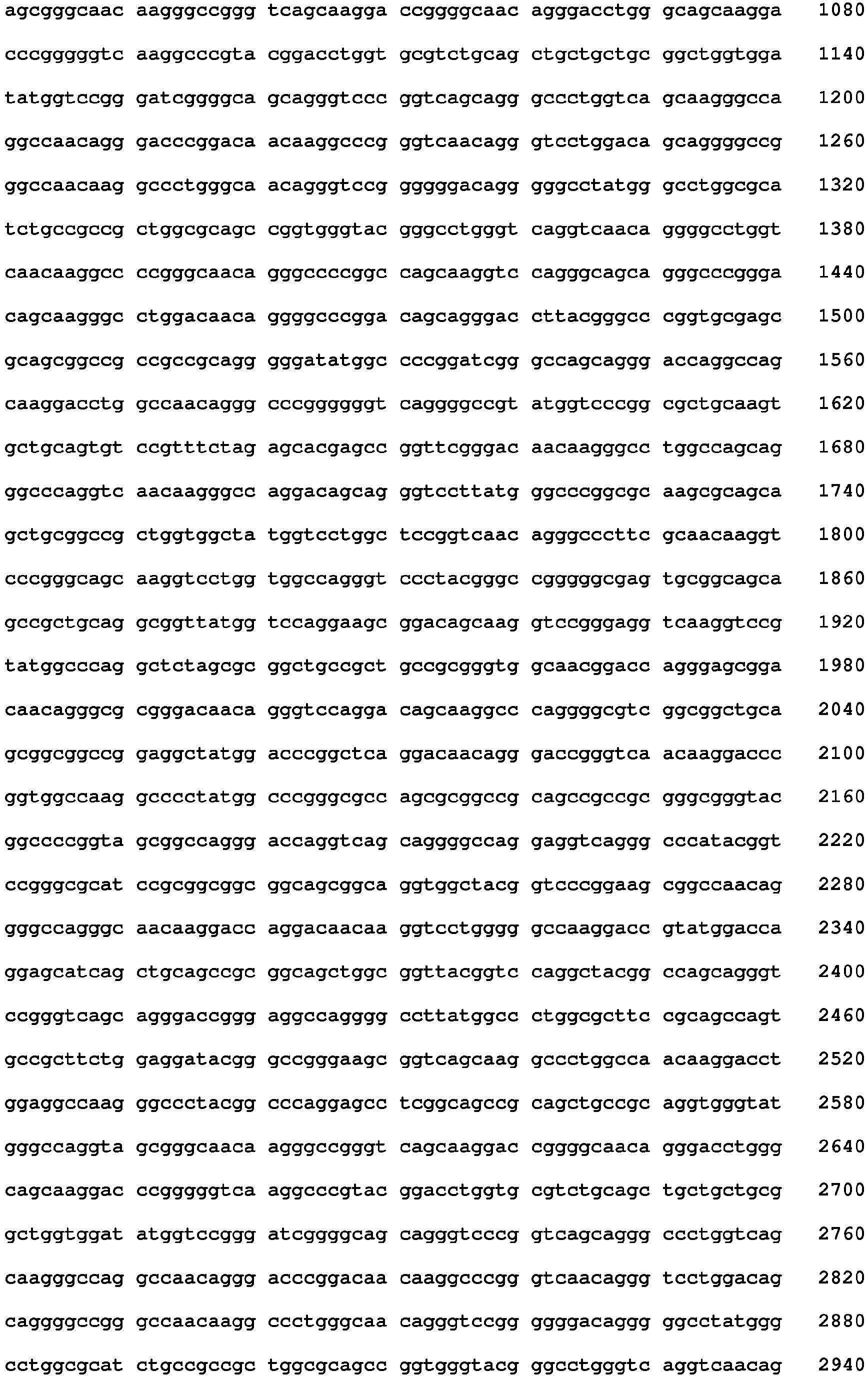

- <210> 7
<211> 3465
<212> DNA
<213> Artificial - <220>
<223> ADF3Kai-Large-NRSH1 - <400> 7


- <210> 8
<211> 20
<212> DNA
<213> Artificial - <220>
<223> T7 promoter primer - <400> 8
taatacgact cactataggg 20 - <210> 9
<211> 27
<212> DNA
<213> Artificial - <220>
<223> Rep Xba I primer - <400> 9
tctagaaacg gacactgcag cacttgc 27 - <210> 10
<211> 28
<212> DNA
<213> Artificial - <220>
<223> Xba I Rep primer - <400> 10
tctagagcac gagccggttc gggacaac 28 - <210> 11
<211> 19
<212> DNA
<213> Artificial - <220>
<223> T7 terminator primer - <400> 11
gctagttatt gctcagcgg 19 - <210> 12
<211> 5
<212> PRT
<213> Artificial - <220>
<223> REP6-U1 - <220>
<221> UNSURE
<222> (1)..(5)
<223> Xaa atposition - <400> 12

- <210> 13
<211> 5
<212> PRT
<213> Artificial - <220>
<223> REP6-U2 - <220>
<221> UNSURE
<222> (1)..(5)
<223> Xaa atposition 5 is any one of amino acids, in particular, it preferably is Ala, Ser, Tyr, Gln, Val, Leu or Ile, it more preferably is Ala, Ser, Tyr, Gln or Val. - <400> 13

Claims (3)
- A method for producing a polar solvent solution in which a solute containing a polyamino acid is dissolved in a polar solvent, wherein
the polyamino acid is a spider silk protein,
the polar solvent contains at least one selected from the group consisting of dimethylsulfoxide (DMSO), N,N-dimethylformamide (DMF), N,N-dimethylacetamide (DMA), and N-methyl-2-pyrrolidone (NMP),
the moisture content of the solution is reduced to increase the viscosity of the solution, wherein the moisture content of the solution is reduced by adjusting the relative humidity of the atmosphere in the production and/or storage of the solution so that the solution has a moisture content of less than 5% by mass based on 100% by mass of the solution. - The method for producing a polar solvent solution according to claim 1, wherein the solute containing the polyamino acid is dried and thereafter dissolved in the polar solvent.
- The method for producing a polar solvent solution according to claim 1 or 2, wherein the relative humidity of the atmosphere in the production and/or storage of the solution is adjusted to 1.3% RH or less.
Applications Claiming Priority (2)
| Application Number | Priority Date | Filing Date | Title |
|---|---|---|---|
| JP2015080226 | 2015-04-09 | ||
| PCT/JP2016/061025 WO2016163336A1 (en) | 2015-04-09 | 2016-04-04 | Polar solvent solution and production method thereof |
Publications (3)
| Publication Number | Publication Date |
|---|---|
| EP3281948A1 EP3281948A1 (en) | 2018-02-14 |
| EP3281948A4 EP3281948A4 (en) | 2018-08-29 |
| EP3281948B1 true EP3281948B1 (en) | 2020-06-10 |
Family
ID=57071842
Family Applications (1)
| Application Number | Title | Priority Date | Filing Date |
|---|---|---|---|
| EP16776502.3A Active EP3281948B1 (en) | 2015-04-09 | 2016-04-04 | Polar solvent solution and production method thereof |
Country Status (5)
| Country | Link |
|---|---|
| US (2) | US20180080147A1 (en) |
| EP (1) | EP3281948B1 (en) |
| JP (1) | JP6810309B2 (en) |
| CN (1) | CN107849100B (en) |
| WO (1) | WO2016163336A1 (en) |
Families Citing this family (2)
| Publication number | Priority date | Publication date | Assignee | Title |
|---|---|---|---|---|
| US11208736B2 (en) | 2017-09-25 | 2021-12-28 | Bolt Threads, Inc. | Methods of generating highly-crystalline recombinant spider silk protein fibers |
| EP3833524A4 (en) * | 2018-08-10 | 2022-06-22 | Bolt Threads, Inc. | COMPOSITION FOR A MOLDED BODY |
Family Cites Families (53)
| Publication number | Priority date | Publication date | Assignee | Title |
|---|---|---|---|---|
| JPH02240165A (en) | 1989-03-13 | 1990-09-25 | Kanebo Ltd | Aqueous silk fibroin solution with excellent storage stability and preparation thereof |
| WO1992009695A1 (en) | 1990-11-28 | 1992-06-11 | E.I. Du Pont De Nemours And Company | Structural proteins from artificial genes |
| US5171505A (en) | 1990-11-28 | 1992-12-15 | E. I. Du Pont De Nemours And Company | Process for spinning polypeptide fibers |
| AT395863B (en) | 1991-01-09 | 1993-03-25 | Chemiefaser Lenzing Ag | METHOD FOR PRODUCING A CELLULOSIC MOLDED BODY |
| US5252285A (en) | 1992-01-27 | 1993-10-12 | E. I. Du Pont De Nemours And Company | Process for making silk fibroin fibers |
| JP3021944B2 (en) | 1992-03-11 | 2000-03-15 | 株式会社クラレ | Manufacturing method of polyvinyl alcohol fiber with excellent strength |
| IT1274603B (en) | 1994-08-08 | 1997-07-18 | Novamont Spa | BIODEGRADABLE PLASTIC EXPANDED MATERIALS |
| JP2922432B2 (en) | 1994-08-31 | 1999-07-26 | 帝人株式会社 | Method for producing meta-type aramid fiber |
| US7014802B1 (en) | 1997-02-20 | 2006-03-21 | Mannington Mills, Of Delaware, Inc. | Methods to make a surface covering having a natural appearance |
| JP4095704B2 (en) | 1998-02-04 | 2008-06-04 | 出光興産株式会社 | Silk-containing resin composition, silk-containing molded article, and method for producing silk-containing resin composition |
| AU1412201A (en) | 1999-11-15 | 2001-05-30 | Akira Hachimori | Molecularly composite polymeric material of fibroin/cellulose and process for producing the same |
| GB9927950D0 (en) | 1999-11-27 | 2000-01-26 | Knight David P | Apparatus and method for forming materials |
| US6620917B1 (en) | 2000-01-20 | 2003-09-16 | The United States Of America As Represented By The Secretary Of The Army | Method for the purification and aqueous fiber spinning of spider silks and other structural proteins |
| EP1266964A4 (en) | 2000-03-24 | 2003-07-09 | Japan Government | PRECURSORS OF SILK TYPE MATERIALS, SILK TYPE MATERIALS AND PROCESS FOR PRODUCING SAID PRECURSORS AND MATERIALS |
| JP2005515309A (en) | 2002-01-09 | 2005-05-26 | イー・アイ・デュポン・ドウ・ヌムール・アンド・カンパニー | Polypeptide fibers and methods for their production |
| AU2003202949A1 (en) | 2002-01-11 | 2003-07-30 | Ali Alwattari | Methods and apparatus for spinning spider silk protein |
| US7057023B2 (en) | 2002-01-11 | 2006-06-06 | Nexia Biotechnologies Inc. | Methods and apparatus for spinning spider silk protein |
| EP2218448B1 (en) * | 2002-12-13 | 2015-09-23 | Durect Corporation | Oral drug delivery system comprising high viscosity liquid carrier materials |
| WO2006013552A2 (en) | 2004-08-02 | 2006-02-09 | Ramot At Tel Aviv University Ltd. | Articles of peptide nanostructures and method of forming the same |
| JP2006257000A (en) | 2005-03-16 | 2006-09-28 | Iwase Cosfa Kk | Sericin derivative and composition containing the same |
| US20070092558A1 (en) | 2005-10-20 | 2007-04-26 | George Heavner | Methods of Preparing Targeted Immunoliposomes |
| RU2444527C2 (en) | 2005-12-30 | 2012-03-10 | Спибер Текнолоджиз Аб | Polymerizable recombinant spidroin protein of principal ampullary gland, controlled polymerisable recombinant fused protein, spidroin protein polymer of principal ampullary gland, controlled polymerisation composition, recombinant nucleic acid molecule (versions), method for producing soluble fused protein, method for producing spidroin protein polymer of principal ampullary gland and method for eukariotic cell culture |
| CN100424239C (en) | 2006-04-28 | 2008-10-08 | 韩晓根 | Maize protein colored textile fiber and method for producing same |
| JP4981355B2 (en) | 2006-05-10 | 2012-07-18 | 公立大学法人 滋賀県立大学 | Electrostatic spinning device |
| JP4945768B2 (en) | 2006-07-04 | 2012-06-06 | 国立大学法人東京農工大学 | Spinning liquid composition, method for producing regenerated silk fiber using the same, and regenerated silk fiber obtained by the production method |
| CN101139501B (en) * | 2007-10-11 | 2011-05-25 | 同济大学 | A kind of polyimide high temperature resistant aqueous dispersion paint and its preparation method and application |
| CN101970023A (en) | 2008-02-07 | 2011-02-09 | 塔夫茨大学信托人 | 3-dimensional silk hydroxyapatite compositions |
| JP2010024586A (en) | 2008-07-22 | 2010-02-04 | Kaneka Corp | Regenerated collagen-based artificial hair fiber |
| JP2011530491A (en) | 2008-08-08 | 2011-12-22 | ビーエーエスエフ ソシエタス・ヨーロピア | Biopolymer-based continuous fiber layers containing active substances, their use, and methods for their production |
| CN101705559A (en) | 2008-08-19 | 2010-05-12 | 江苏金太阳卧室用品有限公司 | Functional type spun-dyed yarn fabric |
| CN101721739B (en) | 2008-10-10 | 2013-02-13 | 陈东 | Polymer composite fiber surgical suture line capable of sustaining and controlling release of therapeutic medicaments and preparation method thereof |
| JP2010104946A (en) * | 2008-10-31 | 2010-05-13 | Riso Kagaku Corp | Water-in-oil (w/o) emulsion formed using reverse vesicle |
| CA2759465C (en) | 2009-04-22 | 2017-12-12 | Spiber Technologies Ab | Method of producing polymers of spider silk proteins |
| CN101564914B (en) | 2009-05-27 | 2011-06-22 | 东华大学 | Preparation method of nanometer cobweb/ nanometer fiber composite protective material |
| CN101724920B (en) | 2009-11-13 | 2011-04-27 | 东华大学 | Method for preparing regenerated silk fiber by means of dry spinning |
| WO2011113446A1 (en) | 2010-03-17 | 2011-09-22 | Amsilk Gmbh | Method for production of polypeptide containing fibres |
| JP5761736B2 (en) | 2010-12-24 | 2015-08-12 | 国立大学法人信州大学 | Sericin nanofiber and production method thereof, metal ion adsorbent, dyeing function enhancement material, chemical resistance enhancement material, sericin / fibroin composite nanofiber and production method thereof |
| CN102181948A (en) | 2011-05-23 | 2011-09-14 | 北京化工大学 | Electrostatic spinning method and electrostatic spinning device for preparing nano fiber with one-dimensional order structure |
| WO2012165477A1 (en) | 2011-06-01 | 2012-12-06 | スパイバー株式会社 | Protein fiber and method for producing same |
| JP5540154B2 (en) | 2011-06-01 | 2014-07-02 | スパイバー株式会社 | Artificial polypeptide fiber |
| JP5584932B2 (en) | 2011-11-02 | 2014-09-10 | スパイバー株式会社 | Method for producing protein fiber |
| EP2774934B1 (en) * | 2011-11-02 | 2017-11-29 | Spiber Inc. | Polypeptide solution, artificial polypeptide fiber production method using same, and polypeptide refining method |
| CN103126974B (en) * | 2011-11-30 | 2018-04-10 | 王冕 | A kind of gel |
| CN104395511B (en) * | 2012-06-28 | 2016-08-17 | 丝芭博株式会社 | Mass colouration azelon and manufacture method thereof |
| US10384178B2 (en) | 2012-06-29 | 2019-08-20 | Archer Daniel Midland Company | Microemulsions and uses thereof as nanoreactors or delivery vehicles |
| US20140175179A1 (en) * | 2012-12-21 | 2014-06-26 | Robert Carter | Context aware passcodes |
| JP5678283B2 (en) * | 2012-12-26 | 2015-02-25 | スパイバー株式会社 | Spider silk protein film and method for producing the same |
| CN104884463B (en) * | 2012-12-27 | 2018-09-18 | 丝芭博株式会社 | The extracting method of hydrophily recombinant protein |
| CN103184570B (en) * | 2013-04-09 | 2015-08-26 | 南京维赛医药科技有限公司 | A kind of fibroin albumen base antibacterial nano fiber and preparation method thereof |
| JP5796147B2 (en) * | 2013-04-25 | 2015-10-21 | Spiber株式会社 | Polypeptide porous body and method for producing the same |
| US9968682B2 (en) * | 2013-04-25 | 2018-05-15 | Spiber Inc. | Polypeptide hydrogel and method for producing same |
| CN104936979B (en) | 2013-04-25 | 2020-02-21 | 丝芭博株式会社 | Polypeptide particles and methods for producing the same |
| JP6856828B2 (en) * | 2015-04-09 | 2021-04-14 | Spiber株式会社 | Polar solvent solution and its manufacturing method |
-
2016
- 2016-04-04 CN CN201680020745.1A patent/CN107849100B/en active Active
- 2016-04-04 EP EP16776502.3A patent/EP3281948B1/en active Active
- 2016-04-04 WO PCT/JP2016/061025 patent/WO2016163336A1/en not_active Ceased
- 2016-04-04 JP JP2017510977A patent/JP6810309B2/en active Active
- 2016-04-04 US US15/564,142 patent/US20180080147A1/en not_active Abandoned
-
2020
- 2020-01-10 US US16/740,106 patent/US11668024B2/en active Active
Non-Patent Citations (1)
| Title |
|---|
| None * |
Also Published As
| Publication number | Publication date |
|---|---|
| US20200131671A1 (en) | 2020-04-30 |
| EP3281948A4 (en) | 2018-08-29 |
| US20180080147A1 (en) | 2018-03-22 |
| US11668024B2 (en) | 2023-06-06 |
| WO2016163336A1 (en) | 2016-10-13 |
| EP3281948A1 (en) | 2018-02-14 |
| JPWO2016163336A1 (en) | 2018-04-12 |
| JP6810309B2 (en) | 2021-01-06 |
| CN107849100A (en) | 2018-03-27 |
| CN107849100B (en) | 2022-02-08 |
Similar Documents
| Publication | Publication Date | Title |
|---|---|---|
| EP3281950B1 (en) | Polypeptide solution, artificial polypeptide fiber production method and polypeptide purification method using same | |
| US9732125B2 (en) | Polypeptide particle and method for producing same | |
| Thamm et al. | Recombinant production, characterization, and fiber spinning of an engineered short major ampullate spidroin (MaSp1s) | |
| EP2990062B1 (en) | Polypeptide hydrogel and method for producing same | |
| EP3478707B1 (en) | Engineered spider silk proteins and uses thereof | |
| US10065997B2 (en) | Polypeptide porous body and method for producing same | |
| US10975206B2 (en) | Polar solvent solution and production method thereof | |
| US11668024B2 (en) | Polar solvent solution and production method thereof | |
| Hekman | Production of Synthetic Spider Silk |
Legal Events
| Date | Code | Title | Description |
|---|---|---|---|
| STAA | Information on the status of an ep patent application or granted ep patent |
Free format text: STATUS: THE INTERNATIONAL PUBLICATION HAS BEEN MADE |
|
| PUAI | Public reference made under article 153(3) epc to a published international application that has entered the european phase |
Free format text: ORIGINAL CODE: 0009012 |
|
| STAA | Information on the status of an ep patent application or granted ep patent |
Free format text: STATUS: REQUEST FOR EXAMINATION WAS MADE |
|
| 17P | Request for examination filed |
Effective date: 20171109 |
|
| AK | Designated contracting states |
Kind code of ref document: A1 Designated state(s): AL AT BE BG CH CY CZ DE DK EE ES FI FR GB GR HR HU IE IS IT LI LT LU LV MC MK MT NL NO PL PT RO RS SE SI SK SM TR |
|
| AX | Request for extension of the european patent |
Extension state: BA ME |
|
| DAV | Request for validation of the european patent (deleted) | ||
| DAX | Request for extension of the european patent (deleted) | ||
| A4 | Supplementary search report drawn up and despatched |
Effective date: 20180726 |
|
| RIC1 | Information provided on ipc code assigned before grant |
Ipc: C07K 14/435 20060101AFI20180720BHEP Ipc: D01C 3/00 20060101ALI20180720BHEP |
|
| STAA | Information on the status of an ep patent application or granted ep patent |
Free format text: STATUS: EXAMINATION IS IN PROGRESS |
|
| 17Q | First examination report despatched |
Effective date: 20190321 |
|
| GRAP | Despatch of communication of intention to grant a patent |
Free format text: ORIGINAL CODE: EPIDOSNIGR1 |
|
| STAA | Information on the status of an ep patent application or granted ep patent |
Free format text: STATUS: GRANT OF PATENT IS INTENDED |
|
| INTG | Intention to grant announced |
Effective date: 20200103 |
|
| RAP1 | Party data changed (applicant data changed or rights of an application transferred) |
Owner name: SPIBER INC. |
|
| GRAS | Grant fee paid |
Free format text: ORIGINAL CODE: EPIDOSNIGR3 |
|
| GRAA | (expected) grant |
Free format text: ORIGINAL CODE: 0009210 |
|
| STAA | Information on the status of an ep patent application or granted ep patent |
Free format text: STATUS: THE PATENT HAS BEEN GRANTED |
|
| AK | Designated contracting states |
Kind code of ref document: B1 Designated state(s): AL AT BE BG CH CY CZ DE DK EE ES FI FR GB GR HR HU IE IS IT LI LT LU LV MC MK MT NL NO PL PT RO RS SE SI SK SM TR |
|
| REG | Reference to a national code |
Ref country code: GB Ref legal event code: FG4D |
|
| REG | Reference to a national code |
Ref country code: CH Ref legal event code: EP Ref country code: AT Ref legal event code: REF Ref document number: 1279117 Country of ref document: AT Kind code of ref document: T Effective date: 20200615 |
|
| REG | Reference to a national code |
Ref country code: DE Ref legal event code: R096 Ref document number: 602016037933 Country of ref document: DE |
|
| REG | Reference to a national code |
Ref country code: IE Ref legal event code: FG4D |
|
| REG | Reference to a national code |
Ref country code: LT Ref legal event code: MG4D |
|
| PG25 | Lapsed in a contracting state [announced via postgrant information from national office to epo] |
Ref country code: SE Free format text: LAPSE BECAUSE OF FAILURE TO SUBMIT A TRANSLATION OF THE DESCRIPTION OR TO PAY THE FEE WITHIN THE PRESCRIBED TIME-LIMIT Effective date: 20200610 Ref country code: FI Free format text: LAPSE BECAUSE OF FAILURE TO SUBMIT A TRANSLATION OF THE DESCRIPTION OR TO PAY THE FEE WITHIN THE PRESCRIBED TIME-LIMIT Effective date: 20200610 Ref country code: NO Free format text: LAPSE BECAUSE OF FAILURE TO SUBMIT A TRANSLATION OF THE DESCRIPTION OR TO PAY THE FEE WITHIN THE PRESCRIBED TIME-LIMIT Effective date: 20200910 Ref country code: LT Free format text: LAPSE BECAUSE OF FAILURE TO SUBMIT A TRANSLATION OF THE DESCRIPTION OR TO PAY THE FEE WITHIN THE PRESCRIBED TIME-LIMIT Effective date: 20200610 Ref country code: GR Free format text: LAPSE BECAUSE OF FAILURE TO SUBMIT A TRANSLATION OF THE DESCRIPTION OR TO PAY THE FEE WITHIN THE PRESCRIBED TIME-LIMIT Effective date: 20200911 |
|
| REG | Reference to a national code |
Ref country code: NL Ref legal event code: MP Effective date: 20200610 |
|
| PG25 | Lapsed in a contracting state [announced via postgrant information from national office to epo] |
Ref country code: LV Free format text: LAPSE BECAUSE OF FAILURE TO SUBMIT A TRANSLATION OF THE DESCRIPTION OR TO PAY THE FEE WITHIN THE PRESCRIBED TIME-LIMIT Effective date: 20200610 Ref country code: RS Free format text: LAPSE BECAUSE OF FAILURE TO SUBMIT A TRANSLATION OF THE DESCRIPTION OR TO PAY THE FEE WITHIN THE PRESCRIBED TIME-LIMIT Effective date: 20200610 Ref country code: BG Free format text: LAPSE BECAUSE OF FAILURE TO SUBMIT A TRANSLATION OF THE DESCRIPTION OR TO PAY THE FEE WITHIN THE PRESCRIBED TIME-LIMIT Effective date: 20200910 Ref country code: HR Free format text: LAPSE BECAUSE OF FAILURE TO SUBMIT A TRANSLATION OF THE DESCRIPTION OR TO PAY THE FEE WITHIN THE PRESCRIBED TIME-LIMIT Effective date: 20200610 |
|
| REG | Reference to a national code |
Ref country code: AT Ref legal event code: MK05 Ref document number: 1279117 Country of ref document: AT Kind code of ref document: T Effective date: 20200610 |
|
| PG25 | Lapsed in a contracting state [announced via postgrant information from national office to epo] |
Ref country code: NL Free format text: LAPSE BECAUSE OF FAILURE TO SUBMIT A TRANSLATION OF THE DESCRIPTION OR TO PAY THE FEE WITHIN THE PRESCRIBED TIME-LIMIT Effective date: 20200610 Ref country code: AL Free format text: LAPSE BECAUSE OF FAILURE TO SUBMIT A TRANSLATION OF THE DESCRIPTION OR TO PAY THE FEE WITHIN THE PRESCRIBED TIME-LIMIT Effective date: 20200610 |
|
| PG25 | Lapsed in a contracting state [announced via postgrant information from national office to epo] |
Ref country code: RO Free format text: LAPSE BECAUSE OF FAILURE TO SUBMIT A TRANSLATION OF THE DESCRIPTION OR TO PAY THE FEE WITHIN THE PRESCRIBED TIME-LIMIT Effective date: 20200610 Ref country code: CZ Free format text: LAPSE BECAUSE OF FAILURE TO SUBMIT A TRANSLATION OF THE DESCRIPTION OR TO PAY THE FEE WITHIN THE PRESCRIBED TIME-LIMIT Effective date: 20200610 Ref country code: EE Free format text: LAPSE BECAUSE OF FAILURE TO SUBMIT A TRANSLATION OF THE DESCRIPTION OR TO PAY THE FEE WITHIN THE PRESCRIBED TIME-LIMIT Effective date: 20200610 Ref country code: SM Free format text: LAPSE BECAUSE OF FAILURE TO SUBMIT A TRANSLATION OF THE DESCRIPTION OR TO PAY THE FEE WITHIN THE PRESCRIBED TIME-LIMIT Effective date: 20200610 Ref country code: AT Free format text: LAPSE BECAUSE OF FAILURE TO SUBMIT A TRANSLATION OF THE DESCRIPTION OR TO PAY THE FEE WITHIN THE PRESCRIBED TIME-LIMIT Effective date: 20200610 Ref country code: ES Free format text: LAPSE BECAUSE OF FAILURE TO SUBMIT A TRANSLATION OF THE DESCRIPTION OR TO PAY THE FEE WITHIN THE PRESCRIBED TIME-LIMIT Effective date: 20200610 Ref country code: PT Free format text: LAPSE BECAUSE OF FAILURE TO SUBMIT A TRANSLATION OF THE DESCRIPTION OR TO PAY THE FEE WITHIN THE PRESCRIBED TIME-LIMIT Effective date: 20201012 |
|
| PG25 | Lapsed in a contracting state [announced via postgrant information from national office to epo] |
Ref country code: PL Free format text: LAPSE BECAUSE OF FAILURE TO SUBMIT A TRANSLATION OF THE DESCRIPTION OR TO PAY THE FEE WITHIN THE PRESCRIBED TIME-LIMIT Effective date: 20200610 Ref country code: SK Free format text: LAPSE BECAUSE OF FAILURE TO SUBMIT A TRANSLATION OF THE DESCRIPTION OR TO PAY THE FEE WITHIN THE PRESCRIBED TIME-LIMIT Effective date: 20200610 Ref country code: IS Free format text: LAPSE BECAUSE OF FAILURE TO SUBMIT A TRANSLATION OF THE DESCRIPTION OR TO PAY THE FEE WITHIN THE PRESCRIBED TIME-LIMIT Effective date: 20201010 |
|
| REG | Reference to a national code |
Ref country code: DE Ref legal event code: R097 Ref document number: 602016037933 Country of ref document: DE |
|
| PLBE | No opposition filed within time limit |
Free format text: ORIGINAL CODE: 0009261 |
|
| STAA | Information on the status of an ep patent application or granted ep patent |
Free format text: STATUS: NO OPPOSITION FILED WITHIN TIME LIMIT |
|
| PG25 | Lapsed in a contracting state [announced via postgrant information from national office to epo] |
Ref country code: DK Free format text: LAPSE BECAUSE OF FAILURE TO SUBMIT A TRANSLATION OF THE DESCRIPTION OR TO PAY THE FEE WITHIN THE PRESCRIBED TIME-LIMIT Effective date: 20200610 |
|
| 26N | No opposition filed |
Effective date: 20210311 |
|
| PG25 | Lapsed in a contracting state [announced via postgrant information from national office to epo] |
Ref country code: SI Free format text: LAPSE BECAUSE OF FAILURE TO SUBMIT A TRANSLATION OF THE DESCRIPTION OR TO PAY THE FEE WITHIN THE PRESCRIBED TIME-LIMIT Effective date: 20200610 |
|
| REG | Reference to a national code |
Ref country code: GB Ref legal event code: 732E Free format text: REGISTERED BETWEEN 20211014 AND 20211020 |
|
| PG25 | Lapsed in a contracting state [announced via postgrant information from national office to epo] |
Ref country code: MC Free format text: LAPSE BECAUSE OF FAILURE TO SUBMIT A TRANSLATION OF THE DESCRIPTION OR TO PAY THE FEE WITHIN THE PRESCRIBED TIME-LIMIT Effective date: 20200610 |
|
| PG25 | Lapsed in a contracting state [announced via postgrant information from national office to epo] |
Ref country code: LU Free format text: LAPSE BECAUSE OF NON-PAYMENT OF DUE FEES Effective date: 20210404 |
|
| REG | Reference to a national code |
Ref country code: BE Ref legal event code: MM Effective date: 20210430 |
|
| PG25 | Lapsed in a contracting state [announced via postgrant information from national office to epo] |
Ref country code: CH Free format text: LAPSE BECAUSE OF NON-PAYMENT OF DUE FEES Effective date: 20210430 Ref country code: LI Free format text: LAPSE BECAUSE OF NON-PAYMENT OF DUE FEES Effective date: 20210430 |
|
| PG25 | Lapsed in a contracting state [announced via postgrant information from national office to epo] |
Ref country code: IE Free format text: LAPSE BECAUSE OF NON-PAYMENT OF DUE FEES Effective date: 20210404 |
|
| PG25 | Lapsed in a contracting state [announced via postgrant information from national office to epo] |
Ref country code: IS Free format text: LAPSE BECAUSE OF FAILURE TO SUBMIT A TRANSLATION OF THE DESCRIPTION OR TO PAY THE FEE WITHIN THE PRESCRIBED TIME-LIMIT Effective date: 20201010 |
|
| PG25 | Lapsed in a contracting state [announced via postgrant information from national office to epo] |
Ref country code: BE Free format text: LAPSE BECAUSE OF NON-PAYMENT OF DUE FEES Effective date: 20210430 |
|
| PG25 | Lapsed in a contracting state [announced via postgrant information from national office to epo] |
Ref country code: HU Free format text: LAPSE BECAUSE OF FAILURE TO SUBMIT A TRANSLATION OF THE DESCRIPTION OR TO PAY THE FEE WITHIN THE PRESCRIBED TIME-LIMIT; INVALID AB INITIO Effective date: 20160404 |
|
| P01 | Opt-out of the competence of the unified patent court (upc) registered |
Effective date: 20230517 |
|
| PG25 | Lapsed in a contracting state [announced via postgrant information from national office to epo] |
Ref country code: CY Free format text: LAPSE BECAUSE OF FAILURE TO SUBMIT A TRANSLATION OF THE DESCRIPTION OR TO PAY THE FEE WITHIN THE PRESCRIBED TIME-LIMIT Effective date: 20200610 |
|
| PG25 | Lapsed in a contracting state [announced via postgrant information from national office to epo] |
Ref country code: MK Free format text: LAPSE BECAUSE OF FAILURE TO SUBMIT A TRANSLATION OF THE DESCRIPTION OR TO PAY THE FEE WITHIN THE PRESCRIBED TIME-LIMIT Effective date: 20200610 |
|
| REG | Reference to a national code |
Ref country code: GB Ref legal event code: 732E Free format text: REGISTERED BETWEEN 20240829 AND 20240904 |
|
| REG | Reference to a national code |
Ref country code: DE Ref legal event code: R081 Ref document number: 602016037933 Country of ref document: DE Owner name: SPIBER IP MANAGEMENT LLC, TSURUOKA-SHI, JP Free format text: FORMER OWNER: SPIBER INC., TSURUOKA-SHI, YAMAGATA, JP |
|
| PG25 | Lapsed in a contracting state [announced via postgrant information from national office to epo] |
Ref country code: MT Free format text: LAPSE BECAUSE OF FAILURE TO SUBMIT A TRANSLATION OF THE DESCRIPTION OR TO PAY THE FEE WITHIN THE PRESCRIBED TIME-LIMIT Effective date: 20200610 |
|
| PG25 | Lapsed in a contracting state [announced via postgrant information from national office to epo] |
Ref country code: TR Free format text: LAPSE BECAUSE OF FAILURE TO SUBMIT A TRANSLATION OF THE DESCRIPTION OR TO PAY THE FEE WITHIN THE PRESCRIBED TIME-LIMIT Effective date: 20200610 |
|
| PGFP | Annual fee paid to national office [announced via postgrant information from national office to epo] |
Ref country code: GB Payment date: 20260313 Year of fee payment: 11 |
|
| PGFP | Annual fee paid to national office [announced via postgrant information from national office to epo] |
Ref country code: IT Payment date: 20260320 Year of fee payment: 11 |
|
| PGFP | Annual fee paid to national office [announced via postgrant information from national office to epo] |
Ref country code: FR Payment date: 20260309 Year of fee payment: 11 |
|
| PGFP | Annual fee paid to national office [announced via postgrant information from national office to epo] |
Ref country code: DE Payment date: 20260305 Year of fee payment: 11 |