EP3280696B1 - Functionalized photoinitiators - Google Patents
Functionalized photoinitiators Download PDFInfo
- Publication number
- EP3280696B1 EP3280696B1 EP16718610.5A EP16718610A EP3280696B1 EP 3280696 B1 EP3280696 B1 EP 3280696B1 EP 16718610 A EP16718610 A EP 16718610A EP 3280696 B1 EP3280696 B1 EP 3280696B1
- Authority
- EP
- European Patent Office
- Prior art keywords
- formula
- compounds
- hydrogen
- het
- alkyl
- Prior art date
- Legal status (The legal status is an assumption and is not a legal conclusion. Google has not performed a legal analysis and makes no representation as to the accuracy of the status listed.)
- Active
Links
- BQMISJGKCCJICG-UHFFFAOYSA-N NO[IH]c(cc1)ccc1C(c1ccccc1)=O Chemical compound NO[IH]c(cc1)ccc1C(c1ccccc1)=O BQMISJGKCCJICG-UHFFFAOYSA-N 0.000 description 1
Classifications
-
- C—CHEMISTRY; METALLURGY
- C07—ORGANIC CHEMISTRY
- C07C—ACYCLIC OR CARBOCYCLIC COMPOUNDS
- C07C69/00—Esters of carboxylic acids; Esters of carbonic or haloformic acids
- C07C69/52—Esters of acyclic unsaturated carboxylic acids having the esterified carboxyl group bound to an acyclic carbon atom
- C07C69/533—Monocarboxylic acid esters having only one carbon-to-carbon double bond
- C07C69/54—Acrylic acid esters; Methacrylic acid esters
-
- C—CHEMISTRY; METALLURGY
- C07—ORGANIC CHEMISTRY
- C07F—ACYCLIC, CARBOCYCLIC OR HETEROCYCLIC COMPOUNDS CONTAINING ELEMENTS OTHER THAN CARBON, HYDROGEN, HALOGEN, OXYGEN, NITROGEN, SULFUR, SELENIUM OR TELLURIUM
- C07F5/00—Compounds containing elements of Groups 3 or 13 of the Periodic Table
- C07F5/02—Boron compounds
- C07F5/027—Organoboranes and organoborohydrides
-
- C—CHEMISTRY; METALLURGY
- C08—ORGANIC MACROMOLECULAR COMPOUNDS; THEIR PREPARATION OR CHEMICAL WORKING-UP; COMPOSITIONS BASED THEREON
- C08F—MACROMOLECULAR COMPOUNDS OBTAINED BY REACTIONS ONLY INVOLVING CARBON-TO-CARBON UNSATURATED BONDS
- C08F2/00—Processes of polymerisation
- C08F2/46—Polymerisation initiated by wave energy or particle radiation
- C08F2/48—Polymerisation initiated by wave energy or particle radiation by ultraviolet or visible light
-
- B—PERFORMING OPERATIONS; TRANSPORTING
- B01—PHYSICAL OR CHEMICAL PROCESSES OR APPARATUS IN GENERAL
- B01J—CHEMICAL OR PHYSICAL PROCESSES, e.g. CATALYSIS OR COLLOID CHEMISTRY; THEIR RELEVANT APPARATUS
- B01J23/00—Catalysts comprising metals or metal oxides or hydroxides, not provided for in group B01J21/00
- B01J23/02—Catalysts comprising metals or metal oxides or hydroxides, not provided for in group B01J21/00 of the alkali- or alkaline earth metals or beryllium
- B01J23/04—Alkali metals
-
- C—CHEMISTRY; METALLURGY
- C07—ORGANIC CHEMISTRY
- C07C—ACYCLIC OR CARBOCYCLIC COMPOUNDS
- C07C49/00—Ketones; Ketenes; Dimeric ketenes; Ketonic chelates
- C07C49/20—Unsaturated compounds containing keto groups bound to acyclic carbon atoms
- C07C49/225—Unsaturated compounds containing keto groups bound to acyclic carbon atoms containing six-membered aromatic rings and other rings
-
- C—CHEMISTRY; METALLURGY
- C07—ORGANIC CHEMISTRY
- C07C—ACYCLIC OR CARBOCYCLIC COMPOUNDS
- C07C69/00—Esters of carboxylic acids; Esters of carbonic or haloformic acids
- C07C69/76—Esters of carboxylic acids having a carboxyl group bound to a carbon atom of a six-membered aromatic ring
- C07C69/80—Phthalic acid esters
- C07C69/82—Terephthalic acid esters
-
- C—CHEMISTRY; METALLURGY
- C07—ORGANIC CHEMISTRY
- C07D—HETEROCYCLIC COMPOUNDS
- C07D335/00—Heterocyclic compounds containing six-membered rings having one sulfur atom as the only ring hetero atom
- C07D335/04—Heterocyclic compounds containing six-membered rings having one sulfur atom as the only ring hetero atom condensed with carbocyclic rings or ring systems
- C07D335/10—Dibenzothiopyrans; Hydrogenated dibenzothiopyrans
- C07D335/12—Thioxanthenes
- C07D335/14—Thioxanthenes with hetero atoms or with carbon atoms having three bonds to hetero atoms with at the most one bond to halogen, e.g. ester or nitrile radicals, directly attached in position 9
- C07D335/16—Oxygen atoms, e.g. thioxanthones
-
- C—CHEMISTRY; METALLURGY
- C07—ORGANIC CHEMISTRY
- C07D—HETEROCYCLIC COMPOUNDS
- C07D495/00—Heterocyclic compounds containing in the condensed system at least one hetero ring having sulfur atoms as the only ring hetero atoms
- C07D495/02—Heterocyclic compounds containing in the condensed system at least one hetero ring having sulfur atoms as the only ring hetero atoms in which the condensed system contains two hetero rings
- C07D495/10—Spiro-condensed systems
-
- C—CHEMISTRY; METALLURGY
- C08—ORGANIC MACROMOLECULAR COMPOUNDS; THEIR PREPARATION OR CHEMICAL WORKING-UP; COMPOSITIONS BASED THEREON
- C08F—MACROMOLECULAR COMPOUNDS OBTAINED BY REACTIONS ONLY INVOLVING CARBON-TO-CARBON UNSATURATED BONDS
- C08F220/00—Copolymers of compounds having one or more unsaturated aliphatic radicals, each having only one carbon-to-carbon double bond, and only one being terminated by only one carboxyl radical or a salt, anhydride ester, amide, imide or nitrile thereof
- C08F220/02—Monocarboxylic acids having less than ten carbon atoms; Derivatives thereof
- C08F220/10—Esters
- C08F220/12—Esters of monohydric alcohols or phenols
- C08F220/16—Esters of monohydric alcohols or phenols of phenols or of alcohols containing two or more carbon atoms
- C08F220/18—Esters of monohydric alcohols or phenols of phenols or of alcohols containing two or more carbon atoms with acrylic or methacrylic acids
-
- C—CHEMISTRY; METALLURGY
- C08—ORGANIC MACROMOLECULAR COMPOUNDS; THEIR PREPARATION OR CHEMICAL WORKING-UP; COMPOSITIONS BASED THEREON
- C08K—Use of inorganic or non-macromolecular organic substances as compounding ingredients
- C08K5/00—Use of organic ingredients
- C08K5/04—Oxygen-containing compounds
- C08K5/10—Esters; Ether-esters
-
- C—CHEMISTRY; METALLURGY
- C08—ORGANIC MACROMOLECULAR COMPOUNDS; THEIR PREPARATION OR CHEMICAL WORKING-UP; COMPOSITIONS BASED THEREON
- C08L—COMPOSITIONS OF MACROMOLECULAR COMPOUNDS
- C08L63/00—Compositions of epoxy resins; Compositions of derivatives of epoxy resins
-
- C—CHEMISTRY; METALLURGY
- C08—ORGANIC MACROMOLECULAR COMPOUNDS; THEIR PREPARATION OR CHEMICAL WORKING-UP; COMPOSITIONS BASED THEREON
- C08L—COMPOSITIONS OF MACROMOLECULAR COMPOUNDS
- C08L67/00—Compositions of polyesters obtained by reactions forming a carboxylic ester link in the main chain; Compositions of derivatives of such polymers
-
- C—CHEMISTRY; METALLURGY
- C08—ORGANIC MACROMOLECULAR COMPOUNDS; THEIR PREPARATION OR CHEMICAL WORKING-UP; COMPOSITIONS BASED THEREON
- C08L—COMPOSITIONS OF MACROMOLECULAR COMPOUNDS
- C08L71/00—Compositions of polyethers obtained by reactions forming an ether link in the main chain; Compositions of derivatives of such polymers
-
- C—CHEMISTRY; METALLURGY
- C09—DYES; PAINTS; POLISHES; NATURAL RESINS; ADHESIVES; COMPOSITIONS NOT OTHERWISE PROVIDED FOR; APPLICATIONS OF MATERIALS NOT OTHERWISE PROVIDED FOR
- C09D—COATING COMPOSITIONS, e.g. PAINTS, VARNISHES OR LACQUERS; FILLING PASTES; CHEMICAL PAINT OR INK REMOVERS; INKS; CORRECTING FLUIDS; WOODSTAINS; PASTES OR SOLIDS FOR COLOURING OR PRINTING; USE OF MATERIALS THEREFOR
- C09D11/00—Inks
- C09D11/02—Printing inks
- C09D11/03—Printing inks characterised by features other than the chemical nature of the binder
-
- C—CHEMISTRY; METALLURGY
- C09—DYES; PAINTS; POLISHES; NATURAL RESINS; ADHESIVES; COMPOSITIONS NOT OTHERWISE PROVIDED FOR; APPLICATIONS OF MATERIALS NOT OTHERWISE PROVIDED FOR
- C09D—COATING COMPOSITIONS, e.g. PAINTS, VARNISHES OR LACQUERS; FILLING PASTES; CHEMICAL PAINT OR INK REMOVERS; INKS; CORRECTING FLUIDS; WOODSTAINS; PASTES OR SOLIDS FOR COLOURING OR PRINTING; USE OF MATERIALS THEREFOR
- C09D11/00—Inks
- C09D11/02—Printing inks
- C09D11/10—Printing inks based on artificial resins
- C09D11/101—Inks specially adapted for printing processes involving curing by wave energy or particle radiation, e.g. with UV-curing following the printing
-
- C—CHEMISTRY; METALLURGY
- C09—DYES; PAINTS; POLISHES; NATURAL RESINS; ADHESIVES; COMPOSITIONS NOT OTHERWISE PROVIDED FOR; APPLICATIONS OF MATERIALS NOT OTHERWISE PROVIDED FOR
- C09D—COATING COMPOSITIONS, e.g. PAINTS, VARNISHES OR LACQUERS; FILLING PASTES; CHEMICAL PAINT OR INK REMOVERS; INKS; CORRECTING FLUIDS; WOODSTAINS; PASTES OR SOLIDS FOR COLOURING OR PRINTING; USE OF MATERIALS THEREFOR
- C09D11/00—Inks
- C09D11/30—Inkjet printing inks
- C09D11/38—Inkjet printing inks characterised by non-macromolecular additives other than solvents, pigments or dyes
-
- C—CHEMISTRY; METALLURGY
- C09—DYES; PAINTS; POLISHES; NATURAL RESINS; ADHESIVES; COMPOSITIONS NOT OTHERWISE PROVIDED FOR; APPLICATIONS OF MATERIALS NOT OTHERWISE PROVIDED FOR
- C09D—COATING COMPOSITIONS, e.g. PAINTS, VARNISHES OR LACQUERS; FILLING PASTES; CHEMICAL PAINT OR INK REMOVERS; INKS; CORRECTING FLUIDS; WOODSTAINS; PASTES OR SOLIDS FOR COLOURING OR PRINTING; USE OF MATERIALS THEREFOR
- C09D163/00—Coating compositions based on epoxy resins; Coating compositions based on derivatives of epoxy resins
- C09D163/10—Epoxy resins modified by unsaturated compounds
-
- C—CHEMISTRY; METALLURGY
- C09—DYES; PAINTS; POLISHES; NATURAL RESINS; ADHESIVES; COMPOSITIONS NOT OTHERWISE PROVIDED FOR; APPLICATIONS OF MATERIALS NOT OTHERWISE PROVIDED FOR
- C09D—COATING COMPOSITIONS, e.g. PAINTS, VARNISHES OR LACQUERS; FILLING PASTES; CHEMICAL PAINT OR INK REMOVERS; INKS; CORRECTING FLUIDS; WOODSTAINS; PASTES OR SOLIDS FOR COLOURING OR PRINTING; USE OF MATERIALS THEREFOR
- C09D167/00—Coating compositions based on polyesters obtained by reactions forming a carboxylic ester link in the main chain; Coating compositions based on derivatives of such polymers
- C09D167/06—Unsaturated polyesters having carbon-to-carbon unsaturation
-
- C—CHEMISTRY; METALLURGY
- C09—DYES; PAINTS; POLISHES; NATURAL RESINS; ADHESIVES; COMPOSITIONS NOT OTHERWISE PROVIDED FOR; APPLICATIONS OF MATERIALS NOT OTHERWISE PROVIDED FOR
- C09D—COATING COMPOSITIONS, e.g. PAINTS, VARNISHES OR LACQUERS; FILLING PASTES; CHEMICAL PAINT OR INK REMOVERS; INKS; CORRECTING FLUIDS; WOODSTAINS; PASTES OR SOLIDS FOR COLOURING OR PRINTING; USE OF MATERIALS THEREFOR
- C09D171/00—Coating compositions based on polyethers obtained by reactions forming an ether link in the main chain; Coating compositions based on derivatives of such polymers
-
- C—CHEMISTRY; METALLURGY
- C09—DYES; PAINTS; POLISHES; NATURAL RESINS; ADHESIVES; COMPOSITIONS NOT OTHERWISE PROVIDED FOR; APPLICATIONS OF MATERIALS NOT OTHERWISE PROVIDED FOR
- C09D—COATING COMPOSITIONS, e.g. PAINTS, VARNISHES OR LACQUERS; FILLING PASTES; CHEMICAL PAINT OR INK REMOVERS; INKS; CORRECTING FLUIDS; WOODSTAINS; PASTES OR SOLIDS FOR COLOURING OR PRINTING; USE OF MATERIALS THEREFOR
- C09D175/00—Coating compositions based on polyureas or polyurethanes; Coating compositions based on derivatives of such polymers
- C09D175/04—Polyurethanes
- C09D175/14—Polyurethanes having carbon-to-carbon unsaturated bonds
-
- C—CHEMISTRY; METALLURGY
- C09—DYES; PAINTS; POLISHES; NATURAL RESINS; ADHESIVES; COMPOSITIONS NOT OTHERWISE PROVIDED FOR; APPLICATIONS OF MATERIALS NOT OTHERWISE PROVIDED FOR
- C09D—COATING COMPOSITIONS, e.g. PAINTS, VARNISHES OR LACQUERS; FILLING PASTES; CHEMICAL PAINT OR INK REMOVERS; INKS; CORRECTING FLUIDS; WOODSTAINS; PASTES OR SOLIDS FOR COLOURING OR PRINTING; USE OF MATERIALS THEREFOR
- C09D4/00—Coating compositions, e.g. paints, varnishes or lacquers, based on organic non-macromolecular compounds having at least one polymerisable carbon-to-carbon unsaturated bond ; Coating compositions, based on monomers of macromolecular compounds of groups C09D183/00 - C09D183/16
-
- C—CHEMISTRY; METALLURGY
- C09—DYES; PAINTS; POLISHES; NATURAL RESINS; ADHESIVES; COMPOSITIONS NOT OTHERWISE PROVIDED FOR; APPLICATIONS OF MATERIALS NOT OTHERWISE PROVIDED FOR
- C09D—COATING COMPOSITIONS, e.g. PAINTS, VARNISHES OR LACQUERS; FILLING PASTES; CHEMICAL PAINT OR INK REMOVERS; INKS; CORRECTING FLUIDS; WOODSTAINS; PASTES OR SOLIDS FOR COLOURING OR PRINTING; USE OF MATERIALS THEREFOR
- C09D7/00—Features of coating compositions, not provided for in group C09D5/00; Processes for incorporating ingredients in coating compositions
- C09D7/40—Additives
- C09D7/60—Additives non-macromolecular
- C09D7/63—Additives non-macromolecular organic
-
- C—CHEMISTRY; METALLURGY
- C09—DYES; PAINTS; POLISHES; NATURAL RESINS; ADHESIVES; COMPOSITIONS NOT OTHERWISE PROVIDED FOR; APPLICATIONS OF MATERIALS NOT OTHERWISE PROVIDED FOR
- C09D—COATING COMPOSITIONS, e.g. PAINTS, VARNISHES OR LACQUERS; FILLING PASTES; CHEMICAL PAINT OR INK REMOVERS; INKS; CORRECTING FLUIDS; WOODSTAINS; PASTES OR SOLIDS FOR COLOURING OR PRINTING; USE OF MATERIALS THEREFOR
- C09D7/00—Features of coating compositions, not provided for in group C09D5/00; Processes for incorporating ingredients in coating compositions
- C09D7/40—Additives
- C09D7/65—Additives macromolecular
-
- G—PHYSICS
- G03—PHOTOGRAPHY; CINEMATOGRAPHY; ANALOGOUS TECHNIQUES USING WAVES OTHER THAN OPTICAL WAVES; ELECTROGRAPHY; HOLOGRAPHY
- G03F—PHOTOMECHANICAL PRODUCTION OF TEXTURED OR PATTERNED SURFACES, e.g. FOR PRINTING, FOR PROCESSING OF SEMICONDUCTOR DEVICES; MATERIALS THEREFOR; ORIGINALS THEREFOR; APPARATUS SPECIALLY ADAPTED THEREFOR
- G03F7/00—Photomechanical, e.g. photolithographic, production of textured or patterned surfaces, e.g. printing surfaces; Materials therefor, e.g. comprising photoresists; Apparatus specially adapted therefor
- G03F7/004—Photosensitive materials
-
- G—PHYSICS
- G03—PHOTOGRAPHY; CINEMATOGRAPHY; ANALOGOUS TECHNIQUES USING WAVES OTHER THAN OPTICAL WAVES; ELECTROGRAPHY; HOLOGRAPHY
- G03F—PHOTOMECHANICAL PRODUCTION OF TEXTURED OR PATTERNED SURFACES, e.g. FOR PRINTING, FOR PROCESSING OF SEMICONDUCTOR DEVICES; MATERIALS THEREFOR; ORIGINALS THEREFOR; APPARATUS SPECIALLY ADAPTED THEREFOR
- G03F7/00—Photomechanical, e.g. photolithographic, production of textured or patterned surfaces, e.g. printing surfaces; Materials therefor, e.g. comprising photoresists; Apparatus specially adapted therefor
- G03F7/004—Photosensitive materials
- G03F7/027—Non-macromolecular photopolymerisable compounds having carbon-to-carbon double bonds, e.g. ethylenic compounds
-
- G—PHYSICS
- G03—PHOTOGRAPHY; CINEMATOGRAPHY; ANALOGOUS TECHNIQUES USING WAVES OTHER THAN OPTICAL WAVES; ELECTROGRAPHY; HOLOGRAPHY
- G03F—PHOTOMECHANICAL PRODUCTION OF TEXTURED OR PATTERNED SURFACES, e.g. FOR PRINTING, FOR PROCESSING OF SEMICONDUCTOR DEVICES; MATERIALS THEREFOR; ORIGINALS THEREFOR; APPARATUS SPECIALLY ADAPTED THEREFOR
- G03F7/00—Photomechanical, e.g. photolithographic, production of textured or patterned surfaces, e.g. printing surfaces; Materials therefor, e.g. comprising photoresists; Apparatus specially adapted therefor
- G03F7/004—Photosensitive materials
- G03F7/027—Non-macromolecular photopolymerisable compounds having carbon-to-carbon double bonds, e.g. ethylenic compounds
- G03F7/028—Non-macromolecular photopolymerisable compounds having carbon-to-carbon double bonds, e.g. ethylenic compounds with photosensitivity-increasing substances, e.g. photoinitiators
- G03F7/031—Organic compounds not covered by group G03F7/029
-
- C—CHEMISTRY; METALLURGY
- C08—ORGANIC MACROMOLECULAR COMPOUNDS; THEIR PREPARATION OR CHEMICAL WORKING-UP; COMPOSITIONS BASED THEREON
- C08F—MACROMOLECULAR COMPOUNDS OBTAINED BY REACTIONS ONLY INVOLVING CARBON-TO-CARBON UNSATURATED BONDS
- C08F220/00—Copolymers of compounds having one or more unsaturated aliphatic radicals, each having only one carbon-to-carbon double bond, and only one being terminated by only one carboxyl radical or a salt, anhydride ester, amide, imide or nitrile thereof
- C08F220/02—Monocarboxylic acids having less than ten carbon atoms; Derivatives thereof
- C08F220/10—Esters
- C08F220/26—Esters containing oxygen in addition to the carboxy oxygen
- C08F220/30—Esters containing oxygen in addition to the carboxy oxygen containing aromatic rings in the alcohol moiety
- C08F220/305—Esters containing oxygen in addition to the carboxy oxygen containing aromatic rings in the alcohol moiety and containing a polyether chain in the alcohol moiety
-
- C—CHEMISTRY; METALLURGY
- C08—ORGANIC MACROMOLECULAR COMPOUNDS; THEIR PREPARATION OR CHEMICAL WORKING-UP; COMPOSITIONS BASED THEREON
- C08F—MACROMOLECULAR COMPOUNDS OBTAINED BY REACTIONS ONLY INVOLVING CARBON-TO-CARBON UNSATURATED BONDS
- C08F222/00—Copolymers of compounds having one or more unsaturated aliphatic radicals, each having only one carbon-to-carbon double bond, and at least one being terminated by a carboxyl radical and containing at least one other carboxyl radical in the molecule; Salts, anhydrides, esters, amides, imides, or nitriles thereof
- C08F222/10—Esters
- C08F222/1006—Esters of polyhydric alcohols or polyhydric phenols
- C08F222/103—Esters of polyhydric alcohols or polyhydric phenols of trialcohols, e.g. trimethylolpropane tri(meth)acrylate
Definitions
- the present invention relates to novel mixtures of compounds which are useful as functionalized photoinitiators which may be used directly or after further functionalization in various photo-curable coating compositions including varnishes, lacquers, printing inks and the like, especially varnishes as well as to a process to prepare such novel mixtures.
- the invention also provides radiation-curable surface coating compositions which include at least one of the mixtures of the present invention as photoinitiators.
- Photoinitiators used in photo-curable compositions such as coating compositions need to ensure good cure speed, low volatility, low yellowing and good solubility, in particular in the coating compositions. Furthermore, increasing health awareness led to lower legal limits in extractables in particular where photocured coatings are likely coming or intended to come into contact with food or food ingredients.
- Benzophenone is known for its capability to allow fast curing, having a good solubility and showing a low degree of yellowing while being cheap and widely available.
- the drawbacks associated with its use are an undesireable high degree of extractability and migration as well as its strong odour which prevents it from being used in modern packaging industry.
- Another material that has an absorption maximum making it in principle useful to be utilized as photoinitiator is 4-hydroxybenzophenone. Due to its poor solubility in UV curable formulations and its lower reactivity it is, however, rarely used for that purpose.
- the products are typically wax-like or highly viscous and thus hard to handle. Another disadvantage is that they still exhibit a substantial migration level when applied in coating compositions. In addition to that such products not compatible with photocurable compositions over the whole desired range and may form deposits upon longer storage.
- EP 632 329 A and EP 2 617 705 disclose photoinitiators of the benzophenone, acetophenone or hydroxyacetophenone type which were functionalized with diisocyanates. Such products may be further functionalized with hydroxyalkyl(meth)acrylates to obtain photoiniitators which are capable of being incorporated into a polymer upon irradiation.
- the monomers as such were not employed as photoinitiators.
- WO99/47176 A discloses a PEG200 ethoxylated 4-hydroxymethyl-benzophenone as starting material for further functionalisation. It is not used as photoinitiator.In view of the aforementioned there was still a need for improved photoinitiators having low odour, good reactivity, particularly good surface curing, and a limited tendency to migrate and be extracted and which does not yellow on cure. It is further desired that such photoinitiators are easy to prepare, allow easy processing and show high compatibility with typical ingredients of photocurable compositions.
- the invention therefore relates to mixtures comprising compounds of formula (IV) wherein
- the invention also encompasses all combinations of preferred embodiments, ranges parameters as disclosed hereinafter with either each other or the broadest disclosed range or parameter.
- none of the single compounds of formula (IV) is present in an amount of more than 45 wt.-%, preferably not more than 40 wt.-% with respect to the total weight of compounds of formula (IV) in the mixture.
- the total amount of compounds of formula (IV) present in the mixture comprising compounds of formula (IV) having at least one of q or where present p and q being 5 or larger is 20 wt.-% or less, preferably 15 wt.-% or less and more preferably 12 wt.-% or less.
- the weight of compounds of formula (IV) with respect to the total weight of the mixture according to the invention is from 10 to 100 wt.-%, preferably 80 to 100 wt.-%, more preferably 90 to 100 wt.-% and even more preferably 95 to 100 % wt.-%.
- the remainder to 100 wt.-% if present may comprise for example the respective ketals of compounds of formula (IV) i.e. compounds of formula (III), unreacted compounds of formula (II) and their ketals, solvents or catalyst residues.
- the compounds of formula (IV) in the mixtures according to the invention are those of formula (IVa) wherein the arrows, B, n, R 1 , m, R 2 , R 3 , R 4 and L have the same meaning as set forth for formula (IV) above including their preferred embodiments and
- the total amount of compounds of formula (IVa) present in the mixture comprising compounds of formula (IVa) wherein q is 5 or larger is 20 wt.-% or less, preferably 15 wt.-% or less and more preferably 12 wt.-% or less.
- none of the single compounds of formula (IVa) is present in an amount of more than 45 wt.-%, preferably not more than 40 wt.-% with respect to the total weight of compounds of formula (IVa) in the mixture.
- the weight of compounds of formula (IVa) with respect to the total weight of the mixture according to the invention is from 10 to 100 wt.-%, preferably 80 to 100 wt.-%, more preferably 90 to 100 wt.-% and even more preferably 95 to 100 % wt.%.
- the remainder to 100 wt.-% if present may comprise for example the respective ketals of compounds of formula (IVa) and catalyst residues.
- the compounds of formula (IV) in the mixtures according to the invention are those of formula (IVb) wherein L, R 3 and R 4 have the meaning including their preferred embodiments set forth above for formula (IV) and
- the total amount of compounds of formula (IVb) present in the mixture comprising compounds of formula (IVa) wherein q is 5 or larger is 20 wt.-% or less, preferably 15 wt.-% or less and more preferably 12 wt.-% or less.
- none of the single compounds of formula (IVb) is present in an amount of more than 45 wt.-%, preferably not more than 40 wt.-% with respect to the total weight of compounds of formula (IVb).
- L is missing.
- C 1 -C 18 -alkyl, C 1 -C 18 -alkoxy and C 1 -C 18 -alkylthio include straight-chained or, for C 3 -C 18 also cyclic either in part or as a whole, branched or unbranched alkyl, alkoxy and alkylthio substituents having the given number of carbon atoms in the substituent as such.
- C 2 -C 18 -alkenyl include straight-chained or, for C 5 -C 18 also cyclic either in part or as a whole, branched or unbranched alkenyl, having the given number of carbon atoms in the substituent as such.
- C 6 -C 14 -aryl, C 6 -C 14 -aryloxy and C 6 -C 14 -arylthio denote carbocyclic aromatic substituents having six to fourteen carbon atoms within the aromatic system as such, i.e. without carbon atoms of substituents, preferably phenyl (C 6 ), naphthyl (C 10 ), phenanthrenyl and anthracenyl (each C 14 ), whereby said carbocyclic, aromatic substituents are either unsubstituted or substituted by up to five identical or different substituents per cycle.
- the substituents are selected from the group consisting of fluoro, chloro, C 1 -C 18 -alkyl, C 1 -C 18 -alkoxy, C 6 -C 14 -aryl.
- carbocyclic, aromatic substituents are unsubstituted.
- C 1 -C 18 -alkyl are methyl, ethyl, n-propyl, isopropyl, n-butyl, sec-butyl, tert-butyl, n-pentyl, isopentyl, tert.-pentyl, neopentyl, cyclohexyl, n-hexyl, n-heptyl, n-octyl and isooctyl, n-decyl, n-dodecyl n-hexadecyl, n-octadecyl.
- C 1 -C 18 -alkoxy-substituents are methoxy, ethoxy, isopropoxy, n-propoxy, n-butoxy, sec.-butoxy, tert-butoxy and cyclohexyloxy.
- C 1 -C 18 -alkylthio-substituents are methylthio abnd ethylthio.
- C 6 -C 14 -aryl are phenyl, o-,m-and p-tolyl.
- a specific example of an C 6 -C 14 -aryl -substituent is phenoxy.
- a specific example of an C 6 -C 14 -aryl -substituent is phenylthio.
- n and m are 0.
- Particularly preferred compounds of formula (I) are those of formula (Ia) wherein the arrows, B, R 1 , n, R 2 , m, R 3 and R 4 , L have the meaning including their preferred embodiments set forth above for formula (I) and
- the compounds of formula (I) or the mixtures of compounds of formula (IV) may be prepared by a process comprising at least the step of reacting one or more compounds, preferably one compound of formula (II) wherein the arrows, B, R 1 , n, R 2 , m, v, L and Het have the meaning including their preferred embodiments set forth for formulae (I) and (IV) above with ethylene oxide and/or propylene oxide in the presence of a catalyst or in the absence of a catalyst, whereby the presence of a catalyst is preferred.
- Compounds of formulae (Ib) and (IVb) are accordingly accessible from 4-hydroxybenzophenone and 4-hydroxymethylbenzophenone.
- Specific starting materials of formula (II) include 2-hydroxythioxanthen-9-one, 4,4'-dihydroxybenzophenone, 4-hydroxybenzophenone and 4-hydroxymethylbenzophenone, whereby 4-hydroxybenzophenone is preferred.
- the process according to the invention may be carried out as a continuous or batch process.
- ethylene oxide is used.
- propylene oxide is used.
- a mixture of ethylene oxide and propylene oxide is used.
- ethylene oxide is used.
- the molar ratio of ethylene oxide, propylene oxide or the sum thereof to the compound(s) of formula (II) depends on the desired number of repeating units (p, q, r, s) .
- the above molar ratio should be at least 2.5, preferably at least 3, more preferably at least 3.5 per substituent L-Het-H if Het is oxygen, sulphur or N(C 1 -C 18 -Alkyl) or the respective double amounts per substituent if Het is N.
- the molar ratio of ethylene oxide, propylene oxide or the sum thereof to the compound(s) of formula (II) is from (r+s)+0.01 to (r+s)+1.0, preferably (r+s)+0.1 to (r+s)+1.0, wherein r and s are the desired number of repeating units and whereby (r+s) refers to the sum of all repeating units bound to Het in the molecule of formula (I).
- the molar ratio of ethylene oxide, propylene oxide or the sum thereof to the compound(s) of formula (IIa) is from s+0.01 to s+1.0, preferably from s+0.1 to s+1.0, wherein s is the desired number of repeating units.
- the molar ratio of ethylene oxide, propylene oxide or the sum thereof to the compound(s) of formula (II) is from (p+q)+0.01 to (p+q)+1.0, preferably from (p+q)+0.1 to (p+q)+1.0, wherein p and q are the desired number of repeating units and whereby (p+q) refers to the sum of all repeating units bound to Het in the molecules of formula (IV).
- the molar ratio of ethylene oxide, propylene oxide or the sum thereof to the compound(s) of formula (IIa) is from q+0.01 to q+1.0, preferably from q+0.1 to q+1.0, wherein q is the desired number of repeating units.
- the process is effected using a flow-through reactors, stirred tank reactors, tubular reactor, gas-liquid stirred reactors, Venturi-loop reactors or spray tower loop reactors.
- the process is carried out at a temperature in the range of 20°C to 200°C, preferably in the range of 60°C to 180 °C and even more preferably in the range of 80°C to 150°C .
- the reaction pressure is typically from 500 to 200,000 hP, preferably from 1,000 to 100,000 hPa, more preferably from 1,500 to 50,000 hPa and even more preferably from 2,000 to 30,000 hPa.
- organic diluent is meant to be an organic compound which is liquid at 25°C which does virtually not react with ethylene oxide or propylene oxide at temperatures of up to 200°C.
- the process is preferably carried out above the melting point of the compound of formula (II) or the employed mixture of compounds of formula (II).
- Suitable diluents include aliphatic hydrocarbons or any mixture thereof such isoaliphatic hydrocarbons according to CAS 64741-65-7 , particular aliphatic hydrocarbons including hydrocarbons such as methycyclopentane, 2-methylpentane, 3-methylpentane, n-hexane, and cyclohexane, aromatic hydrocarbons such as benzene, toluene, xylene, orthoxylene, para-xylene and meta-xylene and ethers such as 1,4-dioxane.
- reaction time is from 2 min to 24 h, preferably from 10 min to 16 h and more preferably from 3 to 12 h.
- the process may be carried out batchwise or continuously. Where a continuous reaction is performed the reaction time given above represents the average residence time.
- the reaction is either carried out in the presence of a catalyst or not.
- a catalyst is added.
- Catalysts may be be acidic or basic, preferably basic.
- acidic catalysts include Brönsted acids and Lewis acids and may be either inorganic or organic.
- Brönsted acids include sulfuric acid, hydrochloric or phosphoric acid, a sulphonic acid, such as p-toluenesulphonic acid or methanesulphonic acid;
- Lewis acid examples include aluminium chloride, boron trifluoride or an organotitanate.
- Examples of basic catalysts include sodium or potassium hydroxide.
- Byproducts that may be formed during the process according to the invention are compounds of formula (III) wherein the arrows, B, R 1 , n, R 2 , m, R 3 , R 4 , L, Het, v, t, r and s have the meaning including their preferred embodiments set forth for formula (I) above and wherein s denotes q and r denotes p where mixtures of compounds of formula (IV) including their preferred embodiments are concerned.
- mixtures comprising compounds of formula (IV) may further be functionalized.
- the preparation of compounds of formula (VI) may be effected by standard esterification procedures known to those skilled in the art, which include for example and as an exemplary embodiment contacting the mixtures of compounds of formula (IV) with acids E-H in the presence of an acid such as a mineral acid such as sulfuric or hydrochloric acid or a organic sulfonic acid such as p-toluene sulfonic acid and removing water e.g. via distillation.
- an acid such as a mineral acid such as sulfuric or hydrochloric acid or a organic sulfonic acid such as p-toluene sulfonic acid
- mixtures of compounds of formula (IV) can be treated with acid halides E-Hal, with Hal being Cl or Br, in the presence of a base such as an amine.
- Preferred mixtures of compounds of formula (VI) are those comprising compounds of formula (VIa) wherein the arrows, B, R 1 , n, R 2 , m, L, R 3 , R 4 and E have the meaning including their preferred embodiments set forth above for formula (VI) and y2 represents an integer of 1 or more, preferably 1 to 20, more preferably 2 to 10, and yet even more preferably 2, 3, 4, 5 or 6.
- Particularly preferred mixtures compounds of formula (VI) are those comprising compounds of formula (VIb)
- L is missing.
- the invention further encompasses mixtures comprising compounds of formula (VIa), more preferably compounds of formula (VIb), wherein with respect to the number of repeating units y2. at least 50 wt.-%, preferably at least 55 wt.-% and even more preferably at least 60 wt.-% of the total weight of compounds of formula (VIa) resp. formula (VIb) within the mixture are those of formula (VIa) resp. formula (VIb) having a number of repeating units y2 of 3 or more, preferably of 3 to 20, even more preferably 3 to 10 and yet even more preferably 3, 4, 5, 6, 7 or 8 and wherein none of the single compounds of formula (VIa) resp. (VIb) is present in an amount of more than 50 wt.-% with respect to the total weight of compounds of formula (VIa) resp. (VIb).
- the total amount of compounds of formula (IVa) resp. (VIb) present in the mixtures comprising compounds of formula (IVa) wherein q is 5 or larger is 20 wt.-% or less, preferably 15 wt.-% or less and more preferably 12 wt.-% or less.
- the weight of compounds of formula (VI) resp. (VIa) resp (VIb) with respect to the total weight of the mixture according to the aformentioned embodiments of the invention is from 10 to 100 wt.-%, preferably 80 to 100 wt.-%, more preferably 90 to 100 wt.-% and even more preferably 95 to 100 % wt.%.
- the remainder to 100 wt.-% if present may comprise for example the respective ketals, unreacted compounds and their ketals, solvents or catalyst residues.
- mixtures comprising compounds of formula (IVa) may further be functionalized in an alternative way.
- Preferred compounds of formula (VIIa) are those wherein the arrows, B, R 1 , n, R 2 , m, R 3 and R 4 and L have the meaning including their preferred embodiments set forth above for formula (VIa) and y3 has the same meaning as y2 in formula (VIa).
- R z is a residue derived from terephthalic, phthalic, crotonic, itaconic, succinic, maleic or fumaric acid by abstraction of all OH-groups of the respective carboxylic functions.
- the preparation of compounds of formula (VIIa) may be effected by standard esterification procedures known to those skilles in the art, which include for example and as an exemplary embodiment contacting the compounds of formula (I) or mixtures of compounds of formula (IV) with acids R-(COH) x in the presence of an acid such as a mineral acid such as sulfuric or hydrochloric acid or a organic sulfonic acid such as p-toluene sulfonic acid and removing water e.g. via distillation.
- an acid such as a mineral acid such as sulfuric or hydrochloric acid or a organic sulfonic acid such as p-toluene sulfonic acid
- compounds of formula (I) or mixtures of compounds of formula (IV) can be treated with acid halides R-(COHal) x , with Hal being Cl or Br, in the presence of a base such as an amine.
- the weight of compounds of formula (VIIa) with respect to the total weight of the mixture according to the aformentioned embodiments of the invention is from 10 to 100 wt.-%, preferably 80 to 100 wt.-%, more preferably 90 to 100 wt.-% and even more preferably 95 to 100 % wt.%.
- the remainder to 100 wt.-% if present may comprise for example the respective ketals, unreacted compounds and their ketals, solvents or catalyst residues.
- mixtures comprising compounds of formula (IV), the mixtures of compounds of formula (VI) as specified above or mixtures of compounds of formula (VIIa) as specified above each including their preferred embodiments are particularly useful as photoinitiators and for use in photo-curable compositions in particular coating compositions, including varnishes, lacquers and printing inks, wood coatings, furniture coating, floor coatings, UV curable adhesives and UV curable resins as well as in other drying or curing compositions such as water-borne or solvent containing UV-curable formulations.
- the present invention also relates to photo-curable compositions, comprising
- ethylenically unsaturated compound preferably denotes a compound other than a compound of formula (VI).
- Suitable ethylenically unsaturated components include mono(meth)acrylates, aliphatic or aromatic urethane (meth)acrylates, polyether (meth)acrylates, polyester (meth)acrylates and epoxy (meth)acrylates (such as bisphenol A epoxy acrylate).
- Suitable mono(meth)acrylates include methylacrylate, methyl methacrylate, ethyl acrylate, ethyl methacrylate, ethylhexyl acrylate, ethylhexyl methacrylate, hydroxyethyl acrylate, hydroxyethyl methacrylate, isobornyl acrylate, isobornyl methacrylate, butyl acrylate and butyl methacrylate.
- Polyester (meth)acrylates include dipropylene glycol diacrylate, pentaerytritol tetraacrylate, dipentaerytrityl hexaacrylate, di-, tri- and tetra-ethylenglycol diacrylate, hexanediol diacrylate, trimethylolpropane triacrylate, di-trimethylolpropane tetra-acrylate, di-pentaerythritol pentaacrylate.
- Polyether acrylates include ethoxylated trimethylol propane triacrylate, glycerol propoxylate triacrylate, ethoxylated pentaerythritol tetraacrylate.
- the photo-curable compositions contain at least one synergist.
- Suitable synergists include but are not limited to 2-ethylhexyl-4-dimethylamino benzoate, ethyl 4-(dimethylamine) benzoate, N-methyl diethanolamine, 2-dimethylamino ethylbenzoate, butoxyethyl-4-dimethylamino benzoate, as well as C373, CN383, CN384, CN386 and CN 371, all available from Sartomer; Ebecryl P104, Ebecryl P115, Ebecryl 7100 all available from Allnex; and Roskydal UA XP 2299 available from Bayer, or the acrylated synergists such as Genomer 5142 and Genomer 5161 available from Rahn.
- the mixtures of compounds of the present invention are especially useful as photoinitiators for use in the production of varnishes, they may also be used with advantage in many other kinds of energy-curable coating compositions.
- yellowing is not such a problem with printing inks, it may still be advantageous to have a photoinitiator which does not result in yellowing on cure or on ageing, since this gives the ink formulator a much greater degree of freedom in choosing the other ingredients of the ink, including the pigment.
- ethylenically unsaturated components ethylenically unsaturated components, photoinitiators, and optional other ingredients will vary according to the type of composition, the particular equipment to be used to apply it and the application.
- the amount of photoinitiator within the composition is in the range of from 0.5 to 12 wt.-%, preferably 2 to 10 wt.-%, more preferably 4 to 9 wt.-%.
- the specific mixtures comprising compounds of formula (IV) as specified above or the mixture obtainable by the process according to the invention may directly be reacted within the photo-curable composition, thus omitting a separate reaction and isolation or workup step.
- the ethylenically unsaturated compounds such as acrylates may serve as diluent and component of the photo-curable composition simultaneously.
- the invention further relates to a process for preparing a cured composition by exposing the photo-curable compositions according to the present invention to electromagnetic radiation, preferably ultraviolet radiation.
- Suitable sources of electromagnetic radiation UV lamps like low-pressure, medium-pressure, high-pressure and super-high-pressure mercury lamps which can be undoped or doped e.g. with gallium iodide, thallium iodide or other metal halides; blue, violet-blue or UV-LEDs; concentrated, direct or indirect sunlight; xenon or xenon mercury arc lamps such as continuous-output xenon short- or long-arc lamps, flash lamps such as xenon or xenon mercury flash lamps; microwave-excited metal vapour lamps; excimer lamps, superactinic fluorescent tubes; fluorescent lamps; and noble gas incandescent lamps.
- UV lamps like low-pressure, medium-pressure, high-pressure and super-high-pressure mercury lamps which can be undoped or doped e.g. with gallium iodide, thallium iodide or other metal halides; blue, violet-blue or UV-LEDs, xenon or xenon mercury arc lamps such as continuous-output xenon short- or long-arc lamps.
- H-UV lamps from Komori and LE-UV lamps from IST Specific examples include H-UV lamps from Komori and LE-UV lamps from IST.
- the cured compositions may be produced by all printing methods known to those skilled in the art including flexography, rotagravure, roller printing and screen printing, ink jet whereby the printed materials include paper, board, paperboard, plastic films and articles e.g. from polypropylene, polyethylene, polyethyleneterephthalate, polyvinylchloride, polystyrene, aluminium, would, laminate, tin or other metals, multi-layer substartes, or mixtures thereof,
- Said printed materials are particular useful to be applied in articles comprising said printed materials e.g. fine arts, pictures, newspapers, magazines, packaging, in particular packaging for food, tobacco and tobacco products, cosmetics, pharmaceuticals and the like.
- the photo-curable compositions may also be used in other fields where UV-curing technologies are applied, such as other coating techniques like roller coating, curtain coating, spray coating, 3-D printing, molding compounds and the like.
- the invention therefore encompasses printed materials comprising the cured compositions according to the invention and articles comprising said printed materials.
- the advantage of the invention is that the mixtures of compounds provided based on readily available compounds of formula (II) as starting materials meet the high solubility in coating formulations, especially UV-curable formulations, very good reactivity and in some cases significantly higher reactivity than some of the commonly used benzophenone derivatives commercially available today.
- the claimed photoinitiators are easy processible since liquid and available via a versatile and efficient process. They further exhibit a much lower tendency to migrate and be extracted than most benzophenone derivatives in particular when reacted with other components of classical photo-curable compositions.
- the amount of compounds of formula (I, IV) (3 ⁇ q ⁇ 5) was 75.51 wt.-%. Further compounds of formula (I, IV) could be detected having up to 10 EO units, however their combined intensities were lower than 2 wt.-% based on the sum (100 wt.-%) of compounds indicated in table 1. Compounds having more than 10 EO units were not detected. None of the single compounds of formula (I, IV) had a share of 50 wt.-% or more. The amount of compounds of formula (I, IV) in the mixture of compounds of formula (I, IV) was above 90 wt.-%. The amount of compounds of formula (I,IV) with any t being 5 or more (q ⁇ 5) was less than 11 wt.-%.
- the product appeared as a yellowish liquid having a viscosity of 2.5 Pa*s at 23°C as measured by Thermo HAAKE Rheostress RS1.
- Omnipol exhibits a viscosity of 200 Pa*s.
- the reacticvity of the mixture obtained according to Example 1 was tested in equal wt.-amounts versus Omnipol BP and Genopol BP and other benzophenones.
- the tested varnish was formulated as follows: Genomer 5161 (Rahn AG) 9.21 parts, OTA-480 (Allnex) 55.25 parts; Miramer M300 (Rahn AG) 27.62 parts, Irgacure 127 (BASF) 0.92 parts, Tego Rad 2011 (Evonik Industries) 0.46 parts; Photoinitiator (Example 1 or Omnipol BP or Genopol BP) 6.54 parts. For comparison with low molecular weight benzophenone-derivatives only 4 parts were used to reflect comparison of actual chromophore concentration. Parts refer to parts by weight. The mixture according to example 1 showed superior behavior in mixing and homogenizing compared to the more viscuous Omnipol BP and Genopol BP.
- Varnishes comprising of same components as in example 6 with Omnipol BP, Genopol BP, the mixtures of examples 1, and in two further runs the mixtures of examples 3 and 4 were each applied with 10g/m 2 on a polyester foil an passed under a standard mercury lamp (200W/cm) with 20m/min. 1 dm 2 of the sample was extracted with Ethanol (95 vol.-%) for 24h at room temperature and the extracted amount of photoinitiator was determined accordingly.
- Genopol BP 50 ⁇ g/ dm 2 Omnipol BP: 39 ⁇ g/ dm 2 Mixture of Example 1*: 1445 ⁇ g/ dm 2 Mixture of Example 3*: 37 ⁇ g/ dm 2 Mixture of Example 4**: 10 ⁇ g/ dm 2 * measured amount of compounds of Example 1) ** measured amount of compounds of Example 4).
- Example 4 was detected in significant lower amounts than compared to all other tested photoinitiators despite having a comparably low molecular weight which indicates superior usability in application such as food packaging were low leaching levels are more than desirable.
Landscapes
- Chemical & Material Sciences (AREA)
- Organic Chemistry (AREA)
- Engineering & Computer Science (AREA)
- Materials Engineering (AREA)
- Life Sciences & Earth Sciences (AREA)
- Wood Science & Technology (AREA)
- Chemical Kinetics & Catalysis (AREA)
- Polymers & Plastics (AREA)
- Medicinal Chemistry (AREA)
- Health & Medical Sciences (AREA)
- Physics & Mathematics (AREA)
- General Physics & Mathematics (AREA)
- Spectroscopy & Molecular Physics (AREA)
- General Chemical & Material Sciences (AREA)
- Organic Low-Molecular-Weight Compounds And Preparation Thereof (AREA)
- Polymerisation Methods In General (AREA)
- Inks, Pencil-Leads, Or Crayons (AREA)
- Addition Polymer Or Copolymer, Post-Treatments, Or Chemical Modifications (AREA)
Description
- The present invention relates to novel mixtures of compounds which are useful as functionalized photoinitiators which may be used directly or after further functionalization in various photo-curable coating compositions including varnishes, lacquers, printing inks and the like, especially varnishes as well as to a process to prepare such novel mixtures. The invention also provides radiation-curable surface coating compositions which include at least one of the mixtures of the present invention as photoinitiators.
- Photoinitiators used in photo-curable compositions such as coating compositions need to ensure good cure speed, low volatility, low yellowing and good solubility, in particular in the coating compositions. Furthermore, increasing health awareness led to lower legal limits in extractables in particular where photocured coatings are likely coming or intended to come into contact with food or food ingredients.
- Another requirement, in order for the photoinitiators to be useful in practice, it is necessary that such compounds are accessable via efficient large scale processes and allow easy processing and long term stability in coating compositions. For the latter it is desired that the photoinitiators are low viscuous liquids which are highly compatible with other ingredients of photocurable compositions and thus do not give rise to flocculation or similar forms of deposit formation upon longer storage.
- Benzophenone is known for its capability to allow fast curing, having a good solubility and showing a low degree of yellowing while being cheap and widely available. The drawbacks associated with its use however are an undesireable high degree of extractability and migration as well as its strong odour which prevents it from being used in modern packaging industry.
- Another material that has an absorption maximum making it in principle useful to be utilized as photoinitiator is 4-hydroxybenzophenone. Due to its poor solubility in UV curable formulations and its lower reactivity it is, however, rarely used for that purpose.
- There were made several attempts to overcome this drawbacks by using functionalized benzophenones such as benzophenone-2-methyl ester (Speedcure MBB ex Lambson) and acrylated benzophenone (IRR261 ex UCB). Even though the aformentioned compounds are less volatile and thus cause less odour their activity as photoinitiator is significantly lower compared to benzophenone.
- Further known examples include benzophenone derivatives bound to a poly butandiol ether backbone via carboxymethoxy moities which are described in detail in
WO 03/033452 A1 - However, the synthesis of these products starting from 4-hydroxybenzophenone requires several tedious reaction and isolation steps thus rendering the overall efficiency low.
- Furthermore, the products are typically wax-like or highly viscous and thus hard to handle. Another disadvantage is that they still exhibit a substantial migration level when applied in coating compositions. In addition to that such products not compatible with photocurable compositions over the whole desired range and may form deposits upon longer storage.
- Another attempt to overcome the problems of migration and odour was made by binding inter alia 4-benzophenonecarboxylic esters to a polymeric backbone bearing several hydroxy groups such as polyethylene glycol. Such compounds are for example disclosed in
EP 2 394 676 A1 and commercially available under the tradename Genopol BP. - The disadvantages of these compounds are, however, that the carboxy substituted benzophenone derivatives have reduced reactivity.
-
EP 632 329 A EP 2 617 705 disclose photoinitiators of the benzophenone, acetophenone or hydroxyacetophenone type which were functionalized with diisocyanates. Such products may be further functionalized with hydroxyalkyl(meth)acrylates to obtain photoiniitators which are capable of being incorporated into a polymer upon irradiation. -
DE 10 2006 047 863 A discloses Photoinitiators inter alia of the hydroxy benzophenone type which are substituted by various ether functionalities. -
WO03/064061 A - Wang, Zhigang et al.: "Process for preparation of multifunctional aromatic ketone compounds as photoinitiators" retrieved from STN Database accession no. 2010:1612764 and
CN 101 921 184 disclose various specific species of functionalized benzophenon-type photoinitiators. However, these documents are silent about specific advantageous mixtures of photoinitiators.DE 102012216170 A discloses photoreactive polymers prepared from a monomer selected from (meth)acrylic esters of ethoxylated 2,5-dimethyl-4-hydroxy-benzophenone with chain lengths of 1 to 30, preferably 5 to 20. - The synthesis of such monomers shown in example 3 of
DE 102012216170 A for n=9 proceeds via tosylation of the respective polyhydroxyethylacrylate and coupling of said activated ester with 2,5-dimethyl-4-hydroxy-benzophenone and thus is quite inefficient in terms of aiding agents. - The monomers as such were not employed as photoinitiators.
-
WO99/47176 A - The invention therefore relates to mixtures comprising compounds of formula (IV)

- the arrows
- denote substitution at the aromatic ring without specifically indicating the relative position to the depicted keto-group if not mentioned otherwise hereinafter and wherein
- B
- is either missing and the two aromatic rings are then therefore substituted with hydrogen, or where n or m are not zero alternatively also with R1 or R2 respectively, at the position where B is depicted to be bound at the aromatic ring or is sulfur or oxygen, whereby B is preferably missing or sulfur and more preferably B is missing
- n
- is 0, 1 or 2, preferably 0 or 1 and more preferably 0
- R1
- is independently of other substituents R1 which may be present selected from the group consisting of C1-C18-alkyl, C2-C18-alkenyl, C1-C18-alkoxy, C1-C18-alkylthio C6-C14-aryl, C6-C14-aryloxy, C6-C14-arylthio, -N(R5)2, fluoro, chloro and COOR5 with R5 being hydrogen or C1-C18-alkyl
- m
- is 0, 1 or 2, preferably 0 or 1 and more preferably 0
- R2
- is independently of other substituents R2 which may be present selected from the group consisting of C1-C18-alkyl, C2-C18-alkenyl, C1-C18-alkoxy, C1-C18-alkylthio, C6-C14-aryl, C6-C14-aryloxy, C6-C14-arylthio, -N(R5)2, fluoro, chloro and COOR5, with R5 being hydrogen or C1-C18-alkyl and
- v
- is 0 or 1, preferably 0 and
- L
- is independently missing or a methylene group, i.e. Het is either directly bound to the aromatic ring or via a methylene group
- Het
- is independently sulphur, oxygen, N(C1-C18-Alkyl), or N, preferably oxygen
- t
- is 1 for Het = sulphur, oxygen, N(C1-C18-Alkyl) and is 2 for for Het = N
- R3 and R4
- are either identically hydrogen or one of R3 and R4 is hydrogen and the other is methyl, whereby, in a preferred embodiment R3 and R4 are identically hydrogen
and - p and q
- independently of each other represent an integer of 0 or more, preferably 1 or more, preferably of from 1 to 20, more preferably of from 1 to 10
- q, where v is 0 and t is 1 or
- at least one of p and q, where both t are 1 or
- at least one of all q, where v=0 and t is 2 or
- at least one of all p and all q, where v=1 and where at least one t is 2
- The invention also encompasses all combinations of preferred embodiments, ranges parameters as disclosed hereinafter with either each other or the broadest disclosed range or parameter.
- In another embodiment none of the single compounds of formula (IV) is present in an amount of more than 45 wt.-%, preferably not more than 40 wt.-% with respect to the total weight of compounds of formula (IV) in the mixture.
- In one embodiment the total amount of compounds of formula (IV) present in the mixture comprising compounds of formula (IV) having at least one of q or where present p and q being 5 or larger is 20 wt.-% or less, preferably 15 wt.-% or less and more preferably 12 wt.-% or less. The weight of compounds of formula (IV) with respect to the total weight of the mixture according to the invention is from 10 to 100 wt.-%, preferably 80 to 100 wt.-%, more preferably 90 to 100 wt.-% and even more preferably 95 to 100 % wt.-%.
- The remainder to 100 wt.-% if present may comprise for example the respective ketals of compounds of formula (IV) i.e. compounds of formula (III), unreacted compounds of formula (II) and their ketals, solvents or catalyst residues.
- In a preferred embodiment the compounds of formula (IV) in the mixtures according to the invention are those of formula (IVa)

- q
- represents an integer of 0 or more, preferably 1 or more, preferably of from 1 to 20, more preferably of from 1 to 10
- In one embodiment the total amount of compounds of formula (IVa) present in the mixture comprising compounds of formula (IVa) wherein q is 5 or larger is 20 wt.-% or less, preferably 15 wt.-% or less and more preferably 12 wt.-% or less.
- In another embodiment none of the single compounds of formula (IVa) is present in an amount of more than 45 wt.-%, preferably not more than 40 wt.-% with respect to the total weight of compounds of formula (IVa) in the mixture.
- The weight of compounds of formula (IVa) with respect to the total weight of the mixture according to the invention is from 10 to 100 wt.-%, preferably 80 to 100 wt.-%, more preferably 90 to 100 wt.-% and even more preferably 95 to 100 % wt.%.
- The remainder to 100 wt.-% if present may comprise for example the respective ketals of compounds of formula (IVa) and catalyst residues.
- In a particularly preferred embodiment the compounds of formula (IV) in the mixtures according to the invention are those of formula (IVb)

- q
- represents an integer of 0 or more, preferably 1 or more, preferably of from 1 to 20, more preferably of from 1 to 10
- In one embodiment the total amount of compounds of formula (IVb) present in the mixture comprising compounds of formula (IVa) wherein q is 5 or larger is 20 wt.-% or less, preferably 15 wt.-% or less and more preferably 12 wt.-% or less.
- In another embodiment none of the single compounds of formula (IVb) is present in an amount of more than 45 wt.-%, preferably not more than 40 wt.-% with respect to the total weight of compounds of formula (IVb).
- In another preferred embodiment L is missing.
- Compounds of formula (I) can form part of mixtures of compounds of formula (IV), (IVa) or (IVb)

the substituents L-Het[[CHR3CHR4O]r-H]t if present and L-Het-[CHR3CHR4O]s-H]t independently of each other occupy the ortho-, meta or the para-position, more preferably the ortho- or the para-position and even more preferably the para-position at their respective aromatic ring and with respect to the keto-function depicted in formula (I) and
if t is 1 for both substituents L-Het[[CHR3CHR4O]r-H]t and L-Het-[CHR3CHR4O]s-H]t - either r or s
- is an integer of 3 or more, preferably of from 3 to 20, more preferably of from 3 to 10 and even more preferably 3, 4, 5, 6, 7 or 8 and the respective other of r or s is an integer of 1 or more, preferably of from 1 to 20, more preferably of from 1 to 10 and even more preferably 3, 4, 5, 6, 7, 8 or 9, with 3 being even more preferred or
- As used herein, and unless specifically stated otherwise, C1-C18-alkyl, C1-C18-alkoxy and C1-C18-alkylthio, include straight-chained or, for C3-C18 also cyclic either in part or as a whole, branched or unbranched alkyl, alkoxy and alkylthio substituents having the given number of carbon atoms in the substituent as such.
- As used herein, and unless specifically stated otherwise, C2-C18-alkenyl include straight-chained or, for C5-C18 also cyclic either in part or as a whole, branched or unbranched alkenyl, having the given number of carbon atoms in the substituent as such.
- As used herein, and unless specifically stated otherwise, C6-C14-aryl, C6-C14-aryloxy and C6-C14-arylthio denote carbocyclic aromatic substituents having six to fourteen carbon atoms within the aromatic system as such, i.e. without carbon atoms of substituents, preferably phenyl (C6), naphthyl (C10), phenanthrenyl and anthracenyl (each C14), whereby said carbocyclic, aromatic substituents are either unsubstituted or substituted by up to five identical or different substituents per cycle. For example and with preference, the substituents are selected from the group consisting of fluoro, chloro, C1-C18-alkyl, C1-C18-alkoxy, C6-C14-aryl.
- In a more preferred embodiment the carbocyclic, aromatic substituents are unsubstituted.
- Specific examples of C1-C18-alkyl are methyl, ethyl, n-propyl, isopropyl, n-butyl, sec-butyl, tert-butyl, n-pentyl, isopentyl, tert.-pentyl, neopentyl, cyclohexyl, n-hexyl, n-heptyl, n-octyl and isooctyl, n-decyl, n-dodecyl n-hexadecyl, n-octadecyl.
- Specific examples of C1-C18-alkoxy-substituents are methoxy, ethoxy, isopropoxy, n-propoxy, n-butoxy, sec.-butoxy, tert-butoxy and cyclohexyloxy.
- Specific examples of C1-C18-alkylthio-substituents are methylthio abnd ethylthio.
- Specific examples of C6-C14-aryl are phenyl, o-,m-and p-tolyl.
- A specific example of an C6-C14-aryl -substituent is phenoxy.
- A specific example of an C6-C14-aryl -substituent is phenylthio.
- In one embodiment
- n
- is 0 or 1,
- R1
- is independently of other substituents R1 which may be present selected from the group consisting of C1-C18-alkyl, C1-C18-alkoxy, C6-C14-aryl and chloro
- m
- is 0 or 1
- R2
- is independently of other substituents R2 which may be present selected from the group consisting of C1-C18-alkyl, C1-C18-alkoxy, C6-C14-aryl and chloro.
- In a preferred embodiment n and m are 0.
- Particularly preferred compounds of formula (I) are those of formula (Ia)

- s
- is an integer of 3 or more, preferably of from 3 to 20, more preferably of from 3 to 10 and even more preferably represents 5, 6, 7 or 8.
- In a further preferred embodiment in formula (Ia)
- the arrow
- for L-O-[CHR3-CHR4-O]s-H denotes substitution at ortho- or para position, preferably at para position at the aromatic ring relative to the depicted keto-group and
- B
- is missing
- L
- is missing
- R3 and R4
- are either identically hydrogen or one of R3 and R4 is hydrogen and the other is methyl, whereby, in a preferred embodiment R3 and R4 are identically hydrogen and
- s
- an integer of 3 or more, preferably of from 3 to 20, more preferably of from 3 to 10 and even more preferably represents 5, 6, 7 or 8 or 3.
- Even more preferred compounds of formula (I) are those of formula (Ib)

- The compounds of formula (I) or the mixtures of compounds of formula (IV) may be prepared by a process comprising at least the step of reacting one or more compounds, preferably one compound of formula (II)

with ethylene oxide and/or propylene oxide in the presence of a catalyst or in the absence of a catalyst, whereby the presence of a catalyst is preferred. - Compounds of formulae (Ia) and (IVa) are accordingly accessible from compounds of formula (IIa)

- Compounds of formulae (Ib) and (IVb) are accordingly accessible from 4-hydroxybenzophenone and 4-hydroxymethylbenzophenone. Specific starting materials of formula (II) include 2-hydroxythioxanthen-9-one, 4,4'-dihydroxybenzophenone, 4-hydroxybenzophenone and 4-hydroxymethylbenzophenone, whereby 4-hydroxybenzophenone is preferred.
- The process according to the invention may be carried out as a continuous or batch process.
- In one embodiment ethylene oxide is used. In another embodiment propylene oxide is used. In a further embodiment a mixture of ethylene oxide and propylene oxide is used.
- In a preferred embodiment ethylene oxide is used.
- The molar ratio of ethylene oxide, propylene oxide or the sum thereof to the compound(s) of formula (II) depends on the desired number of repeating units (p, q, r, s) . To e.g. obtain compounds of formula (I) or mixtures of compounds according to formula (IV) in a sufficient amount the above molar ratio should be at least 2.5, preferably at least 3, more preferably at least 3.5 per substituent L-Het-H if Het is oxygen, sulphur or N(C1-C18-Alkyl) or the respective double amounts per substituent if Het is N.
- In another embodiment the molar ratio of ethylene oxide, propylene oxide or the sum thereof to the compound(s) of formula (II) is from (r+s)+0.01 to (r+s)+1.0, preferably (r+s)+0.1 to (r+s)+1.0, wherein r and s are the desired number of repeating units and whereby (r+s) refers to the sum of all repeating units bound to Het in the molecule of formula (I).
- Accordingly, where compounds of formula (IIa) are used as starting material the molar ratio of ethylene oxide, propylene oxide or the sum thereof to the compound(s) of formula (IIa) is from s+0.01 to s+1.0, preferably from s+0.1 to s+1.0, wherein s is the desired number of repeating units.
- Analogously In another embodiment the molar ratio of ethylene oxide, propylene oxide or the sum thereof to the compound(s) of formula (II) is from (p+q)+0.01 to (p+q)+1.0, preferably from (p+q)+0.1 to (p+q)+1.0, wherein p and q are the desired number of repeating units and whereby (p+q) refers to the sum of all repeating units bound to Het in the molecules of formula (IV).
- Accordingly, where compounds of formula (IIa) are used as starting material the molar ratio of ethylene oxide, propylene oxide or the sum thereof to the compound(s) of formula (IIa) is from q+0.01 to q+1.0, preferably from q+0.1 to q+1.0, wherein q is the desired number of repeating units.
- In one embodiment of the invention the process is effected using a flow-through reactors, stirred tank reactors, tubular reactor, gas-liquid stirred reactors, Venturi-loop reactors or spray tower loop reactors.
- In one embodiment the process is carried out at a temperature in the range of 20°C to 200°C, preferably in the range of 60°C to 180 °C and even more preferably in the range of 80°C to 150°C .
- The reaction pressure is typically from 500 to 200,000 hP, preferably from 1,000 to 100,000 hPa, more preferably from 1,500 to 50,000 hPa and even more preferably from 2,000 to 30,000 hPa.
- The process according to the invention is either carried out in an organic diluent or without organic diluent, whereby organic diluent is meant to be an organic compound which is liquid at 25°C which does virtually not react with ethylene oxide or propylene oxide at temperatures of up to 200°C.
- In particular where no organic diluent is employed the process is preferably carried out above the melting point of the compound of formula (II) or the employed mixture of compounds of formula (II).
- Suitable diluents, where desired, include aliphatic hydrocarbons or any mixture thereof such isoaliphatic hydrocarbons according to CAS 64741-65-7, particular aliphatic hydrocarbons including hydrocarbons such as methycyclopentane, 2-methylpentane, 3-methylpentane, n-hexane, and cyclohexane, aromatic hydrocarbons such as benzene, toluene, xylene, orthoxylene, para-xylene and meta-xylene and ethers such as 1,4-dioxane.
- In one embodiment the reaction time is from 2 min to 24 h, preferably from 10 min to 16 h and more preferably from 3 to 12 h.
- The process may be carried out batchwise or continuously. Where a continuous reaction is performed the reaction time given above represents the average residence time.
- The reaction is either carried out in the presence of a catalyst or not.
- In one embodiment no catalyst added.
- In another embodiment a catalyst is added.
- Catalysts may be be acidic or basic, preferably basic. Examples of acidic catalysts include Brönsted acids and Lewis acids and may be either inorganic or organic. Specific examples of Brönsted acids include sulfuric acid, hydrochloric or phosphoric acid, a sulphonic acid, such as p-toluenesulphonic acid or methanesulphonic acid;
- Specific examples of Lewis acid include aluminium chloride, boron trifluoride or an organotitanate.
- Examples of basic catalysts include sodium or potassium hydroxide.
- Byproducts that may be formed during the process according to the invention are compounds of formula (III)
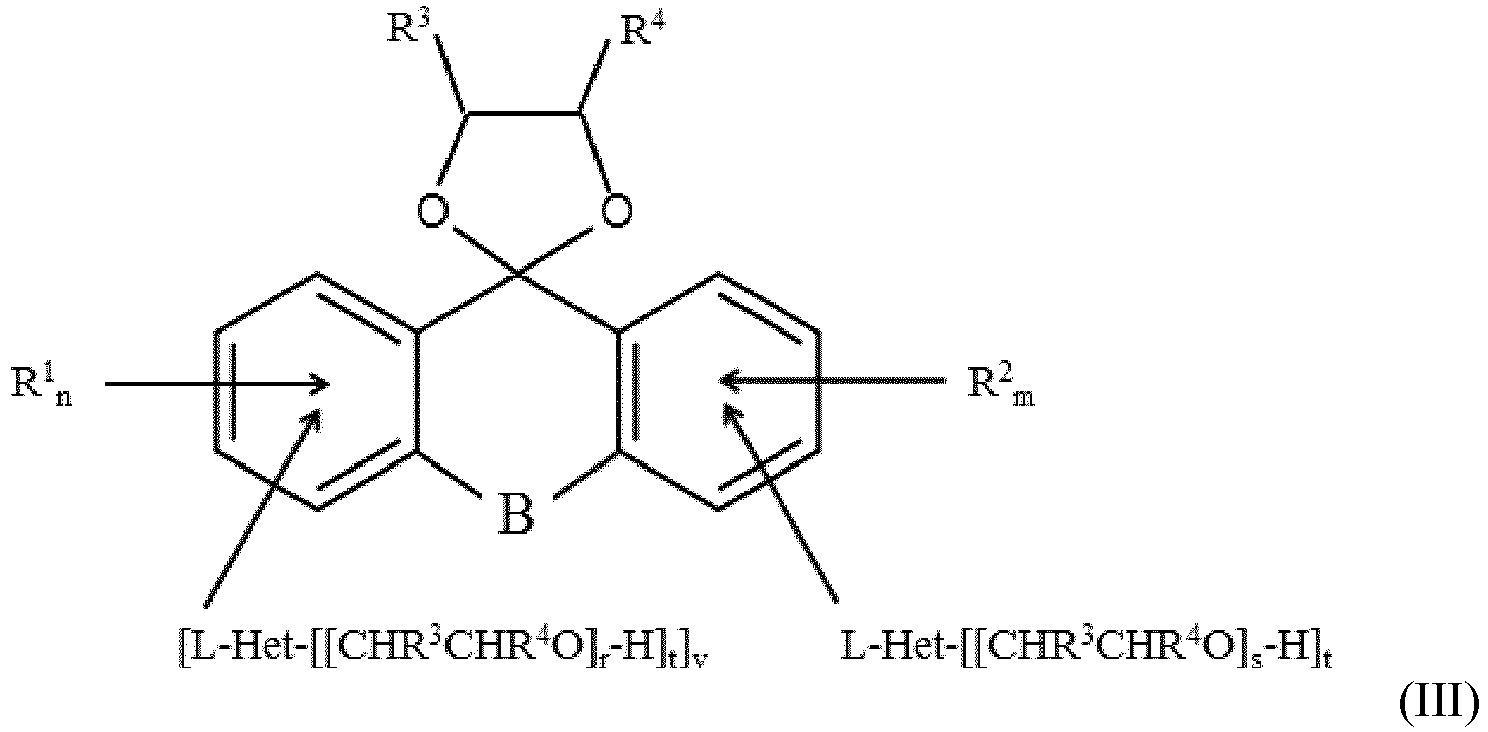
- Since they are typically formed in a minor amount compared to their non ketalized analogoues of formula (I) and (IV) respectively removal is typically not required to fulfil the intended purpose. The compounds of formula (III) area potential starting material for compounds of formulae (I) and (IV).
- In strict analogy compounds of formula (IIIa) are formed as byproducts during the process according to the invention to prepare compounds of formulae (Ia) and (IVa) starting from compounds of formula (IIa)
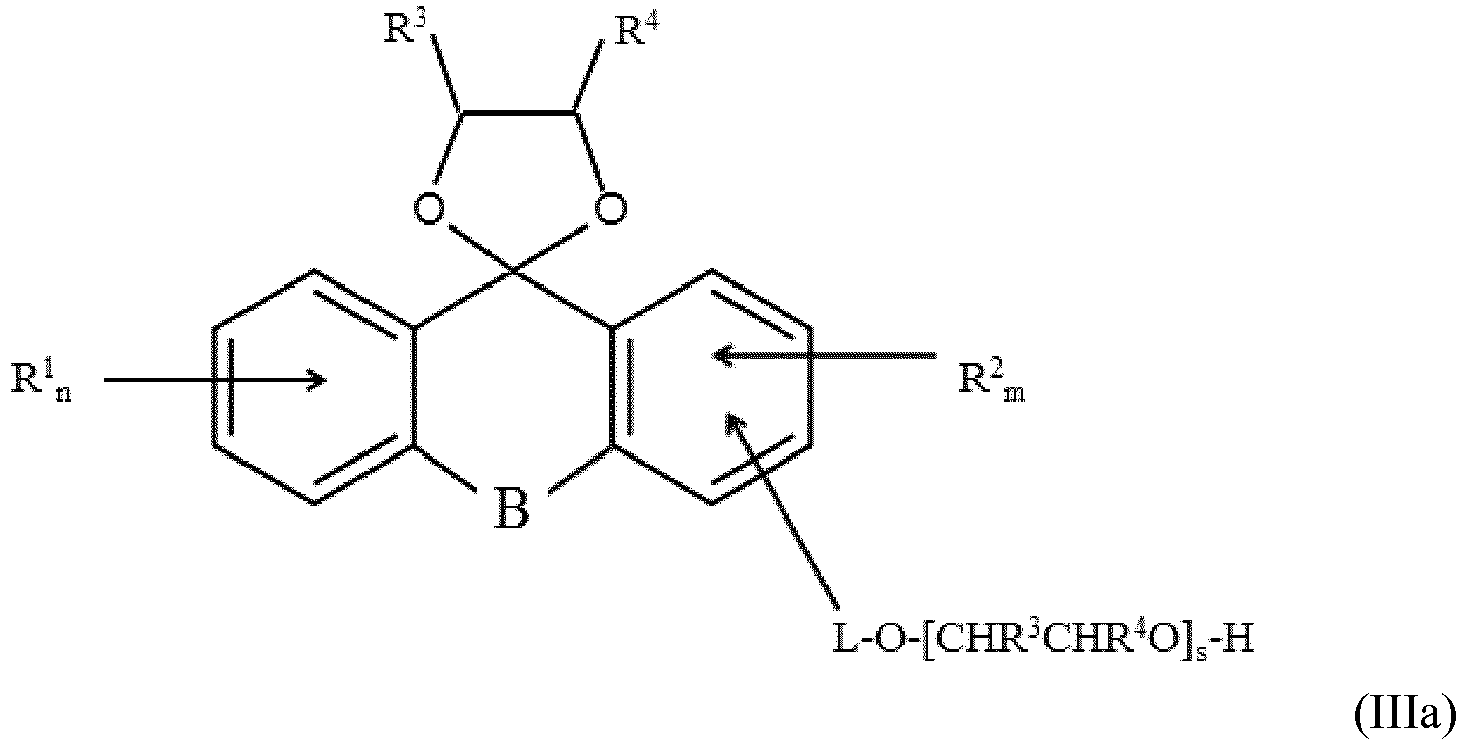
- In formula (IIIa) the arrows, B, R1, n, R2, m , R3, R4, s and L have the meaning including their preferred embodiments set forth for formula (Ia) above and wherein s denotes q where mixtures of compounds of formula (IVa) including their preferred embodiments are concerned.
- It is known to those skilled in the art, that when the compounds of formula (I) are prepared according to the process described above mixtures of several compounds in which the number of repeating units of the ethylene oxide and/or propylene oxide moieties differs and provides the imixtures of compounds of formula IV according to the invention.
- It was found that the mixtures of compounds of formula (IV) are not only advantageous due to lack of workup and purification steps compared compounds of formula (I) but provide further advantages, i.e. lower viscosity and thus even better processing in combination therewith.
- It was found that the mixtures comprising compounds of formula (IV) may further be functionalized.
- Therefore the invention further encompasses mixtures of compounds of formula (VI)

- the arrows
- denote substitution at the aromatic ring without specifically indicating the relative position to the depicted keto-group if not mentioned otherwise hereinafter and wherein
- B
- is either missing and the two aromatic rings are then therefore substituted with hydrogen, or where n or m are not zero alternatively also with R1 or R2 respectively, at the position where B is depicted to be bound at the aromatic ring or is sulfur or oxygen, whereby B is preferably missing or sulfur and more preferably B is missing
- n
- is 0, 1 or 2, preferably 0 or 1 and more preferably 0
- R1
- is independently of other substituents R1 which may be present selected from the group consisting of hydrogen, C1-C18-alkyl, C2-C18-alkenyl, C1-C18-alkoxy, C1-C18-alkylthio C6-C14-aryl, C6-C14-aryloxy, C6-C14-arylthio, -N(R5)2, fluoro, chloro and COOR5 with R5 being hydrogen or C1-C18-alkyl
- m
- is 0, 1 or 2, preferably 0 or 1 and more preferably 0
- R2
- is independently of other substituents R2 which may be present selected from the group consisting of hydrogen, C1-C18-alkyl, C2-C18-alkenyl, C1-C18-alkoxy, C1-C18-alkylthio, C6-C14-aryl, C6-C14-aryloxy, C6-C14-arylthio, -N(R5)2, fluoro, chloro and COOR5, with R5 being hydrogen or C1-C18-alkyl and
- v
- is 0 or 1, preferably 0
- L
- is independently missing or a methylene group, i.e. Het is either directly bound to the aromatic ring or via a methylene group
- Het
- is independently sulphur, oxygen, N(C1-C18-Alkyl), NH or N, preferably oxygen
- t
- is 1 for Het = sulphur, oxygen, N(C1-C18-Alkyl), NH and is 2 for for Het = N
- R3 and R4
- are either identically hydrogen or one of R3 and R4 is hydrogen and the other is methyl, whereby, in a preferred embodiment R3 and R4 are identically hydrogen and
- if t is 1 y1 and y2
- independently of each other represent an integer of 0 or more, preferably 1 or more, preferably of from 1 to 20, more preferably of from 1 to 10 and even more preferably 3 to 10, whereby the sum of y1 and y2 is at least 1 for v = 1, or y2 is at least 1 where v = 0
- if t is 2 all y1 and y2
- independently of each other represent an integer of 0 or more, preferably 1 or more, preferably of from 1 to 20, more preferably of from 1 to 10 and even more preferably 3 to 10, whereby the sum of all y1 and all y2 is at least 1 for v = 1, or the sum of all y2 is at least 1where v = 0
- E
- independently, preferably identically represents H2C=CH-CO-, (CH3)HC=CH-CO- or H2C=C(CH3)-CO-, whereby H2C=CH-CO- and H2C=C(CH3)-CO- are preferred and H2C=CH-CO- is even more preferred,
- y2, where v is 0 and t is 1 or
- at least one of y1 and y2, where both t are 1 or
- at least one of all y2, where v=0 and t is 2 or
- at least one of all y1 and all y2, where v=1 and where at least one t is 2
- The preparation of compounds of formula (VI) may be effected by standard esterification procedures known to those skilled in the art, which include for example and as an exemplary embodiment contacting the mixtures of compounds of formula (IV) with acids E-H in the presence of an acid such as a mineral acid such as sulfuric or hydrochloric acid or a organic sulfonic acid such as p-toluene sulfonic acid and removing water e.g. via distillation. Alternatively mixtures of compounds of formula (IV) can be treated with acid halides E-Hal, with Hal being Cl or Br, in the presence of a base such as an amine.
- Preferred mixtures of compounds of formula (VI) are those comprising compounds of formula (VIa)

- Particularly preferred mixtures compounds of formula (VI) are those comprising compounds of formula (VIb)

- wherein L, R3 and R4 have the meaning including their preferred embodiments set forth above for formula (VI)
- y2 represents an integer of 1 or more, preferably 1 to 20, more preferably 2 to 10, and yet even more preferably 2, 3, 4, 5 or 6 and
- E represents H2C=CH-CO- or H2C=C(CH3)-CO-, preferably H2C=CH-CO-.
- In another preferred embodiment L is missing.
- In preferred embodiment the invention further encompasses mixtures comprising compounds of formula (VIa), more preferably compounds of formula (VIb), wherein with respect to the number of repeating units y2.
at least 50 wt.-%, preferably at least 55 wt.-% and even more preferably at least 60 wt.-% of the total weight of compounds of formula (VIa) resp. formula (VIb) within the mixture are those of formula (VIa) resp. formula (VIb) having a number of repeating units y2 of 3 or more, preferably of 3 to 20, even more preferably 3 to 10 and yet even more preferably 3, 4, 5, 6, 7 or 8 and wherein none of the single compounds of formula (VIa) resp. (VIb) is present in an amount of more than 50 wt.-% with respect to the total weight of compounds of formula (VIa) resp. (VIb). - In one embodiment the total amount of compounds of formula (IVa) resp. (VIb) present in the mixtures comprising compounds of formula (IVa) wherein q is 5 or larger is 20 wt.-% or less, preferably 15 wt.-% or less and more preferably 12 wt.-% or less.
- The weight of compounds of formula (VI) resp. (VIa) resp (VIb) with respect to the total weight of the mixture according to the aformentioned embodiments of the invention is from 10 to 100 wt.-%, preferably 80 to 100 wt.-%, more preferably 90 to 100 wt.-% and even more preferably 95 to 100 % wt.%.
- The remainder to 100 wt.-% if present may comprise for example the respective ketals, unreacted compounds and their ketals, solvents or catalyst residues.
- However, it was surprisingly found that during functionalization with compounds of formula EH or E-Hal as described above the respective ketals are reacted to form additional compounds of formula (VI) resp. (VIa) resp (VIb) with the ethylene glycol released forming the respective mono and double esters, particularly double esters.
- It was found that mixtures comprising compounds of formula (IVa) may further be functionalized in an alternative way.
- Therefore the invention further encompasses mixtures compounds of formula (VIIa)

- the arrows
- denote substitution at the aromatic ring without specifically indicating the relative position to the depicted keto-group if not mentioned otherwise hereinafter and wherein
- B
- is either missing and the two aromatic rings are then therefore substituted with hydrogen, or where n or m are not zero alternatively also with R1 or R2 respectively, at the position where B is depicted to be bound at the aromatic ring or is sulfur or oxygen, whereby B is preferably missing or sulfur and more preferably B is missing
- n
- is 0, 1 or 2, preferably 0 or 1 and more preferably 0
- R1
- is independently of other substituents R1 which may be present selected from the group consisting of hydrogen, C1-C18-alkyl, C2-C18-alkenyl, C1-C18-alkoxy, C1-C18-alkylthio C6-C14-aryl, C6-C14-aryloxy, C6-C14-arylthio, -N(R5)2, fluoro, chloro and COOR5 with R5 being hydrogen or C1-C18-alkyl
- m
- is 0, 1 or 2, preferably 0 or 1 and more preferably 0
- R2
- is independently of other substituents R2 which may be present selected from the group consisting of hydrogen, C1-C18-alkyl, C2-C18-alkenyl, C1-C18-alkoxy, C1-C18-alkylthio, C6-C14-aryl, C6-C14-aryloxy, C6-C14-arylthio, -N(R5)2, fluoro, chloro and COOR5, with R5 being hydrogen or C1-C18-alkyl and
- L
- is independently missing or a methylene group, i.e. Het is either directly bound to the aromatic ring or via a methylene group
- R3 and R4
- are either identically hydrogen or one of R3 and R4 is hydrogen and the other is methyl, whereby, in a preferred embodiment R3 and R4 are identically hydrogen and
- y3
- represents an integer of 1 or more, preferably of from 1 to 20, more preferably of from 1 to 10 and even more preferably 3 to 10
- w
- is an integer of 2 or more, preferably 2, 3 or 4 and
- Rz
- represents R(CO)x with R being an x-valent organic residue with 1 or more, preferably 1 to 30 carbon atoms.
- Preferred compounds of formula (VIIa) are those wherein the arrows, B, R1, n, R2, m, R3 and R4 and L have the meaning including their preferred embodiments set forth above for formula (VIa) and y3 has the same meaning as y2 in formula (VIa).
- w is 2 and Rz is a residue derived from terephthalic, phthalic, crotonic, itaconic, succinic, maleic or fumaric acid by abstraction of all OH-groups of the respective carboxylic functions.
- The preparation of compounds of formula (VIIa) may be effected by standard esterification procedures known to those skilles in the art, which include for example and as an exemplary embodiment contacting the compounds of formula (I) or mixtures of compounds of formula (IV) with acids R-(COH)x in the presence of an acid such as a mineral acid such as sulfuric or hydrochloric acid or a organic sulfonic acid such as p-toluene sulfonic acid and removing water e.g. via distillation. Alternatively compounds of formula (I) or mixtures of compounds of formula (IV) can be treated with acid halides R-(COHal)x, with Hal being Cl or Br, in the presence of a base such as an amine.
- The weight of compounds of formula (VIIa) with respect to the total weight of the mixture according to the aformentioned embodiments of the invention is from 10 to 100 wt.-%, preferably 80 to 100 wt.-%, more preferably 90 to 100 wt.-% and even more preferably 95 to 100 % wt.%.
- The remainder to 100 wt.-% if present may comprise for example the respective ketals, unreacted compounds and their ketals, solvents or catalyst residues.
- The mixtures comprising compounds of formula (IV), the mixtures of compounds of formula (VI) as specified above or mixtures of compounds of formula (VIIa) as specified above each including their preferred embodiments are particularly useful as photoinitiators and for use in photo-curable compositions in particular coating compositions, including varnishes, lacquers and printing inks, wood coatings, furniture coating, floor coatings, UV curable adhesives and UV curable resins as well as in other drying or curing compositions such as water-borne or solvent containing UV-curable formulations.
- They are further useful as photoinitiators in heterophase polymerizations such as emulsion polymerizations.
- Accordingly, the present invention also relates to photo-curable compositions, comprising
- (a) at least one ethylenically unsaturated component and
- (b) a mixture comprising compounds of formula (IV) as specified above or
at least one compound of formula (VI) or mixtures thereof as specified above or
at least one compound of formula (VIIa) or mixtures thereof as specified above. - Where mixtures of compounds of formula (VI) are present the term ethylenically unsaturated compound preferably denotes a compound other than a compound of formula (VI).
- Whereever reference is made to mixtures of compounds of formula (IV), or mixtures of compounds of formula (VI) in the photo-curable compositions and their applications and uses the preferred embodiments described above for such compounds and mixtures shall accordingly apply thereto.
- Suitable ethylenically unsaturated components include mono(meth)acrylates, aliphatic or aromatic urethane (meth)acrylates, polyether (meth)acrylates, polyester (meth)acrylates and epoxy (meth)acrylates (such as bisphenol A epoxy acrylate).
- Examples of suitable mono(meth)acrylates include methylacrylate, methyl methacrylate, ethyl acrylate, ethyl methacrylate, ethylhexyl acrylate, ethylhexyl methacrylate, hydroxyethyl acrylate, hydroxyethyl methacrylate, isobornyl acrylate, isobornyl methacrylate, butyl acrylate and butyl methacrylate.
- Polyester (meth)acrylates include dipropylene glycol diacrylate, pentaerytritol tetraacrylate, dipentaerytrityl hexaacrylate, di-, tri- and tetra-ethylenglycol diacrylate, hexanediol diacrylate, trimethylolpropane triacrylate, di-trimethylolpropane tetra-acrylate, di-pentaerythritol pentaacrylate.
- Polyether acrylates include ethoxylated trimethylol propane triacrylate, glycerol propoxylate triacrylate, ethoxylated pentaerythritol tetraacrylate.
- Epoxy acrylates include dianol diacrylate (= the diacrylate of 2, 2-bis [4-(2-hydroxyethoxy) phenyl] propane, e.g. Ebecryl 150 from UCB) and glycol diacrylates such as tripropylene glycol diacrylate, epoxidized soy bean oil acrylate.
- Preferably the photo-curable compositions contain at least one synergist.
- Suitable synergists include but are not limited to 2-ethylhexyl-4-dimethylamino benzoate, ethyl 4-(dimethylamine) benzoate, N-methyl diethanolamine, 2-dimethylamino ethylbenzoate, butoxyethyl-4-dimethylamino benzoate, as well as C373, CN383, CN384, CN386 and CN 371, all available from Sartomer; Ebecryl P104, Ebecryl P115, Ebecryl 7100 all available from Allnex; and Roskydal UA XP 2299 available from Bayer, or the acrylated synergists such as Genomer 5142 and Genomer 5161 available from Rahn.
- Further components which may be additionally present in the photo-curable compositions or not are:
- isocyanates and/or polyisocyanates
- flattening agents
- matting agents,
- defoamer
- anti-friction agents such as silicon containing antifriction agents,
- surfactants
- resins such as formaldehyde resins, polyurethan resins, polyacrylates, cellulosic resins and sucrose benzoate
- further photoinitiators, including but not limited to Norrish Type I initiators such as 2-hydroxy-1-{4-[4-(2-hydroxy-2-methyl-propionyl)-benzyl]-phenyl}-2-methyl-propan-1-one (Irgacure 127), 2-hydroxy-1-[4-(2-hydroxyethoxy)-phenyl]-phenyl]-2-methylpropan-1-one (Irgacure 2959), 1-hydroxy-cyclohexyl-phenyl-ketone (Irgacure 184), 2-hydroxy-2-methyl-1-phenyl-1-propanone (Irgacure 1173), benzildimethylketal and oligo[2-hydroxy-2-methyl-1-[4-(1-methylvinyl)phenyl]propanone] (Esacure KIP 150 from Lamberti) as well as mono- or bisacylphosphinoxides such as phenyl-bis(2,4,6-trimethylbenzoyl)phosphine oxide, diphenyl-(2,4,6-trimethylbenzoyl)phosphine oxide and ethyl-(2,4,6-trimethylbenzoyl)phenyl phosphinate.
- Although the mixtures of compounds of the present invention are especially useful as photoinitiators for use in the production of varnishes, they may also be used with advantage in many other kinds of energy-curable coating compositions. For example, although yellowing is not such a problem with printing inks, it may still be advantageous to have a photoinitiator which does not result in yellowing on cure or on ageing, since this gives the ink formulator a much greater degree of freedom in choosing the other ingredients of the ink, including the pigment.
- The amounts of ethylenically unsaturated components, photoinitiators, and optional other ingredients will vary according to the type of composition, the particular equipment to be used to apply it and the application.
- However, typically, the amount of photoinitiator within the composition is in the range of from 0.5 to 12 wt.-%, preferably 2 to 10 wt.-%, more preferably 4 to 9 wt.-%.
- In particular where isocyanates and/or polyisocyanates are intended to be used as further component the compounds of formula (I) or the mixtures comprising compounds of formula (IV) are of particular advantage since they are capable of reacting with isocyanates.
- In one embodiment the specific mixtures comprising compounds of formula (IV) as specified above or the mixture obtainable by the process according to the invention may directly be reacted within the photo-curable composition, thus omitting a separate reaction and isolation or workup step. The ethylenically unsaturated compounds such as acrylates may serve as diluent and component of the photo-curable composition simultaneously. The invention further relates to a process for preparing a cured composition by exposing the photo-curable compositions according to the present invention to electromagnetic radiation, preferably ultraviolet radiation.
- Suitable sources of electromagnetic radiation UV lamps like low-pressure, medium-pressure, high-pressure and super-high-pressure mercury lamps which can be undoped or doped e.g. with gallium iodide, thallium iodide or other metal halides; blue, violet-blue or UV-LEDs; concentrated, direct or indirect sunlight; xenon or xenon mercury arc lamps such as continuous-output xenon short- or long-arc lamps, flash lamps such as xenon or xenon mercury flash lamps; microwave-excited metal vapour lamps; excimer lamps, superactinic fluorescent tubes; fluorescent lamps; and noble gas incandescent lamps.
- Preferred sources are UV lamps like low-pressure, medium-pressure, high-pressure and super-high-pressure mercury lamps which can be undoped or doped e.g. with gallium iodide, thallium iodide or other metal halides; blue, violet-blue or UV-LEDs, xenon or xenon mercury arc lamps such as continuous-output xenon short- or long-arc lamps.
- Specific examples include H-UV lamps from Komori and LE-UV lamps from IST.
- The cured compositions may be produced by all printing methods known to those skilled in the art including flexography, rotagravure, roller printing and screen printing, ink jet whereby the printed materials include paper, board, paperboard, plastic films and articles e.g. from polypropylene, polyethylene, polyethyleneterephthalate, polyvinylchloride, polystyrene, aluminium, would, laminate, tin or other metals, multi-layer substartes, or mixtures thereof,
- Said printed materials are particular useful to be applied in articles comprising said printed materials e.g. fine arts, pictures, newspapers, magazines, packaging, in particular packaging for food, tobacco and tobacco products, cosmetics, pharmaceuticals and the like.
- The photo-curable compositions may also be used in other fields where UV-curing technologies are applied, such as other coating techniques like roller coating, curtain coating, spray coating, 3-D printing, molding compounds and the like.
- The invention therefore encompasses printed materials comprising the cured compositions according to the invention and articles comprising said printed materials.
- The advantage of the invention is that the mixtures of compounds provided based on readily available compounds of formula (II) as starting materials meet the high solubility in coating formulations, especially UV-curable formulations, very good reactivity and in some cases significantly higher reactivity than some of the commonly used benzophenone derivatives commercially available today. The claimed photoinitiators are easy processible since liquid and available via a versatile and efficient process. They further exhibit a much lower tendency to migrate and be extracted than most benzophenone derivatives in particular when reacted with other components of classical photo-curable compositions.
- The invention is hereinafter further explained by the examples without being limited thereto.
- In a reactor 1,000 kg [5.05 mol] of 4-hydroxybenzophenone were placed in a reaction vessel and 600 wt.-ppm KOH based on 4-hydroxybenzophenone were added. The reaction chamber was flushed with nitrogen. The mixture was reacted with 3.5 molar equivalants of ethylene oxide at temperatures of 130 to 150°C for 5 hours at pressures of max. 0,6 MPa.
- The crude reaction mixture was analyzed by GC. The composition of the reaction mixture obtained thereby is listed in table 1.
Ethylene oxide repeating units (s,q) % of total peak area Wt.-% calculated (%-peak area* molar mass/ (Sum (peak area*molar mass)* 100) f (free ketone) k (ketal) 0 (k) 0.12 0.09 1 (f) 0.72 0.52 1 (k) 1.80 1.53 2 (f) 22.30 18.95 2 (k) 2.20 2.16 3 (f) 39.17 38.40 3 (k) 1.14 1.27 4 (f) 25.37 28.19 5 (f) 7.18 8.92 Sum 100.00 100 *noise calibrated - The amount of compounds of formula (I, IV) (3 ≤ q ≤ 5) was 75.51 wt.-%. Further compounds of formula (I, IV) could be detected having up to 10 EO units, however their combined intensities were lower than 2 wt.-% based on the sum (100 wt.-%) of compounds indicated in table 1. Compounds having more than 10 EO units were not detected. None of the single compounds of formula (I, IV) had a share of 50 wt.-% or more. The amount of compounds of formula (I, IV) in the mixture of compounds of formula (I, IV) was above 90 wt.-%. The amount of compounds of formula (I,IV) with any t being 5 or more (q ≥ 5) was less than 11 wt.-%.
- The product appeared as a yellowish liquid having a viscosity of 2.5 Pa*s at 23°C as measured by Thermo HAAKE Rheostress RS1.
- An analogous reaction with propylene oxide resulted in a mixture of very similar composition having a viscosity of 1.86 Pa*s.
- Both products showed superior processability and long term stability when employed in photocurable compositions.
- The 4-benzophenonecarboxylic esters disclosed in
EP 2 394 676 A1 and commercially available under the tradename Genopol BP exhibits a viscosity of around 100 Pa*s. - Another product commercially available under the tradename Omnipol exhibits a viscosity of 200 Pa*s.
- In order to decompose the ketals 1 g of the mixture obtained according to example 1 was dissolved in 50 ml tetrahydrofurane:water 1:1 (v/v) and stirred for 24 h at room temperature after addition of 50 mg para-toluene sulfonic acid.
- After addition of 100 ml of toluene, the organic phase was seperated, washed with brine, dried with magnesium sulfate and the solvent evaporated. No acetals could be detected by GC any more.
- 20 grams (about 58 mmol) of the crude reaction mixture of example 1 and 0.1 g of DABCO (1,4-diazabicyclo[2.2.2]octane) were dissolved in 10g of propoxylated glycerol triacrylate (OTA 480, Cytec). 7.8 g H12MDI (4,4'-Diisocyanatodicyclohexylmethane) were added and the reaction temperature controlled at 60°C for about 6h. The reaction product obtained was obtained as a highly viscous, pale brown liquid.
- 20g (about 58 mmol) of the mixture obtained according to Example 1 and 8.4g (92 mmol) acryloylchloride were dissolved_in 120 mL tetrahydrofurane (THF) at room temperature. 9.37g (93mmol) triethylamine were added dropwise over a period of 5h. The mixture was neutralized by adding 5mL HCl (35% in H2O) and 200 mL water were added. After seperating the layers, the organic phase was washed with 3 times with saturated NaCl solution, dried with MgSO4 and the solvent was evaporated under reduced pressure.
The originally present respective ketals were found to fully react to form the respective non-ketalized acyloylesters, while the ethylene glycol released formed the respective ethylene glycol diacrylate. - Yield: 92 % of theory.
The mixture obtained showed neglectable signals of non-acrylated substance in MALDI-TOF measurements. The viscosity of the mixture was found to be even lower than the viscosity of the starting material (1.17 Pa*s at 23°C). - 68g (202mmol) of the mixture obtained according to example 1 were dissolved in 400 mL tetrahydrofurane (THF) and 22g (108mmol) terephtaloyl chloride were added under stirring. 25g (247 mmol) triethylamine were dissolved separately in 70mL THF and the solution was added dropwise to the reaction mixture over a period of 3h and the mixture was further stirred for 4h. To the mixture 700mL distilled water and 20mL HCl (35%) were added. After seperating the layers, the organic phase was washed with 3 times with saturated NaCl solution, dried with MgSO4 and the solvent was evaporated under reduced pressure.
Yield: 90% of theory.
The IR spectrum did not show any broad OH-signal anymore at 3464 cm-1 indicating complete conversion. A strong signal for the ester resonance at 1716cm-1 was detected. - The reacticvity of the mixture obtained according to Example 1 was tested in equal wt.-amounts versus Omnipol BP and Genopol BP and other benzophenones.
- The tested varnish was formulated as follows:
Genomer 5161 (Rahn AG) 9.21 parts, OTA-480 (Allnex) 55.25 parts; Miramer M300 (Rahn AG) 27.62 parts, Irgacure 127 (BASF) 0.92 parts, Tego Rad 2011 (Evonik Industries) 0.46 parts; Photoinitiator (Example 1 or Omnipol BP or Genopol BP) 6.54 parts.
For comparison with low molecular weight benzophenone-derivatives only 4 parts were used to reflect comparison of actual chromophore concentration.
Parts refer to parts by weight.
The mixture according to example 1 showed superior behavior in mixing and homogenizing compared to the more viscuous Omnipol BP and Genopol BP.
On a black printed carton the varnish was applied in about 4g/m2 and passed under a UV Hg-lamp 200 W/cm, 50% in tensity) at 80m/min. several times. The curing was determined by applying fine talcum powder on the surface and carefully wiping it of. The sample was fully cured when no talcum powder sticked to the surface. The number of passes for each varnish is given in table 1.Varnish Number of passes until fully cured Varnish with Genopol BP 6 Varnish with Omnipol BP 4 Varnish with Mixture of Example 1 4 Varnish with 4-Hydroxybenzophenone 7 - Varnishes comprising of same components as in example 6 with Omnipol BP, Genopol BP, the mixtures of examples 1, and in two further runs the mixtures of examples 3 and 4 were each applied with 10g/m2 on a polyester foil an passed under a standard mercury lamp (200W/cm) with 20m/min. 1 dm2 of the sample was extracted with Ethanol (95 vol.-%) for 24h at room temperature and the extracted amount of photoinitiator was determined accordingly. The following leaching rates were found:
Genopol BP: 50 µg/ dm2 Omnipol BP: 39 µg/ dm2 Mixture of Example 1*: 1445 µg/ dm2 Mixture of Example 3*: 37 µg/ dm2 Mixture of Example 4**: 10 µg/ dm2 * measured amount of compounds of Example 1)
** measured amount of compounds of Example 4). - Example 4 was detected in significant lower amounts than compared to all other tested photoinitiators despite having a comparably low molecular weight which indicates superior usability in application such as food packaging were low leaching levels are more than desirable.
- In a reactor 20g [88mmol] of 2-hydroxythioxanthen-9-one were placed in a reaction vessel and 600 wt.-ppm KOH (based on 2-hydroxythioxanthen-9-one) were added together with 100 g isoaliphatic naphta. The reaction chamber was flushed with nitrogen. The mixture was reacted with 3.5 molar equivalants of ethylene oxide at temperatures of 130 to 150°C for 3 hours at pressures of max. 0,6 MPa. The crude reaction mixture was analyzed by MALDI-TOF.:
Ethylene oxide repeating units % of rel. intensities Ethylene oxide repeating units % of total rel. intensities 2 2.3 7 13.0 3 10.7 8 7.9 4 19.7 9 2.9 5 23.7 10 0.8 6 19.9 Mn=460 was calculated based on the mass count distribution
wherein
at least 50 wt.-%, preferably at least 55 wt.-% and even more preferably at least 60 wt.-% of the total weight of compounds of formula (IV) within the mixture are those of formula (IV) wherein
wherein none of the single compounds of formula (IV) is present in an amount of more than 50 wt.-% with respect to the total weight of compounds of formula (IV) in the mixture.
at least 50 wt.-%, preferably at least 55 wt.-% and even more preferably at least 60 wt.-% of the total weight of compounds of formula (IVa) within the mixture are those of formula (IVa) having a number of repeating units q of 3 or more, preferably of 3 to 20, even more preferably 3 to 10 and yet even more preferably 3, 4, 5, 6, 7 or 8 and wherein none of the single compounds of formula (IVa) is present in an amount of more than 50 wt.-% with respect to the total weight of compounds of formula (IVa).
at least 50 wt.-%, preferably at least 55 wt.-% and even more preferably at least 60 wt.-% of the total weight of compounds of formula (IVb) within the mixture are those of formula (IVb) having a number of repeating units q of 3 or more, preferably of 3 to 20, even more preferably 3 to 10 and yet even more preferably 3, 4, 5, 6, 7 or 8 and wherein none of the single compounds of formula (IVb) is present in an amount of more than 50 wt.-% with respect to the total weight of compounds of formula (IVb).
at least one r or s is an integer of 3 or more, preferably of from 3 to 20, more preferably of from 3 to 10 and even more preferably 3, 4, 5, 6, 7 or 8 and the other residues r and/or s are an integer of 1 or more, preferably of from 1 to 20, more preferably of from 1 to 10 and even more preferably 3, 4, 5, 6, 7, 8 or 9 with 3 being even more preferred.In another embodiment t is r and s are independently of one another an integer of 3 or more, preferably of from 3 to 20, more preferably of from 3 to 10 and even more preferably 5, 6, 7 or 8 or 3.
wherein
the substituent L-O[CHR3CHR4O]y3- occupies the ortho-, meta or the para-position, more preferably the ortho- or the para-position and even more preferably the para-position at the aromatic ring and with respect to the keto-function depicted in formula (VIIa) and
wherein
Claims (14)
- Mixtures comprising compounds of formula (IV)
 the arrows denote substitution at the aromatic ring without specifically indicating the relative position to the depicted keto-group if not mentioned otherwise hereinafter and whereinB is either missing and the two aromatic rings are then therefore substituted with hydrogen, or where n or m are not zero alternatively also with R1 or R2 respectively, at the position where B is depicted to be bound at the aromatic ring or is
sulfur or oxygen,
whereby B is preferably missing or sulfur and more preferably B is missingn is 0, 1 or 2, preferably 0 or 1 and more preferably 0R1 is independently of other substituents R1 which may be present selected from the group consisting of C1-C18-alkyl, C2-C18-alkenyl, C1-C18-alkoxy, C1-C18-alkylthio C6-C14-aryl, C6-C14-aryloxy, C6-C14-arylthio, -N(R5)2, fluoro, chloro and COOR5 with R5 being hydrogen or C1-C18-alkylm is 0, 1 or 2, preferably 0 or 1 and more preferably 0R2 is independently of other substituents R2 which may be present selected from the group consisting of C1-C18-alkyl, C2-C18-alkenyl, C1-C18-alkoxy, C1-C18-alkylthio, C6-C14-aryl, C6-C14-aryloxy, C6-C14-arylthio, -N(R5)2, fluoro, chloro and COOR5, with R5 being hydrogen or C1-C18-alkyl andv is 0 or 1, preferably 0 andthe substituents L-Het[[CHR3CHR4O]p-H]t if present and L-Het-[CHR3CHR4O]q-H]t independently of each other occupy the ortho-, meta or the para-position, more preferably the ortho- or the para-position and even more preferably the para-position at their respective aromatic ring and with respect to the keto-function depicted in formula (IV) and
whereinL is independently missing or a methylene group, i.e. Het is either directly bound to the aromatic ring or via a methylene groupHet is independently sulphur, oxygen, N(C1-C18-Alkyl), or N, preferably oxygent is 1 for Het = sulphur, oxygen, N(C1-C18-Alkyl) and
is 2 for for Het = NR3 and R4 are either identically hydrogen or one of R3 and R4 is hydrogen and the other is methyl, whereby, in a preferred embodiment R3 and R4 are identically hydrogen andandp and q independently of each other represent an integer of 0 or more, preferably 1 or more, preferably of from 1 to 20, more preferably of from 1 to 10wherein with respect to the number of repeating units p and q, however,
at least 50 wt.-%, preferably at least 55 wt.-% and even more preferably at least 60 wt.-% of the total weight of compounds of formula (IV) within the mixture are those of formula (IV) wherein• q, where v is 0 and t is 1 or• at least one of p and q, where both t are 1 or• at least one of all q, where v=0 and t is 2 or• at least one of all p and all q, where v=1 and where at least one t is 2is 3 or more, preferably of 3 to 20, even more preferably 3 to 10 and yet even more preferably 3, 4, 5, 6, 7 or 8
wherein none of the single compounds of formula (IV) is present in an amount of more than 50 wt.-% with respect to the total weight of compounds of formula (IV) in the mixture. - Mixture according to claim 1 , wherein the total amount of compounds of formula (IV) present in the mixture comprising compounds of formula (IV) having at least one of p and q being 5 or larger is 20 wt.-% or less, preferably 15 wt.-% or less and more preferably 12 wt.-% or less.
- Mixture according to any one of claims 1 or 2, wherein the compounds of formula (IV) are those of formula (IVb)
 q represents an integer of 0 or more, preferably 1 or more, preferably of from 1 to 20, more preferably of from 1 to 10wherein with respect to the number of repeating units q at least 50 wt.-%, preferably at least 55 wt.-% and even more preferably at least 60 wt.-% of the total weight of compounds of formula (IVb) within the mixture are those of formula (IVb) having a number of repeating units q of 3 or more, preferably of 3 to 20, even more preferably 3 to 10 and yet even more preferably 3, 4, 5, 6, 7 or 8 and wherein none of the single compounds of formula (IVb) is present in an amount of more than 50 wt.-% with respect to the total weight of compounds of formula (IVb).
 - A process for the preparation of mixtures of compounds of formula (IV) according to any one of claims 1 to 3 comprising at least the step of reacting one or more compounds, preferably one compound of formula (II)

with ethylene oxide and/or propylene oxide either in the presence of a catalyst or not, whereby the molar ratio of ethylene oxide and/or propylene oxide or the sum thereof to compounds of formula (II) to obtain mixtures of compounds of formula (IV) according to any one of claims 1 to 3 is at least 2.5, preferably at least 3 and more preferably at least 3.5 per substituent L-Het-H if Het is oxygen, sulfur or N(C1-C18-Alkyl) or the respective double amount per substituent if Het is N. - Mixture according to any one of claims 1 to 3 further comprising compounds of formula (III)

- Mixtures of compounds of formula (VI)
 the arrows denote substitution at the aromatic ring without specifically indicating the relative position to the depicted keto-group if not mentioned otherwise hereinafter and whereinB is either missing and the two aromatic rings are then therefore substituted with hydrogen, or where n or m are not zero alternatively also with R1 or R2 respectively, at the position where B is depicted to be bound at the aromatic ring or is
sulfur or oxygen,
whereby B is preferably missing or sulfur and more preferably B is missingn is 0, 1 or 2, preferably 0 or 1 and more preferably 0R1 is independently of other substituents R1 which may be present selected from the group consisting of hydrogen, C1-C18-alkyl, C2-C18-alkenyl, C1-C18-alkoxy, C1-C18-alkylthio C6-C14-aryl, C6-C14-aryloxy, C6-C14-arylthio, -N(R5)2, fluoro, chloro and COOR5 with R5 being hydrogen or C1-C18-alkylm is 0, 1 or 2, preferably 0 or 1 and more preferably 0R2 is independently of other substituents R2 which may be present selected from the group consisting of hydrogen, C1-C18-alkyl, C2-C18-alkenyl, C1-C18-alkoxy, C1-C18-alkylthio, C6-C14-aryl, C6-C14-aryloxy, C6-C14-arylthio, -N(R5)2, fluoro, chloro and COOR5, with R5 being hydrogen or C1-C18-alkyl andwhereinv is 0 or 1, preferably 0the substituents L-Het-[[CHR3CHR4O]yl-E] where present and L-Het-[[CHR3CHR4O]y2-E] independently of each other occupy the ortho-, meta or the para-position, more preferably the ortho- or the para-position and even more preferably the para-position at their respective aromatic ring and with respect to the keto-function depicted in formula (VI) and
whereinL is independently missing or a methylene group, i.e. Het is either directly bound to the aromatic ring or via a methylene groupHet is independently sulphur, oxygen, N(C1-C18-Alkyl), NH or N, preferably oxygent is 1 for Het = sulphur, oxygen, N(C1-C18-Alkyl), NH and is 2 for for Het = NR3 and R4 are either identically hydrogen or one of R3 and R4 is hydrogen and the other is methyl, whereby, in a preferred embodiment R3 and R4 are identically hydrogen and
if t is 1y1 and y2 independently of each other represent an integer of 0 or more, preferably 1 or more, preferably of from 1 to 20, more preferably of from 1 to 10 and even more preferably 3 to 10,whereby
the sum of y1 and y2 is at least 1 for v = 1, or
y2 is at least 1where v = 0
if t is 2all y1 and y2 independently of each other represent an integer of 0 or more, preferably 1 or more, preferably of from 1 to 20, more preferably of from 1 to 10 and even more preferably 3 to 10, wherebyand
the sum of all y1 and all y2 is at least 1 for v = 1, or
the sum of all y2 is at least 1where v = 0E independently, preferably identically represents H2C=CH-CO-, (CH3)HC=CH-CO- or H2C=C(CH3)-CO-, whereby H2C=CH-CO- and H2C=C(CH3)-CO- are preferred and H2C=CH-CO- is even more preferred,wherein with respect to the number of repeating units y1 and y2 at least 50 wt.-%, preferably at least 55 wt.-% and even more preferably at least 60 wt.-% of the total weight of compounds of formula (VI) within the mixture are those of formula (VI) wherein• y2, where v is 0 and t is 1 or• at least one of y1 and y2, where both t are 1 or• at least one of all y2, where v=0 and t is 2 or• at least one of all y1 and all y2, where v=1 and where at least one t is 2is 3 or more, preferably of 3 to 20, even more preferably 3 to 10 and yet even more preferably 3, 4, 5, 6, 7 or 8 and wherein none of the single compounds of formula (VI) is present in an amount of more than 50 wt.-% with respect to the total weight of compounds of formula (VI). - Mixtures according to claim 6, wherein compounds of formula (VI) are compounds of formula (VIb)

at least 50 wt.-%, preferably at least 55 wt.-% and even more preferably at least 60 wt.-% of the total weight of compounds of formula (VIb) within the mixture are those of formula (VIb) having a number of repeating units y2 of 3 or more, preferably of 3 to 20, even more preferably 3 to 10 and yet even more preferably 3, 4, 5, 6, 7 or 8 and wherein none of the single compounds of formula (VIb) is present in an amount of more than 50 wt.-% with respect to the total weight of compounds of formula (VIb). - A process for the preparation of mixtures according to claim 6 or 7 by esterification, preferably by• contacting mixtures of compounds of formula (IV) with acids E-H in the presence of an acid such as a mineral acid such as sulfuric or hydrochloric acid or a organic sulfonic acid such as p-toluene sulfonic acid and removing water e.g. via distillation or• reacting mixtures of compounds of formula (IV) with acid halides E-Hal, with Hal being Cl or Br, in the presence of a base such as an amine.
- Mixtures of compounds of formula (VIIa)
 the arrows denote substitution at the aromatic ring without specifically indicating the relative position to the depicted keto-group if not mentioned otherwise hereinafter and whereinB is either missing and the two aromatic rings are then therefore substituted with hydrogen, or where n or m are not zero alternatively also with R1 or R2 respectively, at the position where B is depicted to be bound at the aromatic ring or is
sulfur or oxygen,
whereby B is preferably missing or sulfur and more preferably B is missingn is 0, 1 or 2, preferably 0 or 1 and more preferably 0R1 is independently of other substituents R1 which may be present selected from the group consisting of hydrogen, C1-C18-alkyl, C2-C18-alkenyl, C1-C18-alkoxy, C1-C18-alkylthio C6-C14-aryl, C6-C14-aryloxy, C6-C14-arylthio, -N(R5)2, fluoro, chloro and COOR5 with R5 being hydrogen or C1-C18-alkylm is 0, 1 or 2, preferably 0 or 1 and more preferably 0R2 is independently of other substituents R2 which may be present selected from the group consisting of hydrogen, C1-C18-alkyl, C2-C18-alkenyl, C1-C18-alkoxy, C1-C18-alkylthio, C6-C14-aryl, C6-C14-aryloxy, C6-C14-arylthio, -N(R5)2, fluoro, chloro and COOR5, with R5 being hydrogen or C1-C18-alkyl andwherein
the substituent L-O[CHR3CHR4O]y3- occupies the ortho-, meta or the para-position, more preferably the ortho- or the para-position and even more preferably the para-position at the aromatic ring and with respect to the keto-function depicted in formula (VIIa) and
whereinL is independently missing or a methylene group, i.e. Het is either directly bound to the aromatic ring or via a methylene groupR3 and R4 are either identically hydrogen or one of R3 and R4 is hydrogen and the other is methyl, whereby, in a preferred embodiment R3 and R4 are identically hydrogen andy3 represents an integer of 1 or more, preferably of from 1 to 20, more preferably of from 1 to 10 and even more preferably 3 to 10w is an integer of 2 or more, preferably 2, 3 or 4 andRz represents R(CO)x with R being an x-valent organic residue with 1 or more, preferably 1 to 30 carbon atoms,wherein with respect to the number of repeating units y3 at least 50 wt.-%, preferably at least 55 wt.-% and even more preferably at least 60 wt.-% of the total weight of compounds of formula (VIIa) within the mixture are those of formula (VIIa) having a number of repeating units y3 of 3 or more, preferably of 3 to 20, even more preferably 3 to 10 and yet even more preferably 3, 4, 5, 6, 7 or 8 and wherein none of the single compounds of formula (VIIa) is present in an amount of more than 50 wt.-% with respect to the total weight of compounds of formula (VIIa). - A photo-curable composition, comprising(a) at least one ethylenically unsaturated component, preferably other than those of formulae (VI) and (VIIa)(b) at least a mixture comprising compounds of formula (IV) as claimed in claims 1 to 3 and 5 or
at least a mixture comprising compounds of formula (VI)) as claimed in claims 6 and 7 or
at least a mixture of compounds of formula (VIIa)as claimed in claim 9. - The photo-curable composition according to claim 10, wherein the photo-curable compositions further contain at least one component selected from the list below:
isocyanates and/or polyisocyanates, flattening agents, matting agents, defoamer, anti-friction agents such as silicon containing antifriction agents, surfactants, resins such as formaldehyde resins, polyurethan resins, polyacrylates, cellulosic resins and sucrose benzoate, further photoinitiators, including but not limited to Norrish Type I initiators such as 2-hydroxy-1-{4-[4-(2-hydroxy-2-methyl-propionyl)-benzyl]-phenyl}-2-methyl-propan-1-one (Irgacure 127), 2-hydroxy-1-[4-(2-hydroxyethoxy)-phenyl]-phenyl]-2-methylpropan-1-one (Irgacure 2959), 1-hydroxy-cyclohexyl-phenyl-ketone (Irgacure 184), 2-hydroxy-2-methyl-1-phenyl-1-propanone (Irgacure 1173), benzildimethylketal and oligo[2-hydroxy-2-methyl-1-[4-(1-methylvinyl)phenyl]propanone] (Esacure KIP 150 from Lamberti) as well as mono- or bisacylphosphinoxides such as phenyl-bis(2,4,6-trimethylbenzoyl)phosphine oxide, diphenyl-(2,4,6-trimethylbenzoyl)phosphine oxide and ethyl-(2,4,6-trimethylbenzoyl)phenyl phosphinate. - A cured composition obtainable by exposing the photo-curable compositions according to claim 10 or 11 to electromagnetic radiation, preferably ultraviolet radiation.
- Printed material comprising a cured composition according to claim 12.
- Article comprising a printed material according to claim 13.
Applications Claiming Priority (2)
| Application Number | Priority Date | Filing Date | Title |
|---|---|---|---|
| CH4792015 | 2015-04-07 | ||
| PCT/EP2016/057548 WO2016162389A1 (en) | 2015-04-07 | 2016-04-06 | Functionalized photoinitiators |
Publications (2)
| Publication Number | Publication Date |
|---|---|
| EP3280696A1 EP3280696A1 (en) | 2018-02-14 |
| EP3280696B1 true EP3280696B1 (en) | 2020-08-12 |
Family
ID=55809071
Family Applications (1)
| Application Number | Title | Priority Date | Filing Date |
|---|---|---|---|
| EP16718610.5A Active EP3280696B1 (en) | 2015-04-07 | 2016-04-06 | Functionalized photoinitiators |
Country Status (7)
| Country | Link |
|---|---|
| US (1) | US10343967B2 (en) |
| EP (1) | EP3280696B1 (en) |
| JP (1) | JP6766067B2 (en) |
| KR (1) | KR102609025B1 (en) |
| CN (2) | CN118878721A (en) |
| ES (1) | ES2835890T3 (en) |
| WO (1) | WO2016162389A1 (en) |
Families Citing this family (3)
| Publication number | Priority date | Publication date | Assignee | Title |
|---|---|---|---|---|
| EP3898565B1 (en) * | 2018-12-17 | 2023-03-08 | Dow Global Technologies LLC | Benzophenone derivatives used as photoinitoators in coating compositions |
| BR112021009343A2 (en) * | 2018-12-17 | 2021-08-10 | Dow Global Technologies Llc | method |
| CN109761856B (en) * | 2018-12-28 | 2021-05-04 | 天津久日新材料股份有限公司 | Preparation and application of self-hydrogen-supply type macromolecular benzophenone |
Family Cites Families (18)
| Publication number | Priority date | Publication date | Assignee | Title |
|---|---|---|---|---|
| US2675367A (en) * | 1951-04-11 | 1954-04-13 | Eastman Kodak Co | Bis(4-beta-hydroxyalkoxyphenyl) ketones and polyesters prepared therefrom |
| DE1720603C3 (en) * | 1967-01-18 | 1975-06-12 | Hoechst Ag, 6000 Frankfurt | Process for the preparation of aqueous dispersions of light-crosslinkable polymers |
| TW328535B (en) | 1993-07-02 | 1998-03-21 | Novartis Ag | Functional photoinitiators and their manufacture |
| JPH07165870A (en) * | 1993-12-16 | 1995-06-27 | Toyobo Co Ltd | Polyurethane |
| US6465525B1 (en) | 1998-03-18 | 2002-10-15 | Surmodics, Inc. | Latent reactive blood compatible agents |
| DE10150486A1 (en) | 2001-10-16 | 2003-04-24 | Basf Ag | Radically-copolymerizable photoinitiators for UV-curable materials, e.g. hot melt adhesives, are prepared by reacting polyisocyanate with isocyanate-reactive acrylic compound and aceto- or benzo-phenone derivative |
| GB0125099D0 (en) * | 2001-10-18 | 2001-12-12 | Coates Brothers Plc | Multi-functional photoinitiators |
| BR0307285B1 (en) | 2002-01-29 | 2013-07-23 | process for producing a tightly adherent coating on an inorganic or organic substrate | |
| JP2005068320A (en) * | 2003-08-26 | 2005-03-17 | Toyobo Co Ltd | Aqueous composition curable with actinic energy ray |
| JP2005153384A (en) * | 2003-11-27 | 2005-06-16 | Canon Inc | Recording method using water-based ink-jet ink |
| DE102006047863A1 (en) | 2005-10-18 | 2007-04-19 | Basf Ag | Polyurethane acrylates for radiation-curable coating compositions for e.g. car repair or coating large vehicle, are prepared from organic polyisocyanate, reactive compound with polymerizable unsaturated groups and reactive photoinitiator |
| EP2104523B1 (en) | 2006-12-15 | 2015-08-26 | Coloplast A/S | Coatings prepared from poly(ethylene oxide) and photo-initator-containing scaffolds |
| PL2130817T3 (en) | 2008-06-05 | 2016-06-30 | Agfa Graphics Nv | Polymerizable Type II photoinitiators and curable compositions |
| DE102009001966A1 (en) * | 2009-03-30 | 2010-10-07 | Evonik Röhm Gmbh | Coating composition, (meth) acrylic polymer and monomer mixture for producing the (meth) acrylic polymer |
| CN101921184A (en) * | 2010-06-04 | 2010-12-22 | 深圳市有为化学技术有限公司 | Multi-functional group type aromatic ketone compound and photoinitiator containing same |
| EP2617705A1 (en) | 2012-01-20 | 2013-07-24 | Cytec Surface Specialties, S.A. | Amino Photo-Reactive Binder |
| DE102012216170A1 (en) | 2012-09-12 | 2014-03-13 | Basf Se | Photoreactive polymer |
| JP2017500275A (en) | 2013-09-30 | 2017-01-05 | 東洋合成工業株式会社 | Chemical species generation improving compound |
-
2016
- 2016-04-06 JP JP2017553173A patent/JP6766067B2/en active Active
- 2016-04-06 EP EP16718610.5A patent/EP3280696B1/en active Active
- 2016-04-06 CN CN202410915888.5A patent/CN118878721A/en active Pending
- 2016-04-06 WO PCT/EP2016/057548 patent/WO2016162389A1/en not_active Ceased
- 2016-04-06 ES ES16718610T patent/ES2835890T3/en active Active
- 2016-04-06 US US15/564,429 patent/US10343967B2/en active Active
- 2016-04-06 KR KR1020177032165A patent/KR102609025B1/en active Active
- 2016-04-06 CN CN201680020177.5A patent/CN107873025A/en active Pending
Non-Patent Citations (1)
| Title |
|---|
| None * |
Also Published As
| Publication number | Publication date |
|---|---|
| JP2018516859A (en) | 2018-06-28 |
| WO2016162389A1 (en) | 2016-10-13 |
| CN107873025A (en) | 2018-04-03 |
| JP6766067B2 (en) | 2020-10-07 |
| KR102609025B1 (en) | 2023-12-01 |
| US20180134645A1 (en) | 2018-05-17 |
| EP3280696A1 (en) | 2018-02-14 |
| CN118878721A (en) | 2024-11-01 |
| US10343967B2 (en) | 2019-07-09 |
| KR20170134687A (en) | 2017-12-06 |
| ES2835890T3 (en) | 2021-06-23 |
Similar Documents
| Publication | Publication Date | Title |
|---|---|---|
| JP6845851B2 (en) | Curable polymer | |
| US7166647B2 (en) | Multi-functional photoinitiators | |
| JP6038954B2 (en) | Amino photoreactive binder | |
| EP2424855B1 (en) | New photoinitiators | |
| TWI574939B (en) | Photo-reactive binder | |
| JP5845196B2 (en) | 2,2-dimethoxy-1,2-di- [4- (meth) acryloyloxy] phenylethane-1-one, production method thereof, radical polymerization initiator and photocurable composition | |
| JP2011084535A (en) | Cyclic (meth)acrylate compound and method for producing the same | |
| KR20070012502A (en) | Radiation Curing High Gloss Overprint Varnish Composition | |
| TWI847957B (en) | Energy curable compositions comprising polymeric aminoacrylates | |
| JP3649331B2 (en) | Photocurable composition, cured product thereof, and method for producing photocurable resin | |
| EP3514135A1 (en) | Fluorene photoinitiator, preparation method therefor, photocurable composition having same, and use of same in photocuring field | |
| JPH0931116A (en) | Radiation-curable composition having covalently bonded photopolymerization initiator | |
| US10343967B2 (en) | Functionalized photoinitiators | |
| US8334352B2 (en) | Branched polyesteramine acrylate | |
| EP2738159A1 (en) | Mercapto-benzophenone compounds, compositions and preparation methods thereof | |
| CN101434543A (en) | Polyfunctional benzophenone derivates and uses as photoinitiators thereof | |
| JP2004059435A (en) | Method for producing dioxolane compound | |
| JP3400452B2 (en) | Addition products, radiation-curable coating compositions based on the addition products, and their use for wood and paper coatings | |
| JP2001172336A (en) | Activated energy ray-curing type resin composition | |
| US8022243B1 (en) | Low odour oligomeric photoinitiator and method of making the same | |
| JP5925021B2 (en) | Method for producing cyclic ether group-containing (meth) acrylate | |
| KR100202091B1 (en) | Bifunctional reactive quaternary ammonium salt having excellent abrasion resistance, preparation method thereof, and photocurable resin composition containing same | |
| CN102066437A (en) | Multifunctional vinyl ether and resin composition containing same | |
| JP2015229633A (en) | (meth)acryl amide containing epoxy group | |
| WO2008098414A1 (en) | Polyfunctional benzophenone derivates and uses as photoinitiators thereof |
Legal Events
| Date | Code | Title | Description |
|---|---|---|---|
| STAA | Information on the status of an ep patent application or granted ep patent |
Free format text: STATUS: THE INTERNATIONAL PUBLICATION HAS BEEN MADE |
|
| PUAI | Public reference made under article 153(3) epc to a published international application that has entered the european phase |
Free format text: ORIGINAL CODE: 0009012 |
|
| STAA | Information on the status of an ep patent application or granted ep patent |
Free format text: STATUS: REQUEST FOR EXAMINATION WAS MADE |
|
| 17P | Request for examination filed |
Effective date: 20171107 |
|
| AK | Designated contracting states |
Kind code of ref document: A1 Designated state(s): AL AT BE BG CH CY CZ DE DK EE ES FI FR GB GR HR HU IE IS IT LI LT LU LV MC MK MT NL NO PL PT RO RS SE SI SK SM TR |
|
| AX | Request for extension of the european patent |
Extension state: BA ME |
|
| DAV | Request for validation of the european patent (deleted) | ||
| DAX | Request for extension of the european patent (deleted) | ||
| STAA | Information on the status of an ep patent application or granted ep patent |
Free format text: STATUS: EXAMINATION IS IN PROGRESS |
|
| 17Q | First examination report despatched |
Effective date: 20181015 |
|
| GRAP | Despatch of communication of intention to grant a patent |
Free format text: ORIGINAL CODE: EPIDOSNIGR1 |
|
| STAA | Information on the status of an ep patent application or granted ep patent |
Free format text: STATUS: GRANT OF PATENT IS INTENDED |
|
| RIC1 | Information provided on ipc code assigned before grant |
Ipc: C07D 335/16 20060101ALI20200113BHEP Ipc: C07D 495/10 20060101ALI20200113BHEP Ipc: C07C 69/54 20060101AFI20200113BHEP Ipc: C07C 69/82 20060101ALI20200113BHEP Ipc: C09D 4/00 20060101ALI20200113BHEP |
|
| INTG | Intention to grant announced |
Effective date: 20200207 |
|
| GRAS | Grant fee paid |
Free format text: ORIGINAL CODE: EPIDOSNIGR3 |
|
| GRAJ | Information related to disapproval of communication of intention to grant by the applicant or resumption of examination proceedings by the epo deleted |
Free format text: ORIGINAL CODE: EPIDOSDIGR1 |
|
| GRAL | Information related to payment of fee for publishing/printing deleted |
Free format text: ORIGINAL CODE: EPIDOSDIGR3 |
|
| STAA | Information on the status of an ep patent application or granted ep patent |
Free format text: STATUS: EXAMINATION IS IN PROGRESS |
|
| GRAR | Information related to intention to grant a patent recorded |
Free format text: ORIGINAL CODE: EPIDOSNIGR71 |
|
| STAA | Information on the status of an ep patent application or granted ep patent |
Free format text: STATUS: GRANT OF PATENT IS INTENDED |
|
| GRAA | (expected) grant |
Free format text: ORIGINAL CODE: 0009210 |
|
| STAA | Information on the status of an ep patent application or granted ep patent |
Free format text: STATUS: THE PATENT HAS BEEN GRANTED |
|
| INTC | Intention to grant announced (deleted) | ||
| AK | Designated contracting states |
Kind code of ref document: B1 Designated state(s): AL AT BE BG CH CY CZ DE DK EE ES FI FR GB GR HR HU IE IS IT LI LT LU LV MC MK MT NL NO PL PT RO RS SE SI SK SM TR |
|
| INTG | Intention to grant announced |
Effective date: 20200707 |
|
| REG | Reference to a national code |
Ref country code: CH Ref legal event code: EP |
|
| REG | Reference to a national code |
Ref country code: DE Ref legal event code: R096 Ref document number: 602016041812 Country of ref document: DE |
|
| REG | Reference to a national code |
Ref country code: IE Ref legal event code: FG4D |
|
| REG | Reference to a national code |
Ref country code: AT Ref legal event code: REF Ref document number: 1301430 Country of ref document: AT Kind code of ref document: T Effective date: 20200915 |
|
| REG | Reference to a national code |
Ref country code: NL Ref legal event code: FP |
|
| REG | Reference to a national code |
Ref country code: LT Ref legal event code: MG4D |
|
| PG25 | Lapsed in a contracting state [announced via postgrant information from national office to epo] |
Ref country code: FI Free format text: LAPSE BECAUSE OF FAILURE TO SUBMIT A TRANSLATION OF THE DESCRIPTION OR TO PAY THE FEE WITHIN THE PRESCRIBED TIME-LIMIT Effective date: 20200812 Ref country code: SE Free format text: LAPSE BECAUSE OF FAILURE TO SUBMIT A TRANSLATION OF THE DESCRIPTION OR TO PAY THE FEE WITHIN THE PRESCRIBED TIME-LIMIT Effective date: 20200812 Ref country code: HR Free format text: LAPSE BECAUSE OF FAILURE TO SUBMIT A TRANSLATION OF THE DESCRIPTION OR TO PAY THE FEE WITHIN THE PRESCRIBED TIME-LIMIT Effective date: 20200812 Ref country code: BG Free format text: LAPSE BECAUSE OF FAILURE TO SUBMIT A TRANSLATION OF THE DESCRIPTION OR TO PAY THE FEE WITHIN THE PRESCRIBED TIME-LIMIT Effective date: 20201112 Ref country code: LT Free format text: LAPSE BECAUSE OF FAILURE TO SUBMIT A TRANSLATION OF THE DESCRIPTION OR TO PAY THE FEE WITHIN THE PRESCRIBED TIME-LIMIT Effective date: 20200812 Ref country code: GR Free format text: LAPSE BECAUSE OF FAILURE TO SUBMIT A TRANSLATION OF THE DESCRIPTION OR TO PAY THE FEE WITHIN THE PRESCRIBED TIME-LIMIT Effective date: 20201113 Ref country code: NO Free format text: LAPSE BECAUSE OF FAILURE TO SUBMIT A TRANSLATION OF THE DESCRIPTION OR TO PAY THE FEE WITHIN THE PRESCRIBED TIME-LIMIT Effective date: 20201112 |
|
| REG | Reference to a national code |
Ref country code: AT Ref legal event code: MK05 Ref document number: 1301430 Country of ref document: AT Kind code of ref document: T Effective date: 20200812 |
|
| PG25 | Lapsed in a contracting state [announced via postgrant information from national office to epo] |
Ref country code: PL Free format text: LAPSE BECAUSE OF FAILURE TO SUBMIT A TRANSLATION OF THE DESCRIPTION OR TO PAY THE FEE WITHIN THE PRESCRIBED TIME-LIMIT Effective date: 20200812 Ref country code: RS Free format text: LAPSE BECAUSE OF FAILURE TO SUBMIT A TRANSLATION OF THE DESCRIPTION OR TO PAY THE FEE WITHIN THE PRESCRIBED TIME-LIMIT Effective date: 20200812 Ref country code: LV Free format text: LAPSE BECAUSE OF FAILURE TO SUBMIT A TRANSLATION OF THE DESCRIPTION OR TO PAY THE FEE WITHIN THE PRESCRIBED TIME-LIMIT Effective date: 20200812 Ref country code: IS Free format text: LAPSE BECAUSE OF FAILURE TO SUBMIT A TRANSLATION OF THE DESCRIPTION OR TO PAY THE FEE WITHIN THE PRESCRIBED TIME-LIMIT Effective date: 20201212 |
|
| PG25 | Lapsed in a contracting state [announced via postgrant information from national office to epo] |
Ref country code: SM Free format text: LAPSE BECAUSE OF FAILURE TO SUBMIT A TRANSLATION OF THE DESCRIPTION OR TO PAY THE FEE WITHIN THE PRESCRIBED TIME-LIMIT Effective date: 20200812 Ref country code: RO Free format text: LAPSE BECAUSE OF FAILURE TO SUBMIT A TRANSLATION OF THE DESCRIPTION OR TO PAY THE FEE WITHIN THE PRESCRIBED TIME-LIMIT Effective date: 20200812 Ref country code: CZ Free format text: LAPSE BECAUSE OF FAILURE TO SUBMIT A TRANSLATION OF THE DESCRIPTION OR TO PAY THE FEE WITHIN THE PRESCRIBED TIME-LIMIT Effective date: 20200812 Ref country code: DK Free format text: LAPSE BECAUSE OF FAILURE TO SUBMIT A TRANSLATION OF THE DESCRIPTION OR TO PAY THE FEE WITHIN THE PRESCRIBED TIME-LIMIT Effective date: 20200812 Ref country code: EE Free format text: LAPSE BECAUSE OF FAILURE TO SUBMIT A TRANSLATION OF THE DESCRIPTION OR TO PAY THE FEE WITHIN THE PRESCRIBED TIME-LIMIT Effective date: 20200812 |
|
| REG | Reference to a national code |
Ref country code: CH Ref legal event code: PFA Owner name: ACTEGA SCHMID RHYNER AG, CH Free format text: FORMER OWNER: SCHMID RHYNER AG, CH Ref country code: DE Ref legal event code: R097 Ref document number: 602016041812 Country of ref document: DE |
|
| RAP4 | Party data changed (patent owner data changed or rights of a patent transferred) |
Owner name: ACTEGA SCHMID RHYNER AG |
|
| PG25 | Lapsed in a contracting state [announced via postgrant information from national office to epo] |
Ref country code: AL Free format text: LAPSE BECAUSE OF FAILURE TO SUBMIT A TRANSLATION OF THE DESCRIPTION OR TO PAY THE FEE WITHIN THE PRESCRIBED TIME-LIMIT Effective date: 20200812 Ref country code: AT Free format text: LAPSE BECAUSE OF FAILURE TO SUBMIT A TRANSLATION OF THE DESCRIPTION OR TO PAY THE FEE WITHIN THE PRESCRIBED TIME-LIMIT Effective date: 20200812 |
|
| PLBE | No opposition filed within time limit |
Free format text: ORIGINAL CODE: 0009261 |
|
| STAA | Information on the status of an ep patent application or granted ep patent |
Free format text: STATUS: NO OPPOSITION FILED WITHIN TIME LIMIT |
|
| REG | Reference to a national code |
Ref country code: ES Ref legal event code: FG2A Ref document number: 2835890 Country of ref document: ES Kind code of ref document: T3 Effective date: 20210623 |
|
| PG25 | Lapsed in a contracting state [announced via postgrant information from national office to epo] |
Ref country code: SK Free format text: LAPSE BECAUSE OF FAILURE TO SUBMIT A TRANSLATION OF THE DESCRIPTION OR TO PAY THE FEE WITHIN THE PRESCRIBED TIME-LIMIT Effective date: 20200812 |
|
| 26N | No opposition filed |
Effective date: 20210514 |
|
| PG25 | Lapsed in a contracting state [announced via postgrant information from national office to epo] |
Ref country code: SI Free format text: LAPSE BECAUSE OF FAILURE TO SUBMIT A TRANSLATION OF THE DESCRIPTION OR TO PAY THE FEE WITHIN THE PRESCRIBED TIME-LIMIT Effective date: 20200812 |
|
| PG25 | Lapsed in a contracting state [announced via postgrant information from national office to epo] |
Ref country code: MC Free format text: LAPSE BECAUSE OF FAILURE TO SUBMIT A TRANSLATION OF THE DESCRIPTION OR TO PAY THE FEE WITHIN THE PRESCRIBED TIME-LIMIT Effective date: 20200812 |
|
| PG25 | Lapsed in a contracting state [announced via postgrant information from national office to epo] |
Ref country code: LU Free format text: LAPSE BECAUSE OF NON-PAYMENT OF DUE FEES Effective date: 20210406 |
|
| PG25 | Lapsed in a contracting state [announced via postgrant information from national office to epo] |
Ref country code: IS Free format text: LAPSE BECAUSE OF FAILURE TO SUBMIT A TRANSLATION OF THE DESCRIPTION OR TO PAY THE FEE WITHIN THE PRESCRIBED TIME-LIMIT Effective date: 20201212 |
|
| PG25 | Lapsed in a contracting state [announced via postgrant information from national office to epo] |
Ref country code: PT Free format text: LAPSE BECAUSE OF FAILURE TO SUBMIT A TRANSLATION OF THE DESCRIPTION OR TO PAY THE FEE WITHIN THE PRESCRIBED TIME-LIMIT Effective date: 20201214 |
|
| PG25 | Lapsed in a contracting state [announced via postgrant information from national office to epo] |
Ref country code: HU Free format text: LAPSE BECAUSE OF FAILURE TO SUBMIT A TRANSLATION OF THE DESCRIPTION OR TO PAY THE FEE WITHIN THE PRESCRIBED TIME-LIMIT; INVALID AB INITIO Effective date: 20160406 |
|
| PG25 | Lapsed in a contracting state [announced via postgrant information from national office to epo] |
Ref country code: CY Free format text: LAPSE BECAUSE OF FAILURE TO SUBMIT A TRANSLATION OF THE DESCRIPTION OR TO PAY THE FEE WITHIN THE PRESCRIBED TIME-LIMIT Effective date: 20200812 |
|
| P01 | Opt-out of the competence of the unified patent court (upc) registered |
Effective date: 20230628 |
|
| PG25 | Lapsed in a contracting state [announced via postgrant information from national office to epo] |
Ref country code: MK Free format text: LAPSE BECAUSE OF FAILURE TO SUBMIT A TRANSLATION OF THE DESCRIPTION OR TO PAY THE FEE WITHIN THE PRESCRIBED TIME-LIMIT Effective date: 20200812 |
|
| PG25 | Lapsed in a contracting state [announced via postgrant information from national office to epo] |
Ref country code: MT Free format text: LAPSE BECAUSE OF FAILURE TO SUBMIT A TRANSLATION OF THE DESCRIPTION OR TO PAY THE FEE WITHIN THE PRESCRIBED TIME-LIMIT Effective date: 20200812 |
|
| PGFP | Annual fee paid to national office [announced via postgrant information from national office to epo] |
Ref country code: NL Payment date: 20250422 Year of fee payment: 10 |
|
| PGFP | Annual fee paid to national office [announced via postgrant information from national office to epo] |
Ref country code: DE Payment date: 20250417 Year of fee payment: 10 |
|
| PGFP | Annual fee paid to national office [announced via postgrant information from national office to epo] |
Ref country code: GB Payment date: 20250423 Year of fee payment: 10 Ref country code: ES Payment date: 20250519 Year of fee payment: 10 |
|
| PGFP | Annual fee paid to national office [announced via postgrant information from national office to epo] |
Ref country code: IT Payment date: 20250430 Year of fee payment: 10 Ref country code: BE Payment date: 20250422 Year of fee payment: 10 |
|
| PGFP | Annual fee paid to national office [announced via postgrant information from national office to epo] |
Ref country code: FR Payment date: 20250422 Year of fee payment: 10 |
|
| PGFP | Annual fee paid to national office [announced via postgrant information from national office to epo] |
Ref country code: CH Payment date: 20250501 Year of fee payment: 10 |
|
| PGFP | Annual fee paid to national office [announced via postgrant information from national office to epo] |
Ref country code: IE Payment date: 20250428 Year of fee payment: 10 |
|
| PG25 | Lapsed in a contracting state [announced via postgrant information from national office to epo] |
Ref country code: TR Free format text: LAPSE BECAUSE OF FAILURE TO SUBMIT A TRANSLATION OF THE DESCRIPTION OR TO PAY THE FEE WITHIN THE PRESCRIBED TIME-LIMIT Effective date: 20200812 |
|
| REG | Reference to a national code |
Ref country code: CH Ref legal event code: U11 Free format text: ST27 STATUS EVENT CODE: U-0-0-U10-U11 (AS PROVIDED BY THE NATIONAL OFFICE) Effective date: 20260501 |