EP2617705A1 - Amino Photo-Reactive Binder - Google Patents
Amino Photo-Reactive Binder Download PDFInfo
- Publication number
- EP2617705A1 EP2617705A1 EP12151914.4A EP12151914A EP2617705A1 EP 2617705 A1 EP2617705 A1 EP 2617705A1 EP 12151914 A EP12151914 A EP 12151914A EP 2617705 A1 EP2617705 A1 EP 2617705A1
- Authority
- EP
- European Patent Office
- Prior art keywords
- group
- compound
- alkyl
- meth
- hydroxyl
- Prior art date
- Legal status (The legal status is an assumption and is not a legal conclusion. Google has not performed a legal analysis and makes no representation as to the accuracy of the status listed.)
- Withdrawn
Links
- 0 CC(CN(*)CC(C)O)O Chemical compound CC(CN(*)CC(C)O)O 0.000 description 2
- WSKJMLSFZBEQHX-UHFFFAOYSA-N CCOCCOc(cc1)ccc1C(C(c1ccccc1)=O)=O Chemical compound CCOCCOc(cc1)ccc1C(C(c1ccccc1)=O)=O WSKJMLSFZBEQHX-UHFFFAOYSA-N 0.000 description 1
- KIINIJLVDZOSDQ-UTLUCORTSA-N CN(C)[C@]1(C2)C=CCC[C@@H]1[C@H]2O Chemical compound CN(C)[C@]1(C2)C=CCC[C@@H]1[C@H]2O KIINIJLVDZOSDQ-UTLUCORTSA-N 0.000 description 1
- MESJRHHDBDCQTH-UHFFFAOYSA-N CN(C)c1cccc(O)c1 Chemical compound CN(C)c1cccc(O)c1 MESJRHHDBDCQTH-UHFFFAOYSA-N 0.000 description 1
Classifications
-
- C—CHEMISTRY; METALLURGY
- C07—ORGANIC CHEMISTRY
- C07C—ACYCLIC OR CARBOCYCLIC COMPOUNDS
- C07C229/00—Compounds containing amino and carboxyl groups bound to the same carbon skeleton
- C07C229/38—Compounds containing amino and carboxyl groups bound to the same carbon skeleton having amino groups bound to acyclic carbon atoms and carboxyl groups bound to carbon atoms of six-membered aromatic rings of the same carbon skeleton
-
- C—CHEMISTRY; METALLURGY
- C07—ORGANIC CHEMISTRY
- C07C—ACYCLIC OR CARBOCYCLIC COMPOUNDS
- C07C229/00—Compounds containing amino and carboxyl groups bound to the same carbon skeleton
- C07C229/02—Compounds containing amino and carboxyl groups bound to the same carbon skeleton having amino and carboxyl groups bound to acyclic carbon atoms of the same carbon skeleton
- C07C229/04—Compounds containing amino and carboxyl groups bound to the same carbon skeleton having amino and carboxyl groups bound to acyclic carbon atoms of the same carbon skeleton the carbon skeleton being acyclic and saturated
- C07C229/06—Compounds containing amino and carboxyl groups bound to the same carbon skeleton having amino and carboxyl groups bound to acyclic carbon atoms of the same carbon skeleton the carbon skeleton being acyclic and saturated having only one amino and one carboxyl group bound to the carbon skeleton
- C07C229/10—Compounds containing amino and carboxyl groups bound to the same carbon skeleton having amino and carboxyl groups bound to acyclic carbon atoms of the same carbon skeleton the carbon skeleton being acyclic and saturated having only one amino and one carboxyl group bound to the carbon skeleton the nitrogen atom of the amino group being further bound to acyclic carbon atoms or to carbon atoms of rings other than six-membered aromatic rings
- C07C229/12—Compounds containing amino and carboxyl groups bound to the same carbon skeleton having amino and carboxyl groups bound to acyclic carbon atoms of the same carbon skeleton the carbon skeleton being acyclic and saturated having only one amino and one carboxyl group bound to the carbon skeleton the nitrogen atom of the amino group being further bound to acyclic carbon atoms or to carbon atoms of rings other than six-membered aromatic rings to carbon atoms of acyclic carbon skeletons
-
- C—CHEMISTRY; METALLURGY
- C07—ORGANIC CHEMISTRY
- C07C—ACYCLIC OR CARBOCYCLIC COMPOUNDS
- C07C227/00—Preparation of compounds containing amino and carboxyl groups bound to the same carbon skeleton
- C07C227/14—Preparation of compounds containing amino and carboxyl groups bound to the same carbon skeleton from compounds containing already amino and carboxyl groups or derivatives thereof
- C07C227/16—Preparation of compounds containing amino and carboxyl groups bound to the same carbon skeleton from compounds containing already amino and carboxyl groups or derivatives thereof by reactions not involving the amino or carboxyl groups
-
- C—CHEMISTRY; METALLURGY
- C09—DYES; PAINTS; POLISHES; NATURAL RESINS; ADHESIVES; COMPOSITIONS NOT OTHERWISE PROVIDED FOR; APPLICATIONS OF MATERIALS NOT OTHERWISE PROVIDED FOR
- C09D—COATING COMPOSITIONS, e.g. PAINTS, VARNISHES OR LACQUERS; FILLING PASTES; CHEMICAL PAINT OR INK REMOVERS; INKS; CORRECTING FLUIDS; WOODSTAINS; PASTES OR SOLIDS FOR COLOURING OR PRINTING; USE OF MATERIALS THEREFOR
- C09D11/00—Inks
- C09D11/02—Printing inks
- C09D11/10—Printing inks based on artificial resins
- C09D11/101—Inks specially adapted for printing processes involving curing by wave energy or particle radiation, e.g. with UV-curing following the printing
-
- C—CHEMISTRY; METALLURGY
- C09—DYES; PAINTS; POLISHES; NATURAL RESINS; ADHESIVES; COMPOSITIONS NOT OTHERWISE PROVIDED FOR; APPLICATIONS OF MATERIALS NOT OTHERWISE PROVIDED FOR
- C09D—COATING COMPOSITIONS, e.g. PAINTS, VARNISHES OR LACQUERS; FILLING PASTES; CHEMICAL PAINT OR INK REMOVERS; INKS; CORRECTING FLUIDS; WOODSTAINS; PASTES OR SOLIDS FOR COLOURING OR PRINTING; USE OF MATERIALS THEREFOR
- C09D133/00—Coating compositions based on homopolymers or copolymers of compounds having one or more unsaturated aliphatic radicals, each having only one carbon-to-carbon double bond, and at least one being terminated by only one carboxyl radical, or of salts, anhydrides, esters, amides, imides, or nitriles thereof; Coating compositions based on derivatives of such polymers
- C09D133/04—Homopolymers or copolymers of esters
- C09D133/14—Homopolymers or copolymers of esters of esters containing halogen, nitrogen, sulfur or oxygen atoms in addition to the carboxy oxygen
-
- Y—GENERAL TAGGING OF NEW TECHNOLOGICAL DEVELOPMENTS; GENERAL TAGGING OF CROSS-SECTIONAL TECHNOLOGIES SPANNING OVER SEVERAL SECTIONS OF THE IPC; TECHNICAL SUBJECTS COVERED BY FORMER USPC CROSS-REFERENCE ART COLLECTIONS [XRACs] AND DIGESTS
- Y10—TECHNICAL SUBJECTS COVERED BY FORMER USPC
- Y10T—TECHNICAL SUBJECTS COVERED BY FORMER US CLASSIFICATION
- Y10T428/00—Stock material or miscellaneous articles
- Y10T428/24—Structurally defined web or sheet [e.g., overall dimension, etc.]
- Y10T428/24802—Discontinuous or differential coating, impregnation or bond [e.g., artwork, printing, retouched photograph, etc.]
Definitions
- the present invention relates to the field of photo-reactive binders for the preparation of inks, coatings and adhesives particularly suitable for the food industry.
- UV curable inks (flexo, offset, screen and inkjet) that are used for food packaging applications must fulfill very low migration level. Part of migration originates from the photoinitiator, the co-initiator (also called synergist) and from products of photo cleavage.
- Benzophenone is the most widely used photoinitiator for ultraviolet (UV) cured overprint varnishes as it has good surface curing, low yellowing and good solubility and is cheap and widely available.
- UV ultraviolet
- benzophenone is also known for its relatively strong odor and its ability to migrate and get extracted from print into foodstuffs, even through packaging such as board and plastic wrappers (see EP 1 438 282 B1 ).
- polymeric photoinitiators i.e. photoinitiators with higher molecular weight.
- Most of the polymeric photoinitiators have solubility issues, poor reactivity and have a big impact on ink flow. When used in higher concentration to increase the reactivity, they often act as plasticizer which is detrimental for the mechanical properties of the cured ink.
- An object of the present invention is to provide a photo-reactive binder and more in particular a UV curable binder permitting the preparation of photo-reactive compositions showing good surface and deep curing while simultaneously having a very low migration level. This object has been realized by compounds according to the first and second aspect of the present invention.
- the compounds may present one or more of the following advantages:
- compositions comprising the compounds of the first or second aspect may present one or more of the following advantages:
- C 2-n alkenyl designates straight, branched or cyclic hydrocarbon monovalent radicals having one or more ethylenic unsaturations and having from 2 to n carbon atoms such as, for example, vinyl, 1-propenyl, 2-propenyl (allyl), 1-butenyl, 2-butenyl, 2-pentenyl, 3-pentenyl, 3-methyl-2-butenyl, 3-hexenyl, 2-hexenyl, 2-heptenyl, 1,3-butadienyl, pentadienyl, hexadienyl, heptadienyl, heptatrienyl and the like, including all possible isomers thereof
- C 1-n alkylene means the divalent hydrocarbon radical corresponding to the above defined C 1-n alkyl.
- aryl designate any mono- or polycyclic aromatic monovalent hydrocarbon radical having from 6 up to 30 carbon atoms such as but not limited to phenyl, naphthyl, anthracenyl, phenantracyl, fluoranthenyl, chrysenyl, pyrenyl, biphenylyl, terphenyl, picenyl, indenyl, biphenyl, indacenyl, benzocyclobutenyl, benzocyclooctenyl and the like, including fused benzo-C 4-8 cycloalkyl radicals (the latter being as defined above) such as, for instance, indanyl, tetrahydronaphtyl, fluorenyl and the like.
- C 1-n alkoxy or "C 1-n alkyloxy” is intended to include those C 1-n alkyl groups of the designated length in either a linear or branched or cyclic configuration linked through an ether oxygen having its free valence bond from the ether oxygen.
- linear alkoxy groups are methoxy, ethoxy, propoxy, butoxy, pentoxy and hexoxy.
- branched alkoxy are isopropoxy, sec-butoxy, tert-butoxy, isopentoxy and isohexoxy.
- cyclic alkoxy are cyclopropyloxy, cyclobutyloxy, cyclopentyloxy and cyclohexyloxy.
- C 1-n alkoxy C 1-n alkylene refers to a C 1-n alkylene as defined herein whereto is attached a C 1-n alkoxy as defined herein, e.g. methoxymethyl, ethoxymethyl, methoxyethyl, ethoxyethyl, amongst others.
- (meth)acrylic covers both “methacrylic” and “acrylic”.
- the term "residue” when relating to a chemical compound refers to the chemical structure remaining after that at least some of the reactive groups of the chemical compound have reacted.
- the term “residue of a polyhydroxy compound” refers to the chemical structure remaining after that at least some of the hydroxyl groups of the polyhydroxy compound have reacted (e.g. to form esters or urethanes).
- type II photoinitiator relates to a Norrish type II photoinitiator able to generate radicals indirectly by hydrogen abstraction from a suitable synergist or co-initiator.
- the present invention relates to a compound linking covalently:
- said polymerizable insaturation may belong to a (meth)acrylate group, preferably to an acrylate group.
- the compound may have the general formula (I),
- This compound is advantageously used in a coating (e.g. varnish), ink, or adhesive composition based on (meth)acrylics because it enables a very efficient curing of the (meth)acrylic composition while ensuring that few or no residual species prone to migration remains in the final product.
- the photoinitiator being of the type II, it does not lead to photocleavage products that can migrate upon curing.
- the photoinitiator being funtionalized with at least one (meth)acrylic polymerizable function, it is incorporated in the polyacrylate network upon curing, thereby efficiently preventing migration.
- the compound comprises its own co-initiator (an amine synergist) which is also covalently bound to the compound.
- z can be an integer from 1 up to 8. In general z is at most 3, often at most 2. In a particular embodiment z is 1. In an embodiment, if z is 1 then n is at least 2.
- each one of the n M groups is independently selected from the list consisting of:
- the "*" indicates the point of attachment of the group to an oxygen atom on the linker G.
- the molecular weight of the group *-NR 1 R 2 is preferably of 30 or more, more preferably 36 or more and most preferably of 44 or more.
- the molecular weight of the group *-NR 1 R 2 is preferably of 600 or less, more preferably 300 or less and most preferably of 250 or less.
- R 1 and/or R 2 may be independently selected from alkyl and alkenyl groups independently comprising from 1 to 30 carbon atoms, preferably from 2 to 18 carbon atoms, optionally substituted by one or more hydroxyl groups.
- R 1 or R 2 is an aromatic group
- the group *-NR 1 R 2 may originate from an aromatic amines such as aniline, N-alkyl substituted aniline, isomers of aminophenol, (methylamino)phenol, ethyl-4-aminobenzoate and methyl-4-(methylamino)benzoate.
- the group *-NR 1 R 2 may originate from secondary amines such as diethylamine, diethanolamine, dipropylamine, dibutylamine, 2-(methylamino)ethanol, 2-methoxyethylamine, Bis(2-hydroxypropyl)amine, diisopropylamine, dipentylamine, dihexylamine, bis(2-ethylhexyl)amine, 1,2,3,4-Tetrahydroisoquinoline, N-benzylmethylamine, diisopropylamine, morpholine, piperidine, dioctylamine, and di-cocoamine.
- secondary amines such as diethylamine, diethanolamine, dipropylamine, dibutylamine, 2-(methylamino)ethanol, 2-methoxyethylamine, Bis(2-hydroxypropyl)amine, diisopropylamine, dipentylamine, dihexylamine, bis(2-ethylhexyl)amine, 1,2,
- Preferred secondary amines are diethylamine, dipropylamine, dibutylamine, diethanolamine, dioctylamine, bis(2-ethylhexyl)amine, piperidine and morpholine. Most preferred are diethylamine, diethanolamine, dipropylamine, dibutylamine, dioctylamine and morpholine.
- non-aromatic primary amines may be sec-butylamine, isopropylamine, bis(2-ethylhexyl)amine and cyclohexylamine.
- Bis(2-ethylhexyl)amine is particularly suitable.
- R 1 or R 2 is an aromatic group
- the group *-NR 1 R 2 may preferably originate from aromatic amines such as an optionally substituted aniline, optionally substituted N-alkylaniline, or an optionally substituted benzocaine (ethyl-4-aminobenzoate).
- the group * -NR 1 R 2 may be selected from the list consisting of *-N((CH 2 ) 2 CH 3 ) 2 , *-N((CH 2 ) 3 CH 3 ) 2 , *-N((CH 2 ) 5 CH 3 ) 2 , and wherein "*" indicates the point of attachment of -NR 1 R 2 to the linker Q.
- PI may have the formula
- PI'-E-* wherein PI' is a type II photoinitiator derivative, wherein E is either a single bond, a group of general formula -O-Y- or a group of general formula -w-O(CO)-J- wherein Y and J are selected from the group consisting of C 1-3 alkylenes and C 1-3 alkoxy C 1-3 alkylenes, and wherein w is selected from the group consisting of C 1-3 alkylenes.
- a linker E has the advantage to be synthetically readily accessible and to be stable under processing and curing conditions.
- G may be a residue of a polyhydroxy compound having at least 3 hydroxyl groups, preferably at least 4 hydroxyl groups.
- At least three hydroxyl groups permit the attachment of the linker to a PI derivative, to a M group (e.g. (meth)acrylate), and to an amine synergist (either via direct reaction on a hydroxyl group or via reaction on a (meth)acrylate of a meth(acrylating) compound M previously reacted on a hydroxyl).
- a M group e.g. (meth)acrylate
- an amine synergist either via direct reaction on a hydroxyl group or via reaction on a (meth)acrylate of a meth(acrylating) compound M previously reacted on a hydroxyl.
- x i
- at least i + 3 hydroxyl groups permit to attach at least two M groups to the linker.
- at least four hydroxyl groups permit to attach at least two M groups to the linker. This in turn improves the chances of integration of the compound in a poly(meth)acrylate network after curing of a composition comprising the compound.
- the polyhydroxy compound used to prepare the compound according to the first aspect may have at most 200 hydroxyl groups, preferably at most 150 hydroxyl groups, more preferably at most 100 hydroxyl groups, still more preferably at most 50 hydroxyl group, still more preferably at most 32 hydroxyl groups, still more preferably at most 16 hydroxyl groups, yet still more preferably at most 12 hydroxyl groups and most preferably at most 6 hydroxyl groups.
- a small number of hydroxyl groups lead to compounds having a relatively smaller molecular weight which is advantageous for having good solubility and low impact on the viscosity of compositions comprising it.
- the polyhydroxy compound used to prepare the compound according to the first aspect can be selected from polyhydroxy derivatives of aliphatic or aromatic polyethers, polyhydroxy derivatives of polyesters, polyhydroxy derivatives of polyamides, polyhydroxy derivatives of polyimides, polyhydroxy derivatives of polycarbonates, styrene allyl alcohols copolymers (commercially available from Lyondell like SAA 100 or SAA 101), trimethylolpropane, di-trimethylolpropane, pentaerytritol, dipentaerytritol, hyperbranched or dendritic polyols, as well as alkoxylated derivatives thereof (for instance oxypropylated and/or oxyethylated derivatives of any of the foregoing) and/or mixtures thereof.
- the polyhydroxy compound may have its hydroxyl groups modified into other reactive groups capable to react with a carboxylic acid or an activated carboxylic acid to form an ester.
- the polyhydroxy compound used to prepare the compound according to the first aspect may have some or all of its hydroxyl groups alkoxylated.
- the polyhydroxy compound may therefore have alkoxylated units, more preferably ethoxylated and/or propoxylated units.
- alkoxylated polyhydroxy compounds are example of particularly suitable polyhydroxy compounds: Boltorn® H20 ; Boltorn® H2004 ; Boltorn® P1000; Boltorn® P500; polyol 3165, Polyol 3380, Polyol 4290 ; Polyol 4360 ; Polyol 4525; Polyol 4640, Polyol R3215, Polyol R3430 ; 6250 Polyol R4630 ; Polyol R4631 ; and 6430 Polyol R6405 from Perstorp.
- the polyhydroxy compound used to prepare the compound according to the first aspect may have a hydroxyl number between 100 and 1500 mg KOH/g, more preferably between 200 and 800 mg KOH/g, still more preferably between 200 and 600 mg KOH/g.
- the polyhydroxy compound used to prepare the compound according to the first aspect may have a molecular weight (Mn) between 100 and 5000 g/mol, more preferably between 300 and 3500 g/mol, still more preferably between 300 and 1300 g/mol.
- Liquid polyhydroxy compounds are preferred as they may lead to liquid photo-reactive binders (which a.o. are more compatible and easy to handle and induce lower viscosity than solid photo-reactive binders).
- PI may be a thioxanthone derivative, a benzophenone derivative, an anthraquinone derivative, or a 1,2-diketone derivative (or a mixture thereof).
- 1,2-diketone derivative are camphorquinone derivatives and diphenylethanedione derivatives.
- PI may be selected from the list consisting of: and wherein "*" indicates the point of attachment of PI in the compound, wherein R', R" are selected from the list consisting of H (preferred), C 1-8 alkyl, C 1-10 alkoxy and halogen and aryl (e.g.
- phenyl wherein Ar is an aryl group, and wherein E is selected from a single bond, a group of general formula -O-Y- and a group of general formula -w-O(CO)-J- wherein Y and J are selected from the group consisting of C 1-3 alkylene and C 1-3 alkoxy C 1-3 alkylene, wherein w is selected from the group consisting of C 1-3 alkylene.
- Ar may be selected from wherein R' is selected from the list consisting of H and phenyl and wherein the phenyl is optionally substituted with a group R''', wherein R is selected from the list consisting of H, C 1-8 alkyl, C 1-10 alkoxy and halogen, and wherein the "*" indicates the point of attachment to the carbonyl.
- R' is selected from the list consisting of H and phenyl and wherein the phenyl is optionally substituted with a group R''', wherein R is selected from the list consisting of H, C 1-8 alkyl, C 1-10 alkoxy and halogen, and wherein the "*" indicates the point of attachment to the carbonyl.
- PI may be of the general formula:
- PI may be selected from the list consisting of wherein R'" is selected from the list consisting of H (preferred), C 1-8 alkyl, C 1-10 alkoxy and halogen,
- PI may be of formula (II) and E may be either in ortho or in para of the carbonyl in said formula (II), or PI may be of formula (III) and E may be either in ortho or in meta of the carbonyl in said formula (III), or PI may be of formula (IV) and E may be in meta of a first carbonyl and in para of a second carbonyl in said formula (IV), or PI may be of formula (VI) and E may be in para of the carbonyl in said formula (IV).
- PI may be selected from the list consisting of:
- the compound of the first aspect may have the following general formula:
- the phenyl bearing the R''' function may be attached to the benzophenone moiety in ortho, meta or para of its carbonyl function.
- the phenyl bearing the R''' function may be attached to the benzophenone moiety in para of its carbonyl function.
- the compound of the first aspect may have the general formula.
- R, R'' and R'" may be independently selected from the group consisting of H, C 1-8 alkyl and C 1-10 alkoxy are advantageous because of the absence of halogens. This is more environment-friendly and preferred for food packaging applications.
- the linker E may be attached at any position of the phenyl bearing the R" function.
- E may be a single bond.
- the distance between the type II photoinitiator (e.g. a benzophenone derivative) and the amine synergist is minimal, favoring an efficient hydrogen transfer.
- the absence of the linker E i.e. it is a single bond limit to a minimum the dilution of the compound's properties, the increase of its viscosity and eventual adverse plasticizing effects.
- the compound may have the general formula
- the linker E when being a single bond may be attached in ortho of the carbonyl of the type II photoinitiator (e.g. benzophenone moiety).
- the compound of the first aspect may have the general formula
- R, R" and R''' may be at any position on their respective phenyl.
- R''' is however preferably in para of its attachment point to the benzophenone.
- Q may for instance be selected from the list consisting of a C 1-8 straight or branched alkylenoyl, a C 4-10 cyclic alkylenoyl optionally substituted with a C 1-4 straight or branched alkyl, and a phenylenoyl group optionally substituted with a C 1-4 straight or branched alkyl, wherein the carbonyl of Q forms an ester with a hydroxyl of the linker G.
- Q equals to -C(O)(CHA-CH 2 )- (as in formula VII).
- A is a H atom.
- the compound may have the general formula (VII)
- a preferably being a H atom is advantageous as it is a short linker having therefore a minimal negative impact on the performance of the compound and of the compositions comprising it. Furthermore, it is a stable linker in the conditions of cure and processing.
- a further advantage of this linker is that it permits an easy incorporation of the amine synergist by Aza-Michael addition of at least one primary amine and/or at least one secondary amine onto a meth(acrylic) reactive double bond.
- A is preferably a H atom due to the higher reactivity of acrylates compared to methacrylates.
- the compound may have the following formula wherein G is a linker as defined above.
- the M group may be of the formula *-(CO)-NH-R 8 -NH-(CO)-R 9 .
- the group *-(CO)NH-R 8 -NH(CO)-* in this formula may be the residue of a reacted diisocyanate.
- R 8 may be a divalent hydrocarbon group having from 1 to 20 carbon atoms selected from the list consisting of:
- -R 9 may be a residue of a meth(acrylating) compound of a first type.
- (Meth)acrylating compounds of said first type are compounds that contain at least one reactive group capable to react with isocyanate groups and that contain at least one (meth)acryloyl group.
- (meth)acrylating compounds of said first type are end-capping agents that contain at least one acryloyl and/or methacryloyl group and one (or essentially one) nucleophilic function capable of reacting with isocyanate groups, such as a hydroxyl group.
- Useful (meth)acrylating compounds of said first type include the esterification products of aliphatic and/or aromatic polyols with (meth)acrylic acid having a residual average hydroxyl functionality of about 1.
- the partial esterification products of (meth)acrylic acid with tri-, tetra-, penta- or hexahydric polyols or mixtures thereof are preferred.
- reaction products of such polyols with ethylene oxide and/or propylene oxide.
- These modified or unmodified polyols are partly esterified with acrylic acid, methacrylic acid or mixtures thereof until the desired residual hydroxyl functionality is reached.
- (Meth)acrylating compounds of said first type obtained from the reaction of (meth)acrylic acid with aliphatic, cycloaliphatic or aromatic compounds bearing an epoxy functionality together with at least one (meth)acrylic functionality can be used as well.
- suitable (meth)acrylating compounds of said first type are the (meth)acrylic esters with linear and branched polyols in which at least one hydroxy functionality remains free, like hydroxyalkyl(meth)acrylates having 1 to 20 carbon atoms in the alkyl group.
- Preferred molecules in this category are hydroxymethyl(meth)acrylate, hydroxyethyl (meth)acrylate, hydroxypropyl (meth)acrylate and/or hydroxybutyl (meth)acrylate.
- Preferred examples of poly(meth)acryloyl hydroxylated compounds are compounds comprising at least two (meth)acryl functions such as glycerol diacrylate, trimethylolpropane diacrylate, glycerol diacrylate, pentaerythritol triacrylate, ditrimethylolpropane triacrylate, dipentaerythritol pentaacrylate and their (poly)ethoxylated and/or (poly)propoxylated equivalents.
- n may preferably be from 1 to 50, more preferably from 1 to 31, still more preferably from 1 to 10, yet still more preferably from 2 to 5, and most preferably from 3 to 5 in order to provide sufficiently high integration in a (meth)acrylate network.
- m may preferably be from 1 to 50, more preferably from 1 to 31, still more preferably from 1 to 10, yet still more preferably from 1 to 5.
- x may preferably be from 1 to 50, more preferably from 1 to 31, still more preferably from 1 to 10, yet still more preferably from 1 to 5.
- n and m may be independently from 1 to 31, preferably from 2 to 5
- x may be from 1 to 30, preferably from 1 to 5
- p may be from 0 to 30, preferably from 0 to 5.
- n + m + x + p may be from 3 to 400, preferably from 3 to 200, more preferably from 3 to 100 still more preferably from 3 to 50, still more preferably from 3 to 32 and most preferably from 3 to 15.
- n may be from 1 to 31
- m may be from 1 to 31
- x may be from 1 to 30, and
- p may be from 0 to 30 while n + m + x + p may be from 3 to 32. This last embodiment keeps the molecular weight relatively low which is advantageous to keep the viscosity relatively low.
- the compound may be a liquid at 25°C and 1 atm. This is advantageous as it permits a greater solubility in an ink, coating or adhesive composition.
- the present invention relates to a compound obtained (or obtainable) by reaction of one or more amines of the general formula NHR 6 R 7 with a PI (e.g. benzophenone) derivative of the following general formula (VIII) wherein
- PI e.g. benzophenone
- NHR 6 R 7 is a primary amine (except for bulky amines as described above) with either R 6 or R 7 being a hydrogen atom.
- the product obtained by the addition of NHR 6 R 7 on a (meth)acrylate group of the PI (e.g. benzophenone) derivative of the general formula (IX) is, due to the remaining active hydrogen on the amine, still prone to react with a second (meth)acrylate group (e.g. belonging to a second PI (e.g. benzophenone) derivative of the general formula (IX)).
- a second (meth)acrylate group e.g. belonging to a second PI (e.g. benzophenone) derivative of the general formula (IX)
- the resulting product is nevertheless useful as a photo-reactive binder and possesses the same advantages as provided by the compounds of the first aspect of the present invention.
- Examples of useful secondary amines NHR 6 R 7 may be amines of formula NHR 1 R 2 as described in the first aspect of the present invention.
- Examples of useful primary amines of formula NHR 6 R 7 wherein either R 6 or R 7 is a hydrogen atom are: methylamine, ethylamine, propylamine, butylamine, Sec-butylamine, ter-butylamine, amylamine (pentylamine), hexylamine, 2-ethylhexylamine, cyclohexylamine, octylamine, ter-octylamine, 3-morpholinopropylamine, dodecylamine, fatty amines (such as cocoamine), ethoxylated fatty amines, monoethanolamine (2-aminoethanol), 2-methoxyethylamine, 2-hydroxypropylamine, and mixtures thereof.
- Especially preferred primary amines are monoethanolamine (2-aminoethanol), 2-ethylhexylamine, octylamine and cyclohexylamine, and mixtures thereof.
- fatty amines are octyl amine, 2-ethylhexylamine, lauryl amine, stearyl amine, oleyl amine, tallowamine, cetylamine, N-tetradecylamine, cocoamine, di-cocoamine, hydrogenated tallowamine , alkyl(C 16 and C 18 -unsaturated) amine, alkyl(C 14-18 ) amine, alkyl(C 16-22 ) amine, alkyl(C 8-18 and C 18 -unsaturated) amine, alkyl(C 12-18 ) amine, di(hydrogenated tallow)amine, dicocoalkyl amine, dialkyl(C 14-18 ) amine, dialkyl(C 12-18 ) amine, dialkyl(C 16-22 ) amine, N-tridecyltridecanamine, N-methylstearylamine, distearyl amine, dialkyl(C 8-20 ) amine,
- Preferred fatty amines are cocoamine, di-cocoamine, octylamine, dodecylamine and 2-ethylhexylamine, and mixtures thereof.
- G may be a residue of a polyhydroxy compound as defined in any embodiments of the first aspect of the present invention.
- G may have at most 200 hydroxyl groups, preferably at most 150 hydroxyl groups, more preferably at most 100 hydroxyl groups, still more preferably at most 50 hydroxyl group, still more preferably at most 32 hydroxyl groups, still more preferably at most 16 hydroxyl groups, yet still more preferably at most 12 hydroxyl groups and most preferably at most 6 hydroxyl groups.
- the equivalent weight of acrylic double bonds of the compound according to the first aspect of the present invention may be 1 meq/g or more, preferably 2 meq/g or more, most preferably 3 meq/g or more.
- the equivalent weight of acrylic double bonds of the compound according to the first aspect of the present invention may be 11 meq/g or less, preferably 8 meq/g or less, most preferably 5 meq/g or less.
- the present invention relates to a composition comprising the compound or blend according to any embodiment of the present invention.
- the composition can for instance be an ink, a coating composition (e.g. a varnish) or an adhesive.
- the compounds of the first and second aspect of the present invention are particularly useful in an ink for printing food packaging or in a varnish for coating food packaging.
- the compounds of the present invention having the ability to integrate covalently a (meth)acrylate network upon curing, (meth)acrylate based compositions comprising said compound are particularly safe to use for food packaging where migration must be avoided.
- the compound of the present invention may be present in an amount of 0.1 wt% or more, preferably 5 wt% or more, and most preferably 10 wt% or more in the composition (e.g. ink or varnish).
- the compound of the present invention may be present in an amount of 90 wt% or less, preferably 50 wt% or less and most preferably 35 wt% or less in the composition (e.g. ink or varnish).
- the present invention relates to a substrate coated or printed with a coating as described above.
- the coating may be cured or uncured but will typically be cured.
- Such substrates have the advantage to leach no or negligible amounts of initiator and amine synergist.
- Particularly advantageous are food packaging printed with an ink or coated with a varnish as described above.
- Food packaging must meet strict chemical migration requirements that the inks/varnishes as described above help to meet.
- inks/varnishes for food packaging preferably have good flow properties and high UV reactivity. Two features that the inks/varnishes as described above also help to meet. This is especially true when the compound of the first or second aspect present in said coatings is a liquid.
- the present invention relates to a process for the synthesis of a compound according to the first or second aspect of the present invention.
- the synthesis may proceed by the reaction of:
- the (meth)acrylating compound of a second type is a compound comprising at least one (meth)acrylate group and at least one reactive group capable to react with an hydroxyl group.
- reactive group capable to react with a hydroxyl group are carboxylic acid, activated carboxylic acid, carboxylic acid esters or isocyanate groups.
- An example of (meth)acrylating compound is (meth)acrylic acid itself.
- a (meth)acrylating compound of a second type can be obtained by the reaction of a (meth)acrylating compound of a first type and a linker comprising at least two reactive groups capable to react with an hydroxyl.
- linker comprising at least two reactive groups capable to react with an hydroxyl. Examples are polyisocyanates and polycarboxylic acids.
- diisocyanates and triisocyanates examples are:
- the synthesis may proceed by the reaction of 1) type II photoinitiator derivative PI bearing a reactive group capable to react with a hydroxyl group to form e.g an ester with 2) a linker comprising from 3 to 400 hydroxyl groups, 3) a linker comprising at least two reactive groups capable to react with an hydroxyl, 4) a (meth)acrylating compound of a first type, and 5) an amine of the general formula NHR 6 R 7 or Q'-NR 1 R 2 wherein R 6 , k 7 , R 1 and R 2 are as defined above and wherein Q' comprises a reactive group capable to react with a hydroxyl group to form e.g. an ester.
- Combinations of different amines e.g. some of formula NHR 6 R 7 and some of formula Q'-NR 1 R 2 ) can also be used.
- the linker comprising from 3 to 400 hydroxyl groups may be a poyhydroxy compound as defined in any embodiment of the first aspect of the present invention.
- Q' may for instance comprise a carboxylic acid, an activated carboxylic acid or a transesterifiable ester group.
- Q' may for instance be selected from the list consisting of the following groups: a C 1-8 straight or branched alkyl, a C 4-10 cyclic alkyl optionally substituted with a C 1-4 straight or branched alkyl, and a phenyl group optionally substituted with a C 1-4 straight or branched alkyl, wherein said groups are substituted with one or more carboxylic acid, activated carboxylic acid or transesterifiable carboxylic ester groups.
- Q' may be HO-C(O)(CH 2 ) 2 - or may be CH 3 -O-C(O)-C 6 H 6 - or may be HO-C(O)C6H6-.
- the type II photoinitiator derivative PI bearing a reactive group capable to react with a hydroxyl to form e.g. an ester may have the following general formula:
- PI and E may be as defined in the first aspect of the present invention.
- R 5 is a reactive group capable to react with a hydroxyl group to form e.g. an ester.
- This group can for instance be a carboxylic acid group or a modified carboxylic acid group capable to react with a hydroxyl group to form an ester.
- modified carboxylic groups are methyl carboxylate and activated carboxylic acid groups such as an acyl halide group (e.g. an acyl chloride or acyl bromide group) or an anhydride group.
- PI may for instance be a phenyl substituted benzophenone.
- the phenyl-substituted benzophenone derivative can be for instance 2-(4-phenylbenzoyl)benzoic acid.
- Hydroxyl substituted PI can easily be transformed in carboxy substituted PI:
- the linker comprising reactive groups capable to react with a carboxylic acid group or with an activated carboxylic acid group to form an ester may be a polyhydroxy compound as defined above or a polyhydroxy compound which hydroxyl groups have been modified into other reactive groups capable to react with a carboxylic acid or an activated carboxylic acid to form an ester (as also defined above).
- the PI derivative e.g. a phenyl substituted benzophenone derivative
- the linker may be first reacted with said linker, and in a second step with said (meth)acrylating compound.
- the PI derivative and the (meth)acrylating compound can be reacted together with the linker.
- the (meth)acrylating compound of the second type may be first reacted with said linker, and in a second step the reaction product of the first step is then further reacted with a phenyl substituted benzophenone derivative as described above.
- the PI derivative may be reacted with the reactive groups (e.g. hydroxyls groups) of the linker (e.g. polyhydroxy compound) by an esterification reaction with equivalent ratios of 0.05:1 or more, preferably of 0.1:1 or more and most preferably of 0.2:1 or more.
- the reactive groups e.g. hydroxyls groups
- the linker e.g. polyhydroxy compound
- the PI derivative may be reacted with the reactive groups (e.g. hydroxyls groups) of the linker (polyhydroxy compound) by an esterification reaction with equivalent ratios of 0.95:1 or less, preferably of 0.75:1 or less and most preferably of 0.5:1 1 or less.
- the reactive groups e.g. hydroxyls groups
- the linker polyhydroxy compound
- the process may further comprise reacting the reaction product of the linker, PI derivative and a (meth)acrylating compound with an amine of general formula NHR 6 R 7 or Q'-NR 1 R 2 , thereby obtaining an amino photo-reactive binder.
- amines e.g. some of formula NHR 6 R 7 and some of formula Q'-NR 1 R 2 .
- a primary or secondary amine When a primary or secondary amine is reacted, it is preferably reacted after that the PI derivative, the (meth)acrylating compound and the linker have been reacted together.
- the amino photo-reactive binder may be obtained by the reaction of at least one primary amine and/or at least one secondary amine with part of the (meth)acrylic unsaturations of the photo-reactive binder. It is advantageous to keep at least one (meth)acrylic unsaturation unreacted in order to insure that the obtained amino photo-reactive binder has at least one (meth)acrylic unsaturation for future integration in a (meth)acrylate network.
- the amino photo-reactive binder may be prepared by performing an Aza-Michael addition of at least one primary amine and/or at least one secondary amine onto a (meth)acrylate function of the photo-reactive binders.
- An example of amino photo-reactive binder preparation is shown below:
- Amines used to prepare "amino photo-reactive binders" of the present invention are generally selected from primary amines (R 1 -NH 2 ) and/or secondary amines (R 1 -NH-R 2 ) as described in the first and second aspect of the present invention.
- the amino photo-reactive binder may be prepared by an addition reaction of at least one primary amine and/or at least one secondary amine to (meth)acrylic double bonds with an equivalent ratio amine: (meth)acrylic double bonds of 0.05:1 or more, preferably 0.1:1 or more and most preferably 0.2:1 or more.
- the amino photo-reactive binder may be prepared by an addition reaction of at least one primary amine and/or at least one secondary amine to (meth)acrylic double bonds with an equivalent ratio amine: (meth)acrylic double bonds of 0.95:1 or less, preferably 0.75:1 or less and most preferably 0.5:1 or less.
- the amino photo-reactive binder may be prepared by an esterification or transesterification reaction between a) a tertiary amine bearing reactive groups capable to react with an hydroxyl to form an ester (e.g. carboxylic acid groups or the corresponding esters), and b) hydroxyl groups on the linker G.
- a tertiary amine bearing reactive groups capable to react with an hydroxyl to form an ester (e.g. carboxylic acid groups or the corresponding esters)
- an ester e.g. carboxylic acid groups or the corresponding esters
- the amine(s) may be added in an amount such that the reaction product has a nitrogen content of 0.1%wt or more, preferably 0.2%wt or more and most preferably 0.3%wt or more.
- the amine(s) may be added in an amount such that the reaction product has a nitrogen content of 10%wt or less, preferably 5%wt or less and most preferably 3%wt or less.
- the residual (meth)acrylic content in the amine photo-reactive binder (e.g. after reaction of the amine(s) with the photo-reactive binder) is 0.5 meq/g or more, preferably 1 meq/g or more, most preferably 2 meq/g or more.
- the residual (meth)acrylic content in the amine photo-reactive binder (e.g. after reaction of the amine(s) with the photo-reactive binder) is 10 meq/g or less, preferably 8 meq/g or less, most preferably 5 meq/g or less.
- an appropriate catalyst is preferably used to promote the Aza-Michael addition.
- the catalyst may be selected from Br ⁇ nsted or Lewis acids or bases, yttrium trinitrate hexahydrate (Y(NO 3 )3.6H 2 O), ionic liquids, clays and other catalysts described in Tetrahedron Letters 47 (2006)7723-7726 and Catalysis Communications 9 (2008) 1189-1195 or glacial acetic acid as described in WO 2011/117591 A2 (Sun Chemical). This is advantageous since it permits to obtain good yield despite the lower nucleophilicity of aromatic amines when compared to alkyl or alkenyl amines.
- Yet another aspect of the invention concerns products obtainable by a process according to the invention.
- Example 1 General procedure for the synthesis of a compound PI1 (and for compounds PI2 and PI3
- reaction mixture was cooled down to 60 °C and diluted with 39 g of toluene.
- the reaction mixture was washed 3 times with an aqueous solution (15 wt%) of sodium sulphate. Water was then removed by azeotropic distillation under reduced pressure. Once no more water distilled, the organic mixture was filtered at 50 °C and toluene was removed by distillation under reduced pressure.
- Graphite test This test is performed by placing some graphite on the coated surface, followed by rubbing said surface with a piece of cotton. If no black stain remain on the surface, the surface is considered cured.
- Acetone double rubs test The rubs are made with a piece of cotton rag saturated with acetone; one double rub is equal to a forward and backward stroke on the coated surface. The reported number is the number of double rubs required to break through the coating. "60" means that 60 doubles rubs are necessary to break through the coating.
- the photo reactivity of the formulation based on photo-reactive binder PI 1 reacted with amine synergist 1 (diethylamine adduct) (PI 4) is significantly higher than the photo reactivity of a formulation based on the Photo-reactive binder without amine synergist (2-(4-Phenylbenzoyl)benzoic acid precursor PI 1) (OPV 5).
- Example 4 Evaluation of the photoreactivity of the compound PI 4 compared with commercially available polymeric photoinitiators
- Omnipol BP is a di-functional benzophenone photoinitiator specifically designed for use in inks and coatings requiring low migration and low volatility. It is particularly suited to use, in combination with amine synergists, in non-pigmented coatings as an alternative to benzophenone. Its chemical structure is Di-ester of carboxymethoxy-benzophenone and polytetramethylene glycol 250; molecular weight 730; CAS 515136-48-8
- Omnipol 910 is a kind of photoinitiator with high activity, good compatibility, low odor and migration, and with low fragments releasing after curing. It is specifically designed for use in inks and coatings requiring low migration and low volatiles. Its chemical structure is Polyethylene Glycol di ( ⁇ -4[ 4-(2-dimethylamino-2 -benzyl) butaonylphenyl] piperazine) propionate, molecular weight 1032; CAS 886463-10-1
- the Total Energy dose (mJ/cm 2 ) is the energy necessary to have a stain free print; the lower the more reactive FI 4 (comp) FI 5 FI 6 (comp) FI 7 FI 8 (comp) FI 9 FI 10 (comp) FI 11 EBECRYL452 26.5 26.5 18.9 18.9 19 19 EBECRYLLEO 10601 10.8 10.8 EBECRYLLEO 10501 13.5 13.5 ADDITOL S 130 0.4 0.4 0.35 0.35 0.35 0.35 0.45 0.45 Solspers 39000 (Lubrizol) 0.8 0.8 1.75 1.75 1.3 1.3 2.25 2.25 Solsperse 22000 (Lubrizol) 0.3 0.3 Solsperse 5000 (Lubrizol) 0.35 0.35 Yellow DGR (Clariant) 12 12 Magenta pigment 4 BY (SUN) 14 14 Cyan pigment GLO (Ciba-BASF) 14 14 Special Black 250 (Degussa) 18 18 EBECRYL 570 10 10 10 5 10
Landscapes
- Chemical & Material Sciences (AREA)
- Organic Chemistry (AREA)
- Life Sciences & Earth Sciences (AREA)
- Engineering & Computer Science (AREA)
- Materials Engineering (AREA)
- Wood Science & Technology (AREA)
- Chemical Kinetics & Catalysis (AREA)
- Adhesives Or Adhesive Processes (AREA)
- Organic Low-Molecular-Weight Compounds And Preparation Thereof (AREA)
- Paints Or Removers (AREA)
- Polymerisation Methods In General (AREA)
- Inks, Pencil-Leads, Or Crayons (AREA)
- Addition Polymer Or Copolymer, Post-Treatments, Or Chemical Modifications (AREA)
Abstract

- PI is a photoinitiator derivative,
- G is linker comprising a number p' of unreacted hydroxyl groups,
- M is a group comprising a number z of (meth)acrylate groups equal to at least one,
as well as inks, coating compositions and adhesives comprising the same.
Description
- The present invention relates to the field of photo-reactive binders for the preparation of inks, coatings and adhesives particularly suitable for the food industry.
- UV curable inks (flexo, offset, screen and inkjet) that are used for food packaging applications must fulfill very low migration level. Part of migration originates from the photoinitiator, the co-initiator (also called synergist) and from products of photo cleavage. Benzophenone is the most widely used photoinitiator for ultraviolet (UV) cured overprint varnishes as it has good surface curing, low yellowing and good solubility and is cheap and widely available. However, benzophenone is also known for its relatively strong odor and its ability to migrate and get extracted from print into foodstuffs, even through packaging such as board and plastic wrappers (see
EP 1 438 282 B1 ). This has been partially solved by using "polymeric photoinitiators", i.e. photoinitiators with higher molecular weight. Most of the polymeric photoinitiators have solubility issues, poor reactivity and have a big impact on ink flow. When used in higher concentration to increase the reactivity, they often act as plasticizer which is detrimental for the mechanical properties of the cured ink. - There is thus a need to develop photo-reactive binders with no or low migration level of the photo-initiator and the synergist, along with a high UV reactivity and with low detrimental effect on ink flow and mechanical properties of the cured ink even when it is used in large concentration.
- An object of the present invention is to provide a photo-reactive binder and more in particular a UV curable binder permitting the preparation of photo-reactive compositions showing good surface and deep curing while simultaneously having a very low migration level. This object has been realized by compounds according to the first and second aspect of the present invention.
- In the first and second aspect of the present invention, the compounds may present one or more of the following advantages:
- • they permit a good surface and deep curing,
- • they may have a low yellowing,
- • they may have a good solubility with other components of a UV formulation (e.g. with (meth)acrylates),
- • they do not significantly act as plasticizers,
- • they may be halogen-free.
- In a further aspect of the present invention, the compositions (e.g. the inks) comprising the compounds of the first or second aspect may present one or more of the following advantages:
- • they can be used in food packaging due to their very low migration properties,
- • they may have very good flow properties,
- • they have high UV reactivity,
- • they may have low yellowing,
- • they may have weak or no odor,
- • they may have good mechanical properties once cured (e.g. good scratch resistance).
- The following terms are provided solely to aid in the understanding of the invention:
- As used herein and unless otherwise stated, the term "C1-n alkyl" means straight, branched or cyclic (cycloalkyl) saturated hydrocarbon monovalent radicals having from 1 to n carbon atoms such as, for example, methyl, ethyl, propyl, n-butyl, 1-methylethyl (isopropyl), 2-methylpropyl (isobutyl), 1,1-dimethylethyl (ter-butyl), 2-methylbutyl, n-pentyl, dimethylpropyl, n-hexyl, cyclohexyl, 2-methylpentyl, 3-methylpentyl, n-heptyl and the like.
- As used herein and unless otherwise stated, the term " C2-n alkenyl" designates straight, branched or cyclic hydrocarbon monovalent radicals having one or more ethylenic unsaturations and having from 2 to n carbon atoms such as, for example, vinyl, 1-propenyl, 2-propenyl (allyl), 1-butenyl, 2-butenyl, 2-pentenyl, 3-pentenyl, 3-methyl-2-butenyl, 3-hexenyl, 2-hexenyl, 2-heptenyl, 1,3-butadienyl, pentadienyl, hexadienyl, heptadienyl, heptatrienyl and the like, including all possible isomers thereof
- As used herein and unless otherwise stated, the term " C1-n alkylene "means the divalent hydrocarbon radical corresponding to the above defined C1-n alkyl.
- As used herein with respect to a substituting radical, and unless otherwise stated, the term "aryl"designate any mono- or polycyclic aromatic monovalent hydrocarbon radical having from 6 up to 30 carbon atoms such as but not limited to phenyl, naphthyl, anthracenyl, phenantracyl, fluoranthenyl, chrysenyl, pyrenyl, biphenylyl, terphenyl, picenyl, indenyl, biphenyl, indacenyl, benzocyclobutenyl, benzocyclooctenyl and the like, including fused benzo-C4-8 cycloalkyl radicals (the latter being as defined above) such as, for instance, indanyl, tetrahydronaphtyl, fluorenyl and the like.
- As used herein and unless otherwise stated, the term "C1-n alkoxy" or "C1-n alkyloxy" is intended to include those C1-n alkyl groups of the designated length in either a linear or branched or cyclic configuration linked through an ether oxygen having its free valence bond from the ether oxygen. Examples of linear alkoxy groups are methoxy, ethoxy, propoxy, butoxy, pentoxy and hexoxy. Examples of branched alkoxy are isopropoxy, sec-butoxy, tert-butoxy, isopentoxy and isohexoxy. Example of cyclic alkoxy are cyclopropyloxy, cyclobutyloxy, cyclopentyloxy and cyclohexyloxy.
- As used herein and unless otherwise stated, the term "C1-n alkoxy C1-n alkylene" refers to a C1-n alkylene as defined herein whereto is attached a C1-n alkoxy as defined herein, e.g. methoxymethyl, ethoxymethyl, methoxyethyl, ethoxyethyl, amongst others.
- As used herein and unless otherwise stated, the term "(meth)acrylic" covers both "methacrylic" and "acrylic".
- As used herein, the term "residue" when relating to a chemical compound, refers to the chemical structure remaining after that at least some of the reactive groups of the chemical compound have reacted. For instance, the term "residue of a polyhydroxy compound" refers to the chemical structure remaining after that at least some of the hydroxyl groups of the polyhydroxy compound have reacted (e.g. to form esters or urethanes).
- As used herein and unless provided otherwise, the term "type II photoinitiator" relates to a Norrish type II photoinitiator able to generate radicals indirectly by hydrogen abstraction from a suitable synergist or co-initiator.
- In a first aspect, the present invention relates to a compound linking covalently:
- • a type II photoinitiator (PI),
- • at least one polymerizable insaturation, and
- • an amine co-initiator for said type II photoinitiator (PI).
- In an embodiment of the first aspect, said polymerizable insaturation may belong to a (meth)acrylate group, preferably to an acrylate group.
- In an embodiment of the first aspect, the compound may have the general formula (I),

- Wherein:
- PI is a type II photoinitiator derivative,
- M is a group comprising a number z of (meth)acrylate groups equal to at least one,
- Q is a linker,
- G is a linker comprising a number p of unreacted hydroxyl groups comprised between 0 and 100,
- R1 and R2 either:
- o together with the N to which they are attached form a 5-6 membered saturated or aromatic ring optionally fused with a phenyl, said 5-6 membered ring containing one or more carbon atoms, from one to three nitrogen atom(s) and up to two oxygen atoms, or
- o are independently selected from the group consisting of:
- ■ H
- ■ C1-30 alkyl,
- ■ C2-30 alkenyl, and
- ■ 5-6 membered saturated or aromatic ring containing one or more carbon atoms, up to three nitrogen atoms and up to two oxygen atoms, said ring being optionally substituted by a C1-30 alkyl or by a C1-30 alkyloxy or by a hydroxyl or by a C1-6 alkyl substituted acyloxy or fused with a phenyl,
- • wherein each of said C1-30 alkyl and C2-30 alkenyl (as R1 or R2 group or as a substituent on a R1 or R2 group being a 5-6 membered saturated or aromatic ring) are independently optionally substituted with one or more substituents independently selected from: a 5-6 membered saturated or aromatic ring containing one or more carbon atoms, up to three nitrogen atoms and up to two oxygen atoms,
- • a hydroxyl group,
- • a C1-10 alkoxy group, and
- • an amine of formula -NR3R4, wherein R3 and R4 are independently selected from the group consisting of H and C1-8 alkyl, and
- - n is from 1 to 100,
- - m is from 1 to 100, and
- - x is from 1 to 100,
- This compound is advantageously used in a coating (e.g. varnish), ink, or adhesive composition based on (meth)acrylics because it enables a very efficient curing of the (meth)acrylic composition while ensuring that few or no residual species prone to migration remains in the final product. The photoinitiator being of the type II, it does not lead to photocleavage products that can migrate upon curing. The photoinitiator being funtionalized with at least one (meth)acrylic polymerizable function, it is incorporated in the polyacrylate network upon curing, thereby efficiently preventing migration. Furthermore, the compound comprises its own co-initiator (an amine synergist) which is also covalently bound to the compound. This permits a very efficient curing even in presence of oxygen while assuring that few or no residual species prone to migration remains in the final product. This ability to avoid migration is particularly advantageous in compositions for use in coatings (e.g. inks or varnishes) to be applied on food packaging.
- Without being bound by theory, it is believed that a faster intramolecular hydrogen transfer can be obtained when the benzophenone derivative and the amine synergist are bound together.
- In an embodiment, z can be an integer from 1 up to 8. In general z is at most 3, often at most 2. In a particular embodiment z is 1. In an embodiment, if z is 1 then n is at least 2.
- In an embodiment, each one of the n M groups is independently selected from the list consisting of:
- o *-(CO)-CA=CH2,
- o *-(CO)-NH-R8-NH-(CO)-R9,
- o

- o

- R9 is a group comprising at least one (meth)acrylate group and the residue of a reactive group capable to react with an isocyanate,
- R8 is a divalent hydrocarbon group having from 1 to 20 carbon atoms, and
- A is either H or CH3.
- The "*" indicates the point of attachment of the group to an oxygen atom on the linker G.
- In embodiments of the present invention, the molecular weight of the group *-NR1R2 is preferably of 30 or more, more preferably 36 or more and most preferably of 44 or more.
- In embodiments of the present invention, the molecular weight of the group *-NR1R2 is preferably of 600 or less, more preferably 300 or less and most preferably of 250 or less.
- In embodiments, R1 and/or R2 may be independently selected from alkyl and alkenyl groups independently comprising from 1 to 30 carbon atoms, preferably from 2 to 18 carbon atoms, optionally substituted by one or more hydroxyl groups.
- In other embodiments, wherein R1 or R2 is an aromatic group, the group *-NR1R2 may originate from an aromatic amines such as aniline, N-alkyl substituted aniline, isomers of aminophenol, (methylamino)phenol, ethyl-4-aminobenzoate and methyl-4-(methylamino)benzoate.
- In embodiments, the group *-NR1R2 may originate from secondary amines such as diethylamine, diethanolamine, dipropylamine, dibutylamine, 2-(methylamino)ethanol, 2-methoxyethylamine, Bis(2-hydroxypropyl)amine, diisopropylamine, dipentylamine, dihexylamine, bis(2-ethylhexyl)amine, 1,2,3,4-Tetrahydroisoquinoline, N-benzylmethylamine, diisopropylamine, morpholine, piperidine, dioctylamine, and di-cocoamine.
- Preferred secondary amines are diethylamine, dipropylamine, dibutylamine, diethanolamine, dioctylamine, bis(2-ethylhexyl)amine, piperidine and morpholine. Most preferred are diethylamine, diethanolamine, dipropylamine, dibutylamine, dioctylamine and morpholine.
- Examples of suitable non-aromatic primary amines may be sec-butylamine, isopropylamine, bis(2-ethylhexyl)amine and cyclohexylamine. Bis(2-ethylhexyl)amine is particularly suitable.
- In other embodiments, wherein R1 or R2 is an aromatic group, the group *-NR1R2 may preferably originate from aromatic amines such as an optionally substituted aniline, optionally substituted N-alkylaniline, or an optionally substituted benzocaine (ethyl-4-aminobenzoate).
- In an embodiment, the group * -NR1R2 may be selected from the list consisting of *-N((CH2)2CH3)2, *-N((CH2)3CH3)2, *-N((CH2)5CH3)2,


- In embodiments of the present invention, PI may have the formula
- PI'-E-* wherein PI' is a type II photoinitiator derivative, wherein E is either a single bond, a group of general formula -O-Y- or a group of general formula -w-O(CO)-J- wherein Y and J are selected from the group consisting of C1-3 alkylenes and C1-3 alkoxy C1-3 alkylenes, and wherein w is selected from the group consisting of C1-3 alkylenes. Such a linker E has the advantage to be synthetically readily accessible and to be stable under processing and curing conditions.
- In embodiments of the present invention, G may be a residue of a polyhydroxy compound having at least 3 hydroxyl groups, preferably at least 4 hydroxyl groups.
- At least three hydroxyl groups permit the attachment of the linker to a PI derivative, to a M group (e.g. (meth)acrylate), and to an amine synergist (either via direct reaction on a hydroxyl group or via reaction on a (meth)acrylate of a meth(acrylating) compound M previously reacted on a hydroxyl). If x = i, at least i + 3 hydroxyl groups permit to attach at least two M groups to the linker. For instance, if x=1, at least four hydroxyl groups permit to attach at least two M groups to the linker. This in turn improves the chances of integration of the compound in a poly(meth)acrylate network after curing of a composition comprising the compound.
- In embodiments, the polyhydroxy compound used to prepare the compound according to the first aspect may have at most 200 hydroxyl groups, preferably at most 150 hydroxyl groups, more preferably at most 100 hydroxyl groups, still more preferably at most 50 hydroxyl group, still more preferably at most 32 hydroxyl groups, still more preferably at most 16 hydroxyl groups, yet still more preferably at most 12 hydroxyl groups and most preferably at most 6 hydroxyl groups. A small number of hydroxyl groups lead to compounds having a relatively smaller molecular weight which is advantageous for having good solubility and low impact on the viscosity of compositions comprising it.
- In embodiments, the polyhydroxy compound used to prepare the compound according to the first aspect can be selected from polyhydroxy derivatives of aliphatic or aromatic polyethers, polyhydroxy derivatives of polyesters, polyhydroxy derivatives of polyamides, polyhydroxy derivatives of polyimides, polyhydroxy derivatives of polycarbonates, styrene allyl alcohols copolymers (commercially available from Lyondell like SAA 100 or SAA 101), trimethylolpropane, di-trimethylolpropane, pentaerytritol, dipentaerytritol, hyperbranched or dendritic polyols, as well as alkoxylated derivatives thereof (for instance oxypropylated and/or oxyethylated derivatives of any of the foregoing) and/or mixtures thereof.
- In embodiments of the present invention, the polyhydroxy compound may have its hydroxyl groups modified into other reactive groups capable to react with a carboxylic acid or an activated carboxylic acid to form an ester. For instance, the polyhydroxy compound used to prepare the compound according to the first aspect may have some or all of its hydroxyl groups alkoxylated. The polyhydroxy compound may therefore have alkoxylated units, more preferably ethoxylated and/or propoxylated units.
- The following alkoxylated polyhydroxy compounds are example of particularly suitable polyhydroxy compounds: Boltorn® H20 ; Boltorn® H2004 ; Boltorn® P1000; Boltorn® P500; polyol 3165, Polyol 3380, Polyol 4290 ; Polyol 4360 ; Polyol 4525; Polyol 4640, Polyol R3215, Polyol R3430 ; 6250 Polyol R4630 ; Polyol R4631 ; and 6430 Polyol R6405 from Perstorp.
- In embodiments of the present invention, the polyhydroxy compound used to prepare the compound according to the first aspect may have a hydroxyl number between 100 and 1500 mg KOH/g, more preferably between 200 and 800 mg KOH/g, still more preferably between 200 and 600 mg KOH/g.
- In embodiments of the present invention, the polyhydroxy compound used to prepare the compound according to the first aspect may have a molecular weight (Mn) between 100 and 5000 g/mol, more preferably between 300 and 3500 g/mol, still more preferably between 300 and 1300 g/mol.
- Liquid polyhydroxy compounds are preferred as they may lead to liquid photo-reactive binders (which a.o. are more compatible and easy to handle and induce lower viscosity than solid photo-reactive binders).
- The table below list examples of polyhydroxy compounds useful for use in the present invention:
functionality Hydroxy number mg KOH/g Molecular weight (g/mol) Viscosity mPas, 23°C Polyol R2395 2 395 276 350 Polyol R 2490 2 490 220 170 Polyol 3165 3 165 1014 350 Polyol 3380 3 380 444 360 Polyol 3610 3 610 275 700 Polyol 3611 3 611 275 700 Polyol 3940 3 940 179 4000 Polyol 3990 3 990 170 4500 Polyol R3215 3 215 795 340 Polyol R3430 3 430 398 400 Polyol R3530 3 530 308 2000 Polyol R3540 3 540 311 550 Polyol R3600 3 600 275 700 Polyol 4290 4 290 797 450 Polyol 4360 4 360 629 1300 Polyol 4525 4 525 426 2600 Polyol 4640 4 640 355 1100 Polyol 4800 4 800 282 2200 Polyol R4630 4 630 350 1500 Polyol 4631 4 631 356 1500 Polyol R6405 6 405 827 1900 Boltorn P 1000 - 430-490 - 5000 Boltorn P 500 - 560-630 - 15000 Boltorn H 2004 105-125 3200 14000-20000 Boltorn H 20 16 490-530 2100 solid PG17* 17 - - solid PG33* 33 - - solid PG83* 83 - - solid PG179* 179 - - solid *a hyperbranched polyglycidol (available from HYPERPOLYMERS GMBH, Freiburg, Germany); - In an embodiment of the first aspect, PI may be a thioxanthone derivative, a benzophenone derivative, an anthraquinone derivative, or a 1,2-diketone derivative (or a mixture thereof). Examples of 1,2-diketone derivative are camphorquinone derivatives and diphenylethanedione derivatives.
- In an embodiment of the first aspect, PI may be selected from the list consisting of:

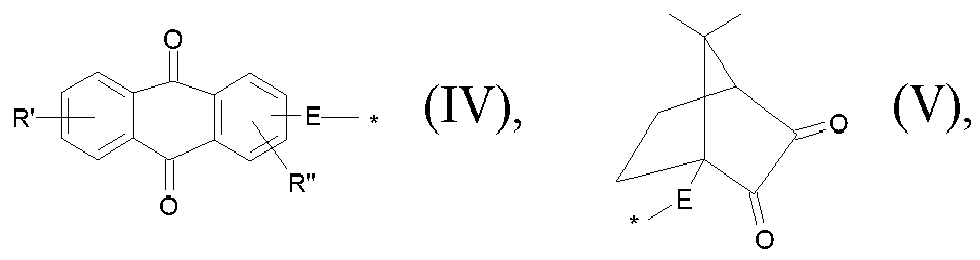

wherein R', R" are selected from the list consisting of H (preferred), C1-8 alkyl, C1-10 alkoxy and halogen and aryl (e.g. phenyl),
wherein Ar is an aryl group, and
wherein E is selected from a single bond, a group of general formula -O-Y- and a group of general formula -w-O(CO)-J- wherein Y and J are selected from the group consisting of C1-3 alkylene and C1-3 alkoxy C1-3 alkylene, wherein w is selected from the group consisting of C1-3 alkylene. - In an embodiment, Ar may be selected from

wherein R is selected from the list consisting of H, C1-8 alkyl, C1-10 alkoxy and halogen, and wherein the "*" indicates the point of attachment to the carbonyl. In an embodiment of the first aspect, PI may be of the general formula:


- In an embodiment of the first aspect, PI may be selected from the list consisting of

- In an embodiment of the first aspect, PI may be of formula (II) and E may be either in ortho or in para of the carbonyl in said formula (II), or PI may be of formula (III) and E may be either in ortho or in meta of the carbonyl in said formula (III), or PI may be of formula (IV) and E may be in meta of a first carbonyl and in para of a second carbonyl in said formula (IV), or PI may be of formula (VI) and E may be in para of the carbonyl in said formula (IV).
- In an embodiment of the first aspect, PI may be selected from the list consisting of:


- In a preferred embodiment, the compound of the first aspect may have the following general formula:
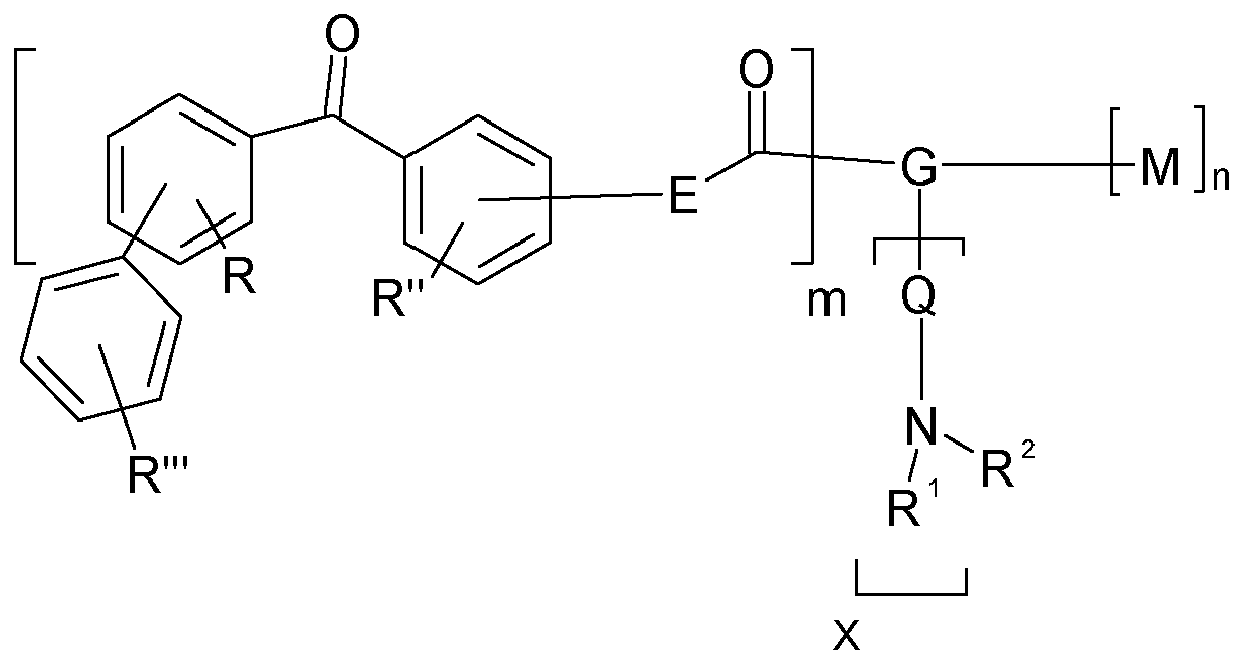
- The phenyl bearing the R''' function may be attached to the benzophenone moiety in ortho, meta or para of its carbonyl function.
- Preferably, the phenyl bearing the R''' function may be attached to the benzophenone moiety in para of its carbonyl function.
- Expressed differently, the compound of the first aspect may have the general formula.

- Embodiments where R, R'' and R'" may be independently selected from the group consisting of H, C1-8 alkyl and C1-10 alkoxy are advantageous because of the absence of halogens. This is more environment-friendly and preferred for food packaging applications.
- Having the R'" bearing phenyl in para of the carbonyl on the benzophenone has the advantage of a very rapid curing time both under air and under inert atmosphere.
- The linker E may be attached at any position of the phenyl bearing the R" function.
- In a preferred embodiment, E may be a single bond. When E is a single bond, without being bound by theory it is believed that the distance between the type II photoinitiator (e.g. a benzophenone derivative) and the amine synergist is minimal, favoring an efficient hydrogen transfer. Furthermore, the absence of the linker E (i.e. it is a single bond) limit to a minimum the dilution of the compound's properties, the increase of its viscosity and eventual adverse plasticizing effects.
- In this embodiment, the compound may have the general formula

- Preferably, the linker E when being a single bond may be attached in ortho of the carbonyl of the type II photoinitiator (e.g. benzophenone moiety). For instance, when E is a single bond, the compound of the first aspect may have the general formula
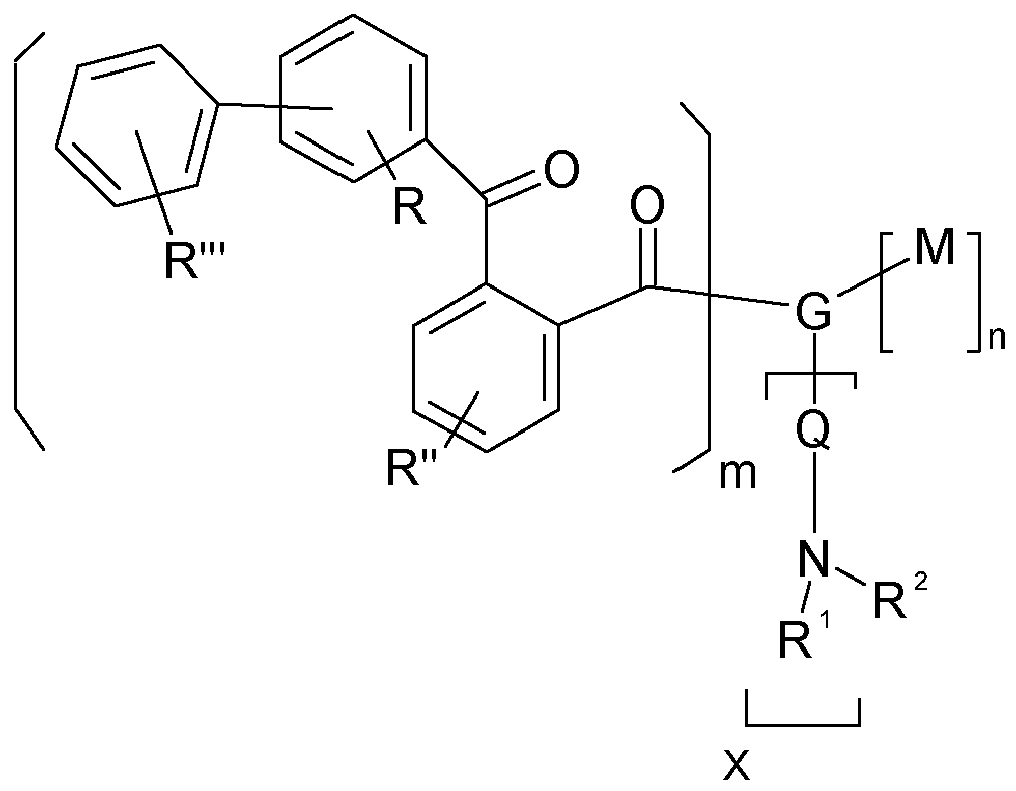
- These embodiments where E is a single bond have the further advantage to be easily synthetically accessible from carboxy substituted type II photoinitiator (e.g. benzophenone) derivatives.
- R, R" and R''' may be at any position on their respective phenyl. R''' is however preferably in para of its attachment point to the benzophenone.
- Still more preferred is the family of compounds

- Still more preferred is the family of compounds having the general formula

- Q may for instance be selected from the list consisting of a C1-8 straight or branched alkylenoyl, a C4-10 cyclic alkylenoyl optionally substituted with a C1-4 straight or branched alkyl, and a phenylenoyl group optionally substituted with a C1-4 straight or branched alkyl, wherein the carbonyl of Q forms an ester with a hydroxyl of the linker G. Preferably, Q equals to -C(O)(CHA-CH2)- (as in formula VII). Most preferably A is a H atom.
- In an embodiment, the compound may have the general formula (VII)

- Having Q equal to -C(O)(CHA-CH2)- with A preferably being a H atom, is advantageous as it is a short linker having therefore a minimal negative impact on the performance of the compound and of the compositions comprising it. Furthermore, it is a stable linker in the conditions of cure and processing. A further advantage of this linker is that it permits an easy incorporation of the amine synergist by Aza-Michael addition of at least one primary amine and/or at least one secondary amine onto a meth(acrylic) reactive double bond.
- In embodiments of the present invention, A is preferably a H atom due to the higher reactivity of acrylates compared to methacrylates.
- As an example, the compound may have the following formula

- A typical example is depicted below wherein G is a di-trimethylolpropane residue and wherein x and m=1, n= 2 and p=0:

- In an embodiment, the M group may be of the formula *-(CO)-NH-R8-NH-(CO)-R9.
- In embodiments, the group *-(CO)NH-R8-NH(CO)-* in this formula may be the residue of a reacted diisocyanate.
- In embodiments, R8 may be a divalent hydrocarbon group having from 1 to 20 carbon atoms selected from the list consisting of:
- alkylenes (e.g. hexamethylene obtainable from hexamethylene diisocyanate),
- cycloalkylenes optionally substituted by one or more alkyl groups (e.g. cyclohexylene obtainable from cyclohexylene diisocyanate),
- arylenes (e.g. tolylene, a divalent tolidine radical or naphthylene each obtainable from their respective diisocyanate derivative), and
- Combinations thereof (such as alkylene cycloalkylene (e.g. divalent isophorone radical obtainable from reaction of isophorone diisocyante), alkylene arylene alkylene (e.g. xylylene obtainable from xylylene diisocyanate), alkylene cycloalkylene alkylene (e.g. hydrogenated xylylene obtainable from hydrogenated xylylene diisocyanate), cycloalkylene alkylene cycloalkylene (e.g. cyclohexylene methylene cyclohexylene obtainable from dicyclohexylmethane diisocyanate), arylene alkylene arylene (e.g. phenylene methylene phenylene obtainable from reaction of diphenylmethane diisocyanate), amongst others.)
- In an embodiment, -R9 may be a residue of a meth(acrylating) compound of a first type.
- (Meth)acrylating compounds of said first type are compounds that contain at least one reactive group capable to react with isocyanate groups and that contain at least one (meth)acryloyl group. Typically (meth)acrylating compounds of said first type are end-capping agents that contain at least one acryloyl and/or methacryloyl group and one (or essentially one) nucleophilic function capable of reacting with isocyanate groups, such as a hydroxyl group. Useful (meth)acrylating compounds of said first type include the esterification products of aliphatic and/or aromatic polyols with (meth)acrylic acid having a residual average hydroxyl functionality of about 1. The partial esterification products of (meth)acrylic acid with tri-, tetra-, penta- or hexahydric polyols or mixtures thereof are preferred. In this context, it is also possible to use reaction products of such polyols with ethylene oxide and/or propylene oxide. These modified or unmodified polyols are partly esterified with acrylic acid, methacrylic acid or mixtures thereof until the desired residual hydroxyl functionality is reached. (Meth)acrylating compounds of said first type obtained from the reaction of (meth)acrylic acid with aliphatic, cycloaliphatic or aromatic compounds bearing an epoxy functionality together with at least one (meth)acrylic functionality can be used as well. Other suitable (meth)acrylating compounds of said first type are the (meth)acrylic esters with linear and branched polyols in which at least one hydroxy functionality remains free, like hydroxyalkyl(meth)acrylates having 1 to 20 carbon atoms in the alkyl group. Preferred molecules in this category are hydroxymethyl(meth)acrylate, hydroxyethyl (meth)acrylate, hydroxypropyl (meth)acrylate and/or hydroxybutyl (meth)acrylate. Preferred examples of poly(meth)acryloyl hydroxylated compounds are compounds comprising at least two (meth)acryl functions such as glycerol diacrylate, trimethylolpropane diacrylate, glycerol diacrylate, pentaerythritol triacrylate, ditrimethylolpropane triacrylate, dipentaerythritol pentaacrylate and their (poly)ethoxylated and/or (poly)propoxylated equivalents.
- In embodiments of the present invention, n may preferably be from 1 to 50, more preferably from 1 to 31, still more preferably from 1 to 10, yet still more preferably from 2 to 5, and most preferably from 3 to 5 in order to provide sufficiently high integration in a (meth)acrylate network.
- In embodiments of the present invention, m may preferably be from 1 to 50, more preferably from 1 to 31, still more preferably from 1 to 10, yet still more preferably from 1 to 5.
- In embodiments of the present invention, x may preferably be from 1 to 50, more preferably from 1 to 31, still more preferably from 1 to 10, yet still more preferably from 1 to 5.
- For instance, n and m may be independently from 1 to 31, preferably from 2 to 5, x may be from 1 to 30, preferably from 1 to 5 and p may be from 0 to 30, preferably from 0 to 5.
- In embodiments of the present invention, n + m + x + p may be from 3 to 400, preferably from 3 to 200, more preferably from 3 to 100 still more preferably from 3 to 50, still more preferably from 3 to 32 and most preferably from 3 to 15.
- For instance, n may be from 1 to 31, m may be from 1 to 31, x may be from 1 to 30, and p may be from 0 to 30 while n + m + x + p may be from 3 to 32. This last embodiment keeps the molecular weight relatively low which is advantageous to keep the viscosity relatively low.
- In embodiments of the present invention, the compound may be a liquid at 25°C and 1 atm. This is advantageous as it permits a greater solubility in an ink, coating or adhesive composition.
- In a second aspect, the present invention relates to a compound obtained (or obtainable) by reaction of one or more amines of the general formula NHR6R7 with a PI (e.g. benzophenone) derivative of the following general formula (VIII)
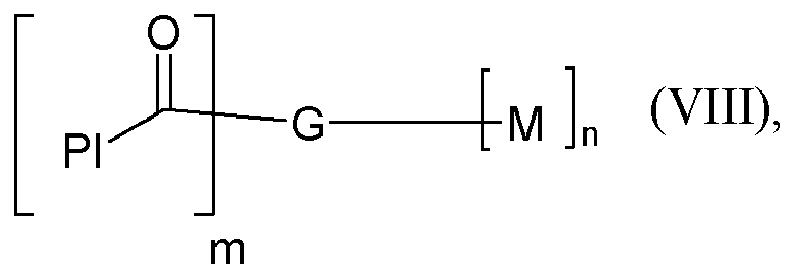
- PI is a type II photoinitiator derivative,
- R6 and R7 either:
- o together with the N to which they are attached form a 5-6 membered saturated or aromatic ring optionally fused with a phenyl, said 5-6 membered ring containing one or more carbon atoms, from one to three nitrogen atom(s) and up to two oxygen atoms, or
- o are independently selected from the group consisting of:
- ■ H,
- ■ C1-30 alkyl,
- ■ C2-30 alkenyl, and
- ■ 5-6 membered saturated or aromatic ring containing one or more carbon atoms, up to three nitrogen atoms and up to one oxygen atom, said ring being optionally substituted by a C1-30 alkyl or by a C1-30 alkyloxy or by a hydroxyl or by a C1-6 acyloxy or fused with a phenyl,
- • a 5-6 membered saturated or aromatic ring containing one or more carbon atoms, up to three nitrogen atoms and up to two oxygen atoms,
- • a hydroxyl group,
- • a C1-10 alkoxy group, and
- • an amine of formula -NR3R4, wherein R3 and R4 are independently selected from the group consisting of H and C1-8 alkyl,
- M is as defined in any embodiment of the first aspect,
- m and n are as defined in any embodiment of the first aspect,
- G is linker comprising a number p' of unreacted hydroxyl groups, and
- p' is from 0 to 200,
- Although some of the compounds of this other aspect are already covered by the first aspect of the present invention and are described in a Markush formula (I) (the case when NHR6R7 is a secondary amine with neither R6 nor R7 being a hydrogen atom), and the case when NHR6R7 is a primary amine with R6 or R7 being bulky (e.g. having the carbon in alpha of the nitrogen bonded to at least two carbon atoms), other compounds obtainable by reaction of one or more amines of the general formula NHR6R7 with a PI (e.g. benzophenone) derivative of the general formula (IX) cannot be described in a general Markush formula. This is the case when NHR6R7 is a primary amine (except for bulky amines as described above) with either R6 or R7 being a hydrogen atom. In this case, the product obtained by the addition of NHR6R7 on a (meth)acrylate group of the PI (e.g. benzophenone) derivative of the general formula (IX) is, due to the remaining active hydrogen on the amine, still prone to react with a second (meth)acrylate group (e.g. belonging to a second PI (e.g. benzophenone) derivative of the general formula (IX)). This starts a chain reaction that can lead to the formation of oligomers of complex structures and to a structure distribution. The resulting product is nevertheless useful as a photo-reactive binder and possesses the same advantages as provided by the compounds of the first aspect of the present invention.
- Examples of useful secondary amines NHR6R7 may be amines of formula NHR1R2 as described in the first aspect of the present invention. Examples of useful primary amines of formula NHR6R7 wherein either R6 or R7 is a hydrogen atom are: methylamine, ethylamine, propylamine, butylamine, Sec-butylamine, ter-butylamine, amylamine (pentylamine), hexylamine, 2-ethylhexylamine, cyclohexylamine, octylamine, ter-octylamine, 3-morpholinopropylamine, dodecylamine, fatty amines (such as cocoamine), ethoxylated fatty amines, monoethanolamine (2-aminoethanol), 2-methoxyethylamine, 2-hydroxypropylamine, and mixtures thereof.
- Especially preferred primary amines are monoethanolamine (2-aminoethanol), 2-ethylhexylamine, octylamine and cyclohexylamine, and mixtures thereof.
- Examples of fatty amines are octyl amine, 2-ethylhexylamine, lauryl amine, stearyl amine, oleyl amine, tallowamine, cetylamine, N-tetradecylamine, cocoamine, di-cocoamine, hydrogenated tallowamine , alkyl(C16 and C18-unsaturated) amine, alkyl(C14-18) amine, alkyl(C16-22) amine, alkyl(C8-18 and C18-unsaturated) amine, alkyl(C12-18) amine, di(hydrogenated tallow)amine, dicocoalkyl amine, dialkyl(C14-18) amine, dialkyl(C12-18) amine, dialkyl(C16-22) amine, N-tridecyltridecanamine, N-methylstearylamine, distearyl amine, dialkyl(C8-20) amine, N-octadecylbenzylamine, N-isopropyloctadecylamine, and N-hexadecyloctadecylamine, and mixtures thereof.
- Preferred fatty amines are cocoamine, di-cocoamine, octylamine, dodecylamine and 2-ethylhexylamine, and mixtures thereof.
- G may be a residue of a polyhydroxy compound as defined in any embodiments of the first aspect of the present invention.
- In embodiments, G may have at most 200 hydroxyl groups, preferably at most 150 hydroxyl groups, more preferably at most 100 hydroxyl groups, still more preferably at most 50 hydroxyl group, still more preferably at most 32 hydroxyl groups, still more preferably at most 16 hydroxyl groups, yet still more preferably at most 12 hydroxyl groups and most preferably at most 6 hydroxyl groups.
- In embodiments, the equivalent weight of acrylic double bonds of the compound according to the first aspect of the present invention may be 1 meq/g or more, preferably 2 meq/g or more, most preferably 3 meq/g or more.
- In embodiments, the equivalent weight of acrylic double bonds of the compound according to the first aspect of the present invention may be 11 meq/g or less, preferably 8 meq/g or less, most preferably 5 meq/g or less.
- In a further aspect, the present invention relates to a composition comprising the compound or blend according to any embodiment of the present invention. The composition can for instance be an ink, a coating composition (e.g. a varnish) or an adhesive. The compounds of the first and second aspect of the present invention are particularly useful in an ink for printing food packaging or in a varnish for coating food packaging. The compounds of the present invention having the ability to integrate covalently a (meth)acrylate network upon curing, (meth)acrylate based compositions comprising said compound are particularly safe to use for food packaging where migration must be avoided.
- In embodiments, the compound of the present invention may be present in an amount of 0.1 wt% or more, preferably 5 wt% or more, and most preferably 10 wt% or more in the composition (e.g. ink or varnish).
- In embodiments, the compound of the present invention may be present in an amount of 90 wt% or less, preferably 50 wt% or less and most preferably 35 wt% or less in the composition (e.g. ink or varnish).
- In yet a further aspect, the present invention relates to a substrate coated or printed with a coating as described above. The coating may be cured or uncured but will typically be cured. Such substrates have the advantage to leach no or negligible amounts of initiator and amine synergist. Particularly advantageous are food packaging printed with an ink or coated with a varnish as described above. Food packaging must meet strict chemical migration requirements that the inks/varnishes as described above help to meet. Furthermore, inks/varnishes for food packaging preferably have good flow properties and high UV reactivity. Two features that the inks/varnishes as described above also help to meet. This is especially true when the compound of the first or second aspect present in said coatings is a liquid.
- In yet a further aspect, the present invention relates to a process for the synthesis of a compound according to the first or second aspect of the present invention.
- The synthesis may proceed by the reaction of:
- • a type II photoinitiator derivative PI bearing a reactive group capable to react with a hydroxyl group to form e.g. an ester,
- • a linker comprising from 3 to 400 hydroxyl groups,
- • a (meth)acrylating compound of a second type, and
- • an amine of the general formula NHR6R7 or Q'-NR1R2 wherein R6, R7, R1 and R2 are as defined above and wherein Q' comprises a reactive group capable to react with a hydroxyl group to form e.g. an ester.
- Combinations of different amines (e.g. some of formula NHR6R7 and some of formula Q'-NR1R2) can also be used.
- The (meth)acrylating compound of a second type is a compound comprising at least one (meth)acrylate group and at least one reactive group capable to react with an hydroxyl group. Examples of such reactive group capable to react with a hydroxyl group are carboxylic acid, activated carboxylic acid, carboxylic acid esters or isocyanate groups. An example of (meth)acrylating compound is (meth)acrylic acid itself.
- A (meth)acrylating compound of a second type can be obtained by the reaction of a (meth)acrylating compound of a first type and a linker comprising at least two reactive groups capable to react with an hydroxyl. Examples are polyisocyanates and polycarboxylic acids.
- Examples of suitable diisocyanates and triisocyanates are:
- o OCN-R8-NCO,
- O

- O

- In an alternative embodiment, the synthesis may proceed by the reaction of 1) type II photoinitiator derivative PI bearing a reactive group capable to react with a hydroxyl group to form e.g an ester with 2) a linker comprising from 3 to 400 hydroxyl groups, 3) a linker comprising at least two reactive groups capable to react with an hydroxyl, 4) a (meth)acrylating compound of a first type, and 5) an amine of the general formula NHR6R7 or Q'-NR1R2 wherein R6, k7, R1 and R2 are as defined above and wherein Q' comprises a reactive group capable to react with a hydroxyl group to form e.g. an ester. Combinations of different amines (e.g. some of formula NHR6R7 and some of formula Q'-NR1R2) can also be used.
- The linker comprising from 3 to 400 hydroxyl groups may be a poyhydroxy compound as defined in any embodiment of the first aspect of the present invention.
- Q' may for instance comprise a carboxylic acid, an activated carboxylic acid or a transesterifiable ester group.
- Q' may for instance be selected from the list consisting of the following groups: a C1-8 straight or branched alkyl, a C4-10 cyclic alkyl optionally substituted with a C1-4 straight or branched alkyl, and a phenyl group optionally substituted with a C1-4 straight or branched alkyl, wherein said groups are substituted with one or more carboxylic acid, activated carboxylic acid or transesterifiable carboxylic ester groups.
- This permits the carboxylic acid or ester group of Q' to form an ester with a hydroxyl of the linker G. For instance, Q' may be HO-C(O)(CH2)2- or may be CH3-O-C(O)-C6H6- or may be HO-C(O)C6H6-.
- The type II photoinitiator derivative PI bearing a reactive group capable to react with a hydroxyl to form e.g. an ester may have the following general formula:

- PI and E may be as defined in the first aspect of the present invention.
- R5 is a reactive group capable to react with a hydroxyl group to form e.g. an ester. This group can for instance be a carboxylic acid group or a modified carboxylic acid group capable to react with a hydroxyl group to form an ester. Examples of modified carboxylic groups are methyl carboxylate and activated carboxylic acid groups such as an acyl halide group (e.g. an acyl chloride or acyl bromide group) or an anhydride group.
- PI may for instance be a phenyl substituted benzophenone.
- The phenyl-substituted benzophenone derivative can be for instance 2-(4-phenylbenzoyl)benzoic acid.
- The preparation of 2-(4-phenylbenzoyl)benzoic acid is for example described in
U.S. Pat. N°1814145 from phthalic anhydride and biphenyl. - Other benzophenone derivatives may be prepared in an analogous way.
- The preparation of carboxy substituted benzophenone is described for example in Journal of Chemical Research, Synopses, (10), 650-651; 2003 and in Journal of combinatorial chemistry 10(2), p333-342, 2008
- The preparation of carboxy substituted thioxanthones is described for example in Organic & Biomolecular Chemistry, 4(22), p 4101-4112; 2006.
- The preparation of carboxy substituted anthraquinone is for example described Organic Preparations and Procedures International; Volume 13, Issue 5, p 368-71, 1981
- The preparation of carboxy substituted 1-2 diketone is described for example in From Journal of Organic Chemistry, 53(7), 1353-6; 1988
- Hydroxyl substituted PI can easily be transformed in carboxy substituted PI:
- The preparation of hydroxyl substituted benzophenone is described for example in Tetrahedron, 67(3), 641-649; 2011. These can be reacted for example with chloroacetic acid to get a carboxy substituted benzophenone
- The preparation of hydroxyl substituted thioxanthones is described for example in synthesis, Issue 17, p 2900-2904, 2004. These can be reacted for example with chloroacetic acid to get a carboxy substituted thioxanthones
- The preparation of hydroxymethyl substituted anthraquinone is for example described. in Journal of Organic Chemistry, Volume 75 , Issue 2, p 412-416 ; 2010. These can be reacted for example with chloroacetic acid to get a carboxy substituted anthraquinone
- The preparation of hydroxyl substituted anthraquinone is for example described in Canadian Journal of Chemistry, Volume 61, Issue 9, p 1965-9,1983. These can be reacted for example with chloroacetic acid to get a carboxy substituted anthraquinone
- The linker comprising reactive groups capable to react with a carboxylic acid group or with an activated carboxylic acid group to form an ester may be a polyhydroxy compound as defined above or a polyhydroxy compound which hydroxyl groups have been modified into other reactive groups capable to react with a carboxylic acid or an activated carboxylic acid to form an ester (as also defined above).
- In an embodiment, the PI derivative (e.g. a phenyl substituted benzophenone derivative) may be first reacted with said linker, and in a second step with said (meth)acrylating compound.
- Alternatively, the PI derivative and the (meth)acrylating compound can be reacted together with the linker.
- Alternatively, the (meth)acrylating compound of the second type may be first reacted with said linker, and in a second step the reaction product of the first step is then further reacted with a phenyl substituted benzophenone derivative as described above.
- In embodiments, the PI derivative may be reacted with the reactive groups (e.g. hydroxyls groups) of the linker (e.g. polyhydroxy compound) by an esterification reaction with equivalent ratios of 0.05:1 or more, preferably of 0.1:1 or more and most preferably of 0.2:1 or more.
- In embodiments, the PI derivative may be reacted with the reactive groups (e.g. hydroxyls groups) of the linker (polyhydroxy compound) by an esterification reaction with equivalent ratios of 0.95:1 or less, preferably of 0.75:1 or less and most preferably of 0.5:1 1 or less.
- After reaction between the PI derivative and the linker, residual reactive groups on the linker (e.g. hydroxyl groups) may be further reacted partially or totally with a (meth)acrylicating compound.
- In an embodiment, the process may further comprise reacting the reaction product of the linker, PI derivative and a (meth)acrylating compound with an amine of general formula NHR6R7 or Q'-NR1R2, thereby obtaining an amino photo-reactive binder. Combinations of different amines (e.g. some of formula NHR6R7 and some of formula Q'-NR1R2) can also be used
- When a primary or secondary amine is reacted, it is preferably reacted after that the PI derivative, the (meth)acrylating compound and the linker have been reacted together.
- In an embodiment of the present invention, the amino photo-reactive binder may be obtained by the reaction of at least one primary amine and/or at least one secondary amine with part of the (meth)acrylic unsaturations of the photo-reactive binder. It is advantageous to keep at least one (meth)acrylic unsaturation unreacted in order to insure that the obtained amino photo-reactive binder has at least one (meth)acrylic unsaturation for future integration in a (meth)acrylate network.
- In an embodiment of the present invention, the amino photo-reactive binder may be prepared by performing an Aza-Michael addition of at least one primary amine and/or at least one secondary amine onto a (meth)acrylate function of the photo-reactive binders. An example of amino photo-reactive binder preparation is shown below:

- Amines used to prepare "amino photo-reactive binders" of the present invention are generally selected from primary amines (R1-NH2) and/or secondary amines (R1-NH-R2) as described in the first and second aspect of the present invention.
- In an embodiment, the amino photo-reactive binder may be prepared by an addition reaction of at least one primary amine and/or at least one secondary amine to (meth)acrylic double bonds with an equivalent ratio amine: (meth)acrylic double bonds of 0.05:1 or more, preferably 0.1:1 or more and most preferably 0.2:1 or more.
- In an embodiment, the amino photo-reactive binder may be prepared by an addition reaction of at least one primary amine and/or at least one secondary amine to (meth)acrylic double bonds with an equivalent ratio amine: (meth)acrylic double bonds of 0.95:1 or less, preferably 0.75:1 or less and most preferably 0.5:1 or less.
- In an embodiment, the amino photo-reactive binder may be prepared by an esterification or transesterification reaction between a) a tertiary amine bearing reactive groups capable to react with an hydroxyl to form an ester (e.g. carboxylic acid groups or the corresponding esters), and b) hydroxyl groups on the linker G.
- In an embodiment, the amine(s) may be added in an amount such that the reaction product has a nitrogen content of 0.1%wt or more, preferably 0.2%wt or more and most preferably 0.3%wt or more.
- In an embodiment, the amine(s) may be added in an amount such that the reaction product has a nitrogen content of 10%wt or less, preferably 5%wt or less and most preferably 3%wt or less.
- In an embodiment, the residual (meth)acrylic content in the amine photo-reactive binder (e.g. after reaction of the amine(s) with the photo-reactive binder) is 0.5 meq/g or more, preferably 1 meq/g or more, most preferably 2 meq/g or more.
- In an embodiment, the residual (meth)acrylic content in the amine photo-reactive binder (e.g. after reaction of the amine(s) with the photo-reactive binder) is 10 meq/g or less, preferably 8 meq/g or less, most preferably 5 meq/g or less.
- In embodiments where the primary or secondary amine is an aromatic amine, an appropriate catalyst is preferably used to promote the Aza-Michael addition. For instance, the catalyst may be selected from Brønsted or Lewis acids or bases, yttrium trinitrate hexahydrate (Y(NO3)3.6H2O), ionic liquids, clays and other catalysts described in Tetrahedron Letters 47 (2006)7723-7726 and Catalysis Communications 9 (2008) 1189-1195 or glacial acetic acid as described in
WO 2011/117591 A2 (Sun Chemical). This is advantageous since it permits to obtain good yield despite the lower nucleophilicity of aromatic amines when compared to alkyl or alkenyl amines. - Yet another aspect of the invention concerns products obtainable by a process according to the invention.
- The present invention will be described with respect to particular embodiments but the invention is not limited thereto.
- To a 1 liter double jacketed reactor vessel connected to an oil bath and equipped with a stirrer, was added 100 g of polyhydroxy compound 4631 (polyhydroxy compound commercially available from Perstorp); "a" g of acrylic acid; "b" g of paratoluenesulfonic acid; "c" g of carboxy substituted benzophenone "d"; 1000 ppm of a phosphite type inhibitor; 600 ppm of a hydroquinone type inhibitor; 1250 ppm of a cupper type inhibitor and 116 g of toluene. The reaction mixture was stirred and heated under reflux until no more water was distilled. The reaction mixture was cooled down to 60 °C and diluted with 39 g of toluene. The reaction mixture was washed 3 times with an aqueous solution (15 wt%) of sodium sulphate. Water was then removed by azeotropic distillation under reduced pressure. Once no more water distilled, the organic mixture was filtered at 50 °C and toluene was removed by distillation under reduced pressure.
- The table below gives the values for parameters "a", "b", "c" and "d".
PI 1 (ex. 1.1) PI 2 (ex. 1.2) PI 3 (ex. 1.3) "a" 86 86 66 "b" 5 5 4 "c" 85 89 73 "d" 2-(4-Phenylbenzoyl)benzoic acid 2-(4-Phenoxybenzoyl)benzoic acid 2-(4-chlorobenzoyl)benzoic acid -
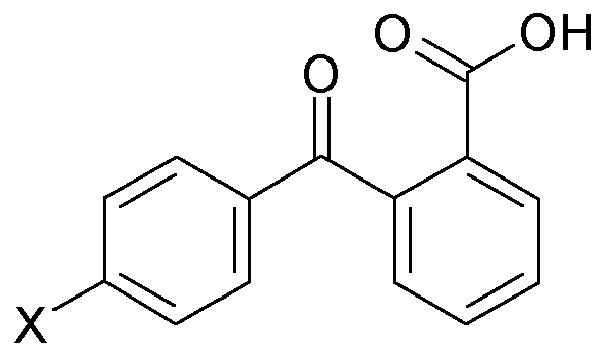
2-(4-Phenoxybenzoyl)benzoic acid precursor (example 1.2): X = Phenoxy
2-(4-chlorobenzoyl)benzoic acid precursor (example 1.3): X = Cl - 1.65 g of diethylamine (secondary amine) was added to 20 g of the acrylated carboxy substituted benzophenone polyhydroxy compound (see example 1.1), homogenized and heated at 40°C for 24 hours.
-
OPV 4 OPV 5 Wt% Wt% EBECRYL LEO™ 10501 70 70 PI 4 30 PI 1 30 Graphite test m/min under air 4 microns 10 < 1 ADR test 60 m/min (1x) under air 4 microns 4 0 ADR test 60 m/min (5x) under air 4 microns 30 1 - Graphite test: This test is performed by placing some graphite on the coated surface, followed by rubbing said surface with a piece of cotton. If no black stain remain on the surface, the surface is considered cured.
- "10 m/min" means that curing at 10 m/min was necessary to pass the graphite test.
- Acetone double rubs test: The rubs are made with a piece of cotton rag saturated with acetone; one double rub is equal to a forward and backward stroke on the coated surface. The reported number is the number of double rubs required to break through the coating. "60" means that 60 doubles rubs are necessary to break through the coating.
- The photo reactivity of the formulation based on photo-reactive binder PI 1 reacted with amine synergist 1 (diethylamine adduct) (PI 4) is significantly higher than the photo reactivity of a formulation based on the Photo-reactive binder without amine synergist (2-(4-Phenylbenzoyl)benzoic acid precursor PI 1) (OPV 5).
- This shows that the amine synergist keeps its co-initiating role despite being covalently bound to the PI.
- Omnipol BP is a di-functional benzophenone photoinitiator specifically designed for use in inks and coatings requiring low migration and low volatility. It is particularly suited to use, in combination with amine synergists, in non-pigmented coatings as an alternative to benzophenone. Its chemical structure is Di-ester of carboxymethoxy-benzophenone and polytetramethylene glycol 250; molecular weight 730; CAS 515136-48-8
- Omnipol 910 is a kind of photoinitiator with high activity, good compatibility, low odor and migration, and with low fragments releasing after curing. It is specifically designed for use in inks and coatings requiring low migration and low volatiles. Its chemical structure is Polyethylene Glycol di (β-4[ 4-(2-dimethylamino-2 -benzyl) butaonylphenyl] piperazine) propionate, molecular weight 1032; CAS 886463-10-1
- The following formulations were prepared and their cure-speed was assessed by curing film at 1.5 g/m2 under air using a UV lamp of 120 W/cm. Graphite test (m/min) gives the speed at which a stain free print is obtained; the higher the more reactive. The Total Energy dose (mJ/cm2) is the energy necessary to have a stain free print; the lower the more reactive
FI 4 (comp) FI 5 FI 6 (comp) FI 7 FI 8 (comp) FI 9 FI 10 (comp) FI 11 EBECRYL452 26.5 26.5 18.9 18.9 19 19 EBECRYLLEO 10601 10.8 10.8 EBECRYLLEO 10501 13.5 13.5 ADDITOL S 130 0.4 0.4 0.35 0.35 0.35 0.35 0.45 0.45 Solspers 39000 (Lubrizol) 0.8 0.8 1.75 1.75 1.3 1.3 2.25 2.25 Solsperse 22000 (Lubrizol) 0.3 0.3 Solsperse 5000 (Lubrizol) 0.35 0.35 Yellow DGR (Clariant) 12 12 Magenta pigment 4 BY (SUN) 14 14 Cyan pigment GLO (Ciba-BASF) 14 14 Special Black 250 (Degussa) 18 18 EBECRYL 570 10 10 10 5 10 5 5 EBECRYLLEO 10501 10 20 15 30 15 30 10 25 EBECRYLLEO 10551 30 - 30 - 30 - 30 Ominpol BP (IGM) 5 5 5 5 Omnipol 910 (IGM) 5 5 5 5 PI 4 30 30 30 30 100 100 100 100 100 100 100 100 Cure speed- under air - 1.5 g/m2 film - 120 W/cm Graphite test (m/min) 10 30 20 40 20 45 20 50 Total Energy dose (mJ/cm2) 700 260 400 180 400 160 400 140 - The photoreactivity of compound PI 4 was compared with a mixture of the two Omnipol BP and 910 polymeric photoinitiator in flexo inks (4 process colors). Overall, an addition of 30 wt % of compound of PI 4 leads to higher reactivity than comparative examples using commercial photoinitiators instead.
Claims (16)
- A compound linking covalently:• a type II photoinitiator (PI),• at least one polymerizable insaturation, and• an amine co-initiator for said type II photoinitiator (PI).
- The compound according to claim 1, having the general formula,
 - PI is a type II photoinitiator derivative,- M is a group comprising a number z of (meth)acrylate groups equal to at least one,- Q is a linker,- G is a linker comprising a number p of unreacted hydroxyl groups comprised between 0 and 100,- R1 and R2 either:o together with the N to which they are attached form a 5-6 membered saturated or aromatic ring optionally fused with a phenyl, said 5-6 membered ring containing one or more carbon atoms, from one to three nitrogen atom(s) and up to one oxygen atom, oro are independently selected from the group consisting of:■ H,■ C1-30 alkyl,■ C2-30 alkenyl, and■ 5-6 membered saturated or aromatic ring containing one or more carbon atoms, up to three nitrogen atoms and up to two oxygen atoms, said ring being optionally substituted by a C1-30 alkyl or by a C1-30 alkyloxy or by a hydroxyl or by a C1-6 alkyl substituted acyloxy or fused with a phenyl,wherein each of said C1-30 alkyl and C2-30 alkenyl are independently optionally substituted with one or more substituents independently selected from:• a 5-6 membered saturated or aromatic ring containing one or more carbon atoms, up to three nitrogen atoms and up to two oxygen atoms,• a hydroxyl group,• a C1-10 alkoxy group, and• an amine of formula -NR3R4, wherein R3 and R4 are independently selected from the group consisting of H and C1-8 alkyl, and- n is from 1 to 100,- m is from 1 to 100, and- x is from 1 to 100,
with the proviso that if R1 is a hydrogen atom, then the carbon atom in R2 directly attached to the nitrogen must be attached to at least two carbon atoms. - The compound according to claim 2 wherein said linker G is a residue of a polyhydroxy compound having from 3 to 32 hydroxyl groups.
- The compound according to claim 2 or claim 3 wherein G is a residue of a polyhydroxy compound selected from the list consisting of polyhydroxy derivatives of aliphatic or aromatic polyethers, polyhydroxy derivatives of polyesters, polyhydroxy derivatives of polyamides, polyhydroxy derivatives of polyimides, polyhydroxy derivatives of polycarbonates, styrene allyl alcohols copolymers, trimethylolpropane, di-trimethylolpropane, pentaerytritol, dipentaerytritol, as well as C1-3 alkoxylated derivatives thereof and/or mixtures thereof.
- The compound according to any one of the preceding claims, wherein PI is a thioxanthone derivative, a benzophenone derivative, an anthraquinone derivative, or a 1,2-diketone derivative.
- The compound according to any one of the preceding claims, wherein PI is selected from the list consisting of:


wherein R, R" and R'" are selected from the list consisting of H, C1-8 alkyl, C1-10 alkoxy and halogen,
wherein E is selected from a single bond, a group of general formula -O-Y- and a group of general formula -w-O(CO)-J- wherein Y and J are selected from the group consisting of C1-3 alkylene and C1-3 alkoxy C1-3 alkylene, and wherein w is selected from the group consisting of C1-3 alkylene. - The compound according to any one of the preceding claims wherein PI is selected from the list consisting of

- The compound according to any one of the preceding claims having the general formula

- The compound of any one of the preceding claims wherein: Q is -C(O)-(CH2)2-.
- A compound obtained by reaction of one or more amines of the general formula NHR6R7 with a compound of the following general formula (IX)
 - PI is a type II photoinitiator derivative,- R6 and R7 either:o together with the N to which they are attached form a 5-6 membered saturated or aromatic ring optionally fused with a phenyl, said 5-6 membered ring containing one or more carbon atoms, from one to three nitrogen atom(s) and up to one oxygen atom, oro are independently selected from the group consisting of:■ H,■ C1-30 alkyl,■ C2-30 alkenyl, and■ 5-6 membered saturated or aromatic ring containing one or more carbon atoms, up to three nitrogen atoms and up to one oxygen atom, said ring being optionally substituted by a C1-30 alkyl or by a C1-30 alkyloxy or by a hydroxyl or by a C1-6 acyloxy or fused with a phenyl,
wherein each of said C1-30 alkyl and C2-30 alkenyl are independently optionally substituted with one or more substituents independently selected from:■ a 5-6 membered saturated or aromatic ring containing one or more carbon atoms, up to three nitrogen atoms and up to one oxygen atom,■ a hydroxyl group,■ a C1-10 alkoxy group, and■ an amine of formula -NR3R4, wherein R3 and R4 are independently selected from the group consisting of H and C1-8 alkyl,- M is a group comprising a number z of (meth)acrylate groups equal to at least one,- G is linker comprising a number p' of unreacted reactive hydroxyl groups,- A is either H or CH3,- n is from 1 to 100,- m is from 1 to 100, and- p' is from 0 to 200;
with the proviso that n is at least 2 when M comprises only one (meth)acrylate group. - The compound according to claim 10 wherein the amine NHR6R7 is selected from the list consisting of methylamine, ethylamine, propylamine, n-butylamine, sec-butylamine, pentylamine, hexylamine, 2-ethylhexylamine, cyclohexylamine, octylamine, tert-octylamine, 3-morpholinopropylamine, dodecylamine, fatty amines, ethoxylated fatty amines, monoethanolamine, aniline, N-alkylaniline, 4-aminophenol, Ethyl-4-aminobenzoate, dicocoamine, diethylamine, diethanolamine, dipropylamine, dibutylamine, 2-(methylamino)ethanol, 2-methoxyethylamine, bis(2-hydroxypropylamine), dihexylamine, diisopropylamine, 1-methylpiperazine, 4-methylpiperidine, morpholine, piperidine, Bis(2-ethylhexyl)amine, 2-hydroxypropylamine, N-benzylmethylamine, Dipentylamine, 1,2,3,4-tetrahydroisoquinoline, dicyclohexylamine and dioctylamine.
- The compound of any one of claims 2 to 11 wherein M is the residue of (meth)acrylic acid, preferably of acrylic acid.
- An ink, a coating composition or an adhesive comprising the compound according to any one of the preceding claims.
- A substrate on which the ink, coating composition or adhesive of claim 13 has been applied.
- A substrate according to claim 14 being a food packaging printed with the ink according to claim 13.
- A process for the synthesis of a compound according to any one of claims 0 to 12, comprising reacting:a) a type II photoinitiator derivative bearing a reactive group capable to react with a hydroxyl group to form an ester,b) a linker comprising from 3 to 400 hydroxyl groups,c1) a (meth)acrylating compound comprising at least one (meth)acrylate group and at least one reactive group capable to react with an hydroxyl group, orc2) a linker comprising at least two reactive groups capable to react with a hydroxyl, then a (meth)acrylating compound comprising at least one (meth)acrylate group and at least one hydroxyl, andd) an amine of the general formula NHR6R7 or Q'-NR1R2 wherein Q' comprises a reactive group capable to react with a hydroxyl group to form an ester, or a combination thereof,
wherein R1, R2, R6 and R7 independently either:o together with the N to which they are attached form a 5-6 membered saturated or aromatic ring optionally fused with a phenyl, said 5-6 membered ring containing one or more carbon atoms, from one to three nitrogen atom(s) and up to one oxygen atom, oro are independently selected from the group consisting of:■ H,■ C1-30 alkyl,■ C2-30 alkenyl, and■ 5-6 membered saturated or aromatic ring containing one or more carbon atoms, up to three nitrogen atoms and up to two oxygen atoms, said ring being optionally substituted by a C1-30 alkyl or by a C1-30 alkyloxy or by a hydroxyl or by a C1-6 alkyl substituted acyloxy or fused with a phenyl,
wherein each of said C1-30 alkyl and C2-30 alkenyl are independently optionally substituted with one or more substituents independently selected from:• a 5-6 membered saturated or aromatic ring containing one or more carbon atoms, up to three nitrogen atoms and up to two oxygen atoms,• a hydroxyl group,• a C1-10 alkoxy group, and• an amine of formula -NR3R4, wherein R3 and R4 are independently selected from the group consisting of H and C1-8 alkyl,with the proviso that if R1 is a hydrogen atom, then the carbon atom in R2 directly attached to the nitrogen must be attached to at least two carbon atoms.
Priority Applications (9)
| Application Number | Priority Date | Filing Date | Title |
|---|---|---|---|
| EP12151914.4A EP2617705A1 (en) | 2012-01-20 | 2012-01-20 | Amino Photo-Reactive Binder |
| PCT/EP2012/076038 WO2013107587A1 (en) | 2012-01-20 | 2012-12-18 | Amino photo-reactive binder |
| CN201280065686.1A CN104024216A (en) | 2012-01-20 | 2012-12-18 | Amino photo-reactive binder |
| ES12809257.4T ES2682754T3 (en) | 2012-01-20 | 2012-12-18 | Amino photoreactive binder |
| US14/361,433 US10000446B2 (en) | 2012-01-20 | 2012-12-18 | Amino photo-reactive binder |
| EP12809257.4A EP2804849B1 (en) | 2012-01-20 | 2012-12-18 | Amino photo-reactive binder |
| KR1020147023105A KR20140115355A (en) | 2012-01-20 | 2012-12-18 | Amino photo-reactive binder |
| JP2014552547A JP6038954B2 (en) | 2012-01-20 | 2012-12-18 | Amino photoreactive binder |
| TW102101882A TWI655175B (en) | 2012-01-20 | 2013-01-18 | Amino photo-reactive binder |
Applications Claiming Priority (1)
| Application Number | Priority Date | Filing Date | Title |
|---|---|---|---|
| EP12151914.4A EP2617705A1 (en) | 2012-01-20 | 2012-01-20 | Amino Photo-Reactive Binder |
Publications (1)
| Publication Number | Publication Date |
|---|---|
| EP2617705A1 true EP2617705A1 (en) | 2013-07-24 |
Family
ID=47471819
Family Applications (2)
| Application Number | Title | Priority Date | Filing Date |
|---|---|---|---|
| EP12151914.4A Withdrawn EP2617705A1 (en) | 2012-01-20 | 2012-01-20 | Amino Photo-Reactive Binder |
| EP12809257.4A Active EP2804849B1 (en) | 2012-01-20 | 2012-12-18 | Amino photo-reactive binder |
Family Applications After (1)
| Application Number | Title | Priority Date | Filing Date |
|---|---|---|---|
| EP12809257.4A Active EP2804849B1 (en) | 2012-01-20 | 2012-12-18 | Amino photo-reactive binder |
Country Status (8)
| Country | Link |
|---|---|
| US (1) | US10000446B2 (en) |
| EP (2) | EP2617705A1 (en) |
| JP (1) | JP6038954B2 (en) |
| KR (1) | KR20140115355A (en) |
| CN (1) | CN104024216A (en) |
| ES (1) | ES2682754T3 (en) |
| TW (1) | TWI655175B (en) |
| WO (1) | WO2013107587A1 (en) |
Cited By (7)
| Publication number | Priority date | Publication date | Assignee | Title |
|---|---|---|---|---|
| WO2015010729A1 (en) * | 2013-07-23 | 2015-01-29 | Allnex Belgium S.A. | Polymeric photoinitiators |
| WO2016162389A1 (en) | 2015-04-07 | 2016-10-13 | Schmid Rhyner Ag | Functionalized photoinitiators |
| US10000446B2 (en) | 2012-01-20 | 2018-06-19 | Allnex Belgium S.A. | Amino photo-reactive binder |
| US10005717B2 (en) | 2012-01-20 | 2018-06-26 | Allnex Belgium S.A. | Photo-reactive binder |
| CN112441929A (en) * | 2020-11-23 | 2021-03-05 | 浙江大学衢州研究院 | Method for separating mixture of diisopropylamine and ethanol by azeotropic distillation |
| WO2022207945A2 (en) | 2021-10-08 | 2022-10-06 | Igm Resins Italia S.R.L. | "novel photoinitiators" |
| WO2023161049A1 (en) * | 2022-02-24 | 2023-08-31 | Igm Resins Italia S.R.L. | Photoinitiators |
Families Citing this family (7)
| Publication number | Priority date | Publication date | Assignee | Title |
|---|---|---|---|---|
| EP3134379B1 (en) | 2014-04-23 | 2024-08-28 | Sun Chemical B.V. | Liquid arylbenzoyl benzoic acid ester derivatives for energy curable compositions |
| FR3022692B1 (en) * | 2014-06-24 | 2016-07-15 | Armor | METHOD FOR MAKING A SEMICONDUCTOR ORGANIC FILM |
| CN105218372A (en) * | 2014-07-02 | 2016-01-06 | 北京英力科技发展有限公司 | (4-Phenylbenzoyl) benzoic ether and the purposes as light trigger thereof |
| GB201915023D0 (en) * | 2019-10-17 | 2019-12-04 | Lambson Ltd | Amine co-initiator mixture |
| AU2022219748A1 (en) * | 2021-02-09 | 2023-08-17 | Dic Corporation | Adhesive, laminate, and packaging material |
| JP7062816B1 (en) * | 2021-07-20 | 2022-05-17 | 株式会社T&K Toka | Active ray curable ink composition |
| JP7174390B1 (en) | 2022-08-02 | 2022-11-17 | Kjケミカルズ株式会社 | Photocurable inkjet ink composition |
Citations (6)
| Publication number | Priority date | Publication date | Assignee | Title |
|---|---|---|---|---|
| US1814145A (en) | 1929-08-08 | 1931-07-14 | Philip H Groggins | Process of preparing para-phenyl-ortho-benzoyl-benzoic acid |
| WO2003033452A1 (en) * | 2001-10-18 | 2003-04-24 | Coates Brothers Plc | Multi-functional photoinitiators |
| EP2130817A1 (en) * | 2008-06-05 | 2009-12-09 | AGFA Graphics NV | Polymerizable Type II photoinitiators and curable compositions |
| EP2161290A1 (en) * | 2008-09-09 | 2010-03-10 | Agfa Graphics N.V. | Radiation curable compositions |
| EP2199273A1 (en) * | 2008-12-18 | 2010-06-23 | AGFA Graphics NV | Polymerizable photoinitiators and radiation curable compositions |
| WO2011117591A2 (en) | 2010-03-25 | 2011-09-29 | Sun Chemical B.V. | Synergists |
Family Cites Families (26)
| Publication number | Priority date | Publication date | Assignee | Title |
|---|---|---|---|---|
| US3429852A (en) | 1967-03-30 | 1969-02-25 | Nat Starch Chem Corp | Ethylenically unsaturated derivatives of benzophenone and crosslinkable polymers thereof |
| US4022674A (en) | 1973-10-11 | 1977-05-10 | Sun Chemical Corporation | Photopolymerizable compounds and compositions comprising the product of the reaction of a monomeric ester and a polycarboxy-substituted benzophenone |
| GB1538211A (en) * | 1975-05-12 | 1979-01-10 | Ucb Sa | Halogenated photopolymerisable adhesives |
| DE3269491D1 (en) | 1981-11-30 | 1986-04-03 | Ciba Geigy Ag | Photosensitive polymers |
| DE3816304A1 (en) * | 1988-05-13 | 1989-11-23 | Merck Patent Gmbh | PHOTOINITIATOR COPOLYMERS |
| JPH06263812A (en) * | 1993-03-12 | 1994-09-20 | Toyo Ink Mfg Co Ltd | Copolymerizable photoinitiator composition and photo-curable coating composition |
| GB9507808D0 (en) | 1995-04-18 | 1995-05-31 | Lambson Fine Chemicals Limited | Novel amine compounds |
| JP2000503053A (en) * | 1995-12-29 | 2000-03-14 | ミネソタ マイニング アンド マニュファクチャリング カンパニー | Process for making hydrophilic pressure sensitive adhesive formulations using photoreactive side chain moieties of a polymer precursor |
| JPH10153855A (en) * | 1996-11-25 | 1998-06-09 | Konica Corp | Photosensitive transfer material and manufacturing method |
| JPH10161394A (en) * | 1996-11-26 | 1998-06-19 | Fuji Xerox Co Ltd | Electrostatic charge imparting member for electrostatic charge image development, electrostatic charge image development and image forming method |
| SE520406C2 (en) * | 2000-09-13 | 2003-07-08 | Perstorp Specialty Chem Ab | Radiation curable dendritic oligomer or polymer |
| JP2004061584A (en) | 2002-07-25 | 2004-02-26 | Fuji Photo Film Co Ltd | Method for making planographic printing plate |
| EP1594904A1 (en) | 2003-02-20 | 2005-11-16 | Ciba SC Holding AG | Photocurable compositions |
| JP2006028518A (en) * | 2004-07-15 | 2006-02-02 | Agfa Gevaert Nv | Novel photo-reactive polymer |
| CN1727320A (en) | 2005-02-03 | 2006-02-01 | 常州华钛化学有限公司 | reactive benzophenone photoinitiator and preparation method thereof |
| US7642035B2 (en) * | 2006-04-13 | 2010-01-05 | Industrial Technology Research Institute | Sensitized photochemical switching for cholesteric liquid crystal displays |
| EP2161264B1 (en) | 2008-09-09 | 2019-11-27 | Agfa Nv | Polymerizable photoinitiators and radiation curable compositions |
| JP2010209183A (en) | 2009-03-09 | 2010-09-24 | Fujifilm Corp | Ink composition and ink-jet recording method |
| CN102101896B (en) | 2009-12-18 | 2013-03-27 | 北京英力科技发展有限公司 | Application of 2-methyl-4'-phenyl benzophenone serving as photo initiator |
| TWI403501B (en) * | 2010-05-13 | 2013-08-01 | Double Bond Chemical Ind Co Ltd | Photosensitizer |
| EP2508574A1 (en) | 2011-04-05 | 2012-10-10 | Cytec Surface Specialties, S.A. | Radiation curable compositions |
| US9309438B2 (en) | 2011-04-05 | 2016-04-12 | ALLNEX Belgium SA | Radiation curable compositions |
| EP2617783A1 (en) | 2012-01-20 | 2013-07-24 | Cytec Surface Specialties, S.A. | Photo-reactive Binder |
| EP2617705A1 (en) | 2012-01-20 | 2013-07-24 | Cytec Surface Specialties, S.A. | Amino Photo-Reactive Binder |
| CN102766045B (en) | 2012-07-31 | 2014-03-05 | 惠州市华泓新材料有限公司 | Benzophenone derivative and application thereof as photoinitiator |
| CN103059168B (en) | 2013-01-17 | 2014-09-17 | 长沙新宇高分子科技有限公司 | Benzophenone-type light initiator and preparation method thereof |
-
2012
- 2012-01-20 EP EP12151914.4A patent/EP2617705A1/en not_active Withdrawn
- 2012-12-18 JP JP2014552547A patent/JP6038954B2/en active Active
- 2012-12-18 CN CN201280065686.1A patent/CN104024216A/en active Pending
- 2012-12-18 WO PCT/EP2012/076038 patent/WO2013107587A1/en not_active Ceased
- 2012-12-18 KR KR1020147023105A patent/KR20140115355A/en not_active Withdrawn
- 2012-12-18 ES ES12809257.4T patent/ES2682754T3/en active Active
- 2012-12-18 EP EP12809257.4A patent/EP2804849B1/en active Active
- 2012-12-18 US US14/361,433 patent/US10000446B2/en active Active
-
2013
- 2013-01-18 TW TW102101882A patent/TWI655175B/en active
Patent Citations (7)
| Publication number | Priority date | Publication date | Assignee | Title |
|---|---|---|---|---|
| US1814145A (en) | 1929-08-08 | 1931-07-14 | Philip H Groggins | Process of preparing para-phenyl-ortho-benzoyl-benzoic acid |
| WO2003033452A1 (en) * | 2001-10-18 | 2003-04-24 | Coates Brothers Plc | Multi-functional photoinitiators |
| EP1438282B1 (en) | 2001-10-18 | 2007-09-05 | Sun Chemical B.V. | Multi-functional photoinitiators |
| EP2130817A1 (en) * | 2008-06-05 | 2009-12-09 | AGFA Graphics NV | Polymerizable Type II photoinitiators and curable compositions |
| EP2161290A1 (en) * | 2008-09-09 | 2010-03-10 | Agfa Graphics N.V. | Radiation curable compositions |
| EP2199273A1 (en) * | 2008-12-18 | 2010-06-23 | AGFA Graphics NV | Polymerizable photoinitiators and radiation curable compositions |
| WO2011117591A2 (en) | 2010-03-25 | 2011-09-29 | Sun Chemical B.V. | Synergists |
Non-Patent Citations (11)
| Title |
|---|
| CANADIAN JOURNAL OF CHEMISTRY, vol. 61, no. 9, 1983, pages 1965 - 9 |
| CATALYSIS COMMUNICATIONS, vol. 9, 2008, pages 1189 - 1195 |
| JOURNAL OF CHEMICAL RESEARCH, SYNOPSES, 2003, pages 650 - 651 |
| JOURNAL OF COMBINATORIAL CHEMISTRY, vol. 10, no. 2, 2008, pages 333 - 342 |
| JOURNAL OF ORGANIC CHEMISTRY, vol. 53, no. 7, 1988, pages 1353 - 6 |
| JOURNAL OF ORGANIC CHEMISTRY, vol. 75, no. 2, 2010, pages 412 - 416 |
| ORGANIC & BIOMOLECULAR CHEMISTRY, vol. 4, no. 22, 2006, pages 4101 - 4112 |
| ORGANIC PREPARATIONS AND PROCEDURES INTERNATIONAL, vol. 13, no. 5, 1981, pages 368 - 71 |
| SYNTHESIS, vol. 17, 2004, pages 2900 - 2904 |
| TETRAHEDRON LETTERS, vol. 47, 2006, pages 7723 - 7726 |
| TETRAHEDRON, vol. 67, no. 3, 2011, pages 641 - 649 |
Cited By (10)
| Publication number | Priority date | Publication date | Assignee | Title |
|---|---|---|---|---|
| US10000446B2 (en) | 2012-01-20 | 2018-06-19 | Allnex Belgium S.A. | Amino photo-reactive binder |
| US10005717B2 (en) | 2012-01-20 | 2018-06-26 | Allnex Belgium S.A. | Photo-reactive binder |
| WO2015010729A1 (en) * | 2013-07-23 | 2015-01-29 | Allnex Belgium S.A. | Polymeric photoinitiators |
| US10189930B2 (en) | 2013-07-23 | 2019-01-29 | Allnex Belgium S.A. | Polymeric photoinitiators |
| WO2016162389A1 (en) | 2015-04-07 | 2016-10-13 | Schmid Rhyner Ag | Functionalized photoinitiators |
| US10343967B2 (en) | 2015-04-07 | 2019-07-09 | Schmid Rhyner Ag | Functionalized photoinitiators |
| CN112441929A (en) * | 2020-11-23 | 2021-03-05 | 浙江大学衢州研究院 | Method for separating mixture of diisopropylamine and ethanol by azeotropic distillation |
| WO2022207945A2 (en) | 2021-10-08 | 2022-10-06 | Igm Resins Italia S.R.L. | "novel photoinitiators" |
| WO2022207945A3 (en) * | 2021-10-08 | 2022-12-01 | Igm Resins Italia S.R.L. | "novel photoinitiators" |
| WO2023161049A1 (en) * | 2022-02-24 | 2023-08-31 | Igm Resins Italia S.R.L. | Photoinitiators |
Also Published As
| Publication number | Publication date |
|---|---|
| US10000446B2 (en) | 2018-06-19 |
| TWI655175B (en) | 2019-04-01 |
| TW201343609A (en) | 2013-11-01 |
| US20140335327A1 (en) | 2014-11-13 |
| EP2804849B1 (en) | 2018-06-27 |
| ES2682754T3 (en) | 2018-09-21 |
| CN104024216A (en) | 2014-09-03 |
| WO2013107587A1 (en) | 2013-07-25 |
| KR20140115355A (en) | 2014-09-30 |
| JP2015509099A (en) | 2015-03-26 |
| EP2804849A1 (en) | 2014-11-26 |
| JP6038954B2 (en) | 2016-12-07 |
Similar Documents
| Publication | Publication Date | Title |
|---|---|---|
| EP2804849B1 (en) | Amino photo-reactive binder | |
| EP2617783A1 (en) | Photo-reactive Binder | |
| EP1616920B1 (en) | Novel polymeric initiators | |
| EP1616921B1 (en) | Novel radiation curable compositions | |
| EP3024858B1 (en) | Polymeric photoinitiators | |
| CN1599713A (en) | Multi-functional photoinitiators | |
| JP2018080321A (en) | Curable composition, curable ink, container, two-dimensional or three-dimensional image forming apparatus, two-dimensional or three-dimensional image forming method, cured product, and curable compound | |
| US20110287274A1 (en) | Radiation curable coating compositions comprising diacrylates | |
| US9388194B2 (en) | Acrylic compound having tetraoxaspiro backbone for radiation curing compositions | |
| CN114599684A (en) | Amine co-initiator mixture |
Legal Events
| Date | Code | Title | Description |
|---|---|---|---|
| PUAI | Public reference made under article 153(3) epc to a published international application that has entered the european phase |
Free format text: ORIGINAL CODE: 0009012 |
|
| AK | Designated contracting states |
Kind code of ref document: A1 Designated state(s): AL AT BE BG CH CY CZ DE DK EE ES FI FR GB GR HR HU IE IS IT LI LT LU LV MC MK MT NL NO PL PT RO RS SE SI SK SM TR |
|
| AX | Request for extension of the european patent |
Extension state: BA ME |
|
| 17P | Request for examination filed |
Effective date: 20140124 |
|
| RBV | Designated contracting states (corrected) |
Designated state(s): AL AT BE BG CH CY CZ DE DK EE ES FI FR GB GR HR HU IE IS IT LI LT LU LV MC MK MT NL NO PL PT RO RS SE SI SK SM TR |
|
| STAA | Information on the status of an ep patent application or granted ep patent |
Free format text: STATUS: THE APPLICATION IS DEEMED TO BE WITHDRAWN |
|
| 18D | Application deemed to be withdrawn |
Effective date: 20140225 |