EP3279731A1 - Radiation-sensitive composition and resist pattern formation method - Google Patents
Radiation-sensitive composition and resist pattern formation method Download PDFInfo
- Publication number
- EP3279731A1 EP3279731A1 EP16772762.7A EP16772762A EP3279731A1 EP 3279731 A1 EP3279731 A1 EP 3279731A1 EP 16772762 A EP16772762 A EP 16772762A EP 3279731 A1 EP3279731 A1 EP 3279731A1
- Authority
- EP
- European Patent Office
- Prior art keywords
- group
- carbon atoms
- substituted
- unsubstituted
- radiation
- Prior art date
- Legal status (The legal status is an assumption and is not a legal conclusion. Google has not performed a legal analysis and makes no representation as to the accuracy of the status listed.)
- Withdrawn
Links
- 239000000203 mixture Substances 0.000 title claims abstract description 99
- 230000005855 radiation Effects 0.000 title claims abstract description 98
- 238000000034 method Methods 0.000 title claims description 48
- 230000007261 regionalization Effects 0.000 title description 5
- 150000001875 compounds Chemical class 0.000 claims abstract description 175
- -1 diazonaphthoquinone compound Chemical class 0.000 claims abstract description 171
- 239000002904 solvent Substances 0.000 claims abstract description 58
- 239000000463 material Substances 0.000 claims abstract description 37
- 239000007787 solid Substances 0.000 claims abstract description 30
- 125000004432 carbon atom Chemical group C* 0.000 claims description 204
- 125000001931 aliphatic group Chemical group 0.000 claims description 61
- 125000003118 aryl group Chemical group 0.000 claims description 34
- 238000004090 dissolution Methods 0.000 claims description 29
- 125000004435 hydrogen atom Chemical group [H]* 0.000 claims description 28
- 239000000758 substrate Substances 0.000 claims description 28
- 125000004122 cyclic group Chemical group 0.000 claims description 22
- 125000002887 hydroxy group Chemical group [H]O* 0.000 claims description 22
- 125000003545 alkoxy group Chemical group 0.000 claims description 20
- ZCYVEMRRCGMTRW-UHFFFAOYSA-N 7553-56-2 Chemical group [I] ZCYVEMRRCGMTRW-UHFFFAOYSA-N 0.000 claims description 18
- 229910052740 iodine Inorganic materials 0.000 claims description 18
- 125000005843 halogen group Chemical group 0.000 claims description 17
- 125000004093 cyano group Chemical group *C#N 0.000 claims description 16
- 125000005103 alkyl silyl group Chemical group 0.000 claims description 15
- 125000003710 aryl alkyl group Chemical group 0.000 claims description 14
- 125000000449 nitro group Chemical group [O-][N+](*)=O 0.000 claims description 13
- 125000002252 acyl group Chemical group 0.000 claims description 11
- 238000010894 electron beam technology Methods 0.000 claims description 11
- 125000004453 alkoxycarbonyl group Chemical group 0.000 claims description 10
- 125000000623 heterocyclic group Chemical group 0.000 claims description 10
- 238000004528 spin coating Methods 0.000 claims description 10
- 125000003342 alkenyl group Chemical group 0.000 claims description 8
- 125000003277 amino group Chemical group 0.000 claims description 8
- 239000011248 coating agent Substances 0.000 claims description 7
- 238000000576 coating method Methods 0.000 claims description 7
- 125000002947 alkylene group Chemical group 0.000 claims description 5
- 125000000732 arylene group Chemical group 0.000 claims description 4
- 125000001033 ether group Chemical group 0.000 claims description 4
- 239000002253 acid Substances 0.000 description 62
- 239000003795 chemical substances by application Substances 0.000 description 57
- 239000000243 solution Substances 0.000 description 46
- 239000002585 base Substances 0.000 description 27
- OKKJLVBELUTLKV-UHFFFAOYSA-N Methanol Chemical compound OC OKKJLVBELUTLKV-UHFFFAOYSA-N 0.000 description 25
- USIUVYZYUHIAEV-UHFFFAOYSA-N diphenyl ether Chemical compound C=1C=CC=CC=1OC1=CC=CC=C1 USIUVYZYUHIAEV-UHFFFAOYSA-N 0.000 description 24
- LFQSCWFLJHTTHZ-UHFFFAOYSA-N Ethanol Chemical compound CCO LFQSCWFLJHTTHZ-UHFFFAOYSA-N 0.000 description 23
- 239000003431 cross linking reagent Substances 0.000 description 23
- 150000002989 phenols Chemical class 0.000 description 23
- 238000011161 development Methods 0.000 description 21
- 230000018109 developmental process Effects 0.000 description 21
- 239000012487 rinsing solution Substances 0.000 description 21
- 125000000217 alkyl group Chemical group 0.000 description 20
- LYCAIKOWRPUZTN-UHFFFAOYSA-N ethylene glycol Natural products OCCO LYCAIKOWRPUZTN-UHFFFAOYSA-N 0.000 description 19
- 239000000126 substance Substances 0.000 description 18
- 239000004094 surface-active agent Substances 0.000 description 18
- 229910052757 nitrogen Inorganic materials 0.000 description 17
- KWYHDKDOAIKMQN-UHFFFAOYSA-N N,N,N',N'-tetramethylethylenediamine Chemical compound CN(C)CCN(C)C KWYHDKDOAIKMQN-UHFFFAOYSA-N 0.000 description 15
- ZMXDDKWLCZADIW-UHFFFAOYSA-N N,N-Dimethylformamide Chemical compound CN(C)C=O ZMXDDKWLCZADIW-UHFFFAOYSA-N 0.000 description 15
- LRHPLDYGYMQRHN-UHFFFAOYSA-N N-Butanol Chemical compound CCCCO LRHPLDYGYMQRHN-UHFFFAOYSA-N 0.000 description 14
- JHIVVAPYMSGYDF-UHFFFAOYSA-N cyclohexanone Chemical compound O=C1CCCCC1 JHIVVAPYMSGYDF-UHFFFAOYSA-N 0.000 description 14
- 235000019441 ethanol Nutrition 0.000 description 14
- LZCLXQDLBQLTDK-UHFFFAOYSA-N ethyl 2-hydroxypropanoate Chemical compound CCOC(=O)C(C)O LZCLXQDLBQLTDK-UHFFFAOYSA-N 0.000 description 14
- RWCCWEUUXYIKHB-UHFFFAOYSA-N benzophenone Chemical compound C=1C=CC=CC=1C(=O)C1=CC=CC=C1 RWCCWEUUXYIKHB-UHFFFAOYSA-N 0.000 description 13
- MTHSVFCYNBDYFN-UHFFFAOYSA-N diethylene glycol Chemical compound OCCOCCO MTHSVFCYNBDYFN-UHFFFAOYSA-N 0.000 description 13
- 229920005989 resin Polymers 0.000 description 13
- 239000011347 resin Substances 0.000 description 13
- 230000035945 sensitivity Effects 0.000 description 13
- UHOVQNZJYSORNB-UHFFFAOYSA-N Benzene Chemical compound C1=CC=CC=C1 UHOVQNZJYSORNB-UHFFFAOYSA-N 0.000 description 12
- DKGAVHZHDRPRBM-UHFFFAOYSA-N Tert-Butanol Chemical compound CC(C)(C)O DKGAVHZHDRPRBM-UHFFFAOYSA-N 0.000 description 12
- 125000004183 alkoxy alkyl group Chemical group 0.000 description 12
- 238000009792 diffusion process Methods 0.000 description 12
- 238000004519 manufacturing process Methods 0.000 description 12
- 238000006243 chemical reaction Methods 0.000 description 11
- CZZYITDELCSZES-UHFFFAOYSA-N diphenylmethane Chemical compound C=1C=CC=CC=1CC1=CC=CC=C1 CZZYITDELCSZES-UHFFFAOYSA-N 0.000 description 11
- 230000000694 effects Effects 0.000 description 11
- 125000001997 phenyl group Chemical group [H]C1=C([H])C([H])=C(*)C([H])=C1[H] 0.000 description 11
- GHMLBKRAJCXXBS-UHFFFAOYSA-N resorcinol Chemical compound OC1=CC=CC(O)=C1 GHMLBKRAJCXXBS-UHFFFAOYSA-N 0.000 description 11
- ARXJGSRGQADJSQ-UHFFFAOYSA-N 1-methoxypropan-2-ol Chemical compound COCC(C)O ARXJGSRGQADJSQ-UHFFFAOYSA-N 0.000 description 10
- 239000007864 aqueous solution Substances 0.000 description 10
- ZSIAUFGUXNUGDI-UHFFFAOYSA-N hexan-1-ol Chemical compound CCCCCCO ZSIAUFGUXNUGDI-UHFFFAOYSA-N 0.000 description 10
- 239000003960 organic solvent Substances 0.000 description 10
- ZUOUZKKEUPVFJK-UHFFFAOYSA-N phenylbenzene Natural products C1=CC=CC=C1C1=CC=CC=C1 ZUOUZKKEUPVFJK-UHFFFAOYSA-N 0.000 description 10
- LLHKCFNBLRBOGN-UHFFFAOYSA-N propylene glycol methyl ether acetate Chemical group COCC(C)OC(C)=O LLHKCFNBLRBOGN-UHFFFAOYSA-N 0.000 description 10
- KFZMGEQAYNKOFK-UHFFFAOYSA-N Isopropanol Chemical compound CC(C)O KFZMGEQAYNKOFK-UHFFFAOYSA-N 0.000 description 9
- YXFVVABEGXRONW-UHFFFAOYSA-N Toluene Chemical compound CC1=CC=CC=C1 YXFVVABEGXRONW-UHFFFAOYSA-N 0.000 description 9
- 239000007983 Tris buffer Substances 0.000 description 9
- BTANRVKWQNVYAZ-UHFFFAOYSA-N butan-2-ol Chemical compound CCC(C)O BTANRVKWQNVYAZ-UHFFFAOYSA-N 0.000 description 9
- 230000000052 comparative effect Effects 0.000 description 9
- 239000004210 ether based solvent Substances 0.000 description 9
- 229910052736 halogen Inorganic materials 0.000 description 9
- 150000002367 halogens Chemical class 0.000 description 9
- UFWIBTONFRDIAS-UHFFFAOYSA-N naphthalene-acid Natural products C1=CC=CC2=CC=CC=C21 UFWIBTONFRDIAS-UHFFFAOYSA-N 0.000 description 9
- KBPLFHHGFOOTCA-UHFFFAOYSA-N 1-Octanol Chemical compound CCCCCCCCO KBPLFHHGFOOTCA-UHFFFAOYSA-N 0.000 description 8
- BBMCTIGTTCKYKF-UHFFFAOYSA-N 1-heptanol Chemical compound CCCCCCCO BBMCTIGTTCKYKF-UHFFFAOYSA-N 0.000 description 8
- QQZOPKMRPOGIEB-UHFFFAOYSA-N 2-Oxohexane Chemical compound CCCCC(C)=O QQZOPKMRPOGIEB-UHFFFAOYSA-N 0.000 description 8
- HCFAJYNVAYBARA-UHFFFAOYSA-N 4-heptanone Chemical compound CCCC(=O)CCC HCFAJYNVAYBARA-UHFFFAOYSA-N 0.000 description 8
- 229920000877 Melamine resin Polymers 0.000 description 8
- SECXISVLQFMRJM-UHFFFAOYSA-N N-Methylpyrrolidone Chemical compound CN1CCCC1=O SECXISVLQFMRJM-UHFFFAOYSA-N 0.000 description 8
- OAICVXFJPJFONN-UHFFFAOYSA-N Phosphorus Chemical compound [P] OAICVXFJPJFONN-UHFFFAOYSA-N 0.000 description 8
- XSQUKJJJFZCRTK-UHFFFAOYSA-N Urea Natural products NC(N)=O XSQUKJJJFZCRTK-UHFFFAOYSA-N 0.000 description 8
- 239000005456 alcohol based solvent Substances 0.000 description 8
- 150000001408 amides Chemical class 0.000 description 8
- 239000004305 biphenyl Substances 0.000 description 8
- 235000010290 biphenyl Nutrition 0.000 description 8
- 150000001732 carboxylic acid derivatives Chemical class 0.000 description 8
- 238000002425 crystallisation Methods 0.000 description 8
- 230000008025 crystallization Effects 0.000 description 8
- 239000003759 ester based solvent Substances 0.000 description 8
- 150000004715 keto acids Chemical class 0.000 description 8
- 239000004065 semiconductor Substances 0.000 description 8
- 230000001235 sensitizing effect Effects 0.000 description 8
- WGTYBPLFGIVFAS-UHFFFAOYSA-M tetramethylammonium hydroxide Chemical compound [OH-].C[N+](C)(C)C WGTYBPLFGIVFAS-UHFFFAOYSA-M 0.000 description 8
- XLYOFNOQVPJJNP-UHFFFAOYSA-N water Substances O XLYOFNOQVPJJNP-UHFFFAOYSA-N 0.000 description 8
- AGJAUFUNZWHLKE-UHFFFAOYSA-N (2E,4E)-N-isobutyl-2,4-tetradecadienamide Natural products CCCCCCCCCC=CC=CC(=O)NCC(C)C AGJAUFUNZWHLKE-UHFFFAOYSA-N 0.000 description 7
- IJGRMHOSHXDMSA-UHFFFAOYSA-N Atomic nitrogen Chemical compound N#N IJGRMHOSHXDMSA-UHFFFAOYSA-N 0.000 description 7
- 239000004593 Epoxy Substances 0.000 description 7
- 239000004202 carbamide Substances 0.000 description 7
- 229940116333 ethyl lactate Drugs 0.000 description 7
- 230000009477 glass transition Effects 0.000 description 7
- 125000002768 hydroxyalkyl group Chemical group 0.000 description 7
- 230000006872 improvement Effects 0.000 description 7
- 239000005453 ketone based solvent Substances 0.000 description 7
- QVEIBLDXZNGPHR-UHFFFAOYSA-N naphthalene-1,4-dione;diazide Chemical class [N-]=[N+]=[N-].[N-]=[N+]=[N-].C1=CC=C2C(=O)C=CC(=O)C2=C1 QVEIBLDXZNGPHR-UHFFFAOYSA-N 0.000 description 7
- 229920000642 polymer Polymers 0.000 description 7
- 230000001737 promoting effect Effects 0.000 description 7
- 238000003756 stirring Methods 0.000 description 7
- YLQBMQCUIZJEEH-UHFFFAOYSA-N tetrahydrofuran Natural products C=1C=COC=1 YLQBMQCUIZJEEH-UHFFFAOYSA-N 0.000 description 7
- 125000004169 (C1-C6) alkyl group Chemical group 0.000 description 6
- ZPVFWPFBNIEHGJ-UHFFFAOYSA-N 2-octanone Chemical compound CCCCCCC(C)=O ZPVFWPFBNIEHGJ-UHFFFAOYSA-N 0.000 description 6
- DKPFZGUDAPQIHT-UHFFFAOYSA-N Butyl acetate Natural products CCCCOC(C)=O DKPFZGUDAPQIHT-UHFFFAOYSA-N 0.000 description 6
- XEKOWRVHYACXOJ-UHFFFAOYSA-N Ethyl acetate Chemical compound CCOC(C)=O XEKOWRVHYACXOJ-UHFFFAOYSA-N 0.000 description 6
- 150000007514 bases Chemical class 0.000 description 6
- 125000002057 carboxymethyl group Chemical group [H]OC(=O)C([H])([H])[*] 0.000 description 6
- 125000006165 cyclic alkyl group Chemical group 0.000 description 6
- BGTOWKSIORTVQH-UHFFFAOYSA-N cyclopentanone Chemical compound O=C1CCCC1 BGTOWKSIORTVQH-UHFFFAOYSA-N 0.000 description 6
- MWKFXSUHUHTGQN-UHFFFAOYSA-N decan-1-ol Chemical compound CCCCCCCCCCO MWKFXSUHUHTGQN-UHFFFAOYSA-N 0.000 description 6
- DIOQZVSQGTUSAI-UHFFFAOYSA-N decane Chemical compound CCCCCCCCCC DIOQZVSQGTUSAI-UHFFFAOYSA-N 0.000 description 6
- 150000002148 esters Chemical class 0.000 description 6
- 125000001495 ethyl group Chemical group [H]C([H])([H])C([H])([H])* 0.000 description 6
- 125000004029 hydroxymethyl group Chemical group [H]OC([H])([H])* 0.000 description 6
- ZXEKIIBDNHEJCQ-UHFFFAOYSA-N isobutanol Chemical compound CC(C)CO ZXEKIIBDNHEJCQ-UHFFFAOYSA-N 0.000 description 6
- JDSHMPZPIAZGSV-UHFFFAOYSA-N melamine Chemical compound NC1=NC(N)=NC(N)=N1 JDSHMPZPIAZGSV-UHFFFAOYSA-N 0.000 description 6
- 125000002496 methyl group Chemical group [H]C([H])([H])* 0.000 description 6
- VKCYHJWLYTUGCC-UHFFFAOYSA-N nonan-2-one Chemical compound CCCCCCCC(C)=O VKCYHJWLYTUGCC-UHFFFAOYSA-N 0.000 description 6
- ISWSIDIOOBJBQZ-UHFFFAOYSA-N phenol group Chemical group C1(=CC=CC=C1)O ISWSIDIOOBJBQZ-UHFFFAOYSA-N 0.000 description 6
- 238000007747 plating Methods 0.000 description 6
- 235000013824 polyphenols Nutrition 0.000 description 6
- BDERNNFJNOPAEC-UHFFFAOYSA-N propan-1-ol Chemical compound CCCO BDERNNFJNOPAEC-UHFFFAOYSA-N 0.000 description 6
- 229960001755 resorcinol Drugs 0.000 description 6
- 238000003860 storage Methods 0.000 description 6
- WVYWICLMDOOCFB-UHFFFAOYSA-N 4-methyl-2-pentanol Chemical compound CC(C)CC(C)O WVYWICLMDOOCFB-UHFFFAOYSA-N 0.000 description 5
- WSFSSNUMVMOOMR-UHFFFAOYSA-N Formaldehyde Chemical compound O=C WSFSSNUMVMOOMR-UHFFFAOYSA-N 0.000 description 5
- FXHOOIRPVKKKFG-UHFFFAOYSA-N N,N-Dimethylacetamide Chemical compound CN(C)C(C)=O FXHOOIRPVKKKFG-UHFFFAOYSA-N 0.000 description 5
- XUIMIQQOPSSXEZ-UHFFFAOYSA-N Silicon Chemical compound [Si] XUIMIQQOPSSXEZ-UHFFFAOYSA-N 0.000 description 5
- 239000000654 additive Substances 0.000 description 5
- 230000000996 additive effect Effects 0.000 description 5
- 150000004945 aromatic hydrocarbons Chemical group 0.000 description 5
- 125000006267 biphenyl group Chemical group 0.000 description 5
- 229910001873 dinitrogen Inorganic materials 0.000 description 5
- 238000007598 dipping method Methods 0.000 description 5
- 125000000524 functional group Chemical group 0.000 description 5
- 150000002576 ketones Chemical class 0.000 description 5
- 239000002736 nonionic surfactant Substances 0.000 description 5
- PGMYKACGEOXYJE-UHFFFAOYSA-N pentyl acetate Chemical compound CCCCCOC(C)=O PGMYKACGEOXYJE-UHFFFAOYSA-N 0.000 description 5
- 239000003504 photosensitizing agent Substances 0.000 description 5
- 229910052710 silicon Inorganic materials 0.000 description 5
- 239000010703 silicon Substances 0.000 description 5
- 238000005507 spraying Methods 0.000 description 5
- 125000003107 substituted aryl group Chemical group 0.000 description 5
- 238000005406 washing Methods 0.000 description 5
- RYNQKSJRFHJZTK-UHFFFAOYSA-N (3-methoxy-3-methylbutyl) acetate Chemical compound COC(C)(C)CCOC(C)=O RYNQKSJRFHJZTK-UHFFFAOYSA-N 0.000 description 4
- DPZNOMCNRMUKPS-UHFFFAOYSA-N 1,3-Dimethoxybenzene Chemical compound COC1=CC=CC(OC)=C1 DPZNOMCNRMUKPS-UHFFFAOYSA-N 0.000 description 4
- JOLQKTGDSGKSKJ-UHFFFAOYSA-N 1-ethoxypropan-2-ol Chemical compound CCOCC(C)O JOLQKTGDSGKSKJ-UHFFFAOYSA-N 0.000 description 4
- 238000005160 1H NMR spectroscopy Methods 0.000 description 4
- XNWFRZJHXBZDAG-UHFFFAOYSA-N 2-METHOXYETHANOL Chemical compound COCCO XNWFRZJHXBZDAG-UHFFFAOYSA-N 0.000 description 4
- ZNQVEEAIQZEUHB-UHFFFAOYSA-N 2-ethoxyethanol Chemical compound CCOCCO ZNQVEEAIQZEUHB-UHFFFAOYSA-N 0.000 description 4
- SVONRAPFKPVNKG-UHFFFAOYSA-N 2-ethoxyethyl acetate Chemical compound CCOCCOC(C)=O SVONRAPFKPVNKG-UHFFFAOYSA-N 0.000 description 4
- PJKZOASOXLSAMR-UHFFFAOYSA-N 2-iodo-2-methylpropanal Chemical compound CC(C)(I)C=O PJKZOASOXLSAMR-UHFFFAOYSA-N 0.000 description 4
- QMYGFTJCQFEDST-UHFFFAOYSA-N 3-methoxybutyl acetate Chemical compound COC(C)CCOC(C)=O QMYGFTJCQFEDST-UHFFFAOYSA-N 0.000 description 4
- ASHGTJPOSUFTGB-UHFFFAOYSA-N 3-methoxyphenol Chemical compound COC1=CC=CC(O)=C1 ASHGTJPOSUFTGB-UHFFFAOYSA-N 0.000 description 4
- KWOLFJPFCHCOCG-UHFFFAOYSA-N Acetophenone Chemical compound CC(=O)C1=CC=CC=C1 KWOLFJPFCHCOCG-UHFFFAOYSA-N 0.000 description 4
- LSNNMFCWUKXFEE-UHFFFAOYSA-M Bisulfite Chemical compound OS([O-])=O LSNNMFCWUKXFEE-UHFFFAOYSA-M 0.000 description 4
- MRABAEUHTLLEML-UHFFFAOYSA-N Butyl lactate Chemical compound CCCCOC(=O)C(C)O MRABAEUHTLLEML-UHFFFAOYSA-N 0.000 description 4
- RTZKZFJDLAIYFH-UHFFFAOYSA-N Diethyl ether Chemical compound CCOCC RTZKZFJDLAIYFH-UHFFFAOYSA-N 0.000 description 4
- VEXZGXHMUGYJMC-UHFFFAOYSA-N Hydrochloric acid Chemical compound Cl VEXZGXHMUGYJMC-UHFFFAOYSA-N 0.000 description 4
- QIGBRXMKCJKVMJ-UHFFFAOYSA-N Hydroquinone Chemical compound OC1=CC=C(O)C=C1 QIGBRXMKCJKVMJ-UHFFFAOYSA-N 0.000 description 4
- AMQJEAYHLZJPGS-UHFFFAOYSA-N N-Pentanol Chemical compound CCCCCO AMQJEAYHLZJPGS-UHFFFAOYSA-N 0.000 description 4
- PXHVJJICTQNCMI-UHFFFAOYSA-N Nickel Chemical compound [Ni] PXHVJJICTQNCMI-UHFFFAOYSA-N 0.000 description 4
- CTQNGGLPUBDAKN-UHFFFAOYSA-N O-Xylene Chemical compound CC1=CC=CC=C1C CTQNGGLPUBDAKN-UHFFFAOYSA-N 0.000 description 4
- NBIIXXVUZAFLBC-UHFFFAOYSA-N Phosphoric acid Chemical compound OP(O)(O)=O NBIIXXVUZAFLBC-UHFFFAOYSA-N 0.000 description 4
- QAOWNCQODCNURD-UHFFFAOYSA-N Sulfuric acid Chemical compound OS(O)(=O)=O QAOWNCQODCNURD-UHFFFAOYSA-N 0.000 description 4
- WYURNTSHIVDZCO-UHFFFAOYSA-N Tetrahydrofuran Chemical compound C1CCOC1 WYURNTSHIVDZCO-UHFFFAOYSA-N 0.000 description 4
- HEDRZPFGACZZDS-MICDWDOJSA-N Trichloro(2H)methane Chemical compound [2H]C(Cl)(Cl)Cl HEDRZPFGACZZDS-MICDWDOJSA-N 0.000 description 4
- 239000003377 acid catalyst Substances 0.000 description 4
- 230000002378 acidificating effect Effects 0.000 description 4
- 125000004849 alkoxymethyl group Chemical group 0.000 description 4
- 230000015572 biosynthetic process Effects 0.000 description 4
- NMJJFJNHVMGPGM-UHFFFAOYSA-N butyl formate Chemical compound CCCCOC=O NMJJFJNHVMGPGM-UHFFFAOYSA-N 0.000 description 4
- 230000008859 change Effects 0.000 description 4
- 239000013078 crystal Substances 0.000 description 4
- 125000000753 cycloalkyl group Chemical group 0.000 description 4
- 230000002542 deteriorative effect Effects 0.000 description 4
- 238000001035 drying Methods 0.000 description 4
- 125000001301 ethoxy group Chemical group [H]C([H])([H])C([H])([H])O* 0.000 description 4
- BHXIWUJLHYHGSJ-UHFFFAOYSA-N ethyl 3-ethoxypropanoate Chemical compound CCOCCC(=O)OCC BHXIWUJLHYHGSJ-UHFFFAOYSA-N 0.000 description 4
- FKRCODPIKNYEAC-UHFFFAOYSA-N ethyl propionate Chemical compound CCOC(=O)CC FKRCODPIKNYEAC-UHFFFAOYSA-N 0.000 description 4
- 238000010438 heat treatment Methods 0.000 description 4
- CATSNJVOTSVZJV-UHFFFAOYSA-N heptan-2-one Chemical compound CCCCCC(C)=O CATSNJVOTSVZJV-UHFFFAOYSA-N 0.000 description 4
- QNVRIHYSUZMSGM-UHFFFAOYSA-N hexan-2-ol Chemical compound CCCCC(C)O QNVRIHYSUZMSGM-UHFFFAOYSA-N 0.000 description 4
- FUZZWVXGSFPDMH-UHFFFAOYSA-N hexanoic acid Chemical compound CCCCCC(O)=O FUZZWVXGSFPDMH-UHFFFAOYSA-N 0.000 description 4
- 150000002430 hydrocarbons Chemical group 0.000 description 4
- 230000002401 inhibitory effect Effects 0.000 description 4
- PHTQWCKDNZKARW-UHFFFAOYSA-N isoamylol Chemical compound CC(C)CCO PHTQWCKDNZKARW-UHFFFAOYSA-N 0.000 description 4
- 125000001449 isopropyl group Chemical group [H]C([H])([H])C([H])(*)C([H])([H])[H] 0.000 description 4
- 229910052751 metal Inorganic materials 0.000 description 4
- 239000002184 metal Substances 0.000 description 4
- 125000000956 methoxy group Chemical group [H]C([H])([H])O* 0.000 description 4
- DNIAPMSPPWPWGF-UHFFFAOYSA-N monopropylene glycol Natural products CC(O)CO DNIAPMSPPWPWGF-UHFFFAOYSA-N 0.000 description 4
- YFSUTJLHUFNCNZ-UHFFFAOYSA-N perfluorooctane-1-sulfonic acid Chemical compound OS(=O)(=O)C(F)(F)C(F)(F)C(F)(F)C(F)(F)C(F)(F)C(F)(F)C(F)(F)C(F)(F)F YFSUTJLHUFNCNZ-UHFFFAOYSA-N 0.000 description 4
- UEZVMMHDMIWARA-UHFFFAOYSA-M phosphonate Chemical compound [O-]P(=O)=O UEZVMMHDMIWARA-UHFFFAOYSA-M 0.000 description 4
- 230000008569 process Effects 0.000 description 4
- ILVGAIQLOCKNQA-UHFFFAOYSA-N propyl 2-hydroxypropanoate Chemical compound CCCOC(=O)C(C)O ILVGAIQLOCKNQA-UHFFFAOYSA-N 0.000 description 4
- WQGWDDDVZFFDIG-UHFFFAOYSA-N pyrogallol Chemical compound OC1=CC=CC(O)=C1O WQGWDDDVZFFDIG-UHFFFAOYSA-N 0.000 description 4
- 238000003786 synthesis reaction Methods 0.000 description 4
- 239000008096 xylene Substances 0.000 description 4
- NWUYHJFMYQTDRP-UHFFFAOYSA-N 1,2-bis(ethenyl)benzene;1-ethenyl-2-ethylbenzene;styrene Chemical compound C=CC1=CC=CC=C1.CCC1=CC=CC=C1C=C.C=CC1=CC=CC=C1C=C NWUYHJFMYQTDRP-UHFFFAOYSA-N 0.000 description 3
- VXQBJTKSVGFQOL-UHFFFAOYSA-N 2-(2-butoxyethoxy)ethyl acetate Chemical compound CCCCOCCOCCOC(C)=O VXQBJTKSVGFQOL-UHFFFAOYSA-N 0.000 description 3
- FPZWZCWUIYYYBU-UHFFFAOYSA-N 2-(2-ethoxyethoxy)ethyl acetate Chemical compound CCOCCOCCOC(C)=O FPZWZCWUIYYYBU-UHFFFAOYSA-N 0.000 description 3
- SBASXUCJHJRPEV-UHFFFAOYSA-N 2-(2-methoxyethoxy)ethanol Chemical compound COCCOCCO SBASXUCJHJRPEV-UHFFFAOYSA-N 0.000 description 3
- ZWEHNKRNPOVVGH-UHFFFAOYSA-N 2-Butanone Chemical compound CCC(C)=O ZWEHNKRNPOVVGH-UHFFFAOYSA-N 0.000 description 3
- PTTPXKJBFFKCEK-UHFFFAOYSA-N 2-Methyl-4-heptanone Chemical compound CC(C)CC(=O)CC(C)C PTTPXKJBFFKCEK-UHFFFAOYSA-N 0.000 description 3
- WFSMVVDJSNMRAR-UHFFFAOYSA-N 2-[2-(2-ethoxyethoxy)ethoxy]ethanol Chemical compound CCOCCOCCOCCO WFSMVVDJSNMRAR-UHFFFAOYSA-N 0.000 description 3
- WWKKTHALZAYYAI-UHFFFAOYSA-N 2-iodobenzaldehyde Chemical compound IC1=CC=CC=C1C=O WWKKTHALZAYYAI-UHFFFAOYSA-N 0.000 description 3
- CKPGJRYCZQDXDI-UHFFFAOYSA-N 2-iododecanal Chemical compound CCCCCCCCC(I)C=O CKPGJRYCZQDXDI-UHFFFAOYSA-N 0.000 description 3
- AQNAZTOGDUYVRJ-UHFFFAOYSA-N 2-iodododecanal Chemical compound CCCCCCCCCCC(I)C=O AQNAZTOGDUYVRJ-UHFFFAOYSA-N 0.000 description 3
- VLYIZRYVGGWLMD-UHFFFAOYSA-N 2-iodooctanal Chemical compound CCCCCCC(I)C=O VLYIZRYVGGWLMD-UHFFFAOYSA-N 0.000 description 3
- MFKRHJVUCZRDTF-UHFFFAOYSA-N 3-methoxy-3-methylbutan-1-ol Chemical compound COC(C)(C)CCO MFKRHJVUCZRDTF-UHFFFAOYSA-N 0.000 description 3
- KUHNCPCUPOPMDY-UHFFFAOYSA-N 4-cyclohexylbenzaldehyde Chemical compound C1=CC(C=O)=CC=C1C1CCCCC1 KUHNCPCUPOPMDY-UHFFFAOYSA-N 0.000 description 3
- VGVHNLRUAMRIEW-UHFFFAOYSA-N 4-methylcyclohexan-1-one Chemical compound CC1CCC(=O)CC1 VGVHNLRUAMRIEW-UHFFFAOYSA-N 0.000 description 3
- QTBSBXVTEAMEQO-UHFFFAOYSA-N Acetic acid Chemical compound CC(O)=O QTBSBXVTEAMEQO-UHFFFAOYSA-N 0.000 description 3
- CSCPPACGZOOCGX-UHFFFAOYSA-N Acetone Chemical compound CC(C)=O CSCPPACGZOOCGX-UHFFFAOYSA-N 0.000 description 3
- 239000004215 Carbon black (E152) Substances 0.000 description 3
- RYGMFSIKBFXOCR-UHFFFAOYSA-N Copper Chemical compound [Cu] RYGMFSIKBFXOCR-UHFFFAOYSA-N 0.000 description 3
- YCKRFDGAMUMZLT-UHFFFAOYSA-N Fluorine atom Chemical compound [F] YCKRFDGAMUMZLT-UHFFFAOYSA-N 0.000 description 3
- IMNFDUFMRHMDMM-UHFFFAOYSA-N N-Heptane Chemical compound CCCCCCC IMNFDUFMRHMDMM-UHFFFAOYSA-N 0.000 description 3
- XBDQKXXYIPTUBI-UHFFFAOYSA-M Propionate Chemical compound CCC([O-])=O XBDQKXXYIPTUBI-UHFFFAOYSA-M 0.000 description 3
- RWRDLPDLKQPQOW-UHFFFAOYSA-N Pyrrolidine Chemical compound C1CCNC1 RWRDLPDLKQPQOW-UHFFFAOYSA-N 0.000 description 3
- HEMHJVSKTPXQMS-UHFFFAOYSA-M Sodium hydroxide Chemical compound [OH-].[Na+] HEMHJVSKTPXQMS-UHFFFAOYSA-M 0.000 description 3
- ZMANZCXQSJIPKH-UHFFFAOYSA-N Triethylamine Chemical compound CCN(CC)CC ZMANZCXQSJIPKH-UHFFFAOYSA-N 0.000 description 3
- ZVQOOHYFBIDMTQ-UHFFFAOYSA-N [methyl(oxido){1-[6-(trifluoromethyl)pyridin-3-yl]ethyl}-lambda(6)-sulfanylidene]cyanamide Chemical compound N#CN=S(C)(=O)C(C)C1=CC=C(C(F)(F)F)N=C1 ZVQOOHYFBIDMTQ-UHFFFAOYSA-N 0.000 description 3
- 125000002777 acetyl group Chemical group [H]C([H])([H])C(*)=O 0.000 description 3
- 150000001338 aliphatic hydrocarbons Chemical class 0.000 description 3
- 239000003513 alkali Substances 0.000 description 3
- 150000003973 alkyl amines Chemical class 0.000 description 3
- 229910052782 aluminium Inorganic materials 0.000 description 3
- XAGFODPZIPBFFR-UHFFFAOYSA-N aluminium Chemical compound [Al] XAGFODPZIPBFFR-UHFFFAOYSA-N 0.000 description 3
- 125000003368 amide group Chemical group 0.000 description 3
- 230000003321 amplification Effects 0.000 description 3
- 229940072049 amyl acetate Drugs 0.000 description 3
- 239000001191 butyl (2R)-2-hydroxypropanoate Substances 0.000 description 3
- 239000003054 catalyst Substances 0.000 description 3
- 150000001805 chlorine compounds Chemical class 0.000 description 3
- KRKNYBCHXYNGOX-UHFFFAOYSA-N citric acid Chemical compound OC(=O)CC(O)(C(O)=O)CC(O)=O KRKNYBCHXYNGOX-UHFFFAOYSA-N 0.000 description 3
- 229910052802 copper Inorganic materials 0.000 description 3
- 239000010949 copper Substances 0.000 description 3
- 238000004132 cross linking Methods 0.000 description 3
- 230000006866 deterioration Effects 0.000 description 3
- 238000005530 etching Methods 0.000 description 3
- 238000001914 filtration Methods 0.000 description 3
- 229910052731 fluorine Inorganic materials 0.000 description 3
- 239000011737 fluorine Substances 0.000 description 3
- 239000007789 gas Substances 0.000 description 3
- MNWFXJYAOYHMED-UHFFFAOYSA-M heptanoate Chemical compound CCCCCCC([O-])=O MNWFXJYAOYHMED-UHFFFAOYSA-M 0.000 description 3
- 229930195733 hydrocarbon Natural products 0.000 description 3
- WGCNASOHLSPBMP-UHFFFAOYSA-N hydroxyacetaldehyde Natural products OCC=O WGCNASOHLSPBMP-UHFFFAOYSA-N 0.000 description 3
- RAXXELZNTBOGNW-UHFFFAOYSA-N imidazole Natural products C1=CNC=N1 RAXXELZNTBOGNW-UHFFFAOYSA-N 0.000 description 3
- 239000003456 ion exchange resin Substances 0.000 description 3
- 238000010884 ion-beam technique Methods 0.000 description 3
- 229920003303 ion-exchange polymer Polymers 0.000 description 3
- 229940035429 isobutyl alcohol Drugs 0.000 description 3
- 238000002156 mixing Methods 0.000 description 3
- VLKZOEOYAKHREP-UHFFFAOYSA-N n-Hexane Chemical compound CCCCCC VLKZOEOYAKHREP-UHFFFAOYSA-N 0.000 description 3
- 125000004433 nitrogen atom Chemical group N* 0.000 description 3
- QJGQUHMNIGDVPM-UHFFFAOYSA-N nitrogen group Chemical group [N] QJGQUHMNIGDVPM-UHFFFAOYSA-N 0.000 description 3
- GYHFUZHODSMOHU-UHFFFAOYSA-N nonanal Chemical compound CCCCCCCCC=O GYHFUZHODSMOHU-UHFFFAOYSA-N 0.000 description 3
- 238000003199 nucleic acid amplification method Methods 0.000 description 3
- NUJGJRNETVAIRJ-UHFFFAOYSA-N octanal Chemical compound CCCCCCCC=O NUJGJRNETVAIRJ-UHFFFAOYSA-N 0.000 description 3
- TVMXDCGIABBOFY-UHFFFAOYSA-N octane Chemical compound CCCCCCCC TVMXDCGIABBOFY-UHFFFAOYSA-N 0.000 description 3
- 125000000962 organic group Chemical group 0.000 description 3
- QCCDLTOVEPVEJK-UHFFFAOYSA-N phenylacetone Chemical compound CC(=O)CC1=CC=CC=C1 QCCDLTOVEPVEJK-UHFFFAOYSA-N 0.000 description 3
- 125000002572 propoxy group Chemical group [*]OC([H])([H])C(C([H])([H])[H])([H])[H] 0.000 description 3
- 125000001436 propyl group Chemical group [H]C([*])([H])C([H])([H])C([H])([H])[H] 0.000 description 3
- 238000000746 purification Methods 0.000 description 3
- 150000003384 small molecules Chemical group 0.000 description 3
- 230000008961 swelling Effects 0.000 description 3
- ZIBGPFATKBEMQZ-UHFFFAOYSA-N triethylene glycol Chemical compound OCCOCCOCCO ZIBGPFATKBEMQZ-UHFFFAOYSA-N 0.000 description 3
- NAWXUBYGYWOOIX-SFHVURJKSA-N (2s)-2-[[4-[2-(2,4-diaminoquinazolin-6-yl)ethyl]benzoyl]amino]-4-methylidenepentanedioic acid Chemical compound C1=CC2=NC(N)=NC(N)=C2C=C1CCC1=CC=C(C(=O)N[C@@H](CC(=C)C(O)=O)C(O)=O)C=C1 NAWXUBYGYWOOIX-SFHVURJKSA-N 0.000 description 2
- UUOXBRMWPMXVDU-UHFFFAOYSA-N 1,3-dicyclohexyloxybenzene Chemical compound C1CCCCC1OC1=CC=CC(OC2CCCCC2)=C1 UUOXBRMWPMXVDU-UHFFFAOYSA-N 0.000 description 2
- MKGFYMKFBCWNCP-UHFFFAOYSA-N 1,3-diethoxybenzene Chemical compound CCOC1=CC=CC(OCC)=C1 MKGFYMKFBCWNCP-UHFFFAOYSA-N 0.000 description 2
- GWEHVDNNLFDJLR-UHFFFAOYSA-N 1,3-diphenylurea Chemical compound C=1C=CC=CC=1NC(=O)NC1=CC=CC=C1 GWEHVDNNLFDJLR-UHFFFAOYSA-N 0.000 description 2
- RXYPXQSKLGGKOL-UHFFFAOYSA-N 1,4-dimethylpiperazine Chemical compound CN1CCN(C)CC1 RXYPXQSKLGGKOL-UHFFFAOYSA-N 0.000 description 2
- RUFPHBVGCFYCNW-UHFFFAOYSA-N 1-naphthylamine Chemical compound C1=CC=C2C(N)=CC=CC2=C1 RUFPHBVGCFYCNW-UHFFFAOYSA-N 0.000 description 2
- NIBFJPXGNVPNHK-UHFFFAOYSA-N 2,2-difluoro-1,3-benzodioxole-4-carbaldehyde Chemical group C1=CC(C=O)=C2OC(F)(F)OC2=C1 NIBFJPXGNVPNHK-UHFFFAOYSA-N 0.000 description 2
- CPEXFJVZFNYXGU-UHFFFAOYSA-N 2,4,6-trihydroxybenzophenone Chemical compound OC1=CC(O)=CC(O)=C1C(=O)C1=CC=CC=C1 CPEXFJVZFNYXGU-UHFFFAOYSA-N 0.000 description 2
- OJVAMHKKJGICOG-UHFFFAOYSA-N 2,5-hexanedione Chemical compound CC(=O)CCC(C)=O OJVAMHKKJGICOG-UHFFFAOYSA-N 0.000 description 2
- QNVRIHYSUZMSGM-LURJTMIESA-N 2-Hexanol Natural products CCCC[C@H](C)O QNVRIHYSUZMSGM-LURJTMIESA-N 0.000 description 2
- GSMHKHIXWAAXIP-UHFFFAOYSA-N 2-[5,8-bis(2-hydroxypropan-2-yl)naphthalen-2-yl]propan-2-ol Chemical compound CC(O)(C)C1=CC=C(C(C)(C)O)C2=CC(C(C)(O)C)=CC=C21 GSMHKHIXWAAXIP-UHFFFAOYSA-N 0.000 description 2
- DRYBUHKBBRHEAE-UHFFFAOYSA-N 2-[diazo(propan-2-ylsulfonyl)methyl]sulfonylpropane Chemical compound CC(C)S(=O)(=O)C(=[N+]=[N-])S(=O)(=O)C(C)C DRYBUHKBBRHEAE-UHFFFAOYSA-N 0.000 description 2
- JESXATFQYMPTNL-UHFFFAOYSA-N 2-ethenylphenol Chemical compound OC1=CC=CC=C1C=C JESXATFQYMPTNL-UHFFFAOYSA-N 0.000 description 2
- CETWDUZRCINIHU-UHFFFAOYSA-N 2-heptanol Chemical compound CCCCCC(C)O CETWDUZRCINIHU-UHFFFAOYSA-N 0.000 description 2
- 125000000954 2-hydroxyethyl group Chemical group [H]C([*])([H])C([H])([H])O[H] 0.000 description 2
- CLDBAVMXPAIRLY-UHFFFAOYSA-N 2-iodo-3,4-dimethylbenzaldehyde Chemical compound CC1=CC=C(C=O)C(I)=C1C CLDBAVMXPAIRLY-UHFFFAOYSA-N 0.000 description 2
- QPABLNRXTZXEIQ-UHFFFAOYSA-N 2-iodo-3-methylbenzaldehyde Chemical compound CC1=CC=CC(C=O)=C1I QPABLNRXTZXEIQ-UHFFFAOYSA-N 0.000 description 2
- LGJHJACPGFQYCA-UHFFFAOYSA-N 2-iodo-3-methylbutanal Chemical compound CC(C)C(I)C=O LGJHJACPGFQYCA-UHFFFAOYSA-N 0.000 description 2
- CFIBYUMOLXLFQY-UHFFFAOYSA-N 2-iodo-3-propylbenzaldehyde Chemical compound CCCC1=CC=CC(C=O)=C1I CFIBYUMOLXLFQY-UHFFFAOYSA-N 0.000 description 2
- ASVCQMHYEONBPM-UHFFFAOYSA-N 2-iodo-4-methylpentanal Chemical compound CC(C)CC(I)C=O ASVCQMHYEONBPM-UHFFFAOYSA-N 0.000 description 2
- ZPUDWFSZFRNFBM-UHFFFAOYSA-N 2-iodohexanal Chemical compound CCCCC(I)C=O ZPUDWFSZFRNFBM-UHFFFAOYSA-N 0.000 description 2
- UKXFYFJFSCMQNP-UHFFFAOYSA-N 2-iodopentanal Chemical compound CCCC(I)C=O UKXFYFJFSCMQNP-UHFFFAOYSA-N 0.000 description 2
- BSKHPKMHTQYZBB-UHFFFAOYSA-N 2-methylpyridine Chemical compound CC1=CC=CC=N1 BSKHPKMHTQYZBB-UHFFFAOYSA-N 0.000 description 2
- BDCFWIDZNLCTMF-UHFFFAOYSA-N 2-phenylpropan-2-ol Chemical class CC(C)(O)C1=CC=CC=C1 BDCFWIDZNLCTMF-UHFFFAOYSA-N 0.000 description 2
- VQGHOUODWALEFC-UHFFFAOYSA-N 2-phenylpyridine Chemical compound C1=CC=CC=C1C1=CC=CC=N1 VQGHOUODWALEFC-UHFFFAOYSA-N 0.000 description 2
- VVRPFXQRPVWQCD-UHFFFAOYSA-N 3-cyclohexyloxyphenol Chemical compound OC1=CC=CC(OC2CCCCC2)=C1 VVRPFXQRPVWQCD-UHFFFAOYSA-N 0.000 description 2
- VBIKLMJHBGFTPV-UHFFFAOYSA-N 3-ethoxyphenol Chemical compound CCOC1=CC=CC(O)=C1 VBIKLMJHBGFTPV-UHFFFAOYSA-N 0.000 description 2
- UHFHPSWEOASRCY-UHFFFAOYSA-N 3-ethyl-2-iodobenzaldehyde Chemical compound CCC1=CC=CC(C=O)=C1I UHFHPSWEOASRCY-UHFFFAOYSA-N 0.000 description 2
- CZJALZISQITNLS-UHFFFAOYSA-N 3-iodo-2,2-dimethylpropanal Chemical compound ICC(C)(C)C=O CZJALZISQITNLS-UHFFFAOYSA-N 0.000 description 2
- JJYPMNFTHPTTDI-UHFFFAOYSA-N 3-methylaniline Chemical compound CC1=CC=CC(N)=C1 JJYPMNFTHPTTDI-UHFFFAOYSA-N 0.000 description 2
- VPWNQTHUCYMVMZ-UHFFFAOYSA-N 4,4'-sulfonyldiphenol Chemical compound C1=CC(O)=CC=C1S(=O)(=O)C1=CC=C(O)C=C1 VPWNQTHUCYMVMZ-UHFFFAOYSA-N 0.000 description 2
- JVZRCNQLWOELDU-UHFFFAOYSA-N 4-Phenylpyridine Chemical compound C1=CC=CC=C1C1=CC=NC=C1 JVZRCNQLWOELDU-UHFFFAOYSA-N 0.000 description 2
- YXZXRYDYTRYFAF-UHFFFAOYSA-M 4-methylbenzenesulfonate;triphenylsulfanium Chemical compound CC1=CC=C(S([O-])(=O)=O)C=C1.C1=CC=CC=C1[S+](C=1C=CC=CC=1)C1=CC=CC=C1 YXZXRYDYTRYFAF-UHFFFAOYSA-M 0.000 description 2
- XLSZMDLNRCVEIJ-UHFFFAOYSA-N 4-methylimidazole Chemical compound CC1=CNC=N1 XLSZMDLNRCVEIJ-UHFFFAOYSA-N 0.000 description 2
- 125000000590 4-methylphenyl group Chemical group [H]C1=C([H])C(=C([H])C([H])=C1*)C([H])([H])[H] 0.000 description 2
- FKNQCJSGGFJEIZ-UHFFFAOYSA-N 4-methylpyridine Chemical compound CC1=CC=NC=C1 FKNQCJSGGFJEIZ-UHFFFAOYSA-N 0.000 description 2
- KDCGOANMDULRCW-UHFFFAOYSA-N 7H-purine Chemical compound N1=CNC2=NC=NC2=C1 KDCGOANMDULRCW-UHFFFAOYSA-N 0.000 description 2
- DLFVBJFMPXGRIB-UHFFFAOYSA-N Acetamide Chemical compound CC(N)=O DLFVBJFMPXGRIB-UHFFFAOYSA-N 0.000 description 2
- QGZKDVFQNNGYKY-UHFFFAOYSA-N Ammonia Chemical compound N QGZKDVFQNNGYKY-UHFFFAOYSA-N 0.000 description 2
- PAYRUJLWNCNPSJ-UHFFFAOYSA-N Aniline Chemical compound NC1=CC=CC=C1 PAYRUJLWNCNPSJ-UHFFFAOYSA-N 0.000 description 2
- KXDAEFPNCMNJSK-UHFFFAOYSA-N Benzamide Chemical compound NC(=O)C1=CC=CC=C1 KXDAEFPNCMNJSK-UHFFFAOYSA-N 0.000 description 2
- FERIUCNNQQJTOY-UHFFFAOYSA-M Butyrate Chemical compound CCCC([O-])=O FERIUCNNQQJTOY-UHFFFAOYSA-M 0.000 description 2
- ZHNUHDYFZUAESO-UHFFFAOYSA-N Formamide Chemical compound NC=O ZHNUHDYFZUAESO-UHFFFAOYSA-N 0.000 description 2
- RZKSECIXORKHQS-UHFFFAOYSA-N Heptan-3-ol Chemical compound CCCCC(O)CC RZKSECIXORKHQS-UHFFFAOYSA-N 0.000 description 2
- XEEYBQQBJWHFJM-UHFFFAOYSA-N Iron Chemical compound [Fe] XEEYBQQBJWHFJM-UHFFFAOYSA-N 0.000 description 2
- OFOBLEOULBTSOW-UHFFFAOYSA-N Malonic acid Chemical compound OC(=O)CC(O)=O OFOBLEOULBTSOW-UHFFFAOYSA-N 0.000 description 2
- NTIZESTWPVYFNL-UHFFFAOYSA-N Methyl isobutyl ketone Chemical compound CC(C)CC(C)=O NTIZESTWPVYFNL-UHFFFAOYSA-N 0.000 description 2
- UIHCLUNTQKBZGK-UHFFFAOYSA-N Methyl isobutyl ketone Natural products CCC(C)C(C)=O UIHCLUNTQKBZGK-UHFFFAOYSA-N 0.000 description 2
- YNAVUWVOSKDBBP-UHFFFAOYSA-N Morpholine Chemical compound C1COCCN1 YNAVUWVOSKDBBP-UHFFFAOYSA-N 0.000 description 2
- JLTDJTHDQAWBAV-UHFFFAOYSA-N N,N-dimethylaniline Chemical compound CN(C)C1=CC=CC=C1 JLTDJTHDQAWBAV-UHFFFAOYSA-N 0.000 description 2
- SJRJJKPEHAURKC-UHFFFAOYSA-N N-Methylmorpholine Chemical compound CN1CCOCC1 SJRJJKPEHAURKC-UHFFFAOYSA-N 0.000 description 2
- OHLUUHNLEMFGTQ-UHFFFAOYSA-N N-methylacetamide Chemical compound CNC(C)=O OHLUUHNLEMFGTQ-UHFFFAOYSA-N 0.000 description 2
- AFBPFSWMIHJQDM-UHFFFAOYSA-N N-methylaniline Chemical compound CNC1=CC=CC=C1 AFBPFSWMIHJQDM-UHFFFAOYSA-N 0.000 description 2
- ATHHXGZTWNVVOU-UHFFFAOYSA-N N-methylformamide Chemical compound CNC=O ATHHXGZTWNVVOU-UHFFFAOYSA-N 0.000 description 2
- PVNIIMVLHYAWGP-UHFFFAOYSA-N Niacin Chemical compound OC(=O)C1=CC=CN=C1 PVNIIMVLHYAWGP-UHFFFAOYSA-N 0.000 description 2
- 229910019142 PO4 Inorganic materials 0.000 description 2
- OFBQJSOFQDEBGM-UHFFFAOYSA-N Pentane Chemical compound CCCCC OFBQJSOFQDEBGM-UHFFFAOYSA-N 0.000 description 2
- ABLZXFCXXLZCGV-UHFFFAOYSA-N Phosphorous acid Chemical compound OP(O)=O ABLZXFCXXLZCGV-UHFFFAOYSA-N 0.000 description 2
- GLUUGHFHXGJENI-UHFFFAOYSA-N Piperazine Chemical compound C1CNCCN1 GLUUGHFHXGJENI-UHFFFAOYSA-N 0.000 description 2
- NQRYJNQNLNOLGT-UHFFFAOYSA-N Piperidine Chemical compound C1CCNCC1 NQRYJNQNLNOLGT-UHFFFAOYSA-N 0.000 description 2
- 229920003171 Poly (ethylene oxide) Polymers 0.000 description 2
- 102100038277 Prostaglandin G/H synthase 1 Human genes 0.000 description 2
- 108050003243 Prostaglandin G/H synthase 1 Proteins 0.000 description 2
- KYQCOXFCLRTKLS-UHFFFAOYSA-N Pyrazine Chemical compound C1=CN=CC=N1 KYQCOXFCLRTKLS-UHFFFAOYSA-N 0.000 description 2
- JUJWROOIHBZHMG-UHFFFAOYSA-N Pyridine Chemical compound C1=CC=NC=C1 JUJWROOIHBZHMG-UHFFFAOYSA-N 0.000 description 2
- SMWDFEZZVXVKRB-UHFFFAOYSA-N Quinoline Chemical compound N1=CC=CC2=CC=CC=C21 SMWDFEZZVXVKRB-UHFFFAOYSA-N 0.000 description 2
- LEEBETSNAGEFCY-UHFFFAOYSA-N [N-]=[N+]=[N-].[N-]=[N+]=[N-].O=C1C=CC(=O)C=C1 Chemical compound [N-]=[N+]=[N-].[N-]=[N+]=[N-].O=C1C=CC(=O)C=C1 LEEBETSNAGEFCY-UHFFFAOYSA-N 0.000 description 2
- CWRYPZZKDGJXCA-UHFFFAOYSA-N acenaphthene Chemical compound C1=CC(CC2)=C3C2=CC=CC3=C1 CWRYPZZKDGJXCA-UHFFFAOYSA-N 0.000 description 2
- KXKVLQRXCPHEJC-UHFFFAOYSA-N acetic acid trimethyl ester Natural products COC(C)=O KXKVLQRXCPHEJC-UHFFFAOYSA-N 0.000 description 2
- YRKCREAYFQTBPV-UHFFFAOYSA-N acetylacetone Chemical compound CC(=O)CC(C)=O YRKCREAYFQTBPV-UHFFFAOYSA-N 0.000 description 2
- DZBUGLKDJFMEHC-UHFFFAOYSA-N acridine Chemical compound C1=CC=CC2=CC3=CC=CC=C3N=C21 DZBUGLKDJFMEHC-UHFFFAOYSA-N 0.000 description 2
- 239000012670 alkaline solution Substances 0.000 description 2
- 229910000147 aluminium phosphate Inorganic materials 0.000 description 2
- 238000004458 analytical method Methods 0.000 description 2
- RDOXTESZEPMUJZ-UHFFFAOYSA-N anisole Chemical compound COC1=CC=CC=C1 RDOXTESZEPMUJZ-UHFFFAOYSA-N 0.000 description 2
- MWPLVEDNUUSJAV-UHFFFAOYSA-N anthracene Chemical compound C1=CC=CC2=CC3=CC=CC=C3C=C21 MWPLVEDNUUSJAV-UHFFFAOYSA-N 0.000 description 2
- WPYMKLBDIGXBTP-UHFFFAOYSA-N benzoic acid Chemical compound OC(=O)C1=CC=CC=C1 WPYMKLBDIGXBTP-UHFFFAOYSA-N 0.000 description 2
- 239000012965 benzophenone Substances 0.000 description 2
- SZUCEMJQEUTBEW-UHFFFAOYSA-M bis(4-tert-butylphenyl)iodanium;acetate Chemical compound CC([O-])=O.C1=CC(C(C)(C)C)=CC=C1[I+]C1=CC=C(C(C)(C)C)C=C1 SZUCEMJQEUTBEW-UHFFFAOYSA-M 0.000 description 2
- WMVCDPHJNPHEIB-UHFFFAOYSA-M bis(4-tert-butylphenyl)iodanium;hydroxide Chemical compound [OH-].C1=CC(C(C)(C)C)=CC=C1[I+]C1=CC=C(C(C)(C)C)C=C1 WMVCDPHJNPHEIB-UHFFFAOYSA-M 0.000 description 2
- DBAVIPITSXUODT-UHFFFAOYSA-N bis[4-(trifluoromethyl)phenyl]iodanium Chemical compound C1=CC(C(F)(F)F)=CC=C1[I+]C1=CC=C(C(F)(F)F)C=C1 DBAVIPITSXUODT-UHFFFAOYSA-N 0.000 description 2
- IISBACLAFKSPIT-UHFFFAOYSA-N bisphenol A Chemical compound C=1C=C(O)C=CC=1C(C)(C)C1=CC=C(O)C=C1 IISBACLAFKSPIT-UHFFFAOYSA-N 0.000 description 2
- PXKLMJQFEQBVLD-UHFFFAOYSA-N bisphenol F Chemical compound C1=CC(O)=CC=C1CC1=CC=C(O)C=C1 PXKLMJQFEQBVLD-UHFFFAOYSA-N 0.000 description 2
- 125000000484 butyl group Chemical group [H]C([*])([H])C([H])([H])C([H])([H])C([H])([H])[H] 0.000 description 2
- 125000002915 carbonyl group Chemical group [*:2]C([*:1])=O 0.000 description 2
- YCIMNLLNPGFGHC-UHFFFAOYSA-N catechol Chemical compound OC1=CC=CC=C1O YCIMNLLNPGFGHC-UHFFFAOYSA-N 0.000 description 2
- 125000002091 cationic group Chemical group 0.000 description 2
- 238000013329 compounding Methods 0.000 description 2
- 238000006482 condensation reaction Methods 0.000 description 2
- ORTQZVOHEJQUHG-UHFFFAOYSA-L copper(II) chloride Chemical compound Cl[Cu]Cl ORTQZVOHEJQUHG-UHFFFAOYSA-L 0.000 description 2
- 125000000113 cyclohexyl group Chemical group [H]C1([H])C([H])([H])C([H])([H])C([H])(*)C([H])([H])C1([H])[H] 0.000 description 2
- PAFZNILMFXTMIY-UHFFFAOYSA-N cyclohexylamine Chemical compound NC1CCCCC1 PAFZNILMFXTMIY-UHFFFAOYSA-N 0.000 description 2
- IGARGHRYKHJQSM-UHFFFAOYSA-N cyclohexylbenzene Chemical compound C1CCCCC1C1=CC=CC=C1 IGARGHRYKHJQSM-UHFFFAOYSA-N 0.000 description 2
- 125000001511 cyclopentyl group Chemical group [H]C1([H])C([H])([H])C([H])([H])C([H])(*)C1([H])[H] 0.000 description 2
- 230000007547 defect Effects 0.000 description 2
- JQVDAXLFBXTEQA-UHFFFAOYSA-N dibutylamine Chemical compound CCCCNCCCC JQVDAXLFBXTEQA-UHFFFAOYSA-N 0.000 description 2
- 238000000113 differential scanning calorimetry Methods 0.000 description 2
- KZTYYGOKRVBIMI-UHFFFAOYSA-N diphenyl sulfone Chemical compound C=1C=CC=CC=1S(=O)(=O)C1=CC=CC=C1 KZTYYGOKRVBIMI-UHFFFAOYSA-N 0.000 description 2
- DMBHHRLKUKUOEG-UHFFFAOYSA-N diphenylamine Chemical compound C=1C=CC=CC=1NC1=CC=CC=C1 DMBHHRLKUKUOEG-UHFFFAOYSA-N 0.000 description 2
- 125000004185 ester group Chemical group 0.000 description 2
- 125000005745 ethoxymethyl group Chemical group [H]C([H])([H])C([H])([H])OC([H])([H])* 0.000 description 2
- XLLIQLLCWZCATF-UHFFFAOYSA-N ethylene glycol monomethyl ether acetate Natural products COCCOC(C)=O XLLIQLLCWZCATF-UHFFFAOYSA-N 0.000 description 2
- 125000002485 formyl group Chemical group [H]C(*)=O 0.000 description 2
- 238000002290 gas chromatography-mass spectrometry Methods 0.000 description 2
- 238000001879 gelation Methods 0.000 description 2
- 125000003055 glycidyl group Chemical group C(C1CO1)* 0.000 description 2
- PCHJSUWPFVWCPO-UHFFFAOYSA-N gold Chemical compound [Au] PCHJSUWPFVWCPO-UHFFFAOYSA-N 0.000 description 2
- 229910052737 gold Inorganic materials 0.000 description 2
- 239000010931 gold Substances 0.000 description 2
- NGAZZOYFWWSOGK-UHFFFAOYSA-N heptan-3-one Chemical compound CCCCC(=O)CC NGAZZOYFWWSOGK-UHFFFAOYSA-N 0.000 description 2
- 125000001072 heteroaryl group Chemical group 0.000 description 2
- ZOCHHNOQQHDWHG-UHFFFAOYSA-N hexan-3-ol Chemical compound CCCC(O)CC ZOCHHNOQQHDWHG-UHFFFAOYSA-N 0.000 description 2
- NAQMVNRVTILPCV-UHFFFAOYSA-N hexane-1,6-diamine Chemical compound NCCCCCCN NAQMVNRVTILPCV-UHFFFAOYSA-N 0.000 description 2
- AOGQPLXWSUTHQB-UHFFFAOYSA-N hexyl acetate Chemical compound CCCCCCOC(C)=O AOGQPLXWSUTHQB-UHFFFAOYSA-N 0.000 description 2
- 125000000959 isobutyl group Chemical group [H]C([H])([H])C([H])(C([H])([H])[H])C([H])([H])* 0.000 description 2
- HJOVHMDZYOCNQW-UHFFFAOYSA-N isophorone Chemical compound CC1=CC(=O)CC(C)(C)C1 HJOVHMDZYOCNQW-UHFFFAOYSA-N 0.000 description 2
- 239000007788 liquid Substances 0.000 description 2
- 238000004895 liquid chromatography mass spectrometry Methods 0.000 description 2
- 238000001459 lithography Methods 0.000 description 2
- 238000002844 melting Methods 0.000 description 2
- 230000008018 melting Effects 0.000 description 2
- 150000002739 metals Chemical class 0.000 description 2
- 125000004184 methoxymethyl group Chemical group [H]C([H])([H])OC([H])([H])* 0.000 description 2
- TZIHFWKZFHZASV-UHFFFAOYSA-N methyl formate Chemical compound COC=O TZIHFWKZFHZASV-UHFFFAOYSA-N 0.000 description 2
- 125000001570 methylene group Chemical group [H]C([H])([*:1])[*:2] 0.000 description 2
- 125000004123 n-propyl group Chemical group [H]C([H])([H])C([H])([H])C([H])([H])* 0.000 description 2
- GNWCSWUWMHQEMD-UHFFFAOYSA-N naphthalene-1,2-dione diazide Chemical group [N-]=[N+]=[N-].[N-]=[N+]=[N-].C1=CC=C2C(=O)C(=O)C=CC2=C1 GNWCSWUWMHQEMD-UHFFFAOYSA-N 0.000 description 2
- 125000001624 naphthyl group Chemical group 0.000 description 2
- 125000001971 neopentyl group Chemical group [H]C([*])([H])C(C([H])([H])[H])(C([H])([H])[H])C([H])([H])[H] 0.000 description 2
- 229910052759 nickel Inorganic materials 0.000 description 2
- 235000001968 nicotinic acid Nutrition 0.000 description 2
- 239000011664 nicotinic acid Substances 0.000 description 2
- 229920003986 novolac Polymers 0.000 description 2
- RNVCVTLRINQCPJ-UHFFFAOYSA-N o-toluidine Chemical compound CC1=CC=CC=C1N RNVCVTLRINQCPJ-UHFFFAOYSA-N 0.000 description 2
- SJWFXCIHNDVPSH-UHFFFAOYSA-N octan-2-ol Chemical compound CCCCCCC(C)O SJWFXCIHNDVPSH-UHFFFAOYSA-N 0.000 description 2
- NMRPBPVERJPACX-UHFFFAOYSA-N octan-3-ol Chemical compound CCCCCC(O)CC NMRPBPVERJPACX-UHFFFAOYSA-N 0.000 description 2
- RZXMPPFPUUCRFN-UHFFFAOYSA-N p-toluidine Chemical compound CC1=CC=C(N)C=C1 RZXMPPFPUUCRFN-UHFFFAOYSA-N 0.000 description 2
- JYVLIDXNZAXMDK-UHFFFAOYSA-N pentan-2-ol Chemical compound CCCC(C)O JYVLIDXNZAXMDK-UHFFFAOYSA-N 0.000 description 2
- YNPNZTXNASCQKK-UHFFFAOYSA-N phenanthrene Chemical compound C1=CC=C2C3=CC=CC=C3C=CC2=C1 YNPNZTXNASCQKK-UHFFFAOYSA-N 0.000 description 2
- 239000010452 phosphate Substances 0.000 description 2
- NBIIXXVUZAFLBC-UHFFFAOYSA-K phosphate Chemical compound [O-]P([O-])([O-])=O NBIIXXVUZAFLBC-UHFFFAOYSA-K 0.000 description 2
- ACVYVLVWPXVTIT-UHFFFAOYSA-N phosphinic acid Chemical compound O[PH2]=O ACVYVLVWPXVTIT-UHFFFAOYSA-N 0.000 description 2
- 239000000049 pigment Substances 0.000 description 2
- 239000011148 porous material Substances 0.000 description 2
- 238000012545 processing Methods 0.000 description 2
- YKYONYBAUNKHLG-UHFFFAOYSA-N propyl acetate Chemical compound CCCOC(C)=O YKYONYBAUNKHLG-UHFFFAOYSA-N 0.000 description 2
- KIDHWZJUCRJVML-UHFFFAOYSA-N putrescine Chemical compound NCCCCN KIDHWZJUCRJVML-UHFFFAOYSA-N 0.000 description 2
- 229940079877 pyrogallol Drugs 0.000 description 2
- 238000010791 quenching Methods 0.000 description 2
- 230000000171 quenching effect Effects 0.000 description 2
- 230000009467 reduction Effects 0.000 description 2
- YGSDEFSMJLZEOE-UHFFFAOYSA-N salicylic acid Chemical compound OC(=O)C1=CC=CC=C1O YGSDEFSMJLZEOE-UHFFFAOYSA-N 0.000 description 2
- 238000000926 separation method Methods 0.000 description 2
- 238000010898 silica gel chromatography Methods 0.000 description 2
- 125000000547 substituted alkyl group Chemical group 0.000 description 2
- KZNICNPSHKQLFF-UHFFFAOYSA-N succinimide Chemical compound O=C1CCC(=O)N1 KZNICNPSHKQLFF-UHFFFAOYSA-N 0.000 description 2
- 150000003457 sulfones Chemical class 0.000 description 2
- JOXIMZWYDAKGHI-UHFFFAOYSA-N toluene-4-sulfonic acid Chemical compound CC1=CC=C(S(O)(=O)=O)C=C1 JOXIMZWYDAKGHI-UHFFFAOYSA-N 0.000 description 2
- WLOQLWBIJZDHET-UHFFFAOYSA-N triphenylsulfonium Chemical compound C1=CC=CC=C1[S+](C=1C=CC=CC=1)C1=CC=CC=C1 WLOQLWBIJZDHET-UHFFFAOYSA-N 0.000 description 2
- 239000012953 triphenylsulfonium Substances 0.000 description 2
- FAYMLNNRGCYLSR-UHFFFAOYSA-M triphenylsulfonium triflate Chemical compound [O-]S(=O)(=O)C(F)(F)F.C1=CC=CC=C1[S+](C=1C=CC=CC=1)C1=CC=CC=C1 FAYMLNNRGCYLSR-UHFFFAOYSA-M 0.000 description 2
- 125000000391 vinyl group Chemical group [H]C([*])=C([H])[H] 0.000 description 2
- SNICXCGAKADSCV-JTQLQIEISA-N (-)-Nicotine Chemical compound CN1CCC[C@H]1C1=CC=CN=C1 SNICXCGAKADSCV-JTQLQIEISA-N 0.000 description 1
- GYXAHUXQRATWDV-UHFFFAOYSA-N (1,3-dioxoisoindol-2-yl) trifluoromethanesulfonate Chemical compound C1=CC=C2C(=O)N(OS(=O)(=O)C(F)(F)F)C(=O)C2=C1 GYXAHUXQRATWDV-UHFFFAOYSA-N 0.000 description 1
- OKJFKPFBSPZTAH-UHFFFAOYSA-N (2,4-dihydroxyphenyl)-(4-hydroxyphenyl)methanone Chemical compound C1=CC(O)=CC=C1C(=O)C1=CC=C(O)C=C1O OKJFKPFBSPZTAH-UHFFFAOYSA-N 0.000 description 1
- RLLFCCPTQOZGOL-UHFFFAOYSA-N (2,5-dioxo-3,4-diphenylpyrrol-1-yl) trifluoromethanesulfonate Chemical compound O=C1N(OS(=O)(=O)C(F)(F)F)C(=O)C(C=2C=CC=CC=2)=C1C1=CC=CC=C1 RLLFCCPTQOZGOL-UHFFFAOYSA-N 0.000 description 1
- OKRLWHAZMUFONP-UHFFFAOYSA-N (2,5-dioxopyrrolidin-1-yl) trifluoromethanesulfonate Chemical compound FC(F)(F)S(=O)(=O)ON1C(=O)CCC1=O OKRLWHAZMUFONP-UHFFFAOYSA-N 0.000 description 1
- ZDROXNKXVHPNBJ-UHFFFAOYSA-N (2,6-dihydroxyphenyl)-(2,3,4-trihydroxyphenyl)methanone Chemical compound OC1=C(O)C(O)=CC=C1C(=O)C1=C(O)C=CC=C1O ZDROXNKXVHPNBJ-UHFFFAOYSA-N 0.000 description 1
- HJIAMFHSAAEUKR-UHFFFAOYSA-N (2-hydroxyphenyl)-phenylmethanone Chemical class OC1=CC=CC=C1C(=O)C1=CC=CC=C1 HJIAMFHSAAEUKR-UHFFFAOYSA-N 0.000 description 1
- SRPYWHQMGQUUFF-UHFFFAOYSA-M (2-methylphenyl)-diphenylsulfanium;1,1,2,2,3,3,4,4,4-nonafluorobutane-1-sulfonate Chemical compound [O-]S(=O)(=O)C(F)(F)C(F)(F)C(F)(F)C(F)(F)F.CC1=CC=CC=C1[S+](C=1C=CC=CC=1)C1=CC=CC=C1 SRPYWHQMGQUUFF-UHFFFAOYSA-M 0.000 description 1
- ZRDYULMDEGRWRC-UHFFFAOYSA-N (4-hydroxyphenyl)-(2,3,4-trihydroxyphenyl)methanone Chemical compound C1=CC(O)=CC=C1C(=O)C1=CC=C(O)C(O)=C1O ZRDYULMDEGRWRC-UHFFFAOYSA-N 0.000 description 1
- JHIGBMVXTRJDTO-UHFFFAOYSA-N (4-hydroxyphenyl)-diphenylsulfanium;1,1,2,2,3,3,4,4,4-nonafluorobutane-1-sulfonate Chemical compound [O-]S(=O)(=O)C(F)(F)C(F)(F)C(F)(F)C(F)(F)F.C1=CC(O)=CC=C1[S+](C=1C=CC=CC=1)C1=CC=CC=C1 JHIGBMVXTRJDTO-UHFFFAOYSA-N 0.000 description 1
- JILJYTPDQRWDGS-UHFFFAOYSA-N (4-hydroxyphenyl)-diphenylsulfanium;4-methylbenzenesulfonate Chemical compound CC1=CC=C(S([O-])(=O)=O)C=C1.C1=CC(O)=CC=C1[S+](C=1C=CC=CC=1)C1=CC=CC=C1 JILJYTPDQRWDGS-UHFFFAOYSA-N 0.000 description 1
- KLBKAFGZQZNLTE-UHFFFAOYSA-N (4-hydroxyphenyl)-diphenylsulfanium;acetate Chemical compound CC([O-])=O.C1=CC(O)=CC=C1[S+](C=1C=CC=CC=1)C1=CC=CC=C1 KLBKAFGZQZNLTE-UHFFFAOYSA-N 0.000 description 1
- OKVVPOOEJLJCGE-UHFFFAOYSA-N (4-hydroxyphenyl)-diphenylsulfanium;hydroxide Chemical compound [OH-].C1=CC(O)=CC=C1[S+](C=1C=CC=CC=1)C1=CC=CC=C1 OKVVPOOEJLJCGE-UHFFFAOYSA-N 0.000 description 1
- ADOBQGXDCURFNZ-UHFFFAOYSA-N (4-hydroxyphenyl)-diphenylsulfanium;trifluoromethanesulfonate Chemical compound [O-]S(=O)(=O)C(F)(F)F.C1=CC(O)=CC=C1[S+](C=1C=CC=CC=1)C1=CC=CC=C1 ADOBQGXDCURFNZ-UHFFFAOYSA-N 0.000 description 1
- AWOATHYNVXCSGP-UHFFFAOYSA-M (4-methylphenyl)-diphenylsulfanium;trifluoromethanesulfonate Chemical compound [O-]S(=O)(=O)C(F)(F)F.C1=CC(C)=CC=C1[S+](C=1C=CC=CC=1)C1=CC=CC=C1 AWOATHYNVXCSGP-UHFFFAOYSA-M 0.000 description 1
- VERIUQVZMSUGKB-UHFFFAOYSA-N (4-tert-butylphenyl)-(4-hydroxyphenyl)iodanium;2-carboxyphenolate Chemical compound OC(=O)C1=CC=CC=C1[O-].C1=CC(C(C)(C)C)=CC=C1[I+]C1=CC=C(O)C=C1 VERIUQVZMSUGKB-UHFFFAOYSA-N 0.000 description 1
- PZAICYOSEYLSLW-UHFFFAOYSA-N (4-tert-butylphenyl)-(4-hydroxyphenyl)iodanium;acetate Chemical compound CC([O-])=O.C1=CC(C(C)(C)C)=CC=C1[I+]C1=CC=C(O)C=C1 PZAICYOSEYLSLW-UHFFFAOYSA-N 0.000 description 1
- PPVQYZGQURRIKC-UHFFFAOYSA-N (4-tert-butylphenyl)-(4-hydroxyphenyl)iodanium;hydroxide Chemical compound [OH-].C1=CC(C(C)(C)C)=CC=C1[I+]C1=CC=C(O)C=C1 PPVQYZGQURRIKC-UHFFFAOYSA-N 0.000 description 1
- MTPFZIRDMCKEKY-UHFFFAOYSA-N (7,7-dimethyl-3-oxo-4-bicyclo[2.2.1]heptanyl)methanesulfonate;(4-hydroxyphenyl)-diphenylsulfanium Chemical compound C1CC2(CS([O-])(=O)=O)C(=O)CC1C2(C)C.C1=CC(O)=CC=C1[S+](C=1C=CC=CC=1)C1=CC=CC=C1 MTPFZIRDMCKEKY-UHFFFAOYSA-N 0.000 description 1
- HHYVKZVPYXHHCG-UHFFFAOYSA-M (7,7-dimethyl-3-oxo-4-bicyclo[2.2.1]heptanyl)methanesulfonate;diphenyliodanium Chemical compound C=1C=CC=CC=1[I+]C1=CC=CC=C1.C1CC2(CS([O-])(=O)=O)C(=O)CC1C2(C)C HHYVKZVPYXHHCG-UHFFFAOYSA-M 0.000 description 1
- FJALTVCJBKZXKY-UHFFFAOYSA-M (7,7-dimethyl-3-oxo-4-bicyclo[2.2.1]heptanyl)methanesulfonate;triphenylsulfanium Chemical compound C1CC2(CS([O-])(=O)=O)C(=O)CC1C2(C)C.C1=CC=CC=C1[S+](C=1C=CC=CC=1)C1=CC=CC=C1 FJALTVCJBKZXKY-UHFFFAOYSA-M 0.000 description 1
- 125000004191 (C1-C6) alkoxy group Chemical group 0.000 description 1
- BJEPYKJPYRNKOW-REOHCLBHSA-N (S)-malic acid Chemical compound OC(=O)[C@@H](O)CC(O)=O BJEPYKJPYRNKOW-REOHCLBHSA-N 0.000 description 1
- VLLPVDKADBYKLM-UHFFFAOYSA-M 1,1,2,2,3,3,4,4,4-nonafluorobutane-1-sulfonate;triphenylsulfanium Chemical compound [O-]S(=O)(=O)C(F)(F)C(F)(F)C(F)(F)C(F)(F)F.C1=CC=CC=C1[S+](C=1C=CC=CC=1)C1=CC=CC=C1 VLLPVDKADBYKLM-UHFFFAOYSA-M 0.000 description 1
- AVQQQNCBBIEMEU-UHFFFAOYSA-N 1,1,3,3-tetramethylurea Chemical compound CN(C)C(=O)N(C)C AVQQQNCBBIEMEU-UHFFFAOYSA-N 0.000 description 1
- UDYXMTORTDACTG-UHFFFAOYSA-N 1,1,3-tributylthiourea Chemical compound CCCCNC(=S)N(CCCC)CCCC UDYXMTORTDACTG-UHFFFAOYSA-N 0.000 description 1
- YBBLOADPFWKNGS-UHFFFAOYSA-N 1,1-dimethylurea Chemical compound CN(C)C(N)=O YBBLOADPFWKNGS-UHFFFAOYSA-N 0.000 description 1
- PVGQKHPQYBLIFG-UHFFFAOYSA-N 1,11-bis[4-(2-hydroxypropan-2-yl)phenyl]undecan-6-one Chemical compound C1=CC(C(C)(O)C)=CC=C1CCCCCC(=O)CCCCCC1=CC=C(C(C)(C)O)C=C1 PVGQKHPQYBLIFG-UHFFFAOYSA-N 0.000 description 1
- NZUPFZNVGSWLQC-UHFFFAOYSA-N 1,3,5-tris(2,3-dibromopropyl)-1,3,5-triazinane-2,4,6-trione Chemical compound BrCC(Br)CN1C(=O)N(CC(Br)CBr)C(=O)N(CC(Br)CBr)C1=O NZUPFZNVGSWLQC-UHFFFAOYSA-N 0.000 description 1
- UNEATYXSUBPPKP-UHFFFAOYSA-N 1,3-Diisopropylbenzene Chemical compound CC(C)C1=CC=CC(C(C)C)=C1 UNEATYXSUBPPKP-UHFFFAOYSA-N 0.000 description 1
- CYSGHNMQYZDMIA-UHFFFAOYSA-N 1,3-Dimethyl-2-imidazolidinon Chemical compound CN1CCN(C)C1=O CYSGHNMQYZDMIA-UHFFFAOYSA-N 0.000 description 1
- SXZCQAGBGCRVGF-UHFFFAOYSA-N 1,3-bis[3,5-bis(2-hydroxypropan-2-yl)phenyl]propan-2-one Chemical compound CC(O)(C)C1=CC(C(C)(O)C)=CC(CC(=O)CC=2C=C(C=C(C=2)C(C)(C)O)C(C)(C)O)=C1 SXZCQAGBGCRVGF-UHFFFAOYSA-N 0.000 description 1
- 229940057054 1,3-dimethylurea Drugs 0.000 description 1
- RYHBNJHYFVUHQT-UHFFFAOYSA-N 1,4-Dioxane Chemical compound C1COCCO1 RYHBNJHYFVUHQT-UHFFFAOYSA-N 0.000 description 1
- OJUDJEZMIDTIKS-UHFFFAOYSA-N 1,5-bis[4-(2-hydroxypropan-2-yl)phenyl]-2,2,4,4-tetramethylpentan-3-one Chemical compound C1=CC(C(C)(O)C)=CC=C1CC(C)(C)C(=O)C(C)(C)CC1=CC=C(C(C)(C)O)C=C1 OJUDJEZMIDTIKS-UHFFFAOYSA-N 0.000 description 1
- YFYZUYJNVPRSKT-UHFFFAOYSA-N 1,7-bis[4-(2-hydroxypropan-2-yl)phenyl]heptan-4-one Chemical compound C1=CC(C(C)(O)C)=CC=C1CCCC(=O)CCCC1=CC=C(C(C)(C)O)C=C1 YFYZUYJNVPRSKT-UHFFFAOYSA-N 0.000 description 1
- RHVFVUTZLDNKHT-UHFFFAOYSA-N 1,9-bis[4-(2-hydroxypropan-2-yl)phenyl]nonan-5-one Chemical compound C1=CC(C(C)(O)C)=CC=C1CCCCC(=O)CCCCC1=CC=C(C(C)(C)O)C=C1 RHVFVUTZLDNKHT-UHFFFAOYSA-N 0.000 description 1
- VCHOFVSNWYPAEF-UHFFFAOYSA-N 1-(3-acetylphenyl)ethanone Chemical compound CC(=O)C1=CC=CC(C(C)=O)=C1 VCHOFVSNWYPAEF-UHFFFAOYSA-N 0.000 description 1
- IHDLMQAVIMEALP-UHFFFAOYSA-N 1-(trifluoromethyl)-4-[4-(trifluoromethyl)phenyl]sulfonylsulfonylbenzene Chemical compound C1=CC(C(F)(F)F)=CC=C1S(=O)(=O)S(=O)(=O)C1=CC=C(C(F)(F)F)C=C1 IHDLMQAVIMEALP-UHFFFAOYSA-N 0.000 description 1
- PJLDAUREVSXMAM-UHFFFAOYSA-N 1-[2,4,6-tris(2-hydroxypropan-2-yl)phenyl]ethanone Chemical compound CC(=O)C1=C(C(C)(C)O)C=C(C(C)(C)O)C=C1C(C)(C)O PJLDAUREVSXMAM-UHFFFAOYSA-N 0.000 description 1
- SRDXJQLLTYFTOC-UHFFFAOYSA-N 1-[3,5-bis(2-hydroxypropan-2-yl)phenyl]propan-1-one Chemical compound CCC(=O)C1=CC(C(C)(C)O)=CC(C(C)(C)O)=C1 SRDXJQLLTYFTOC-UHFFFAOYSA-N 0.000 description 1
- MNEFLNSJCTVLTJ-UHFFFAOYSA-N 1-[3-(2-hydroxypropan-2-yl)phenyl]ethanone Chemical compound CC(=O)C1=CC=CC(C(C)(C)O)=C1 MNEFLNSJCTVLTJ-UHFFFAOYSA-N 0.000 description 1
- CAXHWIHQTUOQTF-UHFFFAOYSA-N 1-[4-(2-hydroxypropan-2-yl)phenyl]-2-methylpropan-1-one Chemical compound CC(C)C(=O)C1=CC=C(C(C)(C)O)C=C1 CAXHWIHQTUOQTF-UHFFFAOYSA-N 0.000 description 1
- KWWWFTBWCKTBQI-UHFFFAOYSA-N 1-[4-(2-hydroxypropan-2-yl)phenyl]ethanone Chemical compound CC(=O)C1=CC=C(C(C)(C)O)C=C1 KWWWFTBWCKTBQI-UHFFFAOYSA-N 0.000 description 1
- QETBWXBJLGGPLS-UHFFFAOYSA-N 1-[4-(2-hydroxypropan-2-yl)phenyl]propan-1-one Chemical compound CCC(=O)C1=CC=C(C(C)(C)O)C=C1 QETBWXBJLGGPLS-UHFFFAOYSA-N 0.000 description 1
- DNIBBCUEPZXVNA-UHFFFAOYSA-N 1-[4-[2-[4-(1-hydroxypropyl)phenyl]propan-2-yl]phenyl]propan-1-ol Chemical compound C1=CC(C(O)CC)=CC=C1C(C)(C)C1=CC=C(C(O)CC)C=C1 DNIBBCUEPZXVNA-UHFFFAOYSA-N 0.000 description 1
- PMAAFKCNQQQBAA-UHFFFAOYSA-N 1-[4-[2-[4-(1-hydroxypropyl)phenyl]propyl]phenyl]propan-1-ol Chemical compound C1=CC(C(O)CC)=CC=C1CC(C)C1=CC=C(C(O)CC)C=C1 PMAAFKCNQQQBAA-UHFFFAOYSA-N 0.000 description 1
- ZXNHLCDFAXKCIG-UHFFFAOYSA-N 1-[4-[3-[4-(1-hydroxypropyl)phenyl]propyl]phenyl]propan-1-ol Chemical compound C1=CC(C(O)CC)=CC=C1CCCC1=CC=C(C(O)CC)C=C1 ZXNHLCDFAXKCIG-UHFFFAOYSA-N 0.000 description 1
- WNQSKPOIYILBMI-UHFFFAOYSA-N 1-[butylsulfonyl(diazo)methyl]sulfonylbutane Chemical compound CCCCS(=O)(=O)C(=[N+]=[N-])S(=O)(=O)CCCC WNQSKPOIYILBMI-UHFFFAOYSA-N 0.000 description 1
- GLYOFBNLYMTEPS-UHFFFAOYSA-N 1-[diazo(2-methylpropylsulfonyl)methyl]sulfonyl-2-methylpropane Chemical compound CC(C)CS(=O)(=O)C(=[N+]=[N-])S(=O)(=O)CC(C)C GLYOFBNLYMTEPS-UHFFFAOYSA-N 0.000 description 1
- WUYAQJZXAJBVFT-UHFFFAOYSA-N 1-[diazo(propylsulfonyl)methyl]sulfonylpropane Chemical compound CCCS(=O)(=O)C(=[N+]=[N-])S(=O)(=O)CCC WUYAQJZXAJBVFT-UHFFFAOYSA-N 0.000 description 1
- OESYNCIYSBWEQV-UHFFFAOYSA-N 1-[diazo-(2,4-dimethylphenyl)sulfonylmethyl]sulfonyl-2,4-dimethylbenzene Chemical compound CC1=CC(C)=CC=C1S(=O)(=O)C(=[N+]=[N-])S(=O)(=O)C1=CC=C(C)C=C1C OESYNCIYSBWEQV-UHFFFAOYSA-N 0.000 description 1
- GYQQFWWMZYBCIB-UHFFFAOYSA-N 1-[diazo-(4-methylphenyl)sulfonylmethyl]sulfonyl-4-methylbenzene Chemical compound C1=CC(C)=CC=C1S(=O)(=O)C(=[N+]=[N-])S(=O)(=O)C1=CC=C(C)C=C1 GYQQFWWMZYBCIB-UHFFFAOYSA-N 0.000 description 1
- FUWDFGKRNIDKAE-UHFFFAOYSA-N 1-butoxypropan-2-yl acetate Chemical compound CCCCOCC(C)OC(C)=O FUWDFGKRNIDKAE-UHFFFAOYSA-N 0.000 description 1
- LIPRQQHINVWJCH-UHFFFAOYSA-N 1-ethoxypropan-2-yl acetate Chemical compound CCOCC(C)OC(C)=O LIPRQQHINVWJCH-UHFFFAOYSA-N 0.000 description 1
- YMBZYYIZTDQCOY-UHFFFAOYSA-N 1-fluoro-2-(2-fluorophenyl)sulfonylsulfonylbenzene Chemical compound FC1=CC=CC=C1S(=O)(=O)S(=O)(=O)C1=CC=CC=C1F YMBZYYIZTDQCOY-UHFFFAOYSA-N 0.000 description 1
- AOXKCCRPCGPYLO-UHFFFAOYSA-N 1-fluoro-4-(4-fluorophenyl)sulfonylsulfonylbenzene Chemical compound C1=CC(F)=CC=C1S(=O)(=O)S(=O)(=O)C1=CC=C(F)C=C1 AOXKCCRPCGPYLO-UHFFFAOYSA-N 0.000 description 1
- BMVXCPBXGZKUPN-UHFFFAOYSA-N 1-hexanamine Chemical compound CCCCCCN BMVXCPBXGZKUPN-UHFFFAOYSA-N 0.000 description 1
- WEFSXBPMNKAUDL-UHFFFAOYSA-N 1-iodopropan-2-one Chemical compound CC(=O)CI WEFSXBPMNKAUDL-UHFFFAOYSA-N 0.000 description 1
- KUXDDVUXCGCYFX-UHFFFAOYSA-N 1-methyl-4-(4-methylphenyl)sulfonylsulfonylbenzene Chemical compound C1=CC(C)=CC=C1S(=O)(=O)S(=O)(=O)C1=CC=C(C)C=C1 KUXDDVUXCGCYFX-UHFFFAOYSA-N 0.000 description 1
- QQLIGMASAVJVON-UHFFFAOYSA-N 1-naphthalen-1-ylethanone Chemical compound C1=CC=C2C(C(=O)C)=CC=CC2=C1 QQLIGMASAVJVON-UHFFFAOYSA-N 0.000 description 1
- 125000001637 1-naphthyl group Chemical group [H]C1=C([H])C([H])=C2C(*)=C([H])C([H])=C([H])C2=C1[H] 0.000 description 1
- DMFAHCVITRDZQB-UHFFFAOYSA-N 1-propoxypropan-2-yl acetate Chemical compound CCCOCC(C)OC(C)=O DMFAHCVITRDZQB-UHFFFAOYSA-N 0.000 description 1
- SZAPBCMXGPYERU-UHFFFAOYSA-N 1-tert-butyl-4-(4-tert-butylphenyl)sulfonylsulfonylbenzene Chemical compound C1=CC(C(C)(C)C)=CC=C1S(=O)(=O)S(=O)(=O)C1=CC=C(C(C)(C)C)C=C1 SZAPBCMXGPYERU-UHFFFAOYSA-N 0.000 description 1
- HYZJCKYKOHLVJF-UHFFFAOYSA-N 1H-benzimidazole Chemical compound C1=CC=C2NC=NC2=C1 HYZJCKYKOHLVJF-UHFFFAOYSA-N 0.000 description 1
- GQHTUMJGOHRCHB-UHFFFAOYSA-N 2,3,4,6,7,8,9,10-octahydropyrimido[1,2-a]azepine Chemical compound C1CCCCN2CCCN=C21 GQHTUMJGOHRCHB-UHFFFAOYSA-N 0.000 description 1
- HTQNYBBTZSBWKL-UHFFFAOYSA-N 2,3,4-trihydroxbenzophenone Chemical compound OC1=C(O)C(O)=CC=C1C(=O)C1=CC=CC=C1 HTQNYBBTZSBWKL-UHFFFAOYSA-N 0.000 description 1
- BVBUVHZVGAXBJX-UHFFFAOYSA-N 2,4,6-tris(2,3-dibromopropyl)-1,3,5-triazine Chemical compound BrCC(Br)CC1=NC(CC(Br)CBr)=NC(CC(Br)CBr)=N1 BVBUVHZVGAXBJX-UHFFFAOYSA-N 0.000 description 1
- VYAFSOWKHGTKOE-UHFFFAOYSA-N 2,4,6-tris(2-hydroxypropan-2-yl)phenol Chemical compound CC(C)(O)C1=CC(C(C)(C)O)=C(O)C(C(C)(C)O)=C1 VYAFSOWKHGTKOE-UHFFFAOYSA-N 0.000 description 1
- ZXDDPOHVAMWLBH-UHFFFAOYSA-N 2,4-Dihydroxybenzophenone Chemical compound OC1=CC(O)=CC=C1C(=O)C1=CC=CC=C1 ZXDDPOHVAMWLBH-UHFFFAOYSA-N 0.000 description 1
- ZCIVTTVWBMTBTH-UHFFFAOYSA-M 2,4-difluorobenzenesulfonate;diphenyl-(2,4,6-trimethylphenyl)sulfanium Chemical compound [O-]S(=O)(=O)C1=CC=C(F)C=C1F.CC1=CC(C)=CC(C)=C1[S+](C=1C=CC=CC=1)C1=CC=CC=C1 ZCIVTTVWBMTBTH-UHFFFAOYSA-M 0.000 description 1
- YIZDIDDKUUSNHM-UHFFFAOYSA-M 2,4-difluorobenzenesulfonate;diphenyliodanium Chemical compound [O-]S(=O)(=O)C1=CC=C(F)C=C1F.C=1C=CC=CC=1[I+]C1=CC=CC=C1 YIZDIDDKUUSNHM-UHFFFAOYSA-M 0.000 description 1
- MUEGPEHUXMYYIU-UHFFFAOYSA-N 2-(2,5-diethylfuran-3-yl)propan-2-ol Chemical compound CCC1=CC(C(C)(C)O)=C(CC)O1 MUEGPEHUXMYYIU-UHFFFAOYSA-N 0.000 description 1
- WHNFHFXJESETFD-UHFFFAOYSA-N 2-(2,5-dimethylfuran-3-yl)propan-2-ol Chemical compound CC1=CC(C(C)(C)O)=C(C)O1 WHNFHFXJESETFD-UHFFFAOYSA-N 0.000 description 1
- ZWAFTLGUMWLXJD-UHFFFAOYSA-N 2-(2-hydroxypropan-2-yl)phenol Chemical class CC(C)(O)C1=CC=CC=C1O ZWAFTLGUMWLXJD-UHFFFAOYSA-N 0.000 description 1
- SMZOUWXMTYCWNB-UHFFFAOYSA-N 2-(2-methoxy-5-methylphenyl)ethanamine Chemical compound COC1=CC=C(C)C=C1CCN SMZOUWXMTYCWNB-UHFFFAOYSA-N 0.000 description 1
- VRLCJQCQBUKRDH-UHFFFAOYSA-N 2-(2-methylfuran-3-yl)propan-2-ol Chemical compound CC=1OC=CC=1C(C)(C)O VRLCJQCQBUKRDH-UHFFFAOYSA-N 0.000 description 1
- ZFUFIXXMJTYOSK-UHFFFAOYSA-N 2-(3-phenylphenyl)propan-2-ol Chemical group CC(C)(O)C1=CC=CC(C=2C=CC=CC=2)=C1 ZFUFIXXMJTYOSK-UHFFFAOYSA-N 0.000 description 1
- GOKGIYHIVSGXDM-UHFFFAOYSA-N 2-(4-phenylphenyl)propan-2-ol Chemical group C1=CC(C(C)(O)C)=CC=C1C1=CC=CC=C1 GOKGIYHIVSGXDM-UHFFFAOYSA-N 0.000 description 1
- WUZAVESBWDKBBS-UHFFFAOYSA-N 2-(5-butylfuran-3-yl)propan-2-ol Chemical compound CCCCC1=CC(C(C)(C)O)=CO1 WUZAVESBWDKBBS-UHFFFAOYSA-N 0.000 description 1
- UKLGAAHFEQCVEI-UHFFFAOYSA-N 2-(5-ethylfuran-3-yl)propan-2-ol Chemical compound CCC1=CC(C(C)(C)O)=CO1 UKLGAAHFEQCVEI-UHFFFAOYSA-N 0.000 description 1
- OMFVZARETAOHFK-UHFFFAOYSA-N 2-(5-methylfuran-3-yl)propan-2-ol Chemical compound CC1=CC(C(C)(C)O)=CO1 OMFVZARETAOHFK-UHFFFAOYSA-N 0.000 description 1
- XHPCCIGGHMTJFP-UHFFFAOYSA-N 2-(5-pentylfuran-3-yl)propan-2-ol Chemical compound CCCCCC1=CC(C(C)(C)O)=CO1 XHPCCIGGHMTJFP-UHFFFAOYSA-N 0.000 description 1
- AHFVMFQPKUAFBU-UHFFFAOYSA-N 2-(5-propan-2-ylfuran-3-yl)propan-2-ol Chemical compound CC(C)C1=CC(C(C)(C)O)=CO1 AHFVMFQPKUAFBU-UHFFFAOYSA-N 0.000 description 1
- NUXMZJVXDWBZJZ-UHFFFAOYSA-N 2-(5-propylfuran-3-yl)propan-2-ol Chemical compound CCCC1=CC(C(C)(C)O)=CO1 NUXMZJVXDWBZJZ-UHFFFAOYSA-N 0.000 description 1
- VTPCOJUXLMYPKF-UHFFFAOYSA-N 2-(5-tert-butylfuran-3-yl)propan-2-ol Chemical compound CC(C)(C)C1=CC(C(C)(C)O)=CO1 VTPCOJUXLMYPKF-UHFFFAOYSA-N 0.000 description 1
- SAKBHTQAACRFAO-UHFFFAOYSA-N 2-(furan-3-yl)propan-2-ol Chemical compound CC(C)(O)C=1C=COC=1 SAKBHTQAACRFAO-UHFFFAOYSA-N 0.000 description 1
- HZAXFHJVJLSVMW-UHFFFAOYSA-N 2-Aminoethan-1-ol Chemical compound NCCO HZAXFHJVJLSVMW-UHFFFAOYSA-N 0.000 description 1
- NIXOWILDQLNWCW-UHFFFAOYSA-N 2-Propenoic acid Natural products OC(=O)C=C NIXOWILDQLNWCW-UHFFFAOYSA-N 0.000 description 1
- NGNBDVOYPDDBFK-UHFFFAOYSA-N 2-[2,4-di(pentan-2-yl)phenoxy]acetyl chloride Chemical compound CCCC(C)C1=CC=C(OCC(Cl)=O)C(C(C)CCC)=C1 NGNBDVOYPDDBFK-UHFFFAOYSA-N 0.000 description 1
- IZGZXJUFKVOAGF-UHFFFAOYSA-N 2-[2,5-diethyl-4-(2-hydroxypropan-2-yl)furan-3-yl]propan-2-ol Chemical compound CCC=1OC(CC)=C(C(C)(C)O)C=1C(C)(C)O IZGZXJUFKVOAGF-UHFFFAOYSA-N 0.000 description 1
- DRZOOMANMBUNIG-UHFFFAOYSA-N 2-[3,4-bis(2-hydroxypropan-2-yl)phenyl]propan-2-ol Chemical compound CC(C)(O)C1=CC=C(C(C)(C)O)C(C(C)(C)O)=C1 DRZOOMANMBUNIG-UHFFFAOYSA-N 0.000 description 1
- WYXUIERDQBBIMU-UHFFFAOYSA-N 2-[3,5-bis(2-hydroxypropan-2-yl)-4-[2,4,6-tris(2-hydroxypropan-2-yl)phenyl]phenyl]propan-2-ol Chemical group CC(O)(C)C1=CC(C(C)(O)C)=CC(C(C)(C)O)=C1C1=C(C(C)(C)O)C=C(C(C)(C)O)C=C1C(C)(C)O WYXUIERDQBBIMU-UHFFFAOYSA-N 0.000 description 1
- ZANWIDYOTAEKRV-UHFFFAOYSA-N 2-[3,5-bis(2-hydroxypropan-2-yl)-4-phenylphenyl]propan-2-ol Chemical group CC(O)(C)C1=CC(C(C)(O)C)=CC(C(C)(C)O)=C1C1=CC=CC=C1 ZANWIDYOTAEKRV-UHFFFAOYSA-N 0.000 description 1
- FMCWGKXGRNQNLD-UHFFFAOYSA-N 2-[3,5-bis(2-hydroxypropan-2-yl)phenyl]propan-2-ol Chemical compound CC(C)(O)C1=CC(C(C)(C)O)=CC(C(C)(C)O)=C1 FMCWGKXGRNQNLD-UHFFFAOYSA-N 0.000 description 1
- LIGFYCSWGHMRHH-UHFFFAOYSA-N 2-[3-(2-hydroxypropan-2-yl)-5-[2,4,6-tris(2-hydroxypropan-2-yl)phenyl]phenyl]propan-2-ol Chemical group CC(O)(C)C1=CC(C(C)(O)C)=CC(C=2C(=CC(=CC=2C(C)(C)O)C(C)(C)O)C(C)(C)O)=C1 LIGFYCSWGHMRHH-UHFFFAOYSA-N 0.000 description 1
- IJUBXXQWGRHQFZ-UHFFFAOYSA-N 2-[3-(2-hydroxypropan-2-yl)-5-phenylphenyl]propan-2-ol Chemical group CC(O)(C)C1=CC(C(C)(O)C)=CC(C=2C=CC=CC=2)=C1 IJUBXXQWGRHQFZ-UHFFFAOYSA-N 0.000 description 1
- UGPWRRVOLLMHSC-UHFFFAOYSA-N 2-[3-(2-hydroxypropan-2-yl)phenyl]propan-2-ol Chemical compound CC(C)(O)C1=CC=CC(C(C)(C)O)=C1 UGPWRRVOLLMHSC-UHFFFAOYSA-N 0.000 description 1
- JZINQZGJUFGIQP-UHFFFAOYSA-N 2-[3-[3,5-bis(2-hydroxypropan-2-yl)phenyl]-5-(2-hydroxypropan-2-yl)phenyl]propan-2-ol Chemical group CC(O)(C)C1=CC(C(C)(O)C)=CC(C=2C=C(C=C(C=2)C(C)(C)O)C(C)(C)O)=C1 JZINQZGJUFGIQP-UHFFFAOYSA-N 0.000 description 1
- GERCGKZLCZJRPZ-UHFFFAOYSA-N 2-[3-[3,5-bis(2-hydroxypropan-2-yl)phenyl]phenyl]propan-2-ol Chemical group CC(C)(O)C1=CC=CC(C=2C=C(C=C(C=2)C(C)(C)O)C(C)(C)O)=C1 GERCGKZLCZJRPZ-UHFFFAOYSA-N 0.000 description 1
- ZUMYWCDSXBCHES-UHFFFAOYSA-N 2-[3-[3-(2-hydroxypropan-2-yl)phenyl]phenyl]propan-2-ol Chemical group CC(C)(O)C1=CC=CC(C=2C=C(C=CC=2)C(C)(C)O)=C1 ZUMYWCDSXBCHES-UHFFFAOYSA-N 0.000 description 1
- JXKZSUBUHCAKRP-UHFFFAOYSA-N 2-[4,6,8-tris(2-hydroxypropan-2-yl)naphthalen-2-yl]propan-2-ol Chemical compound C1=C(C(C)(C)O)C=C(C(C)(C)O)C2=CC(C(C)(O)C)=CC(C(C)(C)O)=C21 JXKZSUBUHCAKRP-UHFFFAOYSA-N 0.000 description 1
- DALPWGJPMCACKJ-UHFFFAOYSA-N 2-[4-(2-hydroxypropan-2-yl)-2,5-dimethylfuran-3-yl]propan-2-ol Chemical compound CC=1OC(C)=C(C(C)(C)O)C=1C(C)(C)O DALPWGJPMCACKJ-UHFFFAOYSA-N 0.000 description 1
- VESIXQCUYZXTSB-UHFFFAOYSA-N 2-[4-(2-hydroxypropan-2-yl)furan-3-yl]propan-2-ol Chemical compound CC(C)(O)C1=COC=C1C(C)(C)O VESIXQCUYZXTSB-UHFFFAOYSA-N 0.000 description 1
- ZYOHOMRVLXLMNO-UHFFFAOYSA-N 2-[4-(2-hydroxypropan-2-yl)naphthalen-1-yl]propan-2-ol Chemical compound C1=CC=C2C(C(C)(O)C)=CC=C(C(C)(C)O)C2=C1 ZYOHOMRVLXLMNO-UHFFFAOYSA-N 0.000 description 1
- KJJNSJHNWDNACJ-UHFFFAOYSA-N 2-[4-(2-hydroxypropan-2-yl)naphthalen-2-yl]propan-2-ol Chemical compound C1=CC=CC2=CC(C(C)(O)C)=CC(C(C)(C)O)=C21 KJJNSJHNWDNACJ-UHFFFAOYSA-N 0.000 description 1
- LEARFTRDZQQTDN-UHFFFAOYSA-N 2-[4-(2-hydroxypropan-2-yl)phenyl]propan-2-ol Chemical compound CC(C)(O)C1=CC=C(C(C)(C)O)C=C1 LEARFTRDZQQTDN-UHFFFAOYSA-N 0.000 description 1
- HHDGJBFFFPTTMF-UHFFFAOYSA-N 2-[4-(2-phenylethyl)phenyl]propan-2-ol Chemical compound C1=CC(C(C)(O)C)=CC=C1CCC1=CC=CC=C1 HHDGJBFFFPTTMF-UHFFFAOYSA-N 0.000 description 1
- DYNINZXZSZCVCL-UHFFFAOYSA-N 2-[4-(2-phenylpropan-2-yl)phenyl]propan-2-ol Chemical compound C1=CC(C(C)(O)C)=CC=C1C(C)(C)C1=CC=CC=C1 DYNINZXZSZCVCL-UHFFFAOYSA-N 0.000 description 1
- MGCSYWCXSNYWMP-UHFFFAOYSA-N 2-[4-(2-phenylpropyl)phenyl]propan-2-ol Chemical compound C=1C=CC=CC=1C(C)CC1=CC=C(C(C)(C)O)C=C1 MGCSYWCXSNYWMP-UHFFFAOYSA-N 0.000 description 1
- WWXRHWLYTKUHHL-UHFFFAOYSA-N 2-[4-(3-phenylpropyl)phenyl]propan-2-ol Chemical compound C1=CC(C(C)(O)C)=CC=C1CCCC1=CC=CC=C1 WWXRHWLYTKUHHL-UHFFFAOYSA-N 0.000 description 1
- ZEORFNBANZTPNW-UHFFFAOYSA-N 2-[4-(4-phenylbutyl)phenyl]propan-2-ol Chemical compound C1=CC(C(C)(O)C)=CC=C1CCCCC1=CC=CC=C1 ZEORFNBANZTPNW-UHFFFAOYSA-N 0.000 description 1
- IMGRVVYGJFZPIW-UHFFFAOYSA-N 2-[4-(5-phenylpentyl)phenyl]propan-2-ol Chemical compound C1=CC(C(C)(O)C)=CC=C1CCCCCC1=CC=CC=C1 IMGRVVYGJFZPIW-UHFFFAOYSA-N 0.000 description 1
- CJLHYUMEBPPLJM-UHFFFAOYSA-N 2-[4-[2-[4-(2-hydroxypropan-2-yl)phenyl]ethyl]phenyl]propan-2-ol Chemical compound C1=CC(C(C)(O)C)=CC=C1CCC1=CC=C(C(C)(C)O)C=C1 CJLHYUMEBPPLJM-UHFFFAOYSA-N 0.000 description 1
- YLJNKKVNLJYTND-UHFFFAOYSA-N 2-[4-[3,5-bis(2-hydroxypropan-2-yl)phenyl]phenyl]propan-2-ol Chemical group C1=CC(C(C)(O)C)=CC=C1C1=CC(C(C)(C)O)=CC(C(C)(C)O)=C1 YLJNKKVNLJYTND-UHFFFAOYSA-N 0.000 description 1
- OINGAZBKDCNUHE-UHFFFAOYSA-N 2-[4-[3-(2-hydroxypropan-2-yl)phenyl]phenyl]propan-2-ol Chemical group C1=CC(C(C)(O)C)=CC=C1C1=CC=CC(C(C)(C)O)=C1 OINGAZBKDCNUHE-UHFFFAOYSA-N 0.000 description 1
- BALFTRWHVULYEO-UHFFFAOYSA-N 2-[4-[4-(2-hydroxypropan-2-yl)phenyl]phenyl]propan-2-ol Chemical group C1=CC(C(C)(O)C)=CC=C1C1=CC=C(C(C)(C)O)C=C1 BALFTRWHVULYEO-UHFFFAOYSA-N 0.000 description 1
- LPUYIAIROCCWHR-UHFFFAOYSA-N 2-[5,7-bis(2-hydroxypropan-2-yl)naphthalen-1-yl]propan-2-ol Chemical compound C1=CC=C(C(C)(C)O)C2=CC(C(C)(O)C)=CC(C(C)(C)O)=C21 LPUYIAIROCCWHR-UHFFFAOYSA-N 0.000 description 1
- YBSFNIINXGWDLP-UHFFFAOYSA-N 2-[5,7-bis(2-hydroxypropan-2-yl)naphthalen-2-yl]propan-2-ol Chemical compound CC(O)(C)C1=CC(C(C)(C)O)=CC2=CC(C(C)(O)C)=CC=C21 YBSFNIINXGWDLP-UHFFFAOYSA-N 0.000 description 1
- QZIRPTFOJIXAPH-UHFFFAOYSA-N 2-[5-(2-hydroxypropan-2-yl)naphthalen-1-yl]propan-2-ol Chemical compound C1=CC=C2C(C(C)(O)C)=CC=CC2=C1C(C)(C)O QZIRPTFOJIXAPH-UHFFFAOYSA-N 0.000 description 1
- GJFIANXAVJSVMH-UHFFFAOYSA-N 2-[5-(2-hydroxypropan-2-yl)naphthalen-2-yl]propan-2-ol Chemical compound CC(O)(C)C1=CC=CC2=CC(C(C)(O)C)=CC=C21 GJFIANXAVJSVMH-UHFFFAOYSA-N 0.000 description 1
- ZNUKBUMMPZZCLU-UHFFFAOYSA-N 2-[6,8-bis(2-hydroxypropan-2-yl)naphthalen-2-yl]propan-2-ol Chemical compound C1=C(C(C)(C)O)C=C(C(C)(C)O)C2=CC(C(C)(O)C)=CC=C21 ZNUKBUMMPZZCLU-UHFFFAOYSA-N 0.000 description 1
- DXIUSVDANCIIAR-UHFFFAOYSA-N 2-[6-(2-hydroxypropan-2-yl)naphthalen-2-yl]propan-2-ol Chemical compound C1=C(C(C)(C)O)C=CC2=CC(C(C)(O)C)=CC=C21 DXIUSVDANCIIAR-UHFFFAOYSA-N 0.000 description 1
- COVOHNBLFUXYNP-UHFFFAOYSA-N 2-[7-(2-hydroxypropan-2-yl)naphthalen-2-yl]propan-2-ol Chemical compound C1=CC(C(C)(C)O)=CC2=CC(C(C)(O)C)=CC=C21 COVOHNBLFUXYNP-UHFFFAOYSA-N 0.000 description 1
- WFMJNDTUPCGTHS-UHFFFAOYSA-N 2-[8-(2-hydroxypropan-2-yl)naphthalen-2-yl]propan-2-ol Chemical compound C1=CC=C(C(C)(C)O)C2=CC(C(C)(O)C)=CC=C21 WFMJNDTUPCGTHS-UHFFFAOYSA-N 0.000 description 1
- LJBWJFWNFUKAGS-UHFFFAOYSA-N 2-[bis(2-hydroxyphenyl)methyl]phenol Chemical compound OC1=CC=CC=C1C(C=1C(=CC=CC=1)O)C1=CC=CC=C1O LJBWJFWNFUKAGS-UHFFFAOYSA-N 0.000 description 1
- SAFWZKVQMVOANB-UHFFFAOYSA-N 2-[tert-butylsulfonyl(diazo)methyl]sulfonyl-2-methylpropane Chemical compound CC(C)(C)S(=O)(=O)C(=[N+]=[N-])S(=O)(=O)C(C)(C)C SAFWZKVQMVOANB-UHFFFAOYSA-N 0.000 description 1
- NQBXSWAWVZHKBZ-UHFFFAOYSA-N 2-butoxyethyl acetate Chemical compound CCCCOCCOC(C)=O NQBXSWAWVZHKBZ-UHFFFAOYSA-N 0.000 description 1
- WKTKKWVPHISOFP-UHFFFAOYSA-N 2-carboxyphenolate;(4-hydroxyphenyl)-diphenylsulfanium Chemical compound OC(=O)C1=CC=CC=C1[O-].C1=CC(O)=CC=C1[S+](C=1C=CC=CC=1)C1=CC=CC=C1 WKTKKWVPHISOFP-UHFFFAOYSA-N 0.000 description 1
- KKLIEUWPBXKNFS-UHFFFAOYSA-M 2-carboxyphenolate;triphenylsulfanium Chemical compound OC1=CC=CC=C1C([O-])=O.C1=CC=CC=C1[S+](C=1C=CC=CC=1)C1=CC=CC=C1 KKLIEUWPBXKNFS-UHFFFAOYSA-M 0.000 description 1
- NRGGMCIBEHEAIL-UHFFFAOYSA-N 2-ethylpyridine Chemical compound CCC1=CC=CC=N1 NRGGMCIBEHEAIL-UHFFFAOYSA-N 0.000 description 1
- XHTDPIHVOGPKPQ-UHFFFAOYSA-N 2-iodo-3-methyl-4-propan-2-ylbenzaldehyde Chemical compound CC(C)C1=CC=C(C=O)C(I)=C1C XHTDPIHVOGPKPQ-UHFFFAOYSA-N 0.000 description 1
- CYEKYJMQEJNAHT-UHFFFAOYSA-N 2-iodo-3-phenylbenzaldehyde Chemical compound IC1=C(C=O)C=CC=C1C1=CC=CC=C1 CYEKYJMQEJNAHT-UHFFFAOYSA-N 0.000 description 1
- BTOIIMVSGYYRLK-UHFFFAOYSA-N 2-iodo-3-propan-2-ylbenzaldehyde Chemical compound CC(C)C1=CC=CC(C=O)=C1I BTOIIMVSGYYRLK-UHFFFAOYSA-N 0.000 description 1
- ICBNJNHWEDURKC-UHFFFAOYSA-N 2-iodoanthracene-1-carbaldehyde Chemical compound C1=CC=CC2=CC3=C(C=O)C(I)=CC=C3C=C21 ICBNJNHWEDURKC-UHFFFAOYSA-N 0.000 description 1
- DGDXWUQRZOWSAW-UHFFFAOYSA-N 2-iodobutanal Chemical compound CCC(I)C=O DGDXWUQRZOWSAW-UHFFFAOYSA-N 0.000 description 1
- RIJSBLIMFHAQLZ-UHFFFAOYSA-N 2-iodonaphthalene-1-carbaldehyde Chemical compound C1=CC=CC2=C(C=O)C(I)=CC=C21 RIJSBLIMFHAQLZ-UHFFFAOYSA-N 0.000 description 1
- YPCNRIPGXOZNTM-UHFFFAOYSA-N 2-iodopropanal Chemical compound CC(I)C=O YPCNRIPGXOZNTM-UHFFFAOYSA-N 0.000 description 1
- XVAGVXFBOZVRNV-UHFFFAOYSA-N 2-iodoundec-2-enal Chemical compound IC(C=O)=CCCCCCCCC XVAGVXFBOZVRNV-UHFFFAOYSA-N 0.000 description 1
- 125000004200 2-methoxyethyl group Chemical group [H]C([H])([H])OC([H])([H])C([H])([H])* 0.000 description 1
- IGTUUFWQCPWFCF-UHFFFAOYSA-N 2-methyl-1,1-diphenylpropan-2-ol Chemical compound C=1C=CC=CC=1C(C(C)(O)C)C1=CC=CC=C1 IGTUUFWQCPWFCF-UHFFFAOYSA-N 0.000 description 1
- CRWNQZTZTZWPOF-UHFFFAOYSA-N 2-methyl-4-phenylpyridine Chemical compound C1=NC(C)=CC(C=2C=CC=CC=2)=C1 CRWNQZTZTZWPOF-UHFFFAOYSA-N 0.000 description 1
- IBENYRAUOZMVRG-UHFFFAOYSA-N 2-naphthalen-1-ylpropan-2-ol Chemical compound C1=CC=C2C(C(C)(O)C)=CC=CC2=C1 IBENYRAUOZMVRG-UHFFFAOYSA-N 0.000 description 1
- CSONNHKIVVSLQQ-UHFFFAOYSA-N 2-naphthalen-2-ylpropan-2-ol Chemical compound C1=CC=CC2=CC(C(C)(O)C)=CC=C21 CSONNHKIVVSLQQ-UHFFFAOYSA-N 0.000 description 1
- DWYHDSLIWMUSOO-UHFFFAOYSA-N 2-phenyl-1h-benzimidazole Chemical compound C1=CC=CC=C1C1=NC2=CC=CC=C2N1 DWYHDSLIWMUSOO-UHFFFAOYSA-N 0.000 description 1
- 125000000094 2-phenylethyl group Chemical group [H]C1=C([H])C([H])=C(C([H])=C1[H])C([H])([H])C([H])([H])* 0.000 description 1
- QMAQLCVJIYANPZ-UHFFFAOYSA-N 2-propoxyethyl acetate Chemical compound CCCOCCOC(C)=O QMAQLCVJIYANPZ-UHFFFAOYSA-N 0.000 description 1
- SBWSQMYLKVEXEP-UHFFFAOYSA-N 3,4,5-trihydroxy-2-iodobenzaldehyde Chemical compound OC1=CC(C=O)=C(I)C(O)=C1O SBWSQMYLKVEXEP-UHFFFAOYSA-N 0.000 description 1
- KIYGIBTTZSXCKC-UHFFFAOYSA-N 3,4-diethyl-2-iodobenzaldehyde Chemical compound CCC1=CC=C(C=O)C(I)=C1CC KIYGIBTTZSXCKC-UHFFFAOYSA-N 0.000 description 1
- JUPUYDKFUWSWJY-UHFFFAOYSA-N 3,4-dihydroxy-2-iodobenzaldehyde Chemical compound OC1=CC=C(C=O)C(I)=C1O JUPUYDKFUWSWJY-UHFFFAOYSA-N 0.000 description 1
- CQXZJTSSVQUFEB-UHFFFAOYSA-N 3,5-bis(2-hydroxypropan-2-yl)phenol Chemical compound CC(C)(O)C1=CC(O)=CC(C(C)(C)O)=C1 CQXZJTSSVQUFEB-UHFFFAOYSA-N 0.000 description 1
- KNCICOZTHWGRMY-UHFFFAOYSA-N 3-(2-hydroxypropan-2-yl)phenol Chemical compound CC(C)(O)C1=CC=CC(O)=C1 KNCICOZTHWGRMY-UHFFFAOYSA-N 0.000 description 1
- ORMPZVZNFSGWTD-UHFFFAOYSA-N 3-(2-hydroxypropanoyl)-2-iodobenzaldehyde Chemical compound CC(O)C(=O)C1=CC=CC(C=O)=C1I ORMPZVZNFSGWTD-UHFFFAOYSA-N 0.000 description 1
- PYSRRFNXTXNWCD-UHFFFAOYSA-N 3-(2-phenylethenyl)furan-2,5-dione Chemical compound O=C1OC(=O)C(C=CC=2C=CC=CC=2)=C1 PYSRRFNXTXNWCD-UHFFFAOYSA-N 0.000 description 1
- ADVRKJOJLPYORU-UHFFFAOYSA-N 3-(dimethylamino)-2-iodobenzaldehyde Chemical compound CN(C)C1=CC=CC(C=O)=C1I ADVRKJOJLPYORU-UHFFFAOYSA-N 0.000 description 1
- NMRPBPVERJPACX-QMMMGPOBSA-N 3-Octanol Natural products CCCCC[C@@H](O)CC NMRPBPVERJPACX-QMMMGPOBSA-N 0.000 description 1
- HIYRIYOUSQLJHP-UHFFFAOYSA-N 3-[2-(4-aminophenyl)propan-2-yl]aniline Chemical compound C=1C=CC(N)=CC=1C(C)(C)C1=CC=C(N)C=C1 HIYRIYOUSQLJHP-UHFFFAOYSA-N 0.000 description 1
- COPUOMGHQGSBQO-UHFFFAOYSA-N 3-[2-(4-aminophenyl)propan-2-yl]phenol Chemical compound C=1C=CC(O)=CC=1C(C)(C)C1=CC=C(N)C=C1 COPUOMGHQGSBQO-UHFFFAOYSA-N 0.000 description 1
- KVXMDGKCAMLNEU-UHFFFAOYSA-N 3-bromo-2-iodobenzaldehyde Chemical compound BrC1=CC=CC(C=O)=C1I KVXMDGKCAMLNEU-UHFFFAOYSA-N 0.000 description 1
- JBBBPCCUCZRFRN-UHFFFAOYSA-N 3-butyl-2-iodobenzaldehyde Chemical compound CCCCC1=CC=CC(C=O)=C1I JBBBPCCUCZRFRN-UHFFFAOYSA-N 0.000 description 1
- NYRXABNWXKNLPL-UHFFFAOYSA-N 3-cyclobutyl-2-iodobenzaldehyde Chemical compound IC1=C(C=O)C=CC=C1C1CCC1 NYRXABNWXKNLPL-UHFFFAOYSA-N 0.000 description 1
- REFBJXDNHUFSJR-UHFFFAOYSA-N 3-cyclohexyl-2-iodobenzaldehyde Chemical compound IC1=C(C=O)C=CC=C1C1CCCCC1 REFBJXDNHUFSJR-UHFFFAOYSA-N 0.000 description 1
- DSZWLOSYCPRZQE-UHFFFAOYSA-N 3-cyclopentyl-2-iodobenzaldehyde Chemical compound IC1=C(C=O)C=CC=C1C1CCCC1 DSZWLOSYCPRZQE-UHFFFAOYSA-N 0.000 description 1
- JDAWGTLXPLRJOL-UHFFFAOYSA-N 3-cyclopropyl-2-iodobenzaldehyde Chemical compound IC1=C(C=O)C=CC=C1C1CC1 JDAWGTLXPLRJOL-UHFFFAOYSA-N 0.000 description 1
- DVNZDENKIAOMBR-UHFFFAOYSA-N 3-hydroxy-2-iodobenzaldehyde Chemical compound OC1=CC=CC(C=O)=C1I DVNZDENKIAOMBR-UHFFFAOYSA-N 0.000 description 1
- YBRVSVVVWCFQMG-UHFFFAOYSA-N 4,4'-diaminodiphenylmethane Chemical compound C1=CC(N)=CC=C1CC1=CC=C(N)C=C1 YBRVSVVVWCFQMG-UHFFFAOYSA-N 0.000 description 1
- PMZXHWXCHFTBFZ-UHFFFAOYSA-N 4-(2-hydroxypropan-2-yl)phenol Chemical compound CC(C)(O)C1=CC=C(O)C=C1 PMZXHWXCHFTBFZ-UHFFFAOYSA-N 0.000 description 1
- JISGCUGKPYJJID-UHFFFAOYSA-N 4-(3-hydroxynaphthalen-1-yl)sulfonylsulfonylnaphthalen-2-ol Chemical compound C1=CC=C2C(S(=O)(=O)S(=O)(=O)C=3C=C(C=C4C=CC=CC4=3)O)=CC(O)=CC2=C1 JISGCUGKPYJJID-UHFFFAOYSA-N 0.000 description 1
- FAZZFXWVHOPPPD-UHFFFAOYSA-N 4-(4-hydroxyphenyl)sulfonylsulfonylphenol Chemical compound C1=CC(O)=CC=C1S(=O)(=O)S(=O)(=O)C1=CC=C(O)C=C1 FAZZFXWVHOPPPD-UHFFFAOYSA-N 0.000 description 1
- HLBLWEWZXPIGSM-UHFFFAOYSA-N 4-Aminophenyl ether Chemical compound C1=CC(N)=CC=C1OC1=CC=C(N)C=C1 HLBLWEWZXPIGSM-UHFFFAOYSA-N 0.000 description 1
- NBLFJUWXERDUEN-UHFFFAOYSA-N 4-[(2,3,4-trihydroxyphenyl)methyl]benzene-1,2,3-triol Chemical compound OC1=C(O)C(O)=CC=C1CC1=CC=C(O)C(O)=C1O NBLFJUWXERDUEN-UHFFFAOYSA-N 0.000 description 1
- FNFYXIMJKWENNK-UHFFFAOYSA-N 4-[(2,4-dihydroxyphenyl)methyl]benzene-1,3-diol Chemical compound OC1=CC(O)=CC=C1CC1=CC=C(O)C=C1O FNFYXIMJKWENNK-UHFFFAOYSA-N 0.000 description 1
- YMSALPCDWZMQQG-UHFFFAOYSA-N 4-[2-(2,4-dihydroxyphenyl)propan-2-yl]benzene-1,3-diol Chemical compound C=1C=C(O)C=C(O)C=1C(C)(C)C1=CC=C(O)C=C1O YMSALPCDWZMQQG-UHFFFAOYSA-N 0.000 description 1
- ZYEDGEXYGKWJPB-UHFFFAOYSA-N 4-[2-(4-aminophenyl)propan-2-yl]aniline Chemical compound C=1C=C(N)C=CC=1C(C)(C)C1=CC=C(N)C=C1 ZYEDGEXYGKWJPB-UHFFFAOYSA-N 0.000 description 1
- NFGPNZVXBBBZNF-UHFFFAOYSA-N 4-[2-(4-aminophenyl)propan-2-yl]phenol Chemical compound C=1C=C(O)C=CC=1C(C)(C)C1=CC=C(N)C=C1 NFGPNZVXBBBZNF-UHFFFAOYSA-N 0.000 description 1
- KWOIWTRRPFHBSI-UHFFFAOYSA-N 4-[2-[3-[2-(4-aminophenyl)propan-2-yl]phenyl]propan-2-yl]aniline Chemical compound C=1C=CC(C(C)(C)C=2C=CC(N)=CC=2)=CC=1C(C)(C)C1=CC=C(N)C=C1 KWOIWTRRPFHBSI-UHFFFAOYSA-N 0.000 description 1
- HESXPOICBNWMPI-UHFFFAOYSA-N 4-[2-[4-[2-(4-aminophenyl)propan-2-yl]phenyl]propan-2-yl]aniline Chemical compound C=1C=C(C(C)(C)C=2C=CC(N)=CC=2)C=CC=1C(C)(C)C1=CC=C(N)C=C1 HESXPOICBNWMPI-UHFFFAOYSA-N 0.000 description 1
- DLJMSUPTAMKSOB-UHFFFAOYSA-N 4-[diphenyl-(2,4,6-trimethylphenyl)methyl]benzenesulfonic acid Chemical compound CC1=CC(C)=CC(C)=C1C(C=1C=CC(=CC=1)S(O)(=O)=O)(C=1C=CC=CC=1)C1=CC=CC=C1 DLJMSUPTAMKSOB-UHFFFAOYSA-N 0.000 description 1
- WTQZSMDDRMKJRI-UHFFFAOYSA-N 4-diazoniophenolate Chemical group [O-]C1=CC=C([N+]#N)C=C1 WTQZSMDDRMKJRI-UHFFFAOYSA-N 0.000 description 1
- JBUIKBMYCZQXMO-UHFFFAOYSA-N 4-ethyl-2-iodo-3-methylbenzaldehyde Chemical compound CCC1=CC=C(C=O)C(I)=C1C JBUIKBMYCZQXMO-UHFFFAOYSA-N 0.000 description 1
- 125000004860 4-ethylphenyl group Chemical group [H]C1=C([H])C(=C([H])C([H])=C1*)C([H])([H])C([H])([H])[H] 0.000 description 1
- VJXRKZJMGVSXPX-UHFFFAOYSA-N 4-ethylpyridine Chemical compound CCC1=CC=NC=C1 VJXRKZJMGVSXPX-UHFFFAOYSA-N 0.000 description 1
- NIEBHDXUIJSHSL-UHFFFAOYSA-N 4-iodobenzaldehyde Chemical compound IC1=CC=C(C=O)C=C1 NIEBHDXUIJSHSL-UHFFFAOYSA-N 0.000 description 1
- QZHXKQKKEBXYRG-UHFFFAOYSA-N 4-n-(4-aminophenyl)benzene-1,4-diamine Chemical compound C1=CC(N)=CC=C1NC1=CC=C(N)C=C1 QZHXKQKKEBXYRG-UHFFFAOYSA-N 0.000 description 1
- TYMLOMAKGOJONV-UHFFFAOYSA-N 4-nitroaniline Chemical compound NC1=CC=C([N+]([O-])=O)C=C1 TYMLOMAKGOJONV-UHFFFAOYSA-N 0.000 description 1
- TYOXIFXYEIILLY-UHFFFAOYSA-N 5-methyl-2-phenyl-1h-imidazole Chemical compound N1C(C)=CN=C1C1=CC=CC=C1 TYOXIFXYEIILLY-UHFFFAOYSA-N 0.000 description 1
- LPEKGGXMPWTOCB-UHFFFAOYSA-N 8beta-(2,3-epoxy-2-methylbutyryloxy)-14-acetoxytithifolin Natural products COC(=O)C(C)O LPEKGGXMPWTOCB-UHFFFAOYSA-N 0.000 description 1
- 239000005711 Benzoic acid Substances 0.000 description 1
- 229930185605 Bisphenol Natural products 0.000 description 1
- UGFAIRIUMAVXCW-UHFFFAOYSA-N Carbon monoxide Chemical compound [O+]#[C-] UGFAIRIUMAVXCW-UHFFFAOYSA-N 0.000 description 1
- VYZAMTAEIAYCRO-UHFFFAOYSA-N Chromium Chemical compound [Cr] VYZAMTAEIAYCRO-UHFFFAOYSA-N 0.000 description 1
- 229920003270 Cymel® Polymers 0.000 description 1
- MHZGKXUYDGKKIU-UHFFFAOYSA-N Decylamine Chemical compound CCCCCCCCCCN MHZGKXUYDGKKIU-UHFFFAOYSA-N 0.000 description 1
- XBPCUCUWBYBCDP-UHFFFAOYSA-N Dicyclohexylamine Chemical compound C1CCCCC1NC1CCCCC1 XBPCUCUWBYBCDP-UHFFFAOYSA-N 0.000 description 1
- IAZDPXIOMUYVGZ-WFGJKAKNSA-N Dimethyl sulfoxide Chemical compound [2H]C([2H])([2H])S(=O)C([2H])([2H])[2H] IAZDPXIOMUYVGZ-WFGJKAKNSA-N 0.000 description 1
- IMROMDMJAWUWLK-UHFFFAOYSA-N Ethenol Chemical compound OC=C IMROMDMJAWUWLK-UHFFFAOYSA-N 0.000 description 1
- XXRCUYVCPSWGCC-UHFFFAOYSA-N Ethyl pyruvate Chemical compound CCOC(=O)C(C)=O XXRCUYVCPSWGCC-UHFFFAOYSA-N 0.000 description 1
- PIICEJLVQHRZGT-UHFFFAOYSA-N Ethylenediamine Chemical compound NCCN PIICEJLVQHRZGT-UHFFFAOYSA-N 0.000 description 1
- YPMLUOYSYBWRGZ-UHFFFAOYSA-M FC1C(C(C(C=C1)(S(=O)(=O)[O-])F)(F)F)(F)F.C(C)(C)(C)C1=CC=C(C=C1)[I+]C1=CC=C(C=C1)C(C)(C)C Chemical compound FC1C(C(C(C=C1)(S(=O)(=O)[O-])F)(F)F)(F)F.C(C)(C)(C)C1=CC=C(C=C1)[I+]C1=CC=C(C=C1)C(C)(C)C YPMLUOYSYBWRGZ-UHFFFAOYSA-M 0.000 description 1
- 239000007818 Grignard reagent Substances 0.000 description 1
- WJYIASZWHGOTOU-UHFFFAOYSA-N Heptylamine Chemical compound CCCCCCCN WJYIASZWHGOTOU-UHFFFAOYSA-N 0.000 description 1
- 229910021578 Iron(III) chloride Inorganic materials 0.000 description 1
- WMFYOYKPJLRMJI-UHFFFAOYSA-N Lercanidipine hydrochloride Chemical compound Cl.COC(=O)C1=C(C)NC(C)=C(C(=O)OC(C)(C)CN(C)CCC(C=2C=CC=CC=2)C=2C=CC=CC=2)C1C1=CC=CC([N+]([O-])=O)=C1 WMFYOYKPJLRMJI-UHFFFAOYSA-N 0.000 description 1
- RJUFJBKOKNCXHH-UHFFFAOYSA-N Methyl propionate Chemical compound CCC(=O)OC RJUFJBKOKNCXHH-UHFFFAOYSA-N 0.000 description 1
- WRQNANDWMGAFTP-UHFFFAOYSA-N Methylacetoacetic acid Chemical compound COC(=O)CC(C)=O WRQNANDWMGAFTP-UHFFFAOYSA-N 0.000 description 1
- MGJKQDOBUOMPEZ-UHFFFAOYSA-N N,N'-dimethylurea Chemical compound CNC(=O)NC MGJKQDOBUOMPEZ-UHFFFAOYSA-N 0.000 description 1
- XTUVJUMINZSXGF-UHFFFAOYSA-N N-methylcyclohexylamine Chemical compound CNC1CCCCC1 XTUVJUMINZSXGF-UHFFFAOYSA-N 0.000 description 1
- XGEGHDBEHXKFPX-UHFFFAOYSA-N N-methylthiourea Natural products CNC(N)=O XGEGHDBEHXKFPX-UHFFFAOYSA-N 0.000 description 1
- GRYLNZFGIOXLOG-UHFFFAOYSA-N Nitric acid Chemical compound O[N+]([O-])=O GRYLNZFGIOXLOG-UHFFFAOYSA-N 0.000 description 1
- PCNDJXKNXGMECE-UHFFFAOYSA-N Phenazine Natural products C1=CC=CC2=NC3=CC=CC=C3N=C21 PCNDJXKNXGMECE-UHFFFAOYSA-N 0.000 description 1
- QLZHNIAADXEJJP-UHFFFAOYSA-N Phenylphosphonic acid Chemical compound OP(O)(=O)C1=CC=CC=C1 QLZHNIAADXEJJP-UHFFFAOYSA-N 0.000 description 1
- 229920001665 Poly-4-vinylphenol Polymers 0.000 description 1
- 239000002202 Polyethylene glycol Substances 0.000 description 1
- 229920002873 Polyethylenimine Polymers 0.000 description 1
- 239000004372 Polyvinyl alcohol Substances 0.000 description 1
- WTKZEGDFNFYCGP-UHFFFAOYSA-N Pyrazole Chemical compound C=1C=NNC=1 WTKZEGDFNFYCGP-UHFFFAOYSA-N 0.000 description 1
- 229920002125 Sokalan® Polymers 0.000 description 1
- 229920000147 Styrene maleic anhydride Polymers 0.000 description 1
- KDYFGRWQOYBRFD-UHFFFAOYSA-N Succinic acid Natural products OC(=O)CCC(O)=O KDYFGRWQOYBRFD-UHFFFAOYSA-N 0.000 description 1
- 229920006362 Teflon® Polymers 0.000 description 1
- NSOXQYCFHDMMGV-UHFFFAOYSA-N Tetrakis(2-hydroxypropyl)ethylenediamine Chemical compound CC(O)CN(CC(C)O)CCN(CC(C)O)CC(C)O NSOXQYCFHDMMGV-UHFFFAOYSA-N 0.000 description 1
- GSEJCLTVZPLZKY-UHFFFAOYSA-N Triethanolamine Chemical compound OCCN(CCO)CCO GSEJCLTVZPLZKY-UHFFFAOYSA-N 0.000 description 1
- PRTXOJLVQAFYSQ-UHFFFAOYSA-N [2,4,6-tris(2-hydroxypropan-2-yl)phenyl] 2,4,6-tris(2-hydroxypropan-2-yl)benzoate Chemical compound CC(O)(C)C1=CC(C(C)(O)C)=CC(C(C)(C)O)=C1OC(=O)C1=C(C(C)(C)O)C=C(C(C)(C)O)C=C1C(C)(C)O PRTXOJLVQAFYSQ-UHFFFAOYSA-N 0.000 description 1
- IQVDINTVMVJTSG-UHFFFAOYSA-N [2,4,6-tris(2-hydroxypropan-2-yl)phenyl] 3,5-bis(2-hydroxypropan-2-yl)benzoate Chemical compound CC(O)(C)C1=CC(C(C)(O)C)=CC(C(=O)OC=2C(=CC(=CC=2C(C)(C)O)C(C)(C)O)C(C)(C)O)=C1 IQVDINTVMVJTSG-UHFFFAOYSA-N 0.000 description 1
- ZBLZIDNQUKLEEO-UHFFFAOYSA-N [2,4,6-tris(2-hydroxypropan-2-yl)phenyl] 3-(2-hydroxypropan-2-yl)benzoate Chemical compound CC(C)(O)C1=CC=CC(C(=O)OC=2C(=CC(=CC=2C(C)(C)O)C(C)(C)O)C(C)(C)O)=C1 ZBLZIDNQUKLEEO-UHFFFAOYSA-N 0.000 description 1
- IMKOAOHUIZGZGX-UHFFFAOYSA-N [2,4,6-tris(2-hydroxypropan-2-yl)phenyl] 4-(2-hydroxypropan-2-yl)benzoate Chemical compound C1=CC(C(C)(O)C)=CC=C1C(=O)OC1=C(C(C)(C)O)C=C(C(C)(C)O)C=C1C(C)(C)O IMKOAOHUIZGZGX-UHFFFAOYSA-N 0.000 description 1
- BDTZOPDRWWVWPN-UHFFFAOYSA-N [2,4,6-tris(2-hydroxypropan-2-yl)phenyl] benzoate Chemical compound CC(O)(C)C1=CC(C(C)(O)C)=CC(C(C)(C)O)=C1OC(=O)C1=CC=CC=C1 BDTZOPDRWWVWPN-UHFFFAOYSA-N 0.000 description 1
- PLHSJEVPPQHBJJ-UHFFFAOYSA-N [3,5-bis(2-hydroxypropan-2-yl)phenyl] 2,4,6-tris(2-hydroxypropan-2-yl)benzoate Chemical compound CC(O)(C)C1=CC(C(C)(O)C)=CC(OC(=O)C=2C(=CC(=CC=2C(C)(C)O)C(C)(C)O)C(C)(C)O)=C1 PLHSJEVPPQHBJJ-UHFFFAOYSA-N 0.000 description 1
- ONBMDHIPDBBSLU-UHFFFAOYSA-N [3,5-bis(2-hydroxypropan-2-yl)phenyl] 3,5-bis(2-hydroxypropan-2-yl)benzoate Chemical compound CC(O)(C)C1=CC(C(C)(O)C)=CC(OC(=O)C=2C=C(C=C(C=2)C(C)(C)O)C(C)(C)O)=C1 ONBMDHIPDBBSLU-UHFFFAOYSA-N 0.000 description 1
- HXGRWUBOFZCDIE-UHFFFAOYSA-N [3,5-bis(2-hydroxypropan-2-yl)phenyl] 3-(2-hydroxypropan-2-yl)benzoate Chemical compound CC(C)(O)C1=CC=CC(C(=O)OC=2C=C(C=C(C=2)C(C)(C)O)C(C)(C)O)=C1 HXGRWUBOFZCDIE-UHFFFAOYSA-N 0.000 description 1
- FMQIOIDLWNBKIC-UHFFFAOYSA-N [3,5-bis(2-hydroxypropan-2-yl)phenyl] 4-(2-hydroxypropan-2-yl)benzoate Chemical compound C1=CC(C(C)(O)C)=CC=C1C(=O)OC1=CC(C(C)(C)O)=CC(C(C)(C)O)=C1 FMQIOIDLWNBKIC-UHFFFAOYSA-N 0.000 description 1
- QBDGCDLSTSPHOH-UHFFFAOYSA-N [3,5-bis(2-hydroxypropan-2-yl)phenyl] benzoate Chemical compound CC(O)(C)C1=CC(C(C)(O)C)=CC(OC(=O)C=2C=CC=CC=2)=C1 QBDGCDLSTSPHOH-UHFFFAOYSA-N 0.000 description 1
- RZAWFZYKDPLDIL-UHFFFAOYSA-N [3-(2-hydroxypropan-2-yl)phenyl] 2,4,6-tris(2-hydroxypropan-2-yl)benzoate Chemical compound CC(C)(O)C1=CC=CC(OC(=O)C=2C(=CC(=CC=2C(C)(C)O)C(C)(C)O)C(C)(C)O)=C1 RZAWFZYKDPLDIL-UHFFFAOYSA-N 0.000 description 1
- BMWQLMKLCFTBMC-UHFFFAOYSA-N [3-(2-hydroxypropan-2-yl)phenyl] 3,5-bis(2-hydroxypropan-2-yl)benzoate Chemical compound CC(C)(O)C1=CC=CC(OC(=O)C=2C=C(C=C(C=2)C(C)(C)O)C(C)(C)O)=C1 BMWQLMKLCFTBMC-UHFFFAOYSA-N 0.000 description 1
- MYKKNWAVRHRBFP-UHFFFAOYSA-N [3-(2-hydroxypropan-2-yl)phenyl] 3-(2-hydroxypropan-2-yl)benzoate Chemical compound CC(C)(O)C1=CC=CC(OC(=O)C=2C=C(C=CC=2)C(C)(C)O)=C1 MYKKNWAVRHRBFP-UHFFFAOYSA-N 0.000 description 1
- SVPWQHQYWDMLHE-UHFFFAOYSA-N [3-(2-hydroxypropan-2-yl)phenyl] 4-(2-hydroxypropan-2-yl)benzoate Chemical compound C1=CC(C(C)(O)C)=CC=C1C(=O)OC1=CC=CC(C(C)(C)O)=C1 SVPWQHQYWDMLHE-UHFFFAOYSA-N 0.000 description 1
- POQWSGILBITVBD-UHFFFAOYSA-N [3-(2-hydroxypropan-2-yl)phenyl] benzoate Chemical compound CC(C)(O)C1=CC=CC(OC(=O)C=2C=CC=CC=2)=C1 POQWSGILBITVBD-UHFFFAOYSA-N 0.000 description 1
- JEGNTQLCVYYXSO-UHFFFAOYSA-N [4-(2-hydroxypropan-2-yl)phenyl] 2,4,6-tris(2-hydroxypropan-2-yl)benzoate Chemical compound C1=CC(C(C)(O)C)=CC=C1OC(=O)C1=C(C(C)(C)O)C=C(C(C)(C)O)C=C1C(C)(C)O JEGNTQLCVYYXSO-UHFFFAOYSA-N 0.000 description 1
- HMTSANQRTKIQJW-UHFFFAOYSA-N [4-(2-hydroxypropan-2-yl)phenyl] 3,5-bis(2-hydroxypropan-2-yl)benzoate Chemical compound C1=CC(C(C)(O)C)=CC=C1OC(=O)C1=CC(C(C)(C)O)=CC(C(C)(C)O)=C1 HMTSANQRTKIQJW-UHFFFAOYSA-N 0.000 description 1
- UKXPRVMTDMBFEE-UHFFFAOYSA-N [4-(2-hydroxypropan-2-yl)phenyl] 3-(2-hydroxypropan-2-yl)benzoate Chemical compound C1=CC(C(C)(O)C)=CC=C1OC(=O)C1=CC=CC(C(C)(C)O)=C1 UKXPRVMTDMBFEE-UHFFFAOYSA-N 0.000 description 1
- DOEKUBXZZZWYMH-UHFFFAOYSA-N [4-(2-hydroxypropan-2-yl)phenyl] 4-(2-hydroxypropan-2-yl)benzoate Chemical compound C1=CC(C(C)(O)C)=CC=C1OC(=O)C1=CC=C(C(C)(C)O)C=C1 DOEKUBXZZZWYMH-UHFFFAOYSA-N 0.000 description 1
- KWVPHRLGZMLJEV-UHFFFAOYSA-N [4-(2-hydroxypropan-2-yl)phenyl] benzoate Chemical compound C1=CC(C(C)(O)C)=CC=C1OC(=O)C1=CC=CC=C1 KWVPHRLGZMLJEV-UHFFFAOYSA-N 0.000 description 1
- AMIUMHHQNFTNQO-UHFFFAOYSA-M [4-[(2-methylpropan-2-yl)oxy]phenyl]-diphenylsulfanium;1,1,2,2,3,3,4,4,4-nonafluorobutane-1-sulfonate Chemical compound [O-]S(=O)(=O)C(F)(F)C(F)(F)C(F)(F)C(F)(F)F.C1=CC(OC(C)(C)C)=CC=C1[S+](C=1C=CC=CC=1)C1=CC=CC=C1 AMIUMHHQNFTNQO-UHFFFAOYSA-M 0.000 description 1
- HKKMPPDCCCBZHM-UHFFFAOYSA-M [4-[(2-methylpropan-2-yl)oxy]phenyl]-diphenylsulfanium;trifluoromethanesulfonate Chemical compound [O-]S(=O)(=O)C(F)(F)F.C1=CC(OC(C)(C)C)=CC=C1[S+](C=1C=CC=CC=1)C1=CC=CC=C1 HKKMPPDCCCBZHM-UHFFFAOYSA-M 0.000 description 1
- LFJLNVUGIWJQCX-UHFFFAOYSA-N [[(4-bromophenyl)-cyanomethylidene]amino] methanesulfonate Chemical compound CS(=O)(=O)ON=C(C#N)C1=CC=C(Br)C=C1 LFJLNVUGIWJQCX-UHFFFAOYSA-N 0.000 description 1
- XDHUWCBFSRIEEC-UHFFFAOYSA-N [[cyano(phenyl)methylidene]amino] methanesulfonate Chemical compound CS(=O)(=O)ON=C(C#N)C1=CC=CC=C1 XDHUWCBFSRIEEC-UHFFFAOYSA-N 0.000 description 1
- PEJLVNJVORRJOP-UHFFFAOYSA-N [[cyano(phenyl)methylidene]amino] trifluoromethanesulfonate Chemical compound FC(F)(F)S(=O)(=O)ON=C(C#N)C1=CC=CC=C1 PEJLVNJVORRJOP-UHFFFAOYSA-N 0.000 description 1
- UPXATANHGSYTNL-UHFFFAOYSA-N [[cyano-(4-methoxyphenyl)methylidene]amino] ethanesulfonate Chemical compound CCS(=O)(=O)ON=C(C#N)C1=CC=C(OC)C=C1 UPXATANHGSYTNL-UHFFFAOYSA-N 0.000 description 1
- BADIYTSGNBSILF-UHFFFAOYSA-N [[cyano-(4-methoxyphenyl)methylidene]amino] methanesulfonate Chemical compound COC1=CC=C(C(=NOS(C)(=O)=O)C#N)C=C1 BADIYTSGNBSILF-UHFFFAOYSA-N 0.000 description 1
- ZMIGBWNVUSOGIL-UHFFFAOYSA-N [[cyano-(4-methoxyphenyl)methylidene]amino] trifluoromethanesulfonate Chemical compound COC1=CC=C(C(=NOS(=O)(=O)C(F)(F)F)C#N)C=C1 ZMIGBWNVUSOGIL-UHFFFAOYSA-N 0.000 description 1
- WVCAZSUCPKYBCC-UHFFFAOYSA-N [[cyano-(4-methylphenyl)methylidene]amino] propane-1-sulfonate Chemical compound CCCS(=O)(=O)ON=C(C#N)C1=CC=C(C)C=C1 WVCAZSUCPKYBCC-UHFFFAOYSA-N 0.000 description 1
- NVJPBZCLWGTJKD-UHFFFAOYSA-N [bis(4-tert-butylphenyl)-lambda3-iodanyl] trifluoromethanesulfonate Chemical compound CC(C)(C)c1ccc(cc1)[I](OS(=O)(=O)C(F)(F)F)c1ccc(cc1)C(C)(C)C NVJPBZCLWGTJKD-UHFFFAOYSA-N 0.000 description 1
- GLGXSTXZLFQYKJ-UHFFFAOYSA-N [cyclohexylsulfonyl(diazo)methyl]sulfonylcyclohexane Chemical compound C1CCCCC1S(=O)(=O)C(=[N+]=[N-])S(=O)(=O)C1CCCCC1 GLGXSTXZLFQYKJ-UHFFFAOYSA-N 0.000 description 1
- HXGDTGSAIMULJN-UHFFFAOYSA-N acetnaphthylene Natural products C1=CC(C=C2)=C3C2=CC=CC3=C1 HXGDTGSAIMULJN-UHFFFAOYSA-N 0.000 description 1
- 125000003668 acetyloxy group Chemical group [H]C([H])([H])C(=O)O[*] 0.000 description 1
- 150000007513 acids Chemical class 0.000 description 1
- 150000001298 alcohols Chemical class 0.000 description 1
- 150000007933 aliphatic carboxylic acids Chemical class 0.000 description 1
- 125000002877 alkyl aryl group Chemical group 0.000 description 1
- 125000004448 alkyl carbonyl group Chemical group 0.000 description 1
- 150000005215 alkyl ethers Chemical class 0.000 description 1
- 125000005037 alkyl phenyl group Chemical group 0.000 description 1
- 125000005336 allyloxy group Chemical group 0.000 description 1
- BJEPYKJPYRNKOW-UHFFFAOYSA-N alpha-hydroxysuccinic acid Natural products OC(=O)C(O)CC(O)=O BJEPYKJPYRNKOW-UHFFFAOYSA-N 0.000 description 1
- 229910021529 ammonia Inorganic materials 0.000 description 1
- 125000000129 anionic group Chemical group 0.000 description 1
- 150000001450 anions Chemical class 0.000 description 1
- 239000002518 antifoaming agent Substances 0.000 description 1
- 150000004982 aromatic amines Chemical class 0.000 description 1
- 125000002029 aromatic hydrocarbon group Chemical group 0.000 description 1
- 125000002102 aryl alkyloxo group Chemical group 0.000 description 1
- QVGXLLKOCUKJST-UHFFFAOYSA-N atomic oxygen Chemical compound [O] QVGXLLKOCUKJST-UHFFFAOYSA-N 0.000 description 1
- RQPZNWPYLFFXCP-UHFFFAOYSA-L barium dihydroxide Chemical compound [OH-].[OH-].[Ba+2] RQPZNWPYLFFXCP-UHFFFAOYSA-L 0.000 description 1
- 229910001863 barium hydroxide Inorganic materials 0.000 description 1
- HUMNYLRZRPPJDN-UHFFFAOYSA-N benzenecarboxaldehyde Natural products O=CC1=CC=CC=C1 HUMNYLRZRPPJDN-UHFFFAOYSA-N 0.000 description 1
- SNXNDROUPCGLKH-UHFFFAOYSA-M benzenesulfonate;bis(4-tert-butylphenyl)iodanium Chemical compound [O-]S(=O)(=O)C1=CC=CC=C1.C1=CC(C(C)(C)C)=CC=C1[I+]C1=CC=C(C(C)(C)C)C=C1 SNXNDROUPCGLKH-UHFFFAOYSA-M 0.000 description 1
- ZLQHCLFLSIEURO-UHFFFAOYSA-M benzenesulfonate;bis[4-(trifluoromethyl)phenyl]iodanium Chemical compound [O-]S(=O)(=O)C1=CC=CC=C1.C1=CC(C(F)(F)F)=CC=C1[I+]C1=CC=C(C(F)(F)F)C=C1 ZLQHCLFLSIEURO-UHFFFAOYSA-M 0.000 description 1
- NEOQDBOWXBXGSC-UHFFFAOYSA-M benzenesulfonate;diphenyliodanium Chemical compound [O-]S(=O)(=O)C1=CC=CC=C1.C=1C=CC=CC=1[I+]C1=CC=CC=C1 NEOQDBOWXBXGSC-UHFFFAOYSA-M 0.000 description 1
- BLBKTJIPOBRUGU-UHFFFAOYSA-M benzenesulfonate;triphenylsulfanium Chemical compound [O-]S(=O)(=O)C1=CC=CC=C1.C1=CC=CC=C1[S+](C=1C=CC=CC=1)C1=CC=CC=C1 BLBKTJIPOBRUGU-UHFFFAOYSA-M 0.000 description 1
- CXJVMJWCNFOERL-UHFFFAOYSA-N benzenesulfonylsulfonylbenzene Chemical compound C=1C=CC=CC=1S(=O)(=O)S(=O)(=O)C1=CC=CC=C1 CXJVMJWCNFOERL-UHFFFAOYSA-N 0.000 description 1
- 235000010233 benzoic acid Nutrition 0.000 description 1
- 150000008366 benzophenones Chemical class 0.000 description 1
- 125000003236 benzoyl group Chemical group [H]C1=C([H])C([H])=C(C([H])=C1[H])C(*)=O 0.000 description 1
- 125000001231 benzoyloxy group Chemical group C(C1=CC=CC=C1)(=O)O* 0.000 description 1
- 125000001797 benzyl group Chemical group [H]C1=C([H])C([H])=C(C([H])=C1[H])C([H])([H])* 0.000 description 1
- WXNRYSGJLQFHBR-UHFFFAOYSA-N bis(2,4-dihydroxyphenyl)methanone Chemical compound OC1=CC(O)=CC=C1C(=O)C1=CC=C(O)C=C1O WXNRYSGJLQFHBR-UHFFFAOYSA-N 0.000 description 1
- ZLSMCQSGRWNEGX-UHFFFAOYSA-N bis(4-aminophenyl)methanone Chemical compound C1=CC(N)=CC=C1C(=O)C1=CC=C(N)C=C1 ZLSMCQSGRWNEGX-UHFFFAOYSA-N 0.000 description 1
- DGHWIWLPQJTBRO-UHFFFAOYSA-N bis(4-fluorophenyl)-(4-hydroxyphenyl)sulfanium;trifluoromethanesulfonate Chemical compound [O-]S(=O)(=O)C(F)(F)F.C1=CC(O)=CC=C1[S+](C=1C=CC(F)=CC=1)C1=CC=C(F)C=C1 DGHWIWLPQJTBRO-UHFFFAOYSA-N 0.000 description 1
- YRUQSKZJSITXPM-UHFFFAOYSA-N bis(4-hydroxyphenyl)-phenylsulfanium;trifluoromethanesulfonate Chemical compound [O-]S(=O)(=O)C(F)(F)F.C1=CC(O)=CC=C1[S+](C=1C=CC(O)=CC=1)C1=CC=CC=C1 YRUQSKZJSITXPM-UHFFFAOYSA-N 0.000 description 1
- DNFSNYQTQMVTOK-UHFFFAOYSA-N bis(4-tert-butylphenyl)iodanium Chemical compound C1=CC(C(C)(C)C)=CC=C1[I+]C1=CC=C(C(C)(C)C)C=C1 DNFSNYQTQMVTOK-UHFFFAOYSA-N 0.000 description 1
- MDUKBVGQQFOMPC-UHFFFAOYSA-M bis(4-tert-butylphenyl)iodanium;(7,7-dimethyl-3-oxo-4-bicyclo[2.2.1]heptanyl)methanesulfonate Chemical compound C1CC2(CS([O-])(=O)=O)C(=O)CC1C2(C)C.C1=CC(C(C)(C)C)=CC=C1[I+]C1=CC=C(C(C)(C)C)C=C1 MDUKBVGQQFOMPC-UHFFFAOYSA-M 0.000 description 1
- DJBAOXYQCAKLPH-UHFFFAOYSA-M bis(4-tert-butylphenyl)iodanium;1,1,2,2,3,3,4,4,4-nonafluorobutane-1-sulfonate Chemical compound [O-]S(=O)(=O)C(F)(F)C(F)(F)C(F)(F)C(F)(F)F.C1=CC(C(C)(C)C)=CC=C1[I+]C1=CC=C(C(C)(C)C)C=C1 DJBAOXYQCAKLPH-UHFFFAOYSA-M 0.000 description 1
- SDAQQOKKCSSGPU-UHFFFAOYSA-M bis(4-tert-butylphenyl)iodanium;2,4-difluorobenzenesulfonate Chemical compound [O-]S(=O)(=O)C1=CC=C(F)C=C1F.C1=CC(C(C)(C)C)=CC=C1[I+]C1=CC=C(C(C)(C)C)C=C1 SDAQQOKKCSSGPU-UHFFFAOYSA-M 0.000 description 1
- ILYGGWOGJKVSLD-UHFFFAOYSA-M bis(4-tert-butylphenyl)iodanium;2-(trifluoromethyl)benzenesulfonate Chemical compound [O-]S(=O)(=O)C1=CC=CC=C1C(F)(F)F.C1=CC(C(C)(C)C)=CC=C1[I+]C1=CC=C(C(C)(C)C)C=C1 ILYGGWOGJKVSLD-UHFFFAOYSA-M 0.000 description 1
- DFWHUMPTRSVZOW-UHFFFAOYSA-M bis(4-tert-butylphenyl)iodanium;2-carboxyphenolate Chemical compound OC1=CC=CC=C1C([O-])=O.C1=CC(C(C)(C)C)=CC=C1[I+]C1=CC=C(C(C)(C)C)C=C1 DFWHUMPTRSVZOW-UHFFFAOYSA-M 0.000 description 1
- IBWLSQDQZDVNSS-UHFFFAOYSA-M bis(4-tert-butylphenyl)iodanium;4-(trifluoromethyl)benzenesulfonate Chemical compound [O-]S(=O)(=O)C1=CC=C(C(F)(F)F)C=C1.C1=CC(C(C)(C)C)=CC=C1[I+]C1=CC=C(C(C)(C)C)C=C1 IBWLSQDQZDVNSS-UHFFFAOYSA-M 0.000 description 1
- UEJFJTOGXLEPIV-UHFFFAOYSA-M bis(4-tert-butylphenyl)iodanium;4-methylbenzenesulfonate Chemical compound CC1=CC=C(S([O-])(=O)=O)C=C1.C1=CC(C(C)(C)C)=CC=C1[I+]C1=CC=C(C(C)(C)C)C=C1 UEJFJTOGXLEPIV-UHFFFAOYSA-M 0.000 description 1
- BMOAHCCGSGYJFA-UHFFFAOYSA-M bis[4-(trifluoromethyl)phenyl]iodanium;1,1,2,2,3,3,4,4,4-nonafluorobutane-1-sulfonate Chemical compound [O-]S(=O)(=O)C(F)(F)C(F)(F)C(F)(F)C(F)(F)F.C1=CC(C(F)(F)F)=CC=C1[I+]C1=CC=C(C(F)(F)F)C=C1 BMOAHCCGSGYJFA-UHFFFAOYSA-M 0.000 description 1
- QFJRKCBZAPLGLD-UHFFFAOYSA-M bis[4-(trifluoromethyl)phenyl]iodanium;4-methylbenzenesulfonate Chemical compound CC1=CC=C(S([O-])(=O)=O)C=C1.C1=CC(C(F)(F)F)=CC=C1[I+]C1=CC=C(C(F)(F)F)C=C1 QFJRKCBZAPLGLD-UHFFFAOYSA-M 0.000 description 1
- IPNMEMKDCWTRGK-UHFFFAOYSA-M bis[4-(trifluoromethyl)phenyl]iodanium;trifluoromethanesulfonate Chemical compound [O-]S(=O)(=O)C(F)(F)F.C1=CC(C(F)(F)F)=CC=C1[I+]C1=CC=C(C(F)(F)F)C=C1 IPNMEMKDCWTRGK-UHFFFAOYSA-M 0.000 description 1
- 125000001246 bromo group Chemical group Br* 0.000 description 1
- 125000006014 bromoethoxy group Chemical group 0.000 description 1
- KDYFGRWQOYBRFD-NUQCWPJISA-N butanedioic acid Chemical compound O[14C](=O)CC[14C](O)=O KDYFGRWQOYBRFD-NUQCWPJISA-N 0.000 description 1
- 125000004106 butoxy group Chemical group [*]OC([H])([H])C([H])([H])C(C([H])([H])[H])([H])[H] 0.000 description 1
- GDLKDGFIUWNVSJ-UHFFFAOYSA-N butyl 3-methoxy-3-methylbutanoate Chemical compound CCCCOC(=O)CC(C)(C)OC GDLKDGFIUWNVSJ-UHFFFAOYSA-N 0.000 description 1
- XYKQGLNAVREJFA-UHFFFAOYSA-N butyl 3-methoxybutanoate Chemical compound CCCCOC(=O)CC(C)OC XYKQGLNAVREJFA-UHFFFAOYSA-N 0.000 description 1
- PBCVVRGYZVUSQX-UHFFFAOYSA-N butyl 4-(2-hydroxypropan-2-yl)benzoate Chemical compound CCCCOC(=O)C1=CC=C(C(C)(C)O)C=C1 PBCVVRGYZVUSQX-UHFFFAOYSA-N 0.000 description 1
- 125000004744 butyloxycarbonyl group Chemical group 0.000 description 1
- 125000000480 butynyl group Chemical group [*]C#CC([H])([H])C([H])([H])[H] 0.000 description 1
- 125000004063 butyryl group Chemical group O=C([*])C([H])([H])C([H])([H])C([H])([H])[H] 0.000 description 1
- 238000001354 calcination Methods 0.000 description 1
- 229910002091 carbon monoxide Inorganic materials 0.000 description 1
- 125000003178 carboxy group Chemical group [H]OC(*)=O 0.000 description 1
- 238000005266 casting Methods 0.000 description 1
- 229920001429 chelating resin Polymers 0.000 description 1
- 239000007810 chemical reaction solvent Substances 0.000 description 1
- 125000001309 chloro group Chemical group Cl* 0.000 description 1
- 125000002668 chloroacetyl group Chemical group ClCC(=O)* 0.000 description 1
- 125000004651 chloromethoxy group Chemical group ClCO* 0.000 description 1
- OEYIOHPDSNJKLS-UHFFFAOYSA-N choline Chemical compound C[N+](C)(C)CCO OEYIOHPDSNJKLS-UHFFFAOYSA-N 0.000 description 1
- 229960001231 choline Drugs 0.000 description 1
- 229910052804 chromium Inorganic materials 0.000 description 1
- 239000011651 chromium Substances 0.000 description 1
- 235000015165 citric acid Nutrition 0.000 description 1
- 238000004440 column chromatography Methods 0.000 description 1
- 238000007796 conventional method Methods 0.000 description 1
- 238000001816 cooling Methods 0.000 description 1
- 125000002592 cumenyl group Chemical group C1(=C(C=CC=C1)*)C(C)C 0.000 description 1
- 229960003280 cupric chloride Drugs 0.000 description 1
- 125000002993 cycloalkylene group Chemical group 0.000 description 1
- 125000001995 cyclobutyl group Chemical group [H]C1([H])C([H])([H])C([H])(*)C1([H])[H] 0.000 description 1
- 125000000640 cyclooctyl group Chemical group [H]C1([H])C([H])([H])C([H])([H])C([H])([H])C([H])(*)C([H])([H])C([H])([H])C1([H])[H] 0.000 description 1
- XCIXKGXIYUWCLL-UHFFFAOYSA-N cyclopentanol Chemical compound OC1CCCC1 XCIXKGXIYUWCLL-UHFFFAOYSA-N 0.000 description 1
- 125000001559 cyclopropyl group Chemical group [H]C1([H])C([H])([H])C1([H])* 0.000 description 1
- 125000003074 decanoyl group Chemical group [H]C([H])([H])C([H])([H])C([H])([H])C([H])([H])C([H])([H])C([H])([H])C([H])([H])C([H])([H])C([H])([H])C(*)=O 0.000 description 1
- 125000002704 decyl group Chemical group [H]C([H])([H])C([H])([H])C([H])([H])C([H])([H])C([H])([H])C([H])([H])C([H])([H])C([H])([H])C([H])([H])C([H])([H])* 0.000 description 1
- 125000006612 decyloxy group Chemical group 0.000 description 1
- 125000005070 decynyl group Chemical group [H]C([H])([H])C([H])([H])C([H])([H])C([H])([H])C([H])([H])C([H])([H])C([H])([H])C([H])([H])C#C* 0.000 description 1
- 238000000151 deposition Methods 0.000 description 1
- SWXVUIWOUIDPGS-UHFFFAOYSA-N diacetone alcohol Chemical compound CC(=O)CC(C)(C)O SWXVUIWOUIDPGS-UHFFFAOYSA-N 0.000 description 1
- URQUNWYOBNUYJQ-UHFFFAOYSA-N diazonaphthoquinone Chemical compound C1=CC=C2C(=O)C(=[N]=[N])C=CC2=C1 URQUNWYOBNUYJQ-UHFFFAOYSA-N 0.000 description 1
- MHDVGSVTJDSBDK-UHFFFAOYSA-N dibenzyl ether Chemical compound C=1C=CC=CC=1COCC1=CC=CC=C1 MHDVGSVTJDSBDK-UHFFFAOYSA-N 0.000 description 1
- 125000004915 dibutylamino group Chemical group C(CCC)N(CCCC)* 0.000 description 1
- QVQGTNFYPJQJNM-UHFFFAOYSA-N dicyclohexylmethanamine Chemical compound C1CCCCC1C(N)C1CCCCC1 QVQGTNFYPJQJNM-UHFFFAOYSA-N 0.000 description 1
- 235000014113 dietary fatty acids Nutrition 0.000 description 1
- ZBCBWPMODOFKDW-UHFFFAOYSA-N diethanolamine Chemical compound OCCNCCO ZBCBWPMODOFKDW-UHFFFAOYSA-N 0.000 description 1
- 125000001664 diethylamino group Chemical group [H]C([H])([H])C([H])([H])N(*)C([H])([H])C([H])([H])[H] 0.000 description 1
- 125000006264 diethylaminomethyl group Chemical group [H]C([H])([H])C([H])([H])N(C([H])([H])*)C([H])([H])C([H])([H])[H] 0.000 description 1
- GYZLOYUZLJXAJU-UHFFFAOYSA-N diglycidyl ether Chemical group C1OC1COCC1CO1 GYZLOYUZLJXAJU-UHFFFAOYSA-N 0.000 description 1
- YLFBFPXKTIQSSY-UHFFFAOYSA-N dimethoxy(oxo)phosphanium Chemical compound CO[P+](=O)OC YLFBFPXKTIQSSY-UHFFFAOYSA-N 0.000 description 1
- 125000002147 dimethylamino group Chemical group [H]C([H])([H])N(*)C([H])([H])[H] 0.000 description 1
- 125000006222 dimethylaminomethyl group Chemical group [H]C([H])([H])N(C([H])([H])[H])C([H])([H])* 0.000 description 1
- LAWOZCWGWDVVSG-UHFFFAOYSA-N dioctylamine Chemical compound CCCCCCCCNCCCCCCCC LAWOZCWGWDVVSG-UHFFFAOYSA-N 0.000 description 1
- IJINQHYPVXDROA-UHFFFAOYSA-M diphenyl-(2,3,4-trimethylphenyl)sulfanium;4-methylbenzenesulfonate Chemical compound CC1=CC=C(S([O-])(=O)=O)C=C1.CC1=C(C)C(C)=CC=C1[S+](C=1C=CC=CC=1)C1=CC=CC=C1 IJINQHYPVXDROA-UHFFFAOYSA-M 0.000 description 1
- UIJMWEXVXVYFID-UHFFFAOYSA-M diphenyl-(2,4,6-trimethylphenyl)sulfanium 1,4,5,5,6,6-hexafluorocyclohex-2-ene-1-sulfonate Chemical compound FC1C(C(C(C=C1)(S(=O)(=O)[O-])F)(F)F)(F)F.C1(=CC=CC=C1)[S+](C1=C(C=C(C=C1C)C)C)C1=CC=CC=C1 UIJMWEXVXVYFID-UHFFFAOYSA-M 0.000 description 1
- YNTQLJBKQJCJKY-UHFFFAOYSA-M diphenyl-(2,4,6-trimethylphenyl)sulfanium;2-(trifluoromethyl)benzenesulfonate Chemical compound [O-]S(=O)(=O)C1=CC=CC=C1C(F)(F)F.CC1=CC(C)=CC(C)=C1[S+](C=1C=CC=CC=1)C1=CC=CC=C1 YNTQLJBKQJCJKY-UHFFFAOYSA-M 0.000 description 1
- CTWXRPQORLZRLG-UHFFFAOYSA-M diphenyl-(2,4,6-trimethylphenyl)sulfanium;4-(trifluoromethyl)benzenesulfonate Chemical compound [O-]S(=O)(=O)C1=CC=C(C(F)(F)F)C=C1.CC1=CC(C)=CC(C)=C1[S+](C=1C=CC=CC=1)C1=CC=CC=C1 CTWXRPQORLZRLG-UHFFFAOYSA-M 0.000 description 1
- OZLBDYMWFAHSOQ-UHFFFAOYSA-N diphenyliodanium Chemical compound C=1C=CC=CC=1[I+]C1=CC=CC=C1 OZLBDYMWFAHSOQ-UHFFFAOYSA-N 0.000 description 1
- LQAHSKPHJZABJW-UHFFFAOYSA-M diphenyliodanium 1,4,5,5,6,6-hexafluorocyclohex-2-ene-1-sulfonate Chemical compound FC1C(C(C(C=C1)(S(=O)(=O)[O-])F)(F)F)(F)F.C1(=CC=CC=C1)[I+]C1=CC=CC=C1 LQAHSKPHJZABJW-UHFFFAOYSA-M 0.000 description 1
- ORPDKMPYOLFUBA-UHFFFAOYSA-M diphenyliodanium;1,1,2,2,3,3,4,4,4-nonafluorobutane-1-sulfonate Chemical compound C=1C=CC=CC=1[I+]C1=CC=CC=C1.[O-]S(=O)(=O)C(F)(F)C(F)(F)C(F)(F)C(F)(F)F ORPDKMPYOLFUBA-UHFFFAOYSA-M 0.000 description 1
- LRYJJIPJQVBUNA-UHFFFAOYSA-M diphenyliodanium;2-(trifluoromethyl)benzenesulfonate Chemical compound C=1C=CC=CC=1[I+]C1=CC=CC=C1.[O-]S(=O)(=O)C1=CC=CC=C1C(F)(F)F LRYJJIPJQVBUNA-UHFFFAOYSA-M 0.000 description 1
- AVTMKEVUEUHBNF-UHFFFAOYSA-M diphenyliodanium;4-(trifluoromethyl)benzenesulfonate Chemical compound C=1C=CC=CC=1[I+]C1=CC=CC=C1.[O-]S(=O)(=O)C1=CC=C(C(F)(F)F)C=C1 AVTMKEVUEUHBNF-UHFFFAOYSA-M 0.000 description 1
- UMIKAXKFQJWKCV-UHFFFAOYSA-M diphenyliodanium;4-methylbenzenesulfonate Chemical compound CC1=CC=C(S([O-])(=O)=O)C=C1.C=1C=CC=CC=1[I+]C1=CC=CC=C1 UMIKAXKFQJWKCV-UHFFFAOYSA-M 0.000 description 1
- SBQIJPBUMNWUKN-UHFFFAOYSA-M diphenyliodanium;trifluoromethanesulfonate Chemical compound [O-]S(=O)(=O)C(F)(F)F.C=1C=CC=CC=1[I+]C1=CC=CC=C1 SBQIJPBUMNWUKN-UHFFFAOYSA-M 0.000 description 1
- 125000004914 dipropylamino group Chemical group C(CC)N(CCC)* 0.000 description 1
- 238000010494 dissociation reaction Methods 0.000 description 1
- 230000005593 dissociations Effects 0.000 description 1
- 125000003438 dodecyl group Chemical group [H]C([H])([H])C([H])([H])C([H])([H])C([H])([H])C([H])([H])C([H])([H])C([H])([H])C([H])([H])C([H])([H])C([H])([H])C([H])([H])C([H])([H])* 0.000 description 1
- JRBPAEWTRLWTQC-UHFFFAOYSA-N dodecylamine Chemical compound CCCCCCCCCCCCN JRBPAEWTRLWTQC-UHFFFAOYSA-N 0.000 description 1
- ODQWQRRAPPTVAG-GZTJUZNOSA-N doxepin Chemical compound C1OC2=CC=CC=C2C(=C/CCN(C)C)/C2=CC=CC=C21 ODQWQRRAPPTVAG-GZTJUZNOSA-N 0.000 description 1
- 238000001312 dry etching Methods 0.000 description 1
- 238000005516 engineering process Methods 0.000 description 1
- 150000002170 ethers Chemical class 0.000 description 1
- 125000003754 ethoxycarbonyl group Chemical group C(=O)(OCC)* 0.000 description 1
- WSFWSOKVQLOLDJ-UHFFFAOYSA-N ethyl 3,5-bis(2-hydroxypropan-2-yl)benzoate Chemical compound CCOC(=O)C1=CC(C(C)(C)O)=CC(C(C)(C)O)=C1 WSFWSOKVQLOLDJ-UHFFFAOYSA-N 0.000 description 1
- CEIPQQODRKXDSB-UHFFFAOYSA-N ethyl 3-(6-hydroxynaphthalen-2-yl)-1H-indazole-5-carboximidate dihydrochloride Chemical compound Cl.Cl.C1=C(O)C=CC2=CC(C3=NNC4=CC=C(C=C43)C(=N)OCC)=CC=C21 CEIPQQODRKXDSB-UHFFFAOYSA-N 0.000 description 1
- IJUHLFUALMUWOM-UHFFFAOYSA-N ethyl 3-methoxypropanoate Chemical compound CCOC(=O)CCOC IJUHLFUALMUWOM-UHFFFAOYSA-N 0.000 description 1
- DOZHQAIHSDBASN-UHFFFAOYSA-N ethyl 4-(2-hydroxypropan-2-yl)benzoate Chemical compound CCOC(=O)C1=CC=C(C(C)(C)O)C=C1 DOZHQAIHSDBASN-UHFFFAOYSA-N 0.000 description 1
- 229940117360 ethyl pyruvate Drugs 0.000 description 1
- 125000000031 ethylamino group Chemical group [H]C([H])([H])C([H])([H])N([H])[*] 0.000 description 1
- 238000011156 evaluation Methods 0.000 description 1
- 238000001704 evaporation Methods 0.000 description 1
- 230000008020 evaporation Effects 0.000 description 1
- 238000001900 extreme ultraviolet lithography Methods 0.000 description 1
- 239000000194 fatty acid Substances 0.000 description 1
- 229930195729 fatty acid Natural products 0.000 description 1
- 125000003983 fluorenyl group Chemical class C1(=CC=CC=2C3=CC=CC=C3CC12)* 0.000 description 1
- 125000004216 fluoromethyl group Chemical group [H]C([H])(F)* 0.000 description 1
- WBJINCZRORDGAQ-UHFFFAOYSA-N formic acid ethyl ester Natural products CCOC=O WBJINCZRORDGAQ-UHFFFAOYSA-N 0.000 description 1
- 125000000457 gamma-lactone group Chemical group 0.000 description 1
- 239000011521 glass Substances 0.000 description 1
- 150000004795 grignard reagents Chemical class 0.000 description 1
- 125000004836 hexamethylene group Chemical group [H]C([H])([*:2])C([H])([H])C([H])([H])C([H])([H])C([H])([H])C([H])([H])[*:1] 0.000 description 1
- GNOIPBMMFNIUFM-UHFFFAOYSA-N hexamethylphosphoric triamide Chemical compound CN(C)P(=O)(N(C)C)N(C)C GNOIPBMMFNIUFM-UHFFFAOYSA-N 0.000 description 1
- JARKCYVAAOWBJS-UHFFFAOYSA-N hexanal Chemical compound CCCCCC=O JARKCYVAAOWBJS-UHFFFAOYSA-N 0.000 description 1
- 125000003104 hexanoyl group Chemical group O=C([*])C([H])([H])C([H])([H])C([H])([H])C([H])([H])C([H])([H])[H] 0.000 description 1
- 125000004051 hexyl group Chemical group [H]C([H])([H])C([H])([H])C([H])([H])C([H])([H])C([H])([H])C([H])([H])* 0.000 description 1
- 125000003707 hexyloxy group Chemical group [H]C([H])([H])C([H])([H])C([H])([H])C([H])([H])C([H])([H])C([H])([H])O* 0.000 description 1
- 125000005935 hexyloxycarbonyl group Chemical group 0.000 description 1
- 125000005980 hexynyl group Chemical group 0.000 description 1
- 239000012433 hydrogen halide Substances 0.000 description 1
- 229910000039 hydrogen halide Inorganic materials 0.000 description 1
- 230000003301 hydrolyzing effect Effects 0.000 description 1
- 229960004337 hydroquinone Drugs 0.000 description 1
- 125000004356 hydroxy functional group Chemical group O* 0.000 description 1
- XLSMFKSTNGKWQX-UHFFFAOYSA-N hydroxyacetone Chemical compound CC(=O)CO XLSMFKSTNGKWQX-UHFFFAOYSA-N 0.000 description 1
- 150000002460 imidazoles Chemical class 0.000 description 1
- 229930002839 ionone Natural products 0.000 description 1
- 150000002499 ionone derivatives Chemical class 0.000 description 1
- 229910052742 iron Inorganic materials 0.000 description 1
- RBTARNINKXHZNM-UHFFFAOYSA-K iron trichloride Chemical compound Cl[Fe](Cl)Cl RBTARNINKXHZNM-UHFFFAOYSA-K 0.000 description 1
- JMMWKPVZQRWMSS-UHFFFAOYSA-N isopropanol acetate Natural products CC(C)OC(C)=O JMMWKPVZQRWMSS-UHFFFAOYSA-N 0.000 description 1
- 125000000555 isopropenyl group Chemical group [H]\C([H])=C(\*)C([H])([H])[H] 0.000 description 1
- 229940011051 isopropyl acetate Drugs 0.000 description 1
- GWYFCOCPABKNJV-UHFFFAOYSA-M isovalerate Chemical compound CC(C)CC([O-])=O GWYFCOCPABKNJV-UHFFFAOYSA-M 0.000 description 1
- 150000002596 lactones Chemical class 0.000 description 1
- 150000002605 large molecules Chemical class 0.000 description 1
- 125000000400 lauroyl group Chemical group O=C([*])C([H])([H])C([H])([H])C([H])([H])C([H])([H])C([H])([H])C([H])([H])C([H])([H])C([H])([H])C([H])([H])C([H])([H])C([H])([H])[H] 0.000 description 1
- NXPHGHWWQRMDIA-UHFFFAOYSA-M magnesium;carbanide;bromide Chemical compound [CH3-].[Mg+2].[Br-] NXPHGHWWQRMDIA-UHFFFAOYSA-M 0.000 description 1
- 239000001630 malic acid Substances 0.000 description 1
- 235000011090 malic acid Nutrition 0.000 description 1
- 238000005259 measurement Methods 0.000 description 1
- 239000012528 membrane Substances 0.000 description 1
- QSHDDOUJBYECFT-UHFFFAOYSA-N mercury Chemical compound [Hg] QSHDDOUJBYECFT-UHFFFAOYSA-N 0.000 description 1
- 229910052753 mercury Inorganic materials 0.000 description 1
- UZKWTJUDCOPSNM-UHFFFAOYSA-N methoxybenzene Substances CCCCOC=C UZKWTJUDCOPSNM-UHFFFAOYSA-N 0.000 description 1
- 125000001160 methoxycarbonyl group Chemical group [H]C([H])([H])OC(*)=O 0.000 description 1
- IIUJUZDLWVRWSU-UHFFFAOYSA-N methyl 2,4,6-tris(2-hydroxypropan-2-yl)benzoate Chemical compound COC(=O)C1=C(C(C)(C)O)C=C(C(C)(C)O)C=C1C(C)(C)O IIUJUZDLWVRWSU-UHFFFAOYSA-N 0.000 description 1
- UECPODAFWPXRII-UHFFFAOYSA-N methyl 3,5-bis(2-hydroxypropan-2-yl)benzoate Chemical compound COC(=O)C1=CC(C(C)(C)O)=CC(C(C)(C)O)=C1 UECPODAFWPXRII-UHFFFAOYSA-N 0.000 description 1
- SPSLYCVKGWUASQ-UHFFFAOYSA-N methyl 3-(2-hydroxypropan-2-yl)benzoate Chemical compound COC(=O)C1=CC=CC(C(C)(C)O)=C1 SPSLYCVKGWUASQ-UHFFFAOYSA-N 0.000 description 1
- HSDFKDZBJMDHFF-UHFFFAOYSA-N methyl 3-ethoxypropanoate Chemical compound CCOCCC(=O)OC HSDFKDZBJMDHFF-UHFFFAOYSA-N 0.000 description 1
- LYLUAHKXJUQFDG-UHFFFAOYSA-N methyl 3-methoxy-2-methylpropanoate Chemical compound COCC(C)C(=O)OC LYLUAHKXJUQFDG-UHFFFAOYSA-N 0.000 description 1
- BDJSOPWXYLFTNW-UHFFFAOYSA-N methyl 3-methoxypropanoate Chemical compound COCCC(=O)OC BDJSOPWXYLFTNW-UHFFFAOYSA-N 0.000 description 1
- INERTZMRNZLDIB-UHFFFAOYSA-N methyl 4-(2-hydroxypropan-2-yl)benzoate Chemical compound COC(=O)C1=CC=C(C(C)(C)O)C=C1 INERTZMRNZLDIB-UHFFFAOYSA-N 0.000 description 1
- 229940057867 methyl lactate Drugs 0.000 description 1
- 229940017219 methyl propionate Drugs 0.000 description 1
- CWKLZLBVOJRSOM-UHFFFAOYSA-N methyl pyruvate Chemical compound COC(=O)C(C)=O CWKLZLBVOJRSOM-UHFFFAOYSA-N 0.000 description 1
- 125000000250 methylamino group Chemical group [H]N(*)C([H])([H])[H] 0.000 description 1
- JCDWETOKTFWTHA-UHFFFAOYSA-N methylsulfonylbenzene Chemical compound CS(=O)(=O)C1=CC=CC=C1 JCDWETOKTFWTHA-UHFFFAOYSA-N 0.000 description 1
- XGEGHDBEHXKFPX-NJFSPNSNSA-N methylurea Chemical compound [14CH3]NC(N)=O XGEGHDBEHXKFPX-NJFSPNSNSA-N 0.000 description 1
- 125000001064 morpholinomethyl group Chemical group [H]C([H])(*)N1C([H])([H])C([H])([H])OC([H])([H])C1([H])[H] 0.000 description 1
- ZQJAONQEOXOVNR-UHFFFAOYSA-N n,n-di(nonyl)nonan-1-amine Chemical compound CCCCCCCCCN(CCCCCCCCC)CCCCCCCCC ZQJAONQEOXOVNR-UHFFFAOYSA-N 0.000 description 1
- FRQONEWDWWHIPM-UHFFFAOYSA-N n,n-dicyclohexylcyclohexanamine Chemical compound C1CCCCC1N(C1CCCCC1)C1CCCCC1 FRQONEWDWWHIPM-UHFFFAOYSA-N 0.000 description 1
- COFKFSSWMQHKMD-UHFFFAOYSA-N n,n-didecyldecan-1-amine Chemical compound CCCCCCCCCCN(CCCCCCCCCC)CCCCCCCCCC COFKFSSWMQHKMD-UHFFFAOYSA-N 0.000 description 1
- CLZGJKHEVKJLLS-UHFFFAOYSA-N n,n-diheptylheptan-1-amine Chemical compound CCCCCCCN(CCCCCCC)CCCCCCC CLZGJKHEVKJLLS-UHFFFAOYSA-N 0.000 description 1
- DIAIBWNEUYXDNL-UHFFFAOYSA-N n,n-dihexylhexan-1-amine Chemical compound CCCCCCN(CCCCCC)CCCCCC DIAIBWNEUYXDNL-UHFFFAOYSA-N 0.000 description 1
- YWFWDNVOPHGWMX-UHFFFAOYSA-N n,n-dimethyldodecan-1-amine Chemical compound CCCCCCCCCCCCN(C)C YWFWDNVOPHGWMX-UHFFFAOYSA-N 0.000 description 1
- XTAZYLNFDRKIHJ-UHFFFAOYSA-N n,n-dioctyloctan-1-amine Chemical compound CCCCCCCCN(CCCCCCCC)CCCCCCCC XTAZYLNFDRKIHJ-UHFFFAOYSA-N 0.000 description 1
- OOHAUGDGCWURIT-UHFFFAOYSA-N n,n-dipentylpentan-1-amine Chemical compound CCCCCN(CCCCC)CCCCC OOHAUGDGCWURIT-UHFFFAOYSA-N 0.000 description 1
- PFAMULVUNGHTFF-UHFFFAOYSA-N n-[10-[(cyclohexylsulfonyldiazenyl)methylsulfonyl]decylsulfonylmethylimino]cyclohexanesulfonamide Chemical compound C1CCCCC1S(=O)(=O)N=NCS(=O)(=O)CCCCCCCCCCS(=O)(=O)CN=NS(=O)(=O)C1CCCCC1 PFAMULVUNGHTFF-UHFFFAOYSA-N 0.000 description 1
- WDQKICIMIPUDBL-UHFFFAOYSA-N n-[2-(dimethylamino)ethyl]prop-2-enamide Chemical compound CN(C)CCNC(=O)C=C WDQKICIMIPUDBL-UHFFFAOYSA-N 0.000 description 1
- DOPGVQXXRLNIJN-UHFFFAOYSA-N n-[3-[(cyclohexylsulfonyldiazenyl)methylsulfonyl]propylsulfonylmethylimino]cyclohexanesulfonamide Chemical compound C1CCCCC1S(=O)(=O)N=NCS(=O)(=O)CCCS(=O)(=O)CN=NS(=O)(=O)C1CCCCC1 DOPGVQXXRLNIJN-UHFFFAOYSA-N 0.000 description 1
- MXLKZNKNVRJFLQ-UHFFFAOYSA-N n-[4-[(benzenesulfonyldiazenyl)methylsulfonyl]butylsulfonylmethylimino]benzenesulfonamide Chemical compound C=1C=CC=CC=1S(=O)(=O)N=NCS(=O)(=O)CCCCS(=O)(=O)CN=NS(=O)(=O)C1=CC=CC=C1 MXLKZNKNVRJFLQ-UHFFFAOYSA-N 0.000 description 1
- SAOJTUFUKMIENZ-UHFFFAOYSA-N n-[6-[(benzenesulfonyldiazenyl)methylsulfonyl]hexylsulfonylmethylimino]benzenesulfonamide Chemical compound C=1C=CC=CC=1S(=O)(=O)N=NCS(=O)(=O)CCCCCCS(=O)(=O)CN=NS(=O)(=O)C1=CC=CC=C1 SAOJTUFUKMIENZ-UHFFFAOYSA-N 0.000 description 1
- 125000004108 n-butyl group Chemical group [H]C([H])([H])C([H])([H])C([H])([H])C([H])([H])* 0.000 description 1
- 229940017144 n-butyl lactate Drugs 0.000 description 1
- GMTCPFCMAHMEMT-UHFFFAOYSA-N n-decyldecan-1-amine Chemical compound CCCCCCCCCCNCCCCCCCCCC GMTCPFCMAHMEMT-UHFFFAOYSA-N 0.000 description 1
- UWHRNIXHZAWBMF-UHFFFAOYSA-N n-dodecyl-n-methyldodecan-1-amine Chemical compound CCCCCCCCCCCCN(C)CCCCCCCCCCCC UWHRNIXHZAWBMF-UHFFFAOYSA-N 0.000 description 1
- 125000003136 n-heptyl group Chemical group [H]C([H])([H])C([H])([H])C([H])([H])C([H])([H])C([H])([H])C([H])([H])C([H])([H])* 0.000 description 1
- NJWMENBYMFZACG-UHFFFAOYSA-N n-heptylheptan-1-amine Chemical compound CCCCCCCNCCCCCCC NJWMENBYMFZACG-UHFFFAOYSA-N 0.000 description 1
- 125000001280 n-hexyl group Chemical group C(CCCCC)* 0.000 description 1
- PXSXRABJBXYMFT-UHFFFAOYSA-N n-hexylhexan-1-amine Chemical compound CCCCCCNCCCCCC PXSXRABJBXYMFT-UHFFFAOYSA-N 0.000 description 1
- OMEMQVZNTDHENJ-UHFFFAOYSA-N n-methyldodecan-1-amine Chemical compound CCCCCCCCCCCCNC OMEMQVZNTDHENJ-UHFFFAOYSA-N 0.000 description 1
- MFHKEJIIHDNPQE-UHFFFAOYSA-N n-nonylnonan-1-amine Chemical compound CCCCCCCCCNCCCCCCCCC MFHKEJIIHDNPQE-UHFFFAOYSA-N 0.000 description 1
- 125000000740 n-pentyl group Chemical group [H]C([H])([H])C([H])([H])C([H])([H])C([H])([H])C([H])([H])* 0.000 description 1
- JACMPVXHEARCBO-UHFFFAOYSA-N n-pentylpentan-1-amine Chemical compound CCCCCNCCCCC JACMPVXHEARCBO-UHFFFAOYSA-N 0.000 description 1
- OOYZLFZSZZFLJW-UHFFFAOYSA-M naphthalen-1-yl(diphenyl)sulfanium;trifluoromethanesulfonate Chemical compound [O-]S(=O)(=O)C(F)(F)F.C1=CC=CC=C1[S+](C=1C2=CC=CC=C2C=CC=1)C1=CC=CC=C1 OOYZLFZSZZFLJW-UHFFFAOYSA-M 0.000 description 1
- 125000004923 naphthylmethyl group Chemical group C1(=CC=CC2=CC=CC=C12)C* 0.000 description 1
- 229960002715 nicotine Drugs 0.000 description 1
- SNICXCGAKADSCV-UHFFFAOYSA-N nicotine Natural products CN1CCCC1C1=CC=CN=C1 SNICXCGAKADSCV-UHFFFAOYSA-N 0.000 description 1
- 229960003512 nicotinic acid Drugs 0.000 description 1
- 229910017604 nitric acid Inorganic materials 0.000 description 1
- FJDUDHYHRVPMJZ-UHFFFAOYSA-N nonan-1-amine Chemical compound CCCCCCCCCN FJDUDHYHRVPMJZ-UHFFFAOYSA-N 0.000 description 1
- IOQPZZOEVPZRBK-UHFFFAOYSA-N octan-1-amine Chemical compound CCCCCCCCN IOQPZZOEVPZRBK-UHFFFAOYSA-N 0.000 description 1
- WOFPPJOZXUTRAU-UHFFFAOYSA-N octan-4-ol Chemical compound CCCCC(O)CCC WOFPPJOZXUTRAU-UHFFFAOYSA-N 0.000 description 1
- 125000002801 octanoyl group Chemical group C(CCCCCCC)(=O)* 0.000 description 1
- 125000002347 octyl group Chemical group [H]C([*])([H])C([H])([H])C([H])([H])C([H])([H])C([H])([H])C([H])([H])C([H])([H])C([H])([H])[H] 0.000 description 1
- 125000005447 octyloxy group Chemical group [H]C([H])([H])C([H])([H])C([H])([H])C([H])([H])C([H])([H])C([H])([H])C([H])([H])C([H])([H])O* 0.000 description 1
- 125000005069 octynyl group Chemical group [H]C([H])([H])C([H])([H])C([H])([H])C([H])([H])C([H])([H])C([H])([H])C#C* 0.000 description 1
- 238000010943 off-gassing Methods 0.000 description 1
- 238000005457 optimization Methods 0.000 description 1
- 230000001590 oxidative effect Effects 0.000 description 1
- 239000001301 oxygen Substances 0.000 description 1
- 229910052760 oxygen Inorganic materials 0.000 description 1
- 125000004430 oxygen atom Chemical group O* 0.000 description 1
- 125000001312 palmitoyl group Chemical group O=C([*])C([H])([H])C([H])([H])C([H])([H])C([H])([H])C([H])([H])C([H])([H])C([H])([H])C([H])([H])C([H])([H])C([H])([H])C([H])([H])C([H])([H])C([H])([H])C([H])([H])C([H])([H])[H] 0.000 description 1
- 125000000913 palmityl group Chemical group [H]C([*])([H])C([H])([H])C([H])([H])C([H])([H])C([H])([H])C([H])([H])C([H])([H])C([H])([H])C([H])([H])C([H])([H])C([H])([H])C([H])([H])C([H])([H])C([H])([H])C([H])([H])C([H])([H])[H] 0.000 description 1
- FJKROLUGYXJWQN-UHFFFAOYSA-N papa-hydroxy-benzoic acid Natural products OC(=O)C1=CC=C(O)C=C1 FJKROLUGYXJWQN-UHFFFAOYSA-N 0.000 description 1
- QNGNSVIICDLXHT-UHFFFAOYSA-N para-ethylbenzaldehyde Natural products CCC1=CC=C(C=O)C=C1 QNGNSVIICDLXHT-UHFFFAOYSA-N 0.000 description 1
- 125000004115 pentoxy group Chemical group [*]OC([H])([H])C([H])([H])C([H])([H])C(C([H])([H])[H])([H])[H] 0.000 description 1
- GXOHBWLPQHTYPF-UHFFFAOYSA-N pentyl 2-hydroxypropanoate Chemical compound CCCCCOC(=O)C(C)O GXOHBWLPQHTYPF-UHFFFAOYSA-N 0.000 description 1
- RPXRNZKIARTPPW-UHFFFAOYSA-N pentyl 4-(2-hydroxypropan-2-yl)benzoate Chemical compound CCCCCOC(=O)C1=CC=C(C(C)(C)O)C=C1 RPXRNZKIARTPPW-UHFFFAOYSA-N 0.000 description 1
- 125000001147 pentyl group Chemical group C(CCCC)* 0.000 description 1
- 125000001148 pentyloxycarbonyl group Chemical group 0.000 description 1
- 125000005981 pentynyl group Chemical group 0.000 description 1
- 150000002978 peroxides Chemical class 0.000 description 1
- 125000001484 phenothiazinyl group Chemical class C1(=CC=CC=2SC3=CC=CC=C3NC12)* 0.000 description 1
- KMRZUNNBYQCGQV-UHFFFAOYSA-N phenyl 2,4,6-tris(2-hydroxypropan-2-yl)benzoate Chemical compound CC(O)(C)C1=CC(C(C)(O)C)=CC(C(C)(C)O)=C1C(=O)OC1=CC=CC=C1 KMRZUNNBYQCGQV-UHFFFAOYSA-N 0.000 description 1
- DHKAVPOEZDLDHR-UHFFFAOYSA-N phenyl 3,5-bis(2-hydroxypropan-2-yl)benzoate Chemical compound CC(O)(C)C1=CC(C(C)(O)C)=CC(C(=O)OC=2C=CC=CC=2)=C1 DHKAVPOEZDLDHR-UHFFFAOYSA-N 0.000 description 1
- ICNNGWUEZQCEGJ-UHFFFAOYSA-N phenyl 3-(2-hydroxypropan-2-yl)benzoate Chemical compound CC(C)(O)C1=CC=CC(C(=O)OC=2C=CC=CC=2)=C1 ICNNGWUEZQCEGJ-UHFFFAOYSA-N 0.000 description 1
- SMQLVUPQKNKMON-UHFFFAOYSA-N phenyl 4-(2-hydroxypropan-2-yl)benzoate Chemical compound C1=CC(C(C)(O)C)=CC=C1C(=O)OC1=CC=CC=C1 SMQLVUPQKNKMON-UHFFFAOYSA-N 0.000 description 1
- 125000000843 phenylene group Chemical group C1(=C(C=CC=C1)*)* 0.000 description 1
- MLCHBQKMVKNBOV-UHFFFAOYSA-N phenylphosphinic acid Chemical compound OP(=O)C1=CC=CC=C1 MLCHBQKMVKNBOV-UHFFFAOYSA-N 0.000 description 1
- 229920002120 photoresistant polymer Polymers 0.000 description 1
- XKJCHHZQLQNZHY-UHFFFAOYSA-N phthalimide Chemical compound C1=CC=C2C(=O)NC(=O)C2=C1 XKJCHHZQLQNZHY-UHFFFAOYSA-N 0.000 description 1
- 239000002798 polar solvent Substances 0.000 description 1
- 239000004584 polyacrylic acid Substances 0.000 description 1
- 229920001223 polyethylene glycol Polymers 0.000 description 1
- 229920002451 polyvinyl alcohol Polymers 0.000 description 1
- 238000004262 preparative liquid chromatography Methods 0.000 description 1
- 230000002265 prevention Effects 0.000 description 1
- UMXPKTGVJPWORO-UHFFFAOYSA-N propan-2-yl 4-(2-hydroxypropan-2-yl)benzoate Chemical compound CC(C)OC(=O)C1=CC=C(C(C)(C)O)C=C1 UMXPKTGVJPWORO-UHFFFAOYSA-N 0.000 description 1
- 125000001325 propanoyl group Chemical group O=C([*])C([H])([H])C([H])([H])[H] 0.000 description 1
- 125000001501 propionyl group Chemical group O=C([*])C([H])([H])C([H])([H])[H] 0.000 description 1
- MKBCAYWJWPRXJC-UHFFFAOYSA-N propyl 4-(2-hydroxypropan-2-yl)benzoate Chemical compound CCCOC(=O)C1=CC=C(C(C)(C)O)C=C1 MKBCAYWJWPRXJC-UHFFFAOYSA-N 0.000 description 1
- RUOJZAUFBMNUDX-UHFFFAOYSA-N propylene carbonate Chemical compound CC1COC(=O)O1 RUOJZAUFBMNUDX-UHFFFAOYSA-N 0.000 description 1
- 125000004742 propyloxycarbonyl group Chemical group 0.000 description 1
- 125000002568 propynyl group Chemical group [*]C#CC([H])([H])[H] 0.000 description 1
- 150000003220 pyrenes Chemical class 0.000 description 1
- PBMFSQRYOILNGV-UHFFFAOYSA-N pyridazine Chemical compound C1=CC=NN=C1 PBMFSQRYOILNGV-UHFFFAOYSA-N 0.000 description 1
- UMJSCPRVCHMLSP-UHFFFAOYSA-N pyridine Natural products COC1=CC=CN=C1 UMJSCPRVCHMLSP-UHFFFAOYSA-N 0.000 description 1
- 150000003222 pyridines Chemical class 0.000 description 1
- HNJBEVLQSNELDL-UHFFFAOYSA-N pyrrolidin-2-one Chemical compound O=C1CCCN1 HNJBEVLQSNELDL-UHFFFAOYSA-N 0.000 description 1
- MCJGNVYPOGVAJF-UHFFFAOYSA-N quinolin-8-ol Chemical compound C1=CN=C2C(O)=CC=CC2=C1 MCJGNVYPOGVAJF-UHFFFAOYSA-N 0.000 description 1
- 239000002994 raw material Substances 0.000 description 1
- 238000009877 rendering Methods 0.000 description 1
- 229920003987 resole Polymers 0.000 description 1
- 229960004889 salicylic acid Drugs 0.000 description 1
- 125000002914 sec-butyl group Chemical group [H]C([H])([H])C([H])([H])C([H])(*)C([H])([H])[H] 0.000 description 1
- 238000001577 simple distillation Methods 0.000 description 1
- 229910000679 solder Inorganic materials 0.000 description 1
- 238000009987 spinning Methods 0.000 description 1
- 239000003381 stabilizer Substances 0.000 description 1
- 125000004079 stearyl group Chemical group [H]C([*])([H])C([H])([H])C([H])([H])C([H])([H])C([H])([H])C([H])([H])C([H])([H])C([H])([H])C([H])([H])C([H])([H])C([H])([H])C([H])([H])C([H])([H])C([H])([H])C([H])([H])C([H])([H])C([H])([H])C([H])([H])[H] 0.000 description 1
- 125000001424 substituent group Chemical group 0.000 description 1
- 125000005017 substituted alkenyl group Chemical group 0.000 description 1
- 125000005415 substituted alkoxy group Chemical group 0.000 description 1
- 229960002317 succinimide Drugs 0.000 description 1
- 238000004381 surface treatment Methods 0.000 description 1
- IQAPWZNFJIMMMQ-UHFFFAOYSA-N tert-butyl 4-(2-hydroxypropan-2-yl)benzoate Chemical compound CC(C)(C)OC(=O)C1=CC=C(C(C)(C)O)C=C1 IQAPWZNFJIMMMQ-UHFFFAOYSA-N 0.000 description 1
- 125000000999 tert-butyl group Chemical group [H]C([H])([H])C(*)(C([H])([H])[H])C([H])([H])[H] 0.000 description 1
- 238000002411 thermogravimetry Methods 0.000 description 1
- 125000005425 toluyl group Chemical group 0.000 description 1
- 125000003944 tolyl group Chemical group 0.000 description 1
- 125000005270 trialkylamine group Chemical group 0.000 description 1
- 150000003918 triazines Chemical class 0.000 description 1
- IMFACGCPASFAPR-UHFFFAOYSA-N tributylamine Chemical compound CCCCN(CCCC)CCCC IMFACGCPASFAPR-UHFFFAOYSA-N 0.000 description 1
- IMNIMPAHZVJRPE-UHFFFAOYSA-N triethylenediamine Chemical compound C1CN2CCN1CC2 IMNIMPAHZVJRPE-UHFFFAOYSA-N 0.000 description 1
- ITMCEJHCFYSIIV-UHFFFAOYSA-M triflate Chemical compound [O-]S(=O)(=O)C(F)(F)F ITMCEJHCFYSIIV-UHFFFAOYSA-M 0.000 description 1
- IZBIRHQNPWSIET-UHFFFAOYSA-M trifluoromethanesulfonate;tris(4-fluorophenyl)sulfanium Chemical compound [O-]S(=O)(=O)C(F)(F)F.C1=CC(F)=CC=C1[S+](C=1C=CC(F)=CC=1)C1=CC=C(F)C=C1 IZBIRHQNPWSIET-UHFFFAOYSA-M 0.000 description 1
- OXWFVYDECNDRMT-UHFFFAOYSA-M trifluoromethanesulfonate;tris(4-methoxyphenyl)sulfanium Chemical compound [O-]S(=O)(=O)C(F)(F)F.C1=CC(OC)=CC=C1[S+](C=1C=CC(OC)=CC=1)C1=CC=C(OC)C=C1 OXWFVYDECNDRMT-UHFFFAOYSA-M 0.000 description 1
- ODHXBMXNKOYIBV-UHFFFAOYSA-N triphenylamine Chemical compound C1=CC=CC=C1N(C=1C=CC=CC=1)C1=CC=CC=C1 ODHXBMXNKOYIBV-UHFFFAOYSA-N 0.000 description 1
- LZTRCELOJRDYMQ-UHFFFAOYSA-N triphenylmethanol Chemical class C=1C=CC=CC=1C(C=1C=CC=CC=1)(O)C1=CC=CC=C1 LZTRCELOJRDYMQ-UHFFFAOYSA-N 0.000 description 1
- XZZGCKRBJSPNEF-UHFFFAOYSA-M triphenylsulfanium;acetate Chemical compound CC([O-])=O.C1=CC=CC=C1[S+](C=1C=CC=CC=1)C1=CC=CC=C1 XZZGCKRBJSPNEF-UHFFFAOYSA-M 0.000 description 1
- KOFQUBYAUWJFIT-UHFFFAOYSA-M triphenylsulfanium;hydroxide Chemical compound [OH-].C1=CC=CC=C1[S+](C=1C=CC=CC=1)C1=CC=CC=C1 KOFQUBYAUWJFIT-UHFFFAOYSA-M 0.000 description 1
- YFTHZRPMJXBUME-UHFFFAOYSA-N tripropylamine Chemical compound CCCN(CCC)CCC YFTHZRPMJXBUME-UHFFFAOYSA-N 0.000 description 1
- 238000004704 ultra performance liquid chromatography Methods 0.000 description 1
- 229910021642 ultra pure water Inorganic materials 0.000 description 1
- 239000012498 ultrapure water Substances 0.000 description 1
- 125000003774 valeryl group Chemical group O=C([*])C([H])([H])C([H])([H])C([H])([H])C([H])([H])[H] 0.000 description 1
- 230000004304 visual acuity Effects 0.000 description 1
- 239000003643 water by type Substances 0.000 description 1
- 239000013585 weight reducing agent Substances 0.000 description 1
- 238000001039 wet etching Methods 0.000 description 1
- 125000005023 xylyl group Chemical group 0.000 description 1
Classifications
-
- G—PHYSICS
- G03—PHOTOGRAPHY; CINEMATOGRAPHY; ANALOGOUS TECHNIQUES USING WAVES OTHER THAN OPTICAL WAVES; ELECTROGRAPHY; HOLOGRAPHY
- G03F—PHOTOMECHANICAL PRODUCTION OF TEXTURED OR PATTERNED SURFACES, e.g. FOR PRINTING, FOR PROCESSING OF SEMICONDUCTOR DEVICES; MATERIALS THEREFOR; ORIGINALS THEREFOR; APPARATUS SPECIALLY ADAPTED THEREFOR
- G03F7/00—Photomechanical, e.g. photolithographic, production of textured or patterned surfaces, e.g. printing surfaces; Materials therefor, e.g. comprising photoresists; Apparatus specially adapted therefor
- G03F7/004—Photosensitive materials
- G03F7/022—Quinonediazides
- G03F7/0226—Quinonediazides characterised by the non-macromolecular additives
-
- G—PHYSICS
- G03—PHOTOGRAPHY; CINEMATOGRAPHY; ANALOGOUS TECHNIQUES USING WAVES OTHER THAN OPTICAL WAVES; ELECTROGRAPHY; HOLOGRAPHY
- G03F—PHOTOMECHANICAL PRODUCTION OF TEXTURED OR PATTERNED SURFACES, e.g. FOR PRINTING, FOR PROCESSING OF SEMICONDUCTOR DEVICES; MATERIALS THEREFOR; ORIGINALS THEREFOR; APPARATUS SPECIALLY ADAPTED THEREFOR
- G03F7/00—Photomechanical, e.g. photolithographic, production of textured or patterned surfaces, e.g. printing surfaces; Materials therefor, e.g. comprising photoresists; Apparatus specially adapted therefor
- G03F7/004—Photosensitive materials
- G03F7/022—Quinonediazides
- G03F7/023—Macromolecular quinonediazides; Macromolecular additives, e.g. binders
-
- G—PHYSICS
- G03—PHOTOGRAPHY; CINEMATOGRAPHY; ANALOGOUS TECHNIQUES USING WAVES OTHER THAN OPTICAL WAVES; ELECTROGRAPHY; HOLOGRAPHY
- G03F—PHOTOMECHANICAL PRODUCTION OF TEXTURED OR PATTERNED SURFACES, e.g. FOR PRINTING, FOR PROCESSING OF SEMICONDUCTOR DEVICES; MATERIALS THEREFOR; ORIGINALS THEREFOR; APPARATUS SPECIALLY ADAPTED THEREFOR
- G03F7/00—Photomechanical, e.g. photolithographic, production of textured or patterned surfaces, e.g. printing surfaces; Materials therefor, e.g. comprising photoresists; Apparatus specially adapted therefor
- G03F7/004—Photosensitive materials
-
- G—PHYSICS
- G03—PHOTOGRAPHY; CINEMATOGRAPHY; ANALOGOUS TECHNIQUES USING WAVES OTHER THAN OPTICAL WAVES; ELECTROGRAPHY; HOLOGRAPHY
- G03F—PHOTOMECHANICAL PRODUCTION OF TEXTURED OR PATTERNED SURFACES, e.g. FOR PRINTING, FOR PROCESSING OF SEMICONDUCTOR DEVICES; MATERIALS THEREFOR; ORIGINALS THEREFOR; APPARATUS SPECIALLY ADAPTED THEREFOR
- G03F7/00—Photomechanical, e.g. photolithographic, production of textured or patterned surfaces, e.g. printing surfaces; Materials therefor, e.g. comprising photoresists; Apparatus specially adapted therefor
- G03F7/004—Photosensitive materials
- G03F7/016—Diazonium salts or compounds
-
- G—PHYSICS
- G03—PHOTOGRAPHY; CINEMATOGRAPHY; ANALOGOUS TECHNIQUES USING WAVES OTHER THAN OPTICAL WAVES; ELECTROGRAPHY; HOLOGRAPHY
- G03F—PHOTOMECHANICAL PRODUCTION OF TEXTURED OR PATTERNED SURFACES, e.g. FOR PRINTING, FOR PROCESSING OF SEMICONDUCTOR DEVICES; MATERIALS THEREFOR; ORIGINALS THEREFOR; APPARATUS SPECIALLY ADAPTED THEREFOR
- G03F7/00—Photomechanical, e.g. photolithographic, production of textured or patterned surfaces, e.g. printing surfaces; Materials therefor, e.g. comprising photoresists; Apparatus specially adapted therefor
- G03F7/004—Photosensitive materials
- G03F7/022—Quinonediazides
-
- G—PHYSICS
- G03—PHOTOGRAPHY; CINEMATOGRAPHY; ANALOGOUS TECHNIQUES USING WAVES OTHER THAN OPTICAL WAVES; ELECTROGRAPHY; HOLOGRAPHY
- G03F—PHOTOMECHANICAL PRODUCTION OF TEXTURED OR PATTERNED SURFACES, e.g. FOR PRINTING, FOR PROCESSING OF SEMICONDUCTOR DEVICES; MATERIALS THEREFOR; ORIGINALS THEREFOR; APPARATUS SPECIALLY ADAPTED THEREFOR
- G03F7/00—Photomechanical, e.g. photolithographic, production of textured or patterned surfaces, e.g. printing surfaces; Materials therefor, e.g. comprising photoresists; Apparatus specially adapted therefor
- G03F7/20—Exposure; Apparatus therefor
-
- G—PHYSICS
- G03—PHOTOGRAPHY; CINEMATOGRAPHY; ANALOGOUS TECHNIQUES USING WAVES OTHER THAN OPTICAL WAVES; ELECTROGRAPHY; HOLOGRAPHY
- G03F—PHOTOMECHANICAL PRODUCTION OF TEXTURED OR PATTERNED SURFACES, e.g. FOR PRINTING, FOR PROCESSING OF SEMICONDUCTOR DEVICES; MATERIALS THEREFOR; ORIGINALS THEREFOR; APPARATUS SPECIALLY ADAPTED THEREFOR
- G03F7/00—Photomechanical, e.g. photolithographic, production of textured or patterned surfaces, e.g. printing surfaces; Materials therefor, e.g. comprising photoresists; Apparatus specially adapted therefor
- G03F7/26—Processing photosensitive materials; Apparatus therefor
-
- G—PHYSICS
- G03—PHOTOGRAPHY; CINEMATOGRAPHY; ANALOGOUS TECHNIQUES USING WAVES OTHER THAN OPTICAL WAVES; ELECTROGRAPHY; HOLOGRAPHY
- G03F—PHOTOMECHANICAL PRODUCTION OF TEXTURED OR PATTERNED SURFACES, e.g. FOR PRINTING, FOR PROCESSING OF SEMICONDUCTOR DEVICES; MATERIALS THEREFOR; ORIGINALS THEREFOR; APPARATUS SPECIALLY ADAPTED THEREFOR
- G03F7/00—Photomechanical, e.g. photolithographic, production of textured or patterned surfaces, e.g. printing surfaces; Materials therefor, e.g. comprising photoresists; Apparatus specially adapted therefor
- G03F7/26—Processing photosensitive materials; Apparatus therefor
- G03F7/38—Treatment before imagewise removal, e.g. prebaking
-
- G—PHYSICS
- G03—PHOTOGRAPHY; CINEMATOGRAPHY; ANALOGOUS TECHNIQUES USING WAVES OTHER THAN OPTICAL WAVES; ELECTROGRAPHY; HOLOGRAPHY
- G03F—PHOTOMECHANICAL PRODUCTION OF TEXTURED OR PATTERNED SURFACES, e.g. FOR PRINTING, FOR PROCESSING OF SEMICONDUCTOR DEVICES; MATERIALS THEREFOR; ORIGINALS THEREFOR; APPARATUS SPECIALLY ADAPTED THEREFOR
- G03F7/00—Photomechanical, e.g. photolithographic, production of textured or patterned surfaces, e.g. printing surfaces; Materials therefor, e.g. comprising photoresists; Apparatus specially adapted therefor
- G03F7/16—Coating processes; Apparatus therefor
-
- G—PHYSICS
- G03—PHOTOGRAPHY; CINEMATOGRAPHY; ANALOGOUS TECHNIQUES USING WAVES OTHER THAN OPTICAL WAVES; ELECTROGRAPHY; HOLOGRAPHY
- G03F—PHOTOMECHANICAL PRODUCTION OF TEXTURED OR PATTERNED SURFACES, e.g. FOR PRINTING, FOR PROCESSING OF SEMICONDUCTOR DEVICES; MATERIALS THEREFOR; ORIGINALS THEREFOR; APPARATUS SPECIALLY ADAPTED THEREFOR
- G03F7/00—Photomechanical, e.g. photolithographic, production of textured or patterned surfaces, e.g. printing surfaces; Materials therefor, e.g. comprising photoresists; Apparatus specially adapted therefor
- G03F7/26—Processing photosensitive materials; Apparatus therefor
- G03F7/30—Imagewise removal using liquid means
Definitions
- the present invention relates to a radiation-sensitive composition and a method for forming a resist pattern using the composition.
- photosensitizing agents having a quinonediazide group such as naphthoquinonediazide compounds, and alkali soluble resins are used.
- Positive type photoresists having such composition exhibit high resolving power by development with an alkaline solution and are used in the production of semiconductors such as IC and LSI and the production of circuit base materials for LCD or the like.
- the low molecular weight resist materials have been proposed so far as resist base materials for providing a resist pattern having higher resolution for the production of leading edge semiconductors. Because of their low molecular weights, the low molecular weight resist materials are expected to provide a resist pattern having a small molecular size, high resolution, and small roughness.
- Patent Literature 1 has proposed an alkaline development type chemical amplification positive type radiation-sensitive composition using a low molecular weight polynuclear polyphenol compound as a main component.
- Patent Literature 2 has proposed an alkaline development type chemical amplification positive type radiation-sensitive composition using a low molecular weight cyclic polyphenol compound as a main component.
- resist patterns obtained from the radiation-sensitive compositions described in Patent Literatures 1 to 2 have large roughness. Further improvement in such radiation-sensitive compositions is desired.
- the present invention has been made in light of the problems of the conventional techniques, and an object of the present invention is to provide a radiation-sensitive composition which reduces roughness and provides a good resist pattern, and a method for forming a resist pattern using the composition.
- a radiation-sensitive composition comprising a resist base material represented by a specific chemical structural formula, an optically active compound, and a solvent reduces roughness and confers a good resist pattern shape, and reached the present invention.
- the present invention is as follows.
- the present invention can provide a radiation-sensitive composition which reduces roughness and provides a good resist pattern, and a method for forming a resist pattern using the composition.
- present embodiment an embodiment of the present invention
- present embodiment is given in order to illustrate the present invention.
- present invention is not limited to only the present embodiment.
- the radiation-sensitive composition of the present embodiment comprises (A) a resist base material, (B) an optically active compound, and (C) a solvent.
- the content of a solid component is 1 to 80% by mass
- the content of the solvent is 20 to 99% by mass
- the resist base material (A) is a compound represented by the formula (1).
- the radiation-sensitive composition of the present embodiment having such constitution can reduce roughness and provide a good resist pattern.
- R 0 are each independently a hydrogen atom, a hydroxyl group, a cyano group, a nitro group, a heterocyclic group, a halogen atom, a substituted or unsubstituted linear aliphatic hydrocarbon group of 1 to 20 carbon atoms, a substituted or unsubstituted branched aliphatic hydrocarbon group of 3 to 20 carbon atoms, a substituted or unsubstituted cyclic aliphatic hydrocarbon group of 3 to 20 carbon atoms, a substituted or unsubstituted aryl group of 6 to 20 carbon atoms, a substituted or unsubstituted aralkyl group of 7 to 30 carbon atoms, a substituted or unsubstituted alkoxy group of 1 to 20 carbon atoms, a substituted or unsubstituted amino group of 0 to 20 carbon atoms, a substituted or unsubstituted alkenyl group of 1 to 20 carbon
- the radiation-sensitive composition of the present embodiment is a radiation-sensitive composition comprising 1 to 80% by mass of a solid component and 20 to 99% by mass of the solvent, and the compound represented by the formula (1) constitutes 1 to 99% by mass of the solid component.
- the "solid component” means the resist base material (A) and the optically active compound (B) contained in the radiation-sensitive composition.
- the radiation-sensitive composition contains (D) an optional component mentioned later, the solid component means all of the resist base material (A), the optically active compound (B), and the optional component (D).
- the content of the solid component can be confirmed by measuring the mass of the radiation-sensitive composition and the mass of a solid component remaining after removal of the solvent from the radiation-sensitive composition.
- substituted means that one or more hydrogen atoms in a functional group are each replaced with a halogen atom, a hydroxyl group, a cyano group, a nitro group, a heterocyclic group, a linear aliphatic hydrocarbon group of 1 to 20 carbon atoms, a branched aliphatic hydrocarbon group of 3 to 20 carbon atoms, a cyclic aliphatic hydrocarbon group of 3 to 20 carbon atoms, an aryl group of 6 to 20 carbon atoms, an aralkyl group of 7 to 30 carbon atoms, an alkoxy group of 1 to 20 carbon atoms, an amino group of 0 to 20 carbon atoms, an alkenyl group of 1 to 20 carbon atoms, an acyl group of 1 to 20 carbon atoms, an alkoxycarbonyl group of 2 to 20 carbon atoms, an alkyloyloxy group of 1 to 20 carbon atoms, an aryloy
- Examples of the unsubstituted linear aliphatic hydrocarbon group of 1 to 20 carbon atoms include, but not limited to, a methyl group, an ethyl group, a propyl group, a butyl group, a pentyl group, a hexyl group, an octyl group, a decyl group, a dodecyl group, a hexadecyl group, and an octadecyl group.
- Examples of the substituted linear aliphatic hydrocarbon group of 1 to 20 carbon atoms include, but not limited to, a fluoromethyl group, a 2-hydroxyethyl group, a 3-cyanopropyl group, and a 20-nitrooctadecyl group.
- Examples of the unsubstituted branched aliphatic hydrocarbon group of 3 to 20 carbon atoms include, but not limited to, an isopropyl group, an isobutyl group, a tertiary butyl group, a neopentyl group, a 2-hexyl group, a 2-octyl group, a 2-decyl group, a 2-dodecyl group, a 2-hexadecyl group, and a 2-octadecyl group.
- Examples of the substituted branched aliphatic hydrocarbon group of 3 to 20 carbon atoms include, but not limited to, a 1-fluoroisopropyl group and a 1-hydroxy-2-octadecyl group.
- Examples of the unsubstituted cyclic aliphatic hydrocarbon group of 3 to 20 carbon atoms include, but not limited to, a cyclopropyl group, a cyclobutyl group, a cyclopentyl group, a cyclohexyl group, a cyclooctyl group, a cyclodecyl group, a cyclododecyl group, a cyclohexadecyl group, and a cyclooctadecyl group.
- Examples of the substituted cyclic aliphatic hydrocarbon group of 3 to 20 carbon atoms include, but not limited to, a 2-fluorocyclopropyl group and a 4-cyanocyclohexyl group.
- Examples of the unsubstituted aryl group of 6 to 20 carbon atoms include, but not limited to, a phenyl group and a naphthyl group.
- Examples of the substituted aryl group of 6 to 20 carbon atoms include, but not limited to, a 4-methylphenyl group and a 6-fluoronaphthyl group.
- Examples of the unsubstituted aralkyl group of 7 to 30 carbon atoms include, but not limited to, a 4-methylphenyl group, a 4-ethylphenyl group, a 6-methylnaphthyl group, and a 2,6-dimethylnaphthyl group.
- Examples of the substituted aralkyl group of 7 to 30 carbon atoms include, but not limited to, a 4-fluoro-3-methylphenyl group.
- Examples of the unsubstituted alkoxy group of 1 to 20 carbon atoms include, but not limited to, a methoxy group, an ethoxy group, a propoxy group, a butoxy group, a pentyloxy group, a hexyloxy group, an octyloxy group, a decyloxy group, a dodecyloxy group, a hexadecyloxy group, and an octadecyloxy group.
- Examples of the substituted alkoxy group of 1 to 20 carbon atoms include, but not limited to, a chloromethoxy group and a bromoethoxy group.
- Examples of the unsubstituted amino group of 0 to 20 carbon atoms include, but not limited to, an amino group, a methylamino group, a dimethylamino group, an ethylamino group, a diethylamino group, a dipropylamino group, and a dibutylamino group.
- Examples of the substituted amino group of 0 to 20 carbon atoms include, but not limited to, a chloromethylamino group and a dibromomethylamino group.
- Examples of the unsubstituted alkenyl group of 1 to 20 carbon atoms include, but not limited to, a vinyl group, a propynyl group, a butynyl group, a pentynyl group, a hexynyl group, an octynyl group, a decynyl group, a dodecynyl group, a hexadecynyl group, and an octadecynyl group.
- Examples of the substituted alkenyl group of 1 to 20 carbon atoms include, but not limited to, a chloropropynyl group.
- Examples of the unsubstituted acyl group of 1 to 20 carbon atoms include, but not limited to, a formyl group, an acetyl group, a propanoyl group, a butanoyl group, a pentanoyl group, a hexanoyl group, an octanoyl group, a decanoyl group, a dodecanoyl group, a hexadecanoyl group, and a benzoyl group.
- Examples of the substituted acyl group of 1 to 20 carbon atoms include, but not limited to, a chloroacetyl group.
- Examples of the unsubstituted alkoxycarbonyl group of 2 to 20 carbon atoms include, but not limited to, a methoxycarbonyl group, an ethoxycarbonyl group, a propoxycarbonyl group, a butoxycarbonyl group, a pentyloxycarbonyl group, a hexyloxycarbonyl group, an octyloxycarbonyl group, a decyloxycarbonyl group, a dodecyloxycarbonyl group, and a hexadecyloxycarbonyl group.
- Examples of the substituted alkoxycarbonyl group of 2 to 20 carbon atoms include, but not limited to, a chloromethoxycarbonyl group.
- Examples of the unsubstituted alkyloyloxy group of 1 to 20 carbon atoms include, but not limited to, a methoxycarbonyloxy group, an ethoxycarbonyloxy group, a propoxycarbonyloxy group, a butoxycarbonyloxy group, a pentyloxycarbonyloxy group, a hexyloxycarbonyloxy group, an octyloxycarbonyloxy group, a decyloxycarbonyloxy group, a dodecyloxycarbonyloxy group, and a hexadecyloxycarbonyloxy group.
- Examples of the substituted alkyloyloxy group of 1 to 20 carbon atoms include, but not limited to, a chloromethoxycarbonyloxy group.
- Examples of the unsubstituted aryloyloxy group of 7 to 30 carbon atoms include, but not limited to, a benzoyloxy group and a naphthylcarbonyloxy group.
- Examples of the substituted aryloyloxy group of 7 to 30 carbon atoms include, but not limited to, a chlorobenzoyloxy group.
- Examples of the unsubstituted alkylsilyl group of 1 to 20 carbon atoms include, but not limited to, a methylsilyl group, an ethylsilyl group, a propylsilyl group, a butylsilyl group, a pentylsilyl group, a hexylsilyl group, an octylsilyl group, a decylsilyl group, a dodecylsilyl group, a hexadecylsilyl group, and an octadecylsilyl group.
- Examples of the substituted alkylsilyl group of 1 to 20 carbon atoms include, but not limited to, a chloromethylsilyl group.
- At least one of R 0 in the compound represented by the formula (1) is preferably a monovalent group containing an iodine atom.
- Examples of the monovalent group containing an iodine atom include, but not limited to, an iodine atom, a linear aliphatic hydrocarbon group of 1 to 6 carbon atoms substituted with an iodine atom, a branched aliphatic hydrocarbon group of 3 to 6 carbon atoms substituted with an iodine atom, a cyclic aliphatic hydrocarbon group of 3 to 6 carbon atoms substituted with an iodine atom, and an aryl group of 6 carbon atoms substituted with an iodine atom.
- the iodine atom tends to increase the ability to absorb radiation such as electron beam, extreme ultraviolet (EUV), or X-ray and consequently tends to further enhance the sensitivity of the radiation-sensitive composition according to the present embodiment.
- extreme ultraviolet (EUV) lithography requires higher sensitivity of radiation-sensitive compositions for improvement in the productivity of semiconductor devices. Therefore, the radiation-sensitive composition of the present embodiment as described above is particularly useful.
- the compound represented by the formula (1) is more preferably a compound represented by the formula (2) from the viewpoint of a convenient production process.
- R 1 are each independently a hydrogen atom, a cyano group, a nitro group, a heterocyclic group, a halogen atom, a substituted or unsubstituted linear aliphatic hydrocarbon group of 1 to 20 carbon atoms, a substituted or unsubstituted branched aliphatic hydrocarbon group of 3 to 20 carbon atoms, a substituted or unsubstituted cyclic aliphatic hydrocarbon group of 3 to 20 carbon atoms, a substituted or unsubstituted aryl group of 6 to 20 carbon atoms, or a substituted or unsubstituted alkylsilyl group of 1 to 20 carbon atoms;
- R 2 are each independently a hydrogen atom, a cyano group, a nitro group, a halogen atom, a substituted or unsubstitute
- the compound represented by the formula (2) is much more preferably a compound represented by the formula (4) from the viewpoint of high sensitivity.
- R 1 and R 4 are as defined above; and p is an integer of 0 to 4.
- the compound represented by the formula (4) is further preferably a compound represented by the formula (5) from the viewpoint of high solubility.
- R 1 and R 4 are as defined above; and p is an integer of 0 to 4.
- the compound represented by the formula (4) is still further preferably a compound represented by the formula (6) from the viewpoint of high solubility.
- R 4 is as defined above; and p is an integer of 0 to 4.
- the compound represented by the formula (5) or the formula (6) is still further preferably a compound represented by the formula (7) from the viewpoint of improvement in the roughness of a pattern shape.
- the molecular weight of the compound represented by the formula (1) is not particularly limited, but is preferably 500 to 5000, more preferably 800 to 2000, and still more preferably 1000 to 2000. Within the above range, there is a tendency to improve resolution while maintaining sufficient film formability necessary for a resist.
- the compound mentioned above as the resist base material (A) according to the present embodiment may assume a cis form and a trans form.
- the compound may be only any one of these forms or may be a mixture.
- Use of only any one of the cis form and the trans form is preferable because there is a tendency to increase the homogeneity of components in a resist film.
- the resist base material (A) constituted by only one of the cis form and the trans form can be obtained by a publicly known method such as separation by column chromatography or preparative liquid chromatography or the optimization of a reaction solvent and a reaction temperature, etc. in production.
- the compound represented by the formula (1) is not limited, but can be obtained by, for example, a condensation reaction of one or more compounds selected from the group consisting of aldehydic compounds (A1) having a monovalent group containing an iodine atom with one or more compounds selected from the group consisting of phenolic compounds (A2).
- the aldehydic compound (A1) is a compound of 2 to 59 carbon atoms having a monovalent group containing 1 to 4 formyl groups and an iodine atom
- the phenolic compound (A2) is a compound of 6 to 15 carbon atoms having 1 to 3 phenolic hydroxyl groups.
- the above preferable aldehydic compound (A1) has 3 to 59 carbon atoms and a monovalent group containing 1 to 4 formyl groups and an iodine atom and is selected from an aromatic aldehydic compound (A1A) and an aliphatic aldehydic compound (A1B).
- the aromatic aldehydic compound (A1A) is preferably a benzaldehyde compound of 7 to 24 carbon atoms.
- Examples thereof include iodobenzaldehyde, methyliodobenzaldehyde, dimethyliodobenzaldehyde, ethyliodobenzaldehyde, propyliodobenzaldehyde, butyliodobenzaldehyde, ethylmethyliodobenzaldehyde, isopropylmethyliodobenzaldehyde, diethyliodobenzaldehyde, methoxyiodoaldehyde, iodonaphthaldehyde, iodoanthraldehyde, cyclopropyliodobenzaldehyde, cyclobutyliodobenzaldehyde, cyclopentyliodobenzaldehyde, cyclohexyliodobenzaldehyde, phenyliodobenzaldehyde
- the aromatic aldehydic compound (A1A) may have a linear or branched alkyl group of 1 to 4 carbon atoms, a cyano group, a hydroxyl group, halogen or the like, within the range of not deteriorating the effect of the present embodiment.
- the aromatic aldehydic compound (A1A) may be used alone or in combination of two or more kinds.
- the aliphatic aldehydic compound (A1B) is preferably a compound of 3 to 24 carbon atoms. Examples thereof include iodopropanal, iodoisopropanal, iodobutanal, iodoisobutanal, iodo-t-butanal, iodopentanal, iodoisopentanal, iodoneopentanal, iodohexanal, iodoisohexanal, iodooctanal, iododecanal, iodododecanal, iodoundecenal, iodocyclopropanecarboxyaldehyde, iodocyclobutanecarboxyaldehyde, and iodocyclohexanecarboxyaldehyde.
- Iodoisobutanal, iodo-t-butanal, iodopentanal, iodoisopentanal, iodoneopentanal, iodohexanal, iodoisohexanal, iodooctanal, iododecanal, iodododecanal, iodocyclopropanecarboxyaldehyde, iodocyclobutanecarboxyaldehyde, and iodocyclohexanecarboxyaldehyde are more preferable, and iodooctanal, iododecanal, iodododecanal, and iodocyclohexanecarboxyaldehyde are still more preferable.
- the aliphatic aldehydic compound (A1B) may have a cyano group, a hydroxyl group, halogen or the like, within the range of not deteriorating the effect of the present embodiment.
- the aliphatic aldehydic compound (A1B) may be used alone or in combination of two or more kinds.
- the phenolic compound (A2) is preferably of 6 to 15 carbon atoms and more preferably has 1 to 3 phenolic hydroxyl groups.
- Preferable examples of the phenolic compound (A2) include phenol, catechol, resorcinol, hydroquinone, pyrogallol, 3-methoxyphenol, 3-ethoxyphenol, 3-cyclohexyloxyphenol, 1,3-dimethoxybenzene, 1,3-diethoxybenzene, and 1,3-dicyclohexyloxybenzene.
- Resorcinol, pyrogallol, 3-methoxyphenol, 3-ethoxyphenol, 3-cyclohexyloxyphenol, 1,3-dimethoxybenzene, 1,3-diethoxybenzene, and 1,3-dicyclohexyloxybenzene are more preferable, and resorcinol is still more preferable.
- the phenolic compound (A2) may have a linear or branched alkyl group of 1 to 4 carbon atoms, a cyano group, a hydroxyl group, halogen or the like, within the range of not deteriorating the effect of the present embodiment.
- the phenolic compound (A2) may be used alone or in combination of two or more kinds.
- a method for producing the compound represented by the formula (1) is not particularly limited, but the compound can be produced by, for example, the following method: first, 0.1 to 10 mol of the phenolic compound (A2) is reacted with 1 mol of the aldehydic compound (A1) at 40 to 150°C for about 0.5 to 20 hours in the presence of an acid catalyst (hydrochloric acid, sulfuric acid, or p-toluenesulfonic acid, etc.) in an organic solvent such as methanol or ethanol. Subsequently, filtration, washing with an alcohol such as methanol, washing with water, and separation by filtration are conducted, followed by drying to obtain the compound represented by the formula (1) having a molecular weight of 500 to 5000.
- an acid catalyst hydroochloric acid, sulfuric acid, or p-toluenesulfonic acid, etc.
- the compound represented by the formula (1) may be obtained by a similar reaction using a basic catalyst (sodium hydroxide, barium hydroxide, or 1,8-diazabicyclo[5.4.0]undecene-7, etc.) instead of the acid catalyst.
- a basic catalyst sodium hydroxide, barium hydroxide, or 1,8-diazabicyclo[5.4.0]undecene-7, etc.
- the compound represented by the formula (1) according to the present embodiment can also be produced by converting the above aldehydic compound (A1) to a dihalide with hydrogen halide or halogen gas, and reacting the isolated dihalide with the phenolic compound (A2).
- the compound represented by the formula (1) may be purified for improving its purity and reducing the amount of residual metals.
- the acid catalyst and a promoter from remaining.
- the basic catalyst from remaining. Therefore, purification aimed at reducing them is preferably conducted.
- the purification method can be conducted by a publicly known method as long as the resist base material is not denatured. Examples thereof include, but not particularly limited to, a method involving washing with water, a method involving washing with an acidic aqueous solution, a method involving washing with a basic aqueous solution, a method involving treatment with an ion exchange resin, and a method involving treatment by silica gel column chromatography. These purification methods are more preferably conducted in combination of two or more kinds.
- the acidic aqueous solution, the basic aqueous solution, the ion exchange resin, and the silica gel column chromatography can be appropriately selected so as to be optimal according to the metals to be removed, the amounts or types of acidic and basic compounds, the types of the resist base material to be purified, etc.
- the acidic aqueous solution include aqueous solutions of hydrochloric acid, nitric acid, or acetic acid having a concentration of 0.01 to 10 mol/L.
- Examples of the basic aqueous solution include aqueous solutions of ammonia having a concentration of 0.01 to 10 mol/L.
- the ion exchange resin include cationic exchange resins, for example, Amberlyst 15J-HG Dry manufactured by Organo Corp.
- the compound thus purified may be dried.
- the drying can be conducted by a publicly known method. Examples thereof include, but not particularly limited to, a method of conducting drying in vacuum or drying in hot air under conditions of not denaturing the compound represented by the formula (1).
- the compound represented by the formula (1) according to the present embodiment is capable of forming an amorphous film by spin coating. Also, the compound can be applied to a general semiconductor production process.
- the compound represented by the formula (1) according to the present embodiment is used in combination with the optically active diazonaphthoquinone compound (B) mentioned later and is useful as a base material for positive type resists that becomes a compound easily soluble in a developing solution by irradiation with g-ray, h-ray, i-ray, KrF excimer laser, ArF excimer laser, extreme ultraviolet, electron beam, or X-ray.
- the properties as the resist base material (A) of the compound represented by the formula (1) are not largely altered by g-ray, h-ray, i-ray, KrF excimer laser, ArF excimer laser, extreme ultraviolet, electron beam, or X-ray, the optically active diazonaphthoquinone compound (B) poorly soluble in a developing solution is converted to an easily soluble compound so that a resist pattern can be formed in a development step. Since the compound represented by the formula (1) according to the present embodiment is a low molecular weight compound, the obtained resist pattern has small roughness.
- the glass transition temperatures of the compounds represented by the formula (1) according to the present embodiment are preferably 100°C or higher, more preferably 120°C or higher, still more preferably 140°C or higher, and much more preferably 150°C or higher.
- the glass transition temperatures fall within the above range, there is a tendency to have heat resistance capable of maintaining a pattern shape in a semiconductor lithography process and to improve performance such as high resolution.
- the heat of crystallization determined by the differential scanning calorimetry of the glass transition temperatures of the compounds represented by the formula (1) according to the present embodiment is preferably less than 20 J/g.
- (Crystallization temperature) - (Glass transition temperature) is preferably 70°C or more, more preferably 80°C or more, still more preferably 100°C or more, and particularly preferably 130°C or more.
- the heat of crystallization is less than 20 J/g or (Crystallization temperature) - (Glass transition temperature) falls within the above range, there is a tendency to facilitate forming an amorphous film by the spin coating of the radiation-sensitive composition and to be able to secure film formability necessary for a resist over a long period, thereby further improving resolution.
- the heat of crystallization, the crystallization temperature, and the glass transition temperature can be determined by differential scanning calorimetry using DSC/TA-50WS manufactured by Shimadzu Corp. More specifically, about 10 mg of a sample is placed in a non-sealed container made of aluminum, and the temperature is raised to the melting point or higher at the rate of temperature rise of 20°C/min in a nitrogen gas stream (50 mL/min). After quenching, again the temperature is raised to the melting point or higher at the rate of temperature rise of 20°C/min in a nitrogen gas stream (30 mL/min). After further quenching, again the temperature is raised to 400°C at the rate of temperature rise of 20°C/min in a nitrogen gas stream (30 mL/min).
- the temperature at the middle point (where the specific heat is changed into the half) of steps in the baseline shifted in a step-like pattern is defined as the glass transition temperature (Tg).
- the temperature of the subsequently appearing exothermic peak is defined as the crystallization temperature.
- the heat is determined from the area of a region surrounded by the exothermic peak and the baseline and defined as the heat of crystallization.
- the compound represented by the formula (1) according to the present embodiment is preferably low sublimable at 100°C or lower, preferably 120°C or lower, more preferably 130°C or lower, still more preferably 140°C or lower, and particularly preferably 150°C or lower at normal pressure.
- the low sublimability means that in thermogravimetry, weight reduction when the compounds are kept at a predetermined temperature for 10 minutes is 10%, preferably 5%, more preferably 3%, still more preferably 1%, and much more preferably 0.1% or less.
- the low sublimability can prevent an exposure apparatus from being contaminated by outgassing upon exposure.
- low roughness and a good pattern shape can be obtained.
- the compound represented by the formula (1) according to the present embodiment is preferably dissolved at 1% by mass or more, more preferably 5% by mass or more, and still more preferably 10% by mass or more at 23°C in a solvent that is selected from propylene glycol monomethyl ether acetate (PGMEA), propylene glycol monomethyl ether (PGME), cyclohexanone (CHN), cyclopentanone (CPN), 2-heptanone, anisole, butyl acetate, ethyl propionate, and ethyl lactate and exhibits the highest ability to dissolve the compound.
- a solvent that is selected from propylene glycol monomethyl ether acetate (PGMEA), propylene glycol monomethyl ether (PGME), cyclohexanone (CHN), cyclopentanone (CPN), 2-heptanone, anisole, butyl acetate, ethyl propionate, and ethyl lactate and exhibits the highest ability to dissolve the
- the compound is dissolved at 20% by mass or more at 23°C in a solvent that is selected from PGMEA, PGME, and CHN and exhibits the highest ability to dissolve the compound. Further preferably, the compound is dissolved at 20% by mass or more at 23°C in PGMEA. When the above conditions are satisfied, there is a tendency to improve usefulness in a semiconductor production process in actual production.
- the radiation-sensitive composition of the present embodiment comprises (B) an optically active diazonaphthoquinone compound.
- the optically active diazonaphthoquinone compound (B) is a diazonaphthoquinone substance comprising a polymer or non-polymer optically active diazonaphthoquinone compound and is not particularly limited as long as it is generally used as a photosensitive component in positive type resist compositions. One kind or two or more kinds can be optionally selected and used.
- a non-polymer optically active diazonaphthoquinone compound is preferable, and a low molecular weight compound having a molecular weight of 1500 or less, still more preferably a molecular weight of 1200 or less, and particularly preferably a molecular weight of 1000 or less is more preferable, from the viewpoint of low roughness and solubility.
- a non-polymer optically active diazonaphthoquinone compound include compounds represented by the following formulae (G), (G-1), (G-2), and (G-3).
- the optically active diazonaphthoquinone compound (B) is preferably a compound obtained by reacting naphthoquinonediazide sulfonic acid chloride, benzoquinonediazide sulfonic acid chloride, or the like with a low molecular weight compound or a high molecular weight compound having a functional group condensable with these acid chlorides.
- the functional group condensable with the acid chlorides can include, but not limited to, a hydroxyl group and an amino group. Among them, a hydroxyl group is preferable.
- Examples of the compound containing a hydroxyl group condensable with the acid chlorides can include, but not limited to, hydroquinone, resorcin, hydroxybenzophenones such as 2,4-dihydroxybenzophenone, 2,3,4-trihydroxybenzophenone, 2,4,6-trihydroxybenzophenone, 2,4,4'-trihydroxybenzophenone, 2,3,4,4'-tetrahydroxybenzophenone, 2,2',4,4'-tetrahydroxybenzophenone, and 2,2',3,4,6'-pentahydroxybenzophenone, hydroxyphenylalkanes such as bis(2,4-dihydroxyphenyl)methane, bis(2,3,4-trihydroxyphenyl)methane, and bis(2, 4-dihydroxyphenyl)propane, and hydroxytriphenylmethanes such as 4,4',3",4"-tetrahydroxy-3,5,3',5'-tetramethyltriphenylmethane and 4,4'
- Preferable examples of the acid chloride such as naphthoquinonediazide sulfonic acid chloride or benzoquinonediazide sulfonic acid chloride include 1,2-naphthoquinonediazide-5-sulfonyl chloride and 1,2-naphthoquinonediazide-4-sulfonyl chloride.
- the radiation-sensitive composition of the present embodiment comprises (C) a solvent.
- the solvent is usually prepared by dissolving each component in a solvent upon use into a homogenous solution, and then if required, filtering through a filter or the like with a pore diameter of about 0.2 ⁇ m, for example.
- Examples of the solvent according to the present embodiment can include, but not particularly limited to, ethylene glycol monoalkyl ether acetates such as ethylene glycol monomethyl ether acetate, ethylene glycol monoethyl ether acetate, ethylene glycol mono-n-propyl ether acetate, and ethylene glycol mono-n-butyl ether acetate; ethylene glycol monoalkyl ethers such as ethylene glycol monomethyl ether and ethylene glycol monoethyl ether; propylene glycol monoalkyl ether acetates such as propylene glycol monomethyl ether acetate, propylene glycol monoethyl ether acetate, propylene glycol mono-n-propyl ether acetate, and propylene glycol mono-n-butyl ether acetate; propylene glycol monoalkyl ethers such as propylene glycol monomethyl ether and propylene glycol monoethyl ether; ester lactate
- the content of the solid component is 1 to 80% by mass, and the content of the solvent is 20 to 99% by mass.
- the content of the solid component is 1 to 50% by mass, and the content of the solvent is 50 to 99% by mass, from the viewpoint of the resolution of the resulting resist pattern.
- the content of the solid component is 2 to 40% by mass, and the content of the solvent is 60 to 98% by mass.
- the content of the solid component is 2 to 10% by mass, and the content of the solvent is 90 to 98% by mass.
- the radiation-sensitive composition of the present embodiment can form an amorphous film by spin coating. Specifically, the amorphous film of the present embodiment is obtained from the radiation-sensitive composition of the present embodiment.
- the dissolution rate of the amorphous film formed by spin coating with the radiation-sensitive composition of the present embodiment in a developing solution at 23°C is preferably 5 angstrom/sec or less, more preferably 0.05 to 5 angstrom/sec, and still more preferably 0.0005 to 5 angstrom/sec.
- the amorphous film preferably has a dissolution rate of 5 angstrom/sec or less from the viewpoint of rendering a resist insoluble in a developing solution and preferably has a dissolution rate of 0.0005 angstrom/sec or more from the viewpoint of improving resolution.
- the dissolution rate of the portion exposed by radiation such as g-ray, h-ray, i-ray, KrF excimer laser, extreme ultraviolet, electron beam, or X-ray, of the amorphous film formed by spin coating with the radiation-sensitive composition of the present embodiment, in a developing solution at 23°C is preferably 10 angstrom/sec or more, more preferably 10 to 10000 angstrom/sec, and still more preferably 100 to 1000 angstrom/sec.
- the exposed portion preferably has a dissolution rate of 10 angstrom/sec or more from the viewpoint of dissolving a resist in a developing solution and preferably has a dissolution rate of 10000 angstrom/sec or less from the viewpoint of improving resolution.
- the content of the resist base material (A) of the present embodiment is preferably 1 to 99% by mass of the solid component (resist base material (A), optically active diazonaphthoquinone compound (B), and optional component (D)), more preferably 5 to 95% by mass, still more preferably 10 to 90% by mass, and much more preferably 25 to 75% by mass.
- resist base material (A) optically active diazonaphthoquinone compound (B), and optional component (D)
- the amount of the optically active diazonaphthoquinone compound (B) of the present embodiment is preferably 1 to 99% by mass of the solid component, more preferably 5 to 95% by mass, still more preferably 10 to 90% by mass, and much more preferably 25 to 75% by mass. In the case of the above content, there is a tendency to obtain a pattern having higher sensitivity and smaller roughness.
- the optional component (D) other than the resist base material (A), the optically active diazonaphthoquinone compound (B), and the solvent (C) one kind or two kinds or more of various additive agents such as an acid generating agent, an acid crosslinking agent, an acid diffusion controlling agent, a dissolution promoting agent, a dissolution controlling agent, a sensitizing agent, a surfactant, and an organic carboxylic acid or an oxo acid of phosphor, or derivative thereof can be added.
- various additive agents such as an acid generating agent, an acid crosslinking agent, an acid diffusion controlling agent, a dissolution promoting agent, a dissolution controlling agent, a sensitizing agent, a surfactant, and an organic carboxylic acid or an oxo acid of phosphor, or derivative thereof can be added.
- the radiation-sensitive composition of the present embodiment preferably contains one or more acid generating agents generating an acid directly or indirectly by irradiation of any radiation selected from visible light, ultraviolet, excimer laser, electron beam, extreme ultraviolet (EUV), X-ray, and ion beam.
- the amount of the acid generating agent used is preferably 0.001 to 49% by mass of the solid component, more preferably 1 to 40% by mass, still more preferably 3 to 30% by mass, and much more preferably 10 to 25% by mass. By using it within the above range, there is a tendency that a pattern profile with higher sensitivity and low edge roughness can be obtained.
- the acid generation method is not limited as long as an acid is generated within a system.
- excimer laser instead of ultraviolet such as g-ray and i-ray, finer processing is possible, and also by using electron beam, extreme ultraviolet, X-ray or ion beam as a high energy ray, further finer processing is possible.
- the acid generating agent is preferably at least one kind selected from the group consisting of compounds represented by the following formulae (7-1) to (7-8):
- R 13 may be the same or different, and are each independently a hydrogen atom, a linear, branched or cyclic alkyl group, a linear, branched or cyclic alkoxy group, a hydroxyl group, or a halogen atom;
- X - is an alkyl group, an aryl group, a sulfonic acid ion having a halogen substituted alkyl group or a halogen substituted aryl group, or a halide ion.
- the compound represented by the above formula (7-1) is preferably at least one kind selected from the group consisting of triphenylsulfonium trifluoromethanesulfonate, triphenylsulfonium nonafluoro-n-butanesulfonate, diphenyltolylsulfonium nonafluoro-n-butanesulfonate, triphenylsulfonium perfluoro-n-octanesulfonate, diphenyl-4-methylphenylsulfonium trifluoromethanesulfonate, di-2,4,6-trimethylphenylsulfonium trifluoromethanesulfonate, diphenyl-4-t-butoxyphenylsulfonium trifluoromethanesulfonate, diphenyl-4-t-butoxyphenylsulfonium trifluoromethanesulfonate, diphenyl-4-t-butoxyphenylsul
- R 14 may be the same or different, and each independently represents a hydrogen atom, a linear, branched or cyclic alkyl group, a linear, branched or cyclic alkoxy group, a hydroxyl group, or a halogen atom.
- X - is the same as defined above.
- the compound represented by the above formula (7-2) is preferably at least one kind selected from the group consisting of bis(4-t-butylphenyl)iodonium trifluoromethanesulfonate, bis(4-t-butylphenyl)iodonium nonafluoro-n-butanesulfonate, bis(4-t-butylphenyl)iodonium perfluoro-n-octanesulfonate, bis(4-t-butylphenyl)iodonium p-toluenesulfonate, bis(4-t-butylphenyl)iodonium benzenesulfonate, bis(4-t-butylphenyl)iodonium-2-trifluoromethylbenzenesulfonate, bis(4-t-butylphenyl)iodonium-4-trifluoromethylbenzenesulfonate, bis(4-t-butylphen
- Q is an alkylene group, an arylene group, or an alkoxylene group
- R 15 is an alkyl group, an aryl group, a halogen substituted alkyl group, or a halogen substituted aryl group.
- the compound represented by the above formula (7-3) is preferably at least one kind selected from the group consisting of N-(trifluoromethylsulfonyloxy)succinimide, N-(trifluoromethylsulfonyloxy)phthalimide, N-(trifluoromethylsulfonyloxy)diphenylmaleimide, N-(trifluoromethylsulfonyloxy)bicyclo[2.2.1]hept-5-en-2,3-dicarboxyimide, N-(trifluoromethylsulfonyloxy)naphthylimide, N-(10-camphorsulfonyloxy)succinimide, N-(10-camphorsulfonyloxy)phthalimide, N-(10-camphorsulfonyloxy)diphenylmaleimide, N-(10-camphorsulfonyloxy)bicyclo[2.2.1]hept-5-en-2,3-dicarboxyimide
- R 16 may be the same or different, and are each independently an optionally substituted linear, branched or cyclic alkyl group, an optionally substituted aryl group, an optionally substituted heteroaryl group, or an optionally substituted aralkyl group.
- the compound represented by the above formula (7-4) is preferably at least one kind selected from the group consisting of diphenyldisulfone, di(4-methylphenyl)disulfone, dinaphthyldisulfone, di(4-tert-butylphenyl)disulfone, di(4-hydroxyphenyl)disulfone, di(3-hydroxynaphthyl)disulfone, di(4-fluorophenyl)disulfone, di(2-fluorophenyl)disulfone, and di(4-trifluoromethylphenyl)disulfone.
- R 17 may be the same or different, and are each independently an optionally substituted linear, branched or cyclic alkyl group, an optionally substituted aryl group, an optionally substituted heteroaryl group, or an optionally substituted aralkyl group.
- the compound represented by the above formula (7-5) is preferably at least one kind selected from the group consisting of ⁇ -(methylsulfonyloxyimino)-phenylacetonitrile, ⁇ -(methylsulfonyloxyimino)-4-methoxyphenylacetonitrile, ⁇ -(trifluoromethylsulfonyloxyimino)-phenylacetonitrile, ⁇ -(trifluoromethylsulfonyloxyimino)-4-methoxyphenylacetonitrile, ⁇ -(ethylsulfonyloxyimino)-4-methoxyphenylacetonitrile, ⁇ -(propylsulfonyloxyimino)-4-methylphenylacetonitrile, and ⁇ -(methylsulfonyloxyimino)-4-bromophenylacetonitrile.
- R 18 may be the same or different, and are each independently a halogenated alkyl group having one or more chlorine atoms and one or more bromine atoms.
- the number of carbon atoms of the halogenated alkyl group is preferably 1 to 5.
- R 19 and R 20 are each independently an alkyl group of 1 to 3 carbon atoms such as a methyl group, an ethyl group, an n-propyl group, and an isopropyl group, a cycloalkyl group such as a cyclopentyl group and a cyclohexyl group, an alkoxyl group of 1 to 3 carbon atoms such as a methoxy group, an ethoxy group, and a propoxy group, or an aryl group such as a phenyl group, a toluoyl group, and a naphthyl group, and preferably an aryl group of 6 to 10 carbon atoms.
- L 19 and L 20 are each independently an organic group having a 1,2-naphthoquinonediazide group.
- the organic group having a 1,2-naphthoquinonediazide group include a 1,2-quinonediazidesulfonyl group such as a 1,2-naphthoquinonediazide-4-sulfonyl group, a 1,2-naphthoquinonediazide-5-sulfonyl group, and a 1,2-naphthoquinonediazide-6-sulfonyl group.
- a 1,2-naphthoquinonediazide-4-sulfonyl group and a 1,2-naphthoquinonediazide-5-sulfonyl group are preferable.
- p is an integer of 1 to 3;
- q is an integer of 0 to 4; and 1 ⁇ p+q ⁇ 5.
- J 19 is a single bond, a polymethylene group of 1 to 4 carbon atoms, a cycloalkylene group, a phenylene group, a group represented by the following formula (7-7-1), a carbonyl group, an ester group, an amide group, or an ether group.
- Y 19 is a hydrogen atom, an alkyl group, or an aryl group, and
- X 20 are each independently a group represented by the following formula (7-8-1):
- Z 22 are each independently an alkyl group, a cycloalkyl group, or an aryl group; R 22 is an alkyl group, a cycloalkyl group, or an alkoxyl group; and r is an integer of 0 to 3.
- Examples of the other acid generating agent include bissulfonyldiazomethanes such as bis(p-toluenesulfonyl)diazomethane, bis(2,4-dimethylphenylsulfonyl)diazomethane, bis(tert-butylsulfonyl)diazomethane, bis(n-butylsulfonyl)diazomethane, bis(isobutylsulfonyl)diazomethane, bis(isopropylsulfonyl)diazomethane, bis(n-propylsulfonyl)diazomethane, bis(cyclohexylsulfonyl)diazomethane, bis(isopropylsulfonyl)diazomethane, 1,3-bis(cyclohexylsulfonyl)diazomethane, 1,4-bis(cyclo
- an acid generating agent having an aromatic ring is preferable, and an acid generating agent represented by the formula (7-1) or (7-2) is more preferable.
- An acid generating agent having a sulfonate ion wherein X - of the formula (7-1) or (7-2) has an aryl group or a halogen-substituted aryl group is still more preferable; an acid generating agent having a sulfonate ion having an aryl group is particularly preferable; and diphenyltrimethylphenylsulfonium p-toluenesulfonate, triphenylsulfonium p-toluenesulfonate, triphenylsulfonium trifluoromethanesulfonate, and triphenylsulfonium nonafluoromethanesulfonate are particularly preferable.
- LER can be reduced.
- the above acid generating agent can be used alone or in combination of two or more kinds.
- the radiation-sensitive composition of the present embodiment preferably contains one or more acid crosslinking agents.
- the acid crosslinking agent is a compound capable of intramolecular or intermolecular crosslinking the compound represented by the formula (1) in the presence of the acid generated from the acid generating agent.
- Examples of such an acid crosslinking agent can include, but not limited to, a compound having one or more groups (hereinafter, referred to as "crosslinkable group") capable of crosslinking the compound represented by the formula (1).
- crosslinkable group examples include, but not limited to, (i) a hydroxyalkyl group such as a hydroxy (C1-C6 alkyl group), a C1-C6 alkoxy (C1-C6 alkyl group), and an acetoxy (C1-C6 alkyl group), or a group derived therefrom; (ii) a carbonyl group such as a formyl group and a carboxy (C1-C6 alkyl group), or a group derived therefrom; (iii) a nitrogenous group-containing group such as a dimethylaminomethyl group, a diethylaminomethyl group, a dimethylolaminomethyl group, a diethylolaminomethyl group, and a morpholinomethyl group; (iv) a glycidyl group-containing group such as a glycidyl ether group, a glycidyl ester group, and a glycidy
- Examples of the acid crosslinking agent having the above crosslinkable group include, but not limited to, (i) a methylol group-containing compound such as a methylol group-containing melamine compound, a methylol group-containing benzoguanamine compound, a methylol group-containing urea compound, a methylol group-containing glycoluryl compound, and a methylol group-containing phenolic compound; (ii) an alkoxyalkyl group-containing compound such as an alkoxyalkyl group-containing melamine compound, an alkoxyalkyl group-containing benzoguanamine compound, an alkoxyalkyl group-containing urea compound, an alkoxyalkyl group-containing glycoluryl compound, and an alkoxyalkyl group-containing phenolic compound; (iii) a carboxymethyl group-containing compound such as a carboxymethyl group-containing melamine compound, a carboxymethyl group-containing benzoguanamine compound, a carb
- the acid crosslinking agent a compound having a phenolic hydroxyl group, and a compound and resin where the above crosslinkable group is introduced into an acid functional group in an alkali soluble resin to impart crosslinkability can be further used.
- the introduction rate of the crosslinkable group in that case is adjusted, usually, to be normally 5 to 100 mol %, preferably 10 to 60 mol %, and more preferably 15 to 40 mol % based on the total acid functional groups in the compound having a phenolic hydroxyl group, and the alkali soluble resin.
- the above range is preferable because there is a tendency that the crosslinking reaction sufficiently occurs, and a decrease in the film remaining rate, and swelling phenomena and meandering or the like of a pattern can be avoided.
- an alkoxyalkylated urea compound or resin thereof, or an alkoxyalkylated glycoluryl compound or resin thereof is preferable.
- More preferable examples of the acid crosslinking agent include compounds represented by the following formulae (8-1) to (8-3) and an alkoxymethylated melamine compound (acid crosslinking agent).
- R 7 each independently represents a hydrogen atom, an alkyl group, or an acyl group
- R 8 to R 11 each independently represents a hydrogen atom, a hydroxyl group, an alkyl group, or an alkoxyl group
- X 2 represents a single bond, a methylene group, or an oxygen atom.
- the alkyl group represented by the above R 7 is preferably 1 to 6 carbon atoms, and more preferably 1 to 3 carbon atoms. Examples thereof include a methyl group, an ethyl group, and a propyl group.
- the acyl group represented by R 7 is preferably 2 to 6 carbon atoms, and more preferably 2 to 4 carbon atoms. Examples thereof include an acetyl group and a propionyl group.
- the alkyl group represented by R 8 to R 11 is preferably 1 to 6 carbon atoms, and more preferably 1 to 3 carbon atoms. Examples thereof include a methyl group, an ethyl group, and a propyl group.
- the alkoxy group represented by R 8 to R 11 is preferably 1 to 6 carbon atoms, and more preferably 1 to 3 carbon atoms. Examples thereof include a methoxy group, an ethoxy group, and a propoxy group.
- X 2 is preferably a single bond or a methylene group.
- R 7 to R 11 and X 2 may be substituted with an alkyl group such as a methyl group and an ethyl group, an alkoxy group such as a methoxy group and an ethoxy group, a hydroxyl group and a halogen atom or the like.
- a plurality of R 7 and R 8 to R 11 may be each the same or different.
- Specific examples of the compound represented by the formula (8-2) include, but not limited to, N,N,N,N-tetra(methoxymethyl)glycoluryl, N,N,N,N-tetra(ethoxymethyl)glycoluryl, N,N,N,N-tetra(n-propoxymethyl)glycoluryl, N,N,N,N-tetra(isopropoxymethyl)glycoluryl, N,N,N,N-tetra(n-butoxymethyl)glycoluryl, and N,N,N,N-tetra(t-butoxymethyl)glycoluryl.
- N,N,N,N-tetra(methoxymethyl)glycoluryl is preferable.
- alkoxymethylated melamine compound examples include, but not limited to, N,N,N,N,N,N-hexa(methoxymethyl)melamine, N,N,N,N,N-hexa(ethoxymethyl)melamine, N,N,N,N,N-hexa(n-propoxymethyl)melamine, N,N,N,N,N-hexa(isopropoxymethyl)melamine, N,N,N,N,N,N-hexa(n-butoxymethyl)melamine, and N,N,N,N,N,N-hexa(t-butoxymethyl)melamine.
- N,N,N,N,N,N-hexa(methoxymethyl)melamine is preferable.
- the above acid crosslinking agent can be obtained by, for example, conducting a condensation reaction of a urea compound or a glycoluryl compound with formalin to introduce an methylol group, etherifying the product with lower alcohols such as methyl alcohol, ethyl alcohol, propyl alcohol, and butyl alcohol, and then cooling the reaction solution to collect a precipitated compound or resin thereof.
- the above acid crosslinking agent can be obtained as a commercially available product such as CYMEL (trade name, manufactured by MT AquaPolymer) and NIKALAC (manufactured by Sanwa Chemical).
- the acid crosslinking agent include a phenol derivative having 1 to 6 benzene rings within a molecule and two or more hydroxyalkyl groups and/or alkoxyalkyl groups within the entire molecule, the hydroxyalkyl groups and/or alkoxyalkyl groups being bonded to any of the above benzene rings.
- Preferable examples thereof include a phenol derivative having a molecular weight of 1500 or less, 1 to 6 benzene rings and a total of two or more hydroxyalkyl groups and/or alkoxyalkyl groups within a molecule, the hydroxyalkyl groups and/or alkoxyalkyl groups being bonded to any one of the above benzene rings, or a plurality of benzene rings.
- the hydroxyalkyl group bonded to a benzene ring is the one of 1 to 6 carbon atoms such as a hydroxymethyl group, a 2-hydroxyethyl group, a 2-hydroxy-1-propyl group is preferable.
- the alkoxyalkyl group bonded to a benzene ring the one of 2 to 6 carbon atoms is preferable.
- a methoxymethyl group, an ethoxymethyl group, an n-propoxymethyl group, an isopropoxymethyl group, an n-butoxymethyl group, an isobutoxymethyl group, a sec-butoxymethyl group, a t-butoxymethyl group, a 2-methoxyethyl group, or a 2-methoxy-1-propyl group is preferable.
- L 1 to L 8 may be the same or different, and each independently represents a hydroxymethyl group, a methoxymethyl group, or an ethoxymethyl group.
- a phenol derivative having a hydroxymethyl group can be obtained by reacting the corresponding phenolic compound having no hydroxymethyl group (a compound where L 1 to L 8 in the above formulae are a hydrogen atom) with formaldehyde in the presence of a basic catalyst.
- the reaction temperature is preferably 60°C or less. Specifically, it can be synthesized by methods described in Japanese Patent Application Laid-Open Nos. 6-282067 and 7-64285 or the like.
- a phenol derivative having an alkoxymethyl group can be obtained by reacting the corresponding phenol derivative having a hydroxymethyl group with an alcohol in the presence of an acid catalyst.
- the reaction temperature is preferably 100°C or less. Specifically, it can be synthesized by methods described in EP632003A1 or the like.
- the phenol derivative having a hydroxymethyl group and/or an alkoxymethyl group thus synthesized is preferable in terms of stability upon storage
- the phenol derivative having an alkoxymethyl group is particularly preferable in terms of stability upon storage.
- the acid crosslinking agent may be used alone, or may be used in combination of two or more kinds.
- the acid crosslinking agent include a compound having at least one ⁇ -hydroxyisopropyl group.
- the compound is not particularly limited in the structure, as long as it has an ⁇ -hydroxyisopropyl group.
- a hydrogen atom of a hydroxyl group in the above ⁇ -hydroxyisopropyl group may be substituted with one or more acid dissociation groups (R-COO- group, R-SO 2 - group or the like, wherein the R represents a substituent group selected from the group consisting of a linear hydrocarbon group of 1 to 12 carbon atoms, a cyclic hydrocarbon group of 3 to 12 carbon atoms, an alkoxy group of 1 to 12 carbon atoms, a 1-branched alkyl group of 3 to 12 carbon atoms, and an aromatic hydrocarbon group of 6 to 12 carbon atoms).
- Examples of a compound having the above ⁇ -hydroxyisopropyl group include one kind or two kinds or more of a substituted or non-substituted aromatic based compound, a diphenyl compound, a naphthalene compound, a furan compound or the like containing at least one ⁇ -hydroxyisopropyl group.
- benzene based compound (1) a compound represented by the following general formula (9-2)
- diphenyl based compound (2) a compound represented by the following general formula (9-3)
- naphthalene based compound (3) a compound represented by the following general formula (9-4)
- furan based compound (4) a compound represented by the following general formula (9-4)
- each A 2 independently represents an ⁇ -hydroxyisopropyl group or a hydrogen atom, and at least one A 2 is an ⁇ -hydroxyisopropyl group.
- R 51 represents a hydrogen atom, a hydroxyl group, a linear or branched alkylcarbonyl group of 2 to 6 carbon atoms, or a linear or branched alkoxycarbonyl group of 2 to 6 carbon atoms.
- R 52 represents a single bond, a linear or branched alkylene group of 1 to 5 carbon atoms, -O-, -CO-, or -COO-.
- R 53 and R 54 represent a hydrogen atom or a linear or branched alkyl group of 1 to 6 carbon atoms independently from each other.
- benzene based compound (1) include, but not limited to, ⁇ -hydroxyisopropylbenzenes such as ⁇ -hydroxyisopropylbenzene, 1,3-bis( ⁇ -hydroxyisopropyl)benzene, 1,4-bis( ⁇ -hydroxyisopropyl)benzene, 1,2,4-tris( ⁇ -hydroxyisopropyl)benzene, and 1,3,5-tris( ⁇ -hydroxyisopropyl)benzene; ⁇ -hydroxyisopropylphenols such as 3- ⁇ -hydroxyisopropylphenol, 4- ⁇ -hydroxyisopropylphenol, 3,5-bis( ⁇ -hydroxyisopropyl)phenol, and 2,4,6-tris( ⁇ -hydroxyisopropyl)phenol; ⁇ -hydroxyisopropylphenyl alkyl ketones such as 3- ⁇ -hydroxyisopropylphenyl methyl ketone, 4- ⁇ -hydroxyisopropylphenyl methyl ketone, 4- ⁇ -hydroxyisopropylphen
- diphenyl based compound (2) include, but not limited to, ⁇ -hydroxyisopropylbiphenyls such as 3- ⁇ -hydroxyisopropylbiphenyl, 4- ⁇ -hydroxyisopropylbiphenyl, 3,5-bis( ⁇ -hydroxyisopropyl)biphenyl, 3,3'-bis( ⁇ -hydroxyisopropyl)biphenyl, 3,4'-bis( ⁇ -hydroxyisopropyl)biphenyl, 4,4'-bis( ⁇ -hydroxyisopropyl)biphenyl, 2,4,6-tris( ⁇ -hydroxyisopropyl)biphenyl, 3,3',5-tris( ⁇ -hydroxyisopropyl)biphenyl, 3,4',5-tris( ⁇ -hydroxyisopropyl)biphenyl, 2,3',4,6,-tetrakis( ⁇ -hydroxyisopropyl)biphenyl, 2,4,4',6,-tetrakis
- naphthalene based compound (3) examples include, but not limited to, 1-( ⁇ -hydroxyisopropyl)naphthalene, 2-( ⁇ -hydroxyisopropyl)naphthalene, 1,3-bis( ⁇ -hydroxyisopropyl)naphthalene, 1,4-bis( ⁇ -hydroxyisopropyl)naphthalene, 1,5-bis( ⁇ -hydroxyisopropyl)naphthalene, 1,6-bis( ⁇ -hydroxyisopropyl)naphthalene, 1,7-bis( ⁇ -hydroxyisopropyl)naphthalene, 2,6-bis( ⁇ -hydroxyisopropyl)naphthalene, 2,7-bis( ⁇ -hydroxyisopropyl)naphthalene, 1,3,5-tris( ⁇ -hydroxyisopropyl)naphthalene, 1,3,6-tris( ⁇ -hydroxyisopropyl)naphthalene, 1,3,7-tris( ⁇ -hydroxyisopropyl)naphthal
- furan based compound (4) examples include, but not limited to, 3-( ⁇ -hydroxyisopropyl)furan, 2-methyl-3-( ⁇ -hydroxyisopropyl)furan, 2-methyl-4-( ⁇ -hydroxyisopropyl)furan, 2-ethyl-4-( ⁇ -hydroxyisopropyl)furan, 2-n-propyl-4-( ⁇ -hydroxyisopropyl)furan, 2-isopropyl-4-( ⁇ -hydroxyisopropyl)furan, 2-n-butyl-4-( ⁇ -hydroxyisopropyl)furan, 2-t-butyl-4-( ⁇ -hydroxyisopropyl)furan, 2-n-pentyl-4-( ⁇ -hydroxyisopropyl)furan, 2,5-dimethyl-3-( ⁇ -hydroxyisopropyl)furan, 2,5-diethyl-3-( ⁇ -hydroxyisopropyl)furan, 3,4-bis( ⁇ -hydroxyisopropyl)furan, 2,5-di
- a compound having two or more free ⁇ -hydroxyisopropyl groups is preferable; the above benzene based compound (1) having two or more ⁇ -hydroxyisopropyl groups, the above diphenyl based compound (2) having two or more ⁇ -hydroxyisopropyl groups, and the above naphthalene based compound (3) having two or more ⁇ -hydroxyisopropyl groups are more preferable; and ⁇ -hydroxyisopropylbiphenyls having two or more ⁇ -hydroxyisopropyl groups and the above naphthalene based compound (3) having two or more ⁇ -hydroxyisopropyl groups are particularly preferable.
- the above acid crosslinking agent can normally be obtained by a method for reacting an acetyl group-containing compound such as 1,3-diacetylbenzene with Grignard reagent such as CH 3 MgBr to methylate and then hydrolyzing, or a method for oxidizing an isopropyl group-containing compound such as 1,3-diisopropylbenzene with oxygen or the like to produce a peroxide and then reducing.
- the amount of the acid crosslinking agent used in the present embodiment is preferably 0.5 to 49% by mass of the solid component, more preferably 0.5 to 40% by mass, still more preferably 1 to 30% by mass, and particularly preferably 2 to 20% by mass.
- the content ratio of the above acid crosslinking agent is preferably 0.5% by mass or more because there is a tendency that the inhibiting effect of the solubility of a resist film in an alkaline developing solution can be improved, and a decrease in the film remaining rate, and occurrence of swelling and meandering of a pattern can be inhibited.
- 50% by mass or less is preferable because there is a tendency that a decrease in heat resistance as a resist can be further inhibited.
- the above content ratio of at least one kind of compound of the above acid crosslinking agent is also not particularly limited, and can be within various ranges according to the kind of substrates or the like used upon forming a resist pattern.
- the content of the above alkoxymethylated melamine compound and/or the compounds represented by (9-1) to (9-3) is preferably 50 to 99% by mass, more preferably 60 to 99% by mass, still more preferably 70 to 98% by mass, and much more preferably 80 to 97% by mass.
- the alkoxymethylated melamine compound and/or the compounds represented by (9-1) to (9-3) of 50% by mass or more of all acid crosslinking agent components is preferable because there is a tendency that the resolution can be improved.
- the compounds of 99% by mass or less are preferable because there is a tendency that the pattern cross section is likely to have a rectangular shape.
- an acid diffusion controlling agent having a function of controlling diffusion of an acid generated from an acid generating agent by radiation irradiation in a resist film to inhibit any unpreferable chemical reaction in an unexposed region or the like may be blended in the radiation-sensitive composition.
- an acid diffusion controlling agent there is a tendency that the storage stability of a radiation-sensitive composition is improved. Also, there is a tendency that, along with the improvement of the resolution, the line width change of a resist pattern due to variation in the post exposure delay time before radiation irradiation and the post exposure delay time after radiation irradiation can be inhibited, and the composition has more excellent process stability.
- Examples of such an acid diffusion controlling agent include a radiation degradable basic compound such as a nitrogen atom-containing basic compound, a basic sulfonium compound, and a basic iodonium compound.
- the acid diffusion controlling agent can be used alone or in combination of two or more kinds.
- Examples of the above acid diffusion controlling agent include, but not limited to, a nitrogen-containing organic compound, and a basic compound degradable by exposure.
- Examples of the above nitrogen-containing organic compound include, but not limited to, a compound represented by the following general formula (10) (hereinafter, referred to as a "nitrogen-containing compound (I)”), a diamino compound having two nitrogen atoms within the same molecule (hereinafter, referred to as a "nitrogen-containing compound (II)”), a polyamino compound or polymer having three or more nitrogen atoms (hereinafter, referred to as a "nitrogen-containing compound (III)”), an amide group-containing compound, a urea compound, and a nitrogen-containing heterocyclic compound.
- the acid diffusion controlling agent (E) may be used alone as one kind or may be used in combination of two or more kinds.
- R 61 , R 62 , and R 63 represent a hydrogen atom, a linear, branched or cyclic alkyl group, an aryl group, or an aralkyl group independently from each other.
- the above alkyl group, aryl group, or aralkyl group may be non-substituted or may be substituted with a hydroxyl group or the like.
- examples of the above linear, branched or cyclic alkyl group include, but not limited to, the one of 1 to 15 carbon atoms, and preferably 1 to 10 carbon atoms.
- aryl group examples include, but not limited to, the one of 6 to 12 carbon atoms.
- examples thereof include a phenyl group, a tolyl group, a xylyl group, a cumenyl group, and a 1-naphthyl group.
- examples of the above aralkyl group include the one of 7 to 19 carbon atoms, and preferably 7 to 13 carbon atoms.
- Specific examples thereof include a benzyl group, an ⁇ -methylbenzyl group, a phenethyl group, and a naphthylmethyl group.
- nitrogen-containing compound (I) examples include, but not limited to, mono(cyclo)alkylamines such as n-hexylamine, n-heptylamine, n-octylamine, n-nonylamine, n-decylamine, n-dodecylamine, and cyclohexylamine; di(cyclo)alkylamines such as di-n-butylamine, di-n-pentylamine, di-n-hexylamine, di-n-heptylamine, di-n-octylamine, di-n-nonylamine, di-n-decylamine, methyl-n-dodecylamine, di-n-dodecylmethyl, cyclohexylmethylamine, and dicyclohexylamine; tri(cyclo)alkylamines such as triethylamine, tri-n-propylamine, tri-
- nitrogen-containing compound (II) examples include, but not limited to, ethylenediamine, N,N,N',N'-tetramethylethylenediamine, N,N,N',N'-tetrakis(2-hydroxypropyl)ethylenediamine, tetramethylenediamine, hexamethylenediamine, 4,4'-diaminodiphenylmethane, 4,4'-diaminodiphenyl ether, 4,4'-diaminobenzophenone, 4,4'-diaminodiphenylamine, 2,2-bis(4-aminophenyl)propane, 2-(3-aminophenyl)-2-(4-aminophenyl)propane, 2-(4-aminophenyl)-2-(3-hydroxyphenyl)propane, 2-(4-aminophenyl)-2-(4-hydroxyphenyl)propane, 1,4-bis[1-(4-di
- nitrogen-containing compound (III) examples include, but not limited to, polymers of polyethyleneimine, polyarylamine, and N-(2-dimethylaminoethyl)acrylamide.
- amide group-containing compound examples include, but not limited to, formamide, N-methylformamide, N,N-dimethylformamide, acetamide, N-methylacetamide, N,N-dimethylacetamide, propioneamide, benzamide, pyrrolidone, and N-methylpyrrolidone.
- urea compound examples include, but not limited to, urea, methylurea, 1,1-dimethylurea, 1,3-dimethylurea, 1,1,3,3-tetramethylurea, 1,3-diphenylurea, and tri-n-butylthiourea.
- nitrogen-containing heterocyclic compound examples include, but not limited to, imidazoles such as imidazole, benzimidazole, 4-methylimidazole, 4-methyl-2-phenylimidazole, and 2-phenylbenzimidazole; pyridines such as pyridine, 2-methylpyridine, 4-methylpyridine, 2-ethylpyridine, 4-ethylpyridine, 2-phenylpyridine, 4-phenylpyridine, 2-methyl-4-phenylpyridine, nicotine, nicotinic acid, amide nicotinate, quinoline, 8-oxyquinoline, and acridine; and pyrazine, pyrazole, pyridazine, quinozaline, purine, pyrrolidine, piperidine, morpholine, 4-methylmorpholine, piperazine, 1,4-dimethylpiperazine, and 1,4-diazabicyclo[2.2.2]octane.
- imidazoles such as imidazole,
- Examples of the above radiation degradable basic compound include, but not limited to, a sulfonium compound represented by the following general formula (11-1) and an iodonium compound represented by the following general formula (11-2).
- R 71 , R 72 , R 73 , R 74 , and R 75 represent a hydrogen atom, an alkyl group of 1 to 6 carbon atoms, an alkoxyl group of 1 to 6 carbon atoms, a hydroxyl group, or a halogen atom independently from each other.
- Z - represents HO - , R-COO - (R represents an alkyl group of 1 to 6 carbon atoms, an aryl group of 6 to 11 carbon atoms, or an alkaryl group of 7 to 12 carbon atoms), or an anion represented by the following general formula (11-3).
- the above radiation degradable basic compound include, but not limited to, triphenylsulfonium hydroxide, triphenylsulfonium acetate, triphenylsulfonium salicylate, diphenyl-4-hydroxyphenylsulfonium hydroxide, diphenyl-4-hydroxyphenylsulfonium acetate, diphenyl-4-hydroxyphenylsulfonium salicylate, bis(4-t-butylphenyl)iodonium hydroxide, bis(4-t-butylphenyl)iodonium acetate, bis(4-t-butylphenyl)iodonium hydroxide, bis(4-t-butylphenyl)iodonium acetate, bis(4-t-butylphenyl)iodonium salicylate, 4-t-butylphenyl-4-hydroxyphenyliodonium hydroxide, 4-t-butylphenyl-4-hydroxyphenyl
- the content of the acid diffusion controlling agent is preferably 0.001 to 49% by mass of the solid component, more preferably 0.01 to 10% by mass, still more preferably 0.01 to 5% by mass, and much more preferably 0.01 to 3% by mass.
- the content of the acid diffusion controlling agent is preferably 0.001 to 49% by mass of the solid component, more preferably 0.01 to 10% by mass, still more preferably 0.01 to 5% by mass, and much more preferably 0.01 to 3% by mass.
- a dissolution promoting agent is a component having a function of increasing the solubility of a compound represented by the formula (1) in a developing solution to moderately increase the dissolution rate of the resist base material upon developing, when the solubility of the compound is too low.
- the low molecular weight dissolution promoting agent can be used, within the range of not deteriorating the effect of the present embodiment.
- Examples of the above dissolution promoting agent can include, but not limited to, a low molecular weight phenolic compound.
- Examples of the low molecular weight phenolic compound can include, but not limited to, bisphenols and tris(hydroxyphenyl)methane.
- the content of the dissolution promoting agent which is arbitrarily adjusted according to the kind of the compound represented by the formula (1) to be used, is preferably 0 to 49% by mass of the solid component, more preferably 0 to 5% by mass, still more preferably 0 to 1% by mass, and much more preferably 0% by mass.
- the dissolution controlling agent is a component having a function of controlling the solubility of the compound represented by the formula (1) in a developing solution to moderately decrease the dissolution rate upon developing, when the solubility of the compound is too high.
- a dissolution controlling agent the one which does not chemically change in steps such as calcination of resist coating, radiation irradiation, and development is preferable.
- dissolution controlling agent examples include, but not limited to, aromatic hydrocarbons such as phenanthrene, anthracene, and acenaphthene; ketones such as acetophenone, benzophenone, and phenyl naphtyl ketone; and sulfones such as methyl phenyl sulfone, diphenyl sulfone, and dinaphthyl sulfone.
- aromatic hydrocarbons such as phenanthrene, anthracene, and acenaphthene
- ketones such as acetophenone, benzophenone, and phenyl naphtyl ketone
- sulfones such as methyl phenyl sulfone, diphenyl sulfone, and dinaphthyl sulfone.
- the content of the dissolution controlling agent is arbitrarily adjusted according to the kind of the compound represented by the formula (1) to be used, is preferably 0 to 49% by mass of the solid component, more preferably 0 to 5% by mass, still more preferably 0 to 1% by mass, and much more preferably 0% by mass.
- the sensitizing agent is a component having a function of absorbing irradiated radiation energy, transmitting the energy to the acid generating agent, and thereby increasing the acid production amount, and improving the apparent sensitivity of a resist.
- a sensitizing agent can include, but not particularly limited to, benzophenones, biacetyls, pyrenes, phenothiazines, and fluorenes. These sensitizing agents can be used alone or in two or more kinds.
- the content of the sensitizing agent which is arbitrarily adjusted according to the kind of the compound represented by the formula (1) to be used, is preferably 0 to 49% by mass of the solid component, more preferably 0 to 5% by mass, still more preferably 0 to 1% by mass, and much more preferably 0% by mass.
- the surfactant is a component having a function of improving coatability and striation of the radiation-sensitive composition of the present embodiment, and developability of a resist or the like.
- a surfactant may be any of anionic, cationic, nonionic or amphoteric.
- a preferable surfactant is a nonionic surfactant.
- the nonionic surfactant has a good affinity with a solvent used in production of radiation-sensitive compositions and more effects. Examples of the nonionic surfactant include, but not particularly limited to, a polyoxyethylene higher alkyl ethers, polyoxyethylene higher alkyl phenyl ethers, and higher fatty acid diesters of polyethylene glycol.
- Examples of commercially available products include, but not limited to, hereinafter by trade name, EFTOP (manufactured by Jemco Inc.), MEGAFAC (manufactured by DIC Corporation), Fluorad (manufactured by Sumitomo 3M Limited), AsahiGuard, Surflon (hereinbefore, manufactured by Asahi Glass Co., Ltd.), Pepole (manufactured by Toho Chemical Industry Co., Ltd.), KP (manufactured by Shin-Etsu Chemical Co., Ltd.), and Polyflow (manufactured by Kyoeisha Chemical Co., Ltd.).
- the content of the surfactant is arbitrarily adjusted according to the kind of the compound represented by the formula (1) to be used, is preferably 0 to 49% by mass of the solid component, more preferably 0 to 5% by mass, still more preferably 0 to 1% by mass, and much more preferably 0% by mass.
- the resist composition of the present embodiment may contain an organic carboxylic acid or an oxo acid of phosphor or derivative thereof.
- the composition can be used in combination with the acid diffusion controlling agent, or may be used alone.
- the organic carboxylic acid for example, malonic acid, citric acid, malic acid, succinic acid, benzoic acid, and salicylic acid, or the like are preferable.
- Examples of the oxo acid of phosphor or derivative thereof include, but not limited to, phosphoric acid or derivative thereof such as ester including phosphoric acid, di-n-butyl ester phosphate, and diphenyl ester phosphate, phosphonic acid or derivative thereof such as ester including phosphonic acid, dimethyl ester phosphonate, di-n-butyl ester phosphonate, phenylphosphonic acid, diphenyl ester phosphonate, and dibenzyl ester phosphonate, and phosphinic acid and derivative thereof such as ester including phosphinic acid and phenylphosphinic acid.
- phosphonic acid is preferable.
- the organic carboxylic acid or the oxo acid of phosphor or derivative thereof can be used alone or in combination of two or more kinds.
- the content of the organic carboxylic acid or the oxo acid of phosphor or derivative thereof, which is arbitrarily adjusted according to the kind of the compound represented by the formula (1) to be used, is preferably 0 to 49% by mass of the solid component, more preferably 0 to 5% by mass, still more preferably 0 to 1% by mass, and much more preferably 0% by mass.
- additive agents other than the above dissolution controlling agent, sensitizing agent, and surfactant and an organic carboxylic acid or an oxo acid of phosphor, or derivative thereof can be blended in the radiation-sensitive composition of the present embodiment, within the range of not inhibiting the purpose of the present embodiment, if required.
- an additive agent include, but not limited to, a dye, a pigment, and an adhesion aid.
- the dye or the pigment is blended in the composition, and thereby a latent image of the exposed portion can be visualized and influence of halation upon exposure can be alleviated, which is preferable.
- the adhesion aid is blended in the composition contains, and thereby adhesiveness to a substrate can be improved, which is preferable.
- examples of other additive agent include a halation preventing agent, a storage stabilizing agent, a defoaming agent, and a shape improving agent. Specific examples thereof include 4-hydroxy-4'-methylchalkone.
- the total amount of the optional component (D) is 0 to 99% by mass of the solid component, preferably 0 to 49% by mass, more preferably 0 to 10% by mass, even more preferably 0 to 5% by mass, much more preferably 0% by mass.
- the ratio of resist base material (A)/optically active diazonaphthoquinone compound (B)/optional component (D) in the radiation-sensitive composition of the present embodiment is preferably 1 to 99/99 to 1/0 to 98% by mass based on solid matter, more preferably 5 to 95/95 to 5/0 to 49% by mass, even more preferably 10 to 90/90 to 10/0 to 10% by mass, much more preferably 20 to 80/80 to 20/0 to 5% by mass, and further preferably 25 to 75/75 to 25/0% by mass.
- the content ratio of each component is selected from each range so that the summation thereof is 100% by mass. By the above content ratio, there is a tendency that in addition to roughness, performance such as sensitivity and resolution is excellent.
- the radiation-sensitive composition of the present embodiment can contain a resin within the range of not inhibiting the purpose of the present embodiment.
- the resin include, but not limited to, a novolac resin, polyvinyl phenols, polyacrylic acid, polyvinyl alcohol, a styrene-maleic anhydride resin, and a polymer containing acrylic acid, vinyl alcohol or vinylphenol as a monomeric unit, or derivative thereof.
- the content of the resin is arbitrarily adjusted according to the kind of the compound represented by the formula (1) to be used, is preferably 30 parts by mass or less per 100 parts by mass of the compound represented by the formula (1), more preferably 10 parts by mass or less, still more preferably 5 parts by mass or less, and particularly preferably 0 part by mass.
- a resist pattern formation method comprises the steps of forming a resist film on a substrate using the radiation-sensitive composition of the present embodiment; exposing the resist film; and developing the exposed resist film.
- the resist pattern obtained by the resist pattern formation method of the present embodiment can be formed as an upper layer resist in a multilayer process.
- a resist film is formed by coating a conventionally publicly known substrate with the radiation-sensitive composition of the present embodiment using a coating means such as spin coating, flow casting coating, and roll coating.
- the conventionally publically known substrate is not particularly limited.
- a substrate for electronic components, and the one having a predetermined wiring pattern formed thereon, or the like can be exemplified. More specific examples include a substrate made of a metal such as a silicon wafer, copper, chromium, iron and aluminum, and a glass substrate.
- Examples of a wiring pattern material include, but not limited to, copper, aluminum, nickel, and gold.
- the substrate may be a substrate having an inorganic and/or organic film provided thereon.
- the inorganic film include an inorganic antireflection film (inorganic BARC).
- the organic film include an organic antireflection film (organic BARC). Surface treatment with hexamethylene disilazane or the like may be conducted.
- the coated substrate is heated if required.
- the heating conditions vary according to the content composition of the radiation-sensitive composition, or the like, but are preferably 20 to 250°C, and more preferably 20 to 150°C. By heating, the adhesiveness of a resist to a substrate may improve, which is preferable.
- the resist film is exposed to a desired pattern by any radiation selected from the group consisting of visible light, ultraviolet, excimer laser, electron beam, extreme ultraviolet (EUV), X-ray, and ion beam.
- the exposure conditions or the like are arbitrarily selected according to the compounding composition of the radiation-sensitive composition, or the like.
- the resist film is preferably heated after radiation irradiation.
- the heating conditions vary according to the compounding composition of the radiation-sensitive composition, or the like, but are preferably 20 to 250°C, and more preferably 20 to 150°C.
- a predetermined resist pattern is formed.
- a solvent having a solubility parameter (SP value) close to the resist base material of the formula (1) used is preferably selected.
- SP value solubility parameter
- a polar solvent such as a ketone-based solvent, an ester-based solvent, an alcohol-based solvent, an amide-based solvent, and an ether-based solvent; a hydrocarbon-based solvent; or an alkaline aqueous solution can be used.
- ketone-based solvent examples include, but not limited to, 1-octanone, 2-octanone, 1-nonanone, 2-nonanone, acetone, 4-heptanone, 1-hexanone, 2-hexanone, diisobutyl ketone, cyclohexanone, methylcyclohexanone, phenylacetone, methyl ethyl ketone, methyl isobutyl ketone, acetylacetone, acetonylacetone, ionone, diacetonyl alcohol, acetyl carbinol, acetophenone, methyl naphthyl ketone, isophorone, and propylene carbonate.
- ester-based solvent examples include, but not limited to, methyl acetate, butyl acetate, ethyl acetate, isopropyl acetate, amyl acetate, propylene glycol monomethyl ether acetate, ethylene glycol monoethyl ether acetate, diethylene glycol monobutyl ether acetate, diethylene glycol monoethyl ether acetate, ethyl-3-ethoxypropionate, 3-methoxybutyl acetate, 3-methyl-3-methoxybutyl acetate, methyl formate, ethyl formate, butyl formate, propyl formate, ethyl lactate, butyl lactate, and propyl lactate.
- the alcohol-based solvent examples include, but not limited to, an alcohol such as methyl alcohol, ethyl alcohol, n-propyl alcohol, isopropyl alcohol (2-propanol), n-butyl alcohol, sec-butyl alcohol, tert-butyl alcohol, isobutyl alcohol, n-hexyl alcohol, 4-methyl-2-pentanol, n-heptyl alcohol, n-octyl alcohol, and n-decanol; a glycol-based solvent such as ethylene glycol, diethylene glycol, and triethylene glycol; and a glycol ether-based solvent such as ethylene glycol monomethyl ether, propylene glycol monomethyl ether, ethylene glycol monoethyl ether, propylene glycol monoethyl ether, diethylene glycol monomethyl ether, triethylene glycol monoethyl ether, and methoxymethyl butanol.
- an alcohol such as methyl alcohol, ethyl
- ether-based solvent examples include, but not limited to, dioxane and tetrahydrofuran in addition to the above glycol ether-based solvents.
- amide-based solvent examples include, but not limited to, N-methyl-2-pyrrolidone, N,N-dimethylacetamide, N,N-dimethylformamide, phosphoric hexamethyltriamide, and 1,3-dimethyl-2-imidazolidinone.
- hydrocarbon-based solvent examples include, but not limited to, an aromatic hydrocarbon-based solvent such as toluene and xylene, and an aliphatic hydrocarbon-based solvent such as pentane, hexane, octane, and decane.
- the water content ratio as the whole developing solution is preferably less than 70% by mass, more preferably less than 50% by mass, still more preferably less than 30% by mass, and much more preferably less than 10% by mass, and further preferably, water is substantially absent.
- the content of the organic solvent in the developing solution is preferably 30% by mass or more and 100% by mass or less based on the total amount of the developing solution, more preferably 50% by mass or more and 100% by mass or less, still more preferably 70% by mass or more and 100% by mass or less, much more preferably 90% by mass or more and 100% by mass or less, and further preferably 95% by mass or more and 100% by mass or less.
- alkaline aqueous solution examples include, but not limited to, an alkaline compound such as mono-, di- or tri-alkylamines, mono-, di- or tri-alkanolamines, heterocyclic amines, tetramethyl ammonium hydroxide (TMAH), and choline.
- an alkaline compound such as mono-, di- or tri-alkylamines, mono-, di- or tri-alkanolamines, heterocyclic amines, tetramethyl ammonium hydroxide (TMAH), and choline.
- the developing solution is preferably a developing solution containing at least one kind of solvent selected from a ketone-based solvent, an ester-based solvent, an alcohol-based solvent, an amide-based solvent, and an ether-based solvent because the resist performance such as resolution and roughness of the resist pattern is improved.
- the vapor pressure of the developing solution is preferably 5 kPa or less at 20°C, more preferably 3 kPa or less, and much more preferably 2 kPa or less.
- the evaporation of the developing solution on the substrate or in a developing cup is inhibited by setting the vapor pressure of the developing solution to 5 kPa or less, to improve temperature uniformity within a wafer surface, there is a tendency to resulting in improvement in size uniformity within the wafer surface.
- the developing solution having a vapor pressure of 5 kPa or less include, but not limited to, a ketone-based solvent such as 1-octanone, 2-octanone, 1-nonanone, 2-nonanone, 4-heptanone, 2-hexanone, diisobutyl ketone, cyclohexanone, methylcyclohexanone, phenylacetone, and methyl isobutyl ketone, an ester-based solvent such as butyl acetate, amyl acetate, propylene glycol monomethyl ether acetate, ethylene glycol monoethyl ether acetate, diethylene glycol monobutyl ether acetate, diethylene glycol monoethyl ether acetate, ethyl-3-ethoxy propionate, 3-methoxy butyl acetate, 3-methyl-3-methoxy butyl acetate, butyl formate, propyl formate, ethyl
- the developing solution having a vapor pressure of 2 kPa or less include, but not limited to, a ketone-based solvent such as 1-octanone, 2-octanone, 1-nonanone, 2-nonanone, 4-heptanone, 2-hexanone, diisobutyl ketone, cyclohexanone, methylcyclohexanone, and phenylacetone, an ester-based solvent such as butyl acetate, amyl acetate, propylene glycol monomethyl ether acetate, ethylene glycol monoethyl ether acetate, diethylene glycol monobutyl ether acetate, diethylene glycol monoethyl ether acetate, ethyl-3-ethoxy propionate, 3-methoxy butyl acetate, 3-methyl-3-methoxy butyl acetate, ethyl lactate, butyl lactate, and propyl lactate, an alcohol-based solvent such as
- a surfactant can be added in an appropriate amount, if required.
- the surfactant is not particularly limited but, for example, an ionic or nonionic fluorine-based and/or silicon-based surfactant can be used.
- fluorine-based and/or silicon-based surfactant include the surfactants described in Japanese Patent Application Laid-Open Nos. 62-36663 , 61-226746 , 61-226745 , 62-170950 , 63-34540 , 7-230165 , 8-62834 , 9-54432 , and 9-5988 , and U.S. Pat. Nos.
- the surfactant is preferably a nonionic surfactant.
- the nonionic surfactant is not particularly limited, but a fluorine-based surfactant or a silicon-based surfactant is more preferably used.
- the amount of the surfactant used is, but not limited to, usually 0.001 to 5% by mass based on the total amount of the developing solution, preferably 0.005 to 2% by mass, and more preferably 0.01 to 0.5% by mass.
- the development method is, but not limited to, for example, a method for dipping a substrate in a bath filled with a developing solution for a fixed time (dipping method), a method for raising a developing solution on a substrate surface by the effect of a surface tension and keeping it still for a fixed time, thereby conducting the development (puddle method), a method for spraying a developing solution on a substrate surface (spraying method), and a method for continuously ejecting a developing solution on a substrate rotating at a constant speed while scanning a developing solution ejecting nozzle at a constant rate (dynamic dispense method), or the like may be applied.
- the time for conducting the pattern development is not particularly limited, but is preferably 10 seconds to 90 seconds.
- a step of stopping the development by the replacement with another solvent may be practiced.
- a step of rinsing the resist film with a rinsing solution containing an organic solvent is preferably practiced after the development.
- the rinsing solution used in the rinsing step after development is not particularly limited as long as the rinsing solution does not dissolve the formed resist pattern.
- a solution containing a general organic solvent or water may be used as the rinsing solution.
- a rinsing solution containing at least one kind of organic solvent selected from a hydrocarbon-based solvent, a ketone-based solvent, an ester-based solvent, an alcohol-based solvent, an amide-based solvent, and an ether-based solvent is preferably used.
- a step of rinsing the film by using a rinsing solution containing at least one kind of organic solvent selected from the group consisting of a ketone-based solvent, an ester-based solvent, an alcohol-based solvent and an amide-based solvent is conducted. Still more preferably, after development, a step of rinsing the film by using a rinsing solution containing an alcohol-based solvent or an ester-based solvent is conducted. Still yet more preferably, after development, a step of rinsing the film by using a rinsing solution containing a monohydric alcohol is conducted.
- a step of rinsing the film by using a rinsing solution containing a monohydric alcohol having 5 or more carbon atoms is conducted.
- the time for rinsing the pattern is not particularly limited, but is preferably 10 seconds to 90 seconds.
- examples of the monohydric alcohol used in the rinsing step after development include a linear, branched or cyclic monohydric alcohol.
- 1-butanol, 2-butanol, 3-methyl-1-butanol, tert-butyl alcohol, 1-pentanol, 2-pentanol, 1-hexanol, 4-methyl-2-pentanol, 1-heptanol, 1-octanol, 2-hexanol, cyclopentanol, 2-heptanol, 2-octanol, 3-hexanol, 3-heptanol, 3-octanol, and 4-octanol or the like can be used without limitations.
- a monohydric alcohol having 5 or more carbon atoms can be used.
- 1-hexanol, 2-hexanol, 4-methyl-2-pentanol, 1-pentanol, and 3-methyl-1-butanol or the like can be used.
- a plurality of these components may be mixed, or the component may be used by mixing the component with an organic solvent other than those described above.
- the water content ratio in the rinsing solution is preferably 10% by mass or less, more preferably 5% by mass or less, and still more preferably 3% by mass or less. By setting the water content ratio to 10% by mass or less, there is a tendency that better development characteristics can be obtained.
- the vapor pressure at 20°C of the rinsing solution used after development is preferably 0.05 kPa or more and 5 kPa or less, more preferably 0.1 kPa or more and 5 kPa or less, and much more preferably 0.12 kPa or more and 3 kPa or less.
- the rinsing solution may also be used after adding an appropriate amount of a surfactant to the rinsing solution.
- the wafer after development is rinsed using the organic solvent-containing rinsing solution.
- the method for rinsing treatment is not particularly limited. However, for example, a method for continuously ejecting a rinsing solution on a substrate spinning at a constant speed (spin coating method), a method for dipping a substrate in a bath filled with a rinsing solution for a fixed time (dipping method), and a method for spraying a rinsing solution on a substrate surface (spraying method), or the like can be applied.
- a pattern wiring substrate is obtained by etching.
- Etching can be conducted by a publicly known method such as dry etching using plasma gas, and wet etching with an alkaline solution, a cupric chloride solution, and a ferric chloride solution or the like.
- plating can also be conducted.
- Examples of the above plating method include, but not limited to, copper plating, solder plating, nickel plating, and gold plating.
- the remaining resist pattern after etching can be peeled by an organic solvent.
- organic solvent include, but not limited to, PGMEA (propylene glycol monomethyl ether acetate), PGME (propylene glycol monomethyl ether), and EL (ethyl lactate).
- Examples of the above peeling method include, but not limited to, a dipping method and a spraying method.
- a wiring substrate having a resist pattern formed thereon may be a multilayer wiring substrate, and may have a small diameter through hole.
- the wiring substrate obtained in the present embodiment can also be formed by a method for forming a resist pattern, then depositing a metal in vacuum, and subsequently dissolving the resist pattern in a solution, i.e., a liftoff method.
- resorcinol manufactured by Kanto Chemical Co., Inc. 22 g, 0.2 mol
- 4-iodobenzaldehyde 46.4 g, 0.2 mol
- dehydrated ethanol 200 mL
- this compound exhibited a molecular weight of 1296.
- the molecular weight was measured using Acquity UPLC/MALDI-Synapt HDMS manufactured by Waters Corp.
- the chemical shift value of 1 H-NMR in a deuterated dimethyl sulfoxide solvent ( ⁇ ppm, TMS standard) was 5.5 (s, 4H), 6.0 to 6.8 (m, 24H), and 8.4 to 8.5 (d, 8H).
- the target component was isolated by simple distillation and analyzed by GC-MS, and the result exhibited a molecular weight of 188, which was 4-cyclohexylbenzaldehyde (hereinafter, referred to as CHBAL) of a target object.
- CHBAL 4-cyclohexylbenzaldehyde
- the molecular weight was measured using GC-MS QP2010 Ultra manufactured by Shimadzu Corp.
- the chemical shift value of 1 H-NMR in a deuterated chloroform solvent ( ⁇ ppm, TMS standard) was 1.0 to 1.6 (m, 10H), 2.6 (m, 1H), 7.4 (d, 2H), 7.8 (d, 2H), and 10.0 (s, 1H).
- resorcinol manufactured by Kanto Chemical Co., Inc. 22 g, 0.2 mol
- the 4-cyclohexylbenzaldehyde 46.0 g, 0.2 mol
- dehydrated ethanol 200 mL
- Components were prepared as described in Table 1 to obtain a homogenous solution. Then, it was filtered through a membrane filter made of Teflon(R) with a pore diameter of 0.1 ⁇ m to prepare a radiation-sensitive composition. Each radiation-sensitive composition was evaluated.
- a clean silicon wafer was spin coated with a radiation-sensitive composition, and then prebaked (PB) before exposure in an oven of 110°C to form a resist film with a thickness of 200 nm.
- the resist film was exposed to ultraviolet using an ultraviolet exposure apparatus (mask aligner MA-10 manufactured by Mikasa Co., Ltd.).
- TMAH tetramethylammonium hydroxide
- Line edge roughness was evaluated as "excellent” when the pattern had less than 10 nm of roughness, as "good” when the pattern had 10 nm or more and less than 100 nm of roughness, and as “poor” when the pattern had more than 100 nm of roughness.
- the resists of Examples 1 to 8 were able to obtain a good resist pattern having resolution of 5 ⁇ m. In addition, the pattern had small roughness and was excellent.
- the resists of Comparative Examples 1 and 4 were able to obtain a good resist pattern having resolution of 5 ⁇ m. However, the pattern had large roughness and was poor.
- the radiation-sensitives composition of Examples can form a resist pattern having small roughness and a good shape as compared with the radiation-sensitive compositions of Comparative Examples.
- Compounds other than those described in Examples produce similar effects as long as the above conditions of the present embodiment are satisfied.
- the present invention can provide a radiation-sensitive composition which comprises a compound represented by a specific chemical structural formula and is useful as a resist material.
- the radiation-sensitive composition is useful as a non-chemical amplification low molecular weight resist material and is suitably used in resist pattern formation.
Landscapes
- Physics & Mathematics (AREA)
- General Physics & Mathematics (AREA)
- Spectroscopy & Molecular Physics (AREA)
- Materials For Photolithography (AREA)
- Exposure And Positioning Against Photoresist Photosensitive Materials (AREA)
Abstract
in the radiation-sensitive composition, the content of a solid component is 1 to 80% by mass, the content of the solvent is 20 to 99% by mass, and
the resist base material (A) is a compound represented by the formula (1):
Description
- The present invention relates to a radiation-sensitive composition and a method for forming a resist pattern using the composition.
- In lithography for the production of semiconductors, LCD, or solar cells, photosensitizing agents having a quinonediazide group, such as naphthoquinonediazide compounds, and alkali soluble resins are used. Positive type photoresists having such composition exhibit high resolving power by development with an alkaline solution and are used in the production of semiconductors such as IC and LSI and the production of circuit base materials for LCD or the like.
- Meanwhile, various low molecular weight resist materials have been proposed so far as resist base materials for providing a resist pattern having higher resolution for the production of leading edge semiconductors. Because of their low molecular weights, the low molecular weight resist materials are expected to provide a resist pattern having a small molecular size, high resolution, and small roughness.
- For example, Patent Literature 1 has proposed an alkaline development type chemical amplification positive type radiation-sensitive composition using a low molecular weight polynuclear polyphenol compound as a main component. Patent Literature 2 has proposed an alkaline development type chemical amplification positive type radiation-sensitive composition using a low molecular weight cyclic polyphenol compound as a main component.
-
- Patent Literature 1: Japanese Patent Application Laid-Open No.
2005-266741 - Patent Literature 2: Japanese Patent Application Laid-Open No.
2012-83731 - However, resist patterns obtained from the radiation-sensitive compositions described in Patent Literatures 1 to 2 have large roughness. Further improvement in such radiation-sensitive compositions is desired.
- The present invention has been made in light of the problems of the conventional techniques, and an object of the present invention is to provide a radiation-sensitive composition which reduces roughness and provides a good resist pattern, and a method for forming a resist pattern using the composition.
- The inventors have, as a result of devoted examinations to solve the above problems, found out that a radiation-sensitive composition comprising a resist base material represented by a specific chemical structural formula, an optically active compound, and a solvent reduces roughness and confers a good resist pattern shape, and reached the present invention.
- More specifically, the present invention is as follows.
- [1] A radiation-sensitive composition comprising (A) a resist base material, (B) an optically active diazonaphthoquinone compound, and (C) a solvent, wherein
in the radiation-sensitive composition, the content of a solid component is 1 to 80% by mass, the content of the solvent is 20 to 99% by mass, and
the resist base material (A) is a compound represented by the formula (1):
- [2] The radiation-sensitive composition according to [1], wherein at least one R0 in the compound represented by the formula (1) is a monovalent group containing an iodine atom.
- [3] The radiation-sensitive composition according to [2], wherein the compound represented by the formula (1) is a compound represented by the formula (2):


- [4] The radiation-sensitive composition according to [3], wherein the compound represented by the formula (2) is a compound represented by the formula (4):

- [5] The radiation-sensitive composition according to any of [1] to [4], wherein the solid component contains resist base material (A)/optically active diazonaphthoquinone compound (B)/optional component (D) at 1 to 99/99 to 1/0 to 98% by mass based on the solid component.
- [6] The radiation-sensitive composition according to any of [1] to [5], wherein the radiation-sensitive composition is capable of forming an amorphous film by spin coating.
- [7] The radiation-sensitive composition according to [6], wherein the dissolution rate of the amorphous film in a developing solution at 23°C is 5 angstrom/sec or less.
- [8] The radiation-sensitive composition according to [7], wherein the dissolution rate of the amorphous film irradiated with g-ray, h-ray, i-ray, KrF excimer laser, ArF excimer laser, extreme ultraviolet, electron beam, or X-ray or the amorphous film heated at 20 to 500°C in a developing solution is 10 angstrom/sec or more.
- [9] An amorphous film obtained from the radiation-sensitive composition according to any of [1] to [5].
- [10] A method for forming a resist pattern, comprising the steps of:
- coating a substrate with the radiation-sensitive composition according to any of [1] to [8], thereby forming a resist film;
- exposing the resist film; and
- developing the exposed resist film.
- The present invention can provide a radiation-sensitive composition which reduces roughness and provides a good resist pattern, and a method for forming a resist pattern using the composition.
- Hereinafter, an embodiment of the present invention (hereinafter, referred to as "present embodiment") will be described in detail. The present embodiment is given in order to illustrate the present invention. The present invention is not limited to only the present embodiment.
- The radiation-sensitive composition of the present embodiment comprises (A) a resist base material, (B) an optically active compound, and (C) a solvent. In the radiation-sensitive composition of the present embodiment, the content of a solid component is 1 to 80% by mass, the content of the solvent is 20 to 99% by mass, and the resist base material (A) is a compound represented by the formula (1). The radiation-sensitive composition of the present embodiment having such constitution can reduce roughness and provide a good resist pattern.

- Preferably, the radiation-sensitive composition of the present embodiment is a radiation-sensitive composition comprising 1 to 80% by mass of a solid component and 20 to 99% by mass of the solvent, and the compound represented by the formula (1) constitutes 1 to 99% by mass of the solid component. In the present specification, the "solid component" means the resist base material (A) and the optically active compound (B) contained in the radiation-sensitive composition. When the radiation-sensitive composition contains (D) an optional component mentioned later, the solid component means all of the resist base material (A), the optically active compound (B), and the optional component (D). Specifically, the content of the solid component can be confirmed by measuring the mass of the radiation-sensitive composition and the mass of a solid component remaining after removal of the solvent from the radiation-sensitive composition.
- In the present specification, the term "substituted" means that one or more hydrogen atoms in a functional group are each replaced with a halogen atom, a hydroxyl group, a cyano group, a nitro group, a heterocyclic group, a linear aliphatic hydrocarbon group of 1 to 20 carbon atoms, a branched aliphatic hydrocarbon group of 3 to 20 carbon atoms, a cyclic aliphatic hydrocarbon group of 3 to 20 carbon atoms, an aryl group of 6 to 20 carbon atoms, an aralkyl group of 7 to 30 carbon atoms, an alkoxy group of 1 to 20 carbon atoms, an amino group of 0 to 20 carbon atoms, an alkenyl group of 1 to 20 carbon atoms, an acyl group of 1 to 20 carbon atoms, an alkoxycarbonyl group of 2 to 20 carbon atoms, an alkyloyloxy group of 1 to 20 carbon atoms, an aryloyloxy group of 7 to 30 carbon atoms, or an alkylsilyl group of 1 to 20 carbon atoms, unless otherwise defined.
- Examples of the unsubstituted linear aliphatic hydrocarbon group of 1 to 20 carbon atoms include, but not limited to, a methyl group, an ethyl group, a propyl group, a butyl group, a pentyl group, a hexyl group, an octyl group, a decyl group, a dodecyl group, a hexadecyl group, and an octadecyl group.
- Examples of the substituted linear aliphatic hydrocarbon group of 1 to 20 carbon atoms include, but not limited to, a fluoromethyl group, a 2-hydroxyethyl group, a 3-cyanopropyl group, and a 20-nitrooctadecyl group.
- Examples of the unsubstituted branched aliphatic hydrocarbon group of 3 to 20 carbon atoms include, but not limited to, an isopropyl group, an isobutyl group, a tertiary butyl group, a neopentyl group, a 2-hexyl group, a 2-octyl group, a 2-decyl group, a 2-dodecyl group, a 2-hexadecyl group, and a 2-octadecyl group.
- Examples of the substituted branched aliphatic hydrocarbon group of 3 to 20 carbon atoms include, but not limited to, a 1-fluoroisopropyl group and a 1-hydroxy-2-octadecyl group.
- Examples of the unsubstituted cyclic aliphatic hydrocarbon group of 3 to 20 carbon atoms include, but not limited to, a cyclopropyl group, a cyclobutyl group, a cyclopentyl group, a cyclohexyl group, a cyclooctyl group, a cyclodecyl group, a cyclododecyl group, a cyclohexadecyl group, and a cyclooctadecyl group.
- Examples of the substituted cyclic aliphatic hydrocarbon group of 3 to 20 carbon atoms include, but not limited to, a 2-fluorocyclopropyl group and a 4-cyanocyclohexyl group.
- Examples of the unsubstituted aryl group of 6 to 20 carbon atoms include, but not limited to, a phenyl group and a naphthyl group.
- Examples of the substituted aryl group of 6 to 20 carbon atoms include, but not limited to, a 4-methylphenyl group and a 6-fluoronaphthyl group.
- Examples of the unsubstituted aralkyl group of 7 to 30 carbon atoms include, but not limited to, a 4-methylphenyl group, a 4-ethylphenyl group, a 6-methylnaphthyl group, and a 2,6-dimethylnaphthyl group.
- Examples of the substituted aralkyl group of 7 to 30 carbon atoms include, but not limited to, a 4-fluoro-3-methylphenyl group.
- Examples of the unsubstituted alkoxy group of 1 to 20 carbon atoms include, but not limited to, a methoxy group, an ethoxy group, a propoxy group, a butoxy group, a pentyloxy group, a hexyloxy group, an octyloxy group, a decyloxy group, a dodecyloxy group, a hexadecyloxy group, and an octadecyloxy group.
- Examples of the substituted alkoxy group of 1 to 20 carbon atoms include, but not limited to, a chloromethoxy group and a bromoethoxy group.
- Examples of the unsubstituted amino group of 0 to 20 carbon atoms include, but not limited to, an amino group, a methylamino group, a dimethylamino group, an ethylamino group, a diethylamino group, a dipropylamino group, and a dibutylamino group.
- Examples of the substituted amino group of 0 to 20 carbon atoms include, but not limited to, a chloromethylamino group and a dibromomethylamino group.
- Examples of the unsubstituted alkenyl group of 1 to 20 carbon atoms include, but not limited to, a vinyl group, a propynyl group, a butynyl group, a pentynyl group, a hexynyl group, an octynyl group, a decynyl group, a dodecynyl group, a hexadecynyl group, and an octadecynyl group.
- Examples of the substituted alkenyl group of 1 to 20 carbon atoms include, but not limited to, a chloropropynyl group.
- Examples of the unsubstituted acyl group of 1 to 20 carbon atoms include, but not limited to, a formyl group, an acetyl group, a propanoyl group, a butanoyl group, a pentanoyl group, a hexanoyl group, an octanoyl group, a decanoyl group, a dodecanoyl group, a hexadecanoyl group, and a benzoyl group.
- Examples of the substituted acyl group of 1 to 20 carbon atoms include, but not limited to, a chloroacetyl group.
- Examples of the unsubstituted alkoxycarbonyl group of 2 to 20 carbon atoms include, but not limited to, a methoxycarbonyl group, an ethoxycarbonyl group, a propoxycarbonyl group, a butoxycarbonyl group, a pentyloxycarbonyl group, a hexyloxycarbonyl group, an octyloxycarbonyl group, a decyloxycarbonyl group, a dodecyloxycarbonyl group, and a hexadecyloxycarbonyl group.
- Examples of the substituted alkoxycarbonyl group of 2 to 20 carbon atoms include, but not limited to, a chloromethoxycarbonyl group.
- Examples of the unsubstituted alkyloyloxy group of 1 to 20 carbon atoms include, but not limited to, a methoxycarbonyloxy group, an ethoxycarbonyloxy group, a propoxycarbonyloxy group, a butoxycarbonyloxy group, a pentyloxycarbonyloxy group, a hexyloxycarbonyloxy group, an octyloxycarbonyloxy group, a decyloxycarbonyloxy group, a dodecyloxycarbonyloxy group, and a hexadecyloxycarbonyloxy group.
- Examples of the substituted alkyloyloxy group of 1 to 20 carbon atoms include, but not limited to, a chloromethoxycarbonyloxy group.
- Examples of the unsubstituted aryloyloxy group of 7 to 30 carbon atoms include, but not limited to, a benzoyloxy group and a naphthylcarbonyloxy group.
- Examples of the substituted aryloyloxy group of 7 to 30 carbon atoms include, but not limited to, a chlorobenzoyloxy group.
- Examples of the unsubstituted alkylsilyl group of 1 to 20 carbon atoms include, but not limited to, a methylsilyl group, an ethylsilyl group, a propylsilyl group, a butylsilyl group, a pentylsilyl group, a hexylsilyl group, an octylsilyl group, a decylsilyl group, a dodecylsilyl group, a hexadecylsilyl group, and an octadecylsilyl group.
- Examples of the substituted alkylsilyl group of 1 to 20 carbon atoms include, but not limited to, a chloromethylsilyl group.
- In the present embodiment, at least one of R0 in the compound represented by the formula (1) is preferably a monovalent group containing an iodine atom.
- Examples of the monovalent group containing an iodine atom include, but not limited to, an iodine atom, a linear aliphatic hydrocarbon group of 1 to 6 carbon atoms substituted with an iodine atom, a branched aliphatic hydrocarbon group of 3 to 6 carbon atoms substituted with an iodine atom, a cyclic aliphatic hydrocarbon group of 3 to 6 carbon atoms substituted with an iodine atom, and an aryl group of 6 carbon atoms substituted with an iodine atom.
- When at least one R0 is a monovalent group containing an iodine atom, the iodine atom tends to increase the ability to absorb radiation such as electron beam, extreme ultraviolet (EUV), or X-ray and consequently tends to further enhance the sensitivity of the radiation-sensitive composition according to the present embodiment. Particularly, extreme ultraviolet (EUV) lithography requires higher sensitivity of radiation-sensitive compositions for improvement in the productivity of semiconductor devices. Therefore, the radiation-sensitive composition of the present embodiment as described above is particularly useful.
- In the present embodiment, the compound represented by the formula (1) is more preferably a compound represented by the formula (2) from the viewpoint of a convenient production process.

- wherein R4 are each independently a hydrogen atom, a cyano group, a nitro group, a heterocyclic group, a halogen atom, a substituted or unsubstituted linear aliphatic hydrocarbon group of 1 to 20 carbon atoms, a substituted or unsubstituted branched aliphatic hydrocarbon group of 3 to 20 carbon atoms, a substituted or unsubstituted cyclic aliphatic hydrocarbon group of 3 to 20 carbon atoms, a substituted or unsubstituted aryl group of 6 to 20 carbon atoms, a substituted or unsubstituted alkoxy group of 1 to 20 carbon atoms, or a substituted or unsubstituted alkylsilyl group of 1 to 20 carbon atoms, wherein at least one R2 and/or at least one R4 is a monovalent group containing an iodine atom.
- In the present embodiment, the compound represented by the formula (2) is much more preferably a compound represented by the formula (4) from the viewpoint of high sensitivity.

- In the present embodiment, the compound represented by the formula (4) is further preferably a compound represented by the formula (5) from the viewpoint of high solubility.
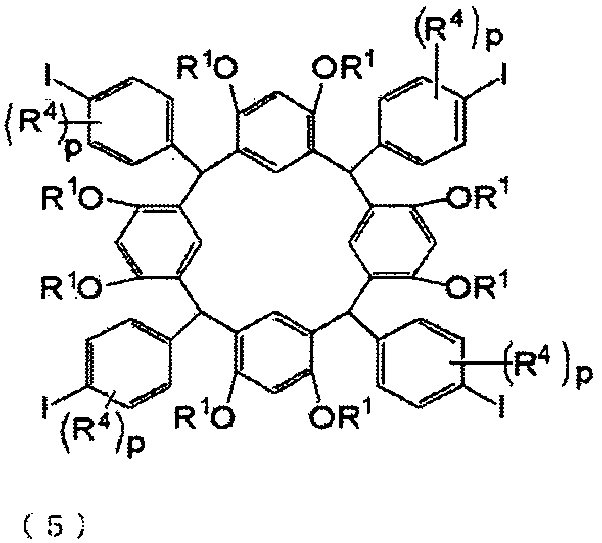
- The compound represented by the formula (4) is still further preferably a compound represented by the formula (6) from the viewpoint of high solubility.
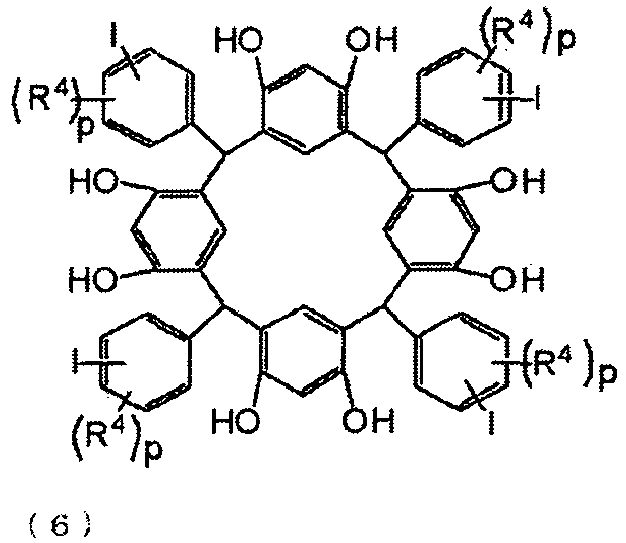
- The compound represented by the formula (5) or the formula (6) is still further preferably a compound represented by the formula (7) from the viewpoint of improvement in the roughness of a pattern shape.

- In the case of using the compound represented by the formula (7) as the resist base material (A), there is a tendency that a resist pattern that has high solubility in a safe solvent, has high sensitivity, has small roughness, and has a good shape can be formed.
- The molecular weight of the compound represented by the formula (1) is not particularly limited, but is preferably 500 to 5000, more preferably 800 to 2000, and still more preferably 1000 to 2000. Within the above range, there is a tendency to improve resolution while maintaining sufficient film formability necessary for a resist.
- The compound mentioned above as the resist base material (A) according to the present embodiment may assume a cis form and a trans form. The compound may be only any one of these forms or may be a mixture. Use of only any one of the cis form and the trans form is preferable because there is a tendency to increase the homogeneity of components in a resist film. The resist base material (A) constituted by only one of the cis form and the trans form can be obtained by a publicly known method such as separation by column chromatography or preparative liquid chromatography or the optimization of a reaction solvent and a reaction temperature, etc. in production.
- The compound represented by the formula (1) is not limited, but can be obtained by, for example, a condensation reaction of one or more compounds selected from the group consisting of aldehydic compounds (A1) having a monovalent group containing an iodine atom with one or more compounds selected from the group consisting of phenolic compounds (A2).
- In the present embodiment, preferably, the aldehydic compound (A1) is a compound of 2 to 59 carbon atoms having a monovalent group containing 1 to 4 formyl groups and an iodine atom, and the phenolic compound (A2) is a compound of 6 to 15 carbon atoms having 1 to 3 phenolic hydroxyl groups.
- The above preferable aldehydic compound (A1) has 3 to 59 carbon atoms and a monovalent group containing 1 to 4 formyl groups and an iodine atom and is selected from an aromatic aldehydic compound (A1A) and an aliphatic aldehydic compound (A1B). The aromatic aldehydic compound (A1A) is preferably a benzaldehyde compound of 7 to 24 carbon atoms. Examples thereof include iodobenzaldehyde, methyliodobenzaldehyde, dimethyliodobenzaldehyde, ethyliodobenzaldehyde, propyliodobenzaldehyde, butyliodobenzaldehyde, ethylmethyliodobenzaldehyde, isopropylmethyliodobenzaldehyde, diethyliodobenzaldehyde, methoxyiodoaldehyde, iodonaphthaldehyde, iodoanthraldehyde, cyclopropyliodobenzaldehyde, cyclobutyliodobenzaldehyde, cyclopentyliodobenzaldehyde, cyclohexyliodobenzaldehyde, phenyliodobenzaldehyde, naphthyliodobenzaldehyde, adamantyliodobenzaldehyde, norbornyliodobenzaldehyde, lactyliodobenzaldehyde, isopropyliodobenzaldehyde, normal propyliodobenzaldehyde, bromoiodobenzaldehyde, dimethylaminoiodobenzaldehyde, hydroxyiodobenzaldehyde, dihydroxyiodobenzaldehyde, and trihydroxyiodobenzaldehyde. Iodobenzaldehyde, methyliodobenzaldehyde, dimethyliodobenzaldehyde, and ethyliodobenzaldehyde are more preferable, and iodobenzaldehyde is still more preferable. The aromatic aldehydic compound (A1A) may have a linear or branched alkyl group of 1 to 4 carbon atoms, a cyano group, a hydroxyl group, halogen or the like, within the range of not deteriorating the effect of the present embodiment. The aromatic aldehydic compound (A1A) may be used alone or in combination of two or more kinds.
- The aliphatic aldehydic compound (A1B) is preferably a compound of 3 to 24 carbon atoms. Examples thereof include iodopropanal, iodoisopropanal, iodobutanal, iodoisobutanal, iodo-t-butanal, iodopentanal, iodoisopentanal, iodoneopentanal, iodohexanal, iodoisohexanal, iodooctanal, iododecanal, iodododecanal, iodoundecenal, iodocyclopropanecarboxyaldehyde, iodocyclobutanecarboxyaldehyde, and iodocyclohexanecarboxyaldehyde. Iodoisobutanal, iodo-t-butanal, iodopentanal, iodoisopentanal, iodoneopentanal, iodohexanal, iodoisohexanal, iodooctanal, iododecanal, iodododecanal, iodocyclopropanecarboxyaldehyde, iodocyclobutanecarboxyaldehyde, and iodocyclohexanecarboxyaldehyde are more preferable, and iodooctanal, iododecanal, iodododecanal, and iodocyclohexanecarboxyaldehyde are still more preferable. The aliphatic aldehydic compound (A1B) may have a cyano group, a hydroxyl group, halogen or the like, within the range of not deteriorating the effect of the present embodiment. The aliphatic aldehydic compound (A1B) may be used alone or in combination of two or more kinds.
- The phenolic compound (A2) is preferably of 6 to 15 carbon atoms and more preferably has 1 to 3 phenolic hydroxyl groups. Preferable examples of the phenolic compound (A2) include phenol, catechol, resorcinol, hydroquinone, pyrogallol, 3-methoxyphenol, 3-ethoxyphenol, 3-cyclohexyloxyphenol, 1,3-dimethoxybenzene, 1,3-diethoxybenzene, and 1,3-dicyclohexyloxybenzene. Resorcinol, pyrogallol, 3-methoxyphenol, 3-ethoxyphenol, 3-cyclohexyloxyphenol, 1,3-dimethoxybenzene, 1,3-diethoxybenzene, and 1,3-dicyclohexyloxybenzene are more preferable, and resorcinol is still more preferable. The phenolic compound (A2) may have a linear or branched alkyl group of 1 to 4 carbon atoms, a cyano group, a hydroxyl group, halogen or the like, within the range of not deteriorating the effect of the present embodiment. The phenolic compound (A2) may be used alone or in combination of two or more kinds.
- A method for producing the compound represented by the formula (1) is not particularly limited, but the compound can be produced by, for example, the following method: first, 0.1 to 10 mol of the phenolic compound (A2) is reacted with 1 mol of the aldehydic compound (A1) at 40 to 150°C for about 0.5 to 20 hours in the presence of an acid catalyst (hydrochloric acid, sulfuric acid, or p-toluenesulfonic acid, etc.) in an organic solvent such as methanol or ethanol. Subsequently, filtration, washing with an alcohol such as methanol, washing with water, and separation by filtration are conducted, followed by drying to obtain the compound represented by the formula (1) having a molecular weight of 500 to 5000. The compound represented by the formula (1) may be obtained by a similar reaction using a basic catalyst (sodium hydroxide, barium hydroxide, or 1,8-diazabicyclo[5.4.0]undecene-7, etc.) instead of the acid catalyst. Alternatively, the compound represented by the formula (1) according to the present embodiment can also be produced by converting the above aldehydic compound (A1) to a dihalide with hydrogen halide or halogen gas, and reacting the isolated dihalide with the phenolic compound (A2).
- From the viewpoint of improving the solubility of the obtained compound represented by the formula (1) in a safe solvent for semiconductors, it is more preferable to use two or more kinds as at least one aldehydic compound (A1) or phenolic compound (A2).
- If required, the compound represented by the formula (1) may be purified for improving its purity and reducing the amount of residual metals. From the viewpoint of securing the sufficient storage stability of the radiation-sensitive composition, it is preferable to prevent the acid catalyst and a promoter from remaining. From the viewpoint of securing the sufficient sensitivity of the radiation-sensitive composition, it is preferable to prevent the basic catalyst from remaining. Therefore, purification aimed at reducing them is preferably conducted.
- The purification method can be conducted by a publicly known method as long as the resist base material is not denatured. Examples thereof include, but not particularly limited to, a method involving washing with water, a method involving washing with an acidic aqueous solution, a method involving washing with a basic aqueous solution, a method involving treatment with an ion exchange resin, and a method involving treatment by silica gel column chromatography. These purification methods are more preferably conducted in combination of two or more kinds.
- The acidic aqueous solution, the basic aqueous solution, the ion exchange resin, and the silica gel column chromatography can be appropriately selected so as to be optimal according to the metals to be removed, the amounts or types of acidic and basic compounds, the types of the resist base material to be purified, etc. Examples of the acidic aqueous solution include aqueous solutions of hydrochloric acid, nitric acid, or acetic acid having a concentration of 0.01 to 10 mol/L. Examples of the basic aqueous solution include aqueous solutions of ammonia having a concentration of 0.01 to 10 mol/L. Examples of the ion exchange resin include cationic exchange resins, for example, Amberlyst 15J-HG Dry manufactured by Organo Corp.
- The compound thus purified may be dried. The drying can be conducted by a publicly known method. Examples thereof include, but not particularly limited to, a method of conducting drying in vacuum or drying in hot air under conditions of not denaturing the compound represented by the formula (1).
- The compound represented by the formula (1) according to the present embodiment is capable of forming an amorphous film by spin coating. Also, the compound can be applied to a general semiconductor production process.
- The compound represented by the formula (1) according to the present embodiment is used in combination with the optically active diazonaphthoquinone compound (B) mentioned later and is useful as a base material for positive type resists that becomes a compound easily soluble in a developing solution by irradiation with g-ray, h-ray, i-ray, KrF excimer laser, ArF excimer laser, extreme ultraviolet, electron beam, or X-ray. Although the properties as the resist base material (A) of the compound represented by the formula (1) are not largely altered by g-ray, h-ray, i-ray, KrF excimer laser, ArF excimer laser, extreme ultraviolet, electron beam, or X-ray, the optically active diazonaphthoquinone compound (B) poorly soluble in a developing solution is converted to an easily soluble compound so that a resist pattern can be formed in a development step. Since the compound represented by the formula (1) according to the present embodiment is a low molecular weight compound, the obtained resist pattern has small roughness. In the case of using a compound represented by the formula (1) and having a monovalent group containing an iodine atom, there is a tendency to increase the ability to absorb radiation such as electron beam, extreme ultraviolet (EUV), or X-ray. As a result, the sensitivity of the radiation-sensitive composition using the resist base material according to the present embodiment can be enhanced. Thus, this is preferable.
- The glass transition temperatures of the compounds represented by the formula (1) according to the present embodiment are preferably 100°C or higher, more preferably 120°C or higher, still more preferably 140°C or higher, and much more preferably 150°C or higher. When the glass transition temperatures fall within the above range, there is a tendency to have heat resistance capable of maintaining a pattern shape in a semiconductor lithography process and to improve performance such as high resolution.
- The heat of crystallization determined by the differential scanning calorimetry of the glass transition temperatures of the compounds represented by the formula (1) according to the present embodiment is preferably less than 20 J/g. (Crystallization temperature) - (Glass transition temperature) is preferably 70°C or more, more preferably 80°C or more, still more preferably 100°C or more, and particularly preferably 130°C or more. When the heat of crystallization is less than 20 J/g or (Crystallization temperature) - (Glass transition temperature) falls within the above range, there is a tendency to facilitate forming an amorphous film by the spin coating of the radiation-sensitive composition and to be able to secure film formability necessary for a resist over a long period, thereby further improving resolution.
- In the present embodiment, the heat of crystallization, the crystallization temperature, and the glass transition temperature can be determined by differential scanning calorimetry using DSC/TA-50WS manufactured by Shimadzu Corp. More specifically, about 10 mg of a sample is placed in a non-sealed container made of aluminum, and the temperature is raised to the melting point or higher at the rate of temperature rise of 20°C/min in a nitrogen gas stream (50 mL/min). After quenching, again the temperature is raised to the melting point or higher at the rate of temperature rise of 20°C/min in a nitrogen gas stream (30 mL/min). After further quenching, again the temperature is raised to 400°C at the rate of temperature rise of 20°C/min in a nitrogen gas stream (30 mL/min). The temperature at the middle point (where the specific heat is changed into the half) of steps in the baseline shifted in a step-like pattern is defined as the glass transition temperature (Tg). The temperature of the subsequently appearing exothermic peak is defined as the crystallization temperature. The heat is determined from the area of a region surrounded by the exothermic peak and the baseline and defined as the heat of crystallization.
- The compound represented by the formula (1) according to the present embodiment is preferably low sublimable at 100°C or lower, preferably 120°C or lower, more preferably 130°C or lower, still more preferably 140°C or lower, and particularly preferably 150°C or lower at normal pressure. The low sublimability means that in thermogravimetry, weight reduction when the compounds are kept at a predetermined temperature for 10 minutes is 10%, preferably 5%, more preferably 3%, still more preferably 1%, and much more preferably 0.1% or less. There is a tendency that the low sublimability can prevent an exposure apparatus from being contaminated by outgassing upon exposure. In addition, there is a tendency that low roughness and a good pattern shape can be obtained.
- The compound represented by the formula (1) according to the present embodiment is preferably dissolved at 1% by mass or more, more preferably 5% by mass or more, and still more preferably 10% by mass or more at 23°C in a solvent that is selected from propylene glycol monomethyl ether acetate (PGMEA), propylene glycol monomethyl ether (PGME), cyclohexanone (CHN), cyclopentanone (CPN), 2-heptanone, anisole, butyl acetate, ethyl propionate, and ethyl lactate and exhibits the highest ability to dissolve the compound. Much more preferably, the compound is dissolved at 20% by mass or more at 23°C in a solvent that is selected from PGMEA, PGME, and CHN and exhibits the highest ability to dissolve the compound. Further preferably, the compound is dissolved at 20% by mass or more at 23°C in PGMEA. When the above conditions are satisfied, there is a tendency to improve usefulness in a semiconductor production process in actual production.
- The radiation-sensitive composition of the present embodiment comprises (B) an optically active diazonaphthoquinone compound. The optically active diazonaphthoquinone compound (B) is a diazonaphthoquinone substance comprising a polymer or non-polymer optically active diazonaphthoquinone compound and is not particularly limited as long as it is generally used as a photosensitive component in positive type resist compositions. One kind or two or more kinds can be optionally selected and used. Among them, a non-polymer optically active diazonaphthoquinone compound is preferable, and a low molecular weight compound having a molecular weight of 1500 or less, still more preferably a molecular weight of 1200 or less, and particularly preferably a molecular weight of 1000 or less is more preferable, from the viewpoint of low roughness and solubility. Preferable specific examples of such a non-polymer optically active diazonaphthoquinone compound include compounds represented by the following formulae (G), (G-1), (G-2), and (G-3).


- The optically active diazonaphthoquinone compound (B) is preferably a compound obtained by reacting naphthoquinonediazide sulfonic acid chloride, benzoquinonediazide sulfonic acid chloride, or the like with a low molecular weight compound or a high molecular weight compound having a functional group condensable with these acid chlorides. Herein, examples of the functional group condensable with the acid chlorides can include, but not limited to, a hydroxyl group and an amino group. Among them, a hydroxyl group is preferable. Examples of the compound containing a hydroxyl group condensable with the acid chlorides can include, but not limited to, hydroquinone, resorcin, hydroxybenzophenones such as 2,4-dihydroxybenzophenone, 2,3,4-trihydroxybenzophenone, 2,4,6-trihydroxybenzophenone, 2,4,4'-trihydroxybenzophenone, 2,3,4,4'-tetrahydroxybenzophenone, 2,2',4,4'-tetrahydroxybenzophenone, and 2,2',3,4,6'-pentahydroxybenzophenone, hydroxyphenylalkanes such as bis(2,4-dihydroxyphenyl)methane, bis(2,3,4-trihydroxyphenyl)methane, and bis(2, 4-dihydroxyphenyl)propane, and hydroxytriphenylmethanes such as 4,4',3",4"-tetrahydroxy-3,5,3',5'-tetramethyltriphenylmethane and 4,4',2",3",4"-pentahydroxy-3,5,3',5'-tetramethyltriphenylmethane.
- Preferable examples of the acid chloride such as naphthoquinonediazide sulfonic acid chloride or benzoquinonediazide sulfonic acid chloride include 1,2-naphthoquinonediazide-5-sulfonyl chloride and 1,2-naphthoquinonediazide-4-sulfonyl chloride.
- The radiation-sensitive composition of the present embodiment comprises (C) a solvent.
- The solvent is usually prepared by dissolving each component in a solvent upon use into a homogenous solution, and then if required, filtering through a filter or the like with a pore diameter of about 0.2 µm, for example.
- Examples of the solvent according to the present embodiment can include, but not particularly limited to, ethylene glycol monoalkyl ether acetates such as ethylene glycol monomethyl ether acetate, ethylene glycol monoethyl ether acetate, ethylene glycol mono-n-propyl ether acetate, and ethylene glycol mono-n-butyl ether acetate; ethylene glycol monoalkyl ethers such as ethylene glycol monomethyl ether and ethylene glycol monoethyl ether; propylene glycol monoalkyl ether acetates such as propylene glycol monomethyl ether acetate, propylene glycol monoethyl ether acetate, propylene glycol mono-n-propyl ether acetate, and propylene glycol mono-n-butyl ether acetate; propylene glycol monoalkyl ethers such as propylene glycol monomethyl ether and propylene glycol monoethyl ether; ester lactates such as methyl lactate, ethyl lactate, n-propyl lactate, n-butyl lactate, and n-amyl lactate; aliphatic carboxylic acid esters such as methyl acetate, ethyl acetate, n-propyl acetate, n-butyl acetate, n-amyl acetate, n-hexyl acetate, methyl propionate, and ethyl propionate; other esters such as methyl 3-methoxypropionate, ethyl 3-methoxypropionate, methyl 3-ethoxypropionate, ethyl 3-ethoxypropionate, methyl 3-methoxy-2-methylpropionate, 3-methoxybutylacetate, 3-methyl-3-methoxybutylacetate, butyl 3-methoxy-3-methylpropionate, butyl 3-methoxy-3-methylbutyrate, methyl acetoacetate, methyl pyruvate, and ethyl pyruvate; aromatic hydrocarbon atoms such as toluene and xylene; ketones such as 2-heptanone, 3-heptanone, 4-heptanone, cyclopentanone, and cyclohexanone; amides such as N,N-dimethylformamide, N-methylacetamide, N,N-dimethylacetamide, and N-methylpyrrolidone; and lactones such as γ-lactone. These solvents can be used alone or in combination of two or more kinds.
- In the radiation-sensitive composition of the present embodiment, the content of the solid component is 1 to 80% by mass, and the content of the solvent is 20 to 99% by mass. Preferably, the content of the solid component is 1 to 50% by mass, and the content of the solvent is 50 to 99% by mass, from the viewpoint of the resolution of the resulting resist pattern. More preferably, the content of the solid component is 2 to 40% by mass, and the content of the solvent is 60 to 98% by mass. Even more preferably, the content of the solid component is 2 to 10% by mass, and the content of the solvent is 90 to 98% by mass.
- The radiation-sensitive composition of the present embodiment can form an amorphous film by spin coating. Specifically, the amorphous film of the present embodiment is obtained from the radiation-sensitive composition of the present embodiment. The dissolution rate of the amorphous film formed by spin coating with the radiation-sensitive composition of the present embodiment in a developing solution at 23°C is preferably 5 angstrom/sec or less, more preferably 0.05 to 5 angstrom/sec, and still more preferably 0.0005 to 5 angstrom/sec. The amorphous film preferably has a dissolution rate of 5 angstrom/sec or less from the viewpoint of rendering a resist insoluble in a developing solution and preferably has a dissolution rate of 0.0005 angstrom/sec or more from the viewpoint of improving resolution. It is presumed that this is because due to the change in the solubility before and after exposure of the compound represented by the formula (1), contrast at the interface between the exposed portion being dissolved in a developing solution and the unexposed portion not being dissolved in a developing solution is increased. There are also reduction effects of roughness and defect.
- The dissolution rate of the portion exposed by radiation such as g-ray, h-ray, i-ray, KrF excimer laser, extreme ultraviolet, electron beam, or X-ray, of the amorphous film formed by spin coating with the radiation-sensitive composition of the present embodiment, in a developing solution at 23°C is preferably 10 angstrom/sec or more, more preferably 10 to 10000 angstrom/sec, and still more preferably 100 to 1000 angstrom/sec. The exposed portion preferably has a dissolution rate of 10 angstrom/sec or more from the viewpoint of dissolving a resist in a developing solution and preferably has a dissolution rate of 10000 angstrom/sec or less from the viewpoint of improving resolution. It is presumed that this is because the micro surface portion of the compound represented by the formula (1) dissolves and roughness is reduced. There is also a reduction effect of defect. The dissolution rate of the amorphous film heated at 20 to 500°C in a developing solution is the same as above.
- The content of the resist base material (A) of the present embodiment is preferably 1 to 99% by mass of the solid component (resist base material (A), optically active diazonaphthoquinone compound (B), and optional component (D)), more preferably 5 to 95% by mass, still more preferably 10 to 90% by mass, and much more preferably 25 to 75% by mass. In the case of the above content, there is a tendency to obtain a pattern having higher sensitivity and smaller roughness.
- The amount of the optically active diazonaphthoquinone compound (B) of the present embodiment is preferably 1 to 99% by mass of the solid component, more preferably 5 to 95% by mass, still more preferably 10 to 90% by mass, and much more preferably 25 to 75% by mass. In the case of the above content, there is a tendency to obtain a pattern having higher sensitivity and smaller roughness.
- To the radiation-sensitive composition of the present embodiment, within the range of not inhibiting the purpose of the present embodiment, if required, as the optional component (D) other than the resist base material (A), the optically active diazonaphthoquinone compound (B), and the solvent (C), one kind or two kinds or more of various additive agents such as an acid generating agent, an acid crosslinking agent, an acid diffusion controlling agent, a dissolution promoting agent, a dissolution controlling agent, a sensitizing agent, a surfactant, and an organic carboxylic acid or an oxo acid of phosphor, or derivative thereof can be added.
- The radiation-sensitive composition of the present embodiment preferably contains one or more acid generating agents generating an acid directly or indirectly by irradiation of any radiation selected from visible light, ultraviolet, excimer laser, electron beam, extreme ultraviolet (EUV), X-ray, and ion beam. The amount of the acid generating agent used is preferably 0.001 to 49% by mass of the solid component, more preferably 1 to 40% by mass, still more preferably 3 to 30% by mass, and much more preferably 10 to 25% by mass. By using it within the above range, there is a tendency that a pattern profile with higher sensitivity and low edge roughness can be obtained. In the present embodiment, the acid generation method is not limited as long as an acid is generated within a system. By using excimer laser instead of ultraviolet such as g-ray and i-ray, finer processing is possible, and also by using electron beam, extreme ultraviolet, X-ray or ion beam as a high energy ray, further finer processing is possible.
- The acid generating agent is preferably at least one kind selected from the group consisting of compounds represented by the following formulae (7-1) to (7-8):

- In the formula (7-1), R13 may be the same or different, and are each independently a hydrogen atom, a linear, branched or cyclic alkyl group, a linear, branched or cyclic alkoxy group, a hydroxyl group, or a halogen atom; X- is an alkyl group, an aryl group, a sulfonic acid ion having a halogen substituted alkyl group or a halogen substituted aryl group, or a halide ion.
- The compound represented by the above formula (7-1) is preferably at least one kind selected from the group consisting of triphenylsulfonium trifluoromethanesulfonate, triphenylsulfonium nonafluoro-n-butanesulfonate, diphenyltolylsulfonium nonafluoro-n-butanesulfonate, triphenylsulfonium perfluoro-n-octanesulfonate, diphenyl-4-methylphenylsulfonium trifluoromethanesulfonate, di-2,4,6-trimethylphenylsulfonium trifluoromethanesulfonate, diphenyl-4-t-butoxyphenylsulfonium trifluoromethanesulfonate, diphenyl-4-t-butoxyphenylsulfonium nonafluoro-n-butanesulfonate, diphenyl-4-hydroxyphenylsulfonium trifluoromethanesulfonate, bis(4-fluorophenyl)-4-hydroxyphenylsulfonium trifluoromethanesulfonate, diphenyl-4-hydroxyphenylsulfonium nonafluoro-n-butanesulfonate, bis(4-hydroxyphenyl)-phenylsulfonium trifluoromethanesulfonate, tri(4-methoxyphenyl)sulfonium trifluoromethanesulfonate, tri(4-fluorophenyl)sulfonium trifluoromethanesulfonate, triphenylsulfonium p-toluenesulfonate, triphenylsulfonium benzenesulfonate, diphenyl-2,4,6-trimethylphenyl-p-toluenesulfonate, diphenyl-2,4,6-trimethylphenylsulfonium-2-trifluoromethylbenzenesulfonate, diphenyl-2,4,6-trimethylphenylsulfonium-4-trifluoromethylbenzenesulfonate, diphenyl-2,4,6-trimethylphenylsulfonium-2,4-difluorobenzenesulfonate, diphenyl-2,4,6-trimethylphenylsulfonium hexafluorobenzenesulfonate, diphenylnaphthylsulfonium trifluoromethanesulfonate, diphenyl-4-hydroxyphenylsulfonium-p-toluenesulfonate, triphenylsulfonium 10-camphorsulfonate, diphenyl-4-hydroxyphenylsulfonium 10-camphorsulfonate, and cyclo(1,3-perfluoropropanedisulfone)imidate.

- In the formula (7-2), R14 may be the same or different, and each independently represents a hydrogen atom, a linear, branched or cyclic alkyl group, a linear, branched or cyclic alkoxy group, a hydroxyl group, or a halogen atom. X- is the same as defined above.
- The compound represented by the above formula (7-2) is preferably at least one kind selected from the group consisting of bis(4-t-butylphenyl)iodonium trifluoromethanesulfonate, bis(4-t-butylphenyl)iodonium nonafluoro-n-butanesulfonate, bis(4-t-butylphenyl)iodonium perfluoro-n-octanesulfonate, bis(4-t-butylphenyl)iodonium p-toluenesulfonate, bis(4-t-butylphenyl)iodonium benzenesulfonate, bis(4-t-butylphenyl)iodonium-2-trifluoromethylbenzenesulfonate, bis(4-t-butylphenyl)iodonium-4-trifluoromethylbenzenesulfonate, bis(4-t-butylphenyl)iodonium-2,4-difluorobenzenesulfonate, bis(4-t-butylphenyl)iodonium hexafluorobenzenesulfonate, bis(4-t-butylphenyl)iodonium 10-camphorsulfonate, diphenyliodonium trifluoromethanesulfonate, diphenyliodonium nonafluoro-n-butanesulfonate, diphenyliodonium perfluoro-n-octanesulfonate, diphenyliodonium p-toluenesulfonate, diphenyliodonium benzenesulfonate, diphenyliodonium 10-camphorsulfonate, diphenyliodonium-2-trifluoromethylbenzenesulfonate, diphenyliodonium-4-trifluoromethylbenzenesulfonate, diphenyliodonium-2,4-difluorobenzenesulfonate, diphenyliodonium hexafluorobenzenesulfonate, di(4-trifluoromethylphenyl)iodonium trifluoromethanesulfonate, di(4-trifluoromethylphenyl)iodonium nonafluoro-n-butanesulfonate, di(4-trifluoromethylphenyl)iodonium perfluoro-n-octanesulfonate, di(4-trifluoromethylphenyl)iodonium p-toluenesulfonate, di(4-trifluoromethylphenyl)iodonium benzenesulfonate, and di(4-trifluoromethylphenyl)iodonium 10-camphersulfonate.
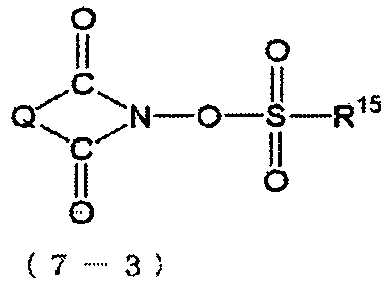
- In the formula (7-3), Q is an alkylene group, an arylene group, or an alkoxylene group, and R15 is an alkyl group, an aryl group, a halogen substituted alkyl group, or a halogen substituted aryl group.
- The compound represented by the above formula (7-3) is preferably at least one kind selected from the group consisting of N-(trifluoromethylsulfonyloxy)succinimide, N-(trifluoromethylsulfonyloxy)phthalimide, N-(trifluoromethylsulfonyloxy)diphenylmaleimide, N-(trifluoromethylsulfonyloxy)bicyclo[2.2.1]hept-5-en-2,3-dicarboxyimide, N-(trifluoromethylsulfonyloxy)naphthylimide, N-(10-camphorsulfonyloxy)succinimide, N-(10-camphorsulfonyloxy)phthalimide, N-(10-camphorsulfonyloxy)diphenylmaleimide, N-(10-camphorsulfonyloxy)bicyclo[2.2.1]hept-5-en-2,3-dicarboxyimide, N-(10-camphorsulfonyloxy)naphthylimide, N-(n-octanesulfonyloxy)bicyclo[2.2.1]hept-5-en-2,3-dicarboxyimide, N-(n-octanesulfonyloxy)naphthylimide, N-(p-toluenesulfonyloxy)bicyclo[2.2.1]hept-5-en-2,3-dicarboxyimide, N-(p-toluenesulfonyloxy)naphthylimide, N-(2-trifluoromethylbenzenesulfonyloxy)bicyclo[2.2.1]hept-5-en-2,3-dicarboxyimide, N-(2-trifluoromethylbenzenesulfonyloxy)naphthylimide, N-(4-trifluoromethylbenzenesulfonyloxy)bicyclo[2.2.1]hept-5-en-2,3-dicarboxyimide, N-(4-trifluoromethylbenzenesulfonyloxy)naphthylimide, N-(perfluorobenzenesulfonyloxy)bicyclo[2.2.1]hept-5-en-2,3-dicarboxyimide, N-(perfluorobenzenesulfonyloxy)naphthylimide, N-(1-naphthalenesulfonyloxy)bicyclo[2.2.1]hept-5-en-2,3-dicarboxyimide, N-(1-naphthalenesulfonyloxy)naphthylimide, N-(nonafluoro-n-butanesulfonyloxy)bicyclo[2.2.1]hept-5-en-2,3-dicarboxyimide, N-(nonafluoro-n-butanesulfonyloxy)naphthylimide, N-(perfluoro-n-octanesulfonyloxy)bicyclo[2.2.1]hept-5-en-2,3-dicarboxyimide, and N-(perfluoro-n-octanesulfonyloxy)naphthylimide.

- In the formula (7-4), R16 may be the same or different, and are each independently an optionally substituted linear, branched or cyclic alkyl group, an optionally substituted aryl group, an optionally substituted heteroaryl group, or an optionally substituted aralkyl group.
- The compound represented by the above formula (7-4) is preferably at least one kind selected from the group consisting of diphenyldisulfone, di(4-methylphenyl)disulfone, dinaphthyldisulfone, di(4-tert-butylphenyl)disulfone, di(4-hydroxyphenyl)disulfone, di(3-hydroxynaphthyl)disulfone, di(4-fluorophenyl)disulfone, di(2-fluorophenyl)disulfone, and di(4-trifluoromethylphenyl)disulfone.

- In the formula (7-5), R17 may be the same or different, and are each independently an optionally substituted linear, branched or cyclic alkyl group, an optionally substituted aryl group, an optionally substituted heteroaryl group, or an optionally substituted aralkyl group.
- The compound represented by the above formula (7-5) is preferably at least one kind selected from the group consisting of α-(methylsulfonyloxyimino)-phenylacetonitrile, α-(methylsulfonyloxyimino)-4-methoxyphenylacetonitrile, α-(trifluoromethylsulfonyloxyimino)-phenylacetonitrile, α-(trifluoromethylsulfonyloxyimino)-4-methoxyphenylacetonitrile, α-(ethylsulfonyloxyimino)-4-methoxyphenylacetonitrile, α-(propylsulfonyloxyimino)-4-methylphenylacetonitrile, and α-(methylsulfonyloxyimino)-4-bromophenylacetonitrile.

- In the formula (7-6), R18 may be the same or different, and are each independently a halogenated alkyl group having one or more chlorine atoms and one or more bromine atoms. The number of carbon atoms of the halogenated alkyl group is preferably 1 to 5.


- In the formulae (7-7) and (7-8), R19 and R20 are each independently an alkyl group of 1 to 3 carbon atoms such as a methyl group, an ethyl group, an n-propyl group, and an isopropyl group, a cycloalkyl group such as a cyclopentyl group and a cyclohexyl group, an alkoxyl group of 1 to 3 carbon atoms such as a methoxy group, an ethoxy group, and a propoxy group, or an aryl group such as a phenyl group, a toluoyl group, and a naphthyl group, and preferably an aryl group of 6 to 10 carbon atoms. L19 and L20 are each independently an organic group having a 1,2-naphthoquinonediazide group. Specifically, preferable examples of the organic group having a 1,2-naphthoquinonediazide group include a 1,2-quinonediazidesulfonyl group such as a 1,2-naphthoquinonediazide-4-sulfonyl group, a 1,2-naphthoquinonediazide-5-sulfonyl group, and a 1,2-naphthoquinonediazide-6-sulfonyl group. Particularly, a 1,2-naphthoquinonediazide-4-sulfonyl group and a 1,2-naphthoquinonediazide-5-sulfonyl group are preferable. p is an integer of 1 to 3; q is an integer of 0 to 4; and 1≤p+q≤5. J19 is a single bond, a polymethylene group of 1 to 4 carbon atoms, a cycloalkylene group, a phenylene group, a group represented by the following formula (7-7-1), a carbonyl group, an ester group, an amide group, or an ether group. Y19 is a hydrogen atom, an alkyl group, or an aryl group, and X20 are each independently a group represented by the following formula (7-8-1):


- In the formula (7-8-1), Z22 are each independently an alkyl group, a cycloalkyl group, or an aryl group; R22 is an alkyl group, a cycloalkyl group, or an alkoxyl group; and r is an integer of 0 to 3.
- Examples of the other acid generating agent include bissulfonyldiazomethanes such as bis(p-toluenesulfonyl)diazomethane, bis(2,4-dimethylphenylsulfonyl)diazomethane, bis(tert-butylsulfonyl)diazomethane, bis(n-butylsulfonyl)diazomethane, bis(isobutylsulfonyl)diazomethane, bis(isopropylsulfonyl)diazomethane, bis(n-propylsulfonyl)diazomethane, bis(cyclohexylsulfonyl)diazomethane, bis(isopropylsulfonyl)diazomethane, 1,3-bis(cyclohexylsulfonylazomethylsulfonyl)propane, 1,4-bis(phenylsulfonylazomethylsulfonyl)butane, 1,6-bis(phenylsulfonylazomethylsulfonyl)hexane, and 1,10-bis(cyclohexylsulfonylazomethylsulfonyl)decane, and halogen-containing triazine derivatives such as 2-(4-methoxyphenyl)-4,6-(bistrichloromethyl)-1,3,5-triazine, 2-(4-methoxynaphthyl)-4,6-(bistrichloromethyl)-1,3,5-triazine, tris(2,3-dibromopropyl)-1,3,5-triazine, and tris(2,3-dibromopropyl)isocyanurate.
- Among the above acid generating agents, an acid generating agent having an aromatic ring is preferable, and an acid generating agent represented by the formula (7-1) or (7-2) is more preferable. An acid generating agent having a sulfonate ion wherein X- of the formula (7-1) or (7-2) has an aryl group or a halogen-substituted aryl group is still more preferable; an acid generating agent having a sulfonate ion having an aryl group is particularly preferable; and diphenyltrimethylphenylsulfonium p-toluenesulfonate, triphenylsulfonium p-toluenesulfonate, triphenylsulfonium trifluoromethanesulfonate, and triphenylsulfonium nonafluoromethanesulfonate are particularly preferable. By using the acid generating agent, LER can be reduced.
- The above acid generating agent can be used alone or in combination of two or more kinds.
- The radiation-sensitive composition of the present embodiment preferably contains one or more acid crosslinking agents. The acid crosslinking agent is a compound capable of intramolecular or intermolecular crosslinking the compound represented by the formula (1) in the presence of the acid generated from the acid generating agent. Examples of such an acid crosslinking agent can include, but not limited to, a compound having one or more groups (hereinafter, referred to as "crosslinkable group") capable of crosslinking the compound represented by the formula (1).
- Specific examples of such a crosslinkable group include, but not limited to, (i) a hydroxyalkyl group such as a hydroxy (C1-C6 alkyl group), a C1-C6 alkoxy (C1-C6 alkyl group), and an acetoxy (C1-C6 alkyl group), or a group derived therefrom; (ii) a carbonyl group such as a formyl group and a carboxy (C1-C6 alkyl group), or a group derived therefrom; (iii) a nitrogenous group-containing group such as a dimethylaminomethyl group, a diethylaminomethyl group, a dimethylolaminomethyl group, a diethylolaminomethyl group, and a morpholinomethyl group; (iv) a glycidyl group-containing group such as a glycidyl ether group, a glycidyl ester group, and a glycidylamino group; (v) a group derived from an aromatic group such as a C1-C6 allyloxy (C1-C6 alkyl group) and a C1-C6 aralkyloxy (C1-C6 alkyl group) such as a benzyloxymethyl group and a benzoyloxymethyl group; and (vi) a polymerizable multiple bond-containing group such as a vinyl group and a isopropenyl group. As the crosslinkable group of the acid crosslinking agent of the present embodiment, a hydroxyalkyl group and an alkoxyalkyl group or the like are preferable, and an alkoxymethyl group is particularly preferable.
- Examples of the acid crosslinking agent having the above crosslinkable group include, but not limited to, (i) a methylol group-containing compound such as a methylol group-containing melamine compound, a methylol group-containing benzoguanamine compound, a methylol group-containing urea compound, a methylol group-containing glycoluryl compound, and a methylol group-containing phenolic compound; (ii) an alkoxyalkyl group-containing compound such as an alkoxyalkyl group-containing melamine compound, an alkoxyalkyl group-containing benzoguanamine compound, an alkoxyalkyl group-containing urea compound, an alkoxyalkyl group-containing glycoluryl compound, and an alkoxyalkyl group-containing phenolic compound; (iii) a carboxymethyl group-containing compound such as a carboxymethyl group-containing melamine compound, a carboxymethyl group-containing benzoguanamine compound, a carboxymethyl group-containing urea compound, a carboxymethyl group-containing glycoluryl compound, and a carboxymethyl group-containing phenolic compound; (iv) an epoxy compound such as a bisphenol A based epoxy compound, a bisphenol F based epoxy compound, a bisphenol S based epoxy compound, a novolac resin based epoxy compound, a resol resin based epoxy compound, and a poly(hydroxystyrene) based epoxy compound.
- As the acid crosslinking agent, a compound having a phenolic hydroxyl group, and a compound and resin where the above crosslinkable group is introduced into an acid functional group in an alkali soluble resin to impart crosslinkability can be further used. The introduction rate of the crosslinkable group in that case is adjusted, usually, to be normally 5 to 100 mol %, preferably 10 to 60 mol %, and more preferably 15 to 40 mol % based on the total acid functional groups in the compound having a phenolic hydroxyl group, and the alkali soluble resin. The above range is preferable because there is a tendency that the crosslinking reaction sufficiently occurs, and a decrease in the film remaining rate, and swelling phenomena and meandering or the like of a pattern can be avoided.
- In the radiation-sensitive composition of the present embodiment, as the acid crosslinking agent, an alkoxyalkylated urea compound or resin thereof, or an alkoxyalkylated glycoluryl compound or resin thereof is preferable. More preferable examples of the acid crosslinking agent include compounds represented by the following formulae (8-1) to (8-3) and an alkoxymethylated melamine compound (acid crosslinking agent).

- In the above formulae (8-1) to (8-3), R7 each independently represents a hydrogen atom, an alkyl group, or an acyl group; R8 to R11 each independently represents a hydrogen atom, a hydroxyl group, an alkyl group, or an alkoxyl group; and X2 represents a single bond, a methylene group, or an oxygen atom.
- The alkyl group represented by the above R7 is preferably 1 to 6 carbon atoms, and more preferably 1 to 3 carbon atoms. Examples thereof include a methyl group, an ethyl group, and a propyl group. The acyl group represented by R7 is preferably 2 to 6 carbon atoms, and more preferably 2 to 4 carbon atoms. Examples thereof include an acetyl group and a propionyl group. The alkyl group represented by R8 to R11 is preferably 1 to 6 carbon atoms, and more preferably 1 to 3 carbon atoms. Examples thereof include a methyl group, an ethyl group, and a propyl group. The alkoxy group represented by R8 to R11 is preferably 1 to 6 carbon atoms, and more preferably 1 to 3 carbon atoms. Examples thereof include a methoxy group, an ethoxy group, and a propoxy group. X2 is preferably a single bond or a methylene group. R7 to R11 and X2 may be substituted with an alkyl group such as a methyl group and an ethyl group, an alkoxy group such as a methoxy group and an ethoxy group, a hydroxyl group and a halogen atom or the like. A plurality of R7 and R8 to R11 may be each the same or different.
- Specific examples of the compound represented by the formula (8-1) include compounds shown below:


- Specific examples of the compound represented by the formula (8-2) include, but not limited to, N,N,N,N-tetra(methoxymethyl)glycoluryl, N,N,N,N-tetra(ethoxymethyl)glycoluryl, N,N,N,N-tetra(n-propoxymethyl)glycoluryl, N,N,N,N-tetra(isopropoxymethyl)glycoluryl, N,N,N,N-tetra(n-butoxymethyl)glycoluryl, and N,N,N,N-tetra(t-butoxymethyl)glycoluryl. Among them, particularly, N,N,N,N-tetra(methoxymethyl)glycoluryl is preferable.
- Specific examples of the compound represented by the formula (8-3) include compounds shown below:


- Specific examples of the alkoxymethylated melamine compound include, but not limited to, N,N,N,N,N,N-hexa(methoxymethyl)melamine, N,N,N,N,N,N-hexa(ethoxymethyl)melamine, N,N,N,N,N,N-hexa(n-propoxymethyl)melamine, N,N,N,N,N,N-hexa(isopropoxymethyl)melamine, N,N,N,N,N,N-hexa(n-butoxymethyl)melamine, and N,N,N,N,N,N-hexa(t-butoxymethyl)melamine. Among them, particularly, N,N,N,N,N,N-hexa(methoxymethyl)melamine is preferable.
- The above acid crosslinking agent can be obtained by, for example, conducting a condensation reaction of a urea compound or a glycoluryl compound with formalin to introduce an methylol group, etherifying the product with lower alcohols such as methyl alcohol, ethyl alcohol, propyl alcohol, and butyl alcohol, and then cooling the reaction solution to collect a precipitated compound or resin thereof. The above acid crosslinking agent can be obtained as a commercially available product such as CYMEL (trade name, manufactured by MT AquaPolymer) and NIKALAC (manufactured by Sanwa Chemical).
- Other particularly preferable examples of the acid crosslinking agent include a phenol derivative having 1 to 6 benzene rings within a molecule and two or more hydroxyalkyl groups and/or alkoxyalkyl groups within the entire molecule, the hydroxyalkyl groups and/or alkoxyalkyl groups being bonded to any of the above benzene rings. Preferable examples thereof include a phenol derivative having a molecular weight of 1500 or less, 1 to 6 benzene rings and a total of two or more hydroxyalkyl groups and/or alkoxyalkyl groups within a molecule, the hydroxyalkyl groups and/or alkoxyalkyl groups being bonded to any one of the above benzene rings, or a plurality of benzene rings.
- The hydroxyalkyl group bonded to a benzene ring is the one of 1 to 6 carbon atoms such as a hydroxymethyl group, a 2-hydroxyethyl group, a 2-hydroxy-1-propyl group is preferable. As the alkoxyalkyl group bonded to a benzene ring, the one of 2 to 6 carbon atoms is preferable. Specifically, a methoxymethyl group, an ethoxymethyl group, an n-propoxymethyl group, an isopropoxymethyl group, an n-butoxymethyl group, an isobutoxymethyl group, a sec-butoxymethyl group, a t-butoxymethyl group, a 2-methoxyethyl group, or a 2-methoxy-1-propyl group is preferable.
- Among these phenol derivatives, particularly preferable ones are shown below:





- In the above formulae, L1 to L8 may be the same or different, and each independently represents a hydroxymethyl group, a methoxymethyl group, or an ethoxymethyl group. A phenol derivative having a hydroxymethyl group can be obtained by reacting the corresponding phenolic compound having no hydroxymethyl group (a compound where L1 to L8 in the above formulae are a hydrogen atom) with formaldehyde in the presence of a basic catalyst. In this case, in order to prevent resinification and gelation, the reaction temperature is preferably 60°C or less. Specifically, it can be synthesized by methods described in Japanese Patent Application Laid-Open Nos.
6-282067 7-64285 - A phenol derivative having an alkoxymethyl group can be obtained by reacting the corresponding phenol derivative having a hydroxymethyl group with an alcohol in the presence of an acid catalyst. In this case, in order to prevent resinification and gelation, the reaction temperature is preferably 100°C or less. Specifically, it can be synthesized by methods described in
EP632003A1 - While the phenol derivative having a hydroxymethyl group and/or an alkoxymethyl group thus synthesized is preferable in terms of stability upon storage, the phenol derivative having an alkoxymethyl group is particularly preferable in terms of stability upon storage. The acid crosslinking agent may be used alone, or may be used in combination of two or more kinds.
- Other particularly preferable examples of the acid crosslinking agent include a compound having at least one α-hydroxyisopropyl group. The compound is not particularly limited in the structure, as long as it has an α-hydroxyisopropyl group. A hydrogen atom of a hydroxyl group in the above α-hydroxyisopropyl group may be substituted with one or more acid dissociation groups (R-COO- group, R-SO2- group or the like, wherein the R represents a substituent group selected from the group consisting of a linear hydrocarbon group of 1 to 12 carbon atoms, a cyclic hydrocarbon group of 3 to 12 carbon atoms, an alkoxy group of 1 to 12 carbon atoms, a 1-branched alkyl group of 3 to 12 carbon atoms, and an aromatic hydrocarbon group of 6 to 12 carbon atoms). Examples of a compound having the above α-hydroxyisopropyl group include one kind or two kinds or more of a substituted or non-substituted aromatic based compound, a diphenyl compound, a naphthalene compound, a furan compound or the like containing at least one α-hydroxyisopropyl group. Specific examples thereof include a compound represented by the following general formula (9-1) (hereinafter, referred to as "benzene based compound (1)"), a compound represented by the following general formula (9-2) (hereinafter, referred to as "diphenyl based compound (2)"), a compound represented by the following general formula (9-3) (hereinafter, referred to as "naphthalene based compound (3)"), and a compound represented by the following general formula (9-4) (hereinafter, referred to as "furan based compound (4)").


- In the above general formulae (9-1) to (9-4), each A2 independently represents an α-hydroxyisopropyl group or a hydrogen atom, and at least one A2 is an α-hydroxyisopropyl group. In the general formula (9-1), R51 represents a hydrogen atom, a hydroxyl group, a linear or branched alkylcarbonyl group of 2 to 6 carbon atoms, or a linear or branched alkoxycarbonyl group of 2 to 6 carbon atoms. Furthermore, in the general formula (9-2), R52 represents a single bond, a linear or branched alkylene group of 1 to 5 carbon atoms, -O-, -CO-, or -COO-. Also, in the general formula (9-4), R53 and R54 represent a hydrogen atom or a linear or branched alkyl group of 1 to 6 carbon atoms independently from each other.
- Specific examples of the above benzene based compound (1) include, but not limited to, α-hydroxyisopropylbenzenes such as α-hydroxyisopropylbenzene, 1,3-bis(α-hydroxyisopropyl)benzene, 1,4-bis(α-hydroxyisopropyl)benzene, 1,2,4-tris(α-hydroxyisopropyl)benzene, and 1,3,5-tris(α-hydroxyisopropyl)benzene; α-hydroxyisopropylphenols such as 3-α-hydroxyisopropylphenol, 4-α-hydroxyisopropylphenol, 3,5-bis(α-hydroxyisopropyl)phenol, and 2,4,6-tris(α-hydroxyisopropyl)phenol; α-hydroxyisopropylphenyl alkyl ketones such as 3-α-hydroxyisopropylphenyl methyl ketone, 4-α-hydroxyisopropylphenyl methyl ketone, 4-α-hydroxyisopropylphenyl ethyl ketone, 4-α-hydroxyisopropylphenyl-n-propyl ketone, 4-α-hydroxyisopropylphenyl isopropyl ketone, 4-α-hydroxyisopropylphenyl-n-butyl ketone, 4-α-hydroxyisopropylphenyl-t-butyl ketone, 4-α-hydroxyisopropylphenyl-n-pentyl ketone, 3,5-bis(α-hydroxyisopropyl)phenyl-methyl ketone, 3,5-bis(α-hydroxyisopropyl)phenyl ethyl ketone, and 2,4,6-tris(α-hydroxyisopropyl)phenyl methyl ketone; alkyl 4-α-hydroxyisopropylbenzoates such as methyl 3-α-hydroxyisopropylbenzoate, methyl 4-α-hydroxyisopropylbenzoate, ethyl 4-α-hydroxyisopropylbenzoate, n-propyl 4-α-hydroxyisopropylbenzoate, isopropyl 4-α-hydroxyisopropylbenzoate, n-butyl 4-α-hydroxyisopropylbenzoate, t-butyl 4-α-hydroxyisopropylbenzoate, n-pentyl 4-α-hydroxyisopropylbenzoate, methyl 3,5-bis(α-hydroxyisopropyl)benzoate, ethyl 3,5-bis(α-hydroxyisopropyl)benzoate, and methyl 2,4,6-tris(α-hydroxyisopropyl)benzoate.
- Specific examples of the above diphenyl based compound (2) include, but not limited to, α-hydroxyisopropylbiphenyls such as 3-α-hydroxyisopropylbiphenyl, 4-α-hydroxyisopropylbiphenyl, 3,5-bis(α-hydroxyisopropyl)biphenyl, 3,3'-bis(α-hydroxyisopropyl)biphenyl, 3,4'-bis(α-hydroxyisopropyl)biphenyl, 4,4'-bis(α-hydroxyisopropyl)biphenyl, 2,4,6-tris(α-hydroxyisopropyl)biphenyl, 3,3',5-tris(α-hydroxyisopropyl)biphenyl, 3,4',5-tris(α-hydroxyisopropyl)biphenyl, 2,3',4,6,-tetrakis(α-hydroxyisopropyl)biphenyl, 2,4,4',6,-tetrakis(α-hydroxyisopropyl)biphenyl, 3,3',5,5'-tetrakis(α-hydroxyisopropyl)biphenyl, 2,3',4,5',6-pentakis(α-hydroxyisopropyl)biphenyl, and 2,2',4,4',6,6'-hexakis(α-hydroxyisopropyl)biphenyl; α-hydroxyisopropyldiphenylalkanes such as 3-α-hydroxyisopropyldiphenylmethane, 4-α-hydroxyisopropyldiphenylmethane, 1-(4-α-hydroxyisopropylphenyl)-2-phenylethane, 1-(4-α-hydroxyisopropylphenyl)-2-phenylpropane, 2-(4-α-hydroxyisopropylphenyl)-2-phenylpropane, 1-(4-α-hydroxyisopropylphenyl)-3-phenylpropane, 1-(4-α-hydroxyisopropylphenyl)-4-phenylbutane, 1-(4-α-hydroxyisopropylphenyl)-5-phenylpentane, 3,5-bis(α-hydroxyisopropyldiphenylmethane, 3,3'-bis(α-hydroxyisopropyl)diphenylmethane, 3,4'-bis(α-hydroxyisopropyl)diphenylmethane, 4,4'-bis(α-hydroxyisopropyl)diphenylmethane, 1,2-bis(4-α-hydroxyisopropylphenyl)ethane, 1,2-bis(4-α-hydroxypropylphenyl)propane, 2,2-bis(4-α-hydroxypropylphenyl)propane, 1,3-bis(4-α-hydroxypropylphenyl)propane, 2,4,6-tris(α-hydroxyisopropyl)diphenylmethane, 3,3',5-tris(α-hydroxyisopropyl)diphenylmethane, 3,4',5-tris(α-hydroxyisopropyl)diphenylmethane, 2,3',4,6-tetrakis(α-hydroxyisopropyl)diphenylmethane, 2,4,4',6-tetrakis(α-hydroxyisopropyl)diphenylmethane, 3,3',5,5'-tetrakis(α-hydroxyisopropyl)diphenylmethane, 2,3',4,5',6-pentakis(α-hydroxyisopropyl)diphenylmethane, and 2,2',4,4',6,6'-hexakis(α-hydroxyisopropyl)diphenylmethane; α-hydroxyisopropyldiphenyl ethers such as 3-α-hydroxyisopropyldiphenyl ether, 4-α-hydroxyisopropyldiphenyl ether, 3,5-bis(α-hydroxyisopropyl)diphenyl ether, 3,3'-bis(α-hydroxyisopropyl)diphenyl ether, 3,4'-bis(α-hydroxyisopropyl)diphenyl ether, 4,4'-bis(α-hydroxyisopropyl)diphenyl ether, 2,4,6-tris(α-hydroxyisopropyl)diphenyl ether, 3,3',5-tris(α-hydroxyisopropyl)diphenyl ether, 3,4',5-tris(α-hydroxyisopropyl)diphenyl ether, 2,3',4,6-tetrakis(α-hydroxyisopropyl)diphenyl ether, 2,4,4',6-tetrakis(α-hydroxyisopropyl)diphenyl ether, 3,3',5,5'-tetrakis(α-hydroxyisopropyl)diphenyl ether, 2,3',4,5',6-pentakis(α-hydroxyisopropyl)diphenyl ether, and 2,2',4,4',6,6'-hexakis(α-hydroxyisopropyl)diphenyl ether; α-hydroxyisopropyldiphenyl ketones such as 3-α-hydroxyisopropyldiphenyl ketone, 4-α-hydroxyisopropyldiphenyl ketone, 3,5-bis(α-hydroxyisopropyl)diphenyl ketone, 3,3'-bis(α-hydroxyisopropyl)diphenyl ketone, 3,4'-bis(α-hydroxyisopropyl)diphenyl ketone, 4,4'-bis(α-hydroxyisopropyl)diphenyl ketone, 2,4,6-tris(α-hydroxyisopropyl)diphenyl ketone, 3,3',5-tris(α-hydroxyisopropyl)diphenyl ketone, 3,4',5-tris(α-hydroxyisopropyl)diphenyl ketone, 2,3',4,6-tetrakis(α-hydroxyisopropyl)diphenyl ketone, 2,4,4',6-tetrakis(α-hydroxyisopropyl)diphenyl ketone, 3,3',5,5'-tetrakis(α-hydroxyisopropyl)diphenyl ketone, 2,3',4,5',6-pentakis(α-hydroxyisopropyl)diphenyl ketone, and 2,2',4,4',6,6'-hexakis(α-hydroxyisopropyl)diphenyl ketone; phenyl α-hydroxyisopropylbenzoates such as phenyl 3-α-hydroxyisopropylbenzoate, phenyl 4-α-hydroxyisopropylbenzoate, 3-α-hydroxyisopropylphenyl benzoate, 4-α-hydroxyisopropylphenyl benzoate, phenyl 3,5-bis(α-hydroxyisopropyl)benzoate, 3-α-hydroxyisopropylphenyl 3-α-hydroxyisopropylbenzoate, 4-α-hydroxyisopropylphenyl 3-α-hydroxyisopropylbenzoate, 3-α-hydroxyisopropylphenyl 4-α-hydroxyisopropylbenzoate, 4-α-hydroxyisopropylphenyl 4-α-hydroxyisopropylbenzoate, 3,5-bis(α-hydroxyisopropyl)phenyl benzoate, phenyl 2,4,6-tris(α-hydroxyisopropyl)benzoate, 3-α-hydroxyisopropylphenyl 3,5-bis(α-hydroxyisopropyl)benzoate, 4-α-hydroxyisopropylphenyl 3,5-bis(α-hydroxyisopropyl)benzoate, 3,5-bis(α-hydroxyisopropyl)phenyl 3-α-hydroxyisopropylbenzoate, 3,5-bis(α-hydroxyisopropyl)phenyl 4-α-hydroxyisopropylbenzoate, 2,4,6-tris(α-hydroxyisopropyl)phenyl benzoate, 3-α-hydroxyisopropylphenyl 2,4,6-tris(α-hydroxyisopropyl)benzoate, 4-α-hydroxyisopropylphenyl 2,4,6-tris(α-hydroxyisopropyl)benzoate, 3,5-bis(α-hydroxyisopropyl)phenyl 3,5-bis(α-hydroxyisopropyl)benzoate, 2,4,6-tris(α-hydroxyisopropyl)phenyl 3-α-hydroxyisopropylbenzoate, 2,4,6-tris(α-hydroxyisopropyl)phenyl 4-α-hydroxyisopropylbenzoate, 3,5-bis(α-hydroxyisopropyl)phenyl 2,4,6-tris(α-hydroxyisopropyl)benzoate, 2,4,6-tris(α-hydroxyisopropyl)phenyl 3,5-bis(α-hydroxyisopropyl)benzoate, and 2,4,6-tris(α-hydroxyisopropyl)phenyl 2,4,6-tris(α-hydroxyisopropyl)benzoate.
- Furthermore, specific examples of the above naphthalene based compound (3) include, but not limited to, 1-(α-hydroxyisopropyl)naphthalene, 2-(α-hydroxyisopropyl)naphthalene, 1,3-bis(α-hydroxyisopropyl)naphthalene, 1,4-bis(α-hydroxyisopropyl)naphthalene, 1,5-bis(α-hydroxyisopropyl)naphthalene, 1,6-bis(α-hydroxyisopropyl)naphthalene, 1,7-bis(α-hydroxyisopropyl)naphthalene, 2,6-bis(α-hydroxyisopropyl)naphthalene, 2,7-bis(α-hydroxyisopropyl)naphthalene, 1,3,5-tris(α-hydroxyisopropyl)naphthalene, 1,3,6-tris(α-hydroxyisopropyl)naphthalene, 1,3,7-tris(α-hydroxyisopropyl)naphthalene, 1,4,6-tris(α-hydroxyisopropyl)naphthalene, 1,4,7-tris(α-hydroxyisopropyl)naphthalene, and 1,3,5,7-tetrakis(α-hydroxyisopropyl)naphthalene.
- Specific examples of the above furan based compound (4) include, but not limited to, 3-(α-hydroxyisopropyl)furan, 2-methyl-3-(α-hydroxyisopropyl)furan, 2-methyl-4-(α-hydroxyisopropyl)furan, 2-ethyl-4-(α-hydroxyisopropyl)furan, 2-n-propyl-4-(α-hydroxyisopropyl)furan, 2-isopropyl-4-(α-hydroxyisopropyl)furan, 2-n-butyl-4-(α-hydroxyisopropyl)furan, 2-t-butyl-4-(α-hydroxyisopropyl)furan, 2-n-pentyl-4-(α-hydroxyisopropyl)furan, 2,5-dimethyl-3-(α-hydroxyisopropyl)furan, 2,5-diethyl-3-(α-hydroxyisopropyl)furan, 3,4-bis(α-hydroxyisopropyl)furan, 2,5-dimethyl-3,4-bis(α-hydroxyisopropyl)furan, and 2,5-diethyl-3,4-bis(α-hydroxyisopropyl)furan.
- As the above acid crosslinking agent, a compound having two or more free α-hydroxyisopropyl groups is preferable; the above benzene based compound (1) having two or more α-hydroxyisopropyl groups, the above diphenyl based compound (2) having two or more α-hydroxyisopropyl groups, and the above naphthalene based compound (3) having two or more α-hydroxyisopropyl groups are more preferable; and α-hydroxyisopropylbiphenyls having two or more α-hydroxyisopropyl groups and the above naphthalene based compound (3) having two or more α-hydroxyisopropyl groups are particularly preferable.
- The above acid crosslinking agent can normally be obtained by a method for reacting an acetyl group-containing compound such as 1,3-diacetylbenzene with Grignard reagent such as CH3MgBr to methylate and then hydrolyzing, or a method for oxidizing an isopropyl group-containing compound such as 1,3-diisopropylbenzene with oxygen or the like to produce a peroxide and then reducing.
- The amount of the acid crosslinking agent used in the present embodiment is preferably 0.5 to 49% by mass of the solid component, more preferably 0.5 to 40% by mass, still more preferably 1 to 30% by mass, and particularly preferably 2 to 20% by mass. The content ratio of the above acid crosslinking agent is preferably 0.5% by mass or more because there is a tendency that the inhibiting effect of the solubility of a resist film in an alkaline developing solution can be improved, and a decrease in the film remaining rate, and occurrence of swelling and meandering of a pattern can be inhibited. On the other hand, 50% by mass or less is preferable because there is a tendency that a decrease in heat resistance as a resist can be further inhibited.
- The above content ratio of at least one kind of compound of the above acid crosslinking agent is also not particularly limited, and can be within various ranges according to the kind of substrates or the like used upon forming a resist pattern.
- In all acid crosslinking agent components, the content of the above alkoxymethylated melamine compound and/or the compounds represented by (9-1) to (9-3) is preferably 50 to 99% by mass, more preferably 60 to 99% by mass, still more preferably 70 to 98% by mass, and much more preferably 80 to 97% by mass. The alkoxymethylated melamine compound and/or the compounds represented by (9-1) to (9-3) of 50% by mass or more of all acid crosslinking agent components is preferable because there is a tendency that the resolution can be improved. The compounds of 99% by mass or less are preferable because there is a tendency that the pattern cross section is likely to have a rectangular shape.
- In the present embodiment, an acid diffusion controlling agent having a function of controlling diffusion of an acid generated from an acid generating agent by radiation irradiation in a resist film to inhibit any unpreferable chemical reaction in an unexposed region or the like may be blended in the radiation-sensitive composition. By using such an acid diffusion controlling agent, there is a tendency that the storage stability of a radiation-sensitive composition is improved. Also, there is a tendency that, along with the improvement of the resolution, the line width change of a resist pattern due to variation in the post exposure delay time before radiation irradiation and the post exposure delay time after radiation irradiation can be inhibited, and the composition has more excellent process stability. Examples of such an acid diffusion controlling agent include a radiation degradable basic compound such as a nitrogen atom-containing basic compound, a basic sulfonium compound, and a basic iodonium compound. The acid diffusion controlling agent can be used alone or in combination of two or more kinds.
- Examples of the above acid diffusion controlling agent include, but not limited to, a nitrogen-containing organic compound, and a basic compound degradable by exposure. Examples of the above nitrogen-containing organic compound include, but not limited to, a compound represented by the following general formula (10) (hereinafter, referred to as a "nitrogen-containing compound (I)"), a diamino compound having two nitrogen atoms within the same molecule (hereinafter, referred to as a "nitrogen-containing compound (II)"), a polyamino compound or polymer having three or more nitrogen atoms (hereinafter, referred to as a "nitrogen-containing compound (III)"), an amide group-containing compound, a urea compound, and a nitrogen-containing heterocyclic compound. The acid diffusion controlling agent (E) may be used alone as one kind or may be used in combination of two or more kinds.

- In the above general formula (10), R61, R62, and R63 represent a hydrogen atom, a linear, branched or cyclic alkyl group, an aryl group, or an aralkyl group independently from each other. The above alkyl group, aryl group, or aralkyl group may be non-substituted or may be substituted with a hydroxyl group or the like. Herein, examples of the above linear, branched or cyclic alkyl group include, but not limited to, the one of 1 to 15 carbon atoms, and preferably 1 to 10 carbon atoms. Specific examples thereof include a methyl group, an ethyl group, an n-propyl group, an isopropyl group, an n-butyl group, an isobutyl group, a sec-butyl group, a t-butyl group, an n-pentyl group, a neopentyl group, an n-hexyl group, a texyl group, an n-heptyl group, an n-octyl group, an n-ethylhexyl group, an n-nonyl group, and an n-decyl group. Examples of the above aryl group include, but not limited to, the one of 6 to 12 carbon atoms. Specific examples thereof include a phenyl group, a tolyl group, a xylyl group, a cumenyl group, and a 1-naphthyl group. Furthermore, examples of the above aralkyl group include the one of 7 to 19 carbon atoms, and preferably 7 to 13 carbon atoms. Specific examples thereof include a benzyl group, an α-methylbenzyl group, a phenethyl group, and a naphthylmethyl group.
- Specific examples of the above nitrogen-containing compound (I) include, but not limited to, mono(cyclo)alkylamines such as n-hexylamine, n-heptylamine, n-octylamine, n-nonylamine, n-decylamine, n-dodecylamine, and cyclohexylamine; di(cyclo)alkylamines such as di-n-butylamine, di-n-pentylamine, di-n-hexylamine, di-n-heptylamine, di-n-octylamine, di-n-nonylamine, di-n-decylamine, methyl-n-dodecylamine, di-n-dodecylmethyl, cyclohexylmethylamine, and dicyclohexylamine; tri(cyclo)alkylamines such as triethylamine, tri-n-propylamine, tri-n-butylamine, tri-n-pentylamine, tri-n-hexylamine, tri-n-heptylamine, tri-n-octylamine, tri-n-nonylamine, tri-n-decylamine, dimethyl-n-dodecylamine, di-n-dodecylmethylamine, dicyclohexylmethylamine, and tricyclohexylamine; alkanolamines such as monoethanolamine, diethanolamine, and triethanolamine; and aromatic amines such as aniline, N-methylaniline, N,N-dimethylaniline, 2-methylaniline, 3-methylaniline, 4-methylaniline, 4-nitroaniline, diphenylamine, triphenylamine, and 1-naphthylamine.
- Specific examples of the above nitrogen-containing compound (II) include, but not limited to, ethylenediamine, N,N,N',N'-tetramethylethylenediamine, N,N,N',N'-tetrakis(2-hydroxypropyl)ethylenediamine, tetramethylenediamine, hexamethylenediamine, 4,4'-diaminodiphenylmethane, 4,4'-diaminodiphenyl ether, 4,4'-diaminobenzophenone, 4,4'-diaminodiphenylamine, 2,2-bis(4-aminophenyl)propane, 2-(3-aminophenyl)-2-(4-aminophenyl)propane, 2-(4-aminophenyl)-2-(3-hydroxyphenyl)propane, 2-(4-aminophenyl)-2-(4-hydroxyphenyl)propane, 1,4-bis[1-(4-aminophenyl)-1-methylethyl]benzene, and 1,3-bis[1-(4-aminophenyl)-1-methylethyl]benzene.
- Specific examples of the above nitrogen-containing compound (III) include, but not limited to, polymers of polyethyleneimine, polyarylamine, and N-(2-dimethylaminoethyl)acrylamide.
- Specific examples of the above amide group-containing compound include, but not limited to, formamide, N-methylformamide, N,N-dimethylformamide, acetamide, N-methylacetamide, N,N-dimethylacetamide, propioneamide, benzamide, pyrrolidone, and N-methylpyrrolidone.
- Specific examples of the above urea compound include, but not limited to, urea, methylurea, 1,1-dimethylurea, 1,3-dimethylurea, 1,1,3,3-tetramethylurea, 1,3-diphenylurea, and tri-n-butylthiourea.
- Specific examples of the above nitrogen-containing heterocyclic compound include, but not limited to, imidazoles such as imidazole, benzimidazole, 4-methylimidazole, 4-methyl-2-phenylimidazole, and 2-phenylbenzimidazole; pyridines such as pyridine, 2-methylpyridine, 4-methylpyridine, 2-ethylpyridine, 4-ethylpyridine, 2-phenylpyridine, 4-phenylpyridine, 2-methyl-4-phenylpyridine, nicotine, nicotinic acid, amide nicotinate, quinoline, 8-oxyquinoline, and acridine; and pyrazine, pyrazole, pyridazine, quinozaline, purine, pyrrolidine, piperidine, morpholine, 4-methylmorpholine, piperazine, 1,4-dimethylpiperazine, and 1,4-diazabicyclo[2.2.2]octane.
- Examples of the above radiation degradable basic compound include, but not limited to, a sulfonium compound represented by the following general formula (11-1) and an iodonium compound represented by the following general formula (11-2).


- In the above general formulae (11-1) and (11-2), R71, R72, R73, R74, and R75 represent a hydrogen atom, an alkyl group of 1 to 6 carbon atoms, an alkoxyl group of 1 to 6 carbon atoms, a hydroxyl group, or a halogen atom independently from each other. Z- represents HO-, R-COO- (R represents an alkyl group of 1 to 6 carbon atoms, an aryl group of 6 to 11 carbon atoms, or an alkaryl group of 7 to 12 carbon atoms), or an anion represented by the following general formula (11-3).

- Specific examples of the above radiation degradable basic compound include, but not limited to, triphenylsulfonium hydroxide, triphenylsulfonium acetate, triphenylsulfonium salicylate, diphenyl-4-hydroxyphenylsulfonium hydroxide, diphenyl-4-hydroxyphenylsulfonium acetate, diphenyl-4-hydroxyphenylsulfonium salicylate, bis(4-t-butylphenyl)iodonium hydroxide, bis(4-t-butylphenyl)iodonium acetate, bis(4-t-butylphenyl)iodonium hydroxide, bis(4-t-butylphenyl)iodonium acetate, bis(4-t-butylphenyl)iodonium salicylate, 4-t-butylphenyl-4-hydroxyphenyliodonium hydroxide, 4-t-butylphenyl-4-hydroxyphenyliodonium acetate, and 4-t-butylphenyl-4-hydroxyphenyliodonium salicylate.
- The content of the acid diffusion controlling agent is preferably 0.001 to 49% by mass of the solid component, more preferably 0.01 to 10% by mass, still more preferably 0.01 to 5% by mass, and much more preferably 0.01 to 3% by mass. There is a tendancy that in the above range, a decrease in resolution, and deterioration of the pattern shape and the dimension fidelity or the like can be prevented. Moreover, even though the post exposure delay time from electron beam irradiation to heating after radiation irradiation becomes longer, there is a tendency that deterioration of the shape of the pattern upper layer portion can be prevented. When the content is 10% by mass or less, there is a tendency that a decrease in sensitivity, and developability of the unexposed portion or the like can be prevented. By using such an acid diffusion controlling agent, there is a tendency that the storage stability of a radiation-sensitive composition improves, also along with improvement of the resolution, the line width change of a resist pattern due to variation in the post exposure delay time before radiation irradiation and the post exposure delay time after radiation irradiation can be inhibited, and the composition becomes more excellent from the viewpoint of process stability.
- A dissolution promoting agent is a component having a function of increasing the solubility of a compound represented by the formula (1) in a developing solution to moderately increase the dissolution rate of the resist base material upon developing, when the solubility of the compound is too low. The low molecular weight dissolution promoting agent can be used, within the range of not deteriorating the effect of the present embodiment. Examples of the above dissolution promoting agent can include, but not limited to, a low molecular weight phenolic compound. Examples of the low molecular weight phenolic compound can include, but not limited to, bisphenols and tris(hydroxyphenyl)methane. These dissolution promoting agents can be used alone or in mixture of two or more kinds. The content of the dissolution promoting agent, which is arbitrarily adjusted according to the kind of the compound represented by the formula (1) to be used, is preferably 0 to 49% by mass of the solid component, more preferably 0 to 5% by mass, still more preferably 0 to 1% by mass, and much more preferably 0% by mass.
- The dissolution controlling agent is a component having a function of controlling the solubility of the compound represented by the formula (1) in a developing solution to moderately decrease the dissolution rate upon developing, when the solubility of the compound is too high. As such a dissolution controlling agent, the one which does not chemically change in steps such as calcination of resist coating, radiation irradiation, and development is preferable.
- Examples of the dissolution controlling agent include, but not limited to, aromatic hydrocarbons such as phenanthrene, anthracene, and acenaphthene; ketones such as acetophenone, benzophenone, and phenyl naphtyl ketone; and sulfones such as methyl phenyl sulfone, diphenyl sulfone, and dinaphthyl sulfone. These dissolution controlling agents can be used alone or in two or more kinds.
- The content of the dissolution controlling agent is arbitrarily adjusted according to the kind of the compound represented by the formula (1) to be used, is preferably 0 to 49% by mass of the solid component, more preferably 0 to 5% by mass, still more preferably 0 to 1% by mass, and much more preferably 0% by mass.
- The sensitizing agent is a component having a function of absorbing irradiated radiation energy, transmitting the energy to the acid generating agent, and thereby increasing the acid production amount, and improving the apparent sensitivity of a resist. Examples of such a sensitizing agent can include, but not particularly limited to, benzophenones, biacetyls, pyrenes, phenothiazines, and fluorenes. These sensitizing agents can be used alone or in two or more kinds. The content of the sensitizing agent, which is arbitrarily adjusted according to the kind of the compound represented by the formula (1) to be used, is preferably 0 to 49% by mass of the solid component, more preferably 0 to 5% by mass, still more preferably 0 to 1% by mass, and much more preferably 0% by mass.
- The surfactant is a component having a function of improving coatability and striation of the radiation-sensitive composition of the present embodiment, and developability of a resist or the like. Such a surfactant may be any of anionic, cationic, nonionic or amphoteric. A preferable surfactant is a nonionic surfactant. The nonionic surfactant has a good affinity with a solvent used in production of radiation-sensitive compositions and more effects. Examples of the nonionic surfactant include, but not particularly limited to, a polyoxyethylene higher alkyl ethers, polyoxyethylene higher alkyl phenyl ethers, and higher fatty acid diesters of polyethylene glycol. Examples of commercially available products include, but not limited to, hereinafter by trade name, EFTOP (manufactured by Jemco Inc.), MEGAFAC (manufactured by DIC Corporation), Fluorad (manufactured by Sumitomo 3M Limited), AsahiGuard, Surflon (hereinbefore, manufactured by Asahi Glass Co., Ltd.), Pepole (manufactured by Toho Chemical Industry Co., Ltd.), KP (manufactured by Shin-Etsu Chemical Co., Ltd.), and Polyflow (manufactured by Kyoeisha Chemical Co., Ltd.). The content of the surfactant is arbitrarily adjusted according to the kind of the compound represented by the formula (1) to be used, is preferably 0 to 49% by mass of the solid component, more preferably 0 to 5% by mass, still more preferably 0 to 1% by mass, and much more preferably 0% by mass.
- For the purpose of prevention of sensitivity deterioration or improvement of a resist pattern shape and post exposure delay stability or the like, and as an additional optional component, the resist composition of the present embodiment may contain an organic carboxylic acid or an oxo acid of phosphor or derivative thereof. The composition can be used in combination with the acid diffusion controlling agent, or may be used alone. As the organic carboxylic acid, for example, malonic acid, citric acid, malic acid, succinic acid, benzoic acid, and salicylic acid, or the like are preferable. Examples of the oxo acid of phosphor or derivative thereof include, but not limited to, phosphoric acid or derivative thereof such as ester including phosphoric acid, di-n-butyl ester phosphate, and diphenyl ester phosphate, phosphonic acid or derivative thereof such as ester including phosphonic acid, dimethyl ester phosphonate, di-n-butyl ester phosphonate, phenylphosphonic acid, diphenyl ester phosphonate, and dibenzyl ester phosphonate, and phosphinic acid and derivative thereof such as ester including phosphinic acid and phenylphosphinic acid. Among them, phosphonic acid is preferable.
- The organic carboxylic acid or the oxo acid of phosphor or derivative thereof can be used alone or in combination of two or more kinds. The content of the organic carboxylic acid or the oxo acid of phosphor or derivative thereof, which is arbitrarily adjusted according to the kind of the compound represented by the formula (1) to be used, is preferably 0 to 49% by mass of the solid component, more preferably 0 to 5% by mass, still more preferably 0 to 1% by mass, and much more preferably 0% by mass.
- Furthermore, one kind or two kinds or more of additive agents other than the above dissolution controlling agent, sensitizing agent, and surfactant and an organic carboxylic acid or an oxo acid of phosphor, or derivative thereof can be blended in the radiation-sensitive composition of the present embodiment, within the range of not inhibiting the purpose of the present embodiment, if required. Examples of such an additive agent include, but not limited to, a dye, a pigment, and an adhesion aid. For example, the dye or the pigment is blended in the composition, and thereby a latent image of the exposed portion can be visualized and influence of halation upon exposure can be alleviated, which is preferable. The adhesion aid is blended in the composition contains, and thereby adhesiveness to a substrate can be improved, which is preferable. Furthermore, examples of other additive agent include a halation preventing agent, a storage stabilizing agent, a defoaming agent, and a shape improving agent. Specific examples thereof include 4-hydroxy-4'-methylchalkone.
- The total amount of the optional component (D) is 0 to 99% by mass of the solid component, preferably 0 to 49% by mass, more preferably 0 to 10% by mass, even more preferably 0 to 5% by mass, much more preferably 0% by mass.
- The ratio of resist base material (A)/optically active diazonaphthoquinone compound (B)/optional component (D) in the radiation-sensitive composition of the present embodiment is preferably 1 to 99/99 to 1/0 to 98% by mass based on solid matter, more preferably 5 to 95/95 to 5/0 to 49% by mass, even more preferably 10 to 90/90 to 10/0 to 10% by mass, much more preferably 20 to 80/80 to 20/0 to 5% by mass, and further preferably 25 to 75/75 to 25/0% by mass. The content ratio of each component is selected from each range so that the summation thereof is 100% by mass. By the above content ratio, there is a tendency that in addition to roughness, performance such as sensitivity and resolution is excellent.
- The radiation-sensitive composition of the present embodiment can contain a resin within the range of not inhibiting the purpose of the present embodiment. Examples of the resin include, but not limited to, a novolac resin, polyvinyl phenols, polyacrylic acid, polyvinyl alcohol, a styrene-maleic anhydride resin, and a polymer containing acrylic acid, vinyl alcohol or vinylphenol as a monomeric unit, or derivative thereof. The content of the resin is arbitrarily adjusted according to the kind of the compound represented by the formula (1) to be used, is preferably 30 parts by mass or less per 100 parts by mass of the compound represented by the formula (1), more preferably 10 parts by mass or less, still more preferably 5 parts by mass or less, and particularly preferably 0 part by mass.
- A resist pattern formation method according to the present embodiment comprises the steps of forming a resist film on a substrate using the radiation-sensitive composition of the present embodiment; exposing the resist film; and developing the exposed resist film. The resist pattern obtained by the resist pattern formation method of the present embodiment can be formed as an upper layer resist in a multilayer process.
- In order to form a resist pattern, for example, a resist film is formed by coating a conventionally publicly known substrate with the radiation-sensitive composition of the present embodiment using a coating means such as spin coating, flow casting coating, and roll coating. The conventionally publically known substrate is not particularly limited. For example, a substrate for electronic components, and the one having a predetermined wiring pattern formed thereon, or the like can be exemplified. More specific examples include a substrate made of a metal such as a silicon wafer, copper, chromium, iron and aluminum, and a glass substrate. Examples of a wiring pattern material include, but not limited to, copper, aluminum, nickel, and gold. Also if required, the substrate may be a substrate having an inorganic and/or organic film provided thereon. Examples of the inorganic film include an inorganic antireflection film (inorganic BARC). Examples of the organic film include an organic antireflection film (organic BARC). Surface treatment with hexamethylene disilazane or the like may be conducted.
- Next, the coated substrate is heated if required. The heating conditions vary according to the content composition of the radiation-sensitive composition, or the like, but are preferably 20 to 250°C, and more preferably 20 to 150°C. By heating, the adhesiveness of a resist to a substrate may improve, which is preferable. Then, the resist film is exposed to a desired pattern by any radiation selected from the group consisting of visible light, ultraviolet, excimer laser, electron beam, extreme ultraviolet (EUV), X-ray, and ion beam. The exposure conditions or the like are arbitrarily selected according to the compounding composition of the radiation-sensitive composition, or the like. In the present embodiment, in order to stably form a fine pattern with a high degree of accuracy in exposure, the resist film is preferably heated after radiation irradiation. The heating conditions vary according to the compounding composition of the radiation-sensitive composition, or the like, but are preferably 20 to 250°C, and more preferably 20 to 150°C.
- Next, by developing the exposed resist film in a developing solution, a predetermined resist pattern is formed. As the developing solution, a solvent having a solubility parameter (SP value) close to the resist base material of the formula (1) used is preferably selected. A polar solvent such as a ketone-based solvent, an ester-based solvent, an alcohol-based solvent, an amide-based solvent, and an ether-based solvent; a hydrocarbon-based solvent; or an alkaline aqueous solution can be used.
- Examples of the ketone-based solvent include, but not limited to, 1-octanone, 2-octanone, 1-nonanone, 2-nonanone, acetone, 4-heptanone, 1-hexanone, 2-hexanone, diisobutyl ketone, cyclohexanone, methylcyclohexanone, phenylacetone, methyl ethyl ketone, methyl isobutyl ketone, acetylacetone, acetonylacetone, ionone, diacetonyl alcohol, acetyl carbinol, acetophenone, methyl naphthyl ketone, isophorone, and propylene carbonate.
- Examples of the ester-based solvent include, but not limited to, methyl acetate, butyl acetate, ethyl acetate, isopropyl acetate, amyl acetate, propylene glycol monomethyl ether acetate, ethylene glycol monoethyl ether acetate, diethylene glycol monobutyl ether acetate, diethylene glycol monoethyl ether acetate, ethyl-3-ethoxypropionate, 3-methoxybutyl acetate, 3-methyl-3-methoxybutyl acetate, methyl formate, ethyl formate, butyl formate, propyl formate, ethyl lactate, butyl lactate, and propyl lactate.
- Examples of the alcohol-based solvent include, but not limited to, an alcohol such as methyl alcohol, ethyl alcohol, n-propyl alcohol, isopropyl alcohol (2-propanol), n-butyl alcohol, sec-butyl alcohol, tert-butyl alcohol, isobutyl alcohol, n-hexyl alcohol, 4-methyl-2-pentanol, n-heptyl alcohol, n-octyl alcohol, and n-decanol; a glycol-based solvent such as ethylene glycol, diethylene glycol, and triethylene glycol; and a glycol ether-based solvent such as ethylene glycol monomethyl ether, propylene glycol monomethyl ether, ethylene glycol monoethyl ether, propylene glycol monoethyl ether, diethylene glycol monomethyl ether, triethylene glycol monoethyl ether, and methoxymethyl butanol.
- Examples of the ether-based solvent include, but not limited to, dioxane and tetrahydrofuran in addition to the above glycol ether-based solvents.
- Examples of the amide-based solvent which can be used include, but not limited to, N-methyl-2-pyrrolidone, N,N-dimethylacetamide, N,N-dimethylformamide, phosphoric hexamethyltriamide, and 1,3-dimethyl-2-imidazolidinone.
- Examples of the hydrocarbon-based solvent include, but not limited to, an aromatic hydrocarbon-based solvent such as toluene and xylene, and an aliphatic hydrocarbon-based solvent such as pentane, hexane, octane, and decane.
- In case of the above solvents, a plurality of these solvents may be mixed, or the solvent may be used by mixing the solvent with a solvent other than those described above or water within the range having performance. From the viewpoint of sufficiently securing the effects of the present embodiment, the water content ratio as the whole developing solution is preferably less than 70% by mass, more preferably less than 50% by mass, still more preferably less than 30% by mass, and much more preferably less than 10% by mass, and further preferably, water is substantially absent. Specifically, the content of the organic solvent in the developing solution is preferably 30% by mass or more and 100% by mass or less based on the total amount of the developing solution, more preferably 50% by mass or more and 100% by mass or less, still more preferably 70% by mass or more and 100% by mass or less, much more preferably 90% by mass or more and 100% by mass or less, and further preferably 95% by mass or more and 100% by mass or less.
- Examples of the alkaline aqueous solution include, but not limited to, an alkaline compound such as mono-, di- or tri-alkylamines, mono-, di- or tri-alkanolamines, heterocyclic amines, tetramethyl ammonium hydroxide (TMAH), and choline.
- Particularly, the developing solution is preferably a developing solution containing at least one kind of solvent selected from a ketone-based solvent, an ester-based solvent, an alcohol-based solvent, an amide-based solvent, and an ether-based solvent because the resist performance such as resolution and roughness of the resist pattern is improved.
- The vapor pressure of the developing solution is preferably 5 kPa or less at 20°C, more preferably 3 kPa or less, and much more preferably 2 kPa or less. The evaporation of the developing solution on the substrate or in a developing cup is inhibited by setting the vapor pressure of the developing solution to 5 kPa or less, to improve temperature uniformity within a wafer surface, there is a tendency to resulting in improvement in size uniformity within the wafer surface.
- Specific examples of the developing solution having a vapor pressure of 5 kPa or less include, but not limited to, a ketone-based solvent such as 1-octanone, 2-octanone, 1-nonanone, 2-nonanone, 4-heptanone, 2-hexanone, diisobutyl ketone, cyclohexanone, methylcyclohexanone, phenylacetone, and methyl isobutyl ketone, an ester-based solvent such as butyl acetate, amyl acetate, propylene glycol monomethyl ether acetate, ethylene glycol monoethyl ether acetate, diethylene glycol monobutyl ether acetate, diethylene glycol monoethyl ether acetate, ethyl-3-ethoxy propionate, 3-methoxy butyl acetate, 3-methyl-3-methoxy butyl acetate, butyl formate, propyl formate, ethyl lactate, butyl lactate, and propyl lactate, an alcohol-based solvent such as n-propyl alcohol, isopropyl alcohol, n-butyl alcohol, sec-butyl alcohol, tert-butyl alcohol, isobutyl alcohol, n-hexyl alcohol, 4-methyl-2-pentanol, n-heptyl alcohol, n-octyl alcohol, and n-decanol, a glycol-based solvent such as ethylene glycol, diethylene glycol, and triethylene glycol; a glycol ether-based solvent such as ethylene glycol monomethyl ether, propylene glycol monomethyl ether, ethylene glycol monoethyl ether, propylene glycol monoethyl ether, diethylene glycol monomethyl ether, triethylene glycol monoethyl ether, and methoxymethyl butanol, an ether-based solvent such as tetrahydrofuran, an amide-based solvent such as N-methyl-2-pyrrolidone, N,N-dimethylacetamide, and N,N-dimethylformamide, an aromatic hydrocarbon-based solvent such as toluene and xylene, and an aliphatic hydrocarbon-based solvent such as octane and decane.
- Specific examples of the developing solution having a vapor pressure of 2 kPa or less include, but not limited to, a ketone-based solvent such as 1-octanone, 2-octanone, 1-nonanone, 2-nonanone, 4-heptanone, 2-hexanone, diisobutyl ketone, cyclohexanone, methylcyclohexanone, and phenylacetone, an ester-based solvent such as butyl acetate, amyl acetate, propylene glycol monomethyl ether acetate, ethylene glycol monoethyl ether acetate, diethylene glycol monobutyl ether acetate, diethylene glycol monoethyl ether acetate, ethyl-3-ethoxy propionate, 3-methoxy butyl acetate, 3-methyl-3-methoxy butyl acetate, ethyl lactate, butyl lactate, and propyl lactate, an alcohol-based solvent such as n-butyl alcohol, sec-butyl alcohol, tert-butyl alcohol, isobutyl alcohol, n-hexyl alcohol, 4-methyl-2-pentanol, n-heptyl alcohol, n-octyl alcohol, and n-decanol, a glycol-based solvent such as ethylene glycol, diethylene glycol, and triethylene glycol, a glycol ether-based solvent such as ethylene glycol monomethyl ether, propylene glycol monomethyl ether, ethylene glycol monoethyl ether, propylene glycol monoethyl ether, diethylene glycol monomethyl ether, triethylene glycol monoethyl ether, and methoxymethyl butanol, an amide-based solvent such as N-methyl-2-pyrrolidone, N,N-dimethylacetamide, and N,N-dimethylformamide, an aromatic hydrocarbon-based solvent such as xylene, and an aliphatic hydrocarbon-based solvent such as octane and decane.
- To the developing solution, a surfactant can be added in an appropriate amount, if required. The surfactant is not particularly limited but, for example, an ionic or nonionic fluorine-based and/or silicon-based surfactant can be used. Examples of the fluorine-based and/or silicon-based surfactant include the surfactants described in Japanese Patent Application Laid-Open Nos.
62-36663 61-226746 61-226745 62-170950 63-34540 7-230165 8-62834 9-54432 9-5988 U.S. Pat. Nos. 5,405,720 ,5,360,692 ,5,529,881 ,5,296,330 ,5,436,098 ,5,576,143 ,5,294,511 , and5,824,451 . The surfactant is preferably a nonionic surfactant. The nonionic surfactant is not particularly limited, but a fluorine-based surfactant or a silicon-based surfactant is more preferably used. - The amount of the surfactant used is, but not limited to, usually 0.001 to 5% by mass based on the total amount of the developing solution, preferably 0.005 to 2% by mass, and more preferably 0.01 to 0.5% by mass.
- The development method is, but not limited to, for example, a method for dipping a substrate in a bath filled with a developing solution for a fixed time (dipping method), a method for raising a developing solution on a substrate surface by the effect of a surface tension and keeping it still for a fixed time, thereby conducting the development (puddle method), a method for spraying a developing solution on a substrate surface (spraying method), and a method for continuously ejecting a developing solution on a substrate rotating at a constant speed while scanning a developing solution ejecting nozzle at a constant rate (dynamic dispense method), or the like may be applied. The time for conducting the pattern development is not particularly limited, but is preferably 10 seconds to 90 seconds.
- After the step of conducting development, a step of stopping the development by the replacement with another solvent may be practiced.
- A step of rinsing the resist film with a rinsing solution containing an organic solvent is preferably practiced after the development.
- The rinsing solution used in the rinsing step after development is not particularly limited as long as the rinsing solution does not dissolve the formed resist pattern. A solution containing a general organic solvent or water may be used as the rinsing solution. As the rinsing solution, a rinsing solution containing at least one kind of organic solvent selected from a hydrocarbon-based solvent, a ketone-based solvent, an ester-based solvent, an alcohol-based solvent, an amide-based solvent, and an ether-based solvent is preferably used. More preferably, after development, a step of rinsing the film by using a rinsing solution containing at least one kind of organic solvent selected from the group consisting of a ketone-based solvent, an ester-based solvent, an alcohol-based solvent and an amide-based solvent is conducted. Still more preferably, after development, a step of rinsing the film by using a rinsing solution containing an alcohol-based solvent or an ester-based solvent is conducted. Still yet more preferably, after development, a step of rinsing the film by using a rinsing solution containing a monohydric alcohol is conducted. Further preferably, after development, a step of rinsing the film by using a rinsing solution containing a monohydric alcohol having 5 or more carbon atoms is conducted. The time for rinsing the pattern is not particularly limited, but is preferably 10 seconds to 90 seconds.
- Herein, examples of the monohydric alcohol used in the rinsing step after development include a linear, branched or cyclic monohydric alcohol. Specifically, 1-butanol, 2-butanol, 3-methyl-1-butanol, tert-butyl alcohol, 1-pentanol, 2-pentanol, 1-hexanol, 4-methyl-2-pentanol, 1-heptanol, 1-octanol, 2-hexanol, cyclopentanol, 2-heptanol, 2-octanol, 3-hexanol, 3-heptanol, 3-octanol, and 4-octanol or the like can be used without limitations. Preferably, a monohydric alcohol having 5 or more carbon atoms can be used. As a specific example thereof, 1-hexanol, 2-hexanol, 4-methyl-2-pentanol, 1-pentanol, and 3-methyl-1-butanol or the like can be used.
- A plurality of these components may be mixed, or the component may be used by mixing the component with an organic solvent other than those described above.
- The water content ratio in the rinsing solution is preferably 10% by mass or less, more preferably 5% by mass or less, and still more preferably 3% by mass or less. By setting the water content ratio to 10% by mass or less, there is a tendency that better development characteristics can be obtained.
- The vapor pressure at 20°C of the rinsing solution used after development is preferably 0.05 kPa or more and 5 kPa or less, more preferably 0.1 kPa or more and 5 kPa or less, and much more preferably 0.12 kPa or more and 3 kPa or less. By setting the vapor pressure of the rinsing solution to 0.05 kPa or more and 5 kPa or less, the temperature uniformity in the wafer surface is further enhanced, moreover, swelling due to permeation of the rinsing solution is further inhibited, and there is a tendancy to resulting in further improving in the dimensional uniformity in the wafer surface.
- The rinsing solution may also be used after adding an appropriate amount of a surfactant to the rinsing solution.
- In the rinsing step, the wafer after development is rinsed using the organic solvent-containing rinsing solution. The method for rinsing treatment is not particularly limited. However, for example, a method for continuously ejecting a rinsing solution on a substrate spinning at a constant speed (spin coating method), a method for dipping a substrate in a bath filled with a rinsing solution for a fixed time (dipping method), and a method for spraying a rinsing solution on a substrate surface (spraying method), or the like can be applied. Above all, it is preferable to conduct the rinsing treatment by the spin coating method and after the rinsing, spin the substrate at a rotational speed of 2,000 rpm to 4,000 rpm, to remove the rinsing solution from the substrate surface.
- After forming the resist pattern, a pattern wiring substrate is obtained by etching. Etching can be conducted by a publicly known method such as dry etching using plasma gas, and wet etching with an alkaline solution, a cupric chloride solution, and a ferric chloride solution or the like.
- After forming the resist pattern, plating can also be conducted. Examples of the above plating method include, but not limited to, copper plating, solder plating, nickel plating, and gold plating.
- The remaining resist pattern after etching can be peeled by an organic solvent. Examples of the above organic solvent include, but not limited to, PGMEA (propylene glycol monomethyl ether acetate), PGME (propylene glycol monomethyl ether), and EL (ethyl lactate). Examples of the above peeling method include, but not limited to, a dipping method and a spraying method. A wiring substrate having a resist pattern formed thereon may be a multilayer wiring substrate, and may have a small diameter through hole.
- The wiring substrate obtained in the present embodiment can also be formed by a method for forming a resist pattern, then depositing a metal in vacuum, and subsequently dissolving the resist pattern in a solution, i.e., a liftoff method.
- The present embodiment will be more specifically described with reference to examples below. In Examples and Comparative Examples below, the structures of compounds were confirmed by 1H-NMR measurement.
- Under a nitrogen gas stream, resorcinol manufactured by Kanto Chemical Co., Inc. (22 g, 0.2 mol), 4-iodobenzaldehyde (46.4 g, 0.2 mol), and dehydrated ethanol (200 mL) were charged to a four necked flask (1000 mL) sufficiently dried, substituted with nitrogen, and equipped with a dropping funnel, a Dimroth condenser tube, a thermometer, and a stirring blade, to prepare an ethanol solution. This solution was heated to 85°C by a mantle heater with stirring. Subsequently, 75 mL of concentrated sulfuric acid (35%) was dropped through the dropping funnel for 30 minutes, followed by stirring at 85°C for 3 hours. After the reaction terminated, it was stood to cool, and after it reached room temperature, it was cooled in an ice bath. It was left at rest for 1 hour, to produce a light yellow crude crystal, which was filtered. The crude crystal was washed twice with 500 mL of methanol, filtered and dried in a vacuum to obtain 44.0 g of a compound.
- As a result of LC-MS analysis, this compound exhibited a molecular weight of 1296. Specifically, the molecular weight was measured using Acquity UPLC/MALDI-Synapt HDMS manufactured by Waters Corp. The chemical shift value of 1H-NMR in a deuterated dimethyl sulfoxide solvent (δ ppm, TMS standard) was 5.5 (s, 4H), 6.0 to 6.8 (m, 24H), and 8.4 to 8.5 (d, 8H).
- From these results, the obtained compound was identified as the target compound (CR-1) (yield: 64%).

- 74.3 g (3.71 mol) of anhydrous HF and 50.5 g (0.744 mol) of BF3 were charged into a temperature-controllable autoclave (made of SUS316L) having an internal capacity of 500 mL and equipped with an electromagnetic stirring device. The content was stirred and increased in pressure with carbon monoxide to 2 MPa while maintaining the liquid temperature to -30°C. Thereafter, while maintaining the pressure to 2 MPa and the liquid temperature to -30°C, a raw material obtained by mixing 57.0 g (0.248 mol) of 4-cyclohexylbenzene and 50.0 g of n-heptane was fed thereto, and maintained the content for 1 hour. Then, the content was collected into ice, diluted with benzene, and neutralized to provide an oily layer, which was analyzed by gas chromatograph for evaluating the reaction performance. As a result, the 4-cyclohexylbenzene conversion was 100%, and the 4-cyclohexylbenzaldehyde selectivity was 97.3%.
- The target component was isolated by simple distillation and analyzed by GC-MS, and the result exhibited a molecular weight of 188, which was 4-cyclohexylbenzaldehyde (hereinafter, referred to as CHBAL) of a target object. Specifically, the molecular weight was measured using GC-MS QP2010 Ultra manufactured by Shimadzu Corp. The chemical shift value of 1H-NMR in a deuterated chloroform solvent (δ ppm, TMS standard) was 1.0 to 1.6 (m, 10H), 2.6 (m, 1H), 7.4 (d, 2H), 7.8 (d, 2H), and 10.0 (s, 1H).

- Under a nitrogen gas stream, resorcinol manufactured by Kanto Chemical Co., Inc. (22 g, 0.2 mol), the 4-cyclohexylbenzaldehyde (46.0 g, 0.2 mol), and dehydrated ethanol (200 mL) were charged to a four necked flask (1000 mL) sufficiently dried, substituted with nitrogen, and equipped with a dropping funnel, a Dimroth condenser tube, a thermometer, and a stirring blade, to prepare an ethanol solution. This solution was heated to 85°C by a mantle heater with stirring. Subsequently, 75 mL of concentrated sulfuric acid (35%) was dropped through the dropping funnel for 30 minutes, followed by stirring at 85°C for 3 hours. After the reaction terminated, it was stood to cool, and after it reached room temperature, it was cooled in an ice bath. It was left at rest for 1 hour, to produce a target light yellow crude crystal, which was filtered. The crude crystal was washed twice with 500 mL of methanol, filtered and dried in a vacuum to obtain 50 g of a product (hereinafter, referred to as CR-1A).
- As a result of LC-MS analysis, the structure of this product exhibited a molecular weight of 1121. The chemical shift value of 1H-NMR in a deuterated chloroform solvent (δ ppm, TMS standard) was 0.8 to 1.9 (m, 44H), 5.5 and 5.6 (d, 4H), 6.0 to 6.8 (m, 24H), and 8.4 and 8.5 (m, 8H).
- From these results, the obtained product was identified as the target compound (CR-1A) (yield: 91%).

- Components were prepared as described in Table 1 to obtain a homogenous solution. Then, it was filtered through a membrane filter made of Teflon(R) with a pore diameter of 0.1 µm to prepare a radiation-sensitive composition. Each radiation-sensitive composition was evaluated.
[Table 1] Resist base material (A) Optically active compound (B) Solvent (g) (g) (g) Example 1 CR-1 P-1 S-1 0.25 1.75 30.0 Example 2 CR-1 P-1 S-1 0.5 1.5 30.0 Example 3 CR-1 P-1 S-1 0.75 1.25 30.0 Example 4 CR-1 P-2 S-1 0.5 1.5 30.0 Example 5 CR-1 P-3 S-1 0.5 1.5 30.0 Example 6 CR-1 P-4 S-1 0.5 1.5 30.0 Example 7 CR-1A P-1 S-1 0.5 1.5 30.0 Example 8 CR-1 P-1 S-1 0.5 1.5 6.0 Comparative Example 1 CR-1 P-1 S-1 2.0 0 30.0 Comparative Example 2 CR-1 P-1 S-1 0.5 1.5 250.0 Comparative Example 3 CR-1 P-1 S-1 0.5 1.5 0.4 Comparative Example 4 PHS-1 P-1 S-1 0.5 1.5 30.0 - The following was used as the resist base material (A).
- PHS-1: polyhydroxystyrene (Mw = 8000) (Sigma-Aldrich Co., LLC)
- The following was used as the optically active compound (B).
- P-1: naphthoquinonediazide-based photosensitizing agent of the following chemical structural formula (G) (4NT-300, Toyo Gosei Co., Ltd.)
- P-2: naphthoquinonediazide-based photosensitizing agent of the chemical structural formula (G-1) (TS-200, Sanbo Chemical Ind., Ltd.)
- P-3: naphthoquinonediazide-based photosensitizing agent of the chemical structural formula (G-2) (TKE1-510, Sanbo Chemical Ind., Ltd.)
- P-4: naphthoquinonediazide-based photosensitizing agent of the chemical structural formula (G-3) (PQ-614, Sanbo Chemical Ind., Ltd.)
- The following was used as the solvent.
- S-1: propylene glycol monomethyl ether (Tokyo Kasei Kogyo Co., Ltd.)
- A clean silicon wafer was spin coated with a radiation-sensitive composition, and then prebaked (PB) before exposure in an oven of 110°C to form a resist film with a thickness of 200 nm. The resist film was exposed to ultraviolet using an ultraviolet exposure apparatus (mask aligner MA-10 manufactured by Mikasa Co., Ltd.). The ultraviolet lamp used was a super high pressure mercury lamp (relative intensity ratio: g-ray:h-ray:i-ray:j-ray = 100:80:90:60). After irradiation, it was heated at 110°C for 90 seconds, and immersed in 2.38% by weight tetramethylammonium hydroxide (TMAH) alkaline developing solution for 60 seconds for development. Subsequently, it was washed with ultrapure water for 30 seconds, and dried to form a 5 µm positive type resist pattern.
- The obtained line and space were observed by a scanning electron microscope (S-4800 manufactured by Hitachi High-Technologies Corporation). Line edge roughness was evaluated as "excellent" when the pattern had less than 10 nm of roughness, as "good" when the pattern had 10 nm or more and less than 100 nm of roughness, and as "poor" when the pattern had more than 100 nm of roughness.
- The resists of Examples 1 to 8 were able to obtain a good resist pattern having resolution of 5 µm. In addition, the pattern had small roughness and was excellent.
- The resists of Comparative Examples 2 and 3 were unable to obtain a good resist pattern having resolution of 5 µm.
- The resists of Comparative Examples 1 and 4 were able to obtain a good resist pattern having resolution of 5 µm. However, the pattern had large roughness and was poor.
- As described above, the radiation-sensitives composition of Examples can form a resist pattern having small roughness and a good shape as compared with the radiation-sensitive compositions of Comparative Examples. Compounds other than those described in Examples produce similar effects as long as the above conditions of the present embodiment are satisfied.
- This application is based on Japanese Patent Application No.
2015-070125 - The present invention can provide a radiation-sensitive composition which comprises a compound represented by a specific chemical structural formula and is useful as a resist material. The radiation-sensitive composition is useful as a non-chemical amplification low molecular weight resist material and is suitably used in resist pattern formation.


Claims (10)
- A radiation-sensitive composition comprising (A) a resist base material, (B) an optically active diazonaphthoquinone compound, and (C) a solvent, wherein
in the radiation-sensitive composition, the content of a solid component is 1 to 80% by mass, the content of the solvent is 20 to 99% by mass, and
the resist base material (A) is a compound represented by the formula (1):
- The radiation-sensitive composition according to claim 1, wherein at least one of R0 in the compound represented by the formula (1) is a monovalent group containing an iodine atom.
- The radiation-sensitive composition according to claim 2, wherein the compound represented by the formula (1) is a compound represented by the formula (2):


- The radiation-sensitive composition according to claim 3, wherein the compound represented by the formula (2) is a compound represented by the formula (4):

- The radiation-sensitive composition according to any one of claims 1 to 4, wherein the solid component contains resist base material (A)/optically active diazonaphthoquinone compound (B)/optional component (D) at 1 to 99/99 to 1/0 to 98% by mass based on the solid component.
- The radiation-sensitive composition according to any one of claims 1 to 5, wherein the radiation-sensitive composition is capable of forming an amorphous film by spin coating.
- The radiation-sensitive composition according to claim 6, wherein the dissolution rate of the amorphous film in a developing solution at 23°C is 5 angstrom/sec or less.
- The radiation-sensitive composition according to claim 7, wherein the dissolution rate of the amorphous film irradiated with g-ray, h-ray, i-ray, KrF excimer laser, ArF excimer laser, extreme ultraviolet, electron beam, or X-ray or the amorphous film heated at 20 to 500°C in a developing solution is 10 angstrom/sec or more.
- An amorphous film obtained from the radiation-sensitive composition according to any one of claims 1 to 5.
- A method for forming a resist pattern, comprising the steps of:coating a substrate with the radiation-sensitive composition according to any one of claims 1 to 8, thereby forming a resist film;exposing the resist film; anddeveloping the exposed resist film.
Applications Claiming Priority (2)
| Application Number | Priority Date | Filing Date | Title |
|---|---|---|---|
| JP2015070125 | 2015-03-30 | ||
| PCT/JP2016/059980 WO2016158881A1 (en) | 2015-03-30 | 2016-03-28 | Radiation-sensitive composition and resist pattern formation method |
Publications (2)
| Publication Number | Publication Date |
|---|---|
| EP3279731A1 true EP3279731A1 (en) | 2018-02-07 |
| EP3279731A4 EP3279731A4 (en) | 2018-12-12 |
Family
ID=57005147
Family Applications (1)
| Application Number | Title | Priority Date | Filing Date |
|---|---|---|---|
| EP16772762.7A Withdrawn EP3279731A4 (en) | 2015-03-30 | 2016-03-28 | Radiation-sensitive composition and resist pattern formation method |
Country Status (7)
| Country | Link |
|---|---|
| US (1) | US20180074404A1 (en) |
| EP (1) | EP3279731A4 (en) |
| JP (1) | JP6737263B2 (en) |
| KR (1) | KR20170131480A (en) |
| CN (1) | CN107430337A (en) |
| TW (1) | TW201708952A (en) |
| WO (1) | WO2016158881A1 (en) |
Families Citing this family (1)
| Publication number | Priority date | Publication date | Assignee | Title |
|---|---|---|---|---|
| EP3605228B1 (en) * | 2017-03-30 | 2022-02-09 | JSR Corporation | Radiation sensitive composition and resist pattern forming method |
Family Cites Families (15)
| Publication number | Priority date | Publication date | Assignee | Title |
|---|---|---|---|---|
| JPH05113663A (en) * | 1991-10-22 | 1993-05-07 | Hitachi Chem Co Ltd | Production of photosensitive resin composition and resist image |
| JPH05113662A (en) * | 1991-10-22 | 1993-05-07 | Hitachi Chem Co Ltd | Production of photosensitive resin composition and resist image |
| JPH05346664A (en) * | 1992-06-15 | 1993-12-27 | Hitachi Chem Co Ltd | Photosensitive resin composition and production of resist image |
| JP2944327B2 (en) * | 1992-09-14 | 1999-09-06 | 富士写真フイルム株式会社 | Positive photosensitive lithographic printing plate |
| JPH10310545A (en) * | 1997-05-09 | 1998-11-24 | Jsr Corp | Phenolic dendrimer compound and radiation-sensitive composition containing the same |
| US20040043322A1 (en) * | 2001-09-27 | 2004-03-04 | Shuichi Takahashi | Photosensitive resin composition |
| JP4364596B2 (en) * | 2003-10-03 | 2009-11-18 | 東京応化工業株式会社 | Positive photoresist composition and method for forming resist pattern |
| JP4591669B2 (en) * | 2004-08-12 | 2010-12-01 | 三菱瓦斯化学株式会社 | Resist composition |
| JP4488194B2 (en) * | 2004-08-18 | 2010-06-23 | 三菱瓦斯化学株式会社 | Resist composition |
| KR101669703B1 (en) * | 2009-08-31 | 2016-10-27 | 미츠비시 가스 가가쿠 가부시키가이샤 | Cyclic compound, process for production of the cyclic compound, radiation-sensitive composition, and method for formation of resist pattern |
| JP6066333B2 (en) * | 2011-08-12 | 2017-01-25 | 三菱瓦斯化学株式会社 | Cyclic compound, method for producing the same, composition and method for forming resist pattern |
| CN103946204B (en) * | 2011-11-18 | 2016-08-24 | 三菱瓦斯化学株式会社 | Cyclic compound, its manufacture method, radiation-sensitive composition and corrosion-resisting pattern forming method |
| KR102004692B1 (en) * | 2011-11-18 | 2019-07-29 | 미쯔비시 가스 케미칼 컴파니, 인코포레이티드 | Cyclic compound, method for producing same, radiation-sensitive composition, and method for forming resist pattern |
| KR20140057959A (en) * | 2012-11-05 | 2014-05-14 | 도레이케미칼 주식회사 | Positive polyamide varnish and polyimide film |
| KR20140057961A (en) * | 2012-11-05 | 2014-05-14 | 도레이케미칼 주식회사 | Positive polyamide varnish and polyimide film |
-
2016
- 2016-03-28 JP JP2017509989A patent/JP6737263B2/en active Active
- 2016-03-28 CN CN201680019062.4A patent/CN107430337A/en active Pending
- 2016-03-28 KR KR1020177027893A patent/KR20170131480A/en not_active Withdrawn
- 2016-03-28 US US15/562,113 patent/US20180074404A1/en not_active Abandoned
- 2016-03-28 EP EP16772762.7A patent/EP3279731A4/en not_active Withdrawn
- 2016-03-28 WO PCT/JP2016/059980 patent/WO2016158881A1/en not_active Ceased
- 2016-03-30 TW TW105110094A patent/TW201708952A/en unknown
Also Published As
| Publication number | Publication date |
|---|---|
| TW201708952A (en) | 2017-03-01 |
| WO2016158881A1 (en) | 2016-10-06 |
| EP3279731A4 (en) | 2018-12-12 |
| JPWO2016158881A1 (en) | 2018-03-08 |
| KR20170131480A (en) | 2017-11-29 |
| CN107430337A (en) | 2017-12-01 |
| US20180074404A1 (en) | 2018-03-15 |
| JP6737263B2 (en) | 2020-08-05 |
Similar Documents
| Publication | Publication Date | Title |
|---|---|---|
| EP2743249B1 (en) | Cyclic compound, method for producing same, composition, and method for forming resist pattern | |
| EP3118684B1 (en) | Resist composition and method for forming resist pattern | |
| EP3062151B1 (en) | Resist composition, method for forming resist pattern, polyphenolic compound for use in the composition, and alcoholic compound that can be derived therefrom | |
| EP3279730A1 (en) | Radiation-sensitive composition, amorphous film, and resist pattern-formation method | |
| EP2781504B1 (en) | Cyclic compound, method for producing same, radiation-sensitive composition, and method for forming resist pattern | |
| EP3285119A1 (en) | Radiation-sensitive composition | |
| EP3007004B1 (en) | Resist composition | |
| EP2911002B1 (en) | Resist composition | |
| JP5821343B2 (en) | Resist pattern forming method | |
| JP6737263B2 (en) | Radiation-sensitive composition and method for forming resist pattern | |
| JP2013140342A (en) | Radiation-sensitive composition | |
| JP6313046B2 (en) | CYCLIC COMPOUND, PROCESS FOR PRODUCING THE SAME, RADIOSENSITIVE COMPOSITION AND METHOD FOR FORMING RESIST PATTERN | |
| JP2013107841A (en) | Cyclic compound, manufacturing method for the same, radiation-sensitive composition and method for forming resist pattern |
Legal Events
| Date | Code | Title | Description |
|---|---|---|---|
| PUAI | Public reference made under article 153(3) epc to a published international application that has entered the european phase |
Free format text: ORIGINAL CODE: 0009012 |
|
| 17P | Request for examination filed |
Effective date: 20170831 |
|
| AK | Designated contracting states |
Kind code of ref document: A1 Designated state(s): AL AT BE BG CH CY CZ DE DK EE ES FI FR GB GR HR HU IE IS IT LI LT LU LV MC MK MT NL NO PL PT RO RS SE SI SK SM TR |
|
| AX | Request for extension of the european patent |
Extension state: BA ME |
|
| DAV | Request for validation of the european patent (deleted) | ||
| DAX | Request for extension of the european patent (deleted) | ||
| A4 | Supplementary search report drawn up and despatched |
Effective date: 20181112 |
|
| RIC1 | Information provided on ipc code assigned before grant |
Ipc: G03F 7/022 20060101AFI20181106BHEP Ipc: G03F 7/38 20060101ALI20181106BHEP |
|
| STAA | Information on the status of an ep patent application or granted ep patent |
Free format text: STATUS: THE APPLICATION IS DEEMED TO BE WITHDRAWN |
|
| 18D | Application deemed to be withdrawn |
Effective date: 20190612 |