EP3279658A1 - Quantification method for ammonia, quantification reagent, quantification reagent kit, and ammonia quantification device - Google Patents
Quantification method for ammonia, quantification reagent, quantification reagent kit, and ammonia quantification device Download PDFInfo
- Publication number
- EP3279658A1 EP3279658A1 EP17184904.5A EP17184904A EP3279658A1 EP 3279658 A1 EP3279658 A1 EP 3279658A1 EP 17184904 A EP17184904 A EP 17184904A EP 3279658 A1 EP3279658 A1 EP 3279658A1
- Authority
- EP
- European Patent Office
- Prior art keywords
- reaction
- ammonia
- quantification
- produced
- reagent
- Prior art date
- Legal status (The legal status is an assumption and is not a legal conclusion. Google has not performed a legal analysis and makes no representation as to the accuracy of the status listed.)
- Withdrawn
Links
- QGZKDVFQNNGYKY-UHFFFAOYSA-N Ammonia Chemical compound N QGZKDVFQNNGYKY-UHFFFAOYSA-N 0.000 title claims abstract description 263
- 229910021529 ammonia Inorganic materials 0.000 title claims abstract description 131
- 238000000034 method Methods 0.000 title claims abstract description 54
- 238000011002 quantification Methods 0.000 title claims description 88
- 239000003153 chemical reaction reagent Substances 0.000 title claims description 63
- 238000006243 chemical reaction Methods 0.000 claims abstract description 131
- NBIIXXVUZAFLBC-UHFFFAOYSA-N Phosphoric acid Chemical compound OP(O)(O)=O NBIIXXVUZAFLBC-UHFFFAOYSA-N 0.000 claims abstract description 62
- LCTONWCANYUPML-UHFFFAOYSA-N Pyruvic acid Chemical compound CC(=O)C(O)=O LCTONWCANYUPML-UHFFFAOYSA-N 0.000 claims abstract description 60
- WHUUTDBJXJRKMK-VKHMYHEASA-N L-glutamic acid Chemical compound OC(=O)[C@@H](N)CCC(O)=O WHUUTDBJXJRKMK-VKHMYHEASA-N 0.000 claims abstract description 55
- ZKHQWZAMYRWXGA-KQYNXXCUSA-J ATP(4-) Chemical compound C1=NC=2C(N)=NC=NC=2N1[C@@H]1O[C@H](COP([O-])(=O)OP([O-])(=O)OP([O-])([O-])=O)[C@@H](O)[C@H]1O ZKHQWZAMYRWXGA-KQYNXXCUSA-J 0.000 claims abstract description 46
- ZKHQWZAMYRWXGA-UHFFFAOYSA-N Adenosine triphosphate Natural products C1=NC=2C(N)=NC=NC=2N1C1OC(COP(O)(=O)OP(O)(=O)OP(O)(O)=O)C(O)C1O ZKHQWZAMYRWXGA-UHFFFAOYSA-N 0.000 claims abstract description 46
- 239000007788 liquid Substances 0.000 claims abstract description 41
- 108010042687 Pyruvate Oxidase Proteins 0.000 claims abstract description 39
- 102000005396 glutamine synthetase Human genes 0.000 claims abstract description 38
- 108020002326 glutamine synthetase Proteins 0.000 claims abstract description 38
- 229910000147 aluminium phosphate Inorganic materials 0.000 claims abstract description 31
- 229940107700 pyruvic acid Drugs 0.000 claims abstract description 30
- 229960002989 glutamic acid Drugs 0.000 claims abstract description 27
- 230000001404 mediated effect Effects 0.000 claims abstract description 23
- XTWYTFMLZFPYCI-KQYNXXCUSA-N 5'-adenylphosphoric acid Chemical compound C1=NC=2C(N)=NC=NC=2N1[C@@H]1O[C@H](COP(O)(=O)OP(O)(O)=O)[C@@H](O)[C@H]1O XTWYTFMLZFPYCI-KQYNXXCUSA-N 0.000 claims abstract description 19
- XTWYTFMLZFPYCI-UHFFFAOYSA-N Adenosine diphosphate Natural products C1=NC=2C(N)=NC=NC=2N1C1OC(COP(O)(=O)OP(O)(O)=O)C(O)C1O XTWYTFMLZFPYCI-UHFFFAOYSA-N 0.000 claims abstract description 19
- 102000013009 Pyruvate Kinase Human genes 0.000 claims abstract description 15
- 108020005115 Pyruvate Kinase Proteins 0.000 claims abstract description 15
- MHAJPDPJQMAIIY-UHFFFAOYSA-N Hydrogen peroxide Chemical compound OO MHAJPDPJQMAIIY-UHFFFAOYSA-N 0.000 claims description 50
- 229960001456 adenosine triphosphate Drugs 0.000 claims description 26
- 239000000852 hydrogen donor Substances 0.000 claims description 23
- 102000003992 Peroxidases Human genes 0.000 claims description 19
- 238000005259 measurement Methods 0.000 claims description 19
- 108040007629 peroxidase activity proteins Proteins 0.000 claims description 19
- 239000000049 pigment Substances 0.000 claims description 17
- 102000004190 Enzymes Human genes 0.000 claims description 16
- 108090000790 Enzymes Proteins 0.000 claims description 16
- JLVVSXFLKOJNIY-UHFFFAOYSA-N Magnesium ion Chemical compound [Mg+2] JLVVSXFLKOJNIY-UHFFFAOYSA-N 0.000 claims description 6
- 238000003487 electrochemical reaction Methods 0.000 claims description 6
- -1 flavin adenine nucleotide Chemical class 0.000 claims description 6
- 229910001425 magnesium ion Inorganic materials 0.000 claims description 6
- 239000003054 catalyst Substances 0.000 claims description 5
- 239000005515 coenzyme Substances 0.000 claims description 5
- 229960002363 thiamine pyrophosphate Drugs 0.000 claims description 5
- 235000008170 thiamine pyrophosphate Nutrition 0.000 claims description 5
- 239000011678 thiamine pyrophosphate Substances 0.000 claims description 5
- YXVCLPJQTZXJLH-UHFFFAOYSA-N thiamine(1+) diphosphate chloride Chemical compound [Cl-].CC1=C(CCOP(O)(=O)OP(O)(O)=O)SC=[N+]1CC1=CN=C(C)N=C1N YXVCLPJQTZXJLH-UHFFFAOYSA-N 0.000 claims description 5
- 229960000510 ammonia Drugs 0.000 claims description 4
- WAEMQWOKJMHJLA-UHFFFAOYSA-N Manganese(2+) Chemical compound [Mn+2] WAEMQWOKJMHJLA-UHFFFAOYSA-N 0.000 claims description 3
- 229910001437 manganese ion Inorganic materials 0.000 claims description 3
- RLFWWDJHLFCNIJ-UHFFFAOYSA-N 4-aminoantipyrine Chemical compound CN1C(C)=C(N)C(=O)N1C1=CC=CC=C1 RLFWWDJHLFCNIJ-UHFFFAOYSA-N 0.000 description 11
- QVGXLLKOCUKJST-UHFFFAOYSA-N atomic oxygen Chemical compound [O] QVGXLLKOCUKJST-UHFFFAOYSA-N 0.000 description 11
- 239000001301 oxygen Substances 0.000 description 11
- 229910052760 oxygen Inorganic materials 0.000 description 11
- 239000000126 substance Substances 0.000 description 10
- 238000002835 absorbance Methods 0.000 description 8
- 239000000872 buffer Substances 0.000 description 8
- 229930029653 phosphoenolpyruvate Natural products 0.000 description 7
- DTBNBXWJWCWCIK-UHFFFAOYSA-N phosphoenolpyruvic acid Chemical compound OC(=O)C(=C)OP(O)(O)=O DTBNBXWJWCWCIK-UHFFFAOYSA-N 0.000 description 7
- 238000005470 impregnation Methods 0.000 description 6
- QGZKDVFQNNGYKY-UHFFFAOYSA-O Ammonium Chemical compound [NH4+] QGZKDVFQNNGYKY-UHFFFAOYSA-O 0.000 description 5
- 238000000691 measurement method Methods 0.000 description 5
- PAYRUJLWNCNPSJ-UHFFFAOYSA-N Aniline Chemical compound NC1=CC=CC=C1 PAYRUJLWNCNPSJ-UHFFFAOYSA-N 0.000 description 4
- CURLTUGMZLYLDI-UHFFFAOYSA-N Carbon dioxide Chemical compound O=C=O CURLTUGMZLYLDI-UHFFFAOYSA-N 0.000 description 4
- ISWSIDIOOBJBQZ-UHFFFAOYSA-N Phenol Chemical compound OC1=CC=CC=C1 ISWSIDIOOBJBQZ-UHFFFAOYSA-N 0.000 description 4
- BFNBIHQBYMNNAN-UHFFFAOYSA-N ammonium sulfate Chemical compound N.N.OS(O)(=O)=O BFNBIHQBYMNNAN-UHFFFAOYSA-N 0.000 description 4
- 229910052921 ammonium sulfate Inorganic materials 0.000 description 4
- 235000011130 ammonium sulphate Nutrition 0.000 description 4
- 238000006482 condensation reaction Methods 0.000 description 4
- 230000001590 oxidative effect Effects 0.000 description 4
- HEMHJVSKTPXQMS-UHFFFAOYSA-M sodium hydroxide Inorganic materials [OH-].[Na+] HEMHJVSKTPXQMS-UHFFFAOYSA-M 0.000 description 4
- 239000000243 solution Substances 0.000 description 4
- AJTVSSFTXWNIRG-UHFFFAOYSA-N 2-[bis(2-hydroxyethyl)amino]ethanesulfonic acid Chemical compound OCC[NH+](CCO)CCS([O-])(=O)=O AJTVSSFTXWNIRG-UHFFFAOYSA-N 0.000 description 3
- 108091000080 Phosphotransferase Proteins 0.000 description 3
- LIPOUNRJVLNBCD-UHFFFAOYSA-N acetyl dihydrogen phosphate Chemical compound CC(=O)OP(O)(O)=O LIPOUNRJVLNBCD-UHFFFAOYSA-N 0.000 description 3
- 150000001448 anilines Chemical class 0.000 description 3
- 230000001351 cycling effect Effects 0.000 description 3
- RJMDNLVCFLKDBY-UHFFFAOYSA-L disodium;4-hydroxynaphthalene-2,7-disulfonate Chemical compound [Na+].[Na+].[O-]S(=O)(=O)C1=CC=C2C(O)=CC(S([O-])(=O)=O)=CC2=C1 RJMDNLVCFLKDBY-UHFFFAOYSA-L 0.000 description 3
- 230000002255 enzymatic effect Effects 0.000 description 3
- RAXXELZNTBOGNW-UHFFFAOYSA-N imidazole Natural products C1=CNC=N1 RAXXELZNTBOGNW-UHFFFAOYSA-N 0.000 description 3
- 238000004519 manufacturing process Methods 0.000 description 3
- 102000020233 phosphotransferase Human genes 0.000 description 3
- 238000007039 two-step reaction Methods 0.000 description 3
- PHOLIFLKGONSGY-CSKARUKUSA-N (e)-(3-methyl-1,3-benzothiazol-2-ylidene)hydrazine Chemical compound C1=CC=C2S\C(=N\N)N(C)C2=C1 PHOLIFLKGONSGY-CSKARUKUSA-N 0.000 description 2
- AZQWKYJCGOJGHM-UHFFFAOYSA-N 1,4-benzoquinone Chemical compound O=C1C=CC(=O)C=C1 AZQWKYJCGOJGHM-UHFFFAOYSA-N 0.000 description 2
- DHMQDGOQFOQNFH-UHFFFAOYSA-N Glycine Chemical compound NCC(O)=O DHMQDGOQFOQNFH-UHFFFAOYSA-N 0.000 description 2
- ZDXPYRJPNDTMRX-VKHMYHEASA-N L-glutamine Chemical compound OC(=O)[C@@H](N)CCC(N)=O ZDXPYRJPNDTMRX-VKHMYHEASA-N 0.000 description 2
- 229930182816 L-glutamine Natural products 0.000 description 2
- 239000008280 blood Substances 0.000 description 2
- 210000004369 blood Anatomy 0.000 description 2
- 239000001569 carbon dioxide Substances 0.000 description 2
- 229910002092 carbon dioxide Inorganic materials 0.000 description 2
- PXEDJBXQKAGXNJ-QTNFYWBSSA-L disodium L-glutamate Chemical compound [Na+].[Na+].[O-]C(=O)[C@@H](N)CCC([O-])=O PXEDJBXQKAGXNJ-QTNFYWBSSA-L 0.000 description 2
- 238000005516 engineering process Methods 0.000 description 2
- 238000006911 enzymatic reaction Methods 0.000 description 2
- 230000002349 favourable effect Effects 0.000 description 2
- VWWQXMAJTJZDQX-UYBVJOGSSA-N flavin adenine dinucleotide Chemical compound C1=NC2=C(N)N=CN=C2N1[C@@H]([C@H](O)[C@@H]1O)O[C@@H]1CO[P@](O)(=O)O[P@@](O)(=O)OC[C@@H](O)[C@@H](O)[C@@H](O)CN1C2=NC(=O)NC(=O)C2=NC2=C1C=C(C)C(C)=C2 VWWQXMAJTJZDQX-UYBVJOGSSA-N 0.000 description 2
- 235000019162 flavin adenine dinucleotide Nutrition 0.000 description 2
- 239000011714 flavin adenine dinucleotide Substances 0.000 description 2
- 229940093632 flavin-adenine dinucleotide Drugs 0.000 description 2
- 229940050906 magnesium chloride hexahydrate Drugs 0.000 description 2
- DHRRIBDTHFBPNG-UHFFFAOYSA-L magnesium dichloride hexahydrate Chemical compound O.O.O.O.O.O.[Mg+2].[Cl-].[Cl-] DHRRIBDTHFBPNG-UHFFFAOYSA-L 0.000 description 2
- 230000037361 pathway Effects 0.000 description 2
- NBIIXXVUZAFLBC-UHFFFAOYSA-K phosphate Chemical compound [O-]P([O-])([O-])=O NBIIXXVUZAFLBC-UHFFFAOYSA-K 0.000 description 2
- JKVUQLWTIZFTMF-UHFFFAOYSA-M potassium;2-oxopropanoate Chemical compound [K+].CC(=O)C([O-])=O JKVUQLWTIZFTMF-UHFFFAOYSA-M 0.000 description 2
- 210000002700 urine Anatomy 0.000 description 2
- GEYOCULIXLDCMW-UHFFFAOYSA-N 1,2-phenylenediamine Chemical compound NC1=CC=CC=C1N GEYOCULIXLDCMW-UHFFFAOYSA-N 0.000 description 1
- KJCVRFUGPWSIIH-UHFFFAOYSA-N 1-naphthol Chemical compound C1=CC=C2C(O)=CC=CC2=C1 KJCVRFUGPWSIIH-UHFFFAOYSA-N 0.000 description 1
- RUFPHBVGCFYCNW-UHFFFAOYSA-N 1-naphthylamine Chemical compound C1=CC=C2C(N)=CC=CC2=C1 RUFPHBVGCFYCNW-UHFFFAOYSA-N 0.000 description 1
- GMXINZMKBKQLQC-UHFFFAOYSA-N 3-(2,5-dimethylanilino)-2-hydroxypropane-1-sulfonic acid Chemical compound CC1=CC=C(C)C(NCC(O)CS(O)(=O)=O)=C1 GMXINZMKBKQLQC-UHFFFAOYSA-N 0.000 description 1
- AOTXQRRUWFSXCN-UHFFFAOYSA-N 3-(3,5-dimethoxyanilino)-2-hydroxypropane-1-sulfonic acid Chemical compound COC1=CC(NCC(O)CS(O)(=O)=O)=CC(OC)=C1 AOTXQRRUWFSXCN-UHFFFAOYSA-N 0.000 description 1
- BTIDJAQNJLWPTI-UHFFFAOYSA-N 3-(n-ethyl-3,5-dimethoxyanilino)-2-hydroxypropane-1-sulfonic acid Chemical compound OS(=O)(=O)CC(O)CN(CC)C1=CC(OC)=CC(OC)=C1 BTIDJAQNJLWPTI-UHFFFAOYSA-N 0.000 description 1
- ZLQNJZKBJSMXCJ-UHFFFAOYSA-N 3-(n-ethyl-3-methoxyanilino)-2-hydroxypropane-1-sulfonic acid Chemical compound OS(=O)(=O)CC(O)CN(CC)C1=CC=CC(OC)=C1 ZLQNJZKBJSMXCJ-UHFFFAOYSA-N 0.000 description 1
- STBWJPWQQLXSCK-UHFFFAOYSA-N 3-(n-ethyl-3-methoxyanilino)propane-1-sulfonic acid Chemical compound OS(=O)(=O)CCCN(CC)C1=CC=CC(OC)=C1 STBWJPWQQLXSCK-UHFFFAOYSA-N 0.000 description 1
- IBSUMVZKDLDAEK-UHFFFAOYSA-N 3-(n-ethyl-3-methylanilino)propane-1-sulfonic acid Chemical compound OS(=O)(=O)CCCN(CC)C1=CC=CC(C)=C1 IBSUMVZKDLDAEK-UHFFFAOYSA-N 0.000 description 1
- HXITYOAFXWBMLL-UHFFFAOYSA-N 3-(n-ethylanilino)propane-1-sulfonic acid Chemical compound OS(=O)(=O)CCCN(CC)C1=CC=CC=C1 HXITYOAFXWBMLL-UHFFFAOYSA-N 0.000 description 1
- 101000950981 Bacillus subtilis (strain 168) Catabolic NAD-specific glutamate dehydrogenase RocG Proteins 0.000 description 1
- 108020004827 Carbamate kinase Proteins 0.000 description 1
- 108020000311 Glutamate Synthase Proteins 0.000 description 1
- 102000016901 Glutamate dehydrogenase Human genes 0.000 description 1
- 239000004471 Glycine Substances 0.000 description 1
- 239000006173 Good's buffer Substances 0.000 description 1
- 229930195714 L-glutamate Natural products 0.000 description 1
- 101000859568 Methanobrevibacter smithii (strain ATCC 35061 / DSM 861 / OCM 144 / PS) Carbamoyl-phosphate synthase Proteins 0.000 description 1
- 102000001253 Protein Kinase Human genes 0.000 description 1
- LCTONWCANYUPML-UHFFFAOYSA-M Pyruvate Chemical compound CC(=O)C([O-])=O LCTONWCANYUPML-UHFFFAOYSA-M 0.000 description 1
- 239000007983 Tris buffer Substances 0.000 description 1
- 230000002421 anti-septic effect Effects 0.000 description 1
- 229940064004 antiseptic throat preparations Drugs 0.000 description 1
- 239000007864 aqueous solution Substances 0.000 description 1
- 239000007853 buffer solution Substances 0.000 description 1
- 239000007795 chemical reaction product Substances 0.000 description 1
- 238000010586 diagram Methods 0.000 description 1
- 230000007062 hydrolysis Effects 0.000 description 1
- 238000006460 hydrolysis reaction Methods 0.000 description 1
- RSAZYXZUJROYKR-UHFFFAOYSA-N indophenol Chemical compound C1=CC(O)=CC=C1N=C1C=CC(=O)C=C1 RSAZYXZUJROYKR-UHFFFAOYSA-N 0.000 description 1
- 239000000203 mixture Substances 0.000 description 1
- 150000004780 naphthols Chemical class 0.000 description 1
- 150000005002 naphthylamines Chemical class 0.000 description 1
- 229910000069 nitrogen hydride Inorganic materials 0.000 description 1
- 150000002989 phenols Chemical class 0.000 description 1
- 239000008363 phosphate buffer Substances 0.000 description 1
- 229960004838 phosphoric acid Drugs 0.000 description 1
- 229910052698 phosphorus Inorganic materials 0.000 description 1
- 239000011574 phosphorus Substances 0.000 description 1
- 229940076788 pyruvate Drugs 0.000 description 1
- 239000001008 quinone-imine dye Substances 0.000 description 1
- 230000035484 reaction time Effects 0.000 description 1
- 150000003839 salts Chemical class 0.000 description 1
- 230000035945 sensitivity Effects 0.000 description 1
- 210000002966 serum Anatomy 0.000 description 1
- 239000003381 stabilizer Substances 0.000 description 1
- 238000003860 storage Methods 0.000 description 1
- 239000000758 substrate Substances 0.000 description 1
- 239000004094 surface-active agent Substances 0.000 description 1
- 238000003786 synthesis reaction Methods 0.000 description 1
- LENZDBCJOHFCAS-UHFFFAOYSA-N tris Chemical compound OCC(N)(CO)CO LENZDBCJOHFCAS-UHFFFAOYSA-N 0.000 description 1
Images


Classifications
-
- C—CHEMISTRY; METALLURGY
- C12—BIOCHEMISTRY; BEER; SPIRITS; WINE; VINEGAR; MICROBIOLOGY; ENZYMOLOGY; MUTATION OR GENETIC ENGINEERING
- C12Q—MEASURING OR TESTING PROCESSES INVOLVING ENZYMES, NUCLEIC ACIDS OR MICROORGANISMS; COMPOSITIONS OR TEST PAPERS THEREFOR; PROCESSES OF PREPARING SUCH COMPOSITIONS; CONDITION-RESPONSIVE CONTROL IN MICROBIOLOGICAL OR ENZYMOLOGICAL PROCESSES
- C12Q1/00—Measuring or testing processes involving enzymes, nucleic acids or microorganisms; Compositions therefor; Processes of preparing such compositions
- C12Q1/26—Measuring or testing processes involving enzymes, nucleic acids or microorganisms; Compositions therefor; Processes of preparing such compositions involving oxidoreductase
-
- G—PHYSICS
- G01—MEASURING; TESTING
- G01N—INVESTIGATING OR ANALYSING MATERIALS BY DETERMINING THEIR CHEMICAL OR PHYSICAL PROPERTIES
- G01N21/00—Investigating or analysing materials by the use of optical means, i.e. using sub-millimetre waves, infrared, visible or ultraviolet light
- G01N21/75—Systems in which material is subjected to a chemical reaction, the progress or the result of the reaction being investigated
- G01N21/77—Systems in which material is subjected to a chemical reaction, the progress or the result of the reaction being investigated by observing the effect on a chemical indicator
- G01N21/78—Systems in which material is subjected to a chemical reaction, the progress or the result of the reaction being investigated by observing the effect on a chemical indicator producing a change of colour
-
- C—CHEMISTRY; METALLURGY
- C12—BIOCHEMISTRY; BEER; SPIRITS; WINE; VINEGAR; MICROBIOLOGY; ENZYMOLOGY; MUTATION OR GENETIC ENGINEERING
- C12Q—MEASURING OR TESTING PROCESSES INVOLVING ENZYMES, NUCLEIC ACIDS OR MICROORGANISMS; COMPOSITIONS OR TEST PAPERS THEREFOR; PROCESSES OF PREPARING SUCH COMPOSITIONS; CONDITION-RESPONSIVE CONTROL IN MICROBIOLOGICAL OR ENZYMOLOGICAL PROCESSES
- C12Q1/00—Measuring or testing processes involving enzymes, nucleic acids or microorganisms; Compositions therefor; Processes of preparing such compositions
- C12Q1/25—Measuring or testing processes involving enzymes, nucleic acids or microorganisms; Compositions therefor; Processes of preparing such compositions involving enzymes not classifiable in groups C12Q1/26 - C12Q1/66
-
- C—CHEMISTRY; METALLURGY
- C12—BIOCHEMISTRY; BEER; SPIRITS; WINE; VINEGAR; MICROBIOLOGY; ENZYMOLOGY; MUTATION OR GENETIC ENGINEERING
- C12Q—MEASURING OR TESTING PROCESSES INVOLVING ENZYMES, NUCLEIC ACIDS OR MICROORGANISMS; COMPOSITIONS OR TEST PAPERS THEREFOR; PROCESSES OF PREPARING SUCH COMPOSITIONS; CONDITION-RESPONSIVE CONTROL IN MICROBIOLOGICAL OR ENZYMOLOGICAL PROCESSES
- C12Q1/00—Measuring or testing processes involving enzymes, nucleic acids or microorganisms; Compositions therefor; Processes of preparing such compositions
- C12Q1/26—Measuring or testing processes involving enzymes, nucleic acids or microorganisms; Compositions therefor; Processes of preparing such compositions involving oxidoreductase
- C12Q1/28—Measuring or testing processes involving enzymes, nucleic acids or microorganisms; Compositions therefor; Processes of preparing such compositions involving oxidoreductase involving peroxidase
-
- C—CHEMISTRY; METALLURGY
- C12—BIOCHEMISTRY; BEER; SPIRITS; WINE; VINEGAR; MICROBIOLOGY; ENZYMOLOGY; MUTATION OR GENETIC ENGINEERING
- C12Q—MEASURING OR TESTING PROCESSES INVOLVING ENZYMES, NUCLEIC ACIDS OR MICROORGANISMS; COMPOSITIONS OR TEST PAPERS THEREFOR; PROCESSES OF PREPARING SUCH COMPOSITIONS; CONDITION-RESPONSIVE CONTROL IN MICROBIOLOGICAL OR ENZYMOLOGICAL PROCESSES
- C12Q1/00—Measuring or testing processes involving enzymes, nucleic acids or microorganisms; Compositions therefor; Processes of preparing such compositions
- C12Q1/527—Measuring or testing processes involving enzymes, nucleic acids or microorganisms; Compositions therefor; Processes of preparing such compositions involving lyase
-
- C—CHEMISTRY; METALLURGY
- C12—BIOCHEMISTRY; BEER; SPIRITS; WINE; VINEGAR; MICROBIOLOGY; ENZYMOLOGY; MUTATION OR GENETIC ENGINEERING
- C12Y—ENZYMES
- C12Y102/00—Oxidoreductases acting on the aldehyde or oxo group of donors (1.2)
- C12Y102/03—Oxidoreductases acting on the aldehyde or oxo group of donors (1.2) with oxygen as acceptor (1.2.3)
- C12Y102/03003—Pyruvate oxidase (1.2.3.3)
-
- C—CHEMISTRY; METALLURGY
- C12—BIOCHEMISTRY; BEER; SPIRITS; WINE; VINEGAR; MICROBIOLOGY; ENZYMOLOGY; MUTATION OR GENETIC ENGINEERING
- C12Y—ENZYMES
- C12Y111/00—Oxidoreductases acting on a peroxide as acceptor (1.11)
- C12Y111/01—Peroxidases (1.11.1)
-
- C—CHEMISTRY; METALLURGY
- C12—BIOCHEMISTRY; BEER; SPIRITS; WINE; VINEGAR; MICROBIOLOGY; ENZYMOLOGY; MUTATION OR GENETIC ENGINEERING
- C12Y—ENZYMES
- C12Y603/00—Ligases forming carbon-nitrogen bonds (6.3)
- C12Y603/01—Acid-ammonia (or amine)ligases (amide synthases)(6.3.1)
- C12Y603/01002—Glutamate-ammonia ligase (6.3.1.2)
-
- G—PHYSICS
- G01—MEASURING; TESTING
- G01N—INVESTIGATING OR ANALYSING MATERIALS BY DETERMINING THEIR CHEMICAL OR PHYSICAL PROPERTIES
- G01N27/00—Investigating or analysing materials by the use of electric, electrochemical, or magnetic means
- G01N27/26—Investigating or analysing materials by the use of electric, electrochemical, or magnetic means by investigating electrochemical variables; by using electrolysis or electrophoresis
-
- G—PHYSICS
- G01—MEASURING; TESTING
- G01N—INVESTIGATING OR ANALYSING MATERIALS BY DETERMINING THEIR CHEMICAL OR PHYSICAL PROPERTIES
- G01N33/00—Investigating or analysing materials by specific methods not covered by groups G01N1/00 - G01N31/00
- G01N33/48—Biological material, e.g. blood, urine; Haemocytometers
- G01N33/50—Chemical analysis of biological material, e.g. blood, urine; Testing involving biospecific ligand binding methods; Immunological testing
- G01N33/52—Use of compounds or compositions for colorimetric, spectrophotometric or fluorometric investigation, e.g. use of reagent paper and including single- and multilayer analytical elements
-
- G—PHYSICS
- G01—MEASURING; TESTING
- G01N—INVESTIGATING OR ANALYSING MATERIALS BY DETERMINING THEIR CHEMICAL OR PHYSICAL PROPERTIES
- G01N33/00—Investigating or analysing materials by specific methods not covered by groups G01N1/00 - G01N31/00
- G01N33/48—Biological material, e.g. blood, urine; Haemocytometers
- G01N33/50—Chemical analysis of biological material, e.g. blood, urine; Testing involving biospecific ligand binding methods; Immunological testing
- G01N33/84—Chemical analysis of biological material, e.g. blood, urine; Testing involving biospecific ligand binding methods; Immunological testing involving inorganic compounds or pH
-
- G—PHYSICS
- G01—MEASURING; TESTING
- G01N—INVESTIGATING OR ANALYSING MATERIALS BY DETERMINING THEIR CHEMICAL OR PHYSICAL PROPERTIES
- G01N21/00—Investigating or analysing materials by the use of optical means, i.e. using sub-millimetre waves, infrared, visible or ultraviolet light
- G01N21/75—Systems in which material is subjected to a chemical reaction, the progress or the result of the reaction being investigated
- G01N2021/752—Devices comprising reaction zones
-
- G—PHYSICS
- G01—MEASURING; TESTING
- G01N—INVESTIGATING OR ANALYSING MATERIALS BY DETERMINING THEIR CHEMICAL OR PHYSICAL PROPERTIES
- G01N21/00—Investigating or analysing materials by the use of optical means, i.e. using sub-millimetre waves, infrared, visible or ultraviolet light
- G01N21/75—Systems in which material is subjected to a chemical reaction, the progress or the result of the reaction being investigated
- G01N21/77—Systems in which material is subjected to a chemical reaction, the progress or the result of the reaction being investigated by observing the effect on a chemical indicator
- G01N2021/7769—Measurement method of reaction-produced change in sensor
- G01N2021/7773—Reflection
-
- G—PHYSICS
- G01—MEASURING; TESTING
- G01N—INVESTIGATING OR ANALYSING MATERIALS BY DETERMINING THEIR CHEMICAL OR PHYSICAL PROPERTIES
- G01N21/00—Investigating or analysing materials by the use of optical means, i.e. using sub-millimetre waves, infrared, visible or ultraviolet light
- G01N21/75—Systems in which material is subjected to a chemical reaction, the progress or the result of the reaction being investigated
- G01N21/77—Systems in which material is subjected to a chemical reaction, the progress or the result of the reaction being investigated by observing the effect on a chemical indicator
- G01N2021/7769—Measurement method of reaction-produced change in sensor
- G01N2021/7783—Transmission, loss
-
- G—PHYSICS
- G01—MEASURING; TESTING
- G01N—INVESTIGATING OR ANALYSING MATERIALS BY DETERMINING THEIR CHEMICAL OR PHYSICAL PROPERTIES
- G01N2333/00—Assays involving biological materials from specific organisms or of a specific nature
- G01N2333/90—Enzymes; Proenzymes
- G01N2333/902—Oxidoreductases (1.)
- G01N2333/90203—Oxidoreductases (1.) acting on the aldehyde or oxo group of donors (1.2)
Definitions
- the present invention relates to a quantification method for ammonia, a quantification reagent, a quantification reagent kit, a test piece, and an ammonia quantification device.
- Known examples of methods of quantification of ammonia include chemical measurement methods and enzymatic measurement methods.
- a chemical measurement method that is mainly used is the indophenol method.
- Examples of the enzymatic measurement methods include methods using glutamate dehydrogenase, as well as methods using glutamine synthetase, carbamate kinase, carbamoyl phosphate synthetase, and/or the like.
- Examples of the enzymatic measurement methods using glutamine synthetase that have been proposed include a method in which glutamate synthase is allowed to act in the presence of ammonia, adenosine triphosphate (ATP), and L-glutamic acid, and kinase is allowed to act on the produced ADP and a kinase substrate phosphorus compound, followed by quantifying the produced kinase reaction product to quantify ammonia (see, for example, Patent Document 1).
- Patent Document 1 discloses a method in which ammonia is quantified by the following four-step reaction.
- Patent Document 1 Japanese Patent Application Laid-Open ( JP-A) No. S62-3800
- An object of the invention is to provide a quantification method for ammonia, a quantification reagent, a quantification reagent kit, a test piece, and an ammonia quantification device which enable inexpensive and simple quantification of ammonia.
- the object can be achieved by the following means.
- a quantification method for ammonia, a quantification reagent, a quantification reagent kit, a test piece and an ammonia quantification device that enable inexpensive and simple quantification of ammonia can be provided.
- a quantification method for ammonia, a quantification reagent, a quantification reagent kit, a test piece and an ammonia quantification device as one embodiment of the invention are described below.
- each numerical range expressed using “from ... to " means the range including the values described before and after “to” as the lower limit and the upper limit, respectively.
- test liquid containing ammonia'' means a test liquid containing at least one of ammonia or ammonium ion
- ammonia concentration and “amount of ammonia” mean the total concentration and the total amount, respectively, of ammonia and ammonium ion.
- each of the L-glutamic acid, phosphoric acid, pyruvic acid, and acetyl phosphate may be a salt.
- One embodiment of the invention is a method of quantifying ammonia, the method comprising: performing a first reaction in which a test liquid containing ammonia is reacted with adenosine triphosphate (ATP) and L-glutamic acid in the presence of glutamine synthetase to produce phosphoric acid; performing a second reaction in which the produced phosphoric acid is reacted with pyruvic acid in the presence of pyruvate oxidase; and measuring a component consumed or produced by the second reaction, to quantify ammonia, wherein a reaction to produce adenosine triphosphate from adenosine diphosphate (ADP) mediated by pyruvate kinase is not carried out.
- ADP adenosine diphosphate
- ammonia (the total of ammonia and ammonium ion) contained in the test liquid can be quantified by measuring a component consumed or produced through a two-step reaction including a reaction mediated by glutamine synthetase (the first reaction) and a reaction mediated by pyruvate oxidase (the second reaction).
- a reaction mediated by pyruvate kinase is carried out in addition to a reaction mediated by glutamine synthetase and a reaction mediated by pyruvate oxidase.
- ammonia contained in a test liquid is quantified through a reaction including at least three steps. More concretely, in the reaction mediated by pyruvate kinase, ADP produced by a reaction mediated by glutamine synthetase is reacted with phosphoenolpyruvate in the presence of pyruvate kinase, to produce ATP and the pyruvic acid to be used in the reaction mediated by pyruvate oxidase. In conventionally known methods of quantifying ammonia, a reaction mediated by pyruvate kinase is carried out as part of the cycling reaction of ATP and ADP.
- the present embodiment is a method of quantifying ammonia in which a reaction to produce ATP from ADP mediated by pyruvate kinase is not carried out. Therefore, since the method of quantifying ammonia of the present embodiment has a smaller number of reaction pathways than conventionally known methods of quantifying ammonia, the number of reagents required can be reduced. Thus, by the quantification method of the present embodiment, ammonia can be more simply quantified. Moreover, since the quantification method of the present embodiment does not use phosphoenolpyruvate, which is expensive, ammonia can be quantified at a lower cost.
- a test liquid containing ammonia is used.
- the test liquid is not limited as long as the test liquid contains ammonia.
- Examples of the test liquid include test liquids containing ammonia produced by an enzymatic reaction, and test liquids containing ammonia produced or released by a chemical reaction (for example, hydrolysis). More specific examples of the test liquid include blood, serum, and urine.
- the quantification of ammonia may be carried out by adding the later-described components to the test liquid to be analyzed, or the quantification of ammonia may be carried out by attaching the test liquid containing ammonia to filter paper or the like impregnated with the later-described components.
- a test liquid containing ammonia is reacted with ATP and L-glutamic acid in the presence of glutamine synthetase, to produce phosphoric acid (the first reaction).
- a test liquid containing ammonia (NH 3 ) is reacted with ATP and L-glutamate in the presence of glutamine synthetase.
- ADP, orthophosphate, and L-glutamine are produced as shown in the following Reaction Formula (1).
- the first reaction further include at least one of a magnesium ion (Mg 2+ ) or a manganese ion (Mn 2+ ) as a catalyst to produce the phosphoric acid.
- Mg 2+ magnesium ion
- Mn 2+ manganese ion
- the produced phosphoric acid is reacted with pyruvic acid in the presence of pyruvate oxidase (the second reaction).
- the produced orthophosphate is reacted with pyruvate, and oxygen (in an aqueous solution containing) in the presence of pyruvate oxidase.
- Reaction Formula (2) acetyl phosphate, carbon dioxide, and hydrogen peroxide are produced.
- the produced phosphoric acid is reacted with pyruvic acid in the presence of pyruvate oxidase, and a component consumed or produced by the second reaction is measured to quantify ammonia.
- the quantification of ammonia may be carried out by measuring the oxygen consumed in the second reaction, or the quantification of ammonia may be carried out by measuring the hydrogen peroxide produced in the second reaction.
- ammonia is quantified by measuring the consumed oxygen, for example, it is preferred to measure the dissolved oxygen level in the solution using an oxygen electrode.
- ammonia is quantified by measuring the produced hydrogen peroxide, for example, it is preferred to carry out a color reaction or an electrochemical reaction.
- the produced hydrogen peroxide is reacted with a hydrogen donor and a coupler in the presence of the peroxidase (a third reaction).
- a pigment is produced by oxidative condensation reaction of the hydrogen donor and the coupler. Since the absorbance at a particular wavelength absorbed by the produced pigment is in a proportional relationship with the concentration of ammonia contained in the test liquid, the ammonia can be quantified by measuring the absorbance at the particular wavelength.
- the quantification of ammonia may be carried out by measuring the reflectance of test paper obtained by attaching the produced pigment on filter paper or the like.
- the quantification of ammonia may be carried out by measuring the reflectance of test paper obtained by impregnating filter paper or the like with a liquid containing the produced hydrogen peroxide, a hydrogen donor, and peroxidase, and with a liquid containing a coupler.
- the produced hydrogen peroxide is reacted with a hydrogen donor disodium 1-naphthol-3,6-disulfonate (NDSA), and the coupler 4-aminoantipyrine in the presence of the peroxidase.
- NDSA hydrogen donor disodium 1-naphthol-3,6-disulfonate
- the coupler 4-aminoantipyrine is produced to increase the absorbance at 560 nm.
- the hydrogen donor is not limited as long as the hydrogen donor causes production of a pigment by oxidative condensation reaction with a coupler, and examples of the hydrogen donor include phenol, phenol derivatives, naphthol, naphthol derivatives, aniline, aniline derivatives, naphthylamine, and naphthylamine derivatives.
- aniline or an aniline derivative is preferred from the viewpoint of the sensitivity and the wavelength for the pigment obtained.
- aniline derivatives include N-ethyl-N-sulfopropyl-3-methoxyaniline, N-ethyl-N-sulfopropylaniline, N-ethyl-N-sulfopropyl-3-methylaniline, N-ethyl-N-(2-hydroxy-3-sulfopropyl)-3-methoxyaniline, N-ethyl-N-(2-hydroxy-3-sulfopropyl)-3,5-dimethoxyaniline, N-(2-hydroxy-3-sulfopropyl)-3,5-dimethoxyaniline, and N-(2-hydroxy-3-sulfopropyl)-2,5-dimethylaniline.
- the coupler is not limited as long as the coupler causes production of a pigment by oxidative condensation reaction with a hydrogen donor, and examples of the coupler include 4-aminoantipyrine, 4-aminoantipyrine derivatives, phenylenediamine, and 3-methyl-2-benzothiazolinone hydrazone (MBTH).
- the coupler include 4-aminoantipyrine, 4-aminoantipyrine derivatives, phenylenediamine, and 3-methyl-2-benzothiazolinone hydrazone (MBTH).
- the value of the electric current generated by the electrochemical reaction of the produced hydrogen peroxide may be measured. Since the measured electric current value is in a proportional relationship with the concentration of ammonia contained in the test liquid, the ammonia can be quantified by measuring the electric current value.
- the second reaction further include the presence of thiamine pyrophosphate and flavin adenine nucleotide as coenzymes for pyruvate oxidase.
- the reaction temperature is preferably from 10°C to 50°C, more preferably from 20°C to 40°C, still more preferably from 30°C to 37°C.
- the reaction time is preferably from 1 minute to 60 minutes, more preferably from 2 minutes to 30 minutes, still more preferably from 5 minutes to 15 minutes.
- a buffer may be used for adjusting the pH of the test liquid containing ammonia to a pH suitable for enzymatic reaction (for example, to a pH of from 6.0 to 9.0).
- a pH suitable for enzymatic reaction for example, to a pH of from 6.0 to 9.0.
- the pH of the buffer that may be used include pHs of preferably from 6.0 to 9.0, more preferably from 6.0 to 8.0.
- the buffer include Good's buffers such as N,N-bis(2-hydroxyethyl)-2-aminoethanesulfonic acid (BES); phosphate buffer; imidazole acid buffer; Tris buffer; and glycine buffer.
- a component(s) other than the components described above may be added to the test liquid containing ammonia, if necessary.
- the other component(s) include surfactants, antiseptics, and stabilizers.
- One embodiment of the invention is a quantifying reagent, comprising pyruvic acid, ATP, L-glutamic acid, and an enzyme, wherein the enzyme consists of glutamine synthetase and pyruvate oxidase.
- the quantifying reagent of the present embodiment is used for, for example, quantification of ammonia.
- Another embodiment of the invention is a quantification reagent kit, comprising: a first reagent containing a hydrogen donor; and a second reagent containing a coupler; wherein pyruvic acid, ATP, L-glutamic acid, and, glutamine synthetase, pyruvate oxidase, and peroxidase, are each independently contained in at least one of the first reagent or the second reagent; and wherein the only enzymes in the first and second reagents consist of the glutamine synthetase, the pyruvate oxidase, the peroxidase, or any combination thereof.
- the quantifying reagent kit of the present embodiment is used for, for example, quantification of ammonia.
- One embodiment of the invention is a test piece including pyruvic acid, adenosine triphosphate, L-glutamic acid, and an enzyme, wherein the enzyme consists of glutamine synthetase and pyruvate oxidase.
- the test piece of the present embodiment is used for, for example, quantification of ammonia.
- ammonia (the total of ammonia and ammonium ion) contained in a test liquid can be quantified by measuring a component consumed or produced through a two-step reaction including a reaction mediated by glutamine synthetase and a reaction mediated by pyruvate oxidase.
- ammonia can be quantified without carrying out a reaction to produce ATP from ADP mediated by pyruvate kinase.
- ammonia can be more simply quantified.
- the produced hydrogen peroxide being reacted with a hydrogen donor and a coupler in the presence of the peroxidase using the quantification reagent kit of the present embodiment, oxidative condensation reaction of the hydrogen donor and the coupler can be allowed to occur, resulting in production of a pigment, so that quantification of ammonia can be carried out in the same manner as in the quantification method of the present embodiment.
- the quantification reagent, the test piece and the first reagent and the second reagent in the quantification reagent kit, of the present embodiment may contain the catalyst, the coenzyme, the buffer and/or the other component described in the method of quantifying ammonia. Since the hydrogen donor and the coupler in the quantification reagent kit of the present embodiment are the same as the hydrogen donor and the coupler described in the method of quantifying ammonia, description of the hydrogen donor and the coupler is omitted.
- the test piece of the present embodiment may further include, for example, a hydrogen donor and a coupler, may be filter paper or the like, and/or may be filter paper or the like impregnated with the components.
- a hydrogen donor and a coupler may be filter paper or the like, and/or may be filter paper or the like impregnated with the components.
- One embodiment of the invention is an ammonia quantification device, performing a first reaction in which a test liquid containing ammonia is reacted with adenosine triphosphate and L-glutamic acid in the presence of glutamine synthetase to produce phosphoric acid; performing a second reaction in which the produced phosphoric acid is reacted with pyruvic acid in the presence of pyruvate oxidase; and measuring a component consumed or produced by the second reaction, to quantify ammonia, wherein a reaction to produce adenosine triphosphate from adenosine diphosphate mediated by pyruvate kinase is not carried out.
- ammonia (the total of ammonia and ammonium ion) contained in the test liquid can be quantified by measuring a component consumed or produced through a two-step reaction including a reaction mediated by glutamine synthetase and a reaction mediated by pyruvate oxidase.
- ammonia can be quantified without carrying out a reaction to produce ATP from ADP mediated by pyruvate kinase.
- ammonia can be more simply quantified with the quantification device of the present embodiment.
- Specific Example 1 of the quantification device of the present embodiment is a quantification device including: a reaction section in which a test subject containing ammonia, pyruvic acid, adenosine triphosphate, L-glutamic acid, glutamine synthetase and pyruvate oxidase, is arranged, wherein, in the test subject, as a first reaction, the ammonia is reacted with the adenosine triphosphate, and the L-glutamic acid in the presence of the glutamine synthetase to produce phosphoric acid, and, as a second reaction, the produced phosphoric acid is reacted with the pyruvic acid in the presence of the pyruvate oxidase; and a measurement section in which a component consumed or produced in the reaction section, is measured.
- a quantification device 100 may have at least a reaction section in which a test subject containing ammonia, pyruvic acid, adenosine triphosphate, L-g
- the quantification device of Specific Example 1 has the reaction section described above.
- the reaction section has a constitution in which the test subject can be arranged.
- the reaction section may have a constitution having the following: a place where a blood collection tube, urine collection tube, or the like storing a test liquid to be tested is arranged; a container storing a test liquid; filter paper which is impregnated with components to be used for the quantification of ammonia and to which a test liquid containing ammonia is attached; or the like.
- the reaction section preferably has a constitution with which a reaction condition(s) (reaction temperature, pH of the test liquid, and/or the like) can be controlled such that the reaction producing phosphoric acid shown in the Reaction Formula (1) and the reaction producing hydrogen peroxide shown in the Reaction Formula (2) can be allowed to proceed efficiently.
- a reaction condition(s) reaction temperature, pH of the test liquid, and/or the like
- the quantification device of Specific Example 1 has the measurement section in which a component consumed or produced by the reaction in the reaction section is measured.
- ammonia is quantified by, for example, measuring oxygen consumed by the reaction in the reaction section or hydrogen peroxide produced by the reaction in the reaction section.
- the measurement section preferably has a constitution having an oxygen electrode in which the dissolved oxygen level in a solution is measured using the oxygen electrode.
- the measurement section preferably has a constitution in which the value of the electric current generated by the electrochemical reaction of the produced hydrogen peroxide is measured.
- Example 2 of the quantification device of the present embodiment is an ammonia quantification device, including:
- the measurement section for measuring the pigment is not limited as long as the measurement section has a constitution in which the absorbance at a particular wavelength absorbed by the pigment is measured, a constitution in which the reflectance of a test paper to which the pigment is attached is measured, or the like.
- test subject containing ammonia to be analyzed in the quantification device of the present embodiment may also contain the catalyst, the coenzyme, the buffer, and/or the other component described above in the method for quantifying ammonia.
- test subject containing ammonia and the components described above may be provided in advance, and the quantification device of the present embodiment may have a constitution in which the provided test subject is arranged in the reaction section.
- the quantification device of the present embodiment may further have a storage section for storing the quantification reagent, for storing the first reagent and the second reagent, or for storing the components described above, and may have a constitution in which the reagents or components are supplied to the test liquid containing ammonia arranged in the reaction section.
- the quantification device of the present embodiment may have a constitution in which a test liquid containing ammonia is attached to filter paper or the like impregnated with the components to be used for the quantification of ammonia, arranged in the reaction section.
- the Reagent 1 and the Reagent 2 described below were prepared.
- Impregnation Liquid 1 and Impregnation Liquid 2 were prepared, and filter paper was provided.
- Impregnation Liquid 1 and Impregnation Liquid 2 were impregnated with Impregnation Liquid 1 and Impregnation Liquid 2, and then dried to obtain a test piece.
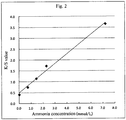
- aqueous ammonium sulfate solutions having the ammonia concentrations shown in Fig. 2 were spotted, and the test piece was left to stand at normal temperature for 10 minutes, followed by reading the reflectance (560 nm) of the position on which each aqueous ammonium sulfate solution was spotted, and converting the reflectance to the following K/S value.
- K / S value 1 ⁇ R 2 / 2 R Kubelka ⁇ Munk equation ;
- R represents the reflectance (Kubelka-Munk equation;
- R represents the reflectance
Landscapes
- Chemical & Material Sciences (AREA)
- Life Sciences & Earth Sciences (AREA)
- Health & Medical Sciences (AREA)
- Engineering & Computer Science (AREA)
- Organic Chemistry (AREA)
- General Health & Medical Sciences (AREA)
- Biochemistry (AREA)
- Zoology (AREA)
- Wood Science & Technology (AREA)
- Immunology (AREA)
- Physics & Mathematics (AREA)
- Molecular Biology (AREA)
- Analytical Chemistry (AREA)
- General Engineering & Computer Science (AREA)
- Proteomics, Peptides & Aminoacids (AREA)
- Genetics & Genomics (AREA)
- Bioinformatics & Cheminformatics (AREA)
- Biotechnology (AREA)
- Microbiology (AREA)
- Hematology (AREA)
- Urology & Nephrology (AREA)
- Biomedical Technology (AREA)
- General Physics & Mathematics (AREA)
- Pathology (AREA)
- Biophysics (AREA)
- Cell Biology (AREA)
- Food Science & Technology (AREA)
- Medicinal Chemistry (AREA)
- Chemical Kinetics & Catalysis (AREA)
- Plasma & Fusion (AREA)
- Inorganic Chemistry (AREA)
- Electrochemistry (AREA)
- Measuring Or Testing Involving Enzymes Or Micro-Organisms (AREA)
Abstract
A method of quantifying ammonia, the method includes performing a first reaction in which a test liquid containing ammonia is reacted with adenosine triphosphate and L-glutamic acid in the presence of glutamine synthetase to produce phosphoric acid, performing a second reaction in which the produced phosphoric acid is reacted with pyruvic acid in the presence of pyruvate oxidase, and measuring a component consumed or produced by the second reaction, to quantify ammonia, wherein a reaction to produce adenosine triphosphate from adenosine diphosphate mediated by pyruvate kinase is not carried out.
Description
- The present invention relates to a quantification method for ammonia, a quantification reagent, a quantification reagent kit, a test piece, and an ammonia quantification device.
- Known examples of methods of quantification of ammonia include chemical measurement methods and enzymatic measurement methods. A chemical measurement method that is mainly used is the indophenol method. Examples of the enzymatic measurement methods include methods using glutamate dehydrogenase, as well as methods using glutamine synthetase, carbamate kinase, carbamoyl phosphate synthetase, and/or the like.
- Examples of the enzymatic measurement methods using glutamine synthetase that have been proposed include a method in which glutamate synthase is allowed to act in the presence of ammonia, adenosine triphosphate (ATP), and L-glutamic acid, and kinase is allowed to act on the produced ADP and a kinase substrate phosphorus compound, followed by quantifying the produced kinase reaction product to quantify ammonia (see, for example, Patent Document 1).
- More specifically,
Patent Document 1 discloses a method in which ammonia is quantified by the following four-step reaction. - (1) Glutamine synthetase is allowed to act in the presence of ammonia, ATP, and L-glutamic acid, to produce L-glutamine, adenosine diphosphate (ADP), and phosphoric acid.
- (2) Pyruvate kinase is allowed to act in the presence of the produced ADP and phosphoenolpyruvate, to produce ATP and pyruvic acid.
- (3) Pyruvate oxidase is allowed to act in the presence of the produced pyruvic acid, produced phosphoric acid, and oxygen, to produce acetyl phosphate, carbon dioxide, and hydrogen peroxide.
- (4) Peroxidase is allowed to act in the presence of the produced hydrogen peroxide, phenol, and 4-aminoantipyrine, to produce a quinone pigment. Based on the level of increase in the absorbance at 500 nm, ammonia is quantified.
- [Patent Document 1] Japanese Patent Application Laid-Open (
JP-A) No. S62-3800 - In the method of quantifying ammonia described in
Patent Document 1, ammonia is quantified through a four-step reaction as described above. In a case in which there is a large number of reaction pathways, a large number of reagents are required, which is problematic. Since, in the method of quantifying ammonia described inPatent Document 1, phosphoenolpyruvate, which is expensive, is used, the measurement cost is high, which is problematic. Thus, an inexpensive and simple method of quantifying ammonia has been demanded. - An object of the invention is to provide a quantification method for ammonia, a quantification reagent, a quantification reagent kit, a test piece, and an ammonia quantification device which enable inexpensive and simple quantification of ammonia. Means for Solving the Problems
- More specifically, the object can be achieved by the following means.
- <1> One embodiment of the invention is a method of quantifying ammonia, the method comprising: performing a first reaction in which a test liquid containing ammonia is reacted with adenosine triphosphate and L-glutamic acid in the presence of glutamine synthetase to produce phosphoric acid; performing a second reaction in which the produced phosphoric acid is reacted with pyruvic acid in the presence of pyruvate oxidase; and measuring a component consumed or produced by the second reaction, to quantify ammonia, wherein a reaction to produce adenosine triphosphate from adenosine diphosphate mediated by pyruvate kinase is not carried out.
- <2> One embodiment of the invention is the method of quantifying ammonia according to <1>, wherein the first reaction further includes at least one of a magnesium ion (Mg2+) or a manganese ion (Mn2+) as a catalyst to produce the phosphoric acid.
- <3> One embodiment of the invention is the method of quantifying ammonia according to <1> or <2>, wherein the second reaction further includes the presence of thiamine pyrophosphate and flavin adenine nucleotide as coenzymes.
- <4> One embodiment of the invention is the method of quantifying ammonia according to any one of <1> to <3>, wherein the second reaction produces hydrogen peroxide, and the measuring comprises measuring the produced hydrogen peroxide.
- <5> One embodiment of the invention is the method of quantifying ammonia according to <4>, wherein the measuring the produced hydrogen peroxide comprises performing a color reaction or an electrochemical reaction.
- <6> One embodiment of the invention is a quantifying reagent, comprising pyruvic acid, adenosine triphosphate, L-glutamic acid, and an enzyme, wherein the enzyme consists of glutamine synthetase and pyruvate oxidase.
- <7> One embodiment of the invention is a quantifying reagent kit, comprising: a first reagent containing a hydrogen donor; and a second reagent containing a coupler, wherein pyruvic acid, adenosine triphosphate, L-glutamic acid, glutamine synthetase, pyruvate oxidase, and peroxidase are each independently contained in at least one of the first reagent or the second reagent, and wherein the only enzymes in the first and second reagents consist of the glutamine synthetase, the pyruvate oxidase, the peroxidase, or any combination thereof.
- <8> One embodiment of the invention is a test piece comprising pyruvic acid, adenosine triphosphate, L-glutamic acid, and an enzyme, wherein the enzyme consists of glutamine synthetase and pyruvate oxidase.
- <9> One embodiment of the invention is an ammonia quantification device, performing a first reaction in which a test liquid containing ammonia is reacted with adenosine triphosphate and L-glutamic acid in the presence of glutamine synthetase to produce phosphoric acid; performing a second reaction in which the produced phosphoric acid is reacted with pyruvic acid in the presence of pyruvate oxidase; and measuring a component consumed or produced by the second reaction, to quantify ammonia, wherein a reaction to produce adenosine triphosphate from adenosine diphosphate mediated by pyruvate kinase is not carried out.
- <10> One embodiment of the invention is an ammonia quantification device, comprising: a reaction section in which a test subject containing ammonia, pyruvic acid, adenosine triphosphate, L-glutamic acid, glutamine synthetase and pyruvate oxidase, is arranged, wherein, in the test subject, as a first reaction, the ammonia is reacted with the adenosine triphosphate, and the L-glutamic acid in the presence of the glutamine synthetase to produce phosphoric acid, and, as a second reaction, the produced phosphoric acid is reacted with the pyruvic acid in the presence of the pyruvate oxidase; and a measurement section in which a component consumed or produced in the reaction section, is measured, wherein a reaction to produce adenosine triphosphate from adenosine diphosphate mediated by pyruvate kinase is not carried out in the reaction section.
- <11> One embodiment of the invention is the ammonia quantification device according to <10>, wherein: the test subject further contains peroxidase, a hydrogen donor, and a coupler; in the reaction section: the second reaction produces hydrogen peroxide, and as a third reaction, the produced hydrogen peroxide is reacted with the hydrogen donor and the coupler in the presence of the peroxidase to produce a pigment; and in the measurement section, the pigment produced in the reaction section is measured.
- According to one embodiment of the invention, a quantification method for ammonia, a quantification reagent, a quantification reagent kit, a test piece and an ammonia quantification device that enable inexpensive and simple quantification of ammonia can be provided.
-
-
Fig. 1 is a graph showing the relationship between the amount of ammonia and the amount of increase in the absorbance at 560 nm in Example 1. -
Fig. 2 is a graph showing the relationship between the concentration of ammonia and the K/S value in Example 2. -
Fig. 3 is a schematic configuration diagram illustrating aquantification device 100 according to one embodiment of the invention. - A quantification method for ammonia, a quantification reagent, a quantification reagent kit, a test piece and an ammonia quantification device as one embodiment of the invention are described below.
- In the present description, each numerical range expressed using "from ... to ..." means the range including the values described before and after "to" as the lower limit and the upper limit, respectively.
- In the present description, "test liquid containing ammonia'' means a test liquid containing at least one of ammonia or ammonium ion, and "ammonia concentration" and "amount of ammonia" mean the total concentration and the total amount, respectively, of ammonia and ammonium ion.
- In the present description, each of the L-glutamic acid, phosphoric acid, pyruvic acid, and acetyl phosphate may be a salt.
- One embodiment of the invention is a method of quantifying ammonia, the method comprising: performing a first reaction in which a test liquid containing ammonia is reacted with adenosine triphosphate (ATP) and L-glutamic acid in the presence of glutamine synthetase to produce phosphoric acid; performing a second reaction in which the produced phosphoric acid is reacted with pyruvic acid in the presence of pyruvate oxidase; and measuring a component consumed or produced by the second reaction, to quantify ammonia, wherein a reaction to produce adenosine triphosphate from adenosine diphosphate (ADP) mediated by pyruvate kinase is not carried out.
- In the quantification method of the present embodiment, ammonia (the total of ammonia and ammonium ion) contained in the test liquid can be quantified by measuring a component consumed or produced through a two-step reaction including a reaction mediated by glutamine synthetase (the first reaction) and a reaction mediated by pyruvate oxidase (the second reaction).
- In conventionally known methods of quantifying ammonia, a reaction mediated by pyruvate kinase is carried out in addition to a reaction mediated by glutamine synthetase and a reaction mediated by pyruvate oxidase. Thus, ammonia contained in a test liquid is quantified through a reaction including at least three steps. More concretely, in the reaction mediated by pyruvate kinase, ADP produced by a reaction mediated by glutamine synthetase is reacted with phosphoenolpyruvate in the presence of pyruvate kinase, to produce ATP and the pyruvic acid to be used in the reaction mediated by pyruvate oxidase. In conventionally known methods of quantifying ammonia, a reaction mediated by pyruvate kinase is carried out as part of the cycling reaction of ATP and ADP.
- However, in conventionally known methods of quantifying ammonia, a reaction using phosphoenolpyruvate is required as part of the cycling reaction of ATP and ADP. Since phosphoenolpyruvate is expensive compared to ATP, pyruvic acid, and the like, the measurement cost is high, which is problematic. Moreover, since it is assumed that a reaction to allow pyruvate oxidase to act using a rather large amount of phosphoenolpyruvate not to be used for the cycling may be stably carried out from the viewpoint of favorably carrying out the quantification of ammonia, the measurement cost may be even higher.
- The present embodiment is a method of quantifying ammonia in which a reaction to produce ATP from ADP mediated by pyruvate kinase is not carried out. Therefore, since the method of quantifying ammonia of the present embodiment has a smaller number of reaction pathways than conventionally known methods of quantifying ammonia, the number of reagents required can be reduced. Thus, by the quantification method of the present embodiment, ammonia can be more simply quantified. Moreover, since the quantification method of the present embodiment does not use phosphoenolpyruvate, which is expensive, ammonia can be quantified at a lower cost.
- In the quantification method of the present embodiment, a test liquid containing ammonia is used. The test liquid is not limited as long as the test liquid contains ammonia. Examples of the test liquid include test liquids containing ammonia produced by an enzymatic reaction, and test liquids containing ammonia produced or released by a chemical reaction (for example, hydrolysis). More specific examples of the test liquid include blood, serum, and urine. In the quantification method of the present embodiment, the quantification of ammonia may be carried out by adding the later-described components to the test liquid to be analyzed, or the quantification of ammonia may be carried out by attaching the test liquid containing ammonia to filter paper or the like impregnated with the later-described components.
- In the quantification method of the present embodiment, a test liquid containing ammonia is reacted with ATP and L-glutamic acid in the presence of glutamine synthetase, to produce phosphoric acid (the first reaction). For example, a test liquid containing ammonia (NH3) is reacted with ATP and L-glutamate in the presence of glutamine synthetase. As a result, ADP, orthophosphate, and L-glutamine are produced as shown in the following Reaction Formula (1).

- In the quantification method of the present embodiment, from the viewpoint of efficiently carrying out the synthesis reaction of phosphoric acid, it is preferred that the first reaction further include at least one of a magnesium ion (Mg2+) or a manganese ion (Mn2+) as a catalyst to produce the phosphoric acid.
- In the quantification method of the present embodiment, the produced phosphoric acid is reacted with pyruvic acid in the presence of pyruvate oxidase (the second reaction). For example, the produced orthophosphate is reacted with pyruvate, and oxygen (in an aqueous solution containing) in the presence of pyruvate oxidase. As a result, as shown in the following Reaction Formula (2), acetyl phosphate, carbon dioxide, and hydrogen peroxide are produced.

- The produced phosphoric acid is reacted with pyruvic acid in the presence of pyruvate oxidase, and a component consumed or produced by the second reaction is measured to quantify ammonia. For example, the quantification of ammonia may be carried out by measuring the oxygen consumed in the second reaction, or the quantification of ammonia may be carried out by measuring the hydrogen peroxide produced in the second reaction.
- In a case in which ammonia is quantified by measuring the consumed oxygen, for example, it is preferred to measure the dissolved oxygen level in the solution using an oxygen electrode.
- In a case in which ammonia is quantified by measuring the produced hydrogen peroxide, for example, it is preferred to carry out a color reaction or an electrochemical reaction.
- In a case in which the color reaction is carried out, for example, the produced hydrogen peroxide is reacted with a hydrogen donor and a coupler in the presence of the peroxidase (a third reaction). As a result, a pigment is produced by oxidative condensation reaction of the hydrogen donor and the coupler. Since the absorbance at a particular wavelength absorbed by the produced pigment is in a proportional relationship with the concentration of ammonia contained in the test liquid, the ammonia can be quantified by measuring the absorbance at the particular wavelength.
- Alternatively, the quantification of ammonia may be carried out by measuring the reflectance of test paper obtained by attaching the produced pigment on filter paper or the like. For example, the quantification of ammonia may be carried out by measuring the reflectance of test paper obtained by impregnating filter paper or the like with a liquid containing the produced hydrogen peroxide, a hydrogen donor, and peroxidase, and with a liquid containing a coupler.
- For example, the produced hydrogen peroxide is reacted with a hydrogen donor disodium 1-naphthol-3,6-disulfonate (NDSA), and the coupler 4-aminoantipyrine in the presence of the peroxidase. As a result, as shown in the following Reaction Formula (3), a quinoneimine dye is produced to increase the absorbance at 560 nm.

- The hydrogen donor is not limited as long as the hydrogen donor causes production of a pigment by oxidative condensation reaction with a coupler, and examples of the hydrogen donor include phenol, phenol derivatives, naphthol, naphthol derivatives, aniline, aniline derivatives, naphthylamine, and naphthylamine derivatives. In particular, aniline or an aniline derivative is preferred from the viewpoint of the sensitivity and the wavelength for the pigment obtained.
- Examples of the aniline derivatives include N-ethyl-N-sulfopropyl-3-methoxyaniline, N-ethyl-N-sulfopropylaniline, N-ethyl-N-sulfopropyl-3-methylaniline, N-ethyl-N-(2-hydroxy-3-sulfopropyl)-3-methoxyaniline, N-ethyl-N-(2-hydroxy-3-sulfopropyl)-3,5-dimethoxyaniline, N-(2-hydroxy-3-sulfopropyl)-3,5-dimethoxyaniline, and N-(2-hydroxy-3-sulfopropyl)-2,5-dimethylaniline.
- The coupler is not limited as long as the coupler causes production of a pigment by oxidative condensation reaction with a hydrogen donor, and examples of the coupler include 4-aminoantipyrine, 4-aminoantipyrine derivatives, phenylenediamine, and 3-methyl-2-benzothiazolinone hydrazone (MBTH).
- In a case in which an electrochemical reaction is carried out, for example, the value of the electric current generated by the electrochemical reaction of the produced hydrogen peroxide may be measured. Since the measured electric current value is in a proportional relationship with the concentration of ammonia contained in the test liquid, the ammonia can be quantified by measuring the electric current value.
- In the quantification method of the present embodiment, it is preferred that the second reaction further include the presence of thiamine pyrophosphate and flavin adenine nucleotide as coenzymes for pyruvate oxidase.
- In the quantification method of the present embodiment, the reaction temperature is preferably from 10°C to 50°C, more preferably from 20°C to 40°C, still more preferably from 30°C to 37°C. The reaction time is preferably from 1 minute to 60 minutes, more preferably from 2 minutes to 30 minutes, still more preferably from 5 minutes to 15 minutes.
- In the quantification method of the present embodiment, a buffer may be used for adjusting the pH of the test liquid containing ammonia to a pH suitable for enzymatic reaction (for example, to a pH of from 6.0 to 9.0). Examples of the pH of the buffer that may be used include pHs of preferably from 6.0 to 9.0, more preferably from 6.0 to 8.0. Examples of the buffer include Good's buffers such as N,N-bis(2-hydroxyethyl)-2-aminoethanesulfonic acid (BES); phosphate buffer; imidazole acid buffer; Tris buffer; and glycine buffer.
- In the quantification method of the present embodiment, a component(s) other than the components described above may be added to the test liquid containing ammonia, if necessary. Examples of the other component(s) include surfactants, antiseptics, and stabilizers.
- One embodiment of the invention is a quantifying reagent, comprising pyruvic acid, ATP, L-glutamic acid, and an enzyme, wherein the enzyme consists of glutamine synthetase and pyruvate oxidase. The quantifying reagent of the present embodiment is used for, for example, quantification of ammonia.
- Another embodiment of the invention is a quantification reagent kit, comprising: a first reagent containing a hydrogen donor; and a second reagent containing a coupler; wherein pyruvic acid, ATP, L-glutamic acid, and, glutamine synthetase, pyruvate oxidase, and peroxidase, are each independently contained in at least one of the first reagent or the second reagent; and wherein the only enzymes in the first and second reagents consist of the glutamine synthetase, the pyruvate oxidase, the peroxidase, or any combination thereof. The quantifying reagent kit of the present embodiment is used for, for example, quantification of ammonia.
- One embodiment of the invention is a test piece including pyruvic acid, adenosine triphosphate, L-glutamic acid, and an enzyme, wherein the enzyme consists of glutamine synthetase and pyruvate oxidase. The test piece of the present embodiment is used for, for example, quantification of ammonia.
- In the quantification reagent, the quantification reagent kit and the test piece of the present embodiment, ammonia (the total of ammonia and ammonium ion) contained in a test liquid can be quantified by measuring a component consumed or produced through a two-step reaction including a reaction mediated by glutamine synthetase and a reaction mediated by pyruvate oxidase.
- By using the quantification reagent, the quantification reagent kit and the test piece of the present embodiment, ammonia can be quantified without carrying out a reaction to produce ATP from ADP mediated by pyruvate kinase. Thus, by the quantification reagent ,the quantification reagent kit and the test piece of the present embodiment, ammonia can be more simply quantified.
- Moreover, by the produced hydrogen peroxide being reacted with a hydrogen donor and a coupler in the presence of the peroxidase using the quantification reagent kit of the present embodiment, oxidative condensation reaction of the hydrogen donor and the coupler can be allowed to occur, resulting in production of a pigment, so that quantification of ammonia can be carried out in the same manner as in the quantification method of the present embodiment.
- The quantification reagent, the test piece and the first reagent and the second reagent in the quantification reagent kit, of the present embodiment may contain the catalyst, the coenzyme, the buffer and/or the other component described in the method of quantifying ammonia. Since the hydrogen donor and the coupler in the quantification reagent kit of the present embodiment are the same as the hydrogen donor and the coupler described in the method of quantifying ammonia, description of the hydrogen donor and the coupler is omitted.
- The test piece of the present embodiment may further include, for example, a hydrogen donor and a coupler, may be filter paper or the like, and/or may be filter paper or the like impregnated with the components.
- One embodiment of the invention is an ammonia quantification device, performing a first reaction in which a test liquid containing ammonia is reacted with adenosine triphosphate and L-glutamic acid in the presence of glutamine synthetase to produce phosphoric acid; performing a second reaction in which the produced phosphoric acid is reacted with pyruvic acid in the presence of pyruvate oxidase; and measuring a component consumed or produced by the second reaction, to quantify ammonia, wherein a reaction to produce adenosine triphosphate from adenosine diphosphate mediated by pyruvate kinase is not carried out.
- In the quantification device of the present embodiment, ammonia (the total of ammonia and ammonium ion) contained in the test liquid can be quantified by measuring a component consumed or produced through a two-step reaction including a reaction mediated by glutamine synthetase and a reaction mediated by pyruvate oxidase.
- By using the quantification device of the present embodiment, ammonia can be quantified without carrying out a reaction to produce ATP from ADP mediated by pyruvate kinase. Thus, ammonia can be more simply quantified with the quantification device of the present embodiment.
- Specific examples of the quantification device of the present embodiment are described below. Specific Example 1 of the quantification device of the present embodiment is a quantification device including: a reaction section in which a test subject containing ammonia, pyruvic acid, adenosine triphosphate, L-glutamic acid, glutamine synthetase and pyruvate oxidase, is arranged, wherein, in the test subject, as a first reaction, the ammonia is reacted with the adenosine triphosphate, and the L-glutamic acid in the presence of the glutamine synthetase to produce phosphoric acid, and, as a second reaction, the produced phosphoric acid is reacted with the pyruvic acid in the presence of the pyruvate oxidase; and a measurement section in which a component consumed or produced in the reaction section, is measured. For example, as shown in
Fig. 1 , aquantification device 100 according to one embodiment of the invention may have at least areaction section 1 for carrying out the reaction described above and ameasurement section 2 for measuring a component consumed or produced by the reaction in thereaction section 1. - The quantification device of Specific Example 1 has the reaction section described above. The reaction section has a constitution in which the test subject can be arranged. For example, the reaction section may have a constitution having the following: a place where a blood collection tube, urine collection tube, or the like storing a test liquid to be tested is arranged; a container storing a test liquid; filter paper which is impregnated with components to be used for the quantification of ammonia and to which a test liquid containing ammonia is attached; or the like.
- The reaction section preferably has a constitution with which a reaction condition(s) (reaction temperature, pH of the test liquid, and/or the like) can be controlled such that the reaction producing phosphoric acid shown in the Reaction Formula (1) and the reaction producing hydrogen peroxide shown in the Reaction Formula (2) can be allowed to proceed efficiently.
- The quantification device of Specific Example 1 has the measurement section in which a component consumed or produced by the reaction in the reaction section is measured. In the measurement section, ammonia is quantified by, for example, measuring oxygen consumed by the reaction in the reaction section or hydrogen peroxide produced by the reaction in the reaction section.
- In a case where oxygen consumed by the reaction in the reaction section is measured in the measurement section, the measurement section preferably has a constitution having an oxygen electrode in which the dissolved oxygen level in a solution is measured using the oxygen electrode.
- In a case where hydrogen peroxide produced by the reaction in the reaction section is measured in the measurement section, the measurement section preferably has a constitution in which the value of the electric current generated by the electrochemical reaction of the produced hydrogen peroxide is measured.
- Specific Example 2 of the quantification device of the present embodiment is an ammonia quantification device, including:
- a reaction section in which a test subject containing ammonia, pyruvic acid, adenosine triphosphate, L-glutamic acid, an enzyme consisting of glutamine synthetase, pyruvate oxidase, and peroxidase, a hydrogen donor, and a coupler is arranged, wherein in the test subject, as a first reaction, the ammonia is reacted with the adenosine triphosphate, and the L-glutamic acid in the presence of the glutamine synthetase to produce phosphoric acid, and, as a second reaction, the produced phosphoric acid is reacted with the pyruvic acid in the presence of the pyruvate oxidase; and as a third reaction, the produced hydrogen peroxide is reacted with the hydrogen donor and the coupler in the presence of the peroxidase to produce a pigment; and a measurement section in which the pigment produced by the reaction in the reaction section is measured.
- The measurement section for measuring the pigment is not limited as long as the measurement section has a constitution in which the absorbance at a particular wavelength absorbed by the pigment is measured, a constitution in which the reflectance of a test paper to which the pigment is attached is measured, or the like.
- The test subject containing ammonia to be analyzed in the quantification device of the present embodiment may also contain the catalyst, the coenzyme, the buffer, and/or the other component described above in the method for quantifying ammonia.
- The test subject containing ammonia and the components described above may be provided in advance, and the quantification device of the present embodiment may have a constitution in which the provided test subject is arranged in the reaction section.
- The quantification device of the present embodiment may further have a storage section for storing the quantification reagent, for storing the first reagent and the second reagent, or for storing the components described above, and may have a constitution in which the reagents or components are supplied to the test liquid containing ammonia arranged in the reaction section. Alternatively, the quantification device of the present embodiment may have a constitution in which a test liquid containing ammonia is attached to filter paper or the like impregnated with the components to be used for the quantification of ammonia, arranged in the reaction section.
- One embodiment of the invention is described below by way of Examples, but the invention is not limited to the Examples.
- The
Reagent 1 and theReagent 2 described below were prepared. As theReagent 2, four kinds of reagents having different concentrations of ammonium sulfate were prepared. -
- BES - sodium hydroxide buffer (manufactured by Dojindo Molecular Technologies, Inc.; pH 7.0) 100 mmol/L
- Sodium L-glutamate (manufactured by Nacalai Tesque, Inc.) 15 mmol/L
- Disodium 1-naphthol-3,6-disulfonate (manufactured by Wako Pure Chemical Industries, Ltd.) 5 mmol/L
- Thiamine pyrophosphate (manufactured by Tokyo Chemical Industry Co., Ltd.) 1 mmol/L
- Flavin adenine dinucleotide (manufactured by Tokyo Chemical Industry Co., Ltd.) 1 mmol/L
- Magnesium chloride hexahydrate 20 mmol/L
- Adenosine triphosphate dihydrate (manufactured by Roche) 15 mmol/L
- Potassium pyruvate (manufactured by Nacalai Tesque, Inc.) 15 mmol/L
- Glutamine synthetase (manufactured by Kikkoman Co., Ltd.) 10 U/mL
- Peroxidase (manufactured by Toyobo Co., Ltd.) 10 U/mL
-
- 4-Aminoantipyrine (manufactured by Wako Pure Chemical Industries, Ltd.) 5 mmol/L
- Pyruvate oxidase (manufactured by Asahi Kasei Corporation) 10 U/mL
- Ammonium sulfate (manufactured by Nacalai Tesque, Inc.) 0 mmol/L, 1.8 mmol/L, 3.6 mmol/L, 7.2 mmol/L
- Subsequently, 200 µL of each
Reagent 2 was mixed with 800 µL ofReagent 1, and the reaction was allowed to proceed at 37°C for 10 minutes. Subsequently, the absorbance of the reagent mixture was measured. As a result, as shown inFig. 1 , a favorable linear relationship could be obtained between the amount of ammonia inReagent 2 and the amount of increase in the absorbance at 560 nm. - The following
Impregnation Liquid 1 andImpregnation Liquid 2 were prepared, and filter paper was provided. -
- BES-sodium hydroxide buffer (manufactured by Dojindo Molecular Technologies, Inc.; pH 7.5) 150 mmol/L
- Sodium L-glutamate (manufactured by Nacalai Tesque, Inc.) 150 mmol/L
- Disodium 1-naphthol-3,6-disulfonate (manufactured by Wako Pure Chemical Industries, Ltd.) 10 mmol/L
- Thiamine pyrophosphate (manufactured by Tokyo Chemical Industry Co., Ltd.) 1.5 mmol/L
- Flavin adenine dinucleotide (manufactured by Tokyo Chemical Industry Co., Ltd.) 1.5 mmol/L
- Magnesium chloride hexahydrate 50 mmol/L
- Adenosine triphosphate dihydrate (manufactured by Roche) 15 mmol/L
- Potassium pyruvate (manufactured by Nacalai Tesque, Inc.) 30 mmol/L
- Glutamine synthetase (manufactured by Kikkoman Co., Ltd.) 45 U/mL
- Pyruvate oxidase (manufactured by Asahi Kasei Corporation) 70 U/mL
- Peroxidase (manufactured by Toyobo Co., Ltd.) 70 U/mL
- 4-Aminoantipyrine (manufactured by Wako Pure Chemical Industries, Ltd.) 15 mmol/L
- 3MM HP (manufactured by Whatman)
- Subsequently, the filter paper was impregnated with
Impregnation Liquid 1 andImpregnation Liquid 2, and then dried to obtain a test piece. On the obtained test piece, aqueous ammonium sulfate solutions having the ammonia concentrations shown inFig. 2 were spotted, and the test piece was left to stand at normal temperature for 10 minutes, followed by reading the reflectance (560 nm) of the position on which each aqueous ammonium sulfate solution was spotted, and converting the reflectance to the following K/S value.
- As shown in
Fig. 2 , a favorable linear relationship could be obtained between the ammonia concentration and the K/S value at 560 nm. - Thus, the present Examples showed that highly sensitive quantification of ammonia is possible by a simple method.
-
- 1.
- Reaction section
- 2.
- Measurement section
- 100.
- Quantification device
Claims (10)
- A method of quantifying ammonia, the method comprising:performing a first reaction in which a test liquid containing ammonia is reacted with adenosine triphosphate and L-glutamic acid in the presence of glutamine synthetase to produce phosphoric acid;performing a second reaction in which the produced phosphoric acid is reacted with pyruvic acid in the presence of pyruvate oxidase; andmeasuring a component consumed or produced by the second reaction, to quantify ammonia,wherein a reaction to produce adenosine triphosphate from adenosine diphosphate mediated by pyruvate kinase is not carried out.
- The method of quantifying ammonia according to claim 1, wherein the first reaction further includes at least one of a magnesium ion (Mg2+) or a manganese ion (Mn2+) as a catalyst to produce the phosphoric acid.
- The method of quantifying ammonia according to claim 1 or 2, wherein the second reaction further includes the presence of thiamine pyrophosphate and flavin adenine nucleotide as coenzymes.
- The method of quantifying ammonia according to any one of claims 1 to 3, wherein the second reaction produces hydrogen peroxide, and the measuring comprises measuring the produced hydrogen peroxide.
- The method of quantifying ammonia according to claim 4, wherein the measuring the produced hydrogen peroxide comprises performing a color reaction or an electrochemical reaction.
- A quantifying reagent, comprising pyruvic acid, adenosine triphosphate, L-glutamic acid, and an enzyme, wherein the enzyme consists of glutamine synthetase and pyruvate oxidase.
- A quantifying reagent kit, comprising:a first reagent containing a hydrogen donor; anda second reagent containing a coupler,wherein pyruvic acid, adenosine triphosphate, L-glutamic acid, glutamine synthetase, pyruvate oxidase, and peroxidase are each independently contained in at least one of the first reagent or the second reagent, andwherein the only enzymes in the first and second reagents consist of the glutamine synthetase, the pyruvate oxidase, the peroxidase, or any combination thereof.
- A test piece comprising pyruvic acid, adenosine triphosphate, L-glutamic acid, and an enzyme, wherein the enzyme consists of glutamine synthetase and pyruvate oxidase.
- An ammonia quantification device, comprising:a reaction section in which a test subject containing ammonia, pyruvic acid, adenosine triphosphate, L-glutamic acid, glutamine synthetase and pyruvate oxidase, is arranged, wherein, in the test subject, as a first reaction, the ammonia is reacted with the adenosine triphosphate, and the L-glutamic acid in the presence of the glutamine synthetase to produce phosphoric acid, and, as a second reaction, the produced phosphoric acid is reacted with the pyruvic acid in the presence of the pyruvate oxidase; anda measurement section in which a component consumed or produced in the reaction section, is measured.
- The ammonia quantification device according to claim 9, wherein:the test subject further contains peroxidase, a hydrogen donor, and a coupler;in the reaction section:the second reaction produces hydrogen peroxide, andas a third reaction, the produced hydrogen peroxide is reacted with the hydrogen donor and the coupler in the presence of the peroxidase to produce a pigment; andin the measurement section, the pigment produced in the reaction section is measured.
Applications Claiming Priority (2)
| Application Number | Priority Date | Filing Date | Title |
|---|---|---|---|
| JP2016154872 | 2016-08-05 | ||
| JP2017118044A JP2018023364A (en) | 2016-08-05 | 2017-06-15 | Quantitative method for ammonia, quantitative reagent, quantitative reagent kit, test piece and quantification apparatus for ammonia |
Publications (1)
| Publication Number | Publication Date |
|---|---|
| EP3279658A1 true EP3279658A1 (en) | 2018-02-07 |
Family
ID=59649485
Family Applications (1)
| Application Number | Title | Priority Date | Filing Date |
|---|---|---|---|
| EP17184904.5A Withdrawn EP3279658A1 (en) | 2016-08-05 | 2017-08-04 | Quantification method for ammonia, quantification reagent, quantification reagent kit, and ammonia quantification device |
Country Status (3)
| Country | Link |
|---|---|
| US (1) | US20180037927A1 (en) |
| EP (1) | EP3279658A1 (en) |
| CN (1) | CN107688017A (en) |
Families Citing this family (3)
| Publication number | Priority date | Publication date | Assignee | Title |
|---|---|---|---|---|
| CN113075139B (en) * | 2021-03-29 | 2022-10-11 | 迪瑞医疗科技股份有限公司 | Stable double-reagent blood ammonia determination kit |
| US12030045B1 (en) | 2023-01-05 | 2024-07-09 | Sequitur Health Corp. | Devices, methods, and systems for deriving ammonia gas from whole blood |
| US12140534B2 (en) | 2023-01-05 | 2024-11-12 | Sequitur Health Corp. | Devices, methods, and systems for deriving a permeate from a feed solution |
Citations (6)
| Publication number | Priority date | Publication date | Assignee | Title |
|---|---|---|---|---|
| JPS623800B2 (en) | 1982-01-22 | 1987-01-27 | Inax Corp | |
| JPH0391497A (en) * | 1989-09-05 | 1991-04-17 | Fuji Photo Film Co Ltd | Integrated multi-layer analytic element containing reagent composition for determination of ammonium ion |
| CN1749755A (en) * | 2004-09-14 | 2006-03-22 | 王尔中 | Method for detecting blood ammonia content and blood ammonia diagnostic reagent kit |
| CN1749756A (en) * | 2004-09-14 | 2006-03-22 | 王尔中 | Method for detecting blood ammonia content and blood ammonia diagnostic reagent kit |
| CN1769475A (en) * | 2004-11-05 | 2006-05-10 | 王尔中 | Adenosine deaminase activity determination method and adenosine deaminase diagnosi kit |
| CN1778945A (en) * | 2004-11-23 | 2006-05-31 | 苏州艾杰生物科技有限公司 | Determination of blood ammonia content and blood ammonia diagnostic reagent kit |
-
2017
- 2017-08-02 US US15/667,172 patent/US20180037927A1/en not_active Abandoned
- 2017-08-03 CN CN201710655702.7A patent/CN107688017A/en active Pending
- 2017-08-04 EP EP17184904.5A patent/EP3279658A1/en not_active Withdrawn
Patent Citations (6)
| Publication number | Priority date | Publication date | Assignee | Title |
|---|---|---|---|---|
| JPS623800B2 (en) | 1982-01-22 | 1987-01-27 | Inax Corp | |
| JPH0391497A (en) * | 1989-09-05 | 1991-04-17 | Fuji Photo Film Co Ltd | Integrated multi-layer analytic element containing reagent composition for determination of ammonium ion |
| CN1749755A (en) * | 2004-09-14 | 2006-03-22 | 王尔中 | Method for detecting blood ammonia content and blood ammonia diagnostic reagent kit |
| CN1749756A (en) * | 2004-09-14 | 2006-03-22 | 王尔中 | Method for detecting blood ammonia content and blood ammonia diagnostic reagent kit |
| CN1769475A (en) * | 2004-11-05 | 2006-05-10 | 王尔中 | Adenosine deaminase activity determination method and adenosine deaminase diagnosi kit |
| CN1778945A (en) * | 2004-11-23 | 2006-05-31 | 苏州艾杰生物科技有限公司 | Determination of blood ammonia content and blood ammonia diagnostic reagent kit |
Also Published As
| Publication number | Publication date |
|---|---|
| CN107688017A (en) | 2018-02-13 |
| US20180037927A1 (en) | 2018-02-08 |
Similar Documents
| Publication | Publication Date | Title |
|---|---|---|
| CN107505273A (en) | Serum tolal bile acid assay kit and its application method | |
| US20180037927A1 (en) | Quantification Method for Ammonia, Quantification Reagent, Quantification Reagent Kit, Test Piece, and Ammonia Quantification Device | |
| EP3315611B1 (en) | Quantification test piece for ammonia, and ammonia quantification device | |
| JP6703721B1 (en) | Method for measuring amino acid and kit therefor | |
| CN111944872A (en) | Reagent combination, reagent or kit for measuring creatinine content | |
| CN101403691A (en) | Melamine or tricyanic acid measuring method and its reagent kit or test paper strip | |
| EP0206316A2 (en) | Method and test composition for determination of hydrogen peroxide | |
| JP5017614B2 (en) | Method and reagent for measuring substance to be measured in sample, method for suppressing nonspecific color development, and nonspecific color development inhibitor | |
| JP2018023364A (en) | Quantitative method for ammonia, quantitative reagent, quantitative reagent kit, test piece and quantification apparatus for ammonia | |
| EP2460888A1 (en) | Method and kit for measurement of dehydrogenase or substrate for the dehydrogenase | |
| JP7328739B2 (en) | A method for efficiently performing a glutamine synthetase reaction, a method for quantifying ammonia using the method, a reagent for glutamine synthetase reaction, and a reagent kit for quantifying ammonia containing the same | |
| JP6989300B2 (en) | Ammonia quantification method, quantification reagent kit, test piece and ammonia quantification device | |
| CA1335170C (en) | Enzyme assay of biochemical substances | |
| JP2804079B2 (en) | Quantitative method of NAD (P) H | |
| WO2012050536A1 (en) | Method of the adenosine diphosphate quantitative determination | |
| US5447847A (en) | Quantitative determination of pyruvic acid and quantitative analysis for component of living body making use of such determination | |
| JP2000253898A (en) | Quantitative determination of substance or enzyme, and quantitative determining reagent | |
| JP5633669B2 (en) | ADP measurement method and ADP measurement kit | |
| JP2002238598A (en) | Composition for measuring calcium ion and measuring method | |
| US6696266B1 (en) | Method for assaying ammonia using an NAD-based cycling reaction system | |
| CN107402305A (en) | A kind of immue quantitative detection reagent box of creatine kinase isozyme | |
| JP7234923B2 (en) | Substance measurement method for measuring the substance to be measured as a coenzyme | |
| CN107236786A (en) | A kind of preparation method of creatine kinase detection kit | |
| JP2000236897A (en) | Measuring method and measuring reagent of enzyme inhibitor | |
| JP2023106021A (en) | Method for measuring l-asparagine, and kit therefor |
Legal Events
| Date | Code | Title | Description |
|---|---|---|---|
| PUAI | Public reference made under article 153(3) epc to a published international application that has entered the european phase |
Free format text: ORIGINAL CODE: 0009012 |
|
| AK | Designated contracting states |
Kind code of ref document: A1 Designated state(s): AL AT BE BG CH CY CZ DE DK EE ES FI FR GB GR HR HU IE IS IT LI LT LU LV MC MK MT NL NO PL PT RO RS SE SI SK SM TR |
|
| AX | Request for extension of the european patent |
Extension state: BA ME |
|
| STAA | Information on the status of an ep patent application or granted ep patent |
Free format text: STATUS: THE APPLICATION IS DEEMED TO BE WITHDRAWN |
|
| 18D | Application deemed to be withdrawn |
Effective date: 20180808 |