EP3279146A1 - Lithium-containing transition metal oxide and lithium ion secondary cell using same - Google Patents
Lithium-containing transition metal oxide and lithium ion secondary cell using same Download PDFInfo
- Publication number
- EP3279146A1 EP3279146A1 EP15887560.9A EP15887560A EP3279146A1 EP 3279146 A1 EP3279146 A1 EP 3279146A1 EP 15887560 A EP15887560 A EP 15887560A EP 3279146 A1 EP3279146 A1 EP 3279146A1
- Authority
- EP
- European Patent Office
- Prior art keywords
- lithium
- transition metal
- secondary cell
- ion secondary
- metal oxide
- Prior art date
- Legal status (The legal status is an assumption and is not a legal conclusion. Google has not performed a legal analysis and makes no representation as to the accuracy of the status listed.)
- Withdrawn
Links
- WHXSMMKQMYFTQS-UHFFFAOYSA-N Lithium Chemical compound [Li] WHXSMMKQMYFTQS-UHFFFAOYSA-N 0.000 title claims abstract description 52
- 229910052744 lithium Inorganic materials 0.000 title claims abstract description 52
- 229910001416 lithium ion Inorganic materials 0.000 title claims abstract description 23
- HBBGRARXTFLTSG-UHFFFAOYSA-N Lithium ion Chemical compound [Li+] HBBGRARXTFLTSG-UHFFFAOYSA-N 0.000 title claims abstract description 19
- 229910000314 transition metal oxide Inorganic materials 0.000 title claims abstract description 13
- 239000013078 crystal Substances 0.000 claims abstract description 23
- 239000000126 substance Substances 0.000 claims abstract description 13
- 229910052804 chromium Inorganic materials 0.000 claims abstract description 10
- 229910052723 transition metal Inorganic materials 0.000 claims description 10
- 150000003624 transition metals Chemical class 0.000 claims description 10
- 239000007784 solid electrolyte Substances 0.000 claims description 6
- 239000011244 liquid electrolyte Substances 0.000 claims description 3
- 230000008859 change Effects 0.000 description 25
- 239000011149 active material Substances 0.000 description 16
- 239000011651 chromium Substances 0.000 description 15
- 239000007772 electrode material Substances 0.000 description 14
- 239000000463 material Substances 0.000 description 14
- 239000010936 titanium Substances 0.000 description 14
- 229910052719 titanium Inorganic materials 0.000 description 14
- RTAQQCXQSZGOHL-UHFFFAOYSA-N Titanium Chemical compound [Ti] RTAQQCXQSZGOHL-UHFFFAOYSA-N 0.000 description 13
- 229910002986 Li4Ti5O12 Inorganic materials 0.000 description 12
- WMFOQBRAJBCJND-UHFFFAOYSA-M Lithium hydroxide Chemical compound [Li+].[OH-] WMFOQBRAJBCJND-UHFFFAOYSA-M 0.000 description 11
- 238000010304 firing Methods 0.000 description 11
- 239000000203 mixture Substances 0.000 description 9
- 238000009830 intercalation Methods 0.000 description 8
- XGZVUEUWXADBQD-UHFFFAOYSA-L lithium carbonate Chemical compound [Li+].[Li+].[O-]C([O-])=O XGZVUEUWXADBQD-UHFFFAOYSA-L 0.000 description 8
- 229910052808 lithium carbonate Inorganic materials 0.000 description 8
- 239000007774 positive electrode material Substances 0.000 description 8
- QVGXLLKOCUKJST-UHFFFAOYSA-N atomic oxygen Chemical compound [O] QVGXLLKOCUKJST-UHFFFAOYSA-N 0.000 description 7
- 230000002687 intercalation Effects 0.000 description 7
- 239000001301 oxygen Substances 0.000 description 7
- 229910052760 oxygen Inorganic materials 0.000 description 7
- OKTJSMMVPCPJKN-UHFFFAOYSA-N Carbon Chemical compound [C] OKTJSMMVPCPJKN-UHFFFAOYSA-N 0.000 description 6
- 239000007789 gas Substances 0.000 description 6
- BVKZGUZCCUSVTD-UHFFFAOYSA-L Carbonate Chemical compound [O-]C([O-])=O BVKZGUZCCUSVTD-UHFFFAOYSA-L 0.000 description 5
- 238000000034 method Methods 0.000 description 5
- 238000002156 mixing Methods 0.000 description 5
- 239000002245 particle Substances 0.000 description 5
- 238000010298 pulverizing process Methods 0.000 description 5
- 239000007787 solid Substances 0.000 description 5
- XKRFYHLGVUSROY-UHFFFAOYSA-N Argon Chemical compound [Ar] XKRFYHLGVUSROY-UHFFFAOYSA-N 0.000 description 4
- 229910011981 Li4Mn5O12 Inorganic materials 0.000 description 4
- 229910003083 TiO6 Inorganic materials 0.000 description 4
- 239000011230 binding agent Substances 0.000 description 4
- 239000008213 purified water Substances 0.000 description 4
- 239000002904 solvent Substances 0.000 description 4
- XLYOFNOQVPJJNP-UHFFFAOYSA-N water Chemical compound O XLYOFNOQVPJJNP-UHFFFAOYSA-N 0.000 description 4
- ZWEHNKRNPOVVGH-UHFFFAOYSA-N 2-Butanone Chemical compound CCC(C)=O ZWEHNKRNPOVVGH-UHFFFAOYSA-N 0.000 description 3
- ZMXDDKWLCZADIW-UHFFFAOYSA-N N,N-Dimethylformamide Chemical compound CN(C)C=O ZMXDDKWLCZADIW-UHFFFAOYSA-N 0.000 description 3
- YXFVVABEGXRONW-UHFFFAOYSA-N Toluene Chemical compound CC1=CC=CC=C1 YXFVVABEGXRONW-UHFFFAOYSA-N 0.000 description 3
- 239000012298 atmosphere Substances 0.000 description 3
- 229910000428 cobalt oxide Inorganic materials 0.000 description 3
- IVMYJDGYRUAWML-UHFFFAOYSA-N cobalt(ii) oxide Chemical compound [Co]=O IVMYJDGYRUAWML-UHFFFAOYSA-N 0.000 description 3
- 239000002131 composite material Substances 0.000 description 3
- 230000000694 effects Effects 0.000 description 3
- 150000002500 ions Chemical class 0.000 description 3
- 230000007246 mechanism Effects 0.000 description 3
- 239000007773 negative electrode material Substances 0.000 description 3
- -1 polytetrafluoroethylene Polymers 0.000 description 3
- 239000002243 precursor Substances 0.000 description 3
- 239000000243 solution Substances 0.000 description 3
- 229910052596 spinel Inorganic materials 0.000 description 3
- 239000011029 spinel Substances 0.000 description 3
- 239000007858 starting material Substances 0.000 description 3
- 229910052726 zirconium Inorganic materials 0.000 description 3
- IJGRMHOSHXDMSA-UHFFFAOYSA-N Atomic nitrogen Chemical compound N#N IJGRMHOSHXDMSA-UHFFFAOYSA-N 0.000 description 2
- CURLTUGMZLYLDI-UHFFFAOYSA-N Carbon dioxide Chemical compound O=C=O CURLTUGMZLYLDI-UHFFFAOYSA-N 0.000 description 2
- 229910011229 Li7Ti5O12 Inorganic materials 0.000 description 2
- BAPJBEWLBFYGME-UHFFFAOYSA-N Methyl acrylate Chemical compound COC(=O)C=C BAPJBEWLBFYGME-UHFFFAOYSA-N 0.000 description 2
- PXHVJJICTQNCMI-UHFFFAOYSA-N Nickel Chemical compound [Ni] PXHVJJICTQNCMI-UHFFFAOYSA-N 0.000 description 2
- WYURNTSHIVDZCO-UHFFFAOYSA-N Tetrahydrofuran Chemical compound C1CCOC1 WYURNTSHIVDZCO-UHFFFAOYSA-N 0.000 description 2
- GWEVSGVZZGPLCZ-UHFFFAOYSA-N Titan oxide Chemical compound O=[Ti]=O GWEVSGVZZGPLCZ-UHFFFAOYSA-N 0.000 description 2
- WGLPBDUCMAPZCE-UHFFFAOYSA-N Trioxochromium Chemical compound O=[Cr](=O)=O WGLPBDUCMAPZCE-UHFFFAOYSA-N 0.000 description 2
- 238000002441 X-ray diffraction Methods 0.000 description 2
- 229910052786 argon Inorganic materials 0.000 description 2
- 229910052799 carbon Inorganic materials 0.000 description 2
- 229910000423 chromium oxide Inorganic materials 0.000 description 2
- 239000011248 coating agent Substances 0.000 description 2
- 238000000576 coating method Methods 0.000 description 2
- 229910017052 cobalt Inorganic materials 0.000 description 2
- 239000010941 cobalt Substances 0.000 description 2
- GUTLYIVDDKVIGB-UHFFFAOYSA-N cobalt atom Chemical compound [Co] GUTLYIVDDKVIGB-UHFFFAOYSA-N 0.000 description 2
- GVPFVAHMJGGAJG-UHFFFAOYSA-L cobalt dichloride Chemical compound [Cl-].[Cl-].[Co+2] GVPFVAHMJGGAJG-UHFFFAOYSA-L 0.000 description 2
- 230000002860 competitive effect Effects 0.000 description 2
- 150000001875 compounds Chemical class 0.000 description 2
- 239000004020 conductor Substances 0.000 description 2
- 230000007423 decrease Effects 0.000 description 2
- 230000003247 decreasing effect Effects 0.000 description 2
- 238000009831 deintercalation Methods 0.000 description 2
- 239000006185 dispersion Substances 0.000 description 2
- 238000010438 heat treatment Methods 0.000 description 2
- 239000007788 liquid Substances 0.000 description 2
- KWGKDLIKAYFUFQ-UHFFFAOYSA-M lithium chloride Chemical compound [Li+].[Cl-] KWGKDLIKAYFUFQ-UHFFFAOYSA-M 0.000 description 2
- IIPYXGDZVMZOAP-UHFFFAOYSA-N lithium nitrate Chemical compound [Li+].[O-][N+]([O-])=O IIPYXGDZVMZOAP-UHFFFAOYSA-N 0.000 description 2
- FUJCRWPEOMXPAD-UHFFFAOYSA-N lithium oxide Chemical compound [Li+].[Li+].[O-2] FUJCRWPEOMXPAD-UHFFFAOYSA-N 0.000 description 2
- 229910001947 lithium oxide Inorganic materials 0.000 description 2
- 239000011572 manganese Substances 0.000 description 2
- 238000004519 manufacturing process Methods 0.000 description 2
- 230000009467 reduction Effects 0.000 description 2
- 230000003252 repetitive effect Effects 0.000 description 2
- 239000002002 slurry Substances 0.000 description 2
- BCNBMSZKALBQEF-UHFFFAOYSA-N 1,3-dimethylpyrrolidin-2-one Chemical compound CC1CCN(C)C1=O BCNBMSZKALBQEF-UHFFFAOYSA-N 0.000 description 1
- IVORCBKUUYGUOL-UHFFFAOYSA-N 1-ethynyl-2,4-dimethoxybenzene Chemical compound COC1=CC=C(C#C)C(OC)=C1 IVORCBKUUYGUOL-UHFFFAOYSA-N 0.000 description 1
- VYZAMTAEIAYCRO-UHFFFAOYSA-N Chromium Chemical compound [Cr] VYZAMTAEIAYCRO-UHFFFAOYSA-N 0.000 description 1
- 229910021555 Chromium Chloride Inorganic materials 0.000 description 1
- 229910020641 Co Zr Inorganic materials 0.000 description 1
- 229910021503 Cobalt(II) hydroxide Inorganic materials 0.000 description 1
- RYGMFSIKBFXOCR-UHFFFAOYSA-N Copper Chemical compound [Cu] RYGMFSIKBFXOCR-UHFFFAOYSA-N 0.000 description 1
- XDTMQSROBMDMFD-UHFFFAOYSA-N Cyclohexane Chemical compound C1CCCCC1 XDTMQSROBMDMFD-UHFFFAOYSA-N 0.000 description 1
- IAYPIBMASNFSPL-UHFFFAOYSA-N Ethylene oxide Chemical compound C1CO1 IAYPIBMASNFSPL-UHFFFAOYSA-N 0.000 description 1
- FXHOOIRPVKKKFG-UHFFFAOYSA-N N,N-Dimethylacetamide Chemical compound CN(C)C(C)=O FXHOOIRPVKKKFG-UHFFFAOYSA-N 0.000 description 1
- 229920000459 Nitrile rubber Polymers 0.000 description 1
- 239000000020 Nitrocellulose Substances 0.000 description 1
- 239000002033 PVDF binder Substances 0.000 description 1
- 239000004698 Polyethylene Substances 0.000 description 1
- XBDQKXXYIPTUBI-UHFFFAOYSA-M Propionate Chemical compound CCC([O-])=O XBDQKXXYIPTUBI-UHFFFAOYSA-M 0.000 description 1
- QCWXUUIWCKQGHC-UHFFFAOYSA-N Zirconium Chemical compound [Zr] QCWXUUIWCKQGHC-UHFFFAOYSA-N 0.000 description 1
- SWFPCDJSMKKRFW-UHFFFAOYSA-N [Cr].[Li] Chemical compound [Cr].[Li] SWFPCDJSMKKRFW-UHFFFAOYSA-N 0.000 description 1
- KLARSDUHONHPRF-UHFFFAOYSA-N [Li].[Mn] Chemical compound [Li].[Mn] KLARSDUHONHPRF-UHFFFAOYSA-N 0.000 description 1
- VVMADELERHBILX-UHFFFAOYSA-N [Mn].[Li].[Ca] Chemical compound [Mn].[Li].[Ca] VVMADELERHBILX-UHFFFAOYSA-N 0.000 description 1
- KXKVLQRXCPHEJC-UHFFFAOYSA-N acetic acid trimethyl ester Natural products COC(C)=O KXKVLQRXCPHEJC-UHFFFAOYSA-N 0.000 description 1
- 239000006230 acetylene black Substances 0.000 description 1
- 239000003570 air Substances 0.000 description 1
- 229910052782 aluminium Inorganic materials 0.000 description 1
- XAGFODPZIPBFFR-UHFFFAOYSA-N aluminium Chemical compound [Al] XAGFODPZIPBFFR-UHFFFAOYSA-N 0.000 description 1
- 239000012300 argon atmosphere Substances 0.000 description 1
- 229910021383 artificial graphite Inorganic materials 0.000 description 1
- 239000011324 bead Substances 0.000 description 1
- 229910002092 carbon dioxide Inorganic materials 0.000 description 1
- 239000001569 carbon dioxide Substances 0.000 description 1
- 229910021393 carbon nanotube Inorganic materials 0.000 description 1
- 239000002041 carbon nanotube Substances 0.000 description 1
- 150000004649 carbonic acid derivatives Chemical class 0.000 description 1
- QSWDMMVNRMROPK-UHFFFAOYSA-K chromium(3+) trichloride Chemical compound [Cl-].[Cl-].[Cl-].[Cr+3] QSWDMMVNRMROPK-UHFFFAOYSA-K 0.000 description 1
- DBULDCSVZCUQIR-UHFFFAOYSA-N chromium(3+);trisulfide Chemical compound [S-2].[S-2].[S-2].[Cr+3].[Cr+3] DBULDCSVZCUQIR-UHFFFAOYSA-N 0.000 description 1
- GRWVQDDAKZFPFI-UHFFFAOYSA-H chromium(III) sulfate Chemical compound [Cr+3].[Cr+3].[O-]S([O-])(=O)=O.[O-]S([O-])(=O)=O.[O-]S([O-])(=O)=O GRWVQDDAKZFPFI-UHFFFAOYSA-H 0.000 description 1
- VQWFNAGFNGABOH-UHFFFAOYSA-K chromium(iii) hydroxide Chemical compound [OH-].[OH-].[OH-].[Cr+3] VQWFNAGFNGABOH-UHFFFAOYSA-K 0.000 description 1
- 229910000361 cobalt sulfate Inorganic materials 0.000 description 1
- 229940044175 cobalt sulfate Drugs 0.000 description 1
- KTVIXTQDYHMGHF-UHFFFAOYSA-L cobalt(2+) sulfate Chemical compound [Co+2].[O-]S([O-])(=O)=O KTVIXTQDYHMGHF-UHFFFAOYSA-L 0.000 description 1
- ASKVAEGIVYSGNY-UHFFFAOYSA-L cobalt(ii) hydroxide Chemical compound [OH-].[OH-].[Co+2] ASKVAEGIVYSGNY-UHFFFAOYSA-L 0.000 description 1
- 229920001940 conductive polymer Polymers 0.000 description 1
- 229910052802 copper Inorganic materials 0.000 description 1
- 239000010949 copper Substances 0.000 description 1
- 238000002425 crystallisation Methods 0.000 description 1
- 230000007547 defect Effects 0.000 description 1
- 230000006866 deterioration Effects 0.000 description 1
- 125000004177 diethyl group Chemical group [H]C([H])([H])C([H])([H])* 0.000 description 1
- YNQRWVCLAIUHHI-UHFFFAOYSA-L dilithium;oxalate Chemical compound [Li+].[Li+].[O-]C(=O)C([O-])=O YNQRWVCLAIUHHI-UHFFFAOYSA-L 0.000 description 1
- 229940113088 dimethylacetamide Drugs 0.000 description 1
- 238000007599 discharging Methods 0.000 description 1
- 238000001035 drying Methods 0.000 description 1
- 239000003792 electrolyte Substances 0.000 description 1
- 238000002474 experimental method Methods 0.000 description 1
- 229920001973 fluoroelastomer Polymers 0.000 description 1
- 229910021389 graphene Inorganic materials 0.000 description 1
- 238000009434 installation Methods 0.000 description 1
- 238000011835 investigation Methods 0.000 description 1
- XIXADJRWDQXREU-UHFFFAOYSA-M lithium acetate Chemical compound [Li+].CC([O-])=O XIXADJRWDQXREU-UHFFFAOYSA-M 0.000 description 1
- INHCSSUBVCNVSK-UHFFFAOYSA-L lithium sulfate Inorganic materials [Li+].[Li+].[O-]S([O-])(=O)=O INHCSSUBVCNVSK-UHFFFAOYSA-L 0.000 description 1
- 229910052748 manganese Inorganic materials 0.000 description 1
- 229910052751 metal Inorganic materials 0.000 description 1
- 239000002184 metal Substances 0.000 description 1
- 239000011812 mixed powder Substances 0.000 description 1
- 239000002116 nanohorn Substances 0.000 description 1
- 239000002135 nanosheet Substances 0.000 description 1
- 229910021382 natural graphite Inorganic materials 0.000 description 1
- 239000011331 needle coke Substances 0.000 description 1
- 229910052759 nickel Inorganic materials 0.000 description 1
- 229920001220 nitrocellulos Polymers 0.000 description 1
- 229910052757 nitrogen Inorganic materials 0.000 description 1
- 239000003960 organic solvent Substances 0.000 description 1
- 230000003647 oxidation Effects 0.000 description 1
- 238000007254 oxidation reaction Methods 0.000 description 1
- RVTZCBVAJQQJTK-UHFFFAOYSA-N oxygen(2-);zirconium(4+) Chemical compound [O-2].[O-2].[Zr+4] RVTZCBVAJQQJTK-UHFFFAOYSA-N 0.000 description 1
- 235000011837 pasties Nutrition 0.000 description 1
- 229920003229 poly(methyl methacrylate) Polymers 0.000 description 1
- 229920000573 polyethylene Polymers 0.000 description 1
- 229920000642 polymer Polymers 0.000 description 1
- 239000004926 polymethyl methacrylate Substances 0.000 description 1
- 229920001343 polytetrafluoroethylene Polymers 0.000 description 1
- 239000004810 polytetrafluoroethylene Substances 0.000 description 1
- 229920002689 polyvinyl acetate Polymers 0.000 description 1
- 239000011118 polyvinyl acetate Substances 0.000 description 1
- 229920000915 polyvinyl chloride Polymers 0.000 description 1
- 239000004800 polyvinyl chloride Substances 0.000 description 1
- 229920002981 polyvinylidene fluoride Polymers 0.000 description 1
- 239000000843 powder Substances 0.000 description 1
- 230000008569 process Effects 0.000 description 1
- 239000012047 saturated solution Substances 0.000 description 1
- 238000000926 separation method Methods 0.000 description 1
- 238000001694 spray drying Methods 0.000 description 1
- 229910001220 stainless steel Inorganic materials 0.000 description 1
- 239000010935 stainless steel Substances 0.000 description 1
- 229920003048 styrene butadiene rubber Polymers 0.000 description 1
- 239000000758 substrate Substances 0.000 description 1
- RBTVSNLYYIMMKS-UHFFFAOYSA-N tert-butyl 3-aminoazetidine-1-carboxylate;hydrochloride Chemical compound Cl.CC(C)(C)OC(=O)N1CC(N)C1 RBTVSNLYYIMMKS-UHFFFAOYSA-N 0.000 description 1
- YLQBMQCUIZJEEH-UHFFFAOYSA-N tetrahydrofuran Natural products C=1C=COC=1 YLQBMQCUIZJEEH-UHFFFAOYSA-N 0.000 description 1
- 230000007704 transition Effects 0.000 description 1
- 238000004804 winding Methods 0.000 description 1
- 229910001928 zirconium oxide Inorganic materials 0.000 description 1
- DUNKXUFBGCUVQW-UHFFFAOYSA-J zirconium tetrachloride Chemical compound Cl[Zr](Cl)(Cl)Cl DUNKXUFBGCUVQW-UHFFFAOYSA-J 0.000 description 1
- ZXAUZSQITFJWPS-UHFFFAOYSA-J zirconium(4+);disulfate Chemical compound [Zr+4].[O-]S([O-])(=O)=O.[O-]S([O-])(=O)=O ZXAUZSQITFJWPS-UHFFFAOYSA-J 0.000 description 1
Images

Classifications
-
- H—ELECTRICITY
- H01—ELECTRIC ELEMENTS
- H01M—PROCESSES OR MEANS, e.g. BATTERIES, FOR THE DIRECT CONVERSION OF CHEMICAL ENERGY INTO ELECTRICAL ENERGY
- H01M4/00—Electrodes
- H01M4/02—Electrodes composed of, or comprising, active material
- H01M4/13—Electrodes for accumulators with non-aqueous electrolyte, e.g. for lithium-accumulators; Processes of manufacture thereof
- H01M4/131—Electrodes based on mixed oxides or hydroxides, or on mixtures of oxides or hydroxides, e.g. LiCoOx
-
- C—CHEMISTRY; METALLURGY
- C01—INORGANIC CHEMISTRY
- C01G—COMPOUNDS CONTAINING METALS NOT COVERED BY SUBCLASSES C01D OR C01F
- C01G25/00—Compounds of zirconium
-
- C—CHEMISTRY; METALLURGY
- C01—INORGANIC CHEMISTRY
- C01G—COMPOUNDS CONTAINING METALS NOT COVERED BY SUBCLASSES C01D OR C01F
- C01G25/00—Compounds of zirconium
- C01G25/02—Oxides
-
- C—CHEMISTRY; METALLURGY
- C01—INORGANIC CHEMISTRY
- C01G—COMPOUNDS CONTAINING METALS NOT COVERED BY SUBCLASSES C01D OR C01F
- C01G37/00—Compounds of chromium
- C01G37/14—Chromates; Bichromates
-
- C—CHEMISTRY; METALLURGY
- C01—INORGANIC CHEMISTRY
- C01G—COMPOUNDS CONTAINING METALS NOT COVERED BY SUBCLASSES C01D OR C01F
- C01G51/00—Compounds of cobalt
- C01G51/40—Complex oxides containing cobalt and at least one other metal element
- C01G51/42—Complex oxides containing cobalt and at least one other metal element containing alkali metals, e.g. LiCoO2
-
- H—ELECTRICITY
- H01—ELECTRIC ELEMENTS
- H01M—PROCESSES OR MEANS, e.g. BATTERIES, FOR THE DIRECT CONVERSION OF CHEMICAL ENERGY INTO ELECTRICAL ENERGY
- H01M10/00—Secondary cells; Manufacture thereof
- H01M10/05—Accumulators with non-aqueous electrolyte
- H01M10/052—Li-accumulators
- H01M10/0525—Rocking-chair batteries, i.e. batteries with lithium insertion or intercalation in both electrodes; Lithium-ion batteries
-
- H—ELECTRICITY
- H01—ELECTRIC ELEMENTS
- H01M—PROCESSES OR MEANS, e.g. BATTERIES, FOR THE DIRECT CONVERSION OF CHEMICAL ENERGY INTO ELECTRICAL ENERGY
- H01M4/00—Electrodes
- H01M4/02—Electrodes composed of, or comprising, active material
- H01M4/36—Selection of substances as active materials, active masses, active liquids
- H01M4/48—Selection of substances as active materials, active masses, active liquids of inorganic oxides or hydroxides
- H01M4/485—Selection of substances as active materials, active masses, active liquids of inorganic oxides or hydroxides of mixed oxides or hydroxides for inserting or intercalating light metals, e.g. LiTi2O4 or LiTi2OxFy
-
- H—ELECTRICITY
- H01—ELECTRIC ELEMENTS
- H01M—PROCESSES OR MEANS, e.g. BATTERIES, FOR THE DIRECT CONVERSION OF CHEMICAL ENERGY INTO ELECTRICAL ENERGY
- H01M4/00—Electrodes
- H01M4/02—Electrodes composed of, or comprising, active material
- H01M4/36—Selection of substances as active materials, active masses, active liquids
- H01M4/48—Selection of substances as active materials, active masses, active liquids of inorganic oxides or hydroxides
- H01M4/52—Selection of substances as active materials, active masses, active liquids of inorganic oxides or hydroxides of nickel, cobalt or iron
- H01M4/525—Selection of substances as active materials, active masses, active liquids of inorganic oxides or hydroxides of nickel, cobalt or iron of mixed oxides or hydroxides containing iron, cobalt or nickel for inserting or intercalating light metals, e.g. LiNiO2, LiCoO2 or LiCoOxFy
-
- C—CHEMISTRY; METALLURGY
- C01—INORGANIC CHEMISTRY
- C01P—INDEXING SCHEME RELATING TO STRUCTURAL AND PHYSICAL ASPECTS OF SOLID INORGANIC COMPOUNDS
- C01P2002/00—Crystal-structural characteristics
- C01P2002/30—Three-dimensional structures
-
- C—CHEMISTRY; METALLURGY
- C01—INORGANIC CHEMISTRY
- C01P—INDEXING SCHEME RELATING TO STRUCTURAL AND PHYSICAL ASPECTS OF SOLID INORGANIC COMPOUNDS
- C01P2002/00—Crystal-structural characteristics
- C01P2002/30—Three-dimensional structures
- C01P2002/32—Three-dimensional structures spinel-type (AB2O4)
-
- C—CHEMISTRY; METALLURGY
- C01—INORGANIC CHEMISTRY
- C01P—INDEXING SCHEME RELATING TO STRUCTURAL AND PHYSICAL ASPECTS OF SOLID INORGANIC COMPOUNDS
- C01P2002/00—Crystal-structural characteristics
- C01P2002/70—Crystal-structural characteristics defined by measured X-ray, neutron or electron diffraction data
- C01P2002/72—Crystal-structural characteristics defined by measured X-ray, neutron or electron diffraction data by d-values or two theta-values, e.g. as X-ray diagram
-
- C—CHEMISTRY; METALLURGY
- C01—INORGANIC CHEMISTRY
- C01P—INDEXING SCHEME RELATING TO STRUCTURAL AND PHYSICAL ASPECTS OF SOLID INORGANIC COMPOUNDS
- C01P2006/00—Physical properties of inorganic compounds
- C01P2006/40—Electric properties
-
- H—ELECTRICITY
- H01—ELECTRIC ELEMENTS
- H01M—PROCESSES OR MEANS, e.g. BATTERIES, FOR THE DIRECT CONVERSION OF CHEMICAL ENERGY INTO ELECTRICAL ENERGY
- H01M4/00—Electrodes
- H01M4/02—Electrodes composed of, or comprising, active material
- H01M2004/026—Electrodes composed of, or comprising, active material characterised by the polarity
- H01M2004/027—Negative electrodes
-
- H—ELECTRICITY
- H01—ELECTRIC ELEMENTS
- H01M—PROCESSES OR MEANS, e.g. BATTERIES, FOR THE DIRECT CONVERSION OF CHEMICAL ENERGY INTO ELECTRICAL ENERGY
- H01M4/00—Electrodes
- H01M4/02—Electrodes composed of, or comprising, active material
- H01M2004/026—Electrodes composed of, or comprising, active material characterised by the polarity
- H01M2004/028—Positive electrodes
-
- Y—GENERAL TAGGING OF NEW TECHNOLOGICAL DEVELOPMENTS; GENERAL TAGGING OF CROSS-SECTIONAL TECHNOLOGIES SPANNING OVER SEVERAL SECTIONS OF THE IPC; TECHNICAL SUBJECTS COVERED BY FORMER USPC CROSS-REFERENCE ART COLLECTIONS [XRACs] AND DIGESTS
- Y02—TECHNOLOGIES OR APPLICATIONS FOR MITIGATION OR ADAPTATION AGAINST CLIMATE CHANGE
- Y02E—REDUCTION OF GREENHOUSE GAS [GHG] EMISSIONS, RELATED TO ENERGY GENERATION, TRANSMISSION OR DISTRIBUTION
- Y02E60/00—Enabling technologies; Technologies with a potential or indirect contribution to GHG emissions mitigation
- Y02E60/10—Energy storage using batteries
Definitions
- the present invention relates to a lithium-containing transition metal oxide and a lithium ion secondary cell using the same.
- Li 4 Ti 5 O 12 and Li 4 Mn 5 O 12 have been known as materials with scarce volumic change accompanied by charge/discharge (for example, refer to Non-patent Literature 1 and Non-patent Literature 2).
- the lithium ion secondary cell gradually decreases electrical capacity capable of charging and discharging along with repetitive charge/discharge. It is considered that one of the causes thereof is attributable to volumic expansion and shrinkage of an electrode active material.
- the electrode active material has a larger volume in a state of intercalating lithium and a smaller volume in a state of deintercalating lithium.
- various deteriorations occur due to such volumic expansion/shrinkage by repetitive charge/discharge.
- bonding between an electrode active material and a conduction aid is separated to interrupt an electron conduction path and partially inactivate the active material.
- macro defects such as cracks are caused to the electrode active material by strain generated when the lithium concentration in the electrode active material is not uniform, which causes interruption of an ion conduction path and, accordingly, the electrode active material is inactivated.
- Li 4 Ti 5 O 12 and Li 4 M 5 O 12 are known respectively as materials with less volumic strain accompanying charge/discharge, and it is considered that separation from the conduction aid and generation of cracks in the electrode active material can be prevented by using such electrode active materials to make the life of the lithium ion secondary cell longer in principle.
- the potential of Li 4 Ti 5 O 12 is 1.5 V and there is a problem that the potential is high when Li 4 Ti 5 O 12 is used as a negative electrode material.
- the voltage of the negative electrode is high, the energy density of the lithium ion secondary cell is decreased, and competitive performance of the cell is lowered.
- active materials having a potential lower than 1.5 V and with less product expansion/shrinkage have not been found.
- the potential of Li 4 Mn 5 O 12 is 3 V, it involves a problem that the potential is low when Li 4 Mn 5 O 12 is used as the material for the positive electrode.
- the voltage of the positive electrode is low, the energy density of the lithium ion secondary cell is decreased and the competitive power of the cell is lowered.
- active materials having a potential higher than 3 V and with less volumic expansion/shrinkage have not been found.
- the present inventors studied on (1) an electrode active material having a potential lower than 1.5 V and with less volumic expansion, (2) an electrode active material having a potential higher than 3.0 V and with a small volumic expansion, and (3) a lithium ion secondary cell using one or both of the electrode active materials described above.
- the lithium-containing transition metal oxide described above can provide a lithium ion secondary cell having a longer life and higher energy density compared with existent cells because the volumic change accompanying charge/discharge is suppressed.
- Other problems, constitutions and advantageous effects than those described above will become apparent by the following description of preferred embodiments. Brief Description of Drawings
- the present inventors took notice on Li 4 Ti 5 O 12 having a spinel-type crystal structure and found a principle of suppressing volumic change accompanied by charge/discharge by theoretically investigating the charge/discharge mechanism thereof. Based on the finding, the present inventors reached an idea of increasing the energy density while suppressing the volumic change accompanied by charge/discharge in Li 4 M 5 O 12 having a spinel-type crystal structure. Investigations reaching the present finding are to be described below.
- Fig. 1 illustrates a generally known crystal structure of a spinel-type Li 4 Ti 5 O 12 by X-ray diffraction experiment.
- Fig. 1 illustrates more generally as an Li 4 M 5 O 12 crystal structure.
- Oxygen 103 is coordinated by the number of six to titanium to form an octahedral TiO 6 structure 101.
- the octahedral structures 101 are present by the number of 16 in a unit cell, and 1/6 of which is occupied by lithium to form LiO 6 .
- Oxygen 103 is coordinated by the number of four at the periphery of lithium 102 to form an LiO 4 tetrahedral structure.
- Li 4 Ti 5 O 12 occludes lithium to form Li 7 Ti 5 O 12 .
- the crystal structure of Li 7 Ti 5 O 12 has also been known generally, which is illustrated in Fig. 2.
- Fig. 2 illustrates the structure as a more general crystal structure of Li 4 M 5 O 12 . It can be seen that the arrangement of the octahedral TiO 6 structure 201 is identical with that of Fig. 1 .
- lithium 202 has oxygen coordinated by the number of six at the periphery thereof, to form an octahedral structure.
- the coordinate structure is different from the lithium coordinate structure in Li 4 Ti 5 O 12 .
- the coordinate structure of lithium changes by intercalation of lithium in Li 4 Ti 5 O 12 to change from the tetrahedral structure to the octahedral structure.
- Change of the coordinate structure is caused by the change of the position of lithium.
- the change of the position is transition from an 8a site to a 16c site in crystallographic expression (Non-patent Literature 1).
- Valence Change of valence number of titanium due to lithium intercalation is also known. Valence changes from tetra valance to tri valence partially in titanium. This is because lithium tends to become a monovalent ion and an electron emitted from lithium reduces titanium. Along with reduction of titanium, ionic radius of titanium increases from 0.61 ⁇ to 0.67 ⁇ . Since the ionic radius increases, the bonding distance between titanium and oxygen increases and, further, the volume of the TiO 6 octahedron increases.
- the present inventors examined the crystal structure, it has been found that while the volume of the octahedral structure 101 is 10.6 ⁇ 3 , the volume of the octahedral structure 201 is partially 12.1 ⁇ 3 and it has been found that the volume increases by as much as 14%. Thus, it has been confirmed that titanium is reduced.
- the present inventors considered that since the volume of the TiO 2 octahedron increases along with lithium intercalation, the volume of the unit cell should also be increased. However, it is known that the volumic change of this material along with lithium intercalation is as small as 0.2%. Then, the present inventors examined the change of the crystal structure along with lithium intercalation as illustrated in Fig. 3 .
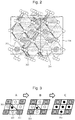
- "A" shows Li 4 Ti 5 O 12 . In this case, lithium 301 at the tetrahedral position is present and the tetrahedral height is 2.75 ⁇ . Further, titanium 303 has a tetra valence and a small radius.
- the present inventors considered that lithium 305 transmits to the octahedral position as "C" in the drawing to avoid increase in the strain.
- the height was 2.63 ⁇ . Since the height is lower by about 0.12 ⁇ than the height of the tetrahedron, it undergoes no large strain due to expansion of TiO 8 octahedron as "B".
- the present inventors considered that since the lithium transferred to the octahedral position, volumic expansion of the unit cell due to the volumic expansion of the TiO 6 octahedron was suppressed.
- the present inventors further developed the concept and considered that electrode active materials of Li 4 M 5 O 12 having such mechanism in which M was other than Ti or Mn could be formed. That is, the present inventors considered that there should be a material having a positional change of lithium along with intercalation and deintercalation of lithium and giving no significant effect of the volumic change of M0 6 octahedron on the volumic of the unit cell.
- the potential of the active material containing a transition metal M is generally different depending on the crystal structure. Accordingly, the potential of a new active material Li 4 M 5 O 12 not yet synthesized so far cannot be estimated easily.
- the present inventors simulated active materials of a compositional formula Li 4 M 5 O 12 having a spinel structure by using various M based on a first principle calculation capable of theoretically calculating the structure and the potential of a material at high accuracy, and conducted the first principle calculation for the volumic change and the potential thereof. Specifically, calculation was performed by using Cr, Co, Zr which are a part of the transition metals. The results are shown in Table 1. [Table 1] Relation between transition metal and volumic change and potential of Li 4 M 5 O 12 Transition metal Cr Co Zr Volume upon charge ( ⁇ 3 ) 432.4 418.5 561.3 Volume upon discharge ( ⁇ 3 ) 433.6 422.7 558.5 Difference (%) 0.3 1.0 0.5 Potential 3.4 3.7 0.2
- Li 4 Cr 5 O 12 has a property suitable as an aimed active material in view of the volumic change.
- the potential of Li 4 Cr 5 O 12 was calculated as 3.4 V. Since the value is higher than 3.0 V, this can be an active material capable of attaining an energy-density higher than that of Li 4 Mn 5 O 12 .
- Li 4 Co 5 O 12 has a property sufficient as the aimed active material in view of the volumic change.
- the potential was calculated as 3.7 V for Li 4 Co 5 O 12 . Since the value is higher than the potential 3.0 V of Li 4 Mn 5 O 1 , this can be an active material for attaining a high energy density.
- M Cr, Co, or Zr was found as electrode active material of extremely less volumic change accompanied by charge/discharge and capable of attaining a high energy density.
- the substance can be manufactured by a step of mixing, while pulverizing, a starting material containing a lithium source and a transition metal source mechanochemically and a step of firing the pulverized mixture.
- lithium source compounds forming lithium oxide by heating can be used and include, specifically, lithium hydroxide, lithium oxide, lithium acetate, basic lithium carbonate, lithium nitrate, lithium oxalate, lithium sulfate, lithium carbonate, and lithium chloride.
- lithium hydroxide and lithium carbonate are used particularly preferably.
- cobalt source compounds forming cobalt oxide by heating can be used. Specifically, they include cobalt oxide, cobalt hydroxide, cobalt sulfate, etc. Among them, cobalt oxide is particularly preferred.
- the chromium source can include chromium chloride, chromium oxide, chromium hydroxide, chromium sulfide, and chromium sulfate.
- the zirconium source includes, for example, zirconium oxide, zirconium chloride, and zirconium hydroxide.
- Mechanochemical pulverization includes a wet mill method and a dry mill method that conduct pulverization while giving physical impact. Specifically, a ball mill, a vibration mill, attrition mill, a planetary mill, etc. can be used and use of the ball mill is preferred with a viewpoint of installation cost.
- a ball mill, a vibration mill, attrition mill, a planetary mill, etc. can be used and use of the ball mill is preferred with a viewpoint of installation cost.
- the time for the mixing treatment by mechanochemical pulverization is not particularly restricted and it is generally preferred within a range of 1 hour to 6 hours. In this embodiment, while description is to be made for a fixed electrolyte, a liquid electrolyte may also be used.
- Firing time is not particularly restricted, but it is performed preferably within a range of one hour to 48 hours.
- the temperature for firing the mixed material is, for example, in a temperature region of 900 to 1500°C and preferably in a temperature range of 1000 to 1300°C. If the firing temperature is lower than 800°C, the firing time becomes longer. Further, if the firing temperature exceeds 1500°C, it is not preferred because the solid electrolyte is sintered strongly.
- the firing atmosphere mainly comprises oxygen and may further contain one or more of materials selected from air, argon, nitrogen or the like. From an economical point of view, the firing atmosphere is the most preferably air. Further, the starting mixture may be fired in a state where an atmospheric gas is filled in a firing furnace, or may be fired in a gas stream of an atmospheric gas. The starting mixture is fired in a gas stream of an atmospheric gas preferably at a flow rate of 10 ml/min or more. With the steps described above, the positive electrode active material of this embodiment is obtained.
- the process for producing an all solid lithium ion cell is performed preferably in accordance with a known method.
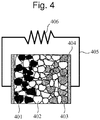
- the all solid lithium ion cell has, for example, as shown in Fig. 4 , a positive electrode 401, a negative electrode 403, and an inorganic lithium solid electrolyte 402 present between the positive electrode 401 and the negative electrode 403 for conducting lithium ions, in which electrons are conducted by way of a collector plate 404 and a conductor wire 405 connected therewith, and they are connected to an external circuit (resistor) 406.
- the positive electrode active material of a lithium ion cell in embodiments is preferably formed by mixing a positive electrode active material, a conduction aid, and a binder by using a solvent into a paste-like state, which is then coated and dried on the surface of a collector.
- the conduction aid may be any material so long as the material has electron conductivity and is less reactive with the positive electrode active material. Specifically, acetylene black, carbon, graphite, natural graphite, artificial graphite, needle coke, carbon nanotube, carbon nanohorn, graphene nanosheet, etc. can be used.
- As the binder a polymeric material capable of binding the positive electrode active material and a conduction aid may be used preferably.
- polytetrafluoroethylene polyvinylidene fluoride, polyvinyl chloride, ethylene-propylene diene polymer, styrene butadiene rubber, acrylonitrile butadiene rubber, fluoro rubber, polyvinyl acetate, polymethyl methacrylate, polyethylene, nitrocellulose, etc.
- Any solvent can be used so long as the solvent can mix the active material and the binder in a highly dispersed state.
- An electrode proposed by the present inventors can also be manufactured by a method, for example, of coating a slurry obtained by mixing the mixed powder described above with an organic solvent (for example, N-methyl methylpyrrolidone, toluene, cyclohexane, dimethyl formamide, dimethyl acetamide, methyl ethyl ketone, methyl acetate, methyl acrylate, diethyl triamine, N-N-dimethyl aminopropylamine, ethylene oxide, tetrahydrofuran, etc.) on a metal substrate made of aluminum, nickel, stainless steel, copper and the like, or on a conductive polymer.
- an organic solvent for example, N-methyl methylpyrrolidone, toluene, cyclohexane, dimethyl formamide, dimethyl acetamide, methyl ethyl ketone, methyl acetate, methyl acrylate, diethyl triamine, N-N-dimethyl aminopropylamine
- the negative electrode of the lithium ion cell proposed by the present inventors may be formed in the same manner as for the positive electrode active material by mixing the negative electrode active material, the conduction aid, and the binder using a solvent, coating and drying the material formed into a pasty state on the surface of the collector.
- the negative electrode active material contains, for example, lithium.
- the shape of the secondary cell is not restricted to a coin type, and may also be configured as a cylindrical shape formed by winding of the electrode, for example, configured by a 18650 type. Further, it may be configured by stacking the electrode into a square shape.
- the cell was manufactured and measured in a dry box under an argon atmosphere.
- the first cycle was started from discharge and then charge/discharge were conducted.
- a coin-type lithium ion secondary cell as illustrated in Fig. 4 is assembled by using the present positive electrode active material.
- a charge/discharge test is performed at a cut-off potential of 3.5 V or 2.0 V, a discharge capacity of 10 mAh/g at a discharge potential of 3.3 V can be confirmed. Since the discharge potential is higher than 3.0 V, it is confirmed that a necessary potential can be obtained.
- a liquid containing 200 g of lithium carbonate suspended in 600 mL of purified water is prepared, to which gaseous carbon dioxide is blown to adjust pH to 7.5.
- 110 g of cobalt chloride is dissolved in 300 mL of purified water to prepare a solution.
- the solution was dropped to prepare a carbonate containing lithium and cobalt (mixture of lithium carbonate and cobalt chloride).
- the carbonate is washed and filtered by using a saturated solution of lithium carbonate so that lithium carbonate is not eluted, and then dried in a hot blow at 100°C.
- the carbonates was used as the starting material and heated from a room temperature to 490°C in an anhydrous air for 2 hours, kept at 490°C for 3 hours, and heated to 800°C over 4 hours. After keeping at that temperature for 24 hours, they are cooled spontaneously to obtain a lithium manganese composite oxide represented by the general formula Li 4-x Co 4 O 12 (where 0 ⁇ x ⁇ 0.2).
- a carbonate precursor is prepared by a reactive crystallization method using a zirconium sulfate as a starting material. Each of the elements is uniformly dispersed in a particle of the carbonate precursor. Lithium carbonate is mixed to the carbonate precursor and when the mixture is subsequently fired at 900°C for 4 hours, a positive electrode active material represented by Li 4 Zr 5 O 12 is obtained. When a discharge test is performed on the present active material, a discharge plateau appears at 0.2 V.
Landscapes
- Chemical & Material Sciences (AREA)
- Organic Chemistry (AREA)
- Inorganic Chemistry (AREA)
- Chemical Kinetics & Catalysis (AREA)
- Electrochemistry (AREA)
- General Chemical & Material Sciences (AREA)
- Engineering & Computer Science (AREA)
- Materials Engineering (AREA)
- Manufacturing & Machinery (AREA)
- Battery Electrode And Active Subsutance (AREA)
- Secondary Cells (AREA)
- Inorganic Compounds Of Heavy Metals (AREA)
Abstract
Description
- The present invention relates to a lithium-containing transition metal oxide and a lithium ion secondary cell using the same.
- Heretofore, as an electrode active material for a lithium ion secondary cell, Li4Ti5O12 and Li4Mn5O12 have been known as materials with scarce volumic change accompanied by charge/discharge (for example, refer to Non-patent Literature 1 and Non-patent Literature 2).
-
- Non-patent Literature 1: Ohzuku, A. Ueda N, Yamamoto, J. Electrochem. Soc. 142, 1431 (1995).
- Non-patent Literature 2: M.M. Thackeray, A. de Kock, M.H. Rossouw, D. Liles, R. Bittihn and D. Hoge, J. Electrochem. Soc. 139, 363 (1992).
- It is known that the lithium ion secondary cell gradually decreases electrical capacity capable of charging and discharging along with repetitive charge/discharge. It is considered that one of the causes thereof is attributable to volumic expansion and shrinkage of an electrode active material.
- Generally, the electrode active material has a larger volume in a state of intercalating lithium and a smaller volume in a state of deintercalating lithium. There is a problem that various deteriorations occur due to such volumic expansion/shrinkage by repetitive charge/discharge. For example, bonding between an electrode active material and a conduction aid is separated to interrupt an electron conduction path and partially inactivate the active material. Further, macro defects such as cracks are caused to the electrode active material by strain generated when the lithium concentration in the electrode active material is not uniform, which causes interruption of an ion conduction path and, accordingly, the electrode active material is inactivated.
- Li4Ti5O12 and Li4M5O12 are known respectively as materials with less volumic strain accompanying charge/discharge, and it is considered that separation from the conduction aid and generation of cracks in the electrode active material can be prevented by using such electrode active materials to make the life of the lithium ion secondary cell longer in principle.
- However, the potential of Li4Ti5O12 is 1.5 V and there is a problem that the potential is high when Li4Ti5O12 is used as a negative electrode material. In a case where the voltage of the negative electrode is high, the energy density of the lithium ion secondary cell is decreased, and competitive performance of the cell is lowered. At present, active materials having a potential lower than 1.5 V and with less product expansion/shrinkage have not been found.
- Further, since the potential of Li4Mn5O12 is 3 V, it involves a problem that the potential is low when Li4Mn5O12 is used as the material for the positive electrode. When the voltage of the positive electrode is low, the energy density of the lithium ion secondary cell is decreased and the competitive power of the cell is lowered. At present, active materials having a potential higher than 3 V and with less volumic expansion/shrinkage have not been found.
- In view of the above, the present inventors studied on (1) an electrode active material having a potential lower than 1.5 V and with less volumic expansion, (2) an electrode active material having a potential higher than 3.0 V and with a small volumic expansion, and (3) a lithium ion secondary cell using one or both of the electrode active materials described above.
- As one of inventions solving the problems described above, the present inventors propose a lithium-containing transition metal oxide having a spinel-type crystal structure and having the chemical compositional formula Li4M5O12 (M = Cr, Co, or Zr). Further, the present inventors propose, as one of inventions capable of solving the problems, a lithium ion secondary cell having a positive electrode comprising a lithium-containing transition metal oxide having a spinel-type crystal structure and having the chemical composition Li4M5O12 (M = Cr or Co). Further, the present inventors propose, as one of inventions solving the problems described above, a lithium ion secondary cell having a negative electrode comprising a lithium-containing transition metal oxide having a spinel-type crystal structure and having the chemical compositional formula Li4M5O12 (M = Zr) .
- The lithium-containing transition metal oxide described above can provide a lithium ion secondary cell having a longer life and higher energy density compared with existent cells because the volumic change accompanying charge/discharge is suppressed. Other problems, constitutions and advantageous effects than those described above will become apparent by the following description of preferred embodiments. Brief Description of Drawings
-
-
Fig. 1 is a view illustrating a crystal structure of Li7M5O12. -
Fig. 2 is a view illustrating a crystal structure of Li4M5O12. -
Fig. 3 is a view illustrating a volume invariable mechanism. -
Fig. 4 is a schematic view of a bulk-type all solid cell. - The present inventors took notice on Li4Ti5O12 having a spinel-type crystal structure and found a principle of suppressing volumic change accompanied by charge/discharge by theoretically investigating the charge/discharge mechanism thereof. Based on the finding, the present inventors reached an idea of increasing the energy density while suppressing the volumic change accompanied by charge/discharge in Li4M5O12 having a spinel-type crystal structure. Investigations reaching the present finding are to be described below.
-
Fig. 1 illustrates a generally known crystal structure of a spinel-type Li4Ti5O12 by X-ray diffraction experiment.Fig. 1 illustrates more generally as an Li4M5O12 crystal structure.Oxygen 103 is coordinated by the number of six to titanium to form an octahedral TiO6 structure 101. Theoctahedral structures 101 are present by the number of 16 in a unit cell, and 1/6 of which is occupied by lithium to form LiO6.Oxygen 103 is coordinated by the number of four at the periphery oflithium 102 to form an LiO4 tetrahedral structure. - According to Non-patent Literature 1, Li4Ti5O12 occludes lithium to form Li7Ti5O12. The crystal structure of Li7Ti5O12 has also been known generally, which is illustrated in
Fig. 2. Fig. 2 illustrates the structure as a more general crystal structure of Li4M5O12. It can be seen that the arrangement of the octahedral TiO6 structure 201 is identical with that ofFig. 1 . On the contrary,lithium 202 has oxygen coordinated by the number of six at the periphery thereof, to form an octahedral structure. The coordinate structure is different from the lithium coordinate structure in Li4Ti5O12. Accordingly, it can be seen that the coordinate structure of lithium changes by intercalation of lithium in Li4Ti5O12 to change from the tetrahedral structure to the octahedral structure. Change of the coordinate structure is caused by the change of the position of lithium. The change of the position is transition from an 8a site to a 16c site in crystallographic expression (Non-patent Literature 1). - Change of valence number of titanium due to lithium intercalation is also known. Valence changes from tetra valance to tri valence partially in titanium. This is because lithium tends to become a monovalent ion and an electron emitted from lithium reduces titanium. Along with reduction of titanium, ionic radius of titanium increases from 0.61 Å to 0.67 Å. Since the ionic radius increases, the bonding distance between titanium and oxygen increases and, further, the volume of the TiO6 octahedron increases. When the present inventors examined the crystal structure, it has been found that while the volume of the
octahedral structure 101 is 10.6 Å3, the volume of theoctahedral structure 201 is partially 12.1 Å3 and it has been found that the volume increases by as much as 14%. Thus, it has been confirmed that titanium is reduced. - The present inventors considered that since the volume of the TiO2 octahedron increases along with lithium intercalation, the volume of the unit cell should also be increased. However, it is known that the volumic change of this material along with lithium intercalation is as small as 0.2%. Then, the present inventors examined the change of the crystal structure along with lithium intercalation as illustrated in
Fig. 3 . In the drawing, "A" shows Li4Ti5O12. In this case,lithium 301 at the tetrahedral position is present and the tetrahedral height is 2.75 Å. Further,titanium 303 has a tetra valence and a small radius. If titanium becomes trivalent along with lithium intercalation, the titanium radius increases as "B" in the drawing and the volume of TiO8 octahedron increases. Then, the LiO4 tetrahedron shrinks by being pushed from the surrounding to undergo large strain. Then, the present inventors considered thatlithium 305 transmits to the octahedral position as "C" in the drawing to avoid increase in the strain. As a result of measuring the height of the LiO6 octahedron in the crystal structure for confirming the concept, the height was 2.63 Å. Since the height is lower by about 0.12 Å than the height of the tetrahedron, it undergoes no large strain due to expansion of TiO8 octahedron as "B". In view of the consideration described above, the present inventors considered that since the lithium transferred to the octahedral position, volumic expansion of the unit cell due to the volumic expansion of the TiO6 octahedron was suppressed. - The present inventors further developed the concept and considered that electrode active materials of Li4M5O12 having such mechanism in which M was other than Ti or Mn could be formed. That is, the present inventors considered that there should be a material having a positional change of lithium along with intercalation and deintercalation of lithium and giving no significant effect of the volumic change of M06 octahedron on the volumic of the unit cell.
- However, increase or decrease of the ion radius due to oxidation/reduction of a transition metal M is strictly non-isotropic generally and volumic change of the unit cell cannot always be suppressed irrespective of the type of M. Accordingly, new active material Li4M5O12 cannot be deduced easily based on the active materials known so far.
- Further, the potential of the active material containing a transition metal M is generally different depending on the crystal structure. Accordingly, the potential of a new active material Li4M5O12 not yet synthesized so far cannot be estimated easily.
- In view of the above, the present inventors simulated active materials of a compositional formula Li4M5O12 having a spinel structure by using various M based on a first principle calculation capable of theoretically calculating the structure and the potential of a material at high accuracy, and conducted the first principle calculation for the volumic change and the potential thereof. Specifically, calculation was performed by using Cr, Co, Zr which are a part of the transition metals. The results are shown in Table 1.
[Table 1] Relation between transition metal and volumic change and potential of Li4M5O12 Transition metal Cr Co Zr Volume upon charge (Å3) 432.4 418.5 561.3 Volume upon discharge (Å3) 433.6 422.7 558.5 Difference (%) 0.3 1.0 0.5 Potential 3.4 3.7 0.2 - In a case where M = Cr, the volume in a state of Li4Cr5O12 was 432.4 Å3, whereas the volume in a state of Li7Cr5O12 was 433.6 Å3. The volumic change corresponds to 0.3% and volumic change hardly occurs in the same manner as Li4Ti5O12. Accordingly, Li4Cr5O12 has a property suitable as an aimed active material in view of the volumic change. Further, the potential of Li4Cr5O12 was calculated as 3.4 V. Since the value is higher than 3.0 V, this can be an active material capable of attaining an energy-density higher than that of Li4Mn5O12.
- In a case where M = Co, the volume in a state of Li4Co5O12 was 418.5 Å3, whereas the volume in a state of Li7Co5O12 was 422.7 Å3. The volumic change corresponds to 1.0%, which is a sufficiently small volumic change. Accordingly, Li4Co5O12 has a property sufficient as the aimed active material in view of the volumic change. Further, the potential was calculated as 3.7 V for Li4Co5O12. Since the value is higher than the potential 3.0 V of Li4Mn5O1, this can be an active material for attaining a high energy density.
- In a case where M = Zr, the volume in a state of Li4Zr5O12 was 561.3 Å3, whereas the volume for Li7Zr5O12 was 558.5 Å3. The volumic change corresponds to 0.5% and since this is a sufficiently small amount of change, the material is suitable as an aimed active material. Further, since the potential of Li4Zr5O12 is 0.2 V, when the material is used as a negative electrode, an energy density higher than that of Li4Ti5O12 can be attained.
- In view of the above, M = Cr, Co, or Zr was found as electrode active material of extremely less volumic change accompanied by charge/discharge and capable of attaining a high energy density.
- An actual method of manufacturing the active materials is to be described. The manufacturing method of Li4M5O12 (M = one of Cr, Co and Zr) is performed by usual firing of a powdery body. For example, the substance can be manufactured by a step of mixing, while pulverizing, a starting material containing a lithium source and a transition metal source mechanochemically and a step of firing the pulverized mixture.
- As the lithium source, compounds forming lithium oxide by heating can be used and include, specifically, lithium hydroxide, lithium oxide, lithium acetate, basic lithium carbonate, lithium nitrate, lithium oxalate, lithium sulfate, lithium carbonate, and lithium chloride. Among them, lithium hydroxide and lithium carbonate are used particularly preferably.
- As the cobalt source, compounds forming cobalt oxide by heating can be used. Specifically, they include cobalt oxide, cobalt hydroxide, cobalt sulfate, etc. Among them, cobalt oxide is particularly preferred. The chromium source can include chromium chloride, chromium oxide, chromium hydroxide, chromium sulfide, and chromium sulfate. The zirconium source includes, for example, zirconium oxide, zirconium chloride, and zirconium hydroxide.
- Mechanochemical pulverization includes a wet mill method and a dry mill method that conduct pulverization while giving physical impact. Specifically, a ball mill, a vibration mill, attrition mill, a planetary mill, etc. can be used and use of the ball mill is preferred with a viewpoint of installation cost. By the pulverization treatment using the ball mill, particles of the lithium source and the transition metal source are pulverized and mixed, and the spinel-type solid electrolyte proposed by the present inventors can be manufactured. The time for the mixing treatment by mechanochemical pulverization is not particularly restricted and it is generally preferred within a range of 1 hour to 6 hours. In this embodiment, while description is to be made for a fixed electrolyte, a liquid electrolyte may also be used.
- Firing time is not particularly restricted, but it is performed preferably within a range of one hour to 48 hours. The temperature for firing the mixed material is, for example, in a temperature region of 900 to 1500°C and preferably in a temperature range of 1000 to 1300°C. If the firing temperature is lower than 800°C, the firing time becomes longer. Further, if the firing temperature exceeds 1500°C, it is not preferred because the solid electrolyte is sintered strongly.
- The firing atmosphere mainly comprises oxygen and may further contain one or more of materials selected from air, argon, nitrogen or the like. From an economical point of view, the firing atmosphere is the most preferably air. Further, the starting mixture may be fired in a state where an atmospheric gas is filled in a firing furnace, or may be fired in a gas stream of an atmospheric gas. The starting mixture is fired in a gas stream of an atmospheric gas preferably at a flow rate of 10 ml/min or more. With the steps described above, the positive electrode active material of this embodiment is obtained.
- The process for producing an all solid lithium ion cell is performed preferably in accordance with a known method. The all solid lithium ion cell has, for example, as shown in
Fig. 4 , apositive electrode 401, anegative electrode 403, and an inorganic lithiumsolid electrolyte 402 present between thepositive electrode 401 and thenegative electrode 403 for conducting lithium ions, in which electrons are conducted by way of acollector plate 404 and aconductor wire 405 connected therewith, and they are connected to an external circuit (resistor) 406. - The positive electrode active material of a lithium ion cell in embodiments is preferably formed by mixing a positive electrode active material, a conduction aid, and a binder by using a solvent into a paste-like state, which is then coated and dried on the surface of a collector. The conduction aid may be any material so long as the material has electron conductivity and is less reactive with the positive electrode active material. Specifically, acetylene black, carbon, graphite, natural graphite, artificial graphite, needle coke, carbon nanotube, carbon nanohorn, graphene nanosheet, etc. can be used. As the binder, a polymeric material capable of binding the positive electrode active material and a conduction aid may be used preferably. Specifically, polytetrafluoroethylene, polyvinylidene fluoride, polyvinyl chloride, ethylene-propylene diene polymer, styrene butadiene rubber, acrylonitrile butadiene rubber, fluoro rubber, polyvinyl acetate, polymethyl methacrylate, polyethylene, nitrocellulose, etc. can be used. Any solvent can be used so long as the solvent can mix the active material and the binder in a highly dispersed state. An electrode proposed by the present inventors can also be manufactured by a method, for example, of coating a slurry obtained by mixing the mixed powder described above with an organic solvent (for example, N-methyl methylpyrrolidone, toluene, cyclohexane, dimethyl formamide, dimethyl acetamide, methyl ethyl ketone, methyl acetate, methyl acrylate, diethyl triamine, N-N-dimethyl aminopropylamine, ethylene oxide, tetrahydrofuran, etc.) on a metal substrate made of aluminum, nickel, stainless steel, copper and the like, or on a conductive polymer.
- The negative electrode of the lithium ion cell proposed by the present inventors may be formed in the same manner as for the positive electrode active material by mixing the negative electrode active material, the conduction aid, and the binder using a solvent, coating and drying the material formed into a pasty state on the surface of the collector. The negative electrode active material contains, for example, lithium.
- The shape of the secondary cell is not restricted to a coin type, and may also be configured as a cylindrical shape formed by winding of the electrode, for example, configured by a 18650 type. Further, it may be configured by stacking the electrode into a square shape.
- Typical embodiments are to be described. It is apparent that the invention proposed in the present specification is no way restricted by them. In the embodiments to be described later, the cell was manufactured and measured in a dry box under an argon atmosphere. For the cell, the first cycle was started from discharge and then charge/discharge were conducted.
- A chromium oxide powder (CrO2) and lithium hydroxide (LiOH) are filled at a ratio of Li:Cr = 4:5 in a wet pulverizer, purified water is added such that the slurry solid concentration is charged by 30% by weight, treated for one hour by using beads of 1.00 mmφ under the condition at a number of rotation of 2500 rpm. Purified water is added to them to prepare a liquid dispersion mixture for spray drying at a solid concentration of 20% by weight. The dispersion is heat treated for 4 hours in a firing atmosphere of 800°C by using an atmospheric furnace (argon gas stream). As a result, lithium-chromium composite oxide particles having a spinel structure in a composition of: Li:Cr = 4.77:5.13 are obtained.
- Then, they are charged in a mixer, pulverized for 30 seconds and then classified for one minute by using an electromagnetic sieve shaker under the condition of mesh opening of 45 µm and an amplitude of 3.0 mm, fractions passing through the sieve are recovered to prepare lithium-manganese-calcium composite oxide particles for positive electrode.
- When the X-ray diffraction pattern is examined for fired particles, their space group belongs to Fd-3m (No. 227). It can be recognized therefrom that Li4Cr5O12 having a spinel structure is formed.
- A coin-type lithium ion secondary cell as illustrated in
Fig. 4 is assembled by using the present positive electrode active material. When a charge/discharge test is performed at a cut-off potential of 3.5 V or 2.0 V, a discharge capacity of 10 mAh/g at a discharge potential of 3.3 V can be confirmed. Since the discharge potential is higher than 3.0 V, it is confirmed that a necessary potential can be obtained. - A liquid containing 200 g of lithium carbonate suspended in 600 mL of purified water is prepared, to which gaseous carbon dioxide is blown to adjust pH to 7.5. On the other hand, 110 g of cobalt chloride is dissolved in 300 mL of purified water to prepare a solution. The solution was dropped to prepare a carbonate containing lithium and cobalt (mixture of lithium carbonate and cobalt chloride). The carbonate is washed and filtered by using a saturated solution of lithium carbonate so that lithium carbonate is not eluted, and then dried in a hot blow at 100°C.
- The carbonates was used as the starting material and heated from a room temperature to 490°C in an anhydrous air for 2 hours, kept at 490°C for 3 hours, and heated to 800°C over 4 hours. After keeping at that temperature for 24 hours, they are cooled spontaneously to obtain a lithium manganese composite oxide represented by the general formula Li4-xCo4O12 (where 0 < x < 0.2).
- A carbonate precursor is prepared by a reactive crystallization method using a zirconium sulfate as a starting material. Each of the elements is uniformly dispersed in a particle of the carbonate precursor. Lithium carbonate is mixed to the carbonate precursor and when the mixture is subsequently fired at 900°C for 4 hours, a positive electrode active material represented by Li4Zr5O12 is obtained. When a discharge test is performed on the present active material, a discharge plateau appears at 0.2 V.
-
- 101: Octahedral structure having a transition metal or lithium at the center
- 102: Lithium
- 103: Oxygen
- 104: Unit cell boundary
- 201: Octahedral structure having a transition metal or lithium at the center
- 202: Lithium
- 203: Oxygen
- 204: Unit cell boundary
- 301: Lithium at tetrahedral position
- 302: Lithium vacant hole at octahedral position
- 303: Tetravalent titanium
- 304: Trivalent titanium
- 305: Lithium at octahedral position
- 401: Positive electrode
- 402: Solid electrolyte
- 403: Negative electrode
- 404: Collector plate
- 405: Conductor wire
- 406: External resistor (resistor)
Claims (5)
- A lithium-containing transition metal oxide having a spinel-type crystal structure and having the chemical compositional formula Li4M5O12 (M = Cr, Co, or Zr).
- A lithium ion secondary cell having:a positive electrode comprising a lithium-containing transition metal oxide having a spinel-type crystal structure and having the chemical compositional formula Li4M5O12 (M = Cr or Co) ;a negative electrode; anda liquid or solid electrolyte having lithium ionic conductivity.
- A lithium ion secondary cell having:a positive electrode;a negative electrode comprising a lithium-containing transition metal having a spinel-type crystal structure and having the chemical compositional formula Li4Zr5O12; anda liquid or solid electrolyte having lithium ionic conductivity.
- The lithium ion secondary cell according to claim 3,
wherein the positive electrode comprises a lithium-containing transition metal oxide having a spinel-type crystal structure and having the chemical compositional formula Li4Cr5O12. - The lithium ion secondary cell according to claim 3,
wherein the positive electrode comprises a lithium-containing transition metal oxide having a spinel-type crystal structure and having the chemical compositional formula Li4Co5O12.
Applications Claiming Priority (1)
| Application Number | Priority Date | Filing Date | Title |
|---|---|---|---|
| PCT/JP2015/060108 WO2016157407A1 (en) | 2015-03-31 | 2015-03-31 | Lithium-containing transition metal oxide and lithium ion secondary cell using same |
Publications (2)
| Publication Number | Publication Date |
|---|---|
| EP3279146A1 true EP3279146A1 (en) | 2018-02-07 |
| EP3279146A4 EP3279146A4 (en) | 2018-12-05 |
Family
ID=57005324
Family Applications (1)
| Application Number | Title | Priority Date | Filing Date |
|---|---|---|---|
| EP15887560.9A Withdrawn EP3279146A4 (en) | 2015-03-31 | 2015-03-31 | Lithium-containing transition metal oxide and lithium ion secondary cell using same |
Country Status (4)
| Country | Link |
|---|---|
| US (1) | US20170352867A1 (en) |
| EP (1) | EP3279146A4 (en) |
| JP (1) | JP6343096B2 (en) |
| WO (1) | WO2016157407A1 (en) |
Families Citing this family (1)
| Publication number | Priority date | Publication date | Assignee | Title |
|---|---|---|---|---|
| JP6567379B2 (en) * | 2015-09-29 | 2019-08-28 | 古河電池株式会社 | Lithium secondary battery charge / discharge method |
Family Cites Families (3)
| Publication number | Priority date | Publication date | Assignee | Title |
|---|---|---|---|---|
| JP2011140430A (en) * | 2010-01-08 | 2011-07-21 | Sharp Corp | Multiple inorganic compound system and utilization thereof and method for producing the multiple inorganic compound system |
| KR101539843B1 (en) * | 2012-07-13 | 2015-07-27 | 주식회사 엘지화학 | Anode Active Material of High Density and Methode for Preparation of The Same |
| JP6397007B2 (en) * | 2013-06-21 | 2018-09-26 | キャボット コーポレイションCabot Corporation | Active materials for lithium ion batteries |
-
2015
- 2015-03-31 EP EP15887560.9A patent/EP3279146A4/en not_active Withdrawn
- 2015-03-31 US US15/535,509 patent/US20170352867A1/en not_active Abandoned
- 2015-03-31 WO PCT/JP2015/060108 patent/WO2016157407A1/en not_active Ceased
- 2015-03-31 JP JP2017508921A patent/JP6343096B2/en not_active Expired - Fee Related
Also Published As
| Publication number | Publication date |
|---|---|
| JPWO2016157407A1 (en) | 2017-11-02 |
| EP3279146A4 (en) | 2018-12-05 |
| WO2016157407A1 (en) | 2016-10-06 |
| JP6343096B2 (en) | 2018-06-13 |
| US20170352867A1 (en) | 2017-12-07 |
Similar Documents
| Publication | Publication Date | Title |
|---|---|---|
| KR101964726B1 (en) | Spherical or spherical-like lithium ion battery cathode material and preparation method and application thereof | |
| US10790506B2 (en) | Spherical or spherical-like cathode material for lithium-ion battery and lithium-ion battery | |
| Ryu et al. | 3-D dumbbell-like LiNi1/3Mn1/3Co1/3O2 cathode materials assembled with nano-building blocks for lithium-ion batteries | |
| Kakuda et al. | Electrochemical performance of Al-doped LiMn2O4 prepared by different methods in solid-state reaction | |
| US20120021292A1 (en) | Anode active material for lithium secondary battery and method for preparing the same | |
| CN116130662A (en) | Method for preparing cathode material of lithium ion battery | |
| Lee et al. | Synthesis of Li [Ni0. 2Li0. 2Mn0. 6] O2 nano-particles and their surface modification using a polydopamine layer | |
| JP2011132095A (en) | Method for producing olivine-type compound particle powder, and nonaqueous electrolyte secondary battery | |
| Ha et al. | Effects of surface modification on the cycling stability of LiNi0. 8Co0. 2O2 electrodes by CeO2 coating | |
| JP5896994B2 (en) | Method for producing lithium titanate | |
| JP6389773B2 (en) | Method for producing positive electrode material for lithium secondary battery | |
| CN115881889B (en) | Lithium ion battery | |
| JP4628704B2 (en) | Positive electrode material for lithium secondary battery and method for producing the same | |
| Wu et al. | Electrochemical and ex situ XRD studies of a LiMn1. 5Ni0. 5O4 high-voltage cathode material | |
| BR102021022649A2 (en) | Active positive electrode material, lithium ion battery, coated transition metal oxide, production process and use of said metal oxide | |
| JP5990512B2 (en) | Titanium raw material for producing lithium titanate and method for producing lithium titanate using such raw material | |
| TWI667837B (en) | A lithium-rich oxide positive electrode material and the preparation method thereof and a lithium-ion battery | |
| Fey et al. | Enhanced cyclability and thermal stability of LiCoO2 coated with cobalt oxides | |
| Kim et al. | Nanostructure cathode materials prepared by high-energy ball milling method | |
| Kim et al. | Effects of the fluorine-substitution and acid treatment on the electrochemical performances of 0.3 Li2MnO3· 0.7 LiMn0. 60Ni0. 25Co0. 15O2 cathode material for Li-ion battery | |
| JP5927182B2 (en) | Method for producing lithium titanate precursor and method for producing lithium titanate | |
| EP3279146A1 (en) | Lithium-containing transition metal oxide and lithium ion secondary cell using same | |
| JP4654488B2 (en) | Positive electrode material for lithium ion secondary battery, positive electrode and battery using the same | |
| Jiang et al. | Synthesis of High-Performance Cycling LiNi x Mn2− x O4 (x≤ 0.10) as Cathode Material for Lithium Batteries | |
| CN111162255A (en) | Silicon-based/lithium titanate composite material, its preparation method and battery |
Legal Events
| Date | Code | Title | Description |
|---|---|---|---|
| STAA | Information on the status of an ep patent application or granted ep patent |
Free format text: STATUS: THE INTERNATIONAL PUBLICATION HAS BEEN MADE |
|
| PUAI | Public reference made under article 153(3) epc to a published international application that has entered the european phase |
Free format text: ORIGINAL CODE: 0009012 |
|
| STAA | Information on the status of an ep patent application or granted ep patent |
Free format text: STATUS: REQUEST FOR EXAMINATION WAS MADE |
|
| 17P | Request for examination filed |
Effective date: 20171102 |
|
| AK | Designated contracting states |
Kind code of ref document: A1 Designated state(s): AL AT BE BG CH CY CZ DE DK EE ES FI FR GB GR HR HU IE IS IT LI LT LU LV MC MK MT NL NO PL PT RO RS SE SI SK SM TR |
|
| AX | Request for extension of the european patent |
Extension state: BA ME |
|
| DAV | Request for validation of the european patent (deleted) | ||
| DAX | Request for extension of the european patent (deleted) | ||
| A4 | Supplementary search report drawn up and despatched |
Effective date: 20181025 |
|
| RIC1 | Information provided on ipc code assigned before grant |
Ipc: C01G 37/14 20060101AFI20181020BHEP Ipc: H01M 4/02 20060101ALN20181020BHEP Ipc: H01M 10/052 20100101ALI20181020BHEP Ipc: H01M 4/525 20100101ALI20181020BHEP Ipc: H01M 10/0562 20100101ALI20181020BHEP Ipc: H01M 10/0566 20100101ALI20181020BHEP Ipc: H01M 10/0525 20100101ALI20181020BHEP Ipc: C01G 51/00 20060101ALI20181020BHEP Ipc: H01M 4/485 20100101ALI20181020BHEP Ipc: C01G 25/00 20060101ALI20181020BHEP |
|
| GRAP | Despatch of communication of intention to grant a patent |
Free format text: ORIGINAL CODE: EPIDOSNIGR1 |
|
| STAA | Information on the status of an ep patent application or granted ep patent |
Free format text: STATUS: GRANT OF PATENT IS INTENDED |
|
| RIC1 | Information provided on ipc code assigned before grant |
Ipc: H01M 4/525 20100101ALI20190913BHEP Ipc: C01G 25/00 20060101ALI20190913BHEP Ipc: H01M 4/02 20060101ALN20190913BHEP Ipc: H01M 10/0525 20100101ALI20190913BHEP Ipc: H01M 10/0566 20100101ALI20190913BHEP Ipc: C01G 37/14 20060101AFI20190913BHEP Ipc: H01M 4/485 20100101ALI20190913BHEP Ipc: H01M 10/052 20100101ALI20190913BHEP Ipc: C01G 51/00 20060101ALI20190913BHEP Ipc: H01M 10/0562 20100101ALI20190913BHEP |
|
| INTG | Intention to grant announced |
Effective date: 20191021 |
|
| STAA | Information on the status of an ep patent application or granted ep patent |
Free format text: STATUS: THE APPLICATION IS DEEMED TO BE WITHDRAWN |
|
| 18D | Application deemed to be withdrawn |
Effective date: 20200303 |