EP3278849A1 - A companion display module to a main display screen for displaying auxiliary information not displayed by the main display screen and a processing method therefor - Google Patents
A companion display module to a main display screen for displaying auxiliary information not displayed by the main display screen and a processing method therefor Download PDFInfo
- Publication number
- EP3278849A1 EP3278849A1 EP17183869.1A EP17183869A EP3278849A1 EP 3278849 A1 EP3278849 A1 EP 3278849A1 EP 17183869 A EP17183869 A EP 17183869A EP 3278849 A1 EP3278849 A1 EP 3278849A1
- Authority
- EP
- European Patent Office
- Prior art keywords
- electronic device
- computer
- based data
- display screen
- interest
- Prior art date
- Legal status (The legal status is an assumption and is not a legal conclusion. Google has not performed a legal analysis and makes no representation as to the accuracy of the status listed.)
- Granted
Links
Images


Classifications
-
- G—PHYSICS
- G06—COMPUTING OR CALCULATING; COUNTING
- G06F—ELECTRIC DIGITAL DATA PROCESSING
- G06F3/00—Input arrangements for transferring data to be processed into a form capable of being handled by the computer; Output arrangements for transferring data from processing unit to output unit, e.g. interface arrangements
- G06F3/14—Digital output to display device ; Cooperation and interconnection of the display device with other functional units
- G06F3/1423—Digital output to display device ; Cooperation and interconnection of the display device with other functional units controlling a plurality of local displays, e.g. CRT and flat panel display
- G06F3/1431—Digital output to display device ; Cooperation and interconnection of the display device with other functional units controlling a plurality of local displays, e.g. CRT and flat panel display using a single graphics controller
-
- A—HUMAN NECESSITIES
- A63—SPORTS; GAMES; AMUSEMENTS
- A63F—CARD, BOARD, OR ROULETTE GAMES; INDOOR GAMES USING SMALL MOVING PLAYING BODIES; VIDEO GAMES; GAMES NOT OTHERWISE PROVIDED FOR
- A63F13/00—Video games, i.e. games using an electronically generated display having two or more dimensions
- A63F13/50—Controlling the output signals based on the game progress
- A63F13/52—Controlling the output signals based on the game progress involving aspects of the displayed game scene
-
- A—HUMAN NECESSITIES
- A63—SPORTS; GAMES; AMUSEMENTS
- A63F—CARD, BOARD, OR ROULETTE GAMES; INDOOR GAMES USING SMALL MOVING PLAYING BODIES; VIDEO GAMES; GAMES NOT OTHERWISE PROVIDED FOR
- A63F13/00—Video games, i.e. games using an electronically generated display having two or more dimensions
- A63F13/25—Output arrangements for video game devices
-
- A—HUMAN NECESSITIES
- A63—SPORTS; GAMES; AMUSEMENTS
- A63F—CARD, BOARD, OR ROULETTE GAMES; INDOOR GAMES USING SMALL MOVING PLAYING BODIES; VIDEO GAMES; GAMES NOT OTHERWISE PROVIDED FOR
- A63F13/00—Video games, i.e. games using an electronically generated display having two or more dimensions
- A63F13/25—Output arrangements for video game devices
- A63F13/26—Output arrangements for video game devices having at least one additional display device, e.g. on the game controller or outside a game booth
-
- A—HUMAN NECESSITIES
- A63—SPORTS; GAMES; AMUSEMENTS
- A63F—CARD, BOARD, OR ROULETTE GAMES; INDOOR GAMES USING SMALL MOVING PLAYING BODIES; VIDEO GAMES; GAMES NOT OTHERWISE PROVIDED FOR
- A63F13/00—Video games, i.e. games using an electronically generated display having two or more dimensions
- A63F13/30—Interconnection arrangements between game servers and game devices; Interconnection arrangements between game devices; Interconnection arrangements between game servers
- A63F13/32—Interconnection arrangements between game servers and game devices; Interconnection arrangements between game devices; Interconnection arrangements between game servers using local area network [LAN] connections
- A63F13/327—Interconnection arrangements between game servers and game devices; Interconnection arrangements between game devices; Interconnection arrangements between game servers using local area network [LAN] connections using wireless networks, e.g. Wi-Fi® or piconet
-
- A—HUMAN NECESSITIES
- A63—SPORTS; GAMES; AMUSEMENTS
- A63F—CARD, BOARD, OR ROULETTE GAMES; INDOOR GAMES USING SMALL MOVING PLAYING BODIES; VIDEO GAMES; GAMES NOT OTHERWISE PROVIDED FOR
- A63F13/00—Video games, i.e. games using an electronically generated display having two or more dimensions
- A63F13/50—Controlling the output signals based on the game progress
- A63F13/53—Controlling the output signals based on the game progress involving additional visual information provided to the game scene, e.g. by overlay to simulate a head-up display [HUD] or displaying a laser sight in a shooting game
-
- A—HUMAN NECESSITIES
- A63—SPORTS; GAMES; AMUSEMENTS
- A63F—CARD, BOARD, OR ROULETTE GAMES; INDOOR GAMES USING SMALL MOVING PLAYING BODIES; VIDEO GAMES; GAMES NOT OTHERWISE PROVIDED FOR
- A63F13/00—Video games, i.e. games using an electronically generated display having two or more dimensions
- A63F13/50—Controlling the output signals based on the game progress
- A63F13/53—Controlling the output signals based on the game progress involving additional visual information provided to the game scene, e.g. by overlay to simulate a head-up display [HUD] or displaying a laser sight in a shooting game
- A63F13/533—Controlling the output signals based on the game progress involving additional visual information provided to the game scene, e.g. by overlay to simulate a head-up display [HUD] or displaying a laser sight in a shooting game for prompting the player, e.g. by displaying a game menu
-
- A—HUMAN NECESSITIES
- A63—SPORTS; GAMES; AMUSEMENTS
- A63F—CARD, BOARD, OR ROULETTE GAMES; INDOOR GAMES USING SMALL MOVING PLAYING BODIES; VIDEO GAMES; GAMES NOT OTHERWISE PROVIDED FOR
- A63F13/00—Video games, i.e. games using an electronically generated display having two or more dimensions
- A63F13/50—Controlling the output signals based on the game progress
- A63F13/54—Controlling the output signals based on the game progress involving acoustic signals, e.g. for simulating revolutions per minute [RPM] dependent engine sounds in a driving game or reverberation against a virtual wall
-
- G—PHYSICS
- G06—COMPUTING OR CALCULATING; COUNTING
- G06F—ELECTRIC DIGITAL DATA PROCESSING
- G06F3/00—Input arrangements for transferring data to be processed into a form capable of being handled by the computer; Output arrangements for transferring data from processing unit to output unit, e.g. interface arrangements
- G06F3/14—Digital output to display device ; Cooperation and interconnection of the display device with other functional units
- G06F3/1423—Digital output to display device ; Cooperation and interconnection of the display device with other functional units controlling a plurality of local displays, e.g. CRT and flat panel display
-
- A—HUMAN NECESSITIES
- A63—SPORTS; GAMES; AMUSEMENTS
- A63F—CARD, BOARD, OR ROULETTE GAMES; INDOOR GAMES USING SMALL MOVING PLAYING BODIES; VIDEO GAMES; GAMES NOT OTHERWISE PROVIDED FOR
- A63F2300/00—Features of games using an electronically generated display having two or more dimensions, e.g. on a television screen, showing representations related to the game
- A63F2300/60—Methods for processing data by generating or executing the game program
- A63F2300/6063—Methods for processing data by generating or executing the game program for sound processing
- A63F2300/6072—Methods for processing data by generating or executing the game program for sound processing of an input signal, e.g. pitch and rhythm extraction, voice recognition
-
- A—HUMAN NECESSITIES
- A63—SPORTS; GAMES; AMUSEMENTS
- A63F—CARD, BOARD, OR ROULETTE GAMES; INDOOR GAMES USING SMALL MOVING PLAYING BODIES; VIDEO GAMES; GAMES NOT OTHERWISE PROVIDED FOR
- A63F2300/00—Features of games using an electronically generated display having two or more dimensions, e.g. on a television screen, showing representations related to the game
- A63F2300/60—Methods for processing data by generating or executing the game program
- A63F2300/6063—Methods for processing data by generating or executing the game program for sound processing
- A63F2300/6081—Methods for processing data by generating or executing the game program for sound processing generating an output signal, e.g. under timing constraints, for spatialization
-
- G—PHYSICS
- G06—COMPUTING OR CALCULATING; COUNTING
- G06F—ELECTRIC DIGITAL DATA PROCESSING
- G06F3/00—Input arrangements for transferring data to be processed into a form capable of being handled by the computer; Output arrangements for transferring data from processing unit to output unit, e.g. interface arrangements
- G06F3/01—Input arrangements or combined input and output arrangements for interaction between user and computer
- G06F3/048—Interaction techniques based on graphical user interfaces [GUI]
- G06F3/0484—Interaction techniques based on graphical user interfaces [GUI] for the control of specific functions or operations, e.g. selecting or manipulating an object, an image or a displayed text element, setting a parameter value or selecting a range
- G06F3/04842—Selection of displayed objects or displayed text elements
Definitions
- the present disclosure generally relates to a computer having a main display screen for displaying information and an electronic device having a companion display module, to the main display screen, which displays auxiliary information not displayed by the main display screen.
- the computer on which the game is played displays game based graphics as a gamer plays the game.
- graphics displayed generally become more detailed.
- the computer screen generally shows graphics related to the controlled game character.
- graphics related to the controlled game character include, for example, changing scenarios as the game character is moved and/or actions related to the controlled game character.
- activities of the gamer controlled game character need not necessary be visually perceivable via the computer screen.
- other characters i.e., other than the aforementioned gamer controlled game character
- the other characters need not necessarily appear in the same scene as the gamer controlled game character. Therefore, activities (e.g., movement) of these other characters which may be of interest to the gamer may, unfortunately, not be visually perceivable via the computer screen at a current point in time when the gamer controlled game character is shown.
- gaming experience may be detracted as capability of the computer screen to appropriately provide display for sophisticated games (e.g., a Massively Multiplayer Online Role Playing Game) may be limited.
- an electronic device operable with a computer.
- the computer can be configured to run/execute a program which can be associated with graphic based data and audio based data.
- the computer can include a main display screen which can be configured to display information based on graphic based data.
- the electronic device can include a display module (e.g., a supplementary display screen) which can be configured to display auxiliary information.
- a display module e.g., a supplementary display screen
- Auxiliary information can be related to information being displayed via the main display screen. Moreover, such auxiliary information is not displayed by the main display screen. Specifically, auxiliary information is not visually perceivable via the main display screen at the same point in time the main display screen displays the aforementioned information based on graphic based data. Furthermore, auxiliary information displayed by the display module, but not the main display screen, can be derived based on audio based data.
- auxiliary information displayed via the display module relates to an object of interest.
- the object of interest can be associated with audio based data audibly perceivable via the computer.
- the graphic based data can, for example, be associated with an environment and auxiliary information is associable with approximate location of the object of interest within the environment.
- audio based data associated with the object of interest corresponds to sound effect associated with the object of interest.
- a processing method associated with a system which can include a computer and an electronic device.
- the computer can be configured to signal communicate with the electronic device.
- the processing method can include a selection step where a user of the computer selects an object of interest and an identification step where audio based data associated with the selected object of interest is identified at the computer.
- the processing method can also include a derivation step where supplementary signals are generated, at the computer, based on the identified audio based data.
- the processing method can include a transmission step where generated supplementary signals are communicated from the computer to the electronic device and an output step where received supplementary signals are processed to generate at least one visual cue visually perceivable via the electronic device but not the computer.
- the present disclosure contemplates an electronic device having a display module which is capable of functioning as, for example, a complementary display.
- the electronic device can be operated with a computer having a screen.
- the screen of the computer can be considered a main display screen and the display module of the electronic device can be considered to be, for example, a supplementary display relative to the main display screen.
- the supplementary display can be in the form of, for example, a supplementary display screen which can be considered to be a complementary display screen to the main display screen.
- the electronic device is a portable type device which can be configured to display, via its display module, information auxiliary to information being displayed by the main display screen. Therefore, the display module can display auxiliary information with reference to information being displayed by the main display screen.
- auxiliary information is not displayed by/visually perceivable via the main display screen and can be derived via audio based data audibly perceivable via the computer as will be discussed with reference to Fig. 1 and Fig. 2 hereinafter.
- Fig. 1a shows a system 100 in accordance with an embodiment of the disclosure.
- the system 100 can include a computer 102 (e.g., Smartphones, Tablets, Laptops, Desktop computers) which is suitable for gaming.
- the system 100 can further include an electronic device 104 (e.g., Smartphones, Tablets, Laptops, pointing devices such as a mouse, keyboards or another computer similar to the computer 102).
- the computer 102 can be coupled to the electronic device 104 such that the computer 102 can communicate with the electronic device 104. Coupling between the computer 102 and the electronic device 104 can be via one or both of wired coupling and wireless coupling.
- Each of the computer 102 and the electronic device 104 can include a body such as a casing (not shown) shaped and dimensioned to carry, respectively, a screen 102a and a display module 104a.
- the screen of the computer 102 can be considered a main display screen 102a and the display module 104a of the electronic device 104 can be considered a supplementary display 104a relative to the main display screen 102a.
- the main display screen 102a displays information generated in respect of the computer 102 at a current point in time and the supplementary display 104a displays information related to that being displayed by the main display screen 102a, but such related information (i.e., displayed by the supplementary display 104a) is not displayed by the main display screen 102a at that same current point in time. Therefore, it is appreciable that the supplementary display 104a displays information auxiliary to information being displayed by the main display screen 102a.
- the supplementary display 104a can display auxiliary information with reference to information being displayed by the main display screen 102a.
- the supplementary display 104a can be considered to be a companion/complementary display (e.g., a companion/complementary display screen) to the main display screen 102a.
- auxiliary Information is displayed only via the supplementary display screen 104a and not the main display screen 102a and such auxiliary information is related to information being displayed by the main display screen 102a, it is appreciable that there is a need to derive such auxiliary information.
- auxiliary information can be derived using, for example, audio based data generated by, and audibly perceivable via, the computer 102.
- the computer 102 can further include an input portion 102b, a processing portion 102c, a visual portion 102d, an audio portion 102e and a transceiver portion 102f.
- the body (e.g., casing) of the computer 102 can be further shaped and dimensioned to carry the input portion 102b, the processing portion 102c, the visual portion 102d, the audio portion 102e and the transceiver portion 102f.
- the visual portion 102d can include a display driver (not shown).
- the audio portion 102e can include an audio processor 102g, an audio amplifier 102h and a plurality of speaker drivers 102i.
- the input portion 102b can be coupled to the processing portion 102c.
- the processing portion 102c can be coupled to each of the visual portion 102d, the audio portion 102e and the transceiver portion 102f.
- the display driver can be coupled to the processing portion 102c.
- the display driver can be further coupled to the main display screen 102a.
- the audio processor 102g can be coupled to the processing portion 102c.
- the audio processor 102g can be further coupled to the audio amplifier 102h.
- the audio amplifier 102h can be coupled to the plurality of speaker drivers 102i.
- the plurality of speaker drivers can include a first speaker driver, a second speaker driver, a third speaker driver and a fourth speaker driver.
- the first speaker driver can, for example, correspond to a front left (i.e., "FL" as indicated in Fig. 1b ) channel speaker.
- the second speaker driver can, for example, correspond to a front right (i.e., "FR" as indicated in Fig. 1b ) channel speaker.
- the third speaker driver can, for example, correspond to a rear left (i.e., "RL” as indicated in Fig. 1b ) channel speaker.
- the fourth speaker driver can, for example, correspond to a rear right (i.e., "RR" as indicated in Fig. 1b ) channel speaker.
- Audio output from the computer 102 can be via the plurality of speaker drivers 102i.
- audio output from the computer 102 can include FL audio output, FR audio output, RL audio output and/or RR audio output via the FL channel speaker, the FR channel speaker, the RL channel speaker and/or the RR channel speaker respectively.
- coupling between the computer 102 and the electronic device 104 can be via one or both of wired coupling and wireless coupling.
- the computer 102 can be coupled to the electronic device 104 via a communication network 106.
- the computer 102 can be configured to wirelessly signal communicate with the electronic device 104 via the communication network 106.
- the communication network 106 can include, for example, Bluetooth based communication, Infrared based communication and/or Wi-Fi based communication.
- the computer 102 can be coupled to the electronic device 104 via hardwiring.
- the computer 102 can be coupled to the electronic device 104 via a cable (not shown).
- the electronic device 104 display module 104a (i.e., also referable as supplementary display 104a) can, in one embodiment, be configured for display in accordance with audio output from the computer 102. Moreover, the supplementary display 104a can be in the form of a display screen.
- display by the supplementary display 104a can, for example, be partitioned based on audio output from the computer 102. Yet more specifically, the supplementary display 104a can, for example, be partitioned into four sections corresponding to the FL channel speaker, the FR channel speaker, the RL channel speaker and the RR channel speaker.
- display by the supplementary display 104a can be partitioned into four equal sections by a vertical axis 108a and a horizontal axis 108b, in accordance with an embodiment of the disclosure.
- the display by the supplementary display 104a can, for example, be partitioned into a first quarter 108c indicative of FL audio output, a second quarter 108d indicative of FR audio output, a third quarter 108e indicative of RL audio output and a fourth quarter 108f indicative of RR audio output.
- the vertical and horizontal axes 108a/108b are included in this discussion to merely illustrate a possible manner of demarcating display by the supplementary display 104a and need not necessarily be visually perceivable (i.e., the vertical and horizontal axes 108a/108b can be imaginary lines which are not visually perceivable).
- the processing portion 102c can be configured to run/execute a software program. Based on the software program being run, output signals can be generated and communicated from the processing portion 102c. Output signals can include one or both of visual based output signals and audio based output signals.
- the software program can be associated with one or both of graphics based data and audio based data which can be processed to generate, respectively, visual based output signals and audio based output signals.
- Visual based output signals can be communicated to the visual portion 102d for further processing (e.g., by the display driver) so that the visual based output signals can, for example, be in a format suitable for display (i.e., visually perceivable by a user) of graphics by the main display screen 102a.
- Audio based output signals can be communicated to the audio portion 102e for further processing.
- the audio based output signals can be processed by the audio processor 102g and the audio amplifier 102h.
- the processed audio based output signals can be output via the plurality of speaker drivers 102i for audible perception by a user.
- audio based output signals can include a FL channel signal, a FR channel signal, a RL channel signal and a RR channel signal.
- the FL channel signal, the FR channel signal, the RL channel signal and the RR channel signal can be processed by the audio processor 102g and the audio amplifier 102h.
- the processed FL channel signal, the processed FR channel signal, the processed RL channel signal and the processed RR channel signal can be output by the FL channel speaker, the FR channel speaker, the RL channel speaker, the RR channel speaker respectively.
- Outputs from the FL channel speaker, the FR channel speaker, the RL channel speaker, the RR channel speaker can be referred to as FL audio output, FR audio output, RL audio output and RR audio output respectively.
- Input signals can be generated, by a user operating the input portion 102b (e.g., a keyboard or a pointing device such as a mouse), and communicated to processing portion 102c.
- the processing portion 102c can be configured to process the graphic based data and/or the audio based data based on the input signals to produce, respectively, visual based output signals and/or audio based output signals.
- the processing portion 102c can be further configured to process one or both of the graphics based data and the audio based data to produce supplementary signals which can be communicated to the electronic device 104.
- the graphics based data and/or audio based data can be processed by the processing portion 102c based on the input signals.
- the supplementary signals are communicated to the transceiver portion 102f which transmits the supplementary signals to the electronic device 104 wirelessly via the communication network 106.
- auxiliary information can be displayed via the supplementary display 104a as will be discussed with reference to an exemplary scenario per Fig. 1c hereinafter.
- the computer 102 can be a gaming laptop and the electronic device 104 can be a Smartphone having a display screen.
- the aforementioned display module/supplementary display 104a can be in the form of a display screen.
- the aforementioned display module/supplementary display 104a can be referred to as a supplementary display screen 104a hereinafter.
- the supplementary display screen 104a can be configured for coordinate graph type display in which a vertical axis 202 and a horizontal axis 204 section the supplementary display screen 104a into four equal sections.
- the supplementary display screen 104a can be partitioned into a first quadrant 206a indicative of a FL based location, a second quadrant 206b indicative of a FR based location, a third quadrant 206c indicative of a RL based location and a fourth quadrant 206d indicative of a RR based location.
- a point of origin 208 can be displayed.
- the point of origin 208 can be a reference point which is indicative that there is no output from each of the FL channel speaker, the FR channel speaker, the RL channel speaker and the RR channel speaker in respect of sound effect of interest (i.e., each of the FL channel signal, FR channel signal, RL channel signal and the RR channel signal can be quantified to be 0dB by the processing portion 102c, in relation to the sound effect of interest).
- one or more visual cues 210a/210b i.e., visual indication(s)
- the software program executed can be a game based program.
- the game based program can, for example, be of a war/battle type game genre (i.e., a game which is war/battle themed).
- a game there will be one or more game characters and/or a game environment (i.e., graphics based data) which can be visually perceived via the main display screen 102a.
- a gamer can play the game in accordance with the storyline or game rules.
- the gamer may be a need for the gamer to move one or more game characters in a game environment so as to achieve a certain objective.
- the game can include accompanying game audio (i.e., audio based data) such as background music, soundtracks and/or sound effects which can be audibly perceived via the plurality of speaker drivers 102i.
- accompanying game audio i.e., audio based data
- the game character(s) and game environment can correspond to graphics based data.
- the accompanying game audio can correspond to audio based data.
- game characters can include soldiers and the game environment can correspond to a battlefield.
- An objective of the game can be to neutralize enemy targets.
- Gamer control can be via the input portion 102b (i.e., input signals generated by a gamer using a keyboard) to, for example, move the soldier(s) and/or to shoot at an enemy target.
- Sound effects of the game can include gunshots and footsteps (e.g., as the gamer moves the soldiers through the battlefield and/or as the enemy targets move through the battlefield). Sound effects can further include gunshots as enemy targets shoot at soldiers controlled by the gamer.
- the main display screen 102a can be configured to display the battlefield and soldiers etc (i.e., information displayed by the main display screen 102a).
- audio based data can be associated with game audio.
- audio based data can include, for example, background music, soundtracks and/or sound effects.
- information displayed by the main display screen 102a can include the game environment, the soldier(s) and/or enemy target(s). Information displayed by the main display screen 102a can further include movement of the soldier(s), movement of the enemy target(s) and/or changes in the game environment as the gamer moves the soldier(s) at a current point in time during gameplay.
- the processing portion 102c can, for example, be configured provide an indication and/or perform calculations based on audio based data associated with the FL channel signal, FR channel signal, RL channel signal and/or the RR channel signal.
- Audio based data associated with each of the FL channel signal, FR channel signal, RL channel signal and the RR channel signal can, for example, be quantified in decibels (dB).
- the FL channel signal, FR channel signal, RL channel signal and the RR channel signal can be indicative of loudness of the FL audio output, the FR audio output, the RL audio output and the RR audio output respectively.
- the supplementary signals communicated from the computer 102 to the electronic device 104 can be derived based on audio based data.
- Audio based data can be based on a sound effect of interest to a gamer.
- the sound effect of interest to a gamer can be associated with an object of interest to the gamer.
- An object of interest can, for example, include a movable game character such as an enemy target.
- the processing portion 102c can be configured to quantify (e.g., in dB) audio based data associated with each of the FL channel signal, FR channel signal, RL channel signal and the RR channel signal at any point in time when the game is being played by a gamer.
- a sound effect e.g., gunshots from an enemy target and/or footsteps of an enemy target
- the processing portion 102c can be configured to quantify, in dB, audio based data associated with each of the FL channel signal, FR channel signal, RL channel signal and the RR channel signal in relation to the sound effect of interest (e.g., gunshots from an enemy target and/or footsteps of an enemy target).
- supplementary signals can be generated by the processing portion 102c and communicated from the computer 102 to the electronic device 104.
- a sound effect of interest can be identified by a gamer by manner of, for example, selection of an object of interest as will be discussed later in further detail with reference to Fig. 2 .
- the processing portion 102c can be configured to quantify (e.g., in dB) audio based data associated with each of the FL channel signal, FR channel signal, RL channel signal and the RR channel signal at any point in time when the game is being played by a gamer.
- the processing portion 102c can be further configured to compare audio based data associated with one channel signal (e.g., FL channel signal) with audio based data associated with another channel signal (e.g., FR channel signal).
- a sound effect (e.g., gunshots from an enemy target and/or footsteps of an enemy target) of interest can be identified by a gamer, and the processing portion 102c can be configured to quantify and compare audio based data associated with the FL channel signal, FR channel signal, RL channel signal and/or the RR channel signal in relation to the sound effect of interest (e.g., gunshots from an enemy target and/or footsteps of an enemy target).
- a sound effect of interest can be identified by a gamer by manner of, for example, selection of an object of interest as will be discussed later in further detail with reference to Fig. 2 .
- audio based data associated with the FL channel signal can be quantified to be 6dB
- audio based data associated with the FR channel signal can be quantified to be 3dB
- audio based data associated with the RL channel signal can be quantified to be 0dB
- audio based data associated with RR channel signal can be quantified to be 0dB.
- the processing portion 102c can be configured to compare audio based data associated with the FL and FR channel signals (since audio based data associated with the RL and RR channel signals, being 0dB, can be disregarded).
- supplementary signals indicating location of the sound effect of interest during gameplay can be generated. Specifically, given that audio based data associated with the FL channel signal is quantified to be 6dB whereas audio based data associated with the FR channel signal is quantified to be 3dB, supplementary signals indicating that, for example, enemy target gunshots can be heard near the front (i.e., between FL and FR channels) closer to the left side (i.e., since audio based data associated with the FL channel signal is 6dB and audio based data associated with the FR channel signal is 3dB).
- audio based data associated with the FL channel signal can be quantified to be 0dB
- audio based data associated with the FR channel signal can be quantified to be 5dB
- audio based data associated with the RL channel signal can be quantified to be 0dB
- audio based data associated with the RR channel signal can be quantified to be 2dB.
- the processing portion 102c can be configured to compare audio based data associated with the FR and RR channel signals (since audio based data associated with the FL and FR channel signals, being 0dB, can be disregarded).
- supplementary signals indicating location of the sound effect of interest during gameplay can be generated. Specifically, given that audio based data associated with the FR channel signal is quantified to be 5dB whereas audio based data associated with the RR channel signal is quantified to be 2dB, supplementary signals indicating that, for example, enemy target gunshots can be heard near the right side (i.e., between FR and RR channels) closer to the front (i.e., since audio based data associated with the FR channel signal is 5dB and audio based data associated with the RR channel signal is 2dB).
- an indication of the approximate location of an enemy target can be provided. Therefore, the supplementary signals can be indicative of an approximate location of an enemy target although the enemy target may not be necessarily visually perceivable via the main display screen 102a at a particular point in time during gameplay when the sound effect of interest (i.e., gunshots from an enemy target) can be audibly perceived.
- an indication of an approximate location of an object of interest e.g., an enemy target
- auxiliary information displayed via the supplementary display screen 104a can relate to the aforementioned approximate location of an object of interest not shown/displayed by the main display screen 102a.
- the supplementary signals communicated from the computer 102 to the electronic device 104 can be received and processed by the electronic device 104 so as to provide at least one indication (i.e., visual cue(s) 210a/210b) of, for example, an approximate location of an object of interest (e.g., an enemy target).
- at least one indication i.e., visual cue(s) 210a/210b
- an approximate location of an object of interest e.g., an enemy target
- audio based data associated with the FL channel signal can be quantified to be 6dB
- audio based data associated with the FR channel signal can be quantified to be 3dB
- audio based data associated with each of the RL channel signal and the RR channel signal can be quantified to be 0dB in relation to the sound effect of interest
- the supplementary signals can indicate that the object of interest (e.g., the enemy target) is approximately located near the front (i.e., between FL and FR channels) closer to the left side (i.e., since audio based data associated with the FL channel signal is 6dB and audio based data associated with the FR channel signal is 3dB).
- the supplementary display screen 104a can display an indication such as a visual cue 210a somewhere in the first quadrant 206a indicating as such.
- audio based data associated with the FL channel signal can be quantified to be 0dB
- audio based data associated with the FR channel signal can be quantified to be 5dB
- audio based data associated with the RL channel signal can be quantified to be 0dB
- audio based data associated with RR channel signal can be quantified to be 2dB in relation to the sound effect of interest
- the supplementary signals can indicate that the object of interest (e.g., the enemy target) is approximately located at the right side (i.e., between FR and RR channels) closer to the front (i.e., since audio based data associated with the FR channel signal is 5dB and audio based data associated with the RR channel signal is 2dB).
- the supplementary display screen 104a can display an indication such as a visual cue 210b somewhere in the second quadrant 206b indicating as such.
- the sound effect of interest e.g., gunshots from an enemy target, footsteps of an enemy target
- the object of interest e.g., an enemy target
- the sound effect of interest may not necessarily be shown (i.e., visually perceivable) on the main display screen 102a even if the sound effect of interest can be audibly perceived at a particular point in time when the game is played.
- information displayed by the main display screen 102a can include the game character(s) moved by the gamer and the game environment whereas auxiliary information such as the object of interest (e.g., a movable enemy target which movement may be computer controlled), which is not displayed by the main display screen 102a when the associated sound of interest can be audibly perceived, can be displayed by the supplementary display screen 104a. Therefore, even if the object of interest is not displayed by the main display screen 102a when the associated sound of interest can be audibly perceived by a gamer, the gamer can still be provided with an approximate location of the object of interest in the game environment by virtue of the aforementioned visual cue(s) 210a/210b displayed by the supplementary display screen 104a.
- the object of interest e.g., a movable enemy target which movement may be computer controlled
- the approximate location of the object of interest in the game environment can be provided by displaying the aforementioned visual cue(s) 210a/210b via the supplementary display screen 104a, it is appreciable that there is no need to provision any additional space on the main display screen 102a for display of such auxiliary information.
- auxiliary information there will be no such visual distractions shown on the main display screen 102a which may detract gaming experience. That is, a gamer can have access to desired auxiliary information and yet still fully enjoy the intended display (the movable game character controlled by the gamer and the game environment etc.) on the main display screen 102a without being distracted by display of auxiliary information.
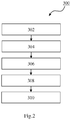
- Fig. 2 shows a flow diagram for a processing method 300 in association with the system 100 of Fig. 1 in accordance with an embodiment of the disclosure.
- the system 100 includes a computer 102 and an electronic device 104.
- the computer 102 is communicable with the electronic device 104.
- the processing method 300 can include a selection step 302, an identification step 304, a derivation step 306, a transmission step 308 and an output step 310.
- a graphics user interface can be provided for user selection by a user of the computer 102.
- the GUI can be displayed by the main display screen 102a.
- a gamer can be provided with an option to select a desired object of interest (e.g., enemy target).
- the GUI can, for example, be presented to the gamer as the game program is initialized.
- Selection of an objection of interest can be by manner of the gamer operating the input portion 102b (e.g., a keyboard or a pointing device such as a mouse) so that input signals communicated to the processing portion 102c can be indicative the gamer's selected object of interest. Therefore, a user of the computer 102 can be able to select an object of interest.
- the processing portion 102c can be configured to identify audio based data associated with the selected object of interest.
- the processing portion 102c can be configured to identify the relevant sound effect(s) associated with the selected object of interest. Therefore, audio based data associated with the selected object of interest can be identified at the computer 102.
- the processing portion 102c can be configured to generate supplementary signals based on the identified audio based data. Therefore, supplementary signals can be generated, at the computer 102, based on the identified audio based data.
- supplementary signals communicated from the processing portion 102c to the transceiver portion 102f can be communicated to the electronic device 104.
- generated supplementary signals can be communicated from the computer 102 to the electronic device 104.
- supplementary signals received by the electronic device 104 can be further processed so that visual cue(s) 210a/210b can be displayed via the display module 104a.
- the gamer can visually perceive auxiliary information displayed by the display module 104a. Therefore, received supplementary signals can be processed to generate auxiliary information which can be visually perceivable via the electronic device 104 but not the computer 102.
- predictive based visual cues can be provided by analyzing historical game play data (e.g., analyzing history of indications 210a/210b displayed by the supplementary display screen 104a) or marked up by global community (e.g., in the case of a Massively Multiplayer Online Role Playing Game). Predictive based visual cues can be generated via, for example, Kalman filtering based signal processing (e.g., by the processing portion 102c).
- options can be presented, via the display module 104a, to a gamer running macros such as a series of keystrokes or commands.
- a gamer running macros such as a series of keystrokes or commands.
- six graphical buttons each being customizable by the gamer to turn on/off (i.e., to activate or to deactivate) certain functions/trigger certain activities/trigger certain actions associated with a game run/executed at the computer 102 side can be presented via the display module 104a.
- one of the six graphical buttons can be customized to trigger an action by the gamer controlled character (e.g., scouting mode, stealth mode and/or to run from/evade enemy target fire).
- the graphical button(s) can effectively function as shortcut key(s) for game control during gameplay.
- the electronic device 104 can be used as a complementary control device during gameplay and can enhance gaming experience by facilitating ease of control of a game character when a gamer is playing a game.
- the display module 104a can be in other forms.
- the display module 104a can be in the form of a light emitting diode (LED) array where an appropriate LED is lit according to the supplementary signals received and processed by the electronic device 104.
- LED light emitting diode
- an LED located at the first quadrant 206a can be lit if the supplementary signals indicate that the object of interest is located approximately near the front and closer to the left side.
- system 100 being a four channel output (e.g., FR channel, FL channel, RL channel and RR channel) system
- the system 100 can be based on any number of channel outputs.
- the system 100 can be based on six channel outputs where the plurality of speaker drivers 102i further includes another two speaker drivers (e.g., a top channel speaker and a side channel speaker) in addition to the FL channel speaker, the FR channel speaker, the RL channel speaker and the RR channel speaker.
Landscapes
- Engineering & Computer Science (AREA)
- Multimedia (AREA)
- Physics & Mathematics (AREA)
- Theoretical Computer Science (AREA)
- Optics & Photonics (AREA)
- General Engineering & Computer Science (AREA)
- General Physics & Mathematics (AREA)
- Human Computer Interaction (AREA)
- Computer Networks & Wireless Communication (AREA)
- Computer Graphics (AREA)
- Acoustics & Sound (AREA)
- User Interface Of Digital Computer (AREA)
- Stereophonic System (AREA)
Abstract
Description
- The present disclosure generally relates to a computer having a main display screen for displaying information and an electronic device having a companion display module, to the main display screen, which displays auxiliary information not displayed by the main display screen.
- Generally, in gaming, the computer on which the game is played displays game based graphics as a gamer plays the game.
- As games become more sophisticated, graphics displayed generally become more detailed. Moreover, as gamers play a game by controlling a game character, it is appreciable that the computer screen generally shows graphics related to the controlled game character. Such related graphics include, for example, changing scenarios as the game character is moved and/or actions related to the controlled game character.
- However, it is appreciable that at the same time activities of the gamer controlled game character is shown on the computer screen, activities of other characters in the game which may be computer controlled and/or controlled by another gamer (e.g., in the case of a Massively Multiplayer Online Role Playing Game) need not necessary be visually perceivable via the computer screen. For example, other characters (i.e., other than the aforementioned gamer controlled game character) may be moving in the background and do not appear in the scene where the aforementioned gamer controlled game character appears at a current point in time. Specifically, the other characters need not necessarily appear in the same scene as the gamer controlled game character. Therefore, activities (e.g., movement) of these other characters which may be of interest to the gamer may, unfortunately, not be visually perceivable via the computer screen at a current point in time when the gamer controlled game character is shown.
- Therefore, gaming experience may be detracted as capability of the computer screen to appropriately provide display for sophisticated games (e.g., a Massively Multiplayer Online Role Playing Game) may be limited.
- It is therefore desirable to provide a solution to address the foregoing problem.
- In accordance with an aspect of the disclosure, there is provided an electronic device operable with a computer. The computer can be configured to run/execute a program which can be associated with graphic based data and audio based data.
- The computer can include a main display screen which can be configured to display information based on graphic based data.
- The electronic device can include a display module (e.g., a supplementary display screen) which can be configured to display auxiliary information.
- Auxiliary information can be related to information being displayed via the main display screen. Moreover, such auxiliary information is not displayed by the main display screen. Specifically, auxiliary information is not visually perceivable via the main display screen at the same point in time the main display screen displays the aforementioned information based on graphic based data. Furthermore, auxiliary information displayed by the display module, but not the main display screen, can be derived based on audio based data.
- In one embodiment, auxiliary information displayed via the display module relates to an object of interest. The object of interest can be associated with audio based data audibly perceivable via the computer. The graphic based data can, for example, be associated with an environment and auxiliary information is associable with approximate location of the object of interest within the environment. Moreover, audio based data associated with the object of interest corresponds to sound effect associated with the object of interest.
- In accordance with another aspect of the disclosure, there is provided a processing method associated with a system which can include a computer and an electronic device. The computer can be configured to signal communicate with the electronic device.
- The processing method can include a selection step where a user of the computer selects an object of interest and an identification step where audio based data associated with the selected object of interest is identified at the computer.
- The processing method can also include a derivation step where supplementary signals are generated, at the computer, based on the identified audio based data.
- Moreover, the processing method can include a transmission step where generated supplementary signals are communicated from the computer to the electronic device and an output step where received supplementary signals are processed to generate at least one visual cue visually perceivable via the electronic device but not the computer.
- Embodiments of the disclosure are described hereinafter with reference to the following drawings, in which:
-
Fig. 1a shows a system which can include a computer which can communicate with an electronic device, according to an embodiment of the disclosure; -
Fig, 1b shows the computer and the electronic device ofFig. 1a in further detail, according to an embodiment of the disclosure; -
Fig. 1c shows an exemplary scenario where the computer ofFig. 1a can be a gaming laptop and theelectronic device 104 ofFig. 1a can be a Smartphone, according to an embodiment of the disclosure; and -
Fig. 2 shows a flow diagram for a processing method in association with the system ofFig. 1a , according to an embodiment of the disclosure. - Representative embodiments of the disclosure, for addressing the foregoing problem(s), are described hereinafter with reference to
Fig. 1 andFig. 2 . - Specifically, the present disclosure contemplates an electronic device having a display module which is capable of functioning as, for example, a complementary display. The electronic device can be operated with a computer having a screen. In this regard, the screen of the computer can be considered a main display screen and the display module of the electronic device can be considered to be, for example, a supplementary display relative to the main display screen. The supplementary display can be in the form of, for example, a supplementary display screen which can be considered to be a complementary display screen to the main display screen. Preferably, the electronic device is a portable type device which can be configured to display, via its display module, information auxiliary to information being displayed by the main display screen. Therefore, the display module can display auxiliary information with reference to information being displayed by the main display screen. Preferably, such auxiliary information is not displayed by/visually perceivable via the main display screen and can be derived via audio based data audibly perceivable via the computer as will be discussed with reference to
Fig. 1 andFig. 2 hereinafter. -
Fig. 1a shows asystem 100 in accordance with an embodiment of the disclosure. Thesystem 100 can include a computer 102 (e.g., Smartphones, Tablets, Laptops, Desktop computers) which is suitable for gaming. Thesystem 100 can further include an electronic device 104 (e.g., Smartphones, Tablets, Laptops, pointing devices such as a mouse, keyboards or another computer similar to the computer 102). Thecomputer 102 can be coupled to theelectronic device 104 such that thecomputer 102 can communicate with theelectronic device 104. Coupling between thecomputer 102 and theelectronic device 104 can be via one or both of wired coupling and wireless coupling. - Each of the
computer 102 and theelectronic device 104 can include a body such as a casing (not shown) shaped and dimensioned to carry, respectively, ascreen 102a and adisplay module 104a. The screen of thecomputer 102 can be considered amain display screen 102a and thedisplay module 104a of theelectronic device 104 can be considered asupplementary display 104a relative to themain display screen 102a. In general, themain display screen 102a displays information generated in respect of thecomputer 102 at a current point in time and thesupplementary display 104a displays information related to that being displayed by themain display screen 102a, but such related information (i.e., displayed by thesupplementary display 104a) is not displayed by themain display screen 102a at that same current point in time. Therefore, it is appreciable that thesupplementary display 104a displays information auxiliary to information being displayed by themain display screen 102a. Specifically, thesupplementary display 104a can display auxiliary information with reference to information being displayed by themain display screen 102a. As such, thesupplementary display 104a can be considered to be a companion/complementary display (e.g., a companion/complementary display screen) to themain display screen 102a. - Since auxiliary Information is displayed only via the
supplementary display screen 104a and not themain display screen 102a and such auxiliary information is related to information being displayed by themain display screen 102a, it is appreciable that there is a need to derive such auxiliary information. As will be discussed in further detail with reference to an exemplary scenario, such auxiliary information can be derived using, for example, audio based data generated by, and audibly perceivable via, thecomputer 102. - The
system 100 will be discussed in further detail with reference toFig. 1b hereinafter. - Referring to
Fig. 1b , thecomputer 102 can further include aninput portion 102b, aprocessing portion 102c, avisual portion 102d, anaudio portion 102e and atransceiver portion 102f. The body (e.g., casing) of thecomputer 102 can be further shaped and dimensioned to carry theinput portion 102b, theprocessing portion 102c, thevisual portion 102d, theaudio portion 102e and thetransceiver portion 102f. - The
visual portion 102d can include a display driver (not shown). Theaudio portion 102e can include anaudio processor 102g, anaudio amplifier 102h and a plurality ofspeaker drivers 102i. - The
input portion 102b can be coupled to theprocessing portion 102c. Theprocessing portion 102c can be coupled to each of thevisual portion 102d, theaudio portion 102e and thetransceiver portion 102f. - In regard to the
visual portion 102d, the display driver can be coupled to theprocessing portion 102c. The display driver can be further coupled to themain display screen 102a. - In regard to the
audio portion 102e, theaudio processor 102g can be coupled to theprocessing portion 102c. Theaudio processor 102g can be further coupled to theaudio amplifier 102h. Theaudio amplifier 102h can be coupled to the plurality ofspeaker drivers 102i. In one example, the plurality of speaker drivers can include a first speaker driver, a second speaker driver, a third speaker driver and a fourth speaker driver. The first speaker driver can, for example, correspond to a front left (i.e., "FL" as indicated inFig. 1b ) channel speaker. The second speaker driver can, for example, correspond to a front right (i.e., "FR" as indicated inFig. 1b ) channel speaker. The third speaker driver can, for example, correspond to a rear left (i.e., "RL" as indicated inFig. 1b ) channel speaker. The fourth speaker driver can, for example, correspond to a rear right (i.e., "RR" as indicated inFig. 1b ) channel speaker. Audio output from thecomputer 102 can be via the plurality ofspeaker drivers 102i. In a more specific example, audio output from thecomputer 102 can include FL audio output, FR audio output, RL audio output and/or RR audio output via the FL channel speaker, the FR channel speaker, the RL channel speaker and/or the RR channel speaker respectively. - Earlier mentioned, coupling between the
computer 102 and theelectronic device 104 can be via one or both of wired coupling and wireless coupling. - In regard to wireless coupling, the
computer 102 can be coupled to theelectronic device 104 via acommunication network 106. Specifically, thecomputer 102 can be configured to wirelessly signal communicate with theelectronic device 104 via thecommunication network 106. Thecommunication network 106 can include, for example, Bluetooth based communication, Infrared based communication and/or Wi-Fi based communication. - In regard to wired coupling, the
computer 102 can be coupled to theelectronic device 104 via hardwiring. For example, thecomputer 102 can be coupled to theelectronic device 104 via a cable (not shown). - The
electronic device 104display module 104a (i.e., also referable assupplementary display 104a) can, in one embodiment, be configured for display in accordance with audio output from thecomputer 102. Moreover, thesupplementary display 104a can be in the form of a display screen. - More specifically, display by the
supplementary display 104a can, for example, be partitioned based on audio output from thecomputer 102. Yet more specifically, thesupplementary display 104a can, for example, be partitioned into four sections corresponding to the FL channel speaker, the FR channel speaker, the RL channel speaker and the RR channel speaker. - As shown, display by the
supplementary display 104a can be partitioned into four equal sections by avertical axis 108a and ahorizontal axis 108b, in accordance with an embodiment of the disclosure. In this regard, the display by thesupplementary display 104a can, for example, be partitioned into afirst quarter 108c indicative of FL audio output, asecond quarter 108d indicative of FR audio output, athird quarter 108e indicative of RL audio output and afourth quarter 108f indicative of RR audio output. It should be noted that the vertical andhorizontal axes 108a/108b are included in this discussion to merely illustrate a possible manner of demarcating display by thesupplementary display 104a and need not necessarily be visually perceivable (i.e., the vertical andhorizontal axes 108a/108b can be imaginary lines which are not visually perceivable). - Operationally, the
processing portion 102c can be configured to run/execute a software program. Based on the software program being run, output signals can be generated and communicated from theprocessing portion 102c. Output signals can include one or both of visual based output signals and audio based output signals. In this regard, the software program can be associated with one or both of graphics based data and audio based data which can be processed to generate, respectively, visual based output signals and audio based output signals. - Visual based output signals can be communicated to the
visual portion 102d for further processing (e.g., by the display driver) so that the visual based output signals can, for example, be in a format suitable for display (i.e., visually perceivable by a user) of graphics by themain display screen 102a. - Audio based output signals can be communicated to the
audio portion 102e for further processing. Specifically, the audio based output signals can be processed by theaudio processor 102g and theaudio amplifier 102h. The processed audio based output signals can be output via the plurality ofspeaker drivers 102i for audible perception by a user. For example, audio based output signals can include a FL channel signal, a FR channel signal, a RL channel signal and a RR channel signal. The FL channel signal, the FR channel signal, the RL channel signal and the RR channel signal can be processed by theaudio processor 102g and theaudio amplifier 102h. The processed FL channel signal, the processed FR channel signal, the processed RL channel signal and the processed RR channel signal can be output by the FL channel speaker, the FR channel speaker, the RL channel speaker, the RR channel speaker respectively. Outputs from the FL channel speaker, the FR channel speaker, the RL channel speaker, the RR channel speaker can be referred to as FL audio output, FR audio output, RL audio output and RR audio output respectively. - Input signals can be generated, by a user operating the
input portion 102b (e.g., a keyboard or a pointing device such as a mouse), and communicated to processingportion 102c. Theprocessing portion 102c can be configured to process the graphic based data and/or the audio based data based on the input signals to produce, respectively, visual based output signals and/or audio based output signals. - The
processing portion 102c can be further configured to process one or both of the graphics based data and the audio based data to produce supplementary signals which can be communicated to theelectronic device 104. The graphics based data and/or audio based data can be processed by theprocessing portion 102c based on the input signals. Preferably, the supplementary signals are communicated to thetransceiver portion 102f which transmits the supplementary signals to theelectronic device 104 wirelessly via thecommunication network 106. - Based on the supplementary signals, auxiliary information can be displayed via the
supplementary display 104a as will be discussed with reference to an exemplary scenario perFig. 1c hereinafter. - Referring to
fig. 1c , in oneexemplary scenario 200, thecomputer 102 can be a gaming laptop and theelectronic device 104 can be a Smartphone having a display screen. In this regard, the aforementioned display module/supplementary display 104a can be in the form of a display screen. Hence, the aforementioned display module/supplementary display 104a can be referred to as asupplementary display screen 104a hereinafter. - The
supplementary display screen 104a can be configured for coordinate graph type display in which avertical axis 202 and ahorizontal axis 204 section thesupplementary display screen 104a into four equal sections. In this regard, thesupplementary display screen 104a can be partitioned into afirst quadrant 206a indicative of a FL based location, asecond quadrant 206b indicative of a FR based location, athird quadrant 206c indicative of a RL based location and afourth quadrant 206d indicative of a RR based location. Additionally, a point oforigin 208 can be displayed. The point oforigin 208 can be a reference point which is indicative that there is no output from each of the FL channel speaker, the FR channel speaker, the RL channel speaker and the RR channel speaker in respect of sound effect of interest (i.e., each of the FL channel signal, FR channel signal, RL channel signal and the RR channel signal can be quantified to be 0dB by theprocessing portion 102c, in relation to the sound effect of interest). Moreover, one or morevisual cues 210a/210b (i.e., visual indication(s)) can be displayed based on the FL channel signal, FR channel signal, RL channel signal and/or the RR channel signal as will be discussed later in further detail. - The software program executed can be a game based program. The game based program can, for example, be of a war/battle type game genre (i.e., a game which is war/battle themed).
- Usually, in a game, there will be one or more game characters and/or a game environment (i.e., graphics based data) which can be visually perceived via the
main display screen 102a. In the game, there can be a storyline or game rules and a gamer can play the game in accordance with the storyline or game rules. For example, there may be a need for the gamer to move one or more game characters in a game environment so as to achieve a certain objective. Appreciably, in a game, there can be one or more movable game characters and/or one or more stationary game characters. The movable game character(s) can be moved in accordance with gamer control to achieve a certain objective in the game. Furthermore, the game can include accompanying game audio (i.e., audio based data) such as background music, soundtracks and/or sound effects which can be audibly perceived via the plurality ofspeaker drivers 102i. The game character(s) and game environment can correspond to graphics based data. The accompanying game audio can correspond to audio based data. - Specifically, in a game which is war themed, game characters can include soldiers and the game environment can correspond to a battlefield. An objective of the game can be to neutralize enemy targets. Gamer control can be via the
input portion 102b (i.e., input signals generated by a gamer using a keyboard) to, for example, move the soldier(s) and/or to shoot at an enemy target. Sound effects of the game can include gunshots and footsteps (e.g., as the gamer moves the soldiers through the battlefield and/or as the enemy targets move through the battlefield). Sound effects can further include gunshots as enemy targets shoot at soldiers controlled by the gamer. Themain display screen 102a can be configured to display the battlefield and soldiers etc (i.e., information displayed by themain display screen 102a). - In this regard, audio based data can be associated with game audio. Specifically, audio based data can include, for example, background music, soundtracks and/or sound effects.
- Additionally, information displayed by the
main display screen 102a can include the game environment, the soldier(s) and/or enemy target(s). Information displayed by themain display screen 102a can further include movement of the soldier(s), movement of the enemy target(s) and/or changes in the game environment as the gamer moves the soldier(s) at a current point in time during gameplay. - The
processing portion 102c can, for example, be configured provide an indication and/or perform calculations based on audio based data associated with the FL channel signal, FR channel signal, RL channel signal and/or the RR channel signal. Audio based data associated with each of the FL channel signal, FR channel signal, RL channel signal and the RR channel signal can, for example, be quantified in decibels (dB). Moreover, the FL channel signal, FR channel signal, RL channel signal and the RR channel signal can be indicative of loudness of the FL audio output, the FR audio output, the RL audio output and the RR audio output respectively. - Preferably, the supplementary signals communicated from the
computer 102 to theelectronic device 104 can be derived based on audio based data. Audio based data can be based on a sound effect of interest to a gamer. The sound effect of interest to a gamer can be associated with an object of interest to the gamer. An object of interest can, for example, include a movable game character such as an enemy target. - In one embodiment, the
processing portion 102c can be configured to quantify (e.g., in dB) audio based data associated with each of the FL channel signal, FR channel signal, RL channel signal and the RR channel signal at any point in time when the game is being played by a gamer. Specifically, a sound effect (e.g., gunshots from an enemy target and/or footsteps of an enemy target) of interest can be identified by a gamer and theprocessing portion 102c can be configured to quantify, in dB, audio based data associated with each of the FL channel signal, FR channel signal, RL channel signal and the RR channel signal in relation to the sound effect of interest (e.g., gunshots from an enemy target and/or footsteps of an enemy target). Based on such quantification, in relation to the sound effect of interest, of audio based data associated with the FL channel signal, FR channel signal, RL channel signal and/or the RR channel signal, supplementary signals can be generated by theprocessing portion 102c and communicated from thecomputer 102 to theelectronic device 104. A sound effect of interest can be identified by a gamer by manner of, for example, selection of an object of interest as will be discussed later in further detail with reference toFig. 2 . - In another embodiment, the
processing portion 102c can be configured to quantify (e.g., in dB) audio based data associated with each of the FL channel signal, FR channel signal, RL channel signal and the RR channel signal at any point in time when the game is being played by a gamer. Theprocessing portion 102c can be further configured to compare audio based data associated with one channel signal (e.g., FL channel signal) with audio based data associated with another channel signal (e.g., FR channel signal). Specifically, a sound effect (e.g., gunshots from an enemy target and/or footsteps of an enemy target) of interest can be identified by a gamer, and theprocessing portion 102c can be configured to quantify and compare audio based data associated with the FL channel signal, FR channel signal, RL channel signal and/or the RR channel signal in relation to the sound effect of interest (e.g., gunshots from an enemy target and/or footsteps of an enemy target). A sound effect of interest can be identified by a gamer by manner of, for example, selection of an object of interest as will be discussed later in further detail with reference toFig. 2 . - In one example, in relation to the sound effect of interest audibly perceivable at a point in time during gameplay, audio based data associated with the FL channel signal can be quantified to be 6dB, audio based data associated with the FR channel signal can be quantified to be 3dB, audio based data associated with the RL channel signal can be quantified to be 0dB and audio based data associated with RR channel signal can be quantified to be 0dB. The
processing portion 102c can be configured to compare audio based data associated with the FL and FR channel signals (since audio based data associated with the RL and RR channel signals, being 0dB, can be disregarded). By comparing audio based data associated with the FL and FR channel signals, supplementary signals indicating location of the sound effect of interest during gameplay can be generated. Specifically, given that audio based data associated with the FL channel signal is quantified to be 6dB whereas audio based data associated with the FR channel signal is quantified to be 3dB, supplementary signals indicating that, for example, enemy target gunshots can be heard near the front (i.e., between FL and FR channels) closer to the left side (i.e., since audio based data associated with the FL channel signal is 6dB and audio based data associated with the FR channel signal is 3dB). - In another example, in relation to the sound effect of interest audibly perceivable at a point in time during gameplay, audio based data associated with the FL channel signal can be quantified to be 0dB, audio based data associated with the FR channel signal can be quantified to be 5dB, audio based data associated with the RL channel signal can be quantified to be 0dB and audio based data associated with the RR channel signal can be quantified to be 2dB. The
processing portion 102c can be configured to compare audio based data associated with the FR and RR channel signals (since audio based data associated with the FL and FR channel signals, being 0dB, can be disregarded). By comparing audio based data associated with the FR and RR channel signals, supplementary signals indicating location of the sound effect of interest during gameplay can be generated. Specifically, given that audio based data associated with the FR channel signal is quantified to be 5dB whereas audio based data associated with the RR channel signal is quantified to be 2dB, supplementary signals indicating that, for example, enemy target gunshots can be heard near the right side (i.e., between FR and RR channels) closer to the front (i.e., since audio based data associated with the FR channel signal is 5dB and audio based data associated with the RR channel signal is 2dB). - Appreciably, in this manner (e.g., per earlier discussion concerning the two examples immediately preceding this paragraph), an indication of the approximate location of an enemy target can be provided. Therefore, the supplementary signals can be indicative of an approximate location of an enemy target although the enemy target may not be necessarily visually perceivable via the
main display screen 102a at a particular point in time during gameplay when the sound effect of interest (i.e., gunshots from an enemy target) can be audibly perceived. Specifically, an indication of an approximate location of an object of interest (e.g., an enemy target) can be provided via thesupplementary display screen 104a based on audio based data even though the object of interest is not visually perceivable via themain display screen 102a at a current point in time during gameplay. Therefore, auxiliary information displayed via thesupplementary display screen 104a can relate to the aforementioned approximate location of an object of interest not shown/displayed by themain display screen 102a. - In this regard, the supplementary signals communicated from the
computer 102 to theelectronic device 104 can be received and processed by theelectronic device 104 so as to provide at least one indication (i.e., visual cue(s) 210a/210b) of, for example, an approximate location of an object of interest (e.g., an enemy target). - In an earlier example (i.e., audio based data associated with the FL channel signal can be quantified to be 6dB, audio based data associated with the FR channel signal can be quantified to be 3dB, audio based data associated with each of the RL channel signal and the RR channel signal can be quantified to be 0dB in relation to the sound effect of interest), where based on audio based data, the supplementary signals can indicate that the object of interest (e.g., the enemy target) is approximately located near the front (i.e., between FL and FR channels) closer to the left side (i.e., since audio based data associated with the FL channel signal is 6dB and audio based data associated with the FR channel signal is 3dB). The
supplementary display screen 104a can display an indication such as avisual cue 210a somewhere in thefirst quadrant 206a indicating as such. - In another earlier example (i.e., audio based data associated with the FL channel signal can be quantified to be 0dB, audio based data associated with the FR channel signal can be quantified to be 5dB, audio based data associated with the RL channel signal can be quantified to be 0dB and audio based data associated with RR channel signal can be quantified to be 2dB in relation to the sound effect of interest), where based on audio based data, the supplementary signals can indicate that the object of interest (e.g., the enemy target) is approximately located at the right side (i.e., between FR and RR channels) closer to the front (i.e., since audio based data associated with the FR channel signal is 5dB and audio based data associated with the RR channel signal is 2dB). The
supplementary display screen 104a can display an indication such as avisual cue 210b somewhere in thesecond quadrant 206b indicating as such. - Appreciably, for a gamer playing a game using the
computer 102, the sound effect of interest (e.g., gunshots from an enemy target, footsteps of an enemy target) may be audibly perceivable from the plurality ofspeaker drivers 102i. However, the object of interest (e.g., an enemy target) associated with the sound effect of interest may not necessarily be shown (i.e., visually perceivable) on themain display screen 102a even if the sound effect of interest can be audibly perceived at a particular point in time when the game is played. In this regard, information displayed by themain display screen 102a can include the game character(s) moved by the gamer and the game environment whereas auxiliary information such as the object of interest (e.g., a movable enemy target which movement may be computer controlled), which is not displayed by themain display screen 102a when the associated sound of interest can be audibly perceived, can be displayed by thesupplementary display screen 104a. Therefore, even if the object of interest is not displayed by themain display screen 102a when the associated sound of interest can be audibly perceived by a gamer, the gamer can still be provided with an approximate location of the object of interest in the game environment by virtue of the aforementioned visual cue(s) 210a/210b displayed by thesupplementary display screen 104a. - Moreover, since the approximate location of the object of interest in the game environment can be provided by displaying the aforementioned visual cue(s) 210a/210b via the
supplementary display screen 104a, it is appreciable that there is no need to provision any additional space on themain display screen 102a for display of such auxiliary information. Hence there will be no such visual distractions shown on themain display screen 102a which may detract gaming experience. That is, a gamer can have access to desired auxiliary information and yet still fully enjoy the intended display (the movable game character controlled by the gamer and the game environment etc.) on themain display screen 102a without being distracted by display of auxiliary information. -
Fig. 2 shows a flow diagram for aprocessing method 300 in association with thesystem 100 ofFig. 1 in accordance with an embodiment of the disclosure. Per earlier discussion, it is appreciable that thesystem 100 includes acomputer 102 and anelectronic device 104. Thecomputer 102 is communicable with theelectronic device 104. - The
processing method 300 can include aselection step 302, anidentification step 304, aderivation step 306, atransmission step 308 and anoutput step 310. - In regard to the
selection step 302, a graphics user interface (GUI) can be provided for user selection by a user of thecomputer 102. The GUI can be displayed by themain display screen 102a. For example, a gamer can be provided with an option to select a desired object of interest (e.g., enemy target). The GUI can, for example, be presented to the gamer as the game program is initialized. Selection of an objection of interest can be by manner of the gamer operating theinput portion 102b (e.g., a keyboard or a pointing device such as a mouse) so that input signals communicated to theprocessing portion 102c can be indicative the gamer's selected object of interest. Therefore, a user of thecomputer 102 can be able to select an object of interest. - In regard to the
identification step 304, theprocessing portion 102c can be configured to identify audio based data associated with the selected object of interest. For example, theprocessing portion 102c can be configured to identify the relevant sound effect(s) associated with the selected object of interest. Therefore, audio based data associated with the selected object of interest can be identified at thecomputer 102. - In regard to the
derivation step 306, theprocessing portion 102c can be configured to generate supplementary signals based on the identified audio based data. Therefore, supplementary signals can be generated, at thecomputer 102, based on the identified audio based data. - In regard to the
transmission step 308, supplementary signals communicated from theprocessing portion 102c to thetransceiver portion 102f can be communicated to theelectronic device 104. - Therefore, generated supplementary signals can be communicated from the
computer 102 to theelectronic device 104. - In regard to the
output step 310, supplementary signals received by theelectronic device 104 can be further processed so that visual cue(s) 210a/210b can be displayed via thedisplay module 104a. As such the gamer can visually perceive auxiliary information displayed by thedisplay module 104a. Therefore, received supplementary signals can be processed to generate auxiliary information which can be visually perceivable via theelectronic device 104 but not thecomputer 102. - In the foregoing manner, various embodiments of the disclosure are described for addressing at least one of the foregoing disadvantages. Such embodiments are intended to be encompassed by the following claims, and are not to be limited to specific forms or arrangements of parts so described and it will be apparent to one skilled in the art in view of this disclosure that numerous changes and/or modification can be made, which are also intended to be encompassed by the following claims.
- In one example, predictive based visual cues can be provided by analyzing historical game play data (e.g., analyzing history of
indications 210a/210b displayed by thesupplementary display screen 104a) or marked up by global community (e.g., in the case of a Massively Multiplayer Online Role Playing Game). Predictive based visual cues can be generated via, for example, Kalman filtering based signal processing (e.g., by theprocessing portion 102c). - In another example, options (e.g., via a graphics user interface) can be presented, via the
display module 104a, to a gamer running macros such as a series of keystrokes or commands. For example, six graphical buttons, each being customizable by the gamer to turn on/off (i.e., to activate or to deactivate) certain functions/trigger certain activities/trigger certain actions associated with a game run/executed at thecomputer 102 side can be presented via thedisplay module 104a. In a more specific example, one of the six graphical buttons can be customized to trigger an action by the gamer controlled character (e.g., scouting mode, stealth mode and/or to run from/evade enemy target fire). Therefore, the graphical button(s) can effectively function as shortcut key(s) for game control during gameplay. As can be appreciated, theelectronic device 104 can be used as a complementary control device during gameplay and can enhance gaming experience by facilitating ease of control of a game character when a gamer is playing a game. - In yet another example, although a display screen has been used in earlier examples, it is appreciable that the
display module 104a can be in other forms. For example, thedisplay module 104a can be in the form of a light emitting diode (LED) array where an appropriate LED is lit according to the supplementary signals received and processed by theelectronic device 104. For example, an LED located at thefirst quadrant 206a can be lit if the supplementary signals indicate that the object of interest is located approximately near the front and closer to the left side. - In yet a further example, although earlier examples are based on the
system 100 being a four channel output (e.g., FR channel, FL channel, RL channel and RR channel) system, it is appreciable that thesystem 100 can be based on any number of channel outputs. For example, thesystem 100 can be based on six channel outputs where the plurality ofspeaker drivers 102i further includes another two speaker drivers (e.g., a top channel speaker and a side channel speaker) in addition to the FL channel speaker, the FR channel speaker, the RL channel speaker and the RR channel speaker.
Claims (15)
- An electronic device (104) operable with a computer (102) running a program associable with graphic based data and audio based data, the computer having a main display screen (102a) displaying information based on graphic based data, the electronic device comprising:a display module (104a) configurable to display auxiliary information related to information being displayed via the main display screen, auxiliary information not being displayed by the main display screen,wherein auxiliary information displayed by the display module, but not the main display screen, is derivable based on audio based data.
- The electronic device as in claim 1, wherein auxiliary information displayed via the display module relates to an object of interest, the object of interest being associable with audio based data audibly perceivable via the computer.
- The electronic device as in claim 2, wherein graphic based data is associable with an environment and auxiliary information is associable with an approximate location of the object of interest within the environment.
- The electronic device as in claim 3, wherein audio based data associated with the object of interest corresponds to a sound effect associated with the object of interest.
- The electronic device as in claim 3 or claim 4, wherein the approximate location of the object of interest is provided by a visual cue displayed via the display module.
- The electronic device as in any preceding claim wherein audio based data is output from the computer via a plurality of speaker drivers and display by the display module is partitioned into sections, each section corresponding to a respective speaker driver signal.
- The electronic device as in claim 6, wherein there are four speaker drivers and display by the display module is partitioned by a vertical axis and a horizontal axis into four equal sections.
- The electronic device as in claim 6 when appended to claim 5, wherein the audio based data is quantifiable in decibels, dB, and the visual cue is based upon supplementary signals generated by comparing quantified audio based data associated with respective speaker driver signals.
- The electronic device as in any preceding claim, wherein the display module comprises a graphical user interface, GUI, and the GUI presents options for controlling the program running on the computer.
- The electronic device as in any preceding claim, wherein the display module comprises a display screen or a light emitting diode array.
- The electronic device as in any preceding claim, wherein the computer is a gaming laptop and the electronic device is a smartphone having a display screen.
- The electronic device as in any preceding claim, wherein audio based data includes background music, soundtracks and/or sound effects.
- A processing method associated with a system comprising a computer (102) and an electronic device (104), the computer being communicable with the electronic device, the processing method comprising:a selection step where a user of the computer selects an object of interest;an identification step where audio based data associated with the selected object of interest is identified at the computer;a derivation step where supplementary signals are generated, at the computer, based on the identified audio based data;a transmission step where generated supplementary signals are communicated from the computer to the electronic device; andan output step where received supplementary signals are processed to generate at least one visual cue visually perceivable via the electronic device but not the computer.
- The processing method of claim 13, wherein the selection step is carried out by a user via a graphics user interface, GUI, displayed by a main display screen of the computer.
- The processing method of claims 13 or 14, wherein the identification step includes identifying a sound effect(s) associated with the selected object of interest.
Applications Claiming Priority (1)
| Application Number | Priority Date | Filing Date | Title |
|---|---|---|---|
| SG10201606458WA SG10201606458WA (en) | 2016-08-04 | 2016-08-04 | A companion display module to a main display screen for displaying auxiliary information not displayed by the main display screen and a processing method therefor |
Publications (2)
| Publication Number | Publication Date |
|---|---|
| EP3278849A1 true EP3278849A1 (en) | 2018-02-07 |
| EP3278849B1 EP3278849B1 (en) | 2022-01-05 |
Family
ID=59485299
Family Applications (1)
| Application Number | Title | Priority Date | Filing Date |
|---|---|---|---|
| EP17183869.1A Active EP3278849B1 (en) | 2016-08-04 | 2017-07-28 | A companion display module to a main display screen for displaying auxiliary information not displayed by the main display screen and a processing method therefor |
Country Status (5)
| Country | Link |
|---|---|
| US (2) | US20180036636A1 (en) |
| EP (1) | EP3278849B1 (en) |
| CN (1) | CN107688449B (en) |
| SG (2) | SG10201606458WA (en) |
| TW (1) | TWI734812B (en) |
Cited By (1)
| Publication number | Priority date | Publication date | Assignee | Title |
|---|---|---|---|---|
| CN112827165A (en) * | 2021-02-15 | 2021-05-25 | 苏州优它科技有限公司 | Wearing recreation external member based on mutual feedback of virtual reality multimode |
Families Citing this family (3)
| Publication number | Priority date | Publication date | Assignee | Title |
|---|---|---|---|---|
| CN108854069B (en) * | 2018-05-29 | 2020-02-07 | 腾讯科技(深圳)有限公司 | Sound source determination method and device, storage medium and electronic device |
| CN108744516B (en) | 2018-05-29 | 2020-09-29 | 腾讯科技(深圳)有限公司 | Method and device for acquiring positioning information, storage medium and electronic device |
| US20240121569A1 (en) * | 2022-10-09 | 2024-04-11 | Sony Interactive Entertainment Inc. | Altering audio and/or providing non-audio cues according to listener's audio depth perception |
Citations (4)
| Publication number | Priority date | Publication date | Assignee | Title |
|---|---|---|---|---|
| US20100113148A1 (en) * | 2008-11-04 | 2010-05-06 | Quado Media Inc. | Multi-player, multi-screens, electronic gaming platform and system |
| WO2010091514A1 (en) * | 2009-02-11 | 2010-08-19 | Hellatronix | Video game with behavior indicators and controller therefor with integrated display screen |
| US20110300930A1 (en) * | 2010-06-08 | 2011-12-08 | Hsu Kent T J | Video game controller with an auxiliary display |
| US20160127775A1 (en) * | 2014-10-31 | 2016-05-05 | Microsoft Corporation | Individualized content presentation for increased user interaction performance in group settings |
Family Cites Families (5)
| Publication number | Priority date | Publication date | Assignee | Title |
|---|---|---|---|---|
| CA2580239C (en) * | 2004-09-21 | 2016-04-26 | Timeplay Entertainment Corporation | System, method and handheld controller for multi-player gaming |
| US20120200667A1 (en) * | 2011-02-08 | 2012-08-09 | Gay Michael F | Systems and methods to facilitate interactions with virtual content |
| EP2506464A1 (en) * | 2011-03-30 | 2012-10-03 | Harman International Industries Ltd. | Audio processing apparatus and method of outputting status information |
| US20160023116A1 (en) * | 2014-07-03 | 2016-01-28 | Spitfire Technologies, Llc | Electronically mediated reaction game |
| US9839854B2 (en) * | 2015-12-15 | 2017-12-12 | Nvidia Corporation | Built-in support of in-game virtual split screens with peer-to peer-video conferencing |
-
2016
- 2016-08-04 SG SG10201606458WA patent/SG10201606458WA/en unknown
-
2017
- 2017-07-24 TW TW106124776A patent/TWI734812B/en active
- 2017-07-27 SG SG10201706135UA patent/SG10201706135UA/en unknown
- 2017-07-28 EP EP17183869.1A patent/EP3278849B1/en active Active
- 2017-08-02 US US15/666,769 patent/US20180036636A1/en not_active Abandoned
- 2017-08-03 CN CN201710655005.1A patent/CN107688449B/en active Active
-
2019
- 2019-04-17 US US16/387,370 patent/US11571621B2/en active Active
Patent Citations (4)
| Publication number | Priority date | Publication date | Assignee | Title |
|---|---|---|---|---|
| US20100113148A1 (en) * | 2008-11-04 | 2010-05-06 | Quado Media Inc. | Multi-player, multi-screens, electronic gaming platform and system |
| WO2010091514A1 (en) * | 2009-02-11 | 2010-08-19 | Hellatronix | Video game with behavior indicators and controller therefor with integrated display screen |
| US20110300930A1 (en) * | 2010-06-08 | 2011-12-08 | Hsu Kent T J | Video game controller with an auxiliary display |
| US20160127775A1 (en) * | 2014-10-31 | 2016-05-05 | Microsoft Corporation | Individualized content presentation for increased user interaction performance in group settings |
Cited By (1)
| Publication number | Priority date | Publication date | Assignee | Title |
|---|---|---|---|---|
| CN112827165A (en) * | 2021-02-15 | 2021-05-25 | 苏州优它科技有限公司 | Wearing recreation external member based on mutual feedback of virtual reality multimode |
Also Published As
| Publication number | Publication date |
|---|---|
| US11571621B2 (en) | 2023-02-07 |
| TWI734812B (en) | 2021-08-01 |
| CN107688449B (en) | 2022-08-30 |
| SG10201606458WA (en) | 2018-03-28 |
| US20180036636A1 (en) | 2018-02-08 |
| EP3278849B1 (en) | 2022-01-05 |
| US20190240576A1 (en) | 2019-08-08 |
| TW201805050A (en) | 2018-02-16 |
| SG10201706135UA (en) | 2018-03-28 |
| CN107688449A (en) | 2018-02-13 |
Similar Documents
| Publication | Publication Date | Title |
|---|---|---|
| US11571621B2 (en) | Companion display module to a main display screen for displaying auxiliary information not displayed by the main display screen and a processing method therefor | |
| KR102599993B1 (en) | Method and device for transmitting prompt information in multiplayer online battle program, and terminal | |
| US20200192625A1 (en) | Systems and Methods for Providing Audio to a User Based on Gaze Input | |
| US10055191B2 (en) | Systems and methods for providing audio to a user based on gaze input | |
| US20100041480A1 (en) | Universal game console controller | |
| CN112843716B (en) | Virtual object prompting and viewing method and device, computer equipment and storage medium | |
| JP2019051311A (en) | Information processing method, device, computer program, and computer readable storage medium | |
| US20150157940A1 (en) | System and method for playing video games on touchscreen-based devices | |
| KR101582296B1 (en) | Automatic aiming system and method for mobile game | |
| TWI793838B (en) | Method, device, apparatus, medium and product for selecting interactive mode for virtual object | |
| ES2958359T3 (en) | Information processing program, information processing device and information processing procedure. | |
| CN115703011B (en) | Sound prompt method, device, equipment and storage medium in virtual world | |
| TW201821139A (en) | Method for inserting virtual resource object in application and terminal and computer readable storage medium | |
| JP2017217352A (en) | Information processing program, information processing device, information processing system, and information processing method | |
| US10898791B2 (en) | Game apparatus | |
| US20120295707A1 (en) | Computer and recording medium | |
| CN114733198A (en) | Virtual character control method, device, terminal device and storage medium | |
| JP2020089492A (en) | Game program, game processing method, and game terminal | |
| JP2022505894A (en) | Interaction Graphic A method for displaying a user interface, its equipment and its computer program | |
| KR20210035773A (en) | How to parse HUD content in a specific situation from a video stream and a professional gaming AR visor | |
| KR20170001539A (en) | Automatic aiming system and method for mobile game | |
| KR102667637B1 (en) | Method to provide User interface for mobile game and device using the same | |
| KR20200080996A (en) | Smart controler, apparatus for controling user terminal, and method for controling user terminal | |
| JP7345093B2 (en) | Game program, game processing method, and game terminal | |
| HK40048751B (en) | Method and apparatus for controlling virtual object, device and computer readable storage medium |
Legal Events
| Date | Code | Title | Description |
|---|---|---|---|
| PUAI | Public reference made under article 153(3) epc to a published international application that has entered the european phase |
Free format text: ORIGINAL CODE: 0009012 |
|
| STAA | Information on the status of an ep patent application or granted ep patent |
Free format text: STATUS: THE APPLICATION HAS BEEN PUBLISHED |
|
| AK | Designated contracting states |
Kind code of ref document: A1 Designated state(s): AL AT BE BG CH CY CZ DE DK EE ES FI FR GB GR HR HU IE IS IT LI LT LU LV MC MK MT NL NO PL PT RO RS SE SI SK SM TR |
|
| AX | Request for extension of the european patent |
Extension state: BA ME |
|
| STAA | Information on the status of an ep patent application or granted ep patent |
Free format text: STATUS: REQUEST FOR EXAMINATION WAS MADE |
|
| 17P | Request for examination filed |
Effective date: 20180731 |
|
| RBV | Designated contracting states (corrected) |
Designated state(s): AL AT BE BG CH CY CZ DE DK EE ES FI FR GB GR HR HU IE IS IT LI LT LU LV MC MK MT NL NO PL PT RO RS SE SI SK SM TR |
|
| STAA | Information on the status of an ep patent application or granted ep patent |
Free format text: STATUS: EXAMINATION IS IN PROGRESS |
|
| 17Q | First examination report despatched |
Effective date: 20200430 |
|
| GRAP | Despatch of communication of intention to grant a patent |
Free format text: ORIGINAL CODE: EPIDOSNIGR1 |
|
| STAA | Information on the status of an ep patent application or granted ep patent |
Free format text: STATUS: GRANT OF PATENT IS INTENDED |
|
| INTG | Intention to grant announced |
Effective date: 20211005 |
|
| GRAS | Grant fee paid |
Free format text: ORIGINAL CODE: EPIDOSNIGR3 |
|
| GRAA | (expected) grant |
Free format text: ORIGINAL CODE: 0009210 |
|
| STAA | Information on the status of an ep patent application or granted ep patent |
Free format text: STATUS: THE PATENT HAS BEEN GRANTED |
|
| AK | Designated contracting states |
Kind code of ref document: B1 Designated state(s): AL AT BE BG CH CY CZ DE DK EE ES FI FR GB GR HR HU IE IS IT LI LT LU LV MC MK MT NL NO PL PT RO RS SE SI SK SM TR |
|
| REG | Reference to a national code |
Ref country code: GB Ref legal event code: FG4D |
|
| REG | Reference to a national code |
Ref country code: CH Ref legal event code: EP |
|
| REG | Reference to a national code |
Ref country code: AT Ref legal event code: REF Ref document number: 1460009 Country of ref document: AT Kind code of ref document: T Effective date: 20220115 |
|
| REG | Reference to a national code |
Ref country code: DE Ref legal event code: R096 Ref document number: 602017051790 Country of ref document: DE |
|
| REG | Reference to a national code |
Ref country code: IE Ref legal event code: FG4D |
|
| REG | Reference to a national code |
Ref country code: NL Ref legal event code: FP |
|
| REG | Reference to a national code |
Ref country code: LT Ref legal event code: MG9D |
|
| REG | Reference to a national code |
Ref country code: AT Ref legal event code: MK05 Ref document number: 1460009 Country of ref document: AT Kind code of ref document: T Effective date: 20220105 |
|
| PG25 | Lapsed in a contracting state [announced via postgrant information from national office to epo] |
Ref country code: SE Free format text: LAPSE BECAUSE OF FAILURE TO SUBMIT A TRANSLATION OF THE DESCRIPTION OR TO PAY THE FEE WITHIN THE PRESCRIBED TIME-LIMIT Effective date: 20220105 Ref country code: RS Free format text: LAPSE BECAUSE OF FAILURE TO SUBMIT A TRANSLATION OF THE DESCRIPTION OR TO PAY THE FEE WITHIN THE PRESCRIBED TIME-LIMIT Effective date: 20220105 Ref country code: PT Free format text: LAPSE BECAUSE OF FAILURE TO SUBMIT A TRANSLATION OF THE DESCRIPTION OR TO PAY THE FEE WITHIN THE PRESCRIBED TIME-LIMIT Effective date: 20220505 Ref country code: NO Free format text: LAPSE BECAUSE OF FAILURE TO SUBMIT A TRANSLATION OF THE DESCRIPTION OR TO PAY THE FEE WITHIN THE PRESCRIBED TIME-LIMIT Effective date: 20220405 Ref country code: LT Free format text: LAPSE BECAUSE OF FAILURE TO SUBMIT A TRANSLATION OF THE DESCRIPTION OR TO PAY THE FEE WITHIN THE PRESCRIBED TIME-LIMIT Effective date: 20220105 Ref country code: HR Free format text: LAPSE BECAUSE OF FAILURE TO SUBMIT A TRANSLATION OF THE DESCRIPTION OR TO PAY THE FEE WITHIN THE PRESCRIBED TIME-LIMIT Effective date: 20220105 Ref country code: ES Free format text: LAPSE BECAUSE OF FAILURE TO SUBMIT A TRANSLATION OF THE DESCRIPTION OR TO PAY THE FEE WITHIN THE PRESCRIBED TIME-LIMIT Effective date: 20220105 Ref country code: BG Free format text: LAPSE BECAUSE OF FAILURE TO SUBMIT A TRANSLATION OF THE DESCRIPTION OR TO PAY THE FEE WITHIN THE PRESCRIBED TIME-LIMIT Effective date: 20220405 |
|
| PG25 | Lapsed in a contracting state [announced via postgrant information from national office to epo] |
Ref country code: PL Free format text: LAPSE BECAUSE OF FAILURE TO SUBMIT A TRANSLATION OF THE DESCRIPTION OR TO PAY THE FEE WITHIN THE PRESCRIBED TIME-LIMIT Effective date: 20220105 Ref country code: LV Free format text: LAPSE BECAUSE OF FAILURE TO SUBMIT A TRANSLATION OF THE DESCRIPTION OR TO PAY THE FEE WITHIN THE PRESCRIBED TIME-LIMIT Effective date: 20220105 Ref country code: GR Free format text: LAPSE BECAUSE OF FAILURE TO SUBMIT A TRANSLATION OF THE DESCRIPTION OR TO PAY THE FEE WITHIN THE PRESCRIBED TIME-LIMIT Effective date: 20220406 Ref country code: FI Free format text: LAPSE BECAUSE OF FAILURE TO SUBMIT A TRANSLATION OF THE DESCRIPTION OR TO PAY THE FEE WITHIN THE PRESCRIBED TIME-LIMIT Effective date: 20220105 Ref country code: AT Free format text: LAPSE BECAUSE OF FAILURE TO SUBMIT A TRANSLATION OF THE DESCRIPTION OR TO PAY THE FEE WITHIN THE PRESCRIBED TIME-LIMIT Effective date: 20220105 |
|
| PG25 | Lapsed in a contracting state [announced via postgrant information from national office to epo] |
Ref country code: IS Free format text: LAPSE BECAUSE OF FAILURE TO SUBMIT A TRANSLATION OF THE DESCRIPTION OR TO PAY THE FEE WITHIN THE PRESCRIBED TIME-LIMIT Effective date: 20220505 |
|
| REG | Reference to a national code |
Ref country code: DE Ref legal event code: R097 Ref document number: 602017051790 Country of ref document: DE |
|
| PG25 | Lapsed in a contracting state [announced via postgrant information from national office to epo] |
Ref country code: SM Free format text: LAPSE BECAUSE OF FAILURE TO SUBMIT A TRANSLATION OF THE DESCRIPTION OR TO PAY THE FEE WITHIN THE PRESCRIBED TIME-LIMIT Effective date: 20220105 Ref country code: SK Free format text: LAPSE BECAUSE OF FAILURE TO SUBMIT A TRANSLATION OF THE DESCRIPTION OR TO PAY THE FEE WITHIN THE PRESCRIBED TIME-LIMIT Effective date: 20220105 Ref country code: RO Free format text: LAPSE BECAUSE OF FAILURE TO SUBMIT A TRANSLATION OF THE DESCRIPTION OR TO PAY THE FEE WITHIN THE PRESCRIBED TIME-LIMIT Effective date: 20220105 Ref country code: EE Free format text: LAPSE BECAUSE OF FAILURE TO SUBMIT A TRANSLATION OF THE DESCRIPTION OR TO PAY THE FEE WITHIN THE PRESCRIBED TIME-LIMIT Effective date: 20220105 Ref country code: DK Free format text: LAPSE BECAUSE OF FAILURE TO SUBMIT A TRANSLATION OF THE DESCRIPTION OR TO PAY THE FEE WITHIN THE PRESCRIBED TIME-LIMIT Effective date: 20220105 Ref country code: CZ Free format text: LAPSE BECAUSE OF FAILURE TO SUBMIT A TRANSLATION OF THE DESCRIPTION OR TO PAY THE FEE WITHIN THE PRESCRIBED TIME-LIMIT Effective date: 20220105 |
|
| PLBE | No opposition filed within time limit |
Free format text: ORIGINAL CODE: 0009261 |
|
| STAA | Information on the status of an ep patent application or granted ep patent |
Free format text: STATUS: NO OPPOSITION FILED WITHIN TIME LIMIT |
|
| PG25 | Lapsed in a contracting state [announced via postgrant information from national office to epo] |
Ref country code: AL Free format text: LAPSE BECAUSE OF FAILURE TO SUBMIT A TRANSLATION OF THE DESCRIPTION OR TO PAY THE FEE WITHIN THE PRESCRIBED TIME-LIMIT Effective date: 20220105 |
|
| 26N | No opposition filed |
Effective date: 20221006 |
|
| PG25 | Lapsed in a contracting state [announced via postgrant information from national office to epo] |
Ref country code: SI Free format text: LAPSE BECAUSE OF FAILURE TO SUBMIT A TRANSLATION OF THE DESCRIPTION OR TO PAY THE FEE WITHIN THE PRESCRIBED TIME-LIMIT Effective date: 20220105 Ref country code: MC Free format text: LAPSE BECAUSE OF FAILURE TO SUBMIT A TRANSLATION OF THE DESCRIPTION OR TO PAY THE FEE WITHIN THE PRESCRIBED TIME-LIMIT Effective date: 20220105 |
|
| REG | Reference to a national code |
Ref country code: CH Ref legal event code: PL |
|
| REG | Reference to a national code |
Ref country code: BE Ref legal event code: MM Effective date: 20220731 |
|
| PG25 | Lapsed in a contracting state [announced via postgrant information from national office to epo] |
Ref country code: LU Free format text: LAPSE BECAUSE OF NON-PAYMENT OF DUE FEES Effective date: 20220728 Ref country code: LI Free format text: LAPSE BECAUSE OF NON-PAYMENT OF DUE FEES Effective date: 20220731 Ref country code: CH Free format text: LAPSE BECAUSE OF NON-PAYMENT OF DUE FEES Effective date: 20220731 |
|
| PG25 | Lapsed in a contracting state [announced via postgrant information from national office to epo] |
Ref country code: BE Free format text: LAPSE BECAUSE OF NON-PAYMENT OF DUE FEES Effective date: 20220731 |
|
| P01 | Opt-out of the competence of the unified patent court (upc) registered |
Effective date: 20230520 |
|
| PG25 | Lapsed in a contracting state [announced via postgrant information from national office to epo] |
Ref country code: IT Free format text: LAPSE BECAUSE OF FAILURE TO SUBMIT A TRANSLATION OF THE DESCRIPTION OR TO PAY THE FEE WITHIN THE PRESCRIBED TIME-LIMIT Effective date: 20220105 Ref country code: IE Free format text: LAPSE BECAUSE OF NON-PAYMENT OF DUE FEES Effective date: 20220728 |
|
| PG25 | Lapsed in a contracting state [announced via postgrant information from national office to epo] |
Ref country code: HU Free format text: LAPSE BECAUSE OF FAILURE TO SUBMIT A TRANSLATION OF THE DESCRIPTION OR TO PAY THE FEE WITHIN THE PRESCRIBED TIME-LIMIT; INVALID AB INITIO Effective date: 20170728 |
|
| PG25 | Lapsed in a contracting state [announced via postgrant information from national office to epo] |
Ref country code: MK Free format text: LAPSE BECAUSE OF FAILURE TO SUBMIT A TRANSLATION OF THE DESCRIPTION OR TO PAY THE FEE WITHIN THE PRESCRIBED TIME-LIMIT Effective date: 20220105 Ref country code: CY Free format text: LAPSE BECAUSE OF FAILURE TO SUBMIT A TRANSLATION OF THE DESCRIPTION OR TO PAY THE FEE WITHIN THE PRESCRIBED TIME-LIMIT Effective date: 20220105 |
|
| PG25 | Lapsed in a contracting state [announced via postgrant information from national office to epo] |
Ref country code: MT Free format text: LAPSE BECAUSE OF FAILURE TO SUBMIT A TRANSLATION OF THE DESCRIPTION OR TO PAY THE FEE WITHIN THE PRESCRIBED TIME-LIMIT Effective date: 20220105 |
|
| PGFP | Annual fee paid to national office [announced via postgrant information from national office to epo] |
Ref country code: NL Payment date: 20250726 Year of fee payment: 9 |
|
| PGFP | Annual fee paid to national office [announced via postgrant information from national office to epo] |
Ref country code: DE Payment date: 20250729 Year of fee payment: 9 |
|
| PGFP | Annual fee paid to national office [announced via postgrant information from national office to epo] |
Ref country code: GB Payment date: 20250728 Year of fee payment: 9 |
|
| PGFP | Annual fee paid to national office [announced via postgrant information from national office to epo] |
Ref country code: FR Payment date: 20250728 Year of fee payment: 9 |
|
| PG25 | Lapsed in a contracting state [announced via postgrant information from national office to epo] |
Ref country code: TR Free format text: LAPSE BECAUSE OF FAILURE TO SUBMIT A TRANSLATION OF THE DESCRIPTION OR TO PAY THE FEE WITHIN THE PRESCRIBED TIME-LIMIT Effective date: 20220105 |