EP3278516B1 - Auf verhaltensanalyse basierendes system zur erkennung und klassifizierung von dns-tunnelierung für netzwerksicherheit - Google Patents
Auf verhaltensanalyse basierendes system zur erkennung und klassifizierung von dns-tunnelierung für netzwerksicherheit Download PDFInfo
- Publication number
- EP3278516B1 EP3278516B1 EP16773621.4A EP16773621A EP3278516B1 EP 3278516 B1 EP3278516 B1 EP 3278516B1 EP 16773621 A EP16773621 A EP 16773621A EP 3278516 B1 EP3278516 B1 EP 3278516B1
- Authority
- EP
- European Patent Office
- Prior art keywords
- dns
- text string
- network domain
- data stream
- domain
- Prior art date
- Legal status (The legal status is an assumption and is not a legal conclusion. Google has not performed a legal analysis and makes no representation as to the accuracy of the status listed.)
- Active
Links
Images





Classifications
-
- H—ELECTRICITY
- H04—ELECTRIC COMMUNICATION TECHNIQUE
- H04L—TRANSMISSION OF DIGITAL INFORMATION, e.g. TELEGRAPHIC COMMUNICATION
- H04L63/00—Network architectures or network communication protocols for network security
- H04L63/02—Network architectures or network communication protocols for network security for separating internal from external traffic, e.g. firewalls
- H04L63/029—Firewall traversal, e.g. tunnelling or, creating pinholes
-
- H—ELECTRICITY
- H04—ELECTRIC COMMUNICATION TECHNIQUE
- H04L—TRANSMISSION OF DIGITAL INFORMATION, e.g. TELEGRAPHIC COMMUNICATION
- H04L63/00—Network architectures or network communication protocols for network security
- H04L63/14—Network architectures or network communication protocols for network security for detecting or protecting against malicious traffic
- H04L63/1408—Network architectures or network communication protocols for network security for detecting or protecting against malicious traffic by monitoring network traffic
- H04L63/1425—Traffic logging, e.g. anomaly detection
-
- H—ELECTRICITY
- H04—ELECTRIC COMMUNICATION TECHNIQUE
- H04L—TRANSMISSION OF DIGITAL INFORMATION, e.g. TELEGRAPHIC COMMUNICATION
- H04L63/00—Network architectures or network communication protocols for network security
- H04L63/14—Network architectures or network communication protocols for network security for detecting or protecting against malicious traffic
- H04L63/1441—Countermeasures against malicious traffic
Definitions
- DNS Domain Name System
- DNS tunneling can be utilized in many malicious ways that can compromise the security of a network.
- DNS tunneling can be used for various malicious/unauthorized activities, such as data exfiltration, cyber-espionage, and/or command and control.
- US2012054860 (A1 ) discloses systems and methods are disclosed for detecting covert DNS tunnels using n-grams.
- the invention is defined by the appended independent claims. Preferred embodiments are defined by the dependent claims.
- the invention can be implemented in numerous ways, including as a process; an apparatus; a system; a composition of matter; a computer program product embodied on a computer readable storage medium; and/or a processor, such as a processor configured to execute instructions stored on and/or provided by a memory coupled to the processor.
- these implementations, or any other form that the invention may take, may be referred to as techniques.
- the order of the steps of disclosed processes may be altered within the scope of the invention as defined by the appended claims.
- a component such as a processor or a memory described as being configured to perform a task may be implemented as a general component that is temporarily configured to perform the task at a given time or a specific component that is manufactured to perform the task.
- the term 'processor' refers to one or more devices, circuits, and/or processing cores configured to process data, such as computer program instructions.
- DNS tunneling is an approach used to convey messages through TCP tunnels over DNS protocol that is typically not blocked or monitored by security enforcement, such as firewalls.
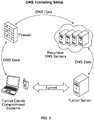
- Figure 3 illustrates an example of a DNS tunneling setup.
- DNS tunneling generally works by encapsulating data into DNS packets.
- the tunnel client encapsulates the data to be sent in a query for a specific domain name.
- the DNS resolver treats the tunnel traffic as a regular request by starting the look-up process for the requested domain name, possibly recursively consulting other DNS resolvers, as shown in Figure 3 .
- the request is processed by the tunnel server.
- the server retrieves the encapsulated data and responds to DNS queries by enclosing tunnel data in the answer section of the DNS response message.
- DNS tunneling techniques typically use 'TXT' type queries in DNS that can maximize the payload in response packets
- implementations that make use of DNS query types other than 'TXT' such as 'A', 'AAAA', 'CNAME', 'NS', 'MX' and so on.
- DNS tunneling poses a significant threat and there are methods to detect it.
- DNS tunnels can be detected by analyzing a single DNS payload based on its fundament that the tunnel is used to convey information.
- DNS tunnels are often used by legitimate users to transfer short messages such as heartbeats.
- Single payload-based methods have less latency in detection but cannot make an accurate classification between legitimate and malicious activities.
- DNS tunneling can be utilized in many malicious ways that can compromise the security of a network.
- DNS tunneling can be used for various malicious/unauthorized activities, such as data exfiltration, cyber-espionage, and/or command and control (C&C).
- C&C command and control
- DNS tunneling can also be used by legitimate users for authorized/legitimate purposes.
- existing approaches for detecting DNS tunneling are not able to effectively and efficiently distinguish between legitimate and malicious uses even if they can detect the DNS tunneling activities.
- a behavior analysis based DNS tunneling detection and classification framework for network security e.g., using one or more DNS tunneling classifiers, such as further described below.
- the disclosed behavior-based techniques can detect the DNS tunneling and can also classify the activities in order to identify unauthorized/malicious network traffic using DNS tunneling.
- An example implementation of the behavior analysis based DNS tunneling detection and classification framework for network security can achieve the scale of real-time detection on fast and large sets of DNS data with the use of big data technologies in online and offline systems, such as further described below.
- Flux domain also referred to as fast flux and domain flux
- Flux domain is often used as an evasion technique that cyber-criminals and Internet miscreants use to evade identification and to frustrate law enforcement and anti-cybercrime efforts aimed at locating and shutting down web sites used for illegal or other improper or unauthorized purposes.
- Flux domain is generally an advanced persistent threat that is an active threat vector.
- flux domain behaviors are continually changing and evolving in an attempt to evade existing detection measures (e.g., existing signature-based approaches and/or existing flux domain detection techniques).
- the online platform implementing an analytics framework for DNS security can detect and classify DNS tunneling and/or can also detect and classify a flux domain.
- Techniques disclosed herein provide a new and more robust solution to DNS security with advanced analytics and/or machine learning techniques that can facilitate zero-day detection of flux domains.
- an online platform can implement an analytics framework for DNS security based on DNS traffic analysis (e.g., analysis of passive DNS traffic can be performed to detect and classify DNS tunneling based on one or more features using one or more DNS tunneling classifiers) as further described herein with respect to various embodiments.
- the online platform can be implemented to support large throughput with real-time DNS streaming data processing with advanced analytics techniques.
- an online platform implementing an analytics framework for DNS security based on passive DNS traffic analysis includes receiving a DNS data stream; processing the DNS data stream to identify DNS tunneling activity (e.g., DNS tunneling behavior) based on a behavioral analysis model (e.g., classifier) applied to a time series collection of passive DNS traffic data; and performing a mitigation action based on the identified DNS tunneling activity (e.g., a bad/malware network domain/FQDN and/or malware IP associated with the suspicious/malicious DNS tunneling activity can be identified and added to a blacklist/policy, which can be communicated/distributed such as using an RPZ feed or another communication mechanism).
- the bad network domain can be determined to be associated with a DNS tunneling activity and/or a flux domain.
- the DNS data stream can include DNS query and DNS response data.
- the disclosed techniques can facilitate detecting DNS tunneling transactions.
- the disclosed techniques can facilitate stopping (e.g., blocking or preventing) DNS tunneling transactions.
- the disclosed techniques can include providing a reputation service based on detecting bad/malware domain names and/or bad/malware IP addresses associated with such detected DNS tunneling transactions.
- the online platform implementing an analytics framework for DNS security based on passive DNS traffic further includes determining a host is infected based on detecting a DNS query request to the bad network domain. In one embodiment, the online platform implementing an analytics framework for DNS security based on passive DNS traffic further includes performing a mitigation action based on the determined infected host.
- the mitigation action (e.g., in response to a suspicious/malicious DNS tunneling activity detection and/or flux domain detection) can include one or more of the following: generating a firewall rule based on the bad network domain; configuring a network device to block network communications with the bad network domain; and quarantining an infected host, in which the infected host is determined to be infected based on an association with the bad network domain (e.g., the infected host submitted a DNS query for the bad network domain).
- the mitigation action can include configuring a network device (e.g., a switch or router, implemented as a physical or virtual switch/router) to quarantine the infected host and/or block access to the bad network domain, using network access control or other mechanisms to quarantine the infected host and/or block access to the bad network domain, configuring a security device controller using Open Flow or other Software Defined Networking (SDN) techniques to configure a network device (e.g., a switch or router, implemented as a physical or virtual switch/router) to quarantine the infected host and/or block access to the bad network domain, and/or to implement other configuration/programming techniques such as via API or publish/subscribe mechanisms to configure a network device (e.g., a switch or router, implemented as a physical or virtual switch/router) to quarantine the infected host and/or block access to the bad network domain.
- SDN Software Defined Networking
- the online platform implementing an analytics framework for DNS security further includes identifying a source IP address, a source host, or attempting to query the bad network domain and/or bad IP address.
- the online platform implementing an analytics framework for DNS security further includes storing the time series collection of passive DNS traffic data in a data store (e.g., an observation cache).
- a data store e.g., an observation cache
- the online platform implementing an analytics framework for DNS security further includes receiving DNS data that is collected from an agent executed on a DNS appliance.
- the agent can be configured to collect DNS data on the DNS appliance and to send the DNS data as a DNS data stream to the online platform implementing an analytics framework for DNS tunneling detection and/or flux domain detection based on passive DNS traffic.
- the DNS data can be collected at one or more DNS appliances and sent to a real-time processor cluster of the online platform that can determine the bad network domain based on applying one or more behavioral models based on one or more features extracted from the passive DNS data traffic.
- the online platform implementing an analytics framework for DNS security further includes extracting a plurality of features from the DNS data stream to detect and classify DNS tunneling based on one or more of the extracted features.
- the online platform implementing an analytics framework for DNS security further includes applying a behavioral model based on extracted DNS data features to detect and classify DNS tunneling activity (e.g., detecting DNS tunneling behavior based on the extracted DNS data features using one or more classifiers, such as further described below).
- the online platform implementing an analytics framework for DNS security further includes extracting a plurality of features from the DNS data stream to determine whether a network domain is associated with a flux domain (e.g., a fast flux domain) based on one or more of the extracted features. For example, one or more models based on DNS data feature extraction can be applied to determine whether a network domain is associated with a legitimate flux domain (e.g., CDN, NTP, or IRC services) and is not a suspicious or malicious flux domain.
- a flux domain e.g., a fast flux domain
- the online platform implementing an analytics framework for DNS security further includes applying a behavioral model based on extracted DNS data features to detect illegitimate flux domains (e.g., as opposed to using a simple blacklist comparison).
- a feedback loop can be used to improve DNS tunneling activity detection and/or flux domain detection (e.g., by automatically adjusting thresholds for correlations, such as based on user feedback, analysis of additional processed DNS data, and/or improved training of the behavioral models, such as improved training performed using an offline platform as further discussed herein).
- the online platform implementing an analytics framework for DNS security further includes processing the DNS data stream using a real-time processor cluster.
- the real-time processor cluster can implement one or more DNS-based behavioral models, such as an n-feature model (e.g., an example five-feature model as further described herein, or another number of extracted features can be implemented using a similar or different behavior model) for flux domain detection.
- the real-time processor cluster can implement one or more DNS-based behavioral models, such as an n-feature model (e.g., an example model utilizes entropy, lexical, n-gram, and time series features as further described herein, or additional/different extracted features can be implemented using a similar or different behavior model) for DNS tunneling detection.
- the real-time processor cluster is in communication with an observation cache (e.g., for storing time series data of a DNS data stream, including DNS data and meta-data that can be extracted or calculated for the DNS data, and the observation cache can be implemented as a persistent, scalable cache).
- the bad network domain detection results from the real-time processor cluster can be provided to a detection data store (e.g., a detection database) and/or to a mitigation engine for performing responsive actions (e.g., mitigation engine determined and requested actions).
- the online platform can be implemented using an appliance for DNS security on a network (e.g., deployed on an enterprise network for network security).
- the online platform can be implemented in software for providing DNS security on a network executed on a computing device (e.g., an appliance, a server, a gateway, or another computing device, which can be deployed on an enterprise network for network security).
- the online platform implementing an analytics framework for DNS security includes an online framework that can apply one or more models (e.g., behavior models) for detecting known and/or unknown malicious DNS queries or anomalies in a real-time stream of DNS data.
- models e.g., behavior models
- these techniques can be implemented using the online platform to accurately identify malicious DNS query patterns and then effectively detect and block such network communication attempts between a compromised host(s) and, for example, botnets or command and controls.
- the online platform implementing an analytics framework for DNS security includes applying a time series model based on a set of features by applying a set of prominent features that can be applied to a behavior-based model for detecting DNS security problems, such as DNS tunneling activities and/or flux domains.
- a horizontally scalable online system can be provided to facilitate large data throughput in near real-time as further described herein with respect to various embodiments.
- models for detecting known and/or unknown malicious DNS queries or anomalies can be generated and trained offline using an offline platform as further described herein with respect to various embodiments.
- a semi-supervised training framework for an offline platform can be provided to overcome the difficulties common in traditional supervised machine learning for DNS/network securities as further described herein with respect to various embodiments.
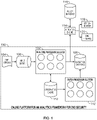
- Figure 1 is a functional block diagram illustrating an architecture for providing an online platform implementing a behavior analysis based DNS tunneling detection and classification framework for network security in accordance with some embodiments.
- the framework for an online platform includes a real-time processor cluster and, in some implementations, can optionally include a batch processor cluster (e.g., both of which can be scalable implementations).
- the real-time processor cluster can be configured to handle Complex Event Processing (CEP) functions that process and analyze DNS stream data input, conduct real-time DNS stream data detection, extract features, and send raw and metadata into an observation cache.
- CEP Complex Event Processing
- a batch processor cluster can optionally be provided to perform detection in a preset schedule against DNS data stored in the observation cache in a manner that can be cost effective.
- the detection modules can be pluggable that are trained from an offline platform (e.g., an offline forensic platform), such as described further with respect to Figure 2 .
- the online platform can apply various models for DNS tunneling activity detection and/or flux domain detection as further described herein.
- these models can be retrained and refined in the online system as further described herein.
- the online platform includes a real-time processor cluster 102 that receives a DNS data stream 104 via an input queue 106.
- a horizontally scalable infrastructure that can facilitate real-time end-to-end processing can be provided.
- the time series model as further discussed below, also can be implemented using a large and fast observation cache that can perform at web scale and at DNS speed.
- the architecture is composed of various open source components that are distributed and horizontally scalable as further discussed below.
- an agent can be configured to execute on one or more DNS servers or appliances to collect and periodically or in real-time send DNS queries to DNS stream 104, which is then provided in a queuing mechanism to collect and near real-time process that DNS data using the real-time process cluster.
- the agent can be configured to send over a DNS stream as structured data using input queue 106 as shown in Figure 1 .
- the DNS data streams can be partitioned per grid, such as for security and/or for policy/rules separation (e.g., mitigations can be configured per grid based on a per grid policy or some other level of granularity).
- Input queue 106 can be implemented using an open source message queue, such as the Apache Kafka high-throughput distributed messaging system that can be used as a persistent queue for input of the DNS message stream.
- real-time processor cluster 102 performs automated detection analysis for DNS security based on passive DNS traffic analysis using various techniques as described herein and provides DNS security detection results to a detection database 108 (e.g., and in some implementations, this activity is also performed by batch processor cluster 112, such as shown in Figure 1 ).
- real-time processor cluster 102 can be implemented using an open source platform for stream data processing, such as Apache Storm or Apache Spark which is a free and open source distributed real-time computation system (e.g., a distributed framework that allows applications to run in parallel, in which users can build topology networks in the application layer based on its API, in which each topology that is distributed and managed by the Storm network is for one or more applications) that can be implemented to perform real-time analytics based on models and various machine learning techniques as further described herein.
- real-time processor cluster 102 performs DNS security feature detection analysis (e.g., IP address changing over time, and/or other features, using caching techniques to calculate those features using a time series collection of DNS data).
- DNS security feature detection analysis e.g., IP address changing over time, and/or other features, using caching techniques to calculate those features using a time series collection of DNS data.
- an observation cache 110 is also provided that is in communication with real-time processor cluster 102, which can be used to provide a time series set of DNS data for applying models (e.g., classifiers) that utilize feature extraction techniques that involve using time series sets of DNS data.
- time series data can be stored in observation cache 110, such as DNS data and meta-data that includes features extracted or calculated from DNS queries.
- the observation cache can be implemented as a persistent, scalable, parallel computing cache (e.g., for storing time series data so that IP changes over time for a particular network domain can be detected, and/or for observing various other features associated with the time series collection of DNS data).
- the observation cache can be implemented using an open source cache solution, such as the Memcached high-performance, distributed memory object caching system or HBase which is a persistent key-value store that has very fast insertion speed and built-in TTL and versioning features that can be used by the observation cache, and this can also be used for storing detection results for mitigation and reporting.
- an optional batch processor cluster shown as batch processor cluster 112 can be used for analysis of such time series data.
- real-time processor cluster 102 can be used for analysis of such time series data, and a batch processor cluster is not needed in such implementations.
- an incoming stream is processed in real-time with an Apache Storm or Apache Spark framework and inserted into the observation cache along with the extracted features that are indexed by, for example, requester IP address and SLD.
- the observation cache can include an in-memory layer and an on-disk layer of which the use is dependent on the data size.
- the detection can be triggered by event or scheduled by interval to be cost effective.
- This online detection framework can be implemented as an appliance (e.g., or using a set of appliances and/or computing servers or other types of computing devices).
- the portion of the online platform as indicated by reference numeral 130 can be implemented on one or more computer servers or appliance devices or can be implemented as a cloud service, such as using Amazon Web Services or another cloud service provider for cloud-based computing and storage services.
- DNS security detection results determined using the online platform 130 can also be communicated to a mitigation engine 114.
- the mitigation engine can be implemented within or integrated with the online platform.
- Mitigation engine 114 can determine and request various mitigation actions in response to the DNS security detection results based on a policy, such as a DNS security policy stored in a policy database 116.
- mitigation engine 114 can configure a switch or router networking device 118 to filter (e.g., block or blacklist) a DNS query/request that was determined to be associated with a bad network domain (e.g., domain name/FQDN) and/or a bad IP address using real-time processor cluster 102.
- a bad network domain e.g., domain name/FQDN
- mitigation engine 114 can communicate with a DNS firewall 120 to identify one or more determined bad domains that were determined to be associated with a bad network domain (e.g., domain name/FQDN) and/or a bad IP address using real-time processor cluster 102.
- mitigation engine 114 communicates with a DNS firewall (e.g., or other firewall device) 120 using a data feed, such as a Response Policy Zone (RPZ) data feed, via a publish/subscribe connection protocol, and/or various other communication mechanisms.
- a DNS firewall e.g., or other firewall device
- a data feed such as a Response Policy Zone (RPZ) data feed
- RZ Response Policy Zone
- a new network domain is received in the DNS stream, such as XYZ.com (e.g., the new network domain can be specified in the form of an FQDN or an SLD).
- the first time that the XYZ.com domain is received by the processor cluster that network domain can be cached in the observation cache (e.g., the network domain can be cached along with its resolved IP address).
- This particular XYZ.com domain can be received up to a threshold number of times (e.g., 100 times, 1,000 times, or some other threshold number of times) with different IP addresses associated with that same XYZ.com domain up to a threshold period of time (e.g., one hour, one day, one week, or some other threshold period of time).
- the XYZ.com domain is flagged and stored in the detection database (e.g., in this example, the XYZ.com can be identified as associated with illegitimate DNS tunneling activities and/or an illegitimate flux domain based on these and/or additional parameters observed during this time period of such captured DNS data).
- whitelists and/or blacklists can be used to eliminate processing for network domains in the DNS data that have previously been determined to be good or bad.
- bad network domains e.g., bad domains
- the detection database can then communicate with the mitigation engine, which can be in communication with a policy data store (e.g., policies can be configured by/for an enterprise, by grid, and/or other policy configurations by grid, network, customer/entity, and/or other configurations and scope of applicability of rules configured in such policies).
- policies can be configured by/for an enterprise, by grid, and/or other policy configurations by grid, network, customer/entity, and/or other configurations and scope of applicability of rules configured in such policies).
- the mitigation engine can be configured based on the policy to perform various actions, such as the following: (1) add the XYZ.com domain to a blacklist, as the XYZ.com domain was determined to be a bad network domain in this example, and can also provide a feed back to the processor cluster and/or a DNS security service (e.g., a cloud-based DNS security service); (2) send the XYZ.com domain to a networking device, such as a router and/or a switch (e.g., physical or soft/virtual networking devices), which can then quarantine the host that was the source of the DNS query request for the XYZ.com domain, which was determined to be a bad network domain in this example; (3) send the XYZ.com domain to a DNS firewall or other firewall (e.g., via response policy zone (RPZ) data feed to the DNS firewall, via a connector model or publish/subscribe communication protocol/model, and/or using another communication mechanism).
- RPZ response policy zone
- the above-described responses performed using the mitigation engine can be implemented to block the network traffic to the XYZ.com domain, which was determined to be a bad network domain in this example, and/or to quarantine the host that is attempting to communicate with this bad network domain (e.g., the host can be deemed to be infected, such as by a botnet and/or other malware, by the fact that the host attempted to communicate with the XYZ.com domain, which was determined to be a bad domain), or to automatically reconfigure routers and/or switches to automatically configure these network devices (e.g., using NETMRI, a security device controller using OpenFlow, or another mechanism that can perform such automated network device configurations) to quarantine the host source for the bad network domain.
- the host can be deemed to be infected, such as by a botnet and/or other malware, by the fact that the host attempted to communicate with the XYZ.com domain, which was determined to be a bad domain
- automatically reconfigure routers and/or switches to automatically
- a benign classifier e.g., generated by a research analyst to eliminate or reduce false positives
- an online platform implementing a behavior analysis based DNS tunneling detection and classification framework for network security includes applying one or more models for DNS tunneling activity detection and classification.
- the online platform implements an analytics framework for DNS tunneling detection by implementing one or more DNS-based behavioral models, such as an n-feature model that extracts and analyzes prominent features that can be associated with DNS tunneling activities (e.g., an example model utilizes entropy, lexical, n-gram, and time series features as further described herein, or additional/different extracted features can be implemented using a similar or different model) for DNS tunneling activity detection, such as further described below.
- DNS-based behavioral models such as an n-feature model that extracts and analyzes prominent features that can be associated with DNS tunneling activities (e.g., an example model utilizes entropy, lexical, n-gram, and time series features as further described herein, or additional/different extracted features can be implemented using a similar or different model) for DNS tunneling activity detection, such as further described below.
- a semi-supervised training framework can be provided to overcome the difficulties common in traditional supervised machine learning for network security, such as further described below.
- a horizontally scalable online system such as the online platform described above with respect to Figure 1 , can be provided to facilitate large data throughput in near real-time as described herein with respect to various embodiments.
- an online platform implementing a behavior analysis based DNS tunneling detection and classification framework for network security also includes applying one or more models for flux domain detection.
- the online platform implements an analytics framework for flux domain detection based on passive DNS traffic analysis that can apply a time series model based on a set of features by applying a set of prominent features that can address behavior changes in domain flux.
- a semi-supervised training framework can be provided to overcome the difficulties common in traditional supervised machine learning for network security.
- a horizontally scalable online system such as the online platform described above with respect to Figure 1 , can be provided to facilitate large data throughput in near real-time as described herein with respect to various embodiments.
- an architecture for an online platform implementing a behavior analysis based DNS tunneling detection and classification framework for network security that supports multiple classifiers for performing DNS security. For example, common attributes can be efficiently extracted from a DNS data stream for using by two or more different classifiers for performing DNS security.
- Example classifiers include classifiers for domain flux (fast flux) related activities, classifiers for DNS tunneling related activities, classifiers for domain generation algorithm (DGA) related activities, and/or other classifiers for performing DNS security.
- DGA domain generation algorithm
- a time series model based on a set of features by applying a set of prominent features that can facilitate detection of DNS tunneling activities is applied (e.g., feature extraction and selection techniques as further described below), such as using the online platform discussed above.
- the proposed detection mechanism is based on extraction of DNS data (e.g., features) from a DNS data stream (e.g., a series of DNS messages), as further discussed below.
- the legitimate DNS traffic typically has very small payload. Generally, that is a reason that many approaches detect tunnels based on payload size. However, when space and bandwidth get less expensive, more and more legitimate users are using longer domain names. Because a primary objective of the tunneling technique is to convey information via the tunnel in a way as efficient as possible, the entropy metrics can be extracted as a feature for detecting such DNS tunneling activities. On the other side, human readability of domain names can also be extracted as an indicator in tunnel detection.
- a tunnel will use a query name to carry outbound payloads.
- the inbound payloads are carried in many different ways depending on the DNS resource record type. For example, in TXT type, the payload is encoded in the text. For many other types, such as A, AAAA, or CNAME, the payload is carried in one or more FQDNs.
- An effective payload is a string that is extracted from its original with common prefix, suffix, and aligned middle segments removed so that the real signal can stand out.
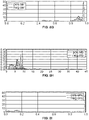
- Figures 8A-8I are charts that illustrate feature analysis results for inbound traffic in accordance with some embodiments (e.g., as example feature analysis distribution results where different curves are shown for positive and negative samples, respectively).
- Figures 8A-8I provide the feature analysis results for inbound traffic as follows: Figure 8A for Entropy; Figure 8B for Bigram; Figure 8C for Trigram; Figure 8D for Lexical feature; Figure 8E for Payload size; Figure 8F for Gini index; Figure 8G for Classification error; Figure 8H for Number of domain labels; and Figure 81 for Encoding classification. Their details will now be further described below.
- entropy is a measurement to quantify the amount of information on a payload.
- the major objective of a tunnel e.g., a DNS tunnel
- the entropy features are calculated based on the character distribution of the effective payload.
- a tunnel is assumed to maximize its bandwidth by increasing the entropy of the data being tunneled.
- this feature is defined as the value in the Pth percentile of the N-gram score distribution f N ( x
- S ) from a text string S, or as follows: nl ⁇ ⁇ ⁇ L N f N x
- P can be empirically set to be between 40 and 55.
- a lookup table of N-grams and their frequencies can be generated from a set of N-gram English words Google collected from large amounts of historical publications (e.g., publicly available at http://storage.googleapis.com/books/ngrams/books/datasetsv2.html).
- a tunnel tends to use some coding method such as base 64 that introduces many non-human readable characters that can be measured by the lexical features.
- the lexical feature is defined as follows:
- Gini index is a feature whose value is bounded within a range between zero and one.
- another feature is the number of domain labels in an FQDN payload named as nlb to differentiate legitimate and malicious payloads.
- an encoding feature enc is the output of a neural network that takes all of the above features as input.
- the classifiers are further described below.
- additional (e.g., including different and/or fewer) inbound features can be utilized for DNS tunneling detection.
- TTL of resource records and the response delay can be used as features based on the rationale that most of the legitimate DNS queries tend to have longer TTL for reducing number of queries by caching.
- tunneling DNS messages involves extra processing such as encoding and decoding, encryption and decryption, proxy and so on. That implies longer response time than normal DNS traffic.
- the time series data is defined by tunnel ID. Since a tunnel is defined by the requester IP address on one end and the SLD on the other end, the tunnel ID is composed of query IP address and SLD.
- the requester IP address can be a resolver or DNS server IP address and the internal client IP address combined depending on the information availability.
- the data points are inserted into an observation cache that has a TTL preset to remove old data points from the series. It also has a capacity preset for each series to remove old data points when the number of points hits the capacity though they haven't passed the TTL criterion. This is to guarantee the data freshness and reserve the storage space so that it can be recycled.
- the entropy on effective inbound and outbound payloads are calculated, respectively, because of the fact that the payload of legitimate traffic doesn't change as much as the malicious ones over the time series.
- the classification is targeted on identifying encoded payload while the second tier is for tunnel detection.
- two neural network classifiers are designed and trained to provide a score indicating if a payload is full of encoded text for inbound and outbound payloads, respectively.
- each of the classifiers can be trained on large DNS data sets (e.g., millions of samples with truth labeled by security experts and tested on independent sets of samples, respectively).
- the classifiers have a single hidden layer with four neurons and each uses a logistic activation function defined as follows: where f k are inputs, w k are weights, and w 0 is the bias for each neuron.
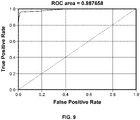
- the receiver operating characteristic (ROC) curves are generated on the independent test datasets.
- Figure 9 is the ROC curve for an inbound classifier in accordance with some embodiments.
- DNS tunneling is one of the most active and harmful attacks that utilize DNS traffics, therefore, its detection is included in the disclosed online detection system.
- Various example detection workflows are described below, such as with respect to flow diagrams shown in Figures 4 , 6 , and 7 , where the details of the benign detection and fast flux detection modules are also discussed in, for example, Figure 4 .
- a baseline can be provided for the system with an input of an initial DNS data set that is analyzed using the offline analysis platform shown in Figure 2 .
- the initial DNS data set can include a set of DNS data collected over a period of time that was collected from one or more sources, such as from Farsight Security's Internet Systems Consortium (ISC)/Security Information Exchange (SIE) with millions or even billions of DNS messages that can be used as the initial DNS data (e.g., such DNS data is collected through ISC/SIE passive DNS technology from more than 80 contributors distributed worldwide).
- the baseline can illustrate a detection accuracy with various defined metrics.
- the initial DNS data can be analyzed to provide insights about the DNS tunneling activities and behavior(s).
- the offline platform can be used for offline data analysis and semi-supervised training using various techniques described herein.
- a MapReduce or Spark job can be created and executed to simulate online detection including feature extraction, time series modeling, and DNS tunneling detection.
- a tunneling transaction generally includes a DNS query and a response. Most of the tunnels last through the end of the data collection period with a few lasting for less than a day. The average observation time before detecting a tunnel was 31 days. The results are based on the classification settings that are for a higher precision rate. Therefore, the false positive rate was zero.
- a classifier is provided for each type of DNS traffic.
- a distinct classifier can be provided for query only without meaningful payload in response, response only without meaningful payload in query, and/or query plus response.
- results of DNS tunneling detection determined one or more new bad domain names that can be included in a reputation feed.
- a list of bad domain names can be included in a reputation feed (e.g., using a DNS Response Policy Zones (RPZ) feed or another communication mechanism).
- the list of known bad domain names can be identified by domain name and/or IP address.
- the list of known bad domain names can be used as a blacklist.
- DNS devices can receive an RPZ feed and process DNS data based on the RPZ feed.
- the DNS device can process a request based on the RPZ feed (e.g., do not respond to a query for a domain name or IP address included on the blacklist, etc.).
- the RPZ feed and/or other communication mechanisms can facilitate broadcast/distribution of the updated bad domain list that is determined using the disclosed techniques for DNS tunneling detection (e.g., and/or similarly applied for domain flux detection, such as further described below).
- the most prominent characteristics that the DNS message of a flux domain may carry include a short TTL value, changing resolved IP addresses, and a large set of resolved IP addresses.
- many flux domain query responses have been observed that have very large TTL values and only one or a small set of resolved IP addresses. In such cases, it is not reliable to decide if a Fully Qualified Domain Name (FQDN) is using a fast flux technique or such a determination cannot be made simply based on each single DNS message.
- FQDN Fully Qualified Domain Name
- a time series model based on a set of features by applying a set of prominent features that can address behavior changes in domain flux is applied, such as using the online platform discussed above.
- the proposed detection mechanism is based on a series of DNS messages associated with the underlying FQDN, as further discussed below.
- a flux domain tends to set a lower TTL value so that it will not stay in the DNS cache for a long time.
- the most obvious feature is the average TTL value for the set M d .
- malware such as C&C botnets and/or other malware, often tend to frequently change destinations to different IP addresses.
- IPv4 addresses we focus on IPv4 addresses, and as would be apparent to those of ordinary skill in the art, similar techniques can be applied to IPv6 addresses.
- One of the challenges in detecting malicious flux domains is to distinguish many legitimate domains owned by, for example, CDN, load balancer vendors, and NTP providers that are also providing a large number of changing destination IP addresses and short TTL values. These are referred to as legitimate flux users to contrast them with illegitimate flux domain users (e.g., malicious or suspicious flux domain users).
- the resolved IP addresses provided by the legitimate flux users are generally distributed in a limited number of subnets and typically have good shares among the first one, two, and three octets of the IPv4 addresses.
- Entropy can provide a useful measure for the uncertainty of a random variable.
- D S be the distribution of the unique elements
- the entropy of set S is then defined as follows: which has a value between 0 and 1. This principle can also be applied to each DNS message. As a result, this provides the average entropy calculated on the first three octets of the addresses of the set of resolved IP addresses per each DNS message, which is denoted as follows:
- the L value will be higher if the target IP addresses are frequently reused, and vice versa.
- a destination IP is often reused within a region.
- malicious flux domain users typically want to evade the detection systems and accommodate the availability fluctuation of compromised servers by changing resolved IP addresses frequently.
- the loyalty feature can provide prominent attributes that facilitate in lowering the false positive rate of this domain flux classification technique for malicious flux domain detection.
- a trivial approach of supervised machine learning is to collect a set of samples with some size and get truth marked by security experts, and then partition the data for training and testing with various machine learning technologies.
- the ratio between the number of malicious messages and number of benign messages in DNS traffic is very small.
- the traditional unsupervised methods will be less likely to provide good results on this highly biased network dataset. Therefore, a new semi-supervised machine learning technique is disclosed.
- a semi-supervised machine learning technique uses heuristics-based semi-supervised regression.
- the heuristics-based semi-supervised regression approach can be applied in defining the classification system for detecting flux domain queries with a high confidence and, on the other side, this approach will not generate obvious false positives.
- the regression starts from a relatively small capture rate and the coverage is extended to a degree where obvious false positive results start to be observed (e.g., 1%).
- a security expert(s) will review the difference of the results which constructs the metrics of coverage and recall rates.
- FIG. 2 is a functional block diagram illustrating an architecture for providing an offline platform implementing a behavior analysis based DNS tunneling detection and classification framework for network security in accordance with some embodiments.
- the offline platform can be provided to perform various offline forensics of bulk DNS query and response data (e.g., analysis of DNS logs).
- an architecture of an offline platform 230 is provided for implementing an analytics framework for DNS security (e.g., based on passive DNS traffic analysis).
- the offline forensic platform can be used to collect DNS data and support machine learning processes that can be used to generate various detection models based on historical DNS data collections.
- the DNS volume is typically very large while the number of anomalous queries is relatively small.
- the offline forensic platform can include Hadoop, HBase, Impala, Hive, Solr and various other Hadoop ecosystems from Apache open source projects.
- the storage and processor cluster can be built on a multi-node Hadoop system (e.g., a nine-node Hadoop system).
- the offline forensic platform can provide the characteristics and functionalities that are used for big data advanced analytics through, for example, three types of interfaces, including search, Structured Query Language (SQL), and MapReduce. Because all of the components inherit the properties of scalability and fault tolerance, this system is scalable to accommodate data growth and fault tolerable for high availability.
- the storage can be schema free to facilitate the data changes and diversity though it supports SQL queries for which schema can be defined in the query time rather than in the storing time.
- the full set of attributes from DNS query and response can be included in the modeling.
- DNS query and response data 204 is provided as input to storage and processor cluster 202.
- the DNS query and response data can be a source of bulk DNS queries, such as from ISC or another DNS data source, such as from the local DNS appliances of an entity's network.
- storage and processor cluster 202 can include various interfaces, including a search interface 206, which can be implemented using an open source search platform (e.g., Apache Lucene or Apache SOLR), a MapReduce interface 208 (e.g., implemented using Hadoop MapReduce), and a database/SQL Interface 210 (e.g., implemented using Apache Hive or Cloudera Impala), any of which can feed into detection models 212, such as example DNS detection models disclosed herein.
- search interface 206 can be implemented using an open source search platform (e.g., Apache Lucene or Apache SOLR), a MapReduce interface 208 (e.g., implemented using Hadoop MapReduce), and a database/SQL Interface 210 (e.g., implemented using Apache Hive or Cloudera Impala), any of which can feed into detection models 212, such as example DNS detection models disclosed herein.
- any of these interfaces can be used as interfaces for various machine learning and feature analysis techniques.
- Example feature analysis techniques include entropy feature extraction
- Example machine learning techniques include k-means clustering, Naive Bayes classification, logistic regression, classification tree, and various other machine learning techniques (e.g., which can be similarly applied to DNS security detection for flux domain related activities detection and/or DNS tunneling related activities detection as disclosed herein).
- the offline platform can facilitate this machine learning process and its iterations for improving accuracy.
- the offline platform can be used to develop one or more DNS detection models, such as a DNS tunneling activity detection model and/or a flux domain detection model.
- DNS detection models can be trained using these machine learning techniques.
- the offline platform can be used to provide new DNS detection models and/or to re-train/modify existing DNS detection models to improve such DNS detection models that can then be provided to the online platform described above with respect to Figure 1 to apply the new or improved DNS detection models.
- storage and processor cluster 202 is a scalable, parallel computing (e.g., using a set of servers, such as using a computing service such as Amazon Web Services) implementation.
- storage and processor cluster 202 can be implemented using a Hadoop cluster for storing DNS structured query data.
- DNS query and response data can be modeled (e.g., based on standard requirements for DNS protocol, such as Internet Engineering Task Force (IETF) Request for Comments (RFC) requirements for the DNS protocol) in the Hadoop cluster.
- IETF Internet Engineering Task Force
- RRC Request for Comments
- structured information can be stored to define attributes based on RFCs that define DNS protocol to optimize the search, query, and MapReduce interface access to provide optimal performance for DNS using various machine learning techniques.
- a baseline can be provided for the system with an input of an initial DNS data set that is analyzed using the offline analysis platform shown in Figure 2 .
- the initial DNS data set can include a set of DNS data collected over a period of time that was collected from one or more sources, such as from Farsight Security's Internet Systems Consortium (ISC)/Security Information Exchange (SIE) with millions or even billions of DNS messages that can be used as the initial DNS data (e.g., such DNS data is collected through ISC/SIE passive DNS technology from more than 80 contributors distributed worldwide).
- the baseline can illustrate a detection accuracy with various defined metrics.
- the initial DNS data can be analyzed to provide insights about the fast flux malware and its behavior(s).
- the offline platform can be used for offline data analysis and semi-supervised training using various techniques described herein.
- a MapReduce or Spark job can be created and executed to simulate online detection including feature extraction, time series modeling, and flux detection.
- the other five sites identified as dashjr.org, sipa.be, bluematt.me, litecoinpool.org, and xurious.com, appear to be peer-to-peer seed trackers.
- the average TTL value of these detected queries can be as high as 14 hours. That means a flux domain can slowly change its target IP address to hide itself from most detection algorithms.
- 23,892 DNS messages are detected to be of flux domain per day or the rate is 24 every one million messages.
- Figure 4 is a flow diagram for implementing an analytics framework for DNS security that performs behavior analysis of DNS traffic to identify fast flux domain traffic and DNS tunneling traffic in accordance with some embodiments.
- a DNS query is received for processing and classification.
- a benign feature extraction is performed.
- the number of unique FQDNs to be requested can be around, for example, 200 million and this number continues to increase.
- a benign classification is performed as a processing stage that can be used to drop DNS messages that are determined to not be malicious with high confidence.
- the benign classification can be implemented as a whitelist (e.g., a listing of known good network domains).
- FF fast flux
- SLD Second Level Domain
- a component of the benign classifier is a whitelist of, for example, 80 items that are carefully selected from the top 100 second level domains or SLDs.
- queries where Ep is the entropy that is calculated on the first two octets of the resolved IP address set P can be classified as benign with confidence.
- a DNS message is classified as not a fast flux (FF) domain, that does not mean that the underlying FQDN d is benign. Rather, the underlying FQDN will be classified further when the time series is updated by the new messages (e.g., DNS stream data associated with that FQDN).
- FF fast flux
- DNST DNS Tunneling
- DNST DNS Tunneling
- the extracted DNST features are analyzed at 436 to detect and classify DNS tunneling activity (if any) (e.g., using the disclosed feature extraction and analysis techniques for DNST detection).
- whether the DNS query is a suspicious DNS tunneling activity is determined. If not, then the process is completed at 412B with the benign classification for the DNS query. If so, then the process is completed at 432 with the DNST classification for the DNS query.
- Figure 5 is a transaction diagram illustrating an asynchronous detection mode for the online platform for DNS security based on passive DNS traffic analysis in accordance with some embodiments.
- the exemplary transaction process shown in Figure 5 can be performed using the online platform discussed above with respect to Figure 1 .
- an asynchronous detection mode for the online platform.
- HBase is used to provide a key-value store that is built based on Google's BigTable publication, which is designed to have near in-memory insertion speed. Similar to most database architectures, its random read speed is slower than its write speed. The system resource requirement is generally linearly proportional to the data velocity.
- a synchronous detection mode a detection process on a subject FQDN that includes time series data retrieval, feature extraction, and classification will be triggered whenever there is an update by a new DNS message. To some extent, the synchronous detection mode will hit the disk input/output (I/O) bound given a limited hardware resource.
- an async detector detects when a DNS message is received from a DNS data source 504.
- the DNS stream can be DNS messages that are received from DNS appliances that execute an agent to provide such DNS stream data to the online platform.
- a Get N operation is performed and a Write N operation is performed.
- the write operation is performed to write the DNS message to the observation cache 506, which can be used to collect time series DNS data as discussed above with respect to, for example, Figure 1 .
- another Get N+1 operation and Write N+1 operation are performed, respectively.
- a scan operation and fast flux (FF) and/or DNS tunneling (DNST) detection can be performed as shown at 508, such as similarly described above and further described below.
- the DNS tunneling classifiers that were trained in the above-described offline system can be deployed in an online real-time detection system that is designated to deal with fast and large streaming data.
- the throughput can be provided at approximately 1-3 million DNS queries per second.
- the throughput can reach a billion per second in a cloud-based deployment. Therefore, the horizontal scalability is an important design factor that facilitates high-throughput as disclosed herein.
- performance benchmarking can be executed on a cluster of nine systems in which each is equipped with, in this example implementation, a CPU of 2.9GHz and four cores, 16GB memory, and two 1TB hard disks.
- the cluster can be linked with a IGbps network and can be loaded with CentOS 6.4, Hadoop 2.0, HBase 0.94, Storm 0.8, and Kafka 0.7.
- CentOS 6.4 Hadoop 2.0
- HBase 0.94 Hadoop 2.0
- Storm 0.8 Storm 0.8
- Kafka 0.7 Kafka 0.7
- the cluster can reach a throughput of processing up to 2.8 million DNS messages per second.
- this performance can be further tuned and optimized using different hardware/software combinations and/or additional hardware for processing.
- Figure 6 is a flow diagram illustrating a process for providing a platform implementing a behavior analysis based DNS tunneling detection and classification framework for network security in accordance with some embodiments.
- a DNS data stream is received.
- the DNS data stream can include DNS query and DNS response data and/or other DNS related data.
- the DNS data stream is processed to identify DNS tunneling activity (e.g., DNS tunneling behavior) based on a behavioral analysis model (e.g., a classifier) applied to a time series collection of passive DNS traffic data.
- DNS tunneling activity e.g., DNS tunneling behavior
- a behavioral analysis model e.g., a classifier
- various techniques are disclosed for implementing a behavior analysis based DNS tunneling detection and classification framework for network security.
- a mitigation action based on the identified DNS tunneling activity is performed.
- the mitigation action can include a configuration action and/or a filtering action (e.g., block or drop packets to/from the bad/malware network domain and/or bad/malware IP address associated with the DNS tunneling activity).
- a bad/malware network domain/FQDN and/or malware IP associated with the suspicious/malicious DNS tunneling activity can be identified and added to a blacklist/policy, which can be communicated/distributed such as using a reputation feed (e.g., RPZ feed) or another communication mechanism.
- a reputation feed e.g., RPZ feed
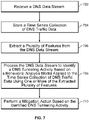
- Figure 7 is another flow diagram illustrating a process for providing a platform implementing a behavior analysis based DNS tunneling detection and classification framework for network security in accordance with some embodiments.
- a DNS data stream is received.
- the DNS data stream can include DNS query and DNS response data and/or other DNS related data.
- a time series collection of passive DNS traffic data is stored.
- the time series collection of passive DNS traffic data can be stored in an observation cache.
- a threshold number of instances of DNS queries with respect to a particular network domain received within a predetermined period of time is used as a trigger for performing further DNS tunneling analysis (e.g., of that particular DNS domain based on extracted features).
- a plurality of features is extracted from the DNS data stream.
- one or more features such as source IP address, source host, network domain name (e.g., SLD and/or FQDN), TTL value, and/or other features, can be extracted from the DNS data stream.
- the DNS data stream is processed to identify DNS tunneling activity (e.g., DNS tunneling behavior) based on a behavioral analysis model (e.g., a classifier) applied to a time series collection of DNS traffic data using the one or more of the extracted plurality of features.
- DNS tunneling activity e.g., DNS tunneling behavior
- a behavioral analysis model e.g., a classifier
- various techniques are disclosed for implementing a behavior analysis based DNS tunneling detection and classification framework for network security.
- a mitigation action based on the identified DNS tunneling activity is performed.
- the mitigation action can include a configuration action and/or a filtering action (e.g., block or drop packets to/from the bad/malware network domain and/or bad/malware IP address associated with the DNS tunneling activity).
- the mitigation action can include configuring a network device (e.g., a switch or router, implemented as a physical or virtual switch/router) to quarantine the infected host and/or block access to the bad network domain and/or bad IP address associated with DNS tunneling activity, using network access control or other mechanisms to quarantine the infected host and/or block access to the bad network domain and/or bad IP address, configuring a security device controller using Open Flow techniques to configure a network device (e.g., a switch or router, implemented as a physical or virtual switch/router) to quarantine the infected host and/or block access to the bad network domain and/or bad IP address, and/or to implement other configuration/programming techniques such as via API or publish/subscribe mechanisms to configure a network device (e.g., a switch or router, implemented as a physical or virtual switch/router) to quarantine the infected host and/or block access to the bad network domain and/or bad IP address.
- a network device e.g.,
Landscapes
- Engineering & Computer Science (AREA)
- Computer Security & Cryptography (AREA)
- Computer Hardware Design (AREA)
- Computing Systems (AREA)
- General Engineering & Computer Science (AREA)
- Computer Networks & Wireless Communication (AREA)
- Signal Processing (AREA)
- Data Exchanges In Wide-Area Networks (AREA)
Claims (15)
- System für eine Online-Plattform zur Implementierung eines auf Verhaltensanalyse basierenden DNS-Tunnelungserkennungs- und - klassifizierungsrahmens für Netzwerksicherheit, das Folgendes umfasst:
einen Prozessor (102), konfiguriert zum:Empfangen eines DNS-Datenstroms (104);Verarbeiten des DNS-Datenstroms (104) zum Identifizieren von DNS-Tunnelungsaktivität auf der Basis eines Verhaltensanalysemodells, das auf eine Zeitseriensammlung von passiven DNS-Verkehrsdaten (106) angewandt wird, wobei sich die DNS-Tunnelungsaktivität auf eine Nachricht bezieht, die durch einen TCP-Tunnel über ein DNS-Protokoll übermittelt wird, wobei das Verarbeiten des DNS-Datenstroms Folgendes beinhaltet:
Durchführen von zwei oder mehr der folgenden DNS-Merkmalsextraktionen zur Eingabe in das Verhaltensanalysemodell:A) Bestimmen von Entropie einer Textfolge im DNS-Datenstrom auf der Basis einer Verteilung eines Zeichensatzes innerhalb der Textfolge;B) Bestimmen eines lexikalischen Merkmals auf der Basis von für Menschen lesbaren Zeichen und für Menschen nicht lesbaren Zeichen innerhalb einer Textfolge, wobei die für Menschen lesbaren Zeichen alphabetische Zeichen beinhalten; oderC) Bestimmen eines Wertes in einem Perzentil einer N-Gram-Score-Verteilung aus einer Textfolge in dem DNS-Datenstrom, wobei das Perzentil auf der Basis eines Zeichensatzes innerhalb einer Textfolge bestimmt wird und wobei N einer ganzen Zahl gleich oder größer 2 entspricht; undferner mit einem oder mehreren der Folgenden zur Eingabe in das Verhaltensanalysemodell:D) Bestimmen eines Gini-Index einer Textfolge im DNS-Datenstrom auf der Basis einer Verteilung eines Zeichensatzes innerhalb der Textfolge;E) Bestimmen von Diversität der Textfolge im DNS-Datenstrom auf der Basis der Verteilung des Zeichensatzes innerhalb der Textfolge; oderF) Bestimmen einer Anzahl von Domänenbezeichnungen in einer FQDN-(Fully Qualified Domain Name)-Nutzlast; undDurchführen (606) einer Minderungsmaßnahme auf der Basis der identifizierten DNS-Tunnelungsaktivität; undeinen Speicher, der mit dem Prozessor (102) gekoppelt und zum Versorgen des Prozessors mit Befehlen konfiguriert ist. - System nach Anspruch 1, wobei eine Netzwerkdomäne auf der Basis einer Assoziation mit der identifizierten DNS-Tunnelungsaktivität als eine schlechte Netzwerkdomäne bestimmt wird, und wobei der Prozessor ferner konfiguriert ist zum:
Feststellen, dass ein Host infiziert ist, auf der Basis der Erkennung einer DNS-Abfrageanforderung an die schlechte Netzwerkdomäne von dem Host. - System nach Anspruch 1, wobei eine Netzwerkdomäne auf der Basis einer Assoziation mit der identifizierten DNS-Tunnelungsaktivität als eine schlechte Netzwerkdomäne bestimmt wird, und wobei der Prozessor ferner konfiguriert ist zum:Feststellen, dass ein Host infiziert ist, auf der Basis der Erkennung einer DNS-Abfrageanforderung an die schlechte Netzwerkdomäne von dem Host; undDurchführen einer weiteren Minderungsmaßnahme auf der Basis des festgestellten infizierten Hosts.
- System nach Anspruch 1, wobei eine Netzwerkdomäne auf der Basis einer Assoziation mit der identifizierten DNS-Tunnelungsaktivität als schlechte Netzwerkdomäne bestimmt wird, und wobei die Minderungsmaßnahme eines oder mehrere der Folgenden beinhaltet:Erzeugen einer Firewall-Regel auf der Basis der schlechten Netzwerkdomäne;Konfigurieren eines Netzwerkgeräts zum Blockieren von Netzwerkkommunikationen mit der schlechten Netzwerkdomäne;Quarantänisieren eines infizierten Hosts, wobei der infizierte Host auf der Basis einer Assoziation mit der schlechten Netzwerkdomäne als infiziert bestimmt wird; undHinzufügen der schlechten Netzwerkdomäne zu einem Reputationsfeed.
- System nach Anspruch 1, wobei eine Netzwerkdomäne auf der Basis einer Assoziation mit der identifizierten DNS-Tunnelungsaktivität als schlechte Netzwerkdomäne bestimmt wird, und wobei der Prozessor ferner konfiguriert ist zum:
Identifizieren einer Quell-IP-Adresse, eines Quell-Hosts oder eines Versuchs, die schlechte Netzwerkdomäne abzufragen. - System nach Anspruch 1, wobei der Prozessor ferner konfiguriert ist zum:
Speichern der Zeitseriensammlung von passiven DNS-Verkehrsdaten in einem Beobachtungscache. - System nach Anspruch 1, wobei der Prozessor ferner konfiguriert ist zum:
Empfangen von DNS-Daten, die von einem auf einem DNS-Appliance ausgeführten Agenten gesammelt werden. - System nach Anspruch 1, wobei der Prozessor ferner konfiguriert ist zum:
Extrahieren mehrerer Merkmale aus dem DNS-Datenstrom, um DNS-Tunnelung auf der Basis der extrahierten mehreren Merkmale zu erkennen. - Verfahren einer Online-Plattform zur Implementierung eines auf Verhaltensanalyse basierenden DNS-Tunnelungserkennungs- und - klassifizierungsrahmens für Netzwerksicherheit, das Folgendes beinhaltet:Empfangen eines DNS-Datenstroms (104);Verarbeiten (102) des DNS-Datenstroms mittels eines Prozessors, um DNS-Tunnelungsaktivität auf der Basis eines Verhaltensanalysemodells zu identifizieren, das auf eine Zeitseriensammlung von passiven DNS-Verkehrsdaten (106) angewendet wird, wobei sich die DNS-Tunnelungsaktivität auf eine Nachricht bezieht, die durch einen TCP-Tunnel über ein DNS-Protokoll übermittelt wird, wobei das Verarbeiten des DNS-Datenstroms (104) Folgendes beinhaltet:
Durchführen von zwei oder mehr der folgenden DNS-Merkmalsextraktionen zur Eingabe in das Verhaltensanalysemodell:A) Bestimmen von Entropie einer Textfolge in dem DNS-Datenstrom auf der Basis einer Verteilung eines Zeichensatzes innerhalb der Textfolge;B) Bestimmen eines lexikalischen Merkmals auf der Basis von für Menschen lesbaren Zeichen und für Menschen nicht lesbaren Zeichen innerhalb einer Textfolge, wobei die für Menschen lesbaren Zeichen alphabetische Zeichen umfassen; oderC) Bestimmen eines Wertes in einem Perzentil einer N-Gram-Score-Verteilung aus einer Textfolge in dem DNS-Datenstrom, wobei das Perzentil auf der Basis eines Zeichensatzes innerhalb einer Textfolge bestimmt wird, wobei die N-Gram-Score-Verteilung auf der Basis von historischen Veröffentlichungen bestimmt wird und wobei N einer ganzen Zahl gleich oder größer 2 entspricht; undferner mit einem oder mehreren der Folgenden zur Eingabe in das Verhaltensanalysemodell:D) Bestimmen eines Gini-Index einer Textfolge im DNS-Datenstrom auf der Basis einer Verteilung eines Zeichensatzes innerhalb der Textfolge;E) Bestimmen von Diversität der Textfolge im DNS-Datenstrom auf der Basis der Verteilung des Zeichensatzes innerhalb der Textfolge; oderF) Bestimmen einer Anzahl von Domänenbezeichnungen in einer FQDN-(Fully Qualified Domain Name)-Nutzlast; undDurchführen (606) einer Minderungsmaßnahme auf der Basis der identifizierten DNS-Tunnelungsaktivität. - Verfahren nach Anspruch 9, wobei eine Netzwerkdomäne auf der Basis einer Assoziation mit der identifizierten DNS-Tunnelungsaktivität als eine schlechte Netzwerkdomäne bestimmt wird, und das ferner Folgendes beinhaltet:
Feststellen, dass ein Host infiziert ist, auf der Basis der Erkennung einer DNS-Abfrageanforderung an die schlechte Netzwerkdomäne von dem Host. - Verfahren nach Anspruch 9, wobei eine Netzwerkdomäne auf der Basis einer Assoziation mit der identifizierten DNS-Tunnelungsaktivität als eine schlechte Netzwerkdomäne bestimmt wird, und das ferner Folgendes beinhaltet:Feststellen, dass ein Host infiziert ist, auf der Basis der Erkennung einer DNS-Abfrageanforderung an die schlechte Netzwerkdomäne von dem Host; undDurchführen einer weiteren Minderungsmaßnahme auf der Basis des festgestellten infizierten Hosts.
- Computerprogrammprodukt für eine Online-Plattform zur Implementierung eines auf Verhaltensanalyse basierenden DNS-Tunnelungserkennungs- und - klassifizierungsrahmens für Netzwerksicherheit, wobei das Computerprogrammprodukt in einem materiellen, computerlesbaren Speichermedium ausgestaltet ist und Computerbefehle umfasst zum:Empfangen eines DNS-Datenstroms (104);Verarbeiten (102) des DNS-Datenstroms, um DNS-Tunnelungsaktivität auf der Basis eines Verhaltensanalysemodells zu identifizieren, das auf eine Zeitseriensammlung von passiven DNS-Verkehrsdaten angewendet wird, wobei sich die DNS-Tunnelungsaktivität auf eine Nachricht bezieht, die durch einen TCP-Tunnel über ein DNS-Protokoll übermittelt wird, wobei das Verarbeiten des DNS-Datenstroms Folgendes beinhaltet:
Durchführen von zwei oder mehr der folgenden DNS-Merkmalsextraktionen zur Eingabe in das Verhaltensanalysemodell:A) Bestimmen von Entropie einer Textfolge im DNS-Datenstrom auf der Basis einer Verteilung eines Zeichensatzes innerhalb der Textfolge;B) Bestimmen eines lexikalischen Merkmals auf der Basis von für Menschen lesbaren Zeichen und für Menschen nicht lesbaren Zeichen innerhalb einer Textfolge, wobei die für Menschen lesbaren Zeichen alphabetische Zeichen umfassen; oderC) Bestimmen eines Wertes in einem Perzentil einer N-Gram-Score-Verteilung aus einer Textfolge in dem DNS-Datenstrom, wobei das Perzentil auf der Basis eines Zeichensatzes innerhalb einer Textfolge bestimmt wird, wobei die N-Gram-Score-Verteilung auf der Basis historischer Veröffentlichungen bestimmt wird und wobei N einer ganzen Zahl gleich oder größer 2 entspricht; undferner mit einem oder mehreren der Folgenden zur Eingabe in das Verhaltensanalysemodell:D) Bestimmen eines Gini-Index einer Textfolge im DNS-Datenstrom auf der Basis einer Verteilung eines Zeichensatzes innerhalb der Textfolge;E) Bestimmen von Diversität der Textfolge im DNS-Datenstrom auf der Basis der Verteilung des Zeichensatzes innerhalb der Textfolge; oderF) Bestimmen einer Anzahl von Domänenbezeichnungen in einer FQDN-(Fully Qualified Domain Name)-Nutzlast; undDurchführen (606) einer Minderungsmaßnahme auf der Basis der identifizierten DNS-Tunnelungsaktivität. - System nach Anspruch 1 oder Verfahren nach Anspruch 9 oder Computerprogrammprodukt nach Anspruch 12, wobei der DNS-Datenstrom DNS-Abfrage- und DNS-Antwortdaten enthält.
- System nach Anspruch 1 oder Verfahren nach Anspruch 9 oder Computerprogrammprodukt nach Anspruch 12, wobei eine Netzwerkdomäne auf der Basis einer Assoziation mit der identifizierten DNS-Tunnelungsaktivität als schlechte Netzwerkdomäne bestimmt wird und wobei die schlechte Netzwerkdomäne mit einem FQDN (Fully Qualified Domäne Name) assoziiert ist.
- Computerprogrammprodukt nach Anspruch 12, wobei eine Netzwerkdomäne auf der Basis einer Assoziation mit der identifizierten DNS-Tunnelungsaktivität als schlechte Netzwerkdomäne bestimmt wird, und das ferner Computerbefehle umfasst zum:Feststellen, dass ein Host infiziert ist, auf der Basis der Erkennung einer DNS-Abfrageanforderung an die schlechte Netzwerkdomäne von dem Host; oderComputerbefehle umfasst zum:Feststellen, dass ein Host infiziert ist, auf der Basis der Erkennung einer DNS-Abfrageanforderung an die schlechte Netzwerkdomäne von dem Host; undDurchführen einer anderen Minderungsmaßnahme auf der Basis des festgestellten infizierten Hosts.
Applications Claiming Priority (4)
| Application Number | Priority Date | Filing Date | Title |
|---|---|---|---|
| US201562142846P | 2015-04-03 | 2015-04-03 | |
| US201562205385P | 2015-08-14 | 2015-08-14 | |
| US14/870,822 US9794229B2 (en) | 2015-04-03 | 2015-09-30 | Behavior analysis based DNS tunneling detection and classification framework for network security |
| PCT/US2016/017213 WO2016160132A1 (en) | 2015-04-03 | 2016-02-09 | Behavior analysis based dns tunneling detection and classification framework for network security |
Publications (3)
| Publication Number | Publication Date |
|---|---|
| EP3278516A1 EP3278516A1 (de) | 2018-02-07 |
| EP3278516A4 EP3278516A4 (de) | 2018-12-05 |
| EP3278516B1 true EP3278516B1 (de) | 2022-11-23 |
Family
ID=57005178
Family Applications (1)
| Application Number | Title | Priority Date | Filing Date |
|---|---|---|---|
| EP16773621.4A Active EP3278516B1 (de) | 2015-04-03 | 2016-02-09 | Auf verhaltensanalyse basierendes system zur erkennung und klassifizierung von dns-tunnelierung für netzwerksicherheit |
Country Status (4)
| Country | Link |
|---|---|
| US (2) | US9794229B2 (de) |
| EP (1) | EP3278516B1 (de) |
| JP (1) | JP7014606B2 (de) |
| WO (1) | WO2016160132A1 (de) |
Families Citing this family (106)
| Publication number | Priority date | Publication date | Assignee | Title |
|---|---|---|---|---|
| US9363269B2 (en) * | 2014-07-30 | 2016-06-07 | Zscaler, Inc. | Zero day threat detection based on fast flux detection and aggregation |
| US10805318B2 (en) | 2015-08-28 | 2020-10-13 | Hewlett Packard Enterprise Development Lp | Identification of a DNS packet as malicious based on a value |
| EP3275150B1 (de) * | 2015-08-28 | 2019-08-07 | Hewlett-Packard Enterprise Development LP | Extrahierte datenklassifizierung zur bestimmung, ob ein dns-paket schädlich ist |
| US9699205B2 (en) | 2015-08-31 | 2017-07-04 | Splunk Inc. | Network security system |
| US9648034B2 (en) * | 2015-09-05 | 2017-05-09 | Nudata Security Inc. | Systems and methods for detecting and scoring anomalies |
| US10331802B2 (en) | 2016-02-29 | 2019-06-25 | Oracle International Corporation | System for detecting and characterizing seasons |
| US10867421B2 (en) | 2016-02-29 | 2020-12-15 | Oracle International Corporation | Seasonal aware method for forecasting and capacity planning |
| US10885461B2 (en) | 2016-02-29 | 2021-01-05 | Oracle International Corporation | Unsupervised method for classifying seasonal patterns |
| US10699211B2 (en) | 2016-02-29 | 2020-06-30 | Oracle International Corporation | Supervised method for classifying seasonal patterns |
| US10075458B2 (en) * | 2016-04-29 | 2018-09-11 | International Business Machines Corporation | Cognitive and contextual detection of malicious DNS |
| US10198339B2 (en) | 2016-05-16 | 2019-02-05 | Oracle International Corporation | Correlation-based analytic for time-series data |
| US10700894B2 (en) * | 2016-06-01 | 2020-06-30 | At&T Intellectual Property I, L.P. | Network caching of outbound content from endpoint device to prevent unauthorized extraction |
| US10635563B2 (en) | 2016-08-04 | 2020-04-28 | Oracle International Corporation | Unsupervised method for baselining and anomaly detection in time-series data for enterprise systems |
| US11082439B2 (en) | 2016-08-04 | 2021-08-03 | Oracle International Corporation | Unsupervised method for baselining and anomaly detection in time-series data for enterprise systems |
| US10673880B1 (en) | 2016-09-26 | 2020-06-02 | Splunk Inc. | Anomaly detection to identify security threats |
| US10505970B2 (en) * | 2016-10-05 | 2019-12-10 | Cisco Technology, Inc. | Identifying and using DNS contextual flows |
| US10326736B2 (en) * | 2016-11-02 | 2019-06-18 | Cisco Technology, Inc. | Feature-based classification of individual domain queries |
| CN106357470B (zh) * | 2016-11-15 | 2019-09-10 | 中国电子科技集团公司第四十一研究所 | 一种基于sdn控制器网络威胁快速感知方法 |
| US11310247B2 (en) | 2016-12-21 | 2022-04-19 | Micro Focus Llc | Abnormal behavior detection of enterprise entities using time-series data |
| US10547636B2 (en) * | 2016-12-28 | 2020-01-28 | Verisign, Inc. | Method and system for detecting and mitigating denial-of-service attacks |
| US10728264B2 (en) * | 2017-02-15 | 2020-07-28 | Micro Focus Llc | Characterizing behavior anomaly analysis performance based on threat intelligence |
| US10949436B2 (en) | 2017-02-24 | 2021-03-16 | Oracle International Corporation | Optimization for scalable analytics using time series models |
| US10412107B2 (en) | 2017-03-22 | 2019-09-10 | Microsoft Technology Licensing, Llc | Detecting domain name system (DNS) tunneling based on DNS logs and network data |
| CN106973051B (zh) * | 2017-03-27 | 2019-11-19 | 山石网科通信技术股份有限公司 | 建立检测网络威胁模型的方法、装置和存储介质 |
| US10440037B2 (en) * | 2017-03-31 | 2019-10-08 | Mcafee, Llc | Identifying malware-suspect end points through entropy changes in consolidated logs |
| US10817803B2 (en) | 2017-06-02 | 2020-10-27 | Oracle International Corporation | Data driven methods and systems for what if analysis |
| US11032127B2 (en) * | 2017-06-26 | 2021-06-08 | Verisign, Inc. | Resilient domain name service (DNS) resolution when an authoritative name server is unavailable |
| US10452846B2 (en) * | 2017-07-13 | 2019-10-22 | Cisco Technology, Inc. | OS start event detection, OS fingerprinting, and device tracking using enhanced data features |
| US10432651B2 (en) * | 2017-08-17 | 2019-10-01 | Zscaler, Inc. | Systems and methods to detect and monitor DNS tunneling |
| US10621005B2 (en) | 2017-08-31 | 2020-04-14 | Oracle International Corporation | Systems and methods for providing zero down time and scalability in orchestration cloud services |
| US10917384B2 (en) * | 2017-09-12 | 2021-02-09 | Synergex Group | Methods, systems, and media for modifying firewalls based on dynamic IP addresses |
| US10104039B1 (en) * | 2017-09-28 | 2018-10-16 | Cloudflare, Inc. | Establishing and using a tunnel from an origin server in a distributed edge compute and routing service |
| US20190141067A1 (en) * | 2017-11-09 | 2019-05-09 | Cisco Technology, Inc. | Deep recurrent neural network for cloud server profiling and anomaly detection through dns queries |
| US11153330B1 (en) * | 2017-11-22 | 2021-10-19 | Cisco Technology, Inc. | Detection of DNS (domain name system) tunneling and exfiltration through DNS query analysis |
| CN108200054B (zh) * | 2017-12-29 | 2021-02-12 | 奇安信科技集团股份有限公司 | 一种基于dns解析的恶意域名检测方法及装置 |
| RU2668710C1 (ru) | 2018-01-17 | 2018-10-02 | Общество с ограниченной ответственностью "Группа АйБи ТДС" | Вычислительное устройство и способ для обнаружения вредоносных доменных имен в сетевом трафике |
| US11218447B2 (en) * | 2018-03-02 | 2022-01-04 | Disney Enterprises, Inc. | Firewall rule remediation for improved network security and performance |
| US10986183B2 (en) * | 2018-05-02 | 2021-04-20 | Hewlett Packard Enterprise Development Lp | Data management in a network environment |
| US11575688B2 (en) * | 2018-05-02 | 2023-02-07 | Sri International | Method of malware characterization and prediction |
| US10963346B2 (en) | 2018-06-05 | 2021-03-30 | Oracle International Corporation | Scalable methods and systems for approximating statistical distributions |
| US10997517B2 (en) | 2018-06-05 | 2021-05-04 | Oracle International Corporation | Methods and systems for aggregating distribution approximations |
| CN109189221B (zh) * | 2018-08-23 | 2021-07-16 | 郑州航空工业管理学院 | 一种跨手机平台的用户行为识别方法 |
| US11627156B2 (en) * | 2018-09-21 | 2023-04-11 | Radware Ltd. | System and method for detecting bots using semi-supervised deep learning techniques |
| US11108730B2 (en) | 2018-09-27 | 2021-08-31 | Hewlett Packard Enterprise Development Lp | Group heartbeat information in a domain name system server text record |
| US12001926B2 (en) | 2018-10-23 | 2024-06-04 | Oracle International Corporation | Systems and methods for detecting long term seasons |
| US11138090B2 (en) | 2018-10-23 | 2021-10-05 | Oracle International Corporation | Systems and methods for forecasting time series with variable seasonality |
| EP3651426A1 (de) * | 2018-11-06 | 2020-05-13 | Efficient IP SAS | Verfahren und system zum erkennen und blockieren der datenübertragung unter verwendung des dns-protokolls |
| RU2701040C1 (ru) | 2018-12-28 | 2019-09-24 | Общество с ограниченной ответственностью "Траст" | Способ и вычислительное устройство для информирования о вредоносных веб-ресурсах |
| US11303605B2 (en) * | 2019-01-15 | 2022-04-12 | Illumio, Inc. | Domain name based visibility and policy enforcement in a segmented network environment |
| JP7120049B2 (ja) | 2019-01-25 | 2022-08-17 | 富士通株式会社 | サイバー攻撃評価プログラム、サイバー攻撃評価方法および情報処理装置 |
| US10855548B2 (en) | 2019-02-15 | 2020-12-01 | Oracle International Corporation | Systems and methods for automatically detecting, summarizing, and responding to anomalies |
| CN110071829B (zh) * | 2019-04-12 | 2022-03-04 | 腾讯科技(深圳)有限公司 | Dns隧道检测方法、装置及计算机可读存储介质 |
| US11206265B2 (en) * | 2019-04-30 | 2021-12-21 | Infoblox Inc. | Smart whitelisting for DNS security |
| US11533326B2 (en) | 2019-05-01 | 2022-12-20 | Oracle International Corporation | Systems and methods for multivariate anomaly detection in software monitoring |
| US11537940B2 (en) | 2019-05-13 | 2022-12-27 | Oracle International Corporation | Systems and methods for unsupervised anomaly detection using non-parametric tolerance intervals over a sliding window of t-digests |
| US11238031B2 (en) | 2019-05-31 | 2022-02-01 | Walmart Apollo, Llc | Systems and methods of metadata monitoring and analysis |
| US11188525B2 (en) * | 2019-05-31 | 2021-11-30 | Walmart Apollo, Llc | Systems and methods of platform-agnostic metadata analysis |
| US11887015B2 (en) | 2019-09-13 | 2024-01-30 | Oracle International Corporation | Automatically-generated labels for time series data and numerical lists to use in analytic and machine learning systems |
| US11729134B2 (en) | 2019-09-30 | 2023-08-15 | Palo Alto Networks, Inc. | In-line detection of algorithmically generated domains |
| US11595357B2 (en) * | 2019-10-23 | 2023-02-28 | Cisco Technology, Inc. | Identifying DNS tunneling domain names by aggregating features per subdomain |
| US11271959B2 (en) | 2019-11-20 | 2022-03-08 | Crowdstrike, Inc. | Method and apparatus for combining a firewall and a forensics agent to detect and prevent malicious software activity |
| RU2727932C1 (ru) * | 2019-12-04 | 2020-07-27 | Публичное Акционерное Общество "Сбербанк России" (Пао Сбербанк) | Способ и система выявления вредоносных файлов с помощью генерирования объявлений на торговых онлайн платформах |
| US11019022B1 (en) * | 2020-01-28 | 2021-05-25 | F5 Networks, Inc. | Processing packets with returnable values |
| US11606385B2 (en) * | 2020-02-13 | 2023-03-14 | Palo Alto Networks (Israel Analytics) Ltd. | Behavioral DNS tunneling identification |
| US20210266293A1 (en) * | 2020-02-24 | 2021-08-26 | Palo Alto Networks, Inc. | Real-time detection of dns tunneling traffic |
| US11811820B2 (en) | 2020-02-24 | 2023-11-07 | Palo Alto Networks (Israel Analytics) Ltd. | Malicious C and C channel to fixed IP detection |
| US11784969B2 (en) | 2020-03-20 | 2023-10-10 | Phrase Health, Inc. | System for securely monitoring and extracting data through a private network |
| CN111680075A (zh) * | 2020-04-16 | 2020-09-18 | 兰州理工大学 | 一种基于离线分析和在线预测结合的Hadoop+Spark交通预测系统及方法 |
| TWI811545B (zh) * | 2020-05-18 | 2023-08-11 | 安碁資訊股份有限公司 | 域名系統中惡意域名的偵測方法與偵測裝置 |
| US11909771B2 (en) | 2020-06-01 | 2024-02-20 | Cisco Technology, Inc. | Role-based policy DNS response for network security user notifications |
| CN111756874A (zh) * | 2020-06-24 | 2020-10-09 | 北京天融信网络安全技术有限公司 | 一种dns隧道上层协议的类型的识别方法和装置 |
| CN111835763B (zh) * | 2020-07-13 | 2022-03-04 | 北京邮电大学 | 一种dns隧道流量检测方法、装置及电子设备 |
| US11743272B2 (en) * | 2020-08-10 | 2023-08-29 | International Business Machines Corporation | Low-latency identification of network-device properties |
| CN114124367B (zh) * | 2020-08-31 | 2023-03-24 | Oppo广东移动通信有限公司 | 一种数据传输方法、装置及存储介质 |
| CN116318677A (zh) * | 2020-08-31 | 2023-06-23 | Oppo广东移动通信有限公司 | 一种数据传输方法、客户端、服务端及存储介质 |
| US12493497B2 (en) | 2020-09-17 | 2025-12-09 | International Business Machines Corporation | Detection and handling of excessive resource usage in a distributed computing environment |
| US11916942B2 (en) * | 2020-12-04 | 2024-02-27 | Infoblox Inc. | Automated identification of false positives in DNS tunneling detectors |
| US11595352B2 (en) | 2020-12-21 | 2023-02-28 | Microsoft Technology Licensing, Llc | Performing transport layer security (TLS) termination using categories of web categorization |
| CN112911011B (zh) * | 2021-02-05 | 2022-05-27 | 深圳前海益链网络科技有限公司 | 一种应用于区块链的区块生成控制方法及相关装置 |
| TWI758179B (zh) * | 2021-05-07 | 2022-03-11 | 華南商業銀行股份有限公司 | 依據回應時間選擇網域名稱系統服務之客戶端連線方法 |
| WO2022239166A1 (ja) * | 2021-05-12 | 2022-11-17 | 日本電信電話株式会社 | 抽出方法、抽出装置及び抽出プログラム |
| TWI796706B (zh) * | 2021-06-11 | 2023-03-21 | 安碁資訊股份有限公司 | 資料外洩偵測方法與裝置 |
| NL2031253B1 (en) | 2021-08-19 | 2023-03-24 | Group Ib Tds Ltd | Computing device and method of detecting compromised network devices based on dns tunneling detection |
| GB202113173D0 (en) * | 2021-09-15 | 2021-10-27 | British Telecomm | Network protection |
| US12028354B2 (en) | 2021-10-26 | 2024-07-02 | Palo Alto Networks, Inc. | Predictive DNS cache to improve security and performance |
| CN116203720B (zh) * | 2021-12-01 | 2026-02-24 | 港大科桥有限公司 | 用于使用金刚石的颜色空间相关的拉曼光谱的防伪系统的方法和设备 |
| CN114301631A (zh) * | 2021-12-02 | 2022-04-08 | 北京安天网络安全技术有限公司 | 一种dns恶意数据检测方法、装置、设备及介质 |
| US12355875B2 (en) * | 2022-01-27 | 2025-07-08 | Boe Technology Group Co., Ltd. | Conference data transmission method, apparatus and system, electronic device and readable medium |
| US20230336528A1 (en) * | 2022-04-18 | 2023-10-19 | Palo Alto Networks, Inc. | System and method for detecting dictionary-based dga traffic |
| US11664986B2 (en) | 2022-04-20 | 2023-05-30 | EllansaLabs Inc. | System and method for etching internal surfaces of transparent gemstones with information pertaining to a blockchain |
| US12160533B2 (en) * | 2022-04-20 | 2024-12-03 | EllansaLabs Inc. | System and method for etching internal surfaces of transparent gemstones with information pertaining to a blockchain |
| US20230388322A1 (en) * | 2022-05-26 | 2023-11-30 | Blackberry Limited | Domain name system tunneling detection |
| US12506729B2 (en) | 2022-06-20 | 2025-12-23 | Palo Alto Networks, Inc. | Detecting credentials abuse of cloud compute services |
| US11968222B2 (en) | 2022-07-05 | 2024-04-23 | Palo Alto Networks (Israel Analytics) Ltd. | Supply chain attack detection |
| US12556365B2 (en) * | 2022-10-14 | 2026-02-17 | Tencent Technology (Shenzhen) Company Limited | Data processing methods and apparatuses based on blockchain, electronic device, computer-readable storage medium, and computer program product |
| CN115643087B (zh) * | 2022-10-24 | 2024-04-30 | 天津大学 | 一种基于编码特征与统计行为特征融合的dns隧道检测方法 |
| US11867637B2 (en) | 2022-12-15 | 2024-01-09 | EllansaLabs Inc. | Systems for authentication and related devices and methods |
| US11783145B2 (en) | 2022-12-21 | 2023-10-10 | EllansaLabs Inc. | Systems for authentication and related devices and methods |
| US12213295B2 (en) | 2023-03-15 | 2025-01-28 | EllansaLabs Inc. | Diamond-based electromagnetic interference shield |
| US12470596B2 (en) | 2023-04-05 | 2025-11-11 | Palo Alto Networks, Inc. | Model for detecting phishing URLS |
| US12375351B2 (en) * | 2023-11-30 | 2025-07-29 | Adriano Monteiro Marques | Unified programmable dynamic context-aware configuration |
| US12598198B2 (en) * | 2024-04-17 | 2026-04-07 | Oracle International Corporation | Detecting data exfiltration and infiltration over DNS |
| US12574234B2 (en) * | 2024-04-18 | 2026-03-10 | Degensoft Ltd | Secure cross-chain atomic swaps |
| US20250358312A1 (en) * | 2024-05-17 | 2025-11-20 | T-Mobile Innovations Llc | Identifying and disrupting malicious traffic in telecommunications networks |
| US20260067225A1 (en) * | 2024-08-27 | 2026-03-05 | Infoblox Inc. | Device classification using dns queries |
| CN120979816A (zh) * | 2025-09-28 | 2025-11-18 | 中国信息安全测评中心 | 面向不同通信架构的僵尸网络分类化抑制阻断方法及系统 |
Family Cites Families (26)
| Publication number | Priority date | Publication date | Assignee | Title |
|---|---|---|---|---|
| US7426576B1 (en) | 2002-09-20 | 2008-09-16 | Network Appliance, Inc. | Highly available DNS resolver and method for use of the same |
| US20060031928A1 (en) * | 2004-08-09 | 2006-02-09 | Conley James W | Detector and computerized method for determining an occurrence of tunneling activity |
| US9692725B2 (en) | 2005-05-26 | 2017-06-27 | Citrix Systems, Inc. | Systems and methods for using an HTTP-aware client agent |
| US9055093B2 (en) * | 2005-10-21 | 2015-06-09 | Kevin R. Borders | Method, system and computer program product for detecting at least one of security threats and undesirable computer files |
| US7970878B1 (en) * | 2005-11-16 | 2011-06-28 | Cisco Technology, Inc. | Method and apparatus for limiting domain name server transaction bandwidth |
| US7890612B2 (en) | 2006-05-08 | 2011-02-15 | Electro Guard Corp. | Method and apparatus for regulating data flow between a communications device and a network |
| US8539577B1 (en) * | 2008-06-20 | 2013-09-17 | Verisign, Inc. | System and method for fast flux detection |
| US8763127B2 (en) * | 2009-03-13 | 2014-06-24 | Rutgers, The State University Of New Jersey | Systems and method for malware detection |
| US20120254333A1 (en) * | 2010-01-07 | 2012-10-04 | Rajarathnam Chandramouli | Automated detection of deception in short and multilingual electronic messages |
| US8321551B2 (en) * | 2010-02-02 | 2012-11-27 | Symantec Corporation | Using aggregated DNS information originating from multiple sources to detect anomalous DNS name resolutions |
| JP2011193343A (ja) * | 2010-03-16 | 2011-09-29 | Kddi Corp | 通信ネットワーク監視システム |
| US8385593B2 (en) * | 2010-06-18 | 2013-02-26 | Google Inc. | Selecting representative images for establishments |
| US8260914B1 (en) * | 2010-06-22 | 2012-09-04 | Narus, Inc. | Detecting DNS fast-flux anomalies |
| US9516058B2 (en) * | 2010-08-10 | 2016-12-06 | Damballa, Inc. | Method and system for determining whether domain names are legitimate or malicious |
| US8661544B2 (en) * | 2010-08-31 | 2014-02-25 | Cisco Technology, Inc. | Detecting botnets |
| US9003518B2 (en) * | 2010-09-01 | 2015-04-07 | Raytheon Bbn Technologies Corp. | Systems and methods for detecting covert DNS tunnels |
| US9843601B2 (en) * | 2011-07-06 | 2017-12-12 | Nominum, Inc. | Analyzing DNS requests for anomaly detection |
| US8904524B1 (en) * | 2011-09-27 | 2014-12-02 | Emc Corporation | Detection of fast flux networks |
| US9178876B1 (en) * | 2011-10-20 | 2015-11-03 | Amazon Technologies, Inc. | Strength-based password expiration |
| US8918836B2 (en) * | 2012-04-23 | 2014-12-23 | Microsoft Corporation | Predicting next characters in password generation |
| WO2014138205A2 (en) * | 2013-03-05 | 2014-09-12 | The University Of North Carolina At Chapel Hill | Methods, systems, and computer readable media for detecting a compromised computing host |
| US20140307551A1 (en) | 2013-04-12 | 2014-10-16 | Nokia Siemens Networks Oy | Automatic learning of wi-fi neighbors and network characteristics |
| US9270693B2 (en) * | 2013-09-19 | 2016-02-23 | The Boeing Company | Detection of infected network devices and fast-flux networks by tracking URL and DNS resolution changes |
| US9191403B2 (en) * | 2014-01-07 | 2015-11-17 | Fair Isaac Corporation | Cyber security adaptive analytics threat monitoring system and method |
| US9729413B2 (en) * | 2014-10-07 | 2017-08-08 | Coudmark, Inc. | Apparatus and method for identifying domain name system tunneling, exfiltration and infiltration |
| EP3213207A4 (de) * | 2014-10-31 | 2018-04-25 | Cyber Crucible Inc. | System und verfahren zur netzwerkeindringungsdetektion von verborgenen kanälen auf basis von offline-netzwerkverkehr |
-
2015
- 2015-09-30 US US14/870,822 patent/US9794229B2/en active Active
-
2016
- 2016-02-09 WO PCT/US2016/017213 patent/WO2016160132A1/en not_active Ceased
- 2016-02-09 EP EP16773621.4A patent/EP3278516B1/de active Active
- 2016-02-09 JP JP2017547003A patent/JP7014606B2/ja active Active
-
2017
- 2017-09-14 US US15/705,118 patent/US10270744B2/en active Active
Also Published As
| Publication number | Publication date |
|---|---|
| WO2016160132A1 (en) | 2016-10-06 |
| JP2018513592A (ja) | 2018-05-24 |
| US20160294773A1 (en) | 2016-10-06 |
| EP3278516A4 (de) | 2018-12-05 |
| US10270744B2 (en) | 2019-04-23 |
| EP3278516A1 (de) | 2018-02-07 |
| US20180109494A1 (en) | 2018-04-19 |
| US9794229B2 (en) | 2017-10-17 |
| JP7014606B2 (ja) | 2022-02-01 |
Similar Documents
| Publication | Publication Date | Title |
|---|---|---|
| US10270744B2 (en) | Behavior analysis based DNS tunneling detection and classification framework for network security | |
| US10425383B2 (en) | Platforms for implementing an analytics framework for DNS security | |
| Vinayakumar et al. | Scalable framework for cyber threat situational awareness based on domain name systems data analysis | |
| Najafimehr et al. | DDoS attacks and machine‐learning‐based detection methods: A survey and taxonomy | |
| US10574681B2 (en) | Detection of known and unknown malicious domains | |
| US11122063B2 (en) | Malicious domain scoping recommendation system | |
| Choi et al. | A method of DDoS attack detection using HTTP packet pattern and rule engine in cloud computing environment | |
| EP3948587B1 (de) | Pipeline zur graph-stream-gewinnung zur effizienten subgraph-detektion | |
| US12126639B2 (en) | System and method for locating DGA compromised IP addresses | |
| Singh et al. | An approach of ddos attack detection using classifiers | |
| CN118901223A (zh) | 用于检测恶意命令和控制流量的深度学习管道 | |
| Kozik et al. | Cost‐Sensitive Distributed Machine Learning for NetFlow‐Based Botnet Activity Detection | |
| US20250202916A1 (en) | Real-time attribution of tools and campaigns for dns tunneling traffic | |
| US20250358300A1 (en) | Ml based domain risk scoring and its applications to advanced url filtering | |
| Sree et al. | HADM: detection of HTTP GET flooding attacks by using Analytical hierarchical process and Dempster–Shafer theory with MapReduce | |
| US12531886B2 (en) | Machine learning for prioritizing traffic in multi- purpose inline cloud analysis (MICA) to enhance malware detection | |
| Jing et al. | DDoS detection based on graph structure features and non‐negative matrix factorization | |
| KR102676386B1 (ko) | 인라인 멀웨어 검출 | |
| US20260006074A1 (en) | Proactively discovering malicious domains through guided crawling of attack infrastructure | |
| Najafi et al. | Guilt-by-association: detecting malicious entities via graph mining | |
| US20240154997A1 (en) | Tor-based malware detection | |
| Kumar et al. | PeerClear: Peer-to-peer bot-net detection | |
| Jeng et al. | MD‐MinerP: Interaction Profiling Bipartite Graph Mining for Malware‐Control Domain Detection | |
| US20260089135A1 (en) | Adns telemetry | |
| US20260058991A1 (en) | In-path per-query sanitization to defeat dns tunneling |
Legal Events
| Date | Code | Title | Description |
|---|---|---|---|
| STAA | Information on the status of an ep patent application or granted ep patent |
Free format text: STATUS: THE INTERNATIONAL PUBLICATION HAS BEEN MADE |
|
| PUAI | Public reference made under article 153(3) epc to a published international application that has entered the european phase |
Free format text: ORIGINAL CODE: 0009012 |
|
| STAA | Information on the status of an ep patent application or granted ep patent |
Free format text: STATUS: REQUEST FOR EXAMINATION WAS MADE |
|
| 17P | Request for examination filed |
Effective date: 20170901 |
|
| AK | Designated contracting states |
Kind code of ref document: A1 Designated state(s): AL AT BE BG CH CY CZ DE DK EE ES FI FR GB GR HR HU IE IS IT LI LT LU LV MC MK MT NL NO PL PT RO RS SE SI SK SM TR |
|
| AX | Request for extension of the european patent |
Extension state: BA ME |
|
| DAV | Request for validation of the european patent (deleted) | ||
| DAX | Request for extension of the european patent (deleted) | ||
| A4 | Supplementary search report drawn up and despatched |
Effective date: 20181030 |
|
| RIC1 | Information provided on ipc code assigned before grant |
Ipc: H04L 12/721 20130101AFI20181024BHEP Ipc: H04L 29/06 20060101ALI20181024BHEP |
|
| STAA | Information on the status of an ep patent application or granted ep patent |
Free format text: STATUS: EXAMINATION IS IN PROGRESS |
|
| 17Q | First examination report despatched |
Effective date: 20210609 |
|
| REG | Reference to a national code |
Ref country code: DE Ref legal event code: R079 Ref document number: 602016076484 Country of ref document: DE Free format text: PREVIOUS MAIN CLASS: H04L0012721000 Ipc: H04L0009400000 |
|
| GRAP | Despatch of communication of intention to grant a patent |
Free format text: ORIGINAL CODE: EPIDOSNIGR1 |
|
| STAA | Information on the status of an ep patent application or granted ep patent |
Free format text: STATUS: GRANT OF PATENT IS INTENDED |
|
| RIC1 | Information provided on ipc code assigned before grant |
Ipc: H04L 9/40 20220101AFI20220525BHEP |
|
| INTG | Intention to grant announced |
Effective date: 20220620 |
|
| GRAS | Grant fee paid |
Free format text: ORIGINAL CODE: EPIDOSNIGR3 |
|
| GRAA | (expected) grant |
Free format text: ORIGINAL CODE: 0009210 |
|
| STAA | Information on the status of an ep patent application or granted ep patent |
Free format text: STATUS: THE PATENT HAS BEEN GRANTED |
|
| AK | Designated contracting states |
Kind code of ref document: B1 Designated state(s): AL AT BE BG CH CY CZ DE DK EE ES FI FR GB GR HR HU IE IS IT LI LT LU LV MC MK MT NL NO PL PT RO RS SE SI SK SM TR |
|
| REG | Reference to a national code |
Ref country code: GB Ref legal event code: FG4D |
|
| REG | Reference to a national code |
Ref country code: CH Ref legal event code: EP |
|
| REG | Reference to a national code |
Ref country code: AT Ref legal event code: REF Ref document number: 1533824 Country of ref document: AT Kind code of ref document: T Effective date: 20221215 Ref country code: DE Ref legal event code: R096 Ref document number: 602016076484 Country of ref document: DE |
|
| REG | Reference to a national code |
Ref country code: IE Ref legal event code: FG4D |
|
| REG | Reference to a national code |
Ref country code: LT Ref legal event code: MG9D |
|
| REG | Reference to a national code |
Ref country code: NL Ref legal event code: MP Effective date: 20221123 |
|
| REG | Reference to a national code |
Ref country code: AT Ref legal event code: MK05 Ref document number: 1533824 Country of ref document: AT Kind code of ref document: T Effective date: 20221123 |
|
| PG25 | Lapsed in a contracting state [announced via postgrant information from national office to epo] |
Ref country code: SE Free format text: LAPSE BECAUSE OF FAILURE TO SUBMIT A TRANSLATION OF THE DESCRIPTION OR TO PAY THE FEE WITHIN THE PRESCRIBED TIME-LIMIT Effective date: 20221123 Ref country code: PT Free format text: LAPSE BECAUSE OF FAILURE TO SUBMIT A TRANSLATION OF THE DESCRIPTION OR TO PAY THE FEE WITHIN THE PRESCRIBED TIME-LIMIT Effective date: 20230323 Ref country code: NO Free format text: LAPSE BECAUSE OF FAILURE TO SUBMIT A TRANSLATION OF THE DESCRIPTION OR TO PAY THE FEE WITHIN THE PRESCRIBED TIME-LIMIT Effective date: 20230223 Ref country code: LT Free format text: LAPSE BECAUSE OF FAILURE TO SUBMIT A TRANSLATION OF THE DESCRIPTION OR TO PAY THE FEE WITHIN THE PRESCRIBED TIME-LIMIT Effective date: 20221123 Ref country code: FI Free format text: LAPSE BECAUSE OF FAILURE TO SUBMIT A TRANSLATION OF THE DESCRIPTION OR TO PAY THE FEE WITHIN THE PRESCRIBED TIME-LIMIT Effective date: 20221123 Ref country code: ES Free format text: LAPSE BECAUSE OF FAILURE TO SUBMIT A TRANSLATION OF THE DESCRIPTION OR TO PAY THE FEE WITHIN THE PRESCRIBED TIME-LIMIT Effective date: 20221123 Ref country code: AT Free format text: LAPSE BECAUSE OF FAILURE TO SUBMIT A TRANSLATION OF THE DESCRIPTION OR TO PAY THE FEE WITHIN THE PRESCRIBED TIME-LIMIT Effective date: 20221123 |
|
| PG25 | Lapsed in a contracting state [announced via postgrant information from national office to epo] |
Ref country code: RS Free format text: LAPSE BECAUSE OF FAILURE TO SUBMIT A TRANSLATION OF THE DESCRIPTION OR TO PAY THE FEE WITHIN THE PRESCRIBED TIME-LIMIT Effective date: 20221123 Ref country code: PL Free format text: LAPSE BECAUSE OF FAILURE TO SUBMIT A TRANSLATION OF THE DESCRIPTION OR TO PAY THE FEE WITHIN THE PRESCRIBED TIME-LIMIT Effective date: 20221123 Ref country code: LV Free format text: LAPSE BECAUSE OF FAILURE TO SUBMIT A TRANSLATION OF THE DESCRIPTION OR TO PAY THE FEE WITHIN THE PRESCRIBED TIME-LIMIT Effective date: 20221123 Ref country code: IS Free format text: LAPSE BECAUSE OF FAILURE TO SUBMIT A TRANSLATION OF THE DESCRIPTION OR TO PAY THE FEE WITHIN THE PRESCRIBED TIME-LIMIT Effective date: 20230323 Ref country code: HR Free format text: LAPSE BECAUSE OF FAILURE TO SUBMIT A TRANSLATION OF THE DESCRIPTION OR TO PAY THE FEE WITHIN THE PRESCRIBED TIME-LIMIT Effective date: 20221123 Ref country code: GR Free format text: LAPSE BECAUSE OF FAILURE TO SUBMIT A TRANSLATION OF THE DESCRIPTION OR TO PAY THE FEE WITHIN THE PRESCRIBED TIME-LIMIT Effective date: 20230224 |
|
| PG25 | Lapsed in a contracting state [announced via postgrant information from national office to epo] |
Ref country code: NL Free format text: LAPSE BECAUSE OF FAILURE TO SUBMIT A TRANSLATION OF THE DESCRIPTION OR TO PAY THE FEE WITHIN THE PRESCRIBED TIME-LIMIT Effective date: 20221123 |
|
| P01 | Opt-out of the competence of the unified patent court (upc) registered |
Effective date: 20230601 |
|
| PG25 | Lapsed in a contracting state [announced via postgrant information from national office to epo] |
Ref country code: SM Free format text: LAPSE BECAUSE OF FAILURE TO SUBMIT A TRANSLATION OF THE DESCRIPTION OR TO PAY THE FEE WITHIN THE PRESCRIBED TIME-LIMIT Effective date: 20221123 Ref country code: RO Free format text: LAPSE BECAUSE OF FAILURE TO SUBMIT A TRANSLATION OF THE DESCRIPTION OR TO PAY THE FEE WITHIN THE PRESCRIBED TIME-LIMIT Effective date: 20221123 Ref country code: EE Free format text: LAPSE BECAUSE OF FAILURE TO SUBMIT A TRANSLATION OF THE DESCRIPTION OR TO PAY THE FEE WITHIN THE PRESCRIBED TIME-LIMIT Effective date: 20221123 Ref country code: DK Free format text: LAPSE BECAUSE OF FAILURE TO SUBMIT A TRANSLATION OF THE DESCRIPTION OR TO PAY THE FEE WITHIN THE PRESCRIBED TIME-LIMIT Effective date: 20221123 Ref country code: CZ Free format text: LAPSE BECAUSE OF FAILURE TO SUBMIT A TRANSLATION OF THE DESCRIPTION OR TO PAY THE FEE WITHIN THE PRESCRIBED TIME-LIMIT Effective date: 20221123 |
|
| REG | Reference to a national code |
Ref country code: DE Ref legal event code: R097 Ref document number: 602016076484 Country of ref document: DE |
|
| PG25 | Lapsed in a contracting state [announced via postgrant information from national office to epo] |
Ref country code: SK Free format text: LAPSE BECAUSE OF FAILURE TO SUBMIT A TRANSLATION OF THE DESCRIPTION OR TO PAY THE FEE WITHIN THE PRESCRIBED TIME-LIMIT Effective date: 20221123 Ref country code: AL Free format text: LAPSE BECAUSE OF FAILURE TO SUBMIT A TRANSLATION OF THE DESCRIPTION OR TO PAY THE FEE WITHIN THE PRESCRIBED TIME-LIMIT Effective date: 20221123 |
|
| PG25 | Lapsed in a contracting state [announced via postgrant information from national office to epo] |
Ref country code: MC Free format text: LAPSE BECAUSE OF FAILURE TO SUBMIT A TRANSLATION OF THE DESCRIPTION OR TO PAY THE FEE WITHIN THE PRESCRIBED TIME-LIMIT Effective date: 20221123 |
|
| PLBE | No opposition filed within time limit |
Free format text: ORIGINAL CODE: 0009261 |
|
| REG | Reference to a national code |
Ref country code: CH Ref legal event code: PL |
|
| STAA | Information on the status of an ep patent application or granted ep patent |
Free format text: STATUS: NO OPPOSITION FILED WITHIN TIME LIMIT |
|
| REG | Reference to a national code |
Ref country code: BE Ref legal event code: MM Effective date: 20230228 |
|
| PG25 | Lapsed in a contracting state [announced via postgrant information from national office to epo] |
Ref country code: LU Free format text: LAPSE BECAUSE OF NON-PAYMENT OF DUE FEES Effective date: 20230209 Ref country code: LI Free format text: LAPSE BECAUSE OF NON-PAYMENT OF DUE FEES Effective date: 20230228 Ref country code: CH Free format text: LAPSE BECAUSE OF NON-PAYMENT OF DUE FEES Effective date: 20230228 |
|
| 26N | No opposition filed |
Effective date: 20230824 |
|
| PG25 | Lapsed in a contracting state [announced via postgrant information from national office to epo] |
Ref country code: SI Free format text: LAPSE BECAUSE OF FAILURE TO SUBMIT A TRANSLATION OF THE DESCRIPTION OR TO PAY THE FEE WITHIN THE PRESCRIBED TIME-LIMIT Effective date: 20221123 |
|
| REG | Reference to a national code |
Ref country code: IE Ref legal event code: MM4A |
|
| PG25 | Lapsed in a contracting state [announced via postgrant information from national office to epo] |
Ref country code: IE Free format text: LAPSE BECAUSE OF NON-PAYMENT OF DUE FEES Effective date: 20230209 |
|
| PG25 | Lapsed in a contracting state [announced via postgrant information from national office to epo] |
Ref country code: BE Free format text: LAPSE BECAUSE OF NON-PAYMENT OF DUE FEES Effective date: 20230228 |
|
| PG25 | Lapsed in a contracting state [announced via postgrant information from national office to epo] |
Ref country code: IT Free format text: LAPSE BECAUSE OF FAILURE TO SUBMIT A TRANSLATION OF THE DESCRIPTION OR TO PAY THE FEE WITHIN THE PRESCRIBED TIME-LIMIT Effective date: 20221123 |
|
| PG25 | Lapsed in a contracting state [announced via postgrant information from national office to epo] |
Ref country code: BG Free format text: LAPSE BECAUSE OF FAILURE TO SUBMIT A TRANSLATION OF THE DESCRIPTION OR TO PAY THE FEE WITHIN THE PRESCRIBED TIME-LIMIT Effective date: 20221123 |
|
| PG25 | Lapsed in a contracting state [announced via postgrant information from national office to epo] |
Ref country code: BG Free format text: LAPSE BECAUSE OF FAILURE TO SUBMIT A TRANSLATION OF THE DESCRIPTION OR TO PAY THE FEE WITHIN THE PRESCRIBED TIME-LIMIT Effective date: 20221123 |
|
| PG25 | Lapsed in a contracting state [announced via postgrant information from national office to epo] |
Ref country code: CY Free format text: LAPSE BECAUSE OF FAILURE TO SUBMIT A TRANSLATION OF THE DESCRIPTION OR TO PAY THE FEE WITHIN THE PRESCRIBED TIME-LIMIT; INVALID AB INITIO Effective date: 20160209 |
|
| PG25 | Lapsed in a contracting state [announced via postgrant information from national office to epo] |
Ref country code: HU Free format text: LAPSE BECAUSE OF FAILURE TO SUBMIT A TRANSLATION OF THE DESCRIPTION OR TO PAY THE FEE WITHIN THE PRESCRIBED TIME-LIMIT; INVALID AB INITIO Effective date: 20160209 |
|
| PG25 | Lapsed in a contracting state [announced via postgrant information from national office to epo] |
Ref country code: TR Free format text: LAPSE BECAUSE OF FAILURE TO SUBMIT A TRANSLATION OF THE DESCRIPTION OR TO PAY THE FEE WITHIN THE PRESCRIBED TIME-LIMIT Effective date: 20221123 |
|
| PGFP | Annual fee paid to national office [announced via postgrant information from national office to epo] |
Ref country code: GB Payment date: 20260122 Year of fee payment: 11 |
|
| PGFP | Annual fee paid to national office [announced via postgrant information from national office to epo] |
Ref country code: DE Payment date: 20260121 Year of fee payment: 11 |
|
| PGFP | Annual fee paid to national office [announced via postgrant information from national office to epo] |
Ref country code: FR Payment date: 20260121 Year of fee payment: 11 |