EP3277686B1 - Novel heterocyclic compounds and their use in preventing or treating bacterial infections - Google Patents
Novel heterocyclic compounds and their use in preventing or treating bacterial infections Download PDFInfo
- Publication number
- EP3277686B1 EP3277686B1 EP16712867.7A EP16712867A EP3277686B1 EP 3277686 B1 EP3277686 B1 EP 3277686B1 EP 16712867 A EP16712867 A EP 16712867A EP 3277686 B1 EP3277686 B1 EP 3277686B1
- Authority
- EP
- European Patent Office
- Prior art keywords
- nhq
- heterocycle
- nhc
- optionally substituted
- mmol
- Prior art date
- Legal status (The legal status is an assumption and is not a legal conclusion. Google has not performed a legal analysis and makes no representation as to the accuracy of the status listed.)
- Active
Links
- 0 *C[C@@](C=C(*)[C@](C1)N2*)N1C2=O Chemical compound *C[C@@](C=C(*)[C@](C1)N2*)N1C2=O 0.000 description 15
Classifications
-
- C—CHEMISTRY; METALLURGY
- C07—ORGANIC CHEMISTRY
- C07D—HETEROCYCLIC COMPOUNDS
- C07D471/00—Heterocyclic compounds containing nitrogen atoms as the only ring hetero atoms in the condensed system, at least one ring being a six-membered ring with one nitrogen atom, not provided for by groups C07D451/00 - C07D463/00
- C07D471/02—Heterocyclic compounds containing nitrogen atoms as the only ring hetero atoms in the condensed system, at least one ring being a six-membered ring with one nitrogen atom, not provided for by groups C07D451/00 - C07D463/00 in which the condensed system contains two hetero rings
- C07D471/08—Bridged systems
-
- A—HUMAN NECESSITIES
- A61—MEDICAL OR VETERINARY SCIENCE; HYGIENE
- A61K—PREPARATIONS FOR MEDICAL, DENTAL OR TOILETRY PURPOSES
- A61K31/00—Medicinal preparations containing organic active ingredients
- A61K31/33—Heterocyclic compounds
- A61K31/395—Heterocyclic compounds having nitrogen as a ring hetero atom, e.g. guanethidine or rifamycins
- A61K31/435—Heterocyclic compounds having nitrogen as a ring hetero atom, e.g. guanethidine or rifamycins having six-membered rings with one nitrogen as the only ring hetero atom
- A61K31/439—Heterocyclic compounds having nitrogen as a ring hetero atom, e.g. guanethidine or rifamycins having six-membered rings with one nitrogen as the only ring hetero atom the ring forming part of a bridged ring system, e.g. quinuclidine
-
- A—HUMAN NECESSITIES
- A61—MEDICAL OR VETERINARY SCIENCE; HYGIENE
- A61K—PREPARATIONS FOR MEDICAL, DENTAL OR TOILETRY PURPOSES
- A61K31/00—Medicinal preparations containing organic active ingredients
- A61K31/33—Heterocyclic compounds
- A61K31/395—Heterocyclic compounds having nitrogen as a ring hetero atom, e.g. guanethidine or rifamycins
- A61K31/495—Heterocyclic compounds having nitrogen as a ring hetero atom, e.g. guanethidine or rifamycins having six-membered rings with two or more nitrogen atoms as the only ring heteroatoms, e.g. piperazine or tetrazines
- A61K31/505—Pyrimidines; Hydrogenated pyrimidines, e.g. trimethoprim
- A61K31/529—Pyrimidines; Hydrogenated pyrimidines, e.g. trimethoprim forming part of bridged ring systems
-
- A—HUMAN NECESSITIES
- A61—MEDICAL OR VETERINARY SCIENCE; HYGIENE
- A61K—PREPARATIONS FOR MEDICAL, DENTAL OR TOILETRY PURPOSES
- A61K31/00—Medicinal preparations containing organic active ingredients
- A61K31/33—Heterocyclic compounds
- A61K31/395—Heterocyclic compounds having nitrogen as a ring hetero atom, e.g. guanethidine or rifamycins
- A61K31/54—Heterocyclic compounds having nitrogen as a ring hetero atom, e.g. guanethidine or rifamycins having six-membered rings with at least one nitrogen and one sulfur as the ring hetero atoms, e.g. sulthiame
- A61K31/542—Heterocyclic compounds having nitrogen as a ring hetero atom, e.g. guanethidine or rifamycins having six-membered rings with at least one nitrogen and one sulfur as the ring hetero atoms, e.g. sulthiame ortho- or peri-condensed with heterocyclic ring systems
- A61K31/545—Compounds containing 5-thia-1-azabicyclo [4.2.0] octane ring systems, i.e. compounds containing a ring system of the formula:, e.g. cephalosporins, cefaclor, or cephalexine
- A61K31/546—Compounds containing 5-thia-1-azabicyclo [4.2.0] octane ring systems, i.e. compounds containing a ring system of the formula:, e.g. cephalosporins, cefaclor, or cephalexine containing further heterocyclic rings, e.g. cephalothin
-
- A—HUMAN NECESSITIES
- A61—MEDICAL OR VETERINARY SCIENCE; HYGIENE
- A61K—PREPARATIONS FOR MEDICAL, DENTAL OR TOILETRY PURPOSES
- A61K45/00—Medicinal preparations containing active ingredients not provided for in groups A61K31/00 - A61K41/00
- A61K45/06—Mixtures of active ingredients without chemical characterisation, e.g. antiphlogistics and cardiaca
-
- A—HUMAN NECESSITIES
- A61—MEDICAL OR VETERINARY SCIENCE; HYGIENE
- A61P—SPECIFIC THERAPEUTIC ACTIVITY OF CHEMICAL COMPOUNDS OR MEDICINAL PREPARATIONS
- A61P31/00—Antiinfectives, i.e. antibiotics, antiseptics, chemotherapeutics
- A61P31/04—Antibacterial agents
-
- A—HUMAN NECESSITIES
- A61—MEDICAL OR VETERINARY SCIENCE; HYGIENE
- A61P—SPECIFIC THERAPEUTIC ACTIVITY OF CHEMICAL COMPOUNDS OR MEDICINAL PREPARATIONS
- A61P43/00—Drugs for specific purposes, not provided for in groups A61P1/00-A61P41/00
-
- A—HUMAN NECESSITIES
- A61—MEDICAL OR VETERINARY SCIENCE; HYGIENE
- A61K—PREPARATIONS FOR MEDICAL, DENTAL OR TOILETRY PURPOSES
- A61K2300/00—Mixtures or combinations of active ingredients, wherein at least one active ingredient is fully defined in groups A61K31/00 - A61K41/00
Definitions
- the present invention relates to heterocyclic compounds, their process of preparation, the pharmaceutical compositions comprising these compounds and use thereof, optionally in combination with other antibacterial agents and/or beta-lactams, for the prevention or treatment of bacterial infections.
- the present invention also relates to the use of these compounds as beta-lactamase inhibitors and/or antibacterial agent.
- the objective of the present invention is to provide new heterocyclic compounds that can be used as antibacterial agent and/or beta-lactamase inhibitor.
- An objective of the present invention is also to provide new heterocyclic compounds that can be used for the prevention or treatment of bacterial infections.
- Another objective of the present invention is to provide such new compounds which can overcome bacterial antibiotic resistance.
- An objective of the invention is also to provide composition comprising these new heterocyclic compounds, optionally in combination with one or more other antibacterial agent, for the prevention or treatment of bacterial infections and which can overcome bacterial antibiotic resistance.
- the present invention relates to compound of formula (I) wherein
- the compounds of formula (I) are chosen among compounds of formula (I*) wherein R 1 , R 2 and R 3 are as defined for compounds of formula (I).
- the compounds of formula (I) are chosen among compounds of formula (A) or (B) wherein R 1 , R 2 and R 3 are as defined for compounds of formula (I).
- the compounds of formula (I) are chosen among compounds of formula (A*) or (B*) wherein R 1 , R 2 and R 3 are as defined for compounds of formula (I).
- R 1 preferably represents a carbon-linked 4-, 5- or 6-membered heterocycle saturated, partially or totally unsaturated or aromatic comprising at least one nitrogen atom, -CN, -(CH 2 ) m -OQ 1 , -(CH 2 ) m -OC(O)Q 1 , -C(O)OQ 1 , -(CH 2 ) m -OC(O)OQ 1 , -(CH 2 ) m -OC(O)NQ 1 Q 2 , -C(O)NHQ 1 , -(CH 2 ) m -NHS(O) 2 NQ 1 Q 2 , -C(O)NHOQ 1 , -C(O)NH-NHQ 1 , -C(O)O-NHQ 1 ,-(CH 2 ) m -NHC(O)Q
- R 1 represents a carbon-linked 4-, 5- or 6-membered heterocycle saturated, partially or totally unsaturated or aromatic comprising at least one nitrogen atom, CN, -C(O)NHQ 1 , -C(O)NHOQ 1 , -C(O)NH-NHQ 1 or -(CH 2 ) m OQ 1 wherein the heterocycle is optionally substituted by one or more T 1 , wherein m, Q 1 and T 1 are as defined in the invention.
- R 1 preferably represents -CN, - C(O)OQ 1 , -C(O)NHQ 1 , -C(O)NHOQ 1 , -C(O)NH-NHQ 1 , -C(O)O-NHQ 1 , preferably -CN ; C(O)NHQ 1 , -C(O)NHOQ 1 , -C(O)NH-NHQ 1 , wherein Q 1 is as defined in the invention.
- R 1 preferably represents -(CH 2 ) m -OQ 1 , -(CH 2 ) m -OC(O)Q 1 , -(CH 2 ) m -OC(O)OQ 1 , -(CH 2 ) m -OC(O)NQ 1 Q 2 , -(CH 2 ) m -NHS(O) 2 NQ 1 Q 2 , -(CH 2 ) m -NHC(O)Q 1 , -(CH 2 ) m -NHS(O) 2 Q 1 , -(CH 2 ) m -NHC(O)OQ 1 , -(CH 2 ) m -NHC(O)NQ 1 Q 2 , preferably -(CH 2 ) m -OQ 1 , -(CH 2 ) m -OC(O)Q 1 ,
- R 1 preferably represents a carbon-linked 4-, 5- or 6-membered heterocycle saturated, partially or totally unsaturated or aromatic comprising at least one nitrogen atom and optionally substituted by one or more T 1 , it can comprise other heteroatoms, for example at least one further heteroatoms, for example 1, 2 or 3 further heteroatoms, the further heteroatom being preferably chosen among N, O, S, S(O) or S(O) 2 . It is preferably a monocyclic heterocycle.
- R 1 preferably represents a carbon-linked 4-, 5- or 6-membered heterocycle saturated, partially or totally unsaturated or aromatic comprising at least one nitrogen atom, -(CH 2 ) m OC(O)Q 1 , -C(O)OQ 1 , -(CH 2 ) m -NHS(O) 2 NQ 1Q 3, -(CH 2 ) m -OC(O)OQ 1 ,-C(O)NHOQ 1 , -C(O)NH-NHQ 1 ,-C(O)O-NHQ 1 , -(CH 2 ) m -NHC(O)Q 1 , -(CH 2 ) m NHS(O) 2 Q 1 ,-(CH 2 ) m -NHC(O)OQ 1 , -(CH 2 ) m -NHC(O)Q 1 , -(CH 2 ) m NHS(O) 2 Q 1 ,-(CH 2 ) m -NHC
- R 1 preferably represents a carbon-linked 4-, 5- or 6-membered heterocycle saturated, partially or totally unsaturated or aromatic comprising at least one nitrogen atom, -(CH 2 ) m OC(O)Q 1 , -C(O)OQ 1 , -(CH 2 ) m -OC(O)OQ 1 , -(CH 2 ) m -NHS(O) 2 NQ 1Q 3, - C(O)NHOQ 1 , -C(O)NH-NHQ 1 , -C(O)O-NHQ 1 , -(CH 2 ) m -NHC(O)Q 1 , -(CH 2 ) m NHS(O) 2 Q 1 , - (CH 2 ) m -NHC(O)OQ 1 , -(CH 2 ) m NHS(O) 2 Q 1 , - (CH 2 ) m -NHC(O)OQ 1 , -(CH 2 )
- R 1 represents a carbon-linked 4-, 5- or 6-membered heterocycle saturated, partially or totally unsaturated or aromatic comprising at least one nitrogen atom, -C(O)NHOQ 1 or -C(O)NH-NHQ 1 , wherein the heterocycle is optionally substituted by one or more T 1 , wherein m, Q 1 and T 1 are as defined above.
- R 1 when R 1 is a carbon-linked 4-, 5- or 6-membered heterocycle saturated, partially or totally unsaturated or aromatic comprising at least one nitrogen atom and optionally substituted by one or more T 1 , it can comprise other heteroatoms, for example at least one further heteroatoms, for example 1, 2 or 3 further heteroatoms, the further heteroatom being preferably chosen among N, O, S, S(O) or S(O) 2 . It is preferably a monocyclic heterocycle.
- R 2 is a monocyclic or bicyclic 4- to 10-membered heterocycle, saturated, partially or totally unsaturated or aromatic, optionally substituted by one or more T 2 .
- this heterocycle comprises at least one nitrogen atom and can comprise further heteroatoms, for example at least one further heteroatoms, for example 1, 2 or 3 further heteroatoms, the further heteroatom being preferably chosen among N, O, S, S(O) or S(O) 2 .
- R 2 is a monocyclic 4-, 5- or 6-membered heterocycle, saturated, partially or totally unsaturated or aromatic, optionally substituted by one or more T 2 .
- this heterocycle comprises at least one nitrogen atom and can comprise further heteroatoms, for example at least one further heteroatoms, for example 1, 2 or 3 further heteroatoms, the further heteroatom being preferably chosen among N, O, S, S(O) or S(O) 2 .
- the heterocycle is a carbon-linked heterocycle.
- R 2 represents a 4-, 5- or 6-membered heterocycle, saturated, partially or totally unsaturated or aromatic, comprising at least one nitrogen atom and optionally another heteroatom chosen among O, S, S(O), S(O) 2 or N, optionally substituted by one or more T 2 .
- R 3 represent SO 3 H or CF 2 COOH.
- Q 3 and Q 4 identical or different independently represent H or methyl, preferably H.
- the invention relates also to compounds of formula preferably of formula wherein
- alkyl refers to an aliphatic-hydrocarbon group which may be straight or branched, having 1 to 3 carbon atoms in the chain unless specified otherwise. Preferred alkyl groups have 1 or 2 carbon atoms in the chain. Specific examples of alkyl groups include, but are not limited to, methyl, ethyl, n-propyl, iso propyl. Preferably, the alkyl group is methyl or ethyl.
- fluoroalkyl refers to an alkyl group substituted with at least one fluorine atom.
- alkyl is as defined above. Specific examples of fluoroalkyl groups include but are not limited to trifluoromethyl, difluoromethyl, fluoromethyl.
- cycloalkyl refers to a saturated monocyclic or bicyclic non-aromatic hydrocarbon ring of 3 to 6 carbon atoms, preferably 3 to 4 carbon atoms, which can comprise one or more unsaturation.
- monocyclic cycloalkyl groups include cyclopropyl, cyclobutyl, cyclopentyl, cyclohexyl.
- the cycloalkyl group is cyclopropyl or cyclobutyl.
- fluorocycloalkyl refers to a cycloalkyl group substituted with at least one fluorine atom.
- cycloalkyl is as defined above. Specific examples of fluorocycloalkyl groups include fluorocyclopropyl, difluorocyclopropyl, fluorocyclobutyl, difluorocyclobutyl.
- heterocycle refers to a monocyclic or bicyclic saturated, partially or totally unsaturated or aromatic hydrocarbon radical, preferably 4 to 10-membered, comprising at least one heteroatom, such as N, O, S, S(O) or S(O) 2 .
- the heterocycle is a monocyclic saturated, partially or totally unsaturated or aromatic hydrocarbon radical, preferably 4, 5- or 6-membered, comprising at least one nitrogen atom and which can comprise at least one further heteroatom, such as N, O, S, S(O) or S(O) 2 , the carbon atoms of the heterocycle can also be oxidized as C(O).
- Suitable heterocycles are also disclosed in the Handbook of Chemistry and Physics, 76th Edition, CRC Press, Inc., 1995-1996, pages 2 25 to 2-26 .
- Examplary heterocycle groups include, but are not limited to, azetidinyl, oxetanyl, oxazolyl, oxazolidinyl, oxadiazolyl, pyrrolyl, pyrrolidinyl, pyridyl, tetrahydropyridinyl, piperidinyl, morpholinyl, pyrazolyl, pyrimidinyl, pyrazinyl, tetrazolyl, imidazolyl, thienyl, thiazolyl, furanyl, thiadiazolyl, isothiazolyl, triazolyl, tetrazolyl, pyrazolyl, isoxazolyl, 2-pyrrolidinonyl, imidazol-2,4-dione, 1,
- some compounds according to this invention may contain a basic amino group and thus may form an inner zwitterionic salt (or zwitterion) with the acidic group (R 3 ) -OSO 3 H,-OCFHCO 2 H or -OCF 2 CO 2 H and such inner zwitterionic salts are also included in this invention.
- racemate is employed herein to refer to an equal amount of two specific enantiomers.
- enantiomer is employed herein to refer to one of the two specific stereoisomers which is a non-superimposable mirror image with one other but is related to one other by reflection.
- the compounds of the invention can possess one or more asymmetric carbon atoms and are thus capable of existing in the form of optical isomers as well as in the form of racemic or non-racemic mixtures thereof.
- the compounds of the invention can be used in the present invention as a single isomer or as a mixture of stereochemical isomeric forms.
- Diastereoisomers, i.e., nonsuperimposable stereochemical isomers can be separated by conventional means such as chromatography, distillation, crystallization or sublimation.
- optical isomers can be obtained by using optically active starting materials, by resolution of the racemic mixtures according to conventional processes, for example by formation of diastereoisomeric salts by treatment with an optically active acid or base or by using chiral chromatography column.
- pharmaceutically acceptable is employed herein to refer to those compounds, materials, compositions, and/or dosage forms which are, within the scope of sound medical judgment, suitable for use in contact with the tissues of human beings and animals without excessive toxicity, irritation, allergic response, or other problem or complication, commensurate with a reasonable benefit/risk ratio.
- the expression “pharmaceutically acceptable salts” refers to derivatives of the disclosed compounds wherein the parent compound is modified by making acid or base salts thereof.
- pharmaceutically acceptable salts include, but are not limited to, mineral or organic acid salts of basic residues such as amines; alkali or organic salts of acidic residues such as carboxylic acids; and the like.
- the pharmaceutically acceptable salts of the present invention can be synthesized from the parent compound which comprises a basic or an acidic moiety, by conventional chemical methods.
- the expression “pharmaceutically acceptable salt” refers to relatively non-toxic, inorganic and organic acid or base addition salts of the compounds of the present invention. These salts can be prepared in situ during the final isolation and purification of the compounds.
- the acid addition salts can be prepared by separately reacting the purified compound in its purified form with an organic or inorganic acid and by isolating the salt thus formed.
- acid addition salts are the hydrobromide, hydrochloride, hydroiodide, sulfamate, sulfate, bisulfate, phosphate, nitrate, acetate, propionate, succinate, oxalate, valerate, oleate, palmitate, stearate, laurate, borate, benzoate, lactate, tosylate, citrate, maleate, fumarate, tartrate, naphthylate, mesylate, glucoheptanate, glucoronate, glutamate, lactobionate, malonate, salicylate, methylenebis-b-hydroxynaphthoate, gentisic acid, isethionate, di-p-toluoyltartrate, ethanesulf
- base addition salts include ammonium salts such as tromethamine, meglumine, epolamine, etc, metal salts such as sodium, lithium, potassium, calcium, zinc or magnesium salts with organic bases such as dicyclohexylamine salts, N-methyl-D-glucamine.
- suitable salts may be found in Remington's Pharmaceutical Sciences, 17th ed., Mack Publishing Company, Easton, PA, 1985, p. 1418 , P.H. Stahl, C.G. Wermuth, Handbook of Pharmaceutical salts - Properties, Selection and Use, Wiley-VCH, 2002 and S.M. Berge et al. "Pharmaceutical Salts" J. Pharm. Sci, 66: p.1-19 (1977 ).
- Compounds according to the invention also include isotopically-labeled compounds wherein one or more atoms is replaced by an atom having the same atomic number, but an atomic mass or mass number different from the atomic mass or mass number usually found in nature.
- isotopes suitable for inclusion in the compounds described above are not limited to 2 H , 3 H, 11 C, 13 C, 14 C, 19 F, 18 F, 15 N, 13 N, 33 S, 34 S, 35 S, 36 S, 17 O or 18 O.
- isotopically-labeled compounds are useful in drug and/or substrate tissue distribution studies.
- isotopically-labeled compounds are prepared by any suitable method or by processes using an appropriate isotopically-labeled reagent in place of the non-labeled reagent otherwise employed.
- the present invention also relates to a composition, preferably a pharmaceutical composition, comprising at least one compound of formula (I), (I*), (A), (A*), (B) or (B*) as defined above, with a pharmaceutically acceptable excipient.
- composition according to the invention can further comprise at least one or more antibacterial agent(s), preferably at least one of these antibacterial agents is a beta-lactam.
- beta-lactam or " ⁇ -lactam” refers to antibacterial compounds comprising a ⁇ -lactam unit, i.e. a group.
- pharmaceutically acceptable carrier or “pharmaceutically acceptable excipient” is employed for any excipient, solvent, dispersion medium, absorption retardant, diluent or adjuvant etc., such as preserving or antioxidant agents, fillers, binders, disintegrating agents, wetting agents, emulsifying agents, suspending agents, solvents, dispersion media, coatings, antibacterial agents, isotonic and absorption delaying agents and the like, that does not produce a secondary reaction, for example an allergic reaction, in humans or animals.
- excipients include mannitol, lactose, magnesium stearate, sodium saccharide, talcum, cellulose, sodium croscarmellose, glucose, gelatin, starch, lactose, dicalcium phosphate, sucrose, kaolin, magnesium carbonate, wetting agents, emulsifying agents, solubilizing agents, sterile water, saline, pH buffers, non-ionic surfactants, lubricants, stabilizing agents, binding agents and edible oils such as peanut oil, sesame oils and the like.
- various excipients commonly used in the art may be included.
- compositions are well known to a person skilled in the art, and include those described in Remington's Pharmaceutical Sciences (Mack Publishing Company, Easton, USA, 1985), Merck Index (Merck & Company, Rahway, N.J .), Gilman et al (Eds. The pharmacological basis of therapeutics, 8th Ed., pergamon press., 1990 ). Except insofar as any conventional media or adjuvant is incompatible with the active ingredient according to the invention, its use in the therapeutic compositions is contemplated.
- antibacterial agent refers to any substance, compound or their combination capable of inhibiting, reducing or preventing growth of bacteria, inhibiting or reducing ability of bacteria to produce infection in a subject, or inhibiting or reducing ability of bacteria to multiply or remain infective in the environment, or decreasing infectivity or virulence of bacteria.
- the antibacterial agent is selected among the following families: aminoglycosides, beta-lactams, glycylcyclines, tetracyclines, quinolones, fluoroquinolones, glycopeptides, lipopeptides, macrolides, ketolides, lincosamides, streptogramins, oxazolidinones and polymyxins alone or in mixture.
- the further antibacterial agent is selected among the beta-lactam families, and more preferably among penicillin, cephalosporins, penems, carbapenems and monobactam, alone or in mixture.
- the antibacterial agent is preferably selected in the group consisting of amoxicillin, ampicillin, azlocillin, mezocillin, apalcillin, hetacillin, bacampicillin, carbenicillin, sulbenicillin, temocillin, ticarcillin, piperacillin, mecillinam, pivmecillinam, methicillin, ciclacillin, talampacillin, aspoxicillin, oxacillin, cloxacillin, dicloxacillin, flucloxacillin, nafcillin, and pivampicillin, alone or in mixture.
- the antibacterial agent is preferably selected in the group consisting of cefatriazine, cefazolin, cefoxitin, cephalexin, cephradine, ceftizoxime, cephacetrile, cefbuperazone, cefprozil, ceftobiprole, ceftobiprole medocaril, ceftaroline, ceftaroline fosaminyl, cefalonium, cefminox, ceforanide, cefotetan, ceftibuten, cefcapene pivoxil, cefditoren pivoxil, cefdaloxime cefroxadine, ceftolozane and S-649266, cephalothin, cephaloridine, cefaclor, cefadroxil, cefamandole, cefazolin, cephalexin, cephradine, ceftizoxime, cephacetrile, cefot
- the antibacterial agent is preferably selected in the group consisting of imipenem, doripenem, meropenem, biapenem, ertapenem and panipenem, alone or in mixture.
- the antibacterial agent is preferably selected in the group consisting of aztreonam, tigemonam, carumonam, BAL30072 and nocardicin A, alone or in mixture.
- the invention relates to a pharmaceutical composition
- a pharmaceutical composition comprising
- the present invention also relates to a composition
- a composition comprising at least a compound of formulae (I), (A), (B), (I*), (A*), (B*) according to the invention and ceftazidime.
- the present invention also relates to a kit comprising:
- the present invention also relates to a kit comprising :
- the two composition can be prepared separately each with one specific pharmaceutically acceptable carrier, and can be mix especially extemporaneity.
- the present invention also refer to a compound of formula (I), (I*), (A), (A*), (B) or (B*) according to the invention for use as a medicine.
- the present invention also refer to the use of a compound of formula (I), (I*), (A), (A*), (B) or (B*) according to the invention or of a composition according to the invention for the preparation of a medicine.
- the present invention also describes the use of the compounds of formula (I), (I*), (A), (A*), (B) and (B*) on the control of bacteria.
- the compound according to the invention is usually used in combination with pharmaceutically acceptable excipient.
- the present invention also refer to a compound of formula (I), (I*), (A), (A*), (B) or (B*) according to the invention for use as antibacterial agent.
- the present invention also refer to the use of a compound of formula (I), (I*), (A), (A*), (B) or (B*) according to the invention or of a composition according to the invention for the preparation of an antibacterial agent medicine.
- the present invention also refer to the use of a compound of formula (I), (I*), (A), (A*), (B) or (B*) according to the invention or of a composition according to the invention for the preparation of an inhibitor of beta-lactamase medicine.
- the present invention also refer to the use of a compound of formula (I), (I*), (A), (A*), (B) or (B*) according to the invention or of a composition according to the invention for the preparation of an antibacterial agent and inhibitor of beta-lactamase medicine.
- the present invention also refer to a compound of formula (I), (I*), (A), (A*), (B) or (B*) or a composition according to the invention or a kit according to the invention for use for the treatment or prevention of bacterial infections.
- the present invention also refer to the use of a compound of formula (I), (I*), (A), (A*), (B) or (B*) or a composition according to the invention for the preparation of a medicine for the treatment or prevention of bacterial infections.
- prevention means the administration of a compound or composition according to the invention in order to prevent infection by bacteria or to prevent occurrence of related infection and/or diseases.
- prevention also encompass the administration of a compound or composition according to the present invention in order preventing at least one bacterial infection, by administration to a patient susceptible to be infected, or otherwise at a risk of infection by this bacteria.
- treatment is intended to mean in particular the administration of a treatment comprising a compound or composition according to the present invention to a patient already suffering from an infection.
- treatment also refer to administering a compound or composition according to the present invention, optionally with one or more antibacterial agent, in order to:
- infection or "bacterial infection” as used herein, includes the presence of bacteria, in or on a subject, which, if its growth were inhibited, would result in a benefit to the subject.
- infection or "bacterial infection” in addition to referring to the presence of bacteria also refers to normal flora, which is not desirable.
- infection includes infection caused by bacteria.
- Exemplary of such bacterial infection are urinary tract infection (UTI), kidney infections (pyelonephritis), gynecological and obstetrical infections, respiratory tract indection (RTI), acute exacerbation of chronic bronchitis (AECB), Community-acquired pneumonia (CAP), hospital-acquired pneumonia (HAP), ventilator associated pneumonia (VAP), intra-abdominal pneumonia (IAI), acute otitis media, acute sinusitis, sepsis, catheter-related sepsis, chancroid, chlamydia, skin infections, bacteremia.
- UMI urinary tract infection
- kidney infections kidney infections
- gynecological and obstetrical infections respiratory tract indection
- RTI respiratory tract indection
- AECB acute exacerbation of chronic bronchitis
- CAP Community-acquired pneumonia
- HAP hospital-acquired pneumonia
- VAP ventilator associated pneumonia
- IAI intra-
- growth refers to the growth of one or more microorganisms and includes reproduction or population expansion of the microorganism, such as bacteria.
- the term also includes maintenance of on-going metabolic processes of a microorganism, including processes that keep the microorganism alive.
- the bacteria are chosen amongst gram-positive bacteria or gram-negative bacteria, preferably the gram-negative bacteria.
- the bacteria can be also chosen among bacteria producing "beta-lactamase” or " ⁇ -lactamase”. These bacteria are well known by the skilled person.
- beta-lactamase or " ⁇ -lactamase” as used herein, refers to any enzyme or protein or any other substance that is able to break down a beta-lactam ring.
- beta-lactamase or " ⁇ -lactamase” includes enzymes that are produced by bacteria and that have the ability to hydrolyze, either partially or completely, the beta-lactam ring present in a compound such as an antibacterial agent.
- the bacteria according to the invention is preferably chosen among Staphylococcus, Streptococcus, Staphylococcus species (including Staphylococcus aureus, Staphylococcus epidermidis ), Streptococcus species (including Streptococcus pneumonia, Streptococcus agalactiae ), Enterococcus species (including Enterococcus faecalis and Enterococcus faecium ).
- the bacteria according to the invention is preferably chosen among Acinetobacter species (including Acinetobacter baumannil ), Citrobacter species, Escherichia species (including Escherichia coli ), Haemophilus influenza , Morganella morganii , Klebsiella species (including Klebsiella pneumonia ), Enterobacter species (including Enterobacter cloacae ), Neisseria gonorrhoeae , Burkholderia species (including Burkholderia cepacia ), ( Proteus species (including Proteus mirabilis ), Serratia species (including Serratia marcescens ), Pseudomonas aeruginosa.
- Acinetobacter species including Acinetobacter baumannil
- Citrobacter species including Escherichia species (including Escherichia coli ), Haemophilus influenza , Morganella morganii , Klebsiella species (including Klebsiella pneumonia ), Enter
- the invention thus preferably refers to a compound of formula (I), (I*), (A), (A*), (B) or (B*), or a composition according to the invention or a kit according to the invention for use for the treatment or prevention of bacterial infection, preferably caused by bacteria producing one or more beta-lactamase(s).
- the bacteria are chosen amongst gram-positive bacteria or gram-negative bacteria, preferably gram-negative bacteria.
- the present invention also refer to the use of a compound of formula (I), (I*), (A), (A*), (B) or (B*) or a composition according to the invention for the preparation of a medicine for the treatment or prevention of bacterial infection, preferably caused by bacteria producing one or more beta-lactamase(s).
- the bacteria are chosen amongst gram-positive bacteria or gram-negative bacteria, preferably gram-negative bacteria.
- the present invention also refers to the kit as defined above, for a simultaneous, separated or sequential administration to a patient in need thereof for use for the treatment or prevention of bacterial infections, preferably caused by bacteria producing one or more beta-lactamase(s).
- the bacteria are chosen amongst gram-positive bacteria or gram-negative bacteria, preferably gram-negative bacteria.
- the present invention also refers to compound of formula (I), (I*), (A), (A*), (B) or (B*) for use in combination with one or more further antibacterial agent, preferably at least one of the further antibacterial agent is a beta lactam, for the treatment or prevention of bacterial infections, preferably caused by bacteria producing one or more beta-lactamase(s).
- the bacteria are chosen amongst gram-positive bacteria or gram-negative bacteria, preferably gram-negative bacteria.
- the compounds of formula (I), (I*), (A), (A*), (B) or (B*) and the further antibacterial agent are administered simultaneously, separately or sequentially.
- the present invention also refers to the use of a compound of formula (I), (I*), (A), (A*), (B) or (B*) or a composition according to the invention or a kit according to the invention for the prevention or treatment of bacterial infections, preferably of bacterial infection, preferably caused by bacteria producing one or more beta-lactamase(s).
- the bacteria are chosen amongst gram-positive bacteria or gram-negative bacteria, preferably gram-negative bacteria.
- the present invention also relates to a method for the treatment or prevention of bacterial infections, preferably caused by bacteria producing one or more beta-lactamase(s) comprising the administration of a therapeutically effective amount of compound of formula (I), (I*), (A), (A*), (B) or (B*), a composition according to the invention or a kit according to the invention to a patient in need thereof.
- the bacteria are chosen amongst gram-positive bacteria or gram-negative bacteria, preferably gram-negative bacteria.
- patient means a person or an animal at risk of being infected by bacteria or, a person or an animal being infected by bacteria, preferably by gram-positive and/or by gram-negative bacteria.
- patient refers to a warm-blooded animal such as a mammal, preferably a human or a human child, who is afflicted with, or has the potential to be afflicted with one or more infections and conditions described herein.
- the identification of those subjects who are in need of treatment of herein-described diseases and conditions is well within the ability and knowledge of one skilled in the art. A veterinarian or a physician skilled in the art can readily identify, by the use of clinical tests, physical examination, medical/family history or biological and diagnostic tests, those subjects who are in need of such treatment.
- terapéuticaally effective amount refers to an amount of a compound according to the invention, which when administered to a patient in need thereof, is sufficient to effect treatment for disease-states, conditions, or disorders for which the compound has utility. Such an amount would be sufficient to elicit the biological or medical response of a tissue system, or patient that is sought by a researcher or a clinician.
- the amount of a compound according to the invention which constitutes a “therapeutically effective amount” will vary, notably depending on the compound itself and its biological activity, the composition used for administration, the time of administration, the route of administration, the rate of excretion of the compound, the duration of the treatment, the type of disease-state or disorder being treated and its severity, drugs used in combination with or coincidentally with the compounds of the invention, and the age, body weight, general health, sex and diet of the patient.
- a “therapeutically effective amount” can be determined by one of ordinary skilled in the art having regard to its own knowledge, and this disclosure.
- the compounds according to the invention are administered in an amount comprised between 0.1 to 30g per day.
- the compounds according to the invention may be provided in an aqueous physiological buffer solution for parenteral administration.
- the compounds of the present invention are also capable of being administered in unit dose forms, wherein the expression "unit dose” means a single dose which is capable of being administered to a patient, and which can be readily handled and packaged, remaining as a physically and chemically stable unit dose comprising either the active compound itself, or as a pharmaceutically acceptable composition, as described hereinafter.
- Compounds provided herein can be formulated into pharmaceutical compositions by admixture with one or more pharmaceutically acceptable excipients.
- compositions may be prepared for use by oral administration, particularly in the form of tablets, simple capsules or soft gel capsules; or intranasally, particularly in the form of powders, nasal drops, or aerosols; or dermally, for example, topically in ointments, creams, lotions, gels or sprays, or via trans-dermal patches.
- the compositions may conveniently be administered in unit dosage form and may be prepared by any of the methods well-known in the pharmaceutical art, for example, as described in Remington: The Science and Practice of Pharmacy, 20th ed.; Gennaro, A. R., Ed.; Lippincott Williams & Wilkins: Philadelphia, PA, 2000 .
- Preferred formulations include pharmaceutical compositions in which a compound of the present invention is formulated for oral or parenteral administration.
- tablets, pills, powders, capsules, troches and the like can contain one or more of any of the following ingredients, or compounds of a similar nature: a binder such as microcrystalline cellulose, or gum tragacanth; a diluent such as starch or lactose; a disintegrant such as starch and cellulose derivatives; a lubricant such as magnesium stearate; a glidant such as colloidal silicon dioxide; a sweetening agent such as sucrose or saccharin; or a flavoring agent such as peppermint, or methyl salicylate.
- a binder such as microcrystalline cellulose, or gum tragacanth
- a diluent such as starch or lactose
- a disintegrant such as starch and cellulose derivatives
- a lubricant such as magnesium stearate
- a glidant
- Capsules can be in the form of a hard capsule or soft capsule, which are generally made from gelatin blends optionally blended with plasticizers, as well as a starch capsule.
- dosage unit forms can contain various other materials that modify the physical form of the dosage unit, for example, coatings of sugar, shellac, or enteric agents.
- Other oral dosage forms syrup or elixir may contain sweetening agents, preservatives, dyes, colorings, and flavorings.
- the active compounds may be incorporated into fast dissolved, modified-release or sustained-release preparations and formulations, and wherein such sustained-release formulations are preferably bi-modal.
- Preferred tablets contain lactose, cornstarch, magnesium silicate, croscarmellose sodium, povidone, magnesium stearate, or talc in any combination.
- Liquid preparations for parenteral administration include sterile aqueous or non-aqueous solutions, suspensions, and emulsions.
- the liquid compositions may also include binders, buffers, preservatives, chelating agents, sweetening, flavoring and coloring agents, and the like.
- Non-aqueous solvents include alcohols, propylene glycol, polyethylene glycol, vegetable oils such as olive oil, and organic esters such as ethyl oleate.
- Aqueous carriers include mixtures of alcohols and water, buffered media, and saline.
- biocompatible, biodegradable lactide polymer, lactide/glycolide copolymer, or polyoxyethylene-polyoxypropylene copolymers may be useful excipients to control the release of the active compounds.
- Intravenous vehicles can include fluid and nutrient replenishers, electrolyte replenishers, such as those based on Ringer's dextrose, and the like.
- parenteral delivery systems for these active compounds include ethylene-vinyl acetate copolymer particles, osmotic pumps, implantable infusion systems, and liposomes.
- Alternative modes of administration include formulations for inhalation, which include such means as dry powder, aerosol, or drops. They may be aqueous solutions containing, for example, polyoxyethylene-9-lauryl ether, glycocholate and deoxycholate, or oily solutions for administration in the form of nasal drops, or as a gel to be applied intranasally.
- Formulations for buccal administration include, for example, lozenges or pastilles and may also include a flavored base, such as sucrose or acacia, and other excipients such as glycocholate.
- Formulations suitable for rectal administration are preferably presented as unit-dose suppositories, with a solid based carrier, and may include a salicylate.
- Formulations for topical application to the skin preferably take the form of an ointment, cream, lotion, paste, gel, spray, aerosol, or oil.
- Carriers which can be used include petroleum jelly, lanolin, polyethylene glycols, alcohols, or their combinations.
- Formulations suitable for transdermal administration can be presented as discrete patches and can be lipophilic emulsions or buffered, aqueous solutions, dissolved and/or dispersed in a polymer or an adhesive.
- the present invention also relates to process for the preparation of compounds of formula (I), (I*), (A), (A*), (B) and (B*) as defined above.
- the compounds of the present invention of formula (I), (I*), (A), (A*), (B) or (B*) can be prepared respectively by the following reaction schemes 1 to 10 depending on R 1 .
- the first part represents the preparation of the compounds (intermediates and final compounds) whereas the second part describes the evaluation of antibacterial activity of compounds according to the invention.
- Example 1 synthesis of sodium and 2,2,2-trifluoroacetate [ trans -2-(azaniumylmethyl)-4-oxazol-5-yl-7-oxo-1,6-diazabicyclo[3.2.1]oct-3-en-6-yl] sulfate
- Step 1 preparation of intermediate tert -butyl trans -3-[allyloxy-(2-nitrophenyl)sulfonyl-amino]-6-[[ tert -butyl(dimethyl)silyl]oxymethyl]-4-iodo-3,6-dihydro-2 H -pyridine-1-carboxylate (2)
- Step 2 preparation of intermediate trans - N -allyloxy-6-[[ tert -butyl(dimethyl)silyl]oxymethyl]-4-iodo-1,2,3,6-tetrahydropyridin-3-amine (3)
- Step 3 preparation of intermediate trans -6-allyloxy-2-[[ tert -butyl(dimethyl)silyl]oxymethyl]-4-iodo-1,6-diazabicyclo[3.2.1]oct-3-en-7-one (4)
- Step 4 preparation of intermediate trans -6-allyloxy-2-[[ tert -butyl(dimethyl)silyl]oxymethyl]-4-oxazol-5-yl-1,6-diazabicyclo[3.2.1]oct-3-en-7-one (5)
- Step 5 preparation of intermediate trans -6-allyloxy-2-(hydroxymethyl)-4-oxazol-5-yl-1,6-diazabicyclo[3.2.1]oct-3-en-7-one (6)
- Step 6 preparation of intermediate tert -butyl N -[[ trans -6-allyloxy-4-oxazol-5-yl-7-oxo-1,6-diazabicyclo[3.2.1]oct-3-en-2-yl]methyl]carbamate (7)
- the crude was dissolved in DMF (29 mL) and NaN 3 (1.79 g, 27.59 mmol) was added. The reaction mixture was heated at 65°C overnight and concentrated in vacuo. H 2 O was added to the crude, which was extracted with EtOAc. The organic layer was washed with brine, dried over Na 2 SO 4 , filtered and concentrated in vacuo.
- the crude was dissolved in a mixture of THF and toluene (16.7 mL/16.7 mL) and trimethylphosphine (1M in tetrahydrofuran) (8.28 mL, 8.28 mmol) was added at 0°C.
- Step 7 preparation of intermediate triphenyl-[( E )-prop-1-enyl]phosphonium [ trans -2-[(tert-butoxycarbonylamino)methyl]-4-oxazol-5-yl-7-oxo-1,6-diazabicyclo[3.2.1]oct-3-en-6-yl] sulfate (8)
- Step 8 preparation of sodium and 2,2,2-trifluoroacetate [ trans -2-(azaniumylmethyl)-4-oxazol-5-yl-7-oxo-1,6-diazabicyclo[3.2.1]oct-3-en-6-yl] sulfate (Example 1)
- Example 2 synthesis of sodium and 2,2,2-trifluoroacetate [(2 S ,5 R )-2-(azaniumylmethyl)-7-oxo-3-thiazol-2-yl-1,6-diazabicyclo[3.2.1]oct-3-en-6-yl] sulfate
- Step 1 preparation of intermediate tert -butyl N -[(1 R )-1-(hydroxymethyl)-2-[methoxy(methyl)amino]-2-oxo-ethyl]carbamate (10)
- N , O -dimethylhydroxylamine hydrochloride (2.54 g, 26.07 mmol) and N-methylmorpholine (2.87 mL, 26.07 mmol).
- N -(3-Dimethylaminopropyl)- N'- ethylcarbodiimide hydrochloride (5.00 g, 26.07 mmol) was then added portionwise (5 portions) over 20 min. The mixture was stirred at -15°C for 40 min. A 1M HCl solution (50 mL) was added.
- Step 2 preparation of intermediate tert -butyl N- [(1 R )-1 - [[ tert- butyl(dimethyl)silyl]oxymethyl]-2-[methoxy(methyl)amino]-2-oxo-ethyl]carbamate (11)
- Step 3 preparation of intermediate (2 R )-2-amino-3-[ tert -butyl(dimethyl)silyl]oxy- N- methoxy- N -methyl-propanamide (12)
- Step 4 preparation of intermediate tert -butyl N -allyl- N -[(1 R ) - 1 - [[ tert- butyl(dimethyl)silyl]oxymethyl]-2-[methoxy(methyl)amino]-2-oxo-ethyl]carbamate (13)
- Step 5 preparation of intermediate tert -butyl N -allyl- N -[(1 R )-1-[[tert-butyl(dimethyl)silyl]oxymethyl]-2-oxo-pent-3-enyl]carbamate (14)
- Step 6 preparation of intermediate tert -butyl (2 R )-2-[[ tert -butyl(dimethyl)silyl]oxymethyl]-3-oxo-2,6-dihydropyridine-1-carboxylate (15)
- Step 7 preparation of intermediate tert -butyl (2 R )-2-[[ tert -butyl(dimethyl)silyl]oxymethyl]-3-hydroxy-3-thiazol-2-yl-2,6-dihydropyridine-1-carboxylate (16)
- Step 8 preparation of intermediate tert -butyl (6 S )-3-bromo-6-[[ tert- butyl(dimethyl)silyl]oxymethyl]-5-thiazol-2-yl-3,6-dihydro-2 H -pyridine-1-carboxylate (17)
- Step 9 preparation of intermediate tert -butyl (3R, 6S)-3-(allyloxyamino)-6-[[ tert- butyl(dimethyl)silyl]oxymethyl]-5-thiazol-2-yl-3,6-dihydro-2 H -pyridine-1-carboxylate (18a) and tert-butyl (3 S , 6 S )-3-(allyloxyamino)-6-[[ tert -butyl(dimethyl)silyl]oxymethyl]-5-thiazol-2-yl-3,6-dihydro-2 H -pyridine-1-carboxylate (18b)
- the residue was purified by flash chromatography on silica gel (dichloromethane). The fractions containing the nosylated intermediate were combined and concentrated in vacuo. The residue was dissolved in ACN (30 mL) and K 2 CO 3 (2.92 g, 21.14 mmol) and thiophenol (2.17 mL, 21.14 mmol) were added. The mixture was stirred at rt for 1 h then concentrated in vacuo. The residue was dissolved in EtOAc (20 mL), washed with a NaOH 2.0 M solution (20 mL), dried over Na 2 SO 4 and concentrated in vacuo.
- Step 10 preparation of intermediate (2 S ,5 R )-6-allyloxy-2-(hydroxymethyl)-3-thiazol-2-yl-1,6-diazabicyclo[3.2.1]oct-3-en-7-one (19a) and (2 S ,5 S )-6-allyloxy-2-(hydroxymethyl)-3-thiazol-2-yl-1,6-diazabicyclo[3.2.1]oct-3-en-7-one (19b)
- Step 11 preparation of intermediate [(2S,5 R )-6-allyloxy-7-oxo-3-thiazol-2-yl-1,6-diazabicyclo[3.2.1]oct-3-en-2-yl]methyl methanesulfonate (20)
- Step 12 preparation of intermediate tert -butyl N -[[(2 S ,5 R )-6-allyloxy-7-oxo-3-thiazol-2-yl-1 ,6-diazabicyclo[3.2.1]oct-3-en-2-yl]methyl]carbamate (21)
- Step 13 preparation of intermediate sodium [(2 S ,5 R ) - 2-[( tert- butoxycarbonylamino)methyl]-7-oxo-3-thiazol-2-yl-1,6-diazabicyclo[3.2.1]oct-3-en-6-yl] sulfate (22)
- Step 14 preparation of sodium and 2,2,2-trifluoroacetate [(2 S ,5 R )-2-(azaniumylmethyl)-7-oxo-3-thiazol-2-yl-1,6-diazabicyclo[3.2.1]oct-3-en-6-yl] sulfate (Example 2)
- Example 3 synthesis of lithium and 2,2,2-trifluoroacetate [ trans -2-(azaniumylmethyl)-4-oxazol-5-yl-7-oxo-1,6-diazabicyclo[3.2.1]oct-3-en-6-yl]oxy]-2,2-difluoro-acetate
- Step 1 preparation of intermediate tert -butyl N -[ trans -6-hydroxy-4-oxazol-5-yl-7-oxo-1,6-diazabicyclo[3.2.1]oct-3-en-2-yl]methyl]carbamate (23)
- Step 2 preparation of intermediate ethyl 2-[ trans -2-[(tert-butoxycarbonylamino)methyl]-4-oxazol-5-yl-7-oxo-1 ,6-diazabicyclo[3.2.1]oct-3-en-6-yl]oxy]-2,2-difluoro-acetate (24) tert- butyl N -[ trans -6-hydroxy-4-oxazol-5-yl-7-oxo-1,6-diazabicyclo[3.2.1]oct-3-en-2-yl]methyl]carbamate (23) (161.5 mg, 0.48 mmol) was solubilized in DMF (5.30 mL) at - 20 °C with DBU (80 ⁇ L, 0.53 mmol) and ethyl 2-bromo-2,2-difluoro-acetate (308 ⁇ L, 2.40 mmol).
- Step 3 preparation of intermediate lithium salt of trans- 2 - [[2 - [( tert- butoxycarbonylamino)methyl]-4-oxazol-5-yl-7-oxo-1,6-diazabicyclo[3.2.1]oct-3-en-6-yl]oxy]-2,2-difluoro-acetate (25)
- Step 4 preparation of lithium and 2,2,2-trifluoroacetate [ trans -2-(azaniumylmethyl)-4-oxazol-5-yl-7-oxo-1,6-diazabicyclo[3.2.1]oct-3-en-6-yl]oxy]-2,2-difluoro-acetate (Example 3)
- Step 1 preparation of intermediate trans -6-allyloxy-2-(methoxymethyl)-4-oxazol-5-yl-1,6-diazabicyclo[3.2.1]oct-3-en-7-one (26)
- Step 2 preparation of sodium [ trans -2-(methoxymethyl)-4-oxazol-5-yl-1,6-diazabicyclo[3.2.1]oct-3-en-7-one] sulfate (example 4)
- Example 5 synthesis of sodium and 2,2,2-trifluoroacetate [(2 S ,5 R )-2-(azaniumylmethyl)-7-oxo-3-oxazol-2-yl-1,6-diazabicyclo[3.2.1]oct-3-en-6-yl] sulfate
- Step 1 preparation of intermediate tert -butyl (2 R )-2-[[ tert -butyl(dimethyl)silyl]oxymethyl]-3-hydroxy-3-oxazol-2-yl-2,6-dihydropyridine-1-carboxylate (27)
- Step 2 preparation of intermediate tert -butyl (6 S )-3-bromo-6-[[ tert- butyl(dimethyl)silyl]oxymethyl]-5-oxazol-2-yl-3,6-dihydro-2H-pyridine-1-carboxylate (28)
- step 8 the intermediate (27) (1.12 g, 2.73 mmol) is converted into intermediate (28) (1.25 g, 2.64 mmol, 96%) as a cis / trans mixture which was used without further purification.
- Step 3 preparation of intermediate tert -butyl (6 S )-3-(allyloxyamino)-6-[[ tert- butyl(dimethyl)silyl]oxymethyl]-5-oxazol-2-yl-3,6-dihydro-2 H -pyridine-1-carboxylate (29)
- step 9) the intermediate (28) (1.25 g, 2.64 mmol) is converted into intermediate (29) (750 mg, 1.61 mmol, 61%) as a mixture cis / trans (62/38) after purification by flash chromatography on silica gel (DCM/EtOAc from 100/0 to 70/30). MS m / z ([M+H] + ) 466.
- Step 4 preparation of intermediates (2 S ,5 R )-6-allyloxy-2-(hydroxymethyl)-3-oxazol-2-yl-1,6-diazabicyclo[3.2.1]oct-3-en-7-one (30a) and (2 S ,5 S )-6-allyloxy-2-(hydroxymethyl)-3-oxazol-2-yl-1,6-diazabicyclo[3.2.1]oct-3-en-7-one (30b)
- step 10 the intermediate (29) (750 mg, 1.61 mmol) is converted into intermediate (30a) (88 mg, 0.31 mmol, 20%) and intermediate (30b) (201 mg, 0.72 mmol, 45%) after purification and separation by preparative TLCs on silica gel (EtOAc). MS m / z ([M+H] + ) 278.
- Step 5 preparation of intermediate [(2 S ,5 R )-6-allyloxy-7-oxo-3-oxazol-2-yl-1,6-diazabicyclo[3.2.1]oct-3-en-2-yl]methyl methanesulfonate (31)
- Step 6 preparation of intermediate tert -butyl N -[[(2 S ,5 R )-6-allyloxy-7-oxo-3-oxazol-2-yl-1,6-diazabicyclo[3.2.1]oct-3-en-2-yl]methyl]carbamate (32)
- step 12 the intermediate (31) (153 mg, 0.43 mmol) is converted into intermediate (32) (57 mg, 0.15 mmol, 35%) after purification by flash chromatography on silica gel (cyclohexane/EtOAc from 70/30 to 0/100) then by preparative TLCs on silica gel (cyclohexane/acetone 60/40). MS m / z ([M+H] + ) 377.
- Step 7 preparation of intermediate sodium [(2 S ,5 R )-2-[( tert -butoxycarbonylamino)methyl]-7-oxo-3-oxazol-2-yl-1,6-diazabicyclo[3.2.1]oct-3-en-6-yl]sulfate (33)
- Step 8 preparation of sodium and 2,2,2-trifluoroacetate [(2 S ,5 R )-2-(azaniumylmethyl)-7-oxo-3-oxazol-2-yl-1,6-diazabicyclo[3.2.1]oct-3-en-6-yl] sulfate (Example 5)
- Step 1 preparation of intermediate trans -6-allyloxy-2-(hydroxymethyl)-4-iodo-1,6-diazabicyclo[3.2.1]oct-3-en-7-one (34)
- Step 2 preparation of intermediate tert -butyl N -[[ trans- 6-allyloxy-4-iodo-7-oxo-1,6-diazabicyclo[3.2.1]oct-3-en-2-yl]methyl]carbamate (35)
- Step 3 preparation of intermediate tert -butyl N- [[ trans -6-allyloxy-4-(1-methylpyrimidin-2(1 H )-one-5-yl)-7-oxo-1,6-diazabicyclo[3.2.1]oct-3-en-2-yl]methyl]carbamate (36)
- Step 4 preparation of intermediate sodium [ trans -2-[( tert -butoxycarbonylamino)methyl]-4-(1-methylpyrimidin-2(1 H )-one-5-yl)-7-oxo-1,6-diazabicyclo[3.2.1]oct-3-en-6-yl] sulfate (37)
- Step 5 preparation of [ trans -2-(aminomethyl)-4-(1-methylpyrimidin-2(1 H )-one-5-yl)-7-oxo-1,6-diazabicyclo[3.2.1]oct-3-en-6-yl] hydrogen sulfate (Example 6)
- Example 7 synthesis of [(2 S ,5 R )-2-(guanidinomethyl)-7-oxo-3-thiazol-2-yl-1,6-diazabicyclo [3.2.1]oct-3-en-6-yl] hydrogen sulfate
- Step 1 preparation of intermediate tert- butyl N -[ N '-[[(2 S ,5 R )-6-allyloxy-7-oxo-3-thiazol-2-yl-1,6-diazabicyclo[3.2.1]oct-3-en-2-yl]methyl]- N - tert -butoxycarbonyl-carbamimidoyl]carbamate (38)
- Step 2 preparation of intermediate sodium [(2 S ,5 R )-2-[[bis( tert- butoxycarbonylamino)methyleneamino]methyl]-7-oxo-3-thiazol-2-yl-1,6-diazabicyclo[3.2.1]oct-3-en-6-yl] sulfate (39)
- the residue was purified by flash chromatography on silica gel (DCM/acetone: 100/0 to 0/100) to provide a mixture of expected intermediate and triphenylphosphine oxide.
- the mixture was dissolved in pyridine (0.55 mL) and sulfur trioxide pyridine complex (131 mg, 0.823 mmol) was added. The mixture was stirred at rt overnight then concentrated in vacuo.
- DCM (2 mL) was added to the residue and the precipitate filtered. The filtrate was concentrated and the residue purified by flash chromatography on silica gel (DCM/acetone: 50/50 to 0/100). The fractions containing the expected intermediate were combined and concentrated in vacuo.
- Step 3 preparation of [(2 S ,5 R )-2-(guanidinomethyl)-7-oxo-3-thiazol-2-yl-1,6-diazabicyclo[3.2.1]oct-3-en-6-yl] hydrogen sulfate (Example 7)
- Example 8 synthesis of sodium and 2,2,2-trifluoroacetate disalt of [(2 S ,5 R )-2-[(3-aminopropanoylamino)methyl]-7-oxo-3-thiazol-2-yl-1,6-diazabicyclo[3.2.1]oct-3-en-6-yl] sulfate
- Step 1 preparation of intermediate (2 S ,5 R )-6-allyloxy-2-(aminomethyl)-3-thiazol-2-yl-1,6-diazabicyclo[3.2.1]oct-3-en-7-one (40)
- Step 2 preparation of intermediate tert -butyl N -[3-[[(2 S ,5 R )-6-allyloxy-7-oxo-3-thiazol-2-yl-1 ,6-diazabicyclo[3.2.1]oct-3-en-2-yl]methylamino]-3-oxo-propyl]carbamate (41)
- Step 3 preparation of intermediate sodium [(2 S, 5 R ) - 2 - [[3 - ( tert- butoxycarbonylamino)propanoylamino]methyl]-7-oxo-3-thiazol-2-yl-1,6-diazabicyclo[3.2.1]oct-3-en-6-yl] sulfate (42)
- Step 4 preparation of intermediate sodium and 2,2,2-trifluoroacetate disalt of [(2S,5R)-2-[(3-aminopropanoylamino)methyl]-7-oxo-3-thiazol-2-yl-1,6-diazabicyclo[3.2.1]oct-3-en-6-yl] sulfate (example 8)
- Enzyme activity was monitored by spectrophotometric measurement of nitrocefin (NCF - TOKU-E, N005) hydrolysis at 485nm, at room temperature and in assay buffer A: 100mM Phosphate pH7, 2% glycerol and 0.1mg/ mL Bovine serum albumin (Sigma, B4287). Enzymes were cloned in E. coli expression vector, expressed and purified in house using classical procedures. To a transparent polystyrene plate (Corning, 3628) were added in each well 5 ⁇ L DMSO or inhibitor dilutions in DMSO and 80 ⁇ L enzyme in buffer A.
- IC 50 curves were fitted to a classical Langmuir equilibrium model with Hill slope using XLFIT (IDBS).
- IC 50 ( ⁇ M) for ⁇ -lactamase Inhibitory Activity IC 50 ⁇ -lactamase ( ⁇ M) (A) (C) (D) TEM-1 SHV-1 CTX-M-15 KPC-2 AmpC (P99 ) CMY-37 AmpC (PAE) OXA-1 OXA-11 OXA-15 OXA-48
- Example 1 0.0032 0.0013 0.0054 0.0078 0.0041 0.0099 0.037 0.080 0.0041 0.00065 0.00051
- Example 2 0.0017 0.00074 0.00076 0.0039 0.0032 0.017 0.11 0.0061 0.0068 0.00084 0.0035
- Example 3 0.0030 0.0046 0.0020 0.033 0.0074 0.025 0.22 0.017 0.048 0.0016 0.0057
- Example 4 0.014 0.020 0.0030 0.068 0.035 0.012 0.40 0.061 0.16 0.0073 0.027
- Example 5 0.11 0.064 0.13 1.8 11 12 0.37
Landscapes
- Health & Medical Sciences (AREA)
- Chemical & Material Sciences (AREA)
- Animal Behavior & Ethology (AREA)
- Veterinary Medicine (AREA)
- Public Health (AREA)
- Medicinal Chemistry (AREA)
- General Health & Medical Sciences (AREA)
- Pharmacology & Pharmacy (AREA)
- Life Sciences & Earth Sciences (AREA)
- Epidemiology (AREA)
- Organic Chemistry (AREA)
- General Chemical & Material Sciences (AREA)
- Nuclear Medicine, Radiotherapy & Molecular Imaging (AREA)
- Chemical Kinetics & Catalysis (AREA)
- Oncology (AREA)
- Engineering & Computer Science (AREA)
- Bioinformatics & Cheminformatics (AREA)
- Communicable Diseases (AREA)
- Pharmaceuticals Containing Other Organic And Inorganic Compounds (AREA)
- Nitrogen Condensed Heterocyclic Rings (AREA)
Description
- The present invention relates to heterocyclic compounds, their process of preparation, the pharmaceutical compositions comprising these compounds and use thereof, optionally in combination with other antibacterial agents and/or beta-lactams, for the prevention or treatment of bacterial infections. The present invention also relates to the use of these compounds as beta-lactamase inhibitors and/or antibacterial agent.
- It has been described that there is a continuous evolution of antibacterial resistance which could lead to bacterial strains against which known antibacterial compounds are inefficient.
- There is thus a need to provide novel compounds and composition that can overcome bacterial antibiotic resistance.
- The objective of the present invention is to provide new heterocyclic compounds that can be used as antibacterial agent and/or beta-lactamase inhibitor.
An objective of the present invention is also to provide new heterocyclic compounds that can be used for the prevention or treatment of bacterial infections.
Another objective of the present invention is to provide such new compounds which can overcome bacterial antibiotic resistance.
An objective of the invention is also to provide composition comprising these new heterocyclic compounds, optionally in combination with one or more other antibacterial agent, for the prevention or treatment of bacterial infections and which can overcome bacterial antibiotic resistance.
Other objectives will appear throughout the following description of the invention. - The present invention relates to compound of formula (I)

- R1 represents a carbon-linked 4-, 5- or 6-membered heterocycle saturated, partially or totally unsaturated or aromatic comprising at least one nitrogen atom, -CN, -(CH2)m-OQ1, -(CH2)m-OC(O)Q1, -C(O)OQ1, -(CH2)m-OC(O)OQ1, -(CH2),-OC(O)NQ1Q2, -C(O)NHQ1, -C(O)NHOQ1, -(CH2)m-NHS(O)2NQ1Q2, -C(O)NH-NHQ1, -C(O)O-NHQ1, -(CH2)m-NHC(O)Q1,-(CH2)m-NHS(O)2Q1, -(CH2)m-NHC(O)OQ1, -(CH2)m-NHC(O)NQ1Q2, -(CH2)m-NHQ3, -(CH2)m-NH-C(NHQ3)=NQ4, (CH2)m-NH-CH=NQ3, -C(NHQ3)=NQ4, wherein the heterocycle is optionally substituted by one or more T1;
- R2 represents a 4- to 10-membered heterocycle saturated, partially or totally unsaturated or aromatic optionally substituted by one or more T2;
- R3 represents -SO3H, -CFHCOOH or -CF2COOH;
- T1, identical or different independently represents a fluorine atom, a (C1-C3)-alkyl, a (C1-C3)-fluoroalkyl, O-(C1-C3)fluoroalkyl, -(CH2)n-heterocycle wherein the heterocycle is a 4-, 5- or 6-membered heterocycle saturated, partially or totally unsaturated or aromatic comprising at least one nitrogen atom, -(CH2)nOQ1, -(CH2)n-C(O)ONHQ1, -(CH2)n-CN, -(CH2)n-OC(O)Q1, -(CH2)n-C(O)OQ1, -(CH2)n-NHS(O)2NQ1Q2, -(CH2)n-OC(O)OQ1, -(CH2)n-OC(O)NHQ1, -(CH2)n-C(O)NHQ1, -(CH2)n-C(O)NHOQ1, -(CH2)n-C(O)NH-NHQ1, -(CH2)n-NHC(O)Q1, -(CH2)n-NHS(O)2Q1, -(CH2)n-NHC(O)OQ1, -(CH2)n-NHC(O)NQ1Q2, -(CH2)n-NHQ1, -(CH2)n-NH-C(NHQ3)=NQ4, -(CH2)n-NH-CH=NQ3, (CH2)n-C(NHQ3)=NQ4, wherein the alkyl, fluoroalkyl, O-fluoroalkyl, and -(CH2)n-heterocycle are independently optionally substituted by one or more T3;
- Q1 and Q2, identical or different independently represent a hydrogen atom, (C1-C3)alkyl, -(CH2)q-NHQ3, -(CH2)q-NH-C(NHQ3)=NQ4, (CH2)q-NH-CH=NQ3, (CH2)r-C(NHQ3)=NQ4, -(CH2)q-OQ3, -(CH2)r-CONHQ3, -(CH2)n-heterocycle, wherein the heterocycle is a 4-, 5- or 6-membered heterocycle saturated, partially or totally unsaturated or aromatic comprising at least one nitrogen atom; wherein the alkyl and -(CH2)n-heterocycle are independently optionally substituted by one or more T3; or
Q1 and Q2 and the nitrogen atom to which they are bonded form together a saturated or partially unsaturated 4-, 5- or 6-membered heterocycle optionally substituted by one or more T3; - Q3 and Q4, identical or different, independently represent a hydrogen atom or (C1-C3)alkyl;
- T2, identical or different, independently represents a fluorine atom, (C1-C3)alkyl, (C1-C3)fluoroalkyl, O-(C1-C3)fluoroalkyl, (X)p-(CH2)n-(C3-C6)cycloalkyl, (X)p-(CH2)n-(C3-C6)cyclofluoroalkyl, -(X)p-(CH2)n-heterocycle wherein the heterocycle is a 4-, 5- or 6-membered heterocycle, saturated, partially or totally unsaturated or aromatic, -(X)p(CH2)tOQ5, (X)p-(CH2)u-CN, -(X)p-(CH2)t-OC(O)Q5, (X)p-(CH2)u-C(O)OQ5, (X)p-(CH2)t-OC(O)OQ5, (X)p-(CH2)t-OC(O)NQ5Q6, (X)p-(CH2)u-C(O)NQ5Q6, (X)p-(CH2)u-C(O)ONQ5Q6, (X)p-(CH2)u-C(O)NQ5OQ6, (X)p-(CH2)u-C(O)NQ5-NQ5Q6, (X)p-(CH2)t-NQ5C(O)Q5, (X)p-(CH2)t-NQ5S(O)2NQ5Q6, (X)p-(CH2)t-NQ5S(O)2Q6, (X)p-(CH2)t-NQ5C(O)OQ6, (X)p-(CH2)t-NQ5C(O)NQ5Q6, (X)p-(CH2)t-NQ5Q6, (X)p-(CH2)t-NH-C(NHQ3)=NQ4, (X)p-(CH2)t-NH-CH=NQ3, (X)p-(CH2)u-C(NHQ3)=NQ4, wherein the alkyl, fluoroalkyl, O-fluoroalkyl, (X)p-(CH2)n-cycloalkyl, (X)p-(CH2)n-cyclofluoroalkyl, -(X)p-(CH2)n-heterocycle are independently optionally substituted by one or more T3;
- Q5 and Q6, identical or different independently represent a hydrogen atom, (C1-C3)alkyl, -(CH2)q-NHQ3, -(CH2)q-NH-C(NHQ3)=NQ4, (CH2)q-NH-CH=NQ3, (CH2)r-C(NHQ3)=NQ4, -(CH2)q-OQ3, -(CH2)r-CONHQ3 -(CH2)n-heterocycle, wherein the heterocycle is a 4-, 5- or 6-membered heterocycle saturated, partially or totally unsaturated or aromatic comprising at least one nitrogen atom; wherein the alkyl and -(CH2)n-heterocycle are independently optionally substituted by one or more T3; or
Q5 and Q6 and the nitrogen atom to which they are bonded form together a saturated or partially unsaturated 4-, 5- or 6-membered heterocycle optionally substituted by one or more T3; - T3, identical or different, independently represents -OH, -NH2, -CONH2;
- m, identical or different, independently represents 1 or 2;
n, identical or different, independently represents 0,1, 2 or 3;
t, identical or different, independently represents 0, 1, 2 or 3;
u, identical or different, independently represents 0, 1, 2 or 3;
q, identical or different, independently represents 2 or 3;
r, identical or different, independently represents 1, 2 or 3;
p, identical or different, independently represents 0 or 1 and when p is 0 t, identical or different is 0, 1, 2 or 3 and u, identical or different, is 0, 1, 2 or 3 and when p is 1 t, identical or different, independently represents 2 or 3 and u, identical or different, represents 1, 2 or 3; X, identical or different, independently represents O, S, S(O), S(O)2 or N(Q3);
wherein- any carbon atom present within a group selected from alkyl ; cycloalkyl ; fluoroalkyl ; cyclofluoroalkyl ; heterocycle can be oxidized to form a C(O) group;
- any sulphur atom present within an heterocycle can be oxidized to form a S(O) group or a S(O)2 group ;
- any nitrogen atom present within a group wherein it is trisubstituted (thus forming a tertiary amine) or within an heterocycle can be further quaternized by a methyl group;
- Preferably, the compounds of formula (I) are chosen among compounds of formula (I*)

- Preferably, the compounds of formula (I) are chosen among compounds of formula (A) or (B)

- Preferably, the compounds of formula (I) are chosen among compounds of formula (A*) or (B*)

- In one embodiment of the present invention, in the compounds of formula (I), (I*), (A), (A*), (B) and (B*), R1 preferably represents a carbon-linked 4-, 5- or 6-membered heterocycle saturated, partially or totally unsaturated or aromatic comprising at least one nitrogen atom, -CN, -(CH2)m-OQ1, -(CH2)m-OC(O)Q1, -C(O)OQ1, -(CH2)m-OC(O)OQ1, -(CH2)m-OC(O)NQ1Q2, -C(O)NHQ1, -(CH2)m-NHS(O)2NQ1Q2, -C(O)NHOQ1, -C(O)NH-NHQ1, -C(O)O-NHQ1,-(CH2)m-NHC(O)Q1, -(CH2)m-NHS(O)2Q1, -(CH2)m-NHC(O)OQ1, -(CH2)m-NHC(O)NQ1Q2, wherein the heterocycle is optionally substituted by one or more T1, wherein m, Q1, Q2 and T1 are as defined above. Preferably R1 represents a carbon-linked 4-, 5- or 6-membered heterocycle saturated, partially or totally unsaturated or aromatic comprising at least one nitrogen atom, CN, -C(O)NHQ1, -C(O)NHOQ1, -C(O)NH-NHQ1 or -(CH2)mOQ1 wherein the heterocycle is optionally substituted by one or more T1, wherein m, Q1 and T1 are as defined in the invention.
- In another embodiment of the present invention, in the compounds of formula (I), (I*), (A), (A*), (B) and (B*), R1 preferably represents -(CH2)mNHQ3, -(CH2)m-NH-C(NHQ3)=NQ4, (CH2)m-NH-CH=NQ3, -C(NHQ3)=NQ4, wherein m, Q3 and Q4 are as defined above. Preferably R1 represents -(CH2)mNHQ3, -(CH2)m-NH-C(NHQ3)=NQ4, wherein m, Q3 and Q4 are as defined in the invention, preferably Q3 and Q4 are H or methyl, preferably H, and m is preferably 1; preferably R1 represents -(CH2)NHQ3 ; -(CH2)NH-C(NHQ3)=NQ4, Q3 and Q4 are as defined in the invention, preferably Q3 and Q4 are H or methyl, preferably H.
- In the compounds of formula (I), (I*), (A), (A*), (B) and (B*), R1 preferably represents -CN, - C(O)OQ1, -C(O)NHQ1, -C(O)NHOQ1, -C(O)NH-NHQ1, -C(O)O-NHQ1, preferably -CN ; C(O)NHQ1, -C(O)NHOQ1, -C(O)NH-NHQ1, wherein Q1 is as defined in the invention.
- In the compounds of formula (I), (I*), (A), (A*), (B) and (B*), R1 preferably represents -(CH2)m-OQ1, -(CH2)m-OC(O)Q1, -(CH2)m-OC(O)OQ1, -(CH2)m-OC(O)NQ1Q2, -(CH2)m-NHS(O)2NQ1Q2, -(CH2)m-NHC(O)Q1, -(CH2)m-NHS(O)2Q1, -(CH2)m-NHC(O)OQ1, -(CH2)m-NHC(O)NQ1Q2, preferably -(CH2)m-OQ1, -(CH2)m-OC(O)Q1, -(CH2)m-NHS(O)2NQ1Q2, -(CH2)m-NHC(O)Q1, - (CH2)m-NHC(O)OQ1 or -(CH2)m-NHC(O)NQ1Q2, more preferably -(CH2)m-OQ1, -(CH2)m-NHC(O)Q1, -(CH2)m-NHC(O)OQ1, -(CH2)m-NHC(O)NQ1Q2wherein Q1 and Q2 are as defined in the invention.
- In the compounds of formula (I), (I*), (A), (A*), (B) and (B*), R1 preferably represents a carbon-linked 4-, 5- or 6-membered heterocycle saturated, partially or totally unsaturated or aromatic comprising at least one nitrogen atom and optionally substituted by one or more T1, it can comprise other heteroatoms, for example at least one further heteroatoms, for example 1, 2 or 3 further heteroatoms, the further heteroatom being preferably chosen among N, O, S, S(O) or S(O)2. It is preferably a monocyclic heterocycle.
- In the compounds of formula (I), (I*), (A), (A*), (B) and (B*), R1 preferably represents - (CH2)mNHQ3, -(CH2)m-NH-C(NHQ3)=NQ4, -CN, -C(O)NHQ1, -C(O)NHOQ1, -C(O)NH-NHQ1,--(CH2)m-OQ1, -(CH2)m-NHC(O)Q1, -(CH2)m-NHC(O)OQ1, -(CH2)m-NHC(O)NQ1Q2, a carbon-linked 4-, 5- or 6-membered heterocycle saturated, partially or totally unsaturated or aromatic comprising at least one nitrogen atom and optionally substituted by one or more T1, it can comprise other heteroatoms, for example at least one further heteroatoms, for example 1, 2 or 3 further heteroatoms, the further heteroatom being preferably chosen among N, O, S, S(O) or S(O)2, wherein T1, m, Q1 and Q2 are as defined in the invention, and Q3 and Q4 are as defined in the invention, preferably Q3 and Q4 are H or methyl, preferably H.
- In the compounds of formula (I), (I*), (A), (A*), (B) and (B*), R1 preferably represents - (CH2)mNHQ3, -(CH2)m-NH-C(NHQ3)=NQ4, -(CH2)m-OQ1, -(CH2)m-NHC(O)NQ1Q2, -(CH2)m-NHC(O)OQ1, -(CH2)m-NHC(O)NQ1Q2, (CH2)m-NHCOQ1, a carbon-linked 4-, 5- or 6-membered heterocycle saturated, partially or totally unsaturated or aromatic comprising at least one nitrogen atom and optionally substituted by one or more T1, it can comprise other heteroatoms, for example at least one further heteroatoms, for example 1, 2 or 3 further heteroatoms, the further heteroatom being preferably chosen among N, O, S, S(O) or S(O)2, wherein T1, m, Q1 and Q2 are as defined in the invention, and Q3 and Q4 are as defined in the invention, preferably Q3 and Q4 are H or methyl, preferably H.
- In the compounds of formula (I), (I*), (A), (A*), (B) and (B*), R1 preferably represents - (CH2)mNHQ3, -(CH2)m-NH-C(NHQ3)=NQ4, -(CH2)m-OQ1, -(CH2)m-NHC(O)NQ1Q2, -(CH2)m-NHC(O)OQ1, -(CH2)m-NHC(O)NQ1Q2, a carbon-linked 4-, 5- or 6-membered heterocycle saturated, partially or totally unsaturated or aromatic comprising at least one nitrogen atom and optionally substituted by one or more T1, it can comprise other heteroatoms, for example at least one further heteroatoms, for example 1, 2 or 3 further heteroatoms, the further heteroatom being preferably chosen among N, O, S, S(O) or S(O)2, wherein T1, m, Q1 and Q2 are as defined in the invention, and Q3 and Q4 are as defined in the invention, preferably Q3 and Q4 are H or methyl, preferably H.
- According to another embodiment of the present invention, in the compounds of formula (I), (I*), (A), (A*), (B) and (B*), R1 preferably represents a carbon-linked 4-, 5- or 6-membered heterocycle saturated, partially or totally unsaturated or aromatic comprising at least one nitrogen atom, -(CH2)mOC(O)Q1, -C(O)OQ1, -(CH2)m-NHS(O)2NQ1Q3, -(CH2)m-OC(O)OQ1,-C(O)NHOQ1, -C(O)NH-NHQ1,-C(O)O-NHQ1, -(CH2)m-NHC(O)Q1, -(CH2)mNHS(O)2Q1,-(CH2)m-NHC(O)OQ1, -(CH2)m-NHC(O)NQ1Q2, -(CH2)m-NH-C(NHQ3)=NQ4, (CH2)m-NH-CH=NQ3 or -C(NHQ3)=NQ4, wherein the heterocycle is optionally substituted by one or more T1, wherein m, Q1, Q2, Q3, Q4 and T1 are as defined above.
- According to one embodiment of the present invention, in the compounds of formula (I), (I*), (A), (A*), (B) and (B*), R1 preferably represents -(CH2)m-NH-C(NHQ3)=NQ4, (CH2)m-NH-CH=NQ3, -C(NHQ3)=NQ4, wherein m, Q3 and Q4 are as defined above. Preferably R1 represents -C(NHQ3)=NQ4, wherein m, Q3 and Q4 are as defined above.
- According to a further embodiment of the present invention, in the compounds of formula (I), (I*), (A), (A*), (B) and (B*), R1 preferably represents a carbon-linked 4-, 5- or 6-membered heterocycle saturated, partially or totally unsaturated or aromatic comprising at least one nitrogen atom, -(CH2)mOC(O)Q1, -C(O)OQ1, -(CH2)m-OC(O)OQ1, -(CH2)m-NHS(O)2NQ1Q3, - C(O)NHOQ1, -C(O)NH-NHQ1, -C(O)O-NHQ1, -(CH2)m-NHC(O)Q1, -(CH2)mNHS(O)2Q1, - (CH2)m-NHC(O)OQ1, -(CH2)m-NHC(O)NQ1Q2 wherein the heterocycle is optionally substituted by one or more T1 wherein m, Q1, Q2 and T1 are as defined above. Preferably, R1 represents a carbon-linked 4-, 5- or 6-membered heterocycle saturated, partially or totally unsaturated or aromatic comprising at least one nitrogen atom, -C(O)NHOQ1 or -C(O)NH-NHQ1, wherein the heterocycle is optionally substituted by one or more T1, wherein m, Q1 and T1 are as defined above.
- In the compounds of formula (I), (I*), (A), (A*), (B) and (B*) according to the invention, when R1 is a carbon-linked 4-, 5- or 6-membered heterocycle saturated, partially or totally unsaturated or aromatic comprising at least one nitrogen atom and optionally substituted by one or more T1, it can comprise other heteroatoms, for example at least one further heteroatoms, for example 1, 2 or 3 further heteroatoms, the further heteroatom being preferably chosen among N, O, S, S(O) or S(O)2. It is preferably a monocyclic heterocycle.
- Preferably, in the compounds of formula (I), (I*), (A), (A*), (B) and (B*) according to the invention, R1 represents a carbon-linked 4-, 5- or 6-membered heterocycle saturated, partially or totally unsaturated or aromatic comprising at least one nitrogen atom, optionally substituted by one or more T1; -C(O)NHQ1, -(CH2)m-NH-C(NHQ3)=NQ4 or -(CH2)mNHQ3, wherein Q1, Q3, Q4, T1 and m are as defined above.
- In the compounds of formula (I), (I*), (A), (A*), (B) and (B*) according to the invention, preferably R2 is a monocyclic or bicyclic 4- to 10-membered heterocycle, saturated, partially or totally unsaturated or aromatic, optionally substituted by one or more T2. Preferably, this heterocycle comprises at least one nitrogen atom and can comprise further heteroatoms, for example at least one further heteroatoms, for example 1, 2 or 3 further heteroatoms, the further heteroatom being preferably chosen among N, O, S, S(O) or S(O)2.
- Preferably, R2 is a monocyclic 4-, 5- or 6-membered heterocycle, saturated, partially or totally unsaturated or aromatic, optionally substituted by one or more T2. Preferably, this heterocycle comprises at least one nitrogen atom and can comprise further heteroatoms, for example at least one further heteroatoms, for example 1, 2 or 3 further heteroatoms, the further heteroatom being preferably chosen among N, O, S, S(O) or S(O)2. Preferably, the heterocycle is a carbon-linked heterocycle.
- Preferably, in the compounds of formula (I), (I*), (A), (A*), (B) and (B*) according to the invention, R2 represents a 4-, 5- or 6-membered heterocycle, saturated, partially or totally unsaturated or aromatic, comprising at least one nitrogen atom and optionally another heteroatom chosen among O, S, S(O), S(O)2 or N, optionally substituted by one or more T2.
- Preferably, in the compounds of formula (I), (I*), (A), (A*), (B) and (B*) according to the invention, R3 represent SO3H or CF2COOH.
- Preferably, in the compounds of formula (I), (I*), (A), (A*), (B) and (B*), Q3 and Q4, identical or different independently represent H or methyl, preferably H.
- Preferably, in the compounds of formula (I), (I*), (A), (A*), (B) and (B*), Q1 and Q2, identical or different independently represent H, methyl, -CH2-CH2-NH2, -CH2-CH2-NH-CNH2=NH, -CH2-CH2-NH-CH=NH, -CH2-C(NH2)=NH, CH2-CH2-OH, -CH2-CONH2, a -(CH2)n-heterocycle, wherein the heterocycle is a 4-, 5- or 6-membered heterocycle saturated, partially or totally unsaturated or aromatic comprising at least one nitrogen atom; wherein the heterocycle is independently optionally substituted by one or more T3, wherein n and T3 are as defined above.
Preferably, in the compounds of formula (I), (I*), (A), (A*), (B) and (B*), Q1 and Q2, identical or different independently represent H, methyl, -CH2-CH2-NH2, -CH2-CH2-NH-CNH2=NH, -CH2-CH2-NH-CH=NH, -CH2-C(NH2)=NH, CH2-CH2-OH, -CH2-CONH2, a saturated 4-membered heterocycle comprising one nitrogen atom, a saturated 5-membered heterocycle comprising one nitrogen atom, a saturated 6-membered heterocycle comprising one nitrogen atom; wherein the heterocycle is independently optionally substituted by one or more T3, wherein n and T3 are as defined above, preferably not substituted. - Preferably, in the compounds of formula (I), (I*), (A), (A*), (B) and (B*):
- R2 is a monocyclic or bicyclic 4- to 10-membered heterocycle, saturated, partially or totally unsaturated or aromatic, optionally substituted by one or more T2; and
- R1 represents -(CH2)mNHQ3, -(CH2)m-NH-C(NHQ3)=NQ4, (CH2)m-NH-CH=NQ3,-C(NHQ3)=NQ4, wherein m, Q3 and Q4 are as defined above. Preferably R1 represents -(CH2)mNHQ3, -(CH2)m-NH-C(NHQ3)=NQ4, wherein m, Q3 and Q4 are as defined in the invention, preferably Q3 and Q4 are H or methyl, preferably H, and m is preferably 1; preferably R1 represents -(CH2)NHQ3 ; -(CH2)NH-C(NHQ3)=NQ4, Q3 and Q4 are as defined in the invention, preferably Q3 and Q4 are H or methyl, preferably H; or
- R1 preferably represents -CN, -C(O)OQ1, -C(O)NHQ1, -C(O)NHOQ1, -C(O)NH-NHQ1, -C(O)O-NHQ1, preferably -CN ; C(O)NHQ1, -C(O)NHOQ1, -C(O)NH-NHQ1, wherein Q1 is as defined in the invention; or
- R1 preferably represents -(CH2)m-OQ1, -(CH2)m-OC(O)Q1, -(CH2)m-OC(O)OQ1,-(CH2)m-OC(O)NQ1Q2, -(CH2)m-NHS(O)2NQ1Q2, -(CH2)m-NHC(O)Q1, -(CH2)m-NHS(O)2Q1, -(CH2)m-NHC(O)OQ1, -(CH2)m-NHC(O)NQ1Q2, preferably -(CH2)m-OQ1,-(CH2)m-OC(O)Q1, -(CH2)m-NHS(O)2NQ1Q2, -(CH2)m-NHC(O)Q1, -(CH2)m-NHC(O)OQ1 or -(CH2)m-NHC(O)NQ1Q2 , more preferably -(CH2)m-OQ1, -(CH2)m-NHC(O)Q1,-(CH2)m-NHC(O)OQ1, -(CH2)m-NHC(O)NQ1Q2 wherein Q1 and Q2 are as defined in the invention; or
- R1 preferably represents a carbon-linked 4-, 5- or 6-membered heterocycle saturated, partially or totally unsaturated or aromatic comprising at least one nitrogen atom and optionally substituted by one or more T1, it can comprise other heteroatoms, for example at least one further heteroatoms, for example 1, 2 or 3 further heteroatoms, the further heteroatom being preferably chosen among N, O, S, S(O) or S(O)2. It is preferably a monocyclic heterocycle; or
- R1 preferably represents -(CH2)mNHQ3, -(CH2)m-NH-C(NHQ3)=NQ4, -(CH2)m-OQ1, - (CH2)m-NHC(O)Q1, -(CH2)m-NHC(O)OQ1, -(CH2)m-NHC(O)NQ1Q2, a carbon-linked 4-, 5- or 6-membered heterocycle saturated, partially or totally unsaturated or aromatic comprising at least one nitrogen atom and optionally substituted by one or more T1, it can comprise other heteroatoms, for example at least one further heteroatoms, for example 1, 2 or 3 further heteroatoms, the further heteroatom being preferably chosen among N, O, S, S(O) or S(O)2, wherein T1, m, Q1 and Q2 are as defined in the invention, and Q3 and Q4 are as defined in the invention, preferably Q3 and Q4 are H or methyl, preferably H.
- Preferably, in the compounds of formula (I), (I*), (A), (A*), (B) and (B*):
- R2 is a monocyclic or bicyclic 4- to 10-membered heterocycle, saturated, partially or totally unsaturated or aromatic, optionally substituted by one or more T2; and
- R1 represents -(CH2)mNHQ3, -(CH2)m-NH-C(NHQ3)=NQ4, wherein m, is as defined in the invention, preferably m is 1 or
- R1 represents -CN ; C(O)NHQ1, -C(O)NHOQ1, -C(O)NH-NHQ1; or
- R1 represents -(CH2)m-OQ1, -(CH2)m-OC(O)Q1, -(CH2)m-NHS(O)2NQ1Q3, -(CH2)m-NHC(O)Q1, -(CH2)m-NHC(O)OQ1 or -(CH2)m-NHC(O)NQ1Q2, more preferably -(CH2)m-OQ1, -(CH2)m-NHC(O)Q1, -(CH2)m-NHC(O)OQ1, -(CH2)m-NHC(O)NQ1Q2 ; or
- R1 represents a carbon-linked 4-, 5- or 6-membered heterocycle saturated, partially or totally unsaturated or aromatic comprising at least one nitrogen atom and optionally substituted by one or more T1, it can comprise other heteroatoms, for example at least one further heteroatoms, for example 1, 2 or 3 further heteroatoms, the further heteroatom being preferably chosen among N, O, S, S(O) or S(O)2. It is preferably a monocyclic heterocycle; or
- R1 represents -(CH2)mNHQ3, -(CH2)m-NH-C(NHQ3)=NQ4, -(CH2)m-OQ1, -(CH2)m-NHC(O)Q1, -(CH2)m-NHC(O)OQ1, -(CH2)m-NHC(O)NQ1Q2, a carbon-linked 4-, 5- or 6-membered heterocycle saturated, partially or totally unsaturated or aromatic comprising at least one nitrogen atom and optionally substituted by one or more T1, it can comprise other heteroatoms, for example at least one further heteroatoms, for example 1, 2 or 3 further heteroatoms, the further heteroatom being preferably chosen among N, O, S, S(O) or S(O)2, wherein T1, m, are as defined in the invention; and
- Q1 and Q2, identical or different independently represent H, methyl, -CH2-CH2-NH2,-CH2-CH2-NH-CNH2=NH, -CH2-CH2-NH-CH=NH, -CH2-C(NH2)=NH, CH2-CH2-OH,-CH2-CONH2, a -(CH2)n-heterocycle, wherein the heterocycle is a 4-, 5- or 6-membered heterocycle saturated, partially or totally unsaturated or aromatic comprising at least one nitrogen atom; wherein the heterocycle is independently optionally substituted by one or more T3, wherein n and T3 are as defined above; and
- Q3 and Q4 represent H.
- Preferably, in the compounds of formula (I), (I*), (A), (A*), (B) and (B*):
- R2 is a monocyclic or bicyclic 4- to 10-membered heterocycle, saturated, partially or totally unsaturated or aromatic, optionally substituted by one or more T2; and
- R1 represents -(CH2)mNHQ3, -(CH2)m-NH-C(NHQ3)=NQ4, wherein m, is as defined in the invention, preferably m is 1, or
- R1 represents -CN ; C(O)NHQ1, -C(O)NHOQ1, -C(O)NH-NHQ1; or
- R1 represents -(CH2)m-OQ1, -(CH2)m-OC(O)Q1, -(CH2)m-NHS(O)2NQ1Q3, -(CH2)m-NHC(O)Q1, -(CH2)m-NHC(O)OQ1 or -(CH2)m-NHC(O)NQ1Q2 , more preferably -(CH2)m-OQ1, -(CH2)m-NHC(O)Q1, -(CH2)m-NHC(O)OQ1; more preferably -(CH2)m-OQ1, - (CH2)m-NHC(O)OQ1; or
- R1 represents a carbon-linked 4-, 5- or 6-membered heterocycle saturated, partially or totally unsaturated or aromatic comprising at least one nitrogen atom and optionally substituted by one or more T1, it can comprise other heteroatoms, for example at least one further heteroatoms, for example 1, 2 or 3 further heteroatoms, the further heteroatom being preferably chosen among N, O, S, S(O) or S(O)2. It is preferably a monocyclic heterocycle; or
- R1 represents -(CH2)mNHQ3, -(CH2)m-NH-C(NHQ3)=NQ4, -(CH2)m-OQ1, -(CH2)m-NHC(O)Q1, -(CH2)m-NHC(O)OQ1, -(CH2)m-NHC(O)NQ1Q2, a carbon-linked 4-, 5- or 6-membered heterocycle saturated, partially or totally unsaturated or aromatic comprising at least one nitrogen atom and optionally substituted by one or more T1, it can comprise other heteroatoms, for example at least one further heteroatoms, for example 1, 2 or 3 further heteroatoms, the further heteroatom being preferably chosen among N, O, S, S(O) or S(O)2, wherein T1, m, are as defined in the invention; and
- Q1 and Q2, identical or different independently represent H, methyl, -CH2-CH2-NH2, - CH2-CH2-NH-CNH2=NH, -CH2-CH2-NH-CH=NH, -CH2-C(NH2)=NH, CH2-CH2-OH, - CH2-CONH2, a -(CH2)n-heterocycle, wherein the heterocycle is a 4-, 5- or 6-membered heterocycle saturated, partially or totally unsaturated or aromatic comprising at least one nitrogen atom; wherein the heterocycle is independently optionally substituted by one or more T3, wherein n and T3 are as defined above; and
- Q3 and Q4 represent H; and
- R3 represent SO3H or CF2COOH.
- The invention relates also to compounds of formula


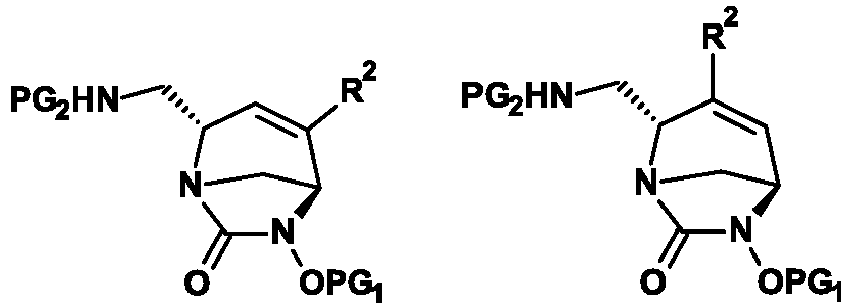
- R1 and R2 are as defined above;
- X is halogen, B(OR)2 ; -OTf ; -SnR3 wherein R is alkyl or the OR are linked together with the B to form a cycle comprising for example 5 members;
- PG1 and PG2, which are different, are protective groups, for example chosen among allyl, benzyl, tertbutyldimethylsilyl (TBDMS), tert-butoxycarbonyl (Boc), etc.
- The term "alkyl", as used herein, refers to an aliphatic-hydrocarbon group which may be straight or branched, having 1 to 3 carbon atoms in the chain unless specified otherwise. Preferred alkyl groups have 1 or 2 carbon atoms in the chain. Specific examples of alkyl groups include, but are not limited to, methyl, ethyl, n-propyl, iso propyl. Preferably, the alkyl group is methyl or ethyl.
- The term "fluoroalkyl", as used herein, refers to an alkyl group substituted with at least one fluorine atom. The term "alkyl" is as defined above. Specific examples of fluoroalkyl groups include but are not limited to trifluoromethyl, difluoromethyl, fluoromethyl.
- The term "cycloalkyl" refers to a saturated monocyclic or bicyclic non-aromatic hydrocarbon ring of 3 to 6 carbon atoms, preferably 3 to 4 carbon atoms, which can comprise one or more unsaturation. Specific examples of monocyclic cycloalkyl groups include cyclopropyl, cyclobutyl, cyclopentyl, cyclohexyl. Preferably, the cycloalkyl group is cyclopropyl or cyclobutyl.
- The term "fluorocycloalkyl" refers to a cycloalkyl group substituted with at least one fluorine atom. The term "cycloalkyl" is as defined above. Specific examples of fluorocycloalkyl groups include fluorocyclopropyl, difluorocyclopropyl, fluorocyclobutyl, difluorocyclobutyl.
- The term "heterocycle", as used herein and without contrary definition specifically mentioned, either alone or in combination with another radical, refers to a monocyclic or bicyclic saturated, partially or totally unsaturated or aromatic hydrocarbon radical, preferably 4 to 10-membered, comprising at least one heteroatom, such as N, O, S, S(O) or S(O)2. Preferably, the heterocycle is a monocyclic saturated, partially or totally unsaturated or aromatic hydrocarbon radical, preferably 4, 5- or 6-membered, comprising at least one nitrogen atom and which can comprise at least one further heteroatom, such as N, O, S, S(O) or S(O)2, the carbon atoms of the heterocycle can also be oxidized as C(O). Suitable heterocycles are also disclosed in the Handbook of Chemistry and Physics, 76th Edition, CRC Press, Inc., 1995-1996, pages 2 25 to 2-26. Examplary heterocycle groups include, but are not limited to, azetidinyl, oxetanyl, oxazolyl, oxazolidinyl, oxadiazolyl, pyrrolyl, pyrrolidinyl, pyridyl, tetrahydropyridinyl, piperidinyl, morpholinyl, pyrazolyl, pyrimidinyl, pyrazinyl, tetrazolyl, imidazolyl, thienyl, thiazolyl, furanyl, thiadiazolyl, isothiazolyl, triazolyl, tetrazolyl, pyrazolyl, isoxazolyl, 2-pyrrolidinonyl, imidazol-2,4-dione, 1,2,4-oxadiazolyl-5-one, 1,5-dihydropyrrolyl-2-one, pyrazinone, pyridazinone, pyridone, pyrimidone, dioxanyl, pyrrolidinyl, imidazolidinyl, pyranyl, tetrahydrofuranyl, dioxolanyl, tetrahydropyranyl. Preferably, in the compounds according to the invention, the heterocycle is linked to the structure of the compounds by a carbon atom of the heterocycle (also said carbon-linked heteroatom).
- Moreover some compounds according to this invention may contain a basic amino group and thus may form an inner zwitterionic salt (or zwitterion) with the acidic group (R3) -OSO3H,-OCFHCO2H or -OCF2CO2H and such inner zwitterionic salts are also included in this invention.
- The term "optionally substituted" means "non-substituted or substituted".
- The term "racemate" is employed herein to refer to an equal amount of two specific enantiomers.
- The term "enantiomer" is employed herein to refer to one of the two specific stereoisomers which is a non-superimposable mirror image with one other but is related to one other by reflection.
- The compounds of the invention can possess one or more asymmetric carbon atoms and are thus capable of existing in the form of optical isomers as well as in the form of racemic or non-racemic mixtures thereof. The compounds of the invention can be used in the present invention as a single isomer or as a mixture of stereochemical isomeric forms. Diastereoisomers, i.e., nonsuperimposable stereochemical isomers can be separated by conventional means such as chromatography, distillation, crystallization or sublimation. The optical isomers (enantiomers) can be obtained by using optically active starting materials, by resolution of the racemic mixtures according to conventional processes, for example by formation of diastereoisomeric salts by treatment with an optically active acid or base or by using chiral chromatography column.
- The expression "pharmaceutically acceptable" is employed herein to refer to those compounds, materials, compositions, and/or dosage forms which are, within the scope of sound medical judgment, suitable for use in contact with the tissues of human beings and animals without excessive toxicity, irritation, allergic response, or other problem or complication, commensurate with a reasonable benefit/risk ratio.
- As used herein, the expression "pharmaceutically acceptable salts" refers to derivatives of the disclosed compounds wherein the parent compound is modified by making acid or base salts thereof. Examples of pharmaceutically acceptable salts include, but are not limited to, mineral or organic acid salts of basic residues such as amines; alkali or organic salts of acidic residues such as carboxylic acids; and the like. The pharmaceutically acceptable salts of the present invention can be synthesized from the parent compound which comprises a basic or an acidic moiety, by conventional chemical methods. Furthermore, the expression "pharmaceutically acceptable salt" refers to relatively non-toxic, inorganic and organic acid or base addition salts of the compounds of the present invention. These salts can be prepared in situ during the final isolation and purification of the compounds. In particular, the acid addition salts can be prepared by separately reacting the purified compound in its purified form with an organic or inorganic acid and by isolating the salt thus formed. Among the examples of acid addition salts are the hydrobromide, hydrochloride, hydroiodide, sulfamate, sulfate, bisulfate, phosphate, nitrate, acetate, propionate, succinate, oxalate, valerate, oleate, palmitate, stearate, laurate, borate, benzoate, lactate, tosylate, citrate, maleate, fumarate, tartrate, naphthylate, mesylate, glucoheptanate, glucoronate, glutamate, lactobionate, malonate, salicylate, methylenebis-b-hydroxynaphthoate, gentisic acid, isethionate, di-p-toluoyltartrate, ethanesulfonate, benzenesulfonate, cyclohexyl sulfamate, quinateslaurylsulfonate salts, and the like. Examples of base addition salts include ammonium salts such as tromethamine, meglumine, epolamine, etc, metal salts such as sodium, lithium, potassium, calcium, zinc or magnesium salts with organic bases such as dicyclohexylamine salts, N-methyl-D-glucamine. Lists of suitable salts may be found in Remington's Pharmaceutical Sciences, 17th ed., Mack Publishing Company, Easton, PA, 1985, p. 1418, P.H. Stahl, C.G. Wermuth, Handbook of Pharmaceutical salts - Properties, Selection and Use, Wiley-VCH, 2002 and S.M. Berge et al. "Pharmaceutical Salts" J. Pharm. Sci, 66: p.1-19 (1977).
- Compounds according to the invention also include isotopically-labeled compounds wherein one or more atoms is replaced by an atom having the same atomic number, but an atomic mass or mass number different from the atomic mass or mass number usually found in nature. Examples of isotopes suitable for inclusion in the compounds described above and are not limited to 2H , 3H, 11C, 13C, 14C,19F, 18F, 15N, 13N, 33S, 34S, 35S, 36S, 17O or 18O. In one embodiment, isotopically-labeled compounds are useful in drug and/or substrate tissue distribution studies. In another embodiment, substitution with heavier isotopes such as deuterium (2H) affords greater metabolic stability (for example increased in vivo half-life or reduced dosage requirements). Isotopically-labeled compounds are prepared by any suitable method or by processes using an appropriate isotopically-labeled reagent in place of the non-labeled reagent otherwise employed.
- The present invention also relates to a composition, preferably a pharmaceutical composition, comprising at least one compound of formula (I), (I*), (A), (A*), (B) or (B*) as defined above, with a pharmaceutically acceptable excipient.
- The composition according to the invention can further comprise at least one or more antibacterial agent(s), preferably at least one of these antibacterial agents is a beta-lactam.
- The term "beta-lactam" or "β-lactam" refers to antibacterial compounds comprising a β-lactam unit, i.e. a group.
- The term "pharmaceutically acceptable carrier" or "pharmaceutically acceptable excipient" is employed for any excipient, solvent, dispersion medium, absorption retardant, diluent or adjuvant etc., such as preserving or antioxidant agents, fillers, binders, disintegrating agents, wetting agents, emulsifying agents, suspending agents, solvents, dispersion media, coatings, antibacterial agents, isotonic and absorption delaying agents and the like, that does not produce a secondary reaction, for example an allergic reaction, in humans or animals. Typical, non-limiting examples of excipients include mannitol, lactose, magnesium stearate, sodium saccharide, talcum, cellulose, sodium croscarmellose, glucose, gelatin, starch, lactose, dicalcium phosphate, sucrose, kaolin, magnesium carbonate, wetting agents, emulsifying agents, solubilizing agents, sterile water, saline, pH buffers, non-ionic surfactants, lubricants, stabilizing agents, binding agents and edible oils such as peanut oil, sesame oils and the like. In addition, various excipients commonly used in the art may be included. Pharmaceutically acceptable carriers or excipients are well known to a person skilled in the art, and include those described in Remington's Pharmaceutical Sciences (Mack Publishing Company, Easton, USA, 1985), Merck Index (Merck & Company, Rahway, N.J.), Gilman et al (Eds. The pharmacological basis of therapeutics, 8th Ed., pergamon press., 1990). Except insofar as any conventional media or adjuvant is incompatible with the active ingredient according to the invention, its use in the therapeutic compositions is contemplated.
- The expression "antibacterial agent" as used herein, refers to any substance, compound or their combination capable of inhibiting, reducing or preventing growth of bacteria, inhibiting or reducing ability of bacteria to produce infection in a subject, or inhibiting or reducing ability of bacteria to multiply or remain infective in the environment, or decreasing infectivity or virulence of bacteria.
- The antibacterial agent is selected among the following families: aminoglycosides, beta-lactams, glycylcyclines, tetracyclines, quinolones, fluoroquinolones, glycopeptides, lipopeptides, macrolides, ketolides, lincosamides, streptogramins, oxazolidinones and polymyxins alone or in mixture.
Preferably, the further antibacterial agent is selected among the beta-lactam families, and more preferably among penicillin, cephalosporins, penems, carbapenems and monobactam, alone or in mixture.
Among the penicillin the antibacterial agent is preferably selected in the group consisting of amoxicillin, ampicillin, azlocillin, mezocillin, apalcillin, hetacillin, bacampicillin, carbenicillin, sulbenicillin, temocillin, ticarcillin, piperacillin, mecillinam, pivmecillinam, methicillin, ciclacillin, talampacillin, aspoxicillin, oxacillin, cloxacillin, dicloxacillin, flucloxacillin, nafcillin, and pivampicillin, alone or in mixture.
Among the cephalosporin, the antibacterial agent is preferably selected in the group consisting of cefatriazine, cefazolin, cefoxitin, cephalexin, cephradine, ceftizoxime, cephacetrile, cefbuperazone, cefprozil, ceftobiprole, ceftobiprole medocaril, ceftaroline, ceftaroline fosaminyl, cefalonium, cefminox, ceforanide, cefotetan, ceftibuten, cefcapene pivoxil, cefditoren pivoxil, cefdaloxime cefroxadine, ceftolozane and S-649266, cephalothin, cephaloridine, cefaclor, cefadroxil, cefamandole, cefazolin, cephalexin, cephradine, ceftizoxime, cephacetrile, cefotiam, cefotaxime, cefsulodin, cefoperazone, cefmenoxime, cefmetazole, cephaloglycin, cefonicid, cefodizime, cefpirome, ceftazidime, ceftriaxone, cefpiramide, cefbuperazone, cefozopran, cefepime, cefoselis, cefluprenam, cefuzonam, cefpimizole, cefclidine, cefixime, ceftibuten, cefdinir, cefpodoxime axetil, cefpodoxime proxetil, cefteram pivoxil, cefetamet pivoxil, cefcapene pivoxil, cefditoren pivoxil, cefuroxime, cefuroxime axetil, loracarbef, and latamoxef, alone or in mixture.
Among the carbapenem, the antibacterial agent is preferably selected in the group consisting of imipenem, doripenem, meropenem, biapenem, ertapenem and panipenem, alone or in mixture.
Among the monobactam the antibacterial agent is preferably selected in the group consisting of aztreonam, tigemonam, carumonam, BAL30072 and nocardicin A, alone or in mixture. - Preferably, the invention relates to a pharmaceutical composition comprising
- a single compound of formula (I), (I*), (A), (A*), (B) and (B*) ;
- a compound of formula (I), (I*), (A), (A*), (B) and (B*) and one or more antibacterial compound ;
- a compound of formula (I), (I*), (A), (A*), (B) and (B*) and one or more 3-lactam compound ;
- a compound of formula (I), (I*), (A), (A*), (B) and (B*), one or more antibacterial compound and one or more β-lactam compound.
- The present invention also relates to a composition comprising at least a compound of formulae (I), (A), (B), (I*), (A*), (B*) according to the invention and ceftazidime.
- The present invention also relates to a kit comprising:
- a pharmaceutical composition according to the invention, and
- at least one other composition comprising one or more antibacterial agent(s), preferably at least one of these antibacterial agent(s) is a beta-lactam.
- The present invention also relates to a kit comprising :
- ▪ a pharmaceutical composition comprising at least a compound of formulae (I), (A), (B), (I*), (A*), (B*), (A1*), (A2*), (B1*) and (B2*) according to the invention; and
- ▪ a pharmaceutical composition comprising ceftazidime.
- The two composition can be prepared separately each with one specific pharmaceutically acceptable carrier, and can be mix especially extemporaneity.
- The present invention also refer to a compound of formula (I), (I*), (A), (A*), (B) or (B*) according to the invention for use as a medicine.
- The present invention also refer to the use of a compound of formula (I), (I*), (A), (A*), (B) or (B*) according to the invention or of a composition according to the invention for the preparation of a medicine.
- The present invention also describes the use of the compounds of formula (I), (I*), (A), (A*), (B) and (B*) on the control of bacteria. The compound according to the invention is usually used in combination with pharmaceutically acceptable excipient.
- The present invention also refer to a compound of formula (I), (I*), (A), (A*), (B) or (B*) according to the invention for use as antibacterial agent.
- The present invention also refer to the use of a compound of formula (I), (I*), (A), (A*), (B) or (B*) according to the invention or of a composition according to the invention for the preparation of an antibacterial agent medicine.
- The present invention also refer to the use of a compound of formula (I), (I*), (A), (A*), (B) or (B*) according to the invention or of a composition according to the invention for the preparation of an inhibitor of beta-lactamase medicine.
- The present invention also refer to the use of a compound of formula (I), (I*), (A), (A*), (B) or (B*) according to the invention or of a composition according to the invention for the preparation of an antibacterial agent and inhibitor of beta-lactamase medicine.
- The present invention also refer to a compound of formula (I), (I*), (A), (A*), (B) or (B*) or a composition according to the invention or a kit according to the invention for use for the treatment or prevention of bacterial infections.
- The present invention also refer to the use of a compound of formula (I), (I*), (A), (A*), (B) or (B*) or a composition according to the invention for the preparation of a medicine for the treatment or prevention of bacterial infections.
- The terms "prevention", "prevent" and "preventing" as used herein are intended to mean the administration of a compound or composition according to the invention in order to prevent infection by bacteria or to prevent occurrence of related infection and/or diseases. The terms "prevention", "prevent" and "preventing" also encompass the administration of a compound or composition according to the present invention in order preventing at least one bacterial infection, by administration to a patient susceptible to be infected, or otherwise at a risk of infection by this bacteria.
- The terms "treatment", "treat" and "treating" as used herein are intended to mean in particular the administration of a treatment comprising a compound or composition according to the present invention to a patient already suffering from an infection. The terms "treatment", "treat" and "treating" as used herein, also refer to administering a compound or composition according to the present invention, optionally with one or more antibacterial agent, in order to:
- reduce or eliminate either a bacterial infection or one or more symptoms associated with bacterial infection, or
- retard the progression of a bacterial infection or of one or more symptoms associated with bacterial infection, or
- reduce the severity of a bacterial infection or of one or more symptoms associated with the bacterial infection, or
- suppress the clinical manifestation of a bacterial infection, or
- suppress the manifestation of adverse symptoms of the bacterial infection.
- The expression "infection" or "bacterial infection" as used herein, includes the presence of bacteria, in or on a subject, which, if its growth were inhibited, would result in a benefit to the subject. As such, the term "infection" or "bacterial infection" in addition to referring to the presence of bacteria also refers to normal flora, which is not desirable. The term "infection" includes infection caused by bacteria. Exemplary of such bacterial infection are urinary tract infection (UTI), kidney infections (pyelonephritis), gynecological and obstetrical infections, respiratory tract indection (RTI), acute exacerbation of chronic bronchitis (AECB), Community-acquired pneumonia (CAP), hospital-acquired pneumonia (HAP), ventilator associated pneumonia (VAP), intra-abdominal pneumonia (IAI), acute otitis media, acute sinusitis, sepsis, catheter-related sepsis, chancroid, chlamydia, skin infections, bacteremia.
- The term "growth" as used herein, refers to the growth of one or more microorganisms and includes reproduction or population expansion of the microorganism, such as bacteria. The term also includes maintenance of on-going metabolic processes of a microorganism, including processes that keep the microorganism alive.
- The bacteria are chosen amongst gram-positive bacteria or gram-negative bacteria, preferably the gram-negative bacteria.
- The bacteria can be also chosen among bacteria producing "beta-lactamase" or "β-lactamase". These bacteria are well known by the skilled person.
- The term "beta-lactamase" or "β-lactamase" as used herein, refers to any enzyme or protein or any other substance that is able to break down a beta-lactam ring. The term "beta-lactamase" or "β-lactamase" includes enzymes that are produced by bacteria and that have the ability to hydrolyze, either partially or completely, the beta-lactam ring present in a compound such as an antibacterial agent.
- Among the gram-positive bacteria, the bacteria according to the invention is preferably chosen among Staphylococcus, Streptococcus, Staphylococcus species (including Staphylococcus aureus, Staphylococcus epidermidis), Streptococcus species (including Streptococcus pneumonia, Streptococcus agalactiae), Enterococcus species (including Enterococcus faecalis and Enterococcus faecium).
- Among the gram-negative bacteria, the bacteria according to the invention is preferably chosen among Acinetobacter species (including Acinetobacter baumannil), Citrobacter species, Escherichia species (including Escherichia coli), Haemophilus influenza, Morganella morganii, Klebsiella species (including Klebsiella pneumonia), Enterobacter species (including Enterobacter cloacae), Neisseria gonorrhoeae, Burkholderia species (including Burkholderia cepacia), (Proteus species (including Proteus mirabilis), Serratia species (including Serratia marcescens), Pseudomonas aeruginosa.
- The invention thus preferably refers to a compound of formula (I), (I*), (A), (A*), (B) or (B*), or a composition according to the invention or a kit according to the invention for use for the treatment or prevention of bacterial infection, preferably caused by bacteria producing one or more beta-lactamase(s). Preferably, the bacteria are chosen amongst gram-positive bacteria or gram-negative bacteria, preferably gram-negative bacteria.
- The present invention also refer to the use of a compound of formula (I), (I*), (A), (A*), (B) or (B*) or a composition according to the invention for the preparation of a medicine for the treatment or prevention of bacterial infection, preferably caused by bacteria producing one or more beta-lactamase(s). Preferably, the bacteria are chosen amongst gram-positive bacteria or gram-negative bacteria, preferably gram-negative bacteria.
- The present invention also refers to the kit as defined above, for a simultaneous, separated or sequential administration to a patient in need thereof for use for the treatment or prevention of bacterial infections, preferably caused by bacteria producing one or more beta-lactamase(s). Preferably, the bacteria are chosen amongst gram-positive bacteria or gram-negative bacteria, preferably gram-negative bacteria.
- The present invention also refers to compound of formula (I), (I*), (A), (A*), (B) or (B*) for use in combination with one or more further antibacterial agent, preferably at least one of the further antibacterial agent is a beta lactam, for the treatment or prevention of bacterial infections, preferably caused by bacteria producing one or more beta-lactamase(s). Preferably, the bacteria are chosen amongst gram-positive bacteria or gram-negative bacteria, preferably gram-negative bacteria. Wherein the compounds of formula (I), (I*), (A), (A*), (B) or (B*) and the further antibacterial agent are administered simultaneously, separately or sequentially.
- The present invention also refers to the use of a compound of formula (I), (I*), (A), (A*), (B) or (B*) or a composition according to the invention or a kit according to the invention for the prevention or treatment of bacterial infections, preferably of bacterial infection, preferably caused by bacteria producing one or more beta-lactamase(s). Preferably, the bacteria are chosen amongst gram-positive bacteria or gram-negative bacteria, preferably gram-negative bacteria.
- The present invention also relates to a method for the treatment or prevention of bacterial infections, preferably caused by bacteria producing one or more beta-lactamase(s) comprising the administration of a therapeutically effective amount of compound of formula (I), (I*), (A), (A*), (B) or (B*), a composition according to the invention or a kit according to the invention to a patient in need thereof. Preferably, the bacteria are chosen amongst gram-positive bacteria or gram-negative bacteria, preferably gram-negative bacteria.
- The term "patient" means a person or an animal at risk of being infected by bacteria or, a person or an animal being infected by bacteria, preferably by gram-positive and/or by gram-negative bacteria. As used herein, the term "patient" refers to a warm-blooded animal such as a mammal, preferably a human or a human child, who is afflicted with, or has the potential to be afflicted with one or more infections and conditions described herein. The identification of those subjects who are in need of treatment of herein-described diseases and conditions is well within the ability and knowledge of one skilled in the art. A veterinarian or a physician skilled in the art can readily identify, by the use of clinical tests, physical examination, medical/family history or biological and diagnostic tests, those subjects who are in need of such treatment.
- The expression "therapeutically effective amount" or "pharmaceutically effective amount" as used herein, refer to an amount of a compound according to the invention, which when administered to a patient in need thereof, is sufficient to effect treatment for disease-states, conditions, or disorders for which the compound has utility. Such an amount would be sufficient to elicit the biological or medical response of a tissue system, or patient that is sought by a researcher or a clinician. The amount of a compound according to the invention which constitutes a "therapeutically effective amount" will vary, notably depending on the compound itself and its biological activity, the composition used for administration, the time of administration, the route of administration, the rate of excretion of the compound, the duration of the treatment, the type of disease-state or disorder being treated and its severity, drugs used in combination with or coincidentally with the compounds of the invention, and the age, body weight, general health, sex and diet of the patient. Such a "therapeutically effective amount" can be determined by one of ordinary skilled in the art having regard to its own knowledge, and this disclosure. Preferably, the compounds according to the invention are administered in an amount comprised between 0.1 to 30g per day.
- The compounds according to the invention may be provided in an aqueous physiological buffer solution for parenteral administration.
The compounds of the present invention are also capable of being administered in unit dose forms, wherein the expression "unit dose" means a single dose which is capable of being administered to a patient, and which can be readily handled and packaged, remaining as a physically and chemically stable unit dose comprising either the active compound itself, or as a pharmaceutically acceptable composition, as described hereinafter. Compounds provided herein can be formulated into pharmaceutical compositions by admixture with one or more pharmaceutically acceptable excipients. Such unit dose compositions may be prepared for use by oral administration, particularly in the form of tablets, simple capsules or soft gel capsules; or intranasally, particularly in the form of powders, nasal drops, or aerosols; or dermally, for example, topically in ointments, creams, lotions, gels or sprays, or via trans-dermal patches. The compositions may conveniently be administered in unit dosage form and may be prepared by any of the methods well-known in the pharmaceutical art, for example, as described in Remington: The Science and Practice of Pharmacy, 20th ed.; Gennaro, A. R., Ed.; Lippincott Williams & Wilkins: Philadelphia, PA, 2000.
Preferred formulations include pharmaceutical compositions in which a compound of the present invention is formulated for oral or parenteral administration.
For oral administration, tablets, pills, powders, capsules, troches and the like can contain one or more of any of the following ingredients, or compounds of a similar nature: a binder such as microcrystalline cellulose, or gum tragacanth; a diluent such as starch or lactose; a disintegrant such as starch and cellulose derivatives; a lubricant such as magnesium stearate; a glidant such as colloidal silicon dioxide; a sweetening agent such as sucrose or saccharin; or a flavoring agent such as peppermint, or methyl salicylate. Capsules can be in the form of a hard capsule or soft capsule, which are generally made from gelatin blends optionally blended with plasticizers, as well as a starch capsule. In addition, dosage unit forms can contain various other materials that modify the physical form of the dosage unit, for example, coatings of sugar, shellac, or enteric agents. Other oral dosage forms syrup or elixir may contain sweetening agents, preservatives, dyes, colorings, and flavorings. In addition, the active compounds may be incorporated into fast dissolved, modified-release or sustained-release preparations and formulations, and wherein such sustained-release formulations are preferably bi-modal. Preferred tablets contain lactose, cornstarch, magnesium silicate, croscarmellose sodium, povidone, magnesium stearate, or talc in any combination.
Liquid preparations for parenteral administration include sterile aqueous or non-aqueous solutions, suspensions, and emulsions. The liquid compositions may also include binders, buffers, preservatives, chelating agents, sweetening, flavoring and coloring agents, and the like. - Non-aqueous solvents include alcohols, propylene glycol, polyethylene glycol, vegetable oils such as olive oil, and organic esters such as ethyl oleate. Aqueous carriers include mixtures of alcohols and water, buffered media, and saline. In particular, biocompatible, biodegradable lactide polymer, lactide/glycolide copolymer, or polyoxyethylene-polyoxypropylene copolymers may be useful excipients to control the release of the active compounds. Intravenous vehicles can include fluid and nutrient replenishers, electrolyte replenishers, such as those based on Ringer's dextrose, and the like. Other potentially useful parenteral delivery systems for these active compounds include ethylene-vinyl acetate copolymer particles, osmotic pumps, implantable infusion systems, and liposomes.
Alternative modes of administration include formulations for inhalation, which include such means as dry powder, aerosol, or drops. They may be aqueous solutions containing, for example, polyoxyethylene-9-lauryl ether, glycocholate and deoxycholate, or oily solutions for administration in the form of nasal drops, or as a gel to be applied intranasally. Formulations for buccal administration include, for example, lozenges or pastilles and may also include a flavored base, such as sucrose or acacia, and other excipients such as glycocholate. Formulations suitable for rectal administration are preferably presented as unit-dose suppositories, with a solid based carrier, and may include a salicylate. Formulations for topical application to the skin preferably take the form of an ointment, cream, lotion, paste, gel, spray, aerosol, or oil. Carriers which can be used include petroleum jelly, lanolin, polyethylene glycols, alcohols, or their combinations. Formulations suitable for transdermal administration can be presented as discrete patches and can be lipophilic emulsions or buffered, aqueous solutions, dissolved and/or dispersed in a polymer or an adhesive. - The present invention also relates to process for the preparation of compounds of formula (I), (I*), (A), (A*), (B) and (B*) as defined above.
- Preparation of the compounds and biological activity: Abbreviations or symbols used herein include:
- ACHN:
- 1,1'-azobis(cyclohexanecarbonitrile)
- ACN:
- acetonitrile
- AcOH:
- acetic acid
- Bn:
- benzyl
- Boc:
- tert-butoxycarbonyl
- Boc2O:
- tert-butoxycarbonyl anhydride
- BocON:
- [2-(tert-butoxycarbonyloxyimino)-2-phenylacetonitrile]
- Bromodan:
- 1,3-Dibromo-5,5-dimethylhydantoin
- bs:
- broad singlet
- Burgess reagent:
- methyl N-(triethylammoniosulfonyl)carbamate
- CFU:
- colony-forming units
- CLSI:
- clinical laboratory standards institute
- d:
- doublet
- DBU:
- 1,8-diazabicyclo[5.4.0]undec-7-ene
- DCM:
- dichloromethane
- dd:
- doublet of doublet
- ddd :
- doublet of doublet doublet
- dq:
- doublet of quadruplet
- dt :
- doublet of triplet
- DTA:
- di-tert-butylazodicarboxylate
- DEAD:
- diethyl azodicarboxylate
- DIAD:
- diisopropyl azodicarboxylate
- DIPEA:
- diisopropylethylamine
- DMF:
- N,N-dimethylformamide
- DMAP:
- 4-dimethylaminopyridine
- DMSO:
- dimethylsulfoxide
- EDCI:
- 1-ethyl-3-(3-dimethylaminopropyl)carbodiimide
- EtOAc:
- ethyl acetate
- Et2O:
- diethyl ether
- h:
- hours
- HATU:
- 1-[Bis(dimethylamino)methylene]-1H-1,2,3-triazolo[4,5-b]pyridinium 3-oxid hexafluorophosphate
- HOBt:
- N-hydroxybenzotriazole
- IC50:
- concentration of inhibitor responsible for 50% of inhibition
- iPrOH:
- isopropanol
- KOAc:
- potassium acetate
- m :
- massif
- min:
- minutes
- MeOH:
- methanol
- MeONa:
- sodium methoxide
- MIC:
- minimum inhibitory concentration
- MS:
- mass spectrometry
- MsCl:
- methanesulfonyl chloride
- MTBE:
- methyl tert-butyl ether
- NBS:
- N-bromosuccinimide
- Ni(COD)2:
- Bis(1,5-cyclooctadiene)nickel(0)
- NMR:
- nuclear magnetic resonance spectroscopy
- Ns:
- nosyl, nitrobenzenesulfonyl
- Pd(dppf)Cl2:
- [1,1'-bis(diphenylphosphino)ferrocene]dichloropalladium
- Pd(PPh3)4:
- tetrakis(triphenylphosphine)palladium(0)
- PEPPSI:
- [1,3-bis(2,6-diisopropylphenyl)imidazol-2-ylidene](3-chloropyridyl)palladium(II) dichloride
- PG:
- protective group
- PMe3:
- trimethylphosphine
- PPh3:
- triphenylphosphine
- Ppm:
- parts per million
- q:
- quadruplet
- qd:
- doublet of quadruplet
- rt:
- room temperature
- s:
- singlet
- SEM:
- 2-(trimethylsilyl)ethoxy]methyl acetal
- t:
- triplet
- TBAF:
- tetrabutylammonium fluoride
- TBDMS:
- tert-butyldimethylsilyl
- TBDMSOTf:
- tert-butyldimethylsilyl trifluoromethanesulfonate
- TBS:
- tert-butylsilyl
- TEA:
- trimethylamine
- Tf:
- trifluoromethanesulfonyl
- TEMPO:
- 2,2,6,6-tetramethyl-1-piperidinyloxy, free radical, 2,2,6,6-Tetramethylpiperidine 1-oxyl
- TFA:
- trifluoroacetic acid
- THF:
- tetrahydrofuran
- THP:
- tetrahydropyranyl acetal
- TLC:
- thin layer chromatography
- TMSI:
- iodotrimethylsilane
- Tr:
- trityl
- The compounds of the present invention of formula (I), (I*), (A), (A*), (B) or (B*) can be prepared respectively by the following reaction schemes 1 to 10 depending on R1.
- It should be understood that the processes of schemes 1 to 9 can be adapted for preparing further compounds according to the invention. Further processes for the preparation of compounds according to the invention can be derived from the processes of schemes 1 to 11.


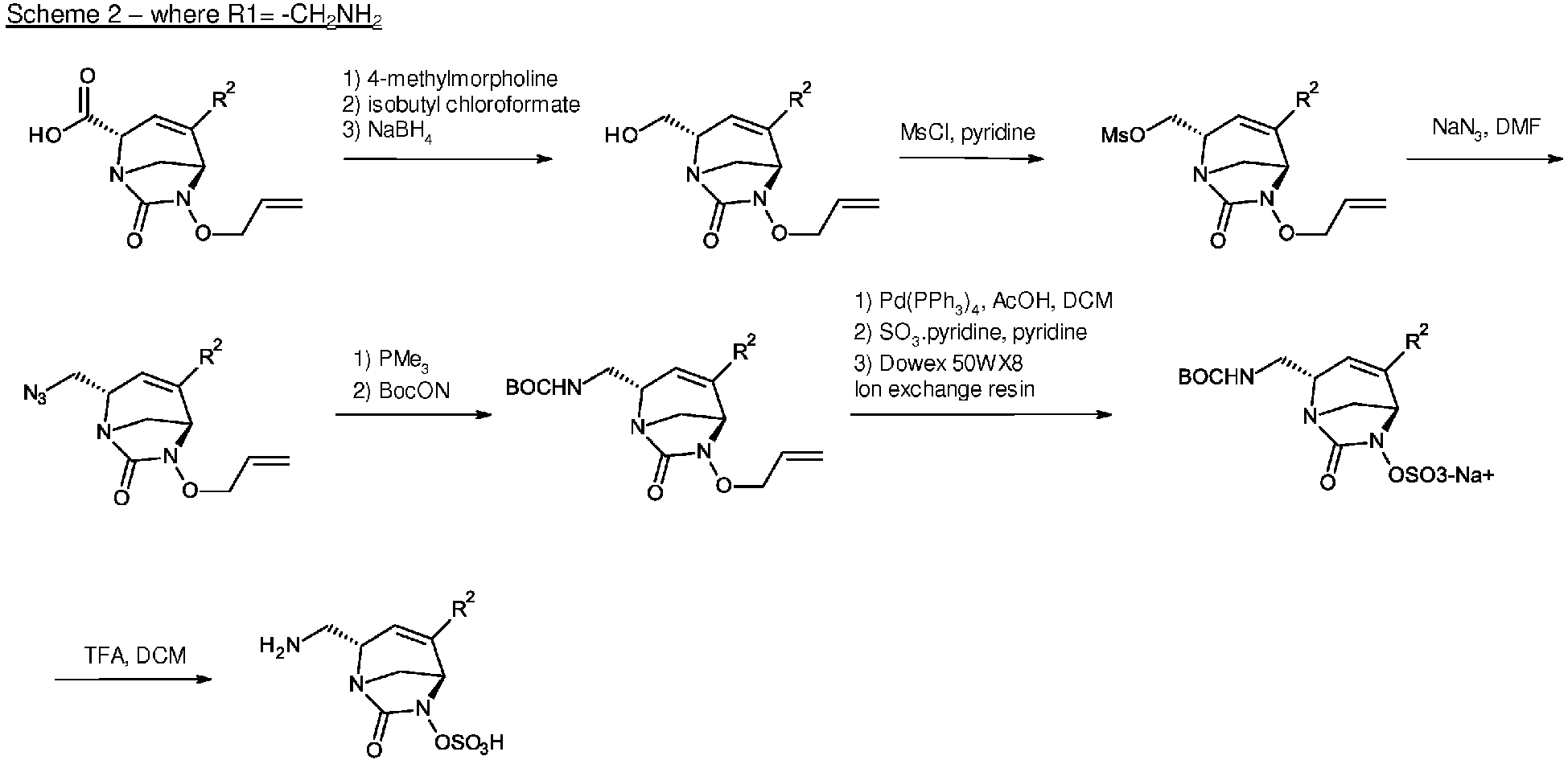


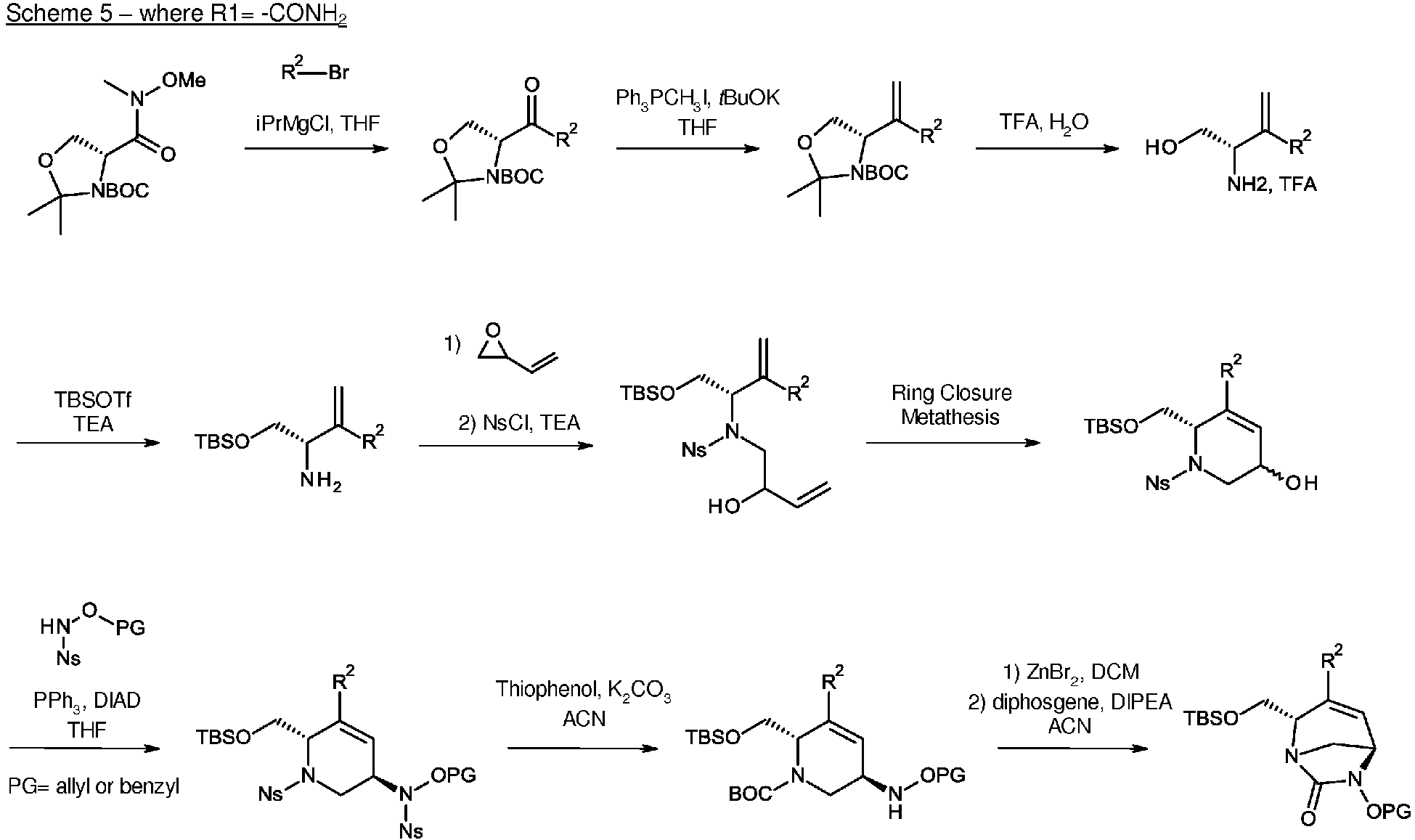


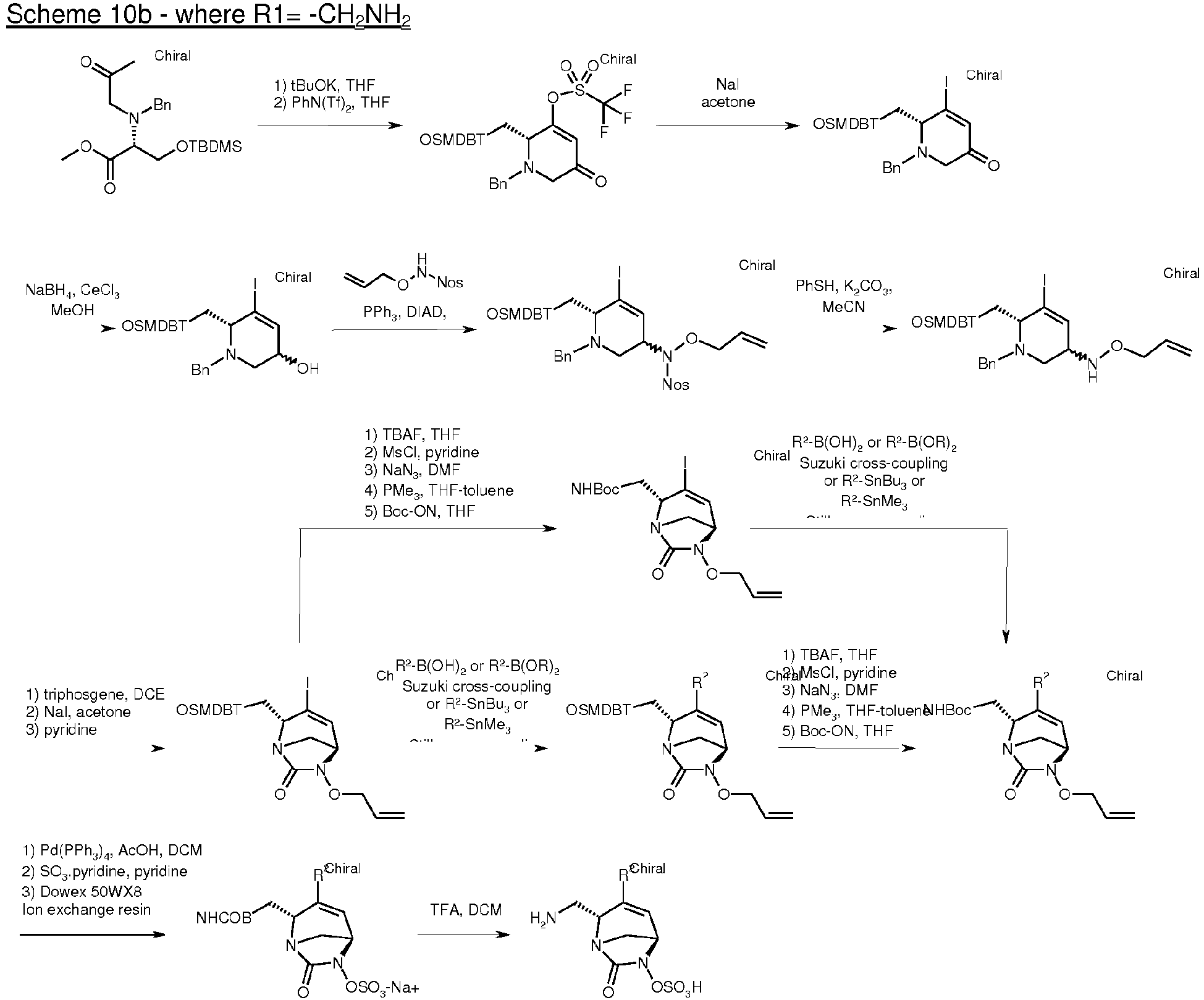
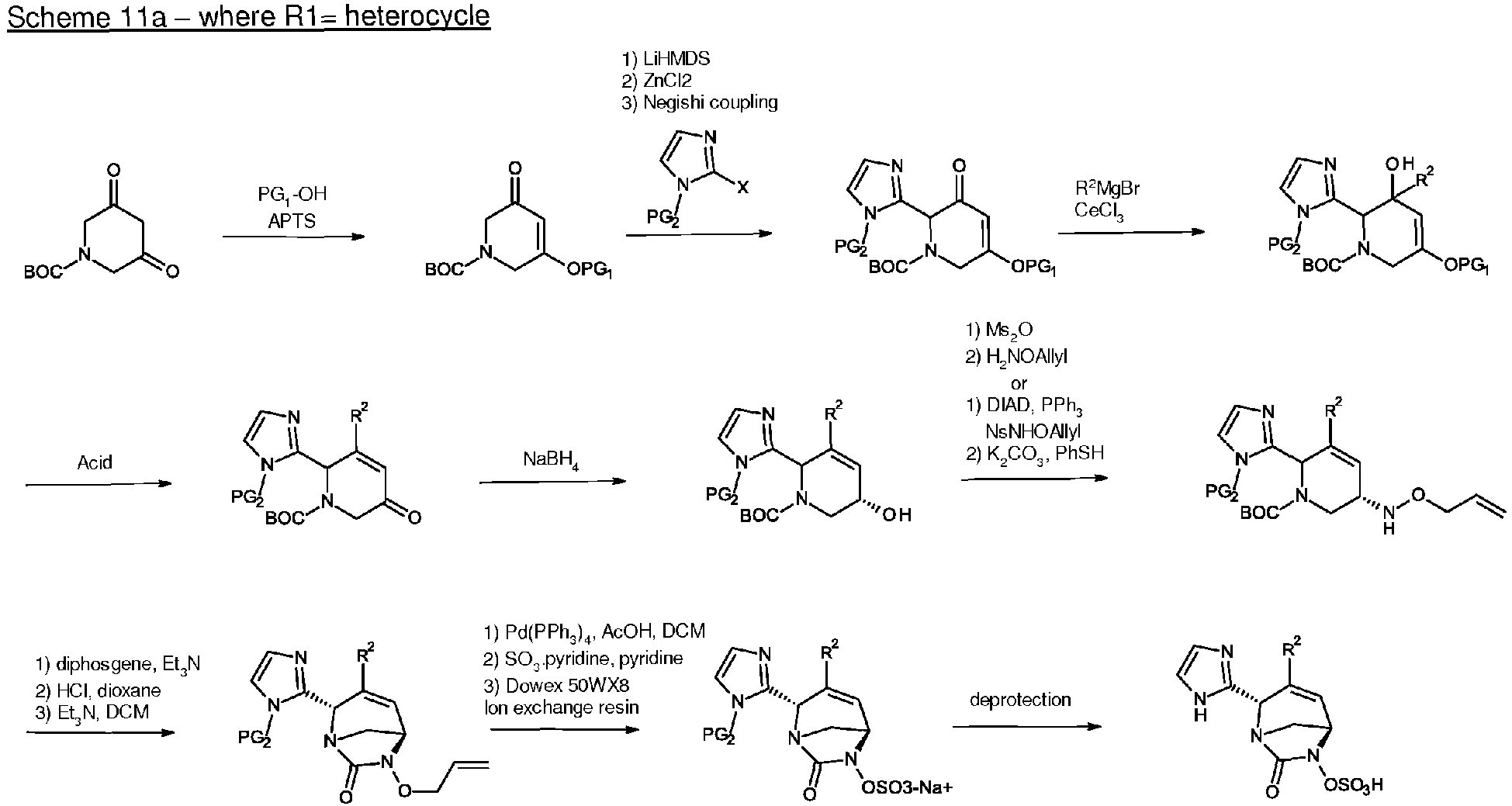

- The following examples are provided for the purpose of illustrating the present invention and by no means should be interpreted to limit the scope of the present invention.
- The first part represents the preparation of the compounds (intermediates and final compounds) whereas the second part describes the evaluation of antibacterial activity of compounds according to the invention.
-

- To a solution of tert-butyl cis-6-[[tert-butyl(dimethyl)silyl]oxymethyl]-3-hydroxy-4-iodo-3,6-dihydro-2H-pyridine-1-carboxylate (1, prepared according to
WO 2013/150296 ) (12.05 g, 25.67 mmol) in toluene (170 mL) at rt was added triphenylphosphine (8.08 g, 30.80 mmol), N-(allyloxy)-2-nitrobenzenesulfonamide (6.63 g, 25.67 mmol) and DIAD (6.06 mL, 30.80 mmol). The reaction mixture was stirred at rt overnight and concentrated in vacuo. The crude was purified by flash chromatography on silica gel (cyclohexane/EtOAc 100/0 to 85/15) to give tert-butyl trans-3-[allyloxy-(2-nitrophenyl)sulfonyl-amino]-6-[[tert-butyl(dimethyl)silyl]oxymethyl]-4-iodo-3,6-dihydro-2H-pyridine-1-carboxylate (2) (17.0 g, 23.95 mmol, 93%).
1H NMR (300 MHz, CDCl3): δ (ppm) 0.03 (s, 6H), 0.88 (s, 9H), 1.35 (s, 9H), 3.16-3.75 (m, 3H), 3.93-4.78 (m, 5H), 5.12-5.38 (m, 2H), 5.68-5.89 (m, 1H), 6.73 (d, J = 4.1 Hz, 1H), 7.54-7.66 (m, 1H), 7.69-7.84 (m, 2H), 8.06-8.19 (m, 1H). - To a solution of tert-butyl trans-3-[allyloxy-(2-nitrophenyl)sulfonyl-amino]-6-[[tert-butyl(dimethyl)silyl]oxymethyl]-4-iodo-3,6-dihydro-2H-pyridine-1-carboxylate (2) (17.0 g, 23.95 mmol) in DCM (177 mL) was added ZnBr2 (16.2 g, 71.86 mmol). The reaction mixture was stirred at rt overnight then diluted with DCM and successively washed with saturated and brine. The organic layer was dried over Na2SO4, filtered and concentrated in vacuo. The crude was diluted with ACN (177 mL). K2CO3 (16.6 g, 119.77 mmol) was added, followed by thiophenol (12.3 mL, 119.77 mmol). The reaction mixture was stirred at rt for 1 h and concentrated in vacuo. DCM was added and the resulting solids were removed by filtration. The filtrate was concentrated in vacuo. The crude was purified by flash chromatography on silica gel (DCM/MeOH 100/0 to 90/10) to give trans-N-allyloxy-6-[[tert-butyl(dimethyl)silyl]oxymethyl]-4-iodo-1,2,3,6-tetrahydropyridin-3-amine (3) (7.99 g, 18.83 mmol, 78%).
MS m/z ([M+H]+) 425.
1H NMR (300 MHz, CDCl3) : δ (ppm) 0.06 (s, 6H), 0.89 (s, 9H), 1.82 (bs, 1H), 3.14 (dd, J = 12.6, 5.1 Hz, 1H), 3.21 (dd, J = 12.6, 3.9 Hz, 1H), 3.37-3.45 (m, 2H), 3.53-3.60 (m, 2H), 4.22 (dq, J = 6.0, 1.2 Hz, 2H), 5.18-5.25 (m, 1H), 5.25-5.35 (m, 1H), 5.88-5.35 (m, 2H), 6.53-6.56 (m, 1H). - To a solution of trans-N-allyloxy-6-[[tert-butyl(dimethyl)silyl]oxymethyl]-4-iodo-1,2,3,6-tetrahydropyridin-3-amine (3) (7.99 g, 18.83 mmol) in anhydrous ACN (980 mL) at 0°C under inert atmosphere was added TEA (10.56 mL, 75.31 mmol). A solution of diphosgene (1.14 mL, 9.41 mmol) in anhydrous ACN (20 mL) was dropwise added over 5 h. Once the addition finished, the reaction mixture is allowed to reach rt and stirred for 3 days. H2O was added and the mixture was extracted with EtOAc. The organic layer was dried over Na2SO4, filtered and evaporated in vacuo. The crude was purified by flash chromatography on silica gel (cyclohexane/EtOAc 100/0 to 80/20) to give trans-6-allyloxy-2-[[tert-butyl(dimethyl)silyl]oxymethyl]-4-iodo-1,6-diazabicyclo[3.2.1]oct-3-en-7-one (4) (7.25 g, 16.10 mmol, 85%).
MS m/z ([M+H]+) 451.
1H NMR (300 MHz, CDCl3) : δ (ppm) 0.06 (s, 6H), 0.88 (s, 9H), 3.19 (dd, J = 11.1, 3.0 Hz, 1H), 3.57 (d, J = 11.1 Hz, 1H), 3.80-3.90 (m, 3H), 4.05-4.08 (m, 1H), 4.35-4.53 (m, 2H), 5.28-5.34 (m, 1H), 5.34-5.43 (m, 1H), 5.97-6.12 (m, 1H), 6.37-6.41 (m, 1H). - In a sealed flask, a mixture of trans-6-allyloxy-2-[[tert-butyl(dimethyl)silyl]oxymethyl]-4-iodo-1,6-diazabicyclo[3.2.1]oct-3-en-7-one (4) (5.20 g, 11.55 mmol), 5-(4,4,5,5-tetramethyl-1,2,3-dioxaborolan-2-yl)oxazole (2.70 g, 13.86 mmol) and CsCO3 (7.52 g, 23.09 mmol) in anhydrous THF (100 mL) was degassed under argon for 5 min and Pd(PPh3)4 (400 mg, 0.35 mmol) was added. The mixture was heated at 60°C overnight. H2O was added and the mixture was extracted with EtOAc. The organic layer was dried over Na2SO4, filtered and concentrated in vacuo. The crude was purified by flash chromatography on silica gel (cyclohexane/EtOAc 100/0 to 70/30) to give trans-6-allyloxy-2-[[tert-butyl(dimethyl)silyl]oxymethyl]-4-oxazol-5-yl-1,6-diazabicyclo[3.2.1]oct-3-en-7-one (5) (3.64 g, 9.30 mmol, 80%).
MS m/z ([M+H]+) 392.
1H NMR (300 MHz, CDCl3) : δ(ppm) 0.07 (s, 6H), 0.88 (s, 9H), 3.37 (dd, J = 11.0, 3.0 Hz, 1H), 3.54 (d, J = 11.0 Hz, 1H), 3.87-4.06 (m, 3H), 4.11-4.14 (m, 1H), 4.33-4.50 (m, 2H), 5.27-5.40 (m, 2H), 5.92-6.08 (m, 1H), 6.15 (d, J = 3.0 Hz, 1H), 7.03 (s, 1H), 7.83 (s, 1H). - To a solution of trans-6-allyloxy-2-[[tert-butyl(dimethyl)silyl]oxymethyl]-4-oxazol-5-yl-1,6-diazabicyclo[3.2.1]oct-3-en-7-one (5) (3.64 g, 9.30 mmol) in THF (45 mL) at 0°C was added tetrabutylammonium fluoride (1M in tetrahydrofuran) (13.9 mL, 13.94 mmol). The reaction mixture was stirred at 0°C for 1 h and concentrated in vacuo. The crude was purified by flash chromatography on silica gel (EtOAc 100%) to give trans-6-allyloxy-2-(hydroxymethyl)-4-oxazol-5-yl-1,6-diazabicyclo[3.2.1]oct-3-en-7-one (6) (1.53 g, 5.52 mmol, 57%).
MS m/z ([M+H]+) 278.
1H NMR (400 MHz, CDCl3) : δ (ppm) 3.32 (d, J = 11.2 Hz, 1H), 3.40 (dd, J = 11.2, 2.9 Hz, 1H), 3.69-3.87 (m, 2H), 4.12-4.19 (m, 2H), 4.36-4.50 (m, 2H), 5.28-5.39 (m, 3H), 5.94-6.06 (m, 2H), 7.06 (s, 1H), 7.83 (s, 1H). - A solution of (trans-6-allyloxy-2-(hydroxymethyl)-4-oxazol-5-yl-1,6-diazabicyclo[3.2.1]oct-3-en-7-one (6) (1.53 g, 5.52 mmol) in pyridine (17 mL) was cooled to 0°C. Methanesulfonyl chloride (0.67 mL, 8.61 mmol) was added and the reaction mixture was stirred at the same temperature for 2 h. After concentrating in vacuo, the crude was dissolved in DCM and successively washed with a solution of 1N HCl and brine. The organic layer was dried over Na2SO4, filtered and evaporated in vacuo. The crude was dissolved in DMF (29 mL) and NaN3 (1.79 g, 27.59 mmol) was added. The reaction mixture was heated at 65°C overnight and concentrated in vacuo. H2O was added to the crude, which was extracted with EtOAc. The organic layer was washed with brine, dried over Na2SO4, filtered and concentrated in vacuo. The crude was dissolved in a mixture of THF and toluene (16.7 mL/16.7 mL) and trimethylphosphine (1M in tetrahydrofuran) (8.28 mL, 8.28 mmol) was added at 0°C. After 1 h stirring at rt, the mixture was cooled to 0°C and a solution of 2-(Boc-oxyimino)-2-phenylacetonitrile (2.04 g, 8.28 mmol) in THF (11 mL) was dropwise added. The mixture was stirred at rt for 1 h and concentrated in vacuo. The crude was purified by flash chromatography on silica gel (cyclohexane/EtOAc 95/5 to 0/100) to give tert-butyl N-[[trans-6-allyloxy-4-oxazol-5-yl-7-oxo-1,6-diazabicyclo[3.2.1]oct-3-en-2-yl]methyl]carbamate (7) (440 mg, 1.17 mmol, 21%).
1H NMR (300 MHz, CDCl3) : δ (ppm) 1.45 (s, 9H), 3.11-3.30 (m, 1H), 3.37 (dd, J = 11.3, 2.9 Hz, 1H), 3.53-3.67 (m, 1H), 3.98-4.07 (m, 1H), 4.15 (d, J = 2.9 Hz, 1H), 4.33-4.50 (m, 2H), 4.99-5.12 (m, 1H), 5.28-5.41 (m, 2H), 5.92-6.07 (m, 2H), 7.05 (s, 1H), 7.83 (s, 1H). MS m/z ([M+H]+) 377. - To a solution of tert-butyl N-[[trans-6-allyloxy-4-oxazol-5-yl-7-oxo-1,6-diazabicyclo[3.2.1]oct-3-en-2-yl]methyl]carbamate (7) (440 mg, 1.17 mmol) and glacial acetic acid (134 µL, 2.34 mmol) in anhydrous DCM (13 mL) was added in one portion Pd(PPh3)4 (675 mg, 0.58 mmol). After stirring for 2 h, a solution of sulfur trioxide pyridine complex (753 mg, 4.73 mmol) in dry pyridine (15 mL) was added and the resulting mixture was stirred overnight. The reaction mixture was concentrated in vacuo, diluted with DCM and filtered. The filtrate was concentrated in vacuo. The crude was purified by flash chromatography on silica gel (DCM/acetone 97/3 to 20/80) to give triphenyl-[(E)-prop-1-enyl]phosphonium [trans-2-[(tert-butoxycarbonylamino)methyl]-4-oxazol-5-yl-7-oxo-1,6-diazabicyclo[3.2.1]oct-3-en-6-yl] sulfate (8) (560 mg, 0.78 mmol, 67%).
1H NMR (300 MHz, CDCl3) : δ(ppm) 1.45 (s, 9H), 2.23-2.28 (m, 3H), 3.07-3.31 (m, 2H), 3.46-3.67 (m, 2H), 3.91-4.01 (m, 1H), 4.77 (bs, 1H), 5.10-5.27 (m, 1H), 5.85 (bs, 1H), 6.52-6.70 (m, 1H), 7.11-7.24 (m, 1H), 7.60-7.82 (m, 1H). - A solution of triphenyl-[(E)-prop-1-enyl]phosphonium [trans-2-[(tertbutoxycarbonylamino) methyl]-4-oxazol-5-yl-7-oxo-1,6-diazabicyclo[3.2.1]oct-3-en-6-yl] sulfate (8) (560 mg, 0.78 mmol) dissolved in a mixture of H20/THF 7/3 (1 mL) was applied on a Dowex sodium form column (Dowex® 50WX8 hydrogen form stored with an aqueous solution of 2N NaOH and washed until neutral pH with H2O). The fractions containing the desired compound were combined and concentrated in vacuo. The product was dissolved in ACN and the remaining precipitate was filtered off. The filtrate was concentrated in vacuo. The crude was dissolved in DCM (28 mL), cooled to 0°C, and trifluoroacetic acid (18.5 mL) was dropwise added. After 1 h stirring at the same temperature, the reaction mixture was concentrated in vacuo, dissolved in a minimum of H2O, freezed and lyophilized to afford sodium and 2,2,2-trifluoroacetate [trans-2-(azaniumylmethyl)-4-oxazol-5-yl-7-oxo-1,6-diazabicyclo[3.2.1]oct-3-en-6-yl] sulfate (example 1) (350 mg, 0.77 mmol, 99%).
1H NMR (300 MHz, DMSO-d6 ) : δ (ppm) 3.10-3.26 (m, 1H), 3.29 (dd, J = 11.7, 2.9 Hz, 1H), 3.46 (d, J = 11.7 Hz, 1H), 4.02-4.11 (m, 1H), 4.59 (d, J = 2.2 Hz, 1H), 6.00 (d, J = 3.3 Hz, 1H), 7.30 (s, 1H), 8.09 (bs, 3H), 8.42 (s, 1H). -


- To a solution of Boc-D-Ser-OH (9) (5 g, 24.37 mmol) in anhydrous DCM (100 mL) at - 15°C were added N,O-dimethylhydroxylamine hydrochloride (2.54 g, 26.07 mmol) and N-methylmorpholine (2.87 mL, 26.07 mmol). N-(3-Dimethylaminopropyl)-N'-ethylcarbodiimide hydrochloride (5.00 g, 26.07 mmol) was then added portionwise (5 portions) over 20 min. The mixture was stirred at -15°C for 40 min. A 1M HCl solution (50 mL) was added. The mixture was extracted with DCM (2 x 25 mL). The organic layer was washed with a saturated solution of NaHCO3 (50 mL), H2O (50 mL), dried over Na2SO4 and concentrated in vacuo to provide the tert-butyl N-[(1 R)-1-(hydroxymethyl)-2-[methoxy(methyl)amino]-2-oxo-ethyl]carbamate (10) (5.42 g, 21.83 mmol, 89%) as a white solid.
1H NMR (400 MHz, CDCl3) δ 1.44 (s, 9H), 2.65 (s, 1H), 3.23 (s, 3H), 3.62-3.97 (m, 5H), 4.79 (s, 1H), 5.60 (d, J = 8.4 Hz, 1H). - To a solution of compound (10) (5.42 g, 21.8 mmol), imidazole (4.46 g, 65.5 mmol) and DMAP (133 mg, 1.1 mmol) in anhydrous DMF (17 mL) at rt was portionwise added tertbutyldimethylsilyl chloride (3.95 g, 26.2 mmol). The mixture was stirred for 2 h then poured in H2O (50 mL). The aqueous layer was extracted with EtOAc (2 x 40 mL). The organic layer was washed with 1 M HCI (50 mL), brine (40 mL), dried over Na2SO4 and concentrated in vacuo. The residue was purified by flash chromatography on silica gel (cyclohexane/EtOAc 100/0 to 50/50) to provide tert-butyl N-[(1R)-1-[[tert-butyl(dimethyl)silyl]oxymethyl]-2-[methoxy(methyl)amino]-2-oxo-ethyl]carbamate (11) (7.09 g, 19.5 mmol, 89%) as a colorless oil.
MS m/z ([M+Na]+) 385, ([M+H]+) 363.
1H NMR (400 MHz, CDCl3) δ 0.03 (s, 6H), 0.87 (s, 9H), 1.44 (s, 9H), 3.21 (s, 3H), 3.64-3.94 (m, 5H), 4.75 (s, 1H), 5.35 (d, J = 9.0 Hz, 1H). - A solution of compound (11) (4.60 g, 12.69 mmol) and ZnBr2 (5.71 g, 25.38 mmol) in DCM (37 mL) was stirred at room temperature for 2h30. A 2M NaOH solution (25 mL) was added followed by H2O (25 mL). The suspension was filtrated. The solid was washed with H2O and DCM. The filtrate was extracted with DCM. The organic layer was washed with brine, dried over Na2SO4 and concentrated in vacuo to provide (2R)-2-amino-3-[tert-butyl(dimethyl)silyl]oxy-N-methoxy-N-methyl-propanamide (12) (3.17 g, 12.08 mmol, 96%) as a colorless oil.
MS m/z ([2M+H]+) 525, ([M+H]+) 263.
1H NMR (400 MHz, CDCl3) δ 0.07 (s, 6H), 0.90 (s, 9H), 1.71 (bs, 2H), 3.23 (s, 3H), 3.63 (dd, J = 9.6, 6.6 Hz, 1H), 3.74 (s, 3H), 3.81 (dd, J = 9.6, 5.4 Hz, 1H), 3.87-3.96 (m, 1H). - To a solution of compound (12) (3.17 g, 12.08 mmol) in anhydrous DMF (24 mL) at 0°C was added K2CO3 (3.34 g, 24.16 mmol). The mixture was stirred at this temperature for 20 min before adding allyl bromide (1.15 mL, 13.29 mmol). The mixture was stirred for 1 h at 0°C then 2 h at rt. Di-tert-butyl dicarbonate (3.95 g, 18.12 mmol) was added and the mixture maintained at rt overnight. H2O (50 mL) was added. The mixture was extracted with EtOAc (2 x 30 mL). The organic layer was washed with brine (40 mL), dried over Na2SO4 and concentrated in vacuo. The residue was purified by flash chromatography on silica gel (cyclohexane/EtOAc : 90/10) to provide tert-butyl N-allyl-N-[(1R)-1-[[tert-butyl(dimethyl)silyl]oxymethyl]-2-[methoxy(methyl)amino]-2-oxo-ethyl]carbamate (13) (2.06 g, 5.11 mmol, 42%) as a colorless oil.
MS m/z ([M+Na]+) 425, ([M+H]+) 403.
1H NMR (400 MHz, CDCl3) δ 0.05 (s, 6H), 0.87 (s, 9H), 1.38-1.60 (m, 9H), 3.16 (s, 3H), 3.73 (s, 3H), 3.78-4.07 (m, 4H), 4.87-5.40 (m, 3H), 5.68-5.96 (m, 1H). - A solution of compound (13) (1.84 g, 4.57 mmol) in anhydrous THF (5 mL) was dropwise added to a propen-1-ylmagnesium bromide solution 0.5M in THF (18.3 mL, 9.14 mmol) at 0°C under nitrogen atmosphere. The mixture was stired at 0°C for 20 min. H2O (15 mL) and a saturated solution of NH4Cl (15 mL) were added. The mixture was extracted with tert-butyl methyl ether (2 x 20 mL). The organic layer was washed with 1M HCI (20 mL), dried over Na2SO4 and concentrated in vacuo to provide tert-butyl N-allyl-N-[(1R)-1-[[tert-butyl(dimethyl)silyl]oxymethyl]-2-oxo-pent-3-enyl]carbamate (14) (1.70 g, 4.43 mmol, 97%) which was used without further purification.
MS m/z ([M+Na]+) 406. - A solution of compound (14) (2.48 g, 6.47 mmol) and (1,3-Bis-(2,4,6-trimethylphenyl)-2-imidazolidinylidene)dichloro(o-isopropoxyphenylmethylene)ruthenium (203 mg, 0.32 mmol) in DCM was refluxed for 1 h. The mixture was concentrated in vacuo. The residue was purified by flash chromatography on silica gel (DCM/EtOAc: 100/0 to 95/5) to provide tert-butyl (2R)-2-[[tert-butyl(dimethyl)silyl]oxymethyl]-3-oxo-2,6-dihydropyridine-1-carboxylate (15) (2.07 g, 6.06 mmol, 93%) as a greenish solid.
1H NMR (400 MHz, CDCl3) δ -0.04 (s, 3H), -0.01 (s, 3H), 0.82 (s, 9H), 1.47 (s, 6H), 1.50 (s, 3H), 3.70-4.19 (m, 3H), 4.38-4.75 (m, 2H), 6.18 (d, J = 10.3, 1H), 6.82-7.08 (m, 1H). - To a solution of 2-bromothiazole (1.09 mL, 12.12 mmol) in anhydrous THF (12 mL) under nitrogen atmosphere at 0°C was dropwise added a isopropylmagnesium chloride solution 2.0 M in THF (6.06 mL, 12.12 mmol). The mixture was stirred at 0°C for 20 min then a solution of compound (15) (2.07 g, 6.06 mmol) in anhydrous THF (6 mL) was dropwise added. The mixture was stirred at rt for 45 min. H2O (15 mL) and a saturated solution of NH4Cl (15 mL) were added. The layers were separated. The aqueous layer was extracted with EtOAc (2 x 15 mL). The combined organic layers were washed with brine (20 mL), dried over Na2SO4 and concentrated in vacuo. The residue was purified by flash chromatography on silica gel (cyclohexane/EtOAc: 80/20 to 40/60) to provide tert-butyl (2R)-2-[[tert-butyl(dimethyl)silyl]oxymethyl]-3-hydroxy-3-thiazol-2-yl-2,6-dihydropyridine-1-carboxylate (16) (1.77 g, 4.15 mmol, 68%) as a brown oil.
MS m/z ([M+H]+) 427. - Thionyl bromide (0.36 mL, 4.56 mmol) was dropwise added to a solution of TEA (0.64 mL, 4.56 mmol) and compound (16) (1.77 g, 4.15 mmol) in anhydrous DCM (18 mL) at 0°C. The mixture was stirred at 0°C for 20 min then poured in a mixture of ice and H2O (50 mL). The layers were separated. The aqueous layer was extracted with DCM (2 x 20 mL). The combined organic layers were washed with brine (20 mL) dried over Na2SO4 and concentrated in vacuo to provide tert-butyl (6S)-3-bromo-6-[[tert-butyl(dimethyl)silyl]oxymethyl]-5-thiazol-2-yl-3,6-dihydro-2H-pyridine-1-carboxylate (17) (1.98 g, 4.04 mmol, 97%) as a brown oil which was used without further purification.
1H NMR (300 MHz, CDCl3) δ -0.26 - -0.05 (m, 6H), 0.63-0.89 (m, 9H), 1.47-1.53 (m, 9H), 3.78-4.19 (m, 3H), 4.38-4.90 (m, 2H), 5.15-5.56 (m, 1H), 6.73-6.78 (m, 1H), 7.24-7.28 (m, 1H), 7.77-7.82 (m, 1H). - To a suspension of NaH 60% in oil (202 mg, 5.06 mmol) in anhydrous DMF (6 mL) at 0°C under nitrogen atmosphere was portionwise added N-allyloxy-2-nitro-benzenesulfonamide (1.31 g, 5.07 mmol). The mixture was stirred at 0°C for 15 min then a solution of compound (17) (1.98 g, 4.04 mmol) in anhydrous DMF (6 mL) was dropwise added. The mixture was stirred for 90 min at 0°C then H2O (20 mL) was added. The mixture was extracted with EtOAc (2 x 20 mL). The organic layer was washed with brine (20 mL), dried over Na2SO4 and concentrated in vacuo. The residue was purified by flash chromatography on silica gel (dichloromethane). The fractions containing the nosylated intermediate were combined and concentrated in vacuo. The residue was dissolved in ACN (30 mL) and K2CO3 (2.92 g, 21.14 mmol) and thiophenol (2.17 mL, 21.14 mmol) were added. The mixture was stirred at rt for 1 h then concentrated in vacuo. The residue was dissolved in EtOAc (20 mL), washed with a NaOH 2.0 M solution (20 mL), dried over Na2SO4 and concentrated in vacuo. The residue was purified by flash chromatography on silica gel (dichloromethane/EtOAc: 100/0 to 80/20) to provide compound (18b) (713 mg, 1.48 mmol) and a mixture (18b) / (18a) (30/70) (868 mg, 1.80 mmol) (yield : 81%).
MS m/z ([M+H]+) 482.
(18a) (3R, 6S):
1H NMR (400 MHz, CDCl3) δ -0.30 - -0.03 (m, 6H), 0.79 (s, 9H), 1.50 (s, 9H), 3.44 and 3.52 (dd, J = 13.8, 3.4 Hz, 1H), 3.60-3.72 (m, 1H), 3.85-4.07 (m, 2H), 4.18-4.34 (m, 2H), 4.47 and 4.57 (d, J = 13.8 Hz, 1H), 5.10-5.43 (m, 3H), 5.89-6.01 (m, 1H), 6.53 and 6.56 (d, J = 5.3 Hz, 1H), 7.21 and 7.22 (d, J = 3.3 Hz, 1H), 7.75 and 7.77 (d, J = 3.3 Hz, 1H). (18b) (3S, 6S):
1H NMR (400 MHz, CDCl3) δ -0.18- -0.08 (m, 6H), 0.81 (s, 9H), 1.49 (s, 9H), 3.17 and 3.29 (t, J = 11.4 Hz, 1H), 3.77-4.07 (m, 3H), 4.17-4.26 (m, 2H), 4.30 and 4.51 (dd, J = 12.7, 6.3 Hz, 1H), 5.15-5.51 (m, 4H), 5.89-6.02 (m, 1H), 6.60 (s, 1H), 7.21 (s, 1H), 7.76 (s, 1H). - To a solution of a mixture cis/trans (30/70) of compounds (18b/18a) (868 mg, 1.80 mmol) in anhydrous DCM (9 mL) at 0°C under nitrogen were added TEA (0.50 mL, 3.60 mmol) and diphosgene (0.283 mL, 2.34 mmol). The mixture was stirred at 0°C for 30 min, diluted with DCM (10 mL) and washed with brine (10 mL). The organic layer was dried over Na2SO4 and concentrated in vacuo. The residue was dissolved in anhydrous dioxane (2 mL) and dropwise added to 4 M HCI solution in dioxane (9 mL). The mixture was stirred at rt for 1 h and concentrated in vacuo. The residue was dissolved in anhydrous dichloromethane (18 mL) cooled at 0°C and triethylamine (1.0 mL, 7.21 mmol) was added. The mixture was stirred at rt for 15 min then washed with brine (10 mL). The organic layer was dried over Na2SO4 and concentrated in vacuo. The residue was purified by flash chromatography on silica gel (DCM/EtOAc: 80/20 to 40/60) to provide (2S,5R)-6-allyloxy-2-(hydroxymethyl)-3-thiazol-2-yl-1,6-diazabicyclo[3.2.1]oct-3-en-7-one (19a) (290 mg, 0.99 mmol) and (2S,5S)-6-allyloxy-2-(hydroxymethyl)-3-thiazol-2-yl-1,6-diazabicyclo[3.2.1]oct-3-en-7-one (19b) (115 mg, 0.39 mmol) (yield : 76%).
MS m/z ([M+H]+) 294.
(19a) (3R, 6S):
1H NMR (400 MHz, CDCl3) δ 3.23-3.43 (m, 2H), 3.67 (bs, 1H), 3.94 (dd, J = 11.4, 7.2 Hz, 1H), 3.99-4.06 (m, 1H), 4.20 (dd, J = 11.6, 4.5 Hz, 1H), 4.32-4.48 (m, 2H), 4.52-4.64 (m, 1H), 5.29 (d, J = 10.3 Hz, 1H), 5.34 (dd, J = 17.2, 1.5 Hz, 1H), 5.85-6.10 (m, 1H), 6.98 (d, J = 5.2 Hz, 1H), 7.23 (d, J = 3.3 Hz, 1H), 7.71 (d, J = 3.3, 1H).
(19b) (3S, 6S):
1H NMR (400 MHz, CDCl3) δ 3.09 (dd, J = 14.1, 3.3 Hz, 1H), 3.72-3.85 (m, 1H), 4.00 - 4.17 (m, 1H), 4.20-4.40 (m, 3H), 4.86-5.03 (m, 2H), 5.19 (d, J = 10.4 Hz, 1H), 5.30 (dd, J = 17.3, 1.7 Hz, 1H), 5.45 (d, J = 5.4 Hz, 1H), 5.84-6.03 (m, 1H), 6.55 (d, J = 5.8 Hz, 1H), 7.30 (d, J = 3.2 Hz, 1H), 7.74 (d, J = 3.2 Hz, 1H). - To a solution of compound (19a) (290 mg, 0.989 mmol) in anhydrous DCM (3 mL) at 0°C under atmosphere of nitrogen were successively added TEA (0.200 mL, 1.43 mmol) and MsCI (92 µL, 1.18 mmol). The mixture was stirred at 0°C. H2O (5 mL) was added. The layers were separated. The aqueous layer was extracted with DCM (2 x 5 mL). The combined organic layers were washed with a saturated solution of NaHCO3 (10 mL), dried over Na2SO4 and concentrated in vacuo to provide [(2S,5R)-6-allyloxy-7-oxo-3-thiazol-2-yl-1,6-diazabicyclo[3.2.1]oct-3-en-2-yl]methyl methanesulfonate (20) (337 mg, 0.907 mmol, 92%) as an off white solid.
MS m/z ([M+H]+) 372.
1H NMR (300 MHz, CDCl3) δ3.00 (s, 3H), 3.40 (ddd, J = 11.4, 2.6, 1.3 Hz, 1H), 3.50 (dd, J = 11.4, 0.8 Hz, 1H), 4.00-4.10 (m, 1H), 4.34-4.52 (m, 2H), 4.85 (s, 3H), 5.27-5.41 (m, 2H), 5.93-6.10 (m, 1H), 7.07 (d, J = 5.2 Hz, 1H), 7.26 (d, J = 3.3 Hz, 1H), 7.75 (d, J = 3.3 Hz, 1H). - A mixture of compound (20) (337 mg, 0.907 mmol) and NaN3 (295 mg, 4.54 mmol) in anhydrous DMF (3.4 mL) was stirred at 65°C for 20 h. The mixture was poured in H2O (10 mL) and extracted with ethyl acetate (2 x 10 mL). The organic layer was washed with brine (10 mL), dried over Na2SO4 and concentrated in vacuo. The residue was dissolved in anhydrous THF (3 mL) and anhydrous toluene (3mL) and cooled at 0°C under nitrogen atmosphere. A trimethylphosphine solution 1M in THF (1.36 mL, 1.36 mmol) was dropwise added and the mixture was stirred at rt for 1 h. The mixture was cooled at 0°C and a solution of 2-(Boc-oxyimino)-2-phenylacetonitrile (335 mg, 1.36 mmol) in anhydrous THF (2 mL) was added. The mixture was stirred at rt for 3 h. H2O (10 mL) was added and the layers separated. The aqueous layer was extracted with EtOAc (2 x 10 mL). The combined organic layers were washed with brine (10 mL), dried over Na2SO4 and concentrated in vacuo. The residue was purified by flash chromatography on silica gel (cyclohexane/EtOAc: 70/30 to 0/100) then by preparative TLC (cyclohexane/EtOAc : 50/50) to provide tert-butyl N-[[(2S,5R)-6-allyloxy-7-oxo-3-thiazol-2-yl-1,6-diazabicyclo[3.2.1]oct-3-en-2-yl]methyl]carbamate (21) (115 mg, 0.292 mmol, 32%) as a white solid.
MS m/z ([M+H]+) 393.
1H NMR (300 MHz, CDCl3) δ 1.44 (s, 9H), 3.18-3.42 (m, 3H), 3.97-4.10 (m, 2H), 4.33-4.51 (m, 2H), 4.61 (ddd, J = 11.0, 4.4, 1.4 Hz, 1H), 5.13 (s, 1H), 5.25-5.42 (m, 2H), 5.92-6.11 (m, 1H), 6.94-7.00 (m, 1H), 7.23 (d, J = 3.2 Hz, 1H), 7.75 (d, J = 3.2 Hz, 1H). - To a solution of compound (21) (115 mg, 0.293 mmol) in anhydrous DCM (1 mL) under nitrogen atmosphere were successively added AcOH (34 µL, 0.586 mmol) and Pd(PPh3)4 (169 mg, 0.146 mmol). The mixture was stirred at rt for 1 h then concentrated in vacuo. The residue was purified by flash chromatography on silica gel (DCM/acetone: 100/0 to 0/100) to provide a mixture of expected intermediate and triphenylphosphine oxide. The mixture was dissolved in pyridine (2 mL) and sulfur trioxide trimethylamine complex (417 mg, 3.00 mmol) was added. The mixture was stirred at rt overnight then concentrated in vacuo. DCM (5 mL) was added to the residue and the precipitate filtered. The filtrate was concentrated and the residue purified by flash chromatography on silica gel (DCM/acetone: 60/40 to 0/100). The fractions containing the expected intermediate were combined and concentrated in vacuo. The residue was dissolved in H2O (1 mL) and converted after ion exchange (Dowex sodium form column) to sodium [(2S,5R)-2-[(tert-butoxycarbonylamino)methyl]-7-oxo-3-thiazol-2-yl-1,6-diazabicyclo[3.2.1]oct-3-en-6-yl] sulfate (22) (38 mg, 0.083 mmol, 29%) as a white solid.
MS m/z ([M+H]+) 433.
MS m/z ([M-H]-) 431.
1H NMR (400 MHz, D2O) δ 1.39 (s, 9H), 3.34-3.68 (m, 5H), 4.43-4.54 (m, 2H), 7.03 (d, J = 5.1 Hz, 1H), 7.52 (d, J = 3.4 Hz, 1H), 7.75 (d, J = 3.4 Hz, 1H). - A solution of compound (22) (38 mg, 0.083 mmol) in anhydrous DCM (0.67 mL) was added to a mixture of DCM (1 mL) and TFA (1 mL) at 0°C. The mixture was stirred at 0°C for 30 min then concentrated in vacuo. The residue was co-evaporated three times with DCM (3 mL). The residue was dissolved in H2O (2 mL) and lyophilized to provide sodium and 2,2,2-trifluoroacetate disalt of [(2S,5R)-2-(azaniumylmethyl)-7-oxo-3-thiazol-2-yl-1,6-diazabicyclo[3.2.1]oct-3-en-6-yl] sulfate (Example 2) (35 mg, 0.074 mmol, 89%) as an off white solid.
MS m/z ([M+H]+) 333.
MS m/z ([M-H]-) 331.
1H NMR (300 MHz, D2O) δ 3.36 (dd, J = 13.8, 11.4 Hz, 1H), 3.54 (d, J = 1.6 Hz, 2H), 3.65 (dd, J = 13.8, 3.9 Hz, 1H), 4.53 (dt, J = 5.2, 1.6 Hz, 1H), 4.72 (ddd, J = 11.4, 3.9, 1.6 Hz, 1H), 7.16 (dd, J = 5.2, 1.6 Hz, 1H), 7.53 (d, J = 3.3 Hz, 1H), 7.77 (d, J = 3.3 Hz, 1H). -

- To a solution of tert-butyl N-[[trans-6-allyloxy-4-oxazol-5-yl-7-oxo-1,6-diazabicyclo[3.2.1]oct-3-en-2-yl]methyl]carbamate (7) (200 mg, 0.53 mmol) and glacial acetic acid (49 µL, 0.85 mmol) in anhydrous DCM (5.3 mL) was added in one portion Pd(PPh3)4 (307 mg, 0.27 mmol). The mixture was stirred at rt for 30 min and concentrated under argon flow. The crude was purified by flash chromatography on silica gel (petroleum ether/acetone 100/0 to 40/60) to give tert-butyl N-[trans-6-hydroxy-4-oxazol-5-yl-7-oxo-1,6-diazabicyclo[3.2.1]oct-3-en-2-yl]methyl]carbamate (23) (176 mg, 0.52 mmol, 90.5%).
MS m/z ([M+H]+) 337.
1H NMR (400 MHz, CDCl3) : δ (ppm) 1.46 (s, 9H), 3.14-3.20 (m, 1H), 3.28 (d, J = 11.2 Hz, 1H), 3.42 (dd, J = 11.2/ 2.6 Hz, 1H), 3.58-3.64 (m, 1H), 4.01-4.05 (m, 1H), 4.15-4.16 (m, 1H), 5.10-5.11 (m, 1H), 5.97-5.98 (m, 1H), 7.11 (s, 1H), 7.79 (s, 1H). - Step 2: preparation of intermediate ethyl 2-[trans-2-[(tert-butoxycarbonylamino)methyl]-4-oxazol-5-yl-7-oxo-1 ,6-diazabicyclo[3.2.1]oct-3-en-6-yl]oxy]-2,2-difluoro-acetate (24) tert-butyl N-[trans-6-hydroxy-4-oxazol-5-yl-7-oxo-1,6-diazabicyclo[3.2.1]oct-3-en-2-yl]methyl]carbamate (23) (161.5 mg, 0.48 mmol) was solubilized in DMF (5.30 mL) at - 20 °C with DBU (80 µL, 0.53 mmol) and ethyl 2-bromo-2,2-difluoro-acetate (308 µL, 2.40 mmol). The reaction was stirred for 1h15 at -20°C. Water was added and the mixture was extracted twice with EtOAc. The organic layer was dried over Na2SO4, filtered, and concentrated in vacuo. The crude was purified by flash chromatography on silica gel (petroleum ether/acetone 100/0 to 60/40) to give ethyl 2-[trans-2-[(tert-butoxycarbonylamino)methyl]-4-oxazol-5-yl-7-oxo-1,6-diazabicyclo[3.2.1]oct-3-en-6-yl]oxy]-2,2-difluoro-acetate
(24) (179 mg, 0.39 mmol, 81 %).
MS m/z ([M+H]+) 459.
1H NMR (400 MHz, CDCl3): δ (ppm) 1.32 (t, J = 7.1 Hz, 3H), 1.46 (s, 9H), 3.21-3.29 (m, 1 H), 3.37-3.39 (m, 1 H), 3.46-3.50 (m, 1 H), 3.58-3.64 (m, 1 H), 4.11-4.15 (m, 1H), 4.34 (q, J = 7.1 Hz, 2H), 4.37-4.38 (m, 1H), 5.0-5.01 (bs, 1H), 6.05-6.06 (m, 1H), 7.15 (s, 1H), 7.84 (s, 1H). - Ethyl 2-[trans-2-[(tert-butoxycarbonylamino)methyl]-4-oxazol-5-yl-7-oxo-1,6-diazabicyclo[3.2.1]oct-3-en-6-yl]oxy]-2,2-difluoro-acetate (24) (79 mg, 0.17 mmol) was solubilized in THF (1 mL) and water (0.31 mL) at 0 °C. A solution of 1N LiOH (215 µL, 0.21 mmol) was then dropped. The mixture was stirred for 30 min at 0 °C. The reaction mixture was acidified with 0.1N HCl (∼ 50 µL) and concentrated to remove THF. The resulting aqueous layer was frozen and lyophilized. The resulting salt was triturated with Et2O to provide lithium trans-2-[[2-[(tert-butoxycarbonylamino)methyl]-4-oxazol-5-yl-7-oxo-1,6-diazabicyclo[3.2.1]oct-3-en-6-yl]oxy]-2,2-difluoro-acetate (25) (60 mg, 0.14 mmol, 80%) as a white solid.
MS m/z ([M+H]+) 431.
1H NMR (400 MHz, CDCl3): δ (ppm) 1.39 (s, 9H), 3.19-3.28 (m, 3H), 3.37-3.40 (m, 1H), 3.86-3.91 (m, 1H), 4.52-4.53 (m, 1H), 6.0-6.01 (m, 1H), 7.45 (s, 1H), 8.37 (s, 1H). - At 0°C TFA (6.6 µL) was slowly added to a solution of compound (25) (25 mg, 0.057 mmol) in anhydrous DCM (1 mL). After 2 h at 0°C an excess of TFA (600 µL) was added. The mixture was stirred at 0°C for 1 h more and concentrated in vacuo. The residue was dissolved in H2O (100 µL) and lyophilized to provide lithium and 2,2,2-trifluoroacetate [trans-2-(azaniumylmethyl)-4-oxazol-5-yl-7-oxo-1,6-diazabicyclo[3.2.1]oct-3-en-6-yl]oxy]-2,2-difluoro-acetate (Example 3) (26 mg, 0.057 mmol, 100%).
MS m/z ([M+H]+) 331.
MS m/z ([M-H]-) 329.
1H NMR (400 MHz, DMSO-d6 ) δ 3.22-3.63 (m, 4H), 4.17-4.22 (m, 1H), 4.66-4.67 (m, 1H), 6.11-6.12 (m, 1H), 7.33 (s, 1H), 8.06 (bs, 3H), 8.44 (s, 1H). -

- A solution of trans-6-allyloxy-2-(hydroxymethyl)-4-oxazol-5-yl-1,6-diazabicyclo[3.2.1]oct-3-en-7-one (6) (140 mg, 0.50 mmol) in anhydrous DMF (1.5 mL) was cooled to 0°C. lodomethane (94 µL, 1.51 mmol) followed by NaH 60% in oil (24 mg, 0.61 mmol) were added and the reaction mixture was stirred at 0°C for 15 min. Water (2 mL) was added carefully and the mixture was extracted with EtOAc (2 x 3 mL). The organic layer was dried over Na2SO4, filtered and concentrated in vacuo. The crude was purified by flash chromatography on silica gel (cyclohexane/EtOAc 100/0 to 20/80) to provide trans-6-allyloxy-2-(methoxymethyl)-4-oxazol-5-yl-1,6-diazabicyclo[3.2.1]oct-3-en-7-one (26) (60 mg, 0.21 mmol, 41%).
MS m/z ([M+H]+) 292.
1H NMR (300 MHz, CDCl3) : δ (ppm) 3.36-3.43 (m, 4H), 3.50 (dd, J = 11.2, 0.8 Hz, 1H), 3.63-3.75 (m, 2H), 4.11-4.19 (m, 2H), 4.33-4.49 (m, 2H), 5.27-5.39 (m, 2H), 5.91-6.06 (m, 1H), 6.10 (d, J = 3.2 Hz, 1H), 7.03 (s, 1H), 7.82 (s, 1H). - To a solution of trans-6-allyloxy-2-(methoxymethyl)-4-oxazol-5-yl-1,6-diazabicyclo[3.2.1]oct-3-en-7-one (26) (60 mg, 0.206 mmol) and glacial acetic acid (24 µL, 0.412 mmol) in anhydrous DCM (2.3 mL) was added in one portion Pd(PPh3)4 (119 mg, 0.103 mmo). After stirring for 2 h, a solution of sulfur trioxide pyridine complex (133 mg, 0.834 mmol) in anhydrous pyridine (2.6 mL) was added and the resulting mixture was stirred overnight. The mixture was concentrated in vacuo, diluted with DCM and the precipitate filtered. The filtrate was concentrated in vacuo. The crude was purified by flash chromatography on silica gel (DCM/acetone 100/0 to 0/100). The fractions containing the expected intermediate were combined and concentrated in vacuo. The residue, dissolved in a mixture of H20/THF 7/3 (0.5 mL), was applied on a Dowex sodium form column (Dowex® 50WX8 hydrogen form stored with an aqueous solution of 2N NaOH and washed until neutral pH with H2O). The fractions containing the desired compound were combined and concentrated in vacuo. The product was dissolved in a minimum amount of water, freezed and lyophilized to afford sodium [trans-2-(methoxymethyl)-4-oxazol-5-yl-1,6-diazabicyclo[3.2.1]oct-3-en-7-one] sulfate (example 4) (18 mg, 0.05 mmol, 24%).
1H NMR (300 MHz, DMSO-d6 ) : δ (ppm) 3.24-3.32 (m, 4H), 3.46 (d, J = 11.4 Hz, 1H), 3.57-3.69 (m, 2H), 3.91-3.98 (m, 1H), 4.50-4.54 (m, 1H), 5.99 (d, J = 2.9 Hz, 1H), 7.25 (s, 1H), 8.37 (s, 1H). -
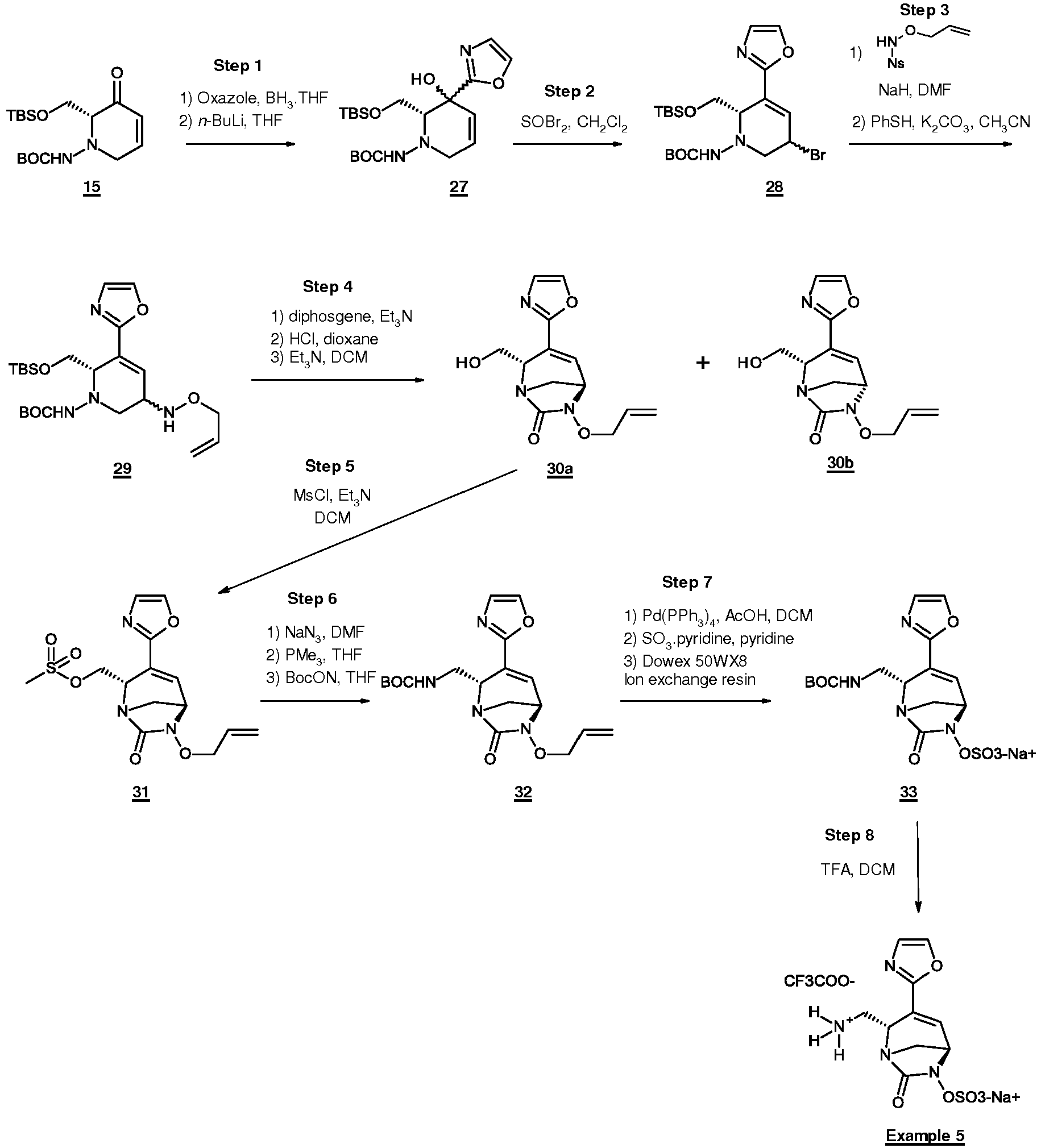
- To a solution of borane tetrahydrofuran complex solution 1.0 M in THF (19 mL, 19 mmol) under nitrogen atmosphere at rt, was dropwise added oxazole (1.24 mL, 18.89 mmol). The mixture was stirred at rt for 1 h then cooled down to -78°C. A n-butyllithium solution 1.6 M in hexanes (12.2 ml, 19.5 mmol) was dropwise added and the mixture maintained at this temperature for 30 min. A solution of compound (15) (4.30 g, 12.6 mmol) in anhydrous THF (9 mL) was dropwise added. The mixture was stirred at -78°C for 90 min. Ethanol containing 5% AcOH (30 mL) was added and the mixture was stirred at rt for 18 h. Water (50 mL) was added. The aqueous layer was extracted with EtOAc (2 x 50 mL). The combined organic layers were washed with a saturated solution of NaHCO3 (50 mL), dried over Na2SO4 and concentrated in vacuo. The residue was purified by flash chromatography on silica gel (cyclohexane/EtOAc: 80/20 to 40/60) to provide compound (27) (1.12 g, 2.72 mmol, 21%) as a cis/trans mixture.
MS m/z ([M+H]+) 411.
1H NMR (400 MHz, CDCl3) δ 0.10 and 0.11 (s, 6H), 0.90 (s, 9H), 1.33 and 1.37 (s, 9H), 3.40-3.78 (m, 2H), 4.00-4.08 (m, 1H), 4.26 and 4.38 (d, J = 19.4 Hz, 1H), 4.68 and 4.99 (bs, 1H), 4.88 and 4.74 (t, J = 7.2 Hz, 1H), 5.86-6.04 (m, 2H), 7.01 and 7.07 (s, 1H), 7.61 (d, J = 0.8 Hz, 1H). - Using the procedure described in example 2 (step 8) the intermediate (27) (1.12 g, 2.73 mmol) is converted into intermediate (28) (1.25 g, 2.64 mmol, 96%) as a cis/trans mixture which was used without further purification.
- Using the procedure described in example 2 (step 9) the intermediate (28) (1.25 g, 2.64 mmol) is converted into intermediate (29) (750 mg, 1.61 mmol, 61%) as a mixture cis/trans (62/38) after purification by flash chromatography on silica gel (DCM/EtOAc from 100/0 to 70/30).
MS m/z ([M+H]+) 466. - Using the procedure described in example 2 (step 10) the intermediate (29) (750 mg, 1.61 mmol) is converted into intermediate (30a) (88 mg, 0.31 mmol, 20%) and intermediate (30b) (201 mg, 0.72 mmol, 45%) after purification and separation by preparative TLCs on silica gel (EtOAc).
MS m/z ([M+H]+) 278. 30a :
1H NMR (400 MHz, CDCl3) δ 3.33 (s, 2H), 3.51 (bs, 1H), 3.93 (dd, J = 11.4, 7.5 Hz, 1H), 4.03-4.08 (m, 1H), 4.22 (dd, J = 11.6, 4.7 Hz, 1H), 4.33-4.52 (m, 3H), 5.24-5.40 (m, 2H), 5.92-6.07 (m, 1H), 7.11 (s, 1H), 7.19 (d, J = 5.3 Hz, 1H), 7.58 (s, 1H).
30b :
1H NMR (400 MHz, CDCl3) δ 3.19 (dd, J = 14.1, 3.3 Hz, 1H), 3.90 (bs, 1H), 4.21 (t, J = 8.5 Hz, 1H), 4.32-4.47 (m, 3H), 4.86-4.98 (m, 1H), 5.04 (t, J = 9.0 Hz, 1H), 5.30 (dd, J = 10.4, 1.0 Hz, 1H), 5.35-5.45 (m, 1H), 5.55 (s, 1H), 5.99-6.09 (m, 1H), 6.86 (d, J = 5.9 Hz, 1H), 7.26 (d, J = 0.8 Hz, 1H), 7.76 (d, J = 0.8 Hz, 1H). - Using the procedure described in example 2 (step 11) the intermediate (30a) (119 mg, 0.43 mmol) is converted into intermediate (31) (153 mg, 0.43 mmol, 100%) as a yellow oil which was used without further purification.
MS m/z ([M+H]+) 356.
1H NMR (400 MHz, CDCl3) δ 3.05 (s, 3H), 3.40 (ddd, J = 11.5, 2.7, 1.3 Hz, 1H), 3.48 (dd, J = 11.5, 0.8 Hz, 1H), 4.07 (dd, J = 5.2, 1.9 Hz, 1H), 4.35 - 4.50 (m, 2H), 4.66 (ddd, J = 6.4, 3.9, 1.8 Hz, 1H), 4.85-4.89 (m, 2H), 5.29-5.41 (m, 2H), 5.95-6.07 (m, 1H), 7.14 (d, J = 0.8 Hz, 1H), 7.27 (dt, J = 5.2, 1.4 Hz, 1H), 7.59 (d, J = 0.8 Hz, 1H). - Using the procedure described in example 2 (step 12) the intermediate (31) (153 mg, 0.43 mmol) is converted into intermediate (32) (57 mg, 0.15 mmol, 35%) after purification by flash chromatography on silica gel (cyclohexane/EtOAc from 70/30 to 0/100) then by preparative TLCs on silica gel (cyclohexane/acetone 60/40).
MS m/z ([M+H]+) 377.
1H NMR (400 MHz, CDCl3) δ1.43 (s, 9H), 3.19-3.37 (m, 3H), 3.97-4.10 (m, 2H), 4.32-4.49 (m, 3H), 5.15 (bs, 1H), 5.24-5.40 (m, 2H), 5.89-6.07 (m, 1H), 7.11 (s, 1H), 7.16 (d, J = 4.9, 1H), 7.56 (s, 1H). - Using the procedure described in example 2 (step 13) the intermediate (32) (57 mg, 0.15 mmol) is converted into intermediate (33) (28 mg, 0.064 mmol, 42%).
MS m/z ([M+H]+) 417.
MS m/z ([M-H]-) 415.
1H NMR (400 MHz, D2O) δ 1.43 (s, 9H), 3.41-3.58 (m, 2H), 3.64 (d, J = 11.9 Hz, 1H), 3.74 (dd, J = 14.8, 3.2 Hz, 1H), 4.40 (dd, J = 9.9, 3.7 Hz, 1H), 4.53 (dd, J = 5.3, 2.5 Hz, 1H), 7.22 (s, 1H), 7.27 (d, J = 5.2 Hz, 1H), 7.85 (s, 1H). - Using the procedure described in example 2 (step 14) the intermediate (33) (28 mg, 0.064 mmol) is converted into Example 5 (22.8 mg, 0.050 mmol, 78%) as an off white solid.
MS m/z ([M+H]+) 317.
MS m/z ([M-H]-) 315.
1H NMR (300 MHz, D2O) δ 3.41 (dd, J = 13.5, 11.9 Hz, 1H), 3.57 (d, J = 1.6 Hz, 2H), 3.79 (dd, J = 13.8, 3.9 Hz, 1H), 4.54-4.66 (m, 2H), 7.24 (d, J = 0.9 Hz, 1H), 7.37 (dd, J = 5.3, 1.6 Hz, 1H), 7.86 (d, J = 0.9 Hz, 1H). -

- Using the procedure described in example 1 (step 5) the intermediate (4) (514 mg, 1.14 mmol) is converted into intermediate (34) (384 mg, 1.14 mmol, quantitative yield) as a brown oil which was used without further purification.
MS m/z ([M+H]+) 337. - A solution of trans-6-allyloxy-2-(hydroxymethyl)-4-iodo-1,6-diazabicyclo[3.2.1]oct-3-en-7-one (34) (384 mg, 1.14 mmol) in DCM (11 mL) was cooled to 0°C. TEA (0.95 mL, 6.85 mmol) and MsCI (0.44 mL, 5.71 mmol) were added and the reaction mixture was stirred at the same temperature for 1 h. After completion, the reacting mixture was concentrated in vacuo. The crude was dissolved in DMF (11 mL) and NaN3 (371 mg, 5.71 mmol) was added. The reaction mixture was heated at 65°C overnight and concentrated in vacuo.
- The crude was dissolved in a mixture of THF and toluene (3.8 mL/3.8 mL) and PMe3 (1M in tetrahydrofuran) (1.71 mL, 1.71 mmol) was added at 0°C. After 1 h stirring at rt, the mixture was cooled to 0°C and a solution of BocON (422 mg, 1.71 mmol) in THF (3.8 mL) was dropwise added. The mixture was stirred overnight at rt and concentrated in vacuo. The crude was purified by flash chromatography on silica gel (DCM/Acetone from 95/5 to 0/100) to give tert-butyl N-[[trans-6-allyloxy-4-iodo-7-oxo-1,6-diazabicyclo[3.2.1]oct-3-en-2-yl]methyl]carbamate (35) (43 mg, 0.10 mmol, 10% over 4 steps).
MS m/z ([M+H]+) 436.
1H NMR (400 MHz, CDCl3) : δ (ppm) 1.42 (s, 9H), 3.17-3.20 (m, 1H), 3.26-3.31 (m, 1H), 3.45-3.51 (m, 1H), 3.85-3.88 (m, 1H), 4.09 (d, J = 2.0 Hz, 1H), 4.37-4.50 (m, 3H), 5.76-5.86 (m, 1H), 5.98-6.08 (m, 2H), 6.26 (d, J = 2.0 Hz, 1H), 6.98 (bs, 1H). - In a sealed flask, a mixture of tert-butyl N-[[trans-6-allyloxy-4-iodo-7-oxo-1,6-diazabicyclo[3.2.1]oct-3-en-2-yl]methyl]carbamate (35) (43 mg, 0.10 mmol) and 5-trimethyltin-1-methylpyrimidin-2(1H)-one (32 mg, 0.12 mmol) in anhydrous THF (1.0 mL) was degassed under argon for 5 min before Pd(PPh3)4 (6 mg, 0.005 mmol) and CuI (2 mg, 0.01 mmol) were added. The mixture was heated at 60°C overnight. After completion, the reacting mixture was concentrated in vacuo. The crude was purified by flash chromatography on silica gel (DCM/Acetone from 70/30 to 0/100) to give tert-butyl N-[[trans-6-allyloxy-4-(1-methylpyrimidin-2(1H)-one-5-yl)-7-oxo-1,6-diazabicyclo[3.2.1]oct-3-en-2-yl]methyl]carbamate (36) (12 mg, 0.03 mmol, 29%).
MS m/z ([M+H]+) 418.
1H NMR (400 MHz, (CD3)2CO) : δ (ppm) 1.41 (s, 9H), 3.25-3.41 (m, 2H), 3.52 (s, 3H), 3.84-3.93 (m, 2H), 4.49-4.52 (m, 1H), 5.25 (d, J = 10.4 Hz, 1H), 5.38 (dd, J = 17.2, 1.2 Hz, 1H), 5.96 (d, J = 2.0 Hz, 1H), 5.99-6.09 (m, 2H), 6.20-6.24 (m, 1H), 6.38 (dd, J = 6.4, 4.0 Hz, 1H), 8.14 (dd, J = 6.4, 2.8 Hz, 1H), 8.53 (d, J = 2.8 Hz, 1H). - To a solution of tert-butyl N-[[trans-6-allyloxy-4-(1-methylpyrimidin-2(1H)-one-5-yl)-7-oxo-1,6-diazabicyclo[3.2.1]oct-3-en-2-yl]methyl]carbamate (36) (12 mg, 0.03 mmol) and glacial AcOH (3 µL, 0.06 mmol) in anhydrous DCM (0.14 mL) was added in one portion Pd(PPh3)4 (17 mg, 0.014 mmol). After stirring for 2 h, a solution of sulfur trioxide pyridine complex (23 mg, 0.14 mmol) in dry pyridine (0.14 mL) was added and the resulting mixture was stirred overnight at 40°C in the dark. The reaction mixture was concentrated in vacuo, diluted with DCM and filtered. The filtrate was concentrated in vacuo. The crude was dissolved in a mixture of H20/MeCN 7/3 (1 mL) was applied on a Dowex sodium form column (Dowex® 50WX8 hydrogen form stored with an aqueous solution of 2N NaOH and washed until neutral pH with H2O). The fractions containing the desired compound were combined and concentrated in vacuo to give sodium [trans-2-[(tert-butoxycarbonylamino)methyl]-4-(1-methylpyrimidin-2(1H)-one-5-yl)-7-oxo-1,6-diazabicyclo[3.2.1]oct-3-en-6-yl] sulfate (37) (15 mg).
MS m/z ([M+H]+) 458.
MS m/z ([M-H]-) 456. - The crude sodium [trans-2-[(tert-butoxycarbonylamino)methyl]-4-(1-methylpyrimidin-2(1H)-one-5-yl)-7-oxo-1,6-diazabicyclo[3.2.1]oct-3-en-6-yl] sulfate (37) (14 mg, 0.03 mmol) was dissolved in DCM (1.0 mL), cooled to 0°C, and a pre-coolded solution of TFA (0.67 mL, 8.76 mmol) in DCM (0.67 mL) was dropwise added. After 1 h stirring at the same temperature, the reaction mixture was poured into DCM and concentrated in vacuo (co-evaporations with DCM). The solid residue was washed with DCM twice, solubilized into water, filtered through Isodisc® and lyophilized to afford the crude sodium and 2,2,2-trifluoroacetate [trans-2-(azaniumylmethyl)-4-(1-methylpyrimidin-2(1H)-one-5-yl)-7-oxo-1,6-diazabicyclo[3.2.1]oct-3-en-6-yl] sulfate. The crude sodium and 2,2,2-trifluoroacetate [trans-2-(azaniumylmethyl)-4-(1-methylpyrimidin-2(1H)-one-5-yl)-7-oxo-1 ,6-diazabicyclo[3.2.1]oct-3-en-6-yl] sulfate (7.1 mg, 0.014 mmol) was then triturated 3 times in propan-2-ol and dried under reduced pressure to afford [trans-2-(aminomethyl)-4-(1-methylpyrimidin-2(1H)-one-5-yl)-7-oxo-1,6-diazabicyclo[3.2.1]oct-3-en-6-yl] sulfate (Example 6) (5.2 mg, 0.01 mmol, 35% over 4 steps).
MS m/z ([M+H]+) 358.
MS m/z ([M-H]-) 356.
1H NMR (400 MHz, D2O) : δ (ppm) 3.27-3.43 (m, 2H), 3.52 (d, J = 11.6 Hz, 1H), 3.59 (dd, J = 11.6, 2.8 Hz, 1H), 3.60 (s, 3H), 4.22-4.27 (ddd, J = 11.6, 3.2, 2.8 Hz, 1H), 4.67 (d, J = 2.8 Hz, 1H), 5.99 (d, J = 2.8 Hz, 1H), 8.23 (d, J = 3.2 Hz, 1H), 8.72 (d, J = 3.2 Hz, 1H). -

- A mixture of compound (20) (150 mg, 0.404 mmol) and NaN3 (131 mg, 2.02 mmol) in anhydrous DMF (2.0 mL) was stirred at 65°C for 24 h. The mixture was poured in H2O (5 mL) and extracted with EtOAc (2 x 5 mL). The organic layer was washed with brine (5 mL), dried over Na2SO4 and concentrated in vacuo. The residue was dissolved in anhydrous THF (1 mL) and anhydrous toluene (1mL) and cooled at 0°C under nitrogen atmosphere. A PMe3 solution 1M in THF (0.52 mL, 0.518 mmol) was dropwise added and the mixture was stirred at rt for 1 h. The mixture was cooled at 0°C and a solution of BocON (161 mg, 0.518 mmol) in anhydrous THF (0.7 mL) was added. The mixture was stirred at rt for 1 h. Water (5 mL) was added and the layers separated. The aqueous layer was extracted with EtOAc (2 x 5 mL). The combined organic layers were washed with brine (5 mL), dried over Na2SO4 and concentrated in vacuo. The residue was purified by flash chromatography on silica gel (cyclohexane/EtOAc: 95/5 to 0/100) to provide tert-butyl N-[N'-[[(2S,5R)-6-allyloxy-7-oxo-3-thiazol-2-yl-1,6-diazabicyclo[3.2.1]oct-3-en-2-yl]methyl]-N-tert-butoxycarbonyl-carbamimidoyl]carbamate (38) (40 mg, 0.075 mmol, 22%) as a white solid.
MS m/z ([M+H]+) 535.
1H NMR (400 MHz, CDCl3) δ 1.47 (s, 9H), 1.50 (s, 9H), 3.29-3.36 (m, 1H), 3.40 (d, J = 11.4 Hz, 1H), 3.65 (ddd, J = 14.1, 11.4, 4.3 Hz, 1H), 4.02 (dd, J = 5.0, 2.3 Hz, 1H), 4.19 (dt, J = 14.2, 4.8 Hz, 1H), 4.35-4.48 (m, 2H), 4.76 (ddd, J = 11.4, 4.3, 1.3 Hz, 1H), 5.27-5.38 (m, 2H), 5.95-6.08 (m, 1H), 6.96 (d, J = 5.1 Hz, 1H), 7.21 (d, J = 3.2 Hz, 1H), 7.74 (d, J = 3.2 Hz, 1H), 8.80 (s, 1H), 11.43 (s, 1H). - To a solution of tert-butyl N-[N'-[[(2S,5R)-6-allyloxy-7-oxo-3-thiazol-2-yl-1,6-diazabicyclo[3.2.1]oct-3-en-2-yl]methyl]-N-tert-butoxycarbonyl-carbamimidoyl]carbamate (38) (40 mg, 0.075 mmol) and glacial AcOH (9 µL, 0.150 mmol) in anhydrous DCM (0.3 mL) was added in one portion Pd(PPh3)4 (43 mg, 0.037 mmo). The mixture was stirred at rt for 1 h then concentrated in vacuo. The residue was purified by flash chromatography on silica gel (DCM/acetone: 100/0 to 0/100) to provide a mixture of expected intermediate and triphenylphosphine oxide. The mixture was dissolved in pyridine (0.55 mL) and sulfur trioxide pyridine complex (131 mg, 0.823 mmol) was added. The mixture was stirred at rt overnight then concentrated in vacuo. DCM (2 mL) was added to the residue and the precipitate filtered. The filtrate was concentrated and the residue purified by flash chromatography on silica gel (DCM/acetone: 50/50 to 0/100). The fractions containing the expected intermediate were combined and concentrated in vacuo. The residue was dissolved in a mixture of H2O/THF 7/3 (0.5 mL), and converted after ion exchange (Dowex sodium form column) to sodium [(2S,5R)-2-[[bis(tert-butoxycarbonylamino)methyleneamino]methyl]-7-oxo-3-thiazol-2-yl-1,6-diazabicyclo[3.2.1]oct-3-en-6-yl] sulfate (39) (12 mg, 0.020 mmol, 28%).
MS m/z ([M+H]+) 575.
MS m/z ([M-H]-) 573. - A solution of sodium [(2S,5R)-2-[[bis(tert-butoxycarbonylamino)methyleneamino]methyl]-7-oxo-3-thiazol-2-yl-1,6-diazabicyclo[3.2.1]oct-3-en-6-yl] sulfate (39) (12 mg, 0.020 mmol) in anhydrous DCM (0.25 mL) was added to a mixture of DCM (0.45 mL) and TFA (0.45 mL) at 0°C. The mixture was stirred at 0°C for 30 min and allowed to reach rt for 1 h. TFA (0.3 mL) was added and the mixture was stirred at rt for a further 3 h, then concentrated in vacuo. The residue was co-evaporated three times with DCM (2 mL). Water (0.5 mL) was added and the precipitate was filtered to provide [(2S,5R)-2-(guanidinommethyl)-7-oxo-3-thiazol-2-yl-1,6-diazabicyclo[3.2.1]oct-3-en-6-yl] hydrogen sulfate (Example 7) (3.2 mg, 0.006 mmol, 42%) as a light pink solid.
MS m/z ([M+H]+) 375.
MS m/z ([M-H]-) 373.
1H NMR (300 MHz, DMSO) δ 3.21-3.31 (m, 1H), 3.43-3.58 (m, 2H), 3.68-3.80 (m, 1H), 4.28-4.36 (m, 1H), 4.39 (dd, J = 5.3, 2.4 Hz, 1H), 7.21 (d, J = 5.3 Hz, 1H), 7.79 (d, J = 3.2 Hz, 1H), 7.75-7.82 (m, 2H). -

- A mixture of compound (20) (253 mg, 0.68 mmol) and NaN3 (221 mg, 3.41 mmol) in anhydrous DMF (3.0 mL) was stirred at 65°C for 24 h. The mixture was poured in H2O (5 mL) and extracted with EtOAc (2 x 5 mL). The organic layer was washed with brine (5 mL), dried over Na2SO4 and concentrated in vacuo. The residue was dissolved in anhydrous THF (2 mL) and anhydrous toluene (2 mL) and cooled at 0°C under nitrogen atmosphere. A PMe3 solution 1M in THF (1.02 mL, 1.02 mmol) was dropwise added, the mixture was stirred at rt for 1 h and concentrated in vacuo. The residue was purified by flash chromatography on silica gel (DCM/iPrOH: 100/0 to 50/50) to provide (2S,5R)-6-allyloxy-2-(aminomethyl)-3-thiazol-2-yl-1,6-diazabicyclo[3.2.1]oct-3-en-7-one (40) (100 mg, 0.34 mmol, 50%).
MS m/z ([M+H]+) 293.
1H NMR (400 MHz, CDCl3) δ 2.81 (dd, J = 14.1, 10.3 Hz, 1H), 3.31 (s, 2H), 3.44 (dd, J = 14.1, 3.5 Hz, 1H), 3.98-4.04 (m, 1H), 4.37-4.49 (m, 3H), 5.27-5.32 (m, 2H), 5.33-5.39 (m, 1H), 5.95-6.08 (m, 1H), 6.93 (d, J = 5.2 Hz, 1H), 7.24 (d, J = 3.3 Hz, 1H), 7.75 (d, J = 3.3 Hz, 1H). - To a solution of N-Boc-β-alanine (78 mg, 0.410 mmol) in anhydrous DMF (2 mL) at 0°C under inert atmosphere was added HOBt hydrate (63 mg, 0.410 mmol), EDCI (72 mg, 0.376 mmol) and DIPEA (0.12 mL, 0.684 mmol). The mixture was stirred for 30 min at this temperature and a solution of compound (40) (100 mg, 0.342 mmol) in anhydrous DMF (2mL) was added. The reaction mixture is allowed to reach rt and stirred for 1 hour. H2O was added and the mixture was extracted with EtOAc. The organic layer was washed with brine (5 mL), dried over Na2SO4, filtered and evaporated in vacuo. The crude was purified by flash chromatography on silica gel (DCM/EtOAc 100/0 to 0/100) to provide tert-butyl N-[3-[[(2S,5R)-6-allyloxy-7-oxo-3-thiazol-2-yl-1,6-diazabicyclo[3.2.1]oct-3-en-2-yl]methylamino]-3-oxo-propyl]carbamate (41) (95 mg, 0.205 mmol, 60%).
MS m/z ([M+H]+) 464.
1H NMR (400 MHz, CDCl3) δ 1.43 (s, 9H), 2.42 (t, J = 6.0 Hz, 2H), 5.30 (dd, J = 11.3, 1.5 Hz, 1H), 3.36 (d, J = 11.3 Hz, 1H), 3.39-3.48 (m, 3H), 4.04 (dd, J = 5.3, 2.4 Hz, 1H), 4.10-4.20 (m, 1H), 4.36-4.49 (m, 2H), 4.62 (ddd, J = 11.0, 4.5, 1.4 Hz, 1H), 5.25 (bs, 1H), 5.31 (dd, J = 10.3, 1.4 Hz, 1H), 5.36 (dd, J = 17.0, 1.4 Hz, 1H), 5.96-6.06 (m, 1H), 6.17 (bs, 1H), 6.98 (d, J = 5.2 Hz, 1H), 7.24 (d, J = 3.3 Hz, 1H), 7.75 (d, J = 3.3 Hz, 1H). - To a solution of compound (41) (85 mg, 0.183 mmol) in anhydrous DCM (1.85 mL) under nitrogen atmosphere were successively added AcOH (21 µL, 0.367 mmol) and Pd(PPh3)4 (106 mg, 0.091 mmol). After stirring for 2 h, dry pyridine (1.85 mL) and sulfur trioxide pyridine complex (145 mg, 0.915 mmol) were added and the resulting mixture was stirred for 2 hours. The reaction mixture was concentrated in vacuo, diluted with DCM (2 mL) and filtered. The filtrate was concentrated in vacuo. The crude was purified by flash chromatography on silica gel (DCM/acetone: 100/0 to 0/100). The fractions containing the expected intermediate were combined and concentrated in vacuo. The residue was dissolved in H2O (1 mL) and converted after ion exchange (Dowex sodium form column), and a chromatography on reverse phase C-18 (water/ACN: 100/0 to 0/100) to sodium [(2S,5R)-2-[[3-(tert-butoxycarbonylamino)propanoylamino]methyl]-7-oxo-3-thiazol-2-yl-1,6-diazabicyclo[3.2.1]oct-3-en-6-yl] sulfate (42) (20 mg, 0.038 mmol, 21%) as a white solid.
MS m/z ([M-H]-) 502.
1H NMR (400 MHz, D2O) δ 1.41 (s, 9H), 2.42 (t, J = 6.4 Hz, 2H), 3.29-3.40 (m, 2H), 3.45-3.53 (m, 1H), 3.57-3.68 (m, 2H), 3.75 (dd, J = 14.6, 4.5 Hz, 1H), 4.51 (dd, J = 5.3, 2.5 Hz, 1H), 4.60 (ddd, J = 10.4, 4.5, 1.4 Hz, 1H), 7.11 (d, J = 5.3 Hz, 1H), 7.57 (d, J = 3.3 Hz, 1H), 7.82 (d, J = 3.3 Hz, 1H). - Using the procedure described in example 2 (step 14) the intermediate (42) (17 mg, 0.032 mmol) is converted into Example 8 (16.1 mg, 0.030 mmol, 93%).
MS m/z ([M+H]+) 404.
MS m/z ([M-H]-) 402.
1H NMR (300 MHz, D2O) δ 2.69 (d, J = 6.7 Hz, 2H), 3.26 (d, J = 6.7 Hz, 2H), 3.44-3.67 (m, 3H), 3.72 (dd, J = 14.7, 4.1 Hz, 1H), 4.50-4.58 (m, 2H), 7.14-7.19 (m, 1H), 7.66 (d, J = 3.5 Hz, 1H), 7.87 (d, J = 3.5 Hz, 1H). - Enzyme activity was monitored by spectrophotometric measurement of nitrocefin (NCF - TOKU-E, N005) hydrolysis at 485nm, at room temperature and in assay buffer A: 100mM Phosphate pH7, 2% glycerol and 0.1mg/ mL Bovine serum albumin (Sigma, B4287). Enzymes were cloned in E. coli expression vector, expressed and purified in house using classical procedures. To a transparent polystyrene plate (Corning, 3628) were added in each well 5µL DMSO or inhibitor dilutions in DMSO and 80µL enzyme in buffer A. Plates were immediately read at 485nm in a microplate spectrophotometer (BioTek, PowerWave HT) to enable background subtraction. After 30min of pre-incubation at room temperature, 15µL of NCF (200µM final) were finally added in each well. Final enzyme concentrations were 0.1nM (TEM-1), 0.075nM (SHV-1), 0.4nM (CTX-M-15), 1nM (KPC-2), 0.2nM (P99 AmpC), 0.2nM (CMY-37), 0.4nM (AmpC P. aeruginosa), 0.2nM (OXA-1), 1.2nM (OXA-11), 0.4nM (OXA-15) and 0.3nM (OXA-48). After 20 min incubation at room temperature, plates were once again read at 485nm. Enzyme activity was obtained by subtracting the final signal by the background, and was converted to enzyme inhibition using non inhibited wells. IC50 curves were fitted to a classical Langmuir equilibrium model with Hill slope using XLFIT (IDBS).
Table 1: IC 50 (µM) for β-lactamase Inhibitory Activity IC50 β-lactamase (µM) (A) (C) (D) TEM-1 SHV-1 CTX-M-15 KPC-2 AmpC (P99) CMY-37 AmpC (PAE) OXA-1 OXA-11 OXA-15 OXA-48 Example 1 0.0032 0.0013 0.0054 0.0078 0.0041 0.0099 0.037 0.080 0.0041 0.00065 0.00051 Example 2 0.0017 0.00074 0.00076 0.0039 0.0032 0.017 0.11 0.0061 0.0068 0.00084 0.0035 Example 3 0.0030 0.0046 0.0020 0.033 0.0074 0.025 0.22 0.017 0.048 0.0016 0.0057 Example 4 0.014 0.020 0.0030 0.068 0.035 0.012 0.40 0.061 0.16 0.0073 0.027 Example 5 0.11 0.064 0.13 1.8 11 12 12 0.37 0.43 0.0080 0.18 Example 6 0.28 0.34 0.51 5.1 6.4 6.8 38 1.2 1.6 0.068 0.84 - Compounds of the present invention were assessed against genotyped bacterial strains alone or in combination with the β-lactam ceftazidime. In the assays, MICs of said compounds, or of ceftazidime at fixed concentrations of said compounds were determined by the broth microdilution method according to the Clinical Laboratory Standards Institute (CLSI - M7-A7). Briefly, compounds alone according to the invention were prepared in DMSO and spotted (2µL each) on sterile polystyrene plates (Corning, 3788). Compounds and ceftazidime dilutions were prepared in DMSO and spotted (1µL each) on sterile polystyrene plates (Corning, 3788). Log phase bacterial suspensions were adjusted to a final density of 5x10⁵ cfu/mL in cation-adjusted Mueller-Hinton broth (Becton-Dickinson) and added to each well (98µL). Microplates were incubated for 16-20 h at 35 °C in ambient air. The MIC of of the compounds was defined as the lowest concentration of said compounds that prevented bacterial growth as read by visual inspection. The MIC of ceftazidime at each compound concentration was defined as the lowest concentration of ceftazidime that prevented bacterial growth as read by visual inspection.
Table 2: Bacterial species used in MIC determination Strain Resistance mechanism E. cloacae 260508 TEM-1, CTX-M-15 E. coli UFR61O TEM-1, KPC-2 K. pneumoniae BAA-1898 TEM-1, SHV-11, SHV-12, KPC-2 K. pneumoniae 160143 TEM-1, SHV-1, CTX-M-15, KPC-2, OXA-1 K. pneumoniae UFR68 TEM-1, SHV-11, CTX-M-15, KPC-3 E. cloacae P99 Derepressed ampC E. cloacae UFR85 TEM-1, CTX-M-15, derepressed ampC E. cloacae UFR70 TEM-1, CTX-M-15, CMY-2, OXA-1, Porin loss K. pneumoniae UFR77 CMY-2 E. coli UFR74 SHV-1, DHA-1 E. coli UFR18 CTX-M-15, OXA-204 E. coli 131119 TEM-1, OXA-48 K. oxytoca UFR21 TEM-1, CTX-M-15, OXA-48 K. pneumoniae UFR24 TEM-1, SHV-2, SHV-11, OXA-1, OXA-48, OXA-47 K. pneumoniae 6299 TEM-1, SHV-11, OXA-163 E. coli RGN238 OXA-1 K. pneumoniae 200047 TEM-1, SHV-32, CTX-M-15, OXA-1 E. coli 190317 TEM-1, SHV-12, CTX-M-15, OXA-1 E. coli UFR32 TEM-1, VEB-1, OXA-10 E. cloacae UFR38 CTX-M-15, NDM-1 C. murliniae 210102 VIM-4 E. coli UFR52 TEM-1, SHV-12, IMP-8 P. aeruginosa CIP107051 TEM-24 P. aeruginosa CIP105250 OXA-15 P. aeruginosa UFR35 OXA-23 P. aeruginosa UFR90 Derepressed ampC, OprD- P. aeruginosa UFR92 Derepressed ampC, OprD- P. aeruginosa UFR93 Derepressed ampC, OprD-, MexAB+, MexXY+ P. aeruginosa UFR47 VIM-1 P. aeruginosa UFR48 VIM-2 P. aeruginosa UFR59 IMP-29 Table 3: MIC of compounds MIC compounds of the invention alone (µg/mL) Strains Example 1 Example 2 Example 3 Example 4 Example 5 Example 6 Example 7 260508 0.063 ≤0.016 8 UFR61O 0.031 0.031 0.5 BAA-1898 >32 16 >32 >32 16 >32 >32 160143 >32 8 32 UFR68 >32 16 32 P99 0.031 ≤0.016 0.063 >32 ≤0.016 0.125 0.031 UFR85 >32 16 8 UFR70 16 4 8 UFR77 >32 32 >32 UFR74 >32 16 16 UFR18 0.031 ≤0.016 ≤0.016 131119 32 ≤0.016 0.5 >32 0.063 >32 0.031 UFR21 >32 16 32 UFR24 >32 >32 >32 6299 >32 >32 >32 >32 >32 >32 >32 RGN238 >32 8 >32 >32 16 >32 16 200047 >32 16 16 190317 0.031 ≤0.016 0.25 >32 ≤0.016 0.125 0.063 UFR32 0.031 ≤0.016 0.063 UFR38 ≤0.016 32 ≤0.016 210102 >32 4 4 UFR52 2 4 4 CIP107051 2 2 16 >32 2 16 8 CIP105250 >32 8 >32 >32 4 32 32 UFR35 1 2 2 0.25 UFR90 0.5 1 1 0.25 UFR92 2 2 8 1 UFR93 8 4 16 4 UFR47 2 2 4 1 UFR48 4 2 8 2 UFR59 8 8 16 2 Table 4: MIC of Ceftazidime/compound combinations Strains CAZ combination of CAZ and compounds of the invention et 4µg/mL: MIC (µg/mL) Example 1 Example 2 Example 3 Example 4 Example 5 Example 6 Example 7 260508 128 ≤0.125 <0.25 <0.25 UFR61O 128 <0.25 <0.25 <0.25 BAA-1898 256 0.5 ≤0.125 1 64 ≤0.125 4 ≤0.125 160143 128 1 ≤0.125 <0.25 UFR68 >128 1 ≤0.125 ≤0.25 P99 128 <0.25 <0.25 ≤0.125 64 <0.25 ≤0.125 <0.125 UFR85 128 2 ≤0.125 <0.25 UFR70 >128 1 <0.25 <0.25 UFR77 64 2 2 <0.25 UFR74 64 4 ≤0.125 <0.25 UFR18 >128 <0.25 <0.25 <0.25 131119 0.5 <0.25 <0.25 <0.25 UFR21 128 0.5 ≤0.125 <0.25 UFR24 >128 4 0.25 <0.25 6299 256 0.5 4 1 128 8 4 2 RGN238 0.5 ≤0.125 ≤0.125 <0.25 200047 128 0.5 ≤0.125 <0.25 190317 128 <0.25 <0.25 <0.125 4 <0.25 <0.125 <0.125 UFR32 >128 <0.25 <0.25 <0.25 UFR38 >128 <0.25 <0.25 <0.25 210102 >128 0.5 ≤0.125 <0.25 UFR52 >128 <0.25 <0.25 <0.25 CIP107051 256 <0.25 <0.25 ≤0.25 64 <0.25 32 1 CIP105250 256 ≤0.125 ≤0.125 8 128 <0.25 64 32 UFR35 2 <0.25 <0.25 <0.25 <0.25 UFR90 64 <0.25 <0.25 <0.25 <0.25 UFR92 32 <0.25 <0.25 ≤0.25 <0.25 UFR93 >128 <0.25 <0.25 0.5 <0.25 UFR47 >128 <0.25 <0.25 <0.25 <0.25 UFR48 256 <0.25 <0.25 16 <0.25 UFR59 128 <0.25 <0.25 2 <0.25
Claims (22)
- A compound of formula (I)
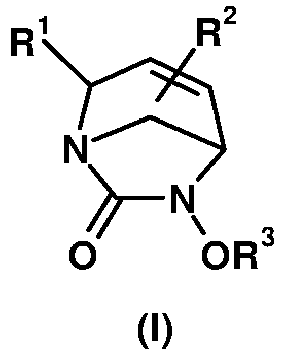 R1 represents a carbon-linked 4-, 5- or 6-membered heterocycle saturated, partially or totally unsaturated or aromatic comprising at least one nitrogen atom, -CN, -(CH2)m-OQ1, -(CH2)m-OC(O)Q1, -C(O)OQ1, -(CH2)m-OC(O)OQ1, -(CH2)m-OC(O)NQ1Q2, -C(O)NHQ1, -C(O)NHOQ1, -(CH2)m-NHS(O)2NQ1Q2, -C(O)NH-NHQ1, -C(O)O-NHQ1, -(CH2)m-NHC(O)Q1,-(CH2)m-NHS(O)2Q1, -(CH2)m-NHC(O)OQ1, -(CH2)m-NHC(O)NQ1Q2, -(CH2)m-NHQ3, -(CH2)m-NH-C(NHQ3)=NQ4, (CH2)m-NH-CH=NQ3, -C(NHQ3)=NQ4, wherein the heterocycle is optionally substituted by one or more T1;R2 represents a 4- to 10-membered heterocycle saturated, partially or totally unsaturated or aromatic optionally substituted by one or more T2;R3 represents -SO3H, -CFHCOOH or -CF2COOH;T1, identical or different independently represents a fluorine atom, a (C1-C3)-alkyl, a (C1-C3)-fluoroalkyl, O-(C1-C3)fluoroalkyl, -(CH2)n-heterocycle wherein the heterocycle is a 4-, 5- or 6-membered heterocycle saturated, partially or totally unsaturated or aromatic comprising at least one nitrogen atom, -(CH2)nOQ1, -(CH2)n-C(O)ONHQ1, -(CH2)n-CN, -(CH2)n-OC(O)Q1, -(CH2)n-C(O)OQ1, -(CH2)n-NHS(O)2NQ1Q2, -(CH2)n-OC(O)OQ1, -(CH2)n-OC(O)NHQ1, -(CH2)n-C(O)NHQ1, -(CH2)n-C(O)NHOQ1, -(CH2)n-C(O)NH-NHQ1, -(CH2)n-NHC(O)Q1, -(CH2)n-NHS(O)2Q1, -(CH2)n-NHC(O)OQ1, -(CH2)n-NHC(O)NQ1Q2, -(CH2)n-NHQ1, -(CH2)n-NH-C(NHQ3)=NQ4, -(CH2)n-NH-CH=NQ3, (CH2)n-C(NHQ3)=NQ4, wherein the alkyl, fluoroalkyl, O-fluoroalkyl, and -(CH2)n-heterocycle are independently optionally substituted by one or more T3;Q1 and Q2, identical or different independently represent a hydrogen atom, (C1-C3)alkyl, -(CH2)q-NHQ3, -(CH2)q-NH-C(NHQ3)=NQ4, (CH2)q-NH-CH=NQ3, (CH2)r-C(NHQ3)=NQ4, -(CH2)q-OQ3, -(CH2)r-CONHQ3, -(CH2)n-heterocycle, wherein the heterocycle is a 4-, 5- or 6-membered heterocycle saturated, partially or totally unsaturated or aromatic comprising at least one nitrogen atom; wherein the alkyl and -(CH2)n-heterocycle are independently optionally substituted by one or more T3; or
Q1 and Q2 and the nitrogen atom to which they are bonded form together a saturated or partially unsaturated 4-, 5- or 6-membered heterocycle optionally substituted by one or more T3;Q3 and Q4, identical or different, independently represent a hydrogen atom or (C1-C3)alkyl;T2 , identical or different, independently represents a fluorine atom, (C1-C3)alkyl, (C1-C3)fluoroalkyl, O-(C1-C3)fluoroalkyl, (X)p-(CH2)n-(C3-C6)cycloalkyl, (X)p-(CH2)n-(C3-C6)cyclofluoroalkyl, -(X)p-(CH2)n-heterocycle wherein the heterocycle is a 4-, 5- or 6-membered heterocycle, saturated, partially or totally unsaturated or aromatic, -(X)p(CH2)tOQ5, (X)p-(CH2)u-CN, -(X)p-(CH2)t-OC(O)Q5, (X)p-(CH2)u-C(O)OQ5, (X)p-(CH2)t-OC(O)OQ5, (X)p-(CH2)t-OC(O)NQ5Q6, (X)p-(CH2)u-C(O)NQ5Q6, (X)p-(CH2)u-C(O)ONQ5Q6, (X)p-(CH2)u-C(O)NQ5OQ6, (X)p-(CH2)u-C(O)NQ5-NQ5Q6, (X)p-(CH2)t-NQ5C(O)Q6, (X)p-(CH2)t-NQ5S(O)2NQ5Q6, (X)p-(CH2)t-NQ5S(O)2Q6, (X)p-(CH2)t-NQ5C(O)OQ6, (X)p-(CH2)t-NQ5C(O)NQ5Q6, (X)p-(CH2)t-NQ5Q6, (X)p-(CH2)t-NH-C(NHQ3)=NQ4, (X)p-(CH2)t-NH-CH=NQ3, (X)p-(CH2)u-C(NHQ3)=NQ4, wherein the alkyl, fluoroalkyl, O-fluoroalkyl, (X)p-(CH2)n-cycloalkyl, (X)p-(CH2)n-cyclofluoroalkyl, -(X)p-(CH2)n-heterocycle are independently optionally substituted by one or more T3;Q5 and Q6, identical or different independently represent a hydrogen atom, (C1-C3)alkyl, -(CH2)q-NHQ3, -(CH2)q-NH-C(NHQ3)=NQ4, (CH2)q-NH-CH=NQ3, (CH2)r-C(NHQ3)=NQ4, -(CH2)q-OQ3, -(CH2)r-CONHQ3 -(CH2)n-heterocycle, wherein the heterocycle is a 4-, 5- or 6-membered heterocycle saturated, partially or totally unsaturated or aromatic comprising at least one nitrogen atom; wherein the alkyl and -(CH2)n-heterocycle are independently optionally substituted by one or more T3; or
Q5 and Q6 and the nitrogen atom to which they are bonded form together a saturated or partially unsaturated 4- to 6-membered heterocycle optionally substituted by one or more T3;T3, identical or different, independently represents -OH, -NH2, -CONH2;m, identical or different, independently represents 1 or 2;or their pharmaceutically acceptable salts, their corresponding zwitterion, or their optical isomers, racemates, diastereoisomers, enantiomers or tautomers.
n, identical or different, independently represents 0,1, 2 or 3;
t, identical or different, independently represents 0, 1, 2 or 3;
u, identical or different, independently represents 0, 1, 2 or 3;
q, identical or different, independently represents 2 or 3;
r, identical or different, independently represents 1, 2 or 3;
p, identical or different, independently represents 0 or 1 and when p is 0 t, identical or different is 0, 1, 2 or 3 and u, identical or different, is 0, 1, 2 or 3 and when p is 1 t, identical or different, independently represents 2 or 3 and u, identical or different, represents 1, 2 or 3; X, identical or different, independently represents O, S, S(O), S(O)2 or N(Q3);
wherein• any carbon atom present within a group selected from alkyl ; cycloalkyl ; fluoroalkyl ; cyclofluoroalkyl ; heterocycle can be oxidized to form a C(O) group;• any sulphur atom present within an heterocycle can be oxidized to form a S(O) group or a S(O)2 group ;• any nitrogen atom present within a group wherein it is trisubstituted (thus forming a tertiary amine) or within an heterocycle can be further quaternized by a methyl group; - A compound according to claim 1, wherein :- R1 represents a carbon-linked 4-, 5- or 6-membered heterocycle saturated, partially or totally unsaturated or aromatic comprising at least one nitrogen atom, -CN, -(CH2)m-OQ1,-(CH2)m-OC(O)Q1, -C(O)OQ1, -(CH2)m-OC(O)OQ1, -(CH2)m-OC(O)NQ1Q2, -C(O)NHQ1,-(CH2)m-NHS(O)2NQ1Q2, -C(O)NHOQ1, -C(O)NH-NHQ1, -C(O)O-NHQ1, -(CH2)m-NHC(O)Q1,-(CH2)m-NHS(O)2Q1, -(CH2)m-NHC(O)OQ1, -(CH2)m-NHC(O)NQ1Q2, wherein the heterocycle is optionally substituted by one or more T1, wherein m, Q1, Q2 and T1 are as defined in claim 1; or- R1 represents -(CH2)mNHQ3, -(CH2)m-NH-C(NHQ3)=NQ4, (CH2)m-NH-CH=NQ3,-C(NHQ3)=NQ4, wherein m, Q3 and Q4 are as defined in claim 1.
- A compound according to claim 1, wherein :- R1 represents a carbon-linked 4-, 5- or 6-membered heterocycle saturated, partially or totally unsaturated or aromatic comprising at least one nitrogen atom, CN, -C(O)NHQ1,-C(O)NHOQ1, -C(O)NH-NHQ1 or -(CH2)mOQ1 wherein the heterocycle is optionally substituted by one or more T1, wherein m, Q1 and T1 are as defined in claim 1; or.- R1 represents -(CH2)mNHQ3, -(CH2)m-NH-C(NHQ3)=NQ4, wherein m is as defined in claim 1 preferably m is 1, Q3 and Q4 are as defined in claim 1.
- A compound according to claim 1, wherein R1 represents -CN, -C(O)OQ1, -C(O)NHQ1,-C(O)NHOQ1, -C(O)NH-NHQ1, -C(O)O-NHQ1, wherein Q1 is as defined in claim 1.
- A compound according to claim 1, wherein R1 represents -(CH2)m-OQ1, -(CH2)m-OC(O)Q1, -(CH2)m-OC(O)OQ1, -(CH2)m-OC(O)NQ1Q2, -(CH2)m-NHS(O)2NQ1Q2, -(CH2)m-NHC(O)Q1,-(CH2)m-NHS(O)2Q1, -(CH2)m-NHC(O)OQ1, -(CH2)m-NHC(O)NQ1Q2, wherein Q1 and Q2 are as defined in claim 1.
- A compound according to claim 1, wherein R1 represents a carbon-linked 4-, 5- or 6-membered heterocycle saturated, partially or totally unsaturated or aromatic comprising at least one nitrogen atom and optionally substituted by one or more T1.
- A compound according to claim 1, wherein R1 represents -(CH2)mNHQ3, -(CH2)m-NH-C(NHQ3)=NQ4, -CN, -C(O)NHQ1, -C(O)NHOQ1, -C(O)NH-NHQ1, -(CH2)m-OQ1, -(CH2)m-NHC(O)Q1, -(CH2)m-NHC(O)NQ1Q2, -(CH2)m-NHC(O)OQ1, a carbon-linked 4-, 5- or 6-membered heterocycle saturated, partially or totally unsaturated or aromatic comprising at least one nitrogen atom and optionally substituted by one or more T1, wherein T1, m, Q1 and Q2 are as defined in claim 1, and Q3 and Q4 are as defined in the claim 1.
- A compound according to anyone of claims 1 to 7, wherein R2 represents a 4-, 5 or 6-membered heterocycle, saturated, partially or totally unsaturated or aromatic, comprising at least one nitrogen atom and optionally at least another heteroatom chosen among O, S, S(O), S(O)2 or N, the heterocycle being optionally substituted by one or more T2 as defined in claim 1.
- A compound according to anyone of claims 1 to 8 , wherein- R2 is a monocyclic or bicyclic 4- to 10-membered heterocycle, saturated, partially or totally unsaturated or aromatic, optionally substituted by one or more T2; and- R1 represents -(CH2)mNHQ3, -(CH2)m-NH-C(NHQ3)=NQ4, wherein m, is as defined in claim 1; or- R1 represents -CN ; C(O)NHQ1, -C(O)NHOQ1, -C(O)NH-NHQ1; or- R1 represents -(CH2)m-OQ1, -(CH2)m-OC(O)Q1, -(CH2)m-NHS(O)2NQ1Q2, -(CH2)m-NHC(O)Q1, -(CH2)m-NHC(O)OQ1 or -(CH2)m-NHC(O)NQ1Q2; or- R1 represents a carbon-linked 4-, 5- or 6-membered heterocycle saturated, partially or totally unsaturated or aromatic comprising at least one nitrogen atom and optionally substituted by one or more T1, it can comprise other heteroatoms; or- R1 represents -(CH2)mNHQ3, -(CH2)m-NH-C(NHQ3)=NQ4, -(CH2)m-OQ1, -(CH2)m-NHC(O)Q1, -(CH2)m-NHC(O)OQ1, -(CH2)m-NHC(O)NQ1Q2, a carbon-linked 4-, 5- or 6-membered heterocycle saturated, partially or totally unsaturated or aromatic comprising at least one nitrogen atom and optionally substituted by one or more T1, wherein T1, m, are as defined in claim 1; and- Q1 and Q2, identical or different independently represent H, methyl, -CH2-CH2-NH2,-CH2-CH2-NH-CNH2=NH, -CH2-CH2-NH-CH=NH, -CH2-C(NH2)=NH, CH2-CH2-OH,-CH2-CONH2, a -(CH2)n-heterocycle, wherein the heterocycle is a 4-, 5- or 6-membered heterocycle saturated, partially or totally unsaturated or aromatic comprising at least one nitrogen atom; wherein the heterocycle is independently optionally substituted by one or more T3, wherein n and T3 are as defined in claim 1; and- Q3 and Q4 represent H.
- A compound according to anyone of claims 1 to 8 , wherein- R2 is a monocyclic or bicyclic 4- to 10-membered heterocycle, saturated, partially or totally unsaturated or aromatic, optionally substituted by one or more T2; and- R1 represents -(CH2)mNHQ3, -(CH2)m-NH-C(NHQ3)=NQ4, wherein m, is as defined in claim 1, or- R1 represents -CN; C(O)NHQ1, -C(O)NHOQ1, -C(O)NH-NHQ1; or- R1 represents -(CH2)m-OQ1, -(CH2)m-OC(O)Q1, -(CH2)m-NHS(O)2NQ1Q2, -(CH2)m-NHC(O)Q1, -(CH2)m-NHC(O)OQ1 or -(CH2)m-NHC(O)NQ1Q2; or- R1 represents a carbon-linked 4-, 5- or 6-membered heterocycle saturated, partially or totally unsaturated or aromatic comprising at least one nitrogen atom and optionally substituted by one or more T1; or- R1 represents -(CH2)mNHQ3, -(CH2)m-NH-C(NHQ3)=NQ4, -(CH2)m-OQ1, -(CH2)m-NHC(O)Q1, -(CH2)m-NHC(O)OQ1, -(CH2)m-NHC(O)NQ1Q2, a carbon-linked 4-, 5- or 6-membered heterocycle saturated, partially or totally unsaturated or aromatic comprising at least one nitrogen atom and optionally substituted by one or more T1, wherein T1, m, are as defined in claim 1; and- Q1 and Q2, identical or different independently represent H, methyl, -CH2-CH2-NH2,-CH2-CH2-NH-CNH2=NH, -CH2-CH2-NH-CH=NH, -CH2-C(NH2)=NH, CH2-CH2-OH,-CH2-CONH2, a -(CH2)n-heterocycle, wherein the heterocycle is a 4-, 5- or 6-membered heterocycle saturated, partially or totally unsaturated or aromatic comprising at least one nitrogen atom; wherein the heterocycle is independently optionally substituted by one or more T3, wherein n and T3 are as defined in claim 1; and- Q3 and Q4 represent H; and- R3 represent SO3H or CF2COOH.
- A compound according to anyone of claims 1 to 9 of formula (I*)

- A pharmaceutical composition comprising at least one compound according to anyone of claims 1 to 11 with a pharmaceutically acceptable excipient.
- A pharmaceutical composition according to claim 12, further comprising at least one or more antibacterial agent(s), preferably chosen among the following families: aminoglycosides, beta-lactams, glycylcyclines, tetracyclines, quinolones, fluoroquinolones, glycopeptides, lipopeptides, macrolides, ketolides, lincosamides, streptogramins, oxazolidinones and polymyxins alone or in mixture.
- A pharmaceutical composition according to claim 13, wherein the further antibacterial agent is selected among the beta-lactam familiesalone or in mixture.
- A pharmaceutical composition according to claim 13 or 14 comprising at least a compound according to claims 1 to 9 and ceftazidime.
- A kit comprising:- a pharmaceutical composition according to claim 12, and- at least another composition comprising one or more antibacterial agent(s).
- A kit according to claim 16 comprising :▪ a pharmaceutical composition comprising at least a compound according to claims 1 to 11; and▪ a pharmaceutical composition comprising ceftazidime.
- A compound according to anyone of claims 1 to 11 or the composition according to claims 12 to 15, for use as a medicine.
- A compound according to anyone of claims 1 to 11 for use as antibacterian agent and/or inhibitor of beta-lactamase.
- A compound according to anyone of claims 1 to 11 or a composition according to claims 12 to 15, for use for the treatment or prevention of a bacterial infections.
- A kit according to claims 17 or 18, for a simultaneous, separated or sequential administration use for the treatment or prevention of bacterial infections.
- Compounds of formula


 R1 and R2 are as defined in claims 1 to 11;X is halogen, B(OR)2; -OTf (Otrifluoromethylsulfolate; -SnR3 wherein R is alkyl or the OR are linked together with the B to form a cycle comprising for example 5 members;PG1 and PG2, which are different, are protective groups of the NH2 or OH functions.
Applications Claiming Priority (3)
| Application Number | Priority Date | Filing Date | Title |
|---|---|---|---|
| EP15305473.9A EP3075733A1 (en) | 2015-03-31 | 2015-03-31 | Novel heterocyclic compounds and their use in preventing or treating bacterial infections |
| EP16305073 | 2016-01-26 | ||
| PCT/EP2016/056847 WO2016156348A1 (en) | 2015-03-31 | 2016-03-30 | Novel heterocyclic compounds and their use in preventing or treating bacterial infections |
Publications (2)
| Publication Number | Publication Date |
|---|---|
| EP3277686A1 EP3277686A1 (en) | 2018-02-07 |
| EP3277686B1 true EP3277686B1 (en) | 2020-07-22 |
Family
ID=55642467
Family Applications (1)
| Application Number | Title | Priority Date | Filing Date |
|---|---|---|---|
| EP16712867.7A Active EP3277686B1 (en) | 2015-03-31 | 2016-03-30 | Novel heterocyclic compounds and their use in preventing or treating bacterial infections |
Country Status (13)
| Country | Link |
|---|---|
| US (1) | US10072006B2 (en) |
| EP (1) | EP3277686B1 (en) |
| JP (1) | JP2018510202A (en) |
| KR (1) | KR20170132301A (en) |
| CN (1) | CN107531708A (en) |
| AU (1) | AU2016239209A1 (en) |
| BR (1) | BR112017020796A2 (en) |
| CA (1) | CA2980085A1 (en) |
| CL (1) | CL2017002451A1 (en) |
| MX (1) | MX2017012535A (en) |
| RU (1) | RU2017133660A (en) |
| TW (1) | TW201643164A (en) |
| WO (1) | WO2016156348A1 (en) |
Families Citing this family (7)
| Publication number | Priority date | Publication date | Assignee | Title |
|---|---|---|---|---|
| CN107580595B (en) * | 2015-05-07 | 2020-09-18 | 拜欧蒂姆公司 | Heterocyclic compounds and their use in preventing or treating bacterial infections |
| SG11201901658PA (en) * | 2016-09-16 | 2019-04-29 | Entasis Therapeutics Ltd | Beta-lactamase inhibitor compounds |
| EP3300736B1 (en) * | 2016-09-30 | 2021-05-05 | Mutabilis | Composition comprising antibiotic compound and an heterocyclic compound and their use in preventing or treating bacterial infections |
| EP3357924A1 (en) * | 2017-02-06 | 2018-08-08 | Mutabilis | Novel heterocyclic compounds and their use in preventing or treating bacterial infections |
| US11905286B2 (en) | 2018-08-09 | 2024-02-20 | Antabio Sas | Diazabicyclooctanones as inhibitors of serine beta-lactamases |
| EP4272831A3 (en) | 2018-08-09 | 2024-02-21 | Antabio SAS | Diazabicyclooctanones as inhibitors of serine beta-lactamases |
| CN109942579B (en) * | 2019-04-18 | 2021-06-22 | 成都千禧莱医药科技有限公司 | Beta-lactamase inhibitor urea-containing bicyclic compound and preparation method and application thereof |
Family Cites Families (3)
| Publication number | Priority date | Publication date | Assignee | Title |
|---|---|---|---|---|
| FR2936798B1 (en) * | 2008-10-03 | 2012-09-28 | Novexel | NOVEL HETEROCYCLIC NITROGEN COMPOUNDS, THEIR PREPARATION AND THEIR USE AS ANTIBACTERIAL MEDICINES. |
| AR090539A1 (en) | 2012-04-02 | 2014-11-19 | Astrazeneca Ab | INHIBITING COMPOUNDS OF B LACTAMASA |
| WO2014141132A1 (en) * | 2013-03-14 | 2014-09-18 | Naeja Pharmaceutical Inc. | NEW HETEROCYCLIC COMPOUNDS AND THEIR USE AS ANTIBACTERIAL AGENTS AND β-LACTAMASE INHIBITORS |
-
2016
- 2016-03-30 CA CA2980085A patent/CA2980085A1/en not_active Abandoned
- 2016-03-30 KR KR1020177031505A patent/KR20170132301A/en not_active Withdrawn
- 2016-03-30 MX MX2017012535A patent/MX2017012535A/en unknown
- 2016-03-30 US US15/563,519 patent/US10072006B2/en active Active
- 2016-03-30 TW TW105110140A patent/TW201643164A/en unknown
- 2016-03-30 BR BR112017020796-6A patent/BR112017020796A2/en not_active Application Discontinuation
- 2016-03-30 CN CN201680019934.7A patent/CN107531708A/en active Pending
- 2016-03-30 EP EP16712867.7A patent/EP3277686B1/en active Active
- 2016-03-30 WO PCT/EP2016/056847 patent/WO2016156348A1/en not_active Ceased
- 2016-03-30 AU AU2016239209A patent/AU2016239209A1/en not_active Abandoned
- 2016-03-30 RU RU2017133660A patent/RU2017133660A/en not_active Application Discontinuation
- 2016-03-30 JP JP2017551710A patent/JP2018510202A/en active Pending
-
2017
- 2017-09-28 CL CL2017002451A patent/CL2017002451A1/en unknown
Non-Patent Citations (1)
| Title |
|---|
| None * |
Also Published As
| Publication number | Publication date |
|---|---|
| EP3277686A1 (en) | 2018-02-07 |
| RU2017133660A (en) | 2019-03-28 |
| AU2016239209A1 (en) | 2017-10-12 |
| WO2016156348A1 (en) | 2016-10-06 |
| CA2980085A1 (en) | 2016-10-06 |
| CL2017002451A1 (en) | 2018-04-20 |
| JP2018510202A (en) | 2018-04-12 |
| RU2017133660A3 (en) | 2019-08-22 |
| US20180086761A1 (en) | 2018-03-29 |
| CN107531708A (en) | 2018-01-02 |
| BR112017020796A2 (en) | 2018-06-26 |
| TW201643164A (en) | 2016-12-16 |
| US10072006B2 (en) | 2018-09-11 |
| MX2017012535A (en) | 2018-07-06 |
| KR20170132301A (en) | 2017-12-01 |
Similar Documents
| Publication | Publication Date | Title |
|---|---|---|
| EP3277277B1 (en) | Heterocyclic compounds and their use in preventing or treating bacterial infections | |
| US10072006B2 (en) | Heterocyclic compounds and their use in preventing or treating bacterial infections | |
| EP3519411B1 (en) | Heterocyclic compounds and their use in preventing or treating bacterial infections | |
| EP3394071B1 (en) | Heterocyclic compounds and their use in preventing or treating bacterial infections | |
| EP3292125B1 (en) | Heterocyclic compounds and their use in preventing or treating bacterial infections | |
| EP3277685B1 (en) | Heterocyclic compounds and their use in preventing or treating bacterial infections | |
| US11865118B2 (en) | Heterocyclic compounds and their use in preventing or treating bacterial infections | |
| EP3091018A1 (en) | Heterocyclic compounds and their use in preventing or treating bacterial infections | |
| EP3075734A1 (en) | Heterocyclic compounds and their use in preventing or treating bacterial infections | |
| EP3075381A1 (en) | Heterocyclic compounds and their use in preventing or treating bacterial infections |
Legal Events
| Date | Code | Title | Description |
|---|---|---|---|
| STAA | Information on the status of an ep patent application or granted ep patent |
Free format text: STATUS: THE INTERNATIONAL PUBLICATION HAS BEEN MADE |
|
| PUAI | Public reference made under article 153(3) epc to a published international application that has entered the european phase |
Free format text: ORIGINAL CODE: 0009012 |
|
| STAA | Information on the status of an ep patent application or granted ep patent |
Free format text: STATUS: REQUEST FOR EXAMINATION WAS MADE |
|
| 17P | Request for examination filed |
Effective date: 20171017 |
|
| AK | Designated contracting states |
Kind code of ref document: A1 Designated state(s): AL AT BE BG CH CY CZ DE DK EE ES FI FR GB GR HR HU IE IS IT LI LT LU LV MC MK MT NL NO PL PT RO RS SE SI SK SM TR |
|
| AX | Request for extension of the european patent |
Extension state: BA ME |
|
| RIN1 | Information on inventor provided before grant (corrected) |
Inventor name: RICHARD, SEBASTIEN Inventor name: LE STRAT, FREDERIC Inventor name: CHEVREUIL, FRANCIS Inventor name: CARAVANO, AUDREY Inventor name: BARBION, JULIEN Inventor name: VOMSCHEID, SOPHIE Inventor name: SIMON, CHRISTOPHE Inventor name: FAIVRE, FABIEN Inventor name: LECOINTE, NICOLAS Inventor name: BRIAS, JULIE Inventor name: LEDOUSSAL, BENOIT Inventor name: CHASSET, SOPHIE |
|
| DAV | Request for validation of the european patent (deleted) | ||
| DAX | Request for extension of the european patent (deleted) | ||
| RAP1 | Party data changed (applicant data changed or rights of an application transferred) |
Owner name: MUTABILIS |
|
| STAA | Information on the status of an ep patent application or granted ep patent |
Free format text: STATUS: EXAMINATION IS IN PROGRESS |
|
| 17Q | First examination report despatched |
Effective date: 20190129 |
|
| GRAP | Despatch of communication of intention to grant a patent |
Free format text: ORIGINAL CODE: EPIDOSNIGR1 |
|
| STAA | Information on the status of an ep patent application or granted ep patent |
Free format text: STATUS: GRANT OF PATENT IS INTENDED |
|
| INTG | Intention to grant announced |
Effective date: 20191018 |
|
| GRAJ | Information related to disapproval of communication of intention to grant by the applicant or resumption of examination proceedings by the epo deleted |
Free format text: ORIGINAL CODE: EPIDOSDIGR1 |
|
| STAA | Information on the status of an ep patent application or granted ep patent |
Free format text: STATUS: EXAMINATION IS IN PROGRESS |
|
| GRAP | Despatch of communication of intention to grant a patent |
Free format text: ORIGINAL CODE: EPIDOSNIGR1 |
|
| STAA | Information on the status of an ep patent application or granted ep patent |
Free format text: STATUS: GRANT OF PATENT IS INTENDED |
|
| INTC | Intention to grant announced (deleted) | ||
| INTG | Intention to grant announced |
Effective date: 20200304 |
|
| GRAS | Grant fee paid |
Free format text: ORIGINAL CODE: EPIDOSNIGR3 |
|
| GRAA | (expected) grant |
Free format text: ORIGINAL CODE: 0009210 |
|
| STAA | Information on the status of an ep patent application or granted ep patent |
Free format text: STATUS: THE PATENT HAS BEEN GRANTED |
|
| AK | Designated contracting states |
Kind code of ref document: B1 Designated state(s): AL AT BE BG CH CY CZ DE DK EE ES FI FR GB GR HR HU IE IS IT LI LT LU LV MC MK MT NL NO PL PT RO RS SE SI SK SM TR |
|
| REG | Reference to a national code |
Ref country code: GB Ref legal event code: FG4D |
|
| REG | Reference to a national code |
Ref country code: CH Ref legal event code: EP |
|
| REG | Reference to a national code |
Ref country code: DE Ref legal event code: R096 Ref document number: 602016040355 Country of ref document: DE |
|
| REG | Reference to a national code |
Ref country code: AT Ref legal event code: REF Ref document number: 1293277 Country of ref document: AT Kind code of ref document: T Effective date: 20200815 |
|
| REG | Reference to a national code |
Ref country code: IE Ref legal event code: FG4D |
|
| REG | Reference to a national code |
Ref country code: LT Ref legal event code: MG4D |
|
| REG | Reference to a national code |
Ref country code: AT Ref legal event code: MK05 Ref document number: 1293277 Country of ref document: AT Kind code of ref document: T Effective date: 20200722 |
|
| PG25 | Lapsed in a contracting state [announced via postgrant information from national office to epo] |
Ref country code: PT Free format text: LAPSE BECAUSE OF FAILURE TO SUBMIT A TRANSLATION OF THE DESCRIPTION OR TO PAY THE FEE WITHIN THE PRESCRIBED TIME-LIMIT Effective date: 20201123 Ref country code: LT Free format text: LAPSE BECAUSE OF FAILURE TO SUBMIT A TRANSLATION OF THE DESCRIPTION OR TO PAY THE FEE WITHIN THE PRESCRIBED TIME-LIMIT Effective date: 20200722 Ref country code: AT Free format text: LAPSE BECAUSE OF FAILURE TO SUBMIT A TRANSLATION OF THE DESCRIPTION OR TO PAY THE FEE WITHIN THE PRESCRIBED TIME-LIMIT Effective date: 20200722 Ref country code: HR Free format text: LAPSE BECAUSE OF FAILURE TO SUBMIT A TRANSLATION OF THE DESCRIPTION OR TO PAY THE FEE WITHIN THE PRESCRIBED TIME-LIMIT Effective date: 20200722 Ref country code: ES Free format text: LAPSE BECAUSE OF FAILURE TO SUBMIT A TRANSLATION OF THE DESCRIPTION OR TO PAY THE FEE WITHIN THE PRESCRIBED TIME-LIMIT Effective date: 20200722 Ref country code: BG Free format text: LAPSE BECAUSE OF FAILURE TO SUBMIT A TRANSLATION OF THE DESCRIPTION OR TO PAY THE FEE WITHIN THE PRESCRIBED TIME-LIMIT Effective date: 20201022 Ref country code: FI Free format text: LAPSE BECAUSE OF FAILURE TO SUBMIT A TRANSLATION OF THE DESCRIPTION OR TO PAY THE FEE WITHIN THE PRESCRIBED TIME-LIMIT Effective date: 20200722 Ref country code: NO Free format text: LAPSE BECAUSE OF FAILURE TO SUBMIT A TRANSLATION OF THE DESCRIPTION OR TO PAY THE FEE WITHIN THE PRESCRIBED TIME-LIMIT Effective date: 20201022 Ref country code: GR Free format text: LAPSE BECAUSE OF FAILURE TO SUBMIT A TRANSLATION OF THE DESCRIPTION OR TO PAY THE FEE WITHIN THE PRESCRIBED TIME-LIMIT Effective date: 20201023 Ref country code: SE Free format text: LAPSE BECAUSE OF FAILURE TO SUBMIT A TRANSLATION OF THE DESCRIPTION OR TO PAY THE FEE WITHIN THE PRESCRIBED TIME-LIMIT Effective date: 20200722 |
|
| PG25 | Lapsed in a contracting state [announced via postgrant information from national office to epo] |
Ref country code: LV Free format text: LAPSE BECAUSE OF FAILURE TO SUBMIT A TRANSLATION OF THE DESCRIPTION OR TO PAY THE FEE WITHIN THE PRESCRIBED TIME-LIMIT Effective date: 20200722 Ref country code: RS Free format text: LAPSE BECAUSE OF FAILURE TO SUBMIT A TRANSLATION OF THE DESCRIPTION OR TO PAY THE FEE WITHIN THE PRESCRIBED TIME-LIMIT Effective date: 20200722 Ref country code: PL Free format text: LAPSE BECAUSE OF FAILURE TO SUBMIT A TRANSLATION OF THE DESCRIPTION OR TO PAY THE FEE WITHIN THE PRESCRIBED TIME-LIMIT Effective date: 20200722 Ref country code: IS Free format text: LAPSE BECAUSE OF FAILURE TO SUBMIT A TRANSLATION OF THE DESCRIPTION OR TO PAY THE FEE WITHIN THE PRESCRIBED TIME-LIMIT Effective date: 20201122 |
|
| PG25 | Lapsed in a contracting state [announced via postgrant information from national office to epo] |
Ref country code: NL Free format text: LAPSE BECAUSE OF FAILURE TO SUBMIT A TRANSLATION OF THE DESCRIPTION OR TO PAY THE FEE WITHIN THE PRESCRIBED TIME-LIMIT Effective date: 20200722 |
|
| REG | Reference to a national code |
Ref country code: DE Ref legal event code: R097 Ref document number: 602016040355 Country of ref document: DE |
|
| PG25 | Lapsed in a contracting state [announced via postgrant information from national office to epo] |
Ref country code: EE Free format text: LAPSE BECAUSE OF FAILURE TO SUBMIT A TRANSLATION OF THE DESCRIPTION OR TO PAY THE FEE WITHIN THE PRESCRIBED TIME-LIMIT Effective date: 20200722 Ref country code: IT Free format text: LAPSE BECAUSE OF FAILURE TO SUBMIT A TRANSLATION OF THE DESCRIPTION OR TO PAY THE FEE WITHIN THE PRESCRIBED TIME-LIMIT Effective date: 20200722 Ref country code: SM Free format text: LAPSE BECAUSE OF FAILURE TO SUBMIT A TRANSLATION OF THE DESCRIPTION OR TO PAY THE FEE WITHIN THE PRESCRIBED TIME-LIMIT Effective date: 20200722 Ref country code: RO Free format text: LAPSE BECAUSE OF FAILURE TO SUBMIT A TRANSLATION OF THE DESCRIPTION OR TO PAY THE FEE WITHIN THE PRESCRIBED TIME-LIMIT Effective date: 20200722 Ref country code: CZ Free format text: LAPSE BECAUSE OF FAILURE TO SUBMIT A TRANSLATION OF THE DESCRIPTION OR TO PAY THE FEE WITHIN THE PRESCRIBED TIME-LIMIT Effective date: 20200722 Ref country code: DK Free format text: LAPSE BECAUSE OF FAILURE TO SUBMIT A TRANSLATION OF THE DESCRIPTION OR TO PAY THE FEE WITHIN THE PRESCRIBED TIME-LIMIT Effective date: 20200722 |
|
| PLBE | No opposition filed within time limit |
Free format text: ORIGINAL CODE: 0009261 |
|
| STAA | Information on the status of an ep patent application or granted ep patent |
Free format text: STATUS: NO OPPOSITION FILED WITHIN TIME LIMIT |
|
| PG25 | Lapsed in a contracting state [announced via postgrant information from national office to epo] |
Ref country code: AL Free format text: LAPSE BECAUSE OF FAILURE TO SUBMIT A TRANSLATION OF THE DESCRIPTION OR TO PAY THE FEE WITHIN THE PRESCRIBED TIME-LIMIT Effective date: 20200722 |
|
| 26N | No opposition filed |
Effective date: 20210423 |
|
| PG25 | Lapsed in a contracting state [announced via postgrant information from national office to epo] |
Ref country code: SK Free format text: LAPSE BECAUSE OF FAILURE TO SUBMIT A TRANSLATION OF THE DESCRIPTION OR TO PAY THE FEE WITHIN THE PRESCRIBED TIME-LIMIT Effective date: 20200722 |
|
| PG25 | Lapsed in a contracting state [announced via postgrant information from national office to epo] |
Ref country code: SI Free format text: LAPSE BECAUSE OF FAILURE TO SUBMIT A TRANSLATION OF THE DESCRIPTION OR TO PAY THE FEE WITHIN THE PRESCRIBED TIME-LIMIT Effective date: 20200722 |
|
| REG | Reference to a national code |
Ref country code: NL Ref legal event code: MP Effective date: 20200722 |
|
| PG25 | Lapsed in a contracting state [announced via postgrant information from national office to epo] |
Ref country code: MC Free format text: LAPSE BECAUSE OF FAILURE TO SUBMIT A TRANSLATION OF THE DESCRIPTION OR TO PAY THE FEE WITHIN THE PRESCRIBED TIME-LIMIT Effective date: 20200722 |
|
| REG | Reference to a national code |
Ref country code: CH Ref legal event code: PL |
|
| REG | Reference to a national code |
Ref country code: BE Ref legal event code: MM Effective date: 20210331 |
|
| PG25 | Lapsed in a contracting state [announced via postgrant information from national office to epo] |
Ref country code: IE Free format text: LAPSE BECAUSE OF NON-PAYMENT OF DUE FEES Effective date: 20210330 Ref country code: CH Free format text: LAPSE BECAUSE OF NON-PAYMENT OF DUE FEES Effective date: 20210331 Ref country code: LI Free format text: LAPSE BECAUSE OF NON-PAYMENT OF DUE FEES Effective date: 20210331 Ref country code: LU Free format text: LAPSE BECAUSE OF NON-PAYMENT OF DUE FEES Effective date: 20210330 |
|
| PG25 | Lapsed in a contracting state [announced via postgrant information from national office to epo] |
Ref country code: BE Free format text: LAPSE BECAUSE OF NON-PAYMENT OF DUE FEES Effective date: 20210331 |
|
| P01 | Opt-out of the competence of the unified patent court (upc) registered |
Effective date: 20230512 |
|
| PG25 | Lapsed in a contracting state [announced via postgrant information from national office to epo] |
Ref country code: CY Free format text: LAPSE BECAUSE OF FAILURE TO SUBMIT A TRANSLATION OF THE DESCRIPTION OR TO PAY THE FEE WITHIN THE PRESCRIBED TIME-LIMIT Effective date: 20200722 |
|
| PG25 | Lapsed in a contracting state [announced via postgrant information from national office to epo] |
Ref country code: HU Free format text: LAPSE BECAUSE OF FAILURE TO SUBMIT A TRANSLATION OF THE DESCRIPTION OR TO PAY THE FEE WITHIN THE PRESCRIBED TIME-LIMIT; INVALID AB INITIO Effective date: 20160330 |
|
| PG25 | Lapsed in a contracting state [announced via postgrant information from national office to epo] |
Ref country code: MK Free format text: LAPSE BECAUSE OF FAILURE TO SUBMIT A TRANSLATION OF THE DESCRIPTION OR TO PAY THE FEE WITHIN THE PRESCRIBED TIME-LIMIT Effective date: 20200722 |
|
| PG25 | Lapsed in a contracting state [announced via postgrant information from national office to epo] |
Ref country code: TR Free format text: LAPSE BECAUSE OF FAILURE TO SUBMIT A TRANSLATION OF THE DESCRIPTION OR TO PAY THE FEE WITHIN THE PRESCRIBED TIME-LIMIT Effective date: 20200722 |
|
| PG25 | Lapsed in a contracting state [announced via postgrant information from national office to epo] |
Ref country code: MT Free format text: LAPSE BECAUSE OF FAILURE TO SUBMIT A TRANSLATION OF THE DESCRIPTION OR TO PAY THE FEE WITHIN THE PRESCRIBED TIME-LIMIT Effective date: 20200722 |
|
| PGFP | Annual fee paid to national office [announced via postgrant information from national office to epo] |
Ref country code: GB Payment date: 20260219 Year of fee payment: 11 |
|
| PGFP | Annual fee paid to national office [announced via postgrant information from national office to epo] |
Ref country code: DE Payment date: 20260219 Year of fee payment: 11 |
|
| PGFP | Annual fee paid to national office [announced via postgrant information from national office to epo] |
Ref country code: FR Payment date: 20260219 Year of fee payment: 11 |