EP3276897A1 - Verfahren zur lastverteilung in einem kommunikationsnetzwerk - Google Patents
Verfahren zur lastverteilung in einem kommunikationsnetzwerk Download PDFInfo
- Publication number
- EP3276897A1 EP3276897A1 EP16180967.8A EP16180967A EP3276897A1 EP 3276897 A1 EP3276897 A1 EP 3276897A1 EP 16180967 A EP16180967 A EP 16180967A EP 3276897 A1 EP3276897 A1 EP 3276897A1
- Authority
- EP
- European Patent Office
- Prior art keywords
- load
- server
- terminal
- distribution unit
- load distribution
- Prior art date
- Legal status (The legal status is an assumption and is not a legal conclusion. Google has not performed a legal analysis and makes no representation as to the accuracy of the status listed.)
- Granted
Links
Images



Classifications
-
- H—ELECTRICITY
- H04—ELECTRIC COMMUNICATION TECHNIQUE
- H04L—TRANSMISSION OF DIGITAL INFORMATION, e.g. TELEGRAPHIC COMMUNICATION
- H04L47/00—Traffic control in data switching networks
- H04L47/10—Flow control; Congestion control
- H04L47/12—Avoiding congestion; Recovering from congestion
- H04L47/125—Avoiding congestion; Recovering from congestion by balancing the load, e.g. traffic engineering
-
- H—ELECTRICITY
- H04—ELECTRIC COMMUNICATION TECHNIQUE
- H04L—TRANSMISSION OF DIGITAL INFORMATION, e.g. TELEGRAPHIC COMMUNICATION
- H04L47/00—Traffic control in data switching networks
- H04L47/10—Flow control; Congestion control
- H04L47/28—Flow control; Congestion control in relation to timing considerations
-
- H—ELECTRICITY
- H04—ELECTRIC COMMUNICATION TECHNIQUE
- H04L—TRANSMISSION OF DIGITAL INFORMATION, e.g. TELEGRAPHIC COMMUNICATION
- H04L47/00—Traffic control in data switching networks
- H04L47/70—Admission control; Resource allocation
- H04L47/74—Admission control; Resource allocation measures in reaction to resource unavailability
- H04L47/745—Reaction in network
-
- H—ELECTRICITY
- H04—ELECTRIC COMMUNICATION TECHNIQUE
- H04L—TRANSMISSION OF DIGITAL INFORMATION, e.g. TELEGRAPHIC COMMUNICATION
- H04L47/00—Traffic control in data switching networks
- H04L47/70—Admission control; Resource allocation
- H04L47/78—Architectures of resource allocation
- H04L47/781—Centralised allocation of resources
-
- H—ELECTRICITY
- H04—ELECTRIC COMMUNICATION TECHNIQUE
- H04L—TRANSMISSION OF DIGITAL INFORMATION, e.g. TELEGRAPHIC COMMUNICATION
- H04L47/00—Traffic control in data switching networks
- H04L47/70—Admission control; Resource allocation
- H04L47/80—Actions related to the user profile or the type of traffic
-
- H—ELECTRICITY
- H04—ELECTRIC COMMUNICATION TECHNIQUE
- H04L—TRANSMISSION OF DIGITAL INFORMATION, e.g. TELEGRAPHIC COMMUNICATION
- H04L67/00—Network arrangements or protocols for supporting network services or applications
- H04L67/50—Network services
- H04L67/60—Scheduling or organising the servicing of application requests, e.g. requests for application data transmissions using the analysis and optimisation of the required network resources
-
- H—ELECTRICITY
- H04—ELECTRIC COMMUNICATION TECHNIQUE
- H04L—TRANSMISSION OF DIGITAL INFORMATION, e.g. TELEGRAPHIC COMMUNICATION
- H04L47/00—Traffic control in data switching networks
- H04L47/70—Admission control; Resource allocation
- H04L47/83—Admission control; Resource allocation based on usage prediction
Definitions
- the present invention relates to a method for load distribution between a server and a terminal, in particular a smartphone or another mobile device.
- the server exchanges data with the terminal via a communication network, in particular the Internet.
- a load distribution unit controls traffic between the server and the terminal. For this control the utilization of the server and / or the communication network is considered.
- the data required for this purpose are made available to the load distribution unit or generated by it itself.
- the load distribution prevents system failures due to overloading of individual components.
- DE 10 2013 200 187 A1 describes a method of load sharing in a wireless local area network with multiple access points and a central server.
- a user may start an application, whereby the application connects to the network via one of the access points and obtains data for the application, for example multimedia information content, from the server.
- the application scans multiple access points simultaneously and sends availability information to the central server. Based on the availability information, the access point is selected for the terminal that has the best operating characteristics.
- DE 10 2010 043 783 A1 describes a method and a load distribution unit in processing 3D image data between at least one terminal and at least one server of a network.
- the 3D processing is adapted such that a feasibility, in Dependence of the available network bandwidth on which server and / or on the terminal is possible.
- the invention is therefore based on the object of specifying a method and a traffic control system for load distribution between a server and a terminal in a communication network, which allows a simple way to use the available resources in the communication network and a system failure by overloading the server or the communication network is prevented.
- the core idea realized in the method according to the invention is that the terminal requests a load process, in particular a data download which is processed by the server via the communication network, at a specific time within a time window.
- the load distribution unit responds to the terminal by transmitting an information message that it should repeat the request within a later time window.
- the terminal then repeats its request in the later time slot.
- the term load process refers to a set of typical tasks that are sent to the server over the communications network. These tasks include transferring media content or performing computational services.
- the load processes are requested by the terminals and sent via the communication network.
- the load distribution unit is provided with data regarding resource utilization of the communication network and / or the server. This data is analyzed by the load distribution unit. Based on this analysis, the load distribution unit determines that the request from the load process is through the terminal could overload the server and / or the communication network, such that the load distribution unit effects a time equalization of the load processors by notifying the terminal to postpone the request for the load process to another, future, time slot.
- the terminal again requests the load process, wherein the load process is executed when the load distribution unit issues a release in this regard.
- resources are kept free for the load process in the further time window, so that the request does not have to be moved again into a time window lying behind it.
- the terminal transmits additional parameters to the server by means of the request of the load process, the additional parameters comprising device and model types data, service category and service ID data, device ID and user ID data or geographical data.
- the load distribution unit to be provided with decision bases with regard to the displacement of the individual load processes.
- a plurality of load processes are requested in a short period of time, which are either released by the load distribution unit for immediate execution or shifted into further time windows.
- the load processes of certain manufacturers can be processed preferentially, if, for example, they have concluded corresponding contracts with operators of the communication network.
- the service category and service ID data or device ID and user ID data which provide a basis for hierarchizing the load processes. If the load distribution unit is aware of emergency event service IDs, these are processed immediately in the case of a request, whereas an update process for the terminal is postponed to a later point in time.
- the additional parameters of the load distribution unit together with operating data of the server, such as a CPU utilization or a broadband utilization over time, for shifting the requested Load process considered by the terminal in a suitable time window.
- operating data of the server such as a CPU utilization or a broadband utilization over time
- a decision about the shifting of the time window is made by a predefined computer algorithm or by a system administrator.
- both the system administrator and the computer algorithm communicate with the load distribution unit, wherein in particular the computer algorithm is designed as a component of the load distribution unit.
- the computer algorithm is well-suited to the routine tasks of the load-balancing unit, allowing the System Administrator to react flexibly to unforeseen events.
- the time window preferably has flexible time intervals, which are, for example, one day, one hour, fifteen minutes, five minutes or one minute.
- the flexibility of the time intervals makes it possible, on the one hand, that the renewed inquiry is not pushed forward into the future unnecessarily long, and, at the same time, that the terminal device does not have to request the load process unnecessarily often. If the load balancing unit has determined that resources are busy in the next hour, a 1 minute window would result in a terminal requesting its load process at least 60 times before it is processed.
- a total load of the load processes is uniformly distributed over time. This ensures optimal utilization of the resources, since a uniform course of the total load of the load processes as close as possible to a threshold with respect to a maximum load of the communication network and / or the server is customizable.
- the server comprises the load distribution unit.
- data for CPU usage or for broadband utilization is particularly effectively provided to the load distribution unit.
- the traffic is controlled in different stages.
- a first stage which leads to a greater temporal equalization of the load processes, can be used in a period in which typically a high utilization of the resources takes place.
- Another stage which leads to a smaller temporal equalization of the load processes, uses less utilization of the resources in a period of time.
- the number of steps is freely selectable and can be adapted to the circumstances.
- the load distribution unit generates a schedule to optimize the traffic.
- This schedule is generated by a computer algorithm by the load distribution unit, analyzed and dynamically adjusted so that an optimal distribution of the load processes can be provided.
- the schedule includes information of the individual load processes, such as CPU utilization and broadband usage, so that an optimization algorithm can be executed with the data of the schedule.
- a traffic control system comprising a server having a load distribution unit and a terminal, the server and the terminal being connected via a communication network to carry out the inventive method described above.
- the traffic control system is implementable to control load processes in both a home network and mobile operator communication networks, and provides optimized utilization of available resources.
- FIG. 1 shows a communication system 10 comprising a plurality of terminals 14a, b, c, d.
- the terminals 14a, b, c, d are preferably mobile communication units such as a smartphone 14a or "intelligent objects" from the area of the "Internet of Things" (loT).
- FIG. 1 Figure 3 shows an intelligent irrigation unit 14b, a smart kitchen unit 14c and an intelligent vehicle 14d.
- the terminals 14a, b, c, d detect by means of detectors / sensors information from their environment, in particular location information 16 a, b, c, d, and can process this information.
- a communication environment with a server 24, in particular a web server 24, is formed via a wireless communication network 20. This is implemented in a manner known, for example, from the field of mobile communications when communicating with a social network or other data exchange application via the smartphone 14a. However, the applications are not limited to mobile.
- Another area of application is for situations in which the server 24 provides and provides expensive computing power, commonly referred to as cloud computing, to the terminals 14a, b, c, d.
- both the server 24 may be overloaded in terms of the computing power to be provided and the communication network 20 in terms of the amount of data flow.
- a connection of the terminals 14a, b, c, d to each other, in particular of multiple smartphones 14a may exceed the capacity of the communication network 20 used, since the transmitted media content data volumes of several hundred megabytes and will take in the near future even larger dimensions. In some cases, this leads to unwanted system crashes. It can be disadvantageous that, for example, an emergency call can not be sent because other participants send 20 high-resolution cat videos via the communication network.
- the double arrows of the communication network 20 symbolize data exchange processes in the form of uplinks and downlinks between the terminals 14a, b, c, d and the server 24.
- a load distribution unit 26 is integrated, which the data flow over the communication network 20 to the terminals 14a, b, c, d measures, controls and controls.
- the load distribution unit 26 also measures utilization of the CPU and memory resources of the server 24.
- the applications of the terminals 14a, b, c, d are managed on virtual servers 28a, b, c, d and processed, each associated with a terminal 14a, b, c, d.
- timetable data 30, which are calculated and created by means of the load distribution unit 26, in particular taking into account the load of the communication network 20, are particularly significant in the context of the invention.
- the load distribution unit 26 is provided with the amount of data flow in the communication network 20 and / or the utilization of the virtual servers 28a, b, c, d.
- the load distribution unit 26 prevents overloading of the communication system 10 in that the load distribution unit 26 controls a processing of the calculations and / or the data exchange processes by a temporal equalization. This is realized as follows:
- the smartphone 14a sends a request, including other parameters, for a load process in the period from 1:00 to 2:00.
- the server 24 responds, taking into account the parameters, to the smartphone 14a, the load process again in the period from 3:00 clock to 4:00 pm to inquire.
- the smartphone 14a again requests the load process between 3:00 and 4:00.
- the x-axis 34 represents a timeline 34 and the y-axis 36 a measurement of the load on the virtual server 28 and / or the communication system 10, in particular the communication network 20, and is referred to below as load dimension 36.
- An overload of the communication system 10 occurs when the threshold value 40 is exceeded by load processes which increase the value of the load dimension 36.
- the case described by the first curve 44 corresponds to a situation in the absence of or deactivated load distribution unit 26:
- the communication system 10 attempts to process all requests, calculations or data exchange processes in real time, which can lead to system overload. For simplicity, all these operations, which are referred to the Lasthus 36 referred to as load processes.
- the total load is made up of N individual load processes.
- the activated load distribution unit 26 equalizes the N load processes along the timeline, such as a second curve 46 or a third curve 48, such that the maximum of the curves 46, 48 is always below the threshold 40 and the communication system 10 is not overloaded.
- N load processes along the timeline
- a second curve 46 or a third curve 48 such that the maximum of the curves 46, 48 is always below the threshold 40 and the communication system 10 is not overloaded.
- the control of the individual load processes by the load distribution unit 26 can be configured to different degrees.
- the third curve 48 attenuates the load processes more than the second curve 46.
- the damping of the load processes accomplished by the temporal equalization.
- the temporal Equalization is based on the principle that not all load processes are processed in quasi-real time, but that the load distribution unit 26 creates a schedule in which selected load processes a later, but well-defined, time window is assigned for processing, this information by means of the schedule data 30 to the terminals 14a, b, c, d is transmitted.
- the terminals 14a, b, c, d send a processing request again later.
- the total number N of load processes is retained.
- the load distribution unit 26 analyzes the additional information before the creation of the schedule 58a, b and can then select in accordance with previously defined rules which load processes are to be carried out preferably in a timely manner or which load processes can be set behind.
- Emergency numbers or important system monitoring parameters get a high prioritization value and are preferably carried out promptly, for example, update processes of the terminals 14a, b, c, d are preferred hired behind and also easily overnight, at times of low system load, executable.
- users of certain smartphone 14a manufacturers may also be preferred, as they have concluded corresponding contracts with the operators of the communication system 10.
- FIGS. 4 and 5 illustrate, by way of example, a schedule 58a for the third curve 48 and another schedule 58b for the second curve 46.
- Columns 60a, b indicate the time grain of the schedules. In the present case, the smallest time interval is designed as one minute. It follows that the total execution time of the schedule 58a is four minutes and the execution time of the schedule 58b is three minutes. Of course, in particular the times may take on a variety of different values, so that the present examples should not be seen as limiting the invention.
- the columns 62a, b indicate the elapsed time, and the columns 64a, b indicate the load processes A, B, C, D, E to be processed by the communication system 10 in the respective time units.
- each terminal 14a, b, c, d receives the respectively relevant schedule data 30 from the schedule 58.
- the smartphone 14a receives the information to re-request a desired load process after five minutes. The required capacities of the load process are then also reserved and available for the smartphone 14a.
- the curves 46; 48 have a bell-shaped curve.
- the concrete form of the curves is formed in particular by the concrete configuration of the algorithms, which are based on the creation of the schedules 58a, b lie. For example, a uniform distribution of the individual load processes over the entire execution time period results in a rectangular shape of the curves 46, 48 and a random algorithm rather in the form of a bell-shaped curve.
- these algorithms need to be flexible in a way that allows for load processes that are new in time after the creation of schedule 30 and before its final execution.
- a variant of the algorithms includes an estimation of how long the processing of each load process takes, so that a load process can seamlessly follow the previous load process and the load processes can also be distributed as evenly as possible. Characteristics of the provided communication network 20 also enter into this calculation. In particular, mobile users are surfing at different transmission rates, which are used as parameters in the algorithms. Preferably, such a generated schedule has flexible time units in columns 60a, b.
- FIG. 2 shows that the load distribution unit 26 for the attenuation stage of the curve 48 starts already at the time of about -15 minutes with the control by the creation of a schedule 58a, b, although the maximum of the load dimension 36 occurs only at the time 0 minutes.
- the load distribution unit 26 thus already starts with the control at a point in time before it can know, by means of its internally provided data, that the load dimension 36 reaches the range of the threshold value 40.
- This method is used when it is determined by an earlier analysis of the data flow of the communication system 10 that the threshold 40 is preferably reached or exceeded at certain points in time. It is known that communications networks 10 regularly collapse at the transition from New Year's Eve to New Year's Eve. This information may be included in the algorithm in a way that activates the load distribution unit 26 at a predetermined attenuation level every year on December 31st at 11:45 pm.
- the load distribution unit 26 dynamically responds to an increase in the load processes to send to the terminals 14a, b, c, d schedule data 30 the times for a re-request of the respective load processes by the corresponding one Terminal 14a, b, c, d include.
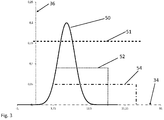
- FIG. 3 shows such a control by the load distribution unit 26.
- the fourth curve 50 represents a course of the load processes without control by the load distribution unit 26, which exceeds a further threshold value 51 and would thereby lead to an overload of the communication system 10.
- Monitoring of the load processes by the load distribution unit 26 includes that the load distribution unit 26 controls the load processes according to either the randomization algorithm or the hierarchy-based algorithm if certain predefined thresholds of the load measurement 36 are exceeded.
- a selection on the strength of the damping can be made for example by an analysis of further criteria, so that optionally follow the curves 52, 54 for the course of the load processes. The greater the slope of the curve, the greater the likelihood that a higher maximum will follow curve 50. This is a possible criterion that can be used to select the damping level.
- the described method thus causes the communication system 10 is not overloaded by the load processes are equalized in time. In addition, it prevents an overcapacity in relation to the communication network 20 and the performance of the server 24, since without the method, the capacity would have to be increased in order not to overload the communication system 10 at maximum load 36. At times a normal one Utilization of the communication system 10 by the load processes, however, many resources of the communication system 10 would then be unused.
Landscapes
- Engineering & Computer Science (AREA)
- Computer Networks & Wireless Communication (AREA)
- Signal Processing (AREA)
- Mobile Radio Communication Systems (AREA)
- Telephonic Communication Services (AREA)
Abstract
Description
- Die vorliegende Erfindung betrifft ein Verfahren zur Lastverteilung zwischen einem Server und einem Endgerät, insbesondere einem Smartphone oder einem anderen mobilen Gerät. Hierbei tauscht der Server über ein Kommunikationsnetzwerk, insbesondere das Internet, Daten mit dem Endgerät aus. Eine Lastverteilungseinheit kontrolliert einen Datenverkehr zwischen dem Server und dem Endgerät. Für diese Kontrolle wird die Auslastung des Servers und/oder des Kommunikationsnetzwerks berücksichtigt. Die hierfür benötigten Daten werden der Lastverteilungseinheit zur Verfügung gestellt oder von dieser selbst generiert. Die Lastverteilung verhindert, dass es zu Systemausfällen durch Überlastung einzelner Komponenten kommt.
-
DE 10 2013 200 187 A1 beschreibt ein Verfahren zur Lastverteilung in einem drahtlosen, lokalen Netzwerk mit mehreren Zugangspunkten und einem zentralen Server. Auf einem Endgerät kann ein Benutzer eine Anwendung starten, wobei sich die Anwendung über einen der Zugangspunkte mit dem Netzwerk verbindet und Daten für die Anwendung, beispielsweise multimediale Informationsinhalte, von dem Server bezieht. Hierbei werden von der Anwendung mehrere Zugangspunkte zugleich gescannt und Verfügbarkeitsinformationen an den zentralen Server gesendet. Auf Basis der Verfügbarkeitsinformationen wird der Zugangspunkt für das Endgerät ausgewählt, der die besten Betriebseigenschaften aufweist. -
DE 10 2010 043 783 A1 beschreibt ein Verfahren und eine Lastverteilungseinheit bei einer Verarbeitung von 3D-Bilddaten zwischen mindestens einem Endgerät und mindestens einem Server eines Netzwerks. Hierbei wird die 3D-Verarbeitung derart adaptiert, dass eine Ausführbarkeit, in Abhängigkeit der verfügbaren Netzwerkbandbreite, auf dem Server- und/oder auf dem Endgerät möglich ist. - Der Erfindung liegt daher die Aufgabe zugrunde, ein Verfahren und ein Datenverkehr-Kontrollsystem zur Lastverteilung zwischen einem Server und einem Endgerät in einem Kommunikationsnetzwerk anzugeben, durch welche auf einfache Weise eine Nutzung der verfügbaren Ressourcen im Kommunikationsnetzwerk ermöglicht wird und einem Systemausfall durch Überlastung des Servers oder des Kommunikationsnetzwerks vorgebeugt wird.
- Diese Aufgabe wird durch ein Verfahren mit den Merkmalen des unabhängigen Patentanspruchs 1 und ein Datenverkehr-Kontrollsystem mit den Merkmalen des unabhängigen Patentanspruchs 10 gelöst. Vorteilhafte Ausführungsformen der vorliegenden Erfindung sind in den abhängigen Ansprüchen beschrieben.
- Der bei dem erfindungsgemäßen Verfahren realisierte Kerngedanke liegt darin, dass das Endgerät einen Lastprozess insbesondere einen Datendownload, der seitens des Servers über das Kommunikationsnetzwerk bearbeitet wird, zu einem bestimmten Zeitpunkt innerhalb eines Zeitfensters anfragt. Die Lastverteilungseinheit antwortet dem Endgerät durch Übermittlung einer Informationsnachricht, dass es die Anfrage innerhalb eines späteren Zeitfensters wiederholen soll. Daraufhin wiederholt das Endgerät seine Anfrage in dem späteren Zeitfenster.
- Hierbei bezeichnet der Ausdruck Lastprozess eine Gesamtheit an typischen Aufgaben, die über das Kommunikationsnetzwerk an den Server gesendet werden. Diese Aufgaben umfassen Medieninhalte zu übertragen oder Rechenleistungen zu erbringen. Die Lastprozesse werden von den Endgeräten angefragt und über das Kommunikationsnetzwerk gesendet. Der Lastverteilungseinheit werden Daten bezüglich Ressourcenauslastung des Kommunikationsnetzwerks und/oder des Servers bereitgestellt. Diese Daten werden von der Lastverteilungseinheit analysiert. Aufgrund dieser Analyse ermittelt die Lastverteilungseinheit, dass die Anfrage des Lastprozesses durch das Endgerät zu einer Überlastung des Servers und/oder des Kommunikationsnetzwerks führen könnte, sodass die Lastverteilungseinheit eine zeitliche Entzerrung der Lastprozessor bewerkstelligt, indem dem Endgerät mitgeteilt wird, die Anfrage für den Lastprozess auf ein weiteres, in der Zukunft liegendes, Zeitfenster zu verschieben. In diesem weiteren Zeitfenster fragt das Endgerät den Lastprozess erneut an, wobei der Lastprozess ausgeführt wird, wenn die Lastverteilungseinheit diesbezüglich eine Freigabe erteilt. Vorteilhaft werden in dem weiteren Zeitfenster Ressourcen für den Lastprozess freigehalten, sodass die Anfrage nicht erneut in ein dahinterliegendes Zeitfenster verschoben werden muss.
- In vorteilhafter Weise sendet das Endgerät mittels der Anfrage des Lastprozesses zusätzliche Parameter an den Server, wobei die zusätzlichen Parameter Geräte- und Modelltypen Daten, Service-Kategorie und Service-ID Daten, Geräte-ID und Benutzer-ID Daten oder geographische Daten umfassen. Hierdurch wird ermöglicht, dass der Lastverteilungseinheit Entscheidungsgrundlagen bezüglich der Verschiebung der einzelnen Lastprozesse bereitgestellt werden. Typischerweise werden in einem kurzen Zeitraum eine Mehrzahl von Lastprozessen angefragt, welche von der Lastverteilungseinheit entweder zur sofortigen Abarbeitung freigegeben oder in weitere Zeitfenster verschoben werden. Mittels der Geräte- und Modelltypen Daten können die Lastprozesse bestimmter Hersteller bevorzugt bearbeitet werden, falls diese beispielsweise entsprechende Verträge mit Betreibern des Kommunikationsnetzwerks abgeschlossen haben. Ähnliches gilt auch für die Service-Kategorie und Service-ID Daten bzw. Geräte-ID und Benutzer-ID Daten, welche eine Grundlage zu einer Hierarchisierung der Lastprozesse darstellen. Sind der Lastverteilungseinheit Service-IDs von Notfallereignissen bekannt, werden diese bei einer Anfrage sofort bearbeitet, wohingegen ein Updateprozess für das Endgerät auf einen späteren Zeitpunkt verschoben wird.
- Bevorzugt werden die zusätzlichen Parameter der Lastverteilungseinheit zusammen mit Betriebsdaten des Servers, wie einer CPU-Auslastung oder einer zeitlichen Breitbandausnutzung, zur Verschiebung des angefragten Lastprozesses durch das Endgerät in ein passendes Zeitfenster berücksichtigt. Auf diese Weise wird sichergestellt, dass die durch den Benutzer angeforderten Lastprozesse nicht in Zeitfenster verschoben werden, die unnötig weit in der Zukunft liegen. Ist der Lastverteilungseinheit bekannt, wie stark der angefragte Lastprozess die Ressourcen belastet, wird ein Optimierungsalgorithmus gestartet, welcher die einzelnen Lastprozesse zeitlich so hintereinander anordnet, dass eine möglichst schnelle Abarbeitung der Lastprozesse unter gleichzeitigem Ausschluss einer Systemüberlastung verwirklicht ist.
- Vorteilhaft wird eine Entscheidung über das Verschieben des Zeitfensters durch einen vorab definierten Computeralgorithmus oder durch einen Systemadministrator getroffen. Um dies zu bewerkstelligen, kommunizieren sowohl der Systemadministrator als auch der Computeralgorithmus mit der Lastverteilungseinheit, wobei insbesondere der Computeralgorithmus als ein Bestandteil der Lastverteilungseinheit ausgebildet ist. Der Computeralgorithmus ist bestens für die routinemäßigen Aufgaben der Lastverteilungseinheit geeignet, wobei der System Administrator flexibel auf unvorhergesehene Ereignisse reagieren kann.
- Bevorzugt weist das Zeitfenster flexible Zeitintervalle auf, die beispielsweise einen Tag, 1 Stunde, 15 Minuten, 5 Minuten oder 1 Minute betragen. Die Flexibilität der Zeitintervalle ermöglicht zum einen, dass die erneute Anfrage nicht unnötig lange in die Zukunft geschoben wird und zugleich, dass das Endgerät den Lastprozess nicht unnötig oft anfragen muss. Hat die Lastverteilungseinheit festgestellt, dass die Ressourcen in der nächsten Stunde ausgelastet sind, hätte ein Zeitfenster von 1 Minute zur Folge, dass ein Endgerät seinen Lastprozess mindestens 60-mal anfragen würde, bevor dieser bearbeitet wird.
- Vorteilhaft wird eine Gesamtlast der Lastprozesse gleichförmig über die Zeit verteilt. Dies gewährleistet eine optimale Ausnutzung der Ressourcen, da ein gleichförmiger Verlauf der Gesamtlast der Lastprozesse möglichst nah an eine Schwelle bezüglich einer Maximalbelastung des Kommunikationsnetzwerks und/oder des Servers anpassbar ist.
- In einer vorteilhaften Ausgestaltung der Erfindung umfasst der Server die Lastverteilungseinheit. Auf diese Weise sind der Lastverteilungseinheit Daten zur CPU-Nutzung oder zur Breitbandauslastung besonders effektiv bereitgestellt.
- Bevorzugt wird der Datenverkehr in verschiedenen Stufen kontrolliert. Hierdurch wird der Lastverteilungseinheit ermöglicht eine Verschiebung der Lastprozesse zu optimieren. So kann eine erste Stufe, welche zu einer größeren zeitlichen Entzerrung der Lastprozesse führt in einem Zeitraum Verwendung finden in dem typischerweise eine hohe Auslastung der Ressourcen stattfindet. Eine weitere Stufe, welche zu einer kleineren zeitlichen Entzerrung der Lastprozesse führt, findet in einem Zeitraum geringere Auslastung der Ressourcen Verwendung. Die Anzahl der Stufen ist hierbei frei wählbar und kann den Umständen entsprechend angepasst werden.
- Vorteilhaft generiert die Lastverteilungseinheit einen Zeitplan, um den Datenverkehr zu optimieren. Dieser Zeitplan wird mittels eines Computeralgorithmuses von der Lastverteilungseinheit erzeugt, analysiert und dynamisch angepasst, sodass eine optimale Verteilung der Lastprozesse bereitgestellt werden kann. Der Zeitplan umfasst hierbei Informationen der einzelnen Lastprozesse wie beispielsweise CPU-Auslastung und Breitbandnutzung, sodass ein Optimierungsalgorithmus mit den Daten des Zeitplans ausführbar ist.
- Gemäß einem Aspekt der Erfindung wird ein Datenverkehr-Kontrollsystem angegeben, wobei das Datenverkehr-Kontrollsystem einen Server mit einer Lastverteilungseinheit und einem Endgerät umfasst, wobei der Server und das Endgerät über ein Kommunikationsnetzwerk verbunden sind, um das vorstehend beschriebene erfindungsgemäße Verfahren auszuführen. Das Datenverkehr-Kontrollsystem ist zur Steuerung von Lastprozessen sowohl in einem Heimnetzwerk als auch in Kommunikationsnetzwerken von Mobilfunkanbietern implementierbar und stellt eine optimierte Nutzung der verfügbaren Ressourcen bereit.
- Weitere Vorteile, Eigenschaften und Weiterbildung der Erfindung ergeben sich aus den abhängigen Ansprüchen sowie aus der nachstehenden Beschreibung eines bevorzugten Ausführungsbeispiels.
- Nachfolgend wird die Erfindung anhand der
Figuren 1 bis 5 näher erklärt. Es zeigen - Figur 1
- ein Kommunikationsnetzwerk mit einer Lastverteilungseinheit, die einen Datenfluss steuert,
- Figur 2:
- eine erste Ausgestaltungsmöglichkeit der Steuerung des Datenflusses durch die Lastverteilungseinheit aus
Figur 1 , - Figur 3:
- eine zweite Ausgestaltungsmöglichkeit der Steuerung des Datenflusses durch die Lastverteilungseinheit aus
Figur 1 , - Figur 4:
- einen ersten Zeitplan für die Verarbeitung von Lastprozessen,
- Figur 5:
- einen zweiten Zeitplan für die Verarbeitung von Lastprozessen.
-
Figur 1 zeigt ein Kommunikationssystem 10 das mehrere Endgeräte 14a, b, c, d umfasst. Bevorzugt sind die Endgeräte 14a, b, c, d mobile Kommunikationseinheiten wie ein Smartphone 14a oder "intelligente Gegenstände" aus dem Bereich des "Internet of Things" (loT).Figur 1 zeigt eine intelligente Bewässerungseinheit 14b, eine intelligente Kücheneinheit 14c und ein intelligentes Fahrzeug 14d. Die Endgeräte 14a, b, c, d erfassen mittels Detektoren/Sensoren Informationen aus ihrer Umgebung, insbesondere Ortsinformationen 16 a, b, c, d, und können diese Informationen verarbeiten. Über ein drahtloses Kommunikationsnetzwerk 20 wird eine Kommunikationsumgebung mit einem Server 24, insbesondere einem Web-Server 24, ausgebildet. Dies ist in einer Art implementiert, die beispielsweise aus dem Mobilfunk bekannt ist, wenn mittels des Smartphones 14a eine Kommunikation zu einem sozialen Netzwerk oder einer anderen Anwendung zum Datenaustausch hergestellt wird. Die Anwendungsmöglichkeiten sind jedoch nicht auf den Mobilfunk beschränkt. - Ein weiteres Anwendungsgebiet ist für Situationen gegeben, in denen der Server 24 aufwändige Rechenleistung, gewöhnlich als Cloud-Computing bezeichnet, für die Endgeräte 14a, b, c, d erbringt und bereitstellt. In solchen Fällen kann sowohl der Server 24 hinsichtlich der zu erbringenden Rechenleistung überlastet sein als auch das Kommunikationsnetzwerk 20 hinsichtlich der Menge des Datenflusses. Auch eine Verbindung der Endgeräte 14a, b, c, d untereinander, insbesondere von mehreren Smartphones 14a, kann die Kapazität des verwendeten Kommunikationsnetzwerks 20 übersteigen, da die übermittelten Medieninhalte Datenmengen von einigen hundert Megabyte umfassen und in naher Zukunft noch größere Dimensionen annehmen werden. Dies führt in einigen Fällen zu unerwünschten Systemabstürzen. Nachteilig kann es deswegen vorkommen, dass beispielsweise ein Notruf nicht gesendet werden kann, weil sich andere Teilnehmer über das Kommunikationsnetzwerk 20 hochauflösende Katzenvideos senden.
- Die Doppelpfeile des Kommunikationsnetzwerks 20 symbolisieren Datenaustauschprozesse in Form von Uplinks und Downlinks zwischen den Endgeräten 14a, b, c, d und dem Server 24. In den Server 24 ist eine Lastverteilungseinheit 26 integriert, die den Datenfluss über das Kommunikationsnetzwerk 20 zu den Endgeräten 14a, b, c, d misst, steuert und kontrolliert. Zusätzlich zu einer Auslastungsmessung des Kommunikationsnetzwerks 20 misst die Lastverteilungseinheit 26 auch eine Auslastung der CPU und der Speicherressourcen des Servers 24. Auf dem Server 24 werden die Anwendungen der Endgeräte 14a, b, c, d auf virtuellen Servern 28a, b, c, d verwaltet und bearbeitet, die jeweils einem Endgerät 14a, b, c, d zugeordnet sind.
- Vermittels des Kommunikationsnetzwerks 20 tauschen die Endgeräte 14a, b, c, d Zusatzinformationen mit dem Server 24 aus, umfassend
- 1) Gerätetyp, Modell und Geräte-ID
- a) Telefon - Sony; Modell - XPERIA Z5; ID - xxx1
- b) Telefon - Apple; Modell - iPhone 6s; ID - xxx2
- 2) Dienstkategorie und ID
- a) Kategorie - intelligentes Fahrzeug 14d; ID - Ferndiagnose
- i) Dauer: 10 Minuten
- b) Kategorie - Soziales Netzwerk; ID - Datenaustausch
- i) Dauer: 2 Minuten
- a) Kategorie - intelligentes Fahrzeug 14d; ID - Ferndiagnose
- 3) Ortsinformationen
- a) GPS Daten - 16a, b, c, d
- 4) Benutzer-ID
- 5) Mobilfunknetz
- Die Liste an versendbaren Zusatzinformationen ist selbstredend erweiterbar und speziellen, insbesondere gewerblichen, Bedürfnissen anpassbar. Besonders bedeutsam im Kontext der Erfindung sind allerdings Zeitplandaten 30, welche mittels der Lastverteilungseinheit 26, insbesondere unter Berücksichtigung der Belastung des Kommunikationsnetzwerkes 20 berechnet und erstellt werden.
- Der Lastverteilungseinheit 26 wird die Höhe des Datenflusses in dem Kommunikationsnetzwerk 20 und/oder der Auslastung der virtuellen Server 28a, b, c, d bereitgestellt. Die Lastverteilungseinheit 26 beugt einer Überlastung des Kommunikationssystems 10 vor, indem die Lastverteilungseinheit 26 eine Abarbeitung der Berechnungen und/oder der Datenaustauschprozesse durch eine zeitliche Entzerrung steuert. Dies wird wie folgt realisiert: Das Smartphone 14a sendet eine Anforderung, inklusive weiterer Parameter, für einen Lastprozess in dem Zeitraum von 1:00 Uhr bis 2:00 Uhr. Um die Überlastung zu vermeiden antwortet der Server 24, unter Berücksichtigung der Parameter, an das Smartphone 14a, den Lastprozess erneut im Zeitraum von 3:00 Uhr bis 4:00 Uhr anzufragen. Das Smartphone 14a fragt den Lastprozess zwischen 3:00 Uhr und 4:00 Uhr erneut an.
- Das dahinterliegende Prinzip der zeitlichen Entzerrung und der hierdurch resultierenden Lastverteilung, oft auch als Load-Balancing bezeichnet, ist in
Figur 2 gezeigt: Die X-Achse 34 repräsentiert einen Zeitstrahl 34 und die Y-Achse 36 ein Messung der Belastung der virtuellen Server 28 und/oder des Kommunikationssystems 10, insbesondere des Kommunikationsnetzwerks 20, und wird nachfolgend als Lastmaß 36 bezeichnet. Eine Überlastung des Kommunikationssystems 10 tritt bei einem Überschreiten des Schwellenwertes 40 durch Lastprozesse ein, welche den Wert des Lastmaßes 36 erhöhen. Die erste Kurve 44 überschreitet den Schwellenwert 40 und erreicht ein Maxima zum Zeitpunkt t = 0 s und führt daher zur Überlastung und im ungünstigsten Fall zum Ausfall des Kommunikationssystems 10. Der Fall, welcher durch die erste Kurve 44 beschrieben ist, entspricht einer Situation bei fehlenden oder deaktivierter Lastverteilungseinheit 26: Das Kommunikationssystems 10 versucht alle Anfragen, Berechnungen oder Datenaustauschprozesse in Echtzeit zu verarbeiten, was zu einer Systemüberlastung führen kann. Zur Einfachheit werden alle diese Vorgänge, welche zur Lastmaß 36 betragen als Lastprozesse bezeichnet. Die Gesamtlast setze sich hierbei aus N einzelnen Lastprozessen zusammen. - Die aktivierte Lastverteilungseinheit 26 entzerrt die N-Lastprozesse entlang des Zeitstrahls in der Art einer zweiten Kurve 46 oder einer dritten Kurve 48, sodass das Maximum der Kurven 46, 48 stets unter dem Schwellenwert 40 liegt und das Kommunikationssystem 10 nicht überlastet wird. Hierbei sind i. allg. für verschiedene Kommunikationssysteme 10 jeweils spezifische Schwellenwerte ausgebildet in die die speziellen Ausprägungen des jeweiligen Kommunikationssystems 10 eingehen. Die Steuerung der einzelnen Lastprozesse durch die Lastverteilungseinheit 26 kann verschieden stark ausgestaltbar sein. In
Figur 2 dämpft die dritte Kurve 48 die Lastprozesse stärker als die zweite Kurve 46. Die Dämpfung der Lastprozesse wird, wie vorstehend kurz erwähnt, durch die zeitliche Entzerrung bewerkstelligt. Die zeitliche Entzerrung basiert auf dem Prinzip, dass nicht alle Lastprozesse in quasi EchtZeit bearbeitet werden, sondern dass die Lastverteilungseinheit 26 einen Zeitplan erstellt, worin ausgewählten Lastprozessen ein späteres, aber wohldefiniertes, Zeitfenster zur Bearbeitung zugeordnet ist, wobei diese Information mittels der Zeitplandaten 30 an die Endgeräte 14a, b, c, d übermittelt wird. Die Endgeräte 14a, b, c, d senden in dem späteren erneut eine Bearbeitungsanfrage. Die Gesamtzahl N der Lastprozesse bleibt hierbei erhalten. - Eine Erstellung dieses Zeitplans kann mittels Randomisierungs-Algorithmen oder Hierarchiebasierten-Algorithmen erfolgen:
- Randomisierungs-Algorithmen: Hierbei wählt die Lastverteilungseinheit 26 aus den zu bearbeitenden Lastprozessen eine gewisse Anzahl aus und verteilt diese auf dem Zeitplan zufallsmäßig auf einen späteren Zeitraum. Es muss hierbei allerdings sichergestellt werden, dass die Gesamtzahl N der Lastprozesse erhalten bleibt, sodass jede Anfrage, wenn auch verzögert, bearbeitet wird. Zu Illustrationszwecken wird angenommen, dass fünf verschiedene Lastprozesse A, B, C, D und E quasi gleichzeitig in dem Kommunikationssystem 10 bearbeitet werden sollen. Zeitgleich kann das beispielhafte Kommunikationssystem 10 jedoch nur zwei Lastprozesse bearbeiten. Um eine Überlastung zu vermeiden, erstellt der Randomisierungs-Algorithmus der Lastverteilungseinheit 26 einen Zeitplan, welcher vorsieht, dass die Lastprozesse B und E, zufällig ausgewählt, sofort bearbeitet werden und verteilt die übrigen Prozesse gleichmäßig oder zufallsverteilt auf eine vorher definierte Abarbeitungszeitspanne. Je länger diese vorher definierte Abarbeitungszeitspanne ist, desto größer ist die Dämpfung. Vorliegend ist die Abarbeitungszeitspanne für die dritte Kurve 48 länger festgelegt als für die zweite Kurve 46.
- Hierarchiebasierten-Algorithmen: Hierbei analysiert die Lastverteilungseinheit 26 vor der Erstellung des Zeitplans 58a, b die Zusatzinformationen und kann dann nach vorher festgelegten Regeln auswählen, welche Lastprozesse bevorzugt zeitnah ausgeführt werden sollen oder welche Lastprozesse hinten anstellbar sind. Notfallrufnummern oder wichtige Systemüberwachungsparameter bekommen eine hohen Priorisierungswert und werden bevorzugt zeitnah ausgeführt, wobei zum Beispiel Update-Prozesse der Endgeräte 14a, b, c, d bevorzugt hinten angestellt werden und auch problemlos über Nacht, zu Zeiten einer geringen Systembelastung, ausführbar sind. Alternativ können auch Benutzer bestimmter Smartphone 14a Hersteller bevorzugt werden, da diese entsprechende Verträge mit den Betreibern des Kommunikationssystems 10 abgeschlossen haben.
- Die
Figuren 4 und 5 illustrieren beispielhaft einen Zeitplan 58a für die dritte Kurve 48 und einen weiteren Zeitplan 58b für die zweite Kurve 46. In den Spalten 60a, b ist die zeitliche Körnung der Zeitpläne angegeben. Vorliegend ist das kleinste Zeitintervall als eine Minute ausgebildet. Hieraus folgt, dass die gesamte Abarbeitungszeitspanne des Zeitplans 58a vier Minuten ist und die Abarbeitungszeitspanne des Zeitplans 58b drei Minuten beträgt. Selbstverständlich können, insbesondere die Zeitangaben, eine Vielzahl verschiedener Werte annehmen, sodass die vorliegenden Beispiele nicht als Begrenzung der Erfindung zu sehen sind. Die Spalten 62a, b geben die jeweils verstrichene Zeit an und die Spalten 64a, b die Lastprozesse A, B, C, D, E, die in den jeweiligen Zeiteinheiten von dem Kommunikationssystem 10 bearbeitet werden sollen. Da die gesamte Abarbeitungszeitspanne der zweiten Kurve 46 (Figur 5 ) länger ist als für die dritte Kurve 48 (Figur 48) werden in der zweiten Zeile der Spalte 64b mehr Lastprozesse bearbeitet als in der korrespondierenden Zelle inFigur 4 , woraus folgt, dass die Dämpfung geringer ausfällt. Die Kontrolle und die Steuerung erfolgt hierbei dadurch, dass jedes Endgerät 14a, b, c, d die jeweils relevanten Zeitplandaten 30 aus dem Zeitplan 58 übermittelt bekommt. Beispielsweise erhält das Smartphone 14a die Informationen, einen gewünschten Lastprozess nach fünf Minuten erneut anzufragen. Bevorzugt sind die benötigten Kapazitäten des Lastprozesses dann auch für das Smartphone 14a reserviert und verfügbar. - Die Kurven 46; 48 weisen hierbei eine Glockenkurvenform auf. Die konkrete Form der Kurven wird insbesondere durch die konkrete Ausgestaltung der Algorithmen ausgebildet, welche der Erstellung der Zeitpläne 58a, b zu Grunde liegen. Eine gleichmäßige Verteilung der einzelnen Lastprozesse auf die gesamte Abarbeitungszeitspanne hat beispielsweise eher eine rechteckige Form der Kurven 46, 48 zur Folge und ein Zufallsalgorithmus eher einen glockenkurvenförmigen Verlauf. Diese Algorithmen müssen allerdings in einer Art flexibel sein, dass sie Lastprozesse berücksichtigen, die zeitlich nach der Erstellung des Zeitplans 30 und vor dessen finaler Abarbeitung neu hinzukommen.
- Eine Variante der Algorithmen umfasst eine Schätzung wie lange die Abarbeitung eines jeden Lastprozesses dauert, sodass ein Lastprozess möglich nahtlos dem vorherigen Lastprozess folgen kann und die Lastprozesse zudem möglichst gleichmäßig verteilt werden können. In diese Berechnung gehen auch Charakteristika des bereitgestellten Kommunikationsnetzwerks 20 ein. Insbesondere im Mobilfunk surfen viele Benutzer mit unterschiedlichen Übertragungsraten, die als Parameter in den Algorithmen eingehen. Bevorzugt weist ein derart erzeugter Zeitplan flexible Zeiteinheiten in den Spalten 60a, b auf.
-
Figur 2 zeigt, dass die Lastverteilungseinheit 26 für die Dämpfungsstufe der Kurve 48 schon zum Zeitpunkt von circa -15 Minuten mit der Steuerung durch die Erstellung eines Zeitplans 58a, b beginnt, obwohl das Maximum des Lastmaßes 36 erst zum Zeitpunkt 0 Minuten auftritt. Die Lastverteilungseinheit 26 fängt also schon zu einem Zeitpunkt mit der Steuerung an, bevor sie durch ihre intern bereitgestellten Daten wissen kann, dass das Lastmaß 36 in den Bereich des Schwellenwertes 40 gelangt. Dieses Verfahren wird angewendet, wenn durch eine, zu einem früheren Zeitpunkt erfolgte, Analyse des Datenflusses des Kommunikationssystems 10 festgestellt wird, dass bevorzugt zu gewissen Zeitpunkten der Schwellenwert 40 erreicht bzw. überschritten wird. So ist bekannt, dass Kommunikationsnetze 10 regelmäßig am Übergang von Sylvester zu Neujahr zusammenbrechen. Diese Information kann in den Algorithmus in einer Art berücksichtig werden, dass jedes Jahr am 31. Dezember um 23:45 Uhr die Lastverteilungseinheit 26 mit einer vorher festgelegten Dämpfungsstufe aktiviert wird. - Zusätzlich wird es aber immer auch Zeitpunkte geben in denen der Schwellenwert 40 des Lastmaßes 36 durch unvorhersehbarer Ereignisse überschritten wird. Dies ist beispielsweise bei Unglücksmeldungen oder Sportereignissen der Fall. Um in solchen Fällen eine Überlastung des Kommunikationssystems 10 zu verhindern, reagiert die Lastverteilungseinheit 26 dynamisch auf einen Anstieg der Lastprozesse, um den Endgeräten 14a, b, c, d Zeitplandaten 30 zu senden, die Zeitpunkte für eine erneute Anfrage der jeweiligen Lastprozesse durch das entsprechende Endgerät 14a, b, c, d umfassen.
Figur 3 zeigt eine derartige Steuerung durch die Lastverteilungseinheit 26. In der dynamischen Regulierungsoption beginnt die Regulierung erst ab dem Zeitpunkt t = 0 Sekunden. Hierbei stellt die vierte Kurve 50 einen Verlauf der Lastprozesse ohne Steuerung durch die Lastverteilungseinheit 26 dar, welche einen weiteren Schwellenwert 51 überschreitet und dadurch zu einer Überlastung des Kommunikationssystems 10 führen würde. - Eine Überwachung der Lastprozesse durch die Lastverteilungseinheit 26 umfasst, dass die Lastverteilungseinheit 26 die Lastprozesse entweder nach dem Randomisierungs-Algorithmus oder dem Hierarchiebasierten-Algorithmus steuert, falls bestimmte, vorher definierte, Grenzwerte des Lastmaßes 36 überschritten werden. Eine Auswahl über die Stärke der Dämpfung kann beispielsweise durch eine Analyse weitere Kriterien getroffen werden, sodass wahlweise die Kurven 52, 54 für den Verlauf der Lastprozesse folgen. Je größer die Steigung der Kurve ist, desto größer ist die Wahrscheinlichkeit, dass ein höheres Maximum der Kurve 50 folgen wird. Dies ist ein mögliches Kriterium, das zur Wahl der Dämpfungsstufe verwendbar ist.
- Das beschriebene Verfahren bewirkt also, dass das Kommunikationssystem 10 nicht überlastet wird, indem die Lastprozesse zeitlich entzerrt werden. Zudem beugt es einer Überkapazität in Bezug auf das Kommunikationsnetzwerk 20 und der Leistung des Servers 24 vor, da ohne das Verfahren die Kapazitäten vergrößert werden müssten, um bei maximalem Lastmaß 36 keine Überlastung des Kommunikationssystems 10 zu erleiden. Zu Zeiten einer normalen Auslastung des Kommunikationssystems 10 durch die Lastprozesse wären dann allerdings viele Ressourcen des Kommunikationssystems 10 ungenutzt.
Claims (10)
- Verfahren zur Lastverteilung zwischeneinem Server (24) undeinem Endgerät (14a, b, c, d),wobei der Server (24) über ein Kommunikationsnetzwerk (20), insbesondere das Internet, Daten mit dem Endgerät (14a, b, c, d) austauscht,
wobei eine Lastverteilungseinheit (26) den Datenverkehr zwischen dem Server (20) und dem Endgerät (14a, b, c, d) kontrolliert,
dadurch gekennzeichnet,
dass das Endgerät (14a, b, c, d) zu einem bestimmten Zeitpunkt das Herunterladen von Daten im Rahmen eines Download bei dem Server (24) anfragt,
dass die Lastverteilungseinheit (26) dem Endgerät (14a, b, c, d) eine Information sendet, in der das Endgerät aufgefordert wird, die Anfrage in einem späteren Zeitfenster zu wiederholen, und
dass das Endgerät (14a, b, c, d) seine Anfrage in dem späteren Zeitfenster erneut sendet. - Verfahren nach Anspruch 1, wobei das Endgerät (14a, b, c, d) mittels der Anfrage des Lastprozesses (28a, b, c, d) zusätzliche Parameter an den Server (24) sendet, wobei die zusätzlichen Parameter Geräte-und Modelltypen Daten, Service-Kategorie und Service-ID Daten, Geräte-ID und Benutzer-ID Daten oder geographische Daten umfassen.
- Verfahren nach Anspruch 2, wobei die zusätzlichen Parameter der Lastverteilungseinheit (26) zusammen mit Betriebsdaten des Servers (24), wie einer CPU-Auslastung oder einer zeitliche Bandbreitenausnutzung, zur Verschiebung des angefragten Lastprozesses (28a, b, c, d) durch das Endgerät (14a, b, c, d) in ein passendes Zeitfenster berücksichtigt werden.
- Verfahren nach einem der Ansprüche 1 bis 3, wobei eine Entscheidung über das Verschieben des Zeitfensters durch einen vorab definierten Computeralgorithmus oder durch einen Systemadministrator getroffen wird.
- Verfahren nach einem der Ansprüche 1 bis 4, wobei das Zeitfenster flexible Zeitintervalle aufweist, die beispielsweise einen Tag, 1 Stunde, 15 Minuten, 5 Minuten oder 1 Minute betragen.
- Verfahren nach einem der Ansprüche 1 bis 5, wobei eine Gesamtlast der Lastprozesse (28a, b, c, d) gleichförmig über die Zeit verteilt ist.
- Verfahren nach einem der Ansprüche 1 bis 6, wobei der Server (24) die Lastverteilungseinheit (26) umfasst.
- Verfahren nach einem der Ansprüche 1 bis 7, wobei der Datenverkehr in verschiedenen Stufen kontrolliert wird.
- Verfahren nach einem der Ansprüche 1 bis 8, wobei die Lastverteilungseinheit (26) einen Zeitplan generiert, um den Datenverkehr zu optimieren.
- Ein Datenverkehr-Kontrollsystem, umfassendeinen Server (24) mit einer Lastverteilungseinheit (26) undeinem Endgerät (14a, b, c, d), wobei der Server (20) und das Endgerät (14a, b, c, d), über ein Kommunikationsnetzwerk (20) verbunden sind, ausgestaltet, um ein Verfahren nach einem der Ansprüche 1 bis 9 auszuführen.
Priority Applications (1)
| Application Number | Priority Date | Filing Date | Title |
|---|---|---|---|
| EP16180967.8A EP3276897B1 (de) | 2016-07-25 | 2016-07-25 | Lastverteilung in einem kommunikationsnetzwerk |
Applications Claiming Priority (1)
| Application Number | Priority Date | Filing Date | Title |
|---|---|---|---|
| EP16180967.8A EP3276897B1 (de) | 2016-07-25 | 2016-07-25 | Lastverteilung in einem kommunikationsnetzwerk |
Publications (2)
| Publication Number | Publication Date |
|---|---|
| EP3276897A1 true EP3276897A1 (de) | 2018-01-31 |
| EP3276897B1 EP3276897B1 (de) | 2021-01-27 |
Family
ID=56557509
Family Applications (1)
| Application Number | Title | Priority Date | Filing Date |
|---|---|---|---|
| EP16180967.8A Active EP3276897B1 (de) | 2016-07-25 | 2016-07-25 | Lastverteilung in einem kommunikationsnetzwerk |
Country Status (1)
| Country | Link |
|---|---|
| EP (1) | EP3276897B1 (de) |
Citations (4)
| Publication number | Priority date | Publication date | Assignee | Title |
|---|---|---|---|---|
| DE102010043783A1 (de) | 2010-11-11 | 2011-11-24 | Siemens Aktiengesellschaft | Verfahren und Anordnung zur Lastverteilung einer 3D-Verarbeitung von Bilddaten zwischen mindestens einem Client-Rechner und mindestens einem Server-Rechner eines Netzwerkes |
| DE102013200187A1 (de) | 2013-01-09 | 2014-07-10 | Siemens Convergence Creators Gmbh | Verfahren zur Lastverteilung in einem drahtlosen, lokalen Netzwerk |
| EP2827561A1 (de) * | 2013-07-18 | 2015-01-21 | Synchronoss Technologies, Inc. | Servergesteuertes, adaptives Zurücksetzen zum Überlastungsschutz mittels Zählungen interner Fehler |
| EP3037965A1 (de) * | 2014-12-22 | 2016-06-29 | Oberthur Technologies | Client-Server-Kommunikation |
Family Cites Families (2)
| Publication number | Priority date | Publication date | Assignee | Title |
|---|---|---|---|---|
| US7761323B2 (en) * | 2003-10-08 | 2010-07-20 | Aspect Software, Inc. | Method and system for scheduling a customer service callback |
| US9444764B2 (en) * | 2015-01-20 | 2016-09-13 | State Farm Mutual Automobile Insurance Company | Scalable and secure interconnectivity in server cluster environments |
-
2016
- 2016-07-25 EP EP16180967.8A patent/EP3276897B1/de active Active
Patent Citations (4)
| Publication number | Priority date | Publication date | Assignee | Title |
|---|---|---|---|---|
| DE102010043783A1 (de) | 2010-11-11 | 2011-11-24 | Siemens Aktiengesellschaft | Verfahren und Anordnung zur Lastverteilung einer 3D-Verarbeitung von Bilddaten zwischen mindestens einem Client-Rechner und mindestens einem Server-Rechner eines Netzwerkes |
| DE102013200187A1 (de) | 2013-01-09 | 2014-07-10 | Siemens Convergence Creators Gmbh | Verfahren zur Lastverteilung in einem drahtlosen, lokalen Netzwerk |
| EP2827561A1 (de) * | 2013-07-18 | 2015-01-21 | Synchronoss Technologies, Inc. | Servergesteuertes, adaptives Zurücksetzen zum Überlastungsschutz mittels Zählungen interner Fehler |
| EP3037965A1 (de) * | 2014-12-22 | 2016-06-29 | Oberthur Technologies | Client-Server-Kommunikation |
Also Published As
| Publication number | Publication date |
|---|---|
| EP3276897B1 (de) | 2021-01-27 |
Similar Documents
| Publication | Publication Date | Title |
|---|---|---|
| DE112018003482B4 (de) | Serveranfrageverwaltung | |
| DE602005001063T2 (de) | Verfahren und Anordnung zur Beschränkung der Wiederbenutzung von DNS Antworten | |
| DE102016103733B4 (de) | Kanaleigentum in einem Veröffentlichungs-/Abonnier-System | |
| EP2826224B1 (de) | Zugriff von clients auf einen serverdienst mittels einer opc-ua | |
| DE112012002631T5 (de) | Stream-Verarbeitung unter Verwendung einer Client-Server-Architektur | |
| DE112018008127T5 (de) | Verfahren und vorrichtung zum mappen von network-slices auf netzinfrastrukturen mit sla-garantie | |
| DE112011103081T5 (de) | Client/Abonnenten-Verlagerung für die Server-Hochverfügbarkeit | |
| WO2013087610A1 (de) | Vorrichtung und verfahren zum dynamischen lastmanagement von cloud services | |
| DE60132360T2 (de) | Verwaltung von netzwerk-verkehr durch anwendung einer hashfunktion | |
| DE10297645B4 (de) | Verfahren und Einrichtung zum Lastteilen und zur Datenverteilung in Servern | |
| DE602004010224T2 (de) | Vorrichtung zur Verkehrssteuerung und entsprechendes Servicesystem | |
| EP3432507B1 (de) | Überwachung einer blockchain | |
| WO2016045885A1 (de) | Verfahren zum übertragen von daten, sowie zugehöriger netzknoten und zugehöriges netzwerk | |
| EP3041199A1 (de) | Verfahren zur Ermittlung von Kommunikationsgeräteadressen innerhalb eines Kommunikationsnetzes eines industriellen Automatisierungssystems und Kommunikationsgerät | |
| DE102012221355A1 (de) | Verfahren zum Bereitstellen von Ressourcen in einer Cloud und Vorrichtung | |
| DE10021222A1 (de) | Verfahren zur dynamischen Bestimmung von Zugriffsrechten | |
| EP3576376A1 (de) | Datenübermittlung innerhalb eines industriellen automatisierungssystems | |
| DE102004057496B4 (de) | Verfahren und Vorrichtung zur automatischen Neueinstellung von Grenzen für Zugangskontrollen zur Beschränkung des Verkehrs in einem Kommunikationsnetz | |
| DE112017005878B4 (de) | Fahrzeug-Telematik-Nachrichtenübermittlung | |
| EP3276897B1 (de) | Lastverteilung in einem kommunikationsnetzwerk | |
| EP1658705B1 (de) | Bereitstellung einer einem benutzer eines kommunikationsdienstes zugeordneten anwesenheitsinformation | |
| EP1244256A2 (de) | Verfahren und Vorrichtung zur dynamischen Regelung der Ressourcenaufteilung in einem Kommunikationsnetz | |
| EP1244257A2 (de) | Verfahren und Vorrichtung zur dynamischen Regelung der Ressourcenaufteilung durch eine dynamische Freigaberate | |
| DE10239934A1 (de) | Verfahren zur Steuerung der Diesntbelegung in einem Datenbussystem | |
| EP3396919A1 (de) | Verfahren zur datenübertragung von einem gerät an ein datenverwaltungsmittel, vermittlungseinheit, gerät und system |
Legal Events
| Date | Code | Title | Description |
|---|---|---|---|
| PUAI | Public reference made under article 153(3) epc to a published international application that has entered the european phase |
Free format text: ORIGINAL CODE: 0009012 |
|
| STAA | Information on the status of an ep patent application or granted ep patent |
Free format text: STATUS: THE APPLICATION HAS BEEN PUBLISHED |
|
| AK | Designated contracting states |
Kind code of ref document: A1 Designated state(s): AL AT BE BG CH CY CZ DE DK EE ES FI FR GB GR HR HU IE IS IT LI LT LU LV MC MK MT NL NO PL PT RO RS SE SI SK SM TR |
|
| AX | Request for extension of the european patent |
Extension state: BA ME |
|
| STAA | Information on the status of an ep patent application or granted ep patent |
Free format text: STATUS: REQUEST FOR EXAMINATION WAS MADE |
|
| 17P | Request for examination filed |
Effective date: 20180710 |
|
| RBV | Designated contracting states (corrected) |
Designated state(s): AL AT BE BG CH CY CZ DE DK EE ES FI FR GB GR HR HU IE IS IT LI LT LU LV MC MK MT NL NO PL PT RO RS SE SI SK SM TR |
|
| STAA | Information on the status of an ep patent application or granted ep patent |
Free format text: STATUS: EXAMINATION IS IN PROGRESS |
|
| 17Q | First examination report despatched |
Effective date: 20190919 |
|
| GRAP | Despatch of communication of intention to grant a patent |
Free format text: ORIGINAL CODE: EPIDOSNIGR1 |
|
| STAA | Information on the status of an ep patent application or granted ep patent |
Free format text: STATUS: GRANT OF PATENT IS INTENDED |
|
| INTG | Intention to grant announced |
Effective date: 20201009 |
|
| GRAS | Grant fee paid |
Free format text: ORIGINAL CODE: EPIDOSNIGR3 |
|
| GRAA | (expected) grant |
Free format text: ORIGINAL CODE: 0009210 |
|
| STAA | Information on the status of an ep patent application or granted ep patent |
Free format text: STATUS: THE PATENT HAS BEEN GRANTED |
|
| AK | Designated contracting states |
Kind code of ref document: B1 Designated state(s): AL AT BE BG CH CY CZ DE DK EE ES FI FR GB GR HR HU IE IS IT LI LT LU LV MC MK MT NL NO PL PT RO RS SE SI SK SM TR |
|
| REG | Reference to a national code |
Ref country code: GB Ref legal event code: FG4D Free format text: NOT ENGLISH |
|
| REG | Reference to a national code |
Ref country code: CH Ref legal event code: EP |
|
| REG | Reference to a national code |
Ref country code: AT Ref legal event code: REF Ref document number: 1359325 Country of ref document: AT Kind code of ref document: T Effective date: 20210215 |
|
| REG | Reference to a national code |
Ref country code: IE Ref legal event code: FG4D Free format text: LANGUAGE OF EP DOCUMENT: GERMAN |
|
| REG | Reference to a national code |
Ref country code: DE Ref legal event code: R096 Ref document number: 502016012287 Country of ref document: DE |
|
| REG | Reference to a national code |
Ref country code: DE Ref legal event code: R082 Ref document number: 502016012287 Country of ref document: DE |
|
| REG | Reference to a national code |
Ref country code: NL Ref legal event code: MP Effective date: 20210127 |
|
| REG | Reference to a national code |
Ref country code: LT Ref legal event code: MG9D |
|
| PG25 | Lapsed in a contracting state [announced via postgrant information from national office to epo] |
Ref country code: PT Free format text: LAPSE BECAUSE OF FAILURE TO SUBMIT A TRANSLATION OF THE DESCRIPTION OR TO PAY THE FEE WITHIN THE PRESCRIBED TIME-LIMIT Effective date: 20210527 Ref country code: NO Free format text: LAPSE BECAUSE OF FAILURE TO SUBMIT A TRANSLATION OF THE DESCRIPTION OR TO PAY THE FEE WITHIN THE PRESCRIBED TIME-LIMIT Effective date: 20210427 Ref country code: BG Free format text: LAPSE BECAUSE OF FAILURE TO SUBMIT A TRANSLATION OF THE DESCRIPTION OR TO PAY THE FEE WITHIN THE PRESCRIBED TIME-LIMIT Effective date: 20210427 Ref country code: HR Free format text: LAPSE BECAUSE OF FAILURE TO SUBMIT A TRANSLATION OF THE DESCRIPTION OR TO PAY THE FEE WITHIN THE PRESCRIBED TIME-LIMIT Effective date: 20210127 Ref country code: FI Free format text: LAPSE BECAUSE OF FAILURE TO SUBMIT A TRANSLATION OF THE DESCRIPTION OR TO PAY THE FEE WITHIN THE PRESCRIBED TIME-LIMIT Effective date: 20210127 Ref country code: GR Free format text: LAPSE BECAUSE OF FAILURE TO SUBMIT A TRANSLATION OF THE DESCRIPTION OR TO PAY THE FEE WITHIN THE PRESCRIBED TIME-LIMIT Effective date: 20210428 Ref country code: LT Free format text: LAPSE BECAUSE OF FAILURE TO SUBMIT A TRANSLATION OF THE DESCRIPTION OR TO PAY THE FEE WITHIN THE PRESCRIBED TIME-LIMIT Effective date: 20210127 |
|
| PG25 | Lapsed in a contracting state [announced via postgrant information from national office to epo] |
Ref country code: SE Free format text: LAPSE BECAUSE OF FAILURE TO SUBMIT A TRANSLATION OF THE DESCRIPTION OR TO PAY THE FEE WITHIN THE PRESCRIBED TIME-LIMIT Effective date: 20210127 Ref country code: RS Free format text: LAPSE BECAUSE OF FAILURE TO SUBMIT A TRANSLATION OF THE DESCRIPTION OR TO PAY THE FEE WITHIN THE PRESCRIBED TIME-LIMIT Effective date: 20210127 Ref country code: LV Free format text: LAPSE BECAUSE OF FAILURE TO SUBMIT A TRANSLATION OF THE DESCRIPTION OR TO PAY THE FEE WITHIN THE PRESCRIBED TIME-LIMIT Effective date: 20210127 Ref country code: PL Free format text: LAPSE BECAUSE OF FAILURE TO SUBMIT A TRANSLATION OF THE DESCRIPTION OR TO PAY THE FEE WITHIN THE PRESCRIBED TIME-LIMIT Effective date: 20210127 |
|
| PG25 | Lapsed in a contracting state [announced via postgrant information from national office to epo] |
Ref country code: IS Free format text: LAPSE BECAUSE OF FAILURE TO SUBMIT A TRANSLATION OF THE DESCRIPTION OR TO PAY THE FEE WITHIN THE PRESCRIBED TIME-LIMIT Effective date: 20210527 |
|
| REG | Reference to a national code |
Ref country code: DE Ref legal event code: R097 Ref document number: 502016012287 Country of ref document: DE |
|
| PG25 | Lapsed in a contracting state [announced via postgrant information from national office to epo] |
Ref country code: SM Free format text: LAPSE BECAUSE OF FAILURE TO SUBMIT A TRANSLATION OF THE DESCRIPTION OR TO PAY THE FEE WITHIN THE PRESCRIBED TIME-LIMIT Effective date: 20210127 Ref country code: CZ Free format text: LAPSE BECAUSE OF FAILURE TO SUBMIT A TRANSLATION OF THE DESCRIPTION OR TO PAY THE FEE WITHIN THE PRESCRIBED TIME-LIMIT Effective date: 20210127 Ref country code: EE Free format text: LAPSE BECAUSE OF FAILURE TO SUBMIT A TRANSLATION OF THE DESCRIPTION OR TO PAY THE FEE WITHIN THE PRESCRIBED TIME-LIMIT Effective date: 20210127 |
|
| REG | Reference to a national code |
Ref country code: DE Ref legal event code: R079 Ref document number: 502016012287 Country of ref document: DE Free format text: PREVIOUS MAIN CLASS: H04L0012911000 Ipc: H04L0047700000 |
|
| PG25 | Lapsed in a contracting state [announced via postgrant information from national office to epo] |
Ref country code: SK Free format text: LAPSE BECAUSE OF FAILURE TO SUBMIT A TRANSLATION OF THE DESCRIPTION OR TO PAY THE FEE WITHIN THE PRESCRIBED TIME-LIMIT Effective date: 20210127 Ref country code: RO Free format text: LAPSE BECAUSE OF FAILURE TO SUBMIT A TRANSLATION OF THE DESCRIPTION OR TO PAY THE FEE WITHIN THE PRESCRIBED TIME-LIMIT Effective date: 20210127 Ref country code: DK Free format text: LAPSE BECAUSE OF FAILURE TO SUBMIT A TRANSLATION OF THE DESCRIPTION OR TO PAY THE FEE WITHIN THE PRESCRIBED TIME-LIMIT Effective date: 20210127 |
|
| PLBE | No opposition filed within time limit |
Free format text: ORIGINAL CODE: 0009261 |
|
| STAA | Information on the status of an ep patent application or granted ep patent |
Free format text: STATUS: NO OPPOSITION FILED WITHIN TIME LIMIT |
|
| 26N | No opposition filed |
Effective date: 20211028 |
|
| PG25 | Lapsed in a contracting state [announced via postgrant information from national office to epo] |
Ref country code: ES Free format text: LAPSE BECAUSE OF FAILURE TO SUBMIT A TRANSLATION OF THE DESCRIPTION OR TO PAY THE FEE WITHIN THE PRESCRIBED TIME-LIMIT Effective date: 20210127 Ref country code: AL Free format text: LAPSE BECAUSE OF FAILURE TO SUBMIT A TRANSLATION OF THE DESCRIPTION OR TO PAY THE FEE WITHIN THE PRESCRIBED TIME-LIMIT Effective date: 20210127 |
|
| PG25 | Lapsed in a contracting state [announced via postgrant information from national office to epo] |
Ref country code: SI Free format text: LAPSE BECAUSE OF FAILURE TO SUBMIT A TRANSLATION OF THE DESCRIPTION OR TO PAY THE FEE WITHIN THE PRESCRIBED TIME-LIMIT Effective date: 20210127 |
|
| REG | Reference to a national code |
Ref country code: CH Ref legal event code: PL |
|
| GBPC | Gb: european patent ceased through non-payment of renewal fee |
Effective date: 20210725 |
|
| PG25 | Lapsed in a contracting state [announced via postgrant information from national office to epo] |
Ref country code: MC Free format text: LAPSE BECAUSE OF FAILURE TO SUBMIT A TRANSLATION OF THE DESCRIPTION OR TO PAY THE FEE WITHIN THE PRESCRIBED TIME-LIMIT Effective date: 20210127 |
|
| REG | Reference to a national code |
Ref country code: BE Ref legal event code: MM Effective date: 20210731 |
|
| PG25 | Lapsed in a contracting state [announced via postgrant information from national office to epo] |
Ref country code: LI Free format text: LAPSE BECAUSE OF NON-PAYMENT OF DUE FEES Effective date: 20210731 Ref country code: IT Free format text: LAPSE BECAUSE OF FAILURE TO SUBMIT A TRANSLATION OF THE DESCRIPTION OR TO PAY THE FEE WITHIN THE PRESCRIBED TIME-LIMIT Effective date: 20210127 Ref country code: GB Free format text: LAPSE BECAUSE OF NON-PAYMENT OF DUE FEES Effective date: 20210725 Ref country code: CH Free format text: LAPSE BECAUSE OF NON-PAYMENT OF DUE FEES Effective date: 20210731 |
|
| PG25 | Lapsed in a contracting state [announced via postgrant information from national office to epo] |
Ref country code: IS Free format text: LAPSE BECAUSE OF FAILURE TO SUBMIT A TRANSLATION OF THE DESCRIPTION OR TO PAY THE FEE WITHIN THE PRESCRIBED TIME-LIMIT Effective date: 20210527 Ref country code: LU Free format text: LAPSE BECAUSE OF NON-PAYMENT OF DUE FEES Effective date: 20210725 Ref country code: FR Free format text: LAPSE BECAUSE OF NON-PAYMENT OF DUE FEES Effective date: 20210731 |
|
| PG25 | Lapsed in a contracting state [announced via postgrant information from national office to epo] |
Ref country code: IE Free format text: LAPSE BECAUSE OF NON-PAYMENT OF DUE FEES Effective date: 20210725 Ref country code: BE Free format text: LAPSE BECAUSE OF NON-PAYMENT OF DUE FEES Effective date: 20210731 |
|
| REG | Reference to a national code |
Ref country code: AT Ref legal event code: MM01 Ref document number: 1359325 Country of ref document: AT Kind code of ref document: T Effective date: 20210725 |
|
| PG25 | Lapsed in a contracting state [announced via postgrant information from national office to epo] |
Ref country code: AT Free format text: LAPSE BECAUSE OF NON-PAYMENT OF DUE FEES Effective date: 20210725 |
|
| PG25 | Lapsed in a contracting state [announced via postgrant information from national office to epo] |
Ref country code: HU Free format text: LAPSE BECAUSE OF FAILURE TO SUBMIT A TRANSLATION OF THE DESCRIPTION OR TO PAY THE FEE WITHIN THE PRESCRIBED TIME-LIMIT; INVALID AB INITIO Effective date: 20160725 |
|
| PG25 | Lapsed in a contracting state [announced via postgrant information from national office to epo] |
Ref country code: CY Free format text: LAPSE BECAUSE OF FAILURE TO SUBMIT A TRANSLATION OF THE DESCRIPTION OR TO PAY THE FEE WITHIN THE PRESCRIBED TIME-LIMIT Effective date: 20210127 Ref country code: NL Free format text: LAPSE BECAUSE OF NON-PAYMENT OF DUE FEES Effective date: 20210127 |
|
| PG25 | Lapsed in a contracting state [announced via postgrant information from national office to epo] |
Ref country code: MK Free format text: LAPSE BECAUSE OF FAILURE TO SUBMIT A TRANSLATION OF THE DESCRIPTION OR TO PAY THE FEE WITHIN THE PRESCRIBED TIME-LIMIT Effective date: 20210127 |
|
| PG25 | Lapsed in a contracting state [announced via postgrant information from national office to epo] |
Ref country code: MT Free format text: LAPSE BECAUSE OF FAILURE TO SUBMIT A TRANSLATION OF THE DESCRIPTION OR TO PAY THE FEE WITHIN THE PRESCRIBED TIME-LIMIT Effective date: 20210127 |
|
| PGFP | Annual fee paid to national office [announced via postgrant information from national office to epo] |
Ref country code: DE Payment date: 20250722 Year of fee payment: 10 |
|
| PG25 | Lapsed in a contracting state [announced via postgrant information from national office to epo] |
Ref country code: TR Free format text: LAPSE BECAUSE OF FAILURE TO SUBMIT A TRANSLATION OF THE DESCRIPTION OR TO PAY THE FEE WITHIN THE PRESCRIBED TIME-LIMIT Effective date: 20210127 |