EP3276548A1 - Itinerary editing processing program and itinerary editing processing device - Google Patents
Itinerary editing processing program and itinerary editing processing device Download PDFInfo
- Publication number
- EP3276548A1 EP3276548A1 EP17177812.9A EP17177812A EP3276548A1 EP 3276548 A1 EP3276548 A1 EP 3276548A1 EP 17177812 A EP17177812 A EP 17177812A EP 3276548 A1 EP3276548 A1 EP 3276548A1
- Authority
- EP
- European Patent Office
- Prior art keywords
- editing
- rollback
- user account
- processing
- itinerary
- Prior art date
- Legal status (The legal status is an assumption and is not a legal conclusion. Google has not performed a legal analysis and makes no representation as to the accuracy of the status listed.)
- Ceased
Links
Images




Classifications
-
- G—PHYSICS
- G06—COMPUTING OR CALCULATING; COUNTING
- G06Q—INFORMATION AND COMMUNICATION TECHNOLOGY [ICT] SPECIALLY ADAPTED FOR ADMINISTRATIVE, COMMERCIAL, FINANCIAL, MANAGERIAL OR SUPERVISORY PURPOSES; SYSTEMS OR METHODS SPECIALLY ADAPTED FOR ADMINISTRATIVE, COMMERCIAL, FINANCIAL, MANAGERIAL OR SUPERVISORY PURPOSES, NOT OTHERWISE PROVIDED FOR
- G06Q10/00—Administration; Management
- G06Q10/10—Office automation; Time management
- G06Q10/109—Time management, e.g. calendars, reminders, meetings or time accounting
- G06Q10/1093—Calendar-based scheduling for persons or groups
-
- G—PHYSICS
- G06—COMPUTING OR CALCULATING; COUNTING
- G06Q—INFORMATION AND COMMUNICATION TECHNOLOGY [ICT] SPECIALLY ADAPTED FOR ADMINISTRATIVE, COMMERCIAL, FINANCIAL, MANAGERIAL OR SUPERVISORY PURPOSES; SYSTEMS OR METHODS SPECIALLY ADAPTED FOR ADMINISTRATIVE, COMMERCIAL, FINANCIAL, MANAGERIAL OR SUPERVISORY PURPOSES, NOT OTHERWISE PROVIDED FOR
- G06Q50/00—Information and communication technology [ICT] specially adapted for implementation of business processes of specific business sectors, e.g. utilities or tourism
- G06Q50/10—Services
- G06Q50/14—Travel agencies
-
- G—PHYSICS
- G01—MEASURING; TESTING
- G01C—MEASURING DISTANCES, LEVELS OR BEARINGS; SURVEYING; NAVIGATION; GYROSCOPIC INSTRUMENTS; PHOTOGRAMMETRY OR VIDEOGRAMMETRY
- G01C21/00—Navigation; Navigational instruments not provided for in groups G01C1/00 - G01C19/00
- G01C21/26—Navigation; Navigational instruments not provided for in groups G01C1/00 - G01C19/00 specially adapted for navigation in a road network
- G01C21/34—Route searching; Route guidance
- G01C21/3407—Route searching; Route guidance specially adapted for specific applications
- G01C21/343—Calculating itineraries
-
- G—PHYSICS
- G06—COMPUTING OR CALCULATING; COUNTING
- G06F—ELECTRIC DIGITAL DATA PROCESSING
- G06F16/00—Information retrieval; Database structures therefor; File system structures therefor
- G06F16/20—Information retrieval; Database structures therefor; File system structures therefor of structured data, e.g. relational data
- G06F16/21—Design, administration or maintenance of databases
- G06F16/219—Managing data history or versioning
-
- G—PHYSICS
- G06—COMPUTING OR CALCULATING; COUNTING
- G06F—ELECTRIC DIGITAL DATA PROCESSING
- G06F3/00—Input arrangements for transferring data to be processed into a form capable of being handled by the computer; Output arrangements for transferring data from processing unit to output unit, e.g. interface arrangements
- G06F3/01—Input arrangements or combined input and output arrangements for interaction between user and computer
- G06F3/048—Interaction techniques based on graphical user interfaces [GUI]
- G06F3/0487—Interaction techniques based on graphical user interfaces [GUI] using specific features provided by the input device, e.g. functions controlled by the rotation of a mouse with dual sensing arrangements, or of the nature of the input device, e.g. tap gestures based on pressure sensed by a digitiser
- G06F3/0488—Interaction techniques based on graphical user interfaces [GUI] using specific features provided by the input device, e.g. functions controlled by the rotation of a mouse with dual sensing arrangements, or of the nature of the input device, e.g. tap gestures based on pressure sensed by a digitiser using a touch-screen or digitiser, e.g. input of commands through traced gestures
-
- G—PHYSICS
- G06—COMPUTING OR CALCULATING; COUNTING
- G06Q—INFORMATION AND COMMUNICATION TECHNOLOGY [ICT] SPECIALLY ADAPTED FOR ADMINISTRATIVE, COMMERCIAL, FINANCIAL, MANAGERIAL OR SUPERVISORY PURPOSES; SYSTEMS OR METHODS SPECIALLY ADAPTED FOR ADMINISTRATIVE, COMMERCIAL, FINANCIAL, MANAGERIAL OR SUPERVISORY PURPOSES, NOT OTHERWISE PROVIDED FOR
- G06Q10/00—Administration; Management
- G06Q10/06—Resources, workflows, human or project management; Enterprise or organisation planning; Enterprise or organisation modelling
Definitions
- a program or the like that permits a plurality of users to edit a travel plan while sharing it is known.
- a travel plan on which editing processing has proceeded when returning the editing processing of the travel plan up to a state at a certain point in time in the past, it may be useful if it is possible to clear editing processing up to the certain point in time in the past that was performed by a user.
- a backup system that manages a backup using an update history only if an account is the same or an authority such as an administrator is maintained with respect to data updated in a client (see, for example, Patent Document 1).
- a simulation method includes creating a restoration point regularly between a plurality of core models that execute a thread by parallel processing and recreating a state of a core model at the created restoration point (see, for example, Patent Document 2).
- An itinerary editing processing program causes a computer to execute a process including receiving a plurality of editing processes corresponding to a user account with respect to an itinerary plan.
- the itinerary editing processing program causes the computer to execute the process including displaying, for each user account, an instruction component instructing canceling of an editing process from among the received plurality of editing processes that corresponds to a same user account; and canceling the editing process which corresponds to a user account that corresponds to a specified instruction component from among the displayed instruction components.
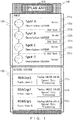
- FIG. 1 illustrates an example of an itinerary editing screen according to the present embodiment.
- An itinerary editing screen 100 is an example of a screen displayed on a monitor of, for example, a smartphone (a mobile terminal) or a computer.
- the itinerary editing screen 100 is provided to be editable to a plurality of users who are allowed to edit it. Further, the itinerary editing screen 100 is shared by the plurality of users who are allowed to edit it.
- the itinerary editing processing is managed by an information processing device.
- the itinerary editing screen 100 includes a title 110, a route 120, and an editing history 130.
- the title 110 is information that indicates a title of an itinerary that is being edited.
- the route 120 is information that indicates a spot of the itinerary that is being edited.
- the spot is, for example, a name or position information of a specific facility or tourist spot.
- the route 120 is a route to take a tour of "Spot A", "Spot B", “Spot C", and “Spot D" in this order.
- the itinerary editing screen 100 includes delete buttons 121a to 121d corresponding to the respective spots in order to delete each piece of spot information.
- the itinerary editing screen 100 includes add spot buttons 122a to 122c in order to add spot information.
- the add spot button 122a when the add spot button 122a is depressed, it is possible to add a new spot to the itinerary between Spot A and Spot B.
- the add spot button 122b when the add spot button 122b is depressed, it is possible to add a new spot to the itinerary between Spot B and Spot C.
- the add spot button 122c when the add spot button 122c is depressed, it is possible to add a new spot to the itinerary between Spot C and Spot D.
- new spot information is added from the itinerary editing screen 100 of another user who is editing the same itinerary.
- the number of spots included in the route 120, the number of delete buttons 121, and the number of add spot buttons 122 are just examples, and the numbers are not limited.
- the route 120 of FIG. 1 is a route to take a tour of "Spot A”, “Spot B”, “Spot C”, and “Spot D” in this order, but each user can rearrange (sort) these spots.
- the editing history 130 is history information on edit processing that was performed in the past on the itinerary that is being edited.
- the editing history 130 includes RbkGrp (rollback group) 1 to RbkGrp 3.
- RbkGrp 1 is, for example, history information on editing processing performed by a user A during a certain period of time.
- RbkGrp 1 of FIG. 1 includes a cancellation button 131a (a cancellation instruction component) with a description of "Cancel This Processing" that corresponds to RbkGrp 1.
- the cancellation button 131a has been depressed, processing of canceling editing processing that corresponds to RbkGrp 1 is performed.
- RbkGrp 2 is, for example, history information on editing processing performed by a user B during a certain period of time.
- RbkGrp 2 of FIG. 1 includes a cancellation button 131b with a description of "Cancel This Processing" that corresponds to RbkGrp 2.
- RbkGrp 3 is, for example, history information on editing processing performed by a user C during a certain period of time.
- RbkGrp 3 of FIG. 1 includes a cancellation button 131c with a description of "Cancel This Processing" that corresponds to RbkGrp 3.
- editing processing included in a rollback group is one of processes of addition, deletion, and sorting of a spot.
- each rollback group is history information that associates editing processes during a certain period of time for each user and stores them.
- a rollback group is specified to cancel editing processing as in the present embodiment, it is possible to cancel editing processing of a user corresponding to the rollback group and to leave editing processing of another user in an itinerary.
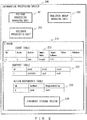
- FIG. 2 illustrates an example of a configuration of an information processing device according to the present embodiment.
- An information processing device 200 is a device that executes and manages an itinerary editing processing program according to the present embodiment.
- the information processing device 200 includes an editing processing managing unit 201, a rollback group managing unit 202, a rollback processing unit 203, and a storage 210.
- the editing processing managing unit 201 manages editing processing of each user who uses the itinerary editing processing program.
- the rollback group managing unit 202 generates a rollback group according to the editing processing of each user. Specific processes for which a rollback group is generated will be described later using FIGS. 3 , 4 , 5 , and 7 .
- the rollback processing unit 203 performs processing of canceling editing processing that corresponds to a rollback group that corresponds to the cancellation button.
- the storage 210 stores various tables that are an event table 221, a snapshot table 222, and an action dependency table 223, and includes a temporary storage region 230.
- the editing processing managing unit 201 registers history information on the editing process in the event table 221.
- the event table 221 includes items of "identifier (ID)", “Actor”, “Action”, “Target Table”, “Target Column”, “Value”, and “Relation”.
- ID of the event table 221 is an identification number of history information registered for each editing process.
- "Actor” of the event table 221 is information that identifies a user who performed an editing process.
- “Target Table” of the event table 221 is an item that is used when the snapshot table 222 is specified.
- “Target Column” of the event table 221 is an item that is used when a column number to be written in the snapshot table 222 is specified.
- “Value” of the event table 221 is an item for storing sorting information when sorting is performed in an editing process.
- “Relation” of the event table 221 is information that indicates which rollback group an editing process belongs to.
- the editing processing managing unit 201 registers history information on the editing process in the event table 221.
- the rollback group managing unit 202 temporality stores (buffers) information on the editing process in the temporary storage region 230.
- the rollback group managing unit 202 stores information on an editing process of a certain user in the temporary storage region 230 and then generates a rollback group by grouping editing processes of the certain user within a specified period of time into one rollback group.
- the rollback group managing unit 202 registers information on a rollback group in the snapshot table 222.
- the snapshot table 222 is a table that manages a rollback group.
- the snapshot table 222 includes items of "ID” and "Col1" to “Col3".
- "ID” of the snapshot table 222 is an identification number that identifies a rollback group.
- "Col1" to “Col3” are pieces of information that indicate a content of editing processing in a rollback group.
- “Col1" to “Col3” of the snapshot table 222 are examples and are not intended to limit the number of processes included in a rollback group.
- the action dependency table 223 is a table that manages a dependence relationship of each editing process, and is preset.
- the action dependency table 223 includes items of "ID”, “Action”, and “Depended by".
- ID of the action dependency table 223 is an identification number that identifies a combination of a dependence relationship.
- Action of the action dependency table 223 includes information that indicates a content of editing processing on which a dependence relationship is based.
- the item of "Depended by" of the action dependency table 223 includes information that indicates a content of editing processing that depends on the item of "Action".
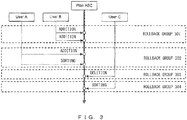
- FIG. 3 illustrates an example of generating a rollback group (part 1).
- FIG. 3 an example of a rollback group generated when the user A, the user B, and the user C edit an itinerary with respect to a travel plan ABC is described.
- the user B performs an editing process of adding one spot and then performs an editing process of adding another spot within a specified period of time. Then, the editing processing managing unit 201 registers a content of editing processing for each editing process with respect to the travel plan ABC in the event table 221. In addition, the rollback group managing unit 202 registers the editing processes of adding two spots in the snapshot table 222, so as to generate a rollback group 301.
- the user A After the editing processing performed by the user B, the user A performs an editing process of adding one spot with respect to the travel plan ABC and then performs an editing process of sorting spots registered in the travel plan ABC within a specified period of time. Then, the editing processing managing unit 201 registers a content of editing processing for each editing process with respect to the travel plan ABC in the event table 221. In addition, the rollback group managing unit 202 registers the editing process of adding a spot and the editing process of sorting spots in the snapshot table 222, so as to generate a rollback group 302.
- the user C performs an editing process of deleting a spot with respect to the travel plan ABC.
- the editing processing managing unit 201 registers information that indicates a deletion process with respect to the travel plan ABC in the event table 221.
- the rollback group managing unit 202 registers the editing process of deleting a spot in the snapshot table 222, so as to generate a rollback group 303.
- the rollback group managing unit 202 generates a rollback group that only corresponds to a deletion editing process.
- the user C performs an editing process of sorting spots with respect to the travel plan ABC.
- the editing processing managing unit 201 registers a content of editing processing for each editing process with respect to the travel plan ABC in the event table 221.
- the rollback group managing unit 202 registers the editing process of sorting spots in the snapshot table 222, so as to generate a rollback group 304.
- the rollback processing unit 203 when the rollback processing unit 203 performs a rollback using the rollback group 301, the editing processing of the user B (addition of two spots) is cleared. In other words, the rollback processing unit 203 returns the travel plan to the state before the editing processing registered corresponding to the rollback group 301 is performed.
- the editing processing of the user A and the editing processing of the user C are not cleared by performing the rollback using the rollback group 301 corresponding to the editing processing performed by the user B.
- the rollback processing unit 203 performs a rollback using the rollback group 302
- the editing processing of the user A (addition and sorting) is cleared.
- the rollback processing unit 203 returns the travel plan to the state before the editing processing registered corresponding to the rollback group 302 is performed.
- the editing processing of the user C which is performed after the editing processing performed by the user A is not cleared by performing the rollback using the rollback group 302 corresponding to the editing processing performed by the user A.
- the rollback processing unit 203 performs a rollback using the rollback group 303, the editing processing of the user C (deletion) is cleared.
- the rollback processing unit 203 returns the travel plan to the state before the editing processing registered corresponding to the rollback group 303 is performed.
- the rollback processing unit 203 performs a rollback using the rollback group 304, the editing processing of the user C (sorting) is cleared. In other words, the rollback processing unit 203 returns the travel plan to the state before the editing processing registered corresponding to the rollback group 304 is performed.
- each rollback group is history information that associates editing processes during a certain period of time for each user and stores them.
- a rollback group is specified to cancel editing processing as in the present embodiment, it is possible to cancel editing processing of a user corresponding to the rollback group and to leave editing processing of another user in an itinerary.
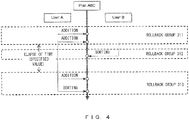
- FIG. 4 illustrates an example of generating a rollback group (part 2).
- FIG. 4 an example of a rollback group generated when the user A and the user B edit an itinerary with respect to the travel plan ABC is described.
- the user A performs an editing process of adding one spot and then performs an editing process of adding another spot within a specified period of time. Then, the editing processing managing unit 201 registers a content of editing processing for each editing process with respect to the travel plan ABC in the event table 221. In addition, the rollback group managing unit 202 registers the editing processes of adding two spots in the snapshot table 222, so as to generate a rollback group 311.
- the user B After the editing processing performed by the user A, the user B performs an editing process of sorting spots registered in the travel plan ABC. Then, the editing processing managing unit 201 registers a content of editing processing for each editing process with respect to the travel plan ABC in the event table 221. In addition, the rollback group managing unit 202 registers the editing process of sorting spots in the snapshot table 222, so as to generate a rollback group 312.
- the user A After a certain period of time has elapsed, the user A performs an editing process of adding one spot with respect to the travel plan ABC and then performs an editing process of sorting spots registered in the travel plan ABC within a specified period of time. Then, the editing processing managing unit 201 registers a content of editing processing for each editing process with respect to the travel plan ABC in the event table 221. In addition, the rollback group managing unit 202 registers the editing process of adding a spot and the editing process of sorting spots in the snapshot table 222, so as to generate a rollback group 313.
- the rollback processing unit 203 when the rollback processing unit 203 performs a rollback using the rollback group 311, the editing processing of the user A (addition of two spots + addition of one spot and sorting) is cleared. In other words, the rollback processing unit 203 returns the travel plan to the state before the editing processing registered corresponding to the rollback group 311 is performed.
- the editing processing of the user B is not cleared by performing the rollback using the rollback group 311 corresponding to the editing processing performed by the user A.
- the rollback processing unit 203 performs a rollback using the rollback group 312
- the editing processing of the user B sorting
- the rollback processing unit 203 returns the travel plan to the state before the editing processing registered corresponding to the rollback group 312 is performed.
- the editing processing performed by the user A is not cleared by performing the rollback using the rollback group 312 corresponding to the editing processing performed by the user B.
- the rollback processing unit 203 performs a rollback using the rollback group 313, the editing processing of the user A (addition and sorting) is cleared. In other words, the rollback processing unit 203 returns the travel plan to the state before the editing processing registered corresponding to the rollback group 313 is performed.
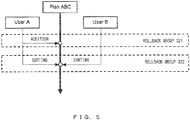
- FIG. 5 illustrates an example of generating a rollback group (part 3).
- FIG. 5 an example of a rollback group generated when the user A and the user B edit an itinerary with respect to the travel plan ABC is described.
- the user A performs an editing process of adding one spot with respect to the travel plan ABC and then performs an editing process of sorting spots registered in the travel plan ABC within a specified period of time.
- the user B also performs, at the same timing, the same editing processing as the editing processing of sorting spots registered in the travel plan ABC that is performed by the user A.
- the editing processing managing unit 201 registers a content of editing processing for each editing process with respect to the travel plan ABC in the event table 221.
- the rollback group managing unit 202 registers, in advance and in the snapshot table 222, the editing process of adding a spot that is performed by the user A, so as to generate a rollback group 321.
- the rollback group managing unit 202 registers, in the snapshot table 222, the editing processes of sorting spots that are performed by the user A and the user B, so as to generate a rollback group 322.
- the rollback processing unit 203 when the rollback processing unit 203 performs a rollback using the rollback group 321, the editing processing of the user A (addition and sorting) is cleared. In other words, the rollback processing unit 203 returns the travel plan to the state before the editing processing registered corresponding to the rollback group 321 is performed.
- the editing processing of the user B is not cleared by performing the rollback using the rollback group 321 corresponding to the editing processing performed by the user A.
- the rollback processing unit 203 performs a rollback using the rollback group 322
- the editing processing of the user A and the editing processing of the user B (sorting) are cleared. In other words, the rollback processing unit 203 returns the travel plan to the state before the editing processing registered corresponding to the rollback group 322 is performed.
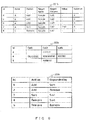
- FIG. 6 illustrates an example of table processing that corresponds to the example of generating a rollback group (part 3) .
- the editing processing managing unit 201 writes a content of editing processing into the storage 210 for each editing process, so as to generate an event table 221a.
- the first line of the event table 221a represents an editing process of adding a spot that is performed by the user A.
- “A” that represents the user A is registered in the first line of the item of "Actor”.
- “Add” that represents an addition process is registered in the first line of the item of "Action”.
- the second line of the event table 221a represents an editing process of sorting spots that is performed by the user B.
- the rollback group managing unit 202 In the example of generating a rollback group (part 3), the rollback group managing unit 202 generates the rollback group 321 and the rollback group 322.
- the rollback group managing unit 202 registers information on the rollback group 321 in (the first line of) a snapshot table 222a.
- the rollback group managing unit 202 registers information on the rollback group 322 in (the second line of) the snapshot table 222a.
- the rollback group managing unit 202 registers the information on the rollback group 321 in the first line of the event table 221a which corresponds to the rollback group 321. Specifically, the information on the rollback group 321 is registered in the first line of the event table 221a. A name of a table (a name of the snapshot table) in which rollback group information that includes the editing process of adding a spot that is performed by the user A is registered is registered in the first line of the item of "Target Table". A column number in the snapshot table is registered in the first line of the item of "Target Column”. Then, information indicating that the first line of the event table 221a has a relationship with "ID" #1 in the snapshot table is registered in the first line of the item of "Relation".
- the rollback group managing unit 202 registers the information on the rollback group 322 in the second and third lines of the event table 221a which correspond to the rollback group 322.
- the information on the rollback group 322 is registered in the second and third lines of the event table 221a.
- a name of a table (the name of the snapshot table) in which rollback group information that includes an editing process of sorting is registered is registered in the second and third lines of the item of "Target Table".
- a column number in the snapshot table is registered in the second and third lines of the item of "Target Column”. Then, information indicating that the second line of the event table 221a has a relationship with "ID" #2 in the snapshot table is registered in the second and third lines of the item of "Relation".
- FIG. 7 illustrates an example of generating a rollback group (part 4).
- FIG. 7 an example of a rollback group generated when the user A and the user B edit an itinerary with respect to the travel plan ABC is described.
- the user A performs an editing process of adding a spot A, and then performs an editing process of adding a spot C within a specified period of time. Further, it is assumed that the user B performs an editing process of adding a spot B between the editing processes of adding the spot A and the spot C that are performed by the user A.
- the editing processing managing unit 201 registers a content of editing processing for each editing process of the user A and for each editing process of the user B with respect to the travel plan ABC in the event table 221.
- the rollback group managing unit 202 registers, in the snapshot table 222, the editing processes of adding the spot A and the spot C that are performed by the user A, so as to generate a rollback group 331.
- the rollback group managing unit 202 registers, in the snapshot table 222, the editing process of adding the spot B that is performed by the user B, so as to generate a rollback group 332.
- the rollback processing unit 203 when the rollback processing unit 203 performs a rollback using the rollback group 331, the editing processing of the user A (addition of the spot A and the spot C) is cleared. In other words, the rollback processing unit 203 returns the travel plan to the state before the editing processing registered corresponding to the rollback group 331 is performed. The editing processing of the user B is not cleared by performing the rollback using the rollback group 331 corresponding to the editing processing performed by the user A.
- the rollback processing unit 203 performs a rollback using the rollback group 332 the editing processing of the user B (addition of the spot B) is cleared. In other words, the rollback processing unit 203 returns the travel plan to the state before the editing processing registered corresponding to the rollback group 332 is performed.
- the editing processing of the user A is not cleared by performing the rollback using the rollback group 332 corresponding to the editing processing performed by the user B.
- FIG. 8 illustrates an example of generating a rollback group (part 5).
- FIG. 8 an example of a rollback group generated when the user A, the user B, and the user C edit an itinerary with respect to the travel plan ABC is described.
- the user A performs an editing process of adding the spot A, then performs an editing process of adding the spot C within a specified period of time, and further performs an editing process of sorting spots to change the position of the spot B.
- the user B performs an editing process of adding the spot B between the editing processes of adding the spot A and the spot C that are performed by the user A.
- the user C performs an editing process of deleting the spot B.
- the editing processing managing unit 201 registers a content of editing processing for each editing process of the user A, for each editing process of the user B, and for each editing process of the user C with respect to the travel plan ABC in the event table 221.
- the rollback group managing unit 202 registers, in the snapshot table 222, the editing processes of adding the spot A and the spot C and the editing process of sorting spots to change the position of the spot B, so as to generate a rollback group 341.
- the rollback group managing unit 202 registers, in the snapshot table 222, the editing process of adding the spot B that is performed by the user B, so as to generate a rollback group 342.
- the rollback group managing unit 202 registers, in the snapshot table 222, the editing process of deleting the spot B that is performed by the user C, so as to generate a rollback group 343.
- the rollback processing unit 203 when the rollback processing unit 203 performs a rollback using the rollback group 341, the editing processing of the user A (the addition processes for the spot A and the spot C and the sorting process for the spot B) is cleared. In other words, the rollback processing unit 203 returns the travel plan to the state before the editing processing registered corresponding to the rollback group 341 is performed. The editing processing of the user B and the editing processing of the user C are not cleared by performing the rollback using the rollback group 341 corresponding to the editing processing performed by the user A. When the rollback processing unit 203 performs a rollback using the rollback group 343, the editing processing of the user C (the deletion process for the spot B) is cleared. In other words, the rollback processing unit 203 returns the travel plan to the state before the editing processing registered corresponding to the rollback group 343 is performed.
- the rollback processing unit 203 When the rollback processing unit 203 performs a rollback using the rollback group 342, the editing processing of the user B (the addition process for the spot B) is cleared. In other words, the rollback processing unit 203 returns the travel plan to the state before the editing processing registered corresponding to the rollback group 342 is performed.
- the addition process for the spot B is cleared, it will not be possible to perform, for example, the sorting process for the spot B that is performed by the user A and the deletion process for the spot B that is performed by the user C. As described above, when a certain process that has a dependence relationship with another process is rolled back, this may have an effect on another user.
- the rollback processing unit 203 performs a rollback using the rollback group 342
- the editing processing of the user B (the addition process for the spot B) is cleared and the sorting process for the spot B that is performed by the user A and the deletion process for the spot B that is performed by the user C are also cleared.
- FIG. 9 illustrates an example of a table generated in the example of generating a rollback group (part 5) .
- An event table 221b is generated according to each editing process in the example of generating a rollback group (part 5).
- a snapshot table 222b includes each rollback group generated in the example of generating a rollback group (part 5).
- An action dependency table 223b is a table that manages a dependence relationship between each of the editing processes.
- the first line of the event table 221b corresponds to the addition process for the spot A that is performed by the user A, and is associated with the rollback group 341 (the second line of the snapshot table 222b).
- the second line of the event table 221b corresponds to the addition process for the spot B that is performed by the user B, and is associated with the rollback group 342 (the first line of the snapshot table 222b).
- the third line of the event table 221b corresponds to the addition process for the spot C that is performed by the user A, and is associated with the rollback group 341 (the second line of the snapshot table 222b).
- the fourth line of the event table 221b corresponds to the sorting process for the spot B that is performed by the user A, and is associated with the rollback group 341 (the second line of the snapshot table 222b) .
- the fifth line of the event table 221b corresponds to the deletion process for the spot B that is performed by the user C, and is associated with the rollback group 343 (the third line of the snapshot table 222b).
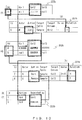
- FIG. 10 illustrates an example of processing of clearing editing processes that have a dependence relationship using a rollback group.
- processing of clearing the addition process for the spot B that is performed by the user B using the rollback group 342 generated in the example of generating a rollback group (part 5) is described in order.
- the rollback processing unit 203 performs a rollback using the rollback group 342, the editing process of the user B (the addition process for the spot B) is cleared and the sorting process for the spot B that is performed by the user A and the deletion process for the spot B that is performed by the user C are also cleared.
- FIG. 11 illustrates an example of a hardware configuration of the information processing device.
- the information processing device 200 includes a processor 11, a memory 12, a bus 15, an external storage 16, and a network connecting device 19. As an option, the information processing device 200 may further include an input device 13, an output device 14, and a medium driving device 17.
- the information processing device 200 may be implemented by, for example, a computer.
- the processor 11 may be any processing route that includes a central processing unit (CPU).
- the processor 11 operates as the editing processing managing unit 201, the rollback group managing unit 202, and the rollback processing unit 203 in the information processing device 200.
- the processor 11 may execute a program stored in the external storage 16.
- the memory 12 operates as the storage 210 and stores the event table 221, the snapshot table 222, and the action dependency table 223. Further, the memory 12 stores, for example, data obtained by the operation of the processor 11 and data used for processing performed by the processor 11 as needed.
- the network connecting device 19 is used to communicate with another device.
- the input device 13 is implemented as, for example, a button, a keyboard, or a mouse
- the output device 14 is implemented as, for example, a display.
- the bus 15 connects the processor 11, the memory 12, the input device 13, the output device 14, the external storage 16, the medium driving device 17, and the network connecting device 19 such that data passing can be mutually performed between these components.
- the external storage 16 stores, for example, a program or data and provides stored information to, for example, the processor 11 as needed.
- the medium driving device 17 can output data in the memory 12 or the external storage 16 to a portable recording medium 18, and read, for example, a program or data from the portable recording medium 18.
- the portable recording medium 18 may be any portable recording medium that includes a floppy disk, a magneto-optical (MO) disk, a compact disk recordable (CD-R), and a digital versatile disk recordable (DVD-R).
- FIG. 12 is a flowchart that illustrates an example of processing of generating a rollback group.
- the editing processing managing unit 201 receives an editing manipulation of a user (Step S101) .
- the editing processing managing unit 201 writes a content of editing processing of the user into the event table 221, and also writes it into the temporary storage region 230 (Step S102).
- the editing processing managing unit 201 determines whether another content of editing processing is written within a specified period of time (for example, within 500 milliseconds) from the editing processing managing unit 201 writing the content of editing processing of the user into the temporary storage region 230 (Step S103).
- Step S103 When the another content of editing processing is written within the specified period of time from the editing processing managing unit 201 writing the content of editing processing of the user into the temporary storage region 230 (YES in Step S103), the editing processing managing unit 201 repeats the processes of and after Step S101.
- the rollback group managing unit 202 determines whether the content of editing processing of the user is the same as the content of a rollback group written into the snapshot table 222 last time (Step S104) .
- Step S104 When the content of editing processing of the user is the same as the content of the rollback group written into the snapshot table 222 last time (YES in Step S104), the rollback group managing unit 202 registers, in "Relation" of the event table 221, information indicating a corresponding rollback group in the snapshot table 222 (Step S105).
- Step S106 When the content of editing processing of the user is not the same as the content of the rollback group written into the snapshot table 222 last time (NO in Step S104), the rollback group managing unit 202 registers the content of editing processing in the snapshot table 222 (Step S106).
- Step S105 or Step S106 When the process of Step S105 or Step S106 is terminated, the information processing device terminates the processing of generating a rollback group.
- FIGS. 13A and 13B are a flowchart that illustrates an example of rollback processing.
- the rollback processing unit 203 receives a deletion instruction issued by a user manipulation (Step S201).
- the rollback processing unit 203 obtains, from the snapshot table 222, information on a rollback group specified to be deleted by the deletion instruction (Step S202).
- the rollback processing unit 203 identifies, from the obtained information on the rollback group, an editing process included in the rollback group (Step S203) .
- the rollback processing unit 203 identifies a rollback group that is posterior to a rollback group specified to be deleted by the deletion instruction and that has a value in the same column as the column in which the rollback group specified to be deleted by the deletion instruction has data (Step S204) .
- the rollback processing unit 203 determines whether there exists a corresponding rollback group (Step S205).
- the rollback processing unit 203 obtains information on the corresponding rollback group from the snapshot table 222 (Step S206).
- the rollback processing unit 203 identifies an editing process included in the rollback group from the obtained information on the rollback group (Step S207) .
- the rollback processing unit 203 determines whether the identified editing process has a dependence relationship with the editing process included in the rollback group specified to be deleted by the deletion instruction (Step S208). When there exists an identified editing process having a dependence relationship (YES in Step S208), the rollback processing unit 203 performs processing of deleting the corresponding identified editing process (Step S209) .
- Step S210 the rollback processing unit 203 performs processing of deleting the editing process included in the rollback group specified to be deleted by the deletion instruction (Step S210).
- Step S210 the rollback processing unit 203 terminates the processing on a rollback.
Landscapes
- Engineering & Computer Science (AREA)
- Business, Economics & Management (AREA)
- Human Resources & Organizations (AREA)
- Theoretical Computer Science (AREA)
- Physics & Mathematics (AREA)
- General Physics & Mathematics (AREA)
- Strategic Management (AREA)
- Entrepreneurship & Innovation (AREA)
- Economics (AREA)
- Tourism & Hospitality (AREA)
- Marketing (AREA)
- General Business, Economics & Management (AREA)
- General Engineering & Computer Science (AREA)
- Quality & Reliability (AREA)
- Data Mining & Analysis (AREA)
- Operations Research (AREA)
- Databases & Information Systems (AREA)
- Radar, Positioning & Navigation (AREA)
- Remote Sensing (AREA)
- Development Economics (AREA)
- Educational Administration (AREA)
- Game Theory and Decision Science (AREA)
- Human Computer Interaction (AREA)
- Automation & Control Theory (AREA)
- Primary Health Care (AREA)
- General Health & Medical Sciences (AREA)
- Health & Medical Sciences (AREA)
- Management, Administration, Business Operations System, And Electronic Commerce (AREA)
- Information Retrieval, Db Structures And Fs Structures Therefor (AREA)
- Retry When Errors Occur (AREA)
Abstract
An itinerary editing processing program causes a computer to execute a process including receiving a plurality of editing processes corresponding to a user account with respect to an itinerary plan. The itinerary editing processing program causes the computer to execute the process including displaying, for each user account, an instruction component instructing canceling of an editing process from among the received plurality of editing processes that corresponds to a same user account; and canceling the editing process which corresponds to a user account that corresponds to a specified instruction component from among the displayed instruction components.
Description
- The embodiments discussed herein are related to itinerary editing processing.
- A program or the like that permits a plurality of users to edit a travel plan while sharing it is known. With respect to a travel plan on which editing processing has proceeded, when returning the editing processing of the travel plan up to a state at a certain point in time in the past, it may be useful if it is possible to clear editing processing up to the certain point in time in the past that was performed by a user.
- A backup system is known that manages a backup using an update history only if an account is the same or an authority such as an administrator is maintained with respect to data updated in a client (see, for example, Patent Document 1).
- A simulation method is known that includes creating a restoration point regularly between a plurality of core models that execute a thread by parallel processing and recreating a state of a core model at the created restoration point (see, for example, Patent Document 2).
- Patent Document 1: Japanese Laid-open Patent Publication No.
2012-22597 - Patent Document 2: Japanese Laid-open Patent Publication No.
2008-210107 - With respect to a travel plan on which editing processing has proceeded, when returning the editing processing of the travel plan up to a state at a certain point in time in the past, editing processing up to the certain point in time in the past that was performed by all users will also be cleared.
- In one aspect, it is an object of the present invention to realize more flexible editing processing.
- An itinerary editing processing program according to an aspect causes a computer to execute a process including receiving a plurality of editing processes corresponding to a user account with respect to an itinerary plan. The itinerary editing processing program causes the computer to execute the process including displaying, for each user account, an instruction component instructing canceling of an editing process from among the received plurality of editing processes that corresponds to a same user account; and canceling the editing process which corresponds to a user account that corresponds to a specified instruction component from among the displayed instruction components.
-
-
FIG. 1 illustrates an example of an itinerary editing screen according to the present embodiment; -
FIG. 2 illustrates an example of a configuration of an information processing device according to the present embodiment; -
FIG. 3 illustrates an example of generating a rollback group (part 1); -
FIG. 4 illustrates an example of generating a rollback group (part 2); -
FIG. 5 illustrates an example of generating a rollback group (part 3); -
FIG. 6 illustrates an example of table processing that corresponds to the example of generating a rollback group (part 3) ; -
FIG. 7 illustrates an example of generating a rollback group (part 4); -
FIG. 8 illustrates an example of generating a rollback group (part 5); -
FIG. 9 illustrates an example of a table generated in the example of generating a rollback group (part 5); -
FIG. 10 illustrates an example of processing of clearing editing processes that have a dependence relationship using a rollback group; -
FIG. 11 illustrates an example of a hardware configuration of the information processing device; -
FIG. 12 is a flowchart that illustrates an example of processing of generating a rollback group; -
FIG. 13A is a flowchart that illustrates an example of rollback processing; and -
FIG. 13B is the flowchart that illustrates the example of the rollback processing. - Embodiments will now be described in detail with reference to the drawings.
-
FIG. 1 illustrates an example of an itinerary editing screen according to the present embodiment. Anitinerary editing screen 100 is an example of a screen displayed on a monitor of, for example, a smartphone (a mobile terminal) or a computer. Theitinerary editing screen 100 is provided to be editable to a plurality of users who are allowed to edit it. Further, theitinerary editing screen 100 is shared by the plurality of users who are allowed to edit it. The itinerary editing processing is managed by an information processing device. - The
itinerary editing screen 100 includes atitle 110, aroute 120, and anediting history 130. Thetitle 110 is information that indicates a title of an itinerary that is being edited. Theroute 120 is information that indicates a spot of the itinerary that is being edited. The spot is, for example, a name or position information of a specific facility or tourist spot. In the example ofFIG. 1 , theroute 120 is a route to take a tour of "Spot A", "Spot B", "Spot C", and "Spot D" in this order. Theitinerary editing screen 100 includesdelete buttons 121a to 121d corresponding to the respective spots in order to delete each piece of spot information. When one of thedelete buttons 121a to 121d is depressed, a corresponding piece of spot information is deleted from the itinerary that is being edited. When the piece of spot information corresponding to the depressed delete button has been deleted from the itinerary that is being edited, the spot information corresponding to the delete button is also deleted from theitinerary editing screen 100 of another user who is editing the same itinerary. - The
itinerary editing screen 100 includes addspot buttons 122a to 122c in order to add spot information. In the example ofFIG. 1 , when theadd spot button 122a is depressed, it is possible to add a new spot to the itinerary between Spot A and Spot B. In the example ofFIG. 1 , when theadd spot button 122b is depressed, it is possible to add a new spot to the itinerary between Spot B and Spot C. In the example ofFIG. 1 , when theadd spot button 122c is depressed, it is possible to add a new spot to the itinerary between Spot C and Spot D. When a new spot has been added to an itinerary that is being edited, new spot information is added from theitinerary editing screen 100 of another user who is editing the same itinerary. InFIG. 1 , the number of spots included in theroute 120, the number of delete buttons 121, and the number of add spot buttons 122 are just examples, and the numbers are not limited. - The
route 120 ofFIG. 1 is a route to take a tour of "Spot A", "Spot B", "Spot C", and "Spot D" in this order, but each user can rearrange (sort) these spots. - The
editing history 130 is history information on edit processing that was performed in the past on the itinerary that is being edited. In the example ofFIG. 1 , theediting history 130 includes RbkGrp (rollback group) 1 toRbkGrp 3.RbkGrp 1 is, for example, history information on editing processing performed by a user A during a certain period of time.RbkGrp 1 ofFIG. 1 includes acancellation button 131a (a cancellation instruction component) with a description of "Cancel This Processing" that corresponds toRbkGrp 1. When thecancellation button 131a has been depressed, processing of canceling editing processing that corresponds toRbkGrp 1 is performed.RbkGrp 2 is, for example, history information on editing processing performed by a user B during a certain period of time. RbkGrp 2 ofFIG. 1 includes acancellation button 131b with a description of "Cancel This Processing" that corresponds toRbkGrp 2. When thecancellation button 131b has been depressed, processing of canceling editing processing corresponding toRbkGrp 2 is performed.RbkGrp 3 is, for example, history information on editing processing performed by a user C during a certain period of time. RbkGrp 3 ofFIG. 1 includes acancellation button 131c with a description of "Cancel This Processing" that corresponds toRbkGrp 3. When thecancellation button 131c has been depressed, processing of canceling editing processing corresponding toRbkGrp 3 is performed. Here, editing processing included in a rollback group is one of processes of addition, deletion, and sorting of a spot. - As described above, each rollback group is history information that associates editing processes during a certain period of time for each user and stores them. Thus, when a rollback group is specified to cancel editing processing as in the present embodiment, it is possible to cancel editing processing of a user corresponding to the rollback group and to leave editing processing of another user in an itinerary.
-
FIG. 2 illustrates an example of a configuration of an information processing device according to the present embodiment. Aninformation processing device 200 is a device that executes and manages an itinerary editing processing program according to the present embodiment. Theinformation processing device 200 includes an editingprocessing managing unit 201, a rollbackgroup managing unit 202, arollback processing unit 203, and astorage 210. - The editing
processing managing unit 201 manages editing processing of each user who uses the itinerary editing processing program. The rollbackgroup managing unit 202 generates a rollback group according to the editing processing of each user. Specific processes for which a rollback group is generated will be described later usingFIGS. 3 ,4 ,5 , and7 . When a cancellation button is depressed, therollback processing unit 203 performs processing of canceling editing processing that corresponds to a rollback group that corresponds to the cancellation button. - The
storage 210 stores various tables that are an event table 221, a snapshot table 222, and an action dependency table 223, and includes atemporary storage region 230. When an instruction is given to perform one of the editing processes, the editingprocessing managing unit 201 registers history information on the editing process in the event table 221. The event table 221 includes items of "identifier (ID)", "Actor", "Action", "Target Table", "Target Column", "Value", and "Relation". "ID" of the event table 221 is an identification number of history information registered for each editing process. "Actor" of the event table 221 is information that identifies a user who performed an editing process. "Target Table" of the event table 221 is an item that is used when the snapshot table 222 is specified. "Target Column" of the event table 221 is an item that is used when a column number to be written in the snapshot table 222 is specified. "Value" of the event table 221 is an item for storing sorting information when sorting is performed in an editing process. "Relation" of the event table 221 is information that indicates which rollback group an editing process belongs to. - As described above, when an instruction is given to perform one of the editing processes, the editing
processing managing unit 201 registers history information on the editing process in the event table 221. In addition, when an instruction is given to perform one of the editing processes, the rollbackgroup managing unit 202 temporality stores (buffers) information on the editing process in thetemporary storage region 230. The rollbackgroup managing unit 202 stores information on an editing process of a certain user in thetemporary storage region 230 and then generates a rollback group by grouping editing processes of the certain user within a specified period of time into one rollback group. Using the rollback group by grouping the editing processes of the certain user within the specified period of time, the rollbackgroup managing unit 202 registers information on a rollback group in the snapshot table 222. - The snapshot table 222 is a table that manages a rollback group. The snapshot table 222 includes items of "ID" and "Col1" to "Col3". "ID" of the snapshot table 222 is an identification number that identifies a rollback group. "Col1" to "Col3" are pieces of information that indicate a content of editing processing in a rollback group. "Col1" to "Col3" of the snapshot table 222 are examples and are not intended to limit the number of processes included in a rollback group.
- The action dependency table 223 is a table that manages a dependence relationship of each editing process, and is preset. The action dependency table 223 includes items of "ID", "Action", and "Depended by". "ID" of the action dependency table 223 is an identification number that identifies a combination of a dependence relationship. "Action" of the action dependency table 223 includes information that indicates a content of editing processing on which a dependence relationship is based. The item of "Depended by" of the action dependency table 223 includes information that indicates a content of editing processing that depends on the item of "Action".
- In the action dependency table 223 of
FIG. 2 , "Add" is registered in the item of "Action", and "Sort" is registered in the item of "Dependency by", which corresponds to "Add". In order to perform "Sort" processing on one piece of spot information, the one piece of spot information has been added ("Add") in advance. Thus, in the action dependency table 223 ofFIG. 2 , information that indicates a dependence relationship between "Add" and "Sort" is registered. -
FIG. 3 illustrates an example of generating a rollback group (part 1). InFIG. 3 , an example of a rollback group generated when the user A, the user B, and the user C edit an itinerary with respect to a travel plan ABC is described. - With respect to the travel plan ABC, the user B performs an editing process of adding one spot and then performs an editing process of adding another spot within a specified period of time. Then, the editing
processing managing unit 201 registers a content of editing processing for each editing process with respect to the travel plan ABC in the event table 221. In addition, the rollbackgroup managing unit 202 registers the editing processes of adding two spots in the snapshot table 222, so as to generate arollback group 301. - After the editing processing performed by the user B, the user A performs an editing process of adding one spot with respect to the travel plan ABC and then performs an editing process of sorting spots registered in the travel plan ABC within a specified period of time. Then, the editing
processing managing unit 201 registers a content of editing processing for each editing process with respect to the travel plan ABC in the event table 221. In addition, the rollbackgroup managing unit 202 registers the editing process of adding a spot and the editing process of sorting spots in the snapshot table 222, so as to generate arollback group 302. - After that, the user C performs an editing process of deleting a spot with respect to the travel plan ABC. Then, the editing
processing managing unit 201 registers information that indicates a deletion process with respect to the travel plan ABC in the event table 221. In addition, the rollbackgroup managing unit 202 registers the editing process of deleting a spot in the snapshot table 222, so as to generate arollback group 303. Here, it is assumed that, when the editing process is a deletion process, the rollbackgroup managing unit 202 generates a rollback group that only corresponds to a deletion editing process. - The user C performs an editing process of sorting spots with respect to the travel plan ABC. Then, the editing
processing managing unit 201 registers a content of editing processing for each editing process with respect to the travel plan ABC in the event table 221. In addition, the rollbackgroup managing unit 202 registers the editing process of sorting spots in the snapshot table 222, so as to generate arollback group 304. - Here, when the
rollback processing unit 203 performs a rollback using therollback group 301, the editing processing of the user B (addition of two spots) is cleared. In other words, therollback processing unit 203 returns the travel plan to the state before the editing processing registered corresponding to therollback group 301 is performed. The editing processing of the user A and the editing processing of the user C are not cleared by performing the rollback using therollback group 301 corresponding to the editing processing performed by the user B. When therollback processing unit 203 performs a rollback using therollback group 302, the editing processing of the user A (addition and sorting) is cleared. In other words, therollback processing unit 203 returns the travel plan to the state before the editing processing registered corresponding to therollback group 302 is performed. The editing processing of the user C which is performed after the editing processing performed by the user A is not cleared by performing the rollback using therollback group 302 corresponding to the editing processing performed by the user A. When therollback processing unit 203 performs a rollback using therollback group 303, the editing processing of the user C (deletion) is cleared. In other words, therollback processing unit 203 returns the travel plan to the state before the editing processing registered corresponding to therollback group 303 is performed. When therollback processing unit 203 performs a rollback using therollback group 304, the editing processing of the user C (sorting) is cleared. In other words, therollback processing unit 203 returns the travel plan to the state before the editing processing registered corresponding to therollback group 304 is performed. - As described above, each rollback group is history information that associates editing processes during a certain period of time for each user and stores them. Thus, when a rollback group is specified to cancel editing processing as in the present embodiment, it is possible to cancel editing processing of a user corresponding to the rollback group and to leave editing processing of another user in an itinerary.
-
FIG. 4 illustrates an example of generating a rollback group (part 2). InFIG. 4 , an example of a rollback group generated when the user A and the user B edit an itinerary with respect to the travel plan ABC is described. - With respect to the travel plan ABC, the user A performs an editing process of adding one spot and then performs an editing process of adding another spot within a specified period of time. Then, the editing
processing managing unit 201 registers a content of editing processing for each editing process with respect to the travel plan ABC in the event table 221. In addition, the rollbackgroup managing unit 202 registers the editing processes of adding two spots in the snapshot table 222, so as to generate arollback group 311. - After the editing processing performed by the user A, the user B performs an editing process of sorting spots registered in the travel plan ABC. Then, the editing
processing managing unit 201 registers a content of editing processing for each editing process with respect to the travel plan ABC in the event table 221. In addition, the rollbackgroup managing unit 202 registers the editing process of sorting spots in the snapshot table 222, so as to generate arollback group 312. - After a certain period of time has elapsed, the user A performs an editing process of adding one spot with respect to the travel plan ABC and then performs an editing process of sorting spots registered in the travel plan ABC within a specified period of time. Then, the editing
processing managing unit 201 registers a content of editing processing for each editing process with respect to the travel plan ABC in the event table 221. In addition, the rollbackgroup managing unit 202 registers the editing process of adding a spot and the editing process of sorting spots in the snapshot table 222, so as to generate arollback group 313. - Here, when the
rollback processing unit 203 performs a rollback using therollback group 311, the editing processing of the user A (addition of two spots + addition of one spot and sorting) is cleared. In other words, therollback processing unit 203 returns the travel plan to the state before the editing processing registered corresponding to therollback group 311 is performed. The editing processing of the user B is not cleared by performing the rollback using therollback group 311 corresponding to the editing processing performed by the user A. When therollback processing unit 203 performs a rollback using therollback group 312, the editing processing of the user B (sorting) is cleared. In other words, therollback processing unit 203 returns the travel plan to the state before the editing processing registered corresponding to therollback group 312 is performed. The editing processing performed by the user A is not cleared by performing the rollback using therollback group 312 corresponding to the editing processing performed by the user B. When therollback processing unit 203 performs a rollback using therollback group 313, the editing processing of the user A (addition and sorting) is cleared. In other words, therollback processing unit 203 returns the travel plan to the state before the editing processing registered corresponding to therollback group 313 is performed. -
FIG. 5 illustrates an example of generating a rollback group (part 3). InFIG. 5 , an example of a rollback group generated when the user A and the user B edit an itinerary with respect to the travel plan ABC is described. - The user A performs an editing process of adding one spot with respect to the travel plan ABC and then performs an editing process of sorting spots registered in the travel plan ABC within a specified period of time. Here, it is assumed that the user B also performs, at the same timing, the same editing processing as the editing processing of sorting spots registered in the travel plan ABC that is performed by the user A.
- Then, the editing
processing managing unit 201 registers a content of editing processing for each editing process with respect to the travel plan ABC in the event table 221. The rollbackgroup managing unit 202 registers, in advance and in the snapshot table 222, the editing process of adding a spot that is performed by the user A, so as to generate arollback group 321. The rollbackgroup managing unit 202 registers, in the snapshot table 222, the editing processes of sorting spots that are performed by the user A and the user B, so as to generate arollback group 322. - Here, when the
rollback processing unit 203 performs a rollback using therollback group 321, the editing processing of the user A (addition and sorting) is cleared. In other words, therollback processing unit 203 returns the travel plan to the state before the editing processing registered corresponding to therollback group 321 is performed. The editing processing of the user B is not cleared by performing the rollback using therollback group 321 corresponding to the editing processing performed by the user A. When therollback processing unit 203 performs a rollback using therollback group 322, the editing processing of the user A and the editing processing of the user B (sorting) are cleared. In other words, therollback processing unit 203 returns the travel plan to the state before the editing processing registered corresponding to therollback group 322 is performed. -
FIG. 6 illustrates an example of table processing that corresponds to the example of generating a rollback group (part 3) . In the example of generating a rollback group (part 3), the editingprocessing managing unit 201 writes a content of editing processing into thestorage 210 for each editing process, so as to generate an event table 221a. The first line of the event table 221a represents an editing process of adding a spot that is performed by the user A. Thus, "A" that represents the user A is registered in the first line of the item of "Actor". "Add" that represents an addition process is registered in the first line of the item of "Action". The second line of the event table 221a represents an editing process of sorting spots that is performed by the user B. Thus, "B" that represents the user B is registered in the second line of the item of "Actor". "Sort" that represents a sorting process is registered in the second line of the item of "Action". "3to4" that represents a sorting process of moving the spot registered in the third position in the itinerary to the fourth position is registered in the second line of the item of "Value". The third line of the event table 221a represents an editing process of soring spots that is performed by the user A. Thus, "A" that represents the user A is registered in the third line of the item of "Actor". "Sort" that represents a sorting process is registered in the third line of the item of "Action". "3to4" that represents a sorting process of moving the spot registered in the third position in the itinerary to the fourth position is registered in the third line of the item of "Value". - In the example of generating a rollback group (part 3), the rollback
group managing unit 202 generates therollback group 321 and therollback group 322. The rollbackgroup managing unit 202 registers information on therollback group 321 in (the first line of) a snapshot table 222a. The rollbackgroup managing unit 202 registers information on therollback group 322 in (the second line of) the snapshot table 222a. - The rollback
group managing unit 202 registers the information on therollback group 321 in the first line of the event table 221a which corresponds to therollback group 321. Specifically, the information on therollback group 321 is registered in the first line of the event table 221a. A name of a table (a name of the snapshot table) in which rollback group information that includes the editing process of adding a spot that is performed by the user A is registered is registered in the first line of the item of "Target Table". A column number in the snapshot table is registered in the first line of the item of "Target Column". Then, information indicating that the first line of the event table 221a has a relationship with "ID" #1 in the snapshot table is registered in the first line of the item of "Relation". - The rollback
group managing unit 202 registers the information on therollback group 322 in the second and third lines of the event table 221a which correspond to therollback group 322. The information on therollback group 322 is registered in the second and third lines of the event table 221a. A name of a table (the name of the snapshot table) in which rollback group information that includes an editing process of sorting is registered is registered in the second and third lines of the item of "Target Table". A column number in the snapshot table is registered in the second and third lines of the item of "Target Column". Then, information indicating that the second line of the event table 221a has a relationship with "ID" #2 in the snapshot table is registered in the second and third lines of the item of "Relation". -
FIG. 7 illustrates an example of generating a rollback group (part 4). InFIG. 7 , an example of a rollback group generated when the user A and the user B edit an itinerary with respect to the travel plan ABC is described. - With respect to the travel plan ABC, the user A performs an editing process of adding a spot A, and then performs an editing process of adding a spot C within a specified period of time. Further, it is assumed that the user B performs an editing process of adding a spot B between the editing processes of adding the spot A and the spot C that are performed by the user A.
- The editing
processing managing unit 201 registers a content of editing processing for each editing process of the user A and for each editing process of the user B with respect to the travel plan ABC in the event table 221. The rollbackgroup managing unit 202 registers, in the snapshot table 222, the editing processes of adding the spot A and the spot C that are performed by the user A, so as to generate arollback group 331. The rollbackgroup managing unit 202 registers, in the snapshot table 222, the editing process of adding the spot B that is performed by the user B, so as to generate arollback group 332. - Here, when the
rollback processing unit 203 performs a rollback using therollback group 331, the editing processing of the user A (addition of the spot A and the spot C) is cleared. In other words, therollback processing unit 203 returns the travel plan to the state before the editing processing registered corresponding to therollback group 331 is performed. The editing processing of the user B is not cleared by performing the rollback using therollback group 331 corresponding to the editing processing performed by the user A. When therollback processing unit 203 performs a rollback using therollback group 332, the editing processing of the user B (addition of the spot B) is cleared. In other words, therollback processing unit 203 returns the travel plan to the state before the editing processing registered corresponding to therollback group 332 is performed. The editing processing of the user A is not cleared by performing the rollback using therollback group 332 corresponding to the editing processing performed by the user B. -
FIG. 8 illustrates an example of generating a rollback group (part 5). InFIG. 8 , an example of a rollback group generated when the user A, the user B, and the user C edit an itinerary with respect to the travel plan ABC is described. - In the example of
FIG. 8 , with respect to the travel plan ABC, the user A performs an editing process of adding the spot A, then performs an editing process of adding the spot C within a specified period of time, and further performs an editing process of sorting spots to change the position of the spot B. The user B performs an editing process of adding the spot B between the editing processes of adding the spot A and the spot C that are performed by the user A. After that, the user C performs an editing process of deleting the spot B. - The editing
processing managing unit 201 registers a content of editing processing for each editing process of the user A, for each editing process of the user B, and for each editing process of the user C with respect to the travel plan ABC in the event table 221. The rollbackgroup managing unit 202 registers, in the snapshot table 222, the editing processes of adding the spot A and the spot C and the editing process of sorting spots to change the position of the spot B, so as to generate arollback group 341. The rollbackgroup managing unit 202 registers, in the snapshot table 222, the editing process of adding the spot B that is performed by the user B, so as to generate arollback group 342. The rollbackgroup managing unit 202 registers, in the snapshot table 222, the editing process of deleting the spot B that is performed by the user C, so as to generate arollback group 343. - Here, when the
rollback processing unit 203 performs a rollback using therollback group 341, the editing processing of the user A (the addition processes for the spot A and the spot C and the sorting process for the spot B) is cleared. In other words, therollback processing unit 203 returns the travel plan to the state before the editing processing registered corresponding to therollback group 341 is performed. The editing processing of the user B and the editing processing of the user C are not cleared by performing the rollback using therollback group 341 corresponding to the editing processing performed by the user A. When therollback processing unit 203 performs a rollback using therollback group 343, the editing processing of the user C (the deletion process for the spot B) is cleared. In other words, therollback processing unit 203 returns the travel plan to the state before the editing processing registered corresponding to therollback group 343 is performed. - When the
rollback processing unit 203 performs a rollback using therollback group 342, the editing processing of the user B (the addition process for the spot B) is cleared. In other words, therollback processing unit 203 returns the travel plan to the state before the editing processing registered corresponding to therollback group 342 is performed. Here, if the addition process for the spot B is cleared, it will not be possible to perform, for example, the sorting process for the spot B that is performed by the user A and the deletion process for the spot B that is performed by the user C. As described above, when a certain process that has a dependence relationship with another process is rolled back, this may have an effect on another user. Thus, when therollback processing unit 203 performs a rollback using therollback group 342, the editing processing of the user B (the addition process for the spot B) is cleared and the sorting process for the spot B that is performed by the user A and the deletion process for the spot B that is performed by the user C are also cleared. -
FIG. 9 illustrates an example of a table generated in the example of generating a rollback group (part 5) . An event table 221b is generated according to each editing process in the example of generating a rollback group (part 5). Further, a snapshot table 222b includes each rollback group generated in the example of generating a rollback group (part 5). An action dependency table 223b is a table that manages a dependence relationship between each of the editing processes. - The first line of the event table 221b corresponds to the addition process for the spot A that is performed by the user A, and is associated with the rollback group 341 (the second line of the snapshot table 222b). The second line of the event table 221b corresponds to the addition process for the spot B that is performed by the user B, and is associated with the rollback group 342 (the first line of the snapshot table 222b). The third line of the event table 221b corresponds to the addition process for the spot C that is performed by the user A, and is associated with the rollback group 341 (the second line of the snapshot table 222b). The fourth line of the event table 221b corresponds to the sorting process for the spot B that is performed by the user A, and is associated with the rollback group 341 (the second line of the snapshot table 222b) . The fifth line of the event table 221b corresponds to the deletion process for the spot B that is performed by the user C, and is associated with the rollback group 343 (the third line of the snapshot table 222b).
-
FIG. 10 illustrates an example of processing of clearing editing processes that have a dependence relationship using a rollback group. InFIG. 10 , processing of clearing the addition process for the spot B that is performed by the user B using therollback group 342 generated in the example of generating a rollback group (part 5) is described in order. - (1) According to an instruction manipulation of a user, the
rollback processing unit 203 starts performing rollback processing using therollback group 342. - (2) The
rollback processing unit 203 obtains information that corresponds to therollback group 342 from the snapshot table 222b (the line including "3" in "ID"). - (3) The
rollback processing unit 203 obtains a content of editing processing included in therollback group 342 from the event table 221b. Specifically, "ID" in the snapshot table 222b, which corresponds to therollback group 342, is "3" in (2), so therollback processing unit 203 extracts a line including "3" in "ID" in the item of "Relation" of the event table 221b (the line including "5" in "ID"). As a result, therollback processing unit 203 determines that the editing processing included in therollback group 342 is an addition (Add) process. - (4) Next, the
rollback processing unit 203 identifies, from the snapshot table 222b, a rollback group that is posterior to therollback group 342 and whose data is registered in the same column as the column registered in therollback group 342. In this case, therollback group 341 and therollback group 343 whose "ID" respectively correspond to "4" and "5" are identified from the snapshot table 222b. - (5) The
rollback processing unit 203 obtains a content of editing processing included in therollback group 341 and therollback group 343 from the event table 221b. Specifically, "ID" in the snapshot table 222b, which corresponds to therollback group 341, is "4", so therollback processing unit 203 extracts a line including "4" in "ID" in the item of "Relation" of the event table 221b (the line including "7" in "ID"). "ID" in the snapshot table 222b, which corresponds to therollback group 343, is "5", so therollback processing unit 203 extracts a line including "5" in "ID" in the item of "Relation" of the event table 221b (the line including "8" in "ID"). As a result, therollback processing unit 203 determines that the editing processing included in therollback group 341 and the editing processing included in therollback group 343 are a sorting process and a deletion process, respectively. - (6) The
rollback processing unit 203 determines, according to the action dependency table 223b, whether the editing process determined in (3) and the editing processes determined in (5) have a dependence relationship. The sorting process and the deletion process are editing processes that depend on the addition process determined in (3). - (7) The editing process determined in (3) and the editing processes determined in (5) have a dependence relationship, so the
rollback processing unit 203 clears the editing processes determined in (5) first, and further clears the editing process determined in (3). - As described above, when a certain process that has a dependence relationship with another process is rolled back, this may have an effect on another user. Thus, when the
rollback processing unit 203 performs a rollback using therollback group 342, the editing process of the user B (the addition process for the spot B) is cleared and the sorting process for the spot B that is performed by the user A and the deletion process for the spot B that is performed by the user C are also cleared. -
FIG. 11 illustrates an example of a hardware configuration of the information processing device. Theinformation processing device 200 includes a processor 11, amemory 12, a bus 15, anexternal storage 16, and anetwork connecting device 19. As an option, theinformation processing device 200 may further include aninput device 13, anoutput device 14, and amedium driving device 17. Theinformation processing device 200 may be implemented by, for example, a computer. - The processor 11 may be any processing route that includes a central processing unit (CPU). The processor 11 operates as the editing
processing managing unit 201, the rollbackgroup managing unit 202, and therollback processing unit 203 in theinformation processing device 200. For example, the processor 11 may execute a program stored in theexternal storage 16. Thememory 12 operates as thestorage 210 and stores the event table 221, the snapshot table 222, and the action dependency table 223. Further, thememory 12 stores, for example, data obtained by the operation of the processor 11 and data used for processing performed by the processor 11 as needed. Thenetwork connecting device 19 is used to communicate with another device. - The
input device 13 is implemented as, for example, a button, a keyboard, or a mouse, and theoutput device 14 is implemented as, for example, a display. The bus 15 connects the processor 11, thememory 12, theinput device 13, theoutput device 14, theexternal storage 16, themedium driving device 17, and thenetwork connecting device 19 such that data passing can be mutually performed between these components. Theexternal storage 16 stores, for example, a program or data and provides stored information to, for example, the processor 11 as needed. Themedium driving device 17 can output data in thememory 12 or theexternal storage 16 to aportable recording medium 18, and read, for example, a program or data from theportable recording medium 18. In this case, theportable recording medium 18 may be any portable recording medium that includes a floppy disk, a magneto-optical (MO) disk, a compact disk recordable (CD-R), and a digital versatile disk recordable (DVD-R). -
FIG. 12 is a flowchart that illustrates an example of processing of generating a rollback group. The editingprocessing managing unit 201 receives an editing manipulation of a user (Step S101) . The editingprocessing managing unit 201 writes a content of editing processing of the user into the event table 221, and also writes it into the temporary storage region 230 (Step S102). The editingprocessing managing unit 201 determines whether another content of editing processing is written within a specified period of time (for example, within 500 milliseconds) from the editingprocessing managing unit 201 writing the content of editing processing of the user into the temporary storage region 230 (Step S103). - When the another content of editing processing is written within the specified period of time from the editing
processing managing unit 201 writing the content of editing processing of the user into the temporary storage region 230 (YES in Step S103), the editingprocessing managing unit 201 repeats the processes of and after Step S101. When the another content of editing processing is not written within the specified period of time from the editingprocessing managing unit 201 writing the content of editing processing of the user into the temporary storage region 230 (NO in Step S103), the rollbackgroup managing unit 202 determines whether the content of editing processing of the user is the same as the content of a rollback group written into the snapshot table 222 last time (Step S104) . When the content of editing processing of the user is the same as the content of the rollback group written into the snapshot table 222 last time (YES in Step S104), the rollbackgroup managing unit 202 registers, in "Relation" of the event table 221, information indicating a corresponding rollback group in the snapshot table 222 (Step S105). When the content of editing processing of the user is not the same as the content of the rollback group written into the snapshot table 222 last time (NO in Step S104), the rollbackgroup managing unit 202 registers the content of editing processing in the snapshot table 222 (Step S106). When the process of Step S105 or Step S106 is terminated, the information processing device terminates the processing of generating a rollback group. -
FIGS. 13A and13B are a flowchart that illustrates an example of rollback processing. Therollback processing unit 203 receives a deletion instruction issued by a user manipulation (Step S201). Therollback processing unit 203 obtains, from the snapshot table 222, information on a rollback group specified to be deleted by the deletion instruction (Step S202). Therollback processing unit 203 identifies, from the obtained information on the rollback group, an editing process included in the rollback group (Step S203) . Therollback processing unit 203 identifies a rollback group that is posterior to a rollback group specified to be deleted by the deletion instruction and that has a value in the same column as the column in which the rollback group specified to be deleted by the deletion instruction has data (Step S204) . Therollback processing unit 203 determines whether there exists a corresponding rollback group (Step S205). - When there exists the corresponding rollback group (YES in Step S205), the
rollback processing unit 203 obtains information on the corresponding rollback group from the snapshot table 222 (Step S206). Therollback processing unit 203 identifies an editing process included in the rollback group from the obtained information on the rollback group (Step S207) . Therollback processing unit 203 determines whether the identified editing process has a dependence relationship with the editing process included in the rollback group specified to be deleted by the deletion instruction (Step S208). When there exists an identified editing process having a dependence relationship (YES in Step S208), therollback processing unit 203 performs processing of deleting the corresponding identified editing process (Step S209) . After Step S209 or when there exists no identified editing process having a dependence relationship (NO in Step S208), therollback processing unit 203 performs processing of deleting the editing process included in the rollback group specified to be deleted by the deletion instruction (Step S210). When the process of Step S210 is terminated, therollback processing unit 203 terminates the processing on a rollback.
Claims (9)
- An itinerary editing processing program that causes a computer(200) to execute a process comprising:receiving a plurality of editing processes corresponding to a user account with respect to an itinerary plan;displaying, for each user account, an instruction component instructing canceling of an editing process from among the received plurality of editing processes that corresponds to a same user account; andcanceling the editing process which corresponds to a user account that corresponds to a specified instruction component from among the displayed instruction components.
- The itinerary editing processing program according to claim 1, wherein
the instruction component instructs canceling of a plurality of editing processes that correspond to a same user account, and the canceling is canceling the plurality of editing processes that correspond to the same user account. - The itinerary editing processing program according to claim 1, wherein
the canceling includes referring to a storage (210) having stored therein an association of editing processing upon performing the canceling, and canceling a second editing process stored in association with a first editing process when the second editing process is detected, wherein the first editing process is included in editing processing corresponding to a certain user account that corresponds to the specified instruction component and the second user account is included in editing processing corresponding to another user account. - The itinerary editing processing program according to claim 1, wherein
the program causes the computer(200) to execute the process comprising:determining, when a first editing process on the itinerary plan has been detected, an elapsed period of time between a time at which a last editing process was performed and a time at which the first editing process was performed, wherein the last editing process is an editing process performed last time in editing processes that are included in the plurality of processes and correspond to first user account, and the first editing process is an editing process after the plurality of editing processes and corresponds to the first user account; anddisplaying, when the determined elapsed period of time is not greater than a threshold, another instruction component instructing canceling of the editing processes that correspond to the first user account and the first editing process. - The itinerary editing processing program according to claim 4, wherein
the program causes the computer(200) to execute the process comprising displaying, when the determined elapsed period of time is greater than the threshold, another instruction component instructing canceling of only the first editing process from among the editing processes that correspond to the first user account and the first editing process. - The itinerary editing processing program according to claim 1, wherein
the program causes the computer(200) to execute the process comprising displaying, when an editing process with respect to deletion is included in the plurality of editing processes, another instruction component instructing canceling of only the editing process with respect to deletion from among the plurality of editing processes. - An itinerary editing processing program that causes a computer(200) to execute a process comprising:receiving a plurality of editing processes corresponding to a user account with respect to an itinerary plan, and storing related editing processes associated with each other in a storage(210), the related editing processes being from among the plurality of editing processes; andupon canceling one or more editing processes corresponding to a certain user account in response to an instruction to cancel the one or more editing processes, canceling, when detecting that an editing process that corresponds to another user account and that is associated with the one or more editing processes has been stored in the storage (210), the editing process corresponding to the another user account in addition to the canceling of the one or more editing processes.
- An itinerary editing processing method comprising:receiving, by a computer (200), a plurality of editing processes corresponding to a user account with respect to an itinerary plan;displaying, by the computer (200) and for each user account, an instruction component instructing canceling of an editing process from among the received plurality of editing processes that corresponds to a same user account; andcanceling, by the computer (200), the editing process which corresponds to a user account that corresponds to a specified instruction component from among the displayed instruction components.
- An itinerary editing processing device (200) comprising:a display(14); anda controller(201) configuredto receive a plurality of editing processes corresponding to a user account with respect to an itinerary plan;to display on the display (14), for each user account, an instruction component instructing canceling of an editing process from among the received plurality of editing processes that corresponds to a same user account; andto cancel the editing process which corresponds to a user account that corresponds to a specified instruction component from among the displayed instruction components.
Applications Claiming Priority (1)
| Application Number | Priority Date | Filing Date | Title |
|---|---|---|---|
| JP2016150722A JP6750375B2 (en) | 2016-07-29 | 2016-07-29 | Itinerary editing processing program |
Publications (1)
| Publication Number | Publication Date |
|---|---|
| EP3276548A1 true EP3276548A1 (en) | 2018-01-31 |
Family
ID=59227544
Family Applications (1)
| Application Number | Title | Priority Date | Filing Date |
|---|---|---|---|
| EP17177812.9A Ceased EP3276548A1 (en) | 2016-07-29 | 2017-06-26 | Itinerary editing processing program and itinerary editing processing device |
Country Status (4)
| Country | Link |
|---|---|
| US (1) | US20180032965A1 (en) |
| EP (1) | EP3276548A1 (en) |
| JP (1) | JP6750375B2 (en) |
| CN (1) | CN107665470A (en) |
Citations (6)
| Publication number | Priority date | Publication date | Assignee | Title |
|---|---|---|---|---|
| JP2008210107A (en) | 2007-02-26 | 2008-09-11 | Fujitsu Ltd | Simulation method and simulation apparatus |
| US20080281858A1 (en) * | 2006-10-27 | 2008-11-13 | Purdue Pharma L.P. | Itinerary search tool for territory management |
| US20100268570A1 (en) * | 2009-04-17 | 2010-10-21 | Michael Rodriguez | Global concierge |
| JP2012022597A (en) | 2010-07-16 | 2012-02-02 | Nec Corp | Backup system, backup method, and backup program |
| US20140074958A1 (en) * | 2012-09-07 | 2014-03-13 | Bruce Elliott | Methods and systems for displaying schedule information |
| US20150112592A1 (en) * | 2013-10-17 | 2015-04-23 | Cubic Corporation | Interactive day planner |
Family Cites Families (10)
| Publication number | Priority date | Publication date | Assignee | Title |
|---|---|---|---|---|
| US6205579B1 (en) * | 1996-10-28 | 2001-03-20 | Altera Corporation | Method for providing remote software technical support |
| JP2951312B1 (en) * | 1998-04-03 | 1999-09-20 | 株式会社トヨタケーラム | CAD system for team design |
| JP2005301838A (en) * | 2004-04-14 | 2005-10-27 | Sharp Corp | Information processing apparatus, information processing system, file simultaneous editing method, and file simultaneous editing program |
| JP4268973B2 (en) * | 2006-03-29 | 2009-05-27 | 恭毅 関口 | Method and computer program for automatically creating a travel plan using a mixed integer programming problem |
| AU2008222813B2 (en) * | 2007-03-05 | 2012-09-13 | Navitaire Llc | Travel service aggregator |
| US20090210262A1 (en) * | 2008-02-15 | 2009-08-20 | Remotian Systems, Inc. (Delaware Corporation) | Methods and apparatus for automated travel |
| JP2012165313A (en) * | 2011-02-09 | 2012-08-30 | Sony Corp | Editing device, method, and program |
| JP5710576B2 (en) * | 2012-11-01 | 2015-04-30 | ヤフー株式会社 | Itinerary table generating device, itinerary table generating method, and itinerary table generating program |
| CN104063815A (en) * | 2013-03-21 | 2014-09-24 | 阿里巴巴集团控股有限公司 | Method and system for assisting in making travel schedule |
| JP6636241B2 (en) * | 2014-10-28 | 2020-01-29 | 松之進 山口 | Information processing apparatus, information processing method and program |
-
2016
- 2016-07-29 JP JP2016150722A patent/JP6750375B2/en not_active Expired - Fee Related
-
2017
- 2017-06-21 US US15/628,827 patent/US20180032965A1/en not_active Abandoned
- 2017-06-26 EP EP17177812.9A patent/EP3276548A1/en not_active Ceased
- 2017-07-20 CN CN201710616646.6A patent/CN107665470A/en active Pending
Patent Citations (6)
| Publication number | Priority date | Publication date | Assignee | Title |
|---|---|---|---|---|
| US20080281858A1 (en) * | 2006-10-27 | 2008-11-13 | Purdue Pharma L.P. | Itinerary search tool for territory management |
| JP2008210107A (en) | 2007-02-26 | 2008-09-11 | Fujitsu Ltd | Simulation method and simulation apparatus |
| US20100268570A1 (en) * | 2009-04-17 | 2010-10-21 | Michael Rodriguez | Global concierge |
| JP2012022597A (en) | 2010-07-16 | 2012-02-02 | Nec Corp | Backup system, backup method, and backup program |
| US20140074958A1 (en) * | 2012-09-07 | 2014-03-13 | Bruce Elliott | Methods and systems for displaying schedule information |
| US20150112592A1 (en) * | 2013-10-17 | 2015-04-23 | Cubic Corporation | Interactive day planner |
Also Published As
| Publication number | Publication date |
|---|---|
| CN107665470A (en) | 2018-02-06 |
| US20180032965A1 (en) | 2018-02-01 |
| JP2018018462A (en) | 2018-02-01 |
| JP6750375B2 (en) | 2020-09-02 |
Similar Documents
| Publication | Publication Date | Title |
|---|---|---|
| US20100122171A1 (en) | Non-linear slide presentation management for slide show programs | |
| CN110909009B (en) | CDR-based trajectory accompanying behavior analysis method, terminal device and storage medium | |
| CN111111201A (en) | Skill creating method, skill creating device, skill creating server and skill creating medium based on game | |
| WO2017113317A1 (en) | File editing method and file editor | |
| KR102144351B1 (en) | Electronic terminal device supporting easy undo processing of electronic document and operating method thereof | |
| KR102327418B1 (en) | Text information input method and device | |
| CN106936979A (en) | The method and apparatus of destruction operation | |
| EP3276548A1 (en) | Itinerary editing processing program and itinerary editing processing device | |
| CN108255486B (en) | View conversion method and device for form design and electronic equipment | |
| JP2003150762A (en) | Project information linkage method and system | |
| JP6918483B2 (en) | Information processing equipment, information processing methods, programs | |
| JP4908024B2 (en) | Project management support apparatus, project management support method, and project management support program | |
| JP5074818B2 (en) | Conference record management apparatus and method | |
| JP2013057999A (en) | Electronic mail template creation device, electronic mail template creation method, and electronic mail template creation program | |
| JP2013214165A (en) | Information processing apparatus, history control method, and history control program | |
| KR20210050146A (en) | Electronic document editing apparatus that enables the insertion of special characters at specific locations on the electronic document based on the entered characters and operating method thereof | |
| JP6623698B2 (en) | Information processing apparatus, information processing method, and program | |
| JP6171906B2 (en) | Work totaling apparatus, work totaling program, and work totaling method | |
| JP2019046280A (en) | Information processor and program | |
| JP5806971B2 (en) | Region estimation apparatus, method, and program | |
| JP5267711B1 (en) | Document management apparatus and program | |
| CN110968363A (en) | Data configuration synchronization method and device, electronic equipment and readable storage medium | |
| KR102566899B1 (en) | Electronic terminal apparatus that can perform individually customized automatic typo correction and operating method thereof | |
| US20180024699A1 (en) | Information processing apparatus, information processing method, and recording medium | |
| JP2011065358A (en) | Workflow system, server device, and program |
Legal Events
| Date | Code | Title | Description |
|---|---|---|---|
| PUAI | Public reference made under article 153(3) epc to a published international application that has entered the european phase |
Free format text: ORIGINAL CODE: 0009012 |
|
| 17P | Request for examination filed |
Effective date: 20171121 |
|
| AK | Designated contracting states |
Kind code of ref document: A1 Designated state(s): AL AT BE BG CH CY CZ DE DK EE ES FI FR GB GR HR HU IE IS IT LI LT LU LV MC MK MT NL NO PL PT RO RS SE SI SK SM TR |
|
| AX | Request for extension of the european patent |
Extension state: BA ME |
|
| 17Q | First examination report despatched |
Effective date: 20190212 |
|
| STAA | Information on the status of an ep patent application or granted ep patent |
Free format text: STATUS: THE APPLICATION HAS BEEN REFUSED |
|
| 18R | Application refused |
Effective date: 20200425 |