EP3275916A1 - Polymer, oxidized polymer, polymer composition, gel-type polymer composition, and use thereof - Google Patents
Polymer, oxidized polymer, polymer composition, gel-type polymer composition, and use thereof Download PDFInfo
- Publication number
- EP3275916A1 EP3275916A1 EP16772633.0A EP16772633A EP3275916A1 EP 3275916 A1 EP3275916 A1 EP 3275916A1 EP 16772633 A EP16772633 A EP 16772633A EP 3275916 A1 EP3275916 A1 EP 3275916A1
- Authority
- EP
- European Patent Office
- Prior art keywords
- group
- carbon atoms
- substituent
- polymer
- optionally
- Prior art date
- Legal status (The legal status is an assumption and is not a legal conclusion. Google has not performed a legal analysis and makes no representation as to the accuracy of the status listed.)
- Granted
Links
Classifications
-
- C—CHEMISTRY; METALLURGY
- C08—ORGANIC MACROMOLECULAR COMPOUNDS; THEIR PREPARATION OR CHEMICAL WORKING-UP; COMPOSITIONS BASED THEREON
- C08G—MACROMOLECULAR COMPOUNDS OBTAINED OTHERWISE THAN BY REACTIONS ONLY INVOLVING UNSATURATED CARBON-TO-CARBON BONDS
- C08G61/00—Macromolecular compounds obtained by reactions forming a carbon-to-carbon link in the main chain of the macromolecule
- C08G61/12—Macromolecular compounds containing atoms other than carbon in the main chain of the macromolecule
- C08G61/122—Macromolecular compounds containing atoms other than carbon in the main chain of the macromolecule derived from five- or six-membered heterocyclic compounds, other than imides
- C08G61/123—Macromolecular compounds containing atoms other than carbon in the main chain of the macromolecule derived from five- or six-membered heterocyclic compounds, other than imides derived from five-membered heterocyclic compounds
- C08G61/126—Macromolecular compounds containing atoms other than carbon in the main chain of the macromolecule derived from five- or six-membered heterocyclic compounds, other than imides derived from five-membered heterocyclic compounds with a five-membered ring containing one sulfur atom in the ring
-
- C—CHEMISTRY; METALLURGY
- C08—ORGANIC MACROMOLECULAR COMPOUNDS; THEIR PREPARATION OR CHEMICAL WORKING-UP; COMPOSITIONS BASED THEREON
- C08G—MACROMOLECULAR COMPOUNDS OBTAINED OTHERWISE THAN BY REACTIONS ONLY INVOLVING UNSATURATED CARBON-TO-CARBON BONDS
- C08G16/00—Condensation polymers of aldehydes or ketones with monomers not provided for in the groups C08G4/00 - C08G14/00
- C08G16/02—Condensation polymers of aldehydes or ketones with monomers not provided for in the groups C08G4/00 - C08G14/00 of aldehydes
- C08G16/025—Condensation polymers of aldehydes or ketones with monomers not provided for in the groups C08G4/00 - C08G14/00 of aldehydes with heterocyclic organic compounds
- C08G16/0275—Condensation polymers of aldehydes or ketones with monomers not provided for in the groups C08G4/00 - C08G14/00 of aldehydes with heterocyclic organic compounds containing sulfur in the ring
-
- C—CHEMISTRY; METALLURGY
- C08—ORGANIC MACROMOLECULAR COMPOUNDS; THEIR PREPARATION OR CHEMICAL WORKING-UP; COMPOSITIONS BASED THEREON
- C08G—MACROMOLECULAR COMPOUNDS OBTAINED OTHERWISE THAN BY REACTIONS ONLY INVOLVING UNSATURATED CARBON-TO-CARBON BONDS
- C08G65/00—Macromolecular compounds obtained by reactions forming an ether link in the main chain of the macromolecule
-
- C—CHEMISTRY; METALLURGY
- C08—ORGANIC MACROMOLECULAR COMPOUNDS; THEIR PREPARATION OR CHEMICAL WORKING-UP; COMPOSITIONS BASED THEREON
- C08J—WORKING-UP; GENERAL PROCESSES OF COMPOUNDING; AFTER-TREATMENT NOT COVERED BY SUBCLASSES C08B, C08C, C08F, C08G or C08H
- C08J3/00—Processes of treating or compounding macromolecular substances
- C08J3/02—Making solutions, dispersions, lattices or gels by other methods than by solution, emulsion or suspension polymerisation techniques
- C08J3/03—Making solutions, dispersions, lattices or gels by other methods than by solution, emulsion or suspension polymerisation techniques in aqueous media
- C08J3/075—Macromolecular gels
-
- C—CHEMISTRY; METALLURGY
- C08—ORGANIC MACROMOLECULAR COMPOUNDS; THEIR PREPARATION OR CHEMICAL WORKING-UP; COMPOSITIONS BASED THEREON
- C08L—COMPOSITIONS OF MACROMOLECULAR COMPOUNDS
- C08L65/00—Compositions of macromolecular compounds obtained by reactions forming a carbon-to-carbon link in the main chain; Compositions of derivatives of such polymers
-
- C—CHEMISTRY; METALLURGY
- C08—ORGANIC MACROMOLECULAR COMPOUNDS; THEIR PREPARATION OR CHEMICAL WORKING-UP; COMPOSITIONS BASED THEREON
- C08G—MACROMOLECULAR COMPOUNDS OBTAINED OTHERWISE THAN BY REACTIONS ONLY INVOLVING UNSATURATED CARBON-TO-CARBON BONDS
- C08G2261/00—Macromolecular compounds obtained by reactions forming a carbon-to-carbon link in the main chain of the macromolecule
- C08G2261/10—Definition of the polymer structure
- C08G2261/14—Side-groups
- C08G2261/142—Side-chains containing oxygen
- C08G2261/1424—Side-chains containing oxygen containing ether groups, including alkoxy
-
- C—CHEMISTRY; METALLURGY
- C08—ORGANIC MACROMOLECULAR COMPOUNDS; THEIR PREPARATION OR CHEMICAL WORKING-UP; COMPOSITIONS BASED THEREON
- C08G—MACROMOLECULAR COMPOUNDS OBTAINED OTHERWISE THAN BY REACTIONS ONLY INVOLVING UNSATURATED CARBON-TO-CARBON BONDS
- C08G2261/00—Macromolecular compounds obtained by reactions forming a carbon-to-carbon link in the main chain of the macromolecule
- C08G2261/30—Monomer units or repeat units incorporating structural elements in the main chain
- C08G2261/32—Monomer units or repeat units incorporating structural elements in the main chain incorporating heteroaromatic structural elements in the main chain
- C08G2261/322—Monomer units or repeat units incorporating structural elements in the main chain incorporating heteroaromatic structural elements in the main chain non-condensed
- C08G2261/3223—Monomer units or repeat units incorporating structural elements in the main chain incorporating heteroaromatic structural elements in the main chain non-condensed containing one or more sulfur atoms as the only heteroatom, e.g. thiophene
-
- C—CHEMISTRY; METALLURGY
- C08—ORGANIC MACROMOLECULAR COMPOUNDS; THEIR PREPARATION OR CHEMICAL WORKING-UP; COMPOSITIONS BASED THEREON
- C08G—MACROMOLECULAR COMPOUNDS OBTAINED OTHERWISE THAN BY REACTIONS ONLY INVOLVING UNSATURATED CARBON-TO-CARBON BONDS
- C08G2261/00—Macromolecular compounds obtained by reactions forming a carbon-to-carbon link in the main chain of the macromolecule
- C08G2261/40—Polymerisation processes
- C08G2261/45—Friedel-Crafts-type
-
- C—CHEMISTRY; METALLURGY
- C08—ORGANIC MACROMOLECULAR COMPOUNDS; THEIR PREPARATION OR CHEMICAL WORKING-UP; COMPOSITIONS BASED THEREON
- C08G—MACROMOLECULAR COMPOUNDS OBTAINED OTHERWISE THAN BY REACTIONS ONLY INVOLVING UNSATURATED CARBON-TO-CARBON BONDS
- C08G2261/00—Macromolecular compounds obtained by reactions forming a carbon-to-carbon link in the main chain of the macromolecule
- C08G2261/50—Physical properties
- C08G2261/51—Charge transport
-
- C—CHEMISTRY; METALLURGY
- C08—ORGANIC MACROMOLECULAR COMPOUNDS; THEIR PREPARATION OR CHEMICAL WORKING-UP; COMPOSITIONS BASED THEREON
- C08G—MACROMOLECULAR COMPOUNDS OBTAINED OTHERWISE THAN BY REACTIONS ONLY INVOLVING UNSATURATED CARBON-TO-CARBON BONDS
- C08G2261/00—Macromolecular compounds obtained by reactions forming a carbon-to-carbon link in the main chain of the macromolecule
- C08G2261/70—Post-treatment
- C08G2261/79—Post-treatment doping
Definitions
- the present invention relates to a polymer, an oxidized polymer, a polymer composition, a gel polymer composition and uses thereof.
- a conductive polymer as a conductivity-imparting material usable for an antistatic agent, functional capacitor, transparent electrode material and the like, or as a hole transport material usable for an organic light emitting diode (OLED), organic photovoltaics (OPV), organic semiconductor sensor and the like.
- the conductive polymer is composed of a combination of a main skeleton which has a conjugated structure capable of electron transfer and a dopant for doping electrons or holes to the main skeleton.
- a skeleton having a chemical structure with an expanded ⁇ electron conjugated system e.g., a polymer such as 3,4-ethylenedioxythiophene (EDOT), pyrrole and aniline is generally used.
- EDOT 3,4-ethylenedioxythiophene
- pyrrole 3,4-ethylenedioxythiophene
- aniline a dopant corresponding to it, there are various dopants such as inorganic Lewis acid and organic protonic acid. Among them, sulfonic acid compound is generally used as the organic protonic acid.
- Patent Document 1 polyethylene dioxythiophene (PEDOT)/polystyrene sulfonic acid (PSS) having the main skeleton PEDOT to which PSS is doped, and the like.
- PEDOT polyethylene dioxythiophene
- PSS polystyrene sulfonic acid
- PEDOT/PSS for example, Patent Document 2
- Patent Document 2 PEDOT/PSS is used industrially since PEDOT used as the main skeleton is highly conductive, and PEDOT/PSS can have an excellent processing suitability in which a uniform film can be easily formed by the coating of its particles which are stably dispersed in water and have a small in-water diameter with nanometer order, by adjusting molecular weight or doping amount of PSS used as the dopant, undoped sulfonic acid concentration, or the like.
- the present inventors have studied use of PEDOT/PSS in an aqueous solvent system.
- PEDOT/PSS appeared to be dissolved in water. However, in fact, particles are aggregated, and the solution is not completely homogeneous. From this result, the inventors found the problem that it is difficult to perform coating to a fine surface or fine filling by using PEDOT/PSS in the aqueous solvent.
- the present invention has been made in view of the above circumstance, and provides a polymer having an excellent solubility in a hydrophilic polar solvent and an excellent stability in the solvent.
- a polymer including one or two structural units selected from the group consisting of a structural unit represented by the following chemical formula (1) and a structural unit represented by the following chemical formula (2):
- the present inventors studied on a polymer having an excellent solubility in a hydrophilic polar solvent, and found that, by introducing an acidic substituent into a main chain of a polymer, it can be dissolved in the hydrophilic polar solvent.
- the present inventors also found that it has extremely higher impregnating ability to a porous body since it has the excellent stability in the solvent and forms a uniform solution when dissolved in the solvent.
- the inventors found that when a basic additive is added to a solution of the polymer having the acidic substituent, its stability is improved and its corrosivity is reduced. Furthermore, the inventors found that, by oxidizing the polymer having the acidic substituent, higher conductivity is exhibited even in the state where the base additive is added. The inventors also found that it can also be used as a gel electrolyte by addition of a gelling agent. The present invention has been completed based on the findings.
- X1 and X2 may be the same as or different from each other, and X1 and X2 are:
- R is the alkyl group having 1 to 12 carbon atoms and the acidic substituent or the salt thereof, the alkoxy group having 1 to 12 carbon atoms, or the phenyl group.
- the acidic substituent or the salt thereof is a sulfo group or an alkali metal salt thereof, or a phosphoric acid group or an alkali metal salt thereof.
- an oxidized polymer being an oxide of the polymer.
- a polymer composition including the polymer or the oxidized polymer and a solvent.
- a polymer composition comprising the polymer composition and a base additive.
- a polymer composition obtained by drying the polymer composition.
- a gel polymer composition obtained by adding a gelling agent to the polymer composition.
- the present invention relates to a polymer including one or two structural units selected from the group consisting of a structural unit represented by the following chemical formula (1) and a structural unit represented by the following chemical formula (2).
- This polymer is can be used as a conductive polymer as an example, but is not limited thereto.
- a polymer of the present invention includes one or two structural units selected from the group consisting of the structural unit represented by the following chemical formula (1) and the structural unit represented by the following chemical formula (2).
- At least one of X1 and X2 preferably has an electron-donating group directly bonded to a heterocycle.
- the substituent does not relatively inhibit an electron donating property relative to the heterocycle, specifically, may be a straight chain, branched or cyclic alkyl group, a sulfo group, a hydroxyl group, a carboxyl group, an amino group, an amide group, an ester group and a straight chain, branched or cyclic alkyl group, alkoxy alkyl group, alkylene oxide group substituted for the sulfo group, hydroxyl group, carboxyl group, amino group, halogen group, and may have a plurality of the substituents.
- the number of carbons of the straight chain, branched, or cyclic alkyl group, the carboxyl group, the amide group, the ester group, the alkoxyalkyl group or the alkylene oxide group as the substituent is, for example, 1 to 20, preferably 1 to 12, but not limited thereto. Specifically, the number of the carbons is, for example, 1, 2, 3, 4, 5, 6, 7, 8, 9, 10, 11, 12, 13, 14, 15, 16, 18 or 20, and may be within a range between any two of the values exemplified above.
- one of X1 and X2 may be hydrogen or the alkyl group having 1 to 12 carbon atoms, optionally having the substituent, it is preferable to exclude combinations of both X1 and X2 being the alkyl groups, both X1 and X2 being hydrogen, and one of X1 and X2 being hydrogen with the other being the alkyl group.
- the alkylenedioxy group having 1 to 12 carbon atoms, optionally having the substituent and the alkylenedithio group having 1 to 12 carbon atoms, optionally having the substituent may have an oxygen analog, nitrogen analog, or sulfur analog structure instead of an ethylene structure in a main chain of the alkylene.
- the acidic substituent of R or the salt thereof is a sulfo group or an alkali metal salt thereof, or a phosphoric acid group or an alkali metal salt thereof, preferably the sulfo group or the alkali metal salt thereof.
- the heterocyclic group includes, for example, a monovalent group derived from a silole ring, a furan ring, a thiophene ring, an oxazole ring, a pyrrole ring, a pyridine ring, a pyridazine ring, a pyrimidine ring, a pyrazine ring, a triazine ring, an oxadiazole ring, a triazole ring, an imidazole ring, a pyrazole ring, a thiazole ring, an indole ring, a benzimidazole ring, a benzthiazole ring, a benzoxazole ring, a quinoxaline ring, a quinazoline ring, a phthalazine ring, a thieno thiophene ring, a carbazole ring, an azacarbazole ring (in
- the condensed ring includes, for example, a naphthalene ring, an azulene ring, an anthracene ring, a phenanthrene ring, a pyrene ring, a chrysene ring, a naphthacene ring, a triphenylene ring, an acenaphthene ring, a coronene ring, a fluorene ring, a fluorantrene ring, a pentacene ring, a perylene ring, a pentaphene ring, a pyranthrene ring, and the like.
- the alkyl group having 1 to 12 carbon atoms, the alkoxy group having 1 to 12 carbon atoms, the alkylene oxide group having 1 to 20 carbon atoms and 1 to 50 repeating units, the phenyl group, the heterocyclic group or the condensed ring group of R may have an optional substituent at any positions in addition to the acidic substituent or the salt thereof.
- the optional substituent includes, for example, an alkyl group having 1 to 12 carbon atoms, an alkoxy group having 1 to 12 carbon atoms, an alkylene oxide group having 1 to 20 carbon atoms and 1 to 50 repeating units, a phenyl group, a naphthyl group, a hydroxyl group, an aldehyde group, an amino group, a cycloalkyl group having 3 to 8 carbon atoms, and the like.
- the polymer represented by the chemical formulae (1) and (2) are obtained by polymerizing a heterocyclic compound of the chemical formula (3) and an aldehyde derivative of the chemical formula (4).
- X1 and X2 in the formula (3) and R in the formula (4) are the same as X1, X2 and R in the chemical formulae (1) and (2), respectively.
- the heterocyclic compound of the chemical formula (3) can be mainly divided into two kinds of the following chemical formulae (3-A) and (3-B).
- X3 and X4 may be the same as or different from each other, and represent: H; an alkyl group having 1 to 12 carbon atoms, optionally having a substituent; an alkoxy group having 1 to 12 carbon atoms, optionally having a substituent; an alkylene oxide group having 1 to 12 carbon atoms, optionally having a substituent; a thiocyano group optionally having a substituent; an amino group optionally having a substituent; or a thioalkyl group optionally having a substituent.
- X3 and X4 are not any of combinations of both X1 and X2 being H, of both X1 and X2 being the alkyl group having 1 to 12 carbon atoms, and of one of X1 and X2 being H with the other being the alkyl group having 1 to 12 carbon atoms.
- a substituent from: the alkyl group having 1 to 12 carbon atoms, optionally having the substituent; the alkoxy group having 1 to 12 carbon atoms, optionally having the substituent; the alkylene oxide group having 1 to 12 carbon atoms, optionally having the substituent; the thiocyano group optionally having the substituent; the amino group optionally having the substituent; or the thioalkyl group optionally having the substituent, the substituent may be the same as the substituents of X1 and X2.
- Y1 and Y2 represent an oxygen atom or a sulfur atom
- X5 is an alkylene group having 1 to 12 carbon atoms, optionally having a substituent and may have an oxygen analog, nitrogen analog, and sulfur analog structure instead of an ethylene structure in a main chain of the alkylene.
- substituents from the alkylene group having 1 to 12 carbon atoms optionally having the substituent in X5 may be the same as the substituents of X1 and X2.
- the aldehyde derivative of the chemical formula (4) can be mainly divided into two kinds of chemical formulae (4-A) and (4-B).
- R2 to R6 has the acidic substituent or the salt thereof, and R2 to R6 may have a plurality of an alkyl group having 1 to 12 carbon atoms, an alkoxy group having 1 to 12 carbon atoms, an alkylene oxide group having 1 to 20 carbon atoms and 1 to 50 repeating units, an alkylene oxide group having 1 to 12 carbon atoms, a phenyl group, a naphthyl group, a hydroxyl group, an aldehyde group, an amino group, or a cycloalkyl group having 3 to 8 carbon atoms.
- R7 represents an alkyl group having 1 to 12 carbon atoms, an alkoxy group having 1 to 12 carbon atoms, alkylene oxide group having 1 to 20 carbon atoms and 1 to 50 repeating units
- Predetermined amounts of the heterocyclic compound, the aldehyde derivative, a polymerization reaction solvent and an acid are added to a reaction vessel, and then heating and stirring are performed with inert gas enclosed. After the reaction, a reaction termination step and a purification step are carried out to obtain a polymer.
- the reaction vessel can be made of glass, Teflon®, or the like, but is not particularly limited thereto.
- the polymerization reaction solvent includes any solvent such as ethyl acetate, tetrahydrofuran, tert-butyl methyl ether, acetonitrile, but is not particularly limited thereto.
- the acid includes any acid such as perchloric acid, sulfuric acid, methanesulfonic acid, trifluoroacetic acid and p-toluenesulfonic acid, but is not particularly limited thereto.
- the inert gas includes, for example, nitrogen, argon and helium.
- the stirring method may be based on use of a stirrer or a shaking machine, but is not particularly limited thereto.
- a stirring temperature during the polymerization reaction is 25 °C to 100 °C, preferably 40 °C to 80 °C. Specifically, this temperature is, for example, 25, 30, 40, 50, 60, 70, 80, 90 or 100 °C and may be within a range between any two of the values exemplified above.
- a stirring time during the polymerization reaction is, for example, 1 to 12 hours, preferably 5 to 9 hours, but is not particularly limited thereto. Specifically, this time is, for example, 1, 2, 3, 4, 5, 6, 7, 8, 9, 10, 11 or 12 hours, and within a range between any two of the values exemplified above.
- the reaction termination step may be performed by a known method, specifically, a cooling method based on the addition of methanol, ethanol, water or the like.
- the purification step may be performed by a known method, specifically, a method for precipitating the polymer by adding a large amount of a solvent which the polymer is not dissolved, and then filtrating, washing and recrystallizing the precipitate.
- the polymer having either a single structure or a mixed structure of a structural unit represented by the chemical formula (1) and a structural unit represented by the chemical formula (2) can be synthesized by the above synthesis method of the polymer.
- the proportion of the structural unit represented by the chemical formula (2) can be increased by increasing an amount of the heterocyclic compound to be used over that of the aldehyde derivative.
- the proportion of the structural unit of the chemical formula (1) or the structural unit of the chemical formula (2) of the polymer is 0 to 100, preferably 10 to 90, but is not particularly limited thereto. Specifically, the proportion is, for example, 0, 10, 20, 30, 40, 50, 60, 70, 80, 90, 100, and may be within a range between any two of the values exemplified above. The above proportion may be expressed by weight% or mol%.
- the number of the repeating units including the structural units of the chemical formula (1) and the chemical formula (2) in the polymer is 2 to 100, preferably 2 to 20, but is not particularly limited thereto. Specifically, the number is for example, 2, 5, 10, 20, 30, 40, 50, 60, 70, 80, 90 or 100, and may be within a range between any two of the values exemplified above.
- Predetermined amounts of the polymer and an oxidation reaction solvent are added to the reaction vessel, and inert gas replacement is performed, an oxidizing agent is added and then stirring is performed. After the reaction, a purification step is carried out to obtain an oxidized polymer.
- the reaction vessel, the inert gas, and the stirring method may be the same as those of the polymerization reaction, but is not particularly limited thereto.
- the oxidation reaction solvent may be any solvents such as water and alcohol solvents (e.g., methanol, ethanol, isopropyl alcohol, and butanol), but is not particularly limited thereto.
- alcohol solvents e.g., methanol, ethanol, isopropyl alcohol, and butanol
- the oxidizing agent may be any acid such as peroxide (e.g., ammonium peroxodisulfate (APS), sodium persulfate and potassium persulfate), hydrogen peroxide, quinone (e.g., p-benzoquinone and chloranil), iron (III) chloride, iron (III) sulfate, iron (III) hydroxide, iron (III) tetrafluoroborate, iron (III) hexafluorophosphate, copper (II) sulfate, copper (II) chloride, copper (II) tetrafluoroborate and copper (II) hexafluorophosphate, but is not particularly limited thereto.
- peroxide e.g., ammonium peroxodisulfate (APS), sodium persulfate and potassium persulfate
- quinone e.g., p-benzoquinone and chloranil
- iron (III) chloride iron (
- a stirring temperature during the oxidation reaction is 0 °C to 50 °C, preferably 10 °C to 30 °C. Specifically, this temperature is, for example, 0, 10, 20, 30, 40, 50 °C and may be within a range between any two of the values exemplified above.
- a stirring time during the oxidation reaction is, for example, 1 to 12 hours, preferably 1 to 5 hours, but is not particularly limited thereto. Specifically, this time is, for example, 1, 2, 3, 4, 5, 6, 7, 8, 9, 10, 11 or 12 hours, and may be within a range between any two of the values exemplified above.
- the purification step may be performed by a known method, specifically, a method having a removing step of ionic components through an ion exchange resin and a lyophilizing step.
- the polymer cannot obtain conductivity under heating condition.
- the oxidized polymer can obtain the conductivity even under the heating condition.
- the polymer or the oxidized polymer is added to a solvent and stirred to obtain a polymer composition.
- the solvent is any solvents in which the polymer or the oxidized polymer can be dissolved and dispersed, for example, water, dimethylsulfoxide, an alcohol-based solvent such as methanol, ethanol and isopropyl alcohol, a glycol-based solvent such as methyl cellosolve, ethyl cellosolve, propylene glycol methyl ether, propylene glycol ethyl ether and ethylene glycol, and a hydrophilic polar solvent such as gamma-butyrolactone and dioxane, acetonitrile, but is not particularly limited thereto.
- an alcohol-based solvent such as methanol, ethanol and isopropyl alcohol
- a glycol-based solvent such as methyl cellosolve, ethyl cellosolve, propylene glycol methyl ether, propylene glycol ethyl ether and ethylene glycol
- a hydrophilic polar solvent such as gamma-butyrol
- the stirring method may be based on the use of the stirrer or the shaker, but is not particularly limited thereto.
- a stirring time during the preparation of the polymer composition is, for example, 1 to 12 hours, preferably 1 to 5 hours, but is not particularly limited thereto. Specifically, this time is, for example, 1, 2, 3, 4, 5, 6, 7, 8, 9, 10, 11 or 12 hours, and may be within a range between any two of the values exemplified above.
- An amount of the solvent to be used for preparing the polymer composition is set to, for example, the amount such that a solid content is 1% to 20%, preferably 1% to 10%, but is not particularly limited thereto. Specifically, this value is, for example, 1, 2, 3, 4, 5, 6, 7, 8, 9, 10, 12, 14, 16, 18 or 20%, and may be within a range between any two of the values exemplified above.
- the base additive is any base additives capable of neutralizing the polymer composition, for example, an organic base or an inorganic base having a pKa of 9 or more as a conjugate acid in water, e.g., an amine such as ammonia, triethylamine and ethanolamine, and an alkali metal hydroxide or an alkaline earth metal hydroxide such as sodium hydroxide, potassium hydroxide and calcium hydroxide, preferably an amine having the pKa of 9 or more as the conjugate acid in water such as ammonia, trimethylamine and ethanolamine, but is not particularly limited thereto.
- the amine is excellent in solvent solubility and corrosiveness-reducing effect.
- the polymer composition When dried, the polymer composition can be used as, for example, a conductive polymer. In an example, a uniform film can be made from the polymer composition when coated.
- drying method may be a known drying method, but is not particularly limited thereto.
- Predetermined amounts of the polymer composition and a gelling agent are added to a reaction vessel and heated to dissolve the gelling agent. Thereafter, the mixture is cooled and then obtain a gel polymer composition.
- the reaction vessel may be the same as one used in the polymerization reaction, but is not particularly limited thereto.
- the gelling agent may be any gelling agents capable of forming the gel polymer composition, for example, a polymer such as polyethylene oxide, polyvinyl alcohol, polyacrylamide, polyvinyl pyrrolidone and polyvinyl butyral, gelatin, pectin, starch, and a polymer such as polyvinyl pyridine and polymethacrylate used in combination with a diamine-based crosslinking agent, which swell by absorbing the solvent, but is not particularly limited thereto.
- a polymer such as polyethylene oxide, polyvinyl alcohol, polyacrylamide, polyvinyl pyrrolidone and polyvinyl butyral, gelatin, pectin, starch
- a polymer such as polyvinyl pyridine and polymethacrylate used in combination with a diamine-based crosslinking agent, which swell by absorbing the solvent, but is not particularly limited thereto.
- a heating temperature for preparing the gel polymer composition is 25 °C to 100 °C, preferably 40 °C to 80 °C. Specifically, this temperature is, for example, 25, 30, 40, 50, 60, 70, 80, 90 or 100 °C, and may be within a range between any two of the values exemplified above.
- a heating time for preparing the gel polymer composition is, for example, 1 to 12 hours, preferably 1 to 5 hours, but is not particularly limited thereto. Specifically, this time is, for example, 1, 2, 3, 4, 5, 6, 7, 8, 9, 10, 11 or 12 hours, and may be within a range between any two of the values exemplified above.
- the heating may be carried out with the stirring.
- the polymer of the present invention is a self-doped polymer, a polymer having a small particle size can be obtained.
- the hydrophilic polar solvent since it has higher solubility in the hydrophilic polar solvent, has very higher impregnating ability to a porous body such as a metal sintered body, and can perform fine filling or coating to a fine surface, it can also be used as the gel polymer composition by adding the gelling agent.
- the polymer, oxidized polymer, polymer composition and gel polymer composition of the present invention can be suitably used for applications in fields where miniaturization is progressing, such as a antistatic agent for various applications and antistatic film using thereof, a p-type organic semiconductor, a n-type organic semiconductor, a solid electrolyte of a solid electrolytic capacitor and additive thereof, an electrochromic device, a transparent electrode of an organic photovoltaic, a counter electrode of a dye-sensitized solar cell and its adjuvant, an organic electroluminescence, a chemical sensor, a fuel cell, an electronic device such as a touch panel and a liquid crystal display, a pressure sensitive adhesive, and an additive to carbon, but is not particularly limited thereto.
- a antistatic agent for various applications and antistatic film using thereof
- a p-type organic semiconductor such as a p-type organic semiconductor, a n-type organic semiconductor, a solid electrolyte of a solid electrolytic capacitor and additive thereof
- Polymer 1 was dissolved in ion-exchanged water such that a solid content is 2.2%. After removing Na using an ion exchange resin, lyophilization was performed to obtain Polymer 2 of green crystal.
- EDOT 14.2g EDOT, 5.6g benzaldehyde and 50g MEK (methyl ethyl ketone) were added to 300ml flask. The atmosphere in the flask was sufficiently substituted with nitrogen. 0.2g concentrated sulfuric acid was added, and the mixture was stirred at 50 °C for 2.5 hours. 100 g ion-exchanged water was added, 14.5g benzoyl peroxide and 20g MEK were added, and the mixture was further stirred at room temperature for 5 hours. After treatment with an excess of the ion exchange resin, vacuum distillation was performed with an evaporator to obtain Polymer 5 of brown crystal.
- MEK methyl ethyl ketone
- Polymer compositions 1, 3, 5 and 7 were neutralized by addition of 20wt% aqueous ammonia solution to obtain Polymer Compositions 2, 4, 6 and 8.
- Polymer Compositions 9 to 32 were obtained in the same manner as Preparation Examples 1 and 2, except that Polymer 1 was changed to Polymers 2 to 4.
- the ion-exchanged water was added to Polymer 5 prepared in Synthesis Example 5, and the mixture was strongly dispersed using an ultrasonic homogenizer to obtain Polymer Composition 33.
- Polymer composition 33 was neutralized by the addition of 20wt% aqueous ammonia solution to Polymer Composition 34.
- Polymer Composition 35 was neutralized by the addition of 20wt% aqueous ammonia solution to obtain Polymer Composition 36.
- Polymer Compositions 37 to 44 were obtained in the same manner as Preparation Examples 1 and 2, except that Polymer 1 was changed to Polymer 6.
- a powder obtained by lyophilizing polystyrene sulfonic acid (Mw: 75,000, nonvolatile content: 19%) was added to ethylene glycol to obtain a solution having 1.3% solid content.
- Polymer Composition 45 was neutralized by addition of 20wt% aqueous ammonia solution to obtain Polymer Composition 47.
- Gel Polymer Composition 2 was obtained in the same manner as Preparation Example 9 except that Polymer Composition 25 was changed to Polymer Composition 45.
- Table 1 shows combinations of Polymer Compositions.
- Excellent means a case where the depth of the impregnation is 700 ⁇ m or more
- Good means a case where the depth of the impregnation is 400 ⁇ m or more and less than 700 ⁇ m
- Biad means a case where the depth of the impregnation is less than 400 ⁇ m.
- 2cm ⁇ 2cm frames were prepared with pieces of tape on a glass plate whose surface was cleaned with isopropyl alcohol (IPA).
- IPA isopropyl alcohol
- Polymer Compositions 1 to 44 were dropped and uniformly spread on the inside of the respective frames. After the drying at 120 °C for 30 minutes, conductivity of each Polymer Composition was measured using Loresta GP manufactured by Mitsubishi Analytech.
- Electrode terminals of a digital multimeter (MT-4090) manufactured by Mother Tool Co., Ltd. were immersed in each of Polymer Compositions 1 to 46 or each of Gel Electrolytic Compositions 1 and 2, and the solution resistance value of each composition was measured.
- MT-4090 digital multimeter manufactured by Mother Tool Co., Ltd.
- Tables 2 and 3 show results of evaluating the corresponding solution stability, solvent solubility, impregnation property, coating film conductivity, solution resistance value of each of Polymer Compositions 1 to 44, and results of evaluating the corresponding solution resistance value of each of Polymer Compositions 45 and 46.
- Tables 2 and 3 show that Polymer Compositions 1 to 32 exhibited satisfactory results in all of the solution stability, the solvent solubility and the impregnating property, while Polymer Compositions 33, 34 and 37 to 44 did not exhibit satisfactory results in all of the solution stability, the solvent solubility and the impregnation property.
- Polymer Compositions 35 and 36 exhibited satisfactory results in all of the solution stability, the solvent solubility and the impregnating property, while the solution resistance value of each of Polymer Compositions 35 and 36 was higher than that of each of Polymer Compositions 1 to 32.
- Table 4 shows results of evaluating the respective solution resistance values of Gel Polymer Compositions 1 to 4.
- Table 4 Gel Polymer Composition 1 2 Solution Resistance Value (k ⁇ ) 200 2 ⁇ 10 ⁇ 3
Landscapes
- Chemical & Material Sciences (AREA)
- Health & Medical Sciences (AREA)
- Chemical Kinetics & Catalysis (AREA)
- Medicinal Chemistry (AREA)
- Polymers & Plastics (AREA)
- Organic Chemistry (AREA)
- Dispersion Chemistry (AREA)
- Compositions Of Macromolecular Compounds (AREA)
- Polyoxymethylene Polymers And Polymers With Carbon-To-Carbon Bonds (AREA)
Abstract


wherein X1 and X2 represent:
H;
an alkyl group having 1 to 12 carbon atoms, optionally having a substituent;
an alkoxy group having 1 to 12 carbon atoms, optionally having a substituent;
an alkylene oxide group having 1 to 12 carbon atoms, optionally having a substituent;
a thiocyano group optionally having a substituent;
an amino group optionally having a substituent; or
a thioalkyl group optionally having a substituent, or
X1 and X2 are combined to be an alkylenedioxy group having 1 to 12 carbon atoms, optionally having a substituent, or an alkylenedithio group having 1 to 12 carbon atoms, optionally having a substituent,
wherein X1 and X2 are not any of combinations of both X 1 and X 2 being H, of both X 1 and X 2 being the alkyl group having 1 to 12 carbon atoms, and of one of X 1 and X 2 being H with the other being the alkyl group having 1 to 12 carbon atoms, and
wherein R represents:
an alkyl group having 1 to 12 carbon atoms;
an alkoxy group having 1 to 12 carbon atoms;
an alkylene oxide group having 1 to 20 carbon atoms and 1 to 50 repeating units;
a phenyl group;
a heterocyclic group; or
a condensed ring group, having an acidic substituent or a salt thereof.
Description
- The present invention relates to a polymer, an oxidized polymer, a polymer composition, a gel polymer composition and uses thereof.
- There are many conventional technologies using a conductive polymer as a conductivity-imparting material usable for an antistatic agent, functional capacitor, transparent electrode material and the like, or as a hole transport material usable for an organic light emitting diode (OLED), organic photovoltaics (OPV), organic semiconductor sensor and the like. The conductive polymer is composed of a combination of a main skeleton which has a conjugated structure capable of electron transfer and a dopant for doping electrons or holes to the main skeleton. As a conductive main skeleton, a skeleton having a chemical structure with an expanded π electron conjugated system, e.g., a polymer such as 3,4-ethylenedioxythiophene (EDOT), pyrrole and aniline is generally used. As a dopant corresponding to it, there are various dopants such as inorganic Lewis acid and organic protonic acid. Among them, sulfonic acid compound is generally used as the organic protonic acid.
- Among the conventional technologies related to the conductive polymer, it is known that a conductive polymer having the main skeleton polyaniline to which bis 2-ethylhexylsulfosuccinic acid is doped (for example, Patent Document 1), polyethylene dioxythiophene (PEDOT)/polystyrene sulfonic acid (PSS) having the main skeleton PEDOT to which PSS is doped, and the like.
- In particular, there are many related technologies about PEDOT/PSS (for example, Patent Document 2) which is frequently used as a general material. PEDOT/PSS is used industrially since PEDOT used as the main skeleton is highly conductive, and PEDOT/PSS can have an excellent processing suitability in which a uniform film can be easily formed by the coating of its particles which are stably dispersed in water and have a small in-water diameter with nanometer order, by adjusting molecular weight or doping amount of PSS used as the dopant, undoped sulfonic acid concentration, or the like.
-
- Patent Document 1: Japanese Patent No.
3426637 - Patent Document 2: Japanese Patent No.
2636968 - The present inventors have studied use of PEDOT/PSS in an aqueous solvent system. PEDOT/PSS appeared to be dissolved in water. However, in fact, particles are aggregated, and the solution is not completely homogeneous. From this result, the inventors found the problem that it is difficult to perform coating to a fine surface or fine filling by using PEDOT/PSS in the aqueous solvent.
- The present invention has been made in view of the above circumstance, and provides a polymer having an excellent solubility in a hydrophilic polar solvent and an excellent stability in the solvent.
- According to the present invention, there is provided that a polymer including one or two structural units selected from the group consisting of a structural unit represented by the following chemical formula (1) and a structural unit represented by the following chemical formula (2):


- wherein X1 and X2 may be the same as or different from each other,
- wherein X1 and X2 represent:
- H;
- an alkyl group having 1 to 12 carbon atoms, optionally having a substituent;
- an alkoxy group having 1 to 12 carbon atoms, optionally having a substituent;
- an alkylene oxide group having 1 to 12 carbon atoms, optionally having a substituent;
- a thiocyano group optionally having a substituent;
- an amino group optionally having a substituent; or
- a thioalkyl group optionally having a substituent, or
- X1 and X2 are combined to be an alkylenedioxy group having 1 to 12 carbon atoms, optionally having a substituent, or an alkylenedithio group having 1 to 12 carbon atoms, optionally having a substituent,
- wherein X1 and X2 are not any of combinations of both X 1 and X 2 being H, of both X 1 and X 2 being the alkyl group having 1 to 12 carbon atoms, and of one of X 1 and X 2 being H with the other being the alkyl group having 1 to 12 carbon atoms, and
- wherein R represents:
- an alkyl group having 1 to 12 carbon atoms;
- an alkoxy group having 1 to 12 carbon atoms;
- an alkylene oxide group having 1 to 20 carbon atoms and 1 to 50 repeating units;
- a phenyl group;
- a heterocyclic group; or
- a condensed ring group, having an acidic substituent or a salt thereof.
- The present inventors studied on a polymer having an excellent solubility in a hydrophilic polar solvent, and found that, by introducing an acidic substituent into a main chain of a polymer, it can be dissolved in the hydrophilic polar solvent.
- The present inventors also found that it has extremely higher impregnating ability to a porous body since it has the excellent stability in the solvent and forms a uniform solution when dissolved in the solvent.
- In addition, the inventors found that when a basic additive is added to a solution of the polymer having the acidic substituent, its stability is improved and its corrosivity is reduced. Furthermore, the inventors found that, by oxidizing the polymer having the acidic substituent, higher conductivity is exhibited even in the state where the base additive is added. The inventors also found that it can also be used as a gel electrolyte by addition of a gelling agent. The present invention has been completed based on the findings.
- Various embodiments of the present invention will be exemplified as follows. The following embodiments may be combined with each other.
- Preferably, X1 and X2 may be the same as or different from each other, and X1 and X2 are:
- the alkoxy group having 1 to 12 carbon atoms, optionally having the substituent; or
- the alkylene oxide group having 1 to 12 carbon atoms, optionally having the substituent, or
- X1 and X2 are combined to be the alkylenedioxy group having 1 to 12 carbon atoms, optionally having the substituent.
- Preferably, R is the alkyl group having 1 to 12 carbon atoms and the acidic substituent or the salt thereof, the alkoxy group having 1 to 12 carbon atoms, or the phenyl group.
- Preferably, the acidic substituent or the salt thereof is a sulfo group or an alkali metal salt thereof, or a phosphoric acid group or an alkali metal salt thereof.
- Preferably, there is provided an oxidized polymer being an oxide of the polymer.
- Preferably, there is provided a polymer composition including the polymer or the oxidized polymer and a solvent.
- Preferably, there is provided a polymer composition comprising the polymer composition and a base additive.
- Preferably, a polymer composition obtained by drying the polymer composition.
- Preferably, a gel polymer composition obtained by adding a gelling agent to the polymer composition.
- An embodiment of the present invention will be described in detail.
- The present invention relates to a polymer including one or two structural units selected from the group consisting of a structural unit represented by the following chemical formula (1) and a structural unit represented by the following chemical formula (2). This polymer is can be used as a conductive polymer as an example, but is not limited thereto.
- Firstly, a method for synthesizing a polymer usable as a conductive polymer will be described. Secondly, a method for preparing a polymer composition as an example of the conductive polymer will be described.
- A polymer of the present invention includes one or two structural units selected from the group consisting of the structural unit represented by the following chemical formula (1) and the structural unit represented by the following chemical formula (2).

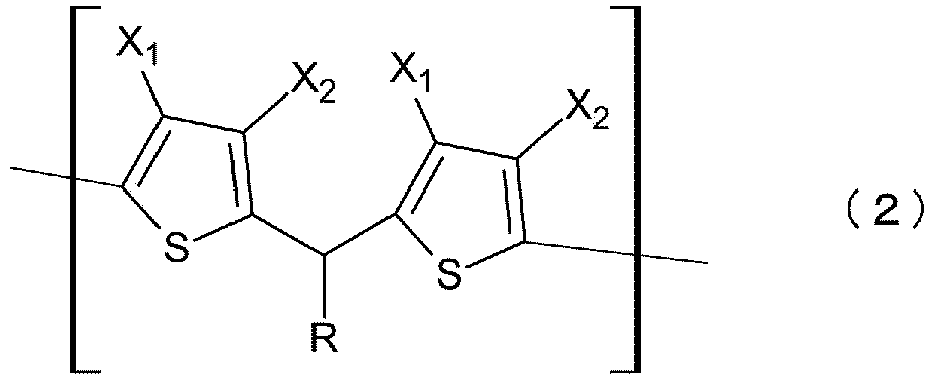
- wherein X1 and X2 may be the same as or different from each other,
- wherein X1 and X2 represent:
- H;
- an alkyl group having 1 to 12 carbon atoms, optionally having a substituent;
- an alkoxy group having 1 to 12 carbon atoms, optionally having a substituent;
- an alkylene oxide group having 1 to 12 carbon atoms, optionally having a substituent;
- a thiocyano group optionally having a substituent;
- an amino group optionally having a substituent; or a thioalkyl group optionally having a substituent, or
- X1 and X2 are combined to be an alkylenedioxy group having 1 to 12 carbon atoms, optionally having a substituent, or an alkylenedithio group having 1 to 12 carbon atoms, optionally having a substituent,
- wherein X1 and X2 are not any of combinations of both X1 and X2 being H, of both X1 and X2 being the alkyl group having 1 to 12 carbon atoms, and of one of X1 and X2 being H with the other being the alkyl group having 1 to 12 carbon atoms, and
- wherein R represents:
- an alkyl group having 1 to 12 carbon atoms;
- an alkoxy group having 1 to 12 carbon atoms;
- an alkylene oxide group having 1 to 20 carbon atoms and 1 to 50 repeating units;
- a phenyl group;
- a heterocyclic group; or
- a condensed ring group, having an acidic substituent or a salt thereof.
- At least one of X1 and X2 preferably has an electron-donating group directly bonded to a heterocycle.
- In X1 and X2, no limitation is applied to a substituent from the alkyl group having 1 to 12 carbon atoms, optionally having the substituent; the alkoxy group having 1 to 12 carbon atoms, optionally having the substituent; the alkylene oxide group having 1 to 12 carbon atoms, optionally having the substituent; the thiocyano group optionally having the substituent; the amino group optionally having the substituent; the thioalkyl group optionally having the substituent; the alkylenedioxy group to which X1 and X2 are combined, having 1 to 12 carbon atoms and optionally having the substituent; or the alkylenedithio group to which X1 and X2 are combined, having 1 to 12 carbon atoms and optionally having the substituent. Preferably, the substituent does not relatively inhibit an electron donating property relative to the heterocycle, specifically, may be a straight chain, branched or cyclic alkyl group, a sulfo group, a hydroxyl group, a carboxyl group, an amino group, an amide group, an ester group and a straight chain, branched or cyclic alkyl group, alkoxy alkyl group, alkylene oxide group substituted for the sulfo group, hydroxyl group, carboxyl group, amino group, halogen group, and may have a plurality of the substituents.
- The number of carbons of the straight chain, branched, or cyclic alkyl group, the carboxyl group, the amide group, the ester group, the alkoxyalkyl group or the alkylene oxide group as the substituent is, for example, 1 to 20, preferably 1 to 12, but not limited thereto. Specifically, the number of the carbons is, for example, 1, 2, 3, 4, 5, 6, 7, 8, 9, 10, 11, 12, 13, 14, 15, 16, 18 or 20, and may be within a range between any two of the values exemplified above.
- Although one of X1 and X2 may be hydrogen or the alkyl group having 1 to 12 carbon atoms, optionally having the substituent, it is preferable to exclude combinations of both X1 and X2 being the alkyl groups, both X1 and X2 being hydrogen, and one of X1 and X2 being hydrogen with the other being the alkyl group.
- In X1 and X2, the alkylenedioxy group having 1 to 12 carbon atoms, optionally having the substituent and the alkylenedithio group having 1 to 12 carbon atoms, optionally having the substituent may have an oxygen analog, nitrogen analog, or sulfur analog structure instead of an ethylene structure in a main chain of the alkylene.
- The acidic substituent of R or the salt thereof is a sulfo group or an alkali metal salt thereof, or a phosphoric acid group or an alkali metal salt thereof, preferably the sulfo group or the alkali metal salt thereof.
- The heterocyclic group includes, for example, a monovalent group derived from a silole ring, a furan ring, a thiophene ring, an oxazole ring, a pyrrole ring, a pyridine ring, a pyridazine ring, a pyrimidine ring, a pyrazine ring, a triazine ring, an oxadiazole ring, a triazole ring, an imidazole ring, a pyrazole ring, a thiazole ring, an indole ring, a benzimidazole ring, a benzthiazole ring, a benzoxazole ring, a quinoxaline ring, a quinazoline ring, a phthalazine ring, a thieno thiophene ring, a carbazole ring, an azacarbazole ring (in which any one or more carbon atoms constituting the carbazole ring is replaced with a nitrogen atom), a dibenzosilole ring, a dibenzofuran ring, a dibenzothiophene ring, a ring in which any one or more carbon atoms constituting the benzothiophene ring or the dibenzofuran ring is replaced by a nitrogen atom, a benzodifuran ring, a benzodithiophene ring, an acridine ring, a benzoquinoline ring, a phenazine ring, a phenanthridine ring, a phenanthroline ring, a cyclazine ring, a kindrin ring, a tepenidine ring, a quinindoline ring, a triphenodithiazine ring, a triphenodioxazine ring, a phenanthrazine ring, an anthrazine ring, a perimidine ring, a naphthofuran ring, a naphthothiophene ring, a naphthodifuran ring, a naphthodithiophene ring, an anthrafuran ring, an anthrafudaran ring, an anthrathiophene ring, an anthradithiophene ring, a thianthrene ring, a phenoxathiin ring, a dibenzo carbazole ring, a indolocarbazole ring, a dithienobenzene ring, an epoxy ring, an aziridine ring, a thiirane ring, an oxetane ring, an azetidine ring, a thietane ring, a tetrahydrofuran ring, a dioxolane ring, a pyrrolidine ring, a pyrazolidine ring, an imidazolidine ring, an oxazolidine ring, a tetrahydrothiophene ring, a sulfolane ring, a thiazolidine ring, a ε-caprolactone ring, a ε-caprolactam ring, a piperidine ring, a hexahydropyridazine ring, a hexahydropyrimidine ring, a piperazine ring, a morpholine ring, a tetrahydropyran ring, a 1,3-dioxane ring, a 1,4-dioxane ring, a trioxane ring, a tetrahydrothiopyran ring, a thiomorpholine ring, a thiomorpholine-1,1-dioxide ring, a pyranose ring, a diazabicyclo [2,2,2] -octane ring, a phenoxazine ring, a phenothiazine ring, an oxanthrene ring, a thioxanthene ring or a phenoxathiin ring, and the like.
- The condensed ring includes, for example, a naphthalene ring, an azulene ring, an anthracene ring, a phenanthrene ring, a pyrene ring, a chrysene ring, a naphthacene ring, a triphenylene ring, an acenaphthene ring, a coronene ring, a fluorene ring, a fluorantrene ring, a pentacene ring, a perylene ring, a pentaphene ring, a pyranthrene ring, and the like.
- The alkyl group having 1 to 12 carbon atoms, the alkoxy group having 1 to 12 carbon atoms, the alkylene oxide group having 1 to 20 carbon atoms and 1 to 50 repeating units, the phenyl group, the heterocyclic group or the condensed ring group of R may have an optional substituent at any positions in addition to the acidic substituent or the salt thereof.
- The optional substituent includes, for example, an alkyl group having 1 to 12 carbon atoms, an alkoxy group having 1 to 12 carbon atoms, an alkylene oxide group having 1 to 20 carbon atoms and 1 to 50 repeating units, a phenyl group, a naphthyl group, a hydroxyl group, an aldehyde group, an amino group, a cycloalkyl group having 3 to 8 carbon atoms, and the like.
- The polymer represented by the chemical formulae (1) and (2) are obtained by polymerizing a heterocyclic compound of the chemical formula (3) and an aldehyde derivative of the chemical formula (4).


- The heterocyclic compound of the chemical formula (3) can be mainly divided into two kinds of the following chemical formulae (3-A) and (3-B).

- Although, in X3 and X4, no limitation is applied to a substituent from: the alkyl group having 1 to 12 carbon atoms, optionally having the substituent; the alkoxy group having 1 to 12 carbon atoms, optionally having the substituent; the alkylene oxide group having 1 to 12 carbon atoms, optionally having the substituent; the thiocyano group optionally having the substituent; the amino group optionally having the substituent; or the thioalkyl group optionally having the substituent, the substituent may be the same as the substituents of X1 and X2.

- Although no limitation is applied to the substituent from the alkylene group having 1 to 12 carbon atoms, optionally having the substituent in X5 may be the same as the substituents of X1 and X2.
- The aldehyde derivative of the chemical formula (4) can be mainly divided into two kinds of chemical formulae (4-A) and (4-B).


- Predetermined amounts of the heterocyclic compound, the aldehyde derivative, a polymerization reaction solvent and an acid are added to a reaction vessel, and then heating and stirring are performed with inert gas enclosed. After the reaction, a reaction termination step and a purification step are carried out to obtain a polymer.
- The reaction vessel can be made of glass, Teflon®, or the like, but is not particularly limited thereto.
- As long as the polymerization reaction of the heterocyclic compound and the aldehyde derivative proceeds, the polymerization reaction solvent includes any solvent such as ethyl acetate, tetrahydrofuran, tert-butyl methyl ether, acetonitrile, but is not particularly limited thereto.
- As long as the polymerization reaction of the heterocyclic compound and the aldehyde derivative proceeds, the acid includes any acid such as perchloric acid, sulfuric acid, methanesulfonic acid, trifluoroacetic acid and p-toluenesulfonic acid, but is not particularly limited thereto.
- The inert gas includes, for example, nitrogen, argon and helium.
- The stirring method may be based on use of a stirrer or a shaking machine, but is not particularly limited thereto.
- A stirring temperature during the polymerization reaction is 25 °C to 100 °C, preferably 40 °C to 80 °C. Specifically, this temperature is, for example, 25, 30, 40, 50, 60, 70, 80, 90 or 100 °C and may be within a range between any two of the values exemplified above.
- A stirring time during the polymerization reaction is, for example, 1 to 12 hours, preferably 5 to 9 hours, but is not particularly limited thereto. Specifically, this time is, for example, 1, 2, 3, 4, 5, 6, 7, 8, 9, 10, 11 or 12 hours, and within a range between any two of the values exemplified above.
- As long as the polymerization reaction can be stopped, the reaction termination step may be performed by a known method, specifically, a cooling method based on the addition of methanol, ethanol, water or the like.
- As long as the polymer can be isolated, the purification step may be performed by a known method, specifically, a method for precipitating the polymer by adding a large amount of a solvent which the polymer is not dissolved, and then filtrating, washing and recrystallizing the precipitate.
- The polymer having either a single structure or a mixed structure of a structural unit represented by the chemical formula (1) and a structural unit represented by the chemical formula (2) can be synthesized by the above synthesis method of the polymer.
- Specifically, the proportion of the structural unit represented by the chemical formula (2) can be increased by increasing an amount of the heterocyclic compound to be used over that of the aldehyde derivative.
- The proportion of the structural unit of the chemical formula (1) or the structural unit of the chemical formula (2) of the polymer is 0 to 100, preferably 10 to 90, but is not particularly limited thereto. Specifically, the proportion is, for example, 0, 10, 20, 30, 40, 50, 60, 70, 80, 90, 100, and may be within a range between any two of the values exemplified above. The above proportion may be expressed by weight% or mol%.
- The number of the repeating units including the structural units of the chemical formula (1) and the chemical formula (2) in the polymer is 2 to 100, preferably 2 to 20, but is not particularly limited thereto. Specifically, the number is for example, 2, 5, 10, 20, 30, 40, 50, 60, 70, 80, 90 or 100, and may be within a range between any two of the values exemplified above.
- Predetermined amounts of the polymer and an oxidation reaction solvent are added to the reaction vessel, and inert gas replacement is performed, an oxidizing agent is added and then stirring is performed. After the reaction, a purification step is carried out to obtain an oxidized polymer.
- The reaction vessel, the inert gas, and the stirring method may be the same as those of the polymerization reaction, but is not particularly limited thereto.
- As long as the oxidation reaction proceeds, the oxidation reaction solvent may be any solvents such as water and alcohol solvents (e.g., methanol, ethanol, isopropyl alcohol, and butanol), but is not particularly limited thereto.
- As long as the oxidizing reaction proceeds, the oxidizing agent may be any acid such as peroxide (e.g., ammonium peroxodisulfate (APS), sodium persulfate and potassium persulfate), hydrogen peroxide, quinone (e.g., p-benzoquinone and chloranil), iron (III) chloride, iron (III) sulfate, iron (III) hydroxide, iron (III) tetrafluoroborate, iron (III) hexafluorophosphate, copper (II) sulfate, copper (II) chloride, copper (II) tetrafluoroborate and copper (II) hexafluorophosphate, but is not particularly limited thereto.
- A stirring temperature during the oxidation reaction is 0 °C to 50 °C, preferably 10 °C to 30 °C. Specifically, this temperature is, for example, 0, 10, 20, 30, 40, 50 °C and may be within a range between any two of the values exemplified above.
- A stirring time during the oxidation reaction is, for example, 1 to 12 hours, preferably 1 to 5 hours, but is not particularly limited thereto. Specifically, this time is, for example, 1, 2, 3, 4, 5, 6, 7, 8, 9, 10, 11 or 12 hours, and may be within a range between any two of the values exemplified above.
- As long as the polymer can be isolated, the purification step may be performed by a known method, specifically, a method having a removing step of ionic components through an ion exchange resin and a lyophilizing step.
- The polymer cannot obtain conductivity under heating condition. However, the oxidized polymer can obtain the conductivity even under the heating condition.
- The polymer or the oxidized polymer is added to a solvent and stirred to obtain a polymer composition.
- The solvent is any solvents in which the polymer or the oxidized polymer can be dissolved and dispersed, for example, water, dimethylsulfoxide, an alcohol-based solvent such as methanol, ethanol and isopropyl alcohol, a glycol-based solvent such as methyl cellosolve, ethyl cellosolve, propylene glycol methyl ether, propylene glycol ethyl ether and ethylene glycol, and a hydrophilic polar solvent such as gamma-butyrolactone and dioxane, acetonitrile, but is not particularly limited thereto.
- The stirring method may be based on the use of the stirrer or the shaker, but is not particularly limited thereto.
- A stirring time during the preparation of the polymer composition is, for example, 1 to 12 hours, preferably 1 to 5 hours, but is not particularly limited thereto. Specifically, this time is, for example, 1, 2, 3, 4, 5, 6, 7, 8, 9, 10, 11 or 12 hours, and may be within a range between any two of the values exemplified above.
- An amount of the solvent to be used for preparing the polymer composition is set to, for example, the amount such that a solid content is 1% to 20%, preferably 1% to 10%, but is not particularly limited thereto. Specifically, this value is, for example, 1, 2, 3, 4, 5, 6, 7, 8, 9, 10, 12, 14, 16, 18 or 20%, and may be within a range between any two of the values exemplified above.
- In addition, by neutralizing the polymer composition with a base additive, it is possible to obtain a polymer composition having improved stability and reduced corrosiveness.
- The base additive is any base additives capable of neutralizing the polymer composition, for example, an organic base or an inorganic base having a pKa of 9 or more as a conjugate acid in water, e.g., an amine such as ammonia, triethylamine and ethanolamine, and an alkali metal hydroxide or an alkaline earth metal hydroxide such as sodium hydroxide, potassium hydroxide and calcium hydroxide, preferably an amine having the pKa of 9 or more as the conjugate acid in water such as ammonia, trimethylamine and ethanolamine, but is not particularly limited thereto. In particular, the amine is excellent in solvent solubility and corrosiveness-reducing effect.
- When dried, the polymer composition can be used as, for example, a conductive polymer. In an example, a uniform film can be made from the polymer composition when coated.
- As a drying method may be a known drying method, but is not particularly limited thereto.
- Predetermined amounts of the polymer composition and a gelling agent are added to a reaction vessel and heated to dissolve the gelling agent. Thereafter, the mixture is cooled and then obtain a gel polymer composition.
- The reaction vessel may be the same as one used in the polymerization reaction, but is not particularly limited thereto.
- The gelling agent may be any gelling agents capable of forming the gel polymer composition, for example, a polymer such as polyethylene oxide, polyvinyl alcohol, polyacrylamide, polyvinyl pyrrolidone and polyvinyl butyral, gelatin, pectin, starch, and a polymer such as polyvinyl pyridine and polymethacrylate used in combination with a diamine-based crosslinking agent, which swell by absorbing the solvent, but is not particularly limited thereto.
- A heating temperature for preparing the gel polymer composition is 25 °C to 100 °C, preferably 40 °C to 80 °C. Specifically, this temperature is, for example, 25, 30, 40, 50, 60, 70, 80, 90 or 100 °C, and may be within a range between any two of the values exemplified above.
- A heating time for preparing the gel polymer composition is, for example, 1 to 12 hours, preferably 1 to 5 hours, but is not particularly limited thereto. Specifically, this time is, for example, 1, 2, 3, 4, 5, 6, 7, 8, 9, 10, 11 or 12 hours, and may be within a range between any two of the values exemplified above.
- During the preparation of the gel polymer composition, the heating may be carried out with the stirring.
- Since the polymer of the present invention is a self-doped polymer, a polymer having a small particle size can be obtained.
- Furthermore, since it has higher solubility in the hydrophilic polar solvent, has very higher impregnating ability to a porous body such as a metal sintered body, and can perform fine filling or coating to a fine surface, it can also be used as the gel polymer composition by adding the gelling agent.
- The polymer, oxidized polymer, polymer composition and gel polymer composition of the present invention can be suitably used for applications in fields where miniaturization is progressing, such as a antistatic agent for various applications and antistatic film using thereof, a p-type organic semiconductor, a n-type organic semiconductor, a solid electrolyte of a solid electrolytic capacitor and additive thereof, an electrochromic device, a transparent electrode of an organic photovoltaic, a counter electrode of a dye-sensitized solar cell and its adjuvant, an organic electroluminescence, a chemical sensor, a fuel cell, an electronic device such as a touch panel and a liquid crystal display, a pressure sensitive adhesive, and an additive to carbon, but is not particularly limited thereto.
- 80g EDOT, 48g sodium 2-sulfobenzaldehyde, 60g ethyl acetate and 1.5g tetrafluoroacetic acid were added to 300ml reaction vessel, and heated to 50 °C with stirring under nitrogen substitution. After the reaction for 7 hours, 10g methanol was added and cooled. After transferring the reaction solution to 500ml container, 200g ethyl acetate was added and stirred. Thereafter, precipitate was collected by filtration. Crystals were collected, and then dissolved in methanol/water = 90/10 to remove insoluble matter. The solution was recrystallized to obtain Polymer 1 of green crystals. Polymer 1 obtained in Synthesis Example 1 had structures of both chemical formulae (1) and (2).
- Polymer 1 was dissolved in ion-exchanged water such that a solid content is 2.2%. After removing Na using an ion exchange resin, lyophilization was performed to obtain Polymer 2 of green crystal.
- 4.0g Polymer 1 and 100g ion-exchanged water were added to 300ml flask. The atmosphere in the flask was sufficiently substituted with nitrogen. In addition, 1.0g of APS (ammonium peroxodisulfate) was added and stirred at 25 °C for 3 hours. After treating the solution with an excess of the ion exchange resin, the lyophilization was performed to obtain Polymer 3 of blue-violet crystal.
- 3.53g EDOT (3,4-ethylenedioxythiophene) and 25g ion-exchanged water were added to 300ml flask. The atmosphere in the flask was sufficiently substituted with nitrogen. 15.2g of 40wt% aqueous solution of 4-formyl-1,3-disulfobenzene was added and the mixture was stirred at 50 °C for 2.5 hours. After adding 125g ion-exchanged water, 3.6g APS and 10g ion-exchanged water were added, and the mixture was stirred at room temperature for 5 hours. After treatment with an excess of the ion exchange resin, the lyophilization was performed to obtain Polymer 4 of blue crystal. Polymer 4 obtained in Synthesis Example 4 had structures of both chemical formula (1) and chemical formula (2).
- 14.2g EDOT, 5.6g benzaldehyde and 50g MEK (methyl ethyl ketone) were added to 300ml flask. The atmosphere in the flask was sufficiently substituted with nitrogen. 0.2g concentrated sulfuric acid was added, and the mixture was stirred at 50 °C for 2.5 hours. 100 g ion-exchanged water was added, 14.5g benzoyl peroxide and 20g MEK were added, and the mixture was further stirred at room temperature for 5 hours. After treatment with an excess of the ion exchange resin, vacuum distillation was performed with an evaporator to obtain Polymer 5 of brown crystal.
- 16g polystyrene sulfonic acid aqueous solution (Mw: 75,000, solid content: 19%), 0.1g iron (III) sulfate n-hydrate and 200g ion-exchanged water were added to 300ml flask. The atmosphere in the flask was sufficiently substituted with nitrogen. 1.2g EDOT, 2.3g APS and 30g ion-exchanged water were added and stirred at 25 °C for 5 hours. After treatment with an excess of the ion exchange resin, the lyophilization was performed to obtain Polymer 6 of blue crystal.
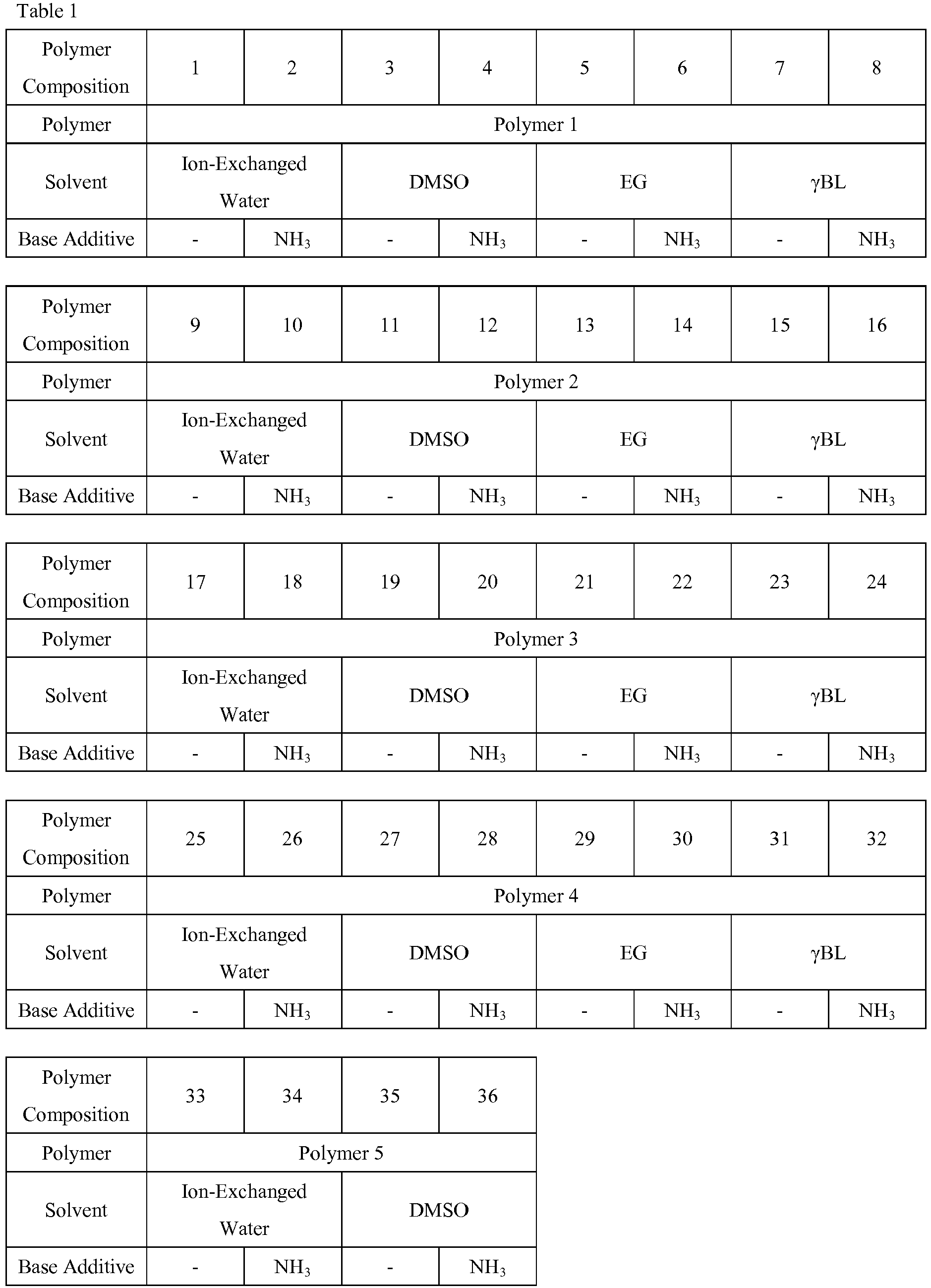
- The ion-exchanged water, DMSO (dimethylsulfoxide), EG (ethylene glycol), γBL (gamma butyrolactone) were added to Polymer 1 prepared in Synthesis Example 1 and stirred for 1 hour to obtain Polymer Compositions 1, 3, 5 and 7 having 2.0% solid content.
- Polymer compositions 1, 3, 5 and 7 were neutralized by addition of 20wt% aqueous ammonia solution to obtain Polymer Compositions 2, 4, 6 and 8.
- Polymer Compositions 9 to 32 were obtained in the same manner as Preparation Examples 1 and 2, except that Polymer 1 was changed to Polymers 2 to 4.
- The ion-exchanged water was added to Polymer 5 prepared in Synthesis Example 5, and the mixture was strongly dispersed using an ultrasonic homogenizer to obtain Polymer Composition 33.
- Polymer composition 33 was neutralized by the addition of 20wt% aqueous ammonia solution to Polymer Composition 34.
- DMSO was added to Polymer 5 prepared in Synthesis Example 5 and stirred for a certain period to obtain Polymer Composition 35 having 2.0% solid content.
- Polymer Composition 35 was neutralized by the addition of 20wt% aqueous ammonia solution to obtain Polymer Composition 36.
- Polymer Compositions 37 to 44 were obtained in the same manner as Preparation Examples 1 and 2, except that Polymer 1 was changed to Polymer 6.
- A powder obtained by lyophilizing polystyrene sulfonic acid (Mw: 75,000, nonvolatile content: 19%) was added to ethylene glycol to obtain a solution having 1.3% solid content.
- Polymer Composition 45 was neutralized by addition of 20wt% aqueous ammonia solution to obtain Polymer Composition 47.
- 10g Polymer Composition 25 and 1.4g gelatin were added to 100ml flask and heated to 50 °C to completely dissolve the gelatin. This was allowed to stand at 25 °C to obtain Gel Polymer Composition 1.
- Gel Polymer Composition 2 was obtained in the same manner as Preparation Example 9 except that Polymer Composition 25 was changed to Polymer Composition 45.
- Table 1 shows combinations of Polymer Compositions.

- 8g Polymer Compositions 1 to 44 immediately after preparation were added to respective 10ml containers. Each container was sealed and allowed to stand, and the presence or absence of precipitate in each container was observed. "Excellent" means a case where there was no precipitate for one or more weeks, "Good" means a case where there was no precipitate for one or more days, and "Bad" means a case where the precipitate occurs less than one day.
- 10ml Polymer Compositions 1 to 44 were filtered with TOMSIC membrane filters (membrane PTFE, size: 30mm, pore size: 0.45µm), and respective liquid passable amounts were measured. "Excellent" means a case where the liquid passable amount is all 10 ml, "Good" means a case where the liquid passable amount is 5 ml or more, and "Bad" means a case where the liquid passable amount is less than 5 ml.
- 10g Polymer Compositions 1 to 44 were added to respective 100ml containers, followed by the addition of 1g activated alumina (KHO-24, manufactured by Sumitomo Chemical Co., Ltd.). After leaving for 30 minutes, the activated alumina in each container was removed and drying was performed at 105 °C for 30 minutes. The activated alumina impregnated with resin was divided in half, the cross-section thereof was observed with a CCD, and depth of the impregnation was measured.
- "Excellent" means a case where the depth of the impregnation is 700µm or more, "Good" means a case where the depth of the impregnation is 400µm or more and less than 700µm, and "Bad" means a case where the depth of the impregnation is less than 400µm.
- 2cm × 2cm frames were prepared with pieces of tape on a glass plate whose surface was cleaned with isopropyl alcohol (IPA). 0.2g Polymer Compositions 1 to 44 were dropped and uniformly spread on the inside of the respective frames. After the drying at 120 °C for 30 minutes, conductivity of each Polymer Composition was measured using Loresta GP manufactured by Mitsubishi Analytech.
- Electrode terminals of a digital multimeter (MT-4090) manufactured by Mother Tool Co., Ltd. were immersed in each of Polymer Compositions 1 to 46 or each of Gel Electrolytic Compositions 1 and 2, and the solution resistance value of each composition was measured.
- Tables 2 and 3 show results of evaluating the corresponding solution stability, solvent solubility, impregnation property, coating film conductivity, solution resistance value of each of Polymer Compositions 1 to 44, and results of evaluating the corresponding solution resistance value of each of Polymer Compositions 45 and 46.


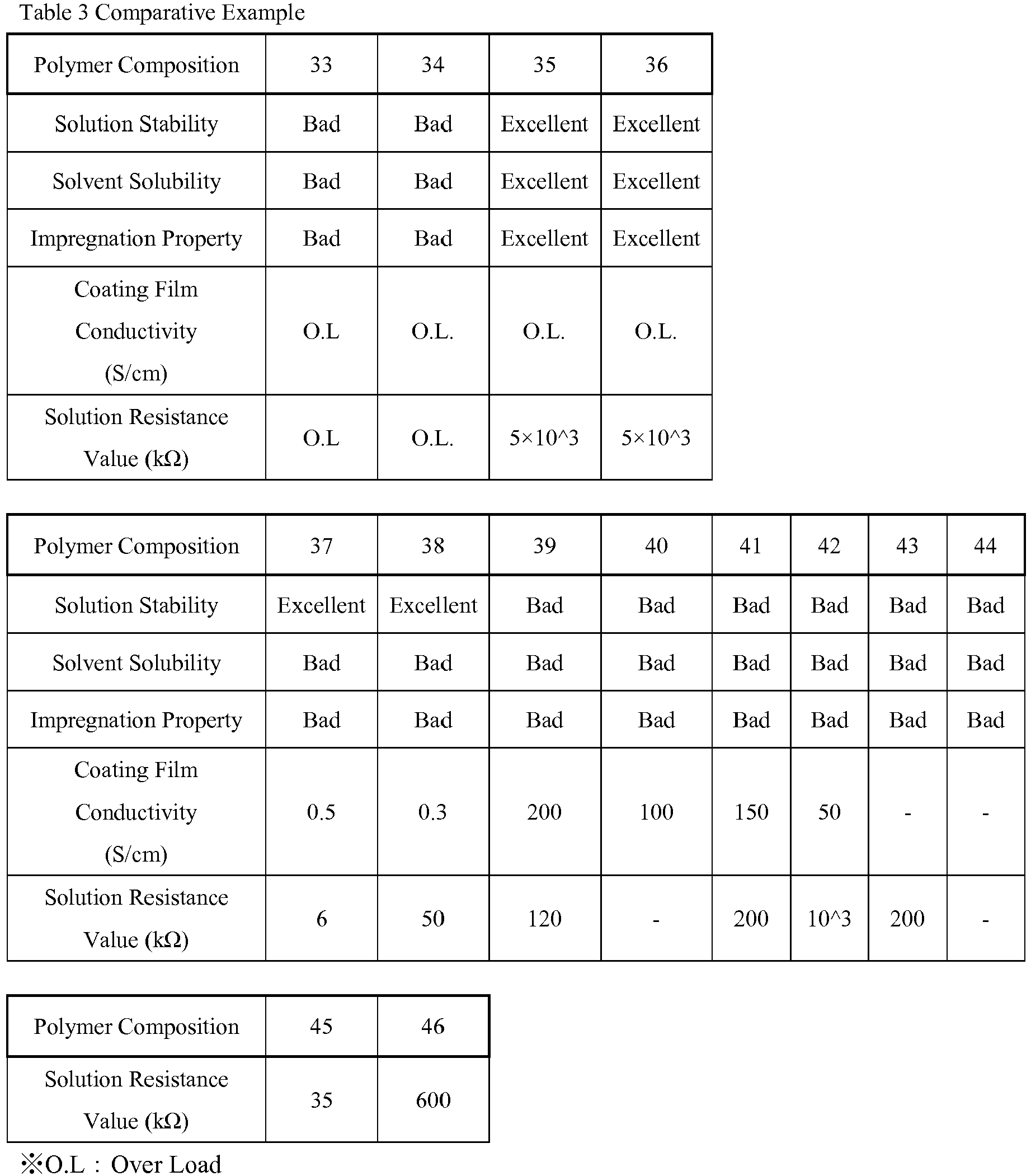
- Tables 2 and 3 show that Polymer Compositions 1 to 32 exhibited satisfactory results in all of the solution stability, the solvent solubility and the impregnating property, while Polymer Compositions 33, 34 and 37 to 44 did not exhibit satisfactory results in all of the solution stability, the solvent solubility and the impregnation property. In addition, it was found that Polymer Compositions 35 and 36 exhibited satisfactory results in all of the solution stability, the solvent solubility and the impregnating property, while the solution resistance value of each of Polymer Compositions 35 and 36 was higher than that of each of Polymer Compositions 1 to 32.
- Furthermore, it was found from Tables 2 and 3 that since the polymer composition of the present invention shows satisfactory results regarding the solvent solubility and the impregnating property, a particle diameter of a polymer thereof is small and highly dispersed.
- Table 4 shows results of evaluating the respective solution resistance values of Gel Polymer Compositions 1 to 4.
Table 4 Gel Polymer Composition 1 2 Solution Resistance Value (kΩ) 200 2×10^3 - It was found from Table 4 that the resistance value of Gel Polymer Composition 2 was higher than that of Gel Polymer Composition 1.
Claims (9)
- A polymer comprising one or two structural units selected from the group consisting of a structural unit represented by the following chemical formula (1):

 wherein X1 and X2 may be the same as or different from each other,wherein X1 and X2 represent:H;an alkyl group having 1 to 12 carbon atoms, optionally having a substituent;an alkoxy group having 1 to 12 carbon atoms, optionally having a substituent;an alkylene oxide group having 1 to 12 carbon atoms, optionally having a substituent;a thiocyano group optionally having a substituent;an amino group optionally having a substituent; ora thioalkyl group optionally having a substituent, orX1 and X2 are combined to be an alkylenedioxy group having 1 to 12 carbon atoms, optionally having a substituent, or an alkylenedithio group having 1 to 12 carbon atoms, optionally having a substituent,wherein X1 and X2 are not any of combinations of both X 1 and X 2 being H, of both X 1 and X 2 being the alkyl group having 1 to 12 carbon atoms, and of one of X 1 and X 2 being H with the other being the alkyl group having 1 to 12 carbon atoms, andwherein R represents:an alkyl group having 1 to 12 carbon atoms;an alkoxy group having 1 to 12 carbon atoms;an alkylene oxide group having 1 to 20 carbon atoms and 1 to 50 repeating units;a phenyl group;a heterocyclic group; ora condensed ring group, having an acidic substituent or a salt thereof.
 - The polymer according to claim 1, wherein X1 and X2 may be the same as or different from each other, and
wherein X1 and X2 are:the alkoxy group having 1 to 12 carbon atoms, optionally having the substituent; orthe alkylene oxide group having 1 to 12 carbon atoms, optionally having the substituent, orX1 and X2 are combined to be the alkylenedioxy group having 1 to 12 carbon atoms, optionally having the substituent. - The polymer according to claim 1 or 2, wherein R is the alkyl group having 1 to 12 carbon atoms and the acidic substituent or the salt thereof, the alkoxy group having 1 to 12 carbon atoms, or the phenyl group.
- The polymer according to any one of claims 1 to 3, wherein the acidic substituent or the salt thereof is a sulfo group or an alkali metal salt thereof, or a phosphoric acid group or an alkali metal salt thereof.
- An oxidized polymer being an oxide of the polymer according to any one of claims 1 to 4.
- A polymer composition comprising the polymer according to any one of claims 1 to 4 or the oxidized polymer according to claim 5 and a solvent.
- A polymer composition comprising the polymer composition according to claim 6 and a base additive.
- A polymer composition obtained by drying the polymer composition according to claim 6 or 7.
- A gel polymer composition obtained by adding a gelling agent to the polymer composition according to claim 6 or 7.
Applications Claiming Priority (2)
| Application Number | Priority Date | Filing Date | Title |
|---|---|---|---|
| JP2015065747 | 2015-03-27 | ||
| PCT/JP2016/059627 WO2016158752A1 (en) | 2015-03-27 | 2016-03-25 | Polymer, oxidized polymer, polymer composition, gel-type polymer composition, and use thereof |
Publications (3)
| Publication Number | Publication Date |
|---|---|
| EP3275916A1 true EP3275916A1 (en) | 2018-01-31 |
| EP3275916A4 EP3275916A4 (en) | 2018-04-04 |
| EP3275916B1 EP3275916B1 (en) | 2021-12-15 |
Family
ID=57004284
Family Applications (1)
| Application Number | Title | Priority Date | Filing Date |
|---|---|---|---|
| EP16772633.0A Active EP3275916B1 (en) | 2015-03-27 | 2016-03-25 | Polymer, oxidized polymer, polymer composition, gel-type polymer composition, and use thereof |
Country Status (7)
| Country | Link |
|---|---|
| US (1) | US20180244838A1 (en) |
| EP (1) | EP3275916B1 (en) |
| JP (1) | JP6704389B2 (en) |
| KR (1) | KR102085000B1 (en) |
| CN (1) | CN107406586B (en) |
| TW (1) | TWI684611B (en) |
| WO (1) | WO2016158752A1 (en) |
Families Citing this family (15)
| Publication number | Priority date | Publication date | Assignee | Title |
|---|---|---|---|---|
| CN110622268B (en) * | 2017-05-31 | 2023-03-28 | 综研化学株式会社 | Method for producing conductive polymer solid electrolytic capacitor and conductive polymer |
| EP3664112B1 (en) * | 2017-08-04 | 2022-10-05 | Soken Chemical & Engineering Co., Ltd. | Solid electrolytic capacitor, and method for producing solid electrolytic capacitor |
| JP7238793B2 (en) | 2017-12-25 | 2023-03-14 | 株式会社レゾナック | Dispersion composition for manufacturing solid electrolytic capacitor and method for manufacturing solid electrolytic capacitor |
| JP2019172770A (en) * | 2018-03-27 | 2019-10-10 | 綜研化学株式会社 | Conductive polymer composition, manufacturing method of conductive polymer thin film |
| US11114250B2 (en) | 2018-08-10 | 2021-09-07 | Avx Corporation | Solid electrolytic capacitor formed from conductive polymer particles |
| CN117912850A (en) | 2018-08-10 | 2024-04-19 | 京瓷Avx元器件公司 | Solid electrolytic capacitors comprising intrinsically conductive polymers |
| JP7426986B2 (en) | 2018-08-10 | 2024-02-02 | キョーセラ・エイブイエックス・コンポーネンツ・コーポレーション | Solid electrolytic capacitor containing polyaniline |
| CN118496480A (en) | 2018-11-05 | 2024-08-16 | 康宁股份有限公司 | UV patternable polymer blend for organic thin film transistor |
| CN113196429A (en) * | 2018-12-11 | 2021-07-30 | 阿维科斯公司 | Solid electrolytic capacitor containing intrinsically conductive polymer |
| KR20220056862A (en) * | 2019-08-30 | 2022-05-06 | 소켄 케미칼 앤드 엔지니어링 캄파니, 리미티드 | Conductive polymer and resin composition |
| DE112020004416T5 (en) | 2019-09-18 | 2022-06-15 | KYOCERA AVX Components Corporation | Solid electrolytic capacitor for use at high voltages |
| WO2021119065A1 (en) | 2019-12-10 | 2021-06-17 | Avx Corporation | Solid electrolytic capacitor containing a pre-coat and intrinsically conductive polymer |
| DE112020006024T5 (en) | 2019-12-10 | 2022-10-06 | KYOCERA AVX Components Corporation | Tantalum capacitor with increased stability |
| US11631548B2 (en) * | 2020-06-08 | 2023-04-18 | KYOCERA AVX Components Corporation | Solid electrolytic capacitor containing a moisture barrier |
| CN116769143B (en) * | 2023-07-06 | 2026-04-10 | 东华大学 | An amino/secondary amine functionalized conductive polymer and its preparation method |
Family Cites Families (15)
| Publication number | Priority date | Publication date | Assignee | Title |
|---|---|---|---|---|
| US2453085A (en) * | 1947-11-28 | 1948-11-02 | Socony Vacuum Oil Co Inc | Thiophene-aldehyde synthetic resins |
| EP0260541A3 (en) * | 1986-09-08 | 1990-02-28 | Honeywell Inc. | Electroactive polymers and method of making them |
| JPS63161024A (en) * | 1986-12-25 | 1988-07-04 | Agency Of Ind Science & Technol | Novel thiophene polymer, its production and organic display material made therefrom |
| JPH02200483A (en) * | 1989-01-30 | 1990-08-08 | Mitsui Petrochem Ind Ltd | Optical recording medium |
| EP0440957B1 (en) | 1990-02-08 | 1996-03-27 | Bayer Ag | New polythiophene dispersions, their preparation and their use |
| JP3426637B2 (en) | 1993-03-29 | 2003-07-14 | 憲幸 倉本 | Method for producing polyaniline or polyaniline conductive thin film |
| JPH07228650A (en) * | 1994-02-22 | 1995-08-29 | Unitika Ltd | Polymer for electroluminescent element |
| US20040119049A1 (en) * | 2002-12-04 | 2004-06-24 | Martin Heeney | Mono-, oligo- and poly-bis(thienyl) arylenes and their use as charge transport materials |
| DE102004033288A1 (en) * | 2004-07-09 | 2006-02-02 | H.C. Starck Gmbh | New 3,4-alkylenedioxythiophene compounds comprising five membered heterocyclic terminal groups, repeating units of five membered heterocyclic compounds and terminal groups useful to prepare electrically conductive oligo- or polymers |
| JP2006257148A (en) | 2005-03-15 | 2006-09-28 | Kaneka Corp | Gel-like composition and method for producing the same |
| KR100715548B1 (en) * | 2005-07-29 | 2007-05-07 | 광 석 서 | Conductive Polymers Synthesized Using Partially Substituted Polymer Dopants |
| JP5637703B2 (en) * | 2010-03-10 | 2014-12-10 | 株式会社クラレ | π-electron conjugated polymer and production method thereof |
| TWI509633B (en) * | 2011-04-20 | 2015-11-21 | Mitsubishi Rayon Co | Conductive composition, conductive body and solid electrolytic capacitor using the same |
| CN103059273A (en) * | 2013-01-28 | 2013-04-24 | 吉林大学 | Novel water-soluble thiofuran acetylene and phenylacetylene copolymer precursor, preparation method and application thereof |
| WO2015088999A1 (en) * | 2013-12-11 | 2015-06-18 | Rhodia Operations | Polymer compositions, films, gels, and foams containing sulfonylimide salts, and electronic devices containing such films, gels, and foams |
-
2016
- 2016-03-25 EP EP16772633.0A patent/EP3275916B1/en active Active
- 2016-03-25 JP JP2017509908A patent/JP6704389B2/en active Active
- 2016-03-25 TW TW105109355A patent/TWI684611B/en active
- 2016-03-25 US US15/562,293 patent/US20180244838A1/en not_active Abandoned
- 2016-03-25 KR KR1020177026873A patent/KR102085000B1/en active Active
- 2016-03-25 CN CN201680015402.6A patent/CN107406586B/en active Active
- 2016-03-25 WO PCT/JP2016/059627 patent/WO2016158752A1/en not_active Ceased
Also Published As
| Publication number | Publication date |
|---|---|
| TW201704287A (en) | 2017-02-01 |
| KR20170130429A (en) | 2017-11-28 |
| JPWO2016158752A1 (en) | 2018-01-18 |
| EP3275916B1 (en) | 2021-12-15 |
| JP6704389B2 (en) | 2020-06-03 |
| WO2016158752A1 (en) | 2016-10-06 |
| EP3275916A4 (en) | 2018-04-04 |
| CN107406586A (en) | 2017-11-28 |
| TWI684611B (en) | 2020-02-11 |
| CN107406586B (en) | 2020-03-27 |
| KR102085000B1 (en) | 2020-03-05 |
| US20180244838A1 (en) | 2018-08-30 |
Similar Documents
| Publication | Publication Date | Title |
|---|---|---|
| EP3275916B1 (en) | Polymer, oxidized polymer, polymer composition, gel-type polymer composition, and use thereof | |
| JP6783832B2 (en) | Heterocycle-containing compounds, polymers using the compounds, and their uses | |
| JP7100029B2 (en) | Conductive Polymer Manufacturing Method of Solid Electrolytic Capacitor and Conductive Polymer | |
| CN101134744B (en) | Heterocyclic compound, the function, organic semiconductor material and electronic or opto-electrical element | |
| JP6273917B2 (en) | Thiophene copolymer and aqueous solution thereof, and thiophene monomer composition and production method thereof | |
| Yadav et al. | Recent advances in poly (3, 4-ethylenedioxyselenophene) and related polymers | |
| US10763438B2 (en) | n-Doped electrically conductive polymeric material | |
| JP6686500B2 (en) | Conductive polymer aqueous solution and conductive polymer film | |
| CN114341104B (en) | Dopants and conductive compositions and methods of manufacturing the same | |
| CN108165140B (en) | Electroactive coating and composition for forming the same | |
| US20150218304A1 (en) | Processes for purifying diketopyrrolopyrrole copolymers | |
| JP2019151814A (en) | Conductive polymer-containing ink and application thereof | |
| Li et al. | Molecular engineering of polymeric hole-transporting materials for efficient and stable perovskite solar cells | |
| EP2423242B1 (en) | Electrically conductive polyrotaxane | |
| WO2020196473A1 (en) | Electroconductive polymer composition | |
| Onozawa-Komatsuzaki et al. | Short-step synthesized dopant-free spiro-type hole-transporting materials for efficient and stable perovskite solar cells | |
| JPWO2020129854A1 (en) | Conductive polymer composition | |
| EP1361244B1 (en) | Poly(5-aminoquinoxalines); preparation and use thereof | |
| Unal et al. | Thienothiophene‐Based Organic Porous Polymers Combining Different Linkers and Functional Groups: Design, Synthesis, Photophysical, and Charge Transport Properties | |
| JP2017197659A (en) | Water-soluble conductive polymer, production method thereof, conductive polymer aqueous solution thereof, and applications thereof | |
| Keshtov et al. | Two new D–A conjugated polymers P (PTQD-Th) and P (PTQD-2Th) with same 9-(2-octyldodecyl)-8H-pyrrolo [3, 4-b] bisthieno [2, 3-f: 3′, 2′-h] quinoxaline-8, 10 (9H)-dione acceptor and different donor units for BHJ polymer solar cells application | |
| 오정아 | Studies on Molecular Design and Synthesis of Furan-Containing Diketopyrrolopyrrole Derivatives for Solution-Processed Organic Solar Cells |
Legal Events
| Date | Code | Title | Description |
|---|---|---|---|
| STAA | Information on the status of an ep patent application or granted ep patent |
Free format text: STATUS: THE INTERNATIONAL PUBLICATION HAS BEEN MADE |
|
| PUAI | Public reference made under article 153(3) epc to a published international application that has entered the european phase |
Free format text: ORIGINAL CODE: 0009012 |
|
| STAA | Information on the status of an ep patent application or granted ep patent |
Free format text: STATUS: REQUEST FOR EXAMINATION WAS MADE |
|
| 17P | Request for examination filed |
Effective date: 20171011 |
|
| AK | Designated contracting states |
Kind code of ref document: A1 Designated state(s): AL AT BE BG CH CY CZ DE DK EE ES FI FR GB GR HR HU IE IS IT LI LT LU LV MC MK MT NL NO PL PT RO RS SE SI SK SM TR |
|
| AX | Request for extension of the european patent |
Extension state: BA ME |
|
| A4 | Supplementary search report drawn up and despatched |
Effective date: 20180301 |
|
| RIC1 | Information provided on ipc code assigned before grant |
Ipc: C08G 61/12 20060101AFI20180223BHEP Ipc: C08L 65/00 20060101ALI20180223BHEP Ipc: C08G 16/02 20060101ALI20180223BHEP |
|
| DAV | Request for validation of the european patent (deleted) | ||
| DAX | Request for extension of the european patent (deleted) | ||
| STAA | Information on the status of an ep patent application or granted ep patent |
Free format text: STATUS: EXAMINATION IS IN PROGRESS |
|
| 17Q | First examination report despatched |
Effective date: 20181029 |
|
| GRAP | Despatch of communication of intention to grant a patent |
Free format text: ORIGINAL CODE: EPIDOSNIGR1 |
|
| STAA | Information on the status of an ep patent application or granted ep patent |
Free format text: STATUS: GRANT OF PATENT IS INTENDED |
|
| INTG | Intention to grant announced |
Effective date: 20210802 |
|
| GRAS | Grant fee paid |
Free format text: ORIGINAL CODE: EPIDOSNIGR3 |
|
| GRAA | (expected) grant |
Free format text: ORIGINAL CODE: 0009210 |
|
| STAA | Information on the status of an ep patent application or granted ep patent |
Free format text: STATUS: THE PATENT HAS BEEN GRANTED |
|
| AK | Designated contracting states |
Kind code of ref document: B1 Designated state(s): AL AT BE BG CH CY CZ DE DK EE ES FI FR GB GR HR HU IE IS IT LI LT LU LV MC MK MT NL NO PL PT RO RS SE SI SK SM TR |
|
| REG | Reference to a national code |
Ref country code: GB Ref legal event code: FG4D Ref country code: CH Ref legal event code: EP |
|
| REG | Reference to a national code |
Ref country code: IE Ref legal event code: FG4D Ref country code: DE Ref legal event code: R096 Ref document number: 602016067415 Country of ref document: DE |
|
| REG | Reference to a national code |
Ref country code: AT Ref legal event code: REF Ref document number: 1455475 Country of ref document: AT Kind code of ref document: T Effective date: 20220115 |
|
| REG | Reference to a national code |
Ref country code: LT Ref legal event code: MG9D |
|
| REG | Reference to a national code |
Ref country code: NL Ref legal event code: MP Effective date: 20211215 |
|
| PG25 | Lapsed in a contracting state [announced via postgrant information from national office to epo] |
Ref country code: RS Free format text: LAPSE BECAUSE OF FAILURE TO SUBMIT A TRANSLATION OF THE DESCRIPTION OR TO PAY THE FEE WITHIN THE PRESCRIBED TIME-LIMIT Effective date: 20211215 Ref country code: LT Free format text: LAPSE BECAUSE OF FAILURE TO SUBMIT A TRANSLATION OF THE DESCRIPTION OR TO PAY THE FEE WITHIN THE PRESCRIBED TIME-LIMIT Effective date: 20211215 Ref country code: FI Free format text: LAPSE BECAUSE OF FAILURE TO SUBMIT A TRANSLATION OF THE DESCRIPTION OR TO PAY THE FEE WITHIN THE PRESCRIBED TIME-LIMIT Effective date: 20211215 Ref country code: BG Free format text: LAPSE BECAUSE OF FAILURE TO SUBMIT A TRANSLATION OF THE DESCRIPTION OR TO PAY THE FEE WITHIN THE PRESCRIBED TIME-LIMIT Effective date: 20220315 |
|
| REG | Reference to a national code |
Ref country code: AT Ref legal event code: MK05 Ref document number: 1455475 Country of ref document: AT Kind code of ref document: T Effective date: 20211215 |
|
| PG25 | Lapsed in a contracting state [announced via postgrant information from national office to epo] |
Ref country code: SE Free format text: LAPSE BECAUSE OF FAILURE TO SUBMIT A TRANSLATION OF THE DESCRIPTION OR TO PAY THE FEE WITHIN THE PRESCRIBED TIME-LIMIT Effective date: 20211215 Ref country code: NO Free format text: LAPSE BECAUSE OF FAILURE TO SUBMIT A TRANSLATION OF THE DESCRIPTION OR TO PAY THE FEE WITHIN THE PRESCRIBED TIME-LIMIT Effective date: 20220315 Ref country code: LV Free format text: LAPSE BECAUSE OF FAILURE TO SUBMIT A TRANSLATION OF THE DESCRIPTION OR TO PAY THE FEE WITHIN THE PRESCRIBED TIME-LIMIT Effective date: 20211215 Ref country code: HR Free format text: LAPSE BECAUSE OF FAILURE TO SUBMIT A TRANSLATION OF THE DESCRIPTION OR TO PAY THE FEE WITHIN THE PRESCRIBED TIME-LIMIT Effective date: 20211215 Ref country code: GR Free format text: LAPSE BECAUSE OF FAILURE TO SUBMIT A TRANSLATION OF THE DESCRIPTION OR TO PAY THE FEE WITHIN THE PRESCRIBED TIME-LIMIT Effective date: 20220316 |
|
| PG25 | Lapsed in a contracting state [announced via postgrant information from national office to epo] |
Ref country code: NL Free format text: LAPSE BECAUSE OF FAILURE TO SUBMIT A TRANSLATION OF THE DESCRIPTION OR TO PAY THE FEE WITHIN THE PRESCRIBED TIME-LIMIT Effective date: 20211215 |
|
| PG25 | Lapsed in a contracting state [announced via postgrant information from national office to epo] |
Ref country code: SM Free format text: LAPSE BECAUSE OF FAILURE TO SUBMIT A TRANSLATION OF THE DESCRIPTION OR TO PAY THE FEE WITHIN THE PRESCRIBED TIME-LIMIT Effective date: 20211215 Ref country code: SK Free format text: LAPSE BECAUSE OF FAILURE TO SUBMIT A TRANSLATION OF THE DESCRIPTION OR TO PAY THE FEE WITHIN THE PRESCRIBED TIME-LIMIT Effective date: 20211215 Ref country code: RO Free format text: LAPSE BECAUSE OF FAILURE TO SUBMIT A TRANSLATION OF THE DESCRIPTION OR TO PAY THE FEE WITHIN THE PRESCRIBED TIME-LIMIT Effective date: 20211215 Ref country code: PT Free format text: LAPSE BECAUSE OF FAILURE TO SUBMIT A TRANSLATION OF THE DESCRIPTION OR TO PAY THE FEE WITHIN THE PRESCRIBED TIME-LIMIT Effective date: 20220418 Ref country code: ES Free format text: LAPSE BECAUSE OF FAILURE TO SUBMIT A TRANSLATION OF THE DESCRIPTION OR TO PAY THE FEE WITHIN THE PRESCRIBED TIME-LIMIT Effective date: 20211215 Ref country code: EE Free format text: LAPSE BECAUSE OF FAILURE TO SUBMIT A TRANSLATION OF THE DESCRIPTION OR TO PAY THE FEE WITHIN THE PRESCRIBED TIME-LIMIT Effective date: 20211215 Ref country code: CZ Free format text: LAPSE BECAUSE OF FAILURE TO SUBMIT A TRANSLATION OF THE DESCRIPTION OR TO PAY THE FEE WITHIN THE PRESCRIBED TIME-LIMIT Effective date: 20211215 |
|
| PG25 | Lapsed in a contracting state [announced via postgrant information from national office to epo] |
Ref country code: PL Free format text: LAPSE BECAUSE OF FAILURE TO SUBMIT A TRANSLATION OF THE DESCRIPTION OR TO PAY THE FEE WITHIN THE PRESCRIBED TIME-LIMIT Effective date: 20211215 Ref country code: AT Free format text: LAPSE BECAUSE OF FAILURE TO SUBMIT A TRANSLATION OF THE DESCRIPTION OR TO PAY THE FEE WITHIN THE PRESCRIBED TIME-LIMIT Effective date: 20211215 |
|
| REG | Reference to a national code |
Ref country code: DE Ref legal event code: R097 Ref document number: 602016067415 Country of ref document: DE |
|
| PG25 | Lapsed in a contracting state [announced via postgrant information from national office to epo] |
Ref country code: IS Free format text: LAPSE BECAUSE OF FAILURE TO SUBMIT A TRANSLATION OF THE DESCRIPTION OR TO PAY THE FEE WITHIN THE PRESCRIBED TIME-LIMIT Effective date: 20220415 |
|
| PLBE | No opposition filed within time limit |
Free format text: ORIGINAL CODE: 0009261 |
|
| STAA | Information on the status of an ep patent application or granted ep patent |
Free format text: STATUS: NO OPPOSITION FILED WITHIN TIME LIMIT |
|
| PG25 | Lapsed in a contracting state [announced via postgrant information from national office to epo] |
Ref country code: MC Free format text: LAPSE BECAUSE OF FAILURE TO SUBMIT A TRANSLATION OF THE DESCRIPTION OR TO PAY THE FEE WITHIN THE PRESCRIBED TIME-LIMIT Effective date: 20211215 Ref country code: DK Free format text: LAPSE BECAUSE OF FAILURE TO SUBMIT A TRANSLATION OF THE DESCRIPTION OR TO PAY THE FEE WITHIN THE PRESCRIBED TIME-LIMIT Effective date: 20211215 Ref country code: AL Free format text: LAPSE BECAUSE OF FAILURE TO SUBMIT A TRANSLATION OF THE DESCRIPTION OR TO PAY THE FEE WITHIN THE PRESCRIBED TIME-LIMIT Effective date: 20211215 |
|
| REG | Reference to a national code |
Ref country code: CH Ref legal event code: PL |
|
| 26N | No opposition filed |
Effective date: 20220916 |
|
| GBPC | Gb: european patent ceased through non-payment of renewal fee |
Effective date: 20220325 |
|
| PG25 | Lapsed in a contracting state [announced via postgrant information from national office to epo] |
Ref country code: SI Free format text: LAPSE BECAUSE OF FAILURE TO SUBMIT A TRANSLATION OF THE DESCRIPTION OR TO PAY THE FEE WITHIN THE PRESCRIBED TIME-LIMIT Effective date: 20211215 |
|
| REG | Reference to a national code |
Ref country code: BE Ref legal event code: MM Effective date: 20220331 |
|
| PG25 | Lapsed in a contracting state [announced via postgrant information from national office to epo] |
Ref country code: LU Free format text: LAPSE BECAUSE OF NON-PAYMENT OF DUE FEES Effective date: 20220325 Ref country code: LI Free format text: LAPSE BECAUSE OF NON-PAYMENT OF DUE FEES Effective date: 20220331 Ref country code: IE Free format text: LAPSE BECAUSE OF NON-PAYMENT OF DUE FEES Effective date: 20220325 Ref country code: GB Free format text: LAPSE BECAUSE OF NON-PAYMENT OF DUE FEES Effective date: 20220325 Ref country code: FR Free format text: LAPSE BECAUSE OF NON-PAYMENT OF DUE FEES Effective date: 20220331 Ref country code: CH Free format text: LAPSE BECAUSE OF NON-PAYMENT OF DUE FEES Effective date: 20220331 |
|
| PG25 | Lapsed in a contracting state [announced via postgrant information from national office to epo] |
Ref country code: BE Free format text: LAPSE BECAUSE OF NON-PAYMENT OF DUE FEES Effective date: 20220331 |
|
| PG25 | Lapsed in a contracting state [announced via postgrant information from national office to epo] |
Ref country code: IT Free format text: LAPSE BECAUSE OF FAILURE TO SUBMIT A TRANSLATION OF THE DESCRIPTION OR TO PAY THE FEE WITHIN THE PRESCRIBED TIME-LIMIT Effective date: 20211215 |
|
| PG25 | Lapsed in a contracting state [announced via postgrant information from national office to epo] |
Ref country code: HU Free format text: LAPSE BECAUSE OF FAILURE TO SUBMIT A TRANSLATION OF THE DESCRIPTION OR TO PAY THE FEE WITHIN THE PRESCRIBED TIME-LIMIT; INVALID AB INITIO Effective date: 20160325 |
|
| PG25 | Lapsed in a contracting state [announced via postgrant information from national office to epo] |
Ref country code: MK Free format text: LAPSE BECAUSE OF FAILURE TO SUBMIT A TRANSLATION OF THE DESCRIPTION OR TO PAY THE FEE WITHIN THE PRESCRIBED TIME-LIMIT Effective date: 20211215 Ref country code: CY Free format text: LAPSE BECAUSE OF FAILURE TO SUBMIT A TRANSLATION OF THE DESCRIPTION OR TO PAY THE FEE WITHIN THE PRESCRIBED TIME-LIMIT Effective date: 20211215 |
|
| PG25 | Lapsed in a contracting state [announced via postgrant information from national office to epo] |
Ref country code: TR Free format text: LAPSE BECAUSE OF FAILURE TO SUBMIT A TRANSLATION OF THE DESCRIPTION OR TO PAY THE FEE WITHIN THE PRESCRIBED TIME-LIMIT Effective date: 20211215 |
|
| PG25 | Lapsed in a contracting state [announced via postgrant information from national office to epo] |
Ref country code: MT Free format text: LAPSE BECAUSE OF FAILURE TO SUBMIT A TRANSLATION OF THE DESCRIPTION OR TO PAY THE FEE WITHIN THE PRESCRIBED TIME-LIMIT Effective date: 20211215 |
|
| PGFP | Annual fee paid to national office [announced via postgrant information from national office to epo] |
Ref country code: DE Payment date: 20260319 Year of fee payment: 11 |