EP3275872B1 - New triazine compounds as photostabilising agents - Google Patents
New triazine compounds as photostabilising agents Download PDFInfo
- Publication number
- EP3275872B1 EP3275872B1 EP17182587.0A EP17182587A EP3275872B1 EP 3275872 B1 EP3275872 B1 EP 3275872B1 EP 17182587 A EP17182587 A EP 17182587A EP 3275872 B1 EP3275872 B1 EP 3275872B1
- Authority
- EP
- European Patent Office
- Prior art keywords
- compounds
- group
- formula
- ethylhexyl
- branched
- Prior art date
- Legal status (The legal status is an assumption and is not a legal conclusion. Google has not performed a legal analysis and makes no representation as to the accuracy of the status listed.)
- Active
Links
- 0 Bc1nc(*)nc(Nc(cc2)ccc2N(C(C)=O)C(C=C2)=CC=CC2(C)C(**)=O)n1 Chemical compound Bc1nc(*)nc(Nc(cc2)ccc2N(C(C)=O)C(C=C2)=CC=CC2(C)C(**)=O)n1 0.000 description 4
Classifications
-
- C—CHEMISTRY; METALLURGY
- C07—ORGANIC CHEMISTRY
- C07D—HETEROCYCLIC COMPOUNDS
- C07D251/00—Heterocyclic compounds containing 1,3,5-triazine rings
- C07D251/02—Heterocyclic compounds containing 1,3,5-triazine rings not condensed with other rings
- C07D251/12—Heterocyclic compounds containing 1,3,5-triazine rings not condensed with other rings having three double bonds between ring members or between ring members and non-ring members
- C07D251/26—Heterocyclic compounds containing 1,3,5-triazine rings not condensed with other rings having three double bonds between ring members or between ring members and non-ring members with only hetero atoms directly attached to ring carbon atoms
- C07D251/40—Nitrogen atoms
- C07D251/54—Three nitrogen atoms
- C07D251/70—Other substituted melamines
-
- A—HUMAN NECESSITIES
- A61—MEDICAL OR VETERINARY SCIENCE; HYGIENE
- A61K—PREPARATIONS FOR MEDICAL, DENTAL OR TOILETRY PURPOSES
- A61K8/00—Cosmetics or similar toiletry preparations
- A61K8/18—Cosmetics or similar toiletry preparations characterised by the composition
- A61K8/30—Cosmetics or similar toiletry preparations characterised by the composition containing organic compounds
- A61K8/49—Cosmetics or similar toiletry preparations characterised by the composition containing organic compounds containing heterocyclic compounds
- A61K8/494—Cosmetics or similar toiletry preparations characterised by the composition containing organic compounds containing heterocyclic compounds with more than one nitrogen as the only hetero atom
- A61K8/4966—Triazines or their condensed derivatives
-
- A—HUMAN NECESSITIES
- A61—MEDICAL OR VETERINARY SCIENCE; HYGIENE
- A61Q—SPECIFIC USE OF COSMETICS OR SIMILAR TOILETRY PREPARATIONS
- A61Q17/00—Barrier preparations; Preparations brought into direct contact with the skin for affording protection against external influences, e.g. sunlight, X-rays or other harmful rays, corrosive materials, bacteria or insect stings
- A61Q17/04—Topical preparations for affording protection against sunlight or other radiation; Topical sun tanning preparations
-
- C—CHEMISTRY; METALLURGY
- C07—ORGANIC CHEMISTRY
- C07D—HETEROCYCLIC COMPOUNDS
- C07D251/00—Heterocyclic compounds containing 1,3,5-triazine rings
- C07D251/02—Heterocyclic compounds containing 1,3,5-triazine rings not condensed with other rings
- C07D251/12—Heterocyclic compounds containing 1,3,5-triazine rings not condensed with other rings having three double bonds between ring members or between ring members and non-ring members
- C07D251/26—Heterocyclic compounds containing 1,3,5-triazine rings not condensed with other rings having three double bonds between ring members or between ring members and non-ring members with only hetero atoms directly attached to ring carbon atoms
- C07D251/40—Nitrogen atoms
- C07D251/54—Three nitrogen atoms
-
- C—CHEMISTRY; METALLURGY
- C08—ORGANIC MACROMOLECULAR COMPOUNDS; THEIR PREPARATION OR CHEMICAL WORKING-UP; COMPOSITIONS BASED THEREON
- C08K—Use of inorganic or non-macromolecular organic substances as compounding ingredients
- C08K5/00—Use of organic ingredients
- C08K5/16—Nitrogen-containing compounds
- C08K5/34—Heterocyclic compounds having nitrogen in the ring
- C08K5/3467—Heterocyclic compounds having nitrogen in the ring having more than two nitrogen atoms in the ring
- C08K5/3477—Six-membered rings
- C08K5/3492—Triazines
-
- C—CHEMISTRY; METALLURGY
- C08—ORGANIC MACROMOLECULAR COMPOUNDS; THEIR PREPARATION OR CHEMICAL WORKING-UP; COMPOSITIONS BASED THEREON
- C08K—Use of inorganic or non-macromolecular organic substances as compounding ingredients
- C08K5/00—Use of organic ingredients
- C08K5/16—Nitrogen-containing compounds
- C08K5/34—Heterocyclic compounds having nitrogen in the ring
- C08K5/3467—Heterocyclic compounds having nitrogen in the ring having more than two nitrogen atoms in the ring
- C08K5/3477—Six-membered rings
- C08K5/3492—Triazines
- C08K5/34922—Melamine; Derivatives thereof
-
- C—CHEMISTRY; METALLURGY
- C08—ORGANIC MACROMOLECULAR COMPOUNDS; THEIR PREPARATION OR CHEMICAL WORKING-UP; COMPOSITIONS BASED THEREON
- C08K—Use of inorganic or non-macromolecular organic substances as compounding ingredients
- C08K5/00—Use of organic ingredients
- C08K5/0008—Organic ingredients according to more than one of the "one dot" groups of C08K5/01 - C08K5/59
- C08K5/005—Stabilisers against oxidation, heat, light, ozone
Definitions
- the present invention relates to s-triazine derivatives, the process for the preparation thereof and their use as light stabilisers.
- Ultraviolet solar radiation is known to have a damaging effect on skin tissue, and to cause the degradation of polymers.
- sunscreens which absorb the UV part of solar radiation, harmful effects and aging of the skin and polymer materials can be prevented, or at least slowed.
- UV-B ultraviolet-B
- a drawback shared by all these compounds is their low ability to absorb radiation between 290 and 320 nm, which means that relatively large quantities are required to obtain the optimum photoprotective effect.
- the concentrations of UV-absorber solutions are characterised by the parameter E 1 1 (or E11), which corresponds to the specific extinction value measured at the maximum absorption wavelength of a solution containing 1% of the product in question, measured with an optical path of 1 cm.
- DE 3206398 discloses s-triazine derivatives obtained by reacting trichlorotriazine with p-amino-benzoic acid esters, which absorb intensely in the UV-B region.
- solubility of said compounds in the solvents generally used to formulate sun creams is very low, which makes their practical use problematic and very difficult, especially when the percentage of photoprotector in the composition must be increased to prepare formulations with a high sun protection factor.
- IT 1255729 discloses s-triazine derivatives obtained by reacting trichlorotriazine with p-amino-benzoic acid esters or amides with high specific extinction in the UV-B zone and improved solubility in solvents.
- EP 832642 discloses s-triazine derivatives obtained by reacting trichlorotriazine with p-aminophenyl-benzoxazole derivatives with high specific extinction in the UV-A zone and improved solubility in solvents.
- EP 838214 discloses cosmetic compositions containing a combination of uv-absorbers including a triazine derivative
- Sun protection factor is a measurement of the photoprotective power of a sunscreen or a cosmetic formulation containing one or more sunscreens.
- the sun protection factor is the ratio between the MED (Minimal Erythema Dose) determined on protected skin and the MED determined on unprotected skin. It is directly correlated with specific extinction, and therefore also with the amount of photoprotector present in the cosmetic preparation.
- the invention also relates to the use of said compounds as sunscreens and photostabilisers, due to their ability to perform a surprising skin protection action against the harmful component of solar radiation.
- the compounds of the invention can also be usefully employed in the photostabilisation of synthetic polymers to prevent photodegradation and deterioration.
- the compounds according to the invention in addition to high absorption in both the UV-B and the UV-A region, also possess other advantageous characteristics, such as heat stability and lack of toxicity, due to their very high molecular weight.
- the numerical UV-A/UV-B ratio of these compounds defined as the ratio between the intensity of the radiation absorbed between 320 nm and 400 nm (UVA fraction) and that absorbed between 290 nm and 320 nm (UVB fraction), is greater than 0.20, and preferably greater than 0.30, whereas in the analogous triazine compounds with a 4-aminobenzoate or 4-aminobenzamide substituent different from the substituents described in Formula (IV), it is below about 0.14.
- the UV-A light absorption component increases accordingly. The fact that it possesses a significant UV-A component and therefore a broader UV spectrum is undoubtedly an advantage for a substance intended for use as a sunscreen.
- the invention relates to the triazine compounds of Formula (I): wherein:
- the R, R 1 , R 2 , R 3 and R 4 groups are straight or branched C 1 -C 12 alkyl groups.
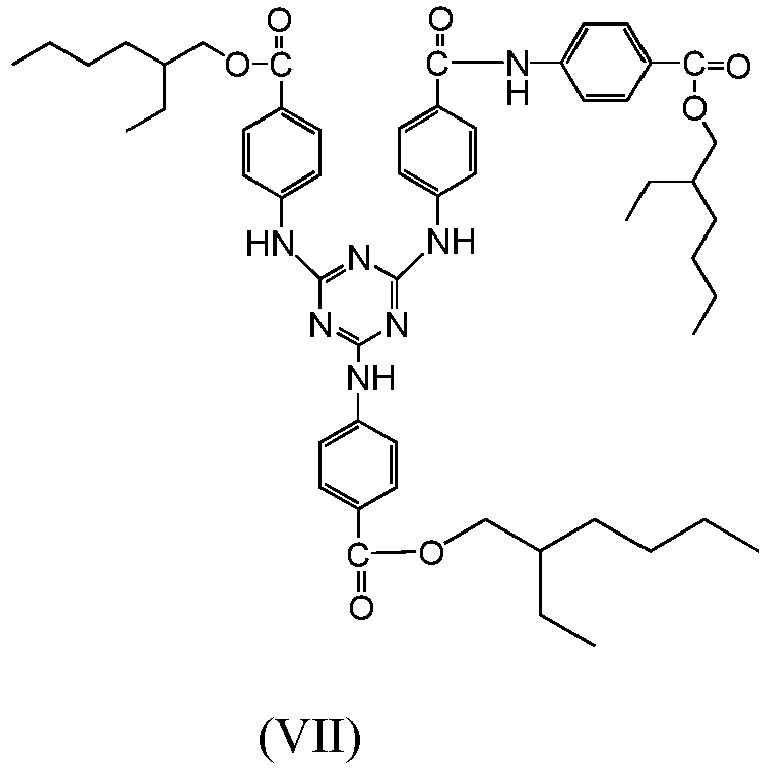
- the compounds of formula (I) are the compounds of formulas (V), (VI) and (VII).
- the compounds of the invention preferably have a UVA:UVB ratio greater than 0.30.
- the compounds of the invention can be prepared by reacting a nitrobenzoyl chloride or bromide with compounds of formula (VIII) to give the nitro intermediate of formula (IX) which, by subsequent reduction or hydrogenation, affords amino intermediate (X)
- the compounds of formula (I) must therefore necessarily be prepared by reacting 1 mole of cyanuryl chloride or bromide with at least 1 mole of intermediate (X), and optionally, where appropriate, with the remaining moles of amino compounds of formula (VIII) and/or (XI), wherein the amines of formula (XI) are: wherein R 1 and R 2 maintain the meaning described above.
- intermediate (X) and optionally the amines of formulas (VIII) and/or (XI) are reacted with cyanuryl chloride or bromide can follow any intermediate sequence and stoichiometry.
- Cyanuryl chloride and bromide have three reactive halogen atoms able to react selectively with ammonia, primary amines and secondary amines at very different temperatures, thus making it possible to replace each halogen atom with the desired amine with quantitative yields.
- neutralising bases are used in many cases, optionally in an aqueous medium, such as sodium hydroxide, sodium carbonate, sodium bicarbonate, calcium hydroxide, calcium carbonate, and tertiary amines such as triethylamine or pyridine.
- an aqueous medium such as sodium hydroxide, sodium carbonate, sodium bicarbonate, calcium hydroxide, calcium carbonate, and tertiary amines such as triethylamine or pyridine.
- solvents wherein the compounds of the invention can be prepared need not be able to dissolve the compounds. However, it is essential that they do not interact chemically with the compounds under the reaction conditions. In this respect they must be inert.
- solvents which can be used are saturated linear and branched hydrocarbons such as hexane, cyclohexane, methylcyclohexane, heptane, octane, isooctane, decane, petrols and dearomatised white spirits, aromatic hydrocarbons such as benzene, toluene, xylenes, ethylbenzene and petrols and white spirits also containing aromatic hydrocarbons, ketones such as acetone, methyl ethyl ketone, methyl isobutyl ketone and diisobutyl ketone, ethers such as tetrahydrofuran and dioxane, esters such as ethyl acetate and butyl a
- the operating temperatures are from 0°C to 200°C, preferably from 40 to 150°C.
- the pressures can range from 0 to 50 bars, preferably from 0 to 5 bars.
- the compounds of the invention can be advantageously introduced into formulas for cosmetics, either as the only sunscreen or in combination with other known sunscreens.
- formulations constitute a second subject of the invention.
- Said formulations will preferably contain one or more conventional UVA and UVB sunscreens such as those listed in Annex VII to the European Cosmetics Directive (76/768/EEC) and Annex VI to European Regulation (EC) No. 1223/2009, as amended, in Household and Personal Care, Monographic Special Issue: Skin Care - "The encyclopedia of allowed sunfilters in the world" by Giulio Pirotta, Consultant, via Solferino 4, 21040 Uboldo (VA) Italy and Electronic Code of Federal Regulations (FDA) PART 352-SUNSCREEN DRUG PRODUCTS FOR OVER-THE-COUNTER HUMAN USE; Subpart B-Active Ingredients.
- the formulations may contain, in addition to the derivatives according to the invention, one or more sunscreens selected from 2-ethylhexyl p-methoxycinnamate, 2-hydroxy-4-methoxybenzophenone, 2-hydroxy-4-methoxybenzophenone-5-sulphonic acid, ethylhexyl salicylate, ethylhexyl dimethyl PABA, drometrizole trisiloxane, 3-(4'-methylbenzylidene)-d,1-camphor, diethylhexyl butamido triazone, ethylhexyl triazone, 4-(tert-butyl)-4'-methoxy-dibenzoylmethane, 2-cyano-3,3-diphenylacrylic acid 2-ethylhexyl ester, bis-ethylhexyloxyphenol-methoxyphenyl-triazine, methylene-bis-benzotriazo
- the compounds of the invention can also be used already in solution in the solvents allowed by European Regulation (EC) No. 1223/2009 on cosmetic products, as amended.
- the compounds of the invention are also suitable for stabilising polymers contained in plastics and coatings against solar and UV radiation. They can therefore be used with other additives as stabilisers, for example to stabilise polyolefins like polyethylene and polypropylene and the copolymers thereof, polyamides, polyesters, polyurethanes and polyvinyl esters.
- the product is recovered by filtration, washing with xylene and drying at 110°C under vacuum, to obtain 83 g of yellow powder corresponding to 2-ethylhexyl 4-(4-nitrobenzamido) benzoate.
- the NMR spectrum and HPLC-MS analysis confirm the identity and molecular weight of the compound, the melting point of which is 105°C (recrystallised from methanol).
- the compounds of formulas (V), (VI) and (VII) were tested for their ability to perform a photoprotective action. Said compounds were added to standard cosmetic formulas (formulas shown in Table 1) to evaluate the SPF (sun protection factor) value with a Labsphere UV-2000S instrument in the UV-visible region from 290 to 400 nm.
- SPF unsun protection factor
- the cosmetic formula was applied to a Transpore medium (3M Inc.) at a concentration of 2.0 mg/cm 2 . 3 tapes were prepared for each formula, 12 readings per tape being conducted; readings with a covariance >10% above the average were rejected.
- the SPF data are set out in Table 2.
- Phase B1 was heated to 70°-75°C under stirring, and B2 was then added.
- A1 was heated separately to 70°-75°C, adding phase A2 and homogenising with a turboemulsifier. Maintaining the temperature at 70°-75°C, B1+B2 was poured into A1, and homogenised with a turboemulsifier.
- the formulation was cooled to 40°C, and phase D was then added, again under stirring.
- Table 2 Formula Mean SPF UVA:UVB ratio Critical wavelength 1 3.50 0.58 314.0 2 3.21 0.33 311.0 3 3.15 0.35 313.0
- the UVA:UVB ratio is the ratio between the intensity of the radiation absorbed between 320 nm and 400 nm (UVA fraction) and that absorbed between 290 nm and 320 nm (UVB fraction).
- the UVA fraction of the compounds of formulas (V), (VI) and (VII) of the invention is at least twice as high as those of the triazine analogues already known, such as diethylhexyl butamido triazone and ethylhexyl triazone, for which said ratio is between 0.12 and 0.14.
Landscapes
- Chemical & Material Sciences (AREA)
- Organic Chemistry (AREA)
- Health & Medical Sciences (AREA)
- Life Sciences & Earth Sciences (AREA)
- Animal Behavior & Ethology (AREA)
- Veterinary Medicine (AREA)
- Public Health (AREA)
- General Health & Medical Sciences (AREA)
- Polymers & Plastics (AREA)
- Medicinal Chemistry (AREA)
- Chemical Kinetics & Catalysis (AREA)
- Dermatology (AREA)
- Birds (AREA)
- Epidemiology (AREA)
- Cosmetics (AREA)
- Plural Heterocyclic Compounds (AREA)
Description
- The present invention relates to s-triazine derivatives, the process for the preparation thereof and their use as light stabilisers.
- Ultraviolet solar radiation is known to have a damaging effect on skin tissue, and to cause the degradation of polymers. By using particular compounds called sunscreens, which absorb the UV part of solar radiation, harmful effects and aging of the skin and polymer materials can be prevented, or at least slowed.
- Numerous substances have been studied and tested as protective agents. A great deal of patent literature exists, relating to compounds belonging to various chemical classes which can absorb in the ultraviolet region, particularly radiation between 290 and 320 nm, called UV-B, which is very harmful.
- Relatively few of said compounds have proved suitable for practical application. They include p-methoxycinnamic acid esters, p-dimethylaminobenzoic acid esters, benzotriazoles and hydroxybenzophenones.
- A drawback shared by all these compounds is their low ability to absorb radiation between 290 and 320 nm, which means that relatively large quantities are required to obtain the optimum photoprotective effect.
- An excellent UV-B absorber should have the following characteristics:
- 1) High specific extinction E1 1 at 290-320 nm, allowing the use of low doses, resulting in cost savings and minimal toxicological risk
- 2) Light stability
- 3) Heat stability
- 4) Oxidation stability
- 5) Stability to different pHs
- 6) Good solubility in the basic substances commonly used for dermatological formulations
- 7) Negligible toxicity
- 8) Colour and odour compatible with the intended applications
- 9) High molecular weight, which reduces the probability of absorption by the skin and increases toxicological safety
- 10) Compatibility with the various substances generally used in dermatological formulations.
- The concentrations of UV-absorber solutions are characterised by the parameter E1 1 (or E11), which corresponds to the specific extinction value measured at the maximum absorption wavelength of a solution containing 1% of the product in question, measured with an optical path of 1 cm.
- Numerous derivatives of symmetrical triazine are already known, which can be used in a wide variety of technical applications and sectors due to their properties of absorbing UV rays, in particular UVA and UVB rays. Examples of said triazines are described in
DE 3206398 ,US 4 617 390 ,US 4 724 137 ,US 5 233 040 ,US 5 252 323 ,US 5 332 568 ,IT 1255729 EP 570838 US 5 346 691 ,US 5 393 517 ,EP 832642 US 5 744 127 ,US 5 759 525 ,US 5 801 244 ,US 6 018 044 ,US 6 193 960 (EP 818450 US 2002085981 and
US 2005143577 . - In particular,
DE 3206398 discloses s-triazine derivatives obtained by reacting trichlorotriazine with p-amino-benzoic acid esters, which absorb intensely in the UV-B region. Unfortunately, the solubility of said compounds in the solvents generally used to formulate sun creams is very low, which makes their practical use problematic and very difficult, especially when the percentage of photoprotector in the composition must be increased to prepare formulations with a high sun protection factor. -
IT 1255729 -
EP 832642 -
EP 838214 -
EP 821939 EP1721600 discloses sun screening preparations comprising triazine derivatives. Sun protection factor (SPF) is a measurement of the photoprotective power of a sunscreen or a cosmetic formulation containing one or more sunscreens. The sun protection factor is the ratio between the MED (Minimal Erythema Dose) determined on protected skin and the MED determined on unprotected skin. It is directly correlated with specific extinction, and therefore also with the amount of photoprotector present in the cosmetic preparation. - It has now been found that the triazine compounds of general formula (I):
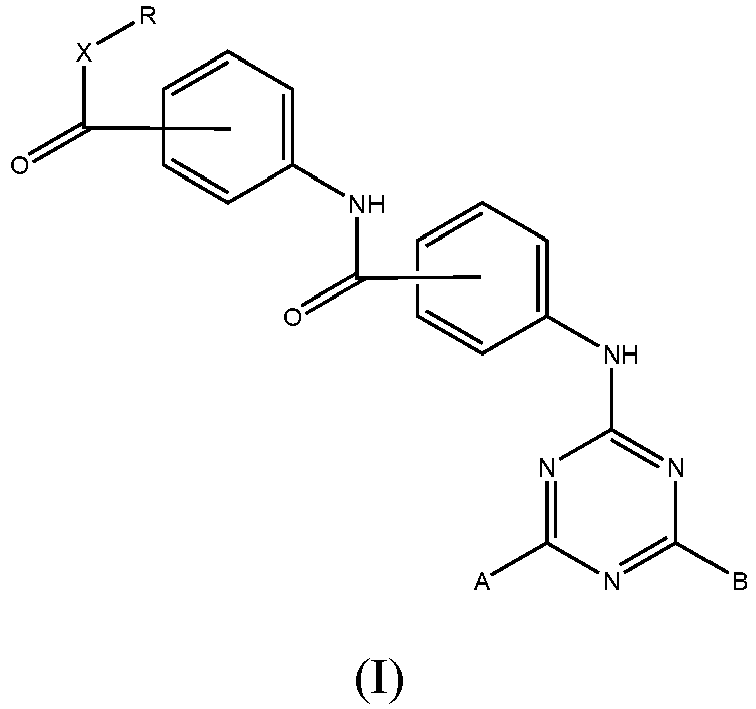
- X is an -O- group
- R is a straight or branched C1-C12 alkyl group
- and groups A and B can be, independently of one another:
a group of formula (II)

or a group of formula (III)
R3 is a straight or branched C1-C12 alkyl group which is the same or different from R
or a group of formula (IV)
R4 is a straight, or branched C1-C12 alkyl group which is the same or different from R and R3
wherein the carboxylate -CO-O- or amide -CO-NH- groups, or the -CO-X-, -COY-, -CO-Z- groups on the phenyl rings are at the para, i.e. 4, position to the -NH- group
not only absorb very intensely in the UV-B region, but also possess excellent solubility in the solvents most commonly used as components of sunscreen formulations, although they have a very high molecular weight, and are therefore more suitable in toxicological terms since they are less likely to be absorbed by the skin tissue. - The invention also relates to the use of said compounds as sunscreens and photostabilisers, due to their ability to perform a surprising skin protection action against the harmful component of solar radiation.
- The compounds of the invention can also be usefully employed in the photostabilisation of synthetic polymers to prevent photodegradation and deterioration.
- The compounds according to the invention, in addition to high absorption in both the UV-B and the UV-A region, also possess other advantageous characteristics, such as heat stability and lack of toxicity, due to their very high molecular weight.
- Typically, the numerical UV-A/UV-B ratio of these compounds, defined as the ratio between the intensity of the radiation absorbed between 320 nm and 400 nm (UVA fraction) and that absorbed between 290 nm and 320 nm (UVB fraction), is greater than 0.20, and preferably greater than 0.30, whereas in the analogous triazine compounds with a 4-aminobenzoate or 4-aminobenzamide substituent different from the substituents described in Formula (IV), it is below about 0.14. Moreover, we have found that by increasing the number of substituents of formula (IV) in the compounds of formula (I), the UV-A light absorption component increases accordingly. The fact that it possesses a significant UV-A component and therefore a broader UV spectrum is undoubtedly an advantage for a substance intended for use as a sunscreen.
- The invention relates to the triazine compounds of Formula (I):

- X is an -O- group
- R is a straight, or branched C1-C12 alkyl group
- and groups A and B can be, independently of one another:
a group of formula (II)
or a group of formula (III)
R3 is a straight or branched C1-C12 alkyl group which is the same or different from R or a group of formula (IV)
R4 is a straight or branched C1-C12 alkyl group which is the same or different from R and R3
wherein the carboxylate -CO-O- or amide -CO-NH- groups, or the -CO-X-, -COY-, -CO-Z- groups on the phenyl rings are at the para, i.e. 4, position to the -NH- group as photostabilising agents against UV-visible radiation. - Preferably, in the compounds of formula (I), the R, R1, R2, R3 and R4 groups are straight or branched C1-C12 alkyl groups.
- Even more preferably, the compounds of formula (I) are the compounds of formulas (V), (VI) and (VII).


- The compounds of the invention preferably have a UVA:UVB ratio greater than 0.30.
- The compounds of the invention can be prepared by reacting a nitrobenzoyl chloride or bromide with compounds of formula (VIII)


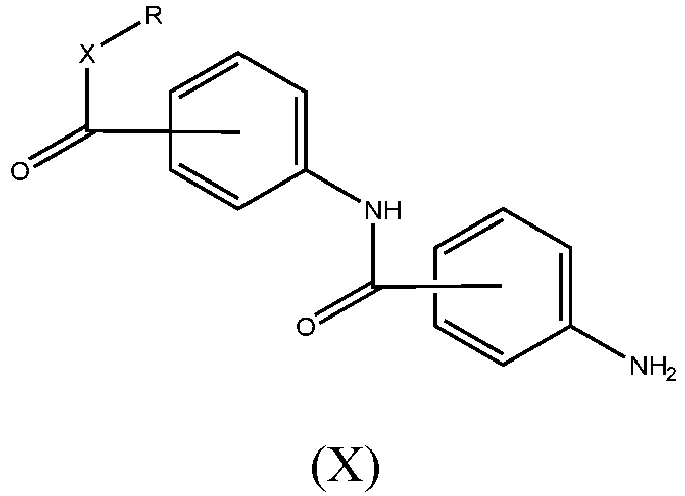
- Intermediate (X) is then reacted with cyanuryl chloride or bromide according to the most suitable stoichiometries and sequences based on well-known synthesis techniques.
- The compounds of formula (I) must therefore necessarily be prepared by reacting 1 mole of cyanuryl chloride or bromide with at least 1 mole of intermediate (X), and optionally, where appropriate, with the remaining moles of amino compounds of formula (VIII) and/or (XI), wherein the amines of formula (XI) are:

- The order in which intermediate (X) and optionally the amines of formulas (VIII) and/or (XI) are reacted with cyanuryl chloride or bromide can follow any intermediate sequence and stoichiometry.
- Cyanuryl chloride and bromide have three reactive halogen atoms able to react selectively with ammonia, primary amines and secondary amines at very different temperatures, thus making it possible to replace each halogen atom with the desired amine with quantitative yields.
- The subsequent synthesis for the preparation of triazine compounds from amino intermediates such as aminobenzoates and aminobenzamides is well known, and described, for example, in
DE 3206398 ,US 4 617 390 ,US 4 724 137 ,US 5 233 040 ,US 5 252 323 ,US 5 332 568 ,IT 1255729 US 5 346 691 ,US 5 393 517 ,EP 832642 US 5 744 127 ,US 5 759 525 ,US 5 801 244 ,US 6 018 044 ,US 6 193 960 ,US 2002085981 ,US 2005143577 . - As the reaction produces acidity, neutralising bases are used in many cases, optionally in an aqueous medium, such as sodium hydroxide, sodium carbonate, sodium bicarbonate, calcium hydroxide, calcium carbonate, and tertiary amines such as triethylamine or pyridine.
- The solvents wherein the compounds of the invention can be prepared need not be able to dissolve the compounds. However, it is essential that they do not interact chemically with the compounds under the reaction conditions. In this respect they must be inert. Examples of solvents which can be used are saturated linear and branched hydrocarbons such as hexane, cyclohexane, methylcyclohexane, heptane, octane, isooctane, decane, petrols and dearomatised white spirits, aromatic hydrocarbons such as benzene, toluene, xylenes, ethylbenzene and petrols and white spirits also containing aromatic hydrocarbons, ketones such as acetone, methyl ethyl ketone, methyl isobutyl ketone and diisobutyl ketone, ethers such as tetrahydrofuran and dioxane, esters such as ethyl acetate and butyl acetate, and nitriles such as acetonitrile and benzonitrile.
- The operating temperatures are from 0°C to 200°C, preferably from 40 to 150°C. The pressures can range from 0 to 50 bars, preferably from 0 to 5 bars.
- The procedure just described is part of the invention.
- The compounds of the invention can be advantageously introduced into formulas for cosmetics, either as the only sunscreen or in combination with other known sunscreens.
- These formulations constitute a second subject of the invention. Said formulations will preferably contain one or more conventional UVA and UVB sunscreens such as those listed in Annex VII to the European Cosmetics Directive (76/768/EEC) and Annex VI to European Regulation (EC) No. 1223/2009, as amended, in Household and Personal Care, Monographic Special Issue: Skin Care - "The encyclopedia of allowed sunfilters in the world" by Giulio Pirotta, Consultant, via Solferino 4, 21040 Uboldo (VA) Italy and Electronic Code of Federal Regulations (FDA) PART 352-SUNSCREEN DRUG PRODUCTS FOR OVER-THE-COUNTER HUMAN USE; Subpart B-Active Ingredients. Even more preferably, the formulations may contain, in addition to the derivatives according to the invention, one or more sunscreens selected from 2-ethylhexyl p-methoxycinnamate, 2-hydroxy-4-methoxybenzophenone, 2-hydroxy-4-methoxybenzophenone-5-sulphonic acid, ethylhexyl salicylate, ethylhexyl dimethyl PABA, drometrizole trisiloxane, 3-(4'-methylbenzylidene)-d,1-camphor, diethylhexyl butamido triazone, ethylhexyl triazone, 4-(tert-butyl)-4'-methoxy-dibenzoylmethane, 2-cyano-3,3-diphenylacrylic acid 2-ethylhexyl ester, bis-ethylhexyloxyphenol-methoxyphenyl-triazine, methylene-bis-benzotriazolyl-tetramethylbutylphenol, benzoic acid 2-(4-diethylamino-2-hydroxybenzoyl)-hexyl ester, 2,4-bis-[4-[5-(1,1-dimethylpropyl)benzoxazol-2-yl]phenylimino]-6-[(2-ethylhexyl)imino]-1,3,5-triazine, tris-biphenyltriazine, titanium dioxide and zinc oxide.
- The compounds of the invention can also be used already in solution in the solvents allowed by European Regulation (EC) No. 1223/2009 on cosmetic products, as amended.
- The compounds of the invention are also suitable for stabilising polymers contained in plastics and coatings against solar and UV radiation. They can therefore be used with other additives as stabilisers, for example to stabilise polyolefins like polyethylene and polypropylene and the copolymers thereof, polyamides, polyesters, polyurethanes and polyvinyl esters.
- The invention will be now be described in greater detail in the following examples and preparations.
- 77.5 g of a 20 wt% aqueous solution of Na2CO3, 190.0 g of xylene and 68.5 g of 2-ethylhexyl 4-aminobenzoate are loaded into a 1 litre flask equipped with mechanical stirrer, thermometer, reflux condenser and dropping funnel. Keeping the mixture stirred at 65°C, a solution of 47.1 g of 4-nitrobenzoyl chloride is added to 47.0 g of xylene. The resulting mixture is then heated to reflux for 1 h. The organic phase is cooled, and the reaction product precipitates. The product is recovered by filtration, washing with xylene and drying at 110°C under vacuum, to obtain 83 g of yellow powder corresponding to 2-ethylhexyl 4-(4-nitrobenzamido) benzoate. The NMR spectrum and HPLC-MS analysis confirm the identity and molecular weight of the compound, the melting point of which is 105°C (recrystallised from methanol).
- 210.0 g of xylene, 70.1 g of compound obtained according to Example 1 and 0.70 g of 5% Pd/C catalyst (50% solution in water) are loaded into a 1L steel autoclave. The mixture is decontaminated with nitrogen and hydrogenated, operating at a pressure of 10 bars with hydrogen at 90°C. The xylene solution is filtered hot through a Büchner funnel heated to 90°C to remove the catalyst. The clear solution is left to cool, and the product precipitates. The precipitate is filtered through a Büchner funnel, and the panel is washed with xylene and dried in a vacuum oven at 110°C. About 64 g of product is obtained as a whitish powder. The NMR spectrum and HPLC-MS analysis confirm the identity and molecular weight of the compound, the melting point of which is 137°C (recrystallised from toluene).
- 17.6 g of sodium bicarbonate is added under stirring to a solution of 37 g of cyanuryl chloride in 450 ml of acetone, cooled to 0°C, then 39 g of N-tert-butyl 4-aminobenzamide is added slowly, always maintaining the temperature at 0°C by cooling. The mixture is then maintained under stirring for 30 minutes, after which 150 ml of water is added, followed by stirring for a further 30 minutes. The precipitate that forms is filtered, washed several times with water and dried under vacuum. 64 g of dichlorotriazine derivative is obtained as a white powder with a melting point > 250°C.
- 10.2 g of the compound of Example 3 (dichlorotriazine derivative) and 22.6 g of the compound of Example 2 in 200 ml of xylene are stirred at 140°C to reflux and then treated with 100.0 g of 2.4 wt% aqueous sodium hydroxide. The water and solvent are eliminated by distillation under vacuum. The residue is taken up with 250 ml of acetone. The acetone solution is clarified by filtration, and the acetone is removed by distillation under vacuum. 30 g of a whitish solid corresponding to the compound of formula (V) is obtained. The NMR spectrum and HPLC-MS analysis confirm the identity and molecular weight of the compound, the melting point of which is 232°C.
- 51 g of the compound of Example 3 is reacted with 38.1 g of 2-ethylhexyl-4-aminobenzoate in the presence of 59.6 g of triisobutylamine in 200 ml of toluene at 110°C for 3 hours. The mass is cooled and diluted with 100 ml of toluene. 200 ml of water and 16.3 g of concentrated hydrochloric acid are then added under stirring. The aqueous phase is separated and eliminated. The organic phase is washed with water and then filtered. The solid is suspended in n-hexane and recovered by filtration and drying. 68.4 g of white solid with a melting point of 166°C is obtained.
- 16.6 g of compound obtained according to Example 5 is reacted with 11.8 g of the compound of Example 2 in the presence of 55 g of 5 wt% aqueous solution of sodium carbonate, 4 g of 30% sodium hydroxide and 100 ml of xylene at reflux for 6 hours. The aqueous phase is separated and eliminated hot. The organic phase is dried by azeotropic distillation, and clarified by hot filtration. The precipitate is cooled and recovered by filtration, washing and drying, and 26.4 g of crude product is obtained. This compound is purified by crystallisation from toluene and methylcyclohexane. 20 g of a white product with a melting point of 118°C is obtained.
- 38.7 g of the compound of Example 2, namely 2-ethylhexyl 4-(4-aminobenzamido)benzoate, is gradually added to a stirred mixture of 18.5 g of cyanuryl chloride, 200 ml of acetone and 9.3 g of sodium bicarbonate maintained at -5°C. The mixture is left to react for one hour at 0°C, and 80 g of water is then added. The solid precipitate is filtered and washed with water and 5% acetone. The filtrate is dried at 40°C under vacuum. 49.2 g of a whitish solid with a melting point of 250°C and 13.61 wt% Cl is obtained (theoretical value 13.76 wt% Cl).
- 15.5 g of the compound of Example 7 and 15.3 g of 2-ethylhexyl 4-aminobenzoate are reacted under stirring in 200 ml of xylene at reflux, gradually adding 100.0 g of 2.4 wt% aqueous sodium hydroxide. The water is eliminated by azeotropic distillation. The xylene solution is filtered hot to clarify it. When the solution is cooled, a precipitate forms which is washed with cold xylene and dried at 60°C under vacuum. 23 g of a white crystalline solid with a melting point of 146°C is obtained. The NMR spectrum confirms the identity of the compound obtained.
- The compounds of formulas (V), (VI) and (VII) were tested for their ability to perform a photoprotective action. Said compounds were added to standard cosmetic formulas (formulas shown in Table 1) to evaluate the SPF (sun protection factor) value with a Labsphere UV-2000S instrument in the UV-visible region from 290 to 400 nm. For the experimental measurement of the SPF, the cosmetic formula was applied to a Transpore medium (3M Inc.) at a concentration of 2.0 mg/cm2. 3 tapes were prepared for each formula, 12 readings per tape being conducted; readings with a covariance >10% above the average were rejected. The SPF data are set out in Table 2.
Table 1 Phase Ingredient INCI name Formula 1 Formula 2 Formula 2 A1 Water water 72.5 72.5 72.5 A1 Propylene Glycol propylene glycol 1 1 1 A2 Satiaxane CX91 xanthan gum 0.6 0.6 0.6 A2 Ultrez 10 Carbo mer 0.15 0.15 0.15 A2 Disodium EDTA disodium EDTA 0.08 0.08 0.08 B1 Lanette 16 cetyl alcohol 1 1 1 B1 Tego alkanol S21P steareth-21 2.5 2.5 2.5 B1 Tego alkanol S2P steareth- 2 3 3 3 B1 Cetiol CC dicaprylyl carbonate 6.5 6.5 6.5 B1 Tegosoft DC decyl cocoate 6.5 6.5 6.5 B2 Compound of formula (V) 1 B2 Compound of formula (VI) 1 B2 Compound of formula (VII) 1 C TEA TEA 0.225 0.225 0.225 D Dow Corning 245 cyclomethicone 2 2 2 D Microcare PMS phenoxyethanol and paraben 1 1 1 - Preparation: Phase B1 was heated to 70°-75°C under stirring, and B2 was then added. A1 was heated separately to 70°-75°C, adding phase A2 and homogenising with a turboemulsifier. Maintaining the temperature at 70°-75°C, B1+B2 was poured into A1, and homogenised with a turboemulsifier. After adding C, the formulation was cooled to 40°C, and phase D was then added, again under stirring.
Table 2 Formula Mean SPF UVA:UVB ratio Critical wavelength 1 3.50 0.58 314.0 2 3.21 0.33 311.0 3 3.15 0.35 313.0 - The UVA:UVB ratio is the ratio between the intensity of the radiation absorbed between 320 nm and 400 nm (UVA fraction) and that absorbed between 290 nm and 320 nm (UVB fraction). The UVA fraction of the compounds of formulas (V), (VI) and (VII) of the invention is at least twice as high as those of the triazine analogues already known, such as diethylhexyl butamido triazone and ethylhexyl triazone, for which said ratio is between 0.12 and 0.14.
Claims (7)
- Triazine compounds of general formula (I):
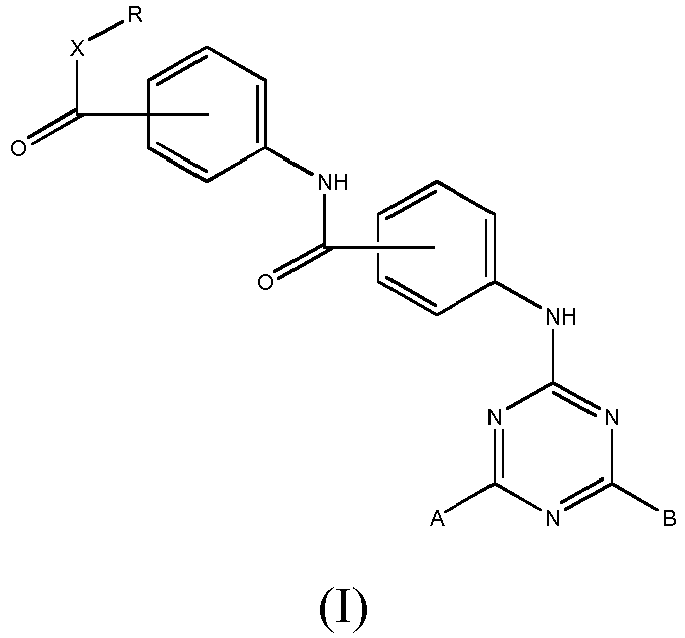 X is an -O- group,R is a straight or branched C1-C12 alkyl group,and the groups A and B can be, independently of one another:
a group of formula (II)
or a group of formula (III)
R3 is a straight or branched C1-C12 alkyl group which is the same or different from R
or a group of formula (IV)
R4 is a straight, or branched C1-C12 alkyl group which is the same or different from R and
R3, wherein the carboxylate -CO-O- or amide -CO-NH- groups, or the -CO-X-, -CO-Y-, - CO-Z- groups on the phenyl rings are at the para, i.e. 4, position to the -NH- group. - Compounds of claim 1 selected from the compounds of formula (V), (VI) and (VII) :


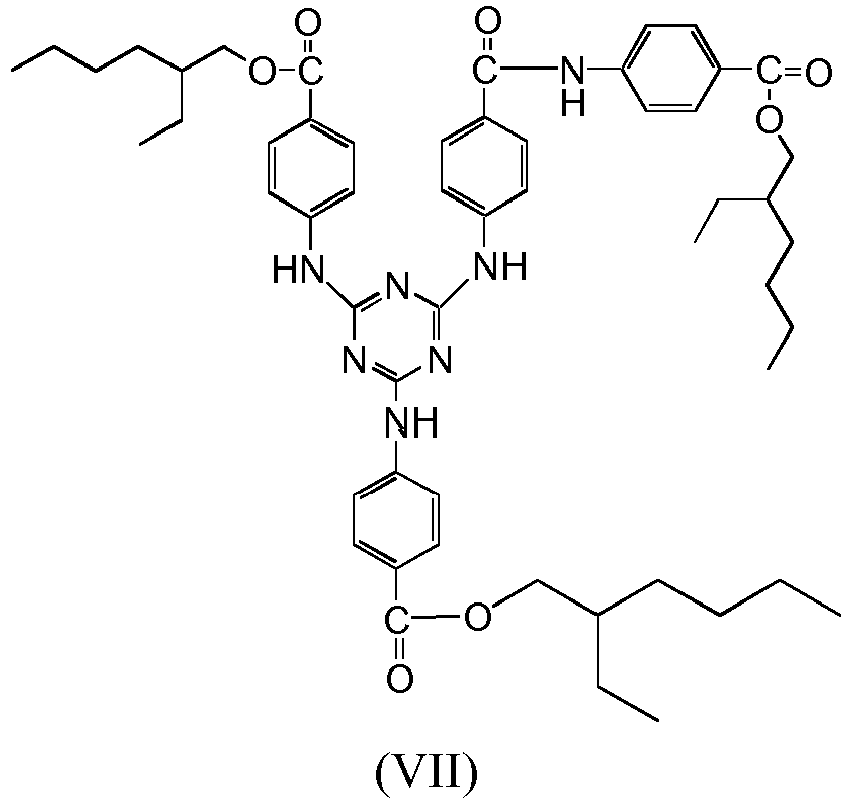
- Compounds of claims 1 to 2 wherein the ratio UVA/UVB is greater than 0.20, preferably greater than 0.30.
- Cosmetic compositions containing the compounds of claims 1 to 3 alone or in mixture with one or more UVA and UVB sunscreens.
- Cosmetic compositions of claim 4 containing also one or more sunscreens selected from: p-metoxycinnamate of 2-ethylhexyl, 2-hydroxy-4-methoxybenzophenone, 2-hydroxy-4-methoxybenzophenone-5-sulfonic acid, ethylhexyl salicylate, ethylhexyl dimethyl PABA, drometrizole trisiloxane, 3-(4'-methylbenzylidene)-d,1-camphor, Dietilhexyl Butamido Triazone, Ethylhexyl Triazone, 4-(tert-butyl)-4'-methoxydibenzoylmethane, 2-ethylhexyl ester of 2-cyano-3,3-diphenylacrylic acid, bis-ethylhexyloxypheno1-methoxyphenyl-triazine, methylene-bis-benzotriazolyl-tetramethylbutylphenol, 2-(4-diethylamino-2-hydroxybenzoyl)-hexyl ester of benzoic acid, 2,4-bis-[4-[5-(1,1-dimethyl-propyl)benzoxazol-2-yl]phenylimino]-6-[(2-ethylhexyl)imino]-1,3,5-triazine, tris-biphenyltriazine, titanium dioxide, zinc oxide.
- Compounds according to claims 1 to 2 for use as UVB and UVA sunscreens for the protection of the skin and of the hair.
- Use ofthe compounds of claims 1 to 2 as UVB and UVA sunscreens for the stabilization to sun radiation of polymeric materials in plastics and in coatings.
Applications Claiming Priority (1)
| Application Number | Priority Date | Filing Date | Title |
|---|---|---|---|
| IT102016000080301A IT201600080301A1 (en) | 2016-07-29 | 2016-07-29 | NEW TRIAZINE COMPOUNDS AS PHOTOSTABILIZING AGENTS |
Publications (2)
| Publication Number | Publication Date |
|---|---|
| EP3275872A1 EP3275872A1 (en) | 2018-01-31 |
| EP3275872B1 true EP3275872B1 (en) | 2021-05-05 |
Family
ID=58159231
Family Applications (1)
| Application Number | Title | Priority Date | Filing Date |
|---|---|---|---|
| EP17182587.0A Active EP3275872B1 (en) | 2016-07-29 | 2017-07-21 | New triazine compounds as photostabilising agents |
Country Status (4)
| Country | Link |
|---|---|
| US (1) | US10457650B2 (en) |
| EP (1) | EP3275872B1 (en) |
| ES (1) | ES2885056T3 (en) |
| IT (1) | IT201600080301A1 (en) |
Families Citing this family (10)
| Publication number | Priority date | Publication date | Assignee | Title |
|---|---|---|---|---|
| IT201600080304A1 (en) * | 2016-07-29 | 2018-01-29 | 3V Sigma Spa | COSMETIC COMPOSITIONS OF UV FILTERS |
| CN113573689B (en) | 2019-03-15 | 2025-04-15 | 巴斯夫欧洲公司 | Sunscreen composition comprising butyl methoxydibenzoylmethane, a triazine derivative and a light stabilizer |
| FR3094214A1 (en) | 2019-03-29 | 2020-10-02 | Jean-Noël Thorel | SOLAR COSMETIC COMPOSITION WITH A HIGH CONTENT IN SOLAR FILTERS DERIVED FROM TRIAZINE |
| FR3102672B1 (en) | 2019-11-05 | 2021-10-29 | Thorel Jean Noel | Water resistant solar composition with a high content of triazines |
| FR3128881B1 (en) | 2021-11-09 | 2024-10-25 | Thorel Jean Noel | Sunscreen composition comprising organic UV filters and environmentally friendly oily copolymers |
| FR3147950B1 (en) | 2023-04-19 | 2025-12-05 | Thorel Jean Noel | An eco-friendly cosmetic composition suitable for promoting the healing of skin wounds |
| FR3154611A1 (en) | 2023-10-27 | 2025-05-02 | Jean-Noël Thorel | Ecobiological composition capable of preventing and treating redness and signs of skin aging, as well as vascular abnormalities. |
| WO2025088285A1 (en) | 2023-10-27 | 2025-05-01 | Naos Institute Of Life Science | Ecobiological topical composition for treating skin redness and discomfort |
| FR3161850A1 (en) | 2024-05-02 | 2025-11-07 | Naos Institute Of Life Science | Ecobiological topical composition suitable for preventing and/or combating sebocyte inflammation |
| FR3167542A1 (en) | 2024-10-22 | 2026-04-24 | Naos Institute Of Life Science | ECO-BIOLOGICAL COMPOSITION INCLUDING ENVIRONMENTALLY FRIENDLY SUN PROTECTION AMPLIFIERS |
Family Cites Families (15)
| Publication number | Priority date | Publication date | Assignee | Title |
|---|---|---|---|---|
| DE3206398A1 (en) | 1982-02-23 | 1983-09-01 | Basf Ag, 6700 Ludwigshafen | S-TRIAZINE DERIVATIVES AND THEIR USE AS LIGHT PROTECTION AGENTS |
| FR2674851B1 (en) | 1991-04-04 | 1995-02-10 | Oreal | S-TRIAZINIC DERIVATIVES CARRYING BENZYLIDENE CAMPHOR SUBSTITUENTS, FILTERING COSMETIC COMPOSITIONS AND THEIR USE FOR PROTECTING THE SKIN AND HAIR FROM ULTRAVIOLET RADIATION. |
| IT1247973B (en) | 1991-06-04 | 1995-01-05 | Sigma Prod Chim | 1,3,5-TRIAZINE DERIVATIVES, THEIR PREPARATION AND USE AS SOLAR FILTERS |
| IT1255729B (en) | 1992-05-19 | 1995-11-15 | Giuseppe Raspanti | s-triazine derivatives as photostabilising agents |
| US5332568A (en) | 1993-05-20 | 1994-07-26 | 3V Inc. | S-triazine derivatives having light-protecting action |
| IT1283295B1 (en) | 1996-03-22 | 1998-04-16 | 3V Sigma Spa | SOLAR FILTERS |
| ES2188883T3 (en) | 1996-07-08 | 2003-07-01 | Ciba Sc Holding Ag | TRIAZINE DERIVATIVES AS UV FILTER IN ANTISOLAR PRODUCTS. |
| EP0821939A1 (en) * | 1996-07-31 | 1998-02-04 | 3V SIGMA S.p.A | Sun screening preparations comprising triazine derivatives |
| IT1284525B1 (en) | 1996-09-13 | 1998-05-21 | 3V Sigma Spa | DERIVATIVES OF BENZOSSAZOLE USED AS STABILIZERS AGAINST UV RADIATION |
| DE19643515A1 (en) * | 1996-10-22 | 1998-04-23 | Basf Ag | Cosmetics containing a combination of UV absorbers |
| US5759525A (en) | 1996-12-26 | 1998-06-02 | 3V Inc. | Concentrated solutions of a 1,3,5-triazine derivative sunscreen and their use for the preparation of cosmetic compositions |
| US6018044A (en) | 1998-01-02 | 2000-01-25 | Roche Vitamins Inc. | Light screening compositions |
| IT1317825B1 (en) | 2000-02-11 | 2003-07-15 | 3V Sigma Spa | BENZOSSAZOLE DERIVATIVES, THEIR USE IN COSMETIC COMPOSITIONS AND IN THE STABILIZATION OF SYNTHETIC POLYMERS. |
| DE10208840A1 (en) | 2002-03-01 | 2003-09-18 | Basf Ag | Process for the preparation of a tautomeric form of 2,4,6-trianilino-p- (carbo-2'-ethylhexyl-1'-oxy) -1,3,5-triazine |
| DE102005021913A1 (en) * | 2005-05-09 | 2006-11-23 | Beiersdorf Ag | Sun protection kit and method for pigmentation approximation |
-
2016
- 2016-07-29 IT IT102016000080301A patent/IT201600080301A1/en unknown
-
2017
- 2017-07-21 EP EP17182587.0A patent/EP3275872B1/en active Active
- 2017-07-21 ES ES17182587T patent/ES2885056T3/en active Active
- 2017-07-25 US US15/658,417 patent/US10457650B2/en active Active
Also Published As
| Publication number | Publication date |
|---|---|
| ES2885056T3 (en) | 2021-12-13 |
| US10457650B2 (en) | 2019-10-29 |
| IT201600080301A1 (en) | 2018-01-29 |
| EP3275872A1 (en) | 2018-01-31 |
| US20180030001A1 (en) | 2018-02-01 |
Similar Documents
| Publication | Publication Date | Title |
|---|---|---|
| US10457650B2 (en) | Triazine compounds as photostabilizing agents | |
| EP0517104B1 (en) | 1,3,5-Triazine derivatives, their preparation and use as sunscreens | |
| AU2004224086B2 (en) | Symmetrical triazine derivatives | |
| ES2212020T3 (en) | USEFUL BEZOXAZOL DERIVATIVES AS FILTERS FOR UV RADIATION. | |
| ES2349920T3 (en) | TRIAZINE DERIVATIVES USED AS UV ABSORBENTS. | |
| EP0570838A1 (en) | S-triazine derivatives as light stabilisers | |
| US5362481A (en) | Benzofuran derivatives and the use thereof as stabilizers against UV radiations | |
| US5332568A (en) | S-triazine derivatives having light-protecting action | |
| EP2956114A2 (en) | Cosmetic or dermatological composition comprising a merocyanine, an oily phase and a c1-c4 monoalkanol | |
| US6399047B1 (en) | Benzoxazole derivatives for use in cosmetic compositions and for stabilizing synthetic polymers | |
| EP3275426B1 (en) | Cosmetic compositions of uv filters | |
| EP3578558B1 (en) | Highly effective photoprotective agents | |
| US7534421B2 (en) | s-Triazine compounds bearing at least one para-aminobenzalmalonic salt substituent and photoprotective cosmetic compositions comprised thereof | |
| EP4037654B1 (en) | Compositions with polymeric or oligomeric hydroxy phenyl triazine uv filter | |
| US5468470A (en) | Benzofuran derivatives and the use thereof as stabilizers against UV radiations | |
| US8999299B2 (en) | Photoprotective cosmetic compositions comprising silicon-containing s-triazine compounds substituted with two aminobenzoate or aminobenzamide groups and non-silicon-containing lipophilic triazine compound UV-screening agents | |
| JP2004262942A (en) | Novel s-triazine derivatives having at least one grafted para-aminobenzalmalonate and light-protective cosmetic compositions containing these derivatives | |
| US8221730B2 (en) | Silanic para-aminobenzalmalonate-substituted s-triazine compounds and photoprotective compositions comprised thereof | |
| EP0570845A1 (en) | S-Triazine derivatives having light-protecting action | |
| EP2759539A1 (en) | Triazine oligomers as photostabilising agents |
Legal Events
| Date | Code | Title | Description |
|---|---|---|---|
| PUAI | Public reference made under article 153(3) epc to a published international application that has entered the european phase |
Free format text: ORIGINAL CODE: 0009012 |
|
| STAA | Information on the status of an ep patent application or granted ep patent |
Free format text: STATUS: THE APPLICATION HAS BEEN PUBLISHED |
|
| AK | Designated contracting states |
Kind code of ref document: A1 Designated state(s): AL AT BE BG CH CY CZ DE DK EE ES FI FR GB GR HR HU IE IS IT LI LT LU LV MC MK MT NL NO PL PT RO RS SE SI SK SM TR |
|
| AX | Request for extension of the european patent |
Extension state: BA ME |
|
| STAA | Information on the status of an ep patent application or granted ep patent |
Free format text: STATUS: REQUEST FOR EXAMINATION WAS MADE |
|
| 17P | Request for examination filed |
Effective date: 20180720 |
|
| RBV | Designated contracting states (corrected) |
Designated state(s): AL AT BE BG CH CY CZ DE DK EE ES FI FR GB GR HR HU IE IS IT LI LT LU LV MC MK MT NL NO PL PT RO RS SE SI SK SM TR |
|
| STAA | Information on the status of an ep patent application or granted ep patent |
Free format text: STATUS: EXAMINATION IS IN PROGRESS |
|
| 17Q | First examination report despatched |
Effective date: 20191105 |
|
| REG | Reference to a national code |
Ref country code: DE Ref legal event code: R079 Ref document number: 602017037949 Country of ref document: DE Free format text: PREVIOUS MAIN CLASS: C07D0251540000 Ipc: A61K0008490000 |
|
| GRAP | Despatch of communication of intention to grant a patent |
Free format text: ORIGINAL CODE: EPIDOSNIGR1 |
|
| STAA | Information on the status of an ep patent application or granted ep patent |
Free format text: STATUS: GRANT OF PATENT IS INTENDED |
|
| RIC1 | Information provided on ipc code assigned before grant |
Ipc: A61Q 17/04 20060101ALI20200706BHEP Ipc: A61K 8/49 20060101AFI20200706BHEP Ipc: C07D 251/70 20060101ALI20200706BHEP Ipc: C08K 5/00 20060101ALI20200706BHEP Ipc: C07D 251/54 20060101ALI20200706BHEP Ipc: C08K 5/3492 20060101ALI20200706BHEP |
|
| INTG | Intention to grant announced |
Effective date: 20200803 |
|
| GRAS | Grant fee paid |
Free format text: ORIGINAL CODE: EPIDOSNIGR3 |
|
| GRAA | (expected) grant |
Free format text: ORIGINAL CODE: 0009210 |
|
| STAA | Information on the status of an ep patent application or granted ep patent |
Free format text: STATUS: THE PATENT HAS BEEN GRANTED |
|
| AK | Designated contracting states |
Kind code of ref document: B1 Designated state(s): AL AT BE BG CH CY CZ DE DK EE ES FI FR GB GR HR HU IE IS IT LI LT LU LV MC MK MT NL NO PL PT RO RS SE SI SK SM TR |
|
| REG | Reference to a national code |
Ref country code: GB Ref legal event code: FG4D |
|
| REG | Reference to a national code |
Ref country code: CH Ref legal event code: EP |
|
| REG | Reference to a national code |
Ref country code: AT Ref legal event code: REF Ref document number: 1388906 Country of ref document: AT Kind code of ref document: T Effective date: 20210515 |
|
| REG | Reference to a national code |
Ref country code: IE Ref legal event code: FG4D |
|
| REG | Reference to a national code |
Ref country code: DE Ref legal event code: R096 Ref document number: 602017037949 Country of ref document: DE |
|
| REG | Reference to a national code |
Ref country code: LT Ref legal event code: MG9D |
|
| REG | Reference to a national code |
Ref country code: AT Ref legal event code: MK05 Ref document number: 1388906 Country of ref document: AT Kind code of ref document: T Effective date: 20210505 |
|
| PG25 | Lapsed in a contracting state [announced via postgrant information from national office to epo] |
Ref country code: HR Free format text: LAPSE BECAUSE OF FAILURE TO SUBMIT A TRANSLATION OF THE DESCRIPTION OR TO PAY THE FEE WITHIN THE PRESCRIBED TIME-LIMIT Effective date: 20210505 Ref country code: AT Free format text: LAPSE BECAUSE OF FAILURE TO SUBMIT A TRANSLATION OF THE DESCRIPTION OR TO PAY THE FEE WITHIN THE PRESCRIBED TIME-LIMIT Effective date: 20210505 Ref country code: BG Free format text: LAPSE BECAUSE OF FAILURE TO SUBMIT A TRANSLATION OF THE DESCRIPTION OR TO PAY THE FEE WITHIN THE PRESCRIBED TIME-LIMIT Effective date: 20210805 Ref country code: FI Free format text: LAPSE BECAUSE OF FAILURE TO SUBMIT A TRANSLATION OF THE DESCRIPTION OR TO PAY THE FEE WITHIN THE PRESCRIBED TIME-LIMIT Effective date: 20210505 Ref country code: LT Free format text: LAPSE BECAUSE OF FAILURE TO SUBMIT A TRANSLATION OF THE DESCRIPTION OR TO PAY THE FEE WITHIN THE PRESCRIBED TIME-LIMIT Effective date: 20210505 |
|
| PG25 | Lapsed in a contracting state [announced via postgrant information from national office to epo] |
Ref country code: PT Free format text: LAPSE BECAUSE OF FAILURE TO SUBMIT A TRANSLATION OF THE DESCRIPTION OR TO PAY THE FEE WITHIN THE PRESCRIBED TIME-LIMIT Effective date: 20210906 Ref country code: PL Free format text: LAPSE BECAUSE OF FAILURE TO SUBMIT A TRANSLATION OF THE DESCRIPTION OR TO PAY THE FEE WITHIN THE PRESCRIBED TIME-LIMIT Effective date: 20210505 Ref country code: NO Free format text: LAPSE BECAUSE OF FAILURE TO SUBMIT A TRANSLATION OF THE DESCRIPTION OR TO PAY THE FEE WITHIN THE PRESCRIBED TIME-LIMIT Effective date: 20210805 Ref country code: RS Free format text: LAPSE BECAUSE OF FAILURE TO SUBMIT A TRANSLATION OF THE DESCRIPTION OR TO PAY THE FEE WITHIN THE PRESCRIBED TIME-LIMIT Effective date: 20210505 Ref country code: SE Free format text: LAPSE BECAUSE OF FAILURE TO SUBMIT A TRANSLATION OF THE DESCRIPTION OR TO PAY THE FEE WITHIN THE PRESCRIBED TIME-LIMIT Effective date: 20210505 Ref country code: LV Free format text: LAPSE BECAUSE OF FAILURE TO SUBMIT A TRANSLATION OF THE DESCRIPTION OR TO PAY THE FEE WITHIN THE PRESCRIBED TIME-LIMIT Effective date: 20210505 Ref country code: IS Free format text: LAPSE BECAUSE OF FAILURE TO SUBMIT A TRANSLATION OF THE DESCRIPTION OR TO PAY THE FEE WITHIN THE PRESCRIBED TIME-LIMIT Effective date: 20210905 Ref country code: GR Free format text: LAPSE BECAUSE OF FAILURE TO SUBMIT A TRANSLATION OF THE DESCRIPTION OR TO PAY THE FEE WITHIN THE PRESCRIBED TIME-LIMIT Effective date: 20210806 |
|
| REG | Reference to a national code |
Ref country code: ES Ref legal event code: FG2A Ref document number: 2885056 Country of ref document: ES Kind code of ref document: T3 Effective date: 20211213 |
|
| REG | Reference to a national code |
Ref country code: NL Ref legal event code: MP Effective date: 20210505 |
|
| PG25 | Lapsed in a contracting state [announced via postgrant information from national office to epo] |
Ref country code: NL Free format text: LAPSE BECAUSE OF FAILURE TO SUBMIT A TRANSLATION OF THE DESCRIPTION OR TO PAY THE FEE WITHIN THE PRESCRIBED TIME-LIMIT Effective date: 20210505 |
|
| PG25 | Lapsed in a contracting state [announced via postgrant information from national office to epo] |
Ref country code: SK Free format text: LAPSE BECAUSE OF FAILURE TO SUBMIT A TRANSLATION OF THE DESCRIPTION OR TO PAY THE FEE WITHIN THE PRESCRIBED TIME-LIMIT Effective date: 20210505 Ref country code: SM Free format text: LAPSE BECAUSE OF FAILURE TO SUBMIT A TRANSLATION OF THE DESCRIPTION OR TO PAY THE FEE WITHIN THE PRESCRIBED TIME-LIMIT Effective date: 20210505 Ref country code: RO Free format text: LAPSE BECAUSE OF FAILURE TO SUBMIT A TRANSLATION OF THE DESCRIPTION OR TO PAY THE FEE WITHIN THE PRESCRIBED TIME-LIMIT Effective date: 20210505 Ref country code: EE Free format text: LAPSE BECAUSE OF FAILURE TO SUBMIT A TRANSLATION OF THE DESCRIPTION OR TO PAY THE FEE WITHIN THE PRESCRIBED TIME-LIMIT Effective date: 20210505 Ref country code: DK Free format text: LAPSE BECAUSE OF FAILURE TO SUBMIT A TRANSLATION OF THE DESCRIPTION OR TO PAY THE FEE WITHIN THE PRESCRIBED TIME-LIMIT Effective date: 20210505 Ref country code: CZ Free format text: LAPSE BECAUSE OF FAILURE TO SUBMIT A TRANSLATION OF THE DESCRIPTION OR TO PAY THE FEE WITHIN THE PRESCRIBED TIME-LIMIT Effective date: 20210505 |
|
| REG | Reference to a national code |
Ref country code: DE Ref legal event code: R097 Ref document number: 602017037949 Country of ref document: DE |
|
| REG | Reference to a national code |
Ref country code: CH Ref legal event code: PL |
|
| PLBE | No opposition filed within time limit |
Free format text: ORIGINAL CODE: 0009261 |
|
| STAA | Information on the status of an ep patent application or granted ep patent |
Free format text: STATUS: NO OPPOSITION FILED WITHIN TIME LIMIT |
|
| PG25 | Lapsed in a contracting state [announced via postgrant information from national office to epo] |
Ref country code: MC Free format text: LAPSE BECAUSE OF FAILURE TO SUBMIT A TRANSLATION OF THE DESCRIPTION OR TO PAY THE FEE WITHIN THE PRESCRIBED TIME-LIMIT Effective date: 20210505 |
|
| REG | Reference to a national code |
Ref country code: BE Ref legal event code: MM Effective date: 20210731 |
|
| 26N | No opposition filed |
Effective date: 20220208 |
|
| PG25 | Lapsed in a contracting state [announced via postgrant information from national office to epo] |
Ref country code: LI Free format text: LAPSE BECAUSE OF NON-PAYMENT OF DUE FEES Effective date: 20210731 Ref country code: CH Free format text: LAPSE BECAUSE OF NON-PAYMENT OF DUE FEES Effective date: 20210731 |
|
| PG25 | Lapsed in a contracting state [announced via postgrant information from national office to epo] |
Ref country code: IS Free format text: LAPSE BECAUSE OF FAILURE TO SUBMIT A TRANSLATION OF THE DESCRIPTION OR TO PAY THE FEE WITHIN THE PRESCRIBED TIME-LIMIT Effective date: 20210905 Ref country code: LU Free format text: LAPSE BECAUSE OF NON-PAYMENT OF DUE FEES Effective date: 20210721 Ref country code: AL Free format text: LAPSE BECAUSE OF FAILURE TO SUBMIT A TRANSLATION OF THE DESCRIPTION OR TO PAY THE FEE WITHIN THE PRESCRIBED TIME-LIMIT Effective date: 20210505 |
|
| PG25 | Lapsed in a contracting state [announced via postgrant information from national office to epo] |
Ref country code: IE Free format text: LAPSE BECAUSE OF NON-PAYMENT OF DUE FEES Effective date: 20210721 Ref country code: BE Free format text: LAPSE BECAUSE OF NON-PAYMENT OF DUE FEES Effective date: 20210731 |
|
| PG25 | Lapsed in a contracting state [announced via postgrant information from national office to epo] |
Ref country code: HU Free format text: LAPSE BECAUSE OF FAILURE TO SUBMIT A TRANSLATION OF THE DESCRIPTION OR TO PAY THE FEE WITHIN THE PRESCRIBED TIME-LIMIT; INVALID AB INITIO Effective date: 20170721 |
|
| P01 | Opt-out of the competence of the unified patent court (upc) registered |
Effective date: 20230509 |
|
| PG25 | Lapsed in a contracting state [announced via postgrant information from national office to epo] |
Ref country code: CY Free format text: LAPSE BECAUSE OF FAILURE TO SUBMIT A TRANSLATION OF THE DESCRIPTION OR TO PAY THE FEE WITHIN THE PRESCRIBED TIME-LIMIT Effective date: 20210505 |
|
| PG25 | Lapsed in a contracting state [announced via postgrant information from national office to epo] |
Ref country code: MK Free format text: LAPSE BECAUSE OF FAILURE TO SUBMIT A TRANSLATION OF THE DESCRIPTION OR TO PAY THE FEE WITHIN THE PRESCRIBED TIME-LIMIT Effective date: 20210505 |
|
| PG25 | Lapsed in a contracting state [announced via postgrant information from national office to epo] |
Ref country code: TR Free format text: LAPSE BECAUSE OF FAILURE TO SUBMIT A TRANSLATION OF THE DESCRIPTION OR TO PAY THE FEE WITHIN THE PRESCRIBED TIME-LIMIT Effective date: 20210505 |
|
| PG25 | Lapsed in a contracting state [announced via postgrant information from national office to epo] |
Ref country code: MT Free format text: LAPSE BECAUSE OF FAILURE TO SUBMIT A TRANSLATION OF THE DESCRIPTION OR TO PAY THE FEE WITHIN THE PRESCRIBED TIME-LIMIT Effective date: 20210505 |
|
| P04 | Withdrawal of opt-out of the competence of the unified patent court (upc) registered |
Free format text: CASE NUMBER: APP_18098/2025 Effective date: 20250414 |
|
| PGFP | Annual fee paid to national office [announced via postgrant information from national office to epo] |
Ref country code: GB Payment date: 20260128 Year of fee payment: 9 |
|
| PGFP | Annual fee paid to national office [announced via postgrant information from national office to epo] |
Ref country code: ES Payment date: 20260128 Year of fee payment: 9 |
|
| PGFP | Annual fee paid to national office [announced via postgrant information from national office to epo] |
Ref country code: DE Payment date: 20260128 Year of fee payment: 9 |
|
| PGFP | Annual fee paid to national office [announced via postgrant information from national office to epo] |
Ref country code: IT Payment date: 20260130 Year of fee payment: 9 |
|
| PGFP | Annual fee paid to national office [announced via postgrant information from national office to epo] |
Ref country code: FR Payment date: 20260130 Year of fee payment: 9 |