EP3275794A1 - Improved container of consumer articles comprising an element of discernible thickness - Google Patents
Improved container of consumer articles comprising an element of discernible thickness Download PDFInfo
- Publication number
- EP3275794A1 EP3275794A1 EP16181558.4A EP16181558A EP3275794A1 EP 3275794 A1 EP3275794 A1 EP 3275794A1 EP 16181558 A EP16181558 A EP 16181558A EP 3275794 A1 EP3275794 A1 EP 3275794A1
- Authority
- EP
- European Patent Office
- Prior art keywords
- thickness
- container
- blank
- less
- laminar
- Prior art date
- Legal status (The legal status is an assumption and is not a legal conclusion. Google has not performed a legal analysis and makes no representation as to the accuracy of the status listed.)
- Granted
Links
- 239000000853 adhesive Substances 0.000 claims abstract description 11
- 230000001070 adhesive effect Effects 0.000 claims abstract description 11
- 239000000758 substrate Substances 0.000 claims description 56
- 239000011247 coating layer Substances 0.000 claims description 16
- 230000003014 reinforcing effect Effects 0.000 claims description 14
- 230000000391 smoking effect Effects 0.000 description 12
- 239000000463 material Substances 0.000 description 10
- 238000012856 packing Methods 0.000 description 9
- 239000010410 layer Substances 0.000 description 8
- 239000011111 cardboard Substances 0.000 description 5
- -1 for example Substances 0.000 description 5
- 230000005484 gravity Effects 0.000 description 5
- 238000004519 manufacturing process Methods 0.000 description 5
- 238000002679 ablation Methods 0.000 description 4
- 238000000034 method Methods 0.000 description 4
- 239000011087 paperboard Substances 0.000 description 4
- 238000000576 coating method Methods 0.000 description 3
- 239000002184 metal Substances 0.000 description 3
- 229910052751 metal Inorganic materials 0.000 description 3
- VTYYLEPIZMXCLO-UHFFFAOYSA-L Calcium carbonate Chemical compound [Ca+2].[O-]C([O-])=O VTYYLEPIZMXCLO-UHFFFAOYSA-L 0.000 description 2
- 239000004698 Polyethylene Substances 0.000 description 2
- 235000019504 cigarettes Nutrition 0.000 description 2
- 239000011248 coating agent Substances 0.000 description 2
- 150000001875 compounds Chemical class 0.000 description 2
- 239000011888 foil Substances 0.000 description 2
- 230000004048 modification Effects 0.000 description 2
- 238000012986 modification Methods 0.000 description 2
- 239000000123 paper Substances 0.000 description 2
- 229920000573 polyethylene Polymers 0.000 description 2
- 239000002966 varnish Substances 0.000 description 2
- 239000004743 Polypropylene Substances 0.000 description 1
- 229920001328 Polyvinylidene chloride Polymers 0.000 description 1
- 229910000019 calcium carbonate Inorganic materials 0.000 description 1
- 229920002678 cellulose Polymers 0.000 description 1
- 239000001913 cellulose Substances 0.000 description 1
- 235000019506 cigar Nutrition 0.000 description 1
- 239000008199 coating composition Substances 0.000 description 1
- 230000006835 compression Effects 0.000 description 1
- 238000007906 compression Methods 0.000 description 1
- 239000011086 glassine Substances 0.000 description 1
- 229920001903 high density polyethylene Polymers 0.000 description 1
- 239000004700 high-density polyethylene Substances 0.000 description 1
- 230000001939 inductive effect Effects 0.000 description 1
- NLYAJNPCOHFWQQ-UHFFFAOYSA-N kaolin Chemical compound O.O.O=[Al]O[Si](=O)O[Si](=O)O[Al]=O NLYAJNPCOHFWQQ-UHFFFAOYSA-N 0.000 description 1
- 229910052622 kaolinite Inorganic materials 0.000 description 1
- 229920001684 low density polyethylene Polymers 0.000 description 1
- 239000004702 low-density polyethylene Substances 0.000 description 1
- 239000000203 mixture Substances 0.000 description 1
- 239000005026 oriented polypropylene Substances 0.000 description 1
- 239000004033 plastic Substances 0.000 description 1
- 229920003023 plastic Polymers 0.000 description 1
- 229920001155 polypropylene Polymers 0.000 description 1
- 239000005033 polyvinylidene chloride Substances 0.000 description 1
- 230000004044 response Effects 0.000 description 1
- 239000003351 stiffener Substances 0.000 description 1
- 230000000007 visual effect Effects 0.000 description 1
Images

Classifications
-
- B—PERFORMING OPERATIONS; TRANSPORTING
- B65—CONVEYING; PACKING; STORING; HANDLING THIN OR FILAMENTARY MATERIAL
- B65D—CONTAINERS FOR STORAGE OR TRANSPORT OF ARTICLES OR MATERIALS, e.g. BAGS, BARRELS, BOTTLES, BOXES, CANS, CARTONS, CRATES, DRUMS, JARS, TANKS, HOPPERS, FORWARDING CONTAINERS; ACCESSORIES, CLOSURES, OR FITTINGS THEREFOR; PACKAGING ELEMENTS; PACKAGES
- B65D85/00—Containers, packaging elements or packages, specially adapted for particular articles or materials
- B65D85/07—Containers, packaging elements or packages, specially adapted for particular articles or materials for compressible or flexible articles
- B65D85/08—Containers, packaging elements or packages, specially adapted for particular articles or materials for compressible or flexible articles rod-shaped or tubular
- B65D85/10—Containers, packaging elements or packages, specially adapted for particular articles or materials for compressible or flexible articles rod-shaped or tubular for cigarettes
- B65D85/1036—Containers formed by erecting a rigid or semi-rigid blank
- B65D85/1045—Containers formed by erecting a rigid or semi-rigid blank having a cap-like lid hinged to an edge
-
- B—PERFORMING OPERATIONS; TRANSPORTING
- B65—CONVEYING; PACKING; STORING; HANDLING THIN OR FILAMENTARY MATERIAL
- B65D—CONTAINERS FOR STORAGE OR TRANSPORT OF ARTICLES OR MATERIALS, e.g. BAGS, BARRELS, BOTTLES, BOXES, CANS, CARTONS, CRATES, DRUMS, JARS, TANKS, HOPPERS, FORWARDING CONTAINERS; ACCESSORIES, CLOSURES, OR FITTINGS THEREFOR; PACKAGING ELEMENTS; PACKAGES
- B65D2203/00—Decoration means, markings, information elements, contents indicators
- B65D2203/10—Transponders
Definitions
- the present invention relates to a container for consumer goods formed by folding a laminar blank comprising an additional element having a discernible thickness affixed to a surface of the container.
- element having a discernible thickness is used herein to refer to any three-dimensional element having a thickness from about 50 micrometres to about 500 micrometres.
- An example of one such element is a radio frequency identification (RFID) element.
- RFID radio frequency identification
- the container of the present invention finds particular application as a container for elongate consumer good items, such as smoking articles.
- Smoking articles are typically packaged in rigid hinge-lid containers comprising a box and a lid hinged to the box along a hinge line extending across a back wall of the container.
- the bundle of smoking articles housed in the box is commonly wrapped in an inner liner, or package, of metallised paper, metal foil or other flexible sheet material.
- Both hinge-lid container and inner package are formed from blanks. During transportation, as well as when they are supplied to packing machines, blanks are preferably stacked on top of each other and in a flat state.
- Such containers often comprise a reinforcing member, which may be provided as an inner frame arranged outside the inner package or as a stiffener arranged inside the inner package. This is to improve the resistance to compression of the package with a view to better protecting the smoking articles within the container during transportation.
- a hinge lid container may comprise an inner frame extending at least partly beyond an upper edge of the front wall of the box to provide a flat surface which the lid front wall may lie against, when in the closed position. This is generally desirable because, when the lid is in the closed position, a container provided with one such arrangement will present to the consumer a substantially flat front surface.
- the reinforcing member typically comprises at least a reinforcing front wall lying against a front wall of the inner package.
- one such reinforcing member is provided as a collar further comprising side walls depending from the reinforcing front wall and folded about respective fold lines to lie against the side walls of the inner package.
- one such reinforcing member embraces the bundle of smoking articles on three sides.
- Radio frequency elements are known for allowing large amounts of information to be accessed without the need for the information to be printed. Accordingly, it would be desirable to provide a container for consumer articles comprising a radio frequency element, especially such that the radio frequency element is not visible on the external surface of the container, since this space may be better spent on branding or other printed information.
- a container for consumer articles comprising a radio frequency element, especially such that the radio frequency element is not visible on the external surface of the container, since this space may be better spent on branding or other printed information.
- the provision of an element with a discernible thickness on a blank for forming a container of the type described above may impact the pliability of the blank. In turn, this may undesirably increase the complexity of the manufacturing process.
- a novel and improved container for consumer goods comprising an element having a discernible thickness.
- it would be desirable for such container to ensure that the consumer articles held within the container are effectively protected from potentially damaging compressive loads.
- it would be desirable to provide a blank for forming one such container such that a plurality of said blanks can easily be stacked, palletised, transported and fed to a packing machine to form the container.
- a container for consumer goods the container being formed from a laminar blank having a blank thickness.
- the container further comprises a three dimensional element having a thickness from about 50 micrometres to about 500 micrometres.
- An inner surface of a first wall of the container comprises an affixing area for at least partly receiving the element, the affixing area comprising a debossed or ablated area having a residual thickness less than the blank thickness.
- the element is affixed to the container by means of adhesive provided on the debossed or ablated zone of the affixing area.
- a blank for forming a container for consumer goods comprising: a laminar substrate having a substrate thickness; and a three dimensional element having a thickness from about 50 micrometres to about 500 micrometres.
- a surface of the laminar substrate comprises an affixing area for at least partly receiving the element, the affixing area comprising a debossed or ablated area having a residual thickness less than the substrate thickness.
- the element is affixed to the laminar substrate by means of adhesive provided on the debossed or ablated zone of the affixing area.
- the terms “front”, “back”, “upper”, “lower”, “top”, “bottom” and “side”, refer to the relative positions of portions of containers according to the invention and components thereof when the container is in an upright position an access opening of the container at the top of the container.
- these terms are used irrespective of the orientation of the container being described.
- the back wall of the outer hinge-lid housing is the wall comprising the hinge line.
- the term “longitudinal” refers to a direction from bottom to top or vice versa, whereas the term “transverse” refers to a direction perpendicular to the longitudinal direction.
- width is used to describe the dimension of an element, such as a radio frequency element or a panel of a blank or a wall of a container as measured in the transverse direction.
- panel is used throughout this specification to refer to a portion of the blank that is used to form a wall in the assembled container.
- a panel may depend along one or more fold lines from one or more other panels.
- fold line refers to a fold between two adjacent panels. When forming the container, adjacent panels are folded along their common fold line, which may come to define an edge of the container or of a portion thereof.
- a “wall” may be formed of one or of several overlying panels that are attached to each other, for example by means of an adhesive.
- a wall may be formed from two or more abutting or overlapping panels.
- the term "height" is used to describe the dimension of one such element as measured in a direction perpendicular to the width of the element.
- thickness is used to describe the dimension of an element, such as a radio frequency element in a direction perpendicular to both the height and width of the element.
- thickness identifies the distance between opposite inner and outer surfaces of the blank.
- element having a discernible thickness is used herein to refer to any three-dimensional element having a thickness from about 50 micrometres to about 500 micrometres.
- An example of one such element is a radio frequency identification (RFID) element.
- RFID radio frequency identification
- the discernible thickness of the element is preferably at least about 50 micrometres, more preferably at least about 100 micrometres, even more preferably at least about 150 micrometres. In addition, or as an alternative, the discernible thickness is preferably less than about 500 micrometre, more preferably less than about 400 micrometres, even more preferably less than about 300 micrometres.
- inner surface is used throughout the specification to refer to the surface of a component of the assembled container that is facing towards the interior of the container, for example towards the consumer goods, when the container is in the closed position.
- outer surface is used throughout the specification to refer to the surface of a component of the container that is facing towards the exterior of the container.
- the front wall of the container has an inner surface that is facing the inside of the container and the consumer goods, and an outer surface facing away from the consumer goods.
- the inside or outside surface is not necessarily equivalent to a certain side of a blank used in assembly of the container. Depending on how the blank is folded around the consumer goods, areas that are on the same side of the blank can either face towards the inside or the towards the outside of the container.
- the term "longitudinal axis” is used to identify an axis of the blank extending across the blank in a flat state in a direction substantially parallel to the longitudinal direction in the assembled container.
- the longitudinal axis of the blank extends across the blank front panel in a direction parallel to the longitudinal direction taken with reference to the corresponding container front wall.
- the term "transverse axis”, on the other hand, is used to identify an axis of the blank extending across the blank in a flat state in a direction perpendicular to the longitudinal axis.
- One such blank has a "longitudinal dimension” corresponding to the maximum distance between opposite ends of the blank as measured along the longitudinal axis. Further, one such panel has a “transverse dimension” corresponding to the maximum distance between opposite ends of the blank as measured along a direction perpendicular to the longitudinal axis.
- the longitudinal dimension and the transverse direction will generally correspond to height and width of the rectangle.
- a blank for forming a substantially parallelepiped container for consumer articles will typically have a roughly quadrilateral shape, but may generally not display quite the exact symmetry of a regular rectangle. Accordingly, the terms "longitudinal dimension” and “transverse dimension” are used herein to identify the dimensions of a blank, particularly a substantially quadrilateral blank, which would correspond to height and width of the blank, if the blank were exactly rectangular.
- midpoint of the longitudinal axis is used herein to identify the middle point of the longitudinal axis of a blank for forming a container in accordance with the invention, that is, a point that is equidistant from both endpoints of the longitudinal axis.
- the endpoints of the longitudinal axis of one such blank are on opposite edges of the blank separated by a distance corresponding to the longitudinal dimension of the blank.
- the midpoint of the longitudinal axis bisects the longitudinal axis, and so the distance between the midpoint and either endpoint of the longitudinal axis is substantially half the longitudinal dimension of the blank.
- affixing area is used herein to refer to the minimum area of the blank that encloses the ablated or debossed zones.
- ablated zone is used herein to refer to an area from which material has been ablated (e.g. removed by means of a laser beam or a blade) from a surface of the laminar blank or container.
- debossed zone is used here in to refer to an area wherein the material of the laminar blank or container has been compressed. Accordingly, the residual thickness of an ablated or debossed zone is less than the thickness of the laminar blank.
- an ablated zone may be formed with a linear ablation tool, such as a laser or a blade.
- hinge line refers to a line about which the lid may be pivoted in order to open the hinge-lid housing.
- a hinge line may be, for example, a fold line or a score line in the panel forming the back wall of the container.
- a container in accordance with the present invention is formed from a laminar blank having a blank thickness. Further, the container comprises a three-dimensional element having a thickness in the range from about 50 micrometres to about 500 micrometres. This encompasses elements having a thickness substantially of the same order of magnitude of the thickness of blanks typically used for manufacturing containers for consumer articles.
- an inner surface of a first wall of the container comprises an affixing area for at least partly receiving the element.
- the affixing area comprises a debossed or ablated area with a residual thickness less than the blank thickness, and the element is affixed to the container by means of adhesive provided on the debossed or ablated zone of the affixing area.
- the thickness of the blank it is advantageously possible, by locally reducing the thickness of the blank, to at least partly offset or compensate the increase in thickness which would, otherwise, be caused by the provision of the element of discernible thickness on a surface of the blank. Accordingly, instead of having a local overall thickness essentially equal to the sum of the thicknesses of the element and the thickness of the blank, the local overall thickness will be given by the sum of the residual thickness of the debossed or ablated area and the thickness of the element.
- the thickness of the blank for forming a container comprising the element of discernible thickness is made - on the average - more even, compared to existing blanks.
- it is easier to stack a plurality of blanks on top of one another in a stable fashion, such that many blanks can be palletised and transported at once.
- the stacks of blanks for forming containers in accordance with the invention are more orderly and stable, it is also easier to feed the blanks to the packing machine.
- containers according to the present invention it is advantageously possible to include an additional element having a discernible thickness such that the additional element is not visible from the outside during normal use of the container.
- space on the external surface of the container may advantageously be used for branding or other printed information.
- containers and blanks in accordance with the present invention are easy to manufacture and do not require any extensive modification of the existing apparatus.
- the element affixed to the blank may be any three-dimensional element having a discernible thickness, that is a thickness of an order of magnitude comparable with the thickness of the blank to which the element is attached.
- the element is a radio frequency (identification) element, also commonly referred to as RFID tag.
- An RFID tag or other radio frequency element can store information relating to the product (for example, information relating to the identity and authenticity of the product).
- one such tag comprises an integrated circuit connected to an antenna or inductive coil.
- An RFID reader is used to interrogate the tag by transmitting a radio frequency signal which is received at the antenna or coil. In response to such signal, the RFID returns to the RFID reader a signal containing the information stored in the tag.
- a difference between the blank thickness and the residual thickness is less than the element thickness, such that the element projects beyond the inner surface of the container by an incremental thickness less than the element thickness.
- the ablation or debossing only partly offsets the locally increased thickness caused by the presence of the additional element. This may be advantageous when the laminar blank from which the container is formed has a low base weight, in that it ensures a sufficient residual thickness for the blanks and container to have the necessary mechanical properties to protect the consumer goods.
- the container comprises a thickness compensating means on a region of the inner surface of the container.
- the thickness compensating means comprises a coating layer applied at least on a region of the inner surface of the first wall of the container extending about the affixing area, that is, around the element of discernible thickness. This advantageously provides a further compensation of the locally increased thickness. This further contributes to even out the thickness non-homogeneity of the blank of the container.
- One such coating layer may comprise a varnish or an ultra-violet (UV) coating composition.
- UV coating composition may comprise one or more of several compounds known to the skilled reader for coating paper and cardboard, such as, for example, polyethylene, calcium carbonate and kaolinite. These compounds may be refined and mixed with viscosifiers to help them adhere to paper and cardboard. UV coatings can impart the paper or cardboard a gloss or matte finish.
- the coating layer may extend only to a finite portion of the inner surface of the first wall of the container extending about the affixing area. As an alternative, the coating layer may extend substantially to the whole inner surface of the first wall of the container extending about the affixing area.
- the coating layer may extend beyond the periphery of the first wall of the container, and even to the whole surface of the blank defining, in the assembled container, the inner surface of the container. This advantageously simplifies the manufacturing process, in that the coating layer may for example be applied substantially homogeneously over the whole blank surface prior to the debossing or ablating process.
- the coating layer has a thickness of at least about 70 percent of the incremental thickness.
- the coating layer compensates only in part the incremental thickness.
- one such degree of compensation has been found to be sufficient to make it easy to form a stable stack of blanks.
- the coating layer has a thickness of at least about 80 percent of the incremental thickness.
- the coating layer has a thickness of at least about 90 percent of the incremental thickness.
- the coating layer has a thickness substantially equal to the incremental thickness. This is advantageous in that it substantially offsets the locally increased thickness in its entirety.
- the coating layer is removable. This is advantageous in that the need to compensate for the uneven surface of a blank comprising an additional element having a discernible thickness is felt especially when a plurality of blanks need to be stacked on one another during storage and transportation.
- the further layer may advantageously protect the surface of the laminar substrate during storage and transportation of the blanks.
- the thickness compensating means may comprise a three-dimensional patch member.
- One such patch member is arranged on the inner surface of the container at a location other than the affixing region.
- the patch member is arranged on the inner surface of a wall of the container other than the first wall.
- the patch member is arranged on the inner surface of the wall of the container opposite the first wall. For example, where the element is affixed on the back wall, the patch member is affixed on the front wall.
- the compensating patch member is affixed on the inner surface of the front wall of the container.
- a width of the patch member is less than a width of the blank.
- a height of the patch is preferably less than a height of the blank panel on which the patch member is arranged.
- the patch member has a shape and size comparable to the shape and size of the element of discernible thickness.
- the patch member has a thickness of at least about 70 percent of the incremental thickness.
- the patch member compensates only in part the incremental thickness.
- one such degree of compensation has been found to be sufficient to make it easy to form a stable stack of blanks.
- the patch member has a thickness of at least about 80 percent of the incremental thickness.
- the patch member has a thickness of at least about 90 percent of the incremental thickness.
- the patch member has a thickness substantially equal to the incremental thickness. This is advantageous in that the element and the patch member, in combination, define a raised surface upon which another blank can advantageously lie in a substantially flat state.
- the patch member is arranged on the inner surface of another wall of the container, more preferably on a wall opposite the first wall.
- the patch member is affixed on the inner surface of the front wall of the container.
- the patch member is removable.
- the patch layer may be provided as a removable sticker.
- the term "removable" is used herein to describe a sticker attached to a surface by means of a generally low tack adhesive capable of forming a connection between two substrates - for example, between the patch member and the surface of the blank from which the container is formed - such that the two substrates can be separated from each other without causing any damage to either substrate.
- a difference between the blank thickness and the residual thickness is substantially equal to the element thickness.
- the debossing process or the ablation process is used to fully compensate for the thickness of the additional element of discernible thickness, such that this does not project over the surface of the laminate substrate of the blank. Accordingly, there is no need for any thickness compensating means at other locations on the first surface of the blank which defines, in the assembled container, the inner surface of the container. This may be advantageous when the thickness and basis weight of the blank are sufficient to ensure that, after the debossing or ablation of material at the affixing area, the blank still has the desired strength.
- the additional element is arranged at a central location on the inner surface of the back wall of the container. Even more preferably, the additional element is arranged at a location along a longitudinal axis of the back wall of the container.
- This is advantageous because, in blanks for forming a typical container for elongate consumer goods, such as smoking articles, this corresponds to the element being arranged at a substantially central location on the blank in its flat state. Accordingly, by having the element at a location that roughly corresponds to a centre of gravity of the laminar substrate of the blank, it is possibly to maximise the stability of a stack of blanks and to facilitate the handling and transportation of the blank itself.
- the additional element is arranged at a central location on the inner surface of the back wall of the container, at least when the consumer opens the container for the first time the additional element will be effectively hidden from the consumer's sight.
- the container further comprises a reinforcing member comprising at least a front wall lying against an inner surface of the front wall of the container.
- the element is preferably arranged in the affixing area on the container at a distance from a bottom edge of the front wall of the reinforcing member.
- a distance from a top edge of the element and the bottom edge of the reinforcing member is at least about 1 millimetre, even more preferably at least about 5 millimetres.
- a container in accordance with the present invention may be formed by folding a blank for forming a container for consumer goods, the blank comprising a laminar substrate having a substrate thickness and a three dimensional element having a thickness of substantially the same order of magnitude of the substrate thickness, the element being affixed to the laminar substrate.
- a first surface of the laminar substrate comprises an affixing area for at least partly receiving the element, the affixing area comprising a debossed or ablated area having a residual thickness less than the substrate thickness.
- the element is affixed to the laminar substrate by means of adhesive provided on the debossed or ablated zone of the affixing area.
- the first surface of the blank to which the element is affixed faces the inside of the container.
- the additional element of discernible thickness is affixed on a side of a blank panel for forming a wall of the container, such that, in the assembled container, the additional element is affixed on the inner surface of said wall of the container.
- the blank comprises a thickness compensating means on a region of the first surface of the laminar substrate.
- This may be in the form of a coating layer extending over at least a region of the first surface about the affixing area.
- the coating layer may extend substantially over the whole of the first surface about the affixing area.
- the thickness compensating means may be in the form of a patch member affixed to the first surface of the laminar substrate at a location other than the affixing area.
- such thickness compensating means is removable.
- the thickness compensating means may be used to at least partly compensate the incremental thickness when blanks are stacked on top of one another for storage and transportation purposes, while the thickness compensating means can be removed when the blank is supplied to a packing machine for forming a container.
- a difference between the substrate thickness and the residual thickness is substantially equal to the element thickness.
- the element is arranged at a location along a longitudinal axis of the blank in its flat state, and a distance between the element and a midpoint of the longitudinal axis of the blank is less than about 20 percent of a longitudinal dimension of the blank. More preferably, the element is at a location along a longitudinal axis of the laminar blank, and a distance between the element and a midpoint of the longitudinal axis of the laminar blank is less than about 15 percent of the longitudinal dimension of the blank, even more preferably less than about 10 percent of the longitudinal dimension of the blank.
- the longitudinal dimension of the laminar blank is about 200 millimetres
- the midpoint of the longitudinal axis is at about 100 millimetres from either end of the laminar blank
- the element of discernible thickness is located on the longitudinal axis at a distance of about 40 millimetres or less from the midpoint. More preferably, the element of discernible thickness is located on the longitudinal axis at a distance of about 30 millimetres or less from the midpoint. Even more preferably, the element of discernible thickness is located on the longitudinal axis at a distance of 20 millimetres or less from the midpoint.
- the midpoint of the longitudinal axis is at about 125 millimetres from either end of the laminar blank, and the element of discernible thickness is located on the longitudinal axis at a distance of about 50 millimetres or less from the midpoint. More preferably, the element of discernible thickness is located on the longitudinal axis at a distance of about 37.5 millimetres or less from the midpoint. Even more preferably, the element of discernible thickness is located on the longitudinal axis at a distance of 25 millimetres or less from the midpoint.
- the location of the centre of gravity of the blank will thus substantially correspond to the location of the centre of gravity of the laminar substrate.
- a stack of these blanks may, accordingly, be particularly stable and easy to store and transport.
- a container for consumer goods in accordance with the present invention may be manufactured by a method comprising the steps of: providing a laminar substrate having a substrate thickness; forming a debossed or ablated area on a first surface of the laminar substrate to define an affixing area, the debossed or ablated area having a residual thickness less than the substrate thickness; affixing three dimensional element having a thickness of substantially the same order of magnitude of the substrate thickness on the first surface of the laminar substrate by means of adhesive provided on the debossed or ablated zone, so as to provide a blank for forming a container; and forming a container from the blank, such that the first surface of the laminar substrate defines an inner surface of the container.
- the bundle of consumer goods is wrapped in a package of metal foil or metallised paper.
- the package material may be formed as a laminate of a metallised polyethylene film, and a liner material.
- the package material may also be a supercalendered glassine paper.
- the package material may be provided with a print-receptive top coating.
- the hinge lid container may be formed from a blank of any suitable material or combination of materials, including, but not limited to, cardboard, paperboard, plastic, metal, or combinations thereof.
- the blank is a laminar cardboard blank having a weight of between about 100 grams per square metre and about 350 grams per square metre.
- the hinge-lid container may optionally comprise an outer wrapper, which is preferably a transparent polymeric film of, for example, high or low density polyethylene, polypropylene, oriented polypropylene, polyvinylidene chloride, cellulose film, or combinations thereof and the outer wrapper is applied in a conventional manner.
- the outer wrapper may include a tear tape.
- the outer wrapper may be printed with images, consumer information or other data.
- the package as well as the outer hinge lid container, is preferably a rectangular parallelepiped comprising two wider walls spaced apart by two narrower walls.
- Containers according to the invention find particular application as containers for elongate smoking articles such as, for example, cigarettes, cigars or cigarillos. It will be appreciated that through appropriate choices of the dimensions thereof, containers according to the invention may be designed for different numbers of conventional size, king size, super-king size, slim or super-slim cigarettes. Alternatively, other consumer goods may be housed inside the container.
- containers according to the invention may be designed to hold different total numbers of smoking articles, or different arrangements of smoking articles.
- containers according to the invention may be designed to hold a total of between ten and thirty smoking articles.
- the smoking articles may be arranged in different collations, depending on the total number of smoking articles.
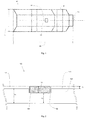
- a container according to the present invention may be formed from the laminar blank 100 shown in Figure 1 .
- the laminar blank 100 may be assembled and filled using standard apparatus.
- FIG 2 shows a detail of the blank 100 of Figure 1 .
- the blank 100 comprises a laminar substrate 102 having a thickness T1 of about 320 micrometres and a parallelepiped element 104 having a thickness T2 of about 200 micrometres.
- the element 104 is affixed to the laminar substrate 102.
- a first surface 106 of the laminar substrate comprises an affixing area 108 for at least partly receiving the element 104.
- the first surface 106 faces the inside of the container.
- the affixing area 108 comprises a debossed area having a residual thickness T3 of about 250 micrometres.
- the depth of the debossing is of about 70 micrometres.
- the element 104 is affixed to the laminar substrate 102 by means of a layer of adhesive 110 provided on the debossed area and projects above the first surface 106 by an incremental thickness T4 of about 130 micrometres.
- the element 104 is at a location along the longitudinal axis 200 of the laminar substrate 102, and a distance between the element 104 and a midpoint 206 of the longitudinal axis 200 of the laminar substrate is less than about 10 percent of the longitudinal end-to-end dimension 202 of the laminar substrate 102.
- the element 104 comprises a radio frequency element and is shaped symmetrical with respect to the longitudinal axis 200.
- the longitudinal dimension 202 of the laminar substrate is about 250 millimetres.
- the midpoint 206 of the longitudinal axis is at about 125 millimetres from either end of the laminar substrate.
- the distance between the element 104 and the midpoint 206 is about 12 millimetres (10 percent of the longitudinal dimension of the laminar substrate amounting to about 25 millimetres).
- the blank 100 comprises (see Figure 2 ) a further layer comprising a varnish 112 on a region of the first surface 106 of the laminar substrate 102 extending about the affixing area 108.
- a thickness of the further layer 112 is substantially as great as the incremental thickness T4.
- the further layer advantageously compensates for the entirety of the incremental thickness.
- the further layer 112 is removed from the laminar substrate 102 immediately prior to feeding the blank 100 to a packing machine for forming a container.
- Figure 3 shows a variant of a blank 300 for forming a container for consumer articles in accordance with the present invention.
- the blank 300 comprises a laminar substrate 302 and a parallelepiped element of discernible thickness 304, the element 304 being affixed to and received into an affixing area of a first surface of the blank 300.
- the blank 300 differs from the blank 100 of Figures 1 and 2 in that, instead of a further layer extending about the affixing area, it comprises a thickness compensating member in the form of a three-dimensional patch member 312 arranged on the inner surface of the laminar substrate at a location other than the affixing region.
Landscapes
- Engineering & Computer Science (AREA)
- Mechanical Engineering (AREA)
- Cartons (AREA)
- Packaging Of Annular Or Rod-Shaped Articles, Wearing Apparel, Cassettes, Or The Like (AREA)
- Details Of Rigid Or Semi-Rigid Containers (AREA)
- Piezo-Electric Or Mechanical Vibrators, Or Delay Or Filter Circuits (AREA)
Abstract
Description
- The present invention relates to a container for consumer goods formed by folding a laminar blank comprising an additional element having a discernible thickness affixed to a surface of the container. The expression "element having a discernible thickness" is used herein to refer to any three-dimensional element having a thickness from about 50 micrometres to about 500 micrometres. An example of one such element is a radio frequency identification (RFID) element. The container of the present invention finds particular application as a container for elongate consumer good items, such as smoking articles.
- Smoking articles are typically packaged in rigid hinge-lid containers comprising a box and a lid hinged to the box along a hinge line extending across a back wall of the container. The bundle of smoking articles housed in the box is commonly wrapped in an inner liner, or package, of metallised paper, metal foil or other flexible sheet material. Both hinge-lid container and inner package are formed from blanks. During transportation, as well as when they are supplied to packing machines, blanks are preferably stacked on top of each other and in a flat state.
- Such containers often comprise a reinforcing member, which may be provided as an inner frame arranged outside the inner package or as a stiffener arranged inside the inner package. This is to improve the resistance to compression of the package with a view to better protecting the smoking articles within the container during transportation. In addition, one such hinge lid container may comprise an inner frame extending at least partly beyond an upper edge of the front wall of the box to provide a flat surface which the lid front wall may lie against, when in the closed position. This is generally desirable because, when the lid is in the closed position, a container provided with one such arrangement will present to the consumer a substantially flat front surface. The reinforcing member typically comprises at least a reinforcing front wall lying against a front wall of the inner package. Most commonly, one such reinforcing member is provided as a collar further comprising side walls depending from the reinforcing front wall and folded about respective fold lines to lie against the side walls of the inner package. Thus, in use, one such reinforcing member embraces the bundle of smoking articles on three sides.
- Radio frequency elements are known for allowing large amounts of information to be accessed without the need for the information to be printed. Accordingly, it would be desirable to provide a container for consumer articles comprising a radio frequency element, especially such that the radio frequency element is not visible on the external surface of the container, since this space may be better spent on branding or other printed information. However, the provision of an element with a discernible thickness on a blank for forming a container of the type described above may impact the pliability of the blank. In turn, this may undesirably increase the complexity of the manufacturing process.
- Further, because the presence of an element with a discernible thickness will locally increase the thickness of the laminar blank from which the container is formed, stacking blanks on top of one another may become less easy if blanks comprise one such element. This may cause problems during the storage and transportation of the blanks, as well as when blanks are fed at high speed to a packing machine for forming the container.
- Thus, it would be desirable to provide a novel and improved container for consumer goods comprising an element having a discernible thickness. In particular, it would be desirable for such container to ensure that the consumer articles held within the container are effectively protected from potentially damaging compressive loads. Further, it would be desirable to provide a blank for forming one such container, such that a plurality of said blanks can easily be stacked, palletised, transported and fed to a packing machine to form the container. In addition, it would be desirable to provide one such container for consumer goods that can easily be manufactured without requiring major modifications to existing equipment.
- According to an aspect of the present invention, there is provided a container for consumer goods, the container being formed from a laminar blank having a blank thickness. The container further comprises a three dimensional element having a thickness from about 50 micrometres to about 500 micrometres. An inner surface of a first wall of the container comprises an affixing area for at least partly receiving the element, the affixing area comprising a debossed or ablated area having a residual thickness less than the blank thickness. The element is affixed to the container by means of adhesive provided on the debossed or ablated zone of the affixing area.
- According to another aspect of the present invention, there is provided a blank for forming a container for consumer goods, the blank comprising: a laminar substrate having a substrate thickness; and a three dimensional element having a thickness from about 50 micrometres to about 500 micrometres. A surface of the laminar substrate comprises an affixing area for at least partly receiving the element, the affixing area comprising a debossed or ablated area having a residual thickness less than the substrate thickness. The element is affixed to the laminar substrate by means of adhesive provided on the debossed or ablated zone of the affixing area.
- It will be appreciated that any features described with reference to one aspect of the present invention are equally applicable to any other aspect of the invention.
- As used herein, the terms "front", "back", "upper", "lower", "top", "bottom" and "side", refer to the relative positions of portions of containers according to the invention and components thereof when the container is in an upright position an access opening of the container at the top of the container. When describing containers according to the present invention, these terms are used irrespective of the orientation of the container being described. The back wall of the outer hinge-lid housing is the wall comprising the hinge line.
- When describing a container in accordance with the present invention, the term "longitudinal" refers to a direction from bottom to top or vice versa, whereas the term "transverse" refers to a direction perpendicular to the longitudinal direction.
- The term "width" is used to describe the dimension of an element, such as a radio frequency element or a panel of a blank or a wall of a container as measured in the transverse direction. The term "panel" is used throughout this specification to refer to a portion of the blank that is used to form a wall in the assembled container. A panel may depend along one or more fold lines from one or more other panels. The term "fold line" refers to a fold between two adjacent panels. When forming the container, adjacent panels are folded along their common fold line, which may come to define an edge of the container or of a portion thereof. In the assembled container a "wall" may be formed of one or of several overlying panels that are attached to each other, for example by means of an adhesive. Further, a wall may be formed from two or more abutting or overlapping panels. The term "height" is used to describe the dimension of one such element as measured in a direction perpendicular to the width of the element. When describing an element of the container, reference is generally made to the element in a flat state.
- The term "thickness" is used to describe the dimension of an element, such as a radio frequency element in a direction perpendicular to both the height and width of the element. With reference to a laminar blank from which a package or hinge-lid container may be formed, the term thickness identifies the distance between opposite inner and outer surfaces of the blank.
- The expression "element having a discernible thickness" is used herein to refer to any three-dimensional element having a thickness from about 50 micrometres to about 500 micrometres. An example of one such element is a radio frequency identification (RFID) element.
- It has been observed that affixing an element having a thickness less than about 50 micrometres to a blank for forming a container for consumer articles does not effectively cause issues relating to a reduced pliability of the blank, nor does it significantly impact the ease of stacking blanks or cause a compressive load to be applied on the consumer articles within the assembled container.
- In some embodiments, the discernible thickness of the element is preferably at least about 50 micrometres, more preferably at least about 100 micrometres, even more preferably at least about 150 micrometres. In addition, or as an alternative, the discernible thickness is preferably less than about 500 micrometre, more preferably less than about 400 micrometres, even more preferably less than about 300 micrometres.
- The term "inner surface" is used throughout the specification to refer to the surface of a component of the assembled container that is facing towards the interior of the container, for example towards the consumer goods, when the container is in the closed position. The term "outer surface" is used throughout the specification to refer to the surface of a component of the container that is facing towards the exterior of the container. For example, the front wall of the container has an inner surface that is facing the inside of the container and the consumer goods, and an outer surface facing away from the consumer goods. It should be noted that the inside or outside surface is not necessarily equivalent to a certain side of a blank used in assembly of the container. Depending on how the blank is folded around the consumer goods, areas that are on the same side of the blank can either face towards the inside or the towards the outside of the container.
- In a blank for forming a container in accordance with the present invention, the term "longitudinal axis" is used to identify an axis of the blank extending across the blank in a flat state in a direction substantially parallel to the longitudinal direction in the assembled container. Thus, for example, the longitudinal axis of the blank extends across the blank front panel in a direction parallel to the longitudinal direction taken with reference to the corresponding container front wall. The term "transverse axis", on the other hand, is used to identify an axis of the blank extending across the blank in a flat state in a direction perpendicular to the longitudinal axis.
- One such blank has a "longitudinal dimension" corresponding to the maximum distance between opposite ends of the blank as measured along the longitudinal axis. Further, one such panel has a "transverse dimension" corresponding to the maximum distance between opposite ends of the blank as measured along a direction perpendicular to the longitudinal axis.
- In a rectangle, the longitudinal dimension and the transverse direction will generally correspond to height and width of the rectangle. However, a blank for forming a substantially parallelepiped container for consumer articles will typically have a roughly quadrilateral shape, but may generally not display quite the exact symmetry of a regular rectangle. Accordingly, the terms "longitudinal dimension" and "transverse dimension" are used herein to identify the dimensions of a blank, particularly a substantially quadrilateral blank, which would correspond to height and width of the blank, if the blank were exactly rectangular. The term "midpoint of the longitudinal axis" is used herein to identify the middle point of the longitudinal axis of a blank for forming a container in accordance with the invention, that is, a point that is equidistant from both endpoints of the longitudinal axis. The endpoints of the longitudinal axis of one such blank are on opposite edges of the blank separated by a distance corresponding to the longitudinal dimension of the blank. The midpoint of the longitudinal axis bisects the longitudinal axis, and so the distance between the midpoint and either endpoint of the longitudinal axis is substantially half the longitudinal dimension of the blank. The term "affixing area" is used herein to refer to the minimum area of the blank that encloses the ablated or debossed zones.
- The term "ablated zone" is used herein to refer to an area from which material has been ablated (e.g. removed by means of a laser beam or a blade) from a surface of the laminar blank or container. The term "debossed zone" is used here in to refer to an area wherein the material of the laminar blank or container has been compressed. Accordingly, the residual thickness of an ablated or debossed zone is less than the thickness of the laminar blank. For example, an ablated zone may be formed with a linear ablation tool, such as a laser or a blade.
- The term "hinge line" refers to a line about which the lid may be pivoted in order to open the hinge-lid housing. A hinge line may be, for example, a fold line or a score line in the panel forming the back wall of the container.
- A container in accordance with the present invention is formed from a laminar blank having a blank thickness. Further, the container comprises a three-dimensional element having a thickness in the range from about 50 micrometres to about 500 micrometres. This encompasses elements having a thickness substantially of the same order of magnitude of the thickness of blanks typically used for manufacturing containers for consumer articles. In contrast to existing containers, according to the present invention an inner surface of a first wall of the container comprises an affixing area for at least partly receiving the element. In more detail, the affixing area comprises a debossed or ablated area with a residual thickness less than the blank thickness, and the element is affixed to the container by means of adhesive provided on the debossed or ablated zone of the affixing area.
- Thus, in containers in accordance with the present invention it is advantageously possible, by locally reducing the thickness of the blank, to at least partly offset or compensate the increase in thickness which would, otherwise, be caused by the provision of the element of discernible thickness on a surface of the blank. Accordingly, instead of having a local overall thickness essentially equal to the sum of the thicknesses of the element and the thickness of the blank, the local overall thickness will be given by the sum of the residual thickness of the debossed or ablated area and the thickness of the element.
- Therefore, the thickness of the blank for forming a container comprising the element of discernible thickness is made - on the average - more even, compared to existing blanks. As a consequence, it is easier to stack a plurality of blanks on top of one another in a stable fashion, such that many blanks can be palletised and transported at once. In addition, because the stacks of blanks for forming containers in accordance with the invention are more orderly and stable, it is also easier to feed the blanks to the packing machine.
- As will be explained in more detail below, in embodiments comprising a reinforcing member, it is also advantageously possible to ensure that the element of discernible thickness does not interfere with the reinforcing member and, at the same time, that reinforcing member and additional element of discernible thickness do not exert a combined, increased pressure over the consumer goods within the container.
- Further, in containers according to the present invention it is advantageously possible to include an additional element having a discernible thickness such that the additional element is not visible from the outside during normal use of the container. Thus, at the same time, space on the external surface of the container may advantageously be used for branding or other printed information.
- Finally, containers and blanks in accordance with the present invention are easy to manufacture and do not require any extensive modification of the existing apparatus.
- The element affixed to the blank may be any three-dimensional element having a discernible thickness, that is a thickness of an order of magnitude comparable with the thickness of the blank to which the element is attached. In preferred embodiments, the element is a radio frequency (identification) element, also commonly referred to as RFID tag. An RFID tag or other radio frequency element can store information relating to the product (for example, information relating to the identity and authenticity of the product). Typically, one such tag comprises an integrated circuit connected to an antenna or inductive coil. An RFID reader is used to interrogate the tag by transmitting a radio frequency signal which is received at the antenna or coil. In response to such signal, the RFID returns to the RFID reader a signal containing the information stored in the tag.
- In some embodiments, a difference between the blank thickness and the residual thickness is less than the element thickness, such that the element projects beyond the inner surface of the container by an incremental thickness less than the element thickness. Thus, the ablation or debossing only partly offsets the locally increased thickness caused by the presence of the additional element. This may be advantageous when the laminar blank from which the container is formed has a low base weight, in that it ensures a sufficient residual thickness for the blanks and container to have the necessary mechanical properties to protect the consumer goods.
- Preferably, in such embodiments, the container comprises a thickness compensating means on a region of the inner surface of the container.
- In some embodiments, the thickness compensating means comprises a coating layer applied at least on a region of the inner surface of the first wall of the container extending about the affixing area, that is, around the element of discernible thickness. This advantageously provides a further compensation of the locally increased thickness. This further contributes to even out the thickness non-homogeneity of the blank of the container.
- One such coating layer may comprise a varnish or an ultra-violet (UV) coating composition. One such composition may comprise one or more of several compounds known to the skilled reader for coating paper and cardboard, such as, for example, polyethylene, calcium carbonate and kaolinite. These compounds may be refined and mixed with viscosifiers to help them adhere to paper and cardboard. UV coatings can impart the paper or cardboard a gloss or matte finish.
- In some embodiments, the coating layer may extend only to a finite portion of the inner surface of the first wall of the container extending about the affixing area. As an alternative, the coating layer may extend substantially to the whole inner surface of the first wall of the container extending about the affixing area.
- In other embodiments, the coating layer may extend beyond the periphery of the first wall of the container, and even to the whole surface of the blank defining, in the assembled container, the inner surface of the container. This advantageously simplifies the manufacturing process, in that the coating layer may for example be applied substantially homogeneously over the whole blank surface prior to the debossing or ablating process.
- Preferably, the coating layer has a thickness of at least about 70 percent of the incremental thickness. Thus, the coating layer compensates only in part the incremental thickness. However, one such degree of compensation has been found to be sufficient to make it easy to form a stable stack of blanks. More preferably, the coating layer has a thickness of at least about 80 percent of the incremental thickness. Even more preferably, the coating layer has a thickness of at least about 90 percent of the incremental thickness.
- In some preferred embodiments, the coating layer has a thickness substantially equal to the incremental thickness. This is advantageous in that it substantially offsets the locally increased thickness in its entirety.
- Preferably, the coating layer is removable. This is advantageous in that the need to compensate for the uneven surface of a blank comprising an additional element having a discernible thickness is felt especially when a plurality of blanks need to be stacked on one another during storage and transportation. However, when feeding the blank comprising the additional element to a packing machine it may instead be preferable to restore the laminar substrate of the blank to its original thickness. This may be both for reasons to do with manufacturing requirements, for example set by the packing machine, as well as for ensuring that the assembled container has a certain visual impact, or to reduce the overall weight of the container. In addition, the further layer may advantageously protect the surface of the laminar substrate during storage and transportation of the blanks.
- As an alternative to the coating layer, in those embodiments where a difference between the blank thickness and the residual thickness is less than the element thickness, the thickness compensating means may comprise a three-dimensional patch member.
- One such patch member is arranged on the inner surface of the container at a location other than the affixing region. Preferably, the patch member is arranged on the inner surface of a wall of the container other than the first wall. Even more preferably, the patch member is arranged on the inner surface of the wall of the container opposite the first wall. For example, where the element is affixed on the back wall, the patch member is affixed on the front wall.
- By providing one such patch member on the same surface of the blank defining, in the assembled container, the inner surface of a wall, at least a partial reduction of the thickness non-homogeneity of the blank or container is achieved. For example, where the element is affixed on the inner surface of the back wall of the container, the compensating patch member is affixed on the inner surface of the front wall of the container. Thus, an arrangement with a certain degree of symmetry is advantageously achieved, such that a centre of gravity of the unfolded blank is arranged substantially along a longitudinal axis of the blank, at a location between the element and the patch member.
- Preferably, a width of the patch member is less than a width of the blank. In addition, or as an alternative, a height of the patch is preferably less than a height of the blank panel on which the patch member is arranged. In preferred embodiments, the patch member has a shape and size comparable to the shape and size of the element of discernible thickness.
- Preferably, the patch member has a thickness of at least about 70 percent of the incremental thickness. Thus, the patch member compensates only in part the incremental thickness. However, one such degree of compensation has been found to be sufficient to make it easy to form a stable stack of blanks. More preferably, the patch member has a thickness of at least about 80 percent of the incremental thickness. Even more preferably, the patch member has a thickness of at least about 90 percent of the incremental thickness. In some particularly preferred embodiments, the patch member has a thickness substantially equal to the incremental thickness. This is advantageous in that the element and the patch member, in combination, define a raised surface upon which another blank can advantageously lie in a substantially flat state.
- Preferably, where the element is affixed on the first wall of the container, the patch member is arranged on the inner surface of another wall of the container, more preferably on a wall opposite the first wall. For example, where the element is affixed on the inner surface of the back wall of the container, the patch member is affixed on the inner surface of the front wall of the container. Thus, an arrangement with a certain degree of symmetry is advantageously achieved, wherein a centre of gravity of the blank is arranged substantially along a longitudinal axis of the blank, at a location between the element and the patch member. Thus, several blanks can still be quite easily stacked on top of each other, which is advantageous for storage, transportation, and for feeding the blanks to a packing machine.
- Preferably, the patch member is removable. For example, the patch layer may be provided as a removable sticker. The term "removable" is used herein to describe a sticker attached to a surface by means of a generally low tack adhesive capable of forming a connection between two substrates - for example, between the patch member and the surface of the blank from which the container is formed - such that the two substrates can be separated from each other without causing any damage to either substrate.
- In other embodiments, a difference between the blank thickness and the residual thickness is substantially equal to the element thickness. Thus, the debossing process or the ablation process is used to fully compensate for the thickness of the additional element of discernible thickness, such that this does not project over the surface of the laminate substrate of the blank. Accordingly, there is no need for any thickness compensating means at other locations on the first surface of the blank which defines, in the assembled container, the inner surface of the container. This may be advantageous when the thickness and basis weight of the blank are sufficient to ensure that, after the debossing or ablation of material at the affixing area, the blank still has the desired strength.
- Preferably, the additional element is arranged at a central location on the inner surface of the back wall of the container. Even more preferably, the additional element is arranged at a location along a longitudinal axis of the back wall of the container. This is advantageous because, in blanks for forming a typical container for elongate consumer goods, such as smoking articles, this corresponds to the element being arranged at a substantially central location on the blank in its flat state. Accordingly, by having the element at a location that roughly corresponds to a centre of gravity of the laminar substrate of the blank, it is possibly to maximise the stability of a stack of blanks and to facilitate the handling and transportation of the blank itself. In addition, in containers where the additional element is arranged at a central location on the inner surface of the back wall of the container, at least when the consumer opens the container for the first time the additional element will be effectively hidden from the consumer's sight.
- In preferred embodiments, the container further comprises a reinforcing member comprising at least a front wall lying against an inner surface of the front wall of the container. In such embodiments, the element is preferably arranged in the affixing area on the container at a distance from a bottom edge of the front wall of the reinforcing member.
- More preferably, a distance from a top edge of the element and the bottom edge of the reinforcing member is at least about 1 millimetre, even more preferably at least about 5 millimetres.
- A container in accordance with the present invention may be formed by folding a blank for forming a container for consumer goods, the blank comprising a laminar substrate having a substrate thickness and a three dimensional element having a thickness of substantially the same order of magnitude of the substrate thickness, the element being affixed to the laminar substrate. A first surface of the laminar substrate comprises an affixing area for at least partly receiving the element, the affixing area comprising a debossed or ablated area having a residual thickness less than the substrate thickness. In addition, the element is affixed to the laminar substrate by means of adhesive provided on the debossed or ablated zone of the affixing area.
- When the container is assembled from the blank, the first surface of the blank to which the element is affixed faces the inside of the container. In other words, the additional element of discernible thickness is affixed on a side of a blank panel for forming a wall of the container, such that, in the assembled container, the additional element is affixed on the inner surface of said wall of the container.
- In some embodiments, a difference between the substrate thickness and the residual thickness is less than the element thickness, such that the element projects beyond the inner surface of the laminar substrate by an incremental thickness less than the element thickness. Preferably, the blank comprises a thickness compensating means on a region of the first surface of the laminar substrate. This may be in the form of a coating layer extending over at least a region of the first surface about the affixing area. In some embodiments, the coating layer may extend substantially over the whole of the first surface about the affixing area. As an alternative, the thickness compensating means may be in the form of a patch member affixed to the first surface of the laminar substrate at a location other than the affixing area.
- More preferably, such thickness compensating means is removable. Thus, the thickness compensating means may be used to at least partly compensate the incremental thickness when blanks are stacked on top of one another for storage and transportation purposes, while the thickness compensating means can be removed when the blank is supplied to a packing machine for forming a container.
- In other embodiments of the blank, a difference between the substrate thickness and the residual thickness is substantially equal to the element thickness. Thus, no further thickness compensating means is required.
- Preferably, the element is arranged at a location along a longitudinal axis of the blank in its flat state, and a distance between the element and a midpoint of the longitudinal axis of the blank is less than about 20 percent of a longitudinal dimension of the blank. More preferably, the element is at a location along a longitudinal axis of the laminar blank, and a distance between the element and a midpoint of the longitudinal axis of the laminar blank is less than about 15 percent of the longitudinal dimension of the blank, even more preferably less than about 10 percent of the longitudinal dimension of the blank.
- For example, in an embodiment the longitudinal dimension of the laminar blank is about 200 millimetres, the midpoint of the longitudinal axis is at about 100 millimetres from either end of the laminar blank, and the element of discernible thickness is located on the longitudinal axis at a distance of about 40 millimetres or less from the midpoint. More preferably, the element of discernible thickness is located on the longitudinal axis at a distance of about 30 millimetres or less from the midpoint. Even more preferably, the element of discernible thickness is located on the longitudinal axis at a distance of 20 millimetres or less from the midpoint.
- In another embodiment, where the longitudinal dimension of the laminar substrate is about 250 millimetres, the midpoint of the longitudinal axis is at about 125 millimetres from either end of the laminar blank, and the element of discernible thickness is located on the longitudinal axis at a distance of about 50 millimetres or less from the midpoint. More preferably, the element of discernible thickness is located on the longitudinal axis at a distance of about 37.5 millimetres or less from the midpoint. Even more preferably, the element of discernible thickness is located on the longitudinal axis at a distance of 25 millimetres or less from the midpoint.
- This is advantageous, in that the location of the centre of gravity of the blank will thus substantially correspond to the location of the centre of gravity of the laminar substrate. A stack of these blanks may, accordingly, be particularly stable and easy to store and transport.
- A container for consumer goods in accordance with the present invention may be manufactured by a method comprising the steps of: providing a laminar substrate having a substrate thickness; forming a debossed or ablated area on a first surface of the laminar substrate to define an affixing area, the debossed or ablated area having a residual thickness less than the substrate thickness; affixing three dimensional element having a thickness of substantially the same order of magnitude of the substrate thickness on the first surface of the laminar substrate by means of adhesive provided on the debossed or ablated zone, so as to provide a blank for forming a container; and forming a container from the blank, such that the first surface of the laminar substrate defines an inner surface of the container.
- Preferably, the bundle of consumer goods is wrapped in a package of metal foil or metallised paper. The package material may be formed as a laminate of a metallised polyethylene film, and a liner material. The package material may also be a supercalendered glassine paper. In addition, the package material may be provided with a print-receptive top coating.
- One such package may be received within a hinge lid container comprising a box and a lid hinged to the box along a hinge line extending across a back wall of the hinge lid container. The hinge lid container may be formed from a blank of any suitable material or combination of materials, including, but not limited to, cardboard, paperboard, plastic, metal, or combinations thereof. Preferably, the blank is a laminar cardboard blank having a weight of between about 100 grams per square metre and about 350 grams per square metre. The hinge-lid container may optionally comprise an outer wrapper, which is preferably a transparent polymeric film of, for example, high or low density polyethylene, polypropylene, oriented polypropylene, polyvinylidene chloride, cellulose film, or combinations thereof and the outer wrapper is applied in a conventional manner. The outer wrapper may include a tear tape. In addition, the outer wrapper may be printed with images, consumer information or other data.
- The package, as well as the outer hinge lid container, is preferably a rectangular parallelepiped comprising two wider walls spaced apart by two narrower walls.
- Containers according to the invention find particular application as containers for elongate smoking articles such as, for example, cigarettes, cigars or cigarillos. It will be appreciated that through appropriate choices of the dimensions thereof, containers according to the invention may be designed for different numbers of conventional size, king size, super-king size, slim or super-slim cigarettes. Alternatively, other consumer goods may be housed inside the container.
- Through an appropriate choice of the dimensions, containers according to the invention may be designed to hold different total numbers of smoking articles, or different arrangements of smoking articles. For example, through an appropriate choice of the dimensions, containers according to the invention may be designed to hold a total of between ten and thirty smoking articles. The smoking articles may be arranged in different collations, depending on the total number of smoking articles.
- The invention will now be further described, by way of example only, with reference to the accompanying drawings in which:
-
Figure 1 is a schematic top view of a blank for forming a container in accordance with the present invention; -
Figure 2 is a schematic side sectional view of a detail of the blank ofFigure 1 ; and -
Figure 3 is a schematic top view of a variant of a blank for forming a container in accordance with the present invention. - A container according to the present invention may be formed from the laminar blank 100 shown in
Figure 1 . The laminar blank 100 may be assembled and filled using standard apparatus. -
Figure 2 shows a detail of the blank 100 ofFigure 1 . The blank 100 comprises alaminar substrate 102 having a thickness T1 of about 320 micrometres and aparallelepiped element 104 having a thickness T2 of about 200 micrometres. Theelement 104 is affixed to thelaminar substrate 102. Afirst surface 106 of the laminar substrate comprises an affixingarea 108 for at least partly receiving theelement 104. When a container is formed from the laminar blank 100, thefirst surface 106 faces the inside of the container. - The affixing
area 108 comprises a debossed area having a residual thickness T3 of about 250 micrometres. The depth of the debossing is of about 70 micrometres. Theelement 104 is affixed to thelaminar substrate 102 by means of a layer of adhesive 110 provided on the debossed area and projects above thefirst surface 106 by an incremental thickness T4 of about 130 micrometres. - In more detail, the
element 104 is at a location along thelongitudinal axis 200 of thelaminar substrate 102, and a distance between theelement 104 and amidpoint 206 of thelongitudinal axis 200 of the laminar substrate is less than about 10 percent of the longitudinal end-to-end dimension 202 of thelaminar substrate 102. In more detail, theelement 104 comprises a radio frequency element and is shaped symmetrical with respect to thelongitudinal axis 200. - The
longitudinal dimension 202 of the laminar substrate is about 250 millimetres. Themidpoint 206 of the longitudinal axis is at about 125 millimetres from either end of the laminar substrate. The distance between theelement 104 and themidpoint 206 is about 12 millimetres (10 percent of the longitudinal dimension of the laminar substrate amounting to about 25 millimetres). - The blank 100 comprises (see
Figure 2 ) a further layer comprising avarnish 112 on a region of thefirst surface 106 of thelaminar substrate 102 extending about the affixingarea 108. In the embodiment illustrated inFigure 2 , a thickness of thefurther layer 112 is substantially as great as the incremental thickness T4. Thus, the further layer advantageously compensates for the entirety of the incremental thickness. Thefurther layer 112 is removed from thelaminar substrate 102 immediately prior to feeding the blank 100 to a packing machine for forming a container. -
Figure 3 shows a variant of a blank 300 for forming a container for consumer articles in accordance with the present invention. The blank 300 comprises alaminar substrate 302 and a parallelepiped element ofdiscernible thickness 304, theelement 304 being affixed to and received into an affixing area of a first surface of the blank 300. - The blank 300 differs from the blank 100 of
Figures 1 and 2 in that, instead of a further layer extending about the affixing area, it comprises a thickness compensating member in the form of a three-dimensional patch member 312 arranged on the inner surface of the laminar substrate at a location other than the affixing region.
Claims (15)
- A container for consumer goods, the container being formed from a laminar blank having a blank thickness; and
a three dimensional element having a thickness from about 50 micrometres to about 500 micrometres;
wherein an inner surface of a first wall of the container comprises an affixing area for at least partly receiving the element, the affixing area comprising a debossed or ablated area having a residual thickness less than the blank thickness; and
wherein the element is affixed to the container by means of adhesive provided on the debossed or ablated zone of the affixing area. - A container according to claim 1, wherein a difference between the blank thickness and the residual thickness is less than the element thickness, such that the element projects beyond the inner surface of the container by an incremental thickness less than the element thickness.
- A container according to claim 2, the container comprising a thickness compensating means on a region of the inner surface of the container.
- A container according to claim 3, wherein the thickness compensating means comprises a coating layer applied at least on a region of the inner surface of the first wall of the container extending about the affixing area.
- A container according to claim 3, wherein the thickness compensating means comprises a three-dimensional patch member arranged on the inner surface of the container at a location other than the affixing region.
- A container according to any one of claims 3 to 5, wherein the thickness compensating means has a thickness of at least about 70 percent of the incremental thickness.
- A container according to any one of claims 3 to 5, wherein the thickness compensating means has a thickness substantially equal to the incremental thickness.
- A container according to any one of claims 5 to 7, wherein the three-dimensional patch member is arranged on the inner surface of a wall of the container opposite the first wall.
- A container according to any one of claims 3 to 8, wherein the thickness compensating means is removable.
- A container according to claim 1, wherein a difference between the blank thickness and the residual thickness is substantially equal to the element thickness.
- A container according to any one of the preceding claims, further comprising a reinforcing member comprising at least a front wall lying against an inner surface of the front wall of the container, wherein the element is arranged in the affixing area on the container at a distance from a bottom edge of the front wall of the reinforcing member.
- A blank for forming a container for consumer goods, the blank comprising a laminar substrate having a substrate thickness and a three dimensional element having a thickness thickness from about 50 micrometres to about 500 micrometres, the element being affixed to the laminar substrate;
wherein a first surface of the laminar substrate comprises an affixing area for at least partly receiving the element, the affixing area comprising a debossed or ablated area having a residual thickness less than the substrate thickness; and
wherein the element is affixed to the laminar substrate by means of adhesive provided on the debossed or ablated zone of the affixing area. - A blank according to claim 12, wherein a difference between the substrate thickness and the residual thickness is less than the element thickness, such that the element projects beyond the inner surface of the laminar substrate by an incremental thickness less than the element thickness.
- A blank according to claim 13, the blank further comprising a thickness compensating means on a region of the first surface of the laminar substrate.
- A blank according to any one of claims 12 to 14, wherein the element is arranged at a location along a longitudinal axis of the blank in its flat state, and a distance between the element and a midpoint of the longitudinal axis of the blank is less than about 20 percent of a longitudinal dimension of the blank.
Priority Applications (10)
| Application Number | Priority Date | Filing Date | Title |
|---|---|---|---|
| ES16181558T ES2748913T3 (en) | 2016-07-27 | 2016-07-27 | Improved consumer goods container comprising an element of discernible thickness |
| EP16181558.4A EP3275794B1 (en) | 2016-07-27 | 2016-07-27 | Improved container of consumer articles comprising an element of discernible thickness |
| PL16181558T PL3275794T3 (en) | 2016-07-27 | 2016-07-27 | Improved container of consumer articles comprising an element of discernible thickness |
| PCT/EP2017/068655 WO2018019773A1 (en) | 2016-07-27 | 2017-07-24 | Improved container of consumer articles comprising an element of discernible thickness |
| IL254621A IL254621A (en) | 2016-07-27 | 2017-09-24 | Modified container of consumer articles comprising an element of discernible thickness |
| PCT/IB2017/055915 WO2018020487A2 (en) | 2016-07-27 | 2017-09-27 | Improved container of consumer articles comprising an element of discernible thickness |
| US16/319,693 US20210284432A1 (en) | 2016-07-27 | 2017-09-27 | Improved container of consumer articles comprising an element of discernible thickness |
| SG11201810351UA SG11201810351UA (en) | 2016-07-27 | 2017-09-27 | Improved container of consumer articles comprising an element of discernible thickness and blank therefor |
| RU2019105276A RU2019105276A (en) | 2016-07-27 | 2017-09-27 | IMPROVED CONSUMER PACKAGING CONTAINING AN ELEMENT OF EXISTING THICKNESS |
| JP2019503467A JP2019521923A (en) | 2016-07-27 | 2017-09-27 | Improved container for consumer goods with an element of distinguishable thickness |
Applications Claiming Priority (1)
| Application Number | Priority Date | Filing Date | Title |
|---|---|---|---|
| EP16181558.4A EP3275794B1 (en) | 2016-07-27 | 2016-07-27 | Improved container of consumer articles comprising an element of discernible thickness |
Publications (2)
| Publication Number | Publication Date |
|---|---|
| EP3275794A1 true EP3275794A1 (en) | 2018-01-31 |
| EP3275794B1 EP3275794B1 (en) | 2019-09-04 |
Family
ID=56567426
Family Applications (1)
| Application Number | Title | Priority Date | Filing Date |
|---|---|---|---|
| EP16181558.4A Active EP3275794B1 (en) | 2016-07-27 | 2016-07-27 | Improved container of consumer articles comprising an element of discernible thickness |
Country Status (9)
| Country | Link |
|---|---|
| US (1) | US20210284432A1 (en) |
| EP (1) | EP3275794B1 (en) |
| JP (1) | JP2019521923A (en) |
| ES (1) | ES2748913T3 (en) |
| IL (1) | IL254621A (en) |
| PL (1) | PL3275794T3 (en) |
| RU (1) | RU2019105276A (en) |
| SG (1) | SG11201810351UA (en) |
| WO (2) | WO2018019773A1 (en) |
Families Citing this family (1)
| Publication number | Priority date | Publication date | Assignee | Title |
|---|---|---|---|---|
| WO2019029816A1 (en) * | 2017-08-10 | 2019-02-14 | Philip Morris Products S.A. | Improved container of consumer articles comprising an element of discernible thickness |
Citations (4)
| Publication number | Priority date | Publication date | Assignee | Title |
|---|---|---|---|---|
| EP0615285A2 (en) * | 1993-03-11 | 1994-09-14 | Btg International Limited | Attaching an electronic circuit to a substrate |
| EP1422168A1 (en) * | 2002-11-25 | 2004-05-26 | G.D Societ Per Azioni | Package of tabocco articles featuring a shoplifting marker |
| CN201249952Y (en) * | 2008-07-07 | 2009-06-03 | 刘彩凤 | Cigarette box with passive RFID intelligent electronic label |
| DE102013112279A1 (en) * | 2012-11-09 | 2014-05-15 | Maxim Integrated Products, Inc. | Embedded Radio Frequency Identification Housing (RFID Enclosure) |
-
2016
- 2016-07-27 PL PL16181558T patent/PL3275794T3/en unknown
- 2016-07-27 EP EP16181558.4A patent/EP3275794B1/en active Active
- 2016-07-27 ES ES16181558T patent/ES2748913T3/en active Active
-
2017
- 2017-07-24 WO PCT/EP2017/068655 patent/WO2018019773A1/en not_active Ceased
- 2017-09-24 IL IL254621A patent/IL254621A/en unknown
- 2017-09-27 JP JP2019503467A patent/JP2019521923A/en active Pending
- 2017-09-27 SG SG11201810351UA patent/SG11201810351UA/en unknown
- 2017-09-27 RU RU2019105276A patent/RU2019105276A/en not_active Application Discontinuation
- 2017-09-27 US US16/319,693 patent/US20210284432A1/en not_active Abandoned
- 2017-09-27 WO PCT/IB2017/055915 patent/WO2018020487A2/en not_active Ceased
Patent Citations (4)
| Publication number | Priority date | Publication date | Assignee | Title |
|---|---|---|---|---|
| EP0615285A2 (en) * | 1993-03-11 | 1994-09-14 | Btg International Limited | Attaching an electronic circuit to a substrate |
| EP1422168A1 (en) * | 2002-11-25 | 2004-05-26 | G.D Societ Per Azioni | Package of tabocco articles featuring a shoplifting marker |
| CN201249952Y (en) * | 2008-07-07 | 2009-06-03 | 刘彩凤 | Cigarette box with passive RFID intelligent electronic label |
| DE102013112279A1 (en) * | 2012-11-09 | 2014-05-15 | Maxim Integrated Products, Inc. | Embedded Radio Frequency Identification Housing (RFID Enclosure) |
Also Published As
| Publication number | Publication date |
|---|---|
| IL254621A (en) | 2018-04-30 |
| JP2019521923A (en) | 2019-08-08 |
| US20210284432A1 (en) | 2021-09-16 |
| RU2019105276A (en) | 2020-08-27 |
| PL3275794T3 (en) | 2020-04-30 |
| ES2748913T3 (en) | 2020-03-18 |
| EP3275794B1 (en) | 2019-09-04 |
| WO2018020487A3 (en) | 2018-03-08 |
| WO2018020487A2 (en) | 2018-02-01 |
| SG11201810351UA (en) | 2018-12-28 |
| WO2018020487A8 (en) | 2018-04-19 |
| WO2018019773A1 (en) | 2018-02-01 |
Similar Documents
| Publication | Publication Date | Title |
|---|---|---|
| US20190270578A1 (en) | Improved inner liner for container for consumer articles | |
| RU2711862C2 (en) | High-end workpiece for formation of container with rounded or chamfered edges | |
| KR102520340B1 (en) | Package including access opening with closure flap | |
| US10919689B2 (en) | Modified container of consumer articles comprising an element of discernible thickness | |
| US20170349364A1 (en) | Improved blank for forming a container with non-square edges | |
| EP3275794B1 (en) | Improved container of consumer articles comprising an element of discernible thickness | |
| EA010810B1 (en) | Hinge-lid container with additional spacer panel | |
| WO2019029816A1 (en) | Improved container of consumer articles comprising an element of discernible thickness | |
| US20210130080A1 (en) | Box-in-box package | |
| JP2018118745A (en) | Carton with inner pocket | |
| GB2483456A (en) | Packaging system for stacks of carton blanks | |
| EP3261956B1 (en) | Container for consumer goods having a uniform lid surface | |
| EP3909882B1 (en) | Inner frame for a cigarette pack | |
| RU80434U1 (en) | TEA PACKAGING (OPTIONS) | |
| JP3199046U (en) | Delivery container | |
| US20140353204A1 (en) | Shipping Container For Paper Reams | |
| IE20100553U1 (en) | A packaging system | |
| JP2006160279A (en) | Packaging box with radio tag | |
| IE20100554A1 (en) | A packaging system | |
| IES85713Y1 (en) | A packaging system | |
| IES20100553A2 (en) | A packaging system |
Legal Events
| Date | Code | Title | Description |
|---|---|---|---|
| PUAI | Public reference made under article 153(3) epc to a published international application that has entered the european phase |
Free format text: ORIGINAL CODE: 0009012 |
|
| STAA | Information on the status of an ep patent application or granted ep patent |
Free format text: STATUS: THE APPLICATION HAS BEEN PUBLISHED |
|
| AK | Designated contracting states |
Kind code of ref document: A1 Designated state(s): AL AT BE BG CH CY CZ DE DK EE ES FI FR GB GR HR HU IE IS IT LI LT LU LV MC MK MT NL NO PL PT RO RS SE SI SK SM TR |
|
| AX | Request for extension of the european patent |
Extension state: BA ME |
|
| STAA | Information on the status of an ep patent application or granted ep patent |
Free format text: STATUS: REQUEST FOR EXAMINATION WAS MADE |
|
| 17P | Request for examination filed |
Effective date: 20180719 |
|
| RBV | Designated contracting states (corrected) |
Designated state(s): AL AT BE BG CH CY CZ DE DK EE ES FI FR GB GR HR HU IE IS IT LI LT LU LV MC MK MT NL NO PL PT RO RS SE SI SK SM TR |
|
| GRAP | Despatch of communication of intention to grant a patent |
Free format text: ORIGINAL CODE: EPIDOSNIGR1 |
|
| STAA | Information on the status of an ep patent application or granted ep patent |
Free format text: STATUS: GRANT OF PATENT IS INTENDED |
|
| INTG | Intention to grant announced |
Effective date: 20190307 |
|
| GRAS | Grant fee paid |
Free format text: ORIGINAL CODE: EPIDOSNIGR3 |
|
| GRAA | (expected) grant |
Free format text: ORIGINAL CODE: 0009210 |
|
| STAA | Information on the status of an ep patent application or granted ep patent |
Free format text: STATUS: THE PATENT HAS BEEN GRANTED |
|
| AK | Designated contracting states |
Kind code of ref document: B1 Designated state(s): AL AT BE BG CH CY CZ DE DK EE ES FI FR GB GR HR HU IE IS IT LI LT LU LV MC MK MT NL NO PL PT RO RS SE SI SK SM TR |
|
| REG | Reference to a national code |
Ref country code: GB Ref legal event code: FG4D |
|
| REG | Reference to a national code |
Ref country code: CH Ref legal event code: EP |
|
| REG | Reference to a national code |
Ref country code: AT Ref legal event code: REF Ref document number: 1175014 Country of ref document: AT Kind code of ref document: T Effective date: 20190915 |
|
| REG | Reference to a national code |
Ref country code: DE Ref legal event code: R096 Ref document number: 602016019778 Country of ref document: DE |
|
| REG | Reference to a national code |
Ref country code: IE Ref legal event code: FG4D |
|
| REG | Reference to a national code |
Ref country code: RO Ref legal event code: EPE |
|
| REG | Reference to a national code |
Ref country code: NL Ref legal event code: FP |
|
| REG | Reference to a national code |
Ref country code: CH Ref legal event code: NV Representative=s name: VENI GMBH, CH |
|
| REG | Reference to a national code |
Ref country code: LT Ref legal event code: MG4D |
|
| PG25 | Lapsed in a contracting state [announced via postgrant information from national office to epo] |
Ref country code: LT Free format text: LAPSE BECAUSE OF FAILURE TO SUBMIT A TRANSLATION OF THE DESCRIPTION OR TO PAY THE FEE WITHIN THE PRESCRIBED TIME-LIMIT Effective date: 20190904 Ref country code: HR Free format text: LAPSE BECAUSE OF FAILURE TO SUBMIT A TRANSLATION OF THE DESCRIPTION OR TO PAY THE FEE WITHIN THE PRESCRIBED TIME-LIMIT Effective date: 20190904 Ref country code: FI Free format text: LAPSE BECAUSE OF FAILURE TO SUBMIT A TRANSLATION OF THE DESCRIPTION OR TO PAY THE FEE WITHIN THE PRESCRIBED TIME-LIMIT Effective date: 20190904 Ref country code: SE Free format text: LAPSE BECAUSE OF FAILURE TO SUBMIT A TRANSLATION OF THE DESCRIPTION OR TO PAY THE FEE WITHIN THE PRESCRIBED TIME-LIMIT Effective date: 20190904 Ref country code: NO Free format text: LAPSE BECAUSE OF FAILURE TO SUBMIT A TRANSLATION OF THE DESCRIPTION OR TO PAY THE FEE WITHIN THE PRESCRIBED TIME-LIMIT Effective date: 20191204 Ref country code: BG Free format text: LAPSE BECAUSE OF FAILURE TO SUBMIT A TRANSLATION OF THE DESCRIPTION OR TO PAY THE FEE WITHIN THE PRESCRIBED TIME-LIMIT Effective date: 20191204 |
|
| PG25 | Lapsed in a contracting state [announced via postgrant information from national office to epo] |
Ref country code: RS Free format text: LAPSE BECAUSE OF FAILURE TO SUBMIT A TRANSLATION OF THE DESCRIPTION OR TO PAY THE FEE WITHIN THE PRESCRIBED TIME-LIMIT Effective date: 20190904 Ref country code: LV Free format text: LAPSE BECAUSE OF FAILURE TO SUBMIT A TRANSLATION OF THE DESCRIPTION OR TO PAY THE FEE WITHIN THE PRESCRIBED TIME-LIMIT Effective date: 20190904 Ref country code: AL Free format text: LAPSE BECAUSE OF FAILURE TO SUBMIT A TRANSLATION OF THE DESCRIPTION OR TO PAY THE FEE WITHIN THE PRESCRIBED TIME-LIMIT Effective date: 20190904 Ref country code: GR Free format text: LAPSE BECAUSE OF FAILURE TO SUBMIT A TRANSLATION OF THE DESCRIPTION OR TO PAY THE FEE WITHIN THE PRESCRIBED TIME-LIMIT Effective date: 20191205 |
|
| REG | Reference to a national code |
Ref country code: AT Ref legal event code: MK05 Ref document number: 1175014 Country of ref document: AT Kind code of ref document: T Effective date: 20190904 |
|
| REG | Reference to a national code |
Ref country code: ES Ref legal event code: FG2A Ref document number: 2748913 Country of ref document: ES Kind code of ref document: T3 Effective date: 20200318 |
|
| PG25 | Lapsed in a contracting state [announced via postgrant information from national office to epo] |
Ref country code: AT Free format text: LAPSE BECAUSE OF FAILURE TO SUBMIT A TRANSLATION OF THE DESCRIPTION OR TO PAY THE FEE WITHIN THE PRESCRIBED TIME-LIMIT Effective date: 20190904 Ref country code: EE Free format text: LAPSE BECAUSE OF FAILURE TO SUBMIT A TRANSLATION OF THE DESCRIPTION OR TO PAY THE FEE WITHIN THE PRESCRIBED TIME-LIMIT Effective date: 20190904 Ref country code: PT Free format text: LAPSE BECAUSE OF FAILURE TO SUBMIT A TRANSLATION OF THE DESCRIPTION OR TO PAY THE FEE WITHIN THE PRESCRIBED TIME-LIMIT Effective date: 20200106 |
|
| PG25 | Lapsed in a contracting state [announced via postgrant information from national office to epo] |
Ref country code: IS Free format text: LAPSE BECAUSE OF FAILURE TO SUBMIT A TRANSLATION OF THE DESCRIPTION OR TO PAY THE FEE WITHIN THE PRESCRIBED TIME-LIMIT Effective date: 20200224 Ref country code: SM Free format text: LAPSE BECAUSE OF FAILURE TO SUBMIT A TRANSLATION OF THE DESCRIPTION OR TO PAY THE FEE WITHIN THE PRESCRIBED TIME-LIMIT Effective date: 20190904 Ref country code: CZ Free format text: LAPSE BECAUSE OF FAILURE TO SUBMIT A TRANSLATION OF THE DESCRIPTION OR TO PAY THE FEE WITHIN THE PRESCRIBED TIME-LIMIT Effective date: 20190904 Ref country code: SK Free format text: LAPSE BECAUSE OF FAILURE TO SUBMIT A TRANSLATION OF THE DESCRIPTION OR TO PAY THE FEE WITHIN THE PRESCRIBED TIME-LIMIT Effective date: 20190904 |
|
| REG | Reference to a national code |
Ref country code: DE Ref legal event code: R097 Ref document number: 602016019778 Country of ref document: DE |
|
| PLBE | No opposition filed within time limit |
Free format text: ORIGINAL CODE: 0009261 |
|
| STAA | Information on the status of an ep patent application or granted ep patent |
Free format text: STATUS: NO OPPOSITION FILED WITHIN TIME LIMIT |
|
| PG2D | Information on lapse in contracting state deleted |
Ref country code: IS |
|
| PG25 | Lapsed in a contracting state [announced via postgrant information from national office to epo] |
Ref country code: DK Free format text: LAPSE BECAUSE OF FAILURE TO SUBMIT A TRANSLATION OF THE DESCRIPTION OR TO PAY THE FEE WITHIN THE PRESCRIBED TIME-LIMIT Effective date: 20190904 Ref country code: IS Free format text: LAPSE BECAUSE OF FAILURE TO SUBMIT A TRANSLATION OF THE DESCRIPTION OR TO PAY THE FEE WITHIN THE PRESCRIBED TIME-LIMIT Effective date: 20200105 |
|
| 26N | No opposition filed |
Effective date: 20200605 |
|
| PG25 | Lapsed in a contracting state [announced via postgrant information from national office to epo] |
Ref country code: SI Free format text: LAPSE BECAUSE OF FAILURE TO SUBMIT A TRANSLATION OF THE DESCRIPTION OR TO PAY THE FEE WITHIN THE PRESCRIBED TIME-LIMIT Effective date: 20190904 |
|
| REG | Reference to a national code |
Ref country code: DE Ref legal event code: R119 Ref document number: 602016019778 Country of ref document: DE |
|
| PG25 | Lapsed in a contracting state [announced via postgrant information from national office to epo] |
Ref country code: MC Free format text: LAPSE BECAUSE OF FAILURE TO SUBMIT A TRANSLATION OF THE DESCRIPTION OR TO PAY THE FEE WITHIN THE PRESCRIBED TIME-LIMIT Effective date: 20190904 |
|
| REG | Reference to a national code |
Ref country code: CH Ref legal event code: PL |
|
| REG | Reference to a national code |
Ref country code: NL Ref legal event code: MM Effective date: 20200801 |
|
| GBPC | Gb: european patent ceased through non-payment of renewal fee |
Effective date: 20200727 |
|
| REG | Reference to a national code |
Ref country code: BE Ref legal event code: MM Effective date: 20200731 |
|
| PG25 | Lapsed in a contracting state [announced via postgrant information from national office to epo] |
Ref country code: CH Free format text: LAPSE BECAUSE OF NON-PAYMENT OF DUE FEES Effective date: 20200731 Ref country code: RO Free format text: LAPSE BECAUSE OF NON-PAYMENT OF DUE FEES Effective date: 20190904 Ref country code: LU Free format text: LAPSE BECAUSE OF NON-PAYMENT OF DUE FEES Effective date: 20200727 Ref country code: LI Free format text: LAPSE BECAUSE OF NON-PAYMENT OF DUE FEES Effective date: 20200731 Ref country code: NL Free format text: LAPSE BECAUSE OF NON-PAYMENT OF DUE FEES Effective date: 20200801 Ref country code: GB Free format text: LAPSE BECAUSE OF NON-PAYMENT OF DUE FEES Effective date: 20200727 Ref country code: FR Free format text: LAPSE BECAUSE OF NON-PAYMENT OF DUE FEES Effective date: 20200731 |
|
| PG25 | Lapsed in a contracting state [announced via postgrant information from national office to epo] |
Ref country code: BE Free format text: LAPSE BECAUSE OF NON-PAYMENT OF DUE FEES Effective date: 20200731 Ref country code: DE Free format text: LAPSE BECAUSE OF NON-PAYMENT OF DUE FEES Effective date: 20210202 |
|
| PG25 | Lapsed in a contracting state [announced via postgrant information from national office to epo] |
Ref country code: IE Free format text: LAPSE BECAUSE OF NON-PAYMENT OF DUE FEES Effective date: 20200727 |
|
| PG25 | Lapsed in a contracting state [announced via postgrant information from national office to epo] |
Ref country code: IT Free format text: LAPSE BECAUSE OF NON-PAYMENT OF DUE FEES Effective date: 20200727 |
|
| REG | Reference to a national code |
Ref country code: ES Ref legal event code: FD2A Effective date: 20211202 |
|
| PG25 | Lapsed in a contracting state [announced via postgrant information from national office to epo] |
Ref country code: ES Free format text: LAPSE BECAUSE OF NON-PAYMENT OF DUE FEES Effective date: 20200728 |
|
| PG25 | Lapsed in a contracting state [announced via postgrant information from national office to epo] |
Ref country code: TR Free format text: LAPSE BECAUSE OF FAILURE TO SUBMIT A TRANSLATION OF THE DESCRIPTION OR TO PAY THE FEE WITHIN THE PRESCRIBED TIME-LIMIT Effective date: 20190904 Ref country code: MT Free format text: LAPSE BECAUSE OF FAILURE TO SUBMIT A TRANSLATION OF THE DESCRIPTION OR TO PAY THE FEE WITHIN THE PRESCRIBED TIME-LIMIT Effective date: 20190904 Ref country code: CY Free format text: LAPSE BECAUSE OF FAILURE TO SUBMIT A TRANSLATION OF THE DESCRIPTION OR TO PAY THE FEE WITHIN THE PRESCRIBED TIME-LIMIT Effective date: 20190904 |
|
| PG25 | Lapsed in a contracting state [announced via postgrant information from national office to epo] |
Ref country code: MK Free format text: LAPSE BECAUSE OF FAILURE TO SUBMIT A TRANSLATION OF THE DESCRIPTION OR TO PAY THE FEE WITHIN THE PRESCRIBED TIME-LIMIT Effective date: 20190904 |
|
| PG25 | Lapsed in a contracting state [announced via postgrant information from national office to epo] |
Ref country code: PL Free format text: LAPSE BECAUSE OF NON-PAYMENT OF DUE FEES Effective date: 20200727 |