EP3275615B1 - Improvements in moulding containers - Google Patents
Improvements in moulding containers Download PDFInfo
- Publication number
- EP3275615B1 EP3275615B1 EP17191054.0A EP17191054A EP3275615B1 EP 3275615 B1 EP3275615 B1 EP 3275615B1 EP 17191054 A EP17191054 A EP 17191054A EP 3275615 B1 EP3275615 B1 EP 3275615B1
- Authority
- EP
- European Patent Office
- Prior art keywords
- wall
- container
- male
- internal
- perimeter
- Prior art date
- Legal status (The legal status is an assumption and is not a legal conclusion. Google has not performed a legal analysis and makes no representation as to the accuracy of the status listed.)
- Not-in-force
Links
Images

Classifications
-
- B—PERFORMING OPERATIONS; TRANSPORTING
- B29—WORKING OF PLASTICS; WORKING OF SUBSTANCES IN A PLASTIC STATE IN GENERAL
- B29C—SHAPING OR JOINING OF PLASTICS; SHAPING OF MATERIAL IN A PLASTIC STATE, NOT OTHERWISE PROVIDED FOR; AFTER-TREATMENT OF THE SHAPED PRODUCTS, e.g. REPAIRING
- B29C45/00—Injection moulding, i.e. forcing the required volume of moulding material through a nozzle into a closed mould; Apparatus therefor
- B29C45/17—Component parts, details or accessories; Auxiliary operations
- B29C45/26—Moulds
-
- B—PERFORMING OPERATIONS; TRANSPORTING
- B29—WORKING OF PLASTICS; WORKING OF SUBSTANCES IN A PLASTIC STATE IN GENERAL
- B29D—PRODUCING PARTICULAR ARTICLES FROM PLASTICS OR FROM SUBSTANCES IN A PLASTIC STATE
- B29D22/00—Producing hollow articles
- B29D22/003—Containers for packaging, storing or transporting, e.g. bottles, jars, cans, barrels, tanks
-
- B—PERFORMING OPERATIONS; TRANSPORTING
- B29—WORKING OF PLASTICS; WORKING OF SUBSTANCES IN A PLASTIC STATE IN GENERAL
- B29C—SHAPING OR JOINING OF PLASTICS; SHAPING OF MATERIAL IN A PLASTIC STATE, NOT OTHERWISE PROVIDED FOR; AFTER-TREATMENT OF THE SHAPED PRODUCTS, e.g. REPAIRING
- B29C45/00—Injection moulding, i.e. forcing the required volume of moulding material through a nozzle into a closed mould; Apparatus therefor
- B29C45/17—Component parts, details or accessories; Auxiliary operations
- B29C45/26—Moulds
- B29C45/2624—Moulds provided with a multiplicity of wall-like cavities connected to a common cavity, e.g. for battery cases
-
- B—PERFORMING OPERATIONS; TRANSPORTING
- B65—CONVEYING; PACKING; STORING; HANDLING THIN OR FILAMENTARY MATERIAL
- B65B—MACHINES, APPARATUS OR DEVICES FOR, OR METHODS OF, PACKAGING ARTICLES OR MATERIALS; UNPACKING
- B65B29/00—Packaging of materials presenting special problems
- B65B29/10—Packaging two or more different substances isolated from one another in the package but capable of being mixed without opening the package, e.g. forming packages containing a resin and hardener isolated by a frangible partition
-
- B—PERFORMING OPERATIONS; TRANSPORTING
- B65—CONVEYING; PACKING; STORING; HANDLING THIN OR FILAMENTARY MATERIAL
- B65B—MACHINES, APPARATUS OR DEVICES FOR, OR METHODS OF, PACKAGING ARTICLES OR MATERIALS; UNPACKING
- B65B3/00—Packaging plastic material, semiliquids, liquids or mixed solids and liquids, in individual containers or receptacles, e.g. bags, sacks, boxes, cartons, cans, or jars
- B65B3/02—Machines characterised by the incorporation of means for making the containers or receptacles
- B65B3/022—Making containers by moulding of a thermoplastic material
-
- B—PERFORMING OPERATIONS; TRANSPORTING
- B65—CONVEYING; PACKING; STORING; HANDLING THIN OR FILAMENTARY MATERIAL
- B65D—CONTAINERS FOR STORAGE OR TRANSPORT OF ARTICLES OR MATERIALS, e.g. BAGS, BARRELS, BOTTLES, BOXES, CANS, CARTONS, CRATES, DRUMS, JARS, TANKS, HOPPERS, FORWARDING CONTAINERS; ACCESSORIES, CLOSURES, OR FITTINGS THEREFOR; PACKAGING ELEMENTS; PACKAGES
- B65D1/00—Rigid or semi-rigid containers having bodies formed in one piece, e.g. by casting metallic material, by moulding plastics, by blowing vitreous material, by throwing ceramic material, by moulding pulped fibrous material or by deep-drawing operations performed on sheet material
- B65D1/34—Trays or like shallow containers
- B65D1/36—Trays or like shallow containers with moulded compartments or partitions
-
- B—PERFORMING OPERATIONS; TRANSPORTING
- B65—CONVEYING; PACKING; STORING; HANDLING THIN OR FILAMENTARY MATERIAL
- B65D—CONTAINERS FOR STORAGE OR TRANSPORT OF ARTICLES OR MATERIALS, e.g. BAGS, BARRELS, BOTTLES, BOXES, CANS, CARTONS, CRATES, DRUMS, JARS, TANKS, HOPPERS, FORWARDING CONTAINERS; ACCESSORIES, CLOSURES, OR FITTINGS THEREFOR; PACKAGING ELEMENTS; PACKAGES
- B65D65/00—Wrappers or flexible covers; Packaging materials of special type or form
- B65D65/38—Packaging materials of special type or form
- B65D65/46—Applications of disintegrable, dissolvable or edible materials
-
- B—PERFORMING OPERATIONS; TRANSPORTING
- B29—WORKING OF PLASTICS; WORKING OF SUBSTANCES IN A PLASTIC STATE IN GENERAL
- B29C—SHAPING OR JOINING OF PLASTICS; SHAPING OF MATERIAL IN A PLASTIC STATE, NOT OTHERWISE PROVIDED FOR; AFTER-TREATMENT OF THE SHAPED PRODUCTS, e.g. REPAIRING
- B29C45/00—Injection moulding, i.e. forcing the required volume of moulding material through a nozzle into a closed mould; Apparatus therefor
- B29C45/17—Component parts, details or accessories; Auxiliary operations
- B29C45/26—Moulds
- B29C45/2602—Mould construction elements
-
- B—PERFORMING OPERATIONS; TRANSPORTING
- B29—WORKING OF PLASTICS; WORKING OF SUBSTANCES IN A PLASTIC STATE IN GENERAL
- B29K—INDEXING SCHEME ASSOCIATED WITH SUBCLASSES B29B, B29C OR B29D, RELATING TO MOULDING MATERIALS OR TO MATERIALS FOR MOULDS, REINFORCEMENTS, FILLERS OR PREFORMED PARTS, e.g. INSERTS
- B29K2995/00—Properties of moulding materials, reinforcements, fillers, preformed parts or moulds
- B29K2995/0037—Other properties
- B29K2995/0059—Degradable
- B29K2995/0062—Degradable water-soluble
-
- B—PERFORMING OPERATIONS; TRANSPORTING
- B29—WORKING OF PLASTICS; WORKING OF SUBSTANCES IN A PLASTIC STATE IN GENERAL
- B29L—INDEXING SCHEME ASSOCIATED WITH SUBCLASS B29C, RELATING TO PARTICULAR ARTICLES
- B29L2031/00—Other particular articles
- B29L2031/712—Containers; Packaging elements or accessories, Packages
Definitions
- This invention relates to a method of making a unit-dose ware-washing product.
- the invention relates in particular to containers made from a water-soluble polymer.
- the containers can be filled with washing compositions, sealed to form an enclosure, and used as a unit-dose article in a ware-washing method, for example in a laundry washing machine or a dishwashing machine.
- unit-dose articles used to deliver a cleaning composition to a ware-washing machine, in which a cleaning composition - whether in a tablet, particulate, gel or liquid form - is enclosed in a water-soluble polymer. As well as providing consistent dosing such articles are easy to handle and often are of attractive appearance.
- One type of unit-dose article has a moulded container, which, when filled with cleaning composition, is closed by a lidding film.
- the article may be cuboid in overall shape, having a base wall and, extending upwards from the base wall, a perimeter wall. There may be an upright internal wall extending between respective parts of the perimeter wall, dividing the container into compartments. The internal wall may, further, define an additional recess.
- Such an article may thus have three compartments, to receive different cleaning compositions, and by a selection of internal wall shapes and composition colours the overall aesthetic effect can be pleasing.
- Such a known unit-dose container when unfilled and unlidded, resembles that shown in Fig. 1 .
- Such a unit-does container is made by injection moulding.
- the perimeter wall and the internal wall are orthogonal to the base wall, and so facilitate the moulding process.
- the moulding process for such a unit-dose container involves one male part and one female part.
- the process is successful, but with this method there is a limit to the thinness of the walls (especially internal walls) that can be produced.
- Document WO-A-2005058700 discloses a method of making a unit-dose ware-washing product comprising an upwardly open container having a base wall, an upright perimeter wall, and an upright internal wall between one part of the perimeter wall and another part of the perimeter wall, the internal wall and the perimeter wall forming first and second compartments within the container, wherein the method comprises: injecting a molten water-soluble polymer, comprising polyvinyl alcohol, polyvinyl alcohol copolymer, or partially hydrolyzed polyvinyl acetate, into a mould cavity between cooperating male and female mould parts; introducing different compositions effective in cleaning into respective compartments; and closing the container.
- a molten water-soluble polymer comprising polyvinyl alcohol, polyvinyl alcohol copolymer, or partially hydrolyzed polyvinyl acetate
- a method of making an upwardly open container having a base wall, an upright perimeter wall, and an upright internal wall between one part of the perimeter wall and another part of the perimeter wall, the internal wall and the perimeter wall forming first and second compartments within the container, wherein the method comprises injecting a molten water-soluble polymer into a mould cavity between cooperating male and female mould parts; wherein there are independently movable first and second male parts separated by a gap in which the internal wall is formed, and wherein the first and second male parts correspond to the first and second compartments of the container to be formed.
- the internal wall is better supported during the process of mould opening and container removal. Also, the respective surfaces of the mould parts which define the space in which the internal wall is formed, are fully accessible, so that they can be given an optimal, smooth, surface finish, which aids release of the moulded container, and minimises the risk of residues, on these surfaces.
- the internal wall may be made thinner than has hitherto been possible.
- the external walls may also be thinner than they have been hitherto. If wished they could have the same thickness as the internal wall; though different thicknesses for the perimeter walls and the internal wall could be selected in some embodiments. We have also found that the mould cycle time can be reduced.
- the use of thinner walls means that less water-soluble polymer is used. This has an immediate economic benefit in terms of cost of goods. It also has a use benefit, in that the article may dissolve more quickly, than a prior article, with thicker walls.
- the internal wall is preferably the same height as the perimeter wall.
- the top of the perimeter wall and the top of the internal wall lie in a common plane.
- they terminate in respective flanges, to which a lidding film may be reliably sealed.
- the internal wall joins to the perimeter wall at two generally opposed places, so that it spans the container.
- the internal wall may be a simple wall, for example a straight wall or a shaped (for example sinuous wall) between one part of the perimeter wall and another part of the perimeter wall.
- the internal wall may be a complex internal wall.
- a complex internal wall could be a wall with one branch wall connected to another part of the perimeter wall, thereby forming three compartments each bounded in part by a section of the perimeter wall; or two or more branches each connected to other parts of the perimeter wall, forming four or more compartments each bounded in part by a section of the perimeter wall.
- a complex internal wall could be a wall which itself has internal compartment, which is not bounded by the perimeter wall. That is, the internal compartment is an interruption or widening in the wall.
- a complex internal wall having one or more branch walls and one or more internal compartments is not excluded.
- the container has an upright internal wall (whether of simple or complex form) between one part of the of the perimeter wall and another part of the perimeter wall, the internal wall and the perimeter wall forming N compartments within the container, and the moulding method uses N independently movable male parts which correspond to the N compartments; N being at least 2.
- N is preferably 2 but could feasibly be 3, 4, 5, 6 or more, in certain embodiments.
- N is preferably not greater than 8, preferably not greater than 6 or 5.
- the container has only two compartments N, each formed by a section of the perimeter wall, and by a simple internal wall.
- the container has first and second compartments which together form the perimeter wall, one internal compartment which is entirely spaced from the perimeter wall; and no further compartments beyond these three.
- the first and second compartments are each formed by a section of the perimeter wall, and by a complex internal wall, which has an interruption which forms the internal compartment.
- N is 2 in this preferred embodiment but additionally has one internal compartment (that is, a compartment which is spaced from the perimeter wall).
- said first and second male parts define the first and second compartments.
- the wall of the internal compartment is defined between the first and second mould parts, and an additional mould part located between them.
- any internal wall is generally aligned with an upright wall of a male part.
- An alternative statement having the same practical effect is that each internal wall is defined between opposed upright surfaces of respective male parts.
- each internal wall is defined between the upright wall of a male mould, and the opposed upright wall of the female mould.
- the base wall, perimeter wall and internal wall may differ in thickness, within one container, depending on the characteristics of the particular moulding process. This is conventional. However, using the method of the invention the mean thickness of the base wall, perimeter wall and internal wall is not greater than 0.6 mm, preferably not greater than 0.5 mm, and most preferably not greater than 0.4 mm. The mean thickness may be determined by the method given later.
- the weight of the container is not greater than 2.5 g, preferably not greater than 2.4 g, preferably not greater than 2.3 g, preferably not greater than 2.2 g, preferably not greater than 2.1 g, and more preferably not greater than 2.0 g.
- the fill volume of the container (that is, the summated volumes of the compartments, is in the range 12-24 cm 3 , preferably in the range 14-20 cm 3 , preferably in the range 16-18 cm 3 .
- the first compartment has a fill volume of not less than 4 cm 3 , preferably not less than 8 cm 3 .
- the second compartment has a fill volume of not less than 2 cm 3 , preferably not less than 4 cm 3 .
- an internal compartment (when present), which is entirely spaced from the perimeter, of the container has a fill volume of not less than 1 cm 3 , preferably not less than 2 cm 3 .
- the moulding process produces an array of conjoined containers, which are separated during manufacture, or which are separable by the user.
- the moulding cycle (starting point - mould closure - polymer injection - polymer setting - mould opening - container(s) removal - stop position) is less than 10 seconds, preferably less than 8 seconds, preferably less than 7 seconds.
- the perimeter wall could be endless - that is to say, with no corners e.g. circular or oval, in plan view.
- it is made up of wall portions, with corners between them.
- a method of making the mould parts to carry out the method of the first aspect comprising forming the first and second mould parts and the female mould part (e.g. by conventional methods) and smoothing all of the polymer-contacting surfaces of the first and second mould parts.
- one or more of the polymer-contacting surfaces, in particular the internal wall of the container, but preferably also other polymer-contacting surfaces of the first and second mould parts, are smoothed to a high quality; preferably including the polymer-contacting surfaces which are to define the internal wall of the container.
- the surfaces which are to define the internal wall of the container are suitably subjected to the same method of smoothing as other polymer-contacting surfaces of the first and second mould parts.
- the same surface finish quality is achieved, as for other polymer-contacting surfaces.
- smoothing for example polishing, occurs by a mechanical to-and-fro action generally parallel to the demolding direction, so that resulting microscopic striations follow the demoulding direction.
- the surfaces which are to define the internal wall of the container, and preferably other polymer-contacting surfaces of the first and second mould parts, achieve a polished finish.
- a method of making a unit-dose ware-washing product comprising making an upwardly open container by the method of the first aspect, introducing different compositions effective in cleaning into respective compartments, and closing the container.
- a closure for example a lidding film, also of water-soluble polymer, is used to close the container, by sealing across the top of the perimeter wall.
- Suitable components of cleaning compositions used in the present invention are as follows.
- the cleaning agents may comprise conventional amounts of detergent builders which may be either phosphorous based (e.g. STPP) or non-phosphorous based, or even a combination of both types. Suitable builders are well known in the art. Non-phosphorous builders are preferred.
- Non-phosphorous based builder may be organic molecules with carboxylic group(s), amino acid based compound or a succinic acid or succinate based compound.
- Builder compounds which are organic molecules containing carboxylic groups include citric acid, fumaric acid, tartaric acid, maleic acid, lactic acid and salts thereof.
- alkali or alkaline earth metal salts of these organic compounds may be used, and especially the sodium salts.
- An especially preferred builder is sodium citrate.
- amino acid based compounds according to the invention are MGDA (methyl-glycine-diacetic acid, and salts and derivatives thereof) and GLDA (glutamic-N,N-diacetic acid and salts and derivatives thereof).
- MGDA methyl-glycine-diacetic acid, and salts and derivatives thereof
- GLDA glutamic-N,N-diacetic acid and salts and derivatives thereof.
- GLDA salts and derivatives thereof
- tetrasodium salt thereof being especially preferred.
- the total amount of builder present in the cleaning agents of the invention is an amount of at least 5 %wt, preferably at least 20 %wt, more preferably at least 30 %wt, and most preferably at least 40 %wt.
- the total amount of builder present in the cleaning agents of the invention is an amount of up to 80 %wt, preferably up to 70 %wt, preferably up to 60 %wt, and most preferably up to 50 %wt.
- the cleaning agents of the invention may contain surfactants.
- Preferred surfactants are anionic surfactants and non-ionic surfactants. Many such surfactants are described in Kirk Othmer's Encyclopedia of Chemical Technology, 3rd Ed., Vol. 22, pp. 360-379, "Surfactants and Detersive Systems ".
- a preferred class of nonionic surfactants is alkoxylated non-ionic surfactants prepared by the reaction of a monohydroxy alkanol or alkylphenol having 6 to 20 carbon atoms, preferably 10 to 18 carbon atoms, most preferably 12 to 15 carbon atoms.
- the surfactants have at least 10 moles of ethylene oxide and/or propylene oxide, preferably at least 12 moles, per mole of alcohol or alkylphenol; most preferably 5-10 moles of ethylene oxide and 3-6 moles of propylene oxide, per mole of alcohol or alkylphenol.
- the surfactant(s) is / are present in the cleaning agents used in the invention in an amount of from 0.1 %wt, more preferably from 0.2% wt, most preferably from 0.5 %wt.
- the surfactant(s) is / are present in the cleaning agents used in the invention in an amount of up to 10 %wt, preferably up to 5 %wt, most preferably up to 3 %wt.
- multivalent ions in cleaning agents, and in particular in automatic dishwashing compositions, for technical and/or performance reasons.
- multivalent ions and especially zinc and/or manganese ions have been included for their ability to inhibit corrosion on metal and/or glass.
- Zinc sulphate is a preferred compound for this purpose.
- any conventional amount of multivalent ions / multivalent ions source may be included in the cleaning agents used in the invention. However, it is preferred that the multivalent ions are present in an amount of from 0.01 %wt, preferably of from 0.05 %wt, preferably of from 0.1 %wt. It is preferred that the multivalent ions are present in an amount of up to 5 %wt, preferably up to 3 %wt, preferably up to 2.5 %wt.
- Polymers intended to improve the cleaning performance of the cleaning agents may also be included therein.
- sulphonated polymers may be used.
- Suitable sulfonated monomers for incorporation in sulfonated (co)polymers are 2-acrylamido-2-methyl-1-propanesulfonic acid, 2-methacrylamido-2-methyl-1-propanesulfonic acid, 3-methacrylamido-2-hydroxypropane-sulfonic acid, allysulfonic acid, methallysulfonic acid, 2-hydroxy-3-(2-propenyl-oxy)propanesulfonic acid, 2-methyl-2-propenen-1-sulfonic acid, styrenesulfonic acid, vinylsulfonic acid, 3-sulfopropyl acrylate, 3-sulfopropylmethacrylate, sulfomethylacrylamide, sulfomethylmethacrylamide and water soluble salts thereof.
- a sulfonated polymer When a sulfonated polymer is present, it is preferably present in the cleaning agents in an amount of at least 0.1 %wt, more preferably at least 1 %wt, preferably at least 2 %wt, and most preferably at least 5 %wt.
- a sulfonated polymer when present, is preferably present in the cleaning agents in an amount of up to 30 %wt, preferably up to 20 %wt, most preferably up to 15 %wt.
- the cleaning agents of the invention may comprise one or more enzymes. It is preferred that the enzyme is selected from protease, lipase, amylase, cellulase and peroxidase enzymes.
- enzyme(s) is/are present in the cleaning agents in an amount of from 0.01 %wt, especially of from 0.1 %wt, most preferably of from 0.2 %wt. Desirably enzyme(s) is/are present in the cleaning agent in an amount of up to 10%wt, preferably up to 7 %wt, most preferably up to 5 %wt.
- any type of bleaching compound conventionally used in dishwashing compositions may be used according to the present invention.
- the bleaching compound is selected from inorganic peroxides or organic peracids, derivatives thereof (including their salts) and mixtures thereof.
- Especially preferred inorganic peroxides are percarbonates, perborates and persulphates with their sodium and potassium salts being most preferred.
- Sodium percarbonate and sodium perborate are most preferred, especially sodium percarbonate.
- Organic peracids include all organic peracids traditionally used as bleaches, including, for example, perbenzoic acid and peroxycarboxylic acids such as mono- or diperoxyphthalic acid, 2-octyldiperoxysuccinic acid, diperoxydodecanedicarboxylic acid, diperoxy-azelaic acid and imidoperoxycarboxylic acid and, optionally, the salts thereof.
- perbenzoic acid and peroxycarboxylic acids such as mono- or diperoxyphthalic acid, 2-octyldiperoxysuccinic acid, diperoxydodecanedicarboxylic acid, diperoxy-azelaic acid and imidoperoxycarboxylic acid and, optionally, the salts thereof.
- PAP phthalimidoperhexanoic acid
- Bleaching compounds herein may include bleach activators and bleach catalysts.
- a bleaching compound is present in the cleaning agents of the invention it is suitably present in an amount of from 1 %wt, preferably of from 2 %wt, most preferably of from 5 %wt; and preferably an amount up to 40 %wt, preferably up to 30 %wt, most preferably up to 20 %wt.
- a bleaching compound may be protected from another component which it may degrade, and/or which may cause its own degradation.
- a bleaching compound and an enzyme may be protected from each other, by physical separation.
- the cleaning agents of the invention may also comprise minor, conventional amounts of thickeners, wetting agents, perfumes, preservatives and/or colourants. Such ingredients are typically present in amounts of up to 2 %wt.
- the cleaning agent may suitably comprise water.
- the water content is not more than 30 %wt, preferably not more than 20 %wt, preferably not more than 10 %wt, preferably not more than 5 %wt, of the cleaning agents.
- amounts of a component of the cleaning agents represent the total amount of such components, when more than one is present e.g. the total enzyme content, when there are two types of enzyme, or two or more types of bleach compounds.
- a water-soluble polymeric material for use in such embodiments may suitably be selected from the group comprising polyvinyl alcohols, polyvinyl alcohol copolymers, partially hydrolyzed polyvinyl acetate.
- fillers, plasticisers and process aids may also be comprised in the formulation of a water-soluble polymeric material for use herein.
- An especially preferred water-soluble polymeric material comprises a poly(vinyl alcohol).
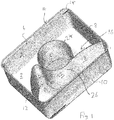
- the container shown in Fig. 1 has a base wall 2, an upright perimeter wall 4 having four perimeter wall parts 6, 8, 10 and 12. In plan view the wall parts give the shape of a rectangle, with slightly curved corners 14. Walls 6, 10 are slightly longer than walls 8, 12.
- the container is formed of water-soluble polyvinyl alcohol polymer, and has an upright internal wall generally indicated as 16.
- the internal wall is the same height as the perimeter wall. It has a sinuous wall 18, 20, 22 which spans the container, between opposed perimeter wall parts 8 and 12. This sinuous wall is interrupted, in its central region, by a curved wall portion 24 which defines, with a central section 26 of the sinuous wall 18, a cylindrical turret-like part.
- this composite internal wall structure (called internal wall herein for simplicity and consistency)
- the container is formed into three compartments A, B and C; the first and second compartments A and B being bounded in part by the perimeter wall, and the third or internal compartment C being bounded entirely within the internal wall; and spaced from the perimeter.
- Containers are moulded within any array of further containers, before being separated into individual containers. Its compartments are filled with different dishwashing compositions, which may include compositions which are mutually incompatible, or, at least, which are desirably kept apart in order to avoid shelf-life reduction (e.g. enzymes and bleach components may desirably be separated.
- dishwashing compositions which may include compositions which are mutually incompatible, or, at least, which are desirably kept apart in order to avoid shelf-life reduction (e.g. enzymes and bleach components may desirably be separated.
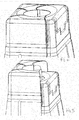
- the moulding process employs a female mould of generally cuboid shape, corresponding to the overall cuboid shape of the container, and first and second male mould parts 30, 32, shown in Figs. 2 to 5 .
- Male mould part 30 corresponds to or defines the shape of compartment A in Fig. 1 .
- Male mould part 32 corresponds to or defines the shape of compartment B in Fig. 1 .
- the male mould parts 30, 32 are nested together with a small gap between them, in which the internal wall is moulded. Also, the male mould parts 30, 32 leave a central opening which defines the shape of the third or internal compartment C.
- compartment C is formed in the contiguous gaps between the first male mould part 30 and a third male mould part in the form of a cylindrical core (not shown); and between the second male mould part 32 and the cylindrical core.
- the cylindrical core substantially fills that opening 34, leaving a small gap around it, into which molten polymer flows, to form the internal wall 22, 24, which defines compartment C.
- each of the male mould parts 30, 32 and the core defines the shape and thickness of the central, turret-like part of the internal wall.
- the gaps 36, 38 between the male mould parts 30, 32 themselves define the shape and thickness of the end regions 18, 20 of the internal wall on opposed sides of the central region.
- the gaps between each male mould part and the female part define the perimeter wall and the base wall.
- the mean thickness of all of the walls is 0.4 mm.
- Mean thickness is measured by taking five thickness gauge readings at random positions in perimeter wall part 6; five thickness gauge readings at random positions in wall part 8; five thickness gauge readings at random positions in wall part 10; five thickness gauge readings at random positions in wall part 12; five thickness gauge readings at random positions in base wall part 2; five thickness gauge readings at random positions in internal wall region 18; five thickness gauge readings at random positions in internal wall region 22; and five thickness gauge readings at random positions in internal wall region 20; and averaging all of these.
- the weight of the container as moulded is less than 2.2g.
- the mean thickness was 0.7 mm, and the weight was up to 3g.
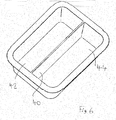
- Fig. 6 shows a simpler container, also formed of water-soluble polyvinyl alcohol, and having a simple planar dividing wall 40 separating the container into two identical compartments 42, 44. There is no internal compartment.
- the principles of making the container of Fig. 6 are the same as those employed for the more complex container of Figs. 1 to 5 . It will be immediately clear that the respective opposed surfaces of the two male mould parts which define the dividing wall 40, are accessible, and can be highly polished.
- the third, core, mould part present in the first embodiment described above is not present in the embodiment of Fig. 6 .
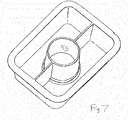
- Fig. 7 shows a water-soluble polyvinyl alcohol container similar to that of Fig. 6 , but having an internal compartment 50, of the type shown in Fig. 1 .
- Fig. 7 shows a third, core, mould part, of the type present in the first embodiment.
- first and second mould parts corresponding in shape to the shape of the first and second compartments, are inserted into the female mould part together, and injection of molten water-soluble polymer (such as polyvinyl alcohol) takes place, as before.
- molten water-soluble polymer such as polyvinyl alcohol
- the male mould parts with all of their polymer-contacting surfaces having an extremely smooth finish, including in all regions of the internal wall.
- smoothing techniques which can be used. All polymer-contacting surfaces are preferably finished to a high polish. All polymer-contacting surfaces are preferably finished to the specific levels required for each. This may be to the same standard for each.
Landscapes
- Engineering & Computer Science (AREA)
- Mechanical Engineering (AREA)
- Manufacturing & Machinery (AREA)
- Ceramic Engineering (AREA)
- Moulds For Moulding Plastics Or The Like (AREA)
- Containers Having Bodies Formed In One Piece (AREA)
- Detergent Compositions (AREA)
Description
- This invention relates to a method of making a unit-dose ware-washing product.
- The invention relates in particular to containers made from a water-soluble polymer. The containers can be filled with washing compositions, sealed to form an enclosure, and used as a unit-dose article in a ware-washing method, for example in a laundry washing machine or a dishwashing machine.
- There are many forms of unit-dose articles used to deliver a cleaning composition to a ware-washing machine, in which a cleaning composition - whether in a tablet, particulate, gel or liquid form - is enclosed in a water-soluble polymer. As well as providing consistent dosing such articles are easy to handle and often are of attractive appearance.
- One type of unit-dose article has a moulded container, which, when filled with cleaning composition, is closed by a lidding film. The article may be cuboid in overall shape, having a base wall and, extending upwards from the base wall, a perimeter wall. There may be an upright internal wall extending between respective parts of the perimeter wall, dividing the container into compartments. The internal wall may, further, define an additional recess. Such an article may thus have three compartments, to receive different cleaning compositions, and by a selection of internal wall shapes and composition colours the overall aesthetic effect can be pleasing.
- Such a known unit-dose container, when unfilled and unlidded, resembles that shown in
Fig. 1 . - Such a unit-does container is made by injection moulding. The perimeter wall and the internal wall are orthogonal to the base wall, and so facilitate the moulding process.
- The moulding process for such a unit-dose container involves one male part and one female part. The process is successful, but with this method there is a limit to the thinness of the walls (especially internal walls) that can be produced. Moreover it is difficult to give the mould surfaces which define the internal wall a desirably smooth finish, which would lead to improved containers, and/or to a more reliable production method for containers. It would also be desirable to reduce the time for the moulding cycle.
- Such products and methods are further described in
WO 01/36290 A1 - Our earlier patent application
WO 2007/057653 A1 describes one attempt to improve the manufacture of water-soluble containers, by using the technique of injection compression moulding, in which there is relative movement between the male part and the female part to reduce the volume of the mould cavity when the molten water-soluble polymer is injected into the mould, so as to force the polymer to fill the available spaces rapidly and completely. However although this technique could give benefit in terms of moulding cycle time and reduced wall thickness, there are considerable engineering issues and capital costs associated with its implementation. DocumentWO-A-2005058700 discloses a method of making a unit-dose ware-washing product comprising an upwardly open container having a base wall, an upright perimeter wall, and an upright internal wall between one part of the perimeter wall and another part of the perimeter wall, the internal wall and the perimeter wall forming first and second compartments within the container, wherein the method comprises: injecting a molten water-soluble polymer, comprising polyvinyl alcohol, polyvinyl alcohol copolymer, or partially hydrolyzed polyvinyl acetate, into a mould cavity between cooperating male and female mould parts; introducing different compositions effective in cleaning into respective compartments; and closing the container. - An alternative process which can give benefit but which can be implemented more readily, is still required. The invention is defined by a method in accordance with claim 1.
- In accordance with a first aspect of the present disclosure there is provided a method of making an upwardly open container having a base wall, an upright perimeter wall, and an upright internal wall between one part of the perimeter wall and another part of the perimeter wall, the internal wall and the perimeter wall forming first and second compartments within the container, wherein the method comprises injecting a molten water-soluble polymer into a mould cavity between cooperating male and female mould parts; wherein there are independently movable first and second male parts separated by a gap in which the internal wall is formed, and wherein the first and second male parts correspond to the first and second compartments of the container to be formed.
- By using plural male mould parts substantial benefits may be achieved. The internal wall is better supported during the process of mould opening and container removal. Also, the respective surfaces of the mould parts which define the space in which the internal wall is formed, are fully accessible, so that they can be given an optimal, smooth, surface finish, which aids release of the moulded container, and minimises the risk of residues, on these surfaces. For these reasons the internal wall may be made thinner than has hitherto been possible. The external walls may also be thinner than they have been hitherto. If wished they could have the same thickness as the internal wall; though different thicknesses for the perimeter walls and the internal wall could be selected in some embodiments. We have also found that the mould cycle time can be reduced. The use of thinner walls means that less water-soluble polymer is used. This has an immediate economic benefit in terms of cost of goods. It also has a use benefit, in that the article may dissolve more quickly, than a prior article, with thicker walls.
- Some characteristics of the container which can now be produced by the method of the first aspect are described in the following paragraphs.
- The internal wall is preferably the same height as the perimeter wall. Preferably the top of the perimeter wall and the top of the internal wall lie in a common plane. Preferably they terminate in respective flanges, to which a lidding film may be reliably sealed.
- Preferably the internal wall joins to the perimeter wall at two generally opposed places, so that it spans the container.
- The internal wall may be a simple wall, for example a straight wall or a shaped (for example sinuous wall) between one part of the perimeter wall and another part of the perimeter wall.
- Alternatively the internal wall may be a complex internal wall.
- A complex internal wall could be a wall with one branch wall connected to another part of the perimeter wall, thereby forming three compartments each bounded in part by a section of the perimeter wall; or two or more branches each connected to other parts of the perimeter wall, forming four or more compartments each bounded in part by a section of the perimeter wall.
- A complex internal wall could be a wall which itself has internal compartment, which is not bounded by the perimeter wall. That is, the internal compartment is an interruption or widening in the wall.
- A complex internal wall having one or more branch walls and one or more internal compartments is not excluded.
- However all such embodiments have in common that the container has an upright internal wall (whether of simple or complex form) between one part of the of the perimeter wall and another part of the perimeter wall, the internal wall and the perimeter wall forming N compartments within the container, and the moulding method uses N independently movable male parts which correspond to the N compartments; N being at least 2.
- N is preferably 2 but could feasibly be 3, 4, 5, 6 or more, in certain embodiments.
- N is preferably not greater than 8, preferably not greater than 6 or 5.
- In one preferred embodiment the container has only two compartments N, each formed by a section of the perimeter wall, and by a simple internal wall.
- In one preferred embodiment the container has first and second compartments which together form the perimeter wall, one internal compartment which is entirely spaced from the perimeter wall; and no further compartments beyond these three. The first and second compartments are each formed by a section of the perimeter wall, and by a complex internal wall, which has an interruption which forms the internal compartment. Thus N is 2 in this preferred embodiment but additionally has one internal compartment (that is, a compartment which is spaced from the perimeter wall).
- In such an embodiment in which the container produced by the method has said first and second compartments with an internal compartment between them, said first and second male parts define the first and second compartments. The wall of the internal compartment is defined between the first and second mould parts, and an additional mould part located between them.
- Preferably any internal wall is generally aligned with an upright wall of a male part. An alternative statement having the same practical effect is that each internal wall is defined between opposed upright surfaces of respective male parts.
- Preferably the perimeter wall is generally aligned with an upright wall of a male part. An alternative statement having the same practical effect is that each internal wall is defined between the upright wall of a male mould, and the opposed upright wall of the female mould.
- The base wall, perimeter wall and internal wall may differ in thickness, within one container, depending on the characteristics of the particular moulding process. This is conventional. However, using the method of the invention the mean thickness of the base wall, perimeter wall and internal wall is not greater than 0.6 mm, preferably not greater than 0.5 mm, and most preferably not greater than 0.4 mm. The mean thickness may be determined by the method given later.
- Preferably the weight of the container (without the closure (lid) or the compositions with will contain) is not greater than 2.5 g, preferably not greater than 2.4 g, preferably not greater than 2.3 g, preferably not greater than 2.2 g, preferably not greater than 2.1 g, and more preferably not greater than 2.0 g.
- Preferably the fill volume of the container (that is, the summated volumes of the compartments, is in the range 12-24 cm3, preferably in the range 14-20 cm3, preferably in the range 16-18 cm3.
- Preferably the first compartment has a fill volume of not less than 4 cm3, preferably not less than 8 cm3.
- Preferably the second compartment has a fill volume of not less than 2 cm3, preferably not less than 4 cm3.
- Preferably an internal compartment (when present), which is entirely spaced from the perimeter, of the container has a fill volume of not less than 1 cm3, preferably not less than 2 cm3.
- Preferably the moulding process produces an array of conjoined containers, which are separated during manufacture, or which are separable by the user.
- Preferably the moulding cycle (starting point - mould closure - polymer injection - polymer setting - mould opening - container(s) removal - stop position) is less than 10 seconds, preferably less than 8 seconds, preferably less than 7 seconds.
- The perimeter wall could be endless - that is to say, with no corners e.g. circular or oval, in plan view. Preferably, however, it is made up of wall portions, with corners between them. Most preferably it is made up of four wall portions, such that the container is an upwardly open cuboid.
- In accordance with a second aspect of the present disclosure there is provided a method of making the mould parts to carry out the method of the first aspect, comprising forming the first and second mould parts and the female mould part (e.g. by conventional methods) and smoothing all of the polymer-contacting surfaces of the first and second mould parts.
- Preferably one or more of the polymer-contacting surfaces, in particular the internal wall of the container, but preferably also other polymer-contacting surfaces of the first and second mould parts, are smoothed to a high quality; preferably including the polymer-contacting surfaces which are to define the internal wall of the container. Heretofore is has not been possible to obtain a desirably high quality finish for the latter surfaces, which have been inaccessible, and it has not been possible to use the same method for such surfaces, as for other surfaces. According to the second aspect, the surfaces which are to define the internal wall of the container are suitably subjected to the same method of smoothing as other polymer-contacting surfaces of the first and second mould parts. Preferably the same surface finish quality is achieved, as for other polymer-contacting surfaces. Preferably smoothing, for example polishing, occurs by a mechanical to-and-fro action generally parallel to the demolding direction, so that resulting microscopic striations follow the demoulding direction.
- Preferably the surfaces which are to define the internal wall of the container, and preferably other polymer-contacting surfaces of the first and second mould parts, achieve a polished finish.
- In accordance with the present invention there is provided a method of making a unit-dose ware-washing product, comprising making an upwardly open container by the method of the first aspect, introducing different compositions effective in cleaning into respective compartments, and closing the container.
- A closure, for example a lidding film, also of water-soluble polymer, is used to close the container, by sealing across the top of the perimeter wall.
- Definitions and statements of preferred and alternative embodiments stated above in relation to any of the five defined aspects, apply to all other aspects (unless an express statement or the context demands otherwise).
- Suitable components of cleaning compositions used in the present invention are as follows.
- The cleaning agents may comprise conventional amounts of detergent builders which may be either phosphorous based (e.g. STPP) or non-phosphorous based, or even a combination of both types. Suitable builders are well known in the art. Non-phosphorous builders are preferred.
- Non-phosphorous based builder may be organic molecules with carboxylic group(s), amino acid based compound or a succinic acid or succinate based compound.
- Builder compounds which are organic molecules containing carboxylic groups include citric acid, fumaric acid, tartaric acid, maleic acid, lactic acid and salts thereof. In particular the alkali or alkaline earth metal salts of these organic compounds may be used, and especially the sodium salts. An especially preferred builder is sodium citrate.
- Preferred examples of amino acid based compounds according to the invention are MGDA (methyl-glycine-diacetic acid, and salts and derivatives thereof) and GLDA (glutamic-N,N-diacetic acid and salts and derivatives thereof). GLDA (salts and derivatives thereof) is especially preferred according to the invention, with the tetrasodium salt thereof being especially preferred.
- Preferably the total amount of builder present in the cleaning agents of the invention is an amount of at least 5 %wt, preferably at least 20 %wt, more preferably at least 30 %wt, and most preferably at least 40 %wt.
- Preferably the total amount of builder present in the cleaning agents of the invention is an amount of up to 80 %wt, preferably up to 70 %wt, preferably up to 60 %wt, and most preferably up to 50 %wt.
- The cleaning agents of the invention may contain surfactants. Preferred surfactants are anionic surfactants and non-ionic surfactants. Many such surfactants are described in Kirk Othmer's Encyclopedia of Chemical Technology, 3rd Ed., Vol. 22, pp. 360-379, "Surfactants and Detersive Systems".
- A preferred class of nonionic surfactants is alkoxylated non-ionic surfactants prepared by the reaction of a monohydroxy alkanol or alkylphenol having 6 to 20 carbon atoms, preferably 10 to 18 carbon atoms, most preferably 12 to 15 carbon atoms. Preferably the surfactants have at least 10 moles of ethylene oxide and/or propylene oxide, preferably at least 12 moles, per mole of alcohol or alkylphenol; most preferably 5-10 moles of ethylene oxide and 3-6 moles of propylene oxide, per mole of alcohol or alkylphenol.
- Preferably the surfactant(s) is / are present in the cleaning agents used in the invention in an amount of from 0.1 %wt, more preferably from 0.2% wt, most preferably from 0.5 %wt.
- Preferably the surfactant(s) is / are present in the cleaning agents used in the invention in an amount of up to 10 %wt, preferably up to 5 %wt, most preferably up to 3 %wt.
- It is known to include a source of multivalent ions in cleaning agents, and in particular in automatic dishwashing compositions, for technical and/or performance reasons. For example, multivalent ions and especially zinc and/or manganese ions have been included for their ability to inhibit corrosion on metal and/or glass. Zinc sulphate is a preferred compound for this purpose.
- Any conventional amount of multivalent ions / multivalent ions source may be included in the cleaning agents used in the invention. However, it is preferred that the multivalent ions are present in an amount of from 0.01 %wt, preferably of from 0.05 %wt, preferably of from 0.1 %wt. It is preferred that the multivalent ions are present in an amount of up to 5 %wt, preferably up to 3 %wt, preferably up to 2.5 %wt.
- Polymers intended to improve the cleaning performance of the cleaning agents may also be included therein. For example sulphonated polymers may be used. Preferred examples include copolymers of CH2=CR1-CR2R3-O-C4H3R4-SO3X wherein R1, R2, R3, R4 are independently 1 to 6 carbon alkyl or hydrogen, and X is hydrogen or alkali with any suitable other monomer units including modified acrylic, fumaric, maleic, itaconic, aconitic, mesaconic, citraconic and methylenemalonic acid or their salts, maleic anhydride, acrylamide, alkylene, vinylmethyl ether, styrene and any mixtures thereof. Other suitable sulfonated monomers for incorporation in sulfonated (co)polymers are 2-acrylamido-2-methyl-1-propanesulfonic acid, 2-methacrylamido-2-methyl-1-propanesulfonic acid, 3-methacrylamido-2-hydroxypropane-sulfonic acid, allysulfonic acid, methallysulfonic acid, 2-hydroxy-3-(2-propenyl-oxy)propanesulfonic acid, 2-methyl-2-propenen-1-sulfonic acid, styrenesulfonic acid, vinylsulfonic acid, 3-sulfopropyl acrylate, 3-sulfopropylmethacrylate, sulfomethylacrylamide, sulfomethylmethacrylamide and water soluble salts thereof.
- When a sulfonated polymer is present, it is preferably present in the cleaning agents in an amount of at least 0.1 %wt, more preferably at least 1 %wt, preferably at least 2 %wt, and most preferably at least 5 %wt. A sulfonated polymer, when present, is preferably present in the cleaning agents in an amount of up to 30 %wt, preferably up to 20 %wt, most preferably up to 15 %wt.
- The cleaning agents of the invention may comprise one or more enzymes. It is preferred that the enzyme is selected from protease, lipase, amylase, cellulase and peroxidase enzymes.
- Desirably enzyme(s) is/are present in the cleaning agents in an amount of from 0.01 %wt, especially of from 0.1 %wt, most preferably of from 0.2 %wt. Desirably enzyme(s) is/are present in the cleaning agent in an amount of up to 10%wt, preferably up to 7 %wt, most preferably up to 5 %wt.
- Any type of bleaching compound conventionally used in dishwashing compositions may be used according to the present invention. Preferably the bleaching compound is selected from inorganic peroxides or organic peracids, derivatives thereof (including their salts) and mixtures thereof. Especially preferred inorganic peroxides are percarbonates, perborates and persulphates with their sodium and potassium salts being most preferred. Sodium percarbonate and sodium perborate are most preferred, especially sodium percarbonate.
- Organic peracids include all organic peracids traditionally used as bleaches, including, for example, perbenzoic acid and peroxycarboxylic acids such as mono- or diperoxyphthalic acid, 2-octyldiperoxysuccinic acid, diperoxydodecanedicarboxylic acid, diperoxy-azelaic acid and imidoperoxycarboxylic acid and, optionally, the salts thereof. Especially preferred is phthalimidoperhexanoic acid (PAP).
- Bleaching compounds herein may include bleach activators and bleach catalysts.
- When a bleaching compound is present in the cleaning agents of the invention it is suitably present in an amount of from 1 %wt, preferably of from 2 %wt, most preferably of from 5 %wt; and preferably an amount up to 40 %wt, preferably up to 30 %wt, most preferably up to 20 %wt.
- A bleaching compound may be protected from another component which it may degrade, and/or which may cause its own degradation. For examples a bleaching compound and an enzyme may be protected from each other, by physical separation.
- The cleaning agents of the invention may also comprise minor, conventional amounts of thickeners, wetting agents, perfumes, preservatives and/or colourants. Such ingredients are typically present in amounts of up to 2 %wt.
- The cleaning agent may suitably comprise water. Suitably the water content is not more than 30 %wt, preferably not more than 20 %wt, preferably not more than 10 %wt, preferably not more than 5 %wt, of the cleaning agents.
- All of the numerical definitions given above for amounts of a component of the cleaning agents represent the total amount of such components, when more than one is present e.g. the total enzyme content, when there are two types of enzyme, or two or more types of bleach compounds.
- A water-soluble polymeric material for use in such embodiments may suitably be selected from the group comprising polyvinyl alcohols, polyvinyl alcohol copolymers, partially hydrolyzed polyvinyl acetate. Optionally fillers, plasticisers and process aids may also be comprised in the formulation of a water-soluble polymeric material for use herein.
- An especially preferred water-soluble polymeric material comprises a poly(vinyl alcohol).
- The invention will now be further described, by way of example, with reference to the accompanying drawings, which show, all in perspective views:
-
Fig. 1 shows a first embodiment of container for containing three dishwashing compositions; -
Fig. 2 shows the male mould parts used in the manufacture of the container shown inFig. 1 , in matched locations; -
Fig. 3 is a view corresponding to that ofFig. 2 , but shows the two mould parts in relative displaced locations; -
Figs. 4 and 5 correspond toFigs. 2 and 3 , but from a different perspective; -
Fig. 6 shows a second embodiment of container, for containing two dishwashing compositions; and -
Fig. 7 shows a third embodiment of container for containing three dishwashing com positions. - The container shown in
Fig. 1 has abase wall 2, anupright perimeter wall 4 having fourperimeter wall parts curved corners 14.Walls walls - The container is formed of water-soluble polyvinyl alcohol polymer, and has an upright internal wall generally indicated as 16. The internal wall is the same height as the perimeter wall. It has a
sinuous wall perimeter wall parts central section 26 of thesinuous wall 18, a cylindrical turret-like part. By means of this composite internal wall structure (called internal wall herein for simplicity and consistency), the container is formed into three compartments A, B and C; the first and second compartments A and B being bounded in part by the perimeter wall, and the third or internal compartment C being bounded entirely within the internal wall; and spaced from the perimeter. - Containers are moulded within any array of further containers, before being separated into individual containers. Its compartments are filled with different dishwashing compositions, which may include compositions which are mutually incompatible, or, at least, which are desirably kept apart in order to avoid shelf-life reduction (e.g. enzymes and bleach components may desirably be separated.
- The moulding process employs a female mould of generally cuboid shape, corresponding to the overall cuboid shape of the container, and first and second
male mould parts Figs. 2 to 5 .Male mould part 30 corresponds to or defines the shape of compartment A inFig. 1 .Male mould part 32 corresponds to or defines the shape of compartment B inFig. 1 . Themale mould parts male mould parts male mould part 30 and a third male mould part in the form of a cylindrical core (not shown); and between the secondmale mould part 32 and the cylindrical core. During moulding the cylindrical core substantially fills that opening 34, leaving a small gap around it, into which molten polymer flows, to form theinternal wall 22, 24, which defines compartment C. - Thus, the gaps between each of the
male mould parts gaps male mould parts end regions - In this embodiment the mean thickness of all of the walls (the base wall, perimeter wall, and internal wall) is 0.4 mm. Mean thickness is measured by taking five thickness gauge readings at random positions in
perimeter wall part 6; five thickness gauge readings at random positions inwall part 8; five thickness gauge readings at random positions inwall part 10; five thickness gauge readings at random positions inwall part 12; five thickness gauge readings at random positions inbase wall part 2; five thickness gauge readings at random positions ininternal wall region 18; five thickness gauge readings at random positions ininternal wall region 22; and five thickness gauge readings at random positions ininternal wall region 20; and averaging all of these. - The weight of the container as moulded (no lidding film; no contents) is less than 2.2g.
- In contrast, in the prior method which used a single male mould part, the mean thickness was 0.7 mm, and the weight was up to 3g.
-
Fig. 6 shows a simpler container, also formed of water-soluble polyvinyl alcohol, and having a simpleplanar dividing wall 40 separating the container into twoidentical compartments Fig. 6 are the same as those employed for the more complex container ofFigs. 1 to 5 . It will be immediately clear that the respective opposed surfaces of the two male mould parts which define the dividingwall 40, are accessible, and can be highly polished. The third, core, mould part present in the first embodiment described above is not present in the embodiment ofFig. 6 . -
Fig. 7 shows a water-soluble polyvinyl alcohol container similar to that ofFig. 6 , but having aninternal compartment 50, of the type shown inFig. 1 . Thus, in this embodiment there is a third, core, mould part, of the type present in the first embodiment. - In the conventional process there is generally one male mould part. It enters the female part, injection of molten polymer takes place, and the male and female parts separate. In the present invention first and second mould parts, corresponding in shape to the shape of the first and second compartments, are inserted into the female mould part together, and injection of molten water-soluble polymer (such as polyvinyl alcohol) takes place, as before. For the separation, the first male mould part, shown as 32 in
Fig. 3 , is withdrawn. Only subsequently is thesecond mould part 30 is withdrawn. As can be understood from a consideration of the first, second and third embodiments, described with reference toFigs. 1 to 7 , there may or may not be a third, core, mould part, producing an internal compartment. - It is possible to produce the male mould parts with all of their polymer-contacting surfaces having an extremely smooth finish, including in all regions of the internal wall. There is no limitation to the smoothing techniques which can be used. All polymer-contacting surfaces are preferably finished to a high polish. All polymer-contacting surfaces are preferably finished to the specific levels required for each. This may be to the same standard for each. In contrast, in the prior art method using a single mould, it was not possible to treat the surfaces corresponding to those shown as 36 and 38 in
Fig. 2 in an adequate way, especially in the demoulding direction, to obtain surface finishes of such high quality as the other polymer-contacting surfaces. - As a consequence of the methods of the invention demoulding is improved, and the moulding cycle can be reduced, compared with the earlier method describe above. It will be observed that, using first and second male mould parts as described, support can be provided for the container along every wall which is present. The walls of the container can be made extremely thin without risking failure, and savings in the amount of polymer used can be realised.
Claims (9)
- A method of making a unit-dose ware-washing product comprising an upwardly open container having a base wall (2), an upright perimeter wall (4), and an upright internal wall (16, 40) between one part (8) of the perimeter wall (4) and another part (12) of the perimeter wall (4), the internal wall (16, 40) and the perimeter wall (4) forming first and second compartments (A, B, 42, 44) within the container, wherein the method comprises:injecting a molten water-soluble polymer, comprising polyvinyl alcohol, polyvinyl alcohol copolymer, or partially hydrolyzed polyvinyl acetate, into a mould cavity between cooperating male and female mould parts; wherein there is an independently movable first male mould part (32) and an independently movable second male mould part (30) separated by a gap (36, 38) in which the internal wall (16, 40) is formed, and wherein the first and second male mould parts (30, 32) are independently movable with respect to one another and correspond to the first and second compartments (A, B, 42, 44) of the container to be formed;withdrawing the first male mould part (32) and subsequently withdrawing the second male mould part (30) wherein the polymer-contacting surfaces of the first and second male mould parts (30, 32) that define the gap (36, 38) in which the internal wall is formed are accessible for polishing;introducing different compositions effective in cleaning into respective compartments; andclosing the container.
- A method as claimed in claim 1, wherein the internal wall (16) has an intermediate region (22, 26) which defines a third compartment (C, 50) entirely spaced from the perimeter (4) of the container.
- A method as claimed in claim 2, wherein the method employs a third male mould part which is located between the first and second mould parts (30, 32) and defines, with them, the third compartment (C).
- A method as claimed in any preceding claim wherein the container has only two compartments (A, B, 42, 44) which are formed in part by the perimeter wall (4); and has no internal compartment, or one internal compartment (C, 50) only.
- A method as claimed in any preceding claim, wherein the internal wall (16, 40) is generally aligned with an upright wall of a male part.
- A method as claimed in any preceding claim, wherein the perimeter wall (4) is generally aligned with an upright wall of a male part.
- A method as claimed in any preceding claim, wherein the mean thicknesses of the base wall (2), perimeter wall (4) and internal wall (16, 40) are each not greater than 0.6 mm.
- A method as claimed in any preceding claim, wherein the weight of the container alone is not greater than 2.5 g.
- A method as claimed in any preceding claim, wherein the water-soluble polymer is poly(vinyl alcohol).
Priority Applications (1)
| Application Number | Priority Date | Filing Date | Title |
|---|---|---|---|
| PL17191054T PL3275615T3 (en) | 2011-04-11 | 2012-04-05 | Improvements in moulding containers |
Applications Claiming Priority (3)
| Application Number | Priority Date | Filing Date | Title |
|---|---|---|---|
| GBGB1106072.0A GB201106072D0 (en) | 2011-04-11 | 2011-04-11 | Improvements in moulding containers |
| PCT/GB2012/050768 WO2012140412A1 (en) | 2011-04-11 | 2012-04-05 | Improvements in moulding containers |
| EP12714357.6A EP2697031A1 (en) | 2011-04-11 | 2012-04-05 | Improvements in moulding containers |
Related Parent Applications (1)
| Application Number | Title | Priority Date | Filing Date |
|---|---|---|---|
| EP12714357.6A Division EP2697031A1 (en) | 2011-04-11 | 2012-04-05 | Improvements in moulding containers |
Publications (2)
| Publication Number | Publication Date |
|---|---|
| EP3275615A1 EP3275615A1 (en) | 2018-01-31 |
| EP3275615B1 true EP3275615B1 (en) | 2020-05-06 |
Family
ID=44122894
Family Applications (2)
| Application Number | Title | Priority Date | Filing Date |
|---|---|---|---|
| EP12714357.6A Ceased EP2697031A1 (en) | 2011-04-11 | 2012-04-05 | Improvements in moulding containers |
| EP17191054.0A Not-in-force EP3275615B1 (en) | 2011-04-11 | 2012-04-05 | Improvements in moulding containers |
Family Applications Before (1)
| Application Number | Title | Priority Date | Filing Date |
|---|---|---|---|
| EP12714357.6A Ceased EP2697031A1 (en) | 2011-04-11 | 2012-04-05 | Improvements in moulding containers |
Country Status (11)
| Country | Link |
|---|---|
| US (1) | US10118353B2 (en) |
| EP (2) | EP2697031A1 (en) |
| CN (1) | CN103596742B (en) |
| AU (2) | AU2012241587B2 (en) |
| BR (1) | BR112013026058A2 (en) |
| CA (1) | CA2832690C (en) |
| GB (2) | GB201106072D0 (en) |
| PL (1) | PL3275615T3 (en) |
| RU (1) | RU2628386C2 (en) |
| WO (1) | WO2012140412A1 (en) |
| ZA (1) | ZA201307528B (en) |
Families Citing this family (3)
| Publication number | Priority date | Publication date | Assignee | Title |
|---|---|---|---|---|
| JP6621632B2 (en) * | 2015-09-29 | 2019-12-18 | 日精エー・エス・ビー機械株式会社 | Multi-chamber container manufacturing apparatus and manufacturing method thereof |
| EP3994068B8 (en) | 2019-08-19 | 2024-06-12 | Congruens Group, LLC | Leak-resistant tray and lid |
| DE102021209932A1 (en) | 2021-09-08 | 2023-03-09 | Henkel Ag & Co. Kgaa | Process for the manufacture of detergent dosing units with improved properties |
Family Cites Families (18)
| Publication number | Priority date | Publication date | Assignee | Title |
|---|---|---|---|---|
| US3673302A (en) * | 1967-01-09 | 1972-06-27 | Globe Union Inc | Method for fabricating battery cases |
| US3564660A (en) * | 1968-12-09 | 1971-02-23 | George Darnell | Injection molding machine |
| US3585690A (en) * | 1969-07-01 | 1971-06-22 | Phillips Petroleum Co | Apparatus for injection molding and ejection of plastic articles |
| US3838960A (en) * | 1972-01-21 | 1974-10-01 | Beatrice Foods Co | Apparatus for making injection molded articles |
| US3871611A (en) * | 1973-05-07 | 1975-03-18 | Taketa Phyllis | Mold with removable and replaceable core and cavity inserts |
| US3930780A (en) * | 1973-07-20 | 1976-01-06 | Beatrice Foods Co. | Injection molding apparatus for partitioned containers |
| IT1221321B (en) * | 1988-02-16 | 1990-06-27 | Olimpio Stocchiero | SATMPO WITH MONOBLOCK MALE FOR THE MANUFACTURE OF ELECTRIC PRE-ACCUMULATOR BOXES AND BOXES OBTAINED WITH SUCH MOLD |
| JPH03254919A (en) * | 1990-03-06 | 1991-11-13 | Takata Kk | Manufacture of module cover of air bag |
| JP3035781B2 (en) | 1991-12-03 | 2000-04-24 | 三菱マテリアル株式会社 | Mold device for case molding |
| ES2222253T3 (en) * | 1999-11-17 | 2005-02-01 | Reckitt Benckiser (Uk) Limited | WATER SOLUBLE CONTAINERS MOLDED BY INJECTION. |
| GB2376676B (en) | 1999-11-17 | 2003-05-14 | Reckitt Benckiser | Rigid water-soluble containers |
| US6610239B2 (en) * | 2000-02-15 | 2003-08-26 | Dow Global Technologies Inc. | Injection molding process using a coated mold |
| GB2419864A (en) * | 2003-12-19 | 2006-05-10 | Reckitt Benckiser Nv | Injection moulded water-soluble container containing a detergent |
| US20070015757A1 (en) * | 2003-12-19 | 2007-01-18 | Novo Nordisk A/S | Novel Glucagon Antagonists/Inverse Agonists |
| GB0523336D0 (en) * | 2005-11-16 | 2005-12-28 | Reckitt Benckiser Uk Ltd | Injection moulding |
| US8557059B2 (en) * | 2009-06-05 | 2013-10-15 | Edro Specialty Steels, Inc. | Plastic injection mold of low carbon martensitic stainless steel |
| GB2487987A (en) * | 2011-02-14 | 2012-08-15 | Fenchurch Environmental Group Ltd | Insert moulding |
| PL2617659T5 (en) * | 2012-01-19 | 2021-08-23 | Lakma Strefa Sp.Z O O. | Cleaning agent product |
-
2011
- 2011-04-11 GB GBGB1106072.0A patent/GB201106072D0/en not_active Ceased
-
2012
- 2012-04-05 EP EP12714357.6A patent/EP2697031A1/en not_active Ceased
- 2012-04-05 EP EP17191054.0A patent/EP3275615B1/en not_active Not-in-force
- 2012-04-05 CA CA2832690A patent/CA2832690C/en not_active Expired - Fee Related
- 2012-04-05 CN CN201280017821.5A patent/CN103596742B/en not_active Expired - Fee Related
- 2012-04-05 PL PL17191054T patent/PL3275615T3/en unknown
- 2012-04-05 US US14/110,903 patent/US10118353B2/en active Active
- 2012-04-05 BR BR112013026058A patent/BR112013026058A2/en not_active Application Discontinuation
- 2012-04-05 RU RU2013150098A patent/RU2628386C2/en active
- 2012-04-05 WO PCT/GB2012/050768 patent/WO2012140412A1/en not_active Ceased
- 2012-04-05 GB GB1318018.7A patent/GB2505339A/en not_active Withdrawn
- 2012-04-05 AU AU2012241587A patent/AU2012241587B2/en not_active Ceased
-
2013
- 2013-10-09 ZA ZA2013/07528A patent/ZA201307528B/en unknown
-
2016
- 2016-06-22 AU AU2016204240A patent/AU2016204240A1/en not_active Abandoned
Non-Patent Citations (1)
| Title |
|---|
| None * |
Also Published As
| Publication number | Publication date |
|---|---|
| BR112013026058A2 (en) | 2017-02-14 |
| PL3275615T3 (en) | 2020-11-02 |
| CN103596742A (en) | 2014-02-19 |
| EP2697031A1 (en) | 2014-02-19 |
| WO2012140412A1 (en) | 2012-10-18 |
| ZA201307528B (en) | 2015-01-28 |
| CA2832690A1 (en) | 2012-10-18 |
| AU2012241587B2 (en) | 2016-07-07 |
| EP3275615A1 (en) | 2018-01-31 |
| RU2013150098A (en) | 2015-05-20 |
| AU2012241587A1 (en) | 2013-05-02 |
| US10118353B2 (en) | 2018-11-06 |
| AU2016204240A1 (en) | 2016-07-14 |
| GB201106072D0 (en) | 2011-05-25 |
| CA2832690C (en) | 2019-09-03 |
| CN103596742B (en) | 2017-02-15 |
| GB201318018D0 (en) | 2013-11-27 |
| GB2505339A (en) | 2014-02-26 |
| US20140305074A1 (en) | 2014-10-16 |
| RU2628386C2 (en) | 2017-08-16 |
Similar Documents
| Publication | Publication Date | Title |
|---|---|---|
| US8980817B2 (en) | Dosage element and a method of manufacturing a dosage element | |
| AU2008206875B2 (en) | Dosage element and a method of manufacturing a dosage element | |
| US8754025B2 (en) | Dosage element and a method of manufacturing a dosage element | |
| US8669219B2 (en) | Dosage element and a method of manufacturing a dosage element | |
| AU2008206878B2 (en) | Dosage element and a method of manufacturing a dosage element | |
| US10118353B2 (en) | Molding containers | |
| AU2004299332A1 (en) | Injection moulded containers | |
| AU2015255279A1 (en) | Dosage element and a method of manufacturing a dosage element |
Legal Events
| Date | Code | Title | Description |
|---|---|---|---|
| PUAI | Public reference made under article 153(3) epc to a published international application that has entered the european phase |
Free format text: ORIGINAL CODE: 0009012 |
|
| STAA | Information on the status of an ep patent application or granted ep patent |
Free format text: STATUS: REQUEST FOR EXAMINATION WAS MADE |
|
| 17P | Request for examination filed |
Effective date: 20170914 |
|
| AC | Divisional application: reference to earlier application |
Ref document number: 2697031 Country of ref document: EP Kind code of ref document: P |
|
| AK | Designated contracting states |
Kind code of ref document: A1 Designated state(s): AL AT BE BG CH CY CZ DE DK EE ES FI FR GB GR HR HU IE IS IT LI LT LU LV MC MK MT NL NO PL PT RO RS SE SI SK SM TR |
|
| AX | Request for extension of the european patent |
Extension state: BA ME |
|
| RIN1 | Information on inventor provided before grant (corrected) |
Inventor name: GEIGER, ANDREAS Inventor name: HALBHERR, AXEL Inventor name: PELLENZ, JUERGEN |
|
| STAA | Information on the status of an ep patent application or granted ep patent |
Free format text: STATUS: EXAMINATION IS IN PROGRESS |
|
| 17Q | First examination report despatched |
Effective date: 20190102 |
|
| GRAP | Despatch of communication of intention to grant a patent |
Free format text: ORIGINAL CODE: EPIDOSNIGR1 |
|
| STAA | Information on the status of an ep patent application or granted ep patent |
Free format text: STATUS: GRANT OF PATENT IS INTENDED |
|
| RIC1 | Information provided on ipc code assigned before grant |
Ipc: B65D 65/46 20060101ALN20200116BHEP Ipc: B29C 45/26 20060101AFI20200116BHEP Ipc: B65D 1/36 20060101ALN20200116BHEP |
|
| RIC1 | Information provided on ipc code assigned before grant |
Ipc: B29C 45/26 20060101AFI20200117BHEP Ipc: B65D 65/46 20060101ALN20200117BHEP Ipc: B65D 1/36 20060101ALN20200117BHEP |
|
| RIC1 | Information provided on ipc code assigned before grant |
Ipc: B65D 65/46 20060101ALN20200204BHEP Ipc: B65D 1/36 20060101ALN20200204BHEP Ipc: B29C 45/26 20060101AFI20200204BHEP |
|
| INTG | Intention to grant announced |
Effective date: 20200217 |
|
| RIN1 | Information on inventor provided before grant (corrected) |
Inventor name: GEIGER, ANDREAS Inventor name: HALBHERR, AXEL Inventor name: PELLENZ, JUERGEN |
|
| GRAS | Grant fee paid |
Free format text: ORIGINAL CODE: EPIDOSNIGR3 |
|
| GRAA | (expected) grant |
Free format text: ORIGINAL CODE: 0009210 |
|
| STAA | Information on the status of an ep patent application or granted ep patent |
Free format text: STATUS: THE PATENT HAS BEEN GRANTED |
|
| AC | Divisional application: reference to earlier application |
Ref document number: 2697031 Country of ref document: EP Kind code of ref document: P |
|
| AK | Designated contracting states |
Kind code of ref document: B1 Designated state(s): AL AT BE BG CH CY CZ DE DK EE ES FI FR GB GR HR HU IE IS IT LI LT LU LV MC MK MT NL NO PL PT RO RS SE SI SK SM TR |
|
| REG | Reference to a national code |
Ref country code: GB Ref legal event code: FG4D |
|
| REG | Reference to a national code |
Ref country code: CH Ref legal event code: EP Ref country code: AT Ref legal event code: REF Ref document number: 1266063 Country of ref document: AT Kind code of ref document: T Effective date: 20200515 |
|
| REG | Reference to a national code |
Ref country code: IE Ref legal event code: FG4D |
|
| REG | Reference to a national code |
Ref country code: DE Ref legal event code: R096 Ref document number: 602012070035 Country of ref document: DE |
|
| REG | Reference to a national code |
Ref country code: LT Ref legal event code: MG4D |
|
| REG | Reference to a national code |
Ref country code: NL Ref legal event code: MP Effective date: 20200506 |
|
| PG25 | Lapsed in a contracting state [announced via postgrant information from national office to epo] |
Ref country code: LT Free format text: LAPSE BECAUSE OF FAILURE TO SUBMIT A TRANSLATION OF THE DESCRIPTION OR TO PAY THE FEE WITHIN THE PRESCRIBED TIME-LIMIT Effective date: 20200506 Ref country code: FI Free format text: LAPSE BECAUSE OF FAILURE TO SUBMIT A TRANSLATION OF THE DESCRIPTION OR TO PAY THE FEE WITHIN THE PRESCRIBED TIME-LIMIT Effective date: 20200506 Ref country code: PT Free format text: LAPSE BECAUSE OF FAILURE TO SUBMIT A TRANSLATION OF THE DESCRIPTION OR TO PAY THE FEE WITHIN THE PRESCRIBED TIME-LIMIT Effective date: 20200907 Ref country code: IS Free format text: LAPSE BECAUSE OF FAILURE TO SUBMIT A TRANSLATION OF THE DESCRIPTION OR TO PAY THE FEE WITHIN THE PRESCRIBED TIME-LIMIT Effective date: 20200906 Ref country code: GR Free format text: LAPSE BECAUSE OF FAILURE TO SUBMIT A TRANSLATION OF THE DESCRIPTION OR TO PAY THE FEE WITHIN THE PRESCRIBED TIME-LIMIT Effective date: 20200807 Ref country code: SE Free format text: LAPSE BECAUSE OF FAILURE TO SUBMIT A TRANSLATION OF THE DESCRIPTION OR TO PAY THE FEE WITHIN THE PRESCRIBED TIME-LIMIT Effective date: 20200506 Ref country code: NO Free format text: LAPSE BECAUSE OF FAILURE TO SUBMIT A TRANSLATION OF THE DESCRIPTION OR TO PAY THE FEE WITHIN THE PRESCRIBED TIME-LIMIT Effective date: 20200806 |
|
| PG25 | Lapsed in a contracting state [announced via postgrant information from national office to epo] |
Ref country code: BG Free format text: LAPSE BECAUSE OF FAILURE TO SUBMIT A TRANSLATION OF THE DESCRIPTION OR TO PAY THE FEE WITHIN THE PRESCRIBED TIME-LIMIT Effective date: 20200806 Ref country code: RS Free format text: LAPSE BECAUSE OF FAILURE TO SUBMIT A TRANSLATION OF THE DESCRIPTION OR TO PAY THE FEE WITHIN THE PRESCRIBED TIME-LIMIT Effective date: 20200506 Ref country code: HR Free format text: LAPSE BECAUSE OF FAILURE TO SUBMIT A TRANSLATION OF THE DESCRIPTION OR TO PAY THE FEE WITHIN THE PRESCRIBED TIME-LIMIT Effective date: 20200506 Ref country code: LV Free format text: LAPSE BECAUSE OF FAILURE TO SUBMIT A TRANSLATION OF THE DESCRIPTION OR TO PAY THE FEE WITHIN THE PRESCRIBED TIME-LIMIT Effective date: 20200506 |
|
| REG | Reference to a national code |
Ref country code: AT Ref legal event code: MK05 Ref document number: 1266063 Country of ref document: AT Kind code of ref document: T Effective date: 20200506 |
|
| PG25 | Lapsed in a contracting state [announced via postgrant information from national office to epo] |
Ref country code: NL Free format text: LAPSE BECAUSE OF FAILURE TO SUBMIT A TRANSLATION OF THE DESCRIPTION OR TO PAY THE FEE WITHIN THE PRESCRIBED TIME-LIMIT Effective date: 20200506 Ref country code: AL Free format text: LAPSE BECAUSE OF FAILURE TO SUBMIT A TRANSLATION OF THE DESCRIPTION OR TO PAY THE FEE WITHIN THE PRESCRIBED TIME-LIMIT Effective date: 20200506 |
|
| PG25 | Lapsed in a contracting state [announced via postgrant information from national office to epo] |
Ref country code: SM Free format text: LAPSE BECAUSE OF FAILURE TO SUBMIT A TRANSLATION OF THE DESCRIPTION OR TO PAY THE FEE WITHIN THE PRESCRIBED TIME-LIMIT Effective date: 20200506 Ref country code: EE Free format text: LAPSE BECAUSE OF FAILURE TO SUBMIT A TRANSLATION OF THE DESCRIPTION OR TO PAY THE FEE WITHIN THE PRESCRIBED TIME-LIMIT Effective date: 20200506 Ref country code: CZ Free format text: LAPSE BECAUSE OF FAILURE TO SUBMIT A TRANSLATION OF THE DESCRIPTION OR TO PAY THE FEE WITHIN THE PRESCRIBED TIME-LIMIT Effective date: 20200506 Ref country code: RO Free format text: LAPSE BECAUSE OF FAILURE TO SUBMIT A TRANSLATION OF THE DESCRIPTION OR TO PAY THE FEE WITHIN THE PRESCRIBED TIME-LIMIT Effective date: 20200506 Ref country code: ES Free format text: LAPSE BECAUSE OF FAILURE TO SUBMIT A TRANSLATION OF THE DESCRIPTION OR TO PAY THE FEE WITHIN THE PRESCRIBED TIME-LIMIT Effective date: 20200506 Ref country code: DK Free format text: LAPSE BECAUSE OF FAILURE TO SUBMIT A TRANSLATION OF THE DESCRIPTION OR TO PAY THE FEE WITHIN THE PRESCRIBED TIME-LIMIT Effective date: 20200506 Ref country code: AT Free format text: LAPSE BECAUSE OF FAILURE TO SUBMIT A TRANSLATION OF THE DESCRIPTION OR TO PAY THE FEE WITHIN THE PRESCRIBED TIME-LIMIT Effective date: 20200506 |
|
| REG | Reference to a national code |
Ref country code: DE Ref legal event code: R097 Ref document number: 602012070035 Country of ref document: DE |
|
| PG25 | Lapsed in a contracting state [announced via postgrant information from national office to epo] |
Ref country code: SK Free format text: LAPSE BECAUSE OF FAILURE TO SUBMIT A TRANSLATION OF THE DESCRIPTION OR TO PAY THE FEE WITHIN THE PRESCRIBED TIME-LIMIT Effective date: 20200506 |
|
| PLBE | No opposition filed within time limit |
Free format text: ORIGINAL CODE: 0009261 |
|
| STAA | Information on the status of an ep patent application or granted ep patent |
Free format text: STATUS: NO OPPOSITION FILED WITHIN TIME LIMIT |
|
| 26N | No opposition filed |
Effective date: 20210209 |
|
| PGFP | Annual fee paid to national office [announced via postgrant information from national office to epo] |
Ref country code: IT Payment date: 20210310 Year of fee payment: 10 |
|
| PG25 | Lapsed in a contracting state [announced via postgrant information from national office to epo] |
Ref country code: SI Free format text: LAPSE BECAUSE OF FAILURE TO SUBMIT A TRANSLATION OF THE DESCRIPTION OR TO PAY THE FEE WITHIN THE PRESCRIBED TIME-LIMIT Effective date: 20200506 |
|
| PGFP | Annual fee paid to national office [announced via postgrant information from national office to epo] |
Ref country code: TR Payment date: 20210330 Year of fee payment: 10 Ref country code: PL Payment date: 20210325 Year of fee payment: 10 |
|
| PG25 | Lapsed in a contracting state [announced via postgrant information from national office to epo] |
Ref country code: MC Free format text: LAPSE BECAUSE OF FAILURE TO SUBMIT A TRANSLATION OF THE DESCRIPTION OR TO PAY THE FEE WITHIN THE PRESCRIBED TIME-LIMIT Effective date: 20200506 |
|
| PG25 | Lapsed in a contracting state [announced via postgrant information from national office to epo] |
Ref country code: LU Free format text: LAPSE BECAUSE OF NON-PAYMENT OF DUE FEES Effective date: 20210405 |
|
| REG | Reference to a national code |
Ref country code: BE Ref legal event code: MM Effective date: 20210430 |
|
| PG25 | Lapsed in a contracting state [announced via postgrant information from national office to epo] |
Ref country code: CH Free format text: LAPSE BECAUSE OF NON-PAYMENT OF DUE FEES Effective date: 20210430 Ref country code: LI Free format text: LAPSE BECAUSE OF NON-PAYMENT OF DUE FEES Effective date: 20210430 |
|
| PG25 | Lapsed in a contracting state [announced via postgrant information from national office to epo] |
Ref country code: IE Free format text: LAPSE BECAUSE OF NON-PAYMENT OF DUE FEES Effective date: 20210405 |
|
| PG25 | Lapsed in a contracting state [announced via postgrant information from national office to epo] |
Ref country code: BE Free format text: LAPSE BECAUSE OF NON-PAYMENT OF DUE FEES Effective date: 20210430 |
|
| PG25 | Lapsed in a contracting state [announced via postgrant information from national office to epo] |
Ref country code: PL Free format text: LAPSE BECAUSE OF NON-PAYMENT OF DUE FEES Effective date: 20220405 Ref country code: IT Free format text: LAPSE BECAUSE OF NON-PAYMENT OF DUE FEES Effective date: 20220405 Ref country code: HU Free format text: LAPSE BECAUSE OF FAILURE TO SUBMIT A TRANSLATION OF THE DESCRIPTION OR TO PAY THE FEE WITHIN THE PRESCRIBED TIME-LIMIT; INVALID AB INITIO Effective date: 20120405 Ref country code: CY Free format text: LAPSE BECAUSE OF FAILURE TO SUBMIT A TRANSLATION OF THE DESCRIPTION OR TO PAY THE FEE WITHIN THE PRESCRIBED TIME-LIMIT Effective date: 20200506 |
|
| P01 | Opt-out of the competence of the unified patent court (upc) registered |
Effective date: 20230513 |
|
| PG25 | Lapsed in a contracting state [announced via postgrant information from national office to epo] |
Ref country code: MK Free format text: LAPSE BECAUSE OF FAILURE TO SUBMIT A TRANSLATION OF THE DESCRIPTION OR TO PAY THE FEE WITHIN THE PRESCRIBED TIME-LIMIT Effective date: 20200506 |
|
| PGFP | Annual fee paid to national office [announced via postgrant information from national office to epo] |
Ref country code: GB Payment date: 20240229 Year of fee payment: 13 |
|
| PGFP | Annual fee paid to national office [announced via postgrant information from national office to epo] |
Ref country code: FR Payment date: 20240308 Year of fee payment: 13 |
|
| PGFP | Annual fee paid to national office [announced via postgrant information from national office to epo] |
Ref country code: DE Payment date: 20240306 Year of fee payment: 13 |
|
| PG25 | Lapsed in a contracting state [announced via postgrant information from national office to epo] |
Ref country code: TR Free format text: LAPSE BECAUSE OF NON-PAYMENT OF DUE FEES Effective date: 20220405 Ref country code: MT Free format text: LAPSE BECAUSE OF FAILURE TO SUBMIT A TRANSLATION OF THE DESCRIPTION OR TO PAY THE FEE WITHIN THE PRESCRIBED TIME-LIMIT Effective date: 20200506 |
|
| REG | Reference to a national code |
Ref country code: DE Ref legal event code: R119 Ref document number: 602012070035 Country of ref document: DE |
|
| GBPC | Gb: european patent ceased through non-payment of renewal fee |
Effective date: 20250405 |
|
| PG25 | Lapsed in a contracting state [announced via postgrant information from national office to epo] |
Ref country code: DE Free format text: LAPSE BECAUSE OF NON-PAYMENT OF DUE FEES Effective date: 20251104 |
|
| PG25 | Lapsed in a contracting state [announced via postgrant information from national office to epo] |
Ref country code: GB Free format text: LAPSE BECAUSE OF NON-PAYMENT OF DUE FEES Effective date: 20250405 |
|
| PG25 | Lapsed in a contracting state [announced via postgrant information from national office to epo] |
Ref country code: FR Free format text: LAPSE BECAUSE OF NON-PAYMENT OF DUE FEES Effective date: 20250430 |