EP3273515A2 - Electrode with perforated current collector and lithium secondary battery including the same - Google Patents
Electrode with perforated current collector and lithium secondary battery including the same Download PDFInfo
- Publication number
- EP3273515A2 EP3273515A2 EP17181825.5A EP17181825A EP3273515A2 EP 3273515 A2 EP3273515 A2 EP 3273515A2 EP 17181825 A EP17181825 A EP 17181825A EP 3273515 A2 EP3273515 A2 EP 3273515A2
- Authority
- EP
- European Patent Office
- Prior art keywords
- secondary battery
- negative electrode
- lithium secondary
- current collector
- electrode
- Prior art date
- Legal status (The legal status is an assumption and is not a legal conclusion. Google has not performed a legal analysis and makes no representation as to the accuracy of the status listed.)
- Granted
Links
Images


Classifications
-
- H—ELECTRICITY
- H01—ELECTRIC ELEMENTS
- H01M—PROCESSES OR MEANS, e.g. BATTERIES, FOR THE DIRECT CONVERSION OF CHEMICAL ENERGY INTO ELECTRICAL ENERGY
- H01M4/00—Electrodes
- H01M4/02—Electrodes composed of, or comprising, active material
- H01M4/64—Carriers or collectors
- H01M4/70—Carriers or collectors characterised by shape or form
- H01M4/72—Grids
- H01M4/74—Meshes or woven material; Expanded metal
- H01M4/742—Meshes or woven material; Expanded metal perforated material
-
- H—ELECTRICITY
- H01—ELECTRIC ELEMENTS
- H01M—PROCESSES OR MEANS, e.g. BATTERIES, FOR THE DIRECT CONVERSION OF CHEMICAL ENERGY INTO ELECTRICAL ENERGY
- H01M4/00—Electrodes
- H01M4/02—Electrodes composed of, or comprising, active material
- H01M4/13—Electrodes for accumulators with non-aqueous electrolyte, e.g. for lithium-accumulators; Processes of manufacture thereof
- H01M4/134—Electrodes based on metals, Si or alloys
-
- H—ELECTRICITY
- H01—ELECTRIC ELEMENTS
- H01M—PROCESSES OR MEANS, e.g. BATTERIES, FOR THE DIRECT CONVERSION OF CHEMICAL ENERGY INTO ELECTRICAL ENERGY
- H01M10/00—Secondary cells; Manufacture thereof
- H01M10/05—Accumulators with non-aqueous electrolyte
- H01M10/052—Li-accumulators
-
- H—ELECTRICITY
- H01—ELECTRIC ELEMENTS
- H01M—PROCESSES OR MEANS, e.g. BATTERIES, FOR THE DIRECT CONVERSION OF CHEMICAL ENERGY INTO ELECTRICAL ENERGY
- H01M4/00—Electrodes
- H01M4/02—Electrodes composed of, or comprising, active material
- H01M4/36—Selection of substances as active materials, active masses, active liquids
- H01M4/362—Composites
- H01M4/366—Composites as layered products
-
- H—ELECTRICITY
- H01—ELECTRIC ELEMENTS
- H01M—PROCESSES OR MEANS, e.g. BATTERIES, FOR THE DIRECT CONVERSION OF CHEMICAL ENERGY INTO ELECTRICAL ENERGY
- H01M4/00—Electrodes
- H01M4/02—Electrodes composed of, or comprising, active material
- H01M4/36—Selection of substances as active materials, active masses, active liquids
- H01M4/38—Selection of substances as active materials, active masses, active liquids of elements or alloys
- H01M4/381—Alkaline or alkaline earth metals elements
- H01M4/382—Lithium
-
- H—ELECTRICITY
- H01—ELECTRIC ELEMENTS
- H01M—PROCESSES OR MEANS, e.g. BATTERIES, FOR THE DIRECT CONVERSION OF CHEMICAL ENERGY INTO ELECTRICAL ENERGY
- H01M4/00—Electrodes
- H01M4/02—Electrodes composed of, or comprising, active material
- H01M4/62—Selection of inactive substances as ingredients for active masses, e.g. binders, fillers
- H01M4/621—Binders
- H01M4/622—Binders being polymers
-
- H—ELECTRICITY
- H01—ELECTRIC ELEMENTS
- H01M—PROCESSES OR MEANS, e.g. BATTERIES, FOR THE DIRECT CONVERSION OF CHEMICAL ENERGY INTO ELECTRICAL ENERGY
- H01M4/00—Electrodes
- H01M4/02—Electrodes composed of, or comprising, active material
- H01M4/64—Carriers or collectors
- H01M4/66—Selection of materials
- H01M4/661—Metal or alloys, e.g. alloy coatings
-
- H—ELECTRICITY
- H01—ELECTRIC ELEMENTS
- H01M—PROCESSES OR MEANS, e.g. BATTERIES, FOR THE DIRECT CONVERSION OF CHEMICAL ENERGY INTO ELECTRICAL ENERGY
- H01M4/00—Electrodes
- H01M4/02—Electrodes composed of, or comprising, active material
- H01M4/64—Carriers or collectors
- H01M4/66—Selection of materials
- H01M4/665—Composites
- H01M4/667—Composites in the form of layers, e.g. coatings
-
- H—ELECTRICITY
- H01—ELECTRIC ELEMENTS
- H01M—PROCESSES OR MEANS, e.g. BATTERIES, FOR THE DIRECT CONVERSION OF CHEMICAL ENERGY INTO ELECTRICAL ENERGY
- H01M4/00—Electrodes
- H01M4/02—Electrodes composed of, or comprising, active material
- H01M4/64—Carriers or collectors
- H01M4/66—Selection of materials
- H01M4/668—Composites of electroconductive material and synthetic resins
-
- H—ELECTRICITY
- H01—ELECTRIC ELEMENTS
- H01M—PROCESSES OR MEANS, e.g. BATTERIES, FOR THE DIRECT CONVERSION OF CHEMICAL ENERGY INTO ELECTRICAL ENERGY
- H01M4/00—Electrodes
- H01M4/02—Electrodes composed of, or comprising, active material
- H01M4/64—Carriers or collectors
- H01M4/70—Carriers or collectors characterised by shape or form
- H01M4/80—Porous plates, e.g. sintered carriers
- H01M4/808—Foamed, spongy materials
-
- H—ELECTRICITY
- H01—ELECTRIC ELEMENTS
- H01M—PROCESSES OR MEANS, e.g. BATTERIES, FOR THE DIRECT CONVERSION OF CHEMICAL ENERGY INTO ELECTRICAL ENERGY
- H01M10/00—Secondary cells; Manufacture thereof
- H01M10/04—Construction or manufacture in general
- H01M10/0413—Large-sized flat cells or batteries for motive or stationary systems with plate-like electrodes
-
- H—ELECTRICITY
- H01—ELECTRIC ELEMENTS
- H01M—PROCESSES OR MEANS, e.g. BATTERIES, FOR THE DIRECT CONVERSION OF CHEMICAL ENERGY INTO ELECTRICAL ENERGY
- H01M10/00—Secondary cells; Manufacture thereof
- H01M10/05—Accumulators with non-aqueous electrolyte
- H01M10/052—Li-accumulators
- H01M10/0525—Rocking-chair batteries, i.e. batteries with lithium insertion or intercalation in both electrodes; Lithium-ion batteries
-
- Y—GENERAL TAGGING OF NEW TECHNOLOGICAL DEVELOPMENTS; GENERAL TAGGING OF CROSS-SECTIONAL TECHNOLOGIES SPANNING OVER SEVERAL SECTIONS OF THE IPC; TECHNICAL SUBJECTS COVERED BY FORMER USPC CROSS-REFERENCE ART COLLECTIONS [XRACs] AND DIGESTS
- Y02—TECHNOLOGIES OR APPLICATIONS FOR MITIGATION OR ADAPTATION AGAINST CLIMATE CHANGE
- Y02E—REDUCTION OF GREENHOUSE GAS [GHG] EMISSIONS, RELATED TO ENERGY GENERATION, TRANSMISSION OR DISTRIBUTION
- Y02E60/00—Enabling technologies; Technologies with a potential or indirect contribution to GHG emissions mitigation
- Y02E60/10—Energy storage using batteries
-
- Y—GENERAL TAGGING OF NEW TECHNOLOGICAL DEVELOPMENTS; GENERAL TAGGING OF CROSS-SECTIONAL TECHNOLOGIES SPANNING OVER SEVERAL SECTIONS OF THE IPC; TECHNICAL SUBJECTS COVERED BY FORMER USPC CROSS-REFERENCE ART COLLECTIONS [XRACs] AND DIGESTS
- Y02—TECHNOLOGIES OR APPLICATIONS FOR MITIGATION OR ADAPTATION AGAINST CLIMATE CHANGE
- Y02P—CLIMATE CHANGE MITIGATION TECHNOLOGIES IN THE PRODUCTION OR PROCESSING OF GOODS
- Y02P70/00—Climate change mitigation technologies in the production process for final industrial or consumer products
- Y02P70/50—Manufacturing or production processes characterised by the final manufactured product
Definitions
- the present disclosure relates to an electrode including a perforated current collector, and a lithium secondary battery including the same, and in particular, to a technology using a perforated current collector and inducing precipitation and elimination reactions of lithium dendrite in the perforated part of the current collector.
- Electrochemical devices are fields receiving most attentions in such aspects and among these, development of secondary batteries capable of charge and discharge have been the focus of attention, and in developing such batteries, research and development on the design of new electrodes and batteries for enhancing capacity density and energy efficiency have been recently progressed.
- lithium secondary batteries developed in early 1990s have received attentions with advantages of having high operating voltage and significantly higher energy density compared to conventional batteries such as Ni-MH, Ni-Cd and sulfuric acid-lead batteries using an aqueous liquid electrolyte.
- a lithium secondary battery is generally formed by an electrode assembly including a positive electrode, a negative electrode and a separator provided between the positive electrode and the negative electrode being embedded in a battery case in a laminated or wound structure, and a non-aqueous liquid electrolyte being injected thereinto.
- lithium foil attached on a planar current collector is used as for a lithium electrode as the negative electrode.
- lithium formation and elimination are irregular when charged and discharged producing lithium dendrite, and this leads to continuous capacity decline.
- lithium dendrite of a lithium secondary battery is precipitated on a surface of a negative electrode current collector and volume expansion of a cell is sometimes caused therefrom.
- the inventors of the present disclosure have conducted studies from various angles and, as a result, have found out a method of solving such a problem caused by dendrite through modifying shape and structure of an electrode itself, and have completed the present disclosure.
- the present disclosure is directed to providing a lithium secondary battery solving a problem of volume expansion of a cell caused by lithium dendrite through modifying shape and structure of an electrode, and having enhanced performance.
- an electrode for a lithium secondary battery including a pair of negative electrode current collectors having a plurality of perforations and a lithium metal layer disposed between the pair of negative electrode current collectors.
- the electrode may further include an insulation layer disposed on the negative electrode current collector, and having a plurality of perforations funneled to the perforations.
- Another embodiment of the present disclosure provides a lithium secondary battery including the electrode.
- Fig. 1 illustrates a perspective view and a perspective view of an essential part of an electrode for a lithium secondary battery including a perforated current collector according to the present disclosure.
- a first embodiment of the present disclosure provides an electrode for a lithium secondary battery including a pair of negative electrode current collectors (100) having a plurality of perforations (110) and a lithium metal layer (200) disposed between the pair of negative electrode current collectors (100).
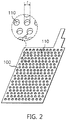
- FIG. 2 illustrates a perspective view and an enlarged view of an essential part of a perforated negative electrode current collector according to the present disclosure.
- the perforation (110) formed on the negative electrode current collector (100) is not limited in the shape, and for example, may have a circular, oval or polygonal shape.
- having a diameter (r) from 0.1 mm to 1.0 mm and space (d) between perforations from 0.1 nm to 1.0 mm is preferred in securing an effect of inducing lithium dendrite precipitation and elimination reactions inside the perforation (110), a goal of the present disclosure.
- a perforation having a longest distance of a perforation inner side surface from 0.1 mm to 1.0 mm, and space (d) between perforations from 0.1 mm to 1.0 mm is preferred.
- an aperture ratio an area ratio of the perforation region based on the total area 100% of the negative electrode current collector, is preferably from 20% to 80%.
- the aperture ratio is less than 20%, the effect of inducing precipitation and elimination reactions of lithium dendrite, a goal of the present disclosure, may not be secured, and when the aperture ratio is greater than 80%, the area of contact between the negative electrode current collector and the lithium metal layer relatively decreases, which is not proper in performing a role as a negative electrode current collector, and as a result, battery performance declines.
- the negative electrode current collector (100) is not particularly limited as long as it has high conductivity without inducing chemical changes in a battery, and may be any one metal selected from the group consisting of copper, aluminum, stainless steel, zinc, titanium, silver, palladium, nickel, iron, chromium, alloys thereof and combinations thereof.
- the stainless steel may have its surface treated with carbon, nickel, titanium or silver, and aluminum-cadmium alloys may be used as the alloy, and in addition thereto, baked carbon, nonconductive polymers of which surface is treated with a conductor, conductive polymers or the like may also be used.
- a copper thin plate is generally used as the negative electrode current collector.
- the negative electrode current collector As the negative electrode current collector (100), those having a thickness range of 3 ⁇ m to 500 ⁇ m are generally used. When the negative electrode current collector has a thickness of less than 3 ⁇ m, a current collecting effect decreases, and perforations (110) having a sufficient size to collect lithium dendrite are not secured. Meanwhile, the thickness being greater than 500 ⁇ m has a problem of reducing processibility when assembling a cell through folding.
- the negative electrode current collector (100) may be perforated after being laminated on a lithium metal layer (200), or a perforated negative electrode current collector (100) may be laminated on a lithium metal layer (200).
- the perforated negative electrode current collector (100) metal mesh, metal foam, perforated metal foil or expanded metal foil may be used as an example.
- the expanded metal foil has a thickness of 40 ⁇ m, has a perforation size of 0.3 mm, and is provided with a specification of the aperture ratio being 50%, and therefore, is preferably used as the negative electrode current collector (100) of the present disclosure.
- the lithium metal layer (200) includes lithium, and may be a lithium-containing metal compound selected from the group consisting of S, P, O, Cl, Se, F, Br, I and combinations thereof.
- elements selected from the group consisting of Ni, Co, Cu, Zn, Ga, Ge, Si, Al, Fe, V, Mn, Ti, Mo, Cr, Nb, Pt and combinations thereof may be further included.
- an added sum of the rest of the elements other than lithium is preferably approximately from 5% by weight to 20% by weight with respect to the total negative electrode active material weight when combined.
- the type of combination is not limited, and for example, alloying in the corresponding mixing ratio may be used, or forming a film on the negative electrode current collector may in the form of metal powders also be used.
- Such a lithium-containing metal compound is added for compensating irreversible capacity of lithium metal, and may be added in an amount corresponding to theoretical capacity of a positive electrode active material to be described below or added in an excess amount thereto, and such an excess negative electrode active material may prevent lithium dendrite from being precipitated on the lithium metal surface.
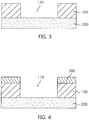
- Fig. 3 is a cross-sectional view of an electrode for a lithium secondary battery including a perforated negative electrode current collector according to a first embodiment of the present disclosure.
- a pair of negative electrode current collectors (100) having perforations (110) and a lithium metal layer (200) disposed between the pair of negative electrode current collectors (100) are included, and precipitation and elimination reactions of lithium dendrite are induced in the perforations (110).
- FIG. 4 is a cross-sectional view of an electrode for a lithium secondary battery including a perforated negative electrode current collector and an insulation layer according to a second embodiment of the present disclosure.
- the electrode for a lithium secondary battery according to the present disclosure includes, as illustrated in FIG. 4 , the negative electrode current collector (100) described above and a lithium metal layer (200), and additionally, further includes an insulation layer (300) disposed on the negative electrode current collector (100), and having a plurality of perforations funneled to the perforations (110).
- the plurality of perforations formed on the insulation layer (300) are preferably funneled and formed so that the shape, the diameter (r) and the space (d) are identical to the plurality of perforations (110) formed on the negative electrode current collector (100).
- Such an insulation layer (300) prevents precipitation and elimination reactions of lithium dendrite from occurring on the negative electrode current collector (100), and performs a role of further inducing precipitation and elimination reactions of lithium dendrite only on the perforations (110) formed on the negative electrode current collector (100).
- the insulation layer (300) is preferably formed with insulating materials that do not have electron conductivity and lithium ion conductivity, and for example, may be selected from among styrene-butadiene series rubber, carboxymethylcellulose, polytetrafluoroethylene, polyethylene, polypropylene, an ethylene propylene copolymer, polybutadiene, butyl rubber, fluoro rubber, polyethylene oxide, polyvinyl pyrrolidone, polyepichlorohydrin, polyphosphazene, polyacrylonitrile, polystyrene, an ethylene propylene diene copolymer, polyvinyl pyridine, chlorosulfonated polyethylene, latex, a polyester resin, an acrylic resin, a phenol resin, an epoxy resin, polyvinyl alcohol, hydroxypropylcellulose and combinations thereof, but is not limited thereto.
- the thickness of the insulation layer (300) having a lower thickness is advantageous for output properties of a battery, however, the precipitation and elimination reactions of lithium dendrite may be suppressed on the negative electrode current collector (100) when the insulation layer is formed to have a certain thickness or higher.
- the thickness is preferably from 0.01 ⁇ m to 50 ⁇ m.
- a method for preparing the electrode for a lithium secondary battery according to the present disclosure may be carried out in various ways, and may be carried out according to the following embodiments.
- a negative electrode current collector is prepared first. When necessary, an insulation layer is laminated on one surface of the negative electrode current collector.
- the (insulation layer-formed) negative electrode current collector is perforated.
- the perforated (insulation layer-formed) negative electrode current collector is laminated on a lithium metal layer.
- a lithium metal layer is prepared first. On at least one surface of the lithium metal layer, a common negative electrode current collector is laminated. After that, an insulation layer is laminated on the negative electrode current collector as necessary. The negative electrode current collector (and the insulation layer) is perforated so that the lithium metal layer is exposed.
- a perforated negative electrode current collector is prepared first. After that, an insulation layer is formed only on an upper surface of the perforated negative electrode current collector as necessary.
- the perforated (insulation layer-formed) negative electrode current collector is laminated on a lithium metal layer.
- a positive electrode according to the present disclosure may be prepared into a positive electrode form by forming film on a positive electrode current collector using a composition including a positive electrode active material, a conductor and a binder.
- sulfides, selenides, halides and the like may also be used in addition to such oxides.
- the conductor is a component for further enhancing conductivity of a positive electrode active material, and nonlimiting examples thereof may include graphite such as natural graphite or artificial graphite; carbon black such as carbon black, acetylene black, Ketjen black, channel black, furnace black, lamp black and thermal black; conductive polymers such as carbon fiber or metal fiber; metal powders such as fluorocarbon, aluminum and nickel powder; conductive whiskers such as zinc oxide and potassium titanate; conductive metal oxides such as titanium oxide; conductive materials such as polyphenylene derivatives, and the like.
- graphite such as natural graphite or artificial graphite
- carbon black such as carbon black, acetylene black, Ketjen black, channel black, furnace black, lamp black and thermal black
- conductive polymers such as carbon fiber or metal fiber
- metal powders such as fluorocarbon, aluminum and nickel powder
- conductive whiskers such as zinc oxide and potassium titanate
- conductive metal oxides such as titanium oxide
- conductive materials such as polypheny
- the binder has functions of keeping a positive electrode active material on a positive electrode current collector, and organically linking the positive electrode active materials, and examples thereof may include polyvinylidene fluoride (PVDF), polyvinyl alcohol (PVA), carboxymethylcellulose (CMC), starch, hydroxypropylcellulose, regenerated cellulose, polyvinyl pyrrolidone, tetrafluoroethylene, polyethylene, polypropylene, an ethylene-propylene-diene polymer (EPDM), a sulfonated-EPDM, styrene-butadiene rubber, fluoro rubber, various copolymers thereof, and the like.
- PVDF polyvinylidene fluoride
- PVA polyvinyl alcohol
- CMC carboxymethylcellulose
- EPDM ethylene-propylene-diene polymer
- sulfonated-EPDM styrene-butadiene rubber
- fluoro rubber various copolymers thereof, and the like.
- the positive electrode current collector is the same as described in the negative electrode current collector, and an aluminum thin plate may be generally used as the positive electrode current collector.
- a separator according to the present disclosure is not particularly limited in the material and, as a material physically separating a positive electrode and a negative electrode, and having electrolyte and ion penetrability, those commonly used as a separator in an electrochemical device may be used without particular limit. However, as a material that is porous, nonconductive and insulating, those having an excellent liquid electrolyte moisture-containing ability while having low resistance for ion migration of the liquid electrolyte are particularly preferred. For example, a polyolefin-based porous membrane or non-woven fabric may be used, however, the separator is not particularly limited thereto.
- membranes formed with a polymer using a polyolefin-based polymer such as polyethylene such as high density polyethylene, linear low density polyethylene, low density polyethylene and ultra-high molecular weight polyethylene, polypropylene, polybutylene and polypentene alone, or a polymer mixing these may be used.
- polyethylene such as high density polyethylene, linear low density polyethylene, low density polyethylene and ultra-high molecular weight polyethylene, polypropylene, polybutylene and polypentene alone, or a polymer mixing these may be used.
- non-woven fabric other than the polyolefin-based non-woven fabric described above, non-woven fabric formed with a polymer using, for example, polyphenylene oxide, polyimide, polyamide, polycarbonate, polyethylene terephthalate, polyethylene naphthalate, polybutylene terephthalate, polyphenylene sulfide, polyacetal, polyether sulfone, polyether ether ketone, polyester and the like alone, or a polymer mixing these may be used, and, as a fiber form forming a porous web, such non-woven fabric includes a spunbond or meltblown form formed with long fibers.
- a polymer using, for example, polyphenylene oxide, polyimide, polyamide, polycarbonate, polyethylene terephthalate, polyethylene naphthalate, polybutylene terephthalate, polyphenylene sulfide, polyacetal, polyether sulfone, polyether ether ketone, polyester and the like alone, or a
- the thickness of the separator is not particularly limited, but is preferably in a range of 1 ⁇ m to 100 ⁇ m, and more preferably in a range of 5 ⁇ m to 50 ⁇ m. When the separator has a thickness of less than 1 ⁇ m, mechanical properties may not be maintained, and when the thickness is greater than 100 ⁇ m, the separator functions as a resistive layer declining battery performance.
- a pore size and porosity of the separator are not particularly limited, however, the pore size is preferably from 0.1 ⁇ m to 50 ⁇ m, and the porosity is preferably from 10% to 95%.
- the separator has a pore size of less than 0.1 ⁇ m or porosity of less than 10%, the separator functions as a resistive layer, and when the pore size is greater than 50 ⁇ m or the porosity is greater than 95%, mechanical properties may not be maintained.
- An electrolyte capable of being used in the present disclosure may be a non-aqueous liquid electrolyte or a solid electrolyte not reacting with lithium metal, but is preferably a non-aqueous electrolyte, and includes an electrolyte salt and an organic solvent.
- the electrolyte salt included in the non-aqueous liquid electrolyte is a lithium salt.
- the lithium salt those commonly used in liquid electrolytes for a lithium secondary battery may be used without limit.
- an anion of the lithium salt may include any one selected from the group consisting of F - , Cl - , Br - , I - , NO 3 - , N(CN) 2 - , BF 4 - , ClO 4 -, PF 6 - , (CF 3 ) 2 PF 4 - , (CF 3 ) 3 PF 3 - , (CF 3 ) 4 PF 2 - , (CF 3 ) 5 PF - , (CF 3 ) 6 P - , CF 3 SO 3 - , CF 3 CF 2 SO 3 - , (CF 3 SO 2 ) 2 N - , (FSO 2 ) 2 N - , CF 3 CF 2 (CF 3 ) 2 CO - , (CF 3 SO
- organic solvent included in the non-aqueous liquid electrolyte those commonly used in liquid electrolytes for a lithium secondary battery may be used without limit, and for example, ether, ester, amide, linear carbonate, cyclic carbonate and the like may be used either alone, or as a mixture of two or more types.
- a carbonate compound that is cyclic carbonate, linear carbonate or a mixture thereof may be typically included.
- cyclic carbonate compound may include any one selected from the group consisting of ethylene carbonate (EC), propylene carbonate (PC), 1,2-butylene carbonate, 2,3-butylene carbonate, 1,2-pentylene carbonate, 2,3-pentylene carbonate, vinylene carbonate, vinyl ethylene carbonate and halides thereof, or a mixture of two or more types thereof.
- halides thereof may include fluoroethylene carbonate (FEC) and the like, but are not limited thereto.
- linear carbonate compound may typically include any one selected from the group consisting of dimethyl carbonate (DMC), diethyl carbonate (DEC), dipropyl carbonate, ethylmethyl carbonate (EMC), methylpropyl carbonate and ethylpropyl carbonate, or a mixture of two or more types thereof, but are not limited thereto.
- DMC dimethyl carbonate
- DEC diethyl carbonate
- EMC ethylmethyl carbonate
- methylpropyl carbonate and ethylpropyl carbonate or a mixture of two or more types thereof, but are not limited thereto.
- ethylene carbonate and propylene carbonate that are cyclic carbonate are a high viscosity organic solvent and have a high dielectric constant, and therefore, may more favorably dissociate a lithium salt in an electrolyte, and when mixing and using linear carbonate having low viscosity and low dielectric constant such as dimethyl carbonate and diethyl carbonate in a proper ratio to such cyclic carbonate, a liquid electrolyte having higher electrical conductivity may be prepared.
- any one selected from the group consisting of dimethyl ether, diethyl ether, dipropyl ether, methylethyl ether, methylpropyl ether and ethylpropyl ether, or a mixture of two or more types thereof may be used, however, the ether is not limited thereto.
- any one selected from the group consisting of methyl acetate, ethyl acetate, propyl acetate, methyl propionate, ethyl propionate, propyl propionate, ⁇ -butyrolactone, ⁇ -valerolactone, ⁇ -caprolactone, ⁇ -valerolactone and ⁇ -caprolactone, or a mixture of two or more types thereof may be used, however, the ester is not limited thereto.
- the non-aqueous liquid electrolyte may be injected at a proper stage in an electrochemical device manufacturing process depending on a final product manufacturing process and required properties.
- the non-aqueous liquid electrolyte may be injected at a stage prior to assembling an electrochemical device or at a final stage of electrochemical device assembly.
- the lithium secondary battery according to the present disclosure may go through lamination (stack) and folding processes of a separator and an electrode in addition to winding, a general process.
- the battery case may be cylindrical, square, a pouch-type, a coin-type or the like.
- the lithium secondary battery according to the present disclosure stably exhibits excellent discharge capacity, output property and capacity retention rate, and therefore, is useful in the fields of portable devices such as mobile phones, notebook computers or digital cameras, electric vehicles such as hybrid electric vehicles (HEV), and the like.
- portable devices such as mobile phones, notebook computers or digital cameras, electric vehicles such as hybrid electric vehicles (HEV), and the like.
- HEV hybrid electric vehicles
- a battery module including the lithium secondary battery as a unit cell, and a battery pack including the same.
- the battery module or the battery pack may be used as a power supply of any one or more of medium to large sized devices among power tools; electric vehicles including electric vehicles (EV), hybrid electric vehicles and plug-in hybrid electric vehicles (PHEV); or systems for power storage.
- EV electric vehicles
- PHEV plug-in hybrid electric vehicles
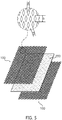
- two sheets of copper meshes (100) having rhombus-shaped perforations and a thickness of 25 ⁇ m were prepared first.
- the shortest distance (a) inside the perforation was 0.5 mm
- the longest distance (b) was 1.0 mm
- space (d) between the perforations was 0.5 mm.
- lithium foil (200) having a thickness of 40 ⁇ m was attached to prepare a negative electrode.
- SBR styrene-butadiene rubber
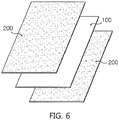
- two sheets of lithium foil (200) having a thickness of 20 ⁇ m were attached on both surfaces of copper foil (100) having a thickness of 20 ⁇ m to prepare a negative electrode.
- two sheets of lithium foil (200) having a thickness of 20 ⁇ m were attached on both surfaces of copper mesh (100) having a thickness of 20 ⁇ m to prepare a negative electrode.
- NMC positive electrode active material:conductor:PVDF binder were mixed in 97:1:2 and the result was formed as a film on aluminum foil having a thickness of 10 ⁇ m as a positive electrode.
- a separator a material coating SRS to a thickness of 5 ⁇ m on both surfaces of PE material having a thickness of 7 ⁇ m was used.
- a liquid electrolyte EC 30%v/v, EMC 70%v/v LiPF 6 1M VC 0.5% were used. The prepared separator and the positive electrode were consecutively attached, and the liquid electrolyte was injected thereto to manufacture a lithium secondary battery having a bicell structure.
- the lithium secondary battery using the electrode according to the present disclosure induces precipitation and elimination reactions of lithium metal inside perforations of a negative electrode current collector, and therefore, volume expansion of the cell is suppressed, and battery performance is enhanced therefrom.
Landscapes
- Chemical & Material Sciences (AREA)
- Chemical Kinetics & Catalysis (AREA)
- Electrochemistry (AREA)
- General Chemical & Material Sciences (AREA)
- Engineering & Computer Science (AREA)
- Materials Engineering (AREA)
- Composite Materials (AREA)
- Manufacturing & Machinery (AREA)
- Secondary Cells (AREA)
- Battery Electrode And Active Subsutance (AREA)
- Cell Electrode Carriers And Collectors (AREA)
Description
- The present disclosure relates to an electrode including a perforated current collector, and a lithium secondary battery including the same, and in particular, to a technology using a perforated current collector and inducing precipitation and elimination reactions of lithium dendrite in the perforated part of the current collector.
- Interests in energy storage technologies have been increasingly higher recently. As applications are expanded to energy of mobile phones, camcorders and notebook PCs, and furthermore, to electric vehicles, efforts on the research and development of electrochemical devices have been more and more materialized.
- Electrochemical devices are fields receiving most attentions in such aspects and among these, development of secondary batteries capable of charge and discharge have been the focus of attention, and in developing such batteries, research and development on the design of new electrodes and batteries for enhancing capacity density and energy efficiency have been recently progressed.
- Among currently used secondary batteries, lithium secondary batteries developed in early 1990s have received attentions with advantages of having high operating voltage and significantly higher energy density compared to conventional batteries such as Ni-MH, Ni-Cd and sulfuric acid-lead batteries using an aqueous liquid electrolyte.
- A lithium secondary battery is generally formed by an electrode assembly including a positive electrode, a negative electrode and a separator provided between the positive electrode and the negative electrode being embedded in a battery case in a laminated or wound structure, and a non-aqueous liquid electrolyte being injected thereinto.
- As for a lithium electrode as the negative electrode, lithium foil attached on a planar current collector is used. In this case, lithium formation and elimination are irregular when charged and discharged producing lithium dendrite, and this leads to continuous capacity decline.
- In view of the above, studies introducing a polymer protective layer or inorganic solid protective layer to a lithium metal layer, increasing a salt concentration of a liquid electrolyte, or using proper additives have been progressed. However, effects of suppressing lithium dendrite resulted from such studies are insignificant. Accordingly, solving problems through modifying a form of a lithium metal negative electrode itself or modifying a battery structure may be an effective option.
- Korean Patent Application Laid-Open Publication No.
2015-0030156 - As described above, lithium dendrite of a lithium secondary battery is precipitated on a surface of a negative electrode current collector and volume expansion of a cell is sometimes caused therefrom. In view of the above, the inventors of the present disclosure have conducted studies from various angles and, as a result, have found out a method of solving such a problem caused by dendrite through modifying shape and structure of an electrode itself, and have completed the present disclosure.
- Accordingly, the present disclosure is directed to providing a lithium secondary battery solving a problem of volume expansion of a cell caused by lithium dendrite through modifying shape and structure of an electrode, and having enhanced performance.
- In view of the above, one embodiment of the present disclosure provides an electrode for a lithium secondary battery including a pair of negative electrode current collectors having a plurality of perforations and a lithium metal layer disposed between the pair of negative electrode current collectors. The electrode may further include an insulation layer disposed on the negative electrode current collector, and having a plurality of perforations funneled to the perforations.
- Another embodiment of the present disclosure provides a lithium secondary battery including the electrode.
-
-
Fig. 1 is a perspective view of an electrode for a lithium secondary battery including a perforated negative electrode current collector according to the present disclosure; -
Fig. 2 illustrates a perspective view and an enlarged view of an essential portion of a perforated negative electrode current collector according to the present disclosure; -
Fig. 3 is a cross-sectional view of an electrode for a lithium secondary battery including a perforated negative electrode current collector according to a first embodiment of the present disclosure; -
Fig. 4 is a cross-sectional view of an electrode for a lithium secondary battery including a perforated negative electrode current collector and an insulation layer according to a second embodiment of the present disclosure; -
Fig. 5 is a perspective view illustrating a structure of an electrode according to Example 1 of the present disclosure; -
Fig. 6 is a perspective view illustrating a structure of an electrode according to Comparative Example 1 of the present disclosure; and -
Fig. 7 is a perspective view illustrating a structure of an electrode according to Comparative Example 2 of the present disclosure.
100. Negative Electrode Current Collector
110. Perforation
200. Lithium Metal Layer
300. Insulation Layer - Hereinafter, embodiments of the present disclosure will be described in detail with reference to the accompanying drawings so that those skilled in the art may readily implement the present disclosure. However, the present disclosure may be implemented in various different forms, and is not limited to the embodiments described herein.
- In the drawings, parts not relevant to the descriptions are not included in order to clearly describe the present disclosure, and like reference numerals are used for like elements throughout the specification. In addition, sizes and relative sizes of constituents shown in the drawings are unrelated to actual scales, and may be reduced or exaggerated for clarity of the descriptions.
-
Fig. 1 illustrates a perspective view and a perspective view of an essential part of an electrode for a lithium secondary battery including a perforated current collector according to the present disclosure. A first embodiment of the present disclosure provides an electrode for a lithium secondary battery including a pair of negative electrode current collectors (100) having a plurality of perforations (110) and a lithium metal layer (200) disposed between the pair of negative electrode current collectors (100). - According to the present disclosure, by using a perforated negative electrode current collector (100), precipitation and elimination reactions of lithium dendrite are induced to occur inside the perforation (110) of the negative electrode current collector (100), and volume expansion of a cell may be suppressed therefrom.
-
FIG. 2 illustrates a perspective view and an enlarged view of an essential part of a perforated negative electrode current collector according to the present disclosure. The perforation (110) formed on the negative electrode current collector (100) is not limited in the shape, and for example, may have a circular, oval or polygonal shape. In a circular perforation as illustrated inFIG. 2 , having a diameter (r) from 0.1 mm to 1.0 mm and space (d) between perforations from 0.1 nm to 1.0 mm is preferred in securing an effect of inducing lithium dendrite precipitation and elimination reactions inside the perforation (110), a goal of the present disclosure. In addition, in a polygonal perforation, a perforation, having a longest distance of a perforation inner side surface from 0.1 mm to 1.0 mm, and space (d) between perforations from 0.1 mm to 1.0 mm is preferred. - In addition, as for a ratio of the perforation (110) in the negative electrode current collector (100), an aperture ratio, an area ratio of the perforation region based on the
total area 100% of the negative electrode current collector, is preferably from 20% to 80%. When the aperture ratio is less than 20%, the effect of inducing precipitation and elimination reactions of lithium dendrite, a goal of the present disclosure, may not be secured, and when the aperture ratio is greater than 80%, the area of contact between the negative electrode current collector and the lithium metal layer relatively decreases, which is not proper in performing a role as a negative electrode current collector, and as a result, battery performance declines. - The negative electrode current collector (100) according to the present disclosure is not particularly limited as long as it has high conductivity without inducing chemical changes in a battery, and may be any one metal selected from the group consisting of copper, aluminum, stainless steel, zinc, titanium, silver, palladium, nickel, iron, chromium, alloys thereof and combinations thereof. The stainless steel may have its surface treated with carbon, nickel, titanium or silver, and aluminum-cadmium alloys may be used as the alloy, and in addition thereto, baked carbon, nonconductive polymers of which surface is treated with a conductor, conductive polymers or the like may also be used. As the negative electrode current collector, a copper thin plate is generally used.
- As the negative electrode current collector (100), those having a thickness range of 3 µm to 500 µm are generally used. When the negative electrode current collector has a thickness of less than 3 µm, a current collecting effect decreases, and perforations (110) having a sufficient size to collect lithium dendrite are not secured. Meanwhile, the thickness being greater than 500 µm has a problem of reducing processibility when assembling a cell through folding.
- The negative electrode current collector (100) may be perforated after being laminated on a lithium metal layer (200), or a perforated negative electrode current collector (100) may be laminated on a lithium metal layer (200).
- As the perforated negative electrode current collector (100), metal mesh, metal foam, perforated metal foil or expanded metal foil may be used as an example. Among these, the expanded metal foil has a thickness of 40 µm, has a perforation size of 0.3 mm, and is provided with a specification of the aperture ratio being 50%, and therefore, is preferably used as the negative electrode current collector (100) of the present disclosure.
- In addition, the lithium metal layer (200) includes lithium, and may be a lithium-containing metal compound selected from the group consisting of S, P, O, Cl, Se, F, Br, I and combinations thereof. In addition thereto, elements selected from the group consisting of Ni, Co, Cu, Zn, Ga, Ge, Si, Al, Fe, V, Mn, Ti, Mo, Cr, Nb, Pt and combinations thereof may be further included.
- In the lithium-containing metal compound, an added sum of the rest of the elements other than lithium is preferably approximately from 5% by weight to 20% by weight with respect to the total negative electrode active material weight when combined. The type of combination is not limited, and for example, alloying in the corresponding mixing ratio may be used, or forming a film on the negative electrode current collector may in the form of metal powders also be used.
- Such a lithium-containing metal compound is added for compensating irreversible capacity of lithium metal, and may be added in an amount corresponding to theoretical capacity of a positive electrode active material to be described below or added in an excess amount thereto, and such an excess negative electrode active material may prevent lithium dendrite from being precipitated on the lithium metal surface.
-
Fig. 3 is a cross-sectional view of an electrode for a lithium secondary battery including a perforated negative electrode current collector according to a first embodiment of the present disclosure. As described above, a pair of negative electrode current collectors (100) having perforations (110) and a lithium metal layer (200) disposed between the pair of negative electrode current collectors (100) are included, and precipitation and elimination reactions of lithium dendrite are induced in the perforations (110). -
FIG. 4 is a cross-sectional view of an electrode for a lithium secondary battery including a perforated negative electrode current collector and an insulation layer according to a second embodiment of the present disclosure. The electrode for a lithium secondary battery according to the present disclosure includes, as illustrated inFIG. 4 , the negative electrode current collector (100) described above and a lithium metal layer (200), and additionally, further includes an insulation layer (300) disposed on the negative electrode current collector (100), and having a plurality of perforations funneled to the perforations (110). - The plurality of perforations formed on the insulation layer (300) are preferably funneled and formed so that the shape, the diameter (r) and the space (d) are identical to the plurality of perforations (110) formed on the negative electrode current collector (100). Such an insulation layer (300) prevents precipitation and elimination reactions of lithium dendrite from occurring on the negative electrode current collector (100), and performs a role of further inducing precipitation and elimination reactions of lithium dendrite only on the perforations (110) formed on the negative electrode current collector (100).
- The insulation layer (300) is preferably formed with insulating materials that do not have electron conductivity and lithium ion conductivity, and for example, may be selected from among styrene-butadiene series rubber, carboxymethylcellulose, polytetrafluoroethylene, polyethylene, polypropylene, an ethylene propylene copolymer, polybutadiene, butyl rubber, fluoro rubber, polyethylene oxide, polyvinyl pyrrolidone, polyepichlorohydrin, polyphosphazene, polyacrylonitrile, polystyrene, an ethylene propylene diene copolymer, polyvinyl pyridine, chlorosulfonated polyethylene, latex, a polyester resin, an acrylic resin, a phenol resin, an epoxy resin, polyvinyl alcohol, hydroxypropylcellulose and combinations thereof, but is not limited thereto.
- As for the thickness of the insulation layer (300), having a lower thickness is advantageous for output properties of a battery, however, the precipitation and elimination reactions of lithium dendrite may be suppressed on the negative electrode current collector (100) when the insulation layer is formed to have a certain thickness or higher. When considering the significance of an improvement effect obtained by the insulation layer formation, the thickness is preferably from 0.01 µm to 50 µm.
- A method for preparing the electrode for a lithium secondary battery according to the present disclosure may be carried out in various ways, and may be carried out according to the following embodiments.
- According to one embodiment, a negative electrode current collector is prepared first. When necessary, an insulation layer is laminated on one surface of the negative electrode current collector. The (insulation layer-formed) negative electrode current collector is perforated. The perforated (insulation layer-formed) negative electrode current collector is laminated on a lithium metal layer.
- According to another embodiment, a lithium metal layer is prepared first. On at least one surface of the lithium metal layer, a common negative electrode current collector is laminated. After that, an insulation layer is laminated on the negative electrode current collector as necessary. The negative electrode current collector (and the insulation layer) is perforated so that the lithium metal layer is exposed.
- According to still another embodiment, a perforated negative electrode current collector is prepared first. After that, an insulation layer is formed only on an upper surface of the perforated negative electrode current collector as necessary. The perforated (insulation layer-formed) negative electrode current collector is laminated on a lithium metal layer.
- As for a lithium secondary battery according to the present disclosure, constitutions other than the structure and the properties of the negative electrode described above may be prepared through known technologies implemented by those skilled in the art, and will be specifically described below.
- A positive electrode according to the present disclosure may be prepared into a positive electrode form by forming film on a positive electrode current collector using a composition including a positive electrode active material, a conductor and a binder.
- As the positive electrode active material, any one selected from the group consisting of LiCoO2, LiNiO2, LiMnO2, LiMn2O4, Li(NiaCobMnc)O2 (0<a<1, 0<b<1, 0<c<1, a+b+c=1), LiNi1-yCoyO2, LiCo1-yMnyO2, LiNi1-yMnyO2 (O≤y<1), Li(NiaCobMnc)O4 (0<a<2, 0<b<2, 0<c<2, a+b+c=2), LiMn2-zNizO4, LiMn2-zCozO4 (0<z<2), LiCoPO4 and LiFePO4, or a mixture of two or more types thereof may be used. In addition, sulfides, selenides, halides and the like may also be used in addition to such oxides. In more preferred examples, the positive electrode active material may be LiCoO2 suitable for a high power battery.
- The conductor is a component for further enhancing conductivity of a positive electrode active material, and nonlimiting examples thereof may include graphite such as natural graphite or artificial graphite; carbon black such as carbon black, acetylene black, Ketjen black, channel black, furnace black, lamp black and thermal black; conductive polymers such as carbon fiber or metal fiber; metal powders such as fluorocarbon, aluminum and nickel powder; conductive whiskers such as zinc oxide and potassium titanate; conductive metal oxides such as titanium oxide; conductive materials such as polyphenylene derivatives, and the like.
- The binder has functions of keeping a positive electrode active material on a positive electrode current collector, and organically linking the positive electrode active materials, and examples thereof may include polyvinylidene fluoride (PVDF), polyvinyl alcohol (PVA), carboxymethylcellulose (CMC), starch, hydroxypropylcellulose, regenerated cellulose, polyvinyl pyrrolidone, tetrafluoroethylene, polyethylene, polypropylene, an ethylene-propylene-diene polymer (EPDM), a sulfonated-EPDM, styrene-butadiene rubber, fluoro rubber, various copolymers thereof, and the like.
- The positive electrode current collector is the same as described in the negative electrode current collector, and an aluminum thin plate may be generally used as the positive electrode current collector.
- A separator according to the present disclosure is not particularly limited in the material and, as a material physically separating a positive electrode and a negative electrode, and having electrolyte and ion penetrability, those commonly used as a separator in an electrochemical device may be used without particular limit. However, as a material that is porous, nonconductive and insulating, those having an excellent liquid electrolyte moisture-containing ability while having low resistance for ion migration of the liquid electrolyte are particularly preferred. For example, a polyolefin-based porous membrane or non-woven fabric may be used, however, the separator is not particularly limited thereto.
- As examples of the polyolefin-based porous membrane, membranes formed with a polymer using a polyolefin-based polymer such as polyethylene such as high density polyethylene, linear low density polyethylene, low density polyethylene and ultra-high molecular weight polyethylene, polypropylene, polybutylene and polypentene alone, or a polymer mixing these may be used.
- As the non-woven fabric other than the polyolefin-based non-woven fabric described above, non-woven fabric formed with a polymer using, for example, polyphenylene oxide, polyimide, polyamide, polycarbonate, polyethylene terephthalate, polyethylene naphthalate, polybutylene terephthalate, polyphenylene sulfide, polyacetal, polyether sulfone, polyether ether ketone, polyester and the like alone, or a polymer mixing these may be used, and, as a fiber form forming a porous web, such non-woven fabric includes a spunbond or meltblown form formed with long fibers.
- The thickness of the separator is not particularly limited, but is preferably in a range of 1 µm to 100 µm, and more preferably in a range of 5 µm to 50 µm. When the separator has a thickness of less than 1 µm, mechanical properties may not be maintained, and when the thickness is greater than 100 µm, the separator functions as a resistive layer declining battery performance.
- A pore size and porosity of the separator are not particularly limited, however, the pore size is preferably from 0.1 µm to 50 µm, and the porosity is preferably from 10% to 95%. When the separator has a pore size of less than 0.1 µm or porosity of less than 10%, the separator functions as a resistive layer, and when the pore size is greater than 50 µm or the porosity is greater than 95%, mechanical properties may not be maintained.
- An electrolyte capable of being used in the present disclosure may be a non-aqueous liquid electrolyte or a solid electrolyte not reacting with lithium metal, but is preferably a non-aqueous electrolyte, and includes an electrolyte salt and an organic solvent.
- The electrolyte salt included in the non-aqueous liquid electrolyte is a lithium salt. As the lithium salt, those commonly used in liquid electrolytes for a lithium secondary battery may be used without limit. For example, an anion of the lithium salt may include any one selected from the group consisting of F-, Cl-, Br-, I-, NO3 -, N(CN)2 -, BF4 -, ClO4-, PF6 -, (CF3)2PF4 -, (CF3)3PF3 -, (CF3)4PF2 -, (CF3)5PF-, (CF3)6P-, CF3SO3 -, CF3CF2SO3 -, (CF3SO2)2N-, (FSO2)2N-, CF3CF2(CF3)2CO-, (CF3SO2)2CH-, (SF5)3C-, (CF3SO2)3C-, CF3(CF2)7SO3 -, CF3CO2 -, CH3CO2 -, SCN- and (CF3CF2SO2)2N-, or two or more types thereof.
- As the organic solvent included in the non-aqueous liquid electrolyte, those commonly used in liquid electrolytes for a lithium secondary battery may be used without limit, and for example, ether, ester, amide, linear carbonate, cyclic carbonate and the like may be used either alone, or as a mixture of two or more types. Among these, a carbonate compound that is cyclic carbonate, linear carbonate or a mixture thereof may be typically included.
- Specific examples of the cyclic carbonate compound may include any one selected from the group consisting of ethylene carbonate (EC), propylene carbonate (PC), 1,2-butylene carbonate, 2,3-butylene carbonate, 1,2-pentylene carbonate, 2,3-pentylene carbonate, vinylene carbonate, vinyl ethylene carbonate and halides thereof, or a mixture of two or more types thereof. Examples of the halides thereof may include fluoroethylene carbonate (FEC) and the like, but are not limited thereto.
- Specific examples of the linear carbonate compound may typically include any one selected from the group consisting of dimethyl carbonate (DMC), diethyl carbonate (DEC), dipropyl carbonate, ethylmethyl carbonate (EMC), methylpropyl carbonate and ethylpropyl carbonate, or a mixture of two or more types thereof, but are not limited thereto.
- Particularly, among the carbonate-based organic solvents, ethylene carbonate and propylene carbonate that are cyclic carbonate are a high viscosity organic solvent and have a high dielectric constant, and therefore, may more favorably dissociate a lithium salt in an electrolyte, and when mixing and using linear carbonate having low viscosity and low dielectric constant such as dimethyl carbonate and diethyl carbonate in a proper ratio to such cyclic carbonate, a liquid electrolyte having higher electrical conductivity may be prepared.
- In addition, as the ether among the organic solvents, any one selected from the group consisting of dimethyl ether, diethyl ether, dipropyl ether, methylethyl ether, methylpropyl ether and ethylpropyl ether, or a mixture of two or more types thereof may be used, however, the ether is not limited thereto.
- As the ester among the organic solvents, any one selected from the group consisting of methyl acetate, ethyl acetate, propyl acetate, methyl propionate, ethyl propionate, propyl propionate, γ-butyrolactone, γ-valerolactone, γ-caprolactone, σ-valerolactone and ε-caprolactone, or a mixture of two or more types thereof may be used, however, the ester is not limited thereto.
- The non-aqueous liquid electrolyte may be injected at a proper stage in an electrochemical device manufacturing process depending on a final product manufacturing process and required properties. In other words, the non-aqueous liquid electrolyte may be injected at a stage prior to assembling an electrochemical device or at a final stage of electrochemical device assembly.
- The lithium secondary battery according to the present disclosure may go through lamination (stack) and folding processes of a separator and an electrode in addition to winding, a general process. In addition, the battery case may be cylindrical, square, a pouch-type, a coin-type or the like.
- As above, the lithium secondary battery according to the present disclosure stably exhibits excellent discharge capacity, output property and capacity retention rate, and therefore, is useful in the fields of portable devices such as mobile phones, notebook computers or digital cameras, electric vehicles such as hybrid electric vehicles (HEV), and the like.
- Accordingly, another embodiment of the present disclosure provides a battery module including the lithium secondary battery as a unit cell, and a battery pack including the same. The battery module or the battery pack may be used as a power supply of any one or more of medium to large sized devices among power tools; electric vehicles including electric vehicles (EV), hybrid electric vehicles and plug-in hybrid electric vehicles (PHEV); or systems for power storage.
- Hereinafter, the present disclosure will be described in detail with reference to examples. However, examples according to the present disclosure may be modified to various different forms, and the scope of the present disclosure is not to be construed as being limited to the examples described below. The examples of the present disclosure are provided to those having average knowledge in the art in order to more completely describe the present disclosure.
- Referring to an electrode structure illustrated in
FIG. 5 , two sheets of copper meshes (100) having rhombus-shaped perforations and a thickness of 25 µm were prepared first. Herein, the shortest distance (a) inside the perforation was 0.5 mm, the longest distance (b) was 1.0 mm, and space (d) between the perforations was 0.5 mm. Between such two layers of copper meshes (100), lithium foil (200) having a thickness of 40 µm was attached to prepare a negative electrode. - After preparing two sheets of copper meshes (100) identical to Example 1, styrene-butadiene rubber (SBR) was coated to a thickness of 1 µm on one surface, and lithium foil (200) was attached on a surface opposite to the coated surface to prepare a negative electrode in the same structure as in Example 1, an electrode structure illustrated in
FIG. 5 . - Referring to an electrode structure illustrated in
FIG. 6 , two sheets of lithium foil (200) having a thickness of 20 µm were attached on both surfaces of copper foil (100) having a thickness of 20 µm to prepare a negative electrode. - Referring to an electrode structure illustrated in
FIG. 7 , two sheets of lithium foil (200) having a thickness of 20 µm were attached on both surfaces of copper mesh (100) having a thickness of 20 µm to prepare a negative electrode. - With the negative electrodes of Examples 1 and 2 and Comparative Examples 1 and 2, NMC positive electrode active material:conductor:PVDF binder were mixed in 97:1:2 and the result was formed as a film on aluminum foil having a thickness of 10 µm as a positive electrode. As a separator, a material coating SRS to a thickness of 5 µm on both surfaces of PE material having a thickness of 7 µm was used. As a liquid electrolyte, EC 30%v/v, EMC 70%v/v LiPF6 1M VC 0.5% were used. The prepared separator and the positive electrode were consecutively attached, and the liquid electrolyte was injected thereto to manufacture a lithium secondary battery having a bicell structure.
- For the lithium secondary batteries manufactured in Examples 1 and 2 and Comparative Examples 1 and 2, charge and discharge were carried out by repeating 50 cycles at a constant current of 20 mAh, and a thickness increase rate was measured by measuring a cell thickness at SOC100 (completely charged state) and comparing the thickness with an initial cell thickness. In addition, the number of cycles completing the charge and discharge was measured. The measurement results are summarized in the following Table 1.
[Table 1] Test Item Example 1 Example 2 Comparative Example 1 Comparative Example 2 SOC 100 Increase in Cell Thickness (%)130% 120% 180% 170% Number of Completed Cycle 150 110 90 100 - When examining Table 1, it was identified that the thickness increase rate in the lithium secondary batteries of Examples 1 and 2 using copper mesh as a negative electrode current collector was significantly reduced compared to Comparative Examples 1 and 2. As for the number of cycles completing the charge and discharge, the lifespan of the lithium secondary battery of Example 1 using copper mesh as a negative electrode current collector was extended by approximately 1.67 times compared to the lifespan of the battery of Comparative Example 1 using copper foil as a negative electrode current collector. In addition, in the lithium secondary battery of Example 2 coating one surface of copper mesh with an SBR insulation layer, an effect of reducing cell expansion rate was enhanced compared to the lithium secondary battery of Example 1 without an insulation layer, and performance somewhat declined in lifespan properties, and this is considered to be due to the fact that the insulation layer functioned as resistance. Meanwhile, in Comparative Example 2 using lithium foil on both surfaces of copper mesh, notable effects were not obtained in terms of cell expansion rate reducing effect or lifespan properties, and it was identified that the structure using copper mesh on both surfaces of lithium metal was important in enhancing cell performance.
- The lithium secondary battery using the electrode according to the present disclosure induces precipitation and elimination reactions of lithium metal inside perforations of a negative electrode current collector, and therefore, volume expansion of the cell is suppressed, and battery performance is enhanced therefrom.
Claims (14)
- An electrode for a lithium secondary battery, characterized in that the electrode comprising:a pair of negative electrode current collectors having a plurality of perforations; anda lithium metal layer disposed between the pair of negative electrode current collectors.
- The electrode for a lithium secondary battery of Claim 1, further comprising an insulation layer disposed on the negative electrode current collector and having a plurality of perforations funneled to the perforations.
- The electrode for a lithium secondary battery of Claim 1, wherein the perforation has a circular, oval or polygonal shape.
- The electrode for a lithium secondary battery of Claim 1, wherein an aperture ratio caused by the perforations of the negative electrode current collector is from 20% to 80%.
- The electrode for a lithium secondary battery of Claim 1, wherein the perforation of the negative electrode current collector is a circle having a diameter from 0.1 mm to 1.0 mm.
- The electrode for a lithium secondary battery of Claim 1, wherein the perforation of the negative electrode current collector is a polygon having a longest distance of an inner side surface from 0.1 mm to 1.0 mm.
- The electrode for a lithium secondary battery of Claim 1, wherein space between the perforations of the negative electrode current collector is from 0.1 mm to 1.0 mm.
- The electrode for a lithium secondary battery of Claim 1, wherein the negative electrode current collector is selected from the group consisting of copper, aluminum, stainless steel, zinc, titanium, silver, palladium, nickel, iron, chromium, an alloy thereof and a combination thereof.
- The electrode for a lithium secondary battery of Claim 1, wherein a thickness of the negative electrode current collector is from 3 µm to 500 µm.
- The electrode for a lithium secondary battery of Claim 2, wherein the insulation layer is one or more types selected from among styrene-butadiene series rubber, carboxymethylcellulose, polytetrafluoroethylene, polyethylene, polypropylene, an ethylene propylene copolymer, polybutadiene, butyl rubber, fluoro rubber, polyethylene oxide, polyvinyl pyrrolidone, polyepichlorohydrin, polyphosphazene, polyacrylonitrile, polystyrene, an ethylene propylene diene copolymer, polyvinyl pyridine, chlorosulfonated polyethylene, latex, a polyester resin, an acrylic resin, a phenol resin, an epoxy resin, polyvinyl alcohol, hydroxypropylcellulose and a combination thereof.
- The electrode for a lithium secondary battery of Claim 2, wherein a thickness of the insulation layer is from 0.01 µm to 50 µm.
- A lithium secondary battery comprising:a negative electrode;a positive electrode;a separator provided therebetween; andan electrolyte,wherein the negative electrode is the electrode of any one of Claims 1 to 11.
- An electrode for a lithium secondary battery, characterized in that the electrode comprising:a lithium metal layer including Li; and a lithium-containing metal compound selected from the group consisting of S, P, O, Cl, Se, F, Br, I and a combination thereof; anda negative electrode current collector disposed on the lithium metal layer and having a plurality of perforations.
- The electrode for a lithium secondary battery of Claim 13, wherein the lithium metal layer further includes an element selected from the group consisting of Ni, Co, Cu, Zn, Ga, Ge, Si, Al, Fe, V, Mn, Ti, Mo, Cr, Nb, Pt and a combination thereof.
Applications Claiming Priority (1)
| Application Number | Priority Date | Filing Date | Title |
|---|---|---|---|
| KR1020160090626A KR102160701B1 (en) | 2016-07-18 | 2016-07-18 | Electrode with Perforated Current Collector, Lithium Secondary Battery containing the Same |
Publications (3)
| Publication Number | Publication Date |
|---|---|
| EP3273515A2 true EP3273515A2 (en) | 2018-01-24 |
| EP3273515A3 EP3273515A3 (en) | 2018-02-14 |
| EP3273515B1 EP3273515B1 (en) | 2021-02-24 |
Family
ID=59366298
Family Applications (1)
| Application Number | Title | Priority Date | Filing Date |
|---|---|---|---|
| EP17181825.5A Active EP3273515B1 (en) | 2016-07-18 | 2017-07-18 | Electrode with perforated current collector and lithium secondary battery including the same |
Country Status (4)
| Country | Link |
|---|---|
| US (1) | US10418638B2 (en) |
| EP (1) | EP3273515B1 (en) |
| KR (1) | KR102160701B1 (en) |
| CN (1) | CN107634179B (en) |
Families Citing this family (30)
| Publication number | Priority date | Publication date | Assignee | Title |
|---|---|---|---|---|
| US11217846B2 (en) * | 2017-03-16 | 2022-01-04 | Eaglepicher Technologies, Llc | Electrochemical cell |
| US11075388B1 (en) * | 2017-11-10 | 2021-07-27 | Greatbatch Ltd. | Foil-type current collector having an unperforated strip at the connector tab |
| KR102654678B1 (en) * | 2018-02-27 | 2024-04-04 | 주식회사 엘지에너지솔루션 | Anode for lithium metal battery, manufacturing method thereof and electrochemical device comprising the same |
| KR102560559B1 (en) * | 2018-03-12 | 2023-07-28 | 에스케이온 주식회사 | Lithium ion secondary cell having multiple substrates |
| JP2019212605A (en) * | 2018-05-31 | 2019-12-12 | パナソニックIpマネジメント株式会社 | Lithium secondary battery |
| CN108899552A (en) * | 2018-06-21 | 2018-11-27 | 湖南格兰博智能科技有限责任公司 | A kind of positive and negative anodes base band, positive and negative anodes pole piece, high-capacity lithium ion cell and preparation method thereof |
| CN110875478B (en) * | 2018-08-29 | 2025-04-15 | 中南大学 | A current collector, negative electrode and preparation and application thereof for metal lithium battery |
| CN110661000B (en) * | 2018-09-30 | 2020-11-27 | 宁德时代新能源科技股份有限公司 | A current collector, pole piece and electrochemical device |
| US11444277B2 (en) | 2019-03-01 | 2022-09-13 | Ses Holdings Pte. Ltd. | Anodes, secondary batteries including the same, and methods of making anodes |
| CN111640915B (en) | 2019-03-01 | 2024-12-31 | 麻省固能控股有限公司 | Negative electrode, secondary battery including the same, and method for manufacturing the negative electrode |
| CN112216876B (en) * | 2019-07-10 | 2022-04-15 | 比亚迪股份有限公司 | Lithium-ion battery repeating unit, lithium-ion battery and method of using the same, battery module and automobile |
| CN112216875B (en) * | 2019-07-10 | 2022-02-08 | 比亚迪股份有限公司 | Lithium ion battery repeating unit, lithium ion battery, using method of lithium ion battery, battery module and automobile |
| WO2021049609A1 (en) * | 2019-09-12 | 2021-03-18 | 学校法人同志社 | Metal negative electrode, method for manufacturing metal negative electrode, and secondary cell comprising metal negative electrode |
| KR102872653B1 (en) * | 2019-10-15 | 2025-10-16 | 주식회사 엘지에너지솔루션 | Metal Plate with Through Hole and Porous Reinforcing Meterial and Secondary Battery Comprising Thereof |
| KR102733942B1 (en) * | 2019-11-07 | 2024-11-26 | 주식회사 엘지화학 | Metal Substrate for Electrode and Preparation Method Thereof |
| CN110931802B (en) * | 2019-11-12 | 2022-09-06 | 浙江锋锂新能源科技有限公司 | Preparation method and application of flexible light non-metal current collector and pole piece, lithium storage battery and preparation method thereof |
| KR102291207B1 (en) * | 2019-12-12 | 2021-08-18 | 인하대학교 산학협력단 | Negative electrode structure for a secondary battery, a negative electrode comprising the same, a secondary battery comprising the same and a manufacturing method |
| KR20210100890A (en) | 2020-02-07 | 2021-08-18 | 현대자동차주식회사 | Electrode for lithium ion secondary battery and manufacturing method of the same and lithium ion secondary battery using the same |
| CN111613772B (en) * | 2020-04-21 | 2022-08-05 | 浙江锋锂新能源科技有限公司 | Three-dimensional structure composite metal lithium cathode and preparation method thereof |
| KR102855234B1 (en) * | 2020-04-27 | 2025-09-05 | 주식회사 엘지에너지솔루션 | Anode Coated with Lithiophillic Material for Lithium Secondary Battery and Manufacturing Method Thereof |
| KR102557102B1 (en) * | 2021-02-17 | 2023-07-18 | 인하대학교 산학협력단 | Anode electrode structure for secondary battery, an anode including the same and the manufacturing method |
| US20220352496A1 (en) * | 2021-04-28 | 2022-11-03 | GM Global Technology Operations LLC | Method and apparatus for fabricating an electrode for a battery |
| CN115440987B (en) * | 2021-06-01 | 2024-10-11 | 比亚迪股份有限公司 | Current collector and preparation method thereof, negative electrode and electrochemical energy storage device |
| JP7737842B2 (en) * | 2021-08-18 | 2025-09-11 | Tdk株式会社 | Anode and lithium ion secondary battery |
| CN115832640A (en) * | 2021-11-22 | 2023-03-21 | 宁德时代新能源科技股份有限公司 | Negative electrode sheet and its preparation method, secondary battery and its preparation method, battery module, battery pack and electrical device |
| CN114864864B (en) * | 2022-03-04 | 2025-03-18 | 远景动力技术(江苏)有限公司 | Wire-clip structure electrode, device for preparing wire-clip structure electrode and application thereof |
| CN119384741A (en) * | 2023-01-16 | 2025-01-28 | 宁德时代新能源科技股份有限公司 | Negative electrode sheet and preparation method thereof, secondary battery and electric device |
| US12009531B1 (en) | 2023-06-29 | 2024-06-11 | Lyten, Inc. | Internally enclosed support system for batteries, fabrication techniques and applications for the same |
| CN119581629B (en) * | 2023-09-06 | 2025-11-28 | 中国科学院大连化学物理研究所 | Zinc-based flow battery structure |
| CN117276468B (en) * | 2023-11-23 | 2024-04-12 | 宁德时代新能源科技股份有限公司 | Negative electrode sheet, battery and electrical device |
Citations (1)
| Publication number | Priority date | Publication date | Assignee | Title |
|---|---|---|---|---|
| KR20150030156A (en) | 2013-09-11 | 2015-03-19 | 주식회사 엘지화학 | Lithium electrode and lithium secondary battery including the same |
Family Cites Families (35)
| Publication number | Priority date | Publication date | Assignee | Title |
|---|---|---|---|---|
| JPS62103968A (en) * | 1985-10-30 | 1987-05-14 | Fuji Elelctrochem Co Ltd | Nonaqueous electrolyte secondary cell |
| US6025094A (en) * | 1994-11-23 | 2000-02-15 | Polyplus Battery Company, Inc. | Protective coatings for negative electrodes |
| JPH08250108A (en) * | 1995-03-10 | 1996-09-27 | Toshiba Battery Co Ltd | Manufacture of negative electrode for lithium secondary battery, and lithium secondary battery |
| JPH11242956A (en) | 1998-02-25 | 1999-09-07 | Fujitsu Ltd | Method for manufacturing battery electrode body |
| JP4161400B2 (en) | 1998-03-31 | 2008-10-08 | 宇部興産株式会社 | Non-aqueous electrolyte lithium secondary battery and manufacturing method thereof |
| KR100477736B1 (en) | 1998-09-28 | 2005-06-08 | 삼성에스디아이 주식회사 | Method for manufacturing electrode plate for lithium ion secondary battery and apparatus for manufacturing same |
| JP3933342B2 (en) * | 1999-04-05 | 2007-06-20 | 東洋アルミニウム株式会社 | Metal foil for current collector of secondary battery and current collector for secondary battery |
| KR100528903B1 (en) | 1999-04-21 | 2005-11-16 | 삼성에스디아이 주식회사 | lithum secondary battery and manufacturing thereof |
| KR100289537B1 (en) | 1999-04-21 | 2001-05-02 | 김순택 | lithum secondary battery |
| KR100637117B1 (en) | 2000-02-25 | 2006-10-20 | 삼성에스디아이 주식회사 | Surface treatment composition of current collector for lithium secondary battery and surface treatment method using the same |
| KR100362281B1 (en) | 2000-04-12 | 2002-11-23 | 삼성에스디아이 주식회사 | Lithium ion polymer battery using cathod current collector coated electron-conductive polymer |
| KR100366345B1 (en) | 2001-01-03 | 2002-12-31 | 삼성에스디아이 주식회사 | Negative electrode for lithium-sulfur battery |
| KR100413796B1 (en) | 2001-05-31 | 2004-01-03 | 삼성에스디아이 주식회사 | Method of manufacturing lithium metal anode protective layer for lithium battery |
| KR100450208B1 (en) | 2002-09-23 | 2004-09-24 | 삼성에스디아이 주식회사 | Negative electrode for lithium battery and lithium battery comprising same |
| KR100879468B1 (en) | 2002-11-28 | 2009-01-20 | 삼성에스디아이 주식회사 | Separator for lithium battery with improved electrical safety and lithium battery using the same |
| JP4155054B2 (en) * | 2003-02-18 | 2008-09-24 | 日産自動車株式会社 | Bipolar battery |
| KR100497249B1 (en) | 2003-04-28 | 2005-06-23 | 삼성에스디아이 주식회사 | Lithium ion secondary battery |
| KR100560541B1 (en) | 2003-09-26 | 2006-03-15 | 삼성에스디아이 주식회사 | Lithium secondary battery |
| KR100542198B1 (en) | 2003-10-23 | 2006-01-11 | 삼성에스디아이 주식회사 | Lithium polymer secondary battery |
| KR100953543B1 (en) | 2003-12-01 | 2010-04-21 | 삼성에스디아이 주식회사 | Lithium anode, its manufacturing method and lithium battery employing the same |
| JP3799049B2 (en) * | 2004-05-12 | 2006-07-19 | 三井金属鉱業株式会社 | Negative electrode for non-aqueous electrolyte secondary battery and method for producing the same |
| US7682739B2 (en) | 2004-05-12 | 2010-03-23 | Mitsui Mining & Smelting Co., Ltd. | Negative electrode for nonaqueous secondary battery and process of producing the same |
| KR100635737B1 (en) | 2005-03-24 | 2006-10-17 | 삼성에스디아이 주식회사 | Lithium secondary battery |
| KR100669338B1 (en) | 2005-07-18 | 2007-01-16 | 삼성에스디아이 주식회사 | Anode for a lithium secondary battery and a lithium secondary battery comprising the same |
| JP5188677B2 (en) | 2005-12-21 | 2013-04-24 | 三星エスディアイ株式会社 | Lithium secondary battery and method for producing lithium secondary battery |
| KR101308195B1 (en) | 2006-04-27 | 2013-09-26 | 삼성에스디아이 주식회사 | Electrode assembly and Lithium rechargeable battery comprising the same and Method of making lithium rechargeable battery |
| JP2011134691A (en) | 2009-12-25 | 2011-07-07 | Panasonic Corp | Electrode for nonaqueous electrolyte secondary battery, method for manufacturing the same, and non-aqueous secondary battery |
| CN103035925A (en) * | 2011-09-30 | 2013-04-10 | 天津市捷威动力工业有限公司 | Lithium-ion power battery, lithium-ion power battery current collecting body, negative electrode pole piece |
| KR101422908B1 (en) | 2012-04-02 | 2014-07-23 | 삼성정밀화학 주식회사 | Electrolyte for Lithium Ion Secondary Battery and Lithium Ion Secondary Battery Comprising The Same |
| KR101503572B1 (en) | 2012-08-03 | 2015-03-18 | (주)오렌지파워 | Anode electrode, rechargeable battery including the same and method of fabricating the same |
| KR101470556B1 (en) * | 2013-05-07 | 2014-12-10 | 주식회사 엘지화학 | Electrode for a secondary battery, preparation method thereof, secondary battery and cable-type secondary battery including the same |
| TWI563716B (en) * | 2014-07-16 | 2016-12-21 | Prologium Technology Co Ltd | Anode electrode |
| KR20160027365A (en) | 2014-08-29 | 2016-03-10 | 에스케이이노베이션 주식회사 | Current collector for electrode of secondary battery |
| KR101623447B1 (en) | 2014-10-14 | 2016-05-23 | 국민대학교산학협력단 | Anode for Lithium Ion Secondary Battery and Method for Manufacturing the Same |
| KR102076689B1 (en) | 2015-09-21 | 2020-02-13 | 주식회사 엘지화학 | Metal mesh foil for current collector of lithium secondary battery, electrode for lithium secondary battery and lithium secondary battery comprising the same |
-
2016
- 2016-07-18 KR KR1020160090626A patent/KR102160701B1/en active Active
-
2017
- 2017-07-14 US US15/649,818 patent/US10418638B2/en active Active
- 2017-07-18 CN CN201710585422.3A patent/CN107634179B/en active Active
- 2017-07-18 EP EP17181825.5A patent/EP3273515B1/en active Active
Patent Citations (1)
| Publication number | Priority date | Publication date | Assignee | Title |
|---|---|---|---|---|
| KR20150030156A (en) | 2013-09-11 | 2015-03-19 | 주식회사 엘지화학 | Lithium electrode and lithium secondary battery including the same |
Also Published As
| Publication number | Publication date |
|---|---|
| CN107634179A (en) | 2018-01-26 |
| US20180019477A1 (en) | 2018-01-18 |
| EP3273515B1 (en) | 2021-02-24 |
| KR102160701B1 (en) | 2020-09-28 |
| EP3273515A3 (en) | 2018-02-14 |
| US10418638B2 (en) | 2019-09-17 |
| KR20180009129A (en) | 2018-01-26 |
| CN107634179B (en) | 2021-05-28 |
Similar Documents
| Publication | Publication Date | Title |
|---|---|---|
| EP3273515B1 (en) | Electrode with perforated current collector and lithium secondary battery including the same | |
| EP3429014B1 (en) | Lithium secondary battery having lithium metal formed on cathode and manufacturing method therefor | |
| KR102140129B1 (en) | Anode with mesh type insulating layer, lithium secondary battery containing the same | |
| US9711798B2 (en) | Lithium electrode and lithium secondary battery comprising the same | |
| US12034147B2 (en) | Negative electrode for lithium secondary battery, method for manufacturing same, and lithium secondary battery comprising same | |
| EP3276709B1 (en) | Negative electrode comprising mesh-type current collector, lithium secondary battery comprising the same, and manufacturing method thereof | |
| JP6872095B2 (en) | Negative electrode including electrode protection layer and lithium secondary battery to which this is applied | |
| EP2942827A1 (en) | Lithium electrode and lithium secondary battery comprising same | |
| US10651469B2 (en) | Lithium secondary battery comprising positive electrode active material for synthesis of lithium cobalt oxide and preparation method thereof | |
| EP3686967B1 (en) | Method for designing electrode for lithium secondary battery and method for manufacturing electrode for lithium secondary battery comprising the same | |
| KR102953468B1 (en) | Electrode with improved safety and manufacturing method thereof | |
| KR102179969B1 (en) | Seperator for lithium secondary battery and lithium secondary battery comprising the same | |
| CN113711409A (en) | Electrochemical element for inducing internal short circuit and method for evaluating safety using the same | |
| EP3322024A1 (en) | Nonaqueous electrolyte battery and battery pack | |
| KR20250085695A (en) | Jelly roll electrode assembly and cylindrical lithium secondary battery comprising same | |
| KR102000539B1 (en) | Method of Manufacturing Electrode Plate Using Unit Electrode Sheet Including Coating Portions Having Different Size from One Another | |
| US9979051B2 (en) | Method for preparing lithium secondary battery and lithium secondary battery prepared therefrom | |
| KR20180011715A (en) | Anode Comprising Mesh Type Current Collector, Lithium Secondary Battery Comprising the Same and Manufacturing Method thereof | |
| US20260018676A1 (en) | Electrode Assembly Comprising Surface-Treated Separator, Secondary Battery Comprising Same, and Electrode Assembly Manufacturing Method | |
| JP2004171979A (en) | Non-aqueous electrolyte secondary battery |
Legal Events
| Date | Code | Title | Description |
|---|---|---|---|
| PUAI | Public reference made under article 153(3) epc to a published international application that has entered the european phase |
Free format text: ORIGINAL CODE: 0009012 |
|
| STAA | Information on the status of an ep patent application or granted ep patent |
Free format text: STATUS: REQUEST FOR EXAMINATION WAS MADE |
|
| PUAL | Search report despatched |
Free format text: ORIGINAL CODE: 0009013 |
|
| 17P | Request for examination filed |
Effective date: 20170718 |
|
| AK | Designated contracting states |
Kind code of ref document: A2 Designated state(s): AL AT BE BG CH CY CZ DE DK EE ES FI FR GB GR HR HU IE IS IT LI LT LU LV MC MK MT NL NO PL PT RO RS SE SI SK SM TR |
|
| AX | Request for extension of the european patent |
Extension state: BA ME |
|
| AK | Designated contracting states |
Kind code of ref document: A3 Designated state(s): AL AT BE BG CH CY CZ DE DK EE ES FI FR GB GR HR HU IE IS IT LI LT LU LV MC MK MT NL NO PL PT RO RS SE SI SK SM TR |
|
| AX | Request for extension of the european patent |
Extension state: BA ME |
|
| RIC1 | Information provided on ipc code assigned before grant |
Ipc: H01M 4/80 20060101ALI20180111BHEP Ipc: H01M 4/74 20060101AFI20180111BHEP Ipc: H01M 4/66 20060101ALI20180111BHEP |
|
| STAA | Information on the status of an ep patent application or granted ep patent |
Free format text: STATUS: EXAMINATION IS IN PROGRESS |
|
| 17Q | First examination report despatched |
Effective date: 20181011 |
|
| GRAP | Despatch of communication of intention to grant a patent |
Free format text: ORIGINAL CODE: EPIDOSNIGR1 |
|
| STAA | Information on the status of an ep patent application or granted ep patent |
Free format text: STATUS: GRANT OF PATENT IS INTENDED |
|
| INTG | Intention to grant announced |
Effective date: 20201112 |
|
| GRAS | Grant fee paid |
Free format text: ORIGINAL CODE: EPIDOSNIGR3 |
|
| GRAA | (expected) grant |
Free format text: ORIGINAL CODE: 0009210 |
|
| STAA | Information on the status of an ep patent application or granted ep patent |
Free format text: STATUS: THE PATENT HAS BEEN GRANTED |
|
| AK | Designated contracting states |
Kind code of ref document: B1 Designated state(s): AL AT BE BG CH CY CZ DE DK EE ES FI FR GB GR HR HU IE IS IT LI LT LU LV MC MK MT NL NO PL PT RO RS SE SI SK SM TR |
|
| REG | Reference to a national code |
Ref country code: CH Ref legal event code: EP |
|
| REG | Reference to a national code |
Ref country code: AT Ref legal event code: REF Ref document number: 1365620 Country of ref document: AT Kind code of ref document: T Effective date: 20210315 |
|
| REG | Reference to a national code |
Ref country code: IE Ref legal event code: FG4D |
|
| REG | Reference to a national code |
Ref country code: DE Ref legal event code: R096 Ref document number: 602017033096 Country of ref document: DE |
|
| REG | Reference to a national code |
Ref country code: LT Ref legal event code: MG9D |
|
| REG | Reference to a national code |
Ref country code: NL Ref legal event code: MP Effective date: 20210224 |
|
| PG25 | Lapsed in a contracting state [announced via postgrant information from national office to epo] |
Ref country code: LT Free format text: LAPSE BECAUSE OF FAILURE TO SUBMIT A TRANSLATION OF THE DESCRIPTION OR TO PAY THE FEE WITHIN THE PRESCRIBED TIME-LIMIT Effective date: 20210224 Ref country code: BG Free format text: LAPSE BECAUSE OF FAILURE TO SUBMIT A TRANSLATION OF THE DESCRIPTION OR TO PAY THE FEE WITHIN THE PRESCRIBED TIME-LIMIT Effective date: 20210524 Ref country code: PT Free format text: LAPSE BECAUSE OF FAILURE TO SUBMIT A TRANSLATION OF THE DESCRIPTION OR TO PAY THE FEE WITHIN THE PRESCRIBED TIME-LIMIT Effective date: 20210624 Ref country code: NO Free format text: LAPSE BECAUSE OF FAILURE TO SUBMIT A TRANSLATION OF THE DESCRIPTION OR TO PAY THE FEE WITHIN THE PRESCRIBED TIME-LIMIT Effective date: 20210524 Ref country code: GR Free format text: LAPSE BECAUSE OF FAILURE TO SUBMIT A TRANSLATION OF THE DESCRIPTION OR TO PAY THE FEE WITHIN THE PRESCRIBED TIME-LIMIT Effective date: 20210525 Ref country code: FI Free format text: LAPSE BECAUSE OF FAILURE TO SUBMIT A TRANSLATION OF THE DESCRIPTION OR TO PAY THE FEE WITHIN THE PRESCRIBED TIME-LIMIT Effective date: 20210224 Ref country code: HR Free format text: LAPSE BECAUSE OF FAILURE TO SUBMIT A TRANSLATION OF THE DESCRIPTION OR TO PAY THE FEE WITHIN THE PRESCRIBED TIME-LIMIT Effective date: 20210224 |
|
| REG | Reference to a national code |
Ref country code: AT Ref legal event code: MK05 Ref document number: 1365620 Country of ref document: AT Kind code of ref document: T Effective date: 20210224 |
|
| PG25 | Lapsed in a contracting state [announced via postgrant information from national office to epo] |
Ref country code: SE Free format text: LAPSE BECAUSE OF FAILURE TO SUBMIT A TRANSLATION OF THE DESCRIPTION OR TO PAY THE FEE WITHIN THE PRESCRIBED TIME-LIMIT Effective date: 20210224 Ref country code: NL Free format text: LAPSE BECAUSE OF FAILURE TO SUBMIT A TRANSLATION OF THE DESCRIPTION OR TO PAY THE FEE WITHIN THE PRESCRIBED TIME-LIMIT Effective date: 20210224 Ref country code: LV Free format text: LAPSE BECAUSE OF FAILURE TO SUBMIT A TRANSLATION OF THE DESCRIPTION OR TO PAY THE FEE WITHIN THE PRESCRIBED TIME-LIMIT Effective date: 20210224 Ref country code: RS Free format text: LAPSE BECAUSE OF FAILURE TO SUBMIT A TRANSLATION OF THE DESCRIPTION OR TO PAY THE FEE WITHIN THE PRESCRIBED TIME-LIMIT Effective date: 20210224 Ref country code: PL Free format text: LAPSE BECAUSE OF FAILURE TO SUBMIT A TRANSLATION OF THE DESCRIPTION OR TO PAY THE FEE WITHIN THE PRESCRIBED TIME-LIMIT Effective date: 20210224 |
|
| PG25 | Lapsed in a contracting state [announced via postgrant information from national office to epo] |
Ref country code: IS Free format text: LAPSE BECAUSE OF FAILURE TO SUBMIT A TRANSLATION OF THE DESCRIPTION OR TO PAY THE FEE WITHIN THE PRESCRIBED TIME-LIMIT Effective date: 20210624 |
|
| PG25 | Lapsed in a contracting state [announced via postgrant information from national office to epo] |
Ref country code: SM Free format text: LAPSE BECAUSE OF FAILURE TO SUBMIT A TRANSLATION OF THE DESCRIPTION OR TO PAY THE FEE WITHIN THE PRESCRIBED TIME-LIMIT Effective date: 20210224 Ref country code: AT Free format text: LAPSE BECAUSE OF FAILURE TO SUBMIT A TRANSLATION OF THE DESCRIPTION OR TO PAY THE FEE WITHIN THE PRESCRIBED TIME-LIMIT Effective date: 20210224 Ref country code: CZ Free format text: LAPSE BECAUSE OF FAILURE TO SUBMIT A TRANSLATION OF THE DESCRIPTION OR TO PAY THE FEE WITHIN THE PRESCRIBED TIME-LIMIT Effective date: 20210224 Ref country code: EE Free format text: LAPSE BECAUSE OF FAILURE TO SUBMIT A TRANSLATION OF THE DESCRIPTION OR TO PAY THE FEE WITHIN THE PRESCRIBED TIME-LIMIT Effective date: 20210224 |
|
| REG | Reference to a national code |
Ref country code: DE Ref legal event code: R097 Ref document number: 602017033096 Country of ref document: DE |
|
| PG25 | Lapsed in a contracting state [announced via postgrant information from national office to epo] |
Ref country code: DK Free format text: LAPSE BECAUSE OF FAILURE TO SUBMIT A TRANSLATION OF THE DESCRIPTION OR TO PAY THE FEE WITHIN THE PRESCRIBED TIME-LIMIT Effective date: 20210224 Ref country code: RO Free format text: LAPSE BECAUSE OF FAILURE TO SUBMIT A TRANSLATION OF THE DESCRIPTION OR TO PAY THE FEE WITHIN THE PRESCRIBED TIME-LIMIT Effective date: 20210224 Ref country code: SK Free format text: LAPSE BECAUSE OF FAILURE TO SUBMIT A TRANSLATION OF THE DESCRIPTION OR TO PAY THE FEE WITHIN THE PRESCRIBED TIME-LIMIT Effective date: 20210224 |
|
| PLBE | No opposition filed within time limit |
Free format text: ORIGINAL CODE: 0009261 |
|
| STAA | Information on the status of an ep patent application or granted ep patent |
Free format text: STATUS: NO OPPOSITION FILED WITHIN TIME LIMIT |
|
| PG25 | Lapsed in a contracting state [announced via postgrant information from national office to epo] |
Ref country code: ES Free format text: LAPSE BECAUSE OF FAILURE TO SUBMIT A TRANSLATION OF THE DESCRIPTION OR TO PAY THE FEE WITHIN THE PRESCRIBED TIME-LIMIT Effective date: 20210224 Ref country code: AL Free format text: LAPSE BECAUSE OF FAILURE TO SUBMIT A TRANSLATION OF THE DESCRIPTION OR TO PAY THE FEE WITHIN THE PRESCRIBED TIME-LIMIT Effective date: 20210224 |
|
| 26N | No opposition filed |
Effective date: 20211125 |
|
| PG25 | Lapsed in a contracting state [announced via postgrant information from national office to epo] |
Ref country code: SI Free format text: LAPSE BECAUSE OF FAILURE TO SUBMIT A TRANSLATION OF THE DESCRIPTION OR TO PAY THE FEE WITHIN THE PRESCRIBED TIME-LIMIT Effective date: 20210224 |
|
| REG | Reference to a national code |
Ref country code: CH Ref legal event code: PL |
|
| PG25 | Lapsed in a contracting state [announced via postgrant information from national office to epo] |
Ref country code: MC Free format text: LAPSE BECAUSE OF FAILURE TO SUBMIT A TRANSLATION OF THE DESCRIPTION OR TO PAY THE FEE WITHIN THE PRESCRIBED TIME-LIMIT Effective date: 20210224 |
|
| REG | Reference to a national code |
Ref country code: BE Ref legal event code: MM Effective date: 20210731 |
|
| PG25 | Lapsed in a contracting state [announced via postgrant information from national office to epo] |
Ref country code: LI Free format text: LAPSE BECAUSE OF NON-PAYMENT OF DUE FEES Effective date: 20210731 Ref country code: IT Free format text: LAPSE BECAUSE OF FAILURE TO SUBMIT A TRANSLATION OF THE DESCRIPTION OR TO PAY THE FEE WITHIN THE PRESCRIBED TIME-LIMIT Effective date: 20210224 Ref country code: CH Free format text: LAPSE BECAUSE OF NON-PAYMENT OF DUE FEES Effective date: 20210731 |
|
| PG25 | Lapsed in a contracting state [announced via postgrant information from national office to epo] |
Ref country code: IS Free format text: LAPSE BECAUSE OF FAILURE TO SUBMIT A TRANSLATION OF THE DESCRIPTION OR TO PAY THE FEE WITHIN THE PRESCRIBED TIME-LIMIT Effective date: 20210624 Ref country code: LU Free format text: LAPSE BECAUSE OF NON-PAYMENT OF DUE FEES Effective date: 20210718 |
|
| PG25 | Lapsed in a contracting state [announced via postgrant information from national office to epo] |
Ref country code: IE Free format text: LAPSE BECAUSE OF NON-PAYMENT OF DUE FEES Effective date: 20210718 Ref country code: BE Free format text: LAPSE BECAUSE OF NON-PAYMENT OF DUE FEES Effective date: 20210731 |
|
| REG | Reference to a national code |
Ref country code: DE Ref legal event code: R081 Ref document number: 602017033096 Country of ref document: DE Owner name: LG ENERGY SOLUTION, LTD., KR Free format text: FORMER OWNER: LG CHEM, LTD., SEOUL, KR |
|
| PG25 | Lapsed in a contracting state [announced via postgrant information from national office to epo] |
Ref country code: HU Free format text: LAPSE BECAUSE OF FAILURE TO SUBMIT A TRANSLATION OF THE DESCRIPTION OR TO PAY THE FEE WITHIN THE PRESCRIBED TIME-LIMIT; INVALID AB INITIO Effective date: 20170718 |
|
| P01 | Opt-out of the competence of the unified patent court (upc) registered |
Effective date: 20230408 |
|
| PG25 | Lapsed in a contracting state [announced via postgrant information from national office to epo] |
Ref country code: CY Free format text: LAPSE BECAUSE OF FAILURE TO SUBMIT A TRANSLATION OF THE DESCRIPTION OR TO PAY THE FEE WITHIN THE PRESCRIBED TIME-LIMIT Effective date: 20210224 |
|
| REG | Reference to a national code |
Ref country code: GB Ref legal event code: 732E Free format text: REGISTERED BETWEEN 20230901 AND 20230906 |
|
| PG25 | Lapsed in a contracting state [announced via postgrant information from national office to epo] |
Ref country code: MK Free format text: LAPSE BECAUSE OF FAILURE TO SUBMIT A TRANSLATION OF THE DESCRIPTION OR TO PAY THE FEE WITHIN THE PRESCRIBED TIME-LIMIT Effective date: 20210224 |
|
| PG25 | Lapsed in a contracting state [announced via postgrant information from national office to epo] |
Ref country code: TR Free format text: LAPSE BECAUSE OF FAILURE TO SUBMIT A TRANSLATION OF THE DESCRIPTION OR TO PAY THE FEE WITHIN THE PRESCRIBED TIME-LIMIT Effective date: 20210224 |
|
| PG25 | Lapsed in a contracting state [announced via postgrant information from national office to epo] |
Ref country code: MT Free format text: LAPSE BECAUSE OF FAILURE TO SUBMIT A TRANSLATION OF THE DESCRIPTION OR TO PAY THE FEE WITHIN THE PRESCRIBED TIME-LIMIT Effective date: 20210224 |
|
| PGFP | Annual fee paid to national office [announced via postgrant information from national office to epo] |
Ref country code: GB Payment date: 20250624 Year of fee payment: 9 |
|
| PGFP | Annual fee paid to national office [announced via postgrant information from national office to epo] |
Ref country code: FR Payment date: 20250624 Year of fee payment: 9 |
|
| PGFP | Annual fee paid to national office [announced via postgrant information from national office to epo] |
Ref country code: DE Payment date: 20250624 Year of fee payment: 9 |