EP3272833A1 - Composition for organic photoelectronic element, organic photoelectronic element, and display apparatus - Google Patents
Composition for organic photoelectronic element, organic photoelectronic element, and display apparatus Download PDFInfo
- Publication number
- EP3272833A1 EP3272833A1 EP16811819.8A EP16811819A EP3272833A1 EP 3272833 A1 EP3272833 A1 EP 3272833A1 EP 16811819 A EP16811819 A EP 16811819A EP 3272833 A1 EP3272833 A1 EP 3272833A1
- Authority
- EP
- European Patent Office
- Prior art keywords
- group
- substituted
- unsubstituted
- compound
- deuterium
- Prior art date
- Legal status (The legal status is an assumption and is not a legal conclusion. Google has not performed a legal analysis and makes no representation as to the accuracy of the status listed.)
- Granted
Links
- 0 C*([n]1c2ccccc2c2c1cccc2)[Al]=I Chemical compound C*([n]1c2ccccc2c2c1cccc2)[Al]=I 0.000 description 4
- RIAQAHPIIHBWTL-UHFFFAOYSA-N CC(C)(C(C)(C)OBc1cccc(-c2cc(-c3nc(-c4ccccc4)nc(-c4ccccc4)n3)ccc2)c1)O Chemical compound CC(C)(C(C)(C)OBc1cccc(-c2cc(-c3nc(-c4ccccc4)nc(-c4ccccc4)n3)ccc2)c1)O RIAQAHPIIHBWTL-UHFFFAOYSA-N 0.000 description 1
- CBVSDGYGMCHKHK-UHFFFAOYSA-N C[BrH]c(cc(cc1)Cl)c1N Chemical compound C[BrH]c(cc(cc1)Cl)c1N CBVSDGYGMCHKHK-UHFFFAOYSA-N 0.000 description 1
- MMBCKDARNLVXED-UHFFFAOYSA-N C[BrH]c(ccc(Cl)c1)c1-c(cc1)ccc1-c1nc(-c2ccccc2)nc(-c2ccccc2)n1 Chemical compound C[BrH]c(ccc(Cl)c1)c1-c(cc1)ccc1-c1nc(-c2ccccc2)nc(-c2ccccc2)n1 MMBCKDARNLVXED-UHFFFAOYSA-N 0.000 description 1
- DPGPCBXZJPDSAU-UHFFFAOYSA-N C[BrH]c1cc(-c2cccc(-c3nc(-c4ccccc4)nc(-c4ccccc4)n3)c2)ccc1 Chemical compound C[BrH]c1cc(-c2cccc(-c3nc(-c4ccccc4)nc(-c4ccccc4)n3)c2)ccc1 DPGPCBXZJPDSAU-UHFFFAOYSA-N 0.000 description 1
- AFSGCRGBKICCFF-UHFFFAOYSA-N Cc1ccc(c2ccccc2c2c3cccc2)c3c1 Chemical compound Cc1ccc(c2ccccc2c2c3cccc2)c3c1 AFSGCRGBKICCFF-UHFFFAOYSA-N 0.000 description 1
- ISWHBGYMCPFTFL-UHFFFAOYSA-N Nc(c(-c(cc1)ccc1-c1nc(-c2ccccc2)nc(-c2ccccc2)n1)c1)ccc1Cl Chemical compound Nc(c(-c(cc1)ccc1-c1nc(-c2ccccc2)nc(-c2ccccc2)n1)c1)ccc1Cl ISWHBGYMCPFTFL-UHFFFAOYSA-N 0.000 description 1
Images

Classifications
-
- C—CHEMISTRY; METALLURGY
- C07—ORGANIC CHEMISTRY
- C07D—HETEROCYCLIC COMPOUNDS
- C07D251/00—Heterocyclic compounds containing 1,3,5-triazine rings
- C07D251/02—Heterocyclic compounds containing 1,3,5-triazine rings not condensed with other rings
- C07D251/12—Heterocyclic compounds containing 1,3,5-triazine rings not condensed with other rings having three double bonds between ring members or between ring members and non-ring members
- C07D251/14—Heterocyclic compounds containing 1,3,5-triazine rings not condensed with other rings having three double bonds between ring members or between ring members and non-ring members with hydrogen or carbon atoms directly attached to at least one ring carbon atom
- C07D251/24—Heterocyclic compounds containing 1,3,5-triazine rings not condensed with other rings having three double bonds between ring members or between ring members and non-ring members with hydrogen or carbon atoms directly attached to at least one ring carbon atom to three ring carbon atoms
-
- C—CHEMISTRY; METALLURGY
- C07—ORGANIC CHEMISTRY
- C07D—HETEROCYCLIC COMPOUNDS
- C07D209/00—Heterocyclic compounds containing five-membered rings, condensed with other rings, with one nitrogen atom as the only ring hetero atom
- C07D209/56—Ring systems containing three or more rings
- C07D209/80—[b, c]- or [b, d]-condensed
- C07D209/82—Carbazoles; Hydrogenated carbazoles
-
- C—CHEMISTRY; METALLURGY
- C07—ORGANIC CHEMISTRY
- C07D—HETEROCYCLIC COMPOUNDS
- C07D209/00—Heterocyclic compounds containing five-membered rings, condensed with other rings, with one nitrogen atom as the only ring hetero atom
- C07D209/56—Ring systems containing three or more rings
- C07D209/80—[b, c]- or [b, d]-condensed
- C07D209/82—Carbazoles; Hydrogenated carbazoles
- C07D209/86—Carbazoles; Hydrogenated carbazoles with only hydrogen atoms, hydrocarbon or substituted hydrocarbon radicals, directly attached to carbon atoms of the ring system
-
- C—CHEMISTRY; METALLURGY
- C07—ORGANIC CHEMISTRY
- C07D—HETEROCYCLIC COMPOUNDS
- C07D307/00—Heterocyclic compounds containing five-membered rings having one oxygen atom as the only ring hetero atom
- C07D307/77—Heterocyclic compounds containing five-membered rings having one oxygen atom as the only ring hetero atom ortho- or peri-condensed with carbocyclic rings or ring systems
- C07D307/91—Dibenzofurans; Hydrogenated dibenzofurans
-
- C—CHEMISTRY; METALLURGY
- C07—ORGANIC CHEMISTRY
- C07D—HETEROCYCLIC COMPOUNDS
- C07D401/00—Heterocyclic compounds containing two or more hetero rings, having nitrogen atoms as the only ring hetero atoms, at least one ring being a six-membered ring with only one nitrogen atom
- C07D401/02—Heterocyclic compounds containing two or more hetero rings, having nitrogen atoms as the only ring hetero atoms, at least one ring being a six-membered ring with only one nitrogen atom containing two hetero rings
- C07D401/10—Heterocyclic compounds containing two or more hetero rings, having nitrogen atoms as the only ring hetero atoms, at least one ring being a six-membered ring with only one nitrogen atom containing two hetero rings linked by a carbon chain containing aromatic rings
-
- C—CHEMISTRY; METALLURGY
- C07—ORGANIC CHEMISTRY
- C07D—HETEROCYCLIC COMPOUNDS
- C07D401/00—Heterocyclic compounds containing two or more hetero rings, having nitrogen atoms as the only ring hetero atoms, at least one ring being a six-membered ring with only one nitrogen atom
- C07D401/14—Heterocyclic compounds containing two or more hetero rings, having nitrogen atoms as the only ring hetero atoms, at least one ring being a six-membered ring with only one nitrogen atom containing three or more hetero rings
-
- C—CHEMISTRY; METALLURGY
- C07—ORGANIC CHEMISTRY
- C07D—HETEROCYCLIC COMPOUNDS
- C07D403/00—Heterocyclic compounds containing two or more hetero rings, having nitrogen atoms as the only ring hetero atoms, not provided for by group C07D401/00
- C07D403/02—Heterocyclic compounds containing two or more hetero rings, having nitrogen atoms as the only ring hetero atoms, not provided for by group C07D401/00 containing two hetero rings
- C07D403/10—Heterocyclic compounds containing two or more hetero rings, having nitrogen atoms as the only ring hetero atoms, not provided for by group C07D401/00 containing two hetero rings linked by a carbon chain containing aromatic rings
-
- C—CHEMISTRY; METALLURGY
- C07—ORGANIC CHEMISTRY
- C07D—HETEROCYCLIC COMPOUNDS
- C07D491/00—Heterocyclic compounds containing in the condensed ring system both one or more rings having oxygen atoms as the only ring hetero atoms and one or more rings having nitrogen atoms as the only ring hetero atoms, not provided for by groups C07D451/00 - C07D459/00, C07D463/00, C07D477/00 or C07D489/00
- C07D491/02—Heterocyclic compounds containing in the condensed ring system both one or more rings having oxygen atoms as the only ring hetero atoms and one or more rings having nitrogen atoms as the only ring hetero atoms, not provided for by groups C07D451/00 - C07D459/00, C07D463/00, C07D477/00 or C07D489/00 in which the condensed system contains two hetero rings
- C07D491/04—Ortho-condensed systems
- C07D491/044—Ortho-condensed systems with only one oxygen atom as ring hetero atom in the oxygen-containing ring
- C07D491/048—Ortho-condensed systems with only one oxygen atom as ring hetero atom in the oxygen-containing ring the oxygen-containing ring being five-membered
-
- C—CHEMISTRY; METALLURGY
- C07—ORGANIC CHEMISTRY
- C07D—HETEROCYCLIC COMPOUNDS
- C07D495/00—Heterocyclic compounds containing in the condensed system at least one hetero ring having sulfur atoms as the only ring hetero atoms
- C07D495/02—Heterocyclic compounds containing in the condensed system at least one hetero ring having sulfur atoms as the only ring hetero atoms in which the condensed system contains two hetero rings
- C07D495/04—Ortho-condensed systems
-
- C—CHEMISTRY; METALLURGY
- C09—DYES; PAINTS; POLISHES; NATURAL RESINS; ADHESIVES; COMPOSITIONS NOT OTHERWISE PROVIDED FOR; APPLICATIONS OF MATERIALS NOT OTHERWISE PROVIDED FOR
- C09K—MATERIALS FOR MISCELLANEOUS APPLICATIONS, NOT PROVIDED FOR ELSEWHERE
- C09K11/00—Luminescent materials, e.g. electroluminescent or chemiluminescent
- C09K11/02—Use of particular materials as binders, particle coatings or suspension media therefor
-
- C—CHEMISTRY; METALLURGY
- C09—DYES; PAINTS; POLISHES; NATURAL RESINS; ADHESIVES; COMPOSITIONS NOT OTHERWISE PROVIDED FOR; APPLICATIONS OF MATERIALS NOT OTHERWISE PROVIDED FOR
- C09K—MATERIALS FOR MISCELLANEOUS APPLICATIONS, NOT PROVIDED FOR ELSEWHERE
- C09K11/00—Luminescent materials, e.g. electroluminescent or chemiluminescent
- C09K11/06—Luminescent materials, e.g. electroluminescent or chemiluminescent containing organic luminescent materials
-
- H—ELECTRICITY
- H10—SEMICONDUCTOR DEVICES; ELECTRIC SOLID-STATE DEVICES NOT OTHERWISE PROVIDED FOR
- H10K—ORGANIC ELECTRIC SOLID-STATE DEVICES
- H10K50/00—Organic light-emitting devices
- H10K50/10—OLEDs or polymer light-emitting diodes [PLED]
- H10K50/11—OLEDs or polymer light-emitting diodes [PLED] characterised by the electroluminescent [EL] layers
-
- H—ELECTRICITY
- H10—SEMICONDUCTOR DEVICES; ELECTRIC SOLID-STATE DEVICES NOT OTHERWISE PROVIDED FOR
- H10K—ORGANIC ELECTRIC SOLID-STATE DEVICES
- H10K85/00—Organic materials used in the body or electrodes of devices covered by this subclass
- H10K85/30—Coordination compounds
- H10K85/341—Transition metal complexes, e.g. Ru(II)polypyridine complexes
- H10K85/342—Transition metal complexes, e.g. Ru(II)polypyridine complexes comprising iridium
-
- H—ELECTRICITY
- H10—SEMICONDUCTOR DEVICES; ELECTRIC SOLID-STATE DEVICES NOT OTHERWISE PROVIDED FOR
- H10K—ORGANIC ELECTRIC SOLID-STATE DEVICES
- H10K85/00—Organic materials used in the body or electrodes of devices covered by this subclass
- H10K85/60—Organic compounds having low molecular weight
- H10K85/615—Polycyclic condensed aromatic hydrocarbons, e.g. anthracene
- H10K85/622—Polycyclic condensed aromatic hydrocarbons, e.g. anthracene containing four rings, e.g. pyrene
-
- H—ELECTRICITY
- H10—SEMICONDUCTOR DEVICES; ELECTRIC SOLID-STATE DEVICES NOT OTHERWISE PROVIDED FOR
- H10K—ORGANIC ELECTRIC SOLID-STATE DEVICES
- H10K85/00—Organic materials used in the body or electrodes of devices covered by this subclass
- H10K85/60—Organic compounds having low molecular weight
- H10K85/649—Aromatic compounds comprising a hetero atom
- H10K85/654—Aromatic compounds comprising a hetero atom comprising only nitrogen as heteroatom
-
- H—ELECTRICITY
- H10—SEMICONDUCTOR DEVICES; ELECTRIC SOLID-STATE DEVICES NOT OTHERWISE PROVIDED FOR
- H10K—ORGANIC ELECTRIC SOLID-STATE DEVICES
- H10K85/00—Organic materials used in the body or electrodes of devices covered by this subclass
- H10K85/60—Organic compounds having low molecular weight
- H10K85/649—Aromatic compounds comprising a hetero atom
- H10K85/657—Polycyclic condensed heteroaromatic hydrocarbons
-
- H—ELECTRICITY
- H10—SEMICONDUCTOR DEVICES; ELECTRIC SOLID-STATE DEVICES NOT OTHERWISE PROVIDED FOR
- H10K—ORGANIC ELECTRIC SOLID-STATE DEVICES
- H10K85/00—Organic materials used in the body or electrodes of devices covered by this subclass
- H10K85/60—Organic compounds having low molecular weight
- H10K85/649—Aromatic compounds comprising a hetero atom
- H10K85/657—Polycyclic condensed heteroaromatic hydrocarbons
- H10K85/6572—Polycyclic condensed heteroaromatic hydrocarbons comprising only nitrogen in the heteroaromatic polycondensed ring system, e.g. phenanthroline or carbazole
-
- C—CHEMISTRY; METALLURGY
- C09—DYES; PAINTS; POLISHES; NATURAL RESINS; ADHESIVES; COMPOSITIONS NOT OTHERWISE PROVIDED FOR; APPLICATIONS OF MATERIALS NOT OTHERWISE PROVIDED FOR
- C09K—MATERIALS FOR MISCELLANEOUS APPLICATIONS, NOT PROVIDED FOR ELSEWHERE
- C09K2211/00—Chemical nature of organic luminescent or tenebrescent compounds
- C09K2211/10—Non-macromolecular compounds
- C09K2211/1003—Carbocyclic compounds
- C09K2211/1007—Non-condensed systems
-
- C—CHEMISTRY; METALLURGY
- C09—DYES; PAINTS; POLISHES; NATURAL RESINS; ADHESIVES; COMPOSITIONS NOT OTHERWISE PROVIDED FOR; APPLICATIONS OF MATERIALS NOT OTHERWISE PROVIDED FOR
- C09K—MATERIALS FOR MISCELLANEOUS APPLICATIONS, NOT PROVIDED FOR ELSEWHERE
- C09K2211/00—Chemical nature of organic luminescent or tenebrescent compounds
- C09K2211/10—Non-macromolecular compounds
- C09K2211/1018—Heterocyclic compounds
- C09K2211/1025—Heterocyclic compounds characterised by ligands
- C09K2211/1029—Heterocyclic compounds characterised by ligands containing one nitrogen atom as the heteroatom
-
- C—CHEMISTRY; METALLURGY
- C09—DYES; PAINTS; POLISHES; NATURAL RESINS; ADHESIVES; COMPOSITIONS NOT OTHERWISE PROVIDED FOR; APPLICATIONS OF MATERIALS NOT OTHERWISE PROVIDED FOR
- C09K—MATERIALS FOR MISCELLANEOUS APPLICATIONS, NOT PROVIDED FOR ELSEWHERE
- C09K2211/00—Chemical nature of organic luminescent or tenebrescent compounds
- C09K2211/10—Non-macromolecular compounds
- C09K2211/1018—Heterocyclic compounds
- C09K2211/1025—Heterocyclic compounds characterised by ligands
- C09K2211/1044—Heterocyclic compounds characterised by ligands containing two nitrogen atoms as heteroatoms
-
- C—CHEMISTRY; METALLURGY
- C09—DYES; PAINTS; POLISHES; NATURAL RESINS; ADHESIVES; COMPOSITIONS NOT OTHERWISE PROVIDED FOR; APPLICATIONS OF MATERIALS NOT OTHERWISE PROVIDED FOR
- C09K—MATERIALS FOR MISCELLANEOUS APPLICATIONS, NOT PROVIDED FOR ELSEWHERE
- C09K2211/00—Chemical nature of organic luminescent or tenebrescent compounds
- C09K2211/10—Non-macromolecular compounds
- C09K2211/1018—Heterocyclic compounds
- C09K2211/1025—Heterocyclic compounds characterised by ligands
- C09K2211/1059—Heterocyclic compounds characterised by ligands containing three nitrogen atoms as heteroatoms
-
- C—CHEMISTRY; METALLURGY
- C09—DYES; PAINTS; POLISHES; NATURAL RESINS; ADHESIVES; COMPOSITIONS NOT OTHERWISE PROVIDED FOR; APPLICATIONS OF MATERIALS NOT OTHERWISE PROVIDED FOR
- C09K—MATERIALS FOR MISCELLANEOUS APPLICATIONS, NOT PROVIDED FOR ELSEWHERE
- C09K2211/00—Chemical nature of organic luminescent or tenebrescent compounds
- C09K2211/18—Metal complexes
- C09K2211/185—Metal complexes of the platinum group, i.e. Os, Ir, Pt, Ru, Rh or Pd
-
- H—ELECTRICITY
- H10—SEMICONDUCTOR DEVICES; ELECTRIC SOLID-STATE DEVICES NOT OTHERWISE PROVIDED FOR
- H10K—ORGANIC ELECTRIC SOLID-STATE DEVICES
- H10K2101/00—Properties of the organic materials covered by group H10K85/00
- H10K2101/10—Triplet emission
-
- H—ELECTRICITY
- H10—SEMICONDUCTOR DEVICES; ELECTRIC SOLID-STATE DEVICES NOT OTHERWISE PROVIDED FOR
- H10K—ORGANIC ELECTRIC SOLID-STATE DEVICES
- H10K2101/00—Properties of the organic materials covered by group H10K85/00
- H10K2101/90—Multiple hosts in the emissive layer
-
- Y—GENERAL TAGGING OF NEW TECHNOLOGICAL DEVELOPMENTS; GENERAL TAGGING OF CROSS-SECTIONAL TECHNOLOGIES SPANNING OVER SEVERAL SECTIONS OF THE IPC; TECHNICAL SUBJECTS COVERED BY FORMER USPC CROSS-REFERENCE ART COLLECTIONS [XRACs] AND DIGESTS
- Y02—TECHNOLOGIES OR APPLICATIONS FOR MITIGATION OR ADAPTATION AGAINST CLIMATE CHANGE
- Y02E—REDUCTION OF GREENHOUSE GAS [GHG] EMISSIONS, RELATED TO ENERGY GENERATION, TRANSMISSION OR DISTRIBUTION
- Y02E10/00—Energy generation through renewable energy sources
- Y02E10/50—Photovoltaic [PV] energy
- Y02E10/549—Organic PV cells
Definitions
- An organic optoelectronic device and a display device are disclosed.
- An organic optoelectronic device is a device that converts electrical energy into photoenergy, and vice versa.
- An organic optoelectronic device may be classified as follows in accordance with its driving principles.
- One is an optoelectronic diode where excitons are generated by photoenergy, separated into electrons and holes, and are transferred to different electrodes to generate electrical energy
- the other is a light emitting device where a voltage or a current is supplied to an electrode to generate photoenergy from electrical energy.
- Examples of the organic optoelectronic diode may be an organic photoelectric device, an organic light emitting diode, an organic solar cell, and an organic photo conductor drum.
- organic light emitting diode converts electrical energy into light by applying current to an organic light emitting material and has a structure in which an organic layer is interposed between an anode and a cathode.
- a blue organic light emitting diode having a long life-span is considered to be one of the critical factors for realizing a long life-span full color display. Accordingly, development of a long life-span blue organic light emitting diode is being actively researched. In order to solve this problem, a long life-span blue organic light emitting diode is provided in this invention.
- One embodiment provides a composition for an organic optoelectronic device capable of realizing having high efficiency and long life-span characteristics.
- Another embodiment provides an organic optoelectronic device including the composition for an organic optoelectronic device.
- Yet another embodiment provides a display device including the organic optoelectronic device.
- a composition for an organic optoelectronic device includes at least one first compound represented by Chemical Formula 1 and at least one second compound represented by Chemical Formula 2.
- X 1 to X 12 are independently N, C, or CR a , at least one of X 1 to X 6 is N, at least one of X 7 to X 12 is N, R a is independently, hydrogen, deuterium, a substituted or unsubstituted C1 to C30 alkyl group, a substituted or unsubstituted C1 to C30 alkenyl group, a substituted or unsubstituted C1 to C30 alkynyl group, a substituted or unsubstituted C6 to C30 aryl group, a substituted or unsubstituted C6 to C30 aryloxy group, a substituted or unsubstituted C6 to C30 arylthio group, a substituted or unsubstituted C2 to C30 heteroaryl group, a hydroxy group, a thiol group, or a combination thereof, R a is independently present or adjacent R a s are linked to each other
- an organic optoelectronic device including the composition for an organic optoelectronic device is provided.
- a display device including the organic optoelectronic device is provided.
- An organic optoelectronic device having high efficiency and long life-span may be realized.
- FIGS. 1 and 2 are cross-sectional views showing organic optoelectronic devices according to one embodiment.
- substituted refers to one substituted with a substituent selected from deuterium, a halogen, a hydroxy group, an amino group, a C1 to C30 amine group, a C6 to C30 arylamine group, a nitro group, a C1 to C40 silyl group, a C1 to C30 alkyl group, a C3 to C30 cycloalkyl group, a C2 to C30 heterocycloalkyl group, a C6 to C30 aryl group, a C2 to C30 heterocyclic group, a C1 to C20 alkoxy group, a C1 to C10 trifluoroalkyl group, a cyano group, or a combination thereof, instead of at least one hydrogen of a substituent or a compound.
- a substituent selected from deuterium, a halogen, a hydroxy group, an amino group, a C1 to C30 amine group, a C6 to C30 arylamine group, a
- substituted refers to one substituted with a substituent selected from deuterium, a C1 to C10 alkyl group, a C6 to C30 aryl group, a C2 to C30 heterocyclic group, or a combination thereof, instead of at least one hydrogen of a substituent or a compound.
- two adjacent substituents of the substituted C1 to C30 amine group, C1 to C40 silyl group, C1 to C30 alkyl group, C1 to C10 alkylsilyl group, C3 to C30 cycloalkyl group, C2 to C30 heterocycloalkyl group, C6 to C30 aryl group, C2 to C30 heterocyclic group, or C1 to C20 alkoxy group may be fused with each other to form a ring.
- the substituted C6 to C30 aryl group may be linked with another adjacent substituted C6 to C30 aryl group to form a substituted or unsubstituted fluorene ring
- the substituted C6 to C30 aryl group may be linked with an adjacent C1 to C30 alkenyl group to form a triphenylene ring, a naphthalene ring, a pyrazine ring, a quinazoline ring, a quinoxaline ring, a phenanthroline ring, and the like.
- hetero refers to one including 1 to 3 hetero atoms selected from N, O, S, P, and Si, and remaining carbons in one functional group.
- alkyl group refers to an aliphatic hydrocarbon group.
- the alkyl group may be "a saturated alkyl group” without any double bond or triple bond.
- the alkyl group may be a C1 to C30 alkyl group. More specifically, the alkyl group may be a C1 to C20 alkyl group or a C1 to C10 alkyl group.
- a C1 to C4 alkyl group may have 1 to 4 carbon atoms in an alkyl chain which may be selected from methyl, ethyl, propyl, iso-propyl, n-butyl, iso-butyl, sec-butyl, and t-butyl.
- alkyl group may be a methyl group, an ethyl group, a propyl group, an isopropyl group, a butyl group, an isobutyl group, a t-butyl group, a pentyl group, a hexyl group, a cyclopropyl group, a cyclobutyl group, a cyclopentyl group, a cyclohexyl group, and the like.
- an "aryl group” refers to a group including at least one hydrocarbon aromatic moiety, and all the elements of the hydrocarbon aromatic moiety have p-orbitals which form conjugation, for example a phenyl group, a naphthyl group, and the like, two or more hydrocarbon aromatic moieties may be linked by a sigma bond and may be, for example a biphenyl group, a terphenyl group, a quarterphenyl group, and the like, and two or more hydrocarbon aromatic moieties are fused directly or indirectly to provide a non-aromatic fused ring. For example, it may be a fluorenyl group.
- the aryl group may include a monocyclic, polycyclic or fused ring polycyclic (i.e., rings sharing adjacent pairs of carbon atoms) functional group.
- heterocyclic group is a generic concept of a heteroaryl group, and may include at least one hetero atom selected from N, O, S, P, and Si instead of carbon (C) in a cyclic compound such as aryl group, a cycloalkyl group, a fused ring thereof, or a combination thereof.
- a cyclic compound such as aryl group, a cycloalkyl group, a fused ring thereof, or a combination thereof.
- the heterocyclic group is a fused ring, the entire ring or each ring of the heterocyclic group may include one or more heteroatoms.
- a "heteroaryl group” may refer to aryl group including at least one hetero atom selected from N, O, S, P, and Si instead of carbon (C).
- Two or more heteroaryl groups are linked by a sigma bond directly, or when the C2 to C60 heteroaryl group includes two or more rings, the two or more rings may be fused.
- each ring may include 1 to 3 hetero atoms.
- heteroaryl group may be a pyridinyl group, a pyrimidinyl group, a pyrazinyl group, a pyridazinyl group, a triazinyl group, a quinolinyl group, an isoquinolinyl group, and the like.
- the substituted or unsubstituted C6 to C30 aryl group and/or the substituted or unsubstituted C2 to C30 heterocyclic group may be a substituted or unsubstituted phenyl group, a substituted or unsubstituted naphthyl group, a substituted or unsubstituted anthracenyl group, a substituted or unsubstituted phenanthryl group, a substituted or unsubstituted naphthacenyl group, a substituted or unsubstituted pyrenyl group, a substituted or unsubstituted biphenyl group, a substituted or unsubstituted p-terphenyl group, a substituted or unsubstituted m-terphenyl group, a substituted or unsubstituted chrysenyl group, a substituted or unsubstituted triphenylenyl group, a
- the single bond refers to a direct bond not by carbon or a hetero atom except carbon, and specifically the meaning that L is a single bond means that a substituent linked to L directly bonds with a central core. That is, in the present specification, the single bond does not refer to methylene that is bonded via carbon.
- hole characteristics refer to an ability to donate an electron to form a hole when an electric field is applied and that a hole formed in the anode may be easily injected into the emission layer and transported in the emission layer due to conductive characteristics according to a highest occupied molecular orbital (HOMO) level.
- HOMO highest occupied molecular orbital
- electron characteristics refer to an ability to accept an electron when an electric field is applied and that electron formed in the cathode may be easily injected into the emission layer and transported in the emission layer due to conductive characteristics according to a lowest unoccupied molecular orbital (LUMO) level.
- LUMO lowest unoccupied molecular orbital
- a composition for an organic optoelectronic device includes at least one first compound represented by Chemical Formula 1 and at least one second compound represented by Chemical Formula 2.
- X 1 to X 12 are independently N, C, or CR a , at least one of X 1 to X 6 is N, at least one of X 7 to X 12 is N, R a is independently, hydrogen, deuterium, a substituted or unsubstituted C1 to C30 alkyl group, a substituted or unsubstituted C1 to C30 alkenyl group, a substituted or unsubstituted C1 to C30 alkynyl group, a substituted or unsubstituted C6 to C30 aryl group, a substituted or unsubstituted C6 to C30 aryloxy group, a substituted or unsubstituted C6 to C30 arylthio group, a substituted or unsubstituted C2 to C30 heteroaryl group, a hydroxy group, a thiol group, or a combination thereof, R a is independently present or adjacent R a s are linked to each other
- substituted of Chemical Formulae 1 and 2 refers to that at least one hydrogen is replaced by deuterium, C1 to C10 alkyl group, C6 to C18 aryl group, C2 to C18 heterocyclic group, or a combination thereof.
- a composition for an organic optoelectronic device uses a first compound including a compound in which nitrogen-containing heterorings are linked through an arylene linker and thus having excellent electron injection and transport characteristics and a second compound including at least one carbazolyl group and thus having excellent hole injection and transport characteristics to form an emission layer and resultantly, may lower a driving voltage and simultaneously realize an organic light emitting diode having a long life-span and high efficiency.
- the first compound respectively includes at least one nitrogen-containing ring in substituents positioned at both ends of the linking group, L 1 and thus has a structure of easily accepting an electron when an electric field is applied and thus may increase the injection amount of electrons and have relatively strong electron transport characteristics.
- various characteristics such as charge injection characteristics, a deposition temperature, a glass transition temperature, and the like may be adjusted depending on the number of N included in the substituents at both ends, a linking direction of the linking group, L 1 , the number of an arylene group linked thereby, and the like.
- the first compound may lower a driving voltage of an organic optoelectronic device and also, improve its efficiency.
- Chemical Formula 1 according to an example embodiment of the present invention may be, for example represented by one of Chemical Formula 1- I to Chemical Formula 1-III in accordance with that adjacent R a s are linked to each other to form a ring.
- L 1 is the same described above, Z is independently N, or CR a , R a is the same described above, and at least one of Z may be N.
- Various characteristics such as charge injection characteristics, a deposition temperature, a glass transition temperature, and the like may be adjusted depending on the number of N included in a substituent at both ends. Specifically, when the entire number of the N is greater than or equal to 4, electron injection characteristics may be stronger.
- the number of the N may be respectively (1 and 3), (2 and 2), (2 and 3), or (3 and 3) and in particular, when the number of the N is (3 and 3), stability and mobility of injected electrons may be particularly improved.
- R a , R a1 to R a4 , R c , R d , R e , R f , R g , and R h are independently hydrogen, deuterium, a substituted or unsubstituted C1 to C30 alkyl group, a substituted or unsubstituted C6 to C30 aryl group, a substituted or unsubstituted C2 to C30 heteroaryl group, or a combination thereof, specifically, hydrogen or a substituted or unsubstituted C6 to C30 aryl group, and more specifically, hydrogen, a substituted or unsubstituted phenyl group, a substituted or unsubstituted biphenyl group, a substituted or unsubstituted terphenyl group, a substituted or unsubstituted quarterphenyl group, a substituted or unsubstituted naphthyl group, a substituted or unsubstituted anthrac
- they may be substituted with deuterium, a C1 to C10 alkyl group, a C6 to C12 aryl group or they may be selected from the following unsubstituted groups of Group 1, but are not limited thereto.
- L 1 of Chemical Formula 1 may be specifically a phenylene group that is unsubstituted or substituted with deuterium, a C1 to C40 silyl group, a C1 to C30 alkyl group, or a C6 to C30 aryl group; a biphenylene group that is unsubstituted or substituted with deuterium, a C1 to C40 silyl group, a C1 to C30 alkyl group, or a C6 to C30 aryl group; a terphenylene group that is unsubstituted or substituted with deuterium, a C1 to C40 silyl group, a C1 to C30 alkyl group, or a C6 to C30 aryl group; or a quarterphenylene group that is unsubstituted or substituted with deuterium, a C1 to C40 silyl group, a C1 to C30 alkyl group, or a C6 to C30 aryl group;
- various characteristics such as charge injection characteristics, a deposition temperature, a glass transition temperature, and the like may be adjusted depending on a linking direction of a linking group, L 1 and the number of an arylene group linked thereby, and herein, the linking group, L 1 may be for example, selected from substituted or unsubstituted linking groups provided in Group 2 but is not limited thereto.
- * is a linking point to an adjacent atom.
- linking groups of Group 2 may be further substituted with one selected from deuterium, a C1 to C5 alkyl group, a C6 to C18 aryl group, a C3 to C12 heteroaryl group, and a combination thereof.
- linking groups of Group 2 may be further substituted with one selected from deuterium, a C1 to C5 alkyl group, a C6 to C18 aryl group, and a combination thereof.
- Chemical Formula 1 may be a dimer including two N-containing heterorings, this dimer may easily adjust hole mobility and electron mobility characteristics depending on characteristics of a substituent and thus suppress formation of a crystalline phase compared with a trimer including three N-containing heterorings.
- a deposition temperature and a glass transition temperature may be adjusted by controlling ratios of moieties linked as a meta or ortho position in the L 1 .
- a LUMO energy level and thus charge injection characteristics may be adjusted by controlling the number of aryl group included in the L 1 and a kind of and a direction of substituents included in the heterorings.
- X 1 to X 12 of Chemical Formula 1 are independently N, C, or CR a , three of X 1 to X 6 are N, one to three of X 7 to X 12 are N, R a is independently, hydrogen, deuterium, a substituted or unsubstituted C1 to C30 alkyl group, a substituted or unsubstituted C6 to C30 aryl group, a substituted or unsubstituted C2 to C30 heteroaryl group, or a combination thereof, and L 1 is a C6 to C30 arylene group that is substituted or unsubstituted with deuterium, a C1 to C30 alkyl group, or a C6 to C30 aryl group, wherein when a definition is not otherwise provided, "substituted” refers to that at least one hydrogen is replaced by deuterium, a halogen, a hydroxy group, a C1 to C40 silyl group, a
- the R a may be a substituted or unsubstituted C6 to C30 aryl group
- the C6 to C30 aryl group may be a substituted or unsubstituted phenyl group, a substituted or unsubstituted biphenyl group, a substituted or unsubstituted terphenyl group, a substituted or unsubstituted quarterphenyl group, a substituted or unsubstituted naphthyl group, a substituted or unsubstituted anthracenyl group, a substituted or unsubstituted fluorenyl group, a substituted or unsubstituted triphenylene group, or a substituted or unsubstituted phenanthrenyl group.
- the first compound represented by Chemical Formula 1 may be, for example compounds of Group 3, but is not limited thereto.
- the first compound used in an emission layer has strong electron transport and inject characteristics, and thus crystallinity of a material may be increased.
- the first compound may be used with a material having strong hole transport and injection characteristics rather than used alone to balance hole transport and injection characteristics/electron transport and injection characteristics.
- the compound having strong hole transport and injection characteristics may be a second compound represented by Chemical Formula 2.
- the second compound is used in an emission layer with the first compound including at least one carbazolyl group and thus having bipolar characteristics in which hole characteristics is relatively strong and thus may increase charge mobility and stability and remarkably improve luminous efficiency and life-span characteristics.
- the Chemical Formula 2 may be represented by one of Chemical Formulas 2-I to 2-VI depending on a linking position of a carbazolyl group, whether a linking group is present or not, and whether the substituents of the carbazolyl group are linked and fused one another or not.
- L 2 to L 5 , Y 1 , Ar 1 and R 1 to R 4 are the same as described above, Y 2 is the same as the definition of Y 1 , and Ar 2 is the same as the definition of Ar 1 .
- R 1 or R 2 of Chemical Formula 2-I is not a substituted or unsubstituted carbazolyl group
- R 5 to R 31 are independently hydrogen, deuterium, a substituted or unsubstituted C1 to C20 alkyl group, a substituted or unsubstituted C6 to C30 aryl group, a substituted or unsubstituted C2 to C30 heterocyclic group, or a combination thereof, provided that all the R 5 to R 7 are not a carbazolyl group, and n is an integer of 0 to 5.
- the Chemical Formula 2-I may be, for example, represented by one of Chemical Formulae 1a to 1j depending on absence or presence of a phenylene linking group linking two carbazolyl groups and linking points of two carbazolyl groups.
- L 2 to L 4 , Y 1 , Y 2 , Ar 1 , Ar 2 , R 1 to R 3 , and R 5 to R 7 are the same described above, provided that R 1 or R 2 is not a substituted or unsubstituted carbazolyl group, all the R 5 to R 7 are not a carbazolyl group.
- the Chemical Formula 2-II may be, for example represented by Chemical Formula 2a according to a linking position of a triphenylene group, and specifically, may be represented by one of Chemical Formulae 2a-1 to 2a-3.
- the Chemical Formula 2-III may be, for example represented by Chemical Formula 3a according to a linking position of a triphenylene group.
- L 2 to L 5 , Y 1 , R 1 to R 4 , and R 13 to R 17 are the same as described above.
- Ar 1 and Ar 2 of Chemical Formulae 2-I to 2-VI may independently be hydrogen, deuterium, a substituted or unsubstituted C1 to C30 alkyl group, a substituted or unsubstituted C1 to C30 alkenyl group, a substituted or unsubstituted C1 to C30 alkynyl group, a substituted or unsubstituted C6 to C30 aryl group, a substituted or unsubstituted C6 to C30 aryloxy group, a substituted or unsubstituted C6 to C30 arylthio group, a substituted or unsubstituted C2 to C30 heteroaryl group, a hydroxy group, a thiol group, or a combination thereof, and specifically, a substituted or unsubstituted C6 to C30 aryl group, or a substituted or unsubstituted C2 to C30 heteroaryl group.
- Ar 1 and Ar 2 are a substituted or unsubstituted C6 to C30 aryl group, they may more specifically be a substituted or unsubstituted phenyl group, a substituted or unsubstituted biphenyl group, a substituted or unsubstituted terphenyl group, a substituted or unsubstituted naphthyl group, a substituted or unsubstituted triphenylenyl group, or a substituted or unsubstituted fluorenyl group, and when the Ar 1 and Ar 2 are a substituted or unsubstituted C2 to C30 heteroaryl group, they may more specifically be a substituted or unsubstituted pyridinyl group, a substituted or unsubstituted quinolinyl group, a substituted or unsubstituted isoquinolinyl group, a substituted or unsubstituted dibenzofuranyl group, or
- Y 1 and Y 2 of Chemical Formula 2 may independently be a single bond, a substituted or unsubstituted C6 to C30 arylene group, a substituted or unsubstituted C2 to C30 heteroarylene group, or a combination thereof, and specifically, a single bond or a substituted or unsubstituted C6 to C30 arylene group.
- the Y 1 and Y 2 may independently be a single bond, a substituted or unsubstituted phenylene group, or a substituted or unsubstituted biphenylene group, and the Ar 1 and Ar 2 may independently be a substituted or unsubstituted groups of Group 4.
- * is a linking point to an adjacent atom.
- R 1 to R 4 of Chemical Formula 2 may independently be hydrogen, deuterium, a substituted or unsubstituted C1 to C20 alkyl group, a substituted or unsubstituted C6 to C30 aryl group, a substituted or unsubstituted C2 to C30 heterocyclic group, a substituted or unsubstituted nitrile group, a substituted or unsubstituted isonitrile group, a hydroxy group, a thiol group, and specifically, hydrogen, a phenyl group, an o-biphenyl group, a m-biphenyl group, a p-biphenyl group, a pyridyl group, a methyl group, an ethyl group, a propyl group, an isopropyl group, and the like, and the phenyl group, o-biphenyl group, m-biphenyl
- R 1 to R 4 when one of R 1 to R 4 is a triphenylmethyl group, two adjacent phenyl group to the triphenylmethyl group are linked therewith to form a fluorene ring.
- the second compound represented by Chemical Formula 2 may be, for example compounds of Group 5, but is not limited thereto.
- charge mobility may be adjusted by controlling a ratio between the second compound having hole characteristics and the first compound.
- a substituent having weak electron characteristics such as a substituted or unsubstituted pyridinyl group may be included in at least either one of Ar 1 and Ar 2 of Chemical Formula 2.
- the second compound may have a LUMO energy level of greater than or equal to -1.7 eV.
- the second compound may have a LUMO energy level ranging from -1.7 to -0.850 eV.
- first and second compounds may be included for example in a weight ratio of about 1:9 to 9:1, specifically, 2:8 to 8:2, 3:7 to 7:3, 4:6 to 6:4, and 5:5.
- a weight ratio of about 1:9 to 9:1, specifically, 2:8 to 8:2, 3:7 to 7:3, 4:6 to 6:4, and 5:5.
- the first compound and the second compound may be simultaneously included as a host, for example the first compound may be represented by Chemical Formula 1-I a and the second compound may be represented by Chemical Formula 1 a or 2a-1.
- Z 1 to Z 6 are independently N, or CR a , at least two of Z 1 to Z 3 are N, at least two of Z 4 to Z 6 are N, R a , and R a1 to R a4 are independently hydrogen, or a substituted or unsubstituted C6 to C30 aryl group, and L 1 is a C6 to C30 arylene group that is substituted or unsubstituted with deuterium, a C1 to C30 alkyl group, or a C6 to C30 aryl group; L 2 to L 5 , Y 1 and Y 2 of Chemical Formulae 1a and 2a-1are independently a single bond, or a substituted or unsubstituted C6 to C30 arylene group, Ar 1 and Ar 2 are independently, a substituted or unsubstituted C6 to C30 aryl group, or a substituted or unsubstituted C2 to C30 heterocyclic group, R 1 to R 3 and R 5
- the emission layer 130 may further include at least one compound in addition to the first compound and the second compound as a host.
- aryl amine compound or aryl amine carbazole compound having excellent hole characteristics may be further included.
- the emission layer 130 may further include a dopant.
- the dopant is mixed with a host in a small amount to cause light emission, and may be generally a material such as a metal complex that emits light by multiple excitation into a triplet or more.
- the dopant may be, for example an inorganic, organic, or organic/inorganic compound, and one or more kinds thereof may be used.
- the dopant may be a red, green, or blue dopant, for example phosphorescent dopant.
- the phosphorescent dopant may be an organic metal compound including Ir, Pt, Os, Ti, Zr, Hf, Eu, Tb, Tm, Fe, Co, Ni, Ru, Rh, Pd, or a combination thereof.
- the phosphorescent dopant may be, for example a compound represented by Chemical Formula Z, but is not limited thereto. [Chemical Formula Z] L 2 MX
- M is a metal
- L and X are the same or different, and are a ligand to form a complex compound with M.
- the M may be, for example Ir, Pt, Os, Ti, Zr, Hf, Eu, Tb, Tm, Fe, Co, Ni, Ru, Rh, Pd or a combination thereof, and the L and X may be, for example a bidendate ligand.
- the composition may be applied to an organic layer of an organic optoelectronic device, for example an emission layer.
- the composition may be applied to an emission layer as a host.
- the composition may be formed using a dry film formation method or a solution process.
- the dry film formation method may be, for example a chemical vapor deposition (CVD) method, sputtering, plasma plating, and ion plating, and two or more compounds may be simultaneously formed into a film or compound having the same deposition temperature may be mixed and formed into a film.
- the solution process may be, for example inkjet printing, spin coating, slit coating, bar coating and/or dip coating.
- the organic optoelectronic device may be any device to convert electrical energy into photoenergy and vice versa without particular limitation, and may be selected from an organic light emitting diode, an organic photoelectric device, an organic solar cell, an organic transistor, an organic photo conductor drum, and an organic memory device.
- the organic optoelectronic device includes an anode and a cathode facing each other, and at least one organic layer interposed between the anode and the cathode, wherein the organic layer includes the composition.
- FIG. 1 is a cross-sectional view showing an organic light emitting diode according to an embodiment.
- an organic light emitting diode 100 includes an anode 120 and a cathode 110 facing each other and an organic layer 105 interposed between the anode 120 and cathode 110.
- the anode 120 may be made of a conductor having a large work function to help hole injection, and may be for example metal, metal oxide and/or a conductive polymer.
- the anode 120 may be, for example a metal nickel, platinum, vanadium, chromium, copper, zinc, gold, and the like or an alloy thereof; metal oxide such as zinc oxide, indium oxide, indium tin oxide (ITO), indium zinc oxide (IZO), and the like; a combination of metal and oxide such as ZnO and Al or SnO 2 and Sb; a conductive polymer such as poly(3-methylthiophene), poly(3,4-(ethylene-1,2-dioxy)thiophene) (PEDT), polypyrrole, and polyaniline, but is not limited thereto.
- the cathode 110 may be made of a conductor having a small work function to help electron injection, and may be for example metal, metal oxide and/or a conductive polymer.
- the cathode 110 may be for example a metal or an alloy thereof such as magnesium, calcium, sodium, potassium, titanium, indium, yttrium, lithium, gadolinium, aluminum silver, tin, lead, cesium, barium, and the like; a multi-layer structure material such as LiF/Al, LiO 2 /Al, LiF/Ca, LiF/Al and BaF 2 /Ca, but is not limited thereto.
- the organic layer 105 includes an emission layer 130 including composition.
- FIG. 2 is a cross-sectional view showing an organic light emitting diode according to another embodiment.
- an organic light emitting diode 200 includes an anode 120 and a cathode 110 facing each other and an organic layer 105 between the anode 120 and the cathode 110 like the above embodiment.
- the organic layer 105 includes an emission layer 130 and an auxiliary layer 140 between the emission layer 130 and the anode 120.
- the auxiliary layer 140 may help charge injection and transfer between the anode 120 and the emission layer 130.
- the auxiliary layer 140 may be, for example an electron transport layer (ETL), an electron injection layer (EIL), and/or an electron transport auxiliary layer.
- At least one auxiliary layer between the anode 120 and the emission layer 130 may be further included as an organic layer 105.
- the organic light emitting diode may be applied to an organic light emitting diode (OLED) display.
- OLED organic light emitting diode
- An intermediate 16-2 was synthesized according to the same method as Synthesis Example 4-2 by using a 3-biphenyl magnesium bromide solution (0.5 M tetrahydrofuran) instead of the 4-biphenyl magnesium bromide solution (0.5 M tetrahydrofuran).
- An intermediate 16-1 was synthesized according to the same method as the (b) of Synthesis Example 5 by using the intermediate 16-2 instead of the intermediate 4-2.
- a compound 126 was synthesized according to the same method as Synthesis Example 2 by using 1,2-dibromobenzene as an intermediate.
- the intermediate 113-4 was put in a 500 mL round-bottomed flask, 250 mL of phosphorylchloride was added thereto, and the mixture was heated and refluxed for 5 hours.
- the reaction solution was cooled down and slowly added to 1 L of ice water, and the mixture is stirred. Then, an aqueous layer is extracted with 500 mL of methane chloride, dried with anhydrous magnesium sulfate, and concentrated.
- the concentrated residue was purified through a silica gel column by using normal hexane and ethyl acetate to obtain 39 g of an intermediate 113-3.
- 35 g (83.5 mmol) of the synthesized intermediate 113-2 was put in a 500 mL round-bottomed flask, 250 mL of toluene, 0.05 equivalent of dichlorodiphenylphosphinoferrocene palladium, 1.2 equivalent of bis(pinacolato)diboron, and 2 equivalents of potassium acetate were added thereto, and the mixture was heated and refluxed for 18 hours under a nitrogen atmosphere. The reaction solution was cooled down, and 100 mL of water was added thereto to extract an organic layer. The organic layer was collected, treated with activated carbon, filtered through silica gel, and concentrated.
- An intermediate 119-2 was synthesized according to the same method as the method of synthesizing the intermediate 113-2 according to Synthesis Example 9.
- An intermediate 119-1 was synthesized according to the same method as the method of synthesizing the intermediate 113-1 according to Synthesis Example 9.
- the solid was collected and then, heated and dissolved in 500 mL of toluene, and filtered through activated carbon/silica gel, and the filtered solution was concentrated.
- the concentrated residue was solidified with 300 mL of a mixed solution of normal hexane and ethyl acetate in a ratio of 5:1 (V/V) to obtain 16 g of an intermediate 146-5.
- the reaction solution was cooled down and extracted with 100 mL of chloride methylene, an organic layer therefrom was dried with anhydrous magnesium sulfate, and the filtered solution was concentrated.
- the concentrated residue was silica gel column-purified with a mixed solution of normal hexane and chloride methylene to obtain 11 g of an intermediate 146-3.
- the compound J (22.42 g, 54.88 mmol) was dissolved in 0.2 L of toluene in a nitrogen environment, 2-bromo-4,6-diphenylpyridine (20.43 g, 65.85 mmol), NaOtBu (7.92 g, 82.32 mmol), tris(dibenzylideneacetone)dipalladium (0) (1.65 g, 1.65 mmol), and tri-tert-butylphosphine (1.78 g, 4.39 mmol) were added thereto, and the mixture was heated and refluxed at 120 °C for 12 hours.
- phenylcarbazolyl bromide (9.97 g, 30.95 mmol) was dissolved in 0.2 L of toluene in a nitrogen environment, phenylcarbazolylboronic acid (9.78 g, 34.05 mmol) and tetrakis(triphenylphosphine)palladium (1.07 g, 0.93 mmol) were added thereto, and the mixture was stirred. Then, potassium carbonate saturated in water (12.83 g, 92.86 mmol) was added thereto, and the mixture was heated and refluxed at 120 °C for 12 hours.
- triphenylcarbazolyl bromide 14.62 g, 30.95 mmol
- phenylcarbazolylboronic acid 9.78 g, 34.05 mmol
- tetrakis(triphenylphosphine)palladium 1.07 g, 0.93 mmol
- potassium carbonate saturated in water (12.83 g, 92.86 mmol) was added thereto, and the mixture was heated and refluxed at 120 °C for 12 hours.
- biphenylcarbazolyl bromide (12.33 g, 30.95 mmol) was dissolved in 0.2 L of toluene in a nitrogen environment, biphenylcarbazolylboronic acid (12.37 g, 34.05 mmol) and tetrakis(triphenylphosphine)palladium (1.07 g, 0.93 mmol) were added thereto, and the mixture was stirred. Then, potassium carbonate saturated in water (12.83 g, 92.86 mmol) was added thereto, and the mixture was heated and refluxed at 120 °C for 12 hours.
- An intermediate a (32 g, 75 %) was synthesized according to the same method as the method of synthesizing the compound B-31 by using 43.2 g (134.2 mmol) of 3-bromo-N-phenyl carbazole and 18 g (147.6 mmol) of phenylboronic acid.
- An intermediate b (35 g, 82 %) was synthesized by dissolving 34.4 g (107.6 mmol) of the compound 1 in 500 mL of dichloromethane, adding 19.2 g (107.6 mmol) of N-bromosuccinimide, and stirring the mixture at room temperature for 8 hours.
- An intermediate c (15 g, 53 %) was synthesized according to the same method as the method of synthesizing the compound B-114 by using 17.65 g (71.74 mmol) of 3-Bromocarbazole and 22 g (78.91 mmol) of 4-lodobiphenyl.
- An intermediate d (20 g, 89 %) was synthesized according to the same method as the method of synthesizing the intermediate 1-5 by using 20.1 g (50.5 mmol) of the intermediate c and 19.2 g (75.8 mmol) of bis(pinacolato)diboron.
- a compound B-116 (18 g, 84 %) was synthesized according to the same method as the method of synthesizing the compound B-31 by using 13 g (33.1 mmol) of the intermediate b and 16.2 g (36.4 mmol) of the intermediate d.
- HRMS 70 eV, EI+: m/z calcd for C48H32N2: 636.2565, found: 636 Elemental Analysis: C, 90 %; H, 5 %
- An intermediate d (33 g, 77 %) was synthesized according to the same method as Synthesis Example 11 by using 43.2 g (108.4 mmol) of the intermediate c and 14.5 g (119 mmol) of phenylboronic acid.
- An intermediate f (29 g, 81 %) was synthesized according to the same method as the method of synthesizing the intermediate b according to Synthesis Example 15 by using 29.8 g (75.28 mmol) of the intermediate e and 14 g (75.28 mmol) of N-bromosuccinimide.
- a compound B-111 was synthesized according to the same method as the first step of Synthesis Example 10 by using the intermediates c and d of Synthesis Example 15 as a starting material.
- a glass substrate coated with ITO (indium tin oxide) as a 1500 ⁇ -thick thin film was ultrasonic wave-washed with distilled water. After washing with the distilled water, the glass substrate was ultrasonic wave-washed with a solvent such as isopropyl alcohol, acetone, methanol, and the like and dried and then, moved to a plasma cleaner, cleaned by using oxygen plasma for 10 minutes, and moved to a vacuum depositor.
- This obtained ITO transparent electrode was used as an anode, a 700 ⁇ -thick hole injection layer was formed on the ITO substrate by vacuum depositing the compound A, and a hole transport layer was formed on the injection layer by depositing the compound B to be 50 ⁇ thick and the compound C to be 1020 ⁇ thick.
- a 400 ⁇ -thick emission layer was formed by vacuum-depositing the compound 1 of Synthesis Example 1 and the compound B-10 of Synthesis Example 10 simultaneously as a host and 10 wt% of tris(2-phenylpyridine)iridium(III) [Ir(ppy) 3 ] as a dopant.
- the compound 1 and the compound B-10 were used in a weight ratio of 3:7, but their ratio in the following Examples was separately provided.
- a 300 ⁇ -thick electron transport layer was formed by simultaneously vacuum-depositing the compound D and Liq in a ratio of 1:1, and on the electron transport layer, Liq and Al were sequentially vacuum-deposited to be 15 ⁇ thick and 1200 ⁇ thick, manufacturing an organic light emitting diode.
- the organic light emitting diode had a structure of 5-layered organic thin films specifically as follows.
- ITO/compound A 700 ⁇ /compound B 50 ⁇ /compound C 1020 ⁇ /EML[compound 1:B-10:Ir(ppy) 3 27 wt%:63 wt%:10 wt%] 400 ⁇ /compound D:Liq 300 ⁇ /Liq 15 ⁇ /Al 1200 ⁇ .
- An organic light emitting diode was manufactured according to the same method as Example 1 by using the compound 1 and the compound B-111 in a weight ratio of 3:7.
- An organic light emitting diode was manufactured according to the same method as Example 1 by using the compound 2 and the compound B-43 in a weight ratio of 5:5.
- An organic light emitting diode was manufactured according to the same method as Example 1 by using the compound 126 and the compound B-43 in a weight ratio of 4:6.
- An organic light emitting diode was manufactured according to the same method as Example 1 by using the compound 113 and the compound B-43 in a weight ratio of 5:5.
- An organic light emitting diode was manufactured according to the same method as Example 1 by using the compound 16 and the compound B-43 in a weight ratio of 3:7.
- An organic light emitting diode was manufactured according to the same method as Example 1 by using the compound 16 and the compound B-111 in a weight ratio of 3:7.
- An organic light emitting diode was manufactured according to the same method as Example 1 by using the compound 16 and the compound B-118 in a weight ratio of 3:7.
- An organic light emitting diode was manufactured according to the same method as Example 1 by using the compound 16 and the compound B-116 in a weight ratio of 3:7.
- An organic light emitting diode was manufactured according to the same method as Example 1 by using the compound 4 and the compound B-43 in a weight ratio of 3:7.
- An organic light emitting diode was manufactured according to the same method as Example 1 by using the compound 4 and the compound B-156 in a weight ratio of 3:7.
- An organic light emitting diode was manufactured according to the same method as Example 1 by using the compound 16 and the compound C-10 in a weight ratio of 3:7.
- An organic light emitting diode was manufactured according to the same method as Example 1 by using the compound 119 and the compound B-43 in a weight ratio of 3:7.
- An organic light emitting diode was manufactured according to the same method as Example 1 by using the compound 146 and the compound B-43 in a weight ratio of 3:7.
- An organic light emitting diode was manufactured according to the same method as Example 1 by using the compound 1 as a single host.
- each organic light emitting diode according to Comparative Examples 2 to 12 was manufactured according to the same method as Example 1 by using the first host or the second host as a single host.
- An organic light emitting diode was manufactured according to the same method as Example 1 by using the Comparative Example compound I and the compound B-43 in a weight ratio of 5:5.
- An organic light emitting diode was manufactured according to the same method as Example 1 by using the compound 1 and mCP(1,3-bis(N-carbazolyl)benzene) in a weight ratio of 5:5 as a host.
- An organic light emitting diode was manufactured according to the same method as Example 1 by using the compound B-43 and Comparative Example compound II in a weight ratio of 5:5 as a host.
- Luminous efficiency and life-span characteristics of the organic light emitting diodes according to Examples 1 to 12 and Comparative Examples 1 to 14 were evaluated. The measurements were specifically performed in the following methods, and the results are shown in Table 1.
- Luminance of the manufactured organic light emitting diodes was measured for luminance, while increasing the voltage from 0 V to 10 V using a luminance meter (Minolta Cs-1000A).
- T90 life-spans of the organic light emitting diodes according to Examples 1 to 12 and Comparative Examples 1 to 14 were measured as a time when their luminance decreased down to 90 % relative to the initial luminance (cd/m2) after emitting light with 5000 cd/m 2 as the initial luminance (cd/m 2 ) and measuring their luminance decrease depending on a time with a Polanonix life-span measurement system.
- a host combination of the first and second hosts of the present invention superbly increased luminous efficiency and a life-span compared with a single first or second host.
- the organic light emitting diodes according to present invention showed at least 1.5 times or greater and at most 6 times or greater improved life-span compared with the organic light emitting diodes according to Comparative Examples.
- the host combination of the present invention showed remarkably excellent effect in terms of a driving voltage compared with a host combination with a known host such as a Comparative Example compound I , a Comparative Example compound II, mCP, or the like.
Landscapes
- Chemical & Material Sciences (AREA)
- Organic Chemistry (AREA)
- Engineering & Computer Science (AREA)
- Materials Engineering (AREA)
- Physics & Mathematics (AREA)
- Spectroscopy & Molecular Physics (AREA)
- Optics & Photonics (AREA)
- Crystallography & Structural Chemistry (AREA)
- Inorganic Chemistry (AREA)
- Electroluminescent Light Sources (AREA)
- Photoreceptors In Electrophotography (AREA)
Abstract
Description
- An organic optoelectronic device and a display device are disclosed.
- An organic optoelectronic device is a device that converts electrical energy into photoenergy, and vice versa.
- An organic optoelectronic device may be classified as follows in accordance with its driving principles. One is an optoelectronic diode where excitons are generated by photoenergy, separated into electrons and holes, and are transferred to different electrodes to generate electrical energy, and the other is a light emitting device where a voltage or a current is supplied to an electrode to generate photoenergy from electrical energy.
- Examples of the organic optoelectronic diode may be an organic photoelectric device, an organic light emitting diode, an organic solar cell, and an organic photo conductor drum.
- Of these, an organic light emitting diode (OLED) has recently drawn attention due to an increase in demand for flat panel displays. The organic light emitting diode converts electrical energy into light by applying current to an organic light emitting material and has a structure in which an organic layer is interposed between an anode and a cathode.
- A blue organic light emitting diode having a long life-span is considered to be one of the critical factors for realizing a long life-span full color display. Accordingly, development of a long life-span blue organic light emitting diode is being actively researched. In order to solve this problem, a long life-span blue organic light emitting diode is provided in this invention.
- One embodiment provides a composition for an organic optoelectronic device capable of realizing having high efficiency and long life-span characteristics.
- Another embodiment provides an organic optoelectronic device including the composition for an organic optoelectronic device.
- Yet another embodiment provides a display device including the organic optoelectronic device.
- According to one embodiment, a composition for an organic optoelectronic device includes at least one first compound represented by Chemical Formula 1 and at least one second compound represented by Chemical Formula 2.

- In Chemical Formula 1,
X1 to X12 are independently N, C, or CRa,
at least one of X1 to X6 is N,
at least one of X7 to X12 is N,
Ra is independently, hydrogen, deuterium, a substituted or unsubstituted C1 to C30 alkyl group, a substituted or unsubstituted C1 to C30 alkenyl group, a substituted or unsubstituted C1 to C30 alkynyl group, a substituted or unsubstituted C6 to C30 aryl group, a substituted or unsubstituted C6 to C30 aryloxy group, a substituted or unsubstituted C6 to C30 arylthio group, a substituted or unsubstituted C2 to C30 heteroaryl group, a hydroxy group, a thiol group, or a combination thereof,
Ra is independently present or adjacent Ras are linked to each other to provide a ring, and
L1 is deuterium, a C1 to C40 silyl group, a C1 to C30 alkyl group, a C3 to C30 cycloalkyl group, a C2 to C30 heterocycloalkyl group, or a C6 to C30 arylene group substituted or unsubstituted with a C6 to C30 aryl group;
- L2 to L5 and Y1 are independently a single bond, or a substituted or unsubstituted C6 to C30 arylene group,
- Ar1 is a substituted or unsubstituted C6 to C30 aryl group, a substituted or unsubstituted C2 to C30 heterocyclic group, a substituted or unsubstituted C6 to C30 arylamine group, or a combination thereof,
- R1 to R4 are independently hydrogen, deuterium, a substituted or unsubstituted C1 to C20 alkyl group, a substituted or unsubstituted C6 to C30 aryl group, a substituted or unsubstituted C2 to C30 heterocyclic group, a substituted or unsubstituted nitrile group, a substituted or unsubstituted isonitrile group, a hydroxy group, a thiol group, or a combination thereof,
- R1 to R4 is independently present or adjacent groups are linked to each other to provide a ring,
- at least one of R1 to R4 and Ar1 is a substituted or unsubstituted triphenylene group, or a substituted or unsubstituted carbazolyl group,
- one of R1 and R2 and one of R3 and R4 are not simultaneously a substituted or unsubstituted carbazolyl group, and
- when one of R1 to R4 is a substituted carbazolyl group, the carbazolyl group is not substituted with a carbazolyl group,
- wherein when a definition is not otherwise provided, "substituted" of Chemical Formulae 1 and 2 refers to that at least one hydrogen is replaced by deuterium, a halogen, a hydroxy group, an amino group, a C1 to C30 amine group, a C6 to C30 arylamine group, a nitro group, a C1 to C40 silyl group, a C1 to C30 alkyl group, a C3 to C30 cycloalkyl group, a C2 to C30 heterocycloalkyl group, a C6 to C30 aryl group, a C2 to C30 heterocyclic group, a C1 to C20 alkoxy group, a C1 to C10 trifluoroalkyl group, or a cyano group.
- According to another embodiment, an organic optoelectronic device including the composition for an organic optoelectronic device is provided.
- According to another embodiment, a display device including the organic optoelectronic device is provided.
- An organic optoelectronic device having high efficiency and long life-span may be realized.
-
FIGS. 1 and 2 are cross-sectional views showing organic optoelectronic devices according to one embodiment. -
- 100, 200: organic light emitting diode
- 105: organic layer
- 110: cathode
- 120:anode
- 130: emission layer
- 140: auxiliary layer
- Hereinafter, embodiments of the present invention are described in detail. However, these embodiments are exemplary, the present invention is not limited thereto and the present invention is defined by the scope of claims.
- In the present specification, when a definition is not otherwise provided, "substituted" refers to one substituted with a substituent selected from deuterium, a halogen, a hydroxy group, an amino group, a C1 to C30 amine group, a C6 to C30 arylamine group, a nitro group, a C1 to C40 silyl group, a C1 to C30 alkyl group, a C3 to C30 cycloalkyl group, a C2 to C30 heterocycloalkyl group, a C6 to C30 aryl group, a C2 to C30 heterocyclic group, a C1 to C20 alkoxy group, a C1 to C10 trifluoroalkyl group, a cyano group, or a combination thereof, instead of at least one hydrogen of a substituent or a compound.
- As one example of the present invention, "substituted" refers to one substituted with a substituent selected from deuterium, a C1 to C10 alkyl group, a C6 to C30 aryl group, a C2 to C30 heterocyclic group, or a combination thereof, instead of at least one hydrogen of a substituent or a compound.
- In addition, two adjacent substituents of the substituted C1 to C30 amine group, C1 to C40 silyl group, C1 to C30 alkyl group, C1 to C10 alkylsilyl group, C3 to C30 cycloalkyl group, C2 to C30 heterocycloalkyl group, C6 to C30 aryl group, C2 to C30 heterocyclic group, or C1 to C20 alkoxy group may be fused with each other to form a ring. For example, the substituted C6 to C30 aryl group may be linked with another adjacent substituted C6 to C30 aryl group to form a substituted or unsubstituted fluorene ring, and the substituted C6 to C30 aryl group may be linked with an adjacent C1 to C30 alkenyl group to form a triphenylene ring, a naphthalene ring, a pyrazine ring, a quinazoline ring, a quinoxaline ring, a phenanthroline ring, and the like.
- In the present specification, when specific definition is not otherwise provided, the term "hetero" refers to one including 1 to 3 hetero atoms selected from N, O, S, P, and Si, and remaining carbons in one functional group.
- In the present specification, when a definition is not otherwise provided, "alkyl group" refers to an aliphatic hydrocarbon group. The alkyl group may be "a saturated alkyl group" without any double bond or triple bond.
- The alkyl group may be a C1 to C30 alkyl group. More specifically, the alkyl group may be a C1 to C20 alkyl group or a C1 to C10 alkyl group. For example, a C1 to C4 alkyl group may have 1 to 4 carbon atoms in an alkyl chain which may be selected from methyl, ethyl, propyl, iso-propyl, n-butyl, iso-butyl, sec-butyl, and t-butyl.
- Specific examples of the alkyl group may be a methyl group, an ethyl group, a propyl group, an isopropyl group, a butyl group, an isobutyl group, a t-butyl group, a pentyl group, a hexyl group, a cyclopropyl group, a cyclobutyl group, a cyclopentyl group, a cyclohexyl group, and the like.
- In the present specification, an "aryl group" refers to a group including at least one hydrocarbon aromatic moiety, and
all the elements of the hydrocarbon aromatic moiety have p-orbitals which form conjugation, for example a phenyl group, a naphthyl group, and the like,
two or more hydrocarbon aromatic moieties may be linked by a sigma bond and may be, for example a biphenyl group, a terphenyl group, a quarterphenyl group, and the like, and
two or more hydrocarbon aromatic moieties are fused directly or indirectly to provide a non-aromatic fused ring. For example, it may be a fluorenyl group. - The aryl group may include a monocyclic, polycyclic or fused ring polycyclic (i.e., rings sharing adjacent pairs of carbon atoms) functional group.
- In the present specification, "heterocyclic group" is a generic concept of a heteroaryl group, and may include at least one hetero atom selected from N, O, S, P, and Si instead of carbon (C) in a cyclic compound such as aryl group, a cycloalkyl group, a fused ring thereof, or a combination thereof. When the heterocyclic group is a fused ring, the entire ring or each ring of the heterocyclic group may include one or more heteroatoms.
- For example, a "heteroaryl group" may refer to aryl group including at least one hetero atom selected from N, O, S, P, and Si instead of carbon (C). Two or more heteroaryl groups are linked by a sigma bond directly, or when the C2 to C60 heteroaryl group includes two or more rings, the two or more rings may be fused. When the heteroaryl group is a fused ring, each ring may include 1 to 3 hetero atoms.
- Specific examples of the heteroaryl group may be a pyridinyl group, a pyrimidinyl group, a pyrazinyl group, a pyridazinyl group, a triazinyl group, a quinolinyl group, an isoquinolinyl group, and the like.
- More specifically, the substituted or unsubstituted C6 to C30 aryl group and/or the substituted or unsubstituted C2 to C30 heterocyclic group may be a substituted or unsubstituted phenyl group, a substituted or unsubstituted naphthyl group, a substituted or unsubstituted anthracenyl group, a substituted or unsubstituted phenanthryl group, a substituted or unsubstituted naphthacenyl group, a substituted or unsubstituted pyrenyl group, a substituted or unsubstituted biphenyl group, a substituted or unsubstituted p-terphenyl group, a substituted or unsubstituted m-terphenyl group, a substituted or unsubstituted chrysenyl group, a substituted or unsubstituted triphenylenyl group, a substituted or unsubstituted perylenyl group, a substituted or unsubstituted fluorenyl group, a substituted or unsubstituted indenyl group, a substituted or unsubstituted furanyl group, a substituted or unsubstituted thiophenyl group, a substituted or unsubstituted pyrrolyl group, a substituted or unsubstituted pyrazolyl group, a substituted or unsubstituted imidazolyl group, a substituted or unsubstituted triazolyl group, a substituted or unsubstituted oxazolyl group, a substituted or unsubstituted thiazolyl group, a substituted or unsubstituted oxadiazolyl group, a substituted or unsubstituted thiadiazolyl group, a substituted or unsubstituted pyridinyl group, a substituted or unsubstituted pyrimidinyl group, a substituted or unsubstituted pyrazinyl group, a substituted or unsubstituted triazinyl group, a substituted or unsubstituted benzofuranyl group, a substituted or unsubstituted benzothiophenyl group, a substituted or unsubstituted benzimidazolyl group, a substituted or unsubstituted indolyl group, a substituted or unsubstituted quinolinyl group, a substituted or unsubstituted isoquinolinyl group, a substituted or unsubstituted quinazolinyl group, a substituted or unsubstituted quinoxalinyl group, a substituted or unsubstituted naphthyridinyl group, a substituted or unsubstituted benzoxazinyl group, a substituted or unsubstituted benzthiazinyl group, a substituted or unsubstituted acridinyl group, a substituted or unsubstituted phenazinyl group, a substituted or unsubstituted phenothiazinyl group, a substituted or unsubstituted phenoxazinyl group, a substituted or unsubstituted carbazolyl group, a substituted or unsubstituted dibenzofuranyl group, or a substituted or unsubstituted dibenzothiophenyl group, or a combination thereof, but are not limited thereto.
- In the present specification, the single bond refers to a direct bond not by carbon or a hetero atom except carbon, and specifically the meaning that L is a single bond means that a substituent linked to L directly bonds with a central core. That is, in the present specification, the single bond does not refer to methylene that is bonded via carbon.
- In the specification, hole characteristics refer to an ability to donate an electron to form a hole when an electric field is applied and that a hole formed in the anode may be easily injected into the emission layer and transported in the emission layer due to conductive characteristics according to a highest occupied molecular orbital (HOMO) level.
- In addition, electron characteristics refer to an ability to accept an electron when an electric field is applied and that electron formed in the cathode may be easily injected into the emission layer and transported in the emission layer due to conductive characteristics according to a lowest unoccupied molecular orbital (LUMO) level.
- Hereinafter, a composition for an organic optoelectronic device according to an embodiment is described.
- A composition for an organic optoelectronic device according to an embodiment includes at least one first compound represented by Chemical Formula 1 and at least one second compound represented by Chemical Formula 2.

- In Chemical Formula 1, X1 to X12 are independently N, C, or CRa, at least one of X1 to X6 is N, at least one of X7 to X12 is N, Ra is independently, hydrogen, deuterium, a substituted or unsubstituted C1 to C30 alkyl group, a substituted or unsubstituted C1 to C30 alkenyl group, a substituted or unsubstituted C1 to C30 alkynyl group, a substituted or unsubstituted C6 to C30 aryl group, a substituted or unsubstituted C6 to C30 aryloxy group, a substituted or unsubstituted C6 to C30 arylthio group, a substituted or unsubstituted C2 to C30 heteroaryl group, a hydroxy group, a thiol group, or a combination thereof, Ra is independently present or adjacent Ras are linked to each other to provide a ring, and
L1 is deuterium, a C1 to C40 silyl group, a C1 to C30 alkyl group, a C3 to C30 cycloalkyl group, a C2 to C30 heterocycloalkyl group, or a C6 to C30 arylene group substituted or unsubstituted with a C6 to C30 aryl group;
- L2 to L5 and Y1 are independently a single bond, or a substituted or unsubstituted C6 to C30 arylene group, Ar1 is a substituted or unsubstituted C6 to C30 aryl group, a substituted or unsubstituted C2 to C30 heterocyclic group, a substituted or unsubstituted C6 to C30 arylamine group, or a combination thereof, R1 to R4 are independently hydrogen, deuterium, a substituted or unsubstituted C1 to C20 alkyl group, a substituted or unsubstituted C6 to C30 aryl group, a substituted or unsubstituted C2 to C30 heterocyclic group, a substituted or unsubstituted nitrile group, a substituted or unsubstituted isonitrile group, a hydroxy group, a thiol group, or a combination thereof, R1 to R4 is independently present or adjacent groups are linked to each other to provide a ring,
- at least one of R1 to R4 and Ar1 is a substituted or unsubstituted triphenylene group, or a substituted or unsubstituted carbazolyl group,
- one of R1 and R2 and one of R3 and R4 are not simultaneously a substituted or unsubstituted carbazolyl group, and
- when one of R1 to R4 is a substituted carbazolyl group, the carbazolyl group is not substituted with a carbazolyl group,
- wherein when a definition is not otherwise provided, "substituted" of Chemical Formulae 1 and 2 refers to that at least one hydrogen is replaced by deuterium, a halogen, a hydroxy group, an amino group, a C1 to C30 amine group, a C6 to C30 arylamine group, a nitro group, a C1 to C40 silyl group, a C1 to C30 alkyl group, a C3 to C30 cycloalkyl group, a C2 to C30 heterocycloalkyl group, a C6 to C30 aryl group, a C2 to C30 heterocyclic group, a C1 to C20 alkoxy group, a C1 to C10 trifluoroalkyl group, or a cyano group.
- In one example of the present invention, "substituted" of Chemical Formulae 1 and 2 refers to that at least one hydrogen is replaced by deuterium, C1 to C10 alkyl group, C6 to C18 aryl group, C2 to C18 heterocyclic group, or a combination thereof.
- A composition for an organic optoelectronic device according to one embodiment of the present invention uses a first compound including a compound in which nitrogen-containing heterorings are linked through an arylene linker and thus having excellent electron injection and transport characteristics and a second compound including at least one carbazolyl group and thus having excellent hole injection and transport characteristics to form an emission layer and resultantly, may lower a driving voltage and simultaneously realize an organic light emitting diode having a long life-span and high efficiency.
- The first compound respectively includes at least one nitrogen-containing ring in substituents positioned at both ends of the linking group, L1 and thus has a structure of easily accepting an electron when an electric field is applied and thus may increase the injection amount of electrons and have relatively strong electron transport characteristics.
- In particular, various characteristics such as charge injection characteristics, a deposition temperature, a glass transition temperature, and the like may be adjusted depending on the number of N included in the substituents at both ends, a linking direction of the linking group, L1, the number of an arylene group linked thereby, and the like.
- Accordingly, the first compound may lower a driving voltage of an organic optoelectronic device and also, improve its efficiency.
- Chemical Formula 1 according to an example embodiment of the present invention may be, for example represented by one of Chemical Formula 1- I to Chemical Formula 1-III in accordance with that adjacent Ras are linked to each other to form a ring.


- In Chemical Formulae 1-I to 1-III, L1 is the same described above, Z is independently N, or CRa, Ra is the same described above, and at least one of Z may be N.
- Various characteristics such as charge injection characteristics, a deposition temperature, a glass transition temperature, and the like may be adjusted depending on the number of N included in a substituent at both ends. Specifically, when the entire number of the N is greater than or equal to 4, electron injection characteristics may be stronger. For example, the number of the N may be respectively (1 and 3), (2 and 2), (2 and 3), or (3 and 3) and in particular, when the number of the N is (3 and 3), stability and mobility of injected electrons may be particularly improved.
- Ra, Ra1 to Ra4, Rc, Rd, Re, Rf, Rg, and Rh are independently hydrogen, deuterium, a substituted or unsubstituted C1 to C30 alkyl group, a substituted or unsubstituted C6 to C30 aryl group, a substituted or unsubstituted C2 to C30 heteroaryl group, or a combination thereof,
specifically, hydrogen or a substituted or unsubstituted C6 to C30 aryl group, and
more specifically, hydrogen, a substituted or unsubstituted phenyl group, a substituted or unsubstituted biphenyl group, a substituted or unsubstituted terphenyl group, a substituted or unsubstituted quarterphenyl group, a substituted or unsubstituted naphthyl group, a substituted or unsubstituted anthracenyl group, a substituted or unsubstituted triphenylene group, a substituted or unsubstituted phenanthrenyl group, or a substituted or unsubstituted pyrenyl group. - For example, they may be substituted with deuterium, a C1 to C10 alkyl group, a C6 to C12 aryl group or they may be selected from the following unsubstituted groups of Group 1, but are not limited thereto.

- In Group 1, * is a linking point.
- L1 of Chemical Formula 1 according to an example embodiment of the present invention may be specifically a phenylene group that is unsubstituted or substituted with deuterium, a C1 to C40 silyl group, a C1 to C30 alkyl group, or a C6 to C30 aryl group; a biphenylene group that is unsubstituted or substituted with deuterium, a C1 to C40 silyl group, a C1 to C30 alkyl group, or a C6 to C30 aryl group; a terphenylene group that is unsubstituted or substituted with deuterium, a C1 to C40 silyl group, a C1 to C30 alkyl group, or a C6 to C30 aryl group; or a quarterphenylene group that is unsubstituted or substituted with deuterium, a C1 to C40 silyl group, a C1 to C30 alkyl group, or a C6 to C30 aryl group.
- Particularly, various characteristics such as charge injection characteristics, a deposition temperature, a glass transition temperature, and the like may be adjusted depending on a linking direction of a linking group, L1 and the number of an arylene group linked thereby, and herein, the linking group, L1 may be for example, selected from substituted or unsubstituted linking groups provided in Group 2 but is not limited thereto.


- In Group 2, * is a linking point to an adjacent atom.
- In one example of the present invention, linking groups of Group 2 may be further substituted with one selected from deuterium, a C1 to C5 alkyl group, a C6 to C18 aryl group, a C3 to C12 heteroaryl group, and a combination thereof.
- Specifically, the linking groups of Group 2 may be further substituted with one selected from deuterium, a C1 to C5 alkyl group, a C6 to C18 aryl group, and a combination thereof.
- When the L1 is the same as above, Chemical Formula 1 may be a dimer including two N-containing heterorings, this dimer may easily adjust hole mobility and electron mobility characteristics depending on characteristics of a substituent and thus suppress formation of a crystalline phase compared with a trimer including three N-containing heterorings.
- In particular, as a ratio of a moiety linked at a para position in the L1 increases, a molecule itself becomes firm and thus may increase charge mobility.
- In addition, a deposition temperature and a glass transition temperature may be adjusted by controlling ratios of moieties linked as a meta or ortho position in the L1. Particularly, a LUMO energy level and thus charge injection characteristics may be adjusted by controlling the number of aryl group included in the L1 and a kind of and a direction of substituents included in the heterorings.
- In an example embodiment of the present invention, X1 to X12 of Chemical Formula 1 are independently N, C, or CRa, three of X1 to X6 are N, one to three of X7 to X12 are N, Ra is independently, hydrogen, deuterium, a substituted or unsubstituted C1 to C30 alkyl group, a substituted or unsubstituted C6 to C30 aryl group, a substituted or unsubstituted C2 to C30 heteroaryl group, or a combination thereof, and L1 is a C6 to C30 arylene group that is substituted or unsubstituted with deuterium, a C1 to C30 alkyl group, or a C6 to C30 aryl group, wherein when a definition is not otherwise provided, "substituted" refers to that at least one hydrogen is replaced by deuterium, a halogen, a hydroxy group, a C1 to C40 silyl group, a C1 to C30 alkyl group, a C3 to C30 cycloalkyl group, a C2 to C30 heterocycloalkyl group, a C6 to C30 aryl group, or a C2 to C30 heterocyclic group.
- Specifically, the Ra may be a substituted or unsubstituted C6 to C30 aryl group, and
the C6 to C30 aryl group may be a substituted or unsubstituted phenyl group, a substituted or unsubstituted biphenyl group, a substituted or unsubstituted terphenyl group, a substituted or unsubstituted quarterphenyl group, a substituted or unsubstituted naphthyl group, a substituted or unsubstituted anthracenyl group, a substituted or unsubstituted fluorenyl group, a substituted or unsubstituted triphenylene group, or a substituted or unsubstituted phenanthrenyl group. - The first compound represented by Chemical Formula 1 may be, for example compounds of Group 3, but is not limited thereto.

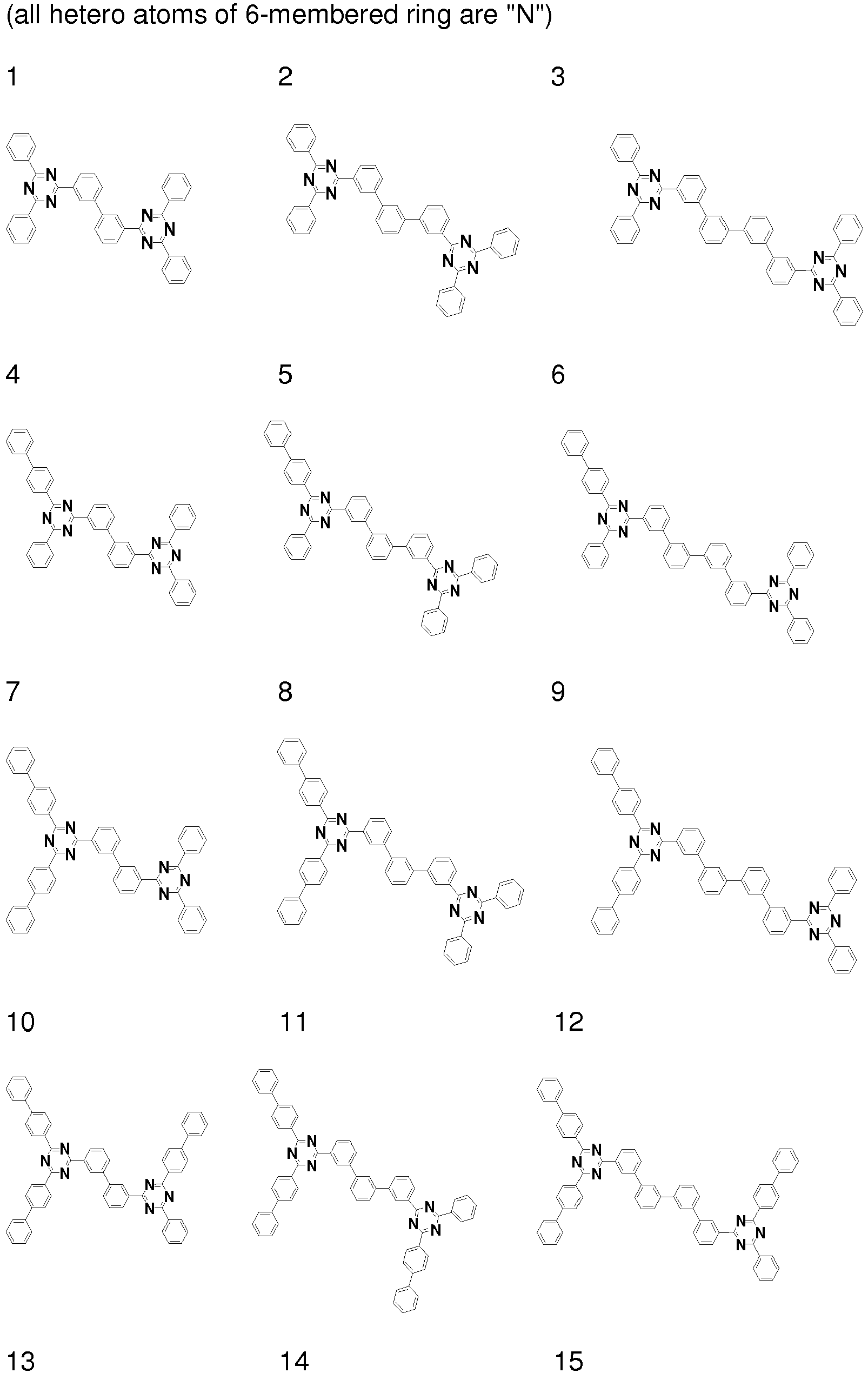


- The first compound used in an emission layer has strong electron transport and inject characteristics, and thus crystallinity of a material may be increased.
- Accordingly, the first compound may be used with a material having strong hole transport and injection characteristics rather than used alone to balance hole transport and injection characteristics/electron transport and injection characteristics.
- The compound having strong hole transport and injection characteristics may be a second compound represented by Chemical Formula 2.
- The second compound is used in an emission layer with the first compound including at least one carbazolyl group and thus having bipolar characteristics in which hole characteristics is relatively strong and thus may increase charge mobility and stability and remarkably improve luminous efficiency and life-span characteristics.
- The Chemical Formula 2 may be represented by one of Chemical Formulas 2-I to 2-VI depending on a linking position of a carbazolyl group, whether a linking group is present or not, and whether the substituents of the carbazolyl group are linked and fused one another or not.
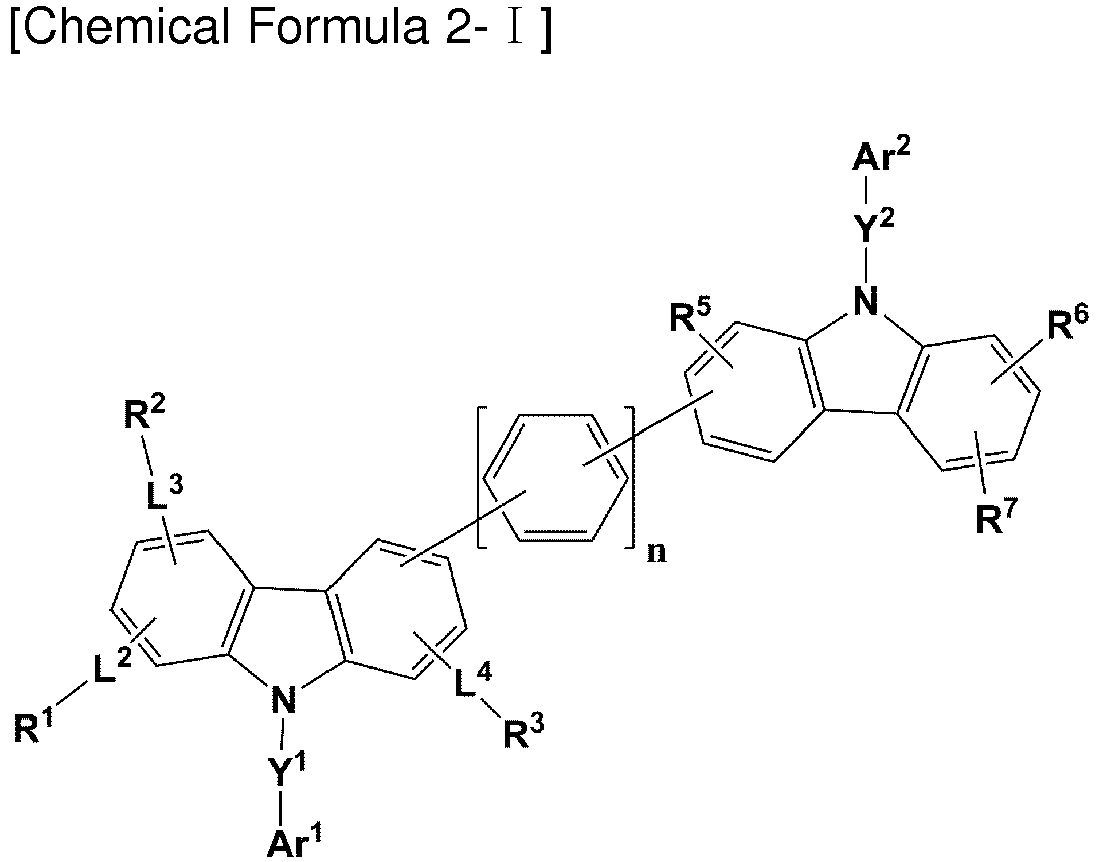


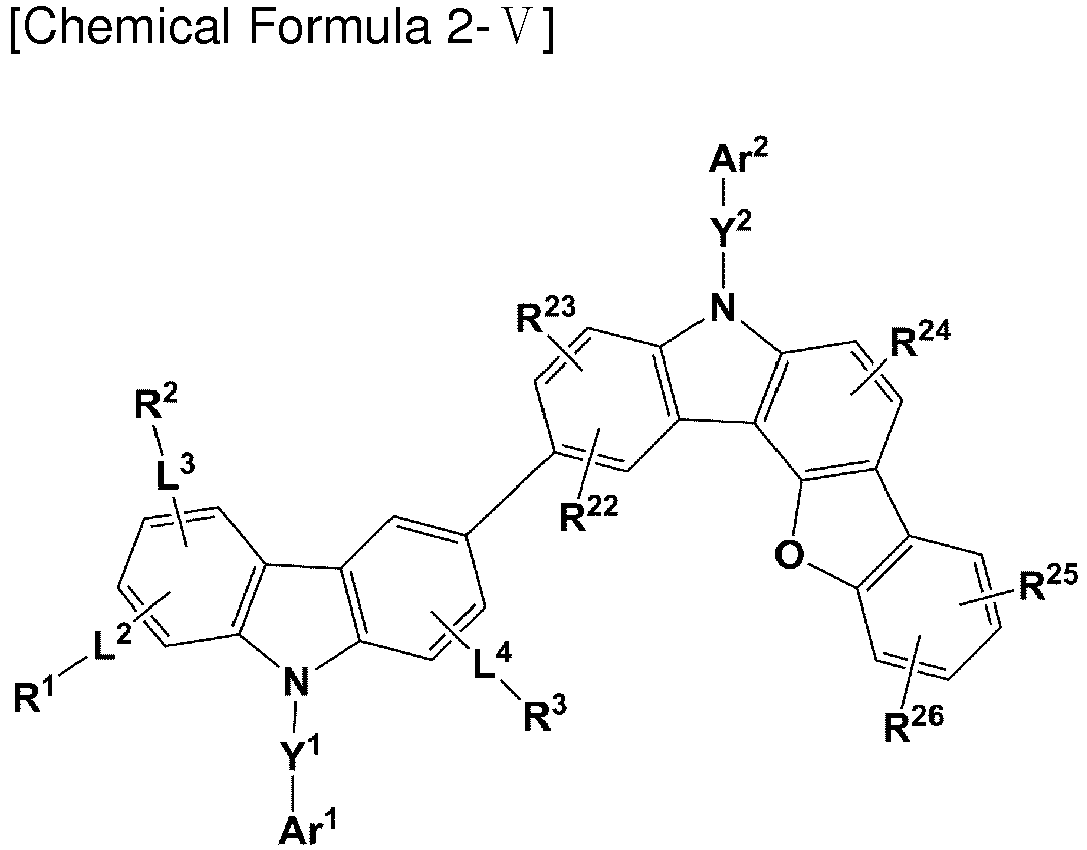

- In Chemical Formulae 2-I to 2-VI, L2 to L5, Y1, Ar1 and R1 to R4 are the same as described above,
Y2 is the same as the definition of Y1, and Ar2 is the same as the definition of Ar1.
R1 or R2 of Chemical Formula 2-I is not a substituted or unsubstituted carbazolyl group,
R5 to R31 are independently hydrogen, deuterium, a substituted or unsubstituted C1 to C20 alkyl group, a substituted or unsubstituted C6 to C30 aryl group, a substituted or unsubstituted C2 to C30 heterocyclic group, or a combination thereof,
provided that all the R5 to R7 are not a carbazolyl group, and
n is an integer of 0 to 5. - The Chemical Formula 2-I may be, for example, represented by one of Chemical Formulae 1a to 1j depending on absence or presence of a phenylene linking group linking two carbazolyl groups and linking points of two carbazolyl groups.


- In Chemical Formulae 1a to 1j, L2 to L4, Y1, Y2, Ar1, Ar2, R1 to R3, and R5 to R7 are the same described above,
provided that R1 or R2 is not a substituted or unsubstituted carbazolyl group,
all the R5 to R7 are not a carbazolyl group. - The Chemical Formula 2-II may be, for example represented by Chemical Formula 2a according to a linking position of a triphenylene group, and


- In Chemical Formulae 2a and 2a-1 to 2a-3, L2 to L5, Y1, Ar1, R1 to R3 and R8 to R12 are the same as described above.
- The Chemical Formula 2-III may be, for example represented by Chemical Formula 3a according to a linking position of a triphenylene group.


- In Chemical Formula 3a, L2 to L5, Y1, R1 to R4, and R13 to R17 are the same as described above.
- Ar1 and Ar2 of Chemical Formulae 2-I to 2-VI according to an example embodiment of the present invention may independently be hydrogen, deuterium, a substituted or unsubstituted C1 to C30 alkyl group, a substituted or unsubstituted C1 to C30 alkenyl group, a substituted or unsubstituted C1 to C30 alkynyl group, a substituted or unsubstituted C6 to C30 aryl group, a substituted or unsubstituted C6 to C30 aryloxy group, a substituted or unsubstituted C6 to C30 arylthio group, a substituted or unsubstituted C2 to C30 heteroaryl group, a hydroxy group, a thiol group, or a combination thereof, and
specifically, a substituted or unsubstituted C6 to C30 aryl group, or a substituted or unsubstituted C2 to C30 heteroaryl group. - When the Ar1 and Ar2 are a substituted or unsubstituted C6 to C30 aryl group, they may more specifically be a substituted or unsubstituted phenyl group, a substituted or unsubstituted biphenyl group, a substituted or unsubstituted terphenyl group, a substituted or unsubstituted naphthyl group, a substituted or unsubstituted triphenylenyl group, or a substituted or unsubstituted fluorenyl group, and
when the Ar1 and Ar2 are a substituted or unsubstituted C2 to C30 heteroaryl group, they may more specifically be a substituted or unsubstituted pyridinyl group, a substituted or unsubstituted quinolinyl group, a substituted or unsubstituted isoquinolinyl group, a substituted or unsubstituted dibenzofuranyl group, or a substituted or unsubstituted dibenzothiophenyl group. - Y1 and Y2 of Chemical Formula 2 according to an example embodiment of the present invention may independently be a single bond, a substituted or unsubstituted C6 to C30 arylene group, a substituted or unsubstituted C2 to C30 heteroarylene group, or a combination thereof, and
specifically, a single bond or a substituted or unsubstituted C6 to C30 arylene group. - For example, the Y1 and Y2 may independently be a single bond, a substituted or unsubstituted phenylene group, or a substituted or unsubstituted biphenylene group, and the Ar1 and Ar2 may independently be a substituted or unsubstituted groups of Group 4.


- In Group 4, * is a linking point to an adjacent atom.
- R1 to R4 of Chemical Formula 2 according to an example embodiment of the present invention may independently be hydrogen, deuterium, a substituted or unsubstituted C1 to C20 alkyl group, a substituted or unsubstituted C6 to C30 aryl group, a substituted or unsubstituted C2 to C30 heterocyclic group, a substituted or unsubstituted nitrile group, a substituted or unsubstituted isonitrile group, a hydroxy group, a thiol group, and
specifically, hydrogen, a phenyl group, an o-biphenyl group, a m-biphenyl group, a p-biphenyl group, a pyridyl group, a methyl group, an ethyl group, a propyl group, an isopropyl group, and the like, and
the phenyl group, o-biphenyl group, m-biphenyl group, p-biphenyl group, pyridyl group, methyl group, ethyl group, propyl group and isopropyl group may be further substituted with deuterium, a C6 to C30 aryl group, or a C1 to C30 alkyl group, and substituents may be linked to each other to form a fused ring. - For example, when one of R1 to R4 is a triphenylmethyl group, two adjacent phenyl group to the triphenylmethyl group are linked therewith to form a fluorene ring.
- The second compound represented by Chemical Formula 2 may be, for example compounds of Group 5, but is not limited thereto.


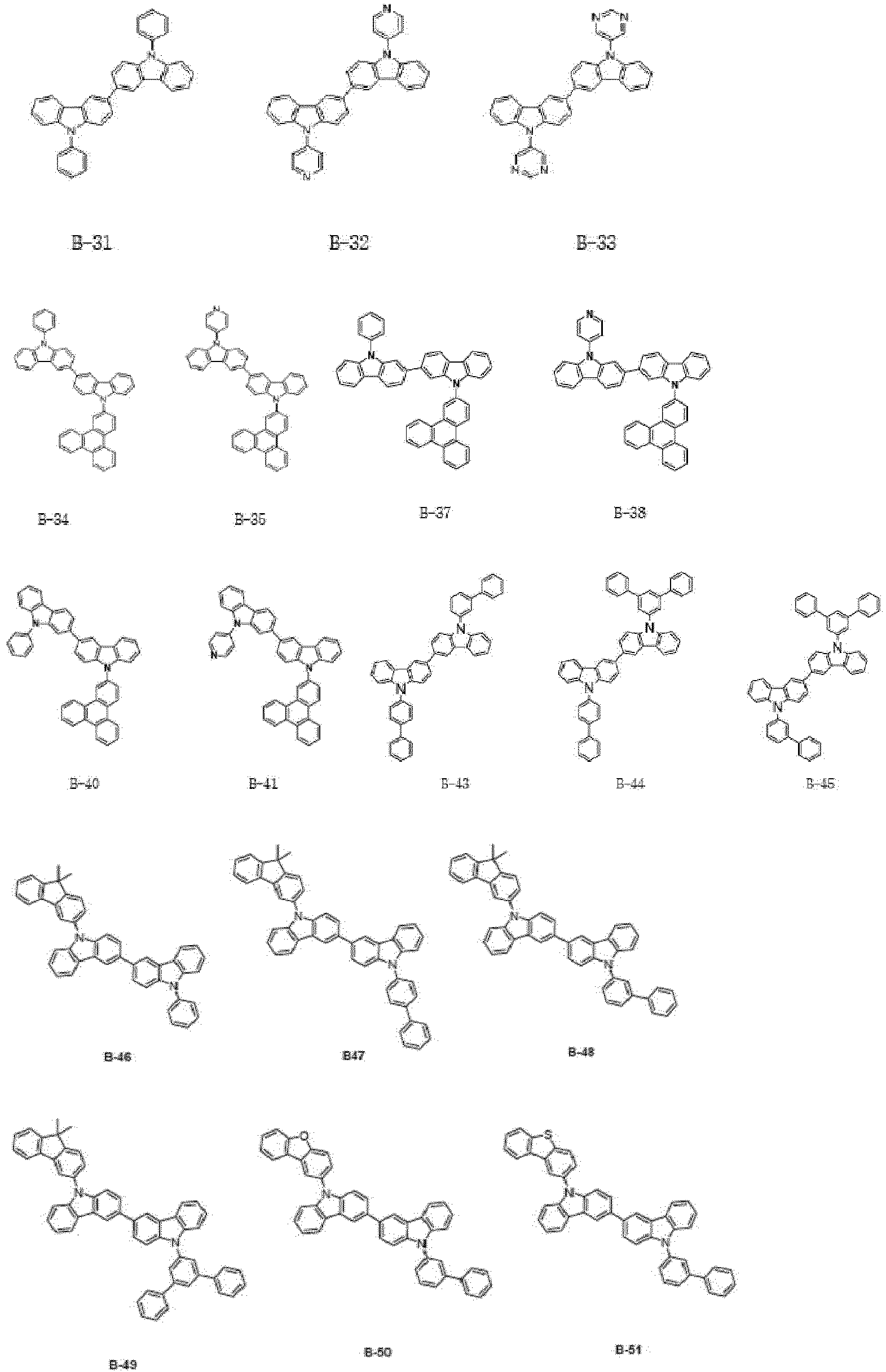


- On the other hand, charge mobility may be adjusted by controlling a ratio between the second compound having hole characteristics and the first compound.
- Since the hole characteristics of the second compound is relatively determined through a relationship with the first compound, a substituent having weak electron characteristics such as a substituted or unsubstituted pyridinyl group may be included in at least either one of Ar1 and Ar2 of Chemical Formula 2.
- Herein, the second compound may have a LUMO energy level of greater than or equal to -1.7 eV.
- Specifically, the second compound may have a LUMO energy level ranging from -1.7 to -0.850 eV.
- In addition, the first and second compounds may be included for example in a weight ratio of about 1:9 to 9:1, specifically, 2:8 to 8:2, 3:7 to 7:3, 4:6 to 6:4, and 5:5. When used within the range, bipolar characteristics may be further effectively realized, and thus efficiency and life-span may be simultaneously improved.
- Specifically, in an
emission layer 130, the first compound and the second compound may be simultaneously included as a host, for example the first compound may be represented by Chemical Formula 1-I a and the second compound may be represented by Chemical Formula 1 a or 2a-1.
- In Chemical Formula 1-I, Z1 to Z6 are independently N, or CRa, at least two of Z1 to Z3 are N, at least two of Z4 to Z6 are N, Ra, and Ra1 to Ra4 are independently hydrogen, or a substituted or unsubstituted C6 to C30 aryl group, and L1 is a C6 to C30 arylene group that is substituted or unsubstituted with deuterium, a C1 to C30 alkyl group, or a C6 to C30 aryl group;
L2 to L5, Y1 and Y2 of Chemical Formulae 1a and 2a-1are independently a single bond, or a substituted or unsubstituted C6 to C30 arylene group, Ar1 and Ar2 are independently, a substituted or unsubstituted C6 to C30 aryl group, or a substituted or unsubstituted C2 to C30 heterocyclic group, R1 to R3 and R5 to R12 are independently, hydrogen, deuterium, or a substituted or unsubstituted C6 to C30 aryl group, and
R1 or R2 of Chemical Formula 1 a is not a substituted or unsubstituted carbazolyl group and all the R5 to R7 are not a carbazolyl group. - Herein, "substituted" is the same as described above.
- The
emission layer 130 may further include at least one compound in addition to the first compound and the second compound as a host. For example, aryl amine compound or aryl amine carbazole compound having excellent hole characteristics may be further included. - The
emission layer 130 may further include a dopant. The dopant is mixed with a host in a small amount to cause light emission, and may be generally a material such as a metal complex that emits light by multiple excitation into a triplet or more. The dopant may be, for example an inorganic, organic, or organic/inorganic compound, and one or more kinds thereof may be used. - The dopant may be a red, green, or blue dopant, for example phosphorescent dopant. Examples of the phosphorescent dopant may be an organic metal compound including Ir, Pt, Os, Ti, Zr, Hf, Eu, Tb, Tm, Fe, Co, Ni, Ru, Rh, Pd, or a combination thereof. The phosphorescent dopant may be, for example a compound represented by Chemical Formula Z, but is not limited thereto.
[Chemical Formula Z] L2MX
- In Chemical Formula Z, M is a metal, and L and X are the same or different, and are a ligand to form a complex compound with M.
- The M may be, for example Ir, Pt, Os, Ti, Zr, Hf, Eu, Tb, Tm, Fe, Co, Ni, Ru, Rh, Pd or a combination thereof, and the L and X may be, for example a bidendate ligand.
- The composition may be applied to an organic layer of an organic optoelectronic device, for example an emission layer. For example, the composition may be applied to an emission layer as a host.
- The composition may be formed using a dry film formation method or a solution process. The dry film formation method may be, for example a chemical vapor deposition (CVD) method, sputtering, plasma plating, and ion plating, and two or more compounds may be simultaneously formed into a film or compound having the same deposition temperature may be mixed and formed into a film. The solution process may be, for example inkjet printing, spin coating, slit coating, bar coating and/or dip coating.
- Hereinafter, an organic optoelectronic device including the composition is described.
- The organic optoelectronic device may be any device to convert electrical energy into photoenergy and vice versa without particular limitation, and may be selected from an organic light emitting diode, an organic photoelectric device, an organic solar cell, an organic transistor, an organic photo conductor drum, and an organic memory device.
- The organic optoelectronic device includes an anode and a cathode facing each other, and at least one organic layer interposed between the anode and the cathode, wherein the organic layer includes the composition.
- Herein, an organic light emitting diode as one example of an organic optoelectronic device is described referring to drawings.
-
FIG. 1 is a cross-sectional view showing an organic light emitting diode according to an embodiment. - Referring to
FIG. 1 , an organiclight emitting diode 100 according to an embodiment includes ananode 120 and acathode 110 facing each other and anorganic layer 105 interposed between theanode 120 andcathode 110. - The
anode 120 may be made of a conductor having a large work function to help hole injection, and may be for example metal, metal oxide and/or a conductive polymer. Theanode 120 may be, for example a metal nickel, platinum, vanadium, chromium, copper, zinc, gold, and the like or an alloy thereof; metal oxide such as zinc oxide, indium oxide, indium tin oxide (ITO), indium zinc oxide (IZO), and the like; a combination of metal and oxide such as ZnO and Al or SnO2 and Sb; a conductive polymer such as poly(3-methylthiophene), poly(3,4-(ethylene-1,2-dioxy)thiophene) (PEDT), polypyrrole, and polyaniline, but is not limited thereto. - The
cathode 110 may be made of a conductor having a small work function to help electron injection, and may be for example metal, metal oxide and/or a conductive polymer. Thecathode 110 may be for example a metal or an alloy thereof such as magnesium, calcium, sodium, potassium, titanium, indium, yttrium, lithium, gadolinium, aluminum silver, tin, lead, cesium, barium, and the like; a multi-layer structure material such as LiF/Al, LiO2/Al, LiF/Ca, LiF/Al and BaF2/Ca, but is not limited thereto. - The
organic layer 105 includes anemission layer 130 including composition. -
FIG. 2 is a cross-sectional view showing an organic light emitting diode according to another embodiment. - Referring to
FIG. 2 , an organiclight emitting diode 200 according to the present embodiment includes ananode 120 and acathode 110 facing each other and anorganic layer 105 between theanode 120 and thecathode 110 like the above embodiment. - The
organic layer 105 includes anemission layer 130 and anauxiliary layer 140 between theemission layer 130 and theanode 120. Theauxiliary layer 140 may help charge injection and transfer between theanode 120 and theemission layer 130. Theauxiliary layer 140 may be, for example an electron transport layer (ETL), an electron injection layer (EIL), and/or an electron transport auxiliary layer. - In
FIGS. 1 and 2 , at least one auxiliary layer between theanode 120 and theemission layer 130 may be further included as anorganic layer 105. - The organic light emitting diode may be applied to an organic light emitting diode (OLED) display.
- Hereinafter, the embodiments are illustrated in more detail with reference to examples. These examples, however, are not in any sense to be interpreted as limiting the scope of the invention.
- Hereinafter, a starting material and a reactant used in Synthesis Examples and Examples were purchased from Sigma-Aldrich Corporation or TCI Inc. unless there was particularly mentioned.
-
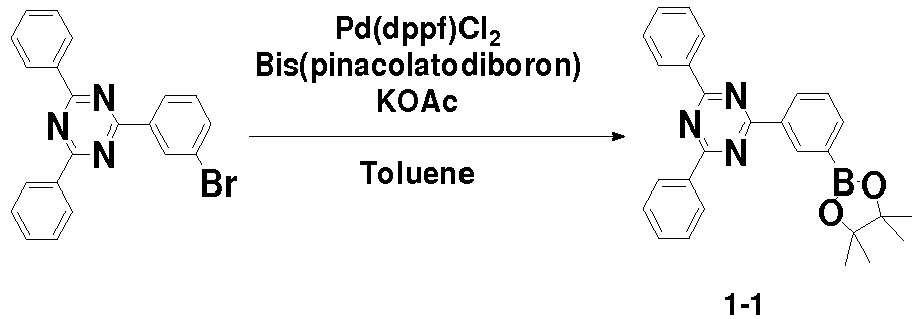
- 20 g (51.51 mmol) of 2-(3-bromophenyl)-4,5-diphenyl-1,3,5-triazine was dissolved in 250 mL of toluene in a 500 mL round-bottomed flask. Then, 0.05 equivalent of dichlorodiphenylphosphinoferrocene palladium, 1.2 equivalent of bis(pinacolato)diboron, and 2 equivalents of potassium acetate were added thereto, and the mixture was heated and refluxed under a nitrogen atmosphere for 18 hours. The reaction solution was cooled down, 100 mL of water was added thereto, and an organic layer was extracted therefrom. The organic layer was collected, treated with activated carbon, and filtered through silica gel, and the filtered solution was concentrated. The concentrated residue was collected and then, crystallized in 200 mL of toluene and 50 mL of acetone to obtain 19.1 g of an intermediate 1-1.
-

- 19 g (43.79 mmol) of the synthesized intermediate 1-1 was added to 200 mL of tetrahydrofuran and 50 mL of distilled water in a 500 mL round-bottomed flask, 1 equivalent of 2-(3-bromophenyl)-4,5-diphenyl-1,3,5-triazine, 0.03 equivalent of tetrakistriphenylphosphine palladium, and 2 equivalents of potassium carbonate were added thereto, and the mixture was heated and refluxed under a nitrogen atmosphere. After 18 hours, the reaction solution was cooled down, and a solid precipitated therein was filtered and washed with 500 mL of water. The solid was recrystallized with 500 mL of monochlorobenzene to obtain 22.41 g of a compound 1.
LC/MS calculated for: C42H28N6 Exact Mass: 616.2375 found for: 617.24[M+H] -
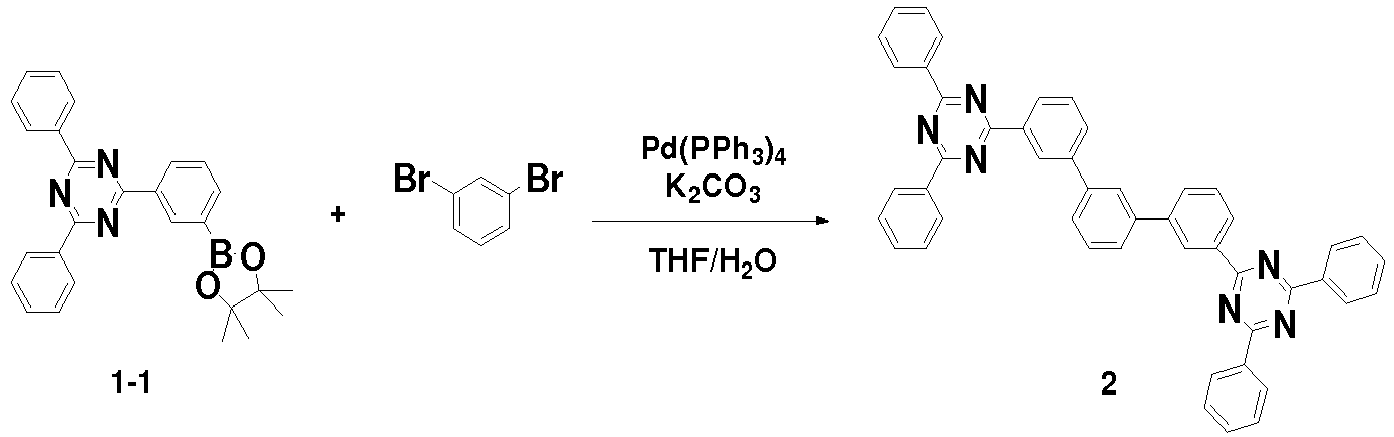
- 15 g (34.46 mmol) of the synthesized intermediate 1-1, 0.5 equivalent of 1,3-dibromobenzene, 0.03 equivalent of tetrakistriphenylphosphine palladium, 2 equivalents of potassium carbonate, 200 mL of tetrahydrofuran, and 50 mL of distilled water were put in a 500 mL round-bottomed flask and then, heated and refluxed under a nitrogen atmosphere. After 20 hours, the reaction solution was cooled down, and a solid precipitated therein was filtered and washed with 500 mL of water. The solid was recrystallized with 400 mL of dichlorobenzene to obtain 9.2 g of a compound 2.
LC/MS calculated for: C48H32N6 Exact Mass: 692.2688 found for: 693.27 [M+H] -

- 30 g (68.92 mmol) of the synthesized intermediate 1-1, 1.2 equivalent of 1,3-dibromobenzene, 0.03 equivalent of tetrakistriphenylphosphine palladium, 2 equivalents of potassium carbonate, 300 mL of tetrahydrofuran, and 100 mL of distilled water were put in a 500 mL round-bottomed flask and then, heated and refluxed under a nitrogen atmosphere. After 18 hours, the reaction solution was cooled down, suspended in 1 L of methanol, stirred, filtered, and washed with 500 mL of water. Then, a solid therein was recrystallized with 400 mL of dichlorobenzene to obtain 32 g of an intermediate 3-1.
-

- 32 g (68.91 mmol) of the synthesized intermediate 3-1 was added to 350 mL of toluene, 0.05 equivalent of dichlorodiphenylphosphinoferrocene palladium, 1.2 equivalent of bis(pinacolato)diboron, and 2 equivalents of potassium acetate were put in a 500 mL round-bottomed flask and then, heated and refluxed under a nitrogen atmosphere for 18 hours. The reaction solution was cooled down, 100 mL of water was added thereto, and an organic layer was extracted therefrom. The organic layer was collected, treated with activated carbon, filtered through silica gel, and concentrated. The concentrated residue was collected, heated and dissolved in 1 L of toluene, treated with activated carbon, and filtered through silica gel. The filtered solution was cooled down to precipitate a solid. The precipitated solid was filtered to obtain 29.96 g of an intermediate 3-2.
-

- 15 g (29.33 mmol) of the synthesized intermediate 3-2, 1 equivalent of the synthesized intermediate 3-1, 0.03 equivalent of tetrakistriphenylphosphine palladium, 2 equivalents of potassium carbonate, 200 mL of tetrahydrofuran, an 50 mL of distilled water were put in a 500 mL round-bottomed flask and then, heated and refluxed under a nitrogen atmosphere. After 18 hours, the reaction solution was cooled down, filtered, and washed with 500 mL of water. Then, a solid therein was recrystallized with 500 mL of dichlorobenzene to obtain 16.01 g of a compound 3.
LC/MS calculated for: C54H36N6 Exact Mass: 768.3001 found for: 769.3 [M+H] -
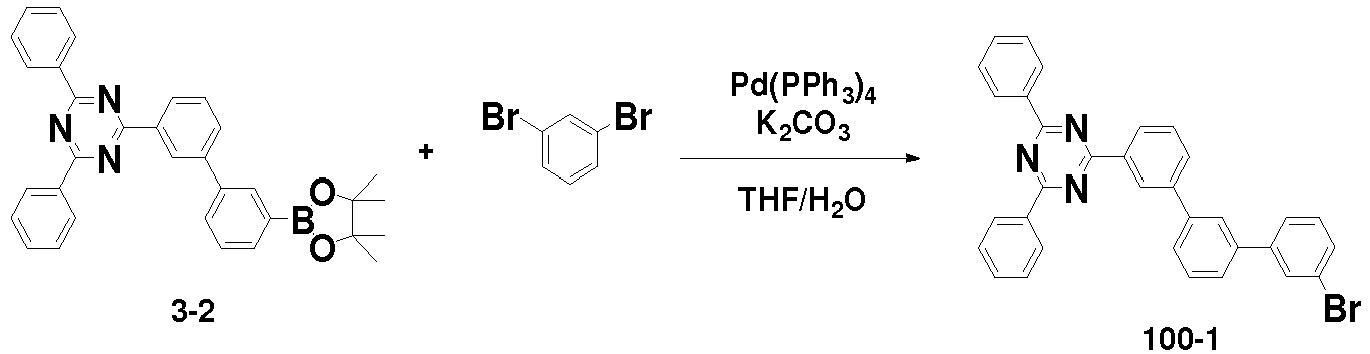
- 15 g (29.33 mmol) of the synthesized intermediate 3-2, 1.2 equivalent of 1,3-dibromobenzene, 0.03 equivalent of tetrakistriphenylphosphine palladium, 2 equivalents of potassium carbonate, 300 mL of tetrahydrofuran, and 100 mL of distilled water were put in a 500 mL round-bottomed flask and then, heated and refluxed under a nitrogen atmosphere. After 18 hours, the reaction solution was cooled down, suspended in 1 L of methanol, stirred and filtered, and washed with 500 mL of water. Then, a solid therefrom was recrystallized with 300 mL of dichlorobenzene to obtain 12.84 g of an intermediate 100-1.
-

- 12 g (22.2 mmol) of the synthesized intermediate 100-1, 1.2 equivalent of the synthesized intermediate 3-2, 0.03 equivalent of tetrakistriphenylphosphine palladium, 2 equivalent of potassium carbonate, 150 mL of tetrahydrofuran, and 50 mL of distilled water were put in a 500 mL round-bottomed flask and then, heated and refluxed under a nitrogen atmosphere. After 18 hours, the reaction solution was cooled down, suspended in 1 L of methanol, stirred and filtered, and then, washed with 500 mL of water. Then, a solid therefrom is recrystallized with 500 mL of dichlorobenzene to obtain 13.3 g of a
compound 100.
LC/MS calculated for: C60H40N6 Exact Mass: 844.3314 found for 845.34 [M+H] -

- 15 g (81.34 mmol) of cyanuric chloride was dissolved in 200 mL of anhydrous tetrahydrofuran in a 500 mL round-bottomed flask, 1 equivalent of a 4-biphenyl magnesium bromide solution (0.5 M tetrahydrofuran) was added thereto in a dropwise fashion under a nitrogen atmosphere at 0° C, and the mixture was slowly heated up to room temperature. Then, the reaction solution was stirred at room temperature for 1 hour, stirred, and then, poured into 500 mL of ice water to separate a layer. The separated organic layer was treated with anhydrous magnesium sulfate and concentrated. The concentrated residue was recrystallized with tetrahydrofuran and methanol to obtain 17.2 g of an intermediate 4-2.
-

- 17 g (56.26 mmol) of the synthesized intermediate 4-2 was put in a 500 mL round-bottomed flask, 1 equivalent of phenylboronic acid, 0.03 equivalent of tetrakistriphenylphosphine palladium, 2 equivalents of potassium carbonate, 150 mL of tetrahydrofuran, and 50 mL of distilled water were added thereto, and the mixture was heated and refluxed under a nitrogen atmosphere. After 18 hours, the reaction solution was cooled down, suspended in 1 L of methanol, stirred and filtered, washed with 500 mL of water, and dried to obtain 12.57 g of an intermediate 4-1.
-

- 12 g (34.9 mmol) of the synthesized intermediate 4-1 was put in a 500 mL round-bottomed flask, 1.1 equivalent of the synthesized intermediate 3-2, 0.03 equivalent of tetrakistriphenylphosphine palladium, 2 equivalents of potassium carbonate, 150 mL of tetrahydrofuran, and 50 mL of distilled water were added thereto, and the mixture was heated and refluxed under a nitrogen atmosphere. After 18 hours, the reaction solution was cooled down, suspended in 1 L of methanol, stirred and filtered, and washed with 500 mL of water. Then, a solid produced therein was recrystallized with 500 mL of dichlorobenzene to obtain 17.8 g of a compound 4.
LC/MS calculated for: C48H32N6 Exact Mass: 692.2688 found for 692.27 [M+H] -
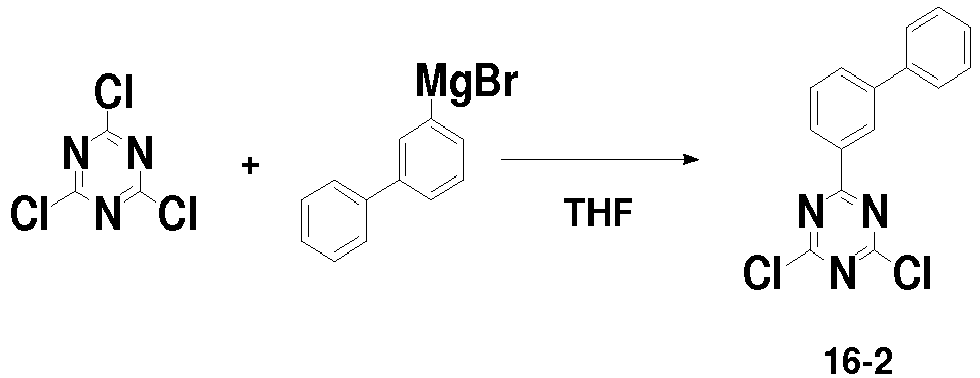
- An intermediate 16-2 was synthesized according to the same method as Synthesis Example 4-2 by using a 3-biphenyl magnesium bromide solution (0.5 M tetrahydrofuran) instead of the 4-biphenyl magnesium bromide solution (0.5 M tetrahydrofuran).
-

- An intermediate 16-1 was synthesized according to the same method as the (b) of Synthesis Example 5 by using the intermediate 16-2 instead of the intermediate 4-2.
-

- A compound 16 was synthesized according to the same method as the (c) of Synthesis Example 5 by using the intermediate 16-1 instead of the intermediate 4-2.
LC/MS calculated for: C48H32N6 Exact Mass: 692.2688 found for 692.27 [M+H] -

- A compound 126 was synthesized according to the same method as Synthesis Example 2 by using 1,2-dibromobenzene as an intermediate.
LC/MS calculated for: C48H32N6 Exact Mass: 692.2688, found for 693.28 [M+H] -

- 20 g (39.11 mmol) of the intermediate 3-2 was put in a 500 mL round-bottomed flask, 1.1 equivalent of 1,2-dibromobenzene, 0.03 equivalent of tetrakistriphenylphosphine palladium, 2 equivalents of potassium carbonate, 200 mL of tetrahydrofuran, and 50 mL of distilled water were added thereto, and the mixture was heated and refluxed under a nitrogen atmosphere. After 18 hours, the reaction solution was cooled down, suspended in 500 mL of methanol, stirred and filtered, and washed with 500 mL of water. Then, a solid produced therein was recrystallized with 500 mL of monochlorobenzene to obtain 18.4 g of an intermediate 140-1.
-

- 18 g (33.31 mmol) of the synthesized intermediate 140-1 was put in a 500 mL round-bottomed flask, 1.1 equivalent of the synthesized intermediate 1-1, 0.03 equivalent of tetrakistriphenylphosphine palladium, 2 equivalents of potassium carbonate, 200 mL of tetrahydrofuran, and 50 mL of distilled water were added thereto, and the mixture was heated and refluxed under a nitrogen atmosphere. After 18 hours, the reaction solution was cooled down, suspended in 500 mL of methanol, stirred and filtered, and washed with 500 mL of water. Then, a solid obtained therein was collected, silica gel column purified with a mixed solvent of normal hexane and ethyl acetate to obtain 19.2 g of a
compound 140.
LC/MS calculated for: C54H36N6 Exact Mass: 768.3001, found for 769.3 [M+H] -

- 30 g (168.37 mmol) of methyl benzoyl acetate was put in a 500 mL round-bottomed flask, 1.1 equivalent of 3-chlorophenyl amidine, 1.2 equivalent of sodium methoxide, and 200 mL of methanol were added thereto, and the mixture heated and refluxed for 6 hours. The reaction solution was cooled down, a 1 N hydrochloric acid solution was added thereto, and chloridemethane was used for an extraction. The extracted solution was concentrated to obtain an intermediate 113-4, which itself is used for the following reaction.
- The intermediate 113-4 was put in a 500 mL round-bottomed flask, 250 mL of phosphorylchloride was added thereto, and the mixture was heated and refluxed for 5 hours. The reaction solution was cooled down and slowly added to 1 L of ice water, and the mixture is stirred. Then, an aqueous layer is extracted with 500 mL of methane chloride, dried with anhydrous magnesium sulfate, and concentrated. The concentrated residue was purified through a silica gel column by using normal hexane and ethyl acetate to obtain 39 g of an intermediate 113-3.
-

- 30 g (99.6 mmol) of the synthesized intermediate 113-3 was put in a 500 mL round-bottomed flask, 1.2 equivalent of biphenyl boronic acid, 0.03 equivalent of tetrakistriphenylphosphine palladium, 2 equivalents of potassium carbonate, 250 mL of tetrahydrofuran, and 70 mL of distilled water were added thereto, and the mixture was heated and refluxed under a nitrogen atmosphere. After 18 hours, the reaction solution was cooled down, suspended in 500 mL of methanol, stirred and filtered, and washed with 500 mL of water. Then, a solid produced therein was collected and then, heated and recrystallized with 500 mL of toluene to obtain 35.9 g of an Intermediate 113-2.
-

- 35 g (83.5 mmol) of the synthesized intermediate 113-2 was put in a 500 mL round-bottomed flask, 250 mL of toluene, 0.05 equivalent of dichlorodiphenylphosphinoferrocene palladium, 1.2 equivalent of bis(pinacolato)diboron, and 2 equivalents of potassium acetate were added thereto, and the mixture was heated and refluxed for 18 hours under a nitrogen atmosphere. The reaction solution was cooled down, and 100 mL of water was added thereto to extract an organic layer. The organic layer was collected, treated with activated carbon, filtered through silica gel, and concentrated. The concentrated residue was collected, heated and dissolved in 1 L of toluene, treated with activated carbon, filtered through silica gel. The filtered solution was cooled down and stirred to precipitate a solid. The precipitated solid was filtered to obtain 35.8 g of an intermediate 113-1.
-

- 35 g (68.6 mmol) of the synthesized 113-1, 1 equivalent of 2-(3-bromophenyl)-4,6-diphenyl-1,3,5-triazine, 0.03 equivalent of tetrakistriphenylphosphine palladium, 2 equivalents of potassium carbonate, 250 mL of tetrahydrofuran, and 70 mL of distilled water were put in a 500 mL round-bottomed flask and then, heated and refluxed under a nitrogen atmosphere. After 16 hours, the reaction solution was cooled down, suspended in 500 mL of methanol, stirred and filtered, and washed with 500 mL of water. Then, a solid produced therein was collected and then, heated and recrystallized with 500 mL of dichlorobenzene to obtain 32 g of a compound 113.
LC/MS calculated for: C49H33N5 Exact Mass: 691.2736, found for: 692.29 [M+H] -

- An intermediate 119-2 was synthesized according to the same method as the method of synthesizing the intermediate 113-2 according to Synthesis Example 9.
-

- An intermediate 119-1 was synthesized according to the same method as the method of synthesizing the intermediate 113-1 according to Synthesis Example 9.
-

- An intermediate 119 was synthesized according to the same method as the method of synthesizing the intermediate 113 according to Synthesis Example 9.
LC/MS calculated for: C49H33N5 Exact Mass: 691.27 found for: 692.33 [M+H] -

- 20 g of 2-chloro-4,6-diphenyl-1,3,5-triazine was dissolved in 250 mL of a mixed solution of tetrahydrofuran/distilled water (3/1) in a 500 mL round-bottomed flask. Then, 1.2 equivalent of 4-chlorophenyl boronic acid, 0.05 equivalent of tetrakistriphenylphosphine palladium, and 3 equivalents of potassium carbonate were added thereto, and the mixture was heated and refluxed under a nitrogen atmosphere for 18 hours. When the reaction was complete, the reaction solution was cooled down, and 100 mL of water was added thereto to extract an organic layer. The organic layer was collected, treated with activated carbon, and filtered through silica gel, and the filtered solution was concentrated. The concentrated residue was collected and crystallized in 200 mL of toluene and 50 mL of acetone to obtain 16 g of an intermediate 146-6.
-

- 15 g of the synthesized intermediate 146-6 was dissolved in 200 mL of dimethyl formamide in a 500 mL round-bottomed flask. Then, 0.05 equivalent of dichlorodiphenylphosphinoferrocene palladium, 1.2 equivalent of bis(pinacolato)diboron, 2 equivalents of potassium acetate, and 0.2 equivalent of tricyclohexyl phosphine were added thereto, and the mixture was heated and refluxed under a nitrogen atmosphere for 18 hours. The reaction solution was cooled down and then, added to 500 mL of water and suspended therein to produce a solid, and the solid was filtered after stirring. The filtered solid was twice washed with 100 mL of water. The solid was collected and then, heated and dissolved in 500 mL of toluene, and filtered through activated carbon/silica gel, and the filtered solution was concentrated. The concentrated residue was solidified with 300 mL of a mixed solution of normal hexane and ethyl acetate in a ratio of 5:1 (V/V) to obtain 16 g of an intermediate 146-5.
-

- 16 g of the synthesized intermediate 146-5, 120 mL of a mixed solution of tetrahydrofuran/distilled water in a ratio of 3/1 (V/V), 0.03 equivalent of tetrakis triphenyl palladium, 3 equivalents of potassium carbonate, and 1.1 equivalent of 2-bromo-4-chloro aniline were put in a 250 mL round-bottomed flask and then, heated and refluxed for 19 hours. When the reaction was complete, the reaction solution was cooled down and layer-separated to obtain an organic layer. Then, anhydrous magnesium sulfate and activated carbon were added to the organic layer, and the mixture was stirred and filtered through silica gel. The filtered solution was concentrated, and the concentrated residue was silica gel column-purified with a mixed solution of normal hexane and ethyl acetate to obtain 13 g of an intermediate 146-4.
-

- 13 g of the synthesized intermediate 146-4 was suspended in 150 mL of water. The reaction solution was stirred, and 2 equivalents of strong sulfuric acid were added thereto in a dropwise fashion. Then, 1.1 equivalent of sodium nitrite was dissolved in 15 mL of distilled water, and the solution was slowly added to the reaction solution in a dropwise fashion in an ice water bath. After the addition in a dropwise fashion, the mixture is stirred for 2 hours. The stirred solution was put in a 500 mL reactor, 2 equivalents of copper bromide was added thereto, and the mixture was heated and refluxed for 1 hour. The reaction solution was cooled down and extracted with 100 mL of chloride methylene, an organic layer therefrom was dried with anhydrous magnesium sulfate, and the filtered solution was concentrated. The concentrated residue was silica gel column-purified with a mixed solution of normal hexane and chloride methylene to obtain 11 g of an intermediate 146-3.
-

- 12 g of the synthesized intermediate 146-3 was put in a 250 mL round-bottomed flask, 100 mL of anhydrous tetrahydrofuran and 1.2 equivalent of triisopropyloxy boron were added thereto, and the mixture was cooled down in a dry ice acetone bath under a nitrogen atmosphere. Then, a 2.5 normal butyllithium solution was added thereto in a dropwise fashion for 20 minutes. After the addition in a dropwise fashion, the mixture was stirred for one hour and slowly heated up to room temperature. The resultant was stirred at room temperature for 2 hours, and a 2 normal hydrochloric acid solution was added to the reaction solution in a dropwise fashion for 2 hours. The reaction solution was layer-separated to obtain an organic layer. The organic layer was dried with anhydrous magnesium sulfate and then, filtered and concentrated. The concentrated residue was used for the following reaction with no additional purification.
-

- 8 g of an intermediate 146-1 was obtained according to the same method as Synthesis Example AD-2 by using the synthesized intermediate 146-2 instead of 4-chlorophenylboronic acid.
-

- 8 g of the synthesized intermediate 146-1 was dissolved in 120 mL of 1,4-dioxane in a 250 mL round-bottomed flask. Then, 1.2 equivalent of phenyl boronic acid, 0.03 equivalent of bis(dibenzylideneacetone)palladium, 0.12 equivalent of SPhos, and 3 equivalents of cesium carbonate were added to the reaction solution, and the mixture was heated and refluxed for 20 hours. The reaction solution was cooled down and then, added to 200 mL of ethyl acetate and 100 mL of distilled water to separate a layer. The organic layer was separated, treated with anhydrous magnesium sulfate and activated carbon, filtered, and concentrated. The concentrated residue was silica gel column-purified with a mixed solution of normal hexane and chloride methylene to obtain 5 g of a compound 146.
LC/MS calculated for: C48H32N6 Exact Mass: 692.27 found for: 693.37 [M+H] -

- The compound of 9-phenyl-3-(4,4,5,5-tetramethyl-1,3,2-dioxaborolan-2-yl)-9H-carbazole (26.96 g, 81.4 mmol) was dissolved in 0.2 L of toluene/THF in a nitrogen environment, 3-bromo-9H-carbazole (23.96 g, 97.36 mmol) and tetrakis(triphenylphosphine)palladium (0.90 g, 0.8 mmol) were added thereto, and the mixture was stirred. Then, potassium carbonate saturated in water (28 g, 203.49 mmol) was added thereto, and the obtained mixture was heated and refluxed at 120 °C for 12 hours. When the reaction was complete, water was added to the reaction solution, dichloromethane (DCM) was used for extraction, and an extract was treated with anhydrous MgSO4 to remove moisture, filtered, and concentrated under a reduced pressure. This obtained residue was separated and purified through flash column chromatography to obtain the compound J (22.6 g, 68 %).
HRMS (70 eV, EI+): m/z calcd for C30H20N2: 408.16, found: 408
Elemental Analysis: C, 88 %; H, 5 % - The compound J (22.42 g, 54.88 mmol) was dissolved in 0.2 L of toluene in a nitrogen environment, 2-bromo-4,6-diphenylpyridine (20.43 g, 65.85 mmol), NaOtBu (7.92 g, 82.32 mmol), tris(dibenzylideneacetone)dipalladium (0) (1.65 g, 1.65 mmol), and tri-tert-butylphosphine (1.78 g, 4.39 mmol) were added thereto, and the mixture was heated and refluxed at 120 °C for 12 hours. When the reaction was complete, water was added to the reaction solution, dichloromethane (DCM) was used for extraction, and an extract was treated with anhydrous MgSO4 to remove moisture, filtered, and concentrated under a reduced pressure. This obtained residue was separated and purified through flash column chromatography to obtain the compound B-10 (28.10 g, 80 %).
HRMS (70 eV, EI+): m/z calcd for C47H31 N3: 637.25, found: 637
Elemental Analysis: C, 89 %; H, 5 % -

- The compound phenylcarbazolyl bromide (9.97 g, 30.95 mmol) was dissolved in 0.2 L of toluene in a nitrogen environment, phenylcarbazolylboronic acid (9.78 g, 34.05 mmol) andtetrakis(triphenylphosphine)palladium (1.07 g, 0.93 mmol) were added thereto, and the mixture was stirred. Then, potassium carbonate saturated in water (12.83 g, 92.86 mmol) was added thereto, and the mixture was heated and refluxed at 120 °C for 12 hours. When the reaction was complete, water was added to the reaction, dichloromethane (DCM) was treated for an extraction, anhydrous MgSO4 was used to remove moisture, and the resultant was filtered and concentrated under a reduced pressure. The obtained residue was separated and purified through flash column chromatography to obtain the compound B-31 (13.8 g, 92 %).

HRMS (70 eV, EI+): m/z calcd for C36H24N2: 484.19, found: 484
Elemental Analysis: C, 89 %; H, 5 % -

- The compound triphenylcarbazolyl bromide (14.62 g, 30.95 mmol) was dissolved in 0.2 L of toluene in a nitrogen environment, phenylcarbazolylboronic acid (9.78 g, 34.05 mmol) and tetrakis(triphenylphosphine)palladium (1.07 g, 0.93 mmol) are added thereto, and the mixture was stirred. Then, potassium carbonate saturated in water (12.83 g, 92.86 mmol) was added thereto, and the mixture was heated and refluxed at 120 °C for 12 hours. When the reaction was complete, water was added to the reaction solution, dichloromethane (DCM) was used for an extraction, anhydrous MgSO4 was used to remove moisture, and the resultant was filtered and concentrated under a reduced pressure. The obtained residue was separated and purified through flash column chromatography to obtain the compound B-34 (16.7 g, 85 %).
HRMS (70 eV, EI+): m/z calcd for C47H29N2: 621.23, found: 621
Elemental Analysis: C, 91 %; H, 5 % -

- The compound of biphenylcarbazolyl bromide (12.33 g, 30.95 mmol) was dissolved in 0.2 L of toluene in a nitrogen environment, biphenylcarbazolylboronic acid (12.37 g, 34.05 mmol) and tetrakis(triphenylphosphine)palladium (1.07 g, 0.93 mmol) were added thereto, and the mixture was stirred. Then, potassium carbonate saturated in water (12.83 g, 92.86 mmol) was added thereto, and the mixture was heated and refluxed at 120 °C for 12 hours. When the reaction was complete, water was added to the reaction solution, dichloromethane (DCM) was used for an extraction, anhydrous MgSO4 was used to remove moisture, and the resultant was filtered and concentrated under a reduced pressure. The obtained residue was separated and purified through flash column chromatography to obtain a compound B-43 (18.7 g, 92 %).
HRMS (70 eV, EI+): m/z calcd for C48H32N2: 636.26, found: 636
Elemental Analysis: C, 91 %; H, 5 % -

- 4-bromo-1,1':4',1"-terphenyl (15 g, 48.5 mmol) was dissolved in 0.2 L of toluene in a nitrogen environment, the compound J (20 g, 48.5 mmol), NaOtBu (6 g, 58.2 mmol), tris(dibenzylideneacetone)dipalladium (0) (0.439 g, 0.48 mmol), and tri-tert-butylphosphine (0.388 g, 1.92 mmol) were added thereto, and the mixture was heated and refluxed at 120 °C for 12 hours. When the reaction was complete, water was added to the reaction solution, dichloromethane (DCM) was used for an extraction, anhydrous MgSO4 was used to remove moisture, and the resultant was filtered and concentrated under a reduced pressure. This obtained residue was separated and purified through flash column chromatography to obtain the compound B-114 (25 g, 80 %).
HRMS (70 eV, EI+): m/z calcd for C48H32N2: 636.2565, found: 636
Elemental Analysis: C, 95 %; H, 5 % -


- An intermediate a (32 g, 75 %) was synthesized according to the same method as the method of synthesizing the compound B-31 by using 43.2 g (134.2 mmol) of 3-bromo-N-phenyl carbazole and 18 g (147.6 mmol) of phenylboronic acid.
- An intermediate b (35 g, 82 %) was synthesized by dissolving 34.4 g (107.6 mmol) of the compound 1 in 500 mL of dichloromethane, adding 19.2 g (107.6 mmol) of N-bromosuccinimide, and stirring the mixture at room temperature for 8 hours.
- An intermediate c (15 g, 53 %) was synthesized according to the same method as the method of synthesizing the compound B-114 by using 17.65 g (71.74 mmol) of 3-Bromocarbazole and 22 g (78.91 mmol) of 4-lodobiphenyl.
- An intermediate d (20 g, 89 %) was synthesized according to the same method as the method of synthesizing the intermediate 1-5 by using 20.1 g (50.5 mmol) of the intermediate c and 19.2 g (75.8 mmol) of bis(pinacolato)diboron.
- A compound B-116 (18 g, 84 %) was synthesized according to the same method as the method of synthesizing the compound B-31 by using 13 g (33.1 mmol) of the intermediate b and 16.2 g (36.4 mmol) of the intermediate d.
HRMS (70 eV, EI+): m/z calcd for C48H32N2: 636.2565, found: 636
Elemental Analysis: C, 90 %; H, 5 % -
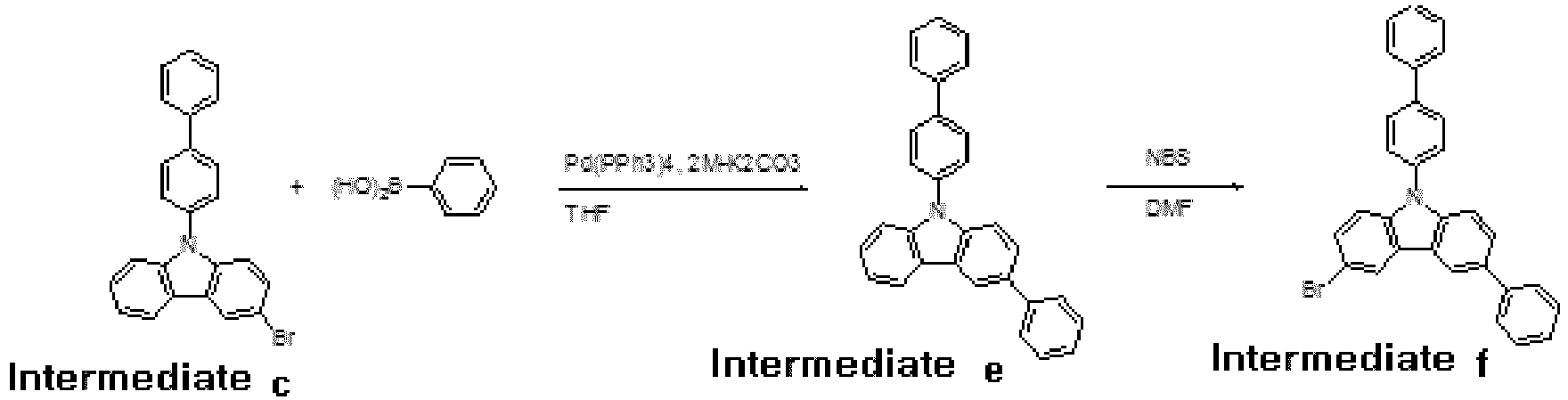

- An intermediate d (33 g, 77 %) was synthesized according to the same method as Synthesis Example 11 by using 43.2 g (108.4 mmol) of the intermediate c and 14.5 g (119 mmol) of phenylboronic acid.
- An intermediate f (29 g, 81 %) was synthesized according to the same method as the method of synthesizing the intermediate b according to Synthesis Example 15 by using 29.8 g (75.28 mmol) of the intermediate e and 14 g (75.28 mmol) of N-bromosuccinimide.
- A compound B-118 (17 g, 79 %) was obtained according to the same method as the method of synthesizing the compound B-31 according to Synthesis Example 11 by using 9.7 g (33.65 mmol) of N-phenylcarbazoe-3-yl-boronic acid and 16 g (33.65 mmol) of the intermediate f.
HRMS (70 eV, EI+): m/z calcd for C48H32N2: 636.2565, found: 636
Elemental Analysis: C, 90 %; H, 5 % - A compound B-111 was synthesized according to the same method as the first step of Synthesis Example 10 by using the intermediates c and d of Synthesis Example 15 as a starting material.
- The following intermediate h was synthesized through the first and second steps of Synthesis Example 15 by using 1,3-dibromo-N-phenyl carbazole instead of the 3-bromo-N-phenyl carbazole in the first step of Synthesis Example 15.
- Subsequently, the compound B-156 was synthesized according to the same method as Synthesis Example 13 by using the intermediate h instead of biphenylcarbazolyl bromide of the starting material of Synthesis Example 13.

-

- 10 g (34.83 mmol) of phenylcarbazolyl boronic acid, 11.77 g (38.31 mmol) of the intermediate g, 14.44 g (104.49 mmol) of potassium carbonate, and 0.80 g (0.7 mmol) of tetrakis-(triphenylphosphine)palladium (0) were suspended in 140 ml of toluene, and 50 ml of distilled water and then, refluxed and stirred for 12 hours. Subsequently, the resultant was extracted with dichloromethane and distilled water, and an organic layer therefrom was silica gel-filtered. After removing an organic solution and silica gel-columning the residue with hexane:dichloromethane = 7:3 (v/v), a solid produced therefrom was recrystallized with dichloromethane and n-hexane to obtain a compound C-10 14.4 g (a yield : 88 %).
HRMS (70 eV, EI+): m/z calcd for C36H23N: 469.18, found: 469
Elemental Analysis: C, 92 %; H, 5 % - A glass substrate coated with ITO (indium tin oxide) as a 1500 Å-thick thin film was ultrasonic wave-washed with distilled water. After washing with the distilled water, the glass substrate was ultrasonic wave-washed with a solvent such as isopropyl alcohol, acetone, methanol, and the like and dried and then, moved to a plasma cleaner, cleaned by using oxygen plasma for 10 minutes, and moved to a vacuum depositor. This obtained ITO transparent electrode was used as an anode, a 700 Å-thick hole injection layer was formed on the ITO substrate by vacuum depositing the compound A, and a hole transport layer was formed on the injection layer by depositing the compound B to be 50 Å thick and the compound C to be 1020 Å thick. On the hole transport layer (HTL), a 400 Å-thick emission layer was formed by vacuum-depositing the compound 1 of Synthesis Example 1 and the compound B-10 of Synthesis Example 10 simultaneously as a host and 10 wt% of tris(2-phenylpyridine)iridium(III) [Ir(ppy)3] as a dopant. Herein, the compound 1 and the compound B-10 were used in a weight ratio of 3:7, but their ratio in the following Examples was separately provided. Subsequently, on the emission layer, a 300 Å-thick electron transport layer was formed by simultaneously vacuum-depositing the compound D and Liq in a ratio of 1:1, and on the electron transport layer, Liq and Al were sequentially vacuum-deposited to be 15 Å thick and 1200 Å thick, manufacturing an organic light emitting diode.
- The organic light emitting diode had a structure of 5-layered organic thin films specifically as follows.
- ITO/compound A 700 Å/compound B 50 Å/compound C 1020 Å/EML[compound 1:B-10:Ir(ppy)3 = 27 wt%:63 wt%:10 wt%] 400 Å/compound D:Liq 300 Å/Liq 15 Å/Al 1200 Å.
- Compound A: N4,N4'-diphenyl-N4,N4'-bis(9-phenyl-9H-carbazol-3-yl)biphenyl-4,4'-diamine
- Compound B: 1,4,5,8,9,11-hexaazatriphenylene-hexacarbonitrile (HAT-CN),
- Compound C: N-(biphenyl-4-yl)-9,9-dimethyl-N-(4-(9-phenyl-9H-carbazol-3-yl)phenyl)-9H-fluoren-2-amine
- Compound D: 8-(4-(4,6-di(naphthalen-2-yl)-1,3,5-triazin-2-yl)phenyl)quinoline
- An organic light emitting diode was manufactured according to the same method as Example 1 by using the compound 1 and the compound B-111 in a weight ratio of 3:7.
- An organic light emitting diode was manufactured according to the same method as Example 1 by using the compound 2 and the compound B-43 in a weight ratio of 5:5.
- An organic light emitting diode was manufactured according to the same method as Example 1 by using the compound 126 and the compound B-43 in a weight ratio of 4:6.
- An organic light emitting diode was manufactured according to the same method as Example 1 by using the compound 113 and the compound B-43 in a weight ratio of 5:5.
- An organic light emitting diode was manufactured according to the same method as Example 1 by using the compound 16 and the compound B-43 in a weight ratio of 3:7.
- An organic light emitting diode was manufactured according to the same method as Example 1 by using the compound 16 and the compound B-111 in a weight ratio of 3:7.
- An organic light emitting diode was manufactured according to the same method as Example 1 by using the compound 16 and the compound B-118 in a weight ratio of 3:7.
- An organic light emitting diode was manufactured according to the same method as Example 1 by using the compound 16 and the compound B-116 in a weight ratio of 3:7.
- An organic light emitting diode was manufactured according to the same method as Example 1 by using the compound 4 and the compound B-43 in a weight ratio of 3:7.
- An organic light emitting diode was manufactured according to the same method as Example 1 by using the compound 4 and the compound B-156 in a weight ratio of 3:7.
- An organic light emitting diode was manufactured according to the same method as Example 1 by using the compound 16 and the compound C-10 in a weight ratio of 3:7.
- An organic light emitting diode was manufactured according to the same method as Example 1 by using the compound 119 and the compound B-43 in a weight ratio of 3:7.
- An organic light emitting diode was manufactured according to the same method as Example 1 by using the compound 146 and the compound B-43 in a weight ratio of 3:7.
- An organic light emitting diode was manufactured according to the same method as Example 1 by using the compound 1 as a single host.
- As described in Table 1, each organic light emitting diode according to Comparative Examples 2 to 12 was manufactured according to the same method as Example 1 by using the first host or the second host as a single host.
- An organic light emitting diode was manufactured according to the same method as Example 1 by using the Comparative Example compound I and the compound B-43 in a weight ratio of 5:5.
-

- An organic light emitting diode was manufactured according to the same method as Example 1 by using the compound 1 and mCP(1,3-bis(N-carbazolyl)benzene) in a weight ratio of 5:5 as a host.
- An organic light emitting diode was manufactured according to the same method as Example 1 by using the compound B-43 and Comparative Example compound II in a weight ratio of 5:5 as a host.
-

- Luminous efficiency and life-span characteristics of the organic light emitting diodes according to Examples 1 to 12 and Comparative Examples 1 to 14 were evaluated. The measurements were specifically performed in the following methods, and the results are shown in Table 1.
- Current values flowing in the unit device of the manufactured organic light emitting diodes were measured for, while increasing the voltage from 0V to 10V using a current-voltage meter (Keithley 2400), and the measured current values were divided by an area to provide the results.
- Luminance of the manufactured organic light emitting diodes was measured for luminance, while increasing the voltage from 0 V to 10 V using a luminance meter (Minolta Cs-1000A).
- Current efficiency (cd/A) at the same current density (10 mA/cm2) was calculated by using the luminance, current density, and voltages (V) from the items (1) and (2).
- T90 life-spans of the organic light emitting diodes according to Examples 1 to 12 and Comparative Examples 1 to 14 were measured as a time when their luminance decreased down to 90 % relative to the initial luminance (cd/m2) after emitting light with 5000 cd/m2 as the initial luminance (cd/m2) and measuring their luminance decrease depending on a time with a Polanonix life-span measurement system.
[Table 1] First host Second host Ratio of First host + Second host Color Efficie ncy (Cd/A) Life-span T90 Example 1 1 B-10 3:7 green 50.3 410 Example 2 1 B-111 3:7 green 50.7 186 Example 3 2 B-43 5:5 green 46.5 700 Example 4 126 B-43 4:6 green 40 210 Example 5 113 B-43 5:5 green 39.1 270 Example 6 16 B-43 3:7 green 45.3 480 Example 7 16 B-111 3:7 green 47.2 410 Example 8 16 B-118 3:7 green 50.3 120 Example 9 16 B-116 3:7 green 51.3 420 Example 10 4 B-43 3:7 green 48.7 470 Example 11 4 B-156 3:7 green 47 350 Example 12 16 C-10 3:7 green 51 320 Example AD-1 119 B-43 3:7 green 47.7 270 Example AD-2 146 B-43 3:7 green 45.4 120 Comparative Example 1 1 - - green 35 71 Comparative Example 2 2 - - green 35 80 Comparative Example 3 4 - - green 37 75 Comparative Example 4 16 - - green 40 77 Comparative Example 5 113 - - green 20.6 32 Comparative Example 6 126 - - green 33.6 10 Comparative Example 7 140 - - green 20.5 30 Comparative Example 8 - B-43 - green 2.8 10 Comparative Example 9 - B-111 - green 3 - Comparative Example 10 - B-116 - green 2.9 5 Comparative Example 11 - B-118 - green 5.1 3 Comparative Example 12 - B-156 - green 5.2 3 Comparative Example 13 Comparative Example compound I B-43 5:5 green 46 80 Comparative Example 14 1 mCP 5:5 green 40 75 - Referring to Table 1, a host combination of the first and second hosts of the present invention superbly increased luminous efficiency and a life-span compared with a single first or second host. The organic light emitting diodes according to present invention showed at least 1.5 times or greater and at most 6 times or greater improved life-span compared with the organic light emitting diodes according to Comparative Examples.
- Driving voltage of each organic light emitting diode was measured at 15 mA/cm2 by using a current-voltage meter (Keithley 2400), and the results are provided in Table 2.
[Table 2] First host Second host Ratio of first host + second host Color Vd Example 3 2 B-43 5:5 green 3.95 Example 5 113 B-43 5:5 green 3.90 Comparative Example 13 Comparative Example compound I B-43 5:5 green 4.26 Comparative Example 14 1 mCP 5:5 green 4.80 Comparative Example 15 Comparative Example compound II B-43 5:5 green 4.74 - Referring to Table 2, the host combination of the present invention showed remarkably excellent effect in terms of a driving voltage compared with a host combination with a known host such as a Comparative Example compound I , a Comparative Example compound II, mCP, or the like.
- While this invention has been described in connection with what is presently considered to be practical exemplary embodiments, it is to be understood that the invention is not limited to the disclosed embodiments, but, on the contrary, is intended to cover various modifications and equivalent arrangements included within the spirit and scope of the appended claims. Therefore, the aforementioned embodiments should be understood to be exemplary but not limiting the present invention in any way.
Claims (15)
- A composition for an organic optoelectronic device, comprising at least one first compound represented by Chemical Formula 1; and at least one second compound represented by Chemical Formula 2:
 X1 to X12 are independently N, C, or CRa,at least one of X1 to X6 is N,at least one of X7 to X12 is N,Ra is independently, hydrogen, deuterium, a substituted or unsubstituted C1 to C30 alkyl group, a substituted or unsubstituted C1 to C30 alkenyl group, a substituted or unsubstituted C1 to C30 alkynyl group, a substituted or unsubstituted C6 to C30 aryl group, a substituted or unsubstituted C6 to C30 aryloxy group, a substituted or unsubstituted C6 to C30 arylthio group, a substituted or unsubstituted C2 to C30 heteroaryl group, a hydroxy group, a thiol group, or a combination thereof,Ra is independently present or adjacent Ras are linked to each other to provide a ring, andL1 is deuterium, a C1 to C40 silyl group, a C1 to C30 alkyl group, a C3 to C30 cycloalkyl group, a C2 to C30 heterocycloalkyl group, or a C6 to C30 arylene group substituted or unsubstituted with a C6 to C30 aryl group;
 L2 to L5 and Y1 are independently a single bond, or a substituted or unsubstituted C6 to C30 arylene group,Ar1 is a substituted or unsubstituted C6 to C30 aryl group, a substituted or unsubstituted C2 to C30 heterocyclic group, a substituted or unsubstituted C6 to C30 arylamine group, or a combination thereof,R1 to R4 are independently hydrogen, deuterium, a substituted or unsubstituted C1 to C20 alkyl group, a substituted or unsubstituted C6 to C30 aryl group, a substituted or unsubstituted C2 to C30 heterocyclic group, a substituted or unsubstituted nitrile group, a substituted or unsubstituted isonitrile group, a hydroxy group, a thiol group, or a combination thereof,R1 to R4 is independently present or adjacent groups are linked to each other to provide a ring,at least one of R1 to R4 and Ar1 is a substituted or unsubstituted triphenylene group, or a substituted or unsubstituted carbazolyl group,one of R1 and R2 and one of R3 and R4 are not simultaneously a substituted or unsubstituted carbazolyl group, andwhen one of R1 to R4 is a substituted carbazolyl group, the carbazolyl group is not substituted with a carbazolyl group,wherein "substituted" of Chemical Formulae 1 and 2 refers to that at least one hydrogen is replaced by deuterium, a halogen, a hydroxy group, an amino group, a C1 to C30 amine group, a C6 to C30 arylamine group, a nitro group, a C1 to C40 silyl group, a C1 to C30 alkyl group, a C3 to C30 cycloalkyl group, a C2 to C30 heterocycloalkyl group, a C6 to C30 aryl group, a C2 to C30 heterocyclic group, a C1 to C20 alkoxy group, a C1 to C10 trifluoroalkyl group, or a cyano group.
 - The composition for an organic optoelectronic device of claim 1, wherein the Chemical Formula 1 is represented by one of Chemical Formula 1- I to Chemical Formula 1-III:


 Z is independently N, or CRa,at least one of Z is N,Ra, Ra1 to Ra4, Rc, Rd, Re, Rf, Rg, and Rh are independently hydrogen, deuterium, a substituted or unsubstituted C1 to C30 alkyl group, a substituted or unsubstituted C6 to C30 aryl group, a substituted or unsubstituted C2 to C30 heteroaryl group, or a combination thereof, andL1 is deuterium, a C1 to C40 silyl group, a C1 to C30 alkyl group, a C3 to C30 cycloalkyl group, a C2 to C30 heterocycloalkyl group, or a C6 to C30 arylene group substituted or unsubstituted with a C6 to C30 aryl group,wherein, "substituted" is the same as defined in claim 1.
 - The composition for an organic optoelectronic device of claim 1, wherein the L1 is a phenylene group that is unsubstituted or substituted with deuterium, a C1 to C40 silyl group, a C1 to C30 alkyl group, or a C6 to C30 aryl group;
a biphenylene group that is unsubstituted or substituted with deuterium, a C1 to C40 silyl group, a C1 to C30 alkyl group, or a C6 to C30 aryl group;
a terphenylene group that is unsubstituted or substituted with deuterium, a C1 to C40 silyl group, a C1 to C30 alkyl group, or a C6 to C30 aryl group; or
a quarterphenylene group that is unsubstituted or substituted with deuterium, a C1 to C40 silyl group, a C1 to C30 alkyl group, or a C6 to C30 aryl group. - The composition for an organic optoelectronic device of claim 1, wherein the L1 is selected from substituted or unsubstituted linking groups of Group 2:

- The composition for an organic optoelectronic device of claim 1, wherein X1 to X12 of Chemical Formula 1 are independently N, C, or CRa,
three of X1 to X6 are N,
one to three of X7 to X12 are N,
Ra is independently, hydrogen, deuterium, a substituted or unsubstituted C1 to C30 alkyl group, a substituted or unsubstituted C6 to C30 aryl group, a substituted or unsubstituted C2 to C30 heteroaryl group, or a combination thereof, and
L1 is a C6 to C30 arylene group that is substituted or unsubstituted with deuterium, a C1 to C30 alkyl group, or a C6 to C30 aryl group,
wherein "substituted" refers to that at least one hydrogen is replaced by deuterium, a halogen, a hydroxy group, a C1 to C40 silyl group, a C1 to C30 alkyl group, a C3 to C30 cycloalkyl group, a C2 to C30 heterocycloalkyl group, a C6 to C30 aryl group, or a C2 to C30 heterocyclic group. - The composition for an organic optoelectronic device of claim 5, wherein the Ra is a substituted or unsubstituted C6 to C30 aryl group,
wherein the C6 to C30 aryl group is substituted or unsubstituted phenyl group, a substituted or unsubstituted biphenyl group, a substituted or unsubstituted terphenyl group, a substituted or unsubstituted quarterphenyl group, a substituted or unsubstituted naphthyl group, a substituted or unsubstituted anthracenyl group, a substituted or unsubstituted fluorenyl group, a substituted or unsubstituted triphenylene group, or a substituted or unsubstituted phenanthrenyl group. - The composition for an organic optoelectronic device of claim 1, wherein the Chemical Formula 2 is represented by one of Chemical Formulae 2- I to 2-VI:


 L2 to L5, Y1, and Y2 are independently a single bond, or a substituted or unsubstituted C6 to C30 arylene group,Ar1 and Ar2 are independently, a substituted or unsubstituted C6 to C30 aryl group, a substituted or unsubstituted C2 to C30 heterocyclic group, a substituted or unsubstituted C6 to C30 arylamine group, or a combination thereof,R1 to R4 are independently hydrogen, deuterium, a substituted or unsubstituted C1 to C20 alkyl group, a substituted or unsubstituted C6 to C30 aryl group, a substituted or unsubstituted C2 to C30 heterocyclic group, a substituted or unsubstituted nitrile group, a substituted or unsubstituted isonitrile group, a hydroxy group, a thiol group, or a combination thereof,R1 or of Chemical Formula 2- I is not a substituted or unsubstituted carbazolyl group,R5 to R31 are independently hydrogen, deuterium, a substituted or unsubstituted C1 to C20 alkyl group, a substituted or unsubstituted C6 to C30 aryl group, a substituted or unsubstituted C2 to C30 heterocyclic group, or a combination thereof,provided that all the R5 to R7 are not a carbazolyl group, andn is an integer of 0 to 5,wherein, "substituted" is the same as defined in claim 1.
 - The composition for an organic optoelectronic device of claim 7, wherein Ar1 and Ar2 of Chemical Formulae 2- I to 2-VI are independently, a substituted or unsubstituted phenyl group, a substituted or unsubstituted biphenyl group, a substituted or unsubstituted terphenyl group, a substituted or unsubstituted naphthyl group, a substituted or unsubstituted triphenylenyl group, a substituted or unsubstituted fluorenyl group, a substituted or unsubstituted pyridinyl group, a substituted or unsubstituted quinolinyl group, a substituted or unsubstituted isoquinolinyl group, a substituted or unsubstituted dibenzofuranyl group, a substituted or unsubstituted dibenzothiophenyl group, or a combination thereof.
- The composition for an organic optoelectronic device of claim 7, wherein Ar1 and Ar2 of Chemical Formula 2- I to 2-VI are selected from substituted or unsubstituted groups of Group 4:

- The composition for an organic optoelectronic device of claim 1, wherein the first compound is represented by Chemical Formula 1- I a, and the second compound is represented by Chemical Formula 1 a or 2a-1
 Z1 to Z6 are independently N, or CRa,at least two of Z1 to Z3 are N,at least two of Z4 to Z6 are N,Ra and Ra1 to Ra4 are independently hydrogen, or a substituted or unsubstituted C6 to C30 aryl group, andL1 is a C6 to C30 arylene group that is substituted or unsubstituted with deuterium, a C1 to C30 alkyl group, or a C6 to C30 aryl group;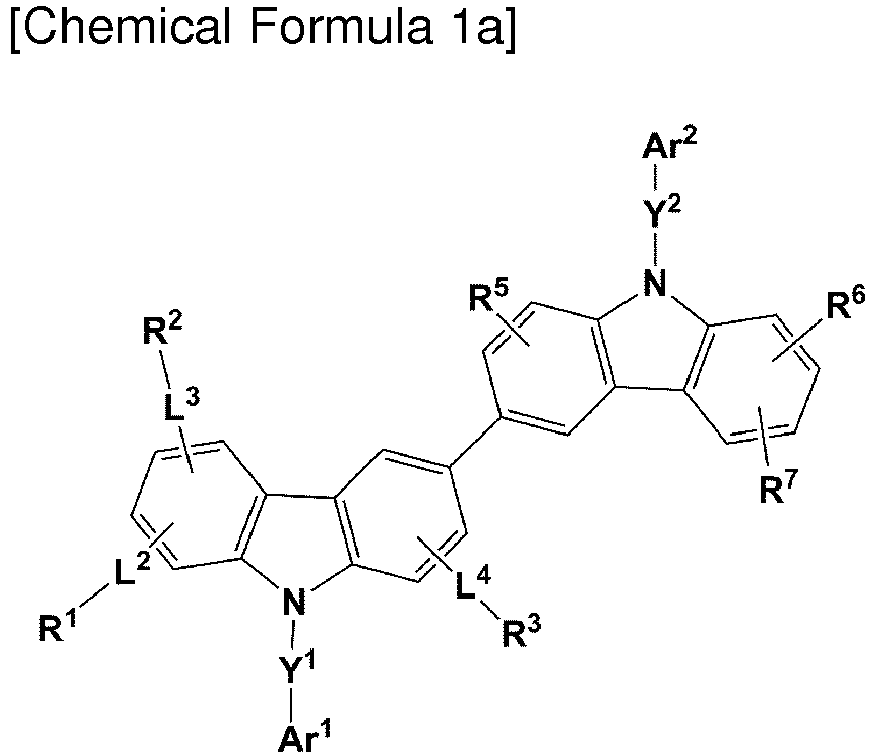

 L2 to L5, Y1, and Y2 are independently a single bond, or a substituted or unsubstituted C6 to C30 arylene group,Ar1 and Ar2 are independently, a substituted or unsubstituted C6 to C30 aryl group, or a substituted or unsubstituted C2 to C30 heterocyclic group,R1 to R3 and R5 to R12 are independently, hydrogen, deuterium, or a substituted or unsubstituted C6 to C30 aryl group,R1 or of Chemical Formula 1a is not a substituted or unsubstituted carbazolyl group, andall the R5 to R7 are not a carbazolyl group,wherein, "substituted" is the same as defined in claim 1.
 - The composition for an organic optoelectronic device of claim 1, which further comprises a phosphorescent dopant.
- An organic optoelectronic device comprising
an anode and a cathode facing each other, and
at least one organic layer interposed between the anode and the cathode,wherein the organic layer includes the composition for an organic optoelectronic device of any one of claim 1 to claim 11. - The organic optoelectronic device of claim 12, wherein the organic layer comprises an emission layer, and
the emission layer comprises the composition for an organic optoelectronic device. - The organic optoelectronic device of claim 12, wherein the organic optoelectronic device is selected from an organic light emitting diode, an organic photoelectric device, an organic solar cell, an organic transistor, an organic photo conductor drum, and an organic memory device.
- A display device comprising the organic optoelectronic device of claim 12.
Applications Claiming Priority (3)
| Application Number | Priority Date | Filing Date | Title |
|---|---|---|---|
| KR20150087776 | 2015-06-19 | ||
| KR1020160057082A KR102059021B1 (en) | 2015-06-19 | 2016-05-10 | Composition for organic optoelectronic device, organic optoelectric device and display device |
| PCT/KR2016/004929 WO2016204406A1 (en) | 2015-06-19 | 2016-05-11 | Composition for organic photoelectronic element, organic photoelectronic element, and display apparatus |
Publications (3)
| Publication Number | Publication Date |
|---|---|
| EP3272833A1 true EP3272833A1 (en) | 2018-01-24 |
| EP3272833A4 EP3272833A4 (en) | 2018-11-14 |
| EP3272833B1 EP3272833B1 (en) | 2021-01-13 |
Family
ID=57724417
Family Applications (1)
| Application Number | Title | Priority Date | Filing Date |
|---|---|---|---|
| EP16811819.8A Active EP3272833B1 (en) | 2015-06-19 | 2016-05-11 | Composition for organic photoelectronic element, organic photoelectronic element, and display apparatus |
Country Status (6)
| Country | Link |
|---|---|
| US (1) | US10644245B2 (en) |
| EP (1) | EP3272833B1 (en) |
| JP (1) | JP6575976B2 (en) |
| KR (1) | KR102059021B1 (en) |
| CN (1) | CN107810182B (en) |
| TW (1) | TWI613197B (en) |
Families Citing this family (18)
| Publication number | Priority date | Publication date | Assignee | Title |
|---|---|---|---|---|
| KR101919438B1 (en) | 2015-06-26 | 2018-11-16 | 삼성에스디아이 주식회사 | Composition for organic optoelectric device, organic optoelectric device and display device |
| KR102082266B1 (en) * | 2016-02-25 | 2020-02-27 | 삼성에스디아이 주식회사 | Organic compound and composition and organic optoelectric device and display device |
| KR102395782B1 (en) | 2017-07-31 | 2022-05-09 | 삼성전자주식회사 | Organic light emitting device |
| KR101884130B1 (en) * | 2017-08-29 | 2018-07-31 | 주식회사 두산 | Organic electroluminescent device |
| KR102423551B1 (en) | 2017-11-03 | 2022-07-22 | 솔루스첨단소재 주식회사 | Compound for an electron transporting layer and organic electroluminescent device comprising the same |
| KR102092797B1 (en) * | 2018-06-11 | 2020-03-24 | 삼성에스디아이 주식회사 | Composition for organic optoelectric device, organic optoelectric device and display device |
| KR102087659B1 (en) * | 2018-06-11 | 2020-03-11 | 삼성에스디아이 주식회사 | Composition for organic optoelectric device, organic optoelectric device and display device |
| CN111770920B (en) * | 2018-06-14 | 2023-08-08 | 株式会社Lg化学 | Compound and organic light emitting device comprising the same |
| EP4174054A1 (en) | 2018-12-28 | 2023-05-03 | Samsung Electronics Co., Ltd. | Heterocyclic compound, composition including the same, and organic light-emitting device including the heterocyclic compound |
| JP7396795B2 (en) * | 2018-12-28 | 2023-12-12 | 三星電子株式会社 | Compound, composition, liquid composition, material for organic electroluminescent device, and organic electroluminescent device |
| KR102555503B1 (en) * | 2019-11-14 | 2023-07-12 | 삼성에스디아이 주식회사 | Compound for organic optoelectronic device, composition for organic optoelectronic device, organic optoelectronic device and display device |
| CN112898275A (en) * | 2019-12-04 | 2021-06-04 | 三星电子株式会社 | Compound, composition, liquid composition, material for organic electroluminescent device, and organic electroluminescent device |
| JP7443038B2 (en) * | 2019-12-04 | 2024-03-05 | 三星電子株式会社 | Compounds, compositions, liquid compositions and organic electroluminescent devices |
| CN115340531B (en) * | 2021-05-12 | 2024-02-13 | 江苏三月科技股份有限公司 | A compound containing triazine and pyrimidine structures and its application in organic electroluminescent devices |
| WO2023286817A1 (en) * | 2021-07-15 | 2023-01-19 | 日鉄ケミカル&マテリアル株式会社 | Material for photoelectric conversion elements for image pickup |
| CN116283790B (en) * | 2021-12-07 | 2024-06-07 | 江苏三月科技股份有限公司 | Pyrimidine structure-containing compound and organic electroluminescent device prepared from same |
| CN117242066A (en) * | 2022-01-13 | 2023-12-15 | 株式会社Lg化学 | Novel compounds and organic light-emitting devices containing the same |
| CN117736179A (en) * | 2022-09-13 | 2024-03-22 | 江苏三月科技股份有限公司 | Organic compound containing triazine and pyrimidine and application thereof |
Family Cites Families (43)
| Publication number | Priority date | Publication date | Assignee | Title |
|---|---|---|---|---|
| WO2005085387A1 (en) | 2004-03-08 | 2005-09-15 | Idemitsu Kosan Co., Ltd. | Material for organic electroluminescence device and organic electroluminescence device utilizing the same |
| US7597967B2 (en) | 2004-12-17 | 2009-10-06 | Eastman Kodak Company | Phosphorescent OLEDs with exciton blocking layer |
| JP5019816B2 (en) | 2005-08-26 | 2012-09-05 | 東ソー株式会社 | 1,3,5-triazine derivative, process for producing the same, and organic electroluminescent device comprising the same |
| US20070252516A1 (en) | 2006-04-27 | 2007-11-01 | Eastman Kodak Company | Electroluminescent devices including organic EIL layer |
| EP2141158B1 (en) | 2007-04-12 | 2014-05-07 | Tosoh Corporation | Phenyl-substituted 1,3,5-triazine compound, process for producing the same, and organic electroluminescent device containing the same as component |
| KR100904070B1 (en) | 2007-07-18 | 2009-06-23 | 제일모직주식회사 | Compound for organic photoelectric device and organic photoelectric device using same |
| DE102008036982A1 (en) * | 2008-08-08 | 2010-02-11 | Merck Patent Gmbh | Organic electroluminescent device |
| JP5748948B2 (en) | 2008-10-03 | 2015-07-15 | 東ソー株式会社 | 1,3,5-triazine derivative, method for producing the same, and organic electroluminescent device comprising the same |
| JP2010138121A (en) | 2008-12-12 | 2010-06-24 | Canon Inc | Triazine compound, and organic light emitting element employing the same |
| KR101311934B1 (en) * | 2009-06-08 | 2013-09-26 | 제일모직주식회사 | Composition for organic photoelectric device and organic photoelectric device using the same |
| CN102471679A (en) | 2009-07-10 | 2012-05-23 | 第一毛织株式会社 | Compound for an organic photoelectric element, and an organic photoelectric element comprising the same |
| CN101654430B (en) | 2009-09-22 | 2011-09-07 | 北京大学 | Broadband electron transport material and preparation and application |
| KR101288566B1 (en) | 2009-12-16 | 2013-07-22 | 제일모직주식회사 | Compound for organic photoelectric device and organic photoelectric device including the same |
| KR101311935B1 (en) | 2010-04-23 | 2013-09-26 | 제일모직주식회사 | Compound for organic photoelectric device and organic photoelectric device including the same |
| WO2011162162A1 (en) * | 2010-06-24 | 2011-12-29 | 東レ株式会社 | Light-emitting device material and light-emitting device |
| JPWO2012008281A1 (en) * | 2010-07-13 | 2013-09-09 | 東レ株式会社 | Light emitting element |
| DE102010048497A1 (en) | 2010-10-14 | 2012-04-19 | Merck Patent Gmbh | Formulations for organic electroluminescent devices |
| WO2012153725A1 (en) * | 2011-05-12 | 2012-11-15 | 東レ株式会社 | Light-emitting element material and light-emitting element |
| US9680107B2 (en) | 2011-05-25 | 2017-06-13 | Lms Co., Ltd. | Compound and organic electronic device comprising the compound |
| JP6092195B2 (en) | 2011-06-03 | 2017-03-08 | メルク パテント ゲーエムベーハー | Organic electroluminescence device |
| CN108440531B (en) | 2011-11-10 | 2021-11-02 | Udc 爱尔兰有限责任公司 | 4H-imidazo [1,2-a ] imidazoles for electronic applications |
| KR20130084952A (en) | 2012-01-18 | 2013-07-26 | (주)씨에스엘쏠라 | Organic light emiiting compound and organic light emitting device comprising the same |
| WO2013122082A1 (en) * | 2012-02-15 | 2013-08-22 | 東レ株式会社 | Light-emitting element material, and light-emitting element |
| KR101604168B1 (en) | 2012-02-27 | 2016-03-16 | 주식회사 엘지화학 | Organic light emitting diode |
| WO2013187896A1 (en) * | 2012-06-14 | 2013-12-19 | Universal Display Corporation | Biscarbazole derivative host materials and green emitter for oled emissive region |
| CN104488105B (en) * | 2012-07-25 | 2017-03-22 | 东丽株式会社 | Light emitting element material and light emitting element |
| KR101401639B1 (en) | 2012-07-27 | 2014-06-02 | (주)피엔에이치테크 | Novel compound for organic electroluminescent device and organic electroluminescent device comprising the same |
| JPWO2014024750A1 (en) * | 2012-08-09 | 2016-07-25 | 東レ株式会社 | Light emitting device material and light emitting device |
| KR101566530B1 (en) | 2012-12-31 | 2015-11-05 | 제일모직 주식회사 | COMPOUND FOR ORGANIC OPTOELECTRONIC DEVICE, ORGANIC LiGHT EMITTING DIODE INCLUDING THE SAME AND DISPLAY INCLUDING THE ORGANIC LiGHT EMITTING DIODE |
| KR102229862B1 (en) | 2013-01-22 | 2021-03-22 | 덕산네오룩스 주식회사 | Compound for organic electronic element, organic electronic element using the same, and an electronic device thereof |
| US10043982B2 (en) | 2013-04-26 | 2018-08-07 | Semiconductor Energy Laboratory Co., Ltd. | Light-emitting element, light-emitting device, display device, electronic device, and lighting device |
| KR101649683B1 (en) | 2013-09-06 | 2016-08-19 | 제일모직 주식회사 | Composition for organic optoelectric device and organic optoelectric device and display device |
| KR101602533B1 (en) | 2013-09-30 | 2016-03-10 | 주식회사 엘지화학 | Hetero-cyclic compound and organic light emitting device comprising the same |
| KR101779110B1 (en) | 2013-10-11 | 2017-09-18 | 제일모직 주식회사 | Organic optoelectric device and display device |
| KR102093186B1 (en) | 2013-12-03 | 2020-03-25 | 덕산네오룩스 주식회사 | Compound for organic electronic element, organic electronic element using the same, and an electronic device thereof |
| KR20150071624A (en) | 2013-12-18 | 2015-06-26 | 롬엔드하스전자재료코리아유한회사 | Organic electroluminescent compound and organic electroluminescent device comprising the same |
| KR101920643B1 (en) * | 2014-01-10 | 2018-11-21 | 삼성에스디아이 주식회사 | Condensed cyclic compound, and organic light emitting device including the same |
| KR20150104260A (en) | 2014-03-04 | 2015-09-15 | 삼성디스플레이 주식회사 | Heterocyclic compound for organic light emitting device and organic light emitting device comprising the same |
| KR101502316B1 (en) | 2014-04-18 | 2015-03-13 | 롬엔드하스전자재료코리아유한회사 | Multi-component host material and an organic electroluminescence device comprising the same |
| CN103985822B (en) | 2014-05-30 | 2017-05-10 | 广州华睿光电材料有限公司 | Organic mixture, composite containing organic mixture, organic electronic device and application |
| KR102755057B1 (en) | 2015-02-18 | 2025-01-21 | 가부시키가이샤 한도오따이 에네루기 켄큐쇼 | Organic compound, light-emitting element, display module, lighting module, light-emitting device, display device, electronic device, and lighting device |
| JP2016185914A (en) * | 2015-03-27 | 2016-10-27 | 東レ株式会社 | Quinazoline derivative, electronic device containing the same, light emitting element and photoelectric conversion element |
| KR101980841B1 (en) | 2015-10-19 | 2019-05-21 | 삼성에스디아이 주식회사 | Composition for organic optoelectronic device, organic optoelectronic device and display device |
-
2016
- 2016-05-10 KR KR1020160057082A patent/KR102059021B1/en active Active
- 2016-05-11 CN CN201680035713.9A patent/CN107810182B/en active Active
- 2016-05-11 EP EP16811819.8A patent/EP3272833B1/en active Active
- 2016-05-11 US US15/540,090 patent/US10644245B2/en active Active
- 2016-05-11 JP JP2017559421A patent/JP6575976B2/en active Active
- 2016-06-16 TW TW105118875A patent/TWI613197B/en active
Also Published As
| Publication number | Publication date |
|---|---|
| CN107810182A (en) | 2018-03-16 |
| JP2018524797A (en) | 2018-08-30 |
| KR20160150000A (en) | 2016-12-28 |
| EP3272833A4 (en) | 2018-11-14 |
| US20180006238A1 (en) | 2018-01-04 |
| JP6575976B2 (en) | 2019-09-18 |
| CN107810182B (en) | 2021-05-11 |
| EP3272833B1 (en) | 2021-01-13 |
| KR102059021B1 (en) | 2019-12-24 |
| TWI613197B (en) | 2018-02-01 |
| US10644245B2 (en) | 2020-05-05 |
| TW201702233A (en) | 2017-01-16 |
Similar Documents
| Publication | Publication Date | Title |
|---|---|---|
| EP3272833B1 (en) | Composition for organic photoelectronic element, organic photoelectronic element, and display apparatus | |
| EP3901148B1 (en) | Compound for organic optoelectronic element, composition for organic optoelectronic element and organic optoelectronic element and display device | |
| EP4212517B1 (en) | Compound for organic optoelectronic element, composition for organic optoelectronic element, organic optoelectronic element, and display device | |
| EP3575296B1 (en) | Triazine compound, composition and organic optoelectronic device and display device | |
| EP3480278B1 (en) | Compound for organic optoelectronic device, composition for organic optoelectronic device, organic optoelectronic device and display apparatus | |
| EP3553050B1 (en) | Composition and organic optoelectronic device and display device | |
| EP3643762B1 (en) | Organic optoelectronic element and display device | |
| EP3657559B1 (en) | Organic optoelectronic diode and display device | |
| EP3492553B1 (en) | Composition for organic optoelectronic element, organic optoelectronic element, and display device | |
| EP3032606B1 (en) | Organic optoelectric device and display device | |
| EP3015527B1 (en) | Organic compound for optoelectric device and composition for optoelectric device and organic optoelectric device and display device | |
| EP2860783B1 (en) | Organic optoelectric device and display device | |
| EP3312255B1 (en) | Compound for organic optoelectric device, organic optoelectric device and display device | |
| EP3366749B1 (en) | Composition for organic optoelectronic element, organic optoelectronic element, and display device | |
| JP2025166035A (en) | Composition for organic optoelectronic device, organic optoelectronic device and display device | |
| EP3486299A1 (en) | Compound for organic optoelectronic device, composition for organic optoelectronic device, organic optoelectronic device, and display device | |
| US20170092873A1 (en) | Composition for organic optoelectronic device, organic optoelectronic device and display device | |
| EP3480277A1 (en) | Compound for organic optoelectronic device, composition for organic optoelectronic device, organic optoelectronic device and display apparatus | |
| EP4273148A1 (en) | Compound for organic optoelectronic element, composition for organic optoelectronic element, organic optoelectronic element, and display device | |
| EP3680309B1 (en) | Composition for organic optoelectronic element, organic optoelectronic element, and display device | |
| EP3208271B1 (en) | Nitrogen-containing polycyclic compound and organic light emitting element using same | |
| US11690288B2 (en) | Composition for organic optoelectronic diode, organic optoelectronic diode, and display device | |
| US10032999B2 (en) | Compound for organic optoelectric device, composition for organic optoelectric device and organic optoelectric device and display device | |
| EP3885345A1 (en) | Compound for organic optoelectronic device, organic optoelectronic device, and display device | |
| WO2016204406A1 (en) | Composition for organic photoelectronic element, organic photoelectronic element, and display apparatus |
Legal Events
| Date | Code | Title | Description |
|---|---|---|---|
| STAA | Information on the status of an ep patent application or granted ep patent |
Free format text: STATUS: THE INTERNATIONAL PUBLICATION HAS BEEN MADE |
|
| PUAI | Public reference made under article 153(3) epc to a published international application that has entered the european phase |
Free format text: ORIGINAL CODE: 0009012 |
|
| STAA | Information on the status of an ep patent application or granted ep patent |
Free format text: STATUS: REQUEST FOR EXAMINATION WAS MADE |
|
| 17P | Request for examination filed |
Effective date: 20170829 |
|
| AK | Designated contracting states |
Kind code of ref document: A1 Designated state(s): AL AT BE BG CH CY CZ DE DK EE ES FI FR GB GR HR HU IE IS IT LI LT LU LV MC MK MT NL NO PL PT RO RS SE SI SK SM TR |
|
| AX | Request for extension of the european patent |
Extension state: BA ME |
|
| DAV | Request for validation of the european patent (deleted) | ||
| DAX | Request for extension of the european patent (deleted) | ||
| A4 | Supplementary search report drawn up and despatched |
Effective date: 20181012 |
|
| RIC1 | Information provided on ipc code assigned before grant |
Ipc: C09K 11/06 20060101AFI20181008BHEP Ipc: H01L 51/54 20060101ALI20181008BHEP |
|
| GRAP | Despatch of communication of intention to grant a patent |
Free format text: ORIGINAL CODE: EPIDOSNIGR1 |
|
| STAA | Information on the status of an ep patent application or granted ep patent |
Free format text: STATUS: GRANT OF PATENT IS INTENDED |
|
| INTG | Intention to grant announced |
Effective date: 20200729 |
|
| GRAS | Grant fee paid |
Free format text: ORIGINAL CODE: EPIDOSNIGR3 |
|
| GRAA | (expected) grant |
Free format text: ORIGINAL CODE: 0009210 |
|
| STAA | Information on the status of an ep patent application or granted ep patent |
Free format text: STATUS: THE PATENT HAS BEEN GRANTED |
|
| AK | Designated contracting states |
Kind code of ref document: B1 Designated state(s): AL AT BE BG CH CY CZ DE DK EE ES FI FR GB GR HR HU IE IS IT LI LT LU LV MC MK MT NL NO PL PT RO RS SE SI SK SM TR |
|
| REG | Reference to a national code |
Ref country code: GB Ref legal event code: FG4D |
|
| REG | Reference to a national code |
Ref country code: CH Ref legal event code: EP |
|
| REG | Reference to a national code |
Ref country code: IE Ref legal event code: FG4D |
|
| REG | Reference to a national code |
Ref country code: DE Ref legal event code: R096 Ref document number: 602016051471 Country of ref document: DE |
|
| REG | Reference to a national code |
Ref country code: AT Ref legal event code: REF Ref document number: 1354561 Country of ref document: AT Kind code of ref document: T Effective date: 20210215 |
|
| REG | Reference to a national code |
Ref country code: AT Ref legal event code: MK05 Ref document number: 1354561 Country of ref document: AT Kind code of ref document: T Effective date: 20210113 |
|
| REG | Reference to a national code |
Ref country code: NL Ref legal event code: MP Effective date: 20210113 |
|
| REG | Reference to a national code |
Ref country code: LT Ref legal event code: MG9D |
|
| PG25 | Lapsed in a contracting state [announced via postgrant information from national office to epo] |
Ref country code: BG Free format text: LAPSE BECAUSE OF FAILURE TO SUBMIT A TRANSLATION OF THE DESCRIPTION OR TO PAY THE FEE WITHIN THE PRESCRIBED TIME-LIMIT Effective date: 20210413 Ref country code: LT Free format text: LAPSE BECAUSE OF FAILURE TO SUBMIT A TRANSLATION OF THE DESCRIPTION OR TO PAY THE FEE WITHIN THE PRESCRIBED TIME-LIMIT Effective date: 20210113 Ref country code: GR Free format text: LAPSE BECAUSE OF FAILURE TO SUBMIT A TRANSLATION OF THE DESCRIPTION OR TO PAY THE FEE WITHIN THE PRESCRIBED TIME-LIMIT Effective date: 20210414 Ref country code: HR Free format text: LAPSE BECAUSE OF FAILURE TO SUBMIT A TRANSLATION OF THE DESCRIPTION OR TO PAY THE FEE WITHIN THE PRESCRIBED TIME-LIMIT Effective date: 20210113 Ref country code: FI Free format text: LAPSE BECAUSE OF FAILURE TO SUBMIT A TRANSLATION OF THE DESCRIPTION OR TO PAY THE FEE WITHIN THE PRESCRIBED TIME-LIMIT Effective date: 20210113 Ref country code: NO Free format text: LAPSE BECAUSE OF FAILURE TO SUBMIT A TRANSLATION OF THE DESCRIPTION OR TO PAY THE FEE WITHIN THE PRESCRIBED TIME-LIMIT Effective date: 20210413 Ref country code: PT Free format text: LAPSE BECAUSE OF FAILURE TO SUBMIT A TRANSLATION OF THE DESCRIPTION OR TO PAY THE FEE WITHIN THE PRESCRIBED TIME-LIMIT Effective date: 20210513 |
|
| PG25 | Lapsed in a contracting state [announced via postgrant information from national office to epo] |
Ref country code: AT Free format text: LAPSE BECAUSE OF FAILURE TO SUBMIT A TRANSLATION OF THE DESCRIPTION OR TO PAY THE FEE WITHIN THE PRESCRIBED TIME-LIMIT Effective date: 20210113 Ref country code: RS Free format text: LAPSE BECAUSE OF FAILURE TO SUBMIT A TRANSLATION OF THE DESCRIPTION OR TO PAY THE FEE WITHIN THE PRESCRIBED TIME-LIMIT Effective date: 20210113 Ref country code: LV Free format text: LAPSE BECAUSE OF FAILURE TO SUBMIT A TRANSLATION OF THE DESCRIPTION OR TO PAY THE FEE WITHIN THE PRESCRIBED TIME-LIMIT Effective date: 20210113 Ref country code: PL Free format text: LAPSE BECAUSE OF FAILURE TO SUBMIT A TRANSLATION OF THE DESCRIPTION OR TO PAY THE FEE WITHIN THE PRESCRIBED TIME-LIMIT Effective date: 20210113 Ref country code: SE Free format text: LAPSE BECAUSE OF FAILURE TO SUBMIT A TRANSLATION OF THE DESCRIPTION OR TO PAY THE FEE WITHIN THE PRESCRIBED TIME-LIMIT Effective date: 20210113 |
|
| PG25 | Lapsed in a contracting state [announced via postgrant information from national office to epo] |
Ref country code: IS Free format text: LAPSE BECAUSE OF FAILURE TO SUBMIT A TRANSLATION OF THE DESCRIPTION OR TO PAY THE FEE WITHIN THE PRESCRIBED TIME-LIMIT Effective date: 20210513 |
|
| REG | Reference to a national code |
Ref country code: DE Ref legal event code: R097 Ref document number: 602016051471 Country of ref document: DE |
|
| PG25 | Lapsed in a contracting state [announced via postgrant information from national office to epo] |
Ref country code: SM Free format text: LAPSE BECAUSE OF FAILURE TO SUBMIT A TRANSLATION OF THE DESCRIPTION OR TO PAY THE FEE WITHIN THE PRESCRIBED TIME-LIMIT Effective date: 20210113 Ref country code: EE Free format text: LAPSE BECAUSE OF FAILURE TO SUBMIT A TRANSLATION OF THE DESCRIPTION OR TO PAY THE FEE WITHIN THE PRESCRIBED TIME-LIMIT Effective date: 20210113 Ref country code: CZ Free format text: LAPSE BECAUSE OF FAILURE TO SUBMIT A TRANSLATION OF THE DESCRIPTION OR TO PAY THE FEE WITHIN THE PRESCRIBED TIME-LIMIT Effective date: 20210113 |
|
| PLBE | No opposition filed within time limit |
Free format text: ORIGINAL CODE: 0009261 |
|
| STAA | Information on the status of an ep patent application or granted ep patent |
Free format text: STATUS: NO OPPOSITION FILED WITHIN TIME LIMIT |
|
| PG25 | Lapsed in a contracting state [announced via postgrant information from national office to epo] |
Ref country code: SK Free format text: LAPSE BECAUSE OF FAILURE TO SUBMIT A TRANSLATION OF THE DESCRIPTION OR TO PAY THE FEE WITHIN THE PRESCRIBED TIME-LIMIT Effective date: 20210113 Ref country code: RO Free format text: LAPSE BECAUSE OF FAILURE TO SUBMIT A TRANSLATION OF THE DESCRIPTION OR TO PAY THE FEE WITHIN THE PRESCRIBED TIME-LIMIT Effective date: 20210113 Ref country code: DK Free format text: LAPSE BECAUSE OF FAILURE TO SUBMIT A TRANSLATION OF THE DESCRIPTION OR TO PAY THE FEE WITHIN THE PRESCRIBED TIME-LIMIT Effective date: 20210113 |
|
| 26N | No opposition filed |
Effective date: 20211014 |
|
| REG | Reference to a national code |
Ref country code: CH Ref legal event code: PL |
|
| GBPC | Gb: european patent ceased through non-payment of renewal fee |
Effective date: 20210511 |
|
| PG25 | Lapsed in a contracting state [announced via postgrant information from national office to epo] |
Ref country code: ES Free format text: LAPSE BECAUSE OF FAILURE TO SUBMIT A TRANSLATION OF THE DESCRIPTION OR TO PAY THE FEE WITHIN THE PRESCRIBED TIME-LIMIT Effective date: 20210113 Ref country code: LI Free format text: LAPSE BECAUSE OF NON-PAYMENT OF DUE FEES Effective date: 20210531 Ref country code: LU Free format text: LAPSE BECAUSE OF NON-PAYMENT OF DUE FEES Effective date: 20210511 Ref country code: MC Free format text: LAPSE BECAUSE OF FAILURE TO SUBMIT A TRANSLATION OF THE DESCRIPTION OR TO PAY THE FEE WITHIN THE PRESCRIBED TIME-LIMIT Effective date: 20210113 Ref country code: AL Free format text: LAPSE BECAUSE OF FAILURE TO SUBMIT A TRANSLATION OF THE DESCRIPTION OR TO PAY THE FEE WITHIN THE PRESCRIBED TIME-LIMIT Effective date: 20210113 Ref country code: CH Free format text: LAPSE BECAUSE OF NON-PAYMENT OF DUE FEES Effective date: 20210531 |
|
| REG | Reference to a national code |
Ref country code: BE Ref legal event code: MM Effective date: 20210531 |
|
| PG25 | Lapsed in a contracting state [announced via postgrant information from national office to epo] |
Ref country code: SI Free format text: LAPSE BECAUSE OF FAILURE TO SUBMIT A TRANSLATION OF THE DESCRIPTION OR TO PAY THE FEE WITHIN THE PRESCRIBED TIME-LIMIT Effective date: 20210113 |
|
| PG25 | Lapsed in a contracting state [announced via postgrant information from national office to epo] |
Ref country code: IT Free format text: LAPSE BECAUSE OF FAILURE TO SUBMIT A TRANSLATION OF THE DESCRIPTION OR TO PAY THE FEE WITHIN THE PRESCRIBED TIME-LIMIT Effective date: 20210113 Ref country code: IE Free format text: LAPSE BECAUSE OF NON-PAYMENT OF DUE FEES Effective date: 20210511 Ref country code: GB Free format text: LAPSE BECAUSE OF NON-PAYMENT OF DUE FEES Effective date: 20210511 |
|
| PG25 | Lapsed in a contracting state [announced via postgrant information from national office to epo] |
Ref country code: IS Free format text: LAPSE BECAUSE OF FAILURE TO SUBMIT A TRANSLATION OF THE DESCRIPTION OR TO PAY THE FEE WITHIN THE PRESCRIBED TIME-LIMIT Effective date: 20210513 Ref country code: FR Free format text: LAPSE BECAUSE OF NON-PAYMENT OF DUE FEES Effective date: 20210531 |
|
| PG25 | Lapsed in a contracting state [announced via postgrant information from national office to epo] |
Ref country code: BE Free format text: LAPSE BECAUSE OF NON-PAYMENT OF DUE FEES Effective date: 20210531 |
|
| PG25 | Lapsed in a contracting state [announced via postgrant information from national office to epo] |
Ref country code: HU Free format text: LAPSE BECAUSE OF FAILURE TO SUBMIT A TRANSLATION OF THE DESCRIPTION OR TO PAY THE FEE WITHIN THE PRESCRIBED TIME-LIMIT; INVALID AB INITIO Effective date: 20160511 |
|
| PG25 | Lapsed in a contracting state [announced via postgrant information from national office to epo] |
Ref country code: NL Free format text: LAPSE BECAUSE OF NON-PAYMENT OF DUE FEES Effective date: 20210113 Ref country code: CY Free format text: LAPSE BECAUSE OF FAILURE TO SUBMIT A TRANSLATION OF THE DESCRIPTION OR TO PAY THE FEE WITHIN THE PRESCRIBED TIME-LIMIT Effective date: 20210113 |
|
| P01 | Opt-out of the competence of the unified patent court (upc) registered |
Effective date: 20230528 |
|
| PG25 | Lapsed in a contracting state [announced via postgrant information from national office to epo] |
Ref country code: MK Free format text: LAPSE BECAUSE OF FAILURE TO SUBMIT A TRANSLATION OF THE DESCRIPTION OR TO PAY THE FEE WITHIN THE PRESCRIBED TIME-LIMIT Effective date: 20210113 |
|
| PG25 | Lapsed in a contracting state [announced via postgrant information from national office to epo] |
Ref country code: MT Free format text: LAPSE BECAUSE OF FAILURE TO SUBMIT A TRANSLATION OF THE DESCRIPTION OR TO PAY THE FEE WITHIN THE PRESCRIBED TIME-LIMIT Effective date: 20210113 |
|
| PGFP | Annual fee paid to national office [announced via postgrant information from national office to epo] |
Ref country code: DE Payment date: 20250429 Year of fee payment: 10 |
|
| PG25 | Lapsed in a contracting state [announced via postgrant information from national office to epo] |
Ref country code: TR Free format text: LAPSE BECAUSE OF FAILURE TO SUBMIT A TRANSLATION OF THE DESCRIPTION OR TO PAY THE FEE WITHIN THE PRESCRIBED TIME-LIMIT Effective date: 20210113 |