EP3272782A1 - Resin composition, prepreg, metal foil-clad laminate, resin sheet, and printed wiring board - Google Patents
Resin composition, prepreg, metal foil-clad laminate, resin sheet, and printed wiring board Download PDFInfo
- Publication number
- EP3272782A1 EP3272782A1 EP16764566.2A EP16764566A EP3272782A1 EP 3272782 A1 EP3272782 A1 EP 3272782A1 EP 16764566 A EP16764566 A EP 16764566A EP 3272782 A1 EP3272782 A1 EP 3272782A1
- Authority
- EP
- European Patent Office
- Prior art keywords
- group
- resin composition
- resin
- bis
- cyanatophenyl
- Prior art date
- Legal status (The legal status is an assumption and is not a legal conclusion. Google has not performed a legal analysis and makes no representation as to the accuracy of the status listed.)
- Granted
Links
- 0 **(cc(C(C(CCC=C1)=C1C1=O)(c(cc2)ccc2OCC2OC2)N1c1ccccc1)cc1)c1OCC1OC1 Chemical compound **(cc(C(C(CCC=C1)=C1C1=O)(c(cc2)ccc2OCC2OC2)N1c1ccccc1)cc1)c1OCC1OC1 0.000 description 1
- VCZMVPPOMSYNOA-UHFFFAOYSA-N O=C(c1c(C2(c(cc3)ccc3OCC3OC3)c(cc3)ccc3OCC3OC3)cccc1)N2c1ccccc1 Chemical compound O=C(c1c(C2(c(cc3)ccc3OCC3OC3)c(cc3)ccc3OCC3OC3)cccc1)N2c1ccccc1 VCZMVPPOMSYNOA-UHFFFAOYSA-N 0.000 description 1
Classifications
-
- C—CHEMISTRY; METALLURGY
- C08—ORGANIC MACROMOLECULAR COMPOUNDS; THEIR PREPARATION OR CHEMICAL WORKING-UP; COMPOSITIONS BASED THEREON
- C08G—MACROMOLECULAR COMPOUNDS OBTAINED OTHERWISE THAN BY REACTIONS ONLY INVOLVING UNSATURATED CARBON-TO-CARBON BONDS
- C08G59/00—Polycondensates containing more than one epoxy group per molecule; Macromolecules obtained by polymerising compounds containing more than one epoxy group per molecule using curing agents or catalysts which react with the epoxy groups
- C08G59/18—Macromolecules obtained by polymerising compounds containing more than one epoxy group per molecule using curing agents or catalysts which react with the epoxy groups ; e.g. general methods of curing
- C08G59/20—Macromolecules obtained by polymerising compounds containing more than one epoxy group per molecule using curing agents or catalysts which react with the epoxy groups ; e.g. general methods of curing characterised by the epoxy compounds used
- C08G59/22—Di-epoxy compounds
- C08G59/26—Di-epoxy compounds heterocyclic
-
- B—PERFORMING OPERATIONS; TRANSPORTING
- B32—LAYERED PRODUCTS
- B32B—LAYERED PRODUCTS, i.e. PRODUCTS BUILT-UP OF STRATA OF FLAT OR NON-FLAT, e.g. CELLULAR OR HONEYCOMB, FORM
- B32B15/00—Layered products comprising a layer of metal
- B32B15/04—Layered products comprising a layer of metal comprising metal as the main or only constituent of a layer, which is next to another layer of the same or of a different material
- B32B15/08—Layered products comprising a layer of metal comprising metal as the main or only constituent of a layer, which is next to another layer of the same or of a different material of synthetic resin
-
- B—PERFORMING OPERATIONS; TRANSPORTING
- B32—LAYERED PRODUCTS
- B32B—LAYERED PRODUCTS, i.e. PRODUCTS BUILT-UP OF STRATA OF FLAT OR NON-FLAT, e.g. CELLULAR OR HONEYCOMB, FORM
- B32B15/00—Layered products comprising a layer of metal
- B32B15/04—Layered products comprising a layer of metal comprising metal as the main or only constituent of a layer, which is next to another layer of the same or of a different material
- B32B15/08—Layered products comprising a layer of metal comprising metal as the main or only constituent of a layer, which is next to another layer of the same or of a different material of synthetic resin
- B32B15/092—Layered products comprising a layer of metal comprising metal as the main or only constituent of a layer, which is next to another layer of the same or of a different material of synthetic resin comprising epoxy resins
-
- B—PERFORMING OPERATIONS; TRANSPORTING
- B32—LAYERED PRODUCTS
- B32B—LAYERED PRODUCTS, i.e. PRODUCTS BUILT-UP OF STRATA OF FLAT OR NON-FLAT, e.g. CELLULAR OR HONEYCOMB, FORM
- B32B15/00—Layered products comprising a layer of metal
- B32B15/14—Layered products comprising a layer of metal next to a fibrous or filamentary layer
-
- B—PERFORMING OPERATIONS; TRANSPORTING
- B32—LAYERED PRODUCTS
- B32B—LAYERED PRODUCTS, i.e. PRODUCTS BUILT-UP OF STRATA OF FLAT OR NON-FLAT, e.g. CELLULAR OR HONEYCOMB, FORM
- B32B15/00—Layered products comprising a layer of metal
- B32B15/20—Layered products comprising a layer of metal comprising aluminium or copper
-
- B—PERFORMING OPERATIONS; TRANSPORTING
- B32—LAYERED PRODUCTS
- B32B—LAYERED PRODUCTS, i.e. PRODUCTS BUILT-UP OF STRATA OF FLAT OR NON-FLAT, e.g. CELLULAR OR HONEYCOMB, FORM
- B32B27/00—Layered products comprising a layer of synthetic resin
- B32B27/18—Layered products comprising a layer of synthetic resin characterised by the use of special additives
-
- B—PERFORMING OPERATIONS; TRANSPORTING
- B32—LAYERED PRODUCTS
- B32B—LAYERED PRODUCTS, i.e. PRODUCTS BUILT-UP OF STRATA OF FLAT OR NON-FLAT, e.g. CELLULAR OR HONEYCOMB, FORM
- B32B27/00—Layered products comprising a layer of synthetic resin
- B32B27/18—Layered products comprising a layer of synthetic resin characterised by the use of special additives
- B32B27/20—Layered products comprising a layer of synthetic resin characterised by the use of special additives using fillers, pigments, thixotroping agents
-
- B—PERFORMING OPERATIONS; TRANSPORTING
- B32—LAYERED PRODUCTS
- B32B—LAYERED PRODUCTS, i.e. PRODUCTS BUILT-UP OF STRATA OF FLAT OR NON-FLAT, e.g. CELLULAR OR HONEYCOMB, FORM
- B32B27/00—Layered products comprising a layer of synthetic resin
- B32B27/28—Layered products comprising a layer of synthetic resin comprising synthetic resins not wholly covered by any one of the sub-groups B32B27/30 - B32B27/42
- B32B27/281—Layered products comprising a layer of synthetic resin comprising synthetic resins not wholly covered by any one of the sub-groups B32B27/30 - B32B27/42 comprising polyimides
-
- B—PERFORMING OPERATIONS; TRANSPORTING
- B32—LAYERED PRODUCTS
- B32B—LAYERED PRODUCTS, i.e. PRODUCTS BUILT-UP OF STRATA OF FLAT OR NON-FLAT, e.g. CELLULAR OR HONEYCOMB, FORM
- B32B27/00—Layered products comprising a layer of synthetic resin
- B32B27/32—Layered products comprising a layer of synthetic resin comprising polyolefins
-
- B—PERFORMING OPERATIONS; TRANSPORTING
- B32—LAYERED PRODUCTS
- B32B—LAYERED PRODUCTS, i.e. PRODUCTS BUILT-UP OF STRATA OF FLAT OR NON-FLAT, e.g. CELLULAR OR HONEYCOMB, FORM
- B32B27/00—Layered products comprising a layer of synthetic resin
- B32B27/32—Layered products comprising a layer of synthetic resin comprising polyolefins
- B32B27/322—Layered products comprising a layer of synthetic resin comprising polyolefins comprising halogenated polyolefins, e.g. PTFE
-
- B—PERFORMING OPERATIONS; TRANSPORTING
- B32—LAYERED PRODUCTS
- B32B—LAYERED PRODUCTS, i.e. PRODUCTS BUILT-UP OF STRATA OF FLAT OR NON-FLAT, e.g. CELLULAR OR HONEYCOMB, FORM
- B32B27/00—Layered products comprising a layer of synthetic resin
- B32B27/36—Layered products comprising a layer of synthetic resin comprising polyesters
-
- B—PERFORMING OPERATIONS; TRANSPORTING
- B32—LAYERED PRODUCTS
- B32B—LAYERED PRODUCTS, i.e. PRODUCTS BUILT-UP OF STRATA OF FLAT OR NON-FLAT, e.g. CELLULAR OR HONEYCOMB, FORM
- B32B27/00—Layered products comprising a layer of synthetic resin
- B32B27/36—Layered products comprising a layer of synthetic resin comprising polyesters
- B32B27/365—Layered products comprising a layer of synthetic resin comprising polyesters comprising polycarbonates
-
- B—PERFORMING OPERATIONS; TRANSPORTING
- B32—LAYERED PRODUCTS
- B32B—LAYERED PRODUCTS, i.e. PRODUCTS BUILT-UP OF STRATA OF FLAT OR NON-FLAT, e.g. CELLULAR OR HONEYCOMB, FORM
- B32B27/00—Layered products comprising a layer of synthetic resin
- B32B27/38—Layered products comprising a layer of synthetic resin comprising epoxy resins
-
- B—PERFORMING OPERATIONS; TRANSPORTING
- B32—LAYERED PRODUCTS
- B32B—LAYERED PRODUCTS, i.e. PRODUCTS BUILT-UP OF STRATA OF FLAT OR NON-FLAT, e.g. CELLULAR OR HONEYCOMB, FORM
- B32B5/00—Layered products characterised by the non- homogeneity or physical structure, i.e. comprising a fibrous, filamentary, particulate or foam layer; Layered products characterised by having a layer differing constitutionally or physically in different parts
- B32B5/02—Layered products characterised by the non- homogeneity or physical structure, i.e. comprising a fibrous, filamentary, particulate or foam layer; Layered products characterised by having a layer differing constitutionally or physically in different parts characterised by structural features of a fibrous or filamentary layer
- B32B5/024—Woven fabric
-
- B—PERFORMING OPERATIONS; TRANSPORTING
- B32—LAYERED PRODUCTS
- B32B—LAYERED PRODUCTS, i.e. PRODUCTS BUILT-UP OF STRATA OF FLAT OR NON-FLAT, e.g. CELLULAR OR HONEYCOMB, FORM
- B32B7/00—Layered products characterised by the relation between layers; Layered products characterised by the relative orientation of features between layers, or by the relative values of a measurable parameter between layers, i.e. products comprising layers having different physical, chemical or physicochemical properties; Layered products characterised by the interconnection of layers
- B32B7/04—Interconnection of layers
- B32B7/12—Interconnection of layers using interposed adhesives or interposed materials with bonding properties
-
- C—CHEMISTRY; METALLURGY
- C08—ORGANIC MACROMOLECULAR COMPOUNDS; THEIR PREPARATION OR CHEMICAL WORKING-UP; COMPOSITIONS BASED THEREON
- C08G—MACROMOLECULAR COMPOUNDS OBTAINED OTHERWISE THAN BY REACTIONS ONLY INVOLVING UNSATURATED CARBON-TO-CARBON BONDS
- C08G59/00—Polycondensates containing more than one epoxy group per molecule; Macromolecules obtained by polymerising compounds containing more than one epoxy group per molecule using curing agents or catalysts which react with the epoxy groups
- C08G59/18—Macromolecules obtained by polymerising compounds containing more than one epoxy group per molecule using curing agents or catalysts which react with the epoxy groups ; e.g. general methods of curing
- C08G59/40—Macromolecules obtained by polymerising compounds containing more than one epoxy group per molecule using curing agents or catalysts which react with the epoxy groups ; e.g. general methods of curing characterised by the curing agents used
- C08G59/4007—Curing agents not provided for by the groups C08G59/42 - C08G59/66
- C08G59/4014—Nitrogen containing compounds
-
- C—CHEMISTRY; METALLURGY
- C08—ORGANIC MACROMOLECULAR COMPOUNDS; THEIR PREPARATION OR CHEMICAL WORKING-UP; COMPOSITIONS BASED THEREON
- C08J—WORKING-UP; GENERAL PROCESSES OF COMPOUNDING; AFTER-TREATMENT NOT COVERED BY SUBCLASSES C08B, C08C, C08F, C08G or C08H
- C08J5/00—Manufacture of articles or shaped materials containing macromolecular substances
- C08J5/24—Impregnating materials with prepolymers which can be polymerised in situ, e.g. manufacture of prepregs
-
- C—CHEMISTRY; METALLURGY
- C08—ORGANIC MACROMOLECULAR COMPOUNDS; THEIR PREPARATION OR CHEMICAL WORKING-UP; COMPOSITIONS BASED THEREON
- C08J—WORKING-UP; GENERAL PROCESSES OF COMPOUNDING; AFTER-TREATMENT NOT COVERED BY SUBCLASSES C08B, C08C, C08F, C08G or C08H
- C08J5/00—Manufacture of articles or shaped materials containing macromolecular substances
- C08J5/24—Impregnating materials with prepolymers which can be polymerised in situ, e.g. manufacture of prepregs
- C08J5/241—Impregnating materials with prepolymers which can be polymerised in situ, e.g. manufacture of prepregs using inorganic fibres
- C08J5/244—Impregnating materials with prepolymers which can be polymerised in situ, e.g. manufacture of prepregs using inorganic fibres using glass fibres
-
- C—CHEMISTRY; METALLURGY
- C08—ORGANIC MACROMOLECULAR COMPOUNDS; THEIR PREPARATION OR CHEMICAL WORKING-UP; COMPOSITIONS BASED THEREON
- C08J—WORKING-UP; GENERAL PROCESSES OF COMPOUNDING; AFTER-TREATMENT NOT COVERED BY SUBCLASSES C08B, C08C, C08F, C08G or C08H
- C08J5/00—Manufacture of articles or shaped materials containing macromolecular substances
- C08J5/24—Impregnating materials with prepolymers which can be polymerised in situ, e.g. manufacture of prepregs
- C08J5/249—Impregnating materials with prepolymers which can be polymerised in situ, e.g. manufacture of prepregs characterised by the additives used in the prepolymer mixture
-
- C—CHEMISTRY; METALLURGY
- C08—ORGANIC MACROMOLECULAR COMPOUNDS; THEIR PREPARATION OR CHEMICAL WORKING-UP; COMPOSITIONS BASED THEREON
- C08J—WORKING-UP; GENERAL PROCESSES OF COMPOUNDING; AFTER-TREATMENT NOT COVERED BY SUBCLASSES C08B, C08C, C08F, C08G or C08H
- C08J7/00—Chemical treatment or coating of shaped articles made of macromolecular substances
- C08J7/04—Coating
-
- C—CHEMISTRY; METALLURGY
- C08—ORGANIC MACROMOLECULAR COMPOUNDS; THEIR PREPARATION OR CHEMICAL WORKING-UP; COMPOSITIONS BASED THEREON
- C08K—Use of inorganic or non-macromolecular organic substances as compounding ingredients
- C08K3/00—Use of inorganic substances as compounding ingredients
- C08K3/34—Silicon-containing compounds
- C08K3/36—Silica
-
- H—ELECTRICITY
- H05—ELECTRIC TECHNIQUES NOT OTHERWISE PROVIDED FOR
- H05K—PRINTED CIRCUITS; CASINGS OR CONSTRUCTIONAL DETAILS OF ELECTRIC APPARATUS; MANUFACTURE OF ASSEMBLAGES OF ELECTRICAL COMPONENTS
- H05K1/00—Printed circuits
- H05K1/02—Details
- H05K1/03—Use of materials for the substrate
- H05K1/0313—Organic insulating material
- H05K1/032—Organic insulating material consisting of one material
- H05K1/0326—Organic insulating material consisting of one material containing O
-
- H—ELECTRICITY
- H05—ELECTRIC TECHNIQUES NOT OTHERWISE PROVIDED FOR
- H05K—PRINTED CIRCUITS; CASINGS OR CONSTRUCTIONAL DETAILS OF ELECTRIC APPARATUS; MANUFACTURE OF ASSEMBLAGES OF ELECTRICAL COMPONENTS
- H05K1/00—Printed circuits
- H05K1/02—Details
- H05K1/03—Use of materials for the substrate
- H05K1/0313—Organic insulating material
- H05K1/032—Organic insulating material consisting of one material
- H05K1/0346—Organic insulating material consisting of one material containing N
-
- H—ELECTRICITY
- H05—ELECTRIC TECHNIQUES NOT OTHERWISE PROVIDED FOR
- H05K—PRINTED CIRCUITS; CASINGS OR CONSTRUCTIONAL DETAILS OF ELECTRIC APPARATUS; MANUFACTURE OF ASSEMBLAGES OF ELECTRICAL COMPONENTS
- H05K1/00—Printed circuits
- H05K1/02—Details
- H05K1/03—Use of materials for the substrate
- H05K1/0313—Organic insulating material
- H05K1/0353—Organic insulating material consisting of two or more materials, e.g. two or more polymers, polymer + filler, + reinforcement
- H05K1/0373—Organic insulating material consisting of two or more materials, e.g. two or more polymers, polymer + filler, + reinforcement containing additives, e.g. fillers
-
- B—PERFORMING OPERATIONS; TRANSPORTING
- B32—LAYERED PRODUCTS
- B32B—LAYERED PRODUCTS, i.e. PRODUCTS BUILT-UP OF STRATA OF FLAT OR NON-FLAT, e.g. CELLULAR OR HONEYCOMB, FORM
- B32B2260/00—Layered product comprising an impregnated, embedded, or bonded layer wherein the layer comprises an impregnation, embedding, or binder material
- B32B2260/02—Composition of the impregnated, bonded or embedded layer
- B32B2260/021—Fibrous or filamentary layer
-
- B—PERFORMING OPERATIONS; TRANSPORTING
- B32—LAYERED PRODUCTS
- B32B—LAYERED PRODUCTS, i.e. PRODUCTS BUILT-UP OF STRATA OF FLAT OR NON-FLAT, e.g. CELLULAR OR HONEYCOMB, FORM
- B32B2260/00—Layered product comprising an impregnated, embedded, or bonded layer wherein the layer comprises an impregnation, embedding, or binder material
- B32B2260/04—Impregnation, embedding, or binder material
- B32B2260/046—Synthetic resin
-
- B—PERFORMING OPERATIONS; TRANSPORTING
- B32—LAYERED PRODUCTS
- B32B—LAYERED PRODUCTS, i.e. PRODUCTS BUILT-UP OF STRATA OF FLAT OR NON-FLAT, e.g. CELLULAR OR HONEYCOMB, FORM
- B32B2262/00—Composition or structural features of fibres which form a fibrous or filamentary layer or are present as additives
- B32B2262/02—Synthetic macromolecular fibres
-
- B—PERFORMING OPERATIONS; TRANSPORTING
- B32—LAYERED PRODUCTS
- B32B—LAYERED PRODUCTS, i.e. PRODUCTS BUILT-UP OF STRATA OF FLAT OR NON-FLAT, e.g. CELLULAR OR HONEYCOMB, FORM
- B32B2262/00—Composition or structural features of fibres which form a fibrous or filamentary layer or are present as additives
- B32B2262/02—Synthetic macromolecular fibres
- B32B2262/0261—Polyamide fibres
-
- B—PERFORMING OPERATIONS; TRANSPORTING
- B32—LAYERED PRODUCTS
- B32B—LAYERED PRODUCTS, i.e. PRODUCTS BUILT-UP OF STRATA OF FLAT OR NON-FLAT, e.g. CELLULAR OR HONEYCOMB, FORM
- B32B2262/00—Composition or structural features of fibres which form a fibrous or filamentary layer or are present as additives
- B32B2262/02—Synthetic macromolecular fibres
- B32B2262/0276—Polyester fibres
-
- B—PERFORMING OPERATIONS; TRANSPORTING
- B32—LAYERED PRODUCTS
- B32B—LAYERED PRODUCTS, i.e. PRODUCTS BUILT-UP OF STRATA OF FLAT OR NON-FLAT, e.g. CELLULAR OR HONEYCOMB, FORM
- B32B2262/00—Composition or structural features of fibres which form a fibrous or filamentary layer or are present as additives
- B32B2262/10—Inorganic fibres
- B32B2262/101—Glass fibres
-
- B—PERFORMING OPERATIONS; TRANSPORTING
- B32—LAYERED PRODUCTS
- B32B—LAYERED PRODUCTS, i.e. PRODUCTS BUILT-UP OF STRATA OF FLAT OR NON-FLAT, e.g. CELLULAR OR HONEYCOMB, FORM
- B32B2264/00—Composition or properties of particles which form a particulate layer or are present as additives
- B32B2264/02—Synthetic macromolecular particles
- B32B2264/0207—Particles made of materials belonging to B32B25/00
-
- B—PERFORMING OPERATIONS; TRANSPORTING
- B32—LAYERED PRODUCTS
- B32B—LAYERED PRODUCTS, i.e. PRODUCTS BUILT-UP OF STRATA OF FLAT OR NON-FLAT, e.g. CELLULAR OR HONEYCOMB, FORM
- B32B2264/00—Composition or properties of particles which form a particulate layer or are present as additives
- B32B2264/10—Inorganic particles
-
- B—PERFORMING OPERATIONS; TRANSPORTING
- B32—LAYERED PRODUCTS
- B32B—LAYERED PRODUCTS, i.e. PRODUCTS BUILT-UP OF STRATA OF FLAT OR NON-FLAT, e.g. CELLULAR OR HONEYCOMB, FORM
- B32B2264/00—Composition or properties of particles which form a particulate layer or are present as additives
- B32B2264/10—Inorganic particles
- B32B2264/101—Glass
-
- B—PERFORMING OPERATIONS; TRANSPORTING
- B32—LAYERED PRODUCTS
- B32B—LAYERED PRODUCTS, i.e. PRODUCTS BUILT-UP OF STRATA OF FLAT OR NON-FLAT, e.g. CELLULAR OR HONEYCOMB, FORM
- B32B2264/00—Composition or properties of particles which form a particulate layer or are present as additives
- B32B2264/10—Inorganic particles
- B32B2264/102—Oxide or hydroxide
-
- B—PERFORMING OPERATIONS; TRANSPORTING
- B32—LAYERED PRODUCTS
- B32B—LAYERED PRODUCTS, i.e. PRODUCTS BUILT-UP OF STRATA OF FLAT OR NON-FLAT, e.g. CELLULAR OR HONEYCOMB, FORM
- B32B2264/00—Composition or properties of particles which form a particulate layer or are present as additives
- B32B2264/10—Inorganic particles
- B32B2264/107—Ceramic
- B32B2264/108—Carbon, e.g. graphite particles
-
- B—PERFORMING OPERATIONS; TRANSPORTING
- B32—LAYERED PRODUCTS
- B32B—LAYERED PRODUCTS, i.e. PRODUCTS BUILT-UP OF STRATA OF FLAT OR NON-FLAT, e.g. CELLULAR OR HONEYCOMB, FORM
- B32B2307/00—Properties of the layers or laminate
- B32B2307/20—Properties of the layers or laminate having particular electrical or magnetic properties, e.g. piezoelectric
- B32B2307/202—Conductive
-
- B—PERFORMING OPERATIONS; TRANSPORTING
- B32—LAYERED PRODUCTS
- B32B—LAYERED PRODUCTS, i.e. PRODUCTS BUILT-UP OF STRATA OF FLAT OR NON-FLAT, e.g. CELLULAR OR HONEYCOMB, FORM
- B32B2307/00—Properties of the layers or laminate
- B32B2307/20—Properties of the layers or laminate having particular electrical or magnetic properties, e.g. piezoelectric
- B32B2307/206—Insulating
-
- B—PERFORMING OPERATIONS; TRANSPORTING
- B32—LAYERED PRODUCTS
- B32B—LAYERED PRODUCTS, i.e. PRODUCTS BUILT-UP OF STRATA OF FLAT OR NON-FLAT, e.g. CELLULAR OR HONEYCOMB, FORM
- B32B2307/00—Properties of the layers or laminate
- B32B2307/30—Properties of the layers or laminate having particular thermal properties
- B32B2307/306—Resistant to heat
-
- B—PERFORMING OPERATIONS; TRANSPORTING
- B32—LAYERED PRODUCTS
- B32B—LAYERED PRODUCTS, i.e. PRODUCTS BUILT-UP OF STRATA OF FLAT OR NON-FLAT, e.g. CELLULAR OR HONEYCOMB, FORM
- B32B2307/00—Properties of the layers or laminate
- B32B2307/70—Other properties
- B32B2307/726—Permeability to liquids, absorption
-
- B—PERFORMING OPERATIONS; TRANSPORTING
- B32—LAYERED PRODUCTS
- B32B—LAYERED PRODUCTS, i.e. PRODUCTS BUILT-UP OF STRATA OF FLAT OR NON-FLAT, e.g. CELLULAR OR HONEYCOMB, FORM
- B32B2457/00—Electrical equipment
- B32B2457/08—PCBs, i.e. printed circuit boards
-
- C—CHEMISTRY; METALLURGY
- C08—ORGANIC MACROMOLECULAR COMPOUNDS; THEIR PREPARATION OR CHEMICAL WORKING-UP; COMPOSITIONS BASED THEREON
- C08J—WORKING-UP; GENERAL PROCESSES OF COMPOUNDING; AFTER-TREATMENT NOT COVERED BY SUBCLASSES C08B, C08C, C08F, C08G or C08H
- C08J2363/00—Characterised by the use of epoxy resins; Derivatives of epoxy resins
-
- Y—GENERAL TAGGING OF NEW TECHNOLOGICAL DEVELOPMENTS; GENERAL TAGGING OF CROSS-SECTIONAL TECHNOLOGIES SPANNING OVER SEVERAL SECTIONS OF THE IPC; TECHNICAL SUBJECTS COVERED BY FORMER USPC CROSS-REFERENCE ART COLLECTIONS [XRACs] AND DIGESTS
- Y10—TECHNICAL SUBJECTS COVERED BY FORMER USPC
- Y10T—TECHNICAL SUBJECTS COVERED BY FORMER US CLASSIFICATION
- Y10T428/00—Stock material or miscellaneous articles
- Y10T428/24—Structurally defined web or sheet [e.g., overall dimension, etc.]
- Y10T428/24802—Discontinuous or differential coating, impregnation or bond [e.g., artwork, printing, retouched photograph, etc.]
- Y10T428/24917—Discontinuous or differential coating, impregnation or bond [e.g., artwork, printing, retouched photograph, etc.] including metal layer
Definitions
- the present invention relates to a resin composition, a prepreg, a metal foil-clad laminate, a resin sheet, and a printed wiring board.
- the present invention has been made in view of the above problems of the conventional art, and an object of the present invention is to provide a resin composition that has a high glass transition temperature when formed into a cured product.
- the present inventors have diligently studied the above problems and, as a result, found that a cured product having a high glass transition temperature is obtained by using a resin composition containing a cyanate compound (A) and an epoxy resin (B) having a predetermined structure, arriving at the present invention.
- the present invention is as follows.
- a prepreg, a metal foil-clad laminate, a resin sheet, and a printed wiring board that are cured products having a high glass transition temperature can be realized.
- this embodiment A mode for carrying out the present invention (hereinafter simply referred to as "this embodiment") will be described in detail below.
- This embodiment below is an illustration for describing the present invention and is not intended to limit the present invention to the embodiment below. Appropriate modifications can be made to the present invention without departing from the spirit thereof.
- a resin composition in this embodiment comprises a cyanate compound (A); and an epoxy resin (B) represented by general formula (1): wherein a plurality of R each independently represent any of a hydrogen atom, an alkyl group having 1 to 6 carbon atoms, and an alkoxy group having 1 to 6 carbon atoms.
- the resin composition in this embodiment contains the cyanate compound and the above epoxy resin (B), and thus has a high glass transition temperature when formed into a cured product.
- the factor contributing to this is presumed as follows (however, the factor is not limited to this).
- Two epoxy groups of the epoxy resin (B) represented by general formula (1) have excellent reactivity with the cyanate compound (A) in this embodiment, and therefore the crosslinking reaction proceeds efficiently when a cured product is formed.
- the above crosslinking reaction proceeds efficiently.
- the resin composition in this embodiment has a high glass transition temperature when formed into a cured product.
- the cyanate compound (A) in this embodiment (hereinafter also referred to as a "cyanate compound", a “component (A)", or “(A)”) is not particularly limited as long as it is a resin having in the molecule an aromatic moiety substituted by at least one cyanato group (cyanate group).
- Examples of the cyanate compound (A) include a compound represented by general formula (2): wherein Ar 1 represents a phenylene group that may have a substituent, a naphthylene group that may have a substituent, or a biphenylene group that may have a substituent, and Ar 1 is each independently as defined above when a plurality of Ar 1 are present.
- Ra represents any of a hydrogen atom, an alkyl group having 1 to 6 carbon atoms that may have a substituent, an aryl group having 6 to 12 carbon atoms that may have a substituent, an alkoxyl group having 1 to 4 carbon atoms that may have a substituent, an aralkyl group that may have a substituent in which an alkyl group having 1 to 6 carbon atoms and an aryl group having 6 to 12 carbon atoms are bonded to each other, and an alkylaryl group that may have a substituent in which an alkyl group having 1 to 6 carbon atoms and an aryl group having 6 to 12 carbon atoms are bonded to each other, and Ra is each independently as defined above when a plurality of Ra are present.
- p represents the number of cyanato groups bonded to Ar 1 , and the number of the cyanato groups is an integer of 1 to 3, and the numbers of the cyanato groups are each independently as defined above when a plurality of the numbers of the cyanato groups are present.
- q represents the number of Ra bonded to Ar 1 , and the number of the Ra is, for example, 4 - p when Ar 1 is a phenylene group, 6 - p when Ar 1 is a naphthylene group, and 8 - p when Ar 1 is a biphenylene group, and the numbers of the Ra are each independently as defined above when a plurality of the numbers of the Ra are present.
- t represents the average number of repetitions, and the average number of repetitions is an integer of 0 to 50, and the compound represented by general formula (2) may be a mixture of compounds having different t.
- the alkyl group represented by Ra may have any of a chain structure and a cyclic structure (for example, a cycloalkyl group).
- hydrogen atoms in the alkyl group and the aryl group represented by Ra may each be independently replaced by a halogen atom such as fluorine or chlorine; an alkoxyl group such as a methoxy group or a phenoxy group; a cyano group; or the like.
- the above alkyl group is not particularly limited. Examples thereof include a methyl group, an ethyl group, a propyl group, an isopropyl group, a n-butyl group, an isobutyl group, a tert-butyl group, a n-pentyl group, a 1-ethylpropyl group, a 2,2-dimethylpropyl group, a cyclopentyl group, a hexyl group, a cyclohexyl group, and a trifluoromethyl group.
- aryl group examples include a phenyl group, a xylyl group, a mesityl group, a naphthyl group, a phenoxyphenyl group, an ethylphenyl group, o-, m-, and p-fluorophenyl groups, a dichlorophenyl group, a dicyanophenyl group, a trifluorophenyl group, a methoxyphenyl group, and o-, m-, and p-tolyl groups.
- the above alkoxyl group is not particularly limited. Examples thereof include a methoxy group, an ethoxy group, a propoxy group, an isopropoxy group, a n-butoxy group, an isobutoxy group, a tert-butoxy group, and a phenoxy group.
- the divalent organic group having 1 to 50 carbon atoms represented by X in general formula (2) is not particularly limited. Examples thereof include a methylene group, an ethylene group, a trimethylene group, a propylene group, a cyclopentylene group, a cyclohexylene group, a trimethylcyclohexylene group, a biphenylylmethylene group, a dimethylmethylene-phenylene-dimethylmethylene group, a fluorenediyl group, and a phthalidediyl group.
- a hydrogen atom in the above divalent organic group may be replaced by a halogen atom such as fluorine or chlorine; an alkoxyl group such as a methoxy group or a phenoxy group; a cyano group; or the like.
- the divalent organic group having 1 to 10 nitrogen atoms represented by X in general formula (2) is not particularly limited. Examples thereof include an imino group and a polyimide group.
- the structure represented by X in general formula (2) is not particularly limited. Examples thereof also include a structure represented by general formula (3) and a structure represented by general formula (4).
- Ar 2 represents any of a phenylene group, a naphthylene group, and a biphenylene group, and Ar 2 is each independently as defined above when a plurality of Ar 2 are present.
- Rb, Rc, Rf, and Rg each independently represent any of a hydrogen atom, an alkyl group having 1 to 6 carbon atoms, an aryl group having 6 to 12 carbon atoms, a trifluoromethyl group, and an aryl group substituted by at least one phenolic hydroxy group.
- Rb, Rc, Rf, and Rg when a plurality of Rb, Rc, Rf, and Rg are present are each independent.
- Rd and Re each independently represent any of a hydrogen atom, an alkyl group having 1 to 6 carbon atoms, an aryl group having 6 to 12 carbon atoms, an alkoxyl group having 1 to 4 carbon atoms, and a hydroxy group.
- Rd and Re when a plurality of Rd and Re are present are each independent.
- u represents an integer of 0 to 5, and the compound represented by general formula (2) may be a mixture of compounds having different u.
- Ar 3 represents any of a phenylene group, a naphthylene group, and a biphenylene group, and Ar 3 is each independently as defined above when a plurality of Ar 3 are present.
- Ri and Rj each independently represent any of a hydrogen atom, an alkyl group having 1 to 6 carbon atoms, an aryl group having 6 to 12 carbon atoms, a benzyl group, an alkoxyl group having 1 to 4 carbon atoms, a hydroxy group, a trifluoromethyl group, and an aryl group substituted by at least one cyanato group.
- v represents an integer of 0 to 5
- the compound represented by general formula (2) may be a mixture of compounds having different v.
- examples of the structure represented by X in general formula (2) also include a divalent group represented by any of the following formulas: wherein z represents an integer of 4 to 7.
- a plurality of Rk each independently represent a hydrogen atom or an alkyl group having 1 to 6 carbon atoms.
- Ar 2 in general formula (3) and Ar 3 in general formula (4) are not particularly limited. Examples thereof include a 1,4-phenylene group, a 1,3-phenylene group, a 4,4'-biphenylene group, a 2,4'-biphenylene group, a 2,2'-biphenylene group, a 2,3'-biphenylene group, a 3,3'-biphenylene group, a 3,4'-biphenylene group, a 2,6-naphthylene group, a 1,5-naphthylene group, a 1,6-naphthylene group, a 1,8-naphthylene group, a 1,3-naphthylene group, and a 1,4-naphthylene group.
- alkyl groups and the aryl groups represented by Rb to Rf in general formula (3) and Ri and Rj in general formula (4) are each independently similar to the one described in general formula (2).
- Examples of the cyanate compound (A) represented by general formula (2) are not particularly limited and include cyanatobenzene, 1-cyanato-2-, 1-cyanato-3-, or 1-cyanato-4-methylbenzene, 1-cyanato-2-, 1-cyanato-3-, or 1-cyanato-4-methoxybenzene, 1-cyanato-2,3-, 1-cyanato-2,4-, 1-cyanato-2,5-, 1-cyanato-2,6-, 1-cyanato-3,4-, or 1-cyanato-3,5-dimethylbenzene, cyanatoethylbenzene, cyanatobutylbenzene, cyanatooctylbenzene, cyanatononylbenzene, 2-(4-cyanatophenyl)-2-phenylpropane (a cyanate of 4- ⁇ -cumylphenol), 1-cyanato-4-cyclohexylbenzene, 1-cyanato-4-vinylbenzene, 1-
- cyanate compound (A) phenol novolac-based cyanate compounds, naphthol aralkyl-based cyanate compounds, biphenyl aralkyl-based cyanate compounds, naphthylene ether-based cyanate compounds, xylene resin-based cyanate compounds, and adamantane skeleton-based cyanate compounds are preferred, and naphthol aralkyl-based cyanate compounds are more preferred.
- the phenol novolac-based cyanate compounds are not particularly limited as long as they have a structure in which benzene rings having a cyanato group are bonded to each other via an alkylene group.
- examples of the phenol novolac-based cyanate compounds include those in which in the above general formula (2), Ar 1 represents a phenylene group, and X represents a methylene group.
- Specific examples include a cyanate compound represented by the following general formula (5). Cured products obtained from such biphenyl aralkyl-based cyanate compounds tend to have a low thermal expansion coefficient and better combustibility, better low water absorbency, and better moisture absorption heat resistance.
- R 2 each independently represents a hydrogen atom or an alkyl group and preferably represents a hydrogen atom
- n2 represents an integer of 1 or more, preferably represents an integer of 1 or more and 10 or less, and more preferably represents an integer of 1 or more and 7 or less.
- the naphthol aralkyl-based cyanate compounds are not particularly limited as long as they have a structure in which a naphthalene ring having a cyanato group and a benzene ring are bonded to each other via an alkylene group.
- Examples of the naphthol aralkyl-based cyanate compounds include those in which in the above general formula (2), Ar 1 represents a naphthylene group, X is represented by the above general formula (3), and Ar 2 represents a phenylene group.
- a cyanate compound represented by the following general formula (6) is preferred.
- two methylene groups bonded to a benzene ring can be bonded to the ortho position, the meta position, or the para position.
- the two methylene groups bonded to the benzene ring are preferably bonded to the meta position or para position of the benzene ring.
- Cured products obtained from such naphthol aralkyl-based cyanate compounds tend to have a low thermal expansion coefficient and better combustibility, better low water absorbency, and better moisture absorption heat resistance.
- n represents an integer of 1 to 50 and preferably represents an integer of 1 to 10.
- the biphenyl aralkyl-based cyanate compounds are not particularly limited as long as they have a structure in which a biphenylene ring having a cyanato group and a benzene ring are bonded to each other via an alkylene group.
- Examples of the biphenyl aralkyl-based cyanate compounds include those in which in the above general formula (2), Ar 1 represents a biphenylene group, X is represented by general formula (3), and Ar 2 represents a phenylene group.
- Specific examples include a cyanate compound represented by the following general formula (7).
- R 5 each independently represents a hydrogen atom or an alkyl group and preferably represents a hydrogen atom
- n represents an integer of 1 or more, preferably represents an integer of 1 or more and 10 or less, and more preferably represents an integer of 1 or more and 7 or less.
- the naphthylene ether-based cyanate compounds are not particularly limited as long as they have a structure in which naphthalene rings having a cyanato group are bonded to each other via an oxygen atom.
- Examples of the naphthylene ether-based cyanate compounds include those in which in the above general formula (2), Ar 1 represents a naphthylene group, and X represents a divalent oxygen atom. Cured products obtained from such naphthylene ether-based cyanate compounds tend to have a low thermal expansion coefficient and better combustibility, better low water absorbency, and better moisture absorption heat resistance.
- the xylene resin-based cyanate compounds are not particularly limited as long as they have a structure in which benzene rings having a cyanato group and two methyl groups are bonded to each other via an alkylene group.
- Examples of the xylene resin-based cyanate compounds include those in which in the above general formula (2), Ar 1 represents a phenylene group, Ra represents a methyl group, q represents an integer of 2 or more, and X represents a methylene group. Cured products obtained from such xylene resin-based cyanate compounds tend to have a low thermal expansion coefficient and better combustibility, better low water absorbency, and better moisture absorption heat resistance.
- the adamantane skeleton-based cyanate compounds are not particularly limited as long as they have a structure in which an aromatic ring having a cyanato group, and an adamantyl group are bonded to each other.
- Examples of the adamantane skeleton-based cyanate compounds include those in which in the above general formula (2), X represents a divalent organic group having 1 to 50 carbon atoms.
- Specific examples include a cyanate compound represented by the following general formula (8). Cured products obtained from such adamantane-based cyanate compounds tend to have a low thermal expansion coefficient and better flame retardancy and heat resistance.
- a plurality of Ar 1 each independently represent a phenylene group that may have a substituent, a naphthylene group that may have a substituent, or a biphenylene group that may have a substituent
- R each independently represents a hydrogen atom or an alkyl group having 1 to 6 carbon atoms
- Ra represents one similar to the one that Ra in formula (2) represents
- 1 represents the number of hydroxy groups bonded to Ar 1 and represents an integer of 1 to 3
- m represents the number of Ra bonded to Ar 1 , represents an integer of 5 - 1 when Ar 1 represents a phenylene group, represents an integer of 7 - 1 when Ar 1 represents a naphthylene group, and represents an integer of 9 - 1 when Ar 1 represents a biphenylene group.
- a cured product of a resin composition using the above-described cyanate compound (A) tends to have characteristics better in high glass transition temperature, low thermal expansion properties, plating adhesiveness, and the like.
- Cured products of resin compositions using the cyanate compounds (A) that are the above phenol novolac-based cyanate compounds, naphthol aralkyl-based cyanate compounds, biphenyl aralkyl-based cyanate compounds, naphthylene ether-based cyanate compounds, xylene resin-based cyanate compounds, and adamantane skeleton-based cyanate compounds tend to have characteristics better in high glass transition temperature, low thermal expansion properties, plating adhesiveness, and the like.
- the naphthol aralkyl-based cyanate compounds tend to have still better characteristics.
- the content of the cyanate compound (A) in the resin composition in this embodiment can be appropriately set according to the desired characteristics and is not particularly limited.
- the resin composition preferably contains 1 to 90% by mass, more preferably 10 to 80% by mass, further preferably 20 to 70% by mass, and still further preferably 30 to 60% by mass of the cyanate compound based on the total amount (100% by mass) of resin solids in the resin composition.
- the resin composition in which the content of the cyanate compound (A) is in such a range tends to have better glass transition temperature when formed into a cured product.
- the total amount of resin solids in the resin composition refers to the total amount of resin components in the resin composition excluding a solvent and a filler (C) described later, unless otherwise noted.
- the resin components include at least the cyanate compound (A) and the epoxy resin (B) in the resin composition and also include other resin components.
- the epoxy resin (B) in this embodiment (hereinafter also referred to as an "epoxy resin", a “component (B)", or “(B)”) is represented by general formula (1): wherein a plurality of R each independently represent any of a hydrogen atom, an alkyl group having 1 to 6 carbon atoms, and an alkoxy group having 1 to 6 carbon atoms.
- the alkyl group having 1 to 6 carbon atoms is not particularly limited. Examples thereof include alkyl groups having a linear, branched, or cyclic structure such as a methyl group, an ethyl group, a propyl group, a butyl group, a pentyl group, and a hexyl group. Among these, for the alkyl group having 1 to 6 carbon atoms, a methyl group and an ethyl group are preferred, and a methyl group is more preferred.
- the alkoxy group having 1 to 6 carbon atoms is not particularly limited. Examples thereof include alkoxy groups having a linear, branched, or cyclic structure such as a methoxy group, an ethoxy group, a propoxy group, and a butoxy group. Among these, for the alkoxy group having 1 to 6 carbon atoms, a methoxy group, an ethoxy group, and a propoxy group are preferred, and a methoxy group is more preferred.
- R more preferably represents a hydrogen atom from the viewpoint of heat resistance.
- epoxy resin (B) represented by general formula (1) commercial epoxy resins may be used, and, for example, the trade name "WHR-991S” manufactured by Nippon Kayaku Co., Ltd. in which R represents a hydrogen atom is preferably used.
- the content of the epoxy resin (B) represented by general formula (1) in the resin composition in this embodiment can be appropriately set according to the desired characteristics and is not particularly limited.
- the resin composition preferably contains 1 to 90% by mass, more preferably 10 to 80% by mass, further preferably 20 to 70% by mass, and still further preferably 30 to 60% by mass based on the epoxy resin (B) based on the total amount (100% by mass) of the resin solids in the resin composition.
- the content of the epoxy resin (B) is in the range of 1 to 90% by mass, a resin composition that has better glass transition temperature when formed into a cured product tends to be obtained.
- the resin composition in this embodiment preferably further contains the filler (C) (hereinafter also referred to as a "component (C)” or “(C)”).
- the filler (C) known fillers can be appropriately used without being particularly limited, and the type of the filler (C) is also not particularly limited. Those generally used in the industry can be preferably used.
- the filler (C) include inorganic fillers such as silicas such as natural silica, fused silica, synthetic silica, amorphous silica, AEROSIL, and hollow silica; white carbon, titanium white, zinc oxide, magnesium oxide, zirconium oxide, boron nitride, aggregated boron nitride, silicon nitride, aluminum nitride, barium sulfate, aluminum hydroxide, heat-treated products of aluminum hydroxide (products obtained by heat-treating aluminum hydroxide to decrease some of the water of crystallization); metal hydrates such as boehmite and magnesium hydroxide; molybdenum compounds such as molybdenum oxide and zinc molybdate; zinc borate, zinc stannate, alumina, clay, kaolin, talc, calcined clay, calcined kaolin, calcined talc, mica, E-glass, A-glass, NE-glass, C
- the characteristics, such as thermal expansion characteristics, dimensional stability, and flame retardancy, of the resin composition tend to improve.
- the content of the filler (C) in the resin composition in this embodiment can be appropriately set according to the desired characteristics and is not particularly limited.
- the resin composition preferably contains 50 to 1600 parts by mass of the filler (C) based on the total amount (100 parts by mass) of the resin solids in the resin composition. By setting the content of the filler (C) at 50 to 1600 parts by mass, the moldability of the resin composition tends to be good.
- a silane coupling agent and a wetting and dispersing agent are preferably used in combination.
- the silane coupling agent is not particularly limited. Those generally used for surface treatment of inorganic matter can be preferably used, and the type of the silane coupling agent is also not particularly limited.
- silane coupling agent examples include aminosilane-based silane coupling agents such as ⁇ -aminopropyltriethoxysilane and N- ⁇ -(aminoethyl)- ⁇ -aminopropyltrimethoxysilane; epoxysilane-based silane coupling agents such as ⁇ -glycidoxypropyltrimethoxysilane and ⁇ -(3,4-epoxycyclohexyl)ethyltrimethoxysilane; vinylsilane-based silane coupling agents such as ⁇ -methacryloxypropyltrimethoxysilane and vinyl-tri( ⁇ -methoxyethoxy)silane; cationic silane-based silane coupling agents such as N- ⁇ -(N-vinylbenzylaminoethyl)- ⁇ -aminopropyltrimethoxysilane hydrochloride; and phenylsilane-based silane coupling agents.
- One silane coupling agent can be used alone, or two or more silane coupling agents can be used in combination.
- the wetting and dispersing agent is not particularly limited. Those generally used for paints can be preferably used, and the type of the wetting and dispersing agent is also not particularly limited.
- the wetting and dispersing agent preferably copolymer-based wetting and dispersing agents are used. Specific examples of the copolymer-based wetting and dispersing agents are not particularly limited and include Disperbyk-110, 111, 161, and 180, BYK-W996, BYK-W9010, BYK-W903, and BYK-W940 manufactured by BYK Japan KK.
- One wetting and dispersing agent can be used alone, or two or more wetting and dispersing agents can be used in combination.
- the resin composition in this embodiment can further contain one or two or more selected from the group consisting of an epoxy resin other than the one represented by the above formula (1) (hereinafter referred to as "another epoxy resin"), a maleimide compound, a phenolic resin, an oxetane resin, a benzoxazine compound, and a compound having a polymerizable unsaturated group in a range in which the operation and effect according to the present invention are not impaired.
- an epoxy resin other than the one represented by the above formula (1) hereinafter referred to as "another epoxy resin”
- a maleimide compound e.g., a phenolic resin, an oxetane resin, a benzoxazine compound, and a compound having a polymerizable unsaturated group in a range in which the operation and effect according to the present invention are not impaired.
- the another epoxy resin is not particularly limited as long as it is an epoxy resin that is not represented by general formula (1) and has two or more epoxy groups in one molecule.
- known epoxy resins can be appropriately used, and the type of the another epoxy resin is also not particularly limited.
- Specific examples of the another epoxy resin include bisphenol A-based epoxy resins, bisphenol E-based epoxy resins, bisphenol F-based epoxy resins, bisphenol S-based epoxy resins, phenol novolac-based epoxy resins, bisphenol A novolac-based epoxy resins, glycidyl ester-based epoxy resins, aralkyl novolac-based epoxy resins, biphenyl aralkyl-based epoxy resins, naphthylene ether-based epoxy resins, cresol novolac-based epoxy resins, polyfunctional phenol-based epoxy resins, naphthalene-based epoxy resins, anthracene-based epoxy resins, naphthalene skeleton-modified novolac-based epoxy resins, phenol
- biphenyl aralkyl-based epoxy resins are preferred in terms of flame retardancy and heat resistance.
- naphthylene ether-based epoxy resins are preferred in terms of flame retardancy and heat resistance.
- polyfunctional phenol-based epoxy resins are preferred in terms of flame retardancy and heat resistance.
- One of these other epoxy resins can be used alone, or two or more of these other epoxy resins can be used in combination.
- the maleimide compound is not particularly limited as long as it is a compound having one or more maleimide groups in one molecule. Those generally known can be used. Specific examples of the maleimide compound include 4,4-diphenylmethanebismaleimide, phenylmethanemaleimide, m-phenylenebismaleimide, 2,2-bis(4-(4-maleimidophenoxy)-phenyl)propane, 3,3-dimethyl-5,5-diethyl-4,4-diphenylmethanebismaleimide, 4-methyl-1,3-phenylenebismaleimide, 1,6-bismaleimido-(2,2,4-trimethyl)hexane, 4,4-diphenyl ether bismaleimide, 4,4-diphenyl sulfone bismaleimide, 1,3-bis(3-maleimidophenoxy)benzene, 1,3-bis(4-maleimidophenoxy)benzene, polyphenylmethanemaleimide, no
- the phenolic resin is not particularly limited as long as it is a phenolic resin having two or more hydroxyl groups in one molecule. Those generally known can be used. Specific examples of the phenolic resin include bisphenol A-based phenolic resins, bisphenol E-based phenolic resins, bisphenol F-based phenolic resins, bisphenol S-based phenolic resins, phenol novolac resins, bisphenol A novolac-based phenolic resins, glycidyl ester-based phenolic resins, aralkyl novolac-based phenolic resins, biphenyl aralkyl-based phenolic resins, cresol novolac-based phenolic resins, polyfunctional phenolic resins, naphthol resins, naphthol novolac resins, polyfunctional naphthol resins, anthracene-based phenolic resins, naphthalene skeleton-modified novolac-based phenolic resins, phenol aralky
- phenolic resins biphenyl aralkyl-based phenolic resins, naphthol aralkyl-based phenolic resins, phosphorus-containing phenolic resins, and hydroxyl group-containing silicone resins are preferred in terms of flame retardancy.
- Ghese phenolic resins can be used alone, or two or more of these phenolic resins can be used in combination.
- the oxetane resin is not particularly limited, and those generally known can be used.
- Specific examples of the oxetane resin include oxetane, alkyloxetanes such as 2-methyloxetane, 2,2-dimethyloxetane, 3-methyloxetane, and 3,3-dimethyloxetane, 3-methyl-3-methoxymethyloxetane, 3,3-di(trifluoromethyl)perfluorooxetane, 2-chloromethyloxetane, 3,3-bis(chloromethyl)oxetane, biphenyl-based oxetane, OXT-101 (trade name manufactured by Toagosei Co., Ltd.), and OXT-121 (trade name manufactured by Toagosei Co., Ltd.).
- One of these oxetane resins can be used alone, or two or more of these oxet
- the benzoxazine compound is not particularly limited as long as it is a compound having two or more dihydrobenzoxazine rings in one molecule. Those generally known can be used. Specific examples of the benzoxazine compound include bisphenol A-based benzoxazine BA-BXZ (trade name manufactured by Konishi Chemical Ind. Co., Ltd.) bisphenol F-based benzoxazine BF-BXZ (trade name manufactured by Konishi Chemical Ind. Co., Ltd.), and bisphenol S-based benzoxazine BS-BXZ (trade name manufactured by Konishi Chemical Ind. Co., Ltd.). One of these benzoxazine compounds can be used alone, or two or more of these benzoxazine compounds can be mixed and used.
- the compound having a polymerizable unsaturated group is not particularly limited, and those generally known can be used.
- Specific examples of the compound having a polymerizable unsaturated group include vinyl compounds such as ethylene, propylene, styrene, divinylbenzene, and divinylbiphenyl, (meth)acrylates of monohydric or polyhydric alcohols such as methyl (meth)acrylate, 2-hydroxyethyl (meth)acrylate, 2-hydroxypropyl (meth)acrylate, polypropylene glycol di(meth)acrylate, trimethylolpropane di(meth)acrylate, trimethylolpropane tri(meth)acrylate, pentaerythritol tetra(meth)acrylate, and dipentaerythritol hexa(meth)acrylate, epoxy (meth)acrylates such as bisphenol A-based epoxy (meth)acrylate and bisphenol F-based epoxy (meth)acrylate, benzo
- the resin composition in this embodiment may further contain a curing accelerator for appropriately adjusting the curing rate, as needed, though not particularly limited.
- This curing accelerator is not particularly limited. Those generally used as curing accelerators for cyanate compounds, epoxy resins, and the like can be preferably used, and the type of the curing accelerator is also not particularly limited.
- the curing accelerator include organometallic salts such as zinc octylate, zinc naphthenate, cobalt naphthenate, copper naphthenate, acetylacetone iron, nickel octylate, and manganese octylate; phenol compounds such as phenol, xylenol, cresol, resorcin, catechol, octyl phenol, and nonyl phenol; alcohols such as 1-butanol and 2-ethylhexanol; imidazoles such as 2-methylimidazole, 2-ethyl-4-methylimidazole, 2-phenylimidazole, 1-cyanoethyl-2-phenylimidazole, 1-cyanoethyl-2-ethyl-4-methylimidazole, 2-phenyl-4,5-dihydroxymethylimidazole, and 2-phenyl-4-methyl-5-hydroxymethylimidazole; derivatives such as adducts, organ
- the content of the curing accelerator can be appropriately adjusted considering the degrees of cure of the resins, the viscosity of the resin composition, and the like and is not particularly limited.
- the resin composition contains 0.005 to 10 parts by mass of the curing accelerator based on the total amount (100 parts by mass) of the resin solids in the resin composition.
- the resin composition in this embodiment can further contain various polymer compounds such as a thermosetting resin, a thermoplastic resin, and an oligomer thereof, and an elastomer, a flame-retardant compound, various additives, and the like other than those described above in a range in which the operation and effect according to the present invention are not impaired. These are not particularly limited as long as they are those generally used.
- the flame-retardant compound is not particularly limited. Examples thereof include bromine compounds such as 4,4'-dibromobiphenyl, phosphates, melamine phosphate, phosphorus-containing epoxy resins, nitrogen compounds such as melamine and benzoguanamine; oxazine ring-containing compounds, and silicone-based compounds.
- the various additives are not particularly limited. Examples thereof include ultraviolet absorbing agents, antioxidants, photopolymerization initiators, fluorescent brightening agents, photosensitizers, dyes, pigments, thickening agents, flow-adjusting agents, lubricants, defoaming agents, dispersing agents, leveling agents, brightening agents, and polymerization inhibitors. One of these can be used alone or two or more of these can be used in combination as desired.
- the resin composition in this embodiment can further contain an organic solvent as needed.
- the resin composition in this embodiment can be used as a form (solution or varnish) in which at least some, preferably all, of the above-described various resin components are dissolved in or compatible with the organic solvent.
- the organic solvent is not particularly limited as long as it can dissolve or be compatible with at least some, preferably all, of the above-described various resin components. Known ones can be appropriately used, and the type of the organic solvent is also not particularly limited.
- organic solvent examples include polar solvents such as ketones such as acetone, methyl ethyl ketone, and methyl isobutyl ketone; cellosolve-based solvents such as propylene glycol monomethyl ether and propylene glycol monomethyl ether acetate; ester-based solvents such as ethyl lactate, methyl acetate, ethyl acetate, butyl acetate, isoamyl acetate, methyl methoxypropionate, and methyl hydroxyisobutyrate; and amides such as dimethylacetamide and dimethylformamide; and nonpolar solvents such as aromatic hydrocarbons such as toluene and xylene.
- polar solvents such as ketones such as acetone, methyl ethyl ketone, and methyl isobutyl ketone
- cellosolve-based solvents such as propylene glycol monomethyl ether and propylene glycol monomethyl ether acetate
- the resin composition in this embodiment can be prepared according to an ordinary method.
- the method for preparing the resin composition in this embodiment is not particularly limited as long as it is a method in which a resin composition uniformly containing the cyanate compound (A) and the epoxy resin (B) represented by general formula (1) is obtained.
- the method is preferably a method in which a resin composition also uniformly containing the above-described other optional components is obtained.
- the resin composition in this embodiment can be easily prepared by sequentially blending the cyanate compound (A) and the epoxy resin (B) represented by general formula (1) with a solvent and sufficiently stirring the blend.
- known treatment for example, stirring, mixing, and kneading treatment
- stirring, mixing, and kneading treatment for uniformly dissolving or dispersing the components
- the dispersibility in the resin composition tends to be increased.
- the above stirring, mixing, and kneading treatment can be appropriately performed, for example, using known apparatuses such as apparatuses intended for mixing such as ball mills and bead mills, and revolution-rotation mixing apparatuses.
- the resin composition in this embodiment can be used as a material for an insulating layer of a printed wiring board and a semiconductor package material though not particularly limited.
- a prepreg can be provided by impregnating or coating a base material with a solution of the resin composition in this embodiment dissolved in a solvent and drying the solution.
- a resin sheet can be provided by using a peelable plastic film as a support, coating the plastic film with a solution of the resin composition in this embodiment dissolved in a solvent, and drying the solution.
- the resin sheet can be used as a buildup film or a dry film solder resist.
- the solvent can be dried by heating at a temperature of 20°C to 150°C for 1 to 90 minutes.
- the resin composition can also be used in an uncured state in which the solvent is only dried, or in a semi-cured (B-staged) state as needed.
- the prepreg in this embodiment comprises a base material; and the resin composition in this embodiment described above with which the base material is impregnated or coated.
- the method for producing the prepreg is not particularly limited as long as it is a method of combining the resin composition in this embodiment and a base material to produce a prepreg.
- the prepreg is obtained by impregnating or coating a base material with the resin composition in this embodiment described above. More specifically, the prepreg in this embodiment can be produced by impregnating or coating a base material with the resin composition in this embodiment and then semi-curing the resin composition by a method involving drying at 120 to 220°C for about 2 to 15 minutes, or the like.
- the amount of the resin composition adhered to the base material that is, the amount of the resin composition (including the filler (C)) based on the total amount (100% by mass) of the prepreg after the semi-curing, is preferably in the range of 20 to 99% by mass.
- the base material in this embodiment is not particularly limited, and, for example, known base materials used for various printed wiring board materials can be used.
- Specific examples of the base material include woven fabrics of fibers of glass such as E glass, D glass, L glass, S glass, T glass, Q glass, UN glass, NE glass, and spherical glass; inorganic fibers of materials other than glass, such as quartz; organic fibers of polyimides, polyamides, polyesters, and the like; liquid crystal polyesters; and the like.
- the shape of the base material is not particularly limited. Examples thereof include woven fabrics, nonwoven fabrics, rovings, chopped strand mats, and surfacing mats.
- the shape of the base material may be any.
- One base material can be used alone, or two or more base materials can be used in combination.
- the thickness of the base material is preferably in the range of 0.01 to 0.2 mm, and it is preferred from the viewpoint of dimensional stability that the base material is particularly a woven fabric subjected to ultra-opening treatment or clogging treatment. Further, glass woven fabrics surface-treated with silane coupling agents for epoxysilane treatment, aminosilane treatment, and the like are preferred from the viewpoint of moisture absorption heat resistance. In addition, liquid crystal polyester woven fabrics are preferred in terms of electrical characteristics.
- a metal foil-clad laminate in this embodiment comprises one of the prepreg in this embodiment described above or two or more of the prepregs in this embodiment described above laminated; and metal foil laminate-molded on one surface or both surfaces of the prepreg.
- the metal foil-clad laminate can be fabricated by using one of the above-described prepreg or stacking a plurality of the above-described prepregs, disposing foil of a metal such as copper or aluminum on one surface or both surfaces of the prepreg or the stack, and laminate-molding the metal foil and the prepreg or the stack.
- the metal foil in this embodiment is not particularly limited as long as it is a metal foil that can be used for a printed wiring board material.
- the thickness of the metal foil is not particularly limited but is preferably 2 to 70 ⁇ m, more preferably 3 to 35 ⁇ m.
- the metal foil-clad laminate in this embodiment can be produced by laminate-molding with a temperature of 180 to 350°C, a heating time of 100 to 300 minutes, and a surface pressure of 20 to 100 kg/cm 2 using a multistage press, a multistage vacuum press, a continuous molding machine, an autoclave molding machine, or the like.
- a multilayer board can also be provided by laminate-molding the above prepreg and a separately fabricated wiring board for an inner layer in combination.
- a multilayer board can be fabricated by disposing 35 ⁇ m copper foil on both surfaces of one of the above-described prepreg, laminating and forming the copper foil and the prepreg under the above conditions, then forming inner layer circuits, subjecting these circuits to blackening treatment to form an inner layer circuit board, then alternately disposing these inner layer circuit boards and the above prepregs one by one, further disposing copper foil on the outermost layers, and laminate-molding the copper foil, the inner layer circuit boards, and the prepregs under the above conditions preferably under vacuum.
- the metal foil-clad laminate in this embodiment can be preferably used as a printed wiring board.
- the printed wiring board can be produced according to an ordinary method, and the method for producing the printed wiring board is not particularly limited.
- One example of a method for producing a printed wiring board will be shown below.
- a metal foil-clad laminate such as the above-described copper-clad laminate is provided.
- the surfaces of the metal foil-clad laminate are subjected to etching treatment to form inner layer circuits to fabricate an inner layer board.
- the inner layer circuit surfaces of this inner layer board are subjected to surface treatment for increasing adhesive strength, as needed.
- a printed wiring board in this embodiment comprises an insulating layer comprising the resin composition in this embodiment described above; and a conductor layer formed on one surface or both surfaces of the insulating layer.
- the insulating layer has a configuration in which it comprises the resin composition in this embodiment described above.
- the prepreg in this embodiment described above (the base material and the resin composition in this embodiment with which the base material is impregnated or coated) and the resin composition layer of the metal foil-clad laminate in this embodiment described above (the layer comprising the resin composition in this embodiment) are composed of an insulating layer comprising the resin composition in this embodiment.
- a resin sheet in this embodiment comprises a sheet base material; and the resin composition in this embodiment described above applied and dried on one surface or both surfaces of the sheet base material.
- the resin sheet can be obtained by coating a sheet base material with a solution of the resin composition dissolved in a solvent (resin composition) (applying a solution of the resin composition dissolved in a solvent (resin composition)) to a sheet base material) and drying the solution.
- the sheet base material in this embodiment is not particularly limited.
- Examples thereof include organic film base materials such as polyethylene films, polypropylene films, polycarbonate films, polyethylene terephthalate films, ethylene-tetrafluoroethylene copolymer films, and release films obtained by coating surfaces of these films with release agents, and polyimide films, conductor foil such as copper foil and aluminum foil, and plate-shaped base materials such as glass plates, SUS plates, and FRP.
- the coating method is not particularly limited. Examples thereof include a method of coating a sheet base material with a solution of the resin composition in this embodiment dissolved in a solvent by a bar coater, a die coater, a doctor blade, a baker applicator, or the like.
- a single-layer sheet can also be provided by drying the solution after coating, and peeling or etching the resin sheet from the laminated sheet.
- a single-layer sheet (resin sheet) can also be obtained without using a sheet base material by supplying a solution of the above resin composition in this embodiment dissolved in a solvent into a mold having a sheet-shaped cavity, and drying the solution, or the like for molding into a sheet shape.
- the drying conditions when the solvent is removed are not particularly limited but are preferably a temperature of 20°C to 200°C for 1 to 90 minutes because at low temperature, the solvent is likely to remain in the resin composition, and at high temperature, curing of the resin composition proceeds.
- the thickness of the single-layer sheet or the resin layer of the laminated resin sheet in this embodiment can be adjusted by the concentration and coating thickness of the solution of the resin composition in this embodiment and is not particularly limited but is preferably 0.1 to 500 ⁇ m because generally, when the coating thickness increases, the solvent is likely to remain during drying.
- reaction liquid was allowed to stand to separate the organic phase and the aqueous phase.
- the obtained organic phase was washed five times with 1300 g of water.
- the electrical conductivity of the wastewater from the fifth water washing was 5 ⁇ S/cm, and it was confirmed that removable ionic compounds were sufficiently removed by the washing with water.
- the organic phase after the water washing was concentrated under reduced pressure and finally concentrated to dryness at 90°C for 1 hour to obtain 331 g of the target naphthol aralkyl-based cyanate compound (SNCN) (orange viscous material).
- the mass average molecular weight Mw of the obtained SNCN was 600.
- the IR spectrum of SNCN showed absorption at 2250 cm -1 (cyanate groups) and showed no absorption of hydroxy groups.
- This varnish was diluted with methyl ethyl ketone, and an E-glass woven fabric having a thickness of 0.1 mm was impregnated and coated with the diluted varnish and heated and dried at 150°C for 5 minutes to obtain a prepreg having a resin content of 50% by mass.
- a metal foil-clad laminate having a thickness of 0.8 mm was obtained as in Example 1 except that 50 parts by mass of a biphenyl aralkyl-based epoxy resin (NC-3000-FH, manufactured by Nippon Kayaku Co., Ltd.) was used instead of using 50 parts by mass of the epoxy resin represented by formula (9), and zinc octylate was used with the amount changed from 0.15 parts by mass to 0.12 parts by mass, in Example 1.
- the evaluation result of the obtained metal foil-clad laminate is shown in Table 1.
- Example 1 Glass transition temperature: Each of the metal foil-clad laminates obtained in Example 1 and Comparative Example 1 was cut to a size of 40 mm ⁇ 20 mm, and the glass transition temperature was measured by a dynamic viscoelasticity measuring apparatus (manufactured by TA Instruments) in accordance with JIS C6481.
- a dynamic viscoelasticity measuring apparatus manufactured by TA Instruments
- Plating peel strength The electrolytic copper foil of the metal foil-clad laminate obtained in Example 1 was removed by etching, and the laminate was immersed in a swelling treatment liquid (400 ml/L of OPC-B103 Pre Etch, 13 g/L of sodium hydroxide) manufactured by Okuno Chemical Industries Co., Ltd. at 65°C for 5 minutes. Next, the laminate was immersed in a roughening treatment liquid (100 ml/L of OPC-1540MN, 100 ml/L of OPC-1200 Epo Etch) manufactured by Okuno Chemical Industries Co., Ltd. at 80°C for 8 minutes.
- a swelling treatment liquid 400 ml/L of OPC-B103 Pre Etch, 13 g/L of sodium hydroxide manufactured by Okuno Chemical Industries Co., Ltd. at 65°C for 5 minutes.
- a roughening treatment liquid 100 ml/L of OPC-1540MN, 100 ml/L of OPC-1200 Epo Etch manufactured by Okuno Chemical Industries Co
- the laminate was subjected to desmear treatment in a neutralization treatment liquid (200 ml/L of OPC-1300 Neutralizer) manufactured by Okuno Chemical Industries Co., Ltd. at 45°C for 5 minutes.
- electroless copper plating of about 0.5 ⁇ m was provided by the process of electroless copper plating manufactured by Okuno Chemical Industries Co., Ltd. (names of chemical solutions used: OPC-370 Condiclean M, OPC-SAL M, OPC-80 Catalyst, OPC-555 Accelerator M, ATS Addcopper IW), and drying was performed at 130°C for 1 hour.
- the resin composition according to the present invention can be widely and effectively used in various applications such as electrical and electronic materials, machine tool materials, and aviation materials, for example, as electrical insulating materials, semiconductor plastic packages, sealing materials, adhesives, lamination materials, resists, and buildup laminate materials, and, particularly, can be especially effectively used as printed wiring board materials adapted to higher integration and higher density for information terminal equipment, communication equipment, and the like in recent years.
- the prepreg, the metal foil-clad laminate, the resin sheet, and the printed wiring board according to the present invention have performance excellent in glass transition temperature, and therefore their industrial practicality is extremely high.
Landscapes
- Chemical & Material Sciences (AREA)
- Engineering & Computer Science (AREA)
- Health & Medical Sciences (AREA)
- Chemical Kinetics & Catalysis (AREA)
- Medicinal Chemistry (AREA)
- Polymers & Plastics (AREA)
- Organic Chemistry (AREA)
- Materials Engineering (AREA)
- Microelectronics & Electronic Packaging (AREA)
- Manufacturing & Machinery (AREA)
- Inorganic Chemistry (AREA)
- Textile Engineering (AREA)
- Reinforced Plastic Materials (AREA)
- Epoxy Resins (AREA)
- Laminated Bodies (AREA)
- Compositions Of Macromolecular Compounds (AREA)
- Macromolecular Compounds Obtained By Forming Nitrogen-Containing Linkages In General (AREA)
Abstract
Description
- The present invention relates to a resin composition, a prepreg, a metal foil-clad laminate, a resin sheet, and a printed wiring board.
- In recent years, higher integration and miniaturization of semiconductors widely used in electronic equipment, communication instruments, personal computers, and the like have accelerated increasingly. With this, various characteristics required of laminates for semiconductor packages used in printed wiring boards have become increasingly strict. Examples of the required characteristics include characteristics such as low water absorbency, moisture absorption heat resistance, flame retardancy, a low dielectric constant, a low dielectric loss tangent, a low thermal expansion coefficient, heat resistance, chemical resistance, and high plating peel strength. But, these required characteristics have not always been satisfied so far.
- Conventionally, as resins for printed wiring boards having excellent heat resistance and electrical characteristics, cyanate compounds are known, and resin compositions using the cyanate resins in combination with epoxy resins and the like have been widely used for materials for highly functional printed wiring boards such as for semiconductor plastic packages, and the like in recent years. In addition, due to smaller size and higher density of multilayer printed wiring boards, thinning laminates used for multilayer printed wiring boards is actively studied.
-
- Patent Literature 1: International Publication No.
WO 2013/065694 - Patent Literature 2: International Publication No.
WO 2014/203866 - However, when a laminate is thinned, the problem of an increase in the warpage of a multilayer printed wiring board occurs. In order to suppress this warpage of a multilayer printed wiring board, the characteristics of a high glass transition temperature when a cured product is formed are required of a resin composition that is a material of an insulating layer. In addition, resin compositions comprising a cyanate and an epoxy resin that have excellent characteristics such as adhesiveness, low water absorbency, moisture absorption heat resistance, and insulation reliability are proposed (for example, see Patent Literatures 1 and 2), but characteristics improvement in the above glass transition temperature is still insufficient, and therefore further improvement in the above glass transition temperature is required.
- The present invention has been made in view of the above problems of the conventional art, and an object of the present invention is to provide a resin composition that has a high glass transition temperature when formed into a cured product.
- The present inventors have diligently studied the above problems and, as a result, found that a cured product having a high glass transition temperature is obtained by using a resin composition containing a cyanate compound (A) and an epoxy resin (B) having a predetermined structure, arriving at the present invention. Specifically, the present invention is as follows.
- [1] A resin composition comprising a cyanate compound (A); and an epoxy resin (B) represented by general formula (1):

- [2] The resin composition according to [1], comprising 1 to 90% by mass of the epoxy resin (B) represented by the general formula (1) based on a total amount (100% by mass) of resin solids in the resin composition.
- [3] The resin composition according to [1] or [2], further comprising a filler (C).
- [4] The resin composition according to any of [1] to [3], further comprising one or two or more selected from the group consisting of an epoxy resin other than the epoxy resin (B) represented by the general formula (1), a maleimide compound, a phenolic resin, an oxetane resin, a benzoxazine compound, and a compound having a polymerizable unsaturated group.
- [5] The resin composition according to [3] or [4], comprising 50 to 1600 parts by mass of the filler (C) based on the total amount (100 parts by mass) of the resin solids in the resin composition.
- [6] A prepreg comprising a base material; and the resin composition according to any of [1] to [5] with which the base material is impregnated or coated.
- [7] A metal foil-clad laminate comprising one of the prepreg according to [6] or two or more of the prepregs according to [6] laminated; and metal foil laminate-molded on one surface or both surfaces of the prepreg.
- [8] A resin sheet comprising a sheet base material; and the resin composition according to any of [1] to [5] applied and dried on one surface or both surfaces of the sheet base material.
- [9] A printed wiring board comprising an insulating layer comprising the resin composition according to any of [1] to [5]; and a conductor layer formed on one surface or both surfaces of the insulating layer.
- According to the resin composition according to the present invention, a prepreg, a metal foil-clad laminate, a resin sheet, and a printed wiring board that are cured products having a high glass transition temperature can be realized.
- A mode for carrying out the present invention (hereinafter simply referred to as "this embodiment") will be described in detail below. This embodiment below is an illustration for describing the present invention and is not intended to limit the present invention to the embodiment below. Appropriate modifications can be made to the present invention without departing from the spirit thereof.
- A resin composition in this embodiment comprises a cyanate compound (A); and an epoxy resin (B) represented by general formula (1):

- The resin composition in this embodiment contains the cyanate compound and the above epoxy resin (B), and thus has a high glass transition temperature when formed into a cured product. The factor contributing to this is presumed as follows (however, the factor is not limited to this). Two epoxy groups of the epoxy resin (B) represented by general formula (1) have excellent reactivity with the cyanate compound (A) in this embodiment, and therefore the crosslinking reaction proceeds efficiently when a cured product is formed. Particularly under reaction conditions when a cured product as a prepreg, a metal foil-clad laminate, a resin sheet, or a printed wiring board in this embodiment is obtained from the resin composition in this embodiment, the above crosslinking reaction proceeds efficiently. Thus, it is presumed that the resin composition in this embodiment has a high glass transition temperature when formed into a cured product.
- The cyanate compound (A) in this embodiment (hereinafter also referred to as a "cyanate compound", a "component (A)", or "(A)") is not particularly limited as long as it is a resin having in the molecule an aromatic moiety substituted by at least one cyanato group (cyanate group).
- Examples of the cyanate compound (A) include a compound represented by general formula (2):

- In general formula (2), the alkyl group represented by Ra may have any of a chain structure and a cyclic structure (for example, a cycloalkyl group). In addition, in general formula (2), hydrogen atoms in the alkyl group and the aryl group represented by Ra may each be independently replaced by a halogen atom such as fluorine or chlorine; an alkoxyl group such as a methoxy group or a phenoxy group; a cyano group; or the like.
- The above alkyl group is not particularly limited. Examples thereof include a methyl group, an ethyl group, a propyl group, an isopropyl group, a n-butyl group, an isobutyl group, a tert-butyl group, a n-pentyl group, a 1-ethylpropyl group, a 2,2-dimethylpropyl group, a cyclopentyl group, a hexyl group, a cyclohexyl group, and a trifluoromethyl group.
- Examples of the above aryl group are not particularly limited and include a phenyl group, a xylyl group, a mesityl group, a naphthyl group, a phenoxyphenyl group, an ethylphenyl group, o-, m-, and p-fluorophenyl groups, a dichlorophenyl group, a dicyanophenyl group, a trifluorophenyl group, a methoxyphenyl group, and o-, m-, and p-tolyl groups.
- The above alkoxyl group is not particularly limited. Examples thereof include a methoxy group, an ethoxy group, a propoxy group, an isopropoxy group, a n-butoxy group, an isobutoxy group, a tert-butoxy group, and a phenoxy group.
- The divalent organic group having 1 to 50 carbon atoms represented by X in general formula (2) is not particularly limited. Examples thereof include a methylene group, an ethylene group, a trimethylene group, a propylene group, a cyclopentylene group, a cyclohexylene group, a trimethylcyclohexylene group, a biphenylylmethylene group, a dimethylmethylene-phenylene-dimethylmethylene group, a fluorenediyl group, and a phthalidediyl group. A hydrogen atom in the above divalent organic group may be replaced by a halogen atom such as fluorine or chlorine; an alkoxyl group such as a methoxy group or a phenoxy group; a cyano group; or the like.
- The divalent organic group having 1 to 10 nitrogen atoms represented by X in general formula (2) is not particularly limited. Examples thereof include an imino group and a polyimide group.
- In addition, the structure represented by X in general formula (2) is not particularly limited. Examples thereof also include a structure represented by general formula (3) and a structure represented by general formula (4).


- Further, examples of the structure represented by X in general formula (2) also include a divalent group represented by any of the following formulas:


- Ar2 in general formula (3) and Ar3 in general formula (4) are not particularly limited. Examples thereof include a 1,4-phenylene group, a 1,3-phenylene group, a 4,4'-biphenylene group, a 2,4'-biphenylene group, a 2,2'-biphenylene group, a 2,3'-biphenylene group, a 3,3'-biphenylene group, a 3,4'-biphenylene group, a 2,6-naphthylene group, a 1,5-naphthylene group, a 1,6-naphthylene group, a 1,8-naphthylene group, a 1,3-naphthylene group, and a 1,4-naphthylene group.
- The alkyl groups and the aryl groups represented by Rb to Rf in general formula (3) and Ri and Rj in general formula (4) are each independently similar to the one described in general formula (2).
- Examples of the cyanate compound (A) represented by general formula (2) are not particularly limited and include cyanatobenzene, 1-cyanato-2-, 1-cyanato-3-, or 1-cyanato-4-methylbenzene, 1-cyanato-2-, 1-cyanato-3-, or 1-cyanato-4-methoxybenzene, 1-cyanato-2,3-, 1-cyanato-2,4-, 1-cyanato-2,5-, 1-cyanato-2,6-, 1-cyanato-3,4-, or 1-cyanato-3,5-dimethylbenzene, cyanatoethylbenzene, cyanatobutylbenzene, cyanatooctylbenzene, cyanatononylbenzene, 2-(4-cyanatophenyl)-2-phenylpropane (a cyanate of 4-α-cumylphenol), 1-cyanato-4-cyclohexylbenzene, 1-cyanato-4-vinylbenzene, 1-cyanato-2- or 1-cyanato-3-chlorobenzene, 1-cyanato-2,6-dichlorobenzene, 1-cyanato-2-methyl-3-chlorobenzene, cyanatonitrobenzene, 1-cyanato-4-nitro-2-ethylbenzene, 1-cyanato-2-methoxy-4-allylbenzene (a cyanate of eugenol), methyl(4-cyanatophenyl)sulfide, 1-cyanato-3-trifluoromethylbenzene, 4-cyanatobiphenyl, 1-cyanato-2- or 1-cyanato-4-acetylbenzene, 4-cyanatobenzaldehyde, methyl 4-cyanatobenzoate ester, phenyl 4-cyanatobenzoate ester, 1-cyanato-4-acetaminobenzene, 4-cyanatobenzophenone, 1-cyanato-2,6-di-tert-butylbenzene, 1,2-dicyanatobenzene, 1,3-dicyanatobenzene, 1,4-dicyanatobenzene, 1,4-dicyanato-2-tert-butylbenzene, 1,4-dicyanato-2,4-dimethylbenzene, 1,4-dicyanato-2,3,4-trimethylbenzene, 1,3-dicyanato-2,4,6-trimethylbenzene, 1,3-dicyanato-5-methylbenzene, 1-cyanato- or 2-cyanatonaphthalene, 1-cyanato4-methoxynaphthalene, 2-cyanato-6-methylnaphthalene, 2-cyanato-7-methoxynaphthalene, 2,2'-dicyanato-1,1'-binaphthyl, 1,3-, 1,4-, 1,5-, 1,6-, 1,7-, 2,3-, 2,6-, or 2,7-dicyanatonaphthalene, 2,2'- or 4,4'-dicyanatobiphenyl, 4,4'-dicyanatooctafluorobiphenyl, 2,4'- or 4,4'-dicyanatodiphenylmethane, bis(4-cyanato-3,5-dimethylphenyl)methane, 1,1-bis(4-cyanatophenyl)ethane, 1,1-bis(4-cyanatophenyl)propane, 2,2-bis(4-cyanatophenyl)propane, 2,2-bis(4-cyanato-3-methylphenyl)propane, 2,2-bis(2-cyanato-5-biphenylyl)propane, 2,2-bis(4-cyanatophenyl)hexafluoropropane, 2,2-bis(4-cyanato-3,5-dimethylphenyl)propane, 1,1-bis(4-cyanatophenyl)butane, 1,1-bis(4-cyanatophenyl)isobutane, 1,1-bis(4-cyanatophenyl)pentane, 1,1-bis(4-cyanatophenyl)-3-methylbutane, 1,1-bis(4-cyanatophenyl)-2-methylbutane, 1,1-bis(4-cyanatophenyl)-2,2-dimethylpropane, 2,2-bis(4-cyanatophenyl)butane, 2,2-bis(4-cyanatophenyl)pentane, 2,2-bis(4-cyanatophenyl)hexane, 2,2-bis(4-cyanatophenyl)-3-methylbutane, 2,2-bis(4-cyanatophenyl)-4-methylpentane, 2,2-bis(4-cyanatophenyl)-3,3-dimethylbutane, 3,3-bis(4-cyanatophenyl)hexane, 3,3-bis(4-cyanatophenyl)heptane, 3,3-bis(4-cyanatophenyl)octane, 3,3-bis(4-cyanatophenyl)-2-methylpentane, 3,3-bis(4-cyanatophenyl)-2-methylhexane, 3,3-bis(4-cyanatophenyl)-2,2-dimethylpentane, 4,4-bis(4-cyanatophenyl)-3-methylheptane, 3,3-bis(4-cyanatophenyl)-2-methylheptane, 3,3-bis(4-cyanatophenyl)-2,2-dimethylhexane, 3,3-bis(4-cyanatophenyl)-2,4-dimethylhexane, 3,3-bis(4-cyanatophenyl)-2,2,4-trimethylpentane, 2,2-bis(4-cyanatophenyl)-1,1,1,3,3,3-hexafluoropropane, bis(4-cyanatophenyl)phenylmethane, 1,1-bis(4-cyanatophenyl)-1-phenylethane, bis(4-cyanatophenyl)biphenylmethane, 1,1-bis(4-cyanatophenyl)cyclopentane, 1,1-bis(4-cyanatophenyl)cyclohexane, 2,2-bis(4-cyanato-3-isopropylphenyl)propane, 1,1-bis(3-cyclohexyl-4-cyanatophenyl)cyclohexane, bis(4-cyanatophenyl)diphenylmethane, bis(4-cyanatophenyl)-2,2-dichloroethylene, 1,3-bis[2-(4-cyanatophenyl)-2-propyl]benzene, 1,4-bis[2-(4-cyanatophenyl)-2-propyl]benzene, 1,1-bis(4-cyanatophenyl)-3,3,5-trimethylcyclohexane, 4-[bis(4-cyanatophenyl)methyl]biphenyl, 4,4-dicyanatobenzophenone, 1,3-bis(4-cyanatophenyl)-2-propen-1-one, bis(4-cyanatophenyl) ether, bis(4-cyanatophenyl) sulfide, bis(4-cyanatophenyl) sulfone, 4-cyanatobenzoic acid-4-cyanatophenyl ester (4-cyanatophenyl-4-cyanatobenzoate), bis-(4-cyanatophenyl) carbonate, 1,3-bis(4-cyanatophenyl)adamantane, 1,3-bis(4-cyanatophenyl)-5,7-dimethyladamantane, 3,3-bis(4-cyanatophenyl)isobenzofuran-1(3H)-one (a cyanate of phenolphthalein), 3,3-bis(4-cyanato-3-methylphenyl)isobenzofuran-1(3H)-one (a cyanate of o-cresolphthalein), 9,9'-bis(4-cyanatophenyl)fluorene, 9,9-bis(4-cyanato-3-methylphenyl)fluorene, 9,9-bis(2-cyanato-5-biphenylyl)fluorene, tris(4-cyanatophenyl)methane, 1,1,1-tris(4-cyanatophenyl)ethane, 1,1,3-tris(4-cyanatophenyl)propane, α,α,α'-tris(4-cyanatophenyl)-1-ethyl-4-isopropylbenzene, 1,1,2,2-tetrakis(4-cyanatophenyl)ethane, tetrakis(4-cyanatophenyl)methane, 2,4,6-tris(N-methyl-4-cyanatoanilino)-1,3,5-triazine, 2,4-bis(N-methyl-4-cyanatoanilino)-6-(N-methylanilino)-1,3,5-triazine, bis(N-4-cyanato-2-methylphenyl)-4,4'-oxydiphthalimide, bis(N-3-cyanato-4-methylphenyl)-4,4'-oxydiphthalimide, bis(N-4-cyanatophenyl)-4,4'-oxydiphthalimide, bis(N-4-cyanato-2-methylphenyl)-4,4'-(hexafluoroisopropylidene)diphthalimide, tris(3,5-dimethyl-4-cyanatobenzyl) isocyanurate, 2-phenyl-3,3-bis(4-cyanatophenyl)phthalimidine, 2-(4-methylphenyl)-3,3-bis(4-cyanatophenyl)phthalimidine, 2-phenyl-3,3-bis(4-cyanato-3-methylphenyl)phthalimidine, 1-methyl-3,3-bis(4-cyanatophenyl)indolin-2-one, 2-phenyl-3,3-bis(4-cyanatophenyl)indolin-2-one, and products obtained by cyanation of phenolic resins such as phenol novolac resins and cresol novolac resins (those obtained by reacting a phenol, an alkyl-substituted phenol, or a halogen-substituted phenol and a formaldehyde compound such as formalin or paraformaldehyde in an acidic solution by a known method), trisphenol novolac resins (those obtained by reacting hydroxybenzaldehyde and a phenol in the presence of an acidic catalyst), fluorene novolac resins (those obtained by reacting a fluorenone compound and a 9,9-bis(hydroxyaryl)fluorene in the presence of an acidic catalyst), phenol aralkyl resins, cresol aralkyl resins, naphthol aralkyl resins, and biphenyl aralkyl resins (those obtained by reacting a bishalogenomethyl compound as represented by Ar2-(CH2Y)2 and a phenol compound with an acidic catalyst or without a catalyst by a known method, and those obtained by reacting a bis(alkoxymethyl) compound as represented by Ar2-(CH2OR)2 or a bis(hydroxymethyl) compound as represented by Ar2-(CH2OH)2 and a phenol compound in the presence of an acidic catalyst by a known method, or those obtained by polycondensing an aromatic aldehyde compound, an aralkyl compound, and a phenol compound by a known method), phenol-modified xylene formaldehyde resins (those obtained by reacting a xylene formaldehyde resin and a phenol compound in the presence of an acidic catalyst by a known method), modified naphthalene formaldehyde resins (those obtained by reacting a naphthalene formaldehyde resin and a hydroxy-substituted aromatic compound in the presence of an acidic catalyst by a known method), phenol-modified dicyclopentadiene resins, and phenolic resins having a polynaphthylene ether structure (those obtained by subjecting a polyvalent hydroxynaphthalene compound having two or more phenolic hydroxy groups in one molecule to dehydration condensation in the presence of a basic catalyst by a known method) by methods similar to the above. One of these other cyanate compounds (A) can be used alone, or two or more of these other cyanate compounds (A) can be mixed and used.
- Among those described above, for the cyanate compound (A), phenol novolac-based cyanate compounds, naphthol aralkyl-based cyanate compounds, biphenyl aralkyl-based cyanate compounds, naphthylene ether-based cyanate compounds, xylene resin-based cyanate compounds, and adamantane skeleton-based cyanate compounds are preferred, and naphthol aralkyl-based cyanate compounds are more preferred.
- The phenol novolac-based cyanate compounds are not particularly limited as long as they have a structure in which benzene rings having a cyanato group are bonded to each other via an alkylene group. Examples of the phenol novolac-based cyanate compounds include those in which in the above general formula (2), Ar1 represents a phenylene group, and X represents a methylene group. Specific examples include a cyanate compound represented by the following general formula (5). Cured products obtained from such biphenyl aralkyl-based cyanate compounds tend to have a low thermal expansion coefficient and better combustibility, better low water absorbency, and better moisture absorption heat resistance.

- The naphthol aralkyl-based cyanate compounds are not particularly limited as long as they have a structure in which a naphthalene ring having a cyanato group and a benzene ring are bonded to each other via an alkylene group. Examples of the naphthol aralkyl-based cyanate compounds include those in which in the above general formula (2), Ar1 represents a naphthylene group, X is represented by the above general formula (3), and Ar2 represents a phenylene group. Specifically, a cyanate compound represented by the following general formula (6) is preferred. In the cyanate compound represented by the following general formula (6), two methylene groups bonded to a benzene ring can be bonded to the ortho position, the meta position, or the para position. Among these, the two methylene groups bonded to the benzene ring are preferably bonded to the meta position or para position of the benzene ring. Cured products obtained from such naphthol aralkyl-based cyanate compounds tend to have a low thermal expansion coefficient and better combustibility, better low water absorbency, and better moisture absorption heat resistance.

- The biphenyl aralkyl-based cyanate compounds are not particularly limited as long as they have a structure in which a biphenylene ring having a cyanato group and a benzene ring are bonded to each other via an alkylene group. Examples of the biphenyl aralkyl-based cyanate compounds include those in which in the above general formula (2), Ar1 represents a biphenylene group, X is represented by general formula (3), and Ar2 represents a phenylene group. Specific examples include a cyanate compound represented by the following general formula (7). Cured products obtained from such biphenyl aralkyl-based cyanate compounds tend to have a low thermal expansion coefficient and better combustibility, better low water absorbency, and better moisture absorption heat resistance.
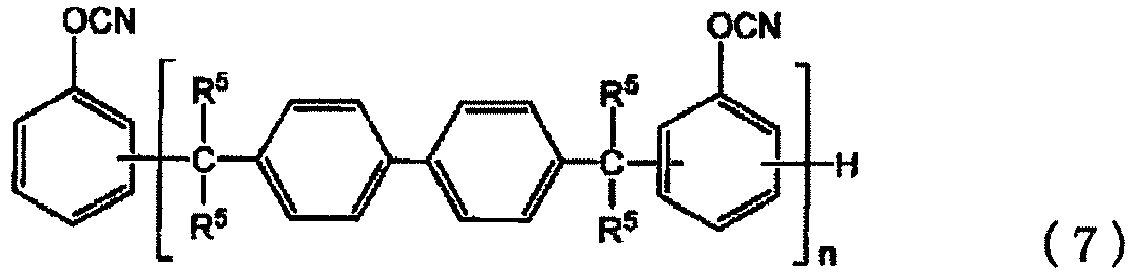
- The naphthylene ether-based cyanate compounds are not particularly limited as long as they have a structure in which naphthalene rings having a cyanato group are bonded to each other via an oxygen atom. Examples of the naphthylene ether-based cyanate compounds include those in which in the above general formula (2), Ar1 represents a naphthylene group, and X represents a divalent oxygen atom. Cured products obtained from such naphthylene ether-based cyanate compounds tend to have a low thermal expansion coefficient and better combustibility, better low water absorbency, and better moisture absorption heat resistance.
- The xylene resin-based cyanate compounds are not particularly limited as long as they have a structure in which benzene rings having a cyanato group and two methyl groups are bonded to each other via an alkylene group. Examples of the xylene resin-based cyanate compounds include those in which in the above general formula (2), Ar1 represents a phenylene group, Ra represents a methyl group, q represents an integer of 2 or more, and X represents a methylene group. Cured products obtained from such xylene resin-based cyanate compounds tend to have a low thermal expansion coefficient and better combustibility, better low water absorbency, and better moisture absorption heat resistance.
- The adamantane skeleton-based cyanate compounds are not particularly limited as long as they have a structure in which an aromatic ring having a cyanato group, and an adamantyl group are bonded to each other. Examples of the adamantane skeleton-based cyanate compounds include those in which in the above general formula (2), X represents a divalent organic group having 1 to 50 carbon atoms. Specific examples include a cyanate compound represented by the following general formula (8). Cured products obtained from such adamantane-based cyanate compounds tend to have a low thermal expansion coefficient and better flame retardancy and heat resistance.

- A cured product of a resin composition using the above-described cyanate compound (A) tends to have characteristics better in high glass transition temperature, low thermal expansion properties, plating adhesiveness, and the like. Cured products of resin compositions using the cyanate compounds (A) that are the above phenol novolac-based cyanate compounds, naphthol aralkyl-based cyanate compounds, biphenyl aralkyl-based cyanate compounds, naphthylene ether-based cyanate compounds, xylene resin-based cyanate compounds, and adamantane skeleton-based cyanate compounds tend to have characteristics better in high glass transition temperature, low thermal expansion properties, plating adhesiveness, and the like. The naphthol aralkyl-based cyanate compounds tend to have still better characteristics.
- The content of the cyanate compound (A) in the resin composition in this embodiment can be appropriately set according to the desired characteristics and is not particularly limited. However, the resin composition preferably contains 1 to 90% by mass, more preferably 10 to 80% by mass, further preferably 20 to 70% by mass, and still further preferably 30 to 60% by mass of the cyanate compound based on the total amount (100% by mass) of resin solids in the resin composition. The resin composition in which the content of the cyanate compound (A) is in such a range tends to have better glass transition temperature when formed into a cured product.
- In this embodiment, "the total amount of resin solids in the resin composition" refers to the total amount of resin components in the resin composition excluding a solvent and a filler (C) described later, unless otherwise noted. In addition, the resin components include at least the cyanate compound (A) and the epoxy resin (B) in the resin composition and also include other resin components.
- The epoxy resin (B) in this embodiment (hereinafter also referred to as an "epoxy resin", a "component (B)", or "(B)") is represented by general formula (1):

- The alkyl group having 1 to 6 carbon atoms is not particularly limited. Examples thereof include alkyl groups having a linear, branched, or cyclic structure such as a methyl group, an ethyl group, a propyl group, a butyl group, a pentyl group, and a hexyl group. Among these, for the alkyl group having 1 to 6 carbon atoms, a methyl group and an ethyl group are preferred, and a methyl group is more preferred.
- In addition, the alkoxy group having 1 to 6 carbon atoms is not particularly limited. Examples thereof include alkoxy groups having a linear, branched, or cyclic structure such as a methoxy group, an ethoxy group, a propoxy group, and a butoxy group. Among these, for the alkoxy group having 1 to 6 carbon atoms, a methoxy group, an ethoxy group, and a propoxy group are preferred, and a methoxy group is more preferred.
- Among these illustrations, R more preferably represents a hydrogen atom from the viewpoint of heat resistance.
- For the epoxy resin (B) represented by general formula (1), commercial epoxy resins may be used, and, for example, the trade name "WHR-991S" manufactured by Nippon Kayaku Co., Ltd. in which R represents a hydrogen atom is preferably used.
- The content of the epoxy resin (B) represented by general formula (1) in the resin composition in this embodiment can be appropriately set according to the desired characteristics and is not particularly limited. However, the resin composition preferably contains 1 to 90% by mass, more preferably 10 to 80% by mass, further preferably 20 to 70% by mass, and still further preferably 30 to 60% by mass based on the epoxy resin (B) based on the total amount (100% by mass) of the resin solids in the resin composition. When the content of the epoxy resin (B) is in the range of 1 to 90% by mass, a resin composition that has better glass transition temperature when formed into a cured product tends to be obtained.
- The resin composition in this embodiment preferably further contains the filler (C) (hereinafter also referred to as a "component (C)" or "(C)"). As the filler (C), known fillers can be appropriately used without being particularly limited, and the type of the filler (C) is also not particularly limited. Those generally used in the industry can be preferably used. Specific examples of the filler (C) include inorganic fillers such as silicas such as natural silica, fused silica, synthetic silica, amorphous silica, AEROSIL, and hollow silica; white carbon, titanium white, zinc oxide, magnesium oxide, zirconium oxide, boron nitride, aggregated boron nitride, silicon nitride, aluminum nitride, barium sulfate, aluminum hydroxide, heat-treated products of aluminum hydroxide (products obtained by heat-treating aluminum hydroxide to decrease some of the water of crystallization); metal hydrates such as boehmite and magnesium hydroxide; molybdenum compounds such as molybdenum oxide and zinc molybdate; zinc borate, zinc stannate, alumina, clay, kaolin, talc, calcined clay, calcined kaolin, calcined talc, mica, E-glass, A-glass, NE-glass, C-glass, L-glass, D-glass, S-glass, M-glass G20, glass short fibers (including fine powders of glass such as E glass, T glass, D glass, S glass, and Q glass), hollow glass, and spherical glass; and organic fillers such as rubber powders such as styrene-based rubber powders, butadiene-based rubber powders, and acrylic rubber powders; core-shell-based rubber powders, silicone resin powders, silicone rubber powders, and silicone composite powders. One of these fillers (C) can be used alone, or two or more of these fillers (C) can be used in combination.
- By containing these fillers (C), the characteristics, such as thermal expansion characteristics, dimensional stability, and flame retardancy, of the resin composition tend to improve.
- The content of the filler (C) in the resin composition in this embodiment can be appropriately set according to the desired characteristics and is not particularly limited. However, the resin composition preferably contains 50 to 1600 parts by mass of the filler (C) based on the total amount (100 parts by mass) of the resin solids in the resin composition. By setting the content of the filler (C) at 50 to 1600 parts by mass, the moldability of the resin composition tends to be good.
- Here, when the filler (C) is used, a silane coupling agent and a wetting and dispersing agent are preferably used in combination. The silane coupling agent is not particularly limited. Those generally used for surface treatment of inorganic matter can be preferably used, and the type of the silane coupling agent is also not particularly limited. Specific examples of the silane coupling agent include aminosilane-based silane coupling agents such as γ-aminopropyltriethoxysilane and N-β-(aminoethyl)-γ-aminopropyltrimethoxysilane; epoxysilane-based silane coupling agents such as γ-glycidoxypropyltrimethoxysilane and β-(3,4-epoxycyclohexyl)ethyltrimethoxysilane; vinylsilane-based silane coupling agents such as γ-methacryloxypropyltrimethoxysilane and vinyl-tri(β-methoxyethoxy)silane; cationic silane-based silane coupling agents such as N-β-(N-vinylbenzylaminoethyl)-γ-aminopropyltrimethoxysilane hydrochloride; and phenylsilane-based silane coupling agents. One silane coupling agent can be used alone, or two or more silane coupling agents can be used in combination. In addition, the wetting and dispersing agent is not particularly limited. Those generally used for paints can be preferably used, and the type of the wetting and dispersing agent is also not particularly limited. For the wetting and dispersing agent, preferably copolymer-based wetting and dispersing agents are used. Specific examples of the copolymer-based wetting and dispersing agents are not particularly limited and include Disperbyk-110, 111, 161, and 180, BYK-W996, BYK-W9010, BYK-W903, and BYK-W940 manufactured by BYK Japan KK. One wetting and dispersing agent can be used alone, or two or more wetting and dispersing agents can be used in combination.
- Further, the resin composition in this embodiment can further contain one or two or more selected from the group consisting of an epoxy resin other than the one represented by the above formula (1) (hereinafter referred to as "another epoxy resin"), a maleimide compound, a phenolic resin, an oxetane resin, a benzoxazine compound, and a compound having a polymerizable unsaturated group in a range in which the operation and effect according to the present invention are not impaired. By using the component (A) and the component (B) and these in combination, the desired characteristics, such as flame retardancy and low dielectric properties, of a cured product obtained by curing the resin composition tend to be able to be improved.
- The another epoxy resin is not particularly limited as long as it is an epoxy resin that is not represented by general formula (1) and has two or more epoxy groups in one molecule. For example, known epoxy resins can be appropriately used, and the type of the another epoxy resin is also not particularly limited. Specific examples of the another epoxy resin include bisphenol A-based epoxy resins, bisphenol E-based epoxy resins, bisphenol F-based epoxy resins, bisphenol S-based epoxy resins, phenol novolac-based epoxy resins, bisphenol A novolac-based epoxy resins, glycidyl ester-based epoxy resins, aralkyl novolac-based epoxy resins, biphenyl aralkyl-based epoxy resins, naphthylene ether-based epoxy resins, cresol novolac-based epoxy resins, polyfunctional phenol-based epoxy resins, naphthalene-based epoxy resins, anthracene-based epoxy resins, naphthalene skeleton-modified novolac-based epoxy resins, phenol aralkyl-based epoxy resins, naphthol aralkyl-based epoxy resins, dicyclopentadiene-based epoxy resins, biphenyl-based epoxy resins, alicyclic epoxy resins, polyol-based epoxy resins, phosphorus-containing epoxy resins, glycidyl amines, glycidyl esters, compounds obtained by epoxidizing double bonds of butadiene and the like, and compounds obtained by reaction of hydroxyl group-containing silicone resins and epichlorohydrin, not represented by general formula (1). Among these other epoxy resins, biphenyl aralkyl-based epoxy resins, naphthylene ether-based epoxy resins, polyfunctional phenol-based epoxy resins, and naphthalene-based epoxy resins are preferred in terms of flame retardancy and heat resistance. One of these other epoxy resins can be used alone, or two or more of these other epoxy resins can be used in combination.
- The maleimide compound is not particularly limited as long as it is a compound having one or more maleimide groups in one molecule. Those generally known can be used. Specific examples of the maleimide compound include 4,4-diphenylmethanebismaleimide, phenylmethanemaleimide, m-phenylenebismaleimide, 2,2-bis(4-(4-maleimidophenoxy)-phenyl)propane, 3,3-dimethyl-5,5-diethyl-4,4-diphenylmethanebismaleimide, 4-methyl-1,3-phenylenebismaleimide, 1,6-bismaleimido-(2,2,4-trimethyl)hexane, 4,4-diphenyl ether bismaleimide, 4,4-diphenyl sulfone bismaleimide, 1,3-bis(3-maleimidophenoxy)benzene, 1,3-bis(4-maleimidophenoxy)benzene, polyphenylmethanemaleimide, novolac-based maleimide, biphenyl aralkyl-based maleimide, and prepolymers of these maleimide compounds and prepolymers of maleimide compounds and amine compounds. One of these maleimide compounds can be used alone, or two or more of these maleimide compounds can be mixed and used. Among these, novolac-based maleimide compounds and biphenyl aralkyl-based maleimide compounds are preferred.
- The phenolic resin is not particularly limited as long as it is a phenolic resin having two or more hydroxyl groups in one molecule. Those generally known can be used. Specific examples of the phenolic resin include bisphenol A-based phenolic resins, bisphenol E-based phenolic resins, bisphenol F-based phenolic resins, bisphenol S-based phenolic resins, phenol novolac resins, bisphenol A novolac-based phenolic resins, glycidyl ester-based phenolic resins, aralkyl novolac-based phenolic resins, biphenyl aralkyl-based phenolic resins, cresol novolac-based phenolic resins, polyfunctional phenolic resins, naphthol resins, naphthol novolac resins, polyfunctional naphthol resins, anthracene-based phenolic resins, naphthalene skeleton-modified novolac-based phenolic resins, phenol aralkyl-based phenolic resins, naphthol aralkyl-based phenolic resins, dicyclopentadiene-based phenolic resins, biphenyl-based phenolic resins, alicyclic phenolic resins, polyol-based phenolic resins, phosphorus-containing phenolic resins, and hydroxyl group-containing silicone resins. Among these phenolic resins, biphenyl aralkyl-based phenolic resins, naphthol aralkyl-based phenolic resins, phosphorus-containing phenolic resins, and hydroxyl group-containing silicone resins are preferred in terms of flame retardancy. Ghese phenolic resins can be used alone, or two or more of these phenolic resins can be used in combination.
- The oxetane resin is not particularly limited, and those generally known can be used. Specific examples of the oxetane resin include oxetane, alkyloxetanes such as 2-methyloxetane, 2,2-dimethyloxetane, 3-methyloxetane, and 3,3-dimethyloxetane, 3-methyl-3-methoxymethyloxetane, 3,3-di(trifluoromethyl)perfluorooxetane, 2-chloromethyloxetane, 3,3-bis(chloromethyl)oxetane, biphenyl-based oxetane, OXT-101 (trade name manufactured by Toagosei Co., Ltd.), and OXT-121 (trade name manufactured by Toagosei Co., Ltd.). One of these oxetane resins can be used alone, or two or more of these oxetane resins can be mixed and used.
- The benzoxazine compound is not particularly limited as long as it is a compound having two or more dihydrobenzoxazine rings in one molecule. Those generally known can be used. Specific examples of the benzoxazine compound include bisphenol A-based benzoxazine BA-BXZ (trade name manufactured by Konishi Chemical Ind. Co., Ltd.) bisphenol F-based benzoxazine BF-BXZ (trade name manufactured by Konishi Chemical Ind. Co., Ltd.), and bisphenol S-based benzoxazine BS-BXZ (trade name manufactured by Konishi Chemical Ind. Co., Ltd.). One of these benzoxazine compounds can be used alone, or two or more of these benzoxazine compounds can be mixed and used.
- The compound having a polymerizable unsaturated group is not particularly limited, and those generally known can be used. Specific examples of the compound having a polymerizable unsaturated group include vinyl compounds such as ethylene, propylene, styrene, divinylbenzene, and divinylbiphenyl, (meth)acrylates of monohydric or polyhydric alcohols such as methyl (meth)acrylate, 2-hydroxyethyl (meth)acrylate, 2-hydroxypropyl (meth)acrylate, polypropylene glycol di(meth)acrylate, trimethylolpropane di(meth)acrylate, trimethylolpropane tri(meth)acrylate, pentaerythritol tetra(meth)acrylate, and dipentaerythritol hexa(meth)acrylate, epoxy (meth)acrylates such as bisphenol A-based epoxy (meth)acrylate and bisphenol F-based epoxy (meth)acrylate, benzocyclobutene resins, and (bis)maleimide resins. One of these compounds having an unsaturated group can be used alone, or two or more of these compounds having an unsaturated group can be mixed and used.
- In addition, the resin composition in this embodiment may further contain a curing accelerator for appropriately adjusting the curing rate, as needed, though not particularly limited. This curing accelerator is not particularly limited. Those generally used as curing accelerators for cyanate compounds, epoxy resins, and the like can be preferably used, and the type of the curing accelerator is also not particularly limited. Specific examples of the curing accelerator include organometallic salts such as zinc octylate, zinc naphthenate, cobalt naphthenate, copper naphthenate, acetylacetone iron, nickel octylate, and manganese octylate; phenol compounds such as phenol, xylenol, cresol, resorcin, catechol, octyl phenol, and nonyl phenol; alcohols such as 1-butanol and 2-ethylhexanol; imidazoles such as 2-methylimidazole, 2-ethyl-4-methylimidazole, 2-phenylimidazole, 1-cyanoethyl-2-phenylimidazole, 1-cyanoethyl-2-ethyl-4-methylimidazole, 2-phenyl-4,5-dihydroxymethylimidazole, and 2-phenyl-4-methyl-5-hydroxymethylimidazole; derivatives such as adducts of carboxylic acids of these imidazoles and acid anhydrides thereof; amines such as dicyandiamide, benzyldimethylamine, and 4-methyl-N,N-dimethylbenzylamine; phosphorus compounds such as phosphine-based compounds, phosphine oxide-based compounds, phosphonium salt-based compounds, and diphosphine-based compounds; epoxy-imidazole adduct-based compounds, peroxides such as benzoyl peroxide, p-chlorobenzoyl peroxide, di-t-butyl peroxide, diisopropyl peroxycarbonate, and di-2-ethylhexyl peroxycarbonate; and azo compounds such as azobisisobutyronitrile. One curing accelerator can be used alone, or two or more curing accelerators can be used in combination.
- The content of the curing accelerator can be appropriately adjusted considering the degrees of cure of the resins, the viscosity of the resin composition, and the like and is not particularly limited. However, preferably, the resin composition contains 0.005 to 10 parts by mass of the curing accelerator based on the total amount (100 parts by mass) of the resin solids in the resin composition.
- Further, the resin composition in this embodiment can further contain various polymer compounds such as a thermosetting resin, a thermoplastic resin, and an oligomer thereof, and an elastomer, a flame-retardant compound, various additives, and the like other than those described above in a range in which the operation and effect according to the present invention are not impaired. These are not particularly limited as long as they are those generally used. The flame-retardant compound is not particularly limited. Examples thereof include bromine compounds such as 4,4'-dibromobiphenyl, phosphates, melamine phosphate, phosphorus-containing epoxy resins, nitrogen compounds such as melamine and benzoguanamine; oxazine ring-containing compounds, and silicone-based compounds. In addition, the various additives are not particularly limited. Examples thereof include ultraviolet absorbing agents, antioxidants, photopolymerization initiators, fluorescent brightening agents, photosensitizers, dyes, pigments, thickening agents, flow-adjusting agents, lubricants, defoaming agents, dispersing agents, leveling agents, brightening agents, and polymerization inhibitors. One of these can be used alone or two or more of these can be used in combination as desired.
- The resin composition in this embodiment can further contain an organic solvent as needed. In this case, the resin composition in this embodiment can be used as a form (solution or varnish) in which at least some, preferably all, of the above-described various resin components are dissolved in or compatible with the organic solvent. The organic solvent is not particularly limited as long as it can dissolve or be compatible with at least some, preferably all, of the above-described various resin components. Known ones can be appropriately used, and the type of the organic solvent is also not particularly limited. Specific examples of the organic solvent include polar solvents such as ketones such as acetone, methyl ethyl ketone, and methyl isobutyl ketone; cellosolve-based solvents such as propylene glycol monomethyl ether and propylene glycol monomethyl ether acetate; ester-based solvents such as ethyl lactate, methyl acetate, ethyl acetate, butyl acetate, isoamyl acetate, methyl methoxypropionate, and methyl hydroxyisobutyrate; and amides such as dimethylacetamide and dimethylformamide; and nonpolar solvents such as aromatic hydrocarbons such as toluene and xylene. One of these can be used alone, or two or more of these can be used in combination.
- The resin composition in this embodiment can be prepared according to an ordinary method. The method for preparing the resin composition in this embodiment is not particularly limited as long as it is a method in which a resin composition uniformly containing the cyanate compound (A) and the epoxy resin (B) represented by general formula (1) is obtained. The method is preferably a method in which a resin composition also uniformly containing the above-described other optional components is obtained. As a specific example of the preparation method, for example, the resin composition in this embodiment can be easily prepared by sequentially blending the cyanate compound (A) and the epoxy resin (B) represented by general formula (1) with a solvent and sufficiently stirring the blend.
- During preparation of the resin composition, known treatment (for example, stirring, mixing, and kneading treatment) for uniformly dissolving or dispersing the components can be performed. For example, in uniform dispersion of the filler (C), by performing stirring and dispersion treatment using a stirring vessel provided with a stirrer having suitable stirring ability, the dispersibility in the resin composition tends to be increased. The above stirring, mixing, and kneading treatment can be appropriately performed, for example, using known apparatuses such as apparatuses intended for mixing such as ball mills and bead mills, and revolution-rotation mixing apparatuses.
- The resin composition in this embodiment can be used as a material for an insulating layer of a printed wiring board and a semiconductor package material though not particularly limited. For example, a prepreg can be provided by impregnating or coating a base material with a solution of the resin composition in this embodiment dissolved in a solvent and drying the solution.
- In addition, a resin sheet can be provided by using a peelable plastic film as a support, coating the plastic film with a solution of the resin composition in this embodiment dissolved in a solvent, and drying the solution. The resin sheet can be used as a buildup film or a dry film solder resist. Here, the solvent can be dried by heating at a temperature of 20°C to 150°C for 1 to 90 minutes. In addition, the resin composition can also be used in an uncured state in which the solvent is only dried, or in a semi-cured (B-staged) state as needed.
- A prepreg in this embodiment will be described in detail below. The prepreg in this embodiment comprises a base material; and the resin composition in this embodiment described above with which the base material is impregnated or coated. The method for producing the prepreg is not particularly limited as long as it is a method of combining the resin composition in this embodiment and a base material to produce a prepreg. The prepreg is obtained by impregnating or coating a base material with the resin composition in this embodiment described above. More specifically, the prepreg in this embodiment can be produced by impregnating or coating a base material with the resin composition in this embodiment and then semi-curing the resin composition by a method involving drying at 120 to 220°C for about 2 to 15 minutes, or the like. At this time, the amount of the resin composition adhered to the base material, that is, the amount of the resin composition (including the filler (C)) based on the total amount (100% by mass) of the prepreg after the semi-curing, is preferably in the range of 20 to 99% by mass.
- The base material in this embodiment is not particularly limited, and, for example, known base materials used for various printed wiring board materials can be used. Specific examples of the base material include woven fabrics of fibers of glass such as E glass, D glass, L glass, S glass, T glass, Q glass, UN glass, NE glass, and spherical glass; inorganic fibers of materials other than glass, such as quartz; organic fibers of polyimides, polyamides, polyesters, and the like; liquid crystal polyesters; and the like. The shape of the base material is not particularly limited. Examples thereof include woven fabrics, nonwoven fabrics, rovings, chopped strand mats, and surfacing mats. The shape of the base material may be any. One base material can be used alone, or two or more base materials can be used in combination. In addition, although not particularly limited, in laminate applications, the thickness of the base material is preferably in the range of 0.01 to 0.2 mm, and it is preferred from the viewpoint of dimensional stability that the base material is particularly a woven fabric subjected to ultra-opening treatment or clogging treatment. Further, glass woven fabrics surface-treated with silane coupling agents for epoxysilane treatment, aminosilane treatment, and the like are preferred from the viewpoint of moisture absorption heat resistance. In addition, liquid crystal polyester woven fabrics are preferred in terms of electrical characteristics.
- A metal foil-clad laminate in this embodiment comprises one of the prepreg in this embodiment described above or two or more of the prepregs in this embodiment described above laminated; and metal foil laminate-molded on one surface or both surfaces of the prepreg. Specifically, the metal foil-clad laminate can be fabricated by using one of the above-described prepreg or stacking a plurality of the above-described prepregs, disposing foil of a metal such as copper or aluminum on one surface or both surfaces of the prepreg or the stack, and laminate-molding the metal foil and the prepreg or the stack. The metal foil in this embodiment is not particularly limited as long as it is a metal foil that can be used for a printed wiring board material. Copper foil such as rolled copper foil and electrolytic copper foil is preferred. In addition, the thickness of the metal foil is not particularly limited but is preferably 2 to 70 µm, more preferably 3 to 35 µm. As the molding conditions, usual methods for laminates and multilayer boards for printed wiring boards can be applied. For example, the metal foil-clad laminate in this embodiment can be produced by laminate-molding with a temperature of 180 to 350°C, a heating time of 100 to 300 minutes, and a surface pressure of 20 to 100 kg/cm2 using a multistage press, a multistage vacuum press, a continuous molding machine, an autoclave molding machine, or the like. In addition, a multilayer board can also be provided by laminate-molding the above prepreg and a separately fabricated wiring board for an inner layer in combination. As the method for producing a multilayer board, for example, a multilayer board can be fabricated by disposing 35 µm copper foil on both surfaces of one of the above-described prepreg, laminating and forming the copper foil and the prepreg under the above conditions, then forming inner layer circuits, subjecting these circuits to blackening treatment to form an inner layer circuit board, then alternately disposing these inner layer circuit boards and the above prepregs one by one, further disposing copper foil on the outermost layers, and laminate-molding the copper foil, the inner layer circuit boards, and the prepregs under the above conditions preferably under vacuum.
- The metal foil-clad laminate in this embodiment can be preferably used as a printed wiring board. The printed wiring board can be produced according to an ordinary method, and the method for producing the printed wiring board is not particularly limited. One example of a method for producing a printed wiring board will be shown below. First, a metal foil-clad laminate such as the above-described copper-clad laminate is provided. Next, the surfaces of the metal foil-clad laminate are subjected to etching treatment to form inner layer circuits to fabricate an inner layer board. The inner layer circuit surfaces of this inner layer board are subjected to surface treatment for increasing adhesive strength, as needed. Then, the required number of the above-described prepregs are stacked on the inner layer circuit surfaces, metal foil for outer layer circuits is further laminated on the outside of the stack, and heat and pressure are applied for integral molding. In this manner, a multilayer laminate in which insulating layers comprising a base material and a cured product of a thermosetting resin composition are formed between inner layer circuits and metal foil for outer layer circuits is produced. Then, this multilayer laminate is subjected to perforation for through holes and via holes, and then plating metal films that allow conduction between the inner layer circuits and the metal foil for outer layer circuits are formed on the wall surfaces of these holes. Further, the metal foil for outer layer circuits is subjected to etching treatment to form outer layer circuits. Thus, a printed wiring board is produced.
- A printed wiring board in this embodiment comprises an insulating layer comprising the resin composition in this embodiment described above; and a conductor layer formed on one surface or both surfaces of the insulating layer. The insulating layer has a configuration in which it comprises the resin composition in this embodiment described above. In other words, the prepreg in this embodiment described above (the base material and the resin composition in this embodiment with which the base material is impregnated or coated) and the resin composition layer of the metal foil-clad laminate in this embodiment described above (the layer comprising the resin composition in this embodiment) are composed of an insulating layer comprising the resin composition in this embodiment.
- A resin sheet in this embodiment comprises a sheet base material; and the resin composition in this embodiment described above applied and dried on one surface or both surfaces of the sheet base material. The resin sheet can be obtained by coating a sheet base material with a solution of the resin composition dissolved in a solvent (resin composition) (applying a solution of the resin composition dissolved in a solvent (resin composition)) to a sheet base material) and drying the solution. The sheet base material in this embodiment is not particularly limited. Examples thereof include organic film base materials such as polyethylene films, polypropylene films, polycarbonate films, polyethylene terephthalate films, ethylene-tetrafluoroethylene copolymer films, and release films obtained by coating surfaces of these films with release agents, and polyimide films, conductor foil such as copper foil and aluminum foil, and plate-shaped base materials such as glass plates, SUS plates, and FRP. The coating method is not particularly limited. Examples thereof include a method of coating a sheet base material with a solution of the resin composition in this embodiment dissolved in a solvent by a bar coater, a die coater, a doctor blade, a baker applicator, or the like. In addition, a single-layer sheet (resin sheet) can also be provided by drying the solution after coating, and peeling or etching the resin sheet from the laminated sheet. A single-layer sheet (resin sheet) can also be obtained without using a sheet base material by supplying a solution of the above resin composition in this embodiment dissolved in a solvent into a mold having a sheet-shaped cavity, and drying the solution, or the like for molding into a sheet shape.
- In fabrication of the single-layer sheet or the laminated resin sheet in this embodiment, the drying conditions when the solvent is removed are not particularly limited but are preferably a temperature of 20°C to 200°C for 1 to 90 minutes because at low temperature, the solvent is likely to remain in the resin composition, and at high temperature, curing of the resin composition proceeds. In addition, the thickness of the single-layer sheet or the resin layer of the laminated resin sheet in this embodiment can be adjusted by the concentration and coating thickness of the solution of the resin composition in this embodiment and is not particularly limited but is preferably 0.1 to 500 µm because generally, when the coating thickness increases, the solvent is likely to remain during drying.
- This embodiment will be described in more detail below by showing Synthesis Examples, an Example, and Comparative Examples, but this embodiment is not limited by these in any way.
- 300 g (1.28 mol in terms of OH groups) of a 1-naphthol aralkyl resin (manufactured by NIPPON STEEL & SUMIKIN CHEMICAL CO., LTD.) and 194.6 g (1.92 mol) (1.5 mol based on 1 mol of hydroxy groups) of triethylamine were dissolved in 1800 g of dichloromethane, and this solution was a solution 1.
- While 125.9 g (2.05 mol) (1.6 mol based on 1 mol of hydroxy groups) of cyanogen chloride, 293.8 g of dichloromethane, 194.5 g (1.92 mol) (1.5 mol based on 1 mol of hydroxy groups) of 36% hydrochloric acid, and 1205.9 g of water were kept at a liquid temperature of -2 to -0.5°C under stirring, the solution 1 was poured over 30 minutes. After completion of pouring of the solution 1, the mixture was stirred at the same temperature for 30 minutes, and then a solution of 65 g (0.64 mol) (0.5 mol based on 1 mol of hydroxy groups) of triethylamine dissolved in 65 g of dichloromethane (solution 2) was poured over 10 minutes. After completion of pouring of the solution 2, the mixture was stirred at the same temperature for 30 minutes to complete the reaction.
- Then, the reaction liquid was allowed to stand to separate the organic phase and the aqueous phase. The obtained organic phase was washed five times with 1300 g of water. The electrical conductivity of the wastewater from the fifth water washing was 5 µS/cm, and it was confirmed that removable ionic compounds were sufficiently removed by the washing with water.
- The organic phase after the water washing was concentrated under reduced pressure and finally concentrated to dryness at 90°C for 1 hour to obtain 331 g of the target naphthol aralkyl-based cyanate compound (SNCN) (orange viscous material). The mass average molecular weight Mw of the obtained SNCN was 600. In addition, the IR spectrum of SNCN showed absorption at 2250 cm-1 (cyanate groups) and showed no absorption of hydroxy groups.
- 50 parts by mass of the SNCN obtained by Synthesis Example 1, 50 parts by mass of an epoxy resin represented by the following formula (9) (WHR-991S, manufactured by Nippon Kayaku Co., Ltd.), 100 parts by mass of fused silica (SC2050MB, manufactured by Admatechs Company Limited), and 0.15 parts by mass of zinc octylate (manufactured by Nihon Kagaku Sangyo Co., Ltd.) were mixed to obtain a varnish. This varnish was diluted with methyl ethyl ketone, and an E-glass woven fabric having a thickness of 0.1 mm was impregnated and coated with the diluted varnish and heated and dried at 150°C for 5 minutes to obtain a prepreg having a resin content of 50% by mass.

- Eight of the obtained prepregs were stacked, and 12 µm thick electrolytic copper foil (3EC-M3-VLP, manufactured by MITSUI MINING & SMELTING CO., LTD.) was disposed on the top and the bottom. The stack was laminate-molded at a pressure of 30 kgf/cm2 and a temperature of 220°C for 120 minutes to obtain a metal foil-clad laminate having an insulating layer thickness of 0.8 mm. Evaluation of glass transition temperature (Tg) was performed using the obtained metal foil-clad laminate. The result is shown in Table 1.
- A metal foil-clad laminate having a thickness of 0.8 mm was obtained as in Example 1 except that 50 parts by mass of a biphenyl aralkyl-based epoxy resin (NC-3000-FH, manufactured by Nippon Kayaku Co., Ltd.) was used instead of using 50 parts by mass of the epoxy resin represented by formula (9), and zinc octylate was used with the amount changed from 0.15 parts by mass to 0.12 parts by mass, in Example 1. The evaluation result of the obtained metal foil-clad laminate is shown in Table 1.
- Glass transition temperature: Each of the metal foil-clad laminates obtained in Example 1 and Comparative Example 1 was cut to a size of 40 mm × 20 mm, and the glass transition temperature was measured by a dynamic viscoelasticity measuring apparatus (manufactured by TA Instruments) in accordance with JIS C6481.
- Plating peel strength: The electrolytic copper foil of the metal foil-clad laminate obtained in Example 1 was removed by etching, and the laminate was immersed in a swelling treatment liquid (400 ml/L of OPC-B103 Pre Etch, 13 g/L of sodium hydroxide) manufactured by Okuno Chemical Industries Co., Ltd. at 65°C for 5 minutes. Next, the laminate was immersed in a roughening treatment liquid (100 ml/L of OPC-1540MN, 100 ml/L of OPC-1200 Epo Etch) manufactured by Okuno Chemical Industries Co., Ltd. at 80°C for 8 minutes. Finally, the laminate was subjected to desmear treatment in a neutralization treatment liquid (200 ml/L of OPC-1300 Neutralizer) manufactured by Okuno Chemical Industries Co., Ltd. at 45°C for 5 minutes. Then, electroless copper plating of about 0.5 µm was provided by the process of electroless copper plating manufactured by Okuno Chemical Industries Co., Ltd. (names of chemical solutions used: OPC-370 Condiclean M, OPC-SAL M, OPC-80 Catalyst, OPC-555 Accelerator M, ATS Addcopper IW), and drying was performed at 130°C for 1 hour. Next, electrolytic copper plating was provided so that the thickness of plating copper was 18 µm, and drying was performed at 180°C for 1 hour. In this manner, a circuit wiring board sample in which a conductor layer (plating copper) having a thickness of 18 µm was formed on an insulating layer was fabricated. Using the circuit wiring board sample, the adhesive force of the plating copper was measured three times in accordance with JIS C6481, and the average value was obtained as plating peel strength.
[Table 1] Example 1 Comparative Example 1 Glass transition temperature (°C) 292 250 Plating peel strength [kg/cm] 0.29 - - As is clear from Table 1, it was at least confirmed that by using the resin composition in the Example, a prepreg, a metal foil-clad laminate, and a printed wiring board that had excellent glass transition temperature were realized.
- This application is based on Japanese Patent Application No.
2015-054268 - As described above, the resin composition according to the present invention can be widely and effectively used in various applications such as electrical and electronic materials, machine tool materials, and aviation materials, for example, as electrical insulating materials, semiconductor plastic packages, sealing materials, adhesives, lamination materials, resists, and buildup laminate materials, and, particularly, can be especially effectively used as printed wiring board materials adapted to higher integration and higher density for information terminal equipment, communication equipment, and the like in recent years. In addition, the prepreg, the metal foil-clad laminate, the resin sheet, and the printed wiring board according to the present invention have performance excellent in glass transition temperature, and therefore their industrial practicality is extremely high.
Claims (9)
- A resin composition comprising a cyanate compound (A); and an epoxy resin (B) represented by general formula (1):

- The resin composition according to claim 1, comprising 1 to 90% by mass of the epoxy resin (B) represented by the general formula (1) based on a total amount (100% by mass) of resin solids in the resin composition.
- The resin composition according to claim 1 or 2, further comprising a filler (C).
- The resin composition according to any one of claims 1 to 3, further comprising one or two or more selected from the group consisting of an epoxy resin other than the epoxy resin (B) represented by the general formula (1), a maleimide compound, a phenolic resin, an oxetane resin, a benzoxazine compound, and a compound having a polymerizable unsaturated group.
- The resin composition according to claim 3 or 4, comprising 50 to 1600 parts by mass of the filler (C) based on the total amount (100 parts by mass) of the resin solids in the resin composition.
- A prepreg comprising a base material; and the resin composition according to any one of claims 1 to 5 with which the base material is impregnated or coated.
- A metal foil-clad laminate comprising one of the prepreg according to claim 6 or two or more of the prepregs according to claim 6 laminated; and metal foil laminate-molded on one surface or both surfaces of the prepreg.
- A resin sheet comprising a sheet base material; and the resin composition according to any one of claims 1 to 5 applied and dried on one surface or both surfaces of the sheet base material.
- A printed wiring board comprising an insulating layer comprising the resin composition according to any one of claims 1 to 5; and a conductor layer formed on one surface or both surfaces of the insulating layer.
Applications Claiming Priority (2)
| Application Number | Priority Date | Filing Date | Title |
|---|---|---|---|
| JP2015054268 | 2015-03-18 | ||
| PCT/JP2016/053365 WO2016147735A1 (en) | 2015-03-18 | 2016-02-04 | Resin composition, prepreg, metal foil-clad laminate, resin sheet, and printed wiring board |
Publications (3)
| Publication Number | Publication Date |
|---|---|
| EP3272782A1 true EP3272782A1 (en) | 2018-01-24 |
| EP3272782A4 EP3272782A4 (en) | 2018-09-19 |
| EP3272782B1 EP3272782B1 (en) | 2023-03-22 |
Family
ID=56919526
Family Applications (1)
| Application Number | Title | Priority Date | Filing Date |
|---|---|---|---|
| EP16764566.2A Active EP3272782B1 (en) | 2015-03-18 | 2016-02-04 | Resin composition, prepreg, metal foil-clad laminate, resin sheet, and printed wiring board |
Country Status (7)
| Country | Link |
|---|---|
| US (1) | US20180009935A1 (en) |
| EP (1) | EP3272782B1 (en) |
| JP (1) | JP7046602B2 (en) |
| KR (1) | KR102490151B1 (en) |
| CN (1) | CN107406577A (en) |
| TW (1) | TWI725956B (en) |
| WO (1) | WO2016147735A1 (en) |
Cited By (1)
| Publication number | Priority date | Publication date | Assignee | Title |
|---|---|---|---|---|
| EP3640276A1 (en) * | 2018-10-16 | 2020-04-22 | SABIC Global Technologies B.V. | High heat epoxy-terminated polyoxazolidones, compositions, methods of manufacture, and uses thereof |
Families Citing this family (5)
| Publication number | Priority date | Publication date | Assignee | Title |
|---|---|---|---|---|
| EP3312213B1 (en) * | 2015-06-17 | 2020-01-01 | Mitsubishi Gas Chemical Company, Inc. | Resin composition, prepreg, resin sheet, metal foil-clad laminate, and printed wiring board |
| US11098195B2 (en) * | 2017-02-07 | 2021-08-24 | Mitsubishi Gas Chemical Company, Inc. | Resin composition, prepreg, metal foil-clad laminate, resin sheet, and printed circuit board |
| US10487077B1 (en) * | 2018-06-14 | 2019-11-26 | Sabic Global Technologies B.V. | Bis(benzoxazinyl)phthalimidine and associated curable composition and composite |
| CN113396182B (en) * | 2019-02-28 | 2023-01-13 | 日本瑞翁株式会社 | Resin composition, electronic component, and method for producing resin film |
| JP2021178880A (en) * | 2020-05-11 | 2021-11-18 | 住友ベークライト株式会社 | Encapsulating resin composition, wafer level package, panel level package and electronics |
Family Cites Families (14)
| Publication number | Priority date | Publication date | Assignee | Title |
|---|---|---|---|---|
| CH496021A (en) * | 1966-03-10 | 1970-09-15 | Ciba Geigy | Preparation of polyglycidyl ethers |
| JP5024205B2 (en) * | 2007-07-12 | 2012-09-12 | 三菱瓦斯化学株式会社 | Prepreg and laminate |
| CN102791796A (en) * | 2010-03-15 | 2012-11-21 | 住友电木株式会社 | Resin composition for sealing semiconductor and semiconductor device using same |
| WO2012165240A1 (en) * | 2011-05-27 | 2012-12-06 | 三菱瓦斯化学株式会社 | Resin composition, prepreg and laminate |
| US9527979B2 (en) | 2011-11-02 | 2016-12-27 | Mitsubishi Gas Chemical Company, Inc. | Resin composition, prepreg, and laminate |
| CN103917596A (en) * | 2011-11-07 | 2014-07-09 | 三菱瓦斯化学株式会社 | Resin composition, and prepreg and laminated sheet each produced using same |
| WO2013183735A1 (en) * | 2012-06-07 | 2013-12-12 | 日本化薬株式会社 | Epoxy resin, epoxy resin composition and cured product |
| MY169102A (en) * | 2012-06-07 | 2019-02-18 | Nippon Kayaku Kk | Epoxy resin composition and cured product thereof and curable resin composition |
| JP2014024970A (en) * | 2012-07-27 | 2014-02-06 | Mitsubishi Gas Chemical Co Inc | Resin composition, prepreg, resin sheet, metal foil-clad laminate, and printed wiring board |
| WO2014203866A1 (en) | 2013-06-18 | 2014-12-24 | 三菱瓦斯化学株式会社 | Resin composition, prepreg, resin sheet and metal foil-clad laminate |
| WO2015012348A1 (en) * | 2013-07-26 | 2015-01-29 | 東レ株式会社 | Epoxy resin composition, prepreg, and fiber-reinforced composite material |
| CN105531297A (en) * | 2013-09-10 | 2016-04-27 | 日本化药株式会社 | Epoxy resin mixture, epoxy resin composition, cured product and semiconductor device |
| KR20170033886A (en) * | 2014-07-22 | 2017-03-27 | 사빅 글로벌 테크놀러지스 비.브이. | High heat monomers and methods of use thereof |
| JP6428147B2 (en) * | 2014-10-22 | 2018-11-28 | 味の素株式会社 | Resin composition |
-
2016
- 2016-02-04 KR KR1020177024726A patent/KR102490151B1/en active Active
- 2016-02-04 US US15/545,419 patent/US20180009935A1/en not_active Abandoned
- 2016-02-04 EP EP16764566.2A patent/EP3272782B1/en active Active
- 2016-02-04 JP JP2017506137A patent/JP7046602B2/en active Active
- 2016-02-04 CN CN201680015558.4A patent/CN107406577A/en active Pending
- 2016-02-04 WO PCT/JP2016/053365 patent/WO2016147735A1/en not_active Ceased
- 2016-02-15 TW TW105104217A patent/TWI725956B/en active
Cited By (1)
| Publication number | Priority date | Publication date | Assignee | Title |
|---|---|---|---|---|
| EP3640276A1 (en) * | 2018-10-16 | 2020-04-22 | SABIC Global Technologies B.V. | High heat epoxy-terminated polyoxazolidones, compositions, methods of manufacture, and uses thereof |
Also Published As
| Publication number | Publication date |
|---|---|
| WO2016147735A1 (en) | 2016-09-22 |
| KR102490151B1 (en) | 2023-01-18 |
| JPWO2016147735A1 (en) | 2018-01-25 |
| JP7046602B2 (en) | 2022-04-04 |
| EP3272782A4 (en) | 2018-09-19 |
| EP3272782B1 (en) | 2023-03-22 |
| TWI725956B (en) | 2021-05-01 |
| TW201634570A (en) | 2016-10-01 |
| US20180009935A1 (en) | 2018-01-11 |
| KR20170129119A (en) | 2017-11-24 |
| CN107406577A (en) | 2017-11-28 |
Similar Documents
| Publication | Publication Date | Title |
|---|---|---|
| EP3012294B1 (en) | Resin composition, prepreg, resin sheet and metal foil-clad laminate | |
| EP3521337B1 (en) | Resin composition, prepreg, metal foil-clad laminated sheet, resin sheet, and printed wiring board | |
| EP3272782B1 (en) | Resin composition, prepreg, metal foil-clad laminate, resin sheet, and printed wiring board | |
| EP3168263B1 (en) | Resin composition, prepreg, metal-foil-clad laminate, resin composite sheet, and printed wiring board | |
| EP3279266B1 (en) | Resin composition for printed wiring board, prepreg, resin composite sheet, and metal foil-clad laminate plate | |
| EP3103825B1 (en) | Resin composition for printed-circuit board, prepreg, metal foil-clad laminate board, resin composite sheet, and printed-circuit board | |
| EP3312213B1 (en) | Resin composition, prepreg, resin sheet, metal foil-clad laminate, and printed wiring board | |
| EP3511355B1 (en) | Resin composition, prepreg, metal foil-clad laminate, resin sheet, and printed circuit board | |
| JP2017052884A (en) | Resin composition, prepreg, metal foil-clad laminate, resin sheet, and printed wiring board | |
| EP3611208B1 (en) | Resin composition, prepreg, metal foil-clad laminate, resin sheet and printed wiring board | |
| JP6718588B2 (en) | Resin composition, prepreg, metal foil-clad laminate, resin sheet and printed wiring board | |
| EP3290454B1 (en) | Resin composition, prepreg, metal-foil-clad laminate, resin sheet, and printed wiring board | |
| EP3287479B1 (en) | Resin composition, prepreg, metal foil-clad laminate, resin sheet and printed wiring board | |
| EP3252101B1 (en) | Resin composition for printed wiring board, prepreg, metal foil-clad laminate, resin sheet, and printed wiring board | |
| JP2017200966A (en) | Resin composition, prepreg, metal foil-clad laminate, resin sheet and printed wiring board | |
| CN110869409A (en) | Resin composition, prepreg, metal foil-clad laminate, resin sheet, and printed wiring board |
Legal Events
| Date | Code | Title | Description |
|---|---|---|---|
| STAA | Information on the status of an ep patent application or granted ep patent |
Free format text: STATUS: THE INTERNATIONAL PUBLICATION HAS BEEN MADE |
|
| PUAI | Public reference made under article 153(3) epc to a published international application that has entered the european phase |
Free format text: ORIGINAL CODE: 0009012 |
|
| STAA | Information on the status of an ep patent application or granted ep patent |
Free format text: STATUS: REQUEST FOR EXAMINATION WAS MADE |
|
| 17P | Request for examination filed |
Effective date: 20170807 |
|
| AK | Designated contracting states |
Kind code of ref document: A1 Designated state(s): AL AT BE BG CH CY CZ DE DK EE ES FI FR GB GR HR HU IE IS IT LI LT LU LV MC MK MT NL NO PL PT RO RS SE SI SK SM TR |
|
| AX | Request for extension of the european patent |
Extension state: BA ME |
|
| DAV | Request for validation of the european patent (deleted) | ||
| DAX | Request for extension of the european patent (deleted) | ||
| A4 | Supplementary search report drawn up and despatched |
Effective date: 20180821 |
|
| RIC1 | Information provided on ipc code assigned before grant |
Ipc: H05K 1/03 20060101ALI20180813BHEP Ipc: B32B 15/08 20060101ALI20180813BHEP Ipc: C08G 59/26 20060101AFI20180813BHEP Ipc: C08G 59/40 20060101ALI20180813BHEP Ipc: C08J 5/24 20060101ALI20180813BHEP |
|
| STAA | Information on the status of an ep patent application or granted ep patent |
Free format text: STATUS: EXAMINATION IS IN PROGRESS |
|
| 17Q | First examination report despatched |
Effective date: 20190130 |
|
| RIC1 | Information provided on ipc code assigned before grant |
Ipc: C08J 5/24 20060101ALI20220906BHEP Ipc: B32B 27/36 20060101ALI20220906BHEP Ipc: B32B 27/32 20060101ALI20220906BHEP Ipc: B32B 15/14 20060101ALI20220906BHEP Ipc: B32B 27/28 20060101ALI20220906BHEP Ipc: B32B 27/20 20060101ALI20220906BHEP Ipc: B32B 27/18 20060101ALI20220906BHEP Ipc: B32B 15/20 20060101ALI20220906BHEP Ipc: B32B 7/12 20060101ALI20220906BHEP Ipc: B32B 5/02 20060101ALI20220906BHEP Ipc: C08G 59/40 20060101ALI20220906BHEP Ipc: H05K 1/03 20060101ALI20220906BHEP Ipc: B32B 15/08 20060101ALI20220906BHEP Ipc: C08G 59/26 20060101AFI20220906BHEP |
|
| GRAP | Despatch of communication of intention to grant a patent |
Free format text: ORIGINAL CODE: EPIDOSNIGR1 |
|
| STAA | Information on the status of an ep patent application or granted ep patent |
Free format text: STATUS: GRANT OF PATENT IS INTENDED |
|
| INTG | Intention to grant announced |
Effective date: 20221111 |
|
| GRAS | Grant fee paid |
Free format text: ORIGINAL CODE: EPIDOSNIGR3 |
|
| GRAA | (expected) grant |
Free format text: ORIGINAL CODE: 0009210 |
|
| STAA | Information on the status of an ep patent application or granted ep patent |
Free format text: STATUS: THE PATENT HAS BEEN GRANTED |
|
| AK | Designated contracting states |
Kind code of ref document: B1 Designated state(s): AL AT BE BG CH CY CZ DE DK EE ES FI FR GB GR HR HU IE IS IT LI LT LU LV MC MK MT NL NO PL PT RO RS SE SI SK SM TR |
|
| REG | Reference to a national code |
Ref country code: GB Ref legal event code: FG4D |
|
| REG | Reference to a national code |
Ref country code: CH Ref legal event code: EP |
|
| REG | Reference to a national code |
Ref country code: IE Ref legal event code: FG4D |
|
| REG | Reference to a national code |
Ref country code: DE Ref legal event code: R096 Ref document number: 602016078435 Country of ref document: DE |
|
| REG | Reference to a national code |
Ref country code: AT Ref legal event code: REF Ref document number: 1555267 Country of ref document: AT Kind code of ref document: T Effective date: 20230415 |
|
| REG | Reference to a national code |
Ref country code: LT Ref legal event code: MG9D |
|
| REG | Reference to a national code |
Ref country code: NL Ref legal event code: MP Effective date: 20230322 |
|
| PG25 | Lapsed in a contracting state [announced via postgrant information from national office to epo] |
Ref country code: RS Free format text: LAPSE BECAUSE OF FAILURE TO SUBMIT A TRANSLATION OF THE DESCRIPTION OR TO PAY THE FEE WITHIN THE PRESCRIBED TIME-LIMIT Effective date: 20230322 Ref country code: NO Free format text: LAPSE BECAUSE OF FAILURE TO SUBMIT A TRANSLATION OF THE DESCRIPTION OR TO PAY THE FEE WITHIN THE PRESCRIBED TIME-LIMIT Effective date: 20230622 Ref country code: LV Free format text: LAPSE BECAUSE OF FAILURE TO SUBMIT A TRANSLATION OF THE DESCRIPTION OR TO PAY THE FEE WITHIN THE PRESCRIBED TIME-LIMIT Effective date: 20230322 Ref country code: LT Free format text: LAPSE BECAUSE OF FAILURE TO SUBMIT A TRANSLATION OF THE DESCRIPTION OR TO PAY THE FEE WITHIN THE PRESCRIBED TIME-LIMIT Effective date: 20230322 Ref country code: HR Free format text: LAPSE BECAUSE OF FAILURE TO SUBMIT A TRANSLATION OF THE DESCRIPTION OR TO PAY THE FEE WITHIN THE PRESCRIBED TIME-LIMIT Effective date: 20230322 |
|
| REG | Reference to a national code |
Ref country code: AT Ref legal event code: MK05 Ref document number: 1555267 Country of ref document: AT Kind code of ref document: T Effective date: 20230322 |
|
| PG25 | Lapsed in a contracting state [announced via postgrant information from national office to epo] |
Ref country code: SE Free format text: LAPSE BECAUSE OF FAILURE TO SUBMIT A TRANSLATION OF THE DESCRIPTION OR TO PAY THE FEE WITHIN THE PRESCRIBED TIME-LIMIT Effective date: 20230322 Ref country code: NL Free format text: LAPSE BECAUSE OF FAILURE TO SUBMIT A TRANSLATION OF THE DESCRIPTION OR TO PAY THE FEE WITHIN THE PRESCRIBED TIME-LIMIT Effective date: 20230322 Ref country code: GR Free format text: LAPSE BECAUSE OF FAILURE TO SUBMIT A TRANSLATION OF THE DESCRIPTION OR TO PAY THE FEE WITHIN THE PRESCRIBED TIME-LIMIT Effective date: 20230623 Ref country code: FI Free format text: LAPSE BECAUSE OF FAILURE TO SUBMIT A TRANSLATION OF THE DESCRIPTION OR TO PAY THE FEE WITHIN THE PRESCRIBED TIME-LIMIT Effective date: 20230322 |
|
| PG25 | Lapsed in a contracting state [announced via postgrant information from national office to epo] |
Ref country code: SM Free format text: LAPSE BECAUSE OF FAILURE TO SUBMIT A TRANSLATION OF THE DESCRIPTION OR TO PAY THE FEE WITHIN THE PRESCRIBED TIME-LIMIT Effective date: 20230322 Ref country code: RO Free format text: LAPSE BECAUSE OF FAILURE TO SUBMIT A TRANSLATION OF THE DESCRIPTION OR TO PAY THE FEE WITHIN THE PRESCRIBED TIME-LIMIT Effective date: 20230322 Ref country code: PT Free format text: LAPSE BECAUSE OF FAILURE TO SUBMIT A TRANSLATION OF THE DESCRIPTION OR TO PAY THE FEE WITHIN THE PRESCRIBED TIME-LIMIT Effective date: 20230724 Ref country code: ES Free format text: LAPSE BECAUSE OF FAILURE TO SUBMIT A TRANSLATION OF THE DESCRIPTION OR TO PAY THE FEE WITHIN THE PRESCRIBED TIME-LIMIT Effective date: 20230322 Ref country code: EE Free format text: LAPSE BECAUSE OF FAILURE TO SUBMIT A TRANSLATION OF THE DESCRIPTION OR TO PAY THE FEE WITHIN THE PRESCRIBED TIME-LIMIT Effective date: 20230322 Ref country code: AT Free format text: LAPSE BECAUSE OF FAILURE TO SUBMIT A TRANSLATION OF THE DESCRIPTION OR TO PAY THE FEE WITHIN THE PRESCRIBED TIME-LIMIT Effective date: 20230322 |
|
| PG25 | Lapsed in a contracting state [announced via postgrant information from national office to epo] |
Ref country code: SK Free format text: LAPSE BECAUSE OF FAILURE TO SUBMIT A TRANSLATION OF THE DESCRIPTION OR TO PAY THE FEE WITHIN THE PRESCRIBED TIME-LIMIT Effective date: 20230322 Ref country code: PL Free format text: LAPSE BECAUSE OF FAILURE TO SUBMIT A TRANSLATION OF THE DESCRIPTION OR TO PAY THE FEE WITHIN THE PRESCRIBED TIME-LIMIT Effective date: 20230322 Ref country code: IS Free format text: LAPSE BECAUSE OF FAILURE TO SUBMIT A TRANSLATION OF THE DESCRIPTION OR TO PAY THE FEE WITHIN THE PRESCRIBED TIME-LIMIT Effective date: 20230722 |
|
| REG | Reference to a national code |
Ref country code: DE Ref legal event code: R097 Ref document number: 602016078435 Country of ref document: DE |
|
| PLBE | No opposition filed within time limit |
Free format text: ORIGINAL CODE: 0009261 |
|
| STAA | Information on the status of an ep patent application or granted ep patent |
Free format text: STATUS: NO OPPOSITION FILED WITHIN TIME LIMIT |
|
| PG25 | Lapsed in a contracting state [announced via postgrant information from national office to epo] |
Ref country code: SI Free format text: LAPSE BECAUSE OF FAILURE TO SUBMIT A TRANSLATION OF THE DESCRIPTION OR TO PAY THE FEE WITHIN THE PRESCRIBED TIME-LIMIT Effective date: 20230322 Ref country code: DK Free format text: LAPSE BECAUSE OF FAILURE TO SUBMIT A TRANSLATION OF THE DESCRIPTION OR TO PAY THE FEE WITHIN THE PRESCRIBED TIME-LIMIT Effective date: 20230322 Ref country code: CZ Free format text: LAPSE BECAUSE OF FAILURE TO SUBMIT A TRANSLATION OF THE DESCRIPTION OR TO PAY THE FEE WITHIN THE PRESCRIBED TIME-LIMIT Effective date: 20230322 |
|
| 26N | No opposition filed |
Effective date: 20240102 |
|
| PG25 | Lapsed in a contracting state [announced via postgrant information from national office to epo] |
Ref country code: MC Free format text: LAPSE BECAUSE OF FAILURE TO SUBMIT A TRANSLATION OF THE DESCRIPTION OR TO PAY THE FEE WITHIN THE PRESCRIBED TIME-LIMIT Effective date: 20230322 |
|
| REG | Reference to a national code |
Ref country code: CH Ref legal event code: PL |
|
| PG25 | Lapsed in a contracting state [announced via postgrant information from national office to epo] |
Ref country code: LU Free format text: LAPSE BECAUSE OF NON-PAYMENT OF DUE FEES Effective date: 20240204 |
|
| PG25 | Lapsed in a contracting state [announced via postgrant information from national office to epo] |
Ref country code: CH Free format text: LAPSE BECAUSE OF NON-PAYMENT OF DUE FEES Effective date: 20240229 |
|
| PG25 | Lapsed in a contracting state [announced via postgrant information from national office to epo] |
Ref country code: LU Free format text: LAPSE BECAUSE OF NON-PAYMENT OF DUE FEES Effective date: 20240204 Ref country code: CH Free format text: LAPSE BECAUSE OF NON-PAYMENT OF DUE FEES Effective date: 20240229 |
|
| PG25 | Lapsed in a contracting state [announced via postgrant information from national office to epo] |
Ref country code: BG Free format text: LAPSE BECAUSE OF FAILURE TO SUBMIT A TRANSLATION OF THE DESCRIPTION OR TO PAY THE FEE WITHIN THE PRESCRIBED TIME-LIMIT Effective date: 20230322 |
|
| PG25 | Lapsed in a contracting state [announced via postgrant information from national office to epo] |
Ref country code: BG Free format text: LAPSE BECAUSE OF FAILURE TO SUBMIT A TRANSLATION OF THE DESCRIPTION OR TO PAY THE FEE WITHIN THE PRESCRIBED TIME-LIMIT Effective date: 20230322 |
|
| REG | Reference to a national code |
Ref country code: BE Ref legal event code: MM Effective date: 20240229 |
|
| PG25 | Lapsed in a contracting state [announced via postgrant information from national office to epo] |
Ref country code: BE Free format text: LAPSE BECAUSE OF NON-PAYMENT OF DUE FEES Effective date: 20240229 |
|
| PG25 | Lapsed in a contracting state [announced via postgrant information from national office to epo] |
Ref country code: IE Free format text: LAPSE BECAUSE OF NON-PAYMENT OF DUE FEES Effective date: 20240204 |
|
| PG25 | Lapsed in a contracting state [announced via postgrant information from national office to epo] |
Ref country code: IE Free format text: LAPSE BECAUSE OF NON-PAYMENT OF DUE FEES Effective date: 20240204 Ref country code: BE Free format text: LAPSE BECAUSE OF NON-PAYMENT OF DUE FEES Effective date: 20240229 |
|
| PG25 | Lapsed in a contracting state [announced via postgrant information from national office to epo] |
Ref country code: CY Free format text: LAPSE BECAUSE OF FAILURE TO SUBMIT A TRANSLATION OF THE DESCRIPTION OR TO PAY THE FEE WITHIN THE PRESCRIBED TIME-LIMIT; INVALID AB INITIO Effective date: 20160204 |
|
| PG25 | Lapsed in a contracting state [announced via postgrant information from national office to epo] |
Ref country code: HU Free format text: LAPSE BECAUSE OF FAILURE TO SUBMIT A TRANSLATION OF THE DESCRIPTION OR TO PAY THE FEE WITHIN THE PRESCRIBED TIME-LIMIT; INVALID AB INITIO Effective date: 20160204 |
|
| PG25 | Lapsed in a contracting state [announced via postgrant information from national office to epo] |
Ref country code: TR Free format text: LAPSE BECAUSE OF FAILURE TO SUBMIT A TRANSLATION OF THE DESCRIPTION OR TO PAY THE FEE WITHIN THE PRESCRIBED TIME-LIMIT Effective date: 20230322 |
|
| PGFP | Annual fee paid to national office [announced via postgrant information from national office to epo] |
Ref country code: FR Payment date: 20251231 Year of fee payment: 11 |
|
| PGFP | Annual fee paid to national office [announced via postgrant information from national office to epo] |
Ref country code: GB Payment date: 20260106 Year of fee payment: 11 |
|
| PGFP | Annual fee paid to national office [announced via postgrant information from national office to epo] |
Ref country code: DE Payment date: 20251230 Year of fee payment: 11 |
|
| PGFP | Annual fee paid to national office [announced via postgrant information from national office to epo] |
Ref country code: IT Payment date: 20260122 Year of fee payment: 11 |