EP3272248A2 - Brush for cosmetic products and manufacturing method of the same - Google Patents
Brush for cosmetic products and manufacturing method of the same Download PDFInfo
- Publication number
- EP3272248A2 EP3272248A2 EP17182260.4A EP17182260A EP3272248A2 EP 3272248 A2 EP3272248 A2 EP 3272248A2 EP 17182260 A EP17182260 A EP 17182260A EP 3272248 A2 EP3272248 A2 EP 3272248A2
- Authority
- EP
- European Patent Office
- Prior art keywords
- brush
- support member
- fibers
- synthetic resin
- brush part
- Prior art date
- Legal status (The legal status is an assumption and is not a legal conclusion. Google has not performed a legal analysis and makes no representation as to the accuracy of the status listed.)
- Withdrawn
Links
- 239000002537 cosmetic Substances 0.000 title claims abstract description 37
- 238000004519 manufacturing process Methods 0.000 title claims abstract description 17
- 239000000835 fiber Substances 0.000 claims abstract description 207
- 229920003002 synthetic resin Polymers 0.000 claims abstract description 71
- 239000000057 synthetic resin Substances 0.000 claims abstract description 71
- 239000007788 liquid Substances 0.000 claims description 34
- 238000005498 polishing Methods 0.000 claims description 32
- 229910052751 metal Inorganic materials 0.000 claims description 11
- 239000002184 metal Substances 0.000 claims description 11
- 238000000034 method Methods 0.000 claims description 7
- 238000005201 scrubbing Methods 0.000 claims description 4
- 230000003247 decreasing effect Effects 0.000 claims description 2
- 210000000720 eyelash Anatomy 0.000 description 34
- 229920001778 nylon Polymers 0.000 description 17
- 238000012545 processing Methods 0.000 description 15
- 239000000243 solution Substances 0.000 description 13
- 229920005989 resin Polymers 0.000 description 8
- 239000011347 resin Substances 0.000 description 8
- 238000005452 bending Methods 0.000 description 7
- 229920002647 polyamide Polymers 0.000 description 7
- -1 polypropylene Polymers 0.000 description 7
- OKKJLVBELUTLKV-UHFFFAOYSA-N Methanol Chemical compound OC OKKJLVBELUTLKV-UHFFFAOYSA-N 0.000 description 6
- 238000004140 cleaning Methods 0.000 description 6
- 239000004677 Nylon Substances 0.000 description 5
- 230000006378 damage Effects 0.000 description 5
- 239000000463 material Substances 0.000 description 5
- VYPSYNLAJGMNEJ-UHFFFAOYSA-N Silicium dioxide Chemical compound O=[Si]=O VYPSYNLAJGMNEJ-UHFFFAOYSA-N 0.000 description 4
- 239000011248 coating agent Substances 0.000 description 4
- 238000000576 coating method Methods 0.000 description 4
- HEMHJVSKTPXQMS-UHFFFAOYSA-M Sodium hydroxide Chemical compound [OH-].[Na+] HEMHJVSKTPXQMS-UHFFFAOYSA-M 0.000 description 3
- 238000002788 crimping Methods 0.000 description 3
- 230000007423 decrease Effects 0.000 description 3
- 238000011156 evaluation Methods 0.000 description 3
- 210000000887 face Anatomy 0.000 description 3
- 238000002844 melting Methods 0.000 description 3
- 230000008018 melting Effects 0.000 description 3
- 239000000049 pigment Substances 0.000 description 3
- 230000037380 skin damage Effects 0.000 description 3
- 239000004034 viscosity adjusting agent Substances 0.000 description 3
- PUPZLCDOIYMWBV-UHFFFAOYSA-N (+/-)-1,3-Butanediol Chemical compound CC(O)CCO PUPZLCDOIYMWBV-UHFFFAOYSA-N 0.000 description 2
- 239000004743 Polypropylene Substances 0.000 description 2
- GWEVSGVZZGPLCZ-UHFFFAOYSA-N Titan oxide Chemical compound O=[Ti]=O GWEVSGVZZGPLCZ-UHFFFAOYSA-N 0.000 description 2
- 238000005422 blasting Methods 0.000 description 2
- QSLUWZMIMXNLJV-UHFFFAOYSA-L calcium methanol dichloride Chemical compound [Cl-].[Cl-].[Ca+2].OC QSLUWZMIMXNLJV-UHFFFAOYSA-L 0.000 description 2
- 239000003795 chemical substances by application Substances 0.000 description 2
- 229960001617 ethyl hydroxybenzoate Drugs 0.000 description 2
- 235000010228 ethyl p-hydroxybenzoate Nutrition 0.000 description 2
- 239000004403 ethyl p-hydroxybenzoate Substances 0.000 description 2
- NUVBSKCKDOMJSU-UHFFFAOYSA-N ethylparaben Chemical compound CCOC(=O)C1=CC=C(O)C=C1 NUVBSKCKDOMJSU-UHFFFAOYSA-N 0.000 description 2
- 238000002474 experimental method Methods 0.000 description 2
- 239000010419 fine particle Substances 0.000 description 2
- 239000000118 hair dye Substances 0.000 description 2
- RLSSMJSEOOYNOY-UHFFFAOYSA-N m-cresol Chemical compound CC1=CC=CC(O)=C1 RLSSMJSEOOYNOY-UHFFFAOYSA-N 0.000 description 2
- 229940100630 metacresol Drugs 0.000 description 2
- 239000000203 mixture Substances 0.000 description 2
- 239000002245 particle Substances 0.000 description 2
- 229920001225 polyester resin Polymers 0.000 description 2
- 229920006324 polyoxymethylene Polymers 0.000 description 2
- 229920001155 polypropylene Polymers 0.000 description 2
- 238000003672 processing method Methods 0.000 description 2
- 238000000926 separation method Methods 0.000 description 2
- 239000000377 silicon dioxide Substances 0.000 description 2
- 239000004094 surface-active agent Substances 0.000 description 2
- 230000008961 swelling Effects 0.000 description 2
- XLYOFNOQVPJJNP-UHFFFAOYSA-N water Substances O XLYOFNOQVPJJNP-UHFFFAOYSA-N 0.000 description 2
- QCDWFXQBSFUVSP-UHFFFAOYSA-N 2-phenoxyethanol Chemical compound OCCOC1=CC=CC=C1 QCDWFXQBSFUVSP-UHFFFAOYSA-N 0.000 description 1
- UXVMQQNJUSDDNG-UHFFFAOYSA-L Calcium chloride Chemical compound [Cl-].[Cl-].[Ca+2] UXVMQQNJUSDDNG-UHFFFAOYSA-L 0.000 description 1
- HEFNNWSXXWATRW-UHFFFAOYSA-N Ibuprofen Chemical compound CC(C)CC1=CC=C(C(C)C(O)=O)C=C1 HEFNNWSXXWATRW-UHFFFAOYSA-N 0.000 description 1
- 229930040373 Paraformaldehyde Natural products 0.000 description 1
- 229930182556 Polyacetal Natural products 0.000 description 1
- 239000004698 Polyethylene Substances 0.000 description 1
- 230000001154 acute effect Effects 0.000 description 1
- 230000002411 adverse Effects 0.000 description 1
- 239000007864 aqueous solution Substances 0.000 description 1
- 235000019437 butane-1,3-diol Nutrition 0.000 description 1
- 239000001110 calcium chloride Substances 0.000 description 1
- 229910001628 calcium chloride Inorganic materials 0.000 description 1
- 239000003054 catalyst Substances 0.000 description 1
- 229920001577 copolymer Polymers 0.000 description 1
- 238000011161 development Methods 0.000 description 1
- 238000010586 diagram Methods 0.000 description 1
- 239000002270 dispersing agent Substances 0.000 description 1
- 238000004090 dissolution Methods 0.000 description 1
- 230000000694 effects Effects 0.000 description 1
- 239000007943 implant Substances 0.000 description 1
- 239000004615 ingredient Substances 0.000 description 1
- 239000011325 microbead Substances 0.000 description 1
- 238000000465 moulding Methods 0.000 description 1
- 230000002093 peripheral effect Effects 0.000 description 1
- 229960005323 phenoxyethanol Drugs 0.000 description 1
- 238000007517 polishing process Methods 0.000 description 1
- 229920001707 polybutylene terephthalate Polymers 0.000 description 1
- 229920000573 polyethylene Polymers 0.000 description 1
- 229920000139 polyethylene terephthalate Polymers 0.000 description 1
- 239000005020 polyethylene terephthalate Substances 0.000 description 1
- 229920005672 polyolefin resin Polymers 0.000 description 1
- 229920002215 polytrimethylene terephthalate Polymers 0.000 description 1
- 230000002265 prevention Effects 0.000 description 1
- 239000008213 purified water Substances 0.000 description 1
- 229910021647 smectite Inorganic materials 0.000 description 1
- 125000006850 spacer group Chemical group 0.000 description 1
- 239000000126 substance Substances 0.000 description 1
- 238000012360 testing method Methods 0.000 description 1
- 239000004408 titanium dioxide Substances 0.000 description 1
- 238000012546 transfer Methods 0.000 description 1
- 239000000230 xanthan gum Substances 0.000 description 1
- 229920001285 xanthan gum Polymers 0.000 description 1
- 229940082509 xanthan gum Drugs 0.000 description 1
- 235000010493 xanthan gum Nutrition 0.000 description 1
Images





Classifications
-
- A—HUMAN NECESSITIES
- A46—BRUSHWARE
- A46B—BRUSHES
- A46B3/00—Brushes characterised by the way in which the bristles are fixed or joined in or on the brush body or carrier
- A46B3/18—Brushes characterised by the way in which the bristles are fixed or joined in or on the brush body or carrier the bristles being fixed on or between belts or wires
-
- A—HUMAN NECESSITIES
- A45—HAND OR TRAVELLING ARTICLES
- A45D—HAIRDRESSING OR SHAVING EQUIPMENT; EQUIPMENT FOR COSMETICS OR COSMETIC TREATMENTS, e.g. FOR MANICURING OR PEDICURING
- A45D40/00—Casings or accessories specially adapted for storing or handling solid or pasty toiletry or cosmetic substances, e.g. shaving soaps or lipsticks
- A45D40/26—Appliances specially adapted for applying pasty paint, e.g. using roller, using a ball
- A45D40/262—Appliances specially adapted for applying pasty paint, e.g. using roller, using a ball using a brush or the like
-
- A—HUMAN NECESSITIES
- A46—BRUSHWARE
- A46B—BRUSHES
- A46B7/00—Bristle carriers arranged in the brush body
-
- A—HUMAN NECESSITIES
- A46—BRUSHWARE
- A46B—BRUSHES
- A46B9/00—Arrangements of the bristles in the brush body
- A46B9/02—Position or arrangement of bristles in relation to surface of the brush body, e.g. inclined, in rows, in groups
- A46B9/021—Position or arrangement of bristles in relation to surface of the brush body, e.g. inclined, in rows, in groups arranged like in cosmetics brushes, e.g. mascara, nail polish, eye shadow
-
- A—HUMAN NECESSITIES
- A46—BRUSHWARE
- A46D—MANUFACTURE OF BRUSHES
- A46D1/00—Bristles; Selection of materials for bristles
- A46D1/02—Bristles details
- A46D1/0207—Bristles characterised by the choice of material, e.g. metal
-
- A—HUMAN NECESSITIES
- A46—BRUSHWARE
- A46D—MANUFACTURE OF BRUSHES
- A46D1/00—Bristles; Selection of materials for bristles
- A46D1/02—Bristles details
- A46D1/0253—Bristles having a shape which is not a straight line, e.g. curved, "S", hook, loop
-
- A—HUMAN NECESSITIES
- A46—BRUSHWARE
- A46D—MANUFACTURE OF BRUSHES
- A46D1/00—Bristles; Selection of materials for bristles
- A46D1/02—Bristles details
- A46D1/0276—Bristles having pointed ends
-
- A—HUMAN NECESSITIES
- A46—BRUSHWARE
- A46D—MANUFACTURE OF BRUSHES
- A46D1/00—Bristles; Selection of materials for bristles
- A46D1/04—Preparing bristles
-
- A—HUMAN NECESSITIES
- A46—BRUSHWARE
- A46D—MANUFACTURE OF BRUSHES
- A46D1/00—Bristles; Selection of materials for bristles
- A46D1/04—Preparing bristles
- A46D1/05—Splitting; Pointing
-
- A—HUMAN NECESSITIES
- A46—BRUSHWARE
- A46D—MANUFACTURE OF BRUSHES
- A46D1/00—Bristles; Selection of materials for bristles
- A46D1/08—Preparing uniform tufts of bristles
-
- A—HUMAN NECESSITIES
- A45—HAND OR TRAVELLING ARTICLES
- A45D—HAIRDRESSING OR SHAVING EQUIPMENT; EQUIPMENT FOR COSMETICS OR COSMETIC TREATMENTS, e.g. FOR MANICURING OR PEDICURING
- A45D33/00—Containers or accessories specially adapted for handling powdery toiletry or cosmetic substances
-
- A—HUMAN NECESSITIES
- A46—BRUSHWARE
- A46B—BRUSHES
- A46B2200/00—Brushes characterized by their functions, uses or applications
- A46B2200/10—For human or animal care
- A46B2200/1046—Brush used for applying cosmetics
-
- A—HUMAN NECESSITIES
- A46—BRUSHWARE
- A46B—BRUSHES
- A46B2200/00—Brushes characterized by their functions, uses or applications
- A46B2200/10—For human or animal care
- A46B2200/1046—Brush used for applying cosmetics
- A46B2200/1053—Cosmetics applicator specifically for mascara
-
- A—HUMAN NECESSITIES
- A46—BRUSHWARE
- A46B—BRUSHES
- A46B2200/00—Brushes characterized by their functions, uses or applications
- A46B2200/10—For human or animal care
- A46B2200/1046—Brush used for applying cosmetics
- A46B2200/1053—Cosmetics applicator specifically for mascara
- A46B2200/106—Cosmetics applicator specifically for mascara including comb like element
-
- A—HUMAN NECESSITIES
- A46—BRUSHWARE
- A46B—BRUSHES
- A46B3/00—Brushes characterised by the way in which the bristles are fixed or joined in or on the brush body or carrier
Definitions
- the present invention relates to brushes for cosmetic implements and a manufacturing method of the same. More specifically the invention relates to brushes for cosmetic implements such as a mascara brush, having bristles that extends in radial directions of the support member, perpendicular to the axis thereof and a manufacturing method of the same.
- a mascara brush for example, to apply mascara onto eyelashes.
- a large number of the brush bristles are fixed between two twisted wires such that the bristles extend from the wires (the axis) in radial directions, perpendicular to the axis.
- some brushes have bristles (fibers), free ends of which are formed to be tapered, and are capable of easily entering between the eyelashes when mascara is applied.
- Patent Literature 1 proposes bristles whose cross section of the free end is formed in a wedge shape.
- Patent Literature 2 proposes that the tip part of the bristles are fused and extended in a thermal processing, and formed in a right-triangular tapered shape seen from a side face.
- Patent Literature 3 proposes that the tip part of the bristles are formed in a right-triangular shape seen from a side face by polishing process with whetstones or files.
- Patent Literature 4 teaches a brush for cosmetic implements is proposed having bristles (fibers) whose tip part is formed in a conical shape.
- a brush for cosmetic implements in Patent Literature 4 is composed of a brush part and a support member to which the brush part is inserted to fix; in the brush part bristles made of synthetic resin having the tip ends formed in a tapered shape (a conical shape) are erectedly disposed in a row in the longitudinal direction and each adjacent bristles is separated from each other.
- This brush for cosmetic implements having bristles (fibers) whose tip ends are formed in a conical shape enables to improve a feeling of use because the repulsive force generated against a force from A direction along the axis of the support member and the repulsive force generated against a force from B direction opposite to A direction are made substantially equal.
- a brush for cosmetic implements disclosed in Patent Literature 4 is provided with a brush part where bristles made of synthetic resin are erectedly disposed in a row in the longitudinal direction.
- the brush fails to include plural rows of bristles on the circumferential surface of the axial direction (on the periphery of the cross section) of the support member. Accordingly, it is inconvenient to users to have to apply mascara to the eyelashes while paying attention to the position of the brush part.
- Another method is to implant tapered bristles at plural positions on the circumferential surface of the axial direction by fusing or adhesion, but this further causes to make the length of the bristles (tip part) uneven. Further another method is tapering the tip part of the bristles after being planted at plural positions on the circumferential surface of the axial direction. As described above, forming the tip ends of the bristles (fibers) to have a conical shape is difficult by tapering with whetstones or files, and tapering with thermal processing may adversely cause the bristles to fuse to each other.
- a brush for cosmetic implements is a brush for cosmetic implements having a brush part provided on a support member, and includes a plurality of synthetic resin fibers whose tip part has a conically tapered surface; a fiber bundle composed of a plurality of synthetic resin fibers on a circumferential surface as to extend at least in three radial directions of the support member; and the fiber bundles provided on a surface of an axial direction of the support member.
- the circumferential surface in the radial direction of the support member means not only the circumferential surface at one cross section of the support member but also a cross section drawn by one rotation of a metallic wire rod (the support member) like a twisted brush, which will be described later, and the peripheral surface of this cross section is also included in the circumferential surface in the radial direction.
- the support member is made of two or more metal wires, and that the synthetic resin fiber bundles are held between wires and fixed by twisting.
- the number of the metal wires is set to be three or more, the number of combination of fibers increases and brushes having various arrangement of fibers can be manufactured.
- the fiber bundles are preferably composed of straight fibers mixed with non-straight fibers, where the axis of the straight fibers is linear and the axis of the non-straight fibers is curved, such as crimped fiber.
- a brush according to the present invention is a brush for cosmetic implements having a brush part attached to a support member, wherein the brush part includes a plurality of synthetic resin fibers whose tip part has a conically tapered surface, the plurality of synthetic resin fibers is disposed on a circumferential surface of the support member to extend in at least two radial directions, and the synthetic resin fibers are disposed on a circumferential surface of the axial direction, and wherein the support member is made of two or more metal wires twisted and the synthetic resin fibers are provided on the support member, interposed and fixed by the twisted wires.
- the support member is made of twisted wires
- a plurality of synthetic resin fibers is easily fixed to the support member.
- using twisted two metal wires enables to achieve a small outer diameter support member and to manufacture easily and at low cost, and to provide a small and inexpensive brush for cosmetic implements.
- the brush part of the brush for cosmetic implements is preferably provided whole circumferential surface of the support member, and the whole shape is preferably formed in a columnar or small conical shape.
- the plurality of synthetic resin fibers is preferably composed of straight fibers mixed with non-straight fibers, similar to the case of the fiber bundles.
- straight fibers By mixing straight fibers with non-straight fibers, occurring of lumping of mascara or clamping of eyelashes or damage of skin can be prevented. Further the mixing of fibers can improve retainability of mascara liquid on the brush and reduce the number of redipping.
- the present invention provides a manufacturing method of the brush for cosmetic implements, including the steps of: bundling the synthetic resin fibers to provide a brush part on the support member; immersing the brush part in a solution bath in which a soluble liquid is contained; moving the brush part up and down from an upper side of a polishing/rubbing blade; causing the brush part to come into contact with a polishing/rubbing blade for a predetermined time; dissolving and swelling a surface of the synthetic resin fiber; and scrubbing off the surface of the synthetic resin fiber by the polishing/rubbing blade, to form the tapered surface.
- the manufacturing method includes the steps of bundling the synthetic resin fibers to provide a brush part on the support member; immersing the brush part in a solution bath in which a soluble liquid is contained; moving the brush part up and down from an upper side of a polishing/rubbing blade; causing the brush part to come into contact with a polishing/rubbing blade for a predetermined time; dissolving and swelling a surface of the synthetic resin fiber; and scrubbing off the surface of the synthetic resin fiber by the polishing/rubbing blade, to form the tapered surface, and therefore the tapered surface is easily formed to the bristles provided on the circumferential surface of the support member.
- the present invention can provide the brush for cosmetic implements provided with bristles having tapered tip ends on a circumferential surface of the support member and the manufacturing method of the brush.
- a cosmetic implement A includes a container 10 containing a coating liquid K, a cap 20 threadedly engaging with the container 10, and applicator 30 provided with a brush part 3 immersed in the coating liquid K in the container 10.
- the container 10 is formed in a bottomed cylinder shape having a neck portion 11 and contains a prescribed amount of the coating liquid K of mascara with fluidity.
- the coating liquid includes, as disclosed in Japanese Patent No. 5791424 , a viscosity modifier 0.1 to 2 wt%, a film-forming agent 0.5 to 30 wt%, a pigment having an average diameter 1 mm or larger 0.5 to 30 wt%, dispersant 0.1 to 2 wt% and a surfactant 0.1 to 2 wt%, and the liquid to be used has a viscosity ranging from 2 to 10 Pa ⁇ s with a shear velocity of 3.83 s -1 , both measured at 25 °C with an EHD type viscometer.
- the neck portion 11 having a narrow cylinder-shaped opening 12 upward is integrally formed with the container.
- a screwed part 13 for fastening is formed in circumferential direction and the screwed part 13 is threadedly engaged with a screwed part 21 on the inner surface of the cap 20.
- a squeezing body 25 is fitted to an opening 12 of the neck portion 11 of the container 10.
- the squeezing body 25 is made of a material with properties of flexibility and viscoelasticity, substantially formed in a cylindrical shape, and the diameter (width of the opening) of the squeezing body is gradually reduced from near the upper end (one end) towards the lower end (the other end).
- a ring-shaped flange 26 protrudes radially outward from the uppermost end of the squeezing body 25 and is fixed to the opening periphery of the neck portion of the container 10.
- the applicator 30 includes a support shaft 31 and an application part 1, the application part 1 for holding the liquid is provided on a distal end of the support shaft 31. Specifically, a rod-like support 2 of the application part 1 is fittingly fixed in a mounting hole 31a bored at the distal end of the support shaft 31.
- the application part 1 includes a rod-like support member 2 and the brush part 3; the support member of the application part 1 is fittingly fixed in a mounting hole 31a bored at the distal end of the support shaft 31, and a plurality of fiber bundles 3A, made of a plurality of synthetic resin fibers 3a extending in the radial direction of the support member 2, are disposed on a circumferential surface of the radial direction and the axial direction of the support member 2.
- brush part 3 is provided point-asymmetrically at three positions on a radial circumferential surface of the support member 2.
- the brush part 3 is prepared by planting fiber bundles 3A formed of synthetic resin fibers in implanting holes 2a of the support member 2; the implanting holes 2a are formed at plural positions on the circumferential and axial direction of the support member 2 and the fiber bundle 3A is planted in each implanting holes 2a to thereby form the brush part 3 having plural fiber bundles 3A disposed on a radial and axial direction of the support member 2.
- the outer diameter of the brush part 3 is preferably 6 mm to 8 mm, for example.
- the support member 2 is formed of resins, such as polypropylene, polyacetal and polyoxymethylene, to have a diameter of 0.5 to 4.0 mm and a length of 10 to 30 mm.
- the fiber bundles 3A are planted by melting or adhesion to the support member 2.
- Length of the synthetic resin fibers 3a planted to the support member 2A are 1.0 to 5.0 mm from the surface of the support member 2.
- Material used for the synthetic resin fibers for the brush part 3 are polyamide-based resin, such as 6, 6 nylon, 6 nylon, 12 nylon, 6,10 nylon, and 6, 12 nylon; polyolefin-based resin, such as polyethylene, and polypropylene; polyester-based resin, such as polyethylene terephthalate, polybutylene terephthalate, and poly trimethylene terephthalate.
- Fibers having a diameter of 0.03 to 0.18 mm, more preferably 0.05 to 0.15 mm are used for synthetic resin fibers 3a because of appropriate elasticity and prevention of bending or breaking, where the diameter denotes the size of columnar part of the fibers the surface 3a1 of which are not tapered.
- the synthetic resin fibers 3a may have any one of cross sections of an ellipse, a star, a cocoon, a cross or a polygon.
- the number of the assembled synthetic resin fibers 3a in a bundle may be properly determined, and the number of fibers may preferably be 5 to 30 for a bundle which is to be implanted in a single planting hole 2a (See FIG. 2A ).
- the number of fiber bundles 3A to be implanted can be set as needed; typically 5 to 20 places can be preferably adopted.
- fiber bundles 3A made of plural synthetic resin fibers 3a are implanted at three positions in the radial circumferential surface of the support member 2, and also implanted in the axial direction of the support member 2. That is, the fiber bundles 3A are provided on the circumferential surface of the support member so as to extend in three directions of the radial direction of the support member and further provided in the circumferential surface of the axial direction of the support member.
- the fiber bundles 3A are implanted at nine positions in a row in the axial direction of the support member 2.
- the fiber bundles 3A are implanted accordingly at 27 positions in total in the radial circumferential surface and axial directions.
- the number of the fiber bundles 3A, implanted in the radial circumferential surface and axial directions, may be increased or decreased as needed, and not limited the number of 27.
- the synthetic resin fibers 3a forming the brush 3 include tapered fibers 3b each having diameter formed to be gradually smaller toward the tip and tapered fibers 3b, being specific synthetic resin fibers, on the tip part of which a tapered surface 3b1 is formed tapering toward the tip.
- the length X of the tapered surface 3b1 of the tapered fibers 3b is formed in a range of 0.5 to 4.0 mm from the tip of the synthetic resin fibers.
- the synthetic resin fibers are prepared such that a taper ratio, a percent ratio of defined by X/(X+Y), falls within a range between 10 to 80%, where X denotes the length of the tapered surface from the tip end of the synthetic resin fibers, and X+Y denotes the length of a mascara brush from the surface of a mascara brush head to the tip end of a synthetic resin fiber; that is, X+Y is the sum of the length Y of the non-tapered surface on which the tapered surface is not formed from the surface 2A1 (synthetic resin fiber planted surface) of the mascara brush support member 2 and the length X of the tapered surface.
- the ratio X/X+Y is defined by (length X of the tapered surface) / (length X+Y from the tip of the synthetic resin fiber of the mascara brush to the mascara brush head surface).
- the number of tapered fibers 3b is configured to occupy more than 80% of the total number of the synthetic resin fibers forming the brush.
- the brush may contain tapered fibers that are out of the range described above up to 30% of the total number of the synthetic resin fibers or may contain untapered fibers 3c up to 30%, as shown FIG. 5B . These fibers that are contained less than 30% in the brush are preferably of the same material and the same diameter as the tapered fibers 3b from the manufacturing view point.
- the length X of the tapered surface 3b1 of the tapered fiber 3b is formed as to fall within a range from 0. 5 mm to 4 mm from the tip end of the synthetic resin fiber such that each fiber is easy to enter between eyelashes. If the length of the length X of the tapered surface 3b1 is less than 0.5 mm, each fiber is difficult to enter between the eyelashes because of the short length of the tapered surface. If the length X of the tapered surface 3b1 exceeds 4 mm, bending strength of the fiber gets weakened and becomes smaller than that of the eyelashes, and as a result, this undesirably causes the synthetic resin fibers to fail to enter between the eyelashes. In addition, it undesirably becomes unable to curl both the eyelashes because the upper eyelashes are pushed up or the lower eyelashes are pushed down.
- the taper ratio of the tapered fibers is less than 10%, it is undesirable because the tapered fibers 3b may have larger bending strength, sweep away eyelashes and are hard to enter between each of the eyelashes.
- the taper ratio exceeds 80%, the fibers 3b may be turned down, or hard to enter deeply into the eyelashes, or may push up or lower the eyelashes, and resultantly curling up of the eyelashes with the brush becomes difficult; thus it is undesirable for use.
- the brush part 3 is formed such that the number of the tapered fibers occupies at least 80% or more of the total fibers.
- the tapered fibers 3b may undesirably fail to give a sufficient effect of tapering.
- brush part 3 containing a larger number of tapered fibers 3b allows the bending strength to be getting stronger from the tip part 3A1, which is the tip part in the radial direction of the support member 2, to downward to the support member as shown in FIG. 3 , and accordingly to improve a feeling of use. That is to say, the tip part of the tapered fibers 3b are configured to easily enter between the eyelashes, when mascara applied.
- the bending strength can be made larger downwardly through the tapered surface 3b1 and a straight body 3b2, and the fibers can easily enter between the eyelashes one by one, overcoming the bending strength of the eyelashes.
- the mascara liquid can be applied finely to each of the eyelashes and curling of the eyelashes firmly performed with pushing the upper eyelashes up or lower eyelashes down. Tapering of the fibers at the tip ends additionally allows to provide a soft touch to the root of the eyelashes and the skin and to prevent from excessively applying of the liquid.
- the synthetic resin fibers 3a may be formed to have a curved surface 3d, as shown in FIG. 6A , which is concave being recessed along the axial direction or to have a flat face 3e on the tip end.
- a tapered surface 3b1 may be formed from the top to the lowest part of the fibers without the straight part 3b2 and may have a round top surface 3f.
- an acute part 3g may be formed at the top end of the tapered fibers 3b.
- a plurality of tapered faces 3j1, 3j2, and 3j3 may be formed on the synthetic resin fibers (the tapered fibers 3b). Dimensions of the tapered faces 3j1, 3j2, and 3j3 are determined as to meet the relationship of cross section ratios which are in a range of 0.8 to 0.9 at the top part 3k2 of the tapered face 3j1 and in a range of 0.2 to 0.4 at the top part 3k3 of the tapered face 3j2, while the cross section at the support member surface 3k1 of the synthetic resin fibers 3a (3b) shown in FIG. 6D to be 1.0, to form a tapered shape as a whole.
- the tapered face 3j1 may be formed to be a straight body 3b2 and the fiber may have two tapered faces 3j2 and 3j3.
- the synthetic resin fibers 3a may have a non-straight shape in which the axis of the fiber is bent, that is a crimped shape.
- the degree of bending 31t of the crimped fiber 31 is preferably three to four times as much as the diameter of the fiber.
- the tapered face is preferably formed after the crimping processing is carried out to make the axis of the fibers curved.
- features of eyelashes such as density, length, thickness, may differ person to person, choosing the optimal fiber shape or tip-tapering shape adapting to each feature allows to improve a feeling of use of mascara.
- FIG. 7 shows the surface of tapered synthetic resin fibers, the surface which has projected portions 3h and recessed portions 3i and an average depth t1 of the recessed portions (height from the top of the projected portions 3h to the bottom of the recessed portions) is formed to be in a range of 0.01 ⁇ m to 10 ⁇ m.
- the average depth t1 is less than 0.01 ⁇ m, the tapered surface of the synthetic resin fibers is too smooth to maintain the liquid in the recessed portions 3i, and good coatability cannot be obtained.
- the average depth t1 of the recessed portions exceed 10 ⁇ m, the coatability is unpreferably lowered because the rigidity of the fibers decreases and liquid transfer is inhibited by excessive collection of the liquid at the recessed portions.
- the average depth t1 of the recessed portions 3i in a range of 0.01 to 10 ⁇ m preferably allows good retainability of the liquid and high rigidity of the fibers.
- an average distance t2 between the projected portions 3h is set to be 10 to 70 ⁇ m.
- the average distance t2 less than 10 ⁇ m unfavorably causes the number of projected portions and the recessed portions to become large, the fiber surface to become rough, liquid separation from the recessed portions to be inadequate, and a skin touch to be uncomfortable.
- the average distance t2 more than 70 ⁇ m undesirably causes to decrease the number of projected portions and the recessed portions and to reduce retainability of the liquid.
- the average distance t2 in a range of 1 to 70 ⁇ m achieves good retainability of the liquid and an excellent skin touch.
- the projected portions 3h and recessed portions 3i on the fiber surface can be formed into rugged fiber surface by molding with a mixture of fine particles such as titanium dioxide.
- prepared fibers are not preferable because the rigidity of fibers may decrease due to presence of foreign material, and particles may be detached as the brushes are being used.
- tapered surfaces are formed; this may likely cause the projected portions 3h and recessed portions 3i to be lost or the fibers to be broken at the recessed portions 3i.
- the tapered surfaces subject to heavy damage and become unsuitable for use to mascara brushes. Accordingly, a preferable manufacturing method will be described later to form the projected portions 3h and recessed portions 3i.
- Synthetic resin fibers having a tapered surface are preferably made of polyamide-based resin, which is desirable in the manufacturing method described later.
- the fiber surface of the polyamide-based resin is easy to make the fiber in a semi-swollen state in a dissolving liquid, and it is possible to selectively peel off only the necessary portion with a polishing-rubbing member, and the projected portions 3h and recessed portions 3i having an arbitrary shape are easily formed.
- a mascara brush may be formed using all synthetic resin fibers including synthetic resin fibers having a tapered surface with a polyamide-based resin.
- fiber bundles 3A formed of a plurality of synthetic resin fibers 3a are planted on a brush part 3 both in a radial circumferential surface and at plural positions in an axial direction of the support member by melting or adhesion.
- the brush part 3 according to the present invention is not limited to the above case.
- the fiber bundles 3A composed of a plurality of synthetic resin fibers 3a may be disposed with a predetermined separation between metal wires 4A and 4B, and then the fiber bundles 3A (tapered fibers 3b) may be fixed by twisting the wires 4A and 4B.
- the number of metal wire rods may be two or more, such as 4A and 4B, and it may be formed with three or more wire materials.
- plural fiber bundles 3a composed of a plurality of synthetic resin fibers 3a (tapered fibers 3b), extending in the radial direction of the wires 4A and 4B, may be disposed in the longitudinal direction (axial direction) of the wires 4A and 4B.
- a diameter D1 of the brush part 3 attached at the distal end of the support member 2 and a diameter D2 of the brush part 3 attached at the proximal end of the support member are formed to be nearly the same, and forms a columnar shape as a whole.
- the diameter D 2 of the brush part 3 attached to the rear end side of the support member 2 is larger than the diameter D 1 of the brush part 3 attached to the front end side of the support member 2, which may form a conical shape as a whole.
- the support member 2 is not linear with respect to the axis but may be curved in an arc shape in accordance with the arrangement of the eyelashes.
- a brush part 3 is formed by attaching bundles of a predetermined number of synthetic resin fibers 3a having a predetermined length onto the support member.
- the attachment of the fiber bundles is performed by adhesion or melting.
- synthetic resin fibers 3b may be placed between metal wires 4A and 4B, and then the wires 4A and 4B may be twisted to hold the fibers.
- the tapering processing of synthetic resin fibers 3a is performed by polishing and rubbing while the synthetic resin fibers are swollen using a soluble or swellable processing liquid.
- the processing liquid to be used differs for each type of synthetic resin fiber; for example, in a case of a polyester-based resin fiber, a sodium hydroxide aqueous solution is generally used, and in a case of a polyamide-based resin fiber, a mixed liquid of meta-cresol and a calcium chloride methanol solution is used.
- the tapered face is preferably formed after the crimping processing to synthetic resin fibers 3a is carried out to make the axis of the fibers curved.
- the tapering processing of the synthetic resin fibers using this kind of processing liquid will be explained by taking a case of using nylon fibers, which is a polyamide-based resin, as an example.
- a processing apparatus in which a plurality of solution baths are arrayed in series.
- a processing liquid used for polishing/rubbing and cleaning of nylon fibers meta-cresol or a saturated calcium chloride methanol solution is used as a soluble liquid of the first solution bath 50A
- a mixed liquid of calcium chloride 15% (by weight) and methanol 85% (by weight) is used as a soluble liquid of the second solution bath 50B
- methanol (100%) is used as a cleaning liquid in the cleaning liquid bath 50C.
- a polishing/rubbing member 52 for polishing and rubbing the nylon fibers to perform the tapering processing is provided in each of the first solution bath 50A and the second solution bath 50B.
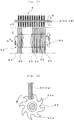
- the polishing/rubbing member 52 includes polishing/rubbing blades 53 in a thin disk-shape, a rotational shaft 54 on which a plurality of the polishing/rubbing blades 53 are disposed in parallel at a predetermined interval, and a spacer 55 disposed between every polishing/rubbing blades 53. At least a part of the polishing/rubbing member 52 (the polishing/rubbing blades 53) is disposed to be submerged in the soluble liquid bath.
- the polishing/rubbing member 52 is also disposed in the cleaning bath 50C, but since the cleaning liquid is a non-swellable to nylon fibers, polishing/rubbing are hardly performed in this section.
- the brush part 3 is rotated, as indicated with an arrow R in FIG. 10 ; while the brush part 3 being moved up and down, as indicated with an arrow Y in FIG. 10 , from an upper side of the polishing/rubbing body 52, and/or being moved forward and backward, as indicated with an arrow X in FIG. 10 , and being moved from the paper deep side to the paper near side of FIG. 10 (left-right direction in FIG. 12 ), the brush part 3 is brought into contact with the polishing/rubbing blade 53 for a predetermined time.
- the polishing/rubbing blade 53 may be fixed, but the polishing/rubbing blade 53 may be formed to rotate by the up and down movement of the brush part 3 and the movement of the brush part 3 from the paper deep side to the paper near side in FIG. 10 (in the left-right direction in FIG. 12 ).
- the nylon fiber is processed in the tapered shape, but the nylon fiber may be processed in the tapered shape by moving the brush part 3 up and down, forward to backward, and rotating without the above lateral movement of the brush part 3.
- the brush part 3 is transferred to the second solution bath 50B, and moved up and down and rotated, and the brush part 3 is brought into contact with the polishing/rubbing blade 53 for a predetermined time.
- the amount of polishing/rubbing of the brush part 3 in the second solution bath 50B is larger than that in the first solution bath, whereby the basic action is the same as that in the first bath 50A. That is, by controlling the speed of up and down movement and rotation of the brush part 3, nylon fibers 3a forming the brush part 3 is processed to become fibers 3b having a tapered surface 3b1 shown in FIG. 5A .
- the brush part 3 is transferred to the cleaning bath 50C, and the fibers 3b are cleaned by making the brush part 3 come into contact with a polishing /rubbing member 52 for a predetermined time, which completes the processing of the brush part 3.
- a plurality of small projecting portions 3h are formed on a surface of the tapered surface 3b1 in an axial direction of the fiber.
- a recessed portion 3i is formed between the adjacent projecting portions 3h. That is, the projecting portion and recessed portion alternately and sequentially appear in the axial direction of the fiber having the small projecting portions 3h and recessed portions 3i.
- the manufacturing method specified above allows to obtain a brush for cosmetic implements, having a brush part in which a plurality of synthetic resin fibers is conically tapered at the tip portion, and in which bundles of the fibers composed of a plurality of synthetic resin fibers are formed at least three positions on the radial circumference of a support member and further in an axial direction.
- the brush for cosmetic implements can be applicable to a mascara brush around eyes, and other brushes for such as eyeliners, nail polishes, lip sticks, and hair dyes.
- a brush is studied which can prevent occurring of lumping of mascara or clamping of eyelashes or damage of skin.
- An experiments of use were performed on brushes whose fiber bundles include straight fibers, non-straight fibers (crimped fibers), and both fibers mixed.
- the straight fiber is a fiber whose axis is linear and the non-straight fiber (crimped fibers) is a fiber whose axis is curved.
- the non-straight fiber crimped fibers
- a brush part is prepared by implanting fiber bundles formed of 5 to 10 6-nylon fibers to implanting holes on a support member and fixed by adhesion.
- the implanting holes are formed on circumferential surfaces in a radial and an axial direction at 30 to 45 positions.
- the brush has 30 to 45 fiber bundles on circumferential surfaces in a radial and an axial direction at each implanting holes.
- the fiber bundles have a length of 3 mm from the surface of the support member, and the outer diameter of the brush is 8 mm.
- the nylon fibers includes straight fibers with a tapering ratio of 10 to 30% and crimped fibers which are prepared by crimping processing to straight fibers with a tapering ratio of 15 to 35%, and a mixing ratio is set as shown in Table 1.
- the used fibers have a diameter of 2.5 mil (0.0635 mm approximately), 3.5 mil (0.0762 mm approximately) and 4 mil (0.1016 mm approximately), respectively.
- Samples are labeled with A to L, which are different in mixing ratio of used fibers having different shapes and diameters.
- the ingredients of the mascara under evaluation are: synthetic smectite 0.6 wt% as a viscosity modifier (Lucentite SWN (Trade Name), supplied by Co-op Chemical Co. , Ltd.); xanthan gum 0.4 wt% as also a viscosity modifier (Ekogamu GM (Trade Name), supplied by DSP Gokyo Food & Chemical Co., Ltd.); ammonium acrylates copolymer 25 wt% as a film-forming agent (YodosolGH800F (Trade name), supplied by Akzo Nobel N.V.), cabon black having an average diameter of 0.2 mm 3 wt% as a pigment (LC902 (Trade Name), supplied by LCW); silica particle as a pigment 3 wt% (Silica Micro bead P-500 (Trade Name), supplied by JGC Catalysts and Chemicals Ltd.); polyoxyethylenebehenylether 1 wt% as a surfactant (
- Brushes under test are evaluated with three items: occurrence of lumps of mascara, occurrence of clumps, and damage to the skin, when the mascara is applied to eyelashes.
- Lumps and clumps respectively means clots of dried mascara on the eyelashes and partial sticking of eyelashes together.
- the occurrence of lumps is rated A when the number of lumps is two or less, and rated B when the number is 3 to 5.
- the occurrence of clumps is rated A when the number of places of clumps is 2 or less, and rated B when the number is 3 to 5.
- the skin damage is rated A if the skin does not hurt when combed with a brush, and rated B if hurts.
- Table 1 It is found that mixed cases give better results: less mascara lumps, less clumped eyelashes and less skin damage, compared to the brushes that are composed of only straight fibers or only non-straight fibers.
Landscapes
- Brushes (AREA)
Abstract
Description
- The present invention relates to brushes for cosmetic implements and a manufacturing method of the same. More specifically the invention relates to brushes for cosmetic implements such as a mascara brush, having bristles that extends in radial directions of the support member, perpendicular to the axis thereof and a manufacturing method of the same.
- As a brush for cosmetic implements having bristles that extends in radial directions of the support member, perpendicular to the axis thereof, a mascara brush, for example, to apply mascara onto eyelashes is known. In this mascara brush, for example, a large number of the brush bristles are fixed between two twisted wires such that the bristles extend from the wires (the axis) in radial directions, perpendicular to the axis. In addition, some brushes have bristles (fibers), free ends of which are formed to be tapered, and are capable of easily entering between the eyelashes when mascara is applied.
- Various proposals have been made on this tapered bristles (fibers). For example,
Patent Literature 1 proposes bristles whose cross section of the free end is formed in a wedge shape. In addition,Patent Literature 2 proposes that the tip part of the bristles are fused and extended in a thermal processing, and formed in a right-triangular tapered shape seen from a side face. Further,Patent Literature 3 proposes that the tip part of the bristles are formed in a right-triangular shape seen from a side face by polishing process with whetstones or files. - Since the free end (the tip part) of the bristles, according to
Patent Literature 1 to 3, are formed in a wedged shape or a right-angle triangular shape, as previously described, when the bristles having a wedged shaped or right-angle triangularshaped cross section 50 are arrayed to face in one direction, there arises a problem of difference of repulsive forces; one of the them is generated against a force applied from A direction along the axis of the support member and the other is generated against a force applied from B direction opposite to A direction. That is, it is problematic that a feeling of use is different because softness and flexibility differ in the direction of use. - To solve this problem,
Patent Literature 4 teaches a brush for cosmetic implements is proposed having bristles (fibers) whose tip part is formed in a conical shape.
A brush for cosmetic implements inPatent Literature 4 is composed of a brush part and a support member to which the brush part is inserted to fix; in the brush part bristles made of synthetic resin having the tip ends formed in a tapered shape (a conical shape) are erectedly disposed in a row in the longitudinal direction and each adjacent bristles is separated from each other.
This brush for cosmetic implements having bristles (fibers) whose tip ends are formed in a conical shape enables to improve a feeling of use because the repulsive force generated against a force from A direction along the axis of the support member and the repulsive force generated against a force from B direction opposite to A direction are made substantially equal. -
- 1. Japanese Unexamined Patent Application Publication No.
2004-49906 - 2. Japanese Unexamined Patent Application Publication No.
2008-30730 - 3. Japanese Unexamined Patent Application Publication No.
2009-60998 - 4. Japanese Patent No.
4846323 - As stated above, a brush for cosmetic implements disclosed in
Patent Literature 4, however, is provided with a brush part where bristles made of synthetic resin are erectedly disposed in a row in the longitudinal direction.
The brush, however, fails to include plural rows of bristles on the circumferential surface of the axial direction (on the periphery of the cross section) of the support member. Accordingly, it is inconvenient to users to have to apply mascara to the eyelashes while paying attention to the position of the brush part. - To eliminate such an inconvenience, it is possible to insert the plural brush parts around all the circumference of the support member, but this raises an additional problem to increase the radius of the support member. Another method is to implant tapered bristles at plural positions on the circumferential surface of the axial direction by fusing or adhesion, but this further causes to make the length of the bristles (tip part) uneven. Further another method is tapering the tip part of the bristles after being planted at plural positions on the circumferential surface of the axial direction. As described above, forming the tip ends of the bristles (fibers) to have a conical shape is difficult by tapering with whetstones or files, and tapering with thermal processing may adversely cause the bristles to fuse to each other.
- At the time of development of a brush for cosmetic implements in which a brush part is formed at a plurality of positions around the support member in the radial direction, a method to taper the tip part of the bristles after being planted on the circumference of the support member has been intensively studied. As a result, it is found that a particular manufacturing method enables to form tip-tapered bristles at a plurality of positions around the support member in the radial direction.
- It is an object of the invention to provide a brush for cosmetic implements having tip-tapered bristles at a plurality of positions around the support member in the radial direction and a manufacturing method of the brush.
- A brush for cosmetic implements according to the present invention is a brush for cosmetic implements having a brush part provided on a support member, and includes a plurality of synthetic resin fibers whose tip part has a conically tapered surface; a fiber bundle composed of a plurality of synthetic resin fibers on a circumferential surface as to extend at least in three radial directions of the support member; and the fiber bundles provided on a surface of an axial direction of the support member.
- Since the fiber bundles are provided on a circumferential surface as to extend at least in three radial directions of the support member and in addition on a surface of an axial direction of the support member, mascara can be applied to eyelashes, and an improved feeling of use is achieved, without paying attention to the position of the brush part when in use. The circumferential surface in the radial direction of the support member means not only the circumferential surface at one cross section of the support member but also a cross section drawn by one rotation of a metallic wire rod (the support member) like a twisted brush, which will be described later, and the peripheral surface of this cross section is also included in the circumferential surface in the radial direction.
- It is desirable that the support member is made of two or more metal wires, and that the synthetic resin fiber bundles are held between wires and fixed by twisting. In particular, by setting the number of the metal wires to be three or more, the number of combination of fibers increases and brushes having various arrangement of fibers can be manufactured.
- The fiber bundles are preferably composed of straight fibers mixed with non-straight fibers, where the axis of the straight fibers is linear and the axis of the non-straight fibers is curved, such as crimped fiber.
- By mingling straight fibers with non-straight fibers, occurring of lumping of mascara or clamping of eyelashes or damage of skin can be prevented. Further the mingling of fibers can improve retainability of mascara liquid on the brush and reduce the number of redipping.
- A brush according to the present invention is a brush for cosmetic implements having a brush part attached to a support member, wherein the brush part includes a plurality of synthetic resin fibers whose tip part has a conically tapered surface, the plurality of synthetic resin fibers is disposed on a circumferential surface of the support member to extend in at least two radial directions, and the synthetic resin fibers are disposed on a circumferential surface of the axial direction, and wherein the support member is made of two or more metal wires twisted and the synthetic resin fibers are provided on the support member, interposed and fixed by the twisted wires.
- Thus, when the support member is made of twisted wires, a plurality of synthetic resin fibers is easily fixed to the support member. In particular, using twisted two metal wires enables to achieve a small outer diameter support member and to manufacture easily and at low cost, and to provide a small and inexpensive brush for cosmetic implements.
- Further the brush part of the brush for cosmetic implements is preferably provided whole circumferential surface of the support member, and the whole shape is preferably formed in a columnar or small conical shape.
- Still further the plurality of synthetic resin fibers is preferably composed of straight fibers mixed with non-straight fibers, similar to the case of the fiber bundles. By mixing straight fibers with non-straight fibers, occurring of lumping of mascara or clamping of eyelashes or damage of skin can be prevented. Further the mixing of fibers can improve retainability of mascara liquid on the brush and reduce the number of redipping.
- In order to achieve the above object, the present invention provides a manufacturing method of the brush for cosmetic implements, including the steps of: bundling the synthetic resin fibers to provide a brush part on the support member; immersing the brush part in a solution bath in which a soluble liquid is contained; moving the brush part up and down from an upper side of a polishing/rubbing blade; causing the brush part to come into contact with a polishing/rubbing blade for a predetermined time; dissolving and swelling a surface of the synthetic resin fiber; and scrubbing off the surface of the synthetic resin fiber by the polishing/rubbing blade, to form the tapered surface.
- The manufacturing method includes the steps of bundling the synthetic resin fibers to provide a brush part on the support member; immersing the brush part in a solution bath in which a soluble liquid is contained; moving the brush part up and down from an upper side of a polishing/rubbing blade; causing the brush part to come into contact with a polishing/rubbing blade for a predetermined time; dissolving and swelling a surface of the synthetic resin fiber; and scrubbing off the surface of the synthetic resin fiber by the polishing/rubbing blade, to form the tapered surface, and therefore the tapered surface is easily formed to the bristles provided on the circumferential surface of the support member. The present invention can provide the brush for cosmetic implements provided with bristles having tapered tip ends on a circumferential surface of the support member and the manufacturing method of the brush.
-
-
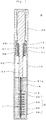
FIG. 1 is a cross-sectional view showing a cosmetic implement which uses a brush for cosmetic implements according to the present invention; -
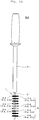
FIGS. 2A and2B are a sectional view and a side view showing an application part of a brush for cosmetic implements according to the present invention; -
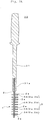
FIG. 3 is a front view of the application part of a brush for cosmetic implements according to the present invention; -
FIG. 4 is a perspective view of the application part of a brush for cosmetic implements according to the present invention. -
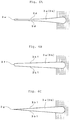
FIG. 5A is a view showing a fiber (brush bristle) having a tapered surface formed, andFIG. 5B is a view showing fibers (brush bristles) without having a tapered surface formed; -
FIGS. 6A to 6E are across sectional views showing an example of modified fiber shape of a synthetic resin fiber (brush bristle); -
FIG. 7 is a perspective view showing the synthetic resin fiber (bristle) having a projecting and recessed portion formed on a tapered surface; -
FIG. 8 is a side view showing a brush part in which the whole shape is formed in a cylindrical shape; -
FIG. 9 is a side view showing a brush part in which the whole shape is formed in a conical shape; -
FIG. 10 is a schematic diagram showing the steps of the manufacturing method according to the present invention; -
FIG. 11 is an enlarged view of a main part of an arrangement of polishing/rubbing blades and the brush part shown inFIG. 10 ; -
FIG. 12 is a side view showing the polishing/scrubbing blade shown inFIG. 11 ; and -
FIG. 13 is a schematic view showing a conventional brush for cosmetic implements. - Hereinafter, an explanation will be made of an embodiment of the present invention with reference to the drawings
FIGS. 1 through 5 . Cosmetic implements to which the brush according to the present invention is utilized are such as eye-liners, mascaras, nail polish, lipsticks, hair dyes. In the present embodiments, a mascara having fluidity will be described as an example. A cosmetic implement A includes acontainer 10 containing a coating liquid K, acap 20 threadedly engaging with thecontainer 10, andapplicator 30 provided with abrush part 3 immersed in the coating liquid K in thecontainer 10. - The
container 10 is formed in a bottomed cylinder shape having a neck portion 11 and contains a prescribed amount of the coating liquid K of mascara with fluidity. The coating liquid includes, as disclosed inJapanese Patent No. 5791424 average diameter 1 mm or larger 0.5 to 30 wt%, dispersant 0.1 to 2 wt% and a surfactant 0.1 to 2 wt%, and the liquid to be used has a viscosity ranging from 2 to 10 Pa·s with a shear velocity of 3.83 s-1, both measured at 25 °C with an EHD type viscometer. - At the upper part of the
container 10, the neck portion 11 having a narrow cylinder-shaped opening 12 upward is integrally formed with the container. On the outer circumferential surface a screwed part 13 for fastening is formed in circumferential direction and the screwed part 13 is threadedly engaged with a screwedpart 21 on the inner surface of thecap 20. - A squeezing
body 25 is fitted to an opening 12 of the neck portion 11 of thecontainer 10. The squeezingbody 25 is made of a material with properties of flexibility and viscoelasticity, substantially formed in a cylindrical shape, and the diameter (width of the opening) of the squeezing body is gradually reduced from near the upper end (one end) towards the lower end (the other end). A ring-shapedflange 26 protrudes radially outward from the uppermost end of the squeezingbody 25 and is fixed to the opening periphery of the neck portion of thecontainer 10. - The
applicator 30 includes asupport shaft 31 and anapplication part 1, theapplication part 1 for holding the liquid is provided on a distal end of thesupport shaft 31. Specifically, a rod-like support 2 of theapplication part 1 is fittingly fixed in a mounting hole 31a bored at the distal end of thesupport shaft 31. - The
application part 1 will be described with reference toFIGS. 2 through 5 . As described above, theapplication part 1 includes a rod-like support member 2 and thebrush part 3; the support member of theapplication part 1 is fittingly fixed in a mounting hole 31a bored at the distal end of thesupport shaft 31, and a plurality of fiber bundles 3A, made of a plurality ofsynthetic resin fibers 3a extending in the radial direction of thesupport member 2, are disposed on a circumferential surface of the radial direction and the axial direction of thesupport member 2.
In this embodiment,brush part 3 is provided point-asymmetrically at three positions on a radial circumferential surface of thesupport member 2.
Thebrush part 3 is prepared by planting fiber bundles 3A formed of synthetic resin fibers in implanting holes 2a of thesupport member 2; the implanting holes 2a are formed at plural positions on the circumferential and axial direction of thesupport member 2 and the fiber bundle 3A is planted in each implanting holes 2a to thereby form thebrush part 3 having plural fiber bundles 3A disposed on a radial and axial direction of thesupport member 2. The outer diameter of thebrush part 3 is preferably 6 mm to 8 mm, for example. - The
support member 2 is formed of resins, such as polypropylene, polyacetal and polyoxymethylene, to have a diameter of 0.5 to 4.0 mm and a length of 10 to 30 mm. The fiber bundles 3A are planted by melting or adhesion to thesupport member 2. - Length of the
synthetic resin fibers 3a planted to the support member 2A are 1.0 to 5.0 mm from the surface of thesupport member 2. Material used for the synthetic resin fibers for thebrush part 3 are polyamide-based resin, such as 6, 6 nylon, 6 nylon, 12 nylon, 6,10 nylon, and 6, 12 nylon; polyolefin-based resin, such as polyethylene, and polypropylene; polyester-based resin, such as polyethylene terephthalate, polybutylene terephthalate, and poly trimethylene terephthalate. - Fibers having a diameter of 0.03 to 0.18 mm, more preferably 0.05 to 0.15 mm are used for
synthetic resin fibers 3a because of appropriate elasticity and prevention of bending or breaking, where the diameter denotes the size of columnar part of the fibers the surface 3a1 of which are not tapered. Thesynthetic resin fibers 3a may have any one of cross sections of an ellipse, a star, a cocoon, a cross or a polygon. - The number of the assembled
synthetic resin fibers 3a in a bundle, that is, a fiber bundles 3A, may be properly determined, and the number of fibers may preferably be 5 to 30 for a bundle which is to be implanted in a single planting hole 2a (SeeFIG. 2A ). The number of fiber bundles 3A to be implanted can be set as needed; typically 5 to 20 places can be preferably adopted. - In the present embodiment, as shown in
FIG. 3 , fiber bundles 3A made of pluralsynthetic resin fibers 3a are implanted at three positions in the radial circumferential surface of thesupport member 2, and also implanted in the axial direction of thesupport member 2. That is, the fiber bundles 3A are provided on the circumferential surface of the support member so as to extend in three directions of the radial direction of the support member and further provided in the circumferential surface of the axial direction of the support member. - In the present embodiment, as shown in
FIGS 2 and4 , the fiber bundles 3A are implanted at nine positions in a row in the axial direction of thesupport member 2. The fiber bundles 3A are implanted accordingly at 27 positions in total in the radial circumferential surface and axial directions. The number of the fiber bundles 3A, implanted in the radial circumferential surface and axial directions, may be increased or decreased as needed, and not limited the number of 27. - As shown in
FIG. 5A which is an enlarged schematic drawing, thesynthetic resin fibers 3a forming thebrush 3 include taperedfibers 3b each having diameter formed to be gradually smaller toward the tip andtapered fibers 3b, being specific synthetic resin fibers, on the tip part of which a tapered surface 3b1 is formed tapering toward the tip. The length X of the tapered surface 3b1 of the taperedfibers 3b is formed in a range of 0.5 to 4.0 mm from the tip of the synthetic resin fibers. - Here, the synthetic resin fibers are prepared such that a taper ratio, a percent ratio of defined by X/(X+Y), falls within a range between 10 to 80%, where X denotes the length of the tapered surface from the tip end of the synthetic resin fibers, and X+Y denotes the length of a mascara brush from the surface of a mascara brush head to the tip end of a synthetic resin fiber; that is, X+Y is the sum of the length Y of the non-tapered surface on which the tapered surface is not formed from the surface 2A1 (synthetic resin fiber planted surface) of the mascara
brush support member 2 and the length X of the tapered surface. And the ratio X/X+Y is defined by (length X of the tapered surface) / (length X+Y from the tip of the synthetic resin fiber of the mascara brush to the mascara brush head surface).
The number of taperedfibers 3b is configured to occupy more than 80% of the total number of the synthetic resin fibers forming the brush. The brush may contain tapered fibers that are out of the range described above up to 30% of the total number of the synthetic resin fibers or may contain untapered fibers 3c up to 30%, as shownFIG. 5B . These fibers that are contained less than 30% in the brush are preferably of the same material and the same diameter as thetapered fibers 3b from the manufacturing view point. - As described above, the length X of the tapered surface 3b1 of the tapered
fiber 3b is formed as to fall within a range from 0. 5 mm to 4 mm from the tip end of the synthetic resin fiber such that each fiber is easy to enter between eyelashes.
If the length of the length X of the tapered surface 3b1 is less than 0.5 mm, each fiber is difficult to enter between the eyelashes because of the short length of the tapered surface. If the length X of the tapered surface 3b1 exceeds 4 mm, bending strength of the fiber gets weakened and becomes smaller than that of the eyelashes, and as a result, this undesirably causes the synthetic resin fibers to fail to enter between the eyelashes. In addition, it undesirably becomes unable to curl both the eyelashes because the upper eyelashes are pushed up or the lower eyelashes are pushed down. - When the taper ratio of the tapered fibers is less than 10%, it is undesirable because the tapered
fibers 3b may have larger bending strength, sweep away eyelashes and are hard to enter between each of the eyelashes. In contrast, when the taper ratio exceeds 80%, thefibers 3b may be turned down, or hard to enter deeply into the eyelashes, or may push up or lower the eyelashes, and resultantly curling up of the eyelashes with the brush becomes difficult; thus it is undesirable for use. - The
brush part 3 is formed such that the number of the tapered fibers occupies at least 80% or more of the total fibers. When the number of the tapered fibers is less than 70% of the total number of the fibers, the taperedfibers 3b may undesirably fail to give a sufficient effect of tapering. - Thus configured
brush part 3 containing a larger number of taperedfibers 3b allows the bending strength to be getting stronger from the tip part 3A1, which is the tip part in the radial direction of thesupport member 2, to downward to the support member as shown inFIG. 3 , and accordingly to improve a feeling of use. That is to say, the tip part of the taperedfibers 3b are configured to easily enter between the eyelashes, when mascara applied. The bending strength can be made larger downwardly through the tapered surface 3b1 and a straight body 3b2, and the fibers can easily enter between the eyelashes one by one, overcoming the bending strength of the eyelashes. Consequently, the mascara liquid can be applied finely to each of the eyelashes and curling of the eyelashes firmly performed with pushing the upper eyelashes up or lower eyelashes down. Tapering of the fibers at the tip ends additionally allows to provide a soft touch to the root of the eyelashes and the skin and to prevent from excessively applying of the liquid. - The
synthetic resin fibers 3a (thetapered fibers 3b) may be formed to have a curved surface 3d, as shown inFIG. 6A , which is concave being recessed along the axial direction or to have a flat face 3e on the tip end. As shown inFIG. 6B , a tapered surface 3b1 may be formed from the top to the lowest part of the fibers without the straight part 3b2 and may have a round top surface 3f. Further, as shown inFIG. 6C , an acute part 3g may be formed at the top end of the taperedfibers 3b. - As shown in
FIG. 6D , in addition, a plurality of tapered faces 3j1, 3j2, and 3j3 may be formed on the synthetic resin fibers (thetapered fibers 3b). Dimensions of the tapered faces 3j1, 3j2, and 3j3 are determined as to meet the relationship of cross section ratios which are in a range of 0.8 to 0.9 at the top part 3k2 of the tapered face 3j1 and in a range of 0.2 to 0.4 at the top part 3k3 of the tapered face 3j2, while the cross section at the support member surface 3k1 of thesynthetic resin fibers 3a (3b) shown inFIG. 6D to be 1.0, to form a tapered shape as a whole. The tapered face 3j1 may be formed to be a straight body 3b2 and the fiber may have two tapered faces 3j2 and 3j3. - Further, the
synthetic resin fibers 3a may have a non-straight shape in which the axis of the fiber is bent, that is a crimped shape. The degree of bending 31t of the crimpedfiber 31 is preferably three to four times as much as the diameter of the fiber. When tapering is performed to crimpedfibers 31, the tapered face is preferably formed after the crimping processing is carried out to make the axis of the fibers curved. - Since features of eyelashes, such as density, length, thickness, may differ person to person, choosing the optimal fiber shape or tip-tapering shape adapting to each feature allows to improve a feeling of use of mascara.
-
FIG. 7 shows the surface of tapered synthetic resin fibers, the surface which has projected portions 3h and recessed portions 3i and an average depth t1 of the recessed portions (height from the top of the projected portions 3h to the bottom of the recessed portions) is formed to be in a range of 0.01 µm to 10 µm. When the average depth t1 is less than 0.01 µm, the tapered surface of the synthetic resin fibers is too smooth to maintain the liquid in the recessed portions 3i, and good coatability cannot be obtained. In contrast, when the average depth t1 of the recessed portions exceed 10 µm, the coatability is unpreferably lowered because the rigidity of the fibers decreases and liquid transfer is inhibited by excessive collection of the liquid at the recessed portions. Thus, the average depth t1 of the recessed portions 3i in a range of 0.01 to 10 µm preferably allows good retainability of the liquid and high rigidity of the fibers. - In addition, an average distance t2 between the projected portions 3h is set to be 10 to 70 µm. The average distance t2 less than 10 µm unfavorably causes the number of projected portions and the recessed portions to become large, the fiber surface to become rough, liquid separation from the recessed portions to be inadequate, and a skin touch to be uncomfortable. In contrast, the average distance t2 more than 70 µm undesirably causes to decrease the number of projected portions and the recessed portions and to reduce retainability of the liquid. As a result, the average distance t2 in a range of 1 to 70 µm achieves good retainability of the liquid and an excellent skin touch.
- The projected portions 3h and recessed portions 3i on the fiber surface can be formed into rugged fiber surface by molding with a mixture of fine particles such as titanium dioxide. Thus prepared fibers are not preferable because the rigidity of fibers may decrease due to presence of foreign material, and particles may be detached as the brushes are being used. After blasting process with bombarding fine particles into an untapered fiber surface in order to form projected portions 3h and recessed portions 3i is performed, tapered surfaces are formed; this may likely cause the projected portions 3h and recessed portions 3i to be lost or the fibers to be broken at the recessed portions 3i. In contrast, when blasting process is performed after forming tapered surfaces, the tapered surfaces subject to heavy damage and become unsuitable for use to mascara brushes. Accordingly, a preferable manufacturing method will be described later to form the projected portions 3h and recessed portions 3i.
- Synthetic resin fibers having a tapered surface are preferably made of polyamide-based resin, which is desirable in the manufacturing method described later. The fiber surface of the polyamide-based resin is easy to make the fiber in a semi-swollen state in a dissolving liquid, and it is possible to selectively peel off only the necessary portion with a polishing-rubbing member, and the projected portions 3h and recessed portions 3i having an arbitrary shape are easily formed. In addition, since polyamide-based resin has a high affinity for water, a mascara brush may be formed using all synthetic resin fibers including synthetic resin fibers having a tapered surface with a polyamide-based resin.
- In the above embodiment, explained is that fiber bundles 3A formed of a plurality of
synthetic resin fibers 3a are planted on abrush part 3 both in a radial circumferential surface and at plural positions in an axial direction of the support member by melting or adhesion.
Thebrush part 3 according to the present invention is not limited to the above case. For example, as shown inFIG. 8 , the fiber bundles 3A composed of a plurality ofsynthetic resin fibers 3a may be disposed with a predetermined separation betweenmetal wires 4A and 4B, and then the fiber bundles 3A (taperedfibers 3b) may be fixed by twisting thewires 4A and 4B. In addition, the number of metal wire rods may be two or more, such as 4A and 4B, and it may be formed with three or more wire materials. Also in the case of such a so-called twisted brush,plural fiber bundles 3a composed of a plurality ofsynthetic resin fibers 3a (taperedfibers 3b), extending in the radial direction of thewires 4A and 4B, may be disposed in the longitudinal direction (axial direction) of thewires 4A and 4B. - In the
brush part 3 as shown inFIG. 8 , a diameter D1 of thebrush part 3 attached at the distal end of thesupport member 2 and a diameter D2 of thebrush part 3 attached at the proximal end of the support member are formed to be nearly the same, and forms a columnar shape as a whole. As shown inFIG. 9 , thediameter D 2 of thebrush part 3 attached to the rear end side of thesupport member 2 is larger than thediameter D 1 of thebrush part 3 attached to the front end side of thesupport member 2, which may form a conical shape as a whole. Furthermore, as a modified example, thesupport member 2 is not linear with respect to the axis but may be curved in an arc shape in accordance with the arrangement of the eyelashes. - An embodiment of a manufacturing method according to the present invention will be described with respect to
FIGS. 10 through 12 . Firstly abrush part 3 is formed by attaching bundles of a predetermined number ofsynthetic resin fibers 3a having a predetermined length onto the support member. The attachment of the fiber bundles is performed by adhesion or melting. Alternatively,synthetic resin fibers 3b may be placed betweenmetal wires 4A and 4B, and then thewires 4A and 4B may be twisted to hold the fibers. - Followingly, the tapering processing of
synthetic resin fibers 3a is performed by polishing and rubbing while the synthetic resin fibers are swollen using a soluble or swellable processing liquid. The processing liquid to be used differs for each type of synthetic resin fiber; for example, in a case of a polyester-based resin fiber, a sodium hydroxide aqueous solution is generally used, and in a case of a polyamide-based resin fiber, a mixed liquid of meta-cresol and a calcium chloride methanol solution is used. - When the
brush part 3 is formed with crimped fibers, the tapered face is preferably formed after the crimping processing tosynthetic resin fibers 3a is carried out to make the axis of the fibers curved. - The tapering processing of the synthetic resin fibers using this kind of processing liquid will be explained by taking a case of using nylon fibers, which is a polyamide-based resin, as an example.
- In this processing method, as shown in
FIG. 10 with reference numerals 50A, 50B, and 50C, a processing apparatus is used in which a plurality of solution baths are arrayed in series. When this processing method is employed, as respective processing liquid used for polishing/rubbing and cleaning of nylon fibers, meta-cresol or a saturated calcium chloride methanol solution is used as a soluble liquid of the first solution bath 50A, a mixed liquid of calcium chloride 15% (by weight) and methanol 85% (by weight) is used as a soluble liquid of the second solution bath 50B, and methanol (100%) is used as a cleaning liquid in the cleaning liquid bath 50C. - A polishing/rubbing
member 52 for polishing and rubbing the nylon fibers to perform the tapering processing is provided in each of the first solution bath 50A and the second solution bath 50B. The polishing/rubbingmember 52 includes polishing/rubbingblades 53 in a thin disk-shape, a rotational shaft 54 on which a plurality of the polishing/rubbingblades 53 are disposed in parallel at a predetermined interval, and aspacer 55 disposed between every polishing/rubbingblades 53. At least a part of the polishing/rubbing member 52 (the polishing/rubbing blades 53) is disposed to be submerged in the soluble liquid bath. The polishing/rubbingmember 52 is also disposed in the cleaning bath 50C, but since the cleaning liquid is a non-swellable to nylon fibers, polishing/rubbing are hardly performed in this section. - In a case of processing the
brush part 3 with this apparatus, firstly thebrush part 3 is rotated, as indicated with an arrow R inFIG. 10 ; while thebrush part 3 being moved up and down, as indicated with an arrow Y inFIG. 10 , from an upper side of the polishing/rubbingbody 52, and/or being moved forward and backward, as indicated with an arrow X inFIG. 10 , and being moved from the paper deep side to the paper near side ofFIG. 10 (left-right direction inFIG. 12 ), thebrush part 3 is brought into contact with the polishing/rubbingblade 53 for a predetermined time. - In this situation, when the soluble liquid in the solution bath 50A adheres to the
brush part 3, the surface of the nylon fibers get dissolved and swelled, and is scrubbed off by the polishing/rubbingblade 53.
That is, as illustrated inFIG. 12 , since a combing blade 53a having a saw-tooth shape is formed on the polishing/rubbingblade 53, the polishing/rubbingblade 53 comes into contact with thefibers 3a of thebrush part 3 to comb the fibers to repeat the dissolution and rubbing. At this time, by controlling a velocity of the up and down movement of thebrush part 3 and the moving velocity thereof from the paper deep side to the paper near side inFIG. 10 (in the left-right direction inFIG. 12 ), the nylon fibers forming thebrush part 3 are processed in a tapered shape. The tip part of thebrush part 3 is formed in a tapered shape to become thinner toward the tip part. - The polishing/rubbing
blade 53 may be fixed, but the polishing/rubbingblade 53 may be formed to rotate by the up and down movement of thebrush part 3 and the movement of thebrush part 3 from the paper deep side to the paper near side inFIG. 10 (in the left-right direction inFIG. 12 ). In addition, by the up and down movement of thebrush part 3 and the lateral movement of thebrush part 3 from the paper deep side to the paper near side inFIG. 10 (in the left-right direction inFIG. 12 ), the nylon fiber is processed in the tapered shape, but the nylon fiber may be processed in the tapered shape by moving thebrush part 3 up and down, forward to backward, and rotating without the above lateral movement of thebrush part 3. - Then, the
brush part 3 is transferred to the second solution bath 50B, and moved up and down and rotated, and thebrush part 3 is brought into contact with the polishing/rubbingblade 53 for a predetermined time.
The amount of polishing/rubbing of thebrush part 3 in the second solution bath 50B is larger than that in the first solution bath, whereby the basic action is the same as that in the first bath 50A. That is, by controlling the speed of up and down movement and rotation of thebrush part 3,nylon fibers 3a forming thebrush part 3 is processed to becomefibers 3b having a tapered surface 3b1 shown inFIG. 5A . - Finally, the
brush part 3 is transferred to the cleaning bath 50C, and thefibers 3b are cleaned by making thebrush part 3 come into contact with a polishing /rubbingmember 52 for a predetermined time, which completes the processing of thebrush part 3. In the previously explained method, by controlling the movement (movement distance) of thebrush part 3 in the upper-lower direction and the movement of thebrush part 3 from the paper deep side to the paper near side inFIG. 10 (in the left-right direction inFIG. 12 ), a plurality of small projecting portions 3h are formed on a surface of the tapered surface 3b1 in an axial direction of the fiber. At this time, a recessed portion 3i is formed between the adjacent projecting portions 3h. That is, the projecting portion and recessed portion alternately and sequentially appear in the axial direction of the fiber having the small projecting portions 3h and recessed portions 3i. - The manufacturing method specified above allows to obtain a brush for cosmetic implements, having a brush part in which a plurality of synthetic resin fibers is conically tapered at the tip portion, and in which bundles of the fibers composed of a plurality of synthetic resin fibers are formed at least three positions on the radial circumference of a support member and further in an axial direction. The brush for cosmetic implements can be applicable to a mascara brush around eyes, and other brushes for such as eyeliners, nail polishes, lip sticks, and hair dyes.
- A brush is studied which can prevent occurring of lumping of mascara or clamping of eyelashes or damage of skin. An experiments of use were performed on brushes whose fiber bundles include straight fibers, non-straight fibers (crimped fibers), and both fibers mixed.
- Here, the straight fiber is a fiber whose axis is linear and the non-straight fiber (crimped fibers) is a fiber whose axis is curved. The experiments will be explained in detail, but the scope of the present invention is no limited thereby.
- A brush part is prepared by implanting fiber bundles formed of 5 to 10 6-nylon fibers to implanting holes on a support member and fixed by adhesion. The implanting holes are formed on circumferential surfaces in a radial and an axial direction at 30 to 45 positions. The brush has 30 to 45 fiber bundles on circumferential surfaces in a radial and an axial direction at each implanting holes. The fiber bundles have a length of 3 mm from the surface of the support member, and the outer diameter of the brush is 8 mm.
- The nylon fibers includes straight fibers with a tapering ratio of 10 to 30% and crimped fibers which are prepared by crimping processing to straight fibers with a tapering ratio of 15 to 35%, and a mixing ratio is set as shown in Table 1. The used fibers have a diameter of 2.5 mil (0.0635 mm approximately), 3.5 mil (0.0762 mm approximately) and 4 mil (0.1016 mm approximately), respectively. Samples are labeled with A to L, which are different in mixing ratio of used fibers having different shapes and diameters.
Table 1 Mixing ratio(%) A B C D E F G H I J K L Fiber shape & Fiber diameter Straight 2.5 mil (About 0.0635 mm) 100 - - - - - 50 - - 50 - - Straight 3 mil (About 0. 0762 mm)- 100 - - - - - 50 - - 50 - Straight 4 mil (About 0.1016 mm)- - 100 - - - - - 50 - - 50 Crimped 2.5 mil (About 0.0635 mm) - - - 100 - - - - - - - - Crimped 3 mil (About 0. 0762 mm)- - - - 100 - 50 50 50 - - - Crimped 4 mil (About 0.1016 mm)- - - - - 100 - - - 50 50 50 Evaluation Mascara lumps B A B B A B A A A A A A Clumped eyelashes B A B B A B A A A A A A Skin damage A A B A A B A A A A A A - The ingredients of the mascara under evaluation are: synthetic smectite 0.6 wt% as a viscosity modifier (Lucentite SWN (Trade Name), supplied by Co-op Chemical Co. , Ltd.); xanthan gum 0.4 wt% as also a viscosity modifier (Ekogamu GM (Trade Name), supplied by DSP Gokyo Food & Chemical Co., Ltd.); ammonium acrylates copolymer 25 wt% as a film-forming agent (YodosolGH800F (Trade name), supplied by Akzo Nobel N.V.), cabon black having an average diameter of 0.2
mm 3 wt% as a pigment (LC902 (Trade Name), supplied by LCW); silica particle as apigment 3 wt% (Silica Micro bead P-500 (Trade Name), supplied by JGC Catalysts and Chemicals Ltd.); polyoxyethylenebehenylether 1 wt% as a surfactant (BB-30 (Trade Name), supplied by Nikko Chemicals Co., Ltd.);nylon fibers 5 wt% (NFBR-10D-2T (Trade Name), supplied by DAITO KASEI KOGYO CO., LTD.); sterilizer with an optimal quantity (a mixture of ethylparaben, ethylparaben, phenoxyethanol); 1,3butanediol 10 wt% and purified water for the remaining part.
The viscosity of the mascara ranges from 2 to 10 Pa·s with a shear velocity of 3.83 s-1, both measured at 25 °C with an EHD type viscometer. - Brushes under test are evaluated with three items: occurrence of lumps of mascara, occurrence of clumps, and damage to the skin, when the mascara is applied to eyelashes. Lumps and clumps respectively means clots of dried mascara on the eyelashes and partial sticking of eyelashes together.
- The occurrence of lumps is rated A when the number of lumps is two or less, and rated B when the number is 3 to 5. The occurrence of clumps is rated A when the number of places of clumps is 2 or less, and rated B when the number is 3 to 5. The skin damage is rated A if the skin does not hurt when combed with a brush, and rated B if hurts. The results of the evaluation are shown in Table 1. It is found that mixed cases give better results: less mascara lumps, less clumped eyelashes and less skin damage, compared to the brushes that are composed of only straight fibers or only non-straight fibers.
Claims (8)
- A brush for cosmetic implements, having a brush part that is attached to a support member,
wherein the brush part includes a plurality of synthetic resin fibers whose tip end has a conically-tapered surface, and wherein a plurality of fiber bundles composed of a plurality of synthetic resin fibers is formed on a circumferential surface of the support member as to extend in three radial directions, and the fiber bundles are further formed on a circumferential surface in an axial direction of the support member. - The brush for cosmetic implements according to Claim 1, wherein the support member is formed of twisted two or more metal wires, and wherein the synthetic resin fiber bundles are held between the wires and fixed to the support member by twisting the metal wires.
- The brush for cosmetic implements according to Claim 1 or 2, wherein the fiber bundle is mixedly formed with straight fibers and non-straight fibers.
- A brush for cosmetic implements, having a brush part that is attached to a support member,
wherein the brush part includes a plurality of synthetic resin fibers whose tip end has a conically-tapered surface, and wherein a plurality of fiber bundles composed of a plurality of synthetic resin fibers is formed on a circumferential surface of the support member as to extend in at least two radial directions and formed on a circumferential surface in an axial direction, and wherein the support member is formed of twisted two or more metal wires and the synthetic resin fiber bundles are held between the wires and fixed to the support member by twisting the metal wires. - The brush for cosmetic implements according to Claims 4, wherein the plurality of synthetic resin fibers mixedly includes straight fibers and non-straight fibers.
- The brush for cosmetic implements according to one of the Claims 1 through 5, wherein the brush part is formed on the whole area of the circumferential surface of the support member.
- The brush for cosmetic implements according to any one of the Claims 1 through 7, wherein a whole shape of the brush part is formed to be a columnar or a conical shape with a diameter decreasing toward a top portion.
- A manufacturing method of the brush for cosmetic implements described in any one of the Claims 1 through 7, the method comprising steps of:a step in which synthetic resin fibers are bundled and a brush part is formed on the support member; anda step in which the brush part is immersed in a solution bath containing a soluble liquid; the brush part is brought into contact with a polishing/rubbing blade for a predetermined time to dissolve and swell the surface of the synthetic resin fibers;and the tapered surface is formed by scrubbing off with the polishing/rubbing blade.
Applications Claiming Priority (2)
| Application Number | Priority Date | Filing Date | Title |
|---|---|---|---|
| JP2016144202 | 2016-07-22 | ||
| JP2017133903A JP2018020105A (en) | 2016-07-22 | 2017-07-07 | Cosmetic brush and method for producing the cosmetic brush |
Publications (2)
| Publication Number | Publication Date |
|---|---|
| EP3272248A2 true EP3272248A2 (en) | 2018-01-24 |
| EP3272248A3 EP3272248A3 (en) | 2018-03-21 |
Family
ID=59383452
Family Applications (1)
| Application Number | Title | Priority Date | Filing Date |
|---|---|---|---|
| EP17182260.4A Withdrawn EP3272248A3 (en) | 2016-07-22 | 2017-07-20 | Brush for cosmetic products and manufacturing method of the same |
Country Status (2)
| Country | Link |
|---|---|
| US (1) | US20180020811A1 (en) |
| EP (1) | EP3272248A3 (en) |
Citations (5)
| Publication number | Priority date | Publication date | Assignee | Title |
|---|---|---|---|---|
| JP2004049906A (en) | 2002-07-18 | 2004-02-19 | Geka Brush Gmbh | Mascara brush |
| JP2008030730A (en) | 2006-06-30 | 2008-02-14 | Equos Research Co Ltd | Vehicle control device |
| JP2009060998A (en) | 2007-09-05 | 2009-03-26 | Tokyo Parts Kk | Liquid applicator |
| JP4846323B2 (en) | 2005-09-30 | 2011-12-28 | ぺんてる株式会社 | Mascara brush |
| JP5791424B2 (en) | 2011-08-11 | 2015-10-07 | 三菱鉛筆株式会社 | Aqueous cosmetic composition |
Family Cites Families (7)
| Publication number | Priority date | Publication date | Assignee | Title |
|---|---|---|---|---|
| KR100421454B1 (en) * | 2001-02-23 | 2004-03-09 | 씨제이 주식회사 | A Toothbrush Combined With High Tapering Hairs Having Superior Elasticity And Manufacturing Method Of It |
| FR2851899B1 (en) * | 2003-03-03 | 2006-06-23 | Oreal | APPLICATOR AND DEVICE FOR PACKAGING AND APPLICATION COMPRISING SUCH AN APPLICATOR |
| US20050236008A9 (en) * | 2003-03-28 | 2005-10-27 | Gueret Jean-Louis H | Cosmetic applicator |
| JP5165987B2 (en) * | 2006-10-13 | 2013-03-21 | 花王株式会社 | Mascara applicator |
| JP5453670B2 (en) * | 2009-06-22 | 2014-03-26 | 東京パーツ株式会社 | Brush tool |
| EP2345342B1 (en) * | 2010-01-18 | 2013-04-24 | Albéa Services | Cosmetic applicator assembly |
| JP6599088B2 (en) * | 2014-09-02 | 2019-10-30 | 辻 陽平 | Toothbrush manufacturing method |
-
2017
- 2017-07-20 US US15/654,821 patent/US20180020811A1/en not_active Abandoned
- 2017-07-20 EP EP17182260.4A patent/EP3272248A3/en not_active Withdrawn
Patent Citations (5)
| Publication number | Priority date | Publication date | Assignee | Title |
|---|---|---|---|---|
| JP2004049906A (en) | 2002-07-18 | 2004-02-19 | Geka Brush Gmbh | Mascara brush |
| JP4846323B2 (en) | 2005-09-30 | 2011-12-28 | ぺんてる株式会社 | Mascara brush |
| JP2008030730A (en) | 2006-06-30 | 2008-02-14 | Equos Research Co Ltd | Vehicle control device |
| JP2009060998A (en) | 2007-09-05 | 2009-03-26 | Tokyo Parts Kk | Liquid applicator |
| JP5791424B2 (en) | 2011-08-11 | 2015-10-07 | 三菱鉛筆株式会社 | Aqueous cosmetic composition |
Also Published As
| Publication number | Publication date |
|---|---|
| US20180020811A1 (en) | 2018-01-25 |
| EP3272248A3 (en) | 2018-03-21 |
Similar Documents
| Publication | Publication Date | Title |
|---|---|---|
| US8899241B2 (en) | Instrument for applying a product to superficial epidermal derivatives and its method of manufacture | |
| JP3372225B2 (en) | Coating device | |
| US9232851B2 (en) | Variable pitch mascara brush | |
| CN109561758B (en) | toothbrush | |
| US6241411B1 (en) | Mascara brush, container, and method | |
| JP4458217B2 (en) | Method for manufacturing an applicator brush | |
| US7325550B2 (en) | Applicator for liquid or paste-like media, in particular decorative cosmetics such as mascara | |
| EP2026678B1 (en) | Ultra-size cosmetic applicator having enhanced surface area | |
| US20040009028A1 (en) | Applicator comprising a sloping applicator element and a stem connected via a hinge to a handle member | |
| KR20180112720A (en) | Cosmetic applicator | |
| JP2001178534A (en) | Applicator device with liquid, paste or particulate product applicator having bristles for retaining particles | |
| CN114641221B (en) | Mascara Applicator | |
| JP2008110259A (en) | Applicator for applying substances to keratinous fibers | |
| CN112702936A (en) | Device for applying a fluid product | |
| JP5181774B2 (en) | Brush ear | |
| EP3272248A2 (en) | Brush for cosmetic products and manufacturing method of the same | |
| EP3745912B1 (en) | An improved bristle for brushes | |
| JP5228377B2 (en) | Brush ear | |
| JP6375535B2 (en) | toothbrush | |
| JP2004154163A (en) | Hair for taper | |
| JP2018020105A (en) | Cosmetic brush and method for producing the cosmetic brush | |
| WO2020044417A1 (en) | Child's toothbrush and child's toothbrush production method | |
| JP2537929Y2 (en) | Brush brush | |
| EP4410150A1 (en) | Cosmetic applicator | |
| JP7410590B1 (en) | makeup brush |
Legal Events
| Date | Code | Title | Description |
|---|---|---|---|
| PUAI | Public reference made under article 153(3) epc to a published international application that has entered the european phase |
Free format text: ORIGINAL CODE: 0009012 |
|
| STAA | Information on the status of an ep patent application or granted ep patent |
Free format text: STATUS: THE APPLICATION HAS BEEN PUBLISHED |
|
| AK | Designated contracting states |
Kind code of ref document: A2 Designated state(s): AL AT BE BG CH CY CZ DE DK EE ES FI FR GB GR HR HU IE IS IT LI LT LU LV MC MK MT NL NO PL PT RO RS SE SI SK SM TR |
|
| AX | Request for extension of the european patent |
Extension state: BA ME |
|
| PUAL | Search report despatched |
Free format text: ORIGINAL CODE: 0009013 |
|
| AK | Designated contracting states |
Kind code of ref document: A3 Designated state(s): AL AT BE BG CH CY CZ DE DK EE ES FI FR GB GR HR HU IE IS IT LI LT LU LV MC MK MT NL NO PL PT RO RS SE SI SK SM TR |
|
| AX | Request for extension of the european patent |
Extension state: BA ME |
|
| RIC1 | Information provided on ipc code assigned before grant |
Ipc: A46D 9/00 20060101ALI20180210BHEP Ipc: A46D 1/04 20060101ALI20180210BHEP Ipc: A46D 9/02 20060101ALI20180210BHEP Ipc: A46D 1/00 20060101ALI20180210BHEP Ipc: A46D 1/08 20060101ALI20180210BHEP Ipc: A46B 9/02 20060101AFI20180210BHEP Ipc: A46D 1/05 20060101ALI20180210BHEP |
|
| STAA | Information on the status of an ep patent application or granted ep patent |
Free format text: STATUS: REQUEST FOR EXAMINATION WAS MADE |
|
| 17P | Request for examination filed |
Effective date: 20180921 |
|
| RBV | Designated contracting states (corrected) |
Designated state(s): AL AT BE BG CH CY CZ DE DK EE ES FI FR GB GR HR HU IE IS IT LI LT LU LV MC MK MT NL NO PL PT RO RS SE SI SK SM TR |
|
| STAA | Information on the status of an ep patent application or granted ep patent |
Free format text: STATUS: EXAMINATION IS IN PROGRESS |
|
| 17Q | First examination report despatched |
Effective date: 20220809 |
|
| STAA | Information on the status of an ep patent application or granted ep patent |
Free format text: STATUS: THE APPLICATION HAS BEEN WITHDRAWN |
|
| 18W | Application withdrawn |
Effective date: 20220906 |