EP3272076B1 - Interleaved communication with resource providers and a home area network - Google Patents
Interleaved communication with resource providers and a home area network Download PDFInfo
- Publication number
- EP3272076B1 EP3272076B1 EP15791445.8A EP15791445A EP3272076B1 EP 3272076 B1 EP3272076 B1 EP 3272076B1 EP 15791445 A EP15791445 A EP 15791445A EP 3272076 B1 EP3272076 B1 EP 3272076B1
- Authority
- EP
- European Patent Office
- Prior art keywords
- gateway device
- timeslot
- network
- communication
- message
- Prior art date
- Legal status (The legal status is an assumption and is not a legal conclusion. Google has not performed a legal analysis and makes no representation as to the accuracy of the status listed.)
- Active
Links
Images





Classifications
-
- H—ELECTRICITY
- H04—ELECTRIC COMMUNICATION TECHNIQUE
- H04L—TRANSMISSION OF DIGITAL INFORMATION, e.g. TELEGRAPHIC COMMUNICATION
- H04L12/00—Data switching networks
- H04L12/28—Data switching networks characterised by path configuration, e.g. LAN [Local Area Networks] or WAN [Wide Area Networks]
- H04L12/2803—Home automation networks
- H04L12/2816—Controlling appliance services of a home automation network by calling their functionalities
- H04L12/2818—Controlling appliance services of a home automation network by calling their functionalities from a device located outside both the home and the home network
-
- H—ELECTRICITY
- H04—ELECTRIC COMMUNICATION TECHNIQUE
- H04L—TRANSMISSION OF DIGITAL INFORMATION, e.g. TELEGRAPHIC COMMUNICATION
- H04L12/00—Data switching networks
- H04L12/28—Data switching networks characterised by path configuration, e.g. LAN [Local Area Networks] or WAN [Wide Area Networks]
- H04L12/2803—Home automation networks
- H04L12/2823—Reporting information sensed by appliance or service execution status of appliance services in a home automation network
- H04L12/2825—Reporting to a device located outside the home and the home network
-
- H—ELECTRICITY
- H04—ELECTRIC COMMUNICATION TECHNIQUE
- H04J—MULTIPLEX COMMUNICATION
- H04J3/00—Time-division multiplex systems
- H04J3/16—Time-division multiplex systems in which the time allocation to individual channels within a transmission cycle is variable, e.g. to accommodate varying complexity of signals, to vary number of channels transmitted
- H04J3/1694—Allocation of channels in TDM/TDMA networks, e.g. distributed multiplexers
-
- H—ELECTRICITY
- H04—ELECTRIC COMMUNICATION TECHNIQUE
- H04L—TRANSMISSION OF DIGITAL INFORMATION, e.g. TELEGRAPHIC COMMUNICATION
- H04L12/00—Data switching networks
- H04L12/28—Data switching networks characterised by path configuration, e.g. LAN [Local Area Networks] or WAN [Wide Area Networks]
- H04L12/2803—Home automation networks
- H04L12/283—Processing of data at an internetworking point of a home automation network
- H04L12/2836—Protocol conversion between an external network and a home network
-
- H—ELECTRICITY
- H04—ELECTRIC COMMUNICATION TECHNIQUE
- H04W—WIRELESS COMMUNICATION NETWORKS
- H04W76/00—Connection management
- H04W76/10—Connection setup
- H04W76/15—Setup of multiple wireless link connections
-
- H—ELECTRICITY
- H04—ELECTRIC COMMUNICATION TECHNIQUE
- H04L—TRANSMISSION OF DIGITAL INFORMATION, e.g. TELEGRAPHIC COMMUNICATION
- H04L12/00—Data switching networks
- H04L12/28—Data switching networks characterised by path configuration, e.g. LAN [Local Area Networks] or WAN [Wide Area Networks]
- H04L12/2803—Home automation networks
- H04L2012/284—Home automation networks characterised by the type of medium used
- H04L2012/2841—Wireless
-
- H—ELECTRICITY
- H04—ELECTRIC COMMUNICATION TECHNIQUE
- H04W—WIRELESS COMMUNICATION NETWORKS
- H04W88/00—Devices specially adapted for wireless communication networks, e.g. terminals, base stations or access point devices
- H04W88/16—Gateway arrangements
Definitions
- This disclosure relates generally to networking and more particularly relates to interleaved communication with a data network and a home area network.
- a home area network may be used to communicate information between devices that consume resources (e.g., electricity) in a home or other premises and devices that monitor and/or manage the consumption of resources.
- Utility companies and other resource providers may use home area networks to monitor consumption of the resources by consumers.
- a home area network may operate on a separate network from a data network used by the resource provider.
- a device that provides communication between a home area network and the data network typically requires multiple radio transceivers that process separate messages from the separate networks to send and receive information from both the home area network and the data network. Accordingly, systems and methods are desirable for interleaving communication with the home area networks and communication with the data network while using a single radio transceiver.
- Document US20140044106 discloses a host device that communicates over a first wireless network and a peer-link wireless network using two different network protocols. It is determined, during a first portion of a timeslot, whether the host device received a portion of a first data network message that requires processing by the host device from a node on the first wireless network.
- An apparatus and a method are disclosed for interleaving communications with a home area network (HAN) and communications with a data network.
- the data network can provide communications between the HAN and resource providers that manage the consumption of the HAN resources.
- An example system includes multiple client devices communicatively coupled to the HAN and a gateway device communicatively coupled to the client devices or to a HAN controller.
- the HAN is configured for communicating information regarding a resource consumed at a geographical area serviced by the home area network.
- the gateway device is also communicatively coupled to a resource provider server system via the data network.
- the data network can be an advanced metering infrastructure mesh network, including devices that communicate using a time slotted channel hopping (TSCH) protocol.
- TSCH time slotted channel hopping
- the gateway device is a node that is part of the data network.
- the data network can be considered a primary network and the TSCH protocol can be considered a primary protocol.
- the HAN can be considered a secondary network. Devices within the HAN can communicate using a secondary protocol, which can include any carrier sense multiple access protocol.
- the gateway device is configured to receive interleaved communications of the data network and the HAN by switching receive periods between the data network and the HAN within a single TSCH timeslot.
- the communications are interleaved among a sequence of TSCH timeslots.
- the gateway device listens for communication from the data network and determines if it received, from the data network a portion of a message that requires processing by the gateway device. If the gateway device did not receive, from the data network, a portion of a message that requires processing by the gateway device during the RX wait period, then, during a second portion of the TSCH timeslot, the gateway device listens for communication from the HAN secondary network.
- the gateway device determines if it received, from the HAN secondary network, a portion of a message that requires processing by the gateway device. If the gateway device determines that it received, from the HAN secondary network, a portion of a message that requires processing by the gateway device, then the gateway device continues to receive the remaining message from the HAN. Messages from the HAN can vary in length and can span one or more TSCH timeslots. Certain trigger conditions can cause the gateway device to revert to listening for communication from the data network. In response to one or more trigger conditions, the gateway device can again determine if it received a message from the data network.
- An example of one trigger condition is the beginning of a new TSCH timeslot.
- the gateway device may receive a complete message from the HAN, the receipt of the message completing during a portion of a TSCH timeslot.
- the start of the RX period of the subsequent timeslot can act as a trigger condition, causing the gateway device to listen for communication from the data network.
- Another example of a trigger condition is the start of a guaranteed timeslot.
- the gateway device may be in the process of receiving a message from the HAN during the start of a guaranteed timeslot.
- the start of the guaranteed timeslot can act as a trigger condition, causing the gateway device to interrupt receipt of the message from the HAN to start listening for communication from the data network.
- An apparatus for interleaved communication between a data network and a home area network (HAN).
- the data network can provide communication between the HAN and resource providers that monitor consumption of resources within the HAN, as well as between other devices on the data network.
- Interleaved communication can be achieved by a dual media access control (MAC) gateway device with a single radio transceiver.
- the gateway device can communicate with both the data network and the HAN.
- the data network can be referred to as a primary network and the HAN can be referred to as a secondary network.
- nodes in the data network can communicate using a time synchronized channel hopping (TSCH) protocol, defined by IEEE 802.15.4(e).
- TSCH time synchronized channel hopping
- the TSCH protocol uses a series of timeslots and multiple channel frequencies for communication between devices, including the gateway device, on the data network.
- Communication with both the HAN network and the data network can occur by switching receive periods in a sequence of TSCH timeslots, listening for communication from the HAN during unused portions of TSCH timeslots.
- Communication from the data network can include the receipt of one or more messages from the data network that the node is required to process.
- communication from the HAN can include the receipt of one or more messages from the HAN that the node is required to process.
- Interleaving communication with the HAN during unused periods of TSCH timeslots can allow communication with the HAN network and the data network using a single radio transceiver.
- a gateway device for coupling a HAN to a data network.
- a HAN can communicatively link multiple devices associated with a power distribution system in a dwelling, a structure, or other suitable geographical area.
- the term "power distribution system” is used to refer to a group of devices, systems, and/or other suitable infrastructure for transferring power from a power provider, to one or more end users or geographical locations, such as a dwelling, structure, or other geographical area.
- a HAN can include a smaller number of network devices (e.g., personal computers, mobile computing devices, etc.) than larger data networks such as a local area network or a wide area network.
- a HAN can include low-power network devices that can wirelessly communicate with other devices in the HAN.
- a HAN can be implemented using any suitable networking protocol.
- a HAN can be implemented using any carrier sense multiple access (CSMA) networking protocol.
- suitable networking protocols for implementing a HAN include ZigBee, Bluetooth, Wi-Fi, and the like.
- Non-limiting examples of a HAN include a HomePlug network implemented via power line communications, a Multimedia over Coax Alliance (“MoCA”) network providing network connectivity between appliances and networking devices implemented via coaxial cable, a HomePNA Alliance network, etc.
- a HAN can be implemented using a TSCH networking protocol.
- the network used within the HAN can be referred to as the secondary network.
- the gateway device can be installed in or near the dwellings or structures serviced by the HAN and can communicate with the HAN using the HAN networking protocol.
- the gateway device can also communicate with a data network that may be operating a TSCH networking protocol.
- the gateway device may include a single wireless transceiver device that implements dual MAC interfaces. One of the MAC interfaces is configured for communicating with the HAN and the other MAC interface is configured for communicating with the data network.
- a processor within the gateway device can receive communication data from the HAN during the unused timeslots of the data network. For example, at the beginning of a TSCH timeslot, the gateway device may listen for communication from the data network. If the gateway device does not detect an incoming message during a first portion of a TSCH timeslot, the gateway device may listen for messages from the HAN during a second portion of the TSCH timeslot.
- head-end system is used to refer to a device or group of devices used to provide one or more management functions for a data network or other system including multiple interconnected devices.
- a head-end system for a power distribution system using intelligent metering may provide communication and/or data collection layers between the smart meter infrastructure of the power distribution system and one or more higher-level data processing systems of the power distribution system.
- the gateway device thus provides for communication between the HAN and the data network.
- the gateway device can be a node that is part of the data network.
- Metering devices can report, to the server system, amounts of power consumed by client devices within the HAN via the data network.
- the gateway device can effectively communicate between two separate networks using a single radio transceiver.
- a computing device can include any suitable arrangement of components that provide a result conditioned on one or more inputs.
- Suitable computing devices include multipurpose microprocessor-based computer systems accessing stored software that programs or configures the computing system from a general-purpose computing apparatus to a specialized computing apparatus implementing one or more aspects of the present subject matter. Any suitable programming, scripting, or other type of language or combinations of languages may be used to implement the teachings contained herein in software to be used in programming or configuring a computing device.
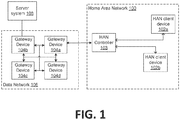
- FIG. 1 is a network diagram illustrating an example HAN 100 that can be communicatively coupled to a data network 106 via a gateway device 104a.
- the HAN 100 can include HAN client devices 102a, 102b and a HAN controller 103.
- the data network 106 can include multiple nodes in a mesh network, shown as gateway devices 104b-d. Each of the gateway devices 104b-d may be coupled to respective HANs (not shown).
- the HAN client devices 102a, 102b can include devices used to perform one or more applications related to managing, monitoring, or performing functions that consume power from a power distribution system associated with the HAN 100.
- Non-limiting examples of such client devices 102a, 102b include a programmable thermostat for managing power consumption, an in-home display device for displaying information related to power consumption and associated billing information for the power consumption, and the like.
- one or more of the HAN client devices 102a, 102b may be a device that consumes power to perform one or more mechanical functions or other functions in addition to analyzing, monitoring, displaying, or otherwise using data communicated via the HAN 100.
- Non-liming examples of such devices include devices that consume power to perform one or more mechanical functions in a dwelling or other structure serviced by the HAN 100, such as (but not limited to) a water heater, a pool pump, an air conditioner, etc.
- HAN client devices 102a, 102b and HAN controller 103 can wirelessly communicate with each other and with the gateway device 104a. As mentioned above, communication within the HAN 100 and with the gateway device 104a can occur via any suitable CSMA networking protocol.
- the HAN client devices 102a, 102b can be communicatively coupled to a HAN controller 103.
- the HAN controller 103 can include any suitable computing device configured to communicate data between the HAN 100 and the gateway device 104a separate from the HAN 100.
- the HAN controller 103 can include an application processor that can access or include a memory device that stores program code executable by the application processor.
- the application processor of the HAN controller 103 can communicate power consumption information between HAN client devices 102a, 102b and the gateway device 104.
- Multiple HAN controllers 103 can monitor respective structures that are units of a multi-dwelling unit and that include respective HANs 100.
- HAN 100 with HAN controller 103 communicatively coupled to HAN client devices 102a, 102b is shown for illustrative purposes, other aspects are also possible.
- HAN controller 103 is shown as included in the HAN 100 for illustrative purposes, the HAN controller 103 can also be separate from the HAN 100 in alternative aspects.
- alternative aspects may include a HAN 100 without the use of a HAN controller 103.
- HAN client devices 102a, 102b communicate directly with the gateway device 104a without the use of a HAN controller 103.
- HAN client devices 102a, 102b can include metering devices for monitoring power consumption information and communicate the respective power consumption information directly to the gateway device 104.
- gateway devices 104a-d can include metering information that monitor, collect, or otherwise manage power consumption information of HAN 100 and HAN client devices 102a, 102b.
- the gateway device 104a can communicate the information from the HAN controller 103 to a server system 108 via a data network 106, which may be implemented as an Advanced Metering Infrastructure (AMI) mesh network using a TSCH protocol.
- a non-limiting example of a server system 108 is a head-end system for a power distribution network that provides power to a dwelling, structure, or other geographical area serviced by the HAN 100.
- the gateway device 104a provides communication between the rest of the data network 106 and the HAN 100.
- the data network 106 can provide a communication channel between the gateway device 104 and the server system 108.
- a communication channel can include any suitable means capable of communicating signals between the HAN gateway device 104a and the server system 108.
- suitable communication media include (but are not limited to) Ethernet cable, wireless data communication, power cables for use in power line communication ("PLC"), etc.
- Power line communication can include communicating signals via cables used for providing electric power from a utility company to buildings in a geographic area.
- the data network 106 can be configured using any suitable network topology, such as (but not limited to) a mesh network (as mentioned above), a ring network, a star network, a bus network, etc.
- the data network 106 can include other nodes, shown as gateway devices 104b-d.
- the gateway device 104a can communicate with both the HAN 100 and the rest of the data network 106 via a single radio transceiver that implements more than one MAC interface.
- Figure 2 is a block diagram illustrating an example of a gateway device 104a with a single transceiver device 220 implementing two MAC interfaces via network interfaces 208, 210.
- the gateway device 104aa can include a processor 202.
- the processor 202 includes a microprocessor, an application-specific integrated circuit (ASIC), a state machine, a field programmable gate array (FPGA) or other suitable processing device.
- the processor 202 can include any number of processing devices, including one.
- the processor 202 can be communicatively coupled to non-transitory computer-readable media, such as memory device 204.
- the processor 202 can execute computer-executable program instructions and/or access information stored in the memory device 204.
- the memory device 204 can store instructions that, when executed by the processor 202, causes the processor 202 to perform operations described herein.
- the memory device 204 may be a computer-readable medium such as (but not limited to) an electronic, optical, magnetic, or other storage device capable of providing a processor with computer-readable instructions.
- Non-limiting examples of such optical, magnetic, or other storage devices include read-only (“ROM”) device(s), random-access memory (“RAM”) device(s), magnetic disk(s), magnetic tape(s) or other magnetic storage, memory chip(s), an ASIC, configured processor(s), optical storage device(s), or any other medium from which a computer processor can read instructions.
- the instructions may comprise processor-specific instructions generated by a compiler and/or an interpreter from code written in any suitable computer-programming language.
- suitable computer-programming languages include C, C++, C#, Visual Basic, Java, Python, Perl, JavaScript, ActionScript, and the like.
- the gateway device 104a can also include a bus 206.
- the bus 206 can communicatively couple one or more components of the gateway device 104a.
- the processor 202, the memory device 204, and the bus 206 are respectively depicted in Figure 2 as separate components in communication with one another, other implementations are possible.
- the processor 202 the memory device 204, and the bus 206 can be respective components of respective printed circuit boards or other suitable devices that can be disposed in gateway device 104a to store and execute programming code.
- the gateway device 104a can also include a transceiver device 220 communicatively coupled to the processor 202 and the memory device 204 via the bus 206.
- a transceiver device 220 include an RF transceiver and other transceivers for wirelessly transmitting and receiving signals.
- the HAN client devices 102a, 102b can also include transceiver devices for communication with the HAN controller 103 or the gateway device 104a.
- the transceiver device 220 is capable of implementing at least two MAC interfaces to communicate with the data network 106 and the HAN 100 via antennas 208, 210, respectively.
- a transceiver device 220 that can communicate with the data network 106 and the HAN 100 with a single antenna.
- the gateway device 104a can communicate with the data network 106 and the HAN 100 using a single transceiver device 220 via the same or differing network protocols.
- the gateway device 104a can communicate with a HAN 100 configured to use a CSMA protocol (e.g., ZigBee IEEE 802.15.4) via antenna 210 while the gateway device 104a can communicate with the data network 106 using the TSCH protocol (e.g., network protocol governed by IEEE 802.15.4e) via antenna 208.
- CSMA protocol e.g., ZigBee IEEE 802.15.4
- TSCH protocol e.g., network protocol governed by IEEE 802.15.4e
- the gateway device 104a may communicate with both the data network 106 and the HAN 100 even if the data network 106 and the HAN 100 use different frequencies.
- gateway device 104a may be configured to send and receive signals with the rest of the data network 106 at 920 Mhz while the gateway device 104a may be configured to send and receive signals with the HAN 100 at a frequency of 900 Mhz.
- the gateway device 104a is capable of implementing two MAC protocols using a single transceiver device 220 (e.g., a single radio).
- Figure 3 depicts an example protocol stack 300 for a single radio transceiver device 220 that can implement two different MAC protocols.
- the protocol stack 300 includes, at the bottom layer, the physical interface (PHY) 310.
- the PHY 310 can define the specifications of the physical transmission medium, such as the transceiver device 220.
- the next layer of the protocol stack 300 for the gateway device 104a includes at least two MAC layers 320a, 320b.
- MAC layer 320a for example, defines the addressing and channel access protocols for a TSCH network, allowing the transceiver device 220 to communicate with the data network 106.
- MAC layer 320b can define the addressing and channel access protocols for a CSMA network, allowing the transceiver device 220 to communicate with the HAN 100.
- the traffic for both MAC layer 320a and MAC layer 320 can be routed through a single IP layer 330.
- data from both a data network 106 and a HAN 100 can be included on TSCH timeslots used by the data network 106.
- the data for the data network 106 and CSMI data for the HAN 100 can be communicated via transport layer such as UDP 340.
- the data network 106 may be an AMI mesh network, which may follow a TSCH communication protocol to communicate wireless information within the network and outside the network.
- TSCH protocol devices within the network are synchronized on a current TSCH timeslot.
- the gateway device 104a can switch listening periods between the data network 106 and the HAN 100 during TSCH timeslots, resulting in interleaved communication with the data network 106 and the HAN 100.
- the gateway device 104a can support both the data network 106 (operating a TSCH protocol) and the HAN 100 (which may or may not operate using the TSCH protocol) via a single transceiver device 220.
- Each timeslot in the TSCH protocol is of a time duration of duration "T" which can be defined in milliseconds or other appropriate time unit.
- the TSCH protocol also uses a multiple channel frequencies for communication between devices in the network.
- a hopping pattern defines the channel used to communicate during each timeslot.
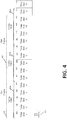
- Figure 4 is a diagram illustrating timeslots and channel hopping pattern for the TSCH protocol. Figure 4 illustrates timeslots 411-415, 421-425, and 431-436, each with the same timeslot duration 430. Each slot frame 410 and 420 includes seven timeslots. Figure 4 also illustrates the hopping pattern 440 (shown as hopping patterns 440a-c).
- a hopping pattern defines a channel frequency or channel for each timeslot in the hopping pattern.
- the hopping pattern 440a may be channel 4, channel 6, channel 3, channel 5, channel 7, i.e., it may associate channel 4 with timeslot 1, channel 6 with timeslot 2, channel 3 with timeslot 3, channel 5 with timeslot 4, and channel 7 with timeslot 5.
- the hopping pattern 440a has a hopping pattern length of 5.
- the hopping pattern repeats.
- the first illustrated iteration of the hopping pattern 440a contains timeslots 1-5 (411-415)
- the second iteration of the hopping pattern 440b contains timeslots 6-10 (416-420)
- the third iteration of the hopping pattern 440c contains timeslots 11-15 (421-425).
- the number of timeslots in a hopping pattern is independent of the number of timeslots in a slot frame.
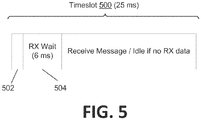
- FIG. 5 illustrates a typical TSCH timeslot structure for timeslot 500.
- the time periods shown are exemplary and other values may be used in other implementations (e.g., timeslot 500 is shown with a duration of 25 milliseconds, but other periods of a timeslot are also possible).
- a node in the data network 106 listens on a channel determined by the TSCH hopping pattern during a first portion of the timeslot for the node's primary network. As shown in Figure 5 , after an RF settle period 502, the node can listen for receive signals on a channel for a first period of time (shown as RX wait time 504). Typically, the duration of the RX wait time 504 is dependent on an expected transmit time duration.
- the transmit time duration is defined by the IEEE 802.15.4-e TSCH specification. If the node receives a message prior to the expiration of the RX wait time 504, then the node can proceed to receive the rest of the message and process the received message. However, if the node does not receive a message prior to the expiration of the RX wait time 504, then the node may determine that it will not receive a communication from another node on the primary network during the present timeslot. In a typical timeslot structure the remainder of the timeslot 500 may be idle / unused.
- the gateway device 104a can interleave data from two or more network protocols by receiving the data from a secondary network (e.g., the HAN 100) during the unused time periods of a TSCH timeslot used with the primary network.
- Figure 6 and 7 illustrate two aspects of a TSCH timeslot where a gateway device receives information from a secondary network in the unused portions of the timeslot.
- Figure 6 shows a timeslot 600 with an RF settle period 602 and an RX wait period 604, and a receive period 606. Similar to the timeslot 500 shown in Figure 5 , during the RX wait period 604, the gateway device 104a can listen for communication on a channel determined by the hopping pattern for the node's primary network (e.g., the data network 106).
- the gateway device 104a can continue to receive the primary network message during the receive period 606 (e.g., for the duration of the timeslot 600). If the gateway device 104a does not receive a message from the data network 106 prior to the expiration of the RX wait period 604, then the gateway device 104a may begin to listen for a communication from a node in the secondary network (e.g., the HAN 100) using the same channel or may move to a different channel. If communication from the secondary network is received, the gateway device 104a can receive the message from the secondary network during the receive period 606 (e.g., for the remaining duration of the timeslot 600).
- the secondary network e.g., the HAN 100
- FIG 7 depicts a similar, but alternate aspect for a TSCH timeslot 700 where a gateway device receives information from a secondary network during the unused periods of the timeslot 700.
- Timeslot 700 can include a first RX settle period 702, and RX wait period 704, a second RF settle period 706, and a receive period 708.
- the timeslot shown in Figure 7 can function similar to the timeslot shown in Figure 6 - allowing the gateway device 104a to receive communications from the primary network if the gateway device 104a detected a message during the RX wait period 704 or to receive communications from the secondary network if the gateway device 104a did not detect a message during the RX wait period 704.
- the second RF settle period 706 can provide better accuracy in message detection by providing a buffer between the RX wait period 704 and receive period 708.
- the second RF settle period 706 may provide better accuracy if the HAN 100 and the data network 106 operate on different frequencies.
- any node in a data network 106 can incorporate a dual MAC transceiver device 220 as shown in Figure 2 , allowing the node to include data from a secondary network in unused time periods in timeslots of a primary network.
- FIG 8 is a flowchart illustrating an example method 800 for communicating data from a HAN 100 within unused portions of TSCH timeslots used for communication with a data network 106.
- the method 800 is described with reference to the system implementations depicted in Figures 1-2 and with regards to the TSCH timeslot illustrations shown in Figures 6-7 . Other implementations, however, are possible.
- the method 800 involves determining, during a first portion of a timeslot of a TSCH protocol, whether a node received a portion of a first data network message that requires processing by the node from a data network communicating using the TSCH protocol, as shown in block 810.
- the node can include the gateway device 104a, and the processor 202 can execute instructions in the memory device 204 to analyze data being received from the data network 106.
- the data network 106 can include an AMI mesh network (e.g., gateway devices 104a-d) that routes communication between the server system 108 and the gateway device 104a.
- the first portion of the timeslot includes the RX wait periods 604, 704 in timeslots 600, 700, respectively.
- the processor 202 can determine whether a message from the data network 106 that requires processing by the gateway device 104a was received by analyzing the packet header information carried by wireless signals received at the antenna 208. For example, the processor 202 can analyze header information in the UDP layer 340 to determine if received signals are broadcast from the data network 106 or addressed to the gateway device 104a. In some aspects, the node may not receive messages that it needs to process during the first portion of the timeslot.
- the node may determine, during a second portion of the timeslot, whether the node received a portion of a first home area network message that requires processing by the node from a home area network communicating using a secondary protocol, as shown in block 820.
- the processor 202 in the gateway device 104a may switch from listening for communications on a first MAC protocol to listening for communication from a second MAC protocol.
- the processor 202 can execute instructions in the memory device 204 to instruct the transceiver device 220 to listen for communication from the HAN 100 and to analyze data being received from the HAN 100 during the receive periods 606, 708 in timeslots 600, 700, respectively.
- the HAN 100 can be configured for communicating information regarding resources (e.g., resources in a power distribution system) consumed at a geographical area serviced by the HAN 100.
- the secondary network protocol (e.g., the protocol being used for communication within the HAN 100) may be the same as or different from the TSCH network protocol being used by the data network 106.
- the secondary network protocol may include another TSCH protocol.
- the secondary network protocol can also include a CSMA protocol, such as 802.15.4 Zigbee. Other protocols are also possible.
- the secondary network protocol, and correspondingly the HAN 100 can operate using the same or different frequencies than the data network 106.
- the data network 106 operates on a 920 MHz frequency band while the HAN 100 operates on a 900 Mhz band.
- the gateway device 104a can maintain synchronization of the clocks of the two different network protocols, even if the network protocols operate on differing frequencies.
- the processor 202 can calculate the accuracy of a clock signal received from the data network 106 and the accuracy of a second clock signal received from the HAN 100 and compare the timing of the two clock signals. If the timing of the two clock signals indicates that the clocks are drifting, the processor 202 can configure the transceiver device 220 to compensate for the un-synchronized clocks.
- the node may determine that the node received a portion of a HAN message on the protocol used by the HAN. For example, the node may determine, by analyzing packet header information in incoming signals, that the received packet originated from the HAN 100. In response to determining that the node received the portion of the HAN message, the node can proceed to receive the remainder of the HAN message, as shown in block 830. For example, the gateway device 104a, upon determining that the node received a portion of a message from the HAN 100, can continue to receive and process the message during the receive periods 606, 708 in timeslots 600, 700 respectively.
- the node can continue receiving a message from the secondary network (e.g., from the network used by the HAN 100) until the message is complete or one or more trigger conditions occur. In response to one or more trigger conditions, the node can then switch back to listening for communication from the data network to determine whether the node received a data network message, as shown in block 840. For example, in response to a trigger condition, the processor 202 can instruct the transceiver device 220 to listen for communication from the data network 106.
- the secondary network e.g., from the network used by the HAN 100
- Trigger conditions can include any condition that causes the gateway device 104a to switch MAC protocols and listen for communication from the data network 106.
- the trigger condition can include the beginning of a new timeslot or the start of an RX period of a new timeslot.
- the gateway device 104a can completely receive the message from the HAN 100 during the portion of a TSCH timeslot or at the conclusion of a TSCH timeslot.
- timeslots 600, 700 follow a repeating pattern in a TSCH network, the beginning of a subsequent timeslot will contain RX receive periods 604/704, during which the gateway device 104a can return to listening for communication from the data network 106.
- Another trigger condition can include the start of a guaranteed timeslot. Communication from the primary network used by the data network 106 can take priority over communication from the secondary network used by the HAN 100. Priority communications within the data network 106 can be provided during guaranteed timeslots.
- a guaranteed timeslot may be a predefined TSCH timeslot during which nodes of the data network 106 can communicate control and maintenance information.
- a guaranteed timeslot may be defined as a particular timeslot within a slot frame, a timeslot, or any other defined series of timeslots.
- the gateway device 104a may interrupt the ongoing transmission of the message from the HAN 100, allowing the gateway device 104a to listen for communication from the data network 106 during the guaranteed timeslot.
- the gateway device 104a can listen for a beacon transmitted by a node in the data network 106.
- a beacon can include a message that is transmitted throughout the nodes of the data network 106 (e.g., throughout gateway devices 104a-d) that the nodes use for synchronization.
- Figures 9 and 10 depict example timing diagrams of sequences of TSCH timeslots 600 and example scenarios for trigger conditions that result in the gateway device 104a switching from receiving communication from a HAN 100 to listening for communication from the data network 106.
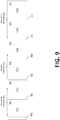
- Figure 9 depicts switching from receiving a message on a secondary network back to listening for communication on a primary network based on the start of a new timeslot or an RX period of a new timeslot.
- the trigger condition can include receiving a complete message from the primary network and starting a new timeslot.
- Figure 9 includes a sequence of TSCH timeslots 902, 904, 906, 908, 910, and 912.
- Each timeslot includes an RX wait period 903, 905, 907, 909, 911, 913, respectively, as the period during which the gateway device 104a listens for communication from the data network 106.
- the data network receives no messages from the data network 106 that the gateway device 104a is required to process during the RX wait period 903 (the first portion of time for the first timeslot 903).
- the gateway device 104a switches to listening for communication from the HAN 100 during the second portion of the first timeslot 902.
- the gateway device 104a receives a message from the secondary network (shown as secondary message 920).
- the gateway device 104a finishes receiving the message at a time during the second timeslot 904. Given that transmission of the secondary message 920 from the HAN 100 is complete, the gateway device 904 remains idle until the start of the third timeslot 906.
- the start of an RX period of the third timeslot 906, in this example, corresponds to the trigger condition indicating that the gateway device 104a switch to listening for a message from the primary network (e.g., the data network 106).
- the gateway device 104a may receive a message from the primary network (shown as primary message 922) during the RX wait period 907.
- the gateway device 104a receives the complete message during a portion of the fourth timeslot 908.
- the process repeats, resulting in the gateway device 104a listening for a message from the primary network.
- the gateway device 104a receives no message from the primary network during the RX wait period 911, and thus switches to listening for a secondary message from the secondary network (e.g., the HAN 100).
- the gateway device 104a may receive a second secondary message 924 during the fifth timeslot 910 and the duration of the sixth timeslot 912.
- the messages from the primary network and the secondary network can vary in length, as shown by secondary receive messages 920, 924 and the primary message 922.
- the gateway device 104a may continue receiving the message from the HAN 100 until the complete secondary message is received, as shown in Figure 9 .
- receipt of the message from the HAN 100 may be interrupted due to the start of a guaranteed timeslot.
- Figure 10 depicts a timing diagram where the gateway device 104a switches from receiving a message on a secondary network to listening for messages on a primary network based on the trigger condition of the start of a guaranteed timeslot.
- Figure 10 depicts a sequence of timeslots 1001, 1004, 1006, 1008, 1010, and 1112, each of which include RX wait periods 1003, 1005, 1007, 1009, 1011, and 1013, respectively.
- the third timeslot 1006 is a guaranteed timeslot.
- Figure 9 further illustrates that the gateway device 104a receives a primary message 1020 at the first RX wait period 1003 during the first timeslot 1002 (e.g., a message from the data network 106).
- the gateway device 104a completes receipt of the primary message 1020 near the end of the first timeslot 1002.
- the gateway device 104a does not receive any message from the data network 106.
- the gateway device 104a switches to listen for messages from the secondary network (e.g., the HAN 100).
- the gateway device 104a detects a secondary message 1022a from the HAN 100 during a portion of the second timeslot 1004.
- the gateway device 104a receives the secondary message 1022a from the secondary network.
- the secondary message 1022a may not be completely received.
- the third timeslot 1006 is a guaranteed timeslot.
- the start of the guaranteed timeslot causes the gateway device 104a to interrupt receipt of the secondary message 1022a to listen for communication from the primary network.
- the gateway device 104a may or may not receive a primary message 1024. If the gateway device 104a receives the primary message 1024, and if the gateway device 104a completes receipt of the primary message 1024, the process repeats at the fourth timeslot 1008.
- the gateway device 104a listens for additional communication from the primary network. In this example, no additional communication is received, resulting in the gateway device 104a switching to listen for messages from the secondary network.
- the gateway device 104a receives message 1022b during the second portion of the timeslot 1008.
- the message 1022b is received for a remaining duration of the timeslot 1008, through the timeslot 1010, and through a portion of the timeslot 1012. Since communication of the secondary message 1022a was interrupted due to the guaranteed timeslot, the secondary message 1022b may be a repeat communication of secondary message 1022a from the secondary network.
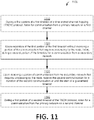
- FIG 11 is an alternate flowchart illustrating another aspect for a method 1100 for communicating data from a HAN 100 within unused portions of TSCH timeslots used for communication with a data network 106.
- the method 1100 is described with reference to the system implementations depicted in Figures 1-2 and with regards to the TSCH timeslot illustrations shown in Figures 6-7 . Other implementations, however, are possible.
- the method 1100 involves listening, during a first portion of a first timeslot of a TSCH protocol, for communication from a primary network on a first channel of the TSCH protocol, as shown in block 1110.
- a gateway device 104a can listen for communication from other nodes in the data network 106 during an RX wait period 604, 704.
- a communication from the primary network can include one or more messages from the data network 106 that the gateway device 104a is required to process.
- a gateway device 104a may be required to process communication broadcast from the data network 106 and communication addressed specifically to the gateway device 104a.
- the method 1100 further involves listening, upon expiration of the first timeslot without receiving a portion of the communication that requires processing by the node, for a communication from a secondary network during a second portion of the timeslot, as shown in block 1120.
- the secondary network may include the HAN 100 operating on a CSMA protocol.
- the gateway device 104a may switch to listening for communication from the HAN 100 during the receive period 606, 706.
- the node Upon receiving a portion of the communication from the secondary network that requires processing by the node, the node can receive the remainder of the second communication for a duration of the second communication or until the start of a guaranteed timeslot, as shown in block 1130.
- the gateway device 104a can continue receiving the secondary message 920 until the secondary message 920 is completely received.
- the receipt of the secondary message 1022a from HAN 100 can be interrupted at the start of a subsequent time slot, for example in the case of a guaranteed timeslot 1006.
- the node may switch to listening for a communication from the primary network on a second channel, as shown in block 1140.
- the gateway device 104a can return to listening for communications from the data network 106 during the next RX wait period. Because the gateway device 104a operates using a TSCH protocol, the frequencies of the first channel and the second channel may be different.
- the gateway device 104 may continue to listen for communication from the data network 106 that the gateway device 104 is required to process even after expiration of the first portion of the timeslot (e.g., after expiration of RX wait periods 604, 704).
- nodes (gateway device 104a-d) in the data network 106 may operate on battery power.
- the nodes in the data network 106 may be configured to communicate a series of messages within multiple TSCH timeslots.
- the series of timeslots during which nodes, which may be battery powered, communicate may be predefined during initial configuration of the data network 106.
- the duration of the series of timeslots may be referred to as a battery powered window.
- the gateway device 104a may listen for messages the gateway device 104a is required to process for multiple timeslots defining the battery powered window. Upon expiration of the battery powered window, the gateway device 104a may return to switching listening periods between the first network and the second network as discussed above with regards to Figures. 8-10 .
Landscapes
- Engineering & Computer Science (AREA)
- Automation & Control Theory (AREA)
- Computer Networks & Wireless Communication (AREA)
- Signal Processing (AREA)
- Multimedia (AREA)
- Computing Systems (AREA)
- Mobile Radio Communication Systems (AREA)
- Small-Scale Networks (AREA)
Description
- This disclosure relates generally to networking and more particularly relates to interleaved communication with a data network and a home area network.
- A home area network may be used to communicate information between devices that consume resources (e.g., electricity) in a home or other premises and devices that monitor and/or manage the consumption of resources. Utility companies and other resource providers may use home area networks to monitor consumption of the resources by consumers.
- A home area network may operate on a separate network from a data network used by the resource provider. A device that provides communication between a home area network and the data network typically requires multiple radio transceivers that process separate messages from the separate networks to send and receive information from both the home area network and the data network. Accordingly, systems and methods are desirable for interleaving communication with the home area networks and communication with the data network while using a single radio transceiver.
- Document
US20140044106 discloses a host device that communicates over a first wireless network and a peer-link wireless network using two different network protocols. It is determined, during a first portion of a timeslot, whether the host device received a portion of a first data network message that requires processing by the host device from a node on the first wireless network. - An apparatus and a method are disclosed for interleaving communications with a home area network (HAN) and communications with a data network. The data network can provide communications between the HAN and resource providers that manage the consumption of the HAN resources. An example system includes multiple client devices communicatively coupled to the HAN and a gateway device communicatively coupled to the client devices or to a HAN controller. The HAN is configured for communicating information regarding a resource consumed at a geographical area serviced by the home area network. The gateway device is also communicatively coupled to a resource provider server system via the data network. The data network can be an advanced metering infrastructure mesh network, including devices that communicate using a time slotted channel hopping (TSCH) protocol. In some aspects, the gateway device is a node that is part of the data network. The data network can be considered a primary network and the TSCH protocol can be considered a primary protocol. The HAN can be considered a secondary network. Devices within the HAN can communicate using a secondary protocol, which can include any carrier sense multiple access protocol.
- The gateway device is configured to receive interleaved communications of the data network and the HAN by switching receive periods between the data network and the HAN within a single TSCH timeslot. The communications are interleaved among a sequence of TSCH timeslots. During an RX wait period of a TSCH timeslot, the gateway device listens for communication from the data network and determines if it received, from the data network a portion of a message that requires processing by the gateway device. If the gateway device did not receive, from the data network, a portion of a message that requires processing by the gateway device during the RX wait period, then, during a second portion of the TSCH timeslot, the gateway device listens for communication from the HAN secondary network. The gateway device determines if it received, from the HAN secondary network, a portion of a message that requires processing by the gateway device. If the gateway device determines that it received, from the HAN secondary network, a portion of a message that requires processing by the gateway device, then the gateway device continues to receive the remaining message from the HAN. Messages from the HAN can vary in length and can span one or more TSCH timeslots. Certain trigger conditions can cause the gateway device to revert to listening for communication from the data network. In response to one or more trigger conditions, the gateway device can again determine if it received a message from the data network.
- An example of one trigger condition is the beginning of a new TSCH timeslot. For example, the gateway device may receive a complete message from the HAN, the receipt of the message completing during a portion of a TSCH timeslot. The start of the RX period of the subsequent timeslot can act as a trigger condition, causing the gateway device to listen for communication from the data network. Another example of a trigger condition is the start of a guaranteed timeslot. For example, the gateway device may be in the process of receiving a message from the HAN during the start of a guaranteed timeslot. The start of the guaranteed timeslot can act as a trigger condition, causing the gateway device to interrupt receipt of the message from the HAN to start listening for communication from the data network.
- The invention is carried out according to the appended independent claims. Optional features of the invention are carried out according to the dependent claims. However, technical descriptions of apparatus, products and/or methods in the description and/ or drawings which are not covered by the claims are presented not as embodiments of the invention but as background art or examples useful for understanding the invention.
- These and other features, aspects, and advantages of the present disclosure are better understood when the following Detailed Description is read with reference to the accompanying drawings, where:
-
Figure 1 is a network diagram illustrating example computing devices for implementing interleaved media access control features; -
Figure 2 is a diagram illustrating an example of a gateway device configured to implement interleaved media access control features; -
Figure 3 is a diagram of an example protocol stack for a single radio transceiver device that implements multiple media access control protocols; -
Figure 4 is a is a diagram illustrating the arrangements of timeslots in a time slotted channel hopping pattern; -
Figure 5 is a diagram illustrating an example of one of the timeslots shown inFigure 4 ; -
Figure 6 is a is a diagram illustrating an example of a timeslot in a time slotted channel hopping network that is capable of interleaved media access control features; -
Figure 7 is an alternate diagram illustrating an example of a timeslot in a time slotted channel hopping network that is capable of interleaved media access control features; -
Figure 8 is a flowchart depicting a process for implementing interleaved media access control features; -
Figure 9 is a diagram illustrating an example of a sequence of timeslots and interleaved media access control features being implemented in the timeslots; and -
Figure 10 is a diagram illustrating an alternate example of a sequence of timeslots and interleaved media access control features being implemented in the timeslots. -
Figure 11 is a flowchart depicting an alternate process for implementing interleaved media access control features. - An
apparatus according claim 1 and amethod according claim 11 are provided for interleaved communication between a data network and a home area network (HAN). The data network can provide communication between the HAN and resource providers that monitor consumption of resources within the HAN, as well as between other devices on the data network. Interleaved communication can be achieved by a dual media access control (MAC) gateway device with a single radio transceiver. The gateway device can communicate with both the data network and the HAN. The data network can be referred to as a primary network and the HAN can be referred to as a secondary network. According to aspects herein, nodes in the data network can communicate using a time synchronized channel hopping (TSCH) protocol, defined by IEEE 802.15.4(e). The TSCH protocol uses a series of timeslots and multiple channel frequencies for communication between devices, including the gateway device, on the data network. In the TSCH protocol, there may be instances when there is unused time within a timeslot. For example, if a node in the data network listening for communication does not receive a communication within a predefined period of time, the node may determine that no communication will be received during that timeslot, leaving the expiration of the predefined period of time and the beginning of the next timeslot unused. Communication with both the HAN network and the data network can occur by switching receive periods in a sequence of TSCH timeslots, listening for communication from the HAN during unused portions of TSCH timeslots. Communication from the data network can include the receipt of one or more messages from the data network that the node is required to process. Similarly, communication from the HAN can include the receipt of one or more messages from the HAN that the node is required to process. Interleaving communication with the HAN during unused periods of TSCH timeslots can allow communication with the HAN network and the data network using a single radio transceiver. - In an exemplary system, a gateway device is provided for coupling a HAN to a data network. For example, a HAN can communicatively link multiple devices associated with a power distribution system in a dwelling, a structure, or other suitable geographical area. As used herein, the term "power distribution system" is used to refer to a group of devices, systems, and/or other suitable infrastructure for transferring power from a power provider, to one or more end users or geographical locations, such as a dwelling, structure, or other geographical area. A HAN can include a smaller number of network devices (e.g., personal computers, mobile computing devices, etc.) than larger data networks such as a local area network or a wide area network. In some aspects, a HAN can include low-power network devices that can wirelessly communicate with other devices in the HAN. A HAN can be implemented using any suitable networking protocol. For example, a HAN can be implemented using any carrier sense multiple access (CSMA) networking protocol. Non-limiting examples of suitable networking protocols for implementing a HAN include ZigBee, Bluetooth, Wi-Fi, and the like. Non-limiting examples of a HAN include a HomePlug network implemented via power line communications, a Multimedia over Coax Alliance ("MoCA") network providing network connectivity between appliances and networking devices implemented via coaxial cable, a HomePNA Alliance network, etc. In some aspects, a HAN can be implemented using a TSCH networking protocol. The network used within the HAN can be referred to as the secondary network.
- The gateway device can be installed in or near the dwellings or structures serviced by the HAN and can communicate with the HAN using the HAN networking protocol. The gateway device can also communicate with a data network that may be operating a TSCH networking protocol. The gateway device may include a single wireless transceiver device that implements dual MAC interfaces. One of the MAC interfaces is configured for communicating with the HAN and the other MAC interface is configured for communicating with the data network. A processor within the gateway device can receive communication data from the HAN during the unused timeslots of the data network. For example, at the beginning of a TSCH timeslot, the gateway device may listen for communication from the data network. If the gateway device does not detect an incoming message during a first portion of a TSCH timeslot, the gateway device may listen for messages from the HAN during a second portion of the TSCH timeslot.
- As used herein, the term "head-end system" is used to refer to a device or group of devices used to provide one or more management functions for a data network or other system including multiple interconnected devices. For example, a head-end system for a power distribution system using intelligent metering may provide communication and/or data collection layers between the smart meter infrastructure of the power distribution system and one or more higher-level data processing systems of the power distribution system.
- The gateway device thus provides for communication between the HAN and the data network. In some aspects, the gateway device can be a node that is part of the data network. Metering devices can report, to the server system, amounts of power consumed by client devices within the HAN via the data network. By switching listen periods for communications with the data network and communications with the home area network during a sequence of TSCH timeslots, the gateway device can effectively communicate between two separate networks using a single radio transceiver.
- These illustrative examples are given to introduce the reader to the general subject matter discussed here and are not intended to limit the scope of the disclosed concepts. The following sections describe various additional aspects and examples with reference to the drawings in which like numerals indicate like elements.
- The features discussed herein are not limited to any particular hardware architecture or configuration. A computing device can include any suitable arrangement of components that provide a result conditioned on one or more inputs. Suitable computing devices include multipurpose microprocessor-based computer systems accessing stored software that programs or configures the computing system from a general-purpose computing apparatus to a specialized computing apparatus implementing one or more aspects of the present subject matter. Any suitable programming, scripting, or other type of language or combinations of languages may be used to implement the teachings contained herein in software to be used in programming or configuring a computing device.
- Referring now to the drawings,
Figure 1 is a network diagram illustrating anexample HAN 100 that can be communicatively coupled to adata network 106 via agateway device 104a. TheHAN 100 can includeHAN client devices HAN controller 103. Along withgateway device 104a, thedata network 106 can include multiple nodes in a mesh network, shown asgateway devices 104b-d. Each of thegateway devices 104b-d may be coupled to respective HANs (not shown). - The
HAN client devices HAN 100. Non-limiting examples ofsuch client devices HAN client devices HAN 100. Non-liming examples of such devices include devices that consume power to perform one or more mechanical functions in a dwelling or other structure serviced by theHAN 100, such as (but not limited to) a water heater, a pool pump, an air conditioner, etc.HAN client devices HAN controller 103 can wirelessly communicate with each other and with thegateway device 104a. As mentioned above, communication within theHAN 100 and with thegateway device 104a can occur via any suitable CSMA networking protocol. -
HAN client devices HAN controller 103. TheHAN controller 103 can include any suitable computing device configured to communicate data between theHAN 100 and thegateway device 104a separate from theHAN 100. TheHAN controller 103 can include an application processor that can access or include a memory device that stores program code executable by the application processor. The application processor of theHAN controller 103 can communicate power consumption information betweenHAN client devices gateway device 104.Multiple HAN controllers 103 can monitor respective structures that are units of a multi-dwelling unit and that includerespective HANs 100. WhileHAN 100 withHAN controller 103 communicatively coupled toHAN client devices HAN controller 103 is shown as included in theHAN 100 for illustrative purposes, theHAN controller 103 can also be separate from theHAN 100 in alternative aspects. Further, alternative aspects may include aHAN 100 without the use of aHAN controller 103. In this aspect,HAN client devices gateway device 104a without the use of aHAN controller 103.HAN client devices gateway device 104. In some aspects,gateway devices 104a-d can include metering information that monitor, collect, or otherwise manage power consumption information ofHAN 100 andHAN client devices - The
gateway device 104a can communicate the information from theHAN controller 103 to aserver system 108 via adata network 106, which may be implemented as an Advanced Metering Infrastructure (AMI) mesh network using a TSCH protocol. A non-limiting example of aserver system 108 is a head-end system for a power distribution network that provides power to a dwelling, structure, or other geographical area serviced by theHAN 100. Thegateway device 104a provides communication between the rest of thedata network 106 and theHAN 100. Thedata network 106 can provide a communication channel between thegateway device 104 and theserver system 108. A communication channel can include any suitable means capable of communicating signals between theHAN gateway device 104a and theserver system 108. Examples of suitable communication media include (but are not limited to) Ethernet cable, wireless data communication, power cables for use in power line communication ("PLC"), etc. Power line communication can include communicating signals via cables used for providing electric power from a utility company to buildings in a geographic area. Thedata network 106 can be configured using any suitable network topology, such as (but not limited to) a mesh network (as mentioned above), a ring network, a star network, a bus network, etc. Thedata network 106 can include other nodes, shown asgateway devices 104b-d. - In aspects disclosed herein, the
gateway device 104a can communicate with both theHAN 100 and the rest of thedata network 106 via a single radio transceiver that implements more than one MAC interface.Figure 2 is a block diagram illustrating an example of agateway device 104a with asingle transceiver device 220 implementing two MAC interfaces via network interfaces 208, 210. - The gateway device 104aa can include a
processor 202. Non-limiting examples of theprocessor 202 includes a microprocessor, an application-specific integrated circuit (ASIC), a state machine, a field programmable gate array (FPGA) or other suitable processing device. Theprocessor 202 can include any number of processing devices, including one. Theprocessor 202 can be communicatively coupled to non-transitory computer-readable media, such asmemory device 204. Theprocessor 202 can execute computer-executable program instructions and/or access information stored in thememory device 204. - The
memory device 204 can store instructions that, when executed by theprocessor 202, causes theprocessor 202 to perform operations described herein. Thememory device 204 may be a computer-readable medium such as (but not limited to) an electronic, optical, magnetic, or other storage device capable of providing a processor with computer-readable instructions. Non-limiting examples of such optical, magnetic, or other storage devices include read-only ("ROM") device(s), random-access memory ("RAM") device(s), magnetic disk(s), magnetic tape(s) or other magnetic storage, memory chip(s), an ASIC, configured processor(s), optical storage device(s), or any other medium from which a computer processor can read instructions. The instructions may comprise processor-specific instructions generated by a compiler and/or an interpreter from code written in any suitable computer-programming language. Non-limiting examples of suitable computer-programming languages include C, C++, C#, Visual Basic, Java, Python, Perl, JavaScript, ActionScript, and the like. - The
gateway device 104a can also include a bus 206. The bus 206 can communicatively couple one or more components of thegateway device 104a. Although theprocessor 202, thememory device 204, and the bus 206 are respectively depicted inFigure 2 as separate components in communication with one another, other implementations are possible. For example, theprocessor 202 thememory device 204, and the bus 206 can be respective components of respective printed circuit boards or other suitable devices that can be disposed ingateway device 104a to store and execute programming code. - The
gateway device 104a can also include atransceiver device 220 communicatively coupled to theprocessor 202 and thememory device 204 via the bus 206. Non-limiting examples of atransceiver device 220 include an RF transceiver and other transceivers for wirelessly transmitting and receiving signals. TheHAN client devices HAN controller 103 or thegateway device 104a. Thetransceiver device 220 is capable of implementing at least two MAC interfaces to communicate with thedata network 106 and theHAN 100 viaantennas multiple antennas transceiver device 220 that can communicate with thedata network 106 and theHAN 100 with a single antenna. Thegateway device 104a can communicate with thedata network 106 and theHAN 100 using asingle transceiver device 220 via the same or differing network protocols. For example, thegateway device 104a can communicate with aHAN 100 configured to use a CSMA protocol (e.g., ZigBee IEEE 802.15.4) viaantenna 210 while thegateway device 104a can communicate with thedata network 106 using the TSCH protocol (e.g., network protocol governed by IEEE 802.15.4e) viaantenna 208. In some aspects, thegateway device 104a may communicate with both thedata network 106 and theHAN 100 even if thedata network 106 and theHAN 100 use different frequencies. For example,gateway device 104a may be configured to send and receive signals with the rest of thedata network 106 at 920 Mhz while thegateway device 104a may be configured to send and receive signals with theHAN 100 at a frequency of 900 Mhz. - As discussed above, the
gateway device 104a is capable of implementing two MAC protocols using a single transceiver device 220 (e.g., a single radio).Figure 3 depicts anexample protocol stack 300 for a singleradio transceiver device 220 that can implement two different MAC protocols. Theprotocol stack 300 includes, at the bottom layer, the physical interface (PHY) 310. ThePHY 310 can define the specifications of the physical transmission medium, such as thetransceiver device 220. The next layer of theprotocol stack 300 for thegateway device 104a includes at least twoMAC layers MAC layer 320a, for example, defines the addressing and channel access protocols for a TSCH network, allowing thetransceiver device 220 to communicate with thedata network 106. Similarly,MAC layer 320b can define the addressing and channel access protocols for a CSMA network, allowing thetransceiver device 220 to communicate with theHAN 100. The traffic for bothMAC layer 320a and MAC layer 320 can be routed through asingle IP layer 330. For example, data from both adata network 106 and aHAN 100 can be included on TSCH timeslots used by thedata network 106. The data for thedata network 106 and CSMI data for theHAN 100 can be communicated via transport layer such asUDP 340. - As mentioned above, the
data network 106 may be an AMI mesh network, which may follow a TSCH communication protocol to communicate wireless information within the network and outside the network. In the TSCH protocol, devices within the network are synchronized on a current TSCH timeslot. To communicate with theHAN 100 and thedata network 106 using asingle transceiver 220, thegateway device 104a can switch listening periods between thedata network 106 and theHAN 100 during TSCH timeslots, resulting in interleaved communication with thedata network 106 and theHAN 100. Thus, thegateway device 104a can support both the data network 106 (operating a TSCH protocol) and the HAN 100 (which may or may not operate using the TSCH protocol) via asingle transceiver device 220. - Each timeslot in the TSCH protocol is of a time duration of duration "T" which can be defined in milliseconds or other appropriate time unit. The TSCH protocol also uses a multiple channel frequencies for communication between devices in the network. A hopping pattern defines the channel used to communicate during each timeslot.
Figure 4 is a diagram illustrating timeslots and channel hopping pattern for the TSCH protocol.Figure 4 illustrates timeslots 411-415, 421-425, and 431-436, each with thesame timeslot duration 430. Eachslot frame Figure 4 also illustrates the hopping pattern 440 (shown as hoppingpatterns 440a-c). A hopping pattern defines a channel frequency or channel for each timeslot in the hopping pattern. For example, the hoppingpattern 440a may bechannel 4,channel 6,channel 3,channel 5,channel 7, i.e., it may associatechannel 4 withtimeslot 1,channel 6 withtimeslot 2,channel 3 withtimeslot 3,channel 5 withtimeslot 4, andchannel 7 withtimeslot 5. InFigure 4 thehopping pattern 440a has a hopping pattern length of 5. The hopping pattern repeats. The first illustrated iteration of thehopping pattern 440a contains timeslots 1-5 (411-415), the second iteration of the hoppingpattern 440b contains timeslots 6-10 (416-420), and the third iteration of the hoppingpattern 440c contains timeslots 11-15 (421-425). The number of timeslots in a hopping pattern is independent of the number of timeslots in a slot frame. -
Figure 5 illustrates a typical TSCH timeslot structure fortimeslot 500. In this example, the time periods shown are exemplary and other values may be used in other implementations (e.g.,timeslot 500 is shown with a duration of 25 milliseconds, but other periods of a timeslot are also possible). In a TSCH timeslot structure, a node in thedata network 106 listens on a channel determined by the TSCH hopping pattern during a first portion of the timeslot for the node's primary network. As shown inFigure 5 , after anRF settle period 502, the node can listen for receive signals on a channel for a first period of time (shown as RX wait time 504). Typically, the duration of theRX wait time 504 is dependent on an expected transmit time duration. The transmit time duration is defined by the IEEE 802.15.4-e TSCH specification. If the node receives a message prior to the expiration of theRX wait time 504, then the node can proceed to receive the rest of the message and process the received message. However, if the node does not receive a message prior to the expiration of theRX wait time 504, then the node may determine that it will not receive a communication from another node on the primary network during the present timeslot. In a typical timeslot structure the remainder of thetimeslot 500 may be idle / unused. - In certain aspects, the
gateway device 104a can interleave data from two or more network protocols by receiving the data from a secondary network (e.g., the HAN 100) during the unused time periods of a TSCH timeslot used with the primary network.Figure 6 and 7 illustrate two aspects of a TSCH timeslot where a gateway device receives information from a secondary network in the unused portions of the timeslot.Figure 6 shows atimeslot 600 with anRF settle period 602 and anRX wait period 604, and a receiveperiod 606. Similar to thetimeslot 500 shown inFigure 5 , during the RX waitperiod 604, thegateway device 104a can listen for communication on a channel determined by the hopping pattern for the node's primary network (e.g., the data network 106). If the gateway device receives the beginning of a message from a node on the primary network during the RX waitperiod 604, thegateway device 104a can continue to receive the primary network message during the receive period 606 (e.g., for the duration of the timeslot 600). If thegateway device 104a does not receive a message from thedata network 106 prior to the expiration of the RX waitperiod 604, then thegateway device 104a may begin to listen for a communication from a node in the secondary network (e.g., the HAN 100) using the same channel or may move to a different channel. If communication from the secondary network is received, thegateway device 104a can receive the message from the secondary network during the receive period 606 (e.g., for the remaining duration of the timeslot 600). -
Figure 7 depicts a similar, but alternate aspect for aTSCH timeslot 700 where a gateway device receives information from a secondary network during the unused periods of thetimeslot 700.Timeslot 700 can include a firstRX settle period 702, and RX waitperiod 704, a second RF settleperiod 706, and a receiveperiod 708. The timeslot shown inFigure 7 can function similar to the timeslot shown inFigure 6 - allowing thegateway device 104a to receive communications from the primary network if thegateway device 104a detected a message during the RX waitperiod 704 or to receive communications from the secondary network if thegateway device 104a did not detect a message during the RX waitperiod 704. The second RF settleperiod 706 can provide better accuracy in message detection by providing a buffer between the RX waitperiod 704 and receiveperiod 708. For example, the second RF settleperiod 706 may provide better accuracy if theHAN 100 and thedata network 106 operate on different frequencies. - While
Figures 6 and 7 are discussed above with reference to thedata network 106,gateway device 104a, andHAN 100, the dual MAC timeslot structure shown inFigures 6 and 7 can be used in any node in a TSCH network configured to also carry data from a secondary network. For example, any node in adata network 106 can incorporate a dualMAC transceiver device 220 as shown inFigure 2 , allowing the node to include data from a secondary network in unused time periods in timeslots of a primary network. -
Figure 8 is a flowchart illustrating anexample method 800 for communicating data from aHAN 100 within unused portions of TSCH timeslots used for communication with adata network 106. For illustrative purposes, themethod 800 is described with reference to the system implementations depicted inFigures 1-2 and with regards to the TSCH timeslot illustrations shown inFigures 6-7 . Other implementations, however, are possible. - The
method 800 involves determining, during a first portion of a timeslot of a TSCH protocol, whether a node received a portion of a first data network message that requires processing by the node from a data network communicating using the TSCH protocol, as shown inblock 810. In some aspects, the node can include thegateway device 104a, and theprocessor 202 can execute instructions in thememory device 204 to analyze data being received from thedata network 106. Thedata network 106 can include an AMI mesh network (e.g.,gateway devices 104a-d) that routes communication between theserver system 108 and thegateway device 104a. The first portion of the timeslot includes the RX waitperiods timeslots processor 202 can determine whether a message from thedata network 106 that requires processing by thegateway device 104a was received by analyzing the packet header information carried by wireless signals received at theantenna 208. For example, theprocessor 202 can analyze header information in theUDP layer 340 to determine if received signals are broadcast from thedata network 106 or addressed to thegateway device 104a. In some aspects, the node may not receive messages that it needs to process during the first portion of the timeslot. In response to determining that the portion of the data network message was not received, the node may determine, during a second portion of the timeslot, whether the node received a portion of a first home area network message that requires processing by the node from a home area network communicating using a secondary protocol, as shown inblock 820. For example, in response to not receiving any messages from thedata network 106, theprocessor 202 in thegateway device 104a may switch from listening for communications on a first MAC protocol to listening for communication from a second MAC protocol. Theprocessor 202 can execute instructions in thememory device 204 to instruct thetransceiver device 220 to listen for communication from theHAN 100 and to analyze data being received from theHAN 100 during the receiveperiods timeslots HAN 100 can be configured for communicating information regarding resources (e.g., resources in a power distribution system) consumed at a geographical area serviced by theHAN 100. - The secondary network protocol (e.g., the protocol being used for communication within the HAN 100) may be the same as or different from the TSCH network protocol being used by the
data network 106. For example, the secondary network protocol may include another TSCH protocol. The secondary network protocol can also include a CSMA protocol, such as 802.15.4 Zigbee. Other protocols are also possible. Additionally, the secondary network protocol, and correspondingly theHAN 100, can operate using the same or different frequencies than thedata network 106. In one example, thedata network 106 operates on a 920 MHz frequency band while theHAN 100 operates on a 900 Mhz band. - In some aspects, the
gateway device 104a can maintain synchronization of the clocks of the two different network protocols, even if the network protocols operate on differing frequencies. For example, theprocessor 202 can calculate the accuracy of a clock signal received from thedata network 106 and the accuracy of a second clock signal received from theHAN 100 and compare the timing of the two clock signals. If the timing of the two clock signals indicates that the clocks are drifting, theprocessor 202 can configure thetransceiver device 220 to compensate for the un-synchronized clocks. - In some aspects, the node may determine that the node received a portion of a HAN message on the protocol used by the HAN. For example, the node may determine, by analyzing packet header information in incoming signals, that the received packet originated from the
HAN 100. In response to determining that the node received the portion of the HAN message, the node can proceed to receive the remainder of the HAN message, as shown inblock 830. For example, thegateway device 104a, upon determining that the node received a portion of a message from theHAN 100, can continue to receive and process the message during the receiveperiods timeslots - The node can continue receiving a message from the secondary network (e.g., from the network used by the HAN 100) until the message is complete or one or more trigger conditions occur. In response to one or more trigger conditions, the node can then switch back to listening for communication from the data network to determine whether the node received a data network message, as shown in
block 840. For example, in response to a trigger condition, theprocessor 202 can instruct thetransceiver device 220 to listen for communication from thedata network 106. - Trigger conditions can include any condition that causes the
gateway device 104a to switch MAC protocols and listen for communication from thedata network 106. For example, the trigger condition can include the beginning of a new timeslot or the start of an RX period of a new timeslot. Thegateway device 104a can completely receive the message from theHAN 100 during the portion of a TSCH timeslot or at the conclusion of a TSCH timeslot. Astimeslots periods 604/704, during which thegateway device 104a can return to listening for communication from thedata network 106. - Another trigger condition can include the start of a guaranteed timeslot. Communication from the primary network used by the
data network 106 can take priority over communication from the secondary network used by theHAN 100. Priority communications within thedata network 106 can be provided during guaranteed timeslots. A guaranteed timeslot may be a predefined TSCH timeslot during which nodes of thedata network 106 can communicate control and maintenance information. A guaranteed timeslot may be defined as a particular timeslot within a slot frame, a timeslot, or any other defined series of timeslots. At the start of a guaranteed timeslot, thegateway device 104a may interrupt the ongoing transmission of the message from theHAN 100, allowing thegateway device 104a to listen for communication from thedata network 106 during the guaranteed timeslot. For example, thegateway device 104a can listen for a beacon transmitted by a node in thedata network 106. A beacon can include a message that is transmitted throughout the nodes of the data network 106 (e.g., throughoutgateway devices 104a-d) that the nodes use for synchronization. -
Figures 9 and10 depict example timing diagrams of sequences ofTSCH timeslots 600 and example scenarios for trigger conditions that result in thegateway device 104a switching from receiving communication from aHAN 100 to listening for communication from thedata network 106. Specifically,Figure 9 depicts switching from receiving a message on a secondary network back to listening for communication on a primary network based on the start of a new timeslot or an RX period of a new timeslot. In this example, the trigger condition can include receiving a complete message from the primary network and starting a new timeslot.Figure 9 includes a sequence ofTSCH timeslots RX wait period gateway device 104a listens for communication from thedata network 106. In the example shown inFigure 9 , the data network receives no messages from thedata network 106 that thegateway device 104a is required to process during the RX wait period 903 (the first portion of time for the first timeslot 903). In response, thegateway device 104a switches to listening for communication from theHAN 100 during the second portion of thefirst timeslot 902. As shown inFigure 9 , thegateway device 104a receives a message from the secondary network (shown as secondary message 920). Thegateway device 104a finishes receiving the message at a time during thesecond timeslot 904. Given that transmission of thesecondary message 920 from theHAN 100 is complete, thegateway device 904 remains idle until the start of thethird timeslot 906. - The start of an RX period of the
third timeslot 906, in this example, corresponds to the trigger condition indicating that thegateway device 104a switch to listening for a message from the primary network (e.g., the data network 106). As shown in the example, thegateway device 104a may receive a message from the primary network (shown as primary message 922) during the RX waitperiod 907. Thegateway device 104a receives the complete message during a portion of thefourth timeslot 908. At the beginning of thefifth timeslot 910, the process repeats, resulting in thegateway device 104a listening for a message from the primary network. In the example, thegateway device 104a receives no message from the primary network during the RX waitperiod 911, and thus switches to listening for a secondary message from the secondary network (e.g., the HAN 100). Thegateway device 104a may receive a secondsecondary message 924 during thefifth timeslot 910 and the duration of thesixth timeslot 912. - The messages from the primary network and the secondary network can vary in length, as shown by secondary receive
messages primary message 922. Thus, even though each timeslot will contain a new RX wait period (during which thegateway device 104a can switch back to listening for messages from the data network 106), thegateway device 104a may continue receiving the message from theHAN 100 until the complete secondary message is received, as shown inFigure 9 . However, receipt of the message from theHAN 100 may be interrupted due to the start of a guaranteed timeslot. -
Figure 10 depicts a timing diagram where thegateway device 104a switches from receiving a message on a secondary network to listening for messages on a primary network based on the trigger condition of the start of a guaranteed timeslot.Figure 10 depicts a sequence oftimeslots periods third timeslot 1006 is a guaranteed timeslot.Figure 9 further illustrates that thegateway device 104a receives aprimary message 1020 at the firstRX wait period 1003 during the first timeslot 1002 (e.g., a message from the data network 106). Thegateway device 104a completes receipt of theprimary message 1020 near the end of thefirst timeslot 1002. During the second RX wait period 1005 (at the start of the second timeslot 1004), thegateway device 104a does not receive any message from thedata network 106. Thus, as described above, thegateway device 104a switches to listen for messages from the secondary network (e.g., the HAN 100). In this example, thegateway device 104a detects asecondary message 1022a from theHAN 100 during a portion of thesecond timeslot 1004. In response, thegateway device 104a receives thesecondary message 1022a from the secondary network. However, thesecondary message 1022a may not be completely received. In this example, thethird timeslot 1006 is a guaranteed timeslot. The start of the guaranteed timeslot causes thegateway device 104a to interrupt receipt of thesecondary message 1022a to listen for communication from the primary network. Entering the RX wait period of 1007 of the third timeslot 1006 (the guaranteed timeslot), thegateway device 104a may or may not receive aprimary message 1024. If thegateway device 104a receives theprimary message 1024, and if thegateway device 104a completes receipt of theprimary message 1024, the process repeats at thefourth timeslot 1008. During the RX wait period 1009 (the RX wait period for the fourth timeslot 1008), thegateway device 104a listens for additional communication from the primary network. In this example, no additional communication is received, resulting in thegateway device 104a switching to listen for messages from the secondary network. Thegateway device 104a receivesmessage 1022b during the second portion of thetimeslot 1008. Themessage 1022b is received for a remaining duration of thetimeslot 1008, through thetimeslot 1010, and through a portion of thetimeslot 1012. Since communication of thesecondary message 1022a was interrupted due to the guaranteed timeslot, thesecondary message 1022b may be a repeat communication ofsecondary message 1022a from the secondary network. -
Figure 11 is an alternate flowchart illustrating another aspect for amethod 1100 for communicating data from aHAN 100 within unused portions of TSCH timeslots used for communication with adata network 106. For illustrative purposes, themethod 1100 is described with reference to the system implementations depicted inFigures 1-2 and with regards to the TSCH timeslot illustrations shown inFigures 6-7 . Other implementations, however, are possible. - The
method 1100 involves listening, during a first portion of a first timeslot of a TSCH protocol, for communication from a primary network on a first channel of the TSCH protocol, as shown inblock 1110. For example, agateway device 104a can listen for communication from other nodes in thedata network 106 during anRX wait period data network 106 that thegateway device 104a is required to process. For example, agateway device 104a may be required to process communication broadcast from thedata network 106 and communication addressed specifically to thegateway device 104a. - The
method 1100 further involves listening, upon expiration of the first timeslot without receiving a portion of the communication that requires processing by the node, for a communication from a secondary network during a second portion of the timeslot, as shown inblock 1120. For example, the secondary network may include theHAN 100 operating on a CSMA protocol. After expiration of the RX waitperiod gateway device 104a may switch to listening for communication from theHAN 100 during the receiveperiod - Upon receiving a portion of the communication from the secondary network that requires processing by the node, the node can receive the remainder of the second communication for a duration of the second communication or until the start of a guaranteed timeslot, as shown in
block 1130. For example, as discussed above with respect toFigure 9 , thegateway device 104a can continue receiving thesecondary message 920 until thesecondary message 920 is completely received. Alternatively, as discussed above with respect toFigure 10 , the receipt of thesecondary message 1022a fromHAN 100 can be interrupted at the start of a subsequent time slot, for example in the case of a guaranteedtimeslot 1006. - During the first portion of a subsequent timeslot of the TSCH protocol, the node may switch to listening for a communication from the primary network on a second channel, as shown in
block 1140. For example, once thesecondary message 920 is completely received by thegateway device 104a, or once receipt of thesecondary message 1022a is interrupted due to the start of guaranteedtimeslot 1006, thegateway device 104a can return to listening for communications from thedata network 106 during the next RX wait period. Because thegateway device 104a operates using a TSCH protocol, the frequencies of the first channel and the second channel may be different. - In some aspects, the
gateway device 104 may continue to listen for communication from thedata network 106 that thegateway device 104 is required to process even after expiration of the first portion of the timeslot (e.g., after expiration of RX waitperiods 604, 704). For example, nodes (gateway device 104a-d) in thedata network 106 may operate on battery power. To improve battery efficiency and decrease overall power consumption, the nodes in thedata network 106 may be configured to communicate a series of messages within multiple TSCH timeslots. The series of timeslots during which nodes, which may be battery powered, communicate may be predefined during initial configuration of thedata network 106. The duration of the series of timeslots may be referred to as a battery powered window. In this aspect, upon the start of a battery powered window, thegateway device 104a may listen for messages thegateway device 104a is required to process for multiple timeslots defining the battery powered window. Upon expiration of the battery powered window, thegateway device 104a may return to switching listening periods between the first network and the second network as discussed above with regards toFigures. 8-10 . - While the present subject matter has been described in detail with respect to specific aspects thereof, it will be appreciated that those skilled in the art, upon attaining an understanding of the foregoing, may readily produce alterations to, variations of, and equivalents to such aspects. Accordingly, it should be understood that the present disclosure has been presented for purposes of example rather than limitation and does not preclude inclusion of such modifications, variations, and/or additions to the present subject matter as would be readily apparent to one of ordinary skill in the art.
Claims (19)
- A gateway device (104a-d) comprising:a single transceiver device (220) configured to communicate with a primary network (106) and with a secondary network (100);a processor (202) communicatively coupled to the transceiver device (220); anda non-transitory computer-readable medium (204) communicatively coupled to the processor (202),wherein the single transceiver device (220) is configured to communicate with the primary network (106) and with the secondary network (100) via more than one media access control, MAC, interface (320a-b) such that a first media access control, MAC, interface (320a) is configured for communicating with the primary network (106) and a second media access control, MAC, interface (320b) is configured for communicating with the secondary network (100) and wherein the processor (202) is configured for executing instructions embodied in the non-transitory computer-readable medium (204) to perform interleaved communications between the primary network (106) and the secondary network (100) using a time synchronized channel hopping, TSCH, protocol by switching periods in a sequence of TSCH timeslots by:at a beginning of a timeslot, listening on a first channel for a communication on the primary network (106) using the first MAC interface (320a),determining, during a first portion of a timeslot of the time slotted channel hopping protocol, whether the gateway device (104a-d) received a portion of a first data network message that requires processing by the gateway device (104a-d) from a node on the primary network (106);in response to determining that the gateway device (106a-d) is not receiving the portion of the first data network message that requires processing by the gateway device (104a-d) during the first portion of the timeslot, configuring the single transceiver device (220) to listen for a communication on the secondary network (100) using the second MAC interface (320b) during a second portion of the timeslot, anddetermining whether the gateway device (104ad) is receiving a portion of a first secondary network message that requires processing by the gateway device from the secondary network (100) communicating using a secondary network protocol;in response to determining that the gateway device (104a-d) is receiving the portion of the first secondary network message that requires processing by the gateway device (104a-d), continuing to receive the first secondary network message until one or more trigger conditions occur; andin response to the one or more trigger conditions configuring the single transceiver device (220) to use the first MAC interface (320a) to listen for communication on a second channel from the primary network (106), whether the gateway device (104a-d) received a second data network message from the node or an additional node on the primary network (106).
- The gateway device (104a-d) of claim 1, wherein the primary network (106) and the secondary network (100) communicate using different frequencies.
- The gateway device (104a-d) of claim 1 or 2, wherein the secondary network protocol comprises a carrier sense multiple access protocol.
- The gateway device (104a-d) of any of the claims 1 to 3, wherein, in response to determining that the gateway device (104a-d) received the portion of the first secondary network message, the processor (202) is configured to receive the secondary network message for a remaining duration of the timeslot and through a portion of a later timeslot, wherein the one or more trigger conditions include a start of a second later timeslot.
- The gateway device (104a-d) of claim 4, wherein the processor is further configured for executing instructions embodied in the non-transitory computer-readable medium to perform operations comprising:
in response to determining that the gateway device (104a-d) received a second data network message from the node on the primary network (106), receiving the second data network message for at least a duration of the second later timeslot. - The gateway device (104a-d) of any of the preceding claims, wherein the one or more trigger conditions include beginning a guaranteed timeslot, and wherein the processor (202) is further configured for executing instructions embodied in the non-transitory computer-readable medium (204) to perform operations comprising:
interrupting receipt of the first home area network message during a first period of the guaranteed time slot to determine whether the gateway device received the second data network message from the node on the primary network (106). - The gateway device (104a-d) of any of the preceding claims, wherein the secondary network protocol comprises a carrier sense multiple access protocol.
- The gateway device (104a-d) of any of the preceding claims, wherein the single transceiver device (220) changes frequency for the second portion of the timeslot when determining whether the gateway device (104a-d) received a portion of a first secondary network message.
- The gateway device (104a-d) of any of the preceding clams, wherein the nodes of the gateway device (104a-d) in the data network (106) operate on battery power.
- The gateway device (104a-d) of any of the preceding claims, wherein the secondary network (100) comprises home area network client devices (102a-b) each comprising a metering device for monitoring power consumption information and for communicating the respective power consumption information to the gateway device (104).
- A method executed by a processor (202) within a gateway device (104a-d), of any of the claims 1-10, the method comprising:at the beginning of a timeslot of the time slotted channel hopping protocol, listening on a first channel for a first communication on the primary network (106) using the first MAC interface (320a);determining (810), during a first portion of a timeslot of a time slotted channel hopping protocol, whether the gateway device (104a-d) received a portion of a first data network message that requires processing by the gateway device (104a-d) from a node on a primary network (106);in response (820) to determining that the gateway device (104a-d) did not receive the portion of the first data network message that requires processing by the gateway device (104a-d), listening for a second communication on the secondary network using the second MAC interface (320b) during a second portion of the timeslot of the time slotted channel hopping protocol;during a second portion of the timeslot, listening whether the gateway device (104a-d) received a portion of a first secondary network message that requires processing by the gateway device (104a-d) from a secondary network (100) communicating using a secondary network protocol;in response to determining that the gateway device (104a-d) received the portion of the first secondary network message that requires processing by the gateway device (104a-d), continuing to receive the first secondary network message until one or more trigger conditions occur; andin response to the one or more trigger conditions causing the gateway device (104a-d) to listen for communication from the one or more nodes of the primary network (106) using the first MAC interface (320a), whether the gateway device (104a-d) received a second data network message from the node or an additional node on the primary network.
- The method of claim 11, wherein the one or more trigger conditions includes a start of a battery powered window of multiple timeslots, the method further comprising:
upon receiving a second data network message from the node or the additional node on the primary network , receiving the second data network message for a duration comprising the multiple timeslots. - The method of claim 11, the method comprising:during the first portion of the first timeslot of the time slotted channel hopping protocol, listening for the first communication from the primary network (106) on a first channel of the time slotted channel hopping protocol on the first MAC interface (320a);upon expiration of the first portion of the first timeslot without receiving, on the first channel, a portion of the first communication that requires processing by the gateway device (104a-d), listening, during the second portion of the first timeslot, for the second communication from a secondary network (100) communicating using the secondary network protocol on the second MAC interface (320b);upon receiving a portion of the second communication that requires processing by the gateway device (104a-d) from the secondary network (100), receiving the second communication for a duration of the second communication or until a start of a guaranteed timeslot of the time slotted channel hopping protocol; andduring a first portion of a later timeslot of the time slotted channel hopping protocol, listening for a third communication from the primary network (106) on a second channel of the time slotted channel hopping protocol, wherein the first channel and the second channel are associated with different frequencies.
- The method of claim 13, wherein the later timeslot comprises a start of a battery powered window of multiple timeslots, the method further comprising:
upon receiving, from the primary network (106), a portion of the third communication from the secondary network (100) that requires processing by the gateway device (104a-d), receiving the third communication for a duration comprising the multiple timeslots. - The method of claim 13 or 14, wherein the duration of the second communication comprises multiple timeslots.
- The method of any of the claims 13 to 15, wherein the second communication is received until the start of the guaranteed timeslot, and wherein receipt of the second communication is interrupted before completion.
- The method of any of the claims 13 to 16, further comprising:
upon expiration of the guaranteed timeslot and during a second portion of a subsequent timeslot occurring after the guaranteed timeslot, continuing to receive the second communication. - The method of any of the claims 13 to 17, wherein the first communication requires processing by the gateway device (104a-d) when the first communication is broadcast from the primary network or addressed to the gateway device.
- The method of any of the claims 13 to 18, wherein the secondary network protocol comprises a carrier sense multiple access protocol.
Priority Applications (1)
| Application Number | Priority Date | Filing Date | Title |
|---|---|---|---|
| PL15791445T PL3272076T3 (en) | 2015-03-20 | 2015-10-26 | Interleaved communication with resource providers and a home area network |
Applications Claiming Priority (2)
| Application Number | Priority Date | Filing Date | Title |
|---|---|---|---|
| US201562136028P | 2015-03-20 | 2015-03-20 | |
| PCT/US2015/057325 WO2016153557A1 (en) | 2015-03-20 | 2015-10-26 | Interleaved communication with resource providers and a home area network |
Publications (2)
| Publication Number | Publication Date |
|---|---|
| EP3272076A1 EP3272076A1 (en) | 2018-01-24 |
| EP3272076B1 true EP3272076B1 (en) | 2021-01-20 |
Family
ID=54478260
Family Applications (1)
| Application Number | Title | Priority Date | Filing Date |
|---|---|---|---|
| EP15791445.8A Active EP3272076B1 (en) | 2015-03-20 | 2015-10-26 | Interleaved communication with resource providers and a home area network |
Country Status (10)
| Country | Link |
|---|---|
| US (2) | US9787491B2 (en) |
| EP (1) | EP3272076B1 (en) |
| JP (1) | JP6778692B2 (en) |
| CN (1) | CN107592965B (en) |
| AU (1) | AU2015387489B2 (en) |
| BR (1) | BR112017020124B1 (en) |
| CA (1) | CA2977761C (en) |
| MX (1) | MX362253B (en) |
| PL (1) | PL3272076T3 (en) |
| WO (1) | WO2016153557A1 (en) |
Cited By (1)
| Publication number | Priority date | Publication date | Assignee | Title |
|---|---|---|---|---|
| EP4513982A4 (en) * | 2022-05-10 | 2025-08-13 | Huawei Tech Co Ltd | DATA PACKET TRANSMISSION METHOD AND DEVICE |
Families Citing this family (11)
| Publication number | Priority date | Publication date | Assignee | Title |
|---|---|---|---|---|
| US9787491B2 (en) | 2015-03-20 | 2017-10-10 | Landis & Gyr Innovations, Inc. | Interleaved communication with resource providers and a home area network |
| US9974035B2 (en) * | 2016-10-12 | 2018-05-15 | Landis+Gyr Innovations, Inc. | Synchronization between low energy end point devices and parent devices in a time slotted channel hopping network |
| US10143000B2 (en) | 2016-12-12 | 2018-11-27 | Landis+Gyr Innovations, Inc. | Prioritized association between child devices and parent devices operating on a time-slotted channel hopping network |
| US10764770B2 (en) * | 2018-08-29 | 2020-09-01 | Landis+Gyr Innovations, Inc. | Detecting network devices without joining a network |
| US11125791B2 (en) * | 2019-05-30 | 2021-09-21 | Landis+Gyr Innovations, Inc. | Managing outage detections and reporting |
| US11115881B2 (en) * | 2019-08-08 | 2021-09-07 | Landis+Gyr Innovations, Inc. | Heterogeneous networks using two channel hopping protocols |
| US11038550B1 (en) * | 2020-05-29 | 2021-06-15 | Landis+Gyr Innovations, Inc. | Multi-radio synchronization within a single connected system |
| US11706063B2 (en) * | 2021-01-25 | 2023-07-18 | Landis+Gyr Innovations, Inc. | Time division physical layer access for network communications |
| US11800437B2 (en) * | 2021-01-27 | 2023-10-24 | Landis+Gyr Technology, Inc. | Automatic configuration switch for a node joined to a wireless network |
| CN116208193B (en) * | 2021-12-01 | 2024-02-06 | 杭州联芯通半导体有限公司 | Method for wireless channel frequency hopping synchronization in PLC and RF integrated network |
| US20240040412A1 (en) * | 2022-05-11 | 2024-02-01 | Texas Instruments Incorporated | Methods, apparatus, and articles of manufacture to improve performance of networks operating in multiple frequency bands |
Family Cites Families (45)
| Publication number | Priority date | Publication date | Assignee | Title |
|---|---|---|---|---|
| JPH11194987A (en) * | 1998-01-05 | 1999-07-21 | Toshiba Corp | Communication device |
| US7657282B2 (en) * | 2002-10-23 | 2010-02-02 | Hitachi, Ltd. | Multimode wireless communication apparatus and high frequency integrated circuit therefor |
| US7701858B2 (en) | 2003-07-17 | 2010-04-20 | Sensicast Systems | Method and apparatus for wireless communication in a mesh network |
| US7506043B2 (en) | 2004-01-08 | 2009-03-17 | Interdigital Technology Corporation | Wireless local area network radio resource management admission control |
| US8682279B2 (en) | 2004-05-07 | 2014-03-25 | Interdigital Technology Corporation | Supporting emergency calls on a wireless local area network |
| CA2588781A1 (en) * | 2004-11-19 | 2006-05-26 | The Trustees Of The Stevens Institute Of Technology | Multi-access terminal with capability for simultaneous connectivity to multiple communication channels |
| KR100666694B1 (en) * | 2005-01-17 | 2007-01-11 | 삼성전자주식회사 | OSG-based home gateway device and device registration method thereof |
| US9258833B2 (en) * | 2006-02-09 | 2016-02-09 | Altair Semiconductor Ltd. | LTE/Wi-Fi coexistence |
| US8554137B2 (en) * | 2007-02-12 | 2013-10-08 | Broadcom Corporation | Method and system for short range and wireless LAN coexistence |
| US7991351B2 (en) * | 2007-02-28 | 2011-08-02 | Kuban Paul A | Extension of wired controller area networks to wireless personal area networks |
| JP2009075735A (en) * | 2007-09-19 | 2009-04-09 | Oki Electric Ind Co Ltd | Gateway device and information control method thereof |
| US8176112B2 (en) * | 2007-10-12 | 2012-05-08 | At&T Intellectual Property I, L.P. | Systems, methods, and products for multimedia applications gateways |
| US8374159B2 (en) | 2008-05-21 | 2013-02-12 | Microsoft Corporation | Wireless network host in silent mode |
| JP5598228B2 (en) | 2010-10-01 | 2014-10-01 | 沖電気工業株式会社 | Wireless terminal, accommodation terminal determination program, wireless network, and network configuration device |
| US8457029B2 (en) | 2010-10-25 | 2013-06-04 | Broadcom Corporation | Transitioning from MIMO to SISO to save power |
| US8942102B2 (en) * | 2010-11-05 | 2015-01-27 | Qualcomm Incorporated | Segmented data transfer with resume capability |
| US8811343B2 (en) | 2010-12-22 | 2014-08-19 | Electronics And Telecommunications Research Institute | Method of providing wireless communication between vehicle and roadside and vehicle wireless communication device using the same |
| US20120242499A1 (en) | 2011-03-22 | 2012-09-27 | General Electric Company | Network interface controller for a utility meter |
| EP2528358A1 (en) * | 2011-05-23 | 2012-11-28 | Oticon A/S | A method of identifying a wireless communication channel in a sound system |
| GB2486926B (en) * | 2011-06-02 | 2013-10-23 | Renesas Mobile Corp | Frequency hopping in license-exempt/shared bands |
| CN102905399B (en) * | 2011-07-28 | 2016-05-11 | 联发科技股份有限公司 | Method for arranging radio activities and communication device therefor |
| US9100108B2 (en) * | 2011-12-15 | 2015-08-04 | Broadcom Corporation | Time domain coexistence of RF signals |
| US9172510B2 (en) * | 2011-12-21 | 2015-10-27 | Qualcomm Incorporated | Systems and methods for improved recovery for the downlink |
| US9185726B2 (en) | 2012-01-09 | 2015-11-10 | Qualcomm Incorporated | System and method of communication using distributed channel access parameters |
| US9215708B2 (en) * | 2012-02-07 | 2015-12-15 | Marvell World Trade Ltd. | Method and apparatus for multi-network communication |
| US9793947B2 (en) | 2012-03-19 | 2017-10-17 | Tyco Fire & Security Gmbh | Scalable protocol for large WSNs having low duty cycle end nodes |
| US9516698B2 (en) * | 2012-04-02 | 2016-12-06 | Intel Deutschland Gmbh | Radio communication devices and methods for operating radio communication devices |
| US20130324113A1 (en) * | 2012-05-30 | 2013-12-05 | Bruno Jechoux | Radio communication device and method for operating a radio communication device |
| JP5901837B2 (en) | 2012-06-27 | 2016-04-13 | エルジー エレクトロニクス インコーポレイティド | Channel access type indication method and apparatus therefor in wireless communication system |
| KR101514966B1 (en) | 2012-06-28 | 2015-04-24 | 주식회사 케이티 | Method for reassigning association id in wireless local area network system |
| EP2717516A1 (en) * | 2012-10-04 | 2014-04-09 | Thomson Licensing | Method of protection of data shared between local area network devices and apparatus implementing the method |
| US9793975B2 (en) | 2013-01-11 | 2017-10-17 | Interdigital Patent Holdings, Inc. | Range extension in wireless local area networks |
| US9629202B2 (en) * | 2013-01-29 | 2017-04-18 | Marvell World Trade Ltd. | In-device coexistence of multiple wireless communication technologies |
| JP6315914B2 (en) * | 2013-07-23 | 2018-04-25 | 株式会社Nttドコモ | Method and apparatus for accessing broadcast distribution information |
| US9853797B2 (en) * | 2014-02-03 | 2017-12-26 | Apple Inc. | Method and apparatus for time division coexistence in unlicensed radio frequency bands for mobile devices |
| JP6122157B2 (en) | 2014-02-14 | 2017-04-26 | 株式会社東芝 | Communication apparatus and program |
| JP6403411B2 (en) | 2014-04-01 | 2018-10-10 | 国立研究開発法人情報通信研究機構 | Wireless communication method |
| CN104039020B (en) | 2014-06-04 | 2017-09-05 | 浙江工业大学 | A priority-based dynamic access method for wireless nanosensor networks |
| US9596558B2 (en) | 2015-03-19 | 2017-03-14 | Texas Instruments Incorporated | Wireless sensor network and association request transmission method |
| US9787491B2 (en) | 2015-03-20 | 2017-10-10 | Landis & Gyr Innovations, Inc. | Interleaved communication with resource providers and a home area network |
| US9756635B2 (en) | 2015-04-10 | 2017-09-05 | Qualcomm Incorporated | Distributed mechanism for medium reservation and prioritization of IOE communications |
| US9760088B2 (en) | 2016-02-09 | 2017-09-12 | King Fahd University Of Petroleum And Minerals | Method for cooperatively deploying robots and cooperative system of robots |
| US9848452B2 (en) | 2016-04-21 | 2017-12-19 | Landis+Gyr Innovations, Inc. | Techniques for allocating short addresses to network devices |
| US10491265B2 (en) | 2016-04-26 | 2019-11-26 | Texas Instruments Incorporated | Sleepy device operation in asynchronous channel hopping networks |
| US10530420B2 (en) * | 2016-05-03 | 2020-01-07 | Landis+Gyr Innovations, Inc. | Scheduled communication with resource providers and a home area network |
-
2015
- 2015-08-19 US US14/830,271 patent/US9787491B2/en active Active
- 2015-10-26 EP EP15791445.8A patent/EP3272076B1/en active Active
- 2015-10-26 PL PL15791445T patent/PL3272076T3/en unknown
- 2015-10-26 WO PCT/US2015/057325 patent/WO2016153557A1/en not_active Ceased
- 2015-10-26 BR BR112017020124A patent/BR112017020124B1/en active IP Right Grant
- 2015-10-26 CN CN201580078011.4A patent/CN107592965B/en active Active
- 2015-10-26 JP JP2017546803A patent/JP6778692B2/en active Active
- 2015-10-26 CA CA2977761A patent/CA2977761C/en active Active
- 2015-10-26 MX MX2017011860A patent/MX362253B/en active IP Right Grant
- 2015-10-26 AU AU2015387489A patent/AU2015387489B2/en active Active
-
2017
- 2017-09-07 US US15/697,801 patent/US10015020B2/en active Active
Non-Patent Citations (1)
| Title |
|---|
| None * |
Cited By (1)
| Publication number | Priority date | Publication date | Assignee | Title |
|---|---|---|---|---|
| EP4513982A4 (en) * | 2022-05-10 | 2025-08-13 | Huawei Tech Co Ltd | DATA PACKET TRANSMISSION METHOD AND DEVICE |
Also Published As
| Publication number | Publication date |
|---|---|
| BR112017020124B1 (en) | 2019-08-13 |
| CA2977761C (en) | 2021-06-08 |
| CN107592965B (en) | 2020-07-10 |
| MX2017011860A (en) | 2018-02-01 |
| EP3272076A1 (en) | 2018-01-24 |
| AU2015387489B2 (en) | 2020-07-23 |
| US10015020B2 (en) | 2018-07-03 |
| US20170366369A1 (en) | 2017-12-21 |
| US9787491B2 (en) | 2017-10-10 |
| CA2977761A1 (en) | 2016-09-29 |
| JP6778692B2 (en) | 2020-11-04 |
| AU2015387489A1 (en) | 2017-09-14 |
| CN107592965A (en) | 2018-01-16 |
| MX362253B (en) | 2019-01-07 |
| WO2016153557A1 (en) | 2016-09-29 |
| PL3272076T3 (en) | 2021-07-05 |
| BR112017020124A2 (en) | 2018-05-29 |
| JP2018514971A (en) | 2018-06-07 |
| US20160277206A1 (en) | 2016-09-22 |
Similar Documents
| Publication | Publication Date | Title |
|---|---|---|
| US10015020B2 (en) | Interleaved communication with resource providers and a home area network | |
| US10530420B2 (en) | Scheduled communication with resource providers and a home area network | |
| CN102752040B (en) | Hybrid networking and communication method based on wireless and power line carrier | |
| WO2012109336A1 (en) | Channel selection in power line communications | |
| JP7046946B2 (en) | Priority association between the slave unit and the master unit operating in the time slot channel hopping network | |
| US11647431B2 (en) | Heterogeneous networks using two channel hopping protocols | |
| EP3891934A1 (en) | Reconstructing a personal area network or system after a failure in the network or system | |
| JP2019515565A (en) | Method of forming a time synchronization channel hopping network using guaranteed time slots | |
| JP7821805B2 (en) | Time-division physical layer access for network communications | |
| KR20140129947A (en) | Smart appliance apparatus and urgent message transmission system | |
| KR20140129946A (en) | Home energy management system server appartus and urgent message transmission system | |
| HK40074235B (en) | Heterogeneous networks using two channel hopping protocols | |
| HK40074235A (en) | Heterogeneous networks using two channel hopping protocols | |
| HK40005938A (en) | Synchronization between low energy end point devices and parent devices in a time slotted channel hopping network | |
| HK40005938B (en) | Synchronization between low energy end point devices and parent devices in a time slotted channel hopping network | |
| KR20140129945A (en) | Method and system of urgent message transmission in multiple home area network environment |
Legal Events
| Date | Code | Title | Description |
|---|---|---|---|
| STAA | Information on the status of an ep patent application or granted ep patent |
Free format text: STATUS: THE INTERNATIONAL PUBLICATION HAS BEEN MADE |
|
| PUAI | Public reference made under article 153(3) epc to a published international application that has entered the european phase |
Free format text: ORIGINAL CODE: 0009012 |
|
| STAA | Information on the status of an ep patent application or granted ep patent |
Free format text: STATUS: REQUEST FOR EXAMINATION WAS MADE |
|
| 17P | Request for examination filed |
Effective date: 20171017 |
|
| AK | Designated contracting states |
Kind code of ref document: A1 Designated state(s): AL AT BE BG CH CY CZ DE DK EE ES FI FR GB GR HR HU IE IS IT LI LT LU LV MC MK MT NL NO PL PT RO RS SE SI SK SM TR |
|
| AX | Request for extension of the european patent |
Extension state: BA ME |
|
| DAV | Request for validation of the european patent (deleted) | ||
| DAX | Request for extension of the european patent (deleted) | ||
| RIC1 | Information provided on ipc code assigned before grant |
Ipc: H04W 72/12 20090101ALI20161005BHEP Ipc: G01D 4/00 20060101ALI20161005BHEP Ipc: H04J 3/16 20060101ALI20161005BHEP Ipc: H04W 76/02 20181130ALI20161005BHEP Ipc: H04L 12/28 20060101AFI20161005BHEP |
|
| RIC1 | Information provided on ipc code assigned before grant |
Ipc: H04W 76/02 20090101ALI20161005BHEP Ipc: H04J 3/16 20060101ALI20161005BHEP Ipc: G01D 4/00 20060101ALI20161005BHEP Ipc: H04L 12/28 20060101AFI20161005BHEP Ipc: H04W 72/12 20090101ALI20161005BHEP |
|
| STAA | Information on the status of an ep patent application or granted ep patent |
Free format text: STATUS: EXAMINATION IS IN PROGRESS |
|
| 17Q | First examination report despatched |
Effective date: 20190509 |
|
| GRAP | Despatch of communication of intention to grant a patent |
Free format text: ORIGINAL CODE: EPIDOSNIGR1 |
|
| STAA | Information on the status of an ep patent application or granted ep patent |
Free format text: STATUS: GRANT OF PATENT IS INTENDED |
|
| RIC1 | Information provided on ipc code assigned before grant |
Ipc: H04W 76/00 20180101ALI20200415BHEP Ipc: G01D 4/00 20060101ALI20200415BHEP Ipc: H04J 3/16 20060101ALI20200415BHEP Ipc: H04W 72/12 20090101ALI20200415BHEP Ipc: H04L 12/28 20060101AFI20200415BHEP |
|
| INTG | Intention to grant announced |
Effective date: 20200515 |
|
| GRAJ | Information related to disapproval of communication of intention to grant by the applicant or resumption of examination proceedings by the epo deleted |
Free format text: ORIGINAL CODE: EPIDOSDIGR1 |
|
| STAA | Information on the status of an ep patent application or granted ep patent |
Free format text: STATUS: EXAMINATION IS IN PROGRESS |
|
| INTC | Intention to grant announced (deleted) | ||
| GRAP | Despatch of communication of intention to grant a patent |
Free format text: ORIGINAL CODE: EPIDOSNIGR1 |
|
| STAA | Information on the status of an ep patent application or granted ep patent |
Free format text: STATUS: GRANT OF PATENT IS INTENDED |
|
| INTG | Intention to grant announced |
Effective date: 20201005 |
|
| GRAS | Grant fee paid |
Free format text: ORIGINAL CODE: EPIDOSNIGR3 |
|
| GRAA | (expected) grant |
Free format text: ORIGINAL CODE: 0009210 |
|
| STAA | Information on the status of an ep patent application or granted ep patent |
Free format text: STATUS: THE PATENT HAS BEEN GRANTED |
|
| AK | Designated contracting states |
Kind code of ref document: B1 Designated state(s): AL AT BE BG CH CY CZ DE DK EE ES FI FR GB GR HR HU IE IS IT LI LT LU LV MC MK MT NL NO PL PT RO RS SE SI SK SM TR |
|
| REG | Reference to a national code |
Ref country code: GB Ref legal event code: FG4D |
|
| REG | Reference to a national code |
Ref country code: CH Ref legal event code: EP |
|
| REG | Reference to a national code |
Ref country code: DE Ref legal event code: R096 Ref document number: 602015064990 Country of ref document: DE |
|
| REG | Reference to a national code |
Ref country code: AT Ref legal event code: REF Ref document number: 1357294 Country of ref document: AT Kind code of ref document: T Effective date: 20210215 |
|
| REG | Reference to a national code |
Ref country code: IE Ref legal event code: FG4D |
|
| REG | Reference to a national code |
Ref country code: FI Ref legal event code: FGE |
|
| REG | Reference to a national code |
Ref country code: CH Ref legal event code: NV Representative=s name: R.A. EGLI AND CO, PATENTANWAELTE, CH |
|
| REG | Reference to a national code |
Ref country code: NL Ref legal event code: FP |
|
| REG | Reference to a national code |
Ref country code: SE Ref legal event code: TRGR |
|
| REG | Reference to a national code |
Ref country code: LT Ref legal event code: MG9D |
|
| REG | Reference to a national code |
Ref country code: AT Ref legal event code: MK05 Ref document number: 1357294 Country of ref document: AT Kind code of ref document: T Effective date: 20210120 |
|
| PG25 | Lapsed in a contracting state [announced via postgrant information from national office to epo] |
Ref country code: HR Free format text: LAPSE BECAUSE OF FAILURE TO SUBMIT A TRANSLATION OF THE DESCRIPTION OR TO PAY THE FEE WITHIN THE PRESCRIBED TIME-LIMIT Effective date: 20210120 Ref country code: GR Free format text: LAPSE BECAUSE OF FAILURE TO SUBMIT A TRANSLATION OF THE DESCRIPTION OR TO PAY THE FEE WITHIN THE PRESCRIBED TIME-LIMIT Effective date: 20210421 Ref country code: NO Free format text: LAPSE BECAUSE OF FAILURE TO SUBMIT A TRANSLATION OF THE DESCRIPTION OR TO PAY THE FEE WITHIN THE PRESCRIBED TIME-LIMIT Effective date: 20210420 Ref country code: BG Free format text: LAPSE BECAUSE OF FAILURE TO SUBMIT A TRANSLATION OF THE DESCRIPTION OR TO PAY THE FEE WITHIN THE PRESCRIBED TIME-LIMIT Effective date: 20210420 Ref country code: PT Free format text: LAPSE BECAUSE OF FAILURE TO SUBMIT A TRANSLATION OF THE DESCRIPTION OR TO PAY THE FEE WITHIN THE PRESCRIBED TIME-LIMIT Effective date: 20210520 Ref country code: LT Free format text: LAPSE BECAUSE OF FAILURE TO SUBMIT A TRANSLATION OF THE DESCRIPTION OR TO PAY THE FEE WITHIN THE PRESCRIBED TIME-LIMIT Effective date: 20210120 |
|
| PG25 | Lapsed in a contracting state [announced via postgrant information from national office to epo] |
Ref country code: AT Free format text: LAPSE BECAUSE OF FAILURE TO SUBMIT A TRANSLATION OF THE DESCRIPTION OR TO PAY THE FEE WITHIN THE PRESCRIBED TIME-LIMIT Effective date: 20210120 Ref country code: RS Free format text: LAPSE BECAUSE OF FAILURE TO SUBMIT A TRANSLATION OF THE DESCRIPTION OR TO PAY THE FEE WITHIN THE PRESCRIBED TIME-LIMIT Effective date: 20210120 Ref country code: LV Free format text: LAPSE BECAUSE OF FAILURE TO SUBMIT A TRANSLATION OF THE DESCRIPTION OR TO PAY THE FEE WITHIN THE PRESCRIBED TIME-LIMIT Effective date: 20210120 |
|
| PG25 | Lapsed in a contracting state [announced via postgrant information from national office to epo] |
Ref country code: IS Free format text: LAPSE BECAUSE OF FAILURE TO SUBMIT A TRANSLATION OF THE DESCRIPTION OR TO PAY THE FEE WITHIN THE PRESCRIBED TIME-LIMIT Effective date: 20210520 |
|
| REG | Reference to a national code |
Ref country code: DE Ref legal event code: R097 Ref document number: 602015064990 Country of ref document: DE |
|
| PG25 | Lapsed in a contracting state [announced via postgrant information from national office to epo] |
Ref country code: SM Free format text: LAPSE BECAUSE OF FAILURE TO SUBMIT A TRANSLATION OF THE DESCRIPTION OR TO PAY THE FEE WITHIN THE PRESCRIBED TIME-LIMIT Effective date: 20210120 Ref country code: EE Free format text: LAPSE BECAUSE OF FAILURE TO SUBMIT A TRANSLATION OF THE DESCRIPTION OR TO PAY THE FEE WITHIN THE PRESCRIBED TIME-LIMIT Effective date: 20210120 Ref country code: CZ Free format text: LAPSE BECAUSE OF FAILURE TO SUBMIT A TRANSLATION OF THE DESCRIPTION OR TO PAY THE FEE WITHIN THE PRESCRIBED TIME-LIMIT Effective date: 20210120 |
|
| PLBE | No opposition filed within time limit |
Free format text: ORIGINAL CODE: 0009261 |
|
| STAA | Information on the status of an ep patent application or granted ep patent |
Free format text: STATUS: NO OPPOSITION FILED WITHIN TIME LIMIT |
|
| PG25 | Lapsed in a contracting state [announced via postgrant information from national office to epo] |
Ref country code: DK Free format text: LAPSE BECAUSE OF FAILURE TO SUBMIT A TRANSLATION OF THE DESCRIPTION OR TO PAY THE FEE WITHIN THE PRESCRIBED TIME-LIMIT Effective date: 20210120 Ref country code: SK Free format text: LAPSE BECAUSE OF FAILURE TO SUBMIT A TRANSLATION OF THE DESCRIPTION OR TO PAY THE FEE WITHIN THE PRESCRIBED TIME-LIMIT Effective date: 20210120 Ref country code: RO Free format text: LAPSE BECAUSE OF FAILURE TO SUBMIT A TRANSLATION OF THE DESCRIPTION OR TO PAY THE FEE WITHIN THE PRESCRIBED TIME-LIMIT Effective date: 20210120 |
|
| 26N | No opposition filed |
Effective date: 20211021 |
|
| PG25 | Lapsed in a contracting state [announced via postgrant information from national office to epo] |
Ref country code: AL Free format text: LAPSE BECAUSE OF FAILURE TO SUBMIT A TRANSLATION OF THE DESCRIPTION OR TO PAY THE FEE WITHIN THE PRESCRIBED TIME-LIMIT Effective date: 20210120 Ref country code: ES Free format text: LAPSE BECAUSE OF FAILURE TO SUBMIT A TRANSLATION OF THE DESCRIPTION OR TO PAY THE FEE WITHIN THE PRESCRIBED TIME-LIMIT Effective date: 20210120 |
|
| PG25 | Lapsed in a contracting state [announced via postgrant information from national office to epo] |
Ref country code: SI Free format text: LAPSE BECAUSE OF FAILURE TO SUBMIT A TRANSLATION OF THE DESCRIPTION OR TO PAY THE FEE WITHIN THE PRESCRIBED TIME-LIMIT Effective date: 20210120 |
|
| PG25 | Lapsed in a contracting state [announced via postgrant information from national office to epo] |
Ref country code: IT Free format text: LAPSE BECAUSE OF FAILURE TO SUBMIT A TRANSLATION OF THE DESCRIPTION OR TO PAY THE FEE WITHIN THE PRESCRIBED TIME-LIMIT Effective date: 20210120 |
|
| REG | Reference to a national code |
Ref country code: DE Ref legal event code: R119 Ref document number: 602015064990 Country of ref document: DE |
|
| PG25 | Lapsed in a contracting state [announced via postgrant information from national office to epo] |
Ref country code: IS Free format text: LAPSE BECAUSE OF FAILURE TO SUBMIT A TRANSLATION OF THE DESCRIPTION OR TO PAY THE FEE WITHIN THE PRESCRIBED TIME-LIMIT Effective date: 20210520 |
|
| REG | Reference to a national code |
Ref country code: BE Ref legal event code: MM Effective date: 20211031 |
|
| GBPC | Gb: european patent ceased through non-payment of renewal fee |
Effective date: 20211026 |
|
| PG25 | Lapsed in a contracting state [announced via postgrant information from national office to epo] |
Ref country code: MC Free format text: LAPSE BECAUSE OF FAILURE TO SUBMIT A TRANSLATION OF THE DESCRIPTION OR TO PAY THE FEE WITHIN THE PRESCRIBED TIME-LIMIT Effective date: 20210120 |
|
| PG25 | Lapsed in a contracting state [announced via postgrant information from national office to epo] |
Ref country code: LU Free format text: LAPSE BECAUSE OF NON-PAYMENT OF DUE FEES Effective date: 20211026 Ref country code: GB Free format text: LAPSE BECAUSE OF NON-PAYMENT OF DUE FEES Effective date: 20211026 Ref country code: DE Free format text: LAPSE BECAUSE OF NON-PAYMENT OF DUE FEES Effective date: 20220503 Ref country code: BE Free format text: LAPSE BECAUSE OF NON-PAYMENT OF DUE FEES Effective date: 20211031 |
|
| PG25 | Lapsed in a contracting state [announced via postgrant information from national office to epo] |
Ref country code: FR Free format text: LAPSE BECAUSE OF NON-PAYMENT OF DUE FEES Effective date: 20211031 |
|
| PG25 | Lapsed in a contracting state [announced via postgrant information from national office to epo] |
Ref country code: HU Free format text: LAPSE BECAUSE OF FAILURE TO SUBMIT A TRANSLATION OF THE DESCRIPTION OR TO PAY THE FEE WITHIN THE PRESCRIBED TIME-LIMIT; INVALID AB INITIO Effective date: 20151026 |
|
| P01 | Opt-out of the competence of the unified patent court (upc) registered |
Effective date: 20230517 |
|
| PG25 | Lapsed in a contracting state [announced via postgrant information from national office to epo] |
Ref country code: CY Free format text: LAPSE BECAUSE OF FAILURE TO SUBMIT A TRANSLATION OF THE DESCRIPTION OR TO PAY THE FEE WITHIN THE PRESCRIBED TIME-LIMIT Effective date: 20210120 |
|
| PG25 | Lapsed in a contracting state [announced via postgrant information from national office to epo] |
Ref country code: MK Free format text: LAPSE BECAUSE OF FAILURE TO SUBMIT A TRANSLATION OF THE DESCRIPTION OR TO PAY THE FEE WITHIN THE PRESCRIBED TIME-LIMIT Effective date: 20210120 |
|
| PG25 | Lapsed in a contracting state [announced via postgrant information from national office to epo] |
Ref country code: TR Free format text: LAPSE BECAUSE OF FAILURE TO SUBMIT A TRANSLATION OF THE DESCRIPTION OR TO PAY THE FEE WITHIN THE PRESCRIBED TIME-LIMIT Effective date: 20210120 |
|
| PG25 | Lapsed in a contracting state [announced via postgrant information from national office to epo] |
Ref country code: MT Free format text: LAPSE BECAUSE OF FAILURE TO SUBMIT A TRANSLATION OF THE DESCRIPTION OR TO PAY THE FEE WITHIN THE PRESCRIBED TIME-LIMIT Effective date: 20210120 |
|
| REG | Reference to a national code |
Ref country code: NL Ref legal event code: PD Owner name: LANDIS+GYR TECHNOLOGY, INC.; US Free format text: DETAILS ASSIGNMENT: CHANGE OF OWNER(S), MERGE; FORMER OWNER NAME: LANDIS+GYR INNOVATIONS INC. Effective date: 20240924 |
|
| REG | Reference to a national code |
Ref country code: FI Ref legal event code: PCE Owner name: LANDIS+GYR TECHNOLOGY, INC., US |
|
| REG | Reference to a national code |
Ref country code: CH Ref legal event code: U11 Free format text: ST27 STATUS EVENT CODE: U-0-0-U10-U11 (AS PROVIDED BY THE NATIONAL OFFICE) Effective date: 20251101 |
|
| PGFP | Annual fee paid to national office [announced via postgrant information from national office to epo] |
Ref country code: NL Payment date: 20251021 Year of fee payment: 11 |
|
| PGFP | Annual fee paid to national office [announced via postgrant information from national office to epo] |
Ref country code: FI Payment date: 20251028 Year of fee payment: 11 |
|
| PGFP | Annual fee paid to national office [announced via postgrant information from national office to epo] |
Ref country code: CH Payment date: 20251101 Year of fee payment: 11 Ref country code: SE Payment date: 20251021 Year of fee payment: 11 |
|
| PGFP | Annual fee paid to national office [announced via postgrant information from national office to epo] |
Ref country code: IE Payment date: 20251024 Year of fee payment: 11 |
|
| PGFP | Annual fee paid to national office [announced via postgrant information from national office to epo] |
Ref country code: PL Payment date: 20251017 Year of fee payment: 11 |