EP3269764A1 - Plasticizer composition, resin composition, and methods for preparing same - Google Patents
Plasticizer composition, resin composition, and methods for preparing same Download PDFInfo
- Publication number
- EP3269764A1 EP3269764A1 EP16860238.1A EP16860238A EP3269764A1 EP 3269764 A1 EP3269764 A1 EP 3269764A1 EP 16860238 A EP16860238 A EP 16860238A EP 3269764 A1 EP3269764 A1 EP 3269764A1
- Authority
- EP
- European Patent Office
- Prior art keywords
- trimellitate
- epoxidized
- oil
- plasticizer
- octyl
- Prior art date
- Legal status (The legal status is an assumption and is not a legal conclusion. Google has not performed a legal analysis and makes no representation as to the accuracy of the status listed.)
- Granted
Links
- 0 COC(*1cc(C(O*)=O)ccc1C(O*)=O)=O Chemical compound COC(*1cc(C(O*)=O)ccc1C(O*)=O)=O 0.000 description 1
Images

Classifications
-
- C—CHEMISTRY; METALLURGY
- C08—ORGANIC MACROMOLECULAR COMPOUNDS; THEIR PREPARATION OR CHEMICAL WORKING-UP; COMPOSITIONS BASED THEREON
- C08K—Use of inorganic or non-macromolecular organic substances as compounding ingredients
- C08K5/00—Use of organic ingredients
- C08K5/0008—Organic ingredients according to more than one of the "one dot" groups of C08K5/01 - C08K5/59
- C08K5/0016—Plasticisers
-
- C—CHEMISTRY; METALLURGY
- C08—ORGANIC MACROMOLECULAR COMPOUNDS; THEIR PREPARATION OR CHEMICAL WORKING-UP; COMPOSITIONS BASED THEREON
- C08K—Use of inorganic or non-macromolecular organic substances as compounding ingredients
- C08K5/00—Use of organic ingredients
- C08K5/04—Oxygen-containing compounds
- C08K5/09—Carboxylic acids; Metal salts thereof; Anhydrides thereof
-
- C—CHEMISTRY; METALLURGY
- C08—ORGANIC MACROMOLECULAR COMPOUNDS; THEIR PREPARATION OR CHEMICAL WORKING-UP; COMPOSITIONS BASED THEREON
- C08K—Use of inorganic or non-macromolecular organic substances as compounding ingredients
- C08K5/00—Use of organic ingredients
- C08K5/04—Oxygen-containing compounds
- C08K5/10—Esters; Ether-esters
- C08K5/12—Esters; Ether-esters of cyclic polycarboxylic acids
-
- C—CHEMISTRY; METALLURGY
- C08—ORGANIC MACROMOLECULAR COMPOUNDS; THEIR PREPARATION OR CHEMICAL WORKING-UP; COMPOSITIONS BASED THEREON
- C08K—Use of inorganic or non-macromolecular organic substances as compounding ingredients
- C08K5/00—Use of organic ingredients
-
- C—CHEMISTRY; METALLURGY
- C08—ORGANIC MACROMOLECULAR COMPOUNDS; THEIR PREPARATION OR CHEMICAL WORKING-UP; COMPOSITIONS BASED THEREON
- C08K—Use of inorganic or non-macromolecular organic substances as compounding ingredients
- C08K5/00—Use of organic ingredients
- C08K5/04—Oxygen-containing compounds
- C08K5/10—Esters; Ether-esters
-
- C—CHEMISTRY; METALLURGY
- C08—ORGANIC MACROMOLECULAR COMPOUNDS; THEIR PREPARATION OR CHEMICAL WORKING-UP; COMPOSITIONS BASED THEREON
- C08K—Use of inorganic or non-macromolecular organic substances as compounding ingredients
- C08K5/00—Use of organic ingredients
- C08K5/04—Oxygen-containing compounds
- C08K5/15—Heterocyclic compounds having oxygen in the ring
- C08K5/151—Heterocyclic compounds having oxygen in the ring having one oxygen atom in the ring
- C08K5/1515—Three-membered rings
-
- C—CHEMISTRY; METALLURGY
- C08—ORGANIC MACROMOLECULAR COMPOUNDS; THEIR PREPARATION OR CHEMICAL WORKING-UP; COMPOSITIONS BASED THEREON
- C08L—COMPOSITIONS OF MACROMOLECULAR COMPOUNDS
- C08L101/00—Compositions of unspecified macromolecular compounds
-
- C—CHEMISTRY; METALLURGY
- C08—ORGANIC MACROMOLECULAR COMPOUNDS; THEIR PREPARATION OR CHEMICAL WORKING-UP; COMPOSITIONS BASED THEREON
- C08L—COMPOSITIONS OF MACROMOLECULAR COMPOUNDS
- C08L23/00—Compositions of homopolymers or copolymers of unsaturated aliphatic hydrocarbons having only one carbon-to-carbon double bond; Compositions of derivatives of such polymers
- C08L23/02—Compositions of homopolymers or copolymers of unsaturated aliphatic hydrocarbons having only one carbon-to-carbon double bond; Compositions of derivatives of such polymers not modified by chemical after-treatment
- C08L23/04—Homopolymers or copolymers of ethene
- C08L23/06—Polyethylene
-
- C—CHEMISTRY; METALLURGY
- C08—ORGANIC MACROMOLECULAR COMPOUNDS; THEIR PREPARATION OR CHEMICAL WORKING-UP; COMPOSITIONS BASED THEREON
- C08L—COMPOSITIONS OF MACROMOLECULAR COMPOUNDS
- C08L23/00—Compositions of homopolymers or copolymers of unsaturated aliphatic hydrocarbons having only one carbon-to-carbon double bond; Compositions of derivatives of such polymers
- C08L23/02—Compositions of homopolymers or copolymers of unsaturated aliphatic hydrocarbons having only one carbon-to-carbon double bond; Compositions of derivatives of such polymers not modified by chemical after-treatment
- C08L23/04—Homopolymers or copolymers of ethene
- C08L23/08—Copolymers of ethene
- C08L23/0846—Copolymers of ethene with unsaturated hydrocarbons containing atoms other than carbon or hydrogen
- C08L23/0853—Ethylene vinyl acetate copolymers
-
- C—CHEMISTRY; METALLURGY
- C08—ORGANIC MACROMOLECULAR COMPOUNDS; THEIR PREPARATION OR CHEMICAL WORKING-UP; COMPOSITIONS BASED THEREON
- C08L—COMPOSITIONS OF MACROMOLECULAR COMPOUNDS
- C08L23/00—Compositions of homopolymers or copolymers of unsaturated aliphatic hydrocarbons having only one carbon-to-carbon double bond; Compositions of derivatives of such polymers
- C08L23/02—Compositions of homopolymers or copolymers of unsaturated aliphatic hydrocarbons having only one carbon-to-carbon double bond; Compositions of derivatives of such polymers not modified by chemical after-treatment
- C08L23/10—Homopolymers or copolymers of propene
- C08L23/12—Polypropene
-
- C—CHEMISTRY; METALLURGY
- C08—ORGANIC MACROMOLECULAR COMPOUNDS; THEIR PREPARATION OR CHEMICAL WORKING-UP; COMPOSITIONS BASED THEREON
- C08L—COMPOSITIONS OF MACROMOLECULAR COMPOUNDS
- C08L25/00—Compositions of, homopolymers or copolymers of compounds having one or more unsaturated aliphatic radicals, each having only one carbon-to-carbon double bond, and at least one being terminated by an aromatic carbocyclic ring; Compositions of derivatives of such polymers
- C08L25/02—Homopolymers or copolymers of hydrocarbons
- C08L25/04—Homopolymers or copolymers of styrene
- C08L25/06—Polystyrene
-
- C—CHEMISTRY; METALLURGY
- C08—ORGANIC MACROMOLECULAR COMPOUNDS; THEIR PREPARATION OR CHEMICAL WORKING-UP; COMPOSITIONS BASED THEREON
- C08L—COMPOSITIONS OF MACROMOLECULAR COMPOUNDS
- C08L27/00—Compositions of homopolymers or copolymers of compounds having one or more unsaturated aliphatic radicals, each having only one carbon-to-carbon double bond, and at least one being terminated by a halogen; Compositions of derivatives of such polymers
- C08L27/02—Compositions of homopolymers or copolymers of compounds having one or more unsaturated aliphatic radicals, each having only one carbon-to-carbon double bond, and at least one being terminated by a halogen; Compositions of derivatives of such polymers not modified by chemical after-treatment
- C08L27/04—Compositions of homopolymers or copolymers of compounds having one or more unsaturated aliphatic radicals, each having only one carbon-to-carbon double bond, and at least one being terminated by a halogen; Compositions of derivatives of such polymers not modified by chemical after-treatment containing chlorine atoms
- C08L27/06—Homopolymers or copolymers of vinyl chloride
-
- C—CHEMISTRY; METALLURGY
- C08—ORGANIC MACROMOLECULAR COMPOUNDS; THEIR PREPARATION OR CHEMICAL WORKING-UP; COMPOSITIONS BASED THEREON
- C08L—COMPOSITIONS OF MACROMOLECULAR COMPOUNDS
- C08L73/00—Compositions of macromolecular compounds obtained by reactions forming a linkage containing oxygen or oxygen and carbon in the main chain, not provided for in groups C08L59/00 - C08L71/00; Compositions of derivatives of such polymers
-
- C—CHEMISTRY; METALLURGY
- C08—ORGANIC MACROMOLECULAR COMPOUNDS; THEIR PREPARATION OR CHEMICAL WORKING-UP; COMPOSITIONS BASED THEREON
- C08L—COMPOSITIONS OF MACROMOLECULAR COMPOUNDS
- C08L91/00—Compositions of oils, fats or waxes; Compositions of derivatives thereof
-
- C—CHEMISTRY; METALLURGY
- C08—ORGANIC MACROMOLECULAR COMPOUNDS; THEIR PREPARATION OR CHEMICAL WORKING-UP; COMPOSITIONS BASED THEREON
- C08L—COMPOSITIONS OF MACROMOLECULAR COMPOUNDS
- C08L2207/00—Properties characterising the ingredient of the composition
- C08L2207/04—Thermoplastic elastomer
Definitions
- the present invention relates to a plasticizer composition, a resin composition, and a method of preparing the same.
- a plasticizer forms an ester through a reaction between an alcohol and a polycarboxylic acid such as phthalic acid or adipic acid.
- a polycarboxylic acid such as phthalic acid or adipic acid.
- compositions of plasticizers that can replace phthalate-based plasticizers such as terephthalate-based, adipate-based, and other polymer-based plasticizers in consideration of domestic and international regulations on phthalate-based plasticizers which are harmful to human bodies.
- plasticizers should be used in consideration of the desired physical properties.
- PVC polyvinyl chloride
- additives such as a plasticizer, a stabilizer, and a pigment are mixed with a PVC resin according to characteristics of the PVC compounds required for corresponding specifications, such as tensile strength, an elongation rate, plasticization efficiency, volatile loss, tension retention and elongation retention and the like.
- DIDP diisodecyl phthalate
- trioctyl trimellitate TOTM or TEHTM
- trimellitic anhydride as a raw material thereof, contains a small amount of phthalic anhydride
- DEHP di(2-ethylhexyl) phthalate
- the present inventors developed a plasticizer composition capable of significantly improving properties of a polyvinyl chloride (PVC) resin composition, and thus completed the present invention.
- PVC polyvinyl chloride
- the present invention is directed to providing a plasticizer capable of improving properties required when the plasticizer is used as a plasticizer for a resin composition, such as hardness, tension retention and elongation retention, migration resistance, volatile loss, and the like, a method of preparing the same, and a resin composition including the same.
- a plasticizer composition which includes an epoxidized oil; and a trimellitate-based material represented by Chemical Formula 1 below, wherein a weight ratio of the epoxidized oil and the trimellitate-based material is 99:1 to 10:90.
- R 1 to R 3 are each independently an alkyl group having 8 to 12 carbon atoms, and a sum of the number of carbon atoms in the alkyl groups of R 1 to R 3 is 25 to 36.
- a resin composition which includes 100 parts by weight of a resin; and 5 to 150 parts by weight of the above-described plasticizer composition.
- the resin may be one or more selected from the group consisting of ethylene vinyl acetate, polyethylene, polypropylene, polyvinyl chloride, polystyrene, polyurethane, and a thermoplastic elastomer.
- a plasticizer composition according to an embodiment of the present invention can provide excellent properties such as plasticization efficiency, tensile strength, an elongation rate, migration resistance, volatilization resistance, and the like when used in a resin composition.
- Epoxidized soybean oil (ESO; commercially available from SAJO) was used.
- trimellitic acid (TMA) 576.3 g of trimellitic acid (TMA) and 1,948 g of isononyl alcohol were used as reaction components to finally obtain 1,731 g of a triisononyl trimellitate product (yield: 98%).
- each specimen was pulled at a cross head speed of 200 mm/min (IT) using a tester, U.T.M, (Manufacturer; Instron, Model No.; 4466), and a point at which the specimen was broken was then measured.
- a specimen having a thickness of 2 mm or more was obtained according to KSM-3156, PS plates were attached to both sides of the specimen, and then a load of 2 kgf/cm 2 was applied thereto.
- the specimen was kept in a forced convection oven (80 °C) for 72 hours, then taken out of the oven, and cooled at room temperature for 4 hours. Thereafter, the PS plates attached to both sides of the specimen were removed, weights before and after being kept in the oven were measured, and thus a migration loss was calculated by the equation as follows.
- Migration loss % Initial weight of specimen at room temperature ⁇ Weight of specimen after being kept in oven / Initial weight of specimen at room temperature ⁇ 100
- each specimen was heated at 135 °C for 168 hours, and then tension and an elongation rate remaining in the specimen were measured. Measurement methods thereof are the same as the above measurement methods of tensile strength and an elongation rate.
- the specimen was prepared with reference to ASTM D638. With respect to 100 parts by weight of a polyvinyl chloride (PVC) resin (LS100), 50 parts by weight of each plasticizer composition prepared in examples and comparative examples, 3 parts by weight of RUP-144 (commercially available from ADEKA KOREA) as a stabilizer, 40 parts by weight of Omya IT (commercially available from Omya) as a filler, and 0.3 parts by weight of St-A (commercially available from ISU CHEMICAL) as a lubricant were mixed at 98 °C and 700 rpm.
- PVC polyvinyl chloride
- RUP-144 commercially available from ADEKA KOREA
- Omya IT commercially available from Omya
- St-A commercially available from ISU CHEMICAL
- the resulting mixture was subjected to roll-milling at 160 °C for 4 minutes using a rolling mill, and pressed for 2.5 minutes (low pressure) and for 2 minutes (high pressure) at 180 °C using a press, thereby preparing a specimen.
- Example 1 57.3 211.6 99.2 280.2 95.6 0.31 0.46 -14.0
- Example 2 58.0 210.5 97.8 271.8 93.4 0.51 0.53 -14.0
- Example 3 58.6 209.7 93.7 271.1 91.5 0.76 0.58 -15.0
- Example 4 59.1 210.6 93.1 268.7 88.6 1.24 0.65 -15.0
- Example 5 59.8 209.1 91.2 264.7 88.1 1.50 0.85 -15.5
- Example 6 55.3 248.9 102.8 298.7 99.8 0.43 0.10 -17.0
- Example 7 55.9 245.7 100.5 292.4 98.2 0.55 0.10 -17.5
- Example 8 56.4 235.6 101.1 290.5 98.4 0.64 0.14 -17.5
- Example 8 56.4 235.6 101.1 290.5 98.4 0.64 0.14 -17.5
- Example 8 56.4 235.6 101.1 290.5 98.4 0.64 0.14 -17.5
- Example 8 56.4 235.6 101.1 290.5 98.4 0.
- Examples 1 to 5 in which a mixing ratio was appropriately adjusted, that is, an epoxidized oil was added at an amount of one plasticizer level rather than an auxiliary stabilizer level, exhibited excellent performance such as plasticization efficiency, tensile strength, an elongation rate, tension retention, elongation retention, and migration resistance, and an effect of improved volatile loss compared to Comparative Example 2. Also, it can be confirmed that, when Examples 6 to 10 and Comparative Example 2 were compared, an improvement in performance such as plasticization efficiency, tensile strength, an elongation rate, tension retention, elongation retention, migration resistance and volatile loss was also exhibited.
- Comparative Example 5 in which a trimellitate-based material having a small number of carbon atoms was used, exhibited poor mechanical properties such as tensile strength and an elongation rate as well as poor loss properties such as volatile loss and migration loss. Therefore, it can be confirmed that, when a trimellitate-based material is applied, adjusting the number of carbon atoms thereof and choosing a branched type or a linear type should be carefully performed.
- DEHP commercially available from LG Chem.
- TEHTM commercially available from UPC Technology Corporation
- FIG. 1 shows a GC analysis result of DEHP
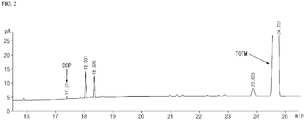
- FIG. 2 shows a GC analysis result of TEHTM.
- DEHP which is a material eluted at about 17 minutes
- TEHTM a GC analysis result of TEHTM
- FIGS. 1 and 2 it can be seen that DEHP, which is a material eluted at about 17 minutes, exhibited a peak at this time, and such a peak was also exhibited in the case of TEHTM. Therefore, it can be seen that commercially available TEHTM essentially includes DEHP even though a small amount of DEHP is included.
- the present invention has a technical feature in providing a plasticizer composition capable of improving poor properties caused by structural limitations.
- a plasticizer composition including an epoxidized oil.
- the epoxidized oil may be included at a content of 1 to 99 wt%, 10 to 99 wt%, 20 to 99 wt%, 30 to 95 wt%, 40 to 90 wt%, or the like based on the total weight of the composition.
- the epoxidized oil may be included at a content of 1 to 50 wt%, 5 to 50 wt%, 10 to 40 wt%, 10 to 45 wt%, 10 to 40 wt% or the like.
- the epoxidized oil may be, for example, one or more selected from the group consisting of epoxidized soybean oil (ESO), epoxidized castor oil, epoxidized linseed oil (ELO), epoxidized palm oil, epoxidized stearate, epoxidized oleate, epoxidized tall oil and epoxidized linoleate.
- ESO epoxidized soybean oil
- ELO epoxidized linseed oil
- ELO epoxidized palm oil
- stearate epoxidized stearate
- epoxidized oleate epoxidized tall oil and epoxidized linoleate.
- the epoxidized oil may be one or more selected from the group consisting of ESO and ELO.
- the plasticizer may exhibit an improvement in thermal resistance, plasticization efficiency, an absorption rate and volatile loss compared to existing products, have relatively excellent economic feasibility compared to other products capable of improving thermal resistance, and be appropriately used as a plasticizer capable of improving mechanical and physical properties.
- the plasticizer composition may further include a trimellitate-based material, and the trimellitate-based material may be represented by Chemical Formula 1 below.
- R 1 to R 3 are each independently an alkyl group having 8 to 12 carbon atoms, and a sum of the number of carbon atoms in the alkyl groups of R 1 to R 3 is 25 to 36.
- R 1 to R 3 may have 8 to 12 carbon atoms and may be the same. When R 1 to R 3 are different, two of R 1 to R 3 may be the same and the remaining one may be a different alkyl group.
- a linear alkyl group is preferably applied in terms of quality, but, commercially, a branched alkyl group is excellent in terms of economic feasibility.
- a branched alkyl group is preferably applied instead of a linear alkyl group, but a linear alkyl group may achieve a more excellent effect of improving properties such as cold resistance and the like.
- the trimellitate-based material may be prepared by esterification between trimellitic acid (TMA) or trimellitate anhydride and an alcohol having 8 to 12 carbon atoms.
- TMA trimellitic acid
- trimellitate anhydride an alcohol having 8 to 12 carbon atoms.
- trimellitate having three different alkyl groups may be applied.
- trimellitate having three identical alkyl groups may be applied.
- the trimellitate-based material may be, for example, triisononyl trimellitate, bis(n-octyl)isononyl trimellitate, bisisononyl(n-octyl) trimellitate, bisisodecyl(n-octyl) trimellitate, bis(n-decyl)(n-octyl) trimellitate, bis(n-octyl)(n-decyl) trimellitate, bis(n-octyl)isodecyl trimellitate, bis(2-propylheptyl)(n-octyl) trimellitate, bis(n-octyl)(2-propylheptyl) trimellitate, tri(n-decyl) trimellitate, triisodecyl trimellitate, or tri(2-propylheptyl) trimellitate.
- trimellitate having alkyl groups that have less than 8 carbon atoms are bonded to all three ester groups performance may be degraded in terms of properties such as volatile loss, tension/elongation retention, and the like, and cost competitiveness may be deteriorated due to a limited supply of an alcohol as a raw material.
- butanol which has a small number of carbon atoms, is applied, malicious waste water including butanol may be generated.
- the upper limit of the number of carbon atoms of the alkyl group is preferably 12, and when the upper limit is greater than 12, a molecular weight of the alkyl group is excessively increased such that properties such as an absorption rate, plasticization efficiency, and the like may be degraded.
- di(2-ethylhexyl) phthalate which is designated as an environmentally hazardous substance
- DEHP di(2-ethylhexyl) phthalate
- TMA phthalic acid essentially included in TMA
- a material which is not free from environmental issues may be generated.
- the branched alkyl group of trimellitate is commercially beneficial, it has a disadvantage in that usage thereof is difficult due to environmental issues, and thus it is difficult to accept trimellitate having a branched alkyl group as a non-phthalate product in an actual commercial product.
- trimellitate-based material which does not generate DEHP due to an adjustment of the number of carbon atoms and appropriately choosing a branched type or a linear type may be applied to provide an environmentally-friendly plasticizer composition.
- the plasticizer composition according to an embodiment of the present invention does not include DEHP, that is, may be a DEHP-free plasticizer, and may be an environmentally-friendly plasticizer composition.
- the plasticizer composition may include an epoxidized oil and a trimellitate-based material at a weight ratio of 99:1 to 1:99, particularly, 99:1 to 5:95, 99:1 to 10:90, 99:1 to 15:85, or 99:1 to 20:80, and, more particularly, at a weight ratio of 95:5 to 20:80 or 90:10 to 25:75.
- an excessive amount of the trimellitate-based material is preferably included such as 50:50 to 5:95, 40:60 to 5:95, 30:70 to 5:95, 30:70 to 10:90, or 20:80 to 10:95.
- trimellitate-based material when used in combination with the epoxidized oil, cold resistance, which is a problem of the epoxidized oil, may be partially improved. Also, when the trimellitate-based material, which has an excellent effect of improving migration but exhibits a slight degradation of economic feasibility, is used, a desired effect in terms of an improvement in properties may be achieved.
- the epoxidized oil when included at less than 10 wt%, it is difficult to exhibit a function thereof as a plasticizer in addition to a role thereof as an auxiliary stabilizer of a general plasticizer composition, achieve an effect of improving thermal resistance, and also achieve an effect of improving properties such as resistance to stress, tension/elongation retention, and the like, which may be exhibited when the epoxidized oil is included at a certain content. Therefore, it is necessary to include the epoxidized oil at a content of at least 10 wt% with respect to the total weight of the plasticizer composition.
- a method of preparing the plasticizer composition may be performed by a blending method, and the blending method is, for example, as follows.
- An epoxidized oil and a trimellitate-based material are prepared and blended at a weight ratio of 1:99 to 99:1 to prepare the plasticizer composition.
- the trimellitate-based material may be prepared by direct esterification between one or more alcohols selected from the group consisting of n-octyl alcohol, isononyl alcohol, isodecyl alcohol, and 2-propylheptyl alcohol and TMA or trimellitate anhydride.
- the direct esterification may be performed by introducing TMA or trimellitate anhydride to the alcohol and then adding a catalyst to induce a reaction under a nitrogen atmosphere; removing an unreacted alcohol and neutralizing an unreacted acid; and performing dehydration and filtration through distillation under reduced pressure.
- the catalyst may be, for example, one or more selected from an acid catalyst such as sulfuric acid, hydrochloric acid, phosphoric acid, nitric acid, p-toluenesulfonic acid, methanesulfonic acid, ethanesulfonic acid, propanesulfonic acid, butanesulfonic acid, alkyl sulfuric acid, and the like; a metal salt such as aluminum lactate, lithium fluoride, potassium chloride, cesium chloride, calcium chloride, iron chloride, aluminum phosphate, and the like; a metal oxide such as a heteropoly acid and the like; and an organic metal such as a natural/synthetic zeolite, cation- and anion-exchange resins, tetraalkyl titanate, a polymer thereof, and the like.
- the catalyst may be tetraalkyl titanate.
- An amount of the catalyst to be used may vary according to the type thereof.
- a homogeneous catalyst may be used at an amount of 0.01 to 5 wt%, 0.01 to 3 wt%, 1 to 5 wt%, or 2 to 4 wt% with respect to 100 wt% of a total weight of the reactants
- a heterogeneous catalyst may be used at an amount of 5 to 200 wt%, 5 to 100 wt%, 20 to 200 wt%, or 20 to 150 wt% with respect to the total weight of the reactants.
- a reaction temperature may be in a range of 180 to 280 °C, 200 to 250 °C, or 210 to 230 °C.
- the plasticizer composition thus prepared is included at an amount of 5 to 150 parts by weight, 40 to 100 parts by weight, or 40 to 50 parts by weight with respect to 100 parts by weight of a resin selected from ethylene vinyl acetate, polyethylene, polypropylene, polyvinyl chloride, polystyrene, polyurethane, and a thermoplastic elastomer, and thus a resin composition which is effective in both compound formulation and sheet formulation may be provided.
- a resin selected from ethylene vinyl acetate, polyethylene, polypropylene, polyvinyl chloride, polystyrene, polyurethane, and a thermoplastic elastomer
- the resin composition may be applied for the use such as compounds for power lines, electric power lines, communication cables and the like, flooring materials, interior materials for automobiles, and the like.
Landscapes
- Chemical & Material Sciences (AREA)
- Health & Medical Sciences (AREA)
- Chemical Kinetics & Catalysis (AREA)
- Medicinal Chemistry (AREA)
- Polymers & Plastics (AREA)
- Organic Chemistry (AREA)
- Oil, Petroleum & Natural Gas (AREA)
- Compositions Of Macromolecular Compounds (AREA)
Abstract
Description
- This application claims priority to and the benefit of Korean Patent Application No.
10-2015-0149655, filed on October 27, 2015 - The present invention relates to a plasticizer composition, a resin composition, and a method of preparing the same.
- Generally, a plasticizer forms an ester through a reaction between an alcohol and a polycarboxylic acid such as phthalic acid or adipic acid. In addition, there has been continuing research on compositions of plasticizers that can replace phthalate-based plasticizers such as terephthalate-based, adipate-based, and other polymer-based plasticizers in consideration of domestic and international regulations on phthalate-based plasticizers which are harmful to human bodies.
- Meanwhile, in compound industries requiring high heat resistance and low volatile loss as main desired physical properties, suitable plasticizers should be used in consideration of the desired physical properties. In the case of polyvinyl chloride (PVC) compounds used for electric wires and cables, additives such as a plasticizer, a stabilizer, and a pigment are mixed with a PVC resin according to characteristics of the PVC compounds required for corresponding specifications, such as tensile strength, an elongation rate, plasticization efficiency, volatile loss, tension retention and elongation retention and the like.
- Recently, because diisodecyl phthalate (DIDP), which is currently typically used as a compound for electric wires and automotive fabrics in the compound industry, is an observational chemical as an endocrine disruptor and its use is being regulated due to environmental issues, there is an increasing demand for the development of environmentally-friendly products for replacing DIDP. In addition, in the case of trioctyl trimellitate (TOTM or TEHTM), which is used as a compound for electric wires in the same compound industry, since trimellitic anhydride, as a raw material thereof, contains a small amount of phthalic anhydride, a final product is likely to contain di(2-ethylhexyl) phthalate (DEHP), and thus it is not possible to fundamentally solve a requirement of non-phthalate. In order to replace these products, it is necessary to develop a novel product having levels of properties equal to or higher than those of the above-described products in terms of quality.
- Accordingly, research is being conducted on the development of a novel environmentally-friendly plasticizer composition product having more excellent properties than those of DIDP and TOTM to ensure a vinyl chloride-based resin composition which is free from environmental issues and excellent in terms of quality.
- Korean Laid-open Patent Application No.
2002-0035930 - Therefore, during research on plasticizers, the present inventors developed a plasticizer composition capable of significantly improving properties of a polyvinyl chloride (PVC) resin composition, and thus completed the present invention.
- That is, the present invention is directed to providing a plasticizer capable of improving properties required when the plasticizer is used as a plasticizer for a resin composition, such as hardness, tension retention and elongation retention, migration resistance, volatile loss, and the like, a method of preparing the same, and a resin composition including the same.
- According to an embodiment of the present invention, there is provided a plasticizer composition which includes an epoxidized oil; and a trimellitate-based material represented by Chemical Formula 1 below, wherein a weight ratio of the epoxidized oil and the trimellitate-based material is 99:1 to 10:90.


- In Chemical Formula 1, R1 to R3 are each independently an alkyl group having 8 to 12 carbon atoms, and a sum of the number of carbon atoms in the alkyl groups of R1 to R3 is 25 to 36.
- According to another embodiment of the present invention, there is provided a resin composition which includes 100 parts by weight of a resin; and 5 to 150 parts by weight of the above-described plasticizer composition.
- The resin may be one or more selected from the group consisting of ethylene vinyl acetate, polyethylene, polypropylene, polyvinyl chloride, polystyrene, polyurethane, and a thermoplastic elastomer.
- A plasticizer composition according to an embodiment of the present invention can provide excellent properties such as plasticization efficiency, tensile strength, an elongation rate, migration resistance, volatilization resistance, and the like when used in a resin composition.
-
-
FIG. 1 shows a gas chromatography (GC) analysis result of di(2-ethylhexyl) phthalate. -
FIG. 2 shows a GC analysis result of tri(2-ethylhexyl) trimellitate. - Hereinafter, embodiments will be described in detail for promoting an understanding of the present invention. However, embodiments of the present invention may be modified in several different forms, and the scope of the present invention is not limited to the embodiments to be described below. The embodiments of the present invention are provided so that this disclosure will be thorough and complete, and will fully convey the concept of embodiments to those skilled in the art.
- Epoxidized soybean oil (ESO; commercially available from SAJO) was used.
- 576.3 g of trimellitic acid (TMA) and 1,948 g of isononyl alcohol were used as reaction components to finally obtain 1,731 g of a triisononyl trimellitate product (yield: 98%).
- 576.3 g of TMA, 878.9 g of n-octyl alcohol, and 1,068.5 g of n-decyl alcohol were used as reaction components to finally obtain 1,731 g of a trimellitate product (yield: 98%).
- Examples and comparative examples were prepared as follows.
[Table 1] Epoxidized oil Trimellitate-based material Mixing weight ratio Example 1 Preparation Example 1 (ESO) Preparation Example 2 9:1 Example 2 7:3 Example 3 5:5 Example 4 3:7 Example 5 1:9 Example 6 Preparation Example 1 (ESO) Preparation Example 3 9:1 Example 7 7:3 Example 8 5:5 Example 9 3:7 Example 10 1:9 [Table 2] Epoxidized oil Trimellitate-based material Mixing weight ratio Comparative Example 1 ESO TEHTM 0.5:9.5 Comparative Example 2 ESO TINTM 0.7:9.3 Comparative Example 3 ESO Preparation Example 3 0.5:9.5 Comparative Example 4 ESO TEHTM 5:5 Comparative Example 5 ESO TBTM 5:5 - According to ASTM D2240, Shore (shore "D") hardness was measured at 25 °C under 3T and 10s conditions.
- According to ASTM D638, each specimen was pulled at a cross head speed of 200 mm/min (IT) using a tester, U.T.M, (Manufacturer; Instron, Model No.; 4466), and a point at which the specimen was broken was then measured. The tensile strength was calculated as follows:

- According to ASTM D638, each specimen was pulled at a cross head speed of 200 mm/min (IT) using the U.T.M, and a point at which the specimen was broken was then measured. The elongation rate was calculated as follows:

- A specimen having a thickness of 2 mm or more was obtained according to KSM-3156, PS plates were attached to both sides of the specimen, and then a load of 2 kgf/cm2 was applied thereto. The specimen was kept in a forced convection oven (80 °C) for 72 hours, then taken out of the oven, and cooled at room temperature for 4 hours. Thereafter, the PS plates attached to both sides of the specimen were removed, weights before and after being kept in the oven were measured, and thus a migration loss was calculated by the equation as follows.

- The specimen thus prepared was processed at 113 °C for 168 hours, and then a weight of the specimen was measured.

- In the measurement of tension retention and elongation retention, each specimen was heated at 135 °C for 168 hours, and then tension and an elongation rate remaining in the specimen were measured. Measurement methods thereof are the same as the above measurement methods of tensile strength and an elongation rate.
- Each mixed plasticizer composition according to examples and comparative examples listed in Tables 1 and 2 was used to prepare a specimen.
- The specimen was prepared with reference to ASTM D638. With respect to 100 parts by weight of a polyvinyl chloride (PVC) resin (LS100), 50 parts by weight of each plasticizer composition prepared in examples and comparative examples, 3 parts by weight of RUP-144 (commercially available from ADEKA KOREA) as a stabilizer, 40 parts by weight of Omya IT (commercially available from Omya) as a filler, and 0.3 parts by weight of St-A (commercially available from ISU CHEMICAL) as a lubricant were mixed at 98 °C and 700 rpm. Afterward, the resulting mixture was subjected to roll-milling at 160 °C for 4 minutes using a rolling mill, and pressed for 2.5 minutes (low pressure) and for 2 minutes (high pressure) at 180 °C using a press, thereby preparing a specimen.
- Properties of each specimen were evaluated by the test items, results of which are shown in Table 3 below.
[Table 3] Hardness (Shore "D") Tensile strength (kg/cm 2) Tension retention (%) Elongation rate (%) Elongation retention (%) Migration loss (%) Volatile loss (%) Cold resistance (°C) Example 1 57.3 211.6 99.2 280.2 95.6 0.31 0.46 -14.0 Example 2 58.0 210.5 97.8 271.8 93.4 0.51 0.53 -14.0 Example 3 58.6 209.7 93.7 271.1 91.5 0.76 0.58 -15.0 Example 4 59.1 210.6 93.1 268.7 88.6 1.24 0.65 -15.0 Example 5 59.8 209.1 91.2 264.7 88.1 1.50 0.85 -15.5 Example 6 55.3 248.9 102.8 298.7 99.8 0.43 0.10 -17.0 Example 7 55.9 245.7 100.5 292.4 98.2 0.55 0.10 -17.5 Example 8 56.4 235.6 101.1 290.5 98.4 0.64 0.14 -17.5 Example 9 57.0 231.5 102.3 289.7 97.0 0.87 0.35 -18.0 Example 10 57.3 222.6 101.5 286.4 97.8 1.15 0.56 -19.0 Comparative Example 1 59.6 178.4 80.6 231.2 81.2 2.68 2.07 -13.5 Comparative Example 2 60.5 203.1 90.2 245.7 80.2 1.88 1.03 -15.5 Comparative Example 3 59.7 202.3 92.3 265.4 90.1 1.66 0.98 -18.0 Comparative Example 4 58.5 188.7 88.8 251.2 80.6 1.87 1.68 -12.5 Comparative Example 5 55.8 167.4 64.2 188.6 74.5 2.97 5.82 -20.0 - Referring to Table 3, it can be confirmed that Examples 1 to 5, in which a mixing ratio was appropriately adjusted, that is, an epoxidized oil was added at an amount of one plasticizer level rather than an auxiliary stabilizer level, exhibited excellent performance such as plasticization efficiency, tensile strength, an elongation rate, tension retention, elongation retention, and migration resistance, and an effect of improved volatile loss compared to Comparative Example 2. Also, it can be confirmed that, when Examples 6 to 10 and Comparative Example 2 were compared, an improvement in performance such as plasticization efficiency, tensile strength, an elongation rate, tension retention, elongation retention, migration resistance and volatile loss was also exhibited.
- In addition, when Comparative Examples 1 and 4 were compared, it can be seen that an effect when an epoxidized oil was added at the main plasticizer level and not at the auxiliary stabilizer level was significant. That is, it can be confirmed that plasticization efficiency, tensile strength, an elongation rate, tension retention, and elongation retention may be significantly improved, and migration or volatile loss may also be improved. That is, it can be seen that, considering that TEHTM in Comparative Example 4 contains DEHP, which is an environmentally hazardous substance, the plasticizers according to Examples 1 to 10 may be useful as products capable of replacing the plasticizer according to Comparative Example 4 because they exhibited levels of properties equal to or higher than those of the plasticizer according to Comparative Example 4.
- In addition, it can be seen that Comparative Example 5, in which a trimellitate-based material having a small number of carbon atoms was used, exhibited poor mechanical properties such as tensile strength and an elongation rate as well as poor loss properties such as volatile loss and migration loss. Therefore, it can be confirmed that, when a trimellitate-based material is applied, adjusting the number of carbon atoms thereof and choosing a branched type or a linear type should be carefully performed.
- In order to determine whether branched TEHTM having 8 carbon atoms contains DEHP, which is an environmentally hazardous substance, DEHP (commercially available from LG Chem.) and TEHTM (commercially available from UPC Technology Corporation) were used to perform a gas chromatography (GC) analysis, results of which are shown in
FIGS. 1 and2 . -
FIG. 1 shows a GC analysis result of DEHP, andFIG. 2 shows a GC analysis result of TEHTM. Referring toFIGS. 1 and2 , it can be seen that DEHP, which is a material eluted at about 17 minutes, exhibited a peak at this time, and such a peak was also exhibited in the case of TEHTM. Therefore, it can be seen that commercially available TEHTM essentially includes DEHP even though a small amount of DEHP is included. - While embodiments have been described in detail above, the scope of embodiments of the present invention is not limited thereto, but encompasses several modifications and improvements by those skilled in the art using basic concepts of embodiments of the present invention defined by the appended claims.
- Hereinafter, the present invention will be described in detail.
- First, the present invention has a technical feature in providing a plasticizer composition capable of improving poor properties caused by structural limitations.
- According to an embodiment of the present invention, there is provided a plasticizer composition including an epoxidized oil. Specifically, the epoxidized oil may be included at a content of 1 to 99 wt%, 10 to 99 wt%, 20 to 99 wt%, 30 to 95 wt%, 40 to 90 wt%, or the like based on the total weight of the composition. Also, in some cases, the epoxidized oil may be included at a content of 1 to 50 wt%, 5 to 50 wt%, 10 to 40 wt%, 10 to 45 wt%, 10 to 40 wt% or the like.
- The epoxidized oil may be, for example, one or more selected from the group consisting of epoxidized soybean oil (ESO), epoxidized castor oil, epoxidized linseed oil (ELO), epoxidized palm oil, epoxidized stearate, epoxidized oleate, epoxidized tall oil and epoxidized linoleate.
- Preferably, the epoxidized oil may be one or more selected from the group consisting of ESO and ELO.
- When the above-described epoxidized oil is used in a plasticizer, the plasticizer may exhibit an improvement in thermal resistance, plasticization efficiency, an absorption rate and volatile loss compared to existing products, have relatively excellent economic feasibility compared to other products capable of improving thermal resistance, and be appropriately used as a plasticizer capable of improving mechanical and physical properties.
- In addition, according to an embodiment of the present invention, the plasticizer composition may further include a trimellitate-based material, and the trimellitate-based material may be represented by Chemical Formula 1 below.

- In Chemical Formula 1, R1 to R3 are each independently an alkyl group having 8 to 12 carbon atoms, and a sum of the number of carbon atoms in the alkyl groups of R1 to R3 is 25 to 36.
- In Chemical Formula 1, R1 to R3 may have 8 to 12 carbon atoms and may be the same. When R1 to R3 are different, two of R1 to R3 may be the same and the remaining one may be a different alkyl group.
- In addition, when the alkyl group has 8 carbon atoms, a linear alkyl group is preferably applied in terms of quality, but, commercially, a branched alkyl group is excellent in terms of economic feasibility. When an alkyl group having 9 to 12 carbon atoms is applied, a branched alkyl group is preferably applied instead of a linear alkyl group, but a linear alkyl group may achieve a more excellent effect of improving properties such as cold resistance and the like.
- Specifically, the trimellitate-based material may be prepared by esterification between trimellitic acid (TMA) or trimellitate anhydride and an alcohol having 8 to 12 carbon atoms. When the number of carbon atoms is 8, two or more alcohols are mixed and reacted, and thus a case in which trimellitate having three alkyl groups that all have 8 carbon atoms is applied may be excluded.
- That is, when an alcohol having 8 carbon atoms is applied, the alcohol is mixed with an alcohol having 9 to 12 carbon atoms and reacted such that trimellitate having three different alkyl groups may be applied. When an alkyl group having 9 to 12 carbon atoms is applied, trimellitate having three identical alkyl groups may be applied.
- The trimellitate-based material may be, for example, triisononyl trimellitate, bis(n-octyl)isononyl trimellitate, bisisononyl(n-octyl) trimellitate, bisisodecyl(n-octyl) trimellitate, bis(n-decyl)(n-octyl) trimellitate, bis(n-octyl)(n-decyl) trimellitate, bis(n-octyl)isodecyl trimellitate, bis(2-propylheptyl)(n-octyl) trimellitate, bis(n-octyl)(2-propylheptyl) trimellitate, tri(n-decyl) trimellitate, triisodecyl trimellitate, or tri(2-propylheptyl) trimellitate.
- When a case in which trimellitate having alkyl groups that have less than 8 carbon atoms are bonded to all three ester groups is applied, performance may be degraded in terms of properties such as volatile loss, tension/elongation retention, and the like, and cost competitiveness may be deteriorated due to a limited supply of an alcohol as a raw material. Also, when butanol, which has a small number of carbon atoms, is applied, malicious waste water including butanol may be generated. The upper limit of the number of carbon atoms of the alkyl group is preferably 12, and when the upper limit is greater than 12, a molecular weight of the alkyl group is excessively increased such that properties such as an absorption rate, plasticization efficiency, and the like may be degraded.
- In particular, when a branched alkyl group having 8 carbon atoms is applied, di(2-ethylhexyl) phthalate (DEHP), which is designated as an environmentally hazardous substance, may be generated due to phthalic acid essentially included in TMA, and even when a content thereof is small, a material which is not free from environmental issues may be generated. As such, although the branched alkyl group of trimellitate is commercially beneficial, it has a disadvantage in that usage thereof is difficult due to environmental issues, and thus it is difficult to accept trimellitate having a branched alkyl group as a non-phthalate product in an actual commercial product.
- However, in order to prevent generation of the above-described materials in the present invention, only a trimellitate-based material which does not generate DEHP due to an adjustment of the number of carbon atoms and appropriately choosing a branched type or a linear type may be applied to provide an environmentally-friendly plasticizer composition.
- Accordingly, the plasticizer composition according to an embodiment of the present invention does not include DEHP, that is, may be a DEHP-free plasticizer, and may be an environmentally-friendly plasticizer composition.
- Here, the plasticizer composition may include an epoxidized oil and a trimellitate-based material at a weight ratio of 99:1 to 1:99, particularly, 99:1 to 5:95, 99:1 to 10:90, 99:1 to 15:85, or 99:1 to 20:80, and, more particularly, at a weight ratio of 95:5 to 20:80 or 90:10 to 25:75.
- In addition, in some cases, an excessive amount of the trimellitate-based material is preferably included such as 50:50 to 5:95, 40:60 to 5:95, 30:70 to 5:95, 30:70 to 10:90, or 20:80 to 10:95.
- As such, when the trimellitate-based material is used in combination with the epoxidized oil, cold resistance, which is a problem of the epoxidized oil, may be partially improved. Also, when the trimellitate-based material, which has an excellent effect of improving migration but exhibits a slight degradation of economic feasibility, is used, a desired effect in terms of an improvement in properties may be achieved.
- However, when the epoxidized oil is included at less than 10 wt%, it is difficult to exhibit a function thereof as a plasticizer in addition to a role thereof as an auxiliary stabilizer of a general plasticizer composition, achieve an effect of improving thermal resistance, and also achieve an effect of improving properties such as resistance to stress, tension/elongation retention, and the like, which may be exhibited when the epoxidized oil is included at a certain content. Therefore, it is necessary to include the epoxidized oil at a content of at least 10 wt% with respect to the total weight of the plasticizer composition.
- In the present invention, a method of preparing the plasticizer composition may be performed by a blending method, and the blending method is, for example, as follows.
- An epoxidized oil and a trimellitate-based material are prepared and blended at a weight ratio of 1:99 to 99:1 to prepare the plasticizer composition.
- The trimellitate-based material may be prepared by direct esterification between one or more alcohols selected from the group consisting of n-octyl alcohol, isononyl alcohol, isodecyl alcohol, and 2-propylheptyl alcohol and TMA or trimellitate anhydride.
- The direct esterification may be performed by introducing TMA or trimellitate anhydride to the alcohol and then adding a catalyst to induce a reaction under a nitrogen atmosphere; removing an unreacted alcohol and neutralizing an unreacted acid; and performing dehydration and filtration through distillation under reduced pressure.
- Meanwhile, the catalyst may be, for example, one or more selected from an acid catalyst such as sulfuric acid, hydrochloric acid, phosphoric acid, nitric acid, p-toluenesulfonic acid, methanesulfonic acid, ethanesulfonic acid, propanesulfonic acid, butanesulfonic acid, alkyl sulfuric acid, and the like; a metal salt such as aluminum lactate, lithium fluoride, potassium chloride, cesium chloride, calcium chloride, iron chloride, aluminum phosphate, and the like; a metal oxide such as a heteropoly acid and the like; and an organic metal such as a natural/synthetic zeolite, cation- and anion-exchange resins, tetraalkyl titanate, a polymer thereof, and the like. As a specific example, the catalyst may be tetraalkyl titanate.
- An amount of the catalyst to be used may vary according to the type thereof. For example, a homogeneous catalyst may be used at an amount of 0.01 to 5 wt%, 0.01 to 3 wt%, 1 to 5 wt%, or 2 to 4 wt% with respect to 100 wt% of a total weight of the reactants, and a heterogeneous catalyst may be used at an amount of 5 to 200 wt%, 5 to 100 wt%, 20 to 200 wt%, or 20 to 150 wt% with respect to the total weight of the reactants.
- In this case, a reaction temperature may be in a range of 180 to 280 °C, 200 to 250 °C, or 210 to 230 °C.
- The plasticizer composition thus prepared is included at an amount of 5 to 150 parts by weight, 40 to 100 parts by weight, or 40 to 50 parts by weight with respect to 100 parts by weight of a resin selected from ethylene vinyl acetate, polyethylene, polypropylene, polyvinyl chloride, polystyrene, polyurethane, and a thermoplastic elastomer, and thus a resin composition which is effective in both compound formulation and sheet formulation may be provided.
- The resin composition may be applied for the use such as compounds for power lines, electric power lines, communication cables and the like, flooring materials, interior materials for automobiles, and the like.
Claims (11)
- A plasticizer composition comprising an epoxidized oil; and a trimellitate-based material represented by Chemical Formula 1 below,
wherein a weight ratio of the epoxidized oil and the trimellitate-based material is 99:1 to 10:90:
- The plasticizer composition of claim 1, wherein the trimellitate-based material is one or more selected from the group consisting of bisisononyl(n-octyl) trimellitate, bis(n-octyl)isononyl trimellitate, triisononyl trimellitate, bis(n-decyl)(n-octyl) trimellitate, bis(n-octyl)(n-decyl) trimellitate, tri(n-decyl) trimellitate, triisodecyl trimellitate, bis(2-propylheptyl)(n-octyl) trimellitate, bis(n-octyl)(2-propylheptyl) trimellitate, and tri(2-propylheptyl) trimellitate.
- The plasticizer composition of claim 1, wherein the trimellitate-based material is one or more selected from the group consisting of triisononyl trimellitate, bisisodecyl(n-octyl) trimellitate, and bis(n-octyl)isodecyl trimellitate.
- The plasticizer composition of claim 1, wherein the epoxidized oil is one or more selected from the group consisting of epoxidized soybean oil, epoxidized castor oil, epoxidized linseed oil, epoxidized palm oil, epoxidized stearate, epoxidized oleate, epoxidized tall oil, and epoxidized linoleate.
- The plasticizer composition of claim 1, wherein a weight ratio of the epoxidized oil and the trimellitate-based material is 90:10 to 10:90.
- The plasticizer composition of claim 5, wherein a weight ratio of the epoxidized oil and the trimellitate-based material is 80:20 to 10:80.
- The plasticizer composition of claim 5, wherein a weight ratio of the epoxidized oil and the trimellitate-based material is 70:30 to 15:85.
- The plasticizer composition of claim 1, wherein the plasticizer composition is a di(2-ethylhexyl) phthalate-free plasticizer.
- A resin composition comprising 100 parts by weight of a resin; and 5 to 150 parts by weight of the plasticizer composition according to claim 1.
- The resin composition of claim 9, wherein the resin is one or more selected from the group consisting of ethylene vinyl acetate, polyethylene, polypropylene, polyketone, polyvinyl chloride, polystyrene, polyurethane, and a thermoplastic elastomer.
- The resin composition of claim 9, wherein the resin composition is a material of one or more products selected from the group consisting of electric wires, flooring materials, interior materials for automobiles, films, sheets, wallpaper, and tubes.
Applications Claiming Priority (2)
| Application Number | Priority Date | Filing Date | Title |
|---|---|---|---|
| KR20150149655 | 2015-10-27 | ||
| PCT/KR2016/012161 WO2017074055A1 (en) | 2015-10-27 | 2016-10-27 | Plasticizer composition, resin composition, and methods for preparing same |
Publications (3)
| Publication Number | Publication Date |
|---|---|
| EP3269764A1 true EP3269764A1 (en) | 2018-01-17 |
| EP3269764A4 EP3269764A4 (en) | 2018-05-23 |
| EP3269764B1 EP3269764B1 (en) | 2023-03-01 |
Family
ID=58630756
Family Applications (1)
| Application Number | Title | Priority Date | Filing Date |
|---|---|---|---|
| EP16860238.1A Active EP3269764B1 (en) | 2015-10-27 | 2016-10-27 | Plasticizer composition, resin composition, and methods for preparing same |
Country Status (6)
| Country | Link |
|---|---|
| US (1) | US10851219B2 (en) |
| EP (1) | EP3269764B1 (en) |
| KR (1) | KR101940219B1 (en) |
| CN (2) | CN114015243A (en) |
| ES (1) | ES2945695T3 (en) |
| WO (1) | WO2017074055A1 (en) |
Cited By (2)
| Publication number | Priority date | Publication date | Assignee | Title |
|---|---|---|---|---|
| US11976166B2 (en) | 2018-12-17 | 2024-05-07 | Dow Global Technologies Llc | Method for preparing a benzophenone derivative |
| EP4703419A1 (en) * | 2024-09-03 | 2026-03-04 | Evonik Oxeno GmbH & Co. KG | Plasticizer composition comprising trimethylester of 1,2,4-cyclohexanetripropionic acid and trialkyltrimellitate |
Families Citing this family (3)
| Publication number | Priority date | Publication date | Assignee | Title |
|---|---|---|---|---|
| TWI826398B (en) * | 2017-11-01 | 2023-12-21 | 南韓商Lg化學股份有限公司 | Plasticizer composition and resin composition including the same |
| WO2021124901A1 (en) * | 2019-12-16 | 2021-06-24 | Dic株式会社 | Plasticizer for vinyl chloride resins, vinyl chloride resin composition, and molded article and wiring harness each using said vinyl chloride resin composition |
| JP7607418B2 (en) * | 2020-08-28 | 2024-12-27 | Ntn株式会社 | Rolling bearings |
Family Cites Families (15)
| Publication number | Priority date | Publication date | Assignee | Title |
|---|---|---|---|---|
| US5374377A (en) * | 1993-01-19 | 1994-12-20 | Achilles Corporation | Phosphorescent polyvinyl chloride films |
| KR20020035930A (en) | 2000-11-07 | 2002-05-16 | 성재갑 | Composition of soft polyvinylchloride resin compound for electric wire and method for preparing the same |
| JP2005060574A (en) * | 2003-08-15 | 2005-03-10 | Mitsubishi Rayon Co Ltd | Acrylic plastisol composition |
| US8372912B2 (en) | 2005-08-12 | 2013-02-12 | Eastman Chemical Company | Polyvinyl chloride compositions |
| EP2470596B1 (en) | 2009-09-30 | 2013-07-17 | Dow Global Technologies LLC | Acetylated polyglycerine fatty acid ester and a pvc insulator plasticised therewith |
| CA2775993C (en) | 2009-09-30 | 2017-07-18 | Dow Global Technologies Llc | Acetylated glycerin esters and their blends with epoxidized fatty acid esters |
| EP2604652B1 (en) * | 2010-08-12 | 2017-01-04 | Zeon Corporation | Vinyl chloride resin composition for forming powder, and formed article and laminate of vinyl chloride resin |
| CN103228711A (en) * | 2010-12-03 | 2013-07-31 | 普立万公司 | Plastisol for spray-molded plastic articles |
| CA2867750C (en) * | 2012-03-28 | 2020-07-14 | Lanxess Deutschland Gmbh | Stable compositions comprising thiabendazole and iodine-containing fungicides |
| AU2013262833A1 (en) | 2012-05-16 | 2014-12-04 | Archer Daniels Midland Company | Emulsifier for solubilizing polar solvents in oils and polyols |
| US20150051326A1 (en) * | 2013-08-13 | 2015-02-19 | E I Du Pont De Nemours And Company | Plasticizers comprising poly(trimethylene ether) glycol esters |
| CN103694598A (en) * | 2013-12-10 | 2014-04-02 | 江苏三角洲塑化有限公司 | Polystyrene (PS) transfer-resistant flame-retardant PVC sheath material and preparation method thereof |
| KR101907252B1 (en) | 2015-03-20 | 2018-10-11 | 주식회사 엘지화학 | Plasticizer, resin composition and method for preparing them |
| ES2901409T3 (en) * | 2015-03-20 | 2022-03-22 | Lg Chemical Ltd | Plasticizer composition and resin composition and method of preparing the same |
| KR102100401B1 (en) * | 2016-07-06 | 2020-04-13 | 주식회사 엘지화학 | Plasticizer, resin composition and method for preparing them |
-
2016
- 2016-10-27 EP EP16860238.1A patent/EP3269764B1/en active Active
- 2016-10-27 CN CN202111500109.8A patent/CN114015243A/en active Pending
- 2016-10-27 KR KR1020160141297A patent/KR101940219B1/en active Active
- 2016-10-27 CN CN201680027281.7A patent/CN107531938A/en active Pending
- 2016-10-27 WO PCT/KR2016/012161 patent/WO2017074055A1/en not_active Ceased
- 2016-10-27 ES ES16860238T patent/ES2945695T3/en active Active
- 2016-10-27 US US15/567,519 patent/US10851219B2/en active Active
Cited By (2)
| Publication number | Priority date | Publication date | Assignee | Title |
|---|---|---|---|---|
| US11976166B2 (en) | 2018-12-17 | 2024-05-07 | Dow Global Technologies Llc | Method for preparing a benzophenone derivative |
| EP4703419A1 (en) * | 2024-09-03 | 2026-03-04 | Evonik Oxeno GmbH & Co. KG | Plasticizer composition comprising trimethylester of 1,2,4-cyclohexanetripropionic acid and trialkyltrimellitate |
Also Published As
| Publication number | Publication date |
|---|---|
| KR20170049447A (en) | 2017-05-10 |
| EP3269764B1 (en) | 2023-03-01 |
| CN114015243A (en) | 2022-02-08 |
| WO2017074055A1 (en) | 2017-05-04 |
| EP3269764A4 (en) | 2018-05-23 |
| ES2945695T3 (en) | 2023-07-05 |
| CN107531938A (en) | 2018-01-02 |
| KR101940219B1 (en) | 2019-04-10 |
| US10851219B2 (en) | 2020-12-01 |
| US20180100052A1 (en) | 2018-04-12 |
Similar Documents
| Publication | Publication Date | Title |
|---|---|---|
| KR101535392B1 (en) | Plasticizer, resin composition and method for preparing them | |
| EP3476891B1 (en) | Plasticizer composition and resin composition comprising same | |
| EP3269764B1 (en) | Plasticizer composition, resin composition, and methods for preparing same | |
| EP3434721B1 (en) | Plasticizer composition and resin composition including same | |
| EP2784113B1 (en) | Plasticizer, plasticizer composition, heat-resistant resin composition and method for preparing same | |
| EP3342813B1 (en) | Plasticizing composition, resin composition, and method for producing both | |
| EP3342810B1 (en) | Plasticizer composition, resin composition and method for preparing same | |
| EP3369771B1 (en) | Plasticizer composition, resin composition, and methods for preparing same | |
| EP3269765B1 (en) | Plasticizer composition, resin composition, and methods for preparing same | |
| EP3281977B1 (en) | Plasticizer composition, resin composition, and methods for preparing same | |
| CN113785010A (en) | Citric acid ester plasticizer composition and resin composition containing the same | |
| CN113677751B (en) | Plasticizer composition and resin composition comprising the same | |
| EP3275930B1 (en) | Plasticizer composition, resin composition, and preparation methods therefor | |
| US12122895B2 (en) | Plasticizer composition and resin composition including the same | |
| EP3281976B1 (en) | Plasticizer composition, resin composition, and method for preparing thereof | |
| KR101569560B1 (en) | Plasticizer composition, method for preparing thereof, and heat-resistant resin composition | |
| EP4209543A1 (en) | Triester-based plasticizer composition, and resin composition comprising same | |
| EP4484482A1 (en) | Plasticizer composition and resin composition comprising same | |
| EP4484484A1 (en) | Plasticizer composition and resin composition comprising same | |
| KR20180133827A (en) | Plasticizer composition and method for preparing thereof |
Legal Events
| Date | Code | Title | Description |
|---|---|---|---|
| STAA | Information on the status of an ep patent application or granted ep patent |
Free format text: STATUS: THE INTERNATIONAL PUBLICATION HAS BEEN MADE |
|
| PUAI | Public reference made under article 153(3) epc to a published international application that has entered the european phase |
Free format text: ORIGINAL CODE: 0009012 |
|
| STAA | Information on the status of an ep patent application or granted ep patent |
Free format text: STATUS: REQUEST FOR EXAMINATION WAS MADE |
|
| 17P | Request for examination filed |
Effective date: 20171013 |
|
| AK | Designated contracting states |
Kind code of ref document: A1 Designated state(s): AL AT BE BG CH CY CZ DE DK EE ES FI FR GB GR HR HU IE IS IT LI LT LU LV MC MK MT NL NO PL PT RO RS SE SI SK SM TR |
|
| AX | Request for extension of the european patent |
Extension state: BA ME |
|
| A4 | Supplementary search report drawn up and despatched |
Effective date: 20180420 |
|
| RIC1 | Information provided on ipc code assigned before grant |
Ipc: C08K 5/00 20060101ALI20180416BHEP Ipc: C08K 5/10 20060101AFI20180416BHEP Ipc: C08K 5/1515 20060101ALI20180416BHEP Ipc: C08L 101/00 20060101ALI20180416BHEP Ipc: C08K 5/12 20060101ALI20180416BHEP |
|
| DAV | Request for validation of the european patent (deleted) | ||
| DAX | Request for extension of the european patent (deleted) | ||
| STAA | Information on the status of an ep patent application or granted ep patent |
Free format text: STATUS: EXAMINATION IS IN PROGRESS |
|
| 17Q | First examination report despatched |
Effective date: 20200310 |
|
| GRAP | Despatch of communication of intention to grant a patent |
Free format text: ORIGINAL CODE: EPIDOSNIGR1 |
|
| STAA | Information on the status of an ep patent application or granted ep patent |
Free format text: STATUS: GRANT OF PATENT IS INTENDED |
|
| INTG | Intention to grant announced |
Effective date: 20221207 |
|
| GRAS | Grant fee paid |
Free format text: ORIGINAL CODE: EPIDOSNIGR3 |
|
| GRAA | (expected) grant |
Free format text: ORIGINAL CODE: 0009210 |
|
| STAA | Information on the status of an ep patent application or granted ep patent |
Free format text: STATUS: THE PATENT HAS BEEN GRANTED |
|
| AK | Designated contracting states |
Kind code of ref document: B1 Designated state(s): AL AT BE BG CH CY CZ DE DK EE ES FI FR GB GR HR HU IE IS IT LI LT LU LV MC MK MT NL NO PL PT RO RS SE SI SK SM TR |
|
| REG | Reference to a national code |
Ref country code: GB Ref legal event code: FG4D |
|
| REG | Reference to a national code |
Ref country code: CH Ref legal event code: EP Ref country code: AT Ref legal event code: REF Ref document number: 1550961 Country of ref document: AT Kind code of ref document: T Effective date: 20230315 |
|
| REG | Reference to a national code |
Ref country code: DE Ref legal event code: R096 Ref document number: 602016078109 Country of ref document: DE |
|
| REG | Reference to a national code |
Ref country code: IE Ref legal event code: FG4D |
|
| REG | Reference to a national code |
Ref country code: LT Ref legal event code: MG9D |
|
| REG | Reference to a national code |
Ref country code: NL Ref legal event code: MP Effective date: 20230301 Ref country code: ES Ref legal event code: FG2A Ref document number: 2945695 Country of ref document: ES Kind code of ref document: T3 Effective date: 20230705 |
|
| PG25 | Lapsed in a contracting state [announced via postgrant information from national office to epo] |
Ref country code: RS Free format text: LAPSE BECAUSE OF FAILURE TO SUBMIT A TRANSLATION OF THE DESCRIPTION OR TO PAY THE FEE WITHIN THE PRESCRIBED TIME-LIMIT Effective date: 20230301 Ref country code: NO Free format text: LAPSE BECAUSE OF FAILURE TO SUBMIT A TRANSLATION OF THE DESCRIPTION OR TO PAY THE FEE WITHIN THE PRESCRIBED TIME-LIMIT Effective date: 20230601 Ref country code: LV Free format text: LAPSE BECAUSE OF FAILURE TO SUBMIT A TRANSLATION OF THE DESCRIPTION OR TO PAY THE FEE WITHIN THE PRESCRIBED TIME-LIMIT Effective date: 20230301 Ref country code: LT Free format text: LAPSE BECAUSE OF FAILURE TO SUBMIT A TRANSLATION OF THE DESCRIPTION OR TO PAY THE FEE WITHIN THE PRESCRIBED TIME-LIMIT Effective date: 20230301 Ref country code: HR Free format text: LAPSE BECAUSE OF FAILURE TO SUBMIT A TRANSLATION OF THE DESCRIPTION OR TO PAY THE FEE WITHIN THE PRESCRIBED TIME-LIMIT Effective date: 20230301 |
|
| REG | Reference to a national code |
Ref country code: AT Ref legal event code: MK05 Ref document number: 1550961 Country of ref document: AT Kind code of ref document: T Effective date: 20230301 |
|
| PG25 | Lapsed in a contracting state [announced via postgrant information from national office to epo] |
Ref country code: SE Free format text: LAPSE BECAUSE OF FAILURE TO SUBMIT A TRANSLATION OF THE DESCRIPTION OR TO PAY THE FEE WITHIN THE PRESCRIBED TIME-LIMIT Effective date: 20230301 Ref country code: PL Free format text: LAPSE BECAUSE OF FAILURE TO SUBMIT A TRANSLATION OF THE DESCRIPTION OR TO PAY THE FEE WITHIN THE PRESCRIBED TIME-LIMIT Effective date: 20230301 Ref country code: NL Free format text: LAPSE BECAUSE OF FAILURE TO SUBMIT A TRANSLATION OF THE DESCRIPTION OR TO PAY THE FEE WITHIN THE PRESCRIBED TIME-LIMIT Effective date: 20230301 Ref country code: GR Free format text: LAPSE BECAUSE OF FAILURE TO SUBMIT A TRANSLATION OF THE DESCRIPTION OR TO PAY THE FEE WITHIN THE PRESCRIBED TIME-LIMIT Effective date: 20230602 Ref country code: FI Free format text: LAPSE BECAUSE OF FAILURE TO SUBMIT A TRANSLATION OF THE DESCRIPTION OR TO PAY THE FEE WITHIN THE PRESCRIBED TIME-LIMIT Effective date: 20230301 |
|
| PG25 | Lapsed in a contracting state [announced via postgrant information from national office to epo] |
Ref country code: SM Free format text: LAPSE BECAUSE OF FAILURE TO SUBMIT A TRANSLATION OF THE DESCRIPTION OR TO PAY THE FEE WITHIN THE PRESCRIBED TIME-LIMIT Effective date: 20230301 Ref country code: RO Free format text: LAPSE BECAUSE OF FAILURE TO SUBMIT A TRANSLATION OF THE DESCRIPTION OR TO PAY THE FEE WITHIN THE PRESCRIBED TIME-LIMIT Effective date: 20230301 Ref country code: PT Free format text: LAPSE BECAUSE OF FAILURE TO SUBMIT A TRANSLATION OF THE DESCRIPTION OR TO PAY THE FEE WITHIN THE PRESCRIBED TIME-LIMIT Effective date: 20230703 Ref country code: EE Free format text: LAPSE BECAUSE OF FAILURE TO SUBMIT A TRANSLATION OF THE DESCRIPTION OR TO PAY THE FEE WITHIN THE PRESCRIBED TIME-LIMIT Effective date: 20230301 Ref country code: CZ Free format text: LAPSE BECAUSE OF FAILURE TO SUBMIT A TRANSLATION OF THE DESCRIPTION OR TO PAY THE FEE WITHIN THE PRESCRIBED TIME-LIMIT Effective date: 20230301 Ref country code: AT Free format text: LAPSE BECAUSE OF FAILURE TO SUBMIT A TRANSLATION OF THE DESCRIPTION OR TO PAY THE FEE WITHIN THE PRESCRIBED TIME-LIMIT Effective date: 20230301 |
|
| PG25 | Lapsed in a contracting state [announced via postgrant information from national office to epo] |
Ref country code: SK Free format text: LAPSE BECAUSE OF FAILURE TO SUBMIT A TRANSLATION OF THE DESCRIPTION OR TO PAY THE FEE WITHIN THE PRESCRIBED TIME-LIMIT Effective date: 20230301 Ref country code: IS Free format text: LAPSE BECAUSE OF FAILURE TO SUBMIT A TRANSLATION OF THE DESCRIPTION OR TO PAY THE FEE WITHIN THE PRESCRIBED TIME-LIMIT Effective date: 20230701 Ref country code: AL Free format text: LAPSE BECAUSE OF FAILURE TO SUBMIT A TRANSLATION OF THE DESCRIPTION OR TO PAY THE FEE WITHIN THE PRESCRIBED TIME-LIMIT Effective date: 20230301 |
|
| REG | Reference to a national code |
Ref country code: DE Ref legal event code: R097 Ref document number: 602016078109 Country of ref document: DE |
|
| PLBE | No opposition filed within time limit |
Free format text: ORIGINAL CODE: 0009261 |
|
| STAA | Information on the status of an ep patent application or granted ep patent |
Free format text: STATUS: NO OPPOSITION FILED WITHIN TIME LIMIT |
|
| PG25 | Lapsed in a contracting state [announced via postgrant information from national office to epo] |
Ref country code: SI Free format text: LAPSE BECAUSE OF FAILURE TO SUBMIT A TRANSLATION OF THE DESCRIPTION OR TO PAY THE FEE WITHIN THE PRESCRIBED TIME-LIMIT Effective date: 20230301 Ref country code: DK Free format text: LAPSE BECAUSE OF FAILURE TO SUBMIT A TRANSLATION OF THE DESCRIPTION OR TO PAY THE FEE WITHIN THE PRESCRIBED TIME-LIMIT Effective date: 20230301 |
|
| 26N | No opposition filed |
Effective date: 20231204 |
|
| PG25 | Lapsed in a contracting state [announced via postgrant information from national office to epo] |
Ref country code: MC Free format text: LAPSE BECAUSE OF FAILURE TO SUBMIT A TRANSLATION OF THE DESCRIPTION OR TO PAY THE FEE WITHIN THE PRESCRIBED TIME-LIMIT Effective date: 20230301 |
|
| REG | Reference to a national code |
Ref country code: CH Ref legal event code: PL |
|
| REG | Reference to a national code |
Ref country code: BE Ref legal event code: MM Effective date: 20231031 |
|
| PG25 | Lapsed in a contracting state [announced via postgrant information from national office to epo] |
Ref country code: LU Free format text: LAPSE BECAUSE OF NON-PAYMENT OF DUE FEES Effective date: 20231027 |
|
| PG25 | Lapsed in a contracting state [announced via postgrant information from national office to epo] |
Ref country code: LU Free format text: LAPSE BECAUSE OF NON-PAYMENT OF DUE FEES Effective date: 20231027 |
|
| PG25 | Lapsed in a contracting state [announced via postgrant information from national office to epo] |
Ref country code: CH Free format text: LAPSE BECAUSE OF NON-PAYMENT OF DUE FEES Effective date: 20231031 |
|
| PG25 | Lapsed in a contracting state [announced via postgrant information from national office to epo] |
Ref country code: CH Free format text: LAPSE BECAUSE OF NON-PAYMENT OF DUE FEES Effective date: 20231031 |
|
| PG25 | Lapsed in a contracting state [announced via postgrant information from national office to epo] |
Ref country code: BE Free format text: LAPSE BECAUSE OF NON-PAYMENT OF DUE FEES Effective date: 20231031 |
|
| PG25 | Lapsed in a contracting state [announced via postgrant information from national office to epo] |
Ref country code: IE Free format text: LAPSE BECAUSE OF NON-PAYMENT OF DUE FEES Effective date: 20231027 |
|
| PG25 | Lapsed in a contracting state [announced via postgrant information from national office to epo] |
Ref country code: IE Free format text: LAPSE BECAUSE OF NON-PAYMENT OF DUE FEES Effective date: 20231027 |
|
| PG25 | Lapsed in a contracting state [announced via postgrant information from national office to epo] |
Ref country code: BG Free format text: LAPSE BECAUSE OF FAILURE TO SUBMIT A TRANSLATION OF THE DESCRIPTION OR TO PAY THE FEE WITHIN THE PRESCRIBED TIME-LIMIT Effective date: 20230301 |
|
| PG25 | Lapsed in a contracting state [announced via postgrant information from national office to epo] |
Ref country code: BG Free format text: LAPSE BECAUSE OF FAILURE TO SUBMIT A TRANSLATION OF THE DESCRIPTION OR TO PAY THE FEE WITHIN THE PRESCRIBED TIME-LIMIT Effective date: 20230301 |
|
| PG25 | Lapsed in a contracting state [announced via postgrant information from national office to epo] |
Ref country code: CY Free format text: LAPSE BECAUSE OF FAILURE TO SUBMIT A TRANSLATION OF THE DESCRIPTION OR TO PAY THE FEE WITHIN THE PRESCRIBED TIME-LIMIT; INVALID AB INITIO Effective date: 20161027 |
|
| PG25 | Lapsed in a contracting state [announced via postgrant information from national office to epo] |
Ref country code: HU Free format text: LAPSE BECAUSE OF FAILURE TO SUBMIT A TRANSLATION OF THE DESCRIPTION OR TO PAY THE FEE WITHIN THE PRESCRIBED TIME-LIMIT; INVALID AB INITIO Effective date: 20161027 |
|
| PGFP | Annual fee paid to national office [announced via postgrant information from national office to epo] |
Ref country code: TR Payment date: 20250925 Year of fee payment: 10 Ref country code: IT Payment date: 20250924 Year of fee payment: 10 |
|
| PGFP | Annual fee paid to national office [announced via postgrant information from national office to epo] |
Ref country code: GB Payment date: 20250922 Year of fee payment: 10 |
|
| PGFP | Annual fee paid to national office [announced via postgrant information from national office to epo] |
Ref country code: FR Payment date: 20250925 Year of fee payment: 10 |
|
| PGFP | Annual fee paid to national office [announced via postgrant information from national office to epo] |
Ref country code: DE Payment date: 20250922 Year of fee payment: 10 |
|
| PGFP | Annual fee paid to national office [announced via postgrant information from national office to epo] |
Ref country code: ES Payment date: 20251117 Year of fee payment: 10 |