EP3260917A1 - Photosensitive resin composition, planographic printing original plate, method for producing planographic printing plate, and polymer compound - Google Patents
Photosensitive resin composition, planographic printing original plate, method for producing planographic printing plate, and polymer compound Download PDFInfo
- Publication number
- EP3260917A1 EP3260917A1 EP16752458.6A EP16752458A EP3260917A1 EP 3260917 A1 EP3260917 A1 EP 3260917A1 EP 16752458 A EP16752458 A EP 16752458A EP 3260917 A1 EP3260917 A1 EP 3260917A1
- Authority
- EP
- European Patent Office
- Prior art keywords
- group
- polymer compound
- resin composition
- planographic printing
- photosensitive resin
- Prior art date
- Legal status (The legal status is an assumption and is not a legal conclusion. Google has not performed a legal analysis and makes no representation as to the accuracy of the status listed.)
- Granted
Links
- 150000001875 compounds Chemical class 0.000 title claims abstract description 177
- 238000007639 printing Methods 0.000 title claims abstract description 155
- 229920000642 polymer Polymers 0.000 title claims abstract description 138
- 239000011342 resin composition Substances 0.000 title claims abstract description 89
- 238000004519 manufacturing process Methods 0.000 title claims abstract description 31
- 239000007864 aqueous solution Substances 0.000 claims abstract description 135
- 239000002243 precursor Substances 0.000 claims abstract description 73
- 125000000565 sulfonamide group Chemical group 0.000 claims abstract description 54
- 239000003513 alkali Substances 0.000 claims abstract description 47
- 239000002250 absorbent Substances 0.000 claims abstract description 39
- 230000002745 absorbent Effects 0.000 claims abstract description 39
- 125000003367 polycyclic group Chemical group 0.000 claims abstract description 33
- 125000004435 hydrogen atom Chemical group [H]* 0.000 claims description 54
- 125000000217 alkyl group Chemical group 0.000 claims description 46
- 238000011161 development Methods 0.000 claims description 43
- 125000002947 alkylene group Chemical group 0.000 claims description 42
- 125000002723 alicyclic group Chemical group 0.000 claims description 36
- 125000005843 halogen group Chemical group 0.000 claims description 29
- 125000002887 hydroxy group Chemical group [H]O* 0.000 claims description 29
- 125000000732 arylene group Chemical group 0.000 claims description 24
- 125000003178 carboxy group Chemical group [H]OC(*)=O 0.000 claims description 23
- 125000005529 alkyleneoxy group Chemical group 0.000 claims description 19
- 125000005647 linker group Chemical group 0.000 claims description 14
- 239000004202 carbamide Substances 0.000 claims description 9
- 230000005660 hydrophilic surface Effects 0.000 claims description 8
- 150000004945 aromatic hydrocarbons Chemical class 0.000 claims description 7
- 125000000753 cycloalkyl group Chemical group 0.000 claims description 3
- 239000000126 substance Substances 0.000 abstract description 110
- 239000010410 layer Substances 0.000 description 185
- -1 methacryloyl Chemical group 0.000 description 142
- 229910052782 aluminium Inorganic materials 0.000 description 135
- HEMHJVSKTPXQMS-UHFFFAOYSA-M Sodium hydroxide Chemical compound [OH-].[Na+] HEMHJVSKTPXQMS-UHFFFAOYSA-M 0.000 description 129
- 239000000243 solution Substances 0.000 description 98
- QAOWNCQODCNURD-UHFFFAOYSA-N Sulfuric acid Chemical compound OS(O)(=O)=O QAOWNCQODCNURD-UHFFFAOYSA-N 0.000 description 90
- 238000005507 spraying Methods 0.000 description 82
- XAGFODPZIPBFFR-UHFFFAOYSA-N aluminium Chemical compound [Al] XAGFODPZIPBFFR-UHFFFAOYSA-N 0.000 description 80
- XLYOFNOQVPJJNP-UHFFFAOYSA-N water Substances O XLYOFNOQVPJJNP-UHFFFAOYSA-N 0.000 description 79
- 239000007788 liquid Substances 0.000 description 71
- 239000002253 acid Substances 0.000 description 67
- 229920005989 resin Polymers 0.000 description 67
- 239000011347 resin Substances 0.000 description 67
- 125000004432 carbon atom Chemical group C* 0.000 description 64
- 238000002048 anodisation reaction Methods 0.000 description 56
- 238000006243 chemical reaction Methods 0.000 description 56
- 238000007788 roughening Methods 0.000 description 56
- 238000005406 washing Methods 0.000 description 56
- 239000011248 coating agent Substances 0.000 description 55
- 238000000576 coating method Methods 0.000 description 55
- OKKJLVBELUTLKV-UHFFFAOYSA-N Methanol Chemical compound OC OKKJLVBELUTLKV-UHFFFAOYSA-N 0.000 description 48
- 239000005057 Hexamethylene diisocyanate Substances 0.000 description 43
- 235000011121 sodium hydroxide Nutrition 0.000 description 43
- 238000000034 method Methods 0.000 description 42
- 230000018109 developmental process Effects 0.000 description 41
- 238000005530 etching Methods 0.000 description 38
- 239000007921 spray Substances 0.000 description 38
- VEXZGXHMUGYJMC-UHFFFAOYSA-N Hydrochloric acid Chemical compound Cl VEXZGXHMUGYJMC-UHFFFAOYSA-N 0.000 description 36
- 239000000203 mixture Substances 0.000 description 35
- 230000015572 biosynthetic process Effects 0.000 description 34
- 239000003792 electrolyte Substances 0.000 description 34
- 239000000047 product Substances 0.000 description 34
- ZWEHNKRNPOVVGH-UHFFFAOYSA-N 2-Butanone Chemical compound CCC(C)=O ZWEHNKRNPOVVGH-UHFFFAOYSA-N 0.000 description 33
- GRYLNZFGIOXLOG-UHFFFAOYSA-N Nitric acid Chemical compound O[N+]([O-])=O GRYLNZFGIOXLOG-UHFFFAOYSA-N 0.000 description 30
- 239000000975 dye Substances 0.000 description 30
- 229910017604 nitric acid Inorganic materials 0.000 description 30
- 230000002378 acidificating effect Effects 0.000 description 29
- 239000000463 material Substances 0.000 description 29
- 239000003795 chemical substances by application Substances 0.000 description 27
- 238000001035 drying Methods 0.000 description 26
- 125000001424 substituent group Chemical group 0.000 description 26
- 239000004094 surface-active agent Substances 0.000 description 24
- 230000000052 comparative effect Effects 0.000 description 23
- 239000003086 colorant Substances 0.000 description 22
- 238000005227 gel permeation chromatography Methods 0.000 description 21
- 238000003786 synthesis reaction Methods 0.000 description 21
- 239000004793 Polystyrene Substances 0.000 description 19
- 239000013076 target substance Substances 0.000 description 19
- 229940125904 compound 1 Drugs 0.000 description 18
- 229940125782 compound 2 Drugs 0.000 description 18
- 238000005868 electrolysis reaction Methods 0.000 description 18
- 229920002223 polystyrene Polymers 0.000 description 18
- 239000007787 solid Substances 0.000 description 17
- ARXJGSRGQADJSQ-UHFFFAOYSA-N 1-methoxypropan-2-ol Chemical compound COCC(C)O ARXJGSRGQADJSQ-UHFFFAOYSA-N 0.000 description 16
- OKTJSMMVPCPJKN-UHFFFAOYSA-N Carbon Chemical group [C] OKTJSMMVPCPJKN-UHFFFAOYSA-N 0.000 description 16
- BPQQTUXANYXVAA-UHFFFAOYSA-N Orthosilicate Chemical compound [O-][Si]([O-])([O-])[O-] BPQQTUXANYXVAA-UHFFFAOYSA-N 0.000 description 16
- XEKOWRVHYACXOJ-UHFFFAOYSA-N Ethyl acetate Chemical compound CCOC(C)=O XEKOWRVHYACXOJ-UHFFFAOYSA-N 0.000 description 15
- 239000011230 binding agent Substances 0.000 description 15
- 239000000178 monomer Substances 0.000 description 15
- 229920002635 polyurethane Polymers 0.000 description 15
- 239000004814 polyurethane Substances 0.000 description 15
- 230000035945 sensitivity Effects 0.000 description 15
- 239000002699 waste material Substances 0.000 description 15
- WYURNTSHIVDZCO-UHFFFAOYSA-N Tetrahydrofuran Chemical compound C1CCOC1 WYURNTSHIVDZCO-UHFFFAOYSA-N 0.000 description 14
- 125000003277 amino group Chemical group 0.000 description 14
- 239000002904 solvent Substances 0.000 description 14
- QGKMIGUHVLGJBR-UHFFFAOYSA-M (4z)-1-(3-methylbutyl)-4-[[1-(3-methylbutyl)quinolin-1-ium-4-yl]methylidene]quinoline;iodide Chemical compound [I-].C12=CC=CC=C2N(CCC(C)C)C=CC1=CC1=CC=[N+](CCC(C)C)C2=CC=CC=C12 QGKMIGUHVLGJBR-UHFFFAOYSA-M 0.000 description 13
- YEJRWHAVMIAJKC-UHFFFAOYSA-N 4-Butyrolactone Chemical compound O=C1CCCO1 YEJRWHAVMIAJKC-UHFFFAOYSA-N 0.000 description 12
- 229920002396 Polyurea Polymers 0.000 description 12
- 125000005442 diisocyanate group Chemical group 0.000 description 12
- 230000000694 effects Effects 0.000 description 12
- 150000004820 halides Chemical group 0.000 description 12
- 238000000655 nuclear magnetic resonance spectrum Methods 0.000 description 12
- ISWSIDIOOBJBQZ-UHFFFAOYSA-N phenol group Chemical group C1(=CC=CC=C1)O ISWSIDIOOBJBQZ-UHFFFAOYSA-N 0.000 description 12
- 229920000515 polycarbonate Polymers 0.000 description 12
- 239000004417 polycarbonate Substances 0.000 description 12
- 0 CC(C1=CCC=C(*)C=C1)S(c(cc1)ccc1C(CC=C1)=CC=C1S(C*C(CCC1)=CC=C1NC)O)(=O)=O Chemical compound CC(C1=CCC=C(*)C=C1)S(c(cc1)ccc1C(CC=C1)=CC=C1S(C*C(CCC1)=CC=C1NC)O)(=O)=O 0.000 description 11
- FXHOOIRPVKKKFG-UHFFFAOYSA-N N,N-Dimethylacetamide Chemical compound CN(C)C(C)=O FXHOOIRPVKKKFG-UHFFFAOYSA-N 0.000 description 11
- 239000004962 Polyamide-imide Substances 0.000 description 11
- 125000003118 aryl group Chemical group 0.000 description 11
- 229910052799 carbon Inorganic materials 0.000 description 11
- 239000013078 crystal Substances 0.000 description 11
- 238000001914 filtration Methods 0.000 description 11
- 229910052731 fluorine Inorganic materials 0.000 description 11
- 229920002647 polyamide Polymers 0.000 description 11
- 229920002312 polyamide-imide Polymers 0.000 description 11
- 230000002062 proliferating effect Effects 0.000 description 11
- 150000003839 salts Chemical class 0.000 description 11
- BNGXYYYYKUGPPF-UHFFFAOYSA-M (3-methylphenyl)methyl-triphenylphosphanium;chloride Chemical compound [Cl-].CC1=CC=CC(C[P+](C=2C=CC=CC=2)(C=2C=CC=CC=2)C=2C=CC=CC=2)=C1 BNGXYYYYKUGPPF-UHFFFAOYSA-M 0.000 description 10
- YCKRFDGAMUMZLT-UHFFFAOYSA-N Fluorine atom Chemical compound [F] YCKRFDGAMUMZLT-UHFFFAOYSA-N 0.000 description 10
- 239000004952 Polyamide Substances 0.000 description 10
- 239000004642 Polyimide Substances 0.000 description 10
- ZUOUZKKEUPVFJK-UHFFFAOYSA-N diphenyl Chemical group C1=CC=CC=C1C1=CC=CC=C1 ZUOUZKKEUPVFJK-UHFFFAOYSA-N 0.000 description 10
- 239000011737 fluorine Substances 0.000 description 10
- 229920003986 novolac Polymers 0.000 description 10
- IWDCLRJOBJJRNH-UHFFFAOYSA-N p-cresol Chemical compound CC1=CC=C(O)C=C1 IWDCLRJOBJJRNH-UHFFFAOYSA-N 0.000 description 10
- 229920001721 polyimide Polymers 0.000 description 10
- JOXIMZWYDAKGHI-UHFFFAOYSA-N toluene-4-sulfonic acid Chemical compound CC1=CC=C(S(O)(=O)=O)C=C1 JOXIMZWYDAKGHI-UHFFFAOYSA-N 0.000 description 10
- JNELGWHKGNBSMD-UHFFFAOYSA-N xanthone Chemical group C1=CC=C2C(=O)C3=CC=CC=C3OC2=C1 JNELGWHKGNBSMD-UHFFFAOYSA-N 0.000 description 10
- 229910000859 α-Fe Inorganic materials 0.000 description 10
- IAZDPXIOMUYVGZ-WFGJKAKNSA-N Dimethyl sulfoxide Chemical compound [2H]C([2H])([2H])S(=O)C([2H])([2H])[2H] IAZDPXIOMUYVGZ-WFGJKAKNSA-N 0.000 description 9
- 238000005481 NMR spectroscopy Methods 0.000 description 9
- 239000004115 Sodium Silicate Substances 0.000 description 9
- 150000008065 acid anhydrides Chemical class 0.000 description 9
- 150000002009 diols Chemical class 0.000 description 9
- 238000011156 evaluation Methods 0.000 description 9
- 238000002329 infrared spectrum Methods 0.000 description 9
- 238000006116 polymerization reaction Methods 0.000 description 9
- NTHWMYGWWRZVTN-UHFFFAOYSA-N sodium silicate Chemical compound [Na+].[Na+].[O-][Si]([O-])=O NTHWMYGWWRZVTN-UHFFFAOYSA-N 0.000 description 9
- 229910052911 sodium silicate Inorganic materials 0.000 description 9
- BVKZGUZCCUSVTD-UHFFFAOYSA-L Carbonate Chemical compound [O-]C([O-])=O BVKZGUZCCUSVTD-UHFFFAOYSA-L 0.000 description 8
- WKDNYTOXBCRNPV-UHFFFAOYSA-N bpda Chemical compound C1=C2C(=O)OC(=O)C2=CC(C=2C=C3C(=O)OC(C3=CC=2)=O)=C1 WKDNYTOXBCRNPV-UHFFFAOYSA-N 0.000 description 8
- 238000007598 dipping method Methods 0.000 description 8
- 150000002430 hydrocarbons Chemical group 0.000 description 8
- 230000003993 interaction Effects 0.000 description 8
- 150000002500 ions Chemical class 0.000 description 8
- IQPQWNKOIGAROB-UHFFFAOYSA-N isocyanate group Chemical group [N-]=C=O IQPQWNKOIGAROB-UHFFFAOYSA-N 0.000 description 8
- 239000011259 mixed solution Substances 0.000 description 8
- 125000000843 phenylene group Chemical group C1(=C(C=CC=C1)*)* 0.000 description 8
- 238000005498 polishing Methods 0.000 description 8
- 238000012545 processing Methods 0.000 description 8
- 230000002829 reductive effect Effects 0.000 description 8
- JUJWROOIHBZHMG-UHFFFAOYSA-N Pyridine Chemical class C1=CC=NC=C1 JUJWROOIHBZHMG-UHFFFAOYSA-N 0.000 description 7
- 125000002915 carbonyl group Chemical group [*:2]C([*:1])=O 0.000 description 7
- ANSXAPJVJOKRDJ-UHFFFAOYSA-N furo[3,4-f][2]benzofuran-1,3,5,7-tetrone Chemical compound C1=C2C(=O)OC(=O)C2=CC2=C1C(=O)OC2=O ANSXAPJVJOKRDJ-UHFFFAOYSA-N 0.000 description 7
- 125000005842 heteroatom Chemical group 0.000 description 7
- 239000002736 nonionic surfactant Substances 0.000 description 7
- 238000003756 stirring Methods 0.000 description 7
- 125000000472 sulfonyl group Chemical group *S(*)(=O)=O 0.000 description 7
- YLQBMQCUIZJEEH-UHFFFAOYSA-N tetrahydrofuran Natural products C=1C=COC=1 YLQBMQCUIZJEEH-UHFFFAOYSA-N 0.000 description 7
- WFDIJRYMOXRFFG-UHFFFAOYSA-N Acetic anhydride Chemical compound CC(=O)OC(C)=O WFDIJRYMOXRFFG-UHFFFAOYSA-N 0.000 description 6
- OIFBSDVPJOWBCH-UHFFFAOYSA-N Diethyl carbonate Chemical compound CCOC(=O)OCC OIFBSDVPJOWBCH-UHFFFAOYSA-N 0.000 description 6
- LFQSCWFLJHTTHZ-UHFFFAOYSA-N Ethanol Chemical compound CCO LFQSCWFLJHTTHZ-UHFFFAOYSA-N 0.000 description 6
- SECXISVLQFMRJM-UHFFFAOYSA-N N-Methylpyrrolidone Chemical compound CN1CCCC1=O SECXISVLQFMRJM-UHFFFAOYSA-N 0.000 description 6
- 239000004677 Nylon Substances 0.000 description 6
- NBIIXXVUZAFLBC-UHFFFAOYSA-N Phosphoric acid Chemical compound OP(O)(O)=O NBIIXXVUZAFLBC-UHFFFAOYSA-N 0.000 description 6
- YXFVVABEGXRONW-UHFFFAOYSA-N Toluene Chemical compound CC1=CC=CC=C1 YXFVVABEGXRONW-UHFFFAOYSA-N 0.000 description 6
- ZMANZCXQSJIPKH-UHFFFAOYSA-N Triethylamine Chemical compound CCN(CC)CC ZMANZCXQSJIPKH-UHFFFAOYSA-N 0.000 description 6
- 125000003545 alkoxy group Chemical group 0.000 description 6
- 150000001989 diazonium salts Chemical class 0.000 description 6
- 125000000524 functional group Chemical group 0.000 description 6
- 230000006872 improvement Effects 0.000 description 6
- VLKZOEOYAKHREP-UHFFFAOYSA-N n-Hexane Chemical compound CCCCCC VLKZOEOYAKHREP-UHFFFAOYSA-N 0.000 description 6
- 125000004957 naphthylene group Chemical group 0.000 description 6
- 229910052757 nitrogen Inorganic materials 0.000 description 6
- 229920001778 nylon Polymers 0.000 description 6
- 150000007524 organic acids Chemical class 0.000 description 6
- 239000003960 organic solvent Substances 0.000 description 6
- 125000002467 phosphate group Chemical group [H]OP(=O)(O[H])O[*] 0.000 description 6
- 229920003023 plastic Polymers 0.000 description 6
- 239000004033 plastic Substances 0.000 description 6
- 239000004014 plasticizer Substances 0.000 description 6
- 239000003755 preservative agent Substances 0.000 description 6
- NLHHRLWOUZZQLW-UHFFFAOYSA-N Acrylonitrile Chemical compound C=CC#N NLHHRLWOUZZQLW-UHFFFAOYSA-N 0.000 description 5
- ZMXDDKWLCZADIW-UHFFFAOYSA-N N,N-Dimethylformamide Chemical compound CN(C)C=O ZMXDDKWLCZADIW-UHFFFAOYSA-N 0.000 description 5
- 150000001335 aliphatic alkanes Chemical class 0.000 description 5
- 239000003945 anionic surfactant Substances 0.000 description 5
- 239000002518 antifoaming agent Substances 0.000 description 5
- 235000010290 biphenyl Nutrition 0.000 description 5
- 239000004305 biphenyl Substances 0.000 description 5
- 239000002981 blocking agent Substances 0.000 description 5
- HQABUPZFAYXKJW-UHFFFAOYSA-N butan-1-amine Chemical compound CCCCN HQABUPZFAYXKJW-UHFFFAOYSA-N 0.000 description 5
- 229920001577 copolymer Polymers 0.000 description 5
- 150000004985 diamines Chemical class 0.000 description 5
- JVICFMRAVNKDOE-UHFFFAOYSA-M ethyl violet Chemical compound [Cl-].C1=CC(N(CC)CC)=CC=C1C(C=1C=CC(=CC=1)N(CC)CC)=C1C=CC(=[N+](CC)CC)C=C1 JVICFMRAVNKDOE-UHFFFAOYSA-M 0.000 description 5
- 238000010438 heat treatment Methods 0.000 description 5
- 229910052751 metal Inorganic materials 0.000 description 5
- 239000002184 metal Substances 0.000 description 5
- 125000004430 oxygen atom Chemical group O* 0.000 description 5
- VLTRZXGMWDSKGL-UHFFFAOYSA-M perchlorate Chemical compound [O-]Cl(=O)(=O)=O VLTRZXGMWDSKGL-UHFFFAOYSA-M 0.000 description 5
- 229940124530 sulfonamide Drugs 0.000 description 5
- 150000003456 sulfonamides Chemical class 0.000 description 5
- 229910052717 sulfur Inorganic materials 0.000 description 5
- 239000000080 wetting agent Substances 0.000 description 5
- PAYRUJLWNCNPSJ-UHFFFAOYSA-N Aniline Chemical compound NC1=CC=CC=C1 PAYRUJLWNCNPSJ-UHFFFAOYSA-N 0.000 description 4
- IJGRMHOSHXDMSA-UHFFFAOYSA-N Atomic nitrogen Chemical compound N#N IJGRMHOSHXDMSA-UHFFFAOYSA-N 0.000 description 4
- BVKZGUZCCUSVTD-UHFFFAOYSA-M Bicarbonate Chemical compound OC([O-])=O BVKZGUZCCUSVTD-UHFFFAOYSA-M 0.000 description 4
- VTYYLEPIZMXCLO-UHFFFAOYSA-L Calcium carbonate Chemical compound [Ca+2].[O-]C([O-])=O VTYYLEPIZMXCLO-UHFFFAOYSA-L 0.000 description 4
- CERQOIWHTDAKMF-UHFFFAOYSA-N Methacrylic acid Chemical compound CC(=C)C(O)=O CERQOIWHTDAKMF-UHFFFAOYSA-N 0.000 description 4
- 229910019142 PO4 Inorganic materials 0.000 description 4
- UIIMBOGNXHQVGW-UHFFFAOYSA-M Sodium bicarbonate Chemical compound [Na+].OC([O-])=O UIIMBOGNXHQVGW-UHFFFAOYSA-M 0.000 description 4
- PPBRXRYQALVLMV-UHFFFAOYSA-N Styrene Chemical compound C=CC1=CC=CC=C1 PPBRXRYQALVLMV-UHFFFAOYSA-N 0.000 description 4
- 125000004018 acid anhydride group Chemical group 0.000 description 4
- NIXOWILDQLNWCW-UHFFFAOYSA-N acrylic acid group Chemical group C(C=C)(=O)O NIXOWILDQLNWCW-UHFFFAOYSA-N 0.000 description 4
- 230000009471 action Effects 0.000 description 4
- 239000002280 amphoteric surfactant Substances 0.000 description 4
- 238000001816 cooling Methods 0.000 description 4
- 238000007334 copolymerization reaction Methods 0.000 description 4
- JHIVVAPYMSGYDF-UHFFFAOYSA-N cyclohexanone Chemical compound O=C1CCCCC1 JHIVVAPYMSGYDF-UHFFFAOYSA-N 0.000 description 4
- 239000012954 diazonium Substances 0.000 description 4
- 238000004090 dissolution Methods 0.000 description 4
- 230000005484 gravity Effects 0.000 description 4
- 229910017053 inorganic salt Inorganic materials 0.000 description 4
- AMXOYNBUYSYVKV-UHFFFAOYSA-M lithium bromide Chemical compound [Li+].[Br-] AMXOYNBUYSYVKV-UHFFFAOYSA-M 0.000 description 4
- RLSSMJSEOOYNOY-UHFFFAOYSA-N m-cresol Chemical compound CC1=CC=CC(O)=C1 RLSSMJSEOOYNOY-UHFFFAOYSA-N 0.000 description 4
- DNIAPMSPPWPWGF-UHFFFAOYSA-N monopropylene glycol Natural products CC(O)CO DNIAPMSPPWPWGF-UHFFFAOYSA-N 0.000 description 4
- 125000001624 naphthyl group Chemical group 0.000 description 4
- 125000000449 nitro group Chemical group [O-][N+](*)=O 0.000 description 4
- FDPIMTJIUBPUKL-UHFFFAOYSA-N pentan-3-one Chemical compound CCC(=O)CC FDPIMTJIUBPUKL-UHFFFAOYSA-N 0.000 description 4
- 239000010452 phosphate Substances 0.000 description 4
- 239000008262 pumice Substances 0.000 description 4
- 239000002002 slurry Substances 0.000 description 4
- 239000010935 stainless steel Substances 0.000 description 4
- 229910001220 stainless steel Inorganic materials 0.000 description 4
- 125000001273 sulfonato group Chemical group [O-]S(*)(=O)=O 0.000 description 4
- 125000004434 sulfur atom Chemical group 0.000 description 4
- 239000000725 suspension Substances 0.000 description 4
- 229920002994 synthetic fiber Polymers 0.000 description 4
- 239000012209 synthetic fiber Substances 0.000 description 4
- CZDYPVPMEAXLPK-UHFFFAOYSA-N tetramethylsilane Chemical compound C[Si](C)(C)C CZDYPVPMEAXLPK-UHFFFAOYSA-N 0.000 description 4
- YJTKZCDBKVTVBY-UHFFFAOYSA-N 1,3-Diphenylbenzene Chemical group C1=CC=CC=C1C1=CC=CC(C=2C=CC=CC=2)=C1 YJTKZCDBKVTVBY-UHFFFAOYSA-N 0.000 description 3
- XSCLFFBWRKTMTE-UHFFFAOYSA-N 1,3-bis(isocyanatomethyl)cyclohexane Chemical compound O=C=NCC1CCCC(CN=C=O)C1 XSCLFFBWRKTMTE-UHFFFAOYSA-N 0.000 description 3
- HZAXFHJVJLSVMW-UHFFFAOYSA-N 2-Aminoethan-1-ol Chemical compound NCCO HZAXFHJVJLSVMW-UHFFFAOYSA-N 0.000 description 3
- WEVYAHXRMPXWCK-UHFFFAOYSA-N Acetonitrile Chemical compound CC#N WEVYAHXRMPXWCK-UHFFFAOYSA-N 0.000 description 3
- NIXOWILDQLNWCW-UHFFFAOYSA-M Acrylate Chemical compound [O-]C(=O)C=C NIXOWILDQLNWCW-UHFFFAOYSA-M 0.000 description 3
- 239000004925 Acrylic resin Substances 0.000 description 3
- 229920000178 Acrylic resin Polymers 0.000 description 3
- UHOVQNZJYSORNB-UHFFFAOYSA-N Benzene Chemical compound C1=CC=CC=C1 UHOVQNZJYSORNB-UHFFFAOYSA-N 0.000 description 3
- RWSOTUBLDIXVET-UHFFFAOYSA-N Dihydrogen sulfide Chemical class S RWSOTUBLDIXVET-UHFFFAOYSA-N 0.000 description 3
- WSFSSNUMVMOOMR-UHFFFAOYSA-N Formaldehyde Chemical compound O=C WSFSSNUMVMOOMR-UHFFFAOYSA-N 0.000 description 3
- DGAQECJNVWCQMB-PUAWFVPOSA-M Ilexoside XXIX Chemical compound C[C@@H]1CC[C@@]2(CC[C@@]3(C(=CC[C@H]4[C@]3(CC[C@@H]5[C@@]4(CC[C@@H](C5(C)C)OS(=O)(=O)[O-])C)C)[C@@H]2[C@]1(C)O)C)C(=O)O[C@H]6[C@@H]([C@H]([C@@H]([C@H](O6)CO)O)O)O.[Na+] DGAQECJNVWCQMB-PUAWFVPOSA-M 0.000 description 3
- VVQNEPGJFQJSBK-UHFFFAOYSA-N Methyl methacrylate Chemical compound COC(=O)C(C)=C VVQNEPGJFQJSBK-UHFFFAOYSA-N 0.000 description 3
- ABLZXFCXXLZCGV-UHFFFAOYSA-N Phosphorous acid Chemical group OP(O)=O ABLZXFCXXLZCGV-UHFFFAOYSA-N 0.000 description 3
- 239000004743 Polypropylene Substances 0.000 description 3
- ZLMJMSJWJFRBEC-UHFFFAOYSA-N Potassium Chemical compound [K] ZLMJMSJWJFRBEC-UHFFFAOYSA-N 0.000 description 3
- 239000003377 acid catalyst Substances 0.000 description 3
- 229910000147 aluminium phosphate Inorganic materials 0.000 description 3
- 125000005577 anthracene group Chemical group 0.000 description 3
- RJGDLRCDCYRQOQ-UHFFFAOYSA-N anthrone Chemical group C1=CC=C2C(=O)C3=CC=CC=C3CC2=C1 RJGDLRCDCYRQOQ-UHFFFAOYSA-N 0.000 description 3
- 125000004104 aryloxy group Chemical group 0.000 description 3
- 239000000987 azo dye Substances 0.000 description 3
- IISBACLAFKSPIT-UHFFFAOYSA-N bisphenol A Chemical compound C=1C=C(O)C=CC=1C(C)(C)C1=CC=C(O)C=C1 IISBACLAFKSPIT-UHFFFAOYSA-N 0.000 description 3
- 125000005587 carbonate group Chemical group 0.000 description 3
- 239000013522 chelant Substances 0.000 description 3
- 239000011247 coating layer Substances 0.000 description 3
- UAOMVDZJSHZZME-UHFFFAOYSA-N diisopropylamine Chemical compound CC(C)NC(C)C UAOMVDZJSHZZME-UHFFFAOYSA-N 0.000 description 3
- 239000000835 fiber Substances 0.000 description 3
- 229940093915 gynecological organic acid Drugs 0.000 description 3
- XMBWDFGMSWQBCA-UHFFFAOYSA-N hydrogen iodide Chemical class I XMBWDFGMSWQBCA-UHFFFAOYSA-N 0.000 description 3
- 125000005462 imide group Chemical group 0.000 description 3
- 230000007246 mechanism Effects 0.000 description 3
- PXHVJJICTQNCMI-UHFFFAOYSA-N nickel Substances [Ni] PXHVJJICTQNCMI-UHFFFAOYSA-N 0.000 description 3
- 125000004433 nitrogen atom Chemical group N* 0.000 description 3
- 235000005985 organic acids Nutrition 0.000 description 3
- 229920001568 phenolic resin Polymers 0.000 description 3
- 150000002989 phenols Chemical class 0.000 description 3
- 239000002985 plastic film Substances 0.000 description 3
- 229920006255 plastic film Polymers 0.000 description 3
- 229920001155 polypropylene Polymers 0.000 description 3
- 229910052700 potassium Inorganic materials 0.000 description 3
- 239000011591 potassium Substances 0.000 description 3
- 230000002335 preservative effect Effects 0.000 description 3
- UMJSCPRVCHMLSP-UHFFFAOYSA-N pyridine Natural products COC1=CC=CN=C1 UMJSCPRVCHMLSP-UHFFFAOYSA-N 0.000 description 3
- WVIICGIFSIBFOG-UHFFFAOYSA-N pyrylium Chemical compound C1=CC=[O+]C=C1 WVIICGIFSIBFOG-UHFFFAOYSA-N 0.000 description 3
- 239000004065 semiconductor Substances 0.000 description 3
- 238000000926 separation method Methods 0.000 description 3
- 229910052708 sodium Inorganic materials 0.000 description 3
- 239000011734 sodium Substances 0.000 description 3
- BIIBYWQGRFWQKM-JVVROLKMSA-N (2S)-N-[4-(cyclopropylamino)-3,4-dioxo-1-[(3S)-2-oxopyrrolidin-3-yl]butan-2-yl]-2-[[(E)-3-(2,4-dichlorophenyl)prop-2-enoyl]amino]-4,4-dimethylpentanamide Chemical compound CC(C)(C)C[C@@H](C(NC(C[C@H](CCN1)C1=O)C(C(NC1CC1)=O)=O)=O)NC(/C=C/C(C=CC(Cl)=C1)=C1Cl)=O BIIBYWQGRFWQKM-JVVROLKMSA-N 0.000 description 2
- KMOUUZVZFBCRAM-OLQVQODUSA-N (3as,7ar)-3a,4,7,7a-tetrahydro-2-benzofuran-1,3-dione Chemical compound C1C=CC[C@@H]2C(=O)OC(=O)[C@@H]21 KMOUUZVZFBCRAM-OLQVQODUSA-N 0.000 description 2
- QIVUCLWGARAQIO-OLIXTKCUSA-N (3s)-n-[(3s,5s,6r)-6-methyl-2-oxo-1-(2,2,2-trifluoroethyl)-5-(2,3,6-trifluorophenyl)piperidin-3-yl]-2-oxospiro[1h-pyrrolo[2,3-b]pyridine-3,6'-5,7-dihydrocyclopenta[b]pyridine]-3'-carboxamide Chemical compound C1([C@H]2[C@H](N(C(=O)[C@@H](NC(=O)C=3C=C4C[C@]5(CC4=NC=3)C3=CC=CN=C3NC5=O)C2)CC(F)(F)F)C)=C(F)C=CC(F)=C1F QIVUCLWGARAQIO-OLIXTKCUSA-N 0.000 description 2
- NYNZQNWKBKUAII-KBXCAEBGSA-N (3s)-n-[5-[(2r)-2-(2,5-difluorophenyl)pyrrolidin-1-yl]pyrazolo[1,5-a]pyrimidin-3-yl]-3-hydroxypyrrolidine-1-carboxamide Chemical compound C1[C@@H](O)CCN1C(=O)NC1=C2N=C(N3[C@H](CCC3)C=3C(=CC=C(F)C=3)F)C=CN2N=C1 NYNZQNWKBKUAII-KBXCAEBGSA-N 0.000 description 2
- WSLDOOZREJYCGB-UHFFFAOYSA-N 1,2-Dichloroethane Chemical compound ClCCCl WSLDOOZREJYCGB-UHFFFAOYSA-N 0.000 description 2
- WKLCCYLIJYHTNJ-UHFFFAOYSA-N 1-[(4-methylphenyl)methyl]-1-phenylpiperidin-1-ium Chemical compound C1=CC(C)=CC=C1C[N+]1(C=2C=CC=CC=2)CCCCC1 WKLCCYLIJYHTNJ-UHFFFAOYSA-N 0.000 description 2
- HIDBROSJWZYGSZ-UHFFFAOYSA-N 1-phenylpyrrole-2,5-dione Chemical compound O=C1C=CC(=O)N1C1=CC=CC=C1 HIDBROSJWZYGSZ-UHFFFAOYSA-N 0.000 description 2
- 150000003923 2,5-pyrrolediones Chemical class 0.000 description 2
- OZAIFHULBGXAKX-UHFFFAOYSA-N 2-(2-cyanopropan-2-yldiazenyl)-2-methylpropanenitrile Chemical compound N#CC(C)(C)N=NC(C)(C)C#N OZAIFHULBGXAKX-UHFFFAOYSA-N 0.000 description 2
- SMZOUWXMTYCWNB-UHFFFAOYSA-N 2-(2-methoxy-5-methylphenyl)ethanamine Chemical compound COC1=CC=C(C)C=C1CCN SMZOUWXMTYCWNB-UHFFFAOYSA-N 0.000 description 2
- XNWFRZJHXBZDAG-UHFFFAOYSA-N 2-METHOXYETHANOL Chemical compound COCCO XNWFRZJHXBZDAG-UHFFFAOYSA-N 0.000 description 2
- DWKNOLCXIFYNFV-HSZRJFAPSA-N 2-[[(2r)-1-[1-[(4-chloro-3-methylphenyl)methyl]piperidin-4-yl]-5-oxopyrrolidine-2-carbonyl]amino]-n,n,6-trimethylpyridine-4-carboxamide Chemical compound CN(C)C(=O)C1=CC(C)=NC(NC(=O)[C@@H]2N(C(=O)CC2)C2CCN(CC=3C=C(C)C(Cl)=CC=3)CC2)=C1 DWKNOLCXIFYNFV-HSZRJFAPSA-N 0.000 description 2
- XLLIQLLCWZCATF-UHFFFAOYSA-N 2-methoxyethyl acetate Chemical compound COCCOC(C)=O XLLIQLLCWZCATF-UHFFFAOYSA-N 0.000 description 2
- VHYFNPMBLIVWCW-UHFFFAOYSA-N 4-Dimethylaminopyridine Chemical compound CN(C)C1=CC=NC=C1 VHYFNPMBLIVWCW-UHFFFAOYSA-N 0.000 description 2
- UXHQLGLGLZKHTC-CUNXSJBXSA-N 4-[(3s,3ar)-3-cyclopentyl-7-(4-hydroxypiperidine-1-carbonyl)-3,3a,4,5-tetrahydropyrazolo[3,4-f]quinolin-2-yl]-2-chlorobenzonitrile Chemical compound C1CC(O)CCN1C(=O)C1=CC=C(C=2[C@@H]([C@H](C3CCCC3)N(N=2)C=2C=C(Cl)C(C#N)=CC=2)CC2)C2=N1 UXHQLGLGLZKHTC-CUNXSJBXSA-N 0.000 description 2
- HFGHRUCCKVYFKL-UHFFFAOYSA-N 4-ethoxy-2-piperazin-1-yl-7-pyridin-4-yl-5h-pyrimido[5,4-b]indole Chemical compound C1=C2NC=3C(OCC)=NC(N4CCNCC4)=NC=3C2=CC=C1C1=CC=NC=C1 HFGHRUCCKVYFKL-UHFFFAOYSA-N 0.000 description 2
- RSIWALKZYXPAGW-NSHDSACASA-N 6-(3-fluorophenyl)-3-methyl-7-[(1s)-1-(7h-purin-6-ylamino)ethyl]-[1,3]thiazolo[3,2-a]pyrimidin-5-one Chemical compound C=1([C@@H](NC=2C=3N=CNC=3N=CN=2)C)N=C2SC=C(C)N2C(=O)C=1C1=CC=CC(F)=C1 RSIWALKZYXPAGW-NSHDSACASA-N 0.000 description 2
- SJVGFKBLUYAEOK-SFHVURJKSA-N 6-[4-[(3S)-3-(3,5-difluorophenyl)-3,4-dihydropyrazole-2-carbonyl]piperidin-1-yl]pyrimidine-4-carbonitrile Chemical compound FC=1C=C(C=C(C=1)F)[C@@H]1CC=NN1C(=O)C1CCN(CC1)C1=CC(=NC=N1)C#N SJVGFKBLUYAEOK-SFHVURJKSA-N 0.000 description 2
- SCOSSUFXFMVRJQ-UHFFFAOYSA-N 6-hydroxynaphthalene-1-sulfonic acid Chemical compound OS(=O)(=O)C1=CC=CC2=CC(O)=CC=C21 SCOSSUFXFMVRJQ-UHFFFAOYSA-N 0.000 description 2
- LPEKGGXMPWTOCB-UHFFFAOYSA-N 8beta-(2,3-epoxy-2-methylbutyryloxy)-14-acetoxytithifolin Natural products COC(=O)C(C)O LPEKGGXMPWTOCB-UHFFFAOYSA-N 0.000 description 2
- 229910000838 Al alloy Inorganic materials 0.000 description 2
- NLXLAEXVIDQMFP-UHFFFAOYSA-N Ammonia chloride Chemical compound [NH4+].[Cl-] NLXLAEXVIDQMFP-UHFFFAOYSA-N 0.000 description 2
- CIWBSHSKHKDKBQ-JLAZNSOCSA-N Ascorbic acid Chemical compound OC[C@H](O)[C@H]1OC(=O)C(O)=C1O CIWBSHSKHKDKBQ-JLAZNSOCSA-N 0.000 description 2
- 241000894006 Bacteria Species 0.000 description 2
- LSNNMFCWUKXFEE-UHFFFAOYSA-M Bisulfite Chemical compound OS([O-])=O LSNNMFCWUKXFEE-UHFFFAOYSA-M 0.000 description 2
- RYGMFSIKBFXOCR-UHFFFAOYSA-N Copper Chemical compound [Cu] RYGMFSIKBFXOCR-UHFFFAOYSA-N 0.000 description 2
- KCXZNSGUUQJJTR-UHFFFAOYSA-N Di-n-hexyl phthalate Chemical compound CCCCCCOC(=O)C1=CC=CC=C1C(=O)OCCCCCC KCXZNSGUUQJJTR-UHFFFAOYSA-N 0.000 description 2
- YMWUJEATGCHHMB-UHFFFAOYSA-N Dichloromethane Chemical compound ClCCl YMWUJEATGCHHMB-UHFFFAOYSA-N 0.000 description 2
- RTZKZFJDLAIYFH-UHFFFAOYSA-N Diethyl ether Chemical compound CCOCC RTZKZFJDLAIYFH-UHFFFAOYSA-N 0.000 description 2
- ROSDSFDQCJNGOL-UHFFFAOYSA-N Dimethylamine Chemical compound CNC ROSDSFDQCJNGOL-UHFFFAOYSA-N 0.000 description 2
- IAZDPXIOMUYVGZ-UHFFFAOYSA-N Dimethylsulphoxide Chemical compound CS(C)=O IAZDPXIOMUYVGZ-UHFFFAOYSA-N 0.000 description 2
- QUSNBJAOOMFDIB-UHFFFAOYSA-N Ethylamine Chemical compound CCN QUSNBJAOOMFDIB-UHFFFAOYSA-N 0.000 description 2
- IAYPIBMASNFSPL-UHFFFAOYSA-N Ethylene oxide Chemical group C1CO1 IAYPIBMASNFSPL-UHFFFAOYSA-N 0.000 description 2
- PIICEJLVQHRZGT-UHFFFAOYSA-N Ethylenediamine Chemical compound NCCN PIICEJLVQHRZGT-UHFFFAOYSA-N 0.000 description 2
- XEEYBQQBJWHFJM-UHFFFAOYSA-N Iron Chemical compound [Fe] XEEYBQQBJWHFJM-UHFFFAOYSA-N 0.000 description 2
- KFZMGEQAYNKOFK-UHFFFAOYSA-N Isopropanol Chemical compound CC(C)O KFZMGEQAYNKOFK-UHFFFAOYSA-N 0.000 description 2
- CSNNHWWHGAXBCP-UHFFFAOYSA-L Magnesium sulfate Chemical compound [Mg+2].[O-][S+2]([O-])([O-])[O-] CSNNHWWHGAXBCP-UHFFFAOYSA-L 0.000 description 2
- AFVFQIVMOAPDHO-UHFFFAOYSA-N Methanesulfonic acid Chemical compound CS(O)(=O)=O AFVFQIVMOAPDHO-UHFFFAOYSA-N 0.000 description 2
- BAPJBEWLBFYGME-UHFFFAOYSA-N Methyl acrylate Chemical compound COC(=O)C=C BAPJBEWLBFYGME-UHFFFAOYSA-N 0.000 description 2
- BAVYZALUXZFZLV-UHFFFAOYSA-N Methylamine Chemical compound NC BAVYZALUXZFZLV-UHFFFAOYSA-N 0.000 description 2
- IMNFDUFMRHMDMM-UHFFFAOYSA-N N-Heptane Chemical compound CCCCCCC IMNFDUFMRHMDMM-UHFFFAOYSA-N 0.000 description 2
- UFWIBTONFRDIAS-UHFFFAOYSA-N Naphthalene Chemical group C1=CC=CC2=CC=CC=C21 UFWIBTONFRDIAS-UHFFFAOYSA-N 0.000 description 2
- 229930182556 Polyacetal Natural products 0.000 description 2
- 239000004698 Polyethylene Substances 0.000 description 2
- 240000004808 Saccharomyces cerevisiae Species 0.000 description 2
- CDBYLPFSWZWCQE-UHFFFAOYSA-L Sodium Carbonate Chemical compound [Na+].[Na+].[O-]C([O-])=O CDBYLPFSWZWCQE-UHFFFAOYSA-L 0.000 description 2
- YSMRWXYRXBRSND-UHFFFAOYSA-N TOTP Chemical compound CC1=CC=CC=C1OP(=O)(OC=1C(=CC=CC=1)C)OC1=CC=CC=C1C YSMRWXYRXBRSND-UHFFFAOYSA-N 0.000 description 2
- KKEYFWRCBNTPAC-UHFFFAOYSA-N Terephthalic acid Chemical compound OC(=O)C1=CC=C(C(O)=O)C=C1 KKEYFWRCBNTPAC-UHFFFAOYSA-N 0.000 description 2
- ZFOZVQLOBQUTQQ-UHFFFAOYSA-N Tributyl citrate Chemical compound CCCCOC(=O)CC(O)(C(=O)OCCCC)CC(=O)OCCCC ZFOZVQLOBQUTQQ-UHFFFAOYSA-N 0.000 description 2
- HCHKCACWOHOZIP-UHFFFAOYSA-N Zinc Chemical compound [Zn] HCHKCACWOHOZIP-UHFFFAOYSA-N 0.000 description 2
- MCRWZBYTLVCCJJ-DKALBXGISA-N [(1s,3r)-3-[[(3s,4s)-3-methoxyoxan-4-yl]amino]-1-propan-2-ylcyclopentyl]-[(1s,4s)-5-[6-(trifluoromethyl)pyrimidin-4-yl]-2,5-diazabicyclo[2.2.1]heptan-2-yl]methanone Chemical compound C([C@]1(N(C[C@]2([H])C1)C(=O)[C@@]1(C[C@@H](CC1)N[C@@H]1[C@@H](COCC1)OC)C(C)C)[H])N2C1=CC(C(F)(F)F)=NC=N1 MCRWZBYTLVCCJJ-DKALBXGISA-N 0.000 description 2
- 238000005299 abrasion Methods 0.000 description 2
- 150000003926 acrylamides Chemical class 0.000 description 2
- 125000003647 acryloyl group Chemical group O=C([*])C([H])=C([H])[H] 0.000 description 2
- 239000000654 additive Substances 0.000 description 2
- WNLRTRBMVRJNCN-UHFFFAOYSA-N adipic acid Chemical compound OC(=O)CCCCC(O)=O WNLRTRBMVRJNCN-UHFFFAOYSA-N 0.000 description 2
- 230000004931 aggregating effect Effects 0.000 description 2
- 229910052783 alkali metal Inorganic materials 0.000 description 2
- 125000005910 alkyl carbonate group Chemical group 0.000 description 2
- 229910045601 alloy Inorganic materials 0.000 description 2
- 239000000956 alloy Substances 0.000 description 2
- VSCWAEJMTAWNJL-UHFFFAOYSA-K aluminium trichloride Chemical compound Cl[Al](Cl)Cl VSCWAEJMTAWNJL-UHFFFAOYSA-K 0.000 description 2
- 150000008064 anhydrides Chemical class 0.000 description 2
- MWPLVEDNUUSJAV-LSMJWXKXSA-N anthracene Chemical group [13CH]1=[13CH][13CH]=[13CH][13C]2=CC3=CC=CC=C3C=[13C]21 MWPLVEDNUUSJAV-LSMJWXKXSA-N 0.000 description 2
- 125000002029 aromatic hydrocarbon group Chemical group 0.000 description 2
- SRSXLGNVWSONIS-UHFFFAOYSA-N benzenesulfonic acid Chemical compound OS(=O)(=O)C1=CC=CC=C1 SRSXLGNVWSONIS-UHFFFAOYSA-N 0.000 description 2
- WPYMKLBDIGXBTP-UHFFFAOYSA-N benzoic acid Chemical compound OC(=O)C1=CC=CC=C1 WPYMKLBDIGXBTP-UHFFFAOYSA-N 0.000 description 2
- UCMIRNVEIXFBKS-UHFFFAOYSA-N beta-alanine Chemical compound NCCC(O)=O UCMIRNVEIXFBKS-UHFFFAOYSA-N 0.000 description 2
- 229960003237 betaine Drugs 0.000 description 2
- 229910052797 bismuth Inorganic materials 0.000 description 2
- JCXGWMGPZLAOME-UHFFFAOYSA-N bismuth atom Chemical compound [Bi] JCXGWMGPZLAOME-UHFFFAOYSA-N 0.000 description 2
- 238000007664 blowing Methods 0.000 description 2
- 229910000019 calcium carbonate Inorganic materials 0.000 description 2
- 239000003093 cationic surfactant Substances 0.000 description 2
- 150000001768 cations Chemical class 0.000 description 2
- 230000008859 change Effects 0.000 description 2
- 239000002738 chelating agent Substances 0.000 description 2
- 229910052802 copper Inorganic materials 0.000 description 2
- 239000010949 copper Substances 0.000 description 2
- 125000001162 cycloheptenyl group Chemical group C1(=CCCCCC1)* 0.000 description 2
- IFDVQVHZEKPUSC-UHFFFAOYSA-N cyclohex-3-ene-1,2-dicarboxylic acid Chemical compound OC(=O)C1CCC=CC1C(O)=O IFDVQVHZEKPUSC-UHFFFAOYSA-N 0.000 description 2
- 125000003678 cyclohexadienyl group Chemical group C1(=CC=CCC1)* 0.000 description 2
- 125000000596 cyclohexenyl group Chemical group C1(=CCCCC1)* 0.000 description 2
- 125000000058 cyclopentadienyl group Chemical group C1(=CC=CC1)* 0.000 description 2
- 125000002433 cyclopentenyl group Chemical group C1(=CCCC1)* 0.000 description 2
- 238000000354 decomposition reaction Methods 0.000 description 2
- 230000006866 deterioration Effects 0.000 description 2
- 125000004986 diarylamino group Chemical group 0.000 description 2
- DOIRQSBPFJWKBE-UHFFFAOYSA-N dibutyl phthalate Chemical compound CCCCOC(=O)C1=CC=CC=C1C(=O)OCCCC DOIRQSBPFJWKBE-UHFFFAOYSA-N 0.000 description 2
- JXTHNDFMNIQAHM-UHFFFAOYSA-N dichloroacetic acid Chemical compound OC(=O)C(Cl)Cl JXTHNDFMNIQAHM-UHFFFAOYSA-N 0.000 description 2
- FLKPEMZONWLCSK-UHFFFAOYSA-N diethyl phthalate Chemical compound CCOC(=O)C1=CC=CC=C1C(=O)OCC FLKPEMZONWLCSK-UHFFFAOYSA-N 0.000 description 2
- 238000007865 diluting Methods 0.000 description 2
- 238000010494 dissociation reaction Methods 0.000 description 2
- 230000005593 dissociations Effects 0.000 description 2
- POULHZVOKOAJMA-UHFFFAOYSA-N dodecanoic acid Chemical compound CCCCCCCCCCCC(O)=O POULHZVOKOAJMA-UHFFFAOYSA-N 0.000 description 2
- ODQWQRRAPPTVAG-GZTJUZNOSA-N doxepin Chemical compound C1OC2=CC=CC=C2C(=C/CCN(C)C)/C2=CC=CC=C21 ODQWQRRAPPTVAG-GZTJUZNOSA-N 0.000 description 2
- 239000003822 epoxy resin Substances 0.000 description 2
- 150000002148 esters Chemical class 0.000 description 2
- LZCLXQDLBQLTDK-UHFFFAOYSA-N ethyl 2-hydroxypropanoate Chemical compound CCOC(=O)C(C)O LZCLXQDLBQLTDK-UHFFFAOYSA-N 0.000 description 2
- 239000000706 filtrate Substances 0.000 description 2
- KWIUHFFTVRNATP-UHFFFAOYSA-N glycine betaine Chemical compound C[N+](C)(C)CC([O-])=O KWIUHFFTVRNATP-UHFFFAOYSA-N 0.000 description 2
- 229910052739 hydrogen Inorganic materials 0.000 description 2
- 239000001257 hydrogen Substances 0.000 description 2
- QQVIHTHCMHWDBS-UHFFFAOYSA-N isophthalic acid Chemical compound OC(=O)C1=CC=CC(C(O)=O)=C1 QQVIHTHCMHWDBS-UHFFFAOYSA-N 0.000 description 2
- YIXJRHPUWRPCBB-UHFFFAOYSA-N magnesium nitrate Chemical compound [Mg+2].[O-][N+]([O-])=O.[O-][N+]([O-])=O YIXJRHPUWRPCBB-UHFFFAOYSA-N 0.000 description 2
- 229910044991 metal oxide Inorganic materials 0.000 description 2
- 150000004706 metal oxides Chemical class 0.000 description 2
- FQPSGWSUVKBHSU-UHFFFAOYSA-N methacrylamide Chemical class CC(=C)C(N)=O FQPSGWSUVKBHSU-UHFFFAOYSA-N 0.000 description 2
- 239000000113 methacrylic resin Substances 0.000 description 2
- VNWKTOKETHGBQD-UHFFFAOYSA-N methane Chemical compound C VNWKTOKETHGBQD-UHFFFAOYSA-N 0.000 description 2
- 125000001434 methanylylidene group Chemical group [H]C#[*] 0.000 description 2
- 229940057867 methyl lactate Drugs 0.000 description 2
- 150000007522 mineralic acids Chemical class 0.000 description 2
- VOVZXURTCKPRDQ-CQSZACIVSA-N n-[4-[chloro(difluoro)methoxy]phenyl]-6-[(3r)-3-hydroxypyrrolidin-1-yl]-5-(1h-pyrazol-5-yl)pyridine-3-carboxamide Chemical compound C1[C@H](O)CCN1C1=NC=C(C(=O)NC=2C=CC(OC(F)(F)Cl)=CC=2)C=C1C1=CC=NN1 VOVZXURTCKPRDQ-CQSZACIVSA-N 0.000 description 2
- 229910052759 nickel Inorganic materials 0.000 description 2
- 239000010680 novolac-type phenolic resin Substances 0.000 description 2
- XULSCZPZVQIMFM-IPZQJPLYSA-N odevixibat Chemical compound C12=CC(SC)=C(OCC(=O)N[C@@H](C(=O)N[C@@H](CC)C(O)=O)C=3C=CC(O)=CC=3)C=C2S(=O)(=O)NC(CCCC)(CCCC)CN1C1=CC=CC=C1 XULSCZPZVQIMFM-IPZQJPLYSA-N 0.000 description 2
- 150000002894 organic compounds Chemical class 0.000 description 2
- LPNBBFKOUUSUDB-UHFFFAOYSA-N p-toluic acid Chemical compound CC1=CC=C(C(O)=O)C=C1 LPNBBFKOUUSUDB-UHFFFAOYSA-N 0.000 description 2
- 125000001997 phenyl group Chemical group [H]C1=C([H])C([H])=C(*)C([H])=C1[H] 0.000 description 2
- 125000001476 phosphono group Chemical group [H]OP(*)(=O)O[H] 0.000 description 2
- XNGIFLGASWRNHJ-UHFFFAOYSA-N phthalic acid Chemical compound OC(=O)C1=CC=CC=C1C(O)=O XNGIFLGASWRNHJ-UHFFFAOYSA-N 0.000 description 2
- 239000001007 phthalocyanine dye Substances 0.000 description 2
- 239000002798 polar solvent Substances 0.000 description 2
- 229920002239 polyacrylonitrile Polymers 0.000 description 2
- 229920006122 polyamide resin Polymers 0.000 description 2
- 229920000647 polyepoxide Polymers 0.000 description 2
- 229920000573 polyethylene Polymers 0.000 description 2
- 229920000139 polyethylene terephthalate Polymers 0.000 description 2
- 239000005020 polyethylene terephthalate Substances 0.000 description 2
- 229920006324 polyoxymethylene Polymers 0.000 description 2
- 229920005749 polyurethane resin Polymers 0.000 description 2
- NROKBHXJSPEDAR-UHFFFAOYSA-M potassium fluoride Chemical compound [F-].[K+] NROKBHXJSPEDAR-UHFFFAOYSA-M 0.000 description 2
- FGIUAXJPYTZDNR-UHFFFAOYSA-N potassium nitrate Chemical compound [K+].[O-][N+]([O-])=O FGIUAXJPYTZDNR-UHFFFAOYSA-N 0.000 description 2
- BDERNNFJNOPAEC-UHFFFAOYSA-N propan-1-ol Chemical compound CCCO BDERNNFJNOPAEC-UHFFFAOYSA-N 0.000 description 2
- LLHKCFNBLRBOGN-UHFFFAOYSA-N propylene glycol methyl ether acetate Chemical compound COCC(C)OC(C)=O LLHKCFNBLRBOGN-UHFFFAOYSA-N 0.000 description 2
- 230000035484 reaction time Effects 0.000 description 2
- 230000002441 reversible effect Effects 0.000 description 2
- 229910052710 silicon Inorganic materials 0.000 description 2
- 239000010703 silicon Substances 0.000 description 2
- 235000017557 sodium bicarbonate Nutrition 0.000 description 2
- 229910000030 sodium bicarbonate Inorganic materials 0.000 description 2
- VWDWKYIASSYTQR-UHFFFAOYSA-N sodium nitrate Chemical compound [Na+].[O-][N+]([O-])=O VWDWKYIASSYTQR-UHFFFAOYSA-N 0.000 description 2
- GEHJYWRUCIMESM-UHFFFAOYSA-L sodium sulfite Chemical compound [Na+].[Na+].[O-]S([O-])=O GEHJYWRUCIMESM-UHFFFAOYSA-L 0.000 description 2
- 238000003860 storage Methods 0.000 description 2
- 125000000020 sulfo group Chemical group O=S(=O)([*])O[H] 0.000 description 2
- BDHFUVZGWQCTTF-UHFFFAOYSA-M sulfonate Chemical compound [O-]S(=O)=O BDHFUVZGWQCTTF-UHFFFAOYSA-M 0.000 description 2
- 150000003457 sulfones Chemical class 0.000 description 2
- 238000004381 surface treatment Methods 0.000 description 2
- 238000012360 testing method Methods 0.000 description 2
- UFDHBDMSHIXOKF-UHFFFAOYSA-N tetrahydrophthalic acid Natural products OC(=O)C1=C(C(O)=O)CCCC1 UFDHBDMSHIXOKF-UHFFFAOYSA-N 0.000 description 2
- WGTYBPLFGIVFAS-UHFFFAOYSA-M tetramethylammonium hydroxide Chemical compound [OH-].C[N+](C)(C)C WGTYBPLFGIVFAS-UHFFFAOYSA-M 0.000 description 2
- GETQZCLCWQTVFV-UHFFFAOYSA-N trimethylamine Chemical compound CN(C)C GETQZCLCWQTVFV-UHFFFAOYSA-N 0.000 description 2
- ZDPHROOEEOARMN-UHFFFAOYSA-N undecanoic acid Chemical compound CCCCCCCCCCC(O)=O ZDPHROOEEOARMN-UHFFFAOYSA-N 0.000 description 2
- KMIOJWCYOHBUJS-HAKPAVFJSA-N vorolanib Chemical compound C1N(C(=O)N(C)C)CC[C@@H]1NC(=O)C1=C(C)NC(\C=C/2C3=CC(F)=CC=C3NC\2=O)=C1C KMIOJWCYOHBUJS-HAKPAVFJSA-N 0.000 description 2
- 229920003169 water-soluble polymer Polymers 0.000 description 2
- 201000008550 xeroderma pigmentosum group D Diseases 0.000 description 2
- 239000011701 zinc Substances 0.000 description 2
- 229910052725 zinc Inorganic materials 0.000 description 2
- VCGRFBXVSFAGGA-UHFFFAOYSA-N (1,1-dioxo-1,4-thiazinan-4-yl)-[6-[[3-(4-fluorophenyl)-5-methyl-1,2-oxazol-4-yl]methoxy]pyridin-3-yl]methanone Chemical compound CC=1ON=C(C=2C=CC(F)=CC=2)C=1COC(N=C1)=CC=C1C(=O)N1CCS(=O)(=O)CC1 VCGRFBXVSFAGGA-UHFFFAOYSA-N 0.000 description 1
- OKJFKPFBSPZTAH-UHFFFAOYSA-N (2,4-dihydroxyphenyl)-(4-hydroxyphenyl)methanone Chemical compound C1=CC(O)=CC=C1C(=O)C1=CC=C(O)C=C1O OKJFKPFBSPZTAH-UHFFFAOYSA-N 0.000 description 1
- JNUZADQZHYFJGW-JOCHJYFZSA-N (2R)-N-[3-[5-fluoro-2-(2-fluoro-3-methylsulfonylanilino)pyrimidin-4-yl]-1H-indol-7-yl]-3-methoxy-2-(4-methylpiperazin-1-yl)propanamide Chemical compound FC=1C(=NC(=NC=1)NC1=C(C(=CC=C1)S(=O)(=O)C)F)C1=CNC2=C(C=CC=C12)NC([C@@H](COC)N1CCN(CC1)C)=O JNUZADQZHYFJGW-JOCHJYFZSA-N 0.000 description 1
- SXGMVGOVILIERA-UHFFFAOYSA-N (2R,3S)-2,3-diaminobutanoic acid Natural products CC(N)C(N)C(O)=O SXGMVGOVILIERA-UHFFFAOYSA-N 0.000 description 1
- KEEKMOIRJUWKNK-CABZTGNLSA-N (2S)-2-[[2-[(4R)-4-(difluoromethyl)-2-oxo-1,3-thiazolidin-3-yl]-5,6-dihydroimidazo[1,2-d][1,4]benzoxazepin-9-yl]amino]propanamide Chemical compound FC([C@H]1N(C(SC1)=O)C=1N=C2N(CCOC3=C2C=CC(=C3)N[C@H](C(=O)N)C)C=1)F KEEKMOIRJUWKNK-CABZTGNLSA-N 0.000 description 1
- XFJAMQQAAMJFGB-ZQGJOIPISA-N (2s,3r,4r,5s,6r)-2-[3-(2,3-dihydro-1,4-benzodioxin-6-ylmethyl)-4-ethylphenyl]-6-(hydroxymethyl)oxane-3,4,5-triol Chemical compound C1=C(CC=2C=C3OCCOC3=CC=2)C(CC)=CC=C1[C@@H]1O[C@H](CO)[C@@H](O)[C@H](O)[C@H]1O XFJAMQQAAMJFGB-ZQGJOIPISA-N 0.000 description 1
- MUTGBJKUEZFXGO-OLQVQODUSA-N (3as,7ar)-3a,4,5,6,7,7a-hexahydro-2-benzofuran-1,3-dione Chemical compound C1CCC[C@@H]2C(=O)OC(=O)[C@@H]21 MUTGBJKUEZFXGO-OLQVQODUSA-N 0.000 description 1
- LCFFREMLXLZNHE-GBOLQPHISA-N (e)-2-[(3r)-3-[4-amino-3-(2-fluoro-4-phenoxyphenyl)pyrazolo[3,4-d]pyrimidin-1-yl]piperidine-1-carbonyl]-4-methyl-4-[4-(oxetan-3-yl)piperazin-1-yl]pent-2-enenitrile Chemical compound C12=C(N)N=CN=C2N([C@@H]2CCCN(C2)C(=O)C(/C#N)=C/C(C)(C)N2CCN(CC2)C2COC2)N=C1C(C(=C1)F)=CC=C1OC1=CC=CC=C1 LCFFREMLXLZNHE-GBOLQPHISA-N 0.000 description 1
- SQZJGTOZFRNWCX-UHFFFAOYSA-N 1,1,1,3,3,3-hexafluoropropan-2-yl 4-[[2-pyrrolidin-1-yl-4-(trifluoromethyl)phenyl]methyl]piperazine-1-carboxylate Chemical compound C1CN(C(=O)OC(C(F)(F)F)C(F)(F)F)CCN1CC1=CC=C(C(F)(F)F)C=C1N1CCCC1 SQZJGTOZFRNWCX-UHFFFAOYSA-N 0.000 description 1
- AVQQQNCBBIEMEU-UHFFFAOYSA-N 1,1,3,3-tetramethylurea Chemical compound CN(C)C(=O)N(C)C AVQQQNCBBIEMEU-UHFFFAOYSA-N 0.000 description 1
- JIHQDMXYYFUGFV-UHFFFAOYSA-N 1,3,5-triazine Chemical class C1=NC=NC=N1 JIHQDMXYYFUGFV-UHFFFAOYSA-N 0.000 description 1
- KEQGZUUPPQEDPF-UHFFFAOYSA-N 1,3-dichloro-5,5-dimethylimidazolidine-2,4-dione Chemical compound CC1(C)N(Cl)C(=O)N(Cl)C1=O KEQGZUUPPQEDPF-UHFFFAOYSA-N 0.000 description 1
- LDVVTQMJQSCDMK-UHFFFAOYSA-N 1,3-dihydroxypropan-2-yl formate Chemical compound OCC(CO)OC=O LDVVTQMJQSCDMK-UHFFFAOYSA-N 0.000 description 1
- ALQLPWJFHRMHIU-UHFFFAOYSA-N 1,4-diisocyanatobenzene Chemical compound O=C=NC1=CC=C(N=C=O)C=C1 ALQLPWJFHRMHIU-UHFFFAOYSA-N 0.000 description 1
- CBCKQZAAMUWICA-UHFFFAOYSA-N 1,4-phenylenediamine Chemical compound NC1=CC=C(N)C=C1 CBCKQZAAMUWICA-UHFFFAOYSA-N 0.000 description 1
- KPQOXMCRYWDRSB-UHFFFAOYSA-N 1-(2-chlorophenyl)pyrrole-2,5-dione Chemical compound ClC1=CC=CC=C1N1C(=O)C=CC1=O KPQOXMCRYWDRSB-UHFFFAOYSA-N 0.000 description 1
- QYOJZFBQEAZNEW-UHFFFAOYSA-N 1-(2-methylphenyl)pyrrole-2,5-dione Chemical compound CC1=CC=CC=C1N1C(=O)C=CC1=O QYOJZFBQEAZNEW-UHFFFAOYSA-N 0.000 description 1
- MWKYMZXCGYXLPL-ZDUSSCGKSA-N 1-[(3s)-3-[[6-[6-methoxy-5-(trifluoromethyl)pyridin-3-yl]-7,8-dihydro-5h-pyrido[4,3-d]pyrimidin-4-yl]amino]pyrrolidin-1-yl]propan-1-one Chemical compound C1N(C(=O)CC)CC[C@@H]1NC1=NC=NC2=C1CN(C=1C=C(C(OC)=NC=1)C(F)(F)F)CC2 MWKYMZXCGYXLPL-ZDUSSCGKSA-N 0.000 description 1
- ABDDQTDRAHXHOC-QMMMGPOBSA-N 1-[(7s)-5,7-dihydro-4h-thieno[2,3-c]pyran-7-yl]-n-methylmethanamine Chemical compound CNC[C@@H]1OCCC2=C1SC=C2 ABDDQTDRAHXHOC-QMMMGPOBSA-N 0.000 description 1
- MXHZAYVEIKSPIA-ZHACJKMWSA-N 1-[(E)-4-[5-carbamoyl-7-[3-(dimethylamino)propoxy]-2-[(2-ethyl-5-methylpyrazole-3-carbonyl)amino]benzimidazol-1-yl]but-2-enyl]-2-[(2-ethyl-5-methylpyrazole-3-carbonyl)amino]-7-methoxybenzimidazole-5-carboxamide Chemical compound CCN1N=C(C)C=C1C(=O)NC1=NC2=CC(=CC(OC)=C2N1C\C=C\CN1C(NC(=O)C2=CC(C)=NN2CC)=NC2=CC(=CC(OCCCN(C)C)=C12)C(N)=O)C(N)=O MXHZAYVEIKSPIA-ZHACJKMWSA-N 0.000 description 1
- HXKKHQJGJAFBHI-UHFFFAOYSA-N 1-aminopropan-2-ol Chemical compound CC(O)CN HXKKHQJGJAFBHI-UHFFFAOYSA-N 0.000 description 1
- JNPCNDJVEUEFBO-UHFFFAOYSA-N 1-butylpyrrole-2,5-dione Chemical compound CCCCN1C(=O)C=CC1=O JNPCNDJVEUEFBO-UHFFFAOYSA-N 0.000 description 1
- BQTPKSBXMONSJI-UHFFFAOYSA-N 1-cyclohexylpyrrole-2,5-dione Chemical compound O=C1C=CC(=O)N1C1CCCCC1 BQTPKSBXMONSJI-UHFFFAOYSA-N 0.000 description 1
- SJLLJZNSZJHXQN-UHFFFAOYSA-N 1-dodecylpyrrole-2,5-dione Chemical compound CCCCCCCCCCCCN1C(=O)C=CC1=O SJLLJZNSZJHXQN-UHFFFAOYSA-N 0.000 description 1
- OZFIGURLAJSLIR-UHFFFAOYSA-N 1-ethenyl-2h-pyridine Chemical compound C=CN1CC=CC=C1 OZFIGURLAJSLIR-UHFFFAOYSA-N 0.000 description 1
- HHVCCCZZVQMAMT-UHFFFAOYSA-N 1-hydroxy-3-phenylpyrrole-2,5-dione Chemical compound O=C1N(O)C(=O)C=C1C1=CC=CC=C1 HHVCCCZZVQMAMT-UHFFFAOYSA-N 0.000 description 1
- DABFKTHTXOELJF-UHFFFAOYSA-N 1-propylpyrrole-2,5-dione Chemical compound CCCN1C(=O)C=CC1=O DABFKTHTXOELJF-UHFFFAOYSA-N 0.000 description 1
- HTQNYBBTZSBWKL-UHFFFAOYSA-N 2,3,4-trihydroxbenzophenone Chemical compound OC1=C(O)C(O)=CC=C1C(=O)C1=CC=CC=C1 HTQNYBBTZSBWKL-UHFFFAOYSA-N 0.000 description 1
- AEQDJSLRWYMAQI-UHFFFAOYSA-N 2,3,9,10-tetramethoxy-6,8,13,13a-tetrahydro-5H-isoquinolino[2,1-b]isoquinoline Chemical compound C1CN2CC(C(=C(OC)C=C3)OC)=C3CC2C2=C1C=C(OC)C(OC)=C2 AEQDJSLRWYMAQI-UHFFFAOYSA-N 0.000 description 1
- CPUXOJVJEJZOSP-UHFFFAOYSA-N 2,4-difluoro-N-[2-methoxy-5-[4-methyl-8-[(3-methyloxetan-3-yl)methoxy]quinazolin-6-yl]pyridin-3-yl]benzenesulfonamide Chemical compound COc1ncc(cc1NS(=O)(=O)c1ccc(F)cc1F)-c1cc(OCC2(C)COC2)c2ncnc(C)c2c1 CPUXOJVJEJZOSP-UHFFFAOYSA-N 0.000 description 1
- MPJQXAIKMSKXBI-UHFFFAOYSA-N 2,7,9,14-tetraoxa-1,8-diazabicyclo[6.6.2]hexadecane-3,6,10,13-tetrone Chemical compound C1CN2OC(=O)CCC(=O)ON1OC(=O)CCC(=O)O2 MPJQXAIKMSKXBI-UHFFFAOYSA-N 0.000 description 1
- PAWQVTBBRAZDMG-UHFFFAOYSA-N 2-(3-bromo-2-fluorophenyl)acetic acid Chemical compound OC(=O)CC1=CC=CC(Br)=C1F PAWQVTBBRAZDMG-UHFFFAOYSA-N 0.000 description 1
- FVEYIFISRORTDD-ROUUACIJSA-N 2-(4-phenoxyphenoxy)-6-[(1S,4S)-5-prop-2-enoyl-2,5-diazabicyclo[2.2.1]heptan-2-yl]pyridine-3-carboxamide Chemical compound C(C=C)(=O)N1[C@@H]2CN([C@H](C1)C2)C1=NC(=C(C(=O)N)C=C1)OC1=CC=C(C=C1)OC1=CC=CC=C1 FVEYIFISRORTDD-ROUUACIJSA-N 0.000 description 1
- YEVQZPWSVWZAOB-UHFFFAOYSA-N 2-(bromomethyl)-1-iodo-4-(trifluoromethyl)benzene Chemical compound FC(F)(F)C1=CC=C(I)C(CBr)=C1 YEVQZPWSVWZAOB-UHFFFAOYSA-N 0.000 description 1
- FALRKNHUBBKYCC-UHFFFAOYSA-N 2-(chloromethyl)pyridine-3-carbonitrile Chemical compound ClCC1=NC=CC=C1C#N FALRKNHUBBKYCC-UHFFFAOYSA-N 0.000 description 1
- AKSVALRPYDVQBS-CABCVRRESA-N 2-[(3R)-3-[1-[1-[(1R)-1-(2,4-dichlorophenyl)ethyl]-3-(trifluoromethyl)pyrazolo[3,4-b]pyrazin-6-yl]azetidin-3-yl]piperidin-1-yl]ethanol Chemical compound ClC1=C(C=CC(=C1)Cl)[C@@H](C)N1N=C(C=2C1=NC(=CN=2)N1CC(C1)[C@@H]1CN(CCC1)CCO)C(F)(F)F AKSVALRPYDVQBS-CABCVRRESA-N 0.000 description 1
- ZSDGHWLLLGYAJV-AHEHSYJASA-N 2-[(E)-[(E)-3-[1-(2-nitrophenyl)pyrrol-2-yl]prop-2-enylidene]amino]guanidine Chemical compound NC(N)=N\N=C\C=C\C1=CC=CN1C1=CC=CC=C1[N+]([O-])=O ZSDGHWLLLGYAJV-AHEHSYJASA-N 0.000 description 1
- SSORSZACHCNXSJ-UHFFFAOYSA-N 2-[2-(3,4-dichlorophenyl)-3-[2-(2-hydroxypropylamino)pyrimidin-4-yl]imidazol-4-yl]acetonitrile Chemical compound ClC=1C=C(C=CC=1Cl)C=1N(C(=CN=1)CC#N)C1=NC(=NC=C1)NCC(C)O SSORSZACHCNXSJ-UHFFFAOYSA-N 0.000 description 1
- KDDPNNXAZURUGP-UHFFFAOYSA-N 2-[2-(3,4-dichlorophenyl)-3-[2-(piperidin-3-ylamino)pyrimidin-4-yl]imidazol-4-yl]acetonitrile Chemical compound ClC=1C=C(C=CC=1Cl)C=1N(C(=CN=1)CC#N)C1=NC(=NC=C1)NC1CNCCC1 KDDPNNXAZURUGP-UHFFFAOYSA-N 0.000 description 1
- BWSQKOKULIALEW-UHFFFAOYSA-N 2-[2-[4-fluoro-3-(trifluoromethyl)phenyl]-3-[2-(piperidin-3-ylamino)pyrimidin-4-yl]imidazol-4-yl]acetonitrile Chemical compound FC1=C(C=C(C=C1)C=1N(C(=CN=1)CC#N)C1=NC(=NC=C1)NC1CNCCC1)C(F)(F)F BWSQKOKULIALEW-UHFFFAOYSA-N 0.000 description 1
- DILISPNYIVRDBP-UHFFFAOYSA-N 2-[3-[2-(2-hydroxypropylamino)pyrimidin-4-yl]-2-naphthalen-2-ylimidazol-4-yl]acetonitrile Chemical compound OC(CNC1=NC=CC(=N1)N1C(=NC=C1CC#N)C1=CC2=CC=CC=C2C=C1)C DILISPNYIVRDBP-UHFFFAOYSA-N 0.000 description 1
- TXIPVVLKTCCGPA-UHFFFAOYSA-N 2-[3-[2-[[1-(cyclopropanecarbonyl)piperidin-3-yl]amino]pyrimidin-4-yl]-2-quinolin-2-ylimidazol-4-yl]acetonitrile Chemical compound C1(CC1)C(=O)N1CC(CCC1)NC1=NC=CC(=N1)N1C(=NC=C1CC#N)C1=NC2=CC=CC=C2C=C1 TXIPVVLKTCCGPA-UHFFFAOYSA-N 0.000 description 1
- FQHWQFIPEVBFKT-UHFFFAOYSA-N 2-[5-[cyclopropylmethyl(1,2-dihydroacenaphthylen-5-yl)amino]-3-methoxypyridine-2-carbonyl]cyclopropane-1-carboxylic acid Chemical compound C1(CC1)CN(C=1C=C(C(=NC=1)C(=O)C1C(C1)C(=O)O)OC)C1=CC=C2CCC=3C=CC=C1C=32 FQHWQFIPEVBFKT-UHFFFAOYSA-N 0.000 description 1
- NPJCURIANJMFEO-UHFFFAOYSA-N 2-[[2-[2-methoxy-4-[4-(4-methylpiperazin-1-yl)piperidin-1-yl]anilino]-6,7-dihydro-5h-pyrrolo[2,3-d]pyrimidin-4-yl]amino]-n-propan-2-ylbenzenesulfonamide Chemical compound COC1=CC(N2CCC(CC2)N2CCN(C)CC2)=CC=C1NC(N=1)=NC=2NCCC=2C=1NC1=CC=CC=C1S(=O)(=O)NC(C)C NPJCURIANJMFEO-UHFFFAOYSA-N 0.000 description 1
- OJPDDQSCZGTACX-UHFFFAOYSA-N 2-[n-(2-hydroxyethyl)anilino]ethanol Chemical compound OCCN(CCO)C1=CC=CC=C1 OJPDDQSCZGTACX-UHFFFAOYSA-N 0.000 description 1
- LHASZEBEQGPCFM-CJFMBICVSA-N 2-amino-4-[(1r)-1-[[(6r)-6-[(5-chloro-2-methoxyphenyl)methyl]-7-oxo-3-(phenoxyamino)-5,6-dihydro-2h-1,4-diazepine-1-carbonyl]amino]propyl]benzoic acid Chemical compound C([C@@H]1CNC(CN(C1=O)C(=O)N[C@H](CC)C=1C=C(N)C(C(O)=O)=CC=1)=NOC=1C=CC=CC=1)C1=CC(Cl)=CC=C1OC LHASZEBEQGPCFM-CJFMBICVSA-N 0.000 description 1
- KPRPFTOLWQQUAV-OCVAFRRMSA-N 2-amino-N-(4-hydroxy-1-bicyclo[2.2.2]octanyl)-5-[4-[(1R,5S)-3-(oxan-4-yl)-3-azabicyclo[3.1.0]hexan-1-yl]phenyl]pyridine-3-carboxamide Chemical compound NC1=C(C(=O)NC23CCC(CC2)(CC3)O)C=C(C=N1)C1=CC=C(C=C1)[C@@]12CN(C[C@H]2C1)C1CCOCC1 KPRPFTOLWQQUAV-OCVAFRRMSA-N 0.000 description 1
- MWGATWIBSKHFMR-UHFFFAOYSA-N 2-anilinoethanol Chemical compound OCCNC1=CC=CC=C1 MWGATWIBSKHFMR-UHFFFAOYSA-N 0.000 description 1
- WBIQQQGBSDOWNP-UHFFFAOYSA-N 2-dodecylbenzenesulfonic acid Chemical compound CCCCCCCCCCCCC1=CC=CC=C1S(O)(=O)=O WBIQQQGBSDOWNP-UHFFFAOYSA-N 0.000 description 1
- ZNQVEEAIQZEUHB-UHFFFAOYSA-N 2-ethoxyethanol Chemical compound CCOCCO ZNQVEEAIQZEUHB-UHFFFAOYSA-N 0.000 description 1
- 229940093475 2-ethoxyethanol Drugs 0.000 description 1
- DILXLMRYFWFBGR-UHFFFAOYSA-N 2-formylbenzene-1,4-disulfonic acid Chemical compound OS(=O)(=O)C1=CC=C(S(O)(=O)=O)C(C=O)=C1 DILXLMRYFWFBGR-UHFFFAOYSA-N 0.000 description 1
- ZRUOTKQBVMWMDK-UHFFFAOYSA-N 2-hydroxy-6-methylbenzaldehyde Chemical compound CC1=CC=CC(O)=C1C=O ZRUOTKQBVMWMDK-UHFFFAOYSA-N 0.000 description 1
- OMIGHNLMNHATMP-UHFFFAOYSA-N 2-hydroxyethyl prop-2-enoate Chemical compound OCCOC(=O)C=C OMIGHNLMNHATMP-UHFFFAOYSA-N 0.000 description 1
- KXGFMDJXCMQABM-UHFFFAOYSA-N 2-methoxy-6-methylphenol Chemical compound [CH]OC1=CC=CC([CH])=C1O KXGFMDJXCMQABM-UHFFFAOYSA-N 0.000 description 1
- NQRAOOGLFRBSHM-UHFFFAOYSA-N 2-methyl-n-(4-sulfamoylphenyl)prop-2-enamide Chemical compound CC(=C)C(=O)NC1=CC=C(S(N)(=O)=O)C=C1 NQRAOOGLFRBSHM-UHFFFAOYSA-N 0.000 description 1
- QTWJRLJHJPIABL-UHFFFAOYSA-N 2-methylphenol;3-methylphenol;4-methylphenol Chemical compound CC1=CC=C(O)C=C1.CC1=CC=CC(O)=C1.CC1=CC=CC=C1O QTWJRLJHJPIABL-UHFFFAOYSA-N 0.000 description 1
- LBBOQIHGWMYDPM-UHFFFAOYSA-N 2-tert-butylphenol;formaldehyde Chemical compound O=C.CC(C)(C)C1=CC=CC=C1O LBBOQIHGWMYDPM-UHFFFAOYSA-N 0.000 description 1
- DAUAQNGYDSHRET-UHFFFAOYSA-N 3,4-dimethoxybenzoic acid Chemical compound COC1=CC=C(C(O)=O)C=C1OC DAUAQNGYDSHRET-UHFFFAOYSA-N 0.000 description 1
- WEHOIIGXTMKVRG-UHFFFAOYSA-N 3-(2,4-dimethoxyphenyl)-4-thiophen-3-yl-1h-pyrrolo[2,3-b]pyridine Chemical compound COC1=CC(OC)=CC=C1C1=CNC2=NC=CC(C3=CSC=C3)=C12 WEHOIIGXTMKVRG-UHFFFAOYSA-N 0.000 description 1
- HCDMJFOHIXMBOV-UHFFFAOYSA-N 3-(2,6-difluoro-3,5-dimethoxyphenyl)-1-ethyl-8-(morpholin-4-ylmethyl)-4,7-dihydropyrrolo[4,5]pyrido[1,2-d]pyrimidin-2-one Chemical compound C=1C2=C3N(CC)C(=O)N(C=4C(=C(OC)C=C(OC)C=4F)F)CC3=CN=C2NC=1CN1CCOCC1 HCDMJFOHIXMBOV-UHFFFAOYSA-N 0.000 description 1
- BVGDAZBTIVRTGO-UONOGXRCSA-N 3-[(1r)-1-(2,6-dichloro-3-fluorophenyl)ethoxy]-5-[4-methoxy-6-[(2s)-2-methylpiperazin-1-yl]pyridin-3-yl]pyridin-2-amine Chemical compound C1([C@@H](C)OC=2C(N)=NC=C(C=2)C2=CN=C(C=C2OC)N2[C@H](CNCC2)C)=C(Cl)C=CC(F)=C1Cl BVGDAZBTIVRTGO-UONOGXRCSA-N 0.000 description 1
- JCEZOHLWDIONSP-UHFFFAOYSA-N 3-[2-[2-(3-aminopropoxy)ethoxy]ethoxy]propan-1-amine Chemical compound NCCCOCCOCCOCCCN JCEZOHLWDIONSP-UHFFFAOYSA-N 0.000 description 1
- WNEODWDFDXWOLU-QHCPKHFHSA-N 3-[3-(hydroxymethyl)-4-[1-methyl-5-[[5-[(2s)-2-methyl-4-(oxetan-3-yl)piperazin-1-yl]pyridin-2-yl]amino]-6-oxopyridin-3-yl]pyridin-2-yl]-7,7-dimethyl-1,2,6,8-tetrahydrocyclopenta[3,4]pyrrolo[3,5-b]pyrazin-4-one Chemical compound C([C@@H](N(CC1)C=2C=NC(NC=3C(N(C)C=C(C=3)C=3C(=C(N4C(C5=CC=6CC(C)(C)CC=6N5CC4)=O)N=CC=3)CO)=O)=CC=2)C)N1C1COC1 WNEODWDFDXWOLU-QHCPKHFHSA-N 0.000 description 1
- OCNBSSLDAIWTKS-UHFFFAOYSA-N 3-[[[3,5-bis(trifluoromethyl)phenyl]methyl-(2-methyltetrazol-5-yl)amino]methyl]-n,n-bis(cyclopropylmethyl)-8-methylquinolin-2-amine Chemical compound C1CC1CN(CC1CC1)C=1N=C2C(C)=CC=CC2=CC=1CN(C1=NN(C)N=N1)CC1=CC(C(F)(F)F)=CC(C(F)(F)F)=C1 OCNBSSLDAIWTKS-UHFFFAOYSA-N 0.000 description 1
- CXJAFLQWMOMYOW-UHFFFAOYSA-N 3-chlorofuran-2,5-dione Chemical compound ClC1=CC(=O)OC1=O CXJAFLQWMOMYOW-UHFFFAOYSA-N 0.000 description 1
- IWTYTFSSTWXZFU-UHFFFAOYSA-N 3-chloroprop-1-enylbenzene Chemical compound ClCC=CC1=CC=CC=C1 IWTYTFSSTWXZFU-UHFFFAOYSA-N 0.000 description 1
- QZYCWJVSPFQUQC-UHFFFAOYSA-N 3-phenylfuran-2,5-dione Chemical compound O=C1OC(=O)C(C=2C=CC=CC=2)=C1 QZYCWJVSPFQUQC-UHFFFAOYSA-N 0.000 description 1
- UPMLOUAZCHDJJD-UHFFFAOYSA-N 4,4'-Diphenylmethane Diisocyanate Chemical compound C1=CC(N=C=O)=CC=C1CC1=CC=C(N=C=O)C=C1 UPMLOUAZCHDJJD-UHFFFAOYSA-N 0.000 description 1
- YBRVSVVVWCFQMG-UHFFFAOYSA-N 4,4'-diaminodiphenylmethane Chemical compound C1=CC(N)=CC=C1CC1=CC=C(N)C=C1 YBRVSVVVWCFQMG-UHFFFAOYSA-N 0.000 description 1
- HJKXLQIPODSWMB-UHFFFAOYSA-N 4-(4-chlorosulfonylphenoxy)benzenesulfonyl chloride Chemical compound C1=CC(S(=O)(=O)Cl)=CC=C1OC1=CC=C(S(Cl)(=O)=O)C=C1 HJKXLQIPODSWMB-UHFFFAOYSA-N 0.000 description 1
- OTFAWEIFBPUXOH-UHFFFAOYSA-N 4-(4-chlorosulfonylphenyl)benzenesulfonyl chloride Chemical compound C1=CC(S(=O)(=O)Cl)=CC=C1C1=CC=C(S(Cl)(=O)=O)C=C1 OTFAWEIFBPUXOH-UHFFFAOYSA-N 0.000 description 1
- LKVFCSWBKOVHAH-UHFFFAOYSA-N 4-Ethoxyphenol Chemical compound CCOC1=CC=C(O)C=C1 LKVFCSWBKOVHAH-UHFFFAOYSA-N 0.000 description 1
- JLBJTVDPSNHSKJ-UHFFFAOYSA-N 4-Methylstyrene Chemical compound CC1=CC=C(C=C)C=C1 JLBJTVDPSNHSKJ-UHFFFAOYSA-N 0.000 description 1
- CWEFDWIKLABKBX-UHFFFAOYSA-N 4-[(4-cyclopropylisoquinolin-3-yl)-[[4-(trifluoromethoxy)phenyl]methyl]sulfamoyl]benzoic acid Chemical compound C1=CC(C(=O)O)=CC=C1S(=O)(=O)N(C=1C(=C2C=CC=CC2=CN=1)C1CC1)CC1=CC=C(OC(F)(F)F)C=C1 CWEFDWIKLABKBX-UHFFFAOYSA-N 0.000 description 1
- WPFUFWIHMYZXSF-UHFFFAOYSA-N 4-[2-(difluoromethyl)benzimidazol-1-yl]-n-[2-methyl-1-[2-(1-methylpiperidin-4-yl)phenyl]propan-2-yl]-6-morpholin-4-yl-1,3,5-triazin-2-amine Chemical compound C1CN(C)CCC1C1=CC=CC=C1CC(C)(C)NC1=NC(N2CCOCC2)=NC(N2C3=CC=CC=C3N=C2C(F)F)=N1 WPFUFWIHMYZXSF-UHFFFAOYSA-N 0.000 description 1
- VNTCGXMLDSKOKN-OAHLLOKOSA-N 4-[4-[[(3r)-3-methyl-4-[5-(trifluoromethyl)pyridin-2-yl]piperazin-1-yl]methyl]-1h-pyrazol-5-yl]benzonitrile Chemical compound C([C@H](N(CC1)C=2N=CC(=CC=2)C(F)(F)F)C)N1CC=1C=NNC=1C1=CC=C(C#N)C=C1 VNTCGXMLDSKOKN-OAHLLOKOSA-N 0.000 description 1
- WFCQTAXSWSWIHS-UHFFFAOYSA-N 4-[bis(4-hydroxyphenyl)methyl]phenol Chemical compound C1=CC(O)=CC=C1C(C=1C=CC(O)=CC=1)C1=CC=C(O)C=C1 WFCQTAXSWSWIHS-UHFFFAOYSA-N 0.000 description 1
- SFXVRNLGOSAWIV-UHFFFAOYSA-N 4-amino-N-[4-(methoxymethyl)phenyl]-7-(1-methylcyclopropyl)-6-(3-morpholin-4-ylprop-1-ynyl)pyrrolo[2,3-d]pyrimidine-5-carboxamide Chemical compound NC=1C2=C(N=CN=1)N(C(=C2C(=O)NC1=CC=C(C=C1)COC)C#CCN1CCOCC1)C1(CC1)C SFXVRNLGOSAWIV-UHFFFAOYSA-N 0.000 description 1
- KVCQTKNUUQOELD-UHFFFAOYSA-N 4-amino-n-[1-(3-chloro-2-fluoroanilino)-6-methylisoquinolin-5-yl]thieno[3,2-d]pyrimidine-7-carboxamide Chemical compound N=1C=CC2=C(NC(=O)C=3C4=NC=NC(N)=C4SC=3)C(C)=CC=C2C=1NC1=CC=CC(Cl)=C1F KVCQTKNUUQOELD-UHFFFAOYSA-N 0.000 description 1
- BTJIUGUIPKRLHP-UHFFFAOYSA-N 4-nitrophenol Chemical compound OC1=CC=C([N+]([O-])=O)C=C1 BTJIUGUIPKRLHP-UHFFFAOYSA-N 0.000 description 1
- CXVGEDCSTKKODG-UHFFFAOYSA-M 5-benzoyl-4-hydroxy-2-methoxybenzenesulfonate Chemical compound C1=C(S([O-])(=O)=O)C(OC)=CC(O)=C1C(=O)C1=CC=CC=C1 CXVGEDCSTKKODG-UHFFFAOYSA-M 0.000 description 1
- YZSCPLGKKMSBMV-UHFFFAOYSA-N 5-fluoro-4-(8-fluoro-4-propan-2-yl-2,3-dihydro-1,4-benzoxazin-6-yl)-N-[5-(1-methylpiperidin-4-yl)pyridin-2-yl]pyrimidin-2-amine Chemical compound FC=1C(=NC(=NC=1)NC1=NC=C(C=C1)C1CCN(CC1)C)C1=CC2=C(OCCN2C(C)C)C(=C1)F YZSCPLGKKMSBMV-UHFFFAOYSA-N 0.000 description 1
- KOAWAWHSMVKCON-UHFFFAOYSA-N 6-[difluoro-(6-pyridin-4-yl-[1,2,4]triazolo[4,3-b]pyridazin-3-yl)methyl]quinoline Chemical compound C=1C=C2N=CC=CC2=CC=1C(F)(F)C(N1N=2)=NN=C1C=CC=2C1=CC=NC=C1 KOAWAWHSMVKCON-UHFFFAOYSA-N 0.000 description 1
- ONPGOSVDVDPBCY-CQSZACIVSA-N 6-amino-5-[(1r)-1-(2,6-dichloro-3-fluorophenyl)ethoxy]-n-[4-(4-methylpiperazine-1-carbonyl)phenyl]pyridazine-3-carboxamide Chemical compound O([C@H](C)C=1C(=C(F)C=CC=1Cl)Cl)C(C(=NN=1)N)=CC=1C(=O)NC(C=C1)=CC=C1C(=O)N1CCN(C)CC1 ONPGOSVDVDPBCY-CQSZACIVSA-N 0.000 description 1
- VVPHSMHEYVOVLH-UHFFFAOYSA-N 6-hydroxynaphthalene-2-sulfonic acid Chemical compound C1=C(S(O)(=O)=O)C=CC2=CC(O)=CC=C21 VVPHSMHEYVOVLH-UHFFFAOYSA-N 0.000 description 1
- RHXHGRAEPCAFML-UHFFFAOYSA-N 7-cyclopentyl-n,n-dimethyl-2-[(5-piperazin-1-ylpyridin-2-yl)amino]pyrrolo[2,3-d]pyrimidine-6-carboxamide Chemical compound N1=C2N(C3CCCC3)C(C(=O)N(C)C)=CC2=CN=C1NC(N=C1)=CC=C1N1CCNCC1 RHXHGRAEPCAFML-UHFFFAOYSA-N 0.000 description 1
- CYJRNFFLTBEQSQ-UHFFFAOYSA-N 8-(3-methyl-1-benzothiophen-5-yl)-N-(4-methylsulfonylpyridin-3-yl)quinoxalin-6-amine Chemical compound CS(=O)(=O)C1=C(C=NC=C1)NC=1C=C2N=CC=NC2=C(C=1)C=1C=CC2=C(C(=CS2)C)C=1 CYJRNFFLTBEQSQ-UHFFFAOYSA-N 0.000 description 1
- BWJHJLINOYAPEG-HOTGVXAUSA-N 8-chloro-6-[(6-chloropyridin-3-yl)methyl]-3-[(1S,2S)-2-hydroxycyclopentyl]-7-methyl-2H-1,3-benzoxazin-4-one Chemical compound ClC1=C(C(=CC=2C(N(COC=21)[C@@H]1[C@H](CCC1)O)=O)CC=1C=NC(=CC=1)Cl)C BWJHJLINOYAPEG-HOTGVXAUSA-N 0.000 description 1
- XTJZKALDRPVFSN-HNNXBMFYSA-N 8-n-[(2s)-3,3-dimethylbutan-2-yl]-2-n-[2-methoxy-4-(1-methylpyrazol-4-yl)phenyl]pyrido[3,4-d]pyrimidine-2,8-diamine Chemical compound C=1C=C(NC=2N=C3C(N[C@@H](C)C(C)(C)C)=NC=CC3=CN=2)C(OC)=CC=1C=1C=NN(C)C=1 XTJZKALDRPVFSN-HNNXBMFYSA-N 0.000 description 1
- HRPVXLWXLXDGHG-UHFFFAOYSA-N Acrylamide Chemical compound NC(=O)C=C HRPVXLWXLXDGHG-UHFFFAOYSA-N 0.000 description 1
- 239000005995 Aluminium silicate Substances 0.000 description 1
- QGZKDVFQNNGYKY-UHFFFAOYSA-O Ammonium Chemical compound [NH4+] QGZKDVFQNNGYKY-UHFFFAOYSA-O 0.000 description 1
- NOWKCMXCCJGMRR-UHFFFAOYSA-N Aziridine Chemical compound C1CN1 NOWKCMXCCJGMRR-UHFFFAOYSA-N 0.000 description 1
- 239000005711 Benzoic acid Substances 0.000 description 1
- DPUOLQHDNGRHBS-UHFFFAOYSA-N Brassidinsaeure Natural products CCCCCCCCC=CCCCCCCCCCCCC(O)=O DPUOLQHDNGRHBS-UHFFFAOYSA-N 0.000 description 1
- 229920002134 Carboxymethyl cellulose Polymers 0.000 description 1
- IZXSYSCLCVFUOB-UHFFFAOYSA-N Cc(cccc1)c1N(C)c1ccccc1C Chemical compound Cc(cccc1)c1N(C)c1ccccc1C IZXSYSCLCVFUOB-UHFFFAOYSA-N 0.000 description 1
- 229920001747 Cellulose diacetate Polymers 0.000 description 1
- DQEFEBPAPFSJLV-UHFFFAOYSA-N Cellulose propionate Chemical compound CCC(=O)OCC1OC(OC(=O)CC)C(OC(=O)CC)C(OC(=O)CC)C1OC1C(OC(=O)CC)C(OC(=O)CC)C(OC(=O)CC)C(COC(=O)CC)O1 DQEFEBPAPFSJLV-UHFFFAOYSA-N 0.000 description 1
- 229920002284 Cellulose triacetate Polymers 0.000 description 1
- VEXZGXHMUGYJMC-UHFFFAOYSA-M Chloride anion Chemical compound [Cl-] VEXZGXHMUGYJMC-UHFFFAOYSA-M 0.000 description 1
- VYZAMTAEIAYCRO-UHFFFAOYSA-N Chromium Chemical compound [Cr] VYZAMTAEIAYCRO-UHFFFAOYSA-N 0.000 description 1
- 239000004375 Dextrin Substances 0.000 description 1
- 229920001353 Dextrin Polymers 0.000 description 1
- MQIUGAXCHLFZKX-UHFFFAOYSA-N Di-n-octyl phthalate Natural products CCCCCCCCOC(=O)C1=CC=CC=C1C(=O)OCCCCCCCC MQIUGAXCHLFZKX-UHFFFAOYSA-N 0.000 description 1
- PQUCIEFHOVEZAU-UHFFFAOYSA-N Diammonium sulfite Chemical compound [NH4+].[NH4+].[O-]S([O-])=O PQUCIEFHOVEZAU-UHFFFAOYSA-N 0.000 description 1
- XTHFKEDIFFGKHM-UHFFFAOYSA-N Dimethoxyethane Chemical compound COCCOC XTHFKEDIFFGKHM-UHFFFAOYSA-N 0.000 description 1
- URXZXNYJPAJJOQ-UHFFFAOYSA-N Erucic acid Natural products CCCCCCC=CCCCCCCCCCCCC(O)=O URXZXNYJPAJJOQ-UHFFFAOYSA-N 0.000 description 1
- JIGUQPWFLRLWPJ-UHFFFAOYSA-N Ethyl acrylate Chemical compound CCOC(=O)C=C JIGUQPWFLRLWPJ-UHFFFAOYSA-N 0.000 description 1
- KIWBPDUYBMNFTB-UHFFFAOYSA-N Ethyl hydrogen sulfate Chemical compound CCOS(O)(=O)=O KIWBPDUYBMNFTB-UHFFFAOYSA-N 0.000 description 1
- JOYRKODLDBILNP-UHFFFAOYSA-N Ethyl urethane Chemical compound CCOC(N)=O JOYRKODLDBILNP-UHFFFAOYSA-N 0.000 description 1
- GISRWBROCYNDME-PELMWDNLSA-N F[C@H]1[C@H]([C@H](NC1=O)COC1=NC=CC2=CC(=C(C=C12)OC)C(=O)N)C Chemical compound F[C@H]1[C@H]([C@H](NC1=O)COC1=NC=CC2=CC(=C(C=C12)OC)C(=O)N)C GISRWBROCYNDME-PELMWDNLSA-N 0.000 description 1
- 241000233866 Fungi Species 0.000 description 1
- LRULVYSBRWUVGR-FCHUYYIVSA-N GSK2879552 Chemical compound C1=CC(C(=O)O)=CC=C1CN1CCC(CN[C@H]2[C@@H](C2)C=2C=CC=CC=2)CC1 LRULVYSBRWUVGR-FCHUYYIVSA-N 0.000 description 1
- UFHFLCQGNIYNRP-UHFFFAOYSA-N Hydrogen Chemical compound [H][H] UFHFLCQGNIYNRP-UHFFFAOYSA-N 0.000 description 1
- WOBHKFSMXKNTIM-UHFFFAOYSA-N Hydroxyethyl methacrylate Chemical compound CC(=C)C(=O)OCCO WOBHKFSMXKNTIM-UHFFFAOYSA-N 0.000 description 1
- 239000005639 Lauric acid Substances 0.000 description 1
- WHXSMMKQMYFTQS-UHFFFAOYSA-N Lithium Chemical compound [Li] WHXSMMKQMYFTQS-UHFFFAOYSA-N 0.000 description 1
- FYYHWMGAXLPEAU-UHFFFAOYSA-N Magnesium Chemical compound [Mg] FYYHWMGAXLPEAU-UHFFFAOYSA-N 0.000 description 1
- UEZVMMHDMIWARA-UHFFFAOYSA-N Metaphosphoric acid Chemical compound OP(=O)=O UEZVMMHDMIWARA-UHFFFAOYSA-N 0.000 description 1
- CERQOIWHTDAKMF-UHFFFAOYSA-M Methacrylate Chemical compound CC(=C)C([O-])=O CERQOIWHTDAKMF-UHFFFAOYSA-M 0.000 description 1
- GYCMBHHDWRMZGG-UHFFFAOYSA-N Methylacrylonitrile Chemical compound CC(=C)C#N GYCMBHHDWRMZGG-UHFFFAOYSA-N 0.000 description 1
- WHNWPMSKXPGLAX-UHFFFAOYSA-N N-Vinyl-2-pyrrolidone Chemical compound C=CN1CCCC1=O WHNWPMSKXPGLAX-UHFFFAOYSA-N 0.000 description 1
- AYCPARAPKDAOEN-LJQANCHMSA-N N-[(1S)-2-(dimethylamino)-1-phenylethyl]-6,6-dimethyl-3-[(2-methyl-4-thieno[3,2-d]pyrimidinyl)amino]-1,4-dihydropyrrolo[3,4-c]pyrazole-5-carboxamide Chemical compound C1([C@H](NC(=O)N2C(C=3NN=C(NC=4C=5SC=CC=5N=C(C)N=4)C=3C2)(C)C)CN(C)C)=CC=CC=C1 AYCPARAPKDAOEN-LJQANCHMSA-N 0.000 description 1
- HZFDKBPTVOENNB-GAFUQQFSSA-N N-[(2S)-1-[2-[(2R)-2-chloro-2-fluoroacetyl]-2-[[(3S)-2-oxopyrrolidin-3-yl]methyl]hydrazinyl]-3-(1-methylcyclopropyl)-1-oxopropan-2-yl]-5-(difluoromethyl)-1,2-oxazole-3-carboxamide Chemical compound CC1(C[C@@H](C(NN(C[C@H](CCN2)C2=O)C([C@H](F)Cl)=O)=O)NC(C2=NOC(C(F)F)=C2)=O)CC1 HZFDKBPTVOENNB-GAFUQQFSSA-N 0.000 description 1
- BTMKEDDEMKKSEF-QGZVFWFLSA-N N-[5-[[4-[5-chloro-4-fluoro-2-(2-hydroxypropan-2-yl)anilino]pyrimidin-2-yl]amino]-2-[(3R)-3-(dimethylamino)pyrrolidin-1-yl]-4-methoxyphenyl]prop-2-enamide Chemical compound C(C=C)(=O)NC1=C(C=C(C(=C1)NC1=NC=CC(=N1)NC1=C(C=C(C(=C1)Cl)F)C(C)(C)O)OC)N1C[C@@H](CC1)N(C)C BTMKEDDEMKKSEF-QGZVFWFLSA-N 0.000 description 1
- BHKDKKZMPODMIQ-UHFFFAOYSA-N N-[5-cyano-4-(2-methoxyethylamino)pyridin-2-yl]-7-formyl-6-[(4-methyl-2-oxopiperazin-1-yl)methyl]-3,4-dihydro-2H-1,8-naphthyridine-1-carboxamide Chemical compound COCCNc1cc(NC(=O)N2CCCc3cc(CN4CCN(C)CC4=O)c(C=O)nc23)ncc1C#N BHKDKKZMPODMIQ-UHFFFAOYSA-N 0.000 description 1
- GHAZCVNUKKZTLG-UHFFFAOYSA-N N-ethyl-succinimide Natural products CCN1C(=O)CCC1=O GHAZCVNUKKZTLG-UHFFFAOYSA-N 0.000 description 1
- HDFGOPSGAURCEO-UHFFFAOYSA-N N-ethylmaleimide Chemical compound CCN1C(=O)C=CC1=O HDFGOPSGAURCEO-UHFFFAOYSA-N 0.000 description 1
- 229930192627 Naphthoquinone Natural products 0.000 description 1
- 239000000020 Nitrocellulose Substances 0.000 description 1
- CTQNGGLPUBDAKN-UHFFFAOYSA-N O-Xylene Chemical compound CC1=CC=CC=C1C CTQNGGLPUBDAKN-UHFFFAOYSA-N 0.000 description 1
- INKMVXOEVYJBME-UHFFFAOYSA-N O=C(C1C=Cc2cc(C(Cl)=O)ccc2C1)I Chemical compound O=C(C1C=Cc2cc(C(Cl)=O)ccc2C1)I INKMVXOEVYJBME-UHFFFAOYSA-N 0.000 description 1
- ZBEPMOZEXLGCTF-UHFFFAOYSA-N O=C(C1CC1)N1CCCC(C1)NC1=NC(=CC=N1)N1C(CC#N)=CN=C1C1=CC2=C(OC=C2)C=C1 Chemical compound O=C(C1CC1)N1CCCC(C1)NC1=NC(=CC=N1)N1C(CC#N)=CN=C1C1=CC2=C(OC=C2)C=C1 ZBEPMOZEXLGCTF-UHFFFAOYSA-N 0.000 description 1
- UQONAEXHTGDOIH-AWEZNQCLSA-N O=C(N1CC[C@@H](C1)N1CCCC1=O)C1=CC2=C(NC3(CC3)CCO2)N=C1 Chemical compound O=C(N1CC[C@@H](C1)N1CCCC1=O)C1=CC2=C(NC3(CC3)CCO2)N=C1 UQONAEXHTGDOIH-AWEZNQCLSA-N 0.000 description 1
- PRSZXCUAHRECEI-UHFFFAOYSA-N OC(c(cc1)ccc1-c(cc1)ccc1C(Cl)=O)Cl Chemical compound OC(c(cc1)ccc1-c(cc1)ccc1C(Cl)=O)Cl PRSZXCUAHRECEI-UHFFFAOYSA-N 0.000 description 1
- WXQZLPFNTPKVJM-UHFFFAOYSA-N OC1CCC(CC(CC2)CCC2O)CC1 Chemical compound OC1CCC(CC(CC2)CCC2O)CC1 WXQZLPFNTPKVJM-UHFFFAOYSA-N 0.000 description 1
- LBZZJNPUANNABV-UHFFFAOYSA-N OCCc1ccc(CCO)cc1 Chemical compound OCCc1ccc(CCO)cc1 LBZZJNPUANNABV-UHFFFAOYSA-N 0.000 description 1
- SFHGONLFTNHXDX-UHFFFAOYSA-N OCc(cc1)ccc1-c1ccc(CO)cc1 Chemical compound OCc(cc1)ccc1-c1ccc(CO)cc1 SFHGONLFTNHXDX-UHFFFAOYSA-N 0.000 description 1
- QLZHNIAADXEJJP-UHFFFAOYSA-N Phenylphosphonic acid Chemical compound OP(O)(=O)C1=CC=CC=C1 QLZHNIAADXEJJP-UHFFFAOYSA-N 0.000 description 1
- OAICVXFJPJFONN-UHFFFAOYSA-N Phosphorus Chemical compound [P] OAICVXFJPJFONN-UHFFFAOYSA-N 0.000 description 1
- 206010034972 Photosensitivity reaction Diseases 0.000 description 1
- LGRFSURHDFAFJT-UHFFFAOYSA-N Phthalic anhydride Natural products C1=CC=C2C(=O)OC(=O)C2=C1 LGRFSURHDFAFJT-UHFFFAOYSA-N 0.000 description 1
- 239000002202 Polyethylene glycol Substances 0.000 description 1
- 101710148171 Pyrokinin-4 Proteins 0.000 description 1
- XUIMIQQOPSSXEZ-UHFFFAOYSA-N Silicon Chemical compound [Si] XUIMIQQOPSSXEZ-UHFFFAOYSA-N 0.000 description 1
- PMZURENOXWZQFD-UHFFFAOYSA-L Sodium Sulfate Chemical compound [Na+].[Na+].[O-]S([O-])(=O)=O PMZURENOXWZQFD-UHFFFAOYSA-L 0.000 description 1
- FAPWRFPIFSIZLT-UHFFFAOYSA-M Sodium chloride Chemical class [Na+].[Cl-] FAPWRFPIFSIZLT-UHFFFAOYSA-M 0.000 description 1
- IYFATESGLOUGBX-YVNJGZBMSA-N Sorbitan monopalmitate Chemical compound CCCCCCCCCCCCCCCC(=O)OC[C@@H](O)[C@H]1OC[C@H](O)[C@H]1O IYFATESGLOUGBX-YVNJGZBMSA-N 0.000 description 1
- 239000004147 Sorbitan trioleate Substances 0.000 description 1
- PRXRUNOAOLTIEF-ADSICKODSA-N Sorbitan trioleate Chemical compound CCCCCCCC\C=C/CCCCCCCC(=O)OC[C@@H](OC(=O)CCCCCCC\C=C/CCCCCCCC)[C@H]1OC[C@H](O)[C@H]1OC(=O)CCCCCCC\C=C/CCCCCCCC PRXRUNOAOLTIEF-ADSICKODSA-N 0.000 description 1
- BOTDANWDWHJENH-UHFFFAOYSA-N Tetraethyl orthosilicate Chemical compound CCO[Si](OCC)(OCC)OCC BOTDANWDWHJENH-UHFFFAOYSA-N 0.000 description 1
- RTAQQCXQSZGOHL-UHFFFAOYSA-N Titanium Chemical compound [Ti] RTAQQCXQSZGOHL-UHFFFAOYSA-N 0.000 description 1
- GSEJCLTVZPLZKY-UHFFFAOYSA-N Triethanolamine Chemical compound OCCN(CCO)CCO GSEJCLTVZPLZKY-UHFFFAOYSA-N 0.000 description 1
- GPVDHNVGGIAOQT-UHFFFAOYSA-N Veratric acid Natural products COC1=CC=C(C(O)=O)C(OC)=C1 GPVDHNVGGIAOQT-UHFFFAOYSA-N 0.000 description 1
- XTXRWKRVRITETP-UHFFFAOYSA-N Vinyl acetate Chemical compound CC(=O)OC=C XTXRWKRVRITETP-UHFFFAOYSA-N 0.000 description 1
- IJCWFDPJFXGQBN-RYNSOKOISA-N [(2R)-2-[(2R,3R,4S)-4-hydroxy-3-octadecanoyloxyoxolan-2-yl]-2-octadecanoyloxyethyl] octadecanoate Chemical compound CCCCCCCCCCCCCCCCCC(=O)OC[C@@H](OC(=O)CCCCCCCCCCCCCCCCC)[C@H]1OC[C@H](O)[C@H]1OC(=O)CCCCCCCCCCCCCCCCC IJCWFDPJFXGQBN-RYNSOKOISA-N 0.000 description 1
- NNLVGZFZQQXQNW-ADJNRHBOSA-N [(2r,3r,4s,5r,6s)-4,5-diacetyloxy-3-[(2s,3r,4s,5r,6r)-3,4,5-triacetyloxy-6-(acetyloxymethyl)oxan-2-yl]oxy-6-[(2r,3r,4s,5r,6s)-4,5,6-triacetyloxy-2-(acetyloxymethyl)oxan-3-yl]oxyoxan-2-yl]methyl acetate Chemical compound O([C@@H]1O[C@@H]([C@H]([C@H](OC(C)=O)[C@H]1OC(C)=O)O[C@H]1[C@@H]([C@@H](OC(C)=O)[C@H](OC(C)=O)[C@@H](COC(C)=O)O1)OC(C)=O)COC(=O)C)[C@@H]1[C@@H](COC(C)=O)O[C@@H](OC(C)=O)[C@H](OC(C)=O)[C@H]1OC(C)=O NNLVGZFZQQXQNW-ADJNRHBOSA-N 0.000 description 1
- FJWGYAHXMCUOOM-QHOUIDNNSA-N [(2s,3r,4s,5r,6r)-2-[(2r,3r,4s,5r,6s)-4,5-dinitrooxy-2-(nitrooxymethyl)-6-[(2r,3r,4s,5r,6s)-4,5,6-trinitrooxy-2-(nitrooxymethyl)oxan-3-yl]oxyoxan-3-yl]oxy-3,5-dinitrooxy-6-(nitrooxymethyl)oxan-4-yl] nitrate Chemical compound O([C@@H]1O[C@@H]([C@H]([C@H](O[N+]([O-])=O)[C@H]1O[N+]([O-])=O)O[C@H]1[C@@H]([C@@H](O[N+]([O-])=O)[C@H](O[N+]([O-])=O)[C@@H](CO[N+]([O-])=O)O1)O[N+]([O-])=O)CO[N+](=O)[O-])[C@@H]1[C@@H](CO[N+]([O-])=O)O[C@@H](O[N+]([O-])=O)[C@H](O[N+]([O-])=O)[C@H]1O[N+]([O-])=O FJWGYAHXMCUOOM-QHOUIDNNSA-N 0.000 description 1
- ONXFNBOZJKXCNC-ZJSXRUAMSA-N [(3aR,9bR)-9b-(4-fluorophenyl)sulfonyl-7-(1,1,1,2,3,3,3-heptafluoropropan-2-yl)-2,3a,4,5-tetrahydro-1H-benzo[e]indol-3-yl]-(4-hydroxy-1,1-dioxothian-4-yl)methanone Chemical compound OC1(CCS(=O)(=O)CC1)C(=O)N1CC[C@@]2([C@H]1CCc1cc(ccc21)C(F)(C(F)(F)F)C(F)(F)F)S(=O)(=O)c1ccc(F)cc1 ONXFNBOZJKXCNC-ZJSXRUAMSA-N 0.000 description 1
- JNGWKQJZIUZUPR-UHFFFAOYSA-N [3-(dodecanoylamino)propyl](hydroxy)dimethylammonium Chemical compound CCCCCCCCCCCC(=O)NCCC[N+](C)(C)[O-] JNGWKQJZIUZUPR-UHFFFAOYSA-N 0.000 description 1
- FDSYOFCVZBGPOV-UHFFFAOYSA-N [4-(cyclopropylamino)piperidin-1-yl]-[6-[[5-fluoro-4-(2-methyl-3-propan-2-ylbenzimidazol-5-yl)pyrimidin-2-yl]amino]-2-methylpyridin-3-yl]methanone Chemical compound CC(C)n1c(C)nc2ccc(cc12)-c1nc(Nc2ccc(C(=O)N3CCC(CC3)NC3CC3)c(C)n2)ncc1F FDSYOFCVZBGPOV-UHFFFAOYSA-N 0.000 description 1
- DHKHKXVYLBGOIT-UHFFFAOYSA-N acetaldehyde Diethyl Acetal Natural products CCOC(C)OCC DHKHKXVYLBGOIT-UHFFFAOYSA-N 0.000 description 1
- 150000001241 acetals Chemical class 0.000 description 1
- 150000007513 acids Chemical class 0.000 description 1
- 125000005396 acrylic acid ester group Chemical group 0.000 description 1
- 239000008186 active pharmaceutical agent Substances 0.000 description 1
- 239000001361 adipic acid Substances 0.000 description 1
- 235000011037 adipic acid Nutrition 0.000 description 1
- 150000001298 alcohols Chemical class 0.000 description 1
- 125000001931 aliphatic group Chemical group 0.000 description 1
- 150000001338 aliphatic hydrocarbons Chemical class 0.000 description 1
- 229910052910 alkali metal silicate Inorganic materials 0.000 description 1
- 150000001340 alkali metals Chemical class 0.000 description 1
- 125000003342 alkenyl group Chemical group 0.000 description 1
- 125000005250 alkyl acrylate group Chemical group 0.000 description 1
- 125000003282 alkyl amino group Chemical group 0.000 description 1
- XYLMUPLGERFSHI-UHFFFAOYSA-N alpha-Methylstyrene Chemical compound CC(=C)C1=CC=CC=C1 XYLMUPLGERFSHI-UHFFFAOYSA-N 0.000 description 1
- 235000012211 aluminium silicate Nutrition 0.000 description 1
- 150000001412 amines Chemical class 0.000 description 1
- 150000001413 amino acids Chemical class 0.000 description 1
- 235000019270 ammonium chloride Nutrition 0.000 description 1
- LFVGISIMTYGQHF-UHFFFAOYSA-N ammonium dihydrogen phosphate Chemical compound [NH4+].OP(O)([O-])=O LFVGISIMTYGQHF-UHFFFAOYSA-N 0.000 description 1
- 150000003863 ammonium salts Chemical class 0.000 description 1
- BFNBIHQBYMNNAN-UHFFFAOYSA-N ammonium sulfate Chemical compound N.N.OS(O)(=O)=O BFNBIHQBYMNNAN-UHFFFAOYSA-N 0.000 description 1
- 229910052921 ammonium sulfate Inorganic materials 0.000 description 1
- 235000011130 ammonium sulphate Nutrition 0.000 description 1
- 150000001450 anions Chemical class 0.000 description 1
- 239000001000 anthraquinone dye Substances 0.000 description 1
- 125000001769 aryl amino group Chemical group 0.000 description 1
- 235000010323 ascorbic acid Nutrition 0.000 description 1
- 229960005070 ascorbic acid Drugs 0.000 description 1
- 239000011668 ascorbic acid Substances 0.000 description 1
- 125000005235 azinium group Chemical group 0.000 description 1
- HRBFQSUTUDRTSV-UHFFFAOYSA-N benzene-1,2,3-triol;propan-2-one Chemical compound CC(C)=O.OC1=CC=CC(O)=C1O HRBFQSUTUDRTSV-UHFFFAOYSA-N 0.000 description 1
- 229940092714 benzenesulfonic acid Drugs 0.000 description 1
- 235000010233 benzoic acid Nutrition 0.000 description 1
- AOJOEFVRHOZDFN-UHFFFAOYSA-N benzyl 2-methylprop-2-enoate Chemical compound CC(=C)C(=O)OCC1=CC=CC=C1 AOJOEFVRHOZDFN-UHFFFAOYSA-N 0.000 description 1
- GCTPMLUUWLLESL-UHFFFAOYSA-N benzyl prop-2-enoate Chemical compound C=CC(=O)OCC1=CC=CC=C1 GCTPMLUUWLLESL-UHFFFAOYSA-N 0.000 description 1
- 229940000635 beta-alanine Drugs 0.000 description 1
- 230000001588 bifunctional effect Effects 0.000 description 1
- BJQHLKABXJIVAM-UHFFFAOYSA-N bis(2-ethylhexyl) phthalate Chemical compound CCCCC(CC)COC(=O)C1=CC=CC=C1C(=O)OCC(CC)CCCC BJQHLKABXJIVAM-UHFFFAOYSA-N 0.000 description 1
- 239000000872 buffer Substances 0.000 description 1
- JHIWVOJDXOSYLW-UHFFFAOYSA-N butyl 2,2-difluorocyclopropane-1-carboxylate Chemical compound CCCCOC(=O)C1CC1(F)F JHIWVOJDXOSYLW-UHFFFAOYSA-N 0.000 description 1
- 125000005626 carbonium group Chemical group 0.000 description 1
- 239000001768 carboxy methyl cellulose Substances 0.000 description 1
- 235000010948 carboxy methyl cellulose Nutrition 0.000 description 1
- 150000007942 carboxylates Chemical class 0.000 description 1
- 239000008112 carboxymethyl-cellulose Substances 0.000 description 1
- 239000003054 catalyst Substances 0.000 description 1
- 238000006555 catalytic reaction Methods 0.000 description 1
- 229920006217 cellulose acetate butyrate Polymers 0.000 description 1
- 229920001727 cellulose butyrate Polymers 0.000 description 1
- 229920006218 cellulose propionate Polymers 0.000 description 1
- 229910001914 chlorine tetroxide Inorganic materials 0.000 description 1
- MVPPADPHJFYWMZ-UHFFFAOYSA-N chlorobenzene Chemical compound ClC1=CC=CC=C1 MVPPADPHJFYWMZ-UHFFFAOYSA-N 0.000 description 1
- XTHPWXDJESJLNJ-UHFFFAOYSA-N chlorosulfonic acid Substances OS(Cl)(=O)=O XTHPWXDJESJLNJ-UHFFFAOYSA-N 0.000 description 1
- 229910052804 chromium Inorganic materials 0.000 description 1
- 239000011651 chromium Substances 0.000 description 1
- 238000011109 contamination Methods 0.000 description 1
- 150000004696 coordination complex Chemical class 0.000 description 1
- 229930003836 cresol Natural products 0.000 description 1
- 238000005520 cutting process Methods 0.000 description 1
- 125000004093 cyano group Chemical group *C#N 0.000 description 1
- 125000004122 cyclic group Chemical group 0.000 description 1
- ILUAAIDVFMVTAU-UHFFFAOYSA-N cyclohex-4-ene-1,2-dicarboxylic acid Chemical compound OC(=O)C1CC=CCC1C(O)=O ILUAAIDVFMVTAU-UHFFFAOYSA-N 0.000 description 1
- OIWOHHBRDFKZNC-UHFFFAOYSA-N cyclohexyl 2-methylprop-2-enoate Chemical compound CC(=C)C(=O)OC1CCCCC1 OIWOHHBRDFKZNC-UHFFFAOYSA-N 0.000 description 1
- 125000000113 cyclohexyl group Chemical group [H]C1([H])C([H])([H])C([H])([H])C([H])(*)C([H])([H])C1([H])[H] 0.000 description 1
- 230000007423 decrease Effects 0.000 description 1
- 238000005238 degreasing Methods 0.000 description 1
- 235000019425 dextrin Nutrition 0.000 description 1
- 125000004663 dialkyl amino group Chemical group 0.000 description 1
- 239000012955 diaryliodonium Substances 0.000 description 1
- 125000005520 diaryliodonium group Chemical group 0.000 description 1
- 125000000664 diazo group Chemical group [N-]=[N+]=[*] 0.000 description 1
- 229960005215 dichloroacetic acid Drugs 0.000 description 1
- ZBCBWPMODOFKDW-UHFFFAOYSA-N diethanolamine Chemical compound OCCNCCO ZBCBWPMODOFKDW-UHFFFAOYSA-N 0.000 description 1
- HPNMFZURTQLUMO-UHFFFAOYSA-N diethylamine Chemical compound CCNCC HPNMFZURTQLUMO-UHFFFAOYSA-N 0.000 description 1
- 238000009792 diffusion process Methods 0.000 description 1
- LVTYICIALWPMFW-UHFFFAOYSA-N diisopropanolamine Chemical compound CC(O)CNCC(C)O LVTYICIALWPMFW-UHFFFAOYSA-N 0.000 description 1
- 229940043276 diisopropanolamine Drugs 0.000 description 1
- 229940043279 diisopropylamine Drugs 0.000 description 1
- ASMQGLCHMVWBQR-UHFFFAOYSA-M diphenyl phosphate Chemical compound C=1C=CC=CC=1OP(=O)([O-])OC1=CC=CC=C1 ASMQGLCHMVWBQR-UHFFFAOYSA-M 0.000 description 1
- JRTVEUGOGWTHTR-UHFFFAOYSA-N dodecyl octadecanoate Chemical compound CCCCCCCCCCCCCCCCCC(=O)OCCCCCCCCCCCC JRTVEUGOGWTHTR-UHFFFAOYSA-N 0.000 description 1
- 229940060296 dodecylbenzenesulfonic acid Drugs 0.000 description 1
- XUZICJHIIJCKQQ-ZDUSSCGKSA-N eclitasertib Chemical compound C(C1=CC=CC=C1)C=1NC(=NN=1)C(=O)N[C@@H]1C(N(C2=C(OC1)C=CC=N2)C)=O XUZICJHIIJCKQQ-ZDUSSCGKSA-N 0.000 description 1
- 238000003379 elimination reaction Methods 0.000 description 1
- DPUOLQHDNGRHBS-KTKRTIGZSA-N erucic acid Chemical compound CCCCCCCC\C=C/CCCCCCCCCCCC(O)=O DPUOLQHDNGRHBS-KTKRTIGZSA-N 0.000 description 1
- CCIVGXIOQKPBKL-UHFFFAOYSA-M ethanesulfonate Chemical compound CCS([O-])(=O)=O CCIVGXIOQKPBKL-UHFFFAOYSA-M 0.000 description 1
- XJELOQYISYPGDX-UHFFFAOYSA-N ethenyl 2-chloroacetate Chemical compound ClCC(=O)OC=C XJELOQYISYPGDX-UHFFFAOYSA-N 0.000 description 1
- MEGHWIAOTJPCHQ-UHFFFAOYSA-N ethenyl butanoate Chemical compound CCCC(=O)OC=C MEGHWIAOTJPCHQ-UHFFFAOYSA-N 0.000 description 1
- SUPCQIBBMFXVTL-UHFFFAOYSA-N ethyl 2-methylprop-2-enoate Chemical compound CCOC(=O)C(C)=C SUPCQIBBMFXVTL-UHFFFAOYSA-N 0.000 description 1
- 229940116333 ethyl lactate Drugs 0.000 description 1
- 229940071087 ethylenediamine disuccinate Drugs 0.000 description 1
- 125000001153 fluoro group Chemical group F* 0.000 description 1
- VOOLKNUJNPZAHE-UHFFFAOYSA-N formaldehyde;2-methylphenol Chemical compound O=C.CC1=CC=CC=C1O VOOLKNUJNPZAHE-UHFFFAOYSA-N 0.000 description 1
- MCPSMQGVSYDFLC-UHFFFAOYSA-N formaldehyde;2-octylphenol Chemical compound O=C.CCCCCCCCC1=CC=CC=C1O MCPSMQGVSYDFLC-UHFFFAOYSA-N 0.000 description 1
- USEUJPGSYMRJHM-UHFFFAOYSA-N formaldehyde;4-methylphenol Chemical compound O=C.CC1=CC=C(O)C=C1 USEUJPGSYMRJHM-UHFFFAOYSA-N 0.000 description 1
- 238000001879 gelation Methods 0.000 description 1
- 150000008282 halocarbons Chemical class 0.000 description 1
- 229910052736 halogen Inorganic materials 0.000 description 1
- 125000000623 heterocyclic group Chemical group 0.000 description 1
- RRAMGCGOFNQTLD-UHFFFAOYSA-N hexamethylene diisocyanate Chemical compound O=C=NCCCCCCN=C=O RRAMGCGOFNQTLD-UHFFFAOYSA-N 0.000 description 1
- NAQMVNRVTILPCV-UHFFFAOYSA-N hexane-1,6-diamine Chemical compound NCCCCCCN NAQMVNRVTILPCV-UHFFFAOYSA-N 0.000 description 1
- 229920001519 homopolymer Polymers 0.000 description 1
- 230000003301 hydrolyzing effect Effects 0.000 description 1
- MTNDZQHUAFNZQY-UHFFFAOYSA-N imidazoline Chemical compound C1CN=CN1 MTNDZQHUAFNZQY-UHFFFAOYSA-N 0.000 description 1
- 238000007654 immersion Methods 0.000 description 1
- 230000008595 infiltration Effects 0.000 description 1
- 238000001764 infiltration Methods 0.000 description 1
- 229910052742 iron Inorganic materials 0.000 description 1
- JJWLVOIRVHMVIS-UHFFFAOYSA-N isopropylamine Chemical compound CC(C)N JJWLVOIRVHMVIS-UHFFFAOYSA-N 0.000 description 1
- NLYAJNPCOHFWQQ-UHFFFAOYSA-N kaolin Chemical compound O.O.O=[Al]O[Si](=O)O[Si](=O)O[Al]=O NLYAJNPCOHFWQQ-UHFFFAOYSA-N 0.000 description 1
- 239000003350 kerosene Substances 0.000 description 1
- 150000002576 ketones Chemical class 0.000 description 1
- 238000000608 laser ablation Methods 0.000 description 1
- 229910052744 lithium Inorganic materials 0.000 description 1
- 239000011777 magnesium Substances 0.000 description 1
- 229910052749 magnesium Inorganic materials 0.000 description 1
- 229910052943 magnesium sulfate Inorganic materials 0.000 description 1
- 235000019341 magnesium sulphate Nutrition 0.000 description 1
- FPYJFEHAWHCUMM-UHFFFAOYSA-N maleic anhydride Chemical compound O=C1OC(=O)C=C1 FPYJFEHAWHCUMM-UHFFFAOYSA-N 0.000 description 1
- 239000011572 manganese Substances 0.000 description 1
- WPBNNNQJVZRUHP-UHFFFAOYSA-L manganese(2+);methyl n-[[2-(methoxycarbonylcarbamothioylamino)phenyl]carbamothioyl]carbamate;n-[2-(sulfidocarbothioylamino)ethyl]carbamodithioate Chemical compound [Mn+2].[S-]C(=S)NCCNC([S-])=S.COC(=O)NC(=S)NC1=CC=CC=C1NC(=S)NC(=O)OC WPBNNNQJVZRUHP-UHFFFAOYSA-L 0.000 description 1
- 150000002736 metal compounds Chemical class 0.000 description 1
- 150000002739 metals Chemical class 0.000 description 1
- 229920003145 methacrylic acid copolymer Polymers 0.000 description 1
- 125000005397 methacrylic acid ester group Chemical group 0.000 description 1
- 125000005395 methacrylic acid group Chemical group 0.000 description 1
- 229940098779 methanesulfonic acid Drugs 0.000 description 1
- WSFSSNUMVMOOMR-NJFSPNSNSA-N methanone Chemical compound O=[14CH2] WSFSSNUMVMOOMR-NJFSPNSNSA-N 0.000 description 1
- 125000002496 methyl group Chemical group [H]C([H])([H])* 0.000 description 1
- 125000001570 methylene group Chemical group [H]C([H])([*:1])[*:2] 0.000 description 1
- VJMRKWPMFQGIPI-UHFFFAOYSA-N n-(2-hydroxyethyl)-5-(hydroxymethyl)-3-methyl-1-[2-[[3-(trifluoromethyl)phenyl]methyl]-1-benzothiophen-7-yl]pyrazole-4-carboxamide Chemical compound OCC1=C(C(=O)NCCO)C(C)=NN1C1=CC=CC2=C1SC(CC=1C=C(C=CC=1)C(F)(F)F)=C2 VJMRKWPMFQGIPI-UHFFFAOYSA-N 0.000 description 1
- BLIJXOOIHRSQRB-PXYINDEMSA-N n-[(2s)-1-[3-(3-chloro-4-cyanophenyl)pyrazol-1-yl]propan-2-yl]-5-(1-hydroxyethyl)-1h-pyrazole-3-carboxamide Chemical compound C([C@H](C)NC(=O)C=1NN=C(C=1)C(C)O)N(N=1)C=CC=1C1=CC=C(C#N)C(Cl)=C1 BLIJXOOIHRSQRB-PXYINDEMSA-N 0.000 description 1
- GUOONOJYWQOJJP-DCMFLLSESA-N n-[(2s,3r)-3-hydroxy-1-phenyl-4-[[3-(trifluoromethoxy)phenyl]methylamino]butan-2-yl]-3-[methyl(methylsulfonyl)amino]-5-[(2r)-2-(4-methyl-1,3-thiazol-2-yl)pyrrolidine-1-carbonyl]benzamide Chemical compound C1([C@H]2CCCN2C(=O)C=2C=C(C=C(C=2)N(C)S(C)(=O)=O)C(=O)N[C@@H](CC=2C=CC=CC=2)[C@H](O)CNCC=2C=C(OC(F)(F)F)C=CC=2)=NC(C)=CS1 GUOONOJYWQOJJP-DCMFLLSESA-N 0.000 description 1
- SKEAGJWUKCNICJ-LSDHHAIUSA-N n-[(4-fluoro-3-methoxyphenyl)methyl]-6-[2-[[(2s,5r)-5-(hydroxymethyl)-1,4-dioxan-2-yl]methyl]tetrazol-5-yl]-2-methylpyrimidine-4-carboxamide Chemical compound C1=C(F)C(OC)=CC(CNC(=O)C=2N=C(C)N=C(C=2)C2=NN(C[C@@H]3OC[C@@H](CO)OC3)N=N2)=C1 SKEAGJWUKCNICJ-LSDHHAIUSA-N 0.000 description 1
- YBXBWBBVLXZQBJ-UHFFFAOYSA-N n-[2-(5-hydroxy-2-methyl-1h-indol-3-yl)ethyl]-2-methoxyacetamide Chemical compound C1=C(O)C=C2C(CCNC(=O)COC)=C(C)NC2=C1 YBXBWBBVLXZQBJ-UHFFFAOYSA-N 0.000 description 1
- NQNLROFWOGGJGK-SFHVURJKSA-N n-[3-[(3r)-5-amino-3-(fluoromethyl)-2,6-dihydro-1,4-oxazin-3-yl]-4-fluorophenyl]-5-chloro-3-methylpyridine-2-carboxamide Chemical compound CC1=CC(Cl)=CN=C1C(=O)NC1=CC=C(F)C([C@@]2(CF)N=C(N)COC2)=C1 NQNLROFWOGGJGK-SFHVURJKSA-N 0.000 description 1
- RAFVKOLBEOKYJW-SFHVURJKSA-N n-[3-[(3r)-5-amino-3-methyl-2,6-dihydro-1,4-oxazin-3-yl]-4-fluorophenyl]-5-chloro-3-methylpyridine-2-carboxamide Chemical compound CC1=CC(Cl)=CN=C1C(=O)NC1=CC=C(F)C([C@@]2(C)N=C(N)COC2)=C1 RAFVKOLBEOKYJW-SFHVURJKSA-N 0.000 description 1
- VZUGBLTVBZJZOE-KRWDZBQOSA-N n-[3-[(4s)-2-amino-1,4-dimethyl-6-oxo-5h-pyrimidin-4-yl]phenyl]-5-chloropyrimidine-2-carboxamide Chemical compound N1=C(N)N(C)C(=O)C[C@@]1(C)C1=CC=CC(NC(=O)C=2N=CC(Cl)=CN=2)=C1 VZUGBLTVBZJZOE-KRWDZBQOSA-N 0.000 description 1
- SWPMNMYLORDLJE-UHFFFAOYSA-N n-ethylprop-2-enamide Chemical compound CCNC(=O)C=C SWPMNMYLORDLJE-UHFFFAOYSA-N 0.000 description 1
- LIIWIMDSZVNYHY-UHFFFAOYSA-N n-hydroxy-2-[(1-phenylcyclopropyl)amino]pyrimidine-5-carboxamide Chemical compound N1=CC(C(=O)NO)=CN=C1NC1(C=2C=CC=CC=2)CC1 LIIWIMDSZVNYHY-UHFFFAOYSA-N 0.000 description 1
- SEEYREPSKCQBBF-UHFFFAOYSA-N n-methylmaleimide Chemical compound CN1C(=O)C=CC1=O SEEYREPSKCQBBF-UHFFFAOYSA-N 0.000 description 1
- YPHQUSNPXDGUHL-UHFFFAOYSA-N n-methylprop-2-enamide Chemical compound CNC(=O)C=C YPHQUSNPXDGUHL-UHFFFAOYSA-N 0.000 description 1
- BPCNEKWROYSOLT-UHFFFAOYSA-N n-phenylprop-2-enamide Chemical compound C=CC(=O)NC1=CC=CC=C1 BPCNEKWROYSOLT-UHFFFAOYSA-N 0.000 description 1
- PSZYNBSKGUBXEH-UHFFFAOYSA-N naphthalene-1-sulfonic acid Chemical compound C1=CC=C2C(S(=O)(=O)O)=CC=CC2=C1 PSZYNBSKGUBXEH-UHFFFAOYSA-N 0.000 description 1
- 150000002791 naphthoquinones Chemical class 0.000 description 1
- 238000006386 neutralization reaction Methods 0.000 description 1
- 230000003472 neutralizing effect Effects 0.000 description 1
- LGQLOGILCSXPEA-UHFFFAOYSA-L nickel sulfate Chemical compound [Ni+2].[O-]S([O-])(=O)=O LGQLOGILCSXPEA-UHFFFAOYSA-L 0.000 description 1
- 229910000363 nickel(II) sulfate Inorganic materials 0.000 description 1
- 229920001220 nitrocellulos Polymers 0.000 description 1
- QIQXTHQIDYTFRH-UHFFFAOYSA-N octadecanoic acid Chemical compound CCCCCCCCCCCCCCCCCC(O)=O QIQXTHQIDYTFRH-UHFFFAOYSA-N 0.000 description 1
- 238000007645 offset printing Methods 0.000 description 1
- DBSMLQTUDJVICQ-CJODITQLSA-N onametostat Chemical compound NC1=C2C=CN([C@@H]3C[C@H](CCC4=CC=C5C=C(Br)C(N)=NC5=C4)[C@@H](O)[C@H]3O)C2=NC=N1 DBSMLQTUDJVICQ-CJODITQLSA-N 0.000 description 1
- 239000012044 organic layer Substances 0.000 description 1
- 229920000620 organic polymer Polymers 0.000 description 1
- GIPDEPRRXIBGNF-KTKRTIGZSA-N oxolan-2-ylmethyl (z)-octadec-9-enoate Chemical compound CCCCCCCC\C=C/CCCCCCCC(=O)OCC1CCCO1 GIPDEPRRXIBGNF-KTKRTIGZSA-N 0.000 description 1
- 125000001820 oxy group Chemical group [*:1]O[*:2] 0.000 description 1
- 229910052760 oxygen Inorganic materials 0.000 description 1
- 239000002245 particle Substances 0.000 description 1
- PNJWIWWMYCMZRO-UHFFFAOYSA-N pent‐4‐en‐2‐one Natural products CC(=O)CC=C PNJWIWWMYCMZRO-UHFFFAOYSA-N 0.000 description 1
- 230000035699 permeability Effects 0.000 description 1
- CMPQUABWPXYYSH-UHFFFAOYSA-N phenyl phosphate Chemical compound OP(O)(=O)OC1=CC=CC=C1 CMPQUABWPXYYSH-UHFFFAOYSA-N 0.000 description 1
- WVDDGKGOMKODPV-ZQBYOMGUSA-N phenyl(114C)methanol Chemical compound O[14CH2]C1=CC=CC=C1 WVDDGKGOMKODPV-ZQBYOMGUSA-N 0.000 description 1
- NIXKBAZVOQAHGC-UHFFFAOYSA-N phenylmethanesulfonic acid Chemical class OS(=O)(=O)CC1=CC=CC=C1 NIXKBAZVOQAHGC-UHFFFAOYSA-N 0.000 description 1
- MLCHBQKMVKNBOV-UHFFFAOYSA-N phenylphosphinic acid Chemical compound OP(=O)C1=CC=CC=C1 MLCHBQKMVKNBOV-UHFFFAOYSA-N 0.000 description 1
- NBIIXXVUZAFLBC-UHFFFAOYSA-K phosphate Chemical compound [O-]P([O-])([O-])=O NBIIXXVUZAFLBC-UHFFFAOYSA-K 0.000 description 1
- ACVYVLVWPXVTIT-UHFFFAOYSA-N phosphinic acid Chemical compound O[PH2]=O ACVYVLVWPXVTIT-UHFFFAOYSA-N 0.000 description 1
- 150000003009 phosphonic acids Chemical class 0.000 description 1
- 150000004714 phosphonium salts Chemical class 0.000 description 1
- 229910052698 phosphorus Inorganic materials 0.000 description 1
- 239000011574 phosphorus Substances 0.000 description 1
- 230000036211 photosensitivity Effects 0.000 description 1
- 239000000049 pigment Substances 0.000 description 1
- 229920001707 polybutylene terephthalate Polymers 0.000 description 1
- 229920000728 polyester Polymers 0.000 description 1
- 229920006267 polyester film Polymers 0.000 description 1
- 229920001223 polyethylene glycol Polymers 0.000 description 1
- 230000037048 polymerization activity Effects 0.000 description 1
- 239000003505 polymerization initiator Substances 0.000 description 1
- 229920000098 polyolefin Polymers 0.000 description 1
- 239000011698 potassium fluoride Substances 0.000 description 1
- 235000003270 potassium fluoride Nutrition 0.000 description 1
- 235000010333 potassium nitrate Nutrition 0.000 description 1
- 239000004323 potassium nitrate Substances 0.000 description 1
- OTYBMLCTZGSZBG-UHFFFAOYSA-L potassium sulfate Chemical compound [K+].[K+].[O-]S([O-])(=O)=O OTYBMLCTZGSZBG-UHFFFAOYSA-L 0.000 description 1
- 229910052939 potassium sulfate Inorganic materials 0.000 description 1
- 235000011151 potassium sulphates Nutrition 0.000 description 1
- 239000000843 powder Substances 0.000 description 1
- 239000002244 precipitate Substances 0.000 description 1
- 108010001861 pregnancy-associated glycoprotein 1 Proteins 0.000 description 1
- AZSRSNUQCUDCGG-UHFFFAOYSA-N propan-2-yl 2-[4-[2-(dimethylamino)ethyl-methylamino]-2-methoxy-5-(prop-2-enoylamino)anilino]-4-(1-methylindol-3-yl)pyrimidine-5-carboxylate Chemical compound C(C=C)(=O)NC=1C(=CC(=C(C=1)NC1=NC=C(C(=N1)C1=CN(C2=CC=CC=C12)C)C(=O)OC(C)C)OC)N(C)CCN(C)C AZSRSNUQCUDCGG-UHFFFAOYSA-N 0.000 description 1
- PNXMTCDJUBJHQJ-UHFFFAOYSA-N propyl prop-2-enoate Chemical compound CCCOC(=O)C=C PNXMTCDJUBJHQJ-UHFFFAOYSA-N 0.000 description 1
- JEXVQSWXXUJEMA-UHFFFAOYSA-N pyrazol-3-one Chemical compound O=C1C=CN=N1 JEXVQSWXXUJEMA-UHFFFAOYSA-N 0.000 description 1
- 239000001008 quinone-imine dye Substances 0.000 description 1
- 239000007870 radical polymerization initiator Substances 0.000 description 1
- 239000002994 raw material Substances 0.000 description 1
- 239000000376 reactant Substances 0.000 description 1
- 230000009467 reduction Effects 0.000 description 1
- 238000007670 refining Methods 0.000 description 1
- 238000010992 reflux Methods 0.000 description 1
- 230000007261 regionalization Effects 0.000 description 1
- FIKPXCOQUIZNHB-WDEREUQCSA-N repotrectinib Chemical compound C[C@H]1CNC(=O)C2=C3N=C(N[C@H](C)C4=C(O1)C=CC(F)=C4)C=CN3N=C2 FIKPXCOQUIZNHB-WDEREUQCSA-N 0.000 description 1
- 239000000837 restrainer Substances 0.000 description 1
- 230000000452 restraining effect Effects 0.000 description 1
- OEBIHOVSAMBXIB-SJKOYZFVSA-N selitrectinib Chemical compound C[C@@H]1CCC2=NC=C(F)C=C2[C@H]2CCCN2C2=NC3=C(C=NN3C=C2)C(=O)N1 OEBIHOVSAMBXIB-SJKOYZFVSA-N 0.000 description 1
- 125000003808 silyl group Chemical group [H][Si]([H])([H])[*] 0.000 description 1
- XGVXKJKTISMIOW-ZDUSSCGKSA-N simurosertib Chemical compound N1N=CC(C=2SC=3C(=O)NC(=NC=3C=2)[C@H]2N3CCC(CC3)C2)=C1C XGVXKJKTISMIOW-ZDUSSCGKSA-N 0.000 description 1
- WBHQBSYUUJJSRZ-UHFFFAOYSA-M sodium bisulfate Chemical compound [Na+].OS([O-])(=O)=O WBHQBSYUUJJSRZ-UHFFFAOYSA-M 0.000 description 1
- 229910000342 sodium bisulfate Inorganic materials 0.000 description 1
- 229910000029 sodium carbonate Inorganic materials 0.000 description 1
- AJPJDKMHJJGVTQ-UHFFFAOYSA-M sodium dihydrogen phosphate Chemical group [Na+].OP(O)([O-])=O AJPJDKMHJJGVTQ-UHFFFAOYSA-M 0.000 description 1
- 239000000176 sodium gluconate Substances 0.000 description 1
- 235000012207 sodium gluconate Nutrition 0.000 description 1
- 229940005574 sodium gluconate Drugs 0.000 description 1
- GCLGEJMYGQKIIW-UHFFFAOYSA-H sodium hexametaphosphate Chemical compound [Na]OP1(=O)OP(=O)(O[Na])OP(=O)(O[Na])OP(=O)(O[Na])OP(=O)(O[Na])OP(=O)(O[Na])O1 GCLGEJMYGQKIIW-UHFFFAOYSA-H 0.000 description 1
- 235000019982 sodium hexametaphosphate Nutrition 0.000 description 1
- 235000010344 sodium nitrate Nutrition 0.000 description 1
- 239000004317 sodium nitrate Substances 0.000 description 1
- 229910052938 sodium sulfate Inorganic materials 0.000 description 1
- 235000011152 sodium sulphate Nutrition 0.000 description 1
- 235000010265 sodium sulphite Nutrition 0.000 description 1
- 235000019832 sodium triphosphate Nutrition 0.000 description 1
- GYBMSOFSBPZKCX-UHFFFAOYSA-N sodium;ethanol;ethanolate Chemical compound [Na+].CCO.CC[O-] GYBMSOFSBPZKCX-UHFFFAOYSA-N 0.000 description 1
- 238000005063 solubilization Methods 0.000 description 1
- 230000007928 solubilization Effects 0.000 description 1
- 230000003381 solubilizing effect Effects 0.000 description 1
- 239000001570 sorbitan monopalmitate Substances 0.000 description 1
- 235000011071 sorbitan monopalmitate Nutrition 0.000 description 1
- 229940031953 sorbitan monopalmitate Drugs 0.000 description 1
- 235000019337 sorbitan trioleate Nutrition 0.000 description 1
- 229960000391 sorbitan trioleate Drugs 0.000 description 1
- 239000001589 sorbitan tristearate Substances 0.000 description 1
- 235000011078 sorbitan tristearate Nutrition 0.000 description 1
- 229960004129 sorbitan tristearate Drugs 0.000 description 1
- 238000001228 spectrum Methods 0.000 description 1
- 230000003068 static effect Effects 0.000 description 1
- 230000001954 sterilising effect Effects 0.000 description 1
- 238000004659 sterilization and disinfection Methods 0.000 description 1
- 238000005728 strengthening Methods 0.000 description 1
- 150000003440 styrenes Chemical class 0.000 description 1
- 125000000547 substituted alkyl group Chemical group 0.000 description 1
- 229940014800 succinic anhydride Drugs 0.000 description 1
- 125000000475 sulfinyl group Chemical group [*:2]S([*:1])=O 0.000 description 1
- HXJUTPCZVOIRIF-UHFFFAOYSA-N sulfolane Chemical compound O=S1(=O)CCCC1 HXJUTPCZVOIRIF-UHFFFAOYSA-N 0.000 description 1
- 150000003459 sulfonic acid esters Chemical class 0.000 description 1
- AUHHYELHRWCWEZ-UHFFFAOYSA-N tetrachlorophthalic anhydride Chemical compound ClC1=C(Cl)C(Cl)=C2C(=O)OC(=O)C2=C1Cl AUHHYELHRWCWEZ-UHFFFAOYSA-N 0.000 description 1
- 229940072958 tetrahydrofurfuryl oleate Drugs 0.000 description 1
- LFQCEHFDDXELDD-UHFFFAOYSA-N tetramethyl orthosilicate Chemical compound CO[Si](OC)(OC)OC LFQCEHFDDXELDD-UHFFFAOYSA-N 0.000 description 1
- RYCLIXPGLDDLTM-UHFFFAOYSA-J tetrapotassium;phosphonato phosphate Chemical compound [K+].[K+].[K+].[K+].[O-]P([O-])(=O)OP([O-])([O-])=O RYCLIXPGLDDLTM-UHFFFAOYSA-J 0.000 description 1
- 239000001577 tetrasodium phosphonato phosphate Substances 0.000 description 1
- 238000005979 thermal decomposition reaction Methods 0.000 description 1
- 238000012719 thermal polymerization Methods 0.000 description 1
- 125000000101 thioether group Chemical group 0.000 description 1
- 125000003396 thiol group Chemical group [H]S* 0.000 description 1
- OKYDCMQQLGECPI-UHFFFAOYSA-N thiopyrylium Chemical compound C1=CC=[S+]C=C1 OKYDCMQQLGECPI-UHFFFAOYSA-N 0.000 description 1
- 239000010936 titanium Substances 0.000 description 1
- 229910052719 titanium Inorganic materials 0.000 description 1
- 125000005409 triarylsulfonium group Chemical group 0.000 description 1
- STCOOQWBFONSKY-UHFFFAOYSA-N tributyl phosphate Chemical compound CCCCOP(=O)(OCCCC)OCCCC STCOOQWBFONSKY-UHFFFAOYSA-N 0.000 description 1
- YNJBWRMUSHSURL-UHFFFAOYSA-N trichloroacetic acid Chemical compound OC(=O)C(Cl)(Cl)Cl YNJBWRMUSHSURL-UHFFFAOYSA-N 0.000 description 1
- 229960004319 trichloroacetic acid Drugs 0.000 description 1
- DQWPFSLDHJDLRL-UHFFFAOYSA-N triethyl phosphate Chemical compound CCOP(=O)(OCC)OCC DQWPFSLDHJDLRL-UHFFFAOYSA-N 0.000 description 1
- RKBCYCFRFCNLTO-UHFFFAOYSA-N triisopropylamine Chemical compound CC(C)N(C(C)C)C(C)C RKBCYCFRFCNLTO-UHFFFAOYSA-N 0.000 description 1
- NJMOHBDCGXJLNJ-UHFFFAOYSA-N trimellitic anhydride chloride Chemical compound ClC(=O)C1=CC=C2C(=O)OC(=O)C2=C1 NJMOHBDCGXJLNJ-UHFFFAOYSA-N 0.000 description 1
- KOZCZZVUFDCZGG-UHFFFAOYSA-N vinyl benzoate Chemical compound C=COC(=O)C1=CC=CC=C1 KOZCZZVUFDCZGG-UHFFFAOYSA-N 0.000 description 1
- 229920001567 vinyl ester resin Polymers 0.000 description 1
- 125000000391 vinyl group Chemical group [H]C([*])=C([H])[H] 0.000 description 1
- 229920002554 vinyl polymer Polymers 0.000 description 1
- 125000001834 xanthenyl group Chemical group C1=CC=CC=2OC3=CC=CC=C3C(C12)* 0.000 description 1
- 239000008096 xylene Substances 0.000 description 1
Classifications
-
- G—PHYSICS
- G03—PHOTOGRAPHY; CINEMATOGRAPHY; ANALOGOUS TECHNIQUES USING WAVES OTHER THAN OPTICAL WAVES; ELECTROGRAPHY; HOLOGRAPHY
- G03F—PHOTOMECHANICAL PRODUCTION OF TEXTURED OR PATTERNED SURFACES, e.g. FOR PRINTING, FOR PROCESSING OF SEMICONDUCTOR DEVICES; MATERIALS THEREFOR; ORIGINALS THEREFOR; APPARATUS SPECIALLY ADAPTED THEREFOR
- G03F7/00—Photomechanical, e.g. photolithographic, production of textured or patterned surfaces, e.g. printing surfaces; Materials therefor, e.g. comprising photoresists; Apparatus specially adapted therefor
- G03F7/004—Photosensitive materials
- G03F7/039—Macromolecular compounds which are photodegradable, e.g. positive electron resists
-
- B—PERFORMING OPERATIONS; TRANSPORTING
- B41—PRINTING; LINING MACHINES; TYPEWRITERS; STAMPS
- B41C—PROCESSES FOR THE MANUFACTURE OR REPRODUCTION OF PRINTING SURFACES
- B41C1/00—Forme preparation
- B41C1/10—Forme preparation for lithographic printing; Master sheets for transferring a lithographic image to the forme
-
- B—PERFORMING OPERATIONS; TRANSPORTING
- B41—PRINTING; LINING MACHINES; TYPEWRITERS; STAMPS
- B41C—PROCESSES FOR THE MANUFACTURE OR REPRODUCTION OF PRINTING SURFACES
- B41C1/00—Forme preparation
- B41C1/10—Forme preparation for lithographic printing; Master sheets for transferring a lithographic image to the forme
- B41C1/1008—Forme preparation for lithographic printing; Master sheets for transferring a lithographic image to the forme by removal or destruction of lithographic material on the lithographic support, e.g. by laser or spark ablation; by the use of materials rendered soluble or insoluble by heat exposure, e.g. by heat produced from a light to heat transforming system; by on-the-press exposure or on-the-press development, e.g. by the fountain of photolithographic materials
-
- B—PERFORMING OPERATIONS; TRANSPORTING
- B41—PRINTING; LINING MACHINES; TYPEWRITERS; STAMPS
- B41N—PRINTING PLATES OR FOILS; MATERIALS FOR SURFACES USED IN PRINTING MACHINES FOR PRINTING, INKING, DAMPING, OR THE LIKE; PREPARING SUCH SURFACES FOR USE AND CONSERVING THEM
- B41N1/00—Printing plates or foils; Materials therefor
- B41N1/12—Printing plates or foils; Materials therefor non-metallic other than stone, e.g. printing plates or foils comprising inorganic materials in an organic matrix
- B41N1/14—Lithographic printing foils
-
- C—CHEMISTRY; METALLURGY
- C08—ORGANIC MACROMOLECULAR COMPOUNDS; THEIR PREPARATION OR CHEMICAL WORKING-UP; COMPOSITIONS BASED THEREON
- C08G—MACROMOLECULAR COMPOUNDS OBTAINED OTHERWISE THAN BY REACTIONS ONLY INVOLVING UNSATURATED CARBON-TO-CARBON BONDS
- C08G18/00—Polymeric products of isocyanates or isothiocyanates
- C08G18/06—Polymeric products of isocyanates or isothiocyanates with compounds having active hydrogen
- C08G18/28—Polymeric products of isocyanates or isothiocyanates with compounds having active hydrogen characterised by the compounds used containing active hydrogen
- C08G18/2805—Compounds having only one group containing active hydrogen
- C08G18/285—Nitrogen containing compounds
- C08G18/2865—Compounds having only one primary or secondary amino group; Ammonia
-
- C—CHEMISTRY; METALLURGY
- C08—ORGANIC MACROMOLECULAR COMPOUNDS; THEIR PREPARATION OR CHEMICAL WORKING-UP; COMPOSITIONS BASED THEREON
- C08G—MACROMOLECULAR COMPOUNDS OBTAINED OTHERWISE THAN BY REACTIONS ONLY INVOLVING UNSATURATED CARBON-TO-CARBON BONDS
- C08G18/00—Polymeric products of isocyanates or isothiocyanates
- C08G18/06—Polymeric products of isocyanates or isothiocyanates with compounds having active hydrogen
- C08G18/28—Polymeric products of isocyanates or isothiocyanates with compounds having active hydrogen characterised by the compounds used containing active hydrogen
- C08G18/30—Low-molecular-weight compounds
- C08G18/32—Polyhydroxy compounds; Polyamines; Hydroxyamines
-
- C—CHEMISTRY; METALLURGY
- C08—ORGANIC MACROMOLECULAR COMPOUNDS; THEIR PREPARATION OR CHEMICAL WORKING-UP; COMPOSITIONS BASED THEREON
- C08G—MACROMOLECULAR COMPOUNDS OBTAINED OTHERWISE THAN BY REACTIONS ONLY INVOLVING UNSATURATED CARBON-TO-CARBON BONDS
- C08G18/00—Polymeric products of isocyanates or isothiocyanates
- C08G18/06—Polymeric products of isocyanates or isothiocyanates with compounds having active hydrogen
- C08G18/28—Polymeric products of isocyanates or isothiocyanates with compounds having active hydrogen characterised by the compounds used containing active hydrogen
- C08G18/30—Low-molecular-weight compounds
- C08G18/32—Polyhydroxy compounds; Polyamines; Hydroxyamines
- C08G18/3225—Polyamines
- C08G18/3246—Polyamines heterocyclic, the heteroatom being oxygen or nitrogen in the form of an amino group
-
- C—CHEMISTRY; METALLURGY
- C08—ORGANIC MACROMOLECULAR COMPOUNDS; THEIR PREPARATION OR CHEMICAL WORKING-UP; COMPOSITIONS BASED THEREON
- C08G—MACROMOLECULAR COMPOUNDS OBTAINED OTHERWISE THAN BY REACTIONS ONLY INVOLVING UNSATURATED CARBON-TO-CARBON BONDS
- C08G18/00—Polymeric products of isocyanates or isothiocyanates
- C08G18/06—Polymeric products of isocyanates or isothiocyanates with compounds having active hydrogen
- C08G18/70—Polymeric products of isocyanates or isothiocyanates with compounds having active hydrogen characterised by the isocyanates or isothiocyanates used
- C08G18/72—Polyisocyanates or polyisothiocyanates
- C08G18/73—Polyisocyanates or polyisothiocyanates acyclic
-
- C—CHEMISTRY; METALLURGY
- C08—ORGANIC MACROMOLECULAR COMPOUNDS; THEIR PREPARATION OR CHEMICAL WORKING-UP; COMPOSITIONS BASED THEREON
- C08G—MACROMOLECULAR COMPOUNDS OBTAINED OTHERWISE THAN BY REACTIONS ONLY INVOLVING UNSATURATED CARBON-TO-CARBON BONDS
- C08G64/00—Macromolecular compounds obtained by reactions forming a carbonic ester link in the main chain of the macromolecule
- C08G64/04—Aromatic polycarbonates
- C08G64/06—Aromatic polycarbonates not containing aliphatic unsaturation
- C08G64/08—Aromatic polycarbonates not containing aliphatic unsaturation containing atoms other than carbon, hydrogen or oxygen
- C08G64/12—Aromatic polycarbonates not containing aliphatic unsaturation containing atoms other than carbon, hydrogen or oxygen containing nitrogen
-
- C—CHEMISTRY; METALLURGY
- C08—ORGANIC MACROMOLECULAR COMPOUNDS; THEIR PREPARATION OR CHEMICAL WORKING-UP; COMPOSITIONS BASED THEREON
- C08G—MACROMOLECULAR COMPOUNDS OBTAINED OTHERWISE THAN BY REACTIONS ONLY INVOLVING UNSATURATED CARBON-TO-CARBON BONDS
- C08G73/00—Macromolecular compounds obtained by reactions forming a linkage containing nitrogen with or without oxygen or carbon in the main chain of the macromolecule, not provided for in groups C08G12/00 - C08G71/00
- C08G73/06—Polycondensates having nitrogen-containing heterocyclic rings in the main chain of the macromolecule
- C08G73/10—Polyimides; Polyester-imides; Polyamide-imides; Polyamide acids or similar polyimide precursors
- C08G73/14—Polyamide-imides
-
- C—CHEMISTRY; METALLURGY
- C08—ORGANIC MACROMOLECULAR COMPOUNDS; THEIR PREPARATION OR CHEMICAL WORKING-UP; COMPOSITIONS BASED THEREON
- C08G—MACROMOLECULAR COMPOUNDS OBTAINED OTHERWISE THAN BY REACTIONS ONLY INVOLVING UNSATURATED CARBON-TO-CARBON BONDS
- C08G75/00—Macromolecular compounds obtained by reactions forming a linkage containing sulfur with or without nitrogen, oxygen, or carbon in the main chain of the macromolecule
- C08G75/30—Polysulfonamides; Polysulfonimides
-
- G—PHYSICS
- G03—PHOTOGRAPHY; CINEMATOGRAPHY; ANALOGOUS TECHNIQUES USING WAVES OTHER THAN OPTICAL WAVES; ELECTROGRAPHY; HOLOGRAPHY
- G03F—PHOTOMECHANICAL PRODUCTION OF TEXTURED OR PATTERNED SURFACES, e.g. FOR PRINTING, FOR PROCESSING OF SEMICONDUCTOR DEVICES; MATERIALS THEREFOR; ORIGINALS THEREFOR; APPARATUS SPECIALLY ADAPTED THEREFOR
- G03F7/00—Photomechanical, e.g. photolithographic, production of textured or patterned surfaces, e.g. printing surfaces; Materials therefor, e.g. comprising photoresists; Apparatus specially adapted therefor
- G03F7/004—Photosensitive materials
- G03F7/0045—Photosensitive materials with organic non-macromolecular light-sensitive compounds not otherwise provided for, e.g. dissolution inhibitors
-
- G—PHYSICS
- G03—PHOTOGRAPHY; CINEMATOGRAPHY; ANALOGOUS TECHNIQUES USING WAVES OTHER THAN OPTICAL WAVES; ELECTROGRAPHY; HOLOGRAPHY
- G03F—PHOTOMECHANICAL PRODUCTION OF TEXTURED OR PATTERNED SURFACES, e.g. FOR PRINTING, FOR PROCESSING OF SEMICONDUCTOR DEVICES; MATERIALS THEREFOR; ORIGINALS THEREFOR; APPARATUS SPECIALLY ADAPTED THEREFOR
- G03F7/00—Photomechanical, e.g. photolithographic, production of textured or patterned surfaces, e.g. printing surfaces; Materials therefor, e.g. comprising photoresists; Apparatus specially adapted therefor
- G03F7/004—Photosensitive materials
- G03F7/09—Photosensitive materials characterised by structural details, e.g. supports, auxiliary layers
- G03F7/095—Photosensitive materials characterised by structural details, e.g. supports, auxiliary layers having more than one photosensitive layer
-
- G—PHYSICS
- G03—PHOTOGRAPHY; CINEMATOGRAPHY; ANALOGOUS TECHNIQUES USING WAVES OTHER THAN OPTICAL WAVES; ELECTROGRAPHY; HOLOGRAPHY
- G03F—PHOTOMECHANICAL PRODUCTION OF TEXTURED OR PATTERNED SURFACES, e.g. FOR PRINTING, FOR PROCESSING OF SEMICONDUCTOR DEVICES; MATERIALS THEREFOR; ORIGINALS THEREFOR; APPARATUS SPECIALLY ADAPTED THEREFOR
- G03F7/00—Photomechanical, e.g. photolithographic, production of textured or patterned surfaces, e.g. printing surfaces; Materials therefor, e.g. comprising photoresists; Apparatus specially adapted therefor
- G03F7/004—Photosensitive materials
- G03F7/09—Photosensitive materials characterised by structural details, e.g. supports, auxiliary layers
- G03F7/11—Photosensitive materials characterised by structural details, e.g. supports, auxiliary layers having cover layers or intermediate layers, e.g. subbing layers
-
- B—PERFORMING OPERATIONS; TRANSPORTING
- B41—PRINTING; LINING MACHINES; TYPEWRITERS; STAMPS
- B41C—PROCESSES FOR THE MANUFACTURE OR REPRODUCTION OF PRINTING SURFACES
- B41C1/00—Forme preparation
- B41C1/10—Forme preparation for lithographic printing; Master sheets for transferring a lithographic image to the forme
- B41C1/1008—Forme preparation for lithographic printing; Master sheets for transferring a lithographic image to the forme by removal or destruction of lithographic material on the lithographic support, e.g. by laser or spark ablation; by the use of materials rendered soluble or insoluble by heat exposure, e.g. by heat produced from a light to heat transforming system; by on-the-press exposure or on-the-press development, e.g. by the fountain of photolithographic materials
- B41C1/1016—Forme preparation for lithographic printing; Master sheets for transferring a lithographic image to the forme by removal or destruction of lithographic material on the lithographic support, e.g. by laser or spark ablation; by the use of materials rendered soluble or insoluble by heat exposure, e.g. by heat produced from a light to heat transforming system; by on-the-press exposure or on-the-press development, e.g. by the fountain of photolithographic materials characterised by structural details, e.g. protective layers, backcoat layers or several imaging layers
-
- B—PERFORMING OPERATIONS; TRANSPORTING
- B41—PRINTING; LINING MACHINES; TYPEWRITERS; STAMPS
- B41C—PROCESSES FOR THE MANUFACTURE OR REPRODUCTION OF PRINTING SURFACES
- B41C2210/00—Preparation or type or constituents of the imaging layers, in relation to lithographic printing forme preparation
- B41C2210/02—Positive working, i.e. the exposed (imaged) areas are removed
-
- B—PERFORMING OPERATIONS; TRANSPORTING
- B41—PRINTING; LINING MACHINES; TYPEWRITERS; STAMPS
- B41C—PROCESSES FOR THE MANUFACTURE OR REPRODUCTION OF PRINTING SURFACES
- B41C2210/00—Preparation or type or constituents of the imaging layers, in relation to lithographic printing forme preparation
- B41C2210/06—Developable by an alkaline solution
-
- B—PERFORMING OPERATIONS; TRANSPORTING
- B41—PRINTING; LINING MACHINES; TYPEWRITERS; STAMPS
- B41C—PROCESSES FOR THE MANUFACTURE OR REPRODUCTION OF PRINTING SURFACES
- B41C2210/00—Preparation or type or constituents of the imaging layers, in relation to lithographic printing forme preparation
- B41C2210/26—Preparation or type or constituents of the imaging layers, in relation to lithographic printing forme preparation characterised by a macromolecular compound or binder obtained by reactions not involving carbon-to-carbon unsaturated bonds
Definitions
- the present invention relates to a photosensitive resin composition, a planographic printing plate precursor, a method for producing a planographic printing plate, and a polymer compound.
- a positive type planographic printing plate precursor for infrared laser has an alkali-soluble binder resin and an infrared absorbent which absorbs light and generates heat, as essential components.
- the infrared absorbent and the like act as a development restrainer which substantially decreases the solubility of a binder resin in a developer due to an interaction with the binder resin, and in the exposed portion (non-image portion), the interaction between the infrared absorbent and the like and the binder resin weakens due to generated heat, the infrared absorbent and the like dissolve in an alkaline developer, and as a result, a planographic printing plate is formed.
- planographic printing plate in the related art the planographic printing plates described in JP1990-156241A ( JP-H02-156241A ) or JP2005-106910A are known.
- the image forming capability of a positive type planographic printing plate precursor for infrared laser as described above depends on the heat generated by infrared laser exposure to the image recording layer (hereinafter, also simply referred to as a "recording layer") surface, in the vicinity of a support, an image is formed by diffusion of heat to the support, that is, the heat quantity to be used for solubilization of the recording layer is reduced, and thus, sensitivity becomes low. Therefore, there is a problem in which development restraining ability loss effects of the recording layer in the non-image portion are not sufficiently obtained, the difference between the image portion and the non-image portion is reduced, and thus, highlight reproducibility is insufficient.
- a recording layer formed of a material having characteristics in which a non-image portion can be more easily developed that is, the solubility in an alkali aqueous solution is better may be considered, but there is a problem in which such a recording layer is chemically weakened even in the image portion region and easily damaged by an ink washing solvent used in the developer or during printing, or the plate cleaner, that is, is poor in chemical resistance, and in the unexposed portion region, there is demand for a resin material having characteristics in which the chemical resistance and the durability of the coating film are excellent and the developability thereof becomes excellent after the dissolution suppressing action is removed by exposure.
- a technique for a planographic printing plate precursor in which a recording layer containing a polyurethane resin having sulfonamide in the main chain which is insoluble in water and soluble in an alkaline aqueous solution, a photosensitive composition containing a photosensitive compound which acts as a positive type for example, refer to JP1990-156241A ( JP-H02-156241A )
- a water-insoluble and alkali-soluble resin having an active hydrogen in the main chain on a support
- an infrared absorbent of which the solubility in an alkaline aqueous solution is increased by exposure is provided has been disclosed (for example, refer to JP2005-106910A ).
- printing durability the number of printable sheets (hereinafter, referred to as "printing durability") is greatly reduced depending on the type of a print material, in the former technique, chemical resistance is excellent, but there is problem in which, in particular, since the film hardness of the resin used in the lower layer is not sufficient, the printing durability in printing using a low quality print material (paper or ink) is greatly reduced and since the development speed (developability) to an alkali aqueous solution is not sufficient, the difference between the image portion and the non-image portion is reduced, and thus, highlight reproducibility is not sufficient, and in the latter technique, the printing durability and the highlight reproducibility in printing using a high quality print material (paper or ink) are excellent, but there is problem in which, in particular, since the film hardness of the resin used in the lower layer is not sufficient, the printing durability in printing using a low quality
- An object of the present invention is to provide a photosensitive resin composition which enables production of a planographic printing plate precursor having a non-image portion which has good solubility in an alkali aqueous solution and which enables production of a planographic printing plate having excellent chemical resistance and excellent printing durability, a planographic printing plate precursor obtained by using the photosensitive resin composition, a method for producing a planographic printing plate, and a new polymer compound.
- a photosensitive resin composition which enables production of a planographic printing plate precursor having a non-image portion which has good solubility in an alkali aqueous solution and which enables production of a planographic printing plate having excellent chemical resistance and excellent printing durability, a planographic printing plate precursor obtained by using the photosensitive resin composition, a method for producing a planographic printing plate, and a new polymer compound.
- alkyl group includes not only an alkyl group (an unsubstituted alkyl group) which does not have a substituent, but also an alkyl group (a substituted alkyl group) which has a substituent.
- (meth)acrylate represents acrylate and methacrylate
- (meth)acrylic represents acrylic and methacrylic
- (meth)acryloyl represents acryloyl and methacryloyl
- % by mass has the same meaning as “% by weight” and “part(s) by mass” has the same meaning as “part(s) by weight”.
- a photosensitive resin composition of the present invention includes a polymer compound which has a polycyclic structure and a sulfonamide group in a main chain; and an infrared absorbent.
- a "main chain” indicates relatively the longest bonding chain in a molecule of a polymer compound constituting a resin and a “side chain” indicates a carbon chain branched from the main chain.
- the inventors of the present invention found that it is possible to provide a planographic printing plate precursor having excellent chemical resistance, printing durability, and non-image portion development time when the photosensitive resin composition contains a polymer compound which has a polycyclic structure and a sulfonamide group in a main chain; and an infrared absorbent.
- the film hardness of a resin is important for the printing durability in printing and the film hardness is significantly influenced by an interaction between polymer compounds.
- the effect is significant, and in general acrylic resins or polyurethane resins, sufficient film hardness is less likely to be imparted. It is thought that this is because inorganic salt particles (calcium carbonate, kaolin, or the like) included in a print material (paper, ink, or the like) are eluted during printing, this polishes the image portion of the printing plate, and as a result, abrasion is promoted.
- the interaction between polymer compounds is high, resistance to chemicals (cleaners or organic compounds) used for printing is extremely high, the strength of the image portion is excellent, and the printing durability is excellent because the polymer compound of the present invention has polycyclic structures having a high interaction between polymer compounds, such as a xanthone structure, an anthracene structure, a naphthalene structure, a biphenyl structure, and a terphenyl structure, in the main chain.
- the infiltration rate of a developer is high and the developability of an exposed portion is excellent in addition to an increase in alkali solubility of a polymer compound when the polymer compound includes a sulfonamide group.
- the printing durability is excellent because the polymer compound includes a plurality of bonds with an extremely high interaction. It is estimated that this is caused by improvement of the film hardness of the resin and effects of suppressing abrasion of the image portion of the printing plate.
- the polymer compound of the present invention has a bond such as a urea bond, a urethane bond, an imide bond, an amide bond, or a carbonate bond and a high-polar group such as a sulfonamide group, in addition to a xanthone structure, an anthracene structure, a naphthalene structure, a biphenyl structure, and a terphenyl structure with high aggregating properties, in the main chain, and thus the polymer compound has excellent chemical resistance. As a result, it is thought that both strength of an image portion and chemical resistance can be achieved.
- the polymer compound used in the present invention (hereinafter, also referred to as a "specific polymer compound”) has a polycyclic structure and a sulfonamide group in a main chain.
- the polycyclic structure indicates a fused cyclic hydrocarbon structure, a fused polycyclic aromatic structure, and a structure formed by a plurality of aromatic hydrocarbons being bonded through a single bond.
- a naphthalene derivative structure, an anthracene derivative structure, a biphenyl structure, or a terphenyl structure is preferable.
- a xanthone structure, an anthrone structure, a xanthene structure, a dihydroanthracene structure, and an anthracene structure are preferable, and from the viewpoints of chemical resistance, printing durability, and developability, a xanthone structure, an anthrone structure, a biphenyl structure, and a naphthalene structure are more preferable, and a xanthone structure and an anthrone structure are still more preferable.
- the specific polymer compound includes a sulfonamide group in a main chain skeleton.
- the specific polymer compound includes other acid groups in a side chain.
- an acid group in the side chain a phenolic hydroxyl group, a sulfonamide group, or a carboxy group is preferable.
- the specific polymer compound of the present invention has a structure represented by any one of the following Formulae A-1 to A-6.
- R A11 , R A12 , R A21 , R A22 , R A31 to R A33 , R A41 , R A42 , R A51 , R A52 , and R A61 to R A63 each independently represent a hydrogen atom, a sulfonamide group, a hydroxyl group, a carboxy group, an alkyl group, or a halogen atom, preferably a hydrogen atom, an alkyl group, or a halogen atom, and more preferably a hydrogen atom.
- an acid group such as a sulfonamide group, a hydroxyl group, or a carboxy group is preferable.
- the content of the structure represented by any of Formulae A-1 to A-6 in the specific polymer compound of the present invention is preferably in a range of 10% to 90% by mass, more preferably in a range of 30% to 80% by mass, and still more preferably in a range of 50% to 75% by mass.
- the polymer compound has a structure represented by any one of the following Formulae B-1 to B-6.
- R B11 , R B12 , R B21 , R B22 , R B31 to R B33 , R B41 , R B42 , R B51 , R B52 , and R B61 to R B63 each independently represent a hydrogen atom, a sulfonamide group, a hydroxyl group, a carboxy group, an alkyl group, or a halogen atom, preferably a hydrogen atom, an alkyl group, or a halogen atom, and more preferably a hydrogen atom.
- an acid group such as a sulfonamide group, a hydroxyl group, or a carboxy group is preferable.
- the content of the structure represented by any of Formulae B-1 to B-6 in the specific polymer compound of the present invention is preferably in a range of 10% to 90% by mass, more preferably in a range of 30% to 80% by mass, and still more preferably in a range of 50% to 70% by mass.
- the polymer compound has a structure represented by the following Formula C-1 or C-2 as the structure represented by Formula B-1 or has a structure represented by the following Formula C-3 or C-4 as the structure represented by Formula B-2.
- R C11 , R C12 , R C21 , R C22 , R C31 , R C32 , R C41 , and R C42 each independently represent a hydrogen atom, a sulfonamide group, a hydroxyl group, a carboxy group, an alkyl group, or a halogen atom, preferably a hydrogen atom, an alkyl group, or a halogen atom, and more preferably a hydrogen atom.
- an acid group such as a sulfonamide group, a hydroxyl group, or a carboxy group is preferable.
- the content of the structure represented by any of Formulae C-1 to C-4 in the specific polymer compound of the present invention is preferably in a range of 10% to 90% by mass, more preferably in a range of 30% to 80% by mass, and still more preferably in a range of 50% to 70% by mass.
- the specific polymer compound of the present invention has preferably a structure represented by any one of Formulae A-1 to A-6, more preferably a structure represented by any one of Formulae B-1 to B-6, still more preferably a structure represented by any one of Formulae C-1 to C-4, and particularly preferably a structure represented by Formula C-1 or C-2.
- the specific polymer compound of the present invention further includes an alkyleneoxy group in the main chain.
- an alkyleneoxy group having 2 to 10 carbon atoms is preferable, an alkyleneoxy group having 2 to 8 carbon atoms is more preferable, an alkyleneoxy group having 2 to 4 carbon atoms is still more preferable, and an ethyleneoxy group, a propyleneoxy group, or an isopropyleneoxy group is particularly preferable.
- alkyleneoxy group may be a polyalkyleneoxy group.
- polyalkyleneoxy group a polyalkyleneoxy group having 2 to 50 repeating units is preferable, a polyalkyleneoxy group having 2 to 40 repeating units is more preferable, and a polyalkyleneoxy group having 2 to 30 repeating units is still more preferable.
- the preferable number of carbon atoms in the repeating units constituting the polyalkyleneoxy group is the same as the preferable number of carbon atoms of the alkyleneoxy group.
- the specific polymer compound of the present invention further includes at least one selected from the group consisting of a urea bond, a urethane bond, an imide bond, an amide bond, a carbonate bond, and a linking group formed by two or more of these bonds being bonded to each other, in the main chain.
- the main chain skeleton of the specific polymer compound of the present invention is at least one selected from the group consisting of a urea bond, a urethane bond, an imide bond, an amide bond, a carbonate bond, and a linking group formed by two or more of these bonds being bonded to each other.
- a urethane bond is preferable from the viewpoints of image formability, printing durability, and production suitability and a urea bond is preferable from the viewpoints of chemical resistance, printing durability, and developability.
- the specific polymer compound of the present invention is a compound having a combination of a plurality of constitutional units represented by any one of the following Formulae D-1 to D-5.
- a combination of three constitutional units included in the specific polymer compound is described in each of Formulae D-1, D-2, D-4, and D-5 and a combination of four constitutional units included in the specific polymer compound is described in Formula D-3.
- L D11 , L D21 , L D31 , L D41 , and L D51 each independently represent any of the structures represented by Formulae B-1 to B-6 and C-1 to C-4, and more preferably contain the structure represented by any one of Formulae C-1 to C-4 and particularly preferably contain the structure represented by Formula C-1 or C-2.
- L D12 , L D22 , L D32 , L D33 , L D42 , and L D52 each independently represent an alkylene group, an arylene group, a carbonyl group, a sulfonyl group, an amide bond, a urethane bond, a single bond, or a linking group formed by two or more of these bonds being bonded to each other, preferably an alkylene group having 1 to 20 carbon atoms, an arylene group having 6 to 20 carbon atoms, a carbonyl group, a sulfonyl group, an amide bond, a urethane bond, a single bond, or a linking group formed by two or more of these bonds being bonded to each other, more preferably an alkylene group having 1 to 15 carbon atoms, a phenylene group, a naphthylene group, a carbonyl group, a sulfonyl group, an amide bond, a urethane bond, a single
- L D13 , L D23 , L D34 , L D43 , and L D53 each independently represent an alkylene group, an alkyleneoxy group, an arylene group, a carbonyl group, a sulfonyl group, an amide bond, a urethane bond, a single bond, or a linking group formed by two or more of these bonds being bonded to each other, preferably an alkylene group having 1 to 20 carbon atoms, an alkyleneoxy group having 2 to 10 carbon atoms, an arylene group having 6 to 20 carbon atoms, a carbonyl group, a sulfonyl group, an amide bond, a urethane bond, a single bond, or a linking group formed by two or more of these bonds being bonded to each other, more preferably an alkylene group having 1 to 15 carbon atoms, an alkyleneoxy group having 2 to 8 carbon atoms, a phenylene group, a naphthylene group, a
- the alkyleneoxy group may form a polyalkyleneoxy group.
- a polyalkyleneoxy group having 2 to 50 repeating units is preferable, a polyalkyleneoxy group having 2 to 40 repeating units is more preferable, and a polyalkyleneoxy group having 2 to 30 repeating units is still more preferable.
- the preferable number of carbon atoms in the repeating units constituting the polyalkyleneoxy group is the same as the preferable number of carbon atoms of the alkyleneoxy group.
- L D13 , L D23 , L D34 , L D43 , or L D53 represents an alkyleneoxy group
- R D1 to R D3 each independently represent a group formed by removing three hydrogen atoms from an alkane or a group formed by removing three hydrogen atoms from an aromatic hydrocarbon ring, preferably a group formed by removing three hydrogen atoms from an alkane having 1 to 20 carbon atoms or a group formed by removing three hydrogen atoms from an aromatic hydrocarbon ring having 6 to 20 carbon atoms, more preferably a group formed by removing three hydrogen groups from an alkane having 1 to 20 carbon atoms or a group formed by removing three hydrogen atoms from an aromatic hydrocarbon ring having 6 to 20 carbon atoms, and still more preferably a group formed by removing three hydrogen atoms from an alkane having 1 to 6 carbon atoms or a group formed by removing three hydrogen atoms from benzene.
- the alkane may be linear or cyclic.
- R D1 , R D2 , and L D32 may form a ring and it is preferable that R D1 , R D2 , and L D32 form a benzene ring or a cyclohexane ring.
- nD1, mD1, and vD1 represent a content ratio (mass ratio) in a case where the total mass of molecules of the polymer compound is set to 100, and nD1:mD1:vD1 is preferably in a range of 90:10:0 to 30:60:10 and more preferably in a range of 80:20:0 to 60:30:10. Further, the total value of nD1 and mD1 is preferably 90 or greater and more preferably 95 or greater. The total value of nD1, mD1, and vD1 is preferably 90 or greater, more preferably 95 or greater, and still more preferably 98 or greater.
- nD2, mD2, and vD2 represent a content ratio (mass ratio) in a case where the total mass of molecules of the polymer compound is set to 100, and nD2:mD2:vD2 is preferably in a range of 90:10:0 to 30:60:10 and more preferably in a range of 80:20:0 to 60:30:10. Further, the total value of nD2 and mD2 is preferably 90 or greater and more preferably 95 or greater. The total value of nD2, mD2, and vD2 is preferably 90 or greater, more preferably 95 or greater, and still more preferably 98 or greater.
- kD3, nD3, mD3, and vD3 represent a content ratio (mass ratio) in a case where the total mass of molecules of the polymer compound is set to 100 and any one of mD3 and nD3 may be 0.
- mD3:nD3 is preferably in a range of 10:90 to 90:10 and more preferably in a range of 30:70 to 70:30.
- kD3:(mD3 + nD3):vD3 is preferably in a range of 80:20:0 to 30:60:10 and more preferably in a range of 70:30:0 to 50:40:10.
- the total value of kD3, mD3, and nD3 is preferably 90 or greater and more preferably 95 or greater.
- the total value of kD3, mD3, nD3, and vD3 is preferably 90 or greater, more preferably 95 or greater, and still more preferably 98 or greater.
- nD4, mD4, and vD4 represent a content ratio (mass ratio) in a case where the total mass of molecules of the polymer compound is set to 100, and nD4:mD4:vD4 is preferably in a range of 90:10:0 to 30:60:10 and more preferably in a range of 80:20:0 to 50:40:10. Further, the total value of nD4 and mD4 is preferably 90 or greater and more preferably 95 or greater. The total value of nD4, mD4, and vD4 is preferably 90 or greater, more preferably 95 or greater, and still more preferably 98 or greater.
- kD5, mD5, and vD5 represent a content ratio (mass ratio) in a case where the total mass of molecules of the polymer compound is set to 100, and kD5:mD5:vD5 is preferably in a range of 90:10:0 to 40:50:10 and more preferably in a range of 70:30:0 to 50:40:10. Further, the total value of kD5 and mD5 is preferably 90 or greater and more preferably 95 or greater. The total value of kD5, mD5, and vD5 is preferably 90 or greater, more preferably 95 or greater, and still more preferably 98 or greater.
- the compound having a combination of a plurality of constitutional units represented by Formula D-1 can be produced by a sequential polymerization reaction of a diamine compound formed by an amino group being bonded to both terminals of the structure represented by L D11 , a diisocyanate compound formed by an isocyanate group being bonded to both terminals of the structure represented by L D12 , and optionally a diamine compound formed by an amino group being bonded to a terminal of the structure represented by L D13 .
- the terminal of the compound having a combination of a plurality of constitutional units represented by Formula D-1 is not particularly limited, is typically an amino group or an isocyanate group, and may be blocked by a known terminal blocking agent such as a monoamine, a monoalcohol, or a monoisocyanate.
- the compound having a combination of a plurality of constitutional units represented by Formula D-2 can be produced by a sequential polymerization reaction of a diol compound formed by a hydroxy group being bonded to both terminals of the structure represented by L D21 , a diisocyanate compound formed by an isocyanate group being bonded to both terminals of the structure represented by L D22 , and optionally a diol compound formed by a hydroxy group being bonded to a terminal of the structure represented by L D23 .
- the terminal of the compound having a combination of a plurality of constitutional units represented by Formula D-2 is not particularly limited, is typically a hydroxy group or an isocyanate group, and may be blocked by a known terminal blocking agent such as a monoamine, a monoalcohol, or a monoisocyanate.
- the compound having a combination of a plurality of constitutional units represented by Formula D-3 can be produced by a sequential polymerization reaction of a diamine compound formed by an amino group being bonded to both terminals of the structure represented by L D31 , a bifunctional acid halide compound formed by an acid halide group being bonded to both terminals of the structure represented by L D32 and/or a compound having two acid anhydrides formed by an acid anhydride structure being bonded to both terminals of the structure represented by L D33 , and optionally a diamine compound formed by an amino group being bonded to a terminal of the structure represented by L D34 .
- the terminal of the compound having a combination of a plurality of constitutional units represented by Formula D-3 is not particularly limited, is typically an amino group, an acid halide group, or a carboxy group, and may be blocked by a known terminal blocking agent such as a monoamine, a monoalcohol, a monoacid halide, or a monoacid anhydride.
- the compound having a combination of a plurality of constitutional units represented by Formula D-4 can be produced by sequential polymerization of a diol compound formed by a hydroxy group being bonded to both terminals of the structure represented by L D41 , a diol compound formed by a hydroxy group being bonded to both terminals of the structure represented by L D42 , and optionally a diol compound formed by a hydroxy group being bonded to a terminal of the structure represented by L D43 .
- the terminal of the compound having a combination of a plurality of constitutional units represented by Formula D-4 is not particularly limited, is typically an amino group, an acid halide group, or a carboxy group, and may be blocked by a known terminal blocking agent such as a monoalcohol or a monoamine.
- the compound having a combination of a plurality of constitutional units represented by Formula D-5 can be produced by sequential polymerization of a diamine compound formed by an amino group being bonded to both terminals of the structure represented by L D51 , a compound formed by an acid halide group and an acid anhydride group being bonded to each of the terminals of the structure represented by L D52 , and optionally a diamine compound formed by an amino group being bonded to a terminal of the structure represented by L D53 .
- the terminal of the compound having a combination of a plurality of constitutional units represented by Formula D-5 is not particularly limited, is typically an amino group, an acid halide group, a carboxy group, or an acid anhydride group, and may be blocked by a known terminal blocking agent such as a monoalcohol or a monoamine.
- the specific polymer compound of the present invention is a polymer compound having a combination of a plurality of constitutional units represented by Formula D-1 or D-2.
- the weight-average molecular weight of the specific polymer compound of the present invention is preferably in a range of 10,000 to 500,000, more preferably in a range of 10,000 to 200,000, and still more preferably in a range of 20,000 to 100,000.
- the weight-average molecular weight can be calculated by a standard polystyrene conversion method using gel permeation chromatography (GPC).
- GPC gel permeation chromatography
- a column filled with a polystyrene crosslinked gel (TSKgel SuperAWM-H; manufactured by Tosoh Corporation) can be used as the GPC column, and N-methylpyrrolidone (0.01 mol/L of each of phosphoric acid and lithium bromide) can be used as the GPC solvent.
- the polyurea having a polycyclic structure and a sulfonamide group in the main chain is a polymer generated by a sequential polymerization reaction of a specific diamine compound having a polycyclic structure and a sulfonamide group in the main chain and a compound (diisocyanate compound) having two or more isocyanate groups.
- the polyurea is not particularly limited as long as the polyurea has a polycyclic structure and a sulfonamide group in the main chain.
- the main chain of the diamine compound indicates a carbon chain serving as the main chain of a polymer compound in a case where a polymer compound such as polyurea is formed.
- Specific preferred examples of the polyurea which can be used in the present invention are shown in Tables 1 to 3.
- Specific examples PU-1 to PU-55 indicate specific polymer compounds formed by reacting a diamine compound having a polycyclic structure and a sulfonamide group in the main chain, a compound having two or more isocyanate groups, and optionally other diamine compounds, listed in Tables 1 to 3, at ratios (molar ratios) listed in Tables 1 to 3.
- the tables show molar ratios used for synthesis of polyureas and weight-average molecular weights (Mw) of obtained specific polyureas, but the polyurea used in the present invention is not limited to these.
- the weight-average molecular weight of a polymer is a value measured according to the GPC method.
- Table 1 Specific polymer compound Diamine compound-1 (molar ratio thereof contained) Diamine compound-2 (molar ratio thereof contained) Diisocyanate compound-1 (molar ratio thereof contained) Diisocyanate compound-2 (molar ratio thereof contained) Weight-average molecular weight (ten thousand) PU-1 SA-1 - HDI - 4.8 50 - 50 - PU-2 SA-1 - H6 XDI - 5.1 50 - 50 - PU-3 SA-1 - NDI - 4.6 50 - 50 - PU-4 SA-1 - DMBPDI - 4.9 50 - 50 - PU-5 SA-2 - HDI - 5.3 50 - 50 - PU-6 SA-2 - H6 XDI - 5.2 50 - 50 - PU-7 SA-2 - NDI - 5.0 50 - 50 - - PU-8 SA-2 - DMBPDI -
- PU-1, PU-2, PU-3, PU-5, PU-7, PU-15, PU-17, PU-43, PU-44, and PU-53 are preferable as polyurea.
- the polyurethane which is used in the present invention and has a polycyclic structure and a sulfonamide group in the main chain is a polymer generated by a sequential polymerization reaction of a specific diol compound having a polycyclic structure and a sulfonamide group in the main chain and a compound having two or more isocyanate groups. Further, the polyurethane is not particularly limited as long as the polyurethane has a polycyclic structure and a sulfonamide group in the main chain.
- the main chain of the diol compound indicates a carbon chain serving as the main chain of a polymer compound in a case where a polymer compound such as polyurethane is formed.
- Specific examples PT-1 to PT-66 indicate specific polymer compounds formed by reacting a diol compound having a polycyclic structure and a sulfonamide group in the main chain and a compound having two or more isocyanate groups, listed in Tables 4 to 6, at ratios (molar ratios) listed in Tables 4 to 6.
- the tables show molar ratios used for synthesis of polyurethanes and weight-average molecular weights (Mw) of obtained specific polyurethanes, but the polyurethane used in the present invention is not limited to these.
- the weight-average molecular weight of a polymer is a value measured according to the GPC method.
- Table 4 Specific polymer compound Diol compound-1 (molar ratio thereof contained) Diol compound-2 (molar ratio thereof contained) Diisocyanate compound-1 (molar ratio thereof contained) Diisocyanate compound-2 (molar ratio thereof contained) Weight-average molecular weight (ten thousand) PT-1 SB-1 - HDI - 4.6 50 - 50 - PT-2 SB-1 - H6 XDI - 5.2 50 - 50 - PT-3 SB-1 - NDI - 4.8 50 - 50 - PT-4 SB-1 - DMBPDI - 4.9 50 - 50 - PT-5 SB-2 - HDI - 4.8 50 - 50 - PT-6 SB-2 - H6 XDI - 4.7 50 - 50 - PT-7 SB-2 - NDI - 4.7 50 - 50 - PT-8 SB-2 - DMBPDI
- PT-1, PT-2, PT-3, PT-7, PT-8, PT-15, PT-18, PT-49, PT-51, PT-61, PT-62, PT-63, and PT-65 are preferable as polyurethane.
- the polyimide, polyamide, or polyamide imide having a polycyclic structure and a sulfonamide group in the main chain is a polymer generated by a sequential polymerization reaction of a specific diamine compound having a polycyclic structure and a sulfonamide group in the main chain and a compound having two or more acid halide groups or acid anhydride groups.
- the polyimide, polyamide, or polyamide imide is not particularly limited as long as the polyimide, polyamide, or polyamide imide has a polycyclic structure and a sulfonamide group in the main chain.
- polyimide, polyamide, or polyamide imide which can be used in the present invention are shown in Tables 7 and 8.
- Specific examples PA-1 to PA-32 indicate specific polymer compounds formed by reacting a diamine compound having a polycyclic structure and a sulfonamide group in the main chain and a compound having two or more acid halide groups or acid anhydride groups, listed in Tables 7 and 8, at ratios (molar ratios) listed in Tables 7 and 8.
- the tables show molar ratios used for synthesis of polyimides, polyamides, or polyamide imides and weight-average molecular weights (Mw) of obtained specific polyimides, polyamides, or polyamide imides, but the polyimide, polyamide, or polyamide imide used in the present invention is not limited to these.
- the weight-average molecular weight of a polymer is a value measured according to the GPC method.
- Table 7 Specific polymer compound Diamine compound-1 (molar ratio thereof contained) Acid anhydride compound-1 (molar ratio thereof contained) Acid halide compound-2 (molar ratio thereof contained) Acid halide-containing acid anhydride compound-2 (molar ratio thereof contained) Weight-average molecular weight (ten thousand)
- Examples of preferable compounds which include the compounds listed in Tables 7 and 8 and are used for synthesis of polyimide, polyamide, or polyamide imide used in the present invention include the following compounds and SA-1 to SA-14.
- PA-1, PA-2, PA-5, PA-15, PA-17, PA-19, and PA-28 are preferable as polyimide, polyamide, or polyamide imide.
- the polycarbonate having a polycyclic structure used for forming a lower layer and a sulfonamide group in the main chain is a polymer generated by a sequential polymerization reaction of a compound having a carbonate group such as alkyl carbonate and a diol compound having a polycyclic structure and a sulfonamide group in the main chain.
- the polycarbonate is not particularly limited as long as the polycarbonate has a polycyclic structure and a sulfonamide group in the main chain.
- Specific preferred examples of the polycarbonate which can be used in the present invention are shown in Table 9.
- Specific examples PK-1 to PK-13 indicate specific polymer compounds formed by reacting a diol compound having a polycyclic structure and a sulfonamide group in the main chain, other diol compounds, and a compound having a carbonate group such as alkyl carbonate, listed in Table 9, at ratios (molar ratios) listed in Table 9.
- the tables show molar ratios used for synthesis of polycarbonates and weight-average molecular weights (Mw) of the obtained polycarbonates, but the polycarbonate used in the present invention is not limited to these.
- the weight-average molecular weight of a polymer is a value measured according to the GPC method.
- Examples of preferable compounds which include the compounds listed in Table 9 and are used for synthesis of polycarbonate used in the present invention include the following compounds and SB-1 to SB-19.
- PK-1, PK-3, PK-7, PK-10, and PK-12 are preferable as polycarbonate.
- the content of the specific polymer compound is preferably in a range of 10% to 90% by mass, more preferably in a range of 20% to 80% by mass, and still more preferably in a range of 30% to 80% by mass with respect to the total solid content mass in the photosensitive resin composition of the present invention.
- the photosensitive resin composition of the present invention contains an infrared absorbent.
- the infrared absorbent is not particularly limited as long as it is a dye which generates heat by absorbing infrared light, and various dyes known as an infrared absorbent can be used.
- infrared absorbent which can be used in the present invention
- commercially available dyes or known dyes described in documents for example, " Dye Handbook", compiled by the Society of Synthetic Organic Chemistry, published in 1970
- dyes such as azo dyes, metal complex azo dyes, pyrazolone azo dyes, anthraquinone dyes, phthalocyanine dyes, carbonium dyes, quinone imine dyes, methine dyes, and cyanine dyes are exemplified.
- a dye absorbing at least infrared light or near infrared light is preferable from the viewpoint of being suitable for use in laser emitting infrared light or near infrared light, and a cyanine dye is particularly preferable.
- Examples of such a dye absorbing at least infrared light or near infrared light include the cyanine dyes described in JP1983-125246A ( JP-S58-125246A ), JP1984-84356A ( JP-S59-84356A ), JP-1984-202829A ( JP-S59-202829A ), or JP1985-78787A ( JP-S60-78787A ), the methine dyes described in JP1983-173696A ( JP-S58-173696A ), JP1983-181690A ( JP-S58-181690A ), or JP1983-194595A ( JP-S58-194595A ), the naphthoquinone dyes described in JP1983-112793A ( JP-S58-112793A ), JP1983-224793A ( JP-S58-224793A ), JP1984-48187A ( JP-S59-48187A ), JP
- the near infrared absorbing sensitizers described in US5156938A are also suitably used, also, the substituted aryl benzo(thio)pyrylium salts described in US3881924A , the trimethinecyanine thiapyrylium salts described in JP1982-142645A ( JP-S57-142645A ) ( US4327169A ), the pyrylium-based compounds described in JP1983-181051A ( JP-S58-181051A ), JP1983-220143A ( JP-S58-220143A ), JP1984-41363A ( JP-S59-41363A ), JP1984-84248A ( JP-S59-84248A ), JP1984-84249A ( JP-S59-84249A ), JP1984-146063A ( JP-S59-146063A ), or JP1984-146061A ( JP-S59-14
- the dye include near infrared absorbing dyes described as Formula (I) or (II) in US4756993A .
- examples of a particularly preferable dye include a cyanine coloring agent, a phthalocyanine dye, an oxonol dye, a squarylium coloring agent, a pyrylium salt, a thiopyrylium dye, and a nickel thiolate complex.
- a cyanine coloring agent represented by the following Formula (a) is used in the upper layer in the present invention, a high polymerization activity is given and the stability and the economic efficiency become excellent, and thus, the cyanine coloring agent is most preferable.
- X 1 represents a hydrogen atom, a halogen atom, a diarylamino group (-NPh 2 ), X 2 -L 1 , or a group shown below.
- X 2 represents an oxygen atom or a sulfur atom.
- L 1 represents a hydrocarbon group having 1 to 12 carbon atoms, an aromatic ring having a heteroatom, or a hydrocarbon group having 1 to 12 carbon atoms including a heteroatom.
- the heteroatom represents N, S, O, a halogen atom, or Se.
- Xa - has the same definition as Za - described below, and R a represents a substituent selected from a hydrogen atom, an alkyl group, an aryl group, a substituted or unsubstituted amino group, and a halogen atom.
- R 21 and R 22 each independently represent a hydrocarbon group having 1 to 12 carbon atoms. From the viewpoint of storage stability of a photosensitive layer coating solution, each of R 21 and R 22 is preferably a hydrocarbon group having two or more carbon atoms, and R 21 and R 22 are particularly preferably bonded to each other to form a 5-membered ring or a 6-membered ring.
- Ar 1 and Ar 2 may be the same as or different from each other, and Ar 1 and Ar 2 each represent an aromatic hydrocarbon group which may have a substituent.
- a preferable aromatic hydrocarbon group include a benzene ring and a naphthalene ring.
- examples of a preferable substituent include a hydrocarbon group having 12 or less carbon atoms, a halogen atom, and an alkoxy group having 12 or less carbon atoms.
- Y 11 and Y 12 may be the same as or different from each other, and Y 11 and Y 12 each represent a sulfur atom or a dialkyl methylene group having 12 or less carbon atoms.
- R 23 and R 24 may be the same as or different from each other, and R 23 and R 24 each represent a hydrocarbon group having 20 or less carbon atoms which may have a substituent. Examples of a preferable substituent include an alkoxy group having 12 or less carbon atoms, a carboxyl group, and a sulfo group.
- R 25 , R 26 , R 27 , and R 28 may be the same as or different from each other, and R 25 , R 26 , R 27 , and R 28 each represent a hydrogen atom or a hydrocarbon group having 12 or less carbon atoms. From the viewpoint of availability of a raw material, each of R 25 , R 26 , R 27 , and R 28 is preferably a hydrogen atom.
- Za - represents a counter anion.
- the cyanine coloring agent represented by Formula (a) has an anionic substituent in the structure thereof, and in a case where neutralization of the charge is not necessary, Za - is not necessary.
- Za - is preferably a halide ion, a perchlorate ion, a tetrafluoroborate ion, a hexafluorophosphate ion, or a sulfonate ion, and particularly preferably a perchlorate ion, a hexafluorophosphate ion, or an arylsulfonate ion.
- cyanine coloring agent represented by Formula (a) which can be suitably used include the cyanine coloring agents described in paragraphs 0017 to 0019 of JP2001-133969A , paragraphs 0012 to 0038 of JP2002-40638A , and paragraphs 0012 to 0023 of JP2002-23360A .
- the infrared absorbent contained in the upper layer is particularly preferably a cyanine dye A shown below.
- the addition amount when an infrared absorbent is added to the photosensitive resin composition of the present invention is preferably 0.01% to 50% by mass, more preferably 0.1% to 30% by mass, and particularly preferably 1.0% to 30% by mass, with respect to the total solid content in the photosensitive resin composition. If the addition amount is 0.01% by mass or greater, the layer becomes high sensitive, and if the addition amount is 50% by mass or less, the uniformity of the layer is good and the durability of the layer is excellent.
- the "alkali-soluble” means "being solubilized by a treatment for a standard development time in an alkali aqueous solution with a pH of 8.5 to 13.5".
- the alkali-soluble resin other than the specific polymer compound used in the photosensitive resin composition of the present invention is not particularly limited as long as it has a characteristic of being dissolved by contact with an alkali developer
- the alkali-soluble resin preferably has an acidic functional group such as a phenolic hydroxyl group, a sulfonate group, a phosphate group, a sulfonamide group, or an active imide group in the main chain and/or a side chain in the polymer
- a resin including 10 mol% or greater of a monomer having such an acidic functional group imparting alkali-solubility is exemplified, and a resin including 20 mol% or greater is more preferable. If the copolymerization component of the monomer imparting alkali-solubility is 10 mol% or greater, sufficient alkali-solubility is obtained, and developability is excellent.
- a novolac resin is also preferably exemplified.
- novolac resins such as a phenol formaldehyde resin, an m-cresol formaldehyde resin, a p-cresol formaldehyde resin, an m-/p- mixed cresol formaldehyde resin, a phenol/cresol (which may be any mixture of m-, p-, and m-/p-) mixed formaldehyde resin or pyrogallol acetone resins are preferably exemplified.
- a polycondensate of phenol having an alkyl group having 3 to 8 carbon atoms as a substituent and formaldehyde such as a t-butyl phenol formaldehyde resin or an octyl phenol formaldehyde resin, as described in US4123279A .
- the weight-average molecular weight (Mw) thereof is preferably 500 or greater, and more preferably 1,000 to 700,000.
- the number average molecular weight (Mn) thereof is preferably 500 or greater, and more preferably 750 to 650,000.
- the dispersity is preferably 1.1 to 10.
- alkali-soluble resins preferably have a weight-average molecular weight of 2,000 or greater and a number average molecular weight of 500 or greater, and more preferably have a weight-average molecular weight of 5,000 to 300,000 and a number average molecular weight of 800 to 250,000.
- the dispersity (weight-average molecular weight/number average molecular weight) of other alkali-soluble resins is preferably 1.1 to 10.
- alkali-soluble resins included in the photosensitive resin composition of the present invention as desired may be used alone or in combination of two or more types thereof.
- the content of other alkali-soluble resins with respect to the total solid content in the photosensitive resin composition of the present invention is preferably 0% to 98% by mass and more preferably 0% to 80% by mass. In addition, 80 parts by mass or less thereof are preferably included with respect to 100 parts by mass of the specific polymer compound used in the present invention.
- the photosensitive resin composition of the present invention preferably contains an acid generator, from the viewpoint of sensitivity improvement.
- the acid generator in the present invention is a compound which generates an acid by light or heat, and indicates a compound which generates an acid due to decomposition by irradiation with infrared rays or heating at 100°C or higher.
- the acid generated is preferably a strong acid having a pKa of 2 or less such as sulfonic acid or hydrochloric acid.
- the permeability of a developer into the image recording layer of the exposed portion is increased and the solubility of the image recording layer in an alkali aqueous solution is further improved due to an acid generated from this acid generator.
- Examples of the acid generator suitably used in the present invention include onium salts such as an iodonium salt, a sulfonium salt, a phosphonium salt, and a diazonium salt.
- onium salts such as an iodonium salt, a sulfonium salt, a phosphonium salt, and a diazonium salt.
- the compounds described in US4708925A or JP1995-20629A JP-H07-20629A
- an iodonium salt, a sulfonium salt, or a diazonium salt, which has a sulfonate ion as a counter ion is preferable.
- the diazonium salt As the diazonium salt, the diazonium compound described in US3867147A , the diazonium compound described in US2632703A , or the diazo resins described in JP1989-102456A ( JP-H01-102456A ) or JP1989-102457A ( JP-H01-102457A ) are also preferable.
- the benzyl sulfonates described in US5135838A or US5200544A are also preferable.
- the active sulfonic acid esters or the disulfonyl compounds described in JP1990-100054A JP-H02-100054A
- JP1990-100055A JP-H02-100055A
- JP1997-197671 JP-H09-197671
- the haloalkyl-substituted S-triazines described in JP1995-271029A JP-H07-271029A
- the compound described as an "acid precursor” in JP1996-220752A JP-H08-220752A
- the compound described as "(a) a compound which can generate an acid by irradiation with active light” in JP1997-171254A JP-H09-171254A
- the acid generator of the present invention can also be applied as the acid generator of the present invention.
- an onium salt compound is preferably used as an acid generator.
- the onium salt compound will be described below.
- onium salt compound which can be suitably used in the present invention
- compounds known as a compound which generates an acid due to decomposition by infrared ray exposure or heat energy generated from the infrared absorbent by exposure can be exemplified.
- known thermal polymerization initiators or compounds having a bond with small bond dissociation energy and having an onium salt structure described below can be exemplified.
- Examples of the onium salt which can be used as an acid generator in the present invention include onium salts represented by the following Formulae (III) to (V).
- Ar 11 and Ar 12 each independently represent an aryl group having 20 or less carbon atoms which may have a substituent.
- a preferable substituent in a case where the aryl group has a substituent include a halogen atom, a nitro group, an alkyl group having 12 or less carbon atoms, an alkoxy group having 12 or less carbon atoms, and an aryloxy group having 12 or less carbon atoms.
- Z 11- represents a counter ion selected from the group consisting of a halogen ion, a perchlorate ion, a tetrafluoroborate ion, a hexafluorophosphate ion, a sulfonate ion, or a sulfonate ion having a fluorine atom such as a perfluoroalkyl sulfonate ion, and a perchlorate ion, a hexafluorophosphate ion, an aryl sulfonate ion, or a perfluoroalkyl sulfonic acid is preferable.
- Ar 21 represents an aryl group having 20 or less carbon atoms which may have a substituent.
- a preferable substituent include a halogen atom, a nitro group, an alkyl group having 12 or less carbon atoms, an alkoxy group having 12 or less carbon atoms, an aryloxy group having 12 or less carbon atoms, an alkylamino group having 12 or less carbon atoms, a dialkylamino group having 12 or less carbon atoms, an arylamino group having 12 or less carbon atoms, and a diarylamino group having 12 or less carbon atoms.
- Z 21- represents a counter ion having the same meaning as Z 11- .
- R 31 , R 32 , and R 33 may be the same as or different from each other, and R 31 , R 32 , and R 33 each represent a hydrocarbon group having 20 or less carbon atoms which may have a substituent.
- a preferable substituent include a halogen atom, a nitro group, an alkyl group having 12 or less carbon atoms, an alkoxy group having 12 or less carbon atoms, and an aryloxy group having 12 or less carbon atoms.
- Z 31- represents a counter ion having the same meaning as Z 11- .
- onium salts (OI-1 to OI-10) represented by Formula (III), onium salts (ON-1 to ON-5) represented by Formula (IV), and onium salts (OS-1 to OS-6) represented by Formula (V) which can be suitably used in the present invention are exemplified below.
- a preferable onium salt as the acid generator used in the present invention includes an azinium salt compound represented by the following Formula (VI).
- R 41 , R 42 , R 43 , R 44 , R 45 , and R 46 may be the same as or different from each other, and R 41 , R 42 , R 43 , R 44 , R 45 , and R 46 each represent a hydrogen atom, a halogen atom, or a monovalent substituent.
- Examples of the monovalent substituent include a halogen atom, an amino group, a substituted amino group, a substituted carbonyl group, a hydroxyl group, a substituted oxy group, a thiol group, a thioether group, a silyl group, a nitro group, a cyano group, an alkyl group, an alkenyl group, an aryl group, a heterocyclic group, a sulfo group, a substituted sulfonyl group, a sulfonate group, a substituted sulfinyl group, a phosphono group, a substituted phosphono group, a phosphonate group, and a substituted phosphonate group, and in the case of being introducible, each of R 41 , R 42 , R 43 , R 44 , R 45 , and R 46 may further have a substituent.
- a compound (multimerized form) including two or more cation portions in the molecule as a result of bonding of the skeletons (cation portions) having a specific structure in the compound represented by Formula (VI) to each other through R 41 is also included in examples of the compound represented by Formula (VI), and such a compound is also suitably used.
- Z 41- represents a counter ion having the same meaning as Z 11- .
- azinium salt compound represented by Formula (VI) include the compounds described in paragraphs 0047 to 0056 of JP2008-195018A .
- JP1988-138345A JP-S63-138345A
- JP1988-142345A JP-S63-142345A
- JP1988-142346A JP-S63-142346A
- JP1988-143537A JP-S63-143537A
- JP1971-42363B JP-S46-42363B
- More preferable examples of the acid generator which can be used in the present invention include the following compounds (PAG-1) to (PAG-5).
- these acid generators are contained in the photosensitive resin composition of the present invention, these compounds may be used alone or in combination of two or more types thereof.
- a preferable addition amount of acid generator is in a range of 0.01% to 50% by mass, preferably in a range of 0.1% to 40% by mass, and more preferably in a range of 0.5% to 30% by mass, with respect to the total solid content in the photosensitive resin composition. If the addition amount is within the above range, improvement of sensitivity which is the effect of the addition of an acid generator is observed, and an occurrence of a residual film in a non-image portion is suppressed.
- the acid proliferative agent in the present invention is a compound substituted with a residue of a relatively strong acid, and a compound which newly generates an acid by being easily released in the presence of an acid catalyst. That is, the compound is decomposed by an acid catalyzed reaction, and generates an acid (hereinafter, referred to as ZOH in formulae) again. Since one or more acids per reaction are increased, and with the progress of the reaction, the acid concentration is increasingly increased, sensitivity is dramatically improved.
- the intensity of this generated acid is 3 or less as an acid dissociation constant (pKa), and preferably 2 or less. In the case of a weaker acid than this, it is not possible to cause the elimination reaction by an acid catalyst.
- Examples of the acid used in such an acid catalyst include dichloroacetic acid, trichloroacetic acid, methanesulfonic acid, ethanesulfonic acid, benzenesulfonic acid, p-toluenesulfonic acid, naphthalenesulfonic acid, and phenyl sulfonic acid.
- the acid proliferative agents described in WO95/29968A , WO98/24000A JP1996-305262A ( JP-H08-305262A ), JP1997-34106A ( JP-H09-34106A ), JP1996-248561A ( JP-H08-248561A ), JP1996-503082A ( JP-H08-503082A ), US5445917A , JP1996-503081A ( JP-H08-503081A ), US5534393A , US5395736A , US5741630A , US5334489A , US5582956A , US5578424A , US5453345A , US5445917A , EP665960B , EP757628B , EP665961B , US5667943A , or JP1998-1598A ( JP-H10-1598A )
- the acid proliferative agent in the present invention include the compounds described in paragraphs 0056 to 0067 of JP2001-66765A .
- the following compounds described as an exemplary compound (ADD-1), (ADD-2), or (ADD-3) can be suitably used.
- the addition amount in a case where the acid proliferative agent is added in an upper layer is in a range of 0.01% to 20% by mass, preferably in a range of 0.01% to 10% by mass, and more preferably in a range of 0.1% to 5% by mass, expressed in terms of the solid contents. If the addition amount of the acid proliferative agent is within the above range, effects of adding acid proliferative agent is sufficiently obtained, improvement in sensitivity is achieved, and film hardness reduction of an image portion is suppressed.
- the photosensitive resin composition of the present invention may include a development accelerator, a surfactant, a print-out agent/colorant, a plasticizer, or a wax agent, as other additives.
- acid anhydrides, phenols, or organic acids may be added to the photosensitive resin composition of the present invention.
- cyclic acid anhydride is preferable, and specifically, as the cyclic acid anhydride, phthalic anhydride, tetrahydrophthalic anhydride, hexahydrophthalic anhydride, 3,6-endooxytetrahydrophthalic anhydride, tetrachlorophthalic anhydride, maleic anhydride, chloromaleic anhydride, ⁇ -phenylmaleic anhydride, succinic anhydride, or pyromellitic anhydride described in US4115128A can be used.
- the non-cyclic acid anhydride acetic anhydride is exemplified.
- phenols examples include bisphenol A, 2,2'-bishydroxysulfone, p-nitrophenol, p-ethoxyphenol, 2,4,4'-trihydroxybenzophenone, 2,3,4-trihydroxybenzophenone, 4-hydroxybenxophenone, 4,4',4"-trihydroxytriphenyl methane, and 4,4',3",4"-tetrahydroxy-3,5,3',5'-tetramethyltriphenyl methane.
- the organic acids are described in JP1985-88942A ( JP-S60-88942A ), JP1990-96755A ( JP-H02-96755A ), or the like, and specific examples thereof include p-toluenesulfonic acid, dodecylbenzenesulfonic acid, p-toluenesulfinic acid, ethyl sulfate, phenylphosphonic acid, phenylphosphinic acid, phenyl phosphate, diphenyl phosphate, benzoic acid, isophthalic acid, adipic acid, p-toluic acid, 3,4-dimethoxybenzoic acid, phthalic acid, terephthalic acid, 4-cyclohexene-1,2-dicarboxylic acid, erucic acid, lauric acid, n-undecanoic acid, and ascorbic acid.
- the ratio of the acid anhydrides, the phenols, and the organic acids
- nonionic surfactant examples include sorbitan tristearate, sorbitan monopalmitate, sorbitan trioleate, monoglyceride stearate, and polyoxyethylenenonylphenyl ether.
- amphoteric surfactant examples include alkyl di(aminoethyl)glycine, alkylpolyaminoethylglycine hydrochloride, 2-alkyl-N-carboxyethyl-N-hydroxyethyl imidazolinium betaine, and an N-tetradecyl-N,N-betaine type (for example, product name "AMOGEN K” manufactured by Dai-ichi Kogyo Seiyaku Co., Ltd.).
- the ratio of the surfactant to the total solid content in the photosensitive resin composition is preferably 0.01% to 15% by mass, more preferably 0.01% to 5% by mass, and still more preferably 0.05% to 2.0% by mass.
- a print-out agent for obtaining a visible image immediately after heating by exposure or a dye or a pigment as an image colorant can be added to the photosensitive resin composition of the present invention.
- the dye is preferably added in a ratio of 0.01% to 10% by mass and more preferably added in a ratio of 0.1% to 3% by mass, with respect to the total solid content of the photosensitive resin composition.
- a plasticizer may be added to the photosensitive resin composition of the present invention.
- a plasticizer may be added to the photosensitive resin composition of the present invention.
- plasticizers are preferably added in a ratio of 0.5% to 10% by mass and more preferably added in a ratio of 1.0% to 5% by mass, with respect to the total solid content of the photosensitive resin composition.
- a compound for reducing the coefficient of static friction of the surface can also be added to the photosensitive resin composition of the present invention.
- the compounds having an ester of a long chain alkyl carboxylic acid as described in US6117913A , JP2003-149799A , JP2003-302750A , or JP2004-12770A can be exemplified.
- the ratio of the wax agent to the solid content of the photosensitive resin composition is preferably 0.1% to 10% by mass and more preferably 0.5% to 5% by mass.
- the content of the specific polymer compound is preferably 10% to 90% by mass
- the content of the infrared absorbent is preferably 0.01% to 50% by mass
- the content of other alkali-soluble resins is preferably 0% to 80% by mass
- the content of the acid generator is preferably 0% to 30% by mass
- the content of the acid proliferative agent is preferably 0% to 20% by mass
- the content of the development accelerator is preferably 0% to 20% by mass
- the content of the surfactant is preferably 0% to 5% by mass
- the content of the print-out agent/colorant is preferably 0% to 10% by mass
- the content of the plasticizer is preferably 0% to 10% by mass
- the content of the wax agent is preferably 0% to 10% by mass, with respect to the total solid content mass of the photosensitive resin composition of the present invention.
- the photosensitive resin composition of the present invention can be applied to various fields requiring resin pattern formation excellent in durability, for example, various fields such as a resist, a display, a planographic printing plate precursor, and the like, and since the photosensitive resin composition can be recorded with high sensitivity and has excellent image formability, and the durability of the image portion formed of the composition is good, by applying to an infrared sensitive positive type planographic printing plate precursor described in detail below, the effects of the present invention can become significant.
- the planographic printing plate precursor of the present invention has an image recording layer including the photosensitive resin composition of the present invention, on a support having a hydrophilic surface.
- planographic printing plate precursor of the present invention is preferably a positive type planographic printing plate precursor.
- planographic printing plate precursor of the present invention is a positive type planographic printing plate precursor including a recording layer which has an lower layer and an upper layer in this order on a support having a hydrophilic surface, and the photosensitive resin composition is preferably contained in at least one of the lower layer or the upper layer, more preferably contained in the lower layer or the upper layer, and still more preferably contained only in the lower layer.
- the recording layer used in the present invention can be formed by dissolving respective components of the photosensitive resin composition in a solvent and applying the resulting product to a suitable support.
- solvent used here examples include ethylene dichloride, cyclohexanone, methyl ethyl ketone, methanol, ethanol, propanol, ethylene glycol monomethyl ether, 1-methoxy-2-propanol, 2-methoxyethyl acetate, 1-methoxy-2-propyl acetate, dimethoxyethane, methyl lactate, ethyl lactate, N,N-dimethylacetamide, N,N-dimethylformamide, tetramethyl urea, N-methylpyrrolidone, dimethyl sulfoxide, sulfolane, ⁇ -butyrolactone, and toluene, and the present invention is not limited thereto. These solvents are used alone or in a mixture.
- the recording layer of the present invention is preferably a recording layer (hereinafter, also referred to as a "planographic printing plate precursor having a two-layer structure") in which a lower layer and an upper layer are disposed in this order on a support.
- a recording layer hereinafter, also referred to as a "planographic printing plate precursor having a two-layer structure"
- the lower layer and the upper layer are preferably separately formed in principle.
- the method of separately forming the two layers for example, a method of using the difference in the solvent solubilities between the components included in the lower layer and the components included in the upper layer and a method of rapidly drying and removing the solvent after application to the upper layer are exemplified. Since by using the latter method in combination, the separation between the layers is more favorably performed, the method is preferable.
- a component insoluble in a solvent such as methyl ethyl ketone or 1-methoxy-2-propanol which dissolves an alkali-soluble resin which is the upper layer component
- a solvent system which dissolves the lower layer component
- dissolving the alkali-soluble resin-based upper layer in methyl ethyl ketone or 1-methoxy-2-propanol and applying the resulting product and drying, bilayering is possible.
- the method of very rapidly drying the solvent after application to the second layer can be achieved by blowing high-pressure air from a slit nozzle provided substantially at a right angle with respect to the running direction of the web, applying heat energy as conductive heat from the lower surface of the web by a roll (heating roll) into which a heating medium such as steam has been supplied, or combining these.
- the photosensitive resin composition of the present invention is preferably included in the upper layer and/or the lower layer, and more preferably included only in the lower layer.
- the coating amount after drying of the lower layer applied to the support of the planographic printing plate precursor of the present invention is preferably in a range of 0.5 to 4.0 g/m 2 and more preferably in a range of 0.6 to 2.5 g/m 2 . If the coating amount is 0.5 g/m 2 or greater, printing durability is excellent, and if the coating amount is 4.0 g/m 2 or less, image reproducibility and sensitivity are excellent.
- the coating amount after drying of the upper layer component is preferably 0.05 to 1.0 g/m 2 and more preferably 0.08 to 0.7 g/m 2 . If the coating amount is 0.05 g/m 2 or greater, development latitude and scratch resistance are excellent, and if the coating amount is 1.0 g/m 2 or less, sensitivity is excellent.
- the coating amount after drying of the lower layer and the upper layer is preferably in a range of 0.6 to 4.0 g/m 2 and more preferably in a range of 0.7 to 2.5 g/m 2 . If the coating amount is 0.6 g/m 2 or greater, printing durability is excellent, and if the coating amount is 4.0 g/m 2 or less, image reproducibility and sensitivity are excellent.
- the upper layer of the planographic printing plate precursor having a two-layer structure of the present invention can be formed using the photosensitive resin composition of the present invention, and is preferably formed using a resin composition other than the photosensitive resin composition of the present invention.
- the upper layer of the planographic printing plate precursor having a two-layer structure of the present invention is preferably an infrared sensitive positive type recording layer of which the solubility in an alkali aqueous solution is improved by heat.
- the mechanism of improving the solubility in alkali aqueous solution by heat in the upper layer is not particularly limited, and any one can be used as long as it includes a binder resin and improves the solubility of the heated region.
- the heat used in image formation the heat generated in a case where the lower layer including an infrared absorbent is exposed is exemplified.
- Preferable examples of the upper layer of which the solubility in an alkali aqueous solution is improved by heat include a layer including an alkali-soluble resin having a hydrogen-bonding capacity such as novolac or urethane, a layer including a water-insoluble and alkali-soluble resin and a compound having a dissolution suppressing action, and a layer including an ablation-possible compound.
- the heat generated from the upper layer can also be used in image formation.
- the constitution of the upper layer including an infrared absorbent include a layer including an infrared absorbent, a water-insoluble and alkali-soluble resin, and a compound having a dissolution suppressing action, and a layer including an infrared absorbent, a water-insoluble and alkali-soluble resin, and an acid generator.
- the upper layer according to the present invention preferably contains a water-insoluble and alkali-soluble resin.
- a water-insoluble and alkali-soluble resin By containing the water-insoluble and alkali-soluble resin, an interaction is formed between the polar groups of the infrared absorbent and the water-insoluble and alkali-soluble resin, and a layer having a positive type photosensitivity is formed.
- a polyamide resin an epoxy resin, a polyacetal resin, an acrylic resin, a methacrylic resin, a polystyrene-based resin, and a novolac-type phenolic resin are preferably exemplified.
- the water-insoluble and alkali-soluble resin which can be used in the present invention is not particularly limited as long as it has a characteristic of being dissolved by contact with an alkali developer, and a homopolymer containing an acidic group in the main chain and/or a side chain in the polymer, a copolymer thereof, or a mixture thereof is preferable.
- Such a water-insoluble and alkali-soluble resin having an acidic group preferably has a functional group such as a phenolic hydroxyl group, a carboxy group, a sulfonate group, a phosphate group, a sulfonamide group, or an active imide group. Therefore, such a resin can be suitably produced by copolymerizing a monomer mixture including one or more ethylenically unsaturated monomers having a functional group described above.
- a compound represented by the following formula and a mixture thereof can be preferably exemplified.
- R 40 represents a hydrogen atom or a methyl group.
- the water-insoluble and alkali-soluble resin which can be used in the present invention is preferably a polymer compound obtained by copolymerizing another polymerizable monomer in addition to the above-mentioned polymerizable monomers.
- a monomer imparting alkali-solubility such as a monomer having a functional group such as a phenolic hydroxyl group, a carboxy group, a sulfonate group, a phosphate group, a sulfonamide group, or an active imide group is preferably included in 10 mol% or greater, and more preferably included in 20 mol% or greater. If the copolymerization component of the monomer imparting alkali-solubility is 10 mol% or greater, sufficient alkali-solubility is obtained, and developability is excellent.
- Examples of other usable polymerizable monomers include compounds exemplified below.
- Alkyl acrylates or alkyl methacrylates such as methyl acrylate, ethyl acrylate, propyl acrylate, benzyl acrylate, methyl methacrylate, ethyl methacrylate, cyclohexyl methacrylate, and benzyl methacrylate.
- Acrylic acid esters or methacrylic acid esters having an aliphatic hydroxyl group such as 2-hydroxyethyl acrylate and 2-hydroxyethyl methacrylate.
- Acrylamides or methacrylamides such as acrylamide, methacrylamide, N-methylacrylamide, N-ethylacrylamide, and N-phenylacrylamide.
- Vinyl esters such as vinyl acetate, vinyl chloroacetate, vinyl butyrate, and vinyl benzoate.
- Styrenes such as styrene, ⁇ -methylstyrene, methylstyrene, and chloromethylstyrene.
- Other nitrogen atom-containing monomers such as N-vinyl pyrrolidone, N-vinyl pyridine, acrylonitrile, and methacrylonitrile.
- Maleimides such as N-methylmaleimide, N-ethylmaleimide, N-propylmaleimide, N-butylmaleimide, N-phenylmaleimide, N-2-methylphenylmaleimide, N-2,6-diethylphenylmaleimide, N-2-chlorophenylmaleimide, N-cyclohexylmaleimide, N-laurylmaleimide, and N-hydroxyphenylmaleimide.
- (meth)acrylic acid esters (meth)acrylamides, maleimides, or (meth)acrylonitrile is suitably used.
- a novolac resin exemplified as another alkali-soluble resin described as an arbitrary component of the photosensitive resin composition of the present invention may also be preferably exemplified.
- water-insoluble and alkali-soluble resin described above can also be used in the resin composition of the present invention.
- the upper layer of the present invention other resins can be used in combination within a range not impairing the effects of the present invention. Since the upper layer is required to express alkali-solubility, in particular, in a non-image portion region, it is necessary to select a resin which does not impair this characteristic. From this viewpoint, as a resin usable in combination, a water-insoluble and alkali-soluble resin is exemplified.
- a polyamide resin an epoxy resin, a polyacetal resin, an acrylic resin, a methacrylic resin, a polystyrene-based resin, and a novolac-type phenolic resin are preferably exemplified.
- the amount to be mixed is preferably 50% by mass or less with respect to the water-insoluble and alkali-soluble resin.
- the water-insoluble and alkali-soluble resin preferably has a weight-average molecular weight of 2,000 or greater and a number average molecular weight of 500 or greater, and more preferably has a weight-average molecular weight of 5,000 to 300,000 and a number average molecular weight of 800 to 250,000.
- the dispersity (weight-average molecular weight/number average molecular weight) of the alkali-soluble resin is preferably 1.1 to 10.
- the alkali-soluble resin in other resins of the photosensitive resin composition of the present invention may be used alone or in combination of two or more types thereof.
- the content of the alkali-soluble resin with respect to the total solid content in other resin compositions of the present invention is preferably 2.0% to 99.5% by mass, more preferably 10.0% to 99.0% by mass, and still more preferably 20.0% to 90.0% by mass, in the total solid content. If the addition amount of the alkali-soluble resin is 2.0% by mass or greater, the durability of a recording layer (photosensitive layer) is good, and if the addition amount of the alkali-soluble resin is 99.5% by mass or less, both the sensitivity and the durability are good.
- the upper layer may contain an infrared absorbent.
- the infrared absorbent is not particularly limited as long as it is a dye which generates heat by absorbing infrared light, and the infrared absorbent used in the resin composition of the present invention, described above, can also be used.
- a particularly preferable dye is the cyanine dye represented by Formula (a).
- the sensitivity is improved.
- the addition amount of the infrared absorbent in the upper layer is preferably 0.01% to 50% by mass, more preferably 0.1% to 30% by mass, and particularly preferably 1.0% to 10% by mass, with respect to the total solid content in the upper layer. If the addition amount is 0.01% by mass or greater, the sensitivity is improved, and if the addition amount is 50% by mass or less, the uniformity of the layer is good and the durability of the layer is excellent.
- the upper layer of the planographic printing plate precursor of the two-layer structure may include an acid generator, an acid proliferative agent, a development accelerator, a surfactant, a print-out agent/colorant, a plasticizer, or a wax agent.
- the lower layer of the planographic printing plate precursor having a two-layer structure of the present invention is preferably formed by applying the photosensitive resin composition of the present invention.
- the photosensitive resin composition of the present invention in the lower layer, in a case where materials such as an ink and paper having particularly poor quality are used, the printing durability is improved.
- the film hardness of the resin used in the lower layer is important, and thus, it is assumed that, since the interaction (hydrogen bonding or the like) between the binders is strong, by using the photosensitive resin composition of the present invention having a high film hardness in the lower layer, the printing durability is improved.
- the lower layer is also preferably formed of the photosensitive resin composition of the present invention, and the lower layer may be formed using a resin composition other than the photosensitive resin composition of the present invention.
- a preferable aspect of the lower layer in this case is the same as the preferable aspect of the upper layer described above.
- the support used in the photosensitive resin composition of the present invention is not particularly limited as long as it is a dimensionally stable plate-shaped material having necessary strength and durability, and examples thereof include paper, paper on which plastic (for example, polyethylene, polypropylene, and polystyrene) has been laminated, a metal plate (for example, aluminum, zinc, and copper), a plastic film (for example, cellulose diacetate, cellulose triacetate, cellulose propionate, cellulose butyrate, cellulose acetate butyrate, cellulose nitrate, polyethylene terephthalate, polyethylene, polystyrene, polypropylene, polycarbonate, and polyvinyl acetal), and paper or a plastic film on which the above-described metals have been laminated or vapor-deposited.
- plastic for example, polyethylene, polypropylene, and polystyrene
- a metal plate for example, aluminum, zinc, and copper
- a plastic film for example, cellulose diacetate, cellulose triacetate
- the support in a case where the image forming material of the present invention is applied to a planographic printing plate precursor is preferably a polyester film or an aluminum plate, and among these, the aluminum plate which has good dimensional stability and is relatively inexpensive is particularly preferable.
- a suitable aluminum plate is a pure aluminum plate or an alloy plate which has aluminum as the main component and includes a small amount of other elements, or may be a plastic film on which aluminum has been laminated or vapor-deposited. Examples of other elements included in the aluminum alloy include silicon, iron, manganese, copper, magnesium, chromium, zinc, bismuth, nickel, and titanium. The content of other elements in the alloy is preferably 10% by mass or less.
- suitable aluminum in the present invention is pure aluminum, it is difficult to produce completely pure aluminum on refining technique, and thus, other elements may be slightly contained.
- the composition of the aluminum plate applied to the present invention as described above is not particularly limited, and aluminum plates formed of known and used materials in the related art can be appropriately used.
- the thickness of the aluminum plate used in the present invention is preferably 0.1 to 0.6 mm, more preferably 0.15 to 0.4 mm, and particularly preferably 0.2 to 0.3 mm.
- Such an aluminum plate may be subjected to a surface treatment such as a surface-roughening treatment and an anodization treatment, if necessary.
- a surface treatment such as a surface-roughening treatment and an anodization treatment, if necessary.
- a surface treatment of the aluminum support for example, a degreasing treatment with a surfactant, an organic solvent, or an alkaline aqueous solution, a roughening treatment of a surface, an anodization treatment, or the like, as described in detail in paragraphs 0167 to 0169 of JP2009-175195A , is suitably performed.
- the aluminum surface on which an anodization treatment has been performed may be subjected to a hydrophilizing treatment, as necessary.
- the alkali metal silicate (for example, sodium silicate aqueous solution) method the method of treating with potassium fluoride zirconate or polyvinylphosphonic acid, or the like, as disclosed in paragraph 0169 of JP2009-175195A , is used.
- supports described in JP2011-245844A can also be preferably used.
- an undercoat layer can be provided between a support and a recording layer, if necessary.
- undercoat layer component various organic compounds can be used, and preferable examples thereof include phosphonic acids having an amino group such as carboxymethylcellulose or dextrin, an organic phosphonic acid, an organic phosphorus acid, an organic phosphinic acid, amino acids, and hydrochloride of an amine having a hydroxy group.
- these undercoat layer components may be used alone or in a mixture of two or more types thereof. Details of the compound used in the undercoat layer and the method of forming the undercoat layer are described in paragraphs 0171 and 0172 of JP2009-175195A , and those described here are also applied to the present invention.
- the coating amount of the undercoat layer is preferably 2 to 200 mg/m 2 and more preferably 5 to 100 mg/m 2 . If the coating amount is within the above range, sufficient printing durability is obtained.
- a back coat layer is provided on the rear surface of the support of the planographic printing plate precursor of the present invention, if necessary.
- the back coat layer coating layers formed of an organic polymer compound described in JP1993-45885A ( JP-H05-45885A ) or a metal oxide obtained by hydrolyzing and polycondensing an organic or inorganic metal compound described in JP1994-35174A ( JP-H06-35174A ) are preferably used.
- alkoxy compounds of silicon such as Si(OCH 3 ) 4 , Si(OC 2 H 5 ) 4 , Si(OC 3 H 7 ) 4 , and Si(OC 4 H 9 ) 4 are easily available at low cost, and coating layers of metal oxides obtained from these have excellent developer resistance, and thus, these are particularly preferable.
- the production method of the planographic printing plate of the present invention includes an exposure step of image-wise exposing the planographic printing plate precursor and a development step of performing development using an alkali aqueous solution having a pH of 8.5 to 13.5 in this order.
- the developability change becomes good, the contamination due to the residual film of the non-image portion does not occur in the obtained planographic printing plate, and the strength of the image portion and the durability are excellent.
- the production method of the planographic printing plate of the present invention includes an exposure step of image-wise exposing the planographic printing plate precursor of the present invention.
- a light source of active light used in image exposure of the planographic printing plate precursor of the present invention a light source having an emission wavelength in the near infrared region to the infrared region is preferable, and solid-state laser or semiconductor laser is more preferable.
- image exposure is performed by solid-state laser or semiconductor laser emitting infrared rays having a wavelength of 750 to 1,400 nm.
- the output of the laser is preferably 100 mW or greater, and to shorten the exposure time, a multibeam laser device is preferable used.
- the exposure time per pixel is preferably within 20 ⁇ seconds.
- Energy with which the planographic printing plate precursor is irradiated is preferably 10 to 300 mJ/cm 2 . If the energy is within the above range, curing sufficiently proceeds and the laser ablation is suppressed, and thus, it is possible to prevent an image from being damaged.
- the overlapping means that the sub-scanning pitch width is smaller than the beam diameter.
- the overlapping can be quantitatively expressed by FWHM/sub-scanning pitch width (overlap coefficient). In the present invention, this overlap coefficient is preferably 0.1 or greater.
- the scanning method of the light source of an exposure apparatus which can be used in the present invention is not particularly limited, and a drum outer surface scanning method, a drum inner surface scanning method, a planar scanning method, or the like can be used.
- the channel of the light source may be a single channel or a multichannel, and in the case of drum outer surface scanning method, the multichannel is preferably used.
- the production method of the planographic printing plate of the present invention includes a development step of performing development using an alkali aqueous solution with a pH of 8.5 to 13.5 (hereinafter, also referred to as a "developer").
- the developer used in the development step is an aqueous solution with a pH of 8.5 to 13.5 and more preferably an alkali aqueous solution with a pH of 12 to 13.5.
- a surfactant contributes to improvement of processability.
- any of an anionic surfactant, a nonionic surfactant, a cationic surfactant, and an amphoteric surfactant can be used, and as described above, an anionic surfactant or a nonionic surfactant is preferable.
- the anionic surfactant As the anionic surfactant, the nonionic surfactant, the cationic surfactant, and the amphoteric surfactant used in the developer of the present invention, the surfactants described in paragraphs 0128 to 0131 of JP2013-134341A can be used.
- a surfactant preferably has a HLB value of 6 or greater and more preferably has a HLB value of 8 or greater.
- an anionic surfactant or a nonionic surfactant is preferable, and an anionic surfactant containing sulfonic acid or sulfonate or a nonionic surfactant having an aromatic ring and an ethylene oxide chain is particularly preferable.
- the surfactant can be used alone or in combination of two or more types thereof.
- the content of the surfactant in the developer is preferably 0.01% to 10% by mass, and more preferably 0.01% to 5% by mass.
- carbonate ions and hydrogencarbonate ions are included to maintain the pH of the developer at 8.5 to 13.5, it is possible to suppress variations in pH even in a case where the developer is used for a long period of time, and it is possible to suppress developability deterioration and a development scum occurrence due to the variation in pH.
- carbonate and hydrogencarbonate may be added to the developer, or by adjusting the pH after carbonate or hydrogencarbonate is added, carbonate ions and hydrogencarbonate ions may be generated.
- carbonate and hydrogencarbonate are not particularly limited, an alkali metal salt is preferable. Examples of the alkali metal include lithium, sodium, and potassium, and sodium is particularly preferable. These may be used alone or in combination of two or more types thereof.
- the total amount of carbonate and hydrogencarbonate is preferably 0.3% to 20% by mass, more preferably 0.5% to 10% by mass, and particularly preferably 1% to 5% by mass, with respect to the total mass of the developer. If the total amount is 0.3% by mass or greater, developability and processing capability are not reduced, and if the total amount is 20% by mass or less, a precipitate or a crystal is less likely to be produced and at the time of the waste liquid treatment of the developer, gelation when neutralizing is less likely to occur, and thus, trouble does not occur in the waste liquid treatment.
- organic alkali agents may be used in combination.
- the organic alkali agent include monomethylamine, dimethylamine, trimethylamine, monoethylamine, diethylamine, triethylamine, monoisopropylamine, diisopropylamine, triisopropylamine, n-butylamine, monoethanolamine, diethanolamine, triethanolamine, monoisopropanolamine, diisopropanolamine, ethyleneimine, ethylenediamine, pyridine, and tetramethylammonium hydroxide.
- Other alkali agents are used alone or in combination of two or more types thereof.
- the developer may contain a wetting agent, a preservative, a chelate compound, an antifoaming agent, an organic acid, an organic solvent, an inorganic acid, an inorganic salt, or the like. If a water-soluble polymer compound is added, in particular, when the developer was fatigued, the plate surface is likely to be sticky, and thus, a water-soluble polymer compound is preferably not added.
- the wetting agents described in paragraph 0141 of JP2013-134341A can be suitably used.
- the wetting agent may be used alone or in combination of two or more types thereof.
- the wetting agent is preferably used in an amount of 0.1% to 5% by mass with respect to the total mass of the developing agent.
- the preservatives described in paragraph 0142 of JP2013-134341A can be suitably used. Two or more preservatives are preferably used in combination such that the preservatives have effect of sterilization of various molds.
- the addition amount of the preservative is an amount in which the effect is stably exhibited on bacteria, fungi, yeast or the like, and although the addition amount varies depending on the type of bacteria, molds, or yeast, the addition amount is preferably in a range of 0.01% to 4% by mass with respect to the total mass of the developer.
- the chelate compound As the chelate compound, the chelate compounds described in paragraph 0143 of JP2013-134341A can be suitably used.
- the chelating agent a chelating agent which is stably present in the developer composition and does not impair the printability is selected.
- the addition amount is suitably 0.001% to 1.0% by mass with respect to the total mass of the developer.
- the antifoaming agents described in paragraph 0144 of JP2013-134341 A can be suitably used.
- the content of the antifoaming agent is suitably in a range of 0.001 % to 1.0% by mass with respect to the total mass of the developer.
- the antifoaming agents described in paragraph 0145 of JP2013-134341A can be suitably used.
- the content of the organic acid is preferably 0.01% to 0.5% by mass with respect to the total mass of the developer.
- organic solvent examples include aliphatic hydrocarbons (hexane, heptane, "Isopar E, H, G” (manufactured by Exxon Chemical Company), gasoline, kerosene, and the like), aromatic hydrocarbons (toluene, xylene, and the like), halogenated hydrocarbons (methylene dichloride, ethylene dichloride, trichlene, monochlorobenzene, and the like), and polar solvents.
- aliphatic hydrocarbons hexane, heptane, "Isopar E, H, G” (manufactured by Exxon Chemical Company)
- gasoline kerosene, and the like
- aromatic hydrocarbons toluene, xylene, and the like
- halogenated hydrocarbons methylene dichloride, ethylene dichloride, trichlene, monochlorobenzene, and the like
- polar solvents examples include polar solvents.
- polar solvent examples include alcohols (methanol, ethanol, propanol, isopropanol, benzyl alcohol, ethylene glycol monomethyl ether, 2-ethoxyethanol, and the like), ketones (methyl ethyl ketone, cyclohexanone, and the like), esters (ethyl acetate, methyl lactate, propylene glycol monomethyl ether acetate, and the like), others (triethyl phosphate, tricresyl phosphate, N-phenylethanolamine, N-phenyldiethanolamine, and the like).
- alcohols methanol, ethanol, propanol, isopropanol, benzyl alcohol, ethylene glycol monomethyl ether, 2-ethoxyethanol, and the like
- ketones methyl ethyl ketone, cyclohexanone, and the like
- esters ethyl acetate, methyl lactate, propylene glycol monomethyl ether a
- the organic solvent is insoluble in water
- the concentration of the solvent is preferably less than 40% by mass.
- Examples of the inorganic acid and the inorganic salt include phosphoric acid, metaphosphoric acid, ammonium primary phosphate, ammonium secondary phosphate, sodium primary phosphate, sodium secondary phosphate, potassium primary phosphate, potassium secondary phosphate, sodium tripolyphosphate, potassium pyrophosphate, sodium hexametaphosphate, magnesium nitrate, sodium nitrate, potassium nitrate, ammonium nitrate, sodium sulfate, potassium sulfate, ammonium sulfate, sodium sulfite, ammonium sulfite, sodium hydrogen sulfate, and nickel sulfate.
- the content of the inorganic salt is preferably 0.01% to 0.5% by mass with respect to the total mass of the developer.
- the temperature of development is not particularly limited as long as, at the temperature, developing is possible, the temperature is preferably at 60°C or lower, and more preferably 15°C to 40°C.
- the developer becomes fatigued according to the treatment amount, and thus, the processing capability may be restored using a replenisher or a fresh developer.
- a method of performing alkali development, removing the alkali in a post-water washing step, performing a gum treatment in a gumming step, and drying in a drying step can be exemplified.
- a method of performing pre-water washing, developing, and gumming at the same time by using an aqueous solution containing carbonate ions, hydrogencarbonate ions, and a surfactant can be preferably exemplified.
- the pre-water washing step may not be performed, and only by using one solution, pre-water washing, developing, and gumming are performed in one bath, and then, a drying step may be preferably performed. After developing, drying is preferably performed after the excess developer is removed using a squeeze roller or the like.
- the development step can be suitably performed by an automatic processing machine equipped with a rubbing member.
- the automatic processing machine include an automatic processing machine which performs a rubbing treatment while transporting the planographic printing plate precursor after image exposure, described in JP1990-220061A ( JP-H02-220061A ) and JP1985-59351A ( JP-S60-59351A ), and an automatic processing machine which performs a rubbing treatment on the planographic printing plate precursor after image exposure, set on a cylinder while rotating the cylinder, described in US5148746A , US5568768A , and GB2297719B .
- the rubbing member an automatic processing machine using a rotating brush roll is particularly preferable.
- the rotating brush roll used in the present invention can be suitably selected in consideration of the difficulty in flawing of the image portion and the stiffness of the support of the planographic printing plate precursor.
- a known rotating brush roll formed by implanting a brush material into a plastic or metal roll can be used.
- plastic fibers for example, polyester-based synthetic fibers such as polyethylene terephthalate and polybutylene terephthalate, polyamide-based synthetic fibers such as nylon 6.6 and nylon 6.10, polyacryl-based synthetic fibers such as polyacrylonitrile and polyalkyl (meth)acrylate, and polyolefin-based synthetic fibers such as polypropylene and polystyrene
- a plastic fiber having a diameter of a fiber hair of 20 to 400 ⁇ m and a length of a hair of 5 to 30 mm can be suitably used.
- the outer diameter of the rotating brush roll is preferably 30 to 200 mm, and the circumferential speed of the front end of the brush rubbing the plate surface is preferably 0.1 to 5 m/sec.
- a plurality of the rotating brush rolls is preferably used.
- the rotation direction of the rotating brush roll may be the same direction or may be the reverse direction, with respect to the transporting direction of the planographic printing plate precursor, in a case where two or more rotating brush rolls are used, it is preferable that at least one rotating brush roll rotates in the same direction and at least one rotating brush roll rotates in the reverse direction.
- removal of the photosensitive layer of the non-image portion becomes more reliable.
- it is also effective to swing the rotating brush roller in the rotation axis direction of the brush roll.
- a continuous or discontinuous drying step is preferably performed. Drying is performed by hot air, infrared rays, or far infrared rays.
- an apparatus having a developing portion and a drying portion, and developing, and gumming are performed on the planographic printing plate precursor in developer tank, and then, the planographic printing plate precursor is dried in the drying portion, whereby a planographic printing plate is obtained.
- the heating temperature is preferably in a range of 200°C to 500°C. If the temperature is low, sufficient image strengthening effects are not obtained, and in a case where the temperature is too high, there is a possibility that problems such as deterioration of the support or thermal decomposition of the image portion occur.
- planographic printing plate obtained in this manner is mounted on an offset printing machine, and can be suitably used in printing a large number of sheets.
- the polymer compound of the present invention has a polycyclic structure and a sulfonamide group in the main chain.
- the polymer compound of the present invention has the same definition as that for the specific polymer compound in the photosensitive resin composition of the present invention which has been described above and the preferred embodiments thereof are the same as the preferred embodiments of the specific polymer compound.
- This ethyl acetate solution was transferred to a separating funnel, washing with pure water and liquid-liquid separation was performed two times, and washing with saturated saline and liquid-liquid separation was performed.
- reaction solution After the temperature of the reaction solution was returned to room temperature and the reaction solution was stirred for 2 hours, 205.0 g of a 1 mol/L sodium hydroxide aqueous solution was added to the reaction solution and then 150 g of pure water was added thereto and dissolved therein.
- the reaction solution was transferred to a separating funnel and washed with 300 mL of ethyl acetate three times, and then the water layer was recovered.
- an aqueous solution obtained by dissolving 11.10 g of ammonium chloride (manufactured by Kanto Chemical Co., Inc.) in 500 mL of pure water was stirred, the water layer was added dropwise using a dropping funnel, and crystals were filtered.
- the filtrate was washed with 500 mL of pure water, washed with 500 mL of hexane, and filtered, thereby obtaining crystals.
- the crystals were vacuum-dried at 40°C for 24 hours, whereby 20.1 g of a target substance (SA-1) was obtained. It was confirmed from the NMR spectrum that the obtained product was the target substance.
- the target substance (SA-1) was analyzed using 1 NMR. The result thereof is shown below.
- SA-2 to SA-17 can be synthesized.
- the target substance (SA-18) was analyzed using 1 NMR. The result thereof is shown below.
- SA-19 and SA-20 can be synthesized.
- the solution was crystallized in 1 L of a 1 mol/L hydrochloric acid aqueous solution, and the crystallized result was filtered, transferred to a beaker, stirred with 1 L of pure water, washed, and then filtered. Next, the crystals were transferred to a beaker, stirred with 500 mL of acetonitrile and washed, thereby obtaining crystals.
- the crystals were vacuum-dried at 40°C for 24 hours, whereby 20.5 g of a target substance (SB-5) was obtained. It was confirmed from the NMR spectrum that the obtained product was the target substance.
- the target substance (SB-5) was analyzed using 1 NMR. The result thereof is shown below.
- SB-1 to SB-4 and SB-6 to SB-19 can be synthesized.
- the reaction solution was poured into a mixed solution of 2 L of pure water and 2 L of methanol, and as a result, a polymer was precipitated.
- the resultant was collected by filtration, washed, and dried, whereby 51.9 g of a binder polymer (PU-1) having a weight-average molecular weight of 56,000 was obtained.
- the reaction solution was poured into a mixed solution of 2 L of pure water and 2 L of methanol, and as a result, a polymer was precipitated.
- the resultant was collected by filtration, washed, and dried, whereby 46.7 g of a binder polymer (PU-44) having a weight-average molecular weight of 53,000 was obtained.
- PU-53 was synthesized using the same method as that for PU-44. The details are described below.
- the reaction solution was poured into a mixed solution of 2 L of pure water and 2 L of methanol, and as a result, a polymer was precipitated.
- the resultant was collected by filtration, washed, and dried, whereby 45.8 g of a binder polymer (PU-53) having a weight-average molecular weight of 51,000 was obtained.
- the reaction solution was poured into a mixed solution of 2 L of pure water and 2 L of methanol, and as a result, a polymer was precipitated.
- the resultant was collected by filtration, washed, and dried, whereby 61.5 g of a binder polymer (PT-2) having a weight-average molecular weight of 52,000 was obtained.
- trimellitic anhydride chloride manufactured by Tokyo Chemical Industry Co., Ltd.
- the reaction solution was stirred at room temperature for 30 minutes for a reaction, the temperature of the reaction solution was adjusted to room temperature, and then the reaction solution was stirred for 3 hours.
- the reaction solution was poured into a mixed solution of 2 L of pure water and 2 L of methanol, and as a result, a polymer was precipitated.
- the resultant was collected by filtration, washed, and dried, whereby 35.20 g of a binder polymer (PA-5) having a weight-average molecular weight of 52,000 was obtained.
- PA-1 to PA-4 and PA-6 to PA-32 can be synthesized.
- the obtained white powder was collected by filtration and dried by blowing air, whereby a binder polymer PK-2 having a weight-average molecular weight of 42,000 was obtained. It was confirmed from the NMR spectrum, the IR spectrum, and GPC (polystyrene conversion) that the obtained product was the target substance. In the same manner as described above, PK-1 and PK-3 to PK-13 can be synthesized.
- weight-average molecular weight is calculated by a standard polystyrene conversion method using gel permeation chromatography (GPC).
- GPC column a column filled with polystyrene crosslinked gel (TSKgel SuperAWM-H; manufactured by Tosoh Corporation) was used, and as the GPC solvent, N-methylpyrrolidone (0.01 mol/L of each of phosphoric acid and lithium bromide) was used.
- An aluminum alloy plate having a thickness of 0.3 mm of a material 1S was subjected to the treatment shown in the following Table 10 from among the following (A) to (F), whereby and a support for a planographic printing plate was manufactured. Moreover, during all treatment steps, a washing treatment with water was performed, and after the washing treatment with water, liquid cutting was performed using a nip roller.
- the median diameter ( ⁇ m) of a polishing material was 30 ⁇ m, the number of the brushes was four, and the rotation speed (rpm) of the brushes was set to 250 rpm.
- the material of the bundle bristle brushes was nylon 6.10, the diameter of the brush bristles was 0.3 mm, and the bristle length was 50 mm.
- the brushes were produced by implanting bristles densely into the holes in a stainless steel cylinder having ⁇ 300 mm.
- the distance between two support rollers ( ⁇ 200 mm) of the lower portion of the bundle bristle brush was 300 mm.
- the bundle bristle brushes were pressed until the load of a driving motor for rotating the brushes became 10 kW plus with respect to the load before the bundle bristle brushes were pressed against the aluminum plate.
- the rotation direction of the brushes was the same as the moving direction of the aluminum plate.
- the aluminum plate obtained above was subjected to an etching treatment by spraying a caustic soda aqueous solution in which the concentration of caustic soda was 26% by mass and the concentration of aluminum ions was 6.5% by mass using a spray tube at a temperature of 70°C. Thereafter, washing with water by spraying was performed.
- the amount of aluminum dissolved was 10 g/m 2 .
- a desmutting treatment was performed in a nitric acid aqueous solution.
- the nitric acid aqueous solution used in the desmutting treatment the waste liquid of nitric acid used in electrochemical roughening of the next step was used.
- the liquid temperature was 35°C.
- the desmutting treatment was performed for 3 seconds by spraying the desmutting liquid using a spray.
- An electrochemical surface roughening treatment was continuously performed using an AC voltage of nitric acid electrolysis 60 Hz.
- an electrolyte which had been adjusted to have a concentration of aluminum ions of 4.5 g/L by adding aluminum nitrate to a nitric acid aqueous solution having a concentration of 10.4 g/L at a temperature of 35°C was used.
- the electrochemical surface-roughening treatment was performed using a carbon electrode as a counter electrode.
- ferrite was used as an auxiliary anode.
- the current density was 30 A/dm 2 as the peak current value, and 5% of the current from the power source was separately flowed to the auxiliary anode.
- the electric quantity (C/dm 2 ) was 185 C/dm 2 as the sum total of electric quantity at the time of anodization of the aluminum plate. Thereafter, washing with water by spraying was performed.
- the aluminum plate obtained above was subjected to an etching treatment by spraying a caustic soda aqueous solution in which the concentration of caustic soda was 5% by mass and the concentration of aluminum ions was 0.5% by mass using a spray tube at a temperature of 50°C. Thereafter, washing with water by spraying was performed. The amount of aluminum dissolved was 0.5 g/m 2 .
- a desmutting treatment was performed in a sulfuric acid aqueous solution.
- a sulfuric acid aqueous solution used in the desmutting treatment a solution in which the concentration of sulfuric acid was 170 g/L and the concentration of aluminum ions was 5 g/L was used.
- the liquid temperature was 30°C.
- the desmutting treatment was performed for 3 seconds by spraying the desmutting liquid using a spray.
- An electrochemical surface roughening treatment was continuously performed using an AC voltage of hydrochloric acid electrolysis 60 Hz.
- an electrolyte which had been adjusted to have a concentration of aluminum ions of 4.5 g/L by adding aluminum nitrate to a hydrochloric acid aqueous solution having a concentration of 6.2 g/L at a liquid temperature of 35°C was used.
- a trapezoidal rectangular waveform AC having a time tp until the current value reached a peak from zero of 0.8 msec and the duty ratio of 1:1
- the electrochemical surface-roughening treatment was performed using a carbon electrode as a counter electrode.
- ferrite was used as an auxiliary anode.
- the current density was 25 A/dm 2 as the peak current value, and the electric quantity (C/dm 2 ) in the hydrochloric acid electrolysis was 63 C/dm 2 as the sum total of electric quantity at the time of anodization of the aluminum plate. Thereafter, washing with water by spraying was performed.
- the aluminum plate obtained above was subjected to an etching treatment by spraying a caustic soda aqueous solution in which the concentration of caustic soda was 5% by mass and the concentration of aluminum ions was 0.5% by mass using a spray tube at a temperature of 50°C. Thereafter, washing with water by spraying was performed. The amount of aluminum dissolved was 0.1 g/m 2 .
- a desmutting treatment was performed in a sulfuric acid aqueous solution. Specifically, the desmutting treatment was performed at a liquid temperature of 35°C for 4 seconds using the waste liquid (aluminum ions having a concentration of 5 g/L were dissolved in a sulfuric acid aqueous solution having a concentration of 170 g/L) generated in the anodization treatment step. The desmutting treatment was performed for 3 seconds by spraying the desmutting liquid using a spray.
- An anodization treatment was performed using an anodization apparatus (the length of each of a first electrolytic portion and a second electrolytic portion was 6 m, the length of each of a first feeding portion and a second feeding portion was 3 m, and the length of each of a first feeding electrode and a second feeding electrode was 2.4 m) of a two-stage feeding electrolytic treatment method.
- an electrolyte supplied to the first electrolytic portion and the second electrolytic portion sulfuric acid was used. All electrolytes have a concentration of sulfuric acid of 50 g/L (including 0.5% by mass of aluminum ions) and were at a temperature of 20°C. Thereafter, washing with water by spraying was performed.
- a silicate treatment was performed by dipping at 50°C for 7 seconds using 2.5% by mass No. 3 sodium silicate aqueous solution.
- the amount of Si attached was 10 mg/m 2 . Thereafter, washing with water by spraying was performed.
- the median diameter ( ⁇ m) of a polishing material was 30 ⁇ m, the number of the brushes was four, and the rotation speed (rpm) of the brushes was set to 250 rpm.
- the material of the bundle bristle brushes was nylon 6.10, the diameter of the brush bristles was 0.3 mm, and the bristle length was 50 mm.
- the brushes were produced by implanting bristles densely into the holes in a stainless steel cylinder having ⁇ 300 mm.
- the distance between two support rollers ( ⁇ 200 mm) of the lower portion of the bundle bristle brush was 300 mm.
- the bundle bristle brushes were pressed until the load of a driving motor for rotating the brushes became 10 kW plus with respect to the load before the bundle bristle brushes were pressed against the aluminum plate.
- the rotation direction of the brushes was the same as the moving direction of the aluminum plate.
- the aluminum plate obtained above was subjected to an etching treatment by spraying a caustic soda aqueous solution in which the concentration of caustic soda was 26% by mass and the concentration of aluminum ions was 6.5% by mass using a spray tube at a temperature of 70°C. Thereafter, washing with water by spraying was performed.
- the amount of aluminum dissolved was 10 g/m 2 .
- a desmutting treatment was performed in a nitric acid aqueous solution.
- the nitric acid aqueous solution used in the desmutting treatment the waste liquid of nitric acid used in electrochemical roughening of the next step was used.
- the liquid temperature was 35°C.
- the desmutting treatment was performed for 3 seconds by spraying the desmutting liquid using a spray.
- An electrochemical surface roughening treatment was continuously performed using an AC voltage of nitric acid electrolysis 60 Hz.
- an electrolyte which had been adjusted to have a concentration of aluminum ions of 4.5 g/L by adding aluminum nitrate to a nitric acid aqueous solution having a concentration of 10.4 g/L at a temperature of 35°C was used.
- the electrochemical surface-roughening treatment was performed using a carbon electrode as a counter electrode.
- ferrite was used as an auxiliary anode.
- the current density was 30 A/dm 2 as the peak current value, and 5% of the current from the power source was separately flowed to the auxiliary anode.
- the electric quantity (C/dm 2 ) was 185 C/dm 2 as the sum total of electric quantity at the time of anodization of the aluminum plate. Thereafter, washing with water by spraying was performed.
- the aluminum plate obtained above was subjected to an etching treatment by spraying a caustic soda aqueous solution in which the concentration of caustic soda was 5% by mass and the concentration of aluminum ions was 0.5% by mass using a spray tube at a temperature of 50°C. Thereafter, washing with water by spraying was performed. The amount of aluminum dissolved was 0.5 g/m 2 .
- a desmutting treatment was performed in a sulfuric acid aqueous solution.
- a sulfuric acid aqueous solution used in the desmutting treatment a solution in which the concentration of sulfuric acid was 170 g/L and the concentration of aluminum ions was 5 g/L was used.
- the liquid temperature was 30°C.
- the desmutting treatment was performed for 3 seconds by spraying the desmutting liquid using a spray.
- An electrochemical surface roughening treatment was continuously performed using an AC voltage of hydrochloric acid electrolysis 60 Hz.
- an electrolyte which had been adjusted to have a concentration of aluminum ions of 4.5 g/L by adding aluminum nitrate to a hydrochloric acid aqueous solution having a concentration of 6.2 g/L at a liquid temperature of 35°C was used.
- a trapezoidal rectangular waveform AC having a time tp until the current value reached a peak from zero of 0.8 msec and the duty ratio of 1:1
- the electrochemical surface-roughening treatment was performed using a carbon electrode as a counter electrode.
- ferrite was used as an auxiliary anode.
- the current density was 25 A/dm 2 as the peak current value, and the electric quantity (C/dm 2 ) in the hydrochloric acid electrolysis was 63 C/dm 2 as the sum total of electric quantity at the time of anodization of the aluminum plate. Thereafter, washing with water by spraying was performed.
- the aluminum plate obtained above was subjected to an etching treatment by spraying a caustic soda aqueous solution in which the concentration of caustic soda was 5% by mass and the concentration of aluminum ions was 0.5% by mass using a spray tube at a temperature of 50°C. Thereafter, washing with water by spraying was performed. The amount of aluminum dissolved was 0.1 g/m 2 .
- a desmutting treatment was performed in a sulfuric acid aqueous solution. Specifically, the desmutting treatment was performed at a liquid temperature of 35°C for 4 seconds using the waste liquid (aluminum ions having a concentration of 5 g/L were dissolved in a sulfuric acid aqueous solution having a concentration of 170 g/L) generated in the anodization treatment step. The desmutting treatment was performed for 3 seconds by spraying the desmutting liquid using a spray.
- a first stage of the anodization treatment was performed using an anodization apparatus by DC electrolysis.
- the anodization treatment was performed using a solution obtained by dissolving aluminum ions of 7 g/L in a sulfuric acid aqueous solution of 170 g/L as an electrolytic bath under the conditions of a liquid temperature of 43°C and a current density of 30 A/dm 2 .
- the depth of the micropores was 27 ⁇ m, and the obtained coating amount was 0.13 g/m 2 .
- a pore-widening treatment was performed by immersing the aluminum plate subjected to the anodization treatment in a caustic soda aqueous solution in which the concentration of caustic soda was 5% by mass and the concentration of aluminum ions was 0.5% by mass at a temperature of 35°C for 1 second. Thereafter, washing with water by spraying was performed.
- a second stage of the anodization treatment was performed using an anodization apparatus by DC electrolysis.
- the anodization treatment was performed using a solution obtained by dissolving aluminum ions of 7 g/L in a sulfuric acid aqueous solution of 170 g/L as an electrolytic bath under the conditions of a liquid temperature of 55°C and a current density of 20 A/dm 2 .
- the obtained coating amount was 2.6 g/m 2 .
- a silicate treatment was performed by dipping at 50°C for 7 seconds using 2.5% by mass No. 3 sodium silicate aqueous solution.
- the amount of Si attached was 10 mg/m 2 . Thereafter, washing with water by spraying was performed.
- the aluminum plate was subjected to an etching treatment by spraying a caustic soda aqueous solution in which the concentration of caustic soda was 26% by mass and the concentration of aluminum ions was 6.5% by mass using a spray tube at a temperature of 70°C. Thereafter, washing with water by spraying was performed.
- the amount of aluminum dissolved on the surface to be subjected to an electrochemical roughening treatment was 1.0 g/m 2 .
- a desmutting treatment was performed in an acidic aqueous solution.
- an acidic aqueous solution used in the desmutting treatment a sulfuric acid aqueous solution having a concentration of 150 g/L was used.
- the liquid temperature was 30°C.
- the desmutting treatment was performed for 3 seconds by spraying the desmutting liquid using a spray. Thereafter, a washing treatment with water was performed.
- an electrolytic surface-roughening treatment was performed using an electrolyte in which the concentration of hydrochloric acid was 14 g/L, the concentration of aluminum ions was 13 g/L, and the concentration of sulfuric acid was 3 g/L using an AC current.
- the liquid temperature of the electrolyte was 30°C.
- the concentration of aluminum ions was adjusted by adding aluminum chloride.
- the waveform of AC was a sine wave in which the positive waveform and the negative waveform were symmetrical, the frequency was 50 Hz, the anode reaction time and the cathode reaction time at one period of AC was 1:1, and the current density was 75 A/dm 2 at the peak current value of AC waveform.
- the electric quantity was 450 C/dm 2 as the sum total of electric quantity which the aluminum plate taken in the anode reaction, and the electrolytic treatment was performed four times with an interval of 4 seconds by 125 C/dm 2 .
- As the counter electrode of the aluminum plate a carbon electrode was used. Thereafter, a washing treatment with water was performed.
- the aluminum plate after the electrochemical roughening treatment was subjected to an etching treatment by spraying a caustic soda aqueous solution in which the concentration of caustic soda was 5% by mass and the concentration of aluminum ions was 0.5% by mass using a spray tube at a temperature of 35°C.
- the amount of aluminum dissolved on the surface subjected to the electrochemical roughening treatment was 0.1 g/m 2 . Thereafter, a washing treatment with water was performed.
- a desmutting treatment was performed in an acidic aqueous solution.
- the acidic aqueous solution used in the desmutting treatment the waste liquid (aluminum ions of 5.0 g/L were dissolved in a sulfuric acid aqueous solution of 170 g/L) generated in the anodization treatment step was used.
- the liquid temperature was 30°C.
- the desmutting treatment was performed for 3 seconds by spraying the desmutting liquid using a spray.
- An anodization treatment was performed using an anodization apparatus (the length of each of a first electrolytic portion and a second electrolytic portion was 6 m, the length of each of a first feeding portion and a second feeding portion was 3 m, and the length of each of a first feeding electrode and a second feeding electrode was 2.4 m) of a two-stage feeding electrolytic treatment method.
- an electrolyte supplied to the first electrolytic portion and the second electrolytic portion sulfuric acid was used. All electrolytes have a concentration of sulfuric acid of 50 g/L (including 0.5% by mass of aluminum ions) and were at a temperature of 20°C. Thereafter, washing with water by spraying was performed.
- a silicate treatment was performed by dipping at 50°C for 7 seconds using 2.5% by mass No. 3 sodium silicate aqueous solution.
- the amount of Si attached was 10 mg/m 2 . Thereafter, washing with water by spraying was performed.
- the aluminum plate was subjected to an etching treatment by spraying a caustic soda aqueous solution in which the concentration of caustic soda was 26% by mass and the concentration of aluminum ions was 6.5% by mass using a spray tube at a temperature of 70°C. Thereafter, washing with water by spraying was performed.
- the amount of aluminum dissolved on the surface to be subjected to an electrochemical roughening treatment was 5 g/m 2 .
- a desmutting treatment was performed in a nitric acid aqueous solution.
- the nitric acid aqueous solution used in the desmutting treatment the waste liquid of nitric acid used in electrochemical roughening of the next step was used.
- the liquid temperature was 35°C.
- the desmutting treatment was performed for 3 seconds by spraying the desmutting liquid using a spray.
- An electrochemical surface roughening treatment was continuously performed using an AC voltage of nitric acid electrolysis 60 Hz.
- an electrolyte which had been adjusted to have a concentration of aluminum ions of 4.5 g/L by adding aluminum nitrate to a nitric acid aqueous solution having a concentration of 10.4 g/L at a temperature of 35°C was used.
- the electrochemical surface-roughening treatment was performed using a carbon electrode as a counter electrode.
- ferrite was used as an auxiliary anode.
- the current density was 30 A/dm 2 as the peak current value, and 5% of the current from the power source was separately flowed to the auxiliary anode.
- the electric quantity (C/dm 2 ) was 250 C/dm 2 as the sum total of electric quantity at the time of anodization of the aluminum plate. Thereafter, washing with water by spraying was performed.
- the aluminum plate obtained above was subjected to an etching treatment by spraying a caustic soda aqueous solution in which the concentration of caustic soda was 5% by mass and the concentration of aluminum ions was 0.5% by mass using a spray tube at a temperature of 50°C. Thereafter, washing with water by spraying was performed. The amount of aluminum dissolved was 0.2 g/m 2 .
- a desmutting treatment was performed in a sulfuric acid aqueous solution.
- a sulfuric acid aqueous solution used in the desmutting treatment a solution in which the concentration of sulfuric acid was 170 g/L and the concentration of aluminum ions was 5 g/L was used.
- the liquid temperature was 30°C.
- the desmutting treatment was performed for 3 seconds by spraying the desmutting liquid using a spray.
- An electrochemical surface roughening treatment was continuously performed using an AC voltage of hydrochloric acid electrolysis 60 Hz.
- an electrolyte which had been adjusted to have a concentration of aluminum ions of 4.5 g/L by adding aluminum nitrate to a hydrochloric acid aqueous solution having a concentration of 6.2 g/L at a liquid temperature of 35°C was used.
- the electrochemical surface-roughening treatment was performed using a carbon electrode as a counter electrode.
- ferrite was used as an auxiliary anode.
- the current density was 25 A/dm 2 as the peak current value, and the electric quantity (C/dm 2 ) in the hydrochloric acid electrolysis was 63 C/dm 2 as the sum total of electric quantity at the time of anodization of the aluminum plate. Thereafter, washing with water by spraying was performed.
- the aluminum plate obtained above was subjected to an etching treatment by spraying a caustic soda aqueous solution in which the concentration of caustic soda was 5% by mass and the concentration of aluminum ions was 0.5% by mass using a spray tube at a temperature of 50°C. Thereafter, washing with water by spraying was performed. The amount of aluminum dissolved was 0.1 g/m 2 .
- a desmutting treatment was performed in a sulfuric acid aqueous solution. Specifically, the desmutting treatment was performed at a liquid temperature of 35°C for 4 seconds using the waste liquid (aluminum ions having a concentration of 5 g/L were dissolved in a sulfuric acid aqueous solution having a concentration of 170 g/L) generated in the anodization treatment step. The desmutting treatment was performed for 3 seconds by spraying the desmutting liquid using a spray.
- An anodization treatment was performed using an anodization apparatus (the length of each of a first electrolytic portion and a second electrolytic portion was 6 m, the length of each of a first feeding portion and a second feeding portion was 3 m, and the length of each of a first feeding electrode and a second feeding electrode was 2.4 m) of a two-stage feeding electrolytic treatment method.
- an electrolyte supplied to the first electrolytic portion and the second electrolytic portion sulfuric acid was used. All electrolytes have a concentration of sulfuric acid of 50 g/L (including 0.5% by mass of aluminum ions) and were at a temperature of 20°C. Thereafter, washing with water by spraying was performed.
- a silicate treatment was performed by dipping at 50°C for 7 seconds using 2.5% by mass No. 3 sodium silicate aqueous solution.
- the amount of Si attached was 10 mg/m 2 . Thereafter, washing with water by spraying was performed.
- the aluminum plate was subjected to an etching treatment by spraying a caustic soda aqueous solution in which the concentration of caustic soda was 26% by mass and the concentration of aluminum ions was 6.5% by mass using a spray tube at a temperature of 70°C. Thereafter, washing with water by spraying was performed.
- the amount of aluminum dissolved on the surface to be subjected to an electrochemical roughening treatment was 5 g/m 2 .
- a desmutting treatment was performed in a nitric acid aqueous solution.
- the nitric acid aqueous solution used in the desmutting treatment the waste liquid of nitric acid used in electrochemical roughening of the next step was used.
- the liquid temperature was 35°C.
- the desmutting treatment was performed for 3 seconds by spraying the desmutting liquid using a spray.
- An electrochemical surface roughening treatment was continuously performed using an AC voltage of nitric acid electrolysis 60 Hz.
- an electrolyte which had been adjusted to have a concentration of aluminum ions of 4.5 g/L by adding aluminum nitrate to a nitric acid aqueous solution having a concentration of 10.4 g/L at a temperature of 35°C was used.
- the electrochemical surface-roughening treatment was performed using a carbon electrode as a counter electrode.
- ferrite was used as an auxiliary anode.
- the current density was 30 A/dm 2 as the peak current value, and 5% of the current from the power source was separately flowed to the auxiliary anode.
- the electric quantity (C/dm 2 ) was 250 C/dm 2 as the sum total of electric quantity at the time of anodization of the aluminum plate. Thereafter, washing with water by spraying was performed.
- the aluminum plate obtained above was subjected to an etching treatment by spraying a caustic soda aqueous solution in which the concentration of caustic soda was 5% by mass and the concentration of aluminum ions was 0.5% by mass using a spray tube at a temperature of 50°C. Thereafter, washing with water by spraying was performed. The amount of aluminum dissolved was 0.2 g/m 2 .
- a desmutting treatment was performed in a sulfuric acid aqueous solution.
- a sulfuric acid aqueous solution used in the desmutting treatment a solution in which the concentration of sulfuric acid was 170 g/L and the concentration of aluminum ions was 5 g/L was used.
- the liquid temperature was 30°C.
- the desmutting treatment was performed for 3 seconds by spraying the desmutting liquid using a spray.
- An electrochemical surface roughening treatment was continuously performed using an AC voltage of hydrochloric acid electrolysis 60 Hz.
- an electrolyte which had been adjusted to have a concentration of aluminum ions of 4.5 g/L by adding aluminum nitrate to a hydrochloric acid aqueous solution having a concentration of 6.2 g/L at a liquid temperature of 35°C was used.
- the electrochemical surface-roughening treatment was performed using a carbon electrode as a counter electrode.
- ferrite was used as an auxiliary anode.
- the current density was 25 A/dm 2 as the peak current value, and the electric quantity (C/dm 2 ) in the hydrochloric acid electrolysis was 63 C/dm 2 as the sum total of electric quantity at the time of anodization of the aluminum plate. Thereafter, washing with water by spraying was performed.
- the aluminum plate obtained above was subjected to an etching treatment by spraying a caustic soda aqueous solution in which the concentration of caustic soda was 5% by mass and the concentration of aluminum ions was 0.5% by mass using a spray tube at a temperature of 50°C. Thereafter, washing with water by spraying was performed. The amount of aluminum dissolved was 0.1 g/m 2 .
- a desmutting treatment was performed in a sulfuric acid aqueous solution. Specifically, the desmutting treatment was performed at a liquid temperature of 35°C for 4 seconds using the waste liquid (aluminum ions having a concentration of 5 g/L were dissolved in a sulfuric acid aqueous solution having a concentration of 170 g/L) generated in the anodization treatment step. The desmutting treatment was performed for 3 seconds by spraying the desmutting liquid using a spray.
- a first stage of the anodization treatment was performed using an anodization apparatus by DC electrolysis.
- the anodization treatment was performed using a solution obtained by dissolving aluminum ions of 7 g/L in a sulfuric acid aqueous solution of 170 g/L as an electrolytic bath under the conditions of a liquid temperature of 43°C and a current density of 30 A/dm 2 .
- the depth of the micropores was 27 ⁇ m, and the obtained coating amount was 0.13 g/m 2 .
- a pore-widening treatment was performed by immersing the aluminum plate subjected to the anodization treatment in a caustic soda aqueous solution in which the concentration of caustic soda was 5% by mass and the concentration of aluminum ions was 0.5% by mass at a temperature of 35°C for 1 second. Thereafter, washing with water by spraying was performed.
- a second stage of the anodization treatment was performed using an anodization apparatus by DC electrolysis.
- the anodization treatment was performed using a solution obtained by dissolving aluminum ions of 7 g/L in a sulfuric acid aqueous solution of 170 g/L as an electrolytic bath under the conditions of a liquid temperature of 40°C and a current density of 20 A/dm 2 .
- the obtained coating amount was 2.6 g/m 2 .
- a silicate treatment was performed by dipping at 50°C for 7 seconds using 2.5% by mass No. 3 sodium silicate aqueous solution.
- the amount of Si attached was 10 mg/m 2 . Thereafter, washing with water by spraying was performed.
- the aluminum plate was subjected to an etching treatment by spraying a caustic soda aqueous solution in which the concentration of caustic soda was 26% by mass and the concentration of aluminum ions was 6.5% by mass using a spray tube at a temperature of 70°C. Thereafter, washing with water by spraying was performed.
- the amount of aluminum dissolved on the surface to be subjected to an electrochemical roughening treatment was 5 g/m 2 .
- a desmutting treatment was performed in a nitric acid aqueous solution.
- the nitric acid aqueous solution used in the desmutting treatment the waste liquid of nitric acid used in electrochemical roughening of the next step was used.
- the liquid temperature was 35°C.
- the desmutting treatment was performed for 3 seconds by spraying the desmutting liquid using a spray.
- An electrochemical surface roughening treatment was continuously performed using an AC voltage of nitric acid electrolysis 60 Hz.
- an electrolyte which had been adjusted to have a concentration of aluminum ions of 4.5 g/L by adding aluminum nitrate to a nitric acid aqueous solution having a concentration of 10.4 g/L at a temperature of 35°C was used.
- the electrochemical surface-roughening treatment was performed using a carbon electrode as a counter electrode.
- ferrite was used as an auxiliary anode.
- the current density was 30 A/dm 2 as the peak current value, and 5% of the current from the power source was separately flowed to the auxiliary anode.
- the electric quantity (C/dm 2 ) was 250 C/dm 2 as the sum total of electric quantity at the time of anodization of the aluminum plate. Thereafter, washing with water by spraying was performed.
- the aluminum plate obtained above was subjected to an etching treatment by spraying a caustic soda aqueous solution in which the concentration of caustic soda was 5% by mass and the concentration of aluminum ions was 0.5% by mass using a spray tube at a temperature of 50°C. Thereafter, washing with water by spraying was performed. The amount of aluminum dissolved was 0.2 g/m 2 .
- the desmutting treatment was performed at a liquid temperature of 35°C for 4 seconds using the waste liquid (aluminum ions having a concentration of 5 g/L were dissolved in a sulfuric acid aqueous solution having a concentration of 170 g/L) generated in the anodization treatment step.
- the desmutting treatment was performed in a sulfuric acid aqueous solution.
- the desmutting treatment was performed for 3 seconds by spraying the desmutting liquid using a spray.
- An anodization treatment was performed using an anodization apparatus (the length of each of a first electrolytic portion and a second electrolytic portion was 6 m, the length of each of a first feeding portion and a second feeding portion was 3 m, and the length of each of a first feeding electrode and a second feeding electrode was 2.4 m) of a two-stage feeding electrolytic treatment method.
- an electrolyte supplied to the first electrolytic portion and the second electrolytic portion sulfuric acid was used. All electrolytes have a concentration of sulfuric acid of 50 g/L (including 0.5% by mass of aluminum ions) and were at a temperature of 20°C. Thereafter, washing with water by spraying was performed.
- a silicate treatment was performed by dipping at 50°C for 7 seconds using 2.5% by mass No. 3 sodium silicate aqueous solution.
- the amount of Si attached was 10 mg/m 2 . Thereafter, washing with water by spraying was performed.
- the median diameter ( ⁇ m) of a polishing material was 30 ⁇ m
- the number of the brushes was four
- the rotation speed (rpm) of the brushes was set to 250 rpm.
- the material of the bundle bristle brushes was nylon 6.10
- the diameter of the brush bristles was 0.3 mm
- the bristle length was 50 mm.
- the brushes were produced by implanting bristles densely into the holes in a stainless steel cylinder having ⁇ 300 mm.
- the distance between two support rollers ( ⁇ 200 mm) of the lower portion of the bundle bristle brush was 300 mm.
- the bundle bristle brushes were pressed until the load of a driving motor for rotating the brushes became 10 kW plus with respect to the load before the bundle bristle brushes were pressed against the aluminum plate.
- the rotation direction of the brushes was the same as the moving direction of the aluminum plate.
- the aluminum plate obtained above was subjected to an etching treatment by spraying a caustic soda aqueous solution in which the concentration of caustic soda was 26% by mass and the concentration of aluminum ions was 6.5% by mass using a spray tube at a temperature of 70°C. Thereafter, washing with water by spraying was performed.
- the amount of aluminum dissolved was 10 g/m 2 .
- a desmutting treatment was performed in an acidic aqueous solution.
- the acidic aqueous solution used in the desmutting treatment the waste liquid (aluminum ions of 5.0 g/L were dissolved in a sulfuric acid aqueous solution of 170 g/L) generated in the anodization treatment step was used.
- the liquid temperature was 30°C.
- the desmutting treatment was performed for 3 seconds by spraying the desmutting liquid using a spray.
- An anodization treatment was performed using an anodization apparatus (the length of each of a first electrolytic portion and a second electrolytic portion was 6 m, the length of each of a first feeding portion and a second feeding portion was 3 m, and the length of each of a first feeding electrode and a second feeding electrode was 2.4 m) of a two-stage feeding electrolytic treatment method.
- an electrolyte supplied to the first electrolytic portion and the second electrolytic portion sulfuric acid was used. All electrolytes have a concentration of sulfuric acid of 50 g/L (including 0.5% by mass of aluminum ions) and were at a temperature of 20°C. Thereafter, washing with water by spraying was performed.
- a silicate treatment was performed by dipping at 50°C for 7 seconds using 2.5% by mass No. 3 sodium silicate aqueous solution.
- the amount of Si attached was 10 mg/m 2 . Thereafter, washing with water by spraying was performed.
- the median diameter ( ⁇ m) of a polishing material was 30 ⁇ m
- the number of the brushes was four
- the rotation speed (rpm) of the brushes was set to 250 rpm.
- the material of the bundle bristle brushes was nylon 6.10
- the diameter of the brush bristles was 0.3 mm
- the bristle length was 50 mm.
- the brushes were produced by implanting bristles densely into the holes in a stainless steel cylinder having ⁇ 300 mm.
- the distance between two support rollers ( ⁇ 200 mm) of the lower portion of the bundle bristle brush was 300 mm.
- the bundle bristle brushes were pressed until the load of a driving motor for rotating the brushes became 10 kW plus with respect to the load before the bundle bristle brushes were pressed against the aluminum plate.
- the rotation direction of the brushes was the same as the moving direction of the aluminum plate.
- the aluminum plate obtained above was subjected to an etching treatment by spraying a caustic soda aqueous solution in which the concentration of caustic soda was 26% by mass and the concentration of aluminum ions was 6.5% by mass using a spray tube at a temperature of 70°C. Thereafter, washing with water by spraying was performed.
- the amount of aluminum dissolved was 10 g/m 2 .
- a desmutting treatment was performed in a nitric acid aqueous solution.
- the nitric acid aqueous solution used in the desmutting treatment the waste liquid of nitric acid used in electrochemical roughening of the next step was used.
- the liquid temperature was 35°C.
- the desmutting treatment was performed for 3 seconds by spraying the desmutting liquid using a spray.
- An electrochemical surface roughening treatment was continuously performed using an AC voltage of nitric acid electrolysis 60 Hz.
- an electrolyte which had been adjusted to have a concentration of aluminum ions of 4.5 g/L by adding aluminum nitrate to a nitric acid aqueous solution having a concentration of 10.4 g/L at a temperature of 35°C was used.
- the electrochemical surface-roughening treatment was performed using a carbon electrode as a counter electrode.
- ferrite was used as an auxiliary anode.
- the current density was 30 A/dm 2 as the peak current value, and 5% of the current from the power source was separately flowed to the auxiliary anode.
- the electric quantity (C/dm 2 ) was 185 C/dm 2 as the sum total of electric quantity at the time of anodization of the aluminum plate. Thereafter, washing with water by spraying was performed.
- the aluminum plate obtained above was subjected to an etching treatment by spraying a caustic soda aqueous solution in which the concentration of caustic soda was 5% by mass and the concentration of aluminum ions was 0.5% by mass using a spray tube at a temperature of 50°C. Thereafter, washing with water by spraying was performed. The amount of aluminum dissolved was 0.5 g/m 2 .
- a desmutting treatment was performed in a sulfuric acid aqueous solution.
- a sulfuric acid aqueous solution used in the desmutting treatment a solution in which the concentration of sulfuric acid was 170 g/L and the concentration of aluminum ions was 5 g/L was used.
- the liquid temperature was 30°C.
- the desmutting treatment was performed for 3 seconds by spraying the desmutting liquid using a spray.
- An anodization treatment was performed using an anodization apparatus (the length of each of a first electrolytic portion and a second electrolytic portion was 6 m, the length of each of a first feeding portion and a second feeding portion was 3 m, and the length of each of a first feeding electrode and a second feeding electrode was 2.4 m) of a two-stage feeding electrolytic treatment method.
- an electrolyte supplied to the first electrolytic portion and the second electrolytic portion sulfuric acid was used. All electrolytes have a concentration of sulfuric acid of 50 g/L (including 0.5% by mass of aluminum ions) and were at a temperature of 20°C. Thereafter, washing with water by spraying was performed.
- a silicate treatment was performed by dipping at 50°C for 7 seconds using 2.5% by mass No. 3 sodium silicate aqueous solution.
- the amount of Si attached was 10 mg/m 2 . Thereafter, washing with water by spraying was performed.
- An undercoat layer coating solution 1 shown below was applied to each of the supports A to F produced in the above manner, followed by drying at 80°C for 15 seconds, whereby supports A-1 to F-1 provided with an undercoat layer were obtained.
- the coating amount after drying was 15 mg/m 2 .
- a coating solution composition (I) for forming a lower layer having the following compositional ratio was applied to the obtained supports A-1 to F-1 using a wire bar
- the resulting product was dried in a drying oven at 150°C for 40 seconds such that the coating amount became 1.0 g/m 2 , whereby a lower layer was provided.
- a coating solution composition (II) for forming an upper layer having the following compositional ratio was applied using a wire bar, whereby an upper layer was provided.
- the resulting product was dried at 150°C for 40 seconds, whereby a planographic printing plate precursor in which the amount of the lower layer and the upper layer coated was 1.2 g/m 2 was obtained.
- Exposure, development, and printing were performed on the planographic printing plate precursors of the examples in the same manner as in the evaluation of the printing durability.
- a step of wiping the plate surface with a cleaner manufactured by Fujifilm Corporation, multi cleaner
- the printing durability at this time was evaluated as 1 in a case where the number of printed sheets was 95% to 100% of the number of printing endurable sheets described above, evaluated as 2 in a case where the number of printed sheets was 80% or greater and less than 95%, evaluated as 3 in a case where the number of printed sheets was 60% or greater and less than 80%, and evaluated as 4 in a case where the number of printed sheets was less than 60%.
- the resulting product was stirred at 65°C for 3 hours.
- the reaction solution was added dropwise to a mixed solution of 0.5 L of pure water and 0.5 L of methanol, and as a result, a polymer was precipitated. This was collected by filtration, washed, and dried, whereby 11.2 g of a binder polymer (CP-3) having a weight-average molecular weight of 53,000 was obtained. It was confirmed from the NMR spectrum, the IR spectrum, and GPC (polystyrene conversion) that the obtained product was the target substance.
- CP-3 binder polymer having a weight-average molecular weight of 53,000
- a coating solution composition (III) for forming a lower layer having the following compositional ratio was applied to the obtained supports [A-1] to [F-1] using a wire bar
- the resulting product was dried in a drying oven at 150°C for 40 seconds such that the coating amount became 1.0 g/m 2 , whereby a lower layer was provided.
- a coating solution composition (IV) for forming an upper layer having the following compositional ratio was applied using a wire bar, whereby an upper layer was provided.
- the resulting product was dried at 150°C for 40 seconds, whereby a planographic printing plate precursor in which the amount of the lower layer and the upper layer coated was 1.2 g/m 2 was obtained.
- Example-27 A-1 PU-44 6 11 1
- Example-28 B-1 PU-44 6 11 1
- Example-29 C-1 PU-44 6 11 1
- Example-30 D-1 PU-44 6 11 1
- Example-31 E-1 PU-44 6 11 1
- Example-32 F-1 PU-44 6 11 1
- Example-33 A-1 PU-1 8 11 1
- Example-34 A-1 PU-2 6 10 1
- Example-35 A-1 PU-15 8 11 1
- Example-36 A-1 PU-37 2 10 1
- Example-38 A-1 PT-1 5 9 1
- Example-39 A-1 PT-2 5 11 1
- Example-40 A-1 PT-3 5 11 1
- Example-41 A-1 PT-15 6 11 2
- Example-42 A-1 PT-18 6 9 2
- Example-43 A-1 PA-1 5 11 1
- Example-41 A-1 PT-15 6 11 2
- Example-42 A-1 PT-18 6 9 2
- Example-43
- An undercoat layer coating solution 2 shown below was applied to each of the supports [A] to [F] produced in the above manner, followed by drying at 80°C for 15 seconds, whereby supports [A-1] to [F-1] provided with an undercoat layer were obtained.
- the coating amount after drying was 15 mg/m 2 .
- a coating solution composition (V) for forming a lower layer having the following compositional ratio was applied to the obtained supports [A-1] to [F-1] using a wire bar such that the coating amount became 1.5 g/m 2
- the resulting product was dried in a drying oven at 160°C for 40 seconds and, immediately, cooled until the temperature of the support reached 35°C using a cold air at 17°C to 20°C, whereby a lower layer was provided.
- a coating solution composition (VI) for forming an upper layer having the following compositional ratio was applied thereto using a wire bar such that the coating amount became 0.5 g/m 2 , and by drying the resulting product at 130°C for 40 seconds and slowly cooling using an air at 20°C to 26°C, an upper layer was provided, whereby a planographic printing plate precursor was obtained.
- a diisocyanate compound and a diol compound represented by the following formulae were polymerized to be a molar ratio of 1:1 (weight-average molecular weight of 36,000).
- a coating solution composition (VII) for forming a lower layer having the following compositional ratio was applied to the obtained supports [A-1] to [F-1] using a wire bar such that the coating amount became 1.5 g/m 2
- the resulting product was dried in a drying oven at 160°C for 40 seconds and, immediately, cooled until the temperature of the support reached 35°C using a cold air at 17°C to 20°C, whereby a lower layer was provided.
- a coating solution composition (VIII) for forming an upper layer having the following compositional ratio was applied thereto using a wire bar such that the coating amount became 0.5 g/m 2 , and by drying the resulting product at 130°C for 40 seconds and slowly cooling using an air at 20°C to 26°C, an upper layer was provided, whereby a planographic printing plate precursor was obtained.
- a coating solution composition (IX) having the following compositional ratio was applied to the obtained supports [A-1] to [F-1] using a wire bar, the resulting product was dried in a drying oven at 140°C for 50 seconds, whereby a planographic printing plate precursor having a coating amount of 1.0 g/m 2 was obtained.
- Example-105 A-1 PU-44 8 13 1
- Example-110 F-1 PU-44 8 13 1 Example-111 A-1 PU-1 8 13 1
- Example-112 A-1 PU-2 9
- Example-113 A-1 PU-15 11 13 1
- Example-114 A-1 PU-37 3 12 1
Landscapes
- Chemical & Material Sciences (AREA)
- Physics & Mathematics (AREA)
- Organic Chemistry (AREA)
- Health & Medical Sciences (AREA)
- Chemical Kinetics & Catalysis (AREA)
- Medicinal Chemistry (AREA)
- Polymers & Plastics (AREA)
- General Physics & Mathematics (AREA)
- Engineering & Computer Science (AREA)
- Architecture (AREA)
- Structural Engineering (AREA)
- Spectroscopy & Molecular Physics (AREA)
- Manufacturing & Machinery (AREA)
- Optics & Photonics (AREA)
- Thermal Sciences (AREA)
- Materials For Photolithography (AREA)
- Photosensitive Polymer And Photoresist Processing (AREA)
- Macromolecular Compounds Obtained By Forming Nitrogen-Containing Linkages In General (AREA)
Abstract
Description
- The present invention relates to a photosensitive resin composition, a planographic printing plate precursor, a method for producing a planographic printing plate, and a polymer compound.
- In recent years, the development of lasers has been remarkable, and in particular, solid-state lasers and semiconductor lasers having an emission region in a near infrared region to an infrared region, with a high output and a small size, have become easily available. In the field of planographic printing, as an exposure light source when manufacturing a printing plate directly from digital data from a computer or the like, these lasers are very useful.
- A positive type planographic printing plate precursor for infrared laser has an alkali-soluble binder resin and an infrared absorbent which absorbs light and generates heat, as essential components. In the unexposed portion (image portion), the infrared absorbent and the like act as a development restrainer which substantially decreases the solubility of a binder resin in a developer due to an interaction with the binder resin, and in the exposed portion (non-image portion), the interaction between the infrared absorbent and the like and the binder resin weakens due to generated heat, the infrared absorbent and the like dissolve in an alkaline developer, and as a result, a planographic printing plate is formed.
- As the planographic printing plate in the related art, the planographic printing plates described in
JP1990-156241A JP-H02-156241A JP2005-106910A - Since the image forming capability of a positive type planographic printing plate precursor for infrared laser as described above depends on the heat generated by infrared laser exposure to the image recording layer (hereinafter, also simply referred to as a "recording layer") surface, in the vicinity of a support, an image is formed by diffusion of heat to the support, that is, the heat quantity to be used for solubilization of the recording layer is reduced, and thus, sensitivity becomes low. Therefore, there is a problem in which development restraining ability loss effects of the recording layer in the non-image portion are not sufficiently obtained, the difference between the image portion and the non-image portion is reduced, and thus, highlight reproducibility is insufficient.
- In addition, to solve the above-described problem of the highlight reproducibility, using a recording layer formed of a material having characteristics in which a non-image portion can be more easily developed, that is, the solubility in an alkali aqueous solution is better may be considered, but there is a problem in which such a recording layer is chemically weakened even in the image portion region and easily damaged by an ink washing solvent used in the developer or during printing, or the plate cleaner, that is, is poor in chemical resistance, and in the unexposed portion region, there is demand for a resin material having characteristics in which the chemical resistance and the durability of the coating film are excellent and the developability thereof becomes excellent after the dissolution suppressing action is removed by exposure.
- For the same purpose as described above, various improved techniques have been proposed, and for example, a technique for a planographic printing plate precursor in which a recording layer containing a polyurethane resin having sulfonamide in the main chain which is insoluble in water and soluble in an alkaline aqueous solution, a photosensitive composition containing a photosensitive compound which acts as a positive type (for example, refer to
JP1990-156241A JP-H02-156241A JP2005-106910A - However, in recent years, diversifying and varying of print materials (paper, ink, and the like) have progressed, and even in the case of using the same printing plate, there is a problem in which the number of printable sheets (hereinafter, referred to as "printing durability") is greatly reduced depending on the type of a print material, in the former technique, chemical resistance is excellent, but there is problem in which, in particular, since the film hardness of the resin used in the lower layer is not sufficient, the printing durability in printing using a low quality print material (paper or ink) is greatly reduced and since the development speed (developability) to an alkali aqueous solution is not sufficient, the difference between the image portion and the non-image portion is reduced, and thus, highlight reproducibility is not sufficient, and in the latter technique, the printing durability and the highlight reproducibility in printing using a high quality print material (paper or ink) are excellent, but there is problem in which, in particular, since the film hardness of the resin used in the lower layer is not sufficient, the printing durability in printing using a low quality print material (paper or ink) is greatly reduced, and thus, this technique also has room for improvement. Therefore, it is difficult to maintain and improve a plurality of characteristics such as printing durability depending on the film hardness of the lower layer, chemical resistance, the development speed (highlight reproducibility) to an alkali aqueous solution.
- An object of the present invention is to provide a photosensitive resin composition which enables production of a planographic printing plate precursor having a non-image portion which has good solubility in an alkali aqueous solution and which enables production of a planographic printing plate having excellent chemical resistance and excellent printing durability, a planographic printing plate precursor obtained by using the photosensitive resin composition, a method for producing a planographic printing plate, and a new polymer compound.
- The above-described object of the present invention has been achieved by the means according to the following <1>, <9>, <13>, or <14>. <1>, <9>, <13>, or <14> are described below with <2> to <8>, <10> to <12>, and <15> to <18> which are preferable embodiments.
- <1> A photosensitive resin composition, comprising:
- a polymer compound which has a polycyclic structure and a sulfonamide group in a main chain thereof; and
- an infrared absorbent.
- <2> The photosensitive resin composition according to <1>, wherein the polycyclic structure comprises at least one structure selected from the group consisting of a fused cyclic hydrocarbon structure, a fused polycyclic aromatic structure, and a structure formed by a plurality of aromatic hydrocarbons being bonded through a single bond.
- <3> The photosensitive resin composition according to <1> or <2>, wherein the polymer compound comprises a structure represented by any one of the following Formulae A-1 to A-6.


In Formulae A-1 to A-6, RA11, RA12, RA21, RA22, RA31 to RA33, RA41, RA42, RA51, RA52, and RA61 to RA63 each independently represent a hydrogen atom, a sulfonamide group, a hydroxyl group, a carboxy group, an alkyl group, or a halogen atom; ZA11 and ZA21 each independently represent -C(R)2-, -O-, -NR-, -S-, or a single bond, wherein R represents a hydrogen atom or an alkyl group; and XA21 represents -C(R')2-, -O-, -NR'-, -S-, or a single bond, wherein R' represents a hydrogen atom or an alkyl group. - <4> The photosensitive resin composition according to any one of <1> to <3>, wherein the polymer compound comprises a structure represented by any one of the following Formulae B-1 to B-6.


In Formulae B-1 to B-6, RB11, RB12 , RB21, RB22, RB31 to RB33, RB41, RB42, RB51, RB52, and RB61 to RB63 each independently represent a hydrogen atom, a sulfonamide group, a hydroxyl group, a carboxy group, an alkyl group, or a halogen atom; ZB11 and ZB21 each independently represent -C(R)2-, -O-, -NR-, -S-, or a single bond, wherein R represents a hydrogen atom or an alkyl group; XB21 represents -C(R')2-, -O-, -NR'-, -S-, or a single bond, wherein R' represents a hydrogen atom or an alkyl group; QB11, QB12, QB21, QB22, QB31, Q32, QB41, QB42, QB51, QB52, QB61, and QB62 each independently represent an alkylene group, an arylene group, a divalent saturated alicyclic hydrocarbon group, a divalent unsaturated alicyclic hydrocarbon group, or a divalent group formed by a plurality of these groups being linked to each other; and nB11, nB12, nB21, nB22, nB31, nB32, nB41, nB42, nB51, nB52, nB61, and nB62 each independently represent an integer of 1 or larger. - <5> The photosensitive resin composition according to <4>, wherein the polymer compound comprises a structure represented by the following Formula C-1 or C-2 as the structure represented by Formula B-1 or comprises a structure represented by the following Formula C-3 or C-4 as the structure represented by Formula B-2.


In Formulae C-1 to C-4, RC11, RC12, RC21, RC22, RC31, RC32, RC41, and RC42 each independently represent a hydrogen atom, a sulfonamide group, a hydroxyl group, a carboxy group, an alkyl group, or a halogen atom; QC11, QC12, QC21, QC22, QC31, QC32, QC41, and QC42 each independently represent an alkylene group, an arylene group, a divalent saturated alicyclic hydrocarbon group, a divalent unsaturated alicyclic hydrocarbon group, or a divalent group formed by a plurality of these groups being linked to each other; and nC11, nC12, nC21, nC22, nC31, nC32, nC41, and nC42 each independently represent an integer of 1 or larger. - <6> The photosensitive resin composition according to <5>, wherein the polymer compound comprises the structure represented by Formula C-1 or C-2.
- <7> The photosensitive resin composition according to any one of <1> to <6>, wherein the polymer compound further comprises an alkyleneoxy group in the main chain thereof.
- <8> The photosensitive resin composition according to any one of <1> to <7>, wherein the polymer compound further comprises at least one selected from the group consisting of a urea bond, a urethane bond, an imide bond, an amide bond, a carbonate bond, and a linking group formed by two or more of these bonds being bonded to each other, in the main chain thereof.
- <9> A planographic printing plate precursor, comprising:
- a support having a hydrophilic surface; and
- an image recording layer which comprises the photosensitive resin composition according to any one of <1> to <8>, on the support.
- <10> The planographic printing plate precursor according to <9>, which is a positive type planographic printing plate precursor.
- <11> The planographic printing plate precursor according to <9> or <10>, which is a positive type planographic printing plate precursor, wherein the image recording layer comprises a lower layer and an upper layer in this order, on the support having the hydrophilic surface, and wherein at least one of the lower layer or the upper layer comprises the photosensitive resin composition.
- <12> The planographic printing plate precursor according to any one of <9> to <11>, further comprising an undercoat layer between the support having a hydrophilic surface and the image recording layer.
- <13> A method for producing a planographic printing plate, comprising in the following order:
- image-wise exposing the planographic printing plate precursor according to any one of <9> to <12>; and
- performing development using an alkali aqueous solution having a pH of 8.5 to 13.5.
- <14> A polymer compound, comprising a structure represented by any one of the following Formulae B-1 to B-6.


In Formulae B-1 to B-6, RB11, RB12, RB21, RB22, RB31 to RB33, RB41, RB42, RB51, RB52, and RB61 to RB63 each independently represent a hydrogen atom, a sulfonamide group, a hydroxyl group, a carboxy group, an alkyl group, or a halogen atom; ZB11 and ZB21 each independently represent -C(R)2-, -O-, -NR-, -S-, or a single bond, wherein R represents a hydrogen atom or an alkyl group; XB21 represents -C(R')2-, -O-, -NR'-, -S-, or a single bond, wherein R' represents a hydrogen atom or an alkyl group; QB11, QB12, QB21, QB22, QB31, Q32, QB41, QB42, QB51, QB52, QB61, and QB62 each independently represent an alkylene group, an arylene group, a divalent saturated alicyclic hydrocarbon group, a divalent unsaturated alicyclic hydrocarbon group, or a divalent group formed by a plurality of these groups being linked to each other; and nB11, nB12, nB21, nB22, nB31, nB32, nB41, nB42, nB51, nB52, nB61, and nB62 each independently represent an integer of 1 or larger. - <15> The polymer compound according to <14>, which comprises a structure represented by the following Formula C-1 or C-2 as the structure represented by Formula B-1 or comprises a structure represented by the following Formula C-3 or C-4 as the structure represented by Formula B-2.


In Formulae C-1 to C-4, RC11, RC12, RC21, RC22, RC31, RC32, RC41, and RC42 each independently represent a hydrogen atom, a sulfonamide group, a hydroxyl group, a carboxy group, an alkyl group, or a halogen atom; QC11, QC12, QC21, QC22, QC31, QC32, QC41, and QC42 each independently represent an alkylene group, an arylene group, a divalent saturated alicyclic hydrocarbon group, a divalent unsaturated alicyclic hydrocarbon group, or a divalent group formed by a plurality of these groups being linked to each other; and nC11, nC12, nC21, nC22, nC31, nC32, nC41, and nC42 each independently represent an integer of 1 or larger. - <16> The polymer compound according to <15>, which comprises the structure represented by Formula C-1 or C-2.
- <17> The polymer compound according to any one of <14> to <16>, comprising an alkyleneoxy group in a main chain thereof.
- <18> The polymer compound according to any one of <14> to <17>, further comprising at least one selected from the group consisting of a urea bond, a urethane bond, an imide bond, an amide bond, a carbonate bond, and a linking group formed by two or more of these bonds being bonded to each other, in the main chain.
- According to the present invention, it is possible to provide a photosensitive resin composition which enables production of a planographic printing plate precursor having a non-image portion which has good solubility in an alkali aqueous solution and which enables production of a planographic printing plate having excellent chemical resistance and excellent printing durability, a planographic printing plate precursor obtained by using the photosensitive resin composition, a method for producing a planographic printing plate, and a new polymer compound.
- Hereinafter, the content of the present invention will be described in detail. The description of the constitutive elements as described below is based on representative embodiments of the present invention, but the present invention is not limited to such embodiments. Moreover, in the present specification, "to" is used to show a range in which the numerical values described before and after "to" indicate the upper limit value and the lower limit value.
- Regarding the description of a group (atomic group) in the present specification, when the description does not indicate whether a group is substituted or unsubstituted, the description includes both a group having a substituent and a group not having a substituent. For example, "alkyl group" includes not only an alkyl group (an unsubstituted alkyl group) which does not have a substituent, but also an alkyl group (a substituted alkyl group) which has a substituent.
- In addition, the chemical structural formulae in the present specification are described using simplified structural formulae in which hydrogen atoms have been omitted, in some cases.
- Moreover, in the present specification, "(meth)acrylate" represents acrylate and methacrylate, "(meth)acrylic" represents acrylic and methacrylic, and "(meth)acryloyl" represents acryloyl and methacryloyl.
- In addition, in the present invention, "% by mass" has the same meaning as "% by weight" and "part(s) by mass" has the same meaning as "part(s) by weight".
- Further, the "*" portions in the chemical formulae each independently represent a binding position with another structure.
- In addition, in the present invention, preferable aspects in a combination are more preferable.
- A photosensitive resin composition of the present invention includes a polymer compound which has a polycyclic structure and a sulfonamide group in a main chain; and an infrared absorbent.
- In the present invention, a "main chain" indicates relatively the longest bonding chain in a molecule of a polymer compound constituting a resin and a "side chain" indicates a carbon chain branched from the main chain.
- As a result of conducting extensive studies, the inventors of the present invention found that it is possible to provide a planographic printing plate precursor having excellent chemical resistance, printing durability, and non-image portion development time when the photosensitive resin composition contains a polymer compound which has a polycyclic structure and a sulfonamide group in a main chain; and an infrared absorbent.
- Although the action mechanism of the excellent effects due to containing the above materials is not clear, it is estimated as follows.
- As the result of studies conducted by the present inventors, it was found that the film hardness of a resin is important for the printing durability in printing and the film hardness is significantly influenced by an interaction between polymer compounds. In particular, in low quality print materials, the effect is significant, and in general acrylic resins or polyurethane resins, sufficient film hardness is less likely to be imparted. It is thought that this is because inorganic salt particles (calcium carbonate, kaolin, or the like) included in a print material (paper, ink, or the like) are eluted during printing, this polishes the image portion of the printing plate, and as a result, abrasion is promoted. In contrast, it is considered that the interaction between polymer compounds is high, resistance to chemicals (cleaners or organic compounds) used for printing is extremely high, the strength of the image portion is excellent, and the printing durability is excellent because the polymer compound of the present invention has polycyclic structures having a high interaction between polymer compounds, such as a xanthone structure, an anthracene structure, a naphthalene structure, a biphenyl structure, and a terphenyl structure, in the main chain. It is assumed that the infiltration rate of a developer is high and the developability of an exposed portion is excellent in addition to an increase in alkali solubility of a polymer compound when the polymer compound includes a sulfonamide group. The printing durability is excellent because the polymer compound includes a plurality of bonds with an extremely high interaction. It is estimated that this is caused by improvement of the film hardness of the resin and effects of suppressing abrasion of the image portion of the printing plate.
- In addition, as the result of studies conducted by the present inventors, it was found that it is effective for chemical resistance to increase the aggregating properties of a polymer compound. The polymer compound of the present invention has a bond such as a urea bond, a urethane bond, an imide bond, an amide bond, or a carbonate bond and a high-polar group such as a sulfonamide group, in addition to a xanthone structure, an anthracene structure, a naphthalene structure, a biphenyl structure, and a terphenyl structure with high aggregating properties, in the main chain, and thus the polymer compound has excellent chemical resistance. As a result, it is thought that both strength of an image portion and chemical resistance can be achieved.
- Hereinafter, first, a polymer compound and an infrared absorbent which are essential components of the photosensitive resin composition of the present invention will be described.
- The polymer compound used in the present invention (hereinafter, also referred to as a "specific polymer compound") has a polycyclic structure and a sulfonamide group in a main chain.
- The polycyclic structure indicates a fused cyclic hydrocarbon structure, a fused polycyclic aromatic structure, and a structure formed by a plurality of aromatic hydrocarbons being bonded through a single bond. As the polycyclic structure, a naphthalene derivative structure, an anthracene derivative structure, a biphenyl structure, or a terphenyl structure is preferable. Among the naphthalene derivative structure and the anthracene derivative structure, a xanthone structure, an anthrone structure, a xanthene structure, a dihydroanthracene structure, and an anthracene structure are preferable, and from the viewpoints of chemical resistance, printing durability, and developability, a xanthone structure, an anthrone structure, a biphenyl structure, and a naphthalene structure are more preferable, and a xanthone structure and an anthrone structure are still more preferable.
- The specific polymer compound includes a sulfonamide group in a main chain skeleton.
- It is preferable that the specific polymer compound includes other acid groups in a side chain. As an acid group in the side chain, a phenolic hydroxyl group, a sulfonamide group, or a carboxy group is preferable.
- Further, it is preferable that the specific polymer compound of the present invention has a structure represented by any one of the following Formulae A-1 to A-6.


- In Formulae A-1 to A-6, RA11, RA12, RA21, RA22, RA31 to RA33, RA41, RA42, RA51, RA52, and RA61 to RA63 each independently represent a hydrogen atom, a sulfonamide group, a hydroxyl group, a carboxy group, an alkyl group, or a halogen atom, preferably a hydrogen atom, an alkyl group, or a halogen atom, and more preferably a hydrogen atom. From the viewpoint of improving developability, an acid group such as a sulfonamide group, a hydroxyl group, or a carboxy group is preferable.
- ZA11 and ZA21 each independently represent -C(R)2-, -O-, -NR-, -S-, or a single bond, preferably -C(R)2- or -O-, and more preferably -O-.
- R represents a hydrogen atom or an alkyl group and preferably a hydrogen atom.
- XA21 represents -C(R')2-, -O-, -NR'-, -S-, or a single bond and preferably -C(R')2-.
- R' represents a hydrogen atom or an alkyl group and preferably a hydrogen atom.
- The content of the structure represented by any of Formulae A-1 to A-6 in the specific polymer compound of the present invention is preferably in a range of 10% to 90% by mass, more preferably in a range of 30% to 80% by mass, and still more preferably in a range of 50% to 75% by mass.
- It is preferable that the polymer compound has a structure represented by any one of the following Formulae B-1 to B-6.


- In Formulae B-1 to B-6, RB11, RB12, RB21, RB22, RB31 to RB33, RB41, RB42, RB51, RB52, and RB61 to RB63 each independently represent a hydrogen atom, a sulfonamide group, a hydroxyl group, a carboxy group, an alkyl group, or a halogen atom, preferably a hydrogen atom, an alkyl group, or a halogen atom, and more preferably a hydrogen atom. From the viewpoint of improving developability, an acid group such as a sulfonamide group, a hydroxyl group, or a carboxy group is preferable.
- ZB11 and ZB21 each independently represent -C(R)2-, -O-, -NR-, -S-, or a single bond, preferably -C(R)2- or -O-, and more preferably -O-.
- R represents a hydrogen atom or an alkyl group and preferably a hydrogen atom.
- XB21 represents -C(R')2-, -O-, -NR'-, -S-, or a single bond and preferably -C(R')2-.
- R' represents a hydrogen atom or an alkyl group and preferably a hydrogen atom.
- QB11, QB12, QB21, QB22, QB31, QB32, QB41, QB42, QB51, QB52, QB61, and QB62 each independently represent an alkylene group, an arylene group, a divalent saturated alicyclic hydrocarbon group, a divalent unsaturated alicyclic hydrocarbon group, or a divalent group formed by a plurality of these groups being linked to each other. As the alkylene group, an alkylene group having 1 to 20 carbon atoms is preferable, an alkylene group having 2 to 15 carbon atoms is more preferable, and an alkylene group having 2 to 8 carbon atoms is still more preferable. Further, the alkylene group may contain oxygen atoms in the carbon chain. Examples of the substituent which may be included in the alkylene group include an alkyl group, an aryl group, and a halogen atom. As the arylene group, an arylene group having 6 to 20 carbon atoms is preferable, a phenylene group or a naphthylene group is more preferable, and a phenylene group is still more preferable. The arylene group may contain heteroatoms in the ring structure, and examples of the heteroatoms include an oxygen atom, a nitrogen atom, and a sulfur atom. As the divalent saturated alicyclic hydrocarbon group, a divalent saturated alicyclic hydrocarbon group having 4 to 10 carbon atoms is preferable, a divalent saturated alicyclic hydrocarbon group having 4 to 8 carbon atoms is more preferable, and a divalent saturated alicyclic hydrocarbon group having 6 to 8 carbon atoms is still more preferable. In addition, the divalent saturated alicyclic hydrocarbon group may contain a substituent. Examples of the substituent include an alkyl group, an aryl group, and a halogen atom. Examples of the divalent unsaturated alicyclic hydrocarbon group include a cyclopentenyl group, a cyclopentadienyl group, a cyclohexenyl group, a cyclohexadienyl group, and a cycloheptenyl group. As the divalent group formed by a plurality of these groups being linked to each other, a group formed by a plurality of alkylene groups and arylene groups or a plurality of alkylene groups and divalent saturated alicyclic hydrocarbon groups, being bonded to each other, is preferable or a group formed by bonding an alkylene group, an arylene group, and an alkylene group in this order or bonding an alkylene group, a divalent saturated alicyclic hydrocarbon group, and an alkylene group in this order is preferable.
- nB11, nB12, nB21, nB22, nB31, nB32, nB41, nB42, nB51, nB52, nB61, and nB62 each independently represent an integer of 1 or larger, preferably an integer of 1 to 3, and more preferably 1.
- The content of the structure represented by any of Formulae B-1 to B-6 in the specific polymer compound of the present invention is preferably in a range of 10% to 90% by mass, more preferably in a range of 30% to 80% by mass, and still more preferably in a range of 50% to 70% by mass.
- It is preferable that the polymer compound has a structure represented by the following Formula C-1 or C-2 as the structure represented by Formula B-1 or has a structure represented by the following Formula C-3 or C-4 as the structure represented by Formula B-2.


- In Formulae C-1 to C-4, RC11, RC12, RC21, RC22, RC31, RC32, RC41, and RC42 each independently represent a hydrogen atom, a sulfonamide group, a hydroxyl group, a carboxy group, an alkyl group, or a halogen atom, preferably a hydrogen atom, an alkyl group, or a halogen atom, and more preferably a hydrogen atom. From the viewpoint of improving developability, an acid group such as a sulfonamide group, a hydroxyl group, or a carboxy group is preferable.
- QC11, QC12, QC21, QC22, QC31, QC32, QC41, and QC42 each independently represent an alkylene group, an arylene group, a divalent saturated alicyclic hydrocarbon group, a divalent unsaturated alicyclic hydrocarbon group, or a divalent group formed by a plurality of these groups being linked to each other. As the alkylene group, an alkylene group having 1 to 20 carbon atoms is preferable, an alkylene group having 2 to 15 carbon atoms is more preferable, and an alkylene group having 2 to 8 carbon atoms is still more preferable. Examples of the substituent which may be included in the alkylene group include an alkyl group, an aryl group, and a halogen atom. Further, the alkylene group may contain oxygen atoms in the carbon chain. As the arylene group, an arylene group having 6 to 20 carbon atoms is preferable, a phenylene group or a naphthylene group is more preferable, and a phenylene group is still more preferable. The arylene group may contain heteroatoms in the ring structure, and examples of the heteroatoms include an oxygen atom, a nitrogen atom, and a sulfur atom. As the divalent saturated alicyclic hydrocarbon group, a divalent saturated alicyclic hydrocarbon group having 4 to 10 carbon atoms is preferable, a divalent saturated alicyclic hydrocarbon group having 4 to 8 carbon atoms is more preferable, and a divalent saturated alicyclic hydrocarbon group having 6 to 8 carbon atoms is still more preferable. In addition, the divalent saturated alicyclic hydrocarbon group may contain a substituent. Examples of the substituent include an alkyl group, an aryl group, and a halogen atom. Examples of the divalent unsaturated alicyclic hydrocarbon group include a cyclopentenyl group, a cyclopentadienyl group, a cyclohexenyl group, a cyclohexadienyl group, and a cycloheptenyl group. As the divalent group formed by a plurality of these groups being linked to each other, a group formed by a plurality of alkylene groups and arylene groups or a plurality of alkylene groups and divalent saturated alicyclic hydrocarbon groups, being bonded to each other, is preferable or a group formed by bonding an alkylene group, an arylene group, and an alkylene group in this order or bonding an alkylene group, a divalent saturated alicyclic hydrocarbon group, and an alkylene group in this order is preferable.
- nC11, nC12, nC21, nC22, nC31, nC32, nC41, and nC42 each independently represent an integer of 1 or larger, preferably an integer of 1 to 3, and more preferably 1.
- The content of the structure represented by any of Formulae C-1 to C-4 in the specific polymer compound of the present invention is preferably in a range of 10% to 90% by mass, more preferably in a range of 30% to 80% by mass, and still more preferably in a range of 50% to 70% by mass.
- The specific polymer compound of the present invention has preferably a structure represented by any one of Formulae A-1 to A-6, more preferably a structure represented by any one of Formulae B-1 to B-6, still more preferably a structure represented by any one of Formulae C-1 to C-4, and particularly preferably a structure represented by Formula C-1 or C-2.
- It is preferable that the specific polymer compound of the present invention further includes an alkyleneoxy group in the main chain.
- According to the above-described embodiment, it is possible to obtain a photosensitive resin composition which enables production of a planographic printing plate having excellent image formability and enables production of a planographic printing plate having excellent printing durability.
- As the alkyleneoxy group, an alkyleneoxy group having 2 to 10 carbon atoms is preferable, an alkyleneoxy group having 2 to 8 carbon atoms is more preferable, an alkyleneoxy group having 2 to 4 carbon atoms is still more preferable, and an ethyleneoxy group, a propyleneoxy group, or an isopropyleneoxy group is particularly preferable.
- Further, the alkyleneoxy group may be a polyalkyleneoxy group.
- As the polyalkyleneoxy group, a polyalkyleneoxy group having 2 to 50 repeating units is preferable, a polyalkyleneoxy group having 2 to 40 repeating units is more preferable, and a polyalkyleneoxy group having 2 to 30 repeating units is still more preferable.
- The preferable number of carbon atoms in the repeating units constituting the polyalkyleneoxy group is the same as the preferable number of carbon atoms of the alkyleneoxy group.
- It is preferable that the specific polymer compound of the present invention further includes at least one selected from the group consisting of a urea bond, a urethane bond, an imide bond, an amide bond, a carbonate bond, and a linking group formed by two or more of these bonds being bonded to each other, in the main chain.
- Further, it is preferable that the main chain skeleton of the specific polymer compound of the present invention is at least one selected from the group consisting of a urea bond, a urethane bond, an imide bond, an amide bond, a carbonate bond, and a linking group formed by two or more of these bonds being bonded to each other.
- Further, as the main chain skeleton of the specific polymer compound, a urethane bond is preferable from the viewpoints of image formability, printing durability, and production suitability and a urea bond is preferable from the viewpoints of chemical resistance, printing durability, and developability.
- It is preferable that the specific polymer compound of the present invention is a compound having a combination of a plurality of constitutional units represented by any one of the following Formulae D-1 to D-5.
- A combination of three constitutional units included in the specific polymer compound is described in each of Formulae D-1, D-2, D-4, and D-5 and a combination of four constitutional units included in the specific polymer compound is described in Formula D-3.


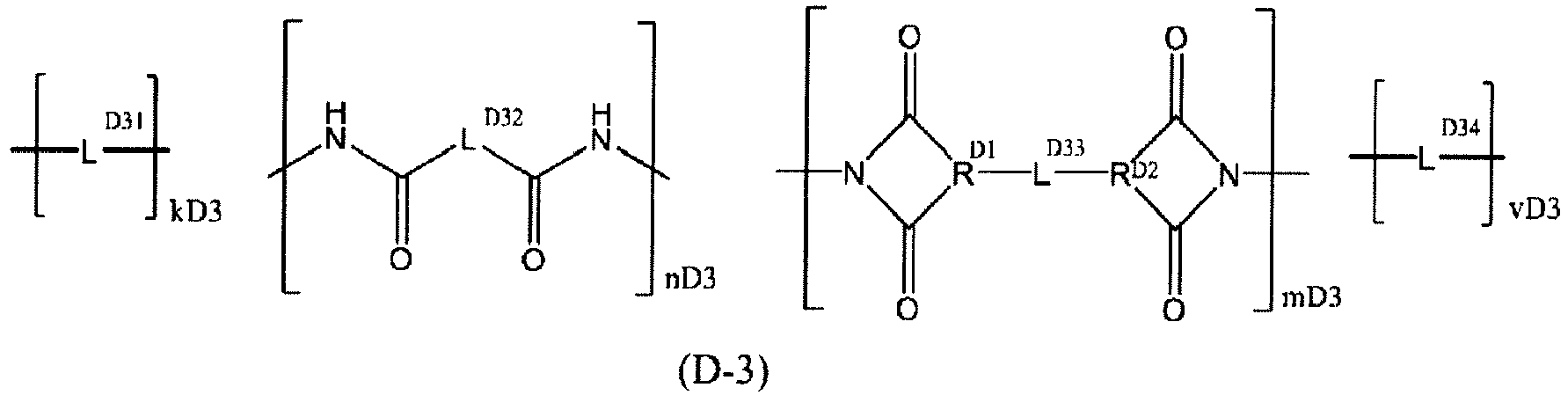


- In Formulae D-1 to D-5, LD11, LD21, LD31, LD41, and LD51 each independently represent any of the structures represented by Formulae B-1 to B-6 and C-1 to C-4, and more preferably contain the structure represented by any one of Formulae C-1 to C-4 and particularly preferably contain the structure represented by Formula C-1 or C-2.
- LD12, LD22, LD32, LD33, LD42, and LD52 each independently represent an alkylene group, an arylene group, a carbonyl group, a sulfonyl group, an amide bond, a urethane bond, a single bond, or a linking group formed by two or more of these bonds being bonded to each other, preferably an alkylene group having 1 to 20 carbon atoms, an arylene group having 6 to 20 carbon atoms, a carbonyl group, a sulfonyl group, an amide bond, a urethane bond, a single bond, or a linking group formed by two or more of these bonds being bonded to each other, more preferably an alkylene group having 1 to 15 carbon atoms, a phenylene group, a naphthylene group, a carbonyl group, a sulfonyl group, an amide bond, a urethane bond, a single bond, or a linking group formed by two or more of these bonds being bonded to each other, and still more preferably an alkylene group having 1 to 15 carbon atoms, a phenylene group, a naphthylene group, or a linking group formed by two or more of these bonds being bonded to each other.
- LD13, LD23, LD34, LD43, and LD53 each independently represent an alkylene group, an alkyleneoxy group, an arylene group, a carbonyl group, a sulfonyl group, an amide bond, a urethane bond, a single bond, or a linking group formed by two or more of these bonds being bonded to each other, preferably an alkylene group having 1 to 20 carbon atoms, an alkyleneoxy group having 2 to 10 carbon atoms, an arylene group having 6 to 20 carbon atoms, a carbonyl group, a sulfonyl group, an amide bond, a urethane bond, a single bond, or a linking group formed by two or more of these bonds being bonded to each other, more preferably an alkylene group having 1 to 15 carbon atoms, an alkyleneoxy group having 2 to 8 carbon atoms, a phenylene group, a naphthylene group, a carbonyl group, a sulfonyl group, an amide bond, a urethane bond, a single bond, or a linking group formed by two or more of these bonds being bonded to each other, and still more preferably an alkylene group having 1 to 15 carbon atoms, an alkyleneoxy group having 2 to 4 carbon atoms, a phenylene group, a naphthylene group, or a linking group formed by two or more of these bonds being bonded to each other.
- Further, the alkyleneoxy group may form a polyalkyleneoxy group. As the polyalkyleneoxy group, a polyalkyleneoxy group having 2 to 50 repeating units is preferable, a polyalkyleneoxy group having 2 to 40 repeating units is more preferable, and a polyalkyleneoxy group having 2 to 30 repeating units is still more preferable. The preferable number of carbon atoms in the repeating units constituting the polyalkyleneoxy group is the same as the preferable number of carbon atoms of the alkyleneoxy group.
- In a case where LD13, LD23, LD34, LD43, or LD53 represents an alkyleneoxy group, it is possible to obtain a photosensitive resin composition which enables production of a planographic printing plate having excellent image formability and enables production of a planographic printing plate having excellent printing durability.
- RD1 to RD3 each independently represent a group formed by removing three hydrogen atoms from an alkane or a group formed by removing three hydrogen atoms from an aromatic hydrocarbon ring, preferably a group formed by removing three hydrogen atoms from an alkane having 1 to 20 carbon atoms or a group formed by removing three hydrogen atoms from an aromatic hydrocarbon ring having 6 to 20 carbon atoms, more preferably a group formed by removing three hydrogen groups from an alkane having 1 to 20 carbon atoms or a group formed by removing three hydrogen atoms from an aromatic hydrocarbon ring having 6 to 20 carbon atoms, and still more preferably a group formed by removing three hydrogen atoms from an alkane having 1 to 6 carbon atoms or a group formed by removing three hydrogen atoms from benzene.
- The alkane may be linear or cyclic.
- Further, RD1, RD2, and LD32 may form a ring and it is preferable that RD1, RD2, and LD32 form a benzene ring or a cyclohexane ring.
- nD1, mD1, and vD1 represent a content ratio (mass ratio) in a case where the total mass of molecules of the polymer compound is set to 100, and nD1:mD1:vD1 is preferably in a range of 90:10:0 to 30:60:10 and more preferably in a range of 80:20:0 to 60:30:10. Further, the total value of nD1 and mD1 is preferably 90 or greater and more preferably 95 or greater. The total value of nD1, mD1, and vD1 is preferably 90 or greater, more preferably 95 or greater, and still more preferably 98 or greater.
- nD2, mD2, and vD2 represent a content ratio (mass ratio) in a case where the total mass of molecules of the polymer compound is set to 100, and nD2:mD2:vD2 is preferably in a range of 90:10:0 to 30:60:10 and more preferably in a range of 80:20:0 to 60:30:10. Further, the total value of nD2 and mD2 is preferably 90 or greater and more preferably 95 or greater. The total value of nD2, mD2, and vD2 is preferably 90 or greater, more preferably 95 or greater, and still more preferably 98 or greater.
- kD3, nD3, mD3, and vD3 represent a content ratio (mass ratio) in a case where the total mass of molecules of the polymer compound is set to 100 and any one of mD3 and nD3 may be 0. In a case where both mD3 and nD3 do not represent 0, mD3:nD3 is preferably in a range of 10:90 to 90:10 and more preferably in a range of 30:70 to 70:30. Further, kD3:(mD3 + nD3):vD3 is preferably in a range of 80:20:0 to 30:60:10 and more preferably in a range of 70:30:0 to 50:40:10. The total value of kD3, mD3, and nD3 is preferably 90 or greater and more preferably 95 or greater. The total value of kD3, mD3, nD3, and vD3 is preferably 90 or greater, more preferably 95 or greater, and still more preferably 98 or greater.
- nD4, mD4, and vD4 represent a content ratio (mass ratio) in a case where the total mass of molecules of the polymer compound is set to 100, and nD4:mD4:vD4 is preferably in a range of 90:10:0 to 30:60:10 and more preferably in a range of 80:20:0 to 50:40:10. Further, the total value of nD4 and mD4 is preferably 90 or greater and more preferably 95 or greater. The total value of nD4, mD4, and vD4 is preferably 90 or greater, more preferably 95 or greater, and still more preferably 98 or greater.
- kD5, mD5, and vD5 represent a content ratio (mass ratio) in a case where the total mass of molecules of the polymer compound is set to 100, and kD5:mD5:vD5 is preferably in a range of 90:10:0 to 40:50:10 and more preferably in a range of 70:30:0 to 50:40:10. Further, the total value of kD5 and mD5 is preferably 90 or greater and more preferably 95 or greater. The total value of kD5, mD5, and vD5 is preferably 90 or greater, more preferably 95 or greater, and still more preferably 98 or greater.
- The compound having a combination of a plurality of constitutional units represented by Formula D-1 can be produced by a sequential polymerization reaction of a diamine compound formed by an amino group being bonded to both terminals of the structure represented by LD11, a diisocyanate compound formed by an isocyanate group being bonded to both terminals of the structure represented by LD12, and optionally a diamine compound formed by an amino group being bonded to a terminal of the structure represented by LD13.
- The terminal of the compound having a combination of a plurality of constitutional units represented by Formula D-1 is not particularly limited, is typically an amino group or an isocyanate group, and may be blocked by a known terminal blocking agent such as a monoamine, a monoalcohol, or a monoisocyanate.
- The compound having a combination of a plurality of constitutional units represented by Formula D-2 can be produced by a sequential polymerization reaction of a diol compound formed by a hydroxy group being bonded to both terminals of the structure represented by LD21, a diisocyanate compound formed by an isocyanate group being bonded to both terminals of the structure represented by LD22, and optionally a diol compound formed by a hydroxy group being bonded to a terminal of the structure represented by LD23.
- The terminal of the compound having a combination of a plurality of constitutional units represented by Formula D-2 is not particularly limited, is typically a hydroxy group or an isocyanate group, and may be blocked by a known terminal blocking agent such as a monoamine, a monoalcohol, or a monoisocyanate.
- The compound having a combination of a plurality of constitutional units represented by Formula D-3 can be produced by a sequential polymerization reaction of a diamine compound formed by an amino group being bonded to both terminals of the structure represented by LD31, a bifunctional acid halide compound formed by an acid halide group being bonded to both terminals of the structure represented by LD32 and/or a compound having two acid anhydrides formed by an acid anhydride structure being bonded to both terminals of the structure represented by LD33, and optionally a diamine compound formed by an amino group being bonded to a terminal of the structure represented by LD34.
- The terminal of the compound having a combination of a plurality of constitutional units represented by Formula D-3 is not particularly limited, is typically an amino group, an acid halide group, or a carboxy group, and may be blocked by a known terminal blocking agent such as a monoamine, a monoalcohol, a monoacid halide, or a monoacid anhydride.
- The compound having a combination of a plurality of constitutional units represented by Formula D-4 can be produced by sequential polymerization of a diol compound formed by a hydroxy group being bonded to both terminals of the structure represented by LD41, a diol compound formed by a hydroxy group being bonded to both terminals of the structure represented by LD42, and optionally a diol compound formed by a hydroxy group being bonded to a terminal of the structure represented by LD43.
- The terminal of the compound having a combination of a plurality of constitutional units represented by Formula D-4 is not particularly limited, is typically an amino group, an acid halide group, or a carboxy group, and may be blocked by a known terminal blocking agent such as a monoalcohol or a monoamine.
- The compound having a combination of a plurality of constitutional units represented by Formula D-5 can be produced by sequential polymerization of a diamine compound formed by an amino group being bonded to both terminals of the structure represented by LD51, a compound formed by an acid halide group and an acid anhydride group being bonded to each of the terminals of the structure represented by LD52, and optionally a diamine compound formed by an amino group being bonded to a terminal of the structure represented by LD53.
- The terminal of the compound having a combination of a plurality of constitutional units represented by Formula D-5 is not particularly limited, is typically an amino group, an acid halide group, a carboxy group, or an acid anhydride group, and may be blocked by a known terminal blocking agent such as a monoalcohol or a monoamine.
- It is preferable that the specific polymer compound of the present invention is a polymer compound having a combination of a plurality of constitutional units represented by Formula D-1 or D-2.
- Further, the weight-average molecular weight of the specific polymer compound of the present invention is preferably in a range of 10,000 to 500,000, more preferably in a range of 10,000 to 200,000, and still more preferably in a range of 20,000 to 100,000.
- The weight-average molecular weight can be calculated by a standard polystyrene conversion method using gel permeation chromatography (GPC). A column filled with a polystyrene crosslinked gel (TSKgel SuperAWM-H; manufactured by Tosoh Corporation) can be used as the GPC column, and N-methylpyrrolidone (0.01 mol/L of each of phosphoric acid and lithium bromide) can be used as the GPC solvent.
- Hereinafter, specific examples of the specific polymer compound will be described.
- In the present invention, the polyurea having a polycyclic structure and a sulfonamide group in the main chain is a polymer generated by a sequential polymerization reaction of a specific diamine compound having a polycyclic structure and a sulfonamide group in the main chain and a compound (diisocyanate compound) having two or more isocyanate groups. Further, the polyurea is not particularly limited as long as the polyurea has a polycyclic structure and a sulfonamide group in the main chain.
- In addition, the main chain of the diamine compound indicates a carbon chain serving as the main chain of a polymer compound in a case where a polymer compound such as polyurea is formed.
- Specific preferred examples of the polyurea which can be used in the present invention are shown in Tables 1 to 3. Specific examples PU-1 to PU-55 indicate specific polymer compounds formed by reacting a diamine compound having a polycyclic structure and a sulfonamide group in the main chain, a compound having two or more isocyanate groups, and optionally other diamine compounds, listed in Tables 1 to 3, at ratios (molar ratios) listed in Tables 1 to 3.
- In addition, the tables show molar ratios used for synthesis of polyureas and weight-average molecular weights (Mw) of obtained specific polyureas, but the polyurea used in the present invention is not limited to these.
- Moreover, the weight-average molecular weight of a polymer is a value measured according to the GPC method.
[Table 1] Specific polymer compound Diamine compound-1 (molar ratio thereof contained) Diamine compound-2 (molar ratio thereof contained) Diisocyanate compound-1 (molar ratio thereof contained) Diisocyanate compound-2 (molar ratio thereof contained) Weight-average molecular weight (ten thousand) PU-1 SA-1 - HDI - 4.8 50 - 50 - PU-2 SA-1 - H6 XDI - 5.1 50 - 50 - PU-3 SA-1 - NDI - 4.6 50 - 50 - PU-4 SA-1 - DMBPDI - 4.9 50 - 50 - PU-5 SA-2 - HDI - 5.3 50 - 50 - PU-6 SA-2 - H6 XDI - 5.2 50 - 50 - PU-7 SA-2 - NDI - 5.0 50 - 50 - PU-8 SA-2 - DMBPDI - 5.1 50 - 50 - PU-9 SA-2 - HDI H6 XDI 4.8 50 - 25 25 PU-10 SA-3 - HDI - 4.8 50 - 50 - PU-11 SA-4 - HDI - 4.6 50 - 50 - PU-12 SA-5 - HDI - 4.8 50 - 50 - PU-13 SA-6 - HDI - 4.9 50 - 50 - PU-14 SA-6 - H6 XDI - 4.6 50 - 50 - PU-15 SA-6 - NDI - 5.2 50 - 50 - PU-16 SA-6 - DMBPDI - 5.2 50 - 50 - PU-17 SA-7 - HDI - 5.4 50 - 50 - PU-18 SA-7 - H6 XDI - 4.5 50 - 50 - PU-19 SA-7 - NDI - 4.8 50 - 50 - PU-20 SA-7 - DMBPDI - 4.9 50 - 50 - [Table 2] Specific polymer compound Diamine compound-1 (molar ratio thereof contained) Diamine compound-2 (molar ratio thereof contained) Diisocyanate compound-1 (molar ratio thereof contained) Diisocyanate compound-2 (molar ratio thereof contained) Weight-average molecular weight (ten thousand) PU-21 SA-1 SA-7 HDI - 4.7 25 25 50 - PU-22 SA-1 SA-6 HDI - 4.7 25 25 50 - PU-23 SA-6 SA-7 HDI - 4.8 25 25 50 - PU-24 SA-1 HDI NDI 4.9 50 - 25 25 PU-25 SA-1 - HDI DMBPDI 4.8 50 - 25 25 PU-26 SA-8 - H6 XDI - 5.8 50 - 50 - PU-27 SA-9 - HDI - 5.1 50 - 50 - PU-28 SA-9 - H6 XDI - 4.8 50 - 50 - PU-29 SA-9 - NDI - 4.2 50 - 50 - PU-30 SA-10 - H6 XDI - 4.5 50 - 50 - PU-31 SA-11 - H6 XDI - 4.9 50 - 50 - PU-32 SA-12 - H6 XDI - 5.2 50 - 50 - PU-33 SA-13 - H6 XDI - 5.3 50 - 50 - PU-34 SA-14 - H6 XDI - 5.1 50 - 50 - PU-35 SA-15 - H6 XDI - 5.1 50 - 50 - PU-36 SA-16 - H6 XDI - 5.1 50 - 50 - PU-37 SA-17 - H6 XDI - 5.1 50 - 50 - PU-38 SA-1 DABA H6 XDI - 4.7 40 10 50 - PU-39 SA-1 PEDA-2 HDI - 4.8 47.5 2.5 50 - PU-40 SA-1 PEDA-2 H6 XDI - 4.7 47.5 2.5 50 - [Table 3] Specific polymer compound Diamine compound-1 (molar ratio thereof contained) Diamine compound-2 (molar ratio thereof contained) Diisocyanate compound-1 (molar ratio thereof contained) Diisocyanate compound-2 (molar ratio thereof contained) Weight-average molecular weight (ten thousand) PU-41 SA-1 TOTDDA HDI - 4.7 47.5 2.5 50 - PU-42 SA-1 TOTDDA HDI - 4.8 45 5 50 - PU-43 SA-1 TOTDDA H6 XDI - 5.1 47.5 2.5 50 - PU-44 SA-18 - H6 XDI - 5.3 50 - 50 - PU-45 SA-18 - HDI - 5.1 50 - 50 - PU-46 SA-19 - H6 XDI - 4.4 50 - 50 - PU-47 SA-20 - H6 XDI - 4.5 50 - 50 - PU-48 SA-18 PEDA-2 H6 XDI - 4.9 47.5 2.5 50 - PU-49 SA-18 PEDA-2 H6 XDI - 5.2 45 5 50 - PU-50 SA-18 PEDA-2 HDI - 4.8 47.5 2.5 50 - PU-51 SA-18 PEDA-2 HDI - 4.9 45 5 50 - PU-52 SA-18 TOTDDA H6 XDI - 4.9 47.5 2.5 50 - PU-53 SA-18 TOTDDA H6 XDI - 5.1 45 5 50 - PU-54 SA-18 TOTDDA HDI - 5.2 47.5 2.5 50 - PU-55 SA-18 TOTDDA HDI - 5.1 45 5 50 - - Specific structures of preferable compounds which include the compounds listed in Tables 1 to 3 and are used for synthesis of polyurea used in the present invention are as follows.


- Among these, PU-1, PU-2, PU-3, PU-5, PU-7, PU-15, PU-17, PU-43, PU-44, and PU-53 are preferable as polyurea.
- The polyurethane which is used in the present invention and has a polycyclic structure and a sulfonamide group in the main chain is a polymer generated by a sequential polymerization reaction of a specific diol compound having a polycyclic structure and a sulfonamide group in the main chain and a compound having two or more isocyanate groups. Further, the polyurethane is not particularly limited as long as the polyurethane has a polycyclic structure and a sulfonamide group in the main chain.
- In addition, the main chain of the diol compound indicates a carbon chain serving as the main chain of a polymer compound in a case where a polymer compound such as polyurethane is formed.
- Specific preferred examples of the polyurethane which can be used in the present invention are shown in Tables 4 to 6. Specific examples PT-1 to PT-66 indicate specific polymer compounds formed by reacting a diol compound having a polycyclic structure and a sulfonamide group in the main chain and a compound having two or more isocyanate groups, listed in Tables 4 to 6, at ratios (molar ratios) listed in Tables 4 to 6.
- In addition, the tables show molar ratios used for synthesis of polyurethanes and weight-average molecular weights (Mw) of obtained specific polyurethanes, but the polyurethane used in the present invention is not limited to these.
- Moreover, the weight-average molecular weight of a polymer is a value measured according to the GPC method.
[Table 4] Specific polymer compound Diol compound-1 (molar ratio thereof contained) Diol compound-2 (molar ratio thereof contained) Diisocyanate compound-1 (molar ratio thereof contained) Diisocyanate compound-2 (molar ratio thereof contained) Weight-average molecular weight (ten thousand) PT-1 SB-1 - HDI - 4.6 50 - 50 - PT-2 SB-1 - H6 XDI - 5.2 50 - 50 - PT-3 SB-1 - NDI - 4.8 50 - 50 - PT-4 SB-1 - DMBPDI - 4.9 50 - 50 - PT-5 SB-2 - HDI - 4.8 50 - 50 - PT-6 SB-2 - H6 XDI - 4.7 50 - 50 - PT-7 SB-2 - NDI - 4.7 50 - 50 - PT-8 SB-2 - DMBPDI - 5.1 50 - 50 - PT-9 SB-2 - HDI H6 XD1 4.8 50 - 25 25 PT-10 SB-3 - HDI - 5.9 50 - 50 - PT-11 SB-4 - HDI - 5.7 50 - 50 - PT-12 SB-5 - HDI - 4.8 50 - 50 - PT-13 SB-6 - HDI - 4.9 50 - 50 - PT-14 SB-6 - H6 XDI - 4.7 50 - 50 - PT-15 SB-6 - NDI - 5.1 50 - 50 - PT-16 SB-6 - DMBPDI - 5.2 50 - 50 - PT-17 SB-7 - HDI - 5.3 50 - 50 - PT-18 SB-7 - H6 XDI - 4.6 50 - 50 - PT-19 SB-7 - NDI - 4.8 50 - 50 - PT-20 SB-7 - DMBPDI - 4.9 50 - 50 - [Table 5] Specific polymer compound Diol compound-1 (molar ratio thereof contained) Diol compound-2 (molar ratio thereof contained) Diisocyanate compound-1 (molar ratio thereof contained) Diisocyanate compound-2 (molar ratio thereof contained) Weight-average molecular weight (ten thousand) PT-21 SB-1 SB-7 HDI - 4.7 25 25 50 - PT-22 SB-1 SB-6 HDI - 5.1 25 25 50 - PT-23 SB-6 SB-7 HDI - 4.8 25 25 50 - PT-24 SB-1 - H6 XDI NDI 5.3 50 - 25 25 PT-25 SB-1 - HDI DMBPDI 4.8 50 - 25 25 PT-26 SB-8 - H6 XDI - 5.7 50 - 50 - PT-27 SB-8 - NDI - 5.8 50 - 50 - PT-28 SB-9 - H6 XDI - 5.6 50 - 50 - PT-29 SB-9 - NDI - 5.2 50 - 50 - PT-30 SB-10 - H6 XDI - 5.4 50 - 50 - PT-31 SB-10 - NDI - 5.6 50 - 50 - PT-32 SB-11 - H6 XDI - 6.1 50 - 50 - PT-33 SB-11 - NDI - 5.8 50 - 50 - PT-34 SB-12 - H6 XDI - 5.9 50 - 50 - PT-35 SB-12 - NDI - 5.8 50 - 50 - PT-36 SB-13 - H6 XDI - 5.5 50 - 50 - PT-37 SB-13 - NDI - 5.5 50 - 50 - PT-38 SB-14 - H6 XDI - 5.4 50 - 50 - PT-39 SB-14 - NDI - 5.7 50 - 50 - PT-40 SB-15 - H6 XDI - 4.9 50 - 50 - [Table 6] Specific polymer compound Diol compound-1 (molar ratio thereof contained) Diol compound-2 (molar ratio thereof contained) Diisocyanate compound-1 (molar ratio thereof contained) Diisocyanate compound-2 (molar ratio thereof contained) Weight-average molecular weight (ten thousand) PT-41 SB-15 - NDI - 5.2 50 - 50 - PT-42 SB-16 - H6 XDI - 5.9 50 - 50 - PT-43 SB-16 - NDI - 5.3 50 - 50 - PT-44 SB-17 - H6 XDI - 5.1 50 - 50 - PT-45 SB-17 - NDI - 5.1 50 - 50 - PT-46 SB-18 DO-7 H6 XDI - 5.1 45 5 50 - PT-47 SB-19 DO-7 H6 XDI - 5.2 45 5 50 - PT-48 SB-1 DO-6 H6 XDI - 4.8 49 1 50 - PT-49 SB-1 DO-7 H6 XDI - 4.9 49 1 50 - PT-50 SB-1 DO-6 H6 XDI - 4.8 49 1 50 - PT-51 SB-1 DO-7 HDI - 5.2 49 1 50 - PT-52 SB-1 DO-6 HDI - 4.6 49 1 50 - PT-53 SB-2 DO-7 H6 XDI - 4.7 49 1 50 - PT-54 SB-2 DO-6 H6 XDI H6 XDI 4.8 49 1 50 25 PT-55 SB-2 DO-7 HDI - 5.2 49 1 50 - PT-56 SB-2 DO-6 HDI - 4.1 49 1 50 - PT-57 SB-1 DO-9 HDI - 4.3 47.5 2.5 50 - PT-58 SB-1 DO-9 HDI - 4.9 45 5 50 - PT-59 SB-1 DO-12 HDI - 4.7 45 5 50 - PT-60 SB-1 DO-12 HDI - 5.2 40 10 50 - PT-61 SB-15 - TDI - 5.5 50 - 50 - PT-62 SB-15 DO-6 TDI - 6.5 45 5 50 - PT-63 SB-15 DO-7 TDI - 6.4 45 5 50 - PT-64 SB-15 - XDI - 5.8 50 - 50 - PT-65 SB-15 - XDI PPDI 5.6 50 - 35 15 PT-66 SB-15 - DMBPDI - 5.9 50 - 50 - - Specific structures of preferable compounds which include the compounds listed in Tables 4 to 6 and are used for synthesis of polyurethane used in the present invention are as follows.


- Among these, PT-1, PT-2, PT-3, PT-7, PT-8, PT-15, PT-18, PT-49, PT-51, PT-61, PT-62, PT-63, and PT-65 are preferable as polyurethane.
- In the present invention, the polyimide, polyamide, or polyamide imide having a polycyclic structure and a sulfonamide group in the main chain is a polymer generated by a sequential polymerization reaction of a specific diamine compound having a polycyclic structure and a sulfonamide group in the main chain and a compound having two or more acid halide groups or acid anhydride groups. Further, the polyimide, polyamide, or polyamide imide is not particularly limited as long as the polyimide, polyamide, or polyamide imide has a polycyclic structure and a sulfonamide group in the main chain.
- Specific preferred examples of the polyimide, polyamide, or polyamide imide which can be used in the present invention are shown in Tables 7 and 8. Specific examples PA-1 to PA-32 indicate specific polymer compounds formed by reacting a diamine compound having a polycyclic structure and a sulfonamide group in the main chain and a compound having two or more acid halide groups or acid anhydride groups, listed in Tables 7 and 8, at ratios (molar ratios) listed in Tables 7 and 8.
- In addition, the tables show molar ratios used for synthesis of polyimides, polyamides, or polyamide imides and weight-average molecular weights (Mw) of obtained specific polyimides, polyamides, or polyamide imides, but the polyimide, polyamide, or polyamide imide used in the present invention is not limited to these.
- Moreover, the weight-average molecular weight of a polymer is a value measured according to the GPC method.
[Table 7] Specific polymer compound Diamine compound-1 (molar ratio thereof contained) Acid anhydride compound-1 (molar ratio thereof contained) Acid halide compound-2 (molar ratio thereof contained) Acid halide-containing acid anhydride compound-2 (molar ratio thereof contained) Weight-average molecular weight (ten thousand) PA-1 SA-1 - - TMAC 5.6 50 - - 50 PA-2 SA-2 - - TMAC 5.8 50 - - 50 PA-3 SA-3 - - TMAC 5.2 50 - - 50 PA-4 SA-4 - - TMAC 6.1 50 - - 50 PA-5 SA-5 - - TMAC 5.2 50 - - 50 PA-6 SA-6 - - TMAC 5.1 50 - - 50 PA-7 SA-7 - - TMAC 5.0 50 - - 50 PA-8 SA-8 - - TMAC 5.1 50 - - 50 PA-9 SA-9 - - TMAC 4.8 50 - - 50 PA-10 SA-10 - - TMAC 5.6 50 - - 50 PA-11 SA-11 - - TMAC 5.1 50 - - 50 PA-12 SA-12 - - TMAC 4.8 50 - - 50 PA-13 SA-13 - - TMAC 4.9 50 - - 50 PA-14 SA-14 - - TMAC 5.3 50 - 50 PA-15 SA-1 PMDA - - 3.8 50 50 - - PA-16 SA-1 BPDA - - 3.7 50 50 - - [Table 8] Specific polymer compound Diamine compound-1 (molar ratio thereof contained) Acid anhydride compound-1 (molar ratio thereof contained) Acid halide compound-2 (molar ratio thereof contained) Acid halide-containing acid anhydride compound-2 (molar ratio thereof contained) Weight-average molecular weight (ten thousand) PA-17 SA-1 - HMDOC - 4.6 50 - 50 - PA-18 SA-1 - CHDOC - 4.2 50 - 50 - PA-19 SA-1 PMDA HMDOC - 4.8 50 25 25 - PA-20 SA-1 BPDA HMDOC - 4.6 50 25 25 - PA-21 SA-1 PMDA HMDOC - 4.8 25 20 30 - PA-22 SA-1 BPDA HMDOC - 4.7 25 30 20 - PA-23 SA-1 BPDA HMDOC - 4.8 25 25 25 - PA-24 SA-5 PMDA - - 3.9 50 50 - - PA-25 SA-5 BPDA - - 4.2 50 50 - - PA-26 SA-5 - HMDOC - 5.8 50 - 50 - PA-27 SA-5 - CHDOC - 5.1 50 - 50 - PA-28 SA-5 PMDA HMDOC - 4.8 50 25 25 - PA-29 SA-5 BPDA HMDOC - 5.9 50 25 25 - PA-30 SA-5 PMDA HMDOC - 5.6 50 20 30 - PA-31 SA-5 BPDA HMDOC - 5.5 50 30 20 - PA-32 SA-5 BPDA HMDOC - 5.4 50 25 25 - - Examples of preferable compounds which include the compounds listed in Tables 7 and 8 and are used for synthesis of polyimide, polyamide, or polyamide imide used in the present invention include the following compounds and SA-1 to SA-14.




- Among these, PA-1, PA-2, PA-5, PA-15, PA-17, PA-19, and PA-28 are preferable as polyimide, polyamide, or polyamide imide.
- In the present invention, the polycarbonate having a polycyclic structure used for forming a lower layer and a sulfonamide group in the main chain is a polymer generated by a sequential polymerization reaction of a compound having a carbonate group such as alkyl carbonate and a diol compound having a polycyclic structure and a sulfonamide group in the main chain. Further, the polycarbonate is not particularly limited as long as the polycarbonate has a polycyclic structure and a sulfonamide group in the main chain.
- Specific preferred examples of the polycarbonate which can be used in the present invention are shown in Table 9. Specific examples PK-1 to PK-13 indicate specific polymer compounds formed by reacting a diol compound having a polycyclic structure and a sulfonamide group in the main chain, other diol compounds, and a compound having a carbonate group such as alkyl carbonate, listed in Table 9, at ratios (molar ratios) listed in Table 9. In addition, the tables show molar ratios used for synthesis of polycarbonates and weight-average molecular weights (Mw) of the obtained polycarbonates, but the polycarbonate used in the present invention is not limited to these.
- Moreover, the weight-average molecular weight of a polymer is a value measured according to the GPC method.
[Table 9] Specific polymer compound Specific diol compound-1 (molar ratio thereof contained) Specific diol compound-2 (molar ratio thereof contained) Diol compound-1 (molar ratio thereof contained) Diol compound-2 (molar ratio thereof contained) Compound containing carbonate group (molar ratio thereof contained) Weight-average molecular weight (ten thousand) PK-1 SB-1 - DO-1 - Diethyl carbonate 4.6 70 - 30 - 100 PK-2 SB-1 - DO-1 - Diethyl carbonate 4.2 60 - 40 - 100 PK-3 SB-1 - DO-1 DO-6 Diethyl carbonate 4.8 70 - 25 5 100 PK-4 SB-1 - DO-2 - Diethyl carbonate 4.5 70 - 30 - 100 PK-5 SB-1 - DO-2 - Diethyl carbonate 4.1 60 - 40 - 100 PK-6 SB-2 - DO-1 - Diethyl carbonate 4.3 70 - 30 - 100 PK-7 SB-2 - DO-1 DO-6 Diethyl carbonate 4.3 70 - 25 5 100 PK-8 SB-5 - DO-1 - Diethyl carbonate 3.9 70 - 30 - 100 PK-9 SB-5 - DO-1 DO-6 Diethyl carbonate 4.6 70 - 25 5 100 PK-10 SB-6 - DO-1 - Diethyl carbonate 4.5 70 - 30 - 100 PK-11 SB-6 - DO-1 DO-7 Diethyl carbonate 4.2 70 - 25 5 100 PK-12 SB-9 - DO-1 - Diethyl carbonate 4.8 70 - 30 - 100 PK-13 SB-9 - DO-1 DO-7 Diethyl carbonate 4.9 70 - 25 5 100 - Examples of preferable compounds which include the compounds listed in Table 9 and are used for synthesis of polycarbonate used in the present invention include the following compounds and SB-1 to SB-19.




- Among these, PK-1, PK-3, PK-7, PK-10, and PK-12 are preferable as polycarbonate.
- The content of the specific polymer compound is preferably in a range of 10% to 90% by mass, more preferably in a range of 20% to 80% by mass, and still more preferably in a range of 30% to 80% by mass with respect to the total solid content mass in the photosensitive resin composition of the present invention.
- When the content of the specific polymer compound is in the above-described range, it is possible to obtain a photosensitive resin composition having excellent coating properties.
- The photosensitive resin composition of the present invention contains an infrared absorbent.
- The infrared absorbent is not particularly limited as long as it is a dye which generates heat by absorbing infrared light, and various dyes known as an infrared absorbent can be used.
- As the infrared absorbent which can be used in the present invention, commercially available dyes or known dyes described in documents (for example, "Dye Handbook", compiled by the Society of Synthetic Organic Chemistry, published in 1970) can be used. Specifically, dyes such as azo dyes, metal complex azo dyes, pyrazolone azo dyes, anthraquinone dyes, phthalocyanine dyes, carbonium dyes, quinone imine dyes, methine dyes, and cyanine dyes are exemplified. In the present invention, among these dyes, a dye absorbing at least infrared light or near infrared light is preferable from the viewpoint of being suitable for use in laser emitting infrared light or near infrared light, and a cyanine dye is particularly preferable.
- Examples of such a dye absorbing at least infrared light or near infrared light include the cyanine dyes described in
JP1983-125246A JP-S58-125246A JP1984-84356A JP-S59-84356A JP-1984-202829A JP-S59-202829A JP1985-78787A JP-S60-78787A JP1983-173696A JP-S58-173696A JP1983-181690A JP-S58-181690A JP1983-194595A JP-S58-194595A JP1983-112793A JP-S58-112793A JP1983-224793A JP-S58-224793A JP1984-48187A JP-S59-48187A JP1984-73996A JP-S59-73996A JP1985-52940A JP-S60-52940A JP1985-63744A JP-S60-63744A JP1983-112792A JP-S58-112792A GB434875B - In addition, as the dye, the near infrared absorbing sensitizers described in
US5156938A are also suitably used, also, the substituted aryl benzo(thio)pyrylium salts described inUS3881924A , the trimethinecyanine thiapyrylium salts described inJP1982-142645A JP-S57-142645A US4327169A ), the pyrylium-based compounds described inJP1983-181051A JP-S58-181051A JP1983-220143A JP-S58-220143A JP1984-41363A JP-S59-41363A JP1984-84248A JP-S59-84248A JP1984-84249A JP-S59-84249A JP1984-146063A JP-S59-146063A JP1984-146061A JP-S59-146061A JP1984-216146A JP-S59-216146A US4283475A , or the pyrylium compounds described inJP1993-13514B JP-H05-13514B JP1993-19702B JP-H05-19702B - In addition, particularly preferable another examples of the dye include near infrared absorbing dyes described as Formula (I) or (II) in
US4756993A . - Among these dyes, examples of a particularly preferable dye include a cyanine coloring agent, a phthalocyanine dye, an oxonol dye, a squarylium coloring agent, a pyrylium salt, a thiopyrylium dye, and a nickel thiolate complex. Furthermore, in a case where a cyanine coloring agent represented by the following Formula (a) is used in the upper layer in the present invention, a high polymerization activity is given and the stability and the economic efficiency become excellent, and thus, the cyanine coloring agent is most preferable.

- In Formula (a), X1 represents a hydrogen atom, a halogen atom, a diarylamino group (-NPh2), X2-L1, or a group shown below. X2 represents an oxygen atom or a sulfur atom. L1 represents a hydrocarbon group having 1 to 12 carbon atoms, an aromatic ring having a heteroatom, or a hydrocarbon group having 1 to 12 carbon atoms including a heteroatom. Here, the heteroatom represents N, S, O, a halogen atom, or Se.

- In the formula, Xa- has the same definition as Za- described below, and Ra represents a substituent selected from a hydrogen atom, an alkyl group, an aryl group, a substituted or unsubstituted amino group, and a halogen atom.
- R21 and R22 each independently represent a hydrocarbon group having 1 to 12 carbon atoms. From the viewpoint of storage stability of a photosensitive layer coating solution, each of R21 and R22 is preferably a hydrocarbon group having two or more carbon atoms, and R21 and R22 are particularly preferably bonded to each other to form a 5-membered ring or a 6-membered ring.
- Ar1 and Ar2 may be the same as or different from each other, and Ar1 and Ar2 each represent an aromatic hydrocarbon group which may have a substituent. Examples of a preferable aromatic hydrocarbon group include a benzene ring and a naphthalene ring. In addition, examples of a preferable substituent include a hydrocarbon group having 12 or less carbon atoms, a halogen atom, and an alkoxy group having 12 or less carbon atoms.
- Y11 and Y12 may be the same as or different from each other, and Y11 and Y12 each represent a sulfur atom or a dialkyl methylene group having 12 or less carbon atoms. R23 and R24 may be the same as or different from each other, and R23 and R24 each represent a hydrocarbon group having 20 or less carbon atoms which may have a substituent. Examples of a preferable substituent include an alkoxy group having 12 or less carbon atoms, a carboxyl group, and a sulfo group.
- R25, R26, R27, and R28 may be the same as or different from each other, and R25, R26, R27, and R28 each represent a hydrogen atom or a hydrocarbon group having 12 or less carbon atoms. From the viewpoint of availability of a raw material, each of R25, R26, R27, and R28 is preferably a hydrogen atom. In addition, Za- represents a counter anion. Here, the cyanine coloring agent represented by Formula (a) has an anionic substituent in the structure thereof, and in a case where neutralization of the charge is not necessary, Za- is not necessary. From the viewpoint of storage stability of a photosensitive layer coating solution, Za- is preferably a halide ion, a perchlorate ion, a tetrafluoroborate ion, a hexafluorophosphate ion, or a sulfonate ion, and particularly preferably a perchlorate ion, a hexafluorophosphate ion, or an arylsulfonate ion.
- Specific examples of the cyanine coloring agent represented by Formula (a) which can be suitably used include the cyanine coloring agents described in paragraphs 0017 to 0019 of
JP2001-133969A JP2002-40638A JP2002-23360A - The infrared absorbent contained in the upper layer is particularly preferably a cyanine dye A shown below.

- The addition amount when an infrared absorbent is added to the photosensitive resin composition of the present invention is preferably 0.01% to 50% by mass, more preferably 0.1% to 30% by mass, and particularly preferably 1.0% to 30% by mass, with respect to the total solid content in the photosensitive resin composition. If the addition amount is 0.01% by mass or greater, the layer becomes high sensitive, and if the addition amount is 50% by mass or less, the uniformity of the layer is good and the durability of the layer is excellent.
- In the present invention, the "alkali-soluble" means "being solubilized by a treatment for a standard development time in an alkali aqueous solution with a pH of 8.5 to 13.5".
- Although the alkali-soluble resin other than the specific polymer compound used in the photosensitive resin composition of the present invention is not particularly limited as long as it has a characteristic of being dissolved by contact with an alkali developer, the alkali-soluble resin preferably has an acidic functional group such as a phenolic hydroxyl group, a sulfonate group, a phosphate group, a sulfonamide group, or an active imide group in the main chain and/or a side chain in the polymer, a resin including 10 mol% or greater of a monomer having such an acidic functional group imparting alkali-solubility is exemplified, and a resin including 20 mol% or greater is more preferable. If the copolymerization component of the monomer imparting alkali-solubility is 10 mol% or greater, sufficient alkali-solubility is obtained, and developability is excellent.
- In addition, as the alkali-soluble resin, a novolac resin is also preferably exemplified.
- As the novolac resin which can be used in the present invention, novolac resins such as a phenol formaldehyde resin, an m-cresol formaldehyde resin, a p-cresol formaldehyde resin, an m-/p- mixed cresol formaldehyde resin, a phenol/cresol (which may be any mixture of m-, p-, and m-/p-) mixed formaldehyde resin or pyrogallol acetone resins are preferably exemplified.
- In addition, a polycondensate of phenol having an alkyl group having 3 to 8 carbon atoms as a substituent and formaldehyde, such as a t-butyl phenol formaldehyde resin or an octyl phenol formaldehyde resin, as described in
US4123279A , is exemplified. In addition, the weight-average molecular weight (Mw) thereof is preferably 500 or greater, and more preferably 1,000 to 700,000. In addition, the number average molecular weight (Mn) thereof is preferably 500 or greater, and more preferably 750 to 650,000. The dispersity (weight-average molecular weight/number average molecular weight) is preferably 1.1 to 10. - Other alkali-soluble resins preferably have a weight-average molecular weight of 2,000 or greater and a number average molecular weight of 500 or greater, and more preferably have a weight-average molecular weight of 5,000 to 300,000 and a number average molecular weight of 800 to 250,000. The dispersity (weight-average molecular weight/number average molecular weight) of other alkali-soluble resins is preferably 1.1 to 10.
- Other alkali-soluble resins included in the photosensitive resin composition of the present invention as desired may be used alone or in combination of two or more types thereof.
- The content of other alkali-soluble resins with respect to the total solid content in the photosensitive resin composition of the present invention is preferably 0% to 98% by mass and more preferably 0% to 80% by mass. In addition, 80 parts by mass or less thereof are preferably included with respect to 100 parts by mass of the specific polymer compound used in the present invention.
- The photosensitive resin composition of the present invention preferably contains an acid generator, from the viewpoint of sensitivity improvement.
- The acid generator in the present invention is a compound which generates an acid by light or heat, and indicates a compound which generates an acid due to decomposition by irradiation with infrared rays or heating at 100°C or higher. The acid generated is preferably a strong acid having a pKa of 2 or less such as sulfonic acid or hydrochloric acid. The permeability of a developer into the image recording layer of the exposed portion is increased and the solubility of the image recording layer in an alkali aqueous solution is further improved due to an acid generated from this acid generator.
- Examples of the acid generator suitably used in the present invention include onium salts such as an iodonium salt, a sulfonium salt, a phosphonium salt, and a diazonium salt. Specifically, the compounds described in
US4708925A orJP1995-20629A JP-H07-20629A US3867147A , the diazonium compound described inUS2632703A , or the diazo resins described inJP1989-102456A JP-H01-102456A JP1989-102457A JP-H01-102457A US5135838A orUS5200544A are also preferable. Furthermore, the active sulfonic acid esters or the disulfonyl compounds described inJP1990-100054A JP-H02-100054A JP1990-100055A JP-H02-100055A JP1997-197671 JP-H09-197671 JP1995-271029A JP-H07-271029A - Furthermore, the compound described as an "acid precursor" in
JP1996-220752A JP-H08-220752A JP1997-171254A JP-H09-171254A - Among these, from the viewpoint of sensitivity and stability, an onium salt compound is preferably used as an acid generator. The onium salt compound will be described below.
- As the onium salt compound which can be suitably used in the present invention, compounds known as a compound which generates an acid due to decomposition by infrared ray exposure or heat energy generated from the infrared absorbent by exposure can be exemplified. As the onium salt compound suitable in the present invention, from the viewpoint of sensitivity, known thermal polymerization initiators or compounds having a bond with small bond dissociation energy and having an onium salt structure described below can be exemplified.
- Examples of the onium salt suitably used in the present invention include known diazonium salts, iodonium salts, sulfonium salts, ammonium salts, pyridinium salts, and azinium salts, and among these, sulfonate of triarylsulfonium or diaryliodonium, carboxylate, BF4 -, PF6 -, or ClO4 - is preferable.
- Examples of the onium salt which can be used as an acid generator in the present invention include onium salts represented by the following Formulae (III) to (V).


- In Formula (III), Ar11 and Ar12 each independently represent an aryl group having 20 or less carbon atoms which may have a substituent. Examples of a preferable substituent in a case where the aryl group has a substituent include a halogen atom, a nitro group, an alkyl group having 12 or less carbon atoms, an alkoxy group having 12 or less carbon atoms, and an aryloxy group having 12 or less carbon atoms. Z11- represents a counter ion selected from the group consisting of a halogen ion, a perchlorate ion, a tetrafluoroborate ion, a hexafluorophosphate ion, a sulfonate ion, or a sulfonate ion having a fluorine atom such as a perfluoroalkyl sulfonate ion, and a perchlorate ion, a hexafluorophosphate ion, an aryl sulfonate ion, or a perfluoroalkyl sulfonic acid is preferable.
- In Formula (IV), Ar21 represents an aryl group having 20 or less carbon atoms which may have a substituent. Examples of a preferable substituent include a halogen atom, a nitro group, an alkyl group having 12 or less carbon atoms, an alkoxy group having 12 or less carbon atoms, an aryloxy group having 12 or less carbon atoms, an alkylamino group having 12 or less carbon atoms, a dialkylamino group having 12 or less carbon atoms, an arylamino group having 12 or less carbon atoms, and a diarylamino group having 12 or less carbon atoms. Z21- represents a counter ion having the same meaning as Z11-.
- In Formula (V), R31, R32, and R33 may be the same as or different from each other, and R31, R32, and R33 each represent a hydrocarbon group having 20 or less carbon atoms which may have a substituent. Examples of a preferable substituent include a halogen atom, a nitro group, an alkyl group having 12 or less carbon atoms, an alkoxy group having 12 or less carbon atoms, and an aryloxy group having 12 or less carbon atoms. Z31- represents a counter ion having the same meaning as Z11-.
- Specific examples of onium salts (OI-1 to OI-10) represented by Formula (III), onium salts (ON-1 to ON-5) represented by Formula (IV), and onium salts (OS-1 to OS-6) represented by Formula (V) which can be suitably used in the present invention are exemplified below.





- In addition, as another example of the compounds represented by each of Formula (III) to (V), the compounds described as an example of a radical polymerization initiator in paragraphs 0036 to 0045 of
JP2008-195018A - Another example of a preferable onium salt as the acid generator used in the present invention includes an azinium salt compound represented by the following Formula (VI).

- In Formula (VI), R41, R42, R43, R44, R45, and R46 may be the same as or different from each other, and R41, R42, R43, R44, R45, and R46 each represent a hydrogen atom, a halogen atom, or a monovalent substituent.
- Examples of the monovalent substituent include a halogen atom, an amino group, a substituted amino group, a substituted carbonyl group, a hydroxyl group, a substituted oxy group, a thiol group, a thioether group, a silyl group, a nitro group, a cyano group, an alkyl group, an alkenyl group, an aryl group, a heterocyclic group, a sulfo group, a substituted sulfonyl group, a sulfonate group, a substituted sulfinyl group, a phosphono group, a substituted phosphono group, a phosphonate group, and a substituted phosphonate group, and in the case of being introducible, each of R41, R42, R43, R44, R45, and R46 may further have a substituent.
- A compound (multimerized form) including two or more cation portions in the molecule as a result of bonding of the skeletons (cation portions) having a specific structure in the compound represented by Formula (VI) to each other through R41 is also included in examples of the compound represented by Formula (VI), and such a compound is also suitably used.
- Z41- represents a counter ion having the same meaning as Z11-.
- Specific examples of the azinium salt compound represented by Formula (VI) include the compounds described in paragraphs 0047 to 0056 of
JP2008-195018A - In addition, a compound group having an N-O bond described in
JP1988-138345A JP-S63-138345A JP1988-142345A JP-S63-142345A JP1988-142346A JP-S63-142346A JP1988-143537A JP-S63-143537A JP1971-42363B JP-S46-42363B - More preferable examples of the acid generator which can be used in the present invention include the following compounds (PAG-1) to (PAG-5).


- In a case where these acid generators are contained in the photosensitive resin composition of the present invention, these compounds may be used alone or in combination of two or more types thereof.
- A preferable addition amount of acid generator is in a range of 0.01% to 50% by mass, preferably in a range of 0.1% to 40% by mass, and more preferably in a range of 0.5% to 30% by mass, with respect to the total solid content in the photosensitive resin composition. If the addition amount is within the above range, improvement of sensitivity which is the effect of the addition of an acid generator is observed, and an occurrence of a residual film in a non-image portion is suppressed.
- An acid proliferative agent may be added to the recording layer of the present invention. The acid proliferative agent in the present invention is a compound substituted with a residue of a relatively strong acid, and a compound which newly generates an acid by being easily released in the presence of an acid catalyst. That is, the compound is decomposed by an acid catalyzed reaction, and generates an acid (hereinafter, referred to as ZOH in formulae) again. Since one or more acids per reaction are increased, and with the progress of the reaction, the acid concentration is increasingly increased, sensitivity is dramatically improved. The intensity of this generated acid is 3 or less as an acid dissociation constant (pKa), and preferably 2 or less. In the case of a weaker acid than this, it is not possible to cause the elimination reaction by an acid catalyst.
- Examples of the acid used in such an acid catalyst include dichloroacetic acid, trichloroacetic acid, methanesulfonic acid, ethanesulfonic acid, benzenesulfonic acid, p-toluenesulfonic acid, naphthalenesulfonic acid, and phenyl sulfonic acid.
- As the acid proliferative agent, the acid proliferative agents described in
WO95/29968A WO98/24000A JP1996-305262A JP-H08-305262A JP1997-34106A JP-H09-34106A JP1996-248561A JP-H08-248561A JP1996-503082A JP-H08-503082A US5445917A ,JP1996-503081A JP-H08-503081A US5534393A ,US5395736A ,US5741630A ,US5334489A ,US5582956A ,US5578424A ,US5453345A ,US5445917A ,EP665960B EP757628B EP665961B US5667943A , orJP1998-1598A JP-H10-1598A - Preferable specific examples of the acid proliferative agent in the present invention include the compounds described in paragraphs 0056 to 0067 of
JP2001-66765A 

- The addition amount in a case where the acid proliferative agent is added in an upper layer is in a range of 0.01% to 20% by mass, preferably in a range of 0.01% to 10% by mass, and more preferably in a range of 0.1% to 5% by mass, expressed in terms of the solid contents. If the addition amount of the acid proliferative agent is within the above range, effects of adding acid proliferative agent is sufficiently obtained, improvement in sensitivity is achieved, and film hardness reduction of an image portion is suppressed.
- The photosensitive resin composition of the present invention may include a development accelerator, a surfactant, a print-out agent/colorant, a plasticizer, or a wax agent, as other additives.
- For the purpose of improving sensitivity, acid anhydrides, phenols, or organic acids may be added to the photosensitive resin composition of the present invention.
- As the acid anhydrides, cyclic acid anhydride is preferable, and specifically, as the cyclic acid anhydride, phthalic anhydride, tetrahydrophthalic anhydride, hexahydrophthalic anhydride, 3,6-endooxytetrahydrophthalic anhydride, tetrachlorophthalic anhydride, maleic anhydride, chloromaleic anhydride, α-phenylmaleic anhydride, succinic anhydride, or pyromellitic anhydride described in
US4115128A can be used. As the non-cyclic acid anhydride, acetic anhydride is exemplified. - Examples of the phenols include bisphenol A, 2,2'-bishydroxysulfone, p-nitrophenol, p-ethoxyphenol, 2,4,4'-trihydroxybenzophenone, 2,3,4-trihydroxybenzophenone, 4-hydroxybenxophenone, 4,4',4"-trihydroxytriphenyl methane, and 4,4',3",4"-tetrahydroxy-3,5,3',5'-tetramethyltriphenyl methane.
- The organic acids are described in
JP1985-88942A JP-S60-88942A JP1990-96755A JP-H02-96755A - To improve coating properties and stability of a treatment with respect to development conditions, a nonionic surfactant as described in
JP1987-251740A JP-S62-251740A JP1991-208514A JP-H03-208514A JP1984-121044A JP-S59-121044A JP1992-13149A JP-H04-13149A JP1987-170950A JP-S62-170950A JP1999-288093A JP-H11-288093A JP2003-57820A - Specific examples of the nonionic surfactant include sorbitan tristearate, sorbitan monopalmitate, sorbitan trioleate, monoglyceride stearate, and polyoxyethylenenonylphenyl ether.
- Specific examples of the amphoteric surfactant include alkyl di(aminoethyl)glycine, alkylpolyaminoethylglycine hydrochloride, 2-alkyl-N-carboxyethyl-N-hydroxyethyl imidazolinium betaine, and an N-tetradecyl-N,N-betaine type (for example, product name "AMOGEN K" manufactured by Dai-ichi Kogyo Seiyaku Co., Ltd.).
- The ratio of the surfactant to the total solid content in the photosensitive resin composition is preferably 0.01% to 15% by mass, more preferably 0.01% to 5% by mass, and still more preferably 0.05% to 2.0% by mass.
- A print-out agent for obtaining a visible image immediately after heating by exposure or a dye or a pigment as an image colorant can be added to the photosensitive resin composition of the present invention.
- Examples of the print-out agent and the colorant are described in detail in paragraphs 0122 and 0123 of
JP2009-229917A - The dye is preferably added in a ratio of 0.01% to 10% by mass and more preferably added in a ratio of 0.1% to 3% by mass, with respect to the total solid content of the photosensitive resin composition.
- To impart flexibility or the like to the coating film, a plasticizer may be added to the photosensitive resin composition of the present invention. For example, butylphthalyl polyethylene glycol, tributyl citrate, diethyl phthalate, dibutyl phthalate, dihexyl phthalate, dioctyl phthalate, tricresyl phosphate, tributyl phosphate, trioctyl phosphate, tetrahydrofurfuryl oleate, or an oligomer or a polymer of acrylic acid or methacrylic acid is used.
- These plasticizers are preferably added in a ratio of 0.5% to 10% by mass and more preferably added in a ratio of 1.0% to 5% by mass, with respect to the total solid content of the photosensitive resin composition.
- For the purpose of imparting resistance against scratches, a compound for reducing the coefficient of static friction of the surface can also be added to the photosensitive resin composition of the present invention. Specifically, the compounds having an ester of a long chain alkyl carboxylic acid as described in
US6117913A ,JP2003-149799A JP2003-302750A JP2004-12770A - As a preferable addition amount thereof, the ratio of the wax agent to the solid content of the photosensitive resin composition is preferably 0.1% to 10% by mass and more preferably 0.5% to 5% by mass.
- The content of the specific polymer compound is preferably 10% to 90% by mass, the content of the infrared absorbent is preferably 0.01% to 50% by mass, the content of other alkali-soluble resins is preferably 0% to 80% by mass, the content of the acid generator is preferably 0% to 30% by mass, the content of the acid proliferative agent is preferably 0% to 20% by mass, the content of the development accelerator is preferably 0% to 20% by mass, the content of the surfactant is preferably 0% to 5% by mass, the content of the print-out agent/colorant is preferably 0% to 10% by mass, the content of the plasticizer is preferably 0% to 10% by mass, and the content of the wax agent is preferably 0% to 10% by mass, with respect to the total solid content mass of the photosensitive resin composition of the present invention.
- The photosensitive resin composition of the present invention can be applied to various fields requiring resin pattern formation excellent in durability, for example, various fields such as a resist, a display, a planographic printing plate precursor, and the like, and since the photosensitive resin composition can be recorded with high sensitivity and has excellent image formability, and the durability of the image portion formed of the composition is good, by applying to an infrared sensitive positive type planographic printing plate precursor described in detail below, the effects of the present invention can become significant.
- The planographic printing plate precursor of the present invention has an image recording layer including the photosensitive resin composition of the present invention, on a support having a hydrophilic surface.
- In addition, the planographic printing plate precursor of the present invention is preferably a positive type planographic printing plate precursor.
- Furthermore, the planographic printing plate precursor of the present invention is a positive type planographic printing plate precursor including a recording layer which has an lower layer and an upper layer in this order on a support having a hydrophilic surface, and the photosensitive resin composition is preferably contained in at least one of the lower layer or the upper layer, more preferably contained in the lower layer or the upper layer, and still more preferably contained only in the lower layer.
- The recording layer used in the present invention can be formed by dissolving respective components of the photosensitive resin composition in a solvent and applying the resulting product to a suitable support.
- Examples of the solvent used here include ethylene dichloride, cyclohexanone, methyl ethyl ketone, methanol, ethanol, propanol, ethylene glycol monomethyl ether, 1-methoxy-2-propanol, 2-methoxyethyl acetate, 1-methoxy-2-propyl acetate, dimethoxyethane, methyl lactate, ethyl lactate, N,N-dimethylacetamide, N,N-dimethylformamide, tetramethyl urea, N-methylpyrrolidone, dimethyl sulfoxide, sulfolane, γ-butyrolactone, and toluene, and the present invention is not limited thereto. These solvents are used alone or in a mixture.
- In addition, the recording layer of the present invention is preferably a recording layer (hereinafter, also referred to as a "planographic printing plate precursor having a two-layer structure") in which a lower layer and an upper layer are disposed in this order on a support.
- The lower layer and the upper layer are preferably separately formed in principle.
- As the method of separately forming the two layers, for example, a method of using the difference in the solvent solubilities between the components included in the lower layer and the components included in the upper layer and a method of rapidly drying and removing the solvent after application to the upper layer are exemplified. Since by using the latter method in combination, the separation between the layers is more favorably performed, the method is preferable.
- These methods will be described in detail below, but the method of separately applying to the two layers is not limited thereto.
- In the method of using the difference in the solvent solubilities between the components included in the lower layer and the components included in the upper layer, when applying a coating solution for an upper layer, a solvent system in which all the components included in the lower layer are insoluble is used. Thus, even in a case where two-layer coating is performed, a coating film can be formed such that each layer thereof is clearly separated. For example, by selecting a component insoluble in a solvent such as methyl ethyl ketone or 1-methoxy-2-propanol which dissolves an alkali-soluble resin which is the upper layer component, as the lower layer component, applying to the lower layer and drying using a solvent system which dissolves the lower layer component, dissolving the alkali-soluble resin-based upper layer in methyl ethyl ketone or 1-methoxy-2-propanol, and applying the resulting product and drying, bilayering is possible.
- Next, the method of very rapidly drying the solvent after application to the second layer (upper layer) can be achieved by blowing high-pressure air from a slit nozzle provided substantially at a right angle with respect to the running direction of the web, applying heat energy as conductive heat from the lower surface of the web by a roll (heating roll) into which a heating medium such as steam has been supplied, or combining these.
- The photosensitive resin composition of the present invention is preferably included in the upper layer and/or the lower layer, and more preferably included only in the lower layer.
- The coating amount after drying of the lower layer applied to the support of the planographic printing plate precursor of the present invention is preferably in a range of 0.5 to 4.0 g/m2 and more preferably in a range of 0.6 to 2.5 g/m2. If the coating amount is 0.5 g/m2 or greater, printing durability is excellent, and if the coating amount is 4.0 g/m2 or less, image reproducibility and sensitivity are excellent.
- In addition, the coating amount after drying of the upper layer component is preferably 0.05 to 1.0 g/m2 and more preferably 0.08 to 0.7 g/m2. If the coating amount is 0.05 g/m2 or greater, development latitude and scratch resistance are excellent, and if the coating amount is 1.0 g/m2 or less, sensitivity is excellent.
- The coating amount after drying of the lower layer and the upper layer is preferably in a range of 0.6 to 4.0 g/m2 and more preferably in a range of 0.7 to 2.5 g/m2. If the coating amount is 0.6 g/m2 or greater, printing durability is excellent, and if the coating amount is 4.0 g/m2 or less, image reproducibility and sensitivity are excellent.
- The upper layer of the planographic printing plate precursor having a two-layer structure of the present invention can be formed using the photosensitive resin composition of the present invention, and is preferably formed using a resin composition other than the photosensitive resin composition of the present invention.
- The upper layer of the planographic printing plate precursor having a two-layer structure of the present invention is preferably an infrared sensitive positive type recording layer of which the solubility in an alkali aqueous solution is improved by heat.
- The mechanism of improving the solubility in alkali aqueous solution by heat in the upper layer is not particularly limited, and any one can be used as long as it includes a binder resin and improves the solubility of the heated region. As the heat used in image formation, the heat generated in a case where the lower layer including an infrared absorbent is exposed is exemplified.
- Preferable examples of the upper layer of which the solubility in an alkali aqueous solution is improved by heat include a layer including an alkali-soluble resin having a hydrogen-bonding capacity such as novolac or urethane, a layer including a water-insoluble and alkali-soluble resin and a compound having a dissolution suppressing action, and a layer including an ablation-possible compound.
- In addition, by further adding an infrared absorbent to the upper layer, the heat generated from the upper layer can also be used in image formation. Preferable examples of the constitution of the upper layer including an infrared absorbent include a layer including an infrared absorbent, a water-insoluble and alkali-soluble resin, and a compound having a dissolution suppressing action, and a layer including an infrared absorbent, a water-insoluble and alkali-soluble resin, and an acid generator.
- The upper layer according to the present invention preferably contains a water-insoluble and alkali-soluble resin. By containing the water-insoluble and alkali-soluble resin, an interaction is formed between the polar groups of the infrared absorbent and the water-insoluble and alkali-soluble resin, and a layer having a positive type photosensitivity is formed.
- General water-insoluble and alkali-soluble resin will be described below in detail, and among these, a polyamide resin, an epoxy resin, a polyacetal resin, an acrylic resin, a methacrylic resin, a polystyrene-based resin, and a novolac-type phenolic resin are preferably exemplified.
- The water-insoluble and alkali-soluble resin which can be used in the present invention is not particularly limited as long as it has a characteristic of being dissolved by contact with an alkali developer, and a homopolymer containing an acidic group in the main chain and/or a side chain in the polymer, a copolymer thereof, or a mixture thereof is preferable.
- Such a water-insoluble and alkali-soluble resin having an acidic group preferably has a functional group such as a phenolic hydroxyl group, a carboxy group, a sulfonate group, a phosphate group, a sulfonamide group, or an active imide group. Therefore, such a resin can be suitably produced by copolymerizing a monomer mixture including one or more ethylenically unsaturated monomers having a functional group described above. As the ethylenically unsaturated monomer having a functional group described above, in addition to acrylic acid and methacrylic acid, a compound represented by the following formula and a mixture thereof can be preferably exemplified. Moreover, in the following formula, R40 represents a hydrogen atom or a methyl group.



- The water-insoluble and alkali-soluble resin which can be used in the present invention is preferably a polymer compound obtained by copolymerizing another polymerizable monomer in addition to the above-mentioned polymerizable monomers. As the copolymerization ratio in this case, a monomer imparting alkali-solubility such as a monomer having a functional group such as a phenolic hydroxyl group, a carboxy group, a sulfonate group, a phosphate group, a sulfonamide group, or an active imide group is preferably included in 10 mol% or greater, and more preferably included in 20 mol% or greater. If the copolymerization component of the monomer imparting alkali-solubility is 10 mol% or greater, sufficient alkali-solubility is obtained, and developability is excellent.
- Examples of other usable polymerizable monomers include compounds exemplified below.
- Alkyl acrylates or alkyl methacrylates such as methyl acrylate, ethyl acrylate, propyl acrylate, benzyl acrylate, methyl methacrylate, ethyl methacrylate, cyclohexyl methacrylate, and benzyl methacrylate. Acrylic acid esters or methacrylic acid esters having an aliphatic hydroxyl group such as 2-hydroxyethyl acrylate and 2-hydroxyethyl methacrylate. Acrylamides or methacrylamides such as acrylamide, methacrylamide, N-methylacrylamide, N-ethylacrylamide, and N-phenylacrylamide. Vinyl esters such as vinyl acetate, vinyl chloroacetate, vinyl butyrate, and vinyl benzoate. Styrenes such as styrene, α-methylstyrene, methylstyrene, and chloromethylstyrene. Other nitrogen atom-containing monomers such as N-vinyl pyrrolidone, N-vinyl pyridine, acrylonitrile, and methacrylonitrile. Maleimides such as N-methylmaleimide, N-ethylmaleimide, N-propylmaleimide, N-butylmaleimide, N-phenylmaleimide, N-2-methylphenylmaleimide, N-2,6-diethylphenylmaleimide, N-2-chlorophenylmaleimide, N-cyclohexylmaleimide, N-laurylmaleimide, and N-hydroxyphenylmaleimide.
- Among these other ethylenically unsaturated monomers, (meth)acrylic acid esters, (meth)acrylamides, maleimides, or (meth)acrylonitrile is suitably used.
- In addition, as the alkali-soluble resin, a novolac resin exemplified as another alkali-soluble resin described as an arbitrary component of the photosensitive resin composition of the present invention may also be preferably exemplified.
- In addition, the water-insoluble and alkali-soluble resin described above can also be used in the resin composition of the present invention.
- Furthermore, in the upper layer of the present invention, other resins can be used in combination within a range not impairing the effects of the present invention. Since the upper layer is required to express alkali-solubility, in particular, in a non-image portion region, it is necessary to select a resin which does not impair this characteristic. From this viewpoint, as a resin usable in combination, a water-insoluble and alkali-soluble resin is exemplified. General water-insoluble and alkali-soluble resin will be described below in detail, and among these, a polyamide resin, an epoxy resin, a polyacetal resin, an acrylic resin, a methacrylic resin, a polystyrene-based resin, and a novolac-type phenolic resin are preferably exemplified.
- In addition, the amount to be mixed is preferably 50% by mass or less with respect to the water-insoluble and alkali-soluble resin.
- The water-insoluble and alkali-soluble resin preferably has a weight-average molecular weight of 2,000 or greater and a number average molecular weight of 500 or greater, and more preferably has a weight-average molecular weight of 5,000 to 300,000 and a number average molecular weight of 800 to 250,000. The dispersity (weight-average molecular weight/number average molecular weight) of the alkali-soluble resin is preferably 1.1 to 10.
- The alkali-soluble resin in other resins of the photosensitive resin composition of the present invention may be used alone or in combination of two or more types thereof.
- The content of the alkali-soluble resin with respect to the total solid content in other resin compositions of the present invention is preferably 2.0% to 99.5% by mass, more preferably 10.0% to 99.0% by mass, and still more preferably 20.0% to 90.0% by mass, in the total solid content. If the addition amount of the alkali-soluble resin is 2.0% by mass or greater, the durability of a recording layer (photosensitive layer) is good, and if the addition amount of the alkali-soluble resin is 99.5% by mass or less, both the sensitivity and the durability are good.
- The upper layer may contain an infrared absorbent.
- The infrared absorbent is not particularly limited as long as it is a dye which generates heat by absorbing infrared light, and the infrared absorbent used in the resin composition of the present invention, described above, can also be used.
- A particularly preferable dye is the cyanine dye represented by Formula (a).
- When the upper layer contains an infrared absorbent, the sensitivity is improved.
- The addition amount of the infrared absorbent in the upper layer is preferably 0.01% to 50% by mass, more preferably 0.1% to 30% by mass, and particularly preferably 1.0% to 10% by mass, with respect to the total solid content in the upper layer. If the addition amount is 0.01% by mass or greater, the sensitivity is improved, and if the addition amount is 50% by mass or less, the uniformity of the layer is good and the durability of the layer is excellent.
- In addition, the upper layer of the planographic printing plate precursor of the two-layer structure may include an acid generator, an acid proliferative agent, a development accelerator, a surfactant, a print-out agent/colorant, a plasticizer, or a wax agent.
- As these components, respective components used in the resin composition of the present invention, described above, can also be used, and preferable aspects thereof are also the same.
- The lower layer of the planographic printing plate precursor having a two-layer structure of the present invention is preferably formed by applying the photosensitive resin composition of the present invention.
- By using the photosensitive resin composition of the present invention in the lower layer, a printing plate having excellent image formability and printing durability can be obtained.
- In addition, by using the photosensitive resin composition of the present invention in the lower layer, in a case where materials such as an ink and paper having particularly poor quality are used, the printing durability is improved.
- Though the detailed mechanism by which the effects as described above are obtained is unclear, it is assumed that for the printing durability in printing, the film hardness of the resin used in the lower layer is important, and thus, it is assumed that, since the interaction (hydrogen bonding or the like) between the binders is strong, by using the photosensitive resin composition of the present invention having a high film hardness in the lower layer, the printing durability is improved.
- In a case where the photosensitive resin composition of the present invention is used in the upper layer, the lower layer is also preferably formed of the photosensitive resin composition of the present invention, and the lower layer may be formed using a resin composition other than the photosensitive resin composition of the present invention. A preferable aspect of the lower layer in this case is the same as the preferable aspect of the upper layer described above.
- The support used in the photosensitive resin composition of the present invention is not particularly limited as long as it is a dimensionally stable plate-shaped material having necessary strength and durability, and examples thereof include paper, paper on which plastic (for example, polyethylene, polypropylene, and polystyrene) has been laminated, a metal plate (for example, aluminum, zinc, and copper), a plastic film (for example, cellulose diacetate, cellulose triacetate, cellulose propionate, cellulose butyrate, cellulose acetate butyrate, cellulose nitrate, polyethylene terephthalate, polyethylene, polystyrene, polypropylene, polycarbonate, and polyvinyl acetal), and paper or a plastic film on which the above-described metals have been laminated or vapor-deposited.
- Moreover, the support in a case where the image forming material of the present invention is applied to a planographic printing plate precursor is preferably a polyester film or an aluminum plate, and among these, the aluminum plate which has good dimensional stability and is relatively inexpensive is particularly preferable. A suitable aluminum plate is a pure aluminum plate or an alloy plate which has aluminum as the main component and includes a small amount of other elements, or may be a plastic film on which aluminum has been laminated or vapor-deposited. Examples of other elements included in the aluminum alloy include silicon, iron, manganese, copper, magnesium, chromium, zinc, bismuth, nickel, and titanium. The content of other elements in the alloy is preferably 10% by mass or less.
- Although particularly suitable aluminum in the present invention is pure aluminum, it is difficult to produce completely pure aluminum on refining technique, and thus, other elements may be slightly contained.
- The composition of the aluminum plate applied to the present invention as described above is not particularly limited, and aluminum plates formed of known and used materials in the related art can be appropriately used. The thickness of the aluminum plate used in the present invention is preferably 0.1 to 0.6 mm, more preferably 0.15 to 0.4 mm, and particularly preferably 0.2 to 0.3 mm.
- Such an aluminum plate may be subjected to a surface treatment such as a surface-roughening treatment and an anodization treatment, if necessary. As the surface treatment of the aluminum support, for example, a degreasing treatment with a surfactant, an organic solvent, or an alkaline aqueous solution, a roughening treatment of a surface, an anodization treatment, or the like, as described in detail in paragraphs 0167 to 0169 of
JP2009-175195A - The aluminum surface on which an anodization treatment has been performed may be subjected to a hydrophilizing treatment, as necessary.
- As the hydrophilizing treatment, the alkali metal silicate (for example, sodium silicate aqueous solution) method, the method of treating with potassium fluoride zirconate or polyvinylphosphonic acid, or the like, as disclosed in paragraph 0169 of
JP2009-175195A - In addition, the supports described in
JP2011-245844A - For example, in a case where the photosensitive resin composition of the present invention is applied to a planographic printing plate precursor, an undercoat layer can be provided between a support and a recording layer, if necessary.
- As the undercoat layer component, various organic compounds can be used, and preferable examples thereof include phosphonic acids having an amino group such as carboxymethylcellulose or dextrin, an organic phosphonic acid, an organic phosphorus acid, an organic phosphinic acid, amino acids, and hydrochloride of an amine having a hydroxy group. In addition, these undercoat layer components may be used alone or in a mixture of two or more types thereof. Details of the compound used in the undercoat layer and the method of forming the undercoat layer are described in paragraphs 0171 and 0172 of
JP2009-175195A - The coating amount of the undercoat layer is preferably 2 to 200 mg/m2 and more preferably 5 to 100 mg/m2. If the coating amount is within the above range, sufficient printing durability is obtained.
- A back coat layer is provided on the rear surface of the support of the planographic printing plate precursor of the present invention, if necessary. As the back coat layer, coating layers formed of an organic polymer compound described in
JP1993-45885A JP-H05-45885A JP1994-35174A JP-H06-35174A - The production method of the planographic printing plate of the present invention includes an exposure step of image-wise exposing the planographic printing plate precursor and a development step of performing development using an alkali aqueous solution having a pH of 8.5 to 13.5 in this order.
- According to the production method of the planographic printing plate of the present invention, the developability change becomes good, the contamination due to the residual film of the non-image portion does not occur in the obtained planographic printing plate, and the strength of the image portion and the durability are excellent.
- Hereinafter, each step of production method of the present invention will be described in detail.
- The production method of the planographic printing plate of the present invention includes an exposure step of image-wise exposing the planographic printing plate precursor of the present invention.
- As a light source of active light used in image exposure of the planographic printing plate precursor of the present invention, a light source having an emission wavelength in the near infrared region to the infrared region is preferable, and solid-state laser or semiconductor laser is more preferable. Among these, in the present invention, it is particularly preferable that image exposure is performed by solid-state laser or semiconductor laser emitting infrared rays having a wavelength of 750 to 1,400 nm.
- The output of the laser is preferably 100 mW or greater, and to shorten the exposure time, a multibeam laser device is preferable used. In addition, the exposure time per pixel is preferably within 20 µ seconds.
- Energy with which the planographic printing plate precursor is irradiated is preferably 10 to 300 mJ/cm2. If the energy is within the above range, curing sufficiently proceeds and the laser ablation is suppressed, and thus, it is possible to prevent an image from being damaged.
- In the exposure in the present invention, it is possible to expose by overlapping a light beam of the light source. The overlapping means that the sub-scanning pitch width is smaller than the beam diameter. For example, when the beam diameter is expressed by the half width (FWHM) of the beam intensity, the overlapping can be quantitatively expressed by FWHM/sub-scanning pitch width (overlap coefficient). In the present invention, this overlap coefficient is preferably 0.1 or greater.
- The scanning method of the light source of an exposure apparatus which can be used in the present invention is not particularly limited, and a drum outer surface scanning method, a drum inner surface scanning method, a planar scanning method, or the like can be used. In addition, the channel of the light source may be a single channel or a multichannel, and in the case of drum outer surface scanning method, the multichannel is preferably used.
- The production method of the planographic printing plate of the present invention includes a development step of performing development using an alkali aqueous solution with a pH of 8.5 to 13.5 (hereinafter, also referred to as a "developer").
- The developer used in the development step is an aqueous solution with a pH of 8.5 to 13.5 and more preferably an alkali aqueous solution with a pH of 12 to 13.5. A surfactant contributes to improvement of processability.
- As the surfactant used in the developer, any of an anionic surfactant, a nonionic surfactant, a cationic surfactant, and an amphoteric surfactant can be used, and as described above, an anionic surfactant or a nonionic surfactant is preferable.
- As the anionic surfactant, the nonionic surfactant, the cationic surfactant, and the amphoteric surfactant used in the developer of the present invention, the surfactants described in paragraphs 0128 to 0131 of
JP2013-134341A - In addition, from the viewpoint of stable solubility or turbidity in water, a surfactant preferably has a HLB value of 6 or greater and more preferably has a HLB value of 8 or greater.
- As the surfactant used in the developer, an anionic surfactant or a nonionic surfactant is preferable, and an anionic surfactant containing sulfonic acid or sulfonate or a nonionic surfactant having an aromatic ring and an ethylene oxide chain is particularly preferable.
- The surfactant can be used alone or in combination of two or more types thereof.
- The content of the surfactant in the developer is preferably 0.01% to 10% by mass, and more preferably 0.01% to 5% by mass.
- If as a buffer, carbonate ions and hydrogencarbonate ions are included to maintain the pH of the developer at 8.5 to 13.5, it is possible to suppress variations in pH even in a case where the developer is used for a long period of time, and it is possible to suppress developability deterioration and a development scum occurrence due to the variation in pH. To make carbonate ions and hydrogencarbonate ions present in the developer, carbonate and hydrogencarbonate may be added to the developer, or by adjusting the pH after carbonate or hydrogencarbonate is added, carbonate ions and hydrogencarbonate ions may be generated. Although carbonate and hydrogencarbonate are not particularly limited, an alkali metal salt is preferable. Examples of the alkali metal include lithium, sodium, and potassium, and sodium is particularly preferable. These may be used alone or in combination of two or more types thereof.
- The total amount of carbonate and hydrogencarbonate is preferably 0.3% to 20% by mass, more preferably 0.5% to 10% by mass, and particularly preferably 1% to 5% by mass, with respect to the total mass of the developer. If the total amount is 0.3% by mass or greater, developability and processing capability are not reduced, and if the total amount is 20% by mass or less, a precipitate or a crystal is less likely to be produced and at the time of the waste liquid treatment of the developer, gelation when neutralizing is less likely to occur, and thus, trouble does not occur in the waste liquid treatment.
- In addition, for the purpose of finely adjusting the alkali concentration or assisting dissolution of the non-image portion photosensitive layer, supplementarily, other alkali agents, for example, organic alkali agents may be used in combination. Examples of the organic alkali agent include monomethylamine, dimethylamine, trimethylamine, monoethylamine, diethylamine, triethylamine, monoisopropylamine, diisopropylamine, triisopropylamine, n-butylamine, monoethanolamine, diethanolamine, triethanolamine, monoisopropanolamine, diisopropanolamine, ethyleneimine, ethylenediamine, pyridine, and tetramethylammonium hydroxide. Other alkali agents are used alone or in combination of two or more types thereof.
- In addition to the above materials, the developer may contain a wetting agent, a preservative, a chelate compound, an antifoaming agent, an organic acid, an organic solvent, an inorganic acid, an inorganic salt, or the like. If a water-soluble polymer compound is added, in particular, when the developer was fatigued, the plate surface is likely to be sticky, and thus, a water-soluble polymer compound is preferably not added.
- As the wetting agent, the wetting agents described in paragraph 0141 of
JP2013-134341A - As the preservative, the preservatives described in paragraph 0142 of
JP2013-134341A - As the chelate compound, the chelate compounds described in paragraph 0143 of
JP2013-134341A - As the antifoaming agent, the antifoaming agents described in paragraph 0144 of
JP2013-134341 A - As the organic acid, the antifoaming agents described in paragraph 0145 of
JP2013-134341A - Examples of the organic solvent include aliphatic hydrocarbons (hexane, heptane, "Isopar E, H, G" (manufactured by Exxon Chemical Company), gasoline, kerosene, and the like), aromatic hydrocarbons (toluene, xylene, and the like), halogenated hydrocarbons (methylene dichloride, ethylene dichloride, trichlene, monochlorobenzene, and the like), and polar solvents.
- Examples of the polar solvent include alcohols (methanol, ethanol, propanol, isopropanol, benzyl alcohol, ethylene glycol monomethyl ether, 2-ethoxyethanol, and the like), ketones (methyl ethyl ketone, cyclohexanone, and the like), esters (ethyl acetate, methyl lactate, propylene glycol monomethyl ether acetate, and the like), others (triethyl phosphate, tricresyl phosphate, N-phenylethanolamine, N-phenyldiethanolamine, and the like).
- In addition, in a case where the organic solvent is insoluble in water, it is also possible to use by solubilizing the organic solvent in water using a surfactant or the like. In a case where the developer contains an organic solvent, from the viewpoint of safety and inflammability, the concentration of the solvent is preferably less than 40% by mass.
- Examples of the inorganic acid and the inorganic salt include phosphoric acid, metaphosphoric acid, ammonium primary phosphate, ammonium secondary phosphate, sodium primary phosphate, sodium secondary phosphate, potassium primary phosphate, potassium secondary phosphate, sodium tripolyphosphate, potassium pyrophosphate, sodium hexametaphosphate, magnesium nitrate, sodium nitrate, potassium nitrate, ammonium nitrate, sodium sulfate, potassium sulfate, ammonium sulfate, sodium sulfite, ammonium sulfite, sodium hydrogen sulfate, and nickel sulfate. The content of the inorganic salt is preferably 0.01% to 0.5% by mass with respect to the total mass of the developer.
- Although the temperature of development is not particularly limited as long as, at the temperature, developing is possible, the temperature is preferably at 60°C or lower, and more preferably 15°C to 40°C. In the development treatment using an automatic developing device, the developer becomes fatigued according to the treatment amount, and thus, the processing capability may be restored using a replenisher or a fresh developer. As one example of the development or the treatment after the development, a method of performing alkali development, removing the alkali in a post-water washing step, performing a gum treatment in a gumming step, and drying in a drying step can be exemplified. In addition, as another example, a method of performing pre-water washing, developing, and gumming at the same time by using an aqueous solution containing carbonate ions, hydrogencarbonate ions, and a surfactant can be preferably exemplified. Thus, particularly, the pre-water washing step may not be performed, and only by using one solution, pre-water washing, developing, and gumming are performed in one bath, and then, a drying step may be preferably performed. After developing, drying is preferably performed after the excess developer is removed using a squeeze roller or the like.
- The development step can be suitably performed by an automatic processing machine equipped with a rubbing member. Examples of the automatic processing machine include an automatic processing machine which performs a rubbing treatment while transporting the planographic printing plate precursor after image exposure, described in
JP1990-220061A JP-H02-220061A JP1985-59351A JP-S60-59351A US5148746A ,US5568768A , andGB2297719B - The rotating brush roll used in the present invention can be suitably selected in consideration of the difficulty in flawing of the image portion and the stiffness of the support of the planographic printing plate precursor. As the rotating brush roll, a known rotating brush roll formed by implanting a brush material into a plastic or metal roll can be used. For example, the brush rolls described in
JP1983-159533A JP-S58-159533A JP1991-100554A JP-H03-100554A JP1987-167253Y JP-S62-167253Y - As the brush material, plastic fibers (for example, polyester-based synthetic fibers such as polyethylene terephthalate and polybutylene terephthalate, polyamide-based synthetic fibers such as nylon 6.6 and nylon 6.10, polyacryl-based synthetic fibers such as polyacrylonitrile and polyalkyl (meth)acrylate, and polyolefin-based synthetic fibers such as polypropylene and polystyrene) can be used, and for example, a plastic fiber having a diameter of a fiber hair of 20 to 400 µm and a length of a hair of 5 to 30 mm can be suitably used.
- The outer diameter of the rotating brush roll is preferably 30 to 200 mm, and the circumferential speed of the front end of the brush rubbing the plate surface is preferably 0.1 to 5 m/sec. A plurality of the rotating brush rolls is preferably used.
- Although the rotation direction of the rotating brush roll may be the same direction or may be the reverse direction, with respect to the transporting direction of the planographic printing plate precursor, in a case where two or more rotating brush rolls are used, it is preferable that at least one rotating brush roll rotates in the same direction and at least one rotating brush roll rotates in the reverse direction. Thus, removal of the photosensitive layer of the non-image portion becomes more reliable. Furthermore, it is also effective to swing the rotating brush roller in the rotation axis direction of the brush roll.
- After the development step, a continuous or discontinuous drying step is preferably performed. Drying is performed by hot air, infrared rays, or far infrared rays.
- As the automatic processing machine suitably used in the production method of the planographic printing plate of the present invention, an apparatus having a developing portion and a drying portion, and developing, and gumming are performed on the planographic printing plate precursor in developer tank, and then, the planographic printing plate precursor is dried in the drying portion, whereby a planographic printing plate is obtained.
- In addition, for the purpose of improving printing durability or the like, it is also possible to heat the printing plate after developing in very strong conditions. The heating temperature is preferably in a range of 200°C to 500°C. If the temperature is low, sufficient image strengthening effects are not obtained, and in a case where the temperature is too high, there is a possibility that problems such as deterioration of the support or thermal decomposition of the image portion occur.
- The planographic printing plate obtained in this manner is mounted on an offset printing machine, and can be suitably used in printing a large number of sheets.
- The polymer compound of the present invention has a polycyclic structure and a sulfonamide group in the main chain.
- The polymer compound of the present invention has the same definition as that for the specific polymer compound in the photosensitive resin composition of the present invention which has been described above and the preferred embodiments thereof are the same as the preferred embodiments of the specific polymer compound.
- Hereinafter, the present invention will be described in detail using examples, but the present invention is not limited thereto. Moreover, "part" and "%" in the following examples respectively represent "part(s) by mass" and "% by mass" unless otherwise specified.
- 139.82 g of chlorosulfonic acid was weighed in a three-neck flask provided with a condenser and a stirrer, 29.43 g of xanthone (manufactured by Tokyo Chemical Industry Co., Ltd.) was added thereto at room temperature, and the resulting solution was stirred at room temperature for 1 hour. The temperature of the reaction solution was raised to 80°C, and the reaction solution was stirred for 8 hours. This reaction solution was cooled to room temperature while being stirred, and crystallized in 2 L of ice-cold water, followed by stirring for 10 minutes. This was collected by filtration, and the collected product was dissolved in 3 L of ethyl acetate. This ethyl acetate solution was transferred to a separating funnel, washing with pure water and liquid-liquid separation was performed two times, and washing with saturated saline and liquid-liquid separation was performed. After the organic layer was transferred to an Erlenmeyer flask, 30 g of magnesium sulfate was added thereto, followed by stirring, the solid content was removed by filtration, the ethyl acetate was distilled off using an evaporator, and the resulting product was vacuum-dried at 40°C for 24 hours, whereby 28 g of a precursor S-1 (disulfonic chloride) which was a target substance was obtained. It was confirmed from the NMR (nuclear magnetic resonance) spectrum that the obtained product was the precursor (S-1). The precursor S-1 was analyzed using 1NMR. The result thereof is shown below.
- 1NMR data (deuterated dimethyl sulfoxide (deuterated DMSO), 400 MHz, internal standard: tetramethylsilane)
- δ (ppm) = 7.62-7.65 (d, 2H), 8.02-8.05 (d, 2H), 8.40 (s, 2H)
- 32.44 g of 1,4-phenylenediamine (manufactured by Tokyo Chemical Industry Co., Ltd.) and 170 g of tetrahydrofuran were weighed in a three-neck flask provided with a condenser and a stirrer, and the resulting mixture was stirred while being cooled to 0°C to 5°C. After 19.66 g of the precursor (S-1) obtained in the above-described manner was dissolved in 170 g of tetrahydrofuran, the solution was transferred to a dropping funnel, added dropwise to the three-neck flask for 1 hour during stirring, and stirred for 1 hour. After the temperature of the reaction solution was returned to room temperature and the reaction solution was stirred for 2 hours, 205.0 g of a 1 mol/L sodium hydroxide aqueous solution was added to the reaction solution and then 150 g of pure water was added thereto and dissolved therein. The reaction solution was transferred to a separating funnel and washed with 300 mL of ethyl acetate three times, and then the water layer was recovered. Next, an aqueous solution obtained by dissolving 11.10 g of ammonium chloride (manufactured by Kanto Chemical Co., Inc.) in 500 mL of pure water was stirred, the water layer was added dropwise using a dropping funnel, and crystals were filtered. The filtrate was washed with 500 mL of pure water, washed with 500 mL of hexane, and filtered, thereby obtaining crystals. The crystals were vacuum-dried at 40°C for 24 hours, whereby 20.1 g of a target substance (SA-1) was obtained. It was confirmed from the NMR spectrum that the obtained product was the target substance.
- The target substance (SA-1) was analyzed using 1NMR. The result thereof is shown below.
- 1NMR data (deuterated DMSO, 400 MHz, internal standard: tetramethylsilane)
- δ (ppm) = 4.63 (s, 4H), 6.36-6.38 (d, 4H), 6.67-6.69 (d, 4H), 7.81-7.83 (d, 2H), 7.99-8.01 (d, 2H), 8.43 (s, 2H), 9.66 (s, 2H)
- In the same manner as described above, SA-2 to SA-17 can be synthesized.
- 36.06 g of ethylenediamine (manufactured by Tokyo Chemical Industry Co., Ltd.) and 40 g of tetrahydrofuran were weighed in a three-neck flask provided with a condenser and a stirrer, and the resulting mixture was stirred while being cooled to 0°C to 5°C. 11.79 g of the precursor (S-1) obtained in the above-described manner was dissolved in 66 g of tetrahydrofuran, the solution was transferred to a dropping funnel, added dropwise to the three-neck flask for 1 hour during stirring, and stirred for 1 hour after the dropwise addition. When the temperature of the reaction solution was returned to room temperature and the reaction solution was stirred for 2 hours, since the solid component and the liquid component were separated from each other, the liquid component was decanted. Next, the solid component in the flask was dissolved in 150 g of N,N-dimethylacetamide (manufactured by Kanto Chemical Co., Ltd.) and 20 g of pure water and crystallized in 2 L of an aqueous solution in which 20 g of sodium hydrogen carbonate was dissolved, and then the resultant was filtered. The filtrate was washed with 500 mL of pure water, washed with 500 mL of tetrahydrofuran, and filtered, thereby obtaining crystals. The crystals were vacuum-dried at 60°C for 24 hours, whereby 10.1 g of a target substance (SA-18) was obtained. It was confirmed from the NMR spectrum that the obtained product was the target substance.
- The target substance (SA-18) was analyzed using 1NMR. The result thereof is shown below.
- 1NMR data (deuterated DMSO, 400 MHz, internal standard: tetramethylsilane)
- δ (ppm) = 2.52-2.55 (t, 4H), 2.75-2.79 (t, 4H), 7.93-7.95 (d, 2H), 8.22-8.25 (d, 2H), 8.57 (s, 2H)
- In the same manner as described above, SA-19 and SA-20 can be synthesized.
- 54.07 g of 2-aminoethanol (manufactured by Tokyo Chemical Industry Co., Ltd.) and 30.0 g of tetrahydrofuran were weighed in a three-neck flask provided with a condenser and a stirrer, and the resulting mixture was stirred while being cooled to 0°C to 5°C. 21.07 g of 4,4'-biphenyl disulfonyl chloride (manufactured by Tokyo Chemical Industry Co., Ltd.) was dissolved in 170 g of tetrahydrofuran, the solution was transferred to a dropping funnel, added dropwise to the three-neck flask for 1 hour during stirring, and stirred for 1 hour. After the temperature of the reaction solution was returned to room temperature and the reaction solution was stirred for 2 hours, the solution was crystallized in 1 L of a 1 mol/L hydrochloric acid aqueous solution, and the crystallized result was filtered, transferred to a beaker, stirred with 1 L of pure water, washed, and then filtered. Next, the crystals were transferred to a beaker, stirred with 500 mL of acetonitrile and washed, thereby obtaining crystals. The crystals were vacuum-dried at 40°C for 24 hours, whereby 20.5 g of a target substance (SB-5) was obtained. It was confirmed from the NMR spectrum that the obtained product was the target substance.
- The target substance (SB-5) was analyzed using 1NMR. The result thereof is shown below.
- 1NMR data (deuterated DMSO, 400 MHz, internal standard: tetramethylsilane)
- δ (ppm) = 2.81-2.86 (q, 4H), 3.37-3.42 (q, 4H), 4.69-4.72 (t, 2H), 7.70-7.73 (t, 2H), 7.90-7.92 (d, 4H), 7.96-7.98 (d, 2H)
- In the same manner as described above, SB-1 to SB-4 and SB-6 to SB-19 can be synthesized.
- 42.93 g of SA-1, 0.027 g of aniline (manufactured by Wako Pure Chemical Industries, Ltd.), and 169.16 g of N,N-dimethylacetamide (manufactured by Kanto Chemical Co., Inc.) were weighed in a three-neck flask provided with a condenser and a stirrer, and the temperature of the reaction solution was set to room temperature to obtain a uniform solution. Next, 13.45 g of hexamethylene diisocyanate (manufactured by Tokyo Chemical Industry Co., Ltd.) was added dropwise using a dropping funnel at room temperature for 15 minutes, the resulting solution was stirred at room temperature for 30 minutes for a reaction, and the reaction solution was heated to 60°C and stirred for 3 hours. Subsequently, 1.00 g of aniline (manufactured by Wako Pure Chemical Industries, Ltd.) and 50 mL of methanol were added to the reaction solution, and the resulting solution was reacted at 60°C for 1 hour and then cooled to room temperature.
- The reaction solution was poured into a mixed solution of 2 L of pure water and 2 L of methanol, and as a result, a polymer was precipitated. The resultant was collected by filtration, washed, and dried, whereby 51.9 g of a binder polymer (PU-1) having a weight-average molecular weight of 56,000 was obtained.
- It was confirmed from the NMR spectrum, the IR spectrum, and GPC (polystyrene conversion) that the obtained product was the target substance. In the same manner as described above, PU-2 to PU-43 can be synthesized.
- Further, the structure of PU-1 is shown below.

- 35.24 g of SA-18, 0.078 g of n-butylamine (manufactured by Wako Pure Chemical Industries, Ltd.), and 200.0 g of N,N-dimethylacetamide (manufactured by Kanto Chemical Co., Inc.) were weighed in a three-neck flask provided with a condenser and a stirrer, and the temperature of the reaction solution was set to room temperature to obtain a uniform solution. Next, 15.54 g of 1,3-bis(isocyanatomethyl)cyclohexane (manufactured by Tokyo Chemical Industry Co., Ltd.) and 80.0 g of N,N-dimethylacetamide (manufactured by Kanto Chemical Co., Inc.) were weighed and added dropwise using a dropping funnel at room temperature for 30 minutes, and the resulting solution was stirred at room temperature for 30 minutes for a reaction. Subsequently, 1.00 g of n-butylamine (manufactured by Wako Pure Chemical Industries, Ltd.) and 50 mL of methanol were added to the reaction solution, and the resulting solution was reacted at room temperature for 30 minutes.
- The reaction solution was poured into a mixed solution of 2 L of pure water and 2 L of methanol, and as a result, a polymer was precipitated. The resultant was collected by filtration, washed, and dried, whereby 46.7 g of a binder polymer (PU-44) having a weight-average molecular weight of 53,000 was obtained.
- It was confirmed from the NMR spectrum, the IR spectrum, and GPC (polystyrene conversion) that the obtained product was the target substance. In the same manner as described above, PU-45 to PU-55 can be synthesized.
- Further, the structure of PU-44 is shown below.

- PU-53 was synthesized using the same method as that for PU-44. The details are described below.
- 31.72 g of SA-18, 1.76 g of diethylene glycol bis(3-aminopropyl)ether (manufactured by Tokyo Chemical Industry Co., Ltd.), 0.078 g of n-butylamine (manufactured by Wako Pure Chemical Industries, Ltd.), and 200.0 g of N,N-dimethylacetamide (manufactured by Kanto Chemical Co., Inc.) were weighed in a three-neck flask provided with a condenser and a stirrer, and the temperature of the reaction solution was set to room temperature to obtain a uniform solution. Next, 15.54 g of 1,3-bis(isocyanatomethyl)cyclohexane (manufactured by Tokyo Chemical Industry Co., Ltd.) and 78.0 g of N,N-dimethylacetamide (manufactured by Kanto Chemical Co., Inc.) were weighed and added dropwise using a dropping funnel at room temperature for 30 minutes, and the resulting solution was stirred at room temperature for 30 minutes for a reaction. Subsequently, 1.00 g of n-butylamine (manufactured by Wako Pure Chemical Industries, Ltd.) and 50 mL of methanol were added to the reaction solution, and the resulting solution was reacted at room temperature for 30 minutes.
- The reaction solution was poured into a mixed solution of 2 L of pure water and 2 L of methanol, and as a result, a polymer was precipitated. The resultant was collected by filtration, washed, and dried, whereby 45.8 g of a binder polymer (PU-53) having a weight-average molecular weight of 51,000 was obtained.
- It was confirmed from the NMR spectrum, the IR spectrum, and GPC (polystyrene conversion) that the obtained product was the target substance.
- Further, the structure of PU-53 is shown below.


- 44.25 g of SB-1 and 149.50 g of N,N-dimethylacetamide (manufactured by Kanto Chemical Co., Inc.) were weighed in a three-neck flask provided with a condenser and a stirrer, and the temperature of the reaction solution was set to room temperature to obtain a uniform solution. Next, 20.98 g of 1,3-bis(isocyanatomethyl)cyclohexane (manufactured by Tokyo Chemical Industry Co., Ltd.) and 0.1 g of NEOSTANN U-600 (manufactured by NITTO KASEI CO., LTD.: bismuth catalyst) were added at room temperature, the resulting solution was stirred at room temperature for 30 minutes for a reaction, and the reaction solution was heated to 70°C and stirred for 10 hours. 100.87 g of N,N-dimethylacetamide (manufactured by Kanto Chemical Co., Inc.) and 50 mL of methanol (manufactured by Wako Pure Chemical Industries, Ltd.) were added to the reaction solution, and the resulting solution was reacted at 70°C for 2 hours and then cooled to room temperature.
- The reaction solution was poured into a mixed solution of 2 L of pure water and 2 L of methanol, and as a result, a polymer was precipitated. The resultant was collected by filtration, washed, and dried, whereby 61.5 g of a binder polymer (PT-2) having a weight-average molecular weight of 52,000 was obtained.
- It was confirmed from the NMR spectrum, the IR spectrum, and GPC (polystyrene conversion) that the obtained product was the target substance. In the same manner as described above, PT-1 and PT-3 to PT-66 can be synthesized.
- Further, the structure of PT-2 is shown below.

- 34.62 g of SA-5, 7.79 g of triethylamine (manufactured by Kanto Chemical Co., Inc.), and 140.00 g of N,N-dimethylacetamide (manufactured by Kanto Chemical Co., Inc.) were weighed in a three-neck flask provided with a condenser and a stirrer, and the reaction solution was ice-cooled so that the temperature thereof was adjusted to be in a range of 0°C to 5°C. Next, 14.74 g of trimellitic anhydride chloride (manufactured by Tokyo Chemical Industry Co., Ltd.) was added to the reaction solution during the ice-cooling, the reaction solution was stirred at room temperature for 30 minutes for a reaction, the temperature of the reaction solution was adjusted to room temperature, and then the reaction solution was stirred for 3 hours. Subsequently, 139.70 g of N,N-dimethylacetamide (manufactured by Kanto Chemical Co., Inc.), 22.10 g of pyridine (manufactured by Kanto Chemical Co., Inc.), and 7.86 g of acetic anhydride (manufactured by Kanto Chemical Co., Inc.) were added to the reaction solution, the resulting solution was reacted at 80°C for 3 hours and then cooled to room temperature, and then 20 mL of a 36% hydrochloric acid aqueous solution was added thereto.
- The reaction solution was poured into a mixed solution of 2 L of pure water and 2 L of methanol, and as a result, a polymer was precipitated. The resultant was collected by filtration, washed, and dried, whereby 35.20 g of a binder polymer (PA-5) having a weight-average molecular weight of 52,000 was obtained.
- It was confirmed from the NMR spectrum, the IR spectrum, and GPC (polystyrene conversion) that the obtained product was the target substance. In the same manner as described above, PA-1 to PA-4 and PA-6 to PA-32 can be synthesized.

- 40 parts by mass of a mixture of each monomer diol in total, 60 parts by mass of diethyl carbonate, and 60 parts by mass of a 20% sodium ethoxide ethanol solution were mixed with each other in a nitrogen-substituted three-neck flask provided with a stirrer and a reflux tube, and heated to 120°C. Thereafter, the pressure in the reactor was reduced by approximately 30 kPa and the mixture was stirred for 1 hour. Next, the mixture was further stirred in a vacuum at 0.1 kPa for 3 hours. The mixture was cooled to room temperature and the reactant was added dropwise to 500 parts by mass of pure water during stirring. The obtained white powder was collected by filtration and dried by blowing air, whereby a binder polymer PK-2 having a weight-average molecular weight of 42,000 was obtained. It was confirmed from the NMR spectrum, the IR spectrum, and GPC (polystyrene conversion) that the obtained product was the target substance. In the same manner as described above, PK-1 and PK-3 to PK-13 can be synthesized.
- In the examples, "weight-average molecular weight" is calculated by a standard polystyrene conversion method using gel permeation chromatography (GPC). Here, as the GPC column, a column filled with polystyrene crosslinked gel (TSKgel SuperAWM-H; manufactured by Tosoh Corporation) was used, and as the GPC solvent, N-methylpyrrolidone (0.01 mol/L of each of phosphoric acid and lithium bromide) was used.
- An aluminum alloy plate having a thickness of 0.3 mm of a material 1S was subjected to the treatment shown in the following Table 10 from among the following (A) to (F), whereby and a support for a planographic printing plate was manufactured. Moreover, during all treatment steps, a washing treatment with water was performed, and after the washing treatment with water, liquid cutting was performed using a nip roller.
- While supplying a suspension of pumice (specific gravity of 1.1 g/cm3) to the surface of an aluminum plate as a polishing slurry liquid, a mechanical roughening treatment was performed using rotating bundle bristle brushes.
- The median diameter (µm) of a polishing material was 30 µm, the number of the brushes was four, and the rotation speed (rpm) of the brushes was set to 250 rpm. The material of the bundle bristle brushes was nylon 6.10, the diameter of the brush bristles was 0.3 mm, and the bristle length was 50 mm. The brushes were produced by implanting bristles densely into the holes in a stainless steel cylinder having φ300 mm. The distance between two support rollers (φ200 mm) of the lower portion of the bundle bristle brush was 300 mm. The bundle bristle brushes were pressed until the load of a driving motor for rotating the brushes became 10 kW plus with respect to the load before the bundle bristle brushes were pressed against the aluminum plate. The rotation direction of the brushes was the same as the moving direction of the aluminum plate.
- The aluminum plate obtained above was subjected to an etching treatment by spraying a caustic soda aqueous solution in which the concentration of caustic soda was 26% by mass and the concentration of aluminum ions was 6.5% by mass using a spray tube at a temperature of 70°C. Thereafter, washing with water by spraying was performed. The amount of aluminum dissolved was 10 g/m2.
- Next, a desmutting treatment was performed in a nitric acid aqueous solution. As the nitric acid aqueous solution used in the desmutting treatment, the waste liquid of nitric acid used in electrochemical roughening of the next step was used. The liquid temperature was 35°C. The desmutting treatment was performed for 3 seconds by spraying the desmutting liquid using a spray.
- An electrochemical surface roughening treatment was continuously performed using an AC voltage of nitric acid electrolysis 60 Hz. As the electrolyte at this time, an electrolyte which had been adjusted to have a concentration of aluminum ions of 4.5 g/L by adding aluminum nitrate to a nitric acid aqueous solution having a concentration of 10.4 g/L at a temperature of 35°C was used. Using a trapezoidal rectangular waveform AC having a time tp until the current value reached a peak from zero of 0.8 msec and the duty ratio of 1:1 as the AC power supply waveform, the electrochemical surface-roughening treatment was performed using a carbon electrode as a counter electrode. As an auxiliary anode, ferrite was used. The current density was 30 A/dm2 as the peak current value, and 5% of the current from the power source was separately flowed to the auxiliary anode. The electric quantity (C/dm2) was 185 C/dm2 as the sum total of electric quantity at the time of anodization of the aluminum plate. Thereafter, washing with water by spraying was performed.
- The aluminum plate obtained above was subjected to an etching treatment by spraying a caustic soda aqueous solution in which the concentration of caustic soda was 5% by mass and the concentration of aluminum ions was 0.5% by mass using a spray tube at a temperature of 50°C. Thereafter, washing with water by spraying was performed. The amount of aluminum dissolved was 0.5 g/m2.
- Next, a desmutting treatment was performed in a sulfuric acid aqueous solution. As the sulfuric acid aqueous solution used in the desmutting treatment, a solution in which the concentration of sulfuric acid was 170 g/L and the concentration of aluminum ions was 5 g/L was used. The liquid temperature was 30°C. The desmutting treatment was performed for 3 seconds by spraying the desmutting liquid using a spray.
- An electrochemical surface roughening treatment was continuously performed using an AC voltage of hydrochloric acid electrolysis 60 Hz. As the electrolyte, an electrolyte which had been adjusted to have a concentration of aluminum ions of 4.5 g/L by adding aluminum nitrate to a hydrochloric acid aqueous solution having a concentration of 6.2 g/L at a liquid temperature of 35°C was used. Using a trapezoidal rectangular waveform AC having a time tp until the current value reached a peak from zero of 0.8 msec and the duty ratio of 1:1, the electrochemical surface-roughening treatment was performed using a carbon electrode as a counter electrode. As an auxiliary anode, ferrite was used.
- The current density was 25 A/dm2 as the peak current value, and the electric quantity (C/dm2) in the hydrochloric acid electrolysis was 63 C/dm2 as the sum total of electric quantity at the time of anodization of the aluminum plate. Thereafter, washing with water by spraying was performed.
- The aluminum plate obtained above was subjected to an etching treatment by spraying a caustic soda aqueous solution in which the concentration of caustic soda was 5% by mass and the concentration of aluminum ions was 0.5% by mass using a spray tube at a temperature of 50°C. Thereafter, washing with water by spraying was performed. The amount of aluminum dissolved was 0.1 g/m2.
- Next, a desmutting treatment was performed in a sulfuric acid aqueous solution. Specifically, the desmutting treatment was performed at a liquid temperature of 35°C for 4 seconds using the waste liquid (aluminum ions having a concentration of 5 g/L were dissolved in a sulfuric acid aqueous solution having a concentration of 170 g/L) generated in the anodization treatment step. The desmutting treatment was performed for 3 seconds by spraying the desmutting liquid using a spray.
- An anodization treatment was performed using an anodization apparatus (the length of each of a first electrolytic portion and a second electrolytic portion was 6 m, the length of each of a first feeding portion and a second feeding portion was 3 m, and the length of each of a first feeding electrode and a second feeding electrode was 2.4 m) of a two-stage feeding electrolytic treatment method. As the electrolyte supplied to the first electrolytic portion and the second electrolytic portion, sulfuric acid was used. All electrolytes have a concentration of sulfuric acid of 50 g/L (including 0.5% by mass of aluminum ions) and were at a temperature of 20°C. Thereafter, washing with water by spraying was performed.
- To ensure hydrophilicity of the non-image portion, a silicate treatment was performed by dipping at 50°C for 7 seconds using 2.5% by mass No. 3 sodium silicate aqueous solution. The amount of Si attached was 10 mg/m2. Thereafter, washing with water by spraying was performed.
- While supplying a suspension of pumice (specific gravity of 1.1 g/cm3) to the surface of an aluminum plate as a polishing slurry liquid, a mechanical roughening treatment was performed using rotating bundle bristle brushes.
- The median diameter (µm) of a polishing material was 30 µm, the number of the brushes was four, and the rotation speed (rpm) of the brushes was set to 250 rpm. The material of the bundle bristle brushes was nylon 6.10, the diameter of the brush bristles was 0.3 mm, and the bristle length was 50 mm. The brushes were produced by implanting bristles densely into the holes in a stainless steel cylinder having φ300 mm. The distance between two support rollers (φ200 mm) of the lower portion of the bundle bristle brush was 300 mm. The bundle bristle brushes were pressed until the load of a driving motor for rotating the brushes became 10 kW plus with respect to the load before the bundle bristle brushes were pressed against the aluminum plate. The rotation direction of the brushes was the same as the moving direction of the aluminum plate.
- The aluminum plate obtained above was subjected to an etching treatment by spraying a caustic soda aqueous solution in which the concentration of caustic soda was 26% by mass and the concentration of aluminum ions was 6.5% by mass using a spray tube at a temperature of 70°C. Thereafter, washing with water by spraying was performed. The amount of aluminum dissolved was 10 g/m2.
- Next, a desmutting treatment was performed in a nitric acid aqueous solution. As the nitric acid aqueous solution used in the desmutting treatment, the waste liquid of nitric acid used in electrochemical roughening of the next step was used. The liquid temperature was 35°C. The desmutting treatment was performed for 3 seconds by spraying the desmutting liquid using a spray.
- An electrochemical surface roughening treatment was continuously performed using an AC voltage of nitric acid electrolysis 60 Hz. As the electrolyte at this time, an electrolyte which had been adjusted to have a concentration of aluminum ions of 4.5 g/L by adding aluminum nitrate to a nitric acid aqueous solution having a concentration of 10.4 g/L at a temperature of 35°C was used. Using a trapezoidal rectangular waveform AC having a time tp until the current value reached a peak from zero of 0.8 msec and the duty ratio of 1:1 as the AC power supply waveform, the electrochemical surface-roughening treatment was performed using a carbon electrode as a counter electrode. As an auxiliary anode, ferrite was used. The current density was 30 A/dm2 as the peak current value, and 5% of the current from the power source was separately flowed to the auxiliary anode. The electric quantity (C/dm2) was 185 C/dm2 as the sum total of electric quantity at the time of anodization of the aluminum plate. Thereafter, washing with water by spraying was performed.
- The aluminum plate obtained above was subjected to an etching treatment by spraying a caustic soda aqueous solution in which the concentration of caustic soda was 5% by mass and the concentration of aluminum ions was 0.5% by mass using a spray tube at a temperature of 50°C. Thereafter, washing with water by spraying was performed. The amount of aluminum dissolved was 0.5 g/m2.
- Next, a desmutting treatment was performed in a sulfuric acid aqueous solution. As the sulfuric acid aqueous solution used in the desmutting treatment, a solution in which the concentration of sulfuric acid was 170 g/L and the concentration of aluminum ions was 5 g/L was used. The liquid temperature was 30°C. The desmutting treatment was performed for 3 seconds by spraying the desmutting liquid using a spray.
- An electrochemical surface roughening treatment was continuously performed using an AC voltage of hydrochloric acid electrolysis 60 Hz. As the electrolyte, an electrolyte which had been adjusted to have a concentration of aluminum ions of 4.5 g/L by adding aluminum nitrate to a hydrochloric acid aqueous solution having a concentration of 6.2 g/L at a liquid temperature of 35°C was used. Using a trapezoidal rectangular waveform AC having a time tp until the current value reached a peak from zero of 0.8 msec and the duty ratio of 1:1, the electrochemical surface-roughening treatment was performed using a carbon electrode as a counter electrode. As an auxiliary anode, ferrite was used.
- The current density was 25 A/dm2 as the peak current value, and the electric quantity (C/dm2) in the hydrochloric acid electrolysis was 63 C/dm2 as the sum total of electric quantity at the time of anodization of the aluminum plate. Thereafter, washing with water by spraying was performed.
- The aluminum plate obtained above was subjected to an etching treatment by spraying a caustic soda aqueous solution in which the concentration of caustic soda was 5% by mass and the concentration of aluminum ions was 0.5% by mass using a spray tube at a temperature of 50°C. Thereafter, washing with water by spraying was performed. The amount of aluminum dissolved was 0.1 g/m2.
- Next, a desmutting treatment was performed in a sulfuric acid aqueous solution. Specifically, the desmutting treatment was performed at a liquid temperature of 35°C for 4 seconds using the waste liquid (aluminum ions having a concentration of 5 g/L were dissolved in a sulfuric acid aqueous solution having a concentration of 170 g/L) generated in the anodization treatment step. The desmutting treatment was performed for 3 seconds by spraying the desmutting liquid using a spray.
- A first stage of the anodization treatment was performed using an anodization apparatus by DC electrolysis. The anodization treatment was performed using a solution obtained by dissolving aluminum ions of 7 g/L in a sulfuric acid aqueous solution of 170 g/L as an electrolytic bath under the conditions of a liquid temperature of 43°C and a current density of 30 A/dm2. The depth of the micropores was 27 µm, and the obtained coating amount was 0.13 g/m2.
- A pore-widening treatment was performed by immersing the aluminum plate subjected to the anodization treatment in a caustic soda aqueous solution in which the concentration of caustic soda was 5% by mass and the concentration of aluminum ions was 0.5% by mass at a temperature of 35°C for 1 second. Thereafter, washing with water by spraying was performed.
- A second stage of the anodization treatment was performed using an anodization apparatus by DC electrolysis. The anodization treatment was performed using a solution obtained by dissolving aluminum ions of 7 g/L in a sulfuric acid aqueous solution of 170 g/L as an electrolytic bath under the conditions of a liquid temperature of 55°C and a current density of 20 A/dm2. The obtained coating amount was 2.6 g/m2.
- To ensure hydrophilicity of the non-image portion, a silicate treatment was performed by dipping at 50°C for 7 seconds using 2.5% by mass No. 3 sodium silicate aqueous solution. The amount of Si attached was 10 mg/m2. Thereafter, washing with water by spraying was performed.
- The aluminum plate was subjected to an etching treatment by spraying a caustic soda aqueous solution in which the concentration of caustic soda was 26% by mass and the concentration of aluminum ions was 6.5% by mass using a spray tube at a temperature of 70°C. Thereafter, washing with water by spraying was performed. The amount of aluminum dissolved on the surface to be subjected to an electrochemical roughening treatment was 1.0 g/m2.
- Next, a desmutting treatment was performed in an acidic aqueous solution. As the acidic aqueous solution used in the desmutting treatment, a sulfuric acid aqueous solution having a concentration of 150 g/L was used. The liquid temperature was 30°C. The desmutting treatment was performed for 3 seconds by spraying the desmutting liquid using a spray. Thereafter, a washing treatment with water was performed.
- Next, an electrolytic surface-roughening treatment was performed using an electrolyte in which the concentration of hydrochloric acid was 14 g/L, the concentration of aluminum ions was 13 g/L, and the concentration of sulfuric acid was 3 g/L using an AC current. The liquid temperature of the electrolyte was 30°C. The concentration of aluminum ions was adjusted by adding aluminum chloride.
- The waveform of AC was a sine wave in which the positive waveform and the negative waveform were symmetrical, the frequency was 50 Hz, the anode reaction time and the cathode reaction time at one period of AC was 1:1, and the current density was 75 A/dm2 at the peak current value of AC waveform. In addition, the electric quantity was 450 C/dm2 as the sum total of electric quantity which the aluminum plate taken in the anode reaction, and the electrolytic treatment was performed four times with an interval of 4 seconds by 125 C/dm2. As the counter electrode of the aluminum plate, a carbon electrode was used. Thereafter, a washing treatment with water was performed.
- The aluminum plate after the electrochemical roughening treatment was subjected to an etching treatment by spraying a caustic soda aqueous solution in which the concentration of caustic soda was 5% by mass and the concentration of aluminum ions was 0.5% by mass using a spray tube at a temperature of 35°C. The amount of aluminum dissolved on the surface subjected to the electrochemical roughening treatment was 0.1 g/m2. Thereafter, a washing treatment with water was performed.
- Next, a desmutting treatment was performed in an acidic aqueous solution. As the acidic aqueous solution used in the desmutting treatment, the waste liquid (aluminum ions of 5.0 g/L were dissolved in a sulfuric acid aqueous solution of 170 g/L) generated in the anodization treatment step was used. The liquid temperature was 30°C. The desmutting treatment was performed for 3 seconds by spraying the desmutting liquid using a spray.
- An anodization treatment was performed using an anodization apparatus (the length of each of a first electrolytic portion and a second electrolytic portion was 6 m, the length of each of a first feeding portion and a second feeding portion was 3 m, and the length of each of a first feeding electrode and a second feeding electrode was 2.4 m) of a two-stage feeding electrolytic treatment method. As the electrolyte supplied to the first electrolytic portion and the second electrolytic portion, sulfuric acid was used. All electrolytes have a concentration of sulfuric acid of 50 g/L (including 0.5% by mass of aluminum ions) and were at a temperature of 20°C. Thereafter, washing with water by spraying was performed.
- To ensure hydrophilicity of the non-image portion, a silicate treatment was performed by dipping at 50°C for 7 seconds using 2.5% by mass No. 3 sodium silicate aqueous solution. The amount of Si attached was 10 mg/m2. Thereafter, washing with water by spraying was performed.
- The aluminum plate was subjected to an etching treatment by spraying a caustic soda aqueous solution in which the concentration of caustic soda was 26% by mass and the concentration of aluminum ions was 6.5% by mass using a spray tube at a temperature of 70°C. Thereafter, washing with water by spraying was performed. The amount of aluminum dissolved on the surface to be subjected to an electrochemical roughening treatment was 5 g/m2.
- Next, a desmutting treatment was performed in a nitric acid aqueous solution. As the nitric acid aqueous solution used in the desmutting treatment, the waste liquid of nitric acid used in electrochemical roughening of the next step was used. The liquid temperature was 35°C. The desmutting treatment was performed for 3 seconds by spraying the desmutting liquid using a spray.
- An electrochemical surface roughening treatment was continuously performed using an AC voltage of nitric acid electrolysis 60 Hz. As the electrolyte at this time, an electrolyte which had been adjusted to have a concentration of aluminum ions of 4.5 g/L by adding aluminum nitrate to a nitric acid aqueous solution having a concentration of 10.4 g/L at a temperature of 35°C was used. Using a trapezoidal rectangular waveform AC having a time tp until the current value reached a peak from zero of 0.8 msec and the duty ratio of 1:1 as the AC power supply waveform, the electrochemical surface-roughening treatment was performed using a carbon electrode as a counter electrode. As an auxiliary anode, ferrite was used. The current density was 30 A/dm2 as the peak current value, and 5% of the current from the power source was separately flowed to the auxiliary anode. The electric quantity (C/dm2) was 250 C/dm2 as the sum total of electric quantity at the time of anodization of the aluminum plate. Thereafter, washing with water by spraying was performed.
- The aluminum plate obtained above was subjected to an etching treatment by spraying a caustic soda aqueous solution in which the concentration of caustic soda was 5% by mass and the concentration of aluminum ions was 0.5% by mass using a spray tube at a temperature of 50°C. Thereafter, washing with water by spraying was performed. The amount of aluminum dissolved was 0.2 g/m2.
- Next, a desmutting treatment was performed in a sulfuric acid aqueous solution. As the sulfuric acid aqueous solution used in the desmutting treatment, a solution in which the concentration of sulfuric acid was 170 g/L and the concentration of aluminum ions was 5 g/L was used. The liquid temperature was 30°C. The desmutting treatment was performed for 3 seconds by spraying the desmutting liquid using a spray.
- An electrochemical surface roughening treatment was continuously performed using an AC voltage of hydrochloric acid electrolysis 60 Hz. As the electrolyte, an electrolyte which had been adjusted to have a concentration of aluminum ions of 4.5 g/L by adding aluminum nitrate to a hydrochloric acid aqueous solution having a concentration of 6.2 g/L at a liquid temperature of 35°C was used. Using a trapezoidal rectangular waveform AC having a time tp until the current value reached a peak from zero of 0.8 msec and the duty ratio of 1:1 as the AC power supply waveform, the electrochemical surface-roughening treatment was performed using a carbon electrode as a counter electrode. As an auxiliary anode, ferrite was used. The current density was 25 A/dm2 as the peak current value, and the electric quantity (C/dm2) in the hydrochloric acid electrolysis was 63 C/dm2 as the sum total of electric quantity at the time of anodization of the aluminum plate. Thereafter, washing with water by spraying was performed.
- The aluminum plate obtained above was subjected to an etching treatment by spraying a caustic soda aqueous solution in which the concentration of caustic soda was 5% by mass and the concentration of aluminum ions was 0.5% by mass using a spray tube at a temperature of 50°C. Thereafter, washing with water by spraying was performed. The amount of aluminum dissolved was 0.1 g/m2.
- Next, a desmutting treatment was performed in a sulfuric acid aqueous solution. Specifically, the desmutting treatment was performed at a liquid temperature of 35°C for 4 seconds using the waste liquid (aluminum ions having a concentration of 5 g/L were dissolved in a sulfuric acid aqueous solution having a concentration of 170 g/L) generated in the anodization treatment step. The desmutting treatment was performed for 3 seconds by spraying the desmutting liquid using a spray.
- An anodization treatment was performed using an anodization apparatus (the length of each of a first electrolytic portion and a second electrolytic portion was 6 m, the length of each of a first feeding portion and a second feeding portion was 3 m, and the length of each of a first feeding electrode and a second feeding electrode was 2.4 m) of a two-stage feeding electrolytic treatment method. As the electrolyte supplied to the first electrolytic portion and the second electrolytic portion, sulfuric acid was used. All electrolytes have a concentration of sulfuric acid of 50 g/L (including 0.5% by mass of aluminum ions) and were at a temperature of 20°C. Thereafter, washing with water by spraying was performed.
- To ensure hydrophilicity of the non-image portion, a silicate treatment was performed by dipping at 50°C for 7 seconds using 2.5% by mass No. 3 sodium silicate aqueous solution. The amount of Si attached was 10 mg/m2. Thereafter, washing with water by spraying was performed.
- The aluminum plate was subjected to an etching treatment by spraying a caustic soda aqueous solution in which the concentration of caustic soda was 26% by mass and the concentration of aluminum ions was 6.5% by mass using a spray tube at a temperature of 70°C. Thereafter, washing with water by spraying was performed. The amount of aluminum dissolved on the surface to be subjected to an electrochemical roughening treatment was 5 g/m2.
- Next, a desmutting treatment was performed in a nitric acid aqueous solution. As the nitric acid aqueous solution used in the desmutting treatment, the waste liquid of nitric acid used in electrochemical roughening of the next step was used. The liquid temperature was 35°C. The desmutting treatment was performed for 3 seconds by spraying the desmutting liquid using a spray.
- An electrochemical surface roughening treatment was continuously performed using an AC voltage of nitric acid electrolysis 60 Hz. As the electrolyte at this time, an electrolyte which had been adjusted to have a concentration of aluminum ions of 4.5 g/L by adding aluminum nitrate to a nitric acid aqueous solution having a concentration of 10.4 g/L at a temperature of 35°C was used. Using a trapezoidal rectangular waveform AC having a time tp until the current value reached a peak from zero of 0.8 msec and the duty ratio of 1:1 as the AC power supply waveform, the electrochemical surface-roughening treatment was performed using a carbon electrode as a counter electrode. As an auxiliary anode, ferrite was used. The current density was 30 A/dm2 as the peak current value, and 5% of the current from the power source was separately flowed to the auxiliary anode. The electric quantity (C/dm2) was 250 C/dm2 as the sum total of electric quantity at the time of anodization of the aluminum plate. Thereafter, washing with water by spraying was performed.
- The aluminum plate obtained above was subjected to an etching treatment by spraying a caustic soda aqueous solution in which the concentration of caustic soda was 5% by mass and the concentration of aluminum ions was 0.5% by mass using a spray tube at a temperature of 50°C. Thereafter, washing with water by spraying was performed. The amount of aluminum dissolved was 0.2 g/m2.
- Next, a desmutting treatment was performed in a sulfuric acid aqueous solution. As the sulfuric acid aqueous solution used in the desmutting treatment, a solution in which the concentration of sulfuric acid was 170 g/L and the concentration of aluminum ions was 5 g/L was used. The liquid temperature was 30°C. The desmutting treatment was performed for 3 seconds by spraying the desmutting liquid using a spray.
- An electrochemical surface roughening treatment was continuously performed using an AC voltage of hydrochloric acid electrolysis 60 Hz. As the electrolyte, an electrolyte which had been adjusted to have a concentration of aluminum ions of 4.5 g/L by adding aluminum nitrate to a hydrochloric acid aqueous solution having a concentration of 6.2 g/L at a liquid temperature of 35°C was used. Using a trapezoidal rectangular waveform AC having a time tp until the current value reached a peak from zero of 0.8 msec and the duty ratio of 1:1 as the AC power supply waveform, the electrochemical surface-roughening treatment was performed using a carbon electrode as a counter electrode. As an auxiliary anode, ferrite was used. The current density was 25 A/dm2 as the peak current value, and the electric quantity (C/dm2) in the hydrochloric acid electrolysis was 63 C/dm2 as the sum total of electric quantity at the time of anodization of the aluminum plate. Thereafter, washing with water by spraying was performed.
- The aluminum plate obtained above was subjected to an etching treatment by spraying a caustic soda aqueous solution in which the concentration of caustic soda was 5% by mass and the concentration of aluminum ions was 0.5% by mass using a spray tube at a temperature of 50°C. Thereafter, washing with water by spraying was performed. The amount of aluminum dissolved was 0.1 g/m2.
- Next, a desmutting treatment was performed in a sulfuric acid aqueous solution. Specifically, the desmutting treatment was performed at a liquid temperature of 35°C for 4 seconds using the waste liquid (aluminum ions having a concentration of 5 g/L were dissolved in a sulfuric acid aqueous solution having a concentration of 170 g/L) generated in the anodization treatment step. The desmutting treatment was performed for 3 seconds by spraying the desmutting liquid using a spray.
- A first stage of the anodization treatment was performed using an anodization apparatus by DC electrolysis.
- The anodization treatment was performed using a solution obtained by dissolving aluminum ions of 7 g/L in a sulfuric acid aqueous solution of 170 g/L as an electrolytic bath under the conditions of a liquid temperature of 43°C and a current density of 30 A/dm2. The depth of the micropores was 27 µm, and the obtained coating amount was 0.13 g/m2.
- A pore-widening treatment was performed by immersing the aluminum plate subjected to the anodization treatment in a caustic soda aqueous solution in which the concentration of caustic soda was 5% by mass and the concentration of aluminum ions was 0.5% by mass at a temperature of 35°C for 1 second. Thereafter, washing with water by spraying was performed.
- A second stage of the anodization treatment was performed using an anodization apparatus by DC electrolysis. The anodization treatment was performed using a solution obtained by dissolving aluminum ions of 7 g/L in a sulfuric acid aqueous solution of 170 g/L as an electrolytic bath under the conditions of a liquid temperature of 40°C and a current density of 20 A/dm2. The obtained coating amount was 2.6 g/m2.
- To ensure hydrophilicity of the non-image portion, a silicate treatment was performed by dipping at 50°C for 7 seconds using 2.5% by mass No. 3 sodium silicate aqueous solution. The amount of Si attached was 10 mg/m2. Thereafter, washing with water by spraying was performed.
- The aluminum plate was subjected to an etching treatment by spraying a caustic soda aqueous solution in which the concentration of caustic soda was 26% by mass and the concentration of aluminum ions was 6.5% by mass using a spray tube at a temperature of 70°C. Thereafter, washing with water by spraying was performed. The amount of aluminum dissolved on the surface to be subjected to an electrochemical roughening treatment was 5 g/m2.
- Next, a desmutting treatment was performed in a nitric acid aqueous solution. As the nitric acid aqueous solution used in the desmutting treatment, the waste liquid of nitric acid used in electrochemical roughening of the next step was used. The liquid temperature was 35°C. The desmutting treatment was performed for 3 seconds by spraying the desmutting liquid using a spray.
- An electrochemical surface roughening treatment was continuously performed using an AC voltage of nitric acid electrolysis 60 Hz. As the electrolyte at this time, an electrolyte which had been adjusted to have a concentration of aluminum ions of 4.5 g/L by adding aluminum nitrate to a nitric acid aqueous solution having a concentration of 10.4 g/L at a temperature of 35°C was used. Using a trapezoidal rectangular waveform AC having a time tp until the current value reached a peak from zero of 0.8 msec and the duty ratio of 1:1 as the AC power supply waveform, the electrochemical surface-roughening treatment was performed using a carbon electrode as a counter electrode. As an auxiliary anode, ferrite was used. The current density was 30 A/dm2 as the peak current value, and 5% of the current from the power source was separately flowed to the auxiliary anode. The electric quantity (C/dm2) was 250 C/dm2 as the sum total of electric quantity at the time of anodization of the aluminum plate. Thereafter, washing with water by spraying was performed.
- The aluminum plate obtained above was subjected to an etching treatment by spraying a caustic soda aqueous solution in which the concentration of caustic soda was 5% by mass and the concentration of aluminum ions was 0.5% by mass using a spray tube at a temperature of 50°C. Thereafter, washing with water by spraying was performed. The amount of aluminum dissolved was 0.2 g/m2.
- Next, the desmutting treatment was performed at a liquid temperature of 35°C for 4 seconds using the waste liquid (aluminum ions having a concentration of 5 g/L were dissolved in a sulfuric acid aqueous solution having a concentration of 170 g/L) generated in the anodization treatment step. The desmutting treatment was performed in a sulfuric acid aqueous solution. The desmutting treatment was performed for 3 seconds by spraying the desmutting liquid using a spray.
- An anodization treatment was performed using an anodization apparatus (the length of each of a first electrolytic portion and a second electrolytic portion was 6 m, the length of each of a first feeding portion and a second feeding portion was 3 m, and the length of each of a first feeding electrode and a second feeding electrode was 2.4 m) of a two-stage feeding electrolytic treatment method. As the electrolyte supplied to the first electrolytic portion and the second electrolytic portion, sulfuric acid was used. All electrolytes have a concentration of sulfuric acid of 50 g/L (including 0.5% by mass of aluminum ions) and were at a temperature of 20°C. Thereafter, washing with water by spraying was performed.
- To ensure hydrophilicity of the non-image portion, a silicate treatment was performed by dipping at 50°C for 7 seconds using 2.5% by mass No. 3 sodium silicate aqueous solution. The amount of Si attached was 10 mg/m2. Thereafter, washing with water by spraying was performed.
- While supplying a suspension of pumice (specific gravity of 1.1 g/cm3) to the surface of an aluminum plate as a polishing slurry liquid, a mechanical roughening treatment was performed using rotating bundle bristle brushes.
- In the mechanical roughening treatment, the median diameter (µm) of a polishing material was 30 µm, the number of the brushes was four, and the rotation speed (rpm) of the brushes was set to 250 rpm. The material of the bundle bristle brushes was nylon 6.10, the diameter of the brush bristles was 0.3 mm, and the bristle length was 50 mm. The brushes were produced by implanting bristles densely into the holes in a stainless steel cylinder having φ300 mm. The distance between two support rollers (φ200 mm) of the lower portion of the bundle bristle brush was 300 mm. The bundle bristle brushes were pressed until the load of a driving motor for rotating the brushes became 10 kW plus with respect to the load before the bundle bristle brushes were pressed against the aluminum plate. The rotation direction of the brushes was the same as the moving direction of the aluminum plate.
- The aluminum plate obtained above was subjected to an etching treatment by spraying a caustic soda aqueous solution in which the concentration of caustic soda was 26% by mass and the concentration of aluminum ions was 6.5% by mass using a spray tube at a temperature of 70°C. Thereafter, washing with water by spraying was performed. The amount of aluminum dissolved was 10 g/m2.
- Next, a desmutting treatment was performed in an acidic aqueous solution. As the acidic aqueous solution used in the desmutting treatment, the waste liquid (aluminum ions of 5.0 g/L were dissolved in a sulfuric acid aqueous solution of 170 g/L) generated in the anodization treatment step was used. The liquid temperature was 30°C. The desmutting treatment was performed for 3 seconds by spraying the desmutting liquid using a spray.
- An anodization treatment was performed using an anodization apparatus (the length of each of a first electrolytic portion and a second electrolytic portion was 6 m, the length of each of a first feeding portion and a second feeding portion was 3 m, and the length of each of a first feeding electrode and a second feeding electrode was 2.4 m) of a two-stage feeding electrolytic treatment method. As the electrolyte supplied to the first electrolytic portion and the second electrolytic portion, sulfuric acid was used. All electrolytes have a concentration of sulfuric acid of 50 g/L (including 0.5% by mass of aluminum ions) and were at a temperature of 20°C. Thereafter, washing with water by spraying was performed.
- To ensure hydrophilicity of the non-image portion, a silicate treatment was performed by dipping at 50°C for 7 seconds using 2.5% by mass No. 3 sodium silicate aqueous solution. The amount of Si attached was 10 mg/m2. Thereafter, washing with water by spraying was performed.
- While supplying a suspension of pumice (specific gravity of 1.1 g/cm3) to the surface of an aluminum plate as a polishing slurry liquid, a mechanical roughening treatment was performed using rotating bundle bristle brushes.
- In the mechanical roughening treatment, the median diameter (µm) of a polishing material was 30 µm, the number of the brushes was four, and the rotation speed (rpm) of the brushes was set to 250 rpm. The material of the bundle bristle brushes was nylon 6.10, the diameter of the brush bristles was 0.3 mm, and the bristle length was 50 mm. The brushes were produced by implanting bristles densely into the holes in a stainless steel cylinder having φ300 mm. The distance between two support rollers (φ200 mm) of the lower portion of the bundle bristle brush was 300 mm. The bundle bristle brushes were pressed until the load of a driving motor for rotating the brushes became 10 kW plus with respect to the load before the bundle bristle brushes were pressed against the aluminum plate. The rotation direction of the brushes was the same as the moving direction of the aluminum plate.
- The aluminum plate obtained above was subjected to an etching treatment by spraying a caustic soda aqueous solution in which the concentration of caustic soda was 26% by mass and the concentration of aluminum ions was 6.5% by mass using a spray tube at a temperature of 70°C. Thereafter, washing with water by spraying was performed. The amount of aluminum dissolved was 10 g/m2.
- Next, a desmutting treatment was performed in a nitric acid aqueous solution. As the nitric acid aqueous solution used in the desmutting treatment, the waste liquid of nitric acid used in electrochemical roughening of the next step was used. The liquid temperature was 35°C. The desmutting treatment was performed for 3 seconds by spraying the desmutting liquid using a spray.
- An electrochemical surface roughening treatment was continuously performed using an AC voltage of nitric acid electrolysis 60 Hz. As the electrolyte at this time, an electrolyte which had been adjusted to have a concentration of aluminum ions of 4.5 g/L by adding aluminum nitrate to a nitric acid aqueous solution having a concentration of 10.4 g/L at a temperature of 35°C was used. Using a trapezoidal rectangular waveform AC having a time tp until the current value reached a peak from zero of 0.8 msec and the duty ratio of 1:1 as the AC power supply waveform, the electrochemical surface-roughening treatment was performed using a carbon electrode as a counter electrode. As an auxiliary anode, ferrite was used. The current density was 30 A/dm2 as the peak current value, and 5% of the current from the power source was separately flowed to the auxiliary anode. The electric quantity (C/dm2) was 185 C/dm2 as the sum total of electric quantity at the time of anodization of the aluminum plate. Thereafter, washing with water by spraying was performed.
- The aluminum plate obtained above was subjected to an etching treatment by spraying a caustic soda aqueous solution in which the concentration of caustic soda was 5% by mass and the concentration of aluminum ions was 0.5% by mass using a spray tube at a temperature of 50°C. Thereafter, washing with water by spraying was performed. The amount of aluminum dissolved was 0.5 g/m2.
- Next, a desmutting treatment was performed in a sulfuric acid aqueous solution. As the sulfuric acid aqueous solution used in the desmutting treatment, a solution in which the concentration of sulfuric acid was 170 g/L and the concentration of aluminum ions was 5 g/L was used. The liquid temperature was 30°C. The desmutting treatment was performed for 3 seconds by spraying the desmutting liquid using a spray.
- An anodization treatment was performed using an anodization apparatus (the length of each of a first electrolytic portion and a second electrolytic portion was 6 m, the length of each of a first feeding portion and a second feeding portion was 3 m, and the length of each of a first feeding electrode and a second feeding electrode was 2.4 m) of a two-stage feeding electrolytic treatment method. As the electrolyte supplied to the first electrolytic portion and the second electrolytic portion, sulfuric acid was used. All electrolytes have a concentration of sulfuric acid of 50 g/L (including 0.5% by mass of aluminum ions) and were at a temperature of 20°C. Thereafter, washing with water by spraying was performed.
- To ensure hydrophilicity of the non-image portion, a silicate treatment was performed by dipping at 50°C for 7 seconds using 2.5% by mass No. 3 sodium silicate aqueous solution. The amount of Si attached was 10 mg/m2. Thereafter, washing with water by spraying was performed.
- An undercoat layer coating solution 1 shown below was applied to each of the supports A to F produced in the above manner, followed by drying at 80°C for 15 seconds, whereby supports A-1 to F-1 provided with an undercoat layer were obtained. The coating amount after drying was 15 mg/m2.
-
- Following copolymer having a weight-average molecular weight of 28,000: 0.3 parts
- Methanol: 100 parts
- Water: 1 part
- After a coating solution composition (I) for forming a lower layer having the following compositional ratio was applied to the obtained supports A-1 to F-1 using a wire bar, the resulting product was dried in a drying oven at 150°C for 40 seconds such that the coating amount became 1.0 g/m2, whereby a lower layer was provided. After the lower layer was provided, a coating solution composition (II) for forming an upper layer having the following compositional ratio was applied using a wire bar, whereby an upper layer was provided. After application, the resulting product was dried at 150°C for 40 seconds, whereby a planographic printing plate precursor in which the amount of the lower layer and the upper layer coated was 1.2 g/m2 was obtained.
-
- Specific polymer compound described in Table 10: 3.5 parts
- m,p-Cresol novolac (m/p ratio = 6/4, weight-average molecular weight of 6,000): 0.6 parts
- Infrared absorbent (IR coloring agent (1): following structure): 0.2 parts
- 4,4'-Bishydroxyphenyl sulfone: 0.3 parts
- Tetrahydrophthalic acid: 0.4 parts
- p-Toluenesulfonic acid: 0.02 parts
- 3-Methoxy-4-diazodiphenylamine hexafluorophosphate: 0.06 parts
- Product obtained by replacing a counter ion of ethyl violet with 6-hydroxynaphthalenesulfonic acid: 0.15 parts
- Fluorine-based surfactant (MEGAFAC F-780, manufactured by DIC Corporation): 0.07 parts
- Methyl ethyl ketone: 30 parts
- 1-Methoxy-2-butyrolactone: 15 parts
- γ-Butyrolactone: 15 parts
-
- Novolac resin (m-cresol/p-cresol/phenol = 3/2/5, Mw of 8,000): 0.68 parts
- Infrared absorbent (IR coloring agent (1): above structure): 0.045 parts
- Fluorine-based surfactant (MEGAFAC F-780, manufactured by DIC Corporation): 0.03 parts
- Methyl ethyl ketone: 15.0 parts
- 1-Methoxy-2-propanol: 30.0 parts
- 5-Benzoyl-4-hydroxy-2-methoxybenzenesulfonate of 1-(4-methylbenzyl)-1-phenylpiperidinium : 0.01 parts
- The following evaluations were performed on the obtained planographic printing plate precursor, and the results are shown in the following Table 10.
- Drawing of a test pattern in an image shape was performed on the planographic printing plate precursor using a Trendsetter VX manufactured by Creo company while changing the exposure energy. Thereafter, the resulting product was immersed in a developing bath charged with a developer XP-D (which was made to have a conductivity of 43 mS/cm by diluting) manufactured by Fujifilm Corporation, and the time required for developing the non-image portion at a developing temperature of 30°C was measured. The immersion time in which the image density became equal to the image density of the A1 support was taken as a non-image portion development time. As the non-image portion development time is shorter, the solubility of a non-image portion in an alkali aqueous solution is excellent and an alkali aqueous solution developability (highlight reproducibility) is good. The results are shown in Table 10.
- Drawing of a test pattern in an image shape was performed on the planographic printing plate precursor using a Trendsetter manufactured by Creo company at a beam intensity of 9 W and a drum rotation speed of 150 rpm. Thereafter, using PS PROCESSOR LP940H manufactured by Fujifilm Corporation charged with a developer XP-D (which was made to have a conductivity of 43 mS/cm by diluting) manufactured by Fujifilm Corporation, development was performed at a developing temperature of 30°C and a development time of 12 seconds. This was continuously printed using a printer LITHRONE manufactured by KOMORI Corporation. As the ink, a tokunen black ink manufactured by TOYO INK CO., LTD. which contains calcium carbonate, as a model of low-grade material was used. At this time, by visually observing how much sheets could be printed while maintaining a sufficient ink density, the printing durability was evaluated. As the number of sheets was larger, the printing durability was evaluated to be excellent. The results are shown in Table 10.
- Exposure, development, and printing were performed on the planographic printing plate precursors of the examples in the same manner as in the evaluation of the printing durability. In this time, every time 5,000 sheets were printed, a step of wiping the plate surface with a cleaner (manufactured by Fujifilm Corporation, multi cleaner) was performed, and the chemical resistance was evaluated. The printing durability at this time was evaluated as 1 in a case where the number of printed sheets was 95% to 100% of the number of printing endurable sheets described above, evaluated as 2 in a case where the number of printed sheets was 80% or greater and less than 95%, evaluated as 3 in a case where the number of printed sheets was 60% or greater and less than 80%, and evaluated as 4 in a case where the number of printed sheets was less than 60%. Even in a case where the step of wiping the plate surface with a cleaner was performed, as the change in the printing durability index was smaller, the chemical resistance was evaluated to be excellent. The results are shown in the following Table 10.
[Table 10] Support Specific polymer compound Non-image portion development time (sec) Printing durability number of printed sheets (× 10000 sheets) Chemical resistance Example-1 A-1 PU-44 6 13 1 Example-2 B-1 PU-44 6 13 1 Example-3 C-1 PU-44 6 13 1 Example-4 D-1 PU-44 6 13 1 Example-5 E-1 PU-44 6 13 1 Example-6 F-1 PU-44 6 13 1 Example-7 A-1 PU-1 8 13 1 Example-8 A-1 PU-2 6 12 1 Example-9 A-1 PU-15 8 13 1 Example-10 A-1 PU-37 2 12 1 Example-11 A-1 PU-53 7 13 1 Example-12 A-1 PT-1 5 11 1 Example-13 A-1 PT-2 5 13 1 Example- 14 A-1 PT-3 5 13 1 Example-15 A-1 PT-15 6 13 2 Example-16 A-1 PT-18 6 11 2 Example-17 A-1 PA-1 5 13 1 Example-18 A-1 PA-5 6 12 1 Example-19 A-1 PA-19 6 11 2 Example-20 A-1 PK-1 6 12 1 Example-21 A-1 PK-10 5 10 2 Example-22 A-1 PT-61 5 13 1 Example-23 A-1 PT-62 5 12 2 Example-24 A-1 PT-63 5 12 1 Example-25 A-1 PT-65 5 13 1 Example-26 A-1 PT-66 6 13 1 Comparative Example-1 A-1 CP-1 150 12 2 Comparative Example-2 A-1 CP-2 150 7 4 Comparative Example-3 A-1 CP-3 20 5 1 - Into a three-neck flask provided with a condenser and a stirrer, 12.51 g of 4,4'-diaminodiphenylmethane (manufactured by Tokyo Chemical Industry Co., Ltd.) and 112.59 g of N-methylpyrrolidone (manufactured by Kanto Chemical Co., Inc.) were put, and by being stirred under ice-cooling to obtain a uniform solution. Next, into a dropping funnel, 5.95 g of methylenediphenyl 4,4'-diisocyanate (manufactured by Tokyo Chemical Industry Co., Ltd.) and 53.5 g of N-methylpyrrolidone (manufactured by Kanto Chemical Co., Inc.) were put, followed by dissolving, and the resulting solution was added dropwise to the reaction solution over a period of 1 hour. The resulting product was stirred at 0°C to 10°C for 1 hour, and allowed to react at room temperature for 2 hours. The reaction solution was added dropwise to a mixed solution of 0.5 L of pure water and 0.5 L of methanol, and as a result, a polymer was precipitated. This was collected by filtration, washed, and dried, whereby 14.8 g of a binder polymer (CP-1) having a weight-average molecular weight of 76,000 was obtained. It was confirmed from the NMR spectrum, the IR spectrum, and GPC (polystyrene conversion) that the obtained product was the target substance.
- Into a three-neck flask provided with a condenser and a stirrer, 6.97 g of 1,6-hexanediamine (manufactured by Tokyo Chemical Industry Co., Ltd.) and 53.9 g of N-methylpyrrolidone (manufactured by Kanto Chemical Co., Inc.) were put, and by being stirred at room temperature under a nitrogen flow to obtain a uniform solution. Next, 9.49 g of pyridine (manufactured by Kanto Chemical Co., Inc.) and 7.33 g of 4-dimethylaminopyridine (manufactured by Tokyo Chemical Industry Co., Ltd.) was added to the reaction solution, followed by dissolving. Next, 22.03 g of 4,4'-oxybis(benzenesulfonylchloride) (manufactured by Tokyo Chemical Industry Co., Ltd.) was added to the flask, followed by stirring at room temperature for 1 hour, then, the temperature was raised to 60°C, and the resulting solution was allowed to react for 10 hours. The reaction solution was added dropwise to a mixed solution of 0.5 L of pure water and 0.5 L of methanol, and as a result, a polymer was precipitated. This was collected by filtration, washed, and dried, whereby 25.5 g of a binder polymer (CP-2) having a weight-average molecular weight of 52,000 was obtained. It was confirmed from the NMR spectrum, the IR spectrum, and GPC (polystyrene conversion) that the obtained product was the target substance.
- Into a three-neck flask provided with a condenser and a stirrer, 5.80 g of N,N'-dimethylformamide (manufactured by Wako Pure Chemical Industries, Ltd.) was put, and the solution was stirred at 65°C for 30 minutes under a nitrogen flow. Next, into a dropping funnel, a 7.21 g of 4-methacrylamidebenzene sulfonamide (manufactured by FUJIFILM Finechemicals Co., Ltd.), 3.00 g of methyl methacrylate (manufactured by Wako Pure Chemical Industries, Ltd.), 2.12 g of acrylonitrile (manufactured by Tokyo Chemical Industry Co., Ltd.), 23.0 g of N,N'-dimethylformamide (manufactured by Wako Pure Chemical Industries, Ltd.), and 0.324 g of azobisisobutyronitrile (manufactured by Wako Pure Chemical Industries, Ltd.) were put, followed by dissolving, and the resulting solution was added dropwise to the flask over a period of 2 hours. The resulting product was stirred at 65°C for 3 hours. The reaction solution was added dropwise to a mixed solution of 0.5 L of pure water and 0.5 L of methanol, and as a result, a polymer was precipitated. This was collected by filtration, washed, and dried, whereby 11.2 g of a binder polymer (CP-3) having a weight-average molecular weight of 53,000 was obtained. It was confirmed from the NMR spectrum, the IR spectrum, and GPC (polystyrene conversion) that the obtained product was the target substance.


- As apparent from the results shown in Table 10, it is found that, in a case where the photosensitive resin composition of the present invention is used, developability, chemical resistance, and printing durability are improved.
- In the same manner as in Examples 1 to 26, supports [A] to [F] were produced.
- In the same manner as in Examples 1 to 26, supports [A-1] to [F-1] having an undercoat layer were produced.
- After a coating solution composition (III) for forming a lower layer having the following compositional ratio was applied to the obtained supports [A-1] to [F-1] using a wire bar, the resulting product was dried in a drying oven at 150°C for 40 seconds such that the coating amount became 1.0 g/m2, whereby a lower layer was provided. After the lower layer was provided, a coating solution composition (IV) for forming an upper layer having the following compositional ratio was applied using a wire bar, whereby an upper layer was provided. After application, the resulting product was dried at 150°C for 40 seconds, whereby a planographic printing plate precursor in which the amount of the lower layer and the upper layer coated was 1.2 g/m2 was obtained.
-
- Copolymer (weight-average molecular weight of 65,000) of N-(p-aminosulfonylphenyl)methacrylamide/methyl methacrylate/acrylonitrile = 35/35/30 (molar ratio): 3.5 parts
- m,p-Cresol novolac (m/p ratio = 6/4, weight-average molecular weight of 6,000): 0.6 parts
- Infrared absorbent (above IR coloring agent (1)): 0.2 parts
- 4,4'-Bishydroxyphenyl sulfone: 0.3 parts
- Tetrahydrophthalic acid: 0.4 parts
- p-Toluenesulfonic acid: 0.02 parts
- 3-Methoxy-4-diazodiphenylamine hexafluorophosphate: 0.06 parts
- Product obtained by replacing a counter ion of ethyl violet with 6-hydroxynaphthalenesulfonic acid: 0.15 parts
- Fluorine-based surfactant (MEGAFAC F-780, manufactured by DIC Corporation): 0.07 parts
- Methyl ethyl ketone: 30 parts
- 1-Methoxy-2-butyrolactone: 15 parts
- γ-butyrolactone: 15 parts
-
- Specific polymer compound described in Table 11: 0.3 parts
- Novolac resin (m-cresol/p-cresol/phenol = 3/2/5, Mw 8,000): 0.4 parts
- Infrared absorbent (above IR coloring agent (1)): 0.045 parts
- Fluorine-based surfactant (MEGAFAC F-780, manufactured by DIC Corporation): 0.03 parts
- Methyl ethyl ketone: 15.0 parts
- 1-Methoxy-2-propanol: 30.0 parts
- 5-Benzoyl-4-bydroxy-2-methoxybenzenesulfonate of 1-(4-methylbenzyl)-1-phenylpiperidinium : 0.01 parts
- Evaluation was performed on the obtained planographic printing plate precursor under the same conditions as in Example 1. The results are shown in the following Table 11.
[Table 11] Support Specific polymer compound Non-image portion development time (sec) Printing durability number of printed sheets (× 10000 sheets) Chemical resistance Example-27 A-1 PU-44 6 11 1 Example-28 B-1 PU-44 6 11 1 Example-29 C-1 PU-44 6 11 1 Example-30 D-1 PU-44 6 11 1 Example-31 E-1 PU-44 6 11 1 Example-32 F-1 PU-44 6 11 1 Example-33 A-1 PU-1 8 11 1 Example-34 A-1 PU-2 6 10 1 Example-35 A-1 PU-15 8 11 1 Example-36 A-1 PU-37 2 10 1 Example-37 A-1 PU-53 7 11 1 Example-38 A-1 PT-1 5 9 1 Example-39 A-1 PT-2 5 11 1 Example-40 A-1 PT-3 5 11 1 Example-41 A-1 PT-15 6 11 2 Example-42 A-1 PT-18 6 9 2 Example-43 A-1 PA-1 5 11 1 Example-44 A-1 PA-5 6 10 1 Example-45 A-1 PA-19 6 9 2 Example-46 A-1 PK-1 6 10 1 Example-47 A-1 PK-10 5 8 2 Example-48 A-1 PT-61 5 11 1 Example-49 A-1 PT-62 5 10 1 Example-50 A-1 PT-63 5 11 1 Example-51 A-1 PT-65 6 11 1 Example-52 A-1 PT-66 6 11 1 Comparative Example-4 A-1 CP-1 150 10 2 Comparative Example-5 A-1 CP-2 150 6 4 Comparative Example-6 A-1 CP-3 19 5 1 - As apparent from the results shown in Table 11, it is found that, in a case where the photosensitive resin composition of the present invention is used, chemical resistance, developability, and printing durability are improved.
- In the same manner as in Examples 1 to 26, supports [A] to [F] were produced.
- An undercoat layer coating solution 2 shown below was applied to each of the supports [A] to [F] produced in the above manner, followed by drying at 80°C for 15 seconds, whereby supports [A-1] to [F-1] provided with an undercoat layer were obtained. The coating amount after drying was 15 mg/m2.
-
- β-alanine: 0.5 parts
- Methanol: 95 parts
- Water: 5 parts
- After a coating solution composition (V) for forming a lower layer having the following compositional ratio was applied to the obtained supports [A-1] to [F-1] using a wire bar such that the coating amount became 1.5 g/m2, the resulting product was dried in a drying oven at 160°C for 40 seconds and, immediately, cooled until the temperature of the support reached 35°C using a cold air at 17°C to 20°C, whereby a lower layer was provided. After the lower layer was provided, a coating solution composition (VI) for forming an upper layer having the following compositional ratio was applied thereto using a wire bar such that the coating amount became 0.5 g/m2, and by drying the resulting product at 130°C for 40 seconds and slowly cooling using an air at 20°C to 26°C, an upper layer was provided, whereby a planographic printing plate precursor was obtained.
-
- Specific polymer compound described in Table 12: 0.8 parts
- Infrared absorbent (IR coloring agent (1): above structure): 0.017 parts
- CRYSTAL VIOLET (manufactured by HODOGAYA CHEMICAL CO., LTD.): 0.017 parts
- MEGAFAC F-177 (manufactured by DIC Corporation, fluorine-based surfactant): 0.015 parts
- γ-Butyrolactone: 10 parts
- Methyl ethyl ketone: 10 parts
- 1-Methoxy-2-propanol: 8 parts
-
- Styrene/acrylonitrile/methacrylic acid copolymers (compositional ratio of 69 mol%/25 mol%/6 mol%, weight-average molecular weight = 45,000): 20 parts
- Alkali-soluble resin: following polyurethane 1:10 parts
- Ethyl Violet: 0.03 parts
- MEGAFAC F-177 (manufactured by DIC Corporation, fluorine-based surfactant): 0.05 parts
- 3-Pentanone: 60 parts
- Propylene glycol monomethyl ether-2-acetate: 8 parts
- A diisocyanate compound and a diol compound represented by the following formulae were polymerized to be a molar ratio of 1:1 (weight-average molecular weight of 36,000).


- Evaluation was performed on the obtained planographic printing plate precursor under the same conditions as in Examples 1 to 26 except that the specific developer A described below was used in a development treatment. The results are shown in the following Table 12.
-
- Water: 796 parts
- Sodium carbonate: 12.8 parts
- Sodium hydrogen carbonate: 7.0 parts
- Sodium gluconate: 15.5 parts
- Softazoline LPB-R (30% aqueous solution): 154.0 parts
- Softazoline LAO (30% aqueous solution): 38.0 parts
- Ethylenediamine disuccinate: 6.7 parts
pH 9.85 - As apparent from the results shown in Table 12, it is found that, in a case where the photosensitive resin composition of the present invention is used, chemical resistance, developability, and printing durability are improved.
- In the same manner as in Examples 1 to 26, supports [A] to [F] were produced.
- In the same manner as in Examples 1 to 26, supports [A-1] to [F-1] having an undercoat layer were produced.
- After a coating solution composition (VII) for forming a lower layer having the following compositional ratio was applied to the obtained supports [A-1] to [F-1] using a wire bar such that the coating amount became 1.5 g/m2, the resulting product was dried in a drying oven at 160°C for 40 seconds and, immediately, cooled until the temperature of the support reached 35°C using a cold air at 17°C to 20°C, whereby a lower layer was provided. After the lower layer was provided, a coating solution composition (VIII) for forming an upper layer having the following compositional ratio was applied thereto using a wire bar such that the coating amount became 0.5 g/m2, and by drying the resulting product at 130°C for 40 seconds and slowly cooling using an air at 20°C to 26°C, an upper layer was provided, whereby a planographic printing plate precursor was obtained.
-
- N-phenylmaleimide/methacrylic acid/methacrylic amide copolymer (copolymerization ratio of 60 mol%/15 mol%/ 25 mol%, weight-average molecular weight = 50,000): 0.8 parts
- Infrared absorbent (IR coloring agent (1): above structure): 0.017 parts
- CRYSTAL VIOLET (manufactured by HODOGAYA CHEMICAL CO., LTD.): 0.017 parts
- MEGAFAC F-177 (manufactured by DIC Corporation, fluorine-based surfactant): 0.015 parts
- γ-Butyrolactone: 10 parts
- Methyl ethyl ketone: 10 parts
- 1-Methoxy-2-propanol: 8 parts
-
- Specific polymer compound described in Table 13: 20 parts
- Alkali-soluble resin: the above-described polyurethane 1: 10 parts
- Ethyl Violet: 0.03 parts
- MEGAFAC F-177 (manufactured by DIC Corporation, fluorine-based surfactant): 0.05 parts
- 3-Pentanone: 60 parts
- Propylene glycol monomethyl ether-2-acetate: 8 parts
- Evaluation was performed on the obtained planographic printing plate precursor under the same conditions as in Examples 1 to 26. The results are shown in the following Table 13.
[Table 13] Support Specific polymer compound Non-image portion development time (sec) Printing durability number of printed sheets (× 10000 sheets) Chemical resistance Example-79 A-1 PU-44 4 14 1 Example-80 B-1 PU-44 4 14 1 Example-81 C-1 PU-44 4 14 1 Example-82 D-1 PU-44 4 14 1 Example-83 E-1 PU-44 4 14 1 Example-84 F-1 PU-44 4 14 1 Example-85 A-1 PU-1 6 14 1 Example-86 A-1 PU-2 4 13 1 Example-87 A-1 PU-15 6 13 1 Example-88 A-1 PU-37 2 13 1 Example-89 A-1 PU-53 5 13 1 Example-90 A-1 PT-1 4 13 1 Example-91 A-1 PT-2 4 13 1 Example-92 A-1 PT-3 4 13 1 Example-93 A-1 PT-15 4 12 2 Example-94 A-1 PT-18 4 11 2 Example-95 A-1 PA-1 4 12 1 Example-96 A-1 PA-5 4 12 1 Example-97 A-1 PA-19 4 11 2 Example-98 A-1 PK-1 4 11 1 Example-99 A-1 PK-10 4 11 2 Example-100 A-1 PT-61 4 13 1 Example-101 A-1 PT-62 4 13 1 Example-102 A-1 PT-63 4 13 1 Example-103 A-1 PT-65 4 13 1 Example-104 A-1 PT-66 4 13 1 Comparative Example-10 A-1 CP-1 150 12 2 Comparative Example-11 A-1 CP-2 150 8 4 Comparative Example-12 A-1 CP-3 16 6 1 - As apparent from the results shown in Table 13, it is found that, in a case where the photosensitive resin composition of the present invention is used, chemical resistance, developability, and printing durability are improved.
- In the same manner as in Examples 1 to 26, supports [A] to [F] were produced.
- In the same manner as in Examples 1 to 26, supports [A-1] to [F-1] having an undercoat layer were produced.
- After a coating solution composition (IX) having the following compositional ratio was applied to the obtained supports [A-1] to [F-1] using a wire bar, the resulting product was dried in a drying oven at 140°C for 50 seconds, whereby a planographic printing plate precursor having a coating amount of 1.0 g/m2 was obtained.
-
- m,p-Cresol novolac (m/p ratio = 6/4, weight-average molecular weight of 5,000): 0.474 parts
- Specific polymer compound described in Table 14: 2.37 parts
- Infrared absorbent (above IR coloring agent (1)): 0.155 parts
- 2-Methoxy-4-(N-phenylamino)benzenediazonium hexafluorophosphate: 0.03 parts
- Tetrahydrophthalic anhydride: 0.19 parts
- Product obtained by replacing an counter ion of ethyl violet with 6-hydroxy-β-naphthalenesulfonic acid: 0.11 parts
- Fluorine-based surfactant (MEGAFAC F-780, manufactured by Dainippon Ink and Chemicals): 0.07 parts
- p-Toluenesulfonic acid: 0.008 parts
- Bis-p-hydroxyphenyl sulfone: 0.13 parts
- 3,3'-Dimyristyl thiodipropionate : 0.04 parts
- Lauryl stearate: 0.02 parts
- γ-Butyrolactone: 13 parts
- Methyl ethyl ketone: 24 parts
- 1-Methoxy-2-propanol: 11 parts
- Evaluation was performed on the obtained planographic printing plate precursor under the same conditions as in Example 1 except that a developer LH-DS manufactured by Fujifilm Corporation was used in a development treatment, and the results are shown in the following Table 14.
[Table 14] Support Specific polymer compound Non-image portion development time (sec) Printing durability number of printed sheets (× 10000 sheets) Chemical resistance Example-105 A-1 PU-44 8 13 1 Example-106 B-1 PU-44 8 13 1 Example-107 C-1 PU-44 8 13 1 Example-108 D-1 PU-44 8 13 1 Example-109 E-1 PU-44 8 13 1 Example-110 F-1 PU-44 8 13 1 Example-111 A-1 PU-1 8 13 1 Example-112 A-1 PU-2 9 12 1 Example-113 A-1 PU-15 11 13 1 Example-114 A-1 PU-37 3 12 1 Example-115 A-1 PU-53 12 13 1 Example-116 A-1 PT-1 8 11 1 Example-117 A-1 PT-2 8 13 1 Example-118 A-1 PT-3 12 13 1 Example-119 A-1 PT-15 9 13 2 Example-120 A-1 PT-18 4 11 2 Example-121 A-1 PA-1 7 13 1 Example-122 A-1 PA-5 7 12 1 Example-123 A-1 PA-19 6 11 2 Example-124 A-1 PK-1 7 12 1 Example-125 A-1 PK-10 7 10 2 Example-126 A-1 PT-61 8 13 1 Example-127 A-1 PT-62 8 12 I Example-128 A-1 PT-63 9 13 1 Example-129 A-1 PT-65 8 13 1 Example-130 A-1 PT-66 8 13 1 Comparative Example-13 A-1 CP-1 150 11 2 Comparative Example-14 A-1 CP-2 150 9 4 Comparative Example-15 A-1 CP-3 25 5 1 - As apparent from the results shown in Table 14, it is found that, in a case where the photosensitive resin composition of the present invention is used, chemical resistance, developability, and printing durability are improved.


| Support | Specific polymer compound | Non-image portion development time (sec) | Printing durability number of printed sheets (× 10000 sheets) | Chemical resistance | |
| Example-53 | A-1 | PU-44 | 4 | 15 | 1 |
| Example-54 | B-1 | PU-44 | 4 | 15 | 1 |
| Example-55 | C-1 | PU-44 | 4 | 15 | 1 |
| Example-56 | D-1 | PU-44 | 4 | 15 | 1 |
| Example-57 | E-1 | PU-44 | 4 | 15 | 1 |
| Example-58 | F-1 | PU-44 | 4 | 15 | 1 |
| Example-59 | A-1 | PU-1 | 6 | 15 | 1 |
| Example-60 | A-1 | PU-2 | 4 | 14 | 1 |
| Example-61 | A-1 | PU-15 | 6 | 14 | 1 |
| Example-62 | A-1 | PU-37 | 2 | 14 | 1 |
| Example-63 | A-1 | PU-53 | 5 | 14 | 1 |
| Example-64 | A-1 | PT-1 | 4 | 14 | 1 |
| Example-65 | A-1 | PT-2 | 4 | 14 | 1 |
| Example-66 | A-1 | PT-3 | 4 | 14 | 1 |
| Example-67 | A-1 | PT-15 | 4 | 13 | 2 |
| Example-68 | A-1 | PT-18 | 4 | 12 | 2 |
| Example-69 | A-1 | PA-1 | 4 | 12 | 1 |
| Example-70 | A-1 | PA-5 | 4 | 12 | 1 |
| Example-71 | A-1 | PA-19 | 4 | 11 | 2 |
| Example-72 | A-1 | PK-1 | 4 | 11 | 1 |
| Example-73 | A-1 | PK-10 | 4 | 11 | 2 |
| Example-74 | A-1 | PT-61 | 4 | 15 | 1 |
| Example-75 | A-1 | PT-62 | 4 | 14 | 1 |
| Example-76 | A-1 | PT-63 | 4 | 15 | 1 |
| Example-77 | A-1 | PT-65 | 4 | 15 | 1 |
| Example-78 | A-1 | PT-66 | 4 | 15 | 1 |
| Comparative Example-7 | A-1 | CP-1 | 150 | 13 | 2 |
| Comparative Example-8 | A-1 | CP-2 | 150 | 9 | 4 |
| Comparative Example-9 | A-1 | CP-3 | 18 | 7 | 1 |
Claims (18)
- A photosensitive resin composition, comprising:a polymer compound which has a polycyclic structure and a sulfonamide group in a main chain thereof; andan infrared absorbent.
- The photosensitive resin composition according to claim 1, wherein the polycyclic structure comprises at least one structure selected from the group consisting of a fused cyclic hydrocarbon structure, a fused polycyclic aromatic structure, and a structure formed by a plurality of aromatic hydrocarbons being bonded through a single bond.
- The photosensitive resin composition according to claim 1 or 2, wherein the polymer compound comprises a structure represented by any one of the following Formulae A-1 to A-6:
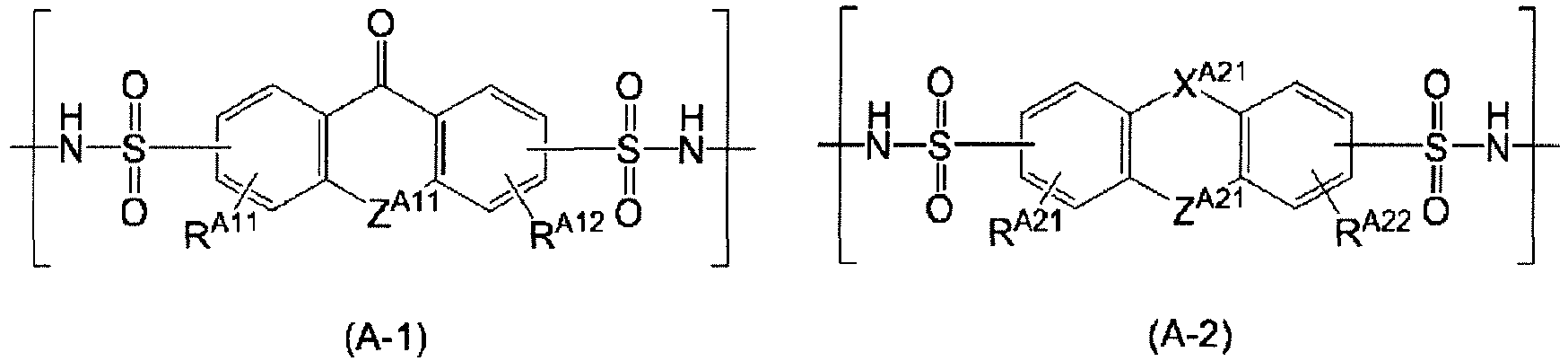


- The photosensitive resin composition according to any one of claims 1 to 3, wherein the polymer compound comprises a structure represented by any one of the following Formulae B-1 to B-6:



- The photosensitive resin composition according to claim 4, wherein the polymer compound comprises a structure represented by the following Formula C-1 or C-2 as the structure represented by Formula B-1 or comprises a structure represented by the following Formula C-3 or C-4 as the structure represented by Formula B-2:


- The photosensitive resin composition according to claim 5, wherein the polymer compound comprises the structure represented by Formula C-1 or C-2.
- The photosensitive resin composition according to any one of claims 1 to 6, wherein the polymer compound further comprises an alkyleneoxy group in the main chain thereof.
- The photosensitive resin composition according to any one of claims 1 to 7, wherein the polymer compound further comprises at least one selected from the group consisting of a urea bond, a urethane bond, an imide bond, an amide bond, a carbonate bond, and a linking group formed by two or more of these bonds being bonded to each other, in the main chain thereof.
- A planographic printing plate precursor, comprising:a support having a hydrophilic surface; andan image recording layer which comprises the photosensitive resin composition according to any one of claims 1 to 8, on the support.
- The planographic printing plate precursor according to claim 9, which is a positive type planographic printing plate precursor.
- The planographic printing plate precursor according to claim 9 or 10, which is a positive type planographic printing plate precursor, wherein the image recording layer comprises a lower layer and an upper layer in this order, on the support having a hydrophilic surface, and wherein at least one of the lower layer or the upper layer comprises the photosensitive resin composition.
- The planographic printing plate precursor according to any one of claims 9 to 11, further comprising an undercoat layer between the support having a hydrophilic surface and the image recording layer.
- A method for producing a planographic printing plate, comprising in the following order:an exposure step of image-wise exposing the planographic printing plate precursor according to any one of claims 9 to 12; anda development step of performing development using an alkali aqueous solution having a pH of 8.5 to 13.5.
- A polymer compound, comprising a structure represented by any one of the following Formulae B-1 to B-6:



- The polymer compound according to claim 14, which comprises a structure represented by the following Formula C-1 or C-2 as the structure represented by Formula B-1 or comprises a structure represented by the following Formula C-3 or C-4 as the structure represented by Formula B-2:


- The polymer compound according to claim 15, which comprises the structure represented by Formula C-1 or C-2.
- The polymer compound according to any one of claims 14 to 16, comprising an alkyleneoxy group in a main chain thereof.
- The polymer compound according to any one of claims 14 to 17, further comprising at least one selected from the group consisting of a urea bond, a urethane bond, an imide bond, an amide bond, a carbonate bond, and a linking group formed by two or more of these bonds being bonded to each other, in the main chain thereof.
Applications Claiming Priority (2)
| Application Number | Priority Date | Filing Date | Title |
|---|---|---|---|
| JP2015030739 | 2015-02-19 | ||
| PCT/JP2016/054405 WO2016133072A1 (en) | 2015-02-19 | 2016-02-16 | Photosensitive resin composition, planographic printing original plate, method for producing planographic printing plate, and polymer compound |
Publications (3)
| Publication Number | Publication Date |
|---|---|
| EP3260917A1 true EP3260917A1 (en) | 2017-12-27 |
| EP3260917A4 EP3260917A4 (en) | 2018-03-14 |
| EP3260917B1 EP3260917B1 (en) | 2020-06-10 |
Family
ID=56689006
Family Applications (1)
| Application Number | Title | Priority Date | Filing Date |
|---|---|---|---|
| EP16752458.6A Not-in-force EP3260917B1 (en) | 2015-02-19 | 2016-02-16 | Photosensitive resin composition, planographic printing original plate, method for producing planographic printing plate, and polymer compound |
Country Status (6)
| Country | Link |
|---|---|
| US (1) | US10437149B2 (en) |
| EP (1) | EP3260917B1 (en) |
| JP (1) | JP6605017B2 (en) |
| CN (1) | CN107209459B (en) |
| BR (1) | BR112017017683B1 (en) |
| WO (1) | WO2016133072A1 (en) |
Cited By (1)
| Publication number | Priority date | Publication date | Assignee | Title |
|---|---|---|---|---|
| EP3511173B1 (en) | 2017-10-31 | 2020-08-05 | FUJIFILM Corporation | Lithographic printing plate precursor, lithographic printing plate manufacturing method, printing method and aluminum support manufacturing method |
Families Citing this family (9)
| Publication number | Priority date | Publication date | Assignee | Title |
|---|---|---|---|---|
| WO2017056595A1 (en) * | 2015-09-28 | 2017-04-06 | 富士フイルム株式会社 | Negative-type photosensitive resin composition, negative-type lithographic printing original plate, and method for producing lithographic printing plate |
| CN107924126A (en) * | 2015-09-28 | 2018-04-17 | 富士胶片株式会社 | The production method of negative light-sensitive resin combination, minus original edition of lithographic printing plate and lithographic plate |
| WO2018003405A1 (en) * | 2016-06-29 | 2018-01-04 | 富士フイルム株式会社 | Positive photosensitive resin composition, positive lithographic printing plate, and method for manufacturing lithographic printing plates |
| WO2018061511A1 (en) * | 2016-09-29 | 2018-04-05 | 富士フイルム株式会社 | Positive lithographic printing original plate and method for producing lithographic printing plate |
| JP2020064082A (en) | 2017-02-17 | 2020-04-23 | 富士フイルム株式会社 | Positive type lithographic printing plate precursor and method for producing lithographic printing plate |
| JP6879158B2 (en) * | 2017-10-03 | 2021-06-02 | 信越化学工業株式会社 | Semiconductor devices, their manufacturing methods, and laminates |
| WO2020110650A1 (en) * | 2018-11-27 | 2020-06-04 | 富士フイルム株式会社 | Original plate for lithographic printing plate and method for manufacturing lithographic printing plate |
| CN115551923A (en) * | 2020-05-19 | 2022-12-30 | 崔国英 | Polysulfonamide polymers, positive photosensitive compositions containing them and their use |
| WO2021232248A1 (en) * | 2020-05-19 | 2021-11-25 | 崔国英 | Polysulfonamide polymer, negative photosensitive composition containing polysulfonamide polymer and application thereof |
Family Cites Families (16)
| Publication number | Priority date | Publication date | Assignee | Title |
|---|---|---|---|---|
| US3856751A (en) * | 1972-06-14 | 1974-12-24 | Eastman Kodak Co | Diacid-xanthylium ion polyester and photographic element comprised thereof |
| JP2522693B2 (en) * | 1988-12-08 | 1996-08-07 | 富士写真フイルム株式会社 | Photosensitive composition |
| JPH04159552A (en) * | 1990-10-23 | 1992-06-02 | Mitsubishi Electric Corp | Radiation sensitive polymer and pattern forming method using this polymer |
| US5656412A (en) * | 1995-03-07 | 1997-08-12 | Lucent Technologies Inc. | Energy-sensitive resist material and a process for device fabrication using an energy-sensitive resist material |
| JP2001042539A (en) * | 1999-07-27 | 2001-02-16 | Fuji Photo Film Co Ltd | Photosensitive or thermosensitive image forming materials |
| JP2003080857A (en) * | 2001-09-12 | 2003-03-19 | Fuji Photo Film Co Ltd | Support for lithographic printing plate and original plate for lithographic printing plate |
| JP2004117534A (en) * | 2002-09-24 | 2004-04-15 | Fuji Photo Film Co Ltd | Resin composition |
| JP4244309B2 (en) * | 2003-09-12 | 2009-03-25 | 富士フイルム株式会社 | Planographic printing plate precursor |
| JP4167160B2 (en) * | 2003-09-29 | 2008-10-15 | 富士フイルム株式会社 | Planographic printing plate precursor |
| CN101467101A (en) * | 2006-06-13 | 2009-06-24 | 柯尼卡美能达医疗印刷器材株式会社 | Lithographic plate material |
| US20080131812A1 (en) * | 2006-11-30 | 2008-06-05 | Konica Minolta Medical & Graphic, Inc. | Resin for printing plate material and lithographic printing plate material by use thereof |
| US20080182202A1 (en) * | 2007-01-29 | 2008-07-31 | Konica Minolta Medical & Graphic, Inc. | Planographic printing plate material and resin used therein |
| JP5588706B2 (en) * | 2010-03-12 | 2014-09-10 | 富士フイルム株式会社 | Actinic ray-sensitive or radiation-sensitive resin composition, and resist film and pattern forming method using the same |
| JP5593447B2 (en) * | 2010-09-14 | 2014-09-24 | マイラン・グループ | Copolymers for near-infrared photosensitive coating compositions for positive working thermal lithographic printing substrates |
| JP6154065B2 (en) * | 2014-03-31 | 2017-06-28 | 富士フイルム株式会社 | Photosensitive resin composition, lithographic printing plate precursor and lithographic printing plate production method |
| EP3128367B1 (en) * | 2014-03-31 | 2018-09-26 | Fujifilm Corporation | Photosensitive resin composition, lithographic printing original plate, and method for manufacturing lithographic plate |
-
2016
- 2016-02-16 CN CN201680009937.2A patent/CN107209459B/en not_active Expired - Fee Related
- 2016-02-16 JP JP2017500677A patent/JP6605017B2/en not_active Expired - Fee Related
- 2016-02-16 BR BR112017017683-1A patent/BR112017017683B1/en not_active IP Right Cessation
- 2016-02-16 EP EP16752458.6A patent/EP3260917B1/en not_active Not-in-force
- 2016-02-16 WO PCT/JP2016/054405 patent/WO2016133072A1/en not_active Ceased
-
2017
- 2017-07-21 US US15/655,887 patent/US10437149B2/en not_active Expired - Fee Related
Cited By (1)
| Publication number | Priority date | Publication date | Assignee | Title |
|---|---|---|---|---|
| EP3511173B1 (en) | 2017-10-31 | 2020-08-05 | FUJIFILM Corporation | Lithographic printing plate precursor, lithographic printing plate manufacturing method, printing method and aluminum support manufacturing method |
Also Published As
| Publication number | Publication date |
|---|---|
| EP3260917A4 (en) | 2018-03-14 |
| CN107209459A (en) | 2017-09-26 |
| BR112017017683B1 (en) | 2022-07-26 |
| EP3260917B1 (en) | 2020-06-10 |
| US10437149B2 (en) | 2019-10-08 |
| JP6605017B2 (en) | 2019-11-13 |
| US20170329225A1 (en) | 2017-11-16 |
| CN107209459B (en) | 2021-03-09 |
| BR112017017683A2 (en) | 2019-05-14 |
| JPWO2016133072A1 (en) | 2017-11-09 |
| WO2016133072A1 (en) | 2016-08-25 |
Similar Documents
| Publication | Publication Date | Title |
|---|---|---|
| EP3260917B1 (en) | Photosensitive resin composition, planographic printing original plate, method for producing planographic printing plate, and polymer compound | |
| EP3182205B1 (en) | Photosensitive resin composition, lithographic printing original plate, method for producing lithographic printing plate, and polymer compound | |
| EP3128369B1 (en) | Photosensitive resin composition, lithographic printing original plate and method for producing lithographic printing plate | |
| EP3128367B1 (en) | Photosensitive resin composition, lithographic printing original plate, and method for manufacturing lithographic plate | |
| US10649337B2 (en) | Positive type lithographic printing plate precursor, method of producing same, and method of preparing lithographic printing plate | |
| EP3410210B1 (en) | Positive lithographic printing master plate and method for manufacturing lithographic printing plate | |
| US10495971B2 (en) | Photosensitive resin composition, planographic printing plate precursor, and plate-making method for planographic printing plate | |
| US9223216B2 (en) | Lithographic printing plate precursor and method of preparing the same | |
| EP3480658A1 (en) | Positive photosensitive resin composition, positive lithographic printing plate, and method for manufacturing lithographic printing plates | |
| US20180314152A1 (en) | Positive type photosensitive resin composition, positive type planographic printing plate precursor, and method of producing planographic printing plate | |
| EP3495887A1 (en) | Positive lithographic printing original plate and method for producing lithographic printing plate | |
| EP2796929B1 (en) | Lithographic printing plate precursor and method of preparing the same | |
| WO2017056761A1 (en) | Photosensitive resin composition, lithographic printing original plate, and method for manufacturing lithographic printing plate |
Legal Events
| Date | Code | Title | Description |
|---|---|---|---|
| STAA | Information on the status of an ep patent application or granted ep patent |
Free format text: STATUS: THE INTERNATIONAL PUBLICATION HAS BEEN MADE |
|
| PUAI | Public reference made under article 153(3) epc to a published international application that has entered the european phase |
Free format text: ORIGINAL CODE: 0009012 |
|
| STAA | Information on the status of an ep patent application or granted ep patent |
Free format text: STATUS: REQUEST FOR EXAMINATION WAS MADE |
|
| 17P | Request for examination filed |
Effective date: 20170712 |
|
| AK | Designated contracting states |
Kind code of ref document: A1 Designated state(s): AL AT BE BG CH CY CZ DE DK EE ES FI FR GB GR HR HU IE IS IT LI LT LU LV MC MK MT NL NO PL PT RO RS SE SI SK SM TR |
|
| AX | Request for extension of the european patent |
Extension state: BA ME |
|
| A4 | Supplementary search report drawn up and despatched |
Effective date: 20180208 |
|
| RIC1 | Information provided on ipc code assigned before grant |
Ipc: C08G 73/14 20060101ALI20180202BHEP Ipc: G03F 7/004 20060101ALI20180202BHEP Ipc: G03F 7/00 20060101ALI20180202BHEP Ipc: C08G 18/32 20060101ALI20180202BHEP Ipc: G03F 7/095 20060101ALI20180202BHEP Ipc: G03F 7/11 20060101ALI20180202BHEP Ipc: C08G 64/12 20060101ALI20180202BHEP Ipc: G03F 7/039 20060101AFI20180202BHEP |
|
| DAV | Request for validation of the european patent (deleted) | ||
| DAX | Request for extension of the european patent (deleted) | ||
| STAA | Information on the status of an ep patent application or granted ep patent |
Free format text: STATUS: EXAMINATION IS IN PROGRESS |
|
| 17Q | First examination report despatched |
Effective date: 20191028 |
|
| GRAP | Despatch of communication of intention to grant a patent |
Free format text: ORIGINAL CODE: EPIDOSNIGR1 |
|
| STAA | Information on the status of an ep patent application or granted ep patent |
Free format text: STATUS: GRANT OF PATENT IS INTENDED |
|
| INTG | Intention to grant announced |
Effective date: 20200325 |
|
| GRAS | Grant fee paid |
Free format text: ORIGINAL CODE: EPIDOSNIGR3 |
|
| GRAA | (expected) grant |
Free format text: ORIGINAL CODE: 0009210 |
|
| STAA | Information on the status of an ep patent application or granted ep patent |
Free format text: STATUS: THE PATENT HAS BEEN GRANTED |
|
| AK | Designated contracting states |
Kind code of ref document: B1 Designated state(s): AL AT BE BG CH CY CZ DE DK EE ES FI FR GB GR HR HU IE IS IT LI LT LU LV MC MK MT NL NO PL PT RO RS SE SI SK SM TR |
|
| REG | Reference to a national code |
Ref country code: GB Ref legal event code: FG4D |
|
| REG | Reference to a national code |
Ref country code: AT Ref legal event code: REF Ref document number: 1279658 Country of ref document: AT Kind code of ref document: T Effective date: 20200615 Ref country code: CH Ref legal event code: EP |
|
| REG | Reference to a national code |
Ref country code: IE Ref legal event code: FG4D |
|
| REG | Reference to a national code |
Ref country code: DE Ref legal event code: R096 Ref document number: 602016037900 Country of ref document: DE |
|
| REG | Reference to a national code |
Ref country code: LT Ref legal event code: MG4D |
|
| PG25 | Lapsed in a contracting state [announced via postgrant information from national office to epo] |
Ref country code: FI Free format text: LAPSE BECAUSE OF FAILURE TO SUBMIT A TRANSLATION OF THE DESCRIPTION OR TO PAY THE FEE WITHIN THE PRESCRIBED TIME-LIMIT Effective date: 20200610 Ref country code: SE Free format text: LAPSE BECAUSE OF FAILURE TO SUBMIT A TRANSLATION OF THE DESCRIPTION OR TO PAY THE FEE WITHIN THE PRESCRIBED TIME-LIMIT Effective date: 20200610 Ref country code: LT Free format text: LAPSE BECAUSE OF FAILURE TO SUBMIT A TRANSLATION OF THE DESCRIPTION OR TO PAY THE FEE WITHIN THE PRESCRIBED TIME-LIMIT Effective date: 20200610 Ref country code: GR Free format text: LAPSE BECAUSE OF FAILURE TO SUBMIT A TRANSLATION OF THE DESCRIPTION OR TO PAY THE FEE WITHIN THE PRESCRIBED TIME-LIMIT Effective date: 20200911 Ref country code: NO Free format text: LAPSE BECAUSE OF FAILURE TO SUBMIT A TRANSLATION OF THE DESCRIPTION OR TO PAY THE FEE WITHIN THE PRESCRIBED TIME-LIMIT Effective date: 20200910 |
|
| REG | Reference to a national code |
Ref country code: NL Ref legal event code: MP Effective date: 20200610 |
|
| PG25 | Lapsed in a contracting state [announced via postgrant information from national office to epo] |
Ref country code: LV Free format text: LAPSE BECAUSE OF FAILURE TO SUBMIT A TRANSLATION OF THE DESCRIPTION OR TO PAY THE FEE WITHIN THE PRESCRIBED TIME-LIMIT Effective date: 20200610 Ref country code: BG Free format text: LAPSE BECAUSE OF FAILURE TO SUBMIT A TRANSLATION OF THE DESCRIPTION OR TO PAY THE FEE WITHIN THE PRESCRIBED TIME-LIMIT Effective date: 20200910 Ref country code: RS Free format text: LAPSE BECAUSE OF FAILURE TO SUBMIT A TRANSLATION OF THE DESCRIPTION OR TO PAY THE FEE WITHIN THE PRESCRIBED TIME-LIMIT Effective date: 20200610 Ref country code: HR Free format text: LAPSE BECAUSE OF FAILURE TO SUBMIT A TRANSLATION OF THE DESCRIPTION OR TO PAY THE FEE WITHIN THE PRESCRIBED TIME-LIMIT Effective date: 20200610 |
|
| REG | Reference to a national code |
Ref country code: AT Ref legal event code: MK05 Ref document number: 1279658 Country of ref document: AT Kind code of ref document: T Effective date: 20200610 |
|
| PG25 | Lapsed in a contracting state [announced via postgrant information from national office to epo] |
Ref country code: NL Free format text: LAPSE BECAUSE OF FAILURE TO SUBMIT A TRANSLATION OF THE DESCRIPTION OR TO PAY THE FEE WITHIN THE PRESCRIBED TIME-LIMIT Effective date: 20200610 Ref country code: AL Free format text: LAPSE BECAUSE OF FAILURE TO SUBMIT A TRANSLATION OF THE DESCRIPTION OR TO PAY THE FEE WITHIN THE PRESCRIBED TIME-LIMIT Effective date: 20200610 |
|
| PG25 | Lapsed in a contracting state [announced via postgrant information from national office to epo] |
Ref country code: AT Free format text: LAPSE BECAUSE OF FAILURE TO SUBMIT A TRANSLATION OF THE DESCRIPTION OR TO PAY THE FEE WITHIN THE PRESCRIBED TIME-LIMIT Effective date: 20200610 Ref country code: IT Free format text: LAPSE BECAUSE OF FAILURE TO SUBMIT A TRANSLATION OF THE DESCRIPTION OR TO PAY THE FEE WITHIN THE PRESCRIBED TIME-LIMIT Effective date: 20200610 Ref country code: SM Free format text: LAPSE BECAUSE OF FAILURE TO SUBMIT A TRANSLATION OF THE DESCRIPTION OR TO PAY THE FEE WITHIN THE PRESCRIBED TIME-LIMIT Effective date: 20200610 Ref country code: EE Free format text: LAPSE BECAUSE OF FAILURE TO SUBMIT A TRANSLATION OF THE DESCRIPTION OR TO PAY THE FEE WITHIN THE PRESCRIBED TIME-LIMIT Effective date: 20200610 Ref country code: ES Free format text: LAPSE BECAUSE OF FAILURE TO SUBMIT A TRANSLATION OF THE DESCRIPTION OR TO PAY THE FEE WITHIN THE PRESCRIBED TIME-LIMIT Effective date: 20200610 Ref country code: CZ Free format text: LAPSE BECAUSE OF FAILURE TO SUBMIT A TRANSLATION OF THE DESCRIPTION OR TO PAY THE FEE WITHIN THE PRESCRIBED TIME-LIMIT Effective date: 20200610 Ref country code: RO Free format text: LAPSE BECAUSE OF FAILURE TO SUBMIT A TRANSLATION OF THE DESCRIPTION OR TO PAY THE FEE WITHIN THE PRESCRIBED TIME-LIMIT Effective date: 20200610 Ref country code: PT Free format text: LAPSE BECAUSE OF FAILURE TO SUBMIT A TRANSLATION OF THE DESCRIPTION OR TO PAY THE FEE WITHIN THE PRESCRIBED TIME-LIMIT Effective date: 20201012 |
|
| PG25 | Lapsed in a contracting state [announced via postgrant information from national office to epo] |
Ref country code: IS Free format text: LAPSE BECAUSE OF FAILURE TO SUBMIT A TRANSLATION OF THE DESCRIPTION OR TO PAY THE FEE WITHIN THE PRESCRIBED TIME-LIMIT Effective date: 20201010 Ref country code: PL Free format text: LAPSE BECAUSE OF FAILURE TO SUBMIT A TRANSLATION OF THE DESCRIPTION OR TO PAY THE FEE WITHIN THE PRESCRIBED TIME-LIMIT Effective date: 20200610 Ref country code: SK Free format text: LAPSE BECAUSE OF FAILURE TO SUBMIT A TRANSLATION OF THE DESCRIPTION OR TO PAY THE FEE WITHIN THE PRESCRIBED TIME-LIMIT Effective date: 20200610 |
|
| REG | Reference to a national code |
Ref country code: DE Ref legal event code: R097 Ref document number: 602016037900 Country of ref document: DE |
|
| RAP4 | Party data changed (patent owner data changed or rights of a patent transferred) |
Owner name: FUJIFILM CORPORATION |
|
| PLBE | No opposition filed within time limit |
Free format text: ORIGINAL CODE: 0009261 |
|
| STAA | Information on the status of an ep patent application or granted ep patent |
Free format text: STATUS: NO OPPOSITION FILED WITHIN TIME LIMIT |
|
| PG25 | Lapsed in a contracting state [announced via postgrant information from national office to epo] |
Ref country code: DK Free format text: LAPSE BECAUSE OF FAILURE TO SUBMIT A TRANSLATION OF THE DESCRIPTION OR TO PAY THE FEE WITHIN THE PRESCRIBED TIME-LIMIT Effective date: 20200610 |
|
| 26N | No opposition filed |
Effective date: 20210311 |
|
| PG25 | Lapsed in a contracting state [announced via postgrant information from national office to epo] |
Ref country code: SI Free format text: LAPSE BECAUSE OF FAILURE TO SUBMIT A TRANSLATION OF THE DESCRIPTION OR TO PAY THE FEE WITHIN THE PRESCRIBED TIME-LIMIT Effective date: 20200610 |
|
| PG25 | Lapsed in a contracting state [announced via postgrant information from national office to epo] |
Ref country code: MC Free format text: LAPSE BECAUSE OF FAILURE TO SUBMIT A TRANSLATION OF THE DESCRIPTION OR TO PAY THE FEE WITHIN THE PRESCRIBED TIME-LIMIT Effective date: 20200610 |
|
| REG | Reference to a national code |
Ref country code: BE Ref legal event code: MM Effective date: 20210228 |
|
| PG25 | Lapsed in a contracting state [announced via postgrant information from national office to epo] |
Ref country code: LU Free format text: LAPSE BECAUSE OF NON-PAYMENT OF DUE FEES Effective date: 20210216 Ref country code: LI Free format text: LAPSE BECAUSE OF NON-PAYMENT OF DUE FEES Effective date: 20210228 Ref country code: CH Free format text: LAPSE BECAUSE OF NON-PAYMENT OF DUE FEES Effective date: 20210228 |
|
| PG25 | Lapsed in a contracting state [announced via postgrant information from national office to epo] |
Ref country code: FR Free format text: LAPSE BECAUSE OF NON-PAYMENT OF DUE FEES Effective date: 20210228 Ref country code: IE Free format text: LAPSE BECAUSE OF NON-PAYMENT OF DUE FEES Effective date: 20210216 |
|
| PG25 | Lapsed in a contracting state [announced via postgrant information from national office to epo] |
Ref country code: BE Free format text: LAPSE BECAUSE OF NON-PAYMENT OF DUE FEES Effective date: 20210228 |
|
| PGFP | Annual fee paid to national office [announced via postgrant information from national office to epo] |
Ref country code: GB Payment date: 20221230 Year of fee payment: 8 |
|
| PGFP | Annual fee paid to national office [announced via postgrant information from national office to epo] |
Ref country code: DE Payment date: 20221229 Year of fee payment: 8 |
|
| P01 | Opt-out of the competence of the unified patent court (upc) registered |
Effective date: 20230515 |
|
| PG25 | Lapsed in a contracting state [announced via postgrant information from national office to epo] |
Ref country code: CY Free format text: LAPSE BECAUSE OF FAILURE TO SUBMIT A TRANSLATION OF THE DESCRIPTION OR TO PAY THE FEE WITHIN THE PRESCRIBED TIME-LIMIT Effective date: 20200610 |
|
| PG25 | Lapsed in a contracting state [announced via postgrant information from national office to epo] |
Ref country code: HU Free format text: LAPSE BECAUSE OF FAILURE TO SUBMIT A TRANSLATION OF THE DESCRIPTION OR TO PAY THE FEE WITHIN THE PRESCRIBED TIME-LIMIT; INVALID AB INITIO Effective date: 20160216 |
|
| PG25 | Lapsed in a contracting state [announced via postgrant information from national office to epo] |
Ref country code: MK Free format text: LAPSE BECAUSE OF FAILURE TO SUBMIT A TRANSLATION OF THE DESCRIPTION OR TO PAY THE FEE WITHIN THE PRESCRIBED TIME-LIMIT Effective date: 20200610 |
|
| PG25 | Lapsed in a contracting state [announced via postgrant information from national office to epo] |
Ref country code: TR Free format text: LAPSE BECAUSE OF FAILURE TO SUBMIT A TRANSLATION OF THE DESCRIPTION OR TO PAY THE FEE WITHIN THE PRESCRIBED TIME-LIMIT Effective date: 20200610 |
|
| REG | Reference to a national code |
Ref country code: DE Ref legal event code: R119 Ref document number: 602016037900 Country of ref document: DE |
|
| PG25 | Lapsed in a contracting state [announced via postgrant information from national office to epo] |
Ref country code: MT Free format text: LAPSE BECAUSE OF FAILURE TO SUBMIT A TRANSLATION OF THE DESCRIPTION OR TO PAY THE FEE WITHIN THE PRESCRIBED TIME-LIMIT Effective date: 20200610 |
|
| GBPC | Gb: european patent ceased through non-payment of renewal fee |
Effective date: 20240216 |
|
| PG25 | Lapsed in a contracting state [announced via postgrant information from national office to epo] |
Ref country code: DE Free format text: LAPSE BECAUSE OF NON-PAYMENT OF DUE FEES Effective date: 20240903 |
|
| PG25 | Lapsed in a contracting state [announced via postgrant information from national office to epo] |
Ref country code: GB Free format text: LAPSE BECAUSE OF NON-PAYMENT OF DUE FEES Effective date: 20240216 |
|
| PG25 | Lapsed in a contracting state [announced via postgrant information from national office to epo] |
Ref country code: GB Free format text: LAPSE BECAUSE OF NON-PAYMENT OF DUE FEES Effective date: 20240216 Ref country code: DE Free format text: LAPSE BECAUSE OF NON-PAYMENT OF DUE FEES Effective date: 20240903 |