EP3260891A1 - Polymerizable composition for optical material, optical material, and application for same - Google Patents
Polymerizable composition for optical material, optical material, and application for same Download PDFInfo
- Publication number
- EP3260891A1 EP3260891A1 EP16746567.3A EP16746567A EP3260891A1 EP 3260891 A1 EP3260891 A1 EP 3260891A1 EP 16746567 A EP16746567 A EP 16746567A EP 3260891 A1 EP3260891 A1 EP 3260891A1
- Authority
- EP
- European Patent Office
- Prior art keywords
- optical material
- bis
- polymerizable composition
- ultraviolet absorber
- general formula
- Prior art date
- Legal status (The legal status is an assumption and is not a legal conclusion. Google has not performed a legal analysis and makes no representation as to the accuracy of the status listed.)
- Granted
Links
Classifications
-
- C—CHEMISTRY; METALLURGY
- C08—ORGANIC MACROMOLECULAR COMPOUNDS; THEIR PREPARATION OR CHEMICAL WORKING-UP; COMPOSITIONS BASED THEREON
- C08K—Use of inorganic or non-macromolecular organic substances as compounding ingredients
- C08K5/00—Use of organic ingredients
- C08K5/16—Nitrogen-containing compounds
- C08K5/34—Heterocyclic compounds having nitrogen in the ring
- C08K5/3467—Heterocyclic compounds having nitrogen in the ring having more than two nitrogen atoms in the ring
- C08K5/3472—Five-membered rings
- C08K5/3475—Five-membered rings condensed with carbocyclic rings
-
- C—CHEMISTRY; METALLURGY
- C08—ORGANIC MACROMOLECULAR COMPOUNDS; THEIR PREPARATION OR CHEMICAL WORKING-UP; COMPOSITIONS BASED THEREON
- C08G—MACROMOLECULAR COMPOUNDS OBTAINED OTHERWISE THAN BY REACTIONS ONLY INVOLVING UNSATURATED CARBON-TO-CARBON BONDS
- C08G18/00—Polymeric products of isocyanates or isothiocyanates
- C08G18/06—Polymeric products of isocyanates or isothiocyanates with compounds having active hydrogen
- C08G18/08—Processes
- C08G18/16—Catalysts
- C08G18/22—Catalysts containing metal compounds
- C08G18/24—Catalysts containing metal compounds of tin
- C08G18/244—Catalysts containing metal compounds of tin tin salts of carboxylic acids
- C08G18/246—Catalysts containing metal compounds of tin tin salts of carboxylic acids containing also tin-carbon bonds
-
- C—CHEMISTRY; METALLURGY
- C08—ORGANIC MACROMOLECULAR COMPOUNDS; THEIR PREPARATION OR CHEMICAL WORKING-UP; COMPOSITIONS BASED THEREON
- C08G—MACROMOLECULAR COMPOUNDS OBTAINED OTHERWISE THAN BY REACTIONS ONLY INVOLVING UNSATURATED CARBON-TO-CARBON BONDS
- C08G18/00—Polymeric products of isocyanates or isothiocyanates
- C08G18/06—Polymeric products of isocyanates or isothiocyanates with compounds having active hydrogen
- C08G18/28—Polymeric products of isocyanates or isothiocyanates with compounds having active hydrogen characterised by the compounds used containing active hydrogen
- C08G18/30—Low-molecular-weight compounds
- C08G18/38—Low-molecular-weight compounds having heteroatoms other than oxygen
-
- C—CHEMISTRY; METALLURGY
- C08—ORGANIC MACROMOLECULAR COMPOUNDS; THEIR PREPARATION OR CHEMICAL WORKING-UP; COMPOSITIONS BASED THEREON
- C08G—MACROMOLECULAR COMPOUNDS OBTAINED OTHERWISE THAN BY REACTIONS ONLY INVOLVING UNSATURATED CARBON-TO-CARBON BONDS
- C08G18/00—Polymeric products of isocyanates or isothiocyanates
- C08G18/06—Polymeric products of isocyanates or isothiocyanates with compounds having active hydrogen
- C08G18/28—Polymeric products of isocyanates or isothiocyanates with compounds having active hydrogen characterised by the compounds used containing active hydrogen
- C08G18/30—Low-molecular-weight compounds
- C08G18/38—Low-molecular-weight compounds having heteroatoms other than oxygen
- C08G18/3855—Low-molecular-weight compounds having heteroatoms other than oxygen having sulfur
-
- C—CHEMISTRY; METALLURGY
- C08—ORGANIC MACROMOLECULAR COMPOUNDS; THEIR PREPARATION OR CHEMICAL WORKING-UP; COMPOSITIONS BASED THEREON
- C08G—MACROMOLECULAR COMPOUNDS OBTAINED OTHERWISE THAN BY REACTIONS ONLY INVOLVING UNSATURATED CARBON-TO-CARBON BONDS
- C08G18/00—Polymeric products of isocyanates or isothiocyanates
- C08G18/06—Polymeric products of isocyanates or isothiocyanates with compounds having active hydrogen
- C08G18/28—Polymeric products of isocyanates or isothiocyanates with compounds having active hydrogen characterised by the compounds used containing active hydrogen
- C08G18/30—Low-molecular-weight compounds
- C08G18/38—Low-molecular-weight compounds having heteroatoms other than oxygen
- C08G18/3855—Low-molecular-weight compounds having heteroatoms other than oxygen having sulfur
- C08G18/3876—Low-molecular-weight compounds having heteroatoms other than oxygen having sulfur containing mercapto groups
-
- C—CHEMISTRY; METALLURGY
- C08—ORGANIC MACROMOLECULAR COMPOUNDS; THEIR PREPARATION OR CHEMICAL WORKING-UP; COMPOSITIONS BASED THEREON
- C08G—MACROMOLECULAR COMPOUNDS OBTAINED OTHERWISE THAN BY REACTIONS ONLY INVOLVING UNSATURATED CARBON-TO-CARBON BONDS
- C08G18/00—Polymeric products of isocyanates or isothiocyanates
- C08G18/06—Polymeric products of isocyanates or isothiocyanates with compounds having active hydrogen
- C08G18/70—Polymeric products of isocyanates or isothiocyanates with compounds having active hydrogen characterised by the isocyanates or isothiocyanates used
- C08G18/72—Polyisocyanates or polyisothiocyanates
- C08G18/721—Two or more polyisocyanates not provided for in one single group C08G18/73 - C08G18/80
- C08G18/722—Combination of two or more aliphatic and/or cycloaliphatic polyisocyanates
-
- C—CHEMISTRY; METALLURGY
- C08—ORGANIC MACROMOLECULAR COMPOUNDS; THEIR PREPARATION OR CHEMICAL WORKING-UP; COMPOSITIONS BASED THEREON
- C08G—MACROMOLECULAR COMPOUNDS OBTAINED OTHERWISE THAN BY REACTIONS ONLY INVOLVING UNSATURATED CARBON-TO-CARBON BONDS
- C08G18/00—Polymeric products of isocyanates or isothiocyanates
- C08G18/06—Polymeric products of isocyanates or isothiocyanates with compounds having active hydrogen
- C08G18/70—Polymeric products of isocyanates or isothiocyanates with compounds having active hydrogen characterised by the isocyanates or isothiocyanates used
- C08G18/72—Polyisocyanates or polyisothiocyanates
- C08G18/721—Two or more polyisocyanates not provided for in one single group C08G18/73 - C08G18/80
- C08G18/725—Combination of polyisocyanates of C08G18/78 with other polyisocyanates
-
- C—CHEMISTRY; METALLURGY
- C08—ORGANIC MACROMOLECULAR COMPOUNDS; THEIR PREPARATION OR CHEMICAL WORKING-UP; COMPOSITIONS BASED THEREON
- C08G—MACROMOLECULAR COMPOUNDS OBTAINED OTHERWISE THAN BY REACTIONS ONLY INVOLVING UNSATURATED CARBON-TO-CARBON BONDS
- C08G18/00—Polymeric products of isocyanates or isothiocyanates
- C08G18/06—Polymeric products of isocyanates or isothiocyanates with compounds having active hydrogen
- C08G18/70—Polymeric products of isocyanates or isothiocyanates with compounds having active hydrogen characterised by the isocyanates or isothiocyanates used
- C08G18/72—Polyisocyanates or polyisothiocyanates
- C08G18/73—Polyisocyanates or polyisothiocyanates acyclic
-
- C—CHEMISTRY; METALLURGY
- C08—ORGANIC MACROMOLECULAR COMPOUNDS; THEIR PREPARATION OR CHEMICAL WORKING-UP; COMPOSITIONS BASED THEREON
- C08G—MACROMOLECULAR COMPOUNDS OBTAINED OTHERWISE THAN BY REACTIONS ONLY INVOLVING UNSATURATED CARBON-TO-CARBON BONDS
- C08G18/00—Polymeric products of isocyanates or isothiocyanates
- C08G18/06—Polymeric products of isocyanates or isothiocyanates with compounds having active hydrogen
- C08G18/70—Polymeric products of isocyanates or isothiocyanates with compounds having active hydrogen characterised by the isocyanates or isothiocyanates used
- C08G18/72—Polyisocyanates or polyisothiocyanates
- C08G18/74—Polyisocyanates or polyisothiocyanates cyclic
- C08G18/75—Polyisocyanates or polyisothiocyanates cyclic cycloaliphatic
-
- C—CHEMISTRY; METALLURGY
- C08—ORGANIC MACROMOLECULAR COMPOUNDS; THEIR PREPARATION OR CHEMICAL WORKING-UP; COMPOSITIONS BASED THEREON
- C08G—MACROMOLECULAR COMPOUNDS OBTAINED OTHERWISE THAN BY REACTIONS ONLY INVOLVING UNSATURATED CARBON-TO-CARBON BONDS
- C08G18/00—Polymeric products of isocyanates or isothiocyanates
- C08G18/06—Polymeric products of isocyanates or isothiocyanates with compounds having active hydrogen
- C08G18/70—Polymeric products of isocyanates or isothiocyanates with compounds having active hydrogen characterised by the isocyanates or isothiocyanates used
- C08G18/72—Polyisocyanates or polyisothiocyanates
- C08G18/74—Polyisocyanates or polyisothiocyanates cyclic
- C08G18/75—Polyisocyanates or polyisothiocyanates cyclic cycloaliphatic
- C08G18/751—Polyisocyanates or polyisothiocyanates cyclic cycloaliphatic containing only one cycloaliphatic ring
-
- C—CHEMISTRY; METALLURGY
- C08—ORGANIC MACROMOLECULAR COMPOUNDS; THEIR PREPARATION OR CHEMICAL WORKING-UP; COMPOSITIONS BASED THEREON
- C08G—MACROMOLECULAR COMPOUNDS OBTAINED OTHERWISE THAN BY REACTIONS ONLY INVOLVING UNSATURATED CARBON-TO-CARBON BONDS
- C08G18/00—Polymeric products of isocyanates or isothiocyanates
- C08G18/06—Polymeric products of isocyanates or isothiocyanates with compounds having active hydrogen
- C08G18/70—Polymeric products of isocyanates or isothiocyanates with compounds having active hydrogen characterised by the isocyanates or isothiocyanates used
- C08G18/72—Polyisocyanates or polyisothiocyanates
- C08G18/74—Polyisocyanates or polyisothiocyanates cyclic
- C08G18/75—Polyisocyanates or polyisothiocyanates cyclic cycloaliphatic
- C08G18/751—Polyisocyanates or polyisothiocyanates cyclic cycloaliphatic containing only one cycloaliphatic ring
- C08G18/752—Polyisocyanates or polyisothiocyanates cyclic cycloaliphatic containing only one cycloaliphatic ring containing at least one isocyanate or isothiocyanate group linked to the cycloaliphatic ring by means of an aliphatic group
- C08G18/753—Polyisocyanates or polyisothiocyanates cyclic cycloaliphatic containing only one cycloaliphatic ring containing at least one isocyanate or isothiocyanate group linked to the cycloaliphatic ring by means of an aliphatic group containing one isocyanate or isothiocyanate group linked to the cycloaliphatic ring by means of an aliphatic group having a primary carbon atom next to the isocyanate or isothiocyanate group
- C08G18/755—Polyisocyanates or polyisothiocyanates cyclic cycloaliphatic containing only one cycloaliphatic ring containing at least one isocyanate or isothiocyanate group linked to the cycloaliphatic ring by means of an aliphatic group containing one isocyanate or isothiocyanate group linked to the cycloaliphatic ring by means of an aliphatic group having a primary carbon atom next to the isocyanate or isothiocyanate group and at least one isocyanate or isothiocyanate group linked to a secondary carbon atom of the cycloaliphatic ring, e.g. isophorone diisocyanate
-
- C—CHEMISTRY; METALLURGY
- C08—ORGANIC MACROMOLECULAR COMPOUNDS; THEIR PREPARATION OR CHEMICAL WORKING-UP; COMPOSITIONS BASED THEREON
- C08G—MACROMOLECULAR COMPOUNDS OBTAINED OTHERWISE THAN BY REACTIONS ONLY INVOLVING UNSATURATED CARBON-TO-CARBON BONDS
- C08G18/00—Polymeric products of isocyanates or isothiocyanates
- C08G18/06—Polymeric products of isocyanates or isothiocyanates with compounds having active hydrogen
- C08G18/70—Polymeric products of isocyanates or isothiocyanates with compounds having active hydrogen characterised by the isocyanates or isothiocyanates used
- C08G18/72—Polyisocyanates or polyisothiocyanates
- C08G18/74—Polyisocyanates or polyisothiocyanates cyclic
- C08G18/75—Polyisocyanates or polyisothiocyanates cyclic cycloaliphatic
- C08G18/758—Polyisocyanates or polyisothiocyanates cyclic cycloaliphatic containing two or more cycloaliphatic rings
-
- C—CHEMISTRY; METALLURGY
- C08—ORGANIC MACROMOLECULAR COMPOUNDS; THEIR PREPARATION OR CHEMICAL WORKING-UP; COMPOSITIONS BASED THEREON
- C08G—MACROMOLECULAR COMPOUNDS OBTAINED OTHERWISE THAN BY REACTIONS ONLY INVOLVING UNSATURATED CARBON-TO-CARBON BONDS
- C08G18/00—Polymeric products of isocyanates or isothiocyanates
- C08G18/06—Polymeric products of isocyanates or isothiocyanates with compounds having active hydrogen
- C08G18/70—Polymeric products of isocyanates or isothiocyanates with compounds having active hydrogen characterised by the isocyanates or isothiocyanates used
- C08G18/72—Polyisocyanates or polyisothiocyanates
- C08G18/77—Polyisocyanates or polyisothiocyanates having heteroatoms in addition to the isocyanate or isothiocyanate nitrogen and oxygen or sulfur
- C08G18/78—Nitrogen
- C08G18/79—Nitrogen characterised by the polyisocyanates used, these having groups formed by oligomerisation of isocyanates or isothiocyanates
- C08G18/791—Nitrogen characterised by the polyisocyanates used, these having groups formed by oligomerisation of isocyanates or isothiocyanates containing isocyanurate groups
- C08G18/792—Nitrogen characterised by the polyisocyanates used, these having groups formed by oligomerisation of isocyanates or isothiocyanates containing isocyanurate groups formed by oligomerisation of aliphatic and/or cycloaliphatic isocyanates or isothiocyanates
-
- C—CHEMISTRY; METALLURGY
- C08—ORGANIC MACROMOLECULAR COMPOUNDS; THEIR PREPARATION OR CHEMICAL WORKING-UP; COMPOSITIONS BASED THEREON
- C08K—Use of inorganic or non-macromolecular organic substances as compounding ingredients
- C08K5/00—Use of organic ingredients
- C08K5/0008—Organic ingredients according to more than one of the "one dot" groups of C08K5/01 - C08K5/59
- C08K5/005—Stabilisers against oxidation, heat, light, ozone
-
- C—CHEMISTRY; METALLURGY
- C08—ORGANIC MACROMOLECULAR COMPOUNDS; THEIR PREPARATION OR CHEMICAL WORKING-UP; COMPOSITIONS BASED THEREON
- C08L—COMPOSITIONS OF MACROMOLECULAR COMPOUNDS
- C08L75/00—Compositions of polyureas or polyurethanes; Compositions of derivatives of such polymers
- C08L75/04—Polyurethanes
-
- G—PHYSICS
- G02—OPTICS
- G02B—OPTICAL ELEMENTS, SYSTEMS OR APPARATUS
- G02B1/00—Optical elements characterised by the material of which they are made; Optical coatings for optical elements
- G02B1/04—Optical elements characterised by the material of which they are made; Optical coatings for optical elements made of organic materials, e.g. plastics
-
- G—PHYSICS
- G02—OPTICS
- G02B—OPTICAL ELEMENTS, SYSTEMS OR APPARATUS
- G02B1/00—Optical elements characterised by the material of which they are made; Optical coatings for optical elements
- G02B1/04—Optical elements characterised by the material of which they are made; Optical coatings for optical elements made of organic materials, e.g. plastics
- G02B1/041—Lenses
-
- G—PHYSICS
- G02—OPTICS
- G02B—OPTICAL ELEMENTS, SYSTEMS OR APPARATUS
- G02B5/00—Optical elements other than lenses
- G02B5/20—Filters
- G02B5/22—Absorbing filters
-
- G—PHYSICS
- G02—OPTICS
- G02C—SPECTACLES; SUNGLASSES OR GOGGLES INSOFAR AS THEY HAVE THE SAME FEATURES AS SPECTACLES; CONTACT LENSES
- G02C7/00—Optical parts
- G02C7/10—Filters, e.g. for facilitating adaptation of the eyes to the dark; Sunglasses
Definitions
- the present invention relates to a polymerizable composition for an optical material, an optical material, and a use thereof.
- Non-Patent Document 1 describes an influence of the short wavelength blue light of approximately 420 nm on the eyes.
- damage to retinal nerve cells (cultured retinal nerve R28 cells of rats) caused by an irradiation with blue light emitting diode (LED) light having different peak wavelengths at 411 nm and 470 nm is verified.
- LED blue light emitting diode
- the results show that the irradiation with blue light having a peak wavelength at 411 nm (4.5 W/m 2 ) causes a cell death of retinal nerve cells within 24 hours, whereas, for the blue light having a peak wavelength at 470 nm, changes do not occur in cells even when irradiated with the same amount, and show that suppression of an exposure of a light having a wavelength of 400 to 420 nm is important for an eye disorder prevention.
- Techniques aimed at suppressing a transmission of the blue light include the following.
- Patent Document 1 discloses a plastic lens including an ultraviolet absorber and having an average light transmittance of 0.5% or less in a wavelength range of equal to or more than 300 nm and equal to or less than 400 nm.
- Patent Document 2 discloses a plastic lens obtained from a composition for a plastic lens which contains a resin material which includes a urethane resin material and at least two types of ultraviolet absorbers having different maximum absorption wavelengths.
- Patent Document 3 discloses a plastic lens obtainable from a composition for a plastic lens which contains a resin material which includes a urethane resin material and an ultraviolet absorber having a maximum absorption wavelength of 345 nm or more in a chloroform solution. Patent Document 3 describes that, with this plastic lens, there is no yellowing of the lens, changes in a refractive index, or the like due to the influence of the ultraviolet absorber, and furthermore, a mechanical strength of the lens is not lowered.
- Patent Document 4 discloses a plastic spectacle lens using a specific benzotriazole compound. Patent Document 4 describes that the plastic spectacle lens has a light transmittance in a predetermined range at a wavelength of 395 nm, a wavelength of 400 nm, and a wavelength of 405 nm.
- Non-patent Document 1 The European journal of neuroscience, vol.34, Iss.4, 548-58, (2011 )
- using a specific ultraviolet absorber makes it possible to provide an optical material having a high effect of blocking the blue light of approximately 420 nm from harmful ultraviolet rays, and to provide a polymerizable composition for an optical material which is also excellent in the productivity of the optical material.
- the polymerizable composition for an optical material of the present invention it is possible to provide an optical material which is colorless and transparent, excellent in an appearance, and excellent in optical characteristics such as a high refractive index and a high Abbe number and various physical properties such as a heat resistance, specifically to provide a plastic spectacle lens.
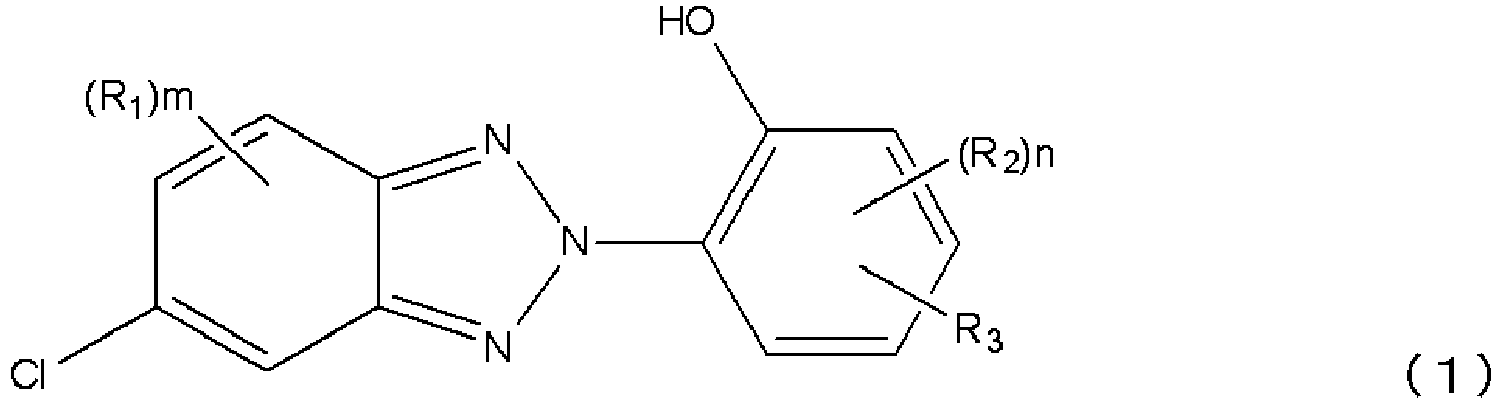
- the polymerizable composition for an optical material of a present embodiment includes (A) an isocyanate compound, (B) an active hydrogen compound, and (C) one or more types of ultraviolet absorber represented by General Formula (1) and having a maximum absorption peak in the range of equal to or more than 350 nm and equal to or less than 370 nm.
- R 1 and R 2 represent an alkyl group having 1 to 8 carbon atoms and may be same or different from each other, a plurality of R 1 present or a plurality of R 2 present may be same or different, m represents an integer of 0 to 3, n represents an integer of 0 to 3, and R 3 represents a functional group having 2 to 15 carbon atoms which includes an ester bond.
- the polymerizable composition for an optical material includes an isocyanate compound having two or more isocyanate groups.
- isocyanate compound (A) examples include an aliphatic isocyanate, an alicyclic isocyanate, an aromatic isocyanate, a heterocyclic isocyanate, and the like, which may be used as one type or two or more types in a mixture. These isocyanate compounds may include dimers, trimers, and prepolymers.
- aliphatic isocyanates include hexamethylene diisocyanate, 2,2,4-trimethylhexamethylene diisocyanate, 2,4,4-trimethylhexamethylene diisocyanate, pentamethylene diisocyanate, lysine diisocyanatomethyl ester, lysine triisocyanate, xylylene diisocyanate, ⁇ , ⁇ , ⁇ ', ⁇ '-tetra methyl xylylene diisocyanate, bis (isocyanatomethyl) naphthalene, mesitylylene triisocyanate, bis (isocyanatomethyl) sulfide, bis (isocyanatoethyl) sulfide, bis (isocyanatomethyl) disulfide, bis (isocyanatoethyl) disulfide, bis (isocyanatomethylthio) methane, bis (isocyanatoethylthio) methane, bis (isocyana
- alicyclic isocyanates include isophorone diisocyanate, bis (isocyanatomethyl) cyclohexane, bis (isocyanatocyclohexyl) methane, cyclohexane diisocyanate, methylcyclohexane diisocyanate, dicyclohexyl-dimethyl methane isocyanate, 2,5-bis (isocyanatomethyl) bicyclo-[2.2.1]-heptane, 2,6-bis (isocyanatomethyl) bicyclo-[2.2.1]-heptane, 3,8-bis (isocyanatomethyl) tricyclodecane, 3,9-bis (isocyanatomethyl) tricyclodecane, 4,8-bis (isocyanatomethyl) tricyclodecane, 4,9-bis (isocyanatomethyl) tricyclodecane, and the like, and it is possible to use at least one type thereof.
- aromatic isocyanates include tolylene diisocyanate, 4,4'-diphenylmethane diisocyanate, phenylene diisocyanate, and the like and the tolylene diisocyanate is one type or more of isocyanates selected from 2,4-tolylene diisocyanate and 2,6-tolylene diisocyanate.
- tolylene diisocyanates include 2,4-tolylene diisocyanate, 2,6-tolylene diisocyanate, a mixture of 2,4-tolylene diisocyanate and 2,6-tolylene diisocyanate, and the like, and it is possible to use at least one type thereof.
- heterocyclic isocyanates examples include 2,5-diisocyanatothiophene, 2,5-bis (isocyanatomethyl) thiophene, 2,5-diisocyanatotetrahydrothiophene, 2,5-bis (isocyanatomethyl) tetrahydrothiophene, 3,4-bis (isocyanatomethyl) tetrahydrothiophene, 2,5-diisocyanato-1,4-dithiane, 2,5-bis (isocyanatomethyl)-1,4-dithiane, 4,5-diisocyanato-1,3-dithiolane, 4,5-bis (isocyanatomethyl)-1,3-dithiolane, and the like, and it is possible to use at least one type thereof.
- the isocyanate compound (A) preferably includes at least one type selected from the group consisting of an aliphatic isocyanate compound and an alicyclic isocyanate compound, more preferably includes at least one type selected from the group consisting of alicyclic isocyanate compounds, and even more preferably includes at least one type selected from the group consisting of isophorone diisocyanate, bis (isocyanatocyclohexyl) methane, 2,5-bis (isocyanatomethyl) bicyclo-[2.2.1]-heptane, and 2,6-bis (isocyanatomethyl) bicyclo-[2.2.1]-heptane.
- the total content of the aromatic isocyanate and heterocyclic isocyanate with respect to the whole isocyanate compound (A) is preferably 50% by weight or less, more preferably 30% by weight or less, even more preferably 10% by weight or less, and even more preferably substantially 0% by weight.
- isocyanate compound (A) it is possible to use at least one type selected from hexamethylene diisocyanate, pentamethylene diisocyanate, xylylene diisocyanate, isophorone diisocyanate, bis (isocyanatomethyl) cyclohexane, bis (isocyanatocyclohexyl) methane, 2,5-bis (isocyanatomethyl) bicyclo-[2.2.1]-heptane, 2,6-bis (isocyanatomethyl) bicyclo-[2.2.1]-heptane, tolylene diisocyanate, phenylene diisocyanate, and 4,4'-diphenylmethane diisocyanate.
- hexamethylene diisocyanate pentamethylene diisocyanate
- xylylene diisocyanate isophorone diisocyanate
- bis (isocyanatomethyl) cyclohexane bis (isocyanatocyclo
- the content of the isocyanate compound (A) in the polymerizable composition for an optical material is preferably 30% by weight or more in 100% by weight of the polymerizable composition for an optical material, and more preferably 40% by weight or more, and preferably 70% by weight or less, and more preferably 60% by weight or less.
- the polymerizable composition for an optical material includes an active hydrogen compound.
- active hydrogen compounds include a polythiol compound having two or more mercapto groups, a hydroxy thiol compound having one or more mercapto groups and one or more hydroxyl groups, a polyol compound having two or more hydroxyl groups, an amine compound, and the like, and it is possible to use one type or two or more types in a mixture.
- polythiol compounds include aliphatic polythiol compounds such as methanedithiol, 1,2-ethanedithiol, 1,2,3-propanetrithiol, 1,2-cyclohexanedithiol, bis (2-mercaptoethyl) ether, tetrakis (mercaptomethyl) methane, diethylene glycol bis (2-mercaptoacetate), diethylene glycol bis (3-mercaptopropionate), ethylene glycol bis (2-mercaptoacetate), ethylene glycol bis (3-mercaptopropionate), trimethylolpropane tris (2-mercaptoacetate), trimethylolpropane tris (3-mercaptopropionate), trimethylolethane tris (2-mercaptoacetate), trimethylolethane tris (3-mercaptopropionate), pentaerythritol tetrakis (2-mercaptoacetate), pentaerythritol tetrakis (3-mercap
- polythiol compounds it is possible to preferably use at least one type selected from 5,7-dimercaptomethyl-1,11-dimercapto-3,6,9-trithiaundecane, 4,7-dimercaptomethyl-1,11-dimercapto-3,6,9 trithiaundecane, 4,8-dimercaptomethyl-1,11-dimercapto-3,6,9-trithiaundecane, 4-mercaptomethyl-1,8-dimercapto-3,6-dithiaoctane, pentaerythritol tetrakis (2-mercaptoacetate), pentaerythritol tetrakis (3-mercaptopropionate), 2,5-bis (mercaptomethyl)-1,4-dithiane, bis (mercaptoethyl) sulfide, 1,1,3,3-tetrakis (mercaptomethylthio) propane, 4,6-bis (mercaptomethylthio)
- hydroxy thiol compounds include 2-mercaptoethanol, 3-mercapto-1,2-propanediol, glycerin di(mercaptoacetate), 1-hydroxy-4-mercaptocyclohexane, 2,4-dimercaptophenol, 2-mercaptohydroquinone, 4-mercaptophenol, 3,4-dimercapto-2-propanol, 1,3-dimercapto-2-propanol, 2,3-dimercapto-1-propanol, 1,2-dimercapto-1,3-butanediol, pentaerythritol tris (3-mercaptopropionate), pentaerythritol mono (3-mercaptopropionate), pentaerythritol bis (3-mercaptopropionate), pentaerythritol tris (thioglycolate), pentaerythritol pentakis (3-mercaptopropionate), hydroxymethyl-tris (mercap
- the polyol compound is one type or more of aliphatic or alicyclic alcohols and specific examples thereof include linear or branched aliphatic alcohols, alicyclic alcohols, alcohols to which ethylene oxide, propylene oxide, and ⁇ -caprolactone are added to these alcohols, and the like.
- linear or branched aliphatic alcohols include ethylene glycol, diethylene glycol, triethylene glycol, propylene glycol, dipropylene glycol, tripropylene glycol, 1,3-propanediol, 2,2-dimethyl-1,3-propanediol, 2,2-diethyl-1,3-propanediol, 1,2-butanediol, 1,3-butanediol, 1,4-butanediol, 3-methyl-1,3-butanediol, 1,2-pentanediol, 1,3-pentanediol, 1,5-pentanediol, 2,4-pentanediol, 2-methyl-2,4-pentanediol, 3-methyl-1,5-pentanediol, 1,6-hexanediol, 2,5-hexanediol, glycerol, diglycerol, polyglyce
- alicyclic alcohols examples include 1,2-cyclopentanediol, 1,3-cyclopentanediol, 3-methyl-1,2-cyclopentanediol, 1,2-cyclohexanediol, 1,3-cyclohexanediol, 1,4-cyclohexanediol, 4,4'-bicyclohexanol, 1,4-cyclohexanedimethanol, and the like.
- the polyol compound may be a compound obtained by adding ethylene oxide, propylene oxide, or ⁇ -caprolactone to these alcohols.
- examples thereof include an ethylene oxide adduct of glycerol, an ethylene oxide adduct of trimethylolpropane, an ethylene oxide adduct of pentaerythritol, a propylene oxide adduct of glycerol, a propylene oxide adduct of trimethylolpropane, a propylene oxide adduct of pentaerythritol, caprolactone-modified glycerol, caprolactone-modified trimethylolpropane, caprolactone-modified pentaerythritol, and the like.
- the amine compound may have at least two primary and/or secondary amine groups (polyamines).
- suitable polyamines include primary or secondary diamines or polyamines, in which case the groups attached to the nitrogen atom may be saturated or unsaturated, aliphatic groups, alicyclic groups, aromatic groups, aromatically substituted aliphatic groups, aliphatically substituted aromatic groups, or heterocyclic.
- suitable aliphatic and alicyclic diamines include 1,2-ethylenediamine, 1,2-propylenediamine, 1,8-octanediamine, isophoronediamine, propane-2,2-cyclohexylamine, and the like.
- Non-limiting examples of suitable aromatic diamines include phenylenediamine and toluenediamine, for example, o-phenylenediamine and p-tolylenediamine. Also suitable are polynuclear aromatic diamines, for example, monochloro derivatives and dichloro derivatives of 4,4'-biphenyldiamine, 4,4'-methylenedianiline, and 4,4'-methylenedianiline.
- polyamines suitable for use in the present invention include substances having General Formula (4) below; however, the polyamines are not limited thereto.
- R 8 and R 9 are each independently selected from groups of methyl, ethyl, propyl, and isopropyl, and R 10 to be selected from hydrogen and chlorine.
- Non-limiting examples of polyamines for use in the present invention include the following compounds produced by Lonza Ltd (Basel, Switzerland).
- Polyamines include diamine reactive compounds and possible examples thereof include 4,4'-methylenebis (3-chloro-2,6-diethylaniline), (Lonzacure (registered trademark) M-CDEA), 2,4-diamino-3,5-diethyl-toluene, and 2,6-diamino-3,5-diethyl-toluene commercially available from Air Products and Chemical, Inc. (Allentown, Pa.) in the United States, mixtures thereof (collectively "diethyltoluenediamine" or "DETDA") commercially available under the trade name Ethacure 100 from
- DETDA dimethylthiotoluenediamine
- Ethacure 300 dimethylthiotoluenediamine
- MOCA 4,4'-methylene-bis-(2-chloroaniline)
- DETDA has a viscosity of 156 cPs at 25°C and is able to a liquid at room temperature.
- DETDA may be isomeric, the 2,4-isomer range may be 75 to 81 percent, while the 2, 6-isomer range may be 18 to 24 percent.
- a color stabilized version of Ethacure 100 that is, a formulation containing yellowing reducing additives
- Ethacure 100S may be used in the present invention.
- polyamines can include ethylene amines.
- ethylene amines Possible suitable ethylene amines include ethylenediamine (EDA), diethylenetriamine (DETA), triethylenetetramine (TETA), tetraethylenepentamine (TEPA), pentaethylenehexamine (PEHA), piperazine, morpholine, substituted morpholine, piperidine, substituted piperidine, diethylenediamine (DEDA), and 2-amino-1-ethylpiperazine; however, the ethylene amines are not limited thereto.
- the polyamine is one or a plurality of isomers of a dialkyl toluenediamine with 1 to 3 carbon atoms, for example, but without being limited thereto, it is possible to select from 3,5-dimethyl-2,4-toluenediamine, 3,5-dimethyl-2,6-toluenediamine, 3,5-diethyl-2,4-toluenediamine, 3,5-diethyl-2,6-toluenediamine, 3,5-diisopropyl-2,4-toluenediamine, 3,5-diisopropyl-2,6-toluenediamine, and mixtures thereof.
- Methylene dianiline and trimethylene glycol di(para-aminobenzoic acid) are also suitable.
- suitable polyamines include methylenebisaniline, sulfurized aniline, and bianiline, any of which may be hetero-substituted, in which case the substituent may be any substituent which does not disturb the reaction which occurs between the reactants.
- substituent may be any substituent which does not disturb the reaction which occurs between the reactants.
- Specific examples thereof include 4,4'-methylene-bis (2,6-dimethylaniline), 4,4'-methylene-bis (2,6-diethylaniline), 4,4'-methylene-bis (2-ethyl-6-methylaniline), 4,4'-methylene-bis (2,6-diisopropylaniline), 4,4'-methylene-bis (2-isopropyl-6-methylaniline), and 4,4'-methylene-bis (2,6-diethyl-3-chloroaniline) .
- Diaminotoluenes such as diethyltoluenediamine (DETDA) are also suitable.
- DETDA diethyltoluenediamine
- the active hydrogen compound (B) is preferably at least one type selected from the group consisting of a polythiol compound having two or more mercapto groups and hydroxythiol compounds having one or more mercapto groups and one or more hydroxyl groups, more preferably at least one type selected from polythiol compounds having two or more mercapto groups, even more preferably at least one type selected from the group consisting of 5,7-dimercaptomethyl-1,11-dimercapto-3,6,9-trithiaundecane, 4,7-dimercaptomethyl-1,11-dimercapto-3,6,9-trithiaundecane, 4,8-dimercaptomethyl-1,11-dimercapto-3,6,9-trithiaundecane, 4-mercaptomethyl-1,8-dimercapto-3,6-dithiaoctane, and pentaerythr
- the content of the active hydrogen compound (B) in the polymerizable composition for an optical material is preferably 30% by weight or more in 100% by weight of the polymerizable composition for an optical material, and more preferably 40% by weight or more, and preferably 70% by weight or less, and more preferably 60% by weight or less.
- the ultraviolet absorber (C) used in the present embodiment is represented by General Formula (1) below and is one type or more of ultraviolet absorber having a maximum absorption peak in the range of equal to or more than 350 nm and equal to or less than 370 nm when dissolved in a chloroform solution.
- R 1 and R 2 represent an alkyl group with 1 to 8 carbon atoms, preferably an alkyl group with 2 to 6 carbon atoms, which may be same or different.
- a plurality of R 1 s present or a plurality of R 2 s present may be same or different.
- n represents an integer of 0 to 3, preferably 0 or 1.
- n an integer of 0 to 3, preferably 1 or 2.
- R 4 and R 5 independently represent a hydrocarbon group with 1 to 10 carbon atoms which may be branched. More specifically, R 4 represents a divalent hydrocarbon group with 1 to 10 carbon atoms which may be branched, and R 5 represents a monovalent hydrocarbon group with 1 to 10 carbon atoms which may be branched.
- an ultraviolet absorber (C) makes it possible to provide an optical material having a high effect of blocking the blue light of approximately 420 nm from harmful ultraviolet rays, and also excellent in an optical material productivity.
- the ultraviolet absorber (C) is one type or more of ultraviolet absorber which is a compound represented by General Formula (2) and has a maximum absorption peak in the range of equal to or more than 350 nm and equal to or less than 370 nm.
- R 1 , R 2 , m, and n have the same meanings as in General Formula (1).
- R 4 represents a hydrocarbon group with 1 to 10 carbon atoms which may be branched, preferably an alkylene group with 1 to 5 carbon atoms which may be branched.
- R 5 represents a hydrocarbon group with 1 to 10 carbon atoms which may be branched, preferably an alkyl group with 3 to 10 carbon atoms which may be branched.
- the ultraviolet absorber (C) is one type or more of an ultraviolet absorber which is a compound represented by General Formula (3) and has a maximum absorption peak in the range of equal to or more than 350 nm and equal to or less than 370 nm.
- R 2 , R 4 , and R 5 have the same meanings as in General Formula (1) or (2).
- Examples of the ultraviolet absorber (C) include a mixture of 3-[3-tert-butyl-5-(5-chloro-2H-benzotriazol-2-yl)-4-hydroxypheny 1] octyl propionate and 3-[3-tert-butyl-5-(5-chloro-2H-benzotriazol-2-yl)-4-hydroxypheny 1] propionate 2-ethyl hexyl, and the like, and it is possible to use EVERSORB 109 (produced by EVER LIGHT) and the like.
- the ultraviolet absorber (C) in an amount of 0.1 to 10.0% by weight in 100% by weight of the polymerizable composition for an optical material, and preferably 0.5 to 7.5% by weight.
- the content of the ultraviolet absorber (C) in 100% by weight of the polymerizable composition for an optical material is preferably 0.1% by weight or more, more preferably 0.5% by weight or more, and, preferably 10.0% by weight or less, and more preferably 7.5% by weight or less.
- the ultraviolet absorber (C) is excellent in solubility and dispersibility in the isocyanate compound (A) and the active hydrogen compound (B), and is able to be easily added by mixing and stirring with the above.
- the ultraviolet absorber (C) is excellent in solubility and dispersibility in the isocyanate compound (A) and the active hydrogen compound (B), it is possible to obtain a homogeneous polymerizable composition in a short time, and the productivity is excellent.
- the solubility and dispersibility are excellent, it is possible to add a large amount of the ultraviolet absorber (C) and, even if added in a large amount, the ultraviolet absorber (C) does not bleed out from the optical material, thus white turbidity and the like are unlikely to occur. Accordingly, using the ultraviolet absorber (C) makes it possible to easily control the wavelength cut according to the addition amount, and to provide an optical material having high effect of blocking the blue light of approximately 420 nm from harmful ultraviolet rays.
- the isocyanate compound (A) include at least one type selected from the group consisting of an aliphatic isocyanate compound and an alicyclic isocyanate compound, more preferably include at least one type selected from the group consisting of alicyclic isocyanate compounds, and even more preferably include at least one type selected from the group consisting of isophorone diisocyanate, bis (isocyanatocyclohexyl) methane, 2,5-bis (isocyanatomethyl) bicyclo-[2.2.1]-heptane, and 2,6-bis (isocyanatomethyl) bicyclo-[2.2.1]-heptane;
- preferable examples of the active hydrogen compound (B) include at least one type selected from the group consisting of a polythiol compound having two or more mercapto groups and a hydroxy thiol compound having one or more mercapto groups and one or more hydroxyl groups, more preferably at least one type selected from the group consisting of a polythio
- ultraviolet absorbers may be included in addition to the ultraviolet absorber (C).
- examples thereof include benzophenone-based compounds, triazine compounds, benzotriazole-based compounds, and the like.
- benzophenone-based compounds examples include 2,2'-dihydroxy-4,4'-dimethoxybenzophenone, 2,2'-4,4'-tetrahydroxybenzophenone, and the like.
- triazine compounds examples include ADK STAB LA-F70 produced by ADEKA Corp., TINUVIN 400 produced by BASF Corp., and the like.
- the other ultraviolet absorber is preferably an ultraviolet absorber having a structure other than General Formula (1) and having a maximum absorption peak in a range of equal to or more than 350 nm and equal to or less than 370 nm.
- a benzotriazole-based compound is preferably used, and examples of benzotriazole-based compounds include a linear alkyl ester-substituted benzotriazole-based compound, a chloro-substituted benzotriazole-based compound, and the like.
- chloro-substituted benzotriazole-based compounds represented by General Formula (5) below are preferable.
- Q 1 and Q 2 may be the same or different and represent an alkyl group having 1 to 8 carbon atoms, and preferably an alkyl group having 2 to 6 carbon atoms.
- a plurality of Q 1 s present or a plurality of Q 2 s present may be the same or different.
- p is an integer of 0 to 3
- q is an integer of 0 to 3.
- Q 3 represents an alkyl group having 1 to 5 carbon atoms.
- an ultraviolet absorber having a maximum absorption peak in a range of equal to or more than 350 nm and equal to or less than 370 nm, and examples thereof include 2-(2-hydroxy-3-t-butyl-5-methylphenyl)-chlorobenzotriazole.
- TINUVIN 326 produced by BASF Corp.
- SEESEORB 703 produced by SHIPRO KASEI KAISHA, LTD.
- Viosorb 550 produced by KYODO CHEMICAL CO., LTD.
- KEMISORB 73 produced by CHEMIPRO KASEI, and the like.
- the mixing ratio of the ultraviolet absorber (C) and the other ultraviolet absorber is 99/1 to 1/99, preferably 95/5 to 5/95, more preferably 90/10 to 10/90, and even more preferably 80/20 to 20/80.
- the ultraviolet absorber (C) is preferably at least one type selected from the compounds represented by General Formula (2) above, more preferably one type or more of compound selected from the compounds represented by General Formula (3) above, and even more preferably at least one type selected from 3-[3-tert-butyl-5-(5-chloro-2H-benzotriazol-2-yl)-4-hydroxypheny 1] octyl propionate and 3-[3-tert-butyl-5-(5-chloro-2H-benzotriazol-2-yl)-4-hydroxypheny 1] propionate 2-ethylhexyl; while preferable examples of other ultraviolet absorbers include benzotriazole-based compounds, more preferably at least one type selected from the group consisting of a linear alkyl ester-substit
- using the ultraviolet absorber (C) represented by General Formula (1) in combination with another ultraviolet absorber further improves the effect of blocking the blue light of approximately 420 nm from harmful ultraviolet rays and makes it possible to obtain a synergistic effect.
- the molar ratio of the active hydrogen group in the active hydrogen compound (B) to the isocyanato group in the isocyanate compound (A) is in the range of 0.8 to 1.2, preferably in the range of 0.85 to 1.15, and more preferably in the range of 0.9 to 1.1.
- a resin suitably used as an optical material specifically as a plastic lens material for spectacles.
- the polymerizable composition for an optical material of the present embodiment may further include a polymerization catalyst, an internal release agent, a resin modifier, a photostabilizer, a bluing agent, and the like as other components.
- catalysts include Lewis acid, amines, organic acids, amine organic acid salts, and the like, preferably Lewis acid, amines, and amine organic acid salts, and more preferably dimethyl tin chloride, dibutyl tin chloride, and dibutyl tin laurate.
- an acidic phosphate ester As the internal release agent, it is possible to use an acidic phosphate ester. Possible examples of acidic phosphate esters include phosphate monoesters and phosphate diesters, which are able to be used alone or in a combination of two or more types. For example, it is possible to use ZelecUN produced by STEPAN Company, an internal mold release agent for MR produced by Mitsui Chemicals, Inc., JP series produced by Johoku Chemical Co., Ltd., Phosphanol series produced by Toho Chemical Industry Co., Ltd., AP, DP Series produced by Daihachi Chemical Industry Co., Ltd., and the like.
- the resin modifier within a range not impairing the effect of the present invention for the purpose of controlling various physical properties such as optical characteristics, impact resistance, and specific gravity of the obtainable resin and adjusting the handleability of the polymerizable composition.
- resin modifiers include episulfide compounds, alcohol compounds, amine compounds, epoxy compounds, organic acids and anhydrides thereof, olefin compounds including (meth)acrylate compounds or the like, and the like.
- hindered amine-base compound As the photostabilizer, it is possible to use a hindered amine-base compound.
- hindered amine-based compounds include Lowilite 76 and Lowilite 92 produced by Chemtura Corp., Tinuvin 144, Tinuvin 292, Tinuvin 765 produced by BASF Corp., ADK STAB LA-52 and LA-72 produced by ADEKA Corp., JF-95 produced by Johoku Chemical Co., Ltd., and the like.
- bluing agents examples include bluing agents having an absorption band in the orange to yellow wavelength range of the visible light region and having a function of adjusting a hue of an optical material formed of a resin. More specifically, the bluing agent includes a substance exhibiting a blue to purple color.
- the polymerizable composition for an optical material by mixing the isocyanate compound (A), the active hydrogen compound (B), the ultraviolet absorber (C) by a predetermined method with other thiol compounds, catalysts, internal release agents, and other additives as necessary.
- the temperature during mixing is usually 25°C or less. From the viewpoint of the pot life of the polymerizable composition for an optical material, it may be preferable to further lower the temperature. However, in a case where the solubility of the catalyst, the internal mold release agent and the additive in the isocyanate compound (A) or the active hydrogen compound (B) is not favorable, it is also possible to dissolve the above by warming in advance.
- a mixing order and a mixing method of each component in the composition are not limited as long as it is possible to uniformly mix each component and to carry out the mixing by a known method.
- a known method there is, for example, a method of preparing a master batch including predetermined amounts of additives and dispersing and dissolving the master batch in a solvent.
- the method for manufacturing the molded article is not limited; however, preferable examples of a manufacturing method include casting polymerization.
- a polymerizable composition for an optical material is injected between molded molds held by a gasket, a tape, or the like.
- a defoaming treatment under reduced pressure, filtration treatment such as pressurization, depressurization, or the like.
- the polymerization conditions are not limited because the conditions are largely different depending on the polymerizable composition for an optical material, the type and amount of catalyst used, the shape of the mold, and the like; however, the conditions are approximately 1 to 50 hours at a temperature of -50 to 150°C. In some cases, it is preferable to hold or gradually raise the temperature in a range of 10 to 150°C so as to carry out curing over 1 to 25 hours.
- the molded article of the present embodiment may be subjected to a treatment such as annealing as necessary.
- the treatment temperature is usually in the range of 50 to 150°C, but the treatment is preferably carried out at 90 to 140°C, and more preferably 100 to 130°C.
- the molded article of the present embodiment is obtainable by curing, for example, the polymerizable composition for an optical material.
- a molded article obtainable by heat curing the polymerizable composition for an optical material as, for example, an optical material.
- the molded article of the present embodiment is colorless and transparent, excellent in appearance, excellent in optical characteristics such as a high refractive index and a high Abbe number and various physical properties such as heat resistance, and the molded article is able to be used as various optical materials by being formed into a desired shape and provided with a coat layer to be formed as necessary, other members, and the like.
- the content of the ultraviolet absorber (C) included in the molded article is preferably 0.1% by weight or more, and more preferably 0.5% by weight or more and preferably 10.0% by weight or less, and more preferably 7.5% by weight or less.
- the molded article of the present embodiment may include the ultraviolet absorber (C) as 0.1 to 10.0% by weight, and preferably 0.5 to 7.5% by weight. Due to this, the effect of blocking the blue light of approximately 420 nm from harmful ultraviolet rays is excellent.
- the optical material of the present embodiment examples include a plastic lens, a camera lens, a light emitting diode (LED), a prism, an optical fiber, an information recording substrate, a filter, a light emitting diode, and the like.
- the optical material of the present embodiment is suitable as an optical material or an optical element such as a plastic lens, a camera lens, a light emitting diode, and the like.
- the plastic lens using the molded article of the present embodiment may be used by applying a coating layer on one side or both sides as necessary.
- coating layers include a primer layer, a hard coat layer, an anti-reflection film layer, an anti-fog coating film layer, an anti-fouling layer, a water-repellent layer, and the like. It is also possible for each of these coating layers to be used alone, or a plurality of coating layers are able to be used in multiple layers. In a case of applying coating layers on both sides, the same coating layer may be applied to each side or different coating layers may be applied to each side.
- These coating layers may each contain a combination of an infrared absorber for the purpose of protecting eyes from infrared rays, a photostabilizer and an anti-oxidant for the purpose of improving the weather resistance of the lens, a dye and a pigment for the purpose of increasing the fashionability of the lens, a photochromic dye or a photochromic pigment, an anti-static agent, and other known additives for enhancing the performance of the lens.
- a coating layer or a primer layer such as a hard coat or an anti-reflection coat may be provided.
- the plastic lens using the molded article of the present embodiment may be used after being dyed for the purpose of imparting fashionability, a photochromic property, or the like using a coloring material according to the purpose. It is possible to carry out the dyeing of the lens by a known dyeing method.
- the method for manufacturing the optical material of the present embodiment includes, for example, a step of cast polymerizing the polymerizable composition for an optical material of the present embodiment.
- the present invention includes the following aspects.
- the UV-visible light spectrum was measured using a 2 mm thick plano lens and as a measuring device using Shimadzu spectrophotometer UV-1600 produced by Shimadzu Corp., and the transmittance at specific wavelengths (410 nm, 420 nm, and 440 nm) was measured.
- the maximum absorption peak of the ultraviolet absorber used in the Examples was as follows.
- Measurement method The ultraviolet-visible light spectrum was measured using a 2 mm thick plano lens and using a Shimadzu spectrophotometer UV-1600 produced by Shimadzu Corp. as a measuring device.
- EVERSORB 109 The maximum absorption peak was present in the range of equal to or more than 350 nm and equal to or less than 370 nm.
- TINUVIN 326 The maximum absorption peak was present in the range of equal to or more than 350 nm and equal to or less than 370 nm.
- a homogeneous solution was obtained by stirring and mixing 0.1 parts by weight of ZelecUN (produced by STEPAN), 1.5 parts by weight of a mixture (EVERSORB 109 produced by EVER LIGHT) of 3-[3-tert-butyl-5-(5-chloro-2H-benzotriazol-2-yl)-4-hydroxypheny 1] octyl propionate and 3-[3-tert-butyl-5-(5-chloro-2H-benzotriazol-2-yl)-4-hydroxypheny 1] propionate 2-ethyl hexyl and 58.9 parts by weight of bis(4-isocyanatocyclohexyl) methane at 20°C.
- a mixed solution was obtained by adding 41.1 parts by weight of a mixture of 5,7-dimercaptomethyl-1,11-dimercapto-3,6,9-trithiaundecane, 4,7-dimercaptomethyl-1,11-dimercapto-3,6,9-trithiaundecane, and 4,8-dimercaptomethyl-1,11-dimercapto-3,6,9-trithiaundecane and 0.15 parts by weight of dibutyltin (II) dichloride to the above homogeneous solution and stirring and mixing at 20°C.
- dibutyltin (II) dichloride 0.15 parts by weight of dibutyltin (II) dichloride
- the mixed solution was introduced into a mold formed of a 2C (curve, the same applies below) plano glass mold with a center thickness of 2 mm and a diameter of 80 mm and a flat glass mold with a center thickness of 2 mm and a diameter of 78 mm.
- This mold was placed in a polymerization oven and polymerization was carried out by gradually raising the temperature from 20°C to 130°C over 21 hours. After completion of the polymerization, the mold was removed from the oven. The obtained plano lens was further annealed at 130°C for 2 hours.
- the obtained 2 mm thick plano lens had a transparency and had a refractive index (ne) of 1.60, an Abbe number (ve) of 39, and a heat resistance of 125°C, which was suitable as a transparent resin for an optical material.
- the ultraviolet-visible light spectrum of the obtained plano lens was measured using a spectrophotometer UV-1600 (produced by Shimadzu Corp.). The evaluation results are shown in Table 1.
- a 2 mm thick plano lens was obtained by the same method as Example 1 except that 1.50 parts by weight of the mixture (EVERSORB 109 produced by EVER LIGHT) of 3-[3-tert-butyl-5-(5-chloro-2H-benzotriazol-2-yl)-4-hydroxypheny 1] octyl propionate and 3-[3-tert-butyl-5-(5-chloro-2H-benzotriazol-2-yl)-4-hydroxypheny 1] propionate 2-ethyl hexyl was changed to 3.00 parts by weight.
- the mixture (EVERSORB 109 produced by EVER LIGHT) of 3-[3-tert-butyl-5-(5-chloro-2H-benzotriazol-2-yl)-4-hydroxypheny 1] octyl propionate and 3-[3-tert-butyl-5-(5-chloro-2H-benzotriazol-2-yl)-4-hydroxypheny 1] prop
- the obtained plano lens had a transparency and had a refractive index (ne) of 1.60, an Abbe number (ve) of 39, and a heat resistance of 122°C, and was suitable as a transparent resin for optical materials.
- the ultraviolet-visible light spectrum of the obtained plano lens was measured using a spectrophotometer UV-1600 (produced by Shimadzu Corp.). The evaluation results are shown in Table 1.
- a 2 mm thick plano lens was obtained by the same method as Example 1 except that 1.50 parts by weight of the mixture (EVERSORB 109 produced by EVER LIGHT) of 3-[3-tert-butyl-5-(5-chloro-2H-benzotriazol-2-yl)-4-hydroxypheny 1] octyl propionate and 3-[3-tert-butyl-5-(5-chloro-2H-benzotriazol-2-yl)-4-hydroxypheny 1] propionate 2-ethyl hexyl was changed to 5.00 parts by weight.
- the mixture (EVERSORB 109 produced by EVER LIGHT) of 3-[3-tert-butyl-5-(5-chloro-2H-benzotriazol-2-yl)-4-hydroxypheny 1] octyl propionate and 3-[3-tert-butyl-5-(5-chloro-2H-benzotriazol-2-yl)-4-hydroxypheny 1] prop
- the obtained plano lens had a transparency and had a refractive index (ne) of 1.60, an Abbe number (ve) of 39, and a heat resistance of 117°C, and was suitable as a transparent resin for optical materials.
- the ultraviolet-visible light spectrum of the obtained plano lens was measured using a spectrophotometer UV-1600 (produced by Shimadzu Corp.). The evaluation results are shown in Table 1.
- a homogeneous solution was obtained by stirring and mixing 0.1 parts by weight of ZelecUN (produced by STEPAN), 0.6 parts by weight of 2-(2-hydroxy-3-t-butyl-5-methylphenyl)-chlorobenzotriazole (TINUVIN 326 produced by BASF Corp.), 1.5 parts by weight of a mixture (EVERSORB 109 produced by EVER LIGHT) of 3-[3-tert-butyl-5-(5-chloro-2H-benzotriazol-2-yl)-4-hydroxypheny 1] octyl propionate and 3-[3-tert-butyl-5-(5-chloro-2H-benzotriazol-2-yl)-4-hydroxypheny 1] propionate 2-ethyl hexyl and 58.9 parts by weight of bis(4-isocyanatocyclohexyl) methane at 20°C.
- a mixed solution was obtained by adding 41.1 parts by weight of a mixture of 5,7-dimercaptomethyl-1,11-dimercapto-3,6,9-trithiaundecane, 4,7-dimercaptomethyl-1,11-dimercapto-3,6,9-trithiaundecane, and 4,8-dimercaptomethyl-1,11-dimercapto-3,6,9-trithiaundecane and 0.15 parts by weight of dibutyltin (II) dichloride to the above homogeneous solution and stirring and mixing at 20°C. After this mixed solution was defoamed at 600 Pa for 1 hour and filtrated with a 1 ⁇ m PTFE filter, the mixed solution was introduced into a mold.
- II dibutyltin
- This mold was placed in a polymerization oven and polymerization was carried out by gradually raising the temperature from 20°C to 130°C over 21 hours. After completion of the polymerization, the mold was removed from the oven.
- the obtained plano lens was further annealed at 130°C for 2 hours.
- the obtained 2 mm thick plano lens had a transparency and had a refractive index (ne) of 1.60, an Abbe number (ve) of 39, and a heat resistance of 123°C, and was suitable as a transparent resin for optical materials.
- the ultraviolet-visible light spectrum of the obtained plano lens was measured using a spectrophotometer UV-1600 (produced by Shimadzu Corp.). The evaluation results are shown in Table 1.
- a 2 mm thick plano lens was obtained by the same method as Example 4 except that 1.50 parts by weight of the mixture (EVERSORB 109 produced by EVER LIGHT) of 3-[3-tert-butyl-5-(5-chloro-2H-benzotriazol-2-yl)-4-hydroxypheny 1] octyl propionate and 3-[3-tert-butyl-5-(5-chloro-2H-benzotriazol-2-yl)-4-hydroxypheny 1] propionate 2-ethyl hexyl was changed to 2.00 parts by weight.
- the mixture (EVERSORB 109 produced by EVER LIGHT) of 3-[3-tert-butyl-5-(5-chloro-2H-benzotriazol-2-yl)-4-hydroxypheny 1] octyl propionate and 3-[3-tert-butyl-5-(5-chloro-2H-benzotriazol-2-yl)-4-hydroxypheny 1] prop
- the obtained plano lens had a transparency and had a refractive index (ne) of 1.60, an Abbe number (ve) of 39, and a heat resistance of 122°C, and was suitable as a transparent resin for optical materials.
- the ultraviolet-visible light spectrum of the obtained plano lens was measured using a spectrophotometer UV-1600 (produced by Shimadzu Corp.). The evaluation results are shown in Table 1.
- a 2 mm thick plano lens was obtained by the same method as Example 4 except that 1.50 parts by weight of the mixture (EVERSORB 109 produced by EVER LIGHT) of 3-[3-tert-butyl-5-(5-chloro-2H-benzotriazol-2-yl)-4-hydroxypheny 1] octyl propionate and 3-[3-tert-butyl-5-(5-chloro-2H-benzotriazol-2-yl)-4-hydroxypheny 1] propionate 2-ethyl hexyl was changed to 5.00 parts by weight.
- the mixture (EVERSORB 109 produced by EVER LIGHT) of 3-[3-tert-butyl-5-(5-chloro-2H-benzotriazol-2-yl)-4-hydroxypheny 1] octyl propionate and 3-[3-tert-butyl-5-(5-chloro-2H-benzotriazol-2-yl)-4-hydroxypheny 1] prop
- the obtained plano lens had a transparency and had a refractive index (ne) of 1.60, an Abbe number (ve) of 39, and a heat resistance of 117°C, and was suitable as a transparent resin for optical materials.
- the ultraviolet-visible light spectrum of the obtained plano lens was measured using a spectrophotometer UV-1600 (produced by Shimadzu Corp.). The evaluation results are shown in Table 1.
- a homogeneous solution was obtained by stirring and mixing 0.1 parts by weight of ZelecUN (produced by STEPAN), 1.5 parts by weight of a mixture (EVERSORB 109 produced by EVER LIGHT) of 3-[3-tert-butyl-5-(5-chloro-2H-benzotriazol-2-yl)-4-hydroxypheny 1] octyl propionate and 3-[3-tert-butyl-5-(5-chloro-2H-benzotriazol-2-yl)-4-hydroxypheny 1] octyl propionate 2-ethyl hexyl and 56.1 parts by weight of isophorone diisocyanate at 20°C.
- a mixed solution was obtained by adding 43.9 parts by weight of 4-mercaptomethyl-1,8-dimercapto-3,6-dithiaoctane and 0.20 parts by weight of dimethyltin (II) dichloride to the above homogeneous solution and stirring and mixing at 20°C. After this mixed solution was defoamed at 600 Pa for 1 hour and filtrated with a 1 ⁇ m PTFE filter, the mixed solution was introduced into a mold formed of a 2C plano glass mold with a center thickness of 2 mm and a diameter of 80 mm and a flat glass mold with a center thickness of 2 mm and a diameter of 78 mm.
- This mold was placed in a polymerization oven and polymerization was carried out by gradually raising the temperature from 20°C to 130°C over 21 hours. After completion of the polymerization, the mold was removed from the oven.
- the obtained plano lens was further annealed at 130°C for 2 hours.
- the obtained plano lens had a transparency and had a refractive index (ne) of 1.60, an Abbe number (ve) of 39, and a heat resistance of 129°C, and was suitable as a transparent resin for optical materials.
- the ultraviolet-visible light spectrum of the obtained plano lens was measured using a spectrophotometer UV-1600 (produced by Shimadzu Corp.). The evaluation results are shown in Table 2.
- a 2 mm thick plano lens was obtained by the same method as Example 7 except that 1.5 parts by weight of the mixture (EVERSORB 109 produced by EVER LIGHT) of 3-[3-tert-butyl-5-(5-chloro-2H-benzotriazol-2-yl)-4-hydroxypheny 1] octyl propionate and 3-[3-tert-butyl-5-(5-chloro-2H-benzotriazol-2-yl)-4-hydroxypheny 1] propionate 2-ethyl hexyl was changed to 3.0 parts by weight.
- the mixture (EVERSORB 109 produced by EVER LIGHT) of 3-[3-tert-butyl-5-(5-chloro-2H-benzotriazol-2-yl)-4-hydroxypheny 1] octyl propionate and 3-[3-tert-butyl-5-(5-chloro-2H-benzotriazol-2-yl)-4-hydroxypheny 1] propionat
- the obtained plano lens had a transparency and had a refractive index (ne) of 1.60, an Abbe number (ve) of 38, and a heat resistance of 124°C, and was suitable as a transparent resin for optical materials.
- the ultraviolet-visible light spectrum of the obtained plano lens was measured using a spectrophotometer UV-1600 (produced by Shimadzu Corp.). The evaluation results are shown in Table 2.
- a 2 mm thick plano lens was obtained by the same method as Example 7 except that 1.5 parts by weight of the mixture (EVERSORB 109 produced by EVER LIGHT) of 3-[3-tert-butyl-5-(5-chloro-2H-benzotriazol-2-yl)-4-hydroxypheny 1] octyl propionate and 3-[3-tert-butyl-5-(5-chloro-2H-benzotriazol-2-yl)-4-hydroxypheny 1] propionate 2-ethyl hexyl was changed to 5.0 parts by weight.
- the mixture (EVERSORB 109 produced by EVER LIGHT) of 3-[3-tert-butyl-5-(5-chloro-2H-benzotriazol-2-yl)-4-hydroxypheny 1] octyl propionate and 3-[3-tert-butyl-5-(5-chloro-2H-benzotriazol-2-yl)-4-hydroxypheny 1] propionat
- the obtained plano lens had a transparency and had a refractive index (ne) of 1.60, an Abbe number (ve) of 38, and a heat resistance of 120°C, and was suitable as a transparent resin for optical materials.
- the ultraviolet-visible light spectrum of the obtained plano lens was measured using a spectrophotometer UV-1600 (produced by Shimadzu Corp.). The evaluation results are shown in Table 2.
- a homogeneous solution was obtained by stirring and mixing 0.1 parts by weight of ZelecUN (produced by STEPAN), 1.5 parts by weight of a mixture (EVERSORB 109 produced by EVER LIGHT) of 3-[3-tert-butyl-5-(5-chloro-2H-benzotriazol-2-yl)-4-hydroxypheny 1] octyl propionate and 3-[3-tert-butyl-5-(5-chloro-2H-benzotriazol-2-yl)-4-hydroxypheny 1] propionate 2-ethyl hexyl and 50.6 parts by weight of a mixture of 2,5-bis (isocyanatomethyl) bicyclo-[2.2.1]-heptane and 2,6-bis (isocyanatomethyl) bicyclo-[2.2.1]-heptane at 20°C.
- a mixed solution was obtained by adding 25.5 parts by weight of 4-mercaptomethyl-1,8-dimercapto-3,6-dithiaoctane, 23.9 parts by weight of pentaerythritol tetrakis (3-mercaptopropionate), 0.035 parts by weight of dibutyltin (II) dichloride to the above homogeneous solution, and mixing and stirring at 20°C.
- the mixed solution was introduced into a mold formed of a 2C plano glass mold with a center thickness of 2 mm and a diameter of 80 mm and a flat glass mold with a center thickness of 2 mm and a diameter of 78 mm.
- This mold was placed in a polymerization oven and polymerization was carried out by gradually raising the temperature from 20°C to 130°C over 21 hours. After completion of the polymerization, the mold was removed from the oven. The obtained plano lens was further annealed at 130°C for 2 hours.
- the obtained plano lens had a transparency and had a refractive index (ne) of 1.60, an Abbe number (ve) of 39, and a heat resistance of 114°C, and was suitable as a transparent resin for optical materials.
- the ultraviolet-visible light spectrum of the obtained plano lens was measured using a spectrophotometer UV-1600 (produced by Shimadzu Corp.). The evaluation results are shown in Table 2.
- a 2 mm thick plano lens was obtained by the same method as Example 10 except that 1.5 parts by weight of the mixture (EVERSORB 109 produced by EVER LIGHT) of 3-[3-tert-butyl-5-(5-chloro-2H-benzotriazol-2-yl)-4-hydroxypheny 1] octyl propionate and 3-[3-tert-butyl-5-(5-chloro-2H-benzotriazol-2-yl)-4-hydroxypheny 1] propionate 2-ethyl hexyl was changed to 3.0 parts by weight.
- the mixture (EVERSORB 109 produced by EVER LIGHT) of 3-[3-tert-butyl-5-(5-chloro-2H-benzotriazol-2-yl)-4-hydroxypheny 1] octyl propionate and 3-[3-tert-butyl-5-(5-chloro-2H-benzotriazol-2-yl)-4-hydroxypheny 1] propionat
- the obtained plano lens had a transparency and had a refractive index (ne) of 1.60, an Abbe number (ve) of 39, and a heat resistance of 112°C, and was suitable as a transparent resin for optical materials.
- the ultraviolet-visible light spectrum of the obtained plano lens was measured using a spectrophotometer UV-1600 (produced by Shimadzu Corp.). The evaluation results are shown in Table 2.
- a homogeneous solution was obtained by stirring and mixing 0.1 part by weight of ZelecUN (produced by STEPAN), 1.5 parts by weight of a mixture (EVERSORB 109 produced by EVER LIGHT) of 3-[3-tert-butyl-5-(5-chloro-2H-benzotriazol-2-yl)-4-hydroxypheny 1] octyl propionate and 3-[3-tert-butyl-5-(5-chloro-2H-benzotriazol-2-yl)-4-hydroxypheny 1] propionate 2-ethyl hexyl, 29.19 parts by weight of a mixture of 2,5-bis (isocyanatomethyl) bicyclo-[2.2.1]-heptane and 2,6-bis (isocyanatomethyl) bicyclo-[2.2.1]-heptane, and 19.48 parts by weight of 1, 6-hexamethylene diisocyanate at 20°C.
- a mixed solution was obtained by adding 27.85 parts by weight of 4-mercaptomethyl-1,8-dimercapto-3,6-dithiaoctane, 23.48 parts by weight of pentaerythritol tetrakis (3-mercaptopropionate), and 0.04 parts by weight of dimethyltin (II) dichloride to the above homogeneous solution, and mixing and stirring at 20°C.
- the mixed solution was introduced into a mold formed of a 2C plano glass mold with a center thickness of 2 mm and a diameter of 80 mm and a flat glass mold with a center thickness of 2 mm and a diameter of 78 mm.
- This mold was placed in a polymerization oven and polymerization was carried out by gradually raising the temperature from 20°C to 130°C over 21 hours. After completion of the polymerization, the mold was removed from the oven. The obtained plano lens was further annealed at 130°C for 2 hours.
- the obtained plano lens had a transparency and had a refractive index (ne) of 1.60, an Abbe number (ve) of 39, and a heat resistance of 92°C, and was suitable as a transparent resin for optical materials.
- the ultraviolet-visible light spectrum of the obtained plano lens was measured using a spectrophotometer UV-1600 (produced by Shimadzu Corp.). The evaluation results are shown in Table 2.
- a homogeneous solution was obtained by stirring and mixing 0.1 parts by weight of ZelecUN (produced by STEPAN) , 1.5 parts by weight of a mixture (EVERSORB 109 produced by EVER LIGHT) of 3-[3-tert-butyl-5-(5-chloro-2H-benzotriazol-2-yl)-4-hydroxypheny 1] octyl propionate and 3-[3-tert-butyl-5-(5-chloro-2H-benzotriazol-2-yl)-4-hydroxypheny 1] propionate 2-ethyl hexyl, 24.15 parts by weight of 1,5-pentamethylene diisocyanate, and 28.15 parts by weight of a polyisocyanate which includes isocyanurate of 1,5-pentamethylene diisocyanate at 20°C.
- a mixed solution was obtained by adding 33.1 parts by weight of a mixture of 5,7-dimercaptomethyl-1,11-dimercapto-3,6,9-trithiaundecane, 4,7-dimercaptomethyl-1,11-dimercapto-3,6,9-trithiaundecane, 4,8-dimercaptomethyl-1,11-dimercapto-3,6,9-trithiaundecane, 14.65 parts by weight of pentaerythritol tetrakis (3-mercaptopropionate), 0.03 parts by weight of 1-benzyl-2-methylimidazole to the above homogeneous solution and mixing and stirring at 20°C.
- the mixed solution was introduced into a mold formed of a 2C plano glass mold with a center thickness of 2 mm and a diameter of 80 mm and a flat glass mold with a center thickness of 2 mm and a diameter of 78 mm.
- This mold was placed in a polymerization oven and polymerization was carried out by gradually raising the temperature from 20°C to 130°C over 21 hours. After completion of the polymerization, the mold was removed from the oven. The obtained plano lens was further annealed at 130°C for 2 hours.
- the obtained plano lens had a transparency and had a refractive index (ne) of 1.60, an Abbe number (ve) of 39, and a heat resistance of 85°C, and was suitable as a transparent resin for optical materials.
- the ultraviolet-visible light spectrum of the obtained plano lens was measured using a spectrophotometer UV-1600 (produced by Shimadzu Corp.). The evaluation results are shown in Table 2.
- a homogeneous solution was obtained by stirring and mixing 0.1 parts by weight of ZelecUN (produced by STEPAN) , 0.6 parts by weight of 2-(2-hydroxy-3-t-butyl-5-methylphenyl)-chlorobenzotriazole (TINUVIN 326 produced by BASF Corp.), and 58.9 parts by weight of bis (4-isocyanatocyclohexyl) methane at 20°C.
- a mixed solution was obtained by adding 41.1 parts by weight of a mixture of 5,7-dimercaptomethyl-1,11-dimercapto-3,6,9-trithiaundecane, 4,7-dimercaptomethyl-1,11-dimercapto-3,6,9-trithiaundecane, and 4,8-dimercaptomethyl-1,11-dimercapto-3,6,9-trithiaundecane and 0.15 parts by weight of dibutyltin (II) dichloride to the above homogeneous solution and stirring and mixing at 20°C. After this mixed solution was defoamed at 600 Pa for 1 hour and filtrated with a 1 ⁇ m PTFE filter, the mixed solution was introduced into a mold.
- II dibutyltin
- This mold was placed in a polymerization oven and polymerization was carried out by gradually raising the temperature from 20°C to 130°C over 21 hours. After completion of the polymerization, the mold was removed from the oven.
- the obtained plano lens was further annealed at 130°C for 2 hours.
- the obtained 2 mm plano lens had a transparency and had a refractive index (ne) of 1.60, an Abbe number (ve) of 40, and a heat resistance of 134°C.
- the ultraviolet-visible light spectrum of the obtained plano lens was measured using a spectrophotometer UV-1600 (produced by Shimadzu Corp.). The evaluation results are shown in Table 1.
- a 2 mm thick plano lens was obtained by the same method as Comparative Example 1 except that 0.6 parts by weight of 2-(2-hydroxy-3-t-butyl-5-methylphenyl)-chlorobenzotriazole (TINUVIN 326 produced by BASF Corp.) was changed to 1.1 parts by weight.
- TINUVIN 326 produced by BASF Corp.
- the obtained plano lens had a transparency, and had a refractive index (ne) of 1.60, an Abbe's number (ve) of 39, and a heat resistance of 134°C.
- the ultraviolet-visible light spectrum of the obtained plano lens was measured using a spectrophotometer UV-1600 (produced by Shimadzu Corp.). The evaluation results are shown in Table 1.
- This mold was placed in a polymerization oven and polymerization was carried out by gradually raising the temperature from 20°C to 130°C over 21 hours. After completion of the polymerization, the mold was removed from the oven. The obtained plano lens was further annealed at 130°C for 2 hours. The obtained 2 mm thick plano lens was cloudy and unsuitable as a transparent resin for optical materials.
- the isocyanate compound, active hydrogen compound, and ultraviolet absorber described in Table 1 and Table 2 are as follows.
- the lenses obtained in each example have a transparent and excellent appearance, and are excellent in the balance between each characteristic of the characteristic of suppressing the transmission of light having a wavelength of 410 to 440 nm, the optical characteristics of a high refractive index and a high Abbe number, and heat resistance.
Landscapes
- Chemical & Material Sciences (AREA)
- Health & Medical Sciences (AREA)
- Medicinal Chemistry (AREA)
- Chemical Kinetics & Catalysis (AREA)
- Polymers & Plastics (AREA)
- Organic Chemistry (AREA)
- Physics & Mathematics (AREA)
- Optics & Photonics (AREA)
- General Physics & Mathematics (AREA)
- Ophthalmology & Optometry (AREA)
- General Health & Medical Sciences (AREA)
- Polyurethanes Or Polyureas (AREA)
- Eyeglasses (AREA)
- Compositions Of Macromolecular Compounds (AREA)
Abstract
Description
- The present invention relates to a polymerizable composition for an optical material, an optical material, and a use thereof.
- In the related art, adverse effects due to an exposure of eyes to ultraviolet rays are regarded as a problem. Furthermore, in recent years, a blue light included in natural light or a light emitted from liquid crystal displays of office equipment and displays of portable equipment such as smartphones or mobile phones has had an influence on the eyes, causing problems such as feelings of fatigue and pain in the eyes and there is a demand to reduce an amount of exposure of the eyes to a blue light having a relatively short wavelength of approximately 420 nm from ultraviolet rays.
- Non-Patent Document 1 describes an influence of the short wavelength blue light of approximately 420 nm on the eyes. In Non-Patent Document 1, damage to retinal nerve cells (cultured retinal nerve R28 cells of rats) caused by an irradiation with blue light emitting diode (LED) light having different peak wavelengths at 411 nm and 470 nm is verified. The results show that the irradiation with blue light having a peak wavelength at 411 nm (4.5 W/m2) causes a cell death of retinal nerve cells within 24 hours, whereas, for the blue light having a peak wavelength at 470 nm, changes do not occur in cells even when irradiated with the same amount, and show that suppression of an exposure of a light having a wavelength of 400 to 420 nm is important for an eye disorder prevention.
- In addition, there is a concern that the exposure of the eyes to blue light for a long time will result in eyestrain and stress and this is considered to be a factor causing age-related macular degeneration.
- Techniques aimed at suppressing a transmission of the blue light include the following.
- Patent Document 1 discloses a plastic lens including an ultraviolet absorber and having an average light transmittance of 0.5% or less in a wavelength range of equal to or more than 300 nm and equal to or less than 400 nm.
- Patent Document 2 discloses a plastic lens obtained from a composition for a plastic lens which contains a resin material which includes a urethane resin material and at least two types of ultraviolet absorbers having different maximum absorption wavelengths.
- Patent Document 3 discloses a plastic lens obtainable from a composition for a plastic lens which contains a resin material which includes a urethane resin material and an ultraviolet absorber having a maximum absorption wavelength of 345 nm or more in a chloroform solution. Patent Document 3 describes that, with this plastic lens, there is no yellowing of the lens, changes in a refractive index, or the like due to the influence of the ultraviolet absorber, and furthermore, a mechanical strength of the lens is not lowered.
- Patent Document 4 discloses a plastic spectacle lens using a specific benzotriazole compound. Patent Document 4 describes that the plastic spectacle lens has a light transmittance in a predetermined range at a wavelength of 395 nm, a wavelength of 400 nm, and a wavelength of 405 nm.
-
- [Patent Document 1] Japanese Laid-open Patent Publication No.
H10-186291 - [Patent Document 2] Japanese Laid-open Patent Publication No.
H11-218602 - [Patent Document 3] Japanese Laid-open Patent Publication No.
H11-295502 - [Patent Document 4] Japanese Laid-open Patent Publication No.
2005-292240 - [Non-patent Document 1] The European journal of neuroscience, vol.34, Iss.4, 548-58, (2011)
- However, in the related art as described above, since the solubility and the like of the ultraviolet absorber in the composition are not sufficient, a productivity of a product may decrease such that dissolving an appropriate amount takes time.
- On the other hand, in order to improve the productivity, it is necessary to reduce the amount of ultraviolet absorber, it is difficult to control an effect of blocking a blue light of approximately 420 nm from harmful ultraviolet rays, and there is still room for improvement in the effect.
- In other words, in the related art, there is a trade-off relationship between the productivity of the products and the effect of blocking the blue light of approximately 420 nm from harmful ultraviolet rays.
- It is possible to illustrate the present invention as follows.
- [1] A polymerizable composition for an optical material including (A) an isocyanate compound, (B) an active hydrogen compound, and (C) one or more types of ultraviolet absorber represented by General Formula (1) and having a maximum absorption peak in a range of equal to or more than 350 nm and equal to or less than 370 nm,


- [2] The polymerizable composition for an optical material according to [1], in which the ultraviolet absorber (C) is represented by General Formula (2) below and is one or more types of ultraviolet absorber having a maximum absorption peak in a range of equal to or more than 350 nm and equal to or less than 370 nm;

- [3] The polymerizable composition for an optical material according to [2], in which the ultraviolet absorber (C) is represented by General Formula (3) below and is one or more types of ultraviolet absorber having a maximum absorption peak in a range of equal to or more than 350 nm and equal to or less than 370 nm;

- [4] The polymerizable composition for an optical material according to any one of [1] to [3], in which the isocyanate compound (A) includes an alicyclic isocyanate compound.
- [5] The polymerizable composition for an optical material according to any one of [1] to [4], in which the isocyanate compound (A) is at least one type selected from the group consisting of hexamethylene diisocyanate, pentamethylene diisocyanate, xylylene diisocyanate, isophorone diisocyanate, bis (isocyanatomethyl) cyclohexane, bis (isocyanatocyclohexyl) methane, 2,5-bis (isocyanatomethyl) bicyclo-[2.2.1]-heptane, 2,6-bis (isocyanatomethyl) bicyclo-[2.2.1]-heptane, tolylene diisocyanate, phenylene diisocyanate, and 4,4'-diphenylmethane diisocyanate.
- [6] The polymerizable composition for an optical material according to any one of [1] to [5], in which the active hydrogen compound (B) is at least one type selected from the group consisting of a polythiol compound having two or more mercapto groups, a hydroxy thiol compound having one or more mercapto groups and one or more hydroxyl groups, a polyol compound having two or more hydroxyl groups, and an amine compound.
- [7] The polymerizable composition for an optical material according to [6], in which the polythiol compound is at least one type selected from the group consisting of 5,7-dimercaptomethyl-1,11-dimercapto-3,6,9-trithiaundecane, 4,7-dimercaptomethyl-1,11-dimercapto-3,6,9-trithiaundecane, 4,8-dimercaptomethyl-1,11-dimercapto-3,6,9-trithiaundecane, 4-mercaptomethyl-1,8-dimercapto-3,6-dithiaoctane, pentaerythritol tetrakis (2-mercaptoacetate), pentaerythritol tetrakis (3-mercaptopropionate), 2,5-bis (mercaptomethyl)-1,4-dithiane, bis (mercaptoethyl) sulfide, 1,1,3,3-tetrakis (mercaptomethylthio) propane, 4,6-bis (mercaptomethylthio)-1,3-dithiane, 2-(2,2-bis (mercaptomethylthio) ethyl)-1,3-dithietane, 1,1,2,2-tetrakis (mercaptomethylthio) ethane, 3-mercaptomethyl-1,5-dimercapto-2,4-dithiapentane, tris (mercaptomethylthio) methane, and ethylene glycol bis (3-mercaptopropionate) .
- [8] The polymerizable composition for an optical material according to any one of [1] to [7], further including an ultraviolet absorber having a structure other than the structure of General Formula (1) and having a maximum absorption peak in a range of equal to or more than 350 nm and equal to or less than 370 nm.
- [9] The polymerizable composition for an optical material according to any one of [1] to [8], in which the ultraviolet absorber (C) is included in an amount of 0.1 to 10.0% by weight in 100% by weight of the polymerizable composition for an optical material.
- [10] A molded article obtainable by curing the polymerizable composition for an optical material according to any one of [1] to [9] .
- [11] The molded article according to [10] including 0.1 to 10.0% by weight of the ultraviolet absorber (C).
- [12] An optical material constituted of the molded article according to [10] or [11].
- [13] A plastic lens formed of the optical material according to [12].
- [14] A method for manufacturing an optical material, the method including a step of cast polymerizing the polymerizable composition for an optical material according to any one of [1] to [9].
- [15] Use of a molded article obtainable by heating and curing the polymerizable composition for an optical material according to any one of [1] to [9] as an optical material.
- According to the present invention, using a specific ultraviolet absorber makes it possible to provide an optical material having a high effect of blocking the blue light of approximately 420 nm from harmful ultraviolet rays, and to provide a polymerizable composition for an optical material which is also excellent in the productivity of the optical material.
- Furthermore, according to the polymerizable composition for an optical material of the present invention, it is possible to provide an optical material which is colorless and transparent, excellent in an appearance, and excellent in optical characteristics such as a high refractive index and a high Abbe number and various physical properties such as a heat resistance, specifically to provide a plastic spectacle lens.
- Detailed description will be given of the present invention.
- The polymerizable composition for an optical material of a present embodiment includes (A) an isocyanate compound, (B) an active hydrogen compound, and (C) one or more types of ultraviolet absorber represented by General Formula (1) and having a maximum absorption peak in the range of equal to or more than 350 nm and equal to or less than 370 nm.

- (In General Formula (1) above, R1 and R2 represent an alkyl group having 1 to 8 carbon atoms and may be same or different from each other, a plurality of R1 present or a plurality of R2 present may be same or different, m represents an integer of 0 to 3, n represents an integer of 0 to 3, and R3 represents a functional group having 2 to 15 carbon atoms which includes an ester bond.)
- Each component will be described in detail below.
- In the present embodiment, the polymerizable composition for an optical material includes an isocyanate compound having two or more isocyanate groups.
- Examples of the isocyanate compound (A) include an aliphatic isocyanate, an alicyclic isocyanate, an aromatic isocyanate, a heterocyclic isocyanate, and the like, which may be used as one type or two or more types in a mixture. These isocyanate compounds may include dimers, trimers, and prepolymers.
- Examples of aliphatic isocyanates include hexamethylene diisocyanate, 2,2,4-trimethylhexamethylene diisocyanate, 2,4,4-trimethylhexamethylene diisocyanate, pentamethylene diisocyanate, lysine diisocyanatomethyl ester, lysine triisocyanate, xylylene diisocyanate, α,α,α',α'-tetra methyl xylylene diisocyanate, bis (isocyanatomethyl) naphthalene, mesitylylene triisocyanate, bis (isocyanatomethyl) sulfide, bis (isocyanatoethyl) sulfide, bis (isocyanatomethyl) disulfide, bis (isocyanatoethyl) disulfide, bis (isocyanatomethylthio) methane, bis (isocyanatoethylthio) methane, bis (isocyanatoethylthio) ethane, bis (isocyanatomethylthio) ethane, and the like and it is possible to use at least one type thereof.
- Examples of alicyclic isocyanates include isophorone diisocyanate, bis (isocyanatomethyl) cyclohexane, bis (isocyanatocyclohexyl) methane, cyclohexane diisocyanate, methylcyclohexane diisocyanate, dicyclohexyl-dimethyl methane isocyanate, 2,5-bis (isocyanatomethyl) bicyclo-[2.2.1]-heptane, 2,6-bis (isocyanatomethyl) bicyclo-[2.2.1]-heptane, 3,8-bis (isocyanatomethyl) tricyclodecane, 3,9-bis (isocyanatomethyl) tricyclodecane, 4,8-bis (isocyanatomethyl) tricyclodecane, 4,9-bis (isocyanatomethyl) tricyclodecane, and the like, and it is possible to use at least one type thereof.
- Examples of aromatic isocyanates include tolylene diisocyanate, 4,4'-diphenylmethane diisocyanate, phenylene diisocyanate, and the like and the tolylene diisocyanate is one type or more of isocyanates selected from 2,4-tolylene diisocyanate and 2,6-tolylene diisocyanate. Examples of tolylene diisocyanates include 2,4-tolylene diisocyanate, 2,6-tolylene diisocyanate, a mixture of 2,4-tolylene diisocyanate and 2,6-tolylene diisocyanate, and the like, and it is possible to use at least one type thereof.
- Examples of heterocyclic isocyanates include 2,5-diisocyanatothiophene, 2,5-bis (isocyanatomethyl) thiophene, 2,5-diisocyanatotetrahydrothiophene, 2,5-bis (isocyanatomethyl) tetrahydrothiophene, 3,4-bis (isocyanatomethyl) tetrahydrothiophene, 2,5-diisocyanato-1,4-dithiane, 2,5-bis (isocyanatomethyl)-1,4-dithiane, 4,5-diisocyanato-1,3-dithiolane, 4,5-bis (isocyanatomethyl)-1,3-dithiolane, and the like, and it is possible to use at least one type thereof.
- In the present embodiment, from the viewpoint of improving a transparency of the optical material obtainable using the polymerizable composition for an optical material, the isocyanate compound (A) preferably includes at least one type selected from the group consisting of an aliphatic isocyanate compound and an alicyclic isocyanate compound, more preferably includes at least one type selected from the group consisting of alicyclic isocyanate compounds, and even more preferably includes at least one type selected from the group consisting of isophorone diisocyanate, bis (isocyanatocyclohexyl) methane, 2,5-bis (isocyanatomethyl) bicyclo-[2.2.1]-heptane, and 2,6-bis (isocyanatomethyl) bicyclo-[2.2.1]-heptane.
- In addition, from the viewpoint of improving the transparency of the optical material obtainable using the polymerizable composition for an optical material, the total content of the aromatic isocyanate and heterocyclic isocyanate with respect to the whole isocyanate compound (A) is preferably 50% by weight or less, more preferably 30% by weight or less, even more preferably 10% by weight or less, and even more preferably substantially 0% by weight.
- In addition, as the isocyanate compound (A), it is possible to use at least one type selected from hexamethylene diisocyanate, pentamethylene diisocyanate, xylylene diisocyanate, isophorone diisocyanate, bis (isocyanatomethyl) cyclohexane, bis (isocyanatocyclohexyl) methane, 2,5-bis (isocyanatomethyl) bicyclo-[2.2.1]-heptane, 2,6-bis (isocyanatomethyl) bicyclo-[2.2.1]-heptane, tolylene diisocyanate, phenylene diisocyanate, and 4,4'-diphenylmethane diisocyanate.
- From the viewpoint of improving the optical characteristics of the optical material obtainable using the polymerizable composition for an optical material, the content of the isocyanate compound (A) in the polymerizable composition for an optical material is preferably 30% by weight or more in 100% by weight of the polymerizable composition for an optical material, and more preferably 40% by weight or more, and preferably 70% by weight or less, and more preferably 60% by weight or less.
- In the present embodiment, the polymerizable composition for an optical material includes an active hydrogen compound.
- Examples of active hydrogen compounds include a polythiol compound having two or more mercapto groups, a hydroxy thiol compound having one or more mercapto groups and one or more hydroxyl groups, a polyol compound having two or more hydroxyl groups, an amine compound, and the like, and it is possible to use one type or two or more types in a mixture.
- Examples of polythiol compounds include aliphatic polythiol compounds such as methanedithiol, 1,2-ethanedithiol, 1,2,3-propanetrithiol, 1,2-cyclohexanedithiol, bis (2-mercaptoethyl) ether, tetrakis (mercaptomethyl) methane, diethylene glycol bis (2-mercaptoacetate), diethylene glycol bis (3-mercaptopropionate), ethylene glycol bis (2-mercaptoacetate), ethylene glycol bis (3-mercaptopropionate), trimethylolpropane tris (2-mercaptoacetate), trimethylolpropane tris (3-mercaptopropionate), trimethylolethane tris (2-mercaptoacetate), trimethylolethane tris (3-mercaptopropionate), pentaerythritol tetrakis (2-mercaptoacetate), pentaerythritol tetrakis (3-mercaptopropionate), bis (mercaptomethyl) sulfide, bis (mercaptomethyl) disulfide, bis (mercaptoethyl) sulfide, bis (mercaptoethyl) disulfide, bis (mercaptopropyl) sulfide, bis (mercaptomethylthio) methane, bis (2-mercaptoethylthio) methane, bis (3-mercaptopropylthio) methane, 1,2-bis (mercaptomethylthio) ethane, 1,2-bis (2-mercaptoethylthio) ethane, 1,2-bis (3-mercaptopropythio) ethane, 1,2,3-tris (mercaptomethylthio) propane, 1,2,3-tris (2-mercaptoethylthio) propane, 1,2,3-tris (3-mercaptopropylthio) propane, 4-mercaptomethyl-1,8-dimercapto-3,6-dithiaoctane, 5,7-dimercaptomethyl-1,11-dimercapto-3,6,9-trithiaundecane, 4,7-dimercaptomethyl-1,11-dimercapto-3,6,9-trithiaundecane, 4,8-dimercaptomethyl-1,11-dimercapto-3,6,9-trithiaundecane, tetrakis (mercaptomethylthiomethyl) methane, tetrakis (2-mercaptoethylthiomethyl) methane, tetrakis (3-mercaptopropylthiomethyl) methane, bis (2,3-dimercaptopropyl) sulfide, 2,5-bis (mercaptomethyl)-1,4-dithiane, 2,5-dimercapto-1,4-dithiane, 2,5-dimercaptomethyl-2,5-dimethyl-1,4-dithiane, and their esters of thioglycolic acid and mercaptopropionic acid, hydroxymethyl sulfide bis (2-mercaptoacetate), hydroxymethyl sulfide bis (3-mercaptopropionate), hydroxyethyl sulfide bis (2-mercaptoacetate), hydroxyethyl sulfide bis (3-mercaptopropionate), hydroxymethyl disulfide bis (2-mercaptoacetate), hydroxymethyl disulfide bis (3-mercaptopropionate), hydroxyethyl disulfide bis (2-mercaptoacetate), hydroxyethyl disulfide bis (3-mercaptopropinate), 2-mercaptoethyl ether bis (2-mercaptoacetate), 2-mercaptoethyl ether bis (3-mercaptpropionate), thiodiglycolic acid bis (2-mercaptoethyl ester), thiodipropionic acid bis (2-mercaptoethyl ester), dithiodiglycolic acid bis (2-mercaptoethyl ester), dithiodipropionate bis (2-mercaptoethyl ester), 1,1,3,3-tetrakis (mercaptomethylthio) propane, 1,1,2,2-tetrakis (mercaptomethylthio) ethane, 4,6-bis (mercaptomethylthio)-1,3-dithiane, tris (mercaptomethylthio) methane, tris (mercaptoethylthio) methane, and 3-mercaptomethyl-1,5-dimercapto-2,4-dithiapentane; aromatic polythiol compounds such as 1,2-dimercaptobenzene, 1,3-dimercaptobenzene, 1,4-dimercaptobenzene, 1,2-bis (mercaptomethyl) benzene, 1,3-bis (mercaptomethyl) benzene, 1,4-bis (mercaptomethyl) benzene, 1,2-bis (mercaptoethyl) benzene, 1,3-bis (mercaptoethyl) benzene, 1,4-bis (mercaptoethyl) benzene, 1,3,5-trimercaptobenzene, 1,3,5-tris (mercaptomethyl) benzene, 1,3,5-tris (mercaptomethyleneoxy) benzene, 1,3,5-tris (mercaptoethyleneoxy) benzene, 2,5-toluenedithiol, 3,4-toluenedithiol, 1,5-naphthalenedithiol, and 2,6-naphthalenedithiol; heterocyclic polythiol compounds such as 2-methylamino-4,6-dithiol-sym-triazine, 3,4-thiophenedithiol, bismuthiol, 4,6-bis (mercaptomethylthio)-1,3-dithiane, 2-(2,2-bis (mercaptomethylthio) ethyl) -1, 3-dithietane, and the like, and it is possible to use one type or two or more types in a mixture.
- As the polythiol compounds, it is possible to preferably use at least one type selected from 5,7-dimercaptomethyl-1,11-dimercapto-3,6,9-trithiaundecane, 4,7-dimercaptomethyl-1,11-dimercapto-3,6,9 trithiaundecane, 4,8-dimercaptomethyl-1,11-dimercapto-3,6,9-trithiaundecane, 4-mercaptomethyl-1,8-dimercapto-3,6-dithiaoctane, pentaerythritol tetrakis (2-mercaptoacetate), pentaerythritol tetrakis (3-mercaptopropionate), 2,5-bis (mercaptomethyl)-1,4-dithiane, bis (mercaptoethyl) sulfide, 1,1,3,3-tetrakis (mercaptomethylthio) propane, 4,6-bis (mercaptomethylthio)-1,3-dithiane, 2-(2,2-bis (mercaptomethylthio) ethyl)-1,3-dithietane, 1,1,2,2 tetrakis (mercaptomethylthio) ethane, 3-mercaptomethyl-1,5-dimercapto-2,4-dithiapentane, tris (mercaptomethylthio) methane, and ethylene glycol bis (3-mercaptopropionate) .
- Examples of hydroxy thiol compounds include 2-mercaptoethanol, 3-mercapto-1,2-propanediol, glycerin di(mercaptoacetate), 1-hydroxy-4-mercaptocyclohexane, 2,4-dimercaptophenol, 2-mercaptohydroquinone, 4-mercaptophenol, 3,4-dimercapto-2-propanol, 1,3-dimercapto-2-propanol, 2,3-dimercapto-1-propanol, 1,2-dimercapto-1,3-butanediol, pentaerythritol tris (3-mercaptopropionate), pentaerythritol mono (3-mercaptopropionate), pentaerythritol bis (3-mercaptopropionate), pentaerythritol tris (thioglycolate), pentaerythritol pentakis (3-mercaptopropionate), hydroxymethyl-tris (mercaptoethylthiomethyl) methane, 1-hydroxyethylthio-3-mercaptoethylthiobenzene, 4-hydroxy-4'-mercaptodiphenyl sulfone, 2-(2-mercaptoethylthio) ethanol, dihydroxyethylsulfide mono (3-mercaptopropionate), dimercaptoethanemono(salicylate), hydroxyethylthiomethyl-tris (mercaptoethylthio) methane, and the like.
- The polyol compound is one type or more of aliphatic or alicyclic alcohols and specific examples thereof include linear or branched aliphatic alcohols, alicyclic alcohols, alcohols to which ethylene oxide, propylene oxide, and ε-caprolactone are added to these alcohols, and the like.
- Examples of linear or branched aliphatic alcohols include ethylene glycol, diethylene glycol, triethylene glycol, propylene glycol, dipropylene glycol, tripropylene glycol, 1,3-propanediol, 2,2-dimethyl-1,3-propanediol, 2,2-diethyl-1,3-propanediol, 1,2-butanediol, 1,3-butanediol, 1,4-butanediol, 3-methyl-1,3-butanediol, 1,2-pentanediol, 1,3-pentanediol, 1,5-pentanediol, 2,4-pentanediol, 2-methyl-2,4-pentanediol, 3-methyl-1,5-pentanediol, 1,6-hexanediol, 2,5-hexanediol, glycerol, diglycerol, polyglycerol, trimethylolpropane, pentaerythritol, di(trimethylolpropane), and the like.
- Examples of alicyclic alcohols include 1,2-cyclopentanediol, 1,3-cyclopentanediol, 3-methyl-1,2-cyclopentanediol, 1,2-cyclohexanediol, 1,3-cyclohexanediol, 1,4-cyclohexanediol, 4,4'-bicyclohexanol, 1,4-cyclohexanedimethanol, and the like.
- The polyol compound may be a compound obtained by adding ethylene oxide, propylene oxide, or ε-caprolactone to these alcohols. Examples thereof include an ethylene oxide adduct of glycerol, an ethylene oxide adduct of trimethylolpropane, an ethylene oxide adduct of pentaerythritol, a propylene oxide adduct of glycerol, a propylene oxide adduct of trimethylolpropane, a propylene oxide adduct of pentaerythritol, caprolactone-modified glycerol, caprolactone-modified trimethylolpropane, caprolactone-modified pentaerythritol, and the like.
- The amine compound may have at least two primary and/or secondary amine groups (polyamines). Non-limiting examples of suitable polyamines include primary or secondary diamines or polyamines, in which case the groups attached to the nitrogen atom may be saturated or unsaturated, aliphatic groups, alicyclic groups, aromatic groups, aromatically substituted aliphatic groups, aliphatically substituted aromatic groups, or heterocyclic. Non-limiting examples of suitable aliphatic and alicyclic diamines include 1,2-ethylenediamine, 1,2-propylenediamine, 1,8-octanediamine, isophoronediamine, propane-2,2-cyclohexylamine, and the like. Non-limiting examples of suitable aromatic diamines include phenylenediamine and toluenediamine, for example, o-phenylenediamine and p-tolylenediamine. Also suitable are polynuclear aromatic diamines, for example, monochloro derivatives and dichloro derivatives of 4,4'-biphenyldiamine, 4,4'-methylenedianiline, and 4,4'-methylenedianiline.
- It is possible for the polyamines suitable for use in the present invention to include substances having General Formula (4) below; however, the polyamines are not limited thereto.

- (In the formula, it is possible for R8 and R9 to be each independently selected from groups of methyl, ethyl, propyl, and isopropyl, and R10 to be selected from hydrogen and chlorine.)
- Non-limiting examples of polyamines for use in the present invention include the following compounds produced by Lonza Ltd (Basel, Switzerland).
LONZACURE (registered trademark) M-DIPA: R8=C3H7; R9=C3H7; R10=H LONZACURE (registered trademark) MM-DMA: R8=CH3; R9=CH3; R10=H LONZACURE (registered trademark) MM-MEA: R8=CH3; R9=C2H5; R10=H LONZACURE (registered trademark) MM-DEA: R8=C2H5; R9=C2H5; R10=H LONZACURE (registered trademark) MM-MIPA: R8=CH3; R9=C3H7; R10=H LONZACURE (registered trademark) MM-CDEA: R8=C2H5; R9=C2H5; R10=Cl Among the above, R8, R9 and R10 correspond to the chemical formula described above. - Polyamines include diamine reactive compounds and possible examples thereof include 4,4'-methylenebis (3-chloro-2,6-diethylaniline), (Lonzacure (registered trademark) M-CDEA), 2,4-diamino-3,5-diethyl-toluene, and 2,6-diamino-3,5-diethyl-toluene commercially available from Air Products and Chemical, Inc. (Allentown, Pa.) in the United States, mixtures thereof (collectively "diethyltoluenediamine" or "DETDA") commercially available under the trade name Ethacure 100 from
- Albemarle Corp., dimethylthiotoluenediamine (DMTDA) commercially available from Albemarle Corp. under the trade name Ethacure 300, and 4,4'-methylene-bis-(2-chloroaniline) commercially available as MOCA from Kingyorker Chemicals. DETDA has a viscosity of 156 cPs at 25°C and is able to a liquid at room temperature. DETDA may be isomeric, the 2,4-isomer range may be 75 to 81 percent, while the 2, 6-isomer range may be 18 to 24 percent. A color stabilized version of Ethacure 100 (that is, a formulation containing yellowing reducing additives) commercially available under the trade name Ethacure 100S may be used in the present invention.
- Other examples of polyamines can include ethylene amines. Possible suitable ethylene amines include ethylenediamine (EDA), diethylenetriamine (DETA), triethylenetetramine (TETA), tetraethylenepentamine (TEPA), pentaethylenehexamine (PEHA), piperazine, morpholine, substituted morpholine, piperidine, substituted piperidine, diethylenediamine (DEDA), and 2-amino-1-ethylpiperazine; however, the ethylene amines are not limited thereto. In a specific embodiment, the polyamine is one or a plurality of isomers of a dialkyl toluenediamine with 1 to 3 carbon atoms, for example, but without being limited thereto, it is possible to select from 3,5-dimethyl-2,4-toluenediamine, 3,5-dimethyl-2,6-toluenediamine, 3,5-diethyl-2,4-toluenediamine, 3,5-diethyl-2,6-toluenediamine, 3,5-diisopropyl-2,4-toluenediamine, 3,5-diisopropyl-2,6-toluenediamine, and mixtures thereof. Methylene dianiline and trimethylene glycol di(para-aminobenzoic acid) are also suitable.
- Additional examples of suitable polyamines include methylenebisaniline, sulfurized aniline, and bianiline, any of which may be hetero-substituted, in which case the substituent may be any substituent which does not disturb the reaction which occurs between the reactants. Specific examples thereof include 4,4'-methylene-bis (2,6-dimethylaniline), 4,4'-methylene-bis (2,6-diethylaniline), 4,4'-methylene-bis (2-ethyl-6-methylaniline), 4,4'-methylene-bis (2,6-diisopropylaniline), 4,4'-methylene-bis (2-isopropyl-6-methylaniline), and 4,4'-methylene-bis (2,6-diethyl-3-chloroaniline) .
- Diaminotoluenes such as diethyltoluenediamine (DETDA) are also suitable.
- From the viewpoint of improving the optical characteristics of the optical material obtainable using the polymerizable composition for an optical material, the active hydrogen compound (B) is preferably at least one type selected from the group consisting of a polythiol compound having two or more mercapto groups and hydroxythiol compounds having one or more mercapto groups and one or more hydroxyl groups, more preferably at least one type selected from polythiol compounds having two or more mercapto groups, even more preferably at least one type selected from the group consisting of 5,7-dimercaptomethyl-1,11-dimercapto-3,6,9-trithiaundecane, 4,7-dimercaptomethyl-1,11-dimercapto-3,6,9-trithiaundecane, 4,8-dimercaptomethyl-1,11-dimercapto-3,6,9-trithiaundecane, 4-mercaptomethyl-1,8-dimercapto-3,6-dithiaoctane, and pentaerythritol tetrakis (3-mercaptopropionate).
- From the viewpoint of improving the optical characteristics of the optical material obtainable using the polymerizable composition for an optical material, the content of the active hydrogen compound (B) in the polymerizable composition for an optical material is preferably 30% by weight or more in 100% by weight of the polymerizable composition for an optical material, and more preferably 40% by weight or more, and preferably 70% by weight or less, and more preferably 60% by weight or less.
- The ultraviolet absorber (C) used in the present embodiment is represented by General Formula (1) below and is one type or more of ultraviolet absorber having a maximum absorption peak in the range of equal to or more than 350 nm and equal to or less than 370 nm when dissolved in a chloroform solution.

- In General Formula (1), R1 and R2 represent an alkyl group with 1 to 8 carbon atoms, preferably an alkyl group with 2 to 6 carbon atoms, which may be same or different. A plurality of R1s present or a plurality of R2s present may be same or different.
- m represents an integer of 0 to 3, preferably 0 or 1.
- n represents an integer of 0 to 3, preferably 1 or 2.
- R3 represents a functional group with 2 to 15 carbon atoms including an ester bond, preferably -R4-C (=O) OR5 or -R4-OC (=O) -R5, and more preferably -R4-C(=O)OR5. R4 and R5 independently represent a hydrocarbon group with 1 to 10 carbon atoms which may be branched. More specifically, R4 represents a divalent hydrocarbon group with 1 to 10 carbon atoms which may be branched, and R5 represents a monovalent hydrocarbon group with 1 to 10 carbon atoms which may be branched.
- Using such an ultraviolet absorber (C) makes it possible to provide an optical material having a high effect of blocking the blue light of approximately 420 nm from harmful ultraviolet rays, and also excellent in an optical material productivity.
- From the viewpoint of the effect of the present invention, it is possible to preferably use one type or more of ultraviolet absorbers selected from compounds represented by General Formula (2) below as the ultraviolet absorber (C). More preferably, the ultraviolet absorber (C) is one type or more of ultraviolet absorber which is a compound represented by General Formula (2) and has a maximum absorption peak in the range of equal to or more than 350 nm and equal to or less than 370 nm.

- In General Formula (2), R1, R2, m, and n have the same meanings as in General Formula (1).
- R4 represents a hydrocarbon group with 1 to 10 carbon atoms which may be branched, preferably an alkylene group with 1 to 5 carbon atoms which may be branched.
- R5 represents a hydrocarbon group with 1 to 10 carbon atoms which may be branched, preferably an alkyl group with 3 to 10 carbon atoms which may be branched.
- From the viewpoint of the effects of the present invention, it is possible to even more preferably use one type or more of ultraviolet absorbers selected from the compounds represented by General Formula (3) below as the ultraviolet absorber (C). Even more preferably, the ultraviolet absorber (C) is one type or more of an ultraviolet absorber which is a compound represented by General Formula (3) and has a maximum absorption peak in the range of equal to or more than 350 nm and equal to or less than 370 nm.

- In General Formula (3), R2, R4, and R5 have the same meanings as in General Formula (1) or (2).
- In the present embodiment, it is possible to further preferably use one type or more selected from isomers of the compounds represented by the following chemical formula as the ultraviolet absorber (C).
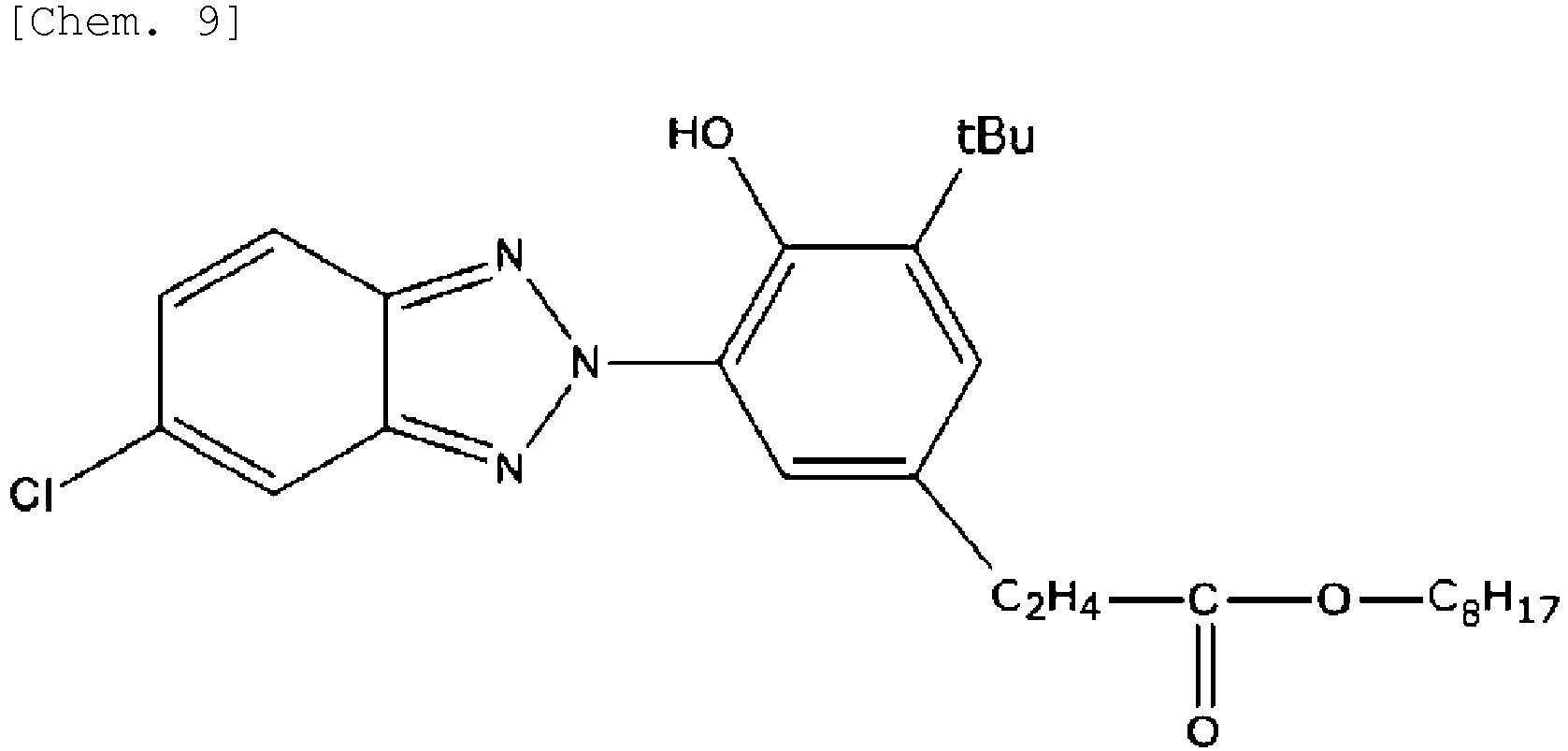
- Examples of the ultraviolet absorber (C) include a mixture of 3-[3-tert-butyl-5-(5-chloro-2H-benzotriazol-2-yl)-4-hydroxypheny 1] octyl propionate and 3-[3-tert-butyl-5-(5-chloro-2H-benzotriazol-2-yl)-4-hydroxypheny 1] propionate 2-ethyl hexyl, and the like, and it is possible to use EVERSORB 109 (produced by EVER LIGHT) and the like.
- From the viewpoint of the effects of the present invention, it is possible to include the ultraviolet absorber (C) in an amount of 0.1 to 10.0% by weight in 100% by weight of the polymerizable composition for an optical material, and preferably 0.5 to 7.5% by weight. In addition, from the same viewpoint, the content of the ultraviolet absorber (C) in 100% by weight of the polymerizable composition for an optical material is preferably 0.1% by weight or more, more preferably 0.5% by weight or more, and, preferably 10.0% by weight or less, and more preferably 7.5% by weight or less. The ultraviolet absorber (C) is excellent in solubility and dispersibility in the isocyanate compound (A) and the active hydrogen compound (B), and is able to be easily added by mixing and stirring with the above.
- Since the ultraviolet absorber (C) is excellent in solubility and dispersibility in the isocyanate compound (A) and the active hydrogen compound (B), it is possible to obtain a homogeneous polymerizable composition in a short time, and the productivity is excellent.
- Furthermore, since the solubility and dispersibility are excellent, it is possible to add a large amount of the ultraviolet absorber (C) and, even if added in a large amount, the ultraviolet absorber (C) does not bleed out from the optical material, thus white turbidity and the like are unlikely to occur. Accordingly, using the ultraviolet absorber (C) makes it possible to easily control the wavelength cut according to the addition amount, and to provide an optical material having high effect of blocking the blue light of approximately 420 nm from harmful ultraviolet rays.
- In the present embodiment, from the viewpoint of improving the balance between the effect of improving the productivity of the product and the effect of blocking the blue light of approximately 420 nm from harmful ultraviolet rays, specific examples of combinations of the isocyanate compound (A), the active hydrogen compound (B), and the ultraviolet absorber (C) are as follows. Preferable examples of the isocyanate compound (A) include at least one type selected from the group consisting of an aliphatic isocyanate compound and an alicyclic isocyanate compound, more preferably include at least one type selected from the group consisting of alicyclic isocyanate compounds, and even more preferably include at least one type selected from the group consisting of isophorone diisocyanate, bis (isocyanatocyclohexyl) methane, 2,5-bis (isocyanatomethyl) bicyclo-[2.2.1]-heptane, and 2,6-bis (isocyanatomethyl) bicyclo-[2.2.1]-heptane;
preferable examples of the active hydrogen compound (B) include at least one type selected from the group consisting of a polythiol compound having two or more mercapto groups and a hydroxy thiol compound having one or more mercapto groups and one or more hydroxyl groups, more preferably at least one type selected from the group consisting of a polythiol compound having two or more mercapto groups, and even more preferably at least one type selected from the group consisting of 5,7-dimercaptomethyl-1,11-dimercapto-3,6,9-trithiaundecane, 4,7-dimercaptomethyl-1,11-dimercapto-3,6,9-trithiaundecane, 4,8-dimercaptomethyl-1,11-dimercapto-3,6,9-trithiaundecane, 4-mercaptomethyl-1,8-dimercapto-3,6-dithiaoctane, and pentaerythritol tetrakis (3-mercaptopropionate); the ultraviolet absorber (C) is preferably at least one type selected from the compounds represented by General Formula (2) above, more preferably at least one type selected from the compounds represented by General Formula (3) above, and even more preferably at least one type selected from
3-[3-tert-butyl-5-(5-chloro-2H-benzotriazol-2-yl)-4-hydroxypheny 1] octyl propionate, and
3-[3-tert-butyl-5-(5-chloro-2H-benzotriazol-2-yl)-4-hydroxypheny 1] propionate 2-ethyl hexyl. - In the present embodiment, other ultraviolet absorbers may be included in addition to the ultraviolet absorber (C). Examples thereof include benzophenone-based compounds, triazine compounds, benzotriazole-based compounds, and the like.
- Examples of benzophenone-based compounds include 2,2'-dihydroxy-4,4'-dimethoxybenzophenone, 2,2'-4,4'-tetrahydroxybenzophenone, and the like.
- Examples of triazine compounds include ADK STAB LA-F70 produced by ADEKA Corp., TINUVIN 400 produced by BASF Corp., and the like.
- In addition, the other ultraviolet absorber is preferably an ultraviolet absorber having a structure other than General Formula (1) and having a maximum absorption peak in a range of equal to or more than 350 nm and equal to or less than 370 nm.
- In the present embodiment, a benzotriazole-based compound is preferably used, and examples of benzotriazole-based compounds include a linear alkyl ester-substituted benzotriazole-based compound, a chloro-substituted benzotriazole-based compound, and the like.
- Among these, chloro-substituted benzotriazole-based compounds represented by General Formula (5) below are preferable.

- In General Formula (5), Q1 and Q2, may be the same or different and represent an alkyl group having 1 to 8 carbon atoms, and preferably an alkyl group having 2 to 6 carbon atoms. A plurality of Q1s present or a plurality of Q2s present may be the same or different. p is an integer of 0 to 3, and q is an integer of 0 to 3. Q3 represents an alkyl group having 1 to 5 carbon atoms.
- Among the compounds represented by General Formula (5), it is preferable to use an ultraviolet absorber having a maximum absorption peak in a range of equal to or more than 350 nm and equal to or less than 370 nm, and examples thereof include 2-(2-hydroxy-3-t-butyl-5-methylphenyl)-chlorobenzotriazole. As commercially available products, it is possible to use TINUVIN 326 produced by BASF Corp., SEESEORB 703 produced by SHIPRO KASEI KAISHA, LTD., Viosorb 550 produced by KYODO CHEMICAL CO., LTD., KEMISORB 73 produced by CHEMIPRO KASEI, and the like.
- From the viewpoint of the effect of the present invention, the mixing ratio of the ultraviolet absorber (C) and the other ultraviolet absorber is 99/1 to 1/99, preferably 95/5 to 5/95, more preferably 90/10 to 10/90, and even more preferably 80/20 to 20/80.
- In addition, in the present embodiment, from the viewpoint of improving the effect of blocking the blue light of approximately 420 nm from harmful ultraviolet rays, specific examples of combinations of the ultraviolet absorber (C) and other ultraviolet absorbers are as follows. The ultraviolet absorber (C) is preferably at least one type selected from the compounds represented by General Formula (2) above, more preferably one type or more of compound selected from the compounds represented by General Formula (3) above, and even more preferably at least one type selected from 3-[3-tert-butyl-5-(5-chloro-2H-benzotriazol-2-yl)-4-hydroxypheny 1] octyl propionate and 3-[3-tert-butyl-5-(5-chloro-2H-benzotriazol-2-yl)-4-hydroxypheny 1] propionate 2-ethylhexyl;
while preferable examples of other ultraviolet absorbers include benzotriazole-based compounds, more preferably at least one type selected from the group consisting of a linear alkyl ester-substituted benzotriazole-based compound and a chloro-substituted benzotriazole-based compound, even more preferably at least one type selected from chloro-substituted benzotriazole-based compounds represented by General Formula (5) above, and still more preferably 2-(2-hydroxy-3-t-butyl-5-methylphenyl)-chlorobenzotriazole. - In the present embodiment, using the ultraviolet absorber (C) represented by General Formula (1) in combination with another ultraviolet absorber further improves the effect of blocking the blue light of approximately 420 nm from harmful ultraviolet rays and makes it possible to obtain a synergistic effect.
- In the present embodiment, the molar ratio of the active hydrogen group in the active hydrogen compound (B) to the isocyanato group in the isocyanate compound (A) is in the range of 0.8 to 1.2, preferably in the range of 0.85 to 1.15, and more preferably in the range of 0.9 to 1.1. Within the ranges described above, it is possible to obtain a resin suitably used as an optical material, specifically as a plastic lens material for spectacles.
- The polymerizable composition for an optical material of the present embodiment may further include a polymerization catalyst, an internal release agent, a resin modifier, a photostabilizer, a bluing agent, and the like as other components.
- Examples of catalysts include Lewis acid, amines, organic acids, amine organic acid salts, and the like, preferably Lewis acid, amines, and amine organic acid salts, and more preferably dimethyl tin chloride, dibutyl tin chloride, and dibutyl tin laurate.
- As the internal release agent, it is possible to use an acidic phosphate ester. Possible examples of acidic phosphate esters include phosphate monoesters and phosphate diesters, which are able to be used alone or in a combination of two or more types. For example, it is possible to use ZelecUN produced by STEPAN Company, an internal mold release agent for MR produced by Mitsui Chemicals, Inc., JP series produced by Johoku Chemical Co., Ltd., Phosphanol series produced by Toho Chemical Industry Co., Ltd., AP, DP Series produced by Daihachi Chemical Industry Co., Ltd., and the like.
- In the polymerizable composition for an optical material of the present embodiment, it is possible to add the resin modifier within a range not impairing the effect of the present invention for the purpose of controlling various physical properties such as optical characteristics, impact resistance, and specific gravity of the obtainable resin and adjusting the handleability of the polymerizable composition.
- Examples of resin modifiers include episulfide compounds, alcohol compounds, amine compounds, epoxy compounds, organic acids and anhydrides thereof, olefin compounds including (meth)acrylate compounds or the like, and the like.
- As the photostabilizer, it is possible to use a hindered amine-base compound. Examples of hindered amine-based compounds include Lowilite 76 and Lowilite 92 produced by Chemtura Corp., Tinuvin 144, Tinuvin 292, Tinuvin 765 produced by BASF Corp., ADK STAB LA-52 and LA-72 produced by ADEKA Corp., JF-95 produced by Johoku Chemical Co., Ltd., and the like.
- Examples of bluing agents include bluing agents having an absorption band in the orange to yellow wavelength range of the visible light region and having a function of adjusting a hue of an optical material formed of a resin. More specifically, the bluing agent includes a substance exhibiting a blue to purple color.
- It is possible to obtain the polymerizable composition for an optical material by mixing the isocyanate compound (A), the active hydrogen compound (B), the ultraviolet absorber (C) by a predetermined method with other thiol compounds, catalysts, internal release agents, and other additives as necessary.
- The temperature during mixing is usually 25°C or less. From the viewpoint of the pot life of the polymerizable composition for an optical material, it may be preferable to further lower the temperature. However, in a case where the solubility of the catalyst, the internal mold release agent and the additive in the isocyanate compound (A) or the active hydrogen compound (B) is not favorable, it is also possible to dissolve the above by warming in advance.
- A mixing order and a mixing method of each component in the composition are not limited as long as it is possible to uniformly mix each component and to carry out the mixing by a known method. As a known method, there is, for example, a method of preparing a master batch including predetermined amounts of additives and dispersing and dissolving the master batch in a solvent.
- In the present embodiment, the method for manufacturing the molded article is not limited; however, preferable examples of a manufacturing method include casting polymerization. First, a polymerizable composition for an optical material is injected between molded molds held by a gasket, a tape, or the like. At this time, depending on the physical properties required for the plastic lens to be obtained, as necessary, it is often preferable to carry out a defoaming treatment under reduced pressure, filtration treatment such as pressurization, depressurization, or the like.
- The polymerization conditions are not limited because the conditions are largely different depending on the polymerizable composition for an optical material, the type and amount of catalyst used, the shape of the mold, and the like; however, the conditions are approximately 1 to 50 hours at a temperature of -50 to 150°C. In some cases, it is preferable to hold or gradually raise the temperature in a range of 10 to 150°C so as to carry out curing over 1 to 25 hours.
- The molded article of the present embodiment may be subjected to a treatment such as annealing as necessary. The treatment temperature is usually in the range of 50 to 150°C, but the treatment is preferably carried out at 90 to 140°C, and more preferably 100 to 130°C.
- It is possible to obtain the molded article of the present embodiment as molded articles of various shapes by changing the mold during casting polymerization.
- In addition, the molded article of the present embodiment is obtainable by curing, for example, the polymerizable composition for an optical material.
- In addition, in the present embodiment, it is possible to use a molded article obtainable by heat curing the polymerizable composition for an optical material as, for example, an optical material.
- The molded article of the present embodiment is colorless and transparent, excellent in appearance, excellent in optical characteristics such as a high refractive index and a high Abbe number and various physical properties such as heat resistance, and the molded article is able to be used as various optical materials by being formed into a desired shape and provided with a coat layer to be formed as necessary, other members, and the like.
- From the viewpoint of improving the effect of blocking the blue light of approximately 420 nm from harmful ultraviolet rays, the content of the ultraviolet absorber (C) included in the molded article is preferably 0.1% by weight or more, and more preferably 0.5% by weight or more and preferably 10.0% by weight or less, and more preferably 7.5% by weight or less.
- In addition, it is possible for the molded article of the present embodiment to include the ultraviolet absorber (C) as 0.1 to 10.0% by weight, and preferably 0.5 to 7.5% by weight. Due to this, the effect of blocking the blue light of approximately 420 nm from harmful ultraviolet rays is excellent.
- Examples of the optical material of the present embodiment include a plastic lens, a camera lens, a light emitting diode (LED), a prism, an optical fiber, an information recording substrate, a filter, a light emitting diode, and the like. Specifically, the optical material of the present embodiment is suitable as an optical material or an optical element such as a plastic lens, a camera lens, a light emitting diode, and the like.
- The plastic lens using the molded article of the present embodiment may be used by applying a coating layer on one side or both sides as necessary. Examples of coating layers include a primer layer, a hard coat layer, an anti-reflection film layer, an anti-fog coating film layer, an anti-fouling layer, a water-repellent layer, and the like. It is also possible for each of these coating layers to be used alone, or a plurality of coating layers are able to be used in multiple layers. In a case of applying coating layers on both sides, the same coating layer may be applied to each side or different coating layers may be applied to each side.
- These coating layers may each contain a combination of an infrared absorber for the purpose of protecting eyes from infrared rays, a photostabilizer and an anti-oxidant for the purpose of improving the weather resistance of the lens, a dye and a pigment for the purpose of increasing the fashionability of the lens, a photochromic dye or a photochromic pigment, an anti-static agent, and other known additives for enhancing the performance of the lens. A coating layer or a primer layer such as a hard coat or an anti-reflection coat may be provided.
- The plastic lens using the molded article of the present embodiment may be used after being dyed for the purpose of imparting fashionability, a photochromic property, or the like using a coloring material according to the purpose. It is possible to carry out the dyeing of the lens by a known dyeing method.
- In addition, the method for manufacturing the optical material of the present embodiment includes, for example, a step of cast polymerizing the polymerizable composition for an optical material of the present embodiment.
- Although the present invention has been described based on the present embodiment, it is possible to adopt various configurations within a range not impairing the effects of the present invention.
- The present invention includes the following aspects.
- 1. A polymerizable composition for an optical material including (A) an isocyanate compound, (B) an active hydrogen compound, and (C) one or more types of ultraviolet absorber represented by General Formula (1) and having a maximum absorption peak in a range of equal to or more than 350 nm and equal to or less than 370 nm,

- 2. The polymerizable composition for an optical material according to the above item 1., in which the ultraviolet absorber (C) is represented by General Formula (2) below and is one or more types of ultraviolet absorber having a maximum absorption peak in the range of equal to or more than 350 nm and equal to or less than 370 nm,

- 3. The polymerizable composition for an optical material according to the above item 2., in which the ultraviolet absorber (C) is represented by General Formula (3) below and is one or more types of ultraviolet absorber having a maximum absorption peak in the range of equal to or more than 350 nm and equal to or less than 370 nm,

- 4. The polymerizable composition for an optical material according to any one of the above items 1. to 3., in which the isocyanate compound (A) includes at least one type selected from hexamethylene diisocyanate, pentamethylene diisocyanate, xylylene diisocyanate, isophorone diisocyanate, bis (isocyanatomethyl) cyclohexane, bis (isocyanatocyclohexyl) methane, 2,5-bis (isocyanatomethyl) bicyclo-[2.2.1]-heptane, 2,6-bis (isocyanatomethyl) bicyclo-[2.2.1]-heptane, tolylene diisocyanate, phenylene diisocyanate, and 4,4'-diphenylmethane diisocyanate.
- 5. The polymerizable composition for an optical material according to any one of the above items 1. to 4., in which the active hydrogen compound (B) is at least one type selected from a polythiol compound having two or more mercapto groups, a hydroxy thiol compound having one or more mercapto groups and one or more hydroxyl groups, a polyol compound having two or more hydroxyl groups, and an amine compound.
- 6. The polymerizable composition for an optical material according to the above item 5., in which the polythiol compound is at least one type selected from 5,7-dimercaptomethyl-1,11-dimercapto-3,6,9-trithiaundecane, 4,7-dimercaptomethyl-1,11-dimercapto-3,6,9-trithiaundecane, 4,8-dimercaptomethyl-1,11-dimercapto-3,6,9-trithiaundecane, 4-mercaptomethyl-1,8-dimercapto-3,6-dithiaoctane, pentaerythritol tetrakis (2-mercaptoacetate), pentaerythritol tetrakis (3-mercaptopropionate), 2,5-bis (mercaptomethyl)-1,4-dithiane, bis (mercaptoethyl) sulfide, 1,1,3,3-tetrakis (mercaptomethylthio) propane, 4,6-bis (mercaptomethylthio)-1,3-dithiane, 2-(2,2-bis (mercaptomethylthio) ethyl)-1,3-dithietane, 1,1,2,2-tetrakis (mercaptomethylthio) ethane, 3-mercaptomethyl-1,5-dimercapto-2,4-dithiapentane, tris (mercaptomethylthio) methane, and ethylene glycol bis (3-mercaptopropionate) .
- 7. The polymerizable composition for an optical material according to the above items 1. to 6., further including an ultraviolet absorber having a structure other than General Formula (1) and having a maximum absorption peak in a range of equal to or more than 350 nm and equal to or less than 370 nm.
- 8. The polymerizable composition for an optical material according to any one of the above items 1. to 7., in which the ultraviolet absorber (C) is included in an amount of 0.1 to 10.0% by weight in 100% by weight of the polymerizable composition for an optical material.
- 9. A molded article obtainable by heating and curing the polymerizable composition for an optical material according to any one of the above items 1. to 8.
- 10. The molded article according to the above item 9. including 0.1 to 10.0% by weight of the ultraviolet absorber (C).
- 11. An optical material constituted of the molded article according to the above item 9. or 10.
- 12. A plastic lens formed of the optical material according to the above item 11.
- 13. A method for manufacturing an optical material, the method including a step of cast polymerizing the polymerizable composition for an optical material according to any one of the above items 1. to 8.
- Description will be given below of the present invention in more detail with reference to examples, but the present invention is not limited thereto. The evaluation methods in the examples of the present invention are as follows.
- In the Examples, the time of complete dissolution after adding the isocyanate solution to various additives including the ultraviolet absorber was visually confirmed.
- The UV-visible light spectrum was measured using a 2 mm thick plano lens and as a measuring device using Shimadzu spectrophotometer UV-1600 produced by Shimadzu Corp., and the transmittance at specific wavelengths (410 nm, 420 nm, and 440 nm) was measured.
- Measurement was carried out at 20°C using a Pulfrich refractometer KPR-30 produced by Shimadzu Corp.
- Measurement was carried out with a thermal mechanical analyzer TMA-60 produced by Shimadzu Corp. according to the TMA penetration method (with a load of 50 g, a pin tip of 0.5 mmφ, a temperature increase rate of 10°C/min).
- The maximum absorption peak of the ultraviolet absorber used in the Examples was as follows.
- Measurement method: The ultraviolet-visible light spectrum was measured using a 2 mm thick plano lens and using a Shimadzu spectrophotometer UV-1600 produced by Shimadzu Corp. as a measuring device.
- EVERSORB 109: The maximum absorption peak was present in the range of equal to or more than 350 nm and equal to or less than 370 nm.
- TINUVIN 326: The maximum absorption peak was present in the range of equal to or more than 350 nm and equal to or less than 370 nm.
- A homogeneous solution was obtained by stirring and mixing 0.1 parts by weight of ZelecUN (produced by STEPAN), 1.5 parts by weight of a mixture (EVERSORB 109 produced by EVER LIGHT) of 3-[3-tert-butyl-5-(5-chloro-2H-benzotriazol-2-yl)-4-hydroxypheny 1] octyl propionate and 3-[3-tert-butyl-5-(5-chloro-2H-benzotriazol-2-yl)-4-hydroxypheny 1] propionate 2-ethyl hexyl and 58.9 parts by weight of bis(4-isocyanatocyclohexyl) methane at 20°C. A mixed solution was obtained by adding 41.1 parts by weight of a mixture of 5,7-dimercaptomethyl-1,11-dimercapto-3,6,9-trithiaundecane, 4,7-dimercaptomethyl-1,11-dimercapto-3,6,9-trithiaundecane, and 4,8-dimercaptomethyl-1,11-dimercapto-3,6,9-trithiaundecane and 0.15 parts by weight of dibutyltin (II) dichloride to the above homogeneous solution and stirring and mixing at 20°C. After this mixed solution was defoamed at 600 Pa for 1 hour and filtrated with a 1 µm PTFE filter, the mixed solution was introduced into a mold formed of a 2C (curve, the same applies below) plano glass mold with a center thickness of 2 mm and a diameter of 80 mm and a flat glass mold with a center thickness of 2 mm and a diameter of 78 mm. This mold was placed in a polymerization oven and polymerization was carried out by gradually raising the temperature from 20°C to 130°C over 21 hours. After completion of the polymerization, the mold was removed from the oven. The obtained plano lens was further annealed at 130°C for 2 hours. The obtained 2 mm thick plano lens had a transparency and had a refractive index (ne) of 1.60, an Abbe number (ve) of 39, and a heat resistance of 125°C, which was suitable as a transparent resin for an optical material. The ultraviolet-visible light spectrum of the obtained plano lens was measured using a spectrophotometer UV-1600 (produced by Shimadzu Corp.). The evaluation results are shown in Table 1.
- A 2 mm thick plano lens was obtained by the same method as Example 1 except that 1.50 parts by weight of the mixture (EVERSORB 109 produced by EVER LIGHT) of 3-[3-tert-butyl-5-(5-chloro-2H-benzotriazol-2-yl)-4-hydroxypheny 1] octyl propionate and 3-[3-tert-butyl-5-(5-chloro-2H-benzotriazol-2-yl)-4-hydroxypheny 1] propionate 2-ethyl hexyl was changed to 3.00 parts by weight. The obtained plano lens had a transparency and had a refractive index (ne) of 1.60, an Abbe number (ve) of 39, and a heat resistance of 122°C, and was suitable as a transparent resin for optical materials. The ultraviolet-visible light spectrum of the obtained plano lens was measured using a spectrophotometer UV-1600 (produced by Shimadzu Corp.). The evaluation results are shown in Table 1.
- A 2 mm thick plano lens was obtained by the same method as Example 1 except that 1.50 parts by weight of the mixture (EVERSORB 109 produced by EVER LIGHT) of 3-[3-tert-butyl-5-(5-chloro-2H-benzotriazol-2-yl)-4-hydroxypheny 1] octyl propionate and 3-[3-tert-butyl-5-(5-chloro-2H-benzotriazol-2-yl)-4-hydroxypheny 1] propionate 2-ethyl hexyl was changed to 5.00 parts by weight. The obtained plano lens had a transparency and had a refractive index (ne) of 1.60, an Abbe number (ve) of 39, and a heat resistance of 117°C, and was suitable as a transparent resin for optical materials. The ultraviolet-visible light spectrum of the obtained plano lens was measured using a spectrophotometer UV-1600 (produced by Shimadzu Corp.). The evaluation results are shown in Table 1.
- A homogeneous solution was obtained by stirring and mixing 0.1 parts by weight of ZelecUN (produced by STEPAN), 0.6 parts by weight of 2-(2-hydroxy-3-t-butyl-5-methylphenyl)-chlorobenzotriazole (TINUVIN 326 produced by BASF Corp.), 1.5 parts by weight of a mixture (EVERSORB 109 produced by EVER LIGHT) of 3-[3-tert-butyl-5-(5-chloro-2H-benzotriazol-2-yl)-4-hydroxypheny 1] octyl propionate and 3-[3-tert-butyl-5-(5-chloro-2H-benzotriazol-2-yl)-4-hydroxypheny 1] propionate 2-ethyl hexyl and 58.9 parts by weight of bis(4-isocyanatocyclohexyl) methane at 20°C. A mixed solution was obtained by adding 41.1 parts by weight of a mixture of 5,7-dimercaptomethyl-1,11-dimercapto-3,6,9-trithiaundecane, 4,7-dimercaptomethyl-1,11-dimercapto-3,6,9-trithiaundecane, and 4,8-dimercaptomethyl-1,11-dimercapto-3,6,9-trithiaundecane and 0.15 parts by weight of dibutyltin (II) dichloride to the above homogeneous solution and stirring and mixing at 20°C. After this mixed solution was defoamed at 600 Pa for 1 hour and filtrated with a 1 µm PTFE filter, the mixed solution was introduced into a mold. This mold was placed in a polymerization oven and polymerization was carried out by gradually raising the temperature from 20°C to 130°C over 21 hours. After completion of the polymerization, the mold was removed from the oven. The obtained plano lens was further annealed at 130°C for 2 hours. The obtained 2 mm thick plano lens had a transparency and had a refractive index (ne) of 1.60, an Abbe number (ve) of 39, and a heat resistance of 123°C, and was suitable as a transparent resin for optical materials. The ultraviolet-visible light spectrum of the obtained plano lens was measured using a spectrophotometer UV-1600 (produced by Shimadzu Corp.). The evaluation results are shown in Table 1.
- A 2 mm thick plano lens was obtained by the same method as Example 4 except that 1.50 parts by weight of the mixture (EVERSORB 109 produced by EVER LIGHT) of 3-[3-tert-butyl-5-(5-chloro-2H-benzotriazol-2-yl)-4-hydroxypheny 1] octyl propionate and 3-[3-tert-butyl-5-(5-chloro-2H-benzotriazol-2-yl)-4-hydroxypheny 1] propionate 2-ethyl hexyl was changed to 2.00 parts by weight. The obtained plano lens had a transparency and had a refractive index (ne) of 1.60, an Abbe number (ve) of 39, and a heat resistance of 122°C, and was suitable as a transparent resin for optical materials. The ultraviolet-visible light spectrum of the obtained plano lens was measured using a spectrophotometer UV-1600 (produced by Shimadzu Corp.). The evaluation results are shown in Table 1.
- A 2 mm thick plano lens was obtained by the same method as Example 4 except that 1.50 parts by weight of the mixture (EVERSORB 109 produced by EVER LIGHT) of 3-[3-tert-butyl-5-(5-chloro-2H-benzotriazol-2-yl)-4-hydroxypheny 1] octyl propionate and 3-[3-tert-butyl-5-(5-chloro-2H-benzotriazol-2-yl)-4-hydroxypheny 1] propionate 2-ethyl hexyl was changed to 5.00 parts by weight. The obtained plano lens had a transparency and had a refractive index (ne) of 1.60, an Abbe number (ve) of 39, and a heat resistance of 117°C, and was suitable as a transparent resin for optical materials. The ultraviolet-visible light spectrum of the obtained plano lens was measured using a spectrophotometer UV-1600 (produced by Shimadzu Corp.). The evaluation results are shown in Table 1.
- A homogeneous solution was obtained by stirring and mixing 0.1 parts by weight of ZelecUN (produced by STEPAN), 1.5 parts by weight of a mixture (EVERSORB 109 produced by EVER LIGHT) of 3-[3-tert-butyl-5-(5-chloro-2H-benzotriazol-2-yl)-4-hydroxypheny 1] octyl propionate and 3-[3-tert-butyl-5-(5-chloro-2H-benzotriazol-2-yl)-4-hydroxypheny 1] octyl propionate 2-ethyl hexyl and 56.1 parts by weight of isophorone diisocyanate at 20°C. A mixed solution was obtained by adding 43.9 parts by weight of 4-mercaptomethyl-1,8-dimercapto-3,6-dithiaoctane and 0.20 parts by weight of dimethyltin (II) dichloride to the above homogeneous solution and stirring and mixing at 20°C. After this mixed solution was defoamed at 600 Pa for 1 hour and filtrated with a 1 µm PTFE filter, the mixed solution was introduced into a mold formed of a 2C plano glass mold with a center thickness of 2 mm and a diameter of 80 mm and a flat glass mold with a center thickness of 2 mm and a diameter of 78 mm. This mold was placed in a polymerization oven and polymerization was carried out by gradually raising the temperature from 20°C to 130°C over 21 hours. After completion of the polymerization, the mold was removed from the oven. The obtained plano lens was further annealed at 130°C for 2 hours. The obtained plano lens had a transparency and had a refractive index (ne) of 1.60, an Abbe number (ve) of 39, and a heat resistance of 129°C, and was suitable as a transparent resin for optical materials. The ultraviolet-visible light spectrum of the obtained plano lens was measured using a spectrophotometer UV-1600 (produced by Shimadzu Corp.). The evaluation results are shown in Table 2.
- A 2 mm thick plano lens was obtained by the same method as Example 7 except that 1.5 parts by weight of the mixture (EVERSORB 109 produced by EVER LIGHT) of 3-[3-tert-butyl-5-(5-chloro-2H-benzotriazol-2-yl)-4-hydroxypheny 1] octyl propionate and 3-[3-tert-butyl-5-(5-chloro-2H-benzotriazol-2-yl)-4-hydroxypheny 1] propionate 2-ethyl hexyl was changed to 3.0 parts by weight. The obtained plano lens had a transparency and had a refractive index (ne) of 1.60, an Abbe number (ve) of 38, and a heat resistance of 124°C, and was suitable as a transparent resin for optical materials. The ultraviolet-visible light spectrum of the obtained plano lens was measured using a spectrophotometer UV-1600 (produced by Shimadzu Corp.). The evaluation results are shown in Table 2.
- A 2 mm thick plano lens was obtained by the same method as Example 7 except that 1.5 parts by weight of the mixture (EVERSORB 109 produced by EVER LIGHT) of 3-[3-tert-butyl-5-(5-chloro-2H-benzotriazol-2-yl)-4-hydroxypheny 1] octyl propionate and 3-[3-tert-butyl-5-(5-chloro-2H-benzotriazol-2-yl)-4-hydroxypheny 1] propionate 2-ethyl hexyl was changed to 5.0 parts by weight. The obtained plano lens had a transparency and had a refractive index (ne) of 1.60, an Abbe number (ve) of 38, and a heat resistance of 120°C, and was suitable as a transparent resin for optical materials. The ultraviolet-visible light spectrum of the obtained plano lens was measured using a spectrophotometer UV-1600 (produced by Shimadzu Corp.). The evaluation results are shown in Table 2.
- A homogeneous solution was obtained by stirring and mixing 0.1 parts by weight of ZelecUN (produced by STEPAN), 1.5 parts by weight of a mixture (EVERSORB 109 produced by EVER LIGHT) of 3-[3-tert-butyl-5-(5-chloro-2H-benzotriazol-2-yl)-4-hydroxypheny 1] octyl propionate and 3-[3-tert-butyl-5-(5-chloro-2H-benzotriazol-2-yl)-4-hydroxypheny 1] propionate 2-ethyl hexyl and 50.6 parts by weight of a mixture of 2,5-bis (isocyanatomethyl) bicyclo-[2.2.1]-heptane and 2,6-bis (isocyanatomethyl) bicyclo-[2.2.1]-heptane at 20°C. A mixed solution was obtained by adding 25.5 parts by weight of 4-mercaptomethyl-1,8-dimercapto-3,6-dithiaoctane, 23.9 parts by weight of pentaerythritol tetrakis (3-mercaptopropionate), 0.035 parts by weight of dibutyltin (II) dichloride to the above homogeneous solution, and mixing and stirring at 20°C. After this mixed solution was defoamed at 600 Pa for 1 hour and filtrated with a 1 µm PTFE filter, the mixed solution was introduced into a mold formed of a 2C plano glass mold with a center thickness of 2 mm and a diameter of 80 mm and a flat glass mold with a center thickness of 2 mm and a diameter of 78 mm. This mold was placed in a polymerization oven and polymerization was carried out by gradually raising the temperature from 20°C to 130°C over 21 hours. After completion of the polymerization, the mold was removed from the oven. The obtained plano lens was further annealed at 130°C for 2 hours. The obtained plano lens had a transparency and had a refractive index (ne) of 1.60, an Abbe number (ve) of 39, and a heat resistance of 114°C, and was suitable as a transparent resin for optical materials. The ultraviolet-visible light spectrum of the obtained plano lens was measured using a spectrophotometer UV-1600 (produced by Shimadzu Corp.). The evaluation results are shown in Table 2.
- A 2 mm thick plano lens was obtained by the same method as Example 10 except that 1.5 parts by weight of the mixture (EVERSORB 109 produced by EVER LIGHT) of 3-[3-tert-butyl-5-(5-chloro-2H-benzotriazol-2-yl)-4-hydroxypheny 1] octyl propionate and 3-[3-tert-butyl-5-(5-chloro-2H-benzotriazol-2-yl)-4-hydroxypheny 1] propionate 2-ethyl hexyl was changed to 3.0 parts by weight. The obtained plano lens had a transparency and had a refractive index (ne) of 1.60, an Abbe number (ve) of 39, and a heat resistance of 112°C, and was suitable as a transparent resin for optical materials. The ultraviolet-visible light spectrum of the obtained plano lens was measured using a spectrophotometer UV-1600 (produced by Shimadzu Corp.). The evaluation results are shown in Table 2.
- A homogeneous solution was obtained by stirring and mixing 0.1 part by weight of ZelecUN (produced by STEPAN), 1.5 parts by weight of a mixture (EVERSORB 109 produced by EVER LIGHT) of 3-[3-tert-butyl-5-(5-chloro-2H-benzotriazol-2-yl)-4-hydroxypheny 1] octyl propionate and 3-[3-tert-butyl-5-(5-chloro-2H-benzotriazol-2-yl)-4-hydroxypheny 1] propionate 2-ethyl hexyl, 29.19 parts by weight of a mixture of 2,5-bis (isocyanatomethyl) bicyclo-[2.2.1]-heptane and 2,6-bis (isocyanatomethyl) bicyclo-[2.2.1]-heptane, and 19.48 parts by weight of 1, 6-hexamethylene diisocyanate at 20°C. A mixed solution was obtained by adding 27.85 parts by weight of 4-mercaptomethyl-1,8-dimercapto-3,6-dithiaoctane, 23.48 parts by weight of pentaerythritol tetrakis (3-mercaptopropionate), and 0.04 parts by weight of dimethyltin (II) dichloride to the above homogeneous solution, and mixing and stirring at 20°C. After this mixed solution was defoamed at 600 Pa for 1 hour and filtrated with a 1 µm PTFE filter, the mixed solution was introduced into a mold formed of a 2C plano glass mold with a center thickness of 2 mm and a diameter of 80 mm and a flat glass mold with a center thickness of 2 mm and a diameter of 78 mm. This mold was placed in a polymerization oven and polymerization was carried out by gradually raising the temperature from 20°C to 130°C over 21 hours. After completion of the polymerization, the mold was removed from the oven. The obtained plano lens was further annealed at 130°C for 2 hours. The obtained plano lens had a transparency and had a refractive index (ne) of 1.60, an Abbe number (ve) of 39, and a heat resistance of 92°C, and was suitable as a transparent resin for optical materials. The ultraviolet-visible light spectrum of the obtained plano lens was measured using a spectrophotometer UV-1600 (produced by Shimadzu Corp.). The evaluation results are shown in Table 2.
- A homogeneous solution was obtained by stirring and mixing 0.1 parts by weight of ZelecUN (produced by STEPAN) , 1.5 parts by weight of a mixture (EVERSORB 109 produced by EVER LIGHT) of 3-[3-tert-butyl-5-(5-chloro-2H-benzotriazol-2-yl)-4-hydroxypheny 1] octyl propionate and 3-[3-tert-butyl-5-(5-chloro-2H-benzotriazol-2-yl)-4-hydroxypheny 1] propionate 2-ethyl hexyl, 24.15 parts by weight of 1,5-pentamethylene diisocyanate, and 28.15 parts by weight of a polyisocyanate which includes isocyanurate of 1,5-pentamethylene diisocyanate at 20°C. A mixed solution was obtained by adding 33.1 parts by weight of a mixture of 5,7-dimercaptomethyl-1,11-dimercapto-3,6,9-trithiaundecane, 4,7-dimercaptomethyl-1,11-dimercapto-3,6,9-trithiaundecane, 4,8-dimercaptomethyl-1,11-dimercapto-3,6,9-trithiaundecane, 14.65 parts by weight of pentaerythritol tetrakis (3-mercaptopropionate), 0.03 parts by weight of 1-benzyl-2-methylimidazole to the above homogeneous solution and mixing and stirring at 20°C. After this mixed solution was defoamed at 600 Pa for 1 hour and filtrated with a 1 µm PTFE filter, the mixed solution was introduced into a mold formed of a 2C plano glass mold with a center thickness of 2 mm and a diameter of 80 mm and a flat glass mold with a center thickness of 2 mm and a diameter of 78 mm. This mold was placed in a polymerization oven and polymerization was carried out by gradually raising the temperature from 20°C to 130°C over 21 hours. After completion of the polymerization, the mold was removed from the oven. The obtained plano lens was further annealed at 130°C for 2 hours. The obtained plano lens had a transparency and had a refractive index (ne) of 1.60, an Abbe number (ve) of 39, and a heat resistance of 85°C, and was suitable as a transparent resin for optical materials. The ultraviolet-visible light spectrum of the obtained plano lens was measured using a spectrophotometer UV-1600 (produced by Shimadzu Corp.). The evaluation results are shown in Table 2.
- A homogeneous solution was obtained by stirring and mixing 0.1 parts by weight of ZelecUN (produced by STEPAN) , 0.6 parts by weight of 2-(2-hydroxy-3-t-butyl-5-methylphenyl)-chlorobenzotriazole (TINUVIN 326 produced by BASF Corp.), and 58.9 parts by weight of bis (4-isocyanatocyclohexyl) methane at 20°C. A mixed solution was obtained by adding 41.1 parts by weight of a mixture of 5,7-dimercaptomethyl-1,11-dimercapto-3,6,9-trithiaundecane, 4,7-dimercaptomethyl-1,11-dimercapto-3,6,9-trithiaundecane, and 4,8-dimercaptomethyl-1,11-dimercapto-3,6,9-trithiaundecane and 0.15 parts by weight of dibutyltin (II) dichloride to the above homogeneous solution and stirring and mixing at 20°C. After this mixed solution was defoamed at 600 Pa for 1 hour and filtrated with a 1 µm PTFE filter, the mixed solution was introduced into a mold. This mold was placed in a polymerization oven and polymerization was carried out by gradually raising the temperature from 20°C to 130°C over 21 hours. After completion of the polymerization, the mold was removed from the oven. The obtained plano lens was further annealed at 130°C for 2 hours. The obtained 2 mm plano lens had a transparency and had a refractive index (ne) of 1.60, an Abbe number (ve) of 40, and a heat resistance of 134°C. The ultraviolet-visible light spectrum of the obtained plano lens was measured using a spectrophotometer UV-1600 (produced by Shimadzu Corp.). The evaluation results are shown in Table 1.
- A 2 mm thick plano lens was obtained by the same method as Comparative Example 1 except that 0.6 parts by weight of 2-(2-hydroxy-3-t-butyl-5-methylphenyl)-chlorobenzotriazole (TINUVIN 326 produced by BASF Corp.) was changed to 1.1 parts by weight. Here, when the dissolution completion time of the ultraviolet absorber was confirmed, the ultraviolet absorber took 100 minutes to completely dissolve. The obtained plano lens had a transparency, and had a refractive index (ne) of 1.60, an Abbe's number (ve) of 39, and a heat resistance of 134°C. The ultraviolet-visible light spectrum of the obtained plano lens was measured using a spectrophotometer UV-1600 (produced by Shimadzu Corp.). The evaluation results are shown in Table 1.
- The experiment was carried out by the same method as Comparative Example 1 except that 0.6 parts by weight of 2-(2-hydroxy-3-t-butyl-5-methylphenyl)-chlorobenzotriazole (TINUVIN 326 produced by BASF Corp.) was changed to 1.2 parts by weight but the dissolution was not completed and the mixed solution was suspended. After defoaming and filtering in accordance with Comparative Example 1, the mixed solution was transparent. After this mixed solution was defoamed at 600 Pa for 1 hour and filtrated with a 1 µm PTFE filter, the mixed solution was introduced into a mold. At this time, the viscosity of the polymerizable composition increased and it was difficult to introduce the composition into the mold. This mold was placed in a polymerization oven and polymerization was carried out by gradually raising the temperature from 20°C to 130°C over 21 hours. After completion of the polymerization, the mold was removed from the oven. The obtained plano lens was further annealed at 130°C for 2 hours. The obtained 2 mm thick plano lens was cloudy and unsuitable as a transparent resin for optical materials.
Table 1 Parts by weight Example 1 Example 2 Example 3 Example 4 Example 5 Example 6 Comparative Example 1 Comparative Example 2 Comparative Example 3 Isocyanate compound a-1 58.9 58.9 58.9 58.9 58.9 58.9 58.9 58.9 58.9 Active hydrogen compound b-1 41.1 41.1 41.1 41.1 41.1 41.1 41.1 41.1 41.1 Ultraviolet absorber c-1 1.5 (15000) 3.0 (30000) 5.0 (50000) 1.5 (15000) 2.0 (20000) 5.0 (50000) - - - c-2 - - - 0.6 (6000) 0.6 (6000) 0.6 (6000) 0.6 (6000) 1.1 (11000) 1.2 (12000) ZelecUN 0.1 0.1 0.1 0.1 0.1 0.1 0.1 0.1 0.1 Dibutyltin (II) dichloride 0.15 0.15 0.15 0.15 0.15 0.15 0.15 0.15 0.15 Dissolution Completion Time (20°C) 10min 10min 30min 30min 30min 30min 30min 100min Uncompleted Light transmission rate: % 410nm 1.3 0.1 0.1 0.1 0.1 0.1 0.3 0.1 - 420nm 42.0 22.6 10.6 11.7 9.6 6.5 27.0 15.9 - 440nm 87.7 86.4 84.8 83.9 83.5 82.8 86.4 85.9 - Transparency Transparent Transparent Transparent Transparent Transparent Transparent Transparent Transparent Not transparent Refractive index (ne) 1.60 1.60 1.60 1.60 1.60 1.60 1.60 1.60 - Abbe number (ve) 39 39 39 39 39 39 40 39 - Heat resistance: Tg 125 122 117 123 122 117 134 134 - - In parentheses is the amount (ppm) of the ultraviolet absorber with respect to the total amount of the isocyanate compound and the active hydrogen compound.
Table 2 Parts by weight Example 7 Example 8 Example 9 Example 10 Example 11 Example 12 Example 13 Isocyanate compound a-1 a-2 56.1 56.1 56.1 a-3 50.6 50.6 29.19 a-4 19.48 a-5 24.15 a-6 28.15 Active hydrogen compound b-1 33.1 b-2 43.9 43.9 43.9 25.5 25.5 27.85 b-3 23.9 23.9 23.48 14.65 Ultraviolet absorber c-1 1.5 (15000) 3.0 (30000) 5.0 (50000) 1.5 (15000) 3.0 (30000) 1.5 (15000) 1.5 (15000) Dissolution Completion Time (20°C) 10min 10min 30min 10min 10min 10min 10min Light transmission rate: % 410nm 0.1 0.1 0.1 0.3 0.1 0.1 0.3 420nm 40.9 22.7 10.0 41.5 20.4 39.1 40.8 440nm 87.3 85.5 84.9 87.3 85.4 82.9 84.2 Transparency Transparent Transparent Transparent Transparent Transparent Transparent Transparent Refractive index (ne) 1.60 1.60 1.60 1.60 1.60 1.60 1.60 Abbe number (ve) 39 38 38 39 39 39 39 Heat resistance: Tg 129 124 120 114 112 92 85 - In parentheses is the amount (ppm) of the ultraviolet absorber with respect to the total amount of the isocyanate compound and the active hydrogen compound.
- The isocyanate compound, active hydrogen compound, and ultraviolet absorber described in Table 1 and Table 2 are as follows.
- a-1: bis (4-isocyanatocyclohexyl) methane
- a-2: isophorone diisocyanate
- a-3: a mixture of 2,5-bis (isocyanatomethyl) bicyclo-[2.2.1]-heptane and 2,6-bis (isocyanatomethyl) bicyclo-[2.2.1]-heptane
- a-4: 1,6-hexamethylene diisocyanate
- a-5: 1,5-pentamethylene diisocyanate
- a-6: polyisocyanate which includes isocyanurate of 1,5-pentamethylene diisocyanate
- b-1: a mixture of 5,7-dimercaptomethyl-1,11-dimercapto-3,6,9-trithiaundecane, 4,7-dimercaptomethyl-1,11-dimercapto-3,6,9-trithiaundecane, and 4,8-dimercaptomethyl-1,11-dimercapto-3,6,9-trithiaundecane
- b-2: 4-mercaptomethyl-1,8-dimercapto-3,6-dithiaoctane
- b-3: pentaerythritol tetrakis (3-mercaptopropionate)
- c-1: a mixture of 3-[3-tert-butyl-5-(5-chloro-2H-benzotriazol-2-yl)-4-hydroxypheny 1] octyl propionate and 3-[3-tert-butyl-5-(5-chloro-2H-benzotriazol-2-yl)-4-hydroxypheny 1] propionate 2-ethyl hexyl
- c-2: 2-(2-hydroxy-3-t-butyl-5-methylphenyl)-chlorobenzotriazole
- From Table 1 and Table 2, in each example, it is possible to quickly dissolve the ultraviolet absorber while the concentration of the ultraviolet absorber in the polymerizable composition was higher than the concentration in each comparative example, and each example was superior in product productivity.
- In addition, the lenses obtained in each example have a transparent and excellent appearance, and are excellent in the balance between each characteristic of the characteristic of suppressing the transmission of light having a wavelength of 410 to 440 nm, the optical characteristics of a high refractive index and a high Abbe number, and heat resistance.
- This application claims priority based on Japanese Patent Application No.
2015-018141 filed on February 2, 2015
Claims (15)
- A polymerizable composition for an optical material comprising:(A) an isocyanate compound;(B) an active hydrogen compound; and(C) one or more types of ultraviolet absorber represented by General Formula (1) below and having a maximum absorption peak in a range of equal to or more than 350 nm and equal to or less than 370 nm;
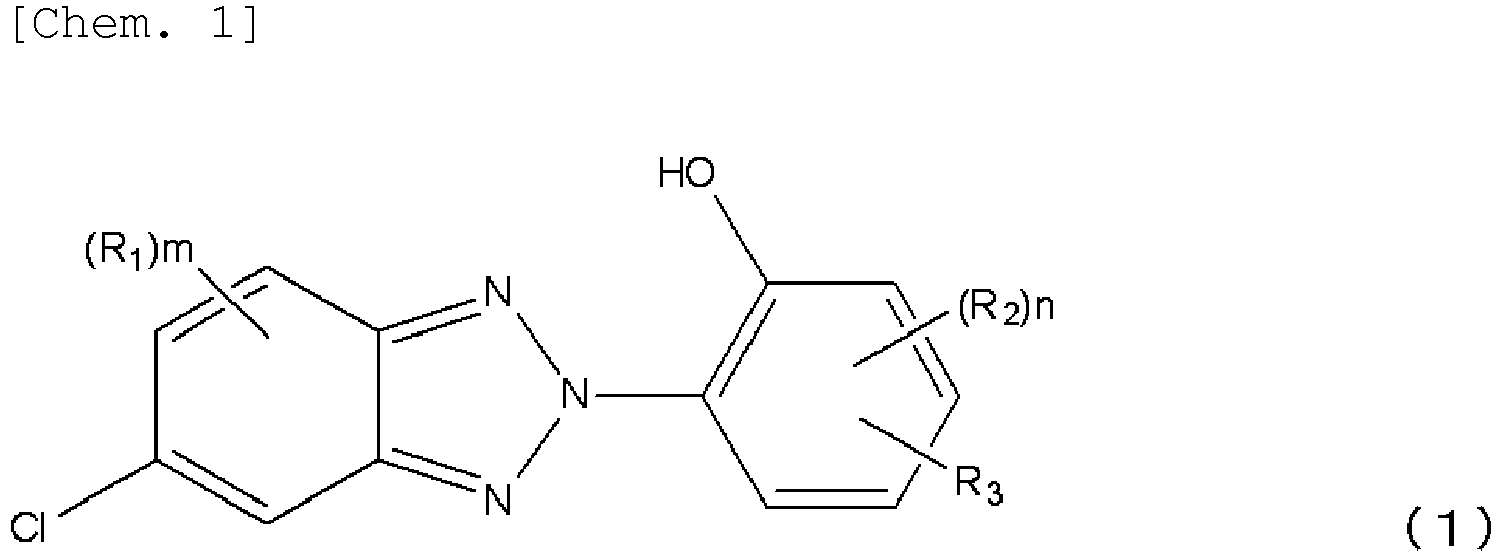
- The polymerizable composition for an optical material according to claim 1,
wherein the ultraviolet absorber (C) is represented by General Formula (2) below and is one or more types of ultraviolet absorber having a maximum absorption peak in a range of equal to or more than 350 nm and equal to or less than 370 nm;
- The polymerizable composition for an optical material according to claim 2,
wherein the ultraviolet absorber (C) is represented by General Formula (3) below and is one or more types of ultraviolet absorber having a maximum absorption peak in a range of equal to or more than 350 nm and equal to or less than 370 nm;
- The polymerizable composition for an optical material according to any one of claims 1 to 3,
wherein the isocyanate compound (A) includes an alicyclic isocyanate compound. - The polymerizable composition for an optical material according to any one of claims 1 to 4,
wherein the isocyanate compound (A) is at least one type selected from the group consisting of hexamethylene diisocyanate, pentamethylene diisocyanate, xylylene diisocyanate, isophorone diisocyanate, bis (isocyanatomethyl) cyclohexane, bis (isocyanatocyclohexyl) methane, 2,5-bis (isocyanatomethyl) bicyclo-[2.2.1]-heptane, 2,6-bis (isocyanatomethyl) bicyclo-[2.2.1]-heptane, tolylene diisocyanate, phenylene diisocyanate, and 4,4'-diphenylmethane diisocyanate. - The polymerizable composition for an optical material according to any one of claims 1 to 5,
wherein the active hydrogen compound (B) is at least one type selected from the group consisting of a polythiol compound having two or more mercapto groups, a hydroxy thiol compound having one or more mercapto groups and one or more hydroxyl groups, a polyol compound having two or more hydroxyl groups, and an amine compound. - The polymerizable composition for an optical material according to claim 6,
wherein the polythiol compound is at least one selected from the group consisting of 5,7-dimercaptomethyl-1,11-dimercapto-3,6,9-trithiaundecane, 4,7-dimercaptomethyl-1,11-dimercapto-3,6,9-trithiaundecane, 4,8-dimercaptomethyl-1,11-dimercapto-3,6,9-trithiaundecane, 4-mercaptomethyl-1,8-dimercapto-3,6-dithiaoctane, pentaerythritol tetrakis (2-mercaptoacetate), pentaerythritol tetrakis (3-mercaptopropionate), 2,5-bis (mercaptomethyl)-1,4-dithiane, bis (mercaptoethyl) sulfide, 1,1,3,3-tetrakis (mercaptomethylthio) propane, 4,6-bis (mercaptomethylthio)-1,3-dithiane, 2-(2,2-bis (mercaptomethylthio) ethyl)-1,3-dithietane, 1,1,2,2-tetrakis (mercaptomethylthio) ethane, 3-mercaptomethyl-1,5-dimercapto-2,4-dithiapentane, tris (mercaptomethylthio) methane, and ethylene glycol bis (3-mercaptopropionate) . - The polymerizable composition for an optical material according to any one of claims 1 to 7, further comprising:an ultraviolet absorber having a structure other than the structure of General Formula (1) and having a maximum absorption peak in a range of equal to or more than 350 nm and equal to or less than 370 nm.
- The polymerizable composition for an optical material according to any one of claims 1 to 8,
wherein the ultraviolet absorber (C) is included in an amount of 0.1 to 10.0% by weight in 100% by weight of the polymerizable composition for an optical material. - A molded article obtainable by curing the polymerizable composition for an optical material according to any one of claims 1 to 9.
- The molded article according to claim 10 comprising 0.1 to 10.0% by weight of the ultraviolet absorber (C).
- An optical material constituted of the molded article according to claim 10 or 11.
- A plastic lens formed of the optical material according to claim 12.
- A method for manufacturing an optical material, the method comprising:a step of cast polymerizing the polymerizable composition for an optical material according to any one of claims 1 to 9.
- Use of a molded article obtainable by heating and curing the polymerizable composition for an optical material according to any one of claims 1 to 9 as an optical material.
Applications Claiming Priority (2)
| Application Number | Priority Date | Filing Date | Title |
|---|---|---|---|
| JP2015018141 | 2015-02-02 | ||
| PCT/JP2016/052899 WO2016125736A1 (en) | 2015-02-02 | 2016-02-01 | Polymerizable composition for optical material, optical material, and application for same |
Publications (3)
| Publication Number | Publication Date |
|---|---|
| EP3260891A1 true EP3260891A1 (en) | 2017-12-27 |
| EP3260891A4 EP3260891A4 (en) | 2018-09-19 |
| EP3260891B1 EP3260891B1 (en) | 2023-11-29 |
Family
ID=56564081
Family Applications (1)
| Application Number | Title | Priority Date | Filing Date |
|---|---|---|---|
| EP16746567.3A Active EP3260891B1 (en) | 2015-02-02 | 2016-02-01 | Polymerizable composition for optical material, optical material, and application for same |
Country Status (7)
| Country | Link |
|---|---|
| US (1) | US20180016415A1 (en) |
| EP (1) | EP3260891B1 (en) |
| JP (1) | JP6438976B2 (en) |
| KR (2) | KR20170091723A (en) |
| CN (1) | CN107209283B (en) |
| BR (1) | BR112017015668A2 (en) |
| WO (1) | WO2016125736A1 (en) |
Cited By (1)
| Publication number | Priority date | Publication date | Assignee | Title |
|---|---|---|---|---|
| EP3901180A4 (en) * | 2018-12-17 | 2022-10-19 | Tokuyama Corporation | CURING COMPOSITION FOR OPTICAL MATERIALS AND OPTICAL MATERIAL |
Families Citing this family (35)
| Publication number | Priority date | Publication date | Assignee | Title |
|---|---|---|---|---|
| EP3203271B1 (en) * | 2016-02-08 | 2021-01-27 | Essilor International | Blue light cutting optical material comprising a benzotriazole uv absorber |
| CN109982841A (en) * | 2016-11-23 | 2019-07-05 | Ppg工业俄亥俄公司 | The ultraviolet protection transparent body |
| JP7116727B2 (en) | 2017-06-14 | 2022-08-10 | 株式会社トクヤマ | Primer composition and laminate for optical article |
| TWI667266B (en) * | 2017-07-12 | 2019-08-01 | 臺灣永光化學工業股份有限公司 | Use of polymerizable ultraviolet absorber in polyurethane and composition for forming polyurethane comprising the same |
| US11472943B2 (en) | 2017-07-26 | 2022-10-18 | Mitsui Chemicals, Inc. | Polymerizable composition for optical material, optical material, and application thereof |
| CN107450198A (en) * | 2017-09-12 | 2017-12-08 | 江苏万新光学有限公司 | A kind of resin lens and anti-glare thin slice pass through shadowless glue adhesion technique |
| CN107599272A (en) * | 2017-09-12 | 2018-01-19 | 江苏万新光学有限公司 | A kind of resin lens and anti-glare monomer cast autoadhesion technique |
| CN108084385B (en) * | 2017-12-28 | 2020-11-03 | 山东益丰生化环保股份有限公司 | Ultrahigh-toughness blue-light-proof resin lens and preparation method thereof |
| KR102001495B1 (en) * | 2018-01-12 | 2019-07-18 | 에스케이씨 주식회사 | Polythiourethane plastic lens |
| KR101894921B1 (en) * | 2018-01-19 | 2018-09-04 | 에스케이씨 주식회사 | Polythiol composition for plastic optical lens |
| TWI797268B (en) * | 2018-02-27 | 2023-04-01 | 日商積水化學工業股份有限公司 | Interlayer film for laminated glass, and laminated glass |
| JP7654408B2 (en) * | 2019-02-08 | 2025-04-01 | 三井化学株式会社 | Polymerizable composition for optical material, optical material and use thereof |
| CN113557467B (en) * | 2019-03-04 | 2023-11-21 | 东海光学株式会社 | Plastic lenses and glasses |
| CN113614581B (en) | 2019-03-29 | 2024-10-25 | 三井化学株式会社 | Method for producing optical material, and polymerizable composition for optical material |
| CN113692552B (en) | 2019-04-19 | 2023-07-21 | 三井化学株式会社 | optical material |
| EP3958044B1 (en) | 2019-04-19 | 2025-02-26 | Mitsui Chemicals, Inc. | Optical material, polymerizable composition for optical material, cured product, optical material, plastic lens, method for manufacturing optical material, and method for using optical material |
| CN113825779B (en) | 2019-05-16 | 2023-04-28 | 三井化学株式会社 | Polymerizable composition for optical material and use thereof |
| KR20250008788A (en) | 2019-05-16 | 2025-01-15 | 미쯔이가가꾸가부시끼가이샤 | Injection molding apparatus, injection molding method and molding production method using said apparatus, and laminated lens |
| EP4435499A3 (en) | 2019-09-18 | 2024-11-27 | Mitsui Chemicals, Inc. | Benzotriazole compound, light absorber, and resin composition |
| CN116178654A (en) | 2020-01-27 | 2023-05-30 | 三井化学株式会社 | Polymerizable composition for optical material, polymerizable prepolymer composition for optical material, cured product, and method for producing optical material |
| US11542357B2 (en) | 2020-01-27 | 2023-01-03 | Mitsui Chemicals, Inc. | Polymerizable composition for optical material, polymerizable prepolymer composition for optical material, cured product, and method of producing optical material |
| EP4711395A3 (en) | 2020-03-10 | 2026-06-03 | Mitsui Chemicals, Inc. | Polymerizable composition for optical material, polymerizable prepolymer composition for optical material, cured product, and method for producing optical material |
| US12583964B2 (en) * | 2020-12-25 | 2026-03-24 | Mitsui Chemicals, Inc. | Polythiol composition, polymerizable composition, resin, molded article, optical material, and lens |
| US20230365737A1 (en) * | 2020-12-25 | 2023-11-16 | Mitsui Chemicals, Inc. | Iso(thio)cyanate compound, polymerizable composition for optical material, molded body, optical material, plastic lens, plastic polarizing lens, method for producing iso(thio)cyanate compound, method for producing polymerizable composition for optical material, method for producing optical material, and method for producing plastic polarizing lens |
| US20240100789A1 (en) | 2021-03-22 | 2024-03-28 | Mitsui Chemicals, Inc. | Method for manufacturing photochromic lens and photochromic lens |
| JP7687874B2 (en) * | 2021-06-15 | 2025-06-03 | 株式会社シード | Blue light absorbing hydrogel |
| EP4400524A4 (en) | 2021-10-15 | 2025-09-24 | Mitsui Chemicals Inc | Light-curable composition, cured article, laminated body, method for producing a cured article, and method for producing a lens |
| WO2023120606A1 (en) | 2021-12-24 | 2023-06-29 | 三井化学株式会社 | Method for manufacturing optical member and cured product |
| EP4484110A4 (en) | 2022-02-25 | 2026-02-25 | Mitsui Chemicals Inc | METHOD FOR MANUFACTURING AN OPTICAL ELEMENT AND OPTICAL ELEMENT |
| US20250101164A1 (en) | 2022-03-18 | 2025-03-27 | Mitsui Chemicals, Inc. | Polythiourethane film, eyeglass lens material, eyeglass lens, and method of producing eyeglass lens |
| CN120530150A (en) | 2023-03-15 | 2025-08-22 | 三井化学株式会社 | Composition, composition kit, cured product, laminate, and method for producing cured product |
| EP4745173A1 (en) | 2023-07-11 | 2026-05-20 | Mitsui Chemicals, Inc. | Polymerizable composition, hardened product, optical material, spectacle lens, compound, method for producing a polymerizable composition and resin |
| JPWO2025013882A1 (en) | 2023-07-11 | 2025-01-16 | ||
| WO2025041800A1 (en) | 2023-08-23 | 2025-02-27 | 三井化学株式会社 | Polymerizable composition for optical material, polymerizable prepolymer composition for optical material, cured article, and method for producing optical material |
| KR20260083436A (en) | 2023-11-20 | 2026-06-05 | 미쯔이가가꾸가부시끼가이샤 | Optical component and method for manufacturing an optical component |
Family Cites Families (19)
| Publication number | Priority date | Publication date | Assignee | Title |
|---|---|---|---|---|
| JPH04219703A (en) * | 1990-12-20 | 1992-08-10 | Nippon Kayaku Co Ltd | Ultraviolet ray shutting-off polarizing plate |
| EP0698637A3 (en) * | 1994-08-22 | 1996-07-10 | Ciba Geigy Ag | Polyurethanes stabilized with selected 5-substituted benzotriazole UV absorbers |
| JPH10186291A (en) | 1996-12-26 | 1998-07-14 | Toray Ind Inc | Plastic lens |
| JPH11218602A (en) | 1998-02-03 | 1999-08-10 | Asahi Optical Co Ltd | Plastic lens |
| JP3538310B2 (en) * | 1998-02-10 | 2004-06-14 | ペンタックス株式会社 | Plastic lens |
| US6187844B1 (en) * | 1998-02-10 | 2001-02-13 | Asahi Kogaku Kogyo Kabushiki Kaisha | Plastic lens |
| JP3538332B2 (en) * | 1998-02-10 | 2004-06-14 | ペンタックス株式会社 | Plastic lens |
| JP4067204B2 (en) * | 1998-11-27 | 2008-03-26 | 三井化学株式会社 | Lens manufacturing method |
| US6773104B2 (en) * | 2000-07-24 | 2004-08-10 | Optical Technologies Corp. | Ultraviolet filter coating |
| JP2002169020A (en) * | 2000-12-04 | 2002-06-14 | Konica Corp | Optical film, polarizing plate and display device using the same |
| WO2005075533A1 (en) * | 2004-01-30 | 2005-08-18 | Essilor International (Compagnie Generale D'optique) | Polarized articles and methods for obtaining polarized articles |
| JP4681820B2 (en) | 2004-03-31 | 2011-05-11 | Hoya株式会社 | Plastic spectacle lens and manufacturing method thereof |
| KR101259235B1 (en) * | 2008-02-07 | 2013-04-29 | 가부시키가이샤 호프닉켄큐쇼 | Plastic polarizing lens and method of producing the same |
| EP2605059B1 (en) * | 2010-08-12 | 2021-02-17 | Mitsui Chemicals, Inc. | Plastic polarizing lens, method for producing the same |
| JP5789746B2 (en) * | 2010-08-25 | 2015-10-07 | パナソニックIpマネジメント株式会社 | LIGHT INSPECTIVE SUBSTRATE |
| JP2013194135A (en) * | 2012-03-19 | 2013-09-30 | Panasonic Corp | Ultraviolet absorbing resin composition, translucent member and lighting equipment |
| EP4600727A3 (en) * | 2012-05-29 | 2025-10-22 | Solutia Canada Inc. | Optical filter comprising a variable transmittance layer |
| US9933635B2 (en) * | 2013-02-27 | 2018-04-03 | Mitsui Chemicals Inc. | Optical material, composition for optical material, and use thereof |
| CN103819681B (en) * | 2014-03-11 | 2016-08-24 | 中国科学院长春应用化学研究所 | A kind of ultraviolet photo-curing cementing agent and preparation method thereof |
-
2016
- 2016-02-01 US US15/548,050 patent/US20180016415A1/en not_active Abandoned
- 2016-02-01 EP EP16746567.3A patent/EP3260891B1/en active Active
- 2016-02-01 CN CN201680007561.1A patent/CN107209283B/en active Active
- 2016-02-01 KR KR1020177018411A patent/KR20170091723A/en not_active Ceased
- 2016-02-01 JP JP2016573349A patent/JP6438976B2/en active Active
- 2016-02-01 KR KR1020197012459A patent/KR102359796B1/en active Active
- 2016-02-01 BR BR112017015668A patent/BR112017015668A2/en not_active Application Discontinuation
- 2016-02-01 WO PCT/JP2016/052899 patent/WO2016125736A1/en not_active Ceased
Cited By (1)
| Publication number | Priority date | Publication date | Assignee | Title |
|---|---|---|---|---|
| EP3901180A4 (en) * | 2018-12-17 | 2022-10-19 | Tokuyama Corporation | CURING COMPOSITION FOR OPTICAL MATERIALS AND OPTICAL MATERIAL |
Also Published As
| Publication number | Publication date |
|---|---|
| KR102359796B1 (en) | 2022-02-07 |
| BR112017015668A2 (en) | 2018-03-20 |
| US20180016415A1 (en) | 2018-01-18 |
| EP3260891B1 (en) | 2023-11-29 |
| CN107209283A (en) | 2017-09-26 |
| KR20190049926A (en) | 2019-05-09 |
| JPWO2016125736A1 (en) | 2017-08-31 |
| CN107209283B (en) | 2020-11-13 |
| KR20170091723A (en) | 2017-08-09 |
| EP3260891A4 (en) | 2018-09-19 |
| WO2016125736A1 (en) | 2016-08-11 |
| JP6438976B2 (en) | 2018-12-19 |
Similar Documents
| Publication | Publication Date | Title |
|---|---|---|
| KR102359796B1 (en) | Polymerizable composition for optical material, optical material, and use thereof | |
| JP6105752B2 (en) | Polymerizable composition for optical material | |
| US10954341B2 (en) | Polymerizable composition for optical material, optical material, process for preparing polymerizable composition for optical material, and method of manufacturing optical material | |
| US9000119B2 (en) | Polymerizable composition for optical material, optical material, and method for producing optical material | |
| JP6475848B2 (en) | Method for producing polymerizable composition for optical material and method for producing optical material | |
| EP3922656B1 (en) | Polymerizable composition for optical materials, optical material and use of same | |
| EP3533817B1 (en) | Polymerizable composition for optical material, optical material obtained from said composition, and method for producing said composition | |
| WO2015088011A1 (en) | Polymerizable composition for optical materials, optical material and use of same | |
| JP7012821B2 (en) | A method for producing a polymerizable composition for an optical material, a method for producing a polymerizable composition for an optical material, and a method for producing an optical article. | |
| HK1165449A (en) | Polymerizable composition for optical materials, optical material, and method for producing optical materials | |
| JP2005258409A (en) | Method for manufacturing plastic spectacle lens having excellent uv absorptivity and spectacle lens |
Legal Events
| Date | Code | Title | Description |
|---|---|---|---|
| STAA | Information on the status of an ep patent application or granted ep patent |
Free format text: STATUS: THE INTERNATIONAL PUBLICATION HAS BEEN MADE |
|
| PUAI | Public reference made under article 153(3) epc to a published international application that has entered the european phase |
Free format text: ORIGINAL CODE: 0009012 |
|
| STAA | Information on the status of an ep patent application or granted ep patent |
Free format text: STATUS: REQUEST FOR EXAMINATION WAS MADE |
|
| 17P | Request for examination filed |
Effective date: 20170724 |
|
| AK | Designated contracting states |
Kind code of ref document: A1 Designated state(s): AL AT BE BG CH CY CZ DE DK EE ES FI FR GB GR HR HU IE IS IT LI LT LU LV MC MK MT NL NO PL PT RO RS SE SI SK SM TR |
|
| AX | Request for extension of the european patent |
Extension state: BA ME |
|
| DAV | Request for validation of the european patent (deleted) | ||
| DAX | Request for extension of the european patent (deleted) | ||
| A4 | Supplementary search report drawn up and despatched |
Effective date: 20180822 |
|
| RIC1 | Information provided on ipc code assigned before grant |
Ipc: C08G 18/72 20060101ALI20180816BHEP Ipc: C08G 18/79 20060101ALI20180816BHEP Ipc: C08G 18/73 20060101ALI20180816BHEP Ipc: G02C 7/10 20060101ALI20180816BHEP Ipc: C08G 18/38 20060101ALI20180816BHEP Ipc: C08G 18/24 20060101ALI20180816BHEP Ipc: G02B 1/04 20060101AFI20180816BHEP Ipc: G02B 5/22 20060101ALI20180816BHEP Ipc: C08G 18/75 20060101ALI20180816BHEP Ipc: C08K 5/3475 20060101ALI20180816BHEP Ipc: C08L 75/04 20060101ALI20180816BHEP |
|
| STAA | Information on the status of an ep patent application or granted ep patent |
Free format text: STATUS: EXAMINATION IS IN PROGRESS |
|
| 17Q | First examination report despatched |
Effective date: 20210920 |
|
| RAP3 | Party data changed (applicant data changed or rights of an application transferred) |
Owner name: MITSUI CHEMICALS, INC. |
|
| GRAP | Despatch of communication of intention to grant a patent |
Free format text: ORIGINAL CODE: EPIDOSNIGR1 |
|
| STAA | Information on the status of an ep patent application or granted ep patent |
Free format text: STATUS: GRANT OF PATENT IS INTENDED |
|
| INTG | Intention to grant announced |
Effective date: 20230710 |
|
| GRAS | Grant fee paid |
Free format text: ORIGINAL CODE: EPIDOSNIGR3 |
|
| GRAA | (expected) grant |
Free format text: ORIGINAL CODE: 0009210 |
|
| STAA | Information on the status of an ep patent application or granted ep patent |
Free format text: STATUS: THE PATENT HAS BEEN GRANTED |
|
| AK | Designated contracting states |
Kind code of ref document: B1 Designated state(s): AL AT BE BG CH CY CZ DE DK EE ES FI FR GB GR HR HU IE IS IT LI LT LU LV MC MK MT NL NO PL PT RO RS SE SI SK SM TR |
|
| REG | Reference to a national code |
Ref country code: GB Ref legal event code: FG4D |
|
| RIN1 | Information on inventor provided before grant (corrected) |
Inventor name: OKAZAKI, KOUJU Inventor name: KAKINUMA, NAOYUKI |
|
| REG | Reference to a national code |
Ref country code: CH Ref legal event code: EP |
|
| REG | Reference to a national code |
Ref country code: DE Ref legal event code: R096 Ref document number: 602016084388 Country of ref document: DE |
|
| REG | Reference to a national code |
Ref country code: IE Ref legal event code: FG4D |
|
| REG | Reference to a national code |
Ref country code: LT Ref legal event code: MG9D |
|
| REG | Reference to a national code |
Ref country code: NL Ref legal event code: MP Effective date: 20231129 |
|
| PG25 | Lapsed in a contracting state [announced via postgrant information from national office to epo] |
Ref country code: GR Free format text: LAPSE BECAUSE OF FAILURE TO SUBMIT A TRANSLATION OF THE DESCRIPTION OR TO PAY THE FEE WITHIN THE PRESCRIBED TIME-LIMIT Effective date: 20240301 |
|
| PG25 | Lapsed in a contracting state [announced via postgrant information from national office to epo] |
Ref country code: IS Free format text: LAPSE BECAUSE OF FAILURE TO SUBMIT A TRANSLATION OF THE DESCRIPTION OR TO PAY THE FEE WITHIN THE PRESCRIBED TIME-LIMIT Effective date: 20240329 |
|
| PG25 | Lapsed in a contracting state [announced via postgrant information from national office to epo] |
Ref country code: LT Free format text: LAPSE BECAUSE OF FAILURE TO SUBMIT A TRANSLATION OF THE DESCRIPTION OR TO PAY THE FEE WITHIN THE PRESCRIBED TIME-LIMIT Effective date: 20231129 |
|
| PG25 | Lapsed in a contracting state [announced via postgrant information from national office to epo] |
Ref country code: ES Free format text: LAPSE BECAUSE OF FAILURE TO SUBMIT A TRANSLATION OF THE DESCRIPTION OR TO PAY THE FEE WITHIN THE PRESCRIBED TIME-LIMIT Effective date: 20231129 |
|
| PG25 | Lapsed in a contracting state [announced via postgrant information from national office to epo] |
Ref country code: LT Free format text: LAPSE BECAUSE OF FAILURE TO SUBMIT A TRANSLATION OF THE DESCRIPTION OR TO PAY THE FEE WITHIN THE PRESCRIBED TIME-LIMIT Effective date: 20231129 Ref country code: IS Free format text: LAPSE BECAUSE OF FAILURE TO SUBMIT A TRANSLATION OF THE DESCRIPTION OR TO PAY THE FEE WITHIN THE PRESCRIBED TIME-LIMIT Effective date: 20240329 Ref country code: GR Free format text: LAPSE BECAUSE OF FAILURE TO SUBMIT A TRANSLATION OF THE DESCRIPTION OR TO PAY THE FEE WITHIN THE PRESCRIBED TIME-LIMIT Effective date: 20240301 Ref country code: ES Free format text: LAPSE BECAUSE OF FAILURE TO SUBMIT A TRANSLATION OF THE DESCRIPTION OR TO PAY THE FEE WITHIN THE PRESCRIBED TIME-LIMIT Effective date: 20231129 Ref country code: BG Free format text: LAPSE BECAUSE OF FAILURE TO SUBMIT A TRANSLATION OF THE DESCRIPTION OR TO PAY THE FEE WITHIN THE PRESCRIBED TIME-LIMIT Effective date: 20240229 |
|
| REG | Reference to a national code |
Ref country code: AT Ref legal event code: MK05 Ref document number: 1636705 Country of ref document: AT Kind code of ref document: T Effective date: 20231129 |
|
| PG25 | Lapsed in a contracting state [announced via postgrant information from national office to epo] |
Ref country code: NL Free format text: LAPSE BECAUSE OF FAILURE TO SUBMIT A TRANSLATION OF THE DESCRIPTION OR TO PAY THE FEE WITHIN THE PRESCRIBED TIME-LIMIT Effective date: 20231129 |
|
| PG25 | Lapsed in a contracting state [announced via postgrant information from national office to epo] |
Ref country code: SE Free format text: LAPSE BECAUSE OF FAILURE TO SUBMIT A TRANSLATION OF THE DESCRIPTION OR TO PAY THE FEE WITHIN THE PRESCRIBED TIME-LIMIT Effective date: 20231129 Ref country code: RS Free format text: LAPSE BECAUSE OF FAILURE TO SUBMIT A TRANSLATION OF THE DESCRIPTION OR TO PAY THE FEE WITHIN THE PRESCRIBED TIME-LIMIT Effective date: 20231129 Ref country code: PL Free format text: LAPSE BECAUSE OF FAILURE TO SUBMIT A TRANSLATION OF THE DESCRIPTION OR TO PAY THE FEE WITHIN THE PRESCRIBED TIME-LIMIT Effective date: 20231129 Ref country code: NO Free format text: LAPSE BECAUSE OF FAILURE TO SUBMIT A TRANSLATION OF THE DESCRIPTION OR TO PAY THE FEE WITHIN THE PRESCRIBED TIME-LIMIT Effective date: 20240229 Ref country code: NL Free format text: LAPSE BECAUSE OF FAILURE TO SUBMIT A TRANSLATION OF THE DESCRIPTION OR TO PAY THE FEE WITHIN THE PRESCRIBED TIME-LIMIT Effective date: 20231129 Ref country code: LV Free format text: LAPSE BECAUSE OF FAILURE TO SUBMIT A TRANSLATION OF THE DESCRIPTION OR TO PAY THE FEE WITHIN THE PRESCRIBED TIME-LIMIT Effective date: 20231129 Ref country code: HR Free format text: LAPSE BECAUSE OF FAILURE TO SUBMIT A TRANSLATION OF THE DESCRIPTION OR TO PAY THE FEE WITHIN THE PRESCRIBED TIME-LIMIT Effective date: 20231129 |
|
| PG25 | Lapsed in a contracting state [announced via postgrant information from national office to epo] |
Ref country code: DK Free format text: LAPSE BECAUSE OF FAILURE TO SUBMIT A TRANSLATION OF THE DESCRIPTION OR TO PAY THE FEE WITHIN THE PRESCRIBED TIME-LIMIT Effective date: 20231129 |
|
| PG25 | Lapsed in a contracting state [announced via postgrant information from national office to epo] |
Ref country code: AT Free format text: LAPSE BECAUSE OF FAILURE TO SUBMIT A TRANSLATION OF THE DESCRIPTION OR TO PAY THE FEE WITHIN THE PRESCRIBED TIME-LIMIT Effective date: 20231129 Ref country code: CZ Free format text: LAPSE BECAUSE OF FAILURE TO SUBMIT A TRANSLATION OF THE DESCRIPTION OR TO PAY THE FEE WITHIN THE PRESCRIBED TIME-LIMIT Effective date: 20231129 |
|
| PG25 | Lapsed in a contracting state [announced via postgrant information from national office to epo] |
Ref country code: SK Free format text: LAPSE BECAUSE OF FAILURE TO SUBMIT A TRANSLATION OF THE DESCRIPTION OR TO PAY THE FEE WITHIN THE PRESCRIBED TIME-LIMIT Effective date: 20231129 |
|
| PG25 | Lapsed in a contracting state [announced via postgrant information from national office to epo] |
Ref country code: SM Free format text: LAPSE BECAUSE OF FAILURE TO SUBMIT A TRANSLATION OF THE DESCRIPTION OR TO PAY THE FEE WITHIN THE PRESCRIBED TIME-LIMIT Effective date: 20231129 Ref country code: SK Free format text: LAPSE BECAUSE OF FAILURE TO SUBMIT A TRANSLATION OF THE DESCRIPTION OR TO PAY THE FEE WITHIN THE PRESCRIBED TIME-LIMIT Effective date: 20231129 Ref country code: RO Free format text: LAPSE BECAUSE OF FAILURE TO SUBMIT A TRANSLATION OF THE DESCRIPTION OR TO PAY THE FEE WITHIN THE PRESCRIBED TIME-LIMIT Effective date: 20231129 Ref country code: IT Free format text: LAPSE BECAUSE OF FAILURE TO SUBMIT A TRANSLATION OF THE DESCRIPTION OR TO PAY THE FEE WITHIN THE PRESCRIBED TIME-LIMIT Effective date: 20231129 Ref country code: EE Free format text: LAPSE BECAUSE OF FAILURE TO SUBMIT A TRANSLATION OF THE DESCRIPTION OR TO PAY THE FEE WITHIN THE PRESCRIBED TIME-LIMIT Effective date: 20231129 Ref country code: DK Free format text: LAPSE BECAUSE OF FAILURE TO SUBMIT A TRANSLATION OF THE DESCRIPTION OR TO PAY THE FEE WITHIN THE PRESCRIBED TIME-LIMIT Effective date: 20231129 Ref country code: CZ Free format text: LAPSE BECAUSE OF FAILURE TO SUBMIT A TRANSLATION OF THE DESCRIPTION OR TO PAY THE FEE WITHIN THE PRESCRIBED TIME-LIMIT Effective date: 20231129 Ref country code: AT Free format text: LAPSE BECAUSE OF FAILURE TO SUBMIT A TRANSLATION OF THE DESCRIPTION OR TO PAY THE FEE WITHIN THE PRESCRIBED TIME-LIMIT Effective date: 20231129 |
|
| PG25 | Lapsed in a contracting state [announced via postgrant information from national office to epo] |
Ref country code: PT Free format text: LAPSE BECAUSE OF FAILURE TO SUBMIT A TRANSLATION OF THE DESCRIPTION OR TO PAY THE FEE WITHIN THE PRESCRIBED TIME-LIMIT Effective date: 20240401 |
|
| PG25 | Lapsed in a contracting state [announced via postgrant information from national office to epo] |
Ref country code: PT Free format text: LAPSE BECAUSE OF FAILURE TO SUBMIT A TRANSLATION OF THE DESCRIPTION OR TO PAY THE FEE WITHIN THE PRESCRIBED TIME-LIMIT Effective date: 20240401 |
|
| REG | Reference to a national code |
Ref country code: DE Ref legal event code: R097 Ref document number: 602016084388 Country of ref document: DE |
|
| PG25 | Lapsed in a contracting state [announced via postgrant information from national office to epo] |
Ref country code: MC Free format text: LAPSE BECAUSE OF FAILURE TO SUBMIT A TRANSLATION OF THE DESCRIPTION OR TO PAY THE FEE WITHIN THE PRESCRIBED TIME-LIMIT Effective date: 20231129 |
|
| REG | Reference to a national code |
Ref country code: CH Ref legal event code: PL |
|
| PLBE | No opposition filed within time limit |
Free format text: ORIGINAL CODE: 0009261 |
|
| STAA | Information on the status of an ep patent application or granted ep patent |
Free format text: STATUS: NO OPPOSITION FILED WITHIN TIME LIMIT |
|
| PG25 | Lapsed in a contracting state [announced via postgrant information from national office to epo] |
Ref country code: LU Free format text: LAPSE BECAUSE OF NON-PAYMENT OF DUE FEES Effective date: 20240201 |
|
| PG25 | Lapsed in a contracting state [announced via postgrant information from national office to epo] |
Ref country code: CH Free format text: LAPSE BECAUSE OF NON-PAYMENT OF DUE FEES Effective date: 20240229 |
|
| GBPC | Gb: european patent ceased through non-payment of renewal fee |
Effective date: 20240229 |
|
| PG25 | Lapsed in a contracting state [announced via postgrant information from national office to epo] |
Ref country code: SI Free format text: LAPSE BECAUSE OF FAILURE TO SUBMIT A TRANSLATION OF THE DESCRIPTION OR TO PAY THE FEE WITHIN THE PRESCRIBED TIME-LIMIT Effective date: 20231129 |
|
| PG25 | Lapsed in a contracting state [announced via postgrant information from national office to epo] |
Ref country code: SI Free format text: LAPSE BECAUSE OF FAILURE TO SUBMIT A TRANSLATION OF THE DESCRIPTION OR TO PAY THE FEE WITHIN THE PRESCRIBED TIME-LIMIT Effective date: 20231129 Ref country code: LU Free format text: LAPSE BECAUSE OF NON-PAYMENT OF DUE FEES Effective date: 20240201 Ref country code: CH Free format text: LAPSE BECAUSE OF NON-PAYMENT OF DUE FEES Effective date: 20240229 |
|
| 26N | No opposition filed |
Effective date: 20240830 |
|
| REG | Reference to a national code |
Ref country code: BE Ref legal event code: MM Effective date: 20240229 |
|
| PG25 | Lapsed in a contracting state [announced via postgrant information from national office to epo] |
Ref country code: BE Free format text: LAPSE BECAUSE OF NON-PAYMENT OF DUE FEES Effective date: 20240229 |
|
| PG25 | Lapsed in a contracting state [announced via postgrant information from national office to epo] |
Ref country code: GB Free format text: LAPSE BECAUSE OF NON-PAYMENT OF DUE FEES Effective date: 20240229 |
|
| PG25 | Lapsed in a contracting state [announced via postgrant information from national office to epo] |
Ref country code: IE Free format text: LAPSE BECAUSE OF NON-PAYMENT OF DUE FEES Effective date: 20240201 |
|
| PG25 | Lapsed in a contracting state [announced via postgrant information from national office to epo] |
Ref country code: IE Free format text: LAPSE BECAUSE OF NON-PAYMENT OF DUE FEES Effective date: 20240201 Ref country code: GB Free format text: LAPSE BECAUSE OF NON-PAYMENT OF DUE FEES Effective date: 20240229 Ref country code: BE Free format text: LAPSE BECAUSE OF NON-PAYMENT OF DUE FEES Effective date: 20240229 |
|
| PG25 | Lapsed in a contracting state [announced via postgrant information from national office to epo] |
Ref country code: CY Free format text: LAPSE BECAUSE OF FAILURE TO SUBMIT A TRANSLATION OF THE DESCRIPTION OR TO PAY THE FEE WITHIN THE PRESCRIBED TIME-LIMIT; INVALID AB INITIO Effective date: 20160201 |
|
| PG25 | Lapsed in a contracting state [announced via postgrant information from national office to epo] |
Ref country code: HU Free format text: LAPSE BECAUSE OF FAILURE TO SUBMIT A TRANSLATION OF THE DESCRIPTION OR TO PAY THE FEE WITHIN THE PRESCRIBED TIME-LIMIT; INVALID AB INITIO Effective date: 20160201 |
|
| PG25 | Lapsed in a contracting state [announced via postgrant information from national office to epo] |
Ref country code: FI Free format text: LAPSE BECAUSE OF FAILURE TO SUBMIT A TRANSLATION OF THE DESCRIPTION OR TO PAY THE FEE WITHIN THE PRESCRIBED TIME-LIMIT Effective date: 20231129 |
|
| PG25 | Lapsed in a contracting state [announced via postgrant information from national office to epo] |
Ref country code: TR Free format text: LAPSE BECAUSE OF FAILURE TO SUBMIT A TRANSLATION OF THE DESCRIPTION OR TO PAY THE FEE WITHIN THE PRESCRIBED TIME-LIMIT Effective date: 20231129 |
|
| PGFP | Annual fee paid to national office [announced via postgrant information from national office to epo] |
Ref country code: DE Payment date: 20260218 Year of fee payment: 11 |
|
| PGFP | Annual fee paid to national office [announced via postgrant information from national office to epo] |
Ref country code: FR Payment date: 20260218 Year of fee payment: 11 |