EP3259704B1 - Dreidimensionale modellierung - Google Patents
Dreidimensionale modellierung Download PDFInfo
- Publication number
- EP3259704B1 EP3259704B1 EP16706235.5A EP16706235A EP3259704B1 EP 3259704 B1 EP3259704 B1 EP 3259704B1 EP 16706235 A EP16706235 A EP 16706235A EP 3259704 B1 EP3259704 B1 EP 3259704B1
- Authority
- EP
- European Patent Office
- Prior art keywords
- image
- model
- landmarks
- fitting
- albedo
- Prior art date
- Legal status (The legal status is an assumption and is not a legal conclusion. Google has not performed a legal analysis and makes no representation as to the accuracy of the status listed.)
- Active
Links
Images



Classifications
-
- G—PHYSICS
- G06—COMPUTING OR CALCULATING; COUNTING
- G06T—IMAGE DATA PROCESSING OR GENERATION, IN GENERAL
- G06T7/00—Image analysis
- G06T7/30—Determination of transform parameters for the alignment of images, i.e. image registration
- G06T7/33—Determination of transform parameters for the alignment of images, i.e. image registration using feature-based methods
-
- G—PHYSICS
- G06—COMPUTING OR CALCULATING; COUNTING
- G06T—IMAGE DATA PROCESSING OR GENERATION, IN GENERAL
- G06T7/00—Image analysis
- G06T7/30—Determination of transform parameters for the alignment of images, i.e. image registration
- G06T7/33—Determination of transform parameters for the alignment of images, i.e. image registration using feature-based methods
- G06T7/344—Determination of transform parameters for the alignment of images, i.e. image registration using feature-based methods involving models
-
- G—PHYSICS
- G06—COMPUTING OR CALCULATING; COUNTING
- G06T—IMAGE DATA PROCESSING OR GENERATION, IN GENERAL
- G06T7/00—Image analysis
- G06T7/50—Depth or shape recovery
-
- G—PHYSICS
- G06—COMPUTING OR CALCULATING; COUNTING
- G06T—IMAGE DATA PROCESSING OR GENERATION, IN GENERAL
- G06T7/00—Image analysis
- G06T7/50—Depth or shape recovery
- G06T7/514—Depth or shape recovery from specularities
-
- G—PHYSICS
- G06—COMPUTING OR CALCULATING; COUNTING
- G06V—IMAGE OR VIDEO RECOGNITION OR UNDERSTANDING
- G06V10/00—Arrangements for image or video recognition or understanding
- G06V10/40—Extraction of image or video features
- G06V10/60—Extraction of image or video features relating to illumination properties, e.g. using a reflectance or lighting model
-
- G—PHYSICS
- G06—COMPUTING OR CALCULATING; COUNTING
- G06V—IMAGE OR VIDEO RECOGNITION OR UNDERSTANDING
- G06V20/00—Scenes; Scene-specific elements
- G06V20/60—Type of objects
- G06V20/64—Three-dimensional [3D] objects
-
- G—PHYSICS
- G06—COMPUTING OR CALCULATING; COUNTING
- G06V—IMAGE OR VIDEO RECOGNITION OR UNDERSTANDING
- G06V20/00—Scenes; Scene-specific elements
- G06V20/60—Type of objects
- G06V20/64—Three-dimensional [3D] objects
- G06V20/647—Three-dimensional [3D] objects by matching two-dimensional images to three-dimensional objects
-
- G—PHYSICS
- G06—COMPUTING OR CALCULATING; COUNTING
- G06V—IMAGE OR VIDEO RECOGNITION OR UNDERSTANDING
- G06V40/00—Recognition of biometric, human-related or animal-related patterns in image or video data
- G06V40/10—Human or animal bodies, e.g. vehicle occupants or pedestrians; Body parts, e.g. hands
- G06V40/16—Human faces, e.g. facial parts, sketches or expressions
- G06V40/161—Detection; Localisation; Normalisation
- G06V40/165—Detection; Localisation; Normalisation using facial parts and geometric relationships
-
- G—PHYSICS
- G06—COMPUTING OR CALCULATING; COUNTING
- G06V—IMAGE OR VIDEO RECOGNITION OR UNDERSTANDING
- G06V40/00—Recognition of biometric, human-related or animal-related patterns in image or video data
- G06V40/10—Human or animal bodies, e.g. vehicle occupants or pedestrians; Body parts, e.g. hands
- G06V40/16—Human faces, e.g. facial parts, sketches or expressions
- G06V40/168—Feature extraction; Face representation
- G06V40/171—Local features and components; Facial parts ; Occluding parts, e.g. glasses; Geometrical relationships
-
- G—PHYSICS
- G06—COMPUTING OR CALCULATING; COUNTING
- G06V—IMAGE OR VIDEO RECOGNITION OR UNDERSTANDING
- G06V40/00—Recognition of biometric, human-related or animal-related patterns in image or video data
- G06V40/10—Human or animal bodies, e.g. vehicle occupants or pedestrians; Body parts, e.g. hands
- G06V40/16—Human faces, e.g. facial parts, sketches or expressions
- G06V40/172—Classification, e.g. identification
-
- G—PHYSICS
- G06—COMPUTING OR CALCULATING; COUNTING
- G06T—IMAGE DATA PROCESSING OR GENERATION, IN GENERAL
- G06T2207/00—Indexing scheme for image analysis or image enhancement
- G06T2207/10—Image acquisition modality
- G06T2207/10028—Range image; Depth image; 3D point clouds
-
- G—PHYSICS
- G06—COMPUTING OR CALCULATING; COUNTING
- G06T—IMAGE DATA PROCESSING OR GENERATION, IN GENERAL
- G06T2207/00—Indexing scheme for image analysis or image enhancement
- G06T2207/20—Special algorithmic details
- G06T2207/20084—Artificial neural networks [ANN]
-
- G—PHYSICS
- G06—COMPUTING OR CALCULATING; COUNTING
- G06T—IMAGE DATA PROCESSING OR GENERATION, IN GENERAL
- G06T2207/00—Indexing scheme for image analysis or image enhancement
- G06T2207/30—Subject of image; Context of image processing
- G06T2207/30196—Human being; Person
- G06T2207/30201—Face
Definitions
- the present invention relates to methods of modelling an object in three dimensions.
- the 3D morphable model (3DMM) encapsulates prior knowledge about human faces that can be used for this purpose, and therefore it is a good tool for 3D face reconstruction.
- the reconstruction is conducted by a fitting process, by which a 3DMM estimates the 3D shape, texture, pose and illumination from a single image.
- SimOpt Simultaneous Optimisation
- SeqOpt Sequential Optimisation
- the SimOpt methods use gradient-based methods which are slow and tend to get trapped in local minima.
- SeqOpt methods can achieve closed-form solutions for some parameters optimisation; therefore, SeqOpt is more efficient.
- the existing SeqOpt methods make strong assumptions detailed below and do not generalise well.
- the fitting algorithm minimises the sum of squared differences over all colour channels and all pixels between the input and reconstructed images.
- a Stochastic Newton Optimisation (SNO) technique is used to optimise a nonconvex cost function.
- SNO performance is poor in terms of both efficiency and accuracy because SNO is an iterative gradient-based optimiser which can end up in a local minimum.
- ICIA Inverse Compositional Image Alignment
- MFF Multi-Feature Fitting
- LiST the 'linear shape and texture fitting algorithm'
- the idea is to update the shape and texture parameters by solving linear systems.
- the illumination and camera parameters are optimised by the gradient-based Levenberg-Marquardt method, exhibiting many local minima.
- the experiments reported in LiST show that the fitting is faster than the SNO algorithm, but with similar accuracy.
- the shape is recovered using an optical flow algorithm, which is relatively slow.
- Another SeqOpt method decomposes the fitting process into geometric and photometric parts.
- the camera model is optimised by the Levenberg-Marquardt method, and shape parameters are estimated by a closed-form solution.
- this method recovers 3D shape using only facial feature landmarks, and models illumination using spherical harmonics.
- the least squares method is used to optimise illumination and albedo.
- Some prior art work improved the fitting performance by segmenting the 3D face model into different subregions.
- a Markov Random Field is used to model the spatial coherence of the face texture.
- Face recognition is an important application of the 3DMM.
- the face recognition performance is heavily influenced by the fitting accuracy.
- Most existing 3DMM methods assume that accurate facial landmarks are known.
- Z.-H. Feng, et al, "Random cascaded-regression copse for robust facial landmark detection," Signal Processing Letters on, IEEE, vol. 22, no. 1, 2013, p.2 is an example of prior art that proposes to use automatically detected landmarks.
- the automatic landmark detection and 3DMM fitting are combined by a data-driven Markov chain Monte Carlo method. This method is robust to automatic landmarks but it is rather slow.
- the present invention provides a method of modelling an object that reduces the number of required iterations in order to decrease the time taken to model the object, yet provides a better a better fit than existing SeqOpt methods. Furthermore, the present invention provides a method of modelling an object positioned close to a camera without distortion occurring. Furthermore, the present invention provides a fast and accurate method of performing facial recognition. Further advantages are set out in the detailed description.
- Estimating 3D geometric information may comprise: projecting the plurality of image landmarks onto the surface of the generic 3D model in order to estimate a depth of said image landmark in three-dimensional space.
- Refining the geometric information of the base model may comprise minimising the distance between the image landmarks and the corresponding model landmarks by iteratively adjusting the pose and shape of the base model.
- the plurality of image landmarks may be on the contour edge of the object in the 2D image.
- Estimating 3D geometric information of a plurality of image landmarks may comprise estimating 3D geometric information of between 2 and 100 image landmarks. For example, 3 image landmarks may be used.
- the method may further comprise: estimating light direction and light strength of the object from the 2D image; estimating the albedo of the object based on the estimated light direction and light strength; iteratively refining the estimation of light direction and light strength using the estimated albedo; and applying the refined light direction, light strength and albedo to the base model.
- Estimating the light direction and light strength may comprise linearising a Phong model by keeping specular reflectance and shininess constant across the iterations.
- the object is a human face.
- a method of performing facial recognition comprising: generating a 3D model according to the previous aspect; rotating the input 2D image to a frontal view using the 3D model; extracting local features from the rotated 2D image; and comparing the local features with images in a database.
- a method of fitting a three dimensional 3D model to an object in a two dimensional 2D image comprising: estimating light direction and light strength of the object from the 2D image; estimating the albedo of the object based on the estimated light direction and light strength; iteratively refining the estimation of light direction and light strength using the estimated albedo; and applying the refined light direction, light strength and albedo to a base model.
- Estimating the light direction and light strength may comprise linearising a Phong model by keeping specular reflectance and shininess constant across the iterations.
- the object is a human face.
- a computer readable storage medium arranged to store computer program instructions which, when executed on one or more processors, perform the method according to any of the previous aspects.
- these aspects reduce the number of iterations required to fit a 3D model to an object in a 2D image, resulting in a reduction in time and computational overhead. Furthermore, these aspects are more accurate than prior art methods.
- ESO SeqOpt fitting framework
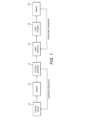
- 'efficient stepwise optimisation' groups the parameters to be optimised into five categories: camera model (pose) 10, shape 12, light direction 16, light strength 18 and albedo (texture) 20.
- ESO decomposes the fitting into geometric and photometric parts.
- ESO is applied to model faces.
- it can also be applied to model other objects with a standard structure, such as cars.
- both Phong and Spherical Harmonics (SH) models have been adopted to estimate illumination.
- an exemplary prior art method using an SH model uses 81 bases.
- the Phong model has a more compact representation, and therefore is used in embodiments of the present invention.
- the illumination is modelled as a combination of a single distant point source plus uniform ambient light, thus keeping the number of coefficients to be found to a minimum.
- the present invention provides a novel approach to optimise both Phong model parameters and albedo.
- embodiments detailed in Section 4 linearise the nonlinear Phong model. The objective functions of these linear methods are convex and global solutions are guaranteed.
- albedo can also be estimated by solving a linear system.
- Embodiments of the present invention provide a fully automatic face recognition (AFR) system, which is referred to throughout as ESOAFR.
- AFR fully automatic face recognition
- This system is constructed using bespoke components.
- ESOAFR supports two types of feature extraction: holistic and local features. This differs from the traditional 3DMMs which usually only use holistic features (shape and texture coefficients) for face recognition. Experimental results demonstrate that the local features are more powerful than the holistic features.
- 3DMMs 3D Morphable Models fitting strategies are introduced in Section 2.1.
- 3DMM can intrinsically model pose and illuminations variations, it is widely used for pose- and illumination-invariant face recognition, which is then introduced in Section 2.2.
- the 3DMM first proposed by Blanz and Vetter, has successfully been applied to computer vision and graphics.
- a 3DMM consists of separate face shape and texture models learned from a set of 3D exemplar faces.
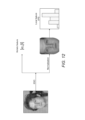
- a 3DMM can recover the face (shape and texture) and scene properties (illumination and camera model) from a single image as shown in Fig. 1 .
- the recovered parameters can be used for different applications, such as realistic face synthesis and face recognition.
- it should be noted that it is particularly difficult to achieve an accurate fitting for two reasons. Firstly, when recovering the 3D shape from a single 2D image, the depth information is lost through the projection from 3D to 2D. Secondly, separating the contributions of albedo and illumination is an ill-posed problem.
- ESO is much more efficient because of the use of closed-form solutions.
- our experiments demonstrate that ESO improves the optimisation efficiency by an order of magnitude in comparison with MFF yet achieves very competitive fitting performance.
- ESO overcomes the weaknesses of earlier SeqOpt methods.
- the shape reconstruction of ESO supports the perspective camera, while the exemplary methods are limited to the affine camera. Therefore our shape reconstruction is more robust to perspective effects.
- embodiments of the present invention use contour landmarks for robust fitting. Also, ESO is much faster than state-of-the-art methods detailed in Section 5.2.1.
- 3DMM Face recognition under pose and illumination variations is a challenging task.
- 3DMM is a good tool to solve the pose problem.
- other methods for pose- and illumination-invariant face recognition are briefly introduced in this section. These methods are basically categorised into 2D and 3D methods.
- the former methods aim to establish the pixel-level correspondence under different poses in the image space, such as the Locally Linear Regression, Partial Least Square, Markov Random Field, Stereo Matching, Generalized Multiview Analysis, and Probabilistic Stack-flow.
- the latter methods project the pixel values into pose- and/or illumination-invariant feature spaces, such as Canonical Correlation Analysis, Tied Factor Analysis, Latent Space Discriminative Analysis, Orthogonal Discriminant Vector and Deep Learning.
- prior 3D methods explicitly model the facial pose variations that are intrinsically caused by 3D rigid motion.
- a 3D face model is fitted to the 2D input image.
- Accurate fitting is essential for good face recognition performance.
- the pose problem can be solved by either pose normalisation or pose synthesis.
- pose normalisation both gallery and probe images are rotated to a frontal view by means of a 3D model.
- pose synthesis approach generates multiple gallery images of different poses from the frontal images of each subject. A probe image is only matched against those of the same pose in the gallery.
- features are extracted as a prerequisite to face recognition.
- the extracted features can be either (1) local features or (2) holistic features.
- an object is modelled in three dimensional space using the ESO method shown in Figure 1 .
- the method is divided into a geometric analysis part, where steps include determining the pose 10, shape 12 and contour landmarks 14, which in turn are used to refine the pose and shape; and a photometric analysis part, where steps include determining illumination and albedo 20, where the albedo 20 is used to refine the illumination.
- Illumination comprises two steps - determining light direction 16 and determining light strength 18.
- a 3DMM face model is created from a training set of 3D face scans that have been registered in dense correspondence.
- the ith vertex v i of a registered face is located at ( x i , y i , z i ), and has the RGB colour values ( r i , g i , b i ) .
- ⁇ s ( ⁇ 1, s , ..., ⁇ m -1, s ) T
- ⁇ t ( ⁇ 1, t , ..., ⁇ m -1, t ) T
- ⁇ i , s 2 and ⁇ i , t 2 are the ith eigenvalues of shape and texture covariance matrices respectively.
- a 3DMM is used to generate/render a 2D face image which resembles the input image via a fitting process.
- the 3DMM fitting can explicitly reconstruct the 3D shape, texture, camera model and lighting from the input image.
- the 3D reconstruction is conducted by minimising the RGB value differences between the input face image and model rendered one.
- a 3DMM has to be aligned to the input image. Specifically, a vertex x 3 d M of the shape model s is projected to a 2D coordinate x 2 d M in the 2D image plane via a camera projection defined by extrinsic camera parameter set ⁇ .
- the rendered image a M is also determined by albedo and illumination (photometric part).
- the albedo 20 is represented by t ( ⁇ ) and the illumination is modelled by the Phong reflection with parameter ⁇ .
- the cost function can be written as min ⁇ , ⁇ , ⁇ , ⁇ ⁇ a I ⁇ ⁇ ⁇ a M ⁇ ⁇ ⁇ ⁇ ⁇ 2
- the cost function can be rewritten as min ⁇ , ⁇ ⁇ a I ⁇ a M ⁇ ⁇ ⁇ 2
- a M is generated by the interplay of skin albedo t ( ⁇ ) and incident light represented as the sum of contributions from ambient, diffuse and specular lights:
- a M l a ⁇ t ⁇ ambient + I d ⁇ t ⁇ N 3 d ⁇ diffuse + I d ⁇ e ⁇ specular
- l a r l a g l a b and l d r l d g l d b are strengths of ambient and directed light in RGB channels, respectively;
- ⁇ denotes the element-wise multiplication operation
- v i Since the camera is located at the origin, the value of v i is equal to the position of this vertex.
- k s and ⁇ are two constants of the specular reflectance and shininess respectively. Note that k s and ⁇ are determined by the facial skin reflectance property, which is similar for different people. They are assumed constant over the whole facial region. For the sake of simplicity, in our work, we also assume that k s and ⁇ are the same for the three colour channels. Thus each entry e i is repeated three times in constructing vector e. In this work, k s and ⁇ are set to values 0.175 and 30 respectively.
- ESO is a Sequential Optimisation method which groups all the parameters into 5 categories: camera (pose) 10, shape 12, light direction 16, light strength 18 and albedo 20. These parameters are optimised by iterating two sequences of steps in turn a few times as shown in Figure 1 . Closed-form solutions are obtained in these steps.
- the perspective camera parameters are estimated using a set of 2D landmarks 22 (which may be referred to as image landmarks 22) and s o of equation 3.
- the shape parameters are estimated by a new linear method, which constructs a cost function by projecting the 2D landmarks 22 into 3D space.
- contour landmarks 22 are used to improve camera and shape estimates.
- the first three steps are repeated several times to refine the geometric ingredients of the model.
- s o is replaced by the current estimated shape for estimating the camera parameters.
- a correspondence between the input image and 3DMM is created.
- the light strengths 18 of the Phong model are estimated using the generic texture model and the estimated light direction.
- the albedo 20 is estimated using the evaluated light direction and strengths.
- the last three steps are also repeated to refine the photometric estimates.
- the estimated albedo is used instead of t o for estimating light direction and strengths.
- the topology of the ESO is shown in Figure 1 .
- Section 4.1 to 4.6 each step of ESO is explained in more detail.
- This cost function is solved by the Levenberg-Marquardt algorithm. Note that x 3 d M , which depends on the shape model s, is a constant in this step. In the first iteration, s is set to s o . In subsequent iterations, s is replaced by the one estimated in the previous iteration.
- the estimated camera parameters feed into shape estimation described in Section 4.2.
- the contour landmarks described in Section 4.3 constrain both camera and shape estimations.
- the shape parameters ⁇ can be estimated.
- the methods proposed for estimating the shape parameters can be classified into two groups: (1) gradient-based methods and (2) linear methods.
- the gradient-based methods optimise ⁇ by solving the general fitting cost function of equation 6. Noting that the shape variations cause the facial landmarks to shift, therefore, more efficient linear methods, which only use landmarks to recover ⁇ , have been proposed.
- these methods are based on an affine camera.
- a linear method which is applicable to a general perspective camera, by minimising the distance between the observed and reconstructed landmarks. In other words geometric information of a base model is refined so as to reduce a distance between the image landmarks and the corresponding model landmarks.
- ⁇ S ⁇ T S ⁇ + ⁇ s ⁇ 1 S ⁇ T s ⁇ I ⁇ s ⁇ 0
- diagonal matrix ⁇ s diag ⁇ 1 / ⁇ 1 , s 2 , ... , ⁇ 1 / ⁇ m ⁇ 1 , s 2
- W -1 consists of 2 transformations: F p ⁇ 1 and F r ⁇ 1 .
- x 2 d M cannot be projected to w via F p ⁇ 1 unless w z is known.
- w z is approximated by F r x 3 d M , where x 3 d M is constructed from the mean shape s 0 and the estimated s in the first and subsequent iterations, respectively.
- contour edges are defined as the occluding boundary between the face and non-face area, and they are used to constrain the fitting.
- the contour edges of a model-based reconstruction of a 2D image are shown in Figure 2b .
- the computational cost of using contour edges is high.
- contour landmarks i.e. landmarks on the contour edges, are proposed in this work to constrain the camera and shape fitting.
- the contour landmarks are used because: 1) it is computationally efficient as contour landmarks are sparser than contour edges; 2) they can be accurately detected by existing 2D facial landmark detectors.
- the input image is aligned to a 3DMM, and the reflectance parameters can then be estimated.
- the first task is to find the light direction d. In this step, all the variables are regarded as constant apart from d , so the cost function is obtained by combining equation 7 and equation 8: min d ⁇ a I ⁇ l a ⁇ t ⁇ l d ⁇ t ⁇ N 3 d ⁇ I d ⁇ e ⁇ 2
- Equation 18 is a non-linear problem for two reasons: 1) the exponential form of e in equation 11, and 2) the element-wise multiplication between l d ⁇ t and N 3 d .
- i the value of e based on the assumptions: i ) k s and ⁇ are constant; ii ) the values of v and r are set to those of the previous iteration.
- the cost function is reformulated as: min d ⁇ a I ⁇ l a ⁇ t ⁇ l d ⁇ e ⁇ A ⁇ N 3 d ⁇ 2
- A l d ⁇ t , l d ⁇ t , l d ⁇ t ⁇ R 3 n ⁇ 3 .
- the estimated light direction is fed into the light strength and albedo estimations detailed in Section 4.5 and Section 4.6. In turn, the output of these is used in the subsequent refinements of light direction by solving equation 19.
- t is set to t o as a starting point in the first iteration.
- the green and blue channels are solved in the same way.
- the albedo can be estimated.
- ⁇ T T T + ⁇ t ⁇ 1 T T a ′ ⁇ t 0
- a' ( a I - l d ⁇ e )./( l a + l d ⁇ (N 3 d))
- the diagonal matrix ⁇ t diag( ⁇ 2 / ⁇ 1 , t 2 , ... , ⁇ 2 / ⁇ m ⁇ 1 , t 2 ).
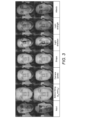
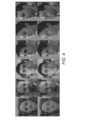
- the fitting results of each step are visualised.
- the input images with various pose and illuminations are from the Multi-PIE database.
- the two input images in Figure 3 are illuminated by the left and right light sources, respectively.
- the camera model, shape, light direction, light strengths and albedo are well recovered.
- illumination normalisation is achieved by removing the directed lighting.
- Pose normalisation is performed by setting ⁇ to rotate the face to a frontal view.
- LPQ Local Phase Quantisation
- the relevant hyperparameters are the regularisation weights ⁇ 1 in equation 16 and ⁇ 2 in equation 23 and the number of iterations ( l 1 and l 2 ) for geometric and photometric refinements ( Figure 1 ), respectively. All the renderings in Section 5.1.1 are generated by setting both the focal length and the distance between the object and camera to 1800 pixels.
- the affine camera used by the exemplary prior art SeqOpt method cannot model perspective effects, while the perspective camera used by ESO and MFF can.
- Different camera models lead to different shape reconstruction strategies. In order to find out how significant this difference is, we change the distance between the object and camera to generate perspective effects, at the same time keeping the facial image size constant by adjusting the focal length to match. Note that the shorter this distance, the larger the perspective distortion.
- 2D renderings under frontal pose obtained for 6 different distances are generated.
- the performance of ESO and MFF remains constant under different perspective distortions.
- the performance ofthe exemplary SeqOpt method Aldrian reduces greatly as the distance between the object and camera decreases.
- ESO consistently works better than MFF under all perspective distortions.
- 3DMM-based face recognition systems have been successful in this area because a 3DMM can extract the intrinsic 3D shape and albedo regardless of pose and illumination variations.
- the hyperparameters ⁇ 1 , l 1 , ⁇ 2 , l 2 ⁇ of ESO are set to ⁇ 0.5, 3, 0.7, 4 ⁇ as discussed in Section 5.1.
- Both holistic and local features are extracted following Section 4.8.
- the cosine distance and Chisquared distance are used to measure the similarity for holistic and local features respectively.
- 3DMM can intrinsically model large pose and illumination variations; therefore our face recognition system should be evaluated on databases that reflect this.
- the commonly-used databases for evaluating the performance of the methods in Section 2.2 are PIE, Multi-PIE, FERET and LFW.
- FERET and LFW have limited illumination and pose variations, respectively.
- FERET has only two illumination variations and LFW only contains frontal or near-frontal images.
- PIE and Multi-PIE have large pose and illumination variations; therefore they are used here.
- the PIE database is a benchmark database used to evaluate different 3DMM fitting methods. In this section we compare the face recognition performance of ESO with prior art fitting methods.
- the optimisation time was measured on an Intel Core2 Duo CPU E8400 and 4G memory computer.
- the best SimOpt method MFF and SeqOpt method are compared with ESO.
- MFF took 23.1 seconds to fit one image, while ESO took only 2.1 seconds.
- Aldrian did not report their run time, but determined the albedo estimation (dominant step) complexity to be of 0 ( m 2 p ): 'p' is the number of vertices, which is the same for ESO; 'm' is the number of texture coefficients. Note that firstly Aldrian uses not only one group of global ⁇ and ⁇ but also four additional local groups to improve the model representation capacity, while we only use the global parameters.
- Setting -I is used for face recognition in the presence of combined pose and illumination variations
- Setting -II for face recognition with only pose variations.
- Setting -I uses a subset in session 01 consisting of 249 subjects with 7 poses and 20 illumination variations. These 7 poses have a yaw range from left 45° to right 45° in step of 15°.
- the images of the first 100 subjects constitute the training set.
- the remaining 149 subjects form the test set.
- the frontal images under neutral illumination work as the gallery and the remaining are probe images.
- Setting -II uses the images of all the 4 sessions (01-04) under 7 poses and only neutral illumination.
- the images from the first 200 subjects are used for training and the remaining 137 subjects for testing.
- the frontal images from the earliest session for the 137 subjects work as gallery, and the others are probes.
- Table 3 also compares the performance of ESO with the fully automatic annotation against that based on manual annotation. This table shows that the mean face recognition rates of the fully automatic system are close to those relying on manual annotation: 88.0% vs 91.2% for holistic features, and 91.5% vs 92.2% for local features. It means that ESO is reasonably robust to the errors caused by automatically detected landmarks for both holistic and local features. The superiority of local features which can capture more facial details than holistic features is also evident from the results.
- Table 4 compares ESO with the state-of-the-art methods for pose-robust face recognition.
- the methods can be classified into 2D and 3D approaches as discussed in Section 2.2.
- PLS and CCA are unsupervised methods, and consequently they deliver inferior performance.
- the GMA benefits from its use of the additional supervisory information.
- DAE and SPAE are auto-encoder-based methods, which have superior capability to learn the non-linear relationships between images of different poses. Unlike the other 2D methods which learn the projection from different poses to frontal pose directly, SPAE learns the mapping from a large range of pose variations to a set of narrow ranges progressively. In this way, SPAE splits a large search space into several small ones, reducing the complexity of the learning task.
- SPAE achieves state-of-the-art performance, even compared with 3D methods.
- our ESO outperforms SPAE, specifically 94.4% vs 91.4%, because of its accurate shape and albedo reconstruction capability.
- ESO works much better than other state-of-the-art methods in the presence of larger pose variations, demonstrating its superior pose modelling capability.
- ESO stepwise optimisation
- the present invention relates to performing 3D face reconstruction from a single 2D image using a 3D Morphable Model (3DMM) in an analysis-by-synthesis approach.
- 3DMM 3D Morphable Model
- the present invention provides an efficient stepwise 3DMM-to-2D image-fitting strategy, which optimises sequentially the pose, shape, light direction, light strength and skin texture parameters in separate steps.
- a perspective camera and Phong reflectance model are used to model the geometric projection and illumination respectively. Linear methods that are adapted to camera and illumination models are used. This generates closed-form solutions for these parameters, leading to an accurate and efficient fitting.
- 3DMMs are widely used for face recognition.
- existing 3DMM-based methods use manual landmarks to initialise the fitting and produce holistic facial features.
- the present invention also provides an automatic face recognition system, which can detect landmarks automatically and extract both holistic and local features using a 3DMM.
- the described method has been tested on the public CMU-PIE, Multi-PIE face databases and one local database.
- the experimental results show that the face reconstruction performance is better than that achieved by the existing 3DMMs.
- the described face recognition system outperforms the state-of-the-art methods. In particular, it significantly outperforms deep learning methods tested on Multi-PIE.
Landscapes
- Engineering & Computer Science (AREA)
- Physics & Mathematics (AREA)
- General Physics & Mathematics (AREA)
- Theoretical Computer Science (AREA)
- Oral & Maxillofacial Surgery (AREA)
- Health & Medical Sciences (AREA)
- Computer Vision & Pattern Recognition (AREA)
- Multimedia (AREA)
- General Health & Medical Sciences (AREA)
- Human Computer Interaction (AREA)
- Geometry (AREA)
- Software Systems (AREA)
- Image Processing (AREA)
- Image Analysis (AREA)
Claims (7)
- Verfahren zum Durchführen von Gesichtserkennung durch Anpassen eines dreidimensionalen 3D-Modells an ein menschliches Gesicht in einem zweidimensionalen 2D-Bild, wobei das Verfahren Folgendes umfasst:Erkennen einer Vielzahl von Bildmarkierungspunkten auf einem menschlichen Gesicht in dem 2D-Bild;Schätzen von geometrischen 3D-Informationen der Vielzahl von Bildmarkierungspunkten aus dem 2D-Bild und bekannten geometrischen Informationen eines generischen 3D-Modells durch Projizieren der Vielzahl von Bildmarkierungspunkten auf die Oberfläche des generischen 3D-Modells, um eine Tiefe der Bildmarkierungspunkte im 3D-Raum zu schätzen;Verfeinern der geometrischen Informationen des generischen 3D-Modells, um eine Kostenfunktion in Bezug auf die Tiefeninformationen der in den 3D-Raum projizierten Bildmarkierungspunkte und bekannte geometrische Informationen der entsprechenden Modellmarkierungspunkte im 3D-Raum zu reduzieren, die auf einen Abstand zwischen den in einen 3D-Raum projizierten Bildmarkierungspunkten und entsprechenden Modellmarkierungspunkten im 3D-Raum hinweisen;Drehen des 2D-Bildes in eine Vorderansicht unter Verwendung des 3D-Modells;Extrahieren lokaler Merkmale aus der gedrehten Vorderansicht des 2D-Bildes; undVergleichen der lokalen Merkmale mit Bildern in einer Datenbank.
- Verfahren nach Anspruch 1, wobei das Verfeinern der geometrischen Informationen des generischen 3D-Modells Minimieren des Abstands zwischen den Bildmarkierungspunkten und den entsprechenden Modellmarkierungspunkten durch iteratives Anpassen der Pose und Form des generischen 3D-Modells umfasst.
- Verfahren nach einem der vorhergehenden Ansprüche, wobei sich die Vielzahl von Bildmarkierungspunkten auf der Konturkante des Objekts in dem 2D-Bild befindet, wobei die Konturkante eine verdeckende Grenze des Objekts in dem 2D-Bild umfasst.
- Verfahren nach einem der vorhergehenden Ansprüche, wobei das Schätzen von geometrischen 3D-Informationen einer Vielzahl von Bildmarkierungspunkten Schätzen von geometrischen 3D-Informationen von zwischen 4 und 100 Bildmarkierungspunkten umfasst.
- Verfahren nach einem der vorhergehenden Ansprüche, ferner umfassend:Schätzen von Lichtrichtung und Lichtstärke des Objekts aus dem 2D-Bild;Schätzen der Albedo des Objekts basierend auf der geschätzten Lichtrichtung und Lichtstärke;iteratives Verfeinern der Schätzung von Lichtrichtung und Lichtstärke unter Verwendung der geschätzten Albedo; undAnwenden der verfeinerten Lichtrichtung, Lichtstärke und Albedo auf das generische 3D-Modell.
- Verfahren nach Anspruch 5, wobei das Schätzen der Lichtrichtung und Lichtstärke Linearisieren eines Phong-Modells umfasst, indem gerichtete Reflexion und Glanz über die Iterationen hinweg konstant gehalten werden.
- Computerlesbares Speichermedium, das angeordnet ist, um Computerprogrammanweisungen zu speichern, welche bei Ausführung auf einem oder mehreren Prozessoren das Verfahren nach einem der vorhergehenden Ansprüche durchführen.
Applications Claiming Priority (2)
| Application Number | Priority Date | Filing Date | Title |
|---|---|---|---|
| US201562116602P | 2015-02-16 | 2015-02-16 | |
| PCT/GB2016/050378 WO2016132113A1 (en) | 2015-02-16 | 2016-02-16 | Three dimensional modelling |
Publications (2)
| Publication Number | Publication Date |
|---|---|
| EP3259704A1 EP3259704A1 (de) | 2017-12-27 |
| EP3259704B1 true EP3259704B1 (de) | 2023-08-23 |
Family
ID=55411699
Family Applications (1)
| Application Number | Title | Priority Date | Filing Date |
|---|---|---|---|
| EP16706235.5A Active EP3259704B1 (de) | 2015-02-16 | 2016-02-16 | Dreidimensionale modellierung |
Country Status (3)
| Country | Link |
|---|---|
| US (1) | US10521649B2 (de) |
| EP (1) | EP3259704B1 (de) |
| WO (1) | WO2016132113A1 (de) |
Families Citing this family (32)
| Publication number | Priority date | Publication date | Assignee | Title |
|---|---|---|---|---|
| KR102477190B1 (ko) * | 2015-08-10 | 2022-12-13 | 삼성전자주식회사 | 얼굴 인식 방법 및 장치 |
| KR102285376B1 (ko) * | 2015-12-01 | 2021-08-03 | 삼성전자주식회사 | 3d 얼굴 모델링 방법 및 3d 얼굴 모델링 장치 |
| KR102850047B1 (ko) * | 2016-10-31 | 2025-08-25 | 삼성전자주식회사 | 영상 처리 장치 및 방법 |
| WO2018102700A1 (en) * | 2016-12-01 | 2018-06-07 | Pinscreen, Inc. | Photorealistic facial texture inference using deep neural networks |
| WO2018126275A1 (en) * | 2016-12-30 | 2018-07-05 | Dirk Schneemann, LLC | Modeling and learning character traits and medical condition based on 3d facial features |
| US10474881B2 (en) * | 2017-03-15 | 2019-11-12 | Nec Corporation | Video retrieval system based on larger pose face frontalization |
| WO2018184140A1 (en) * | 2017-04-04 | 2018-10-11 | Intel Corporation | Facial image replacement using 3-dimensional modelling techniques |
| CN110019580B (zh) * | 2017-08-25 | 2022-07-12 | 腾讯科技(深圳)有限公司 | 地图显示方法、装置、存储介质及终端 |
| CN108510437B (zh) * | 2018-04-04 | 2022-05-17 | 科大讯飞股份有限公司 | 一种虚拟形象生成方法、装置、设备以及可读存储介质 |
| US10824909B2 (en) * | 2018-05-15 | 2020-11-03 | Toyota Research Institute, Inc. | Systems and methods for conditional image translation |
| RU2697627C1 (ru) * | 2018-08-01 | 2019-08-15 | Самсунг Электроникс Ко., Лтд. | Способ корректировки освещенности объекта на изображении в последовательности изображений и вычислительное устройство пользователя, реализующее упомянутый способ |
| CN110032927B (zh) * | 2019-02-27 | 2024-08-02 | 视缘(上海)智能科技有限公司 | 一种人脸识别方法 |
| US11069135B2 (en) | 2019-03-07 | 2021-07-20 | Lucasfilm Entertainment Company Ltd. | On-set facial performance capture and transfer to a three-dimensional computer-generated model |
| US11049332B2 (en) * | 2019-03-07 | 2021-06-29 | Lucasfilm Entertainment Company Ltd. | Facial performance capture in an uncontrolled environment |
| JP7161111B2 (ja) * | 2019-03-26 | 2022-10-26 | 日本電信電話株式会社 | 重みマスク生成装置、重みマスク生成方法及びプログラム |
| CN114041175B (zh) * | 2019-05-13 | 2025-09-12 | 深圳引望智能技术有限公司 | 基于使用真实感合成数据估计头部姿势和视线的神经网络 |
| KR102241153B1 (ko) * | 2019-07-01 | 2021-04-19 | 주식회사 시어스랩 | 2차원 이미지로부터 3차원 아바타를 생성하는 방법, 장치 및 시스템 |
| US10872457B1 (en) | 2019-07-18 | 2020-12-22 | Sony Corporation | Facial texture map generation using single color image and depth information |
| CN110543845B (zh) * | 2019-08-29 | 2022-08-12 | 四川大学 | 一种三维人脸的人脸级联回归模型训练方法及重建方法 |
| JP2021056164A (ja) * | 2019-10-01 | 2021-04-08 | 富士ゼロックス株式会社 | 情報処理装置、発光装置、情報処理システム、及びプログラム |
| US11682234B2 (en) * | 2020-01-02 | 2023-06-20 | Sony Group Corporation | Texture map generation using multi-viewpoint color images |
| CN111414803A (zh) * | 2020-02-24 | 2020-07-14 | 北京三快在线科技有限公司 | 人脸识别方法、装置、电子设备 |
| CN111553983A (zh) * | 2020-03-27 | 2020-08-18 | 中铁十九局集团第三工程有限公司 | 还原爆炸现场的三维空间建模方法、装置、设备和介质 |
| KR102331034B1 (ko) * | 2020-12-10 | 2021-12-01 | 이마고웍스 주식회사 | 치과용 3차원 스캔 데이터의 랜드마크 자동 검출 방법 및 이를 컴퓨터에서 실행시키기 위한 프로그램이 기록된 컴퓨터로 읽을 수 있는 기록 매체 |
| CN113971715B (zh) * | 2020-07-22 | 2025-08-26 | 虹软科技股份有限公司 | 基于深度学习的三维脸部重建的系统 |
| EP3965002B1 (de) * | 2020-09-03 | 2023-08-16 | Toyota Jidosha Kabushiki Kaisha | Anisotrope verlustfunktion zum trainieren eines modells zur lokalisierung von merkmalspunkten |
| KR102925433B1 (ko) | 2021-03-08 | 2026-02-11 | 삼성전자주식회사 | 재구성된 이미지를 생성하는 이미지 처리 방법 및 장치 |
| CN113744129A (zh) * | 2021-09-08 | 2021-12-03 | 深圳龙岗智能视听研究院 | 一种基于语义神经渲染的人脸图像生成方法及系统 |
| US11663798B2 (en) * | 2021-10-13 | 2023-05-30 | Mitsubishi Electric Research Laboratories, Inc. | System and method for manipulating two-dimensional (2D) images of three-dimensional (3D) objects |
| DE102023112912A1 (de) * | 2023-05-16 | 2024-11-21 | Kai Fröhner | Verfahren und System zur Farbfindung in Gesichtsbildern |
| CN117877098B (zh) * | 2024-03-07 | 2024-05-28 | 深圳百沃彰世科技有限公司 | 基于大数据和多维特征的异常通讯行为识别方法及系统 |
| CN119784938B (zh) * | 2024-12-12 | 2025-10-17 | 杭州电子科技大学 | 一种基于相机光度优化的三维场景重建方法 |
Family Cites Families (9)
| Publication number | Priority date | Publication date | Assignee | Title |
|---|---|---|---|---|
| US6950104B1 (en) * | 2000-08-30 | 2005-09-27 | Microsoft Corporation | Methods and systems for animating facial features, and methods and systems for expression transformation |
| US6850872B1 (en) * | 2000-08-30 | 2005-02-01 | Microsoft Corporation | Facial image processing methods and systems |
| US20070086627A1 (en) * | 2005-10-18 | 2007-04-19 | Samsung Electronics Co., Ltd. | Face identification apparatus, medium, and method |
| CN102077242B (zh) * | 2008-07-30 | 2013-08-07 | 松下电器产业株式会社 | 3d纹理的超分辨率的图像生成设备和方法 |
| IL196162A (en) * | 2008-12-24 | 2013-02-28 | Rafael Advanced Defense Sys | A system that uses 3D models to enable image comparison regardless of the source of the images |
| WO2012126135A1 (en) * | 2011-03-21 | 2012-09-27 | Intel Corporation | Method of augmented makeover with 3d face modeling and landmark alignment |
| KR101339900B1 (ko) * | 2012-03-09 | 2014-01-08 | 한국과학기술연구원 | 2차원 단일 영상 기반 3차원 몽타주 생성 시스템 및 방법 |
| US20150243035A1 (en) * | 2014-02-21 | 2015-08-27 | Metaio Gmbh | Method and device for determining a transformation between an image coordinate system and an object coordinate system associated with an object of interest |
| US9317785B1 (en) * | 2014-04-21 | 2016-04-19 | Video Mining Corporation | Method and system for determining ethnicity category of facial images based on multi-level primary and auxiliary classifiers |
-
2016
- 2016-02-16 EP EP16706235.5A patent/EP3259704B1/de active Active
- 2016-02-16 US US15/551,247 patent/US10521649B2/en active Active
- 2016-02-16 WO PCT/GB2016/050378 patent/WO2016132113A1/en not_active Ceased
Also Published As
| Publication number | Publication date |
|---|---|
| EP3259704A1 (de) | 2017-12-27 |
| WO2016132113A1 (en) | 2016-08-25 |
| US10521649B2 (en) | 2019-12-31 |
| US20180046854A1 (en) | 2018-02-15 |
Similar Documents
| Publication | Publication Date | Title |
|---|---|---|
| EP3259704B1 (de) | Dreidimensionale modellierung | |
| Kim et al. | Inversefacenet: Deep monocular inverse face rendering | |
| Wang et al. | Face relighting from a single image under arbitrary unknown lighting conditions | |
| Aldrian et al. | Inverse rendering of faces with a 3D morphable model | |
| Hu et al. | Efficient 3D morphable face model fitting | |
| Bhagavatula et al. | Faster than real-time facial alignment: A 3d spatial transformer network approach in unconstrained poses | |
| CN107085716B (zh) | 基于多任务生成对抗网络的跨视角步态识别方法 | |
| Amberg et al. | Reconstructing high quality face-surfaces using model based stereo | |
| CN101159015B (zh) | 一种二维人脸图像的识别方法 | |
| Andrés et al. | Face recognition on partially occluded images using compressed sensing | |
| Wang et al. | Face re-lighting from a single image under harsh lighting conditions | |
| WO2007116208A1 (en) | Method of locating features of an object | |
| Hu | Face analysis using 3D morphable models | |
| Malassiotis et al. | Robust face recognition using 2D and 3D data: Pose and illumination compensation | |
| Dou et al. | Monocular 3D facial shape reconstruction from a single 2D image with coupled-dictionary learning and sparse coding | |
| De Smet et al. | A generalized EM approach for 3D model based face recognition under occlusions | |
| Luo et al. | Beyond fvd: Enhanced evaluation metrics for video generation quality | |
| Ferizal et al. | Gender recognition using PCA and LDA with improve preprocessing and classification technique | |
| Wang et al. | Couple metric learning based on separable criteria with its application in cross-view gait recognition | |
| Georgoulis et al. | Material classification under natural illumination using reflectance maps | |
| Singh et al. | Face liveness detection through face structure analysis | |
| Chen et al. | Regression-based active appearance model initialization for facial feature tracking with missing frames | |
| KR20190105314A (ko) | 소비자 객체 분석 시스템 | |
| Ratsch et al. | Wavelet reduced support vector regression for efficient and robust head pose estimation | |
| Drobnyh et al. | Using supervised deep learning for human age estimation problem |
Legal Events
| Date | Code | Title | Description |
|---|---|---|---|
| STAA | Information on the status of an ep patent application or granted ep patent |
Free format text: STATUS: THE INTERNATIONAL PUBLICATION HAS BEEN MADE |
|
| PUAI | Public reference made under article 153(3) epc to a published international application that has entered the european phase |
Free format text: ORIGINAL CODE: 0009012 |
|
| STAA | Information on the status of an ep patent application or granted ep patent |
Free format text: STATUS: REQUEST FOR EXAMINATION WAS MADE |
|
| 17P | Request for examination filed |
Effective date: 20170914 |
|
| AK | Designated contracting states |
Kind code of ref document: A1 Designated state(s): AL AT BE BG CH CY CZ DE DK EE ES FI FR GB GR HR HU IE IS IT LI LT LU LV MC MK MT NL NO PL PT RO RS SE SI SK SM TR |
|
| AX | Request for extension of the european patent |
Extension state: BA ME |
|
| DAV | Request for validation of the european patent (deleted) | ||
| DAX | Request for extension of the european patent (deleted) | ||
| STAA | Information on the status of an ep patent application or granted ep patent |
Free format text: STATUS: EXAMINATION IS IN PROGRESS |
|
| 17Q | First examination report despatched |
Effective date: 20210319 |
|
| REG | Reference to a national code |
Ref country code: DE Ipc: G06V0040160000 Ref country code: DE Ref legal event code: R079 Ref document number: 602016082104 Country of ref document: DE Free format text: PREVIOUS MAIN CLASS: G06K0009000000 Ipc: G06V0040160000 |
|
| GRAP | Despatch of communication of intention to grant a patent |
Free format text: ORIGINAL CODE: EPIDOSNIGR1 |
|
| STAA | Information on the status of an ep patent application or granted ep patent |
Free format text: STATUS: GRANT OF PATENT IS INTENDED |
|
| RIC1 | Information provided on ipc code assigned before grant |
Ipc: G06T 7/50 20170101ALI20230308BHEP Ipc: G06T 7/33 20170101ALI20230308BHEP Ipc: G06V 20/64 20220101ALI20230308BHEP Ipc: G06V 40/16 20220101AFI20230308BHEP |
|
| INTG | Intention to grant announced |
Effective date: 20230330 |
|
| GRAS | Grant fee paid |
Free format text: ORIGINAL CODE: EPIDOSNIGR3 |
|
| GRAA | (expected) grant |
Free format text: ORIGINAL CODE: 0009210 |
|
| STAA | Information on the status of an ep patent application or granted ep patent |
Free format text: STATUS: THE PATENT HAS BEEN GRANTED |
|
| AK | Designated contracting states |
Kind code of ref document: B1 Designated state(s): AL AT BE BG CH CY CZ DE DK EE ES FI FR GB GR HR HU IE IS IT LI LT LU LV MC MK MT NL NO PL PT RO RS SE SI SK SM TR |
|
| REG | Reference to a national code |
Ref country code: GB Ref legal event code: FG4D |
|
| REG | Reference to a national code |
Ref country code: CH Ref legal event code: EP |
|
| REG | Reference to a national code |
Ref country code: IE Ref legal event code: FG4D |
|
| REG | Reference to a national code |
Ref country code: DE Ref legal event code: R096 Ref document number: 602016082104 Country of ref document: DE |
|
| REG | Reference to a national code |
Ref country code: LT Ref legal event code: MG9D |
|
| REG | Reference to a national code |
Ref country code: NL Ref legal event code: MP Effective date: 20230823 |
|
| REG | Reference to a national code |
Ref country code: AT Ref legal event code: MK05 Ref document number: 1603521 Country of ref document: AT Kind code of ref document: T Effective date: 20230823 |
|
| PG25 | Lapsed in a contracting state [announced via postgrant information from national office to epo] |
Ref country code: GR Free format text: LAPSE BECAUSE OF FAILURE TO SUBMIT A TRANSLATION OF THE DESCRIPTION OR TO PAY THE FEE WITHIN THE PRESCRIBED TIME-LIMIT Effective date: 20231124 |
|
| PG25 | Lapsed in a contracting state [announced via postgrant information from national office to epo] |
Ref country code: IS Free format text: LAPSE BECAUSE OF FAILURE TO SUBMIT A TRANSLATION OF THE DESCRIPTION OR TO PAY THE FEE WITHIN THE PRESCRIBED TIME-LIMIT Effective date: 20231223 |
|
| PG25 | Lapsed in a contracting state [announced via postgrant information from national office to epo] |
Ref country code: SE Free format text: LAPSE BECAUSE OF FAILURE TO SUBMIT A TRANSLATION OF THE DESCRIPTION OR TO PAY THE FEE WITHIN THE PRESCRIBED TIME-LIMIT Effective date: 20230823 Ref country code: RS Free format text: LAPSE BECAUSE OF FAILURE TO SUBMIT A TRANSLATION OF THE DESCRIPTION OR TO PAY THE FEE WITHIN THE PRESCRIBED TIME-LIMIT Effective date: 20230823 Ref country code: PT Free format text: LAPSE BECAUSE OF FAILURE TO SUBMIT A TRANSLATION OF THE DESCRIPTION OR TO PAY THE FEE WITHIN THE PRESCRIBED TIME-LIMIT Effective date: 20231226 Ref country code: NO Free format text: LAPSE BECAUSE OF FAILURE TO SUBMIT A TRANSLATION OF THE DESCRIPTION OR TO PAY THE FEE WITHIN THE PRESCRIBED TIME-LIMIT Effective date: 20231123 Ref country code: NL Free format text: LAPSE BECAUSE OF FAILURE TO SUBMIT A TRANSLATION OF THE DESCRIPTION OR TO PAY THE FEE WITHIN THE PRESCRIBED TIME-LIMIT Effective date: 20230823 Ref country code: LV Free format text: LAPSE BECAUSE OF FAILURE TO SUBMIT A TRANSLATION OF THE DESCRIPTION OR TO PAY THE FEE WITHIN THE PRESCRIBED TIME-LIMIT Effective date: 20230823 Ref country code: LT Free format text: LAPSE BECAUSE OF FAILURE TO SUBMIT A TRANSLATION OF THE DESCRIPTION OR TO PAY THE FEE WITHIN THE PRESCRIBED TIME-LIMIT Effective date: 20230823 Ref country code: IS Free format text: LAPSE BECAUSE OF FAILURE TO SUBMIT A TRANSLATION OF THE DESCRIPTION OR TO PAY THE FEE WITHIN THE PRESCRIBED TIME-LIMIT Effective date: 20231223 Ref country code: HR Free format text: LAPSE BECAUSE OF FAILURE TO SUBMIT A TRANSLATION OF THE DESCRIPTION OR TO PAY THE FEE WITHIN THE PRESCRIBED TIME-LIMIT Effective date: 20230823 Ref country code: GR Free format text: LAPSE BECAUSE OF FAILURE TO SUBMIT A TRANSLATION OF THE DESCRIPTION OR TO PAY THE FEE WITHIN THE PRESCRIBED TIME-LIMIT Effective date: 20231124 Ref country code: FI Free format text: LAPSE BECAUSE OF FAILURE TO SUBMIT A TRANSLATION OF THE DESCRIPTION OR TO PAY THE FEE WITHIN THE PRESCRIBED TIME-LIMIT Effective date: 20230823 Ref country code: AT Free format text: LAPSE BECAUSE OF FAILURE TO SUBMIT A TRANSLATION OF THE DESCRIPTION OR TO PAY THE FEE WITHIN THE PRESCRIBED TIME-LIMIT Effective date: 20230823 |
|
| PG25 | Lapsed in a contracting state [announced via postgrant information from national office to epo] |
Ref country code: PL Free format text: LAPSE BECAUSE OF FAILURE TO SUBMIT A TRANSLATION OF THE DESCRIPTION OR TO PAY THE FEE WITHIN THE PRESCRIBED TIME-LIMIT Effective date: 20230823 |
|
| PG25 | Lapsed in a contracting state [announced via postgrant information from national office to epo] |
Ref country code: ES Free format text: LAPSE BECAUSE OF FAILURE TO SUBMIT A TRANSLATION OF THE DESCRIPTION OR TO PAY THE FEE WITHIN THE PRESCRIBED TIME-LIMIT Effective date: 20230823 |
|
| PG25 | Lapsed in a contracting state [announced via postgrant information from national office to epo] |
Ref country code: SM Free format text: LAPSE BECAUSE OF FAILURE TO SUBMIT A TRANSLATION OF THE DESCRIPTION OR TO PAY THE FEE WITHIN THE PRESCRIBED TIME-LIMIT Effective date: 20230823 Ref country code: RO Free format text: LAPSE BECAUSE OF FAILURE TO SUBMIT A TRANSLATION OF THE DESCRIPTION OR TO PAY THE FEE WITHIN THE PRESCRIBED TIME-LIMIT Effective date: 20230823 Ref country code: ES Free format text: LAPSE BECAUSE OF FAILURE TO SUBMIT A TRANSLATION OF THE DESCRIPTION OR TO PAY THE FEE WITHIN THE PRESCRIBED TIME-LIMIT Effective date: 20230823 Ref country code: EE Free format text: LAPSE BECAUSE OF FAILURE TO SUBMIT A TRANSLATION OF THE DESCRIPTION OR TO PAY THE FEE WITHIN THE PRESCRIBED TIME-LIMIT Effective date: 20230823 Ref country code: DK Free format text: LAPSE BECAUSE OF FAILURE TO SUBMIT A TRANSLATION OF THE DESCRIPTION OR TO PAY THE FEE WITHIN THE PRESCRIBED TIME-LIMIT Effective date: 20230823 Ref country code: CZ Free format text: LAPSE BECAUSE OF FAILURE TO SUBMIT A TRANSLATION OF THE DESCRIPTION OR TO PAY THE FEE WITHIN THE PRESCRIBED TIME-LIMIT Effective date: 20230823 Ref country code: SK Free format text: LAPSE BECAUSE OF FAILURE TO SUBMIT A TRANSLATION OF THE DESCRIPTION OR TO PAY THE FEE WITHIN THE PRESCRIBED TIME-LIMIT Effective date: 20230823 |
|
| REG | Reference to a national code |
Ref country code: DE Ref legal event code: R097 Ref document number: 602016082104 Country of ref document: DE |
|
| PG25 | Lapsed in a contracting state [announced via postgrant information from national office to epo] |
Ref country code: IT Free format text: LAPSE BECAUSE OF FAILURE TO SUBMIT A TRANSLATION OF THE DESCRIPTION OR TO PAY THE FEE WITHIN THE PRESCRIBED TIME-LIMIT Effective date: 20230823 |
|
| PLBE | No opposition filed within time limit |
Free format text: ORIGINAL CODE: 0009261 |
|
| STAA | Information on the status of an ep patent application or granted ep patent |
Free format text: STATUS: NO OPPOSITION FILED WITHIN TIME LIMIT |
|
| 26N | No opposition filed |
Effective date: 20240524 |
|
| PG25 | Lapsed in a contracting state [announced via postgrant information from national office to epo] |
Ref country code: SI Free format text: LAPSE BECAUSE OF FAILURE TO SUBMIT A TRANSLATION OF THE DESCRIPTION OR TO PAY THE FEE WITHIN THE PRESCRIBED TIME-LIMIT Effective date: 20230823 |
|
| PG25 | Lapsed in a contracting state [announced via postgrant information from national office to epo] |
Ref country code: MC Free format text: LAPSE BECAUSE OF FAILURE TO SUBMIT A TRANSLATION OF THE DESCRIPTION OR TO PAY THE FEE WITHIN THE PRESCRIBED TIME-LIMIT Effective date: 20230823 |
|
| REG | Reference to a national code |
Ref country code: CH Ref legal event code: PL |
|
| PG25 | Lapsed in a contracting state [announced via postgrant information from national office to epo] |
Ref country code: LU Free format text: LAPSE BECAUSE OF NON-PAYMENT OF DUE FEES Effective date: 20240216 |
|
| PG25 | Lapsed in a contracting state [announced via postgrant information from national office to epo] |
Ref country code: CH Free format text: LAPSE BECAUSE OF NON-PAYMENT OF DUE FEES Effective date: 20240229 |
|
| PG25 | Lapsed in a contracting state [announced via postgrant information from national office to epo] |
Ref country code: LU Free format text: LAPSE BECAUSE OF NON-PAYMENT OF DUE FEES Effective date: 20240216 Ref country code: CH Free format text: LAPSE BECAUSE OF NON-PAYMENT OF DUE FEES Effective date: 20240229 |
|
| PG25 | Lapsed in a contracting state [announced via postgrant information from national office to epo] |
Ref country code: BG Free format text: LAPSE BECAUSE OF FAILURE TO SUBMIT A TRANSLATION OF THE DESCRIPTION OR TO PAY THE FEE WITHIN THE PRESCRIBED TIME-LIMIT Effective date: 20230823 |
|
| PG25 | Lapsed in a contracting state [announced via postgrant information from national office to epo] |
Ref country code: BG Free format text: LAPSE BECAUSE OF FAILURE TO SUBMIT A TRANSLATION OF THE DESCRIPTION OR TO PAY THE FEE WITHIN THE PRESCRIBED TIME-LIMIT Effective date: 20230823 |
|
| REG | Reference to a national code |
Ref country code: BE Ref legal event code: MM Effective date: 20240229 |
|
| PG25 | Lapsed in a contracting state [announced via postgrant information from national office to epo] |
Ref country code: BE Free format text: LAPSE BECAUSE OF NON-PAYMENT OF DUE FEES Effective date: 20240229 |
|
| PG25 | Lapsed in a contracting state [announced via postgrant information from national office to epo] |
Ref country code: IE Free format text: LAPSE BECAUSE OF NON-PAYMENT OF DUE FEES Effective date: 20240216 |
|
| PG25 | Lapsed in a contracting state [announced via postgrant information from national office to epo] |
Ref country code: IE Free format text: LAPSE BECAUSE OF NON-PAYMENT OF DUE FEES Effective date: 20240216 Ref country code: BE Free format text: LAPSE BECAUSE OF NON-PAYMENT OF DUE FEES Effective date: 20240229 |
|
| PGFP | Annual fee paid to national office [announced via postgrant information from national office to epo] |
Ref country code: DE Payment date: 20250218 Year of fee payment: 10 |
|
| PGFP | Annual fee paid to national office [announced via postgrant information from national office to epo] |
Ref country code: FR Payment date: 20250219 Year of fee payment: 10 |
|
| PGFP | Annual fee paid to national office [announced via postgrant information from national office to epo] |
Ref country code: GB Payment date: 20250131 Year of fee payment: 10 |
|
| PG25 | Lapsed in a contracting state [announced via postgrant information from national office to epo] |
Ref country code: CY Free format text: LAPSE BECAUSE OF FAILURE TO SUBMIT A TRANSLATION OF THE DESCRIPTION OR TO PAY THE FEE WITHIN THE PRESCRIBED TIME-LIMIT; INVALID AB INITIO Effective date: 20160216 |
|
| PG25 | Lapsed in a contracting state [announced via postgrant information from national office to epo] |
Ref country code: HU Free format text: LAPSE BECAUSE OF FAILURE TO SUBMIT A TRANSLATION OF THE DESCRIPTION OR TO PAY THE FEE WITHIN THE PRESCRIBED TIME-LIMIT; INVALID AB INITIO Effective date: 20160216 |
|
| PG25 | Lapsed in a contracting state [announced via postgrant information from national office to epo] |
Ref country code: TR Free format text: LAPSE BECAUSE OF FAILURE TO SUBMIT A TRANSLATION OF THE DESCRIPTION OR TO PAY THE FEE WITHIN THE PRESCRIBED TIME-LIMIT Effective date: 20230823 |