EP3259253B1 - Sulfonylureas and related compounds and use of same - Google Patents
Sulfonylureas and related compounds and use of same Download PDFInfo
- Publication number
- EP3259253B1 EP3259253B1 EP16751821.6A EP16751821A EP3259253B1 EP 3259253 B1 EP3259253 B1 EP 3259253B1 EP 16751821 A EP16751821 A EP 16751821A EP 3259253 B1 EP3259253 B1 EP 3259253B1
- Authority
- EP
- European Patent Office
- Prior art keywords
- compound
- disease
- disorder
- condition
- alkyl
- Prior art date
- Legal status (The legal status is an assumption and is not a legal conclusion. Google has not performed a legal analysis and makes no representation as to the accuracy of the status listed.)
- Active
Links
- 0 Cc1cc(*)n[n]1C Chemical compound Cc1cc(*)n[n]1C 0.000 description 26
- NPWPFIBADBSRON-UHFFFAOYSA-N CC(C)(C)[n](cc1)nc1S(NC(Nc1c(CCC2)c2cc2c1CCC2)=O)(=O)=O Chemical compound CC(C)(C)[n](cc1)nc1S(NC(Nc1c(CCC2)c2cc2c1CCC2)=O)(=O)=O NPWPFIBADBSRON-UHFFFAOYSA-N 0.000 description 2
- GHNBPPOAWRAEJT-UHFFFAOYSA-N CC(C)[n](cc1)nc1S(N)(=O)=O Chemical compound CC(C)[n](cc1)nc1S(N)(=O)=O GHNBPPOAWRAEJT-UHFFFAOYSA-N 0.000 description 2
- SYFVBWYCPOFNQX-UHFFFAOYSA-N O=C(Nc1c(CCC2)c2cc2c1CCC2)NS(c1n[n](C(F)(F)F)cc1)(=O)=O Chemical compound O=C(Nc1c(CCC2)c2cc2c1CCC2)NS(c1n[n](C(F)(F)F)cc1)(=O)=O SYFVBWYCPOFNQX-UHFFFAOYSA-N 0.000 description 2
- MZRUFMBFIKGOAL-UHFFFAOYSA-N [O-][N+](c1n[nH]cc1)=O Chemical compound [O-][N+](c1n[nH]cc1)=O MZRUFMBFIKGOAL-UHFFFAOYSA-N 0.000 description 2
- FAWNNQHUBFBWHS-UHFFFAOYSA-N CC(C)(c1cc(C)n[n]1C)O Chemical compound CC(C)(c1cc(C)n[n]1C)O FAWNNQHUBFBWHS-UHFFFAOYSA-N 0.000 description 1
- VWIPOMNYRUDUNV-UHFFFAOYSA-N CC(C)(c1cc(C)n[n]1Cc1ccccc1)O Chemical compound CC(C)(c1cc(C)n[n]1Cc1ccccc1)O VWIPOMNYRUDUNV-UHFFFAOYSA-N 0.000 description 1
- AGELCMHPFVWNSS-UHFFFAOYSA-N CC(C)(c1cc(S(NC(Nc2c(CCC3)c3cc3c2CCC3)=O)(=O)=O)n[n]1C)O Chemical compound CC(C)(c1cc(S(NC(Nc2c(CCC3)c3cc3c2CCC3)=O)(=O)=O)n[n]1C)O AGELCMHPFVWNSS-UHFFFAOYSA-N 0.000 description 1
- GEPLOEQQEVQQHA-UHFFFAOYSA-N CC(C)[n](c(C(F)(F)F)c1)nc1S(NC(Nc1c(CCC2)c2cc2c1CCC2)=O)(=O)=O Chemical compound CC(C)[n](c(C(F)(F)F)c1)nc1S(NC(Nc1c(CCC2)c2cc2c1CCC2)=O)(=O)=O GEPLOEQQEVQQHA-UHFFFAOYSA-N 0.000 description 1
- SUYVYQWSSQMBNP-UHFFFAOYSA-N CC(C)[n](cc1)nc1S(NC(Nc(c(C)c1)c(C)cc1Cl)=O)(=O)=O Chemical compound CC(C)[n](cc1)nc1S(NC(Nc(c(C)c1)c(C)cc1Cl)=O)(=O)=O SUYVYQWSSQMBNP-UHFFFAOYSA-N 0.000 description 1
- MTOUOUSKXWSTAX-UHFFFAOYSA-N CC(C)[n](cc1)nc1S(NC(Nc1c(CCC2)c2cc2c1CCC2)=O)(=O)=O Chemical compound CC(C)[n](cc1)nc1S(NC(Nc1c(CCC2)c2cc2c1CCC2)=O)(=O)=O MTOUOUSKXWSTAX-UHFFFAOYSA-N 0.000 description 1
- XBHHKVWZNGPYQD-UHFFFAOYSA-N CC(C)[n]1ncc(C)c1 Chemical compound CC(C)[n]1ncc(C)c1 XBHHKVWZNGPYQD-UHFFFAOYSA-N 0.000 description 1
- KKMJTVNLYPYBSV-UHFFFAOYSA-N CC(C)c1cc(S(NC(Nc2c(CCC3)c3cc3c2CCC3)=O)(=O)=O)n[n]1C Chemical compound CC(C)c1cc(S(NC(Nc2c(CCC3)c3cc3c2CCC3)=O)(=O)=O)n[n]1C KKMJTVNLYPYBSV-UHFFFAOYSA-N 0.000 description 1
- HULMHHPAAOWJLL-UHFFFAOYSA-N CC(C)c1cccc(C(C)C)c1NC(NS(c1n[n](C)c(C(C)(C)O)c1)(=O)=O)O Chemical compound CC(C)c1cccc(C(C)C)c1NC(NS(c1n[n](C)c(C(C)(C)O)c1)(=O)=O)O HULMHHPAAOWJLL-UHFFFAOYSA-N 0.000 description 1
- XCJCGFDYWDYDHL-UHFFFAOYSA-N CC(C)c1cccc(C(C)C)c1NC(NS(c1n[n](C)c(C(F)(F)F)c1)(=O)=O)=O Chemical compound CC(C)c1cccc(C(C)C)c1NC(NS(c1n[n](C)c(C(F)(F)F)c1)(=O)=O)=O XCJCGFDYWDYDHL-UHFFFAOYSA-N 0.000 description 1
- RLPKDPGRZGVHFM-UHFFFAOYSA-N CCc1cc(Cl)cc(CC)c1N Chemical compound CCc1cc(Cl)cc(CC)c1N RLPKDPGRZGVHFM-UHFFFAOYSA-N 0.000 description 1
- CGEFVBBWDRKNHL-UHFFFAOYSA-N CCc1cc(Cl)cc(CC)c1NC(NS(c1n[n](C(C)C)cc1)(=O)=O)=O Chemical compound CCc1cc(Cl)cc(CC)c1NC(NS(c1n[n](C(C)C)cc1)(=O)=O)=O CGEFVBBWDRKNHL-UHFFFAOYSA-N 0.000 description 1
- QRRNHVNSZNEIGK-UHFFFAOYSA-N CCc1cc(Cl)cc(CC)c1NC(Oc1ccccc1)=O Chemical compound CCc1cc(Cl)cc(CC)c1NC(Oc1ccccc1)=O QRRNHVNSZNEIGK-UHFFFAOYSA-N 0.000 description 1
- MOGQNVSKBCVIPW-UHFFFAOYSA-N C[n](cc1)nc1N Chemical compound C[n](cc1)nc1N MOGQNVSKBCVIPW-UHFFFAOYSA-N 0.000 description 1
- TWLAHGNFQBQYEL-UHFFFAOYSA-N C[n](cc1)nc1S(Cl)(=O)=O Chemical compound C[n](cc1)nc1S(Cl)(=O)=O TWLAHGNFQBQYEL-UHFFFAOYSA-N 0.000 description 1
- CROYEWDIUWFDJI-UHFFFAOYSA-N C[n](cc1)nc1S(N)(=O)=O Chemical compound C[n](cc1)nc1S(N)(=O)=O CROYEWDIUWFDJI-UHFFFAOYSA-N 0.000 description 1
- NSVBWSJFJSSLAK-UHFFFAOYSA-N C[n](cc1)nc1S(NC(Nc1c(CCC2)c2cc2c1CCC2)=O)(=O)=O Chemical compound C[n](cc1)nc1S(NC(Nc1c(CCC2)c2cc2c1CCC2)=O)(=O)=O NSVBWSJFJSSLAK-UHFFFAOYSA-N 0.000 description 1
- JHVXREYOJIKQMO-UHFFFAOYSA-N Cc1c[n](C2CC2)nc1 Chemical compound Cc1c[n](C2CC2)nc1 JHVXREYOJIKQMO-UHFFFAOYSA-N 0.000 description 1
- JCLZLZKUISPXDC-UHFFFAOYSA-N Cc1cc(Cl)cc(C)c1N Chemical compound Cc1cc(Cl)cc(C)c1N JCLZLZKUISPXDC-UHFFFAOYSA-N 0.000 description 1
- UKTDAQDTJFLOMR-UHFFFAOYSA-N Cc1cc(Cl)cc(C)c1NC(Oc1ccccc1)=O Chemical compound Cc1cc(Cl)cc(C)c1NC(Oc1ccccc1)=O UKTDAQDTJFLOMR-UHFFFAOYSA-N 0.000 description 1
- YGRLFMMSIGPOOI-UHFFFAOYSA-N Cc1cc(N)n[n]1C Chemical compound Cc1cc(N)n[n]1C YGRLFMMSIGPOOI-UHFFFAOYSA-N 0.000 description 1
- SLQKSPVMRXDLGX-UHFFFAOYSA-N Cc1cc(S(Cl)(=O)=O)n[n]1C Chemical compound Cc1cc(S(Cl)(=O)=O)n[n]1C SLQKSPVMRXDLGX-UHFFFAOYSA-N 0.000 description 1
- VQZAJYAGNSTSBB-UHFFFAOYSA-N Cc1cc(S(N)(=O)=O)n[n]1C Chemical compound Cc1cc(S(N)(=O)=O)n[n]1C VQZAJYAGNSTSBB-UHFFFAOYSA-N 0.000 description 1
- DNXIBNFKICKPGH-UHFFFAOYSA-N Nc1n[n](CCN2CCCCC2)cc1 Chemical compound Nc1n[n](CCN2CCCCC2)cc1 DNXIBNFKICKPGH-UHFFFAOYSA-N 0.000 description 1
- VSUXHXCLAWFAJR-UHFFFAOYSA-N Nc1n[n](Cc2ccccc2)cc1 Chemical compound Nc1n[n](Cc2ccccc2)cc1 VSUXHXCLAWFAJR-UHFFFAOYSA-N 0.000 description 1
- RVKCDAVSAVAANT-UHFFFAOYSA-N O=C(Nc1c(CCC2)c2cc2c1CCC2)NS(c(cc1)n[n]1-c1ccccc1)(=O)=O Chemical compound O=C(Nc1c(CCC2)c2cc2c1CCC2)NS(c(cc1)n[n]1-c1ccccc1)(=O)=O RVKCDAVSAVAANT-UHFFFAOYSA-N 0.000 description 1
- KDJHBRRHSINJIS-UHFFFAOYSA-N O=C(Nc1c(CCC2)c2cc2c1CCC2)NS(c1n[n](Cc2ccccc2)cc1)(=O)=O Chemical compound O=C(Nc1c(CCC2)c2cc2c1CCC2)NS(c1n[n](Cc2ccccc2)cc1)(=O)=O KDJHBRRHSINJIS-UHFFFAOYSA-N 0.000 description 1
- MOTGRNUEKUKJRP-UHFFFAOYSA-N [O-][N+](c1n[n](CCN2CCCCC2)cc1)=O Chemical compound [O-][N+](c1n[n](CCN2CCCCC2)cc1)=O MOTGRNUEKUKJRP-UHFFFAOYSA-N 0.000 description 1
- UUQVFBBHWLZERQ-UHFFFAOYSA-N [O-][N+](c1n[n](Cc2ccccc2)cc1)=O Chemical compound [O-][N+](c1n[n](Cc2ccccc2)cc1)=O UUQVFBBHWLZERQ-UHFFFAOYSA-N 0.000 description 1
Images


Classifications
-
- C—CHEMISTRY; METALLURGY
- C07—ORGANIC CHEMISTRY
- C07C—ACYCLIC OR CARBOCYCLIC COMPOUNDS
- C07C311/00—Amides of sulfonic acids, i.e. compounds having singly-bound oxygen atoms of sulfo groups replaced by nitrogen atoms, not being part of nitro or nitroso groups
- C07C311/50—Compounds containing any of the groups, X being a hetero atom, Y being any atom
- C07C311/52—Y being a hetero atom
- C07C311/54—Y being a hetero atom either X or Y, but not both, being nitrogen atoms, e.g. N-sulfonylurea
- C07C311/56—Y being a hetero atom either X or Y, but not both, being nitrogen atoms, e.g. N-sulfonylurea having sulfur atoms of the sulfonylurea groups bound to carbon atoms of rings other than six-membered aromatic rings
-
- A—HUMAN NECESSITIES
- A61—MEDICAL OR VETERINARY SCIENCE; HYGIENE
- A61K—PREPARATIONS FOR MEDICAL, DENTAL OR TOILETRY PURPOSES
- A61K31/00—Medicinal preparations containing organic active ingredients
- A61K31/64—Sulfonylureas, e.g. glibenclamide, tolbutamide, chlorpropamide
-
- A—HUMAN NECESSITIES
- A61—MEDICAL OR VETERINARY SCIENCE; HYGIENE
- A61P—SPECIFIC THERAPEUTIC ACTIVITY OF CHEMICAL COMPOUNDS OR MEDICINAL PREPARATIONS
- A61P1/00—Drugs for disorders of the alimentary tract or the digestive system
-
- A—HUMAN NECESSITIES
- A61—MEDICAL OR VETERINARY SCIENCE; HYGIENE
- A61P—SPECIFIC THERAPEUTIC ACTIVITY OF CHEMICAL COMPOUNDS OR MEDICINAL PREPARATIONS
- A61P11/00—Drugs for disorders of the respiratory system
-
- A—HUMAN NECESSITIES
- A61—MEDICAL OR VETERINARY SCIENCE; HYGIENE
- A61P—SPECIFIC THERAPEUTIC ACTIVITY OF CHEMICAL COMPOUNDS OR MEDICINAL PREPARATIONS
- A61P13/00—Drugs for disorders of the urinary system
- A61P13/12—Drugs for disorders of the urinary system of the kidneys
-
- A—HUMAN NECESSITIES
- A61—MEDICAL OR VETERINARY SCIENCE; HYGIENE
- A61P—SPECIFIC THERAPEUTIC ACTIVITY OF CHEMICAL COMPOUNDS OR MEDICINAL PREPARATIONS
- A61P17/00—Drugs for dermatological disorders
-
- A—HUMAN NECESSITIES
- A61—MEDICAL OR VETERINARY SCIENCE; HYGIENE
- A61P—SPECIFIC THERAPEUTIC ACTIVITY OF CHEMICAL COMPOUNDS OR MEDICINAL PREPARATIONS
- A61P17/00—Drugs for dermatological disorders
- A61P17/02—Drugs for dermatological disorders for treating wounds, ulcers, burns, scars, keloids, or the like
-
- A—HUMAN NECESSITIES
- A61—MEDICAL OR VETERINARY SCIENCE; HYGIENE
- A61P—SPECIFIC THERAPEUTIC ACTIVITY OF CHEMICAL COMPOUNDS OR MEDICINAL PREPARATIONS
- A61P17/00—Drugs for dermatological disorders
- A61P17/06—Antipsoriatics
-
- A—HUMAN NECESSITIES
- A61—MEDICAL OR VETERINARY SCIENCE; HYGIENE
- A61P—SPECIFIC THERAPEUTIC ACTIVITY OF CHEMICAL COMPOUNDS OR MEDICINAL PREPARATIONS
- A61P17/00—Drugs for dermatological disorders
- A61P17/10—Anti-acne agents
-
- A—HUMAN NECESSITIES
- A61—MEDICAL OR VETERINARY SCIENCE; HYGIENE
- A61P—SPECIFIC THERAPEUTIC ACTIVITY OF CHEMICAL COMPOUNDS OR MEDICINAL PREPARATIONS
- A61P19/00—Drugs for skeletal disorders
- A61P19/02—Drugs for skeletal disorders for joint disorders, e.g. arthritis, arthrosis
-
- A—HUMAN NECESSITIES
- A61—MEDICAL OR VETERINARY SCIENCE; HYGIENE
- A61P—SPECIFIC THERAPEUTIC ACTIVITY OF CHEMICAL COMPOUNDS OR MEDICINAL PREPARATIONS
- A61P19/00—Drugs for skeletal disorders
- A61P19/06—Antigout agents, e.g. antihyperuricemic or uricosuric agents
-
- A—HUMAN NECESSITIES
- A61—MEDICAL OR VETERINARY SCIENCE; HYGIENE
- A61P—SPECIFIC THERAPEUTIC ACTIVITY OF CHEMICAL COMPOUNDS OR MEDICINAL PREPARATIONS
- A61P25/00—Drugs for disorders of the nervous system
-
- A—HUMAN NECESSITIES
- A61—MEDICAL OR VETERINARY SCIENCE; HYGIENE
- A61P—SPECIFIC THERAPEUTIC ACTIVITY OF CHEMICAL COMPOUNDS OR MEDICINAL PREPARATIONS
- A61P25/00—Drugs for disorders of the nervous system
- A61P25/24—Antidepressants
-
- A—HUMAN NECESSITIES
- A61—MEDICAL OR VETERINARY SCIENCE; HYGIENE
- A61P—SPECIFIC THERAPEUTIC ACTIVITY OF CHEMICAL COMPOUNDS OR MEDICINAL PREPARATIONS
- A61P27/00—Drugs for disorders of the senses
- A61P27/02—Ophthalmic agents
-
- A—HUMAN NECESSITIES
- A61—MEDICAL OR VETERINARY SCIENCE; HYGIENE
- A61P—SPECIFIC THERAPEUTIC ACTIVITY OF CHEMICAL COMPOUNDS OR MEDICINAL PREPARATIONS
- A61P29/00—Non-central analgesic, antipyretic or antiinflammatory agents, e.g. antirheumatic agents; Non-steroidal antiinflammatory drugs [NSAID]
-
- A—HUMAN NECESSITIES
- A61—MEDICAL OR VETERINARY SCIENCE; HYGIENE
- A61P—SPECIFIC THERAPEUTIC ACTIVITY OF CHEMICAL COMPOUNDS OR MEDICINAL PREPARATIONS
- A61P3/00—Drugs for disorders of the metabolism
-
- A—HUMAN NECESSITIES
- A61—MEDICAL OR VETERINARY SCIENCE; HYGIENE
- A61P—SPECIFIC THERAPEUTIC ACTIVITY OF CHEMICAL COMPOUNDS OR MEDICINAL PREPARATIONS
- A61P3/00—Drugs for disorders of the metabolism
- A61P3/08—Drugs for disorders of the metabolism for glucose homeostasis
- A61P3/10—Drugs for disorders of the metabolism for glucose homeostasis for hyperglycaemia, e.g. antidiabetics
-
- A—HUMAN NECESSITIES
- A61—MEDICAL OR VETERINARY SCIENCE; HYGIENE
- A61P—SPECIFIC THERAPEUTIC ACTIVITY OF CHEMICAL COMPOUNDS OR MEDICINAL PREPARATIONS
- A61P31/00—Antiinfectives, i.e. antibiotics, antiseptics, chemotherapeutics
- A61P31/04—Antibacterial agents
-
- A—HUMAN NECESSITIES
- A61—MEDICAL OR VETERINARY SCIENCE; HYGIENE
- A61P—SPECIFIC THERAPEUTIC ACTIVITY OF CHEMICAL COMPOUNDS OR MEDICINAL PREPARATIONS
- A61P31/00—Antiinfectives, i.e. antibiotics, antiseptics, chemotherapeutics
- A61P31/12—Antivirals
-
- A—HUMAN NECESSITIES
- A61—MEDICAL OR VETERINARY SCIENCE; HYGIENE
- A61P—SPECIFIC THERAPEUTIC ACTIVITY OF CHEMICAL COMPOUNDS OR MEDICINAL PREPARATIONS
- A61P31/00—Antiinfectives, i.e. antibiotics, antiseptics, chemotherapeutics
- A61P31/12—Antivirals
- A61P31/14—Antivirals for RNA viruses
-
- A—HUMAN NECESSITIES
- A61—MEDICAL OR VETERINARY SCIENCE; HYGIENE
- A61P—SPECIFIC THERAPEUTIC ACTIVITY OF CHEMICAL COMPOUNDS OR MEDICINAL PREPARATIONS
- A61P31/00—Antiinfectives, i.e. antibiotics, antiseptics, chemotherapeutics
- A61P31/12—Antivirals
- A61P31/14—Antivirals for RNA viruses
- A61P31/16—Antivirals for RNA viruses for influenza or rhinoviruses
-
- A—HUMAN NECESSITIES
- A61—MEDICAL OR VETERINARY SCIENCE; HYGIENE
- A61P—SPECIFIC THERAPEUTIC ACTIVITY OF CHEMICAL COMPOUNDS OR MEDICINAL PREPARATIONS
- A61P33/00—Antiparasitic agents
- A61P33/10—Anthelmintics
-
- A—HUMAN NECESSITIES
- A61—MEDICAL OR VETERINARY SCIENCE; HYGIENE
- A61P—SPECIFIC THERAPEUTIC ACTIVITY OF CHEMICAL COMPOUNDS OR MEDICINAL PREPARATIONS
- A61P35/00—Antineoplastic agents
-
- A—HUMAN NECESSITIES
- A61—MEDICAL OR VETERINARY SCIENCE; HYGIENE
- A61P—SPECIFIC THERAPEUTIC ACTIVITY OF CHEMICAL COMPOUNDS OR MEDICINAL PREPARATIONS
- A61P35/00—Antineoplastic agents
- A61P35/02—Antineoplastic agents specific for leukemia
-
- A—HUMAN NECESSITIES
- A61—MEDICAL OR VETERINARY SCIENCE; HYGIENE
- A61P—SPECIFIC THERAPEUTIC ACTIVITY OF CHEMICAL COMPOUNDS OR MEDICINAL PREPARATIONS
- A61P37/00—Drugs for immunological or allergic disorders
-
- A—HUMAN NECESSITIES
- A61—MEDICAL OR VETERINARY SCIENCE; HYGIENE
- A61P—SPECIFIC THERAPEUTIC ACTIVITY OF CHEMICAL COMPOUNDS OR MEDICINAL PREPARATIONS
- A61P37/00—Drugs for immunological or allergic disorders
- A61P37/02—Immunomodulators
- A61P37/06—Immunosuppressants, e.g. drugs for graft rejection
-
- A—HUMAN NECESSITIES
- A61—MEDICAL OR VETERINARY SCIENCE; HYGIENE
- A61P—SPECIFIC THERAPEUTIC ACTIVITY OF CHEMICAL COMPOUNDS OR MEDICINAL PREPARATIONS
- A61P5/00—Drugs for disorders of the endocrine system
-
- A—HUMAN NECESSITIES
- A61—MEDICAL OR VETERINARY SCIENCE; HYGIENE
- A61P—SPECIFIC THERAPEUTIC ACTIVITY OF CHEMICAL COMPOUNDS OR MEDICINAL PREPARATIONS
- A61P9/00—Drugs for disorders of the cardiovascular system
-
- A—HUMAN NECESSITIES
- A61—MEDICAL OR VETERINARY SCIENCE; HYGIENE
- A61P—SPECIFIC THERAPEUTIC ACTIVITY OF CHEMICAL COMPOUNDS OR MEDICINAL PREPARATIONS
- A61P9/00—Drugs for disorders of the cardiovascular system
- A61P9/10—Drugs for disorders of the cardiovascular system for treating ischaemic or atherosclerotic diseases, e.g. antianginal drugs, coronary vasodilators, drugs for myocardial infarction, retinopathy, cerebrovascula insufficiency, renal arteriosclerosis
-
- A—HUMAN NECESSITIES
- A61—MEDICAL OR VETERINARY SCIENCE; HYGIENE
- A61P—SPECIFIC THERAPEUTIC ACTIVITY OF CHEMICAL COMPOUNDS OR MEDICINAL PREPARATIONS
- A61P9/00—Drugs for disorders of the cardiovascular system
- A61P9/12—Antihypertensives
-
- C—CHEMISTRY; METALLURGY
- C07—ORGANIC CHEMISTRY
- C07C—ACYCLIC OR CARBOCYCLIC COMPOUNDS
- C07C311/00—Amides of sulfonic acids, i.e. compounds having singly-bound oxygen atoms of sulfo groups replaced by nitrogen atoms, not being part of nitro or nitroso groups
- C07C311/50—Compounds containing any of the groups, X being a hetero atom, Y being any atom
- C07C311/52—Y being a hetero atom
- C07C311/54—Y being a hetero atom either X or Y, but not both, being nitrogen atoms, e.g. N-sulfonylurea
- C07C311/57—Y being a hetero atom either X or Y, but not both, being nitrogen atoms, e.g. N-sulfonylurea having sulfur atoms of the sulfonylurea groups bound to carbon atoms of six-membered aromatic rings
- C07C311/60—Y being a hetero atom either X or Y, but not both, being nitrogen atoms, e.g. N-sulfonylurea having sulfur atoms of the sulfonylurea groups bound to carbon atoms of six-membered aromatic rings having nitrogen atoms of the sulfonylurea groups bound to carbon atoms of six-membered aromatic rings
-
- C—CHEMISTRY; METALLURGY
- C07—ORGANIC CHEMISTRY
- C07D—HETEROCYCLIC COMPOUNDS
- C07D207/00—Heterocyclic compounds containing five-membered rings not condensed with other rings, with one nitrogen atom as the only ring hetero atom
- C07D207/02—Heterocyclic compounds containing five-membered rings not condensed with other rings, with one nitrogen atom as the only ring hetero atom with only hydrogen or carbon atoms directly attached to the ring nitrogen atom
- C07D207/30—Heterocyclic compounds containing five-membered rings not condensed with other rings, with one nitrogen atom as the only ring hetero atom with only hydrogen or carbon atoms directly attached to the ring nitrogen atom having two double bonds between ring members or between ring members and non-ring members
- C07D207/34—Heterocyclic compounds containing five-membered rings not condensed with other rings, with one nitrogen atom as the only ring hetero atom with only hydrogen or carbon atoms directly attached to the ring nitrogen atom having two double bonds between ring members or between ring members and non-ring members with hetero atoms or with carbon atoms having three bonds to hetero atoms with at the most one bond to halogen, e.g. ester or nitrile radicals, directly attached to ring carbon atoms
- C07D207/36—Oxygen or sulfur atoms
- C07D207/38—2-Pyrrolones
-
- C—CHEMISTRY; METALLURGY
- C07—ORGANIC CHEMISTRY
- C07D—HETEROCYCLIC COMPOUNDS
- C07D213/00—Heterocyclic compounds containing six-membered rings, not condensed with other rings, with one nitrogen atom as the only ring hetero atom and three or more double bonds between ring members or between ring members and non-ring members
- C07D213/02—Heterocyclic compounds containing six-membered rings, not condensed with other rings, with one nitrogen atom as the only ring hetero atom and three or more double bonds between ring members or between ring members and non-ring members having three double bonds between ring members or between ring members and non-ring members
- C07D213/04—Heterocyclic compounds containing six-membered rings, not condensed with other rings, with one nitrogen atom as the only ring hetero atom and three or more double bonds between ring members or between ring members and non-ring members having three double bonds between ring members or between ring members and non-ring members having no bond between the ring nitrogen atom and a non-ring member or having only hydrogen or carbon atoms directly attached to the ring nitrogen atom
- C07D213/60—Heterocyclic compounds containing six-membered rings, not condensed with other rings, with one nitrogen atom as the only ring hetero atom and three or more double bonds between ring members or between ring members and non-ring members having three double bonds between ring members or between ring members and non-ring members having no bond between the ring nitrogen atom and a non-ring member or having only hydrogen or carbon atoms directly attached to the ring nitrogen atom with hetero atoms or with carbon atoms having three bonds to hetero atoms with at the most one bond to halogen, e.g. ester or nitrile radicals, directly attached to ring carbon atoms
- C07D213/62—Oxygen or sulfur atoms
- C07D213/70—Sulfur atoms
- C07D213/71—Sulfur atoms to which a second hetero atom is attached
-
- C—CHEMISTRY; METALLURGY
- C07—ORGANIC CHEMISTRY
- C07D—HETEROCYCLIC COMPOUNDS
- C07D213/00—Heterocyclic compounds containing six-membered rings, not condensed with other rings, with one nitrogen atom as the only ring hetero atom and three or more double bonds between ring members or between ring members and non-ring members
- C07D213/02—Heterocyclic compounds containing six-membered rings, not condensed with other rings, with one nitrogen atom as the only ring hetero atom and three or more double bonds between ring members or between ring members and non-ring members having three double bonds between ring members or between ring members and non-ring members
- C07D213/04—Heterocyclic compounds containing six-membered rings, not condensed with other rings, with one nitrogen atom as the only ring hetero atom and three or more double bonds between ring members or between ring members and non-ring members having three double bonds between ring members or between ring members and non-ring members having no bond between the ring nitrogen atom and a non-ring member or having only hydrogen or carbon atoms directly attached to the ring nitrogen atom
- C07D213/60—Heterocyclic compounds containing six-membered rings, not condensed with other rings, with one nitrogen atom as the only ring hetero atom and three or more double bonds between ring members or between ring members and non-ring members having three double bonds between ring members or between ring members and non-ring members having no bond between the ring nitrogen atom and a non-ring member or having only hydrogen or carbon atoms directly attached to the ring nitrogen atom with hetero atoms or with carbon atoms having three bonds to hetero atoms with at the most one bond to halogen, e.g. ester or nitrile radicals, directly attached to ring carbon atoms
- C07D213/72—Nitrogen atoms
- C07D213/74—Amino or imino radicals substituted by hydrocarbon or substituted hydrocarbon radicals
-
- C—CHEMISTRY; METALLURGY
- C07—ORGANIC CHEMISTRY
- C07D—HETEROCYCLIC COMPOUNDS
- C07D215/00—Heterocyclic compounds containing quinoline or hydrogenated quinoline ring systems
- C07D215/02—Heterocyclic compounds containing quinoline or hydrogenated quinoline ring systems having no bond between the ring nitrogen atom and a non-ring member or having only hydrogen atoms or carbon atoms directly attached to the ring nitrogen atom
- C07D215/16—Heterocyclic compounds containing quinoline or hydrogenated quinoline ring systems having no bond between the ring nitrogen atom and a non-ring member or having only hydrogen atoms or carbon atoms directly attached to the ring nitrogen atom with hetero atoms or with carbon atoms having three bonds to hetero atoms with at the most one bond to halogen, e.g. ester or nitrile radicals, directly attached to ring carbon atoms
- C07D215/36—Sulfur atoms
-
- C—CHEMISTRY; METALLURGY
- C07—ORGANIC CHEMISTRY
- C07D—HETEROCYCLIC COMPOUNDS
- C07D217/00—Heterocyclic compounds containing isoquinoline or hydrogenated isoquinoline ring systems
- C07D217/02—Heterocyclic compounds containing isoquinoline or hydrogenated isoquinoline ring systems with only hydrogen atoms or radicals containing only carbon and hydrogen atoms, directly attached to carbon atoms of the nitrogen-containing ring; Alkylene-bis-isoquinolines
-
- C—CHEMISTRY; METALLURGY
- C07—ORGANIC CHEMISTRY
- C07D—HETEROCYCLIC COMPOUNDS
- C07D217/00—Heterocyclic compounds containing isoquinoline or hydrogenated isoquinoline ring systems
- C07D217/22—Heterocyclic compounds containing isoquinoline or hydrogenated isoquinoline ring systems with hetero atoms or with carbon atoms having three bonds to hetero atoms with at the most one bond to halogen, e.g. ester or nitrile radicals, directly attached to carbon atoms of the nitrogen-containing ring
-
- C—CHEMISTRY; METALLURGY
- C07—ORGANIC CHEMISTRY
- C07D—HETEROCYCLIC COMPOUNDS
- C07D217/00—Heterocyclic compounds containing isoquinoline or hydrogenated isoquinoline ring systems
- C07D217/22—Heterocyclic compounds containing isoquinoline or hydrogenated isoquinoline ring systems with hetero atoms or with carbon atoms having three bonds to hetero atoms with at the most one bond to halogen, e.g. ester or nitrile radicals, directly attached to carbon atoms of the nitrogen-containing ring
- C07D217/24—Oxygen atoms
-
- C—CHEMISTRY; METALLURGY
- C07—ORGANIC CHEMISTRY
- C07D—HETEROCYCLIC COMPOUNDS
- C07D221/00—Heterocyclic compounds containing six-membered rings having one nitrogen atom as the only ring hetero atom, not provided for by groups C07D211/00 - C07D219/00
- C07D221/02—Heterocyclic compounds containing six-membered rings having one nitrogen atom as the only ring hetero atom, not provided for by groups C07D211/00 - C07D219/00 condensed with carbocyclic rings or ring systems
- C07D221/04—Ortho- or peri-condensed ring systems
-
- C—CHEMISTRY; METALLURGY
- C07—ORGANIC CHEMISTRY
- C07D—HETEROCYCLIC COMPOUNDS
- C07D221/00—Heterocyclic compounds containing six-membered rings having one nitrogen atom as the only ring hetero atom, not provided for by groups C07D211/00 - C07D219/00
- C07D221/02—Heterocyclic compounds containing six-membered rings having one nitrogen atom as the only ring hetero atom, not provided for by groups C07D211/00 - C07D219/00 condensed with carbocyclic rings or ring systems
- C07D221/04—Ortho- or peri-condensed ring systems
- C07D221/18—Ring systems of four or more rings
-
- C—CHEMISTRY; METALLURGY
- C07—ORGANIC CHEMISTRY
- C07D—HETEROCYCLIC COMPOUNDS
- C07D231/00—Heterocyclic compounds containing 1,2-diazole or hydrogenated 1,2-diazole rings
- C07D231/02—Heterocyclic compounds containing 1,2-diazole or hydrogenated 1,2-diazole rings not condensed with other rings
- C07D231/10—Heterocyclic compounds containing 1,2-diazole or hydrogenated 1,2-diazole rings not condensed with other rings having two or three double bonds between ring members or between ring members and non-ring members
- C07D231/14—Heterocyclic compounds containing 1,2-diazole or hydrogenated 1,2-diazole rings not condensed with other rings having two or three double bonds between ring members or between ring members and non-ring members with hetero atoms or with carbon atoms having three bonds to hetero atoms with at the most one bond to halogen, e.g. ester or nitrile radicals, directly attached to ring carbon atoms
- C07D231/18—One oxygen or sulfur atom
-
- C—CHEMISTRY; METALLURGY
- C07—ORGANIC CHEMISTRY
- C07D—HETEROCYCLIC COMPOUNDS
- C07D235/00—Heterocyclic compounds containing 1,3-diazole or hydrogenated 1,3-diazole rings, condensed with other rings
- C07D235/02—Heterocyclic compounds containing 1,3-diazole or hydrogenated 1,3-diazole rings, condensed with other rings condensed with carbocyclic rings or ring systems
-
- C—CHEMISTRY; METALLURGY
- C07—ORGANIC CHEMISTRY
- C07D—HETEROCYCLIC COMPOUNDS
- C07D241/00—Heterocyclic compounds containing 1,4-diazine or hydrogenated 1,4-diazine rings
- C07D241/02—Heterocyclic compounds containing 1,4-diazine or hydrogenated 1,4-diazine rings not condensed with other rings
- C07D241/10—Heterocyclic compounds containing 1,4-diazine or hydrogenated 1,4-diazine rings not condensed with other rings having three double bonds between ring members or between ring members and non-ring members
- C07D241/14—Heterocyclic compounds containing 1,4-diazine or hydrogenated 1,4-diazine rings not condensed with other rings having three double bonds between ring members or between ring members and non-ring members with hetero atoms or with carbon atoms having three bonds to hetero atoms with at the most one bond to halogen, e.g. ester or nitrile radicals, directly attached to ring carbon atoms
- C07D241/24—Carbon atoms having three bonds to hetero atoms with at the most one bond to halogen, e.g. ester or nitrile radicals
-
- C—CHEMISTRY; METALLURGY
- C07—ORGANIC CHEMISTRY
- C07D—HETEROCYCLIC COMPOUNDS
- C07D241/00—Heterocyclic compounds containing 1,4-diazine or hydrogenated 1,4-diazine rings
- C07D241/36—Heterocyclic compounds containing 1,4-diazine or hydrogenated 1,4-diazine rings condensed with carbocyclic rings or ring systems
- C07D241/38—Heterocyclic compounds containing 1,4-diazine or hydrogenated 1,4-diazine rings condensed with carbocyclic rings or ring systems with only hydrogen or carbon atoms directly attached to the ring nitrogen atoms
- C07D241/40—Benzopyrazines
- C07D241/42—Benzopyrazines with only hydrogen atoms, hydrocarbon or substituted hydrocarbon radicals, directly attached to carbon atoms of the hetero ring
-
- C—CHEMISTRY; METALLURGY
- C07—ORGANIC CHEMISTRY
- C07D—HETEROCYCLIC COMPOUNDS
- C07D241/00—Heterocyclic compounds containing 1,4-diazine or hydrogenated 1,4-diazine rings
- C07D241/36—Heterocyclic compounds containing 1,4-diazine or hydrogenated 1,4-diazine rings condensed with carbocyclic rings or ring systems
- C07D241/38—Heterocyclic compounds containing 1,4-diazine or hydrogenated 1,4-diazine rings condensed with carbocyclic rings or ring systems with only hydrogen or carbon atoms directly attached to the ring nitrogen atoms
- C07D241/40—Benzopyrazines
- C07D241/44—Benzopyrazines with hetero atoms or with carbon atoms having three bonds to hetero atoms with at the most one bond to halogen, e.g. ester or nitrile radicals, directly attached to carbon atoms of the hetero ring
-
- C—CHEMISTRY; METALLURGY
- C07—ORGANIC CHEMISTRY
- C07D—HETEROCYCLIC COMPOUNDS
- C07D249/00—Heterocyclic compounds containing five-membered rings having three nitrogen atoms as the only ring hetero atoms
- C07D249/02—Heterocyclic compounds containing five-membered rings having three nitrogen atoms as the only ring hetero atoms not condensed with other rings
- C07D249/04—1,2,3-Triazoles; Hydrogenated 1,2,3-triazoles
-
- C—CHEMISTRY; METALLURGY
- C07—ORGANIC CHEMISTRY
- C07D—HETEROCYCLIC COMPOUNDS
- C07D249/00—Heterocyclic compounds containing five-membered rings having three nitrogen atoms as the only ring hetero atoms
- C07D249/02—Heterocyclic compounds containing five-membered rings having three nitrogen atoms as the only ring hetero atoms not condensed with other rings
- C07D249/04—1,2,3-Triazoles; Hydrogenated 1,2,3-triazoles
- C07D249/06—1,2,3-Triazoles; Hydrogenated 1,2,3-triazoles with aryl radicals directly attached to ring atoms
-
- C—CHEMISTRY; METALLURGY
- C07—ORGANIC CHEMISTRY
- C07D—HETEROCYCLIC COMPOUNDS
- C07D249/00—Heterocyclic compounds containing five-membered rings having three nitrogen atoms as the only ring hetero atoms
- C07D249/02—Heterocyclic compounds containing five-membered rings having three nitrogen atoms as the only ring hetero atoms not condensed with other rings
- C07D249/08—1,2,4-Triazoles; Hydrogenated 1,2,4-triazoles
- C07D249/10—1,2,4-Triazoles; Hydrogenated 1,2,4-triazoles with hetero atoms or with carbon atoms having three bonds to hetero atoms with at the most one bond to halogen, e.g. ester or nitrile radicals, directly attached to ring carbon atoms
- C07D249/12—Oxygen or sulfur atoms
-
- C—CHEMISTRY; METALLURGY
- C07—ORGANIC CHEMISTRY
- C07D—HETEROCYCLIC COMPOUNDS
- C07D261/00—Heterocyclic compounds containing 1,2-oxazole or hydrogenated 1,2-oxazole rings
- C07D261/02—Heterocyclic compounds containing 1,2-oxazole or hydrogenated 1,2-oxazole rings not condensed with other rings
- C07D261/06—Heterocyclic compounds containing 1,2-oxazole or hydrogenated 1,2-oxazole rings not condensed with other rings having two or more double bonds between ring members or between ring members and non-ring members
- C07D261/10—Heterocyclic compounds containing 1,2-oxazole or hydrogenated 1,2-oxazole rings not condensed with other rings having two or more double bonds between ring members or between ring members and non-ring members with hetero atoms or with carbon atoms having three bonds to hetero atoms with at the most one bond to halogen, e.g. ester or nitrile radicals, directly attached to ring carbon atoms
- C07D261/18—Carbon atoms having three bonds to hetero atoms, with at the most one bond to halogen
-
- C—CHEMISTRY; METALLURGY
- C07—ORGANIC CHEMISTRY
- C07D—HETEROCYCLIC COMPOUNDS
- C07D271/00—Heterocyclic compounds containing five-membered rings having two nitrogen atoms and one oxygen atom as the only ring hetero atoms
- C07D271/02—Heterocyclic compounds containing five-membered rings having two nitrogen atoms and one oxygen atom as the only ring hetero atoms not condensed with other rings
- C07D271/08—1,2,5-Oxadiazoles; Hydrogenated 1,2,5-oxadiazoles
-
- C—CHEMISTRY; METALLURGY
- C07—ORGANIC CHEMISTRY
- C07D—HETEROCYCLIC COMPOUNDS
- C07D271/00—Heterocyclic compounds containing five-membered rings having two nitrogen atoms and one oxygen atom as the only ring hetero atoms
- C07D271/12—Heterocyclic compounds containing five-membered rings having two nitrogen atoms and one oxygen atom as the only ring hetero atoms condensed with carbocyclic rings or ring systems
-
- C—CHEMISTRY; METALLURGY
- C07—ORGANIC CHEMISTRY
- C07D—HETEROCYCLIC COMPOUNDS
- C07D277/00—Heterocyclic compounds containing 1,3-thiazole or hydrogenated 1,3-thiazole rings
- C07D277/02—Heterocyclic compounds containing 1,3-thiazole or hydrogenated 1,3-thiazole rings not condensed with other rings
- C07D277/20—Heterocyclic compounds containing 1,3-thiazole or hydrogenated 1,3-thiazole rings not condensed with other rings having two or three double bonds between ring members or between ring members and non-ring members
- C07D277/32—Heterocyclic compounds containing 1,3-thiazole or hydrogenated 1,3-thiazole rings not condensed with other rings having two or three double bonds between ring members or between ring members and non-ring members with hetero atoms or with carbon atoms having three bonds to hetero atoms with at the most one bond to halogen, e.g. ester or nitrile radicals, directly attached to ring carbon atoms
- C07D277/36—Sulfur atoms
-
- C—CHEMISTRY; METALLURGY
- C07—ORGANIC CHEMISTRY
- C07D—HETEROCYCLIC COMPOUNDS
- C07D307/00—Heterocyclic compounds containing five-membered rings having one oxygen atom as the only ring hetero atom
- C07D307/02—Heterocyclic compounds containing five-membered rings having one oxygen atom as the only ring hetero atom not condensed with other rings
- C07D307/04—Heterocyclic compounds containing five-membered rings having one oxygen atom as the only ring hetero atom not condensed with other rings having no double bonds between ring members or between ring members and non-ring members
- C07D307/18—Heterocyclic compounds containing five-membered rings having one oxygen atom as the only ring hetero atom not condensed with other rings having no double bonds between ring members or between ring members and non-ring members with hetero atoms or with carbon atoms having three bonds to hetero atoms with at the most one bond to halogen, e.g. ester or nitrile radicals, directly attached to ring carbon atoms
-
- C—CHEMISTRY; METALLURGY
- C07—ORGANIC CHEMISTRY
- C07D—HETEROCYCLIC COMPOUNDS
- C07D307/00—Heterocyclic compounds containing five-membered rings having one oxygen atom as the only ring hetero atom
- C07D307/02—Heterocyclic compounds containing five-membered rings having one oxygen atom as the only ring hetero atom not condensed with other rings
- C07D307/34—Heterocyclic compounds containing five-membered rings having one oxygen atom as the only ring hetero atom not condensed with other rings having two or three double bonds between ring members or between ring members and non-ring members
- C07D307/56—Heterocyclic compounds containing five-membered rings having one oxygen atom as the only ring hetero atom not condensed with other rings having two or three double bonds between ring members or between ring members and non-ring members with hetero atoms or with carbon atoms having three bonds to hetero atoms with at the most one bond to halogen, e.g. ester or nitrile radicals, directly attached to ring carbon atoms
- C07D307/64—Sulfur atoms
-
- C—CHEMISTRY; METALLURGY
- C07—ORGANIC CHEMISTRY
- C07D—HETEROCYCLIC COMPOUNDS
- C07D307/00—Heterocyclic compounds containing five-membered rings having one oxygen atom as the only ring hetero atom
- C07D307/02—Heterocyclic compounds containing five-membered rings having one oxygen atom as the only ring hetero atom not condensed with other rings
- C07D307/34—Heterocyclic compounds containing five-membered rings having one oxygen atom as the only ring hetero atom not condensed with other rings having two or three double bonds between ring members or between ring members and non-ring members
- C07D307/56—Heterocyclic compounds containing five-membered rings having one oxygen atom as the only ring hetero atom not condensed with other rings having two or three double bonds between ring members or between ring members and non-ring members with hetero atoms or with carbon atoms having three bonds to hetero atoms with at the most one bond to halogen, e.g. ester or nitrile radicals, directly attached to ring carbon atoms
- C07D307/68—Carbon atoms having three bonds to hetero atoms with at the most one bond to halogen
-
- C—CHEMISTRY; METALLURGY
- C07—ORGANIC CHEMISTRY
- C07D—HETEROCYCLIC COMPOUNDS
- C07D307/00—Heterocyclic compounds containing five-membered rings having one oxygen atom as the only ring hetero atom
- C07D307/77—Heterocyclic compounds containing five-membered rings having one oxygen atom as the only ring hetero atom ortho- or peri-condensed with carbocyclic rings or ring systems
-
- C—CHEMISTRY; METALLURGY
- C07—ORGANIC CHEMISTRY
- C07D—HETEROCYCLIC COMPOUNDS
- C07D307/00—Heterocyclic compounds containing five-membered rings having one oxygen atom as the only ring hetero atom
- C07D307/77—Heterocyclic compounds containing five-membered rings having one oxygen atom as the only ring hetero atom ortho- or peri-condensed with carbocyclic rings or ring systems
- C07D307/78—Benzo [b] furans; Hydrogenated benzo [b] furans
- C07D307/82—Benzo [b] furans; Hydrogenated benzo [b] furans with hetero atoms or with carbon atoms having three bonds to hetero atoms with at the most one bond to halogen, e.g. ester or nitrile radicals, directly attached to carbon atoms of the hetero ring
-
- C—CHEMISTRY; METALLURGY
- C07—ORGANIC CHEMISTRY
- C07D—HETEROCYCLIC COMPOUNDS
- C07D309/00—Heterocyclic compounds containing six-membered rings having one oxygen atom as the only ring hetero atom, not condensed with other rings
- C07D309/02—Heterocyclic compounds containing six-membered rings having one oxygen atom as the only ring hetero atom, not condensed with other rings having no double bonds between ring members or between ring members and non-ring members
- C07D309/08—Heterocyclic compounds containing six-membered rings having one oxygen atom as the only ring hetero atom, not condensed with other rings having no double bonds between ring members or between ring members and non-ring members with hetero atoms or with carbon atoms having three bonds to hetero atoms with at the most one bond to halogen, e.g. ester or nitrile radicals, directly attached to ring carbon atoms
-
- C—CHEMISTRY; METALLURGY
- C07—ORGANIC CHEMISTRY
- C07D—HETEROCYCLIC COMPOUNDS
- C07D311/00—Heterocyclic compounds containing six-membered rings having one oxygen atom as the only hetero atom, condensed with other rings
- C07D311/02—Heterocyclic compounds containing six-membered rings having one oxygen atom as the only hetero atom, condensed with other rings ortho- or peri-condensed with carbocyclic rings or ring systems
- C07D311/04—Benzo[b]pyrans, not hydrogenated in the carbocyclic ring
- C07D311/06—Benzo[b]pyrans, not hydrogenated in the carbocyclic ring with oxygen or sulfur atoms directly attached in position 2
- C07D311/08—Benzo[b]pyrans, not hydrogenated in the carbocyclic ring with oxygen or sulfur atoms directly attached in position 2 not hydrogenated in the hetero ring
- C07D311/16—Benzo[b]pyrans, not hydrogenated in the carbocyclic ring with oxygen or sulfur atoms directly attached in position 2 not hydrogenated in the hetero ring substituted in position 7
-
- C—CHEMISTRY; METALLURGY
- C07—ORGANIC CHEMISTRY
- C07D—HETEROCYCLIC COMPOUNDS
- C07D311/00—Heterocyclic compounds containing six-membered rings having one oxygen atom as the only hetero atom, condensed with other rings
- C07D311/02—Heterocyclic compounds containing six-membered rings having one oxygen atom as the only hetero atom, condensed with other rings ortho- or peri-condensed with carbocyclic rings or ring systems
- C07D311/04—Benzo[b]pyrans, not hydrogenated in the carbocyclic ring
- C07D311/06—Benzo[b]pyrans, not hydrogenated in the carbocyclic ring with oxygen or sulfur atoms directly attached in position 2
- C07D311/08—Benzo[b]pyrans, not hydrogenated in the carbocyclic ring with oxygen or sulfur atoms directly attached in position 2 not hydrogenated in the hetero ring
- C07D311/18—Benzo[b]pyrans, not hydrogenated in the carbocyclic ring with oxygen or sulfur atoms directly attached in position 2 not hydrogenated in the hetero ring substituted otherwise than in position 3 or 7
-
- C—CHEMISTRY; METALLURGY
- C07—ORGANIC CHEMISTRY
- C07D—HETEROCYCLIC COMPOUNDS
- C07D311/00—Heterocyclic compounds containing six-membered rings having one oxygen atom as the only hetero atom, condensed with other rings
- C07D311/02—Heterocyclic compounds containing six-membered rings having one oxygen atom as the only hetero atom, condensed with other rings ortho- or peri-condensed with carbocyclic rings or ring systems
- C07D311/04—Benzo[b]pyrans, not hydrogenated in the carbocyclic ring
- C07D311/58—Benzo[b]pyrans, not hydrogenated in the carbocyclic ring other than with oxygen or sulphur atoms in position 2 or 4
- C07D311/60—Benzo[b]pyrans, not hydrogenated in the carbocyclic ring other than with oxygen or sulphur atoms in position 2 or 4 with aryl radicals attached in position 2
-
- C—CHEMISTRY; METALLURGY
- C07—ORGANIC CHEMISTRY
- C07D—HETEROCYCLIC COMPOUNDS
- C07D317/00—Heterocyclic compounds containing five-membered rings having two oxygen atoms as the only ring hetero atoms
- C07D317/08—Heterocyclic compounds containing five-membered rings having two oxygen atoms as the only ring hetero atoms having the hetero atoms in positions 1 and 3
- C07D317/44—Heterocyclic compounds containing five-membered rings having two oxygen atoms as the only ring hetero atoms having the hetero atoms in positions 1 and 3 ortho- or peri-condensed with carbocyclic rings or ring systems
- C07D317/46—Heterocyclic compounds containing five-membered rings having two oxygen atoms as the only ring hetero atoms having the hetero atoms in positions 1 and 3 ortho- or peri-condensed with carbocyclic rings or ring systems condensed with one six-membered ring
- C07D317/48—Methylenedioxybenzenes or hydrogenated methylenedioxybenzenes, unsubstituted on the hetero ring
- C07D317/62—Methylenedioxybenzenes or hydrogenated methylenedioxybenzenes, unsubstituted on the hetero ring with hetero atoms or with carbon atoms having three bonds to hetero atoms with at the most one bond to halogen, e.g. ester or nitrile radicals, directly attached to atoms of the carbocyclic ring
-
- C—CHEMISTRY; METALLURGY
- C07—ORGANIC CHEMISTRY
- C07D—HETEROCYCLIC COMPOUNDS
- C07D333/00—Heterocyclic compounds containing five-membered rings having one sulfur atom as the only ring hetero atom
- C07D333/02—Heterocyclic compounds containing five-membered rings having one sulfur atom as the only ring hetero atom not condensed with other rings
- C07D333/04—Heterocyclic compounds containing five-membered rings having one sulfur atom as the only ring hetero atom not condensed with other rings not substituted on the ring sulphur atom
- C07D333/26—Heterocyclic compounds containing five-membered rings having one sulfur atom as the only ring hetero atom not condensed with other rings not substituted on the ring sulphur atom with hetero atoms or with carbon atoms having three bonds to hetero atoms with at the most one bond to halogen, e.g. ester or nitrile radicals, directly attached to ring carbon atoms
- C07D333/30—Hetero atoms other than halogen
- C07D333/34—Sulfur atoms
-
- C—CHEMISTRY; METALLURGY
- C07—ORGANIC CHEMISTRY
- C07D—HETEROCYCLIC COMPOUNDS
- C07D333/00—Heterocyclic compounds containing five-membered rings having one sulfur atom as the only ring hetero atom
- C07D333/50—Heterocyclic compounds containing five-membered rings having one sulfur atom as the only ring hetero atom condensed with carbocyclic rings or ring systems
- C07D333/52—Benzo[b]thiophenes; Hydrogenated benzo[b]thiophenes
-
- C—CHEMISTRY; METALLURGY
- C07—ORGANIC CHEMISTRY
- C07D—HETEROCYCLIC COMPOUNDS
- C07D333/00—Heterocyclic compounds containing five-membered rings having one sulfur atom as the only ring hetero atom
- C07D333/50—Heterocyclic compounds containing five-membered rings having one sulfur atom as the only ring hetero atom condensed with carbocyclic rings or ring systems
- C07D333/52—Benzo[b]thiophenes; Hydrogenated benzo[b]thiophenes
- C07D333/54—Benzo[b]thiophenes; Hydrogenated benzo[b]thiophenes with only hydrogen atoms, hydrocarbon or substituted hydrocarbon radicals, directly attached to carbon atoms of the hetero ring
-
- C—CHEMISTRY; METALLURGY
- C07—ORGANIC CHEMISTRY
- C07D—HETEROCYCLIC COMPOUNDS
- C07D333/00—Heterocyclic compounds containing five-membered rings having one sulfur atom as the only ring hetero atom
- C07D333/50—Heterocyclic compounds containing five-membered rings having one sulfur atom as the only ring hetero atom condensed with carbocyclic rings or ring systems
- C07D333/52—Benzo[b]thiophenes; Hydrogenated benzo[b]thiophenes
- C07D333/62—Benzo[b]thiophenes; Hydrogenated benzo[b]thiophenes with hetero atoms or with carbon atoms having three bonds to hetero atoms with at the most one bond to halogen, e.g. ester or nitrile radicals, directly attached to carbon atoms of the hetero ring
-
- C—CHEMISTRY; METALLURGY
- C07—ORGANIC CHEMISTRY
- C07D—HETEROCYCLIC COMPOUNDS
- C07D401/00—Heterocyclic compounds containing two or more hetero rings, having nitrogen atoms as the only ring hetero atoms, at least one ring being a six-membered ring with only one nitrogen atom
- C07D401/02—Heterocyclic compounds containing two or more hetero rings, having nitrogen atoms as the only ring hetero atoms, at least one ring being a six-membered ring with only one nitrogen atom containing two hetero rings
- C07D401/06—Heterocyclic compounds containing two or more hetero rings, having nitrogen atoms as the only ring hetero atoms, at least one ring being a six-membered ring with only one nitrogen atom containing two hetero rings linked by a carbon chain containing only aliphatic carbon atoms
-
- C—CHEMISTRY; METALLURGY
- C07—ORGANIC CHEMISTRY
- C07D—HETEROCYCLIC COMPOUNDS
- C07D401/00—Heterocyclic compounds containing two or more hetero rings, having nitrogen atoms as the only ring hetero atoms, at least one ring being a six-membered ring with only one nitrogen atom
- C07D401/02—Heterocyclic compounds containing two or more hetero rings, having nitrogen atoms as the only ring hetero atoms, at least one ring being a six-membered ring with only one nitrogen atom containing two hetero rings
- C07D401/12—Heterocyclic compounds containing two or more hetero rings, having nitrogen atoms as the only ring hetero atoms, at least one ring being a six-membered ring with only one nitrogen atom containing two hetero rings linked by a chain containing hetero atoms as chain links
-
- C—CHEMISTRY; METALLURGY
- C07—ORGANIC CHEMISTRY
- C07D—HETEROCYCLIC COMPOUNDS
- C07D403/00—Heterocyclic compounds containing two or more hetero rings, having nitrogen atoms as the only ring hetero atoms, not provided for by group C07D401/00
- C07D403/02—Heterocyclic compounds containing two or more hetero rings, having nitrogen atoms as the only ring hetero atoms, not provided for by group C07D401/00 containing two hetero rings
- C07D403/12—Heterocyclic compounds containing two or more hetero rings, having nitrogen atoms as the only ring hetero atoms, not provided for by group C07D401/00 containing two hetero rings linked by a chain containing hetero atoms as chain links
-
- C—CHEMISTRY; METALLURGY
- C07—ORGANIC CHEMISTRY
- C07D—HETEROCYCLIC COMPOUNDS
- C07D405/00—Heterocyclic compounds containing both one or more hetero rings having oxygen atoms as the only ring hetero atoms, and one or more rings having nitrogen as the only ring hetero atom
- C07D405/02—Heterocyclic compounds containing both one or more hetero rings having oxygen atoms as the only ring hetero atoms, and one or more rings having nitrogen as the only ring hetero atom containing two hetero rings
- C07D405/12—Heterocyclic compounds containing both one or more hetero rings having oxygen atoms as the only ring hetero atoms, and one or more rings having nitrogen as the only ring hetero atom containing two hetero rings linked by a chain containing hetero atoms as chain links
-
- C—CHEMISTRY; METALLURGY
- C07—ORGANIC CHEMISTRY
- C07D—HETEROCYCLIC COMPOUNDS
- C07D407/00—Heterocyclic compounds containing two or more hetero rings, at least one ring having oxygen atoms as the only ring hetero atoms, not provided for by group C07D405/00
- C07D407/02—Heterocyclic compounds containing two or more hetero rings, at least one ring having oxygen atoms as the only ring hetero atoms, not provided for by group C07D405/00 containing two hetero rings
- C07D407/12—Heterocyclic compounds containing two or more hetero rings, at least one ring having oxygen atoms as the only ring hetero atoms, not provided for by group C07D405/00 containing two hetero rings linked by a chain containing hetero atoms as chain links
-
- C—CHEMISTRY; METALLURGY
- C07—ORGANIC CHEMISTRY
- C07D—HETEROCYCLIC COMPOUNDS
- C07D413/00—Heterocyclic compounds containing two or more hetero rings, at least one ring having nitrogen and oxygen atoms as the only ring hetero atoms
- C07D413/02—Heterocyclic compounds containing two or more hetero rings, at least one ring having nitrogen and oxygen atoms as the only ring hetero atoms containing two hetero rings
- C07D413/12—Heterocyclic compounds containing two or more hetero rings, at least one ring having nitrogen and oxygen atoms as the only ring hetero atoms containing two hetero rings linked by a chain containing hetero atoms as chain links
-
- C—CHEMISTRY; METALLURGY
- C07—ORGANIC CHEMISTRY
- C07D—HETEROCYCLIC COMPOUNDS
- C07D417/00—Heterocyclic compounds containing two or more hetero rings, at least one ring having nitrogen and sulfur atoms as the only ring hetero atoms, not provided for by group C07D415/00
- C07D417/02—Heterocyclic compounds containing two or more hetero rings, at least one ring having nitrogen and sulfur atoms as the only ring hetero atoms, not provided for by group C07D415/00 containing two hetero rings
- C07D417/12—Heterocyclic compounds containing two or more hetero rings, at least one ring having nitrogen and sulfur atoms as the only ring hetero atoms, not provided for by group C07D415/00 containing two hetero rings linked by a chain containing hetero atoms as chain links
-
- C—CHEMISTRY; METALLURGY
- C07—ORGANIC CHEMISTRY
- C07D—HETEROCYCLIC COMPOUNDS
- C07D487/00—Heterocyclic compounds containing nitrogen atoms as the only ring hetero atoms in the condensed system, not provided for by groups C07D451/00 - C07D477/00
- C07D487/02—Heterocyclic compounds containing nitrogen atoms as the only ring hetero atoms in the condensed system, not provided for by groups C07D451/00 - C07D477/00 in which the condensed system contains two hetero rings
- C07D487/04—Ortho-condensed systems
-
- C—CHEMISTRY; METALLURGY
- C07—ORGANIC CHEMISTRY
- C07D—HETEROCYCLIC COMPOUNDS
- C07D493/00—Heterocyclic compounds containing oxygen atoms as the only ring hetero atoms in the condensed system
- C07D493/02—Heterocyclic compounds containing oxygen atoms as the only ring hetero atoms in the condensed system in which the condensed system contains two hetero rings
- C07D493/04—Ortho-condensed systems
-
- C—CHEMISTRY; METALLURGY
- C07—ORGANIC CHEMISTRY
- C07D—HETEROCYCLIC COMPOUNDS
- C07D495/00—Heterocyclic compounds containing in the condensed system at least one hetero ring having sulfur atoms as the only ring hetero atoms
- C07D495/02—Heterocyclic compounds containing in the condensed system at least one hetero ring having sulfur atoms as the only ring hetero atoms in which the condensed system contains two hetero rings
- C07D495/04—Ortho-condensed systems
-
- C—CHEMISTRY; METALLURGY
- C07—ORGANIC CHEMISTRY
- C07D—HETEROCYCLIC COMPOUNDS
- C07D495/00—Heterocyclic compounds containing in the condensed system at least one hetero ring having sulfur atoms as the only ring hetero atoms
- C07D495/02—Heterocyclic compounds containing in the condensed system at least one hetero ring having sulfur atoms as the only ring hetero atoms in which the condensed system contains two hetero rings
- C07D495/06—Peri-condensed systems
-
- C—CHEMISTRY; METALLURGY
- C07—ORGANIC CHEMISTRY
- C07D—HETEROCYCLIC COMPOUNDS
- C07D498/00—Heterocyclic compounds containing in the condensed system at least one hetero ring having nitrogen and oxygen atoms as the only ring hetero atoms
- C07D498/02—Heterocyclic compounds containing in the condensed system at least one hetero ring having nitrogen and oxygen atoms as the only ring hetero atoms in which the condensed system contains two hetero rings
- C07D498/04—Ortho-condensed systems
-
- C—CHEMISTRY; METALLURGY
- C07—ORGANIC CHEMISTRY
- C07C—ACYCLIC OR CARBOCYCLIC COMPOUNDS
- C07C2601/00—Systems containing only non-condensed rings
- C07C2601/02—Systems containing only non-condensed rings with a three-membered ring
-
- C—CHEMISTRY; METALLURGY
- C07—ORGANIC CHEMISTRY
- C07C—ACYCLIC OR CARBOCYCLIC COMPOUNDS
- C07C2601/00—Systems containing only non-condensed rings
- C07C2601/06—Systems containing only non-condensed rings with a five-membered ring
- C07C2601/08—Systems containing only non-condensed rings with a five-membered ring the ring being saturated
-
- C—CHEMISTRY; METALLURGY
- C07—ORGANIC CHEMISTRY
- C07C—ACYCLIC OR CARBOCYCLIC COMPOUNDS
- C07C2601/00—Systems containing only non-condensed rings
- C07C2601/12—Systems containing only non-condensed rings with a six-membered ring
- C07C2601/14—The ring being saturated
-
- C—CHEMISTRY; METALLURGY
- C07—ORGANIC CHEMISTRY
- C07C—ACYCLIC OR CARBOCYCLIC COMPOUNDS
- C07C2601/00—Systems containing only non-condensed rings
- C07C2601/12—Systems containing only non-condensed rings with a six-membered ring
- C07C2601/16—Systems containing only non-condensed rings with a six-membered ring the ring being unsaturated
-
- C—CHEMISTRY; METALLURGY
- C07—ORGANIC CHEMISTRY
- C07C—ACYCLIC OR CARBOCYCLIC COMPOUNDS
- C07C2602/00—Systems containing two condensed rings
- C07C2602/02—Systems containing two condensed rings the rings having only two atoms in common
- C07C2602/04—One of the condensed rings being a six-membered aromatic ring
- C07C2602/08—One of the condensed rings being a six-membered aromatic ring the other ring being five-membered, e.g. indane
-
- C—CHEMISTRY; METALLURGY
- C07—ORGANIC CHEMISTRY
- C07C—ACYCLIC OR CARBOCYCLIC COMPOUNDS
- C07C2602/00—Systems containing two condensed rings
- C07C2602/02—Systems containing two condensed rings the rings having only two atoms in common
- C07C2602/04—One of the condensed rings being a six-membered aromatic ring
- C07C2602/10—One of the condensed rings being a six-membered aromatic ring the other ring being six-membered, e.g. tetraline
-
- C—CHEMISTRY; METALLURGY
- C07—ORGANIC CHEMISTRY
- C07C—ACYCLIC OR CARBOCYCLIC COMPOUNDS
- C07C2603/00—Systems containing at least three condensed rings
- C07C2603/02—Ortho- or ortho- and peri-condensed systems
- C07C2603/04—Ortho- or ortho- and peri-condensed systems containing three rings
- C07C2603/06—Ortho- or ortho- and peri-condensed systems containing three rings containing at least one ring with less than six ring members
- C07C2603/10—Ortho- or ortho- and peri-condensed systems containing three rings containing at least one ring with less than six ring members containing five-membered rings
-
- Y—GENERAL TAGGING OF NEW TECHNOLOGICAL DEVELOPMENTS; GENERAL TAGGING OF CROSS-SECTIONAL TECHNOLOGIES SPANNING OVER SEVERAL SECTIONS OF THE IPC; TECHNICAL SUBJECTS COVERED BY FORMER USPC CROSS-REFERENCE ART COLLECTIONS [XRACs] AND DIGESTS
- Y02—TECHNOLOGIES OR APPLICATIONS FOR MITIGATION OR ADAPTATION AGAINST CLIMATE CHANGE
- Y02A—TECHNOLOGIES FOR ADAPTATION TO CLIMATE CHANGE
- Y02A50/00—TECHNOLOGIES FOR ADAPTATION TO CLIMATE CHANGE in human health protection, e.g. against extreme weather
- Y02A50/30—Against vector-borne diseases, e.g. mosquito-borne, fly-borne, tick-borne or waterborne diseases whose impact is exacerbated by climate change
Definitions
- the invention relates to the field of medical treatment and diagnosis of disease. More particularly, this invention relates to novel sulfonylureas and related compounds and their use in treating, or identifying a disease or condition responsive to modulation of NLRP3 or inhibition of the activation of NLRP3 or related components of the inflammatory process.
- NLR NOD-like receptor
- NLRP3 pyrin domain-containing protein 3
- NLRP3 is an intracellular signalling molecule that senses many pathogen-derived, environmental and host-derived factors. Upon activation, NLRP3 binds to apoptosis-associated speck-like protein containing a caspase activation and recruitment domain (ASC). ASC then polymerises to form a large aggregate known as an ASC speck. Polymerised ASC in turn interacts with the cysteine protease caspase-1 to form a complex termed the inflammasome. This results in the activation of caspase-1, which cleaves the proinflammatory cytokines IL-1 ⁇ and IL-18 to their active forms and mediates a type of inflammatory cell death known as pyroptosis. The ASC speck can also recruit and activate caspase-8, which can process pro-IL-1 ⁇ and pro-IL-18 and trigger apoptotic cell death.
- ASC caspase activation and recruitment domain
- Caspase-1 cleaves pro-IL-1 ⁇ and pro-IL-18 to their active forms, which are secreted from the cell. Active caspase-1 also cleaves gasdermin-D to trigger pyroptosis. Through its control of the pyroptotic cell death pathway, caspase-1 also mediates the release of alarmin molecules such as IL-33 and high mobility group box 1 protein (HMGB1). Caspase-1 also cleaves intracellular IL-1R2 resulting in its degradation and allowing the release of IL-1 ⁇ . In human cells caspase-1 may also control the processing and secretion of IL-37. A number of other caspase-1 substrates such as components of the cytoskeleton and glycolysis pathway may contribute to caspase-1-dependent inflammation.
- NLRP3-dependent ASC specks are released into the extracellular environment where they can activate caspase-1, induce processing of caspase-1 substrates and propagate inflammation.
- cytokines derived from NLRP3 inflammasome activation are important drivers of inflammation and interact with other cytokine pathways to shape the immune response to infection and injury.
- IL-1 ⁇ signalling induces the secretion of the pro-inflammatory cytokines IL-6 and TNF.
- IL-1 ⁇ and IL-18 synergise with IL-23 to induce IL-17 production by memory CD4 Th17 cells and by ⁇ T cells in the absence of T cell receptor engagement.
- IL-18 and IL-12 also synergise to induce IFN- ⁇ production from memory T cells and NK cell driving a Th1 response.
- PRRs intracellular pattern recognition receptors
- NLRs nuclear factor receptors
- NLRP1 and NLRC4 are also capable of forming inflammasomes.
- NLRP1 and NLRC4 are also capable of forming inflammasomes.
- NLRP1 and NLRC4 are also capable of forming inflammasomes.
- non-NLR PRRs such as the doublestranded DNA (dsDNA) sensors absent in melanoma 2 (AIM2) and interferon, gamma inducible protein 16 (IFI16).
- dsDNA doublestranded DNA
- AIM2 interferon, gamma inducible protein 16
- IFI16 interferon, gamma inducible protein 16
- NLRP3 The inherited CAPS diseases Muckle-Wells syndrome (MWS), familial cold autoinflammatory syndrome and neonatal-onset multisystem inflammatory disease are caused by gain-of-function mutations in NLRP3, thus defining NLRP3 as a critical component of the inflammatory process.
- NLRP3 has also been implicated in the pathogenesis of a number of complex diseases, notably including metabolic disorders such as type 2 diabetes, atherosclerosis, obesity and gout.
- NLRP3 A role for NLRP3 in diseases of the central nervous system is emerging, and lung diseases have also been shown to be influenced by NLRP3. Furthermore, NLRP3 has a role in the development of liver disease, kidney disease and aging. Many of these associations were defined using NIlrp3 - / - mice, but there have also been insights into the specific activation of NLRP3 in these diseases. In type 2 diabetes, the deposition of islet amyloid polypeptide in the pancreas activates NLRP3 and IL-1 ⁇ signaling, resulting in cell death and inflammation.
- NLRP3-related diseases include biologic agents that target IL-1. These are the recombinant IL-1 receptor antagonist anakinra, the neutralizing IL-1 ⁇ antibody canakinumab and the soluble decoy IL-1 receptor rilonacept. These approaches have proven successful in the treatment of CAPS, and these biologic agents have been used in clinical trials for other IL-1 ⁇ -associated diseases.
- NLRP3 inflammasome Several small molecules have been shown to inhibit the NLRP3 inflammasome. Glyburide inhibits IL-1 ⁇ production at micromolar concentrations in response to the activation of NLRP3 but not NLRC4 or NLRP1.
- Other previously characterised NLRP3 inhibitors include parthenolide, 3,4-methylenedioxy-p-nitrostyrene and dimethyl sulfoxide (DMSO), although these agents have limited potency and are nonspecific.
- cytokine release inhibitory drugs CRIDs
- CRIDs are a class of diarylsulfonylurea containing compounds that inhibit the post-translational processing of IL-1 ⁇ . Post-translational processing of IL-1 ⁇ is accompanied by activation of caspase-1 and cell death. CRIDs arrest activated monocytes so that caspase-1 remains inactive and plasma membrane latency is preserved.
- a pharmaceutical composition comprising a compound of the first aspect, or a pharmaceutically acceptable salt or solvate thereof, and a pharmaceutically acceptable carrier, diluent and/or excipient.
- a fourth aspect of the invention provides for a compound of the first aspect, or a pharmaceutically effective salt or solvate thereof, or the pharmaceutical composition of the second aspect for use in the treatment or prevention of a disease, disorder or condition.
- a fifth aspect of the invention provides for use of a compound of the first aspect, or a pharmaceutically effective salt or solvate thereof, in the manufacture of a medicament for the treatment or prevention of a disease, disorder or condition.
- the disease, disorder or condition is responsive to inhibition of activation of the NLRP3 inflammasome.
- the disease, disorder or condition is a disease, disorder or condition of the immune system, the cardiovascular system, the endocrine system, the gastrointestinal tract, the renal system, the respiratory system, the central nervous system, is a cancer or other malignancy and/or is caused by or associated with a pathogen.
- a compound of the first aspect, or a pharmaceutically effective salt or solvate thereof, or the pharmaceutical composition of the second aspect for use in diagnosing a disease, disorder or condition in a mammal including the step of administering a labelled compound of the invention, or a pharmaceutically effective salt or solvate thereof, to the mammal or to a biological sample obtained from the mammal to facilitate diagnosis of the disease, disorder or condition in the mammal.
- the present invention is predicated, at least in part, on the finding that certain sulfonyl ureas and related compounds have advantageous properties and show useful activity in the inhibition of activation of the NLRP3 inflammasome and/or inhibition of IL-1 ⁇ and/or IL-17 and/or IL-18, and/or IL-1 ⁇ , and/or IL-37, and/or IL-33 as well as interfere with or modulate the activity of T helper cells such as Th17.
- the compounds of the invention are useful in the treatment of a wide range of disorders in which the inflammation process, or the NLRP3 inflammasome and/or IL-1 ⁇ and/or IL-17 and/or IL-18, and/or IL-1 ⁇ , and/or IL-37, and/or IL-33 and/or Th17 cells play a part.
- NLRP3 inhibition will be a superior treatment over IL-1 biologics, as inhibition of all NLRP3-dependent processes will be more effective than inhibition of a single NLRP3-dependent process, such as IL-1 signalling.
- NLRP3 inhibition may block all processes downstream of NLRP3, including ASC speck formation and caspase-8 and caspase-1 activation. Consequently, NLRP3 inhibition will block all caspase-1 dependent processes such as IL-1 ⁇ , IL-18 and IL-37 processing and secretion, gasdermin D cleavage, pyroptosis, and release of IL-1 ⁇ , IL-33 and HMGB. Furthermore, NLRP3-dependent extracellular release of the ASC speck will be blocked, and caspase-8-dependent pro-IL-1 ⁇ and pro-IL-18 cleavage and apoptotic cell death will be prevented. Thus, specific inhibition of NLRP3 by compounds of the first aspect will prevent multiple downstream inflammatory signals and should therefore prove more effective anti-inflammatory therapy than IL-1 blockade alone.
- Anti-IL-1 biologics block IL-1 derived from NLRP3-independent sources, such IL-1 produced by other inflammasomes (e.g. NLRC4, NLRP1, NLRP6, AIM2) and IL-1 generated by the latter pathways may be important for host defence against pathogens.
- IL-1 derived from NLRP3-independent sources
- IL-1 produced by other inflammasomes e.g. NLRC4, NLRP1, NLRP6, AIM2
- IL-1 generated by the latter pathways may be important for host defence against pathogens.
- patients receiving IL-1/IL-1R antagonists exhibit increased incidence of upper airway infections. Specific inhibition of NLRP3 by the present compounds may thus exert less generalised immunosuppression compared to anti-IL-1 biologics.
- IL-1 ⁇ and IL-18 generated by the Nlrp3/caspase-1 axis, play critical roles in driving IL-17 production by CD4 Th17 cells and ⁇ T cells.
- IL-1 ⁇ and IL-18 synergise with IL-23 to induce IL-17 production by memory CD4 Th17 cells and by ⁇ T cells in the absence of TCR engagement.
- IL-1-driven IL-17 has also been implicated in psoriasis, type I diabetes, rheumatoid arthritis, type 2 diabetes mellitus, atherosclerosis, obesity, gout, and recently, asthma.
- each of these diseases has been shown to involve the activation of tissue macrophages, dendritic cells, or brain microglia, driven by either soluble alarmins, or the frustrated phagocytosis of metabolites that accumulate extracellularly.
- NLRP3 senses these events, leading to IL-1 release, triggering inflammation to clear the offensive material. Disease will result if this process becomes chronic or over-activated, which explains why so many diseases have been shown to involve NLRP3.
- Inhibitors that act to prevent NLRP3 activation hence can have utility in IL-17 driven, as well as IL-1 driven diseases.
- the terms 'comprises', 'comprising', 'includes', 'including', or similar terms are intended to mean a non-exclusive inclusion, such that a method or composition that comprises a list of elements does not include those elements solely, but may well include other elements not listed.
- pharmaceutically acceptable salt refers to salts which are toxicologically safe for systemic or localised administration such as salts prepared from pharmaceutically acceptable non-toxic bases or acids including inorganic or organic bases and inorganic or organic acids.
- the pharmaceutically acceptable salts may be selected from the group including alkali and alkali earth, ammonium, aluminium, iron, amine, glucosamine, chloride, sulphate, sulphonate, bisulphate, nitrate, citrate, tartrate, bitarate, phosphate, carbonate, bicarbonate, malate, maleate, napsylate, fumarate, succinate, acetate, benzoate, terephthalate, palmoate, piperazine, pectinate and S-methyl methionine salts and the like.
- alkyl refers to a straight-chain or branched alkyl substituent containing from, for example, 1 to about 12 carbon atoms, preferably 1 to about 9 carbon atoms, more preferably 1 to about 6 carbon atoms, even more preferably from 1 to about 4 carbon atoms, still yet more preferably from 1 to 2 carbon atoms.
- substituents may be selected from the group consisting of methyl, ethyl, propyl, isopropyl, n-butyl, sec-butyl, isobutyl, tert -butyl, pentyl, isoamyl, 2-methylbutyl, 3-methylbutyl, hexyl, heptyl, 2-methylpentyl, 3-methylpentyl, 4-methylpentyl, 2-ethylbutyl, 3-ethylbutyl, octyl, nonyl, decyl, undecyl, dodecyl and the like.
- the number of carbons referred to relates to the carbon backbone and carbon branching but does not include carbon atoms belonging to any substituents, for example the carbon atoms of an alkoxy substituent branching off the main carbon chain.
- Substituted alkyl includes alkyl substituted with one or more moieties selected from the group consisting of halo (e.g., Cl, F, Br, and I); halogenated alkyl (e.g., CF 3 , 2-Br-ethyl, CH 2 F, CH 2 Cl, CH 2 CF 3 , or CF 2 CF 3 ); hydroxyl; amino; carboxylate; carboxamido; alkylamino; arylamino; alkoxy; aryloxy; nitro; azido; cyano; thio; sulfonic acid; sulfate; phosphonic acid; phosphate; and phosphonate as well as those described under the definition of 'optionally substituted' .
- alkenyl refers to optionally substituted unsaturated linear or branched hydrocarbon groups, having 2 to 12 carbon atoms, preferably 2 to 9 carbon atoms, more preferably 2 to 6 carbon atoms and having at least one carbon-carbon double bond.
- the alkenyl group may have a specified number of carbon atoms, for example, C 2 -C 6 alkenyl which includes alkenyl groups having 2, 3, 4, 5 or 6 carbon atoms in linear or branched arrangements.
- the number of carbons referred to relates to the carbon backbone and carbon branching but does not include carbon atoms belonging to any substituents.
- substituents may be selected from the group consisting of ethenyl, propenyl, isopropenyl, butenyl, s- and t-butenyl, pentenyl, hexenyl, hept-1,3-diene, hex-1,3-diene, non-1,3,5-triene and the like.
- Substituted alkenyl includes alkenyl substituted with one or more moieties selected from the group consisting of halo ( e.g. , Cl, F, Br, and I); halogenated alkyl (e.g.
- CF 3 2-Br-ethyl, CH 2 F, CH 2 Cl, CH 2 CF 3 , or CF 2 CF 3 ); hydroxyl; amino; carboxylate; carboxamido; alkylamino; arylamino; alkoxy; aryloxy; nitro; azido; cyano; thio; sulfonic acid; sulfate; phosphonic acid; phosphate; and phosphonate as well as those described under the definition of 'optionally substituted'.
- alkoxy as used herein means straight or branched chain alkyl groups linked by an oxygen atom (i.e., -O-alkyl), wherein alkyl is as described above.
- alkoxy refers to oxygen-linked groups comprising 1 to 10 carbon atoms ("C1-10 alkoxy”).
- alkoxy refers to oxygen-linked groups comprising 1 to 8 carbon atoms (“C1-8 alkoxy”), 1 to 6 carbon atoms (“C1-6 alkoxy”), 1 to 4 carbon atoms (“C1-4 alkoxy”) or 1 to 3 carbon atoms ("C1-3 alkoxy").
- cycloalkyl and “cycloalkenyl” refers to optionally substituted saturated and unsaturated mono-cyclic, bicyclic or tricyclic carbon groups. Where appropriate, the cycloalkyl or cycloalkenyl group may have a specified number of carbon atoms, for example, C 3 -C 6 cycloalkyl or cycloalkenyl includes within its scope a carbocyclic group having 3, 4, 5 or 6 carbon atoms.
- substituents may be selected from the group consisting of cyclopropyl, cyclobutyl, cyclopentyl, cyclopentenyl, cyclohexyl, cyclohexenyl, cyclohexadienyl and the like.
- Substituted cycloalkyl or cycloalkenyl includes substitutions with one or more moieties selected from the group consisting of halo (e.g., Cl, F, Br, and I); halogenated alkyl (e.g., CF 3 , 2-Br-ethyl, CH 2 F, CH 2 Cl, CH 2 CF 3 , or CF 2 CF 3 ); hydroxyl; amino; carboxylate; carboxamido; alkylamino; arylamino; alkoxy; aryloxy; nitro; azido; cyano; thio; sulfonic acid; sulfate; phosphonic acid; phosphate; and phosphonate as well as those described under the definition of 'optionally substituted'.
- halo e.g., Cl, F, Br, and I
- halogenated alkyl e.g., CF 3 , 2-Br-ethyl, CH 2 F, CH
- alkylthio as used herein means a thio group with one or more alkyl substituents, where alkyl is defined as above.
- amino as used herein means a moiety represented by the structure NR 23 , and includes primary amines, and secondary and tertiary amines substituted by alkyl ( i.e., alkylamino).
- R 23 may represent, for example, two hydrogen atoms, two alkyl moieties, or one hydrogen atom and one alkyl moiety.
- aryl refers to a stable monocyclic, bicyclic, or tricyclic carbon ring of up to 8 members in each ring, wherein at least one ring is aromatic as defined by the Hückel 4n+2 rule.
- the term includes polycyclic systems comprising saturated carbon rings or heteroaryl or heterocyclic groups so long as at least one ring is aryl, as described.
- aralkyl and "arylalkyl” as used herein mean an aryl group as defined above linked to the molecule through an alkyl group as defined above.
- heteroaryl refers to an aryl group containing from one or more (particularly one to four) non-carbon atom(s) (particularly N, O or S) or a combination thereof, which heteroaryl group is optionally substituted at one or more carbon or nitrogen atom(s). Heteroaryl rings may also be fused with one or more cyclic hydrocarbon, heterocyclic, aryl, or heteroaryl rings.
- Heteroaryl includes, but is not limited to, 5-membered heteroaryls having one hetero atom (e.g., thiophenes, pyrroles, furans); 5 membered heteroaryls having two heteroatoms in 1,2 or 1,3 positions (e.g., oxazoles, pyrazoles, imidazoles, thiazoles, purines); 5-membered heteroaryls having three heteroatoms (e.g., triazoles, thiadiazoles); 5-membered heteroaryls having four heteroatoms (e.g., tetrazoles); 6-membered heteroaryls with one heteroatom (e.g., pyridine, quinoline, isoquinoline, phenanthrine, 5,6-cycloheptenopyridine); 6-membered heteroaryls with two heteroatoms (e.g., pyridazines, cinnolines, phthalazines, pyrazines, pyrimidine
- Heterocyclyl refers to a non-aromatic ring having 5 to 8 atoms in the ring and of those atoms 1 to 4 are heteroatoms. Heterocyclic rings may also be fused with one or more cyclic hydrocarbon, heterocyclic, aryl, or heteroaryl rings. Heterocyclic includes partially and fully saturated heterocyclic groups. Heterocyclic systems may be attached to another moiety via any number of carbon atoms or heteroatoms of the radical and may be both saturated and unsaturated.
- heterocyclic include C 4 -C 6 selenocycles, pyrrolidinyl, pyrrolinyl, pyranyl, piperidinyl, piperazinyl, morpholinyl, tetrahydrofuranyl, tetrahydrothiophenyl, pyrazolinyl, dithiolyl, oxathiolyl, dioxanyl, dioxinyl, oxazinyl, azepinyl, diazepinyl, thiazepinyl, oxepinyl and thiapinyl, imidazolinyl, thiomorpholinyl, and the like.
- Optionally substituted in reference to a substituent group refers to substituent groups optionally substituted with one or more moieties, for example, those selected from the group consisting of optionally substituted C1-10 alkyl (e.g., optionally substituted C1-6 alkyl); optionally substituted C3-6 cycloalkyl (e.g., optionally substituted cyclopropyl); optionally substituted hydroxyalkyl; optionally substituted C1-10 alkoxy (e.g., optionally substituted C1-6 alkoxy); optionally substituted C2-10 alkenyl; optionally substituted C2-10 alkynyl; optionally substituted C6-C12 aryl; aryloxy; optionally substituted heteroaryl; optionally substituted heterocyclyl; halo (e.g., Cl, F, Br, and I); hydroxyl; halogenated alkyl (e.g., CF 3 , 2-Br-ethyl, CH 2 F, CH 2 CF 3 ,
- trialkylsilyl such as dimethyl-t-butylsilyl or diphenylmethylsilyl
- R 24 and R 25 are each independently selected from H or optionally substituted C1-10 alkyl, C1-6 alkyl or C1-4 alkyl.
- a range of the number of atoms in a structure is indicated (e.g., a C 1 -C 12 , C 1 -C 10 , C 1 -C 9 , C 1 -C 6 , C 1 -C 4 , or C 2 -C 20 , C 2 -C 12 , C 2 -C 10 , C 2 -C 9 , C 2 -C 8 , C 2 -C 6 , C 2 -C 4 alkyl, alkenyl, etc.), it is specifically contemplated that any sub-range or individual number of carbon atoms falling within the indicated range also can be used.
- A, B, D, and E form a ring comprising at least two ring nitrogen atoms and each of which rings may be optionally substituted.
- R 2 may be an indacene.
- R 2 is selected from the group consisting of: and and for each of such groups, R 2 may be independently selected from the group consisting of: and
- each incidence of Y is a carbon and R 5 is hydrogen or halo.
- R 2 is selected from a substituted or hydrogenated indacene, a 2,6-dialkylphenyl, a 2,6-dialkyl-4-halophenyl, a 2,6-dicycloalkylphenyl, and a 2,6-dicycloalkyl-4-halophenyl.
- R 2 is selected from hexahydroindacene, 2,6-diisopropylphenyl, 2,6-diisopropyl-4-chlorophenyl, 2,6-dicyclopropylphenyl and 2,6-dicyclopropyl-4-chlorophenyl.
- R 2 is wherein each Y is CH and R 5 is H or halogen, preferably R 5 is H.
- the compound of formula (II) may be selected from a compound of formula (Ia), (Ib) and (Ic), or a pharmaceutically acceptable salt or solvate thereof: wherein R 1 is and wherein A, B, D, E and R 6 are as previously described for any embodiment of formula (II).
- R 1 is selected from the group consisting of pyrazole, pyrrolidine, pyrrole, triazole, tetrazole, and imidazole, all of which may be optionally substituted as appropriate.
- R 1 is selected from the group consisting of:
- At least two of A, B, D and E are N.
- A, B, D and E are selected from N and C.
- A is C and at least two of B, D and E are N.
- A, B, D and E form a ring selected from a pyrazole, an imidazole, a triazole, and a tetrazole.
- A, B, D, and E form a ring selected from a pyrazole or an imidazole ring, most preferably a pyrazole ring.
- A, B, D and E may comprise a selenocycle.
- the compound of formula (II) may be selected from a compound of formula (IIb), or a pharmaceutically acceptable salt or solvate thereof:
- the compound of formula (II) is selected from:
- R 6 moiety extending from the centre of each ring may represent a group bonded to the ring carbons or ring heteroatoms, as appropriate taking valency into consideration, or may not be present.
- R 6 is C 1 -C 6 alkyl or C 1 -C 6 alkylhydroxy.
- the compound of the first aspect may be selected from a compound of formula (IIIa), (IIIb) or (IIIc), or a pharmaceutically acceptable salt or solvate thereof: either wherein:
- the compound of the first aspect may be selected from a compound of formula (IVa), (IVb) or (IVc), or a pharmaceutically acceptable salt or solvate thereof: either wherein:
- the compound of the first aspect may be selected from a compound of formula (Va), (Vb) or (Vc), or a pharmaceutically acceptable salt or solvate thereof: either wherein:
- the compound of the first aspect may be selected from a compound of formula (VIa) or (Vlb), or a pharmaceutically acceptable salt or solvate thereof: either wherein:
- the compounds of the first aspect and particularly those of formulae (II) to (VI), provide a range of unexpected benefits over those sulfonylureas of the prior art, which benefits may be selected from: Improved microsomal stability; Improved permeability; Reduced Pgp liability; Reduced plasma protein binding; Increased half-life; Improved oral bioavailability; Improved AUC; Improved Cmax; Reduced Cyp inhibition; Improved inhibition of activation of the NLRP3 inflammasome; and Improved solubility.
- the solubility, and certain other, improvements may be seen particularly in an aqueous environment.
- the compounds of the first aspect offer improved pharmacokinetic characteristics.
- CRID3 a known sulfonylurea, has a half life of 3.2 hours (mouse) which may lead to substantial trough levels from QD or BD dosing when the t1/2 is extrapolated to man.
- the compounds of the first aspect may differ in, for example, their protein binding, metabolism and oral availability.
- compounds of the first aspect especially those wherein A, B, D and E form a 5-membered nitrogen heteroaryl, for example a pyrazole ring, are less metabolically labile and/or have improved pharmacokinetic properties over otherwise structurally similar furans and thiophenes seen in the prior art.
- the compounds of the first aspect have a tPSA of less than 90 ⁇ 2 .
- the compounds of the first aspect have a tPSA of less than 90 ⁇ 2 and a molecular weight of less than 405.
- the absence of a tertiary alcohol group in some embodiments, increases plasma concentration and aids in decreasing both MW and polar surface area thereby giving an overall improvement in blood brain barrier penetration.
- one or more hydrogens of the substituents or optional substitutions thereupon may be deuterated.
- Deuterated analogues of the compounds of the invention may exhibit increased metabolic stability due to the kinetic isotope effect.
- the compound of the first aspect is selected from the group consisting of:
- the compounds of the first aspect may exhibit improved properties compared to known anti-diabetes drugs.
- the compounds of the first aspect show advantageously improved properties in a significant decrease in IC50 versus the NLRP3 inflammasome and additionally have the benefits, not realised by existing diabetes and other drugs, associated with NLRP3 inhibition such as improved wound healing and other advantages described herein.
- the compound is an inhibitor of activation of the NLRP3 inflammasome.
- the present invention provides for sulfonyl ureas and related drugs exhibiting significantly lower NLRP3 IC 50 values in cell based assay using HMDM (see experimental section for protocols) than known compounds.
- HMDM cell based assay using HMDM
- known diabetes drugs are not potent inhibitors of the NLRP3 inflammasome at therapeutic doses and to achieve any such inhibition would require dosing outside of recommended levels.
- the present compounds allow lower doses to be used and therefore limit the risk of toxic effects.
- one or more of the compounds of the first aspect may be useful as photoswitchable compounds which may be applied in a range of uses including but not limited to insulin release.
- one or more compounds of the first aspect may be appropriate for use as probes, such as photoaffinity probes, or as reactive intermediates which can be modified either directly or by means of a linking moiety to give biotinylated, fluorescent or photoaffinity probes.
- the compounds of the first aspect may be modified or derivatised by means well understood in the art to allow linkage to a molecule such as biotin, or a fluorescent group or photoaffinity label.
- the compound of the first aspect including any compound of formula (I) to (VI)
- the pyrazole is not substituted with an aryl or heteroaryl group.
- alkylation, acylation, or other lipophilic modification of one or more heteroatoms of a compound may reduce polarity and allow for the compound's passage into cells.
- substituent groups that can replace one or more hydrogen atoms on a free amine and/or carboxylic acid moiety include, but are not limited to, the following: aryl; steroids; carbohydrates (including sugars); 1,2-diacylglycerol; alcohols; acyl (including lower acyl); alkyl (including lower alkyl); sulfonate ester (including alkyl or arylalkyl sulfonyl, such as methanesulfonyl and benzyl, wherein the phenyl group is optionally substituted with one or more substituents as provided in the definition of an aryl given herein); optionally substituted arylsulfonyl; lipids (including phospholipids); phosphotidy
- compounds with one or more chiral centers are provided. While racemic mixtures of compounds of the invention may be active, selective, and bioavailable, isolated isomers may be of interest as well.
- the compounds of the first aspect may contain chiral centers, which may be either of the (R) or (S) configuration, or which may comprise a mixture thereof. Accordingly, the present invention also includes stereoisomers of the compounds described herein, where applicable, either individually or admixed in any proportions.
- Stereoisomers may include, but are not limited to, enantiomers, diastereomers, racemic mixtures, and combinations thereof. Such stereoisomers can be prepared and separated using conventional techniques, either by reacting enantiomeric starting materials, or by separating isomers of compounds of the present invention.
- Isomers may include geometric isomers. Examples of geometric isomers include, but are not limited to, cis isomers or trans isomers across a double bond. Other isomers are contemplated among the compounds of the present invention. The isomers may be used either in pure form or in admixture with other isomers of the compounds described herein.
- optical isomers of the compounds according to the present invention include the following:
- the compound optionally may be provided in a composition that is enantiomerically enriched, such as a mixture of enantiomers in which one enantiomer is present in excess, in particular, to the extent of 95% or more, 96% or more, 97% or more, 98% or more, or 99% or more, including 100%.
- a composition that is enantiomerically enriched such as a mixture of enantiomers in which one enantiomer is present in excess, in particular, to the extent of 95% or more, 96% or more, 97% or more, 98% or more, or 99% or more, including 100%.
- compositions contain a greater proportion of the named isomer of the compound in relation to other isomers.
- these terms indicate that the composition contains at least 90% by weight of the named isomer and 10% by weight or less of the one or more other isomers; or more preferably about 95% by weight of the named isomer and 5% or less of the one or more other isomers.
- the composition may contain at least 99% by weight of the named isomer and 1% or less by weight of the one or more other isomers, or may contain 100% by weight of the named isomer and 0% by weight of the one of more other isomers. These percentages are based on the total amount of the compound of the present invention present in the composition.
- the compounds of the first aspect may be utilized per se or in the form of a pharmaceutically acceptable ester, amide, salt, solvate, or isomer, as appropriate.
- the compound may be provided as a pharmaceutically acceptable salt.
- a salt of the drug compound should be both pharmacologically and pharmaceutically acceptable, but non-pharmaceutically acceptable salts may conveniently be used to prepare the free active compound or pharmaceutically acceptable salts thereof and are not excluded from the scope of this invention.
- Such pharmacologically and pharmaceutically acceptable salts can be prepared by reaction of the drug with an organic or inorganic acid, using standard methods detailed in the literature.
- Examples of pharmaceutically acceptable salts of the compounds useful according to the invention include acid addition salts. Salts of non-pharmaceutically acceptable acids, however, may be useful, for example, in the preparation and purification of the compounds.
- Suitable acid addition salts according to the present invention include organic and inorganic acids. Preferred salts include those formed from hydrochloric, hydrobromic, sulfuric, phosphoric, citric, tartaric, lactic, pyruvic, acetic, succinic, fumaric, maleic, oxaloacetic, methanesulfonic, ethanesulfonic, p-toluenesulfonic, benzenesulfonic, and isethionic acids.
- compositions include propionic acid, glycolic acid, oxalic acid, malic acid, malonic acid, benzoic acid, cinnamic acid, mandelic acid, salicylic acid, and the like.
- pharmaceutically acceptable salts include, but are not limited to, sulfates, pyrosulfates, bisulfates, sulfites, bisulfites, phosphates, monohydrogenphosphates, dihydrogenphosphates, metaphosphates, pyrophosphates, chlorides, bromides, iodides, acetates, propionates, decanoates, caprylates, acrylates, formates, isobutyrates, caproates, heptanoates, propiolates, oxalates, malonates, succinates, suberates, sebacates, fumarates, maleates, butyne-1,4-dioates, hexyne-1,6-dioates, be
- An acid addition salt may be reconverted to the free base by treatment with a suitable base.
- Preparation of basic salts of acid moieties which may be present on a compound according to the present invention may be prepared in a similar manner using a pharmaceutically acceptable base, such as sodium hydroxide, potassium hydroxide, ammonium hydroxide, calcium hydroxide, triethylamine, or the like.
- Esters of the active agent compounds according to the present invention may be prepared through functionalization of hydroxyl and/or carboxyl groups that may be present within the molecular structure of the compound.
- Amides may also be prepared using techniques known to those skilled in the art. For example, amides may be prepared from esters, using suitable amine reactants, or they may be prepared from an anhydride or an acid chloride by reaction with ammonia or a lower alkyl amine.
- esters and amides of compounds of the invention can be made by reaction with a carbonylating agent (e.g., ethyl formate, acetic anhydride, methoxyacetyl chloride, benzoyl chloride, methyl isocyanate, ethyl chloroformate, methanesulfonyl chloride) and a suitable base (e.g., 4-dimethylaminopyridine, pyridine, triethylamine, potassium carbonate) in a suitable organic solvent (e.g., tetrahydrofuran, acetone, methanol, pyridine, N,N-dimethylformamide) at a temperature of 0 °C to 60 °C.
- a carbonylating agent e.g., ethyl formate, acetic anhydride, methoxyacetyl chloride, benzoyl chloride, methyl isocyanate, ethyl chloroformate, methanes
- the compounds of the invention may exist in different forms.
- the compounds may exist in stable and metastable crystalline forms and isotropic and amorphous forms, all of which are intended to be within the scope of the present invention.
- the desired salt may be prepared by any suitable method known to the art, including treatment of the free base with an inorganic acid, such as hydrochloric acid, hydrobromic acid, sulfuric acid, nitric acid, phosphoric acid and the like, or with an organic acid, such as acetic acid, maleic acid, succinic acid, mandelic acid, fumaric acid, malonic acid, pyruvic acid, oxalic acid, glycolic acid, salicylic acid, pyranosidyl acids such as glucuronic acid and galacturonic acid, alpha-hydroxy acids such as citric acid and tartaric acid, amino acids such as aspartic acid and glutamic acid, aromatic acids such as benzoic acid and cinnamic acid, sulfonic acids such a p-toluenesulfonic acid or ethanesulfonic acid, or the like.
- an inorganic acid such as hydrochloric acid, hydrobromic acid, sulfuric acid, nitric acid,
- the desired salt may be prepared by any suitable method known in the art, including treatment of the free acid with an inorganic or organic base, such as an amine (primary, secondary or tertiary), an alkali metal or alkaline earth metal hydroxide or the like.
- an inorganic or organic base such as an amine (primary, secondary or tertiary), an alkali metal or alkaline earth metal hydroxide or the like.
- suitable salts include organic salts derived from amino acids such as glycine and arginine, ammonia, primary, secondary and tertiary amines, and cyclic amines such as piperidine, morpholine and piperazine, and inorganic salts derived from sodium, calcium, potassium, magnesium, manganese, iron, copper, zinc, aluminum and lithium.
- a pharmaceutical composition comprising a compound of formula (I) to (VI), or a pharmaceutically acceptable salt or solvate thereof, and a pharmaceutically acceptable carrier, diluent and/or excipient.
- the pharmaceutically acceptable carrier, diluent and/or excipient may be or include one or more of diluents, solvents, pH buffers, binders, fillers, emulsifiers, disintegrants, polymers, lubricants, oils, fats, waxes, coatings, viscosity-modifying agents, glidants and the like.
- the salt forms of the compounds of the invention may be especially useful due to their improved solubility.
- the pharmaceutical composition includes a cyclodextrin.
- the cyclodextrin may be selected from alpha, beta or gamma cyclodextrins.
- the cyclodextrin is selected from a methyl cyclodextrin, a hydroxypropyl cyclodextrin and a sulfobutylether cyclodextrin.
- cyclodextrins provide significant advantages in formulation and delivery of the compounds of the invention.
- Cyclodextrin formulations such as for example, one or more compounds of the invention with hydroxypropyl beta cyclodextrin or methyl beta cyclodextrin, may have uses in cholesterol sequestration/cholesterol lowering or via NLRP3 inhibition for Non-alcoholic steatohepatitis (NASH), alcoholic liver disease, atherosclerosis and also in Alzheimer's Disease (AD).
- NASH Non-alcoholic steatohepatitis
- AD Alzheimer's Disease
- Diluents may include one or more of microcrystalline cellulose, lactose, mannitol, calcium phosphate, calcium sulfate, kaolin, dry starch, powdered sugar, and the like.
- Binders may include one or more of povidone, starch, stearic acid, gums, hydroxypropylmethyl cellulose and the like.
- Disintegrants may include one or more of starch, croscarmellose sodium, crospovidone, sodium starch glycolate and the like.
- Solvents may include one or more of ethanol, methanol, isopropanol, chloroform, acetone, methylethyl ketone, methylene chloride, water and the like.
- Lubricants may include one or more of magnesium stearate, zinc stearate, calcium stearate, stearic acid, sodium stearyl fumarate, hydrogenated vegetable oil, glyceryl behenate and the like.
- a glidant may be one or more of colloidal silicon dioxide, talc or cornstarch and the like.
- Buffers may include phosphate buffers, borate buffers and carbonate buffers, although without limitation thereto.
- Fillers may include one or more gels inclusive of gelatin, starch and synthetic polymer gels, although without limitation thereto.
- Coatings may comprise one or more of film formers, solvents, plasticizers and the like.
- Suitable film formers may be one or more of hydroxypropyl methyl cellulose, methyl hydroxyethyl cellulose, ethyl cellulose, hydroxypropyl cellulose, povidone, sodium carboxymethyl cellulose, polyethylene glycol, acrylates and the like.
- Suitable solvents may be one or more of water, ethanol, methanol, isopropanol, chloroform, acetone, methylethyl ketone, methylene chloride and the like.
- Plasticizers may be one or more of propylene glycol, castor oil, glycerin, polyethylene glycol, polysorbates, and the like.
- composition may be in the form of a tablet, capsule, caplet, powder, an injectable liquid, a suppository, a slow release formulation, an osmotic pump formulation or any other form that is effective and safe for administration.
- the pharmaceutical composition is for the treatment or prevention of a disease, disorder or condition in a mammal.
- a fourth aspect of the invention provides for a compound of formula (I) to (VI), or a pharmaceutically effective salt or solvate thereof, or the pharmaceutical composition of the second aspect for use in the treatment or prevention of a disease, disorder or condition.
- a fifth aspect of the invention provides for use of a compound of formula (I) to (VI), or a pharmaceutically effective salt or solvate thereof, in the manufacture of a medicament for the treatment or prevention of a disease, disorder or condition.
- administering or “administration”, and the like, describe the introduction of the compound or composition to a mammal such as by a particular route or vehicle.
- Routes of administration may include topical, parenteral and enteral which include oral, buccal, sub-lingual, nasal, anal, gastrointestinal, subcutaneous, intramuscular and intradermal routes of administration, although without limitation thereto.
- treat administration of the compound or composition to a subject to at least ameliorate, reduce or suppress existing signs or symptoms of the disease, disorder or condition experienced by the subject.
- prevent prophylactically administering the formulation to a subject who does not exhibit signs or symptoms of a disease, disorder or condition, but who is expected or anticipated to likely exhibit such signs or symptoms in the absence of prevention.
- Preventative treatment may at least lessen or partly ameliorate expected symptoms or signs.
- effective amount refers to the administration of an amount of the relevant compound or composition sufficient to prevent the occurrence of symptoms of the condition being treated, or to bring about a halt in the worsening of symptoms or to treat and alleviate or at least reduce the severity of the symptoms.
- the effective amount will vary in a manner which would be understood by a person of skill in the art with patient age, sex, weight etc. An appropriate dosage or dosage regime can be ascertained through routine trial.
- the terms "subject” or “individual” or “patient” may refer to any subject, particularly a vertebrate subject, and even more particularly a mammalian subject, for whom therapy is desired.
- Suitable vertebrate animals include, but are not restricted to, primates, avians, livestock animals (e.g., sheep, cows, horses, donkeys, pigs), laboratory test animals (e.g., rabbits, mice, rats, guinea pigs, hamsters), companion animals (e.g., cats, dogs) and captive wild animals (e.g., foxes, deer, dingoes).
- a preferred subject is a human in need of treatment for a disease, disorder or condition as described herein. However, it will be understood that the aforementioned terms do not imply that symptoms are necessarily present.
- the disease, disorder or condition is one which is responsive to inhibition of activation of the NLRP3 inflammasome.
- the compound of the first aspect, or pharmaceutically effective salt or solvate thereof is a specific inhibitor of NLRP3.
- the disease, disorder or condition is responsive to modulation of one or more of IL-1 ⁇ , IL-17, IL-18, IL-1 ⁇ , IL-37, IL-33 and Th17 cells.
- the modulation is inhibition of one or more of IL-1 ⁇ , IL-17, IL-18, IL-1 ⁇ , IL-37, and IL-33.
- the modulation of Th17 cells is by inhibition of production and/or secretion of IL-17.
- the disease, disorder or condition is a disease, disorder or condition of the immune system, the cardiovascular system, the endocrine system, the gastrintestinal tract, the renal system, the respiratory system, the central nervous system, is a cancer or other malignancy and/or is caused by or associated with a pathogen.
- any particular disease, disorder or condition may be categorized according to more than one of the above general embodiments.
- a non-limiting example is Type I diabetes which is an autoimmune disease and a disease of the endocrine system.
- the disease, disorder or condition is of the immune system.
- the disease, disorder or condition is an inflammatory disease, disorder or condition or an autoimmune disease, disorder or condition.
- the disease, disorder or condition is of the skin.
- the disease, disorder or condition is of the cardiovascular system.
- the disease, disorder or condition is a cancer, tumour or other malignancy.
- cancers, tumours and malignancies refer to diseases, disorders or conditions, or to cells or tissues associated with the diseases, disorders or conditions, characterized by aberrant or abnormal cell proliferation, differentiation and/or migration often accompanied by an aberrant or abnormal molecular phenotype that includes one or more genetic mutations or other genetic changes associated with oncogenesis, expression of tumour markers, loss of tumour suppressor expression or activity and/or aberrant or abnormal cell surface marker expression.
- cancers, tumours and malignancies may include sarcomas, lymphomas, leukemias, solid tumours, blastomas, gliomas, carcinomas, melanomas and metastatic cancers, although without limitation thereto.
- sarcomas lymphomas, leukemias, solid tumours, blastomas, gliomas, carcinomas, melanomas and metastatic cancers, although without limitation thereto.
- a more comprehensive listing of cancers, tumours and malignancies may be found at the National Cancer Institutes website http://www.cancer.gov/cancertopics/types/alphalist.
- the disease, disorder or condition is of the renal system.
- the disease, disorder or condition is of the gastro-intestinal tract.
- the disease, disorder or condition is of the respiratory system.
- the disease, disorder or condition is of the endocrine system.
- the disease, disorder or condition is of the central nervous system (CNS).
- CNS central nervous system
- the disease, disorder or condition is caused by, or is associated with, a pathogen.
- the pathogen may be a virus, a bacterium, a protist, a worm or a fungus or any other organism capable of infecting a mammal, although without limitation thereto.
- viruses include influenza virus, cytomegalovirus, Epstein Barr Virus, human immunodeficiency virus (HIV), alphavirus such as Chikungunya and Ross River virus, flaviviruses such as Dengue virus, Zika virus and papillomavirus, although without limitation thereto.
- HIV human immunodeficiency virus
- alphavirus such as Chikungunya and Ross River virus
- flaviviruses such as Dengue virus, Zika virus and papillomavirus, although without limitation thereto.
- Non-limiting examples of pathogenic bacteria include Staphylococcus aureus, Helicobacter pylori, Bacillus anthracis, Bordatella pertussis, Corynebacterium diptheriae, Clostridium tetani, Clostridium botulinum, Streptococcus pneumoniae, Streptococcus pyogenes, Listeria monocytogenes, Hemophilus influenzae, Pasteurella multicida, Shigella dysenteriae, Mycobacterium tuberculosis, Mycobacterium leprae, Mycoplasma pneumoniae, Mycoplasma hominis, Neisseria meningitidis, Neisseria gonorrhoeae, Rickettsia rickettsii, Legionella pneumophila, Klebsiella pneumoniae, Pseudomonas aeruginosa, Propionibacterium acnes, Treponema pallidum, Chlamydia tra
- protists include Plasmodium, Babesia, Giardia, Entamoeba, Leishmania and Trypanosomes, although without limitation thereto.
- Non-limiting examples of worms include helminths inclusive of schistisimes, roundworms, tapeworms and flukes, although without limitation thereto.
- Non-limiting examples of fungi include Candida and Aspergillus species, although without limitation thereto.
- the disease, disorder or condition is selected from the group consisting of constitutive inflammation including the cryopyrin-associated periodic syndromes (CAPS): Muckle-Wells syndrome (MWS), familial cold autoinflammatory syndrome (FCAS) and neonatal-onset multisystem inflammatory disease (NOMID); including autoinflammatory diseases: familial Mediterranean fever (FMF), TNF receptor associated periodic syndrome (TRAPS), mevalonate kinase deficiency (MKD), hyperimmunoglobulinemia D and periodic fever syndrome (HIDS), deficiency of interleukin 1 receptor (DIRA) antagonist, Majeed syndrome, pyogenic arthritis, pyoderma gangrenosum and acne (PAPA), haploinsufficiency of A20 (HA20), pediatric granulomatous arthritis (PGA), PLCG2-associated antibody deficiency and immune dysregulation (PLAID), PLCG2-associated autoinflammation, antibody deficiency and immune dysregulation (APLAID), sideroblastic anemia with B-cell immunodefici
- CAPS
- the disease, disorder or condition being treated is NASH.
- NLRP3 inflammasome activation is central to inflammatory recruitment in NASH, and inhibition of NLRP3 may both prevent and reverse liver fibrosis.
- Compounds of the present invention by interrupting the function of NLRP3 inflammasomes in liver tissue, can cause histological reductions in liver inflammation, decreased recruitment of macrophages and neutrophils, and suppression of NF- ⁇ B activation. Inhibition of the NLRP3 can reduce hepatic expression of pro-IL-1 ⁇ and normalized hepatic and circulating IL-1 ⁇ , IL-6 and MCP-1 levels thereby assisting in treatment of the disease.
- the disease, disorder or condition being treated is severe steroid resistant (SSR) asthma.
- SSR severe steroid resistant
- Respiratory infections induce an NLRP3 inflammasome/caspase-1/IL-1 ⁇ signaling axis in the lungs that promotes SSR asthma.
- the NLRP3 inflammasome recruits, and activates, pro-caspase-1 to induce IL-1 ⁇ responses.
- NLRP3 inflammasome-induced IL-1 ⁇ responses are therefore important in the control of infections, however, excessive activation results in aberrant inflammation and has been associated with the pathogenesis of SSR asthma and COPD.
- the administration of compounds of the first aspect that target specific disease processes are more therapeutically attractive than non-specifically inhibiting inflammatory responses with steroids or IL-1 ⁇ .
- Targeting the NLRP3 inflammasome/caspase-1/IL-1 ⁇ signaling axis with the compounds of the first aspect may therefore be useful in the treatment of SSR asthma and other steroid-resistant inflammatory conditions.
- the disease, disorder or condition being treated is Parkinson's disease.
- Parkinson's is the most common neurodegenerative movement disorder and is characterized by a selective loss of dopaminergic neurons, accompanied by the accumulation of mis-folded ⁇ -synuclein (Syn) into Lewy bodies that are pathological hallmarks of the disease.
- Syn mis-folded ⁇ -synuclein
- Chronic microglial neuroinflammation is evident early in the disease, and has been proposed to drive pathology.
- a central role for microglial NLRP3 is postulated in Parkinson's progression.
- the NLRP3 inflammasome is activated by fibrillar Syn via a Syk kinase dependent mechanism, and also occurs in the absence of Syn pathology at the early stages of dopaminergic degeneration, and drives neuronal loss.
- the compounds of the first aspect may block NLRP3 inflammasome activation by fibrillar Syn or mitochondrial dysfunction and thereby confer effective neuroprotection of the nigrostriatal dopaminergic system and assist with treatment of Parkinson's.
- a compound of the first aspect, or a pharmaceutically effective salt or solvate thereof, or the pharmaceutical composition of the second aspect for use in diagnosing a disease, disorder or condition in a mammal including the step of administering a labelled compound of formula (I) to (VI), or a pharmaceutically effective salt or solvate thereof, to the mammal or to a biological sample obtained from the mammal to facilitate diagnosis of the disease, disorder or condition in the mammal.
- Inflammasome activation in particular that of the NLRP3 inflammasome, is known to drive initiation, progression and chronic development of a vast number of inflammatory diseases.
- the sulfonylureas and related compounds of the first aspect are potent and specific direct inhibitors of NLRP3. Accordingly, a chemical probe specific for NLRP3, which is present in immune cells during inflammation has potential utility in diagnosing inflammatory and other related diseases.
- An NRLP3 activation probe comprising a compound of the first aspect could act as an effective surrogate biomarker of inflammatory diease for ex vivo (blood) or in vivo (MRI, PET etc.) diagnostics.
- the use of the compounds of the first aspect in diagnosing inflammatory and other related diseases may be achieved by near infrared fluorescent imaging and ex vivo characterisation of immune cells by degree of inhibition of IL-1beta, pro-caspase 1 cleavage and IL-18 levels.
- peripheral blood monocytes PMBCs
- macrophages macrophages
- dendritic cells CD4 + T cells
- Th17 cells Th1 cells
- Th2 cells are relevant.
- PET positron emission tomography
- isotopes include 11 C, 13 N, 15 O, 18 F, 64 Cu, 62 Cu, 124 I, 76 Br, 82 Rb and 68 Ga, with 18 F being the most clinically utilized.
- diagnostic probe for radioimaging, PET and the like whereby the intensity, location and temporal accretion of the diagnostic probe is able to identify the degree and/or the location of immune cells with activated NLRP3 as a surrogate biomarker of the patient's inflammatory state, and site of inflammation within the body. They will also be useful for application to biological samples removed from the body i.e. in vitro diagnosis.
- a biological sample may include cells, tissues, fluids, molecules or other biological materials obtained, or obtainable, from a mammal.
- Non-limiting examples include urine, blood and fractions thereof such as serum, plasma, lymphocytes and erythrocytes, cerebrospinal fluid, PAP smears, nasal and ocular secretions, amniotic fluid, faeces, semen, tissue and/or organ biopsies and nucleic acid (e.g. DNA, RNA) or protein samples, although without limitation thereto.
- the reaction mixture was diluted using DCM, washed using water, brine, dried (Na 2 SO 4 ) and concentrated in vacuo.
- the crude product was purified by column chromatography on silica gel using 10% EtOAc-hexanes eluent to give 1-cyclopropyl-3-(2,5-dimethyl-1H-pyrrol-1-yl)-1H-pyrazole as a yellow liquid (0.2 g, 32%).
- 3-nitro-1H-pyrazole (1 g, 8.85 mmol) was dissolved in N,N-dimethylformamide (20 mL) and treated with potassium carbonate (1.47 g, 10.62 mmol) and bromocyclohexane (1.8 g, 10.62 mmol). The mixture was heated to 100 °C for 16 hours (or until completion) then cooled to ambient temperature diluted using water (100 mL) and extracted using ethyl acetate (2 x 75 mL). The combined organics were washed using water (100 mL), brine (100 mL), dried (Na 2 SO 4 ) and concentrated in vacuo.
- N -Bromosuccinimide (1.02 g, 5.78 mmol) was added portion-wise to a solution of 1,2,3,5,6,7-hexahydro-s-indacen-4-amine (1 g, 5.78 mmol) in DCM (20 mL) at 0 °C. The solution was gradually warmed to ambient temperature and stirred for 12 h. The reaction mixture was diluted with sat. aqueous Na 2 S 2 O 3 (50 mL) and extracted with DCM (2 x 25 mL). The combined organic extracts were washed with water (25 mL), brine (25 mL), dried (Na 2 SO 4 ) and concentrated in vacuo.
- N -Chlorosuccinimide (0.46 g, 3.46 mmol) was added portion-wise to a solution of 1,2,3,5,6,7-hexahydro- s -indacen-4-amine, 1 (0.6 g, 3.46 mmol) in CHCl 3 (10 mL) at 0 °C. The solution was gradually warmed to ambient temperature and stirred for 10 h. The reaction mixture was diluted with sat. aqueous Na 2 S 2 O 3 (50 mL) and extracted with DCM (2 x 25 mL). The combined organic extracts were washed with water (25 mL), brine (25 mL), dried (Na 2 SO 4 ) and concentrated in vacuo.
- aluminium trichloride (2 g, 15 mmol) was added to anhydrous 1,2-dichloroethane (40 mL) at 0 °C followed by the acid chloride solution (10 mL) drop-wise over 5 min and the resulting solution was stirred for 30 min at 0 °C. A further portion of aluminium trichloride (3 g, 22.5 mmol) was added followed by drop-wise addition of the remaining acid chloride solution (20 mL) at 0 °C. The reaction mixture was stirred at room temperature for 1 h or until completion, diluted with water and extracted using EtOAc (2 x 50 mL).
- N-(3,5,6,7-tetrahydro-2H-indeno[5,6-b]furan-8-yl)pivalamide (0.55 g, 2.12 mmol) in acetic acid (10 mL) was treated drop-wise with a solution of bromine (0.4 g, 2.55 mmol) in acetic acid (2.0 mL) and the reaction stirred at ambient temperature for 3 h. Ice cold water was added to the reaction mixture and stirred for 10 min.
- N-(4-bromo-3,5,6,7-tetrahydro-2H-indeno[5,6-b]furan-8-yl)pivalamide (0.6 g, 1.78 mmol) in EtOH (10 mL) and cHCl (15 mL) was heated at 90 °C for 36 h. The solution was concentrated in vacuo then basified using aq NH 4 OH solution.
- the aldehyde (0.68 g, 3.58 mmol) was oxidized using silver (I) oxide (1.5 eq.) in 5% aqueous sodium hydroxide at rt for 20 days.
- the crude reaction mixture was filtered through celite, extracted using diethyl ether (2 x 50 mL) to remove unreacted aldehyde then the aqueous phase was acidified to pH 1 using 3.0 M aqueous HCl drop-wise at 0 °C.
- the aldehyde (0.5 g, 2.77 mmol) in acetone (5.0 mL) was treated with sulfamic acid (0.4 g, 4.17 mmol) in two portions at 0 °C.
- a solution of sodium chlorite (0.32 g, 3.6 mmol) in water (1.0 mL) was added drop-wise and stirring continued at 0 °C for 4 h.
- the reaction mixture was diluted with water (20 mL) and extracted using 10% IPA/chloroform (2 x 20 mL). The combined organics were washed with water (25 mL), brine (25 mL), dried (Na 2 SO 4 ) and concentrated in vacuo.
- 1,2,3,5,6,7-hexahydro-s-indacen-4-amine, 7 (100 mg, 0.578 mmol) was dissolved in anhydrous THF (5 mL) and treated with Et 3 N (70 mg, 0.693 mmol) at RT. The solution was treated with triphosgene (70 mg, 0.231 mmol) and resulting mixture was stirred at 70 °C for 3h. The reaction mixture was concentrated in vacuo. The residue obtained was stirred with n-pentane (20 mL) for 10 min and filtered through celite. The filtrate was concentrated in vacuo to give isocyanate as a white solid.
- the combined organic extract was washed with water, brine, dried (Na 2 SO 4 ) and concentrated in vacuo.
- reaction mixture Upon completion of reaction the reaction mixture was diluted with saturated NH 4 Cl solution, extracted with EtOAc (2 x 30 mL) and the combined organic extract washed with water, brine, dried (Na 2 SO 4 ) and concentrated in vacuo.
- the crude product was purified by column chromatography on silica gel (60-120 mesh) using 40% EtOAc-hexanes eluant to give N-((4-chloro-2,6-dicyclo propylphenyl)carbamoyl)-1-isopropyl-1 H -pyrazole-3-sulfonamide. This was triturated with diethyl ether and n-pentane to give (25 mg, 11%) as a white solid.
- the following assays can be used to determine inhibitory activity of test compounds on the NLRP3 inflammasome using common stimuli such as adenosine triphosphate, nigericin, LeuLeu-OMe or monosodium urate crystals (MSU).
- common stimuli such as adenosine triphosphate, nigericin, LeuLeu-OMe or monosodium urate crystals (MSU).
- HMDM human monocytes are isolated from buffy coat blood using Ficoll-Plaque Plus (GE Healthcare) and density centrifugation. CD14 + cell selection is performed using MACS magnetic beads (Miltenyl Biotec). Isolated CD14 + monocytes are differentiated in culture for 7 days with 10 ng/ml human CSF-1 (Miltenyl Biotec) in Iscove's modified Dulbecco's medium (IMDM) containing L-glutamine supplemented with 10% FBS and 1% penicillin/streptomycin (Life Technologies) as described by Croker et al 2013 Immunol Cell Biol 91:625 .
- IMDM Iscove's modified Dulbecco's medium
- BMDM Mouse bone marrow-derived macrophages
- HMDM HMDM are seeded at 1 x 10 5 /ml. The following day the overnight medium is replaced and cells are stimulated with Escherichia coli serotype 0111:B4 (Sigma Aldrich) for 3 h. Medium is removed and replaced with serum free medium (SFM) containing test compound 30 min prior to NLRP3 stimulation. Cells are then stimulated with: adenosine 5'-triphosphate disodium salt hydrate (5 mM 1 h), nigericin (10 ⁇ M 1 h), LeuLeu-OMe (1 mM 2 h) or MSU (200 ⁇ g/ml 15 h). ATP can be sourced from Sigma Aldrich, nigericin and MSU from Invivogen and LeuLeu-OMe from Chem-Impex International.
- SFM serum free medium
- BMDM are seeded at 1 x 10 5 /ml. The following day the overnight medium is replaced and cells are stimulated with Ultrapure lipopolysaccharide from Escherichia coli K12 strain (InvivoGen) for 3 h. Medium is removed and replaced with serum free medium (SFM) containing test compound 30 min prior to NLRP3 stimulation. Cells are then stimulated with: adenosine 5'-triphosphate disodium salt hydrate (1.25-5 mM 1 h), nigericin (5 ⁇ M 1 h), LeuLeu-OMe (1 mM 2 h) or MSU (200 ⁇ g/ml 15 h). ATP can be sourced from Sigma Aldrich, nigericin and MSU from Invivogen and LeuLeu-OMe from Chem-Impex International.
- ELISA and cell death assays cells are seeded in 96 well plates. Supernatants are removed and analysed using ELISA kits according to the manufacturer's instructions (DuoSet® R&D Systems, ReadySetGo!® eBioscience, BD OptEIATM, or Perkin Elmer AlphaLISA®). Cell death is assessed by measurement of LDH release relative to a 100% cell lysis control using the CytoTox96® non-radioactive cytotoxicity assay (Promega).
- Carbutamide was purchased from Sigma Aldrich (Catalogue No. 381578). Acetonitrile was Chromasolv® HPLC grade (Sigma Aldrich, Sydney, Australia), the formic acid was AR grade 99%-100% Normapur (VWR International Pty Ltd, Brisbane, Australia), DMSO was ReagentPlus® grade (D5879, Sigma Aldrich, Sydney, Australia) and the H 2 O Milli-Q was filtered.
- Preparation of precipitation solution 100 mL ACN and 5 ⁇ L of 10 mM carbutamide in DMSO (ACN with 135 ng/mL carbutamide MS internal standard).
- Preparation of standard curve in plasma A 1 mg/mL of test compound in 10 mM NH 4 HCO 3 was prepared and diluted 10-fold to give a 100,000 ng/mL stock solution. A series of 10-fold dilutions of the 100,000 ng/mL stock solution with 10 mM NH 4 HCO 3 gave concentrations of 10,000, 1,000, 100 and 10 ng/mL. The 100,000 ng/mL stock solution was diluted to 3: 7 with 10 mM NH 4 HCO 3 to give a concentration of 30,000 ng/mL and a series of 10-fold dilutions gave concentrations of 3,000, 300, 30 and 3 ng/mL.
- test compound-containing solution 20 ⁇ L of test compound-containing solution and 160 ⁇ L precipitation solution were added to 20 ⁇ L of mouse plasma in a low binding Eppendorf tube.
- the samples were vortexed, allowed to stand at 4 °C for 10 mins and centrifuged at 14,000 ⁇ g for 8 min.
- 150 ⁇ L of the supernatant was transferred to an HPLC vial insert. The samples were stored at 4 °C until analysis.
- Preparation of standard curve in brain homogenate The sample solutions prepared for the plasma standard curve were used for the brain homogenate standard curve.
- mice brain homogenate from the saline control was thawed and vortexed for 3 min or until homogenous, sonicated for 1 min.
- 50 ⁇ L of mouse brain homogenate was transferred into an Eppendorf tube, followed by 50 ⁇ L of test compound in 10 mM NH 4 HCO 3 , 150 ⁇ L of H 2 O and 500 ⁇ L of ice cold precipitation solution with vortexing after every addition.
- the standards were allowed to stand at 4 °C for 10 mins and then centrifuged at 14,000 ⁇ g for 8 min. 200 ⁇ L of the supernatant was transferred to HPLC vial insert ensuring that no air bubbles were present and the samples stored at 4 °C until analysis.
- Table 1 Topological Polar Surface Area (tPSA) and molecular weight of select compound.
- IL-18 IC50 HMDM N-((1,2,3,5,6,7-hexahydro-s-indacen-4-yl)carbamoyl)-4-(2-hydroxypropan-2-yl)furan-2-sulfonamide (comparative example MCC950) C20H24N2O5S C20H23N2O5S1 ESI- 403.1333 403.1351 ++++ ++++++++++++ N-((1,2,3,5,6,7-hexahydro-s-indacen-4-yl)carbamoyl)thiazole-2-sulfonamide C16H17N3O3S2 ND + ND 1-benzyl-N-((1,2,3,5,6,7-hexahydro-s-indacen-4-yl)carbamoyl)-1H-1,2,4-triazole-3-sulfonamide C22H23N5O3S C22H22N5O3S1 ES
- mice Male C57BL/6 mice were used at 7-9 weeks age with 3 animals per group. Mice were dosed with test compound using single intravenous bolus or oral gavage. Blood samples were taken via submandibular or saphenous vein for analysis of plasma concentrations of compound by LC-MS/MS at the following timepoints: IV (3 mice): 0.083, 0.25, 0.5, 1, 2, 4, 8 and 24 hours post dosing, PO (3 mice): 0.25, 0.5, 1, 2, 4, 8 and 24 hours post dosing. LC-MS/MS method for the quantitative determination of test compound in corresponding biological matrix was developed. PK parameters were calculated using Phoenix WinNonlin 6.3. The results are shown graphically in FIGs 1A to 1C (MCC950) and FIGs 2A to 2C (MCC7840).
- Tables 5 and 6 PK and bioavailability data for N-((1,2,3,5,6,7-hexahydro-s-indacen-4-yl)carbamoyl)-4-(2-hydroxypropan-2-yl)furan-2-sulfonamide (MCC950) (comparative example) Bioavailability of MCC950 (comparative example) in Mouse (ng/mL) IV IV Time (h) M1 M2 M3 Mean IV SD CV (%) 0.0833 20200 17200 17700 18367 ⁇ 1607 8.75 0.250 16000 10200 12700 12967 ⁇ 2909 22.4 0.500 11700 9420 10500 10540 ⁇ 1141 10.8 1.00 9340 7730 8230 8433 ⁇ 824 9.77 2.00 7410 6000 5010 6140 ⁇ 1206 19.6 4.00 3280 2390 2130 2600 ⁇ 603 23.2 8.00 905 843 480 743 ⁇ 230 30.9
Landscapes
- Chemical & Material Sciences (AREA)
- Organic Chemistry (AREA)
- Health & Medical Sciences (AREA)
- Life Sciences & Earth Sciences (AREA)
- Veterinary Medicine (AREA)
- General Health & Medical Sciences (AREA)
- Animal Behavior & Ethology (AREA)
- Pharmacology & Pharmacy (AREA)
- Public Health (AREA)
- Medicinal Chemistry (AREA)
- Chemical Kinetics & Catalysis (AREA)
- General Chemical & Material Sciences (AREA)
- Nuclear Medicine, Radiotherapy & Molecular Imaging (AREA)
- Engineering & Computer Science (AREA)
- Bioinformatics & Cheminformatics (AREA)
- Diabetes (AREA)
- Immunology (AREA)
- Dermatology (AREA)
- Neurology (AREA)
- Neurosurgery (AREA)
- Biomedical Technology (AREA)
- Virology (AREA)
- Hematology (AREA)
- Endocrinology (AREA)
- Oncology (AREA)
- Obesity (AREA)
- Communicable Diseases (AREA)
- Rheumatology (AREA)
- Pain & Pain Management (AREA)
- Cardiology (AREA)
- Heart & Thoracic Surgery (AREA)
- Epidemiology (AREA)
- Urology & Nephrology (AREA)
- Physical Education & Sports Medicine (AREA)
- Pulmonology (AREA)
- Molecular Biology (AREA)
- Transplantation (AREA)
- Orthopedic Medicine & Surgery (AREA)
- Tropical Medicine & Parasitology (AREA)
- Psychiatry (AREA)
Description
- The invention relates to the field of medical treatment and diagnosis of disease. More particularly, this invention relates to novel sulfonylureas and related compounds and their use in treating, or identifying a disease or condition responsive to modulation of NLRP3 or inhibition of the activation of NLRP3 or related components of the inflammatory process.
- Any reference to background art herein is not to be construed as an admission that such art constitutes common general knowledge in Australia or elsewhere.
- The NOD-like receptor (NLR) family, pyrin domain-containing protein 3 (NLRP3) inflammasome is a component of the inflammatory process, and its aberrant activation is pathogenic in inherited disorders such as cryopyrin-associated periodic syndromes (CAPS) and complex diseases such as multiple sclerosis, type 2 diabetes, Alzheimer's disease and atherosclerosis.
- NLRP3 is an intracellular signalling molecule that senses many pathogen-derived, environmental and host-derived factors. Upon activation, NLRP3 binds to apoptosis-associated speck-like protein containing a caspase activation and recruitment domain (ASC). ASC then polymerises to form a large aggregate known as an ASC speck. Polymerised ASC in turn interacts with the cysteine protease caspase-1 to form a complex termed the inflammasome. This results in the activation of caspase-1, which cleaves the proinflammatory cytokines IL-1β and IL-18 to their active forms and mediates a type of inflammatory cell death known as pyroptosis. The ASC speck can also recruit and activate caspase-8, which can process pro-IL-1β and pro-IL-18 and trigger apoptotic cell death.
- Caspase-1 cleaves pro-IL-1β and pro-IL-18 to their active forms, which are secreted from the cell. Active caspase-1 also cleaves gasdermin-D to trigger pyroptosis. Through its control of the pyroptotic cell death pathway, caspase-1 also mediates the release of alarmin molecules such as IL-33 and high
mobility group box 1 protein (HMGB1). Caspase-1 also cleaves intracellular IL-1R2 resulting in its degradation and allowing the release of IL-1α. In human cells caspase-1 may also control the processing and secretion of IL-37. A number of other caspase-1 substrates such as components of the cytoskeleton and glycolysis pathway may contribute to caspase-1-dependent inflammation. - NLRP3-dependent ASC specks are released into the extracellular environment where they can activate caspase-1, induce processing of caspase-1 substrates and propagate inflammation.
- Active cytokines derived from NLRP3 inflammasome activation are important drivers of inflammation and interact with other cytokine pathways to shape the immune response to infection and injury. For example, IL-1β signalling induces the secretion of the pro-inflammatory cytokines IL-6 and TNF. IL-1β and IL-18 synergise with IL-23 to induce IL-17 production by memory CD4 Th17 cells and by γδ T cells in the absence of T cell receptor engagement. IL-18 and IL-12 also synergise to induce IFN-γ production from memory T cells and NK cell driving a Th1 response.
- Other intracellular pattern recognition receptors (PRRs) are also capable of forming inflammasomes. These include other NLR family members such as NLRP1 and NLRC4, as well as non-NLR PRRs such as the doublestranded DNA (dsDNA) sensors absent in melanoma 2 (AIM2) and interferon, gamma inducible protein 16 (IFI16). NLRP3-dependent IL-1β processing can also be activated by an indirect, non-canonical pathway downstream of caspase-11.
- The inherited CAPS diseases Muckle-Wells syndrome (MWS), familial cold autoinflammatory syndrome and neonatal-onset multisystem inflammatory disease are caused by gain-of-function mutations in NLRP3, thus defining NLRP3 as a critical component of the inflammatory process. NLRP3 has also been implicated in the pathogenesis of a number of complex diseases, notably including metabolic disorders such as type 2 diabetes, atherosclerosis, obesity and gout.
- A role for NLRP3 in diseases of the central nervous system is emerging, and lung diseases have also been shown to be influenced by NLRP3. Furthermore, NLRP3 has a role in the development of liver disease, kidney disease and aging. Many of these associations were defined using NIlrp3 -/- mice, but there have also been insights into the specific activation of NLRP3 in these diseases. In type 2 diabetes, the deposition of islet amyloid polypeptide in the pancreas activates NLRP3 and IL-1β signaling, resulting in cell death and inflammation.
- Current treatments for NLRP3-related diseases include biologic agents that target IL-1. These are the recombinant IL-1 receptor antagonist anakinra, the neutralizing IL-1β antibody canakinumab and the soluble decoy IL-1 receptor rilonacept. These approaches have proven successful in the treatment of CAPS, and these biologic agents have been used in clinical trials for other IL-1 β-associated diseases.
- Several small molecules have been shown to inhibit the NLRP3 inflammasome. Glyburide inhibits IL-1β production at micromolar concentrations in response to the activation of NLRP3 but not NLRC4 or NLRP1. Other previously characterised NLRP3 inhibitors include parthenolide, 3,4-methylenedioxy-p-nitrostyrene and dimethyl sulfoxide (DMSO), although these agents have limited potency and are nonspecific.
- Certain diarylsulfonylurea-containing compounds have been identified as cytokine release inhibitory drugs (CRIDs) (Perregaux et al.; J. Pharmacol. Exp. Ther. 299, 187-197, 2001). CRIDs are a class of diarylsulfonylurea containing compounds that inhibit the post-translational processing of IL-1β. Post-translational processing of IL-1β is accompanied by activation of caspase-1 and cell death. CRIDs arrest activated monocytes so that caspase-1 remains inactive and plasma membrane latency is preserved.
- There is a need to provide compounds with improved pharmacological and/or physiological and or physicochemical properties and/or those that provide a useful alternative to known compounds.
- According to a first aspect of the invention, there is provided a compound of formula (II), or a pharmaceutically acceptable salt or solvate thereof:

- wherein A, B, D and E are independently selected from C, N, O, S and Se, but at least one thereof is C and at least one thereof is N;
- each dashed line may represent a bond;
- each incidence of R6 is independently selected from the group consisting of hydrogen, halide, cyano, C1-C6 alkyl, C1-C6 alkylamino, C1-C6 alkylhydroxy, C3-C6 cycloalkyl, alkylphenyl, phenyl, benzyl, C1-C6 ester, C2-C6 alkenyl, C1-C6 trifluoroalkyl and C1-C6 alkoxy, each of which may be optionally substituted, as appropriate, wherein any optional substituent is independently selected from the group consisting of C1-10 alkyl; C3-6 cycloalkyl; hydroxyalkyl; C1-10 alkoxy; C2-10 alkenyl; C2-10 alkynyl; C6-C12 aryl; aryloxy; heteroaryl; heterocyclyl; halo; hydroxyl; halogenated alkyl; amino; alkylamino; arylamino; acyl; amido; CN; NO2; N3; CH2OH; CONH2; CONR24R25; CO2R24; CH2OR24; NHCOR24; NHCO2R24; C1-3 alkylthio; sulfate; sulfonic acid; sulfonate esters; phosphonic acid; phosphate; phosphonate; mono-, di-, or triphosphate esters; trityl; monomethoxytrityl; R24SO; R24SO2; CF3S; CF3SO2; and trialkylsilyl; wherein R24 and R25 are each independently selected from H or C1-10 alkyl; and
- R2 is selected from a 2,6-dialkylphenyl, a 2,6-dialkyl-4-halophenyl, a 2,6-dicycloalkylphenyl, a 2,6-dicycloalkyl-4-halophenyl, and:

- wherein each incidence of Y is independently selected from C, N, S and O, which may be optionally substituted as appropriate, wherein any optional substituent is independently selected from the group consisting of C1-10 alkyl; C3-6 cycloalkyl; hydroxyalkyl; C1-10 alkoxy; C2-10 alkenyl; C2-10 alkynyl; C6-C12 aryl; aryloxy; heteroaryl; heterocyclyl; halo; hydroxyl; halogenated alkyl; amino; alkylamino; arylamino; acyl; amido; CN; NO2; N3; CH2OH; CONH2; CONR24R25; CO2R24; CH2OR24; NHCOR24; NHCO2R24; C1-3 alkylthio; sulfate; sulfonic acid; sulfonate esters; phosphonic acid; phosphate; phosphonate; mono-, di-, or triphosphate esters; trityl; monomethoxytrityl; R24SO; R24SO2; CF3S; CF3SO2; and trialkylsilyl; wherein R24 and R25 are each independently selected from H or C1-10 alkyl; and
- R5 is selected from the group consisting of hydrogen, halo, cyano, amide, sulphonamide, acyl, hydroxyl, C1-C6 alkyl, C1-C6 haloalkyl, C3-C5 cycloalkyl and C1-C6 alkoxy, all of which groups may be optionally substituted, as appropriate, with halo, cyano or C1-C6 alkoxy.
- According to a second aspect of the invention there is provided a pharmaceutical composition comprising a compound of the first aspect, or a pharmaceutically acceptable salt or solvate thereof, and a pharmaceutically acceptable carrier, diluent and/or excipient.
- A fourth aspect of the invention provides for a compound of the first aspect, or a pharmaceutically effective salt or solvate thereof, or the pharmaceutical composition of the second aspect for use in the treatment or prevention of a disease, disorder or condition.
- A fifth aspect of the invention provides for use of a compound of the first aspect, or a pharmaceutically effective salt or solvate thereof, in the manufacture of a medicament for the treatment or prevention of a disease, disorder or condition.
- In one embodiment, the disease, disorder or condition is responsive to inhibition of activation of the NLRP3 inflammasome.
- In particular non-limiting embodiments of the above aspects, the disease, disorder or condition is a disease, disorder or condition of the immune system, the cardiovascular system, the endocrine system, the gastrointestinal tract, the renal system, the respiratory system, the central nervous system, is a cancer or other malignancy and/or is caused by or associated with a pathogen.
- In a sixth aspect of the invention there is provided a compound of the first aspect, or a pharmaceutically effective salt or solvate thereof, or the pharmaceutical composition of the second aspect for use in diagnosing a disease, disorder or condition in a mammal including the step of administering a labelled compound of the invention, or a pharmaceutically effective salt or solvate thereof, to the mammal or to a biological sample obtained from the mammal to facilitate diagnosis of the disease, disorder or condition in the mammal.
- The various features and embodiments of the present invention, referred to in individual sections above apply, as appropriate, to other sections, mutatis mutandis. Consequently features specified in one section may be combined with features specified in other sections as appropriate.
- Further features and advantages of the present invention will become apparent from the following detailed description.
- In order that the invention may be readily understood and put into practical effect, preferred embodiments will now be described by way of example with reference to the accompanying figures wherein:
-
FIG 1A to 1C is a series of graphical representations of the plasma concentrations of a known sulfonylurea (MCC950) following different dosing levels in mice; and -
FIG 2A to 2C is a series of graphical representations of the plasma concentrations of a sulfonylurea of the present invention (MCC7840) following different dosing levels in mice. - The present invention is predicated, at least in part, on the finding that certain sulfonyl ureas and related compounds have advantageous properties and show useful activity in the inhibition of activation of the NLRP3 inflammasome and/or inhibition of IL-1β and/or IL-17 and/or IL-18, and/or IL-1α, and/or IL-37, and/or IL-33 as well as interfere with or modulate the activity of T helper cells such as Th17. Particularly, the compounds of the invention are useful in the treatment of a wide range of disorders in which the inflammation process, or the NLRP3 inflammasome and/or IL-1β and/or IL-17 and/or IL-18, and/or IL-1α, and/or IL-37, and/or IL-33 and/or Th17 cells play a part.
- Evidence from human CAPS patients and mouse models of CAPS has lead the present inventors to believe that NLRP3 inhibition will be a superior treatment over IL-1 biologics, as inhibition of all NLRP3-dependent processes will be more effective than inhibition of a single NLRP3-dependent process, such as IL-1 signalling.
- Individuals with CAPS display dysregulated secretion of both IL-1β and IL-18, and CAPS patients treated with anti-IL-1 biologics have residual disease. Symptoms such as bony overgrowth and joint deformity are not prevented by IL-1 biologics. In addition, symptoms involving the central nervous system such as hearing loss are difficult to control using IL-1 biologics, which appear to poorly penetrate the central nervous system. Studies in mouse models of CAPS indicate that deficiency in either IL-1 signalling or IL-18 alone is insufficient to block systemic inflammation, particularly in older animals. In a severe model of CAPS, only a complete loss of caspase-1 signalling fully rescued the disease.
- Specific inhibition of NLRP3 by sulfonyurea-containing compounds, such as those of the first aspect, may block all processes downstream of NLRP3, including ASC speck formation and caspase-8 and caspase-1 activation. Consequently, NLRP3 inhibition will block all caspase-1 dependent processes such as IL-1β, IL-18 and IL-37 processing and secretion, gasdermin D cleavage, pyroptosis, and release of IL-1α, IL-33 and HMGB. Furthermore, NLRP3-dependent extracellular release of the ASC speck will be blocked, and caspase-8-dependent pro-IL-1β and pro-IL-18 cleavage and apoptotic cell death will be prevented. Thus, specific inhibition of NLRP3 by compounds of the first aspect will prevent multiple downstream inflammatory signals and should therefore prove more effective anti-inflammatory therapy than IL-1 blockade alone.
- Anti-IL-1 biologics block IL-1 derived from NLRP3-independent sources, such IL-1 produced by other inflammasomes (e.g. NLRC4, NLRP1, NLRP6, AIM2) and IL-1 generated by the latter pathways may be important for host defence against pathogens. For example, patients receiving IL-1/IL-1R antagonists exhibit increased incidence of upper airway infections. Specific inhibition of NLRP3 by the present compounds may thus exert less generalised immunosuppression compared to anti-IL-1 biologics.
- IL-1β and IL-18, generated by the Nlrp3/caspase-1 axis, play critical roles in driving IL-17 production by CD4 Th17 cells and γδT cells. IL-1β and IL-18 synergise with IL-23 to induce IL-17 production by memory CD4 Th17 cells and by γδ T cells in the absence of TCR engagement. IL-1-driven IL-17 has also been implicated in psoriasis, type I diabetes, rheumatoid arthritis, type 2 diabetes mellitus, atherosclerosis, obesity, gout, and recently, asthma.
- In essence, each of these diseases has been shown to involve the activation of tissue macrophages, dendritic cells, or brain microglia, driven by either soluble alarmins, or the frustrated phagocytosis of metabolites that accumulate extracellularly. NLRP3 senses these events, leading to IL-1 release, triggering inflammation to clear the offensive material. Disease will result if this process becomes chronic or over-activated, which explains why so many diseases have been shown to involve NLRP3. Inhibitors that act to prevent NLRP3 activation hence can have utility in IL-17 driven, as well as IL-1 driven diseases.
- In this patent specification, the terms 'comprises', 'comprising', 'includes', 'including', or similar terms are intended to mean a non-exclusive inclusion, such that a method or composition that comprises a list of elements does not include those elements solely, but may well include other elements not listed.
- Unless defined otherwise, all technical and scientific terms used herein have the same meaning as would be commonly understood by those of ordinary skill in the art to which this invention belongs.
- The term "pharmaceutically acceptable salt", as used herein, refers to salts which are toxicologically safe for systemic or localised administration such as salts prepared from pharmaceutically acceptable non-toxic bases or acids including inorganic or organic bases and inorganic or organic acids. The pharmaceutically acceptable salts may be selected from the group including alkali and alkali earth, ammonium, aluminium, iron, amine, glucosamine, chloride, sulphate, sulphonate, bisulphate, nitrate, citrate, tartrate, bitarate, phosphate, carbonate, bicarbonate, malate, maleate, napsylate, fumarate, succinate, acetate, benzoate, terephthalate, palmoate, piperazine, pectinate and S-methyl methionine salts and the like.
- The term "alkyl" refers to a straight-chain or branched alkyl substituent containing from, for example, 1 to about 12 carbon atoms, preferably 1 to about 9 carbon atoms, more preferably 1 to about 6 carbon atoms, even more preferably from 1 to about 4 carbon atoms, still yet more preferably from 1 to 2 carbon atoms. Examples of such substituents may be selected from the group consisting of methyl, ethyl, propyl, isopropyl, n-butyl, sec-butyl, isobutyl, tert-butyl, pentyl, isoamyl, 2-methylbutyl, 3-methylbutyl, hexyl, heptyl, 2-methylpentyl, 3-methylpentyl, 4-methylpentyl, 2-ethylbutyl, 3-ethylbutyl, octyl, nonyl, decyl, undecyl, dodecyl and the like. The number of carbons referred to relates to the carbon backbone and carbon branching but does not include carbon atoms belonging to any substituents, for example the carbon atoms of an alkoxy substituent branching off the main carbon chain. Substituted alkyl includes alkyl substituted with one or more moieties selected from the group consisting of halo (e.g., Cl, F, Br, and I); halogenated alkyl (e.g., CF3, 2-Br-ethyl, CH2F, CH2Cl, CH2CF3, or CF2CF3); hydroxyl; amino; carboxylate; carboxamido; alkylamino; arylamino; alkoxy; aryloxy; nitro; azido; cyano; thio; sulfonic acid; sulfate; phosphonic acid; phosphate; and phosphonate as well as those described under the definition of 'optionally substituted' .
- The term "alkenyl" refers to optionally substituted unsaturated linear or branched hydrocarbon groups, having 2 to 12 carbon atoms, preferably 2 to 9 carbon atoms, more preferably 2 to 6 carbon atoms and having at least one carbon-carbon double bond. Where appropriate, the alkenyl group may have a specified number of carbon atoms, for example, C2-C6 alkenyl which includes alkenyl groups having 2, 3, 4, 5 or 6 carbon atoms in linear or branched arrangements. The number of carbons referred to relates to the carbon backbone and carbon branching but does not include carbon atoms belonging to any substituents. Examples of such substituents may be selected from the group consisting of ethenyl, propenyl, isopropenyl, butenyl, s- and t-butenyl, pentenyl, hexenyl, hept-1,3-diene, hex-1,3-diene, non-1,3,5-triene and the like. Substituted alkenyl includes alkenyl substituted with one or more moieties selected from the group consisting of halo (e.g., Cl, F, Br, and I); halogenated alkyl (e.g., CF3, 2-Br-ethyl, CH2F, CH2Cl, CH2CF3, or CF2CF3); hydroxyl; amino; carboxylate; carboxamido; alkylamino; arylamino; alkoxy; aryloxy; nitro; azido; cyano; thio; sulfonic acid; sulfate; phosphonic acid; phosphate; and phosphonate as well as those described under the definition of 'optionally substituted'.
- The term "alkoxy" as used herein means straight or branched chain alkyl groups linked by an oxygen atom (i.e., -O-alkyl), wherein alkyl is as described above. In particular embodiments, alkoxy refers to oxygen-linked groups comprising 1 to 10 carbon atoms ("C1-10 alkoxy"). In further embodiments, alkoxy refers to oxygen-linked groups comprising 1 to 8 carbon atoms ("C1-8 alkoxy"), 1 to 6 carbon atoms ("C1-6 alkoxy"), 1 to 4 carbon atoms ("C1-4 alkoxy") or 1 to 3 carbon atoms ("C1-3 alkoxy").
- The terms "cycloalkyl" and "cycloalkenyl" refers to optionally substituted saturated and unsaturated mono-cyclic, bicyclic or tricyclic carbon groups. Where appropriate, the cycloalkyl or cycloalkenyl group may have a specified number of carbon atoms, for example, C3-C6 cycloalkyl or cycloalkenyl includes within its scope a carbocyclic group having 3, 4, 5 or 6 carbon atoms. Examples of such substituents may be selected from the group consisting of cyclopropyl, cyclobutyl, cyclopentyl, cyclopentenyl, cyclohexyl, cyclohexenyl, cyclohexadienyl and the like. Substituted cycloalkyl or cycloalkenyl includes substitutions with one or more moieties selected from the group consisting of halo (e.g., Cl, F, Br, and I); halogenated alkyl (e.g., CF3, 2-Br-ethyl, CH2F, CH2Cl, CH2CF3, or CF2CF3); hydroxyl; amino; carboxylate; carboxamido; alkylamino; arylamino; alkoxy; aryloxy; nitro; azido; cyano; thio; sulfonic acid; sulfate; phosphonic acid; phosphate; and phosphonate as well as those described under the definition of 'optionally substituted'.
- The term "alkylthio" as used herein means a thio group with one or more alkyl substituents, where alkyl is defined as above.
- The term "amino" as used herein means a moiety represented by the structure NR23, and includes primary amines, and secondary and tertiary amines substituted by alkyl (i.e., alkylamino). Thus, R23 may represent, for example, two hydrogen atoms, two alkyl moieties, or one hydrogen atom and one alkyl moiety.
- The term "aryl" refers to a stable monocyclic, bicyclic, or tricyclic carbon ring of up to 8 members in each ring, wherein at least one ring is aromatic as defined by the Hückel 4n+2 rule. The term includes polycyclic systems comprising saturated carbon rings or heteroaryl or heterocyclic groups so long as at least one ring is aryl, as described.
- The terms "aralkyl" and "arylalkyl" as used herein mean an aryl group as defined above linked to the molecule through an alkyl group as defined above.
- The term "heteroaryl" refers to an aryl group containing from one or more (particularly one to four) non-carbon atom(s) (particularly N, O or S) or a combination thereof, which heteroaryl group is optionally substituted at one or more carbon or nitrogen atom(s). Heteroaryl rings may also be fused with one or more cyclic hydrocarbon, heterocyclic, aryl, or heteroaryl rings. Heteroaryl includes, but is not limited to, 5-membered heteroaryls having one hetero atom (e.g., thiophenes, pyrroles, furans); 5 membered heteroaryls having two heteroatoms in 1,2 or 1,3 positions (e.g., oxazoles, pyrazoles, imidazoles, thiazoles, purines); 5-membered heteroaryls having three heteroatoms (e.g., triazoles, thiadiazoles); 5-membered heteroaryls having four heteroatoms (e.g., tetrazoles); 6-membered heteroaryls with one heteroatom (e.g., pyridine, quinoline, isoquinoline, phenanthrine, 5,6-cycloheptenopyridine); 6-membered heteroaryls with two heteroatoms (e.g., pyridazines, cinnolines, phthalazines, pyrazines, pyrimidines, quinazolines); 6-membered heretoaryls with three heteroatoms (e.g., 1,3,5- triazine); and 6-membered heteroaryls with four heteroatoms. "Substituted heteroaryl" means a heteroaryl having one or more non-interfering groups as substituents and including those defined under 'optionally substituted'.
- "Heterocyclyl" as used herein refers to a non-aromatic ring having 5 to 8 atoms in the ring and of those
atoms 1 to 4 are heteroatoms. Heterocyclic rings may also be fused with one or more cyclic hydrocarbon, heterocyclic, aryl, or heteroaryl rings. Heterocyclic includes partially and fully saturated heterocyclic groups. Heterocyclic systems may be attached to another moiety via any number of carbon atoms or heteroatoms of the radical and may be both saturated and unsaturated. Non-limiting examples of heterocyclic include C4-C6 selenocycles, pyrrolidinyl, pyrrolinyl, pyranyl, piperidinyl, piperazinyl, morpholinyl, tetrahydrofuranyl, tetrahydrothiophenyl, pyrazolinyl, dithiolyl, oxathiolyl, dioxanyl, dioxinyl, oxazinyl, azepinyl, diazepinyl, thiazepinyl, oxepinyl and thiapinyl, imidazolinyl, thiomorpholinyl, and the like. - "Optionally substituted" in reference to a substituent group refers to substituent groups optionally substituted with one or more moieties, for example, those selected from the group consisting of optionally substituted C1-10 alkyl (e.g., optionally substituted C1-6 alkyl); optionally substituted C3-6 cycloalkyl (e.g., optionally substituted cyclopropyl); optionally substituted hydroxyalkyl; optionally substituted C1-10 alkoxy (e.g., optionally substituted C1-6 alkoxy); optionally substituted C2-10 alkenyl; optionally substituted C2-10 alkynyl; optionally substituted C6-C12 aryl; aryloxy; optionally substituted heteroaryl; optionally substituted heterocyclyl; halo (e.g., Cl, F, Br, and I); hydroxyl; halogenated alkyl (e.g., CF3, 2-Br-ethyl, CH2F, CH2CF3, and CF2CF3); amino (e.g., NH2, NR12H, and NR12R13); alkylamino; arylamino; acyl; amido; CN; NO2; N3; CH2OH; CONH2; CONR24R25; CO2R24; CH2OR24; NHCOR24; NHCO2R24; C1-3 alkylthio; sulfate; sulfonic acid; sulfonate esters such as alkyl or aralkyl sulfonyl, including methanesulfonyl; phosphonic acid; phosphate; phosphonate; mono-, di-, or triphosphate esters; trityl or monomethoxytrityl; R24SO; R24SO2; CF3S; and CF3SO2. trialkylsilyl such as dimethyl-t-butylsilyl or diphenylmethylsilyl; and R24 and R25 are each independently selected from H or optionally substituted C1-10 alkyl, C1-6 alkyl or C1-4 alkyl.
- Whenever a range of the number of atoms in a structure is indicated (e.g., a C1-C12, C1-C10, C1-C9, C1-C6, C1-C4, or C2-C20, C2-C12, C2-C10, C2-C9, C2-C8, C2-C6, C2-C4 alkyl, alkenyl, etc.), it is specifically contemplated that any sub-range or individual number of carbon atoms falling within the indicated range also can be used. Thus, for instance, the recitation of a range of 1-12 carbon atoms (e.g., C1-C12), 1-9 carbon atoms (e.g., C1-C9), 1-6 carbon atoms (e.g., C1-C6), 1-4 carbon atoms (e.g., C1-C4), 1-3 carbon atoms (e.g., C1-C3), or 2-8 carbon atoms (e.g., C2-C8) as used with respect to any chemical group (e.g., alkyl, etc.) referenced herein encompasses and specifically describes 1, 2, 3, 4, 5, 6, 7, 8, 9, 10, 11, and/or 12 carbon atoms, as appropriate, as well as any sub-range thereof (e.g., 1-2 carbon atoms, 1-3 carbon atoms, 1-4 carbon atoms, 1-5 carbon atoms, 1-6 carbon atoms, 1-7 carbon atoms, 1-8 carbon atoms, 1-9 carbon atoms, 1-10 carbon atoms, 1-11 carbon atoms, 1-12 carbon atoms, 2-3 carbon atoms, 2-4 carbon atoms, 2-5 carbon atoms, 2-6 carbon atoms, 2-7 carbon atoms, 2-8 carbon atoms, 2-9 carbon atoms, 2-10 carbon atoms, 2-11 carbon atoms, 2-12 carbon atoms, 3-4 carbon atoms, 3-5 carbon atoms, 3-6 carbon atoms, 3-7 carbon atoms, 3-8 carbon atoms, 3-9 carbon atoms, 3-10 carbon atoms, 3-11 carbon atoms, 3-12 carbon atoms, 4-5 carbon atoms, 4-6 carbon atoms, 4-7 carbon atoms, 4-8 carbon atoms, 4-9 carbon atoms, 4-10 carbon atoms, 4-11 carbon atoms, and/or 4-12 carbon atoms, etc., as appropriate).
- According to a first aspect of the invention, there is provided a compound of formula (II), or a pharmaceutically acceptable salt or solvate thereof:

- wherein A, B, D and E are independently selected from C, N, O, S and Se, but at least one thereof is C and at least one thereof is N;
- each dashed line may represent a bond;
- each incidence of R6 is independently selected from the group consisting of hydrogen, halide, cyano, C1-C6 alkyl, C1-C6 alkylamino, C1-C6 alkylhydroxy, C3-C6 cycloalkyl, alkylphenyl, phenyl, benzyl, C1-C6 ester, C2-C6 alkenyl, C1-C6 trifluoroalkyl and C1-C6 alkoxy, each of which may be optionally substituted, as appropriate, wherein any optional substituent is independently selected from the group consisting of C1-10 alkyl; C3-6 cycloalkyl; hydroxyalkyl; C1-10 alkoxy; C2-10 alkenyl; C2-10 alkynyl; C6-C12 aryl; aryloxy; heteroaryl; heterocyclyl; halo; hydroxyl; halogenated alkyl; amino; alkylamino; arylamino; acyl; amido; CN; NO2; N3; CH2OH; CONH2; CONR24R25; CO2R24; CH2OR24; NHCOR24; NHCO2R24; C1-3 alkylthio; sulfate; sulfonic acid; sulfonate esters; phosphonic acid; phosphate; phosphonate; mono-, di-, or triphosphate esters; trityl; monomethoxytrityl; R24SO; R24SO2; CF3S; CF3SO2; and trialkylsilyl; wherein R24 and R25 are each independently selected from H or C1-10 alkyl; and
- R2 is selected from a 2,6-dialkylphenyl, a 2,6-dialkyl-4-halophenyl, a 2,6-dicycloalkylphenyl, a 2,6-dicycloalkyl-4-halophenyl, and:

- wherein each incidence of Y is independently selected from C, N, S and O, which may be optionally substituted as appropriate, wherein any optional substituent is independently selected from the group consisting of C1-10 alkyl; C3-6 cycloalkyl; hydroxyalkyl; C1-10 alkoxy; C2-10 alkenyl; C2-10 alkynyl; C6-C12 aryl; aryloxy; heteroaryl; heterocyclyl; halo; hydroxyl; halogenated alkyl; amino; alkylamino; arylamino; acyl; amido; CN; NO2; N3; CH2OH; CONH2; CONR24R25; CO2R24; CH2OR24; NHCOR24; NHCO2R24; C1-3 alkylthio; sulfate; sulfonic acid; sulfonate esters; phosphonic acid; phosphate; phosphonate; mono-, di-, or triphosphate esters; trityl; monomethoxytrityl; R24SO; R24SO2; CF3S; CF3SO2; and trialkylsilyl; wherein R24 and R25 are each independently selected from H or C1-10 alkyl; and
- R5 is selected from the group consisting of hydrogen, halo, cyano, amide, sulphonamide, acyl, hydroxyl, C1-C6 alkyl, C1-C6 haloalkyl, C3-C5 cycloalkyl and C1-C6 alkoxy, all of which groups may be optionally substituted, as appropriate, with halo, cyano or C1-C6 alkoxy.
- In certain embodiments,

- In an embodiment, A, B, D, and E form a ring comprising at least two ring nitrogen atoms and each of which rings may be optionally substituted.
- In one embodiment,

- In one embodiment,

- R2 may be an indacene.
- In one embodiment,










- Suitably, each incidence of Y is a carbon and R5 is hydrogen or halo.
- Preferably, R2 is selected from a substituted or hydrogenated indacene, a 2,6-dialkylphenyl, a 2,6-dialkyl-4-halophenyl, a 2,6-dicycloalkylphenyl, and a 2,6-dicycloalkyl-4-halophenyl.
- In certain preferred embodiments, and in combination with any group

- In one embodiment, R2 is
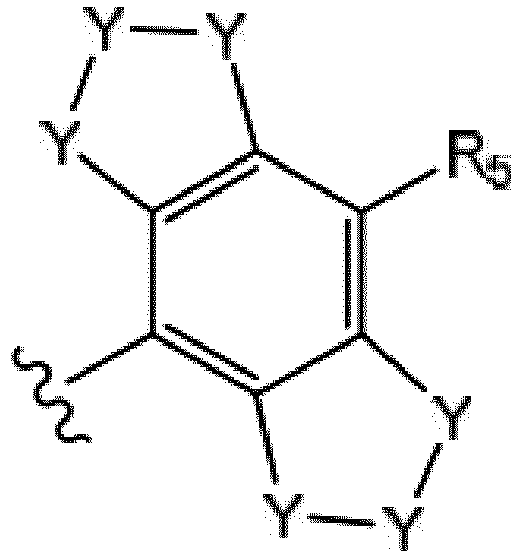
- In particular embodiments, the compound of formula (II) may be selected from a compound of formula (Ia), (Ib) and (Ic), or a pharmaceutically acceptable salt or solvate thereof:

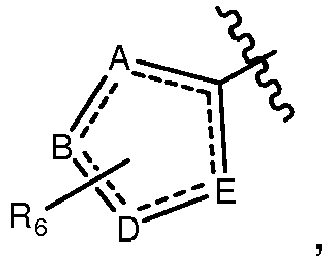
- In one embodiment of the compound of formula (Ia), (Ib) and (Ic), R1 is selected from the group consisting of pyrazole, pyrrolidine, pyrrole, triazole, tetrazole, and imidazole, all of which may be optionally substituted as appropriate.
- In one embodiment of the compound of formula (Ia), (Ib) and (Ic), R1 is selected from the group consisting of:





- In a preferred embodiment of the compound of formula (II), at least two of A, B, D and E are N.
- In one embodiment of the compound of formula (II), A, B, D and E are selected from N and C.
- In a further embodiment of the compound of formula (II), A is C and at least two of B, D and E are N.
- In one embodiment, A, B, D and E form a ring selected from a pyrazole, an imidazole, a triazole, and a tetrazole.
- Preferably, A, B, D, and E form a ring selected from a pyrazole or an imidazole ring, most preferably a pyrazole ring.
- In one embodiment, A, B, D and E may comprise a selenocycle.
- In one embodiment, the compound of formula (II) may be selected from a compound of formula (IIb), or a pharmaceutically acceptable salt or solvate thereof:


- wherein Y, R5 and R6 are as previously defined; and
- A, B, D and E are selected from N and C and at least two of A, B, D, and E are N.
- In one embodiment the compound of formula (II) is selected from:


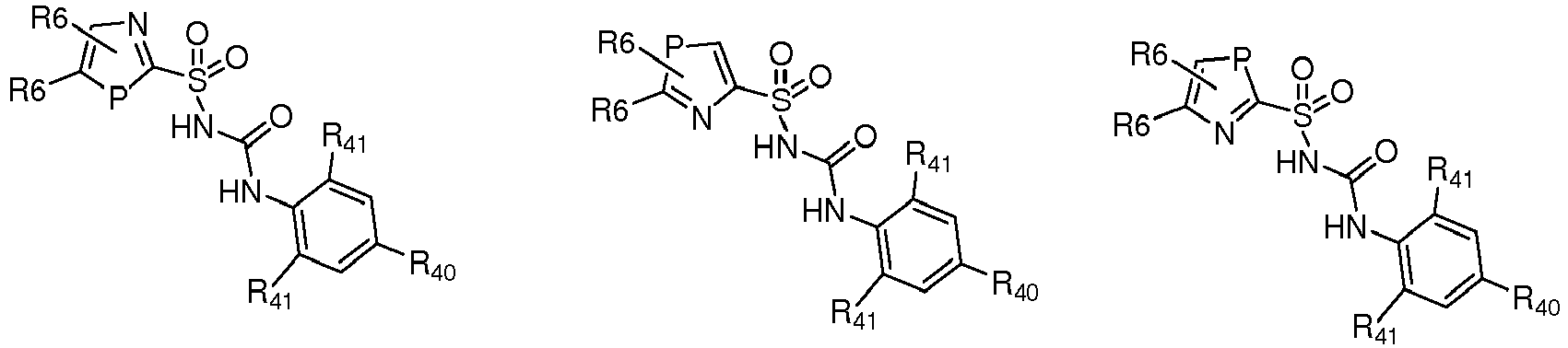


- wherein R40 is selected from H, C1-C6alkyl and halo;
- R41 is selected from alkyl and cycloalkyl;
- each incidence of P is independently selected from C, O or S; and
- each incidence of R6, when present, is independently selected from those groups defined for formula (II).
- It will be understood that the R6 moiety extending from the centre of each ring may represent a group bonded to the ring carbons or ring heteroatoms, as appropriate taking valency into consideration, or may not be present.
- In one embodiment of formula (II), R6 is C1-C6 alkyl or C1-C6 alkylhydroxy.
- In one embodiment, the compound of the first aspect may be selected from a compound of formula (IIIa), (IIIb) or (IIIc), or a pharmaceutically acceptable salt or solvate thereof:

- R21 is selected from H, alkyl, perhaloalkyl or hydroxylalkyl;
- R22 is selected from H, alkyl, perhaloalkyl, C3-C6 cycloalkyl, phenyl or benzyl;
- R18 is H or halogen;
- R16 and R17, together with the carbon atoms to which they are attached, form a cyclopentyl ring;
- R19 and R20, together with the carbon atoms to which they are attached, form a cyclopentyl ring; and
- provided that R21 and R22 are not both H;
- R21 is selected from H, alkyl, perhaloalkyl or hydroxylalkyl;
- R22 is selected from H, alkyl, perhaloalkyl, C3-C6 cycloalkyl, phenyl or benzyl;
- R16 and R20 are C1-6 alkyl or C3-5 cycloalkyl;
- R17 and R19 are H;
- R18 is H or halogen; and
- provided that R21 and R22 are not both H.
- In a preferred embodiment of compounds of formulae (IIIa), (IIIb) and (IIIc):
- R21 is selected from H, alkyl, perhaloalkyl or hydroxylalkyl; preferably C1-6 perhaloalkyl or hydroxylalkyl;
- R22 is selected from H, alkyl, perhaloalkyl, C3-C6 cycloalkyl, phenyl or benzyl;
- R16 and R17, together with the atoms to which they are attached, form a cyclopentyl ring;
- R19 and R20, together with the atoms to which they are attached, form a cyclopentyl ring;
- R18 is H or halogen, preferably R18 is H; and
- provided that R21 and R22 are not both H.
- In another preferred embodiment of the compounds of formulae (IIIa), (IIIb) and (IIIc):
- R21 is selected from H, alkyl, perhaloalkyl or hydroxylalkyl; preferably C1-6 perhaloalkyl or hydroxylalkyl;
- R22 is selected from H, alkyl, perhaloalkyl, C3-C6 cycloalkyl, phenyl and benzyl;
- R16 and R20 are C1-6 alkyl, preferably isopropyl;
- R17 and R19 are H;
- R18 is H or halogen; preferably R18 is H or Cl; and
- provided that R21 and R22 are not both H.
- In one embodiment, the compound of the first aspect may be selected from a compound of formula (IVa), (IVb) or (IVc), or a pharmaceutically acceptable salt or solvate thereof:

- R21 and R22 are selected from H, alkyl, perhaloalkyl, hydroxylalkyl, C3-C6 cycloalkyl, phenyl and benzyl;
- R18 is H or halogen;
- R16 and R17, together with the carbon atoms to which they are attached, form a cyclopentyl ring;
- R19 and R20, together with the carbon atoms to which they are attached, form a cyclopentyl ring; and
- provided that R21 and R22 are not both H;
- R21 and R22 are selected from H, alkyl, perhaloalkyl, hydroxylalkyl, C3-C6 cycloalkyl, phenyl and benzyl; preferably wherein the perhaloalkyl and hydroxylalkyl are C1-6 perhaloalkyl and hydroxylalkyl;
- R16 and R20 are C1-6 alkyl or C3-5 cycloalkyl;
- R17 and R19 are H;
- R18 is H or halogen; and
- provided that R21 and R22 are not both H.
- In a preferred embodiment of compounds of formulae (IVa), (IVb) and (IVc):
- R21 and R22 are selected from H, alkyl, perhaloalkyl, hydroxylalkyl, C3-C6 cycloalkyl, phenyl and benzyl; preferably the perhaloalkyl and hydroxylalkyl are C1-6 perhaloalkyl and hydroxylalkyl;
- R16 and R17, together with the atoms to which they are attached, form a cyclopentyl ring;
- R19 and R20, together with the atoms to which they are attached, form a cyclopentyl ring;
- R18 is H or halogen; preferably R18 is H; and
- provided that R21 and R22 are not both H.
- In another preferred embodiment of compounds of formulae (IVa), (IVb) and (IVc):
- R21 and R22 are selected from H, alkyl, perhaloalkyl, hydroxylalkyl, C3-C6 cycloalkyl, phenyl and benzyl; preferably the perhaloalkyl and hydroxylalkyl are C1-6 perhaloalkyl and hydroxylalkyl;
- R16 and R20 are C1-6 alkyl, preferably isopropyl;
- R17 and R19 are H;
- R18 is H or halogen; preferably R18 is H or Cl;
- provided that R21 and R22 are not both H.
- In one embodiment, the compound of the first aspect may be selected from a compound of formula (Va), (Vb) or (Vc), or a pharmaceutically acceptable salt or solvate thereof:

- R21 and R22 are selected from H, alkyl, perhaloalkyl, hydroxylalkyl, C3-C6 cycloalkyl, phenyl and benzyl;
- R18 is H or halogen;
- R16 and R17, together with the carbon atoms to which they are attached, form a cyclopentyl ring;
- R19 and R20, together with the carbon atoms to which they are attached, form a cyclopentyl ring; and
- provided that R21 and R22 are not both H;
- R21 and R22 are selected from H, alkyl, perhaloalkyl, hydroxylalkyl, C3-C6 cycloalkyl, phenyl and benzyl;
- R16 and R20 are C1-6 alkyl or C3-5 cycloalkyl;
- R17 and R19 are H;
- R18 is H or halogen; and
- provided that R21 and R22 are not both H.
- In a preferred embodiment of compounds of formulae (Va), (Vb) and (Vc):
- R21 and R22 are selected from H, alkyl, perhaloalkyl, hydroxylalkyl, C3-C6 cycloalkyl, phenyl and benzyl; preferably the perhaloalkyl and hydroxylalkyl are C1-6 perhaloalkyl and hydroxylalkyl;
- R16 and R17, together with the atoms to which they are attached, form a cyclopentyl ring;
- R19 and R20, together with the atoms to which they are attached, form a cyclopentyl ring;
- R18 is H or halogen; preferably R18 is H; and
- provided that R21 and R22 are not both H.
- In another preferred embodiment of compounds of formulae (Va), (Vb) and (Vc):
- R21 and R22 are selected from H, alkyl, perhaloalkyl, hydroxylalkyl, C3-C6 cycloalkyl, phenyl and benzyl; preferably the perhaloalkyl and hydroxylalkyl are C1-6 perhaloalkyl and hydroxylalkyl;
- R16 and R20 are C1-6 alkyl, preferably isopropyl;
- R17 and R19 are H;
- R18 is H or halogen; preferably R18 is H or Cl; and
- provided that R21 and R22 are not both H.
- In one embodiment, the compound of the first aspect may be selected from a compound of formula (VIa) or (Vlb), or a pharmaceutically acceptable salt or solvate thereof:

- R22 is selected from alkyl, perhaloalkyl, hydroxylalkyl, C3-C6 cycloalkyl, phenyl and benzyl;
- R18 is H or halogen;
- R16 and R17, together with the carbon atoms to which they are attached, form a cyclopentyl ring; and
- R19 and R20, together with the carbon atoms to which they are attached, form a cyclopentyl ring;
- R22 is selected from alkyl, perhaloalkyl, hydroxylalkyl, C3-C6 cycloalkyl, phenyl and benzyl;
- R16 and R20 are C1-6 alkyl or C3-5 cycloalkyl, preferably isopropyl or cyclopentyl;
- R17 and R19 are H; and
- R18 is H or halogen.
- In a preferred embodiment of compounds of formulae (VIa) and (Vlb):
- R22 is selected from alkyl, perhaloalkyl, hydroxylalkyl, C3-C6 cycloalkyl, phenyl and benzyl; preferably the perhaloalkyl and hydroxylalkyl are C1-6 perhaloalkyl and hydroxylalkyl;
- R16 and R17, together with the atoms to which they are attached, form a cyclopentyl ring;
- R19 and R20, together with the atoms to which they are attached, form a cyclopentyl ring; and
- R18 is H or halogen; preferably R18 is H.
- In another preferred embodiment of compounds of formulae (VIa) and (Vlb):
- R22 is selected from alkyl, perhaloalkyl, hydroxylalkyl, C3-C6 cycloalkyl, phenyl and benzyl; preferably the perhaloalkyl and hydroxylalkyl are C1-6 perhaloalkyl and hydroxylalkyl;
- R16 and R20 are C1-6 alkyl, preferably isopropyl;
- R17 and R19 are H; and
- R18 is H or halogen; preferably R18 is H or Cl.
- The compounds of the first aspect, and particularly those of formulae (II) to (VI), provide a range of unexpected benefits over those sulfonylureas of the prior art, which benefits may be selected from: Improved microsomal stability; Improved permeability; Reduced Pgp liability; Reduced plasma protein binding; Increased half-life; Improved oral bioavailability; Improved AUC; Improved Cmax; Reduced Cyp inhibition; Improved inhibition of activation of the NLRP3 inflammasome; and Improved solubility. The solubility, and certain other, improvements may be seen particularly in an aqueous environment.
- In one embodiment, the compounds of the first aspect offer improved pharmacokinetic characteristics. CRID3, a known sulfonylurea, has a half life of 3.2 hours (mouse) which may lead to substantial trough levels from QD or BD dosing when the t1/2 is extrapolated to man. The compounds of the first aspect may differ in, for example, their protein binding, metabolism and oral availability.
- Particularly it has been found that compounds of the first aspect, especially those wherein A, B, D and E form a 5-membered nitrogen heteroaryl, for example a pyrazole ring, are less metabolically labile and/or have improved pharmacokinetic properties over otherwise structurally similar furans and thiophenes seen in the prior art.
- In one embodiment, the compounds of the first aspect have a tPSA of less than 90 Å2.
- It is one advantage of the present compounds of the first aspect that they may demonstrate a significantly lowered polar surface area in comparison to prior art sulfonylureas, such as CRID3.
- In one further embodiment, the compounds of the first aspect have a tPSA of less than 90 Å2 and a molecular weight of less than 405.
- The absence of a tertiary alcohol group, in some embodiments, increases plasma concentration and aids in decreasing both MW and polar surface area thereby giving an overall improvement in blood brain barrier penetration.
- In any of the embodiments described for the compound of the first aspect, including the compounds of formula (I) to (VI), one or more hydrogens of the substituents or optional substitutions thereupon may be deuterated.
- Deuterated analogues of the compounds of the invention may exhibit increased metabolic stability due to the kinetic isotope effect.
- In one embodiment, the compound of the first aspect is selected from the group consisting of:
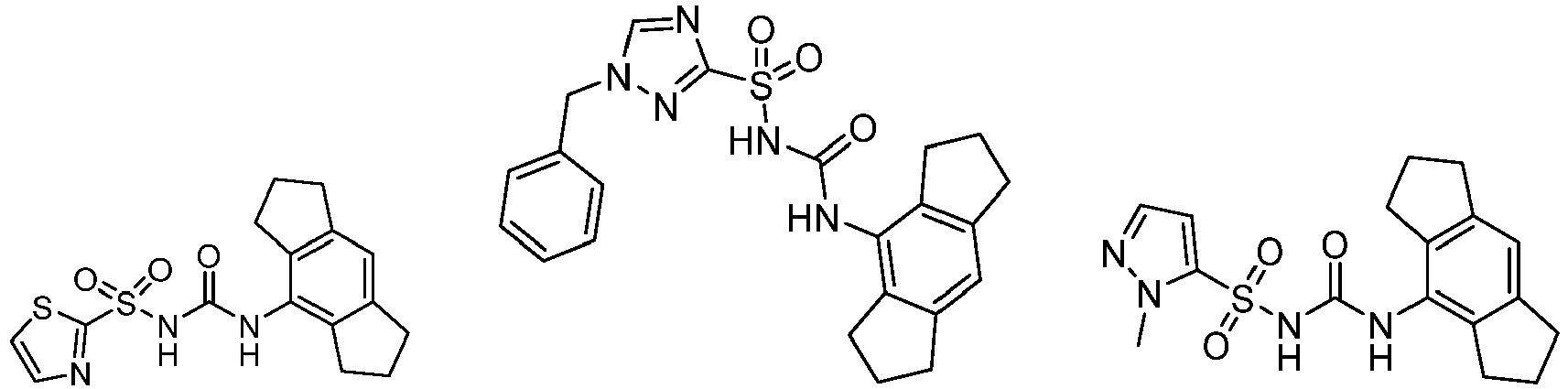


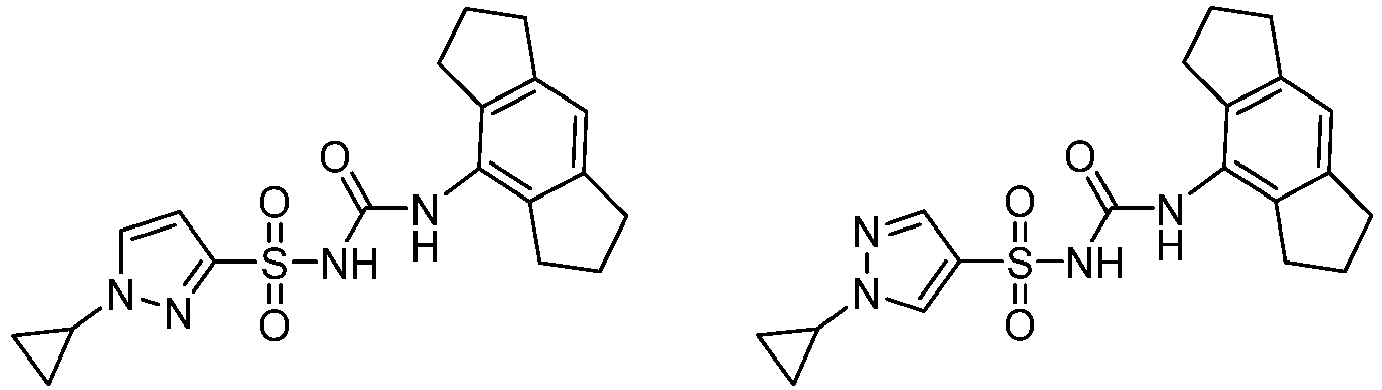


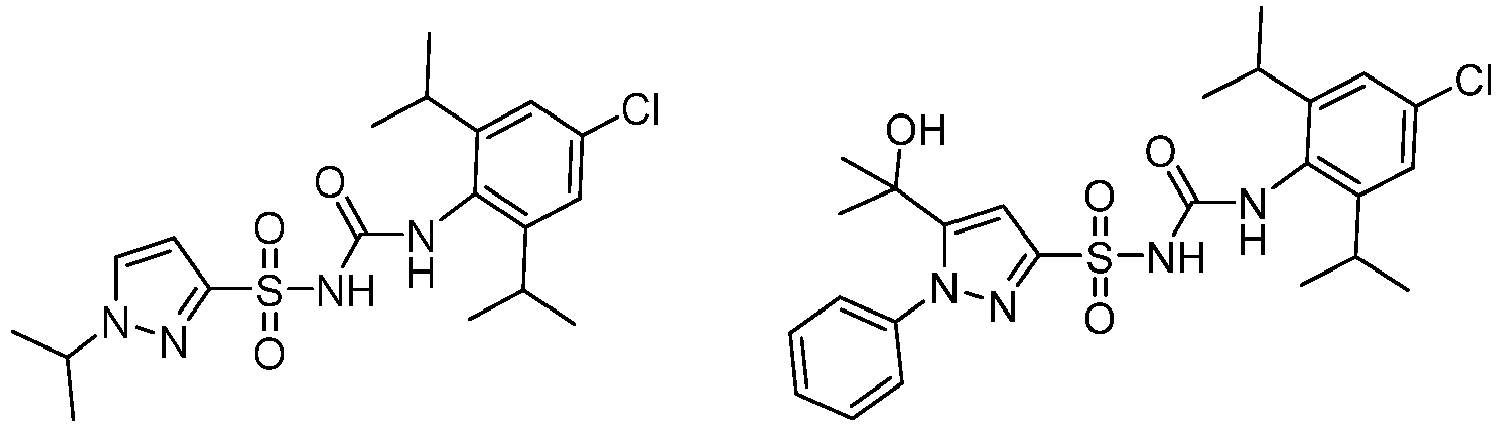
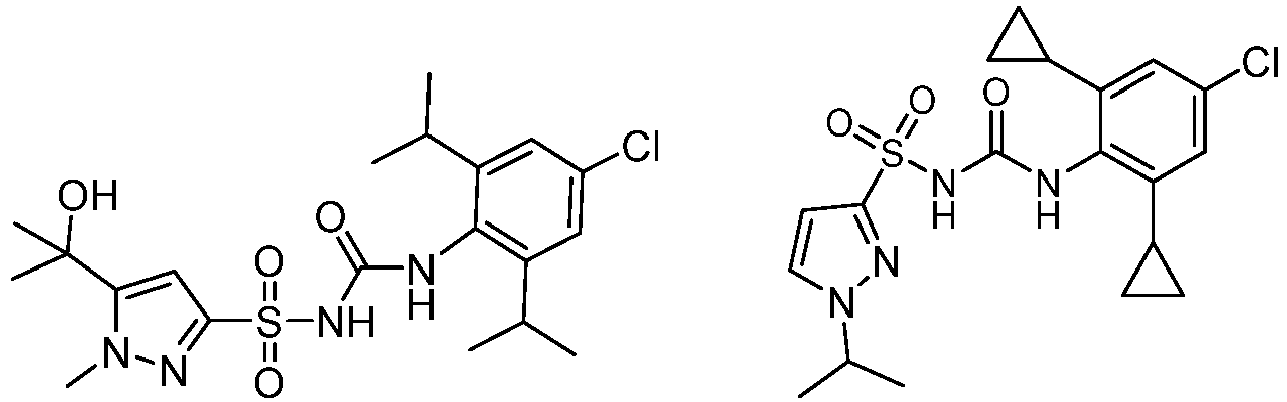

- In certain embodiments, the compounds of the first aspect may exhibit improved properties compared to known anti-diabetes drugs.
- It is believed that known drugs do not target NLRP3 to any therapeutically significant extent and so it would be necessary to use very high doses to have any significant effect on the NLRP3 inflammasome. The compounds of the first aspect show advantageously improved properties in a significant decrease in IC50 versus the NLRP3 inflammasome and additionally have the benefits, not realised by existing diabetes and other drugs, associated with NLRP3 inhibition such as improved wound healing and other advantages described herein.
- In any one or more embodiments of the first aspect and in relation to any one or more of the compounds of formula (I) to (VI), the compound is an inhibitor of activation of the NLRP3 inflammasome.
- Therefore it will be appreciated that the present invention provides for sulfonyl ureas and related drugs exhibiting significantly lower NLRP3 IC50 values in cell based assay using HMDM (see experimental section for protocols) than known compounds. Currently known diabetes drugs are not potent inhibitors of the NLRP3 inflammasome at therapeutic doses and to achieve any such inhibition would require dosing outside of recommended levels. The present compounds allow lower doses to be used and therefore limit the risk of toxic effects.
- In a further embodiment, one or more of the compounds of the first aspect may be useful as photoswitchable compounds which may be applied in a range of uses including but not limited to insulin release.
- In certain embodiments of the invention one or more compounds of the first aspect may be appropriate for use as probes, such as photoaffinity probes, or as reactive intermediates which can be modified either directly or by means of a linking moiety to give biotinylated, fluorescent or photoaffinity probes.
- It will be appreciated that the compounds of the first aspect may be modified or derivatised by means well understood in the art to allow linkage to a molecule such as biotin, or a fluorescent group or photoaffinity label.
- In one embodiment, wherein the compound of the first aspect, including any compound of formula (I) to (VI), has a pyrazole attached to the sulfur atom of the sulfonylurea, then the pyrazole is not substituted with an aryl or heteroaryl group.
- In general, alkylation, acylation, or other lipophilic modification of one or more heteroatoms of a compound, such as a free amine or carboxylic acid residue, may reduce polarity and allow for the compound's passage into cells. Examples of substituent groups that can replace one or more hydrogen atoms on a free amine and/or carboxylic acid moiety include, but are not limited to, the following: aryl; steroids; carbohydrates (including sugars); 1,2-diacylglycerol; alcohols; acyl (including lower acyl); alkyl (including lower alkyl); sulfonate ester (including alkyl or arylalkyl sulfonyl, such as methanesulfonyl and benzyl, wherein the phenyl group is optionally substituted with one or more substituents as provided in the definition of an aryl given herein); optionally substituted arylsulfonyl; lipids (including phospholipids); phosphotidylcholine; phosphocholine; amino acid residues or derivatives; amino acid acyl residues or derivatives; peptides; cholesterols; or other pharmaceutically acceptable leaving groups which, when administered in vivo, provide the free amine. Any of these moieties can be used in combination with the disclosed active agents to achieve a desired effect.
- In some embodiments, compounds with one or more chiral centers are provided. While racemic mixtures of compounds of the invention may be active, selective, and bioavailable, isolated isomers may be of interest as well.
- The compounds of the first aspect may contain chiral centers, which may be either of the (R) or (S) configuration, or which may comprise a mixture thereof. Accordingly, the present invention also includes stereoisomers of the compounds described herein, where applicable, either individually or admixed in any proportions. Stereoisomers may include, but are not limited to, enantiomers, diastereomers, racemic mixtures, and combinations thereof. Such stereoisomers can be prepared and separated using conventional techniques, either by reacting enantiomeric starting materials, or by separating isomers of compounds of the present invention. Isomers may include geometric isomers. Examples of geometric isomers include, but are not limited to, cis isomers or trans isomers across a double bond. Other isomers are contemplated among the compounds of the present invention. The isomers may be used either in pure form or in admixture with other isomers of the compounds described herein.
- Various methods are known in the art for preparing optically active forms and determining activity. Such methods include standard tests described herein and other similar tests which are well known in the art. Examples of methods that can be used to obtain optical isomers of the compounds according to the present invention include the following:
- i) physical separation of crystals whereby macroscopic crystals of the individual enantiomers are manually separated. This technique may particularly be used when crystals of the separate enantiomers exist (i.e., the material is a conglomerate), and the crystals are visually distinct;
- ii) simultaneous crystallization whereby the individual enantiomers are separately crystallized from a solution of the racemate, possible only if the latter is a conglomerate in the solid state;
- iii) enzymatic resolutions whereby partial or complete separation of a racemate by virtue of differing rates of reaction for the enantiomers with an enzyme;
- iv) enzymatic asymmetric synthesis, a synthetic technique whereby at least one step of the synthesis uses an enzymatic reaction to obtain an enantiomerically pure or enriched synthetic precursor of the desired enantiomer;
- v) chemical asymmetric synthesis whereby the desired enantiomer is synthesized from an achiral precursor under conditions that produce asymmetry (i.e., chirality) in the product, which may be achieved using chiral catalysts or chiral auxiliaries;
- vi) diastereomer separations whereby a racemic compound is reacted with an enantiomerically pure reagent (the chiral auxiliary) that converts the individual enantiomers to diastereomers. The resulting diastereomers are then separated by chromatography or crystallization by virtue of their now more distinct structural differences and the chiral auxiliary later removed to obtain the desired enantiomer;
- vii) first- and second-order asymmetric transformations whereby diastereomers from the racemate equilibrate to yield a preponderance in solution of the diastereomer from the desired enantiomer or where preferential crystallization of the diastereomer from the desired enantiomer perturbs the equilibrium such that eventually in principle all the material is converted to the crystalline diastereomer from the desired enantiomer. The desired enantiomer is then released from the diastereomers;
- viii) kinetic resolutions comprising partial or complete resolution of a racemate (or of a further resolution of a partially resolved compound) by virtue of unequal reaction rates of the enantiomers with a chiral, non-racemic reagent or catalyst under kinetic conditions;
- ix) enantiospecific synthesis from non-racemic precursors whereby the desired enantiomer is obtained from non-chiral starting materials and where the stereochemical integrity is not or is only minimally compromised over the course of the synthesis;
- x) chiral liquid chromatography whereby the enantiomers of a racemate are separated in a liquid mobile phase by virtue of their differing interactions with a stationary phase. The stationary phase can be made of chiral material or the mobile phase can contain an additional chiral material to provoke the differing interactions;
- xi) chiral gas chromatography whereby the racemate is volatilized and enantiomers are separated by virtue of their differing interactions in the gaseous mobile phase with a column containing a fixed non-racemic chiral adsorbent phase;
- xii) extraction with chiral solvents whereby the enantiomers are separated by virtue of preferential dissolution of one enantiomer into a particular chiral solvent; and
- xiii) transport across chiral membranes whereby a racemate is placed in contact with a thin membrane barrier. The barrier typically separates two miscible fluids, one containing the racemate, and a driving force such as concentration or pressure differential causes preferential transport across the membrane barrier. Separation occurs as a result of the non-racemic chiral nature of the membrane which allows only one enantiomer of the racemate to pass through.
- The compound optionally may be provided in a composition that is enantiomerically enriched, such as a mixture of enantiomers in which one enantiomer is present in excess, in particular, to the extent of 95% or more, 96% or more, 97% or more, 98% or more, or 99% or more, including 100%.
- The terms (R), (S), (R,R), (S,S), (R,S) and (S,R) as used herein mean that the composition contains a greater proportion of the named isomer of the compound in relation to other isomers. In a preferred embodiment, these terms indicate that the composition contains at least 90% by weight of the named isomer and 10% by weight or less of the one or more other isomers; or more preferably about 95% by weight of the named isomer and 5% or less of the one or more other isomers. In some embodiments, the composition may contain at least 99% by weight of the named isomer and 1% or less by weight of the one or more other isomers, or may contain 100% by weight of the named isomer and 0% by weight of the one of more other isomers. These percentages are based on the total amount of the compound of the present invention present in the composition.
- The compounds of the first aspect may be utilized per se or in the form of a pharmaceutically acceptable ester, amide, salt, solvate, or isomer, as appropriate. For example, the compound may be provided as a pharmaceutically acceptable salt. If used, a salt of the drug compound should be both pharmacologically and pharmaceutically acceptable, but non-pharmaceutically acceptable salts may conveniently be used to prepare the free active compound or pharmaceutically acceptable salts thereof and are not excluded from the scope of this invention. Such pharmacologically and pharmaceutically acceptable salts can be prepared by reaction of the drug with an organic or inorganic acid, using standard methods detailed in the literature.
- Examples of pharmaceutically acceptable salts of the compounds useful according to the invention include acid addition salts. Salts of non-pharmaceutically acceptable acids, however, may be useful, for example, in the preparation and purification of the compounds. Suitable acid addition salts according to the present invention include organic and inorganic acids. Preferred salts include those formed from hydrochloric, hydrobromic, sulfuric, phosphoric, citric, tartaric, lactic, pyruvic, acetic, succinic, fumaric, maleic, oxaloacetic, methanesulfonic, ethanesulfonic, p-toluenesulfonic, benzenesulfonic, and isethionic acids. Other useful acid addition salts include propionic acid, glycolic acid, oxalic acid, malic acid, malonic acid, benzoic acid, cinnamic acid, mandelic acid, salicylic acid, and the like. Particular examples of pharmaceutically acceptable salts include, but are not limited to, sulfates, pyrosulfates, bisulfates, sulfites, bisulfites, phosphates, monohydrogenphosphates, dihydrogenphosphates, metaphosphates, pyrophosphates, chlorides, bromides, iodides, acetates, propionates, decanoates, caprylates, acrylates, formates, isobutyrates, caproates, heptanoates, propiolates, oxalates, malonates, succinates, suberates, sebacates, fumarates, maleates, butyne-1,4-dioates, hexyne-1,6-dioates, benzoates, chlorobenzoates, methylbenzoates, dinitrobenzoates, hydroxybenzoates, methoxybenzoates, phthalates, sulfonates, xylenesulfonates, phenylacetates, phenylpropionates, phenylbutyrates, citrates, lactates, γ-hydroxybutyrates, glycolates, tartrates, methanesulfonates, propanesulfonates, naphthalene-1-sulfonates, naphthalene-2-sulfonates, and mandelates.
- An acid addition salt may be reconverted to the free base by treatment with a suitable base. Preparation of basic salts of acid moieties which may be present on a compound according to the present invention may be prepared in a similar manner using a pharmaceutically acceptable base, such as sodium hydroxide, potassium hydroxide, ammonium hydroxide, calcium hydroxide, triethylamine, or the like.
- Esters of the active agent compounds according to the present invention may be prepared through functionalization of hydroxyl and/or carboxyl groups that may be present within the molecular structure of the compound. Amides may also be prepared using techniques known to those skilled in the art. For example, amides may be prepared from esters, using suitable amine reactants, or they may be prepared from an anhydride or an acid chloride by reaction with ammonia or a lower alkyl amine. Moreover, esters and amides of compounds of the invention can be made by reaction with a carbonylating agent (e.g., ethyl formate, acetic anhydride, methoxyacetyl chloride, benzoyl chloride, methyl isocyanate, ethyl chloroformate, methanesulfonyl chloride) and a suitable base (e.g., 4-dimethylaminopyridine, pyridine, triethylamine, potassium carbonate) in a suitable organic solvent (e.g., tetrahydrofuran, acetone, methanol, pyridine, N,N-dimethylformamide) at a temperature of 0 °C to 60 °C. Examples of pharmaceutically acceptable solvates include, but are not limited to, compounds according to the invention in combination with water, isopropanol, ethanol, methanol, DMSO, ethyl acetate, acetic acid, or ethanolamine.
- In the case of solid compositions, it is understood that the compounds of the invention may exist in different forms. For example, the compounds may exist in stable and metastable crystalline forms and isotropic and amorphous forms, all of which are intended to be within the scope of the present invention.
- If a compound useful as an active agent according to the invention is a base, the desired salt may be prepared by any suitable method known to the art, including treatment of the free base with an inorganic acid, such as hydrochloric acid, hydrobromic acid, sulfuric acid, nitric acid, phosphoric acid and the like, or with an organic acid, such as acetic acid, maleic acid, succinic acid, mandelic acid, fumaric acid, malonic acid, pyruvic acid, oxalic acid, glycolic acid, salicylic acid, pyranosidyl acids such as glucuronic acid and galacturonic acid, alpha-hydroxy acids such as citric acid and tartaric acid, amino acids such as aspartic acid and glutamic acid, aromatic acids such as benzoic acid and cinnamic acid, sulfonic acids such a p-toluenesulfonic acid or ethanesulfonic acid, or the like.
- If a compound described herein as an active agent is an acid, the desired salt may be prepared by any suitable method known in the art, including treatment of the free acid with an inorganic or organic base, such as an amine (primary, secondary or tertiary), an alkali metal or alkaline earth metal hydroxide or the like. Illustrative examples of suitable salts include organic salts derived from amino acids such as glycine and arginine, ammonia, primary, secondary and tertiary amines, and cyclic amines such as piperidine, morpholine and piperazine, and inorganic salts derived from sodium, calcium, potassium, magnesium, manganese, iron, copper, zinc, aluminum and lithium.
- According to a second aspect of the invention there is provided a pharmaceutical composition comprising a compound of formula (I) to (VI), or a pharmaceutically acceptable salt or solvate thereof, and a pharmaceutically acceptable carrier, diluent and/or excipient.
- Suitably, the pharmaceutically acceptable carrier, diluent and/or excipient may be or include one or more of diluents, solvents, pH buffers, binders, fillers, emulsifiers, disintegrants, polymers, lubricants, oils, fats, waxes, coatings, viscosity-modifying agents, glidants and the like.
- The salt forms of the compounds of the invention may be especially useful due to their improved solubility.
- In one embodiment, the pharmaceutical composition includes a cyclodextrin.
- The cyclodextrin may be selected from alpha, beta or gamma cyclodextrins.
- In one embodiment, the cyclodextrin is selected from a methyl cyclodextrin, a hydroxypropyl cyclodextrin and a sulfobutylether cyclodextrin.
- It has been found that cyclodextrins provide significant advantages in formulation and delivery of the compounds of the invention.
- Cyclodextrin formulations such as for example, one or more compounds of the invention with hydroxypropyl beta cyclodextrin or methyl beta cyclodextrin, may have uses in cholesterol sequestration/cholesterol lowering or via NLRP3 inhibition for Non-alcoholic steatohepatitis (NASH), alcoholic liver disease, atherosclerosis and also in Alzheimer's Disease (AD).
- Diluents may include one or more of microcrystalline cellulose, lactose, mannitol, calcium phosphate, calcium sulfate, kaolin, dry starch, powdered sugar, and the like. Binders may include one or more of povidone, starch, stearic acid, gums, hydroxypropylmethyl cellulose and the like. Disintegrants may include one or more of starch, croscarmellose sodium, crospovidone, sodium starch glycolate and the like. Solvents may include one or more of ethanol, methanol, isopropanol, chloroform, acetone, methylethyl ketone, methylene chloride, water and the like. Lubricants may include one or more of magnesium stearate, zinc stearate, calcium stearate, stearic acid, sodium stearyl fumarate, hydrogenated vegetable oil, glyceryl behenate and the like. A glidant may be one or more of colloidal silicon dioxide, talc or cornstarch and the like. Buffers may include phosphate buffers, borate buffers and carbonate buffers, although without limitation thereto. Fillers may include one or more gels inclusive of gelatin, starch and synthetic polymer gels, although without limitation thereto. Coatings may comprise one or more of film formers, solvents, plasticizers and the like. Suitable film formers may be one or more of hydroxypropyl methyl cellulose, methyl hydroxyethyl cellulose, ethyl cellulose, hydroxypropyl cellulose, povidone, sodium carboxymethyl cellulose, polyethylene glycol, acrylates and the like. Suitable solvents may be one or more of water, ethanol, methanol, isopropanol, chloroform, acetone, methylethyl ketone, methylene chloride and the like. Plasticizers may be one or more of propylene glycol, castor oil, glycerin, polyethylene glycol, polysorbates, and the like.
- Reference is made to the Handbook of Excipients 6th Edition, Eds. Rowe, Sheskey & Quinn (Pharmaceutical Press), which provides non-limiting examples of excipients which may be useful according to the invention.
- It will be appreciated that the choice of pharmaceutically acceptable carriers, diluents and/or excipients will, at least in part, be dependent upon the mode of administration of the formulation. By way of example only, the composition may be in the form of a tablet, capsule, caplet, powder, an injectable liquid, a suppository, a slow release formulation, an osmotic pump formulation or any other form that is effective and safe for administration.
- Suitably, the pharmaceutical composition is for the treatment or prevention of a disease, disorder or condition in a mammal.
- A fourth aspect of the invention provides for a compound of formula (I) to (VI), or a pharmaceutically effective salt or solvate thereof, or the pharmaceutical composition of the second aspect for use in the treatment or prevention of a disease, disorder or condition.
- A fifth aspect of the invention provides for use of a compound of formula (I) to (VI), or a pharmaceutically effective salt or solvate thereof, in the manufacture of a medicament for the treatment or prevention of a disease, disorder or condition.
- As generally used herein, the terms "administering" or "administration", and the like, describe the introduction of the compound or composition to a mammal such as by a particular route or vehicle. Routes of administration may include topical, parenteral and enteral which include oral, buccal, sub-lingual, nasal, anal, gastrointestinal, subcutaneous, intramuscular and intradermal routes of administration, although without limitation thereto.
- By "treat", "treatment" or treating" is meant administration of the compound or composition to a subject to at least ameliorate, reduce or suppress existing signs or symptoms of the disease, disorder or condition experienced by the subject.
- By "prevent", "preventing" or "preventative" is meant prophylactically administering the formulation to a subject who does not exhibit signs or symptoms of a disease, disorder or condition, but who is expected or anticipated to likely exhibit such signs or symptoms in the absence of prevention. Preventative treatment may at least lessen or partly ameliorate expected symptoms or signs.
- As used herein, "effective amount" refers to the administration of an amount of the relevant compound or composition sufficient to prevent the occurrence of symptoms of the condition being treated, or to bring about a halt in the worsening of symptoms or to treat and alleviate or at least reduce the severity of the symptoms. The effective amount will vary in a manner which would be understood by a person of skill in the art with patient age, sex, weight etc. An appropriate dosage or dosage regime can be ascertained through routine trial.
- As used herein, the terms "subject" or "individual" or "patient" may refer to any subject, particularly a vertebrate subject, and even more particularly a mammalian subject, for whom therapy is desired. Suitable vertebrate animals include, but are not restricted to, primates, avians, livestock animals (e.g., sheep, cows, horses, donkeys, pigs), laboratory test animals (e.g., rabbits, mice, rats, guinea pigs, hamsters), companion animals (e.g., cats, dogs) and captive wild animals (e.g., foxes, deer, dingoes). A preferred subject is a human in need of treatment for a disease, disorder or condition as described herein. However, it will be understood that the aforementioned terms do not imply that symptoms are necessarily present.
- In one particular embodiment, the disease, disorder or condition is one which is responsive to inhibition of activation of the NLRP3 inflammasome.
- According to this embodiment, the compound of the first aspect, or pharmaceutically effective salt or solvate thereof is a specific inhibitor of NLRP3.
- In a further embodiment, the disease, disorder or condition is responsive to modulation of one or more of IL-1β, IL-17, IL-18, IL-1α, IL-37, IL-33 and Th17 cells.
- In one embodiment, the modulation is inhibition of one or more of IL-1β, IL-17, IL-18, IL-1α, IL-37, and IL-33. In one embodiment, the modulation of Th17 cells, is by inhibition of production and/or secretion of IL-17.
- In general embodiments, the disease, disorder or condition is a disease, disorder or condition of the immune system, the cardiovascular system, the endocrine system, the gastrintestinal tract, the renal system, the respiratory system, the central nervous system, is a cancer or other malignancy and/or is caused by or associated with a pathogen.
- It will be appreciated that these general embodiments defined according to broad categories of diseases, disorders and conditions are not mutually exclusive. In this regard any particular disease, disorder or condition may be categorized according to more than one of the above general embodiments. A non-limiting example is Type I diabetes which is an autoimmune disease and a disease of the endocrine system.
- In one embodiment, the disease, disorder or condition is of the immune system. In particular embodiments, the disease, disorder or condition is an inflammatory disease, disorder or condition or an autoimmune disease, disorder or condition.
- In one embodiment, the disease, disorder or condition is of the skin.
- In one embodiment, the disease, disorder or condition is of the cardiovascular system.
- In one embodiment, the disease, disorder or condition is a cancer, tumour or other malignancy. As used herein, cancers, tumours and malignancies, refer to diseases, disorders or conditions, or to cells or tissues associated with the diseases, disorders or conditions, characterized by aberrant or abnormal cell proliferation, differentiation and/or migration often accompanied by an aberrant or abnormal molecular phenotype that includes one or more genetic mutations or other genetic changes associated with oncogenesis, expression of tumour markers, loss of tumour suppressor expression or activity and/or aberrant or abnormal cell surface marker expression. In general embodiments, cancers, tumours and malignancies may include sarcomas, lymphomas, leukemias, solid tumours, blastomas, gliomas, carcinomas, melanomas and metastatic cancers, although without limitation thereto. A more comprehensive listing of cancers, tumours and malignancies may be found at the National Cancer Institutes website http://www.cancer.gov/cancertopics/types/alphalist.
- In one embodiment, the disease, disorder or condition is of the renal system.
- In one embodiment, the disease, disorder or condition is of the gastro-intestinal tract.
- In one embodiment, the disease, disorder or condition is of the respiratory system.
- In a further embodiment, the disease, disorder or condition is of the endocrine system.
- In one embodiment, the disease, disorder or condition is of the central nervous system (CNS).
- In one embodiment, the disease, disorder or condition is caused by, or is associated with, a pathogen. The pathogen may be a virus, a bacterium, a protist, a worm or a fungus or any other organism capable of infecting a mammal, although without limitation thereto.
- Non-limiting examples of viruses include influenza virus, cytomegalovirus, Epstein Barr Virus, human immunodeficiency virus (HIV), alphavirus such as Chikungunya and Ross River virus, flaviviruses such as Dengue virus, Zika virus and papillomavirus, although without limitation thereto.
- Non-limiting examples of pathogenic bacteria include Staphylococcus aureus, Helicobacter pylori, Bacillus anthracis, Bordatella pertussis, Corynebacterium diptheriae, Clostridium tetani, Clostridium botulinum, Streptococcus pneumoniae, Streptococcus pyogenes, Listeria monocytogenes, Hemophilus influenzae, Pasteurella multicida, Shigella dysenteriae, Mycobacterium tuberculosis, Mycobacterium leprae, Mycoplasma pneumoniae, Mycoplasma hominis, Neisseria meningitidis, Neisseria gonorrhoeae, Rickettsia rickettsii, Legionella pneumophila, Klebsiella pneumoniae, Pseudomonas aeruginosa, Propionibacterium acnes, Treponema pallidum, Chlamydia trachomatis, Vibrio cholerae, Salmonella typhimurium, Salmonella typhi, Borrelia burgdorferi and Yersinia pestis, although without limitation thereto.
- Non-limiting examples of protists include Plasmodium, Babesia, Giardia, Entamoeba, Leishmania and Trypanosomes, although without limitation thereto.
- Non-limiting examples of worms include helminths inclusive of schistisimes, roundworms, tapeworms and flukes, although without limitation thereto.
- Non-limiting examples of fungi include Candida and Aspergillus species, although without limitation thereto.
- Further relevant diseases, disorders or conditions may be selected from the group consisting of those recited in the journal article found at: http://onlinelibrary.wiley.eom/store/10.1111/j.1365-2249.2011.04440.x/asset/j.1365-2249.2011.04440.x.pdf?v=1&t=i60c1phf&s=d26f50a2622926cc6b4bc855bd911 ae9dc9750cf.
- In particular embodiments, the disease, disorder or condition is selected from the group consisting of constitutive inflammation including the cryopyrin-associated periodic syndromes (CAPS): Muckle-Wells syndrome (MWS), familial cold autoinflammatory syndrome (FCAS) and neonatal-onset multisystem inflammatory disease (NOMID); including autoinflammatory diseases: familial Mediterranean fever (FMF), TNF receptor associated periodic syndrome (TRAPS), mevalonate kinase deficiency (MKD), hyperimmunoglobulinemia D and periodic fever syndrome (HIDS), deficiency of interleukin 1 receptor (DIRA) antagonist, Majeed syndrome, pyogenic arthritis, pyoderma gangrenosum and acne (PAPA), haploinsufficiency of A20 (HA20), pediatric granulomatous arthritis (PGA), PLCG2-associated antibody deficiency and immune dysregulation (PLAID), PLCG2-associated autoinflammation, antibody deficiency and immune dysregulation (APLAID), sideroblastic anemia with B-cell immunodeficiency, periodic fevers, and developmental delay (SIFD); Sweet s syndrome, chronic nonbacterial osteomyelitis (CNO), chronic recurrent multifocal osteomyelitis (CRMO) and synovitis, acne, pustulosis, hyperostosis, osteitis syndrome (SAPHO); autoimmune diseases including multiple sclerosis (MS), type-1 diabetes, psoriasis, rheumatoid arthritis, Behcet's disease, Sjogren's syndrome and Schnitzler syndrome; respiratory diseases including chronic obstructive pulmonary disorder (COPD), steroid-resistant asthma, asbestosis, silicosis and cystic fibrosis; central nervous system diseases including Parkinson's disease, Alzheimer's disease, motor neuron disease, Huntington's disease, cerebral malaria and brain injury from pneumococcal meningitis; metabolic diseases including Type 2 diabetes, atherosclerosis, obesity, gout, pseudo-gout; ocular diseases including those of the ocular epithelium, age-related macular degeneration (AMD), corneal infection, uveitis and dry eye; kidney disease including chronic kidney disease, oxalate nephropathy and diabetic nephropathy; liver disease including non-alcoholic steatohepatitis and alcoholic liver disease; inflammatory reactions in skin including contact hypersensitivity and sunburn; inflammatory reactions in the joints including osteoarthritis, systemic juvenile idiopathic arthritis, adult-onset Still's disease, relapsing polychondritis; viral infections including alpha virus (Chikungunya, Ross River) and flavivirus (Dengue and Zika Virus), flu, HIV; hidradenitis suppurativa (HS) and other cyst-causing skin diseases; cancers including lung cancer metastasis, pancreatic cancers, gastric cancers, myelodisplastic syndrome, leukemia; polymyositis; stroke; myocardial infarction; Graft versus Host Disease; hypertension; colitis; helminth infection; bacterial infection; abdominal aortic aneurism; wound healing; depression, psychological stress; pericarditis including Dressler's syndrome, ischaemia reperfusion injury and any disease where an individual has been determined to carry a germline or somatic non-silent mutation in NLRP3.
- In one non-limiting example of those described, the disease, disorder or condition being treated is NASH. NLRP3 inflammasome activation is central to inflammatory recruitment in NASH, and inhibition of NLRP3 may both prevent and reverse liver fibrosis. Compounds of the present invention, by interrupting the function of NLRP3 inflammasomes in liver tissue, can cause histological reductions in liver inflammation, decreased recruitment of macrophages and neutrophils, and suppression of NF-κB activation. Inhibition of the NLRP3 can reduce hepatic expression of pro-IL-1β and normalized hepatic and circulating IL-1β, IL-6 and MCP-1 levels thereby assisting in treatment of the disease.
- In a further non-limiting example of those described, the disease, disorder or condition being treated is severe steroid resistant (SSR) asthma. Respiratory infections induce an NLRP3 inflammasome/caspase-1/IL-1β signaling axis in the lungs that promotes SSR asthma. The NLRP3 inflammasome recruits, and activates, pro-caspase-1 to induce IL-1β responses. NLRP3 inflammasome-induced IL-1β responses are therefore important in the control of infections, however, excessive activation results in aberrant inflammation and has been associated with the pathogenesis of SSR asthma and COPD. The administration of compounds of the first aspect that target specific disease processes, are more therapeutically attractive than non-specifically inhibiting inflammatory responses with steroids or IL-1β. Targeting the NLRP3 inflammasome/caspase-1/IL-1β signaling axis with the compounds of the first aspect may therefore be useful in the treatment of SSR asthma and other steroid-resistant inflammatory conditions.
- In one further non-limiting example of those described, the disease, disorder or condition being treated is Parkinson's disease. Parkinson's is the most common neurodegenerative movement disorder and is characterized by a selective loss of dopaminergic neurons, accompanied by the accumulation of mis-folded α-synuclein (Syn) into Lewy bodies that are pathological hallmarks of the disease. Chronic microglial neuroinflammation is evident early in the disease, and has been proposed to drive pathology.
- A central role for microglial NLRP3 is postulated in Parkinson's progression. The NLRP3 inflammasome is activated by fibrillar Syn via a Syk kinase dependent mechanism, and also occurs in the absence of Syn pathology at the early stages of dopaminergic degeneration, and drives neuronal loss. The compounds of the first aspect may block NLRP3 inflammasome activation by fibrillar Syn or mitochondrial dysfunction and thereby confer effective neuroprotection of the nigrostriatal dopaminergic system and assist with treatment of Parkinson's.
- In a sixth aspect of the invention there is provided a compound of the first aspect, or a pharmaceutically effective salt or solvate thereof, or the pharmaceutical composition of the second aspect for use in diagnosing a disease, disorder or condition in a mammal including the step of administering a labelled compound of formula (I) to (VI), or a pharmaceutically effective salt or solvate thereof, to the mammal or to a biological sample obtained from the mammal to facilitate diagnosis of the disease, disorder or condition in the mammal.
- Inflammasome activation, in particular that of the NLRP3 inflammasome, is known to drive initiation, progression and chronic development of a vast number of inflammatory diseases. The sulfonylureas and related compounds of the first aspect are potent and specific direct inhibitors of NLRP3. Accordingly, a chemical probe specific for NLRP3, which is present in immune cells during inflammation has potential utility in diagnosing inflammatory and other related diseases. An NRLP3 activation probe comprising a compound of the first aspect could act as an effective surrogate biomarker of inflammatory diease for ex vivo (blood) or in vivo (MRI, PET etc.) diagnostics.
- The use of the compounds of the first aspect in diagnosing inflammatory and other related diseases, such as those listed above, may be achieved by near infrared fluorescent imaging and ex vivo characterisation of immune cells by degree of inhibition of IL-1beta, pro-caspase 1 cleavage and IL-18 levels. In particular, peripheral blood monocytes (PMBCs), macrophages, dendritic cells, CD4+ T cells, Th17 cells, Th1 cells and Th2 cells are relevant. In vivo diagnostics using magnetic resonance imaging (MRI). H2 (deuterium) 13C, 19F, 15N labelled variants of [compound classes] given to a patient IV, IM, SC, PO, topical, IT, etc.
- In vivo diagnostics using positron emission tomography (PET) are also appropriate. PET is a molecular imaging technique that requires specific probes radiolabelled with short-lived positron emitting radionuclides. Typical isotopes include 11C, 13N, 15O, 18F, 64Cu, 62Cu, 124I, 76Br, 82Rb and 68Ga, with 18F being the most clinically utilized. In particular it is possible to produce in a simple manner a stable 64Cu or 62Cu salt of one or more of the compounds of the invention by simple ion exchange with a sodium (or other monovalent cation) salt of said compounds. This enables rapid preparation of a diagnostic probe for radioimaging, PET and the like whereby the intensity, location and temporal accretion of the diagnostic probe is able to identify the degree and/or the location of immune cells with activated NLRP3 as a surrogate biomarker of the patient's inflammatory state, and site of inflammation within the body. They will also be useful for application to biological samples removed from the body i.e. in vitro diagnosis.
- As generally used herein, a biological sample may include cells, tissues, fluids, molecules or other biological materials obtained, or obtainable, from a mammal. Non-limiting examples include urine, blood and fractions thereof such as serum, plasma, lymphocytes and erythrocytes, cerebrospinal fluid, PAP smears, nasal and ocular secretions, amniotic fluid, faeces, semen, tissue and/or organ biopsies and nucleic acid (e.g. DNA, RNA) or protein samples, although without limitation thereto.
- The following experimental section describes in more detail the characterisation of certain of the compounds of the invention and their efficacy. The intention is to illustrate certain specific embodiments of the compounds of the invention and their efficacy without limiting the invention in any way.
-

-
- A1: To a solution of R2 amine intermediate (1 eq.) with or without base such as, but not exclusively, triethylamine (1.2 eq.) in an anhydrous aprotic solvent such as, but not exclusively, tetrahydrofuran or dichloromethane was added triphosgene (0.4 to 1.1 eq.). The reaction was stirred at ambient temperature or, where necessary, heated at reflux until completion, typically from 2 to 18 h.
- A2: To di-t-butyldicarbonate (1.2-1.4 eq.) in anhydrous acetonitrile or THF was added DMAP (15-100 mol%), after 5 minutes, a solution of R2 amine intermediate (1.0 eq.) in acetonitrile was added. The reaction mixture was stirred for 30-60 min at room temperature.
-
- B1: The R2 carboxylic acid intermediate (1 eq.) was dissolved in an aprotic solvent such as toluene with or without 2 drops of DMF and a chlorinating agent such as thionyl chloride (2 eq.) added. The reaction mixture was heated at reflux until completion, then concentrated in vacuo to give the corresponding R2 acid chloride intermediate.
Alternative methods for forming the acid chloride are also equally useful here for example the above procedure can be carried out without toluene and DMF thereby using thionyl chloride as both solvent and chlorinating agent.
The R2 acid chloride intermediate was dissolved in acetone and added drop-wise to a solution of sodium azide (1.5 eq) in a water:acetone (50:50) solution at 0 °C. Iced water was added to precipitate the resulting R2 acylazide intermediate which was dissolved in toluene and dried (MgSO4) prior to adding the solution in a drop-wise fashion to anhydrous toluene at reflux while maintaining a constant flow of inert gas. The reaction was heated until completion, typically 2 h, to give the R2 isocyanate. - B2: To the R2 acid chloride (formed as indicated in method B1) in dry CH2Cl2 was added NaN3 (2.0 eq.) at 0 °C. The reaction mixture was stirred at room temperature for 1 h and extracted into EtOAc. The organic layer was washed with H2O (15 mL), dried (MgSO4), and carefully evaporated to give acyl azide. The acyl azide was dissolved in dry toluene and heated to 100 °C for 2 h. The solvent was removed to give crude R2 isocyanate.
-
- C1: R1 sulfonamide intermediate (1 eq.) was dissolved in anhydrous THF and treated with NaH (1 eq.) under reduced pressure. The mixture was heated to reflux for 2 h then cooled to room temperature and R2 isocyanate intermediate in THF added under nitrogen atmosphere. The reaction mixture was stirred at reflux until completion.
- C2: R1 sulfonamide intermediate (1 eq.) was dissolved in anhydrous THF or anhydrous methanol and treated with NaH (1 eq.) under reduced pressure. Once effervescence ceased the R2 isocyanate intermediate was added and the reaction mixture was stirred at ambient temperature overnight.
- C3: To R1 sulfonamide intermediate (1 eq) in anhydrous THF (5 mL/mmol) was added NaH (1 eq) at 0 °C and stirred for 30 min to 2 h, or until completion, at ambient temperature under nitrogen atmosphere. Again cooled to 0 °C, R2 isocyanate (1.0 eq) in THF was added and stirred at ambient temperature until completion, typically 2 to 16 h.
- C4: To crude R2 isocyanate (1.0 eq) in anhydrous THF or DCM (5-11 mL/mmol) was added R1 sulfonamide (1.0 eq) followed by base such as triethylamine, DIPEA, or DBU (1-2 eq) and the reaction mixture stirred at ambient temperature overnight.
- C5: To R1 sulfonamide intermediate (1 eq) in anhydrous MeOH (5 mL/mmol) was added NaOMe (1 eq) [alternatively: a 1.0 mM solution of freshly prepared sodium methoxide (1 eq) was added to a 1.0 mM solution of R1 sulfonamide (1 eq) in anhydrous methanol]. The solvent was then removed in vacuo. The salt was suspended in anhydrous aprotic solvent such as acetonitrile or THF, the R2 isocyanate (1.0 eq) in anhydrous aprotic solvent such as acetonitrile or THF was added and the mixture stirred at ambient temperature overnight. The solution was then heated at reflux until completion, typically 90 min.
- C6: R1 sulfonamide (1.0 eq.) was dissolved in anhydrous THF under a nitrogen atmosphere. Solid sodium methoxide (1.0 eq mmol) was added in one portion. This mixture was stirred at ambient temperature for 3 h. A solution of the R2 isocyanate (1.17 eq) in THF was added drop wise. The reaction mixture was stirred at room temperature overnight.

- A solution of amine (1.0 eq) in acetonitrile (7-12 mL/mmol) at 0 °C was treated with c.HCI (1.25-2.25 mL/mmol) in H2O (0.5-1.2 mL/mmol) followed by aqueous solution of NaNO2 (1.2 eq) dissolved in H2O (0.3-0.5 mL/mmol of NaNO2). The resulting solution was stirred at 0 °C for 45 min. AcOH (0.5-1.2 mL/mmol), CuCl2.2H2O (0.5 eq) and CuCI (0.05 eq) were sequentially added to the above mixture and purged with SO2 gas for 20 min at 0 °C. The resulting reaction mixture was stirred at 0°C - 10°C until completion.
-
- E1: A solution of sulfonyl chloride (1 eq) in THF (10-20 mL/mmol) was cooled to -78 °C and ammonia gas was bubbled through the solution for 15 min, stirring was continued for a further 30 min, then allowed to warm to ambient temperature and stirred for 2h or until completion.
- E2: A solution of sulfonyl chloride (1 eq) in acetone (20 mL/mmol) was treated with a solution of NH4HCO3 (4 eq) dissolved in water (1.5 mL/mmol of NH4HCO3) at ambient temperature and stirred for 4 h or until completion.
- E3: A solution of sulfonyl chloride (1 eq) in acetone (2.5 mL/mmol) was treated with NH3 (3.5 mL/mmol, NH4OH in H2O, 28% NH3 basis) at 0 °C and stirred for 2 h or until completion.
-

- Alkyne (1 eq) and azide (1.2 eq), 5 mol% CuSO4, 10 mol% NaAsc solution in DMSO (500 µL) were stirred at room temperature until completion, typically 12 h.
-

- A solution of 1H-1,2,4-triazole-3-thiol (1 g, 9.90 mmol) in DMF (20 mL) was treated with K2CO3 (4.8g, 34.7 mmol), cooled to 0 °C then benzyl bromide (4.2 g, 24.8 mmol) was added drop-wise over 5 min. The resulting reaction mixture was warmed to ambient temperature and stirred for 12 h. The reaction mixture was diluted with water (25 mL) and extracted with ethyl acetate (2 x 25 mL). The combined organics were washed with water (20 mL), brine (20 mL), dried (Na2SO4) and concentrated in vacuo. The crude product was purified by column chromatography on silica gel using 20% EtOAc-hexanes eluent to give 1-benzyl-3-(benzylthio)-1H-1,2,4-triazole as a white solid (1.5 g 54%). 1H NMR (400 MHz, DMSO-d6): δ = 8.67 (s, 1H), 7.39-7.32 (m, 5H), 7.27-7.21 (m, 5H), 5.36 (s, 2H), 4.29 (s, 2H).
- To a solution of 1-benzyl-3-(benzylthio)-1H-1,2,4-triazole, 2 (0.5 g, 1.77 mmol) in acetonitrile (5 mL) at 0 °C was added AcOH (3 mL) and H2O (2 mL) then and Cl2 gas was bubbled through the solution for 45 min. Stirring was continued at 0 °C for 30 min then at 20 ° C for 1.5h. The reaction mixture was diluted with water (20 mL) and extracted with EtOAc (2 x 20 mL). The combined organics were washed with water (20 mL), brine (20 mL), dried (Na2SO4) and concentrated in vacuo to give a colorless liquid. The residue was diluted with THF and cooled to -78°C. Ammonia gas was bubbled through the solution for 20 min and stirring continued for a further 30 min before warming to ambient temperature and stirring for 1 h. The reaction mixture was diluted with water (25 mL) and extracted with ethyl acetate (2 x 25 mL). The combined organics were washed with water (20 mL), brine (20 mL), dried (Na2SO4) and concentrated in vacuo. The residue was triturated with diethyl ether to give 1-benzyl-1H-1,2,4-triazole-3-sulfonamide as an off-white solid (0.25 g, 60%). 1H NMR (400 MHz, DMSO-d6): δ = 8.88 (s, 1H), 7.77 (s, 2H), 7.39-7.33 (m, 5H), 5.45 (s, 2H).
-

- Sodium 1H-1,2,3-triazole-5-thiolate (500 mg, 4.06 mmol) was dissolved in EtOH (5 mL) and cooled to 0 °C. Benzyl bromide (0.69 g, 4.06 mmol) was added drop wise over a period of 5 min. The resulting reaction mixture was warmed to RT and stirred for 1h. Upon completion, the reaction mixture was concentrated in vacuo and residue obtained was diluted with saturated NaHCO3 solution and extracted with EtOAc (2 x 20 mL). The combined organic extract was washed with water, brine, dried (Na2SO4) and concentrated in vacuo. The residue obtained was stirred with n-pentane (30 mL), filtered and dried in vacuo to give 4-(benzylthio)-1H-1,2,3-triazole as a white solid (0.7 g, 90%) which was used without further purification. 1H NMR (400 MHz, CDCl3): δ = 7.40-7.38 (m, 1H), 7.35-7.21 (m, 5H), 4.12 (s, 2H). LCMS (m/z): 192.0 [M+H]+
- A solution of 4-(benzylthio)-1H-1,2,3-triazole (5 g, 26.1 mmol) in DMF (50 mL) was cooled to 0 °C and treated with K2CO3 (9.03 g, 65.4 mmol). The reaction mixture was stirred for 5 minutes at same temperature. Isopropyl iodide (8.89 g, 52.3 mmol) was added drop wise to the above mixture over 5 min. The resulting reaction mixture was warmed to RT and stirred for 2h. Upon completion, the reaction mixture was diluted with water (30 mL) and extracted with ethyl acetate (50 mL). The organic extract was washed with water, brine and dried over anhydrous Na2SO4. The crude product was purified by column chromatography on silica using, 8% EtOAc-hexane eluent to give 5-(benzylthio)-1-isopropyl-1H-1,2,3-triazole A (0.9 g), 4-(benzylthio)-2-isopropyl-2H-1,2,3-triazole B (1 g) and the desired product 4-(benzylthio)-1-isopropyl-1H-1,2,3-triazole C (1.4 g, 23%). 1H NMR (400 MHz, DMSO-d 6): δ = 7.29-7.18 (m, 5H), 4.78-4.71 (m, 1H), 4.09 (s, 2H), 1.4 (d, J = 6.8 Hz, 6H). LCMS (m/z): 234.30 [M+H]+.
- A solution of 4-(benzylthio)-1-isopropyl-1H-1,2,3-triazole (75 mg, 0.32 mmol) in acetic acid (2.25 mL) and H2O (1.12 mL) was cooled to 0 °C . N-chlorosuccinamide (170 mg, 1.28 mmol) was added at 0 °C. The resulting reaction mixture was warmed to RT and stirred for 1 h. Upon completion, the reaction mixture was diluted with water and extracted with ethyl acetate (2 x 10 mL). The combined organic extracts were washed with water, brine, dried (Na2SO4) and concentrated in vacuo. The crude product was purified by column chromatography on silica using, 8% EtOAc-hexanes eluant to give 1-isopropyl-1H-1,2,3-triazole-4-sulfonyl chloride (0.1 g, 100%) as a pale brown liquid used without further purification. LCMS (m/z): 210.10 [M+H]+.
- A solution of 1-isopropyl-1H-1,2,3-triazole-4-sulfonyl chloride (100 mg) in THF (5 mL) was cooled to -40 °C. Ammonia gas was purged through the aforementioned solution for 15 min. The reaction mixture was warmed to RT and stirred for 2h. Upon completion, the reaction mixture was concentrated in vacuo and residue obtained was diluted with ethyl acetate (25 mL) and water (10 mL). The organic extract was washed with water, brine, dried (Na2SO4) and concentrated in vacuo to give 1-isopropyl-1H-1,2,3-triazole-4-sulfonamide (0.07 g, 78%) as brown solid. 1H NMR (400 MHz, DMSO-d 6): δ = 8.71 (s, 1H), 7.66 (s, 2H), 4.91-4.87 (m, 1H), 1.5 (d, J=6.8 Hz, 6H). LCMS (m/z): 191.30 [M+H]+.
-
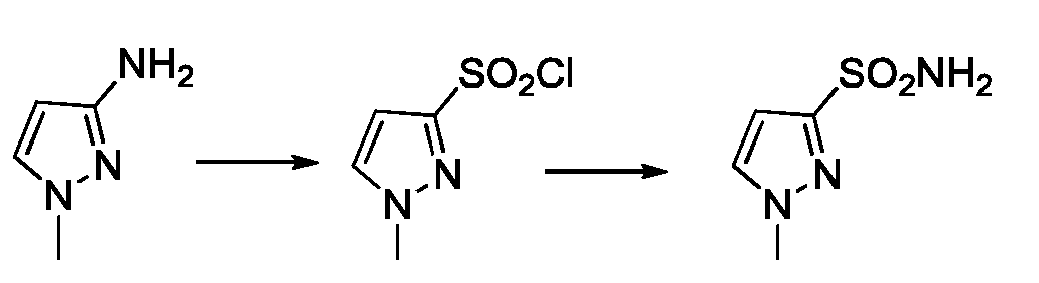
- 1-Methyl-1H-pyrazol-3-amine hydrochloride was reacted to 1-methyl-1H-pyrazole-3-sulfonyl chloride, a pale-yellow liquid, using general method D (0.7 g, 38%). 1H NMR (300 MHz, CDCl3): δ = 7.51-7.50 (d, J = 2.1 Hz, 1H), 6.89-6.88 (d, J = 2.4 Hz, 1H), 4.06 (s, 3H). LCMS (m/z): 160.9 (M-1)-. The sulfonyl chloride was converted using general method E1 to give the titled compound as an off-white solid (0.4 g, 69%). 1H NMR (400 MHz, DMSO-d6): δ = 7.80 (d, J= 2.1 Hz, 1H), 7.36 (s, 2H), 6.53 (d, J = 2.1 Hz, 1H), 3.88 (s, 3H). LCMS (m/z): 162.05 (M+1)+.
-

- 1-(trifluoromethyl)-1H-pyrazol-3-amine was reacted to 1-(trifluoromethyl)-1H-pyrazole-3-sulfonyl chloride, a brown liquid, using general method D (0.4 g, 43%). 1H NMR (300 MHz, CDCl3) δ = 8.02 (d, J = 2.8 Hz, 1H), 7.06 (d, J = 2.8 Hz, 1H). 19F NMR (282 MHz, CDCl3) δ = -60.46.
- The sulfonyl chloride was converted using general method E1 to give the titled compound (0.22 g, 46%). 1H NMR (300 MHz, CDCl3) δ = 7.92 (dd, J = 2.8, 0.3 Hz, 1H),6.91 (dd, J = 2.8, 0.7 Hz, 1 H), 5.28 (s, 2H). 19F NMR (282 MHz, CDCl3) δ = -60.41.
-

- 1-Isopropyl-1H-pyrazol-3-amine was reacted to 1-isopropyl-1H-pyrazole-3-sulfonyl chloride, a brown liquid, using general method D (0.5 g, 43 %). 1H NMR (400 MHz, CDCl3): δ = 7.55 (s, 1H), 6.88 (s, 1H), 4.66-4.63 (m, 1H), 3.6 (br.s., 2H), 1.59 (d, J = 6.8 Hz, 6H). LCMS (m/z): 209.0 (M+1)+. The sulfonyl chloride was converted using general method E1 to give the titled compound as yellow solid (0.45 g, 82%). 1H NMR (300 MHz, DMSO-d6): δ = 7.9 (d, J = 2.4 Hz, 1H), 7.36 (s, 2H), 6.55 (d, J = 2.1 Hz, 1H), 4.57-4.53 (m, 1H), 1.42 (d, J = 6.9 Hz, 6H). LCMS (m/z): 190.0 (M+1)+.
-

- A solution of 4-iodo-1H-pyrazole (1 g, 5.15 mmol) in DMF (20 mL) was treated with K2CO3 (1.42g, 10.30 mmol) and isopropyl iodide (1.05 g, 6.19 mmol) at ambient temperature under nitrogen atmosphere. The resulting reaction mixture was heated to 90 °C and stirred for 12 h. The mixture was cooled, diluted with water (50 mL) and extracted with diethyl ether (2 x 50 mL). The combined organics were washed with water (2 x 50 mL), brine (50 mL), dried (Na2SO4) and concentrated in vacuo. The crude product was purified by column chromatography on silica gel using 10% EtOAc-hexanes eluent to give 4-iodo-1-isopropyl-1H-pyrazole as a colorless liquid (1.1 g, 92%). 1H NMR (400 MHz, CDCl3): δ = 7.50-7.46 (m, 2H), 4.53-4.47 (m, 1H), 1.50 (d, J = 6.8 Hz, 6H). LCMS (m/z): 237.2 (M+1)+.
- A solution of 4-iodo-1-isopropyl-1H-pyrazole (1 g, 4.24 mmol) in dioxane (20 mL) was treated sequentially with benzyl mercaptan (0.8g, 6.35 mmol) and DIPEA (1.1g, 8.47 mmol) under nitrogen atmosphere. The solution was degassed by purging with argon gas for 15 min. Pd2(dba)3 (40 mg, 0.0423 mmol) and Xantphos (50 mg, 0.0847 mmol) were added under argon atmosphere then the resulting mixture was sealed in the reaction vessel and heated at 75 °C for 6 h. The reaction mixture was cooled, concentrated in vacuo, diluted with water (20 mL) and extracted with EtOAc (2 x 20 mL). The combined organics were washed with water (2 x 50 mL), brine (50 mL), dried (Na2SO4) and concentrated in vacuo. The crude product was purified by column chromatography on silica gel using 10% EtOAc-hexanes eluent to give 4-(benzylthio)-1-isopropyl-1H-pyrazole as a yellow liquid (650 mg, 66%). 1H NMR (400 MHz, CDCl3): δ = 7.36 (s, 1H), 7.26-7.22 (m, 4H), 7.11-7.09 (m, 2H), 4.41-4.36 (m, 1H), 3.76 (s, 2H), 1.42 (d, J = 6.8 Hz, 6H). LCMS (m/z): 233.3 (M+1)+
- To a solution of 4-(benzylthio)-1-isopropyl-1H-pyrazole, 3 (0.35 g, 1.508 mmol) in acetonitrile (10 mL) at 0 °C was added AcOH (0.7 mL) and H2O (0.35 mL) then DCDMH (0.6 g, 3.017 mmol) was added portion-wise over 5 min. The solution was stirred for 30 min then warmed to ambient temperature and stirred for a further 2 h. The reaction mixture was diluted with water (20 mL) and extracted with EtOAc (2 x 20 mL). The combined organics were washed with water (20 mL), brine (20 mL), dried (Na2SO4) and concentrated in vacuo to give 1-isopropyl-1H-pyrazole-4-sulfonyl chloride as a colorless liquid. The sulfonyl chloride was diluted with THF and cooled to -78 °C then NH3 gas was bubbled through the solution for 15 minutes. The reaction mixture was stirred at -78 °C for 1 h and at ambient temperature for 2 h. The reaction mixture was diluted with water and compound extracted with ethyl acetate (2 x 25 mL). The combined organic extracts were washed with water (20 mL), brine (20 mL), dried (Na2SO4) and concentrated in vacuo. The residue obtained was triturated with diethyl ether and dried under reduced pressure give 1-isopropyl-1H-pyrazole-4-sulfonamide as a light brown solid (0.2 g, 71%). 1H NMR (400 MHz, DMSO-d6): δ = 8.21 (s, 1H), 7.71 (s, 1H), 7.22 (s, 2H), 4.59-4.53 (m, 1H), 1.4 (d, J = 6.8 Hz, 6H). LCMS (m/z): 190.2 (M+1)+.
-
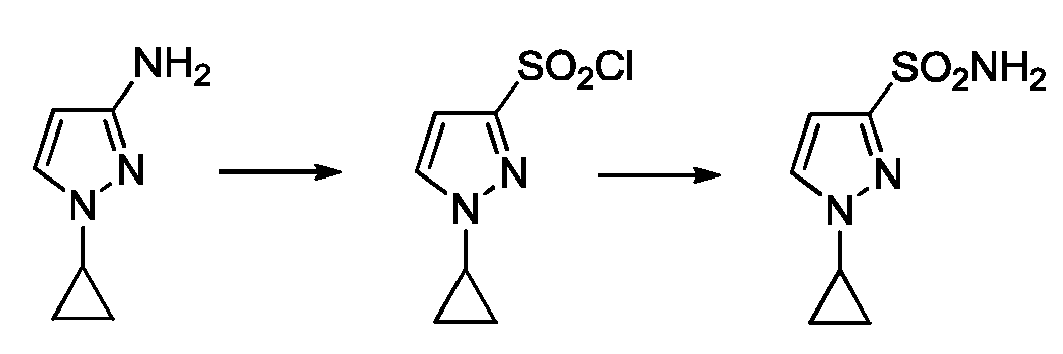
- 1-Cyclopropyl-1H-pyrazole-3-amine was reacted to 1-cyclopropyl-1H-pyrazole-3-sulfonyl chloride using general method D then converted using general method E1 to give the titled compound as a light brown solid (0.2 g, 33%). 1H NMR (400 MHz, CDCl3) δ = 7.51 (d, J = 2.4 Hz, 1H), 6.69 (d, J = 2.4 Hz, 1H), 5.04 (s, 2H), 3.67 (m, 1H), 1.28 - 1.05 (m, 4H).
-

- 1-(tert-butyl)-1H-pyrazol-3-amine was reacted to 1-(tert-butyl)-1H-pyrazole-3-sulfonyl chloride using general method D then converted using general method E1 to give the titled compound as a light brown solid (150 mg, 26%). 1H NMR (400 MHz, DMSO-d6): δ = 7.56 (d, J = 3.6 Hz, 1H), 6.7 (d, J = 3.2 Hz, 1H), 4.75 (br.s., 1H), 1.60 (s, 9H). LCMS (m/z): 204.15 (M+1)+.
-

- 1-Cyclohexyl-1H-pyrazole-3-amine was reacted to 1-cyclohexyl-1H-pyrazole-3-sulfonyl chloride using general method D then converted using general method E1 to give the titled compound as a white solid (0.35 mg, 50%). 1H NMR (300 MHz, DMSO-d6) δ = 7.89 (d, J = 2.3 Hz, 1H), 7.36 (s, 2H), 6.55 (d, J = 2.3 Hz, 1H), 4.28 - 4.08 (m, 1H), 2.0 1.1 (m, 6H).
-

- 1-phenyl-1H-pyrazol-3-amine was reacted to 1-phenyl-1H-pyrazole-3-sulfonyl chloride, a yellow liquid, using general method D (0.5 g, 47 %). 1H NMR (400 MHz, CDCl3): δ = 8.04 (d, J = 2.4 Hz, 1 H), 7.73 (d, J = 9.2 Hz, 2H), 7.58 (t, J = 7.6 Hz, 2H), 7.47 (t, J = 7.2 Hz, 1H), 7.08 (d, J = 2.8 Hz, 1H). The sulfonyl chloride was converted using general method E1 to give the titled compound as a yellow solid (0.4 g, 87 %). 1H NMR (400 MHz, DMSO-d6): δ = 8.62 (d, J = 2.7 Hz, 1 H), 7.86 (d, J = 8.7 Hz, 2H), 7.61 (br.s., 2H), 7.57 (t, J = 7.8 Hz, 2H), 7.41 (t, J = 7.2 Hz, 1H), 6.85 (d, J = 2.4 Hz, 1H). LCMS (m/z): 224.1 (M+1)+.
-

- 1-benzyl-1H-pyrazol-3-amine was reacted to 1-benzyl-1H-pyrazole-3-sulfonyl chloride, a light brown liquid, using general method D (0.2 g, 45%). 1H NMR (300 MHz, CDCl3): δ 7.42-7.38 (m, 3H), 7.33-7.28 (m, 3H), 6.8 (d, J=2.4Hz, 1H), 5.42 (s, 2H). The sulfonyl chloride was converted using general method E1 to give the titled compound as a light brown liquid (0.15 g, 81%). 1H NMR (400 MHz, CDCl3): δ = 7.42-7.36 (m, 4H), 7.24 (d, J = 1.6Hz, 2H), 6.7 (d, J = 2.4Hz, 1H), 5.35 (s, 2H), 5.10 (s, 2H). LCMS (m/z): 238.10 (M+1)+
-

- 1-(1-phenylethyl)-1H-pyrazol-3-amine was reacted to 1-(1-phenylethyl)-1H-pyrazole-3-sulfonyl chloride using general method D then converted using general method E1 to give the titled compound as a white solid (0.25 mg, 68%). 1H NMR (300 MHz, CDCl3) δ = 7.43 - 7.18 (m, 6H), 6.72 (d, J = 2.4 Hz, 1H), 5.57 (q, J = 7.1 Hz, 1H), 5.02 (s, 2H), 1.92 (d, J = 7.1 Hz, 3H).
-

- 1-(2-(piperidin-1-yl)ethyl)-1H-pyrazol-3-amine was reacted to 1-(2-(piperidin-1-yl)ethyl)-1H-pyrazole-3-sulfonyl chloride, a pale-brown liquid, using general method D then converted using general method E1 to give the titled compound as an off-white solid (0.3 g, 46%). 1H NMR (300 MHz, DMSO-d6): δ = 7.84 (d, J = 2.1 Hz, 1H), 7.36 (s, 2H), 6.54 (s, J = 2.4 Hz, 1H), 4.26 (t, J = 6.9 Hz, 2H), 2.66 (t, J = 6.6 Hz, 2H), 2.36 (s, 4H), 1.46-1.34 (m, 6H). LCMS (m/z): 259.10 (M +1)+.
-
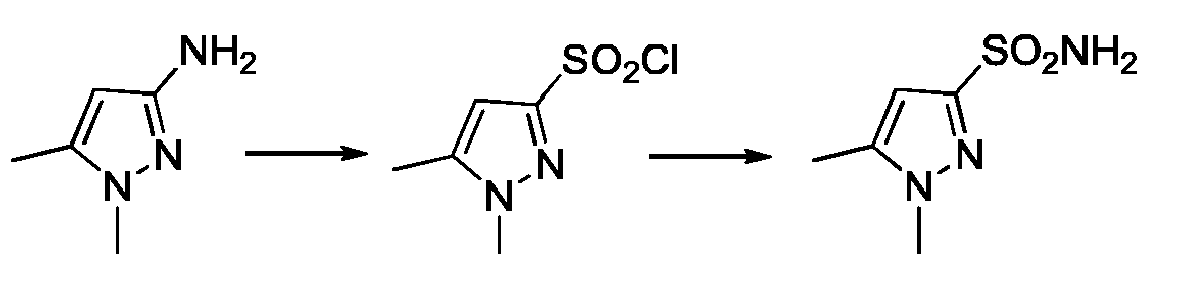
- 1,5-dimethyl-1H-pyrazol-3-amine was reacted to 1,5-dimethyl-1H-pyrazole-3-sulfonyl chloride, a yellow liquid, using general method D (0.45 g, 26%). 1H NMR (300 MHz, CDCl3): δ = 5.92 (s, 1H), 3.71 (s, 3H), 2.23 (s, 3H). LCMS (m/z): 217 (M+Na)+. The sulfonyl chloride was converted using general method E1 to give the titled compound as an off-white solid (0.25 g, 55%). 1H NMR (400 MHz, DMSO-d6): δ = 7.30 (s, 2H), 6.36 (s, 1H), 3.76 (s, 3H), 2.27 (s, 3H). LCMS (m/z): 175.9 (M+1)+.
-

- 1-methyl-5-(trifluoromethyl)-1H-pyrazol-3-amine was reacted to 1-methyl-5-(trifluoromethyl)-1H-pyrazole-3-sulfonyl chloride, a pale-brown liquid, using general method D (1.1 g, 37%). 1H NMR (300 MHz, CDCl3): δ = 7.21 (s, 1H), 4.16 (s, 3H). The sulfonyl chloride was converted using general method E1 to give the titled compound as a yellow solid (0.45 mg, 82%). 1H NMR (300 MHz, CDCl3): δ = 7.06 (s, 1H), 5.02 (br.s., 2H), 4.03 (s, 3H).
-
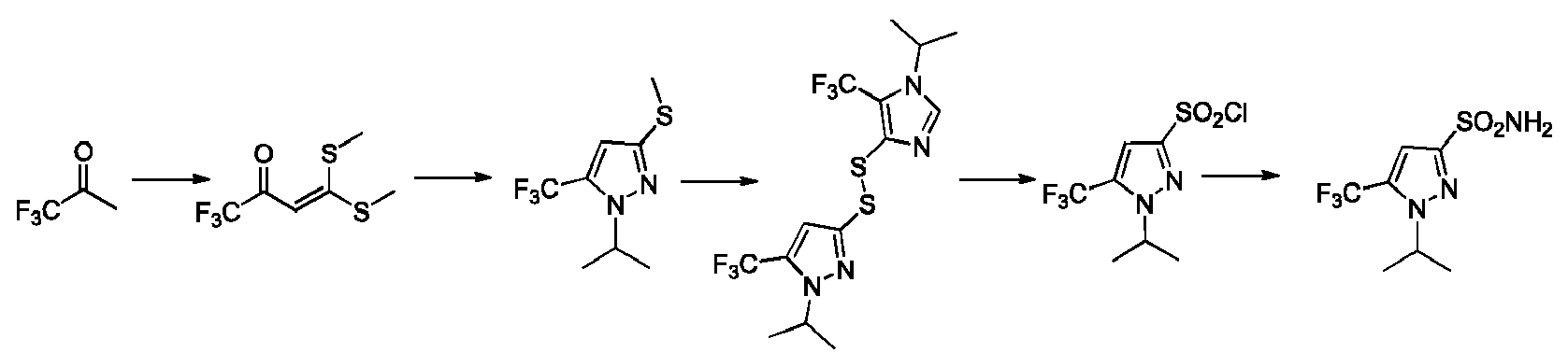
- A mixture of NaH (2.14 g, 89.3 mmol) in DMF (20 mL) was cooled to -10 °C. A solution of 1,1,1-trifluoropropan-2-one (5 g, 44.6 mmol) in DMF (80 mL) was added very carefully to the above mixture and stirred at -10 °C for 5 min. CS2 (10.2 g, 133.9 mmol) was added drop-wise to the above mixture over 30 min then the reaction mixture was warmed to ambient temperature and stirred for 1 h. The reaction mixture was cooled to 0 °C and treated with CH3I (7.5 mL) over 10 min. The resulting reaction mixture was warmed to ambient temperature and stirred for 12 h. The reaction mixture was diluted with cold water (50 mL) and extracted with diethyl ether (2 x 100 mL). The combined organic extracts were washed with water (50 mL), brine (50 mL), dried (Na2SO4) and concentrated in vacuo. The crude product was purified by column chromatography on silica gel using 5% EtOAc-hexanes eluent to give 1,1,1-trifluoro-4,4-bis(methylthio)but-3-en-2-one as a light brown solid (3.5 g, 36%). 1H NMR (300 MHz, CDCl3): δ = 6.24 (s, 1H), 2.57 (m, 6H). LCMS (m/z): 217.20 (M+1)+.
- A solution of 1,1,1-trifluoro-4,4-bis(methylthio)but-3-en-2-one (2.5 g, 11.6 mmol) in EtOH (25 mL) was treated with isopropyl hydrazine hydrochloride (2 g, 13.9 mmol) at 0 °C, Et3N (2.4g, 40.98 mmol) was added and the mixture heated at 80°C for 12 h. The reaction mixture was concentrated in vacuo,diluted with sat. aq. NaHCO3 solution and extracted with EtOAc (2 x 250 mL). The combined organics were washed with water (200 mL), brine (200 mL), dried (Na2SO4) and concentrated in vacuo. The crude product was purified by column chromatography on silica gel using 100% EtOAc eluent to give 1-isopropyl-3-(methylthio)-5-(trifluoromethyl)-1H-pyrazole as a light brown liquid (1.5 g, 58%). 1H NMR (400 MHz, CDCl3): δ = 6.47 (s, 1H), 4.58-4.53 (m, 1H), 2.49 (s, 3H), 1.50 (d, J = 6.8 Hz, 6H). LCMS (m/z): 225.20 (M +1)+.
- A solution of 1-isopropyl-3-(methylthio)-5-(trifluoromethyl)-1H-pyrazole (0.5g, 2.23 mmol) in chloroform (10 mL) at 0°C was treated with mCPBA (0.38 g, 2.23 mmol) and stirred at 10 °C for 1 h. The reaction mixture was diluted with saturated NaHCO3 solution (10 mL) and extracted with CHCl3 (2 x 30 mL). The combined organics were washed with water (30 mL), brine (30 mL), dried (Na2SO4) and concentrated in vacuo The residue obtained was dissolved in CHCl3 (10 mL) and treated with trifluoroacetic anhydride (1.4 g, 6.7 mmol) the reaction mixture was heated at 50 °C for 3 h, cooled to ambient temperature and concentrated in vacuo. The residue obtained was diluted with MeOH (5 mL)-THF (5 mL)-H2O (5 mL), cooled to 0°C, treated with Na2CO3 (0.7 g, 6.7 mmol) and stirred for 3h. The solution was diluted with water (30 mL) and extracted with CHCl3 (2 x 50 mL). The combined organics were washed with water (50 mL), brine (50 mL), dried (Na2SO4) and concentrated in vacuo. The crude residue (0.2 g) containing 1-isopropyl-3-((1-isopropyl-5-(trifluoromethyl)-1H-imidazol-4-yl)disulfanyl)-5-(trifluoromethyl)-1H-pyrazole was used in the next in step without further purification. 1H NMR (400 MHz, CDCl3): δ = 6.85 (s, 2H), 6.70 (s, 1H), 6.60 (s, 1H), 4.6 (m, 2H), 1.53 (m, 6H). LCMS (m/z): 416.75 (M-1)-
- A solution of crude 1-isopropyl-3-((1-isopropyl-5-(trifluoromethyl)-1 H-imidazol-4-yl)disulfanyl)-5-(trifluoromethyl)-1H-pyrazole (0.2 g crude, 0.478 mmol) in acetonitrile (10 mL) was cooled to 0°C and treated with AcOH (1 mL) and H2O (1.5mL). DCDMH (0.19 g, 0.956 mmol) was added portion-wise over 5 minutes and stirred for 2h. The mixture was diluted with water (20 mL) and extracted with DCM (2 x 20 mL). The combined organics were washed with water (50 mL), brine (50 mL), dried (Na2SO4) and concentrated in vacuo to give 1-isopropyl-5-(trifluoromethyl)-1H-pyrazole-3-sulfonyl chloride as a colorless liquid. The (1-isopropyl-5-(trifluoromethyl)-1H-pyrazole-3-sulfonyl chloride) was diluted with THF, cooled to -78 °C and NH3 gas was bubbled through the solution for 10 min then stirred for 1 h before warming to ambient temperature and stirring for a further 1 h. The reaction mixture was diluted with water and extracted with ethyl acetate (2 x 25 mL). The combined organics were washed with water (50 mL), brine (50 mL), dried (Na2SO4) and concentrated in vacuo. The residue obtained was triturated with diethyl ether and n-pentane to give 1-isopropyl-5-(trifluoromethyl)-1H-pyrazole-3-sulfonamide as a white solid (75 mg, 61%). 1H NMR (400 MHz, CDCl3): δ = 7.01 (s, 1H), 5.06 (s, 2H), 4.73-4.70 (m, 1H), 1.5 (d, J = 6.8 Hz, 6H). LCMS (m/z): 256.0 (M-1)-.
-

- A solution of 1-methyl-5-(prop-1-en-2-yl)-1H-pyrazol-3-amine (0.25 g, 1.824 mmol) in acetonitrile (10 mL) at 0 °C was treated with c.HCl (1.2 mL) in H2O (0.5 mL) followed by aqueous solution of NaNO2 (0.15 g, 2.19 mmol) dissolved in H2O (2 mL). The resulting solution was stirred at 0°C for 45 min. AcOH (0.25 mL), CuCl2.2H2O (0.15 g, 0.91 mmol) and CuCl (10 mg , 0.091 mmol) were sequentially added to the above mixture and purged with SO2 gas for 20 min at 0 °C. The resulting reaction mixture was stirred at 0°C- 10°C for 60 min. Upon completion, the reaction mixture was diluted with water (20 mL) and extracted with EtOAc (2 x 20 mL). The combined organics were washed with water (20 mL), brine (20 mL), dried (Na2SO4) and concentrated in vacuo. The crude product was purified by column chromatography on silica gel using 20% EtOAc-hexanes eluent to give 1-methyl-5-(prop-1-en-2-yl)-1H-pyrazole-3-sulfonyl chloride as a colourless liquid (0.15 g, 38%). 1H NMR (300 MHz, CDCl3): δ = 6.77 (s, 1H), 5.51 (s, 1H), 5.28 (s, 1H), 4.02 (s, 3H), 2.11 (s, 3H).
- A solution of 1-methyl-5-(prop-1-en-2-yl)-1H-pyrazole-3-sulfonyl chloride (0.075 g, 0.34 mmol) in THF (7 mL) was cooled to -78 °C and ammonia gas was bubbled through the solution for 15 min, stirring was continued for a further 30 min then allowed to warm to ambient temperature and stirred for 2h or until completion. The reaction mixture was diluted with ethyl acetate (25 mL) and filtered through a pad of celite. The filtrate was dried (Na2SO4) and concentrated in vacuo to give 1-methyl-5-(prop-1-en-2-yl)-1H-pyrazole-3-sulfonamide as an off-white solid used without purification 0.04 g (crude).
- A solution of crude 1-methyl-5-(prop-1-en-2-yl)-1H-pyrazole-3-sulfonamide (0.12 g, 0.6 mmol) in MeOH (10 mL) - EtOAc (4 mL) was treated with 10% palladium on carbon (30 mg) under nitrogen atmosphere. The reaction flask was evacuated, filled with hydrogen (balloon) and stirred for 4 h. The reaction mixture was diluted with ethyl acetate (25 mL), filtered through a pad of celite, dried (Na2SO4) and concentrated in vacuo. The solid obtained was futher washed with diethyl ether to give 5-isopropyl-1-methyl-1H-pyrazole-3-sulfonamide as an off-white solid (0.11 g, 91%). 1H NMR (400 MHz, CDCl3): δ = 6.50 (s, 1H), 5.00 (br.s., 2H), 3.87 (s, 3H), 2.97-2.93 (m, 1H), 1.28 (d, J = 7.2 Hz, 6H).
-

- Ethyl 3-amino-1-methyl-1H-pyrazole-5-carboxylate was reacted to ethyl 3-(chlorosulfonyl)-1-methyl-1H-pyrazole-5-carboxylate, a light-yellow liquid, using general method D (0.35 g, 47%). 1H NMR (300 MHz, Chloroform-d) δ 7.39 (s, 1H), 4.40 (q, J= 7.1 Hz, 2H), 4.32 (s, 3H), 1.40 (t, J= 7.1 Hz, 3H).. The sulfonyl chloride was converted using general method E2 to give ethyl 1-methyl-3-sulfamoyl-1H-pyrazole-5-carboxylate as an off-white solid (0.3 g, 94%). 1H NMR (300 MHz, DMSO-d6) δ = 7.59 (s, 2H), 7.09 (s, 1H), 4.33 (q, J = 7.1 Hz, 2H), 4.14 (s, 3H), 1.31 (t, J = 7.1 Hz, 3H).
- To a solution of ethyl 1-methyl-3-sulfamoyl-1H-pyrazole-5-carboxylate (0.25 g, 1.07 mmol) in anhydrous THF (10 mL) at 0 °C was added methyl magnesium chloride (3 M in THF, 5 equivalents) drop-wise. The resulting reaction mixture was gradually warmed to ambient temperature and stirred for 6h or until completion. The solution was cooled to 0°C, quenched with sat. aq. NH4Cl (2.0 mL) then diluted with cold water (20 mL) and extracted with EtOAc (2 x 25 mL). The combined organics were washed with brine (50 mL), dried (Na2SO4) and concentrated in vacuo. The crude product was purified by column chromatography on silica gel using 50% gradient of EtOAc in hexanes eluent to give the titled compound as a white solid. (0.2 g, 87%). 1H NMR (400 MHz, DMSO-d 6) δ = 7.34 (s, 2H), 6.40 (s, 1H), 5.48 (s, 1H), 4.0 (s, 3H), 1.50 (s, 6H).
-

- Ethyl 3-amino-1-benzyl-1H-pyrazole-5-carboxylate was reacted to ethyl 1-benzyl-3-(chlorosulfonyl)-1H-pyrazole-5-carboxylate, a light-brown liquid, using method D (0.35 g, 47%). 1H NMR (400 MHz, CDCl3): δ = 7.41 (s, 1H), 7.34-7.26 (m, 5H), 5.87(s, 2H), 4.37 (q, J = 7.2 Hz, 2H), 1.38 (t, J = 7.2 Hz, 3H). The sulfonyl chloride was converted using general method E2 to give ethyl 1 -benzyl-3-sulfamoyl-1H-pyrazole-5-carboxylate as a white solid (0.7 g, 88%). 1H NMR (400 MHz, DMSO-d6): δ = 7.66 (s, 2H), 7.39-7.27 (m, 3H), 7.2-7.18 (m, 3H), 5.77(s, 2H), 4.33 (q, J = 7.2 Hz, 2H), 1.29 (t, J = 7.2 Hz, 3H). LCMS (m/z): 310.05 (M+1)+.
- To a solution of ethyl 1-benzyl-3-sulfamoyl-1H-pyrazole-5-carboxylate (0.5 g, 1.62 mmol) in anhydrous THF (10 mL) at 0 °C was added methyl magnesium chloride (3 M in THF, 2.77 mL, 8.1 mmol) drop-wise. The resulting reaction mixture was gradually warmed to ambient temperature and stirred for 4h or until completion. The solution was cooled to 0°C, quenched with sat. aq. NH4Cl (2.0 mL) then diluted with cold water (20 mL) and extracted with EtOAc (2 x 25 mL). The combined organics were washed with brine (50 mL), dried (Na2SO4) and concentrated in vacuo. The crude product was purified by column chromatography on silica gel using 70-100% gradient of EtOAc in hexanes eluent to give the titled compound as a white solid. (0.27 g, 57%). 1H NMR (300 MHz, DMSO-d6): δ = 7.37 (s, 2H), 7.39-7.27 (m, 3H), 7.2-7.18 (m, 2H), 6.45 (s, 1H), 5.66 (s, 2H), 5.60 (s, 1H), 1.44 (s, 6H). LCMS (m/z): 296.1 (M +1)+.
-

- 2-(3-Amino-1-phenyl-1H-pyrazol-5-yl)propan-2-ol was reacted to 5-(2-hydroxypropan-2-yl)-1-phenyl-1H-pyrazole-3-sulfonyl chloride, a yellow liquid, using method D (0.4 g, 36%). 1H NMR (300 MHz, CDCl3): δ = 7.55-7.45 (m, 5H), 6.91 (s, 1H), 1.51 (s, 6H). The sulfonyl chloride was converted using general method E2 to give the titled compound as a yellow solid (0.32 g, 87%). 1H NMR (300 MHz, DMSO-d6): δ = 7.5 (s, 5H), 7.47 (s, 2H), 6.65 (s, 1H), 5.41 (s, 1H), 1.30 (s, 6H).
-

- In a 20 mL microwave vial, a solution of 2-chloroacrylonitrile (2 g, 22.85 mmol) in EtOH (10 mL) was treated with methyl hydrazine (1.93g, 41.13 mmol,). The resulting reaction mixture was heated at 100 °C for 10 minutes in a Biotage microwave synthesizer. The reaction mixture was left at < 5 °C for 12 h during this time a solid precipitated. The precipitate was removed by filtration and dried in vacuo to give the titled compound as white solid (0.12 g, 55%). 1H NMR (400 MHz, DMSO-d6): δ 7.76 (s, 1H), 6.13 (s, 1H), 3.80 (s, 3H), 2.58 (s, 2H). LCMS (m/z): 98.3 (M +1)+.
-

- 3-Nitro-1H-pyrazole (5 g, 44 mmol) was dissolved in N,N-dimethylformamide (100 mL), cooled to -5 °C and NaH (3.8 g, 93.6 mmol) added portionwise. The reaction mixture was stirred for 15 mins before adding dibromodifluoromethane (8.6 g, 44 mmol) and allowing to warm to ambient temperature overnight. The reaction mixture was quenched using ice-water and extracted using ethyl acetate. The organic phase was washed using water, brine, dried (Na2SO4) and concentrated in vacuo to give 3-nitro-1-(trifluoromethyl)-1H-pyrazole (2.1 g, 22%) which was used without further purification. 19F NMR (282 MHz, CDCl3) δ = -34.20.
- 1-(bromodifluoromethyl)-3-nitro-1H-pyrazole (2.1 g, 9.76 mmol) was dissolved in DCM (50 mL) and cooled to -78 °C before adding AgBF4 (5.7 g, 28.3, 3 equivalents). The reaction mixture was allowed to warm to ambient temperature overnight then cooled to 0 °C and quenched by addition of sat.aq. NaHCO3 (50 mL). The aqueous phase was extracted using DCM and the combined organics washed with water, brine, dried (Na2SO4) and concentrated in vacuo to give 3-nitro-1-(trifluoromethyl)-1H-pyrazole (0.9 g, 51%). 19F NMR (282 MHz, CDCl3) δ = -60.96.
- 3-nitro-1-(trifluoromethyl)-1H-pyrazole (1.0 g) was dissolved in THF:EtOAc (1:1, 50 mL), Pd/C (200 mg) was added and the mixture stirred under a hydrogen atmosphere (balloon) overnight. The mixture was filtered through celite and washed through using ethyl acetate. The solvent was removed in vacuo and the residue purified by column chromatography on silica gel using 40% EtOAc in hexanes eluant to give the titled product (0.75 g, 87%). 1H NMR (300 MHz, CDCl3) δ = 7.54 (d, J = 2.7 Hz, 1H), 5.84 (d, J = 2.7 Hz, 1H). 19F NMR (282 MHz, CDCl3) δ = -61.13.
-

- Isopropyl hydrazine hydrochloride (5 g, 45.45 mmol) in water (40 mL) was treated sequentially with K2CO3 (12.5 g, 91 mmol) and 2-chloroacrylonitile (4g, 45.45 mmol). The resulting reaction mixture was stirred at 50 °C for 1 h, cooled to RT and extracted with ethyl acetate (50 mL). The organic extract was washed with water (40 mL), brine(40 mL), dried (Na2SO4) and concentrated in vacuo to give the titled compound as a yellow solid (3.5 g, 62%). 1H NMR (400 MHz, CDCl3): δ = 7.15 (s, 1H), 5.56 (s, 1H), 4.27-4.23 (m, 1H), 3.6 (br.s., 2H), 1.43 (d, J = 6.4 Hz, 6H). LCMS (m/z): 126.0 (M+1)+.
-

- A solution of 1H-pyrazol-3-amine (2 g, 24.1 mmol,) in AcOH (20 mL) was treated with 2,5-hexane dione (5.7 g, 50.6 mmol) at ambient temperature under nitrogen atmosphere. The resulting reaction mixture was heated to 100 °C for 6 h. The reaction mixture was concentrated under reduced pressure and azeotroped with toluene. The crude product was purified by column chromatography on silica gel using a gradient of 50-100% EtOAc-hexanes eluent to give 3-(2,5-dimethyl-1H-pyrrol-1-yl)-1H-pyrazole as a red solid (2.25 g, 59%). 1H NMR (400 MHz, DMSO-d 6) δ 12.92 (s, 1H), 7.85 (t, J = 1.8 Hz, 1H), 6.28 (t, J = 2.1 Hz, 1H), 5.75 (s, 2H), 2.00 (s, 6H).
- Copper (II) acetate (0.56 g, 3.1 mmol), 2, 2; -bipyridine (0.48 g, 3.1 mmol) and dichloroethane (10 mL) were heated to 75 °C for 20 min. 5 mL of this pre-prepared solution was added to a mixture of 3-(2,5-dimethyl-1H-pyrrol-1-yl)-1H-pyrazole (0.5 g, 3.1 mmol), potassium cyclopropyltrifluoroborate (2 eq) and sodium carbonate (2eq.), in dichloroethane (5 mL) then the reaction stirred at 75 °C for 6 h. The reaction mixture was diluted using DCM, washed using water, brine, dried (Na2SO4) and concentrated in vacuo. The crude product was purified by column chromatography on silica gel using 10% EtOAc-hexanes eluent to give 1-cyclopropyl-3-(2,5-dimethyl-1H-pyrrol-1-yl)-1H-pyrazole as a yellow liquid (0.2 g, 32%). 1H NMR (300 MHz, Chloroform-d) δ 7.48 (dd, J = 2.3, 0.5 Hz, 1H), 6.12 (d, J = 2.3 Hz, 1H), 5.84 (s, 2H), 3.61 (tt, J = 7.3, 3.6 Hz, 1H), 2.09 (s, 6H), 1.22 - 0.95 (m, 4H).
- To a solution of ammonium hydroxide hydrochloride (1.64 g, 11.8 mmol) in ethanol ((10 mL) was added a solution of potassium hydroxide (0.66 g) in water (10 mL) at 0 °C. After 10 min stirring a solution of 1-cyclopropyl-3-(2,5-dimethyl-1H-pyrrol-1-yl)-1H-pyrazole (0.95 g) in ethanol (10 mL) was added and the reaction heated at 100 °C for 20 h. The solvent was removed in vacuo and the residue partitioned between ethyl acetate and water. The organic phase was washed with water, brine, dried (Na2SO4) and concentrated in vacuo. The crude product was purified by column chromatography on silica gel using a gradient of 70-100% EtOAc-hexanes eluent to give the titled product as a brown solid (0.4 g, 69%). 1H NMR (400 MHz, CDCl3) δ = 7.51 (d, J = 2.4 Hz, 1H), 6.69 (d, J = 2.4 Hz, 1H), 5.04 (s, 2H), 3.67 (m, 1H), 1.19 (m, 2H), 1.12 (m, 2H).
-
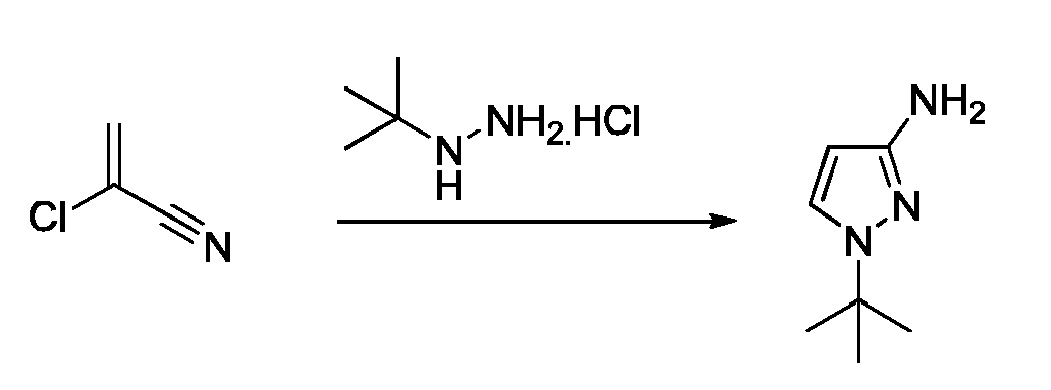
- Isopropyl hydrazine hydrochloride (1.42 g, 11.4 mmol) in water (25 mL) at 0 °C was treated sequentially with K2CO3 (1.57 g, 11.4 mmol), NaHCO3 (1.91 g, 22.9 mmol) and 2-chloroacrylonitile (1 g, 11.4 mmol) then warmed to ambient temperature and stirred for 12h. The reaction mixture was diluted with water (20 mL) and extracted with ethyl acetate (2 x 25 mL). The combined organics were washed with water (30 mL), brine (30 mL), dried (Na2SO4) and concentrated in vacuo to give the titled compound as a brown liquid (0.9 g, 60%). 1H NMR (400 MHz, DMSO-d6): δ = 7.34 (s, 1H), 5.35 (s, 1H), 4.51 (br.s., 2H), 1.40 (s, 9H). LCMS (m/z): 140.10 (M+1)+.
-

- 3-nitro-1H-pyrazole (1 g, 8.85 mmol) was dissolved in N,N-dimethylformamide (20 mL) and treated with potassium carbonate (1.47 g, 10.62 mmol) and bromocyclohexane (1.8 g, 10.62 mmol). The mixture was heated to 100 °C for 16 hours (or until completion) then cooled to ambient temperature diluted using water (100 mL) and extracted using ethyl acetate (2 x 75 mL). The combined organics were washed using water (100 mL), brine (100 mL), dried (Na2SO4) and concentrated in vacuo. The crude product was purified by column chromatography on silica gel using a gradient of 10% EtOAc-hexanes eluent to give 1-cyclohexyl-3-nitro-1H-pyrazole as a colourless liquid (1.3 g, 76%). 1H NMR (300 MHz, CDCl3) δ = 7.47 (d, J = 2.5 Hz, 1H), 6.88 (d, J = 2.5 Hz, 1H), 4.26 - 4.11 (m, 1H), 2.18 (m, 2H), 1.93 (m, 2H), 1.82 - 1.20 (m, 6H).
- In a 100 mL Parr shaker reaction vessel, a solution of 1,5-dimethyl-3-nitro-1H-pyrazole (0.65 g, 3.3 mmol) in MeOH (4 mL) and EtOAc (20 mL) was treated with 10% palladium on carbon (200 mg) under nitrogen atmosphere. The flask was evacuated then filled with hydrogen gas (60 psi) and stirred at ambient temperature for 12h. The reaction mixture was diluted with ethyl acetate (50 mL) and filtered through a bed of Celite. The filtrate was dried (Na2SO4) and concentrated in vacuo to give 1-cyclohexyl-1H-pyrazol-3-amine as a light brown solid (0.3 g 55%). 1H NMR (300 MHz, CDCl3) δ = 7.15 (d, J = 2.3 Hz, 1H), 5.56 (d, J = 2.3 Hz, 1H), 3.85 (m, 1H), 3.62 (s, 1H), 2.1 (m, 2H), 1.8 (m, 2H), 1.77 - 1.10 (m, 6H).
-

- Potassium tert-butoxide (11.9 g, 106.3 mmol) was dissolved in tBuOH (100mL) and the solution was heated to 100 °C. Phenyl hydrazine (5 g, 46.2 mmol) and 3-ethoxy acrylonitrile (4.5 g, 46.2 mmol) were sequentially added and heating continued for 16 h. The mixture was concentrated in vacuo. The residue obtained was partitioned between water (500 mL) and ethyl acetate (500 mL). The organic extract was washed with water (250 mL), brine (250 mL), dried (Na2SO4) and concentrated in vacuo. The crude product was purified by column chromatography on silica gel using 25% EtOAc-hexanes eluent to give 1-phenyl-1H-pyrazol-3-amine as a pale brown solid (3.5 g, 48%). 1H NMR (400 MHz, CDCl3): δ = 7.69 (s, 1H), 7.57 (d, J = 8.0 Hz, 2H), 7.41 (d, J= 8.0 Hz, 2H), 7.2 (t, J = 7.6 Hz, 1H), 5.85 (s, 1H), 3.83 (br.s., 2H). LCMS (m/z): 160.3 (M+1)+.
-

- A solution of 3-nitro-1H-pyrazole (1 g, 8.85 mmol) in THF (20 mL) was cooled to 0 °C and NaH (0.53 g, 13.27 mmol) was added. The suspension was stirred for 20 min then benzyl bromide (1.5 g, 8.85 mmol) was added drop-wise. The reaction was stirred until completion ∼6 h, diluted with saturated NaHCO3 solution (20 mL) and extracted with EtOAc (2 x 50 mL). The organics were washed with water (30 mL), brine (30 mL), dried (Na2SO4) and concentrated in vacuo to give 1-benzyl-3-nitro-1H-pyrazole as a white solid (1.5 g, 84%). 1H NMR (300 MHz, CDCl3): δ = 7.40-7.36 (m, 4H), 7.31-7.27 (m, 2H), 6.90 (d, J =2.7Hz, 1H), 5.37 (s, 2H). LCMS (m/z): 204.20 (M+1)+.
- A solution of 1-benzyl-3-nitro-1H-pyrazole (1.5 g, 7.39 mmol) in THF (20 mL) and MeOH (5 mL) was cooled to 0 °C. Zinc powder (2.4 g, 36.9 mmol) and NH4Cl solution (1.97g, 36.94 mmol; in 5 mL of water) was added. The resulting reaction mixture was heated at 70 °C for 12 h. The reaction mixture was cooled to ambient temperature, diluted with EtOAc (50 mL) and filtered through a bed of Celite. The filtrate was dried (Na2SO4) and concentrated in vacuo. The crude product was purified by column chromatography on silica gel using 50% EtOAc-hexanes eluent to give 1-benzyl-1H-pyrazol-3-amine as light brown liquid (0.85 g, 67%). 1H NMR (300 MHz, CDCl3): δ = 7.34-7.26 (m, 3H), 7.14-7.11 (m, 2H), 7.05 (d, J=2.4Hz, 1H), 5.59 (d, J=2.4Hz, 1H), 5.14(s, 2H). LCMS (m/z): 174.10 (M+1)+
-

- A solution of 3-nitro-1H-pyrazole (1 g, 8.85 mmol) in THF (20 mL) was cooled to 0°C and NaH (0.7 g, 17.7 mmol) was added. The suspension was stirred for 30 min then (1-bromoethyl)benzene (1.96 g, 10.6 mmol) was added drop-wise. The reaction was heated to 80 °C overnight or until completion, cooled to ambient temperature, diluted using water (40 mL) and extracted with EtOAc (2 x 50 mL). The organics were washed with water (30 mL), brine (30 mL), dried (Na2SO4) and concentrated in vacuo. The crude product was purified by column chromatography on silica gel using 20% EtOAc-hexanes eluent to give 3-nitro-1-(1-phenylethyl)-1H-pyrazole as a yellow liquid (1.2 g, 63%). 1H NMR (300 MHz, CDCl3) δ 7.46 - 7.18 (m, 6H), 6.88 (d, J = 2.5 Hz, 1H), 5.59 (q, J = 7.1 Hz, 1H), 1.96 (d, J = 7.1 Hz, 3H).
- A solution of 3-nitro-1-(1-phenylethyl)-1H-pyrazole (1 g, 4.6 mmol) in THF (20 mL) and MeOH (5 mL) was cooled to 0 °C. Zinc powder (1.49 g, 23.04 mmol) and NH4Cl solution (1.23 g, 23.04 mmol; in 5 mL of water) was added. The resulting reaction mixture was stirred for 30 mins then heated at 80 °C for 6 h. The reaction mixture was cooled to ambient temperature, diluted with EtOAc (50 mL) and filtered through a bed of Celite. The organic phase was washed using water (20 mL), brine (20 mL), dried (Na2SO4) and concentrated in vacuo. The crude product was purified by column chromatography on silica gel using 50% EtOAc-hexanes eluent to give 1-(1-phenylethyl)-1H-pyrazol-3-amine as a yellow liquid (0.85 g, 67%). 1H NMR (300 MHz, CDCl3) δ = 7.39 - 7.04 (m, 6H), 5.59 (d, J = 2.4 Hz, 1H), 5.35 (q, J = 7.1 Hz, 1H), 3.83 (s, 2H), 1.78 (d, J = 7.1 Hz, 3H).
-

- A solution of 3-nitro-1H-pyrazole (2 g, 17.7 mmol) in DMF (20 mL) was treated with 1-(2-chloroethyl)piperidine hydrochloride (4.8 g, 26.5 mmol) at ambient temperature. The solution was cooled to 0 °C, and treated with K2CO3 (6.1 g, 44.27 mmol) in portions over a period of 5 min. The resulting reaction mixture was stirred at ambient temperature for 4 h. The reaction mixture was diluted with water and extracted with ethyl acetate (2 x 40 mL). The combined organics were washed with water (40 mL), brine (40 mL), dried (Na2SO4) and concentrated in vacuo. The crude product was purified by column chromatography on silica gel using 25% EtOAc-hexanes eluent to give 1-(2-(3-nitro-1H-pyrazol-1-yl)ethyl)piperidine as a pale yellow solid (2.5 g, 64%). 1H NMR (400 MHz, CDCl3): δ = 7.60 (d, J = 2.4 Hz, 1H), 6.81 (d, J = 2.4 Hz, 1H), 4.29 (t, J = 6.4 Hz, 2H), 2.78 (t, J = 6.4 Hz, 2H), 2.41 (s, 4H), 1.57-1.53 (m, 4H), 1.45 (t, J = 6 Hz, 2H). LCMS (m/z): 225.10 (M+1)+.
- A solution of 1-(2-(3-nitro-1H-pyrazol-1-yl)ethyl)piperidine 3 (2.5 g, 11.16 mmol) in THF (20 mL) and MeOH (5 mL) was cooled to 0 °C. The solution was sequentially treated with zinc powder (3.6 g, 55.8 mmol) and aqueous NH4Cl (3 g, 55.8 mmol) solution then warmed to ambient temperature and stirred for 5 h. The reaction mixture was diluted with ethyl acetate (50 mL), filtered through a bed of Celite and concentrated in vacuo. The residue was diluted with ethyl acetate (60 mL) and washed with water (40 mL), brine (40 mL), dried (Na2SO4) and concentrated in vacuo to give 1-(2-(piperidin-1-yl)ethyl)-1H-pyrazol-3-amine as light yellow liquid (1.75 g, 81%). 1H NMR (400 MHz, DMSO-d6): δ = 7.28 (d, J = 2 Hz, 1H), 5.30 (s, J = 2 Hz, 1H), 4.50 (s, 2H), 3.90 (t, J = 6.8 Hz, 2H), 2.5-2.53 (m, 4H), 2.39-2.33 (m, 6H), 1.2 (s, 2H). LCMS (m/z): 195.10 (M+1)+.
-

- A solution of 5-methyl-3-nitro-1H-pyrazole (2 g, 15.7 mmol) in THF (20 mL) was cooled to 0 °C. NaH (0.7 g, 17.32 mmol) was added portion-wise over 10 min under nitrogen atmosphere. The resulting suspension was stirred for 10 min then treated with Mel (2.2 g, 15.7 mmol), warmed to ambient temperature and stirred for 4h. The reaction mixture was diluted with saturated NH4Cl solution (20 mL) and extracted with EtOAc (2 x 30 mL). The organics were washed with water (30 mL), brine (30 mL), dried (Na2SO4) and concentrated in vacuo to give 1 ,5-dimethyl-3-nitro-1H-pyrazole as a white solid (2 g, 91%). 1H NMR (300 MHz, CDCl3): δ = 6.71 (s, 1H), 3.87 (s, 3H), 2.34 (s, 3H).
- In a 100 mL Parr shaker reaction vessel, a solution of 1,5-dimethyl-3-nitro-1H-pyrazole (2 g, 14.18 mmol) in MeOH (4 mL) and EtOAc (20 mL) was treated with 10% palladium on carbon (400 mg) under nitrogen atmosphere. The flask was evacuated then filled with hydrogen gas (60 psi) and stirred at ambient temperature for 12h. The reaction mixture was diluted with ethyl acetate (50 mL) and filtered through a bed of Celite. The filtrate was dried (Na2SO4) and concentrated in vacuo to give 1 ,5-dimethyl-1H-pyrazol-3-amine as a light brown solid (1.36 g 87%). 1H NMR (400 MHz, DMSO-d6): δ = 5.19 (s, 1H), 4.33 (br.s., 2H), 3.43 (s, 3H), 2.07 (s, 3H). LCMS (m/z): 112.3 (M+1)+
-

- A solution of 1,1,1-triethoxyethane (20 g, 123 mmol) in DCM (250 mL) and pyridine (20.5g, 259 mmol) was cooled to 0 °C. A solution of trifluoroacetic anhydride (52 g, 246 mmol) in DCM (50 mL) was added drop-wise over a period of 30 min. The reaction mixture was warmed to ambient temperature, stirred for 12h, then diluted with sat. aq. NaHCO3 solution and extracted with DCM (2 x 250 mL). The combined organics were washed with water (20 mL), brine (20 mL), dried (Na2SO4) and concentrated in vacuo to give 4,4-diethoxy-1,1,1-trifluorobut-3-en-2-one as a pale brown liquid (20 g, 76%). 1H NMR (400 MHz, CDCl3): δ = 4.93 (s, 1H), 4.39 (q, J = 7.2 Hz, 2H), 4.18 (q, J = 7.2 Hz, 4H), 1.46-1.40 (m, 6H).
- A solution of 4,4-diethoxy-1,1,1-trifluorobut-3-en-2-one (10 g, 47.16 mmol) in acetonitrile (100 mL) was treated with aqueous NH3 solution (15 mL) at 0 °C then stirred at RT for 12 h. The reaction mixture was concentrated in vacuo then the residue was treated with water (250 mL) and extracted with DCM (2 x 250 mL). The combined organics were washed with water (250 mL), brine (250 mL), dried (Na2SO4) and concentrated in vacuo to give (E)-4-amino-4-ethoxy-1,1,1-trifluorobut-3-en-2-one as an off white solid (7.5 g, 87%). 1H NMR (300 MHz, CDCl3): δ = 5.6 (br.s., 1H), 4.17 (q, J = 7.2 Hz, 2H), 1.42 (t, J = 7.2 Hz, 3H).
- A solution of (E)-4-amino-4-ethoxy-1,1,1-trifluorobut-3-en-2-one (5 g, 27.3 mmol) in EtOH (30 mL) was treated with methylhydrazine sulphate (4.72 g, 32.8 mmol) and Et3N (4.1 g, 41.0 mmol) at ambient temperature. The resulting reaction mixture was heated at 85 °C for 12 h then cooled to ambient temperature and concentrated in vacuo. The residue obtained was diluted with sat. aq. NaHCO3 solution (250 mL) and extracted with EtOAc (2 x 250 mL). The combined organics were washed with water (250 mL), brine (250 mL), dried (Na2SO4) and concentrated in vacuo. The crude product was purified by column chromatography on silica gel using 20% EtOAc-hexanes eluent to give 1-methyl-5-(trifluoromethyl)-1H-pyrazol-3-amine as a pale brown liquid (0.17 g, 38%). 1H NMR (400 MHz, CDCl3): δ = 5.93 (s, 1H), 3.79 (s, 3H), 3.68 (br.s., 2H).
-

- A solution of 1-methyl-1H-pyrazol-3-amine (2g, 20.6 mmol,) in AcOH (50 mL) was treated with 2,5-hexane dione (4.9 g, 43.29 mmol) at ambient temperature under nitrogen atmosphere. The resulting reaction mixture was heated to 100 °C for 1 h then stirred at ambient temperature for 5 h. The reaction mixture was concentrated under reduced pressure and azeotroped with toluene. The crude product was purified by column chromatography on silica gel using 10% EtOAc-hexanes eluent to give 3-(2,5-dimethyl-1H-pyrrol-1-yl)-1-methyl-1H-pyrazole as a liquid (2.5 g, 69%). 1H NMR (300 MHz, CDCl3): δ = 7.39 (d, J= 2.1 Hz, 1H), 6.15 (d, J = 2.4 Hz, 1H), 5.84 (s, 2H), 3.92 (s, 3H), 2.10 (s, 6H).
- A solution of 3-(2,5-dimethyl-1H-pyrrol-1-yl)-1-methyl-1H-pyrazole (1 g, 5.71 mmol) in dry THF (10 mL) was cooled to -78 °C under nitrogen atmosphere, n-BuLi (1.6 M in hexanes, 4.4 mL, 6.86 mmol) was added drop-wise to the above solution over a period of 10 minutes then stirred at-78 °C for 1 h before treating with a solution of I2 (1.54g, 5.71 mmol) in THF (5 mL) at-78 °C stirring was continued at this temperature until completion (2 h). The reaction mixture was quenched with sat. aq. NH4Cl solution and extracted with ethyl acetate (2 x 25 mL). The combined organics were washed with water (20 mL), brine (20 mL), dried (Na2SO4) and concentrated in vacuo. The crude product was purified by column chromatography on silica gel using 50% EtOAc-hexanes eluent to give 3-(2,5-dimethyl-1H-pyrrol-1-yl)-5-iodo-1-methyl-1H-pyrazole as an off-white solid (0.75g, 43.6%). 1H NMR(400 MHz, CDCl3): δ = 6.33 (s, 1H), 5.84 (s, 2H), 3.95 (s, 3H), 2.09 (s, 6H).
- A solution of 3-(2,5-dimethyl-1H-pyrrol-1-yl)-5-iodo-1-methyl-1H-pyrazole (1g, 3.32 mmol) in DME:water (8:2, 10 mL) was treated with 4,4,5,5-tetramethyl-2-(prop-1-en-2-yl)-1,3,2-dioxaborolane (0.67g, 3.98 mmol) and Na2CO3 (0.52g, 4.98 mmol) at ambient temperature under nitrogen atmosphere. The resulting solution was degassed by purging with argon for 15 min then treated with Pd(PPh3)4 (190 mg, 0.166 mmol) under argon atmosphere. The resulting mixture was heated at 90 °C for 24 h then cooled to ambient temperature and concentrated in vacuo. The residue obtained was diluted with cold water (20 mL) and extracted with EtOAc (2 x 20 mL). The combined organics were washed with water (20 mL), brine (20 mL), dried (Na2SO4) and concentrated in vacuo. The crude product was purified by column chromatography on silica gel using 5% EtOAc-hexanes eluent to give 3-(2,5-dimethyl-1H-pyrrol-1-yl)-1-methyl-5-(prop-1-en-2-yl)-1H-pyrazole as a pale-yellow liquid (0.765 g, 92%). 1H NMR (300 MHz, CDCl3): δ = 6.08 (s, 1H), 5.84 (s, 2H), 5.39 (s, 1H), 5.23 (s, 1H), 3.92 (s, 3H), 2.12 (s, 9H).
- A solution of 3-(2,5-dimethyl-1H-pyrrol-1-yl)-1-methyl-5-(prop-1-en-2-yl)-1H-pyrazole (0.7 g, 3.25 mmol) in EtOH-H2O (8:2, 12 mL) was treated with NH2OH.HCl (2.26 g, 32.55 mmol) and KOH (1.8 g, 32.55 mmol). The resulting reaction mixture was heated at 100 °C for 48 h. The reaction mixture was cooled and concentrated in vacuo. The residue was treated with saturated NaHCO3 to give a solution of pH∼8 then extracted with EtOAc (2 x 50 mL). The combined organics were washed with water (20 mL), brine (20 mL), dried (Na2SO4) and concentrated in vacuo. The crude product was purified by column chromatography on silica gel using 100% EtOAc eluent to give 1-methyl-5-(prop-1-en-2-yl)-1H-pyrazol-3-amine as a light brown liquid (0.4 g, 91%). 1H NMR (400 MHz, CDCl3): δ = 5.54 (s, 1H), 5.27 (s, 1H), 5.08 (s, 1H), 3.71 (s, 3H), 2.41 (s, 2H), 1.92 (s, 3H).
-

- A solution of 3-nitro-1H-pyrazole-5-carboxylic acid (5 g, 31.8 mmol) in ethanol (50 mL) was treated with thionyl chloride (4.5 g, 38.2 mmol) drop wise over a period of 10 min at 0 °C under a nitrogen atmosphere. The resulting mixture was stirred at 80 °C for 6 h then cooled to ambient temperature and concentrated in vacuo. The residue obtained was basified to
pH 8 with saturated NaHCO3 solution before extracting with ethyl acetate (2 x 100 mL). The combined organics were washed with water (100 mL), brine (100 mL), dried (Na2SO4) and concentrated in vacuo. The crude product was triturated with diethyl ether, filtered and dried under reduced pressure to give ethyl 3-nitro-1H-pyrazole-5-carboxylate as a white solid (5g, 85%). 1H NMR (400 MHz, DMSO-d6): δ = 7.44 (s, 1H), 4.36 (q, J = 6.8 Hz, 2H), 1.33 (t, J = 7.2 Hz, 3H). LCMS (m/z): 184 (M-1)-. - Ethyl 3-nitro-1H-pyrazole-5-carboxylate (1 g, 5.4 mmol) was dissolved in DMF (10 mL) at ambient temperature and treated with K2CO3 (1.34 g, 9.7 mmol). The resulting mixture was cooled to 0 °C and methyl iodide (1.15 g, 8.1 mmol) was added drop-wise, the reaction mixture was sealed, allowed to warm to ambient temperature and stirred for 12 h. The reaction mixture was diluted with water (20 mL) and extracted with EtOAc (2 x 30 mL). The combined organics were washed with water (30 mL), brine (30 mL), dried (Na2SO4) and concentrated in vacuo. The crude product was purified by column chromatography on silica gel using 5% EtOAc-hexanes eluent to give ethyl 1-methyl-3-nitro-1H-pyrazole-5-carboxylate as a white solid (0.65 g, 61%). 1H NMR (400 MHz, DMSO-d 6) δ = 7.54 (s, J = 1.1 Hz, 1H), 4.35 (q, J = 7.1 Hz, 2H), 4.19 (d, J = 1.2 Hz, 3H), 1.33 (t, J = 7.1 Hz, 3H).
- Ethyl 1-methyl-3-nitro-1H-pyrazole-5-carboxylate (0.65 g, 3.3 mmol) was dissolved in THF (20 mL) and MeOH (5 mL) at 0 °C. Zinc powder (1.0 g, 16.3 mmol) and aqueous NH4Cl (0.87 g, 16.3 mmol) were added sequentially. The resulting reaction mixture was stirred at ambient temperature for 4h, then heated to 70 C for 1 hour. The solvents were removed in vacuo. The residue obtained was dissolved in EtOAc (30 mL) and filtered through a bed of Celite. The filtrate was washed with water (30 mL), brine (30 mL), dried (Na2SO4) and concentrated in vacuo to give ethyl 3-amino-1-methyl-1H-pyrazole-5-carboxylate as a white solid (0.5 g, 91%). 1H NMR (400 MHz, DMSO-d6) δ 5.95 (s, 1H), 4.24 (q, J = 7.1 Hz, 2H), 3.83 (s, 3H), 3.41 (s, 2H), 1.27 (t, J = 7.1 Hz, 4H).
-

- A solution of 3-nitro-1H-pyrazole-5-carboxylic acid (5 g, 31.8 mmol) in ethanol (50 mL) was treated with thionyl chloride (4.5 g, 38.2 mmol) drop wise over a period of 10 min at 0 °C under a nitrogen atmosphere. The resulting mixture was stirred at 80 °C for 6 h then cooled to ambient temperature and concentrated in vacuo. The residue obtained was basified to
pH 8 with saturated NaHCO3 solution before extracting with ethyl acetate (2 x 100 mL). The combined organics were washed with water (100 mL), brine (100 mL), dried (Na2SO4) and concentrated in vacuo. The crude product was triturated with diethyl ether, filtered and dried under reduced pressure to give ethyl 3-nitro-1 H-pyrazole-5-carboxylate as a white solid (5 g, 85%). 1H NMR (400 MHz, DMSO-d6): δ = 7.44 (s, 1H), 4.36 (q, J = 6.8 Hz, 2H), 1.33 (t, J = 7.2 Hz, 3H). LCMS (m/z): 184 (M-1)-. - Ethyl 3-nitro-1 H-pyrazole-5-carboxylate (2 g, 10.8 mmol) was dissolved in DMF (10 mL) at ambient temperature and treated with K2CO3 (3g, 21.6 mmol). The resulting mixture was cooled to 0 °C and benzyl bromide (2.7 g, 16.2 mmol) was added drop-wise, the reaction mixture was allowed to warm to ambient temperature and stirred for 2 h. The reaction mixture was diluted with water (20 mL) and extracted with EtOAc (2 x 30 mL). The combined organics were washed with water (30 mL), brine (30 mL), dried (Na2SO4) and concentrated in vacuo. The crude product was purified by column chromatography on silica gel using 5% EtOAc-hexanes eluent to give ethyl 1-benzyl-3-nitro-1H-pyrazole-5-carboxylate as a white solid (1.2 g, 40%). 1H NMR (400 MHz, CDCl3): δ = 7.44 (s, 1H), 7.34-7.31 (m, 5H), 5.83(s, 2H), 4.39 (q, J = 7.2 Hz, 2H), 1.38 (t, J = 7.2 Hz, 3H). LCMS (m/z): 276.15 (M+1)+.
- Ethyl 1-benzyl-3-nitro-1H-pyrazole-5-carboxylate (1.2 g, 4.36 mmol) was dissolved in THF (20 mL) and MeOH (5 mL) at 0 °C. Zinc powder (1.4 g, 21.8 mmol) and aqueous NH4Cl (1.16g, 21.8 mmol) were added sequentially. The resulting reaction mixture was stirred at ambient temperature for 4h, then concentrated in vacuo. The residue obtained was dissolved in EtOAc (30 mL) and filtered through a bed of Celite. The filtrate was washed with water (30 mL), brine (30 mL), dried (Na2SO4) and concentrated in vacuo to give ethyl 3-amino-1-benzyl-1H-pyrazole-5-carboxylate as a white solid (1 g, 94%). 1H NMR (300 MHz, DMSO-d6): δ = 7.30-7.19 (m, 3H), 7.11-7.08(m, 2H), 6.00 (s, 1H), 5.43 (s, 2H), 4.91 (s, 2H), 4.23 (q, J= 7.2 Hz, 2H), 1.24 (t, J= 7.2 Hz, 3H). LCMS (m/z): 245.9 (M+1)+.
-
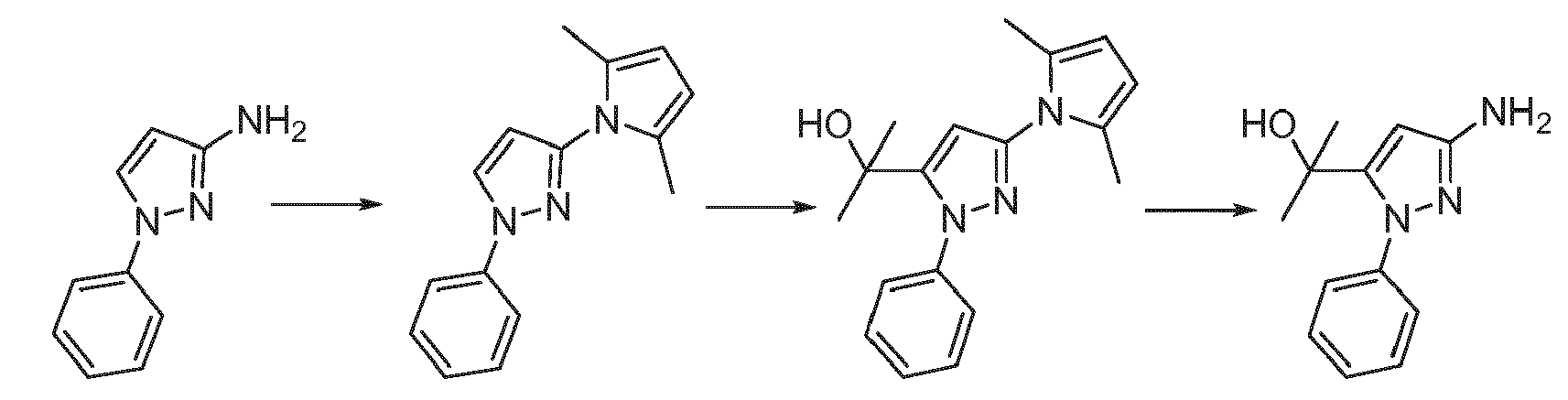
- A solution of 1-phenyl-1H-pyrazol-3-amine (3.5 g, 21.9 mmol) in acetic acid (20 mL) was treated with 2,5-hexadione (5.2 g, 45.9 mmol) and heated to 100 °C for 4 h. The mixture was cooled and concentrated in vacuo. The crude product was purified by column chromatography on silica gel using 5% EtOAc-hexanes eluent to give 3-(2,5-dimethyl-1H-pyrrol-1-yl)-1-phenyl-1H-pyrazole as a colorless liquid (2.8 g, 54%). 1H NMR (400 MHz, CDCl3): δ = 7.98 (s, 1H), 7.74 (d, J = 8.4 Hz, 2H), 7.49 (d, J = 8.4 Hz, 2H), 7.32 (t, J = 7.6 Hz, 1H), 6.39 (s, 1H), 5.9 (s, 2H), 2.19 (s, 6H).
- A solution of 3-(2,5-dimethyl-1H-pyrrol-1-yl)-1-phenyl-1H-pyrazole (2.7 g, 11.4 mmol) in THF (70 mL) at -78 °C was treated drop-wise with n-BuLi (1.6 M in THF, 10 mL, 23.91 mmol) over 10 min. The reaction mixture was stirred at -78 °C for 1.5 h then treated with freshly dried acetone (1 g, 17.0 mmol) and stirring continued at -78 °C for 1.5 h. The reaction mixture was quenched with sat. ammonium chloride (2 mL), concentrated in vacuo then partitioned between water (100 mL) and ethyl acetate (100 mL). The organic extract was washed with water (100 mL), brine (100 mL), dried (Na2SO4) and concentrated in vacuo. The crude product was purified by column chromatography on silica gel using 20% EtOAc-hexanes eluent to give 2-(3-(2,5-dimethyl-1H-pyrrol-1-yl)-1-phenyl-1H-pyrazol-5-yl)propan-2-ol as an off white solid (1.4 g, 42%). 1H NMR (400 MHz, CDCl3): δ = 7.57-7.56 (m, 2H), 7.47-7.46 (m, 3H), 6.23 (s, 1H), 5.85 (s, 2H), 2.19 (s, 6H), 1.52 (s, 6H). LCMS (m/z): 296.1 (M+1)+.
- In an 100 mL re-sealable reaction tube, 2-(3-(2,5-dimethyl-1H-pyrrol-1-yl)-1-phenyl-1H-pyrazol-5-yl)propan-2-ol (1.4 g, 4.74 mmol) was dissolved in EtOH-H2O (1:1, 50 mL) at ambient temperature. Hydroxyl amine hydrochloride (3.3 g, 47.45 mmol), and KOH (2.6 g, 47.45 mmol) were added sequentially and resulting reaction mixture was heated at 120 °C for 16 h. The reaction mixture was concentrated in vacuo, diluted with water (50 mL) and extracted with ethyl acetate (2 x 50 mL). The organic extracts were washed with water (50 mL), brine (50 mL), dried (Na2SO4) and concentrated in vacuo. The crude product was purified by column chromatography on silica gel using 50% EtOAc-hexanes eluent to give 2-(3-amino-1-phenyl-1H-pyrazol-5-yl)propan-2-ol as a colorless liquid (0.8 g, 78%). LCMS (m/z): 218.1 (M+1)+.
-

- N-Bromosuccinimide (1.02 g, 5.78 mmol) was added portion-wise to a solution of 1,2,3,5,6,7-hexahydro-s-indacen-4-amine (1 g, 5.78 mmol) in DCM (20 mL) at 0 °C. The solution was gradually warmed to ambient temperature and stirred for 12 h. The reaction mixture was diluted with sat. aqueous Na2S2O3 (50 mL) and extracted with DCM (2 x 25 mL). The combined organic extracts were washed with water (25 mL), brine (25 mL), dried (Na2SO4) and concentrated in vacuo. The crude product was purified by column chromatography on silica gel using 5% EtOAc-hexane eluent to give 8-bromo-1,2,3,5,6,7-hexahydro-s-indacen-4-amine as a brown solid (1.2 g, 83%). 1H NMR (300 MHz, CDCl3): δ = 3.45 (br.s., 2H), 2.92-2.88 (m, 4H), 2.81-2.77 (m, 4H), 2.16-2.09 (m, 4H); LC-MS 94% (210 nM); m/z 252.15 [M+H]+.
-

- N-Chlorosuccinimide (0.46 g, 3.46 mmol) was added portion-wise to a solution of 1,2,3,5,6,7-hexahydro-s-indacen-4-amine, 1 (0.6 g, 3.46 mmol) in CHCl3 (10 mL) at 0 °C. The solution was gradually warmed to ambient temperature and stirred for 10 h. The reaction mixture was diluted with sat. aqueous Na2S2O3 (50 mL) and extracted with DCM (2 x 25 mL). The combined organic extracts were washed with water (25 mL), brine (25 mL), dried (Na2SO4) and concentrated in vacuo. The crude product was purified by column chromatography on silica gel using 10% EtOAc-hexane eluent to give 8-chloro-1,2,3,5,6,7-hexahydro-s-indacen-4-amine as a brown solid (0.45 g, 63%). 1H NMR (300 MHz, CDCl3): δ = 2.94 (t, J = 7.2 Hz, 4H), 2.77 (t, J = 8.1 Hz, 4H), 2.18 (m, 4H); m/z 207.8 [M +H]+.
-

- 8-Bromo-1,2,3,5,6,7-hexahydro-s-indacen-4-amine (400 mg, 1.59 mmol) was dissolved in 1,4-dioxane-water (8:2, 10 mL) and the reaction flask purged with argon gas for 15 min. K2CO3 (650 mg, 4.78 mmol), methyl boronic acid (100 mg, 1.75 mmol) and Pd(PPh3)4 (100 mg, 0.079 mmol) were sequentially added under argon atmosphere. The resulting mixture was sealed and heated at 100 °C for 2 h. The reaction mixture was cooled, diluted with water and extracted using EtOAc (2 x 20 mL). The combined organic extracts were washed with water (25 mL), brine (25 mL), dried (Na2SO4) and concentrated in vacuo. The crude product was purified by column chromatography on silica gel using 5% EtOAc-hexane eluent to give 8-methyl-1,2,3,5,6,7-hexahydro-s-indacen-4-amine as a colorless liquid (0.220 g, 76%). 1H NMR (400 MHz, CDCl3): δ = 3.41 (br.s., 2H), 2.88-2.8 (m, J = 7.5 Hz, 4H), 2.75-2.67 (m, 4H), 2.18-2.09 (m, 7H); m/z 188.2 [M +H]+.
-

- A solution of 2,3-dihydrobenzofuran-5-carbaldehyde (10 g, 67.6 mmol), malonic acid (10.5 g, 101.35 mmol) and piperidine (0.47 mL, 4.73 mmol, 0.07 eq) was heated in pyridine (60 mL) at 100 °C for 5 h. The reaction mixture was acidified to ∼pH 3 using 1N HCl and the product extracted using 10% IPA/chloroform (2 x 250 mL). The combined organic extracts were washed with water (250 mL), brine (250 mL), dried (Na2SO4) and concentrated in vacuo. The crude product was triturated using diethyl ether to give (E)-3-(2,3-dihydrobenzofuran-5-yl)acrylic acid as a yellow solid (10 g, 78%). 1H NMR (300 MHz, Chloroform-d) δ = 7.73 (d, J = 15.9 Hz, 1H), 7.43 (s, 1H), 7.33 (dd, J = 8.1, 1.8 Hz, 1H), 6.80 (d, J = 8.1 Hz, 1H), 6.29 (d, J = 15.9 Hz, 1H), 4.64 (t, J = 8.7 Hz, 2H), 3.24 (t, J = 8.7 Hz, 2H).
- A solution of (E)-3-(2,3-dihydrobenzofuran-5-yl)acrylic acid (8.0 g, 42.1 mmol) in acetic acid (80 mL) and water (1.0 mL) was treated with 10% palladium on carbon (1.0 g) in two portions. The reaction mixture was stirred under an atmosphere or hydrogen gas (balloon) until completion, typically 4 h. The mixture was diluted using ethyl acetate (100 mL) and filtered through a bed of celite washing through with further ethyl acetate. The solvents were removed in vacuo and the crude residue azeotroped using toluene (2 x 50 mL) to give an off white solid which was triturated using diethyl ether (50 mL) to give 3-(2,3-dihydrobenzofuran-5-yl)propanoic acid as a white solid (6.5 g, 80%). 1H NMR (400 MHz, CDCl3) δ = 7.04 (s, 1H), 6.93 (d, J = 8.4, 1H), 6.7 (d, J = 8.4 Hz, 1H), 4.55 (t, J = 8.4 Hz, 2H), 3.18 (t, J = 8.4 Hz, 2H), 2.89 (t, J = 7.6 Hz, 2H), 2.64 (t, J = 7.6 Hz, 2H).
- A solution of 3-(2,3-dihydrobenzofuran-5-yl)propanoic acid (6.0 g, 31 mmol) in thionyl chloride (8 mL) was heated at 80 °C for 1 h. On completion of the reaction the thionyl chloride was removed in vacuo and the crude 3-(2,3-dihydrobenzofuran-5-yl)propanoyl chloride dissolved in
anhydrous 1,2-dichloroethane (30 mL). In a separate flask aluminium trichloride (2 g, 15 mmol) was added toanhydrous 1,2-dichloroethane (40 mL) at 0 °C followed by the acid chloride solution (10 mL) drop-wise over 5 min and the resulting solution was stirred for 30 min at 0 °C. A further portion of aluminium trichloride (3 g, 22.5 mmol) was added followed by drop-wise addition of the remaining acid chloride solution (20 mL) at 0 °C. The reaction mixture was stirred at room temperature for 1 h or until completion, diluted with water and extracted using EtOAc (2 x 50 mL). The combined organic extracts were washed with 1N HCl (50 mL), 1N NaOH (50 mL), water (25 mL), brine (25 mL), dried (Na2SO4) and concentrated in vacuo. The crude product was purified by column chromatography on silica gel using 10% EtOAc-hexanes eluent to give 2,3,5,6-tetrahydro-7H-indeno[5,6-b]furan-7-one as a white solid (3.8 g, 70%). 1H NMR (300 MHz, CD3OD) δ = 7.36 (s, 1H), 6.91 (s, 1H), 4.61 (t, J = 8.6 Hz, 3H), 3.26 (t, J = 8.6 Hz, 2H), 3.05 (t, J = 5.5 Hz, 3H), 2.68 (t, J = 5.5 Hz, 2H). 2,3,5,6-tetrahydro-7H-indeno[5,6-b]furan-7-one (1.5 g, 8.61 mmol) was dissolved in c.H2SO4 (6.0 mL) at 0 °C followed by drop-wise addition of f.HNO3:c.H2SO4, 1:1 (1.2 mL) stirring was continued at 0 °C for 1 h. The reaction mixture was added to ice-cold water (60 mL) and stirred for 10 min, the resulting light brown ppt was removed by filtration, washed with ice cold water (20 mL) and dried in vacuo to give 8-nitro-2,3,5,6-tetrahydro-7H-indeno[5,6-b]furan-7-one (1.2 g, 64%). 1H NMR (300 MHz, CD3OD) δ = 7.54 (s, 1H), 4.80 (t, J = 8.6 Hz, 2H), 3.42 (t, J = 8.6 Hz, 2H), 3.09 (t, J = 5.6 Hz, 2H), 2.74 (t, J = 5.6 Hz, 2H). - A solution of 8-nitro-2,3,5,6-tetrahydro-7H-indeno[5,6-b]furan-7-one (1.0 g, 4.57 mmol) in methanol (20 mL) 0 °C was treated with methane sulfonic acid (0.2 mL) followed by 20% palladium hydroxide (0.5 g). The reaction mixture was stirred under an atmosphere or hydrogen gas at 60 psi until completion. The reaction mixture was filtered through a bed of celite washing through with methanol (50 mL) and concentrated in vacuo. The residue was diluted with ethyl acetate (50 mL) and washed using sat. aq. NaHCO3 (50 mL), water (20 mL), brine (20 mL), dried (Na2SO4) and concentrated in vacuo. The crude product was purified by column chromatography on silica gel using 10% EtOAc-hexanes eluent to give 3,5,6,7-tetrahydro-2H-indeno[5,6-b]furan-8-amine as a white solid (0.5 g, 63%). 1H NMR (300 MHz, CDCl3) δ = 6.54 (s, 1H), 5.30 (s, 2H), 4.61 (t, J = 8.7 Hz, 2H), 3.21 (t, J = 8.7 Hz, 2H), 2.95 (t, J = 5.5 Hz, 2H), 2.66 (t, J = 5.5 Hz, 2H).
-

- 3,5,6,7-tetrahydro-2H-indeno[5,6-b]furan-8-amine (0.5 g, 2.86 mmol) and triethylamine (0.51 mL, 3.71 mmol) in dichloromethane (6.0 mL) at 0 °C was treated drop-wise with a solution of pivolyl chloride (0.41 g, 3.43 mmol) in DCM (4.0 mL). The reaction was stirred at ambient temperature for 6 h. The reaction mixture was added to sat. aq. NaHCO3 (30 mL), and extracted using DCM (2 x 25 mL). The combined organics were washed with water (25 mL), brine (25 mL), dried (Na2SO4) and concentrated in vacuo to give N-(3,5,6,7-tetrahydro-2H-indeno[5,6-b]furan-8-yl)pivalamide as a white solid (0.55 g, 74%). 1H NMR (300 MHz, Chloroform-d) δ = 6.91 (s, 1H), 4.56 (t, J = 8.6 Hz, 2H), 3.17 (t, J = 8.6 Hz, 2H), 2.83 (t, J = 7.4 Hz, 2H), 2.75 (t, J = 7.4 Hz, 2H), 2.04 (p, J = 7.4 Hz, 2H), 1.32 (s, 9H).
- N-(3,5,6,7-tetrahydro-2H-indeno[5,6-b]furan-8-yl)pivalamide (0.55 g, 2.12 mmol) in acetic acid (10 mL) was treated drop-wise with a solution of bromine (0.4 g, 2.55 mmol) in acetic acid (2.0 mL) and the reaction stirred at ambient temperature for 3 h. Ice cold water was added to the reaction mixture and stirred for 10 min. The resulting precipitate was removed by filtration, washed with water (20 mL) and dried in vacuo to give N-(4-bromo-3,5,6,7-tetrahydro-2H-indeno[5,6-b]furan-8-yl)pivalamide as a pale-brown solid (0.65 g, 91%). 1H NMR (300 MHz, Chloroform-d) δ = 6.94 (s, 1H), 4.61 (t, J = 8.7 Hz, 2H), 3.18 (t, J = 8.7 Hz, 2H), 2.92 - 2.80 (m, 4H), 2.06 (p, J = 7.4 Hz, 2H), 1.31 (s, 9H).
- N-(4-bromo-3,5,6,7-tetrahydro-2H-indeno[5,6-b]furan-8-yl)pivalamide (0.6 g, 1.78 mmol) in EtOH (10 mL) and cHCl (15 mL) was heated at 90 °C for 36 h. The solution was concentrated in vacuo then basified using aq NH4OH solution. The aqueous phase was extracted using ethyl acetate (2 x 20 mL) and the combined organics dried (Na2SO4) and concentrated in vacuo to give 4-bromo-3,5,6,7-tetrahydro-2H-indeno[5,6-b]furan-8-amine as a brown solid (0.3 g, 67%). 1H NMR (400 MHz, Chloroform-d) δ = 4.61 (t, J = 8.6 Hz, 2H), 3.49 (s, 2H), 3.17 (t, J = 8.6 Hz, 2H), 2.84 (t, J = 7.4 Hz, 2H), 2.78 (t, J = 7.4 Hz, 2H), 2.12 (p, J = 7.4 Hz, 2H).
-

- 3,5,6,7-tetrahydro-2H-indeno[5,6-b]furan-8-amine (0.5 g, 1.98 mmol) in ethanol (10 mL) and acetic acid (1.5 mL) was treated with a solution of sodium nitrate (1.3 g, 19.8 mmol) in water (3.0 mL) and the reaction stirred at ambient temperature for 4h. The ethanol was removed in vacuo then the residue diluted with water (30 mL), extracted using 10% IPA/chloroform (2 x 25 mL), dried (Na2SO4) and concentrated in vacuo.. The crude product was purified by column chromatography on silica gel using 5% EtOAc-hexanes eluent to give 4-bromo-3,5,6,7-tetrahydro-2H-indeno[5,6-b]furan as a yellow solid (0.28 g, 60%).
- 4-bromo-3,5,6,7-tetrahydro-2H-indeno[5,6-b]furan (0.28 g, 1.18 mmol) in DMSO (10 mL) was treated with copper iodide (0.22 g, 1.18 mmol), L-proline (0.21 g, 1.88 mmol) and sodium azide (0.19 g, 2.94 mmol). The reaction mixture was heated in a sealed tube at 135 °C for 36 h. The reaction mixture was cooled, diluted with water and extracted using EtOAc (2 x 25 mL). The combined organic extracts were washed with water (25 mL), brine (25 mL), dried (Na2SO4) and concentrated in vacuo. The crude product was purified by column chromatography on silica gel using 10% EtOAc-hexanes eluent to give 3,5,6,7-tetrahydro-2H-indeno[5,6-b]furan-4-amine as a grey solid (0.17 g, 85%). 1H NMR (300 MHz, Chloroform-d) δ = 6.21 (s, 1H), 4.59 (t, J = 8.5 Hz, 2H), 3.51 (s, 1H), 2.98 (t, J = 8.5 Hz, 2H), 2.83 (t, J = 7.5 Hz, 2H), 2.64 (t, J = 7.5 Hz, 2H), 2.10 (p, J = 7.5 Hz, 2H).
-

- 2,3,6,7-tetrahydrobenzo[1,2-b:4,5-b']difuran-4-carboxylic acid (0.8 g, 3.88 mmol), 2, 3-dichloro-5,6-dicyanobenzoquinone (2.64 g, 11.65 mmol) in anhydrous dioxane (20 mL) was heated in a sealed tube at 120°C for 18 h. The reaction mixture was cooled to room temperature and sat. aq. Na2S2O3 (30 mL) added before extraction with ethyl acetate (2 x 25 mL). The combined organics dried (Na2SO4) and concentrated in vacuo to give the crude benzo[1,2-b:4,5-b']difuran-4-carboxylic acid (1.5 g). The crude acid (1.5 g), triethylamine (2.05 mL) and diphenylphosphoryl azide (4.08 g, 14.85 mmol) in tertiary butanol (20 mL) was heated in a sealed tube at 90 °C for 12 h. The solution was cooled to room temperature, diluted with water (50 mL) and extracted using EtOAc (2 x 50 mL). The combined organic extracts were washed with water (25 mL), brine (25 mL), dried (Na2SO4) and concentrated in vacuo. The crude product was purified by column chromatography on silica gel using 10% EtOAc-hexanes eluent to give tert-butyl benzo[1,2-b:4,5-b']difuran-4-ylcarbamate (0.75 g) with minor impurities from the phosphine reagent, the product was dissolved in DCM (10 mL) and TFA (3.0 mL) added drop-wise over 5 min at 0°C. The reaction was stirred at ambient temperature for 2 h then added carefully to sat. aq. NaHCO3 (50 mL). The aqueous phase was extracted using DCM (2 x 30 mL) and the combined organic extracts were washed with water (25 mL), brine (25 mL), dried (Na2SO4) and concentrated in vacuo. The crude product was purified by column chromatography on silica gel using 10% EtOAc-hexanes eluent to give benzo[1,2-b:4,5-b']difuran-4-amine as an off-white solid (0.2 g, 30% over three steps). 1H NMR (400 MHz, CDCl3): δ = 7.6 (d, J = 2.2 Hz, 1H), 7.53 (d, J = 2.2 Hz, 1H), 7.12 (s, 1H), 6.78 (m, 2H), 4.17 (br.s., 1H).
-

- 2,6-Diisopropylaniline (5.0 g, 28.2 mmol) in DMF (100 mL) was treated with N-chlorosuccinimide (3.97 g, 29.7 mmol) and the reaction mixture stirred at room temperature overnight. The solution was poured onto water (500 mL) and extracted using diethyl ether (2 x 150 mL). The combined organics were washed with water (2 x 200 mL), brine (200 mL), dried (MgSO4) and concentrated in vacuo. The product was purified by short path distillation to give the titled compound as a red oil (3.0 g, 50%). 1H NMR (600 MHz, DMSO-d 6 ): δ = 6.84 (s, 2H), 4.75 (s, 2H), 3.01 (hept, J = 6.8 Hz, 2H), 1.13 (d, J = 6.8 Hz, 12H). 13C NMR (151 MHz, DMSO-d 6): δ = 141.1, 133.8, 122.5, 120.5, 27.2, 22.8.
-

- In a 50 mL re-sealable reaction tube, a solution of 2,6-dibromo-4-chloroaniline (0.25 g, 0.88 mmol) and cyclopropyl boronic acid (0.22 g, 2.62 mmol) along with K3PO4 (0.74 g, 3.50 mmol) was dissolved in toluene:water (10 mL:1 mL). The resulting solution was degassed by purging with nitrogen gas for 5 minutes. Pd(OAc)2 (20mg, 0.087 mmol) and tricyclohexylphospine (25 mg, 0.087 mmol) were added and the solution was purged with nitrogen gas for another 5 minutes. The resulting mixture was stirred at 100 °C for 12 h. Upon completion of reaction the mixture was diluted with water (25 mL), extracted with EtOAc (2 x 25 mL) and the combined organic extract washed with water, brine, dried (Na2SO4) and concentrated in vacuo. The crude product was purified by column chromatography on silica gel (60-120 mesh) using 5% EtOAc-hexanes eluant to give 4-chloro-2,6-dicyclopropylaniline (150 mg, 83%) as brown liquid. 1H NMR (300 MHz, DMSO-d 6): δ = 6.69 (s, 2H), 4.98 (s, 2H), 1.74-1.64 (m, 2H), 0.90-0.84 (m, 4H), 0.52 -0.47 (m, 4H). LCMS (m/z): 208.30 [M+H]+.
-

- A solution of 2,6-dibromo-4-chloroaniline (0.5 g, 1.75 mmol) and ethyl boronic acid (0.4 g, 5.25 mmol) in toluene (15 mL) and water (4 mL) was treated with K3PO4 (1.5 g, 7.0 mmol) at RT under argon atmosphere. Argon gas was used to purge the solution for 5 minutes before treating with Pd(OAc)2 (40 mg, 0.175 mmol) and tricyclohexyl phospine (50 mg, 0.175 mmol). The reaction mixture was again purged with argon for 5 minutes. The resulting mixture was stirred at 100 °C for 12 h. Upon completion the reaction mixture diluted with water extracted with EtOAc (2 x 25 mL) and the combined organic extract washed with water, brine, dried (Na2SO4) and concentrated in vacuo. The crude product was purified by column chromatography on silica gel (60-120 mesh) using 8% EtOAc-hexanes eluant to give 4-chloro-2,6-dicyclopropylaniline (100 mg, 31 %) as yellow liquid. 1H NMR (300 MHz, CDCl3): δ = 6.94 (s, 2H), 3.61 (s, 2H), 2.53 (q, J = 7.5 Hz, 4H), 1.27 (t, J = 7.5 Hz, 6H). LCMS (m/z): 184.00 [M+H]+.
-

- Synthesis of 2,3,6,7-tetrahydrobenzo[1 ,2-b:4,5-b']difuran-4-carboxylic acid was carried out from hydroquinone using procedures detailed by Monte et.al. J.Med.Chem. 1996, 39, 2953-2961 to give the 2,3,6,7-tetrahydrobenzo[1,2-b:4,5-b']difuran-4-carbaldehyde as a bright yellow solid; 1H NMR (400 MHz, CDCl3): δ = 10.27 (s, 1H), 6.87 (s, 1H), 4.67 (t, J = 8.8 Hz, 2H), 4.59 (t, J = 8.8 Hz, 2H), 4.59 (t, J = 8.8 Hz, 2H), 3.46 (t, J = 8.8 Hz, 2H), 3.18 (t, J = 8.8 Hz, 2H).
- The aldehyde (0.68 g, 3.58 mmol) was oxidized using silver (I) oxide (1.5 eq.) in 5% aqueous sodium hydroxide at rt for 20 days. The crude reaction mixture was filtered through celite, extracted using diethyl ether (2 x 50 mL) to remove unreacted aldehyde then the aqueous phase was acidified to
pH 1 using 3.0 M aqueous HCl drop-wise at 0 °C. The product was extracted using dichloromethane (2 x 50 mL) and the combined organics washed using brine (50 mL), dried (MgSO4) and concentrated in vacuo to give 2,3,6,7-tetrahydrobenzo[1,2-b:4,5-b']difuran-4-carboxylic acid as a white solid (0.44 g; 60%). - Alternatively, the aldehyde (0.5 g, 2.77 mmol) in acetone (5.0 mL) was treated with sulfamic acid (0.4 g, 4.17 mmol) in two portions at 0 °C. After 2 min a solution of sodium chlorite (0.32 g, 3.6 mmol) in water (1.0 mL) was added drop-wise and stirring continued at 0 °C for 4 h. The reaction mixture was diluted with water (20 mL) and extracted using 10% IPA/chloroform (2 x 20 mL). The combined organics were washed with water (25 mL), brine (25 mL), dried (Na2SO4) and concentrated in vacuo. The crude solid was triturated with diethyl ether to give 2,3,6,7-tetrahydrobenzo[1,2-b:4,5-b']difuran-4-carboxylic acid (0.4 g; 70%). 1H NMR (400 MHz, DMSO-d6): δ = 6.86 (s, 1H), 4.52 (t, J = 8.8 Hz, 2H), 4.47 (t, J = 8.8 Hz, 2H), 3.30 (t, J = 8.8 Hz, 2H), 3.10 (t, J = 8.8 Hz, 2H). 13C (100 MHz, DMSO-d6): δ = 166.4, 154.2, 153.9, 128.9, 127.2, 111.4, 110.43, 71.9, 71.6, 31.5, 29.5.
-

- 4-lsocyanato-1,2,3,5,6,7-hexahydro-s-indacene (prepared using general method A2) and thiazole-2-sulfonamide were used in general method C2 to give the titled compound as a white solid (8 mg, 20%). 1H NMR (400 MHz, CD3OD): δ = 7.02 (d, 1H, J = 4.0 Hz), 6.99 (s, 1H), 6.60 (d, 1H, J = 4.0 Hz), 2.88 (t, 4H, J = 8.0 Hz), 2.76 (t, 4H, J = 8.0 Hz), 2.08-2.02 (m, 4H); 13C NMR (100 MHz, CD3OD): δ = 169.6, 144.2, 144.1, 137.7, 137.5, 132.4, 118.1, 106.9, 32.4, 29.9, 25.2.
-

- 4-Isocyanato-1,2,3,5,6,7-hexahydro-s-indacene (prepared using general method A2) and 2-methylthiazole-5-sulfonamide were used in general method C3 to give the titled compound as a white solid (35 mg, 65%); 1H NMR (600 MHz, DMSO-d 6) δ = 7.73 (s, 1H), 7.53 (s, 1H), 6.78 (s, 1H), 2.75 (t, J = 7.4 Hz, 4H), 2.66 (t, J = 7.4 Hz, 4H), 2.59 (s, 3H), 1.93-1.88 (m, 4H); 13C NMR (150 MHz, DMSO-d 6): 166.8, 158.3, 143.9, 142.0, 141.4, 136.6, 132.3, 115.5, 32.5, 30.4, 25.0, 18.6; LCMS Purity: >95%; LCMS (m/z): 378 [M+H]+; HRMS calculated for C17H18N3O3S2 [M-H]+ 376.0795, found 376.0791.
-

- 4-Isocyanato-8-methyl-1,2,3,5,6,7-hexanydro-s-indacene (prepared using general method A1) and 1-benzyl-1H-1,2,4-triazole-3-sulfonamide were used in general method C3 to give the titled compound as a white solid (40 mg, 15%) 1H NMR (400 MHz, DMSO-d6): δ = 8.9 (s, 1H), 8.0 (s, 1H), 7.35-7.28 (m, 5H), 6.90 (s, 1H), 5.48 (s, 2H), 2.77 (t, J = 7.2 Hz, 4H), 2.59 (t, J = 7.2 Hz, 4H), 1.95-1.90 (m, 4H). LCMS (m/z): 438.10 (M +1)+ 95.84% (210 nm), 97.84% (254 nm). HPLC: 95.99% (210nm), 95.31% (254nm).
-

- 4-Isocyanato-1,2,3,5,6,7-hexahydro-s-indacene (prepared using general method A2) and 4H-1,2,4-triazole-3-sulfonamide were used in general method C3 to give the titled compound as a white solid (31 mg, 62%); 1H NMR (600 MHz, DMSO-d 6) δ = 9.83 (bs, 1H), 7.99 (s, 1H), 7.62 (s, 1H), 6.77 (s, 1H), 2.73 (t, J = 7.4 Hz, 4H), 2.64 (t, J = 7.4 Hz, 4H), 1.91-1.86 (m, 4H); 13C NMR (150 MHz, DMSO-d 6): 159.2, 149.8, 148.7, 142.5, 137.2, 132.8, 116.1, 33.0, 30.9, 25.6; LCMS Purity: >95%; LCMS (m/z): 348 [M+H]+; HRMS calculated for C15H16N5O3S1 [M-H]- 346.0979, found 346.0983.
-

- 1,2,3,5,6,7-hexahydro-s-indacen-4-amine, 7 (100 mg, 0.578 mmol) was dissolved in anhydrous THF (5 mL) and treated with Et3N (70 mg, 0.693 mmol) at RT. The solution was treated with triphosgene (70 mg, 0.231 mmol) and resulting mixture was stirred at 70 °C for 3h. The reaction mixture was concentrated in vacuo. The residue obtained was stirred with n-pentane (20 mL) for 10 min and filtered through celite. The filtrate was concentrated in vacuo to give isocyanate as a white solid. In another 50 mL round bottom flask, 1-isopropyl-1H-1,2,3-triazole-4-sulfonamide (95 mg, 0.50 mmol) was dissolved in anhydrous THF (5 mL) and treated carefully with NaH (42 mg, 1.05 mmol) at 0 °C under nitrogen. It was stirred at RT for 45 minutes and treated with aforementioned solution of isocyanate in THF under nitrogen. The resulting reaction mixture was stirred at RT for 5 h. Upon completion (TLC, 70% ethyl acetate-hexanes, Rf, 0.3), the reaction mixture was diluted with saturated NH4Cl solution and extracted with EtOAc (2 x 25 mL). The combined organic extract was washed with water, brine, dried (Na2SO4) and concentrated in vacuo. The crude product was purified by reverse phase preparative HPLC [column: Gemini NX C18 (21.5 mm x 150 mm particle size 5µm); flow: 15 mL/min; eluent: 10 mM ammonium bicarbonate in water (A) & MeCN (B); gradient: T/% B= 0/10, 2/20, 8/65]. The fractions were lyophilized to give N-((1,2,3,5,6,7-hexahydro-s-indacen-4-yl)carbamoyl)-1-isopropyl-1H-1,2,3-triazole-4-sulfonamide (25 mg, 12%), as a white solid. 1H NMR (400 MHz, DMSO-d 6): δ = 8.75 (s, 1H), 7.91 (s, 1H), 6.89 (s, 1H), 4.9 (m, 1H), 2.79 (t, J = 7.2 Hz, 4H), 2.60 (t, J = 7.2 Hz, 4H), 1.96-1.89 (m, 4H), 1.5 (d, J=6.8 Hz, 6H). LCMS (m/z): 390.10 [M+H]+ ; 100% (210 nm),100% (254 nm). HPLC: 96.05% (210nm), 96.13% (254nm). HRMS calculated for C18H22N5O3S1 [M-H]- 388.1449, found 388.1457.
-

- 4-Isocyanato-8-methyl-1,2,3,5,6,7-hexahydro-s-indacene (prepared using general method A2) and 1-methyl-1H-pyrazole-5-sulfonamide were used in general method C2 to give the titled compound as a white solid (8 mg) 20%. 1H NMR (400 MHz, DMSO-d 6 ): δ = 7.95 (bs, 1H), 7.45 (s, 1H), 6.88 (s, 1H), 6.66 (s, 1H), 4.02 (s, 3H), 2.77 (t, J = 16 Hz, 4H), 2.60 (t, J = 16 Hz, 4H), 1.96-1.88 (m,4H). 13C NMR (150 MHz, DMSO-d6): δ = 143.1, 142.9, 137.2, 125.2, 117.4, 110.0, 109.0, 108.7, 38.6, 33.0, 30.7, 25.5; LCMS Purity: >95%; LCMS (m/z): 361 [M +H]+; HRMS calculated for C17H20N4O3S (M+H)+, 361.13289, found 361.13213.
-
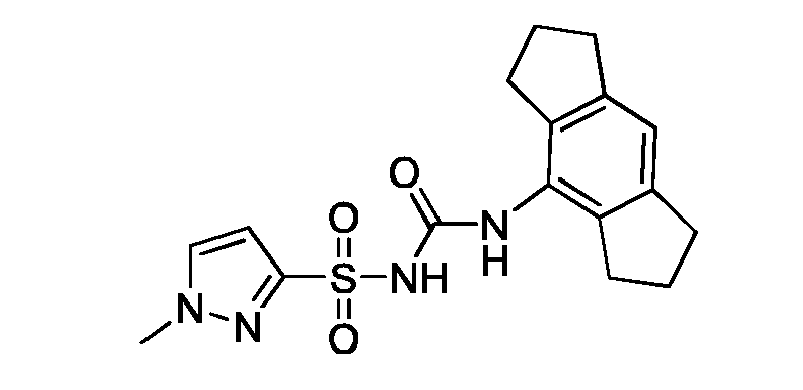
- 4-Isocyanato-8-methyl-1,2,3,5,6,7-hexahydro-s-indacene (prepared using general method A1) and 1-methyl-1H-pyrazole-3-sulfonamide were used in general method C1 to give the titled compound as a white solid (40 mg, 8%). 1H NMR (400 MHz, DMSO-d6): δ = 10.8 (brs,1H), 8.02 (s, 1H), 7.86 (s, 1H), 6.92 (s, 1H), 6.69 (s, 1H), 3.91(s, 3H), 2.80 (t, J= 7.2 Hz, 4H), 2.62 (t, J= 7.2 Hz, 4H), 1.96 (t, J= 7.2 Hz ,4H). LCMS (m/z): 383.10 (M +Na)+; 96.00% (210 nm), 93.44% (254 nm). HPLC: 97.86% (210nm), 97.44% (254nm).
-

- 4-Isocyanato-1,2,3,5,6,7-hexahydro-s-indacene (prepared using general method A1) and 1-(trifluoromethyl)-1H-pyrazole-3-sulfonamide were used in general method C2 to give the titled compound as a white solid (5 mg, 1 %). 1H NMR (400 MHz, CD3OD) δ = 8.28 (d, J= 2.8 Hz, 1H), 6.96 (d, J = 2.8, 1H), 6.91 (s, 1H), 2.84 (t, J = 7.4 Hz, 4H), 2.75 (t, J = 7.4 Hz, 4H), 2.03 (m, J = 7.4 Hz, 4H).
-

- 4-Isocyanato-8-methyl-1,2,3,5,6,7-hexahydro-s-indacene (prepared using general method A1) and 1-isopropyl-1H-pyrazole-3-sulfonamide were used in general method C1 to give the titled compound as an off-white solid (40 mg, 9%). 1H NMR (400 MHz, DMSO-d6): δ = 10.92 (s, 1H), 8.02 (s, 1H), 8.0 (s, 1H), 6.94 (s, 1H), 6.74 (s, 1H), 4.67-4.59 (m, 1H), 2.78 (t, J = 7.2 Hz, 4H), 2.58 (t, J = 7.2 Hz, 4H), 1.95-1.91 (m, 4H), 1.44 (d, J=6.8 Hz, 6H). LCMS (m/z): 387.1 (M-1)-; 97.14% (210 nm), 95.11 % (254 nm). HPLC: 95.57% (210nm), 93.53% (254 nm).
-

- 4-Isocyanato-8-methyl-1,2,3,5,6,7-hexahydro-s-indacene (prepared using general method A1) and 1-isopropyl-1H-pyrazole-4-sulfonamide were used in general method C3 to give the titled compound as a white solid (40 mg, 10%) 1H NMR (400 MHz, DMSO-d6): δ = 10.6 (s, 1H), 8.44 (s, 1H), 8.05 (s, 1H), 7.86 (s, 1H), 6.94 (s, 1H), 4.63-4.57 (m, 1H), 2.80 (t, J = 7.2 Hz, 4H), 2.57 (t, J = 7.6 Hz, 4H), 1.94-1.89 (m, 4H), 1.42 (d, J = 6.8 Hz 6H). LCMS (m/z): 389.20 (M +1)+; 97.25% (210 nm), 94.22% (254 nm). HPLC: 97.13% (210nm), 95.06% (254nm).
-

- 4-Isocyanato-8-methyl-1,2,3,5,6,7-hexahydro-s-indacene (prepared using general method A1) and 1-cyclopropyl-1H-pyrazole-3-sulfonamide were used in general method C3 to give the titled compound as a white solid (20 mg, 6%). 1H NMR (400 MHz, DMSO-d 6) δ = 7.83 (s, 1H), 7.8 (s, 1H), 6.84 (s, 1H), 6.48 (s, 1H), 3.81 - 3.71 (m, 1H), 2.77 (t, J = 7.4 Hz, 4H), 2.64 (t, J = 7.4 Hz, 4H), 2.02 - 1.86 (m, 4H), 1.09 - 0.93 (m, 4H).
-

- 4-Isocyanato-8-methyl-1,2,3,5,6,7-hexahydro-s-indacene (prepared using general method A1) and 1-(tert-butyl)-1H-pyrazole-3-sulfonamide were used in general method C3 to give the titled compound as a pale yellow solid (120 mg, 51%). 1H NMR (400 MHz, DMSO-d6): δ = 10.85 (br.s., 1H), 7.95 (s, 1H), 7.88 (br.s., 1H), 6.88 (s, 1H), 6.63 (s, 1H), 2.79 (t, J = 7.2 Hz, 4H), 2.61 (t, J = 7.2 Hz, 4H), 1.96 (m, 4H), 1.55 (s, 9H). LCMS (m/z): 403.15 (M +1)+; 97.86% (210 nm), 96.50% (254 nm). HPLC: 96.45% (210nm), 95.89% (254nm).
-
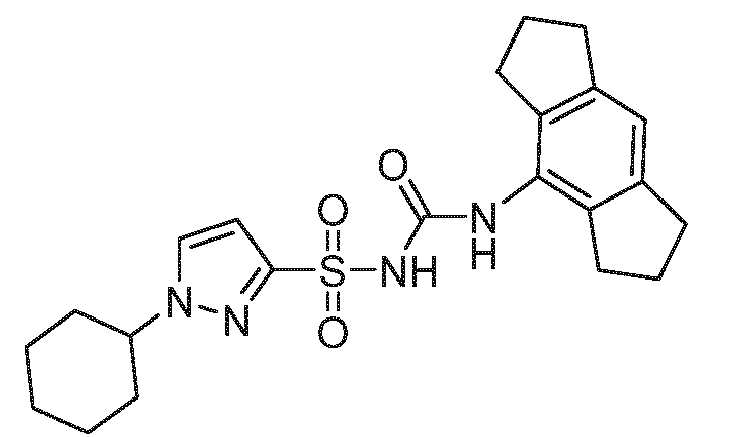
- 4-Isocyanato-8-methyl-1,2,3,5,6,7-hexahydro-s-indacene (prepared using general method A1) and 1-cyclohexyl-1H-pyrazole-3-sulfonamide were used in general method C3 to give the titled compound as a white solid (20 mg, 6%). 1H NMR (400 MHz, DMSO-d 6) δ = 10.8 (s, 1H), 8.03 (s, 1H), 7.99 (d, J = 2.4, 1H), 6.95 (s, 1H), 6.75 (d, J = 2.4 Hz, 1H), 4.33 - 4.20 (m, 1H), 2.79 (t, J = 7.4 Hz, 4H), 2.58 (t, J = 7.4 Hz, 4H), 2.05 - 1.88 (m, 6H), 1.86 - 1.63 (m, 6H), 1.48 - 1.33 (m, 2H).
-

- 4-Isocyanato-8-methyl-1,2,3,5,6,7-hexahydro-s-indacene (prepared using general method A1) and 1-phenyl-1H-pyrazole-3-sulfonamide were used in general method C1 to give the titled compound as an off-white solid (110 mg, 27%). 1H NMR (400 MHz, DMSO-d6): δ = 10.92 (s, 1H), 8.61 (d, J = 2.4 Hz, 1H), 7.95 (br.s., 1H), 7.86 (d, J = 8.4 Hz, 2H), 7.56 (t, J = 7.6 Hz, 2H), 7.41 (t, J = 7.2 Hz, 1H), 6.9 (d, J = 2.0 Hz, 1H), 6.86 (s, 1H), 2.77 (t, J = 7.2 Hz, 4H), 2.62 (t, J = 7.2 Hz, 4H), 1.91-1.83 (m, 4H). LCMS (m/z): 421.05 (M -1)-; 96.62% (210 nm), 95.12% (254 nm). HPLC: 95.2% (210 nm), 95.77% (254 nm).
-
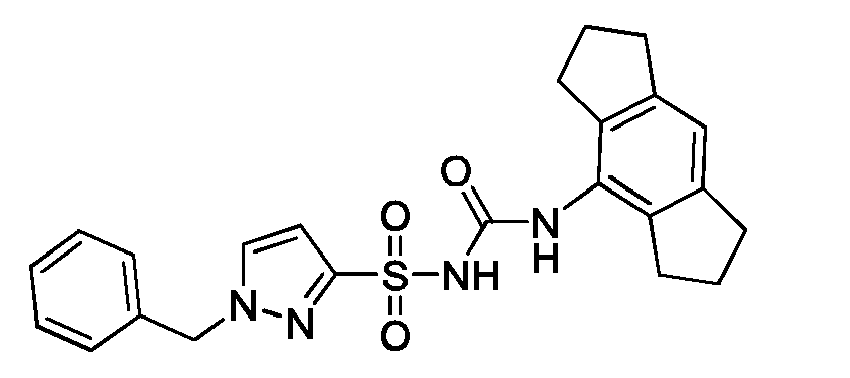
- 4-Isocyanato-8-methyl-1,2,3,5,6,7-hexahydro-s-indacene (prepared using general method A1) and, 1-benzyl-1H-pyrazole-3-sulfonamide were used in general method C3 to give the titled compound as a white solid (85 mg, 34%). 1H NMR (400 MHz, DMSO-d6): δ = 10.85 (s, 1H), 8.05 (d, J= 2.4 Hz, 1H), 7.99 (s, 1H), 7.32-7.31 (m, 3H), 7.24-7.22(m, 2H), 6.93 (s, 1H), 6.78 (d, J = 2.4 Hz, 1H), 5.44 (s, 2H), 2.80 (t, J = 7.6 Hz, 4H), 2.57 (t, J = 7.2 Hz, 4H), 1.96 (m, 4H). LCMS (m/z): 437.15 (M +1)+; 97.70% (210 nm), 96.86% (254 nm). HPLC: 98.05% (210 nm), 97.56% (254 nm).
-

- 4-Isocyanato-8-methyl-1,2,3,5,6,7-hexahydro-s-indacene (prepared using general method A1) and, 1-(1-phenylethyl)-1H-pyrazole-3-sulfonamide were used in general method C3 to give the titled compound as a white solid (0.13 g, 38%). 1H NMR (400 MHz, DMSO-d 6) δ = 7.94 (d, J = 2.4 Hz, 1H), 7.80 (s, 1H), 7.34 - 7.18 (m, 5H), 6.85 (s, 1H), 6.62 (d, J = 2.3 Hz, 1H), 5.68 (q, J = 7.0 Hz, 1H), 2.76 (t, J = 7.4 Hz, 4H), 2.58 (t, J = 7.4 Hz, 4H), 1.90 (p, J = 7.4 Hz, 4H), 1.8 (d, J 7.1 Hz, 3H).
-

- 4-Isocyanato-8-methyl-1,2,3,5,6,7-hexahydro-s-indacene (prepared using general method A1) and, 1-(2-(piperidin-1-yl)ethyl)-1H-pyrazole-3-sulfonamide were used in general method C3 to give the titled compound as a white solid (110 mg, 25%). 1H NMR (400 MHz, CD3OD): δ = 7.76 (d, J = 2.4 Hz, 1H), 6.91 (s, 1H), 6.73 (d, J= 2.4 Hz 1H), 4.55 (t, J= 6.4 Hz, 2H), 3.41 (t, J= 6.0Hz, 2H), 3.02 (s, 4H), 2.86 (t, J=7.2 Hz, 4H), 2.78 (t, J=7.2 Hz, 4H), 2.06-1.99 (m, 4H), 1.74-1.70 (m, 4H), 1.51 (d, J= 5.2 Hz ,2H). LCMS (m/z): 458.20 (M+1)+; 100% (210 nm), 100% (254 nm). HPLC: 98.70% (210nm), 98.31% (254nm).
-

- 4-Isocyanato-8-methyl-1,2,3,5,6,7-hexahydro-s-indacene (prepared using general method A1) and 1,5-dimethyl-1H-pyrazole-3-sulfonamide were used in general method C1 to give the titled compound as a white solid (15 mg, 4 %). 1H NMR (400 MHz, DMSO-d6): δ = 10.7 (br.s., 1H), 7.98 (s, 1H), 6.93 (s, 1H), 6.52 (s, 1H) , 3.79 (s, 3H), 2.80 (t, J = 7.2 Hz, 4H), 2.62 (t, J = 7.6 Hz, 4H), 2.28 (s, 3H), 1.98-1.93 (m, 4H). LCMS (m/z): 397.10 (M+Na)+; 97.75% (210 nm), 88.23% (254 nm). HPLC: 94.42% (210nm), 95.19% (254nm).
-

- 4-Isocyanato-8-methyl-1,2,3,5,6,7-hexahydro-s-indacene (prepared using general method A1) and 1-methyl-5-(trifluoromethyl)-1H-pyrazole-3-sulfonamide were used in general method C3 to give the titled compound as a white solid (200 mg, 48%). 1H NMR (400 MHz, CD3OD): δ = 7.10 (s, 1H), 6.87 (s, 1H), 4.03 (s, 3H), 2.83 (t, J = 7.2 Hz, 4H), 2.74- (t, J = 7.2 Hz, 4H), 2.03-1.99 (m, 4H). LCMS(m/z): 429.10 (M +1)+; 97.73% (210 nm), 95.71% (254 nm). HPLC: 94.95% (210nm), 93.52% (254nm).
-

- 2-Isocyanato-1,3-diisopropylbenzene (prepared using general method A1) and 1-methyl-5-(trifluoromethyl)-1H-pyrazole-3-sulfonamide were used in general method C3 to give the titled compound as a white solid (70 mg, 39%). 1H NMR (400 MHz, CD3OD): δ = 7.18-7.16 (m, 1H), 7.10-7.08 (m, 3H), 4.03 (s, 3H), 3.17-3.13 (m, 2H), 1.03 (d, J= 6.0 Hz, 12H). LCMS (m/z): 433.15 (M +1)+; 99.73% (210 nm), 98.16% (254 nm). HPLC: 97.51% (210 nm), 95.47% (254 nm).
-

- 4-Isocyanato-8-methyl-1,2,3,5,6,7-hexahydro-s-indacene (prepared using general method A1) and 1-isopropyl-5-(trifluoromethyl)-1H-pyrazole-3-sulfonamide were used in general method C3 to give the titled compound as a white solid (15 mg, 12%). 1H NMR (400 MHz, DMSO-d6): δ = 8.54 (s, 1H), 6.90 (s, 1H), 6.77 (s, 1H), 4.62-4.56 (m, 1H), 2.76 (t, J=7.2 Hz, 4H), 2.67 (t, J=7.6 Hz, 4H), 1.92-1.84 (m, 4H), 1.44 (d, J= 6.4 Hz, 6H). LCMS (m/z): 455.05 (M-1)-; 96.13% (210 nm), 95.41% (254 nm). HPLC: 95.71% (210 nm), 95.12% (254 nm).
-

- 4-Isocyanato-8-methyl-1,2,3,5,6,7-hexahydro-s-indacene (prepared using general method A1) and 5-isopropyl-1-methyl-1H-pyrazole-3-sulfonamide were used in general method C3 to give the titled compound as a white solid (10 mg, 17%). 1H NMR (400 MHz, CD3OD): δ = 6.88 (s, 1H), 6.50 (s, 1H), 3.82 (s, 3H), 3.08 - 3.03 (m, 1H), 2.83 (t, J = 7.2 Hz, 4H), 2.71 (t, J = 7.2 Hz, 4H), 2.04-1.96 (m, 4H), 1.21 (d, J = 6.8 Hz, 6H). LCMS(m/z): 403.20 (M +1)+; 98.39% (210 nm), 94.19% (254 nm). HPLC: 95.62% (210nm), 93.00% (254nm).
-

- 2-Isocyanato-1,3-diisopropylbenzene (prepared using general method A1)and 5-(2-hydroxypropan-2-yl)-1-methyl-1H-pyrazole-3-sulfonamide were used in general method C1 to give the titled compound as a white solid (90 mg, 26%). 1H NMR (400 MHz, CD3OD): δ = 7.25-7.24 (m, 1H), 7.16-7.14 (m, 2H), 6.67(s, 1H), 4.13 (s, 3H), 3.11-3.08 (m, 2H), 1.61 (s, 6H), 1.16 (d, J = 6.8 Hz, 12H). LCMS (m/z): 423.20 (M +1)+; 99.16% (210 nm), 97.19% (254 nm). HPLC: 98.16% (210nm), 97.09% (254nm).
-

- 4-Isocyanato-8-methyl-1,2,3,5,6,7-hexahydro-s-indacene (prepared using general method A1) and 5-(2-hydroxypropan-2-yl)-1-methyl-1H-pyrazole-3-sulfonamide were used in general method C1 to give the titled compound as a white solid (70 mg, 15%). 1H NMR (400 MHz, DMSO-d 6) δ 8.01 (s, 1H), 6.92 (s, 1H), 6.53 (s, 1H), 5.51 (s, 1H), 4.02 (s, 3H), 2.79 (t, J = 7.4 Hz, 4H), 2.62 (t, J = 7.4 Hz, 4H), 1.95 (p, J = 7.4 Hz, 4H), 1.50 (s, 6H).
-
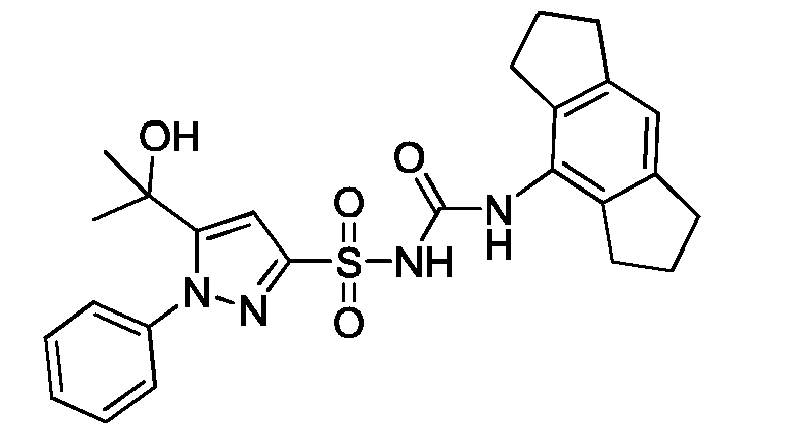
- 4-Isocyanato-8-methyl-1,2,3,5,6,7-hexahydro-s-indacene (prepared using general method A1) and 5-(2-hydroxypropan-2-yl)-1-phenyl-1H-pyrazole-3-sulfonamide were used in general method C1 to give the titled compound as a white solid (10 mg, 2%). 1H NMR (400 MHz, CD3OD): δ = 7.54 (s, 5H), 6.59 (s, 1H), 6.91 (s, 1H), 2.86 (t, J = 7.2 Hz, 4H), 2.69 (t, J = 7.2 Hz, 4H), 2.05-1.96 (m, 4H), 1.44 (s, 6H). LCMS (m/z): 481.20 (M -1)-; 93.76% (210 nm), 93.24% (254 nm). HPLC: 95.86% (210 nm), 93.93% (254 nm).
-
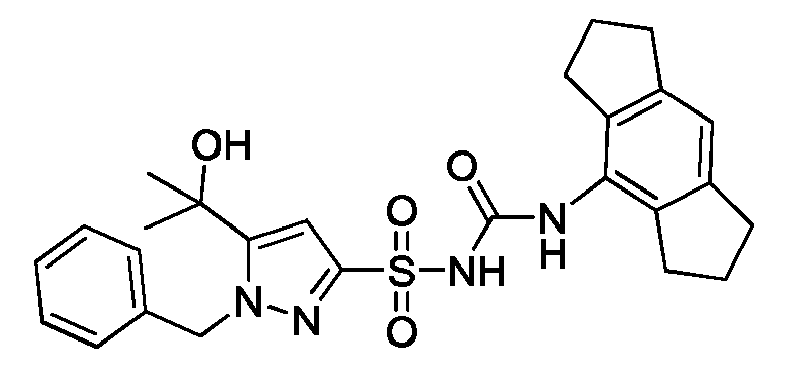
- 4-Isocyanato-8-methyl-1,2,3,5,6,7-hexahydro-s-indacene (prepared using general method A1) and 1-benzyl-5-(2-hydroxypropan-2-yl)-1H-pyrazole-3-sulfonamide were used in general method C1 to give the titled compound as a white solid (40 mg, 7%). 1H NMR (400 MHz, CD3OD): δ = 7.20-7.14 (m, 5H), 6.95 (s 2H), 6.73 (s, 1H), 5.77 (s, 2H), 2.86 (t, J = 7.2 Hz, 4H), 2.68 (t, J = 7.6 Hz, 4H), 2.01-1.94 (m, 4H), 1.51 (s, 6H). LCMS (m/z): 494.7 (M +1)+; 98.74% (210 nm), 96.05% (254 nm). HPLC: 95.11% (210 nm), 95.08% (254 nm).
-

- 5-chloro-2-isocyanato-1,3-diisopropylbenzene (prepared using general method A2) and 5-(2-hydroxypropan-2-yl)-1-methyl-1H-pyrazole-3-sulfonamide were used in general method C2 to give the titled compound as a white solid (83 mg, 17%). 1H NMR (600 MHz, DMSO-d 6) δ = 7.81 (s, 1H), 7.10 (s, 2H), 6.42 (s, 1H), 5.45 (s, 1H), 3.99 (s, 3H), 3.03 (hept, J = 7.0 Hz, 2H), 1.47 (s, 6H), 1.05 (d, J = 1.8 Hz, 12H). HRMS calculated for C20H28Cl1N4O4S1 [M-H]- 455.1525, found 455.1515.
-

- 5-chloro-2-isocyanato-1,3-diisopropylbenzene (prepared using general method A2) and 5-(2-hydroxypropan-2-yl)-1-phenyl-1H-pyrazole-3-sulfonamide were used in general method C2 to give the titled compound as a white solid (168 mg, 31%). 1H NMR (600 MHz, DMSO-d 6) δ = 7.87 (s, 1H), 7.52 (s, 5H), 7.10 (s, 2H), 6.71 (s, 1H), 5.42 (s, 1H), 3.10 - 2.92 (m, 2H), 1.31 (s, 6H), 1.02 (d, J = 7.0 Hz, 12H). HRMS calculated for C25H30Cl1N4O4S1 [M-H]- 517.1682, found 517.1671.
-

- A solution of 4-chloro-2,6-dimethylaniline (50 mg, 0.321 mmol) in DCM (5 mL) was treated with Et3N (50 mg, 0.48 mmol) and cooled to 0 °C, Phenyl chloroformate (60 mg, 0.39 mmol) was added dropwise at 0 °C. The reaction mixture was warmed to RT and stirred for 12 h. Upon completion the reaction mixture was diluted with saturated NaHCO3 solution, extracted with DCM (2 x 20 mL) and the combined organic extract washed with water, brine dried (Na2SO4) and concentrated in vacuo. The residue obtained was washed with n-pentane and dried in vacuo to give phenyl (4-chloro-2,6-dimethylphenyl)carbamate (75 mg, 85%) as a brown solid. 1H NMR (300 MHz, CDCl3): δ = 7.46-7.37 (m, 4H), 7.26-7.20 (m, 2H), 7.12-7.11(m, 2H), 2.33(s, 6H). LCMS (m/z): 275.9 [M+H]+.
- 1-isopropyl-1H-pyrazole-3-sulfonamide (150 mg, 0.79 mmol) was dissolved in anhydrous THF (5 mL) and treated carefully with NaH (80 mg, 1.98 mmol) at 0 °C under nitrogen atmosphere. The resulting mixture was stirred at RT for 30 min then treated with a solution of phenyl (4-chloro-2,6-dimethylphenyl)carbamate (240 mg, 0.87 mmol) in THF (3 mL) under nitrogen atmosphere at 0 °C. The resulting reaction mixture was warmed to RT and stirred for 3 h. Upon completion the reaction mixture was diluted with saturated NH4Cl solution, extracted with EtOAc (2 x 30 mL) and the combined organic extract was washed with water, brine dried (Na2SO4) and concentrated in vacuo. The crude product was purified by column chromatography on silica gel (60-120 mesh) using 40% EtOAc-hexanes eluant to give N-((4-chloro-2,6-dimethylphenyl)carbamoyl)-1-isopropyl-1H-pyrazole-3-sulfonamide (90 mg, 31%) as a white solid.1H NMR (400 MHz, DMSO-d 6): δ = 11.05 (s, 1H), 7.99 (d, J = 2.8 Hz, 1H), 7.93 (s, 1H), 7.13 (s, 2H), 6.73(d, J = 2.4 Hz, 1H), 4.64-4.57 (m, 1H), 2.03 (s, 6H), 1.43 (d, J = 6.8 Hz, 6H). LCMS (m/z): 370.95 [M+H]+.; 97.62% (210 nm), 97.48% (254 nm). HPLC: 97.20% (210nm). HRMS calculated for C15H18Cl1N4O3S1 [M-H]- 369.0794, found 369.0785.
-

- A solution of 4-chloro-2,6-dicyclopropylaniline (100 mg, 0.546 mmol) in THF (5 mL) was cooled to 0 °C and treated with NaH (30 mg, 0.66 mmol) under nitrogen atmosphere and stirred for 15 min. Phenyl chloroformate (130 mg, 0.819 mmol) was added dropwise to the aforementioned solution at 0 °C. The reaction mixture was warmed to RT and stirred for 12 h. Upon completion the mixture was diluted with EtOAc, filtered through a celite pad and concentrated in vacuo. The crude product was was purified by column chromatography on silica gel (60-120 mesh) using 10% EtOAc-hexanes to give phenyl (4-chloro-2,6-diethylphenyl)carbamate (0.15 g, 91 %) as a white solid. 1H NMR (300 MHz, CDCl3): δ = 7.38-7.33 (m, 2H), 7.23-7.18 (m, 3H), 7.13 (m, 2H), 6.27 (s, 1H), 2.75-2.64 (m, 4H), 1.28-1.22 (m, 6H).
- 1-isopropyl-1H-pyrazole-3-sulfonamide (75 mg, 0.40 mmol) was dissolved in anhydrous THF (5 mL) and treated carefully with NaH (40 mg, 0.99 mmol) at 0 °C under nitrogen atmosphere. The resulting mixture was stirred at RT for 30 min then treated with a solution of give phenyl (4-chloro-2,6-diethylphenyl)carbamate (130 mg, 0.44 mmol) in THF (3 mL) under nitrogen atmosphere at 0 °C. The resulting reaction mixture was warmed to RT and stirred for 4 h. Upon completion, the reaction mixture was diluted with saturated NH4Cl solution, extracted with EtOAc (2 x 30 mL) and the combined organic extract was washed with water, brine, dried (Na2SO4) and concentrated in vacuo. The crude product was was purified by column chromatography on silica gel (60-120 mesh) using 30-40% EtOAc-hexanes eluant followed by trituration with diethyl ether and n-pentane to give N-((4-chloro-2,6-diethylphenyl)carbamoyl)-1-isopropyl-1H-pyrazole-3-sulfonamide (40 mg, 24%) as a white solid. 1H NMR (400 MHz, DMSO-d 6): δ = 11.05 (s, 1H), 7.99 (d, J = 2.4 Hz, 1H), 7.89 (s, 1H), 7.12 (s, 2H), 6.72 (d, J = 2.4 Hz,1H), 4.62-4.59 (m, 1H), 2.42 (q, J = 7.6 Hz, 4H), 1.43 (d, J = 6.8 Hz, 6H), 1.02 (t, J = 7.6 Hz, 6H). LCMS (m/z): 399.0 [M+H]+, 96.72% (210nm). HPLC: 97.13% (210nm). HRMS calculated for C17H22Cl1N4O3S1 [M-H]- 397.1107, found 397.1090.
-

- 5-Chloro-2-isocyanato-1,3-diisopropylbenzene (prepared using general method A2) and 1-isopropyl-1H-pyrazole-3-sulfonamide were used in general method C2 to give the titled compound as a white solid (221 mg, 49%). 1H NMR (600 MHz, DMSO-d6) δ = 7.70 (d, J = 2.3 Hz, 1H), 7.49 (s, 1H), 7.00 (s, 2H), 6.36 (s, 1H), 4.62 - 4.29 (m, 1H), 3.11 (d, J = 6.4 Hz, 2H), 1.38 (d, J = 6.8 Hz, 6H), 1.01 (d, J= 6.8 Hz, 12H). 13C NMR (151 MHz, DMSO) δ = 160.96, 156.43, 150.19, 135.25, 131.49, 128.53, 123.27, 105.21, 54.23, 28.80, 24.15, 23.55. HRMS calculated for C19H26Cl1N4O3S1 [M-H]- 425.1420, found 425.1409.
-

- A solution of 4-chloro-2,6-dicyclopropylaniline (150 mg, 0.724 mmol) in THF (5 mL) was cooled to 0 °C. NaH (35 mg, 0.87 mmol) was added in portions to aforementioned solution and stirred for 20 min. Phenyl chloroformate (170 mg, 1.08 mmol) was added dropwise to the aforementioned solution at 0 °C. The reaction mixture was warmed to RT and stirred for 12 h. Upon completion, the mixture was diluted with EtOAc, filtered through celite and concentrated in vacuo. The crude product was purified by column chromatography on silica gel (60-120 mesh) using 15% EtOAc-hexanes eluant to give phenyl (4-chloro-2,6-dicyclopropylphenyl)carbamate (195 mg, 83%) as a white solid. 1H NMR (300 MHz, CDCl3): δ = 7.37-7.35 (m, 2H), 7.21-7.19 (m, 3H), 6.84-6.83 (m, 2H), 2.08-2.04 (m, 2H), 1.04-1.02 (m, 4H), 0.69-0.68 (m, 4H). LCMS (m/z): 328.2 [M+H]+.
- 1-isopropyl-1H-pyrazole-3-sulfonamide (100 mg, 0.53 mmol) was dissolved in anhydrous THF (5 mL) and treated carefully with NaH (53 mg, 1.32 mmol) at 0 °C under nitrogen atmosphere. The resulting mixture was stirred at RT for 30 min then treated with a solution of phenyl (4-chloro-2,6-dicyclopropylphenyl)carbamate (190 mg, 0.582 mmol) in THF (3 mL) under nitrogen atmosphere at 0 °C. The reaction mixture was warmed to RT and stirred for 4 h. Upon completion of reaction the reaction mixture was diluted with saturated NH4Cl solution, extracted with EtOAc (2 x 30 mL) and the combined organic extract washed with water, brine, dried (Na2SO4) and concentrated in vacuo. The crude product was purified by column chromatography on silica gel (60-120 mesh) using 40% EtOAc-hexanes eluant to give N-((4-chloro-2,6-dicyclo propylphenyl)carbamoyl)-1-isopropyl-1H-pyrazole-3-sulfonamide. This was triturated with diethyl ether and n-pentane to give (25 mg, 11%) as a white solid. 1H NMR (400 MHz, DMSO-d 6): δ = 11.05 (s, 1H), 8.01-7.98 (m, 2H), 6.74 (s, 3H), 4.59-4.56 (m, 1H), 1.77 -1.76 (m, 2H), 1.41 (d, J = 6.8 Hz, 6H), 0.77-0.75 (m, 4H), 0.56-0.55 (m, 4H). LCMS (m/z): 423.00 [M+H]+.; 93.58% (210 nm). HPLC: 92.87% (210nm). HRMS calculated for C19H22Cl1N4O3S1 [M-H]- 421.1107, found 421.1107.
- The following assays can be used to determine inhibitory activity of test compounds on the NLRP3 inflammasome using common stimuli such as adenosine triphosphate, nigericin, LeuLeu-OMe or monosodium urate crystals (MSU).
- To generate HMDM, human monocytes are isolated from buffy coat blood using Ficoll-Plaque Plus (GE Healthcare) and density centrifugation. CD14+ cell selection is performed using MACS magnetic beads (Miltenyl Biotec). Isolated CD14+ monocytes are differentiated in culture for 7 days with 10 ng/ml human CSF-1 (Miltenyl Biotec) in Iscove's modified Dulbecco's medium (IMDM) containing L-glutamine supplemented with 10% FBS and 1% penicillin/streptomycin (Life Technologies) as described by Croker et al 2013 Immunol Cell Biol 91:625 .
- Mouse bone marrow-derived macrophages (BMDM) were derived from bone marrow progenitors isolated from the femurs and tibias of C57BL/6 mice. Bones were flushed with medium, and bone marrow cells were cultured for 7 days in RPMI 1640 medium supplemented with 10% heat inactivated FCS, 2 mM GlutaMAX (Life Technologies), 50 U/ml penicillin-streptomycin (Life Technologies) and 150 ng/ml recombinant human M-CSF (endotoxin-free, expressed and purified by The University of Queensland Protein Expression Facility).
- HMDM are seeded at 1 x 10⁵/ml. The following day the overnight medium is replaced and cells are stimulated with Escherichia coli serotype 0111:B4 (Sigma Aldrich) for 3 h. Medium is removed and replaced with serum free medium (SFM) containing test compound 30 min prior to NLRP3 stimulation. Cells are then stimulated with: adenosine 5'-triphosphate disodium salt hydrate (5 mM 1 h), nigericin (10 µM 1 h), LeuLeu-OMe (1 mM 2 h) or MSU (200 µg/ml 15 h). ATP can be sourced from Sigma Aldrich, nigericin and MSU from Invivogen and LeuLeu-OMe from Chem-Impex International.
- BMDM are seeded at 1 x 10⁵/ml. The following day the overnight medium is replaced and cells are stimulated with Ultrapure lipopolysaccharide from Escherichia coli K12 strain (InvivoGen) for 3 h. Medium is removed and replaced with serum free medium (SFM) containing test compound 30 min prior to NLRP3 stimulation. Cells are then stimulated with: adenosine 5'-triphosphate disodium salt hydrate (1.25-5 mM 1 h), nigericin (5 µM 1 h), LeuLeu-OMe (1 mM 2 h) or MSU (200 µg/ml 15 h). ATP can be sourced from Sigma Aldrich, nigericin and MSU from Invivogen and LeuLeu-OMe from Chem-Impex International.
- For ELISA and cell death assays cells are seeded in 96 well plates. Supernatants are removed and analysed using ELISA kits according to the manufacturer's instructions (DuoSet® R&D Systems, ReadySetGo!® eBioscience, BD OptEIA™, or Perkin Elmer AlphaLISA®). Cell death is assessed by measurement of LDH release relative to a 100% cell lysis control using the CytoTox96® non-radioactive cytotoxicity assay (Promega).
- General experimental: Carbutamide was purchased from Sigma Aldrich (Catalogue No. 381578). Acetonitrile was Chromasolv® HPLC grade (Sigma Aldrich, Sydney, Australia), the formic acid was AR grade 99%-100% Normapur (VWR International Pty Ltd, Brisbane, Australia), DMSO was ReagentPlus® grade (D5879, Sigma Aldrich, Sydney, Australia) and the H2O Milli-Q was filtered. The HPLC vial and polypropylene inserts from Agilent Technologies (Melbourne, Australia), while the 1.5 mL Eppendorf tubes Protein LoBind Tubes were from VWR International Pty Ltd (Brisbane, Australia).
- Preparation of precipitation solution: 100 mL ACN and 5 µL of 10 mM carbutamide in DMSO (ACN with 135 ng/mL carbutamide MS internal standard).
- Preparation of standard curve in plasma: A 1 mg/mL of test compound in 10 mM NH4HCO3 was prepared and diluted 10-fold to give a 100,000 ng/mL stock solution. A series of 10-fold dilutions of the 100,000 ng/mL stock solution with 10 mM NH4HCO3 gave concentrations of 10,000, 1,000, 100 and 10 ng/mL. The 100,000 ng/mL stock solution was diluted to 3: 7 with 10 mM NH4HCO3 to give a concentration of 30,000 ng/mL and a series of 10-fold dilutions gave concentrations of 3,000, 300, 30 and 3 ng/mL.
- 20 µL of test compound-containing solution and 160 µL precipitation solution were added to 20 µL of mouse plasma in a low binding Eppendorf tube. The samples were vortexed, allowed to stand at 4 °C for 10 mins and centrifuged at 14,000 × g for 8 min. 150 µL of the supernatant was transferred to an HPLC vial insert. The samples were stored at 4 °C until analysis.
- Preparation of standard curve in brain homogenate: The sample solutions prepared for the plasma standard curve were used for the brain homogenate standard curve.
- The mouse brain homogenate from the saline control was thawed and vortexed for 3 min or until homogenous, sonicated for 1 min. When the foam settled, 50 µL of mouse brain homogenate was transferred into an Eppendorf tube, followed by 50 µL of test compound in 10 mM NH4HCO3, 150 µL of H2O and 500 µL of ice cold precipitation solution with vortexing after every addition. The standards were allowed to stand at 4 °C for 10 mins and then centrifuged at 14,000 × g for 8 min. 200 µL of the supernatant was transferred to HPLC vial insert ensuring that no air bubbles were present and the samples stored at 4 °C until analysis.
-
- Dosing: Oral gavage at 20 mg/kg
- Time point: 2 hour
Prepare stock compounds for dosing at 4 mg/ml in sterile PBS. Mice were weighed and dosed by oral gavage at 20 mg/kg for each compound. After 2 hours mice were anesthetized using a combination of Zoletil (50 mg/kg) and Xylazine (10 mg/kg) and blood was collected by cardiac puncture into tubes containing 20 µL of 100 mM EDTA. The blood was centrifuged at 2000 x g for 15 minutes at 4 °C to collect plasma. - Preparation of plasma samples for analysis: 20 µL of NH4HCO3 and 160 µL precipitation solution were added to 20 µL of mouse plasma in a low binding Eppendorf tube. The samples were vortexed, allowed to stand at 4 °C for 10 mins and centrifuged at 14,000 × g for 8 min. 150 µL of the supernatant was transferred to an HPLC vial insert ensuring that no air bubbles were present. The samples were stored at 4 °C until analysis.
- Brain homogenate preparation: The brains of mice were perfused with PBS for 5 minutes then dissected and weighed. Brain homogenate was prepared by homogenizing total brain (0.5 g) with 4 volumes (2 ml) of deionized water and stored at -20 °C before analysis. The homogenate was thawed, vortexed for 3 min or until homogenous, and sonicated for 1 min. When the foam settled, 50 µL of mouse brain homogenate was transferred into an Eppendorf tube, followed by 50 µL of 10 mM NH4HCO3, 150 µL of H2O and 500 µL of ice cold precipitation solution with vortexing after every addition. 200 µL of the supernatant was transferred to HPLC vial insert ensuring that no air bubbles were present and the samples stored at 4 °C until analysis.
- Preparation of brain samples for analysis: 50 µL of mouse brain was transferred into an Eppendorf tube, followed by 50 µL of 10 mM NH4HCO3, 150 µL of H2O and 500 µL of ice cold precipitation solution with vortexing after every addition. The solutions were allowed to stand at 4 °C for 10 mins and then centrifuged at 14,000 × g for 8 min. 200 µL of the supernatant was transferred to HPLC vial insert ensuring that no air bubbles were present and the samples stored at 4 °C until analysis.
- LC-MS/MS: The samples were analysed on an AB Sciex 4000QTrap MS with 2 Shimadzu Nexera LC-30AD Solvent Delivery Units, Shimadzu Nexera SIL-30AC Auto-Sampler, Shimadzu Prominence DGU-20A5 Degasser, Shimadzu Prominence CBM-20A System Controller and Shimadzu Prominence CTO-20A Column Oven. The column oven was set to 40 °C, while the Autosampler was set to 15 °C. 2 µL injections were made and MS analyses were undertaken in Selected Reaction Monitoring (SRM) mode using Turbo Spray (-)-ESI with Low Resolution Q1 and Low Resolution Q3. MS parameters: CUR: 30.00, IS: - 4300.00, TEM: 500.00, GS1: 50.00, GS2: 50.00, ihe: ON, CAD: High, DP - 60.00, EP -10.00, CXP -15.00. MCC950 SRM: Q1 403.2 to Q3 204.3 Da, dwell 150 msec, CE -27 and carbutamide (IS) SRM: Q1 270.0 to Q3 171.0 Da, dwell 100 msec, CE -25. HPLC Column: Waters Atlantis® T3 5 µm 2.1 × 50mm with Atlantis® T3 5 µm 2.1 × 10 mm guard column. Flow rates and solvent: 0.35 ml/min, solvent A: 0.1% formic acid in H2O, solvent B: 0.1 % formic acid in ACN; isocratic2% B from 0→2 mins, gradient 2%→100% B from 2→5 mins, isocratic 100% from 5→9 mins,
gradient 100%→2% B from 9→9.1 mins and isocratic 2% B from 9.1→13 mins. The peak areas from the SRM data for carbutamide and test compound were analysed using the AB Sciex's Analyst software using the Quantitation Wizard. The peak area was plotted against the ng/mL concentration in 20 µL 3 to 30,000 ng/mL test compound solutions and the lower and upper range of linear response was determined. These data were then plotted in Microsoft Excel and the linear response equation used to determine the test compound concentration in the 20 µL plasma solutions. Similarly, for the brain homogenate samples, the peak areas of the 50 µL 3 to 3,000 ng/mL test compound solutions were used to determine the test compound concentration in the 50 µL brain homogenate solutions. - The full series of tPSA and biological results are provided in the tables below, however select data is presented below for certain compounds of the invention.


Table 1: Topological Polar Surface Area (tPSA) and molecular weight of select compound. SMILES NAME tPSA MV 
N-((1,2,3,5,6,7-hexahydro-s-indacen-4-yl)carbamoyl)thiazole-2-sulfonamide 88 363 O=C(NC1=C2C(CCC2)=CC3=C1CCC3)NS (C4=NC=CS4)(=O)=O Table 2: Compound HRMS characterisation data; Inhibition of IL-1β release IC50 in nM cell based assay using either HMDM or BMDM (<100 nM = '++++' / <1 µM = '+++' / <10 µM = '++'/ <50 µM = '+'); Inhibition of IL-18 release IC50 in nM cell based assay using HMDM (<100 nM = '++++' / <1 µM = '+++' / <10 µM = '++' / <50 µM = '+'). "ND" = not determined. Name Chem Formula HRMS formula ESI+/- HRMS Calc HRMS found Avg. IL-1β IC50 Murine BMDM (nM) Avg. IL-1β IC50 HMDM (nM) Avg. IL-18 IC50 HMDM (nM) N-((1,2,3,5,6,7-hexahydro-s-indacen-4-yl)carbamoyl)-4-(2-hydroxypropan-2-yl)furan-2-sulfonamide (comparative example MCC950) C20H24N2O5S C20H23N2O5S1 ESI- 403.1333 403.1351 ++++ ++++ ++++ N-((1,2,3,5,6,7-hexahydro-s-indacen-4-yl)carbamoyl)thiazole-2-sulfonamide C16H17N3O3S2 ND + ND 1-benzyl-N-((1,2,3,5,6,7-hexahydro-s-indacen-4-yl)carbamoyl)-1H-1,2,4-triazole-3-sulfonamide C22H23N5O3S C22H22N5O3S1 ESI- 436.1449 436.1436 ND ++++ ++++ N-((1,2,3,5,6,7-hexahydro-s-indacen-4-yl)carbamoyl)-1-methyl-1H-pyrazole-5-sulfonamide C17H20N4O3S C17H21N4O3S1 ESI+ 361.1329 361.1321 ND ++ ND N-((1,2,3,5,6,7-hexahydro-s-indacen-4-yl)carbamoyl)-1-methyl-1H-pyrazole-3-sulfonamide C17H20N4O3S C17H19N4O3S1 ESI- 359.1183 359.1176 ND +++ ND N-((1,2,3,5,6,7-hexahydro-s-indacen-4-yl)carbamoyl)-1-(trifluoromethyl)-1H-pyrazole-3-sulfonamide C17H17F3N4O3S C17H18F3N4O3S1 ESI+ 415.1046 415.1063 ND ++++ ND N-((1,2,3,5,6,7-hexahydro-s-indacen-4-yl)carbamoyl)-1-isopropyl-1H-pyrazole-3-sulfonamide C19H24N4O3S C19H23N4O3S1 ESI- 387.1496 387.1514 ND ++++ ++++ N-((1,2,3,5,6,7-hexahydro-s-indacen-4-yl)carbamoyl)-1-isopropyl-1H-pyrazole-4-sulfonamide C19H24N4O3S ND ++++ ++++ 1-cyclopropyl-N-((1,2,3,5,6,7-hexahydro-s-indacen-4-yl)carbamoyl)-1H-pyrazole-3-sulfonamide C19H22N4O3S C19H23N4O3S1 ESI+ 387.1485 387.1501 ND ++++ ND 1-(tert-butyl)-N-((12,3,5,6,7-hexahydro-s-indacen-4-yl)carbamoyl)-1H-pyrazole-3-sulfonamide C20H26N4O3S C20H27N4O3S1 ESI+ 403.1798 403.1802 ND ++++ ++++ 1-cyclohexyl-N-((1,2,3,5,6,7-hexahydro-s-indacen-4-yl)carbamoyl)-1H-pyrazole-3-sulfonamide C22H28N4O3S C22H29N4O3S1 ESI+ 429.1955 429.1968 ND +++ ND N-((1,2,3,5,6,7-hexahydro-s-indacen-4-yl)carbamoyl)-1-phenyl-1H-pyrazole-3-sulfonamide C22H22N4O3S C22H23N4O3S1 ESI+ 423.1485 423.1474 ND +++ ND 1-benzyl-N-((1,2,3,5,6,7-hexahydro-s-indacen-4-yl)carbamoyl)-1H-pyrazole-3-sulfonamide C23H24N4O3S C23H25N4O3S1 ESI+ 437.1642 437.163 ND ++ ND N-((1,2,3,5,6,7-hexahydro-s-indacen-4-yl)carbamoyl)-1-(1-phenylethyl)-1H-pyrazole-3-sulfonamide C24H26N4O3S C24H27N4O3S1 ESI+ 451.1798 451.1811 ND +++ ND N-((1,2,3,5,6,7-hexahydro-s-indacen-4-yl)carbamoyl)-1-(2-(piperidin-1-yl)ethyl)-1H-pyrazole-3-sulfonamide C23H31N5O3S C23H30N5O3S1 ESI- 456.2075 456.2076 ND ++ ND N-((1,2,3,5,6,7-hexahydro-sindacen-4-yl)carbamoyl)-1,5-dimethyl-1H-pyrazole-3-sulfonamide C18H22N4O3S C18H21N4O3S1 ESI- 373.134 373.1334 ND +++ ND N-((1,2,3,5,6,7-hexahydro-s-indacen-4-yl)carbamoyl)-1-methyl-5-(trifluoromethyl)-1H-pyrazole-3-sulfonamide C18H19F3N4O3S C18H18F3N4O351 ESI- 427.1057 427.1057 ND +++ ND N-((2,6-diisopropylphenyl)carbamoyl)-1-methyl-5-(trifluoromethyl)-1H-pyrazole-3-sulfonamide C18H23F3N4O3S C18H22F3N4O3S1 ESI- 431.137 431.1388 ND ++ ND N-((1,2,3,5,6,7-hexahydro-s-indacen-4-yl)carbamoyl)-1-isopropyl-5-(trifluoromethyl)-1H-pyrazole-3-sulfonamide C20H23F3N4O3S C20H24F3N4O3S1 ESI+ 457.1516 457.1528 ND +++ ND N-((1,2,3,5,6,7-hexahydro-s-indacen-4-yl)carbamoyl)-5-isopropyl-1-methyl-1H-pyrazole-3-sulfonamide C20H26N4O3S C20H25N4O3S1 ESI- 401.1653 401.1637 ND +++ ND N-((2,6-diisopropylphenyl)carbamoyl)-5-(2-hydroxypropan-2-yl)-1-methyl-1H-pyrazole-3-sulfonamide C20H30N4O4S C20H29N4O4S1 ESI- 421.1915 421.1904 ND ++++ ++++ N-((1,2,3,5,6,7-hexahydro-sindacen-4-yl)carbamoyl)-5-(2-hydroxypropan-2-yl)-1-methyl-1H-pyrazole-3-sulfonamide C20H26N4O4S C20H25N4O4S1 ESI- 417.1602 417.1603 ++++ ++++ ++++ N-((1,2,3,5,6,7-hexahydro-s-indacen-4-yl)carbamoyl)-5-(2-hydroxypropan-2-yl)-1-phenyl-1H-pyrazole-3-sulfonamide C25H28N4O4S C25H27N4O4S1 ESI- 479.1758 479.1758 ++++ ++++ ++++ 1-benzyl-N-((1,2,3,5,6,7-hexahydro-s-indacen-4-yl)carbamoyl)-5-(2-hydroxypropan-2-yl)-1H-pyrazole-3-sulfonamide C26H30N4O4S C26H29N4O4S1 ESI- 493.1915 493.1912 ND ++++ ++++ N-((1,2,3,5,6,7-hexahydro-s-indacen-4-yl)carbamoyl)-2-methylthiazole-5-sulfonamide C17H19N3O3S2 C17H18N3O3S2 ESI- 376.0795 376.0791 ++++ ND ND N-((1,2,3,5,6,7-hexahydro-sindacen-4-yl)carbamoyl)-4H-1,2,4-triazole-3-sulfonamide C15H17N5O3S C15H16N5O3S1 ESI- 346.0979 346.0983 ++++ ND ND N-((1,2,3,5,6,7-hexahydro-s-indacen-4-yl)carbamoyl)-1-isopropyl-1H-1,2,3-triazole-4-sulfonamide C18H23N5O3S C18H22N5O3S1 ESI- 388.1449 388.1457 +++ ++++ ND sodium ((4-chloro-2,6-diisopropylphenyl)carbamoyl)((5-(2-hydroxypropan-2-yl)-1-methyl-1H-pyrazol-3-yl)sulfonyl)amide C20H28ClN4NaO45 C20H28Cl1N4O4S1 ESI- 455.1525 455.1515 ND ++++ ND sodium ((4-chloro-2,6-diisopropylphenyl)carbamoyl)((5-(2-hydroxypropan-2-yl)-1-phenyl-1H-pyrazol-3-yl)sulfonyl)amide C25H30ClN4NaO45 C25H30Cl1N4O4S1 ESI- 517.1682 517.1671 ND ++++ ND N-((4-chloro-2,6-dimethylphenyl)carbamoyl)-1-isopropyl-1H-pyrazole-3-sulfonamide C15H19ClN4O3S C15H18Cl1N4O3S1 ESI- 369.0794 369.0785 >10,000 ++ ND N-((4-chloro-2,6-diethylphenyl)carbamoyl)-1-isopropyl-1H-pyrazole-3-sulfonamide C17H23ClN4O3S C17H22Cl1N4O3S1 ESI- 397.1107 397.109 ++ ++ ND sodium ((4-chloro-2,6-diisopropylphenyl)carbamoyl)((1-isopropyl-1H-pyrazol-3-yl)sulfonyl)amide C19H26CIN4NaO35 C19H26Cl1N4O3S1 ESI- 425.1420 425.1409 ND +++ ND N-((4-chloro-2,6-dicyclopropylphenyl)carbamoyl)-1-isopropyl-1H-pyrazole-3-sulfonamide C19H23ClN4O3S C19H22Cl1N4O3S1 ESI- 421.1107 421.1107 +++ +++ ND Table 3: Plasma levels of select test compounds at 2 hour timepoint after oral gavage at 20 mg/Kg 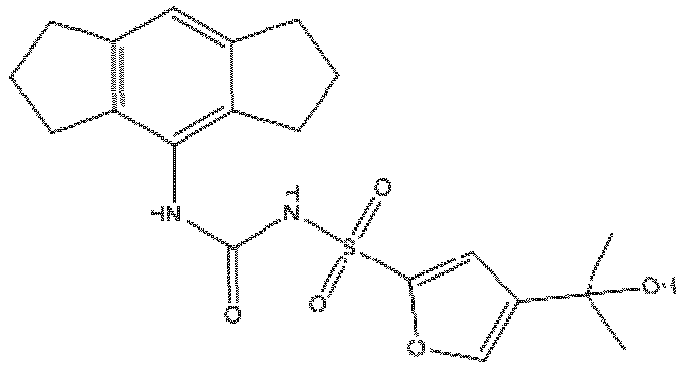


(comparative example MCC950) (comparative example) Plasma Concentration (ng/mL) 17490 28231 66260 Table 4: Properties of sulfonylureas, including increased BBB penetration, with and without hydroxylalkyl group on furan ring. 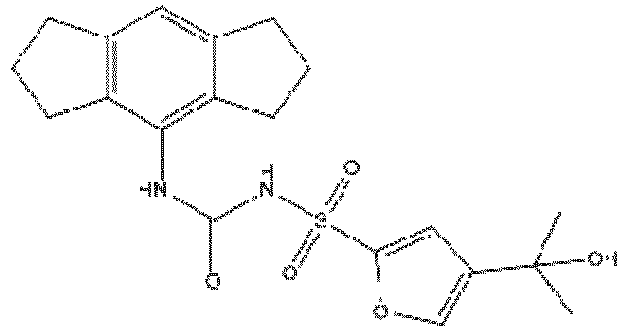
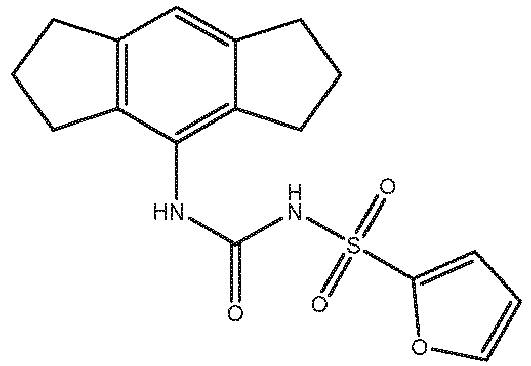
(comparative example MCC950) (comparative example) Brain Concentration (ng/g)* 184 1339 Plasma Concentration (ng/mL) 17490 66260 Brain/Plasma Ratioa 0.0117 0.0203 tPSA 104.7 84.5 - A single dose pharmacokinetic study of N-((1 ,2,3,5,6,7-hexahydro-s-indacen-4-yl)carbamoyl)-1-isopropyl-1H-pyrazole-3-sulfonamide (MCC7840 and being a compound of the first aspect) in comparison to N-((1,2,3,5,6,7-hexahydro-s-indacen-4-yl)carbamoyl)-4-(2-hydroxypropan-2-yl)furan-2-sulfonamide (MCC950) using an iv dose of 4 mg/Kg and po dose of 20 mg/Kg clearly indicated an extended half-life, increased maximum concentration (Cmax) and area under the curve (AUC) for the pyrazole derivative in comparison to the furan. This is advantageous leading to comparatively lower doses or less frequent administration.
- The procedure followed was: Male C57BL/6 mice were used at 7-9 weeks age with 3 animals per group. Mice were dosed with test compound using single intravenous bolus or oral gavage. Blood samples were taken via submandibular or saphenous vein for analysis of plasma concentrations of compound by LC-MS/MS at the following timepoints: IV (3 mice): 0.083, 0.25, 0.5, 1, 2, 4, 8 and 24 hours post dosing, PO (3 mice): 0.25, 0.5, 1, 2, 4, 8 and 24 hours post dosing. LC-MS/MS method for the quantitative determination of test compound in corresponding biological matrix was developed. PK parameters were calculated using Phoenix WinNonlin 6.3. The results are shown graphically in
FIGs 1A to 1C (MCC950) andFIGs 2A to 2C (MCC7840). - The relevant compound structures are shown below and tables 5-8 contain the relevant data:
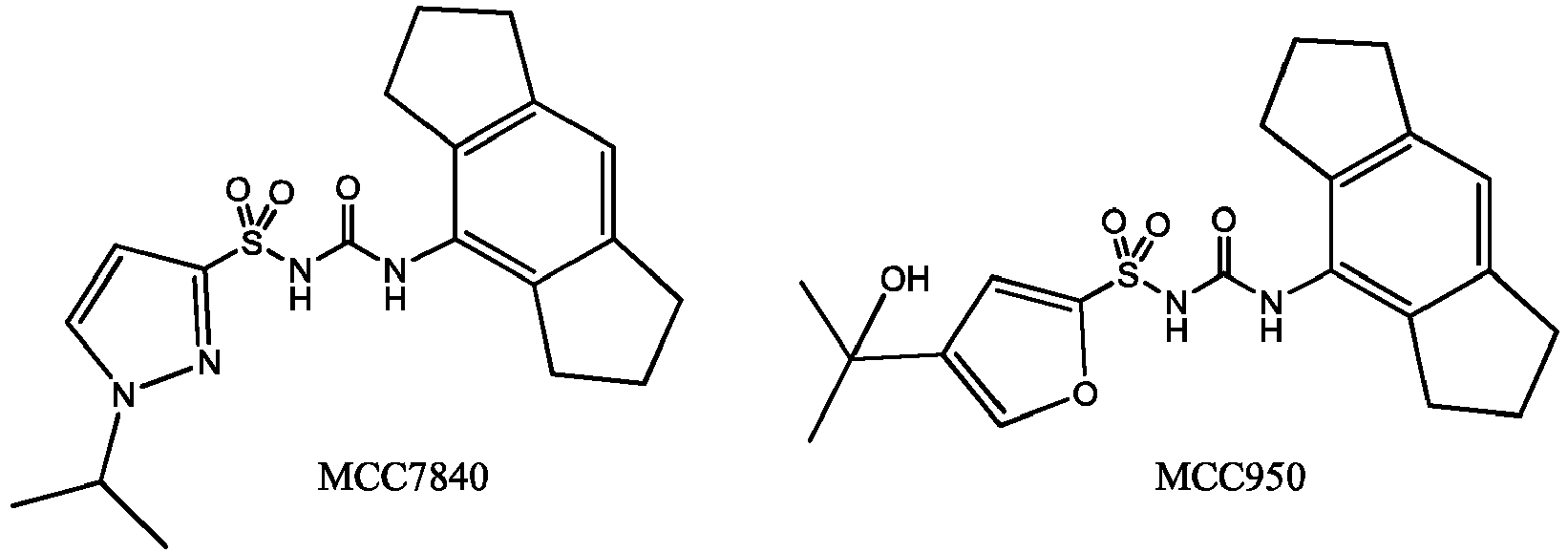
Tables 5 and 6: PK and bioavailability data for N-((1,2,3,5,6,7-hexahydro-s-indacen-4-yl)carbamoyl)-4-(2-hydroxypropan-2-yl)furan-2-sulfonamide (MCC950) (comparative example) Bioavailability of MCC950 (comparative example) in Mouse (ng/mL) IV IV Time (h) M1 M2 M3 Mean IV SD CV (%) 0.0833 20200 17200 17700 18367 ± 1607 8.75 0.250 16000 10200 12700 12967 ± 2909 22.4 0.500 11700 9420 10500 10540 ± 1141 10.8 1.00 9340 7730 8230 8433 ± 824 9.77 2.00 7410 6000 5010 6140 ± 1206 19.6 4.00 3280 2390 2130 2600 ± 603 23.2 8.00 905 843 480 743 ± 230 30.9 24.0 3.29 2.33 2.33 2.65 ± 0.554 20.9 PK Parameters M1 M2 M3 Mean IV SD CV (%) Rsq_adj 1.000 0.998 0.999 -- ± -- -- No. points used for T1/2 6.00 7.00 3.00 ND ± -- -- C0 (ng/mL) 22695 22332 20894 21974 ± 953 4.34 T1/2(h) 2.00 1.97 2.05 2.00 ± 0.0394 1.97 Vdss (L/kg) 0.265 0.339 0.313 0.306 ± 0.0376 12.3 Cl (mL/min/kg) 1.59 1.99 2.17 1.92 ± 0.295 15.4 Tlast (h) 24.0 24.0 24.0 24.0 ± -- -- AUC0-last (ng.h/mL) 41880 33489 30751 35373 ± 5799 16.4 AUC0-inf (ng.h/mL) 41889 33496 30758 35381 ± 5800 16.4 MRT0-last (h) 2.77 2.83 2.40 2.67 ± 0.234 8.76 MRT0-inf (h) 2.78 2.84 2.41 2.67 ± 0.233 8.73 AUCExtra (%) 0.0226 0.0198 0.0224 0.0216 ± 0.00158 7.30 AUMCExtra (%) 0.219 0.187 0.251 0.219 ± 0.0318 14.6 Bioavailability of MCC950 (comparative example) in Mouse (ng/mL) PO PO Time (h) M4 M5 M6 Mean PO SD CV (%) 0.250 21900 29000 48900 33267 ± 13997 42.1 0.500 20400 34100 35800 30100 ± 8443 28.1 1.00 19300 33700 37000 30000 ± 9412 31.4 2.00 18500 22500 26200 22400 ± 3851 17.2 4.00 10200 13000 10500 11233 ± 1537 13.7 8.00 4330 2360 4670 3787 ± 1247 32.9 24.0 60.7 17.4 39.3 39.1 ± 21.7 55.3 PK Parameters M4 M5 M6 Mean PO SD CV (%) Rsq_adj 0.999 0.996 0.996 -- ± -- -- No. points used for T1/2 4.00 5.00 6.00 ND ± -- -- Cmax (ng/mL) 21900 34100 48900 34967 ± 13521 38.7 Tmax (h) 0.250 0.500 0.250 0.333 ± 0.144 43.3 T1/2 (h) 2.67 2.11 2.37 2.39 ± 0.282 11.8 Tlast (h) 24.0 24.0 24.0 24.0 ± -- -- AUC0-last (ng·h/mL) 108135 123399 144734 125422 ± 18383 14.7 AUC0-inf (ng.h/mL) 108369 123452 144868 125563 ± 18341 14.6 MRT0-last (h) 4.26 3.07 3.47 3.60 ± 0.603 16.8 MRT0-inf (h) 4.31 3.08 3.49 3.63 ± 0.624 17.2 AUCExtra (%) 0.216 0.0429 0.0929 0.117 ± 0.0892 76.0 AUMCExtra (%) 1.40 0.376 0.730 0.835 ± 0.519 62.1 Bioavailability (%)a -- -- -- 71.0 ± -- -- Tables 7 and 8: PK and bioavailability data for N-((1,2,3,5,6,7-hexahydro-s-indacen-4-yl)carbamoyl)-1-isopropyl-1H-pyrazole-3-sulfonamide (MCC7840) Bioavailability of MCC7840 in Mouse (ng/mL) IV IV Time (h) M1 M2 M3 Mean IV SD CV (%) 0.0833 47800 41900 38600 42767 ± 4661 10.9 0.250 28100 29300 29300 28900 ± 693 2.40 0.500 25200 25200 24500 24967 ± 404 1.62 1.00 19900 18900 17200 18667 ± 1365 7.31 2.00 13300 14700 19900 15967 ± 3478 21.8 4.00 6520 8550 8590 7887 ± 1184 15.0 8.00 3490 3360 4440 3763 ± 590 15.7 24.0 149 122 130 134 ± 13.9 10.4 PK Parameters M1 M2 M3 Mean IV SD CV (%) Rsq_adj 0.998 0.999 0.996 -- ± -- -- No. points used for T1/2 3.00 3.00 3.00 3.00 ± -- -- C0 (ng/mL) 62333 50100 44301 52245 ± 9205 17.6 T1/2 (h) 3.62 3.29 3.26 3.39 ± 0.204 6.01 Vdss (L/kg) 0.170 0.158 0.151 0.160 ± 0.00989 6.20 Cl (mL/min/kg) 0.659 0.633 0.571 0.621 ± 0.0455 7.33 Tlast (h) 24.0 24.0 24.0 24.0 ± -- -- AUC0-last (ng.h/mL) 100364 104705 116222 107097 ± 8195 7.65 AUC0-inf (ng.h/mL) 101143 105283 116833 107753 ± 8132 7.55 MRT0-last (h) 4.11 4.01 4.28 4.13 ± 0.133 3.23 MRT0-inf (h) 4.30 4.15 4.40 4.29 ± 0.129 3.02 AUCExtra (%) 0.770 0.549 0.523 0.614 ± 0.136 22.1 AUMCExtra (%) 5.23 3.81 3.41 4.15 ± 0.957 23.1 Bioavailability of MCC7840 in Mouse (ng/mL) PO PO Time (h) M4 M5 M6 Mean PO SD CV (%) 0.250 84300 27400 69700 60467 ± 29552 48.9 0.500 70300 24000 56600 50300 ± 23784 47.3 1.00 60400 20900 45700 42333 ± 19964 47.2 2.00 54900 19100 53800 42600 ± 20359 47.8 4.00 32900 14100 32800 26600 ± 10825 40.7 8.00 14100 12800 29900 18933 ± 9520 50.3 24.0 660 2370 1370 1467 ± 859 58.6 PK Parameters M4 M5 M6 Mean PO SD CV (%) Rsq_adj 0.999 0.984 0.968 -- ± -- -- No. points used for T1/2 3.00 6.00 4.00 ND ± -- -- Cmax (ng/mL) 84300 27400 69700 60467 ± 29552 48.9 Tmax (h) 0.250 0.250 0.250 0.250 ± 0.000 0.0 T1/2 (h) 3.57 7.31 4.18 5.02 ± 2.01 40.1 Tlast (h) 24.0 24.0 24.0 24.0 ± -- -- AUC0-last (ng·h/mL) 364947 226687 457808 349814 ± 116301 33.2 AUC0-inf (ng.h/mL) 368345 251697 466063 362035 ± 107323 29.6 MRT0-last (h) 4.80 8.07 6.41 6.43 ± 1.64 25.4 MRT0-inf (h) 5.03 10.7 6.83 7.52 ± 2.90 38.6 AUCExtra (%) 0.922 9.94 1.77 4.21 ± 4.98 118 AUMCExtra (%) 5.35 32.1 7.78 15.1 ± 14.8 98.1 Bioavailability (%)a -- -- -- 67.2 ± -- -- Table 9: Comparative IC50 data for commercial compounds. Common names Structure HMDM IC50 vs NLRP3 BMDM IC50 vs NLRP3 Common names Structure HMDM IC50 vs NLRP3 BMDM IC50 vs NLRP3 Glibenclamide (Glyburide) 
6 µM 22 µM Acetohexamide 
>200 µM >200 µM Glibenclamide precursor 
>200 µM >200 µM Tolazamide 
>200 µM Glipizide 
>200 µM >200 µM Gliclazide 
>200 µM >200 µM Glipizide precursor 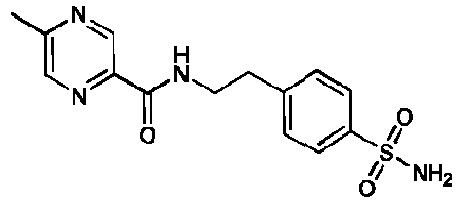
>50 µM Tolbutamide 
>200 µM >200 µM Glimepiride 
92 µM Carbutamide 
>200 µM Glimepiride precursor 
>200 µM Chlorpropamide 
>200 µM >200 µM Gliquidone 
32 µM Glisoxepide 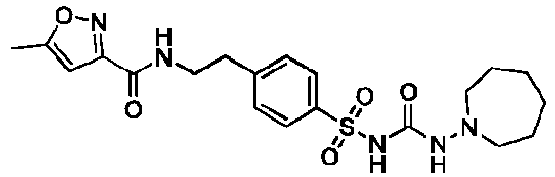
Gliquidone precursor 
>200 µM >10 µM Glisoxepide Precursor 
>10,000 Sulofenur 
>100 µM >10 µM
Claims (29)
- A compound of formula (II), or a pharmaceutically acceptable salt or solvate thereof:
 wherein A, B, D and E are independently selected from C, N, O, S and Se, but at least one thereof is C and at least one thereof is N;each dashed line may represent a bond;each incidence of R6 is independently selected from the group consisting of hydrogen, halide, cyano, C1-C6 alkyl, C1-C6 alkylamino, C1-C6 alkylhydroxy, C3-C6 cycloalkyl, alkylphenyl, phenyl, benzyl, C1-C6 ester, C2-C6 alkenyl, C1-C6 trifluoroalkyl and C1-C6 alkoxy, each of which may be optionally substituted, as appropriate, wherein any optional substituent is independently selected from the group consisting of C1-10 alkyl; C3-6 cycloalkyl; hydroxyalkyl; C1-10 alkoxy; C2-10 alkenyl; C2-10 alkynyl; C6-C12 aryl; aryloxy; heteroaryl; heterocyclyl; halo; hydroxyl; halogenated alkyl; amino; alkylamino; arylamino; acyl; amido; CN; NO2; N3; CH2OH; CONH2; CONR24R25; CO2R24; CH2OR24; NHCOR24; NHCO2R24; C1-3 alkylthio; sulfate; sulfonic acid; sulfonate esters; phosphonic acid; phosphate; phosphonate; mono-, di-, or triphosphate esters; trityl; monomethoxytrityl; R24SO; R24SO2; CF3S; CF3SO2; and trialkylsilyl; wherein R24 and R25 are each independently selected from H or C1-10 alkyl; andR2 is selected from a 2,6-dialkylphenyl, a 2,6-dialkyl-4-halophenyl, a 2,6-dicycloalkylphenyl, a 2,6-dicycloalkyl-4-halophenyl, and:
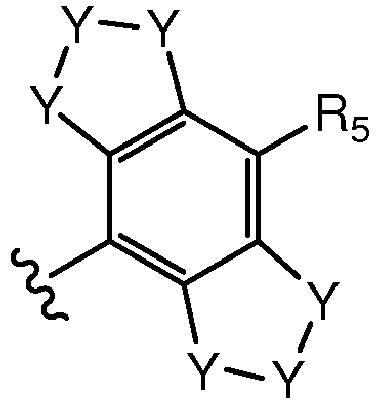 wherein each incidence of Y is independently selected from C, N, S and O, which may be optionally substituted as appropriate, wherein any optional substituent is independently selected from the group consisting of C1-10 alkyl; C3-6 cycloalkyl; hydroxyalkyl; C1-10 alkoxy; C2-10 alkenyl; C2-10 alkynyl; C6-C12 aryl; aryloxy; heteroaryl; heterocyclyl; halo; hydroxyl; halogenated alkyl; amino; alkylamino; arylamino; acyl; amido; CN; NO2; N3; CH2OH; CONH2; CONR24R25; CO2R24; CH2OR24; NHCOR24; NHCO2R24; C1-3 alkylthio; sulfate; sulfonic acid; sulfonate esters; phosphonic acid; phosphate; phosphonate; mono-, di-, or triphosphate esters; trityl; monomethoxytrityl; R24SO; R24SO2; CF3S; CF3SO2; and trialkylsilyl; wherein R24 and R25 are each independently selected from H or C1-10 alkyl; andR5 is selected from the group consisting of hydrogen, halo, cyano, amide, sulphonamide, acyl, hydroxyl, C1-C6 alkyl, C1-C6 haloalkyl, C3-C5 cycloalkyl and C1-C6 alkoxy, all of which groups may be optionally substituted, as appropriate, with halo, cyano or C1-C6 alkoxy.
 - The compound of claim 1, wherein the compound is a compound of formula (IIb), or a pharmaceutically acceptable salt or solvate thereof:
 wherein Y, R5 and R6 are as defined in claim 1; andA, B, D and E are selected from N and C and at least two of A, B, D and E are N.
 - The compound of any one of the preceding claims, wherein at least two of A, B, D and E are N.
- The compound of any one of the preceding claims, wherein A, B, D and E are selected from N and C.
- The compound of any one of the preceding claims, wherein A is C and at least two of B, D and E are N.
- The compound of any one of the preceding claims, wherein A, B, D and E form a ring selected from a pyrazole, a pyrrolidine, a pyrrole, a triazole, a tetrazole and an imidazole.
- The compound of any one of the preceding claims, wherein A, B, D and E form a ring selected from a pyrazole, an imidazole, a triazole, and a tetrazole.
- The compound of any one of the preceding claims, wherein A, B, D and E form a ring selected from a pyrazole and an imidazole ring.
- The compound of any one of the preceding claims, wherein A, B, D and E form a pyrazole ring.
- The compound of any one of the preceding claims, wherein R6 is C1-C6 alkyl or C1-C6 alkylhydroxy.
- The compound of any one of claim 1 to claim 9, wherein the compound is a compound of formula (IIIa), (IIIb) or (IIIc), or a pharmaceutically acceptable salt or solvate thereof:
 R21 is selected from H, alkyl, perhaloalkyl or hydroxylalkyl;R22 is selected from H, alkyl, perhaloalkyl, C3-C6 cycloalkyl, phenyl or benzyl;R16 and R17, together with the atoms to which they are attached, form a cyclopentyl ring;R19 and R20, together with the atoms to which they are attached, form a cyclopentyl ring;R18 is H or halogen; andprovided that R21 and R22 are not both H;or wherein:R21 is selected from H, alkyl, perhaloalkyl or hydroxylalkyl;R22 is selected from H, alkyl, perhaloalkyl, C3-C6 cycloalkyl, phenyl or benzyl;R16 and R20 are C1-6 alkyl or C3-5 cycloalkyl;R17 and R19 are H;R18 is H or halogen; andprovided that R21 and R22 are not both H.
 - The compound of any one of claim 1 to claim 8, wherein the compound is a compound of formula (IVa), (IVb) or (IVc), or a pharmaceutically acceptable salt or solvate thereof:
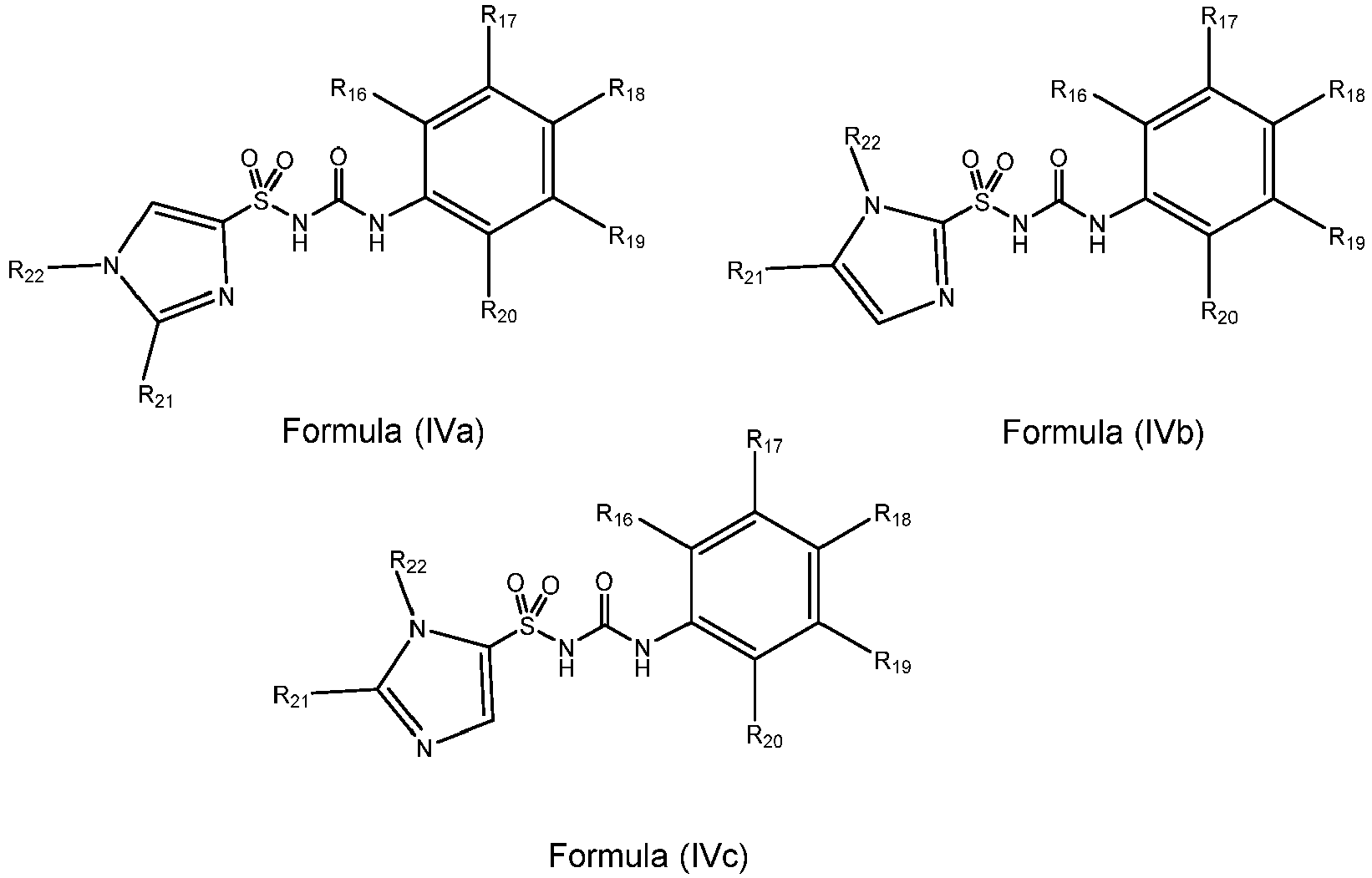 R21 and R22 are selected from H, alkyl, perhaloalkyl, hydroxylalkyl, C3-C6 cycloalkyl, phenyl and benzyl;R16 and R17, together with the atoms to which they are attached, form a cyclopentyl ring;R19 and R20, together with the atoms to which they are attached, form a cyclopentyl ring;R18 is H or halogen; andprovided that R21 and R22 are not both H;or wherein:R21 and R22 are selected from H, alkyl, perhaloalkyl, hydroxylalkyl, C3-C6 cycloalkyl, phenyl and benzyl; preferably wherein the perhaloalkyl and hydroxylalkyl are C1-6 perhaloalkyl and hydroxylalkyl;R16 and R20 are C1-6 alkyl or C3-5 cycloalkyl;R17 and R19 are H;R18 is H or halogen; andprovided that R21 and R22 are not both H.
 - The compound of any one of claim 1 to claim 7, wherein the compound is a compound of formula (Va), (Vb) or (Vc), or a pharmaceutically acceptable salt or solvate thereof:
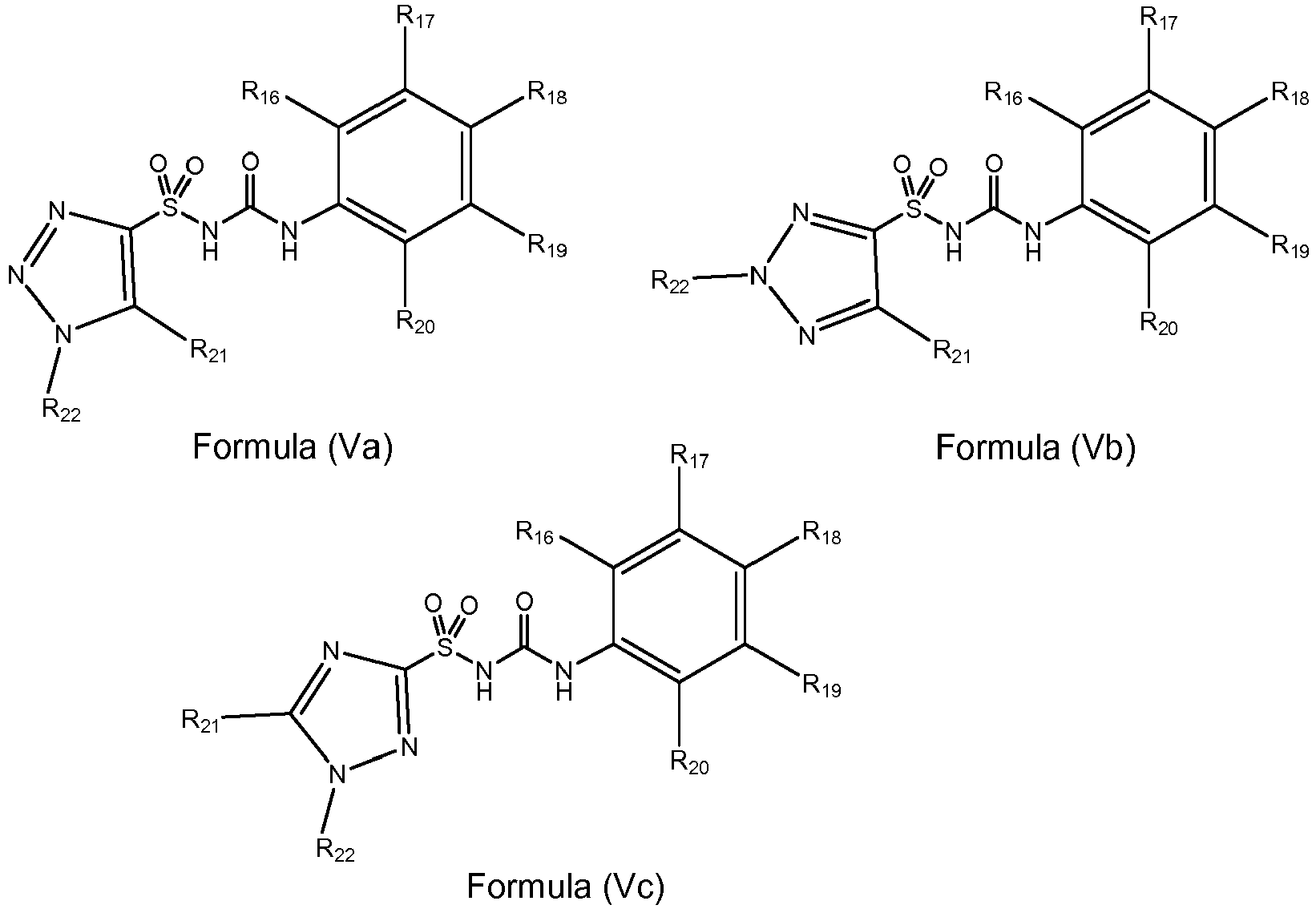 R21 and R22 are selected from H, alkyl, perhaloalkyl, hydroxylalkyl, C3-C6 cycloalkyl, phenyl and benzyl;R16 and R17, together with the atoms to which they are attached, form a cyclopentyl ring;R19 and R20, together with the atoms to which they are attached, form a cyclopentyl ring;R18 is H or halogen; andprovided that R21 and R22 are not both H;or wherein:R21 and R22 are selected from H, alkyl, perhaloalkyl, hydroxylalkyl, C3-C6 cycloalkyl, phenyl and benzyl;R16 and R20 are C1-6 alkyl or C3-5 cycloalkyl;R17 and R19 are H;R18 is H or halogen; andprovided that R21 and R22 are not both H.
 - The compound of any one of claim 1 to claim 7, wherein the compound is a compound of formula (VIa) or (Vlb), or a pharmaceutically acceptable salt or solvate thereof:
 R22 is selected from alkyl, perhaloalkyl, hydroxylalkyl, C3-C6 cycloalkyl, phenyl and benzyl;R16 and R17, together with the atoms to which they are attached, form a cyclopentyl ring;R19 and R20, together with the atoms to which they are attached, form a cyclopentyl ring; andR18 is H or halogen;or wherein:R22 is selected from alkyl, perhaloalkyl, hydroxylalkyl, C3-C6 cycloalkyl, phenyl and benzyl;R16 and R20 are C1-6 alkyl or C3-5 cycloalkyl, preferably isopropyl or cyclopentyl;R17 and R19 are H; andR18 is H or halogen.
 - The compound of any one of claim 1 to claim 9, wherein


- The compound of any one of the preceding claims, wherein R2 is selected from hexahydroindacene, 2,6-diisopropylphenyl, 2,6-diisopropyl-4-chlorophenyl, 2,6-dicyclopropylphenyl, 2,6-dicyclopropyl-4-chlorophenyl, or

- The compound of any one of claim 1 to claim 10, wherein the compound is a compound of formula (Ia), (Ib) or (Ic), or a pharmaceutically acceptable salt or solvate thereof:

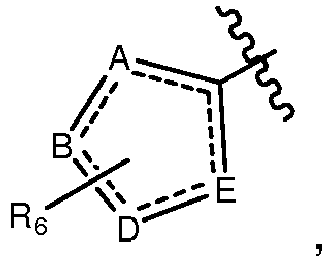
- The compound of claim 17, wherein R1 is selected from the group consisting of pyrazole, pyrrolidine, pyrrole, triazole, tetrazole and imidazole, all of which may be optionally substituted as appropriate, wherein any optional substituent is independently selected from the group consisting of C1-10 alkyl; C3-6 cycloalkyl; hydroxyalkyl; C1-10 alkoxy; C2-10 alkenyl; C2-10 alkynyl; C6-C12 aryl; aryloxy; heteroaryl; heterocyclyl; halo; hydroxyl; halogenated alkyl; amino; alkylamino; arylamino; acyl; amido; CN; NO2; N3; CH2OH; CONH2; CONR24R25; CO2R24; CH2OR24; NHCOR24; NHCO2R24; C1-3 alkylthio; sulfate; sulfonic acid; sulfonate esters; phosphonic acid; phosphate; phosphonate; mono-, di-, or triphosphate esters; trityl; monomethoxytrityl; R24SO; R24SO2; CF3S; CF3SO2; and trialkylsilyl; wherein R24 and R25 are each independently selected from H or C1-10 alkyl.
- The compound of claim 17 or claim 18, wherein R1 is selected from the group consisting of:





- The compound of claim 1, wherein the compound of formula (II) is selected from the group consisting of:
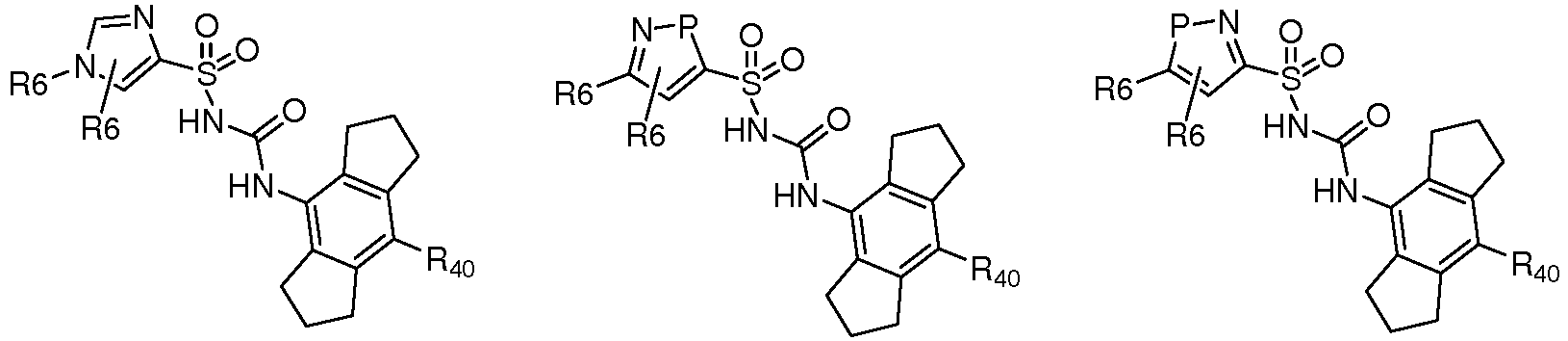


 wherein R40 is selected from H, C1-C6 alkyl and halo;R41 is selected from alkyl and cycloalkyl;each incidence of P is independently selected from C, O or S; andeach incidence of R6, when present, is independently selected from those groups defined in claim 1.
 - The compound of any one of the preceding claims, wherein the compound is selected from the group consisting of:
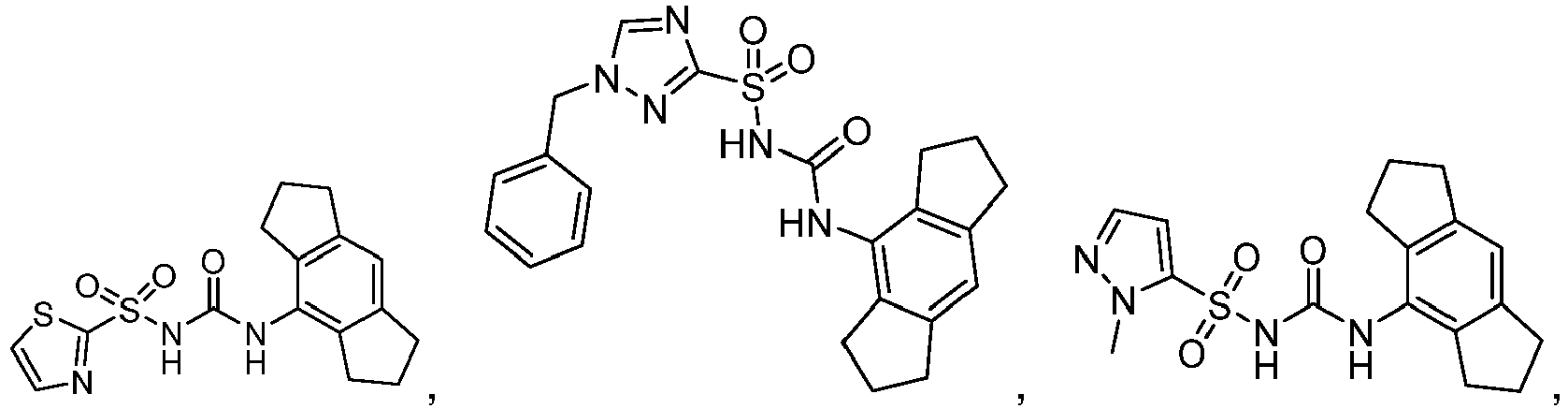


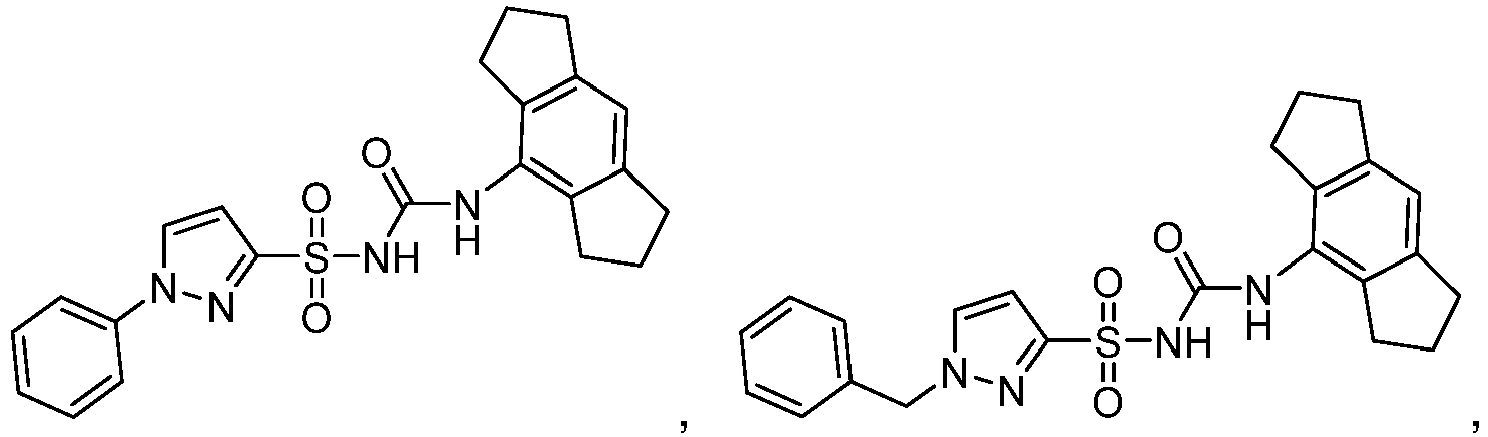


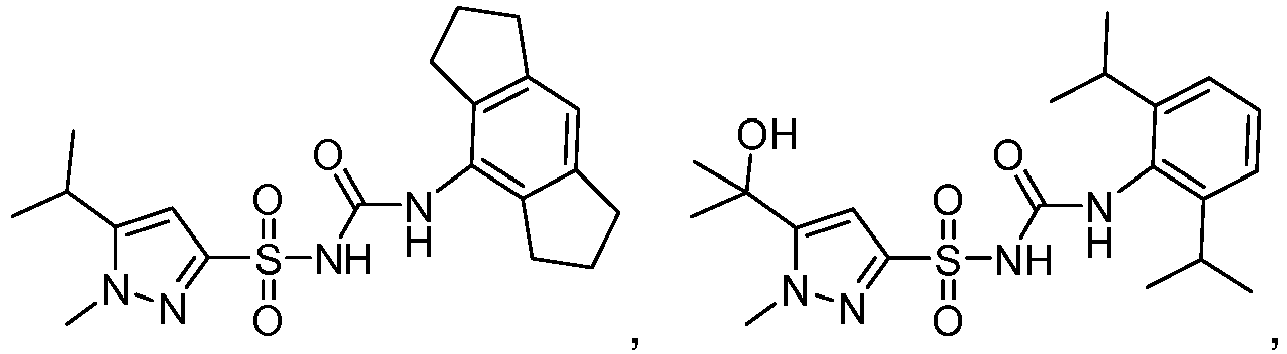


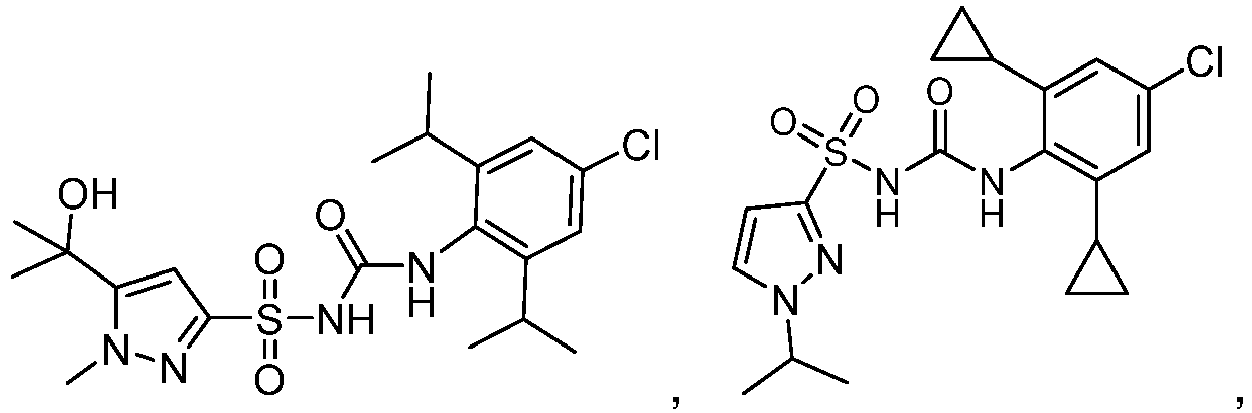

- The compound of any one of claims 1 to 21, wherein the compound is

- The compound of any one of claims 1 to 21, wherein the compound is

- The compound of any one of claims 1 to 21, wherein the compound is

- The compound of any one of claims 1 to 21, wherein the compound is

- A pharmaceutical composition comprising a compound of any one of claim 1 to claim 25, or a pharmaceutically acceptable salt or solvate thereof, and a pharmaceutically acceptable carrier, diluent and/or excipient.
- The compound or the pharmaceutically effective salt or solvate of any one of claim 1 to claim 25, for use in medicine.
- The compound or the pharmaceutically effective salt or solvate of any one of claim 1 to claim 25, for use in:(a) the treatment or prevention of a disease, disorder or condition; and/or(b) the treatment or prevention of a disease, disorder or condition, wherein the disease, disorder or condition is a disease, disorder or condition of the immune system; and/or(c) the treatment or prevention of a disease, disorder or condition, wherein the disease, disorder or condition is an inflammatory disease, disorder or condition or an autoimmune disease, disorder or condition; and/or(d) the treatment or prevention of a disease, disorder or condition, wherein the disease, disorder or condition is a disease, disorder or condition of the skin; and/or(e) the treatment or prevention of a disease, disorder or condition, wherein the disease, disorder or condition is a disease, disorder or condition of the cardiovascular system; and/or(f) the treatment or prevention of a disease, disorder or condition, wherein the disease, disorder or condition is a cancer, tumour or other malignancy; and/or(g) the treatment or prevention of a disease, disorder or condition, wherein the disease, disorder or condition is a disease, disorder or condition of the renal system; and/or(h) the treatment or prevention of a disease, disorder or condition, wherein the disease, disorder or condition is a disease, disorder or condition of the gastro-intestinal tract; and/or(i) the treatment or prevention of a disease, disorder or condition, wherein the disease, disorder or condition is a disease, disorder or condition of the respiratory system; and/or(j) the treatment or prevention of a disease, disorder or condition, wherein the disease, disorder or condition is a disease, disorder or condition of the endocrine system; and/or(k) the treatment or prevention of a disease, disorder or condition, wherein the disease, disorder or condition is a disease, disorder or condition of the central nervous system (CNS); and/or(l) the treatment or prevention of a disease, disorder or condition, wherein the disease, disorder or condition is selected from the group consisting of constitutive inflammation including the cryopyrin-associated periodic syndromes (CAPS): Muckle-Wells syndrome (MWS), familial cold autoinflammatory syndrome (FCAS) and neonatal-onset multisystem inflammatory disease (NOMID); including autoinflammatory diseases: familial Mediterranean fever (FMF), TNF receptor associated periodic syndrome (TRAPS), mevalonate kinase deficiency (MKD), hyperimmunoglobulinemia D and periodic fever syndrome (HIDS), deficiency of interleukin 1 receptor (DIRA) antagonist, Majeed syndrome, pyogenic arthritis, pyoderma gangrenosum and acne (PAPA), haploinsufficiency of A20 (HA20), pediatric granulomatous arthritis (PGA), PLCG2-associated antibody deficiency and immune dysregulation (PLAID), PLCG2-associated autoinflammation, antibody deficiency and immune dysregulation (APLAID), sideroblastic anemia with B-cell immunodeficiency, periodic fevers, and developmental delay (SIFD); Sweet's syndrome, chronic nonbacterial osteomyelitis (CNO), chronic recurrent multifocal osteomyelitis (CRMO) and synovitis, acne, pustulosis, hyperostosis, osteitis syndrome (SAPHO); autoimmune diseases including multiple sclerosis (MS), type-1 diabetes, psoriasis, rheumatoid arthritis, Behcet's disease, Sjogren's syndrome and Schnitzler syndrome; respiratory diseases including chronic obstructive pulmonary disorder (COPD), steroid-resistant asthma, asbestosis, silicosis and cystic fibrosis; central nervous system diseases including Parkinson's disease, Alzheimer's disease, motor neuron disease, Huntington's disease, cerebral malaria and brain injury from pneumococcal meningitis; metabolic diseases including Type 2 diabetes, atherosclerosis, obesity, gout, pseudo-gout; ocular diseases including those of the ocular epithelium, age-related macular degeneration (AMD), corneal infection, uveitis and dry eye; kidney disease including chronic kidney disease, oxalate nephropathy and diabetic nephropathy; liver disease including non-alcoholic steatohepatitis and alcoholic liver disease; inflammatory reactions in skin including contact hypersensitivity and sunburn; inflammatory reactions in the joints including osteoarthritis, systemic juvenile idiopathic arthritis, adult-onset Still's disease, relapsing polychondritis; viral infections including alpha virus including Chikungunya and Ross River, and flavivirus including Dengue and Zika viruses, flu, HIV; hidradenitis suppurativa (HS) and other cyst-causing skin diseases; cancers including lung cancer metastasis, pancreatic cancers, gastric cancers, myelodisplastic syndrome, leukemia; polymyositis; stroke; myocardial infarction; Graft versus Host Disease; hypertension; colitis; helminth infection; bacterial infection; abdominal aortic aneurism; wound healing; depression, psychological stress; pericarditis including Dressler's syndrome, ischaemia reperfusion injury and any disease where an individual has been determined to carry a germline or somatic non-silent mutation in NLRP3.
- The compound or the pharmaceutically effective salt or solvate of any one of claim 1 to claim 25, for use in diagnosing a disease, disorder or condition in a mammal including the step of administering a labelled compound of any one of claim 1 to claim 25, or a pharmaceutically effective salt or solvate thereof, or metal ion chelate complex thereof, to the mammal or to a biological sample obtained from the mammal to facilitate diagnosis of the disease, disorder or condition in the mammal.
Priority Applications (11)
| Application Number | Priority Date | Filing Date | Title |
|---|---|---|---|
| HRP20200214TT HRP20200214T1 (en) | 2015-02-16 | 2016-02-16 | Sulfonylureas and related compounds and use of same |
| EP19187141.7A EP3578547B1 (en) | 2015-02-16 | 2016-02-16 | Sulfonylureas and related compounds and use of same |
| DK19187141.7T DK3578547T3 (en) | 2015-02-16 | 2016-02-16 | SULPHONYLURASES AND RELATED COMPOUNDS AND USE OF THE SAME |
| MA41553A MA41553B1 (en) | 2015-02-16 | 2016-02-16 | Sulfonylureas, Related Compounds, and Their Use |
| SM20200192T SMT202000192T1 (en) | 2015-02-16 | 2016-02-16 | Sulfonylureas and related compounds and use of same |
| RS20200258A RS60048B1 (en) | 2015-02-16 | 2016-02-16 | Sulfonylureas and related compounds and use of same |
| MEP-2020-49A ME03737B (en) | 2015-02-16 | 2016-02-16 | Sulfonylureas and related compounds and use of same |
| PL19187141T PL3578547T3 (en) | 2015-02-16 | 2016-02-16 | SULFONYL UREA DERIVATIVES AND RELATED COMPOUNDS AND THEIR USE |
| SI201630635T SI3259253T1 (en) | 2015-02-16 | 2016-02-16 | Sulfonylureas and related compounds and their use |
| PL16751821T PL3259253T3 (en) | 2015-02-16 | 2016-02-16 | Sulfonylureas and related compounds and their application |
| EP21152421.0A EP3888749A1 (en) | 2015-02-16 | 2016-02-16 | Sulfonylureas and related compounds and use of same |
Applications Claiming Priority (2)
| Application Number | Priority Date | Filing Date | Title |
|---|---|---|---|
| AU2015900507A AU2015900507A0 (en) | 2015-02-16 | Sulfonylureas and related compounds and use of same | |
| PCT/AU2016/050103 WO2016131098A1 (en) | 2015-02-16 | 2016-02-16 | Sulfonylureas and related compounds and use of same |
Related Child Applications (3)
| Application Number | Title | Priority Date | Filing Date |
|---|---|---|---|
| EP21152421.0A Division EP3888749A1 (en) | 2015-02-16 | 2016-02-16 | Sulfonylureas and related compounds and use of same |
| EP19187141.7A Division-Into EP3578547B1 (en) | 2015-02-16 | 2016-02-16 | Sulfonylureas and related compounds and use of same |
| EP19187141.7A Division EP3578547B1 (en) | 2015-02-16 | 2016-02-16 | Sulfonylureas and related compounds and use of same |
Publications (3)
| Publication Number | Publication Date |
|---|---|
| EP3259253A1 EP3259253A1 (en) | 2017-12-27 |
| EP3259253A4 EP3259253A4 (en) | 2018-07-25 |
| EP3259253B1 true EP3259253B1 (en) | 2020-01-15 |
Family
ID=56691944
Family Applications (3)
| Application Number | Title | Priority Date | Filing Date |
|---|---|---|---|
| EP21152421.0A Pending EP3888749A1 (en) | 2015-02-16 | 2016-02-16 | Sulfonylureas and related compounds and use of same |
| EP16751821.6A Active EP3259253B1 (en) | 2015-02-16 | 2016-02-16 | Sulfonylureas and related compounds and use of same |
| EP19187141.7A Active EP3578547B1 (en) | 2015-02-16 | 2016-02-16 | Sulfonylureas and related compounds and use of same |
Family Applications Before (1)
| Application Number | Title | Priority Date | Filing Date |
|---|---|---|---|
| EP21152421.0A Pending EP3888749A1 (en) | 2015-02-16 | 2016-02-16 | Sulfonylureas and related compounds and use of same |
Family Applications After (1)
| Application Number | Title | Priority Date | Filing Date |
|---|---|---|---|
| EP19187141.7A Active EP3578547B1 (en) | 2015-02-16 | 2016-02-16 | Sulfonylureas and related compounds and use of same |
Country Status (30)
| Country | Link |
|---|---|
| US (4) | US10538487B2 (en) |
| EP (3) | EP3888749A1 (en) |
| JP (2) | JP6929792B2 (en) |
| KR (2) | KR20240162585A (en) |
| CN (3) | CN113582889B (en) |
| AU (3) | AU2016222278B2 (en) |
| CA (2) | CA3250390A1 (en) |
| CL (2) | CL2017002097A1 (en) |
| CY (1) | CY1122832T1 (en) |
| DK (2) | DK3578547T3 (en) |
| ES (2) | ES2777626T3 (en) |
| HR (2) | HRP20200214T1 (en) |
| HU (1) | HUE055755T2 (en) |
| IL (2) | IL273065B2 (en) |
| LT (2) | LT3259253T (en) |
| MA (3) | MA47440B1 (en) |
| MD (1) | MD3259253T2 (en) |
| ME (1) | ME03737B (en) |
| MX (2) | MX2017010528A (en) |
| MY (2) | MY193765A (en) |
| NZ (1) | NZ733948A (en) |
| PE (2) | PE20180160A1 (en) |
| PL (2) | PL3578547T3 (en) |
| PT (2) | PT3578547T (en) |
| RS (2) | RS60048B1 (en) |
| RU (1) | RU2739356C2 (en) |
| SG (2) | SG11201706664QA (en) |
| SI (2) | SI3259253T1 (en) |
| SM (1) | SMT202000192T1 (en) |
| WO (1) | WO2016131098A1 (en) |
Cited By (3)
| Publication number | Priority date | Publication date | Assignee | Title |
|---|---|---|---|---|
| US11981667B2 (en) | 2017-07-07 | 2024-05-14 | Inflazome Limited | Sulfonamide carboxamide compounds |
| US12012397B2 (en) | 2017-12-18 | 2024-06-18 | NodThera Limited | Sulphonyl urea derivatives as NLRP3 inflammasome modulators |
| US12054461B2 (en) | 2019-06-12 | 2024-08-06 | NodThera Limited | Sulfonylurea derivatives and uses thereof |
Families Citing this family (133)
| Publication number | Priority date | Publication date | Assignee | Title |
|---|---|---|---|---|
| MY193765A (en) * | 2015-02-16 | 2022-10-27 | Univ Queensland | Sulfonylureas and related compounds and use of same |
| FR3046933B1 (en) * | 2016-01-25 | 2018-03-02 | Galderma Research & Development | NLRP3 INHIBITORS FOR THE TREATMENT OF INFLAMMATORY SKIN CONDITIONS |
| US11858922B2 (en) * | 2016-02-16 | 2024-01-02 | The University Of Queensland | Sulfonylureas and related compounds and use of same |
| JP7050751B2 (en) | 2016-04-18 | 2022-04-08 | ノバルティス アーゲー | Compounds and compositions for treating conditions associated with NLRP activity |
| WO2018103583A1 (en) * | 2016-12-05 | 2018-06-14 | Zibo Anxuan Pharmaceutical Science And Technology Co., Ltd. | N-hydroxy-benzene-sulfonamide derivatives and their uses thereof |
| JP7163293B2 (en) | 2017-01-23 | 2022-10-31 | ジェネンテック, インコーポレイテッド | Chemical compounds as inhibitors of interleukin-1 activity |
| GB2561540A (en) | 2017-03-13 | 2018-10-24 | Nodthera Ltd | Chemical compounds |
| US11840543B2 (en) | 2017-05-24 | 2023-12-12 | The University Of Queensland | Compounds and uses |
| US11236045B2 (en) | 2017-06-09 | 2022-02-01 | Cadila Healthcare Limited | Substituted sulfoximine compounds |
| WO2019008029A1 (en) * | 2017-07-07 | 2019-01-10 | Inflazome Limited | Sulfonylureas and sulfonylthioureas as nlrp3 inhibitors |
| CN111793060B (en) * | 2017-07-14 | 2023-06-06 | 先天肿瘤免疫公司 | NLRP3 modulators |
| EP3658538B1 (en) * | 2017-07-24 | 2023-04-19 | Novartis AG | Compounds and compositions for treating conditions associated with nlrp activity |
| CN117209447A (en) | 2017-07-24 | 2023-12-12 | 诺华股份有限公司 | Compounds and compositions for treating disorders associated with NLRP activity |
| GB201712282D0 (en) * | 2017-07-31 | 2017-09-13 | Nodthera Ltd | Selective inhibitors of NLRP3 inflammasome |
| DE102017118230B4 (en) * | 2017-08-10 | 2021-04-22 | Christoph Lucks | Method for analyzing and / or monitoring bridges and the corresponding system and use |
| TW201910317A (en) | 2017-08-15 | 2019-03-16 | 愛爾蘭商英弗雷佐姆有限公司 | Novel compound |
| CN111132974B (en) * | 2017-08-15 | 2023-11-21 | 英夫拉索姆有限公司 | Sulfonamide carboxamide compounds |
| PE20200758A1 (en) | 2017-08-15 | 2020-07-27 | Inflazome Ltd | SULFONYLUREAS AND SULFONYLTIOUREAS AS INHIBITORS OF NLRP3 |
| EP3668840A1 (en) * | 2017-08-15 | 2020-06-24 | Inflazome Limited | Novel sulfonamide carboxamide compounds |
| EP3668843A1 (en) * | 2017-08-15 | 2020-06-24 | Inflazome Limited | Sulfonylureas and sulfonylthioureas as nlrp3 inhibitors |
| EP3668862A1 (en) * | 2017-08-15 | 2020-06-24 | Inflazome Limited | Novel sulfonamide carboxamide compounds |
| EP3668601A1 (en) * | 2017-08-15 | 2020-06-24 | Inflazome Limited | Novel sulfonamide carboxamide compounds |
| WO2019043610A1 (en) | 2017-08-31 | 2019-03-07 | Cadila Healthcare Limited | Novel substituted sulfonylurea derivatives |
| WO2019068772A1 (en) * | 2017-10-03 | 2019-04-11 | Inflazome Limited | Novel compounds |
| WO2019092172A1 (en) * | 2017-11-09 | 2019-05-16 | Inflazome Limited | Novel sulfonamide carboxamide compounds |
| CA3078195A1 (en) * | 2017-11-09 | 2019-05-16 | Inflazome Limited | Novel sulfonamide carboxamide compounds |
| WO2019092171A1 (en) * | 2017-11-09 | 2019-05-16 | Inflazome Limited | Novel sulfonamide carboxamide compounds |
| TWI805699B (en) * | 2018-03-01 | 2023-06-21 | 日商日本煙草產業股份有限公司 | Methyllactam ring compound and pharmaceutical use thereof |
| WO2019166633A1 (en) | 2018-03-02 | 2019-09-06 | Inflazome Limited | Sulfonamide derivates as nlrp3 inhibitors |
| WO2019166632A1 (en) | 2018-03-02 | 2019-09-06 | Inflazome Limited | Novel compounds |
| GB201803394D0 (en) | 2018-03-02 | 2018-04-18 | Inflazome Ltd | Novel compounds |
| US11905252B2 (en) | 2018-03-02 | 2024-02-20 | Inflazome Limited | Compounds |
| WO2019166627A1 (en) | 2018-03-02 | 2019-09-06 | Inflazome Limited | Novel compounds |
| US11884645B2 (en) | 2018-03-02 | 2024-01-30 | Inflazome Limited | Sulfonyl acetamides as NLRP3 inhibitors |
| EP3759090A1 (en) | 2018-03-02 | 2021-01-06 | Inflazome Limited | Novel compounds |
| US20200399242A1 (en) * | 2018-03-02 | 2020-12-24 | Inflazome Limited | Novel compounds |
| GB201803393D0 (en) | 2018-03-02 | 2018-04-18 | Inflazome Ltd | Novel compounds |
| WO2019182981A1 (en) | 2018-03-21 | 2019-09-26 | Olatec Therapeutics Llc | Methods for treating melanoma |
| GB201806578D0 (en) * | 2018-04-23 | 2018-06-06 | Inflazome Ltd | Novel compound |
| ES3038908T3 (en) * | 2018-04-23 | 2025-10-15 | Corcept Therapeutics Inc | Methods of preparing regioselective n-alkyl triazoles |
| US20210261512A1 (en) | 2018-05-04 | 2021-08-26 | Inflazome Limited | Novel compounds |
| CN108404117B (en) * | 2018-05-29 | 2020-06-30 | 广东龙帆生物科技有限公司 | Application of nucleotide-binding oligomerization domain-like receptor protein in the treatment of Zika virus infection |
| CA3103664A1 (en) * | 2018-07-03 | 2020-01-09 | Novartis Ag | Methods of treating or selecting a treatment for a subject resistant to tnf inhibitor using a nlrp3 antagonist |
| JP2021529187A (en) | 2018-07-03 | 2021-10-28 | ノバルティス アーゲー | NLRP modulator |
| US20210395241A1 (en) * | 2018-07-03 | 2021-12-23 | Novartis Ag | Nlrp modulators |
| CA3104199A1 (en) | 2018-07-20 | 2020-01-23 | F. Hoffmann-La Roche Ag | Sulfonylurea compounds as inhibitors of interleukin-1 activity |
| PE20211811A1 (en) * | 2018-07-20 | 2021-09-14 | Hoffmann La Roche | SULFONIMIDAMIDE COMPOUNDS AS INHIBITORS OF INTERLEUKIN-1 ACTIVITY |
| GB201902327D0 (en) | 2019-02-20 | 2019-04-03 | Inflazome Ltd | Novel compounds |
| PE20211333A1 (en) | 2018-08-15 | 2021-07-22 | Inflazome Ltd | NOVEL SULFONAMIDAUREA COMPOUNDS |
| GB201817038D0 (en) * | 2018-10-19 | 2018-12-05 | Inflazome Ltd | Novel processes |
| JP2022505525A (en) * | 2018-10-24 | 2022-01-14 | ノバルティス アーゲー | Compounds and compositions for treating conditions associated with NLRP activity |
| US12134611B2 (en) | 2018-11-13 | 2024-11-05 | Novartis Ag | Compounds and compositions for treating conditions associated with NLRP activity |
| CN120531732A (en) * | 2018-11-13 | 2025-08-26 | 诺华股份有限公司 | Compounds and compositions for treating conditions associated with NLRP activity |
| ES2974842T3 (en) * | 2018-11-13 | 2024-07-01 | Novartis Ag | Compounds and compositions for the treatment of conditions associated with nlrp activity |
| CN113227055A (en) * | 2018-11-16 | 2021-08-06 | 诺华股份有限公司 | Compounds and compositions for treating conditions associated with NLRP activity |
| US20230051589A1 (en) * | 2018-11-16 | 2023-02-16 | Novartis Ag | Compounds and compositions for treating conditions associated with nlrp activity |
| GB201819083D0 (en) * | 2018-11-23 | 2019-01-09 | Inflazome Ltd | Novel compounds |
| CN113474333B (en) * | 2019-01-14 | 2025-06-13 | 载度思生命科学有限公司 | New substituted sulfonylurea derivatives |
| WO2020154321A1 (en) * | 2019-01-22 | 2020-07-30 | Novartis Inflammasome Research, Inc. | Compounds and compositions for treating conditions associated with nlrp activity |
| SG11202107653RA (en) * | 2019-01-25 | 2021-08-30 | Nodthera Ltd | Carbamate derivatives and uses thereof |
| KR102841700B1 (en) | 2019-02-22 | 2025-08-01 | 피아이 인더스트리스 엘티디. | Method for synthesizing anthranilic acid diamide compounds and their intermediates |
| EP3934636A1 (en) * | 2019-03-06 | 2022-01-12 | Institut National de la Santé et de la Recherche Médicale (INSERM) | Inhibitors of ngal protein |
| GB201905265D0 (en) | 2019-04-12 | 2019-05-29 | Inflazome Ltd | Inflammasome inhibition |
| CN111848461A (en) * | 2019-04-29 | 2020-10-30 | 苏州大学 | NLRP3 inflammasome inhibitor and preparation method and application thereof |
| UY38687A (en) | 2019-05-17 | 2023-05-15 | Novartis Ag | NLRP3 INFLAMMASOME INHIBITORS, COMPOSITIONS, COMBINATIONS THEREOF AND METHODS OF USE |
| EP3983388A1 (en) * | 2019-06-12 | 2022-04-20 | Nodthera Limited | Sulfonamide derivatives and uses thereof |
| US20220378801A1 (en) | 2019-06-21 | 2022-12-01 | Ac Immune Sa | Novel compounds |
| WO2021002887A1 (en) | 2019-07-02 | 2021-01-07 | Novartis Inflammasome Research, Inc. | Gut-targeted nlrp3 antagonists and their use in therapy |
| CA3151865A1 (en) * | 2019-07-17 | 2021-01-21 | Zomagen Biosciences Ltd | N-((1,2,3,5,6,7-hexahydro-s-indacen-4-yl)carbamoyl)-4,5,6,7-tetrahydrobenzofuran -2-sulfonamide derivatives and related compounds as nlpr3 modulators for the treatment of multiple sclerosis (ms) |
| JP7595642B2 (en) * | 2019-07-17 | 2024-12-06 | ズーマゲン バイオサイエンシーズ エルティーディー | NLRP3 Modulators |
| JP2022545400A (en) * | 2019-08-16 | 2022-10-27 | インフレイゾーム リミテッド | Macrocyclic Sulfonylurea Derivatives Useful as NLRP3 Inhibitors |
| JP2022547882A (en) * | 2019-09-06 | 2022-11-16 | インフレイゾーム リミテッド | NLRP3 inhibitor |
| EP4027986A4 (en) | 2019-09-12 | 2023-10-04 | Zydus Lifesciences Limited | NEW SUBSTITUTED SULFOXIMINE DERIVATIVES |
| EP4054564A1 (en) * | 2019-11-07 | 2022-09-14 | Inflazome Limited | Treatment of autoinflammatory disorders |
| GB201916237D0 (en) * | 2019-11-07 | 2019-12-25 | Inflazome Ltd | Novel treatment |
| WO2021089769A1 (en) * | 2019-11-07 | 2021-05-14 | Inflazome Limited | Treatment and prevention of neuroinflammation or an inflammatory brain disorder |
| CN114641287A (en) * | 2019-11-07 | 2022-06-17 | 英夫拉索姆有限公司 | Treatment and prevention of neurodegenerative disorders |
| WO2021089781A1 (en) * | 2019-11-07 | 2021-05-14 | Inflazome Limited | Treatment or prevention of psychiatric brain disorders using the nlrp3 inhibitor n-((1,2,3,5,6,7-hexahydro-s-indacen-4-yl)carbamoyl)-1 -isopropyl-1 h-pyrazole-3-sulfonamide |
| WO2021089776A1 (en) * | 2019-11-07 | 2021-05-14 | Inflazome Limited | Treatment and prevention of a traumatic brain disorder |
| JP7392169B2 (en) * | 2019-11-12 | 2023-12-05 | 成都百裕制薬股▲ふん▼有限公司 | Amide derivatives and their preparation methods and applications in medicine |
| WO2021111351A1 (en) * | 2019-12-03 | 2021-06-10 | Cadila Healthcare Limited | Novel substituted sulfonylurea and sulfoximineurea derivatives |
| WO2021150574A1 (en) * | 2020-01-22 | 2021-07-29 | Genentech, Inc. | Sulfonimidamide compounds as nlrp3 modulators |
| US11618751B1 (en) | 2022-03-25 | 2023-04-04 | Ventus Therapeutics U.S., Inc. | Pyrido-[3,4-d]pyridazine amine derivatives useful as NLRP3 derivatives |
| JP2023513935A (en) | 2020-02-18 | 2023-04-04 | インフレイゾーム リミテッド | Compound |
| JP2023518044A (en) | 2020-03-16 | 2023-04-27 | ズーマゲン バイオサイエンシーズ エルティーディー | NLRP3 modulator |
| CN111358778A (en) * | 2020-03-17 | 2020-07-03 | 中国医科大学附属第一医院 | Application of MCC950 in the preparation of drugs for preventing or treating Alzheimer's disease |
| CN115297855A (en) | 2020-03-19 | 2022-11-04 | 索芙特海尔公司 | Methods of treating NLRP3-related diseases |
| KR20230005320A (en) * | 2020-04-30 | 2023-01-09 | 얀센 파마슈티카 엔.브이. | Novel triazinoindole compounds |
| WO2021249337A1 (en) | 2020-06-11 | 2021-12-16 | 南京明德新药研发有限公司 | Dimethylsulfoximine derivative |
| CA3178361A1 (en) * | 2020-06-19 | 2021-12-23 | Emanuele Gabellieri | Dihydrooxazole and thiourea derivatives modulating the nlrp3 inflammasome pathway |
| WO2022022646A1 (en) * | 2020-07-29 | 2022-02-03 | 南京明德新药研发有限公司 | Selenium-containing five-membered heteroaromatic ring compound |
| WO2022023907A1 (en) | 2020-07-31 | 2022-02-03 | Novartis Ag | Methods of selecting and treating patients at elevated risk of major adverse cardiac events |
| CA3191410A1 (en) * | 2020-09-04 | 2022-03-10 | Mark G. Bock | Sulphamoyl urea derivatives containing alkyl-oxacycloalkyl moiety and uses thereof |
| WO2022098108A1 (en) * | 2020-11-04 | 2022-05-12 | (주) 업테라 | Nlrp3 protein degradation inducing compound |
| FR3115682B1 (en) * | 2020-11-05 | 2023-02-24 | Roquette Freres | Compositions based on methyl-cyclodextrins for the treatment and/or prevention of hepatic steatosis |
| WO2022104102A2 (en) * | 2020-11-13 | 2022-05-19 | University Of Miami | Materials and methods for treating corneal dysfunction |
| CA3202544A1 (en) * | 2020-11-20 | 2022-05-27 | Denali Therapeutics Inc. | Compounds, compositions, and methods |
| WO2022115417A1 (en) * | 2020-11-25 | 2022-06-02 | VenatoRx Pharmaceuticals, Inc. | Sulfonyl urea nlrp3 inflammasome inhibitors |
| KR102802013B1 (en) * | 2021-02-03 | 2025-05-07 | 환인제약 주식회사 | Small Molecule Inhibitors of NLRP3 Inflammasome for Treatment of Alzheimer's Disease |
| JP7825294B2 (en) * | 2021-02-10 | 2026-03-06 | ハンジョウ イノゲート ファーマ カンパニー リミテッド | Compounds as NLRP3 inhibitors |
| US11319319B1 (en) | 2021-04-07 | 2022-05-03 | Ventus Therapeutics U.S., Inc. | Compounds for inhibiting NLRP3 and uses thereof |
| WO2022232632A1 (en) * | 2021-04-30 | 2022-11-03 | Denali Therapeutics Inc. | Compounds, compositions, and methods |
| IT202100011237A1 (en) * | 2021-05-03 | 2022-11-03 | Univ Degli Studi Di Torino | NLRP3 INFLAMMASOME INHIBITOR COMPOUNDS AND THEIR USE |
| CN116635374B (en) * | 2021-05-10 | 2025-05-06 | 康百达(四川)生物医药科技有限公司 | Amide derivatives and use thereof |
| WO2022237782A1 (en) * | 2021-05-10 | 2022-11-17 | 成都百裕制药股份有限公司 | Amide derivative and application thereof |
| WO2022237781A1 (en) * | 2021-05-10 | 2022-11-17 | 成都百裕制药股份有限公司 | Amide derivative and application thereof |
| JP2024524250A (en) | 2021-06-23 | 2024-07-05 | エフ. ホフマン-ラ ロシュ アーゲー | Crystalline potassium salt of 1-ethyl-N-((1,2,3,5,6,7-hexahydro-S-indacen-4-yl)carbamoyl)piperidine-4-sulfonamide |
| CN117940120A (en) * | 2021-07-16 | 2024-04-26 | 戴纳立制药公司 | Compounds, compositions, and methods |
| ES2948511A1 (en) * | 2021-09-08 | 2023-09-13 | Fundacion Para La Investigacion Biomedica Del Hospital Univ De La Princesa | N-SULFONYLUREA DERIVATIVES AND THEIR THERAPEUTIC USE (Machine-translation by Google Translate, not legally binding) |
| CN115894478B (en) * | 2021-09-30 | 2025-04-04 | 杭州民生药物研究院有限公司 | A novel pyridopyrazole heterocyclic compound and its application |
| KR20230066899A (en) | 2021-11-08 | 2023-05-16 | 제일약품주식회사 | Novel compounds as nlrp3 inhibitor and pharmaceutical composition comprising the same |
| CN118355000A (en) * | 2021-12-03 | 2024-07-16 | 辰欣药业股份有限公司 | Salt and crystal forms of dimethylsulfinyl imide derivatives |
| US20250109126A1 (en) | 2021-12-22 | 2025-04-03 | Ac Immune Sa | Dihydro-oxazol derivative compounds |
| WO2023230002A1 (en) * | 2022-05-23 | 2023-11-30 | VenatoRx Pharmaceuticals, Inc. | Nlrp3 inflammasome inhibitors |
| WO2024010772A1 (en) * | 2022-07-06 | 2024-01-11 | Kodiak Sciences Inc. | Nlrp3 inhibitors |
| JP2025524640A (en) | 2022-07-14 | 2025-07-30 | エーシー・イミューン・エス・アー | Pyrrolotriazine and imidazotriazine derivatives as modulators of the nlrp3 inflammasome pathway |
| CN119998284A (en) | 2022-07-28 | 2025-05-13 | Ac免疫有限公司 | New compounds |
| UY40374A (en) | 2022-08-03 | 2024-02-15 | Novartis Ag | NLRP3 INFLAMASOME INHIBITORS |
| KR20240022938A (en) | 2022-08-12 | 2024-02-20 | 제일약품주식회사 | Novel compounds as nlrp3 inhibitor and pharmaceutical composition comprising the same |
| US12331048B2 (en) | 2022-10-31 | 2025-06-17 | Ventus Therapeutics U.S., Inc. | Pyrido-[3,4-d]pyridazine amine derivatives useful as NLRP3 inhibitors |
| CN115772173B (en) * | 2022-12-20 | 2024-04-16 | 武汉国粹医药科技有限公司 | Benzofuran compound, preparation method and application thereof and antibacterial agent |
| WO2024249539A1 (en) | 2023-06-02 | 2024-12-05 | Merck Sharp & Dohme Llc | 5,6 unsaturated bicyclic heterocyles useful as inhibitors of nod-like receptor protein 3 |
| KR20250030934A (en) | 2023-08-25 | 2025-03-05 | 제일약품주식회사 | Novel compounds as nlrp3 inhibitor and pharmaceutical composition comprising the same |
| TW202513060A (en) * | 2023-09-29 | 2025-04-01 | 瑞士商諾華公司 | Nlrp3 inhibitor for use in lowering the risk of cardiovascular diseases |
| WO2025113692A1 (en) * | 2023-12-01 | 2025-06-05 | 拜西欧斯(北京)生物技术有限公司 | Sulfonylurea derivative and use thereof |
| WO2025133307A1 (en) | 2023-12-22 | 2025-06-26 | Ac Immune Sa | Heterocyclic modulators of the nlrp3 inflammasome pathway |
| TW202545527A (en) | 2024-01-16 | 2025-12-01 | 英商諾得瑟拉公司 | Nlrp3 and glp-1a combination therapies |
| WO2025153625A1 (en) | 2024-01-17 | 2025-07-24 | Ac Immune Sa | Imidazo[1,2-d][1,2,4]triazine derivatives for use as inhibitors of the nlrp3 inflammasome pathway |
| WO2025153624A1 (en) | 2024-01-17 | 2025-07-24 | Ac Immune Sa | Imidazo[1,2-d][1,2,4]triazine derivatives for use as inhibitors of the nlrp3 inflammasome pathway |
| WO2025163069A1 (en) | 2024-01-31 | 2025-08-07 | Ac Immune Sa | Novel compounds |
| CN120463630A (en) * | 2024-02-09 | 2025-08-12 | 杭州矩阵生物药业有限公司 | Sulfonylurea derivatives with NLRP3 inhibitory activity and applications thereof |
| CN118638081A (en) * | 2024-05-23 | 2024-09-13 | 武汉科技大学 | Sulfonylurea compounds |
| WO2026001614A1 (en) * | 2024-06-26 | 2026-01-02 | 拜西欧斯(北京)生物技术有限公司 | Sulfonylurea compound and use thereof |
Citations (3)
| Publication number | Priority date | Publication date | Assignee | Title |
|---|---|---|---|---|
| WO1998032733A1 (en) | 1997-01-29 | 1998-07-30 | Pfizer Inc. | Sulfonyl urea derivatives and their use in the control of interleukin-1 activity |
| WO2001019390A1 (en) | 1999-09-14 | 2001-03-22 | Pfizer Products Inc. | Combination treatment with il-1ra and diaryl sulphonyl urea compounds |
| WO2016131098A1 (en) | 2015-02-16 | 2016-08-25 | The University Of Queensland | Sulfonylureas and related compounds and use of same |
Family Cites Families (89)
| Publication number | Priority date | Publication date | Assignee | Title |
|---|---|---|---|---|
| GB797474A (en) | 1955-07-20 | 1958-07-02 | Boehringer & Soehne Gmbh | Sulphonylurea derivatives |
| US3242174A (en) | 1962-02-06 | 1966-03-22 | Pfizer & Co C | 1-(tertiary aminosulfonyl)-3-(hydrocarbon) ureas |
| US3305556A (en) | 1962-11-23 | 1967-02-21 | Pfizer & Co C | Novel hypoglycemic agents |
| NL129208C (en) | 1965-07-14 | |||
| CH509991A (en) | 1966-08-08 | 1971-07-15 | Hoffmann La Roche | Sulphonamides and process for the manufacture thereof |
| NL131473C (en) | 1966-10-28 | |||
| BE754588A (en) | 1969-08-07 | 1971-02-08 | Hoechst Ag | THIOPHENE-SULFONYL-UREES AND THE MEDICINAL PRODUCTS CONTAINING THESE SUBSTANCES |
| FR2063472A5 (en) | 1969-10-17 | 1971-07-09 | Mercier Pierre | |
| GB1477664A (en) * | 1974-04-17 | 1977-06-22 | Christiaens Sa A | Pyridine derivatives |
| AU571869B2 (en) | 1983-05-09 | 1988-04-28 | E.I. Du Pont De Nemours And Company | Pyridyl- and pyrimidyl- sulphonamides |
| DE3479213D1 (en) | 1983-05-16 | 1989-09-07 | Ciba Geigy Ag | Herbicidally active and plant growth regulating pyrimidine derivatives, their preparation and use |
| JPS6045573A (en) | 1983-08-22 | 1985-03-12 | Nissan Chem Ind Ltd | Pyrazolesulfonylurea derivative, its preparation and selective herbicide containing said derivative |
| US4723991A (en) | 1984-03-23 | 1988-02-09 | E. I. Du Pont De Nemours And Company | Lower alkyl 2-[[N-(3-cyano-pyridin-2-yl)aminocarbonyl]aminosulphonyl]benzoate derivatives having herbicidal activity |
| US4659369A (en) | 1984-08-27 | 1987-04-21 | E. I. Du Pont De Nemours And Company | Herbicidal acetals and ketals |
| AU578307B2 (en) | 1984-09-17 | 1988-10-20 | E.I. Du Pont De Nemours And Company | Herbicidal pyrazolesulfonamides |
| FI855180A7 (en) | 1985-01-18 | 1986-07-19 | Nissan Chemical Ind Ltd | Pyrazolesulfonamide derivative, method for its preparation and herbicide containing it. |
| JPH0720957B2 (en) | 1985-11-26 | 1995-03-08 | 日産化学工業株式会社 | Pyrazole sulfonylurea derivative, process and herbicide |
| JP2570686B2 (en) | 1985-12-23 | 1997-01-08 | 日産化学工業株式会社 | Pyrazole derivatives |
| US4830660A (en) | 1986-06-19 | 1989-05-16 | Nissan Chemical Industries, Ltd. | Imidazolesulfonamide derivatives and herbicides |
| ATE71096T1 (en) | 1986-09-26 | 1992-01-15 | Ciba Geigy Ag | AMINOPYRAZINONES AND AMINOTRIAZINONES. |
| US4802908A (en) | 1987-01-22 | 1989-02-07 | E. I. Du Pont De Nemours And Company | Herbicidal 2-(1H)-pyrazinones |
| EP0511993A1 (en) | 1990-01-22 | 1992-11-11 | E.I. Du Pont De Nemours And Company | Herbicidal sulfonylureas |
| IL98784A0 (en) | 1990-07-17 | 1992-07-15 | Lilly Co Eli | Heterocyclyl sulfonamide derivatives,process for their preparation and pharmaceutical compositions containing them |
| ES2095955T3 (en) | 1990-08-29 | 1997-03-01 | Du Pont | PYRROLLSULFONILUREAS HERBICIDES. |
| US5214206A (en) * | 1990-11-07 | 1993-05-25 | Warner-Lambert Company | Aminosulfonyl urea acat inhibitors |
| DE4039733A1 (en) | 1990-12-13 | 1992-06-17 | Basf Ag | SUBSTITUTED 5-AMINOPYRAZOLE |
| CZ36294A3 (en) | 1991-08-19 | 1994-07-13 | Du Pont | Substituted imidazilonone derivatives and pharmaceutical preparations based thereon |
| JPH06510763A (en) | 1991-08-19 | 1994-12-01 | イー・アイ・デュポン・ドゥ・ヌムール・アンド・カンパニー | Angiotensin 2 receptor blocking imidazolinone derivative |
| US5169860A (en) * | 1992-03-13 | 1992-12-08 | Eli Lilly And Company | Antitumor compositions and methods of treatment |
| US5219856A (en) | 1992-04-06 | 1993-06-15 | E. I. Du Pont De Nemours And Company | Angiotensin-II receptor blocking, heterocycle substituted imidazoles |
| JPH0645573A (en) | 1992-07-23 | 1994-02-18 | Nikon Corp | Infrared solid-state imaging device |
| JPH06199054A (en) | 1992-12-28 | 1994-07-19 | Dainippon Printing Co Ltd | Heat transfer sheet |
| JPH06199053A (en) | 1992-12-28 | 1994-07-19 | Sankyo Kagaku Kk | Color element for heat transfer recording |
| JPH06199047A (en) | 1993-01-08 | 1994-07-19 | New Oji Paper Co Ltd | Heat-sensitive recording substance |
| US5466823A (en) * | 1993-11-30 | 1995-11-14 | G.D. Searle & Co. | Substituted pyrazolyl benzenesulfonamides |
| WO1997011057A1 (en) | 1995-09-22 | 1997-03-27 | E.I. Du Pont De Nemours And Company | Arthropodicidal 1,4-dihydropyridines and 1,4-dihydropyrimidines |
| EP0795548B1 (en) | 1995-09-28 | 2002-07-03 | Suntory Limited | Quinazoline derivatives and use thereof |
| WO1997030978A1 (en) * | 1996-02-26 | 1997-08-28 | Sumitomo Pharmaceuticals Company, Limited | Sulfonylureidopyrazole derivatives |
| US6022984A (en) | 1998-07-27 | 2000-02-08 | Pfizer Inc. | Efficient synthesis of furan sulfonamide compounds useful in the synthesis of new IL-1 inhibitors |
| JP2000053649A (en) | 1998-08-11 | 2000-02-22 | Sumitomo Pharmaceut Co Ltd | Sulfonylureidopyrazole derivatives |
| EP0987552A3 (en) * | 1998-08-31 | 2000-06-07 | Pfizer Products Inc. | Diarylsulfonylurea binding proteins |
| EP1161415B1 (en) | 1999-03-15 | 2005-07-13 | Axys Pharmaceuticals, Inc. | N-cyanomethylamides as protease inhibitors |
| EP1257550B1 (en) | 2000-02-04 | 2005-11-16 | Portola Pharmaceuticals, Inc. | Platelet adp receptor inhibitors |
| US6906063B2 (en) | 2000-02-04 | 2005-06-14 | Portola Pharmaceuticals, Inc. | Platelet ADP receptor inhibitors |
| GB0017676D0 (en) | 2000-07-19 | 2000-09-06 | Angeletti P Ist Richerche Bio | Inhibitors of viral polymerase |
| CA2369967A1 (en) * | 2001-02-12 | 2002-08-12 | Joseph Anthony Cornicelli | Methods of treating nuclear factor-kappa b mediated diseases and disorders |
| WO2002094176A2 (en) | 2001-05-18 | 2002-11-28 | Solvay Pharmaceuticals Gmbh | Use of compounds with combined nep/mp-inhibitory activity on the preparation of medicaments |
| AR037097A1 (en) | 2001-10-05 | 2004-10-20 | Novartis Ag | ACILSULFONAMID COMPOUNDS, PHARMACEUTICAL COMPOSITIONS AND THE USE OF SUCH COMPOUNDS FOR THE PREPARATION OF A MEDICINAL PRODUCT |
| FI110677B (en) | 2001-10-12 | 2003-03-14 | Jujo Thermal Oy | Heat-sensitive recording material for use in, e.g. stickers, has coating layer comprising chelate-type color forming system and leuco dye with urea-based developer |
| ATE355064T1 (en) | 2001-10-26 | 2006-03-15 | Angeletti P Ist Richerche Bio | DIHYDROXYPYRIMIDINE CARBONIC ACID RAMIDE INHIBITORS OF HIV INTEGRASE |
| WO2003045400A1 (en) | 2001-11-30 | 2003-06-05 | Pfizer Products Inc. | Combination of an il-1/18 inhibitor with a tnf inhibitor for the treatment of inflammation |
| AR039891A1 (en) | 2002-05-28 | 2005-03-09 | Dimensional Pharm Inc | THIOPHEN-AMIDINE COMPOUNDS, THEIR PHARMACEUTICAL COMPOSITIONS AND THEIR USE FOR THE PREPARATION OF MEDICINES TO TREAT DISEASES AND DISORDERS MEDIATED BY C1S |
| US7294635B2 (en) | 2003-10-03 | 2007-11-13 | Portola Pharmaceuticals, Inc. | Substituted isoquinolinones |
| PT1668002E (en) | 2003-10-03 | 2009-11-25 | Portola Pharm Inc | 2,4-dioxo-3-quinazolinylaryl sulfonylureas |
| WO2005105777A1 (en) * | 2004-05-05 | 2005-11-10 | Pharmacia & Upjohn Company Llc | Substituted thiophene amide compounds for the treatment of inflammation |
| US7205296B2 (en) | 2004-09-29 | 2007-04-17 | Portola Pharmaceuticals, Inc. | Substituted 2H-1,3-benzoxazin-4(3H)-ones |
| AR052900A1 (en) | 2005-02-11 | 2007-04-11 | Astrazeneca Ab | DERIVATIVES OF TIAZOL, A METHOD FOR THEIR PREPARATION, PHARMACEUTICAL COMPOSITIONS THAT CONTAIN THEM AND THEIR USE IN THE PREPARATION OF MEDICINES FOR THE TREATMENT OF DISEASES MEDIATED BY ECE-1 |
| GB0505539D0 (en) | 2005-03-17 | 2005-04-27 | Novartis Ag | Organic compounds |
| DK200600313A (en) | 2006-03-03 | 2006-03-13 | Novo Nordisk As | Treating type 2 diabetes or metabolic syndrome with an interleukin 1beta inhibitor or an interleukin 1beta synthesis or release inhibitor |
| JPWO2007105637A1 (en) * | 2006-03-10 | 2009-07-30 | 小野薬品工業株式会社 | Nitrogen-containing heterocyclic derivatives and drugs containing them as active ingredients |
| TWI391378B (en) | 2006-03-16 | 2013-04-01 | Astellas Pharma Inc | Quinolone derivative or pharmaceutically acceptable salt thereof |
| GB0701426D0 (en) | 2007-01-25 | 2007-03-07 | Univ Sheffield | Compounds and their use |
| US8486987B2 (en) | 2007-11-16 | 2013-07-16 | University Of Medicine And Dentistry Of New Jersey | Mechanism-based small-molecule parasite inhibitors |
| US8211928B2 (en) * | 2009-05-29 | 2012-07-03 | Bristol-Myers Squibb Company | Hepatitis C virus inhibitors |
| GB2474120B (en) | 2009-10-01 | 2011-12-21 | Amira Pharmaceuticals Inc | Compounds as Lysophosphatidic acid receptor antagonists |
| CN102791712B (en) | 2010-03-05 | 2015-07-01 | 协和发酵麒麟株式会社 | Pyrazolopyrimidine Derivatives |
| WO2012067265A1 (en) * | 2010-11-18 | 2012-05-24 | Kyoto University | Method for screening drugs for suppressing inflammasome activity |
| US20140221340A1 (en) | 2011-09-02 | 2014-08-07 | Kyowa Hakko Kirin Co., Ltd. | Chemokine receptor activity regulator |
| JP6036193B2 (en) * | 2012-11-09 | 2016-11-30 | 国立大学法人富山大学 | Inflammasome activity regulator |
| PL221813B1 (en) | 2013-02-22 | 2016-05-31 | Univ Medyczny W Lublinie | Derivatives of 1-aryl-6-benzenesulfonylimidazo[1,2-a][1.3.5]triazine and their preparation |
| TW201501713A (en) | 2013-03-01 | 2015-01-16 | Kyowa Hakko Kirin Co Ltd | Agent for preventing and/or treating ocular inflammatory disease |
| CN104513239B (en) | 2014-12-10 | 2017-08-22 | 沈阳药科大学 | The ketone compounds of pyrazolo [3,4 c] pyridine 7 and its application |
| WO2016119349A1 (en) | 2015-01-29 | 2016-08-04 | 中国农业大学 | Preparation method for sulfonylurea and sulfonamide formate compounds |
| WO2016138473A1 (en) | 2015-02-26 | 2016-09-01 | H. Lee Moffitt Cancer Center And Research Institute, Inc. | Inflammasome activation in myelodysplastic syndromes |
| WO2017106957A1 (en) | 2015-12-23 | 2017-06-29 | The University Of British Columbia | Lipid-linked prodrugs |
| FR3046933B1 (en) | 2016-01-25 | 2018-03-02 | Galderma Research & Development | NLRP3 INHIBITORS FOR THE TREATMENT OF INFLAMMATORY SKIN CONDITIONS |
| US11858922B2 (en) | 2016-02-16 | 2024-01-02 | The University Of Queensland | Sulfonylureas and related compounds and use of same |
| US11447460B2 (en) | 2016-04-18 | 2022-09-20 | Novartis Ag | Compounds and compositions for treating conditions associated with NLRP activity |
| US10080742B2 (en) | 2016-04-26 | 2018-09-25 | Enanta Pharmaceuticals, Inc. | Isoxazole derivatives as FXR agonists and methods of use thereof |
| WO2017189663A1 (en) | 2016-04-26 | 2017-11-02 | Enanta Pharmaceuticals, Inc. | Isoxazole derivatives as fxr agonists and methods of use thereof |
| WO2017189652A1 (en) | 2016-04-26 | 2017-11-02 | Enanta Pharmaceuticals, Inc. | Isoxazole derivatives as fxr agonists and methods of use thereof |
| US10138228B2 (en) | 2016-05-18 | 2018-11-27 | Enanta Pharmaceuticals, Inc. | Isoxazole derivatives as FXR agonists and methods of use therof |
| US10144729B2 (en) | 2016-05-18 | 2018-12-04 | Enanta Pharmaceuticals, Inc. | Isoxazole analogs as FXR agonists and methods of use thereof |
| US11840543B2 (en) | 2017-05-24 | 2023-12-12 | The University Of Queensland | Compounds and uses |
| WO2019008029A1 (en) | 2017-07-07 | 2019-01-10 | Inflazome Limited | Sulfonylureas and sulfonylthioureas as nlrp3 inhibitors |
| HRP20220195T1 (en) | 2017-07-07 | 2022-04-15 | Inflazome Limited | Novel sulfonamide carboxamide compounds |
| CN111132974B (en) | 2017-08-15 | 2023-11-21 | 英夫拉索姆有限公司 | Sulfonamide carboxamide compounds |
| CN115134851B (en) | 2018-09-27 | 2025-08-22 | 苹果公司 | Method, apparatus, and medium for radio link monitoring and failure for new air interface unlicensed operation |
| GB201819083D0 (en) * | 2018-11-23 | 2019-01-09 | Inflazome Ltd | Novel compounds |
-
2016
- 2016-02-16 MY MYPI2017001188A patent/MY193765A/en unknown
- 2016-02-16 DK DK19187141.7T patent/DK3578547T3/en active
- 2016-02-16 PE PE2017001395A patent/PE20180160A1/en unknown
- 2016-02-16 AU AU2016222278A patent/AU2016222278B2/en active Active
- 2016-02-16 CA CA3250390A patent/CA3250390A1/en active Pending
- 2016-02-16 RS RS20200258A patent/RS60048B1/en unknown
- 2016-02-16 EP EP21152421.0A patent/EP3888749A1/en active Pending
- 2016-02-16 HR HRP20200214TT patent/HRP20200214T1/en unknown
- 2016-02-16 IL IL273065A patent/IL273065B2/en unknown
- 2016-02-16 LT LTEP16751821.6T patent/LT3259253T/en unknown
- 2016-02-16 WO PCT/AU2016/050103 patent/WO2016131098A1/en not_active Ceased
- 2016-02-16 SG SG11201706664QA patent/SG11201706664QA/en unknown
- 2016-02-16 CA CA2975192A patent/CA2975192A1/en active Pending
- 2016-02-16 MA MA47440A patent/MA47440B1/en unknown
- 2016-02-16 CN CN202110867103.8A patent/CN113582889B/en active Active
- 2016-02-16 RS RS20210952A patent/RS62164B1/en unknown
- 2016-02-16 HU HUE19187141A patent/HUE055755T2/en unknown
- 2016-02-16 MX MX2017010528A patent/MX2017010528A/en unknown
- 2016-02-16 JP JP2017560843A patent/JP6929792B2/en active Active
- 2016-02-16 RU RU2017128287A patent/RU2739356C2/en active
- 2016-02-16 CN CN201680010446.XA patent/CN107428696B/en active Active
- 2016-02-16 SG SG10202002599XA patent/SG10202002599XA/en unknown
- 2016-02-16 MA MA056473A patent/MA56473A/en unknown
- 2016-02-16 LT LTEP19187141.7T patent/LT3578547T/en unknown
- 2016-02-16 US US15/551,264 patent/US10538487B2/en active Active
- 2016-02-16 EP EP16751821.6A patent/EP3259253B1/en active Active
- 2016-02-16 IL IL253661A patent/IL253661B2/en unknown
- 2016-02-16 MD MDE20180009T patent/MD3259253T2/en unknown
- 2016-02-16 CN CN202110865543.XA patent/CN113563264A/en active Pending
- 2016-02-16 ME MEP-2020-49A patent/ME03737B/en unknown
- 2016-02-16 PT PT191871417T patent/PT3578547T/en unknown
- 2016-02-16 DK DK16751821.6T patent/DK3259253T3/en active
- 2016-02-16 PE PE2021001430A patent/PE20221627A1/en unknown
- 2016-02-16 KR KR1020247036650A patent/KR20240162585A/en active Pending
- 2016-02-16 KR KR1020177025608A patent/KR102727059B1/en active Active
- 2016-02-16 MY MYPI2020001281A patent/MY197094A/en unknown
- 2016-02-16 PL PL19187141T patent/PL3578547T3/en unknown
- 2016-02-16 SI SI201630635T patent/SI3259253T1/en unknown
- 2016-02-16 MA MA41553A patent/MA41553B1/en unknown
- 2016-02-16 EP EP19187141.7A patent/EP3578547B1/en active Active
- 2016-02-16 PL PL16751821T patent/PL3259253T3/en unknown
- 2016-02-16 SI SI201631297T patent/SI3578547T1/en unknown
- 2016-02-16 ES ES16751821T patent/ES2777626T3/en active Active
- 2016-02-16 NZ NZ733948A patent/NZ733948A/en unknown
- 2016-02-16 ES ES19187141T patent/ES2881228T3/en active Active
- 2016-02-16 PT PT167518216T patent/PT3259253T/en unknown
- 2016-02-16 SM SM20200192T patent/SMT202000192T1/en unknown
-
2017
- 2017-08-15 MX MX2023001647A patent/MX2023001647A/en unknown
- 2017-08-16 CL CL2017002097A patent/CL2017002097A1/en unknown
-
2019
- 2019-01-08 CL CL2019000060A patent/CL2019000060A1/en unknown
- 2019-08-07 US US16/535,002 patent/US11130731B2/en active Active
-
2020
- 2020-03-18 CY CY20201100252T patent/CY1122832T1/en unknown
- 2020-05-26 AU AU2020203464A patent/AU2020203464B2/en active Active
-
2021
- 2021-07-29 HR HRP20211225TT patent/HRP20211225T1/en unknown
- 2021-08-11 JP JP2021131251A patent/JP7566699B2/en active Active
- 2021-08-18 US US17/405,989 patent/US20220112159A1/en active Granted
- 2021-10-28 AU AU2021258033A patent/AU2021258033A1/en not_active Abandoned
-
2023
- 2023-12-14 US US18/540,743 patent/US20240400502A1/en active Pending
Patent Citations (3)
| Publication number | Priority date | Publication date | Assignee | Title |
|---|---|---|---|---|
| WO1998032733A1 (en) | 1997-01-29 | 1998-07-30 | Pfizer Inc. | Sulfonyl urea derivatives and their use in the control of interleukin-1 activity |
| WO2001019390A1 (en) | 1999-09-14 | 2001-03-22 | Pfizer Products Inc. | Combination treatment with il-1ra and diaryl sulphonyl urea compounds |
| WO2016131098A1 (en) | 2015-02-16 | 2016-08-25 | The University Of Queensland | Sulfonylureas and related compounds and use of same |
Non-Patent Citations (15)
| Title |
|---|
| ALEX G. BALDWIN, BROUGH DAVID, FREEMAN SALLY: "Inhibiting the Inflammasome: A Chemical Perspective", J. MED. CHEM., vol. 59, 30 September 2015 (2015-09-30), pages 1691 - 1710, XP055745542 |
| D30 - OPPOSITION AGAINST EP3259253 B1 DECLARATION OF PROF LUKE O'NEILL |
| DATABASE Registry STN; 3 September 1998 (1998-09-03), "2-Furansulfonamide, N-[[(l,2,3,5,6,7-hexahydro-s-indacen-4 yl)amino]carbonyl]-4-(1-hydroxy-l-methylethyl) - (CA INDEX NAME)", XP055745610, Database accession no. RN 210826-40-7 |
| DAVID J. ST. JEAN, FOTSCH CHRISTOPHER: "Mitigating Heterocycle Metabolism in Drug Discovery", JOURNAL OF MEDICAL CHEMISTRY, vol. 55, no. 13, 25 April 2012 (2012-04-25), pages 6002 - 6020, XP055745476 |
| DEEPAK K DALVIE; AMIT S KALGUTKAR; CYRUS KHOJASTEH-BAKHT S; SCOTT OBACH R; JOHN P O'DONNELL: "Biotransformation Reactions of Five-Membered Aromatic Heterocyclic Rings", CHEMICAL RESEARCH IN TOXICOLOGY, vol. 15, no. 3, March 2002 (2002-03-01), pages 269 - 299, XP055239789, DOI: 10.1021/tx015574b |
| DEMPSEY COLIN; COLL REBECCA; ROBERTSON AVRIL; COOPER MATTHEW; O'NEILL LUKE; LYNCH MARINA: "Cytokine release inhibitor drug, CRID3, inhibits the NLRP3 inflammasome in glia", JOURNAL OF NEUROIMMUNOLOGY, vol. 275, no. 1, 15 October 2014 (2014-10-15), pages 147, XP029083496 |
| HAITAO GUO, JUSTIN B CALLAWAY & JENNY P-Y TING: "Inflammasomes: mechanism of action, role in disease, and therapeutics", NATURE MEDICINE, vol. 21, no. 7, July 2015 (2015-07-01), pages 677 - 687, XP055745593 |
| LISA M MULLEN; GISELLE CHAMBERLAIN; SANDRA SACRE: "Pattern recognition receptors as potential therapeutic targets in inflammatory rheumatic disease", ARTHRITIS RESEARCH & THERAPY, vol. 17, no. 1, May 2015 (2015-05-01), pages 122, XP021223428, DOI: 10.1186/s13075-015-0645-y |
| M, STOCKS, L. ALCARAZ AND E. GRIFFEN: "On Chemistry - On Medicinal Chemistry", 2007, SCI-INK LIMITED, Great Britain, pages: 214 - 215, XP055745471 |
| MARK A FEBBRAIO: "Role of interleukins in obesity: implications for metabolic disease", TRENDS IN ENDOCRINOLOGY AND METABOLISM, vol. 25, no. 6, June 2014 (2014-06-01), pages 312 - 319, XP055745491 |
| MORITZ HANEKLAUS, LUKE AJ O’NEILL, REBECCA C COLL: "Modulatory mechanisms controlling the NLRP3 inflammasome in inflammation: recent developments", CURRENT OPINION IN IMMUNOLOGY, vol. 25, no. 1, February 2013 (2013-02-01), pages 40 - 45, XP055745589 |
| NATHAN BROWN: "Bioisosteres in Medicinal Chemistry", 2012, WILEY-VCH VERLAG GMBH & CO. KGAA, pages: 3-20, 136 - 138, XP055745474 |
| REBECCA C COLL, AVRIL A B ROBERTSON, JAE JIN CHAE, SARAH C HIGGINS, RAÚL MUÑOZ-PLANILLO, MARCO C INSERRA, IRINA VETTER, LARA S DU: "A small-molecule inhibitor of the NLRP3 inflammasome for the treatment of inflammatory diseases", NATURE, vol. 21, no. 3, 16 February 2015 (2015-02-16), pages 248 - 257, XP055745537 |
| REBECCA C COLL; LUKE A J O'NEILL: "The cytokine release inhibitory drug CRID3 targets ASC oligomerisation in the NLRP3 and AIM2 inflammasomes", PLOS ONE, vol. 6, no. 12, 22 December 2011 (2011-12-22), pages e29539, XP055474074, DOI: 10.1371/journal.pone.0029539 |
| REBECCA C. COLL: "Characterisation of CRID3 and Bayer-31 as inflammasome inhibitors and analysis of the role of the CRID3 targets GST01 and CLIC1 in innate immune signalling", PHD THESIS , TRINITY COLLEGE DUBLIN, 2012 |
Cited By (4)
| Publication number | Priority date | Publication date | Assignee | Title |
|---|---|---|---|---|
| US11981667B2 (en) | 2017-07-07 | 2024-05-14 | Inflazome Limited | Sulfonamide carboxamide compounds |
| US12012397B2 (en) | 2017-12-18 | 2024-06-18 | NodThera Limited | Sulphonyl urea derivatives as NLRP3 inflammasome modulators |
| US12459925B2 (en) | 2017-12-18 | 2025-11-04 | NodThera Limited | Sulphonyl urea derivatives as NLRP3 inflammasome modulators |
| US12054461B2 (en) | 2019-06-12 | 2024-08-06 | NodThera Limited | Sulfonylurea derivatives and uses thereof |
Also Published As
Similar Documents
| Publication | Publication Date | Title |
|---|---|---|
| EP3259253B1 (en) | Sulfonylureas and related compounds and use of same | |
| EP3416948B1 (en) | Indacene bearing sulfonylureas as anti-inflammatory agents | |
| CN110191887B (en) | Imidazopyridazine modulators of IL-12, IL-23 and/or IFN-alpha | |
| TW201315727A (en) | Uracil derivatives and their medical use | |
| JP6941235B2 (en) | Imidazopyridine derivatives and their use as drugs | |
| HK1249501B (en) | Sulfonylureas and related compounds and use of same | |
| HK40057486A (en) | Sulfonylureas and related compounds and use of same | |
| HK40009886A (en) | Sulfonylureas and related compounds and use of same | |
| HK40009886B (en) | Sulfonylureas and related compounds and use of same | |
| RU2795512C2 (en) | Sulphonylureas and related compounds and their use | |
| TW201840531A (en) | Phenyldifluoromethyl-substituted prolineamide compound | |
| BR112017017610B1 (en) | COMPOUND OF FORMULA (II) OR A PHARMACEUTICALLY ACCEPTABLE SALT OR SOLVATE, USE OF PHARMACEUTICALLY ACCEPTABLE SALT OR SOLVATE AND PHARMACEUTICAL COMPOSITION |
Legal Events
| Date | Code | Title | Description |
|---|---|---|---|
| STAA | Information on the status of an ep patent application or granted ep patent |
Free format text: STATUS: THE INTERNATIONAL PUBLICATION HAS BEEN MADE |
|
| PUAI | Public reference made under article 153(3) epc to a published international application that has entered the european phase |
Free format text: ORIGINAL CODE: 0009012 |
|
| STAA | Information on the status of an ep patent application or granted ep patent |
Free format text: STATUS: REQUEST FOR EXAMINATION WAS MADE |
|
| 17P | Request for examination filed |
Effective date: 20170908 |
|
| AK | Designated contracting states |
Kind code of ref document: A1 Designated state(s): AL AT BE BG CH CY CZ DE DK EE ES FI FR GB GR HR HU IE IS IT LI LT LU LV MC MK MT NL NO PL PT RO RS SE SI SK SM TR |
|
| AX | Request for extension of the european patent |
Extension state: BA ME |
|
| A4 | Supplementary search report drawn up and despatched |
Effective date: 20180621 |
|
| RIC1 | Information provided on ipc code assigned before grant |
Ipc: C07D 309/08 20060101ALI20180615BHEP Ipc: C07D 405/12 20060101ALI20180615BHEP Ipc: C07D 213/71 20060101ALI20180615BHEP Ipc: C07C 311/54 20060101ALI20180615BHEP Ipc: C07D 333/34 20060101ALI20180615BHEP Ipc: C07D 407/12 20060101ALI20180615BHEP Ipc: C07D 277/36 20060101ALI20180615BHEP Ipc: C07D 307/82 20060101ALI20180615BHEP Ipc: C07D 333/62 20060101ALI20180615BHEP Ipc: C07D 307/64 20060101ALI20180615BHEP Ipc: C07D 249/04 20060101ALI20180615BHEP Ipc: C07D 271/12 20060101ALI20180615BHEP Ipc: C07C 311/56 20060101ALI20180615BHEP Ipc: C07D 217/22 20060101ALI20180615BHEP Ipc: C07D 311/60 20060101ALI20180615BHEP Ipc: C07D 417/12 20060101ALI20180615BHEP Ipc: C07D 403/12 20060101ALI20180615BHEP Ipc: C07D 307/18 20060101ALI20180615BHEP Ipc: C07D 231/18 20060101AFI20180615BHEP Ipc: C07D 249/12 20060101ALI20180615BHEP |
|
| RAP1 | Party data changed (applicant data changed or rights of an application transferred) |
Owner name: THE UNIVERSITY OF QUEENSLAND Owner name: THE PROVOST, FELLOWS, FOUNDATION SCHOLARS, AND THE |
|
| REG | Reference to a national code |
Ref country code: HK Ref legal event code: DE Ref document number: 1249501 Country of ref document: HK |
|
| STAA | Information on the status of an ep patent application or granted ep patent |
Free format text: STATUS: EXAMINATION IS IN PROGRESS |
|
| 17Q | First examination report despatched |
Effective date: 20190201 |
|
| 111L | Licence recorded |
Designated state(s): AL AT BE BG CH CY CZ DE DK EE ES FI FR GB GR HR HU IE IS IT LT LU LV MC MK MT NL NO PL PT RO RS SE SI SK SM TR Free format text: EXCLUSIVE LICENSE Name of requester: INFLAZOME LIMITED, IE Effective date: 20181008 Designated state(s): AL AT BE BG CH CY CZ DE DK EE ES FI FR GB GR HR HU IE IS IT LT LU LV MC MK MT NL NO PL PT RO RS SE SI SK SM TR Free format text: EXCLUSIVE LICENSE Name of requester: UNIQUEST PTY LIMITED, AU Effective date: 20180405 |
|
| GRAP | Despatch of communication of intention to grant a patent |
Free format text: ORIGINAL CODE: EPIDOSNIGR1 |
|
| STAA | Information on the status of an ep patent application or granted ep patent |
Free format text: STATUS: GRANT OF PATENT IS INTENDED |
|
| GRAS | Grant fee paid |
Free format text: ORIGINAL CODE: EPIDOSNIGR3 |
|
| GRAA | (expected) grant |
Free format text: ORIGINAL CODE: 0009210 |
|
| STAA | Information on the status of an ep patent application or granted ep patent |
Free format text: STATUS: THE PATENT HAS BEEN GRANTED |
|
| INTG | Intention to grant announced |
Effective date: 20191122 |
|
| RAP1 | Party data changed (applicant data changed or rights of an application transferred) |
Owner name: THE PROVOST, FELLOWS, FOUNDATION SCHOLARS, AND THE Owner name: THE UNIVERSITY OF QUEENSLAND |
|
| 111L | Licence recorded |
Designated state(s): AL AT BE BG CH CY CZ DE DK EE ES FI FR GB GR HR HU IE IS IT LT LU LV MC MK MT NL NO PL PT RO RS SE SI SK SM TR Free format text: EXCLUSIVE LICENSE Name of requester: INFLAZOME LIMITED, IE Effective date: 20181008 Designated state(s): AL AT BE BG CH CY CZ DE DK EE ES FI FR GB GR HR HU IE IS IT LT LU LV MC MK MT NL NO PL PT RO RS SE SI SK SM TR Free format text: EXCLUSIVE LICENSE Name of requester: UNIQUEST PTY LIMITED, AU Effective date: 20180405 |
|
| AK | Designated contracting states |
Kind code of ref document: B1 Designated state(s): AL AT BE BG CH CY CZ DE DK EE ES FI FR GB GR HR HU IE IS IT LI LT LU LV MC MK MT NL NO PL PT RO RS SE SI SK SM TR |
|
| AX | Request for extension of the european patent |
Extension state: BA ME |
|
| REG | Reference to a national code |
Ref country code: GB Ref legal event code: FG4D Ref country code: CH Ref legal event code: EP |
|
| REG | Reference to a national code |
Ref country code: IE Ref legal event code: FG4D |
|
| REG | Reference to a national code |
Ref country code: HR Ref legal event code: TUEP Ref document number: P20200214T Country of ref document: HR |
|
| REG | Reference to a national code |
Ref country code: DE Ref legal event code: R096 Ref document number: 602016028336 Country of ref document: DE |
|
| REG | Reference to a national code |
Ref country code: AT Ref legal event code: REF Ref document number: 1225042 Country of ref document: AT Kind code of ref document: T Effective date: 20200215 |
|
| REG | Reference to a national code |
Ref country code: PT Ref legal event code: SC4A Ref document number: 3259253 Country of ref document: PT Date of ref document: 20200311 Kind code of ref document: T Free format text: AVAILABILITY OF NATIONAL TRANSLATION Effective date: 20200304 |
|
| REG | Reference to a national code |
Ref country code: NL Ref legal event code: FP |
|
| REG | Reference to a national code |
Ref country code: RO Ref legal event code: EPE |
|
| REG | Reference to a national code |
Ref country code: DK Ref legal event code: T3 Effective date: 20200408 |
|
| REG | Reference to a national code |
Ref country code: CH Ref legal event code: NV Representative=s name: STOLMAR AND PARTNER INTELLECTUAL PROPERTY S.A., CH |
|
| REG | Reference to a national code |
Ref country code: FI Ref legal event code: FGE |
|
| REG | Reference to a national code |
Ref country code: MA Ref legal event code: VAGR Ref document number: 41553 Country of ref document: MA Kind code of ref document: B1 |
|
| REG | Reference to a national code |
Ref country code: HR Ref legal event code: ODRP Ref document number: P20200214T Country of ref document: HR Payment date: 20200309 Year of fee payment: 5 |
|
| REG | Reference to a national code |
Ref country code: SE Ref legal event code: TRGR |
|
| REG | Reference to a national code |
Ref country code: GR Ref legal event code: EP Ref document number: 20200400792 Country of ref document: GR Effective date: 20200518 |
|
| REG | Reference to a national code |
Ref country code: NO Ref legal event code: T2 Effective date: 20200115 |
|
| REG | Reference to a national code |
Ref country code: EE Ref legal event code: FG4A Ref document number: E018954 Country of ref document: EE Effective date: 20200305 |
|
| REG | Reference to a national code |
Ref country code: MD Ref legal event code: VAGR Ref document number: 3259253 Country of ref document: MD Date of ref document: 20200630 Kind code of ref document: T2 |
|
| REG | Reference to a national code |
Ref country code: SK Ref legal event code: T3 Ref document number: E 33884 Country of ref document: SK |
|
| REG | Reference to a national code |
Ref country code: ES Ref legal event code: FG2A Ref document number: 2777626 Country of ref document: ES Kind code of ref document: T3 Effective date: 20200805 |
|
| REG | Reference to a national code |
Ref country code: HR Ref legal event code: T1PR Ref document number: P20200214 Country of ref document: HR |
|
| VSFP | Annual fee paid to validation state [announced via postgrant information from national office to epo] |
Ref country code: MD Payment date: 20200527 Year of fee payment: 5 |
|
| REG | Reference to a national code |
Ref country code: DE Ref legal event code: R026 Ref document number: 602016028336 Country of ref document: DE |
|
| REG | Reference to a national code |
Ref country code: DE Ref legal event code: R082 Ref document number: 602016028336 Country of ref document: DE Representative=s name: VENNER SHIPLEY GERMANY LLP, DE Ref country code: DE Ref legal event code: R082 Ref document number: 602016028336 Country of ref document: DE Representative=s name: VENNER SHIPLEY LLP, DE |
|
| PLBI | Opposition filed |
Free format text: ORIGINAL CODE: 0009260 |
|
| PLAX | Notice of opposition and request to file observation + time limit sent |
Free format text: ORIGINAL CODE: EPIDOSNOBS2 |
|
| 26 | Opposition filed |
Opponent name: STRAWMAN LIMITED Effective date: 20201015 |
|
| REG | Reference to a national code |
Ref country code: FI Ref legal event code: MDE Opponent name: STRAWMAN LIMITED |
|
| REG | Reference to a national code |
Ref country code: HU Ref legal event code: HC9C Owner name: THE PROVOST, FELLOWS, FOUNDATION SCHOLARS, AND, IE Ref country code: HU Ref legal event code: HC9C Owner name: THE UNIVERSITY OF QUEENSLAND, AU |
|
| PLAF | Information modified related to communication of a notice of opposition and request to file observations + time limit |
Free format text: ORIGINAL CODE: EPIDOSCOBS2 |
|
| REG | Reference to a national code |
Ref country code: HR Ref legal event code: ODRP Ref document number: P20200214 Country of ref document: HR Payment date: 20210205 Year of fee payment: 6 |
|
| VSFP | Annual fee paid to validation state [announced via postgrant information from national office to epo] |
Ref country code: MD Payment date: 20210212 Year of fee payment: 6 Ref country code: MA Payment date: 20210217 Year of fee payment: 5 |
|
| PLBB | Reply of patent proprietor to notice(s) of opposition received |
Free format text: ORIGINAL CODE: EPIDOSNOBS3 |
|
| REG | Reference to a national code |
Ref country code: AT Ref legal event code: UEP Ref document number: 1225042 Country of ref document: AT Kind code of ref document: T Effective date: 20200115 |
|
| REG | Reference to a national code |
Ref country code: HR Ref legal event code: ODRP Ref document number: P20200214 Country of ref document: HR Payment date: 20220208 Year of fee payment: 7 |
|
| VSFP | Annual fee paid to validation state [announced via postgrant information from national office to epo] |
Ref country code: MD Payment date: 20220114 Year of fee payment: 7 |
|
| APBM | Appeal reference recorded |
Free format text: ORIGINAL CODE: EPIDOSNREFNO |
|
| APBP | Date of receipt of notice of appeal recorded |
Free format text: ORIGINAL CODE: EPIDOSNNOA2O |
|
| APAH | Appeal reference modified |
Free format text: ORIGINAL CODE: EPIDOSCREFNO |
|
| REG | Reference to a national code |
Ref country code: HU Ref legal event code: HC9C Owner name: THE PROVOST, FELLOWS, FOUNDATION SCHOLARS, AND THE OTHER MEMBERS OF BOARD, OF THE COLLEGE OF TH, IE Ref country code: HU Ref legal event code: HC9C Owner name: THE UNIVERSITY OF QUEENSLAND, AU |
|
| APBQ | Date of receipt of statement of grounds of appeal recorded |
Free format text: ORIGINAL CODE: EPIDOSNNOA3O |
|
| REG | Reference to a national code |
Ref country code: HR Ref legal event code: ODRP Ref document number: P20200214 Country of ref document: HR Payment date: 20221229 Year of fee payment: 8 |
|
| VSFP | Annual fee paid to validation state [announced via postgrant information from national office to epo] |
Ref country code: MD Payment date: 20230110 Year of fee payment: 8 |
|
| P01 | Opt-out of the competence of the unified patent court (upc) registered |
Effective date: 20230513 |
|
| REG | Reference to a national code |
Ref country code: HR Ref legal event code: ODRP Ref document number: P20200214 Country of ref document: HR Payment date: 20240130 Year of fee payment: 9 |
|
| VSFP | Annual fee paid to validation state [announced via postgrant information from national office to epo] |
Ref country code: MD Payment date: 20240209 Year of fee payment: 9 |
|
| APBU | Appeal procedure closed |
Free format text: ORIGINAL CODE: EPIDOSNNOA9O |
|
| PGFP | Annual fee paid to national office [announced via postgrant information from national office to epo] |
Ref country code: LU Payment date: 20250121 Year of fee payment: 10 |
|
| REG | Reference to a national code |
Ref country code: HR Ref legal event code: ODRP Ref document number: P20200214 Country of ref document: HR Payment date: 20250129 Year of fee payment: 10 |
|
| PLAY | Examination report in opposition despatched + time limit |
Free format text: ORIGINAL CODE: EPIDOSNORE2 |
|
| PGFP | Annual fee paid to national office [announced via postgrant information from national office to epo] |
Ref country code: HU Payment date: 20250211 Year of fee payment: 10 |
|
| PGFP | Annual fee paid to national office [announced via postgrant information from national office to epo] |
Ref country code: MC Payment date: 20250129 Year of fee payment: 10 |
|
| PGFP | Annual fee paid to national office [announced via postgrant information from national office to epo] |
Ref country code: PT Payment date: 20250121 Year of fee payment: 10 Ref country code: HR Payment date: 20250129 Year of fee payment: 10 Ref country code: DE Payment date: 20250122 Year of fee payment: 10 Ref country code: IS Payment date: 20250129 Year of fee payment: 10 |
|
| PGFP | Annual fee paid to national office [announced via postgrant information from national office to epo] |
Ref country code: DK Payment date: 20250121 Year of fee payment: 10 Ref country code: FI Payment date: 20250121 Year of fee payment: 10 Ref country code: RO Payment date: 20250211 Year of fee payment: 10 Ref country code: SM Payment date: 20250122 Year of fee payment: 10 Ref country code: LT Payment date: 20250122 Year of fee payment: 10 |
|
| PGFP | Annual fee paid to national office [announced via postgrant information from national office to epo] |
Ref country code: BG Payment date: 20250127 Year of fee payment: 10 |
|
| PGFP | Annual fee paid to national office [announced via postgrant information from national office to epo] |
Ref country code: ES Payment date: 20250303 Year of fee payment: 10 |
|
| PGFP | Annual fee paid to national office [announced via postgrant information from national office to epo] |
Ref country code: IE Payment date: 20250124 Year of fee payment: 10 Ref country code: SE Payment date: 20250121 Year of fee payment: 10 |
|
| PGFP | Annual fee paid to national office [announced via postgrant information from national office to epo] |
Ref country code: NO Payment date: 20250123 Year of fee payment: 10 |
|
| PGFP | Annual fee paid to national office [announced via postgrant information from national office to epo] |
Ref country code: AT Payment date: 20250124 Year of fee payment: 10 Ref country code: SI Payment date: 20250129 Year of fee payment: 10 Ref country code: CH Payment date: 20250301 Year of fee payment: 10 Ref country code: LV Payment date: 20250121 Year of fee payment: 10 Ref country code: BE Payment date: 20250121 Year of fee payment: 10 Ref country code: EE Payment date: 20250122 Year of fee payment: 10 Ref country code: GR Payment date: 20250124 Year of fee payment: 10 |
|
| PGFP | Annual fee paid to national office [announced via postgrant information from national office to epo] |
Ref country code: FR Payment date: 20250122 Year of fee payment: 10 Ref country code: PL Payment date: 20250205 Year of fee payment: 10 Ref country code: CZ Payment date: 20250128 Year of fee payment: 10 |
|
| PGFP | Annual fee paid to national office [announced via postgrant information from national office to epo] |
Ref country code: SK Payment date: 20250127 Year of fee payment: 10 Ref country code: IT Payment date: 20250121 Year of fee payment: 10 Ref country code: GB Payment date: 20250123 Year of fee payment: 10 |
|
| PGFP | Annual fee paid to national office [announced via postgrant information from national office to epo] |
Ref country code: RS Payment date: 20250220 Year of fee payment: 10 |
|
| PGFP | Annual fee paid to national office [announced via postgrant information from national office to epo] |
Ref country code: MT Payment date: 20250129 Year of fee payment: 10 Ref country code: TR Payment date: 20250128 Year of fee payment: 10 |
|
| PGFP | Annual fee paid to national office [announced via postgrant information from national office to epo] |
Ref country code: AL Payment date: 20250226 Year of fee payment: 10 |
|
| VSFP | Annual fee paid to validation state [announced via postgrant information from national office to epo] |
Ref country code: MD Payment date: 20250212 Year of fee payment: 10 |
|
| PLBC | Reply to examination report in opposition received |
Free format text: ORIGINAL CODE: EPIDOSNORE3 |
|
| PGFP | Annual fee paid to national office [announced via postgrant information from national office to epo] |
Ref country code: CY Payment date: 20250122 Year of fee payment: 10 |
|
| VSFP | Annual fee paid to validation state [announced via postgrant information from national office to epo] |
Ref country code: MA Payment date: 20221223 Year of fee payment: 8 |
|
| VSFP | Annual fee paid to validation state [announced via postgrant information from national office to epo] |
Ref country code: MA Payment date: 20240201 Year of fee payment: 9 Ref country code: MA Payment date: 20220303 Year of fee payment: 7 Ref country code: MA Payment date: 20210217 Year of fee payment: 6 |
|
| PLAY | Examination report in opposition despatched + time limit |
Free format text: ORIGINAL CODE: EPIDOSNORE2 |
|
| PGFP | Annual fee paid to national office [announced via postgrant information from national office to epo] |
Ref country code: MK Payment date: 20250124 Year of fee payment: 10 |
|
| PLBC | Reply to examination report in opposition received |
Free format text: ORIGINAL CODE: EPIDOSNORE3 |
|
| VSFP | Annual fee paid to validation state [announced via postgrant information from national office to epo] |
Ref country code: MA Payment date: 20210217 Year of fee payment: 5 Ref country code: MA Payment date: 20250218 Year of fee payment: 10 |
|
| PGFP | Annual fee paid to national office [announced via postgrant information from national office to epo] |
Ref country code: NL Payment date: 20260121 Year of fee payment: 11 |
|
| REG | Reference to a national code |
Ref country code: CH Ref legal event code: U11 Free format text: ST27 STATUS EVENT CODE: U-0-0-U10-U11 (AS PROVIDED BY THE NATIONAL OFFICE) Effective date: 20260301 |