EP3258484A1 - Polishing composition - Google Patents
Polishing composition Download PDFInfo
- Publication number
- EP3258484A1 EP3258484A1 EP16749152.1A EP16749152A EP3258484A1 EP 3258484 A1 EP3258484 A1 EP 3258484A1 EP 16749152 A EP16749152 A EP 16749152A EP 3258484 A1 EP3258484 A1 EP 3258484A1
- Authority
- EP
- European Patent Office
- Prior art keywords
- polishing
- silicon
- acid
- polishing composition
- abrasive grains
- Prior art date
- Legal status (The legal status is an assumption and is not a legal conclusion. Google has not performed a legal analysis and makes no representation as to the accuracy of the status listed.)
- Withdrawn
Links
Classifications
-
- B—PERFORMING OPERATIONS; TRANSPORTING
- B24—GRINDING; POLISHING
- B24B—MACHINES, DEVICES, OR PROCESSES FOR GRINDING OR POLISHING; DRESSING OR CONDITIONING OF ABRADING SURFACES; FEEDING OF GRINDING, POLISHING, OR LAPPING AGENTS
- B24B37/00—Lapping machines or devices; Accessories
-
- B—PERFORMING OPERATIONS; TRANSPORTING
- B24—GRINDING; POLISHING
- B24B—MACHINES, DEVICES, OR PROCESSES FOR GRINDING OR POLISHING; DRESSING OR CONDITIONING OF ABRADING SURFACES; FEEDING OF GRINDING, POLISHING, OR LAPPING AGENTS
- B24B37/00—Lapping machines or devices; Accessories
- B24B37/04—Lapping machines or devices; Accessories designed for working plane surfaces
- B24B37/042—Lapping machines or devices; Accessories designed for working plane surfaces operating processes therefor
- B24B37/044—Lapping machines or devices; Accessories designed for working plane surfaces operating processes therefor characterised by the composition of the lapping agent
-
- C—CHEMISTRY; METALLURGY
- C09—DYES; PAINTS; POLISHES; NATURAL RESINS; ADHESIVES; COMPOSITIONS NOT OTHERWISE PROVIDED FOR; APPLICATIONS OF MATERIALS NOT OTHERWISE PROVIDED FOR
- C09G—POLISHING COMPOSITIONS; SKI WAXES
- C09G1/00—Polishing compositions
- C09G1/02—Polishing compositions containing abrasives or grinding agents
-
- C—CHEMISTRY; METALLURGY
- C09—DYES; PAINTS; POLISHES; NATURAL RESINS; ADHESIVES; COMPOSITIONS NOT OTHERWISE PROVIDED FOR; APPLICATIONS OF MATERIALS NOT OTHERWISE PROVIDED FOR
- C09K—MATERIALS FOR MISCELLANEOUS APPLICATIONS, NOT PROVIDED FOR ELSEWHERE
- C09K3/00—Materials not provided for elsewhere
- C09K3/14—Anti-slip materials; Abrasives
-
- C—CHEMISTRY; METALLURGY
- C09—DYES; PAINTS; POLISHES; NATURAL RESINS; ADHESIVES; COMPOSITIONS NOT OTHERWISE PROVIDED FOR; APPLICATIONS OF MATERIALS NOT OTHERWISE PROVIDED FOR
- C09K—MATERIALS FOR MISCELLANEOUS APPLICATIONS, NOT PROVIDED FOR ELSEWHERE
- C09K3/00—Materials not provided for elsewhere
- C09K3/14—Anti-slip materials; Abrasives
- C09K3/1409—Abrasive particles per se
-
- H—ELECTRICITY
- H10—SEMICONDUCTOR DEVICES; ELECTRIC SOLID-STATE DEVICES NOT OTHERWISE PROVIDED FOR
- H10P—GENERIC PROCESSES OR APPARATUS FOR THE MANUFACTURE OR TREATMENT OF DEVICES COVERED BY CLASS H10
- H10P52/00—Grinding, lapping or polishing of wafers, substrates or parts of devices
-
- H—ELECTRICITY
- H10—SEMICONDUCTOR DEVICES; ELECTRIC SOLID-STATE DEVICES NOT OTHERWISE PROVIDED FOR
- H10P—GENERIC PROCESSES OR APPARATUS FOR THE MANUFACTURE OR TREATMENT OF DEVICES COVERED BY CLASS H10
- H10P52/00—Grinding, lapping or polishing of wafers, substrates or parts of devices
- H10P52/40—Chemomechanical polishing [CMP]
- H10P52/403—Chemomechanical polishing [CMP] of conductive or resistive materials
-
- H—ELECTRICITY
- H10—SEMICONDUCTOR DEVICES; ELECTRIC SOLID-STATE DEVICES NOT OTHERWISE PROVIDED FOR
- H10W—GENERIC PACKAGES, INTERCONNECTIONS, CONNECTORS OR OTHER CONSTRUCTIONAL DETAILS OF DEVICES COVERED BY CLASS H10
- H10W20/00—Interconnections in chips, wafers or substrates
- H10W20/01—Manufacture or treatment
- H10W20/031—Manufacture or treatment of conductive parts of the interconnections
- H10W20/062—Manufacture or treatment of conductive parts of the interconnections by smoothing of conductive parts, e.g. by planarisation
-
- H—ELECTRICITY
- H10—SEMICONDUCTOR DEVICES; ELECTRIC SOLID-STATE DEVICES NOT OTHERWISE PROVIDED FOR
- H10D—INORGANIC ELECTRIC SEMICONDUCTOR DEVICES
- H10D64/00—Electrodes of devices having potential barriers
- H10D64/01—Manufacture or treatment
- H10D64/013—Manufacture or treatment of electrodes having a conductor capacitively coupled to a semiconductor by an insulator
- H10D64/01302—Manufacture or treatment of electrodes having a conductor capacitively coupled to a semiconductor by an insulator the insulator being formed after the semiconductor body, the semiconductor being silicon
- H10D64/01304—Manufacture or treatment of electrodes having a conductor capacitively coupled to a semiconductor by an insulator the insulator being formed after the semiconductor body, the semiconductor being silicon characterised by the conductor
- H10D64/01306—Manufacture or treatment of electrodes having a conductor capacitively coupled to a semiconductor by an insulator the insulator being formed after the semiconductor body, the semiconductor being silicon characterised by the conductor the conductor comprising a layer of silicon contacting the insulator, e.g. polysilicon
Definitions
- the present invention relates to a polishing composition.
- CMP chemical mechanical polishing
- the CMP has been applied to each process in manufacturing of a semiconductor, and as an aspect thereof, for example, application to a gate forming process in production of a transistor is mentioned.
- a Si-containing material such as silicon, polycrystalline silicon (polysilicon), or silicon nitride is polished in some cases, and thus there is a demand for controlling the polishing rate of each Si-containing material depending on the structure of the transistor.
- JP 2013-41992 A WO 2008/105223 A (corresponding to US 2010/0001229 A1 ), and JP 2006-344786 A .
- polishing compositions described in the above-described patent literatures show insufficient improvement in the polishing speed of a simple substance of silicon such as polysilicon, and thus there is a demand for further improvement.
- an object of the present invention is to provide a polishing composition capable of polishing a simple substance of silicon at a higher polishing speed.
- the present inventors have been conducted intensive studies in order to solve the above-described problem. As a result, it is found that the above-described problem is solved by a polishing composition in which the number of silanol groups per unit surface area of abrasive grains contained in the polishing composition is in a specific range. Thus, the present invention has been completed on the basis of the above finding.
- the present invention is a polishing composition which is used for polishing a polishing object containing a simple substance of silicon and a silicon-containing compound other than the simple substance of silicon, the polishing composition including: abrasive grains; and a dispersing medium, wherein the number of silanol groups per unit surface area of the abrasive grains is more than 0/nm 2 but 2.0/nm 2 or less.
- the present invention is a polishing composition which is used for polishing a polishing object containing a simple substance of silicon and a silicon-containing compound other than the simple substance of silicon, the polishing composition containing: abrasive grains; and a dispersing medium, in which the number of silanol groups per unit surface area of the abrasive grains is more than 0/nm 2 but 2.0/nm 2 or less.
- the polishing composition of the present invention having such a configuration can polish the simple substance of silicon at a higher polishing speed.
- the number of silanol groups per unit surface area of the abrasive grains (hereinafter, also simply referred to as the number of silanol groups) is set to more than 0/nm 2 but 2.0/nm 2 or less, the hydrophobicity of the surfaces of the abrasive grains becomes higher and the interaction with the simple substance of silicon having a hydrophobic surface similarly becomes stronger. As a result, it is considered that the polishing speed of the simple substance of silicon is improved.
- the functional mechanism which has not been hitherto known, that by setting the number of silanol groups per unit surface area of the abrasive grains to a specific range, the hydrophobicity of the surfaces of the abrasive grains becomes higher and the interaction with the simple substance of silicon having a hydrophobic surface similarly becomes stronger so that the polishing speed of the simple substance of silicon is improved, and thus it is found that the above-described problem is solved.
- polishing composition of the present invention it is possible to obtain an effect that the polishing speed of the silicon-containing compound other than the simple substance of silicon can be maintained or suppressed while the polishing speed of the simple substance of silicon is improved, that is, an effect that a ratio (selectivity) of the polishing speed of the simple substance of silicon to the polishing speed of the silicon-containing compound other than the simple substance of silicon is improved.
- a polishing object according to the present invention contains a simple substance of silicon and a silicon-containing compound other than the simple substance of silicon.
- the simple substance of silicon include polysilicon (Poly Si, polycrystalline silicon), single crystal silicon, and amorphous silicon.
- silicon-containing compound other than the simple substance of silicon examples include silicon oxide (SiO 2 ), silicon nitride (SiN), and tetraethyl orthosilicate (TEOS) . These silicon-containing compounds can be used either singly or in mixture of two or more kinds thereof.
- Abrasive grains contained in the polishing composition have an action of mechanically polishing a polishing object and improve the polishing speed of the polishing object by the polishing composition.
- the abrasive grains to be used in the present invention are not particularly limited as long as they have a silanol group. Specific examples thereof include particles composed of a metal oxide such as silica, alumina, zirconia, or titania.
- the abrasive grains may be used either singly or in mixture of two or more kinds thereof.
- the abrasive grains used may be a commercially available product or a synthetic product.
- silica is preferable, fumed silica and colloidal silica are more preferable, and colloidal silica is particularly preferable.
- a method for producing colloidal silica a silicate soda method and a sol-gel method are mentioned, and any colloidal silica produced by any of these production methods is suitably used as the abrasive grains of the present invention.
- colloidal silica produced by a sol-gel method which can produce colloidal silica with high purity is preferable.
- the abrasive grains may be surface-modified as long as the number of silanol groups per unit surface area satisfies the above range.
- colloidal silica having an organic acid immobilized is particularly preferable.
- the immobilization of an organic acid on the surface of colloidal silica contained in the polishing composition is performed, for example, by chemically bonding the functional group of the organic acid on the surface of colloidal silica.
- the immobilization of an organic acid to colloidal silica cannot be accomplished by only allowing colloidal silica to simply coexist with an organic acid. It is possible to perform the immobilization, for example, by the method described in " Sulfonic acid-functionalized silica through quantitative oxidation of thiol groups," Chem.
- colloidal silica having sulfonic acid immobilized on the surface by coupling a silane coupling agent having a thiol group such as 3-mercaptopropyltrimethoxysilane to colloidal silica and then oxidizing the thiol group with hydrogen peroxide.
- silane coupling agent having a thiol group such as 3-mercaptopropyltrimethoxysilane
- the number of silanol groups per unit surface area of the abrasive grains contained in the polishing composition of the present invention is in a range of more than 0/nm 2 but 2.0/nm 2 or less.
- the number of silanol groups per unit surface area is 0/nm 2 , the abrasive grains are aggregated, and thus the polishing speed of the simple substance of silicon is decreased.
- the number of silanol groups per unit surface area is more than 2.0/nm 2 , the hydrophobic interaction with the polishing object is decreased by an increase in the number of hydrophilic groups on the surfaces of the abrasive grains, and thus the polishing speed of the simple substance of silicon is decreased.
- the number of silanol groups per unit surface area of the abrasive grains is preferably 0.5/nm 2 or more but 2.0/nm 2 or less.
- the number of silanol groups per unit surface area of the abrasive grains can be calculated by the Sears method using neutralization titration described in Analytical Chemistry, vol. 28, No. 12, 1956, 1982 to 1983 by G. W. Sears .
- the number of silanol groups per unit surface area of the abrasive grains can be controlled by selection of the method for producing abrasive grains, or the like.
- the lower limit of the average secondary particle size of the abrasive grains is preferably 5 nm or more, more preferably 7 nm or more, and further preferably 10 nm or more.
- the upper limit of the average secondary particle size of the abrasive grains is preferably 500 nm or less, more preferably 300 nm or less, and further preferably 200 nm or less. With such a range, the polishing speed of the simple substance of silicon by the polishing composition is improved.
- the average secondary particle size of the abrasive grains is calculated, for example, by a dynamic light scattering method.
- the lower limit of the content of the abrasive grains in the polishing composition is preferably 0.002% by mass or more, more preferably 0.02% by mass or more, and further preferably 0.1% by mass or more.
- the upper limit of the content of the abrasive grains in the polishing composition is preferably 10% by mass or less, more preferably 8% by mass or less, further preferably 5% by mass or less. With such a range, a high polishing speed is achieved while costs are suppressed, and processing can be performed efficiently.
- the polishing composition of the present invention contains a dispersing medium for dispersing each component.
- Water is preferable as a dispersing medium.
- Water containing impurities as little as possible is preferable from the viewpoint of suppressing the inhibition of the impurities on the action of other components, and specifically, pure water, ultrapure water, or distilled water from which the impurity ions are removed by an ion exchange resin and then the foreign matters are removed through filtration is preferable.
- the pH of the polishing composition of the present invention is not particularly limited, and the effect of improving the polishing speed of the simple substance of silicon is exerted in a broad pH range.
- the lower limit of pH is preferably pH 1.0 or more and more preferably pH 2.0 or more.
- the upper limit of pH is preferably pH 12 or less and more preferably pH 10.5 or less.
- the pH can be adjusted by adding an appropriate amount of pH adjusting agent.
- a pH adjusting agent used, if necessary, for adjusting the pH of the polishing composition to a desired value may be either an acid or an alkali, and either an inorganic compound or an organic compound.
- the acid include an inorganic acid such as sulfuric acid, nitric acid, boric acid, carbonic acid, hypophosphorous acid, phosphorous acid, or phosphoric acid; and an organic acid such as a carboxylic acid including formic acid, acetic acid, propionic acid, butyric acid, valeric acid, 2-methylbutyric acid, n-hexanoic acid, 3,3-dimethylbutyric acid, 2-ethylbutyric acid, 4-methylpentanoic acid, n-heptanoic acid, 2-methylhexanoic acid, n-octanoic acid, 2-ethylhexanoic acid, benzoic acid, glycolic acid, salicylic acid, glyceric acid, oxalic acid, malonic acid, succinic acid, glutaric acid, adipic acid, pimelic acid, maleic acid, phthalic acid, malic acid, tartaric acid, citric acid, and lactic acid, an organic acid such
- alkali examples include a hydroxide of an alkali metal such as potassium hydroxide, an amine such as ammonia, ethylene diamine, or piperazine, and a quaternary ammonium salt such as tetramethyl ammonium or tetraethyl ammonium.
- pH adjusting agents can be used either singly or in mixture of two or more kinds thereof.
- the polishing composition of the present invention may further contain, if necessary, other components such as an oxidant, a metal anticorrosive, an antiseptic agent, an antifungal agent, a water-soluble polymer, and an organic solvent for dissolving a sparingly soluble organic substance.
- an oxidant, a metal anticorrosive, an antiseptic agent, and an antifungal agent that are preferred other components will be described.
- the oxidant that may be added to the polishing composition has an action of oxidizing the surface of the polishing object and improves the polishing speed of the polishing object by the polishing composition.
- oxidant examples include hydrogen peroxide, sodium peroxide, barium peroxide, ozone water, a silver (II) salt, iron (III) salt, permanganic acid, chromic acid, dichromic acid, peroxodisulfuric acid, peroxophosphoric acid, peroxosulfuric acid, peroxoboric acid, performic acid, peracetic acid, perbenzoic acid, perphthalic acid, hypochlorous acid, hypobromous acid, hypoiodous acid, chloric acid, chlorous acid, perchloric acid, bromic acid, iodic acid, periodic acid, persulfuric acid, dichloroisocyanuric acid, and salts thereof.
- These oxidants may be used either singly or in mixture of two or more kinds thereof.
- the content of the oxidant in the polishing composition is preferably 0.1 g/L or more, more preferably 1 g/L or more, and further preferably 3 g/L or more. As the content of the oxidant increases, the polishing speed of the polishing object by the polishing composition is further improved.
- the content of the oxidant in the polishing composition is also preferably 200 g/L or less, more preferably 100 g/L or less, and further preferably 40 g/L or less.
- the content of the oxidant decreases, the costs of materials of the polishing composition can be suppressed, and a load of treatment of the polishing composition after using the polishing composition for polishing, that is, a load of a waste water treatment can be reduced.
- the metal anticorrosive into the polishing composition With the addition of the metal anticorrosive into the polishing composition, the occurrence of a depression at the side of the wiring due to the polishing using the polishing composition can be further suppressed. Further, the occurrence of dishing on the surface of the polishing object after being polished using the polishing composition can be further suppressed.
- the usable metal anticorrosive is not particularly limited; however, a heterocyclic compound or a surfactant is preferable.
- the number of members in the heterocyclic ring in the heterocyclic compound is not particularly limited.
- the heterocyclic compound may be a monocyclic compound or may be a polycyclic compound having a condensed ring.
- the metal anticorrosive may be used either singly or in mixture of two or more kinds thereof. Further, the metal anticorrosive used may be a commercially available product or a synthetic product.
- heterocyclic compound usable as the metal anticorrosive include a nitrogen-containing heterocyclic compound such as a pyrrole compound, a pyrazole compound, an imidazole compound, a triazole compound, a tetrazole compound, a pyridine compound, a pyrazine compound, a pyridazine compound, a pyrindine compound, an indolizine compound, an indole compound, an isoindole compound, an indazole compound, a purine compound, a quinolizine compound, a quinoline compound, an isoquinoline compound, a naphthyridine compound, a phthalazine compound, a quinoxaline compound, a quinazoline compound, a cinnoline compound, a pteridine compound, a thiazole compound, an isothiazole compound, an oxazole compound, an isoxazole compound, or a furazan
- antiseptic agent and the antifungal agent to be used in the present invention examples include an isothiazolin-based antiseptic agent such as 2-methyl-4-isothiazolin-3-one or 5-chloro-2-methyl-4-isothiazolin-3-one, paraoxybenzoate ester, and phenoxyethanol. These antiseptic agents and antifungal agents may be used either singly or in mixture of two or more kinds thereof.
- a method for producing the polishing composition of the present invention is not particularly limited.
- the polishing composition can be obtained, for example, by stirring and mixing abrasive grains, and if necessary, another component in water.
- the temperature at the time of mixing each component is not particularly limited, but is preferably 10 to 40°C.
- the components may be heated in order to increase a rate of dissolution. Further, the mixing time is not particularly limited, either.
- the polishing composition of the present invention is particularly suitably used for polishing a polishing object containing a simple substance of silicon and a silicon-containing compound other than the simple substance of silicon. Therefore, the present invention provides a method for polishing a polishing object containing a simple substance of silicon and a silicon-containing compound other than the simple substance of silicon by using the polishing composition of the present invention. In addition, the present invention provides a method for manufacturing a substrate, the method including a process of polishing a polishing object containing a simple substance of silicon and a silicon-containing compound other than the simple substance of silicon by the above-described polishing method.
- polishing apparatus it is possible to use a general polishing apparatus to which a holder for holding a substrate or the like having a polishing object and a motor with a changeable rotating speed and the like are attached, having a polishing table to which a polishing pad (polishing cloth) can be attached.
- polishing pad a general nonwoven fabric, polyurethane, a porous fluororesin, or the like can be used without any particular limitation.
- the polishing pad is preferably grooved such that a polishing liquid can be stored therein.
- Polishing conditions are not particularly limited, either.
- the rotational speed of the polishing table is preferably 10 to 500 rpm
- the pressure (the polishing pressure) applied to a substrate having a polishing object is preferably 0.5 to 10 psi.
- a method for supplying a polishing composition to a polishing pad is not particularly limited, either.
- a method in which a polishing composition is supplied continuously by using a pump or the like is employed.
- the supply amount is not limited, but a surface of the polishing pad is preferably covered all the time with the polishing composition of the present invention.
- the substrate is washed with running water, the substrate is dried by flicking off water droplets adhering onto the surface of the substrate by using a spin dryer or the like, and as a result, a substrate including a layer having a metal or a silicon-containing material is obtained.
- the number of silanol groups per unit surface area of the abrasive grains was calculated by the following method after each parameter was measured or calculated by the following measurement method or the following calculation method. Further, the average secondary particle size of the abrasive grains was measured by a dynamic light scattering particle size measuring apparatus.
- the number of silanol groups per unit surface area of the abrasive grains can be calculated by the Sears method using neutralization titration described in Analytical Chemistry, vol. 28, No. 12, 1956, 1982 to 1983 by G. W. Sears .
- a polishing composition was prepared by mixing colloidal silica having the number of silanol groups of 1.5/nm 2 (average secondary particle size: 67 nm, synthesized by a sol-gel method) as abrasive grains with water to have a concentration of 0.1% by mass (mixing temperature: 25°C, mixing time: 10 min), and further adding nitric acid as a pH adjusting agent to adjust pH.
- the pH of the polishing composition was confirmed with a pH meter to be 4.
- a polishing composition was prepared in the same manner as in Example 1-1, except that the concentration of the abrasive grains in the polishing composition was changed to 4% by mass.
- a polishing composition was prepared by mixing colloidal silica having the number of silanol groups of 1.6/nm 2 (one synthesized by a silicate soda method) as abrasive grains with water to have a concentration of 4% by mass (mixing temperature: 25°C, mixing time: 10 min), and further adding nitric acid as a pH adjusting agent to adjust pH.
- the pH of the polishing composition was confirmed with a pH meter to be 4.
- a polishing composition was prepared by mixing fumed silica having the number of silanol groups of 1.9/nm 2 as abrasive grains with water to have a concentration of 1% by mass (mixing temperature: 25°C, mixing time: 10 min), and further adding nitric acid as a pH adjusting agent to adjust pH.
- the pH of the polishing composition was confirmed with a pH meter to be 4.
- a polishing composition was prepared in the same manner as in Example 1-1, except that colloidal silica having the number of silanol groups of 5.7/nm 2 (trade name: SS-3P, manufactured by FUSO CHEMICAL CO., LTD., average secondary particle size: 70 nm, one synthesized by a sol-gel method) was used as abrasive grains.
- colloidal silica having the number of silanol groups of 5.7/nm 2 (trade name: SS-3P, manufactured by FUSO CHEMICAL CO., LTD., average secondary particle size: 70 nm, one synthesized by a sol-gel method) was used as abrasive grains.
- a polishing composition was prepared in the same manner as in Example 1-2, except that colloidal silica having the number of silanol groups of 5.7/nm 2 (trade name: SS-3P, manufactured by FUSO CHEMICAL CO., LTD., average secondary particle size: 70 nm, one synthesized by a sol-gel method) was used as abrasive grains.
- colloidal silica having the number of silanol groups of 5.7/nm 2 (trade name: SS-3P, manufactured by FUSO CHEMICAL CO., LTD., average secondary particle size: 70 nm, one synthesized by a sol-gel method) was used as abrasive grains.
- a polishing composition was prepared in the same manner as in Example 1-1, except that ⁇ -alumina having no silanol group was used as abrasive grains.
- a polishing composition was prepared in the same manner as in Example 1-1, except that ⁇ -alumina having no silanol group was used as abrasive grains.
- the film thicknesses of Poly Si, SiN, and TEOS were obtained by an optical interferometric film thickness measurement apparatus and evaluation was carried out by dividing a difference between the film thicknesses by polishing time.
- polishing compositions of Examples 1-1 to 1-4 further improve the polishing speed of polysilicon (Poly Si) as compared to the polishing compositions of Comparative Examples 1-1 to 1-4.
- the ratio (selectivity) of the polishing speed of polysilicon (Poly Si) to the polishing speed of TEOS in Example 1-1 and Example 1-2 was improved as compared to Comparative Examples 1-1 to 1-4.
- a polishing composition was prepared in the same manner as in Example 1-2, except that nitric acid and potassium hydroxide were used as a pH adjusting agent and the pH of the polishing composition was adjusted to 7.
- a polishing composition was prepared in the same manner as in Comparative Example 1-2, except that nitric acid and potassium hydroxide were used as a pH adjusting agent and the pH of the polishing composition was adjusted to 7.
- Example 2-1 and Comparative Example 2-1 are presented in the following Table 2.
- Table 2 Abrasive grains Polishing composition Polishing speed (A/min) Selectivity Type Mohs hardness Number of silanol groups (count/nm 2 ) True density (g/cm 3 ) Producing method Concentration of abrasive grains (% by mass) pH Poly Si TEOS SiN Poly Si /TEOS Poly Si /SiN Example 2-1 Colloidal silica 7 1.5 2.18 Sol-gel method 4 7 834 9 16 89.2 53.4 Comparative Example 2-1 Colloidal silica 7 5.7 1.82 Sol-gel method 4 7 138 8 20 17.2 6.9
- the polishing composition of Example 2-1 further improves the polishing speed of polysilicon (Poly Si) as compared to the polishing composition of Comparative Example 2-1.
- the ratio (selectivity) of the polishing speed of polysilicon (Poly Si) to the polishing speed of TEOS and the ratio (selectivity) of the polishing speed of polysilicon (Poly Si) to the polishing speed of SiN in Example 2-1 were improved as compared to Comparative Example 2-1.
- a polishing composition was prepared in the same manner as in Example 1-2, except that potassium hydroxide was used as a pH adjusting agent and the pH of the polishing composition was adjusted to 10.
- a polishing composition was prepared in the same manner as in Comparative Example 1-2, except that potassium hydroxide was used as a pH adjusting agent and the pH of the polishing composition was adjusted to 10.
- Example 3-1 The evaluation results of the polishing compositions of Example 3-1 and Comparative Example 3-1 are presented in the following Table 3.
- Table 3 Abrasive grains Polishing composition Polishing speed (A/min) Selectivity Type Mohs hardness Number of silanol groups (count/nm 2 ) True density (g/cm 3 ) Producing method Concentration of abrasive grains (% by mass) pH Poly Si TEOS SiN Poly Si /TEOS Poly Si /SiN
- Example 3-1 Colloidal silica 7 1.5 2.18 Sol-gel method 4 10 1727 26 10 66.4 166.3
- Comparative Example 3-1 Colloidal silica 7 5.7 1.82 Sol-gel method 4 10 1418 25 9 56.7 157.5
- the ratio (selectivity) of the polishing speed of polysilicon (Poly Si) to the polishing speed of TEOS and the ratio (selectivity) of the polishing speed of polysilicon (Poly Si) to the polishing speed of SiN in the polishing composition of Example 3-1 were improved as compared to the polishing composition of Comparative Example 3-1.
Landscapes
- Chemical & Material Sciences (AREA)
- Engineering & Computer Science (AREA)
- Organic Chemistry (AREA)
- Mechanical Engineering (AREA)
- Materials Engineering (AREA)
- Mechanical Treatment Of Semiconductor (AREA)
- Finish Polishing, Edge Sharpening, And Grinding By Specific Grinding Devices (AREA)
Abstract
The present invention provides a polishing composition capable of polishing a simple substance of silicon at a higher polishing speed.
The present invention is a polishing composition which is used for polishing a polishing object containing a simple substance of silicon and a silicon-containing compound other than the simple substance of silicon, the polishing composition including: abrasive grains; and a dispersing medium, wherein the number of silanol groups per unit surface area of the abrasive grains is more than 0/nm2 but 2.0/nm2 or less.
Description
- The present invention relates to a polishing composition.
- In recent years, new fine processing techniques have been developed along with high integration and high performance of large scale integration (LSI). A chemical mechanical polishing (CMP) method is one of the techniques, and is a technique frequently used for planarization of an interlayer insulating film, metal plug formation, and buried wiring (damascene wiring) formation in an LSI production process, in particular, in a multilayer wiring forming process.
- The CMP has been applied to each process in manufacturing of a semiconductor, and as an aspect thereof, for example, application to a gate forming process in production of a transistor is mentioned. At the time of producing a transistor, a Si-containing material such as silicon, polycrystalline silicon (polysilicon), or silicon nitride is polished in some cases, and thus there is a demand for controlling the polishing rate of each Si-containing material depending on the structure of the transistor.
- For example, techniques of polishing polysilicon by a polishing agent containing abrasive grains, a surfactant, and the like are disclosed in
JP 2013-41992 A WO 2008/105223 A (corresponding toUS 2010/0001229 A1 ), andJP 2006-344786 A - However, polishing compositions described in the above-described patent literatures show insufficient improvement in the polishing speed of a simple substance of silicon such as polysilicon, and thus there is a demand for further improvement.
- In this regard, an object of the present invention is to provide a polishing composition capable of polishing a simple substance of silicon at a higher polishing speed.
- The present inventors have been conducted intensive studies in order to solve the above-described problem. As a result, it is found that the above-described problem is solved by a polishing composition in which the number of silanol groups per unit surface area of abrasive grains contained in the polishing composition is in a specific range. Thus, the present invention has been completed on the basis of the above finding.
- That is, the present invention is a polishing composition which is used for polishing a polishing object containing a simple substance of silicon and a silicon-containing compound other than the simple substance of silicon, the polishing composition including: abrasive grains; and a dispersing medium, wherein the number of silanol groups per unit surface area of the abrasive grains is more than 0/nm2 but 2.0/nm2 or less.
- The present invention is a polishing composition which is used for polishing a polishing object containing a simple substance of silicon and a silicon-containing compound other than the simple substance of silicon, the polishing composition containing: abrasive grains; and a dispersing medium, in which the number of silanol groups per unit surface area of the abrasive grains is more than 0/nm2 but 2.0/nm2 or less. The polishing composition of the present invention having such a configuration can polish the simple substance of silicon at a higher polishing speed.
- The detailed reason for improving the polishing speed of the simple substance of silicon in the case of using the polishing composition of the present invention is not clear, but the reason for this is considered as follows. Incidentally, the present invention is not limited to the following description.
- That is, when the number of silanol groups per unit surface area of the abrasive grains (hereinafter, also simply referred to as the number of silanol groups) is set to more than 0/nm2 but 2.0/nm2 or less, the hydrophobicity of the surfaces of the abrasive grains becomes higher and the interaction with the simple substance of silicon having a hydrophobic surface similarly becomes stronger. As a result, it is considered that the polishing speed of the simple substance of silicon is improved.
- Conventionally, in the case of decreasing the number of silanol groups of the surfaces of the abrasive grains, binding between the abrasive grains and/or between the surfaces of the abrasive grains becomes stronger. As a result, the hardness of the abrasive grains is increased. For this reason, regardless of the type of the material of the polishing object, improvement in the polishing speed is recognized.
- However, in the present invention, there is found the functional mechanism, which has not been hitherto known, that by setting the number of silanol groups per unit surface area of the abrasive grains to a specific range, the hydrophobicity of the surfaces of the abrasive grains becomes higher and the interaction with the simple substance of silicon having a hydrophobic surface similarly becomes stronger so that the polishing speed of the simple substance of silicon is improved, and thus it is found that the above-described problem is solved. In addition, by using the polishing composition of the present invention, it is possible to obtain an effect that the polishing speed of the silicon-containing compound other than the simple substance of silicon can be maintained or suppressed while the polishing speed of the simple substance of silicon is improved, that is, an effect that a ratio (selectivity) of the polishing speed of the simple substance of silicon to the polishing speed of the silicon-containing compound other than the simple substance of silicon is improved.
- Hereinafter, the present invention will be described in detail.
- A polishing object according to the present invention contains a simple substance of silicon and a silicon-containing compound other than the simple substance of silicon. Examples of the simple substance of silicon include polysilicon (Poly Si, polycrystalline silicon), single crystal silicon, and amorphous silicon.
- Examples of the silicon-containing compound other than the simple substance of silicon include silicon oxide (SiO2), silicon nitride (SiN), and tetraethyl orthosilicate (TEOS) . These silicon-containing compounds can be used either singly or in mixture of two or more kinds thereof.
- Next, the configuration of the polishing composition of the present invention will be described in detail.
- Abrasive grains contained in the polishing composition have an action of mechanically polishing a polishing object and improve the polishing speed of the polishing object by the polishing composition.
- The abrasive grains to be used in the present invention are not particularly limited as long as they have a silanol group. Specific examples thereof include particles composed of a metal oxide such as silica, alumina, zirconia, or titania. The abrasive grains may be used either singly or in mixture of two or more kinds thereof. Moreover, the abrasive grains used may be a commercially available product or a synthetic product.
- Among these abrasive grains, silica is preferable, fumed silica and colloidal silica are more preferable, and colloidal silica is particularly preferable. As a method for producing colloidal silica, a silicate soda method and a sol-gel method are mentioned, and any colloidal silica produced by any of these production methods is suitably used as the abrasive grains of the present invention. However, from the viewpoint of reducing metal impurities, colloidal silica produced by a sol-gel method which can produce colloidal silica with high purity is preferable.
- Further, the abrasive grains may be surface-modified as long as the number of silanol groups per unit surface area satisfies the above range. Among them, colloidal silica having an organic acid immobilized is particularly preferable. The immobilization of an organic acid on the surface of colloidal silica contained in the polishing composition is performed, for example, by chemically bonding the functional group of the organic acid on the surface of colloidal silica. The immobilization of an organic acid to colloidal silica cannot be accomplished by only allowing colloidal silica to simply coexist with an organic acid. It is possible to perform the immobilization, for example, by the method described in "Sulfonic acid-functionalized silica through quantitative oxidation of thiol groups," Chem. Commun. 246-247 (2003) when sulfonic acid of a kind of organic acids is immobilized on colloidal silica. Specifically, it is possible to obtain colloidal silica having sulfonic acid immobilized on the surface by coupling a silane coupling agent having a thiol group such as 3-mercaptopropyltrimethoxysilane to colloidal silica and then oxidizing the thiol group with hydrogen peroxide. Alternatively, it is possible to perform the immobilization, for example, by the method described in "Novel Silane Coupling Agents Containing a Photolabile 2-Nitrobenzyl Ester for Introduction of a Carboxy Group on the Surface of Silica Gel," Chemistry Letters, 3, 228-229 (2000) when carboxylic acid is immobilized on colloidal silica. Specifically, it is possible to obtain colloidal silica having carboxylic acid immobilized on the surface by coupling a silane coupling agent containing a photoreactive 2-nitrobenzyl ester to colloidal silica and then irradiating with light.
- The number of silanol groups per unit surface area of the abrasive grains contained in the polishing composition of the present invention is in a range of more than 0/nm2 but 2.0/nm2 or less. When there is no silanol group on the surfaces of the abrasive grains, that is, the number of silanol groups per unit surface area is 0/nm2, the abrasive grains are aggregated, and thus the polishing speed of the simple substance of silicon is decreased. On the other hand, when the number of silanol groups per unit surface area is more than 2.0/nm2, the hydrophobic interaction with the polishing object is decreased by an increase in the number of hydrophilic groups on the surfaces of the abrasive grains, and thus the polishing speed of the simple substance of silicon is decreased. The number of silanol groups per unit surface area of the abrasive grains is preferably 0.5/nm2 or more but 2.0/nm2 or less.
- The number of silanol groups per unit surface area of the abrasive grains can be calculated by the Sears method using neutralization titration described in Analytical Chemistry, vol. 28, No. 12, 1956, 1982 to 1983 by G. W. Sears. The calculation formula for the number of silanol groups is calculated by the following equation.

- ρ: Number of silanol groups [count/nm2]
- c : Concentration of sodium hydrate solution used in titration [mol/L]
- a: Amount of sodium hydrate solution having pH of 4 to 9 added dropwise [ml]
- NA: Avogadro's number (6.022 × 10²³ [count/mol])
- C: Mass of silica [g]
- S: BET specific surface area [nm2/g]
- The number of silanol groups per unit surface area of the abrasive grains can be controlled by selection of the method for producing abrasive grains, or the like.
- The lower limit of the average secondary particle size of the abrasive grains is preferably 5 nm or more, more preferably 7 nm or more, and further preferably 10 nm or more. In addition, the upper limit of the average secondary particle size of the abrasive grains is preferably 500 nm or less, more preferably 300 nm or less, and further preferably 200 nm or less. With such a range, the polishing speed of the simple substance of silicon by the polishing composition is improved.
- Further, the occurrence of dishing on the surface of the polishing object after being polished using the polishing composition can be further suppressed. Incidentally, the average secondary particle size of the abrasive grains is calculated, for example, by a dynamic light scattering method.
- The lower limit of the content of the abrasive grains in the polishing composition is preferably 0.002% by mass or more, more preferably 0.02% by mass or more, and further preferably 0.1% by mass or more. In addition, the upper limit of the content of the abrasive grains in the polishing composition is preferably 10% by mass or less, more preferably 8% by mass or less, further preferably 5% by mass or less. With such a range, a high polishing speed is achieved while costs are suppressed, and processing can be performed efficiently.
- The polishing composition of the present invention contains a dispersing medium for dispersing each component. Water is preferable as a dispersing medium. Water containing impurities as little as possible is preferable from the viewpoint of suppressing the inhibition of the impurities on the action of other components, and specifically, pure water, ultrapure water, or distilled water from which the impurity ions are removed by an ion exchange resin and then the foreign matters are removed through filtration is preferable.
- The pH of the polishing composition of the present invention is not particularly limited, and the effect of improving the polishing speed of the simple substance of silicon is exerted in a broad pH range. However, from the viewpoint of the dispersion stability of the abrasive grains, the lower limit of pH is preferably pH 1.0 or more and more preferably pH 2.0 or more. In addition, the upper limit of pH is preferably pH 12 or less and more preferably pH 10.5 or less.
- The pH can be adjusted by adding an appropriate amount of pH adjusting agent. A pH adjusting agent used, if necessary, for adjusting the pH of the polishing composition to a desired value may be either an acid or an alkali, and either an inorganic compound or an organic compound. Specific examples of the acid include an inorganic acid such as sulfuric acid, nitric acid, boric acid, carbonic acid, hypophosphorous acid, phosphorous acid, or phosphoric acid; and an organic acid such as a carboxylic acid including formic acid, acetic acid, propionic acid, butyric acid, valeric acid, 2-methylbutyric acid, n-hexanoic acid, 3,3-dimethylbutyric acid, 2-ethylbutyric acid, 4-methylpentanoic acid, n-heptanoic acid, 2-methylhexanoic acid, n-octanoic acid, 2-ethylhexanoic acid, benzoic acid, glycolic acid, salicylic acid, glyceric acid, oxalic acid, malonic acid, succinic acid, glutaric acid, adipic acid, pimelic acid, maleic acid, phthalic acid, malic acid, tartaric acid, citric acid, and lactic acid, an organic sulfuric acid including methanesulfonic acid, ethanesulfonic acid, and isethionic acid, or an organophosphorus acid including phytic acid and hydroxyethylidene diphosphonic acid. Specific examples of the alkali include a hydroxide of an alkali metal such as potassium hydroxide, an amine such as ammonia, ethylene diamine, or piperazine, and a quaternary ammonium salt such as tetramethyl ammonium or tetraethyl ammonium. These pH adjusting agents can be used either singly or in mixture of two or more kinds thereof.
- The polishing composition of the present invention may further contain, if necessary, other components such as an oxidant, a metal anticorrosive, an antiseptic agent, an antifungal agent, a water-soluble polymer, and an organic solvent for dissolving a sparingly soluble organic substance. Hereinafter, an oxidant, a metal anticorrosive, an antiseptic agent, and an antifungal agent that are preferred other components will be described.
- The oxidant that may be added to the polishing composition has an action of oxidizing the surface of the polishing object and improves the polishing speed of the polishing object by the polishing composition.
- Examples of the oxidant that is usable include hydrogen peroxide, sodium peroxide, barium peroxide, ozone water, a silver (II) salt, iron (III) salt, permanganic acid, chromic acid, dichromic acid, peroxodisulfuric acid, peroxophosphoric acid, peroxosulfuric acid, peroxoboric acid, performic acid, peracetic acid, perbenzoic acid, perphthalic acid, hypochlorous acid, hypobromous acid, hypoiodous acid, chloric acid, chlorous acid, perchloric acid, bromic acid, iodic acid, periodic acid, persulfuric acid, dichloroisocyanuric acid, and salts thereof. These oxidants may be used either singly or in mixture of two or more kinds thereof.
- The content of the oxidant in the polishing composition is preferably 0.1 g/L or more, more preferably 1 g/L or more, and further preferably 3 g/L or more. As the content of the oxidant increases, the polishing speed of the polishing object by the polishing composition is further improved.
- The content of the oxidant in the polishing composition is also preferably 200 g/L or less, more preferably 100 g/L or less, and further preferably 40 g/L or less. As the content of the oxidant decreases, the costs of materials of the polishing composition can be suppressed, and a load of treatment of the polishing composition after using the polishing composition for polishing, that is, a load of a waste water treatment can be reduced. In addition, it is possible to reduce a possibility that excessive oxidation on the surface of the polishing object caused by the oxidant occurs.
- With the addition of the metal anticorrosive into the polishing composition, the occurrence of a depression at the side of the wiring due to the polishing using the polishing composition can be further suppressed. Further, the occurrence of dishing on the surface of the polishing object after being polished using the polishing composition can be further suppressed.
- The usable metal anticorrosive is not particularly limited; however, a heterocyclic compound or a surfactant is preferable. The number of members in the heterocyclic ring in the heterocyclic compound is not particularly limited. In addition, the heterocyclic compound may be a monocyclic compound or may be a polycyclic compound having a condensed ring. The metal anticorrosive may be used either singly or in mixture of two or more kinds thereof. Further, the metal anticorrosive used may be a commercially available product or a synthetic product.
- Specific examples of the heterocyclic compound usable as the metal anticorrosive include a nitrogen-containing heterocyclic compound such as a pyrrole compound, a pyrazole compound, an imidazole compound, a triazole compound, a tetrazole compound, a pyridine compound, a pyrazine compound, a pyridazine compound, a pyrindine compound, an indolizine compound, an indole compound, an isoindole compound, an indazole compound, a purine compound, a quinolizine compound, a quinoline compound, an isoquinoline compound, a naphthyridine compound, a phthalazine compound, a quinoxaline compound, a quinazoline compound, a cinnoline compound, a pteridine compound, a thiazole compound, an isothiazole compound, an oxazole compound, an isoxazole compound, or a furazan compound.
- Examples of the antiseptic agent and the antifungal agent to be used in the present invention include an isothiazolin-based antiseptic agent such as 2-methyl-4-isothiazolin-3-one or 5-chloro-2-methyl-4-isothiazolin-3-one, paraoxybenzoate ester, and phenoxyethanol. These antiseptic agents and antifungal agents may be used either singly or in mixture of two or more kinds thereof.
- A method for producing the polishing composition of the present invention is not particularly limited. The polishing composition can be obtained, for example, by stirring and mixing abrasive grains, and if necessary, another component in water.
- The temperature at the time of mixing each component is not particularly limited, but is preferably 10 to 40°C. The components may be heated in order to increase a rate of dissolution. Further, the mixing time is not particularly limited, either.
- As described above, the polishing composition of the present invention is particularly suitably used for polishing a polishing object containing a simple substance of silicon and a silicon-containing compound other than the simple substance of silicon. Therefore, the present invention provides a method for polishing a polishing object containing a simple substance of silicon and a silicon-containing compound other than the simple substance of silicon by using the polishing composition of the present invention. In addition, the present invention provides a method for manufacturing a substrate, the method including a process of polishing a polishing object containing a simple substance of silicon and a silicon-containing compound other than the simple substance of silicon by the above-described polishing method.
- As a polishing apparatus, it is possible to use a general polishing apparatus to which a holder for holding a substrate or the like having a polishing object and a motor with a changeable rotating speed and the like are attached, having a polishing table to which a polishing pad (polishing cloth) can be attached.
- As the polishing pad, a general nonwoven fabric, polyurethane, a porous fluororesin, or the like can be used without any particular limitation. The polishing pad is preferably grooved such that a polishing liquid can be stored therein.
- Polishing conditions are not particularly limited, either. For example, the rotational speed of the polishing table is preferably 10 to 500 rpm, and the pressure (the polishing pressure) applied to a substrate having a polishing object is preferably 0.5 to 10 psi. A method for supplying a polishing composition to a polishing pad is not particularly limited, either. For example, a method in which a polishing composition is supplied continuously by using a pump or the like is employed. The supply amount is not limited, but a surface of the polishing pad is preferably covered all the time with the polishing composition of the present invention.
- After polishing is completed, the substrate is washed with running water, the substrate is dried by flicking off water droplets adhering onto the surface of the substrate by using a spin dryer or the like, and as a result, a substrate including a layer having a metal or a silicon-containing material is obtained.
- The present invention will be described in more detail by means of the following Examples and Comparative Examples. However, the technical scope of the present invention is not limited to only the following Examples.
- Incidentally, the number of silanol groups per unit surface area of the abrasive grains (unit: count/nm2) was calculated by the following method after each parameter was measured or calculated by the following measurement method or the following calculation method. Further, the average secondary particle size of the abrasive grains was measured by a dynamic light scattering particle size measuring apparatus.
- The number of silanol groups per unit surface area of the abrasive grains can be calculated by the Sears method using neutralization titration described in Analytical Chemistry, vol. 28, No. 12, 1956, 1982 to 1983 by G. W. Sears. The calculation formula for the number of silanol groups is calculated by the following equation.

- ρ: Number of silanol groups [count/nm2]
- c : Concentration of sodium hydrate solution used in titration [mol/L]
- a: Amount of sodium hydrate solution having pH of 4 to 9 added dropwise [ml]
- NA: Avogadro's number (6.022 × 10²³ [count/mol])
- C: Mass of silica [g]
- S: BET specific surface area [nm2/g]
- A polishing composition was prepared by mixing colloidal silica having the number of silanol groups of 1.5/nm2 (average secondary particle size: 67 nm, synthesized by a sol-gel method) as abrasive grains with water to have a concentration of 0.1% by mass (mixing temperature: 25°C, mixing time: 10 min), and further adding nitric acid as a pH adjusting agent to adjust pH. The pH of the polishing composition was confirmed with a pH meter to be 4.
- A polishing composition was prepared in the same manner as in Example 1-1, except that the concentration of the abrasive grains in the polishing composition was changed to 4% by mass.
- A polishing composition was prepared by mixing colloidal silica having the number of silanol groups of 1.6/nm2 (one synthesized by a silicate soda method) as abrasive grains with water to have a concentration of 4% by mass (mixing temperature: 25°C, mixing time: 10 min), and further adding nitric acid as a pH adjusting agent to adjust pH. The pH of the polishing composition was confirmed with a pH meter to be 4.
- A polishing composition was prepared by mixing fumed silica having the number of silanol groups of 1.9/nm2 as abrasive grains with water to have a concentration of 1% by mass (mixing temperature: 25°C, mixing time: 10 min), and further adding nitric acid as a pH adjusting agent to adjust pH. The pH of the polishing composition was confirmed with a pH meter to be 4.
- A polishing composition was prepared in the same manner as in Example 1-1, except that colloidal silica having the number of silanol groups of 5.7/nm2 (trade name: SS-3P, manufactured by FUSO CHEMICAL CO., LTD., average secondary particle size: 70 nm, one synthesized by a sol-gel method) was used as abrasive grains.
- A polishing composition was prepared in the same manner as in Example 1-2, except that colloidal silica having the number of silanol groups of 5.7/nm2 (trade name: SS-3P, manufactured by FUSO CHEMICAL CO., LTD., average secondary particle size: 70 nm, one synthesized by a sol-gel method) was used as abrasive grains.
- A polishing composition was prepared in the same manner as in Example 1-1, except that α-alumina having no silanol group was used as abrasive grains.
- A polishing composition was prepared in the same manner as in Example 1-1, except that γ-alumina having no silanol group was used as abrasive grains.
- The true density of the abrasive grains was calculated by a pycnometer method represented by the following equation.
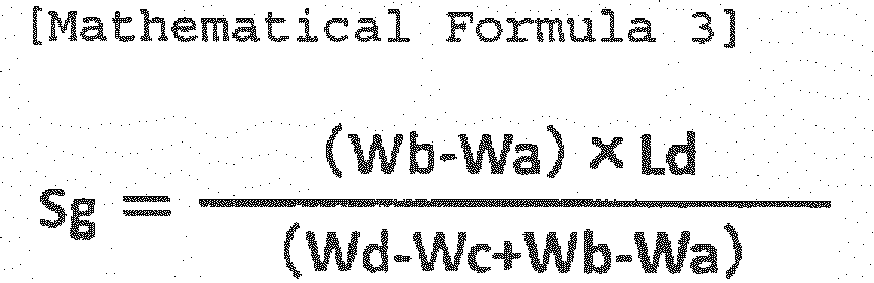
- Sg: True density of abrasive grains
- Wa: Mass of pycnometer
- Wb: Mass of sample and pycnometer
- Wc: Mass of sample, ethanol, and pycnometer
- Wd: Mass of ethanol and pycnometer
- Ld: Specific gravity of ethanol
- The polishing speed was calculated by the following equation.

- The film thicknesses of Poly Si, SiN, and TEOS were obtained by an optical interferometric film thickness measurement apparatus and evaluation was carried out by dividing a difference between the film thicknesses by polishing time.
- The evaluation results of the polishing compositions of Examples 1-1 to 1-4 and Comparative Examples 1-1 to 1-4 are presented in the following Table 1. Incidentally, in the column entitled selectivity in Tables 1 to 3, a value obtained by dividing the polishing speed of Poly Si by the polishing speed of TEOS is shown in the column entitled "Poly Si/TEOS" and a value obtained by dividing the polishing speed of Poly Si by the polishing speed of SiN is shown in the column entitled "Poly Si/SiN."
[Table 1] Abrasive grains Polishing composition Polishing speed (A/min) Selectivity Type Mohs hardness Number of silanol groups (count/nm2) True density (g/cm3) Producing method Concentration of abrasive grains (% by mass) pH Poly Si TEOS SiN Poly Si /TEOS Poly Si /SiN Example 1-1 Colloidal silica 7 1.5 2.18 Sol-gel method 0.1 4 201 3 85 77.3 2.4 Example 1-2 Colloidal silica 7 1.5 2.18 Sol-gel method 4 4 828 30 256 27.6 3.2 Example 1-3 Colloidal silica 7 1.6 2.19 Silicate soda method 4 4 73 18 75 4.0 1.0 Example 1-4 Fumed silica 7 1.9 2.66 - 1 4 120 15 151 8.0 0.8 Comparative Example 1-1 Colloidal silica 7 5.7 1.82 Sol-gel method 0.1 4 23 2 66 10.6 0.4 Comparative Example 1-2 Colloidal silica 7 5.7 1.82 Sol-gel method 4 4 55 27 206 2.1 0.3 Comparative Example 1-3 α-alumina 9 0 3.95 - 0.1 4 94 25 81 3.8 1.2 Comparative Example 1-4 γ-alumina 7 0 3.95 - 0.1 4 101 31 42 3.3 2.4 - As presented in the above Table 1, it was found that the polishing compositions of Examples 1-1 to 1-4 further improve the polishing speed of polysilicon (Poly Si) as compared to the polishing compositions of Comparative Examples 1-1 to 1-4. In addition, the ratio (selectivity) of the polishing speed of polysilicon (Poly Si) to the polishing speed of TEOS in Example 1-1 and Example 1-2 was improved as compared to Comparative Examples 1-1 to 1-4.
- A polishing composition was prepared in the same manner as in Example 1-2, except that nitric acid and potassium hydroxide were used as a pH adjusting agent and the pH of the polishing composition was adjusted to 7.
- A polishing composition was prepared in the same manner as in Comparative Example 1-2, except that nitric acid and potassium hydroxide were used as a pH adjusting agent and the pH of the polishing composition was adjusted to 7.
- The evaluation results of the polishing compositions of Example 2-1 and Comparative Example 2-1 are presented in the following Table 2.
[Table 2] Abrasive grains Polishing composition Polishing speed (A/min) Selectivity Type Mohs hardness Number of silanol groups (count/nm2) True density (g/cm3) Producing method Concentration of abrasive grains (% by mass) pH Poly Si TEOS SiN Poly Si /TEOS Poly Si /SiN Example 2-1 Colloidal silica 7 1.5 2.18 Sol-gel method 4 7 834 9 16 89.2 53.4 Comparative Example 2-1 Colloidal silica 7 5.7 1.82 Sol-gel method 4 7 138 8 20 17.2 6.9 - As presented in the above Table 2, it was found that the polishing composition of Example 2-1 further improves the polishing speed of polysilicon (Poly Si) as compared to the polishing composition of Comparative Example 2-1. In addition, the ratio (selectivity) of the polishing speed of polysilicon (Poly Si) to the polishing speed of TEOS and the ratio (selectivity) of the polishing speed of polysilicon (Poly Si) to the polishing speed of SiN in Example 2-1 were improved as compared to Comparative Example 2-1.
- A polishing composition was prepared in the same manner as in Example 1-2, except that potassium hydroxide was used as a pH adjusting agent and the pH of the polishing composition was adjusted to 10.
- A polishing composition was prepared in the same manner as in Comparative Example 1-2, except that potassium hydroxide was used as a pH adjusting agent and the pH of the polishing composition was adjusted to 10.
- The evaluation results of the polishing compositions of Example 3-1 and Comparative Example 3-1 are presented in the following Table 3.
[Table 3] Abrasive grains Polishing composition Polishing speed (A/min) Selectivity Type Mohs hardness Number of silanol groups (count/nm2) True density (g/cm3) Producing method Concentration of abrasive grains (% by mass) pH Poly Si TEOS SiN Poly Si /TEOS Poly Si /SiN Example 3-1 Colloidal silica 7 1.5 2.18 Sol-gel method 4 10 1727 26 10 66.4 166.3 Comparative Example 3-1 Colloidal silica 7 5.7 1.82 Sol-gel method 4 10 1418 25 9 56.7 157.5 - As presented in the above Table 3, the ratio (selectivity) of the polishing speed of polysilicon (Poly Si) to the polishing speed of TEOS and the ratio (selectivity) of the polishing speed of polysilicon (Poly Si) to the polishing speed of SiN in the polishing composition of Example 3-1 were improved as compared to the polishing composition of Comparative Example 3-1.
- Incidentally, the present application is based on Japanese Patent Application No.
2015-024377, filed on February 10, 2015
Claims (5)
- A polishing composition which is used for polishing a polishing object containing a simple substance of silicon and a silicon-containing compound other than the simple substance of silicon, the polishing composition comprising:abrasive grains; anda dispersing medium, whereinthe number of silanol groups per unit surface area of the abrasive grains is more than 0/nm2 but 2.0/nm2 or less.
- The polishing composition according to claim 1, wherein the abrasive grains are colloidal silica.
- The polishing composition according to claim 2, wherein the colloidal silica is the one produced by a sol-gel method.
- A method for polishing a polishing object containing a simple substance of silicon and a silicon-containing compound other than the simple substance of silicon by the polishing composition according to any one of claims 1 to 3.
- A method for manufacturing a substrate, the method comprising a process of polishing a polishing object containing a simple substance of silicon and a silicon-containing compound other than the simple substance of silicon by the polishing method according to claim 4.
Applications Claiming Priority (2)
| Application Number | Priority Date | Filing Date | Title |
|---|---|---|---|
| JP2015024377A JP6423279B2 (en) | 2015-02-10 | 2015-02-10 | Polishing composition |
| PCT/JP2016/053419 WO2016129508A1 (en) | 2015-02-10 | 2016-02-04 | Polishing composition |
Publications (1)
| Publication Number | Publication Date |
|---|---|
| EP3258484A1 true EP3258484A1 (en) | 2017-12-20 |
Family
ID=56614623
Family Applications (1)
| Application Number | Title | Priority Date | Filing Date |
|---|---|---|---|
| EP16749152.1A Withdrawn EP3258484A1 (en) | 2015-02-10 | 2016-02-04 | Polishing composition |
Country Status (8)
| Country | Link |
|---|---|
| US (1) | US20180022959A1 (en) |
| EP (1) | EP3258484A1 (en) |
| JP (1) | JP6423279B2 (en) |
| KR (1) | KR102649656B1 (en) |
| CN (1) | CN107396639B (en) |
| SG (2) | SG10201907376RA (en) |
| TW (4) | TWI839249B (en) |
| WO (1) | WO2016129508A1 (en) |
Families Citing this family (11)
| Publication number | Priority date | Publication date | Assignee | Title |
|---|---|---|---|---|
| KR102611598B1 (en) * | 2017-04-27 | 2023-12-08 | 주식회사 동진쎄미켐 | Aqueous slurry composition for chemical mechanical polishing |
| CN118439623A (en) * | 2019-02-21 | 2024-08-06 | 三菱化学株式会社 | Silica particles and method for producing same, silanol group measurement method, polishing composition, polishing method, method for producing semiconductor wafer, and method for producing semiconductor device |
| JP7285113B2 (en) * | 2019-03-29 | 2023-06-01 | 株式会社フジミインコーポレーテッド | Polishing composition |
| JP7234008B2 (en) * | 2019-03-29 | 2023-03-07 | 株式会社フジミインコーポレーテッド | Polishing composition |
| JP7638667B2 (en) * | 2019-11-20 | 2025-03-04 | 株式会社フジミインコーポレーテッド | Polishing composition, polishing method and method for producing substrate |
| JP7488672B2 (en) * | 2020-03-19 | 2024-05-22 | 株式会社フジミインコーポレーテッド | Polishing method and manufacturing method of semiconductor substrate |
| JP7493367B2 (en) * | 2020-03-27 | 2024-05-31 | 株式会社フジミインコーポレーテッド | Polishing composition, method for producing polishing composition, polishing method, and method for producing semiconductor substrate |
| JP7663331B2 (en) * | 2020-09-23 | 2025-04-16 | 株式会社フジミインコーポレーテッド | Polishing composition |
| JP7663386B2 (en) * | 2021-03-24 | 2025-04-16 | 株式会社フジミインコーポレーテッド | Polishing composition, polishing method, and method for producing semiconductor substrate |
| JP7766536B2 (en) * | 2022-03-29 | 2025-11-10 | 株式会社フジミインコーポレーテッド | Polishing composition and polishing method using the same |
| JP7706684B1 (en) * | 2025-02-07 | 2025-07-11 | 扶桑化学工業株式会社 | Colloidal silica and method for producing colloidal silica |
Family Cites Families (16)
| Publication number | Priority date | Publication date | Assignee | Title |
|---|---|---|---|---|
| JP2714411B2 (en) * | 1988-12-12 | 1998-02-16 | イー・アイ・デュポン・ドゥ・ヌムール・アンド・カンパニー | Composition for fine polishing of wafers |
| JP3584485B2 (en) * | 1993-03-03 | 2004-11-04 | 日産化学工業株式会社 | Method for producing silica sol |
| JP4635217B2 (en) * | 2003-09-17 | 2011-02-23 | 学校法人慶應義塾 | Surface treatment agent and material, and surface treatment method |
| TWI363796B (en) * | 2004-06-14 | 2012-05-11 | Kao Corp | Polishing composition |
| JP2006231436A (en) * | 2005-02-23 | 2006-09-07 | Tokyo Seimitsu Co Ltd | Polishing slurry and polishing method |
| JPWO2006098141A1 (en) * | 2005-03-16 | 2008-08-21 | 旭硝子株式会社 | Polishing agent for semiconductor integrated circuit device, polishing method, and method for manufacturing semiconductor integrated circuit device |
| US7902072B2 (en) * | 2006-02-28 | 2011-03-08 | Fujifilm Corporation | Metal-polishing composition and chemical-mechanical polishing method |
| JP2008135452A (en) * | 2006-11-27 | 2008-06-12 | Fujimi Inc | Polishing composition and polishing method |
| US9550683B2 (en) * | 2007-03-27 | 2017-01-24 | Fuso Chemical Co., Ltd. | Colloidal silica, and method for production thereof |
| US9028572B2 (en) * | 2007-09-21 | 2015-05-12 | Cabot Microelectronics Corporation | Polishing composition and method utilizing abrasive particles treated with an aminosilane |
| JP2010034497A (en) * | 2008-02-18 | 2010-02-12 | Jsr Corp | Aqueous dispersion for chemo-mechanical polishing and manufacturing method thereof, and chemo-mechanical polishing method |
| KR20100123678A (en) * | 2008-02-18 | 2010-11-24 | 제이에스알 가부시끼가이샤 | Aqueous dispersion for chemical mechanical polishing and chemical mechanical polishing method |
| JP2009289885A (en) * | 2008-05-28 | 2009-12-10 | Fujifilm Corp | Polishing liquid and polishing method |
| JP2010067914A (en) * | 2008-09-12 | 2010-03-25 | Fujifilm Corp | Chemical mechanical polishing liquid and chemical mechanical polishing method |
| WO2011021599A1 (en) * | 2009-08-19 | 2011-02-24 | 日立化成工業株式会社 | Polishing solution for cmp and polishing method |
| JP5744597B2 (en) * | 2011-03-31 | 2015-07-08 | Hoya株式会社 | Mask blank glass substrate manufacturing method, mask blank manufacturing method, transfer mask manufacturing method, and semiconductor device manufacturing method |
-
2015
- 2015-02-10 JP JP2015024377A patent/JP6423279B2/en active Active
-
2016
- 2016-02-04 WO PCT/JP2016/053419 patent/WO2016129508A1/en not_active Ceased
- 2016-02-04 SG SG10201907376RA patent/SG10201907376RA/en unknown
- 2016-02-04 CN CN201680009819.1A patent/CN107396639B/en active Active
- 2016-02-04 KR KR1020177021999A patent/KR102649656B1/en active Active
- 2016-02-04 EP EP16749152.1A patent/EP3258484A1/en not_active Withdrawn
- 2016-02-04 US US15/549,503 patent/US20180022959A1/en not_active Abandoned
- 2016-02-04 SG SG11201706046PA patent/SG11201706046PA/en unknown
- 2016-02-05 TW TW112122040A patent/TWI839249B/en active
- 2016-02-05 TW TW110125539A patent/TWI814030B/en active
- 2016-02-05 TW TW105104151A patent/TWI746433B/en active
- 2016-02-05 TW TW109115241A patent/TWI755727B/en active
Also Published As
| Publication number | Publication date |
|---|---|
| SG11201706046PA (en) | 2017-08-30 |
| TW201634618A (en) | 2016-10-01 |
| JP2016149402A (en) | 2016-08-18 |
| CN107396639B (en) | 2021-05-25 |
| TW202140706A (en) | 2021-11-01 |
| TW202033312A (en) | 2020-09-16 |
| CN107396639A (en) | 2017-11-24 |
| WO2016129508A1 (en) | 2016-08-18 |
| TWI755727B (en) | 2022-02-21 |
| JP6423279B2 (en) | 2018-11-14 |
| SG10201907376RA (en) | 2019-09-27 |
| KR20170115058A (en) | 2017-10-16 |
| TW202340406A (en) | 2023-10-16 |
| US20180022959A1 (en) | 2018-01-25 |
| KR102649656B1 (en) | 2024-03-21 |
| TWI839249B (en) | 2024-04-11 |
| TWI746433B (en) | 2021-11-21 |
| TWI814030B (en) | 2023-09-01 |
Similar Documents
| Publication | Publication Date | Title |
|---|---|---|
| EP3258484A1 (en) | Polishing composition | |
| US10478939B2 (en) | Polishing method | |
| US20190256742A1 (en) | Polishing composition, method for producing polishing composition, and polishing method | |
| US10138396B2 (en) | Polishing composition | |
| EP3121239A1 (en) | Polishing composition, polishing method, and method for producing substrate | |
| US20210079264A1 (en) | Polishing composition, method for producing polishing composition, polishing method, and method for producing semiconductor substrate | |
| JP6908592B2 (en) | Polishing composition | |
| US10414019B2 (en) | Polishing composition | |
| US20190292407A1 (en) | Polishing composition, method for producing polishing composition, and polishing method | |
| JP7267795B2 (en) | Polishing speed improver for simple silicon | |
| SG10202103098SA (en) | Polishing composition, production method of the same, polishing method, and manufacturing method of semiconductor substrate | |
| US10894901B2 (en) | Method for producing polishing composition and polishing method | |
| TW202413586A (en) | Polishing composition, manufacturing method of polishing composition, polishing method, manufacturing method of semiconductor substrate | |
| JP2018157164A (en) | Polishing composition, manufacturing method of polishing composition, polishing method, and manufacturing method of semiconductor substrate | |
| TW202305927A (en) | Polishing liquid and polishing method |
Legal Events
| Date | Code | Title | Description |
|---|---|---|---|
| PUAI | Public reference made under article 153(3) epc to a published international application that has entered the european phase |
Free format text: ORIGINAL CODE: 0009012 |
|
| STAA | Information on the status of an ep patent application or granted ep patent |
Free format text: STATUS: THE APPLICATION HAS BEEN WITHDRAWN |
|
| 17P | Request for examination filed |
Effective date: 20170727 |
|
| AK | Designated contracting states |
Kind code of ref document: A1 Designated state(s): AL AT BE BG CH CY CZ DE DK EE ES FI FR GB GR HR HU IE IS IT LI LT LU LV MC MK MT NL NO PL PT RO RS SE SI SK SM TR |
|
| AX | Request for extension of the european patent |
Extension state: BA ME |
|
| 18W | Application withdrawn |
Effective date: 20171206 |