EP3258388B1 - Parallelisierungstechniken zur variablen auswahl und erzeugung und anwendung prädiktiver modelle - Google Patents
Parallelisierungstechniken zur variablen auswahl und erzeugung und anwendung prädiktiver modelle Download PDFInfo
- Publication number
- EP3258388B1 EP3258388B1 EP17176197.6A EP17176197A EP3258388B1 EP 3258388 B1 EP3258388 B1 EP 3258388B1 EP 17176197 A EP17176197 A EP 17176197A EP 3258388 B1 EP3258388 B1 EP 3258388B1
- Authority
- EP
- European Patent Office
- Prior art keywords
- subsets
- independent variables
- subset
- variables
- comparison
- Prior art date
- Legal status (The legal status is an assumption and is not a legal conclusion. Google has not performed a legal analysis and makes no representation as to the accuracy of the status listed.)
- Active
Links
Images


Classifications
-
- G—PHYSICS
- G06—COMPUTING OR CALCULATING; COUNTING
- G06N—COMPUTING ARRANGEMENTS BASED ON SPECIFIC COMPUTATIONAL MODELS
- G06N5/00—Computing arrangements using knowledge-based models
- G06N5/02—Knowledge representation; Symbolic representation
- G06N5/022—Knowledge engineering; Knowledge acquisition
-
- G—PHYSICS
- G06—COMPUTING OR CALCULATING; COUNTING
- G06F—ELECTRIC DIGITAL DATA PROCESSING
- G06F17/00—Digital computing or data processing equipment or methods, specially adapted for specific functions
- G06F17/10—Complex mathematical operations
- G06F17/18—Complex mathematical operations for evaluating statistical data, e.g. average values, frequency distributions, probability functions, regression analysis
-
- G—PHYSICS
- G06—COMPUTING OR CALCULATING; COUNTING
- G06N—COMPUTING ARRANGEMENTS BASED ON SPECIFIC COMPUTATIONAL MODELS
- G06N3/00—Computing arrangements based on biological models
- G06N3/12—Computing arrangements based on biological models using genetic models
- G06N3/126—Evolutionary algorithms, e.g. genetic algorithms or genetic programming
Definitions
- Variable selection methods are one such data analytics approach that is applied to the selection of a subset of variables (X) from a large pool of variables based on various statistics measures.
- the selected variables can be used for the development of prediction models for a dependent variable (Y), when used with modelling techniques such as multiple linear regression, nonlinear regression, etc.
- the variables selection can be accomplished using a random or exhaustive search technique.
- the random approach includes heuristic methods such as ant colony, particle swarm optimization, genetic algorithm, and the like; however, these methods cannot guarantee an optimal solution as they fail to explore the complete problem (variable) space.
- the exhaustive search approach evaluates each possible combination and thus provides the best solution; however, it is a computationally hard problem, thus limiting its applications to the selection of smaller subsets.
- Predictive regression model generation in principle involves the following three critical steps: a) data division, b) optimal features/variable selection from a large pool of structural features and c) model generation from the selected optimal features using regression techniques.
- Data quality and the efficiency of the above three steps determine robustness of the predictive models and their applications/business impact. For example, late stages failures of drug candidates can be addressed using reliable and easily applicable predictive ADMET models [Absorption, Distribution, Metabolism, Excretion and Toxicity].
- ADMET models Absorption, Distribution, Metabolism, Excretion and Toxicity.
- the generation of predictive ADMET models based on structural features of drugs and drug candidates typically involves three critical steps, discussed earlier.
- variable selection step enables researchers to a) derive rules/alerts that can be used for improving research outcomes b) provide the best sub-set of variables to generate robust predictive models that are applicable in virtual screening of drug candidates even before they are produced in laboratory.
- efficiency of the above steps have significant business impact across different domains.
- Embodiments of the present disclosure present technological improvements as solutions to one or more of the above-mentioned technical problems recognized by the inventors in conventional systems. For example, in one aspect, a processor implemented method for performing parallelization techniques for generating predictive models and variable selection and its applications is provided.
- the method comprising: defining, by one or more processors, (i) an input data comprising a set of independent variables, a set of dependent variables, and a subset size, (ii) a set of control parameters comprising maximum allowed inter correlation coefficient of independent variables R int , and a minimum or maximum objective function threshold ( R cri ) pertaining to the set of independent variables, and (iii) a block size and a grid size pertaining to a graphics processing unit (GPU), the block size and grid size are indicative of number of execution threads to be executed in one or more blocks in a grid; calculating, by the one or more processors, one or more inter correlation coefficients of each pair of independent variables from the set of independent variables; ranking, using a lexicographical technique, one or more subsets of independent variables from the set of independent variables; assigning the one or more ranked subsets to corresponding one or more execution threads of the GPU; executing, in parallel, in each of the one or more execution threads specific to the one or more blocks:
- the method may further comprise calculating model correlation coefficient R m based on the one or more generated predictive models and one or more dependent variables from the set of dependent variables.
- the method may further comprise performing a comparison of R m and ( R cri ); and updating value of ( R cri ) based on the comparison of R m and ( R cri ).
- the method may further comprise determining, based on the comparison, an optimal subset from each corresponding execution thread from each block to obtain one or more optimal subsets, each of the one or more optimal subsets comprises one or more independent variables; and synchronizing, for the grid and block, the one or more optimal subsets from each of the corresponding execution threads specific to each block to obtain a best subset from the synchronized one or more optimal subsets for variable selection.
- a system for performing parallelization techniques for generating predictive models and variable selection and its applications comprising: a memory storing instructions; one or more communication interfaces; and one or more hardware processors coupled to the memory via the one or more communication interfaces, wherein the one or more hardware processors are configured by the instructions to: define (i) an input data comprising a set of independent variables, a set of dependent variables, and a subset size, (ii) a set of control parameters comprising maximum allowed inter correlation coefficient of independent variables R int , and a minimum or maximum objective function threshold ( R cri ) pertaining to the set of independent variables, and (iii) a block size and a grid size pertaining to a graphics processing unit (GPU), the block size and grid size are indicative of number of execution threads to be executed in one or more blocks in a grid; calculate one or more inter correlation coefficients of each pair of independent variables from the set of independent variables; rank, using a lexicographical technique, one or more subsets of independent variables
- the one or more predictive models are generated for each of the subset.
- the one or more hardware processors are may be further configured by instructions to calculate model correlation coefficient R m based on the one or more generated predictive models and one or more dependent variables from the set of dependent variables.
- the one or more hardware processors are may be further configured by instructions to perform a comparison of R m and ( R cri ); and update value of ( R cri ) based on the comparison of R m and ( R cri ).
- the one or more hardware processors are may be further configured by instructions to determine, based on the comparison, an optimal subset from each corresponding execution thread from each block to obtain one or more optimal subsets, each of the one or more optimal subsets comprises one or more independent variables; and synchronize, for the grid and block, the one or more optimal subsets from each of the corresponding execution thread specific to each block to obtain a best subset from the synchronized one or more optimal subsets for variable selection.
- one or more non-transitory machine readable information storage mediums comprising one or more instructions.
- the one or more instructions which when executed by one or more hardware processors causes performing parallelization techniques for generating predictive models and variable selection and its applications by defining, by one or more processors, (i) an input data comprising a set of independent variables, a set of dependent variables, and a subset size, (ii) a set of control parameters comprising maximum allowed inter correlation coefficient of independent variables R int , and a minimum or maximum objective function threshold ( R cri ) pertaining to the set of independent variables, and (iii) a block size and a grid size pertaining to a graphics processing unit (GPU), the block size and grid size are indicative of number of execution threads to be executed in one or more blocks in a grid; calculating, by the one or more processors, one or more inter correlation coefficients of each pair of independent variables from the set of independent variables; ranking, using a lexicographical technique, one or more subsets of independent variables from
- the one or more predictive models are generated for each of the subset.
- the one or more instructions which when executed by the one or more hardware processors further cause calculating model correlation coefficient R m based on the one or more generated predictive models and one or more dependent variables from the set of dependent variables.
- the one or more instructions which when executed by the one or more hardware processors further cause performing a comparison of R m and ( R cri ); and updating value of ( R cri ) based on the comparison of R m and ( R cri ) .
- the one or more instructions which when executed by the one or more hardware processors further cause determining, based on the comparison, an optimal subset from each corresponding execution thread from each block to obtain one or more optimal subsets, each of the one or more optimal subsets comprises one or more independent variables; and synchronizing, for the grid and block, the one or more optimal subsets from each of the corresponding execution thread specific to each block to obtain a best subset from the synchronized one or more optimal subsets for variable selection.
- FIGS. 1 through 4 where similar reference characters denote corresponding features consistently throughout the figures, there are shown preferred embodiments and these embodiments are described in the context of the following exemplary system and/or method.
- FIG. 1 illustrates an exemplary block diagram of a system 100 for parallelization of variables selection and generating predictive models thereof for its applications in accordance with an embodiment of the present disclosure.
- the device 100 includes one or more processors 104, communication interface device(s) or input/output (I/O) interface(s) 106, and one or more data storage devices or memory 102 operatively coupled to the one or more processors 104.
- the one or more devices are Long Term Evolution (LTE) devices (e.g., cellular devices).
- LTE Long Term Evolution
- the one or more processors 104 may be one or more software processing modules and/or hardware processors.
- the hardware processors can be implemented as one or more microprocessors, microcomputers, microcontrollers, digital signal processors, central processing units, state machines, logic circuitries, and/or any devices that manipulate signals based on operational instructions.
- the processor(s) is configured to fetch and execute computer-readable instructions stored in the memory.
- the device 100 can be implemented in a variety of computing systems, such as laptop computers, notebooks, hand-held devices, workstations, mainframe computers, servers, a network cloud and the like.
- the I/O interface device(s) 106 can include a variety of software and hardware interfaces, for example, a web interface, a graphical user interface, and the like and can facilitate multiple communications within a wide variety of networks N/W and protocol types, including wired networks, for example, LAN, cable, etc., and wireless networks, such as WLAN, cellular, or satellite.
- the I/O interface device(s) can include one or more ports for connecting a number of devices to one another or to another server.
- the memory 102 may include any computer-readable medium known in the art including, for example, volatile memory, such as static random access memory (SRAM) and dynamic random access memory (DRAM), and/or non-volatile memory, such as read only memory (ROM), erasable programmable ROM, flash memories, hard disks, optical disks, and magnetic tapes.
- volatile memory such as static random access memory (SRAM) and dynamic random access memory (DRAM)
- non-volatile memory such as read only memory (ROM), erasable programmable ROM, flash memories, hard disks, optical disks, and magnetic tapes.
- ROM read only memory
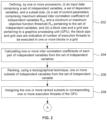
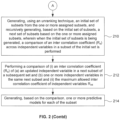
- FIG. 2 illustrates an exemplary flow diagram of a method for parallelization of variables selection and generating predictive models thereof for its applications in accordance with an embodiment of the present disclosure.
- the device(s) 100 comprises one or more data storage devices or the memory 102 operatively coupled to the one or more hardware processors 104 and is configured to store instructions for execution of steps of the method by the one or more processors 104.
- the steps of the method of the present disclosure will now be explained with reference to the components of the device 100 as depicted in FIG. 1 , and the flow diagram.
- the one or more hardware processors 104 define (i) an input data comprising a set of independent variables, a set of dependent variables, and a subset size, (ii) a set of control parameters comprising maximum allowed inter correlation coefficient of independent variables R int , and a minimum or maximum objective function threshold ( R cri ) pertaining to the set of independent variables, and (iii) a block size and a grid size pertaining to a graphics processing unit (GPU), the block size and grid size are indicative of number of execution threads to be executed in one or more blocks in a grid.
- a graphics processing unit GPU
- the one or more hardware processors 104 calculate one or more inter correlation coefficients of each pair of independent variables from the set of independent variables.
- the one or more hardware processors 104 rank, using a lexicographical technique, one or more subsets of independent variables from the set of independent variables. In an embodiment of the present disclosure, at step 208, the one or more hardware processors 104 assign the one or more ranked subsets to corresponding one or more execution threads of the GPU.
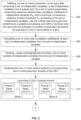
- FIG. 3 is an exemplary flow diagram illustrating CUDA Kernels workflow implemented by the system 100 of FIG. 1 for parallelization of variables selection and generating predictive models thereof and its applications in accordance to an embodiment of the present disclosure. The steps of the method of FIG. 3 will now be explained with reference to the components of the device 100 and the flow diagram as depicted in FIGS. 1-2 .
- the one or more hardware processors 104 determine, based on the comparison, an optimal subset from each corresponding execution thread to obtain one or more optimal subsets wherein each of the one or more optimal subsets comprises one or more independent variables.
- the one or more hardware processors 104 synchronize, for the grid size, the one or more optimal subsets from each of the corresponding execution thread specific to each block to obtain a best subset from the synchronized one or more optimal subsets for variable selection.
- steps 312, and 314 are executed in parallel in each of the one or more execution threads specific to the one or more blocks depicted in step 310.
- combinations _ per _ thread total _ combinations GPU _ BLOCK _ SIZE ⁇ GPU _ GRID _ SIZE
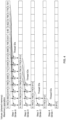
- the subsets to evaluate are arranged lexicographically and assigned to each thread depending on the rank of the subset and index of the thread. Below are illustrative subsets depicted by way of examples. Using blood brain barrier (BBB) data of 88(m, number of observations) drugs and drug-like compounds and 277 descriptors/independent variables derived from chemical structures of the observations employed.
- BBB blood brain barrier
- the embodiments of the present disclosure provide systems and methods for parallelization techniques for generating predictive models and variable selection and its applications.
- the parallelization techniques for generating predictive models and variable selection and its applications is achieved by assigning each combination to the individual kernels of GPU based on thread's index and lexicographical rank of subset.
- the initial subset is derived using unranking technique and then iterating over it to evaluate other combinations. This enables parallelism of the proposed method and assigns combinations uniquely to each kernel.
- the hardware device can be any kind of device which can be programmed including e.g. any kind of computer like a server or a personal computer, or the like, or any combination thereof.
- the device may also include means which could be e.g. hardware means like e.g. an application-specific integrated circuit (ASIC), a field-programmable gate array (FPGA), or a combination of hardware and software means, e.g.
- ASIC application-specific integrated circuit
- FPGA field-programmable gate array
- the means can include both hardware means and software means.
- the method embodiments described herein could be implemented in hardware and software.
- the device may also include software means.
- the embodiments may be implemented on different hardware devices, e.g. using a plurality of CPUs.
- the embodiments herein can comprise hardware and software elements.
- the embodiments that are implemented in software include but are not limited to, firmware, resident software, microcode, etc.
- the functions performed by various modules described herein may be implemented in other modules or combinations of other modules.
- a computer-usable or computer readable medium can be any apparatus that can comprise, store, communicate, propagate, or transport the program for use by or in connection with the instruction execution system, apparatus, or device.
- a computer-readable storage medium refers to any type of physical memory on which information or data readable by a processor may be stored.
- a computer-readable storage medium may store instructions for execution by one or more processors, including instructions for causing the processor(s) to perform steps or stages consistent with the embodiments described herein.
- the term "computer-readable medium” should be understood to include tangible items and exclude carrier waves and transient signals, i.e., be non-transitory. Examples include random access memory (RAM), read-only memory (ROM), volatile memory, nonvolatile memory, hard drives, CD ROMs, DVDs, BLU-RAYs, flash drives, disks, and any other known physical storage media.
Landscapes
- Engineering & Computer Science (AREA)
- Physics & Mathematics (AREA)
- Theoretical Computer Science (AREA)
- General Physics & Mathematics (AREA)
- Data Mining & Analysis (AREA)
- Mathematical Physics (AREA)
- General Engineering & Computer Science (AREA)
- Life Sciences & Earth Sciences (AREA)
- Evolutionary Biology (AREA)
- Bioinformatics & Computational Biology (AREA)
- Bioinformatics & Cheminformatics (AREA)
- Software Systems (AREA)
- Mathematical Analysis (AREA)
- Computational Mathematics (AREA)
- Mathematical Optimization (AREA)
- Pure & Applied Mathematics (AREA)
- Biophysics (AREA)
- Health & Medical Sciences (AREA)
- Computing Systems (AREA)
- Evolutionary Computation (AREA)
- Computational Linguistics (AREA)
- Artificial Intelligence (AREA)
- Probability & Statistics with Applications (AREA)
- Algebra (AREA)
- Databases & Information Systems (AREA)
- Operations Research (AREA)
- Physiology (AREA)
- Molecular Biology (AREA)
- General Health & Medical Sciences (AREA)
- Biomedical Technology (AREA)
- Genetics & Genomics (AREA)
- Devices For Executing Special Programs (AREA)
- Complex Calculations (AREA)
Claims (10)
- Prozessorimplementiertes Verfahren (200), umfassend:Definieren (202), durch einen oder mehrere Prozessoren, (i) von Eingabedaten, die einen Satz von unabhängigen Variablen, einen Satz von abhängigen Variablen und eine Teilmengengröße umfassen, (ii) eines Satzes von Steuerparametern, die einen maximal zulässigen Interkorrelationskoeffizienten von unabhängigen Variablen Rint und einen minimalen oder maximalen Zielfunktionsschwellenwert (R cri ), der zu dem Satz von unabhängigen Variablen gehört, umfassen, und (iii) einer Blockgröße und einer Gittergröße, die zu einer Grafikverarbeitungseinheit (GPU) gehören, wobei die Blockgröße und die Gittergröße eine Anzahl von Ausführungsthreads angeben, die in einem oder mehreren Blöcken in einem Gitter auszuführen sind;Berechnen (204), durch den einen oder die mehreren Prozessoren, eines oder mehrerer Interkorrelationskoeffizienten jedes Paars von unabhängigen Variablen aus dem Satz von unabhängigen Variablen;Einstufen (206), unter Verwendung einer lexikographischen Technik, einer oder mehrerer Teilmengen von unabhängigen Variablen aus dem Satz von unabhängigen Variablen, wobei die eine oder die mehreren Teilmengen von unabhängigen Variablen eine definierte Größe aufweisen;Zuweisen (208) der einen oder der mehreren eingestuften Teilmengen zu einem oder mehreren entsprechenden Ausführungsthreads der GPU;paralleles Ausführen, in jedem des einen oder der mehreren Ausführungsthreads, die für den einen oder die mehreren Blöcke spezifisch sind:Erzeugen (214), basierend auf dem Vergleich, eines oder mehrerer prädiktiver Modelle für jede der Teilmengen.Erzeugen (210), unter Verwendung einer Einstufungstechnik, eines anfänglichen Satzes von Teilmengen aus der einen oder den mehreren zugewiesenen Teilmengen, und rekursives Erzeugen, basierend auf dem anfänglichen Satz von Teilmengen, eines nächsten Satzes von Teilmengen basierend auf der einen oder den mehreren zugewiesenen Teilmengen, wobei, wenn der anfängliche Satz von Teilmengen erzeugt wird, ein Vergleich eines Interkorrelationskoeffizienten (Ra ) über unabhängige Variablen in einer Teilmenge des anfänglichen Satzes durchgeführt wird, wobei die Erzeugung des nächsten Satzes von Teilmengen rekursiv erfolgt, indem die Interkorrelation der unabhängigen Variablen nur für aktualisierte Teilmengenwerte und nicht für die gesamte Kombination von zugewiesenen ein oder mehreren Teilmengen geprüft wird, und wobei die aktualisierte unabhängige Variable in der nächsten Teilmenge beim rekursiven Erzeugen einer oder mehrerer nächster Teilmengen aus dem anfänglichen Satz von Teilmengen erhalten wird;Durchführen (212) eines Vergleichs von (i) einem Interkorrelationskoeffizienten (Ra ) von (a) einer aktualisierten unabhängigen Variablen in einer nächsten Teilmenge eines nachfolgenden Satzes und (b) einer oder mehreren unabhängigen Variablen in derselben nächsten Teilmenge und (ii) dem maximal zulässigen Interkorrelationskoeffizienten von unabhängigen Variablen Rint ;Bestimmen, basierend auf dem Vergleich, einer optimalen Teilmenge aus jedem entsprechenden Ausführungsthread aus jedem Block, um eine oder mehrere optimale Teilmengen zu erhalten, wobei jede der einen oder der mehreren optimalen Teilmengen eine oder mehrere unabhängige Variablen umfasst;Synchronisieren, für das Raster und den Block, der einen oder der mehreren optimalen Teilmengen aus jedem der entsprechenden Ausführungsthreads, die für jeden Block spezifisch sind, um eine beste Teilmenge aus den synchronisierten ein oder mehreren optimalen Teilmengen zur Variablenauswahl zu erhalten; und
- Prozessorimplementiertes Verfahren nach Anspruch 1, wobei, wenn Ra kleiner als Rint ist, das eine oder die mehreren prädiktiven Modelle für jede der Teilmengen erzeugt werden.
- Prozessorimplementiertes Verfahren nach Anspruch 1, ferner umfassend Berechnen des Modellkorrelationskoeffizienten Rm basierend auf dem einen oder den mehreren erzeugten prädiktiven Modellen und einer oder mehreren abhängigen Variablen aus dem Satz von abhängigen Variablen.
- Prozessorimplementiertes Verfahren nach Anspruch 3, ferner umfassend:Durchführen eines Vergleichs von Rm und Rcri ; undAktualisieren des Werts von Rcri basierend auf dem Vergleich von Rm und Rcri .
- System (100), umfassend:einen Speicher (102), der Anweisungen speichert;eine oder mehrere Kommunikationsschnittstellen (106); und
einen oder mehrere Hardwareprozessoren (104), die über die eine oder die mehreren Kommunikationsschnittstellen (106) mit dem Speicher (102) gekoppelt sind, wobei der eine oder die mehreren Hardwareprozessoren (104) durch die Anweisungen konfiguriert sind zum:Definieren (i) von Eingabedaten, die einen Satz von unabhängigen Variablen, einen Satz von abhängigen Variablen und eine Teilmengengröße umfassen, (ii) eines Satzes von Steuerparametern, die einen maximal zulässigen Interkorrelationskoeffizienten von unabhängigen Variablen Rint und einen minimalen oder maximalen Zielfunktionsschwellenwert (Rcri ), der zu dem Satz von unabhängigen Variablen gehört, umfassen, und (iii) einer Blockgröße und einer Gittergröße, die zu einer Grafikverarbeitungseinheit (GPU) gehören, wobei die Blockgröße und die Gittergröße eine Anzahl von Ausführungsthreads angeben, die in einem oder mehreren Blöcken in einem Gitter auszuführen sind;Berechnen eines oder mehrerer Interkorrelationskoeffizienten jedes Paars von unabhängigen Variablen aus dem Satz von unabhängigen Variablen;Einstufen, unter Verwendung einer lexikographischen Technik, einer oder mehrerer Teilmengen von unabhängigen Variablen aus dem Satz von unabhängigen Variablen, wobei die eine oder die mehreren Teilmengen von unabhängigen Variablen eine definierte Größe aufweisen;Zuweisen der einen oder der mehreren eingestuften Teilmengen zu einem oder mehreren entsprechenden Ausführungsthreads der GPU;paralleles Ausführen, in jedem des einen oder der mehreren Ausführungsthreads, die für den einen oder die mehreren Blöcke spezifisch sind:Erzeugen, unter Verwendung einer Einstufungstechnik, eines anfänglichen Satzes von Teilmengen aus der einen oder den mehreren zugewiesenen Teilmengen, und rekursives Erzeugen, basierend auf dem anfänglichen Satz von Teilmengen, eines nächsten Satzes von Teilmengen basierend auf der einen oder den mehreren zugewiesenen Teilmengen, wobei, wenn der anfängliche Satz von Teilmengen erzeugt wird, ein Vergleich eines Interkorrelationskoeffizienten (Ra ) über unabhängige Variablen in einer Teilmenge des anfänglichen Satzes durchgeführt wird, wobei die Erzeugung des nächsten Satzes von Teilmengen rekursiv erfolgt, indem die Interkorrelation der unabhängigen Variablen nur für aktualisierte Teilmengenwerte und nicht für die gesamte Kombination von zugewiesenen ein oder mehreren Teilmengen geprüft wird, und wobei die aktualisierte unabhängige Variable in der nächsten Teilmenge beim rekursiven Erzeugen einer oder mehrerer nächster Teilmengen aus dem anfänglichen Satz von Teilmengen erhalten wird; undDurchführen eines Vergleichs von (i) einem Interkorrelationskoeffizienten (Ra ) von (a) einer aktualisierten unabhängigen Variablen in einer nächsten Teilmenge eines nachfolgenden Satzes und (b) einer oder mehreren unabhängigen Variablen in derselben nächsten Teilmenge und (ii) dem maximal zulässigen Interkorrelationskoeffizienten von unabhängigen Variablen Rint ;Bestimmen, basierend auf dem Vergleich, einer optimalen Teilmenge aus jedem entsprechenden Ausführungsthread aus jedem Block, um eine oder mehrere optimale Teilmengen zu erhalten, wobei jede der einen oder der mehreren optimalen Teilmengen eine oder mehrere unabhängige Variablen umfasst;Synchronisieren, für das Raster und den Block, der einen oder der mehreren optimalen Teilmengen aus jedem der entsprechenden Ausführungsthreads, die für jeden Block spezifisch sind, um eine beste Teilmenge aus den synchronisierten ein oder mehreren optimalen Teilmengen zur Variablenauswahl zu erhalten; undErzeugen, basierend auf dem Vergleich, eines oder mehrerer prädiktiver Modelle für jede der Teilmengen. - System nach Anspruch 5, wobei, wenn Ra kleiner als Rint ist, das eine oder die mehreren prädiktiven Modelle für jede der Teilmengen erzeugt werden.
- System nach Anspruch 5, wobei der eine oder die mehreren Hardwareprozessoren (104) ferner durch die Anweisungen konfiguriert sind zum Berechnen des Modellkorrelationskoeffizienten Rm basierend auf dem einen oder den mehreren erzeugten prädiktiven Modellen und einer oder mehreren abhängigen Variablen aus dem Satz von abhängigen Variablen.
- System nach Anspruch 7, wobei der eine oder die mehreren Hardwareprozessoren (104) ferner durch die Anweisungen konfiguriert sind zum:Durchführen eines Vergleichs von Rm und Rcri , undAktualisieren des Werts von Rcri basierend auf dem Vergleich von Rm und Rcri.
- Ein oder mehrere nichtflüchtige maschinenlesbare Informationsspeichermedien, die eine oder mehrere Anweisungen umfassen, die bei Ausführung durch einen oder mehrere Hardwareprozessoren bewirken:Definieren, durch den einen oder die mehreren Prozessoren, (i) von Eingabedaten, die einen Satz von unabhängigen Variablen, einen Satz von abhängigen Variablen und eine Teilmengengröße umfassen, (ii) eines Satzes von Steuerparametern, die einen maximal zulässigen Interkorrelationskoeffizienten von unabhängigen Variablen Rint und einen minimalen oder maximalen Zielfunktionsschwellenwert (Rcri ), der zu dem Satz von unabhängigen Variablen gehört, umfassen, und (iii) einer Blockgröße und einer Gittergröße, die zu einer Grafikverarbeitungseinheit (GPU) gehören, wobei die Blockgröße und die Gittergröße eine Anzahl von Ausführungsthreads angeben, die in einem oder mehreren Blöcken in einem Gitter auszuführen sind;Berechnen, durch den einen oder die mehreren Prozessoren, eines oder mehrerer Interkorrelationskoeffizienten jedes Paars von unabhängigen Variablen aus dem Satz von unabhängigen Variablen;Einstufen, unter Verwendung einer lexikographischen Technik, einer oder mehrerer Teilmengen von unabhängigen Variablen aus dem Satz von unabhängigen Variablen, wobei die eine oder die mehreren Teilmengen von unabhängigen Variablen eine definierte Größe aufweisen;Zuweisen der einen oder der mehreren eingestuften Teilmengen zu einem oder mehreren entsprechenden Ausführungsthreads der GPU;paralleles Ausführen, in jedem des einen oder der mehreren Ausführungsthreads, die für den einen oder die mehreren Blöcke spezifisch sind:Erzeugen, unter Verwendung einer Einstufungstechnik, eines anfänglichen Satzes von Teilmengen aus der einen oder den mehreren zugewiesenen Teilmengen, und rekursives Erzeugen, basierend auf dem anfänglichen Satz von Teilmengen, eines nächsten Satzes von Teilmengen basierend auf der einen oder den mehreren zugewiesenen Teilmengen, wobei, wenn der anfängliche Satz von Teilmengen erzeugt wird, ein Vergleich eines Interkorrelationskoeffizienten (Ra ) über unabhängige Variablen in einer Teilmenge des anfänglichen Satzes durchgeführt wird, wobei die Erzeugung des nächsten Satzes von Teilmengen rekursiv erfolgt, indem die Interkorrelation der unabhängigen Variablen nur für aktualisierte Teilmengenwerte und nicht für die gesamte Kombination von zugewiesenen ein oder mehreren Teilmengen geprüft wird, und wobei die aktualisierte unabhängige Variable in der nächsten Teilmenge beim rekursiven Erzeugen einer oder mehrerer nächster Teilmengen aus dem anfänglichen Satz von Teilmengen erhalten wird;Durchführen eines Vergleichs von (i) einem Interkorrelationskoeffizienten (Ra ) von (a) einer aktualisierten unabhängigen Variablen in einer nächsten Teilmenge eines nachfolgenden Satzes und (b) einer oder mehreren unabhängigen Variablen in derselben nächsten Teilmenge und (ii) dem maximal zulässigen Interkorrelationskoeffizienten von unabhängigen Variablen Rint ;Bestimmen, basierend auf dem Vergleich, einer optimalen Teilmenge aus jedem entsprechenden Ausführungsthread aus jedem Block, um eine oder mehrere optimale Teilmengen zu erhalten, wobei jede der einen oder der mehreren optimalen Teilmengen eine oder mehrere unabhängige Variablen umfasst;Synchronisieren, für das Raster und den Block, der einen oder der mehreren optimalen Teilmengen aus jedem der entsprechenden Ausführungsthreads, die für jeden Block spezifisch sind, um eine beste Teilmenge aus den synchronisierten ein oder mehreren optimalen Teilmengen zur Variablenauswahl zu erhalten; undErzeugen, basierend auf dem Vergleich, eines oder mehrerer prädiktiver Modelle für jede der Teilmengen.
- Ein oder mehrere nichtflüchtige maschinenlesbare Informationsspeichermedien nach Anspruch 9, wobei, wenn Ra kleiner als Rint ist, das eine oder die mehreren prädiktiven Modelle für jede der Teilmengen erzeugt werden, und wobei die eine oder die mehreren Anweisungen, die bei Ausführung durch den einen oder die mehreren Hardwareprozessoren ferner bewirken:Berechnen des Modellkorrelationskoeffizienten Rm basierend auf dem einen oder den mehreren erzeugten prädiktiven Modellen und einer oder mehreren abhängigen Variablen aus dem Satz von abhängigen Variablen;Durchführen eines Vergleichs von Rm und Rcri ; undAktualisieren des Werts von Rcri basierend auf dem Vergleich von Rm und Rcri.
Applications Claiming Priority (1)
| Application Number | Priority Date | Filing Date | Title |
|---|---|---|---|
| IN201621020879 | 2016-06-17 |
Publications (3)
| Publication Number | Publication Date |
|---|---|
| EP3258388A1 EP3258388A1 (de) | 2017-12-20 |
| EP3258388C0 EP3258388C0 (de) | 2025-02-26 |
| EP3258388B1 true EP3258388B1 (de) | 2025-02-26 |
Family
ID=59077874
Family Applications (1)
| Application Number | Title | Priority Date | Filing Date |
|---|---|---|---|
| EP17176197.6A Active EP3258388B1 (de) | 2016-06-17 | 2017-06-15 | Parallelisierungstechniken zur variablen auswahl und erzeugung und anwendung prädiktiver modelle |
Country Status (2)
| Country | Link |
|---|---|
| US (1) | US11080606B2 (de) |
| EP (1) | EP3258388B1 (de) |
Families Citing this family (4)
| Publication number | Priority date | Publication date | Assignee | Title |
|---|---|---|---|---|
| US11200461B2 (en) * | 2018-12-21 | 2021-12-14 | Capital One Services, Llc | Methods and arrangements to identify feature contributions to erroneous predictions |
| CN114296911B (zh) * | 2021-12-10 | 2024-08-30 | 湖南工业大学 | 面向Dask集群的基于局部加权线性回归的动态数据分块方法 |
| EP4476907A1 (de) * | 2022-02-10 | 2024-12-18 | Beijing Dajia Internet Information Technology Co., Ltd. | Verfahren und vorrichtung zur komponentenübergreifenden vorhersage für videocodierung |
| EP4246386A1 (de) * | 2022-03-16 | 2023-09-20 | Tata Consultancy Services Limited | Optimale variablenauswahl zur erzeugung von prädiktiven modellen unter verwendung von populationsbasierten tiefgehenden ersatztechniken |
Family Cites Families (6)
| Publication number | Priority date | Publication date | Assignee | Title |
|---|---|---|---|---|
| US20200250185A1 (en) * | 2003-08-12 | 2020-08-06 | Russell Wayne Anderson | System and method for deriving merchant and product demographics from a transaction database |
| TWI419070B (zh) | 2011-01-11 | 2013-12-11 | Nat Univ Tsing Hua | 相關性變數篩選系統及其篩選方法 |
| CN103413052B (zh) | 2013-08-21 | 2016-02-24 | 华北电力大学 | 基于相关性分析的火电厂过程稳态建模变量筛选方法 |
| GB2521155B (en) * | 2013-12-10 | 2021-06-02 | Advanced Risc Mach Ltd | Configuring thread scheduling on a multi-threaded data processing apparatus |
| US10496927B2 (en) * | 2014-05-23 | 2019-12-03 | DataRobot, Inc. | Systems for time-series predictive data analytics, and related methods and apparatus |
| US10706188B1 (en) * | 2015-11-12 | 2020-07-07 | Educational Testing Service | Parallel computing for data analysis using generalized latent variable models |
-
2017
- 2017-06-15 EP EP17176197.6A patent/EP3258388B1/de active Active
- 2017-06-16 US US15/625,383 patent/US11080606B2/en active Active
Non-Patent Citations (2)
| Title |
|---|
| CARASTAN-SANTOS DANILO ET AL: "A Multi-GPU Hitting Set Algorithm for GRNs Inference", 2015 15TH IEEE/ACM INTERNATIONAL SYMPOSIUM ON CLUSTER, CLOUD AND GRID COMPUTING, IEEE, 4 May 2015 (2015-05-04), pages 313 - 322, XP033171750, DOI: 10.1109/CCGRID.2015.29 * |
| FABRIZIO F BORELLI ET AL: "Gene regulatory networks inference using a multi-GPU exhaustive search algorithm", BMC BIOINFORMATICS, BIOMED CENTRAL , LONDON, GB, vol. 14, no. Suppl 18, 5 November 2013 (2013-11-05), pages S5, XP021165789, ISSN: 1471-2105, DOI: 10.1186/1471-2105-14-S18-S5 * |
Also Published As
| Publication number | Publication date |
|---|---|
| US20170364809A1 (en) | 2017-12-21 |
| EP3258388C0 (de) | 2025-02-26 |
| EP3258388A1 (de) | 2017-12-20 |
| US11080606B2 (en) | 2021-08-03 |
Similar Documents
| Publication | Publication Date | Title |
|---|---|---|
| Ji et al. | ispan: Parallel identification of strongly connected components with spanning trees | |
| Ramírez‐Gallego et al. | Fast‐mRMR: Fast minimum redundancy maximum relevance algorithm for high‐dimensional big data | |
| US8868470B2 (en) | Parallel processing of data sets | |
| JP5950285B2 (ja) | 予め決められた複数のビット幅のデータに対して操作を行う命令を使用してツリーの検索を行うための方法、並びに、当該命令を使用してツリーの検索を行うためのコンピュータ及びそのコンピュータ・プログラム | |
| US9972063B2 (en) | Pipelined approach to fused kernels for optimization of machine learning workloads on graphical processing units | |
| US9471377B2 (en) | Systems and methods for parallelizing and optimizing sparse tensor computations | |
| Prountzos et al. | Betweenness centrality: algorithms and implementations | |
| US11775878B2 (en) | Automated machine learning test system | |
| US8903824B2 (en) | Vertex-proximity query processing | |
| Xia et al. | A high-performance cellular automata model for urban simulation based on vectorization and parallel computing technology | |
| EP3258388B1 (de) | Parallelisierungstechniken zur variablen auswahl und erzeugung und anwendung prädiktiver modelle | |
| EP3648013B1 (de) | Verfahren und system zur partitionierung eines tiefen faltenden netzwerks zur ausführung auf rechnerbeschränkten vorrichtungen | |
| JP7590087B2 (ja) | データ品質問題の動的発見及び修正 | |
| Turner et al. | Neural architecture search as program transformation exploration | |
| Cecilia et al. | Enhancing GPU parallelism in nature-inspired algorithms | |
| EP4208786B1 (de) | Speichergebundene planung | |
| US11636280B2 (en) | Updating of statistical sets for decentralized distributed training of a machine learning model | |
| Bandic et al. | Profiling quantum circuits for their efficient execution on single-and multi-core architectures | |
| CN117993426A (zh) | 一种对图神经网络进行自动调优的方法及装置 | |
| Meyerhenke | Shape optimizing load balancing for MPI-parallel adaptive numerical simulations. | |
| El Zein et al. | Generating optimal CUDA sparse matrix–vector product implementations for evolving GPU hardware | |
| Luitjens et al. | Scalable parallel regridding algorithms for block‐structured adaptive mesh refinement | |
| WO2018222064A1 (en) | Systems and methods of hierarchical community detection in graphs | |
| Kim et al. | Optimal Model Partitioning with Low-Overhead Profiling on the PIM-based Platform for Deep Learning Inference | |
| CN111712811B (zh) | Hd地图的可扩展图形slam |
Legal Events
| Date | Code | Title | Description |
|---|---|---|---|
| PUAI | Public reference made under article 153(3) epc to a published international application that has entered the european phase |
Free format text: ORIGINAL CODE: 0009012 |
|
| STAA | Information on the status of an ep patent application or granted ep patent |
Free format text: STATUS: THE APPLICATION HAS BEEN PUBLISHED |
|
| AK | Designated contracting states |
Kind code of ref document: A1 Designated state(s): AL AT BE BG CH CY CZ DE DK EE ES FI FR GB GR HR HU IE IS IT LI LT LU LV MC MK MT NL NO PL PT RO RS SE SI SK SM TR |
|
| AX | Request for extension of the european patent |
Extension state: BA ME |
|
| STAA | Information on the status of an ep patent application or granted ep patent |
Free format text: STATUS: REQUEST FOR EXAMINATION WAS MADE |
|
| 17P | Request for examination filed |
Effective date: 20180405 |
|
| RBV | Designated contracting states (corrected) |
Designated state(s): AL AT BE BG CH CY CZ DE DK EE ES FI FR GB GR HR HU IE IS IT LI LT LU LV MC MK MT NL NO PL PT RO RS SE SI SK SM TR |
|
| STAA | Information on the status of an ep patent application or granted ep patent |
Free format text: STATUS: EXAMINATION IS IN PROGRESS |
|
| 17Q | First examination report despatched |
Effective date: 20210217 |
|
| GRAP | Despatch of communication of intention to grant a patent |
Free format text: ORIGINAL CODE: EPIDOSNIGR1 |
|
| STAA | Information on the status of an ep patent application or granted ep patent |
Free format text: STATUS: GRANT OF PATENT IS INTENDED |
|
| INTG | Intention to grant announced |
Effective date: 20241125 |
|
| RIN1 | Information on inventor provided before grant (corrected) |
Inventor name: KONETI, GEERVANI Inventor name: RAMAMURTHI, NARAYANAN |
|
| GRAS | Grant fee paid |
Free format text: ORIGINAL CODE: EPIDOSNIGR3 |
|
| GRAA | (expected) grant |
Free format text: ORIGINAL CODE: 0009210 |
|
| STAA | Information on the status of an ep patent application or granted ep patent |
Free format text: STATUS: THE PATENT HAS BEEN GRANTED |
|
| AK | Designated contracting states |
Kind code of ref document: B1 Designated state(s): AL AT BE BG CH CY CZ DE DK EE ES FI FR GB GR HR HU IE IS IT LI LT LU LV MC MK MT NL NO PL PT RO RS SE SI SK SM TR |
|
| REG | Reference to a national code |
Ref country code: GB Ref legal event code: FG4D |
|
| REG | Reference to a national code |
Ref country code: CH Ref legal event code: EP |
|
| REG | Reference to a national code |
Ref country code: DE Ref legal event code: R096 Ref document number: 602017087985 Country of ref document: DE |
|
| REG | Reference to a national code |
Ref country code: IE Ref legal event code: FG4D |
|
| U01 | Request for unitary effect filed |
Effective date: 20250226 |
|
| U07 | Unitary effect registered |
Designated state(s): AT BE BG DE DK EE FI FR IT LT LU LV MT NL PT RO SE SI Effective date: 20250304 |
|
| PG25 | Lapsed in a contracting state [announced via postgrant information from national office to epo] |
Ref country code: RS Free format text: LAPSE BECAUSE OF FAILURE TO SUBMIT A TRANSLATION OF THE DESCRIPTION OR TO PAY THE FEE WITHIN THE PRESCRIBED TIME-LIMIT Effective date: 20250526 |
|
| PG25 | Lapsed in a contracting state [announced via postgrant information from national office to epo] |
Ref country code: PL Free format text: LAPSE BECAUSE OF FAILURE TO SUBMIT A TRANSLATION OF THE DESCRIPTION OR TO PAY THE FEE WITHIN THE PRESCRIBED TIME-LIMIT Effective date: 20250226 |
|
| PG25 | Lapsed in a contracting state [announced via postgrant information from national office to epo] |
Ref country code: ES Free format text: LAPSE BECAUSE OF FAILURE TO SUBMIT A TRANSLATION OF THE DESCRIPTION OR TO PAY THE FEE WITHIN THE PRESCRIBED TIME-LIMIT Effective date: 20250226 |
|
| PGFP | Annual fee paid to national office [announced via postgrant information from national office to epo] |
Ref country code: GB Payment date: 20250617 Year of fee payment: 9 |
|
| PG25 | Lapsed in a contracting state [announced via postgrant information from national office to epo] |
Ref country code: NO Free format text: LAPSE BECAUSE OF FAILURE TO SUBMIT A TRANSLATION OF THE DESCRIPTION OR TO PAY THE FEE WITHIN THE PRESCRIBED TIME-LIMIT Effective date: 20250526 Ref country code: IS Free format text: LAPSE BECAUSE OF FAILURE TO SUBMIT A TRANSLATION OF THE DESCRIPTION OR TO PAY THE FEE WITHIN THE PRESCRIBED TIME-LIMIT Effective date: 20250626 |
|
| PG25 | Lapsed in a contracting state [announced via postgrant information from national office to epo] |
Ref country code: HR Free format text: LAPSE BECAUSE OF FAILURE TO SUBMIT A TRANSLATION OF THE DESCRIPTION OR TO PAY THE FEE WITHIN THE PRESCRIBED TIME-LIMIT Effective date: 20250226 |
|
| PG25 | Lapsed in a contracting state [announced via postgrant information from national office to epo] |
Ref country code: GR Free format text: LAPSE BECAUSE OF FAILURE TO SUBMIT A TRANSLATION OF THE DESCRIPTION OR TO PAY THE FEE WITHIN THE PRESCRIBED TIME-LIMIT Effective date: 20250527 |
|
| U20 | Renewal fee for the european patent with unitary effect paid |
Year of fee payment: 9 Effective date: 20250624 |
|
| PG25 | Lapsed in a contracting state [announced via postgrant information from national office to epo] |
Ref country code: SM Free format text: LAPSE BECAUSE OF FAILURE TO SUBMIT A TRANSLATION OF THE DESCRIPTION OR TO PAY THE FEE WITHIN THE PRESCRIBED TIME-LIMIT Effective date: 20250226 |
|
| PGFP | Annual fee paid to national office [announced via postgrant information from national office to epo] |
Ref country code: CH Payment date: 20250701 Year of fee payment: 9 |
|
| PG25 | Lapsed in a contracting state [announced via postgrant information from national office to epo] |
Ref country code: CZ Free format text: LAPSE BECAUSE OF FAILURE TO SUBMIT A TRANSLATION OF THE DESCRIPTION OR TO PAY THE FEE WITHIN THE PRESCRIBED TIME-LIMIT Effective date: 20250226 |
|
| PG25 | Lapsed in a contracting state [announced via postgrant information from national office to epo] |
Ref country code: SK Free format text: LAPSE BECAUSE OF FAILURE TO SUBMIT A TRANSLATION OF THE DESCRIPTION OR TO PAY THE FEE WITHIN THE PRESCRIBED TIME-LIMIT Effective date: 20250226 |