EP3258291A1 - Verfahren zum senden und empfangen von gnss-navigationsnachrichten - Google Patents
Verfahren zum senden und empfangen von gnss-navigationsnachrichten Download PDFInfo
- Publication number
- EP3258291A1 EP3258291A1 EP16174636.7A EP16174636A EP3258291A1 EP 3258291 A1 EP3258291 A1 EP 3258291A1 EP 16174636 A EP16174636 A EP 16174636A EP 3258291 A1 EP3258291 A1 EP 3258291A1
- Authority
- EP
- European Patent Office
- Prior art keywords
- ced
- pages
- page
- navigation
- encoded
- Prior art date
- Legal status (The legal status is an assumption and is not a legal conclusion. Google has not performed a legal analysis and makes no representation as to the accuracy of the status listed.)
- Granted
Links
- 238000000034 method Methods 0.000 title claims abstract description 68
- 125000004122 cyclic group Chemical group 0.000 claims abstract description 12
- 238000012545 processing Methods 0.000 claims description 20
- 238000004590 computer program Methods 0.000 claims description 4
- 238000012937 correction Methods 0.000 description 28
- 238000011084 recovery Methods 0.000 description 16
- 230000009897 systematic effect Effects 0.000 description 16
- 238000013459 approach Methods 0.000 description 10
- 239000011159 matrix material Substances 0.000 description 7
- 230000006870 function Effects 0.000 description 6
- 238000004422 calculation algorithm Methods 0.000 description 5
- 239000013598 vector Substances 0.000 description 5
- 102100024061 Integrator complex subunit 1 Human genes 0.000 description 4
- 101710092857 Integrator complex subunit 1 Proteins 0.000 description 4
- 102100039131 Integrator complex subunit 5 Human genes 0.000 description 4
- 101710092888 Integrator complex subunit 5 Proteins 0.000 description 4
- 238000003780 insertion Methods 0.000 description 4
- 230000037431 insertion Effects 0.000 description 4
- 230000008901 benefit Effects 0.000 description 3
- 101150046002 ced-1 gene Proteins 0.000 description 3
- 238000006243 chemical reaction Methods 0.000 description 3
- HVCNNTAUBZIYCG-UHFFFAOYSA-N ethyl 2-[4-[(6-chloro-1,3-benzothiazol-2-yl)oxy]phenoxy]propanoate Chemical compound C1=CC(OC(C)C(=O)OCC)=CC=C1OC1=NC2=CC=C(Cl)C=C2S1 HVCNNTAUBZIYCG-UHFFFAOYSA-N 0.000 description 3
- 101100001471 Schizosaccharomyces pombe (strain 972 / ATCC 24843) alm1 gene Proteins 0.000 description 2
- 230000005540 biological transmission Effects 0.000 description 2
- 101150117572 ced-2 gene Proteins 0.000 description 2
- 230000001186 cumulative effect Effects 0.000 description 2
- 238000005315 distribution function Methods 0.000 description 2
- 238000005562 fading Methods 0.000 description 2
- 230000036541 health Effects 0.000 description 2
- 230000006872 improvement Effects 0.000 description 2
- 230000008569 process Effects 0.000 description 2
- 230000009467 reduction Effects 0.000 description 2
- 238000000638 solvent extraction Methods 0.000 description 2
- FRJNIHLOMXIQKH-UHFFFAOYSA-N 1-amino-15-oxo-4,7,10-trioxa-14-azaoctadecan-18-oic acid Chemical compound NCCCOCCOCCOCCCNC(=O)CCC(O)=O FRJNIHLOMXIQKH-UHFFFAOYSA-N 0.000 description 1
- -1 ALM2 Proteins 0.000 description 1
- 102100033265 Integrator complex subunit 2 Human genes 0.000 description 1
- 108050002021 Integrator complex subunit 2 Proteins 0.000 description 1
- 102100033263 Integrator complex subunit 3 Human genes 0.000 description 1
- 101710092886 Integrator complex subunit 3 Proteins 0.000 description 1
- 102100039134 Integrator complex subunit 4 Human genes 0.000 description 1
- 101710092887 Integrator complex subunit 4 Proteins 0.000 description 1
- 238000000342 Monte Carlo simulation Methods 0.000 description 1
- 101150055276 ced-3 gene Proteins 0.000 description 1
- 101150112018 ced-4 gene Proteins 0.000 description 1
- 230000008859 change Effects 0.000 description 1
- 230000003247 decreasing effect Effects 0.000 description 1
- 238000009795 derivation Methods 0.000 description 1
- 238000013461 design Methods 0.000 description 1
- 238000009826 distribution Methods 0.000 description 1
- 230000009977 dual effect Effects 0.000 description 1
- 230000000694 effects Effects 0.000 description 1
- 230000007613 environmental effect Effects 0.000 description 1
- 230000003862 health status Effects 0.000 description 1
- 238000002955 isolation Methods 0.000 description 1
- 230000002045 lasting effect Effects 0.000 description 1
- 230000007246 mechanism Effects 0.000 description 1
- 238000012986 modification Methods 0.000 description 1
- 230000004048 modification Effects 0.000 description 1
- 238000004088 simulation Methods 0.000 description 1
Images














Classifications
-
- G—PHYSICS
- G01—MEASURING; TESTING
- G01S—RADIO DIRECTION-FINDING; RADIO NAVIGATION; DETERMINING DISTANCE OR VELOCITY BY USE OF RADIO WAVES; LOCATING OR PRESENCE-DETECTING BY USE OF THE REFLECTION OR RERADIATION OF RADIO WAVES; ANALOGOUS ARRANGEMENTS USING OTHER WAVES
- G01S19/00—Satellite radio beacon positioning systems; Determining position, velocity or attitude using signals transmitted by such systems
- G01S19/01—Satellite radio beacon positioning systems transmitting time-stamped messages, e.g. GPS [Global Positioning System], GLONASS [Global Orbiting Navigation Satellite System] or GALILEO
- G01S19/02—Details of the space or ground control segments
Definitions
- the present invention relates to a method of transmitting a navigation message, a transmitter for transmitting a navigation message, a method of receiving a navigation message and a receiver for receiving a navigation message.
- the so-called I/NAV navigation message is a navigation message transmitted at frequencies E1 and E5.
- the original I/NAV navigation message was provided for different services, like an open service, a safety-of-life service, an external region integrity service and a search and rescue service. Some of those services reserve a significant amount of bits transmitted by the I/NAV navigation message. As a consequence, a lot of bits are unused within the I/NAV navigation message.
- Performance and effectiveness of a GNSS navigation message can be derived by four essential parameters, such as the amount of content transmitted, quality of the transmitted data with respect to the targeted service, timeliness of delivery and robustness against transmission errors.
- Increasing the quality of the transmitted data and the amount of transmitted content affects the time that a receiver needs to receive the additional content and requires a higher transmission rate. This in consequence challenges the data robustness, since a signal with higher data rate requires more power for keeping a desired performance in terms of maximum error rate.
- a short time to data (TTD) requires either high data rates or a limitation of the quantity of the transmitted bits by reducing the quality of the parameters or the content to be provided.
- An improvement of the signal robustness requires to keep the data rate as low as possible or to introduce additional redundancy by channel coding.
- the I/NAV navigation message is designed to provide large amounts of integrity data limiting the performance of the open service, which is used by receivers with high requirements on robustness and a time to first fix (TTFF).
- TTFF time to first fix
- the navigation message for an open service comprises at least satellite clock corrections and ephemeris parameters (CED) which is used for a computation of the satellite position and the satellite clock. This enables a computation of the position solution, in particular the first fix.
- CED ephemeris parameters
- the I/NAV navigation message provides the open service to a standard receiver in a GNSS system, for example the Galileo system.
- the I/NAV navigation message structure is made up of 30 seconds long subframes containing 15 pages, each page is made up of an even and an odd page part lasting 1 second.
- the 2 seconds combination of even and odd page parts is usually defined as page.
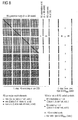
- the page illustration is shown in figure 6a , wherein the upper part is the even page part and the lower part is the odd page part as indicated by the first bit.
- a subframe structure of one of the two versions of the I/NAV navigation message is illustrated in figure 1 .
- the pages indicated with Int1 to Int5 and the spare pages are currently not used, since the integrity functionality of the Galileo open service system has become obsolete.
- Each page contains a data field that is also denoted as word, more specifically as navigation word.
- a navigation word of a specific type is labelled by a unique (navigation) word type number.
- the CED is transmitted in CED pages 1 to 4 which contain the respective navigation words of types 1 to 4. Usually, an error free reception of all four navigation words is necessary to recover the original CED.
- To the information in each page a CRC value is appended.
- Each page contains convolutionally encoded information and CRC value. By the checking of the latter at a receiver it is possible to tell for each page, whether the decoding of the convolutional code after receiving the navigation message has been successful or not. If the CRC fails after the decoding, it means that residual errors exist. Thus, the respective page cannot be used and is discarded.
- One way to improve the CED robustness is based on a low-density parity-check (LDPC) code as an outer channel code in addition to a legacy inner convolutional code. Therefore, the available space of the integrity pages and of the spare pages is used for two LDPC redundancy pages as illustrated in figure 2 , mid-column.
- a further solution is based on a reduction of a respective data resolution resulting in so-called reduced Code and Ephemeris Data (reduced CED) which fits into one page and is transmitted, e.g. twice per subframe of the navigation message. This solution results in very low TTDs. However, the accuracy of the first position fix is quite low and the full CED still has to be acquired by receiving each of the respective CED pages.
- LDPC low-density parity-check
- a subframe according to the right column of figure 2 can be achieved.
- the LDPC redundancy pages add more error robustness to the CED and help the receiver to recover/derive the CED more reliably in harsher channel environments. Consequently, a receiver in such channel conditions does not necessarily need to wait for a repetition of a received CED page with residual errors, since the redundancy in the LDPC redundancy pages can help to correct residual errors after the convolutional decoding stage.
- Available LDPC decoding algorithms recover the CED information of the CED pages and report whether decoding was successful or not. Therefore, no additional CRC is required. While additional LDPC code pages add a further layer of protection to the CED pages, the TTD in error-free channels is the same as the standard scheme without LDPC redundancy pages.
- the reduced CED approach has the disadvantage of requiring a generation of reduced resolution data on board of the satellite. This generation needs modifications in a signal generator on board of the satellite, which can be quite complex.
- a method of transmitting a navigation message comprises outer RS encoding of Clock and Ephemeris data, CED.
- the method further comprises embedding the CED in CED navigation words and the RS encoded CED in RS CED navigation words.
- the method further comprises adding a Cyclic Redundancy Check, CRC, value to the CED navigation words and to the RS CED navigation words.
- the method further comprises embedding the CED navigation words into CED pages and the RS CED navigation words into at least one RS CED page.
- the method further comprises inner encoding, for example convolutionally encoding, the CED pages and the at least one RS CED page.
- the method further comprises transmitting the navigation message including a subframe.
- a subset of the inner encoded CED pages and a subset of the inner encoded at least one RS CED page are allocated within the subframe of the navigation message.
- the subset of the inner encoded CED pages and the subset of the inner encoded at least one RS CED page form a set of pages having the CED.
- a subset may be understood as at least a subset.
- the expression "a subset of the inner encoded CED pages and a subset of the inner encoded at least one RS CED page are allocated within the subframe of the navigation message” may be understood such that a part of the inner encoded CED pages and a part of the inner encoded at least one RS CED page are allocated within the subframe of the navigation message or may be understood such that all of the inner encoded CED pages and a part or all of the inner encoded at least one RS CED page are allocated within the subframe of the navigation message.
- Each of the CED navigation words and each of the CED pages can comprise data parts representing a separate navigation word type and a separate part of the CED.
- Reduced CED can be embedded in at least one other page. This may be denoted Reduced CED page.
- the at least one Reduced CED page can be inner encoded.
- the navigation message can be transmitted including the subframe.
- the at least one inner encoded Reduced CED page can be allocated within the subframe consecutively or non-consecutively with respect to the inner encoded CED pages and the at least one inner encoded RS CED page.
- a subsequent subframe may be included in the navigation message.
- the subsequent subframe may be consecutive to the subframe.
- the subsequent subframe may comprise a different subset of the inner encoded CED pages, a different subset of the inner encoded at least one RS CED page and/or the at least one inner encoded Reduced CED page.
- the different subset of the inner encoded CED pages, the different subset of the inner encoded at least one RS CED page and/or the at least one inner encoded Reduced CED page can be allocated within the subsequent subframe of the navigation message.
- the different subset of the inner encoded CED pages, the different subset of the inner encoded at least one RS CED page and/or the at least one inner encoded Reduced CED page form another set of pages having the CED.
- the navigation word types of the at least one RS CED page can be different.
- the navigation word types of the CED pages can be different.
- the navigation word types of the at least one RS CED page can match the navigation word types of the CED pages.
- the CED pages may be four CED pages.
- the number of pages within the subframe may be four to perform erasure decoding.
- the number of pages within the subframe may be more than four to perform outer error correction decoding.
- the pages within the subframe may be any combination of the at least one RS CED page and the CED pages.
- the navigation message comprises the subframe.
- the subframe can have 30 seconds.
- the subframe can comprise 15 pages.
- Each of the inner encoded CED pages, each of the inner encoded at least one RS CED page and/or each of the at least one inner encoded Reduced CED page can have two seconds.
- the inner encoded CED pages and the inner encoded at least one RS CED page and/or the at least one inner encoded Reduced CED page can be optimally distributed within the subframe, such that a time to data (TTD) and/or a time to first fix (TTFF) is reduced for a receiver.
- TTD time to data
- TTFF time to first fix
- At least two of the inner encoded CED pages can be allocated consecutively.
- the at least one inner encoded RS CED page can be allocated consecutively.
- two, three, four, five, six, seven or eight inner encoded RS CED pages can be allocated consecutively or timely separated.
- the two, three, four, five, six, seven or eight inner encoded RS CED pages can be allocated to subsequent subframes.
- the navigation message can comprise multiple subframes, for example two subframes.
- the inner encoded CED pages, the inner encoded at least one RS CED page and/or the at least one inner encoded Reduced CED page can be allocated within the multiple subframes of the navigation message.
- Each subframe can be transmitted via a different frequency and/or polarisation.
- One of two subframes can be transmitted via a first frequency.
- the other one of the two subframes can be transmitted via a second frequency.
- the first and second frequencies can be orthogonal frequencies. These two subframes may also be subsequent subframes.
- the data parts and/or navigation word parts of the CED navigation word may sequentially include a word type, issue of data, and a part of the CED.
- the data parts and/or navigation word parts of the RS CED navigation word may sequentially include a word type, issue of data, and a part of the RS encoded CED.
- the issue of data may comprise further redundant information with respect to consecutive pages of a same type. A same type may be understood as CED pages, RS CED pages or Reduced CED pages.
- the word type may be deterministic.
- the deterministic word type forms redundant information.
- the redundant information of the word type and/or the issue of data can be skipped during the step of RS encoding.
- the issue of data can be used as redundant information during RS decoding in a receiver.
- the word type may be used as redundant information during RS decoding in the receiver based on its determinism.
- a storage device storing the computer program according to the second aspect.
- a transmitter for transmitting a navigation message comprises a first and second processing unit, an outer Reed-Solomon (RS) encoder, a CRC value generating unit, an inner encoder unit, e.g. a convolutional encoder unit, and a transmitting unit.
- the outer RS encoder is adapted to encode Clock and Ephemeris data, CED.
- the first processing unit is adapted to embed the CED in CED navigation words and the RS encoded CED in RS CED navigation words.
- the CRC value generating unit is adapted to add a Cyclic Redundancy Check, CRC, value to the CED navigation words and to the RS CED navigation words.
- the second processing unit is adapted to embed the CED navigation words into CED pages and the RS CED navigation words into at least one RS CED page.
- the inner encoder unit is adapted to inner encode the CED pages and the at least one RS CED page.
- the transmitting unit is adapted to transmit the navigation message including a subframe. A subset of the inner encoded CED pages and a subset of the inner encoded at least one RS CED page are allocated within the subframe of the navigation message. The subset of the inner encoded CED pages and the subset of the inner encoded at least one RS CED page form a set of pages having the CED.
- the first and second processing units can be different processing units. The first and second processing units can be the same processing unit.
- a method of receiving a navigation message comprises receiving a navigation message including a subframe.
- a subset of inner encoded Clock and Ephemeris data, CED, pages and a subset of at least one inner encoded Reed-Solomon (RS) CED page are allocated within the subframe of the navigation message.
- the subset of the inner encoded CED pages and the subset of the at least one inner encoded RS CED page form a set of pages having CED.
- the method further comprises inner decoding the inner encoded CED pages and the at least one inner encoded RS CED page.
- the method further comprises performing a Cyclic Redundancy Check (CRC) based on a CRC value included in the CED page and the RS CED page.
- CRC Cyclic Redundancy Check
- the method further comprises extracting CED navigation words and RS CED navigation words from the CED pages and the at least one RS CED page.
- the method further comprises deriving the CED under use of outer RS decoding the CED navigation words and the RS CED navigation words.
- the step of extracting can further comprise extracting the CED navigation words from the CED pages and the RS CED navigation words from the at least one RS CED page.
- a receiver for receiving a navigation message comprises a receiving unit, an inner decoder unit, a Cyclic Redundancy Check (CRC) unit, an outer Reed-Solomon (RS) decoder and a processing unit.
- the receiving unit is adapted to receive the navigation message including a subframe.
- a subset of inner encoded Clock and Ephemeris data, CED, pages and a subset of at least one inner encoded Reed-Solomon (RS) CED page are allocated within the subframe of the navigation message.
- the subset of the CED pages and the subset of the at least one RS CED page form a set of pages having CED.
- the inner decoder is adapted to inner decode the inner encoded CED pages and the at least one inner encoded RS CED page.
- the CRC unit performs a CRC based on a CRC value included in the CED pages and the at least one RS CED page.
- the processing unit is adapted to extract CED navigation words and RS CED navigation words from the CED pages and the at least one RS CED page.
- the outer RS decoder is adapted to derive the CED under use of RS decoding the CED navigation words and the RS CED navigation words.
- a system comprising the transmitter according to the fourth aspect and the receiver according to the sixth aspect.
- a method comprising the method of receiving according to the fifth aspect and the method of transmitting according to the first aspect is provided.
- Figure 1 schematically illustrates three different illustrations of a subframe of a navigation message.
- the first column illustrates a time scale, which indicates that each page has two seconds of time.
- the second column illustrates the subframe of the navigation message.
- the third column illustrates only CED pages within the subframe of the navigation message.
- the fourth column illustrates reordered CED pages within the subframe of the navigation message.
- the navigation message in figure 1 is illustrated to be an I/NAV navigation message transmitted via the E1-B frequency which does not state a limitation to the E1-B frequency, such that it can also be the E5B-I frequency. Usually the navigation messages are transmitted via the E1 and E5 frequencies.
- the Clock and Ephemeris data CED are transmitted in pages, each page having a word type from 1 to 4.
- the illustrated nominal subframe format has an arrangement of 15 pages in a 30 seconds time frame. Further, retransmission of the same CED page every 30 seconds is performed until a new set of data is available for downlink. Thus, a receiver missing a CED page of a certain word type is not able to derive the corresponding CED, such that the receiver has to wait for at least another 30 seconds. This leads to a high time to receive the CED which is denoted time to data TTD.
- the subframe of the navigation message in figure 1 comprises consecutively CED 2/4, CED 4/4, GST-UTC, ALM1, ALM2, Int1, Int2, Int3, Int4, Int5, CED 1/4, CED 3/4, (IONO, Flags, BGD), and two spare pages filled with dummy messages.
- the CED pages of word types 1 to 4 comprise the whole information about Clock and Ephemeris correction data.
- the ALM1 and ALM2 comprise almanac data.
- the almanac data is a reduced precision subset of Clock and Ephemeris parameters of the active satellites in orbit. Also a reduced set of clock correction parameters is provided in the almanac for each satellite including a time of applicability of the almanac data.
- the GST-UTC page comprises information about a week number and a time of week.
- the Int1 to Int5 pages can be considered as spare pages, since they are not applicable for the open service.
- the (IONO, FLAGS, BGD) page comprises information about broadcast group delay and ionospheric correction. Since the integrity functionality of the Int1 to Int5 pages in the open service has become obsolete, there exist unused pages.
- One example to use spare pages is schematically illustrated in figure 2 .
- Figure 2 schematically illustrates three different arrangements of pages within a subframe of a navigation message.
- reduced CED pages are allocated within the subframe of the navigation message.
- the reduced CED pages comprise information which is reduced in data size.
- LDPC pages are used within the subframe of the navigation message.
- the LDPC pages so-called LDPC redundancy pages, add more error robustness to the CED and support the receiver in order to recover the information transmitted in the CED pages and LDPC redundancy pages. Error robustness is important in harsher channel environments.
- a receiver in bad channel conditions does not necessarily need to wait for a repetition of a missing CED page, since the redundancy in the additional LDPC redundancy pages can help to correct residual errors after decoding of the inner channel code.
- the available LDPC decoding algorithms then can recover/derive the CED from the CED pages and the LDPC redundancy pages.
- a combination of the allocated reduced CED pages and LDPC pages is shown.
- the reduced CED pages have the advantage of leading to very low TTD.
- the LDPC approach has the advantage of adding more error robustness to the CED.
- the present invention makes use of a Reed-Solomon code. This is introduced in the following figures.
- time to data i.e. the time required to receive the clock and ephemeris data (CED) constitutes a major factor in the time to first fix (TTFF). More precisely, it is defined as the time difference between the epoch at which the first encoded bit is recovered from the received signal and the epoch at which the complete CED is available.
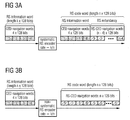
- Figure 3A schematically illustrates a schematic RS encoder showing the systematic allocation of bits.
- An RS information word with a length of k x 128 bits which comprises the k CED navigation words each with a length of 128 bits, is fed to the systematic RS encoder with a rate of k/n, which leads to an RS code word with a length of n x 128 bits.
- the RS code word then consists of two parts, the first part being the RS information word with k x 128 bits and the second part being the RS redundancy word with (n-k) x 128 bits.
- the RS code word consists of n words, k of which are identical to the k CED words and n-k are denoted as RS CED words.
- the size of the RS redundancy word of the RS code word can be adjusted by using a higher or lower code rate. For example, two or four RS redundancy parts each consisting of 128 bits are used. Another possibility of generating an RS code word is schematically illustrated in figure 3B .
- Figure 3B schematically illustrates a non-systematic RS encoder with code rate k/n.
- RS codes have both erasure and error correcting properties. Erasure correction can be applied as soon as parts of information can be labelled reliable or unreliable. Such a reliability flag is given in terms of a CRC, for example if the CRC reports errors in a page after the inner decoding stage, often Viterbi decoding is applied, this page is discarded or erased.
- a CED page containing errors is not used at the receiver. Instead the receiver is required to wait for the reception of the same page in the next subframe. With RS CED pages, this is not necessary, as an RS CED page can act like a so-called joker page. For example it can replace any of the CED pages. So the receiver just needs to wait for the next RS CED/joker page. Since the receiver can recover/derive the CED from four RS CED pages, the RS code can also be used in a non-systematic way.
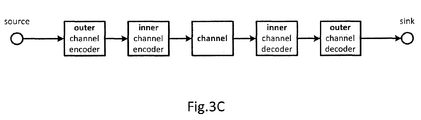
- Figure 3c schematically illustrates a channel encoding and decoding principle.
- the source provides information, which is encoded at an outer channel encoder and then encoded at an inner channel encoder, transmitted via a channel and decoded at an inner channel decoder and finally decoded at an outer channel decoder.
- Final output is the information derivable from the sink, which was first provided at the source.
- an RS code acts as outer code and a convolutional code as inner code.
- RS codes are known to be optimal erasure correcting codes.
- the property in which this optimality is based is denoted maximum distance separability MDS.
- MDS maximum distance separability
- a symbol or information entity is said to be received in an erasure correction setting, it means that it is correct, not received means it is erased or it has not arrived yet.
- the latter case is equivalent from the perspective of a recovery algorithm.
- a suboptimal erasure correcting code would require the reception of k or more different encoded information units.
- Figure 4 schematically illustrates a simplified conversion of raw CED and RS encoded CED words to pages.
- This conversion is also referred to as embedding CED and RS encoded CED words into pages in the present disclosure.
- the converted pages are separated into a part comprising CED pages and a part comprising RS CED pages.
- the CED pages are compliant with the standard.
- the information on the CED is split in even and odd word parts, wherein the different CED and RS CED words can be transmitted independently on each frequency for the case of two frequencies E5B and E1.
- FIG. 5 schematically illustrates examples for erasure correction of recoverable and unrecoverable CED and RS CED page constellations. Doublet pages can be considered as one page, as they do not contain any new information. Provided that full CED information is equivalent to four CED pages, a receiver just needs to collect the set of four different CED or RS CED pages in order to derive the CED. All CED pages or RS CED pages used for erasure correction need to be error free after inner decoding, for example the CRC for each used page needs to be successful. If the CRC fails, the respective page is discarded at least for erasure correction. Still, it may be used for RS error correction.
- the first and third columns of figure 5 show recoverable CED under erasure decoding, because the underlying pages comprise four different pages, i.e. there are no doublet pages that comprise the same information.
- the second and fourth columns comprise constellations, where the CED is not recoverable, because at least one of the pages is doubled, so there are effectively only three useful pages. If after inner decoding there are still residual errors in a page, this page cannot be used for erasure correction decoding, but it can be used for error correction decoding, since the redundancy in the at least one RS CED page can be used to correct those residual errors. In order to perform error correction, a receiver needs to collect at least five CED pages or RS CED pages, of which some or all may contain residual errors after inner decoding.
- RS codes are burst error correcting codes and therefore work well in combination with a convolutional code, since the Viterbi decoding algorithm which is normally applied as inner decoder to decode convolutional codes, produces burst errors in case of a decoding failure. Furthermore, it is important to keep in mind that RS decoding has a very low probability of not detecting errors and as such can validate the decoded information. Consequently, it is not required to append a second CRC to the CED and RS CED to report the failure or success of RS decoding.
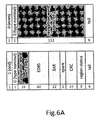
- Figure 6A schematically illustrates a bit allocation in a nominal page before inner encoding.
- Figure 6A shows the size of the different fields into which the even and odd page part are divided. This information is indicated by the first bit of the upper and the lower page part.
- the following type field was designed for informing the receiver whether the page parts are parts of alert pages according to the original Galileo integrity concept or page parts of a nominal page. Here only nominal pages are considered.
- the two navigation word fields have a size of 128 bits in total and contain navigation data.
- the fields EDBS and SAR comprise environmental data bank system data EDBS and search and rescue SAR data, respectively.
- the CRC field is used to check the validity of the received data and protects all the data fields with exception of the region status and the two tail bits fields.
- Each 120 bit long page part is encoded with a rate 1 ⁇ 2 convolutional code into a sequence of 240 symbols including the 6 tail bits for terminating the sequence in a known state to improve the decoding performance.
- a block interleaver is applied to the 240 symbols and a 10 symbols synchronisation pattern is put in front of them, thus forming a 250 symbol page.
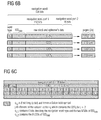
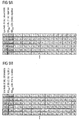
- Figure 6B schematically illustrates raw CED allocation to a CED navigation word and embedding the data into the navigation word structure.
- the navigation word type, the issue of data and the raw CED build a set of data parts. After convolutional encoding, interleaving and appending a synchronisation pattern, the final CED pages are created on the right side of the figure.
- the issue of data (IOD NAV ) field (10 bits) is equal for the same CED batch formed by CED 1 , CED 2 , CED 3 and CED 4 as illustrated. Each CED batch comprises the whole CED. CED words from different batches cannot be used together. The current CED batch remains constant until a new set or batch of CED data is available for downlink. For one CED batch, the IOD NAV field is equal for each CED word. These equal IOD NAV fields can therefore be interpreted as repetition encoded.
- FIG 6C schematically illustrates an allocation of CED navigation words to Galois symbols (here 16 octets).
- the reasons for choosing octets are first the divisibility of the data length (128 bits) by 8. Second it is a natural choice in byte-oriented systems.
- the partitioning in figure 7A is used.
- the elements C i, 1 and C i, 2 with i greater than 1 and the elements ⁇ j , 1 and ⁇ j,2 with j greater than or equal to 4 are not RS encoded, since the navigation word type is contained in the first 6 bits and that is required in unmodified form after inner decoding in order to apply the suited outer decoding settings for the respective types of words.
- the remaining elements C i,j form the RS information word and the remaining elements ⁇ i,j form the RS parity symbols.
- the navigation word type 1 together with the first occurrence of the IOD NAV field is RS encoded to stretch CRC-like functionality of the RS code over one instance of the IOD NAv field
- the word type 1 is merely included into the RS information word due to the fact that Galois field symbols (here octets) cannot be split in the current context and two bits of the IOD NAv field are contained in the same octet as the word type.
- the repeated IOD NAv fields are contained in the RS uncoded part, since the repetition of this field is exploited by other means.
- the symbols C 1,1 and C i,2 are also available in unmodified form as the used RS code is systematic, i.e.
- the RS information word is part of the RS code word, since the RS parity part is merely appended.
- a non-systematic code would completely transform the RS information word, such that it is not visible in the RS code word anymore.
- a systematic code is necessary if backwards compatibility shall be granted.
- the octets are reindexed as illustrated in figure 7B .
- FIG. 7B schematically illustrates reindexed CED navigation word octets and RS CED navigation word octets.
- C RS (C 1 , C 2 , ..., C 16 , C 19 , ..., C 32 , C 35 , ..., C 48 , C 51 , ..., C 64 ) T .
- Figure 8 schematically illustrates systematic RS encoding of the CED navigation words, following the description according to figure 7A and 7B .
- the word type and IOD NAv octets are inserted into the resulting code word.
- the gaps within the matrix and the RS information as well as the code word is left at those positions where the insertion takes place. These gaps are for illustrative purposes only, as they indicate positions at which to insert the unencoded word type and (partial) IOD NAv octets.
- the error correction capability of the RS code can be slightly improved if the octets ⁇ 66 , ⁇ 82 , ... also contain RS parity symbols instead of the 8 IOD NAV LSBs. Then, the RS CED navigation words would contain 15 RS symbols which would result only in 13 different RS CED pages, i.e. 17 pages in total. For both six or eight page schemes 17 pages would only suffice for two neighbouring subframes, since 17/6 and 17/8 make two (rounded down).
- the number of available new navigation word types is greater than 13 or 14, it can be considered to increase the Galois field size.
- the optimal erasure correction capability of RS codes can be exploited, since an inner convolutional code and a CRC is used, where the latter indicates whether a page could be correctly decoded or not, for example by an inner decoder.
- the CRC emulates an almost ideal erasure channel after the real channel and inner decoder.
- a page is considered erased, for example it is not used, if the CRC reports an error.
- a page is also regarded as erased if it has not been received yet, for example if it is transmitted only at a later point in time.
- the redundant RS CED navigation words are created from the original set of four CED navigation words by means of RS encoding.
- the RS CED navigation words and consequently the at least one RS CED page have the ideal property that from any constellation of exactly four CED or RS CED pages, the original set of four CED pages can be derived/recovered.
- An RS CED page acts like a so called joker page, the four pages used for erasure decoding just have to be different.
- the received pages also need to be error-free after inner decoding (no CRC error).
- the standard requirements of receiving all CED pages to recover/derive the complete CED can therefore be loosened to the RS requirement or more precisely the MDS erasure correction requirement of receiving a set of any four different CED or RS CED pages. Since the MDS requirement can be fulfilled in a much shorter amount of time, the RS coding approach significantly reduces the TTD. This applies to the case of channel environments being both bad and good. In contrast thereto, the LDPC redundancy pages are only useful if the channel is bad. In good channel conditions the TTD performance is equal to the standard TTD performance under good channel conditions. Moreover in the RS coding setup, if, for example one CED related page is damaged, the next received such page can replace it as long as one obtains a set of four different pages.
- An octet is considered erroneous if it contains at least one bit error.
- the number of received octets raises accordingly by 14 to 16 octets, depending on the setting and the word type. Since the position of pages in the subframe structure may vary, each page needs a unique identifier, the word type.
- the word type field (6 bits) in a navigation word has to be directly accessible after inner decoding in order to apply the correct outer decoding setting, since this differs for each word type. Therefore, the outer code may not change this field. Residual errors in the type field are thus especially harmful, since an error in this field results in a complete misinterpretation of the respective page's content.
- the decoding system just has to fill in the respective information, i.e. data type 1, even if the page of word type 1 is not among the received pages.
- the information of the 2 MSB s in the IOD NAV can also be found in the other navigation words as well as the 8 LSB s or it can be decoded, depending on the used scheme.
- Figure 9 schematically illustrates a brief CED and RS CED navigation word content analysis, which is essential particularly for exploiting the optimal erasure correction capability of the RS decoding stage.
- the type field is deterministic, while the IOD nav fields can be interpreted as repetition encoded.
- the IOD nav fields are equal for all CED navigation words of the same batch. Depending on the chosen scheme, this also applies for the RS CED word fully or partially.
- the number of received symbols has to be equal to (but it is allowed to be greater than) the number of information symbols.
- the first CED navigation word is completely RS encoded and in the remaining CED navigation words the type field as well as the IOD nav field are not part of the RS information word.
- the RS CED navigation words also only provide 14 RS redundancy symbols or octets.
- each RS CED word contains one RS symbol more, i.e. 15, as depicted in Figure 9B .
- the word type used for RS encoding (here word type 1) is known a priori and the 2 IOD nav MSBs are repeated in every RS CED and CED word, so that symbol or octet is known and the 8 IOD nav LSBs are provided in the other CED words, here CED words 2, 3 and 4. So the erasure recovery from a seemingly underdetermined system of linear equations is possible, since the missing information can be provided either from a priori knowledge or by exploiting the multiple occurrence of (parts of) the IOD nav field and the system of linear equations can be solved.
- Figure 10 schematically illustrates the so called baseline I/NAV navigation message and reordered subframe schemes that contain only the CED pages and no further redundancy pages.
- the left column of figure 10 shows the time in seconds with respect to the beginning of a subframe.
- nominal page of all word types are shown, while in the third column only the CED pages are highlighted.
- the setup refers to the baseline scheme. As we are only interested in recovering/deriving the CED, only the relevant pages are depicted in the following.
- the TTD (minimum, average, 95% confidence, maximum) is provided at the bottom of each figure for a noiseless channel.
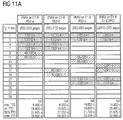
- Figure 11A schematically illustrates different page allocations within a subframe with four CED pages and two RS CED pages. Further, figure 11A shows the TTD performance under ideal conditions.
- the illustrated subframe schemes contain two additional pages comprising redundancy from an outer channel code (LDPC or RS code), such that the six CED related pages are contained within one subframe.
- LDPC outer channel code
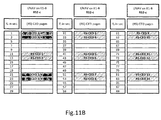
- Figure 11B schematically illustrates a possible realisation of page allocation RS2-c, as depicted in Figure 11A , over subsequent subframes, where each subframe contains a different set of CED related pages.
- the subsequent subframes contain only RS CED pages.
- Figure 12 schematically illustrates different page allocations within a subframe with four CED pages and four RS CED pages. Further, figure 12 shows the TTD performance under ideal conditions.
- the illustrated subframes comprise four additional pages containing redundancy from an outer channel code (repetition code or RS code). This yields eight CED related pages per subframe.
- Figure 13 schematically illustrates different page allocations within a subframe with four CED pages, two reduced CED pages and two RS CED pages. Further, figure 13 shows the TTD performance under ideal conditions.
- the illustrated subframes comprise two additional pages containing redundancy from an outer channel code (LDPC or RS code) and two reduced CED pages. This yields eight CED related pages per subframe.
- LDPC outer channel code
- a combination of allocated pages within a subframe of a navigation message allows a variety of distributions within the subframe.
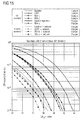
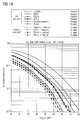
- a CED recovery failure rate is shown over a carrier-to-noise ratio (C/N 0 ).
- the performance will be evaluated for a target CED recovery failure rate of 10 -2 .
- This target number is also highlighted in the plots by a horizontal dotted grey line.
- the number of error events in the grey shaded area is considered to be insufficient. Thus, the results in that area have a lower confidence level and should be regarded as preliminary.
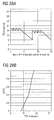
- FIG 14 the CED recovery failure rate is shown for an AWGN channel.
- Figure 15 schematically illustrates a CED recovery failure rate over a carrier-to-noise ratio for a two state LMS channel with a speed of 50 km/h.
- Figure 16 schematically illustrates a CED recovery failure rate over a carrier-to-noise-ratio simulated over a two-state LMS channel with a 40 degree elevation angle and a speed of 5 km/h.
- the simulations have been performed for various CED protection schemes after a maximal reception time of one subframe length (30 seconds).
- reduced accuracy pages yield lower CED recovery failure rates.
- the RS scheme yields better results in view of CED recovery failures with respect to the amount of pages used and with respect to the other mentioned schemes like baseline and LDPC.
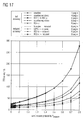
- FIG 17 and 18 schematically illustrate TTD in seconds as a function of page erasure probability.
- a page is considered erased if its CRC fails and reports residual errors after inner decoding.
- pages are erased with a certain probability independently of each other.
- the receiver waits for the LDPC redundancy pages in order to correct residual errors.
- the LDPC approach performs equally to the baseline approach in terms of TTD, since the LDPC redundancy parts cannot replace nominal CED pages that have not yet been received.
- the RS codes provide erasure correction property and are capable of correcting errors.
- Figure 17 and 18 show that the TTD in seconds is reduced under use of RS codes with respect to a baseline approach and a respective number of used CED related pages.
- the TTD of all previously mentioned allocation schemes is provided as a function of an epoch of a first available symbol for an error-free channel.
- an average TTD and a TTD with 95% confidence is shown.
- plots are shown illustrating the respective cumulative distribution function CDF.
- Figure 19A schematically illustrates the TTD in seconds for the baseline approach and the LDPC approach, since in an error-free channel the redundancy in the LDPC pages does not suffice to recover a missing CED page. The same applies to the respective schemes with reduced CED.
- Figure 19B schematically illustrates the CDF of the TTD according to figure 19A .
- the minimum value for the TTD (14s) is obtained when a first symbol is available at the beginning of page of navigation word type 1, i.e. CED 1, (see figure 10 ) just located 20s after the beginning of the subframe. If the first symbol is skipped, then the TTD jumps up to the maximum value (32s), since the receiver must wait for the current incomplete page (about 2s) and for a complete subframe (30s).
- the maximum value 32s
- skipping any of its symbols has no impact on the final result.
- the curve is only decreasing.
- the horizontal lines show the average TTD (dashed line) and the TTD with 95% confidence (solid line).
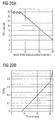
- FIG 20A schematically illustrates the TTD for the baseline scheme in a reordered subframe with four pages.
- FIG 20B the CDF of the TTD according to figure 20A is shown.
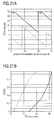
- Figure 21A schematically illustrates the TTD of the baseline or LDPC approach with reduced CED pages with 6 or 8 CED related pages respectively.
- the grey lines show the results of the respective scheme without reduced CED.
- FIG 21B the CDF of the TTD according to figure 21A is shown.
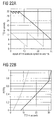
- FIG 22A schematically illustrates the TTD of the baseline scheme with reordered and reduced CED pages (6 CED related pages). The grey lines show the results of the respective scheme without reduced CED.
- FIG 22B the CDF of the TTD according to figure 22A is shown.
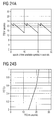
- Figure 23A schematically illustrates the TTD of an RS scheme with 6 CED related pages within a subframe of a navigation message. This scheme corresponds to the RS2-b scheme on figure 11A , wherein the CED pages and the at least one RS CED page are respectively aligned consecutively.
- FIG 23B the corresponding CDF of the TTD according to figure 23A is shown.
- FIG 24A schematically illustrates the TTD according to another RS coding scheme with 6 CED related pages.
- the CED pages are aligned together timely separated from the following RS CED pages, which are themselves aligned consecutively.
- the at least one RS CED page are further timely separated from the following two consecutive CED pages.
- This scheme corresponds to the RS2-c scheme in figure 11A .
- the CDF of the TTD according to figure 24A is shown.
- FIG 25A schematically illustrate the TTD according to the baseline repetition scheme of figure 12 with 8 CED related pages. The pages are separated in two blocks within the subframe, such that four pages form a block.
- FIG 25B the corresponding CDF of the TTD according to figure 25A is shown.
- FIG 26A schematically illustrates the TTD according to another RS scheme, RS2-b Red-CED, with reduced CED comprising 8 CED related pages, as illustrated in figure 13 .
- the CED pages are aligned consecutively.
- the following one reduced CED page is timely separated from the CED pages and the following block of two RS CED pages.
- the two RS CED pages are themselves timely separated from the following reduced CED page.
- FIG 26B the CDFs of the TTD according to figure 26A are shown.
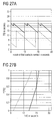
- FIG 27A schematically illustrates the TTD according to another RS coding scheme.
- This coding scheme, RS2-c Red-CED, with reduced CED comprises 8 CED related pages according to figure 13 .
- the grey line shows the results of the respective scheme without reduced CED.
- two consecutive CED pages are timely separated from a following reduced CED page.
- the reduced CED page is consecutively followed by two consecutive RS CED pages.
- the two consecutive RS CED pages are timely separated from other two consecutive CED pages being consecutively followed by another reduced CED page.
- FIG 27B the CDFs of the TTD according to figure 27A are shown.
- FIG 28A schematically illustrates the TTD according to another RS coding scheme.
- This coding scheme is the RS4-b according to figure 12 with 8 CED related pages.
- the CED pages and the at least one RS CED page are allocated, such that two CED pages and two RS CED pages are aligned consecutively timely separated from the other two RS CED pages consecutively arranged with the other CED pages.
- FIG 28B the CDF of the TTD according to figure 28A is shown.
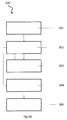
- a method of transmitting a navigation message comprises outer RS encoding of the CED in step S291.
- the method further comprises embedding the CED in CED navigation words and the RS encoded CED in RS CED navigation words in step S292.
- the method further comprises adding a Cyclic Redundancy Check, CRC, value to the CED navigation words and to the RS CED navigation words in step S293.
- the method further comprises embedding the CED navigation words into CED pages and the RS CED navigation words into at least one RS CED page in step S294.
- the method further comprises inner encoding, for example convolutionally encoding, the CED pages and the at least one RS CED page in step S295.
- the method further comprises transmitting the navigation message including a subframe in step S296.
- a subset of the inner encoded CED pages and a subset of the inner encoded at least one RS CED page are allocated within the subframe of the navigation message.
- the subset of the inner encoded CED pages and the subset of the inner encoded at least one RS CED page form a set of pages having the CED.
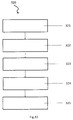
- a transmitter 300 for transmitting a navigation message comprises an outer RS encoder 301, a first and second processing unit 302, a CRC value generating unit 303, an inner encoder unit 304, and a transmitting unit 305.
- the outer RS encoder 301 is adapted to encode Clock and Ephemeris data, CED.
- the first processing unit 302 is adapted to embed the CED in CED navigation words and the RS encoded CED in RS CED navigation words.
- the CRC value generating unit 303 is adapted to add a Cyclic Redundancy Check, CRC, value to the CED navigation words and to the RS CED navigation words.
- the second processing unit 302 is adapted to embed the CED navigation words into CED pages and the RS CED navigation words into at least one RS CED page.
- the inner encoder unit 304 is adapted to inner encode the CED pages and the at least one RS CED page.
- the transmitting unit 305 is adapted to transmit the navigation message including a subframe. A subset of the inner encoded CED pages and a subset of the inner encoded at least one RS CED page are allocated within the subframe of the navigation message. The subset of the inner encoded CED pages and the subset of the inner encoded at least one RS CED page form a set of pages having the CED.
- the first and second processing units 302 can be separate processing units or the same processing unit.
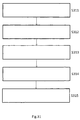
- a method of receiving a navigation message comprises receiving a navigation message including a subframe in step S311.
- a subset of inner encoded CED pages and a subset of at least one inner encoded RS CED page are allocated within the subframe of the navigation message, such that the subset of the inner encoded CED pages and the subset of the at least one inner encoded RS CED page form a set of pages having the CED.
- the method further comprises inner decoding the inner encoded CED pages and the at least one inner encoded RS CED page in step S312.
- the method further comprises performing a Cyclic Redundancy Check (CRC) based on a CRC value included in the CED pages and the at least one RS CED page in step S313.
- CRC Cyclic Redundancy Check
- the method further comprises extracting CED navigation words and RS CED navigation words from the CED pages and the at least one RS CED page in step S314.
- the method further comprises deriving the CED under use of outer RS decoding the CED navigation words and the RS CED navigation words in step S315.
- Each of the CED navigation words and consequently each of the CED pages comprises data parts representing a separate navigation word type and a separate part of the CED.
- a receiver 320 receiving a navigation message comprises a receiving unit 321, an inner decoder unit 322, a CRC unit 323, a processing unit 324 and an outer RS decoder 325.
- the receiving unit 321 is adapted to receive the navigation message including a subframe.
- a subset of inner encoded Clock and Ephemeris data, CED, pages and a subset of at least one inner encoded Reed-Solomon (RS) CED page are allocated within the subframe of the navigation message.
- the subset of the inner encoded CED pages and the subset of the at least one inner encoded RS CED page form a set of pages having CED.
- the inner decoder unit 322 is adapted to inner decode the inner encoded CED pages and the at least one inner encoded RS CED page.
- the CRC unit 323 performs a CRC based on a CRC value included in the CED pages and the at least one RS CED page.
- the processing unit 324 is adapted to extract CED navigation words and RS CED navigation words from the CED pages and the at least one RS CED page.
- the outer RS decoder 325 is adapted to derive the CED under use of RS decoding the CED navigation words and the RS CED navigation words.
- Each of the CED navigation words and consequently each of the CED pages comprises data parts representing a separate navigation word type and a separate part of the CED.
- Exemplary subsets of the innerly encoded CED pages and exemplary subsets of the innerly encoded RS CED pages as mentioned for figures 29 to 32 can be found in figures 10 to 13 .
- a subset can be any combination of the shown subsets. Further, a subset can vary from subframe to subframe, such that subsequent subframes do not comprise the same allocation scheme. Subframes transmitted over different channels, such as via different frequencies or polarisation may have a same or different allocation scheme.
Landscapes
- Engineering & Computer Science (AREA)
- Radar, Positioning & Navigation (AREA)
- Remote Sensing (AREA)
- Computer Networks & Wireless Communication (AREA)
- Physics & Mathematics (AREA)
- General Physics & Mathematics (AREA)
- Position Fixing By Use Of Radio Waves (AREA)
- Error Detection And Correction (AREA)
Priority Applications (2)
| Application Number | Priority Date | Filing Date | Title |
|---|---|---|---|
| EP16174636.7A EP3258291B1 (de) | 2016-06-15 | 2016-06-15 | Verfahren zum senden und empfangen von gnss-navigationsnachrichten |
| PCT/EP2017/064120 WO2017216058A1 (en) | 2016-06-15 | 2017-06-09 | Technique for transmitting and receiving gnss navigation messages |
Applications Claiming Priority (1)
| Application Number | Priority Date | Filing Date | Title |
|---|---|---|---|
| EP16174636.7A EP3258291B1 (de) | 2016-06-15 | 2016-06-15 | Verfahren zum senden und empfangen von gnss-navigationsnachrichten |
Publications (2)
| Publication Number | Publication Date |
|---|---|
| EP3258291A1 true EP3258291A1 (de) | 2017-12-20 |
| EP3258291B1 EP3258291B1 (de) | 2020-02-19 |
Family
ID=56134202
Family Applications (1)
| Application Number | Title | Priority Date | Filing Date |
|---|---|---|---|
| EP16174636.7A Active EP3258291B1 (de) | 2016-06-15 | 2016-06-15 | Verfahren zum senden und empfangen von gnss-navigationsnachrichten |
Country Status (2)
| Country | Link |
|---|---|
| EP (1) | EP3258291B1 (de) |
| WO (1) | WO2017216058A1 (de) |
Families Citing this family (2)
| Publication number | Priority date | Publication date | Assignee | Title |
|---|---|---|---|---|
| CA3091571C (en) | 2018-10-09 | 2023-10-17 | The European Union, Represented By The European Commission | Transmission of satellite navigation message into multiple pages encoded for optimal retrieval at receiver in a fully interchangeable way |
| EP3904900B1 (de) | 2020-04-28 | 2024-06-05 | Airbus Defence and Space GmbH | Verfahren und system zur lokalisierung einer vorrichtung innerhalb einer umgebung |
Citations (1)
| Publication number | Priority date | Publication date | Assignee | Title |
|---|---|---|---|---|
| US20140258802A1 (en) * | 2013-03-05 | 2014-09-11 | Exactearth Ltd. | Methods and systems for enhanced detection of e-navigation messages |
-
2016
- 2016-06-15 EP EP16174636.7A patent/EP3258291B1/de active Active
-
2017
- 2017-06-09 WO PCT/EP2017/064120 patent/WO2017216058A1/en not_active Ceased
Patent Citations (1)
| Publication number | Priority date | Publication date | Assignee | Title |
|---|---|---|---|---|
| US20140258802A1 (en) * | 2013-03-05 | 2014-09-11 | Exactearth Ltd. | Methods and systems for enhanced detection of e-navigation messages |
Non-Patent Citations (4)
| Title |
|---|
| ANGHILERI M ET AL: "GNSS Data Message Performance: A New Methodology for its Understanding and Ideas for its Improvement", ITM 2013 - PROCEEDINGS OF THE 2013 INTERNATIONAL TECHNICAL MEETING OF THE INSTITUTE OF NAVIGATION, THE INSTITUTE OF NAVIGATION, 8551 RIXLEW LANE SUITE 360 MANASSAS, VA 20109, USA, 27 January 2013 (2013-01-27), pages 638 - 650, XP056008049 * |
| AUBAULT-ROUDIER M ET AL: "LDPC Channel Code Optimization for a GNSS CSK-Modulated Signal", GNSS 2015 - PROCEEDINGS OF THE 28TH INTERNATIONAL TECHNICAL MEETING OF THE SATELLITE DIVISION OF THE INSTITUTE OF NAVIGATION (ION GNSS+ 2015), THE INSTITUTE OF NAVIGATION, 8551 RIXLEW LANESUITE 360MANASSAS, VA 20109, USA, 18 September 2015 (2015-09-18), pages 1888 - 1901, XP056010820 * |
| MARCO ANGHILERI ET AL: "Reduced navigation data for a fast first fix", SATELLITE NAVIGATION TECHNOLOGIES AND EUROPEAN WORKSHOP ON GNSS SIGNALS AND SIGNAL PROCESSING, (NAVITEC), 2012 6TH ESA WORKSHOP ON, IEEE, 5 December 2012 (2012-12-05), pages 1 - 7, XP032322274, ISBN: 978-1-4673-2010-8, DOI: 10.1109/NAVITEC.2012.6423105 * |
| SUZUKI T ET AL: "Evaluation of Precise Point Positioning Using MADOCA-LEX via Quasi-Zenith Satellite System", ITM 2014 - PROCEEDINGS OF THE 2014 INTERNATIONAL TECHNICAL MEETING OF THE INSTITUTE OF NAVIGATION, THE INSTITUTE OF NAVIGATION, 8551 RIXLEW LANE SUITE 360 MANASSAS, VA 20109, USA, 29 January 2014 (2014-01-29), pages 460 - 470, XP056008107 * |
Also Published As
| Publication number | Publication date |
|---|---|
| WO2017216058A1 (en) | 2017-12-21 |
| EP3258291B1 (de) | 2020-02-19 |
Similar Documents
| Publication | Publication Date | Title |
|---|---|---|
| Fernández‐Hernández et al. | High‐parity vertical Reed‐Solomon codes for long GNSS high‐accuracy messages | |
| US11171741B2 (en) | Polar code transmission method and apparatus | |
| US7293222B2 (en) | Systems and processes for fast encoding of hamming codes | |
| US20210288765A1 (en) | Transport block segmentation for multi-level codes | |
| US8631309B2 (en) | Forward error correction with extended effective block size | |
| WO1997014225A1 (en) | A coding system and method providing unequal error protection by puncturing less significant symbols | |
| CN110007325B (zh) | 一种用于星基增强l5信号的快速帧同步方法 | |
| Schotsch et al. | Joint time-to-CED reduction and improvement of CED robustness in the Galileo I/NAV message | |
| US20230065312A1 (en) | Transmitter and shortening method thereof | |
| US11448772B2 (en) | Transmission of satellite navigation message into multiple pages encoded for optimal retrieval at receiver in a fully interchangeable way | |
| Ortega et al. | Optimizing the co‐design of message structure and channel coding to reduce the TTD for a Galileo 2nd generation signal | |
| EP3258291B1 (de) | Verfahren zum senden und empfangen von gnss-navigationsnachrichten | |
| JP2001028549A (ja) | 衛星アプリケーション用の積符号によって、セルを符号化する方法 | |
| US7325183B2 (en) | Error correction code generation method and apparatus | |
| CN105527637B (zh) | 北斗卫星导航定位系统中的bch译码方法及装置 | |
| CN104698479A (zh) | 导航电文的解码方法和解码装置 | |
| Borio et al. | Experimental analysis of a candidate galileo E6-B data dissemination scheme | |
| US8621333B2 (en) | Encoding device, controller and system including the same | |
| Fernandez-Hernandez et al. | Fountain codes for GNSS | |
| US7577893B2 (en) | Forward error correction decoding method and apparatus for satellite digital audio radio broadcasting | |
| CN109358978A (zh) | 一种基于极化码和元数据信息的nand flash差错控制方法 | |
| RU2776780C1 (ru) | Способ и система для оптимизированной передачи сообщений спутниковой навигации | |
| Ortega et al. | GNSS Channel Coding Structures for Fast Acquisition Signals in Harsh Environment Conditions | |
| Gkougkas et al. | Evaluation of new message structures for navigation message authentication | |
| Espluga et al. | Co-design of Message Structure and Channel Coding Scheme to Reduce the Time to CED for a Galileo 2nd Generation New Signal |
Legal Events
| Date | Code | Title | Description |
|---|---|---|---|
| PUAI | Public reference made under article 153(3) epc to a published international application that has entered the european phase |
Free format text: ORIGINAL CODE: 0009012 |
|
| STAA | Information on the status of an ep patent application or granted ep patent |
Free format text: STATUS: THE APPLICATION HAS BEEN PUBLISHED |
|
| AK | Designated contracting states |
Kind code of ref document: A1 Designated state(s): AL AT BE BG CH CY CZ DE DK EE ES FI FR GB GR HR HU IE IS IT LI LT LU LV MC MK MT NL NO PL PT RO RS SE SI SK SM TR |
|
| AX | Request for extension of the european patent |
Extension state: BA ME |
|
| RAP1 | Party data changed (applicant data changed or rights of an application transferred) |
Owner name: AIRBUS DEFENCE AND SPACE GMBH |
|
| STAA | Information on the status of an ep patent application or granted ep patent |
Free format text: STATUS: REQUEST FOR EXAMINATION WAS MADE |
|
| 17P | Request for examination filed |
Effective date: 20180223 |
|
| RBV | Designated contracting states (corrected) |
Designated state(s): AL AT BE BG CH CY CZ DE DK EE ES FI FR GB GR HR HU IE IS IT LI LT LU LV MC MK MT NL NO PL PT RO RS SE SI SK SM TR |
|
| GRAP | Despatch of communication of intention to grant a patent |
Free format text: ORIGINAL CODE: EPIDOSNIGR1 |
|
| STAA | Information on the status of an ep patent application or granted ep patent |
Free format text: STATUS: GRANT OF PATENT IS INTENDED |
|
| INTG | Intention to grant announced |
Effective date: 20190920 |
|
| RIN1 | Information on inventor provided before grant (corrected) |
Inventor name: SCHOTSCH, BIRGIT ELKE |
|
| GRAS | Grant fee paid |
Free format text: ORIGINAL CODE: EPIDOSNIGR3 |
|
| GRAA | (expected) grant |
Free format text: ORIGINAL CODE: 0009210 |
|
| STAA | Information on the status of an ep patent application or granted ep patent |
Free format text: STATUS: THE PATENT HAS BEEN GRANTED |
|
| AK | Designated contracting states |
Kind code of ref document: B1 Designated state(s): AL AT BE BG CH CY CZ DE DK EE ES FI FR GB GR HR HU IE IS IT LI LT LU LV MC MK MT NL NO PL PT RO RS SE SI SK SM TR |
|
| REG | Reference to a national code |
Ref country code: CH Ref legal event code: EP |
|
| REG | Reference to a national code |
Ref country code: DE Ref legal event code: R096 Ref document number: 602016029928 Country of ref document: DE |
|
| REG | Reference to a national code |
Ref country code: AT Ref legal event code: REF Ref document number: 1235597 Country of ref document: AT Kind code of ref document: T Effective date: 20200315 |
|
| REG | Reference to a national code |
Ref country code: IE Ref legal event code: FG4D |
|
| REG | Reference to a national code |
Ref country code: NL Ref legal event code: MP Effective date: 20200219 |
|
| PG25 | Lapsed in a contracting state [announced via postgrant information from national office to epo] |
Ref country code: FI Free format text: LAPSE BECAUSE OF FAILURE TO SUBMIT A TRANSLATION OF THE DESCRIPTION OR TO PAY THE FEE WITHIN THE PRESCRIBED TIME-LIMIT Effective date: 20200219 Ref country code: RS Free format text: LAPSE BECAUSE OF FAILURE TO SUBMIT A TRANSLATION OF THE DESCRIPTION OR TO PAY THE FEE WITHIN THE PRESCRIBED TIME-LIMIT Effective date: 20200219 Ref country code: NO Free format text: LAPSE BECAUSE OF FAILURE TO SUBMIT A TRANSLATION OF THE DESCRIPTION OR TO PAY THE FEE WITHIN THE PRESCRIBED TIME-LIMIT Effective date: 20200519 |
|
| REG | Reference to a national code |
Ref country code: LT Ref legal event code: MG4D |
|
| PG25 | Lapsed in a contracting state [announced via postgrant information from national office to epo] |
Ref country code: IS Free format text: LAPSE BECAUSE OF FAILURE TO SUBMIT A TRANSLATION OF THE DESCRIPTION OR TO PAY THE FEE WITHIN THE PRESCRIBED TIME-LIMIT Effective date: 20200619 Ref country code: GR Free format text: LAPSE BECAUSE OF FAILURE TO SUBMIT A TRANSLATION OF THE DESCRIPTION OR TO PAY THE FEE WITHIN THE PRESCRIBED TIME-LIMIT Effective date: 20200520 Ref country code: BG Free format text: LAPSE BECAUSE OF FAILURE TO SUBMIT A TRANSLATION OF THE DESCRIPTION OR TO PAY THE FEE WITHIN THE PRESCRIBED TIME-LIMIT Effective date: 20200519 Ref country code: SE Free format text: LAPSE BECAUSE OF FAILURE TO SUBMIT A TRANSLATION OF THE DESCRIPTION OR TO PAY THE FEE WITHIN THE PRESCRIBED TIME-LIMIT Effective date: 20200219 Ref country code: LV Free format text: LAPSE BECAUSE OF FAILURE TO SUBMIT A TRANSLATION OF THE DESCRIPTION OR TO PAY THE FEE WITHIN THE PRESCRIBED TIME-LIMIT Effective date: 20200219 Ref country code: HR Free format text: LAPSE BECAUSE OF FAILURE TO SUBMIT A TRANSLATION OF THE DESCRIPTION OR TO PAY THE FEE WITHIN THE PRESCRIBED TIME-LIMIT Effective date: 20200219 |
|
| PG25 | Lapsed in a contracting state [announced via postgrant information from national office to epo] |
Ref country code: NL Free format text: LAPSE BECAUSE OF FAILURE TO SUBMIT A TRANSLATION OF THE DESCRIPTION OR TO PAY THE FEE WITHIN THE PRESCRIBED TIME-LIMIT Effective date: 20200219 |
|
| PG25 | Lapsed in a contracting state [announced via postgrant information from national office to epo] |
Ref country code: DK Free format text: LAPSE BECAUSE OF FAILURE TO SUBMIT A TRANSLATION OF THE DESCRIPTION OR TO PAY THE FEE WITHIN THE PRESCRIBED TIME-LIMIT Effective date: 20200219 Ref country code: SK Free format text: LAPSE BECAUSE OF FAILURE TO SUBMIT A TRANSLATION OF THE DESCRIPTION OR TO PAY THE FEE WITHIN THE PRESCRIBED TIME-LIMIT Effective date: 20200219 Ref country code: RO Free format text: LAPSE BECAUSE OF FAILURE TO SUBMIT A TRANSLATION OF THE DESCRIPTION OR TO PAY THE FEE WITHIN THE PRESCRIBED TIME-LIMIT Effective date: 20200219 Ref country code: PT Free format text: LAPSE BECAUSE OF FAILURE TO SUBMIT A TRANSLATION OF THE DESCRIPTION OR TO PAY THE FEE WITHIN THE PRESCRIBED TIME-LIMIT Effective date: 20200712 Ref country code: SM Free format text: LAPSE BECAUSE OF FAILURE TO SUBMIT A TRANSLATION OF THE DESCRIPTION OR TO PAY THE FEE WITHIN THE PRESCRIBED TIME-LIMIT Effective date: 20200219 Ref country code: EE Free format text: LAPSE BECAUSE OF FAILURE TO SUBMIT A TRANSLATION OF THE DESCRIPTION OR TO PAY THE FEE WITHIN THE PRESCRIBED TIME-LIMIT Effective date: 20200219 Ref country code: LT Free format text: LAPSE BECAUSE OF FAILURE TO SUBMIT A TRANSLATION OF THE DESCRIPTION OR TO PAY THE FEE WITHIN THE PRESCRIBED TIME-LIMIT Effective date: 20200219 Ref country code: ES Free format text: LAPSE BECAUSE OF FAILURE TO SUBMIT A TRANSLATION OF THE DESCRIPTION OR TO PAY THE FEE WITHIN THE PRESCRIBED TIME-LIMIT Effective date: 20200219 Ref country code: CZ Free format text: LAPSE BECAUSE OF FAILURE TO SUBMIT A TRANSLATION OF THE DESCRIPTION OR TO PAY THE FEE WITHIN THE PRESCRIBED TIME-LIMIT Effective date: 20200219 |
|
| REG | Reference to a national code |
Ref country code: AT Ref legal event code: MK05 Ref document number: 1235597 Country of ref document: AT Kind code of ref document: T Effective date: 20200219 |
|
| REG | Reference to a national code |
Ref country code: DE Ref legal event code: R097 Ref document number: 602016029928 Country of ref document: DE |
|
| PLBE | No opposition filed within time limit |
Free format text: ORIGINAL CODE: 0009261 |
|
| STAA | Information on the status of an ep patent application or granted ep patent |
Free format text: STATUS: NO OPPOSITION FILED WITHIN TIME LIMIT |
|
| REG | Reference to a national code |
Ref country code: DE Ref legal event code: R119 Ref document number: 602016029928 Country of ref document: DE |
|
| 26N | No opposition filed |
Effective date: 20201120 |
|
| PG25 | Lapsed in a contracting state [announced via postgrant information from national office to epo] |
Ref country code: IT Free format text: LAPSE BECAUSE OF FAILURE TO SUBMIT A TRANSLATION OF THE DESCRIPTION OR TO PAY THE FEE WITHIN THE PRESCRIBED TIME-LIMIT Effective date: 20200219 Ref country code: MC Free format text: LAPSE BECAUSE OF FAILURE TO SUBMIT A TRANSLATION OF THE DESCRIPTION OR TO PAY THE FEE WITHIN THE PRESCRIBED TIME-LIMIT Effective date: 20200219 Ref country code: AT Free format text: LAPSE BECAUSE OF FAILURE TO SUBMIT A TRANSLATION OF THE DESCRIPTION OR TO PAY THE FEE WITHIN THE PRESCRIBED TIME-LIMIT Effective date: 20200219 |
|
| REG | Reference to a national code |
Ref country code: CH Ref legal event code: PL |
|
| PG25 | Lapsed in a contracting state [announced via postgrant information from national office to epo] |
Ref country code: SI Free format text: LAPSE BECAUSE OF FAILURE TO SUBMIT A TRANSLATION OF THE DESCRIPTION OR TO PAY THE FEE WITHIN THE PRESCRIBED TIME-LIMIT Effective date: 20200219 Ref country code: PL Free format text: LAPSE BECAUSE OF FAILURE TO SUBMIT A TRANSLATION OF THE DESCRIPTION OR TO PAY THE FEE WITHIN THE PRESCRIBED TIME-LIMIT Effective date: 20200219 |
|
| GBPC | Gb: european patent ceased through non-payment of renewal fee |
Effective date: 20200615 |
|
| PG25 | Lapsed in a contracting state [announced via postgrant information from national office to epo] |
Ref country code: LU Free format text: LAPSE BECAUSE OF NON-PAYMENT OF DUE FEES Effective date: 20200615 |
|
| REG | Reference to a national code |
Ref country code: BE Ref legal event code: MM Effective date: 20200630 |
|
| PG25 | Lapsed in a contracting state [announced via postgrant information from national office to epo] |
Ref country code: FR Free format text: LAPSE BECAUSE OF NON-PAYMENT OF DUE FEES Effective date: 20200630 Ref country code: GB Free format text: LAPSE BECAUSE OF NON-PAYMENT OF DUE FEES Effective date: 20200615 Ref country code: IE Free format text: LAPSE BECAUSE OF NON-PAYMENT OF DUE FEES Effective date: 20200615 Ref country code: LI Free format text: LAPSE BECAUSE OF NON-PAYMENT OF DUE FEES Effective date: 20200630 Ref country code: CH Free format text: LAPSE BECAUSE OF NON-PAYMENT OF DUE FEES Effective date: 20200630 |
|
| PG25 | Lapsed in a contracting state [announced via postgrant information from national office to epo] |
Ref country code: BE Free format text: LAPSE BECAUSE OF NON-PAYMENT OF DUE FEES Effective date: 20200630 Ref country code: DE Free format text: LAPSE BECAUSE OF NON-PAYMENT OF DUE FEES Effective date: 20210101 |
|
| PG25 | Lapsed in a contracting state [announced via postgrant information from national office to epo] |
Ref country code: TR Free format text: LAPSE BECAUSE OF FAILURE TO SUBMIT A TRANSLATION OF THE DESCRIPTION OR TO PAY THE FEE WITHIN THE PRESCRIBED TIME-LIMIT Effective date: 20200219 Ref country code: MT Free format text: LAPSE BECAUSE OF FAILURE TO SUBMIT A TRANSLATION OF THE DESCRIPTION OR TO PAY THE FEE WITHIN THE PRESCRIBED TIME-LIMIT Effective date: 20200219 Ref country code: CY Free format text: LAPSE BECAUSE OF FAILURE TO SUBMIT A TRANSLATION OF THE DESCRIPTION OR TO PAY THE FEE WITHIN THE PRESCRIBED TIME-LIMIT Effective date: 20200219 |
|
| PG25 | Lapsed in a contracting state [announced via postgrant information from national office to epo] |
Ref country code: MK Free format text: LAPSE BECAUSE OF FAILURE TO SUBMIT A TRANSLATION OF THE DESCRIPTION OR TO PAY THE FEE WITHIN THE PRESCRIBED TIME-LIMIT Effective date: 20200219 Ref country code: AL Free format text: LAPSE BECAUSE OF FAILURE TO SUBMIT A TRANSLATION OF THE DESCRIPTION OR TO PAY THE FEE WITHIN THE PRESCRIBED TIME-LIMIT Effective date: 20200219 |