EP3257876A1 - Polymerizable composition and novel alkyne compound - Google Patents
Polymerizable composition and novel alkyne compound Download PDFInfo
- Publication number
- EP3257876A1 EP3257876A1 EP16749207.3A EP16749207A EP3257876A1 EP 3257876 A1 EP3257876 A1 EP 3257876A1 EP 16749207 A EP16749207 A EP 16749207A EP 3257876 A1 EP3257876 A1 EP 3257876A1
- Authority
- EP
- European Patent Office
- Prior art keywords
- bis
- group
- mercaptomethylthio
- polymerizable composition
- general formula
- Prior art date
- Legal status (The legal status is an assumption and is not a legal conclusion. Google has not performed a legal analysis and makes no representation as to the accuracy of the status listed.)
- Granted
Links
- 0 CC1CC(C)*C1 Chemical compound CC1CC(C)*C1 0.000 description 4
Classifications
-
- C—CHEMISTRY; METALLURGY
- C08—ORGANIC MACROMOLECULAR COMPOUNDS; THEIR PREPARATION OR CHEMICAL WORKING-UP; COMPOSITIONS BASED THEREON
- C08F—MACROMOLECULAR COMPOUNDS OBTAINED BY REACTIONS ONLY INVOLVING CARBON-TO-CARBON UNSATURATED BONDS
- C08F38/00—Homopolymers and copolymers of compounds having one or more carbon-to-carbon triple bonds
- C08F38/02—Acetylene
-
- C—CHEMISTRY; METALLURGY
- C07—ORGANIC CHEMISTRY
- C07C—ACYCLIC OR CARBOCYCLIC COMPOUNDS
- C07C321/00—Thiols, sulfides, hydropolysulfides or polysulfides
- C07C321/12—Sulfides, hydropolysulfides, or polysulfides having thio groups bound to acyclic carbon atoms
-
- C—CHEMISTRY; METALLURGY
- C07—ORGANIC CHEMISTRY
- C07F—ACYCLIC, CARBOCYCLIC OR HETEROCYCLIC COMPOUNDS CONTAINING ELEMENTS OTHER THAN CARBON, HYDROGEN, HALOGEN, OXYGEN, NITROGEN, SULFUR, SELENIUM OR TELLURIUM
- C07F9/00—Compounds containing elements of Groups 5 or 15 of the Periodic Table
- C07F9/90—Antimony compounds
-
- C—CHEMISTRY; METALLURGY
- C08—ORGANIC MACROMOLECULAR COMPOUNDS; THEIR PREPARATION OR CHEMICAL WORKING-UP; COMPOSITIONS BASED THEREON
- C08G—MACROMOLECULAR COMPOUNDS OBTAINED OTHERWISE THAN BY REACTIONS ONLY INVOLVING UNSATURATED CARBON-TO-CARBON BONDS
- C08G75/00—Macromolecular compounds obtained by reactions forming a linkage containing sulfur with or without nitrogen, oxygen, or carbon in the main chain of the macromolecule
- C08G75/02—Polythioethers
- C08G75/04—Polythioethers from mercapto compounds or metallic derivatives thereof
-
- C—CHEMISTRY; METALLURGY
- C08—ORGANIC MACROMOLECULAR COMPOUNDS; THEIR PREPARATION OR CHEMICAL WORKING-UP; COMPOSITIONS BASED THEREON
- C08G—MACROMOLECULAR COMPOUNDS OBTAINED OTHERWISE THAN BY REACTIONS ONLY INVOLVING UNSATURATED CARBON-TO-CARBON BONDS
- C08G75/00—Macromolecular compounds obtained by reactions forming a linkage containing sulfur with or without nitrogen, oxygen, or carbon in the main chain of the macromolecule
- C08G75/02—Polythioethers
- C08G75/04—Polythioethers from mercapto compounds or metallic derivatives thereof
- C08G75/045—Polythioethers from mercapto compounds or metallic derivatives thereof from mercapto compounds and unsaturated compounds
-
- G—PHYSICS
- G02—OPTICS
- G02B—OPTICAL ELEMENTS, SYSTEMS OR APPARATUS
- G02B1/00—Optical elements characterised by the material of which they are made; Optical coatings for optical elements
- G02B1/04—Optical elements characterised by the material of which they are made; Optical coatings for optical elements made of organic materials, e.g. plastics
-
- G—PHYSICS
- G02—OPTICS
- G02B—OPTICAL ELEMENTS, SYSTEMS OR APPARATUS
- G02B1/00—Optical elements characterised by the material of which they are made; Optical coatings for optical elements
- G02B1/04—Optical elements characterised by the material of which they are made; Optical coatings for optical elements made of organic materials, e.g. plastics
- G02B1/041—Lenses
-
- G—PHYSICS
- G02—OPTICS
- G02C—SPECTACLES; SUNGLASSES OR GOGGLES INSOFAR AS THEY HAVE THE SAME FEATURES AS SPECTACLES; CONTACT LENSES
- G02C7/00—Optical parts
- G02C7/02—Lenses; Lens systems ; Methods of designing lenses
Definitions
- the present invention relates to a polymerizable composition and a novel alkyne compound.
- a transparent organic polymer material has been used as a transparent material to replace inorganic glass.
- a transparent material In the case where such a material is used in, for example, optical applications such as spectacle lenses, it is required to have a high refractive index while having generally required properties such as transparency, thermal properties, and mechanical properties.
- Patent Document 1 describes examples of using a compound having a disulfide bond. Further, Non-Patent Document 1 describes that a resin is obtained by copolymerizing a compound having sulfur atom and a triple bond with a polythiol, although optical properties of such a resin are not known.
- Patent Document 2 As a related art relating to a resin, there is a disclosure of Patent Document 2.
- the same document describes a metal-containing thietane compound.
- a high refractive index optical material having a refractive index (nd) of more than 1.7 is described therein.
- Patent Document 3 a high refractive index optical material having a refractive index (ne) of more than 1.8 is obtained by using an antimony thietane compound.
- Patent Document 4 describes that an optical material having a refractive index of 1.643 is obtained by using an antimony arylthiolate compound.
- Patent Document 5 describes that an optical material having a refractive index of 1. 730 is obtained from a polymerizable composition containing a propargyl isocyanate and a polythiol compound.
- Patent Document 6 and Non-Patent Documents 2 to 5 disclose compounds having triple bonds at both terminals thereof.
- An object of the present invention is to obtain a polymerizable composition including a predetermined compound with which an optical material having a high refractive index can be obtained, and a novel alkyne compound.
- the present invention is as follows.
- a polymerizable composition including a predetermined compound with which a transparent optical material having a high refractive index is obtained, and a novel alkyne compound.
- the polymerizable composition according to the present invention includes an alkyne compound represented by the following general formula (1).
- X 1 and X 2 represent a sulfur atom, an oxygen atom, or an NH group, and may be the same or different from each other.
- X 1 and X 2 may be a combination of sulfur atoms, a combination of a sulfur atom and an NH group, or a combination of oxygen atoms.
- Q represents an alkylene group having 1 or 2 carbon atoms, a carbonyl group, or a thiophenylene group in which one of carbon atoms is substituted by an antimony atom.
- the position of an antimony atom is not particularly limited. From the viewpoint of the effect of the present invention, it is possible to use a group represented by the following general formula (4).
- R 1 and R 2 represent an alkylene group having 1 or 2 carbon atoms, and may be the same or different from each other.
- R 1 and R 2 are preferably an alkylene group having one carbon atom.
- n each represent 0 or 1.
- a transparent optical material having a high refractive index can be obtained.
- the alkyne compound is preferably a compound represented by the following general formula (2) or (3).
- Q represents an alkylene group having 1 or 2 carbon atoms, or a thiophenylene group in which one of carbon atoms is substituted by an antimony atom.
- m and n have the same definition as in general formula (1).
- X 1 and X 2 have the same definition as in general formula (1).
- a novel compound may be, for example, the following compound.
- X 3 and X 4 represent a sulfur atom or an NH group, and are preferably a combination of sulfur atom, or a combination of a sulfur atom and an NH group.
- Q has the same definition as in general formula (1) and is preferably an alkylene group having one carbon atom, a carbonyl group, or a thiophenylene group in which one of carbon atoms is substituted by an antimony atom.
- the compounds represented by the following general formulae (1-1) to (1-5) may be preferably used as the alkyne compound represented by general formula (1).
- R 1 , R 2 , Q, X 1 , and X 2 have the same definition as in general formula (1). In this case, m is 1.
- the compound represented by general formula (1-1) can be produced as follows.
- the compound represented by general formula (1-1) is obtained by charging dropwise an alkyl halide compound having an alkyne group at the terminal thereof into a solution which is obtained by mixing and stirring a dithiol compound and a basic compound.
- a basic compound as a scavenger of the resulting hydrogen halide.
- Examples of such a basic compound include inorganic bases such as sodium hydroxide, potassium hydroxide, lithium hydroxide, sodium carbonate, potassium carbonate, lithium carbonate, sodium bicarbonate, potassium bicarbonate, lithium bicarbonate, magnesium hydroxide, and calcium hydroxide; and organic bases such as pyridine, triethylamine, dimethylaniline, diethylaniline, and 1,8-diazabicyclo[5.4.0]-7-undecene.
- inorganic bases such as sodium hydroxide, potassium hydroxide, lithium hydroxide, sodium carbonate, potassium carbonate, lithium carbonate, sodium bicarbonate, potassium bicarbonate, lithium bicarbonate, magnesium hydroxide, and calcium hydroxide
- organic bases such as pyridine, triethylamine, dimethylaniline, diethylaniline, and 1,8-diazabicyclo[5.4.0]-7-undecene.
- the compound represented by general formula (1-2) can be produced as follows.
- the compound represented by general formula (1-2) is produced by charging dropwise an iodine solution into a solution which is obtained by mixing and stirring a thioacetic acid ester compound having an alkyne group at the terminal thereof and caustic water.
- the disulfide compound having an alkyne group at the terminal thereof synthesized by the above-mentioned method has a high self-reactivity, it is desired to ensure reaction and handling at low temperatures. Specifically, the operation from reaction to removal can be performed at a temperature of -20°C to 10°C.
- the compound represented by general formula (1-3) can be obtained as follows.
- the compound represented by general formula (1-3) is produced by charging dropwise an alkyl halide compound having an alkyne group at the terminal thereof into a solution which is obtained by mixing and stirring sodium sulfide and dimethylformamide.
- the reaction temperature of the compounds shown above is not particularly limited and is usually in the range of -78°C to 200°C, and preferably -78°C to 100°C.
- the compound represented by general formula (1-4) can be obtained as follows.
- A represent a hydroxyl group, a thiol group, or an isocyanate group, and may be the same or different from each other.
- the compound represented by general formula (1-4) is obtained by charging dropwise a mixed solution of an alcohol or thiol compound having an alkyne group at the terminal thereof and a base to a solution of triphosgene or phosgene.
- the compound represented by general formula (1-4) is obtained by charging dropwise an alcohol or thiol compound having an alkyne group at the terminal thereof to a solution of an isocyanate compound having an alkyne group at the terminal thereof.
- the solvent that can be used in the above reaction is not particularly limited as long as it is a reaction-inert solvent, and examples thereof include hydrocarbon-based solvents such as petroleum ether, hexane, benzene, toluene, xylene, and mesitylene; ether-based solvents such as diethyl ether, tetrahydrofuran, and diethylene glycol dimethyl ether; ketone-based solvents such as acetone, methyl ethyl ketone, and methyl isobutyl ketone; ester-based solvents such as ethyl acetate, butyl acetate, and amyl acetate; and chlorinated solvents such as methylene chloride, chloroform, chlorobenzene, and dichlorobenzene.
- hydrocarbon-based solvents such as petroleum ether, hexane, benzene, toluene, xylene, and mesitylene
- ether-based solvents
- the base examples include inorganic bases such as sodium hydroxide, potassium hydroxide, lithium hydroxide, sodium carbonate, potassium carbonate, lithium carbonate, sodium bicarbonate, potassium bicarbonate, lithium bicarbonate, magnesium hydroxide, and calcium hydroxide; alkali metal alkoxides such as sodium methoxide, sodium ethoxide, and potassium t-butoxide; and organic bases such as pyridine, triethylamine, dimethylaniline, diethylaniline, and 1,8-diazabicyclo[5.4.0]-7-undecene.
- inorganic bases such as sodium hydroxide, potassium hydroxide, lithium hydroxide, sodium carbonate, potassium carbonate, lithium carbonate, sodium bicarbonate, potassium bicarbonate, lithium bicarbonate, magnesium hydroxide, and calcium hydroxide
- alkali metal alkoxides such as sodium methoxide, sodium ethoxide, and potassium t-butoxide
- organic bases such as pyridine, triethy
- the reaction temperature is not particularly limited and is usually in the range of -78°C to 200°C, and preferably -78°C to 100°C.
- the reaction time is affected by the reaction temperature, but it is usually from several minutes to 100 hours.
- the compound represented by general formula (1-5) can be obtained, for example, by reacting a thioacetylation product of propyne or 1-butyne, propargyl thiol or 3-butyne-1-thiol with an antimony halide in the presence of a reaction-inert solvent and a base.
- the solvent that can be used in the above reaction is not particularly limited as long as it is a reaction-inert solvent, and examples thereof include hydrocarbon-based solvents such as petroleum ether, hexane, benzene, toluene, xylene, and mesitylene; ether-based solvents such as diethyl ether, tetrahydrofuran, and diethylene glycol dimethyl ether; ketone-based solvents such as acetone, methyl ethyl ketone, and methyl isobutyl ketone; ester-based solvents such as ethyl acetate, butyl acetate, and amyl acetate; chlorinated solvents such as methylene chloride, chloroform, chlorobenzene, and dichlorobenzene; aprotic polar solvents such as N,N-dimethyl formamide, N,N-dimethyl acetamide, N,N-dimethyl imidazolidinone, and dimethyl
- the base examples include inorganic bases such as sodium hydroxide, potassium hydroxide, lithium hydroxide, sodium carbonate, potassium carbonate, lithium carbonate, sodium bicarbonate, potassium bicarbonate, lithium bicarbonate, magnesium hydroxide, and calcium hydroxide; alkali metal alkoxides such as sodium methoxide, sodium ethoxide, and potassium t-butoxide; and organic bases such as pyridine, triethylamine, dimethylaniline, diethylaniline, and 1,8-diazabicyclo[5.4.0]-7-undecene.
- inorganic bases such as sodium hydroxide, potassium hydroxide, lithium hydroxide, sodium carbonate, potassium carbonate, lithium carbonate, sodium bicarbonate, potassium bicarbonate, lithium bicarbonate, magnesium hydroxide, and calcium hydroxide
- alkali metal alkoxides such as sodium methoxide, sodium ethoxide, and potassium t-butoxide
- organic bases such as pyridine, triethy
- antimony halide examples include antimony chloride and antimony bromide. From the viewpoint of easy availability, preferred is antimony chloride.
- the reaction temperature is not particularly limited and is usually in the range of -78°C to 200°C, and preferably -78°C to 100°C.
- the reaction time is affected by the reaction temperature, but it is usually from several minutes to 100 hours.
- the amount of the thioacetylation product of propyne or 1-butyne, propargyl thiol or 3-butyne-1-thiol to be used is not particularly limited.
- the amount of the thioacetylation product, propargyl thiol or 3-butyne-1-thiol to be used is usually equal to or more than 0.01 mol and equal to or less than 20 mol with respect to 1 mol of halogen atoms contained in the antimony halide.
- the amount of the thioacetylation product, propargyl thiol or 3-butyne-1-thiol to be used is preferably equal to or more than 0.1 mol and equal to or less than 5 mol, and more preferably equal to or more than 0.5 mol and equal to or less than 1.5 mol.
- reaction schemes for compounds of Formula (1a), Formula (1e), Formula (If), Formula (1g), and Formula (1h) are shown as specific examples.
- NaOHaq represents a sodium hydroxide aqueous solution
- Ac represents an acetyl group
- the polymerizable composition of the present invention includes an alkyne compound represented by general formula (1).
- a thiol compound can be contained in conjunction with this alkyne compound, and the polymerizable composition of the present invention can be suitably used as a polymerizable composition for an optical material.
- the thiol compound used in the polymerizable composition is a compound containing at least one kind of thiol groups (SH groups) in the molecule.
- SH groups thiol groups
- a compound having any structure may also be used as long as it is compatible with the compound represented by general formula (1).
- examples of a monovalent thiol compound include aliphatic mercaptan compounds such as methyl mercaptan, ethyl mercaptan, propyl mercaptan, butyl mercaptan, octyl mercaptan, dodecyl mercaptan, tert-dodecyl mercaptan, hexadecyl mercaptan, octadecyl mercaptan, cyclohexyl mercaptan, benzyl mercaptan, ethyl phenyl mercaptan, 2-mercaptomethyl-1,3-dithiolane, 2-mercaptomethyl-1,4-dithiane, 1-mercapto-2,3-epithiopropane, 1-mercaptomethylthio-2,3-epithiopropane, 1-mercaptoethylthio-2,3-
- polyvalent thiol (polythiol) compound examples include aliphatic polythiol compounds such as 1,1-methanedithiol, 1,2-ethanedithiol, 1,1-propanedithiol, 1,2-propanedithiol, 1,3-propanedithiol, 2,2-propanedithiol, 1,6-hexanedithiol, 1,2,3-propanetrithiol, 1,1-cyclohexanedithiol, 1,2-cyclohexanedithiol, 2,2-dimethylpropane-1,3-dithiol, 3,4-dimethoxybutane-1,2-dithiol, 2-methylcyclohexane-2,3-dithiol, 1,1-bis(mercaptomethyl)cyclohexane, thiomalic acid bis(2-mercaptoethyl ester), 2,3-dimercapto-1-propanol(2-mercaptoacetate
- aliphatic thiol compounds are preferably selected rather than aromatic thiol compounds.
- a compound containing a sulfur atom, such as a sulfide bond and/or a disulfide bond, in addition to a thiol group is more preferably selected.
- at least one kind of compounds having three or more thiol groups are particularly preferably selected for improvement in a three-dimensional crosslinkability.
- examples of the preferred thiol compound include 4-mercaptomethyl-1,8-dimercapto-3,6-dithiaoctane, 4,8 or 4,7 or 5,7-dimercaptomethyl-1,11-dimercapto-3,6,9-trithiaundecane, pentaerythritol tetrakis(2-mercaptoacetate), pentaerythritol tetrakis(3-mercaptopropionate), 2,5-bis(mercaptomethyl)-1,4-dithiane, bis(mercaptoethyl)sulfide, 1,1,3,3-tetrakis(mercaptomethylthio)propane, 4,6-bis(mercaptomethylthio)-1,3-dithiane, and 2-(2,2-bis(mercaptomethylthio)ethyl)-1,3-dithietane, and can include at least one kind of polythiol compounds selected from
- the amount of the thiol compound contained in the polymerizable composition of the present invention when the amount of the thiol compound to be used is too low, with respect to 100 parts by weight of the total weight of the alkyne compound represented by general formula (1) and the thiol compound, improvement in color and mechanical strength may be unfavorably reduced in some cases. Furthermore, if the amount of the thiol compound to be used is too high, with respect to 100 parts by weight of the total weight of the compound represented by general formula (1) and the thiol compound, a reduction of heat resistance may be unfavorably significant in some cases.
- the content of the thiol compound in the polymerizable composition of the present invention is preferably equal to or more than 25 parts by weight and equal to or less than 75 parts by weight with respect to 100 parts by weight of the total weight of the alkyne compound represented by general formula (1) and the thiol compound.
- the thiol compound in such a range By including the thiol compound in such a range, a molded product having a high refractive index is provided and also exhibiting excellent color, mechanical strength and heat resistance.
- the polymerizable composition of the present invention may further contain a known polymerization catalyst to adjust a polymerization rate, if necessary.
- a known polymerization catalyst include peroxides such as Perbutyl O, Perhexyl O, benzoyl peroxide, and hydrogen peroxide water, and azide compounds such as azobisbutyronitrile. Use of these radical generators as a catalyst makes it possible to proceed with polymerization under mild conditions.
- various materials such as a resin modifier, a chain extender, a crosslinking agent, a photostabilizer represented by HALS , an ultraviolet absorber represented by a benzotriazole-based ultraviolet absorber, an antioxidant represented by a hindered phenol-based antioxidant, a coloring inhibitor, a dye or bluing agent represented by an anthraquinone-based disperse dye, a filler, an external mold releasing agent represented by a silicone-based external mold releasing agent, or an internal mold releasing agent represented by a surfactant such as acidic phosphoric ester, a quaternary ammonium salt, or a quaternary phosphonium salt, and an adhesion improving agent may be added.
- the internal mold releasing agent also includes those catalysts exhibiting a mold releasing effect among the various catalysts as described above.
- the adding amount is usually in the range of equal to or more than 0.001% by weight and equal to or less than 10% by weight and preferably in the range of equal to or more than 0.01% by weight and equal to or less than 5% by weight, based on the total weight of the polymerizable composition.
- the dye is preferably used in the range of equal to or more than 1 ppb and equal to or less than 100 ppm. Within these ranges, a better cured molded product can be produced, and the resulting molded product may have better transparency and optical properties in some cases.
- the process for producing the polymerizable composition of the present invention may be, for example, typically a method of mixing and dissolving the compound represented by general formula (1) in combination with the foregoing various other polymerizable compounds if necessary, with the addition of the foregoing polymerization catalyst if necessary.
- the resulting polymerizable composition is useful as a raw material monomer composition for a transparent molded product having a very high refractive index.
- the polymerizable composition of the present invention may be further purified if necessary.
- Purification of the polymerizable composition is a technique which is used for improving the transparency of the molded product obtained by curing, improving the color of the molded product or increasing the purity of the molded product.
- a method for purifying the polymerizable composition of the present invention any known method, for example, recrystallization, column chromatography (for example, using silica gel, activated carbon, or an ion-exchange resin), or extraction, may be carried out with any timing as long as the transparency and color of the molded product obtained by curing the generally purified composition are improved.
- the method of washing the polymerizable composition is a technique which is used for improving the transparency or color of the molded product obtained by curing.
- a method in which, when the polymerizable composition is synthesized and taken out or after the polymerizable composition is synthesized and taken out, the composition is washed with a polar and/or nonpolar solvent to remove or reduce a substance deteriorating the transparency of a molded product for example, an inorganic salt used for synthesizing the polymerizable composition or by-prepared in synthesizing the composition, such as an ammonium salt.
- the solvent to be used depends on the polymerizable composition to be cleaned and the polarity of a solution containing the polymerizable composition and is not limited, preferred is a solvent which can dissolve a component to be removed, and which is hardly compatible with the polymerizable composition to be cleaned and the solution containing the polymerizable composition.
- the solvent may be used singly or a mixture of two or more solvents may be used.
- the amount of a component to be removed varies depending on the purpose and application, the amount is preferably as low as possible. The amount is usually not more than 5, 000 ppm and more preferably not more than 1,000 ppm, which may provide favorable results.
- the thermal insulation, cold storage or filtration method for the polymerizable composition is a technique which is used for improving the transparency or hue of the molded product obtained by curing, and is generally carried out at the timing such as when the polymerizable composition is synthesized and taken out or after the polymerizable composition is synthesized and taken out.
- the thermal insulation method there is a method in which, for example, in the case where the polymerizable composition is crystallized to deteriorate handleability during storage, the polymerizable composition are dissolved by heating within a range causing no deterioration in the performance of the polymerizable composition and the molded product.
- the heating temperature range and heat dissolution method depend on the structure of the compound constituting the polymerizable composition to be handled and are not limited, the heating temperature is usually within the range of a solidification point + 50°C and preferably within the range of a solidification point + 20°C.
- the heat dissolution method there is a method in which the composition is dissolved by mechanical stirring with a stirring device or bubbling with an inert gas for moving an internal liquid.
- the cold storage is generally carried out for improving the preservation stability of the polymerizable composition.
- consideration may be given to the storage temperature to improve handleability after crystallization.
- the cold storage temperature depends on the structure and preservation stability of the compound constituting the polymerizable composition to be handled and is not limited, the polymerizable composition of the present invention needs to be stored at a temperature or below which can maintain the stability thereof.
- the polymerizable composition of the present invention is a polymerizable composition used for optical applications, such a polymerizable composition is required to have very high transparency, and thus the polymerizable composition may be usually filtered with a filter having a small pore size.
- the pore size of the filter used herein is usually equal to or greater than 0.05 ⁇ m and equal to or smaller than 10 ⁇ m, the pore size is preferably equal to or greater than 0.05 ⁇ m and equal to or smaller than 5 ⁇ m and more preferably equal to or greater than 0.1 ⁇ m and equal to or smaller than 5 ⁇ m from the viewpoints of operability and performance.
- the polymerizable composition of the present invention is no exception in many cases in that filtration leads to good results. Although a low filtration temperature near the solidification point produces more desirable results in some cases, there may be a case where filtration is preferably carried out at a temperature causing no trouble in the filtration work in the case where solidification proceeds during filtration.
- the reduced-pressure treatment is a general means which removes a solvent, dissolved gas and odor which deteriorate the performance of the molded product prepared by curing the polymerizable composition. Since a dissolved solvent generally decreases the refractive index of the resulting molded product or deteriorates the heat resistance thereof, the dissolved solvent may be removed as much as possible.
- the permissible amount of the dissolved solvent depends on the structure of the compound constituting the polymerizable composition to be handled and the structure of the dissolved solvent and is not limited, the permissible amount is usually preferably not more than 1% and more preferably not more than 5,000 ppm.
- a moisture gas such as water vapor is preferably removed by bubbling with a dry gas.
- the amount of the dissolved gas can be determined depending on the structure of the compound constituting the polymerizable composition, and the physical properties, structure and type of the dissolved gas.
- the molded product can be obtained by polymerizing and curing the resulting polymerizable composition, usually, according to the method used when polymerizing a known thietane group-containing compound.
- the polymerization catalyst type and amount and the monomer type and ratio for obtaining a molded product formed of a cured resin are determined depending on the structure of the compound constituting the polymerizable composition.
- the molded product obtained by heat curing such a polymerizable composition can be used as an optical material.
- the optical material examples include various plastic lenses such as a spectacle lens for vision correction, a lens for imaging equipment, a Fresnel lens for liquid crystal projectors, a lenticular lens, and a contact lens; a sealing material for a light emitting diode (LED); an optical waveguide; an optical adhesive used for the junction of an optical lens and an optical waveguide; an anti-reflection layer to be used for an optical lens or the like; and a transparent coating or transparent substrate used for a liquid crystal display member such as a substrate, a light guiding plate, a film or a sheet.
- plastic lenses such as a spectacle lens for vision correction, a lens for imaging equipment, a Fresnel lens for liquid crystal projectors, a lenticular lens, and a contact lens
- an optical waveguide an optical adhesive used for the junction of an optical lens and an optical waveguide
- an anti-reflection layer to be used for an optical lens or the like
- Examples of the process for producing a plastic lens include various known molding methods.
- a typical method includes a casting polymerization.
- the polymerizable composition is degassed under reduced pressure or filtered off using a filter if necessary, and then the polymerizable composition is poured into a molding mold and if necessary, heated for carrying out polymerization. In this case, it is preferable to carry out polymerization by slowly heating from a low temperature to a high temperature.
- the aforementioned molding mold is composed of, for example, two pieces of mirror surface-ground casting molds through a gasket comprised of, for example, polyethylene, an ethylene-vinyl acetate copolymer or polyvinyl chloride.
- Typical examples of the casting mold include, but are not limited to, combined casting molds such as glass and glass, glass and plastic plate, and glass and metal plate.
- the molding mold may be two pieces of casting molds fixed by a tape such as a polyester adhesive tape. If necessary, a known process method such as mold release process may be carried out for the casting mold.
- the polymerization temperature is affected by the polymerization conditions such as the type of a polymerization initiator, and is not particularly limited.
- the polymerization temperature is usually -50°C to 200°C, preferably -20°C to 170°C, and more preferably 0°C to 150°C.
- the polymerization time is affected by the polymerization temperature, it is usually equal to or longer than 0.01 hours and equal to or shorter than 200 hours and preferably equal to or longer than 0.05 hours and equal to or shorter than 100 hours. Polymerization can also be carried out in combination of several temperatures by conducting temperature fixation, temperature elevation, or temperature dropping, if necessary.
- the polymerizable composition of the present invention can also be polymerized by applying an active energy ray such as an electron beam, ultraviolet light or visible light.
- an active energy ray such as an electron beam, ultraviolet light or visible light.
- a radical polymerization catalyst or a cationic polymerization catalyst for initiating polymerization by the active energy ray is used if necessary.
- the resulting molded product (plastic lens) is cured, it may be subjected to an annealing process if necessary.
- various known physical or chemical processes such as surface polishing, antistatic process, hard coat process, non-reflective coat process, tinting process, and photochromic process (for example, photochromic lens process) may be carried out, if necessary.
- the molded product comprised of the resin obtained by polymerizing the polymerizable composition of the present invention has a high refractive index, high transparency, and good heat resistance and mechanical strength, and is useful as, for example, an optical material such as a plastic lens.
- Refractive index Measurement was carried out at 20°C using a Pulfrich refractometer.
- IR Universal ATR method 3251, 2109, 1417, 1203, 1172, 1128, 727, 716, 681, 652, 468cm -1 .
- reaction solution was discharged into 100 ml of water, extracted with 30 ml of ethyl acetate, and washed three times with 50 ml of water, followed by liquid separation.
- the organic layer was dried over sodium sulfate, filtered to remove salts and then dried under reduced pressure by a vacuum pump to give 1.7 g (yield: 73%) of a compound shown below.
- IR Universal ATR method 3289, 1407, 1232, 630cm -1 .
- triphosgene commercially available product (manufactured by Tokyo Chemical Industry Co., Ltd.) was charged into a reactor equipped with a stirrer, and 210 ml of methylene chloride was added thereto, followed by stirring and dissolution.
- reaction solution was cooled to 10°C using an ice-water bath, and then a solution of 60.0 g (1.07 mol) of propargyl alcohol (commercially available product (manufactured by Tokyo Chemical Industry Co., Ltd.)) and 84.5 g (1.07 mol) of pyridine (commercially available product (manufactured by Wako Pure Chemical Industries, Ltd.)) dissolved in 210 ml of methylene chloride was charged dropwise thereto over 1.5 hours, followed by stirring for another 3 hours.
- propargyl alcohol commercially available product (manufactured by Tokyo Chemical Industry Co., Ltd.)
- pyridine commercially available product (manufactured by Wako Pure Chemical Industries, Ltd.)
- IR Universal ATR method 3293, 2131, 1749, 1439, 1232, 979, 916, 785, 638, 524cm -1 .
- IR Universal ATR method: 3281, 1553, 1407, 1238, 1183, 9652, 629cm -1 .
- 0.43 g of the compound produced in Reference Production Example 2 was weighed in a glass beaker at room temperature (25°C), followed by weighing 0.57 g of a mixture containing 1,1,3,3-tetrakis(mercaptomethylthio)propane as a main component. Stirring and mixing were carried out while cooling to 10°C, so that degassing under reduced pressure was carried out.
- the glass beaker was placed in the reactor and then allowed to stand for 7 days while cooling to 10°C. Then, the reaction system was heated to 80°C over 1 hour using an oil bath. The reaction system was transferred to a polymerization oven, followed by heating polymerization at 110°C for 3 hours.
- the resulting resin molded product had a transparent appearance and a refractive index ne of 1.745.
- the resulting resin molded product had a transparent appearance and a refractive index ne of 1.732.
- 0.50 g of the compound produced in Reference Production Example 2 was weighed in a glass beaker at room temperature (25°C), followed by weighing 0.50 g of a mixture containing 1,1,3,3-tetrakis(mercaptomethylthio)propane as a main component. Stirring and mixing were carried out while cooling to 10°C, so that degassing under reduced pressure was carried out.
- the glass beaker was placed in the reactor and allowed to stand for 3 hours while cooling to 10°C and then allowed to stand for 2 days at room temperature (25°C) .
- the reaction system was warmed to 60°C over 8 hours and then transferred to a polymerization oven where the temperature was raised from 60°C to 100°C over 9 hours, followed by heating polymerization at 100°C for 3 hours.
- the resulting resin molded product had a transparent appearance and a refractive index ne of 1.732.
- the resulting resin molded product had a transparent appearance and a refractive index ne of 1.692.
- the resulting resin molded product had a transparent appearance and a refractive index ne of 1.730.
- Example 1 0.27 g of the compound produced in Example 1 was weighed in a glass beaker at room temperature (25°C), followed by weighing 0.73 g of a mixture containing 1,1,3,3-tetrakis(mercaptomethylthio)propane as a main component. Stirring and mixing were carried out while cooling to 10°C, so that degassing under reduced pressure was carried out. The reaction system was transferred to a polymerization oven where the temperature was raised from 25°C to 100°C over 22 hours, followed by heating polymerization. The resulting resin molded product had a refractive index ne of 1.743.
- Example 1 0.30 g of the compound produced in Example 1 was weighed in a glass beaker at room temperature (25°C), followed by weighing 0.70 g of a mixture containing 4,8 or 4,7 or 5,7-dimercaptomethyl-1,11-dimercapto-3,6,9-trithiaundecane as a main component. Stirring and mixing were carried out while cooling to 10°C, so that degassing under reduced pressure was carried out. The reaction system was transferred to a polymerization oven where the temperature was raised from 25°C to 100°C over 22 hours, followed by heating polymerization. The resulting resin molded product had a refractive index ne of 1.696.
- Example 2 0.29 g of the compound produced in Example 2 was weighed in a glass beaker at room temperature (25°C), followed by weighing 0.71 g of a mixture containing 1,1,3,3-tetrakis(mercaptomethylthio)propane as a main component. Stirring and mixing were carried out while cooling to 10°C, so that degassing under reduced pressure was carried out. The reaction system was transferred to a polymerization oven where the temperature was raised from 25°C to 100°C over 22 hours, followed by heating polymerization. The resulting resin molded product had a transparent appearance and a refractive index ne of 1.741.
- Example 2 0.32 g of the compound produced in Example 2 was weighed in a glass beaker at room temperature (25°C), followed by weighing 0.68 g of a mixture containing 4,8 or 4,7 or 5,7-dimercaptomethyl-1,11-dimercapto-3,6,9-trithiaundecane as a main component. Stirring and mixing were carried out while cooling to 10°C, so that degassing under reduced pressure was carried out. The reaction system was transferred to a polymerization oven where the temperature was raised from 25°C to 100°C over 22 hours, followed by heating polymerization. The resulting resin molded product had a transparent appearance and a refractive index ne of 1.709.
- Example 3 0.27 g of the compound produced in Example 3 was weighed in a glass beaker at room temperature (25°C), followed by weighing 0.73 g of a mixture containing 1,1,3,3-tetrakis(mercaptomethylthio)propane as a main component. Stirring and mixing were carried out while cooling to 10°C, so that degassing under reduced pressure was carried out. The reaction system was transferred to a polymerization oven where the temperature was raised from 25°C to 100°C over 22 hours, followed by heating polymerization. The resulting resin molded product had a transparent appearance and a refractive index ne of 1.730.
- Example 3 0.30 g of the compound produced in Example 3 was weighed in a glass beaker at room temperature (25°C), followed by weighing 0.70 g of a mixture containing 4,8 or 4,7 or 5,7-dimercaptomethyl-1,11-dimercapto-3,6,9-trithiaundecane as a main component. Stirring and mixing were carried out while cooling to 10°C, so that degassing under reduced pressure was carried out. The reaction system was transferred to a polymerization oven where the temperature was raised from 25°C to 120°C over 22 hours, followed by heating polymerization. The resulting resin molded product had a transparent appearance and a refractive index ne of 1.698.
- Example 4 0.67 g of the compound of Formula (1h) produced in Example 4 was weighed in a glass beaker at room temperature (25°C), followed by weighing 0.52 g of 4-mercaptomethyl-1,8-dimercapto-3,6-dithiaoctane. The reaction mixture was dissolved by heating to 80°C. After cooling to 70°C, 1 mg (0.1 parts by weight) of t-butyl 2-perethylhexanoate (commercially available product (manufactured by Nippon Oil & Fats Co., Ltd.)) as a polymerization catalyst was added thereto, followed by degassing under reduced pressure, and the polymerizable compound was injected into a casting mold comprised of glass mold and a tape. The casting mold was placed in a heating oven, such that polymerization was carried out at 90°C for 16 hours and at 100°C for 3 hours.
- t-butyl 2-perethylhexanoate commercially available product (manu
- the resulting resin molded product had a transparent appearance and a refractive index ne of 1.795.
- Resin molded products were produced in the same manner as in Example 5, except that the compound produced in Reference Production Example 3 or 4 was used. All of the resulting resin molded products had a transparent appearance and a refractive index ne of about 1.7 to 1.8.
- the present invention also includes the following aspects.
- the present invention also further includes the following aspects.
Landscapes
- Chemical & Material Sciences (AREA)
- Organic Chemistry (AREA)
- Health & Medical Sciences (AREA)
- Physics & Mathematics (AREA)
- Medicinal Chemistry (AREA)
- Polymers & Plastics (AREA)
- Chemical Kinetics & Catalysis (AREA)
- General Physics & Mathematics (AREA)
- Optics & Photonics (AREA)
- Ophthalmology & Optometry (AREA)
- General Health & Medical Sciences (AREA)
- Organic Low-Molecular-Weight Compounds And Preparation Thereof (AREA)
- Polymers With Sulfur, Phosphorus Or Metals In The Main Chain (AREA)
- Addition Polymer Or Copolymer, Post-Treatments, Or Chemical Modifications (AREA)
- Eyeglasses (AREA)
- Polyurethanes Or Polyureas (AREA)
Abstract

Description
- The present invention relates to a polymerizable composition and a novel alkyne compound.
- In recent years, a transparent organic polymer material has been used as a transparent material to replace inorganic glass. In the case where such a material is used in, for example, optical applications such as spectacle lenses, it is required to have a high refractive index while having generally required properties such as transparency, thermal properties, and mechanical properties.
- As a related art relating to such a resin, Patent Document 1 describes examples of using a compound having a disulfide bond. Further, Non-Patent Document 1 describes that a resin is obtained by copolymerizing a compound having sulfur atom and a triple bond with a polythiol, although optical properties of such a resin are not known.
- Further, as a related art relating to a resin, there is a disclosure of Patent Document 2. The same document describes a metal-containing thietane compound. Further, a high refractive index optical material having a refractive index (nd) of more than 1.7 is described therein. Further, there is a description in Patent Document 3 that a high refractive index optical material having a refractive index (ne) of more than 1.8 is obtained by using an antimony thietane compound. Further, Patent Document 4 describes that an optical material having a refractive index of 1.643 is obtained by using an antimony arylthiolate compound. Patent Document 5 describes that an optical material having a refractive index of 1. 730 is obtained from a polymerizable composition containing a propargyl isocyanate and a polythiol compound.
- In addition, Patent Document 6, and Non-Patent Documents 2 to 5 disclose compounds having triple bonds at both terminals thereof.
-
- [Patent Document 1]
-
JPH11-322930 - [Patent Document 2]
-
WO 2005-095490 - [Patent Document 3]
-
WO 2008-102545 - [Patent Document 4]
-
JP2009-275023 - [Patent Document 5]
-
WO 2014-157664 - [Patent Document 6]
-
JPH9-40615 -
- [Non-Patent Document 1] Journal of Polymer Science: Part A, Macromolecules, 2008, pp 3580 to 3587
- [Non-Patent Document 2] Tetrahedron Volume 66, Issue 10, pp 1925 to 1930, 2010
- [Non-Patent Document 3] Journal of the American Chemical Society Volume 127, Issue 2, pp 605 to 613, 2005
- [Non-Patent Document 4] RESEARCH DISCLOSURE August 1980, 19619 Organic hardeners for photographic material, pp 342 to 343
- [Non-Patent Document 5] Bull. Chem. Soc. Jpn., pp 1204 to 1206, Vol. 60, No. 3, 1987
- An object of the present invention is to obtain a polymerizable composition including a predetermined compound with which an optical material having a high refractive index can be obtained, and a novel alkyne compound.
- That is, the present invention is as follows.
- [1] A polymerizable composition including an alkyne compound represented by the following general formula (1):

- [2] The polymerizable composition according to [1], including an alkyne compound represented by the following general formula (2) or (3) :


- [3] The polymerizable composition according to [1] or [2], in which the thiophenylene group in which one of carbon atoms is substituted by an antimony atom is a divalent group represented by the following Formula (4):

- [4] The polymerizable composition according to any one of [1] to [3], further including a thiol compound.
- [5] The polymerizable composition according to [4], in which the thiol compound includes at least one kind of polythiol compounds selected from 4-mercaptomethyl-1,8-dimercapto-3,6-dithiaoctane, 4,8 or 4,7 or
5,7-dimercaptomethyl-1,11-dimercapto-3,6,9-trithiaundecane, pentaerythritol tetrakis(2-mercaptoacetate), pentaerythritol tetrakis(3-mercaptopropionate),
2,5-bis(mercaptomethyl)-1,4-dithiane, bis(mercaptoethyl)sulfide, 1,1,3,3-tetrakis(mercaptomethylthio)propane, 4,6-bis(mercaptomethylthio)-1,3-dithiane, and 2-(2,2-bis(mercaptomethylthio)ethyl)-1,3-dithietane. - [6] A molded product obtained by curing the polymerizable composition according to any one of [1] to [5].
- [7] An optical material comprised of the molded product according to [6].
- [8] A plastic lens comprised of the molded product according to [6].
- [9] An alkyne compound represented by the following general formula (5):

- [10] The alkyne compound according to [9], in which the thiophenylene group in which one of carbon atoms is substituted by an antimony atom is a group represented by the following Formula (4) :

- According to the present invention, it is possible to provide a polymerizable composition including a predetermined compound with which a transparent optical material having a high refractive index is obtained, and a novel alkyne compound.
- Hereinafter, the present invention will be described.
- The polymerizable composition according to the present invention includes an alkyne compound represented by the following general formula (1).

- In general formula (1), X1 and X2 represent a sulfur atom, an oxygen atom, or an NH group, and may be the same or different from each other. X1 and X2 may be a combination of sulfur atoms, a combination of a sulfur atom and an NH group, or a combination of oxygen atoms.
- Q represents an alkylene group having 1 or 2 carbon atoms, a carbonyl group, or a thiophenylene group in which one of carbon atoms is substituted by an antimony atom.
- With respect to the "thiophenylene group in which one of carbon atoms is substituted by an antimony atom", the position of an antimony atom is not particularly limited. From the viewpoint of the effect of the present invention, it is possible to use a group represented by the following general formula (4).

- In general formula (4), * represents a bonding hand.
- In general formula (1), R1 and R2 represent an alkylene group having 1 or 2 carbon atoms, and may be the same or different from each other. R1 and R2 are preferably an alkylene group having one carbon atom.
- According to the polymerizable composition including such an alkyne compound, a transparent optical material having a high refractive index can be obtained.
- From the viewpoint of the effect of the present invention, the alkyne compound is preferably a compound represented by the following general formula (2) or (3).

- In general formula (2), Q represents an alkylene group having 1 or 2 carbon atoms, or a thiophenylene group in which one of carbon atoms is substituted by an antimony atom. m and n have the same definition as in general formula (1).
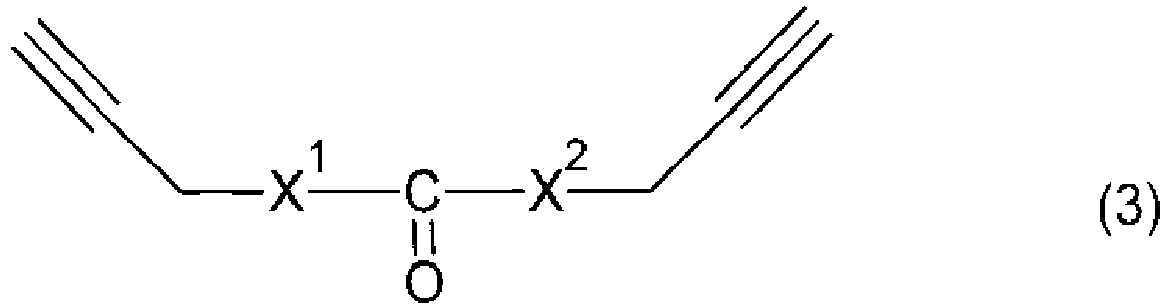
- In general formula (3), X1 and X2 have the same definition as in general formula (1).
- Among the alkyne compounds as described above, a novel compound may be, for example, the following compound.

- In general formula (5), X3 and X4 represent a sulfur atom or an NH group, and are preferably a combination of sulfur atom, or a combination of a sulfur atom and an NH group. Q has the same definition as in general formula (1) and is preferably an alkylene group having one carbon atom, a carbonyl group, or a thiophenylene group in which one of carbon atoms is substituted by an antimony atom.
- The compounds represented by the following general formulae (1-1) to (1-5) may be preferably used as the alkyne compound represented by general formula (1).


- In general formulae (1-1) to (1-5), R1, R2, Q, X1, and X2 have the same definition as in general formula (1). In this case, m is 1.
- These compounds can be obtained as follows.
- The compound represented by general formula (1-1) can be produced as follows.

- The compound represented by general formula (1-1) is obtained by charging dropwise an alkyl halide compound having an alkyne group at the terminal thereof into a solution which is obtained by mixing and stirring a dithiol compound and a basic compound.
- In order to achieve an efficient reaction when carrying out the reaction, it is preferred to use a basic compound as a scavenger of the resulting hydrogen halide.
- Examples of such a basic compound include inorganic bases such as sodium hydroxide, potassium hydroxide, lithium hydroxide, sodium carbonate, potassium carbonate, lithium carbonate, sodium bicarbonate, potassium bicarbonate, lithium bicarbonate, magnesium hydroxide, and calcium hydroxide; and
organic bases such as pyridine, triethylamine, dimethylaniline, diethylaniline, and 1,8-diazabicyclo[5.4.0]-7-undecene. - The compound represented by general formula (1-2) can be produced as follows.

- The compound represented by general formula (1-2) is produced by charging dropwise an iodine solution into a solution which is obtained by mixing and stirring a thioacetic acid ester compound having an alkyne group at the terminal thereof and caustic water.
- Since the disulfide compound having an alkyne group at the terminal thereof synthesized by the above-mentioned method has a high self-reactivity, it is desired to ensure reaction and handling at low temperatures. Specifically, the operation from reaction to removal can be performed at a temperature of -20°C to 10°C.
- The compound represented by general formula (1-3) can be obtained as follows.

- The compound represented by general formula (1-3) is produced by charging dropwise an alkyl halide compound having an alkyne group at the terminal thereof into a solution which is obtained by mixing and stirring sodium sulfide and dimethylformamide.
- The reaction temperature of the compounds shown above is not particularly limited and is usually in the range of -78°C to 200°C, and preferably -78°C to 100°C.
- The compound represented by general formula (1-4) can be obtained as follows.

- In the above reaction formula, "A" represent a hydroxyl group, a thiol group, or an isocyanate group, and may be the same or different from each other.
- The compound represented by general formula (1-4) is obtained by charging dropwise a mixed solution of an alcohol or thiol compound having an alkyne group at the terminal thereof and a base to a solution of triphosgene or phosgene. Alternatively, the compound represented by general formula (1-4) is obtained by charging dropwise an alcohol or thiol compound having an alkyne group at the terminal thereof to a solution of an isocyanate compound having an alkyne group at the terminal thereof.
- The solvent that can be used in the above reaction is not particularly limited as long as it is a reaction-inert solvent, and examples thereof include hydrocarbon-based solvents such as petroleum ether, hexane, benzene, toluene, xylene, and mesitylene;
ether-based solvents such as diethyl ether, tetrahydrofuran, and diethylene glycol dimethyl ether;
ketone-based solvents such as acetone, methyl ethyl ketone, and methyl isobutyl ketone;
ester-based solvents such as ethyl acetate, butyl acetate, and amyl acetate; and
chlorinated solvents such as methylene chloride, chloroform, chlorobenzene, and dichlorobenzene. - Examples of the base include inorganic bases such as sodium hydroxide, potassium hydroxide, lithium hydroxide, sodium carbonate, potassium carbonate, lithium carbonate, sodium bicarbonate, potassium bicarbonate, lithium bicarbonate, magnesium hydroxide, and calcium hydroxide;
alkali metal alkoxides such as sodium methoxide, sodium ethoxide, and potassium t-butoxide; and
organic bases such as pyridine, triethylamine, dimethylaniline, diethylaniline, and 1,8-diazabicyclo[5.4.0]-7-undecene. - The reaction temperature is not particularly limited and is usually in the range of -78°C to 200°C, and preferably -78°C to 100°C.
- The reaction time is affected by the reaction temperature, but it is usually from several minutes to 100 hours.
- The compound represented by general formula (1-5) can be obtained, for example, by reacting a thioacetylation product of propyne or 1-butyne, propargyl thiol or 3-butyne-1-thiol with an antimony halide in the presence of a reaction-inert solvent and a base.
- The solvent that can be used in the above reaction is not particularly limited as long as it is a reaction-inert solvent, and examples thereof include hydrocarbon-based solvents such as petroleum ether, hexane, benzene, toluene, xylene, and mesitylene;
ether-based solvents such as diethyl ether, tetrahydrofuran, and diethylene glycol dimethyl ether;
ketone-based solvents such as acetone, methyl ethyl ketone, and methyl isobutyl ketone;
ester-based solvents such as ethyl acetate, butyl acetate, and amyl acetate;
chlorinated solvents such as methylene chloride, chloroform, chlorobenzene, and dichlorobenzene;
aprotic polar solvents such as N,N-dimethyl formamide, N,N-dimethyl acetamide, N,N-dimethyl imidazolidinone, and dimethyl sulfoxide;
sulfur-containing solvents such as tetrahydrothiophene, thiophene, sulfolane, trimethylene sulfide, diethyl sulfide, di-n-propyl sulfide, di-t-butyl sulfide, 3-mercaptothietane, and bis(2-mercaptoethyl)sulfide;
aliphatic alcohols such as methanol, ethanol, propanol, isopropanol, butanol, and t-butanol; and
water. - Examples of the base include inorganic bases such as sodium hydroxide, potassium hydroxide, lithium hydroxide, sodium carbonate, potassium carbonate, lithium carbonate, sodium bicarbonate, potassium bicarbonate, lithium bicarbonate, magnesium hydroxide, and calcium hydroxide;
alkali metal alkoxides such as sodium methoxide, sodium ethoxide, and potassium t-butoxide; and
organic bases such as pyridine, triethylamine, dimethylaniline, diethylaniline, and 1,8-diazabicyclo[5.4.0]-7-undecene. - Examples of the antimony halide that can be used in the present invention include antimony chloride and antimony bromide. From the viewpoint of easy availability, preferred is antimony chloride.
- The reaction temperature is not particularly limited and is usually in the range of -78°C to 200°C, and preferably -78°C to 100°C.
- The reaction time is affected by the reaction temperature, but it is usually from several minutes to 100 hours.
- In the above reaction, the amount of the thioacetylation product of propyne or 1-butyne, propargyl thiol or 3-butyne-1-thiol to be used is not particularly limited. The amount of the thioacetylation product, propargyl thiol or 3-butyne-1-thiol to be used is usually equal to or more than 0.01 mol and equal to or less than 20 mol with respect to 1 mol of halogen atoms contained in the antimony halide. The amount of the thioacetylation product, propargyl thiol or 3-butyne-1-thiol to be used is preferably equal to or more than 0.1 mol and equal to or less than 5 mol, and more preferably equal to or more than 0.5 mol and equal to or less than 1.5 mol.
- Compounds represented by the following Formulae (1a) to (1h) can be preferably used as the alkyne compound represented by general formula (1).





- Hereinafter, reaction schemes for compounds of Formula (1a), Formula (1e), Formula (If), Formula (1g), and Formula (1h) are shown as specific examples.


- In the above scheme, NaOHaq represents a sodium hydroxide aqueous solution, and Ac represents an acetyl group.


- In the above schemes, Ac represents an acetyl group, Me represents a methyl group, and Et represents an ethyl group.
- The polymerizable composition of the present invention includes an alkyne compound represented by general formula (1).
- Further, a thiol compound can be contained in conjunction with this alkyne compound, and the polymerizable composition of the present invention can be suitably used as a polymerizable composition for an optical material.
- The thiol compound used in the polymerizable composition is a compound containing at least one kind of thiol groups (SH groups) in the molecule. As the thiol compound, for example, a compound having any structure may also be used as long as it is compatible with the compound represented by general formula (1).
- In the thiol compound, examples of a monovalent thiol compound include aliphatic mercaptan compounds such as methyl mercaptan, ethyl mercaptan, propyl mercaptan, butyl mercaptan, octyl mercaptan, dodecyl mercaptan, tert-dodecyl mercaptan, hexadecyl mercaptan, octadecyl mercaptan, cyclohexyl mercaptan, benzyl mercaptan, ethyl phenyl mercaptan, 2-mercaptomethyl-1,3-dithiolane, 2-mercaptomethyl-1,4-dithiane, 1-mercapto-2,3-epithiopropane, 1-mercaptomethylthio-2,3-epithiopropane, 1-mercaptoethylthio-2,3-epithiopropane, 3-mercaptothietane, 2-mercaptothietane, 3-mercaptomethylthiothietane, 2-mercaptomethylthiothietane, 3-mercaptoethylthiothietane, and 2-mercaptoethylthiothietane; aromatic mercaptan compounds such as thiophenol and mercaptotoluene; and compounds containing a hydroxy group in addition to a mercapto group, such as 2-mercaptoethanol and 3-mercapto-1,2-propanediol.
- Examples of the polyvalent thiol (polythiol) compound include aliphatic polythiol compounds such as 1,1-methanedithiol, 1,2-ethanedithiol, 1,1-propanedithiol, 1,2-propanedithiol, 1,3-propanedithiol, 2,2-propanedithiol, 1,6-hexanedithiol, 1,2,3-propanetrithiol, 1,1-cyclohexanedithiol, 1,2-cyclohexanedithiol, 2,2-dimethylpropane-1,3-dithiol, 3,4-dimethoxybutane-1,2-dithiol, 2-methylcyclohexane-2,3-dithiol, 1,1-bis(mercaptomethyl)cyclohexane, thiomalic acid bis(2-mercaptoethyl ester), 2,3-dimercapto-1-propanol(2-mercaptoacetate), 2,3-dimercapto-1-propanol(3-mercaptopropionate), diethylene glycol bis(2-mercaptoacetate), diethylene glycol bis(3-mercaptopropionate), 1,2-dimercaptopropyl methyl ether, 2,3-dimercaptopropyl methyl ether, 2,2-bis(mercaptomethyl)-1,3-propanedithiol, bis(2-mercaptoethyl)ether, ethylene glycol bis(2-mercaptoacetate), ethylene glycol bis(3-mercaptopropionate), trimethylolpropane bis(2-mercaptoacetate), trimethylolpropane bis(3-mercaptopropionate), pentaerythritol tetrakis(2-mercaptoacetate), pentaerythritol tetrakis(3-mercaptopropionate), tetrakis(mercaptomethyl)methane, and 1,1,1,1-tetrakis(mercaptomethyl)methane;
aromatic polythiol compounds such as 1,2-dimercaptobenzene, 1,3-dimercaptobenzene, 1,4-dimercaptobenzene, 1,2-bis(mercaptomethyl)benzene, 1,3-bis(mercaptomethyl)benzene, 1,4-bis(mercaptomethyl)benzene, 1,2-bis(mercaptoethyl)benzene, 1,3-bis(mercaptoethyl)benzene, 1,4-bis(mercaptoethyl)benzene, 1,2,3-trimercaptobenzene, 1,2,4-trimercaptobenzene, 1,3,5-trimercaptobenzene, 1,2,3-tris(mercaptomethyl)benzene, 1,2,4-tris(mercaptomethyl)benzene, 1,3,5-tris(mercaptomethyl)benzene, 1,2,3-tris(mercaptoethyl)benzene, 1,2,4-tris(mercaptoethyl)benzene, 1,3,5-tris(mercaptoethyl)benzene, 2,5-toluenedithiol, 3,4-toluenedithiol, 1,3-di(p-methoxyphenyl)propane-2,2-dithiol, 1,3-diphenylpropane-2,2-dithiol, phenylmethane-1,1-dithiol, and 2,4-di(p-mercaptophenyl)pentane;
aromatic polythiol compounds each containing a sulfur atom in addition to a mercapto group, such as 1,2-bis(mercaptoethylthio)benzene, 1,3-bis(mercaptoethylthio)benzene, 1,4-bis(mercaptoethylthio)benzene, 1,2,3-tris(mercaptomethylthio)benzene, 1,2,4-tris(mercaptomethylthio)benzene, 1,3,5-tris(mercaptomethylthio)benzene, 1,2,3-tris(mercaptoethylthio)benzene, 1,2,4-tris(mercaptoethylthio)benzene, and 1,3,5-tris(mercaptoethylthio)benzene, and nuclear alkylated products thereof;
aliphatic polythiol compounds each containing a sulfur atom in addition to a mercapto group, such as bis(mercaptomethyl)sulfide, bis(mercaptomethyl)disulfide, bis(mercaptoethyl)sulfide, bis(mercaptoethyl)disulfide, bis(mercaptopropyl)sulfide, bis(mercaptomethylthio)methane, bis(2-mercaptoethylthio)methane, bis(3-mercaptopropylthio)methane, 1,2-bis(mercaptomethylthio)ethane, 1,2-bis(2-mercaptoethylthio)ethane, 1,2-bis(3-mercaptopropyl)ethane, 1,3-bis(mercaptomethylthio)propane, 1,3-bis(2-mercaptoethylthio)propane, 1,3-bis(3-mercaptopropylthio)propane, 1,2,3-tris(mercaptomethylthio)propane, 1,2,3-tris(2-mercaptoethylthio)propane, 1,2,3-tris(3-mercaptopropylthio)propane, 1,2-bis[(2-mercaptoethyl)thio]-3-mercaptopropane, 4,8-dimercaptomethyl-1,11-dimercapto-3,6,9-trithiaundecane, 4,7-dimercaptomethyl-1,11-dimercapto-3,6,9-trithiaundecane, 5,7-dimercaptomethyl-1,11-dimercapto-3,6,9-trithiaundecane, tetrakis(mercaptomethylthiomethyl)methane, tetrakis(2-mercaptoethylthiomethyl)methane, tetrakis(3-mercaptopropylthiomethyl)methane, bis(2,3-dimercaptopropyl)sulfide, bis(1,3-dimercaptopropyl)sulfide, 2,5-dimercapto-1,4-dithiane, 2,5-bis(mercaptomethyl)-1,4-dithiane, 2,5-dimercaptomethyl-2,5-dimethyl-1,4-dithiane, bis(mercaptomethyl)disulfide, bis(mercaptoethyl)disulfide, bis(mercaptopropyl)disulfide, and 4-mercaptomethyl-1,8-dimercapto-3,6-dithiaoctane, and esters of thioglycolic acid and mercaptopropionic acid thereof;
aliphatic polythiol compounds each containing a sulfur atom and an ester bond in addition to a mercapto group, such as hydroxymethyl sulfide bis(2-mercaptoacetate), hydroxymethyl sulfide bis(3-mercaptopropionate), hydroxyethyl sulfide bis(2-mercaptoacetate), hydroxyethyl sulfide bis(3-mercaptopropionate), hydroxypropyl sulfide bis(2-mercaptoacetate), hydroxypropyl sulfide bis(3-mercaptopropionate), hydroxymethyl disulfide bis(2-mercaptoacetate), hydroxymethyl disulfide bis(3-mercaptopropionate), hydroxyethyl disulfide bis(2-mercaptoacetate), hydroxyethyl disulfide bis(3-mercaptopropionate), hydroxypropyl disulfide bis(2-mercaptoacetate), hydroxypropyl disulfide bis(3-mercaptopropionate), 2-mercaptoethyl ether bis(2-mercaptoacetate), 2-mercaptoethyl ether bis(3-mercaptopropionate), 1,4-dithiane-2,5-diol bis(2-mercaptoacetate), 1,4-dithiane-2,5-diol bis(3-mercaptopropionate), thiodiglycolic acid bis(2-mercaptoethyl ester), thiodipropionic acid bis(2-mercaptoethyl ester), 4,4-thiodibutyric acid bis(2-mercaptoethyl ester), dithiodiglycolic acid bis(2-mercaptoethyl ester), dithiodipropionic acid bis(2-mercaptoethyl ester), 4,4-dithiodibutyric acid bis(2-mercaptoethyl ester), thiodiglycolic acid bis(2,3-dimercaptopropyl ester), thiodipropionic acid bis(2,3-dimercaptopropyl ester), dithioglycolic acid bis(2,3-dimercaptopropyl ester), and dithiodipropionic acid bis(2,3-dimercaptopropyl ester);
heterocyclic compounds each containing a sulfur atom in addition to a mercapto group, such as 3,4-thiophenedithiol and 2,5-dimercapto-1,3,4-thiadiazole;
compounds each containing a hydroxy group in addition to a mercapto group, such as glycerin di(mercaptoacetate), 1-hydroxy-4-mercaptocyclohexane, 2,4-dimercaptophenol, 2-mercaptohydroquinone, 4-mercaptophenol, 3,4-dimercapto-2-propanol, 1,3-dimercapto-2-propanol, 2,3-dimercapto-l-propanol, 1,2-dimercapto-1,3-butanediol, pentaerythritol tris(3-mercaptopropionate), pentaerythritol mono(3-mercaptopropionate), pentaerythritol bis(3-mercaptopropionate), pentaerythritol tris(thioglycolate), dipentaerythritol pentakis(3-mercaptopropionate), hydroxymethyl-tris(mercaptoethylthiomethyl)methane, and 1-hydroxyethylthio-3-mercaptoethylthiobenzene;
compounds each having a dithioacetal or dithioketal skeleton, such as 1,1,3,3-tetrakis(mercaptomethylthio)propane, 4,6-bis(mercaptomethylthio)-1,3-dithiane, 2-(2,2-bis(mercaptomethylthio)ethyl)-1,3-dithietane, 1,1,2,2-tetrakis(mercaptomethylthio)ethane, 1,1,5,5-tetrakis(mercaptomethylthio)-3-thiapentane, 1,1,6,6-tetrakis(mercaptomethylthio)-3,4-dithiahexane, 2,2-bis(mercaptomethylthio)ethanethiol, 2-(4,5-dimercapto-2-thiapentyl)-1,3-dithiacyclopentane, 2,2-bis(mercaptomethyl)-1,3-dithiacyclopentane, 2,5-bis(4,4-bis(mercaptomethylthio)-2-thiabutyl)-1,4-dithiane, 2,2-bis(mercaptomethylthio)-1,3-propanedithiol, 3-mercaptomethylthio-1,7-dimercapto-2,6-dithiaheptane, 3,6-bis(mercaptomethylthio)-1,9-dimercapto-2,5,8-trithianonane, 4,6-bis(mercaptomethylthio)-1,9-dimercapto-2,5,8-trithianonane, 3-mercaptomethylthio-1,6-dimercapto-2,5-dithiahexane, 1,1,9,9-tetrakis(mercaptomethylthio)-5-(3,3-bis(mercaptomethylth io)-1-thiapropyl)3,7-dithianonane, tris(2,2-bis(mercaptomethylthio)ethyl)methane, tris(4,4-bis(mercaptomethylthio)-2-thiabutyl)methane, tetrakis(2,2-bis(mercaptomethylthio)ethyl)methane, tetrakis(4,4-bis(mercaptomethylthio)-2-thiabutyl)methane, 3,5,9,11-tetrakis(mercaptomethylthio)-1,13-dimercapto-2,6,8,12-t etrathiatridecane, 3,5,9,11,15,17-hexakis(mercaptomethylthio)-1,19-dimercapto-2,6,8 ,12,14,18-hexathianonadecane, 9-(2,2-bis(mercaptomethylthio)ethyl)-3,5,13,15-tetrakis(mercapto methylthio)-1,17-dimercapto-2,6,8,10,12,16-hexathiaheptadecane, 3,4,8,9-tetrakis(mercaptomethylthio)-1,11-dimercapto-2,5,7,10-te trathiaundecane,
3,4,8,9,13,14-hexakis(mercaptomethylthio)-1,16-dimercapto-2,5,7, 10,12,15-hexathiahexadecane,
8-{bis(mercaptomethylthio)methyl}-3,4,12,13-tetrakis(mercaptomet hylthio)-1,15-dimercapto-2,5,7,9,11,14-hexathiapentadecane, 4,6-bis{3,5-bis(mercaptomethylthio)-7-mercapto-2,6-dithiaheptylt hio}-1,3-dithiane,
4-{3,5-bis(mercaptomethylthio)-7-mercapto-2,6-dithiaheptylthio}-6-mercaptomethylthio-1,3-dithiane,
1,1-bisf4-(6-mercaptomethylthio)-1,3-dithianylthiol-3,3-bis(merc aptomethylthio)propane,
1,3-bis{4-(6-mercaptomethylthio)-1,3-dithianylthiol-1,3-bis(merc aptomethylthio)propane,
1-{4-(6-mercaptomethylthio)-1,3-dithianylthiol-3-{2,2-bis(mercap tomethylthio)ethyl}-7,9-bis(mercaptomethylthio)-2,4,6,10-tetrath iaundecane,
1-{4-(6-mercaptomethylthio)-1,3-dithianylthiol-3-{2-(1,3-dithiet hanyl)}methyl-7,9-bis(mercaptomethylthio)-2,4,6,10-tetrathiaunde cane,
1,5-bis{4-(6-mercaptomethylthio)-1,3-dithianylthio}-3-{2-(1,3-di thiethanyl)}methyl-2,4-dithiapentane,
4,6-bis[3-{2-(1,3-dithiethanyl)}methyl-5-mercapto-2,4-dithiapent ylthio]-1,3-dithiane,
4,6-bis{4-(6-mercaptomethylthio)-1,3-dithianylthio}-1,3-dithiane, 4-{4-(6-mercaptomethylthio)-1,3-dithianylthio}-6-{4-(6-mercaptom ethylthio)-1,3-dithianylthio}-1,3-dithiane,
3-{2-(1,3-dithiethanyl)}methyl-7,9-bis(mercaptomethylthio)-1,11-dimercapto-2,4,6,10-tetrathiaundecane,
9-{2-(1,3-dithiethanyl)}methyl-3,5,13,15-tetrakis(mercaptomethyl thio)-1,17-dimercapto-2,6,8,10,12,16-hexathiaheptadecane, 3-{2-(1,3-dithiethanyl)}methyl-7,9,13,15-tetrakis(mercaptomethyl thio)-1,17-dimercapto-2,4,6,10,12,16-hexathiaheptadecane, 3,7-bis{2-(1,3-dithiethanyl)}methyl-1,9-dimercapto-2,4,6,8-tetra thianonane,
4-{3,4,8,9-tetrakis(mercaptomethylthio)-11-mercapto-2,5,7,10-tet rathiaundecyl}-5-mercaptomethylthio-1,3-dithiolane, 4,5-bis{3,4-bis(mercaptomethylthio)-6-mercapto-2,5-dithiahexylth io}-1,3-dithiolane,
4-{3,4-bis(mercaptomethylthio)-6-mercapto-2,5-dithiahexylthio}-5 -mercaptomethylthio-1,3-dithiolane,
4-{3-bis(mercaptomethylthio)methyl-5,6-bis(mercaptomethylthio)-8 -mercapto-2,4,7-trithiaoctyl}-5-mercaptomethylthio-1,3-dithiolan e,
2-[bis{3,4-bis(mercaptomethylthio)-6-mercapto-2,5-dithiahexylthi o}methyl]-1,3-dithietane,
2-{3,4-bis(mercaptomethylthio)-6-mercapto-2,5-dithiahexylthio}me rcaptomethylthiomethyl-1,3-dithietane,
2-{3,4,8,9-tetrakis(mercaptomethylthio)-11-mercapto-2,5,7,10-tet rathiaundecylthio}mercaptomethylthiomethyl-1,3-dithietane, 2-{3-bis(mercaptomethylthio)methyl-5,6-bis(mercaptomethylthio)-8 -mercapto-2,4,7-trithiaoctyl}mercaptomethylthiomethyl-1,3-dithie tane,
4,5-bis[1-{2-(1,3-dithiethanyl)}-3-mercapto-2-thiapropylthio]-1, 3-dithiolane,
4-[1-{2-(1,3-dithiethanyl)}-3-mercapto-2-thiapropylthio]-5-{1,2-bis(mercaptomethylthio)-4-mercapto-3-thiabutylthio}-1,3-dithiola ne,
2-[bis{4-(5-mercaptomethylthio-1,3-dithiolanyl)thiol}methyl-1,3-dithietane, and
4-{4-(5-mercaptomethylthio-1,3-dithiolanyl)thio}-5-[1-{2-(1,3-di thiethanyl)}-3-mercapto-2-thiapropylthio]-1,3-dithiolane, and oligomers thereof;
compounds each having an orthotrithio formic acid ester skeleton, such as tris(mercaptomethylthio)methane,
tris(mercaptoethylthio)methane,
1,1,5,5-tetrakis(mercaptomethylthio)-2,4-dithiapentane, bis[4,4-bis(mercaptomethylthio)-1,3-dithiabutyl](mercaptomethylt hio)methane,
tris[4,4-bis(mercaptomethylthio)-1,3-dithiabutyl]methane, 2,4,6-tris(mercaptomethylthio)-1,3,5-trithiacyclohexane, 2,4-bis(mercaptomethylthio)-1,3,5-trithiacyclohexane, 1,1,3,3-tetrakis(mercaptomethylthio)-2-thiapropane, bis(mercaptomethyl)methylthio-1,3,5-trithiacyclohexane, tris[(4-mercaptomethyl-2,5-dithiacyclohexyl-1-yl)methylthio]meth ane, 2,4-bis(mercaptomethylthio)-1,3-dithiacyclopentane, 2-mercaptoethylthio-4-mercaptomethyl-1,3-dithiacyclopentane, 2-(2,3-dimercaptopropylthio)-1,3-dithiacyclopentane, 4-mercaptomethyl-2-(2,3-dimercaptopropylthio)-1,3-dithiacyclopen tane,
4-mercaptomethyl-2-(1,3-dimercapto-2-propylthio)-1,3-dithiacyclo pentane, tris[2,2-bis(mercaptomethylthio)-1-thiaethyl]methane, tris[3,3-bis(mercaptomethylthio)-2-thiapropyl]methane, tris[4,4-bis(mercaptomethylthio)-3-thiabutyl]methane, 2,4,6-tris[3,3-bis(mercaptomethylthio)-2-thiapropyl]-1,3,5-trith iacyclohexane, and
tetrakis[3,3-bis(mercaptomethylthio)-2-thiapropyl]methane, and oligomers thereof; and
compounds each having an orthotetrathiocarbonic acid ester skeleton, such as
3,3'-di(mercaptomethylthio)-1,5-dimercapto-2,4-dithiapentane, 2,2'-di(mercaptomethylthio)-1,3-dithiacyclopentane, 2,7-di(mercaptomethyl)-1,4,5,9-tetrathiaspiro [4.4]nonane, and 3,9-dimercapto-1,5,7,11-tetrathiaspiro [5.5]undecane, and oligomers thereof, but are not limited to these exemplary compounds. These exemplary compounds may be used alone or in combination of two or more thereof. - Among these thiol compounds, from the viewpoint of the optical properties, in particular Abbe's numbers, of the resulting molded product, aliphatic thiol compounds are preferably selected rather than aromatic thiol compounds. Further, from the viewpoint of optical properties, in particular, requirements in refractive indices, a compound containing a sulfur atom, such as a sulfide bond and/or a disulfide bond, in addition to a thiol group is more preferably selected. From the viewpoint of heat resistance of the resulting molded product, at least one kind of compounds having three or more thiol groups are particularly preferably selected for improvement in a three-dimensional crosslinkability.
- From the above-described viewpoints, examples of the preferred thiol compound include
4-mercaptomethyl-1,8-dimercapto-3,6-dithiaoctane, 4,8 or 4,7 or 5,7-dimercaptomethyl-1,11-dimercapto-3,6,9-trithiaundecane, pentaerythritol tetrakis(2-mercaptoacetate), pentaerythritol tetrakis(3-mercaptopropionate),
2,5-bis(mercaptomethyl)-1,4-dithiane, bis(mercaptoethyl)sulfide, 1,1,3,3-tetrakis(mercaptomethylthio)propane,
4,6-bis(mercaptomethylthio)-1,3-dithiane, and
2-(2,2-bis(mercaptomethylthio)ethyl)-1,3-dithietane, and can include at least one kind of polythiol compounds selected from these compounds. - As for the amount of the thiol compound contained in the polymerizable composition of the present invention, when the amount of the thiol compound to be used is too low, with respect to 100 parts by weight of the total weight of the alkyne compound represented by general formula (1) and the thiol compound, improvement in color and mechanical strength may be unfavorably reduced in some cases. Furthermore, if the amount of the thiol compound to be used is too high, with respect to 100 parts by weight of the total weight of the compound represented by general formula (1) and the thiol compound, a reduction of heat resistance may be unfavorably significant in some cases.
- Therefore, the content of the thiol compound in the polymerizable composition of the present invention is preferably equal to or more than 25 parts by weight and equal to or less than 75 parts by weight with respect to 100 parts by weight of the total weight of the alkyne compound represented by general formula (1) and the thiol compound. By including the thiol compound in such a range, a molded product having a high refractive index is provided and also exhibiting excellent color, mechanical strength and heat resistance.
- The polymerizable composition of the present invention may further contain a known polymerization catalyst to adjust a polymerization rate, if necessary. Examples of the polymerization catalyst include peroxides such as Perbutyl O, Perhexyl O, benzoyl peroxide, and hydrogen peroxide water, and azide compounds such as azobisbutyronitrile. Use of these radical generators as a catalyst makes it possible to proceed with polymerization under mild conditions.
- Depending on the intended purposes, various materials such as a resin modifier, a chain extender, a crosslinking agent, a photostabilizer represented by HALS , an ultraviolet absorber represented by a benzotriazole-based ultraviolet absorber, an antioxidant represented by a hindered phenol-based antioxidant, a coloring inhibitor, a dye or bluing agent represented by an anthraquinone-based disperse dye, a filler, an external mold releasing agent represented by a silicone-based external mold releasing agent, or an internal mold releasing agent represented by a surfactant such as acidic phosphoric ester, a quaternary ammonium salt, or a quaternary phosphonium salt, and an adhesion improving agent may be added. Herein, the internal mold releasing agent also includes those catalysts exhibiting a mold releasing effect among the various catalysts as described above.
- Although the amount of each of the aforementioned various additives which can be added varies depending on the type, structure and effect of each additive and is not limited, the adding amount is usually in the range of equal to or more than 0.001% by weight and equal to or less than 10% by weight and preferably in the range of equal to or more than 0.01% by weight and equal to or less than 5% by weight, based on the total weight of the polymerizable composition. The dye is preferably used in the range of equal to or more than 1 ppb and equal to or less than 100 ppm. Within these ranges, a better cured molded product can be produced, and the resulting molded product may have better transparency and optical properties in some cases.
- The process for producing the polymerizable composition of the present invention may be, for example, typically a method of mixing and dissolving the compound represented by general formula (1) in combination with the foregoing various other polymerizable compounds if necessary, with the addition of the foregoing polymerization catalyst if necessary.
- The resulting polymerizable composition is useful as a raw material monomer composition for a transparent molded product having a very high refractive index.
- The polymerizable composition of the present invention may be further purified if necessary.
- Purification of the polymerizable composition is a technique which is used for improving the transparency of the molded product obtained by curing, improving the color of the molded product or increasing the purity of the molded product. As a method for purifying the polymerizable composition of the present invention, any known method, for example, recrystallization, column chromatography (for example, using silica gel, activated carbon, or an ion-exchange resin), or extraction, may be carried out with any timing as long as the transparency and color of the molded product obtained by curing the generally purified composition are improved.
- The method of washing the polymerizable composition is a technique which is used for improving the transparency or color of the molded product obtained by curing. For example, there is a method in which, when the polymerizable composition is synthesized and taken out or after the polymerizable composition is synthesized and taken out, the composition is washed with a polar and/or nonpolar solvent to remove or reduce a substance deteriorating the transparency of a molded product, for example, an inorganic salt used for synthesizing the polymerizable composition or by-prepared in synthesizing the composition, such as an ammonium salt. Although the solvent to be used depends on the polymerizable composition to be cleaned and the polarity of a solution containing the polymerizable composition and is not limited, preferred is a solvent which can dissolve a component to be removed, and which is hardly compatible with the polymerizable composition to be cleaned and the solution containing the polymerizable composition. The solvent may be used singly or a mixture of two or more solvents may be used. Although the amount of a component to be removed varies depending on the purpose and application, the amount is preferably as low as possible. The amount is usually not more than 5, 000 ppm and more preferably not more than 1,000 ppm, which may provide favorable results.
- The thermal insulation, cold storage or filtration method for the polymerizable composition is a technique which is used for improving the transparency or hue of the molded product obtained by curing, and is generally carried out at the timing such as when the polymerizable composition is synthesized and taken out or after the polymerizable composition is synthesized and taken out. As the thermal insulation method, there is a method in which, for example, in the case where the polymerizable composition is crystallized to deteriorate handleability during storage, the polymerizable composition are dissolved by heating within a range causing no deterioration in the performance of the polymerizable composition and the molded product. Although the heating temperature range and heat dissolution method depend on the structure of the compound constituting the polymerizable composition to be handled and are not limited, the heating temperature is usually within the range of a solidification point + 50°C and preferably within the range of a solidification point + 20°C. As the heat dissolution method, there is a method in which the composition is dissolved by mechanical stirring with a stirring device or bubbling with an inert gas for moving an internal liquid. The cold storage is generally carried out for improving the preservation stability of the polymerizable composition. However, for example in the case where the polymerizable composition has a high melting point, consideration may be given to the storage temperature to improve handleability after crystallization. Although the cold storage temperature depends on the structure and preservation stability of the compound constituting the polymerizable composition to be handled and is not limited, the polymerizable composition of the present invention needs to be stored at a temperature or below which can maintain the stability thereof.
- Further, in the case where the polymerizable composition of the present invention is a polymerizable composition used for optical applications, such a polymerizable composition is required to have very high transparency, and thus the polymerizable composition may be usually filtered with a filter having a small pore size. Although the pore size of the filter used herein is usually equal to or greater than 0.05 µm and equal to or smaller than 10 µm, the pore size is preferably equal to or greater than 0.05 µm and equal to or smaller than 5 µm and more preferably equal to or greater than 0.1 µm and equal to or smaller than 5 µm from the viewpoints of operability and performance. The polymerizable composition of the present invention is no exception in many cases in that filtration leads to good results. Although a low filtration temperature near the solidification point produces more desirable results in some cases, there may be a case where filtration is preferably carried out at a temperature causing no trouble in the filtration work in the case where solidification proceeds during filtration.
- The reduced-pressure treatment is a general means which removes a solvent, dissolved gas and odor which deteriorate the performance of the molded product prepared by curing the polymerizable composition. Since a dissolved solvent generally decreases the refractive index of the resulting molded product or deteriorates the heat resistance thereof, the dissolved solvent may be removed as much as possible. Although the permissible amount of the dissolved solvent depends on the structure of the compound constituting the polymerizable composition to be handled and the structure of the dissolved solvent and is not limited, the permissible amount is usually preferably not more than 1% and more preferably not more than 5,000 ppm. It is preferable to remove the dissolved gas from the viewpoint of suppressing the polymerization inhibition and from the viewpoint of suppressing incorporation of air bubbles into the resulting molded product. Particularly, a moisture gas such as water vapor is preferably removed by bubbling with a dry gas. The amount of the dissolved gas can be determined depending on the structure of the compound constituting the polymerizable composition, and the physical properties, structure and type of the dissolved gas.
- The molded product can be obtained by polymerizing and curing the resulting polymerizable composition, usually, according to the method used when polymerizing a known thietane group-containing compound. The polymerization catalyst type and amount and the monomer type and ratio for obtaining a molded product formed of a cured resin are determined depending on the structure of the compound constituting the polymerizable composition.
- Further, the molded product obtained by heat curing such a polymerizable composition can be used as an optical material.
- Examples of the optical material include various plastic lenses such as a spectacle lens for vision correction, a lens for imaging equipment, a Fresnel lens for liquid crystal projectors, a lenticular lens, and a contact lens; a sealing material for a light emitting diode (LED); an optical waveguide; an optical adhesive used for the junction of an optical lens and an optical waveguide; an anti-reflection layer to be used for an optical lens or the like; and a transparent coating or transparent substrate used for a liquid crystal display member such as a substrate, a light guiding plate, a film or a sheet.
- Hereinafter, the process for producing a plastic lens will be described.
- Examples of the process for producing a plastic lens include various known molding methods. A typical method includes a casting polymerization.
- When casting polymerization of the polymerizable composition of the present invention is carried out, the polymerizable composition is degassed under reduced pressure or filtered off using a filter if necessary, and then the polymerizable composition is poured into a molding mold and if necessary, heated for carrying out polymerization. In this case, it is preferable to carry out polymerization by slowly heating from a low temperature to a high temperature.
- The aforementioned molding mold is composed of, for example, two pieces of mirror surface-ground casting molds through a gasket comprised of, for example, polyethylene, an ethylene-vinyl acetate copolymer or polyvinyl chloride. Typical examples of the casting mold include, but are not limited to, combined casting molds such as glass and glass, glass and plastic plate, and glass and metal plate. The molding mold may be two pieces of casting molds fixed by a tape such as a polyester adhesive tape. If necessary, a known process method such as mold release process may be carried out for the casting mold.
- In the case of carrying out the casting polymerization, the polymerization temperature is affected by the polymerization conditions such as the type of a polymerization initiator, and is not particularly limited. The polymerization temperature is usually -50°C to 200°C, preferably -20°C to 170°C, and more preferably 0°C to 150°C.
- Although the polymerization time is affected by the polymerization temperature, it is usually equal to or longer than 0.01 hours and equal to or shorter than 200 hours and preferably equal to or longer than 0.05 hours and equal to or shorter than 100 hours. Polymerization can also be carried out in combination of several temperatures by conducting temperature fixation, temperature elevation, or temperature dropping, if necessary.
- Furthermore, the polymerizable composition of the present invention can also be polymerized by applying an active energy ray such as an electron beam, ultraviolet light or visible light. At this time, a radical polymerization catalyst or a cationic polymerization catalyst for initiating polymerization by the active energy ray is used if necessary.
- After the resulting molded product (plastic lens) is cured, it may be subjected to an annealing process if necessary. Furthermore, for purposes of anti-reflection, high hardness, wear resistance improvement, anti-fogging properties or fashionability, various known physical or chemical processes such as surface polishing, antistatic process, hard coat process, non-reflective coat process, tinting process, and photochromic process (for example, photochromic lens process) may be carried out, if necessary.
- The molded product comprised of the resin obtained by polymerizing the polymerizable composition of the present invention has a high refractive index, high transparency, and good heat resistance and mechanical strength, and is useful as, for example, an optical material such as a plastic lens.
- Hereinafter, the present invention will be described in more detail with reference to the following Examples, but the present invention is not limited thereto.
- The evaluation of physical properties of molded products obtained in Examples was carried out by the following methods.
- External appearance: Transparency was confirmed visually.
- Refractive index: Measurement was carried out at 20°C using a Pulfrich refractometer.
- The mixture containing 1,1,3,3-tetrakis(mercaptomethylthio)propane as a main component, which is used in Examples, was produced by the method described in Japanese Laid-open Patent Publication No.
2001-342172 - Propargyl thioacetate (compound represented by the following formula) was synthesized.
- 20.0 g (0.175 mol) of potassium thioacetate (commercially available product (manufactured by Tokyo Chemical Industry Co., Ltd.)) was charged into a reactor equipped with a stirrer, and 60 g of methanol was added thereto, followed by stirring and dissolution. Subsequently, the reaction solution was cooled to 5°C using an ice-water bath, and 20.4 g (0.172 mol) of propargyl bromide (commercially available product (manufactured by Tokyo Chemical Industry Co., Ltd.)) was charged dropwise over 1 hour, followed by continued stirring for 4 hours. The resulting salt of potassium bromide was filtered off, and the solvent was distilled off using a rotary evaporator. The resulting reaction product was dissolved in 125 g of dichloromethane, and washed twice with 30 g of water. The organic layer was separated, dried over sodium sulfate, and filtered to remove salts. The resulting residue was concentrated under reduced pressure in a rotary evaporator to give 17.80 g (yield: 80.9%, purity 89.2%) of a compound shown below (propargyl thioacetate).

- The identification data of the obtained compound are shown below.
- 1H-NMR (solvent: CDCl3, internal standard material: TMS) δ: 2.20(1H), 2.37(3H), 3.65(2H).
- EI-MS Found [M]+: 114, Theoretical [M]+: 114
- 6.0 g (0.044 mol) of propargyl thioacetate synthesized in Reference Production Example 1 was charged into a reactor equipped with a stirrer, and 54 g of water was added thereto, followed by stirring and dissolution. Subsequently, the reaction solution was cooled to 10°C using an ice-water bath, and then 10.6 g (0.132 mol) of a 50% sodium hydroxide solution (commercially available product (manufactured by Wako Pure Chemical Industries, Ltd.)) was charged to thereby synthesize propargyl thiol. Next, 40 ml (0.02 mol) of a 0.5 mol/L iodine solution (commercially available product (manufactured by Wako Pure Chemical Industries, Ltd.)) was charged dropwise over 20 minutes. This was followed by extraction with 50 g of dichloromethane and washing with 50 g of water to remove salts, followed by liquid separation. Following washing liquid separation with 50 g of a 5% sodium thiosulfate aqueous solution, liquid separation by washing with 50 g of saturated saline was carried out. The organic layer was dried over magnesium sulfate and filtered to remove salts, and then the solvent was distilled off in a rotary evaporator while being cooled in an ice-water bath. The remaining pale yellow liquid was dried under reduced pressure by a vacuum pump while being cooled in an ice-water bath, thereby affording 2.27 g (yield: 79.8%) of a compound shown below.

- The identification data of the obtained compound are shown below.
- 1H-NMR (solvent: CDCl3, internal standard material: TMS) δ: 2.33(2H), 3.62(4H).
- EI-MS Found [M-H]+: 141, Theoretical [M]+: 142
- 6.5 g (0.069 mol) of ethanedithiol (commercially available product (manufactured by Tokyo Chemical Industry Co., Ltd.)) was charged into a reactor equipped with a stirrer, and 80 ml of methanol was added thereto, followed by stirring and dissolution. Subsequently, the reaction solution was cooled to 10°C using an ice-water bath, and then a solution of 5.5 g (0.139 mol) of sodium hydroxide dissolved in 20 ml of water was charged thereto, followed by stirring. After cooling to 0°C, 16.5 g (0.139 mol) of propargyl bromide (commercially available product (manufactured by Tokyo Chemical Industry Co., Ltd.)) was charged dropwise, and the reaction solution was allowed to stand overnight at room temperature. The precipitated solid was collected by filtration, washed with water, and then dried under reduced pressure by a vacuum pump to give 10.0 g (yield: 85%) of a compound shown below.

- The identification data of the obtained compound are shown below.
- 1H-NMR (solvent: CDCl3, internal standard material: TMS) δ: 2.28(2H), 2.98(4H), 3.32(4H).
- IR (Universal ATR method) 3251, 2109, 1417, 1203, 1172, 1128, 727, 716, 681, 652, 468cm-1.
- 3.5 g (0.021 mol) of sodium sulfide having a purity of 46.2% (commercially available product (manufactured by Sankyo Kasei Co., Ltd.)) was charged into a reactor equipped with a stirrer, and 12 ml of dimethylformamide was added thereto, followed by stirring and dissolution. Subsequently, the reaction solution was cooled to 10°C using an ice-water bath and then 5.0g (0.042 mol) of propargyl bromide (commercially available product (manufactured by Tokyo Chemical Industry Co., Ltd.)) was charged thereto, followed by allowing to stand overnight at room temperature. The reaction solution was discharged into 100 ml of water, extracted with 30 ml of ethyl acetate, and washed three times with 50 ml of water, followed by liquid separation. The organic layer was dried over sodium sulfate, filtered to remove salts and then dried under reduced pressure by a vacuum pump to give 1.7 g (yield: 73%) of a compound shown below.

- The identification data of the obtained compound are shown below.
- 1H-NMR (solvent: CDCl3, internal standard material: TMS) δ: 2.27(2H), 3.44(4H).
- IR (Universal ATR method) 3289, 1407, 1232, 630cm-1.
- EI-MS Found [M-H]+: 109, Theoretical [M]+: 110
- 51.8g (0.17 mol) of triphosgene (commercially available product (manufactured by Tokyo Chemical Industry Co., Ltd.)) was charged into a reactor equipped with a stirrer, and 210 ml of methylene chloride was added thereto, followed by stirring and dissolution. Subsequently, the reaction solution was cooled to 10°C using an ice-water bath, and then a solution of 60.0 g (1.07 mol) of propargyl alcohol (commercially available product (manufactured by Tokyo Chemical Industry Co., Ltd.)) and 84.5 g (1.07 mol) of pyridine (commercially available product (manufactured by Wako Pure Chemical Industries, Ltd.)) dissolved in 210 ml of methylene chloride was charged dropwise thereto over 1.5 hours, followed by stirring for another 3 hours. Subsequently, a solution of 10.4 g (0.035 mol) of triphosgene and 16.9 g (0.21 mol) of pyridine dissolved in 210 ml of methylene chloride was charged thereto, followed by stirring for another 2 hours. This was followed by liquid separation washing with water, a 5% HCl aqueous solution, water, a 5% NaHCO3 aqueous solution, and water. The organic layer was dried over magnesium sulfate and filtered to remove salts, and then the solvent was distilled off in a rotary evaporator. The resulting residue was dried under reduced pressure by a vacuum pump to give 59.2 g (yield: 80.3%) of a compound shown below.

- The identification data of the obtained compound are shown below.
- 1H-NMR (solvent: CDCl3, internal standard material: TMS) δ: 2.55(2H), 4.76(4H).
- IR (Universal ATR method) 3293, 2131, 1749, 1439, 1232, 979, 916, 785, 638, 524cm-1.
- 37.8 g (0.25 mol) of propargyl bromide (commercially available product (manufactured by Tokyo Chemical Industry Co., Ltd.)) was charged into a reactor equipped with a stirrer, and 115 ml of toluene was added thereto, followed by stirring and dissolution. Subsequently, the reaction solution was cooled to 10°C using an ice-water bath and then 10.0 g (0.125 mol) of methanedithiol and 25.3 g (0.25 mol) of triethylamine (commercially available product (manufactured by Wako Pure Chemical Industries, Ltd.)) were charged thereto, followed by stirring at room temperature. Water was charged to carry out liquid separation washing. The organic layer was dried over magnesium sulfate and filtered to remove salts, and then the solvent was distilled off in a rotary evaporator. The remaining liquid was purified by column chromatography to give 13.56 g (yield: 69.5%) of a compound shown below.

- The identification data of the obtained compound are shown below.
1H-NMR (solvent: CDCl3, internal standard material: TMS) δ: 2.26(2H), 3.38(4H), 4.02(2H). - 9. 9 g (0.033 mol) of triphosgene (commercially available product (manufactured by Tokyo Chemical Industry Co., Ltd.) was charged into a reactor equipped with a stirrer, and 70 ml of methylene chloride was added thereto, followed by stirring and dissolution. Subsequently, the reaction solution was cooled to 10°C using an ice-water bath and then a solution of 11.0g (0.017 mol) of propargyl thiol (produced by the method of Reference Production Example 2) and 13.2 g (0.017 mol) of pyridine dissolved in 70 ml of methylene chloride was charged dropwise over 1 hour, followed by further stirring for 1.5 hours and then stirring at room temperature for 1.5 hours. The reaction was stopped with a saturated aqueous NaHCO3 solution, followed by liquid separation washing with water, a 5% HCl aqueous solution, water, a 5% NaHCO3 aqueous solution, and water. The organic layer was dried over magnesium sulfate. This was followed by filtration to remove salts and the solvent was distilled off in a rotary evaporator. The resulting residue was dried under reduced pressure by a vacuum pump to give 3.8 g (yield: 53.4%) of a compound shown below.

- The identification data of the obtained compound are shown below.
1H-NMR (solvent: CDCl3, internal standard material: TMS) δ: 2.35(2H), 3.79(4H). - 24.3 g (0.05 mol) of a toluene solution of 2.06 mmol/g of propargyl thiol (produced by the method of Reference Production Example 2) was charged into a screw tube to which 10 ml of toluene was then added, followed by stirring. Subsequently, 4.1 g (0.05 mol) of propargyl isocyanate was charged thereto, followed by stirring at room temperature for 2 days. Silica gel was charged thereto, followed by stirring, and silica gel was filtered off. The solvent was distilled off in a rotary evaporator and then the resulting residue was dried under reduced pressure by a vacuum pump to give 5.72 g (yield: 74.7%) of a compound shown below.

- The identification data of the obtained compound are shown below.
- 1H-NMR (solvent: CDCl3, internal standard material: TMS) δ: 2.23(1H), 2.28(1H), 3.71(2H), 4.12(2H), 5.54(1H).
- 14.8 g (0.10 mol) of propargyl thioacetate synthesized in Reference Production Example 1 was charged into a reactor equipped with a stirrer, and 100 g of methanol was added thereto, followed by stirring and dissolution. Subsequently, the reaction solution was cooled to 10°C using an ice-water bath and then 12.9 g (0.067 mol) of a 28% sodium methoxide methanol solution was charged dropwise over 1 hour. Next, a solution of 5.0 g (0.022 mol) of antimony chloride (commercially available product (manufactured by Wako Pure Chemical Industries, Ltd.)) dissolved in 20 g of ethanol was charged dropwise over 20 minutes. This was followed by stirring for 15 hours, and the precipitated solid was collected by filtration. The precipitate was dissolved in 50 g of dichloromethane and washed with 50 g of water to remove salts, followed by liquid separation. The organic layer was dried over magnesium sulfate and filtered to remove salts, and then the solvent was distilled off in a rotary evaporator. The remaining yellow solid was dried to give 4.60 g (yield: 62.4%) of a compound shown below.

- The identification data of the obtained compound of Formula (1h) are shown below.
- 1H-NMR (solvent: DMSO-d6, internal standard material: TMS) δ: 3.18(2H), 3.43(2H), 3.78(2H), 4.09(1H), 4.45(1H), 6.74(1H).
- 13C-NMR (solvent: DMSO-d6) δ: 16.0, 20.7, 43.9, 73.5, 73.9, 79.6, 83.6, 126.9, 156.1
- IR (Universal ATR method): 3281, 1553, 1407, 1238, 1183, 9652, 629cm-1.
- FAB-MS Found [M+H]+: 335, Theoretical [M]+: 334
- 0.43 g of the compound produced in Reference Production Example 2 was weighed in a glass beaker at room temperature (25°C), followed by weighing 0.57 g of a mixture containing
1,1,3,3-tetrakis(mercaptomethylthio)propane as a main component. Stirring and mixing were carried out while cooling to 10°C, so that degassing under reduced pressure was carried out. The glass beaker was placed in the reactor and then allowed to stand for 7 days while cooling to 10°C. Then, the reaction system was heated to 80°C over 1 hour using an oil bath. The reaction system was transferred to a polymerization oven, followed by heating polymerization at 110°C for 3 hours. - The resulting resin molded product had a transparent appearance and a refractive index ne of 1.745.
- 0.27 g of the compound produced in Reference Production Example 2 was weighed in a glass beaker at room temperature (25°C), followed by weighing a mixture containing 0.73 g of
1,1,3,3-tetrakis(mercaptomethylthio)propane as a main component. Stirring and mixing were carried out while cooling to 10°C, so that degassing under reduced pressure was carried out. The glass beaker was placed in the reactor and then allowed to stand for 7 days while cooling to 10°C. Then, the reaction system was heated to 80°C over 1 hour using an oil bath. The reaction system was transferred to a polymerization oven, followed by heating polymerization at 100°C for 2 hours. - The resulting resin molded product had a transparent appearance and a refractive index ne of 1.732.
- 0.50 g of the compound produced in Reference Production Example 2 was weighed in a glass beaker at room temperature (25°C), followed by weighing 0.50 g of a mixture containing
1,1,3,3-tetrakis(mercaptomethylthio)propane as a main component. Stirring and mixing were carried out while cooling to 10°C, so that degassing under reduced pressure was carried out. The glass beaker was placed in the reactor and allowed to stand for 3 hours while cooling to 10°C and then allowed to stand for 2 days at room temperature (25°C) . The reaction system was warmed to 60°C over 8 hours and then transferred to a polymerization oven where the temperature was raised from 60°C to 100°C over 9 hours, followed by heating polymerization at 100°C for 3 hours. - The resulting resin molded product had a transparent appearance and a refractive index ne of 1.732.
- 0.47 g of the compound produced in Reference Production Example 2 was weighed in a glass beaker at room temperature (25°C), followed by weighing 0.53 g of
4-mercaptomethyl-1,8-dimercapto-3,6-dithiaoctane. Stirring and mixing were carried out while cooling to 10°C, so that degassing under reduced pressure was carried out. The glass beaker was placed in the reactor and allowed to stand for 3 hours while cooling to 10°C and then allowed to stand for 2 days at room temperature (25°C). The reaction system was warmed to 60°C over 8 hours and then transferred to a polymerization oven where the temperature was raised from 60°C to 100°C over 9 hours, followed by heating polymerization at 100°C for 3 hours. - The resulting resin molded product had a transparent appearance and a refractive index ne of 1.692.
- 0.25 g of the compound produced in Reference Production Example 2 was weighed in a glass beaker at room temperature (25°C), followed by weighing 0.75 g of a mixture containing
4-mercaptomethyl-1,8-dimercapto-3,6-dithiaoctane as a main component. Stirring and mixing were carried out, so that degassing under reduced pressure was carried out. The reaction system was transferred to a polymerization oven where the temperature was raised from 25°C to 120°C over 22 hours, followed by heating polymerization. - The resulting resin molded product had a transparent appearance and a refractive index ne of 1.730.
- 0.25 g of the compound produced in Reference Production Example 5 was weighed in a glass beaker at room temperature (25°C), followed by weighing 0.75 g of a mixture containing
1,1,3,3-tetrakis(mercaptomethylthio)propane as a main component. Stirring and mixing were carried out while cooling to 10°C, so that degassing under reduced pressure was carried out. The reaction system was transferred to a polymerization oven where the temperature was raised from 25°C to 100°C over 22 hours, followed by heating polymerization. The resulting resin molded product had a transparent appearance and a refractive index ne of 1.697. - 0.27 g of the compound produced in Reference Production Example 5 was weighed in a glass beaker at room temperature (25°C), followed by weighing 0.73 g of a mixture containing 4,8 or 4,7 or 5,7-dimercaptomethyl-1,11-dimercapto-3,6,9-trithiaundecane as a main component. Stirring and mixing were carried out while cooling to 10°C, so that degassing under reduced pressure was carried out. The reaction system was transferred to a polymerization oven where the temperature was raised from 25°C to 100°C over 22 hours, followed by heating polymerization. The resulting resin molded product had a transparent appearance and a refractive index ne of 1.668.
- 0.27 g of the compound produced in Example 1 was weighed in a glass beaker at room temperature (25°C), followed by weighing 0.73 g of a mixture containing
1,1,3,3-tetrakis(mercaptomethylthio)propane as a main component. Stirring and mixing were carried out while cooling to 10°C, so that degassing under reduced pressure was carried out. The reaction system was transferred to a polymerization oven where the temperature was raised from 25°C to 100°C over 22 hours, followed by heating polymerization. The resulting resin molded product had a refractive index ne of 1.743. - 0.30 g of the compound produced in Example 1 was weighed in a glass beaker at room temperature (25°C), followed by weighing 0.70 g of a mixture containing 4,8 or 4,7 or
5,7-dimercaptomethyl-1,11-dimercapto-3,6,9-trithiaundecane as a main component. Stirring and mixing were carried out while cooling to 10°C, so that degassing under reduced pressure was carried out. The reaction system was transferred to a polymerization oven where the temperature was raised from 25°C to 100°C over 22 hours, followed by heating polymerization. The resulting resin molded product had a refractive index ne of 1.696. - 0.29 g of the compound produced in Example 2 was weighed in a glass beaker at room temperature (25°C), followed by weighing 0.71 g of a mixture containing
1,1,3,3-tetrakis(mercaptomethylthio)propane as a main component. Stirring and mixing were carried out while cooling to 10°C, so that degassing under reduced pressure was carried out. The reaction system was transferred to a polymerization oven where the temperature was raised from 25°C to 100°C over 22 hours, followed by heating polymerization. The resulting resin molded product had a transparent appearance and a refractive index ne of 1.741. - 0.32 g of the compound produced in Example 2 was weighed in a glass beaker at room temperature (25°C), followed by weighing 0.68 g of a mixture containing 4,8 or 4,7 or
5,7-dimercaptomethyl-1,11-dimercapto-3,6,9-trithiaundecane as a main component. Stirring and mixing were carried out while cooling to 10°C, so that degassing under reduced pressure was carried out. The reaction system was transferred to a polymerization oven where the temperature was raised from 25°C to 100°C over 22 hours, followed by heating polymerization. The resulting resin molded product had a transparent appearance and a refractive index ne of 1.709. - 0.27 g of the compound produced in Example 3 was weighed in a glass beaker at room temperature (25°C), followed by weighing 0.73 g of a mixture containing
1,1,3,3-tetrakis(mercaptomethylthio)propane as a main component. Stirring and mixing were carried out while cooling to 10°C, so that degassing under reduced pressure was carried out. The reaction system was transferred to a polymerization oven where the temperature was raised from 25°C to 100°C over 22 hours, followed by heating polymerization. The resulting resin molded product had a transparent appearance and a refractive index ne of 1.730. - 0.30 g of the compound produced in Example 3 was weighed in a glass beaker at room temperature (25°C), followed by weighing 0.70 g of a mixture containing 4,8 or 4,7 or
5,7-dimercaptomethyl-1,11-dimercapto-3,6,9-trithiaundecane as a main component. Stirring and mixing were carried out while cooling to 10°C, so that degassing under reduced pressure was carried out. The reaction system was transferred to a polymerization oven where the temperature was raised from 25°C to 120°C over 22 hours, followed by heating polymerization. The resulting resin molded product had a transparent appearance and a refractive index ne of 1.698. - 0.67 g of the compound of Formula (1h) produced in Example 4 was weighed in a glass beaker at room temperature (25°C), followed by weighing 0.52 g of
4-mercaptomethyl-1,8-dimercapto-3,6-dithiaoctane. The reaction mixture was dissolved by heating to 80°C. After cooling to 70°C, 1 mg (0.1 parts by weight) of t-butyl 2-perethylhexanoate (commercially available product (manufactured by Nippon Oil & Fats Co., Ltd.)) as a polymerization catalyst was added thereto, followed by degassing under reduced pressure, and the polymerizable compound was injected into a casting mold comprised of glass mold and a tape. The casting mold was placed in a heating oven, such that polymerization was carried out at 90°C for 16 hours and at 100°C for 3 hours. - The resulting resin molded product had a transparent appearance and a refractive index ne of 1.795.
- Resin molded products were produced in the same manner as in Example 5, except that the compound produced in Reference Production Example 3 or 4 was used. All of the resulting resin molded products had a transparent appearance and a refractive index ne of about 1.7 to 1.8.
- This application claims the benefit of priority to Japanese Patent Application No.
2015-024228 filed on February 10, 2015 2015-024229 filed on February 10, 2015 - The present invention also includes the following aspects.
- [a1] A novel sulfur-containing alkyne compound represented by the following general formula (1-6).

- [a2] A polymerizable composition including the sulfur-containing alkyne compound according to [a1].
- [a3] The polymerizable composition according to [a2], further including a thiol compound.
- [a4] The polymerizable composition according to [a3], in which the thiol compound includes at least one kind of polythiol compounds selected from 4-mercaptomethyl-1,8-dimercapto-3,6-dithiaoctane, 4,8 or 4,7 or
5,7-dimercaptomethyl-1,11-dimercapto-3,6,9-trithiaundecane, pentaerythritol tetrakis(2-mercaptoacetate), pentaerythritol tetrakis(3-mercaptopropionate),
2,5-bis(mercaptomethyl)-1,4-dithiane, bis(mercaptoethyl)sulfide, 1,1,3,3-tetrakis(mercaptomethylthio)propane, 4,6-bis(mercaptomethylthio)-1,3-dithiane, and 2-(2,2-bis(mercaptomethylthio)ethyl)-1,3-dithietane. - [a5] A molded product obtained by curing the polymerizable composition according to any one of [a2] to [a4].
- [a6] An optical material comprised of the molded product according to [a5].
- [a7] A plastic lens comprised of the molded product according to [a5].
- The present invention also further includes the following aspects.
- [b1] A novel antimony-containing compound represented by the following Formula (1h).

- [b2] A polymerizable composition including the antimony-containing compound according to [b1].
- [b3] The polymerizable composition according to [b2], further including a thiol compound.
- [b4] The polymerizable composition according to [b3], in which the thiol compound includes at least one kind of polythiol compounds selected from 4-mercaptomethyl-1,8-dimercapto-3,6-dithiaoctane, 4,8 or 4,7 or
5,7-dimercaptomethyl-1,11-dimercapto-3,6,9-trithiaundecane, pentaerythritol tetrakis mercaptoacetate, pentaerythritol tetrakis mercaptopropionate, 2,5-bis(mercaptomethyl)-1,4-dithiane, bis(mercaptoethyl)sulfide,
1,1,3,3-tetrakis(mercaptomethylthio)propane,
4,6-bis(mercaptomethylthio)-1,3-dithiane, and
2-(2,2-bis(mercaptomethylthio)ethyl)-1,3-dithietane. - [b5] A molded product obtained by curing the polymerizable composition according to any one of [b2] to [b4].
- [b6] An optical material comprised of the molded product according to [b5].
- [b7] A plastic lens comprised of the molded product according to [b5].
- [b8] A process for producing an antimony-containing compound represented by the following Formula (1h), including reacting a thioacetylation product of propargyl or a propargyl thiol with an antimony halide in the presence of a reaction-inert solvent and a base.

Claims (10)
- A polymerizable composition comprising an alkyne compound represented by the following general formula (1):

- The polymerizable composition according to claim 1, comprising an alkyne compound represented by the following general formula (2) or (3):
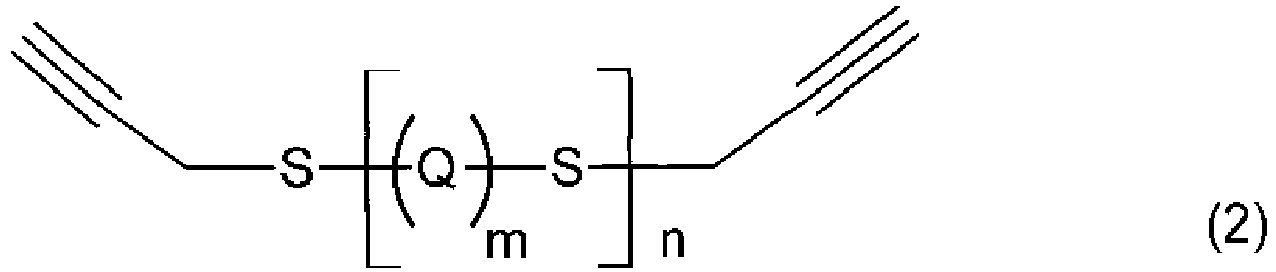

- The polymerizable composition according to claim 1 or 2, wherein the thiophenylene group in which one of carbon atoms is substituted by an antimony atom is a divalent group represented by the following Formula (4):

- The polymerizable composition according to any one of claims 1 to 3, further comprising a thiol compound.
- The polymerizable composition according to claim 4, wherein the thiol compound includes at least one kind of polythiol compounds selected from 4-mercaptomethyl-1,8-dimercapto-3,6-dithiaoctane, 4,8 or 4,7 or
5,7-dimercaptomethyl-1,11-dimercapto-3,6,9-trithiaundecane, pentaerythritol tetrakis(2-mercaptoacetate), pentaerythritol tetrakis(3-mercaptopropionate),
2,5-bis(mercaptomethyl)-1,4-dithiane, bis(mercaptoethyl)sulfide, 1,1,3,3-tetrakis(mercaptomethylthio)propane, 4,6-bis(mercaptomethylthio)-1,3-dithiane, and 2-(2,2-bis(mercaptomethylthio)ethyl)-1,3-dithietane. - A molded product obtained by curing the polymerizable composition according to any one of claims 1 to 5.
- An optical material comprised of the molded product according to claim 6.
- A plastic lens comprised of the molded product according to claim 6.
- An alkyne compound represented by the following general formula (5) :

- The alkyne compound according to claim 9, wherein the thiophenylene group in which one of carbon atoms is substituted by an antimony atom is a group represented by the following Formula (4) :

Applications Claiming Priority (3)
| Application Number | Priority Date | Filing Date | Title |
|---|---|---|---|
| JP2015024228 | 2015-02-10 | ||
| JP2015024229 | 2015-02-10 | ||
| PCT/JP2016/053703 WO2016129563A1 (en) | 2015-02-10 | 2016-02-08 | Polymerizable composition and novel alkyne compound |
Publications (3)
| Publication Number | Publication Date |
|---|---|
| EP3257876A1 true EP3257876A1 (en) | 2017-12-20 |
| EP3257876A4 EP3257876A4 (en) | 2018-10-10 |
| EP3257876B1 EP3257876B1 (en) | 2020-01-01 |
Family
ID=56615591
Family Applications (1)
| Application Number | Title | Priority Date | Filing Date |
|---|---|---|---|
| EP16749207.3A Active EP3257876B1 (en) | 2015-02-10 | 2016-02-08 | Polymerizable composition and novel alkyne compound |
Country Status (6)
| Country | Link |
|---|---|
| US (1) | US10472435B2 (en) |
| EP (1) | EP3257876B1 (en) |
| JP (1) | JP6034997B1 (en) |
| KR (1) | KR101953502B1 (en) |
| CN (1) | CN107207656B (en) |
| WO (1) | WO2016129563A1 (en) |
Cited By (3)
| Publication number | Priority date | Publication date | Assignee | Title |
|---|---|---|---|---|
| WO2025017197A1 (en) | 2023-07-20 | 2025-01-23 | Essilor International | Optical material derived from a polymerizable composition containing a heterodifunctional alkyne compound |
| WO2025017198A1 (en) | 2023-07-20 | 2025-01-23 | Essilor International | Optical material derived from a prepolymer obtained from a heterodifunctional alkyne compound |
| WO2025017201A1 (en) | 2023-07-20 | 2025-01-23 | Essilor International | Optical material derived from a polymerizable composition containing a terminal dialkyne compound |
Families Citing this family (4)
| Publication number | Priority date | Publication date | Assignee | Title |
|---|---|---|---|---|
| US11639413B2 (en) * | 2016-10-11 | 2023-05-02 | Mitsui Chemicals, Inc. | Polymerizable composition for optical materials and application of same |
| JP7234677B2 (en) * | 2018-02-22 | 2023-03-08 | 三菱瓦斯化学株式会社 | Polyfunctional propargyl compound and optical composition containing same |
| CN116034126B (en) * | 2020-06-10 | 2025-11-28 | 科罗拉多大学评议会公司 | Holographic recording material and preparation method thereof |
| CN114736373B (en) * | 2022-04-28 | 2023-09-19 | 武汉纺织大学 | Ladder polyphenylene sulfide and its preparation method and application |
Family Cites Families (21)
| Publication number | Priority date | Publication date | Assignee | Title |
|---|---|---|---|---|
| GB582721A (en) * | 1943-12-08 | 1946-11-26 | Distillers Co Yeast Ltd | Improvements in or relating to vinylidene chloride compositions |
| US4066440A (en) * | 1975-10-09 | 1978-01-03 | Ppg Industries, Inc. | Symmetrical alkynyl ureas |
| US4363919A (en) | 1979-05-10 | 1982-12-14 | International Business Machines Corporation | Heterofulvalene geminal dithiolate compounds and their selenium and tellurium analogs and a method of fabricating the same |
| US4405515A (en) | 1979-05-10 | 1983-09-20 | International Business Machines Corporation | Heterofulvalene geminal dithiolate compounds and their selenium and tellurium analogs and a method of fabricating the same |
| US4362662A (en) | 1979-05-10 | 1982-12-07 | International Business Machines Corporation | Heterofulvalene geminal dithiolate compounds and their selenium and tellurium analogs and a method of fabricating the same |
| US4312991A (en) * | 1979-05-10 | 1982-01-26 | International Business Machines Corporation | Dithiobenzoate 4,5-dicyano-1,3-(dithiolidene-2-yl)methylene |
| JPH0819239B2 (en) | 1987-06-02 | 1996-02-28 | 三菱化学株式会社 | Novel vinylene sulfide polymer |
| JPH0940615A (en) | 1995-07-31 | 1997-02-10 | Idemitsu Kosan Co Ltd | Dipropargyl carbonates and method for producing the same |
| US6204311B1 (en) | 1998-03-13 | 2001-03-20 | Mitsui Chemicals, Inc. | Polymerizable composition |
| JP3315090B2 (en) | 1998-03-13 | 2002-08-19 | 三井化学株式会社 | Polymerizable composition |
| JP2000273317A (en) * | 1999-02-12 | 2000-10-03 | Natl Starch & Chem Investment Holding Corp | Electrically stable conductive and resistive materials for electronic devices |
| JP2001019724A (en) | 1999-07-06 | 2001-01-23 | Jsr Corp | Composition for forming a film, electronic material, method of forming a film, and film |
| EP2161296B1 (en) | 2004-03-31 | 2013-02-20 | Mitsui Chemicals, Inc. | Polymerisable compound und use thereof |
| US7534899B2 (en) | 2005-11-25 | 2009-05-19 | Smasung Electronics Co., Ltd. | Aromatic enediyne derivatives, organic semiconductor thin films using the same and manufacturing methods thereof, and electronic devices incorporating such films |
| KR101139055B1 (en) * | 2005-11-25 | 2012-04-30 | 삼성전자주식회사 | Novel aromatic enediene derivatives, organic semiconductors and electronic devices using the same |
| EP2024420B1 (en) * | 2006-05-05 | 2011-07-06 | PPG Industries Ohio, Inc. | Thioether functional oligomeric polythiols and articles prepared therefrom |
| WO2008102545A1 (en) | 2007-02-20 | 2008-08-28 | Mitsui Chemicals, Inc. | Metal thietane compound, polymerizable composition comprising the compound, resin, and use of the resin |
| JP5220473B2 (en) | 2008-05-19 | 2013-06-26 | 三井化学株式会社 | Metal-containing compound and polymerizable composition containing the same |
| US8859698B2 (en) | 2009-08-21 | 2014-10-14 | The Hong Kong University Of Science And Technology | Sulfur-containing macromolecules and methods for their preparation |
| JP6127457B2 (en) * | 2011-11-11 | 2017-05-17 | 三菱化学株式会社 | Non-aqueous electrolyte secondary battery and non-aqueous electrolyte |
| KR101766104B1 (en) | 2013-03-29 | 2017-08-23 | 미쓰이 가가쿠 가부시키가이샤 | Polymerizable composition for optical material, optical material, and method for producing optical material |
-
2016
- 2016-02-08 CN CN201680008489.4A patent/CN107207656B/en active Active
- 2016-02-08 US US15/548,604 patent/US10472435B2/en active Active
- 2016-02-08 WO PCT/JP2016/053703 patent/WO2016129563A1/en not_active Ceased
- 2016-02-08 EP EP16749207.3A patent/EP3257876B1/en active Active
- 2016-02-08 JP JP2016531073A patent/JP6034997B1/en active Active
- 2016-02-08 KR KR1020177021463A patent/KR101953502B1/en active Active
Cited By (3)
| Publication number | Priority date | Publication date | Assignee | Title |
|---|---|---|---|---|
| WO2025017197A1 (en) | 2023-07-20 | 2025-01-23 | Essilor International | Optical material derived from a polymerizable composition containing a heterodifunctional alkyne compound |
| WO2025017198A1 (en) | 2023-07-20 | 2025-01-23 | Essilor International | Optical material derived from a prepolymer obtained from a heterodifunctional alkyne compound |
| WO2025017201A1 (en) | 2023-07-20 | 2025-01-23 | Essilor International | Optical material derived from a polymerizable composition containing a terminal dialkyne compound |
Also Published As
| Publication number | Publication date |
|---|---|
| US20180066082A1 (en) | 2018-03-08 |
| CN107207656B (en) | 2019-10-18 |
| JP6034997B1 (en) | 2016-11-30 |
| KR20170101296A (en) | 2017-09-05 |
| JPWO2016129563A1 (en) | 2017-04-27 |
| EP3257876A4 (en) | 2018-10-10 |
| US10472435B2 (en) | 2019-11-12 |
| KR101953502B1 (en) | 2019-02-28 |
| CN107207656A (en) | 2017-09-26 |
| WO2016129563A1 (en) | 2016-08-18 |
| EP3257876B1 (en) | 2020-01-01 |
Similar Documents
| Publication | Publication Date | Title |
|---|---|---|
| EP3257876B1 (en) | Polymerizable composition and novel alkyne compound | |
| JP5336843B2 (en) | Polymerizable composition, resin and optical component using the same | |
| EP2123695B1 (en) | Metal thietane compound, polymerizable composition comprising the compound, resin, and use of the resin | |
| KR0164648B1 (en) | Optical composition and its use | |
| JP2019524725A (en) | Aromatic polythiol compounds for optical materials | |
| JP2001342252A (en) | New polythiol-containing polymerizable composition, resin obtained by polymerizing the composition and lens | |
| EP2314637B1 (en) | Composition, polymerizable composition, resin, optical component, and production method of composition | |
| JP2011231185A (en) | Method of manufacturing prepolymer for optical lens molding, and method of manufacturing optical lens | |
| EP2311845B1 (en) | Compound, polymerizable composition, resin, and use of the composition and the resin | |
| JPWO2009104385A1 (en) | THIETANE COMPOUND, POLYMERIZABLE COMPOSITION CONTAINING THE SAME, RESIN AND PROCESS FOR PRODUCING THE SAME | |
| JP4431856B2 (en) | New polythiol compounds | |
| KR101814724B1 (en) | Aromatic polythiol compound used in the manufacture of an optical material | |
| JP2006131554A (en) | Cyclic polythiol for highly heat-resistant resin | |
| JP2011073165A (en) | Optical lens and method of manufacturing the same | |
| JP2006131724A (en) | Polythiol for highly heat resistant resin | |
| JP4469918B2 (en) | High refractive index resin composition | |
| JP2003128668A (en) | New polythiol | |
| JP4598916B2 (en) | Method for producing polythiol and polythiol obtained thereby | |
| WO2009141984A1 (en) | Metal compound, polymerizable composition containing the same, resin, method for producing the resin and use of the resin | |
| KR20190060419A (en) | Aliphatic and cycloaliphatic polythiol compound for optical material and the composition using the same | |
| JP4421911B2 (en) | High refractive index resin composition | |
| JP2010043148A (en) | Thietane compound, polymerizable composition containing the same and use of the same | |
| JP2008015465A (en) | Manufacturing method of optical products |
Legal Events
| Date | Code | Title | Description |
|---|---|---|---|
| STAA | Information on the status of an ep patent application or granted ep patent |
Free format text: STATUS: THE INTERNATIONAL PUBLICATION HAS BEEN MADE |
|
| PUAI | Public reference made under article 153(3) epc to a published international application that has entered the european phase |
Free format text: ORIGINAL CODE: 0009012 |
|
| STAA | Information on the status of an ep patent application or granted ep patent |
Free format text: STATUS: REQUEST FOR EXAMINATION WAS MADE |
|
| 17P | Request for examination filed |
Effective date: 20170829 |
|
| AK | Designated contracting states |
Kind code of ref document: A1 Designated state(s): AL AT BE BG CH CY CZ DE DK EE ES FI FR GB GR HR HU IE IS IT LI LT LU LV MC MK MT NL NO PL PT RO RS SE SI SK SM TR |
|
| AX | Request for extension of the european patent |
Extension state: BA ME |
|
| DAV | Request for validation of the european patent (deleted) | ||
| DAX | Request for extension of the european patent (deleted) | ||
| A4 | Supplementary search report drawn up and despatched |
Effective date: 20180911 |
|
| RIC1 | Information provided on ipc code assigned before grant |
Ipc: G02B 1/04 20060101ALI20180905BHEP Ipc: C07C 321/12 20060101ALI20180905BHEP Ipc: G02C 7/02 20060101ALI20180905BHEP Ipc: C08G 75/04 20160101ALI20180905BHEP Ipc: C08F 38/02 20060101AFI20180905BHEP |
|
| RIC1 | Information provided on ipc code assigned before grant |
Ipc: C08G 75/04 20160101ALI20181114BHEP Ipc: C07C 321/12 20060101ALI20181114BHEP Ipc: G02C 7/02 20060101ALI20181114BHEP Ipc: G02B 1/04 20060101ALI20181114BHEP Ipc: C08F 38/02 20060101AFI20181114BHEP |
|
| RIC1 | Information provided on ipc code assigned before grant |
Ipc: C07C 321/12 20060101ALI20190430BHEP Ipc: C08F 38/02 20060101AFI20190430BHEP Ipc: G02B 1/04 20060101ALI20190430BHEP Ipc: C08G 75/045 20160101ALI20190430BHEP Ipc: C08G 75/04 20160101ALI20190430BHEP Ipc: G02C 7/02 20060101ALI20190430BHEP |
|
| GRAP | Despatch of communication of intention to grant a patent |
Free format text: ORIGINAL CODE: EPIDOSNIGR1 |
|
| STAA | Information on the status of an ep patent application or granted ep patent |
Free format text: STATUS: GRANT OF PATENT IS INTENDED |
|
| INTG | Intention to grant announced |
Effective date: 20190703 |
|
| GRAS | Grant fee paid |
Free format text: ORIGINAL CODE: EPIDOSNIGR3 |
|
| GRAJ | Information related to disapproval of communication of intention to grant by the applicant or resumption of examination proceedings by the epo deleted |
Free format text: ORIGINAL CODE: EPIDOSDIGR1 |
|
| GRAL | Information related to payment of fee for publishing/printing deleted |
Free format text: ORIGINAL CODE: EPIDOSDIGR3 |
|
| STAA | Information on the status of an ep patent application or granted ep patent |
Free format text: STATUS: REQUEST FOR EXAMINATION WAS MADE |
|
| GRAR | Information related to intention to grant a patent recorded |
Free format text: ORIGINAL CODE: EPIDOSNIGR71 |
|
| STAA | Information on the status of an ep patent application or granted ep patent |
Free format text: STATUS: GRANT OF PATENT IS INTENDED |
|
| GRAA | (expected) grant |
Free format text: ORIGINAL CODE: 0009210 |
|
| STAA | Information on the status of an ep patent application or granted ep patent |
Free format text: STATUS: THE PATENT HAS BEEN GRANTED |
|
| INTC | Intention to grant announced (deleted) | ||
| RIN1 | Information on inventor provided before grant (corrected) |
Inventor name: MURAKAMI, MASAKAZU Inventor name: ANDO, TOMOYUKI |
|
| INTG | Intention to grant announced |
Effective date: 20191121 |
|
| AK | Designated contracting states |
Kind code of ref document: B1 Designated state(s): AL AT BE BG CH CY CZ DE DK EE ES FI FR GB GR HR HU IE IS IT LI LT LU LV MC MK MT NL NO PL PT RO RS SE SI SK SM TR |
|
| REG | Reference to a national code |
Ref country code: GB Ref legal event code: FG4D |
|
| REG | Reference to a national code |
Ref country code: CH Ref legal event code: EP Ref country code: AT Ref legal event code: REF Ref document number: 1219701 Country of ref document: AT Kind code of ref document: T Effective date: 20200115 |
|
| REG | Reference to a national code |
Ref country code: DE Ref legal event code: R096 Ref document number: 602016027344 Country of ref document: DE |
|
| REG | Reference to a national code |
Ref country code: IE Ref legal event code: FG4D |
|
| REG | Reference to a national code |
Ref country code: NL Ref legal event code: MP Effective date: 20200101 |
|
| REG | Reference to a national code |
Ref country code: LT Ref legal event code: MG4D |
|
| PG25 | Lapsed in a contracting state [announced via postgrant information from national office to epo] |
Ref country code: RS Free format text: LAPSE BECAUSE OF FAILURE TO SUBMIT A TRANSLATION OF THE DESCRIPTION OR TO PAY THE FEE WITHIN THE PRESCRIBED TIME-LIMIT Effective date: 20200101 Ref country code: FI Free format text: LAPSE BECAUSE OF FAILURE TO SUBMIT A TRANSLATION OF THE DESCRIPTION OR TO PAY THE FEE WITHIN THE PRESCRIBED TIME-LIMIT Effective date: 20200101 Ref country code: NO Free format text: LAPSE BECAUSE OF FAILURE TO SUBMIT A TRANSLATION OF THE DESCRIPTION OR TO PAY THE FEE WITHIN THE PRESCRIBED TIME-LIMIT Effective date: 20200401 Ref country code: NL Free format text: LAPSE BECAUSE OF FAILURE TO SUBMIT A TRANSLATION OF THE DESCRIPTION OR TO PAY THE FEE WITHIN THE PRESCRIBED TIME-LIMIT Effective date: 20200101 Ref country code: CZ Free format text: LAPSE BECAUSE OF FAILURE TO SUBMIT A TRANSLATION OF THE DESCRIPTION OR TO PAY THE FEE WITHIN THE PRESCRIBED TIME-LIMIT Effective date: 20200101 Ref country code: PT Free format text: LAPSE BECAUSE OF FAILURE TO SUBMIT A TRANSLATION OF THE DESCRIPTION OR TO PAY THE FEE WITHIN THE PRESCRIBED TIME-LIMIT Effective date: 20200527 Ref country code: LT Free format text: LAPSE BECAUSE OF FAILURE TO SUBMIT A TRANSLATION OF THE DESCRIPTION OR TO PAY THE FEE WITHIN THE PRESCRIBED TIME-LIMIT Effective date: 20200101 |
|
| PG25 | Lapsed in a contracting state [announced via postgrant information from national office to epo] |
Ref country code: LV Free format text: LAPSE BECAUSE OF FAILURE TO SUBMIT A TRANSLATION OF THE DESCRIPTION OR TO PAY THE FEE WITHIN THE PRESCRIBED TIME-LIMIT Effective date: 20200101 Ref country code: BG Free format text: LAPSE BECAUSE OF FAILURE TO SUBMIT A TRANSLATION OF THE DESCRIPTION OR TO PAY THE FEE WITHIN THE PRESCRIBED TIME-LIMIT Effective date: 20200401 Ref country code: SE Free format text: LAPSE BECAUSE OF FAILURE TO SUBMIT A TRANSLATION OF THE DESCRIPTION OR TO PAY THE FEE WITHIN THE PRESCRIBED TIME-LIMIT Effective date: 20200101 Ref country code: IS Free format text: LAPSE BECAUSE OF FAILURE TO SUBMIT A TRANSLATION OF THE DESCRIPTION OR TO PAY THE FEE WITHIN THE PRESCRIBED TIME-LIMIT Effective date: 20200501 Ref country code: GR Free format text: LAPSE BECAUSE OF FAILURE TO SUBMIT A TRANSLATION OF THE DESCRIPTION OR TO PAY THE FEE WITHIN THE PRESCRIBED TIME-LIMIT Effective date: 20200402 Ref country code: HR Free format text: LAPSE BECAUSE OF FAILURE TO SUBMIT A TRANSLATION OF THE DESCRIPTION OR TO PAY THE FEE WITHIN THE PRESCRIBED TIME-LIMIT Effective date: 20200101 |
|
| REG | Reference to a national code |
Ref country code: CH Ref legal event code: PL |
|
| REG | Reference to a national code |
Ref country code: DE Ref legal event code: R097 Ref document number: 602016027344 Country of ref document: DE |
|
| REG | Reference to a national code |
Ref country code: BE Ref legal event code: MM Effective date: 20200229 |
|
| PG25 | Lapsed in a contracting state [announced via postgrant information from national office to epo] |
Ref country code: EE Free format text: LAPSE BECAUSE OF FAILURE TO SUBMIT A TRANSLATION OF THE DESCRIPTION OR TO PAY THE FEE WITHIN THE PRESCRIBED TIME-LIMIT Effective date: 20200101 Ref country code: SM Free format text: LAPSE BECAUSE OF FAILURE TO SUBMIT A TRANSLATION OF THE DESCRIPTION OR TO PAY THE FEE WITHIN THE PRESCRIBED TIME-LIMIT Effective date: 20200101 Ref country code: DK Free format text: LAPSE BECAUSE OF FAILURE TO SUBMIT A TRANSLATION OF THE DESCRIPTION OR TO PAY THE FEE WITHIN THE PRESCRIBED TIME-LIMIT Effective date: 20200101 Ref country code: SK Free format text: LAPSE BECAUSE OF FAILURE TO SUBMIT A TRANSLATION OF THE DESCRIPTION OR TO PAY THE FEE WITHIN THE PRESCRIBED TIME-LIMIT Effective date: 20200101 Ref country code: MC Free format text: LAPSE BECAUSE OF FAILURE TO SUBMIT A TRANSLATION OF THE DESCRIPTION OR TO PAY THE FEE WITHIN THE PRESCRIBED TIME-LIMIT Effective date: 20200101 Ref country code: ES Free format text: LAPSE BECAUSE OF FAILURE TO SUBMIT A TRANSLATION OF THE DESCRIPTION OR TO PAY THE FEE WITHIN THE PRESCRIBED TIME-LIMIT Effective date: 20200101 Ref country code: LU Free format text: LAPSE BECAUSE OF NON-PAYMENT OF DUE FEES Effective date: 20200208 Ref country code: RO Free format text: LAPSE BECAUSE OF FAILURE TO SUBMIT A TRANSLATION OF THE DESCRIPTION OR TO PAY THE FEE WITHIN THE PRESCRIBED TIME-LIMIT Effective date: 20200101 |
|
| PLBE | No opposition filed within time limit |
Free format text: ORIGINAL CODE: 0009261 |
|
| STAA | Information on the status of an ep patent application or granted ep patent |
Free format text: STATUS: NO OPPOSITION FILED WITHIN TIME LIMIT |
|
| REG | Reference to a national code |
Ref country code: AT Ref legal event code: MK05 Ref document number: 1219701 Country of ref document: AT Kind code of ref document: T Effective date: 20200101 |
|
| PG25 | Lapsed in a contracting state [announced via postgrant information from national office to epo] |
Ref country code: LI Free format text: LAPSE BECAUSE OF NON-PAYMENT OF DUE FEES Effective date: 20200229 Ref country code: CH Free format text: LAPSE BECAUSE OF NON-PAYMENT OF DUE FEES Effective date: 20200229 |
|
| 26N | No opposition filed |
Effective date: 20201002 |
|
| PG25 | Lapsed in a contracting state [announced via postgrant information from national office to epo] |
Ref country code: IT Free format text: LAPSE BECAUSE OF FAILURE TO SUBMIT A TRANSLATION OF THE DESCRIPTION OR TO PAY THE FEE WITHIN THE PRESCRIBED TIME-LIMIT Effective date: 20200101 Ref country code: IE Free format text: LAPSE BECAUSE OF NON-PAYMENT OF DUE FEES Effective date: 20200208 Ref country code: AT Free format text: LAPSE BECAUSE OF FAILURE TO SUBMIT A TRANSLATION OF THE DESCRIPTION OR TO PAY THE FEE WITHIN THE PRESCRIBED TIME-LIMIT Effective date: 20200101 |
|
| PG25 | Lapsed in a contracting state [announced via postgrant information from national office to epo] |
Ref country code: SI Free format text: LAPSE BECAUSE OF FAILURE TO SUBMIT A TRANSLATION OF THE DESCRIPTION OR TO PAY THE FEE WITHIN THE PRESCRIBED TIME-LIMIT Effective date: 20200101 Ref country code: PL Free format text: LAPSE BECAUSE OF FAILURE TO SUBMIT A TRANSLATION OF THE DESCRIPTION OR TO PAY THE FEE WITHIN THE PRESCRIBED TIME-LIMIT Effective date: 20200101 Ref country code: BE Free format text: LAPSE BECAUSE OF NON-PAYMENT OF DUE FEES Effective date: 20200229 |
|
| GBPC | Gb: european patent ceased through non-payment of renewal fee |
Effective date: 20200401 |
|
| PG25 | Lapsed in a contracting state [announced via postgrant information from national office to epo] |
Ref country code: GB Free format text: LAPSE BECAUSE OF NON-PAYMENT OF DUE FEES Effective date: 20200401 |
|
| PG25 | Lapsed in a contracting state [announced via postgrant information from national office to epo] |
Ref country code: TR Free format text: LAPSE BECAUSE OF FAILURE TO SUBMIT A TRANSLATION OF THE DESCRIPTION OR TO PAY THE FEE WITHIN THE PRESCRIBED TIME-LIMIT Effective date: 20200101 Ref country code: MT Free format text: LAPSE BECAUSE OF FAILURE TO SUBMIT A TRANSLATION OF THE DESCRIPTION OR TO PAY THE FEE WITHIN THE PRESCRIBED TIME-LIMIT Effective date: 20200101 Ref country code: CY Free format text: LAPSE BECAUSE OF FAILURE TO SUBMIT A TRANSLATION OF THE DESCRIPTION OR TO PAY THE FEE WITHIN THE PRESCRIBED TIME-LIMIT Effective date: 20200101 |
|
| PG25 | Lapsed in a contracting state [announced via postgrant information from national office to epo] |
Ref country code: MK Free format text: LAPSE BECAUSE OF FAILURE TO SUBMIT A TRANSLATION OF THE DESCRIPTION OR TO PAY THE FEE WITHIN THE PRESCRIBED TIME-LIMIT Effective date: 20200101 Ref country code: AL Free format text: LAPSE BECAUSE OF FAILURE TO SUBMIT A TRANSLATION OF THE DESCRIPTION OR TO PAY THE FEE WITHIN THE PRESCRIBED TIME-LIMIT Effective date: 20200101 |
|
| PGFP | Annual fee paid to national office [announced via postgrant information from national office to epo] |
Ref country code: DE Payment date: 20260218 Year of fee payment: 11 |
|
| PGFP | Annual fee paid to national office [announced via postgrant information from national office to epo] |
Ref country code: FR Payment date: 20260218 Year of fee payment: 11 |