EP3257855A1 - Method for preparing ibrutinib - Google Patents
Method for preparing ibrutinib Download PDFInfo
- Publication number
- EP3257855A1 EP3257855A1 EP16748716.4A EP16748716A EP3257855A1 EP 3257855 A1 EP3257855 A1 EP 3257855A1 EP 16748716 A EP16748716 A EP 16748716A EP 3257855 A1 EP3257855 A1 EP 3257855A1
- Authority
- EP
- European Patent Office
- Prior art keywords
- compound
- formula
- potassium
- group
- sodium
- Prior art date
- Legal status (The legal status is an assumption and is not a legal conclusion. Google has not performed a legal analysis and makes no representation as to the accuracy of the status listed.)
- Granted
Links
- 0 C*c1cccc(Oc2ccccc2)c1 Chemical compound C*c1cccc(Oc2ccccc2)c1 0.000 description 2
- XYFPWWZEPKGCCK-GOSISDBHSA-N C=CC(N(CCC1)C[C@@H]1[n](c1ncnc(N)c11)nc1-c(cc1)ccc1Oc1ccccc1)=O Chemical compound C=CC(N(CCC1)C[C@@H]1[n](c1ncnc(N)c11)nc1-c(cc1)ccc1Oc1ccccc1)=O XYFPWWZEPKGCCK-GOSISDBHSA-N 0.000 description 1
- CTFXOUXSBGMYTJ-MRVPVSSYSA-N C=CC(N(CCC1)C[C@@H]1[n](c1ncnc(N)c11)nc1I)=O Chemical compound C=CC(N(CCC1)C[C@@H]1[n](c1ncnc(N)c11)nc1I)=O CTFXOUXSBGMYTJ-MRVPVSSYSA-N 0.000 description 1
- NTSAEGNFPKKRLX-LJQANCHMSA-N CC(C)(C)OC(N(CCC1)C[C@@H]1[n](c1ncnc(N)c11)nc1-c(cc1)ccc1Oc1ccccc1)=O Chemical compound CC(C)(C)OC(N(CCC1)C[C@@H]1[n](c1ncnc(N)c11)nc1-c(cc1)ccc1Oc1ccccc1)=O NTSAEGNFPKKRLX-LJQANCHMSA-N 0.000 description 1
- VHATZAIZPHOHET-SECBINFHSA-N CC(C)(C)OC(N(CCC1)C[C@@H]1[n](c1ncnc(N)c11)nc1Br)=O Chemical compound CC(C)(C)OC(N(CCC1)C[C@@H]1[n](c1ncnc(N)c11)nc1Br)=O VHATZAIZPHOHET-SECBINFHSA-N 0.000 description 1
- UIJXHKXIOCDSEB-QMMMGPOBSA-N CC(C)(C)OC(N(CCC1)C[C@H]1O)=O Chemical compound CC(C)(C)OC(N(CCC1)C[C@H]1O)=O UIJXHKXIOCDSEB-QMMMGPOBSA-N 0.000 description 1
- RQCNHUCCQJMSRG-UHFFFAOYSA-N CC(C)(C)OC(N1CCCCC1)=O Chemical compound CC(C)(C)OC(N1CCCCC1)=O RQCNHUCCQJMSRG-UHFFFAOYSA-N 0.000 description 1
- YYVUOZULIDAKRN-UHFFFAOYSA-N Nc1c(c(-c(cc2)ccc2Oc2ccccc2)n[nH]2)c2ncn1 Chemical compound Nc1c(c(-c(cc2)ccc2Oc2ccccc2)n[nH]2)c2ncn1 YYVUOZULIDAKRN-UHFFFAOYSA-N 0.000 description 1
- VJQOEGZWPHTCTQ-GOSISDBHSA-N Nc1c(c(-c(cc2)ccc2Oc2ccccc2)n[n]2[C@H](CCC3)CN3C(CCCl)=O)c2ncn1 Chemical compound Nc1c(c(-c(cc2)ccc2Oc2ccccc2)n[n]2[C@H](CCC3)CN3C(CCCl)=O)c2ncn1 VJQOEGZWPHTCTQ-GOSISDBHSA-N 0.000 description 1
- GPSQYTDPBDNDGI-MRXNPFEDSA-N Nc1c(c(-c(cc2)ccc2Oc2ccccc2)n[n]2[C@H]3CNCCC3)c2ncn1 Chemical compound Nc1c(c(-c(cc2)ccc2Oc2ccccc2)n[n]2[C@H]3CNCCC3)c2ncn1 GPSQYTDPBDNDGI-MRXNPFEDSA-N 0.000 description 1
- GZQVGSRUUTUJNG-UHFFFAOYSA-N Nc1c2c(Br)n[nH]c2ncn1 Chemical compound Nc1c2c(Br)n[nH]c2ncn1 GZQVGSRUUTUJNG-UHFFFAOYSA-N 0.000 description 1
- HQAIUXZORKJOJY-UHFFFAOYSA-N Nc1c2c(I)n[nH]c2ncn1 Chemical compound Nc1c2c(I)n[nH]c2ncn1 HQAIUXZORKJOJY-UHFFFAOYSA-N 0.000 description 1
- XYBLNTXJBVNSIS-ZCFIWIBFSA-N Nc1c2c(I)n[n]([C@H]3CNCCC3)c2ncn1 Chemical compound Nc1c2c(I)n[n]([C@H]3CNCCC3)c2ncn1 XYBLNTXJBVNSIS-ZCFIWIBFSA-N 0.000 description 1
Classifications
-
- A—HUMAN NECESSITIES
- A61—MEDICAL OR VETERINARY SCIENCE; HYGIENE
- A61P—SPECIFIC THERAPEUTIC ACTIVITY OF CHEMICAL COMPOUNDS OR MEDICINAL PREPARATIONS
- A61P35/00—Antineoplastic agents
-
- A—HUMAN NECESSITIES
- A61—MEDICAL OR VETERINARY SCIENCE; HYGIENE
- A61P—SPECIFIC THERAPEUTIC ACTIVITY OF CHEMICAL COMPOUNDS OR MEDICINAL PREPARATIONS
- A61P35/00—Antineoplastic agents
- A61P35/02—Antineoplastic agents specific for leukemia
-
- A—HUMAN NECESSITIES
- A61—MEDICAL OR VETERINARY SCIENCE; HYGIENE
- A61P—SPECIFIC THERAPEUTIC ACTIVITY OF CHEMICAL COMPOUNDS OR MEDICINAL PREPARATIONS
- A61P43/00—Drugs for specific purposes, not provided for in groups A61P1/00-A61P41/00
-
- C—CHEMISTRY; METALLURGY
- C07—ORGANIC CHEMISTRY
- C07D—HETEROCYCLIC COMPOUNDS
- C07D487/00—Heterocyclic compounds containing nitrogen atoms as the only ring hetero atoms in the condensed system, not provided for by groups C07D451/00 - C07D477/00
- C07D487/02—Heterocyclic compounds containing nitrogen atoms as the only ring hetero atoms in the condensed system, not provided for by groups C07D451/00 - C07D477/00 in which the condensed system contains two hetero rings
- C07D487/04—Ortho-condensed systems
-
- Y—GENERAL TAGGING OF NEW TECHNOLOGICAL DEVELOPMENTS; GENERAL TAGGING OF CROSS-SECTIONAL TECHNOLOGIES SPANNING OVER SEVERAL SECTIONS OF THE IPC; TECHNICAL SUBJECTS COVERED BY FORMER USPC CROSS-REFERENCE ART COLLECTIONS [XRACs] AND DIGESTS
- Y02—TECHNOLOGIES OR APPLICATIONS FOR MITIGATION OR ADAPTATION AGAINST CLIMATE CHANGE
- Y02P—CLIMATE CHANGE MITIGATION TECHNOLOGIES IN THE PRODUCTION OR PROCESSING OF GOODS
- Y02P20/00—Technologies relating to chemical industry
- Y02P20/50—Improvements relating to the production of bulk chemicals
- Y02P20/55—Design of synthesis routes, e.g. reducing the use of auxiliary or protecting groups
Definitions
- the present application relates to the field of pharmaceutical chemistry.
- the present application relates to a process for preparing ibrutinib (trade name: Imbruvica) and intermediates for the preparation thereof.
- Ibrutinib is an oral Bruton's tyrosine kinase (BTK) inhibitor indicated for the treatment of patients with Mantle Cell Lymphoma (MCL) who have received prior therapy, Chronic Lymphocytic Leukemia (CLL) who have received prior therapy and CLL with the 17p deletion geneticmutation (del 1 7p).
- BTK Bruton's tyrosine kinase
- CN101610676A discloses that 4-phenoxybenzoic acid as a starting material was chlorinated, condensed with malononitrile and then cyclized with anhydrous hydrazine to give a pyrazole intermediate, which was then cyclized with formamide to give 4-aminopyrazolo[3,4-d]pyrimidine core, and condensed with a chiral alcohol via Mitsunobu reaction followed by the removal of the protecting group Boc and acrylation to afford a product.
- This synthetic route is shown as follows:
- CN103121999A discloses that 3-bromo-4-aminopyrazolo[3,4-d]pyrimidine as a starting material was coupled to 4-phenoxybenzeneboronic acid via Suzuki reaction, condensed with a chiral alcohol in the presence of cesium carbonate as a base, protected with trifluoroacetyl group, deprotected to remove the protecting group Boc, acrylated, and then deprotected to remove the protecting group trifluoroacetyl to afford ibrutinib.
- This synthetic route is shown as follows:
- WO2014022390A1 reports that 4-aminopyrazolo[3,4-d]pyrimidine as a starting material was iodinated to prepare intermediate 3-iodo-1H-pyrazolo[3,4-d]pyrimidin-4-amine, which was then coupled to 4-phenoxybenzeneboronic acid via Suzuki reaction, condensed with a chiral alcohol via Mitsunobu reaction, deprotected with hydrochloric acid to remove the protecting group Boc and form a salt, and finally acrylated to afford ibrutinib.
- This synthetic route is shown as follows:
- acryloylchloride generally contain 1% to 3% of 3-chloropropionyl chloride, which results in the presence of 3-chloropropionylated impurities in the product ibrutinib, making the purification and industrial application difficult.
- the present application provides a process for preparing ibrutinib, comprising
- Step 1 reacting a compound of Formula 1 as a starting material with a compound of Formula 2 in the presence of a base to form a compound of Formula 3,
- Step 2 reacting the compound of Formula 3 with a compound of Formula 4 in the presence of a base and a catalyst to produce ibrutinib, wherein X 1 is independently selected from the group consisting of Cl, Br and I, preferably Cl and Br; X 2 is independently selected from the group consisting of Cl and Br; R' is selected from the group consisting of and X 3 is independently selected from the group consisting of Cl, Br and I, preferably Cl and Br.
- the present application provides another process for preparing ibrutinib, comprising
- Step 1 reacting the compound of Formula 1 with a compound of Formula 4 in the presence of a base and a catalyst to produce a compound of Formula 8,
- Step 2 reacting the compound of Formula 8 with a compound of Formula 2-1 in the presence of a base to produce ibrutinib, wherein X 1 is independently selected from the group consisting of Cl, Br and I, preferably Cl and Br; and X 2 is independently selected from the group consisting of Cl and Br.
- the present application provides an intermediate compound useful in the preparation of ibrutinib as shown below: wherein X 1 and X 3 are each independently selected from the group consisting of Cl, Br and I.
- the present application provides a use of an intermediate compound as shown below in the preparation of ibrutinib: wherein X 1 and X 3 are each independently selected from the group consisting of Cl, Br and I.
- the present application provides a process for preparing ibrutinib, comprising
- Step 1 reacting a compound of Formula 1 as a starting material with a compound of Formula 2 in the presence of a base to form a compound of Formula 3,
- Step 2 reacting the compound of Formula 3 with a compound of Formula 4 in the presence of a base and a catalyst to produce ibrutinib, wherein X 1 is independently selected from the group consisting of Cl, Br and I, preferably Cl and Br; X 2 is independently selected from the group consisting of Cl and Br; R' is selected from the group consisting of and X 3 is independently selected from the group consisting of Cl, Br and I, preferably Cl and Br.
- the amount of the compound of Formula 2 in step 1 is 0.9 to 2 equivalents, preferably 1 to 1.2 equivalents, relative to the amount of compound of Formula 1.
- the base used in step 1 is an inorganic base and/or an organic base
- the inorganic base includes, but is not limited to, potassium carbonate, sodium carbonate, sodium bicarbonate, potassium bicarbonate, sodium hydroxide, potassium hydroxide, potassium hydride or sodium hydride, and the like
- the organic base includes, but is not limited to, triethylamine, dimethylpyridine, diisopropylethylamine or 1,8-diazabicyclo[5.4.0]undec-7-ene, and the like, preferably an inorganic base, and more preferably sodium bicarbonate and potassium bicarbonate.
- the amount of the base used in step 1 is 1 to 5 equivalents, preferably 1.5 to 3 equivalents, and more preferably 2 equivalents, relative to the amount of the compound of Formula 1.
- a reaction solvent in step 1 is a polar aprotic solvent, preferably tetrahydrofuran, 2-methyltetrahydrofuran, N,N-dimethylformamide, acetonitrile or acetone, and the like, and more preferably 2-methyltetrahydrofuran.
- the amount of the compound of Formula 4 in step 2 is 1 to 3 equivalents, preferably 1.2 to 2 equivalents, and more preferably 1.5 equivalents, relative to the amount of compound of Formula 3.
- the catalyst in step 2 is selected from the group consisting of Pd(PPh 3 ) 4 , PdCl 2 (PPh 3 ) 2 , PdCl 2 (PhCN) 2 , Pd(OAc) 2 , Pd/C and PdCl 2 (dppf) 2 , and the like, preferably Pd(PPh 3 ) 4 .
- the amount of the catalyst in step 2 is 0.001 to 0.1 equivalents, preferably 0.005 to 0.05 equivalents, and more preferably 0.01 equivalents, relative to the amount of the compound of Formula 3.
- the base used in step 2 is an inorganic base, preferably potassium carbonate, sodium carbonate, cesium carbonate, potassium acetate, sodium acetate, potassium phosphate, sodium phosphate, sodium bicarbonate, potassium bicarbonate, sodium hydroxide, potassium hydroxide, sodium hydride or potassium hydride, and more preferably potassium phosphate or potassium carbonate.
- the amount of the base used in step 2 is 1 to 5 equivalents, preferably 2 to 4 equivalents, and more preferably 3 to 3.5 equivalents, relative to the compound of Formula 3.
- an reaction solvent used in step 2 is a mixed solvent of a polar aprotic solvent and water, preferably a mixed solvent of tetrahydrofuran, 1,4-dioxane, acetonitrile, acetone, N,N-dimethylformamide (DMF), dimethylsulfoxide, N-methylpyrrolidone or ethylene glycol dimethyl ether and water, and more preferably a mixed solvent of 1,4-dioxane and water or a mixed solvent of ethylene glycol dimethyl ether and water.
- a mixed solvent of 1,4-dioxane and water preferably a mixed solvent of 1,4-dioxane and water or a mixed solvent of ethylene glycol dimethyl ether and water.
- a reaction temperature in step 1 is 15°C or less, preferably -10°C to 5°C, and more preferably -5°C to 0°C.
- a reaction temperature in step 2 is 60°C to 120°C, preferably 80°C to 100°C.
- the present application provides another process for preparing ibrutinib, comprising
- Step 1 reacting a compound of Formula 1 with a compound of Formula 4 in the presence of a base and a catalyst to produce a compound of Formula 8,
- Step 2 reacting the compound of Formula 8 with a compound of Formula 2-1 in the presence of a base to produce ibrutinib, wherein X 1 is independently selected from the group consisting of Cl, Br and I, preferably Cl and Br; and X 2 is independently selected from the group consisting of Cl and Br.
- the amount of the compound of Formula 4 is 1 to 3 equivalents, preferably 1.2 to 2 equivalents, and more preferably 1.5 equivalents, relative to the amount of compound of Formula 1.
- the catalyst is selected from the group consisting of Pd(PPh 3 ) 4 , PdCl 2 (PPh 3 ) 2 , PdCl 2 (PhCN) 2 , Pd(OAc) 2 , Pd/C and PdCl 2 (dppf) 2 , and the like, preferably Pd(PPh 3 ) 4 .
- the amount of the catalyst is 0.001 to 0.1 equivalents, preferably 0.005 to 0.05 equivalents, and more preferably 0.01 equivalents, relative to the amount of the compound of Formula 1.
- the base used in step 1 is an inorganic base, preferably potassium carbonate, sodium carbonate, cesium carbonate, potassium acetate, sodium acetate, potassium phosphate, sodium phosphate, sodium bicarbonate, potassium bicarbonate, sodium hydroxide, potassium hydroxide, sodium hydride or potassium hydride, and more preferably potassium phosphate or potassium carbonate.
- the amount of the base used in step 1 is 1 to 5 equivalents, preferably 2 to 4 equivalents, and more preferably 3 to 3.5 equivalents, relative to the amount of the compound of Formula 1.
- a reaction solvent used in step 1 is a mixed solvent of a polar aprotic solvent and water, preferably a mixed solvent of tetrahydrofuran, 1,4-dioxane, acetonitrile, acetone, N,N-dimethylformamide (DMF), dimethylsulfoxide, N-methylpyrrolidone or ethylene glycol dimethyl ether and water, and more preferably a mixed solvent of 1,4-dioxane and water or a mixed solvent of ethylene glycol dimethyl ether and water.
- a mixed solvent of 1,4-dioxane and water preferably a mixed solvent of 1,4-dioxane and water or a mixed solvent of ethylene glycol dimethyl ether and water.
- the amount of the compound of Formula 2-1 in step 2 is 0.9 to 2 equivalents, preferably 1 to 1.2 equivalents, relative to the amount of compound of Formula 8.
- the base used in step 2 is an inorganic base and/or an organic base, wherein the inorganic base is selected from the group consisting of potassium carbonate, sodium carbonate, sodium bicarbonate, potassium bicarbonate, sodium hydroxide, potassium hydroxide, potassium hydride, sodium hydride and the like; and the organic base is selected from the group consisting of triethylamine, dimethylpyridine, diisopropylethylamine, 1,8-diazabicyclo[5.4.0]undec -7-ene and the like, preferably an inorganic base, and more preferably sodium bicarbonate and potassium bicarbonate.
- the inorganic base is selected from the group consisting of potassium carbonate, sodium carbonate, sodium bicarbonate, potassium bicarbonate, sodium hydroxide, potassium hydroxide, potassium hydride, sodium hydride and the like
- the organic base is selected from the group consisting of triethylamine, dimethylpyridine, diisopropylethylamine, 1,8-diaza
- the amount of base used in step 2 is 1 to 5 equivalents, preferably 1.5 to 3 equivalents, and more preferably 2 equivalents, relative to the amount of the compound of Formula 8.
- a reaction solvent used in step 2 is a polar aprotic solvent, preferably tetrahydrofuran, 2-methyltetrahydrofuran, N,N-dimethylformamide, acetonitrile or acetone, and more preferably 2-methyltetrahydrofuran.
- a reaction temperature in step 1 is 60°C to 120°C, preferably 80°C to 100°C.
- a reaction temperature in step 2 is 15°C or less, preferably -10°C to 5°C, and more preferably -5°C to 0°C.
- the process for preparing ibrutinib of the present application further comprises the following steps for the preparation of the compound of Formula 1:
- the amount of the compound of Formula 6 is 0.5 to 3 equivalents, preferably 1 to 2 equivalents, and more preferably 1.5 equivalents, relative to the amount of compound of Formula 5.
- the Mitsunobu reaction reagent is composed of a first reagent selected from the group consisting of triphenylphosphine (TPP), tributylphosphine (TBP) and trimethylphosphine (TMP), and a second reagent selected from the group consisting of diisopropyl azodicarboxylate (DIAD), di-tert-butyl azodicarboxylate (DBAD), diethyl azodicarboxylate (DEAD), di-p-chlorobenzyl azodicarboxylate (DCAD), 1,1'-(azodicarbonyl)dipiperidine (ADDP), N,N,N',N' -tetraisopropylazodicarboxamide (TIPA), N,N,N',N'-tetramethylazodicarboxamide (TMAD) and 4,7-dimethyl-3,4,5,6,7,8-hexahydro-1,2,4,7-t
- TPP tripheny
- the amount of the first reagent and the amount of the second reagent in the Mitsunobu reaction reagent are equimolar to each other, and are each 1 to 5 equivalents, preferably 2 to 5 equivalents, and more preferably 3 to 4 equivalents, relative to the amount of the compound of Formula 5.
- a solvent used for preparing the compound of Formula 7 is selected from the group consisting of a polar aprotic solvent and water, preferably tetrahydrofuran (THF), N,N-dimethylformamide, dimethylsulfoxide, N-methylpyrrolidone, acetonitrile or 1,4-dioxane, and the like, and more preferably tetrahydrofuran.
- THF tetrahydrofuran
- N,N-dimethylformamide dimethylsulfoxide
- N-methylpyrrolidone acetonitrile or 1,4-dioxane
- R is preferably tert-butoxycarbonyl (Boc).
- the acid used in deprotecting the compound of Formula 7 is selected from the group consisting of hydrochloric acid, hydrobromic acid, sulfuric acid, phosphoric acid, acetic acid, methanesulfonic acid and trifluoroacetic acid, preferably hydrochloric acid.
- the present application provides an intermediate compound useful in the preparation of ibrutinib as shown below: wherein X 1 and X 3 are each independently selected from the group consisting of Cl, Br and I.
- the intermediate compound useful in the preparation of ibrutinib is selected from the group consisting of compounds represented by the following chemical structures:
- the present application provides a use of an intermediate compound as shown below in the preparation of ibrutinib: wherein X 1 and X 3 are each independently selected from the group consisting of Cl, Br and I.
- the used raw materials are inexpensive and readily available, and ibrutinib can be obtained only through acylation reaction and Suzuki reaction.
- the processes for preparing ibrutinib of the present application have at least one of the following advantages.
- the compound of Formula 1, the compound of Formula 3 or the compound of Formula 8 may be present in the form of a free base or a salt formed with an inorganic acid or an organic acid, both of which are within the scope of the present application.
- said “equivalent” refers to the amount of a material by molar mass.
- the amount of the compound of Formula 2 as described in the present application is 0.9 to 2 equivalents relative to the amount of the compound of Formula 1, which means that the molar mass of the compound of Formula 2 is 0.9 to 2 times relative to the molar mass of the compound of Formula 1.
- the compound of Formula 1-Br (5 g, 0.017 mol) was dissolved in 2-methyltetrahydrofuran (50 mL), and a 7% aqueous solution (40 mL) of sodium bicarbonate (2.83 g, 0.034 mol) was added under the protection of nitrogen atmosphere.
- the reaction temperature was then reduced to -5°C, and a solution of acryloyl chloride (1.52 g, 0.017 mol) in 2-methyltetrahydrofuran (5 mL) was slowly added dropwise. After completing the addition, the reaction temperature was kept below 0°C, and meanwhile the reaction solution was stirred for 1 h.
- the reaction solution was layered.
- the compound of Formula 1-1 (5 g, 0.0145 mol) was dissolved in 2-methyltetrahydrofuran (50 mL), and a 7% aqueous solution (34.8 mL) of sodium bicarbonate (2.44 g, 0.029 mol) was added under the protection of nitrogen atmosphere.
- the reaction temperature was then reduced to -5°C, and a solution of acryloyl chloride (1.31 g, 0.0145 mol) in 2-methyltetrahydrofuran (5 mL) was slowly added dropwise. After completing the addition, the reaction temperature was kept below 0°C, and meanwhile the reaction solution was stirred for 1 h.
- the reaction solution was layered.
- the compound of Formula 1-Br (5 g, 0.017 mol) was dissolved in 2-methyltetrahydrofuran (50 mL), and a 7% aqueous solution (40 mL) of sodium bicarbonate (2.83 g, 0.034 mol) was added under the protection of nitrogen atmosphere.
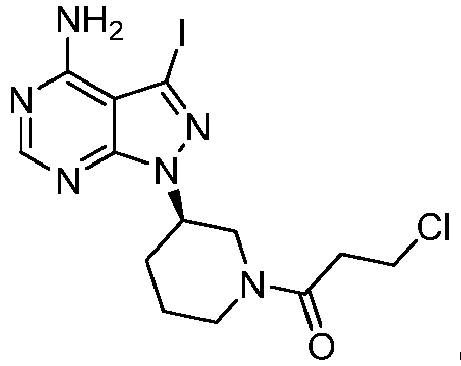
- the reaction temperature was then reduced to -5°C, and a solution of 3-chloropropionyl chloride (2.14g, 0.017mol) in 2-methyltetrahydrofuran (5 mL) was slowly added dropwise. After completing the addition, the reaction temperature was kept below 0°C, and meanwhile the reaction solution was stirred for 1 h. The reaction solution was layered.
- the compound of Formula 1-Br (5 g, 0.017 mol) was dissolved in 2-methyltetrahydrofuran (50 mL), and a 7% aqueous solution (40 mL) of sodium bicarbonate (2.83 g, 0.034 mol) was added under the protection of nitrogen atmosphere. The reaction temperature was then reduced to -5°C, and a solution of 3-bromopropionyl bromide (3.63g, 0.017mol) in 2-methyltetrahydrofuran (5 mL) was slowly added dropwise. After completing the addition, the reaction temperature was kept below 0°C, and meanwhile the reaction solution was stirred for 1 h. The reaction solution was layered.
- the compound of Formula 1-1 (5 g, 0.0145 mol) was dissolved in 2-methyltetrahydrofuran (50 mL), and a 7% aqueous solution (34.8 mL) of sodium bicarbonate (2.44 g, 0.029 mol) was added under the protection of nitrogen atmosphere.
- the reaction temperature was then reduced to -5°C, and a solution of 3-chloropropionyl chloride (1.84g, 0.0145mol) in 2-methyltetrahydrofuran (5 mL) was slowly added dropwise. After completing the addition, the reaction temperature was kept below 0°C, and meanwhile the reaction solution was stirred for 1 h.
- the reaction solution was layered.
- the compound of Formula 1-1 (5 g, 0.0145 mol) was dissolved in 2-methyltetrahydrofuran (50 mL), and a 7% aqueous solution (34.8 mL) of sodium bicarbonate (2.44 g, 0.029 mol) was added under the protection of nitrogen atmosphere.
- the reaction temperature was then reduced to -5°C, and a solution of 3-bromopropionyl bromide (3.14g, 0.0145mol) in 2-methyltetrahydrofuran (5 mL) was slowly added dropwise. After completing the addition, the reaction temperature was kept below 0°C, and meanwhile the reaction solution was stirred for 1 h. The reaction solution was layered.
- the resulting solution was layered after the pH was adjusted to 2 to 3 with hydrochloric acid, and then the aqueous phase was extracted once with ethyl acetate (100 mL). After liquid separation, dichloromethane (200 mL) was added to the aqueous phase, and the pH was adjusted to 9 to 10 with 6N sodium hydroxide solution. The resulting solution was stirred for liquid separation. The organic layer was dried over anhydrous sodium sulfate, and the solvent was evaporated to dryness to afford 18.8 g of a free base of Compound 8 as an off-white solid in 90.0% yield and 98.5% chemical purity. The free base was reacted with a solution of HCl in ethanol to form a salt, and 18.9 g of the hydrochloride of Compound 8 was obtained in 92% yield and 99.1% chemical purity.
- the resulting solution was layered after the pH was adjusted to 2 to 3 with hydrochloric acid, and then the aqueous phase was extracted once with ethyl acetate (100 mL). After liquid separation, dichloromethane (200 mL) was added to the aqueous phase, and the pH was adjusted to 9 to 10 with 6N sodium hydroxide solution. The resulting solution was stirred for liquid separation. The organic layer was dried over anhydrous sodium sulfate, and the solvent was evaporated to dryness to afford 18.2 g of a free base of Compound 8 as an off-white solid in 87.1% yield and 98.8% chemical purity.
- the resulting solution was layered after the pH was adjusted to 2 to 3 with hydrochloric acid, and then the aqueous phase was extracted once with ethyl acetate (100 mL). After liquid separation, dichloromethane (200 mL) was added to the aqueous phase, and the pH was adjusted to 9 to 10 with 6N sodium hydroxide solution. The resulting solution was stirred for liquid separation. The organic layer was dried over anhydrous sodium sulfate, and the solvent was evaporated to dryness to afford 13.6 g of an off-white solid in 65.1% yield.
- the resulting solution was layered after the pH was adjusted to 2 to 3 with hydrochloric acid, and then the aqueous phase was extracted once with ethyl acetate (100 mL). After liquid separation, dichloromethane (200 mL) was added to the aqueous phase, and the pH was adjusted to 9 to 10 with 6N sodium hydroxide solution. The resulting solution was stirred for liquid separation. The organic layer was dried over anhydrous sodium sulfate, and the solvent was evaporated to dryness to afford 16.8 g of an off-white solid in 80.4% yield.
- the compound of Formula 8 (10g, 0.026mol) was dissolved in 2-methyltetrahydrofuran (100 mL), and a 7% aqueous solution (62 mL) of sodium bicarbonate (4.37g, 0.052mol) was added under the protection of nitrogen atmosphere. The reaction temperature was then reduced to -5°C, and a solution of acryloyl chloride (2.34g, 0.026mol) in 2-methyltetrahydrofuran (10 mL) was slowly added dropwise. After completing the addition, the reaction temperature was kept below 0°C, and meanwhile the reaction solution was stirred for 1 h, and then layered.
- the hydrochloride of the compound of Formula 8 (11g, 0.026mol) was dissolved in 2-methyltetrahydrofuran (100 mL), and a 7% aqueous solution (72 mL) of sodium bicarbonate (5.04g, 0.06mol) was added under the protection of nitrogen atmosphere.
- the reaction temperature was then reduced to -5°C, and a solution of acryloyl chloride (2.34g, 0.026mol) in 2-methyltetrahydrofuran (10 mL) was slowly added dropwise. After completing the addition, the reaction temperature was kept below 0°C, and meanwhile the reaction solution was stirred for 1 h, and then layered.
Landscapes
- Chemical & Material Sciences (AREA)
- Organic Chemistry (AREA)
- Health & Medical Sciences (AREA)
- Life Sciences & Earth Sciences (AREA)
- Public Health (AREA)
- General Chemical & Material Sciences (AREA)
- Medicinal Chemistry (AREA)
- Nuclear Medicine, Radiotherapy & Molecular Imaging (AREA)
- Chemical Kinetics & Catalysis (AREA)
- Pharmacology & Pharmacy (AREA)
- Veterinary Medicine (AREA)
- Animal Behavior & Ethology (AREA)
- General Health & Medical Sciences (AREA)
- Oncology (AREA)
- Hematology (AREA)
- Engineering & Computer Science (AREA)
- Bioinformatics & Cheminformatics (AREA)
- Nitrogen Condensed Heterocyclic Rings (AREA)
- Low-Molecular Organic Synthesis Reactions Using Catalysts (AREA)
- Pharmaceuticals Containing Other Organic And Inorganic Compounds (AREA)
- Catalysts (AREA)
- Heterocyclic Carbon Compounds Containing A Hetero Ring Having Oxygen Or Sulfur (AREA)
- Plural Heterocyclic Compounds (AREA)
Abstract
Description
- The present application relates to the field of pharmaceutical chemistry. In particular, the present application relates to a process for preparing ibrutinib (trade name: Imbruvica) and intermediates for the preparation thereof.
- Ibrutinib is an oral Bruton's tyrosine kinase (BTK) inhibitor indicated for the treatment of patients with Mantle Cell Lymphoma (MCL) who have received prior therapy, Chronic Lymphocytic Leukemia (CLL) who have received prior therapy and CLL with the 17p deletion geneticmutation (del 1 7p).
-
CN101610676A discloses that 4-phenoxybenzoic acid as a starting material was chlorinated, condensed with malononitrile and then cyclized with anhydrous hydrazine to give a pyrazole intermediate, which was then cyclized with formamide to give 4-aminopyrazolo[3,4-d]pyrimidine core, and condensed with a chiral alcohol via Mitsunobu reaction followed by the removal of the protecting group Boc and acrylation to afford a product. This synthetic route is shown as follows:

- The above synthesis route is lengthy, and involves many steps. The yield in the Mitsunobu reaction step is low (34%), and the total yield is only 8.1%. Triphenylphosphine resin as an expensive and unavailable reagent is used, and purification through chromatography is finally needed to obtain ibrutinib, resulting in a high industrialization cost and complex operations.
-
CN103121999A discloses that 3-bromo-4-aminopyrazolo[3,4-d]pyrimidine as a starting material was coupled to 4-phenoxybenzeneboronic acid via Suzuki reaction, condensed with a chiral alcohol in the presence of cesium carbonate as a base, protected with trifluoroacetyl group, deprotected to remove the protecting group Boc, acrylated, and then deprotected to remove the protecting group trifluoroacetyl to afford ibrutinib. This synthetic route is shown as follows:
- This synthesis route is also lengthy; the Suzuki raction using PdCl2(PhCN)2 as a catalyst is difficult to be repeated and a large amount of the catalyst is required; it takes 24 hours to carry out the condensation step using cesium carbonate as a base, and therefore the reaction time is too long; and the steps for protection and deprotection of amino group prolong this reaction route and reduce the total yield, which was 21.5% (with 3-bromo-4-aminopyrazolo[3,4-d]pyrimidine as the starting material). Therefore, this process is not suitable for a large-scale industrial production.
-
WO2014022390A1 reports that 4-aminopyrazolo[3,4-d]pyrimidine as a starting material was iodinated to prepare intermediate 3-iodo-1H-pyrazolo[3,4-d]pyrimidin-4-amine, which was then coupled to 4-phenoxybenzeneboronic acid via Suzuki reaction, condensed with a chiral alcohol via Mitsunobu reaction, deprotected with hydrochloric acid to remove the protecting group Boc and form a salt, and finally acrylated to afford ibrutinib. This synthetic route is shown as follows:
- A large amount of catalyst tetraphenylphenylphosphine palladium is used in the Suzuki reaction in this synthesis route, and the reaction time is up to 24 hours; it takes a long time to carry out the Mitsunobu reaction, and its yield is low (38%); the total yield of this synthesis route is only 9.3%; and purification by chromatography is required. Therefore, this route is not suitable for industrial production, either.
- In addition, commercially available acryloylchloride generally contain 1% to 3% of 3-chloropropionyl chloride, which results in the presence of 3-chloropropionylated impurities in the product ibrutinib, making the purification and industrial application difficult.
- In one aspect, the present application provides a process for preparing ibrutinib, comprising
- Step 1: reacting a compound of Formula 1 as a starting material with a compound of Formula 2 in the presence of a base to form a compound of Formula 3,

- Step 2: reacting the compound of Formula 3 with a compound of Formula 4 in the presence of a base and a catalyst to produce ibrutinib,


- In another aspect, the present application provides another process for preparing ibrutinib, comprising
- Step 1: reacting the compound of Formula 1 with a compound of Formula 4 in the presence of a base and a catalyst to produce a compound of Formula 8,

- Step 2: reacting the compound of Formula 8 with a compound of Formula 2-1 in the presence of a base to produce ibrutinib,

- In still another aspect, the present application provides an intermediate compound useful in the preparation of ibrutinib as shown below:

- In yet another aspect, the present application provides a use of an intermediate compound as shown below in the preparation of ibrutinib:

- In the following description, certain specific details are included to provide a thorough understanding of various disclosed embodiments. However, those skilled in the relevant art will recognize that the embodiments may be practiced without one or more of these specific details, or with other methods, components, materials, and the like.
- Unless the context requires otherwise, throughout the specification and claims which follow, the term "comprise" and English variations thereof, such as "comprises" and "comprising", are to be construed in an open and inclusive sense, that is as, "including, but not limited to".
- Reference throughout this specification to "one embodiment", or "an embodiment", or "another embodiment", or "some embodiments" means that a particular referent element, structure, or characteristic described in connection with the embodiment is included in at least one embodiment. Accordingly, the appearances of the phase "in one embodiment", or "in an embodiment", or "in another embodiment", or "in some embodiments" in various places throughout this specification are not necessarily all referring to the same embodiment. In addition, the paticular elements, structures, or characteristics may be combined in any suitable manner in one or more embodiments.
- It should be noted that, as used in this specification and the appended claims, the singular forms "a", "an" and "the" include plural referents unless the content clearly dictates otherwise. Thus, for example, reference to a reaction in which "a catalyst" is involved includes a single catalyst, or two or more catalysts. Unless otherwise explicitly specified herein, it should also be noted that the term "or" is generally employed in its sense including "and/or" unless the content clearly dictates otherwise.
- The present application provides a process for preparing ibrutinib, comprising
- Step 1: reacting a compound of Formula 1 as a starting material with a compound of Formula 2 in the presence of a base to form a compound of Formula 3,

- Step 2: reacting the compound of Formula 3 with a compound of Formula 4 in the presence of a base and a catalyst to produce ibrutinib,
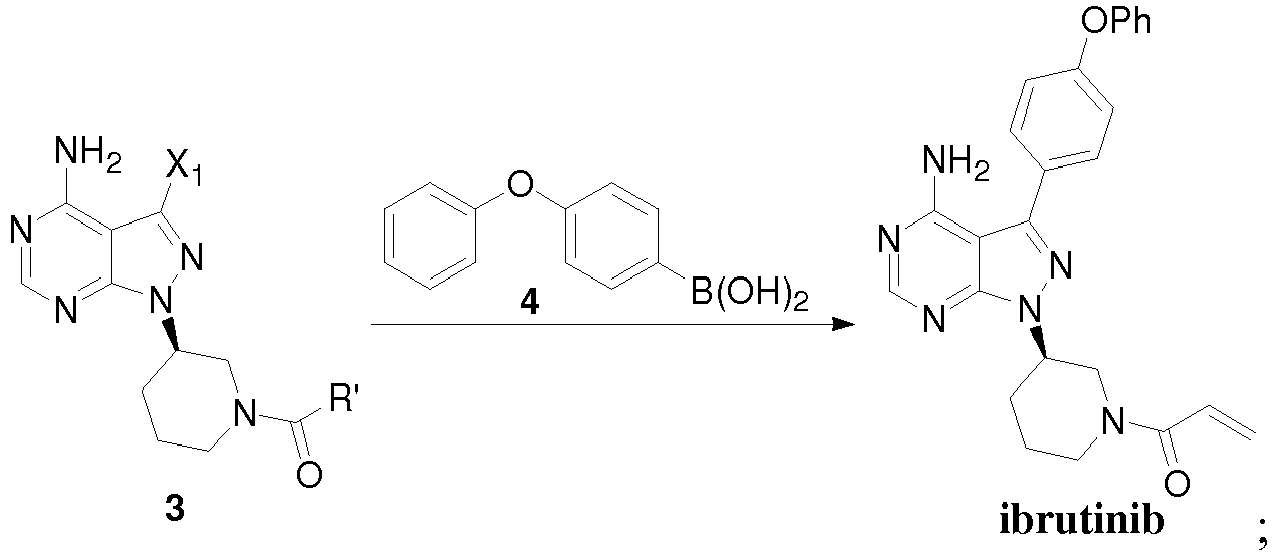

- In one embodiment of the present application, the amount of the compound of Formula 2 in step 1 is 0.9 to 2 equivalents, preferably 1 to 1.2 equivalents, relative to the amount of compound of Formula 1.
- In one embodiment of the present application, the base used in step 1 is an inorganic base and/or an organic base, wherein the inorganic base includes, but is not limited to, potassium carbonate, sodium carbonate, sodium bicarbonate, potassium bicarbonate, sodium hydroxide, potassium hydroxide, potassium hydride or sodium hydride, and the like, and the organic base includes, but is not limited to, triethylamine, dimethylpyridine, diisopropylethylamine or 1,8-diazabicyclo[5.4.0]undec-7-ene, and the like, preferably an inorganic base, and more preferably sodium bicarbonate and potassium bicarbonate.
- In one embodiment of the present application, the amount of the base used in step 1 is 1 to 5 equivalents, preferably 1.5 to 3 equivalents, and more preferably 2 equivalents, relative to the amount of the compound of Formula 1.
- In one embodiment of the present application, a reaction solvent in step 1 is a polar aprotic solvent, preferably tetrahydrofuran, 2-methyltetrahydrofuran, N,N-dimethylformamide, acetonitrile or acetone, and the like, and more preferably 2-methyltetrahydrofuran.
- In one embodiment of the present application, the amount of the compound of Formula 4 in step 2 is 1 to 3 equivalents, preferably 1.2 to 2 equivalents, and more preferably 1.5 equivalents, relative to the amount of compound of Formula 3.
- In one embodiment of the present application, the catalyst in step 2 is selected from the group consisting of Pd(PPh3)4, PdCl2(PPh3)2, PdCl2(PhCN)2, Pd(OAc)2, Pd/C and PdCl2(dppf)2, and the like, preferably Pd(PPh3)4.
- In one embodiment of the present application, the amount of the catalyst in step 2 is 0.001 to 0.1 equivalents, preferably 0.005 to 0.05 equivalents, and more preferably 0.01 equivalents, relative to the amount of the compound of Formula 3.
- In one embodiment of the present application, the base used in step 2 is an inorganic base, preferably potassium carbonate, sodium carbonate, cesium carbonate, potassium acetate, sodium acetate, potassium phosphate, sodium phosphate, sodium bicarbonate, potassium bicarbonate, sodium hydroxide, potassium hydroxide, sodium hydride or potassium hydride, and more preferably potassium phosphate or potassium carbonate.
- In one embodiment of the present application, the amount of the base used in step 2 is 1 to 5 equivalents, preferably 2 to 4 equivalents, and more preferably 3 to 3.5 equivalents, relative to the compound of Formula 3.
- In one embodiment of the present application, an reaction solvent used in step 2 is a mixed solvent of a polar aprotic solvent and water, preferably a mixed solvent of tetrahydrofuran, 1,4-dioxane, acetonitrile, acetone, N,N-dimethylformamide (DMF), dimethylsulfoxide, N-methylpyrrolidone or ethylene glycol dimethyl ether and water, and more preferably a mixed solvent of 1,4-dioxane and water or a mixed solvent of ethylene glycol dimethyl ether and water.
- In one embodiment of the present application, a reaction temperature in step 1 is 15°C or less, preferably -10°C to 5°C, and more preferably -5°C to 0°C.
- In one embodiment of the present application, a reaction temperature in step 2 is 60°C to 120°C, preferably 80°C to 100°C.
- In still another aspect, the present application provides another process for preparing ibrutinib, comprising
- Step 1: reacting a compound of Formula 1 with a compound of Formula 4 in the presence of a base and a catalyst to produce a compound of Formula 8,

- Step 2: reacting the compound of Formula 8 with a compound of Formula 2-1 in the presence of a base to produce ibrutinib,

- In one embodiment of the present application, the amount of the compound of Formula 4 is 1 to 3 equivalents, preferably 1.2 to 2 equivalents, and more preferably 1.5 equivalents, relative to the amount of compound of Formula 1.
- In one embodiment of the present application, the catalyst is selected from the group consisting of Pd(PPh3)4, PdCl2(PPh3)2, PdCl2(PhCN)2, Pd(OAc)2, Pd/C and PdCl2(dppf)2, and the like, preferably Pd(PPh3)4.
- In one embodiment of the present application, the amount of the catalyst is 0.001 to 0.1 equivalents, preferably 0.005 to 0.05 equivalents, and more preferably 0.01 equivalents, relative to the amount of the compound of Formula 1.
- In one embodiment of the present application, the base used in step 1 is an inorganic base, preferably potassium carbonate, sodium carbonate, cesium carbonate, potassium acetate, sodium acetate, potassium phosphate, sodium phosphate, sodium bicarbonate, potassium bicarbonate, sodium hydroxide, potassium hydroxide, sodium hydride or potassium hydride, and more preferably potassium phosphate or potassium carbonate.
- In one embodiment of the present application, the amount of the base used in step 1 is 1 to 5 equivalents, preferably 2 to 4 equivalents, and more preferably 3 to 3.5 equivalents, relative to the amount of the compound of Formula 1.
- In one embodiment of the present application, a reaction solvent used in step 1 is a mixed solvent of a polar aprotic solvent and water, preferably a mixed solvent of tetrahydrofuran, 1,4-dioxane, acetonitrile, acetone, N,N-dimethylformamide (DMF), dimethylsulfoxide, N-methylpyrrolidone or ethylene glycol dimethyl ether and water, and more preferably a mixed solvent of 1,4-dioxane and water or a mixed solvent of ethylene glycol dimethyl ether and water.
- In one embodiment of the present application, the amount of the compound of Formula 2-1 in step 2 is 0.9 to 2 equivalents, preferably 1 to 1.2 equivalents, relative to the amount of compound of Formula 8.
- In one embodiment of the present application, the base used in step 2 is an inorganic base and/or an organic base, wherein the inorganic base is selected from the group consisting of potassium carbonate, sodium carbonate, sodium bicarbonate, potassium bicarbonate, sodium hydroxide, potassium hydroxide, potassium hydride, sodium hydride and the like; and the organic base is selected from the group consisting of triethylamine, dimethylpyridine, diisopropylethylamine, 1,8-diazabicyclo[5.4.0]undec -7-ene and the like, preferably an inorganic base, and more preferably sodium bicarbonate and potassium bicarbonate.
- In one embodiment of the present application, the amount of base used in step 2 is 1 to 5 equivalents, preferably 1.5 to 3 equivalents, and more preferably 2 equivalents, relative to the amount of the compound of Formula 8.
- In one embodiment of the present application, a reaction solvent used in step 2 is a polar aprotic solvent, preferably tetrahydrofuran, 2-methyltetrahydrofuran, N,N-dimethylformamide, acetonitrile or acetone, and more preferably 2-methyltetrahydrofuran.
- In one embodiment of the present application, a reaction temperature in step 1 is 60°C to 120°C, preferably 80°C to 100°C.
- In one embodiment of the present application, a reaction temperature in step 2 is 15°C or less, preferably -10°C to 5°C, and more preferably -5°C to 0°C.
- In one embodiment of the present application, the process for preparing ibrutinib of the present application further comprises the following steps for the preparation of the compound of Formula 1:
- reacting a compound of Formula 5 with a compound of Formula 6 in the presence of a Mitsunobu reaction reagent to produce a compound of Formula 7, and then deprotecting the compound of Formula 7 in the presence of an acid to produce a compound of Formula 1:

- wherein R is an amino protecting group; and X1 is independently selected from the group consisting of Cl, Br and I, preferably Cl or Br.
- In one embodiment of the present application, the amount of the compound of Formula 6 is 0.5 to 3 equivalents, preferably 1 to 2 equivalents, and more preferably 1.5 equivalents, relative to the amount of compound of Formula 5.
- In one embodiment of the present application, the Mitsunobu reaction reagent is composed of a first reagent selected from the group consisting of triphenylphosphine (TPP), tributylphosphine (TBP) and trimethylphosphine (TMP), and a second reagent selected from the group consisting of diisopropyl azodicarboxylate (DIAD), di-tert-butyl azodicarboxylate (DBAD), diethyl azodicarboxylate (DEAD), di-p-chlorobenzyl azodicarboxylate (DCAD), 1,1'-(azodicarbonyl)dipiperidine (ADDP), N,N,N',N' -tetraisopropylazodicarboxamide (TIPA), N,N,N',N'-tetramethylazodicarboxamide (TMAD) and 4,7-dimethyl-3,4,5,6,7,8-hexahydro-1,2,4,7-tetrazocin-3,8-dione (DHTD), preferably composed of TPP and DIAD.
- In one embodiment of the present application, the amount of the first reagent and the amount of the second reagent in the Mitsunobu reaction reagent are equimolar to each other, and are each 1 to 5 equivalents, preferably 2 to 5 equivalents, and more preferably 3 to 4 equivalents, relative to the amount of the compound of Formula 5.
- In one embodiment of the present application, a solvent used for preparing the compound of Formula 7 is selected from the group consisting of a polar aprotic solvent and water, preferably tetrahydrofuran (THF), N,N-dimethylformamide, dimethylsulfoxide, N-methylpyrrolidone, acetonitrile or 1,4-dioxane, and the like, and more preferably tetrahydrofuran.
- In one embodiment of the present application, R is preferably tert-butoxycarbonyl (Boc).
- In one embodiment of the present application, the acid used in deprotecting the compound of Formula 7 is selected from the group consisting of hydrochloric acid, hydrobromic acid, sulfuric acid, phosphoric acid, acetic acid, methanesulfonic acid and trifluoroacetic acid, preferably hydrochloric acid.
- In another aspect, the present application provides an intermediate compound useful in the preparation of ibrutinib as shown below:

- In one embodiment of the present application, the intermediate compound useful in the preparation of ibrutinib is selected from the group consisting of compounds represented by the following chemical structures:


- In still another aspect, the present application provides a use of an intermediate compound as shown below in the preparation of ibrutinib:

- In the processes for the preparation of ibrutinib of the present application, the used raw materials are inexpensive and readily available, and ibrutinib can be obtained only through acylation reaction and Suzuki reaction. The processes for preparing ibrutinib of the present application have at least one of the following advantages.
- 1. Acylation reaction does not require additional protection of functional groups, and the product ibrutinib can be obtained in high yield and purity.
- 2. The amount of the catalyst used in Suzuki reaction is much smaller than that reported in the existing literatures, and the conversion of raw materials can reach up to 100% when reacted for 1 to 5h.
- 3. When Suzuki reaction occurs after the acylation reaction, the reaction for eliminating hydrogen halide can occur at the same time as Suzuki reaction, which reduces a reaction step and an impurity content of the product, and improves the total yield.
- 4. Where the compound of the Formula 5 is used as a starting material to carry out Mitsunobu reaction, the conversion of the starting material is significantly improved, and the reaction product can be directly precipitated from the reaction solution, which overcomes the drawback that the product of Mitsunobu reaction in the prior art needs to be purified by chromatography. Especially, when X is Br, the preparation processes of the present application can improve the yield of the final product, simplify a purification method, and reduce the cost of raw materials.
- 5. In the step of reacting a compound of Formula 1 with a compound of Formula 4 to produce a compound of Formula 8, the amount of a catalyst is much smaller than that reported in the prior literatures; the conversion of the raw materials can reach up to 100% when reacted for 1 to 5h; a very small amount of impurities are contained in the reaction product; and the reaction product can be purified in a high purity only by forming a corresponding salt.
- In the present application, the compound of Formula 1, the compound of Formula 3 or the compound of Formula 8 may be present in the form of a free base or a salt formed with an inorganic acid or an organic acid, both of which are within the scope of the present application.
- In the present application, said "equivalent" refers to the amount of a material by molar mass. For example, the amount of the compound of Formula 2 as described in the present application is 0.9 to 2 equivalents relative to the amount of the compound of Formula 1, which means that the molar mass of the compound of Formula 2 is 0.9 to 2 times relative to the molar mass of the compound of Formula 1.
- The following examples are intended to illustrate the present invention, but do not constitute limitations to the scope of the present application.
-

- To anhydrous THF (10 eq volume) were added the compound of Formula 5-Br (60 g, 0.28 mol), the compound of Formula 6-Boc (84.6 g, 0.42 mol) and triphenylphosphine (257.4 g, 0.98 mol) under the protection of nitrogen atmosphere to obtain a pale brown suspension. A reaction temperature was reduced to 0°C, and DIAD (198.4 g, 0.98 mol) was added dropwise while keeping the temperature below 5°C. The reaction solution gradually became a pale yellow clear solution. After completing the addition, the temperature was gradually raised to 20°C, and meanwhile the reaction solution was stirred for 3 hours. Concentrated hydrochloric acid (10 eq) was added. The temperature was raised to 50°C, and the reaction solution was stirred for another 2 hours. Then, the temperature was reduced to room temperature, and the reaction mixture was filtered. The filter cake was washed with a small amount of THF, and concentrated in vacuo to dryness to constant weight to afford 74.0 g of an off-white solid in 71.0% yield and 98.5% chemical purity. To 30 g of the off-white solid was added an aqueous solution of sodium bicarbonate to afford 22.9 g of a free base in 95.1% yield and 98.5% chemical purity. m/z (MH+) 297, 1H NMR (400 MHz, DMSO) δ 1.94 - 2.11 (m, 4H), 2.92 - 2.98 (m, 1H), 3.01 - 3.36 (m, 2H), 3.45 - 3.47 (m, 1H), 5.12 - 5.19(m, 1H), 8.50 - 8.51 (s, 1H), 9.61 - 9.87(dd, 2H).
-

- To anhydrous THF (10 eq volume) were added the compound of Formula 5-Br (60 g, 0.28 mol), the compound of Formula 6-Boc (84.6 g, 0.42 mol) and triphenylphosphine (257.4 g, 0.98 mol) under the protection of nitrogen atmosphere to obtain a pale brown suspension. A reaction temperature was reduced to 0°C, and DEAD (170.8 g, 0.98 mol) was added dropwise while keeping the temperature below 5°C. The reaction solution gradually became a pale yellow clear solution. After completing the addition, the temperature was gradually raised to 20°C, and meanwhile the reaction solution was stirred for 3 hours. Concentrated hydrochloric acid (10 eq) was added. The temperature was raised to 50°C, and the reaction solution was stirred for another 2 hours. Then, the temperature was reduced to room temperature, and the reaction mixture was filtered. The filter cake was washed with a small amount of THF, and concentrated in vacuo to dryness to constant weight to afford 70.3 g of an off-white solid in 67.8% yield and 98.3% chemical purity.
-

- To anhydrous THF (200mL) were added the compound of Formula 5-Br (20 g , 0.093 mol), the compound of Formula 6-Boc (28.21 g, 0.14 mol) and triphenylphosphine (85.79 g, 0.33 mol) under the protection of nitrogen atmosphere to obtain a pale brown suspension. A reaction temperature was reduced to 0°C, and DIAD (66.14 g, 0.33 mol) was added dropwise while keeping the temperature below 5°C. The reaction solution gradually became a pale yellow clear solution. After completing the addition, the temperature was gradually raised to 0°C to 10°C, and meanwhile the reaction solution was stirred for 3 hours. Concentrated hydrochloric acid (78mL) was added. The temperature was raised to 50°C, and the reaction solution was stirred for another 2 hours. Then, the temperature was reduced to room temperature, and the reaction mixture was filtered. After water was added to dissolve the filter cake, the solution was adjusted to pH 8 with 6N sodium hydroxide solution, and extracted with dichloromethane. The organic phase was dried over anhydrous sodium sulfate, filtered and concentrated in vacuo to dryness to afford 19.5 g of an off-white solid in 70% yield.
-

- The compound of Formula 1-Br (5 g, 0.017 mol) was dissolved in 2-methyltetrahydrofuran (50 mL), and a 7% aqueous solution (40 mL) of sodium bicarbonate (2.83 g, 0.034 mol) was added under the protection of nitrogen atmosphere. The reaction temperature was then reduced to -5°C, and a solution of acryloyl chloride (1.52 g, 0.017 mol) in 2-methyltetrahydrofuran (5 mL) was slowly added dropwise. After completing the addition, the reaction temperature was kept below 0°C, and meanwhile the reaction solution was stirred for 1 h. The reaction solution was layered. After the aqueous phase was extracted with 2-methyltetrahydrofuran (50 mL), the organic phases were combined, washed sequentially with a 7% aqueous solution (50 mL) of sodium bicarbonate and water (50 mL), dried over anhydrous sodium sulfate, and concentrated in vacuo to dryness to afford 5.03 g of a pale yellow solid in 85.1% yield, which contained 1.05% of impurity

-

- The compound of Formula 1-1 (5 g, 0.0145 mol) was dissolved in 2-methyltetrahydrofuran (50 mL), and a 7% aqueous solution (34.8 mL) of sodium bicarbonate (2.44 g, 0.029 mol) was added under the protection of nitrogen atmosphere. The reaction temperature was then reduced to -5°C, and a solution of acryloyl chloride (1.31 g, 0.0145 mol) in 2-methyltetrahydrofuran (5 mL) was slowly added dropwise. After completing the addition, the reaction temperature was kept below 0°C, and meanwhile the reaction solution was stirred for 1 h. The reaction solution was layered. After the aqueous phase was extracted with 2-methyltetrahydrofuran (50 mL), the organic phases were combined, washed sequentially with a 7% aqueous solution (50 mL) of sodium bicarbonate and water (50 mL), dried over anhydrous sodium sulfate, and concentrated in vacuo to dryness to afford 4.67 g of a pale yellow solid in 80.7% yield, which contained 1.01% of impurity
-

- To a mixed solvent of 1,4-dioxane (30 mL) and water (12 mL) were added the compound of Formula 3-1-Br (3 g, 8.54 mmol) (it contained 1.05% of impurity


-

- The compound of Formula 1-Br (5 g, 0.017 mol) was dissolved in 2-methyltetrahydrofuran (50 mL), and a 7% aqueous solution (40 mL) of sodium bicarbonate (2.83 g, 0.034 mol) was added under the protection of nitrogen atmosphere. The reaction temperature was then reduced to -5°C, and a solution of 3-chloropropionyl chloride (2.14g, 0.017mol) in 2-methyltetrahydrofuran (5 mL) was slowly added dropwise. After completing the addition, the reaction temperature was kept below 0°C, and meanwhile the reaction solution was stirred for 1 h. The reaction solution was layered. After the aqueous phase was extracted with 2-methyltetrahydrofuran (50 mL), the organic phases were combined, washed sequentially with a 7% aqueous solution (50 mL) of sodium bicarbonate and water (50 mL), dried over anhydrous sodium sulfate, and concentrated in vacuo to dryness to afford 5.61g of a pale yellow solid in 86.6% yield. m/z (MH+) 1H NMR (400 MHz, DMSO) δ 8.24 (s, 1H), 4.47 - 4.56 (m, 1H), 4.00 - 4.04 (m, 1H), 4.69 (m, 0.5H), 4.21 - 4.27 (m, 0.5H), 3.80 - 3.82 (m, 0.5H), 3.51 - 3.57 (m, 0.5H), 3.76 - 3.80 (m, 1H), 2.70 - 3.14 (m, 4H), 2.05 - 2.16 (m, 2H), 1.48 - 1.64 (m, 2H).
-

- The compound of Formula 1-Br (5 g, 0.017 mol) was dissolved in 2-methyltetrahydrofuran (50 mL), and a 7% aqueous solution (40 mL) of sodium bicarbonate (2.83 g, 0.034 mol) was added under the protection of nitrogen atmosphere. The reaction temperature was then reduced to -5°C, and a solution of 3-bromopropionyl bromide (3.63g, 0.017mol) in 2-methyltetrahydrofuran (5 mL) was slowly added dropwise. After completing the addition, the reaction temperature was kept below 0°C, and meanwhile the reaction solution was stirred for 1 h. The reaction solution was layered. After the aqueous phase was extracted with 2-methyltetrahydrofuran (50 mL), the organic phases were combined, washed sequentially with a 7% aqueous solution (50 mL) of sodium bicarbonate and water (50 mL), dried over anhydrous sodium sulfate, and concentrated in vacuo to dryness to afford 6.12g of a pale yellow solid in 84.1% yield. m/z (MH+) 1H NMR (400 MHz, DMSO) δ 8.31 (s, 1H), 4.71 - 4.76 (m, 1H), 4.48 - 4.59 (m, 1H), 4.20 - 4.23 (m, 0.5H), 4.00 - 4.02 (m, 0.5H), 3.86 - 3.89 (m, 0.5H), 3.51 - 3.55 (m, 0.5H), 3.55 - 3.67 (m, 1H), 2.81 - 3.17 (m, 1H), 2.06 - 2.21 (m, 2H), 1.81 - 1.91 (m, 1H), 1.46 - 1.68 (m, 1H).
-

- The compound of Formula 1-1 (5 g, 0.0145 mol) was dissolved in 2-methyltetrahydrofuran (50 mL), and a 7% aqueous solution (34.8 mL) of sodium bicarbonate (2.44 g, 0.029 mol) was added under the protection of nitrogen atmosphere. The reaction temperature was then reduced to -5°C, and a solution of 3-chloropropionyl chloride (1.84g, 0.0145mol) in 2-methyltetrahydrofuran (5 mL) was slowly added dropwise. After completing the addition, the reaction temperature was kept below 0°C, and meanwhile the reaction solution was stirred for 1 h. The reaction solution was layered. After the aqueous phase was extracted with 2-methyltetrahydrofuran (50 mL), the organic phases were combined, washed sequentially with a 7% aqueous solution (50 mL) of sodium bicarbonate and water (50 mL), dried over anhydrous sodium sulfate, and concentrated in vacuo to dryness to afford 5.29 g of a pale yellow solid in 83.8% yield. m/z (MH+), 1H NMR (400 MHz, DMSO) δ 8.23 (s, 1H), 4.66 - 4.71 (m, 0.5H), 4.47 - 4.58 (m, 1H), 4.21 - 4.24 (m, 0.5H), 3.99 - 4.03 (m, 0.5H), 3.87 - 3.90 (m, 0.5H), 3.76 - 3.82 (m, 2H), 2.71 - 3.15 (m, 4H), 1.99 - 2.21 (m, 2H), 1.80 - 1.89 (m, 1H), 1.48 - 1.64 (m, 1H).
-

- The compound of Formula 1-1 (5 g, 0.0145 mol) was dissolved in 2-methyltetrahydrofuran (50 mL), and a 7% aqueous solution (34.8 mL) of sodium bicarbonate (2.44 g, 0.029 mol) was added under the protection of nitrogen atmosphere. The reaction temperature was then reduced to -5°C, and a solution of 3-bromopropionyl bromide (3.14g, 0.0145mol) in 2-methyltetrahydrofuran (5 mL) was slowly added dropwise. After completing the addition, the reaction temperature was kept below 0°C, and meanwhile the reaction solution was stirred for 1 h. The reaction solution was layered. After the aqueous phase was extracted with 2-methyltetrahydrofuran (50 mL), the organic phases were combined, washed sequentially with a 7% aqueous solution (50 mL) of sodium bicarbonate and water (50 mL), dried over anhydrous sodium sulfate, and concentrated in vacuo to dryness to afford 6.01 g of a pale yellow solid in 86.3% yield. m/z (MH+), 1H NMR (400 MHz, DMSO) δ 8.23 (s, 1H), 4.69 (m, 0.5H), 4.47 - 4.55 (m, 1H), 4.20 - 4.24 (m, 0.5H), 3.97 - 3.98 (m, 0.5H), 3.86 - 3.89 (m, 0.5H), 3.52 - 3.67 (m, 2H), 2.83 - 3.12 (m, 4H), 2.06 - 2.19 (m, 2H), 1.86 - 1.89 (m, 1H), 1.64 - 1.84 (m, 1H).
-

- To a mixed solvent of 1,4-dioxane (30 mL) and water (12 mL) were added the compound of Formula 3-2-Br-Cl (3 g, 7.74 mmol), the compound of Formula 4 (2.48 g, 11.61 mmol) and potassium phosphate (5.75 g, 27.09 mmol). After bubbling with nitrogen gas for 20 min, Pd(PPh3)4 (89.4 mg, 0.077 mmol) was added, and bubbling with nitrogen gas was continued for 5min. Then, the reaction mixture was heated to reflux for 1h under stirring, and thereafter was layered. The organic phase was evaporated to dryness, and the residue was crystallized in ethanol to afford 2.87 g of an off-white solid in 84.2% yield.
-

- To a mixed solvent of 1,4-dioxane (30 mL) and water (12 mL) were added the compound of Formula 3-2-Br-Br (3 g, 6.94 mmol), the compound of Formula 4 (2.23 g, 10.41 mmol) and potassium phosphate (5.16 g, 24.3 mmol). After bubbling with nitrogen gas for 20 min, Pd(PPh3)4 (80.3 mg, 0.067 mmol) was added, and bubbling with nitrogen gas was continued for 5min. Then, the reaction mixture was heated to reflux for 1 h under stirring, and thereafter was layered. The organic phase was evaporated to dryness, and the residue was crystallized in ethanol to afford 2.64 g of an off-white solid in 86.2% yield.
-

- To a mixed solvent of 1,4-dioxane (200 mL) and water (80 mL) were added the dihydrochloride of the compound of Formula 1-Br (20 g, 0.054 mol), the compound of Formula 4 (17.35 g, 0.081 mol) and potassium phosphate (40.15 g, 0.19 mol). After bubbling with nitrogen gas for 20 min, Pd(PPh3)4 (0.62g, 5.4×10⁻⁴mol) was added, and bubbling with nitrogen gas was continued for 5min. The reaction solution was heated to reflux for 5 h under stirring, and then concentrated. Ethyl acetate (100 mL) and water (100 mL) were added to the residue. The resulting solution was layered after the pH was adjusted to 2 to 3 with hydrochloric acid, and then the aqueous phase was extracted once with ethyl acetate (100 mL). After liquid separation, dichloromethane (200 mL) was added to the aqueous phase, and the pH was adjusted to 9 to 10 with 6N sodium hydroxide solution. The resulting solution was stirred for liquid separation. The organic layer was dried over anhydrous sodium sulfate, and the solvent was evaporated to dryness to afford 18.8 g of a free base of Compound 8 as an off-white solid in 90.0% yield and 98.5% chemical purity. The free base was reacted with a solution of HCl in ethanol to form a salt, and 18.9 g of the hydrochloride of Compound 8 was obtained in 92% yield and 99.1% chemical purity.
-

- To a mixed solvent of ethylene glycol dimethyl ether (200 mL) and water (80 mL) were added the compound of the formula 1-Br (16.1 g, 0.054 mol), the compound of Formula 4 (17.35 g, 0.081 mol) and potassium phosphate (48. 5 g, 0.23 mol). After bubbling with nitrogen gas for 20 min, Pd(PPh3)4 (0.62g, 5.4×10⁻⁴mol) was added, and bubbling with nitrogen gas was continued for 5min. The reaction solution was heated to reflux for 5 h under stirring, and then concentrated. Ethyl acetate (100 mL) and water (100 mL) were added to the residue. The resulting solution was layered after the pH was adjusted to 2 to 3 with hydrochloric acid, and then the aqueous phase was extracted once with ethyl acetate (100 mL). After liquid separation, dichloromethane (200 mL) was added to the aqueous phase, and the pH was adjusted to 9 to 10 with 6N sodium hydroxide solution. The resulting solution was stirred for liquid separation. The organic layer was dried over anhydrous sodium sulfate, and the solvent was evaporated to dryness to afford 18.2 g of a free base of Compound 8 as an off-white solid in 87.1% yield and 98.8% chemical purity.
-

- To a mixed solvent of DMF (200 mL) and water (80 mL) were added the dihydrochloride of the compound of Formula 1-Br (20 g, 0.054 mol), the compound of Formula 4 (17.35 g, 0.081 mol) and potassium phosphate (40.15 g, 0.19 mol). After bubbling with nitrogen gas for 20 min, Pd(PhCN)2Cl2 (0.21g, 5.5×10⁻⁴mol) was added, and bubbling with nitrogen gas was continued for 5min. The solution reaction was heated to reflux for 5 h under stirring, and then concentrated. Ethyl acetate (100 mL) and water (100 mL) were added to the residue. The resulting solution was layered after the pH was adjusted to 2 to 3 with hydrochloric acid, and then the aqueous phase was extracted once with ethyl acetate (100 mL). After liquid separation, dichloromethane (200 mL) was added to the aqueous phase, and the pH was adjusted to 9 to 10 with 6N sodium hydroxide solution. The resulting solution was stirred for liquid separation. The organic layer was dried over anhydrous sodium sulfate, and the solvent was evaporated to dryness to afford 13.6 g of an off-white solid in 65.1% yield.
-

- To a mixed solvent of 1,4-dioxane (200 mL) and water (80 mL) were added the dihydrochloride of the compound of Formula 1-Br (20g, 0.054mol), the compound of Formula 4 (17.35 g, 0.081 mol) and potassium carbonate (26.14g, 0.19mol). After bubbling with nitrogen gas for 20 min, Pd(PPh3)4 (0.62g, 5.4×10⁻⁴mol) was added, and bubbling with nitrogen gas was continued for 5min. The reaction solution was heated to reflux for 5 h under stirring, and then concentrated. Ethyl acetate (100 mL) and water (100 mL) were added to the residue. The resulting solution was layered after the pH was adjusted to 2 to 3 with hydrochloric acid, and then the aqueous phase was extracted once with ethyl acetate (100 mL). After liquid separation, dichloromethane (200 mL) was added to the aqueous phase, and the pH was adjusted to 9 to 10 with 6N sodium hydroxide solution. The resulting solution was stirred for liquid separation. The organic layer was dried over anhydrous sodium sulfate, and the solvent was evaporated to dryness to afford 16.8 g of an off-white solid in 80.4% yield.
-

- The compound of Formula 8 (10g, 0.026mol) was dissolved in 2-methyltetrahydrofuran (100 mL), and a 7% aqueous solution (62 mL) of sodium bicarbonate (4.37g, 0.052mol) was added under the protection of nitrogen atmosphere. The reaction temperature was then reduced to -5°C, and a solution of acryloyl chloride (2.34g, 0.026mol) in 2-methyltetrahydrofuran (10 mL) was slowly added dropwise. After completing the addition, the reaction temperature was kept below 0°C, and meanwhile the reaction solution was stirred for 1 h, and then layered. After the aqueous phase was extracted with 2-methyltetrahydrofuran (100 mL), the organic phases were combined, washed sequentially with a 7% aqueous solution (50 mL) of sodium bicarbonate and water (50 mL), dried over anhydrous sodium sulfate, and then concentrated in vacuo to dryness to afford 10.5 g of a white foamy solid in 92.1% yield. The solid was recrystallized from ethyl acetate and n-heptane to afford 10.0 g of a white crystal in 95.0% yield, 99.6% chemical purity and 99.5% optical purity.
-

- The hydrochloride of the compound of Formula 8 (11g, 0.026mol) was dissolved in 2-methyltetrahydrofuran (100 mL), and a 7% aqueous solution (72 mL) of sodium bicarbonate (5.04g, 0.06mol) was added under the protection of nitrogen atmosphere. The reaction temperature was then reduced to -5°C, and a solution of acryloyl chloride (2.34g, 0.026mol) in 2-methyltetrahydrofuran (10 mL) was slowly added dropwise. After completing the addition, the reaction temperature was kept below 0°C, and meanwhile the reaction solution was stirred for 1 h, and then layered. After the aqueous phase was extracted with 2-methyltetrahydrofuran (50 mL), the organic phases were combined, washed sequentially with a 7% aqueous solution (50 mL) of sodium bicarbonate and water (50 mL), dried over anhydrous sodium sulfate, and concentrated in vacuo to dryness to afford 10.2 g of a white foamy solid in 89.9% yield. The solid was recrystallized from ethyl acetate and n-heptane to afford 9.7 g of a white crystal in 95.0% yield, 99.7% chemical purity and 99.6% optical purity.
Claims (19)
- A process for preparing ibrutinib, comprising
Step 1: reacting a compound of Formula 1 with a compound of Formula 2 in the presence of a base to form a compound of Formula 3,


- The process for preparing ibrutinib according to Claim 1, wherein the base in step 1 is potassium carbonate, sodium carbonate, sodium bicarbonate, potassium bicarbonate, sodium hydroxide, potassium hydroxide, potassium hydride, sodium hydride, triethylamine, dimethylpyridine, diisopropylethylamine or 1,8-diazabicyclo[5.4.0]undec -7-ene, preferably sodium bicarbonate and potassium bicarbonate.
- The process for preparing ibrutinib according to Claim 1, wherein a reaction solvent in step 1 is selected form the group consisting of tetrahydrofuran, 2-methyltetrahydrofuran, N,N-dimethylformamide, acetonitrile and acetone, preferably 2-methyltetrahydrofuran.
- The process for preparing ibrutinib according to Claim 1, wherein the catalyst in step 2 is selected from the group consisting of Pd(PPh3)4, PdCl2(PPh3)2, PdCl2(PhCN)2, Pd(OAc)2, Pd/C and PdCl2(dppf)2, preferably Pd(PPh3)4.
- The process for preparing ibrutinib according to Claim 1, wherein the base in step 2 is potassium carbonate, sodium carbonate, cesium carbonate, potassium acetate, sodium acetate, potassium phosphate, sodium phosphate, sodium bicarbonate, potassium bicarbonate, sodium hydroxide, potassium hydroxide, sodium hydride or potassium hydride, preferably potassium phosphate or potassium carbonate.
- The process for preparing ibrutinib according to Claim 1, wherein a reaction solvent in step 2 is a mixed solvent of tetrahydrofuran, 1,4-dioxane, acetonitrile, acetone, N,N-dimethylformamide (DMF), dimethylsulfoxide, N-methylpyrrolidone or ethylene glycol dimethyl ether and water, preferably a mixed solvent of 1,4-dioxane and water or a mixed solvent of ethylene glycol dimethyl ether and water.
- A process for preparing ibrutinib, comprising
Step 1: reacting a compound of Formula 1 with a compound of Formula 4 in the presence of a base and a catalyst to produce a compound of Formula 8,

- The process for preparing ibrutinib according to Claim 7, wherein the catalyst in step 1 is selected from the group consisting of Pd(PPh3)4, PdCl2(PPh3)2, PdCl2(PhCN)2, Pd(OAc)2, Pd/C and PdCl2(dppf)2, preferably Pd(PPh3)4.
- The process for preparing ibrutinib according to Claim 7, wherein the base in step 1 is potassium carbonate, sodium carbonate, cesium carbonate, potassium acetate, sodium acetate, potassium phosphate, sodium phosphate, sodium bicarbonate, potassium bicarbonate, sodium hydroxide, potassium hydroxide, sodium hydride or potassium hydride, preferably potassium phosphate or potassium carbonate.
- The process for preparing ibrutinib according to Claim 7, wherein a reaction solvent in step 1 is a mixed solvent of tetrahydrofuran, 1,4-dioxane, acetonitrile, acetone, N,N-dimethylformamide, dimethylsulfoxide, N-methylpyrrolidone or ethylene glycol dimethyl ether and water, preferably a mixed solvent of 1,4-dioxane and water or a mixed solvent of ethylene glycol dimethyl ether and water.
- The process for preparing ibrutinib according to Claim 7, wherein the base in step 2 is potassium carbonate, sodium carbonate, sodium bicarbonate, potassium bicarbonate, sodium hydroxide, potassium hydroxide, potassium hydride, sodium hydride, triethylamine, dimethylpyridine, diisopropylethylamine, or 1,8-diazabicyclo[5.4.0]undec-7-ene, preferably sodium bicarbonate and potassium bicarbonate.
- The process for preparing ibrutinib according to Claim 7, wherein a reaction solvent in step 2 is tetrahydrofuran, 2-methyltetrahydrofuran, N,N-dimethylformamide, acetonitrile or acetone, preferably 2-methyltetrahydrofuran.
- The process for preparing ibrutinib according to Claim 1 or 7, further comprising
reacting a compound of Formula 5 with a compound of Formula 6 in the presence of a Mitsunobu reaction reagent to produce a compound of Formula 7, and deprotecting the compound of Formula 7 in the presence of an acid to produce the compound of Formula 1: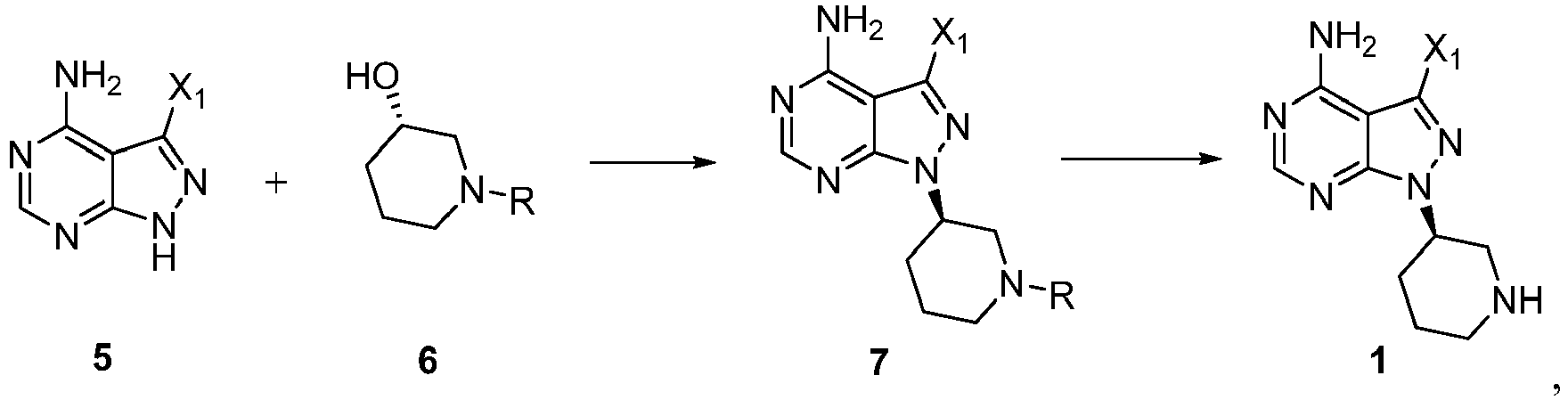
- The process for preparing ibrutinib according to Claim 13, wherein the Mitsunobu reaction reagent is composed of a first reagent selected from the group consisting of triphenylphosphine, tributylphosphine and trimethylphosphine, and a second reagent selected from the group consisting of diisopropyl azodicarboxylate, di-tert-butyl azodicarboxylate, diethyl azodicarboxylate, di-p-chlorobenzyl azodicarboxylate, 1,1'-(azodicarbonyl)dipiperidine, N,N,N',N'-tetraisopropylazodicarboxamide, N,N,N',N'-tetramethylazodicarboxamide and 4,7-dimethyl-3,4,5,6,7,8-hexahydro-1,2,4,7 -tetrazocin-3,8-dione, preferably composed of triphenylphosphine and diisopropyl azodicarboxylate.
- The process for preparing ibrutinib according to Claim 13, wherein a solvent used for preparing the compound of Formula 7 is selected from the group consisting of tetrahydrofuran, N,N-dimethylformamide, dimethylsulfoxide, N-methylpyrrolidone, acetonitrile and 1,4-dioxane, preferably tetrahydrofuran.
- The process for preparing ibrutinib according to Claim 13, wherein the acid used when deprotecting the compound of Formula 7 is selected from the group consisting of hydrochloric acid, hydrobromic acid, sulfuric acid, phosphoric acid, acetic acid, methanesulfonic acid and trifluoroacetic acid, preferably hydrochloric acid.
- An intermediate compound represented by the following structure:

- The intermediate compound according to Claim 17 selected from the group consisting of:


- Use of the intermediate compound of claim 17 or 18 in the preparation of ibrutinib.
Applications Claiming Priority (4)
| Application Number | Priority Date | Filing Date | Title |
|---|---|---|---|
| CN201510074023.1A CN105985343A (en) | 2015-02-12 | 2015-02-12 | Preparation method for ibrutinib |
| CN201510075177.2A CN105985345A (en) | 2015-02-12 | 2015-02-12 | Preparation method for ibrutinib and intermediate of ibrutinib |
| CN201510074031.6A CN105985344A (en) | 2015-02-12 | 2015-02-12 | Synthetic method for ibrutinib and intermediate of ibrutinib |
| PCT/CN2016/073537 WO2016127915A1 (en) | 2015-02-12 | 2016-02-04 | Method for preparing ibrutinib |
Publications (3)
| Publication Number | Publication Date |
|---|---|
| EP3257855A1 true EP3257855A1 (en) | 2017-12-20 |
| EP3257855A4 EP3257855A4 (en) | 2018-07-11 |
| EP3257855B1 EP3257855B1 (en) | 2020-04-22 |
Family
ID=56614165
Family Applications (1)
| Application Number | Title | Priority Date | Filing Date |
|---|---|---|---|
| EP16748716.4A Active EP3257855B1 (en) | 2015-02-12 | 2016-02-04 | Method for preparing ibrutinib |
Country Status (6)
| Country | Link |
|---|---|
| US (1) | US10214532B2 (en) |
| EP (1) | EP3257855B1 (en) |
| JP (1) | JP6681922B2 (en) |
| CN (2) | CN111018862B (en) |
| RU (1) | RU2712440C2 (en) |
| WO (1) | WO2016127915A1 (en) |
Families Citing this family (8)
| Publication number | Priority date | Publication date | Assignee | Title |
|---|---|---|---|---|
| TWI642671B (en) * | 2015-10-28 | 2018-12-01 | 台灣神隆股份有限公司 | Process for preparing ibrutinib and its intermediates |
| CN109422752B (en) * | 2017-09-03 | 2023-04-07 | 上海美志医药科技有限公司 | Compound with functions of inhibiting and degrading Bruton tyrosine protein kinase Btk activity |
| CN108295882B (en) * | 2018-01-30 | 2020-07-14 | 浙江树人学院 | Preparation of core-shell nano catalyst and application of core-shell nano catalyst in preparation of tinib drugs |
| WO2020234381A1 (en) | 2019-05-21 | 2020-11-26 | Janssen Pharmaceutica Nv | Processes and intermediates for preparing a btk inhibitor |
| CN112824417A (en) * | 2019-11-21 | 2021-05-21 | 上海天慈国际药业有限公司 | Preparation method of Laolatinib |
| CN114105990A (en) * | 2020-08-31 | 2022-03-01 | 北京四环制药有限公司 | Synthesis method of ibrutinib |
| CN112125913B (en) * | 2020-10-29 | 2024-07-19 | 瑞阳制药股份有限公司 | Synthesis method of high-purity ibutenib |
| CN114516830B (en) * | 2022-02-14 | 2023-12-19 | 兰州优莱特化学科技有限公司 | Preparation method and application of risedronic acid |
Family Cites Families (9)
| Publication number | Priority date | Publication date | Assignee | Title |
|---|---|---|---|---|
| DK2526933T3 (en) * | 2006-09-22 | 2015-05-18 | Pharmacyclics Inc | Inhibitors of Bruton's tyrosine kinase |
| SG10202107066WA (en) * | 2007-03-28 | 2021-07-29 | Pharmacyclics Llc | Inhibitors of bruton's tyrosine kinase |
| US7718662B1 (en) * | 2009-10-12 | 2010-05-18 | Pharmacyclics, Inc. | Pyrazolo-pyrimidine inhibitors of bruton's tyrosine kinase |
| JP6261580B2 (en) * | 2012-07-30 | 2018-01-17 | コンサート ファーマシューティカルズ インコーポレイテッド | Deuterated ibrutinib |
| CN103121999A (en) * | 2012-08-29 | 2013-05-29 | 苏州迪飞医药科技有限公司 | Method for synthesizing tyrosine kinase inhibitor PCI-32765 |
| GB201309085D0 (en) * | 2013-05-20 | 2013-07-03 | Redx Pharma Ltd | Compounds |
| CN105017256A (en) | 2014-04-29 | 2015-11-04 | 浙江导明医药科技有限公司 | Polyfluorinated compound Bruton tyrosine kinase inhibitor |
| EP3221320A4 (en) * | 2014-11-19 | 2018-04-25 | Sun Pharmaceutical Industries Ltd | A process for the preparation of ibrutinib |
| MA41350A (en) * | 2015-01-14 | 2017-11-21 | Janssen Pharmaceutica Nv | SUMMARY OF A BRUTON TYROSINE KINASE INHIBITOR |
-
2016
- 2016-02-04 JP JP2017560860A patent/JP6681922B2/en active Active
- 2016-02-04 US US15/549,631 patent/US10214532B2/en active Active
- 2016-02-04 RU RU2017131355A patent/RU2712440C2/en active
- 2016-02-04 WO PCT/CN2016/073537 patent/WO2016127915A1/en not_active Ceased
- 2016-02-04 CN CN201910949458.4A patent/CN111018862B/en active Active
- 2016-02-04 EP EP16748716.4A patent/EP3257855B1/en active Active
- 2016-02-04 CN CN201680009639.3A patent/CN107207519B/en active Active
Also Published As
| Publication number | Publication date |
|---|---|
| RU2017131355A (en) | 2019-03-12 |
| US20180044339A1 (en) | 2018-02-15 |
| EP3257855B1 (en) | 2020-04-22 |
| JP2018513205A (en) | 2018-05-24 |
| CN107207519A (en) | 2017-09-26 |
| RU2017131355A3 (en) | 2019-08-07 |
| WO2016127915A1 (en) | 2016-08-18 |
| CN111018862B (en) | 2021-12-24 |
| EP3257855A4 (en) | 2018-07-11 |
| JP6681922B2 (en) | 2020-04-15 |
| CN107207519B (en) | 2019-11-08 |
| US10214532B2 (en) | 2019-02-26 |
| RU2712440C2 (en) | 2020-01-29 |
| CN111018862A (en) | 2020-04-17 |
Similar Documents
| Publication | Publication Date | Title |
|---|---|---|
| EP3257855B1 (en) | Method for preparing ibrutinib | |
| CN105985343A (en) | Preparation method for ibrutinib | |
| CN108794491A (en) | Refining method of tofacitinib citrate | |
| EP3199536B1 (en) | Preparation method for benzoxazoleoxazine ketone compound and intermediate and crystal form thereof | |
| CN105985345A (en) | Preparation method for ibrutinib and intermediate of ibrutinib | |
| CN116829554B (en) | Intermediate for thiohydantoin drug and preparation method and application thereof | |
| CN107353291A (en) | Her a kind of cloth replaces the refined preparation method of Buddhist nun | |
| WO2017221272A1 (en) | Process for the preparation of idelalisib | |
| JP2020070296A (en) | Method for producing linagliptin | |
| CN114539133B (en) | Method for preparing prucalopride intermediate 1- (3-methoxypropyl) -4-piperidinamine | |
| HK1241368B (en) | Method for preparing ibrutinib | |
| CN114671890A (en) | Efficient and stable everolimus preparation method | |
| CN113717178B (en) | Intermediate of SHP2 inhibitor and preparation method thereof | |
| HK1241368A1 (en) | Method for preparing ibrutinib | |
| CN105884746A (en) | Synthesizing method of flumatinib | |
| CN116063309B (en) | Synthesis method of ibrutinib | |
| CN116589372B (en) | Among the octenib Synthesis method of intermediate | |
| CN113896730B (en) | Preparation method of tofacitinib citrate and intermediate thereof | |
| CA2837150C (en) | Substituted phenyl compounds | |
| CN115703733B (en) | A method for preparing a prucalopride intermediate | |
| WO2026047102A1 (en) | Process for the preparation of pyrimidine derivatives | |
| CN109748885B (en) | Ceritinib intermediate and preparation method of ceritinib | |
| CN118005706A (en) | Preparation method of 2',3' -dideoxynucleotide | |
| CN121405706A (en) | A method for synthesizing utpatinib and its intermediate Up-3 | |
| CN120607512A (en) | Preparation method of compound fasudil hydrochloride |
Legal Events
| Date | Code | Title | Description |
|---|---|---|---|
| STAA | Information on the status of an ep patent application or granted ep patent |
Free format text: STATUS: THE INTERNATIONAL PUBLICATION HAS BEEN MADE |
|
| PUAI | Public reference made under article 153(3) epc to a published international application that has entered the european phase |
Free format text: ORIGINAL CODE: 0009012 |
|
| STAA | Information on the status of an ep patent application or granted ep patent |
Free format text: STATUS: REQUEST FOR EXAMINATION WAS MADE |
|
| 17P | Request for examination filed |
Effective date: 20170912 |
|
| AK | Designated contracting states |
Kind code of ref document: A1 Designated state(s): AL AT BE BG CH CY CZ DE DK EE ES FI FR GB GR HR HU IE IS IT LI LT LU LV MC MK MT NL NO PL PT RO RS SE SI SK SM TR |
|
| AX | Request for extension of the european patent |
Extension state: BA ME |
|
| DAV | Request for validation of the european patent (deleted) | ||
| DAX | Request for extension of the european patent (deleted) | ||
| A4 | Supplementary search report drawn up and despatched |
Effective date: 20180612 |
|
| RIC1 | Information provided on ipc code assigned before grant |
Ipc: C07D 487/04 20060101AFI20180606BHEP |
|
| GRAP | Despatch of communication of intention to grant a patent |
Free format text: ORIGINAL CODE: EPIDOSNIGR1 |
|
| STAA | Information on the status of an ep patent application or granted ep patent |
Free format text: STATUS: GRANT OF PATENT IS INTENDED |
|
| INTG | Intention to grant announced |
Effective date: 20200107 |
|
| GRAS | Grant fee paid |
Free format text: ORIGINAL CODE: EPIDOSNIGR3 |
|
| RAP1 | Party data changed (applicant data changed or rights of an application transferred) |
Owner name: CHIA TAI TIANQING PHARMACEUTICAL GROUP CO., LTD. Owner name: LIANYUNGANG RUNZHONG PHARMACEUTICAL CO., LTD. Owner name: SHANGHAI DUDE MEDICAL SCIENCE AND TECHNOLOGY CO., LTD. |
|
| GRAA | (expected) grant |
Free format text: ORIGINAL CODE: 0009210 |
|
| STAA | Information on the status of an ep patent application or granted ep patent |
Free format text: STATUS: THE PATENT HAS BEEN GRANTED |
|
| AK | Designated contracting states |
Kind code of ref document: B1 Designated state(s): AL AT BE BG CH CY CZ DE DK EE ES FI FR GB GR HR HU IE IS IT LI LT LU LV MC MK MT NL NO PL PT RO RS SE SI SK SM TR |
|
| REG | Reference to a national code |
Ref country code: CH Ref legal event code: EP |
|
| REG | Reference to a national code |
Ref country code: IE Ref legal event code: FG4D |
|
| REG | Reference to a national code |
Ref country code: DE Ref legal event code: R096 Ref document number: 602016034564 Country of ref document: DE |
|
| REG | Reference to a national code |
Ref country code: AT Ref legal event code: REF Ref document number: 1259939 Country of ref document: AT Kind code of ref document: T Effective date: 20200515 |
|
| REG | Reference to a national code |
Ref country code: LT Ref legal event code: MG4D |
|
| REG | Reference to a national code |
Ref country code: NL Ref legal event code: MP Effective date: 20200422 |
|
| PG25 | Lapsed in a contracting state [announced via postgrant information from national office to epo] |
Ref country code: PT Free format text: LAPSE BECAUSE OF FAILURE TO SUBMIT A TRANSLATION OF THE DESCRIPTION OR TO PAY THE FEE WITHIN THE PRESCRIBED TIME-LIMIT Effective date: 20200824 Ref country code: IS Free format text: LAPSE BECAUSE OF FAILURE TO SUBMIT A TRANSLATION OF THE DESCRIPTION OR TO PAY THE FEE WITHIN THE PRESCRIBED TIME-LIMIT Effective date: 20200822 Ref country code: NO Free format text: LAPSE BECAUSE OF FAILURE TO SUBMIT A TRANSLATION OF THE DESCRIPTION OR TO PAY THE FEE WITHIN THE PRESCRIBED TIME-LIMIT Effective date: 20200722 Ref country code: SE Free format text: LAPSE BECAUSE OF FAILURE TO SUBMIT A TRANSLATION OF THE DESCRIPTION OR TO PAY THE FEE WITHIN THE PRESCRIBED TIME-LIMIT Effective date: 20200422 Ref country code: FI Free format text: LAPSE BECAUSE OF FAILURE TO SUBMIT A TRANSLATION OF THE DESCRIPTION OR TO PAY THE FEE WITHIN THE PRESCRIBED TIME-LIMIT Effective date: 20200422 Ref country code: GR Free format text: LAPSE BECAUSE OF FAILURE TO SUBMIT A TRANSLATION OF THE DESCRIPTION OR TO PAY THE FEE WITHIN THE PRESCRIBED TIME-LIMIT Effective date: 20200723 Ref country code: LT Free format text: LAPSE BECAUSE OF FAILURE TO SUBMIT A TRANSLATION OF THE DESCRIPTION OR TO PAY THE FEE WITHIN THE PRESCRIBED TIME-LIMIT Effective date: 20200422 Ref country code: NL Free format text: LAPSE BECAUSE OF FAILURE TO SUBMIT A TRANSLATION OF THE DESCRIPTION OR TO PAY THE FEE WITHIN THE PRESCRIBED TIME-LIMIT Effective date: 20200422 |
|
| REG | Reference to a national code |
Ref country code: AT Ref legal event code: MK05 Ref document number: 1259939 Country of ref document: AT Kind code of ref document: T Effective date: 20200422 |
|
| PG25 | Lapsed in a contracting state [announced via postgrant information from national office to epo] |
Ref country code: BG Free format text: LAPSE BECAUSE OF FAILURE TO SUBMIT A TRANSLATION OF THE DESCRIPTION OR TO PAY THE FEE WITHIN THE PRESCRIBED TIME-LIMIT Effective date: 20200722 Ref country code: LV Free format text: LAPSE BECAUSE OF FAILURE TO SUBMIT A TRANSLATION OF THE DESCRIPTION OR TO PAY THE FEE WITHIN THE PRESCRIBED TIME-LIMIT Effective date: 20200422 Ref country code: HR Free format text: LAPSE BECAUSE OF FAILURE TO SUBMIT A TRANSLATION OF THE DESCRIPTION OR TO PAY THE FEE WITHIN THE PRESCRIBED TIME-LIMIT Effective date: 20200422 Ref country code: RS Free format text: LAPSE BECAUSE OF FAILURE TO SUBMIT A TRANSLATION OF THE DESCRIPTION OR TO PAY THE FEE WITHIN THE PRESCRIBED TIME-LIMIT Effective date: 20200422 |
|
| PG25 | Lapsed in a contracting state [announced via postgrant information from national office to epo] |
Ref country code: AL Free format text: LAPSE BECAUSE OF FAILURE TO SUBMIT A TRANSLATION OF THE DESCRIPTION OR TO PAY THE FEE WITHIN THE PRESCRIBED TIME-LIMIT Effective date: 20200422 |
|
| REG | Reference to a national code |
Ref country code: DE Ref legal event code: R097 Ref document number: 602016034564 Country of ref document: DE |
|
| PG25 | Lapsed in a contracting state [announced via postgrant information from national office to epo] |
Ref country code: RO Free format text: LAPSE BECAUSE OF FAILURE TO SUBMIT A TRANSLATION OF THE DESCRIPTION OR TO PAY THE FEE WITHIN THE PRESCRIBED TIME-LIMIT Effective date: 20200422 Ref country code: ES Free format text: LAPSE BECAUSE OF FAILURE TO SUBMIT A TRANSLATION OF THE DESCRIPTION OR TO PAY THE FEE WITHIN THE PRESCRIBED TIME-LIMIT Effective date: 20200422 Ref country code: SM Free format text: LAPSE BECAUSE OF FAILURE TO SUBMIT A TRANSLATION OF THE DESCRIPTION OR TO PAY THE FEE WITHIN THE PRESCRIBED TIME-LIMIT Effective date: 20200422 Ref country code: EE Free format text: LAPSE BECAUSE OF FAILURE TO SUBMIT A TRANSLATION OF THE DESCRIPTION OR TO PAY THE FEE WITHIN THE PRESCRIBED TIME-LIMIT Effective date: 20200422 Ref country code: DK Free format text: LAPSE BECAUSE OF FAILURE TO SUBMIT A TRANSLATION OF THE DESCRIPTION OR TO PAY THE FEE WITHIN THE PRESCRIBED TIME-LIMIT Effective date: 20200422 Ref country code: AT Free format text: LAPSE BECAUSE OF FAILURE TO SUBMIT A TRANSLATION OF THE DESCRIPTION OR TO PAY THE FEE WITHIN THE PRESCRIBED TIME-LIMIT Effective date: 20200422 Ref country code: IT Free format text: LAPSE BECAUSE OF FAILURE TO SUBMIT A TRANSLATION OF THE DESCRIPTION OR TO PAY THE FEE WITHIN THE PRESCRIBED TIME-LIMIT Effective date: 20200422 Ref country code: CZ Free format text: LAPSE BECAUSE OF FAILURE TO SUBMIT A TRANSLATION OF THE DESCRIPTION OR TO PAY THE FEE WITHIN THE PRESCRIBED TIME-LIMIT Effective date: 20200422 |
|
| PG25 | Lapsed in a contracting state [announced via postgrant information from national office to epo] |
Ref country code: PL Free format text: LAPSE BECAUSE OF FAILURE TO SUBMIT A TRANSLATION OF THE DESCRIPTION OR TO PAY THE FEE WITHIN THE PRESCRIBED TIME-LIMIT Effective date: 20200422 Ref country code: SK Free format text: LAPSE BECAUSE OF FAILURE TO SUBMIT A TRANSLATION OF THE DESCRIPTION OR TO PAY THE FEE WITHIN THE PRESCRIBED TIME-LIMIT Effective date: 20200422 |
|
| PLBE | No opposition filed within time limit |
Free format text: ORIGINAL CODE: 0009261 |
|
| STAA | Information on the status of an ep patent application or granted ep patent |
Free format text: STATUS: NO OPPOSITION FILED WITHIN TIME LIMIT |
|
| 26N | No opposition filed |
Effective date: 20210125 |
|
| PG25 | Lapsed in a contracting state [announced via postgrant information from national office to epo] |
Ref country code: SI Free format text: LAPSE BECAUSE OF FAILURE TO SUBMIT A TRANSLATION OF THE DESCRIPTION OR TO PAY THE FEE WITHIN THE PRESCRIBED TIME-LIMIT Effective date: 20200422 |
|
| PG25 | Lapsed in a contracting state [announced via postgrant information from national office to epo] |
Ref country code: MC Free format text: LAPSE BECAUSE OF FAILURE TO SUBMIT A TRANSLATION OF THE DESCRIPTION OR TO PAY THE FEE WITHIN THE PRESCRIBED TIME-LIMIT Effective date: 20200422 |
|
| REG | Reference to a national code |
Ref country code: BE Ref legal event code: MM Effective date: 20210228 |
|
| PG25 | Lapsed in a contracting state [announced via postgrant information from national office to epo] |
Ref country code: LU Free format text: LAPSE BECAUSE OF NON-PAYMENT OF DUE FEES Effective date: 20210204 Ref country code: LI Free format text: LAPSE BECAUSE OF NON-PAYMENT OF DUE FEES Effective date: 20210228 Ref country code: CH Free format text: LAPSE BECAUSE OF NON-PAYMENT OF DUE FEES Effective date: 20210228 |
|
| PG25 | Lapsed in a contracting state [announced via postgrant information from national office to epo] |
Ref country code: IE Free format text: LAPSE BECAUSE OF NON-PAYMENT OF DUE FEES Effective date: 20210204 |
|
| PG25 | Lapsed in a contracting state [announced via postgrant information from national office to epo] |
Ref country code: BE Free format text: LAPSE BECAUSE OF NON-PAYMENT OF DUE FEES Effective date: 20210228 |
|
| PG25 | Lapsed in a contracting state [announced via postgrant information from national office to epo] |
Ref country code: CY Free format text: LAPSE BECAUSE OF FAILURE TO SUBMIT A TRANSLATION OF THE DESCRIPTION OR TO PAY THE FEE WITHIN THE PRESCRIBED TIME-LIMIT Effective date: 20200422 |
|
| P01 | Opt-out of the competence of the unified patent court (upc) registered |
Effective date: 20230601 |
|
| PG25 | Lapsed in a contracting state [announced via postgrant information from national office to epo] |
Ref country code: HU Free format text: LAPSE BECAUSE OF FAILURE TO SUBMIT A TRANSLATION OF THE DESCRIPTION OR TO PAY THE FEE WITHIN THE PRESCRIBED TIME-LIMIT; INVALID AB INITIO Effective date: 20160204 |
|
| PG25 | Lapsed in a contracting state [announced via postgrant information from national office to epo] |
Ref country code: MK Free format text: LAPSE BECAUSE OF FAILURE TO SUBMIT A TRANSLATION OF THE DESCRIPTION OR TO PAY THE FEE WITHIN THE PRESCRIBED TIME-LIMIT Effective date: 20200422 |
|
| PG25 | Lapsed in a contracting state [announced via postgrant information from national office to epo] |
Ref country code: MT Free format text: LAPSE BECAUSE OF FAILURE TO SUBMIT A TRANSLATION OF THE DESCRIPTION OR TO PAY THE FEE WITHIN THE PRESCRIBED TIME-LIMIT Effective date: 20200422 |
|
| PGFP | Annual fee paid to national office [announced via postgrant information from national office to epo] |
Ref country code: GB Payment date: 20241212 Year of fee payment: 10 |
|
| PGFP | Annual fee paid to national office [announced via postgrant information from national office to epo] |
Ref country code: FR Payment date: 20241223 Year of fee payment: 10 |
|
| PGFP | Annual fee paid to national office [announced via postgrant information from national office to epo] |
Ref country code: DE Payment date: 20241210 Year of fee payment: 10 |
|
| PG25 | Lapsed in a contracting state [announced via postgrant information from national office to epo] |
Ref country code: TR Free format text: LAPSE BECAUSE OF FAILURE TO SUBMIT A TRANSLATION OF THE DESCRIPTION OR TO PAY THE FEE WITHIN THE PRESCRIBED TIME-LIMIT Effective date: 20200422 |