EP3256406B1 - A palletizing system and a method of operating such a palletizing system - Google Patents
A palletizing system and a method of operating such a palletizing system Download PDFInfo
- Publication number
- EP3256406B1 EP3256406B1 EP16706549.9A EP16706549A EP3256406B1 EP 3256406 B1 EP3256406 B1 EP 3256406B1 EP 16706549 A EP16706549 A EP 16706549A EP 3256406 B1 EP3256406 B1 EP 3256406B1
- Authority
- EP
- European Patent Office
- Prior art keywords
- container
- containers
- determining
- control system
- pallet
- Prior art date
- Legal status (The legal status is an assumption and is not a legal conclusion. Google has not performed a legal analysis and makes no representation as to the accuracy of the status listed.)
- Active
Links
Images


Classifications
-
- B—PERFORMING OPERATIONS; TRANSPORTING
- B65—CONVEYING; PACKING; STORING; HANDLING THIN OR FILAMENTARY MATERIAL
- B65G—TRANSPORT OR STORAGE DEVICES, e.g. CONVEYORS FOR LOADING OR TIPPING, SHOP CONVEYOR SYSTEMS OR PNEUMATIC TUBE CONVEYORS
- B65G1/00—Storing articles, individually or in orderly arrangement, in warehouses or magazines
- B65G1/02—Storage devices
- B65G1/04—Storage devices mechanical
- B65G1/137—Storage devices mechanical with arrangements or automatic control means for selecting which articles are to be removed
- B65G1/1373—Storage devices mechanical with arrangements or automatic control means for selecting which articles are to be removed for fulfilling orders in warehouses
- B65G1/1378—Storage devices mechanical with arrangements or automatic control means for selecting which articles are to be removed for fulfilling orders in warehouses the orders being assembled on fixed commissioning areas remote from the storage areas
-
- G—PHYSICS
- G06—COMPUTING OR CALCULATING; COUNTING
- G06Q—INFORMATION AND COMMUNICATION TECHNOLOGY [ICT] SPECIALLY ADAPTED FOR ADMINISTRATIVE, COMMERCIAL, FINANCIAL, MANAGERIAL OR SUPERVISORY PURPOSES; SYSTEMS OR METHODS SPECIALLY ADAPTED FOR ADMINISTRATIVE, COMMERCIAL, FINANCIAL, MANAGERIAL OR SUPERVISORY PURPOSES, NOT OTHERWISE PROVIDED FOR
- G06Q10/00—Administration; Management
- G06Q10/08—Logistics, e.g. warehousing, loading or distribution; Inventory or stock management
- G06Q10/087—Inventory or stock management, e.g. order filling, procurement or balancing against orders
-
- B—PERFORMING OPERATIONS; TRANSPORTING
- B65—CONVEYING; PACKING; STORING; HANDLING THIN OR FILAMENTARY MATERIAL
- B65G—TRANSPORT OR STORAGE DEVICES, e.g. CONVEYORS FOR LOADING OR TIPPING, SHOP CONVEYOR SYSTEMS OR PNEUMATIC TUBE CONVEYORS
- B65G1/00—Storing articles, individually or in orderly arrangement, in warehouses or magazines
- B65G1/02—Storage devices
- B65G1/04—Storage devices mechanical
- B65G1/137—Storage devices mechanical with arrangements or automatic control means for selecting which articles are to be removed
- B65G1/1371—Storage devices mechanical with arrangements or automatic control means for selecting which articles are to be removed with data records
Definitions
- the present invention relates to a palletizing system and to a method of operating such a palletizing system.
- Palletizing systems facilitated to load containers containing food products onto a pallet have served for many years, because manual loading causes high labor cost and risk of workplace injury.
- Such labor saving systems have developed over the years from simple palletizer devices to automatic robotic driven solutions where a robot arm can load containers to a number of pallet positions in the proximity of the robot.
- Containers transported on a conveyor system are automatically distributed to one of perhaps multiple robots comprising the palletizing system.
- Even most recent systems are characterized by the need of operator assistance to configure the system on which pallet position on which robot each type of container containing different food products is palletized. Changes in customer orders and raw material being processed require continuous re-configuration of the system to adapt to the actual stream of containers to be palletized, and such manual adjustment makes the systems inefficient.
- US 2008/046116 A1 discloses a palletizing system according to the preamble of claim 1.
- Figure 1 shows a prior art palletizing system for placing containers containing food products onto pallets.
- the palletizing system 100 shown here is utilized for placing containers containing salmon of e.g. different weight and/or quality onto pallets 113, 114 within pallet storage 120.
- the incoming food items are previously sorted by quality and weighed by a weighing device (not shown) and fed into the system at the in-feed area 140 into a grader containing two parallel distribution conveyors 101, 102, and where via sweep arms (not shown) the food items are diverted to plurality of compartments or bins 103, where plurality of batches are created.
- the batches are subsequently put into empty containers that are fed by in-feed conveyor 104, where the containers are uniquely identified with container identifiers, i.e. any type of identification means that uniquely identify the containers.
- the customer orders could e.g. include number of containers fulfilling one or more targets, e.g. fixed weight and/or quality and/or number of salmon in the containers.
- Plurality of containers containing the food items are subsequently conveyed on two separate conveyors 105, 106, where at stations 107, 108 information about the food items in the containers is acquired, e.g. the weight, and where the containers are further scanned to identify the ID of the container.
- the unique ID number of the containers is subsequently associated to the acquired data on the content inside the container and stored.
- Two ice-devices 115, 116 are also shown for putting ice in an amount according to customer order into the containers and subsequently the individual boxes strapped at strapping stations 121, 122.
- the palletizing is performed by robotic systems 111, 112 where the assigned pallet places for each robotic system for each food product are pre-determined manually by an operator.
- robotic system 111 could be assigned pallets for customer order line A and B
- robotic system 112 is assigned pallets for customer order line C, D and E.
- This assignment is figured out by an operator and the control system is manually configured, e.g. once or several times a day.
- the palletizing system must be reconfigured manually accordantly.
- Embodiments of the invention preferably seeks to mitigate, alleviate or eliminate one or more of the above mentioned disadvantages singly or in any combination.
- a palletizing system comprising:
- Each robotic system thus preferably includes a plurality of pallet positions.
- the containers optionally enter the conveying means from a single or common source of containers at an in-feed area of the palletizing system.
- a dynamic allocation is provided where the system automatically allocates the pallet positions based on the flow rate of the plurality of types of containers on the conveyor means and the order line identifier. This eliminates that manual labour of adjusting the pallet positions manually and more importantly greatly increases the throughput of the palletizing system.
- flow rate may according to the present invention be understood as the number of containers that are in the system per unit time sharing one or more common characteristics of the food items contained in the containers.
- the order line identifiers indicate the order for customer(s), e.g. one (or more) customer order comprising 500 containers (order A) of high-quality salmon fish between 3-4 kg where each container has a target weight of 10kg, another order (order B) could be 50 containers of 2-3kg medium quality salmon where the target weight of the boxes is 14kg and a third order (order C) could be 150 containers of high-quality salmon fish between 3-4 kg where each container has a target weight of 20kg.
- order A containers
- order B could be 50 containers of 2-3kg medium quality salmon where the target weight of the boxes is 14kg
- a third order (order C) could be 150 containers of high-quality salmon fish between 3-4 kg where each container has a target weight of 20kg.
- the number of containers of order A per unit time gives the flow rate of that type of containers, same applies for order B and C.
- the robotic system is operable by means of the control system to compare the flow rates of the plurality of types of containers and the capacity of each available pallet position for a particular order line.
- the capacity of each order line may, e.g., be defined as the number of containers in general, or more specifically the number of containers of each type of containers, which can be accommodated per unit of time at the pallet position.
- the capacity of the pallet positions may vary over time and may dependent upon, e.g., its physical distance to the robotic system, or its physical dimensions.
- the robotic system may thus be operable by means of the control system to allocate containers to pallet positions in accordance with the capacity of the individual pallet positions.
- each pallet position is assigned to one single order line during production of the order.
- Each order line may occupy a plurality of pallet positions during production of the order.
- the control system may thus be able to determine, on the basis of the order line identifier of each container, the possible pallet positions of each container, and to correlate the flow rate of the container's type to the capacity of each of the pallet positions so as to thereby determine to which one of the possible pallet positions the container is to be allocated. For example, types of containers fed at a high flow rate may be preferentially allocated to pallet positions operated at a high capacity, whereas types of containers fed at a low flow rate are preferentially allocated to pallet positions operated at a low capacity.
- the step of determining the one single pallet position to which each individual container is to be allocated may include the steps of:
- a specific order e.g. order A discussed above, includes a high number of containers of a particular type and the flow rote of this type of containers (i.e. salmon fish between 3-4 kg with 10kg target) is relatively high
- the palletizing system will adapt the pallet positions accordingly, e.g. by reserving 3 (more or less) pallet positions at the one or more robotic systems.
- the flow rate for order A would be much lower (e.g. distributed over 20 hours instead of 2 hours), there might be no need to reserve such three pallet positions, instead only one pallet position at a time might be sufficient.
- the conveying means comprises a closed-loop conveyor and where the at least one robotic system is positioned along the closed-loop conveyor.
- the control system may preferably further be configured to determine whether or not to recirculate the container on the closed-loop conveyor. This may be of a particular advantage where e.g. a given container does not fit into any of the pallet positions. Thus, instead of e.g. manually removing the container and run it back into system or instead of buffering containers up during order production, it will simply be recirculated until a suitable pallet position is found.
- Another scenario may be where the order is e.g. one pallet of product F (e.g. 17 containers of particular type of product), and where the flow rate of this particular product type is too high for the capacity of the robotic system, i.e. the time the robotic system needs to take a container and move back to the same position is too long.
- the container may simply be recirculated into the system.
- the identifier accessing means for determining the container identifier of each container upstream of the at least one robot system is positioned at an entrance of the closed-loop conveyor.
- control system is further configured to utilize information about the capacity of the at least one robotic system in determining the pallet positions to which each of the containers is to be allocated and utilize the associated flow rate of that type of containers and the capacity of the at least one robotic system in determining whether or not to recirculate the container on the closed-loop conveyor.
- the palletizing system of the present invention may comprise one robotic system or a plurality of robotic systems.
- each of the robotic systems may preferably be arranged along the conveying means, such as along a closed-loop conveyor of the conveying means.
- the one single robotic system or, in case of a plurality of robotic systems, each of the robotic systems preferably comprises a plurality of pallet positions.
- the palletizing system preferably comprises take-out means, such as cross-belts, sweeper arms or the like, at each robotic system.
- the take-out means may be utilized to take containers out from the conveying means, so that containers may subsequently be allocated to a pallet position of the robotic system, or, in the case of multiple robotic systems, to a pallet position of one of the robotic systems.
- the control system may be configured to determine the pallet position for the containers each time a container approaches any one of the take-out means.
- the control system may be configured to overrule a previously determined pallet position, whereby a possible overrule decision may be taken by the control system each time a container approaches any one of the take-out means.
- pallet position determination may be performed on-the-fly, so that allocation of pallet positions may be swiftly adapted to changes or order lines, malfunction of the robotic means, priority requirements, etc.
- the palletizing system further comprises a label printer and an applicator stationed in proximity to each of the at least one robotic system for printing labels with food related information and attaching the labels to the containers prior to arranging each container at the determined pallet position.
- a label printer and an applicator stationed in proximity to each of the at least one robotic system for printing labels with food related information and attaching the labels to the containers prior to arranging each container at the determined pallet position.
- the flow rate determining means is operably connected to a receiving area of the palletizing system, where the receiving area comprises weight determining means for determining the weight of individual incoming food items or food item batches prior to arranging the food item batches into the containers, where the flow rate determining means includes a processor for processing the weight data from the weight determining means for determining or estimating the respective flow rates.
- the palletizing system is capable to plan the palletizing process very early in time, since e.g. customer orders are typically already stored in the system.
- the palletizing system further comprises a weighing means positioned upstream in relation to the identifier accessing means for weighing the containers and the plurality of food items in the containers, where the control system is further configured to utilize the weighing data in determining the respective flow rates of the plurality of types of containers. It is thus possible to accurately determine the exact weight of the containers, i.e. the container itself, and the weight of the food items in the containers.
- control system is configured to control the at least one robotic system in placing plurality containers sharing one or more common characteristics of the food items contained in the containers at two or more different pallet positions.
- this may be the scenario where the flow rate is high and also the customer's order, but by e.g. already knowing that more than one pallet is needed and for such a high flow rate, the system automatically assigns another pallet position for this particular type of food item (e.g. the order A discussed above). This may also be relevant where the capacity of the robotic system is not sufficient to keep up with the flow rate, and where thus at least once second pallet position is assigned for this particular product type.
- the present invention provides a method according to the subject-matter of claim 9.
- the common characteristics may as an example be, but is not limited to, the weight, the quality, the colour, the size, the shape etc.
- the assignment of the pallet positions may e.g. include, for large orders for a client and for products having high production rate, that the method may instructs the system to choose those pallet positions that are closest to the robotic system(s) so as to enhance the capacity of the robotic system(s), but it is obvious that the robotic system(s) will have less capacity if it is placing the containers at further back (away) pallet positions compared to the closest most pallet positions.
- the step of determining one single of the pallet positions is assigned to plurality of pallet positions of a specific robotic system selected from the at least one robotic system.
- the method and the system is capable of responding to if some pallet positions are available or not and adapt the palletizing process accordingly.
- the method further comprises by-passing a container selected from the plurality of containers to manual handling. This may e.g. be preferred if a container is damaged or if a customer's order is very low (e.g. 5 containers).
- the pallet position selection may be made on the basis of a preselection; for example three pallets may be pre-designated to a specific order line, and all containers of that order line go to these three pallet positions all day long.
- the present invention also provides a method for operating a palletizing system, the palletizing system comprising
- the respective flow rates of the plurality of sorts (herein referred to also as "types") of containers on the conveyor means may be determined utilizing at least one piece of information captured at the filling location of the containers or at the conveyor means upstream to the point of determination of the container identifier of each container.
- the flow rates of the plurality of sorts of containers may be determined at a weighing station at or upstream of a filing/packaging station.
- the step of determining the one more pallet positions, to which each of the containers is to be allocated may include determining a distance to be travelled by the robotic system when arranging the container in question at the one or more positions, and basing the determination of the one or more positions on the basis of said distance.
- the distance to be travelled by the robotic system from the conveyor means to the pallet position in respect of the container may influence the choice of pallet position.
- determination of the container identifier of each of the containers upstream of the at least one robotic system may be performed by tracking each container from the moments its identifier is entered in the list of container identifiers in the control system.
- a buffer conveyor may be provided in association with the conveyor means.
- a track change for the flow of containers may be provided in order to divert containers from the conveyor means onto the buffer conveyor upstream of the at least one robotic system.
- the control system may be configured to control the track change in order to control whether or not each container should be allowed to continue to the robotic system, or whether the container should rather be diverted onto the buffer conveyor.
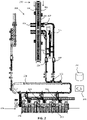
- Figure 2 shows one embodiment of a palletizing system 200 according to the present invention for automatically placing containers containing food products onto pallets 213, 214.
- the palletizing system may be used for placing containers containing salmon of e.g. different weight and/or quality onto pallets 213, 214, within pallet storage 220 accommodating a plurality of pallets 213, 214 at fixed positions and where at least one robotic system is arranged in the proximity of the fixed positions.
- the palletizing system further includes an in-feed area 240 where incoming food items are weighed by a weighing device (not shown) and fed into a grader containing e.g. two parallel distribution conveyors 201, 202.
- the food items are diverted from the distribution conveyors 201, 202 to plurality of compartments or bins 203, where plurality of batches are created.
- the batches are subsequently put into empty containers that are fed by in-feed conveyor 204, where the containers are uniquely identified with container identifiers, i.e. any type of identification means that uniquely identify the containers.
- the uniquely identified empty containers are associated with customer orders, e.g. container ID 123 is associated to customer order F.
- the step of advancing the containers to the position where the batches are released into the containers is preferably fully automatized e.g. via tracking the position of the containers and the batches such that correct batches are placed into the correct empty containers.
- An example of a customer orders could e.g. include target weight and/or quality and/or number of food items etc.
- the customer orders could include the number of containers fulfilling the criteria, e.g. 500 containers of food product A, e.g. 20kg batches of high quality salmon.
- Plurality of containers containing the food items are subsequently conveyed on a conveying means, e.g. two separate conveyors 205, 206, where at stations 207, 208 the containers are identified by e.g. a scanner, and where furthermore information about the food items characteristics in the containers is acquired, e.g. the weight in the containers.
- the container identifiers are subsequently associated to the acquired food items characteristics data inside the container and stored in e.g. a database 232.
- Two ice-devices 215, 216 may also be provided putting ice into the containers, especially if the food products is fish, and subsequently the individual boxes may be strapped at strapping stations.
- the present invention should however to be construed as being limited to such an in-feed area where batches are created and placed into the containers.
- the palletizing system according to the present invention could just as well receive pre-packed containers, where the above mentioned information are associated to the containers, i.e. the container identifier and the information about the food items in the containers.
- Figures 2 further comprises at least one robotic system 210-212 in the proximity of the fixed positions of the plurality of pallets.
- a closed-loop conveyor 230 is arranged at distal ends of the conveyors 205, 206 for receiving the containers and convey them along a closed-loop. As depicted here, the robotic systems are positioned along the closed-loop conveyor 230.
- the palletizing system further comprises an identifier accessing means 233, e.g. a scanner, positioned between conveyors 205, 206 and the closed-loop conveyor 230 for determining the container identifier of each container upstream of the at least one robot system.
- an identifier accessing means 233 e.g. a scanner
- the palletizing system 200 further comprises a control system 232 configured to:
- control system 231 is further configured to utilize information about the capacity of the at least one robotic system, i.e. the number of pick and place container per unit time, in determining the pallet positions to which each of the containers is to be allocated. Based on this, the control system 231 may utilize the associated flow rate of that type of containers and the capacity of the at least one robotic system in determining whether or not to recirculate the container on the closed-loop conveyor. If as an example a pallet position within the palletizing area associated to robotic system 211 has been assigned for a particular product type, e.g. container containing 20kg of food items of high quality, and the flow rate of this particular robot cannot keep up with this high production rate (e.g. all these containers are coming in sequence) then the system may recycle one or more of the boxes at give it another try.
- information about the capacity of the at least one robotic system i.e. the number of pick and place container per unit time, in determining the pallet positions to which each of the containers is to be allocated. Based on this, the control system 231 may utilize
- a label printer and an applicator may be stationed in proximity to each of the at least one robotic system for printing labels with food related information and attaching the labels to the containers prior to arranging each container at the determined pallet position.
- Figure 3 shows another way of creating containers of e.g. fish such as salmon as discussed in relation to figure 2 until the icing and strapping.
- Food products are coming one by one at 300, which may e.g. be an in-feed conveyor, where they are weighed at the weighing station 301 while they are conveyed and continue onto the separator 302 where they are taken off the conveyor one at a time by one of the turnable rejecter arms 311 to 316 (315 is shown in the turned reject position).
- a bin is arranged for each rejecter arm (e.g. 321 next to rejecter arm 311).
- Each bin is equipped with a bottom gate such that when the batch is complete it is discharged onto a takeaway conveyor 301 which takes the batch to the loading station 332.
- An empty container (of a type according to the specifications for that particular batch), is entering the conveyor 330 from 331 and the batch is loaded into the container at the loading station 332 as already described.
- the container continues to 333 where it is weighed, to 334 where it is labelled with all relevant data for the customer, to 335 where ice is put into the container, to 336 where the lid is put on the container and to 337 where it is strapped.
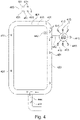
- containers 401 are supplied to a conveying means comprising a closed-loop conveyor 430, from a common or single source of in-feed area 403.
- the system comprises a single robotic system 410 to which the closed-loop conveyor 430 connects by means of a connecting conveyor 442.
- the robotic system allocates containers 401 to a plurality of pallet positions 413.
- the take-out controller may thus be controlled by the control system to determine a respective one of the pallet positions 413 for the containers 401 each time a container 401 approaches the take-out controller 440.
- the control system may be configured to cause the take-out controller overrule a previously determined pallet position 413, whereby a possible overrule decision may be taken by the control system each time a container 401 approaches the take-out controller 440.
- pallet position determination may be performed on-the-fly, so that allocation of pallet positions may be swiftly adapted to changes or order lines, malfunction of the robotic means, priority requirements, etc.
- Containers 401 which are not taken out for palletizing at the robotic system 401 may be recirculated at the closed-loop conveyor, or they may be taken out at discharge conveyor 444 for manual palletizing or other processing.
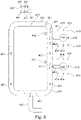
- Figure 5 illustrates an embodiment similar to that of Figure 4 , but with two robotic systems 410, 412 arranged along the closed-loop conveyor 430.
- the embodiment of Figure 5 comprises a common or single source of in-feed area 403 for the containers 401.
- the closed-loop conveyor 430 connects to the robotic systems 401, 412 by means of respective connecting conveyors 442, 443.
- Each of the robotic systems 410, 412 allocate containers 401 to a plurality of pallet positions 413 and 414, respectively.
- take-out controllers 440 and 441 are operated by the control system of the palletizing system to make a final decision as to whether or not each container 401 is to be taken out to any one of the robotic systems 410 and 412.
- the take-out controllers 440, 441 may thus be controlled by the control system to determine a respective one of the pallet positions 413 and 414 for the containers 401 each time a container 401 approaches any one of the take-out controllers 440 and 441.
- the control system may be configured to cause any one of the take-out controllers 440, 441 overrule a previously determined pallet position 413, 414, whereby a possible overrule decision may be taken by the control system each time a container 401 approaches one of the take-out controllers 440, 441.
- pallet position determination may be performed on-the-fly, so that allocation of pallet positions may be swiftly adapted to changes or order lines, malfunction of the robotic means, priority requirements, etc.
- containers 401 which are not taken out for palletizing at the robotic system 401 may be recirculated at the closed-loop conveyor, or they may be taken out at discharge conveyor 444 for manual palletizing or other processing.
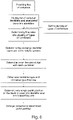
- Figure 6 includes a flow-chart illustrating the method according to the second aspect of the invention, performed in a palletizing system according to the first aspect of the invention.
Landscapes
- Business, Economics & Management (AREA)
- Engineering & Computer Science (AREA)
- Economics (AREA)
- Operations Research (AREA)
- Strategic Management (AREA)
- Development Economics (AREA)
- Accounting & Taxation (AREA)
- Entrepreneurship & Innovation (AREA)
- Human Resources & Organizations (AREA)
- Marketing (AREA)
- Mechanical Engineering (AREA)
- Quality & Reliability (AREA)
- Finance (AREA)
- Tourism & Hospitality (AREA)
- Physics & Mathematics (AREA)
- General Business, Economics & Management (AREA)
- General Physics & Mathematics (AREA)
- Theoretical Computer Science (AREA)
- Stacking Of Articles And Auxiliary Devices (AREA)
- Warehouses Or Storage Devices (AREA)
Applications Claiming Priority (2)
| Application Number | Priority Date | Filing Date | Title |
|---|---|---|---|
| EP15154491 | 2015-02-10 | ||
| PCT/EP2016/052717 WO2016128394A1 (en) | 2015-02-10 | 2016-02-09 | A palletizing system and a method of operating such a palletizing system |
Publications (2)
| Publication Number | Publication Date |
|---|---|
| EP3256406A1 EP3256406A1 (en) | 2017-12-20 |
| EP3256406B1 true EP3256406B1 (en) | 2023-01-25 |
Family
ID=52464263
Family Applications (1)
| Application Number | Title | Priority Date | Filing Date |
|---|---|---|---|
| EP16706549.9A Active EP3256406B1 (en) | 2015-02-10 | 2016-02-09 | A palletizing system and a method of operating such a palletizing system |
Country Status (5)
| Country | Link |
|---|---|
| EP (1) | EP3256406B1 (pl) |
| DK (1) | DK3256406T3 (pl) |
| ES (1) | ES2941912T3 (pl) |
| PL (1) | PL3256406T3 (pl) |
| WO (1) | WO2016128394A1 (pl) |
Families Citing this family (6)
| Publication number | Priority date | Publication date | Assignee | Title |
|---|---|---|---|---|
| CN111670447B (zh) * | 2018-02-07 | 2023-12-22 | 米其林集团总公司 | 识别和使用混合周期中的回收产品的方法 |
| US11523618B2 (en) * | 2019-09-30 | 2022-12-13 | Mettler-Toledo, LLC | X-ray inspection of meat |
| CN113110132B (zh) * | 2021-03-23 | 2022-12-30 | 佛山市高明安华陶瓷洁具有限公司 | 基于工业机器人的堆垛控制方法、控制器及控制系统 |
| CN113663937A (zh) * | 2021-08-24 | 2021-11-19 | 格力电器(杭州)有限公司 | 一种基于最小队列的物流智能分拣系统 |
| CN115447858B (zh) * | 2022-09-13 | 2024-07-26 | 北京鑫创数字科技股份有限公司 | 多箱交替的产品打包系统 |
| US11878325B1 (en) * | 2023-05-22 | 2024-01-23 | Tompkins Robotics, Inc. | Logical relocation of sort destinations |
Family Cites Families (4)
| Publication number | Priority date | Publication date | Assignee | Title |
|---|---|---|---|---|
| US4692876A (en) * | 1984-10-12 | 1987-09-08 | Hitachi, Ltd. | Automatic freight stacking system |
| US8406917B2 (en) * | 2006-08-16 | 2013-03-26 | Salahuddin F. Khan | System and method for random mixed palletizing of products |
| US7751919B2 (en) * | 2006-08-19 | 2010-07-06 | Dynamic Micro Systems | Method for operating equipment using buffer station having emergency access |
| FR2993258B1 (fr) * | 2012-07-12 | 2015-04-10 | Cinetic Transitique | Systeme et procede de preparation et de livraison de commandes |
-
2016
- 2016-02-09 WO PCT/EP2016/052717 patent/WO2016128394A1/en not_active Ceased
- 2016-02-09 ES ES16706549T patent/ES2941912T3/es active Active
- 2016-02-09 PL PL16706549.9T patent/PL3256406T3/pl unknown
- 2016-02-09 DK DK16706549.9T patent/DK3256406T3/da active
- 2016-02-09 EP EP16706549.9A patent/EP3256406B1/en active Active
Also Published As
| Publication number | Publication date |
|---|---|
| WO2016128394A1 (en) | 2016-08-18 |
| EP3256406A1 (en) | 2017-12-20 |
| DK3256406T3 (da) | 2023-04-11 |
| ES2941912T3 (es) | 2023-05-26 |
| PL3256406T3 (pl) | 2023-05-02 |
Similar Documents
| Publication | Publication Date | Title |
|---|---|---|
| US11820605B2 (en) | Systems and methods for providing singulation of objects for processing | |
| EP3256406B1 (en) | A palletizing system and a method of operating such a palletizing system | |
| US20250001457A1 (en) | Systems and methods for dynamic processing of objects | |
| US12286310B2 (en) | Systems and methods for processing objects | |
| US20240269711A1 (en) | Systems and methods for providing for the processing of objects in vehicles | |
| US6694220B1 (en) | Device for handling individually packaged goods | |
| US8634954B2 (en) | System and method for handling returned goods in an order-picking system | |
| CA3139261C (en) | SYSTEMS AND METHODS FOR PROCESSING OBJECTS PLACED IN VEHICLES | |
| US20240286839A1 (en) | Distributor system and method for conveying goods in a storage and order-picking system | |
| KR20240175422A (ko) | 물품분류 방법 및 이를 위한 시스템 |
Legal Events
| Date | Code | Title | Description |
|---|---|---|---|
| STAA | Information on the status of an ep patent application or granted ep patent |
Free format text: STATUS: THE INTERNATIONAL PUBLICATION HAS BEEN MADE |
|
| PUAI | Public reference made under article 153(3) epc to a published international application that has entered the european phase |
Free format text: ORIGINAL CODE: 0009012 |
|
| STAA | Information on the status of an ep patent application or granted ep patent |
Free format text: STATUS: REQUEST FOR EXAMINATION WAS MADE |
|
| 17P | Request for examination filed |
Effective date: 20170911 |
|
| AK | Designated contracting states |
Kind code of ref document: A1 Designated state(s): AL AT BE BG CH CY CZ DE DK EE ES FI FR GB GR HR HU IE IS IT LI LT LU LV MC MK MT NL NO PL PT RO RS SE SI SK SM TR |
|
| AX | Request for extension of the european patent |
Extension state: BA ME |
|
| DAV | Request for validation of the european patent (deleted) | ||
| DAX | Request for extension of the european patent (deleted) | ||
| GRAP | Despatch of communication of intention to grant a patent |
Free format text: ORIGINAL CODE: EPIDOSNIGR1 |
|
| STAA | Information on the status of an ep patent application or granted ep patent |
Free format text: STATUS: GRANT OF PATENT IS INTENDED |
|
| INTG | Intention to grant announced |
Effective date: 20220406 |
|
| GRAJ | Information related to disapproval of communication of intention to grant by the applicant or resumption of examination proceedings by the epo deleted |
Free format text: ORIGINAL CODE: EPIDOSDIGR1 |
|
| STAA | Information on the status of an ep patent application or granted ep patent |
Free format text: STATUS: REQUEST FOR EXAMINATION WAS MADE |
|
| INTC | Intention to grant announced (deleted) | ||
| GRAP | Despatch of communication of intention to grant a patent |
Free format text: ORIGINAL CODE: EPIDOSNIGR1 |
|
| STAA | Information on the status of an ep patent application or granted ep patent |
Free format text: STATUS: GRANT OF PATENT IS INTENDED |
|
| INTG | Intention to grant announced |
Effective date: 20221102 |
|
| GRAS | Grant fee paid |
Free format text: ORIGINAL CODE: EPIDOSNIGR3 |
|
| GRAA | (expected) grant |
Free format text: ORIGINAL CODE: 0009210 |
|
| STAA | Information on the status of an ep patent application or granted ep patent |
Free format text: STATUS: THE PATENT HAS BEEN GRANTED |
|
| AK | Designated contracting states |
Kind code of ref document: B1 Designated state(s): AL AT BE BG CH CY CZ DE DK EE ES FI FR GB GR HR HU IE IS IT LI LT LU LV MC MK MT NL NO PL PT RO RS SE SI SK SM TR |
|
| REG | Reference to a national code |
Ref country code: GB Ref legal event code: FG4D |
|
| REG | Reference to a national code |
Ref country code: CH Ref legal event code: EP |
|
| REG | Reference to a national code |
Ref country code: DE Ref legal event code: R096 Ref document number: 602016077601 Country of ref document: DE |
|
| REG | Reference to a national code |
Ref country code: AT Ref legal event code: REF Ref document number: 1545784 Country of ref document: AT Kind code of ref document: T Effective date: 20230215 Ref country code: IE Ref legal event code: FG4D |
|
| REG | Reference to a national code |
Ref country code: FR Ref legal event code: PLFP Year of fee payment: 8 |
|
| REG | Reference to a national code |
Ref country code: DK Ref legal event code: T3 Effective date: 20230405 Ref country code: NO Ref legal event code: T2 Effective date: 20230125 |
|
| REG | Reference to a national code |
Ref country code: SE Ref legal event code: TRGR |
|
| REG | Reference to a national code |
Ref country code: LT Ref legal event code: MG9D |
|
| REG | Reference to a national code |
Ref country code: ES Ref legal event code: FG2A Ref document number: 2941912 Country of ref document: ES Kind code of ref document: T3 Effective date: 20230526 |
|
| REG | Reference to a national code |
Ref country code: NL Ref legal event code: MP Effective date: 20230125 |
|
| REG | Reference to a national code |
Ref country code: AT Ref legal event code: MK05 Ref document number: 1545784 Country of ref document: AT Kind code of ref document: T Effective date: 20230125 |
|
| P01 | Opt-out of the competence of the unified patent court (upc) registered |
Effective date: 20230514 |
|
| PG25 | Lapsed in a contracting state [announced via postgrant information from national office to epo] |
Ref country code: NL Free format text: LAPSE BECAUSE OF FAILURE TO SUBMIT A TRANSLATION OF THE DESCRIPTION OR TO PAY THE FEE WITHIN THE PRESCRIBED TIME-LIMIT Effective date: 20230125 |
|
| PG25 | Lapsed in a contracting state [announced via postgrant information from national office to epo] |
Ref country code: RS Free format text: LAPSE BECAUSE OF FAILURE TO SUBMIT A TRANSLATION OF THE DESCRIPTION OR TO PAY THE FEE WITHIN THE PRESCRIBED TIME-LIMIT Effective date: 20230125 Ref country code: PT Free format text: LAPSE BECAUSE OF FAILURE TO SUBMIT A TRANSLATION OF THE DESCRIPTION OR TO PAY THE FEE WITHIN THE PRESCRIBED TIME-LIMIT Effective date: 20230525 Ref country code: LV Free format text: LAPSE BECAUSE OF FAILURE TO SUBMIT A TRANSLATION OF THE DESCRIPTION OR TO PAY THE FEE WITHIN THE PRESCRIBED TIME-LIMIT Effective date: 20230125 Ref country code: LT Free format text: LAPSE BECAUSE OF FAILURE TO SUBMIT A TRANSLATION OF THE DESCRIPTION OR TO PAY THE FEE WITHIN THE PRESCRIBED TIME-LIMIT Effective date: 20230125 Ref country code: HR Free format text: LAPSE BECAUSE OF FAILURE TO SUBMIT A TRANSLATION OF THE DESCRIPTION OR TO PAY THE FEE WITHIN THE PRESCRIBED TIME-LIMIT Effective date: 20230125 Ref country code: AT Free format text: LAPSE BECAUSE OF FAILURE TO SUBMIT A TRANSLATION OF THE DESCRIPTION OR TO PAY THE FEE WITHIN THE PRESCRIBED TIME-LIMIT Effective date: 20230125 |
|
| PG25 | Lapsed in a contracting state [announced via postgrant information from national office to epo] |
Ref country code: GR Free format text: LAPSE BECAUSE OF FAILURE TO SUBMIT A TRANSLATION OF THE DESCRIPTION OR TO PAY THE FEE WITHIN THE PRESCRIBED TIME-LIMIT Effective date: 20230426 Ref country code: FI Free format text: LAPSE BECAUSE OF FAILURE TO SUBMIT A TRANSLATION OF THE DESCRIPTION OR TO PAY THE FEE WITHIN THE PRESCRIBED TIME-LIMIT Effective date: 20230125 |
|
| REG | Reference to a national code |
Ref country code: CH Ref legal event code: PL |
|
| REG | Reference to a national code |
Ref country code: DE Ref legal event code: R097 Ref document number: 602016077601 Country of ref document: DE |
|
| PG25 | Lapsed in a contracting state [announced via postgrant information from national office to epo] |
Ref country code: SM Free format text: LAPSE BECAUSE OF FAILURE TO SUBMIT A TRANSLATION OF THE DESCRIPTION OR TO PAY THE FEE WITHIN THE PRESCRIBED TIME-LIMIT Effective date: 20230125 Ref country code: RO Free format text: LAPSE BECAUSE OF FAILURE TO SUBMIT A TRANSLATION OF THE DESCRIPTION OR TO PAY THE FEE WITHIN THE PRESCRIBED TIME-LIMIT Effective date: 20230125 Ref country code: MC Free format text: LAPSE BECAUSE OF FAILURE TO SUBMIT A TRANSLATION OF THE DESCRIPTION OR TO PAY THE FEE WITHIN THE PRESCRIBED TIME-LIMIT Effective date: 20230125 Ref country code: LU Free format text: LAPSE BECAUSE OF NON-PAYMENT OF DUE FEES Effective date: 20230209 Ref country code: LI Free format text: LAPSE BECAUSE OF NON-PAYMENT OF DUE FEES Effective date: 20230228 Ref country code: EE Free format text: LAPSE BECAUSE OF FAILURE TO SUBMIT A TRANSLATION OF THE DESCRIPTION OR TO PAY THE FEE WITHIN THE PRESCRIBED TIME-LIMIT Effective date: 20230125 Ref country code: CZ Free format text: LAPSE BECAUSE OF FAILURE TO SUBMIT A TRANSLATION OF THE DESCRIPTION OR TO PAY THE FEE WITHIN THE PRESCRIBED TIME-LIMIT Effective date: 20230125 Ref country code: CH Free format text: LAPSE BECAUSE OF NON-PAYMENT OF DUE FEES Effective date: 20230228 |
|
| PG25 | Lapsed in a contracting state [announced via postgrant information from national office to epo] |
Ref country code: SK Free format text: LAPSE BECAUSE OF FAILURE TO SUBMIT A TRANSLATION OF THE DESCRIPTION OR TO PAY THE FEE WITHIN THE PRESCRIBED TIME-LIMIT Effective date: 20230125 |
|
| PLBE | No opposition filed within time limit |
Free format text: ORIGINAL CODE: 0009261 |
|
| STAA | Information on the status of an ep patent application or granted ep patent |
Free format text: STATUS: NO OPPOSITION FILED WITHIN TIME LIMIT |
|
| REG | Reference to a national code |
Ref country code: IE Ref legal event code: MM4A |
|
| 26N | No opposition filed |
Effective date: 20231026 |
|
| PG25 | Lapsed in a contracting state [announced via postgrant information from national office to epo] |
Ref country code: SI Free format text: LAPSE BECAUSE OF FAILURE TO SUBMIT A TRANSLATION OF THE DESCRIPTION OR TO PAY THE FEE WITHIN THE PRESCRIBED TIME-LIMIT Effective date: 20230125 Ref country code: IE Free format text: LAPSE BECAUSE OF NON-PAYMENT OF DUE FEES Effective date: 20230209 |
|
| PG25 | Lapsed in a contracting state [announced via postgrant information from national office to epo] |
Ref country code: IT Free format text: LAPSE BECAUSE OF FAILURE TO SUBMIT A TRANSLATION OF THE DESCRIPTION OR TO PAY THE FEE WITHIN THE PRESCRIBED TIME-LIMIT Effective date: 20230125 |
|
| PG25 | Lapsed in a contracting state [announced via postgrant information from national office to epo] |
Ref country code: BG Free format text: LAPSE BECAUSE OF FAILURE TO SUBMIT A TRANSLATION OF THE DESCRIPTION OR TO PAY THE FEE WITHIN THE PRESCRIBED TIME-LIMIT Effective date: 20230125 |
|
| PG25 | Lapsed in a contracting state [announced via postgrant information from national office to epo] |
Ref country code: BG Free format text: LAPSE BECAUSE OF FAILURE TO SUBMIT A TRANSLATION OF THE DESCRIPTION OR TO PAY THE FEE WITHIN THE PRESCRIBED TIME-LIMIT Effective date: 20230125 |
|
| PGFP | Annual fee paid to national office [announced via postgrant information from national office to epo] |
Ref country code: ES Payment date: 20250303 Year of fee payment: 10 |
|
| PGFP | Annual fee paid to national office [announced via postgrant information from national office to epo] |
Ref country code: BE Payment date: 20250121 Year of fee payment: 10 |
|
| PGFP | Annual fee paid to national office [announced via postgrant information from national office to epo] |
Ref country code: PL Payment date: 20250124 Year of fee payment: 10 Ref country code: FR Payment date: 20250122 Year of fee payment: 10 |
|
| PG25 | Lapsed in a contracting state [announced via postgrant information from national office to epo] |
Ref country code: CY Free format text: LAPSE BECAUSE OF FAILURE TO SUBMIT A TRANSLATION OF THE DESCRIPTION OR TO PAY THE FEE WITHIN THE PRESCRIBED TIME-LIMIT; INVALID AB INITIO Effective date: 20160209 |
|
| PG25 | Lapsed in a contracting state [announced via postgrant information from national office to epo] |
Ref country code: HU Free format text: LAPSE BECAUSE OF FAILURE TO SUBMIT A TRANSLATION OF THE DESCRIPTION OR TO PAY THE FEE WITHIN THE PRESCRIBED TIME-LIMIT; INVALID AB INITIO Effective date: 20160209 |
|
| PG25 | Lapsed in a contracting state [announced via postgrant information from national office to epo] |
Ref country code: TR Free format text: LAPSE BECAUSE OF FAILURE TO SUBMIT A TRANSLATION OF THE DESCRIPTION OR TO PAY THE FEE WITHIN THE PRESCRIBED TIME-LIMIT Effective date: 20230125 |
|
| PGFP | Annual fee paid to national office [announced via postgrant information from national office to epo] |
Ref country code: SE Payment date: 20260121 Year of fee payment: 11 |
|
| PGFP | Annual fee paid to national office [announced via postgrant information from national office to epo] |
Ref country code: GB Payment date: 20260121 Year of fee payment: 11 |
|
| PGFP | Annual fee paid to national office [announced via postgrant information from national office to epo] |
Ref country code: NO Payment date: 20260123 Year of fee payment: 11 Ref country code: DK Payment date: 20260121 Year of fee payment: 11 Ref country code: DE Payment date: 20260121 Year of fee payment: 11 |
|
| PGFP | Annual fee paid to national office [announced via postgrant information from national office to epo] |
Ref country code: IS Payment date: 20260213 Year of fee payment: 11 |