EP3253595B1 - Pneu radial ayant une structure de ceinture améliorée - Google Patents
Pneu radial ayant une structure de ceinture améliorée Download PDFInfo
- Publication number
- EP3253595B1 EP3253595B1 EP16702676.4A EP16702676A EP3253595B1 EP 3253595 B1 EP3253595 B1 EP 3253595B1 EP 16702676 A EP16702676 A EP 16702676A EP 3253595 B1 EP3253595 B1 EP 3253595B1
- Authority
- EP
- European Patent Office
- Prior art keywords
- reinforcers
- rubber
- layer
- monofilaments
- tyre according
- Prior art date
- Legal status (The legal status is an assumption and is not a legal conclusion. Google has not performed a legal analysis and makes no representation as to the accuracy of the status listed.)
- Not-in-force
Links
Images
Classifications
-
- B—PERFORMING OPERATIONS; TRANSPORTING
- B60—VEHICLES IN GENERAL
- B60C—VEHICLE TYRES; TYRE INFLATION; TYRE CHANGING; CONNECTING VALVES TO INFLATABLE ELASTIC BODIES IN GENERAL; DEVICES OR ARRANGEMENTS RELATED TO TYRES
- B60C9/00—Reinforcements or ply arrangement of pneumatic tyres
- B60C9/0064—Reinforcements comprising monofilaments
-
- B—PERFORMING OPERATIONS; TRANSPORTING
- B60—VEHICLES IN GENERAL
- B60C—VEHICLE TYRES; TYRE INFLATION; TYRE CHANGING; CONNECTING VALVES TO INFLATABLE ELASTIC BODIES IN GENERAL; DEVICES OR ARRANGEMENTS RELATED TO TYRES
- B60C9/00—Reinforcements or ply arrangement of pneumatic tyres
- B60C9/0007—Reinforcements made of metallic elements, e.g. cords, yarns, filaments or fibres made from metal
-
- B—PERFORMING OPERATIONS; TRANSPORTING
- B60—VEHICLES IN GENERAL
- B60C—VEHICLE TYRES; TYRE INFLATION; TYRE CHANGING; CONNECTING VALVES TO INFLATABLE ELASTIC BODIES IN GENERAL; DEVICES OR ARRANGEMENTS RELATED TO TYRES
- B60C9/00—Reinforcements or ply arrangement of pneumatic tyres
- B60C9/0042—Reinforcements made of synthetic materials
-
- B—PERFORMING OPERATIONS; TRANSPORTING
- B60—VEHICLES IN GENERAL
- B60C—VEHICLE TYRES; TYRE INFLATION; TYRE CHANGING; CONNECTING VALVES TO INFLATABLE ELASTIC BODIES IN GENERAL; DEVICES OR ARRANGEMENTS RELATED TO TYRES
- B60C9/00—Reinforcements or ply arrangement of pneumatic tyres
- B60C9/18—Structure or arrangement of belts or breakers, crown-reinforcing or cushioning layers
- B60C9/20—Structure or arrangement of belts or breakers, crown-reinforcing or cushioning layers built-up from rubberised plies each having all cords arranged substantially parallel
- B60C9/2003—Structure or arrangement of belts or breakers, crown-reinforcing or cushioning layers built-up from rubberised plies each having all cords arranged substantially parallel characterised by the materials of the belt cords
- B60C9/2009—Structure or arrangement of belts or breakers, crown-reinforcing or cushioning layers built-up from rubberised plies each having all cords arranged substantially parallel characterised by the materials of the belt cords comprising plies of different materials
-
- B—PERFORMING OPERATIONS; TRANSPORTING
- B60—VEHICLES IN GENERAL
- B60C—VEHICLE TYRES; TYRE INFLATION; TYRE CHANGING; CONNECTING VALVES TO INFLATABLE ELASTIC BODIES IN GENERAL; DEVICES OR ARRANGEMENTS RELATED TO TYRES
- B60C9/00—Reinforcements or ply arrangement of pneumatic tyres
- B60C9/18—Structure or arrangement of belts or breakers, crown-reinforcing or cushioning layers
- B60C9/20—Structure or arrangement of belts or breakers, crown-reinforcing or cushioning layers built-up from rubberised plies each having all cords arranged substantially parallel
- B60C2009/2012—Structure or arrangement of belts or breakers, crown-reinforcing or cushioning layers built-up from rubberised plies each having all cords arranged substantially parallel with particular configuration of the belt cords in the respective belt layers
- B60C2009/2016—Structure or arrangement of belts or breakers, crown-reinforcing or cushioning layers built-up from rubberised plies each having all cords arranged substantially parallel with particular configuration of the belt cords in the respective belt layers comprising cords at an angle of 10 to 30 degrees to the circumferential direction
-
- B—PERFORMING OPERATIONS; TRANSPORTING
- B60—VEHICLES IN GENERAL
- B60C—VEHICLE TYRES; TYRE INFLATION; TYRE CHANGING; CONNECTING VALVES TO INFLATABLE ELASTIC BODIES IN GENERAL; DEVICES OR ARRANGEMENTS RELATED TO TYRES
- B60C9/00—Reinforcements or ply arrangement of pneumatic tyres
- B60C9/18—Structure or arrangement of belts or breakers, crown-reinforcing or cushioning layers
- B60C9/20—Structure or arrangement of belts or breakers, crown-reinforcing or cushioning layers built-up from rubberised plies each having all cords arranged substantially parallel
- B60C2009/2061—Physical properties or dimensions of the belt coating rubber
- B60C2009/2067—Thickness
-
- B—PERFORMING OPERATIONS; TRANSPORTING
- B60—VEHICLES IN GENERAL
- B60C—VEHICLE TYRES; TYRE INFLATION; TYRE CHANGING; CONNECTING VALVES TO INFLATABLE ELASTIC BODIES IN GENERAL; DEVICES OR ARRANGEMENTS RELATED TO TYRES
- B60C9/00—Reinforcements or ply arrangement of pneumatic tyres
- B60C9/18—Structure or arrangement of belts or breakers, crown-reinforcing or cushioning layers
- B60C9/20—Structure or arrangement of belts or breakers, crown-reinforcing or cushioning layers built-up from rubberised plies each having all cords arranged substantially parallel
- B60C2009/2074—Physical properties or dimension of the belt cord
- B60C2009/2077—Diameters of the cords; Linear density thereof
-
- B—PERFORMING OPERATIONS; TRANSPORTING
- B60—VEHICLES IN GENERAL
- B60C—VEHICLE TYRES; TYRE INFLATION; TYRE CHANGING; CONNECTING VALVES TO INFLATABLE ELASTIC BODIES IN GENERAL; DEVICES OR ARRANGEMENTS RELATED TO TYRES
- B60C9/00—Reinforcements or ply arrangement of pneumatic tyres
- B60C9/18—Structure or arrangement of belts or breakers, crown-reinforcing or cushioning layers
- B60C9/20—Structure or arrangement of belts or breakers, crown-reinforcing or cushioning layers built-up from rubberised plies each having all cords arranged substantially parallel
- B60C2009/2074—Physical properties or dimension of the belt cord
- B60C2009/2083—Density in width direction
-
- B—PERFORMING OPERATIONS; TRANSPORTING
- B60—VEHICLES IN GENERAL
- B60C—VEHICLE TYRES; TYRE INFLATION; TYRE CHANGING; CONNECTING VALVES TO INFLATABLE ELASTIC BODIES IN GENERAL; DEVICES OR ARRANGEMENTS RELATED TO TYRES
- B60C9/00—Reinforcements or ply arrangement of pneumatic tyres
- B60C9/18—Structure or arrangement of belts or breakers, crown-reinforcing or cushioning layers
- B60C9/20—Structure or arrangement of belts or breakers, crown-reinforcing or cushioning layers built-up from rubberised plies each having all cords arranged substantially parallel
- B60C2009/2074—Physical properties or dimension of the belt cord
- B60C2009/2096—Twist structures
Definitions
- the present invention relates to tires for vehicles, and to their crown or belt reinforcement. It relates more particularly to the multilayer composite laminates used in the belt of such tires, in particular for passenger vehicles or light trucks.
- a tire with radial carcass reinforcement for a passenger vehicle or light truck comprises, as we know, a tread, two inextensible beads, two flexible sidewalls connecting the beads to the tread and a rigid crown reinforcement or “belt” (“ belt ”) disposed circumferentially between the carcass reinforcement and the tread.
- the tire belt is generally formed by at least two rubber plies known as “working plies”, “triangulation plies” or even “working reinforcement”, superimposed and crossed, most often reinforced with metal cables arranged substantially parallel to each other. relative to the others and inclined relative to the median circumferential plane, these working plies may or may not be associated with other plies and / or rubber fabrics.
- These working plies primary function of giving the tire stiffness or drift thrust (in English, “drift thrust” or “cornering") high, necessary in a known manner to obtain a good road behavior ( "handling ”) on a motor vehicle.
- the above belt which is particularly the case for tires capable of rolling at high speed in a sustained manner, may also include an additional rubber ply above the working plies (tread side), called " hooping ply “or” hooping reinforcement ", which is generally reinforced by so-called” circumferential "reinforcing threads, that is to say that these reinforcing threads are arranged practically parallel to each other and extend substantially circumferentially around the pneumatic casing so as to form an angle preferably within a range of -5 ° to + 5 ° with the median circumferential plane.
- the primary function of these circumferential reinforcing threads is to resist centrifugation of the top at high speed.
- Such belt structures ultimately consisting of a multilayer composite laminate comprising at least one hooping ply, most often textile, and two generally metallic working plies, are well known to those skilled in the art and do not need to be described here in more detail.
- the first reinforcements preferably of polyamide or of polyester, consist of multifilament fibers comprising a very large number (typically several hundred) of elementary filaments of very small diameter, which are twisted together in the form of conventional textile cords.
- the second and third reinforcements consist of unitary steel monofilaments, in particular of very high strength carbon steel.
- the weight of the tires and their rolling resistance can be reduced, at reduced cost thanks to the use of steel monofilaments which do not require any prior assembly operation, and this without penalizing the fin stiffness or the overall endurance in rolling.
- the Applicants have developed an improved multilayer composite laminate, of new architecture, which addresses the above problem and which can therefore constitute an advantageous alternative to the laminates described in the two aforementioned applications, for tires liable to 'be subjected to such particularly severe driving conditions.
- preformed steel monofilaments acting as a kind of springs, makes it possible to increase the endurance of the tire, thanks to an extensibility and a resistance in bending-compression of the multilayer laminate which are both improved.
- the multilayer composite laminate according to the invention can be used as an element for reinforcing the belt of any type of tire, particularly for passenger vehicles including in particular 4x4 and “SUV” (Sport Utility Vehicles ) vehicles or for light-duty vehicles.
- passenger vehicles including in particular 4x4 and “SUV” (Sport Utility Vehicles ) vehicles or for light-duty vehicles.
- SUV Sport Utility Vehicles
- x and / or y means “x” or “y” or both (ie “x and y”). Any interval of values designated by the expression “between a and b” represents the range of values going from more than “a” to less than “b” (that is to say limits “a” and “b” excluded. ) while any interval of values designated by the expression “from a to b” signifies the range of values going from “a” to "b” (that is to say including the strict limits “a” and “B”).
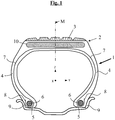
- the figure 1 represents very schematically (that is to say without respecting a specific scale) a radial section of a tire according to the invention, for example for a passenger vehicle or light truck, the belt of which comprises a laminate multilayer composite according to the invention.
- This tire (1) defining three perpendicular directions, circumferential (X), axial (Y) and radial (Z), comprises a crown (2) surmounted by a tread (3), two sidewalls (4), two beads (5), each flank (4) connecting each bead (5) to the top (2), a carcass reinforcement (7) anchored in each of the beads (5) and extending into the sides ( 4) up to the top (2), a crown reinforcement or belt (10) extending in the crown (2) in the circumferential direction (X) and located radially between the carcass reinforcement (7) and the band bearing (3).
- the carcass reinforcement (7) is in a known manner made up of at least one rubber ply reinforced by so-called "radial" textile cords, arranged practically parallel to each other and extending from one bead to the other. so as to form an angle generally between 80 ° and 90 ° with the median circumferential plane M; it is here, by way of example, wound around two bead wires (6) in each bead (5), the upturn (8) of this reinforcement (7) being for example disposed towards the outside of the tire (1) which is shown here mounted on its rim (9).
- angles ⁇ and y in opposite directions can be identical or different, that is to say that the second (120) and third (130) reinforcements can be arranged symmetrically or not, on either side of the median circumferential plane (M) defined above.
- the tread (3), the multilayer laminate (10) and the carcass reinforcement (7) may or may not be in contact with each other, even if these parts have been intentionally separated on the figure 1 , schematically, for reasons of simplification and clarity of the drawing. They could be physically separated, at least for a part of them, for example by connecting gums, well known to those skilled in the art, intended to optimize the cohesion of the assembly after curing or crosslinking.
- the first reinforcements (110) of heat-shrinkable textile material are monofilaments or assemblies of monofilaments, such monofilaments taken individually having a diameter (or, by definition, a thickness if the monofilament is not has not a substantially circular cross section) denoted ⁇ which is greater than 0.10 mm, preferably between 0.15 and 0.80 mm, in particular between 0.20 and 0.60 mm.
- the overall diameter (average) D1 of these first textile reinforcements (110) is for its part between 0.20 mm and 1.20 mm, preferably between 0.30 and 1.00 mm, in particular between 0, 40 and 0.80 mm; in other words, in the particular case where the reinforcement (110) consists in a unitary textile monofilament of circular cross section, the latter has a diameter ⁇ which is necessarily greater than 0.20 mm.
- the term “overall diameter” is usually understood to mean the diameter of the imaginary revolution cylinder which surrounds such first textile reinforcements (110) in the general case where the latter do not have a circular cross section.
- Any heat-shrinkable textile material is suitable, in particular and preferentially a textile material satisfying the CT contraction characteristics set out below is suitable.
- this heat-shrinkable textile material is chosen from the group consisting of polyamides, polyesters and polyketones.
- polyamides mention may in particular be made of polyamides 4-6, 6, 6-6, 11 or 12.
- polyesters mention may be made, for example, of PET (polyethylene terephthalate), PEN (polyethylene naphthalate), PBT (polybutylene terephthalate). ), PBN (polybutylene naphthalate), PPT (polypropylene terephthalate), PPN (polypropylene naphthalate).
- Hybrid reinforcements made up of two (at least two) different materials such as for example assemblies of aramid / nylon, aramid / monofilaments can also be used, in particular and preferably insofar as they satisfy the CT characteristic recommended above.
- the heat-shrinkable textile material constituting the first reinforcements (110) is a polyamide (nylon) or a polyester.
- the density d 1 of the first reinforcements (110) in the first rubber layer (C1), measured in the axial direction (Y), is preferably between 70 and 130 threads / dm, more preferably between 80 and 120 threads / dm, in particular between 90 and 110 threads / dm.
- the quantity CT is measured, unless otherwise specified, according to the ASTM D1204-08 standard, for example on a device of the "TESTRITE" type, under a so-called standard pretension of 0.5 cN / tex (therefore reduced to the titer or linear density of sample tested).
- the maximum of the contraction force is also measured (denoted F C ) using the above test, this time at a temperature of 180 ° C. and under 3% elongation.
- This contraction force F C is preferably greater than 20 N (Newton).
- a high contraction force has been shown to be particularly favorable to the shrinking capacity of first reinforcements (110) in heat-shrinkable textile material, vis-à-vis the crown reinforcement of the tire when the latter heats up under high rolling speed.
- the quantities CT and F C above can be measured without distinction on the initial textile reinforcements glued before their incorporation into the laminate and then into the tire, or else measured on these reinforcements once extracted from the central zone of the vulcanized tire and preferably " degummed ”(that is to say free of the rubber which coats them in layer C1).
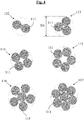
- the figure 4 shows schematically in cross section, different examples (112, 113, 114, 115, 116, 117) of assemblies of (respectively 2, 3, 4, 5, 6 and 7) monofilaments (111) of heat-shrinkable textile material such as for example polyamide, polyester or polyketone, which can be used as reinforcements (110) in the first layer (10a) of the multilayer composite laminate according to the invention.
- monofilaments (111) of heat-shrinkable textile material such as for example polyamide, polyester or polyketone, which can be used as reinforcements (110) in the first layer (10a) of the multilayer composite laminate according to the invention.
- the monofilaments or assemblies of heat-shrinkable textile monofilaments have the advantage, compared with textile cords formed from conventional multifilament fibers, of better protecting the rest of the multilayer composite laminate against humidity, thus limiting the risks of penalizing adhesion between the layers.
- various reinforcements of the laminate and their surrounding rubber matrix not to mention the risk of corrosion of the surfaces of the steel reinforcements.
- assemblies of textile monofilaments preferably comprise 2 to 10, more preferably 3 to 7 monofilaments of heat-shrinkable textile material such as for example polyamide, polyester or polyketone.
- the monofilaments are cabled, twisted together according to well-known techniques, with a twist preferably between 30 and 200 rev / m (turns per meter), more preferably between 30 and 100 rev / m, these monofilaments being, in a known manner, devoid of, or almost devoid of, torsion on themselves.
- the monofilaments or assemblies of monofilaments made of heat-shrinkable textile material represent the majority (by definition, majority in number), more preferably all of the first (110) reinforcements of the first layer (10a) of rubber (C1).
- All or part of the second (120) and / or third (130) reinforcements are steel monofilaments which, as a reminder, are not twisted, cabled together but used as a unit; their diameter (in the rectilinear state, not preformed) or by definition thickness if the monofilament does not have a circular cross section, respectively noted D2 and D3, is between 0.20 mm and 0 , 50 mm.
- D2 and D3 are preferably between 0.25 mm and 0.40 mm, more preferably within a range of 0.28 to 0.35 mm.
- D2 and D3, just like A p may be the same or different from one layer to another; if they are different, D3 may be greater than D2 or else less than D2, according to the particular embodiments of the invention.
- these steel monofilaments are preformed.
- these monofilaments have undergone a preformation treatment in a plane (preformation in 2 dimensions) or in space (preformation in 3 dimensions), such treatment having of course the consequence of increasing their overall diameter (hereinafter A p ) relative to their diameter in the non-preformed state (D2 or D3), that is to say rectilinear.
- the preformation can take any known form, in two dimensions (that is to say contained in a single plane, for example in the form of an undulation or a ziz-zag) or in three dimensions (that is to say that is to say contained in space, for example in the form of a helix).
- the preformed monofilaments are in a corrugated form or in a helical form.
- Preformed steel wires and / or their manufacturing processes are well known to those skilled in the art of tires; they have been described in particular in EP 462 716 , EP 1,066,989 , EP 1 162 086 , EP 1 184 203 , EP 1,439,967 , US 5,524,687 , WO 2006/100245 , to name just a few examples.
- the pre-training may or may not be periodic.
- the monofilaments could contain, as an alternative, straight parts (rectilinear) and preformed parts.
- a p is preferably between 1.1 and 2.0 times the diameter or thickness, respectively D2 and / or D3, of the non-preformed monofilament, that is to say in the rectilinear state.
- a p represents in a known manner the diameter of the circle circumscribing the preformed monofilament, or the diameter of the imaginary cylinder which envelops, surrounds the preformed monofilament.
- a p is more preferably between 1.1 and 1.8 times the diameter or thickness (respectively D2 and / or D3) of the non-preformed monofilament (rectilinear).
- the reinforcement (120 and / or 130) that constitutes the preformed monofilament is capable of deforming, like a spring, when it is subjected to a compressive stress (by compressing) or a stress of extension (by lying down). Thanks to such a preformation, the buckling resistance of the steel monofilaments is improved, with it the compressive endurance of the multilayer composite laminate and that of the overall belt, compared to the solutions described in the two applications.
- WO 2013/117476 and WO 2013/117477 aforementioned.
- the density, respectively d 2 and d 3 , of the second (120) and third (130) reinforcements in the second (C2) and third (C3) layers of rubber, respectively, measured in the axial direction (Y), is preferably included between 100 and 180 threads / dm, more preferably between 110 and 170 threads / dm, in particular between 120 and 160 threads / dm.
- the preformed monofilaments represent at least a portion, preferably all, of the second (120) reinforcements of the second layer (10b) of rubber (C2). According to another preferred embodiment, whether or not combined with the previous one, the preformed monofilaments represent at least a part, preferably all, of the third (130) reinforcements of the third layer (10c) of rubber (C3).
- the steel of these reinforcements is a carbon steel such as those used in cables of the “steel cords ” type for tires; but it is of course possible to use other steels, for example stainless steels, or other alloys.
- a carbon steel when a carbon steel is used, its carbon content (% by weight of steel) is within a range of 0.5% to 1.2%, more preferably 0.7 % to 1.0%.
- the invention applies in particular to steels of the steel cord type with normal strength (called “NT” for “Normal Tensile ”) or high strength (called “HT” for “High Tensile “), the (second and third ) carbon steel reinforcements then having a tensile strength (Rm) which is preferably greater than 2000 MPa, more preferably greater than 2500 MPa.
- the invention also applies to steels of the steel cord type with very high resistance (called “SHT” for “ Super High Tensile "), ultra-high resistance (called “UHT” for “Ultra High Tensile “ or “MT” for “Mega Tensile ”), the (second and third) carbon steel reinforcements then having a tensile strength (Rm) which is preferably greater than 3000 MPa, more preferably greater than 3500 MPa.
- Rm tensile strength
- the total elongation at break (At) of these reinforcements, the sum of the elastic elongation and the plastic elongation, is preferably greater than 2.0%.
- the steel used can itself be coated with a metallic layer improving for example the processing properties of the monofilament d. steel, or the properties of use of the reinforcement and / or of the tire themselves, such as the properties of adhesion, resistance to corrosion or even resistance to aging.
- the steel used is covered with a layer of brass (Zn-Cu alloy) or of zinc; it will be recalled that during the wire manufacturing process, the brass or zinc coating facilitates the drawing of the wire, as well as the bonding of the wire with the rubber.
- the reinforcements could be covered with a thin metallic layer other than brass or zinc, having for example the function of improving the corrosion resistance of these wires and / or their adhesion to the rubber, for example a thin layer of Co, Ni, Al, an alloy of two or more of the compounds Cu, Zn, Al, Ni, Co, Sn.
- a thin metallic layer other than brass or zinc having for example the function of improving the corrosion resistance of these wires and / or their adhesion to the rubber, for example a thin layer of Co, Ni, Al, an alloy of two or more of the compounds Cu, Zn, Al, Ni, Co, Sn.
- Each layer (C1, C2, C3) of rubber composition (or hereinafter “rubber layer”) constituting the multilayer composite laminate is based on at least one elastomer and a filler.
- the rubber is a diene rubber, that is to say, as a reminder, any elastomer (single elastomer or mixture of elastomers) which is derived, at least in part (ie, a homopolymer or a copolymer), from monomers dienes, that is to say of monomers bearing two carbon-carbon double bonds, whether the latter are conjugated or not.
- elastomer single elastomer or mixture of elastomers
- monomers dienes that is to say of monomers bearing two carbon-carbon double bonds, whether the latter are conjugated or not.
- This diene elastomer is chosen more preferably from the group consisting of polybutadienes (BR), natural rubber (NR), synthetic polyisoprenes (IR), butadiene copolymers, isoprene copolymers, and mixtures of these elastomers. , such copolymers being chosen in particular from the group consisting of butadiene-styrene (SBR) copolymers, isoprene-butadiene (BIR) copolymers, isoprene-styrene (SIR) copolymers and isoprene-copolymers. butadiene-styrene (SBIR).
- a particularly preferred embodiment consists in using an "isoprene” elastomer, that is to say a homopolymer or a copolymer of isoprene, in other words a diene elastomer chosen from the group consisting of natural rubber (NR ), synthetic polyisoprenes (IR), various isoprene copolymers and mixtures of these elastomers.
- isoprene elastomer
- NR natural rubber
- IR synthetic polyisoprenes
- the isoprene elastomer is preferably natural rubber or a synthetic polyisoprene of the cis-1,4 type.
- synthetic polyisoprenes use is preferably made of polyisoprenes having a content (mol%) of cis-1,4 bonds greater than 90%, more preferably still greater than 98%.
- each layer of rubber composition comprises 50 to 100 phr of natural rubber.
- the diene elastomer may consist, in whole or in part, of another diene elastomer such as, for example, an SBR elastomer used in blending or not with another elastomer, for example of type BR.
- Each rubber composition may comprise one or more diene elastomer (s), also all or part of the additives usually used in rubber matrices intended for the manufacture of tires, such as, for example, reinforcing fillers such as tire black.
- carbon or silica coupling agents, anti-aging agents, antioxidants, plasticizers or extender oils, whether the latter are of an aromatic or non-aromatic nature (in particular very weak or non-aromatic oils, for example of the naphthenic or paraffinic type, with high or preferably low viscosity, MES or TDAE oils), plasticizing resins with high glass transition temperature (above 30 ° C), agents facilitating the implementation (processability ) compositions in the uncured state, tackifying resins, anti-reversion agents, methylene acceptors and donors such as for example HMT (hexamethylenetetrami ne) or H3M (hexamethoxymethylmelamine), reinforcing resins (such as resorcinol or bis
- the system for crosslinking the rubber composition is a so-called vulcanization system, that is to say based on sulfur (or on a sulfur donor agent) and on a primary vulcanization accelerator.
- vulcanization system Various known secondary accelerators or vulcanization activators can be added to this basic vulcanization system.
- the sulfur is used at a preferential rate of between 0.5 and 10 phr
- the primary vulcanization accelerator for example a sulfenamide
- the level of reinforcing filler for example carbon black and / or silica, is preferably greater than 30 phr, in particular between 30 and 100 phr.
- Suitable carbon blacks are all carbon blacks, in particular blacks of the HAF, ISAF, SAF type conventionally used in tires (so-called tire grade blacks). Among the latter, there will be mentioned more particularly carbon blacks of grade (ASTM) 300, 600 or 700 (for example N326, N330, N347, N375, N683, N772).
- Suitable silicas are in particular precipitated or pyrogenic silicas having a BET surface area of less than 450 m 2 / g, preferably from 30 to 400 m 2 / g.
- each rubber composition has, in the crosslinked state, a secant modulus in extension, at 10% elongation, which is between 4 and 25 MPa, more preferably between 4 and 20 MPa; values of in particular between 5 and 15 MPa have proved to be particularly suitable.
- the modulus measurements are carried out in tension, unless otherwise indicated according to the ASTM D 412 standard of 1998 ("C" test piece): the secant modulus is measured in second elongation (that is to say after a cycle of accommodation). "true” (that is to say reduced to the real section of the test specimen) at 10% elongation, here noted Ms and expressed in MPa (normal temperature and hygrometry conditions according to standard ASTM D 1349 1999).
- any suitable adhesive system can be used, for example a textile glue of the “RFL” type (resorcinol-formaldehyde- latex) or equivalent as regards the first textile reinforcements, or for example an adhesive coating such as brass or zinc as regards the second and third steel reinforcements; however, it is also possible to use a clear, i.e. uncoated, steel.
- RRL resorcinol-formaldehyde- latex
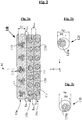
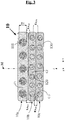
- the figures 2 and 3 schematically show (without respecting a specific scale), in cross section, two examples of multilayer composite laminate (10a, 10b, 10c) used as a belt (10) in the tire (1) according to the invention of the figure 1 , the laminate (10) using in the first layer (C1) reinforcements (110) of heat-shrinkable textile material respectively in the form of an assembly of three monofilaments ( Fig. 2 ) or a simple unitary monofilament ( Fig.
- preformed steel monofilaments 120, 130
- preformation amplitude diameter of the imaginary cylinder enveloping the preformed monofilament
- diameter diameter of the straight monofilament
- Ez 1 is the average of the thicknesses (Ez 1 (1) , Ez 1 (2) , Ez 1 (3) , ..., Ez 1 (i) ) of rubber separating a first reinforcement (110) from the second reinforcement ( 120) which is closest to it, these thicknesses each being measured in the radial direction Z, and averaged over a total axial distance between - 5.0 cm and + 5.0 cm with respect to the center of the belt (i.e., for example in total about 100 measurements if there are ten reinforcements (110) per cm in the layer C1).
- Ez 1 is the average of the minimum distances Ez 1 (i) separating "back to back" each first reinforcement (110) from the second reinforcement (120) which is closest to it in the radial direction Z, this average being calculated on all of the first reinforcements (110) present in the central part of the belt, in an axial interval extending between - 5 cm and + 5 cm with respect to the median plane M.
- Ez 2 is the average of the rubber thicknesses (Ez 2 (1), Ez 2 (2), Ez 2 (3), ..., Ez 2 (i) ) separating a second reinforcement (120) from the third reinforcement (130) which is closest to it, measured in the radial direction Z, this average being calculated over a total axial distance between - 5.0 cm and + 5.0 cm with respect to the center of the belt.
- these thicknesses represent the minimum distances which separate "back to back" the second reinforcement (120) from the third reinforcement (130) which is closest to it in the radial direction Z.
- Ez 2 is the average of the minimum distances Ez 2 (i) separating "back to back" each second reinforcement (120) from the third reinforcement (130) which is closest to it in the radial direction Z, this average being calculated on all of the second reinforcements (120) present in the central part of the belt, in an axial interval extending between - 5 cm and + 5 cm with respect to the median plane M.
- the tire of the invention preferably satisfies at least one of the following inequalities (more preferably all three): 0.10 ⁇ Ez 1 / Ez 1 + D 1 + D 2 ⁇ 0.50 0.10 ⁇ Ez 2 / Ez 2 + D 2 + D 3 ⁇ 0.65 0.30 ⁇ Ez 1 + Ez 2 / Ez 1 + Ez 2 + D 1 + D 2 + D 3 ⁇ 0.60
- the invention offers the possibility, in the multilayer composite laminates forming the tire belts, of improving the buckling resistance of the steel monofilaments while protecting the latter from humidity, this thanks to the use in these. laminates with specific reinforcements as defined above, namely on the one hand in the first layer (C1) of heat-shrinkable textile monofilaments or assemblies of monofilaments, and on the other hand in the second (C2) and third (C3) layers of monofilaments made of steel which are preformed.
Landscapes
- Engineering & Computer Science (AREA)
- Mechanical Engineering (AREA)
- Tires In General (AREA)
- Ropes Or Cables (AREA)
Applications Claiming Priority (2)
| Application Number | Priority Date | Filing Date | Title |
|---|---|---|---|
| FR1550846A FR3032152B1 (fr) | 2015-02-04 | 2015-02-04 | Pneu radial ayant une structure de ceinture amelioree |
| PCT/EP2016/051307 WO2016124420A1 (fr) | 2015-02-04 | 2016-01-22 | Pneu radial ayant une structure de ceinture améliorée |
Publications (2)
| Publication Number | Publication Date |
|---|---|
| EP3253595A1 EP3253595A1 (fr) | 2017-12-13 |
| EP3253595B1 true EP3253595B1 (fr) | 2020-10-21 |
Family
ID=53008685
Family Applications (1)
| Application Number | Title | Priority Date | Filing Date |
|---|---|---|---|
| EP16702676.4A Not-in-force EP3253595B1 (fr) | 2015-02-04 | 2016-01-22 | Pneu radial ayant une structure de ceinture améliorée |
Country Status (4)
| Country | Link |
|---|---|
| EP (1) | EP3253595B1 (enExample) |
| JP (1) | JP2018504320A (enExample) |
| FR (1) | FR3032152B1 (enExample) |
| WO (1) | WO2016124420A1 (enExample) |
Families Citing this family (1)
| Publication number | Priority date | Publication date | Assignee | Title |
|---|---|---|---|---|
| JP7589493B2 (ja) * | 2020-02-18 | 2024-11-26 | 住友ゴム工業株式会社 | 空気入りタイヤ |
Family Cites Families (7)
| Publication number | Priority date | Publication date | Assignee | Title |
|---|---|---|---|---|
| DE3505240A1 (de) * | 1985-02-15 | 1986-08-21 | Uniroyal Englebert Reifen GmbH, 5100 Aachen | Fahrzeugluftreifen |
| JP3322934B2 (ja) * | 1993-03-09 | 2002-09-09 | 横浜ゴム株式会社 | 空気入りラジアルタイヤ |
| JP2001039108A (ja) * | 1999-07-28 | 2001-02-13 | Sumitomo Rubber Ind Ltd | 空気入りラジアルタイヤ |
| JP2001354007A (ja) * | 2000-06-09 | 2001-12-25 | Sumitomo Rubber Ind Ltd | 空気入りラジアルタイヤ |
| DE60238610D1 (de) * | 2001-07-19 | 2011-01-27 | Pirelli | Reifen für kraftfahrzeuge mit gewellten monofilamenten in gürtelverstärkungsschicht |
| FR2986739B1 (fr) * | 2012-02-09 | 2014-03-21 | Michelin & Cie | Pneumatique a structure de ceinture allegee |
| FR2986740B1 (fr) * | 2012-02-09 | 2014-03-21 | Michelin & Cie | Pneumatique a structure de ceinture allegee |
-
2015
- 2015-02-04 FR FR1550846A patent/FR3032152B1/fr not_active Expired - Fee Related
-
2016
- 2016-01-22 WO PCT/EP2016/051307 patent/WO2016124420A1/fr not_active Ceased
- 2016-01-22 EP EP16702676.4A patent/EP3253595B1/fr not_active Not-in-force
- 2016-01-22 JP JP2017541312A patent/JP2018504320A/ja active Pending
Non-Patent Citations (1)
| Title |
|---|
| None * |
Also Published As
| Publication number | Publication date |
|---|---|
| EP3253595A1 (fr) | 2017-12-13 |
| FR3032152B1 (fr) | 2017-02-17 |
| FR3032152A1 (fr) | 2016-08-05 |
| JP2018504320A (ja) | 2018-02-15 |
| WO2016124420A1 (fr) | 2016-08-11 |
Similar Documents
| Publication | Publication Date | Title |
|---|---|---|
| EP3253592B1 (fr) | Pneu radial ayant une structure de ceinture très fine | |
| EP3253598B1 (fr) | Pneu radial ayant une structure de ceinture ameliorée | |
| EP2812194B1 (fr) | Pneumatique a structure de ceinture allégée | |
| EP2812195B1 (fr) | Pneumatique a structure de ceinture allegee | |
| EP3027424B1 (fr) | Pneu radial à structure de ceinture allégée | |
| EP3027429B1 (fr) | Pneu radial à structure de ceinture allégée | |
| EP1984560B1 (fr) | Cable composite elastique pour pneumatique | |
| EP3253597B1 (fr) | Pneu radial ayant une structure de ceinture améliorée | |
| EP3426503B1 (fr) | Pneu radial avec structure de ceinture améliorée | |
| EP3448695B1 (fr) | Pneu avion ayant une armature de carcasse à endurance améliorée | |
| EP3253596B1 (fr) | Pneu radial ayant une structure de ceinture améliorée | |
| EP3253593B1 (fr) | Pneu radial ayant une structure de ceinture améliorée renforcée de monofilaments | |
| EP3253594B1 (fr) | Pneu radial ayant une structure de ceinture ameliorée | |
| WO2016124420A1 (fr) | Pneu radial ayant une structure de ceinture améliorée |
Legal Events
| Date | Code | Title | Description |
|---|---|---|---|
| STAA | Information on the status of an ep patent application or granted ep patent |
Free format text: STATUS: THE INTERNATIONAL PUBLICATION HAS BEEN MADE |
|
| PUAI | Public reference made under article 153(3) epc to a published international application that has entered the european phase |
Free format text: ORIGINAL CODE: 0009012 |
|
| STAA | Information on the status of an ep patent application or granted ep patent |
Free format text: STATUS: REQUEST FOR EXAMINATION WAS MADE |
|
| 17P | Request for examination filed |
Effective date: 20170904 |
|
| AK | Designated contracting states |
Kind code of ref document: A1 Designated state(s): AL AT BE BG CH CY CZ DE DK EE ES FI FR GB GR HR HU IE IS IT LI LT LU LV MC MK MT NL NO PL PT RO RS SE SI SK SM TR |
|
| AX | Request for extension of the european patent |
Extension state: BA ME |
|
| DAV | Request for validation of the european patent (deleted) | ||
| DAX | Request for extension of the european patent (deleted) | ||
| RAP1 | Party data changed (applicant data changed or rights of an application transferred) |
Owner name: COMPAGNIE GENERALE DES ETABLISSEMENTS MICHELIN |
|
| STAA | Information on the status of an ep patent application or granted ep patent |
Free format text: STATUS: EXAMINATION IS IN PROGRESS |
|
| 17Q | First examination report despatched |
Effective date: 20191014 |
|
| GRAP | Despatch of communication of intention to grant a patent |
Free format text: ORIGINAL CODE: EPIDOSNIGR1 |
|
| STAA | Information on the status of an ep patent application or granted ep patent |
Free format text: STATUS: GRANT OF PATENT IS INTENDED |
|
| INTG | Intention to grant announced |
Effective date: 20200520 |
|
| GRAS | Grant fee paid |
Free format text: ORIGINAL CODE: EPIDOSNIGR3 |
|
| GRAA | (expected) grant |
Free format text: ORIGINAL CODE: 0009210 |
|
| STAA | Information on the status of an ep patent application or granted ep patent |
Free format text: STATUS: THE PATENT HAS BEEN GRANTED |
|
| AK | Designated contracting states |
Kind code of ref document: B1 Designated state(s): AL AT BE BG CH CY CZ DE DK EE ES FI FR GB GR HR HU IE IS IT LI LT LU LV MC MK MT NL NO PL PT RO RS SE SI SK SM TR |
|
| REG | Reference to a national code |
Ref country code: GB Ref legal event code: FG4D Free format text: NOT ENGLISH |
|
| REG | Reference to a national code |
Ref country code: CH Ref legal event code: EP |
|
| REG | Reference to a national code |
Ref country code: IE Ref legal event code: FG4D Free format text: LANGUAGE OF EP DOCUMENT: FRENCH |
|
| REG | Reference to a national code |
Ref country code: DE Ref legal event code: R096 Ref document number: 602016046161 Country of ref document: DE |
|
| REG | Reference to a national code |
Ref country code: AT Ref legal event code: REF Ref document number: 1325464 Country of ref document: AT Kind code of ref document: T Effective date: 20201115 |
|
| REG | Reference to a national code |
Ref country code: AT Ref legal event code: MK05 Ref document number: 1325464 Country of ref document: AT Kind code of ref document: T Effective date: 20201021 |
|
| REG | Reference to a national code |
Ref country code: NL Ref legal event code: MP Effective date: 20201021 |
|
| PG25 | Lapsed in a contracting state [announced via postgrant information from national office to epo] |
Ref country code: GR Free format text: LAPSE BECAUSE OF FAILURE TO SUBMIT A TRANSLATION OF THE DESCRIPTION OR TO PAY THE FEE WITHIN THE PRESCRIBED TIME-LIMIT Effective date: 20210122 Ref country code: FI Free format text: LAPSE BECAUSE OF FAILURE TO SUBMIT A TRANSLATION OF THE DESCRIPTION OR TO PAY THE FEE WITHIN THE PRESCRIBED TIME-LIMIT Effective date: 20201021 Ref country code: PT Free format text: LAPSE BECAUSE OF FAILURE TO SUBMIT A TRANSLATION OF THE DESCRIPTION OR TO PAY THE FEE WITHIN THE PRESCRIBED TIME-LIMIT Effective date: 20210222 Ref country code: RS Free format text: LAPSE BECAUSE OF FAILURE TO SUBMIT A TRANSLATION OF THE DESCRIPTION OR TO PAY THE FEE WITHIN THE PRESCRIBED TIME-LIMIT Effective date: 20201021 Ref country code: NO Free format text: LAPSE BECAUSE OF FAILURE TO SUBMIT A TRANSLATION OF THE DESCRIPTION OR TO PAY THE FEE WITHIN THE PRESCRIBED TIME-LIMIT Effective date: 20210121 Ref country code: NL Free format text: LAPSE BECAUSE OF FAILURE TO SUBMIT A TRANSLATION OF THE DESCRIPTION OR TO PAY THE FEE WITHIN THE PRESCRIBED TIME-LIMIT Effective date: 20201021 |
|
| REG | Reference to a national code |
Ref country code: LT Ref legal event code: MG4D |
|
| PG25 | Lapsed in a contracting state [announced via postgrant information from national office to epo] |
Ref country code: SE Free format text: LAPSE BECAUSE OF FAILURE TO SUBMIT A TRANSLATION OF THE DESCRIPTION OR TO PAY THE FEE WITHIN THE PRESCRIBED TIME-LIMIT Effective date: 20201021 Ref country code: AT Free format text: LAPSE BECAUSE OF FAILURE TO SUBMIT A TRANSLATION OF THE DESCRIPTION OR TO PAY THE FEE WITHIN THE PRESCRIBED TIME-LIMIT Effective date: 20201021 Ref country code: ES Free format text: LAPSE BECAUSE OF FAILURE TO SUBMIT A TRANSLATION OF THE DESCRIPTION OR TO PAY THE FEE WITHIN THE PRESCRIBED TIME-LIMIT Effective date: 20201021 Ref country code: BG Free format text: LAPSE BECAUSE OF FAILURE TO SUBMIT A TRANSLATION OF THE DESCRIPTION OR TO PAY THE FEE WITHIN THE PRESCRIBED TIME-LIMIT Effective date: 20210121 Ref country code: IS Free format text: LAPSE BECAUSE OF FAILURE TO SUBMIT A TRANSLATION OF THE DESCRIPTION OR TO PAY THE FEE WITHIN THE PRESCRIBED TIME-LIMIT Effective date: 20210221 Ref country code: PL Free format text: LAPSE BECAUSE OF FAILURE TO SUBMIT A TRANSLATION OF THE DESCRIPTION OR TO PAY THE FEE WITHIN THE PRESCRIBED TIME-LIMIT Effective date: 20201021 Ref country code: LV Free format text: LAPSE BECAUSE OF FAILURE TO SUBMIT A TRANSLATION OF THE DESCRIPTION OR TO PAY THE FEE WITHIN THE PRESCRIBED TIME-LIMIT Effective date: 20201021 |
|
| PG25 | Lapsed in a contracting state [announced via postgrant information from national office to epo] |
Ref country code: HR Free format text: LAPSE BECAUSE OF FAILURE TO SUBMIT A TRANSLATION OF THE DESCRIPTION OR TO PAY THE FEE WITHIN THE PRESCRIBED TIME-LIMIT Effective date: 20201021 |
|
| REG | Reference to a national code |
Ref country code: DE Ref legal event code: R097 Ref document number: 602016046161 Country of ref document: DE |
|
| PG25 | Lapsed in a contracting state [announced via postgrant information from national office to epo] |
Ref country code: LT Free format text: LAPSE BECAUSE OF FAILURE TO SUBMIT A TRANSLATION OF THE DESCRIPTION OR TO PAY THE FEE WITHIN THE PRESCRIBED TIME-LIMIT Effective date: 20201021 Ref country code: SM Free format text: LAPSE BECAUSE OF FAILURE TO SUBMIT A TRANSLATION OF THE DESCRIPTION OR TO PAY THE FEE WITHIN THE PRESCRIBED TIME-LIMIT Effective date: 20201021 Ref country code: EE Free format text: LAPSE BECAUSE OF FAILURE TO SUBMIT A TRANSLATION OF THE DESCRIPTION OR TO PAY THE FEE WITHIN THE PRESCRIBED TIME-LIMIT Effective date: 20201021 Ref country code: CZ Free format text: LAPSE BECAUSE OF FAILURE TO SUBMIT A TRANSLATION OF THE DESCRIPTION OR TO PAY THE FEE WITHIN THE PRESCRIBED TIME-LIMIT Effective date: 20201021 Ref country code: SK Free format text: LAPSE BECAUSE OF FAILURE TO SUBMIT A TRANSLATION OF THE DESCRIPTION OR TO PAY THE FEE WITHIN THE PRESCRIBED TIME-LIMIT Effective date: 20201021 Ref country code: RO Free format text: LAPSE BECAUSE OF FAILURE TO SUBMIT A TRANSLATION OF THE DESCRIPTION OR TO PAY THE FEE WITHIN THE PRESCRIBED TIME-LIMIT Effective date: 20201021 |
|
| PLBE | No opposition filed within time limit |
Free format text: ORIGINAL CODE: 0009261 |
|
| STAA | Information on the status of an ep patent application or granted ep patent |
Free format text: STATUS: NO OPPOSITION FILED WITHIN TIME LIMIT |
|
| PG25 | Lapsed in a contracting state [announced via postgrant information from national office to epo] |
Ref country code: MC Free format text: LAPSE BECAUSE OF FAILURE TO SUBMIT A TRANSLATION OF THE DESCRIPTION OR TO PAY THE FEE WITHIN THE PRESCRIBED TIME-LIMIT Effective date: 20201021 Ref country code: DK Free format text: LAPSE BECAUSE OF FAILURE TO SUBMIT A TRANSLATION OF THE DESCRIPTION OR TO PAY THE FEE WITHIN THE PRESCRIBED TIME-LIMIT Effective date: 20201021 |
|
| REG | Reference to a national code |
Ref country code: CH Ref legal event code: PL |
|
| 26N | No opposition filed |
Effective date: 20210722 |
|
| GBPC | Gb: european patent ceased through non-payment of renewal fee |
Effective date: 20210122 |
|
| PG25 | Lapsed in a contracting state [announced via postgrant information from national office to epo] |
Ref country code: LU Free format text: LAPSE BECAUSE OF NON-PAYMENT OF DUE FEES Effective date: 20210122 |
|
| REG | Reference to a national code |
Ref country code: BE Ref legal event code: MM Effective date: 20210131 |
|
| PG25 | Lapsed in a contracting state [announced via postgrant information from national office to epo] |
Ref country code: IT Free format text: LAPSE BECAUSE OF FAILURE TO SUBMIT A TRANSLATION OF THE DESCRIPTION OR TO PAY THE FEE WITHIN THE PRESCRIBED TIME-LIMIT Effective date: 20201021 Ref country code: AL Free format text: LAPSE BECAUSE OF FAILURE TO SUBMIT A TRANSLATION OF THE DESCRIPTION OR TO PAY THE FEE WITHIN THE PRESCRIBED TIME-LIMIT Effective date: 20201021 |
|
| PG25 | Lapsed in a contracting state [announced via postgrant information from national office to epo] |
Ref country code: GB Free format text: LAPSE BECAUSE OF NON-PAYMENT OF DUE FEES Effective date: 20210122 Ref country code: LI Free format text: LAPSE BECAUSE OF NON-PAYMENT OF DUE FEES Effective date: 20210131 Ref country code: CH Free format text: LAPSE BECAUSE OF NON-PAYMENT OF DUE FEES Effective date: 20210131 Ref country code: SI Free format text: LAPSE BECAUSE OF FAILURE TO SUBMIT A TRANSLATION OF THE DESCRIPTION OR TO PAY THE FEE WITHIN THE PRESCRIBED TIME-LIMIT Effective date: 20201021 |
|
| PG25 | Lapsed in a contracting state [announced via postgrant information from national office to epo] |
Ref country code: IE Free format text: LAPSE BECAUSE OF NON-PAYMENT OF DUE FEES Effective date: 20210122 |
|
| PG25 | Lapsed in a contracting state [announced via postgrant information from national office to epo] |
Ref country code: IS Free format text: LAPSE BECAUSE OF FAILURE TO SUBMIT A TRANSLATION OF THE DESCRIPTION OR TO PAY THE FEE WITHIN THE PRESCRIBED TIME-LIMIT Effective date: 20210221 |
|
| PG25 | Lapsed in a contracting state [announced via postgrant information from national office to epo] |
Ref country code: BE Free format text: LAPSE BECAUSE OF NON-PAYMENT OF DUE FEES Effective date: 20210131 |
|
| PGFP | Annual fee paid to national office [announced via postgrant information from national office to epo] |
Ref country code: FR Payment date: 20230124 Year of fee payment: 8 |
|
| PGFP | Annual fee paid to national office [announced via postgrant information from national office to epo] |
Ref country code: DE Payment date: 20230123 Year of fee payment: 8 |
|
| PG25 | Lapsed in a contracting state [announced via postgrant information from national office to epo] |
Ref country code: CY Free format text: LAPSE BECAUSE OF FAILURE TO SUBMIT A TRANSLATION OF THE DESCRIPTION OR TO PAY THE FEE WITHIN THE PRESCRIBED TIME-LIMIT Effective date: 20201021 |
|
| PG25 | Lapsed in a contracting state [announced via postgrant information from national office to epo] |
Ref country code: HU Free format text: LAPSE BECAUSE OF FAILURE TO SUBMIT A TRANSLATION OF THE DESCRIPTION OR TO PAY THE FEE WITHIN THE PRESCRIBED TIME-LIMIT; INVALID AB INITIO Effective date: 20160122 |
|
| PG25 | Lapsed in a contracting state [announced via postgrant information from national office to epo] |
Ref country code: MK Free format text: LAPSE BECAUSE OF FAILURE TO SUBMIT A TRANSLATION OF THE DESCRIPTION OR TO PAY THE FEE WITHIN THE PRESCRIBED TIME-LIMIT Effective date: 20201021 |
|
| REG | Reference to a national code |
Ref country code: DE Ref legal event code: R119 Ref document number: 602016046161 Country of ref document: DE |
|
| PG25 | Lapsed in a contracting state [announced via postgrant information from national office to epo] |
Ref country code: MT Free format text: LAPSE BECAUSE OF FAILURE TO SUBMIT A TRANSLATION OF THE DESCRIPTION OR TO PAY THE FEE WITHIN THE PRESCRIBED TIME-LIMIT Effective date: 20201021 |
|
| PG25 | Lapsed in a contracting state [announced via postgrant information from national office to epo] |
Ref country code: DE Free format text: LAPSE BECAUSE OF NON-PAYMENT OF DUE FEES Effective date: 20240801 |
|
| PG25 | Lapsed in a contracting state [announced via postgrant information from national office to epo] |
Ref country code: FR Free format text: LAPSE BECAUSE OF NON-PAYMENT OF DUE FEES Effective date: 20240131 |
|
| PG25 | Lapsed in a contracting state [announced via postgrant information from national office to epo] |
Ref country code: FR Free format text: LAPSE BECAUSE OF NON-PAYMENT OF DUE FEES Effective date: 20240131 Ref country code: DE Free format text: LAPSE BECAUSE OF NON-PAYMENT OF DUE FEES Effective date: 20240801 |
|
| PG25 | Lapsed in a contracting state [announced via postgrant information from national office to epo] |
Ref country code: TR Free format text: LAPSE BECAUSE OF FAILURE TO SUBMIT A TRANSLATION OF THE DESCRIPTION OR TO PAY THE FEE WITHIN THE PRESCRIBED TIME-LIMIT Effective date: 20201021 |