EP3252268A1 - Downhole power supply device - Google Patents
Downhole power supply device Download PDFInfo
- Publication number
- EP3252268A1 EP3252268A1 EP16172602.1A EP16172602A EP3252268A1 EP 3252268 A1 EP3252268 A1 EP 3252268A1 EP 16172602 A EP16172602 A EP 16172602A EP 3252268 A1 EP3252268 A1 EP 3252268A1
- Authority
- EP
- European Patent Office
- Prior art keywords
- power supply
- supply device
- downhole
- fuel
- downhole power
- Prior art date
- Legal status (The legal status is an assumption and is not a legal conclusion. Google has not performed a legal analysis and makes no representation as to the accuracy of the status listed.)
- Withdrawn
Links
Images




Classifications
-
- E—FIXED CONSTRUCTIONS
- E21—EARTH OR ROCK DRILLING; MINING
- E21B—EARTH OR ROCK DRILLING; OBTAINING OIL, GAS, WATER, SOLUBLE OR MELTABLE MATERIALS OR A SLURRY OF MINERALS FROM WELLS
- E21B41/00—Equipment or details not covered by groups E21B15/00 - E21B40/00
- E21B41/0085—Adaptations of electric power generating means for use in boreholes
-
- E—FIXED CONSTRUCTIONS
- E21—EARTH OR ROCK DRILLING; MINING
- E21B—EARTH OR ROCK DRILLING; OBTAINING OIL, GAS, WATER, SOLUBLE OR MELTABLE MATERIALS OR A SLURRY OF MINERALS FROM WELLS
- E21B47/00—Survey of boreholes or wells
- E21B47/06—Measuring temperature or pressure
- E21B47/07—Temperature
-
- H—ELECTRICITY
- H01—ELECTRIC ELEMENTS
- H01M—PROCESSES OR MEANS, e.g. BATTERIES, FOR THE DIRECT CONVERSION OF CHEMICAL ENERGY INTO ELECTRICAL ENERGY
- H01M8/00—Fuel cells; Manufacture thereof
- H01M8/04—Auxiliary arrangements, e.g. for control of pressure or for circulation of fluids
- H01M8/04082—Arrangements for control of reactant parameters, e.g. pressure or concentration
- H01M8/04089—Arrangements for control of reactant parameters, e.g. pressure or concentration of gaseous reactants
- H01M8/04119—Arrangements for control of reactant parameters, e.g. pressure or concentration of gaseous reactants with simultaneous supply or evacuation of electrolyte; Humidifying or dehumidifying
- H01M8/04156—Arrangements for control of reactant parameters, e.g. pressure or concentration of gaseous reactants with simultaneous supply or evacuation of electrolyte; Humidifying or dehumidifying with product water removal
- H01M8/04171—Arrangements for control of reactant parameters, e.g. pressure or concentration of gaseous reactants with simultaneous supply or evacuation of electrolyte; Humidifying or dehumidifying with product water removal using adsorbents, wicks or hydrophilic material
-
- H—ELECTRICITY
- H01—ELECTRIC ELEMENTS
- H01M—PROCESSES OR MEANS, e.g. BATTERIES, FOR THE DIRECT CONVERSION OF CHEMICAL ENERGY INTO ELECTRICAL ENERGY
- H01M8/00—Fuel cells; Manufacture thereof
- H01M8/04—Auxiliary arrangements, e.g. for control of pressure or for circulation of fluids
- H01M8/04082—Arrangements for control of reactant parameters, e.g. pressure or concentration
- H01M8/04201—Reactant storage and supply, e.g. means for feeding, pipes
-
- H—ELECTRICITY
- H01—ELECTRIC ELEMENTS
- H01M—PROCESSES OR MEANS, e.g. BATTERIES, FOR THE DIRECT CONVERSION OF CHEMICAL ENERGY INTO ELECTRICAL ENERGY
- H01M8/00—Fuel cells; Manufacture thereof
- H01M8/10—Fuel cells with solid electrolytes
- H01M8/1016—Fuel cells with solid electrolytes characterised by the electrolyte material
- H01M8/1018—Polymeric electrolyte materials
- H01M8/102—Polymeric electrolyte materials characterised by the chemical structure of the main chain of the ion-conducting polymer
- H01M8/103—Polymeric electrolyte materials characterised by the chemical structure of the main chain of the ion-conducting polymer having nitrogen, e.g. sulfonated polybenzimidazoles [S-PBI], polybenzimidazoles with phosphoric acid, sulfonated polyamides [S-PA] or sulfonated polyphosphazenes [S-PPh]
-
- H—ELECTRICITY
- H01—ELECTRIC ELEMENTS
- H01M—PROCESSES OR MEANS, e.g. BATTERIES, FOR THE DIRECT CONVERSION OF CHEMICAL ENERGY INTO ELECTRICAL ENERGY
- H01M8/00—Fuel cells; Manufacture thereof
- H01M8/18—Regenerative fuel cells, e.g. redox flow batteries or secondary fuel cells
- H01M8/184—Regeneration by electrochemical means
- H01M8/186—Regeneration by electrochemical means by electrolytic decomposition of the electrolytic solution or the formed water product
-
- H—ELECTRICITY
- H01—ELECTRIC ELEMENTS
- H01M—PROCESSES OR MEANS, e.g. BATTERIES, FOR THE DIRECT CONVERSION OF CHEMICAL ENERGY INTO ELECTRICAL ENERGY
- H01M8/00—Fuel cells; Manufacture thereof
- H01M8/10—Fuel cells with solid electrolytes
- H01M2008/1095—Fuel cells with polymeric electrolytes
-
- H—ELECTRICITY
- H01—ELECTRIC ELEMENTS
- H01M—PROCESSES OR MEANS, e.g. BATTERIES, FOR THE DIRECT CONVERSION OF CHEMICAL ENERGY INTO ELECTRICAL ENERGY
- H01M2250/00—Fuel cells for particular applications; Specific features of fuel cell system
- H01M2250/10—Fuel cells in stationary systems, e.g. emergency power source in plant
-
- Y—GENERAL TAGGING OF NEW TECHNOLOGICAL DEVELOPMENTS; GENERAL TAGGING OF CROSS-SECTIONAL TECHNOLOGIES SPANNING OVER SEVERAL SECTIONS OF THE IPC; TECHNICAL SUBJECTS COVERED BY FORMER USPC CROSS-REFERENCE ART COLLECTIONS [XRACs] AND DIGESTS
- Y02—TECHNOLOGIES OR APPLICATIONS FOR MITIGATION OR ADAPTATION AGAINST CLIMATE CHANGE
- Y02B—CLIMATE CHANGE MITIGATION TECHNOLOGIES RELATED TO BUILDINGS, e.g. HOUSING, HOUSE APPLIANCES OR RELATED END-USER APPLICATIONS
- Y02B90/00—Enabling technologies or technologies with a potential or indirect contribution to GHG emissions mitigation
- Y02B90/10—Applications of fuel cells in buildings
-
- Y—GENERAL TAGGING OF NEW TECHNOLOGICAL DEVELOPMENTS; GENERAL TAGGING OF CROSS-SECTIONAL TECHNOLOGIES SPANNING OVER SEVERAL SECTIONS OF THE IPC; TECHNICAL SUBJECTS COVERED BY FORMER USPC CROSS-REFERENCE ART COLLECTIONS [XRACs] AND DIGESTS
- Y02—TECHNOLOGIES OR APPLICATIONS FOR MITIGATION OR ADAPTATION AGAINST CLIMATE CHANGE
- Y02E—REDUCTION OF GREENHOUSE GAS [GHG] EMISSIONS, RELATED TO ENERGY GENERATION, TRANSMISSION OR DISTRIBUTION
- Y02E60/00—Enabling technologies; Technologies with a potential or indirect contribution to GHG emissions mitigation
- Y02E60/30—Hydrogen technology
- Y02E60/50—Fuel cells
Definitions
- the present invention relates to a downhole power supply device for supplying power in situ to a power consuming device arranged in a well. Furthermore, the present invention relates to a downhole system.
- a downhole power supply device for supplying power in situ to a power consuming device arranged in a well, comprising
- the fuel cell may have an internal pressure which is at least 1.5 bar, preferably at least 3 bar, more preferably at least 5 bar, for increasing a boiling temperature of the water produced in the fuel cell
- the downhole power supply device may have a device housing comprising the fuel cell, the fuel container and the oxidising agent container.
- the device housing may have an internal pressure of at least 1.0 bar, preferably at least 1.5 bar, more preferably at least 3 bar, and even more preferably at least 5 bar.
- the device housing may be configured to withstand an external pressure of at least 50 bar.
- the water outlet may be fluidly connected to a water collecting container.
- the water outlet may be fluidly connected to the water collecting container by means of a capillarity member, such as a wick.
- the capillarity member may comprise a plurality of thin tubes, porous material, or similar materials and/or geometrical shapes for creating a capillarity effect.
- the water collecting container may comprise a water absorbing material.
- the water absorbing material may comprise Silicon dioxide or similar materials.
- the water collecting container may be arranged in the device housing.
- the water collecting container may be the device housing.
- the downhole power supply device as described above may further comprise a control unit for controlling the supply of fuel and/or oxidising agent to the fuel cell.
- the electric output may be connected to the power consuming device.
- the downhole power supply device as described above may further comprise a regenerative unit comprising:
- the downhole power supply device as described above may further comprise a temperature sensor for measuring a temperature exterior of the downhole power supply device and/or interior of the downhole power supply device.
- the downhole power supply device as described above may further comprise a pressure generating unit configured to increase the internal pressure.
- Such increase of the internal pressure may be based on a temperature measurement.
- the fuel container may comprise a plurality of metal hydrates for binding the fuel.
- the present invention also relates to a downhole system comprising
- the power consuming device may be a tool arranged in the well tubular metal structure and the downhole power supply device may be comprised in the tool.
- the tool may be wireless.
- the tool may be connected to a slickline.
- the tool may be connected to an optic fibre for communicating data to a surface of the borehole.
- the tool may be a downhole driving unit, such as a downhole tractor.
- the downhole power supply device may be a secondary power supply to the tool.
- the power consuming device may be a sensor or an actuator, being arranged exterior of the well tubular metal structure.
- the downhole power supply device and the power consuming device may be arranged exterior of the well tubular metal structure.
- the well tubular metal structure may comprise an annular barrier comprising:
- the well tubular metal structure may comprise a plurality of annular barriers.
- the downhole power supply device and the power consuming device may be arranged between two adjacent annular barriers.
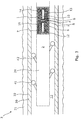
- Fig. 1 shows a downhole power supply device 1 for supplying power in situ to a power consuming device arranged in a borehole of a well so that the power consuming device does not rely on power by other means, such as through a wireline or electric lines on the outside of a well tubular metal structure in the borehole.
- the power consuming device can thus be arranged very far away from the top of the well where power through the wireline is very limited or not possible, or arranged outside the well tubular metal structure away from the reach of electric lines where the power consuming device cannot receive power.
- the downhole power supply device 1 comprises a fuel cell 4 producing electricity, heat and water.
- the downhole power supply device 1 has a fuel inlet 5, an oxidising inlet 6, an electric output 7 and a water outlet 8.
- Fuel is fed from a fuel container 9 fluidly connected to the fuel inlet, and oxidising agent is fed to the fuel cell from an oxidising agent container 10 fluidly connected to the oxidising inlet.
- the fuel cell has an internal pressure P which is at least 1.0 bar for increasing a boiling temperature of the water produced in the fuel cell in order to prevent the water from being transformed into its gas phase.
- the downhole power supply device 1 has a device housing 12 comprising the fuel cell, the fuel container and the oxidising agent container, which has an internal pressure of at least 1.0 bar.
- the internal pressure of at least 1.5 bar, preferably at least 3 bar, of the device housing 12 may be provided at surface before the downhole power supply device 1 is submerged into the well.
- the device housing is provided with a significant wall thickness and is made of a material having a high yield strength.
- the device housing 12 may be made of aluminium in order to efficiently transport heat generated in the housing away from the housing.
- the downhole power supply device 1 is arranged on the exterior face 22 of the well tubular metal structure 20 in order to power a power consuming device 2 which is electrically connected to the electric output 7.
- the downhole power supply device 1 comprises a water collecting container 14 and the water outlet is fluidly connected to the water collecting container 14.
- the water outlet is fluidly connected to the water collecting container by means of a capillarity member 15, such as a wick.
- the capillarity member 15 thus sucks the water from the fuel cell into the water collecting container 14 by means of its capillary effect, and the ability of the water to be led away from the fuel cell does not rely on the gravity force, which is the case for known fuel cells.
- the capillarity member comprises a plurality of thin tubes, porous material, or similar materials and/or geometrical shapes for creating a capillarity effect.
- the capillarity member may comprise a bundle of thin tubes having inherent capillary effect and may be surrounded by an outer tube protecting the capillarity member 15 from the high internal pressure, so that the capillary function is not deteriorated.
- the water collecting container of Fig. 2 comprises a water absorbing material 16 to absorb the water from the capillarity member 15 and thus assist the capillarity member in extracting the water from the fuel cell.
- the water absorbing material comprises Silicon dioxide or similar materials.
- the water collecting container 14 is arranged adjacent to the device housing but may also be arranged in the device housing 12.
- the water collecting container 14 is the device housing 12, and the water absorbing material 16 is arranged in the device housing 12 surrounding both the containers and the fuel cell 4.
- the power consuming device 2 is a wireless driving unit running back and forth in a lower part of the well in one lateral 30 and then further into another lateral 30, as shown in Fig. 4 .
- the wireless driving unit can operate in the lower part of the well for years without having to surface.
- the downhole power supply device 1 may further comprise a control unit 17 for controlling the supply of fuel and/or oxidising agent to the fuel cell 4 via electric lines, e.g. the control unit controls valves 31 arranged in the fuel inlet 5 and the oxidising inlet 6, as shown in Fig. 2 . Once the valves are activated, the fuel cell is activated, and when the valves 31 are closed again, the fuel cell will stop producing electricity. The fuel cell can thus be turned on or off upon request without having to undergo a longer start-up procedure which is not possible when the downhole power supply device is arranged in parts of the well unreachable by electric lines or a wireline.
- the control unit may be pre-programmed with an activation plan, e.g. if the downhole power supply device 1 is arranged outside the well tubular metal structure 20, or the control unit may receive signals in the form of pulsed waves down the well fluid to activate or deactivate the fuel cell.
- the downhole power supply device 1 further comprises a temperature sensor 18 for measuring a temperature exterior of the downhole power supply device and/or interior of the downhole power supply device 1. If the temperature increases to approximate the boiling point of the water, a pressure generating unit 19 is configured to increase the internal pressure, so that the boiling point of the water is equally increased to prohibit the water from boiling.
- the fuel container comprises a plurality of metal hydrates for binding the fuel and thereby ensuring a controlled fuel cell operation.
- Fig. 4 shows a downhole system 100 comprising the well tubular metal structure 20 arranged in a borehole 21 and having an exterior face 22 and an inside 23.
- the downhole power supply device 1 is arranged inside the power consuming device 2, which is a tool 24, such as a downhole driving unit.
- the downhole driving unit may be a downhole tractor as shown in Fig. 3 having wheels 41 on arms 42.
- the downhole power supply device 1 is thus arranged inside the well tubular metal structure 20.
- the downhole power supply device 1 is arranged on the exterior face 22 of the well tubular metal structure 20.
- the power consuming devices 2 are sensors 45 arranged in production zones 101.
- the production zones 101 are provided by annular barriers 50 which are expanded to isolate the production zone.
- the annular barrier may also serve another purpose, e.g. as a liner hanger between an upper casing 32 and the well tubular metal structure 20.
- the well tubular metal structure 20 comprises openings 44 opposite the production zone 101 for allowing fluid to flow from fractures 36 in the production zone into the well tubular metal structure 20.
- the openings may be provided with inflow control valves 46.
- the tool comprising the downhole power supply device 1 may be connected to a slickline, which is not an electric line and which is always present near a well, as the slickline is a cheaper line which does not take up at lot of space.
- the tool may also be connected to an optic fibre for communication of data to a surface of the borehole while being power by the downhole power supply device 1.
- Long wirelines have an electric resistance which is so high that the tool in the end of the wireline does not receive enough power to perform an intended operation, and thus the tool comprises the downhole power supply device as a secondary power supply to the tool in order to compensate for lack of power supply through the wireline.
- the power consuming device is a sensor 45 as well as an actuator 26 arranged exterior of the well tubular metal structure.
- the actuator 26 slides a sliding sleeve 25 to open or close the openings 44.
- the downhole power supply device 1 further comprises a regenerative unit 33 for converting water from the fuel cell into fuel and oxidising agent and thus recharging the fuel cell by supplying the fuel container with fuel and the oxidising agent container with oxidising agent.
- the regenerative unit 33 comprises a regenerative fuel cell 34 configured to convert water from the water collecting container into fuel and oxidising agent.
- the regenerative unit 33 thus has a first inlet 35 fluidly connected with the water collecting container, a first outlet 36 fluidly connected with the fuel container, and a second outlet 37 fluidly connected with the oxidising agent container.
- the regenerative unit 33 further comprises an energy harvesting unit 38 for harvesting energy from a unit (not shown) which is arranged inside the well tubular metal structure 20 and generates energy through the well tubular metal structure 20 to energise the energy harvesting unit 38 and thus the regenerative fuel cell 34 to convert water into fuel and oxidising agent.
- the fuel may be hydrogen and the oxidising agent may be oxygen which in the fuel cell 4 undergo the following chemical reaction:
- the well tubular metal structure of Figs. 4 and 6 comprises annular barriers 50.
- Each annular barrier comprises a tubular metal part 51 for mounting as part of the well tubular metal structure.
- the tubular metal part has a first expansion opening 52 and an outer face 53, and an expandable metal sleeve 54 is arranged surrounding the tubular metal part and having an inner face 55 facing the tubular metal part and an outer face 56 facing a wall 57 of the borehole.
- Each end 58 of the expandable metal sleeve is connected with the tubular metal part, defining an annular space 59 between the inner face of the expandable metal sleeve and the tubular metal part.
- the expandable metal sleeve is configured to expand by entering pressurised fluid into the annular space through the first expansion opening.
- fluid or well fluid any kind of fluid that may be present in oil or gas wells downhole, such as natural gas, oil, oil mud, crude oil, water, etc.
- gas is meant any kind of gas composition present in a well, completion, or open hole
- oil is meant any kind of oil composition, such as crude oil, an oil-containing fluid, etc.
- Gas, oil, and water fluids may thus all comprise other elements or substances than gas, oil, and/or water, respectively.
- a casing any kind of pipe, tubing, tubular, liner, string etc. used downhole in relation to oil or natural gas production.
- a downhole tractor can be used to push the tool all the way into position in the well.
- the downhole tractor may have projectable arms having wheels, wherein the wheels contact the inner surface of the casing for propelling the tractor and the tool forward in the casing.
- a downhole tractor is any kind of driving tool capable of pushing or pulling tools in a well downhole, such as a Well Tractor®.
Landscapes
- Engineering & Computer Science (AREA)
- Life Sciences & Earth Sciences (AREA)
- Mining & Mineral Resources (AREA)
- Geology (AREA)
- Chemical & Material Sciences (AREA)
- Sustainable Energy (AREA)
- Sustainable Development (AREA)
- Electrochemistry (AREA)
- General Chemical & Material Sciences (AREA)
- Chemical Kinetics & Catalysis (AREA)
- Manufacturing & Machinery (AREA)
- Physics & Mathematics (AREA)
- Fluid Mechanics (AREA)
- Environmental & Geological Engineering (AREA)
- General Life Sciences & Earth Sciences (AREA)
- Geochemistry & Mineralogy (AREA)
- Crystallography & Structural Chemistry (AREA)
- Fuel Cell (AREA)
- Geophysics (AREA)
Abstract
The present invention relates to a downhole power supply device (1) for supplying power in situ to a power consuming device (2) arranged in a well (3), comprising a fuel cell (4) producing electricity and water and having a fuel inlet (5), an oxidising inlet (6), an electric output (7) and a water outlet (8), a fuel container (9) fluidly connected to the fuel inlet, and an oxidising agent container (10) fluidly connected to the oxidising inlet, wherein the fuel cell has an internal pressure which is at least 1.0 bar for increasing a boiling temperature of the water produced in the fuel cell. Furthermore, the present invention relates to a downhole system including the downhole power supply device.
Description
- The present invention relates to a downhole power supply device for supplying power in situ to a power consuming device arranged in a well. Furthermore, the present invention relates to a downhole system.
- When performing operations downhole with intervention tools, the demand for power for performing an operation is not always in compliance with the amount of power which can be delivered downhole. Lack of power, e.g. through a wireline, is especially the problem when an operation is performed 10-15 kilometres away from the wireline drum at the rig or at surface. Furthermore, wirelines are not always present at the top of the well. Thus, powering of power consuming devices arranged out of reach from a known supply of power supplied from the top of the well has become a field of increased focus in the area of oil field operations.
- It is an object of the present invention to wholly or partly overcome the above disadvantages and drawbacks of the prior art. More specifically, it is an object to provide an improved downhole power supply for supplying power to a power consuming device arranged out of reach from a known supply of power supplied from the top of the well.
- The above objects, together with numerous other objects, advantages and features, which will become evident from the below description, are accomplished by a solution in accordance with the present invention by a downhole power supply device for supplying power in situ to a power consuming device arranged in a well, comprising
- a fuel cell producing electricity and water and having a fuel inlet, an oxidising inlet, an electric output and a water outlet,
- a fuel container fluidly connected to the fuel inlet, and
- an oxidising agent container fluidly connected to the oxidising inlet,
wherein the fuel cell has an internal pressure which is at least 1.0 bar for increasing a boiling temperature of the water produced in the fuel cell. - In addition, the fuel cell may have an internal pressure which is at least 1.5 bar, preferably at least 3 bar, more preferably at least 5 bar, for increasing a boiling temperature of the water produced in the fuel cell
- The downhole power supply device may have a device housing comprising the fuel cell, the fuel container and the oxidising agent container.
- Moreover, the device housing may have an internal pressure of at least 1.0 bar, preferably at least 1.5 bar, more preferably at least 3 bar, and even more preferably at least 5 bar.
- Also, the device housing may be configured to withstand an external pressure of at least 50 bar.
- Further, the water outlet may be fluidly connected to a water collecting container.
- Additionally, the water outlet may be fluidly connected to the water collecting container by means of a capillarity member, such as a wick.
- The capillarity member may comprise a plurality of thin tubes, porous material, or similar materials and/or geometrical shapes for creating a capillarity effect.
- Moreover, the water collecting container may comprise a water absorbing material.
- Also, the water absorbing material may comprise Silicon dioxide or similar materials.
- Furthermore, the water collecting container may be arranged in the device housing.
- In addition, the water collecting container may be the device housing.
- The downhole power supply device as described above may further comprise a control unit for controlling the supply of fuel and/or oxidising agent to the fuel cell.
- Further, the electric output may be connected to the power consuming device.
- Moreover, the downhole power supply device as described above may further comprise a regenerative unit comprising:
- a regenerative fuel cell for converting water from the fuel cell into fuel and oxidising agent,
- a first inlet fluidly connected with the water collecting container,
- a first outlet fluidly connected with the fuel container, and
- a second outlet fluidly connected with the oxidising agent container.
- The downhole power supply device as described above may further comprise a temperature sensor for measuring a temperature exterior of the downhole power supply device and/or interior of the downhole power supply device.
- Also, the downhole power supply device as described above may further comprise a pressure generating unit configured to increase the internal pressure.
- Such increase of the internal pressure may be based on a temperature measurement.
- Moreover, the fuel container may comprise a plurality of metal hydrates for binding the fuel.
- The present invention also relates to a downhole system comprising
- a well tubular metal structure arranged in a borehole and having an exterior face and an inside,
- a power consuming device, and
- a downhole power supply device according to any of the preceding claims, arranged inside the well tubular metal structure or on the exterior face of the well tubular metal structure.
- Furthermore, the power consuming device may be a tool arranged in the well tubular metal structure and the downhole power supply device may be comprised in the tool.
- The tool may be wireless.
- Also, the tool may be connected to a slickline.
- Further, the tool may be connected to an optic fibre for communicating data to a surface of the borehole.
- Moreover, the tool may be a downhole driving unit, such as a downhole tractor.
- In addition, the downhole power supply device may be a secondary power supply to the tool.
- The power consuming device may be a sensor or an actuator, being arranged exterior of the well tubular metal structure.
- Furthermore, the downhole power supply device and the power consuming device may be arranged exterior of the well tubular metal structure.
- Also, the well tubular metal structure may comprise an annular barrier comprising:
- a tubular metal part for mounting as part of the well tubular metal structure, the tubular metal part having a first expansion opening and an outer face,
- an expandable metal sleeve surrounding the tubular metal part and having an inner face facing the tubular metal part and an outer face facing a wall of the borehole, each end of the expandable metal sleeve being connected with the tubular metal part, and
- an annular space between the inner face of the expandable metal sleeve and the tubular metal part, the expandable metal sleeve being configured to expand by entering pressurised fluid into the annular space through the first expansion opening.
- Further, the well tubular metal structure may comprise a plurality of annular barriers.
- Finally, the downhole power supply device and the power consuming device may be arranged between two adjacent annular barriers.
- The invention and its many advantages will be described in more detail below with reference to the accompanying schematic drawings, which for the purpose of illustration show some non-limiting embodiments and in which
-
Fig. 1 shows a partial cross-sectional view of a downhole power supply device for supplying power in situ in a well, -
Fig. 2 shows a partial cross-sectional view of another downhole power supply device arranged outside of a well tubular metal structure, -
Fig. 3 shows a partial cross-sectional view of another downhole power supply device arranged inside of a well tubular metal structure, -
Fig. 4 shows a partial cross-sectional view of a downhole system in which the downhole power supply device is arranged inside of a well tubular metal structure, -
Fig. 5 shows a partial cross-sectional view of another downhole power supply device arranged outside of a well tubular metal structure, -
Fig. 6 shows a partial cross-sectional view of a downhole system in which the downhole power supply device is arranged outside of a well tubular metal structure, and -
Fig. 7 shows a partial cross-sectional view of another downhole power supply device arranged outside of a well tubular metal structure. - All the figures are highly schematic and not necessarily to scale, and they show only those parts which are necessary in order to elucidate the invention, other parts being omitted or merely suggested.
-
Fig. 1 shows a downholepower supply device 1 for supplying power in situ to a power consuming device arranged in a borehole of a well so that the power consuming device does not rely on power by other means, such as through a wireline or electric lines on the outside of a well tubular metal structure in the borehole. The power consuming device can thus be arranged very far away from the top of the well where power through the wireline is very limited or not possible, or arranged outside the well tubular metal structure away from the reach of electric lines where the power consuming device cannot receive power. - The downhole
power supply device 1 comprises afuel cell 4 producing electricity, heat and water. The downholepower supply device 1 has afuel inlet 5, an oxidisinginlet 6, anelectric output 7 and awater outlet 8. Fuel is fed from afuel container 9 fluidly connected to the fuel inlet, and oxidising agent is fed to the fuel cell from an oxidisingagent container 10 fluidly connected to the oxidising inlet. The fuel cell has an internal pressure P which is at least 1.0 bar for increasing a boiling temperature of the water produced in the fuel cell in order to prevent the water from being transformed into its gas phase. - The downhole
power supply device 1 has adevice housing 12 comprising the fuel cell, the fuel container and the oxidising agent container, which has an internal pressure of at least 1.0 bar. The internal pressure of at least 1.5 bar, preferably at least 3 bar, of thedevice housing 12 may be provided at surface before the downholepower supply device 1 is submerged into the well. - Thus, in order to withstand an external pressure of at least 50 bar, the device housing is provided with a significant wall thickness and is made of a material having a high yield strength. The
device housing 12 may be made of aluminium in order to efficiently transport heat generated in the housing away from the housing. - In
Fig. 2 , the downholepower supply device 1 is arranged on theexterior face 22 of the welltubular metal structure 20 in order to power apower consuming device 2 which is electrically connected to theelectric output 7. The downholepower supply device 1 comprises awater collecting container 14 and the water outlet is fluidly connected to thewater collecting container 14. The water outlet is fluidly connected to the water collecting container by means of acapillarity member 15, such as a wick. Thecapillarity member 15 thus sucks the water from the fuel cell into thewater collecting container 14 by means of its capillary effect, and the ability of the water to be led away from the fuel cell does not rely on the gravity force, which is the case for known fuel cells. When a tool or a well tubular metal structure is submerged into a well, the orientation is not always known, and when entering a non-vertical part of the well, the fuel cell in such tool or outside the well tubular metal structure cannot rely on gravity in order to guide the water from the fuel cell. Thus by providing the downholepower supply device 1 with thecapillarity member 15, it is ensured that the water is always led from the fuel cell, so the process in the fuel cell is not deteriorated. The capillarity member comprises a plurality of thin tubes, porous material, or similar materials and/or geometrical shapes for creating a capillarity effect. Thus, the capillarity member may comprise a bundle of thin tubes having inherent capillary effect and may be surrounded by an outer tube protecting thecapillarity member 15 from the high internal pressure, so that the capillary function is not deteriorated. - The water collecting container of
Fig. 2 comprises awater absorbing material 16 to absorb the water from thecapillarity member 15 and thus assist the capillarity member in extracting the water from the fuel cell. The water absorbing material comprises Silicon dioxide or similar materials. InFig. 2 , thewater collecting container 14 is arranged adjacent to the device housing but may also be arranged in thedevice housing 12. - In
Fig. 3 , thewater collecting container 14 is thedevice housing 12, and thewater absorbing material 16 is arranged in thedevice housing 12 surrounding both the containers and thefuel cell 4. Thepower consuming device 2 is a wireless driving unit running back and forth in a lower part of the well in onelateral 30 and then further into another lateral 30, as shown inFig. 4 . Thus, the wireless driving unit can operate in the lower part of the well for years without having to surface. - The downhole
power supply device 1 may further comprise acontrol unit 17 for controlling the supply of fuel and/or oxidising agent to thefuel cell 4 via electric lines, e.g. the control unit controlsvalves 31 arranged in thefuel inlet 5 and the oxidisinginlet 6, as shown inFig. 2 . Once the valves are activated, the fuel cell is activated, and when thevalves 31 are closed again, the fuel cell will stop producing electricity. The fuel cell can thus be turned on or off upon request without having to undergo a longer start-up procedure which is not possible when the downhole power supply device is arranged in parts of the well unreachable by electric lines or a wireline. The control unit may be pre-programmed with an activation plan, e.g. if the downholepower supply device 1 is arranged outside the welltubular metal structure 20, or the control unit may receive signals in the form of pulsed waves down the well fluid to activate or deactivate the fuel cell. - As shown in
Fig. 5 , the downholepower supply device 1 further comprises atemperature sensor 18 for measuring a temperature exterior of the downhole power supply device and/or interior of the downholepower supply device 1. If the temperature increases to approximate the boiling point of the water, apressure generating unit 19 is configured to increase the internal pressure, so that the boiling point of the water is equally increased to prohibit the water from boiling. The fuel container comprises a plurality of metal hydrates for binding the fuel and thereby ensuring a controlled fuel cell operation. -
Fig. 4 shows adownhole system 100 comprising the welltubular metal structure 20 arranged in aborehole 21 and having anexterior face 22 and an inside 23. The downholepower supply device 1 is arranged inside thepower consuming device 2, which is atool 24, such as a downhole driving unit. The downhole driving unit may be a downhole tractor as shown inFig. 3 havingwheels 41 onarms 42. The downholepower supply device 1 is thus arranged inside the welltubular metal structure 20. InFigs. 5 and6 , the downholepower supply device 1 is arranged on theexterior face 22 of the welltubular metal structure 20. InFig. 6 , thepower consuming devices 2 aresensors 45 arranged inproduction zones 101. Theproduction zones 101 are provided byannular barriers 50 which are expanded to isolate the production zone. The annular barrier may also serve another purpose, e.g. as a liner hanger between anupper casing 32 and the welltubular metal structure 20. The welltubular metal structure 20 comprisesopenings 44 opposite theproduction zone 101 for allowing fluid to flow fromfractures 36 in the production zone into the welltubular metal structure 20. The openings may be provided withinflow control valves 46. - The tool comprising the downhole
power supply device 1 may be connected to a slickline, which is not an electric line and which is always present near a well, as the slickline is a cheaper line which does not take up at lot of space. The tool may also be connected to an optic fibre for communication of data to a surface of the borehole while being power by the downholepower supply device 1. Long wirelines have an electric resistance which is so high that the tool in the end of the wireline does not receive enough power to perform an intended operation, and thus the tool comprises the downhole power supply device as a secondary power supply to the tool in order to compensate for lack of power supply through the wireline. - As shown in
Fig. 6 , the power consuming device is asensor 45 as well as anactuator 26 arranged exterior of the well tubular metal structure. Theactuator 26 slides a sliding sleeve 25 to open or close theopenings 44. - In
Fig. 7 , the downholepower supply device 1 further comprises aregenerative unit 33 for converting water from the fuel cell into fuel and oxidising agent and thus recharging the fuel cell by supplying the fuel container with fuel and the oxidising agent container with oxidising agent. Theregenerative unit 33 comprises aregenerative fuel cell 34 configured to convert water from the water collecting container into fuel and oxidising agent. Theregenerative unit 33 thus has afirst inlet 35 fluidly connected with the water collecting container, afirst outlet 36 fluidly connected with the fuel container, and asecond outlet 37 fluidly connected with the oxidising agent container. Theregenerative unit 33 further comprises anenergy harvesting unit 38 for harvesting energy from a unit (not shown) which is arranged inside the welltubular metal structure 20 and generates energy through the welltubular metal structure 20 to energise theenergy harvesting unit 38 and thus theregenerative fuel cell 34 to convert water into fuel and oxidising agent. - The fuel may be hydrogen and the oxidising agent may be oxygen which in the
fuel cell 4 undergo the following chemical reaction: - Anode Reaction: 2H2 + 2O2- → 2H2O + 4e-
- Cathode Reaction: O2 + 4e- → 2O2-
- Overall Cell Reaction: 2H2 + O2 → 2H2O
- In the
regenerative fuel cell 34, the water is converted into hydrogen and oxygen by the chemical reaction: - At cathode: H2O + 2e- → H2 + O2-
- At anode: O2- → 1/2O2 + 2e-
- Overall: H2O → 1/2O2 + H2
- The well tubular metal structure of
Figs. 4 and6 comprisesannular barriers 50. Each annular barrier comprises atubular metal part 51 for mounting as part of the well tubular metal structure. The tubular metal part has afirst expansion opening 52 and anouter face 53, and anexpandable metal sleeve 54 is arranged surrounding the tubular metal part and having aninner face 55 facing the tubular metal part and anouter face 56 facing awall 57 of the borehole. Eachend 58 of the expandable metal sleeve is connected with the tubular metal part, defining anannular space 59 between the inner face of the expandable metal sleeve and the tubular metal part. The expandable metal sleeve is configured to expand by entering pressurised fluid into the annular space through the first expansion opening. - By fluid or well fluid is meant any kind of fluid that may be present in oil or gas wells downhole, such as natural gas, oil, oil mud, crude oil, water, etc. By gas is meant any kind of gas composition present in a well, completion, or open hole, and by oil is meant any kind of oil composition, such as crude oil, an oil-containing fluid, etc. Gas, oil, and water fluids may thus all comprise other elements or substances than gas, oil, and/or water, respectively.
- By a casing is meant any kind of pipe, tubing, tubular, liner, string etc. used downhole in relation to oil or natural gas production.
- In the event that the tool is not submergible all the way into the casing, a downhole tractor can be used to push the tool all the way into position in the well. The downhole tractor may have projectable arms having wheels, wherein the wheels contact the inner surface of the casing for propelling the tractor and the tool forward in the casing. A downhole tractor is any kind of driving tool capable of pushing or pulling tools in a well downhole, such as a Well Tractor®.
- Although the invention has been described in the above in connection with preferred embodiments of the invention, it will be evident for a person skilled in the art that several modifications are conceivable without departing from the invention as defined by the following claims.
Claims (15)
- A downhole power supply device (1) for supplying power in situ to a power consuming device (2) arranged in a well (3), comprising- a fuel cell (4) producing electricity and water and having a fuel inlet (5), an oxidising inlet (6), an electric output (7) and a water outlet (8),- a fuel container (9) fluidly connected to the fuel inlet, and- an oxidising agent container (10) fluidly connected to the oxidising inlet, wherein the fuel cell has an internal pressure (P) which is at least 1.0 bar for increasing a boiling temperature of the water produced in the fuel cell.
- A downhole power supply device according to claim 1, wherein the downhole power supply device has a device housing (12) comprising the fuel cell, the fuel container and the oxidising agent container.
- A downhole power supply device according to claim 2, wherein the device housing has an internal pressure of at least 1.0 bar.
- A downhole power supply device according to any of the preceding claims, wherein the water outlet is fluidly connected to a water collecting container (14).
- A downhole power supply device according to claim 4, wherein the water outlet is fluidly connected to the water collecting container by means of a capillarity member (15), such as a wick.
- A downhole power supply device according to claim 4 or 5, wherein the water collecting container comprises a water absorbing material (16).
- A downhole power supply device according to claim 6, wherein the water absorbing material comprises Silicon dioxide or similar materials.
- A downhole power supply device according to any of claims 4-7, wherein the water collecting container is arranged in the device housing.
- A downhole power supply device according to any of the preceding claims, further comprising a control unit (17) for controlling the supply of fuel and/or oxidising agent to the fuel cell.
- A downhole power supply device according to any of claims 4-9, further comprising a regenerative unit (33) comprising:- a regenerative fuel cell (34) for converting water from the fuel cell into fuel and oxidising agent,- a first inlet (35) fluidly connected with the water collecting container,- a first outlet (36) fluidly connected with the fuel container, and- a second outlet (37) fluidly connected with the oxidising agent container.
- A downhole power supply device according to any of the preceding claims, further comprising a pressure generating unit (19) configured to increase the internal pressure.
- A downhole system comprising:- a well tubular metal structure (20) arranged in a borehole (21) and having an exterior face (22) and an inside (23),- a power consuming device (2), and- a downhole power supply device (1) according to any of the preceding claims, arranged inside the well tubular metal structure or on the exterior face of the well tubular metal structure.
- A downhole system according to claim 12, wherein the power consuming device is a tool (24) arranged in the well tubular metal structure and the downhole power supply device is comprised in the tool.
- A downhole system according to claim 12, wherein the power consuming device is a sensor (25) or an actuator (26), being arranged exterior of the well tubular metal structure.
- A downhole system according to claim 14, wherein the downhole power supply device and the power consuming device are arranged exterior of the well tubular metal structure.
Priority Applications (10)
| Application Number | Priority Date | Filing Date | Title |
|---|---|---|---|
| EP16172602.1A EP3252268A1 (en) | 2016-06-02 | 2016-06-02 | Downhole power supply device |
| US15/610,962 US10502029B2 (en) | 2016-06-02 | 2017-06-01 | Downhole power supply device |
| PCT/EP2017/063390 WO2017207732A1 (en) | 2016-06-02 | 2017-06-01 | Downhole power supply device |
| AU2017272797A AU2017272797B2 (en) | 2016-06-02 | 2017-06-01 | Downhole power supply device |
| CN201780030139.2A CN109312609A (en) | 2016-06-02 | 2017-06-01 | Underground power supply used device |
| CA3024530A CA3024530A1 (en) | 2016-06-02 | 2017-06-01 | Downhole power supply device |
| BR112018073745-3A BR112018073745A2 (en) | 2016-06-02 | 2017-06-01 | downhole power supply device |
| RU2018145162A RU2018145162A (en) | 2016-06-02 | 2017-06-01 | INSIDE BORE POWER SUPPLY |
| EP17733744.1A EP3464803A1 (en) | 2016-06-02 | 2017-06-01 | Downhole power supply device |
| MX2018014398A MX2018014398A (en) | 2016-06-02 | 2017-06-01 | Downhole power supply device. |
Applications Claiming Priority (1)
| Application Number | Priority Date | Filing Date | Title |
|---|---|---|---|
| EP16172602.1A EP3252268A1 (en) | 2016-06-02 | 2016-06-02 | Downhole power supply device |
Publications (1)
| Publication Number | Publication Date |
|---|---|
| EP3252268A1 true EP3252268A1 (en) | 2017-12-06 |
Family
ID=56097037
Family Applications (2)
| Application Number | Title | Priority Date | Filing Date |
|---|---|---|---|
| EP16172602.1A Withdrawn EP3252268A1 (en) | 2016-06-02 | 2016-06-02 | Downhole power supply device |
| EP17733744.1A Withdrawn EP3464803A1 (en) | 2016-06-02 | 2017-06-01 | Downhole power supply device |
Family Applications After (1)
| Application Number | Title | Priority Date | Filing Date |
|---|---|---|---|
| EP17733744.1A Withdrawn EP3464803A1 (en) | 2016-06-02 | 2017-06-01 | Downhole power supply device |
Country Status (9)
| Country | Link |
|---|---|
| US (1) | US10502029B2 (en) |
| EP (2) | EP3252268A1 (en) |
| CN (1) | CN109312609A (en) |
| AU (1) | AU2017272797B2 (en) |
| BR (1) | BR112018073745A2 (en) |
| CA (1) | CA3024530A1 (en) |
| MX (1) | MX2018014398A (en) |
| RU (1) | RU2018145162A (en) |
| WO (1) | WO2017207732A1 (en) |
Families Citing this family (2)
| Publication number | Priority date | Publication date | Assignee | Title |
|---|---|---|---|---|
| AU2018366219B2 (en) * | 2017-11-10 | 2025-09-11 | Wisconsin Alumni Research Foundation | Using targeted radiotherapy (TRT) to drive anti-tumor immune response to immunotherapies |
| RU2752826C1 (en) * | 2021-01-26 | 2021-08-06 | Публичное акционерное общество «Татнефть» имени В.Д. Шашина | Downhole power supply for downhole equipment |
Citations (3)
| Publication number | Priority date | Publication date | Assignee | Title |
|---|---|---|---|---|
| US20020034668A1 (en) * | 2000-05-17 | 2002-03-21 | Wenlin Zhang | Fuel cell for downhole power systems |
| US20140367120A1 (en) * | 2013-06-18 | 2014-12-18 | Baker Hughes Incorporated | Downhole fuel cell with steam adsorption and pressure compensation |
| US9312557B2 (en) * | 2005-05-11 | 2016-04-12 | Schlumberger Technology Corporation | Fuel cell apparatus and method for downhole power systems |
Family Cites Families (12)
| Publication number | Priority date | Publication date | Assignee | Title |
|---|---|---|---|---|
| US4460292A (en) * | 1982-07-15 | 1984-07-17 | Agritec, Inc. | Process for containment of liquids as solids or semisolids |
| US4662608A (en) * | 1984-09-24 | 1987-05-05 | Ball John W | Automatic drilling control system |
| US6444343B1 (en) | 1996-11-18 | 2002-09-03 | University Of Southern California | Polymer electrolyte membranes for use in fuel cells |
| US6575248B2 (en) * | 2000-05-17 | 2003-06-10 | Schlumberger Technology Corporation | Fuel cell for downhole and subsea power systems |
| JP2002025802A (en) * | 2000-07-10 | 2002-01-25 | Rohm Co Ltd | Chip resistor |
| BRPI0617559B1 (en) * | 2005-09-29 | 2021-06-15 | Prime Mover International, Llc | ROTATING INTERNAL COMBUSTION ENGINE |
| CA2665865C (en) * | 2006-10-20 | 2015-06-16 | Shell Internationale Research Maatschappij B.V. | Heating hydrocarbon containing formations in a spiral startup staged sequence |
| US9096725B2 (en) * | 2009-04-24 | 2015-08-04 | Samsung Electronics Co., Ltd. | Cross-linked polyazole, method of preparing the polyazole, electrode for fuel cell including the cross-linked polyazole, electrolyte membrane for fuel cell including the cross-linked polyazole, method of manufacturing the electrolyte membrane, and fuel cell including the cross-linked polyazole |
| EP2312119A1 (en) * | 2009-10-07 | 2011-04-20 | Welltec A/S | An annular barrier |
| US9603233B2 (en) * | 2010-11-11 | 2017-03-21 | Schlumberger Technology Corporation | Particle accelerator with a heat pipe supporting components of a high voltage power supply |
| CN104271880A (en) * | 2011-05-24 | 2015-01-07 | 快帽系统公司 | Power system for high temperature applications with rechargeable energy storage |
| JP5783324B2 (en) * | 2012-04-06 | 2015-09-24 | トヨタ自動車株式会社 | Fuel cell system |
-
2016
- 2016-06-02 EP EP16172602.1A patent/EP3252268A1/en not_active Withdrawn
-
2017
- 2017-06-01 CA CA3024530A patent/CA3024530A1/en not_active Abandoned
- 2017-06-01 US US15/610,962 patent/US10502029B2/en not_active Expired - Fee Related
- 2017-06-01 BR BR112018073745-3A patent/BR112018073745A2/en not_active IP Right Cessation
- 2017-06-01 WO PCT/EP2017/063390 patent/WO2017207732A1/en not_active Ceased
- 2017-06-01 AU AU2017272797A patent/AU2017272797B2/en not_active Ceased
- 2017-06-01 EP EP17733744.1A patent/EP3464803A1/en not_active Withdrawn
- 2017-06-01 RU RU2018145162A patent/RU2018145162A/en unknown
- 2017-06-01 MX MX2018014398A patent/MX2018014398A/en unknown
- 2017-06-01 CN CN201780030139.2A patent/CN109312609A/en active Pending
Patent Citations (3)
| Publication number | Priority date | Publication date | Assignee | Title |
|---|---|---|---|---|
| US20020034668A1 (en) * | 2000-05-17 | 2002-03-21 | Wenlin Zhang | Fuel cell for downhole power systems |
| US9312557B2 (en) * | 2005-05-11 | 2016-04-12 | Schlumberger Technology Corporation | Fuel cell apparatus and method for downhole power systems |
| US20140367120A1 (en) * | 2013-06-18 | 2014-12-18 | Baker Hughes Incorporated | Downhole fuel cell with steam adsorption and pressure compensation |
Also Published As
| Publication number | Publication date |
|---|---|
| RU2018145162A3 (en) | 2020-07-27 |
| CN109312609A (en) | 2019-02-05 |
| AU2017272797A1 (en) | 2019-01-24 |
| CA3024530A1 (en) | 2017-12-07 |
| BR112018073745A2 (en) | 2019-02-26 |
| US10502029B2 (en) | 2019-12-10 |
| RU2018145162A (en) | 2020-07-09 |
| AU2017272797B2 (en) | 2020-03-26 |
| EP3464803A1 (en) | 2019-04-10 |
| MX2018014398A (en) | 2019-07-08 |
| WO2017207732A1 (en) | 2017-12-07 |
| US20170350216A1 (en) | 2017-12-07 |
Similar Documents
| Publication | Publication Date | Title |
|---|---|---|
| EP3548692B1 (en) | Well completion system | |
| US20210356174A1 (en) | Well completion converting a hydrocarbon production well into a geothermal well | |
| US20110210645A1 (en) | Downhole static power generator | |
| CN110234872A (en) | System for acoustic navigation of boreholes | |
| NO325291B1 (en) | Method and apparatus for establishing an underground well. | |
| EA031016B1 (en) | Method for production of hydrocarbons using caverns | |
| CN104136707B (en) | For the piston hauling machine system in missile silo | |
| CN105793518A (en) | Downhole completion system and method | |
| RU130343U1 (en) | Borehole installation for simultaneous separate development of several operational facilities from one well | |
| US7320366B2 (en) | Assembly of downhole equipment in a wellbore | |
| EP3252268A1 (en) | Downhole power supply device | |
| US12385672B2 (en) | Method and apparatus to establish a geothermal well for closed loop fluid circulation and geothermal heat extraction | |
| EA039708B1 (en) | Downhole communication | |
| WO2013153388A2 (en) | Improved underground coal gasification methods, systems and apparatus | |
| CA2628368A1 (en) | Cut release sub and method | |
| CA2880115C (en) | Thermal regulating well completion devices and methods | |
| EP3686511A1 (en) | Geothermal well, method of establishing thereof and method for geothermal energy production | |
| WO2007022166A1 (en) | Communicating fluids with a heated-fluid generation system | |
| US20130220597A1 (en) | Anchor Assembly | |
| JP2006046009A (en) | Underground hydrocarbon gas resource collection device and collection method | |
| CN115217446B (en) | Resource mining method and device | |
| CN121932140A (en) | Layer-changing exploitation pipe column and method | |
| EP3252267A1 (en) | Downhole completion device with liquid | |
| GB2475812A (en) | Communicating Fluids with a Heated Fluid Generation System |
Legal Events
| Date | Code | Title | Description |
|---|---|---|---|
| PUAI | Public reference made under article 153(3) epc to a published international application that has entered the european phase |
Free format text: ORIGINAL CODE: 0009012 |
|
| AK | Designated contracting states |
Kind code of ref document: A1 Designated state(s): AL AT BE BG CH CY CZ DE DK EE ES FI FR GB GR HR HU IE IS IT LI LT LU LV MC MK MT NL NO PL PT RO RS SE SI SK SM TR |
|
| AX | Request for extension of the european patent |
Extension state: BA ME |
|
| STAA | Information on the status of an ep patent application or granted ep patent |
Free format text: STATUS: THE APPLICATION IS DEEMED TO BE WITHDRAWN |
|
| 18D | Application deemed to be withdrawn |
Effective date: 20180607 |